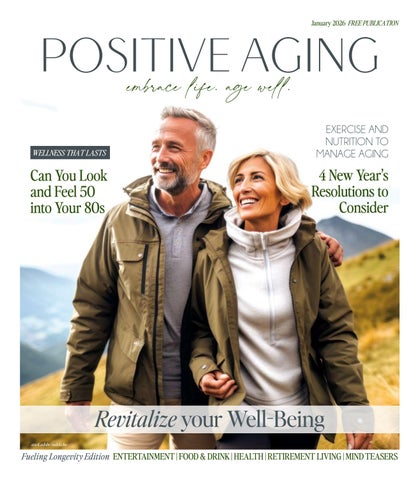
January 2026 FREE PUBLICATION
POSITIVE AGING embrace life. age well.
WELLNESS THAT LASTS
EXERCISE AND NUTRITION TO MANAGE AGING
Can You Look and Feel 50 into Your 80s
4 New Year’s Resolutions to Consider
Revitalize your Well-Being stock.adobe/radekcho
Fueling Longevity Edition ENTERTAINMENT | FOOD & DRINK | HEALTH | RETIREMENT LIVING | MIND TEASERS
ON A POSITIVE NOTE... A Year Older, A Year Wiser
0$,17(1$1&( )5(( /,9,1* )25 $'8/76 83
9 LOODV
$7 7+( 67$7,21
6 :22' &5((. '5,9( 2$. &5((.
&DOO 1RZ
6HFXUHG /REE\ (OHYDWRU &RPPXQLW\ 5RRP 8QGHUJURXQG 3DUNLQJ /DXQGU\ RQ (DFK )ORRU 2Q 6LWH 0DQDJPHQW
As the year winds down, there’s a quiet truth that we often overlook: we’re all getting older. Time moves forward, sometimes in ways that feel like a blur, other times with a slow, almost imperceptible tug. But it’s not just the number of years that pass—it’s the change they bring with them. This year, as we step into a new chapter, I’ve been reflecting on how each passing year shapes us, in ways big and small. The moments that once seemed fleeting are now pieces of a much bigger story. I’ve found that the more I embrace the shifts—whether it’s the way I see the world, the way I’ve learned to hold my space in it, or how I approach the unknown—the more I appreciate the lessons time offers. Aging isn’t just about getting older. It’s about the growth, the resilience, and the understanding that you are ever-evolving. So, as we face the new year, I want to remind you—and myself—that it’s not about the number of candles on the cake. It’s about how you spend your time, how you love and learn, and how you grow into the person you are becoming. Cheers to another year of lessons, challenges, and triumphs. May we approach it with the same curiosity and grace that comes with being a little older, and a lot wiser. Happy New Year.
%/.6 :(67 2) +2:(// $9( 2)) 38(7= 52$'
%('5220 )/225 3/$16 12 ,1&20( /,0,76
ZZZ UHQWZLWKJDWHZD\ FRP YLOODV VWDWLRQ#JPDLO FRP
Steeple View 414-525-5500 An Independent Senior Community Embracing Christian Values
Enjoy secure, worry-free, independent living for active seniors in a caring, Christian atmosphere. Relax with the comforts of home without the burden of home ownership! Our spacious 1, 2 and 3 bedroom deluxe apartment homes start at $927 per month with a 85% refundable entrance fee required.
Call to schedule your personal tour of STEEPLE VIEW!
414-525-5500 12455 West Janesville Road, Muskego 414-525-5500 | steepleview.org | info@steepleview.org POSITIVE AGING January 2026
Revitalize Your Wellness -Amanda Editor-in-chief
Make this YOUR YEAR for Maintenance-Free, Luxury, Senior Living!
(Above) Judy and Bryon and Daryl and Bonnie (below) enjoy their life at Steeple View.
Join TEAM Modern Health and Living www.PinkEnergyRun.com!!! All proceeds go to breast cancer and prostate cancer research
Please like and follow us Positive Aging www.facebook.com/positiveagingnews
POSITIVE AGING EMBRACE LIFE. AGE WELL. KEEP READING.
Contact For information on advertising or to submit articles call, 262-343-5163, or Email: positiveaging@wi.rr.com. Disclaimer POSITIVE AGING is published on the first of each month . The articles in this publication are in no way intended to replace the knowledge or diagnosis of your doctor. We advise seeing a physician whenever a health problem arises requiring an expert’s care.
Images - istock.com Special Thanks -To all the local professionals that provide us with articles containing new information and keeping all our readers informed of the latest in positive living. And to all our advertisers, and you the readers! MyPositiveAging.com Positive Aging is distributed throughout the Milwaukee, Waukesha, Ozauakee and Washington county.
embrace life WELLNESS
´6HQLRU /LYLQJ 7KH :D\ ,W :DV 0HDQW 7R %Hµ
istock.com/simonapilolla
>K d /E d, , Zd K& 'Z &dKE
`PaoXoXPn Ä $a§/XoP /PmuXLPn
0 ůů ĂƉƉůŝĂŶĐĞƐ ŝŶĐůƵĚĞĚ 0 /ŶͲhŶŝƚ tĂƐŚĞƌͬ ƌLJĞƌ 0 'ĞŶĞƌŽƵƐ ĐůŽƐĞƚ ƐƉĂĐĞ 0 WĂƟŽ Žƌ ďĂůĐŽŶLJ 0 hŶĚĞƌŐƌŽƵŶĚ ŚĞĂƚĞĚ ƉĂƌŬŝŶŐ
istock.com/Harbucks
0 ^ĐŚĞĚƵůĞĚ ĂĐƟǀŝƟĞƐ 0 ĞĂƵƚLJ ^ĂůŽŶͬ ĂƌďĞƌ ƐŚŽƉ 0 &ŝƚŶĞƐƐ ƌŽŽŵ 0 WƌŝǀĂƚĞ ĐŚĞĨ ƐĞƌǀŝĐĞ 0 >ŝďƌĂƌLJ 0 ŽŵŵƵŶŝƚLJ 'ĂƌĚĞŶ
P ³ ³ / ¼ | 5¿ w ³ : S¡ ¼· ¿³³ ¡¼ Ï Èl lw ä Kx |¿ P P¦ P¦¿³ :¿³ ¿Î Ü |³¦¦ å Ü ¿ l¼ S¡ ¼·ä
E /E W E Ed Z d/Z D Ed KDDhE/dz t/d, ^K Dh , dK K&& Z͊
>> hd/>/d/ ^ Z /E >h /E d, >Kt DKEd,>z Z Ed t/d, ϵϬй Z &hE > EdZ E & ͊
0$ / 1 =$1. ,. 6 0 0$1. ϴϭϱ tĂƐŚŝŶŐƚŽŶ ^ƚ͘ 'ƌĂŌŽŶ t/ ϱϯϬϮϰ ǁǁǁ͘ƚŚĞƉƌŽǀŝĚĞŶĐĞƉůĂĐĞ͘ŽƌŐ
(48$/ +286,1* 23325781,7<
Fitness after 50 Exercise and Nutrition to Manage Aging and Brain Health By John E. Lewis, Ph.D. Founder and President of Dr Lewis Nutrition® oluntary Associate Professor of the Department of Family Medicine and Community Health at the University of Miami Miller School of Medicine Diplomate, Faculty Member, and Advisor of the Medical Wellness Association The United States has an aging population that is crippled by chronic diseases. About 75% of Americans are almost totally sedentary. Roughly 70% of Americans are low in their vitamin D status. Most adults fail to get the necessary amount of whole foods to make an impact on their daily nutrient requirements. The United States healthcare expenditure was $4.9 Trillion in 2023. Around 80% of this spending is for treating chronic diseases, which are almost entirely due to poor nutrition and being sedentary. So, what do we do? I am sharing with you my top 5 recommendations (in no particular order of importance) for anyone over 50 who is either already dealing with health challenges or is concerned about health moving forward. First, start weight training. While walking is the typical starter recommendation for all sedentary people, it is insufficient for optimizing health. Weight training confers more benefits than making you stronger and increasing muscle size, but also improves your blood pressure and heart rate, cholesterol values, and inflammation level. Start with movements that stress all parts of the body at a reasonable weight and then increase your intensity and frequency. If you do not like the gym, excellent at-home equipment can be bought that will be more than adequate for most people. Also, ladies, do not be concerned about losing your femininity. You do not produce enough testosterone to become overly muscular. Second, check your blood vitamin D level. If your level is deficient (<12 ng/mL) or insufficient (12-20 ng/mL), then address this immediately. While vitamin D is mostly known for its impact on bones, it interacts with over 4,500 of our genes and every major organ system. The optimal value is debatable, but I keep my value at least 50 ng/mL. Get 15-20 minutes of daily sun exposure on your body. If that is not doable, then take a vitamin D3/K2 product (3,000-5,000 IU/day). After a few months, check your value again
V
POSITIVE AGING January 2026
and reevaluate. Third, stay hydrated! Drink pure, clean water; not energy drinks, coffee, or any other liquid. The Atherosclerosis Risk in Communities study showed that hydration level in middle age is related to inflammation and coagulation and predicts developing many age-related degenerative diseases 24 years later. Better hydration throughout life may significantly decrease the prevalence of degenerative diseases, most profoundly heart failure, dementia, and lung disease, which would stop these diseases from developing in 3 million less Americans. Your water needs depend on your activity level and body size, but most people need at least 2 liters/day. Fourth, eat a whole-food, plant-based diet. Multiple studies show the benefits of eating a plant-based diet on reducing the risks of early mortality, cardiovascular disease, and cancer, particularly when replacing animal protein with plant protein. A plant-based diet provides the widest variety of nutrients and phytonutrients that our cells require to function properly. All plants make the nutrients we require (with the exception of vitamin B12 made by bacteria); no animal makes any of these nutrients! Fifth, some amazing nutrients can be acquired with dietary supplements. While optimal health requires good eating habits, exceptions exist in how we can acquire some nutrients with profound effects. Our research from the University of Miami has demonstrated the powerful effects of aloe vera and rice bran polysaccharides on immune function, adult stem cell production, inflammation, and cognitive function. Our work was so compelling that I left my academic career to found Dr Lewis Nutrition® to bring this flagship product, Daily Brain Care, to market. It contains these polysaccharides in the proven concentrations that you would not get from food. These recommendations are important for anyone over 50 to help achieve a high quality of life. This is not an exhaustive list of behaviors that you should consider, but as a starting point and to help you from becoming another tragic statistic of succumbing to chronic disease. Your health depends on it, and you will be doing your part to help reverse our country’s decline due to the chronic disease epidemic crisis.
How Much Movement is Enough? According to health experts, including the American Heart Association (AHA), adults should aim for at least 150 minutes of moderate aerobic activity each week or 75 minutes of vigorous activity. This can be spread throughout the week, with most days of the week being active. If you prefer, you can also do a combination of moderate and vigorous exercise. Additionally, it’s important to incorporate strength training exercises into your routine at least two days a week. This will help maintain muscle mass and bone density, which naturally decline as we get older. Balance and flexibility exercises should also be a regular part of your routine. Though the AHA doesn’t provide a specific time recommendation for these, aiming for at least two sessions per week is ideal for improving stability and preventing falls. Incorporate Movement into Your Daily Life You don’t have to spend hours at the gym to stay active. Incorporate movement into your daily routine, whether it’s walking or cycling to school, doing household chores, or even standing up every hour to stretch. Taking the stairs instead of the elevator, going for short walks during breaks, and stretching while watching TV are small ways to add movement throughout your day. Stay Consistent The key to reaping the benefits of movement as you age is consistency. Make physical activity a habit by setting aside time each day or week for exercise. Whether it’s a morning walk, an evening yoga session, or a weekend bike ride, consistency is what keeps you strong, healthy, and independent in the long run. Movement is the cornerstone of healthy aging. It keeps your body strong, your mind sharp, and your energy high. Whether you’re walking, lifting weights, doing yoga, or practicing balance exercises, staying active is essential for maintaining independence and quality of life. By choosing a variety of movements that challenge your cardiovascular system, strengthen your muscles, improve flexibility, and enhance your balance, you can ensure that your body remains resilient and capable as you grow older. So, find what you enjoy, stay consistent, and keep moving for a healthier, more vibrant future.
, 2025
January 2026 POSITIVE AGING
age well HEALTHLY LIFESTYLE
on limitations, the program highlights the many ways adults can continue to grow, stay active, expand their social circles, and strengthen their well-being. Designed with a whole-person approach, FOREVERWELL is built on three core pillars: moving, connecting, and discovering. Each one supports healthy aging in meaningful and practical ways. Moving is a key part of staying independent and feeling good. The YMCA of Greater Waukesha County offers over 130 FOREVERWELL group exercise classes each week across our Association, all included with membership. These classes aren’t one size fits all. They are intentionally designed for a wide range of abilities, interests, and comfort levels. Whether someone is just beginning their fitness journey or has been active for years, there is a class that fits. The Y’s Healthy Living programs also play a valuable role, addressing common health concerns like pre-diabetes, high blood pressure, cancer recovery, cardiac conditions, and balance issues. These programs are evidence-based and empower adults to manage their health proactively. Together, these options help older adults stay strong, mobile, and confident in istock.com/ AnnaStills their daily lives. Connecting may be one of the biggest contributors to overall well-being, especially as loneliness and isolation become more common with age. FOREVERWELL creates intentional, welcoming spaces where relationships can grow naturally. Monthly socials, free for members, bring people together for fun, food, and conversation. Beyond that, the YMCA offers clubs and activities nearly every day of the week, from Sheepshead and Euchre to walking club, WII sports, and a long list of other social games and gatherings. These elebrating Aging Through Connection, Movement, and Lifelong moments of connection help people feel grounded, supported, and part of Learning: Introducing FOREVERWELL® at the YMCA of Greater something larger. Discovering reflects the belief that curiosity doesn’t fade with age. Many Waukesha County For many, words like Senior, Older Adult, or Elderly can unintentionally adults find joy in continuing to learn, ask questions, and explore new ideas. create a negative picture, one that leans toward slowing down instead of cele- To support this, the YMCA regularly invites local health and wellness profesbrating all that comes with experience and age. But aging is not something to sionals to lead educational talks on topics that matter to the 55+ community. shy away from. It is full of opportunity. It’s a stage of life where people often These sessions cover fraud prevention, memory care, nutrition, brain health, finally have the time to focus on themselves, build relationships, and explore and much more. They allow individuals to stay informed and empowered new interests. That mindset is at the heart of the YMCA of Greater Waukesha while gaining tools that support daily living. One of the things that makes FOREVERWELL stand out is its accessibilCounty’s program for adults ages 55 and up: FOREVERWELL. FOREVERWELL is more than a new label. It reflects a shift in how we ity. The YMCA recognizes that everyone’s circumstances are different. That view aging and what it means to live well later in life. Rather than centering is why programming happens not only inside YMCA branches but also in local senior living communities. By bringing classes, social programs, and educational workshops directly to older adults, the Y ensures that staying active and connected is possible for everyone. Aging is a meaningful part of life, one that deserves encouragement, joy, and community. Through FOREVERWELL, the YMCA of Greater Waukesha County celebrates that journey, offering the tools, support, and connection adults need to thrive. If your loved one needs daytime care, we’re A home away from home With FOREVERWELL, growing here to provide it with love and compassion. older isn’t about stepping back. It is about stepping into a fuller, healthier, more connected life together. The benefits of joining the YMCA are endless. Enjoy no contract or join fees, membership at all six YMCA of Our goal is to enhance the independence of older Daytime Care Socialization Personalized Care Greater Waukesha County Locations, adults through active living that’s personalized for group and family fitness classes, and everyone’s needs. Call today for a tour! more! Explore all the benefits the Y has to offer below. 1919 N. 60th St, Milwaukee 7:00 a.m. - 4:30 p.m. In addition to our great benefits we also have an excellent rewards Health & Wellness Enriching Activities CCMKE.ORG ajankowski@ccmke.org 414.771.6063 program that include exciting perks like Gift Certificates to the Y Store and credits to our varying programs. POSITIVE AGING January 2026
A New Way to Age Well: Introducing FOREVERWELL®
C
Adult Day Center
Welcome!
embrace life HEALTHY AGING
istock.com/AaronAmat
The New Science of Getting Older Without Getting Old Published by FoodTrients ging—not cancer or heart disease—is the underlying cause of most human death and suffering. Scientists work diligently to combat individual diseases, but we never ask: Is aging itself necessary? In Ageless: The New Science of Getting Older Without Getting Old, computational biologist and gifted science writer Andrew Steele reveals an exciting
A
POSITIVE AGING January 2026
effort by scientists to develop treatments for aging that could offer an astonishing extension to our lifespan and a vastly improved quality of life in our later years. In his new book, Steele charts the impressive progress scientists have made in recent years to secure biological immortality for humans by helping us become old without getting frail and to live longer without ill health or disease. We age because our DNA is being damaged by our own actions, such as poor diet choices, smoking, or lack of physical activity. Eventually, our cells start to die or malfunction. The final stage in degeneration is caused by problems with our organs and internal systems and the increased inability to fight infectious diseases. Combating Aging: Out With the Old Scientific testing has shown that decreasing aging “senescent” cells is possible through the use of dasatinib, a cancer drug used in chemotherapy, and a flavonol called quercetin, which is found in fruits and vegetables. Testing in humans is on-going. Studies have shown that eating less helps our bodies eliminate “junk” from our systems. Scientists are working on creating safe drugs that mimic the positive benefits of eating less. On-going scientific tests are now focused on the APP gene, which is believed to be a major cause of early-onset Alzheimer’s. Possible solutions are expected to be developed over the next few years. In With the New: There are four ways scientists are working on replacing our aging immune system: Stem cell therapies that provide stem cells to underpin the regeneration of various parts of our body. Determining ways to help bolster our immune system. Improving our huge ecosystem of bacteria, viruses, and fungi, which we carry in our guts, on our skin, and elsewhere.
Replacing damaged proteins outside our cells, which suffer chemical damage over time. How To Live Long Enough To Live Even Longer: Don’t smoke! Don’t eat too much. Get some exercise. Get seven-to-eight hours of sleep a night. Get vaccinated and wash your hands. Take care of your teeth. Wear sunscreen. Monitor your heart rate and blood pressure. Don’t bother with longevity drugs—yet. Ageless is an interesting journey through the field of aging biology, which has moved from hope to promise. This book is a roadmap, not only for scientists, but also for lay people. Living longer, healthier lives is the goal for all of us. Kale-Cashew Pesto Cashews are a sweet nut that helps to balance the sharpness of kale. I use Tuscan kale, which is mild and tender. It’s also called lactinato kale, black kale, or cavolo nero. This pesto is wonderful tossed with pasta, quinoa, roasted potatoes, or even spread on sandwiches. This recipe is from The Age Beautifully Cookbook, and it’s loaded with antioxidants, which prevent and repair oxidative damage to cells caused by free radicals. Cashews themselves contribute to this antioxidant power, as they are rich in vitamin E, a fat-soluble antioxidant that helps protect cells from oxidative stress while supporting immune function and overall disease prevention. Kale is practically a wonder drug, with all its disease-preventing indoles (sulfur compounds), immune-boosting carotenoids, quercetin, vitamin C, and a bonus helping of bone-building calcium. These nutrients not only fight inflammation but also strengthen the body’s defenses against chronic diseases and infections. Olive oil is rich in heart-healthy monounsaturated fats and flavonoids, both
of which have antioxidant and anti-inflammatory properties that further support cardiovascular health and immunity. Basil contains lycopene, which appears to be particularly beneficial for prostate health, along with other antioxidants like lutein and zeaxanthin, known for supporting eye health and strengthening the immune system Yield 1 cup Ingredients 1 cup tightly packed whole Tuscan kale leaves, without stems 2 tsp. salt in a large bowl with water for rinsing 1 cup tightly packed whole basil leaves ½ cup unsalted roasted cashews 5 Tbs. olive oil 1 tsp. crushed garlic ¼ tsp. sea salt 1/8 cup grated Parmesan cheese Instructions Rinse the kale in salted water. Drain and dry with paper towels Place the kale and remaining ingredients except the cheese and 1 Tbs. of olive oil into a food processor bowl, Blend for 10 seconds or until the mixture is granular but not smooth. Scrape down the sides of the bowl; add the cheese and the reserved Tbs. of olive oil. Blend for another 6-10 seconds until it becomes an emeraldcolored paste. This pesto is wonderful tossed with pasta, quinoa, roasted potatoes, or even spread on sandwiches. Grace O GRACE O is the creator of FoodTrients, a unique program for optimizing wellness and longevity. She is the author of three award-winning cookbooks – The Age Gracefully Cookbook, The Age Beautifully Cookbook, and AntiAging Dishes From Around the World. She is a fusion chef with a mission to deliver delicious recipes built on a foundation of anti-aging science and her 30 years in the healthcare industry. For more info visit foodtrients.com.
January 2026 POSITIVE AGING
embrace life ENTERTAINMENT
stock.adobe.com/ KayJoint/peopleimages.com
Engaging with the Arts
E
10 POSITIVE AGING January 2026
ngaging with the arts plays a vital role in individual well-being, community connection, and societal growth. Whether experienced through visual art, music, theater, dance, or creative writing, the arts offer far more than entertainment. They strengthen emotional health, foster critical thinking, build social bonds, and enrich quality of life across all ages and backgrounds. One of the most profound benefits of the arts is their impact on mental and emotional well-being. Participating in or experiencing artistic expression can reduce stress, anxiety, and depression by providing an emotional outlet and a sense of calm. Music, visual art, and performance allow people to process complex feelings that may be difficult to express verbally. Studies consistently show that exposure to the arts can improve mood, increase mindfulness, and promote overall mental resilience. The arts also play a powerful role in cognitive development and lifelong learning. Creative activities strengthen problem-solving skills, encourage innovation, and improve memory and focus. For children, arts education supports brain development, language skills, and academic success. For adults and older individuals, creative engagement helps maintain cognitive flexibility, supports memory retention, and encourages curiosity and adaptability throughout life. Another key benefit is the way the arts foster empathy and understanding. Artistic expression often reflects diverse perspectives, histories, and lived experiences. By engaging with art created by others, people gain insight into different cultures, identities, and viewpoints. This exposure helps build compassion, tolerance, and open-mindedness, making the arts a powerful tool for social understanding and inclusion. The arts are also essential to community connection and social belonging. Shared cultural experiences — such as attending performances, visiting galleries, or participating in workshops — bring people together across generational, cultural, and socioeconomic lines. These shared moments create opportunities for dialogue, collaboration, and mutual respect, strengthening social bonds and fostering a sense of collective identity. From an economic perspective, the arts contribute significantly to local vitality and sustainability. Creative industries support jobs, attract visitors, and stimulate innovation across sectors such as education, technology, hospitality, and design. Artists and cultural organizations often act as catalysts for neighborhood revitalization, turning underutilized spaces into hubs of creativity and activity. A strong arts presence can enhance a region’s appeal, encouraging both personal and professional investment. In a fast-paced, technology-driven world, the arts offer a necessary balance — slowing us down, encouraging reflection, and reminding us of our shared humanity. Whether through participation or observation, engaging with the arts enhances emotional health, strengthens communities, and supports a more thoughtful, connected society.
age well PET HEALTH
3HDFH RI 0LQG 6HUYLFHV K ° ³ l¼ ¦¡ ēàãßäÚÚ ÷ Îx ¿| ¡ ³ l¼ ¦¡ D ³ ¼ Ċ ø
P³l| ¼ ¦¡l ¿¡ ³l · ēÛåããßäÚÚ
l¼ Ϧ¿³ ¿³x ¦³ ¼ ³Ï l° ¦ Ϧ¿³ x ¦ x
P³l| ¼ ¦¡l ¿¡ ³l · l¼ ¼ ¿¡ ³l "¦ ēÜÞãßäÚÚ l ¦³ ¦³ | ¼l · istock.com/Oleksandr Zinchenko
ÞÛÞäÞßÝäÛßàÜ
K G\#5 // : ]#K :5K#5
WALK YOUR DOG MONTH
Benefits of Walking Your Dog
J
FollowTheFlow anuary is designated as Walk Your Dog Month! Did youistock.com/ know there are many benefits to walking your dog—not just for your pup, but for dog owners too!? Physical Health and Conditioning Regular walks are a great way for both you and your dog to stay in shape and help with overall health. Healthier pets mean fewer trips to the “dogtor”! For your pup, walking helps maintain a healthy weight, get better sleep, keep joints healthy, and can even help regulate their digestive system. For humans, research has shown that walking at least 30 minutes per day reduces the risk of serious illness. Mental Health Walks provide the mental stimulation your dog needs and not only exercise the body, but exercise the mind too! Your dog will be wagging their tail over all the exciting things they see during their walks—from wildlife, other dogs, sniffing everything their hearts desire, and, of course, all the people who will pass them by while telling them how cute they are. Builds Trust and Confidence Setting a regular walking routine will help build your dog’s trust. Knowing they have their daily walk with you is reassuring and will reduce any potential stress. As you and your dog explore and experience different situations during your walk, your pup will gain confidence knowing that you are by their side for support. Reduces Destructive Behavior Destructive behavior is often a sign that your dog has pent-up energy. When not stimulated enough, dogs are more likely to chew on items that are not toys or bark more. Walks are a healthy way to reduce this behavior and help them release any excess energy. Socialization It’s likely that you’ll run into other dog owners and dog lovers on your walks. This is a wonderful opportunity to socialize your dog and have leashed introductions. Your dog can meet other people and pups safely and provides them with an opportunity for them to learn proper social skills. With the many benefits of daily walks, we encourage you to take a new leash on life this month and dedicate extra time to walking your furry best friend. For any questions or to schedule an appointment, call us at (414) 2287655. Winter Tips: It may be a beautiful winter wonderland outside, but when the weather is frightful, it’s important to keep your pets safe, warm, and feeling delightful. We’ve put together a list of winter safety tips—be it a snowstorm or a small flurry, these tips will help you avoid worry.
For 75 years, TOPS Club has helped people take off, and keep off, the weight. January 2026 POSITIVE AGING 11
SENIOR LIVING
INDEPENDENT LIVING ASSISTED LIVING M E M O RY C A R E
DISCOVER A LIFESTYLE THAT YOU’LL
Love
!
INDEPENDENT LIVING C O T TA G E S INDEPENDENT LIVING ASSISTED LIVING M E M O RY C A R E
In the Heart of Drexel Town Square 262-320-3017 8000 South Market St. Oak Creek, WI 53154
Ready to see for yourself?
Nestled On a Lush 22-Acre Campus 262-333-1872 W239N2540 Dahlia Blvd. Waukesha, WI 53188
To learn about our saving specials & schedule a tour,
SCAN OUR QR CODE
age well LIFESTYLE istock.com/ Drazen Zigic
Enjoy An Independent Lifestyle With Assistance
W
hat is assisted living Assisted living is an excellent option for seniors seeking an independent and vibrant lifestyle, while also receiving the help they want and need with daily activities. Assisted living is the senior living option that combines housing, support services,and health care, as needed. Seniors who choose assisted living enjoy an independent lifestyle with assistance customized to meet their needs, benefits that enrich their lives, and an environment that promotes well-being and family connectedness. Staff is available to meet both scheduled and unscheduled needs. Communities typically offer dining, as well as social and wellness activities designed to support a wellrounded lifestyle. Assisted living is a housing and health-care option that
combines independence and personal care in a residential setting. The Residents More than one million Americans currently live in assisted living communities. Assisted living is appropriate for someone who wants and needs some level of assistance with everyday activities, such as meal preparation, medication management, transportation, and bathing, for example. Some residents may have Alzheimer’s or other cognitive impairments, or they may need assistance with mobility, incontinence, or other challenges. The Communities Assisted living communities offer the latest amenities, privacy, comfort, and beautifully decorated home inspired environments for seniors. There is no single blueprint for assisted living because consumers’ preferences and needs vary widely. Most communities have suites varying in size from a single room to a full apartment. They may be operated by nonprofit or for-profit organizations. Typical Costs Costs vary with the community, apartment size, and types of services needed by residents; however, assisted living often is less expensive than home health services or nursing home care in the same geographic area. The basic rate may cover all amenities and personal services or there may be additional charges for special services. Every community is unique. As you begin your search for an assisted living community, assess your current needs and be prepared to ask each provider how it might accommo-date any changes in your needs over time.n. It’s always very important to be patient, understanding and supportive to your parent, but especially at this critical time. We’re proud to share that Ciel of Shorewood is the first community in Wisconsin certified by the Parkinson’s and Movement Disorder Alliance (PMD Alliance). Visit www.cielseniorliving.com/shorewood.
January 2026 POSITIVE AGING 13
age well LONGEVITY
The Specialized Realtors You Need.
The importance of brain health shouldn’t be underestimated:
As Certified Senior Real Estate Specialists, we are dedicated to providing the best possible customer experience, whether you are buying or selling a home!(or both). With a combined 35+ years of experience in the real estate industry, we understand that this is more than a transaction it’s personal. If you are contemplating if the time is right to make a move, give us a call and lets have a conversation. Recipients of the 2024 Realtor Service Award
Chris Ott
REALTOR© SRES, ABR 414-405-5200 chrisottrealtor@gmail.com chrisottrealtor.com
Jean Boothby
istock.com/SeventyFour
REALTOR© GRI, ABR, SRES, Green Ambassador 262-894-0142 jboothby@firstweber.com jeanboothby.firstweber.com
4 New Year’s Resolutions to Consider As You Age
T
he older we get, the more our bodies and minds change. Our joints begin to ache, and our minds begin to forget things that used to be simple. However, assisted living doesn’t have to be a time of decline. There are many ways you can use your new situation as an opportunity for growth! Below, we’ll share some ideas on how you can grow old gracefully while in assisted living in Picayune, MS: Don’t Stop Learning Learning new things is important to your brain health, even if you’re not a student. Learning something new helps keep old skills sharp, which is why many senior-friendly independent living communities offer art classes and other activities stimulate the mind. The importance of brain health shouldn’t be underestimated: keeping the brain active can help reduce the risk of memory loss and dementia. Even better, learning new things can be fun! There are plenty of free resources out there for people who want to learn how to crochet or knit; even if you don’t have any interest in making a scarf for yourself or someone else (and honestly? It’s not too late!), there are many other options available online, including language classes for English speakers who want to brush up on their skills! Learn to Play a Musical Instrument Learning to play a musical instrument is a great way of socializing, having fun, and keeping your mind active. The benefits of music are well documented and include better memory, concentration, and even improved sleep patterns. In addition to these mental benefits, aging family members who engage in musical activities tend to have more friends and live longer than those who do not. For example, it has been shown that older adults who play instruments regularly have fewer doctor visits than those who do not practice music. You can learn to play nearly any instrument you choose at home or online for free! Many sites offer free lessons for beginner guitar players and other instruments such as piano, drums, or saxophone. You may want to start with something simple like the harmonica; this will allow you to practice blowing into the mouthpiece without being too embarrassed if you make mistakes along the way! Get Out of Your Comfort Zone To get out of your comfort zone, you have to know that you can do it. Ask your loved one to help you if you’re unsure about this. Ask them what they think would be good for getting out of your comfort zone, and then go from there. It could be anything from taking a class at the local park district or trying out for a community theater production—whatever helps push yourself outside your comfort zone! 14 POSITIVE AGING January 2026
If you’ve never been much of an athlete in the past, consider joining your assisted living community’s sports league (if they have one). Or maybe check out a few local gyms that offer different exercise classes—you may find that yoga or Pilates is more up your alley than kickboxing or weightlifting! Become social media savvy If you don’t already have a Facebook or another social media account – and you’ve been wanting to join the fun – consider resolving to open one. Social media can help you keep in touch online with people you know. Use these social media tips for seniors to confidently and safely navigate your way through this New Year’s resolution idea for seniors. Challenge your memory If you’re looking to exercise your brain – and enjoy yourself too – start 2019 off with these memory games and puzzles for seniors. From traditional games like chess to smartphone apps like Lumocity®, you can have fun challenging your memory while also helping boost other cognitive functions that can enhance your health and life. Volunteer in your community Whether it’s starting a donation drive, lending your skills to organizations in need, or donating blood, there are plenty of ways to be charitable. Not only will your efforts serve your community, but they can also make you feel great. Check out more volunteer ideas for seniors to help you ring in the New Year with a bang. Spread kindness to strangers Random acts of kindness are a heartwarming way to spread warmth and cheer wherever you go. If making strangers smile fills you with joy, consider resolving to perform simple gestures in 2019 to make someone’s day using these random acts of kindness ideas for seniors as inspiration for this New Year’s resolution tip. Be a good neighbor Establishing relationships with your neighbors can help enrich your home
life. If you’d like to build strong bonds with others in your neighborhood in 2019, check out these four ways to be a good neighbor to help make this new year goal easy. Celebrate your friends Good friends can lend a supportive shoulder to lean on. Resolve to show your pals you care with these fun friendship celebration ideas to try throughout 2019. From hosting gatherings to keeping in touch, nurturing your friendships is a New Year’s resolution tip bound to have a lasting effect. If hearing loss prevents you from reaching out to your friends over the phone, learn how a CapTel captioned telephone can help you stay connected. Learn gardening There are many health benefits of gardening for seniors, making it a wonderful new year goal. Embracing your green thumb not only encourages healthy physical activity, but it can also reduce stress and boost your mood. If gardening at home isn’t your thing, but you love looking at flora and fauna, check out these beautiful hearing loss-friendly botanical gardens you can visit throughout the country. Adopt a pet While caring for a pet isn’t for everyone, it certainly can have its perks for those who enjoy the companionship and responsibility of having furry friends. Not only will this New Year’s resolution idea help you give an animal in need a new home, but you can also enjoy many health benefits of pets for seniors when you adopt one. Thinking about adopting a service dog in 2019 to help support your hearing? Find out how a hearing dog could change your life here. Resolve to make 2026 healthy, fruitful, and fun with these New Year’s resolution ideas for seniors. For even more ideas to nurture your well-being and happiness all year long, check out our post on different ways to maximize your retirement life. For more information on health and resources for antiaging visit captel.com.
,Q +RPH +HDULQJ $LG 6HUYLFH :H SURYLGH )5(( WHVWV :H UHSDLU DOO PDNHV :H FXVWRP ILW DOO HDU PROGV
352037 ()),&,(17 &2857(286 6(59,&( )RUZDUG +HDOWK $FFHSWHG 81,7(' +($/7+ &$5( +($5,1* 3529,'(5
6DWLVIDFWLRQ *XDUDQWHHG RU 0RQH\ %DFN +RPH +HDULQJ $LG 6HUYLFHV January 2026 POSITIVE AGING 15
Tudor Oaks Senior Living Community
age well RESOURCES THE GOOD NEWS IS YOU DON’T HAVE TO SPEND A LOT OF MONEY TO MAKE A BIG DIFFERENCE
now offers
Home Care Services!
stock.adobe/ChayTee
Tudor Oaks Senior Living Community, a trusted name in the Muskego area for over 40 years, is now offering Home Care Services to area residents! Tudor Oaks Home Care Services provide a variety of supportive options to assist seniors who wish to remain in their own home.
• Companion Care Social Engagement
• Personal Care
Nutrition & Meal Prep Housekeeping!
• Advanced/Specialized Care Memory Care support
• Post-Operative Support Assistance while you Rehab
Call for your FREE In-Home Care Consultation today! Tudor Oaks Home Care
S77 W12929 McShane Dr, Suite 100, Muskego, WI 53150
414-295-0745
TudorOaksHomeCare.com
HOME CARE
Tudor Oaks Home Care is owned and operated by American Baptist Homes of the Midwest, a not-for-profit provider of senior housing and healthcare since 1930.
istock.com/opolja
15 Essential Life Hacks to Make Life Easier
W
orsening eyesight, arthritis, memory loss, and other age-related conditions can make even the simplest day-to-day tasks challenging—especially for older adults who live alone. These changes can impact everything from opening a jar to remembering medication, but simple solutions can significantly improve senior independence and safety at home. “We know an overwhelming majority of older adults want to remain in their homes as they age, but sometimes they need a little help to do that,” said Lori Lutze, director at Tudor Oaks Home Care. “The good news is you don’t have to spend a lot of money to make a big difference.” Here are fifteen simple things you can do to make it easier for your aging loved ones to successfully navigate the challenges of aging, reducing the risk of accidents and injuries. These aging in place tips and senior safety hacks can empower them to live more comfortably and confidently. Organize and Simplify the Kitchen Install turntables in cabinets and the refrigerator. With lazy Susan-type turntables, your senior will have easy access to items in hard-to-reach spaces, making meals and cleanup simpler. Pour liquids from big bottles into smaller bottles. Make items like dish soap or cooking oil easier to hold by pouring them into smaller, lighter bottles. If you get bottles with pump tops, they won’t have to pick them up at all. Use an easy-grip jar opener. These inexpensive gadgets are a great example of easy senior living solutions. They can be used on jars and lids of all sizes. A rubber glove works pretty well, too. Put rubber bands around glasses and jars. Arthritis and joint issues can make it hard to grip smooth items. Adding ordinary rubber bands to glasses and jars will make them easier to hold on to. Improve Safety Around the Home Add furniture bumpers to prevent injuries. Soften sharp corners on counters, coffee tables, and nightstands with adhesive bumper pads to prevent bumps and bruises. Swap out round door knobs for lever handles. Round handles can be hard to turn for those who are losing fine motor skills. Lever-style handles are easier to open with just a push. Color code keys. Paint the end of your senior’s keys with different colors of nail polish to help them remember which key goes where, reducing frustration. Make Personal Care Easier Use simple tools to help get dressed. A buttonhook is especially helpful for those with arthritic hands, and a long shoehorn can help those who struggle HACKS continued on page 38
age well MEMORY CARE
Humor Can Bring Light and Joy istock.com/Pressmaster
Anthem Memory Care hen a loved one is diagnosed with dementia, families feel as though their world has been turned upside down. A mix of overwhelming emotions fills their days and nights as they attempt to grasp the enormity of the journey ahead. Everyday routines and joyful moments are frequently set aside, overpowered by the weight of the diagnosis. And opportunities to smile and laugh pass by, seemingly having disappeared completely. With time, however, most caregivers find their sense of humor slowly returning. And it’s a blessing because in the face of dementia, humor is a powerful ally, for both those living with dementia and those who care for them. While at first it may seem almost counterintuitive, it is not. It is part of nature’s way to release pressure and help the brain and body restore a sense of equilibrium. Humor alleviates stress and anxiety while providing measurable health benefits.
W
In addition to reducing stress and anxiety, humor brings additional physiological and psychological benefits. Leading organizations, including the National Institutes of Health and AARP, have published findings on research conducted on the therapeutic value of humor for both caregivers and individuals living with dementia. The evidence highlights several key benefits summarized below: For the individual with dementia: Lifts mood & boost brain function: Laughter releases chemicals called endorphins that can ease anxiety, reduce depression, and may even temporarily support cognitive function. Eases agitation: Humor therapy can calm restlessness and has been found at times to be as effective as anti-anxiety medications, but without side effects. Fosters connection: Humor can help bridge communication gaps, making it easier to engage with loved ones. Those moments can, in turn, help reduce feelings of isolation. Adds meaning & dignity: Sharing a moment of positive, inclusive humor can enhance purpose, safety, and self-worth. For the caregiver: Reduces stress & burnout: Laughter offers relief from caregiving’s challenging daily demands. Supports physical health: Moments of humor can strengthen the immune system, lower blood pressure, and release tension. Builds resilience: Humor brings greater emotional strength to caregivers, helping to maintain a positive outlook. Strengthens bonds: Shared laughter deepens relationships, even in later stages of dementia when words are hard to find. Finding your sense of humor is powerful therapy, especially on the toughest days. Humor, after all, is part of our human experience. It not only lifts spirits by releasing endorphins and reducing anxiety, but it also has a way of reaching out and engaging those around us. For more information call 414.377.9536.
January 2026 POSITIVE AGING 17
age well LONGEVITY
istock.com/Wavebreakmedia
Can You Look and Feel 50 into Your 80s Published by FoodTrients ow do some people avoid the slowing down, deteriorating, and weakening that plagues many of their peers decades earlier? Are they just lucky? Or do they know something the rest of us don’t? Is it possible to grow older without getting sicker? What if you could look and feel fifty through your eighties and nineties? Founder of the Institute for Aging Research at the Albert Einstein College of Medicine and one of the leading pioneers of longevity research, Nir Barzi-
H
lai, M.D.’s life’s work is tackling the challenges of aging to delay and prevent the onset of all age-related diseases including “the big four” — diabetes, cancer, heart disease, and Alzheimer’s. One of Dr. Barzilai’s most fascinating studies features volunteers that include 750 SuperAgers ― individuals who maintain active lives well into their nineties and even beyond ― and, more importantly, who reached that ripe old age never having experienced cardiovascular disease, cancer, diabetes, or cognitive decline. In his book, Age Later: Health Span, Life Span, and the New Science of Longevity, Dr. Barzilai reveals the secrets his team has unlocked about SuperAgers and the scientific discoveries that show we can mimic some of their natural resistance to the aging process. istock.com/Valerii Apetroaiei In the 1950s, average life expectancy for the Western world hovered around 65-70 years of age, which included a 25% infant mortality rate (dying before the age of 5) and a 16% youth mortality rate (dying before the age of 15). Today, life expectancy in the United States has risen to 78 years of age, which undoubtedly reflects an infant and youth mortality rate that has been brought under control. Despite enormous advances in keeping young children alive, extending human lifespan over the past century, give or take a decade, has not made much progress. This lack of progress is not for lack of trying. Though we’ve known that cells experience senescence — programmed aging — since the 1960s and that the accumulation of senescent cells eventually leads to dysfunction, disease, and death, there has been little progress made in addressing inevitable, age-related breakdowns. In fact, in many ways, it can seem that we are moving in the wrong direction. This eye-opening and inspirational book will help you think of aging not as a certainty, but as a phenomenon―like many other diseases and misfortunes―that can be targeted, improved, and even cured. FoodTrients Combining her passion for food and a lifelong commitment to promoting a healthy lifestyle, Grace O has created www.foodtrients.com
" , " "0 6 " Ê // /0 6 " Ê ! !$.= .
/LYLQJ 6SDFHV WKDW \RX·OO ORYH WR PDNH \RXU RZQ 777 6 "/ " $. $! " 1/ $" $$ § § 6 "
18 POSITIVE AGING January 2026
age well COMMUNITY LIVING
iStock.com/Diamond Dogs
6 Expert Tips for Touring Older Adult Facilities
C
hoosing the right senior care facility is an important decision. We have tips for making the most out of touring different communities. Selecting the right senior care facility for yourself or a loved one is a large task. You’re making a decision that will impact where you live, the care you get, and the money you need to spend. With the right approach, you can make the process as simple as possible and feel confident that you’re making the right decision. We put together the best tips and a few insights from professional senior living advisors to help you tour senior living communities like a pro.
Stay organized with a notebook It might feel formal, unfriendly, or cumbersome to tour a facility with a notepad and pen, but your future self will thank you. Staying organized with your research notes will help you remember all the details correctly, and it’ll also help you better compare the communities that you tour. Consider the fact that a facility is one of at least a few that you will tour. Each has its unique set of staff members, activities, benefits, and drawbacks. For example, laundry services might be included in the base cost at one facility but cost $10 per load at another. Caregivers might put away the clean clothing afterward at one of the facilities you visited, but which one was it? Don’t try to remember every detail yourself. Jotting down notes while you tour will allow you to remember it all. Taking notes will also help you compare facilities more closely. Making notes about those laundry services at the first community will prompt you to gather laundry service details at the next facility, allowing you to compare features directly. Talk with appropriate facility directors Initially, you might meet with the community’s sales director or a sales representative. You can also ask to speak with directors of other facility departments. Paul Doyle, owner of Oasis Senior Advisors FairfieldWestchester, suggests thinking of your loved one’s current issues and then asking to chat with the director whose department will help your loved one with those issues. “If we’re looking at memory care, I like our family to speak with the memory care director or the director of nursing if there are medical concerns,” Doyle said. Pro tip: “Use declarations of your concerns rather than questions,” Doyle said. If you state your concern rather than ask a question about it, you’ll allow the director to demonstrate empathy for you and your loved one while also giving insight into how the procedures and culture of the facility might address those concerns.
Janauary 2026 POSITIVE AGING 19
Ǣss ǼÌs EsǣǼ ɴŸȖ O Ř ǣss ɠÌsŘ ɴŸȖ ǣss ɟÞǣOŸŘǣÞŘ˅ǣ Ķs _sNjǣ ÞŘ ŸƼÌǼÌ ĶŎŸĶŸ¶ɴʳ ǻNjȖǣǼs_ Eɴ ŸɚsNj ˡ˟˟ʰ˟˟˟ _ŸOǼŸNjǣ ˓ Ƽ ǼÞsŘǼǣʳ ɳŸȖNj ɚÞǣÞŸŘ Þǣ ÞŘɚ ĶȖ EĶsʳ ɟÌsǼÌsNj ÞǼ˅ǣ NjŸȖǼÞŘs sɴs sɮ Ŏ ŸNj ȖNj¶sŘǼ ǼNjs ǼŎsŘǼ ¯ŸNj NjsǼÞŘ Ķ Ǽs Njʰ ɴŸȖ _sǣsNjɚs sɮƼsNjǼ O Njs ¯NjŸŎ Ǽs Ŏ ɴŸȖ O Ř ǼNjȖǣǼʳ ŷȖNj EŸ Nj_˚OsNjǼÞʩs_ ǣƼsOÞ ĶÞǣǼǣ OŸĶĶ EŸNj Ǽs ǼŸ ƼNjŸɚÞ_s OŸŎƼNjsÌsŘǣÞɚsʰ ˡˣˀ˦ OŸɚsNj ¶s ȖǣÞض ǼÌs Ķ ǼsǣǼ ǼsOÌŘŸĶŸ¶ɴ Ř_ _ɚ ŘOs_ ǼsOÌŘÞLJȖsǣʳ ɟs ǼNjs Ǽ sɚsNjɴ Ƽ ǼÞsŘǼ ǣ Ř ÞŘ_ÞɚÞ_Ȗ Ķʰ NjsOŸŎŎsŘ_Þض ŸŘĶɴ ɠÌ Ǽ˅ǣ EsǣǼ ¯ŸNj ǼÌsÞNj ȖŘÞLJȖs Řss_ǣ Ř_ OÞNjOȖŎǣǼ ŘOsǣʳ ǣ ƼNjŸȖ_ ŎsŎEsNjǣ Ÿ¯ ǼÌÞǣ OŸŎŎȖŘÞǼɴʰ ɠs ĶǣŸ ÞŘɚsǣǼ ÝŘ ĶŸO Ķ Ìs ĶǼÌO Njs˜Ÿ¯¯sNjÞض OŸŘǼÞŘȖÞض s_ȖO ǼÞŸŘ ¯ŸNj Ŏs_ÞO Ķ Ř_ ǣsŘÞŸNj O Njs ƼNjŸɚÞ_sNjǣ Ř_ _ÞǣǼNjÞEȖǼÞض ŎŸNjs ǼÌ Ř ŸŘs ŎÞĶĶÞŸŘ ¯Njss s_ȖO ǼÞŸŘ Ķ Ŏ ǼsNjÞ Ķǣʳ ÝǼ˅ǣ ǼÌÞǣ _s_ÞO ǼÞŸŘ Ř_ sɮƼsNjǼÞǣs ǼÌ Ǽ s NjŘs_ Ȗǣ NjsOŸ¶ŘÞǼÞŸŘ ǣ ˆǻŸƼ ^ŸOǼŸNjǣˇ Eɴ ōÞĶɠ ȖĨss Ř_ ōħr ĵÞ¯sǣǼɴĶs ō ¶ ʊÞŘsǣʳ
ɠɠɠʳsɴsO NjsǣƼsOÞ ĶÞǣǼǣʳŘsǼ
ŽĐƚŽƌ ƉƌŽĮůĞƐ Θ ŝŶͲĚĞƉƚŚ ŝŶĨŽƌŵĂƟŽŶ ĂďŽƵƚ ĐŽŵŵŽŶ ĞLJĞ ĐŽŶĚŝƟŽŶƐ
¨x²²ƝC txũƝ1 Ɲ1 p dx ƝCdp ² ũƝ1 Ɲ d¾ tƝGp x t²ũƝ7 d x Ɲ x¨ ¶¬ ũƝ1 Ɲ d x Ɲ@d¬ ¿ ²ÆũƝ1 ũƝ@ ũƝ ¶¬² Ɲ!¨ od¨ũƝ7
ōs_ÞO Ķʰ ǢȖNj¶ÞO Ķ ˓ ĵ ǣsNj ǢsNjɚÞOsǣ ¯ŸNj rɚsNjɴ ŗss_ʳ µĶ ȖOŸŎ ʰ ^Þ EsǼsǣ ˓ ō OȖĶ Nj ^s¶sŘsNj ǼÞŸŘ ʹ ō^ʺ N Njs
NŸŎƼNjsÌsŘǣÞɚs rɴs rɮ Ŏǣˀ^Þ ¶ŘŸǣǼÞO ĵ ǣsNj ǢO Řǣ
ɠÞǼÌ _ɚ ŘOs_ Ŏs_ÞO ǼÞŸŘ ÞŘĠsOǼÞŸŘ ˓ Ķ ǣsNj ǼNjs ǼŎsŘǼǣ
^Njɴ rɴs ^Þǣs ǣsʰ ÝŘ¯sOǼÞŸŘǣ ˓ ®ĶŸ ǼsNjǣ ǻNjs ǼŎsŘǼ
ŗŸǢǼÞǼOÌʰ ŗŸǢÌŸǼ ȕĶǼNj ǣŸŘÞO N Ǽ Nj OǼ ǢȖNj¶sNjɴ ˜ɠÞǼÌ ǼŸNjÞOʰ
rɴsĶÞ_ ǻNjs ǼŎsŘǼ ʹÞŘʪ ŎŎ ǼÞŸŘʺ ˓ ǢȖNj¶sNjɴ ʹ_NjŸŸƼÞضʺ
ŎŸŘŸ¯ŸO Ķʰ ŎȖĶǼÞ¯ŸO Ķ ˓ ĵÞ¶ÌǼ _ĠȖǣǼ EĶs ĵsŘǣ ʹĵ ĵʺ ÞŎƼĶ ŘǼǣ
OOsƼǼ ōs_ÞO Njs ˓ ōŸǣǼ ō ĠŸNj ÝŘǣȖNj ŘOsǣ
NŸNjŘs Ķʰ ŗsȖNjŸŷƼÌǼÌ ĶŎŸĶŸ¶ɴ ˓ NJsǼÞŘ Ķ N ǣsǣ
Yx¬²Ɲ ¬Ɲ ĜĠĚěƝGŮƝěĚĜ tƝG²Ɲ ĞěĞƆĝĜěƆġğĜĚƝƝ
1 ¿d¶ xxƝ ĠĝĝƝYŮƝY ¬p ¬ Ɲ ¾xŮ ĞěĞƆĜģĢƆĚĚģģ
Yd¶¿d² ¬d ĜĝĜĝƝ2ŮƝ1dÁ d ¨ƝCtŮ ĞěĞƆĜğĢƆĞğğĚƝ
age well VISION
istock.com/Zinkevych
START THE NEW YEAR RIGHT
By Taking Steps To Protect Your Sight
O
ften when I tell a patient that they have a serious eye condition like glaucoma or diabetic eye disease, they’ll respond, ‘But, I can see fine’ or ‘I haven’t noticed anything wrong with my eyes,’” reports Brett Rhode, MD, senior partner at Eye Care Specialists, an ophthalmology practice that has overseen the medical, surgical and laser care of 200,000+ area residents. He adds, “Unfortunately, whether the person is in denial,
didn’t notice, or really has no symptoms, the outcome is still the same. Early diagnosis and treatment are the only ways to prevent unnecessary vision loss.” Harvard- and Johns Hopkins-trained ophthalmologist and partner at Eye Care Specialists, Daniel Paskowitz, MD, PhD, explains, “What people don’t realize is that problems in one eye can be masked by the ability of the other eye to compensate. Or, changes occur so gradually that they go unnoticed. For example, with glaucoma, loss of side vision slowly occurs until it creates a ‘tunnel’ effect. And, with cataracts, many people don’t realize how much they’ve been missing until the cloudy lens is surgically removed and replaced with an implant. Afterward, they often talk about how much brighter and more colorful everything is or how much easier it is to recognize faces or see the TV.” Loss of vision also leads to serious issues, like an increased risk of falling, hip fractures, car accidents, nursing home placement, and depression. “Early diagnosis and prompt treatment are key to maintaining independence and quality of life. For example, when a patient’s vision has diminished with age and a new eyeglass prescription doesn’t do the trick, we often find that cataracts are the cause of the problem and, in most cases, surgical removal and replacement with a lens implant is a relatively easy and painless solution,” notes Daniel Ferguson, MD, who has performed thousands of cataract surgeries. “Poor vision is not a fact of life and aging. It’s important to discover what’s behind the changes—whether it’s simply the need for a new glasses prescription or something more serious like the need for injection treatment to hold off diabetes-related damage. That’s why we can’t stress enough the importance of scheduling comprehensive dilated eye examinations at least every two years,” states Michael Raciti, MD, an ophthalmologist and continuing education lecturer for eye care professionals from throughout southeastern Wisconsin. He advises, “When you do schedule an appointment, make sure VISION continued on page 38
SPECIALIZING IN
HEALTH INSURANCE FOR SENIORS
CALL YOUR LOCAL AGENT NICHOLAS BLAWAT
414-545-7878 | 1-800-924-4061
Allied Senior Services Insurance LTD January 2026 POSITIVE AGING 21
embrace life MINDFULNESS
istock.com/Daniel de la Hoz
FEEL GREAT & LIVE LONGER
Ways You Can Keep Your Mind, Spirit, And Body Youthful
I
t seems like everyone is obsessed with looking young these days. And hey, who can blame them? We all want to look young for our age. But the truth is, there’s only one thing better than looking young: feeling young and living young longer. Consider this: 61% of men describe their current energy level as lower than their energy level 5 years ago, and 65% of men say that they experience brain fog and think their mind is not as sharp as it used to be.
:
22 POSITIVE AGING January 2026
Once thought to be hard-wired after early childhood, the brain actually has a remarkable ability to change and heal itself. Known as neuroplasticity, this remodeling due to our environment, behavior, and feelings happen throughout our lives. Given the flexibility of your brain, how will you rewire it to help you live younger longer? Dr. Myles Spar, Chief Medical Officer of Vault Health, is an expert when it comes to men’s physical, emotional, and sexual health. He has shared 13 ways you can keep your mind, spirit, and body youthful regardless of your age. Here are his 13 tips to live younger longer: 1.Meditate When it comes to keeping you young, meditation has been shown to actually change the brain. Sara Lazar, a neuroscientist at Harvard Medical School and Massachusetts General Hospital, conducted studies involving brain scans of meditators. She found that people who had been meditating for a long time had increased grey matter in the auditory and sensory cortex, which she attributes to the mindful attention paid to breathing, sounds, and other stimuli during meditation. She also discovered more grey matter in the frontal cortex, the part of the brain associated with memory and decision making. According to Lazar, meditators in their fifties had the same amount of gray matter in one part of the prefrontal cortex as people in their twenties in spite of the fact that the cortex is known to shrink as we age. Why not incorporate this brain-boosting practice into your life? 2.Play Have you seen ads for brain-training games and wondered if they were legit? According to recent research, the answer is yes. A new study found cognitive training increased the energy efficiency of participants’ brains. In the randomized clinical trial, adults aged 56 to 71 were either given twelve weeks of cognitive training or assigned to one of two control groups. Measuring brain activity, researchers found those in the cognitive training group showed a significant increase in the association between reaction time and frontal lobe activity compared to the control groups, meaning their brains didn’t have to work as hard to perform tasks. The study’s authors hope their
findings pave the way for further research that attempts to harness the potential of the aging brain. 3.Get Busy According to Dr. Oz, having loving sex a couple of times a week increases testosterone in men and can reduce your “real age” by nearly three years. Even if you’re not romantically involved, spending time with friends and family keeps you from isolating yourself as you get older. Volunteering, too, can be a nice way to ward off loneliness while helping your community. The website volunteermatch.org can help you figure out where your skills can best be put to use. 4.Stretch it Out Flexibility decreases as we age, but the National Academy of Sports Medicine says following a systematic and progressive flexibility program can help keep you limber. Even a few minutes of light stretching every morning can make a difference. The National Institute on Aging provides some good information and exercises here. 5.Socialize It’s probably a given that loneliness takes a toll on your mental health, but did you know it can actually affect your genes—and maybe even shorten your life? Research suggests being lonely can have a negative impact on telomeres, the segments of DNA at the end of our chromosomes that shorten each time a cell divides and may indicate how long we’ll live. Longer telomeres are associated with slower aging, fewer age-related diseases, and generally greater life spans. In a study of African grey parrots in captivity, those who were housed alone had shorter telomeres compared to those who lived with a companion bird. This finding supports a growing body of evidence showing that social isolation and other stressors can be detrimental to our telomeres. Loneliness can also increase your risk of depression, cognitive decline, heart disease, and other serious conditions in ways similar to obesity and smoking. Schedule a dinner with a buddy you haven’t seen in a while or take your spouse out for a night on the town. You could also consider volunteering in your community, which gives you a chance to help others while you interact with them. 6.Exercise Not only does exercise benefit your body and mind, research shows it could also keep your muscles young by stopping or even reversing the decline in their cellular health that comes with aging. 7.Eat Clean A balanced diet high in whole foods provides your body with the nutrients it needs to stay in top form. Avoid refined sugar, which causes inflammation linked to diseases like diabetes and Alzheimer’s. Unsure what to eat? Check out livestrong.com’s list of antiaging foods here. 8.Sleep Well
According to a survey by Vault Health, 41% of men get 6 hours or less of sleep on an average night. It’s common for sleep patterns to shift as we age. Taking steps like cutting caffeine intake and putting your devices down well before bed can help you get the rest you need. And while it might be tempting to exercise in an attempt to wear yourself out, don’t work out too close to bedtime or you’ll have a hard time winding down. 9.Manage Stress If left unchecked, chronic stress can lead to depression, heart disease, and other serious conditions, potentially shaving years off your life. Try a relaxation technique like yoga or meditation, both scientifically proven to lower stress levels. Or consider tai chi, a practice that may improve balance and stability in older people while reducing anxiety. 10.Consider Supplements Even if you eat well you’re probably lacking nutrients important for healthy aging. And many supplements have been shown to protect the body from disYOUTHFUL continued on page 39
January 2026 POSITIVE AGING 23
Come for the view. Stay for the lifestyle. We believe retirement is the beginning of your next great adventure—no matter the season. Wake up to the quiet beauty of freshly fallen snow and the peacefulness of the Kettle Moraine—right outside your door. Cedar Community offers lakefront charm, outdoor winter adventures, and vibrant community living designed for active adults who want more from retirement. Whether you’re snowshoeing through forested trails, cross-country skiing, walking with friends under snowfilled trees, or ice fishing on Big Cedar Lake—you’ll find endless ways to connect—and thrive all year long. Discover how Cedar Community can enhance your next chapter!
24 POSITIVE AGING December 2025
cedarcommunity.org
Call 262.338.4617 to schedule your personal tour and experience Cedar Community for yourself.
EQUAL HOUSING OPPORTUNITY
embrace life COMMUNITY LIFESTYLE
The Importance of Community Within A Community
W
hether we realize it or not, being connected with our community has been a staple of our lives since we were children. We formed friendships on the bus we took to school every day, attended neighborhood barbeques with the family that sat behind us at church every week or engaged in some light rivalry with the couple down the street who seemed to never lose a game of cards – no matter how many times we played against them. Often times, without even realizing it, we are forming bonds with people with whom we have even the slightest bit of interaction with. Think about it – when you go to the grocery store, you recognize some people, like the woman who always seems to have the number just before you in the deli line. When you call for takeout, they might know your order by heart simply because of your name or phone number. When your car needs servicing, you’ll likely take it to the same mechanic or workshop you visited the last time you needed work done. Even these small, ordinary interactions are what make us feel like we belong. This very feeling of connectedness is precisely what provides us with a sense of security and the opportunity to form new relationships that are vital to our happiness throughout our entire lives. But, as we age, these little familiarities can disappear. Senior living communities provide more than just the basic necessities of life. Beyond the obvious benefits of onsite care-givers and daily activities that a community provides, it also places seniors in an environment with others who are like-minded. Peers who have similar interests and life experiences, and the prospects of new, fulfilling social interactions. Cedar Community is woven into the prairies, waterways, and forests of Wisconsin’s Kettle Moraine—just 40 minutes north of Milwaukee and 10 minutes from downtown West Bend—the natural beauty surrounding Cedar Community makes their campuses unique. Over its 70+ year history, Cedar Community has grown to include three campuses on over 535 total acres, with more than 900 residents, nearly 400 employees, and over 300 volunteers. Residents enjoy miles of wooded trails and paths as well as access to the shores of Big Cedar Lake on Cedar Community’s 245-acre Cedar Lake Campus. This private, serene setting affords many opportunities for unique senior living and life-enriching activities, including pontoon boat and golf cart rides to explore the lake and nature. Cedar Community offers a variety of benefits that enhance wellbeing from physical and spiritual wellness to improved mental health, socialization, and life-long learning opportunities. As people age, their social circles often shrink—friends pass away or move, access to activities becomes more challenging, and making friends becomes less of a priority. However, living in a senior community provides a built-in network of people in similar life stages, which can lead to new connections through shared interests and life experiences. This supportive environment helps residents build meaningful relationships. To learn more, visit their website at cedarcommunity.org or call Abby to schedule a tour, 262.338.4617.
With more than 100 years of experience, Milwaukee Catholic Home has now been recognized as a top Life Plan Community for both Short-Term Rehabilitation and Long-Term Care. To learn more or to schedule a tour, call 414-220-3216 or visit us at milwaukeecatholichome.org!
2462 North Prospect Avenue, Milwaukee, WI 53211 · milwaukeecatholichome.org
Experience a unique senior living lifestyle of well-being, connectedness and convenience in a vibrant intergenerational setting.
Tour Today! Call us at 414-625-9909.
9525 W. Burleigh Street, Milwaukee, WI 53222 trinitywoods.com · alifeengaged.org · 414-625-9905
age well NUTRITION
Tips to Incorporate More Citrus in Your Diet
W
ith shorter days ahead, let’s boost your citrus intake for an extra health kick. Colorful assortment of fruits showing easy ways to incorporate more citrus in your diet. Citrus is a powerful health booster, especially in the winter months. But what makes citrus so beneficial? In this blog, we’ll take a look at some of the many health benefits of citrus and give a few tips to incorporate more citrus into your diet. Let’s take a look at the benefits and some of the foods that offer added health benefits
Citrus Interactions While citrus can be a great addition to your diet, be sure to talk with your doctor before adding new citrus fruits to your diet. Certain types, especially grapefruit, can interact negatively with certain medications. Be sure to read medication labels and talk with your physician before adding these fruits to your diet. A Boost of Vitamins Citrus foods, like oranges, grapefruit, lemon, and lime, all contain Vitamin C. Vitamin C is essential for maintaining your immune system, skin, and bone health. Vitamin C also helps in the absorption of iron, making it an important part of every diet. It is also water-soluble, meaning it leaves your body after a day or so. It’s a good idea to have some food that contains Vitamin C every day to support a healthy level. One orange or grapefruit is about the recommended daily intake, or an eight-ounce glass of citrus juice can get you a great boost of Vitamin C. Healthy Fibers Citrus is also a great way to boost your fiber intake. Fiber can help you feel full, improve digestion, and even help your body break down and absorb nutrients better. Eating an orange, clementine, or grapefruit is a smart choice to boost your fruit-based fiber intake. Heart Health Help Recent studies show a positive correlation between increased citrus intake and heart and cardiovascular health. Consuming citrus fruits like oranges, mandarins, pomelos, and tangerines can help boost heart health and may even reduce the risk of cardiovascular disease. Tips to Add More Citrus to Your Diet There are a variety of fun ways you can incorporate citrus into your diet. The easiest is to have a bowl full of your favorite fruits on hand, like oranges, clementines, tangerines, or grapefruits, to easily grab for a healthy midafterCITRUS continued on page 31
Can’t Hear on the Phone? Get a NO-COST CapTel Captioned Telephone! The CapTel® Captioned Telephone shows word-for-word captions of everything a caller says, letting you read anything you cannot hear over the phone. CapTel is a NO-COST, federally funded technology available under the Americans with Disabilities Act. To qualify, users need: • Hearing loss • Internet connection • Landline telephone service
Several phones to choose from for landlines, Internet phone, or mobile
800-233-9130 CapTel.com FEDERAL LAW PROHIBITS ANYONE BUT REGISTERED USERS WITH HEARING LOSS FROM USING INTERNET PROTOCOL (IP) CAPTIONED TELEPHONES WITH THE CAPTIONS TURNED ON. Advanced speech recognition software is used to process calls, and, in certain circumstances, a live communications assistant may be included on the call. There is a cost for each minute of captions generated, paid from a federally administered fund. No cost is passed on to the CapTel user for using the service. CapTel captioning service is intended exclusively for individuals with hearing loss. CapTel® is a registered trademark of Ultratec, Inc. The Bluetooth® word mark and logos are registered trademarks owned by Bluetooth SIG, Inc. and any use of such marks by Ultratec, Inc. is under license. (v1.7 01-23)
26 POSITIVE AGING January 2026
embrace life MINDFULNESS
G PG P c:S 5 // ":4
LQ D SDUN OLNH VHWWLQJ
ǯ Ǩ ¨¶ : } ¶ }Ä Áº çã ³ ĺ istock.com/Jonathan Erasmus
ơ
Let Us Help Inspire A ‘ New Year, New You’ Mindset With This Curated Collection. From Ulysses Press: The Miracle Kidney Cleanse by Lauren Felts, $15.95 A straightforward diet plan to keep your kidneys in optimum health and peak function by introducing short detox regimens.
*5((1%522. 7(55$&( ͙͙͘͝ ȁ Ƥ ǡ ͙͖͖͔͗
͕͘͘Ǧ͖͖͜Ǧ͙͔͘͘ (48$/ +286,1* 23325781,7<
Ǥ Ǥ ǣ ̻ Ǥ
The Mind Diet, 2nd Edition by Maggie Moon, MS, RD, $16.95 An approachable explanation of the science behind how you can improve your brain health through nutrition and lifestyle habits. The Blood Sugar Balancing Workbook by Autumn Enloe, MS, RD, LD, $16.95 The go-to handbook for non-diabetics on ways to support stable and optimal blood sugar levels all day long, and prevent health complications in the future. From VeloPress: Believe Training Journal: 10th Anniversary Edition by Lauren Fleshman and Roisin McGettigan-Dumas, $26.95 Celebrate a decade of success with this updated motivational journal, perfect for any athlete looking to track their progress and stay inspired. Move, Rest, Recover: A Workbook by Erin Taylor, $19.95 A practical workbook designed to help you create a recovery practice that supports you in performing and feeling better in all aspects of your active lifestyle. The Strength Training Bible for Seniors by Dr. Karl Knopf, $21.95 An ultimate fitness guide full of functional exercises and customizable total-body workouts for people 50 years and older. Think Like a Runner by Jeff Horowitz, $19.95 A practical guide that helps runners improve their technique and mindset, filled with personal stories and tips for achieving running goals. From Victory Belt Publishing: Carnivore in the Kitchen by Courtney Luna, $35.95 Popular TikTok creator Courtney Luna shares her favorite recipes and approach to making a meat-centric way of eating exciting and sustainable.
$ 0(025< &$5( &20081,7< 2XU $XEHUJH &RPPXQLWLHV VXSSRUW HQJDJH DQG HQFRXUDJH WKH ZKROH LQGLYLGXDO SURYLGLQJ UHVLGHQWV ZLWK D KRPHOLNH HQYLURQPHQW DQG LPSURYHG TXDOLW\ RI OLIH
:H $UH $Q $VVLVWHG /LYLQJ &RPPXQLW\ 6SHFLDOL]LQJ ,Q 'HPHQWLD &DUH 7KDW 3URYLGHV +RXU 1XUVLQJ 3XUSRVH 'ULYHQ /LIH (QULFKLQJ 3URJUDPV 63$5. SURJUDPLQJ EDVHG RQ 0RQWHVVRUL VW\OH HQJDJHPHQW 5HVWDXUDQW 6W\OH 4XDOLW\ 'LQLQJ 3HW )ULHQGO\ (QYLURQPHQW 5HVSLWH 6WD\V $YDLODEOH
7KH $XEHUJH DW 2DN 9LOODJH
7KH $XEHUJH DW %URRNILHOG
: 1 1RUWKILHOG 'U 0HQRQRPHH )DOOV :, _ DXEHUJHRDNYLOODJH FRP
'DYLGVRQ 5G %URRNILHOG _ DXEHUJHEURRNILHOG FRP
Janaury 2026 POSITIVE AGING 27
embrace life DOWNSIZING
The Power of Decluttering
W
hen you open a drawer or cabinet, do you experience an anxious feeling you can’t quite explain? Do you ever come across a chipped glass or a sweater with a hole in it and wonder “Why do I still have this?” If so, you’re not alone. Multiple studies have found that Americans are drowning in their possessions. A study by the University of California at Los Angeles found middle-class families with garages full to bursting, sprawling toy and book collections and refrigerators cluttered with magnets. The U.S. Department of Energy reported that 25 percent of people with two-car garages didn’t have space to park a car, and a report by the National Association of Professional Organizers found we’ll spend an average of one year of our lives looking for lost possessions due to clutter. For many of us, clutter is one of life’s little annoyances that we can’t seem to shake, no matter how old we get. It may not be as frightening as death or taxes, but it is just as certain, and – unless you’re one of the very disciplined, very organized few – just as looming. Decluttering to be proactive A clutter-free home is important to reduce tripping and fall hazards as
well. Allowing your home to be safe and accessible if you’re planning to stay in your home as long as possible. You might want to be proactive and declutter well before a move is required or a health crisis happens and you no longer have the time, health or energy to declutter the way you want. For seniors, however, it can be a special challenge. In addition to creating a messy home and making it difficult to find things when they’re needed, clutter can increase your senior’s risk of household accidents, such as trips and falls. It can even be a fire hazard. Some of our tried-and-true techniques include: Mail and bills • Arrange for your senior to pay their bills online, or offer to do it for them. • Ask that your senior be removed from mailing lists or visit one of these websites to do it for them: https://www.dmachoice.org/, https://www.catalogchoice.org/, https:// www.optoutprescreen.com/?rf=t Photos and Mementos • The most efficient way to organize photos is to digitize them. This way your senior can enjoy them on a continual loop in a digital photo frame or screen saver, or they can store them on a DVD. The downside to this is that it can be costly and/or time consuming, and your senior might not trust the technology enough to be comfortable getting rid of the “backup” photos. • Sometimes seniors don’t necessarily want all the photos or their children’s school projects around but feel guilty about getting rid of them. Consider hosting a memory open house, where all the people who have helped your senior make these memories (their children, other relatives, friends) can come by and look through the items, taking home the things that mean something to them. Of course, even if a senior has said an item is up for grabs, the person should still double check before taking it. • Every season, do an update of the closet and the storage bin. If the senior hasn’t needed the item in storage or won’t in the upcoming season, maybe it’s time to relegate it to donations or trash. Photo credit istock.com/ AaronAmat
January 2026 POSITIVE AGING 29
age well SMILE MAKEOVER
, 2025
istock.com/Lordn
2026 “New Year, New Smile” Trends: Why Youthful Dentistry Is the New Anti-Aging Secret
A
s we head into 2026, one of the biggest emerging trends in aesthetics isn’t coming from dermatologists or plastic surgeons—it’s coming from cosmetic dentists. More patients are discovering that a youthful, well-designed smile can refresh the entire face, soften visible signs of aging, and restore confidence without the downtime or invasiveness of traditional cosmetic procedures. I often tell patients: skincare, injectables, and facelifts can only take you so far if your smile still looks worn, dark, or aged. A smile has the power to lift the lower face, brighten the overall appearance, and restore vitality in a way that complements (and sometimes surpasses) other anti-aging treatments. And today’s dental innovations make rejuvenation more natural-looking and comfortable than ever. Why Smiles Age—And Why Patients Are Taking Action Just like skin, teeth change with time. Enamel thins, teeth shorten, edges flatten, and old dental work begins to show. Color shifts occur slowly, and tiny changes in shape or gum position can make a once-youthful smile look tired or mismatched with the rest of the face. These changes can also affect function. Patients may notice increased grinding or TMJ discomfort, shifting teeth, or gaps that weren’t there before. All of these subtle cues add up often making individuals in their 40s, 50s, and 60s feel like their smile no longer reflects their energy or personality. That’s where modern cosmetic dentistry comes in. With advanced materials, digital technology, and minimally invasive techniques, we can now rebuild youthful proportions, brighten enamel, refine contours, and restore harmony in ways that look beautifully natural. The Top Youthful Dentistry Trends for 2026 For those considering smile rejuvenation in the new year, here are the six leading trends shaping cosmetic dentistry: 1. The “Smile Makeover” Anti-Aging Effect Smile makeovers are gaining recognition as a true anti-aging solution. By restoring length, brightness, and symmetry, the smile can create a lifting effect in the lower face—softening fine lines around the mouth and giving the entire facial structure a refreshed look. In many cases, patients see noticeable facial rejuvenation even without injectables. 2. Anti-Aging Veneers for Worn or Aging Teeth Veneers are no longer just for Hollywood. They’re a versatile, natural-looking solution for correcting worn edges, discoloration, receding gum lines, outdated dental work, and age-related shifting. Today’s veneers are designed to restore the youthful character teeth naturally have—subtle translucency, 30 POSITIVE AGING January 2026
gentle contours, and healthy radiance. 3. No-Prep & Minimal-Prep Veneers For patients looking for the most conservative path, no-prep and minimalprep veneers offer an elegant option. With little to no drilling, no anesthetic, and no temporary teeth required, these veneers add youthful volume, close spaces, and enhance shape while preserving nearly all natural tooth structure. 4. Same-Day Permanent Ceramic Crowns Thanks to CEREC technology, patients can now receive permanent, custom-shaded ceramic crowns in a single appointment. No messy impressions, no temporary crowns—just beautiful, durable results that strengthen and restore aging teeth quickly and comfortably. 5. “Undetectable Natural Beauty” Aesthetics The era of overly white, uniform veneers is fading fast. Patients today want believable beauty: natural translucency, slight variation, and shades that flatter their skin tone without looking artificial. The goal is a youthful smile that looks genuinely theirs—not like a dental procedure. 6. Micro Enhancements Over Full Makeovers Not everyone needs a full smile transformation. In 2026, subtle upgrades will dominate: small composite additions to rebuild chipped edges, laser contouring for gummy smiles, strategic whitening, Invisalign refinements, and even Botox for TMD or lip/gingival balance. These small touches can create outsized visual impact. A Youthful Smile Without Surgery The beauty of modern cosmetic dentistry is its ability to create transformative, natural-looking results without lengthy recovery or drastic intervention. It’s about restoring what time has taken away—brightness, balance, harmony—and helping patients feel like the best version of themselves again. At Water Tower Dental Care in downtown Chicago and Hinsdale Dentistry in the western suburbs, I customize each smile rejuvenation plan with a focus on comfort, artistry, and clinical excellence. Every patient deserves a smile that feels authentically theirs— just healthier, more confident, and more radiant. To learn more or schedule a consultation, visit DrJenMoranKobes.com or follow @DrJenMoran on Instagram.
CITRUS from page 26
noon snack. For a boost of Vitamin C, 100% fruit juice is a good way to add a healthy drink to your diet. You can get a variety of juices or blends to fit your taste preferences. Salads are a fun and novel way to add citrus. Try adding mandarin oranges to a salad for a sweet and tangy kick. Or dive in with a completely citrusbased salad with extra nutritious avocado and pine nuts for an exciting new dish. Or, stick with a lettuce-based salad and add mandarin oranges, strawberries, and other seasonal fresh fruit with a balsamic drizzle for a sweet and savory new favorite. Lemons and limes are great for some extra flavor. Try tacos with a squeezed and zested lime on top (citrus peel also has Vitamin C!) or squeeze and zest a lime atop freshly cooked rice for a kick. Pair it with some lime and garlicmarinated chicken, and you have an easy and delicious meal. Lemon can be a staple in desserts; try a lemon pie, lemon bars, or lemon cookies, and be sure to grate or zest some of the peel on top for presentation and health benefits. Lemon and lime can be added or muddled into your water for a hydration and citrus boost, too. Dried citrus can have health benefits, too. Consider adding dried fruits to your tea, nut blends, oatmeal, granola, or simply as a little snack. Dried citrus fruits still contain fiber and Vitamin C, making them a great choice as a chewy or crunchy add-on topping. Adding citrus to your diet can have a positive impact. Be sure to talk with a doctor before adding new fruits to your diet, especially if you’re taking medications. But once cleared, try some new flavors, recipes, and ideas for incorporating more citrus into your diet. Be sure to visit the CapTel blog for additional recipes and ideas www.captel.com.
Memory Care at Tudor Oaks
O
ur specially trained staff will ensure your loved one is treated with dignity and care, AND as a family member you can look forward to your visits because of all the fun things you can do together right here on our campus!
• Individual Care Plans • Medication Management • Wellness Program • Beautiful Campus Setting
Take an online
Video Tour
at TudorOaks.net Call for your personal tour today! Tudor Oaks Senior Living Community S77 W12929 McShane Drive, Muskego, WI 53150
414-529-0100 www.TudorOaks.net Tudor Oaks Senior Living Community is owned and operated by American Baptist Homes of the Midwest, a not-for-profit provider of senior housing and healthcare since 1930.
January 2026 POSITIVE AGING 31
Caring forfor you, Caring you, Completely. Completely. Complete Care specializes in short term rehabilitation to get you back home Complete Care specializes in short term safely, and long term care. Be at peace rehabilitation to get you back home knowing your loved one is receiving safely,outstanding and long term care. Be at peace care with the amenities knowing yourin loved onesetting. is receiving of home a serene
outstanding care with the amenities Find Care center near you of home inaaComplete serene setting. to learn more and schedule a tour!
Find a Complete Care center near you to learn more and schedule a tour! GLENDALE CARE AND REHAB CENTER 6263 N Green Bay Avenue, Glendale, WI 53209 414.351.0543 | glendalecrc.com GRANDE PRAIRIE CARE AND REHAB CENTER 10330 Prairie Ridge Blvd, Pleasant Prairie, WI 53158 GLENDALE CARECARE AND REHAB CENTER HALES CORNERS CENTER 262.612.2800 | grandeprairiecrc.com
6263 W N Green Bay Avenue, Glendale, 9449 Forest Home Ave, Hales Corners,WI WI53209 53130 414.351.0543 | glendalecrc.com KENSINGTON CARE AND REHAB CENTER 414.529-6888 | www.halescornerscarecenter.com 1810 Kensington Drive, Waukesha, WI 53188
| kensingtoncareandrehab.com GRANDE262.548.1400 PRAIRIE CARE AND REHAB CENTER 10330 Prairie Ridge Blvd, Pleasant Prairie, WI 53158 262.612.2800 | grandeprairiecrc.com
KENSINGTON CARE AND REHAB CENTER 1810 Kensington Drive, Waukesha, WI 53188 262.548.1400 | kensingtoncareandrehab.com
OUR CARE SERVICES • • • • • • •
OUR CARE Inpatient DialysisSERVICES Physical, Occupational, Speech Therapy •andInpatient Dialysis Care Occupational, •Wound Physical, Behavioral Health and Speech Therapy Respite Care •VA Wound Care Contracting •AndBehavioral Much More Health • • •
Respite Care VA Contracting And Much More
RIDGEWOOD CARE CENTER 3205 Wood Road, Racine, WI 53406 262.554.6440 | ridgewoodcarecenter.com SOUTHPOINTE CARE AND REHAB CENTER 4500 West Loomis Road, Green�ield, WI 53220 RIDGEWOOD CARE CENTER 414.325.5300 | southpointecrc.com
3205 Wood Road, Racine, WI 53406
262.554.6440 | ridgewoodcarecenter.com VIRGINIA HIGHLANDS CARE AND REHAB CENTER W173 N 10915 Bernie’s Way, Germantown, WI 53022 262.509.3300 | virginiahighlandscrc.com SOUTHPOINTE CARE AND REHAB CENTER
4500 West Loomis Road, Green�ield, WI 53220 414.325.5300 | southpointecrc.com
VIRGINIA HIGHLANDS CARE AND REHAB CENTER W173 N 10915 Bernie’s Way, Germantown, WI 53022 262.509.3300 | virginiahighlandscrc.com Scan to Learn More
Scan to Learn More
embrace life ECO FRIENDLY
A Natural, Eco-Friendly Way to Honor a Life
(YHU\RQH 'HVHUYHV WR EH 5HPHPEHUHG
"EAUTIFUbY
A
n Overview of Natural Burial Natural or green burial is the practice of placing an unembalmed body into the earth in a simple, natural state. Used for thousands of years and revived in popularity since the 1990s, it offers a dignified, environmentally conscious alternative that reduces one’s carbon footprint. Prairie Home Cemetery features a dedicated Natural Burial Prairie (Section 12), a serene landscape intentionally restored to native habitat. Wildlife is a natural part of this environment. The prairie attracts a wide variety of birds, butterflies, and small animals. Visitors often see bird watchers, walkers, and individuals who stop to sit, reflect, and appreciate the peaceful surroundings. Please enjoy the prairie respectfully—removal of seeds, flowers, or plants is strictly prohibited.aBody Preparation Natural burial typically avoids traditional embalming. The body may be wrapped in a simple shroud or placed in a fully biodegradable casket made of natural materials. Green-friendly embalming techniques are available for families who wish to hold services prior to burial. In most cases, interment occurs within 24–48 hours after death. Caskets Common natural-burial caskets include wicker, seagrass, or unfinished wood—materials free of metal or synthetic components. No burial vault is used, allowing the body and materials to return naturally to the earth. Committal Area Prairie Home Cemetery’s new committal area serves two meaningful purposes: A gathering space for families and clergy to hold services A permanent site for memorialization of individuals laid to rest in the prairiCenotaphs. Large cenotaphs located within the committal area will display the names of those buried in the prairie section. Prairie Home Cemetery began with the sale of three acres of land by Nathaniel Walton to Waukesha Township on December 3, 1849—a tradition of honoring life that continues today. For more information, please contact 262-524-3540.
6RXWK 3UDLULH $YHQXH :DXNHVKD :, &RQWDFW XV DERXW 1DWXUDO %XULDO RSWLRQV
:H RIIHU 1DWXUDO %XULDOV 7UDGLWLRQDO %XULDOV &UHPDWLRQ 2SWLRQV $ERYH *URXQG 2SWLRQV 1HZ 9HWHUDQ 6HFWLRQ
ZDXNHVKD ZL JRY FHPHWHU\ February Edition Winter Wellness
January 2026POSITIVE AGING 33
age well FEATURED INGREDIENTS
istock.com/Georgiy Datsenko
How Coffee’s Timing, Chemistry, and Preparation Shape Its Health Benefits By Stephen Shaul ithout my morning coffee, I’m just like a dried-up piece of roast goat.” – Johann Sebastian Bach We are fed the idea that coffee is essential to our morning routines. Whether it boosts alertness or nudges nature’s call, coffee is now a global commodity as well as a social and business lubricant. If you’re still reading, you probably think that coffee is a beverage with which you have an intimate relationship. You’re not alone. With 2.5 billion cups drunk daily, only water surpasses coffee as the beverage of choice worldwide. Studying the effects of coffee is particularly challenging. Isolating for a beverage with over 1000 compounds is so tricky that all studies tend to be population effect studies or literary reviews. These can show general trends, but when trying to isolate for serious disease prevention, the results are associations, rather than causal. Improvements in isolation techniques have, however, helped scientists dive deeper into the ways certain coffee compounds are affected by the way we prepare our coffee, and how the time of consumption creates the effects we know. The Global Health Drink. Kim Y, eta al (2019) show coffee consumed at the rate of 3 to 4 cups (80100mg of caffeine each) daily does reduce all-cause mortality, regardless of other mortality factors, such as weight, drinking alcohol, and smoking. At these consumption levels, coffee is even safe for those with hypertension and high blood pressure. Meta-analyses and literature reviews show that coffee consumption benefits the full range of cardiovascular health, cognitive disorders, diabetes, Alzheimer’s, inflammation, cancer, and heart disease. With its prevalence in societies globally, and the health benefits documented in the last eight years, it is certain that few beverages will continue to be studied as thoroughly as coffee. The Diabetes Exception Yang et al (2024) studied the effects of coffee and tea drinking on 5380 people being treated for diabetes and found that consuming coffee between dawn and noon elevated their risk of death from cardiovascular diseases, while forenoon to noon showed a reduced risk. If you’re diabetic and reading this, please refer to the detailed study, linked in the reference list below, and consult your health care professional. Extracting the Benefits
W
COFFEE continued on page 36
34 POSITIVE AGING January 2026
COFFEE from page 34
To gain the benefits of coffee-drinking, how it is roasted and brewed are more important than whether you’re using organic or conventional beans. Differences do exist, but they pale when compared to the handling and preparation methods. Using a medium roast and brewing it for three minutes is the most effective way to extract its beneficial compounds. This is most commonly achieved by using what is known as a French press, although the majority of benefits remain regardless of brewing technique. Decaffeinated coffee demonstrates the same health outcomes. Caffeine itself is not associated with the many health benefits uncovered in the research, and non-coffee caffeinated beverages will not confer most of the benefits of the 1000+ compounds found in coffee. Health benefits and Time of Day Consumption. All-day coffee drinkers experience fewer health benefits than morning drinkers, possibly because they are more likely to ingest more than the recommended four cups a day, beyond which benefits are reduced, and negative effects emerge. “I don’t really like coffee…but I don’t really like it when my head hits my desk when I fall asleep either.” – Brian Andreas Performance, Circadian Rhythms and Coffee. Is there a difference in these health outcomes, and performance outcomes depending on when coffee is consumed? While it doesn’t play a role in the health benefits of coffee-drinking, caffeine is a driver of sports performance. Zhang et al (2024) show seventy-six percent of athletes have blood caffeine readings that reinforce the same survey data, indicating caffeine’s use as a performance enhancer. The effects pea after 30-90 minutes from consumption. The research shows that mornings are typically the lowest athletic performance windows, caffeine has a greater effect on our abilities at these times. And it’s not just athletes who benefit. Morning caffeine consumption re-
duces fatigue and extends our afternoon alertness for everyone, including students. But afternoon consumption does not further extend these benefits. Our circadian cycles are approximately 24 hours (24.09 h for women and 24.19 h for men). Rhythms during the cycle vary from person to person and are affected by temperature and lifestyle patterns. Afternoons, when our body temperature is at its peak, is also the time when our sports performance is at its peak. Caffeine has an effect here, by reducing the decline in morning sports performance, with regular slow dose caffeine intake reducing the effect of sleep deprivation. This means that caffeine taken in the morning not only reduces the effects of sleep deprivation (for example, pre-event nerves), but carries its benefits through to the peak performance period of afternoons. “Coffee is a way of stealing time that should by rights belong to your older self.” – Terry Pratchett Not for You? You’re Not Alone. One third of athletes claim that caffeine has either no or a deleterious effect on their performance. To Male Readers – Sorry, No. Despite many attempts by researchers to find statistical causation, there is no reliable evidence that coffee plays a role in libido or sexual performance in men. Memories The morning is when our memory function peaks, with a slow slide to the “where was I?” afternoon slump. Caffeine in the morning has been shown to prolong the morning memory function and largely avoid the afternoon slump. More is Less Drinking more than four cups a day has not shown any increased benefit and, in fact, may even increase risk. Alzheimer’s disease risks increase, as do bone density reductions (especially for women) and resultant fractures. High doses are associated with higher risks of cardiovascular complications. For more information visit foodmedcenter.org.
CALL TO SCHEDULE A TOUR TODAY! (262) 896-8888 LIFESTYLE & WELLNESS YOUR HOME • Safe & Secured Community • 24 Hours Emergency Response System • Cable TV and Wifi Available 36 POSITIVE AGINGJanuary 2026
• Spacious Apartments • 3 Chef-Inspired Nutritious Meals Daily • Housekeeping and Laundry Services
• Onsite Beauty Shop • Inviting Common Areas • Social and Recreational Activities
Give yourself the gift of maintenance-free living.
Our Full Continuum Features: 3 eW
3023 S 84th St. West Allis, WI 53227 VMPcares.com
Independent Living Assisted Living Memory Care Rehabilitation
Call to learn more about our New Year’s move-in special!
(414) 607-4322
PREVENT from page 34
HACKS from page 16
the shower, put a bar of soap inside a knotted nylon stocking and tie it to the shower head or a grab bar. Opt for shoes with stretchy laces. They provide enough stretch to slip shoes on and off without the need for tying and untying, promoting senior independence. Enhance Accessibility and Comfort Increase the font size on their phone. Go into the phone’s accessibility settings and increase the text size to make it easier for them to read messages and navigate apps. Add raised dot stickers to TV remote controls. For seniors with failing eyesight, placing raised stickers on commonly used buttons like power, volume, and channel up/down can make them easier to locate by touch. Medication and Health Management Keep medications organized. Using a pill organizer that’s labeled with every day of the week will help ensure your senior is taking the right meds at the right time. You can also ask your senior’s pharmacist to avoid using childproof pill bottles. Set alarms for medications. Use a phone, a digital assistant, or a regular alarm clock to set reminders so they never miss a dose. Additional Tip for Independence Add a digital assistant. Devices like Alexa or Google Home can make life easier and more enjoyable—especially for seniors who are aging in place. These devices can help with appointment and medication reminders, check the weather, set alarms, play music, and more. When to Consider Professional Caregiving Services These life hacks for seniors can make a tremendous difference in daily life. However, there may come a time when more support is needed to ensure safety and well-being. “If your aging loved ones need more than just a simple fix, you might want to consider hiring a professional caregiver,” Lutze said. “Our compassionate caregivers can assist with light housekeeping, meal preparation, personal care, and more—helping your seniors maintain their independence and live safely in their homes for as long as possible.” Empowering Seniors to Live Independently Trying to care for an aging parent while juggling work and family obligations By implementing these easy living can be a challenge. You are not alone in your struggles. It’s okay to feel overwhelmed, it’s okay to ask for help. The caring team at Lakehouse solutions, you can help your loved Cedarburg and Lakehouse Menomonee can guide you and your loved ones maintain their confidence and one to unlock a vastly improved way of life. independence while aging in place. Each small adjustment contributes HELP IS JUST A PHONE CALL AWAY. to a safer, more comfortable, and less stressful environment. Ready to provide your loved ones with the support they need to thrive at home? Contact your us today to learn more about our professional caregivon Move-In Incentives!* ing services. Staying Connected and Confident at Home — CALL TO SCHEDULE YOUR PERSONALIZED TOUR TODAY — Beyond practical tools and caregiving support, emotional well-being and social connection are essential to truly independent living. Encouraging regular communication with fam262.228.6539 262.462.0991 ily, friends, and community—whether LakeHouseCedarburg.com LakeHouseMenomonee.com through phone calls, video chats, or W56 N225 McKinley Blvd., N84 W17147 Menomonee Ave., local activities—can reduce isolation Cedarburg, WI 53012 Menomonee Falls, WI 53051 and boost overall quality of life. When Assisted Living Assisted Living seniors feel supported, heard, and engaged.
Instead of saying, “Do residents socialize with each other?” try, “This seems like such a great community, I’m just so worried about how my mom will fit in.” If you don’t know whether your loved one’s needs can be met, try something like, “This seems like such a great community, but my mom needs so much attention I worry that she needs a nursing home.” Let the facility representative talk about the service packages they offer. Notice how they address your personal worry for your loved one’s safety. Money is finite for most older adults. If that’s a concern for you, tell the facility representative: “This seems like such a great community, I’m just so worried that my mom will outlive her financial resources.” You’re not the first person who has said this nor will you be the last. Let them talk with you about the options they offer to residents and how they address those scenarios. Pay attention to and ask about the senior care facility staff Pay attention to how the staff conducts themselves. How do they interact with one another? With you? With the residents? Doyle said that can go a long way toward understanding the culture of the facility as a workplace. Though you’re looking at a facility for residency and not employment, know that the workplace culture of a facility is related to residents’ well-being and outcomes. While even the best communities have some staff turnover, the longevity of staff can impact resident happiness and care. For more information call Oasis Advisors at (262) 777-0462. Get free help finding the best senior living, care, and resources that fit your needs.
Are You a Caregiver?
SOME HELP COULD HELP. Save
1,000s
$
*Contact the community for more details. ©2025 LakeHouse Senior Living. All Rights Reserved. Prices, plans and programs are subject to change or withdrawal without notice. Void where prohibited by law. Managed and Operated by LakeHouse Senior Living. LHCBZG-0032 02/25
38 POSITIVE AGING January 2026
YOUTHFUL from page 23
stroke. 11.Have a Drink Moderate alcohol consumption has been shown to bump up HDL (“good”) cholesterol, and red wine in particular may have additional heart-healthy powers. As far as nonalcoholic beverages go, both green tea and coffee contain antioxidants that may help you fight off age-related illnesses. A 2013 study found green tea drinkers who consumed four cups a day had an almost 20% lower stroke risk compared to people who rarely drank green tea, probably due to compounds called catechins that help regulate blood pressure and improve blood flow. 12.Use Your Head According to research in the burgeoning field of epigenetics, your brain never loses its capacity to change and heal itself. Known as neuroplasticity, this malleability needs to be maintained so you can stay sharp into your golden years. According to alzheimers.net, games that challenge your memory and mental agility may help strengthen the neural connections in your brain. Instead of spending your lunch break scrolling through Facebook, why not spend a few minutes doing some brain training? 13.Care for Your Skin Science shows the condition of your skin has a big impact on how old people think you are. To keep wrinkles and sunspots at bay, wear sunscreen, use a basic moisturizer, and drink plenty of water. If you still smoke, quit! Among other negative effects, it makes you look A LOT older. For more antiaging ideas, check out these 5 steps to looking 10 years younger. “You’re only as old as you feel.” While something of a cliché, this expression’s general idea—that you have control over the ways your body is affected by the aging process—is absolutely true. By making healthy lifestyle choices, you can keep yourself feeling strong and vital well into old age. Many factors can influence healthy aging. While some of these factors, such as genetics, are not within our control, research shows there are steps you can take to help manage your health as you age. Even making small changes in your daily life can help you live longer and better.
!mh Z^r P G^[f> R^\>lJ i R^hi >hJ lQJhJ l^ QJZf 7KHUH·V D KXJH GLIIHUHQFH LQ WKH NLQG RI KRPH FDUH \RX FDQ UHFHLYH IURP VRPHRQH ZKR UHDOO\ XQGHUVWDQGV \RXU OLIH LV OLNH DV D VHQLRU
,Q +RPH 6HUYLFHV IRU 6HQLRUV E\ 6HQLRUV 3HUVRQDO *URRPLQJ DQG 'UHVV 'HPHQWLD $O]KHLPHU·V &DUH
&RPSDQLRQ +RPHPDNHU 6HUYLFHV 3HUVRQDO &DUH DQG 'DLO\ /LYLQJ $VVLVWDQFH
6HQLRUV +HOSLQJ 6HQLRUV 1RUWKHUQ :DXNHVKD &RXQW\ &DOO _ VHQLRUFDUHZDXNHVKD FRP
(PDLO YDQ#VKVZDXNHVKD FRP
VISION from page 22
that it is for a ‘comprehensive’ eye exam, which means that the doctor will dilate your pupils and check your ability as far as accommodation (switching focus between near and far), pupil reflexes (adjusting from light to dark), muscle motility (looking to the sides and keeping the eyes in alignment), visual acuity (seeing objects clearly near and far), and visual field (seeing objects off to the side). They should also check the external surface (for infections and inflammations), lens (for cataracts), retina (for macular degeneration, diabetes, etc.), and internal pressure and optic nerve (for glaucoma).” “Sight-saving diagnosis and treatment options are of no use if you are not aware, or are in denial, that you even have a problem. Start by asking yourself, ‘When was my last eye exam?’ Then, take action to enhance and protect your ability to see life to the fullest—now and in the future—by scheduling an exam today,” says medical optometrist David Scheidt, OD. FREE Booklets & Information The doctors quoted in this article have been named “Top Doctors” by both Milwaukee and MKElifestyle magazines. They have also published a series of detailed color booklets on common eye conditions, including diabetes, cataracts, glaucoma, and macular degeneration (AMD). Call 414-321-7520 ext. 235 and leave a message to receive free copies. Eye Care Specialists offers comprehensive eye exams and second opinions (typically covered by Medicare and insurance) at their offices on 7th & Wisconsin Ave. in downtown Milwaukee, across from Mayfair Mall in Wauwatosa, and 102nd & National Ave. in West Allis. They also offer extensive information on the most common eye concerns for older adults on their website at www.eyecarespecialists.net. Photo Credit: istock.com/ Margaryta Basarab. January 2026 POSITIVE AGING 39
Find ÚZWUTXJ find ÚFæ NTS Freedom to Live Well find PHS
®
Find joy and peace of mind with Presbyterian Homes & Services, one of the largest and most experienced nonprofit, faith-based providers of senior housing and services in the nation.
Now Expanding
Engaging programming for an active lifestyle | Access to a spectrum of care options
Avalon Square
Dickson Hollow
S67W14765 Janesville Road Muskego, WI
222 Park Place Waukesha, WI
W156N4881Pilgrim Road Menomonee Falls, WI
414-367-2400 StairCrest.org
262-446-9300 AvalonSquare.org
262-599-8300 DicksonHollow.org
Fairway Knoll
Kirkland Crossings*
Towner Crest
N112W17500 Mequon Road Germantown, WI
700 Quinlan Drive Pewaukee, WI
1205 East Lisbon Road Oconomowoc, WI
262-735-7900 FairwayKnoll.org
262-695-5800 KirklandCrossings.org
262-468-2300 TownerCrest.org
Now Expanding
Stair Crest
Contact Us for a Tour! PresHomes.org Townhomes* | Senior Apartments | Assisted Living Apartments | Memory/Specialty Care Residence Equal housing opportunity. All faiths welcome. © 2025 Presbyterian Homes & Services 8/25