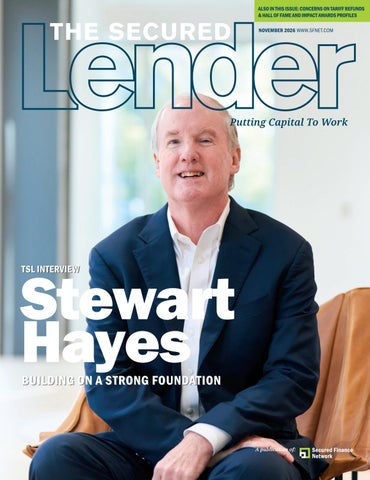
ALSO IN THIS ISSUE: CONCERNS ON TARIFF REFUNDS & HALL OF FAME AND IMPACT AWARDS PROFILES NOVEMBER 2026 WWW.SFNET.COM
Stewart Hayes TSL INTERVIEW
BUILDING ON A STRONG FOUNDATION
GROWING YOUR BUSINESS. PROTECTING YOUR CASH FLOW. CIT Commercial Services is now First Citizens Bank. Decades of insight meets top-tier banking stability. Working capital finance backed by the strength of First Citizens Bank. Learn more at firstcitizens.com/wcf
FIT FO R YOU R A M B ITION
©2026 First-Citizens Bank & Trust Company.
TOUCHING BASE HARNESSING THE WINDS OF CHANGE
Building the Future for Secured Finance SFNet’s 82nd Annual Convention theme, Harnessing the Winds of Change, aptly describes both the environment we are facing and the way our industry is responding. Economic uncertainty, rapid technological advancement, evolving regulation and shifting market dynamics continue to test our ability to adapt. They also create new opportunities. SFNet and its members meet those challenges with the innovation, resilience and practical resolve that have long defined the secured finance community. That spirit was evident across every facet of our mission over the past year. Strong attendance at industry conferences, dynamic leadership and networking programs, and continued growth in initiatives supporting women and emerging leaders all reflected the strength and engagement of our membership. We also expanded our educational offerings through professional development courses, mentoring, and guest lectures — investments that strengthen today’s workforce while helping us attract and develop the next generation of industry talent. We continued to strengthen the resources members rely on for perspective and informed decision-making. From creating the first ABL and Factoring Economic Impact Study to publishing research on fraud and emerging risks, SFNet provided practical intelligence for an increasingly complex market. Through The Secured Lender, TSL Express, webinars, podcasts and educational programming, we kept members connected to the trends and issues shaping our industry. Advocacy also remained a central priority. Working with policymakers and coalition partners, SFNet helped advance the interests of secured lenders and factors on important state and federal issues, including improving legislation in California, pursuing New York Safe Harbor protections and responding to federal regulatory proposals. The articles in this issue examine many of the forces reshaping secured finance. Whether the focus is artificial intelligence, risk management, technology, regulation or leadership, each reflects the same underlying reality: our industry continues to evolve, and its ability to respond with discipline and confidence remains one of its greatest strengths. On page 8, the issue kicks off with an interview with the incoming President of our Executive Board, Stewart Hayes, managing director/senior vice president, Wells Fargo Lender Finance. Here, he shares his career history and extensive contributions to SFNet as well as his top priorities and industry challenges and opportunities.
On page 12, Financing the Infrastructure Behind the AI Economy explores how traditional ABL, factoring and equipmentfinance solutions can support the suppliers, contractors and manufacturers building the foundation that underpins the AI economy. In Building the Infrastructure for Secured Finance Growth in Mexico, on page 18, TSL’s RICHARD D. GUMBRECHT editor-in-chief discusses SFNet Chief Executive Officer how Mexico’s secured finance market is gaining momentum as legal reforms, nearshoring and proven collateral structures open new opportunities for lenders and borrowers. Discover why SFNet’s upcoming Mexico City Summit could help advance cross-border collaboration, expand access to capital and shape the market’s next phase of growth. Article 12 is changing how secured lenders think about digital collateral, priority and control. In this timely article on page 42, commercial finance attorneys explain why a properly filed UCC-1 may no longer be enough when collateral includes controllable electronic records, tokenized receivables or other emerging digital assets. Tariff refunds may look like found money, but for ABL lenders they can raise complicated questions around timing, valuation, collateral and accounting treatment. In ABL Lender Concerns Around Potential Tariff Refunds on page 46, two Hilco executives explain why expected refunds should be approached with caution, how CAPE processing affects recovery risk, and what lenders should consider before giving these claims credit in a borrowing base. A new set of geopolitical and economic forces is reshaping the metals markets. On page 50, in Metals Price Volatility: Implications for Inventory, Lending and Collateral Management, Gordon Brothers’ executives discuss navigating an environment in which inventory values, working capital needs and collateral coverage can change rapidly. Thank you for your continued engagement and support of SFNet. Together, we will keep Harnessing the Winds of Change and building a stronger future for secured finance.
Rich Gumbrecht Chief Executive Officer Secured Finance Network
TABLE OF CONTENTS. NOV. 2026 VOL. 82 ISSUE 6
COVER STORY BUILDING ON A STRONG FOUNDATION P8
Building on a Strong Foundation: Incoming SFNet President Stewart Hayes’ Vision Stewart Hayes, managing director/senior vice president, Wells Fargo Lender Finance, and incoming SFNet president, shares his career history and extensive contributions to SFNet as well as his top priorities and industry challenges and opportunities. BY EILEEN WUBBE 8
FEATURE STORIES
Financing the Infrastructure Behind the AI Economy As AI drives unprecedented investment in data centers, power, fiber and cooling systems, the biggest opportunities for secured lenders may lie beyond the technology itself. 12 BY EDWARD GONZALEZ AND DAVID HEDAYA
The Beauty of Specialized Lending As beauty and wellness brands scale, their financing needs often outgrow traditional lending models. Long inventory cycles, retailer exclusivity, costly merchandising and viral demand can create major working capital pressure, even for profitable companies. 16 BY JORDAN HOPPE
2
THE SECURED LENDER NOV. 2026
Building the Infrastructure for Secured Finance Growth in Mexico Mexico’s secured finance market is gaining momentum as legal reforms, nearshoring and proven collateral structures open new opportunities for lenders and borrowers. 18 BY MICHELE OCEJO
SFNET AWARDS
SFNet Hall of Fame Awards Profiles of SFNet’s 2026 Hall of Fame Inductees, including their career highlights and industry contributions. 22 SFNET AWARDS
SFNet Impact Awards IMPACT Award recipients embody the core values and achievements the SFNet community strives to uphold and promote. 31
Articles ARTICLE 12 INSIGHTS
When Filing Isn’t Enough: Article 12 And Hidden Priority Risks Article 12 is changing how secured lenders think about digital collateral, priority and control. In this timely article, Lon M. Singer and Lyle P. Stein explain why a properly filed UCC-1 may no longer be enough. 42 BY LON M. SINGER AND LYLE P. STEIN
TAX INSIGHTS
LENDER'S EDGE
ABL Lender Concerns Around Potential Tariff Refunds
It May Be Your Inventory, but It’s My AR (Part I)
Tariff refunds may look like found money, but for ABL lenders they can raise complicated questions around timing, valuation, collateral and accounting treatment. 46 BY CANDACE HOLOWICKI AND ANGEL RAMIREZ CAREER INSIGHTS
From Modest Beginnings, a Secured Finance Foundation Program that is Lighting the Way What began with one classroom visit has grown into a meaningful bridge between students and the secured finance industry. Robert D. Katz traces the origins of SFNet’s Guest Lecturer Programn. 48 BY ROBERT D. KATZ
In this edition of the Lender’s Edge, we present the first of a two-part series discussing purchase money security interests in inventory, consigned inventory and the relative priority of conflicting security and consignment interests in the proceeds of that inventory. 52 BY KEVIN O'MALLEY SFNET MEMBER PROFILE
Cascade Credit Services, LLC: A Trusted Risk Management Partner Since its founding in 1995, Cascade Credit Services ("Cascade") has remained focused on one core objective: helping lenders better understand and effectively manage collateral risk. 70 BY EILEEN WUBBE
METAL INDUSTRY INSIGHTS
SFNET MEMBER PROFILE
Metals Price Volatility: Implications for Inventory, Lending and Collateral Management
Rouse Services: A Century of Equipment Expertise Behind Today’s Lending Decisions
A new set of geopolitical and economic forces is reshaping the metals markets. Over the last two years, the price of aluminum has nearly doubled for U.S. buyers, while steel and copper prices have jumped between 47% and 68%. 50 BY MICHAEL GUELFO, CALEB HILL, AND BRIAN WRIGHT SFNET FOUNDATION CONTRIBUTORS 54 CONVENTION INFORMATION SFNET’S 82ND ANNUAL CONVENTION EXHIBITOR GUIDE Showcases the exhibitors at SFNet’s Annual Convention 57
Since its founding in 1995, Rouse Services brings more than a century of auction and liquidation history to machinery and equipment appraisals for secured lenders. 73 BY EILEEN WUBBE
Departments NETWORK NOTES 4 TOUCHING BASE 1
The Secured Finance Network is the trade group for the asset-based lending arms of domestic and foreign commercial banks, small and large independent finance companies, floor plan financing organizations, factoring organizations and financing subsidiaries of major industrial corporations. The objectives of the Association are to provide, through discussion and publication, a forum for the consideration of inter- and intra-industry ideas and opportunities; to make available current information on legislation and court decisions relating to asset-based financial services; to improve legal and operational procedures employed by the industry; to furnish to the general public information on the function and significance of the industry in the credit structure of the country; to encourage the Association’s members, and their personnel, in the performance of their social and community responsibilities; and to promote, through education, the sound development of asset-based financial services. The opinions and views expressed by The Secured Lender’s contributing editors and authors are their own and do not necessarily express the magazine’s viewpoint or position. Reprinting of any material is prohibited without the express written permission of The Secured Lender. The Secured Lender 0888-255X, Copyright © 2026 by Secured Finance Network is published 6x per year (Jan/ Feb, March, June, July/Aug, Sept/Oct, November) by SFNet, 875 6th Ave, Ste 1802, NY, NY 10001. Business and Editorial Offices: 875 6th Ave., Ste 1802, NY, NY 10001, Accounting and Circulation Offices: 875 6th Ave, Ste 1802, NY, NY 10001 Call (212) 792-9390 to subscribe. Periodicals postage is paid at New York, NY, and additional mailing offices (if applicable). Secured Finance Network 875 6th Ave., Suite 1802, New York, NY 10001 (212) 792 -9390 Email: tsl@sfnet.com www.SFNet.com Periodicals postage paid at New York, NY, and at additional mailing offices. Postmaster, send address changes to The Secured Lender, c/o Secured Finance Network, 875 6th Ave., Suite 1802, New York, NY 10001 Editorial Staff Michele Ocejo Editor-in-Chief and SFNet Communications Director mocejo@sfnet.com Eileen Wubbe Senior Editor ewubbe@sfnet.com Aydan Savaser Art Director asavaser@sfnet.com Advertising Contact: James Kravitz Chief Business Development Officer T: 646-839-6080 jkravitz@sfnet.com
3
THE SECURED LENDER NOV. 2026
DEPARTMENT DEPARTMENT NETWORK INDUSTRY NOTES MOVES In Memoriam: William “Bill” Schoenholz
John Fee joins Entrepreneur Growth Capital
The secured finance community recently lost one of its most respected members with the passing of William “Bill” Schoenholz, a longtime partner at Buchalter and a highly regarded banking and finance attorney.
Entrepreneur Growth Capital (“EGC”) is pleased to announce that John Fee has joined as senior vice president. Based in South Florida, Fee will pursue business development nationwide.
Schoenholz devoted much of his 45year legal career to Buchalter, where he served on the firm's Board of Directors and helped shape its growth and success. Widely recognized as a leading banking lawyer, he was a trusted advisor to financial institutions and lenders nationwide.
Rick Perea Rejoins FGI Risk as Director of Business Development
Archway FinCo Welcomes Mark Pickering to Growing Team Archway FinCo, a national private credit firm providing tailored capital solutions to middle-market companies, announced that Mark Pickering has joined the firm as managing director, further strengthening Archway’s asset-based lending capabilities and expanding the depth of experience available to its clients and referral partners. Advantage Business Capital Welcomes William Garcia as VP, ABL Underwriter Advantage Business Capital welcomes William Garcia to its growing team as the new VP, ABL underwriter/credit analyst. Garcia has over a decade of credit and underwriting experience in the commercial finance industry. Buchalter Names Shawn Christianson Managing Partner of its San Francisco Office
4
THE SECURED LENDER NOV. 2026
A distinguished member of Buchalter’s Insolvency & Financial Law practice and former member of the firm’s Board of Directors, Shawn Christianson brings decades of experience representing financial institutions, creditors, technology companies, receivers, and bankruptcy trustees in complex insolvency, restructuring and commercial litigation matters.
FGI Worldwide LLC (“FGI”) announced that Rick Perea has rejoined FGI Risk as director of Business Development. Based out of FGI’s Boca Raton, FL office, Perea will focus on business development and relationship management, working to expand FGI Risk’s presence in the market and connect businesses with tailored trade credit insurance and risk advisory solutions. FGI TRUST™ Expands Presence in Americas with Addition of Jason Duke FGI Worldwide LLC (“FGI”), a leading provider of working capital financing and trade credit insurance solutions, has announced the hiring of Jason Duke as director of Business Development, FGI Tech. First Horizon Bank Welcomes Jennifer Feske as Senior Commercial Portfolio Manager Jennifer Feske has joined the First Horizon Bank as senior commercial portfolio manager in the New Orleans market. In her role, Feske will work with the bank's Northshore commercial portfolios, supporting client relationships across the area. Eclipse Business Capital Adds Charlie Bacon to Its Business Development Team Charlie Bacon has joined Eclipse Business Capital, LLC (“EBC”) as a managing director. Bacon, who will be located in Charleston, SC, joins EBC with extensive experience in originating and structuring credit transactions.
Franklin Capital Network Expands Leadership Team with Gammie Chung as VP, Head of A/R Administration Franklin Capital Network, a leading provider of flexible working capital solutions to growing businesses, is pleased to announce the addition of Gammie Chung as vice president, head of A/R Administration. Garrington Group of Companies Names Vince Mancuso Chief Executive Officer of Liquid Capital Liquid Capital, a subsidiary of the Garrington Group of Companies, provides factoring and working capital solutions across the United States and Canada, announced the appointment of Vince Mancuso, SFCP, CAEF, as chief executive officer. Mancuso brings more than 25 years of C-level and executive leadership in commercial finance and banking to the role. Gibraltar Business Capital Welcomes Michael Fine Michael Fine joined Gibraltar’s credit team in July 2026 as senior vice president – account executive, bringing more than 30 years of banking experience, including 25+ years dedicated to asset-based lending. Gordon Brothers Welcomes Tron Allen as Senior Managing Director Based in Texas, Tron Allen will help drive business development efforts across Gordon Brothers' platform, expanding client relationships and supporting the firm's continued growth in key markets. He will work closely with teams across appraisal, disposition, investment and advisory services to deliver the full breadth of Gordon Brothers' capabilities to clients in North America. Great Rock Capital Expands Originations and Capital Markets Leadership Great Rock Capital announced the promotions of Christina Zielinski to chief commercial officer and head of
DEPARTMENT DEPARTMENT NETWORK INDUSTRY NOTES MOVES Originations, and Jake Goldberg to head of Capital Markets. Zielinski and Goldberg will be based in the New York metro area and will be responsible for expanding the firm’s origination efforts and strategic relationships across North America. Haversine Funding Welcomes Tim Serritella as Vice President, Lender Finance
THE SECURED LENDER NOV. 2026
Chris Grushko Appointed Collateral Analyst at JPalmer Collective Following 10-Week Summer Internship Program
Tim Serritella brings more than two decades of experience providing capital solutions, leading operational turnarounds and delivering strategic financial guidance to middle-market companies, commercial lenders and investment groups.
Chris Grushko brings a background in real estate and asset management to JPalmer Collective, with experience in financial analysis, collateral valuation, and portfolio management. At JPC, he helps evaluate new opportunities, assess collateral and credit risk, and support the ongoing management of the firm’s borrower portfolio.
Hilco Global Appoints Industry Veteran Andrew Hede as Vice Chairman of Hilco Global Professional Services
JPalmer Collective Appoints Caryn Alexander Head of Portfolio Management
In this role, Andrew Hede will report to David Kurtz, CEO of Hilco Global Professional Services and vice chairman of Hilco Global. Hede will focus on accelerating the continued growth and development of Hilco Global Professional Services, while also driving and originating revenue opportunities across the platform.
Caryn Alexander brings more than two decades of bank-side credit and portfolio leadership to the role, most recently as senior managing director, head of ABL Portfolio Management at Webster Bank, where she led a 16-member national team overseeing a $3 billion assetbased lending portfolio.
Hilco Global Appoints Chris George as Global Head of Healthcare for Professional Services
6
unveiling a new name and logo that reflects its legacy and future direction. The rebrand comes as Hyper Group continues to broaden its service offerings to meet growing client demand.
In this newly established role, Chris George will lead the development and growth of the global healthcare practice. He will collaborate across the Hilco Global platform to advise healthcare companies worldwide - both sponsorbacked and independent – across healthcare services and technology, pharmaceutical and life sciences, health systems and academic medical centers including physician groups. HyperAMS Rebrands as Hyper Group, Marking A New Chapter of Growth HyperAMS, a full-service asset valuation, monetization, and advisory firm for 16 years, has rebranded as Hyper Group,
JPalmer Collective Appoints Chris Mayo Senior Vice President, Portfolio Management Chris Mayo brings significant commercial banking and asset-based lending experience to the role, including underwriting, structuring, and managing complex middle-market and corporate credit facilities. Legacy Corporate Lending Appoints Karla Gorgij as Executive Vice President, Portfolio & Underwriting In her role, Karla Gorgij will be primarily responsible for managing a portfolio of client relationships where she will work closely with borrowers to support their ongoing financing needs and deliver exceptional service throughout the life of each credit facility.
Lendscape Appoints Pat Hinchin as Chief Operating Officer Lendscape, a leading global provider of commercial finance technology, announced the appointment of Pat Hinchin as chief operating officer. Hinchin brings more than 25 years in fintech and regtech, including experience in risk, regulatory and compliance technology and the modernisation of enterprise software into scalable, API-driven SaaS. Mayer Brown Adds Structured Finance Partner Michelle Herman in New York Mayer Brown announced that structured finance lawyer Michelle Herman has joined the firm as a partner in New York in its Global Trade Finance practice. Mayer Brown Strengthens Leveraged Finance and Private Capital Capabilities With Addition of Justin Hewett in Houston Mayer Brown announced that finance lawyer Justin Hewett has joined the firm in Houston as a partner in its Global Leveraged Finance and Private Capital Group. He joins from DLA Piper. MidFirst Business Credit Appoints Graham Nelson as Business Development Officer MidFirst Business Credit announced the appointment of Graham Nelson as vice president, business development officer, based in Los Angeles. NautaDutilh Reaffirms Commitment to US Clients With New York Leadership Transition NautaDutilh reaffirms its long-standing commitment to clients in the United States with the appointment of Boudewijn Smit as managing partner of its New York office and lead Dutch Finance Transactions counsel in the US. Smit succeeds Elizabeth van Schilfgaarde, who has led the New York office for many years and has played an important role in strengthening NautaDutilh's presence in the US market.
DJ Krystopa Joins Pathward’s Commercial Finance Team Pathward®, N.A. has appointed DJ Krystopa as managing director of Business Development. Based in Philadelphia, Krystopa joins Pathward’s working capital business development team, supporting efforts across the midAtlantic and Northeast regions of the U.S. PNC Bank Appoints Michael Jannusch to Lead Commercial Banking for Tennessee As PNC Bank accelerates its growth in Tennessee, the bank has appointed Michael Jannusch to lead Commercial Banking for the region.
will work out of the Chicago office and report to Danika Louis, senior vice president, portfolio manager.
United Community Expands AssetBased Lending Team with Industry Veteran Steve Janson
Danielle Reboli Joins Republic Business Credit as Senior Vice President, Underwriter
United Community has strengthened its Asset-Based Lending (ABL) team with the addition of Steve Janson as senior ABL business development officer.
Republic Business Credit announced that Danielle Reboli has joined the Company as senior vice president, underwriter, further strengthening its underwriting team as it continues its rapid growth trajectory. SPECTRUM Commercial Finance Opens Dallas Office and Adds to Operations
Republic Business Credit Expands Chicago Team with Addition of Sam Crespo Republic Business Credit announced the addition of Sam Crespo to the client management team as a collateral analyst, further strengthening Republic’s client services capabilities and commitment to delivering exceptional support. Crespo
SPECTRUM Commercial Finance opened a new Dallas office and added vice president, Kyle Nowokunski, to its team of business development officers. SPECTRUM also hired Oden Eliason, a collateral analyst, to support continued growth in the loan portfolio.
STATEMENT OF OWNERSHIP, MANAGEMENT AND CIRCULATION Required by 39 U.S.C. 3685. 1. Title of publication: The Secured Lender. 2. Publication No. 0888-255x. 3. Date of filing: September 30, 2026. 4. Frequency of issue: 6x a year. 5. No. of issues published annually: 6. 6. Annual subscription price: $65 for nonmembers. 7. Complete mailing address of known office of publication: 875 6th Ave., Suite 1802, New York, NY 10001. Contact Person: Michele Ocejo, Telephone: (212) 792-9396. Complete mailing address of the headquarters of general business offices of the publisher: 875 6th Ave., Suite 1802, New York, NY 10001. 9. Full names and complete mailing address of publisher, editor, and managing editor: Publisher: Secured Finance Network, Inc. 875 6th Ave., Suite 1802, New York, NY 10001; Editor-in-Chief: Michele Ocejo, 875 6th Ave., Suite 1802, New York, NY 10001; Managing Editor: Eileen Wubbe. 10. Owner: (If the publication is owned by a corporation, give the name and address of the corporation immediately followed by the names and addresses of all stockholders owning or holding 1 percent or more of the total amount of stock. If not owned by a Corporation, give the names and addresses of the individual owners. If owned by a partnership or other unincorporated firm, give its name and address, as well as those of each individual owner. If the publication is published by a nonprofit organization, give its name and address.): Secured Finance Network, Inc., A Delaware Non-Stock, Non-Profit Corporation, 875 6th Ave., Suite 1802, New York, NY 10001. 11. Known bondholders, mortgagees, and other security holders owning or holding 1 percent or more of total amount of bonds, mortgages or other securities: None. 12. The purpose, function, and nonprofit status of this organization and the exempt status for federal income tax purposes: has not changed during preceding 12 months. 13. Publication Title: The Secured Lender. 14. Issue date for circulation data below: September, 2026. 15. Extent and nature of circulation: a. Total number of copies (net press run): Average no. copies of each issue during preceding 12 months: 6,846; No. copies of single issue published nearest to filing date: 6,700. b. Paid circulation (by mail and outside the mail): (1) Mailed outside-county paid subscriptions stated on PS Form 3541 (Include paid distribution above nominal rate, advertiser’s proof copies, and exchange copies): Average No. copies each issue during preceding 12 months: 6,226; No. copies of single issue published nearest to filing date: 6,317 (2) Mailed in-county paid subscriptions stated on PS Form 3541 (Include paid distribution above nominal rate, advertiser’s proof copies, and exchange copies): Average no.
copies each issue during preceding 12 months: 0; No. copies of single issue published nearing to filing date: 0; (3) Paid distribution outside the mails including sales through dealers and carriers, street venders, counter sales and other paid distribution outside USPS: Average no. copies each issue during preceding 12 months: 0; No. copies of single issue published nearing to filing date: 0; (4) Paid distribution by other classes of mail through the USPS (e.g., First-Class Mail): Average no. copies each issue during preceding 12 months: 220; No. copies of single issue published nearing to filing date: 115. c. Total paid distribution (Sum of 15b(1), (2), (3) and (4)): Average no. copies of each issue during preceding 12 months: 6,446; No. copies of single issue published nearest to filing date: 6,317. d. Free or nominal rate distribution (by mail and outside the mail): (1): Free or nominal rate outside-county copies included on PS Form 3541: Average no. copies of each issue during preceding 12 months: 0; No. copies of single issue published nearest to filing date: 0. (2) Free or nominal rate in-county copies included on PS Form 3541: Average no. copies of each issue during preceding 12 months: 0. No. Copies of Single Issue Published Nearest to Filing Date: 0. (3) Free or nominal rate copies mailed at other classes through the USPS (e.g., First-Class Mail): Average no. copies of each issue during preceding 12 months: 0; No. copies of single issue published nearest to filing date: 0. (4) Free or nominal rate distribution outside the mail (carriers or other means): Average no. copies of each issue during preceding 12 months: 325; No. copies of single issue published nearest to filing date: 300. e. Total free or nominal rate distribution (sum of 15d (1), (2), (3) and (4): Average no. copies of each issue during preceding 12 months: 325; No. copies of single issue published nearest to filing date: 300. f. Total distribution (Sum of 15c and 15e): Average no. copies of each issue during preceding 12 months: 6,771; No. copies of single issue published nearest to filing date: 6,617. g. Copies not distributed: Average no. copies of each issue during preceding 12 months: 75; No. copies of single issue published nearest to filing date: 83. h. Total (Sum of 15f, 15g): Average no. copies of each issue during preceding 12 months: 6,846; No. copies of single issue published nearest to filing date: 6,700. i. Percent paid (15c/f x 100): Average no. copies of each issue during preceding 12 months: 95.24%; No. copies of single issue published nearest to filing date: 95.46%. I certify that all information furnished on this form is true and complete.
7
THE SECURED LENDER NOV. 2026
TSL INTERVIEW
8
THE SECURED LENDER NOV. 2026
Building on a Strong Foundation:
Incoming SFNet President Stewart Hayes’ Vision BY EILEEN WUBBE STEWART HAYES, MANAGING DIRECTOR/SENIOR VICE PRESIDENT, 9 THE WELLS FARGO LENDER FINANCE, AND INCOMING SFNET PRESIDENT, SECURED LENDER SHARES HIS CAREER HISTORY AND EXTENSIVE CONTRIBUTIONS TO NOV. 2026 SFNET AS WELL AS HIS TOP PRIORITIES AND INDUSTRY CHALLENGES AND OPPORTUNITIES.
TSL INTERVIEW Can you provide our readers with your career background? After graduating from Texas Tech University, I joined the credit training program at InterFirst Bank. After completing the bank’s credit training program, the company’s asset-based lending leaders, Stephen Fisher and Jim Casper, persuaded me to join the bank’s ABL division. The ABL business was not the “glamourous” spot in banking at the time, and while I did not realize it then, I started on a path to a wonderful 40+-year career in the industry. I have had the opportunity to serve in multiple roles, including field examination, portfolio management, underwriting, new business, and various leadership roles. In 2000, I was fortunate to have the opportunity to join industry icon Andrea Petro as one of the original team members of the newly created Wells Fargo Lender Finance business, where I still serve today. Unlike today’s market, back in 2000 banks were generally not lending to non-bank lenders and Wells Fargo was the first bank to establish a lending business solely focused on specialty commercial finance companies.
What are some of the most memorable moments you have had through your involvement with SFNet? There have been many memorable moments, but two special highlights stand out for me. First, I was elected to the SFNet Hall of Fame in 2022. This is a unique and exclusive honor that is voted upon by the leaders of the industry. The fact that the industry leaders bestowed this honor on me was incredibly touching and humbling. Second, I had the privilege (and pressure) of serving as Convention chair for the 2017 SFNet Annual Convention in Chicago. Through the efforts of many, we had the best-attended and most profitable conference the SFNet has had since that time. We are, of course, back in Chicago for this year’s conference. Chicago is a great city and always a great location for the conference, so I expect this year’s event will again be highly successful. What does the role of SFNet president mean to you professionally and personally? I attended my first Annual Convention in 1985 and could not have imagined ever serving as president of this prestigious organization. For me, this represents both a special honor and a tremendous accomplishment. I have always strived to do my best to fulfill the opportunities provided to me within SFNet. Hard work and dedication are always appreciated and can sometimes take you to unexpected places.
I am following Betty Hernandez, and before her, Rob Meyers and Barry Bobrow. All three were very influential and dedicated leaders of SFNet. These are very large shoes to fill. I aim to continue their efforts and do all that I can to support the SFNet and our member firms.
You’ve had a long and active record of SFNet involvement, including service on the Management Committee, Executive Committee, Board of Directors, as well as leadership roles such as Secured Foundation chair, Convention chair, 40 Under 40 Awards chair, and president of SFNet’s Dallas Chapter. What have you enjoyed most about these experiences?
10
THE SECURED LENDER NOV. 2026
I really enjoy the people. There are many talented, dedicated, and fun people at all levels within our industry and the SFNet staff. I have had the unique opportunity to work with many wonderful people and establish meaningful professional relationships as well as long-term personal friendships. Serving in these roles has provided me with a variety of experiences, mostly positive and, at times, challenging. My SFNet involvement has provided me with key industry connections, many wonderful experiences, and favorable exposure for both me and my organization, which have all greatly enhanced my career and success.
What are your top priorities as SFNet president? We have a tradition that each SFNet president determines a word or phrase for their respective term. Mine is simple: Transition. The SFNet has been fortunate to have Rich Gumbrecht as the CEO for the last 10 years, but Rich has announced his intent to retire in late 2027. We have initiated a process to identify the next leader to serve as our CEO. Finding the right person and ensuring a smooth transition is the top priority. I should emphasize that Rich remains fully engaged and that he is personally committed to providing a smooth transition and leaving SFNet in a good place. We
are proactively broadening our reach to include previously untapped allies in our ecosystem and explore ways that we work together to better serve our members. Additionally, we need to continue to fulfil the evolving priorities of our members and find ways to add even more value to our members. We need to grow and strengthen our chapters, as they are the SFNet’s “boots on the ground,’’ where much of the industry networking occurs. So, there is a lot to focus on. How do you hope to build on the initiatives of past SFNet presidents? I am following Betty Hernandez, and before her, Rob Meyers and Barry Bobrow. All three were very influential and dedicated leaders of SFNet. These are very large shoes to fill. I aim to continue their efforts and do all that I can to support the SFNet and our member firms. What do you see as the biggest opportunities and challenges facing SFNet right now? The challenges are 1) Industry consolidation: The current trend we are seeing is that consolidation among our member firms is rivaling the number of new entrants. 2) Event metrics: SFNet’s costs for hotels, food, and travel continue to rise quickly, whereas members are understandably managing costs carefully 3) SFNet CEO transition: As discussed above, it is essential that we find the right successor for Rich. But the challenges are also our opportunities. We have the opportunity to continue to meaningfully serve our members and expand the value that SFNet provides. We have the opportunity to find new names and new paths to broaden our membership. Finally, our leadership transition provides the opportunity for new perspectives and stakeholder relationships that we may not have today.
we have done many things right in recent years to support this group. SFNet’s 40 Under 40 Awards were established in 2016 to annually recognize 40 up-and-coming contributors and leaders. That program has been highly successful, and multiple honorees have subsequently navigated to key SFNet board and leadership positions (including Rob Meyers and Jennifer Palmer serving as presidents). SFNet's Emerging Leader Summit was started several years ago, and this annual event expands and improves each iteration. SFNet’s Mentoring Program pairs rising secured finance talent with seasoned industry leaders for a high-impact mentoring experience. And this fall, the new Reverse Mentoring Program was launched, which flips the traditional model by pairing early-career professionals as mentors with senior executives, giving senior leaders direct insight into emerging trends, technology, and evolving workplace perspectives. And SFNet continues to expand our educational offerings, including multiple online options at no charge. We need to continue to expand and improve upon these development efforts. When you aren’t busy at Wells Fargo or volunteering with SFNet, what can you be found doing? First and foremost, family time, including spending as much time with my four young grandchildren as possible and traveling with my wife when we can. Church activities are also important to me, and I particularly enjoy teaching in our ESL program (English as a second language). Time on a golf course is always a welcome treat. Eileen Wubbe is senior editor of The Secured Lender.
What do you believe are the biggest business challenges facing the secured finance industry? The secured finance industry is doing quite well and has historically succeeded in all market conditions. That said, we face multiple challenges. In no particular order: 1) Transaction costs are materially higher, and even more so for bankruptcy and workout situations. 2) Technology is rapidly evolving, and we need to stay nimble in this regard. 3) Succession planning and talent bench depth (one example – the pool of people with true workout experience is thin). 4) Other forms of lending continue to compete in this space. It is incumbent on SFNet to help equip and assist our members in navigating these challenges. How can SFNet better support emerging leaders and succession planning across the industry? Emerging leaders are THE FUTURE of our industry. I believe
11
THE SECURED LENDER NOV. 2026
FEATURE STORY
Financing the Infrastructure Behind the AI Economy BY EDWARD GONZALEZ AND DAVID HEDAYA
As AI drives unprecedented investment in data centers, power, fiber and cooling systems, the biggest opportunities for secured lenders may lie beyond the technology itself. This article explores how traditional ABL, factoring and equipmentfinance solutions can support the suppliers, contractors and manufacturers building the infrastructure behind the AI economy. 12
THE SECURED LENDER NOV. 2026
N
early $7 trillion of capital could be required to build the world’s data-center infrastructure through 2030, according to McKinsey, with more than 40% of that investment expected in the United States.environment.
For secured lenders, however, some of the most compelling opportunities may never sit on a data-center balance sheet. They may sit with the electrical distributor supplying switchgear, the contractor laying fiber, the manufacturer building cooling equipment or the company carrying receivables for 60 to 90 days while waiting to be paid.
not necessarily mean financing a power plant. It could mean lending against the receivables and inventory of an electrical distributor or the receivables of a contractor installing the equipment. AI may be the catalyst, but many of the financing opportunities look distinctly industrial.
Artificial intelligence may be driving the investment cycle, but the buildout is increasingly physical. That is creating a much broader end market for traditional secured finance.
Telecom, Fiber and the Working-Capital Gap
Beyond the Data Center CBRE reported a record 7,481.1 megawatts of data-center capacity under construction across primary North American markets in the first half of 2026, up 24.8% from a year earlier. Yet a data center is only the final node in a much larger industrial ecosystem. Facilities require transformers, switchgear, generators, copper, steel, fiber-optic networks, cooling systems, servers, GPUs and specialized construction. Those products must be manufactured, distributed, transported and installed. That creates opportunities across the capital structure. Project and construction lenders can finance the facilities themselves, while asset-based lenders, factors and equipment finance companies can finance the businesses supplying and building them. An electrical distributor may need capital to purchase inventory months before delivery. A fiber contractor may need to fund labor and materials while waiting for payment. A cooling-system manufacturer may need additional working capital as orders increase. These are traditional secured-finance needs appearing within a rapidly expanding end market. Power: The Infrastructure Behind the Infrastructure Few areas illustrate the scale of the opportunity better than electricity. The International Energy Agency projects that data centers will account for roughly half of U.S. electricity-demand growth through 2030. Meeting that demand requires investment throughout the electrical ecosystem: generation, transmission, substations, transformers, switchgear, cabling and backup power. The demand is already visible in supplier backlogs. Eaton reported year-over-year electrical-sector backlog growth of 43% in the second quarter of 2026. For secured lenders, participating in this boom does
EDWARD GONZALEZ Valley National Bank
Computing capacity also requires connectivity. Lumen Technologies has disclosed nearly $13 billion of Private Connectivity Fabric contracts and plans a major expansion of its intercity fiber network. At the same time, the $42.45 billion Federal Broadband Equity, Access, and Deployment (BEAD) program is supporting broadband DAVID HEDAYA expansion across the The Hedaya Capital Group country, broadening demand for telecom infrastructure beyond the data-center market. That investment flows through manufacturers, engineering firms, contractors and equipment providers. Fiber must be manufactured and transported. Routes must be engineered. Trenches must be dug. Cable must be installed. For contractors, growth can create a working-capital challenge. Labor, materials and equipment often have to be funded well before customers pay. Telecom contractors, for example, can face payment terms stretching to 75 or 90 days. That produces a familiar dynamic for factors and ABL lenders: the more work a contractor wins, the more capital it may require. From a secured financing standpoint, there are additional opportunities for middle-market companies supporting the buildout of data centers. These include manufacturers of data servers, suppliers of graphics processing units (GPUs), and other businesses involved in the broader data center supply chain. Given that data center development and implementation can span several years, these companies may experience significant working capital needs driven by extended inventory
13
THE SECURED LENDER NOV. 2026
FEATURE STORY holding periods and the timing of large project deliveries. This creates an opportunity for secured lenders to provide working capital financing solutions to support growth and bridge liquidity gaps throughout the project lifecycle. Underwriting the Opportunity The opportunity is significant, but lenders will need to distinguish between companies directly benefiting AI-driven infrastructure spending and those simply operating adjacent to it. Many of these businesses generate the collateral secured lenders know best: receivables, inventory, and equipment. Receivables supported by completed work, purchase orders, and large creditworthy customers can create attractive financing opportunities, even when customer concentrations appear elevated. In some cases, concentration to a hyperscale cloud provider, major utility, telecom carrier, or leading data center developer may represent a stronger credit profile than a broadly diversified customer base of smaller companies. Lenders will also need to understand the collateral beyond the borrowing base. Specialized equipment, electrical components, networking hardware, and other infrastructurerelated assets may provide meaningful collateral support, but their value depends on marketability, useful life, and secondary market demand.
vehicles becoming commonplace would have seemed unrealistic to most people. Fast forward to today, and it is difficult to leave your neighborhood without seeing an electric vehicle on the road, with some models even capable of driving themselves. As artificial intelligence continues to gain adoption across businesses and consumers, demand for data centers is expected to increase significantly. This growth will require substantial investments in power generation, transmission infrastructure, and data center capacity to support the expanding computing needs of AI applications. As a result, there is considerable opportunity for secured lenders to provide working capital and growth capital solutions to the companies building the infrastructure necessary to support this long-term trend. Specialized contractors may engineer and install charging infrastructure directly for large corporate customers, billing as units of work are completed. Master service agreements, work orders and modern vendor portals can provide lenders with greater visibility into the underlying work and invoice approval process. The same framework can apply across data centers, telecom and power infrastructure. Customer concentration, contract terms, lien rights, payment contingencies and verification remain important underwriting considerations. But lenders that understand those risks can find attractive opportunities among businesses serving large, creditworthy end customers. Success in this sector requires a deeper understanding of the unique capital requirements and working capital cycles associated with these businesses, as well as the ability to structure financing solutions that support the borrower's growth while ensuring the lender maintains adequate collateral coverage and appropriate structural protections.
Electric-vehicle charging provides another example of how large infrastructure investment can translate into financeable middle-market receivables.
14
THE SECURED LENDER NOV. 2026
As data center construction accelerates, suppliers, contractors, and manufacturers will require additional working capital to support inventory purchases, labor costs, equipment investments, and extended cash conversion cycles. Lenders that can combine traditional collateral analysis with an understanding of project-driven businesses may be well positioned to capitalize on one of the largest infrastructure buildouts of the coming decade. A Lesson From EV Infrastructure Electric-vehicle charging provides another example of how large infrastructure investment can translate into financeable middle-market receivables. If you go back 10 to 20 years, the idea of fully electric
Follow the Supply Chain The largest technology companies and infrastructure developers will continue to attract enormous pools of institutional capital. For secured lenders, the more
differentiated opportunity may be one or two levels down the supply chain.
chasing the technology itself, but those financing the supply chain that enables its growth.
Electrical suppliers need inventory financing. Contractors need capital to bridge payroll and receivables. Equipment providers require funding to build and deploy assets, while manufacturers need working capital to keep pace with growing order volumes. While these financing solutions already exist today for many established middle-market companies, demand is expected to increase as data center construction accelerates. For lenders, the opportunity is not necessarily creating new products, but rather adapting existing underwriting frameworks to better understand the unique cash conversion cycles, contract structures, and working capital needs of companies supporting the data center ecosystem.
Edward Gonzalez is an associate in Asset-Based Lending Origination at Valley National Bank. He partners with private equity sponsors, intermediaries, and middle-market companies to provide customized asset-based financing solutions that support growth, acquisitions, recapitalizations, and ongoing working capital needs. His experience spans a variety of industries, with a focus on structuring senior secured lending facilities tailored to each client's objectives.
As the AI economy scales, billions of dollars will move through businesses that may never be described as artificial intelligence companies at all. Electrical distributors, telecom contractors, equipment providers, manufacturers, and other middlemarket businesses supporting data center development will require increasing amounts of working capital to finance inventory, bridge receivable cycles, fund labor, and support growing order volumes. For the secured-finance industry, the opportunity is not necessarily to develop entirely new lending products, but rather to recognize how traditional asset-based lending solutions can be applied to a rapidly expanding end market driven by long-term infrastructure investment.
David E. Hedaya is an account executive at The Hedaya Capital Group, a New York-based commercial finance firm specializing in factoring and assetbased lending. He focuses on working-capital solutions for middlemarket and growing companies, with a particular interest in emerging technology and infrastructure sectors.
The largest technology companies and infrastructure developers will continue to attract enormous pools of institutional capital. For secured lenders, the more differentiated opportunity may be one or two levels down the supply chain.
The opportunity is not simply to finance AI. It is to finance the infrastructure and businesses making AI possible. Lenders that develop a deeper understanding of project-driven cash flows, customer concentrations, contract structures, and extended working capital cycles within the data center ecosystem may be well positioned to participate in one of the largest infrastructure buildouts of the next decade. As demand for computing power, connectivity, and energy continues to accelerate, the winners may not only be the institutions
15
THE SECURED LENDER NOV. 2026
FEATURE STORY
The Beauty of Specialized Lending BY JORDAN HOPPE
As beauty and wellness brands scale, their financing needs often outgrow traditional lending models. Long inventory cycles, retailer exclusivity, costly merchandising and viral demand can create major working capital pressure, even for profitable companies. This article explores why specialized lending is becoming essential to support growth in one of today’s most dynamic consumer sectors.
16
THE SECURED LENDER NOV. 2026
W
omen account for roughly 80-85% of all consumer purchases in the United States and influence or control up to 80% of household spending. Most lenders don't equate consumer spending with building a lending business, but maybe they should, especially when lending into consumer discretionary sectors. Investors certainly do, and it's what inspired my colleague, Claire McNamara, and me, with the support of our colleagues, to build a lending practice focused exclusively on beauty & wellness. The beauty & wellness market, spanning mass to prestige, is multi-billion dollars, and it became clear there was a void in the lending space. We saw the broader trend toward lending specialization and wanted to be first movers here. Our objective is to build a dedicated practice grounded in our experience working with dozens of brands over the years and, of course, in being consumers ourselves.
The complexities of product, capital, and retail dynamics create a working capital need beyond what many other consumer segments require. While investors are drawn to beauty and wellness brands for their strong margins, there are real nuances to building a beauty brand in today's environment. A brand can be growing and profitable, and still carry a large working capital need, a dynamic that often surprises new entrants to the space. Given the profitability and margin profile, you'd think this would be a perfect candidate for a traditional bank. But there's one problem: exclusivity. Historically, Ulta and Sephora have required exclusivity for a brand to launch with them, and now even Target can require it. In exchange, brands get marketing support and premium shelf space that would be difficult to earn on their own. But exclusivity becomes a sticking point for traditional banks, both because of the concentration risk with a single retailer and because of how retailer contracts are written, often with terms around chargebacks, returns, and inventory ownership that don't fit neatly into a standard borrowing base. Traditional banks either don't understand it, or their internal policies won't allow for an exception, which leaves growing, profitable brands without a natural financing partner just when they need capital the most. To achieve strong margins, especially in beauty, brands typically source their componentry overseas. That componentry, things like pumps, jars, and packaging, is often made in Asia, shipped by ocean freight, and then filled in the U.S. or Europe. Italy is home to many of the best color formulators in beauty, and Korea has become a leading supplier in skincare — both of which add even more lead time on top of the 3-6 months it would already take if manufactured domestically. Between the long lead times and minimum order quantities, most brands end up holding far more inventory than brands in other consumer categories. While food and beverage brands typically carry 3-6 months of inventory, beauty brands can sit on 12+ months at a time. This is partly out of necessity and partly due to the complexity of catering to a diverse clientele, which can create a large SKU base. A brand needs to keep up with demand to sustain growth and avoid stockouts from a viral moment, and in a category where a single TikTok video can sell out a SKU overnight, being out of stock isn't just a missed sale — it can mean losing momentum permanently. As a beauty brand grows and earns more shelf space at retail, that growth
also brings a significant cash outlay for retailer displays, fixtures, and merchandising that often has to be paid for well before the incremental sales show up. All of this adds up to a large working capital need that a lender can finance, if they understand the category and the channel nuances that come with consumer products. Private equity and JORDAN HOPPE investment banks have built SG Credit Partners specialists and dedicated coverage teams for this space, but lenders haven't adapted the same way. Beauty & wellness brands are often left choosing between expensive alternative capital, slowing growth to self-fund, or taking on additional dilution through an equity raise. As a passionate consumer and a beauty & wellness lover myself, that's where I saw the opportunity. Over the past few years, we've built a large and diversified client base in the space, and it became clear there was room, and demand, to formalize that work into a dedicated group: the kind of lender this category has been missing. Lending has clearly evolved toward specialization, whether by product, industry, or type of coverage, and beauty is no exception. The lending industry at large already has dedicated groups focused on transportation, technology, and healthcare, among others, so this is a natural extension of where lending is heading. That's further supported by strong consumer spending and new, unique retail entrants — all of which warrant lending specialization. Investors and retailers have already validated beauty & wellness as a category worth building around; specialized lending is simply the last piece to fall into place. Jordan Hoppe is head of Beauty & Wellness at SG Credit Partners, where she leads the firm's dedicated lending practice serving beauty, personal care, and wellness brands. In this role, she originates, underwrites, and executes transactions across the category, and manages SG Credit's relationships within it. She also attends the industry's major events to stay close to the challenges and opportunities brands in the space are facing. Prior to this role, Jordan was a founding member of SG Credit Partners' Consumer Products team, where she reviewed, underwrote, and executed new transactions and managed client relationships. She now brings that 8 years of consumer experience to building out the firm's Beauty & Wellness practice. Jordan began her career in 2014 at MB Financial Bank as a credit analyst in the bank's Leadership Development Program, rotating through several lending groups, including Healthcare, Commercial & Industrial, Commercial Real Estate, and Professional Services. Jordan holds a BS in Finance from Michigan State University (Go Green!). Outside of work, she enjoys trying new restaurants, playing video games, and traveling to new places.
17
THE SECURED LENDER NOV. 2026
FEATURE STORY
Building the Infrastructure for Secured Finance Growth in Mexico BY MICHELE OCEJO
18
THE SECURED LENDER NOV. 2026
Mexico’s secured finance market is gaining momentum as legal reforms, nearshoring and proven collateral structures open new opportunities for lenders and borrowers. Discover why SFNet’s upcoming Mexico City event—and the potential launch of a local chapter—could help advance cross-border collaboration, expand access to capital and shape the market’s next phase of growth.
M
exico’s secured finance market may be approaching an inflection point. Legal reforms, lessons from recent credit failures and expanding North American supply chains have created both a greater need for asset-based financing and a stronger foundation on which the industry can grow.
As momentum builds, SFNet is taking a significant step forward. On March 17-18, SFNet will host the Secured Finance Summit in Mexico City, designed to bring together lenders, borrowers, investors, attorneys and other industry participants from both sides of the border. The event is expected to serve as a catalyst for deeper engagement within the market and as a key milestone in SFNet’s efforts to explore establishing a local chapter in Mexico. The event reflects growing interest among market participants who believe the time is right for a dedicated forum focused on collateral-based lending, cross-border finance, education and professional development. Through an initial event and, ultimately, a local chapter, SFNet intends to connect lenders, borrowers, investors, attorneys, appraisers, field examiners, servicers and other specialists while promoting education, professional standards and cross-border collaboration. The initiative builds upon work SFNet began nearly a decade ago. “In 2016, through SFNet’s World Bank program, I had the opportunity to travel to Mexico City and introduce local bankers to the fundamentals of asset-based lending,” said Betty Hernandez, executive vice president and chief credit officer of SLR Business Credit and immediate past president of SFNet. Interest in establishing a local SFNet community gained new momentum at SFNet’s Annual Convention in Los Angeles last year. There, Hernandez was approached by Javier Arreola and Mauricio Justus, whose firms were active in secured finance and cross-border lending. “They asked me how SFNet chapters worked and how we could start a chapter in Mexico,” Hernandez said. “They mentioned how firms could benefit from a local presence. They could share best practices, network and participate in educational panels through local meetings.” Hernandez followed up with SFNet staff and Kat Parker, chair of the SFNet Chapter Committee. The group began meeting to explore the opportunity and discuss how SFNet could respond to the needs of the Mexican market. A Market Tested Under Pressure While interest in Mexico’s secured finance market is growing today, the legal and structural foundations have been developing for years. Daniel Biro, an associate with Nader Hayaux Goebel in Mexico, serves on the planning committee. He notes that the tools underpinning modern secured lending in Mexico are
not new. Reforms to Mexico’s secured lending and insolvency laws in 2000 introduced non-possessory pledges and security trusts, providing lenders with more effective ways to structure transactions and secure collateral. A major advancement followed in 2010 with the creation of the Registro Único de Garantías Mobiliarias, or RUG, a national online registry for security interests in movable assets. “The RUG gave lenders three things they didn’t have: certainty that their lien exists, clear priority over later creditors and public notice so everyone else has access to the records,” Biro said. “That’s what made receivables, inventory and equipment usable as collateral.” More recently, the market has gained confidence through real-world testing. According to Biro, the defaults of relevant non-bank Mexican lenders (SOFOMs) in 2021 and 2022 revealed the weaknesses of unsecured growth and highlighted the resilience of properly structured collateral-backed transactions. The lessons were reinforced by a broader wave of lender distress, according to Samuel Suchowiecky, CEO – Professional Services (Mexico) at Hilco Global. “Mexico’s secured finance market has spent the last decade proving a point many foreign lenders once doubted: when transactions are built with genuine bankruptcy-remote features and backed by real operational control, they survive borrower distress,” Suchowiecky said. Transactions with well-defined payment waterfalls, segregated trust accounts and pre-appointed master and substitute servicers continued paying investors, while structures dependent on borrower-controlled cash flows proved more vulnerable. “Structures that were once defensible on paper are now proven enforceable,” Suchowiecky said. Mexican courts have increasingly validated what the market has demonstrated through experience: properly structured trusts, supported by true-sale transfers and effective control mechanisms, can remain outside insolvency estates and protect investors during periods of distress. Nearshoring Creates New Demand Those developments are occurring at a pivotal moment for the North American economy. Mexico has become a critical manufacturing and trade partner for the United States, and nearshoring continues to drive investment in automotive, industrial, logistics and supply-chain infrastructure. “This comes at a pivotal moment for trade,” Suchowiecky said. “Mexico has become the United States’ leading trading partner, and nearshoring continues to expand that integration across automotive, industrial and logistics supply chains.” As factories expand and companies relocate production closer to North American customers, demand for equipment financing, working capital facilities, supply chain finance and receivables-backed lending is increasing. Javier Arreola, partner with Nader Hayaux Goebel,
19
THE SECURED LENDER NOV. 2026
FEATURE STORY highlighted that: “For many observers, growing trade flows, legal structures proven through distress and expanding cross-border investment are combining to create a unique opportunity for secured finance to scale.” Arreola further indicated that is why now is the right time for SFNet to host this event. Meeting the Needs of Mexico’s Middle Market Despite this momentum, significant financing gaps remain. Mexico’s middle market continues to be underserved by traditional lenders. According to Biro, bank lending to the private sector remains relatively low compared with global averages, while many financial institutions continue to focus on real estate collateral and personal guarantees. “The companies that need working capital most have receivables and inventory, not buildings,” Biro said. “Very few players are lending against the operating cycle.” The challenge is especially visible among suppliers supporting nearshoring-related manufacturing. These businesses often sell to large, creditworthy customers but may wait months to receive payment.
20
THE SECURED LENDER NOV. 2026
a proven track record,” Suchowiecky said. International lenders frequently ask practical questions about perfection, enforcement, tax considerations and insolvency procedures. Without experienced local partners, many institutions either decline opportunities or price them as if they were unsecured. Those that work with trusted local specialists gain not only access to attractive opportunities but also confidence in the enforceability of their collateral. Making Cross-Border Lending Work As North American supply chains become increasingly integrated, cross-border transactions are becoming more common. “Mexico’s growth is making crossborder the default, not the exception,” Suchowiecky said.
An SFNet Mexico chapter could provide a platform for education, practical case discussions and relationship building while serving as a bridge between Mexican practitioners and SFNet’s broader North American network.
A single financing may involve a Mexican borrower, U.S. customers, North American lenders and collateral located in manufacturing facilities operating under specialized customs regimes. Successfully navigating those transactions requires a deep understanding of both jurisdictions.
“Suppliers to nearshoring factories sell to large, creditworthy buyers but often wait two to four months to get paid,” Biro noted. “In the meantime, they have to cover payroll and materials.”
Some of the most promising opportunities include receivablesbacked facilities tied to U.S. customers, equipment financing for new manufacturing plants, inventory financing and supply chain facilities supporting nearshoring activity.
Asset-based lending is specifically designed to address these situations by unlocking the value of receivables, inventory, machinery and equipment.
Both Arreola and Suchowiecky see significant opportunities for greater collaboration between U.S. and Mexican professionals.
“Banks continue to lend primarily against real estate and personal guarantees, while the companies that most need working capital hold their value in receivables, inventory, machinery and equipment,” Suchowiecky said. “That is the gap asset-based lending is designed to fill.”
“U.S. lenders bring capital and ABL discipline,” Suchowiecky said. “Mexican specialists bring deep knowledge of the assets and of how they are perfected, protected and recovered on the ground.”
For lenders and investors, however, the challenge is often less about available capital and more about confidence in execution. “Mexican law provides the tools, but making them work in practice depends on local connections, market reputation and
Arreola agrees that the exchange of expertise must flow in both directions. “U.S. lenders teach ABL discipline,” he said. “Mexican professionals teach how collateral and enforcement really work here.” There is also an opportunity to develop shared
documentation, common playbooks and referral networks that can streamline transactions and reduce uncertainty. Why an SFNet Presence in Mexico Matters While Mexico has active banking, leasing, SOFOM and factoring organizations, market participants note that none are organized around secured finance as a discipline. “Mexican industry groups are organized by license: banks, SOFOMs, leasing, factoring,” Biro said. “None is organized around collateral lending as a discipline.” That distinction becomes especially important in cross-border transactions. “U.S. lenders come in speaking the SFNet language: borrowing bases, field exams and cash dominion” Arreola said. “Their Mexican counterparts have no equivalent reference point, so every deal ends up negotiating the basics from scratch.”
opportunity to bring together lenders, investors, borrowers and advisors who share a common interest in advancing secured finance in Mexico. “I’m extremely excited to attend the upcoming Mexico summit,” Hernandez said. If successful, the effort could lay the groundwork for an SFNet chapter that helps establish common standards, expand access to capital and strengthen ties between the secured finance communities in Mexico and the United States. As trade, investment and supply chains continue to bind the two countries more closely together, many believe the timing could not be better. This article was written with the assistance of an AI tool. Michele Ocejo is director of communications for SFNet and editor-in-chief of The Secured Lender.
A dedicated SFNet presence could help create that common language by bringing lenders, investors, attorneys, turnaround professionals, appraisers and service providers together around collateral-based lending best practices. According to Suchowiecky, some of the market’s most valuable lessons were not learned from textbooks, but from transactions that were tested under pressure. “The best practices in this market were not written in manuals,” Suchowiecky said. “They were learned in live distress situations, in transition mechanics that had to work under pressure and in structures tested before Mexican courts.” An SFNet chapter could become a forum for sharing those lessons and adapting SFNet’s educational resources to Mexican law and market practice. Building the Community For Hernandez, chapters have always represented one of SFNet’s greatest strengths. “I’ve always said that the chapters are our ‘boots on the ground,’” she said. Those chapters create opportunities for education, relationship-building and professional development through events ranging from technical seminars and lunch-and-learn sessions to networking receptions, golf outings and pickleball tournaments. “There are often subcommittees at the local chapter level that can gear events toward emerging leaders or women in SFNet,” Hernandez said. An SFNet Mexico chapter could provide a platform for education, practical case discussions and relationship building while serving as a bridge between Mexican practitioners and SFNet’s broader North American network. “These interactions allow for networking that otherwise may not occur,” Hernandez said. The upcoming March 18 event in Mexico City represents an important first step. More than a conference, it is an
21
THE SECURED LENDER NOV. 2026
SFNet Awards:
SFNet Hall of Fame Inductees & SFNet IMPACT Awards
22
THE SECURED LENDER NOV. 2026
HALL OF FAME & IMPACT AWARDS CELEBRATING EXCELLENCE
Honoring SFNet HOF Inductees and IMPACT Award Recipients It is a privilege to present the extraordinary individuals and organizations recognized in this issue of The Secured Lender. In the pages ahead, we proudly introduce our distinguished 2026 SFNet Hall of Fame inductees and the honorees receiving our third annual SFNet IMPACT Awards. Together, these accomplished leaders, innovators and organizations reflect the strength of our industry and the ideas, service and leadership that continue to move secured finance forward. First recognized in 2019, our Hall of Fame inductees have helped shape secured finance through careers marked by vision, achievement and lasting influence. Their paths and areas of expertise may differ, but each has strengthened the industry and our association in meaningful ways. We are deeply grateful for their leadership, dedication and enduring pursuit of excellence.
More than a collection of honors, these awards highlight the dynamic and forward-looking community at the heart of the Secured Finance Network. They underscore a shared dedication to high standards, fresh thinking and the continued advancement of our profession. As we recognize these remarkable accomplishments, we are RICHARD D. GUMBRECHT reminded to look ahead SFNet Chief Executive Officer with confidence and purpose. May the stories that follow encourage each of us to aim higher, embrace new possibilities and help shape the next chapter of secured finance. Congratulations to every honoree and thank you for the lasting impact you have made on our industry and our association. Rich Gumbrecht Chief Executive Officer Secured Finance Network
Introduced in 2024, the SFNet IMPACT Awards honor excellence across the many dimensions of the secured finance community. IMPACT represents Innovation, Market Leadership, Performance, Achievement, Customer Focus and Teamwork— the qualities that drive our industry. These awards celebrate individuals and organizations whose talent, commitment and ingenuity create value not only for their own businesses, but also for the broader secured finance community. As you read about this year’s recipients, you will see an impressive range of experience, perspective and accomplishment. Established executives, rising leaders and outstanding teams alike have demonstrated the determination and imagination needed to expand what secured finance can achieve. The Transactions of the Year category recognizes deals that delivered meaningful results from the borrower’s perspective through resourcefulness and collaboration. The Chapters of the Year and Volunteers of the Year awards salute those whose time and energy build stronger connections and further SFNet’s mission at the national and local level. The Innovators of the Year award honors those advancing original solutions to the challenges and opportunities facing our industry.
23
THE SECURED LENDER NOV. 2026
BARBARA ANDERSON BasePoint Capital LLC
Barbara Anderson has over 30 years of commercial lending experience. After completing formal credit training at NatWest USA, Barbara managed a portfolio of loans to specialty finance companies ranging in size from $5 million to $450 million. From 1991 through 1997, she held senior management positions at Allstate Financial Corporation and The CIT Group, specializing in direct financing for small businesses. She subsequently held roles at BankBoston Retail Finance, Back Bay Capital, IBJ Whitehall Retail Finance, LaSalle Retail Finance, and National City Retail Finance, where she originated, underwrote, and managed in excess of $3 billion of senior secured, asset-based loans to consumer product distributors and retailers nationwide. She worked with hundreds of small and mid-cap companies, as well as large public companies, to provide financing for acquisitions, refinancings, restructurings, bankruptcies, and recapitalizations. Since 2009, Barbara has worked for a large private investment firm to acquire performing and non-performing, commercial and consumer loans; co-founded i2B Capital, LLC, to provide senior secured growth capital to early- and mid-stage companies with a focus on the specialty finance sector; and led a private credit team at Yieldstreet that acquired more than $1 billion in factoring, supply chain, and revenue-based assets, as well as commercial equipment and consumer installment loans and leases. Barbara joined BasePoint Capital in 2024 as director of Commercial Credit, where she is responsible for developing new commercial finance verticals, establishing credit policies and procedures, conducting risk analysis and due diligence, and sourcing new business opportunities.
What advice would you offer to your “younger” self? My own career took an unconventional route — commercial banking, factoring, asset-based lending at CIT and several bank-owned platforms, and then private credit — and I’ve come to believe that’s not a flaw in a career, it’s the shape a good one can take. So, my advice is simple: say yes to the unfamiliar assignment — the turnaround, the industry you don’t know, the seat nobody’s fighting over. That’s where you’ll learn the most and get noticed for it. This industry has never had a shortage of smart people, but those smart people need to acquire wisdom over time to accelerate their careers — the judgment that comes from having seen a deal go bad, or a borrower unravel, and learning what the numbers alone couldn’t tell you. You can’t shortcut your way to that. You can only borrow it for a while from someone who’s already lived it. That’s what a mentor really is. But borrowing wisdom only works if you’re humble enough to ask for it and honest enough to actually take the advice when it’s inconvenient.
24
THE SECURED LENDER NOV. 2026
Find those mentors deliberately. And don’t mistake a winding path for being behind — this industry rewards people who understand collateral, credit, and companies in periods of change: skills built through variety and time, not always earned through a straight climb. What role did SFNet, its events and connections play in your career development? What role did mentoring play in your career? I met many of my mentors through the Secured Finance Network. More than 30 years of chapter events, committee work, and Annual Conventions have introduced me to colleagues who became lifelong
friends, competitors who became referral sources, and a professional home that outlasted any single employer. The organization’s education and certification programs, its chapters, and initiatives like Women in Secured Finance exist because people before me built them for exactly this purpose: so, no one has to learn this business alone. Join. Show up. Volunteer for a committee before you feel ready. The relationships you build there will outlast every job you ever hold. Beyond the deals and the deal volume, what do you hope people remember about the way you did business — whether that’s mentorship philosophy, a standard you held your team to, or a contribution to the profession itself? Beyond the deal volume, I hope people remember I was a straight shooter who listened first. Most clients lead with a story, not a term sheet — what got them into trouble, what they’re building, what keeps them up at night — and good deals are built around that story, not the numbers alone. I told clients the truth, even unwelcome truth, because an honest no beats a false yes that costs them later. Internally, I rarely just gave an answer. I’d rather walk a junior team member through the thinking behind a conclusion than hand them the result — that’s what lets them get there on their own next time. That habit matters even more today: as AI takes on more of the mechanical work of underwriting and generates the analysis itself, the credit professionals who continue to add value will be the ones who understand the underlying reasoning well enough to know whether AI’s answer is actually right.
SFNet’s 82nd Annual Convention November 10 to 11, 2026 | Chicago, IL | #SFNet82Annual CONVENTION PARTNER LEVEL
DIAMOND PLUS LEVEL
PLATINUM PLUS LEVEL
PLATINUM LEVEL
TITANIUM PLUS LEVEL
TITANIUM LEVEL
GOLD LEVEL
BRONZE LEVEL
SILVER LEVEL
EXECUTIVE LEVEL
EXHIBITOR LEVEL
FRANK GRIMALDI Gordon Brothers
Frank Grimaldi is senior managing director, North American sales manager, Valuations at Gordon Brothers responsible for developing and maintaining client relationships throughout North America. Additionally, Grimaldi manages the firm’s regional business development officers and oversees the Mid-Atlantic region, working closely with asset-based lenders, private equity sponsors and corporate management teams in Delaware, Maryland, New Jersey, New York, Pennsylvania and Washington, D.C. to help them understand the underlying value of assets including inventory, machinery and equipment, and intellectual property. He has nearly 40 years of experience in asset valuation and commercial lending. Prior to joining Gordon Brothers, Frank was a vice president at Brevet Capital responsible for managing assets and originating investment opportunities. He was previously a vice president at CIT Group where he managed the commercial services workout group. Frank has a Bachelor of Business Administration from Hofstra University. He is a board member of New York Institute of Credit and Secured Finance Network where he is an executive board member of the Secured Finance Foundation. Additionally, Frank is PresidentElect of the Turnaround Management Association (TMA) and will assume the presidency on January 1, 2027. He was also the recipient of the 2026 National Jewish Health Humanitarian Award. Frank is based in New York.
How did you get your start in the industry? I’m one of the few people who seemed destined for this business from the start. My school vacations were spent in credit committee meetings at BNY Financial, and I started my career at CIT/Business Credit, learning from industry leaders such as Joe Pollicino, Manny Darmanin and Larry Marsiello. This was the ultimate training ground for true asset-based lending. We didn't just lend money, we managed through every stage of the credit cycle, including handling our own liquidations. My experience selling housewares and gardening accessories out of a warehouse in northern New Jersey taught me an invaluable lesson early on: lending money is the easy part; collecting it is an art. The hands-on exposure, problem-solving and understanding of collateral that I gained during those years has shaped my approach to lending and restructuring.
my career that shaped my perspective. When someone asks me how to achieve lasting success in this business, I point to a practice I began 38 years ago: build relationships with your peers early and invest in them over time. Those individuals eventually become decision-makers, business partners and trusted advisors. Another lesson came from a friend I've known for more than 50 years. When asked how I was doing, he said, “Frank has figured out how to monetize being Frank.” I believe that observation underscores the importance of authenticity. In an industry built on relationships, credibility, and trust, being genuine matters. My advice to someone starting out is simple: build your network, stay curious and be yourself. Technical skills are essential, but long-term impact comes from the relationships you cultivate and the reputation you build. I've been fortunate to spend my career doing something I truly enjoy, alongside talented colleagues who encourage creativity and excellence.
What advice would you offer to your “younger” self?
26
THE SECURED LENDER NOV. 2026
Know what you know, but more importantly, know what you don’t know. Don't hesitate to ask for help or seek out the perspectives of those around you. Everyone you work with has something valuable to offer. Build relationships, listen carefully and take advantage of the incredible talent and experience within your network. Success isn't about having all the answers, it’s about being willing to learn, collaborate and grow throughout your career. Looking back at your career in secured finance, what was the moment or deal that changed how you thought about the industry — and what would you tell someone starting out today who wants to have that same kind of impact? There was no single deal that changed how I viewed the secured finance industry. Instead, it was the people and relationships I built throughout
Beyond the deals and the deal volume, what do you hope people remember about the way you did business — whether that's a mentorship philosophy, a standard you held your team to, or a contribution to the profession itself? As I have become more “seasoned,” I have spent time reflecting on the people who helped shape my career, often without realizing the impact they had on me. I believe it is our responsibility as industry veterans to support the next generation of leaders. I am actively involved in mentoring initiatives, including SFNet’s Mentoring Program because I believe sharing knowledge and experience is one of the most meaningful ways to give back. I don’t want to be remembered for a deal I closed, or an award I won. Rather, I want to be known as the guy who was always willing to sit down and talk with a young professional, offer guidance and share some of the experiences I was lucky to be part of.
Congratulations
Frank Grimaldi Senior Managing Director, North American Sales Manager, Valuations We would like to congratulate Frank on being inducted into the SFNet Hall of Fame. We are proud of Frank’s exceptional leadership, vision and impact on our industry and at Gordon Brothers.
Companies need an indispensable ally to help them overcome challenges and respond quickly to shifting market conditions so they can stay ahead of the curve. We partner with private equity sponsors, strategic buyers, managements teams and asset-based lenders globally to deliver creative solutions fueled by intelligent capital.
© 2026 Gordon Brothers Group, LLC
GORDONBROTHERS.COM
MICHAEL MONK Amerisource Business Capital
Michael Monk is managing partner of Amerisource Business Capital, where he’s helped lead the company’s strategic direction and growth since 1999. He brings 30+ years of leadership experience in asset-based lending, private credit and direct private equity investing. He started his career in commercial banking with Team Bank, predecessor to JPMorgan Chase. Throughout his career, he has been deeply committed to advancing the secured finance industry, serving as President of SFNet in 2017–2018 following decades of service on its Board of Directors, Executive and Management committees. Among his contributions to the organization, he helped lead the association’s transformation and rebranding from the Commercial Finance Association (CFA) to SFNet, served on the search committee that recruited/hired longtime CEO Rich Gumbrecht, chaired two annual conventions (2009, 2024), and led the creation of and chaired the Chapters Committee in 2002. He is widely respected for his commitment to leadership development, industry collaboration, and service to the finance community. Michael also served as president of the SFNet Houston Chapter. A graduate of The University of Texas at Austin’s Canfield Business Honors Program, Michael earned degrees in Finance and Marketing and later received his MBA from UT. He remains actively involved, serving on UT’s Canfield BHP Advisory Board. Originally from Austin and a Houston resident since 1992, Michael and his wife, Brooke, are the proud parents of Jack and Sara. Michael treasures time with family and friends, hunting, fishing, skiing and outdoor adventure, and has fond memories of coaching youth sports teams.
What advice would you offer to your “younger” self? First, your reputation is your most valuable asset—protect it at all costs. Opportunities come and go, but your reputation follows you throughout your career. So focus on building long-term trust rather than winning arguments. Develop a reputation for reliability, integrity and follow-through. Second, invest in developing communication and leadership skills. How you say something is often as important as what you say, especially when delivering difficult news. Ask thoughtful questions, listen intently, and consider your words carefully before responding. And learn to communicate complex ideas simply. Third, relationships matter more than any deal you might win. Invest in relationships long before you need them. Looking back, many of the opportunities that shaped my career came from relationships and trust that had been built years earlier. So treat every interaction as the beginning of a 20-year relationship. Over time, these relationships will create opportunities, provide perspective, and sustain you through challenges. In the end, your career will be defined less by the deals you won and more by relationships you built. And family and personal relationships are the most important of all.
28
THE SECURED LENDER NOV. 2026
Finally, remember that it’s a marathon, not a sprint. Develop resilience, because setbacks can become some of your greatest learning experiences, often turning into career-defining opportunities. The deals that taught me the most were not the successes — they were the workouts. And having survived many credit cycles, I’ve learned that downturns are inevitable. The key is maintaining discipline during the good times, so you’re positioned to seize opportunities when others are retreating. In the end, success is built through consistency, sound judgment, and integrity over decades—not by winning any single deal.
Beyond the deals and the deal volume, what do you hope people remember about the way you did business — whether that's a mentorship philosophy, a standard you held your team to, or a contribution to the profession itself? I hope people remember me as someone who never sacrificed ethics for short-term gain. Someone who was a fierce competitor, but always fair-minded and respectful in dealing with clients, referral partners and our team. I’ve always tried to take the long view, looking for ways to align our interests with those of our clients and business partners. Win-win outcomes bolster trust and confidence over the long haul. Most importantly, I hope people recognize that the greatest thing we’ve built at Amerisource is not our portfolio, our processes, or our growth. It’s our team. I consider many of the people I’ve worked alongside over the years to be extended family, and I hope they know how much I value and appreciate them. I also take great pride in seeing younger professionals grow into leaders and in knowing that, in some small way, I may have helped them along the way. If there is one thing I’m most proud of, it’s the culture we’ve built together and the people on our team who made it possible. What role did SFNet, its events and connections play in your career development? What role did mentoring play in your career? SFNet was instrumental in my career development. SFNet introduced me to peers across the industry, expanded my perspective, and created lifelong professional relationships and friendships. Through committees, leadership, conferences, and countless interactions, I learned as much from my colleagues as I did from any formal education. Looking back, virtually every meaningful opportunity in my career can be traced back to someone who was willing to meet with me, share their experience, offer advice, or make an introduction. I have always tried to repay that generosity by mentoring and doing the same for others.
Lou Rubin was giant in the world of the corporate finance industry. Lou began his career at AJ Armstrong, an independent commercial finance company, becoming president in 1978. His career coincided with a major transformation in commercial finance from mainly independent asset-based lenders into multinational financial institutions in ‘80s & 90s. When AJ Armstrong was merged into Security Pacific in 1982, Rubin became president of the Business Credit division.
LOU RUBIN NatWest USA ABL alumnus
In 1986, Lou was recruited to become president CEO of NatWest USA Credit Corporation. As shared by Dave Kantes, the former chief operating officer of NatWest: "Lou was usually quiet and reserved, but he was always actively thinking through issues, concerns, and focused on managing risk, supporting clients, prudently managing the capital resources the Bank made available. Under Lou's superb leadership, NatWest USA Credit Corp and later, Nat West USA Bank produced 10-year results that were the very best globally.” Rubin retired in 1992 as a leader of the industry. Lou was not just an expert in deals; he was a dear friend, teacher and a mentor to the people who worked for him. “Your father was a huge influence in my life…simply put, I would not have realized the successes in my life if it wasn’t for your father. A week does not go by without some mention of your father. 'What would Lou think of this…' is a common question you hear around the office to this day," Bill Hall, formerly of Nat West Credit Corp. After his retirement in 1992, he enjoyed travelling and playing golf with his wife, Ruth, and spending time with his two daughters and five grandsons. Throughout his career, Lou was active in NCFA, now SFNet. He would be so proud to receive this recognition alongside many of his close friends and colleagues who are past SFNet honorees. His family is grateful for this honor.
29
THE SECURED LENDER NOV. 2026
Herbert R. Silverman was a leading figure in the commercial finance industry, distinguished attorney and philanthropist. A pioneer and innovator in the commercial finance industry, Silverman was the founding president of the National Commercial Finance Conference (NCFC) (1948-1952) and served as its chairman from 1952-1958.
HERBERT SILVERMAN James Talcott, Inc. alumnus
The NCFC—alongside NCARC—was a principal predecessor to today’s Secured Finance Network. During its formative decade, Silverman established the governance, professional standards, and national identity of the commercial finance industry. His leadership helped transform a fragmented post war field into a coordinated national association that would ultimately evolve into SFNet. When the U.S. found itself mired again in a war – the Korean War, which began in June 1950, Silverman announced a key subject at an October 1950 Conference on “Commercial Finance in a War Economy," ensuring the industry remained relevant.
30
THE SECURED LENDER NOV. 2026
In parallel with his association leadership, Silverman played a defining role in the growth of one of the industry’s most influential institutions: James Talcott, Inc. After founding Centaur Credit Corporation, he engineered its 1945 merger with Talcott, joining the executive team of what would become one of the largest and most respected factoring and commercial finance companies in the United States. Silverman rose through senior leadership roles—executive vice president, president (1958), and ultimately chairman and CEO (1961–1973)—guiding Talcott through a period of national expansion and strategic modernization. His tenure helped shape the professionalization and scale of secured finance during the mid-20th century. Silverman was also a senior advisor to Bank Julius Baer and chairman of the Finance Committee at Helmsley-Spear, Inc, from 1974-1990. Silverman received a BA from NYU in 1932, and a JD from St. Lawrence University in 1935. He was admitted to the New York Bar in 1935. While pursuing his undergraduate degree, he was the founding president of NYU's first all university student body government.
In addition to his achievements as a business leader, Silverman was a Life Trustee of the NYU Board of Trustees and Medical Center; Honorary Retired Vice Chairman of the Board of Trustees, NYU; Adjunct Professor of Finance, NYU College of Business and Public Administration, 1973-1978; Professor of Finance, BPA; President, NYU Alumni Federation, 1958-1961; and founding Chairman of the NYU $111 Million Leadership Campaign. Silverman was a recipient of the Golden Medallion for Humanitarian Services, B'nai B'rith and the Albert Gallatin Award, NYU. He was a member of the ABA and New York Bar Association. Silverman died on Thursday, August 21, 2003, in New York City.
2026 Chapters of the Year
The present iteration of the SFNet Midwest Chapter dates to July 22, 2004. The Chapter continues to show strong year-over-year membership vitality, with 253 current members, including 50 new members added year-to-date. Chapter officers president Samantha Luckman (Citibank), 1st vice president Andy Bennett (Byline Bank), vice president/secretary Bridget Anderson (Encina Private Credit), treasurer Jim Vesecky (BMO Commercial Bank), and vice president Jake Sklena (PNC Business Credit) have focused on growing membership and attendance among lenders and YoPros.
Their approach includes a proactive renewal campaign and a streamlined process that lets attendees add dues, including YoPro dues, when registering for events. Member-only events and tiered pricing reinforce our commitment to the full membership.
The Entertainment Committee organized dine-arounds in January and June at five locations across the city, suburbs, and Milwaukee. October brought back the Dine-Around with Lenders, a progressive lunch where leading lenders host and rotate between tables to engage attendees.
Above all, the Board is most proud of our member community. Our ten committees, built intentionally over time, shape the member experience, from identifying topics to planning events and publishing our newsletter. Each year they collaborate to build a calendar spanning education, networking, community service, and social engagement. The dedication of these volunteers, too many to name, brings our programming to life, and the results speak for themselves: event registrations are up 8% in 2026.
The Annual Golf Invitational remains one of our top events, drawing more than 200 participants, and doubles as a giving-back opportunity, with a portion of proceeds benefiting a local non-profit. This year's partner was Ladder Up, which helps hardworking individuals take control of their finances through services ranging from free tax filing assistance to unlocking college aid. We were thrilled to support an organization whose mission aligns with the values of financial empowerment and independence.
The re-establishment of our Milwaukee Committee in 2025 significantly increased engagement among members to the north. We built on that momentum in 2026 with four events, including a lender panel and reception on Proactive Credit Risk & Distress Detection, held with the TMA Chicago/ Midwest Chapter, a networking breakfast, and participation in two dine-arounds. Continued joint programming with TMA Midwest complements these offerings.
None of this would be possible without our robust Annual Sponsorship Program. The growth of the program has allowed us to offer heightened experiences, lower registration fees for young professionals, giveaways, and casual lunches and happy hours for committee engagement.
Chapter Board Members and Annual Sponsors enjoying an evening at the Sponsor Appreciation Dinner.
Developing the next generation of secured finance leaders is a chapter priority. The YoPro Committee increased its programming by 50% this year, including the return of the popular Pickleball social, whose winners received complimentary National Convention registration. To ensure cost is never a barrier, the board also committed ten complimentary registrations to Young Professionals at select events throughout the year.
The Women's Committee hosted its annual Spring Speed Networking Lunch and Fall Wine Tasting Social, both member favorites.
We are proud of the deep connections our members build. When people leave our events in conversation, planning their next meeting, we know we have delivered on our goals.
31
THE SECURED LENDER NOV. 2026
2026 Chapters of the Year
The SFNet South Florida Chapter was formed in 2008 and has grown into an extremely active chapter. The Chapter serves lenders, private credit providers, turnaround professionals, attorneys, investors, consultants, and corporate finance professionals across South Florida through education, networking, and professional development.
The SFNet South Florida Chapter is led by Nick Welch (president) and the Executive Committee of David Fuller (vice president), Robert Harbers (treasurer), and Roger Welker (secretary). 2026 Board members include Kristen Palmer, Danny Krasna, Cesar Silva, Luke Ferraro, David Weinstein, Michael Litwack, Max Toledo, Jared Levy, and Christopher Gouskos, supported by committee leaders Athina Filopoulos, Mike Fussell, John Gullman, and Hallie Berk. Together, these volunteers oversee membership, sponsorship, events, content, Young Professionals (YoPro), and Women in Secured Finance (WISF) initiatives.
committees, clear accountability, and a centralized board reporting dashboard. But what the Chapter is most proud of is less tangible—and more meaningful: it has built a genuinely engaged and collaborative community of professionals who are actively shaping the future of secured finance in South Florida. Members are not just attending events; they are contributing ideas, sponsoring initiatives, mentoring younger professionals, and giving back to the community. That is the kind of culture SFNet was built to foster, and it is the kind of culture the South Florida Chapter is proud to lead.
The Chapter is most proud of the transformation it has achieved— The Chapter delivered a strong mix of educational and networking moving from a solid regional chapter to a high-performing, disciplined, events throughout the year. A highlight was a presentation by Don and growth-oriented organization. That progress is reflected in record Clarke of ABLC Consultants, membership of 80 members as who shared insights on of October 2026, the highest in economic trends, capital Chapter history, reversing prior markets, and the outlook attrition and establishing a new for lenders and borrowers. growth baseline. Sponsorship Additional programs focused also expanded to 13 sponsors on restructuring, private and two new tiers, with 2026 credit, and secured lending, commitments outpacing 2025, providing valuable industry while enhanced financial perspectives for members. stewardship and transparency On the networking side, were strengthened through “in the Chapter's World Cup kind” sponsorship for services Watch Party was one of its SFNet South Florida members and guests by a local CPA firm. most successful events,
gather at the Chapter's Miami Marlins
32
THE SECURED LENDER NOV. 2026
The Chapter also sustained attracting both members networking event, one of the many quality programming, hosting and prospective members. opportunities fostering connections across nine events with growing average Additional highlights attendance of 43-plus participants the South Florida secured finance community. included Women in Secured and a fully published forward Finance programming, calendar. Its measurable community impact included $6,000 in Young Professional events supported by an SFNet Foundation grant, charitable contributions supporting veterans through The 22 Project and enhanced networking opportunities that helped strengthen and cancer patients through RCCS. relationships across the South Florida secured finance community. Just as important, the Chapter enhanced its governance structure in 2026, including appointing an annual Nominations Committee to ensure transparent and objective board selection, best-in-class operating model across its core strategies including Membership, Sponsorship, Events, Education, YoPro and WISF, supported by active
2026 Innovators of the Year
Anthony Eden is co-founder and CEO of Iridium Credit, the verification infrastructure for receivables ABL and factoring, which he founded with Preesha Gehlot. He previously automated credit underwriting for banks and private credit funds at a global alternative asset manager, and co-built the payments platform at Morgan Stanley, which settles more than $1 trillion a day. He holds an MEng from Imperial College London and is based in New York.
ANTHONY EDEN Iridium Credit
The most expensive part of lending against an invoice is proving the invoice is real, and I have spent most of my career on the capital side of that problem, in underwriting and loan origination automation for banks and private credit funds and in payments at Morgan Stanley. Both taught me that at volume, a check nobody downstream can re-perform is a check nobody downstream can rely on. Preesha Gehlot and I founded Iridium Credit in 2025 to fix that for receivables ABL and factoring. Iridium checks every funded invoice against its backup, puts it to the debtor for confirmation, and leaves a record a bank or examiner can test. Innovative Product and Creation Process The first thing factors taught me is that they spend roughly a tenth of revenue on time checking invoices and still cannot check them all. The first invoice in a relationship gets scrutinized and the five hundredth gets waved through. The debtor's confirmation lives in an account executive's inbox, and the bank financing that lender sees a borrowing base certificate and an exam sample, never the confirmations. The alleged frauds at First Brands and Tricolor, and the alleged fake-customer fraud against HPS, cost lenders more than $11 billion in three months, and each began with paperwork a lender had reviewed and relied on. We built the first version inside a working factor: Preesha, who built the recommendation models for the Bloomberg Terminal, led the engineering; I led what the system asks, of whom, and what it keeps. After go-live, I sat with our first customer's portfolio manager and account executives, and the debtors' AP teams shaped the flow. The system reads every invoice and its backup, flags discrepancies, and asks the debtor to confirm a fixed set of statements: goods and services received, amount and terms correct, no disputes or offsets, updated payment instructions acknowledged. Deciding what a debtor is asked, in what words,
and what record has to survive for a bank or examiner to trust the answer later was my part of the work, and so were the rules around it: one response covers every invoice not flagged, every exception goes to a person, and the record of submission (time, IP address, location against the debtor's registered state) is hashed into a verification code. The comparison I kept returning to was DocuSign. DocuSign made the act of signing standard and the proof portable; the certificate of verification we are now rolling out does the same for verifying an invoice. It says a named debtor confirmed a fixed set of statements at a recorded time from a recorded place, and any change since would show. I drew that line deliberately: whether the invoice is good stays the lender's judgment, and the certificate proves only that the process ran, so a factor, its bank and its examiner have one artifact to point at. Benefits to Clients and the Industry For a factor, verification stops being the ceiling on growth. At our first customer, 98% of verifications ran without a person within three weeks of go-live. Their portfolio manager told me verification time had fallen by 90% and the same team could take on ten times the volume. The intention behind this industry award resonates with me, and is the one reason I decided to co-found Iridium. Field examiners can test the confirmations themselves rather than the account executive's notes. A bank or fund that left the market because the operations were too heavy can participate on top of the verification layer without rebuilding it.
33
THE SECURED LENDER NOV. 2026
2026 Innovators of the Year
Raul Esqueda, president and founder of 1st Commercial Credit, LLC, has spent over two decades building his career in invoice factoring around a simple idea: technology should serve the client, not the other way around. Since founding the company in 2002, he's worked to strip away the unnecessary complexity that has long plagued the factoring process.
RAUL ESQUEDA 1st Commercial Credit, LLC For Esqueda, innovation starts with a real problem, not technology for its own sake. After years working directly with factoring clients, he's seen the gap between sophisticated financial software and how businesses actually operate. A staffing company needs to meet payroll. A trucking company needs to keep its trucks moving. Neither should have to become a technology expert just to submit an invoice and get funded.
34
THE SECURED LENDER NOV. 2026
A New Approach to the Factoring CRM A separate platform is being built around the factoring BDO, the person who finds prospects, understands their businesses, structures deals, and builds relationships. The goal is an interoperable CRM with a single login, replacing the patchwork of tools BDOs currently juggle.
Meanwhile, factoring companies themselves often juggle fragmented systems with each year increasing cost, CRM, email, credit, document management, underwriting, accounting, proposals, and funding scattered across separate platforms, forcing employees to shuffle information manually between them.
AI is being woven into every stage: email portal, prospect interviews, real-time transcription, notes, follow-up, document collection, proposals, debtor credit information, preliminary due diligence, fraud detection, and underwriting prep. Information gets entered once and flows wherever it's needed, the BDO shouldn't have to be the human bridge between disconnected systems.
MyBizPad: Solving the Client-Side Problem
AI at the Front Door
That philosophy produced MyBizPad®, a platform built specifically for factoring clients to simplify invoicing and document submission. Its origin traces back to a real failure, a client once tried emailing invoices through AOL, but the file ballooned to 160 megabytes and wouldn't send. With funding on the line, the client ended up faxing hundreds of pages one at a time. Esqueda hired programmers and built MyBizPad® from scratch to prevent problems like this.
1st Commercial Credit has also rolled out an AI Voice Agent that answers inbound inquiries around the clock, engaging callers to determine what service they need and gathering details about their company and financing needs, creating a ready starting point for the sales process.
For trucking companies, drivers can submit documents straight from a phone without downloading an app; photos are compressed automatically, and the system assembles complete funding packages. For staffing companies, MyBizPad® imports weekly employee-hour spreadsheets, converts time into proper billing formats, separates regular from overtime hours, and generates invoices without manual re-entry of hundreds of records. QuickBooks® integration cuts processing further. Esqueda's philosophy: "Don't make the client adapt to the technology. Make the technology adapt to the client." The payoff: less paperwork, less data entry, fewer errors, and faster funding.
The Invoice Factoring AI Sales Agent The most forward-looking piece is the Invoice Factoring AI Sales Agent. It's far more than a chatbot: it runs a structured factoring interview, collects AR and company details, prequalifies the prospect against set criteria, and can generate a preliminary term sheet for qualified deals. Instead of a vague lead, the BDO gets an organized, prequalified opportunity. The BDO still owns the relationship. AI handles the repetitive intake so they can focus on structuring and closing deals, without juggling six logins for one prospect. Make it easy to do business. Make it easy to get funded. Make it easy for the BDO to sell. That's the future Esqueda is building. A trucking owner shouldn't need to understand software to submit an invoice. A staffing company shouldn't have to retype hundreds of employee hours. A BDO shouldn't need six logins to manage one prospect.
2026 Transactions of the Year
Novo Advisors Epic! Creations & Affiliates In the spring of 2025, Epic! Creations, an education technology company, was successfully sold for nearly $100 million following involuntary bankruptcy petitions filed against the Company the year prior. Previously, the Company and its affiliates were in a state of near-total financial and operational failure, demanding far more than traditional advisory support. Novo Advisors stepped in to execute a highly complex, multi-entity revitalization and sale process spanning several jurisdictions and interdependent operating environments. Breakdown Across Borders Epic!’s troubles came to a head in late 2024. Once part of Byju’s, a global education technology company, Epic! rapidly deteriorated after defaulting on a $1.2 billion term loan. After allegations that more than $533 million of proceeds were fraudulently diverted, the lenders filed involuntary bankruptcy petitions against the Company and entered into an Order for Relief. By the time Claudia Z. Springer, principal of Novo Advisors, was appointed Chapter 11 Trustee, Epic! and its affiliates faced severe distress across both their U.S. and international operations. In the months before the bankruptcy, parent company Byju’s stopped funding the U.S. businesses and diverted capital overseas, leaving them unable to meet their financial obligations.
of complaints. With baseline functionality restored, Novo turned to the content pipeline, rebuilding publisher relationships and restarting production. As Epic! regained its footing, Novo simultaneously rebuilt its financial foundation to support its sale. Working with overseas engineering teams and Moelis & Company, Novo reconstructed key operating metrics, manually reconciled school accounts to identify outstanding receivables, and replaced inefficient processes with automated workflows. A Successful Exit: From Crisis to Competitive Sale Novo Advisors’ intervention materially changed the trajectory of Epic! and its affiliates. Novo’s emergency stabilization plan reaped clear benefits: the resumption of engineering and customer support functions enabled the company to repair its applications and reduce a backlog of approximately 24,000 customer complaints to fewer than 60.
In addition, Novo’s efforts reversed a monthly net operating cash drain of $4.62 million to a positive cash flow of $1.5 million per month during the Trustee’s The siphoning of resources control sale period. Over that Sandeep Gupta, Claudia Springer, Jacob away from Epic! left core period, the businesses generated Grall, Wen Rittsteuer, Matt Mimlitz, Nate functions – engineering, back$11.70 million for the eight-month office operations, customer period compared with a cash burn VanDeCasteele, and Erin DeCero. support, and content production of $151 million in the prior period, – non-operational or nonexistent. Months of unpaid wages owed to which opened up the possibility of pursuing a competitive sale. overseas employees led to strikes, accelerating the deterioration of key This culminated in a May 2025 auction where Epic! was sold for $95 technology platforms, financial bookkeeping, and user data. Lacking million after multiple rounds of bidding, meeting the Lenders' target price. critical functions and constrained by its interdependent international Affiliate Neuron Fuel secured $2.2 million – more than double the initial operating structure, Epic! struggled to show value ahead of the sale. $1 million bid, and Novo’s continued oversight enabled a sale of the A Race to Stabilize: Novo Advisors Steps In Against this backdrop, the Trustee retained Novo Advisors as lead Financial and Operational advisor. Novo then assumed direct executive leadership across Epic! with a mandate to restore operations and prepare the businesses for sale. A deep-dive operational assessment made clear that rebuilding the teams and systems Epic! needed to keep functioning had to be Novo’s first priority. Faced with an unpaid and fragmented overseas workforce, Novo quickly implemented an Employer of Record solution in India, bringing experienced personnel back into the business and resolving outstanding wage claims. Novo worked quickly to rebuild engineering and customer support teams at Epic! to repair key applications and control the growing backlog
remaining assets in December, satisfying all administrative and priority claims in full. Preserving People and Purpose Novo Advisors’ efforts also mitigated the human cost of the collapse. Rehiring 20 experienced former team members in India brought critical institutional knowledge back to the business while resolving outstanding wage liabilities and ending months of financial hardship. Their return was critical to restoring Epic!’s operations and ultimately supporting its sale, keeping the learning platform available to thousands of schools and students nationwide, along with its library of books, reading materials, and learning resources.
35
THE SECURED LENDER NOV. 2026
2026 Transactions of the Year
Siena Lending Group: Financing the Onshoring of American Chipmaking A $350 million asset-based revolver turned a growing ABL relationship into the funding source for a transformative semiconductor acquisition.
SkyWater Technology was founded in March 2017 when Minnesota-based Oxbow Industries acquired a 200-millimeter wafer fabrication facility in Bloomington, MN. The company would eventually go public on the Nasdaq in March 2021 under the ticker symbol SKYT.
senior managing director at Siena, described backing domestic technology leaders as a commitment to strengthening American industry.
In late 2024, SkyWater found an acquisition opportunity that had the potential to reshape the company. By early 2025, SkyWater reached an agreement-in-principal with Infineon Technologies to buy Infineon's 200-millimeter fab in Austin, Texas, and to run it as a foundry. The plant would add U.S. capacity for foundational chips at nodes from 130 down to 65 nanometers, which are critical for industrial, automotive and defense applications. The purchase would add approximately 400,000 wafer starts per year of capacity and bring proven capabilities in copper processing and high-voltage technology into SkyWater’s platform.
The transaction changed SkyWater's position in the industry. It became the largest exclusively U.S.-based pure-play foundry offering dual-sourced 200-millimeter capacity at foundational nodes. The fab itself shifted from serving one captive integrated device manufacturer to operating as an open-access foundry, advancing the onshoring of critical semiconductor production at a moment when U.S. supply chain resilience had become a matter of economic and national security.
The deal was large relative to SkyWater's existing capital structure. The prevailing structure would have to accommodate a publicly traded borrower, a cross-border seller, a concurrent longterm supply agreement, a sale-leaseback of office space, and the integration of approximately 1,000 employees — all executed on a defined timeline. Siena Lending: A Partner Ready to Help Siena didn't bring in a separate acquisition lender. Instead, it scaled the existing ABL relationship. On June 30, 2025, the parties signed an Amended and Restated Loan and Security Agreement, replacing its existing $130 million credit facility with a $350 million revolving line of credit. Siena served as sole left lead arranger and agent.
36
THE SECURED LENDER NOV. 2026
The approach was simple. Leverage the existing relationship and listen to the specific needs of its partner. Financing a capitalintensive semiconductor fab acquisition through an asset-based revolving structure — rather than traditional term debt or equity dilution — reflects a creative application of ABL to a situation that does not fit the conventional mold. By building the structure around a foundry’s assets, Siena was able to offer SkyWater the operating flexibility it needed to complete its acquisition while leaving plenty of runway for working capital and necessary capex – ultimately solidifying investor confidence. "Siena has a deep understanding of our business," said CFO Steve Manko. He noted that Siena had tailored financial solutions that continue to meet SkyWater's business objectives. Nick Payne,
The Impact
Nearly 1,000 employees joined SkyWater as part of the transaction, preserving high-skill domestic manufacturing jobs and sustaining a vibrant semiconductor hub in Austin. The financial results would quickly follow. CEO Thomas Sonderman said the acquisition gave the company the financing agility it needed to drive future growth. SkyWater reported record fiscal 2025 revenue of $442.1 million, up 29% and driven mainly by Fab 25. Fab 25 alone produced $175.6 million in revenue in the second half of the year, ahead of earlier expectations. An Even Brighter Future for SkyWater While the acquisition was a pivotal moment in strengthening the US Semiconductor ecosystem, the augmented performance of SkyWater helped set up a larger outcome for the company. In January 2026, IonQ agreed to acquire SkyWater for $35.00 per share in cash and stock. The deal closed on July 31, 2026, and SkyWater now operates as a wholly owned IonQ subsidiary under CEO Thomas Sonderman. In about 13 months, the company went from a $130 million revolver to closing a transformative acquisition, posting record results and being acquired itself. A special thank you to Steve Manko, CFO at SkyWater Technology; Jim Persico, senior underwriter at Siena; Todd Eubanks, chief risk officer at Siena; and Nick Payne, senior managing director at Siena, for their invaluable support and contributions and meeting the demands of the acquisition’s firm timeline.
2026 Volunteers of the Year
BRYAN BALLOWE TradeCap Partners
Bryan Ballowe is co-founder and managing partner of TradeCap Partners, which is a leading Purchase Order Funding provider headquartered in Dallas, TX. Prior to founding TradeCap Partners in 2017, Bryan was vice president and chief operating officer of King Trade Capital where he worked for 20 years. Bryan began his finance career at Bank of America as a global financial analyst underwriting senior bank debt and high-yield bonds for companies in the media and telecom industry. Bryan has served on the Secured Finance Network Executive Committee, the Dallas Finance Forum Board of Directors, and chairs both the Entrepreneurial Board and Supply Chain Board of the Secured Finance Network. Bryan holds a B.B.A. in finance and a B.S. in economics from Southern Methodist University where he graduated Magna Cum Laude, as well as an MBA from Southern Methodist University in corporate finance, where he graduated Summa Cum Laude and was president of his graduating class. Bryan was a two-year varsity letter winner and member of Southern Methodist University’s men’s 1993 Southwest Conference championship basketball team.
Tell us about your career trajectory and why you were drawn to secured finance. I always had an interest in math and turned that into a finance and economics degree in college. After graduating, I joined corporate banking as a financial analyst underwriting senior bank debt and high-yield bonds, working with the bank’s syndication desk for media and telecom companies. That was when my interest in secured finance took shape. The telecom industry was undergoing transformational change, and I was involved in significant capital raises tied to consolidation and the onset of the cellular and Internet boom. After several years at a corporate bank, I joined an entrepreneurial company providing a unique financing solution to fast-growing businesses with large sales opportunities, but limited access to traditional funding. My banking experience helped me understand how large secured financing decisions were made and structured, but I quickly saw that those decisions looked very different for small to medium-sized companies. I realized my secured finance experience could have a greater, more immediate impact on smaller companies, their owners, employees and stakeholders. After 20 years of building a niche in secured finance, I started TradeCap Partners, which is now one of the premier providers of Purchase Order Funding in the United States. How did you first get involved with SFNet and in what capacity and why did you want to dedicate your time to these initiatives? I attended many SFNet conferences and events over the years, but, when I started TradeCap Partners in 2017, I was asked to join the SFNet Executive Committee as chair of the Entrepreneurial Committee. That was when I began to strengthen relationships within SFNet and its leadership, and to see more clearly the good work the organization was doing. I also witnessed firsthand the time and commitment of those deeply involved in advancing
the industry. There was a true sense of building an organization whose direct beneficiaries were those outside the organization itself. I believe SFNet works to create a legacy for the benefit of the secured finance industry and its members. I wanted to be part of that mindset, especially as the industry continues to change and its members face external pressures to evolve and thrive. TradeCap has grown tremendously through the SFNet community and the resources SFNet provides. What aspects of your involvement have been the most rewarding and why? One of the most rewarding aspects of my involvement in SFNet has been contributing to an organization whose mission is to help an industry critical to small business grow and thrive. I have also enjoyed getting to know others within the organization who have helped me grow my business in various ways. However, that personal benefit is small compared with being able to contribute to events and content that make the industry stronger for the many small businesses it supports. What advice would you offer to SFNet members about why they should become more engaged in SFNet? SFNet is only as strong as those dedicated to making the organization better. Often, a small percentage of those who benefit from an organization do most of the work. In my opinion, that is neither equitable nor sustainable. Everyone should contribute in some way. If that became reality, the benefits to all would grow exponentially. Being engaged in SFNet also creates new relationships and strengthens existing ones that can directly benefit your organization. For me, involvement has led to meaningful, valuable relationships and opportunities to contribute to the future of secured finance.
37
THE SECURED LENDER NOV. 2026
2026 Volunteers of the Year
Steve Beriau currently serves as a senior managing director for Eclipse Business Capital, where he is responsible for sourcing and structuring asset-based lending transactions. He joined Eclipse as a managing director and senior underwriter in 2016, completing due diligence and documenting transactions. Prior to Eclipse, Steve was a senior underwriter for First Midwest Bank and held positions for Bibby Financial Services and MB Financial/Cole Taylor Bank within their asset-based lending, cash flow, and commercial divisions. Steve received his Bachelor of Science in finance and international business from Loyola University Chicago.
STEPHEN BERIAU Eclipse Business Capital
Steve is chairperson of SFNet’s Data Committee, a member of the SFFound board in 2026 and is a member of the SFNet Executive Committee.
Tell us about your career trajectory and why you were drawn to secured finance. I wouldn’t describe my initial draw to secured finance as anything more than my resume getting pulled by the career office at Loyola Chicago for an interview with Bibby Financial Services early in my senior year. That chance interaction and being lucky enough to work directly with Kris Varley and Leigh Lones on their risk team got me interested in continuing in ABL. I followed up on that opportunity by joining Cole Taylor/MB Financial and First Midwest Bank in underwriting roles where I gained friends and confidants that lead to me joining the new platform at Eclipse as their first underwriter. Working at Eclipse and being part of the team that has scaled a non-bank platform to one of the largest in our industry has been a very fulfilling experience. How did you first get involved with SFNet and why did you want to dedicate your time to these initiatives?
38
THE SECURED LENDER NOV. 2026
My managers at institutions like Cole Taylor and First Midwest Bank were the drivers to my initial involvement and they expressed the benefits of networking with my peers. I became more involved with the Chicago Chapter following my 40 Under 40 Award nomination and move to origination in 2018. Initially, I worked across multiple roles in the Chicago Chapter, but during the pandemic, I requested to join the Data Committee because I was fascinated by the ABL Index and wanted to better understand how it was developed. The committee meetings are a great exercise in digesting lender data and presenting our synopsis to the industry. What aspects of your involvement have been the most rewarding and why? While serving in this volunteer organization, I have had the opportunity to learn from exceptionally knowledgeable individuals representing a wide range of organizations. These interactions
have exposed me to industry best practices, provided deeper insight into the more nuanced aspects of our profession, and helped me build a strong network across North America. There is an extraordinary wealth of knowledge among SFNet's member institutions, and the organization creates unique opportunities for members to engage directly with many of the industry's most respected professionals. The insights gained through those experiences have been invaluable to my professional development. What advice would you offer to SFNet members about why they should become more engaged in SFNet? I did not become involved with SFNet early enough in my career because I viewed my role primarily as a job and did not fully appreciate how the organization could support my professional growth. While I was developing my credit expertise, I was not preparing myself for the sales responsibilities I would eventually assume, nor was I gaining meaningful leadership experience outside of my day-to-day role. My involvement with SFNet helped fill those gaps by providing opportunities to network, develop leadership skills, and build relationships beyond my immediate responsibilities. Those experiences ultimately helped me become a more well-rounded professional. In addition, I underestimated the value of SFNet’s national reach early in my career. As transactions in our industry have become increasingly complex, successfully completing or exiting a credit often requires relationships with multiple specialty firms and, in some cases, competitors. Having connections with these firms across the country provides access to broader expertise, creates additional opportunities for collaboration, and can ultimately lead to better outcomes for our clients and our organization.
2026 Volunteers of the Year
Eunice Kepka is a business development officer at JPalmer Collective, where she is responsible for connecting with companies seeking tailored financial solutions. Prior to joining JPC, she was an originations associate at White Oak Commercial Finance, supporting borrowers looking for factoring solutions and cultivating partner relationships. She began her finance career in the subordinated debt space supporting cross-functional teams across sales, marketing, underwriting, and operations. Kepka serves as vice president of the Secured Finance Network New Jersey Chapter Executive Board and the SFNet Emerging Leaders Committee, in addition to being a member of the New York Institute of Credit Future Leaders Committee. Eunice also serves on Big Brothers Big Sisters NYC as an Associate Trustee of the Board. She holds a BBA from Baruch College’s Zicklin School of Business.
EUNICE KEPKA JPalmer Collective Tell us about your career trajectory and why you were drawn to secured finance.
How did you first get involved with SFNet and in what capacity and why did you want to dedicate your time to these initiatives?
I have had a relatively unusual career trajectory. After graduating high school in 2010, I spent two years in college while working at a small equity research firm in New Jersey. In 2012, I completely changed course and went to cosmetology school. I apprenticed for a few years at salons in New York City before realizing I was ready to go back to college, then applied as a transfer student to Baruch College and returned in the fall of 2017.
I attended my first SFNet Emerging Leaders Summit in 2022 and loved connecting with my peers. When the post-event email survey went out, I ticked off the selection to be contacted for future involvement. I was then looped into the Committee for the 2023 Summit and have been involved every year since. A friend later asked if I’d join the New Jersey chapter as their new secretary, and I said yes. Serving as secretary in 2025 and as vice president this year has given me great insight into a chapter’s operations; it’s truly a team effort. Our volunteers and administrators are incredible at ensuring that each event is a success. I am so grateful that this is the group I’ll be working with when I transition to Chapter president in 2027.
I returned as a finance major, thinking I might eventually end up at L’Oreal or a similar organization. In early 2020, I joined Change Capital and discovered the commercial lending space. Until then, I knew only about banks and merchant cash advance companies. I had no idea there was an entire ecosystem of asset-based lenders, factors, equipment finance, purchase order financing, supply chain finance, sub-debt lenders, and others providing companies with working capital. From the sub-debt side, I saw how different products and structures could work together to meet a company’s needs. Each deal felt like a puzzle, and it fascinated me. I eventually pivoted and joined the factoring team at White Oak Commercial Finance in 2023. With the guidance of Martin Efron, White Oak’s head of factoring, and my colleagues, I went out into the world to source new business. This was when I really started to connect with the industry and my peers, and the Secured Finance Network was truly an integral part of that process. I joined the Emerging Leaders Committee for a second time in 2024, signed up for the mentorship program and some of the educational programming, and attended every possible networking event I could get to. Indirectly, the SFNet is also part of how I ended up at JPalmer Collective. I met Jennifer Palmer at the 2025 Asset-Based Capital Conference, and just ten weeks later I was officially representing JPalmer Collective as a business development officer. The last 18 months have been amazing, and I’m thrilled to be able to learn and grow alongside such an awesome team.
What aspects of your involvement have been the most rewarding and why? At our last Summit, a first-time attendee started telling me, unprompted, how much she absolutely loved it. Her enthusiasm was amazing to see, and it’s why I believe that what we’re doing is so important. Fostering interest and excitement among the new generation is key to ensuring that the industry retains talent. What advice would you offer to SFNet members about why they should become more engaged in SFNet? I really think that the community within the Secured Finance Network is so special. The SFNet’s staff and its members are kind, friendly to newcomers, helpful, and you can form genuine friendships. There is also a wealth of information available through the education programming, which is supported by volunteers. I view my involvement as a way of giving back to the community that has been so helpful to me, and I hope that anyone else who feels similarly considers doing the same.
39
THE SECURED LENDER NOV. 2026
2026 Volunteers of the Year
JILL KIRSHENBAUM Briar Capital Real Estate Fund
Jill Kirshenbaum is a senior vice president at Briar Capital Real Estate Fund. Jill is a seasoned finance professional with deep expertise in Private Credit Commercial Real Estate-backed financing, and alternative funding solutions for businesses. Throughout her career, she’s led growth initiatives, advised boards, and mentored emerging leaders—particularly in the commercial, manufacturing and turnaround space. For the past 17 years, Jill has been asked to speak on many topics, including Impact Networking, and Sales. In the finance community, Jill is a frequent speaker/participant, moderator on panel discussions or solo presenter. Jill has led fireside chats with luminaries such as Suzy Welch and the talented country music stars in Nashville. Jill serves on the SFNet Convention Planning Committee and chairs the Mentor Program. She also serves on the Executive Global Board of Directors for the Turnaround Management Association as vice president of Inclusivity, while actively supporting women-focused initiatives within both organizations. Jill is active as an Executive Board member of the Israel Cancer Research Fund (ICRF.org), which is finding cures for every type of cancer.
Tell us about your career trajectory and why you were drawn to secured finance. Early on in my career, I was with a global training and development organization. My husband, the incredible Gary Kirshenbaum, was working for a private credit company in Chicago, and I would go with him as his “plus one” to the Annual Convention. I thought the people we met at those events were so welcoming and inviting. Coincidentally, I had clients who were in finance, wealth management, and restructuring whom I was coaching and training. Being a curious one, I would ask a lot of questions about who, what, where, when, and how opportunities for them would work and where they had challenges. Fast forward, and I am still amazed by the incredible people I have been lucky enough to meet along the way. I continue to be drawn to SFNet, for the people. The connections, collaboration, problem solving, and friendships. I feed the network with opportunities, and I’m honored to have earned the trust of the network, as they feed me back. How did you first get involved with SFNet and why did you want to dedicate your time to these initiatives?
40
THE SECURED LENDER NOV. 2026
I started attending SFNet Chicago/Midwest events while with a small factor and PO facility lender. I started leaning in to volunteering with the women’s group, conference committees, and more. It made the experience so much better. I was able to attend more national events, such as the incredible SFNet Annual Convention. It was there that I met Terry Keating, whom I am very lucky to call my friend. At that point, he was leading a mentor program for SFNet. It was incredible to see how the more- established members were mentoring new members, young or older, and really played a part in implementing the program to help lift the mentees into even greater capacities.
When Terry Keating and Denise Castagna reached out to me to lead the Mentor Group into the next wave of sessions, I jumped at the chance and haven’t looked back. It has been such an outstanding experience, and I have made incredible connections along the way. What aspects of your involvement have been the most rewarding and why? There have been so many rewards; it is hard to say what has been most rewarding! I am honored to be chairing the Mentor Program for the 3rd time. People like Eunice Kepka and Mia O’Leary have taken the ball and sprinted! The Mentors have been critical to the success, but the Mentees have been thriving. What is even more rewarding is seeing these mentors and mentees live at conferences! Their first comment, most frequently, is “I didn’t realize you were so small.” Well…. What advice would you offer to SFNet members about why they should become more engaged in SFNet? 1. Be curious. Curious people win, where assumptive people may lose. I’ll stay on the side of curious and ask more questions rather than assume I know the answer. 2. Seek to learn something every day. A new term, a new type of role, a new rule, or a new idea. Listen, ask questions, ask more questions, seek to understand, and continue to learn. Everyday. 3. Every person you are lucky enough to meet is a new connection. If you are curious and seeking to learn, start by asking them questions (i.e., “What is it you do?”). Listen. Ask more questions to get a better understanding of their story (i.e., “Can you share what you might be working on?”). Let us all become Curious Story Carriers!
2026 Volunteers of the Year
GEN MERRITT-PARIKH Haversine Funding
Gen Merritt-Parikh is co-chief executive officer of Haversine Funding. With more than 30 years of experience in commercial finance, she leads the firm’s originations, capital allocation strategy, investor relationships, and portfolio management. Haversine provides capital to commercial lenders, including factoring companies, asset-based lenders, and other commercial finance providers, and Gen’s extensive operating experience gives her a unique perspective in supporting their growth. Before joining Haversine in 2020, Gen spent more than two decades in factoring and asset-based lending, holding senior roles across underwriting, operations, portfolio management, and executive leadership. She served as president of Allied Affiliated Funding, helping lead its growth and successful sale to a nationally chartered bank in 2018. Gen holds a B.A. in interdisciplinary studies with a focus on economics and business from the University of Texas at Dallas. She serves on SFNet’s Factoring Committee and holds the Subject Matter Expert designation from the International Factoring Association, where she helped develop the industry’s first factoring certification program.
Tell us about your career trajectory and why you were drawn to secured finance. Like many in our industry, I found secured finance by happenstance. I was working in retail management while attending college and eventually realized that path was not for me. At 20, I took a temporary afternoon job answering phones at Fidelity Funding, a privately held factor and ABL lender. Within six months, I had moved full time into underwriting while attending school at night. Fidelity was later acquired by Guaranty Bank, where I remained in ABL underwriting for several years before moving into account management. Those early years were formative. I learned from smart people who mentored me, gave me opportunities and invited me into conversations so I could listen and learn. Many of those colleagues are still close friends or peers today. What kept me in secured finance was the combination of the people, the work and the challenge. I never focused on a specific title or endpoint. I kept learning, staying curious, taking on more and following the next challenge. That led through underwriting, portfolio management, consulting and broader leadership roles before I joined Haversine in 2020. More than 30 years later, I still enjoy learning how companies and industries work, and I appreciate the people even more. How did you first get involved with SFNet and in what capacity, and why did you want to dedicate your time to these initiatives? My involvement with SFNet happened gradually. I started by attending local events and later national conferences. After joining Haversine, I became more active, beginning with the Factoring Committee and later participating in mentoring, roundtables and more. What I have appreciated is that SFNet creates opportunities to do more than attend events. It has given me chances to contribute to industry discussions, participate on panels, present ideas and take on things that were new and, at times, a little scary. That fits how I have approached much of my career: learn something, take on a little more and see where it leads, especially if it’s scary. Over
time, people within SFNet made me feel welcome, encouraged me to participate and created opportunities to get involved, which made it easy to keep saying yes. What aspects of your involvement have been the most rewarding and why? The relationships are probably the simplest and most accurate answer. Through SFNet, I have developed professional relationships, genuine friendships and connections with people I might never have known otherwise. My favorite moments were watching two Haversine team members, Eddie Mun and Nolan Reichert, each be recognized as SFNet 40 Under 40 Award honorees in consecutive years. I loved that those events centered entirely on celebrating the honorees and their accomplishments. I have also enjoyed mentoring, participating on the Factoring Committee and talking with peers about what we are seeing in the market. Those conversations lead to new ideas and opportunities, not just for me, but for others on our team as well. What advice would you offer to SFNet members about why they should become more engaged in SFNet? You do not have to walk into a room full of strangers and become the world’s greatest networker. I certainly do not. I am probably just as likely as anyone to stand with people I already know. The difference is that involvement makes the room smaller over time. Join a committee, participate in a call, attend a roundtable, volunteer or say yes when someone asks you to contribute. Eventually the names on emails become people you know, those people introduce you to others, and relationships develop naturally. It gets easier the more you get involved. I also would not approach involvement only by asking, “What referrals will I get from this?” Business relationships can come from it, but people who remain involved understand there is more to it. You become part of something. You develop friendships, have a voice, help shape the industry in some small way and create opportunities for others.
UCC SPOTLIGHT ARTICLE 12 INSIGHTS
When Filing Isn’t Enough: Article 12 And Hidden Priority Risks1 BY LON M. SINGER AND LYLE P. STEIN Article 12 is changing how secured lenders think about digital collateral, priority and control. In this timely article, Lon M. Singer and Lyle P. Stein explain why a properly filed UCC-1 may no longer be enough when collateral includes controllable electronic records, tokenized receivables or other emerging digital assets. Secured lenders have spent decades operating on the assumption that a properly filed, “all assets” UCC-1 financing statement, coupled with control or possession where required, have long been among the principal touchstones of blanket first-priority perfection over a borrower’s asset pool.
42
THE SECURED LENDER NOV. 2026
The 2022 amendments to the Uniform Commercial Code2 (“UCC” or the “Code”), including new Article 12 and corresponding amendments to Article 9, created a specialized property-law regime applicable to the transfer, perfection, and priority of a specific subset of digital assets denominated as “Controllable Electronic Records” or CERs.3 Historically, digital assets (including directly held cryptocurrencies) lacked a distinct asset class, forcing market participants to categorize them as “general intangibles” under Article 9. Lenders could not achieve the “super-priority” status that typically comes with possession or control-based perfection (which applies to cash or investment property). This left lenders vulnerable to competing claims and challenges in court. Moreover, since general intangibles do not enjoy the negotiability or “take-free-and-clear” protections afforded to money or securities, if, for example, a borrower used Bitcoin as collateral and later transferred it to a good-faith purchaser, the lender’s lien arguably survived the transfer. Good faith purchasers for value would be at risk when buying digital assets that were encumbered by a lender’s prior security interest (perfected by a UCC filing), which limited the commercial utility of these increasingly important digital assets.
may include Bitcoin, Ether and other decentralized cryptocurrencies, and many non-fungible tokens (NFTs). Many readers will recall the 2021 launch of the BAYC (Bored Ape Yacht Club) portfolio of 10,000 NFT images that went quickly from boom to bust. Similarly, “real estate” in the metaverse was a fad asset class whose luster has tarnished badly. “Real estate” in the metaverse may qualify as Article 12 collateral under the UCC, provided it meets the specific legal criteria to be classified as a Controllable Electronic Record (CER). Despite being marketed as “virtual land,” such interests generally function as digital assets rather than real property, and may be represented by an NFT or similar digital record.
LON M. SINGER Riemer & Braunstein LLP
Controllable Accounts A controllable account is LYLE P. STEIN an account (such as a right Riemer & Braunstein LLP to payment for property sold or services rendered) that is evidenced by a CER, where the account debtor has agreed to pay the person having control of that CER. This may apply to tokenized receivables or smart-contract arrangements where the payment right follows control of the CER. Controllable Payment Intangibles Like a controllable account, a controllable payment intangible is a payment intangible (a monetary obligation that is not an account or instrument) evidenced by a CER that provides that the account debtor undertakes to pay the person having control of the CER. This may include certain tokenized debt instruments, virtual loan participations, or payment streams tied to Decentralized Finance (DeFi) arrangements where the payment obligation follows control of the digital record.
What Collateral Are We Talking About?4
Market Uses and Mechanics
Three primary categories of assets that benefit from the new Article 12 and amended Article 9 framework are:
Suppose a prospective borrower’s assets include some or all the categories of collateral discussed immediately above. Article 12, together with corresponding amendments to Article 9, modernizes the Code by creating commercial predictability for transactions involving blockchain and distributed ledger technologies (DLT). The primary commercial benefits are overcoming the prior shortcomings of Article 9 alone as applies to these asset classes. The new regime accomplishes:
Controllable Electronic Records, or CERs: These are defined functionally as a record stored in an electronic medium that can be subjected to legal and technical control. Under the UCC amendments, CERs are treated as a specialized subset of general intangibles. Depending on the applicable system and control mechanics, CERs
Tokenized Assets & Cryptocurrencies: Resolving title and lien risk for digital-native assets like Bitcoin, Ether, asset-backed tokens, and NFTs. Controllable Accounts & Controllable Payment Intangibles (CPIs): Permitting certain debt obligations and payment rights to be evidenced by a CER (e.g., smart contracts or digital promissory notes), thereby allowing those payment rights to inherit the transactional attributes of an underlying CER. Commercial Negotiability: Creating an electronic equivalent to the “holder in due course” doctrine found in Article 3 on Negotiable Instruments. Under UCC §12-104, a Qualifying Purchaser acquires a CER free and clear of any competing third-party property claims. Critically for secured lenders, filing a financing statement itself does not constitute notice of a property claim under UCC §12-104(h). A lender relying solely on filing may therefore face not merely subordination, but a qualifying purchaser that acquires a CER free of its lien. Control Under §12-105 So, what must we do? Well, the touchstone of Article 12 and amended Article 9 is control to achieve priority status ahead of any filing, which certainly is not a new concept. Lenders and their counsel have relied on control for decades to ensure perfection, priority, and enforceability of secured lender rights pursuant to arrangements such as those embodied in deposit account control agreements and securities account control agreements. Control—both historically and now electronically under Article 12, acts as the functional equivalent of physical possession for tangible collateral (e.g., delivery of a stock certificate as part of an equity pledge arrangement). To establish statutory control under UCC §12-105, the electronic record or the hosting protocol/system must provide the secured party with certain specific, exclusive powers as well as self-identification mechanics. That sounds complicated, so let’s break it down: The Four Elements5 To establish control under UCC §12-105(a), the digital asset, its underlying system (such as a blockchain), or an associated record must provide a specific party (the secured party) with the following four core capabilities: Benefit Power: The power to obtain substantially all the economic or functional benefits from the CER (e.g., the right to spend, trade, or hold a cryptocurrency). Exclusive Prevention Power: The exclusive power to block any third party from obtaining substantially all those same benefits. Exclusive Transfer Power: The exclusive power to transfer control of the CER to someone else, or to initiate a system change that shifts control to another record.6 Self-Identification: A reliable protocol that allows the controlling party readily to identify itself as the entity holding these powers, whether by name, identification number, cryptographic public key, or account number.
Let’s Get Practical In practice, there are several ways in which a lender may establish control over Article 12 collateral, two of which are likely to be particularly relevant in secured lending transactions. If the lender or agent is managing the collateral directly, the wallet architecture must give it the powers required by UCC §12-105, including the requisite ability to prevent unauthorized disposition and transfer control. This may be accomplished by moving the digital assets into a wallet in which the lender or agent holds the necessary private key(s). If the digital assets are held through an exchange or third-party institutional custodian, the parties may instead use a custodial control arrangement that resembles, in concept, a traditional control agreement. UCC §12105(e) expressly permits a person to have control through another person that has control and acknowledges that it has control on the secured party’s behalf.7 Even though Article 12 control confers superpriority (even over a prior-filed UCC-1 covering general intangibles), lenders and their counsel will still be sure also to file a UCC-1 financing statement. Filing is easy and inexpensive--and it is a useful belt beneath the control suspenders. If a court held control was deficient or interrupted, a backup UCC-1 filing ensures the preservation of perfected secured creditor status. Control also changes the traditional priority analysis. Under UCC §9-326A, a secured party having control of a CER has priority over a conflicting secured party that does not have control, even where the competing secured party filed first. The rule is not, however, simply “first to control wins.” If competing secured parties both have control, UCC §9-326A no longer resolves the contest, and the generally applicable Article 9 priority rules (e.g., first to file or perfect) must then be considered for such a determination. Tokenized Receivables and the Borrowing Base of Tomorrow For ABL lenders, the analysis should not end with cryptocurrency, and Article 12 is drafted broadly enough to reach well beyond cryptocurrency as fintech platforms expand and evolve. Article 12 may provide part of the legal foundation for a future in which the receivable itself, the lender’s control over it, and the ultimate collection of that receivable become increasingly integrated. Imagine a platform on which each receivable is represented by a unique digital token or controllable electronic record—a “tokenized receivable”—with the account debtor agreeing to pay the person having control of that record. If the statutory requirements are met, the receivable could qualify as a “controllable account” under Article 12. A lender with control might be able to confirm from the fintech platform that the receivable exists, that its borrower owns it, and that it has not already been sold or pledged elsewhere. And if the payment infrastructure were linked to the same platform, a transfer of control could update the instructions by which the account debtor’s bank routes payment to the current CER controller’s designated account, without the need for further action or manually updating payment or wire instructions.8 For lenders and factors, the attractions are fairly obvious: less risk of double-pledging or double-factoring, better collateral verification, less dependence on borrower-generated aging reports, and potentially greater control over collections before proceeds ever reach a deposit
43
THE SECURED LENDER NOV. 2026
UCC SPOTLIGHT account. The same fintech architecture might also make it much easier to transfer a pool of receivables in a factoring transaction, or perhaps following an Article 9 foreclosure.
already have established rules under other sections of the UCC. Control under
Article 12 itself does not build this payment infrastructure, and tokenization of receivables will not eliminate traditional underwriting or account-debtor verification. What Article 12 and the corresponding Article 9 amendments do provide is something the market did not previously have: a clear legal framework for electronic assets and records that can be controlled and transferred, with perfection, priority and payment consequences tied to that control. The technology still has a way to go, particularly as it integrates with complex banking systems. But the legal framework for a more digitized borrowing base is beginning to take shape.
Article 8), (c) electronic money issued by central governments (e.g., Central Bank
Article 12 cannot be used for: (a) deposit accounts (governed by Article 9); (b) investment property like electronic stocks or brokerage accounts (governed by Digital Currencies/CBDCs, which have distinct rules), or (d) electronic chattel paper or electronic documents of title. 5. The Fifth Element is a weird 1997 science fiction-action film starring Bruce Willis. 6. The UCC permits certain forms of “shared control.” Depending on the wallet architecture, a multi-signature arrangement may satisfy UCC §12-105, but the lender’s control powers must satisfy the statute’s exclusivity requirements. 7. Be careful with this, though. Digital assets held by a securities intermediary in a securities account may be treated as financial assets under Article 8. The borrower’s resulting security entitlement is an investment property subject to the
Conclusion
applicable Article 8 and Article 9 rules.
Article 12 does not render the traditional UCC financing statement obsolete. Under Article 9, a properly filed financing statement remains a core component of perfecting a secured lender’s collateral package, and such financing statements can still also perfect a security interest in CERs. What has changed with the introduction of Article 12 is the degree of comfort a lender can take from filing alone.
8. Recent developments suggest that the payment infrastructure necessary to
For Article 12 collateral, control (and concomitant superpriority status) may dictate whether a lien has priority over another secured party. For asset-based lenders, the impacts extend beyond cryptocurrency. As receivables, payment rights and other commercial assets evolve in the direction of digital and fintech platforms, lenders will need to understand not only what collateral their borrowers own, but how that collateral is held, transferred, and controlled.
interoperating with existing payment and settlement systems. See Swift, “Swift’s
The traditional secured-lending playbook remains highly relevant, but Article 12 now adds an important qualification for the digital age: when the collateral is electronic and controllable, knowing that you filed first may no longer be enough. The better question may be whether someone else can obtain—or has already obtained—control. 1. “You’ve got to be very careful if you don’t know where you’re going, because you might not get there”. – Yogi Berra A classic Yogi-ism. Economists’ writings historically have quoted Lewis Carroll’s Alice in Wonderland. May we start a trend among commentators on financing issues and markets of invoking the wisdom of Yankees’ legend, Yogi Berra? 2. Uniform Commercial Code Amendments (2022) (Am. Law Inst. & Unif. Law Comm’n 2022). 3. Article 12 and the related 2022 UCC amendments require legislative enactment, and enactments may differ in their effective dates, transition
44
THE SECURED LENDER NOV. 2026
provisions, and substantive terms. New York’s amendments, for example, became effective June 3, 2026, with a June 3, 2027 “adjustment date” marking the end of certain transition protections for preexisting interests. Lenders should confirm the enactment and applicable effective and transition dates in each jurisdiction whose law governs the relevant issue. The governing law may differ from the lender’s home-state law. For CERs, the debtor’s location generally determines law governing perfection by filing, while the CER’s jurisdiction generally determines the laws governing perfection by control and priority. 4. Notably, Article 12 explicitly excludes several digital or electronic assets that
support such a model is beginning to emerge. In July 2026, Swift announced that its blockchain-based ledger was ready for initial use, with 17 banks from six continents preparing to pilot live, cross-border transactions using tokenized bank deposits. Swift describes the ledger as an “orchestration layer” designed to permit tokenized deposits to move among participating institutions while blockchain ledger ready for use as 17 banks set to pioneer tokenised crossborder payments on trusted global infrastructure” (July 9, 2026).
Lon M. Singer, Esq. is a senior partner in the Commercial Finance Practice group of Riemer & Braunstein LLP. Lon focuses on asset-based finance and other commercial finance transactions. He has extensive experience structuring, documenting, and negotiating secured and unsecured revolving credit and term loan financings. These credit facilities include syndicated loans, unitranche facilities, second-lien, mezzanine, and subordinated facilities, domestic and cross-border transactions, working capital and acquisition financings (including 363 purchases), debtor-in-possession and exit financings, and other financing arrangements, such as trade and supply-chain finance, receivables purchases, and structured finance. The transactions Lon has closed for lead-lender Agents in syndicated facilities and for individual lenders have involved complex collateral types both domestically and in foreign jurisdictions. Lyle P. Stein, Esq. is a partner, in the Commercial Finance Practice group of Riemer & Braunstein LLP. Lyle has experience representing agents, lead arrangers and investors in a wide range of credit facilities ranging in size from $5 million to over $1 billion, including secured and unsecured financings, asset-based and cash flow financings, acquisition and leveraged buyout financings, unitranche and multitranche financings, investment fund financings, subordinated financings, debtor-in-possession and exit financings and outof-court restructurings and workouts.
TARIFF SPOTLIGHT TAX INSIGHTS
ABL Lender Concerns Around Potential Tariff Refunds BY CANDACE HOLOWICKI AND ANGEL RAMIREZ Tariff refunds may look like found money, but for ABL lenders they can raise complicated questions around timing, valuation, collateral and accounting treatment. This article explains why expected refunds should be approached with caution, how CAPE processing affects recovery risk, and what lenders should consider before giving these claims credit in a borrowing base. When an importer pays tariffs on eligible entries and later becomes entitled to recover some or all of those duties, accounting for the potential refund revenue can vary. This is an actively debated issue among ABL lenders, private credit funds, sponsors and auditors at this time because the legal right to the refund is established, but the refund timing, final refund amount and accounting treatment are less straightforward. In principle, tariff refunds can boost borrower liquidity, but there is risk in framing them as predictable cash flow. Refund Timing Variability
46
THE SECURED LENDER NOV. 2026
On April 20, 2026, Customs and Border Protection (CBP) launched Phase 1 of CAPE (Consolidated Administration and Processing of Entries), the tariff refund request tool in the ACE portal created to process the high volume of refund requests tied to the Emergency Economic Powers Act (IEEPA) tariffs being struck down. CBP’s ACE portal is not inherently complicated, but it is not user-friendly and can be challenging for personnel who are not used to working with it. Customs refunds and drawback* claims are often delayed if the information submitted was incomplete, inconsistent or missing, and importers are facing the same challenges with CAPE. As of July 31, 2026, the CAPE Declaration rejection rate was ~30%. While CBP has not yet published an average refund processing time, importers describe CAPE processing times as inconsistent. Refunds are typically issued within 60-90 days from CBP acceptance of the CAPE Declaration, unless a compliance concern, like incomplete or incorrect entry data, requires further CBP review. Refund Amount Variability Submitting a tariff refund request in CAPE does not necessarily
result in a refund. Some requests are rejected, but it is also possible to receive a bill, not a refund, after CAPE processing. CBP removes the tariff, then reprocesses the entry, which gives them the opportunity to review and correct it. This may result in a different amount being owed. If the amount originally paid on the entry is less than the recalculated duty owed, a bill will be issued for the difference. If the recalculated amount is the same or less, a refund will be issued. CBP also checks for any unpaid debts owed by the importer before issuing the refund, so the final amount will be equal to the difference between the IEEPA duties being refunded and the amount owed on each entry processed. Accounting Treatment Variability
CANDACE HOLOWICKI Hilco Diligence Services
ANGEL RAMIREZ Hilco Diligence Services
Many lenders may be reluctant or unwilling to include expected tariff refunds in EBITDA before receipt due to the variability in refund processing time and the potential CBP adjustments to the expected refund amount mentioned above. For specific clients, or in certain cases, some lenders may consider including the expected refund in EBITDA once it becomes probable and recognized under GAAP, is accepted by the borrower’s auditors, or the refund amount has been approved in CAPE by CBP. Each of those cases represents additional risk to the lender and should be carefully considered. The most common and conservative approach is to recognize the refund as a gain contingency or loss recovery once it is received. Ownership Risk & Collateral Risk ABL lenders also need to determine if there are potential thirdparty claims to portions of the tariff refunds from customers, suppliers, etc. If the refund claim is sold or assigned at a discount for liquidity, a lien release is needed because the claim is part of the lender’s collateral package.
Practical Approaches in the ABL Market ABL lenders need to be clear in discussions with potential borrowers that the value of tariff refund claims is based only on unliquidated entries already filed and acknowledged in CAPE. Borrowing base calculation adjustments to consider: Exclude expected refunds from eligible receivables. Create a separate Expected Refunds collateral category with low advance rates. Require cash receipt before granting collateral value. Covenant calculation adjustments: Do not permit a 2025 EBITDA add-back based on an expected refund. Negotiate a one-time “extraordinary item” adjustment with sponsor-backed borrowers. CAPE - Phase 2 On June 29, 2026, CBP launched Phase 2 CAPE functionality. Phase 1 allowed processing of certain unliquidated entries and certain entries within 80 days of liquidation.** Phase 2 added entries flagged for reconciliation where the reconciliation entry has not yet been filed.*** CBP has confirmed Phase 3 CAPE functionality is in development, but no official guidance or rollout timing has been released. Why is the Phase 2 inclusion of reconciliation entries important? Correcting duties on unliquidated entries is administratively simpler and less legally complex because CBP has established statutory authority and processes already in place. For many importers, reconciliation entries are their largest and most complex refund opportunities. For lenders and auditors, the distinction between liquidated and unliquidated entries is important in terms of refund recovery probability: Claim Type
Probability of Refund Recovery
Unliquidated entry request accepted into CAPE
High
Liquidated entry submitted for CBP processing
Medium
Litigation-dependent recovery
Low
Based on this, two key diligence questions going forward will be: 1. How much of the expected refund is tied to CAPE-accepted claims, and how much is tied to more complex or excluded categories, such as reconciliation entries already filed, drawback claims, open protests, final liquidations, or litigation-dependent recoveries? 2. What percentage of the expected refund is tied to unliquidated entries that were eligible for Phase 1 CAPE filing?’ Candace Holowicki is a director at Hilco Diligence Services and a member of Hilco Operational Diligence Services. With more than 30 years of supply chain and logistics experience, Candace advises lenders, private equity sponsors, and corporate investors on operational diligence in fleet-intensive, asset-heavy transportation, distribution, and manufacturing environments. Her work focuses on transportation cost structures, owned-versus-outsourced fleet economics, maintenance discipline, compliance exposure, working capital considerations, and capital reinvestment requirements. Candace’s operator-led approach helps clients assess whether operating performance is sustainable, identify risks that may affect collateral value or liquidity, and evaluate opportunities for post-close improvement. Angel Ramirez is a director at Hilco Diligence Services and a member of Hilco Operational Diligence Services. With more than 20 years of experience across logistics, supply chain, manufacturing operations, and crossborder trade, Angel supports diligence engagements for lenders, private equity sponsors, and companies with U.S., Mexico, and broader Americas exposure. His work includes assessing customs compliance, tariffs, duty recovery, import/export processes, and trade-related risks that may affect liquidity, working capital, collateral value, and execution risk. Angel brings practical industry, advisory, and economic development experience to operational diligence engagements involving manufacturing, distribution, fleet, and asset-intensive businesses, and cross-border operating models.
47
* Drawback is a separate customs refund process that generally allows an importer to recover duties paid on imported goods when those goods, or products made from them, are later exported or destroyed. ** Liquidation constitutes the final assessment of duties on an entry for all purposes, and a voluntary reliquidation within the 90-day period may correct any error in the original liquidation. An unliquidated entry is an import entry where CBP has not yet finalized the duties, taxes, and fees owed. A liquidated entry is one where CBP has finalized that calculation. This matters because refund timing and recovery risk can differ depending on whether the entry is still open or already finalized. *** A reconciliation entry is a CBP mechanism that allows an importer to create an entry with the best information available at the time of importation while deferring information that cannot be finalized yet.
THE SECURED LENDER NOV. 2026
EDUCATION SPOTLIGHT CAREER INSIGHTS
From Modest Beginnings, a Secured Finance Foundation Program that is Lighting the Way BY ROBERT D. KATZ What began with one classroom visit has grown into a meaningful bridge between students and the secured finance industry. Robert D. Katz traces the origins of SFNet’s Guest Lecture Program, the mentors and employers helping it gain traction, and the opportunity ahead: expanding internships, deepening student engagement and inspiring the next generation of ABL professionals. In spring 2019, Joe Accardi—a prominent member of the Secured Finance Network (“SFNet”) and asset-based lending (“ABL”) community, who is now enjoying retirement—visited the finance class I taught to graduating seniors at Temple University as a guest lecturer. To support the session, the SFNet team prepared a slide presentation outlining the fundamentals of ABL, and Joe developed a separate supplemental presentation to share practical insights from his career.
48
THE SECURED LENDER NOV. 2026
Student Engagement and Program Launch While I assisted with the presentation, Joe was the featured speaker and quickly captured the students’ attention. Drawing on stories from
his lending career, he shared practical insights, industry experience, and real-world perspective that brought the subject matter to life. The session was so well received that Joe returned for the fall 2019 semester. From that response, the guest lecture program was born. Expanding Reach and Lasting Impact
ROBERT D. KATZ
Eisner Advisory Group Since then, SFNet chapter members have served as guest lecturers at more than 40 colleges and universities throughout the country. In my experience as an adjunct professor, students value the opportunity to engage directly with professionals. These conversations help bridge the gap between classroom theory and the realities of the workplace, giving students a clearer sense of what to expect in the lending industry and where future opportunities may arise. Colleges and universities also recognize the program’s value as a meaningful pathway to career opportunities for their graduates. Many of us remember how valuable it was to meet professionals who could offer advice, share insight, or even accept a résumé for a potential job opportunity.
Colleges and universities also recognize the program’s value as a meaningful pathway to career opportunities for their graduates. Many of us remember how valuable it was to meet professionals who could offer advice, share insight, or even accept a résumé for a potential job opportunity.
At its best, the guest lecturer program provides: Practical exposure to the ABL and secured finance industries; Direct access to experienced professionals and potential mentors; A clearer view of career paths within banking and commercial finance; and A rewarding way for industry members to give back and help develop the next generation of talent.
Growing Support and Career Pathways The program’s commitment, support, and impact have continued to grow. Denise Castagna, SFNet’s program manager for education and chapters, has played a central role in developing the foundation, criteria, and platform that supports the program’s success. In the fall 2022, SFNet created an internship grant program, setting aside $10,000 annually to fund five internships at $2,000 each. Industry-leading employers, including Bizcap, Rosenberg and Fecci Consulting LLC, PNC, Great Rock Capital, and Capital Foundry have participated and hosted interns who received these grants. The program has also begun to create longer-term career pathways. Firms such as JPalmer Collective, led by former SFNet president Jennifer Palmer, have taken the effort a step further by hiring, on a full-time basis, interns who were originally introduced to the ABL community through the Guest Lecture Program. Together, these efforts have helped the program deliver several important benefits: Expanded support for students exploring careers in secured finance; Meaningful internship opportunities funded through annual grants; Greater employer engagement across the SFNet community; and A stronger bridge from classroom exposure to internships and full-time employment. Next Steps: A Bright Future and Opportunity to Grow SFNet recently hosted two classes titled “Intro to ABL for College Interns,” which introduced participants to the fundamentals of asset-based lending. Enrollment was strong, with more than 100 attendees registered. Looking ahead, additional funding beyond the $10,000 already committed annually could help significantly expand the program’s reach. With broader support, SFNet could at least double—and perhaps triple—the number of student internships offered in future years. On October 1, 2026, the new SFNet fiscal year begins. There is a meaningful opportunity for industry participants to step up and shape the future of secured finance. Whether by expanding the Guest Lecture Program, supporting student internships, or making a matching grant, each commitment helps strengthen the bridge between today’s professionals and tomorrow’s industry leaders. Visit www.sfnet.com/home/foundation/donate-to-thefoundation to donate to the Secured Finance Foundation. Robert D. Katz, CTP, CPA, is a managing director of Eisner Advisory Group, Financial Advisory Services practice, and an expert in lender relations and increasing cash flow. He is one of the founders of
TMA’s most successful conferences: “The Distressed Investing Conference.” Rob is a member of SFNet’s Education Foundation and has served as an adjunct professor in Strategic Management and Corporate Finance at Temple University. Contact him at Robert. Katz@eisneramper.com or 215-738-5542. for additional insight.
COLLATERAL SPOTLIGHT METAL INDUSTRY INSIGHTS
Aluminum
Metals Price Volatility:
Aluminum has experienced intense supply-side pressure as the war in Iran and the resulting disruption in the Strait of Hormuz have slowed the global movement of commodities. While public attention has focused on oil, aluminum is similarly vulnerable to supply shocks in the Middle East. The Persian Gulf region produces approximately 11% of the world’s aluminum; about 80% of that supply is exported, making the global market particularly vulnerable to shipping closures.
Implications for Inventory, Lending and Collateral Management
BY MICHAEL GUELFO, CALEB HILL, AND BRIAN WRIGHT
A new set of geopolitical and economic forces is reshaping the metals markets. Over the last two years, the price of aluminum has nearly doubled for U.S. buyers, while steel and copper prices have jumped between 47% and 68%, depending on the grade. For metals companies and their lenders, the challenge is no longer simply managing higher costs. It is navigating an environment in which inventory values, working capital needs and collateral coverage can change rapidly. These dynamics have strained liquidity for metals processors, distributors, manufacturers and scrap dealers while increasing the risk that their inventory could suffer sudden changes in value. This environment also heightens risk for lenders as rapid shifts in metals prices can significantly affect the value of inventory serving as collateral. Companies are responding by focusing on turnover, inventory supply on hand, and in some cases, employing derivatives-based hedging strategies. For their part, lenders are placing greater emphasis on maintaining accurate, up-todate valuations of company inventories. Tracing the Causes of Higher Metal Prices
50
THE SECURED LENDER NOV. 2026
Cyclical price shifts are intrinsic to the metals business. But many of the factors driving today’s price increases and volatility extend beyond traditional supply-and-demand dynamics. Conflicts in the Middle East and Eastern Europe have disrupted supply chains, while shifting U.S. tariffs have raised the costs of material from Canada and other trading partners. Higher energy prices have also raised production and shipping costs. At the same time, the AI-driven data center buildout has boosted demand for key materials. Together, these factors have led to greater investment flows in exchangetraded metals. That larger picture affects each metal in different ways.
1 Platts Market Data, as of August 31, 2026.
As disruptions in the Strait have slowed metals distribution, producers have reduced output. Gulf exports are running at around 60% of prewar levels. And because aluminum production is energy-intensive, higher energy prices are adding further pressure to costs.
MICHAEL GUELFO Gordon Brothers
CALEB HILL Gordon Brothers
All these factors raise the cost of aluminum globally, as reflected by its price on the London Metals Exchange (LME). U.S. buyers face an additional cost layer: U.S. purchasers of aluminum pay the Midwest Transaction Price (MWTP), which includes a premium to account for tariffs, freight and other expenses. That premium has increased by a factor of more than BRIAN WRIGHT five in the last two years, Gordon Brothers rising from $0.19 per pound in September 2024 to $1.12 per pound in August 2026.1 As a result, while LME aluminum prices rose 33% over the past two years, prices for U.S. buyers climbed 99%.
Figure 1: Rising Metals Prices
Figure 2: A Widening Gap in the Price of Aluminum in the U.S.
Aluminum, copper and steel coil prices have risen dramatically over the last two years.
U.S. aluminum buyers have faced a growing cost premium even as the metal’s global price has risen.
Source: Tower Extrusion, aluminum monthly Midwest average; MacroTrends, copper monthly price; Investing.com, hot-rolled steel coil futures monthly price.
Source: Tower Extrusion, aluminum monthly Midwest average; westmetall, aluminum LME monthly price.
Aluminum, copper and steel are actively traded on exchanges, where investors commonly use them as a hedge against inflation and for other financial purposes. The macroeconomic environment has led to increased demand for metals as investments, adding to the mix of factors driving prices higher.
Copper A key driver of copper’s price increase is the ongoing AI buildout. Because the material is critical to nearly every part of data infrastructure, rising investment in semiconductors, chip manufacturing facilities and data centers has intensified demand for copper, along with other metals. Copper, which traditionally has been used as an inflation hedge, may also be especially sensitive to investment flows during periods of high inflation. Steel
Metals as an Inflation Hedge Adds to the Demand
This combination of structural and cyclical forces is creating greater uncertainty, forcing industry participants to rethink how they manage current risks.
Higher prices can strain operations for companies that purchase metal. Buyers may need more vendor credit, greater working capital or other sources of liquidity. And they may be intensely wary of over-buying near a peak.
Steel, particularly hotrolled coil, also faces distinct pressures. Steel tariffs imposed under Section 232 of the Trade Expansion Act have curtailed roughly 50% of the imports of the lower-cost coil entering the U.S. market. Service centers have pulled back on inventory as well, both because of lower supply and to manage risks related to price volatility. Spot market availability is low, leading mills to prioritize contract customers over single orders.
How Metals Companies Can Navigate Today’s Challenges
Higher prices can strain operations for companies that purchase metal. Buyers may need more vendor credit, greater working capital or other sources of liquidity. And they may be intensely wary of over-buying near a peak. Many companies are navigating this environment by exercising greater discipline around inventory. They are maintaining conservative inventory levels, basing purchase decisions on realistic demand and resisting the temptation to build supply in anticipation of further price increases. Aggressive inventory management can take a variety of forms,
51
THE SECURED LENDER NOV. 2026
COLLATERAL SPOTLIGHT depending on the business. Some scrap processors and hotrolled-coil manufacturers turn inventory as much as 14 times a year, while suppliers carrying a diverse product range may turn inventory just once annually. In each case, the goal is to minimize the impact of price volatility on inventory values. Companies also are diversifying suppliers, helping insulate against disruption in purchases from any one provider, and renegotiating contracts, which can provide greater clarity for buyers and sellers alike. Larger companies can employ derivatives-based hedging tools to manage commodity exposure. Strategies for Lenders Lenders to metals companies are strengthening oversight, monitoring turnover more closely and conducting appraisals more frequently, in many cases moving from annual to quarterly reviews. Collateral values may rise less than metals prices depending on market dynamics. Employing lower-of-cost-or-market (LCM) analysis helps lenders account for that fact. Considering not just market price and inventory on hand but also turnover speed, the amount that needs to be moved and buyer demand can help lenders develop a clearer picture of the realizable value of the collateral they are lending against. There is little evidence to suggest that pressures on metal prices will ease anytime soon. For both metals companies and their lenders, an even more disciplined, attentive approach to inventory, turnover and collateral monitoring may become the new normal. Michael Guelfo is managing director, industrial, at Gordon Brothers where he is responsible for structuring and executing large, multi-asset transactions within a broad cross section of manufacturing segments. He has over 30 years of experience in asset valuations, complex dispositions and project management within the textile, food and beverage, pharmaceutical and chemical processing, and metalworking segments.
52
THE SECURED LENDER NOV. 2026
Caleb Hill is a senior appraiser, global valuations at Gordon Brothers, where he specializes in the valuation of industrial assets with a primary focus on the metals sector. His expertise spans primary and secondary metals markets, including service centers, fabricators, processors and recyclers. Caleb advises clients on asset values and market dynamics, providing valuation support for financing, lending and strategic transactions. Brian Wright is managing director, lending client coverage & origination, at Gordon Brothers. In conjunction with the client coverage & origination
team, he is focused on expanding the firm’s market presence from the Midwest throughout the Western U.S. and supporting the lending business and origination efforts across the entire platform. Wright has over 30 years of experience in commercial banking, origination and credit leadership working with customers of all sizes and complexities.
SFNet Professional Development Your Partner in Building High-Performing Secured Finance Teams
• Structured Learning Paths • Customized Private Training • Leadership Development • Certification Opportunities
Designed for lenders, factors, attorneys, and service providers. Visit sfnet.com/education
Creating the Future of Secured Finance Today www.SFFound.org
®
Thank You 2026 Contributors Since its inception, the Secured Finance Foundation has achieved unprecedented success and has now raised over $11 million. These funds are critical to SFNet’s extensive education, research and development mission. SFNet recognizes the tireless efforts of the Foundation’s Board of Directors and countless fundraising volunteers who have exceeded their goals year after year through significant contribution of time and energy to the annual campaigns. Particular thanks go to the following organizations which have continuously supported the Foundation since its formation and whose combined contributions to the Foundation total $2,510,000.
As you grow your business and prepare your team for whatever comes next...
the Secured Finance Foundation is here to help Thanks to 2026 Development Chairperson, Frank Grimaldi, and his entire fundraising team for their extraordinary efforts raising $576k in contributions.
54
THE SECURED LENDER NOV. 2026
Corporate Campaign Lawrence Flick, Blank Rome Frank Grimaldi, Gordon Brothers Rich Gumbrecht, Secured Finance Network Stewart Hayes, Wells Fargo Capital Finance Janet Jarrett, Gordon Brothers Charlie Johnson Wade Kennedy, Holland & Knight LLP Bobbi Acord Noland, Parker, Hudson, Rainer & Dobbs LLP Bethani Oppenheimer, Greenberg Traurig, LLP
Individual Campaign Frank Grimaldi, Gordon Brothers Stewart Hayes, Wells Fargo Capital Finance Charlie Johnson Doug Jung, Hilco Global Wade Kennedy, Holland & Knight Bethani Oppenheimer, Greenberg Traurig, LLP
We unite our industry for crucial conversations, provide essential data to inform smart business decisions, attract and recognize emerging leaders, and deliver relevant, industry-specific education programs in a variety of formats. But none of this is possible without your support.
p.
2026 Corporate Contributors Ruby Members: $25,000 Blank Rome LLP, Lawrence F. Flick, II Goldberg Kohn Ltd., Richard M. Kohn Greenberg Traurig, LLP, David B. Kurzweil & Bethani R. Oppenheimer Holland & Knight LLP, James C. Chadwick & Wade M. Kennedy Otterbourg P.C., Jon Helfat & David W. Morse Parker, Hudson, Rainer & Dobbs LLP, C. Edward Dobbs & Bobbi Acord Noland Gold Members: $12,500-$19,999 Morgan, Lewis & Bockius LLP, Marshall C. Stoddard, Jr. Skadden, Arps, Slate, Meagher & Flom LLP, David Wagener Winston Taylor LLP, Jordan M. Klein Silver Members: $7,500-$12,499 BMO Commercial Bank ABL, Jon Wright Biorkman Buchalter, Robert S. Gillison eCapital Corp., Marius Silvasan & Steve McDonald SLR Business Credit, Jeffrey K. Goldrich Wells Fargo Capital Finance, Kurt Marsden & Stewart W. Hayes White Oak Commercial Finance, LLC, Thomas K. Otte Bronze Members: $5,000-$7,499 First Citizens Bank, Michael G. Hudgens GA Group, Jen Arnett Gordon Brothers, Frank Grimaldi Hilco Global, Gary C. Epstein JPalmer Collective, Jennifer Palmer Knight & Associates, LLC, Tim Knight Legacy Corporate Lending LLC, Clark Dexter Griffith MidCap Business Credit, LLC, Steven Samson & William J. Black Siena Lending Group, Miin Chen & David Grende Thompson Coburn LLP, Leonard Lee Podair Truist, Chris Curtis Benefactors: $2,500-$4,999 Apple Bank, Burt M. Feinberg Assembled Brands, Michael Lipkin BDO USA, P.A., Baker A. Smith Chapman and Cutler LLP, Daniel Baker CIBC, Bruce Denby Dwight Funding, Daniel Basloe & Ben Brachot Encore Funding, LLC, Joel Adelman FTI Consulting, Sean Harding J D Factors LLC, Matthew Johnson KPMG LLP, Andrea Pipitone Beirne McMillan LLP, Jeff Rogers MidCap Financial Services, LLC, Bradley S. Kastner & David Moore
Phoenix Management a part of J. S. Held, Michael Jacoby Regions Business Capital, Courtney Jeans & Amy Barrentine Republic Business Credit, Robert Meyers & Stewart Chesters SG Credit Partners, Charlie Perer & Marc Cole SLR Healthcare ABL, Mark Roscioli & Thomas Schneider Solifi, Billy Cripe & Rosanne Doyle Valley National Business Capital, Terry Keating Wingspire Capital, William R. Bence Patrons: $1,000-$2,499 ABLSoft Inc., Nancy Lee Access Business Finance, LLC, Douglas L. McDonald Access Capital, Inc., John Belling Aequum Capital Financial LLC, John Stanfield AeroFund Financial, Inc., Stephen K. Troy Alleon Healthcare Capital, Leon Chernyavsky Alston & Bird LLP, Michael Parisi Amerisource Business Capital, Michael Monk Ares Management LLC, Ryan Cascade Carob Financial, Aharon Tarnavsky & Andrea Petro Cost Reduction Solutions, Denise Albanese Eclipse Business Capital, Martin Battaglia Entrepreneur Growth Capital, LLC, Dean I. Landis First Bank, Michael Maiorino Focus Management Group, J. Tim Pruban & Joseph Karel Gibraltar Business Capital, LLC, Scott Winicour Great Rock Capital, Jenn Cronin Haversine Funding LLC, Genevieve Merritt-Parikh Hovde Group, LLC, Tim Stute M&T Bank, Albert Spada Monroe Capital LLC, Ted L. Koenig Moritt Hock & Hamroff LLP, Marc Hamroff Mountain Ridge Capital, Craig Winslow nFusion Capital Finance, Jason Lippman Quasar Capital Partners Inc., Rob Hydeman Rosenthal Capital Group, Paul D. Schuldiner SFNet Atlanta Chapter, Joe Massaroni SLR Credit Solutions, Joshua B. Franklin TD Bank, Joseph F. Nemia The Keystone Group, Danielle Miller Tiger Capital Group, Michael McGrail & Melissa Van Nort TradeCap Partners, Bryan Ballowe United Community Bank, Caleb McFaddin Vion Investments, Stacey Schacter US Bank Asset Based Finance, John P. Freeman Members: Up To $999 Jabez Group, LLC, Kevin Adams
55
THE SECURED LENDER NOV. 2026
Secured Finance Foundation
2026 Individual Contributors
Individual - Foundation Fellow: $10,000 - $19,999 Robert Katz, CTP, CPA, MBA, EisnerAmper, in Honor & Memory of Martin I. Katz Sheree Savar Foundation Benefactor: $5,000 - $9,999 Barry Bobrow, Regions Business Capital Lawrence F. Flick, II, Blank Rome LLP Jeffrey K. Goldrich, SLR Business Credit Richard Gumbrecht, Secured Finance Network Stewart W. Hayes, Wells Fargo Capital Finance Jonathan N. Helfat, Otterbourg P.C. Betty Hernandez, SLR Business Credit Wade M. Kennedy, Holland & Knight LLP Lawrence A. Marsiello Robert Meyers, Republic Business Credit Michael Monk, Amerisource Business Capital David W. Morse, Otterbourg P.C. Bobbi Acord Noland, Parker, Hudson, Rainer & Dobbs LLP Bethani R. Oppenheimer, Greenberg Traurig, LLP Jennifer Palmer, JPalmer Collective Andrea L. Petro, Carob Financial, LLC John Ventola, Choate Hall & Stewart LLP
56
THE SECURED LENDER NOV. 2026
Foundation Patron $2,500-$4,999 Tina Capobianco, J D Factors LLC Miin Chen, Siena Lending Group Kevin Cox, White Oak Commercial Finance, LLC Michael Coiley, First Citizens Bank John M. DePledge Ian Fredericks, Hilco Global Jason Hoefler, BMO Commercial Bank ABL Michael Hudgens, First Citizens Bank Cynthia Hochman, Cynthia Hochman Foundation Laura Lynn Jakubowski, Goldberg Kohn Ltd. Charles & Jane Johnson Doug Jung, Hilco Global Jordan M. Klein, Winston Taylor LLP Stuart Kessler, Tiger Capital Group Guelay Mese, BNP Paribas Michael D. Sharkey, The Sharkey Family Fund at The Chicago Community Foundation Tim Stute, The Stute Family Charitable Fund Patrick B. Trammell, Southeastern Commercial Finance, a Renasant Bank Company Jennifer Bernice Wallace, Wells Fargo Capital Finance Mignon Winston, Great Rock Capital
Friend of the Foundation: $1,500-$2,499 Bruce Denby, CIBC Kevin Harbour, Oxford Finance LLC Janet Z. Jarrett, Gordon Brothers Paul Schuldiner, Rosenthal Capital Group Peter York, Gordon Brothers Member of the Foundation $500-$1,499 Alister Bazaz, Bank of America William R. Bence, Wingspire Capital Daniel Ennis, Parker, Hudson, Rainer & Dobbs LLP Robert P. Grbic, In Memory of Thomas William Strachan Frank Grimaldi, Gordon Brothers Eileen Kowalski, PNC Business Credit Nneoma A. Maduike, Holland & Knight LLP Randy Mitzman, SLR Business Credit Lauren Nadeau, Gordon Brothers Kathleen Parker, Hyper Group Nick Payne, Siena Lending Group Rhett Bartley Rowe, Bridge Business Credit Greg Slowik, Secured Finance Network Foundation Donor Up to $499 Marvin & Barbara Aal Michael Albanese, Jr., Cost Reduction Solutions Stephen Beriau, Eclipse Business Capital David & Sharlee Bergman James Croke, Sidley Austin LLP David Estrakh, Express Trade Capital Adam Evans, Hyper Group Florence Kranitz Hamid R. Namazie, Holland & Knight LLP Rob Rossiter, Harney Partners Mirlande Telfort, Blank Rome LLP Boudewijn Smit, NautaDutilh
Special Acknowledgment Thank you to the Katz Family who supports the SFFound Guest Lecture Program through the Martin I. Katz Guest Lecture Scholarship. This scholarship helps to lessen financial stressors, mitigate monetary disenfranchisement, and bring diverse talent to the secured finance industry.
Harnessing the Winds of Change SFNet’s 82nd Annual Convention November 10 to 11, 2026 | Chicago, IL | #SFNet82Annual
2026 Exhibitor Guide
57
THE SECURED LENDER NOV. 2026
SFNet’s 82nd Annual Convention November 10-11, 2026 | Chicago, Il | Marriott Marquis Chicago
ABLSoft, Inc., #7 Nancy Lee, CEO 303 Twin Dolphin Drive Redwood City, CA 94065 Phone: 866-632-7146 Email: nlee@ablsoft.com www.ablsoft.com
Nove
ABLSoft is a leading provider of commercial lending software for asset-based lending, factoring, and structured finance. Built for the complexity of modern lending, ABLSoft helps banks and specialty lenders modernize complex lending operations by applying AI capabilities to enhance automation, deliver actionable insights, and support intelligent workflows that enable faster, more informed decisions. Designed for flexibility, the ABLSoft platform supports a wide range of lending structures and portfolio requirements while delivering an intuitive experience for both lenders and borrowers. Combining deep industry expertise, continuous innovation, and highly responsive service, ABLSoft helps lenders operate more efficiently, improve visibility into risk, and scale their businesses with confidence. To learn more, visit: www.ablsoft.com.
Allianz Trade North America, #13 Rebekah Law 100 International Dr. Fl. 22 Baltimore, MD 21202 Phone: 847-704-2065 Email: Rebekah.law@amer.allianz-trade.com www.allianz-trade.com/en_US
58
THE SECURED LENDER NOV. 2026
We predict trade and credit risk today, so companies can have confidence in tomorrow. Allianz Trade is the global leader in trade credit insurance and a recognized specialist in the areas of surety, collections, structured trade credit and political risk. Our proprietary intelligence network is based on instant access to data of 289 million corporates. We give companies the confidence to trade by securing their payments. We compensate your company in the event of a bad debt, but more importantly, we help you avoid bad debt in the first place. Whenever we provide trade credit insurance or other finance solutions, our priority is predictive protection. But, when the unexpected arrives, our AA credit rating means we have the resources, backed by Allianz to provide compensation to maintain your business. Headquartered in Paris, Allianz Trade is present in over 40 countries with 5,800 employees. In
2024, our consolidated turnover was € 3.8 billion and insured global business transactions represented € 1,400 billion in exposure. For more information, please visit allianz-trade.com.
1
Capitol Lien, #2 Lacy Sadarangani, Vice President of Business Development 1010 Dale St. North Saint Paul, MN 55117 Phone: 612-441-1139 Email: LacyL@CapitolLien.com www.capitollien.com Capitol Lien is a nationwide public records research and due diligence provider serving lenders, factors, and secured finance professionals since 1990. The team handles UCC searches and filings, secured party and good standing searches, tax lien, judgment, and bankruptcy research, corporate document retrieval, and real estate due diligence across all 50 states. Every search is hand-sourced and verified by experienced researchers, so lenders get results they can rely on, delivered when the deal needs them. Visit capitollien. com to learn more.
Change Capital, #10 Essa Thiry, Senior Vice President, Head of Revenue 600 Madison Ave. New York, NY 10021 Phone: 646-969-9886 Email: deals@change.capital.com www.change.capital Change Capital lends, invests, and gives to businesses and initiatives with a preference to align itself with those that provide socially impactful, responsible, sustainable, and highly innovative and disruptive products and services.
Codix, #3&4 Billy Quinn, Managing Director 1372 Peachtree St. NE Atlanta, GA 30309 Phone: 404-790-0998 Email: bquinn@codix.us www.codix.us One Platform. The Entire Commercial Finance Lifecycle. Commercial finance has become a patchwork of disconnected systems. Many lenders manage Asset-Based Lending (ABL), factoring, supply chain finance, leasing, and syndicated facilities on separate platforms. The result is fragmented data, inconsistent workflows, slower onboarding, greater compliance risk, and AI initiatives that struggle because the underlying data isn't connected. CODIX changes that. iMX is a single, enterprise platform built on one data model that unifies the entire commercial finance lifecycle, including: Asset-Based Lending (ABL) Factoring (recourse, non-recourse, confidential, bulk, transportation, and international) Invoice Finance and Invoice Discounting Supply Chain Finance (Reverse Factoring, Purchase Order Finance, Inventory Finance, and Shipment Finance) Leasing and Equipment Finance Syndicated Lending (lead arranger or participant) Inventory Collateral Management, including direct integration with inventory and warehouse management systems Commercial Real Estate (CRE), Developer Finance, and Commercial Lending Loans, Credit Insurance, Collections, and more Instead of integrating multiple point solutions, lenders manage every product, customer relationship, workflow, and source of collateral within a single platform. Built for global financial institutions, iMX supports multientity, multi-country, multi-currency, multi-language, and multi-ledger operations. Version 10 delivers a modern browser-based architecture built on Spring, Angular, and REST, available on Oracle Cloud Infrastructure (OCI) or on-premises. Native business process modeling, workflow automation, and an expanding library of open APIs enable rapid implementation and seamless integration with enterprise ecosystems. Artificial Intelligence is embedded where it delivers measurable business value, from intelligent payment allocation and collections optimization to email automation and virtual assistants. Every AI capability is powered by more than three decades of structured commercial finance expertise and data, not isolated pilots or disconnected add-ons. Trusted by financial institutions worldwide, iMX is used by more than 50,000 users across 50 countries and is available
in 28 languages. Founded in 1993 and still founder-owned, CODIX is certified to ISO 9001 and ISO 27001 and has earned the EcoVadis Silver rating for its sustainability performance. One platform. One data model. One source of truth.
Creditsafe, #19 Leighton Weston, Global Accounts Director 4635 Crackersport Road Allentown, PA 18104 Phone: 610-844-9932 Email: leighton.weston@creditsafe.com www.creditsafe.com Creditsafe, the global expert in credit monitoring and risk management, is the world’s most used provider of business reports. Today, over 120,000 customers globally depend on Creditsafe to make critical business decisions. Using realtime data from over 9,000 sources across 200 countries and territories, Creditsafe’s mission is to help businesses mitigate financial, legal and compliance risks, while also empowering them to make more informed decisions. To learn more, visit www.creditsafe.com.
CSC Global, #12 Paul Schultz, Vice President/Financial Sales 251 Little Falls Dr. Wilmington, DE 19808 Phone: 800-927-9801 x62670 Email: paul.schultz@cscglobal.com www.cscglobal.com CSC is the leading provider of Uniform Commercial Code (UCC) searches, filings, and online UCC portfolio management services for commercial banks of all sizes, factoring and accounts receivable organizations, capital finance companies, large leasing enterprises, and legal firms specializing in secured transactions. Founded in 1899 and headquartered in Wilmington, Delaware, USA, CSC is the industry’s most experienced provider, having served the UCC community for nearly six decades. We process millions of UCC searches and filings annually, and monitor millions of UCC filings for expiration or continuation. Through our proprietary online applications, our lender and law firm clients can search and file UCC records, manage and monitor their entire UCC portfolio, and navigate through the
59
THE SECURED LENDER NOV. 2026
SFNet’s 82nd Annual Convention November 10-11, 2026 | Chicago, Il | Marriott Marquis Chicago complexity of UCC filing rules to file accurately and securely every time. For more information, visit cscglobal.com/service/uccservices.
of industry-veteran Forward Deployed Engineers who build fully custom AI solutions tailored to each firm's workflows and deploy them in an enterprise-secure package. Over 100 enterprises trust F2 to own their AI transformation, rather than hand it to generalist LLM vendors with lower accuracy, higher blended token costs, and a clear design on leveraging sensitive client data to compete with those clients at scale.
Decipher Credit, #16 Paula Claro, Marketing & Communications Director 10411 Motor City Dr., Ste. 750 Bethesda, MD 20817 Phone: 301-798-9778 Email: paula@deciphercredit.com www.deciphercredit.com Decipher is an origination and underwriting platform designed to streamline ABL lending. Decipher has the latest technology with Open Banking, Automated Receivables and Payables Aging Analysis, Inventory Aging Analysis, Automated Financials Spreading, AI-Gen Credit Memo Automation, Customized Risk Scorecards, Covenants management and a sophisticated Borrower Credit Portal to move prospects quickly from origination to approval with less risk. Our end-to-end cloud-based system with APIs is a game-changer for Banks and ABL lenders looking to increase efficiencies and modernize their lending process.
F2.AI, #24 Kyle Fernando, Head of Sales 40 Fulton St., 9th Fl. New York, NY 10038 Phone: 661-414-2175 Email: kyle@f2.ai
60
THE SECURED LENDER NOV. 2026
Emma Goddard 40 Fulton St., 9th Fl. New York, NY 10038 Phone: 332-227-1289 Email: emma@f2.ai www.f2.ai Large private credit firms and commercial banks don't need another chatbot. They need deep workflow automation across deal execution, portfolio management, and fund administration, grounded in their own institutional knowledge, and shaped to the specifics of how their teams actually work. F2 delivers that in a model-agnostic platform, honed on private markets investment data, paired with a bench
Factor Finders, LLC, #25 Stephanie Chmielecki, Sales Manager 25101 Chargin Blvd., Ste. 250 Cleveland, OH 44122 Phone: 216-292-5660 Email: stephanie@factorfinders.com www.factorfinders.com Factor Finders is a commercial finance broker specializing in invoice factoring, asset-based lending, and purchase order funding. We partner with factors, banks, and commercial finance professionals as a onestop referral source for deals that are too small or outside their lending criteria.
Finterface, #9 Frank Husken, CEO Reduitlaan 46, 4814DC Breda, The Netherlands Phone: +31 (0) 85 303 73 00 Email: frank.husken@finterface.tech www.finterface.tech Finterface makes Asset-Based Lending digital, predictable, and scalable. As ABL portfolios become more complex and data-driven, lenders are increasingly moving beyond spreadsheet-based processes to gain greater visibility and control across inventory and receivables finance. Finterface provides a connected, real-time ABL platform that integrates borrower ERP, WMS, and accounting systems. By automating borrowing base calculations and delivering continuous portfolio and risk insights, the platform enables faster, more informed decision-making. Built by practitioners with deep ABL expertise, Finterface supports a transparent, well-controlled operating model that helps lenders scale with confidence.
Hawkeye ABL Vision Inc, #1 Dave Drogos, CEO 5725 S Valley View Blvd, Ste #5 Las Vegas, NV 89118 Phone: 949-547-0893 Email: ddrogos@hawkeyeable.com www.insites-hawkeye.com Insites by Hawkeye is a specialized digital finance company that provides a unified, customizable software platform for banks, asset-based lenders and financial institutions. Designed to replace outdated legacy systems, its platform consolidates collateral, borrower data, and loan portfolios into a single system tailored specifically to each lender's unique workflows and reporting needs.
Lendscape, #14 & 15 Erika Garcia, Director of Client Experience 735 Tank Farm Rd., Ste. 185 San Luis Obispo, CA 93401 Phone: 805-544-5821 Email: Erika.garcia@lendscape.com www.lendscape.com Lendscape has been at the forefront of industry innovation for 50 years – from pioneering the first packaged solution for receivables finance to building the most comprehensive platform for commercial funding. Today, our technology powers everything from receivables and ABL to equipment finance. From global banks to regional lenders, clients trust us to tackle complex challenges, stay ahead of their evolving needs and deliver reliable, futureready solutions. Great people. Great technology. That’s how we power smarter lending.
National Business Capital, #23 Dominic Geraci, Vice President of Partnerships 80 Arkay Dr., Ste. 215 Hauppauge, NY 11788 Phone: 631-387-4162 www.nationalbusinessCapital.com National Business Capital provides fast, flexible funding up to $15 million, no collateral required. Since 2007, we’ve delivered over $3 billion to help businesses scale, win contracts, and manage growth.
We’re more than a lender we’re a capital partner. With direct lending and access to private financing, we offer tailored solutions aligned with your goals. Plus, every client works with a dedicated Business Finance Advisor who brings real-world insight to help you plan ahead. Capital that moves with you means smarter, faster growth.
Platinum Filings LLC, #8 Steven Friedman, President 99 West Hawthorne Ave., Ste. 408 Valley Stream, NY 11580 Phone: 718-705-9886 Email: stevenfriedman@platinumfilings.com www.platinumfilings.com Platinum Filings helps your deals close quicker and smoother. We are a global service provider of due diligence, compliance and business forensics services. We serve leading law firms, lenders, private equity and financial institutions with high-quality work product, clienttailored services, innovation and unmatched turnaround times. We are experts in UCC/Lien research and delivering our results with industry disrupting speed. We harness leading technology and artificial intelligence to deliver a unique experience that combines speed and accuracy. The Platinum Advantage A few items to keep in mind that differentiate Platinum Filings from other service companies: Our unmatched level of personalized customer service We are lightning quick with unmatched speed and turnaround abilities. Thoroughness. We are experts in searching and filing nationwide–and we know each jurisdictions nuance and make sure everything is covered and clear. Competitive pricing Easy billing. What we quote is what you pay–so everything is always organized and efficient on your end for closing. We send an invoice together with the results on every order and can also send monthly spreadsheets of all invoices.
61
THE SECURED LENDER NOV. 2026
SFNet’s 82nd Annual Convention November 10-11, 2026 | Chicago, Il | Marriott Marquis Chicago
RelPro, #5 Lara Hocheiser, VP, Marketing & Partnerships First Floor West 51 John F Kennedy Pkwy. Short Hills, NJ 07078 Phone: 774-353-6591 Email: lhocheiser@relpro.com relpro.com RelPro’s Business Development solution enables Banks & Financial Institutions to excel in New Business Growth, Client Retention/Growth, AI initiatives, and CRM Enrichment. RelPro integrates data from 25+ best-inclass sources into one platform which allows you to gain a comprehensive picture of the companies and business executives you want to reach. RelPro’s seamless integration with leading CRM and Industry Research Platforms keeps your workflows efficient and connected, helping you uncover Asset-Based Lending opportunities, build and deepen relationships, and increase wallet share. RelPro is trusted by 9 of the Top 10 and 60% of the Top 50 US Banks to support their Business Growth and Client Retention Strategies at scale. RelPro’s continued growth has led to 5 consecutive years ranking among the Inc. 5000 Fastest Growing Private Companies in the U.S.
ROK Financial, #20 Tony Cimino, VP of Business Development 3500 Sunrise Hwy., Building 100 Ste. 210 Great River, NY 11739 Email: tony@rok.biz www.ROK.Biz
62
THE SECURED LENDER NOV. 2026
ROK Financial is committed to establishing ROK solid relationships with our clients, lenders, and partners, by providing the best financing solutions available to business owners while creating a positive association with business financing. Through our streamlined process, revolutionary technology and educated team of experts, we support business owners' ability to create new opportunities through simple business financing.
Scherzer International, #18 Jessica Staheli, Chief Client Officer 21550 Oxnard Street #1050 Woodland Hills, CA 91367 Phone: 818-227-2598 Email: JStaheli@scherzer.com www.scherzer.com Scherzer International (SI) has been providing specialized background screening reports since 1993. Our global clients include asset-based lenders, commercial and investment banks, private equity funds, and many of the largest law and public accounting firms in the world. With a distinct portfolio of scalable, purpose-specific reports for business transaction due diligence, client acceptance or continuation, employment and regulatory compliance, our services have proven essential for informed decisions and sustainable risk-management.
Solifi, #17 Rosanne Doyle, Global Head of ABL and Factoring, Product Management 800 Washington Ave. N, Ste. 901 Minneapolis, MN 55401 Phone: 201-965-6513 Email: rdoyle@solifi.com www.solifi.com/working-capital-finance Solifi is a global secured finance software company that delivers mission-critical solutions across the full finance lifecycle. Its platform helps lenders and lessors manage risk, increase operational efficiency, and deliver better customer experiences. Solifi serves banks, captives, independents, and other finance organizations across multiple asset classes and regions worldwide.
TaxRock, #21 Mike Christoff 5901 Priestly Dr #100 Carlsbad, CA 92024 Phone: 720-902-4377 Email: mike.christoff@taxrock.com taxrock.com
TaxRock is an AI-native IRS Intelligence Platform built for factoring and asset-based lending. It provides continuous, read-only visibility into IRS activity across client portfolios, transforming complex IRS data into actionable credit intelligence. Rather than relying on point-in-time transcript reviews, TaxRock continuously monitors IRS activity, surfacing meaningful changes in tax compliance, notices, federal tax liens, and other risk signals as they emerge. Powered by its AI agent, Rocky, TaxRock doesn't just retrieve IRS data - it interprets it, prioritizes what matters, and helps credit teams identify emerging risk earlier, protect collateral, strengthen underwriting, and make faster, more informed lending decisions.
Tex Software, Inc., #22 Keagan Wernicke, Chief Marketing Officer Phone: 817-917-9914 Email: keagan@texsoftware.com www.texsoftware.com Tex Software provides equipment intelligence for the heavy equipment industry. Tex Intel maps equipment ownership, fleet activity, demand, lenders, and direct contacts so dealers, brokers, lenders, rental companies, and service providers can find contacts they know are buyers and close more deals.
TRUST™, #6 Sami Altaher, CEO 410 Park Ave., Ste. 920 New York, NY 10022 Phone: 212-248-3400 Email: info@fgiww.com www.fgiww.com TRUST™ is a cloud-based SaaS platform that simplifies the management of trade credit insurance. Built by FGI Tech, TRUST™ helps financial institutions, corporations, and brokers monitor, manage, and maintain trade credit insurance policies across multiple carriers to reduce risk, improve compliance, and save time through automation, AI, and real-time insights. Learn more at www.fgitrust.com.
Xen, #11 Alexander Kayfetz-Gaum, Senior Vice President 600 Madison Ave. New York, NY 10022 Phone: 888-212-4434 Email: alexander@xenplatforms.com XEN is a leading origination and management platform for lenders and factors, powering sales, underwriting, and operations. Commercial finance teams on XEN, from startup firms to the Fortune 500, consistently highlight several key outcomes: winning more deals, more quickly; reducing risk and fraud; and delivering a superior client experience. With embedded AI and best-in-class integration partners, XEN's end-to-end platform boosts profitability and efficiency across the lending lifecycle supported by a team dedicated to your success. Learn more at xenplatforms.com.
63
THE SECURED LENDER NOV. 2026
LENDER’S EDGE
COLLATERAL INSIGHTS
It May Be Your Inventory, but It’s My AR (Part I) BY KEVIN O’MALLEY
In this edition of the Lender’s Edge, we present the first of a two-part series discussing purchase money security interests in inventory, consigned inventory and the relative priority of conflicting security and consignment interests in the proceeds of that inventory. For asset-based and other senior secured lenders, a frequently misunderstood issue is the interplay among “all assets liens”, purchase money security interests (“PMSIs”) in inventory, consignments, and the priority of conflicting security interests in the resulting collateral proceeds. An asset-based lending (“ABL”) lender with a blanket lien on all assets of its borrower often assumes that its properly perfected first-priority lien in accounts and inventory will remain a first-priority lien regardless of the granting of any subsequent liens or filing of financing statements. A consignor or PMSI holder, on the other hand, often assumes that if it has a properly (and timely) perfected PMSI in inventory (or is the consignor of such inventory) and it has complied with the notification requirements of UCC § 9-324(b) discussed below, it should enjoy superpriority status not only in the inventory itself, but also in the proceeds generated when that inventory is sold. Both assumptions are partially correct—and partially wrong. The result is a gap in understanding that can lead to overleveraging, inadequate reserves, overstated borrowing bases, and significant losses in workout and bankruptcy scenarios. This article examines the legal framework governing PMSIs in inventory and consignments under Article 9 of the Uniform Commercial Code (for purposes of this article, “UCC” refers to Article 9 of the Uniform Commercial Code), explores the critical distinction between priority in inventory and priority in proceeds (particularly accounts receivable), and provides practical guidance for both ABL lenders and PMSI holders (and consignors) seeking to protect their respective interests.
64
THE SECURED LENDER NOV. 2026
For the ABL lender, the key takeaway is this: a properly perfected PMSI in inventory has priority over your prior perfected blanket lien on inventory—but the accounts receivable generated from the sale of such inventory are generally subject to your first-priority lien. Understanding this distinction is essential to properly structuring borrowing base calculations, negotiating intercreditor agreements with PMSI holders, and protecting your collateral position.
What Are PMSIs in Inventory and Consignments? Purchase Money Security Interest in Inventory A “purchase money obligation” under UCC § 9-103(a) is an obligation incurred as all or part of the price of collateral or for value given to enable the debtor to acquire rights in the collateral. “Purchase Money Collateral” means goods or software that KEVIN O’MALLEY secures a purchase money Blank Rome obligation incurred with respect to that collateral. Also, pursuant to UCC § 9-103(d) the security interest of a consignor in goods that are subject to a consignment is considered a purchase money security interest for purposes of the UCC. The parties to a consignment or PMSI in inventory transaction are generally: The Consignor/Vendor/Lender/Secured Party: The party that supplies or consigns the inventory and retains a security interest or the lender or vendor that advances funds or provides credit to purchase the specific inventory. This party advances value (in the form of credit or loans) that enables the debtor to acquire inventory for resale. The Consignee/Buyer/Borrower/Debtor: The party that receives the inventory for purposes of resale and/or receives the loans advanced to purchase such inventory. The consignee/buyer grants (or in the case of consignment is deemed to have granted for purposes of the UCC) a security interest in the inventory to the consignor/vendor/lender as security for the obligation to pay for the inventory. The PMSI in inventory is significant because, when properly perfected pursuant to UCC § 9-324(b), it enjoys superpriority over a conflicting security interest in the same inventory—even if that conflicting interest was perfected earlier. This is an exception to the general first-to-file-or-perfect rule of UCC § 9-322(a)(1), and it exists because of the policy judgment that enabling debtors to obtain new inventory benefits all creditors by keeping the business operational. What Is a Consignment? UCC Consignment (Section 9-102(a)(20)) The UCC defines a “consignment” in § 9-102(a)(20) as a transaction, regardless of its form, in which a person delivers goods to a merchant for the purpose of sale and: The merchant (a) deals in goods of that kind under a name
Relationships that move business forward At Wells Fargo, we take the time to understand your business, your goals, and the opportunities ahead. Through every stage of growth, we provide tailored insights and financial solutions designed to help you move forward with confidence. Wells Fargo is proud to sponsor SFNet’s 82nd Annual Convention and support the secured finance professionals helping businesses succeed.
© 2026 Wells Fargo & Company. PDS-5043417
LENDER’S EDGE
other than the name of the person making delivery; (b) is not an auctioneer; and (c) is not generally known by its creditors to be substantially engaged in selling the goods of others; The aggregate value of the goods delivered is $1,000 or more at the time of each delivery; The goods are not consumer goods immediately before delivery; and The transaction does not create a security interest that secures an obligation. Transactions satisfying the conditions above are governed by the UCC for purposes of perfection and priority, even though the consignor retains title to the goods and a security interest is not granted. The UCC provides that a consignor’s interest in consigned merchandise constitutes a PMSI under UCC §9-103(d). The practical effect is that a consignor who fails to comply with the UCC’s requirements risks losing its goods to the claims of the consignee’s creditors. Contract language should establish the nature of the transaction explicitly. For example, a well-drafted consignment agreement may state: The Parties agree and confirm that this Agreement creates a true consignment of the Consigned Merchandise and not the purchase and sale of merchandise by [the Consignee]. The transactions contemplated by this Agreement . . . shall be characterized as a 'consignment' under the Uniform Commercial Code as in effect in each jurisdiction where Consigned Merchandise is delivered . . . and the provisions of the UCC relating to consignment, including, without limitation, Sections 9-103 and 9-324 thereof, shall apply to the Consigned Merchandise and the terms of this Agreement.
and the consignee was merely an agent with authority to sell. Because the consignor retained ownership, creditors of the consignee had no claim to the consigned goods—even without any filing or public notice. The consignment was not a ‘secured transaction’ and was not subject to the filing requirements applicable to security interests. The UCC fundamentally changed this framework. Recognizing that third parties (including lenders) who extend credit to the consignee in reliance on the consignee’s apparent ownership of inventory would be harmed by secret ownership claims, the drafters of Article 9 brought certain consignments that satisfy the statutory conditions within the scope of secured transactions law. Distinction from a Bailment A bailment is often confused with a consignment. A bailment is the delivery of personal property by one person (the bailor) to another (the bailee) for a specific purpose, with the understanding that the property will be returned or dealt with according to the bailor’s instructions. Unlike a consignment, a bailment does not contemplate the sale of the goods by the bailee. Common examples include goods left for repair, storage, or processing. Another common example is parts or other goods stored in a segregated area on a customer’s property, which parts or goods are pulled from the segregated area as the customer needs them. A sale generally occurs, and title passes, at the time the parts or goods are pulled from the segregated area. This is not a consignment because the customer is not reselling the goods.
For the ABL lender, this equivalence means that consigned inventory and PMSI inventory should be analyzed identically for purposes of borrowing base eligibility, lien priority, and proceeds allocation. For the remainder of this article, references to PMSIs will also include consignments.
66
THE SECURED LENDER NOV. 2026
Common Law Consignment At common law, a consignment was simply a bailment for the purpose of sale. The consignor retained title to the goods,
The critical distinction is purpose: in a consignment, goods are delivered for the purpose of sale; in a bailment, goods are delivered for some other purpose (repair, storage, display, use, etc.). A true bailment—where the bailee has no authority to sell—remains outside the scope of the UCC.
LENDER’S EDGE
Are PMSIs and Consignments the Same? As stated above, for purposes of the UCC, if a consignment satisfies the statutory conditions set forth in the UCC, the answer is yes. This means that a consignor who complies with the requirements of § 9-324(b) will have superpriority in the consigned inventory over a prior-perfected blanket lienholder. Conversely, the limitations on PMSI priority in inventory— particularly the limitation on proceeds—apply equally to the consignor. For the ABL lender, this equivalence means that consigned inventory and PMSI inventory should be analyzed identically for purposes of borrowing base eligibility, lien priority, and proceeds allocation. For the remainder of this article, references to PMSIs will also include consignments.
Is the Consignor/Secured Party Perfected in Proceeds?
Steps the Consignor/Secured Party Must Take
Under UCC § 9-324(b), the PMSI superpriority in inventory carries forward into “identifiable cash proceeds” of the purchase money inventory, but only to the extent the identifiable cash proceeds are received on or before the delivery of the inventory to a buyer (and assuming the steps outlined above with respect to perfection and notification have been complied with). This means that if the consigned inventory is sold for cash (received contemporaneously with delivery), the PMSI superpriority status extends to those cash proceeds.
The PMSI holder must take the following steps to achieve superpriority status: File a UCC Financing Statement: The PMSI holder must perfect its PMSI in the inventory (by filing a UCC-1 financing statement covering the applicable inventory in the appropriate filing office) before the debtor receives possession of the goods.
THE SECURED LENDER NOV. 2026
The practical import for ABL lenders is: if you receive a § 9-324(b) notification from a PMSI holder, you are on notice of a superpriority lien in the described inventory. This should trigger prompt action—including review of your borrowing base, excluding the affected inventory, reserving for payables (or the outstanding indebtedness) owing in connection with such inventory, and potentially requiring additional reporting from the borrower.
Perfection of a Purchase Money Security Interest in Inventory Achieving a superpriority lien in inventory under UCC § 9-324(b) requires the PMSI holder to satisfy several conditions before the debtor receives possession of the goods. These requirements are more onerous than those applicable to PMSIs in non-inventory collateral (which generally need only be perfected within twenty days after the debtor receives possession). The heightened requirements reflect the reality that inventory is a revolving asset: lenders advance against it continuously, and a surprise superpriority claim could adversely and materially affect an existing lender's collateral position.
68
secured party an opportunity to protect itself—for example, by adjusting its borrowing base, requiring additional reserves, or restricting advances against the affected inventory. A PMSI holder who fails to send timely notification will be perfected (assuming a financing statement was filed) but will not enjoy superpriority over a prior-perfected competing security interest.
Send Authenticated Notification to Conflicting Secured Parties: Before the debtor receives possession of the inventory, the PMSI holder must send an authenticated notification to every holder of a conflicting security interest in the debtor's inventory (to the extent such conflicting security interest was perfected prior to the PMSI) and the holder of the conflicting security interest must receive the notification within five years before the debtor receives possession of the specific inventory. The notification must state that the PMSI holder has or expects to acquire a purchase money security interest in inventory of the debtor, describing the inventory by item or type. This notification requirement is the most distinctive feature of the inventory PMSI rules. As a practical matter, the notification is typically sent shortly before the first delivery of consigned goods. The notification requirement exists to give the prior-perfected
Yes, as to Identifiable Cash Proceeds
In practice, this protection is relatively narrow. Most commercial transactions do not involve cash payment at the time of delivery (although in some floor plan inventory financings, a cash wire transfer may be initiated at time of purchase). Rather, the buyer receives the goods and an account receivable is created. The PMSI holder’s superpriority does not extend to such accounts receivable. No, as to Accounts Receivable This is the critical point that many PMSI holders and their counsel fail to appreciate: a purchase money security interest in inventory does not carry over into proceeds consisting of accounts receivable. This principle is established by Official Comment 8 to UCC § 9-324, which states: Many parties financing inventory are quite content to protect their first-priority security interest in the inventory itself. They realize that when the inventory is sold, someone else will be financing the resulting receivables (accounts or chattel paper), and the priority for inventory will not run forward to the receivables constituting the proceeds. Indeed, the cash supplied by the receivables financer often will be used to pay the inventory financing. In some situations, the party financing the inventory on a purchasemoney basis makes contractual arrangements that the proceeds of receivables financing by another be devoted to
paying off the inventory security interest. This Commentary has been applied by courts with increasing clarity. In In re SemCrude, L.P., 407 B.R. 82, 102 (Bankr. D. Del. 2009), the court addressed PMSI priority in the context of oil and gas inventory. The court held that PMSI superpriority was limited to the inventory itself, identifiable cash proceeds received before delivery, and certain chattel paper. Critically, the court did not include accounts receivable among the categories entitled to PMSI superpriority, confirming the narrow scope of the inventory PMSI protection. Another important clarification was made in In re R&J Pizza Corp., No. 14-43066-CEC, 2014 WL 12973408, at *2 (Bankr. E.D.N.Y. Oct. 14, 2014), in which the court expressly held that credit card receivables qualify as accounts within the meaning of UCC §9-102. Therefore, when inventory is sold through credit card transactions, the resulting payment obligations are treated as accounts rather than as cash or cash equivalents. This classification is significant because it means that even point-of-sale credit card transactions generate ‘accounts’ rather than ‘cash proceeds’—further narrowing the scope of the PMSI proceeds protection. The practical implication is a PMSI holder who delivers inventory to a debtor and properly perfects its PMSI will have superpriority in the inventory, but once that inventory is sold on credit terms (generating an account receivable) or even sold via credit card, the PMSI holder’s superpriority terminates. The prior-perfected blanket lienholder steps back into firstpriority position with respect to those accounts. It should be noted that if the proceeds of the inventory are chattel paper or instruments, generally the PMSI holder would have priority in such chattel paper and instruments.
next edition of The Secured Lender, we will present part two, where we will discuss the issue, particularly as it relates to the borrowing base, from the perspective of the borrower’s senior secured revolving loan lender. Of course, we are always interested in your feedback. If you have any questions or comments, please let us know at kevin.omalley@blankrome.com. And as always, whenever the structure matters and the stakes are real, the Lender’s Edge is with Blank Rome. A co-chair of Blank Rome’s Financial Services, Restructuring, and Bankruptcy practice group, Kevin O’Malley has a broad range of expertise in commercial finance and restructuring matters across various industries. He primarily represents national and state banks, private credit and equity funds, and other institutional lenders and investors in senior secured asset-based and cash flow financing transactions, acquisition financing, unitranches, syndicated facilities, cross-border facilities, debtor-in-possession financing and other complex debt structures. He advises clients on structuring and documenting transactions to provide maximum protection while remaining commercially practical. He employs a practical, efficient, solution-based approach to guide his clients through distressed lending matters, including workouts, Article 9 sales, wind downs, liquidations and bankruptcy proceedings. He has expertise in various industries, including manufacturing, healthcare, retail, agriculture, aerospace, consumer products, transportation, logistics and technology.
C. Rules Governing Accounts Receivable Arising from the Sale of PMSI/Consigned Inventory As discussed in Part III.B above, a PMSI holder’s superpriority is limited to the inventory and identifiable cash proceeds received on or before delivery. Accordingly, accounts receivable arising from the sale of consigned or PMSI inventory are subject to the normal first-to-file-or-perfect priority rule of § 9-322(a)(1). The ABL lender with a prior-perfected blanket lien on accounts will have first priority lien in those receivables. The ABL lender may therefore include such accounts receivable in the borrowing base as eligible receivables (subject to the usual eligibility criteria applicable to all accounts). Comment 8 to Section 324 summarizes the resulting financing arrangements: the consignor finances the inventory, the ABL lender finances the receivables, and ‘the cash supplied by the receivables financer often will (at least in theory) be used to pay the inventory financing.’ The system works as designed provided each party understands the scope of its priority. We hope you enjoyed part one of this two part series. In the
69
THE SECURED LENDER NOV. 2026
SFNET MEMBER PROFILE
Cascade Credit Services, LLC:
A Trusted Risk Management Partner BY EILEEN WUBBE
Since its founding in 1995, Cascade Credit Services ("Cascade") has remained focused on one core objective: helping lenders better understand and effectively manage collateral risk. Cascade provides collateral examination services and collateral monitoring services, delivering independent collateral verification and risk assessment solutions that support informed lending decisions.
70
THE SECURED LENDER NOV. 2026
Established in the Pacific Northwest as a trusted collateral examination provider, Cascade Credit Services has expanded its footprint and capabilities through new ownership in Texas. Led by Errin Glasgow, president & CEO, Cascade Credit Services has entered a new phase of strategic growth and expansion. This evolution has positioned the company for continued ERRIN GLASGOW growth while remaining Cascade Credit focused on delivering Services, LLC high-quality collateral examination and collateral monitoring solutions to lenders across the Western United States. Built for Diverse Portfolios and Geographic Reach Lenders today face the challenge of maintaining consistent collateral oversight across an increasingly dispersed borrower population. Cascade addresses this through a network of experienced examiners strategically located throughout the Western United States. This footprint allows the firm to efficiently service borrowers in major metropolitan markets, regional business centers, and remote operating locations. Primary industries served include oil and gas, food and agriculture, manufacturing, technology, service providers, retail, contractors, commodities, transportation, factoring, government, finance, and healthcare. "For lenders with multi-state portfolios, consistency can be just as important as speed. Cascade's examination methodologies and reporting standards provide lenders with a uniform framework for evaluating collateral quality regardless of geography, industry, or borrower size. This scalability enables clients to utilize Cascade as a single resource across multiple markets rather than managing relationships with numerous regional vendors," said Glasgow, president and CEO. Whether evaluating a $2 million working capital line for a distributor or supporting a complex syndicated credit facility with multiple operating locations, Cascade provides lenders with a clear understanding of collateral quality and reporting reliability, while maintaining proactive communication throughout the engagement to ensure clients remain informed, aligned, and confident in the examination process. A Practical, Risk-Focused Approach That Extends Beyond Validating Collateral While compliance and verification remain important components of every engagement, Cascade views collateral
examinations as a strategic risk management tool that helps lenders gain a deeper understanding of the businesses behind the borrowing base. Equally important is Cascade's commitment to open, transparent communication throughout the engagement process. "By maintaining consistent dialogue with lenders and borrowers, providing timely updates, and proactively addressing concerns as they arise, Cascade helps ensure there are no surprises," Glasgow said. "This collaborative approach fosters trust, improves decision-making, and enables clients to identify and manage risk with greater confidence." The firm's examiners evaluate the processes, controls, and operational practices that support collateral reporting, providing lenders with valuable insight into the reliability of the information used to make credit decisions. By assessing reporting procedures, workflow efficiencies, inventory management practices, customer concentrations, and internal controls, Cascade helps lenders understand not only their current collateral position but also the factors that may influence that position in the future, delivering meaningful insights and recommendations that support stronger controls, improved reporting practices, and more informed credit decisions.
credit funds, direct lenders, private equity-backed lending platforms, and other capital providers increasingly rely on collateral examination services and collateral monitoring services to gain greater visibility into portfolio risk. What was once viewed primarily as a compliance function has evolved into a critical risk management practice that helps institutions validate collateral, identify emerging concerns, and make more informed credit decisions. Through independent collateral examinations and ongoing collateral monitoring, lenders can obtain greater transparency into the quality, performance, and reporting of the assets supporting their credit facilities. These services often uncover risks and trends that may not be apparent through routine borrowing base reporting alone. Glasgow recalled a borrower whose reported accounts receivable appeared relatively stable based on monthly borrowing base submissions. However, during a Cascade collateral examination, a detailed review of the accounts receivable aging and supporting documentation revealed a significant volume of receivables tied to unbilled work that had been included in collateral reporting through periodic adjustments. "While the adjustments themselves were not necessarily inappropriate, the magnitude and frequency of the entries raised questions about the timing of revenue recognition, invoicing practices, and the collectability of certain balances. Through discussions with management and further analysis of operational records, Cascade identified that a growing portion of reported receivables represented work that had not yet been invoiced to customers, creating a disconnect between reported collateral and immediately collectible assets," Glasgow said.
"More importantly, the issue was identified before it developed into a larger collateral or liquidity concern," Glasgow added. “Our role is not simply to identify exceptions. It's to help lenders understand what's driving those exceptions and how they may impact collateral quality and borrowing availability,"
"Scalability isn't just about handling greater volume. It's about maintaining quality, consistency, and communication as our clients grow," Glasgow said. "We've built our team, technology, and processes to support lenders at every stage, from community institutions expanding their commercial lending programs to large national organizations managing complex credit portfolios. Our goal is to ensure every client receives timely communication, meaningful insights, and practical recommendations that support sound credit decisions and effective collateral risk management." Delivering Meaningful Insight As lending portfolios grow in size and complexity, lenders, private
The examination enabled the lender to gain a clearer understanding of the relationship between billed and unbilled receivables, reassess advance rate considerations, and implement enhanced reporting requirements around work-inprocess and unbilled balances. "More importantly, the issue was identified before it
71
THE SECURED LENDER NOV. 2026
TSL MEMBER PROFILE developed into a larger collateral or liquidity concern," Glasgow added. “Our role is not simply to identify exceptions. It's to help lenders understand what's driving those exceptions and how they may impact collateral quality and borrowing availability,"
detect concentration risks, highlight changes in collateral performance, and streamline data analysis. Rather than relying solely on periodic reviews, lenders will have access to more timely information that supports proactive decision-making.
As lending portfolios become more diverse, many institutions are reassessing how they allocate examination resources. Rather than applying a one-size-fits-all approach, lenders increasingly seek examination partners capable of scaling services according to risk. Higher-risk borrowers may require more comprehensive reviews and more frequent monitoring, while lower-risk relationships may benefit from targeted examinations or periodic validation procedures. Cascade's examiner network and flexible service model allow clients to build collateral examination and monitoring programs that align with their specific credit policies and risk management objectives, according to Glasgow.
"Technology is giving lenders access to more information than ever before, but information alone does not reduce risk," said Glasgow. "The real value comes from validating that data, understanding the story behind it, and applying experienced judgment to identify risks that may not be apparent in a spreadsheet. The future of collateral examinations lies in combining advanced technology with independent expertise."
Addressing Today's Credit and Collateral Challenges While virtual meetings, secure document-sharing platforms, and electronic data access offer greater flexibility and efficiency, remote engagements can also create obstacles that contribute to examination delays. Competing demands on borrower personnel, incomplete documentation, and the inability to observe operations firsthand can slow the flow of information and require additional follow-up discussions to resolve questions that might otherwise be addressed during an on-site visit. As a result, examination timelines may extend, and critical business context can be more difficult to obtain. To address this, Glasgow said Cascade places a strong emphasis on communication throughout every stage of the engagement and believes that effective collateral engagements depend on active collaboration among the borrower, lender, and examination team. This includes borrower education and orientation discussions, timely communication of material observations, and proactive coordination when delays or information gaps arise. Looking Ahead As secured lending continues to evolve, collateral examinations and collateral monitoring services are becoming more than periodic requirements. They are increasingly viewed as strategic sources of portfolio intelligence.
72
THE SECURED LENDER NOV. 2026
Advances in technology, data analytics, and artificial intelligence (AI) are transforming how lenders monitor risk, evaluate collateral, and manage portfolio performance. Borrowers now generate vast amounts of operational and financial data through ERP systems, warehouse management platforms, cloud-based accounting software, and digital reporting tools. These technologies create opportunities for lenders to gain greater visibility into collateral performance and emerging risk trends. AI and automation will play an increasingly important role in the secured lending ecosystem by helping identify reporting anomalies, monitor borrowing base trends,
"AI can help identify patterns and exceptions, but it cannot walk a warehouse, observe operational processes, assess management practices, evaluate internal controls, or fully understand the business realities that often drive collateral risk," Glasgow added. "The future is not about replacing examiners with technology, but about combining the strengths of both. By leveraging technology to improve reporting efficiency, trend analysis, and collateral monitoring while maintaining rigorous independent examination procedures, lenders can create a stronger and more secure risk management framework," Glasgow said. "For Cascade, that means continuing to embrace innovation while remaining focused on the fundamentals that have always mattered: independent verification, clear communication, operational insight, and sound collateral analysis." Eileen Wubbe is senior editor of The Secured Lender.
SFNET MEMBER PROFILE
Rouse Services: A Century of Equipment Expertise Behind Today’s Lending Decisions BY EILEEN WUBBE
Rouse Services brings more than a century of auction and liquidation history to machinery and equipment appraisals for secured lenders. Its equipment specialists combine observed sales transactions, field inspections and market intelligence to support underwriting, collateral monitoring and recovery planning across construction and related heavy-asset industries.
Rouse Services traces its roots to 1920 when Max Rouse started the business as an auction and liquidation firm, eventually developing into a leader in construction equipment. Rouse’s auctions reflected the events of the time, from the Great Depression to World War II and the oil crisis in the 1970s. As the 20th century came to an end, Rouse JAKE MCCARTHY evolved from an auction Rouse Services into a data services firm. The transition drew on years of accumulated auction and retail sales data, as construction equipment rental companies and their lenders sought reliable information on equipment values. Rouse subsequently developed pricing and remarketing tools and rental benchmarking services, building visibility into both the resale market and how equipment is used. In 2020, Rouse was acquired by Ritchie Bros., a global asset management and disposition company offering customers endto-end solutions for buying and selling used heavy equipment, trucks and other assets. The parent company adopted the RB Global name in 2023; Ritchie Bros. remains an operating brand within the group. Rouse operates across the United States, Canada, the United Kingdom and Australia and annually appraises more than $90 billion of equipment, tracks more than 100,000 unique makes and models, and analyzes nearly $59 billion of retail, auction, and trade-in sales of used equipment annually. Rouse Services’ Evolving Role in the Secured Finance Ecosystem Rouse’s relationships with major equipment rental companies helped shape its appraisal practice and market intelligence. Its work with fleet operators and the lenders that finance them developed alongside services supporting equipment pricing, remarketing and rental benchmarking. Rouse grew its footprint beyond traditional construction assets to other heavy equipment. Today, its appraisal coverage includes general rental and earthmoving equipment, cranes, truck tractors and trailers, material handling equipment, and specialty products such as trench shoring and concrete forming. Joining Ritchie Bros. also expanded its expertise in transportation, agriculture and oil and gas. Its services extend beyond bank asset-based lending (ABL) appraisals to valuation and residual guidance for equipment finance and leasing. Unlike firms with appraisal practices spanning many asset
73
THE SECURED LENDER NOV. 2026
TSL MEMBER PROFILE classes, machinery and equipment appraisals are Rouse’s core and specialty. “RB Global’s purchase of Rouse opened more doors in terms of how we show up and present ourselves and how we go about using some of the market data and expertise that they have, and that gets baked into our appraisal work,” explained Jake McCarthy, who heads the Appraisal division. “We have grown the breadth of heavy assets that we track and expanded our services and how we provide insight for secured lenders.” Rouse’s distinction is the depth of its equipment expertise and the combination of observed retail, auction and tradein transactions with fleet and rental-market information. For secured lenders, its appraisal process can include asset register reviews, physical inspections, maintenance history and net liquidation studies addressing expected sale timing and execution expenses. These help connect equipment values to potential recoveries. When an assignment falls outside its expertise, Rouse can refer lenders to other specialists. “We're really dialed into understanding what's happening in the heavy asset space, such as construction demand and activity,” McCarthy explained. “That perspective helps lenders recognize asset characteristics or end uses that may warrant caution or protection in the lending structure. “The depth is big in allowing us to focus ourselves on not only doing appraisals, but understanding broad industry dynamics that serve as the basis for those appraisals.”
THE SECURED LENDER NOV. 2026
Looking at construction activity more broadly, large equipment rental companies and contractors are often well positioned to serve major infrastructure projects, McCarthy noted. In contrast, he has observed softer demand in local residential and nonresidential construction. These differences matter when assessing a borrower’s endmarket exposure and the markets into which its equipment could be sold.
Beyond individual appraisal engagements, Rouse is exploring ways to use its data for more direct collateral monitoring and valuation updates. Through RB Global, it can also connect lenders and equipment owners with disposition solutions when assets need to be sold.
Industry Trends
74
industry application,” McCarthy explained. “An excavator being used for a dredging project, for example, might be the exact same from a make and model perspective as an excavator being used for grading work for residential construction. Those end-use conditions can significantly affect an asset’s wear, value and marketability. Two identical units on a spreadsheet may have very different values depending on how they were used.” McCarthy also pointed to newer equipment brands as an area for diligence, particularly where resale history is limited. Lenders should consider the available sales evidence and buyer acceptance rather than assuming that similarly specified machines will deliver similar recoveries.
McCarthy has seen heavy asset values normalize from the elevated levels of several years ago due to the COVID pandemic and the supply chain issues it caused. For lenders, he emphasized the importance of assessing the equipment category and end market rather than applying a single market view across an entire fleet. “One thing that we always caution lenders to be aware of when they're thinking about heavy equipment and M&E, is end-
Market conditions can also differ by equipment category and geography, reinforcing the importance of reviewing collateral assumptions as new market evidence becomes available. Data Availability and the Appraisal and Collateral Monitoring Process
Rouse offers a monthly Market Trends Report with mix-adjusted price indexes and insights drawn from transactional sales channels. Its equipment reports provide additional perspective on usedequipment values. Together, these resources help lenders distinguish broader price movements from changes in the types of equipment being sold. McCarthy said another critical component is consistent equipment classification: organizing makes, models and categories so that comparable assets and exposures can be identified across a lender’s portfolio. “At Rouse and for our parent company, RB Global, we try
Print Advertising with The Secured Lender The industry’s most trusted resource for credible news TSL print The industry’s most trusted resource for credible news published for over 30 years, with over 6000 readers per issue, SFNet’s The Secured Lender has an audience that is engaged, refers to the magazine often and 47% of respondents to a recent survey have taken action as a result of reading advertisements in the publication.
The power of buzz is still alive in print 7 out of 10 B2B readers say they spend more time with industry related print publications than with mainstream business or consumer print magazines, according to the Association of Business Information & Media Companies.
Put your capital to work with SFNet today. Contact James Kravitz, Chief Business Development Officer at (917) 881-1247 or jkravitz@sfnet.com.
TSL MEMBER PROFILE our best to build a single language, a single truth, in talking about and organizing equipment from makes and models and categories and subcategories of equipment,” McCarthy said. For lenders with similar equipment exposures across multiple borrowers, consistent classification can make insights from one appraisal more useful when reviewing another. To understand pricing, values and trends, Rouse considers internal and external data sources. It monitors auction volumes against historical benchmarks and tracks bankruptcy activity that can introduce additional equipment into the resale market. Increasing supply can put pressure on pricing when buyer demand does not keep pace, but sales volumes alone does not establish whether demand is strong or weak. On the demand side, Rouse’s rental benchmarking provides another perspective. Rental utilization and other operating metrics can help show how equipment demand is changing, alongside transaction prices and resale volumes. “We can get visibility into what's happening with construction rental demand through observed utilization rates that we're seeing in the market If utilization is trending at high levels naturally demand and price will pick up and conversely the same can be said.,” McCarthy said. Utilization needs to be considered in the context of equipment type, geography and seasonality when assessing its implications for usedequipment demand and value. “We try to make ourselves available as resources for the lending partners whom we work with when they're looking at new deals, whether they're trying to get a ballpark sense for value or just understand how things might have shifted recently,” McCarthy said. “So, I think that's another area where folks should think of their appraisers not only as the one-time paid engagement where you insert the coin, pull the lever and get the appraisal out, but hopefully as an ongoing resource and guideline. A lot of appraisers, not just Rouse, are so close and tied to the industries that they might be looking at and tracking.” Beyond individual appraisal engagements, Rouse is exploring ways to use its data for more direct collateral monitoring and valuation updates. Through RB Global, it can also connect lenders and equipment owners with disposition solutions when assets need to be sold. Opportunities That Lie Ahead
76
THE SECURED LENDER NOV. 2026
In addition to supporting asset-based lenders and equipment finance providers, Rouse is exploring other uses for its heavyequipment valuation expertise, including insurance. The opportunity is to apply equipment-level analysis to decisions that require an understanding of asset condition, value and replacement needs. Rouse is also building relationships with private equity firms and search funds evaluating equipment-intensive businesses. “For us, we're also trying to build relationships direct with private equity firms to not only give them the traditional
appraisal that they might need for a bank or lender, but to give them insight and guidance on that sector, on what sort of CapEx needs might be there and how they might need to think about asset management and cycling assets,” McCarthy said. Early engagement can help buyers understand a fleet’s value and capital expenditure requirements while informing discussions with secured lenders. For Rouse, the broader opportunity is to remain a resource throughout the financing relationship, from initial underwriting to collateral monitoring and potential disposition. Eileen Wubbe is senior editor of The Secured Lender.
Big bank muscle. Small bank hustle.
At First Horizon, big bank capital resources meet small bank client relationships to deliver best-of-both-worlds financial know-how. Our asset-based lending team is highly skilled at working with you to develop a tailored package of cash and capital solutions that help you build bottom-line confidence and accelerate top-line growth.
Let’s find a way. Flexible debt capital solutions Relationship-driven mindset Deep industry knowledge Learn more at firsthorizon.com/specialty-finance ©2025 First Horizon Bank. Member FDIC.
SPECIALTY FINANCE
SFNet’s Asset-Based Capital Conference 2027 FEBRUARY 9 TO 10, 2027 ENCORE AT THE WYNN | LAS VEGAS, NV
Where Asset-Based and Middle-Market Leveraged Lenders Shape the Year Ahead Strengthen your pipeline and sharpen your credit decisions. Hear from distinguished speakers and thought leaders on: • Winning advisor-led deals • Underwriting amid uncertainty • The 2027 capital markets outlook • AI that delivers real value Plus, high impact networking and CLE / CPE credits.
Register at SFNet.com.
SFNET.COM