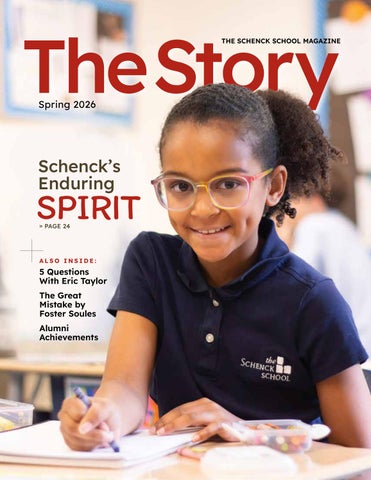
The Story
THE SCHENCK SCHOOL MAGAZINE
Spring 2026
Schenck’s Enduring
SPIRIT » PAGE 24
ALSO INSIDE:
5 Questions With Eric Taylor The Great Mistake by Foster Soules Alumni Achievements
soaring
around campus
Contents Departments 04. A Message from the Board Chair
04. Board of Trustees 05. A Message from
the Head of School
05. Leadership
& Administration
06. Letters to the Editor 08. Campus News
13. Professional Development 18. Notes from ReadSource 20. Bookmark
34. Alumni News 40. Epilogue
22 28 34
Features 12. Five Questions with…
14. The State of Dyslexia
08
16. Portrait of a Phoenix 22. The Great Mistake
24. The Enduring Spirit of The Schenck School
28. Executive Function 38. A Fond Farewell
The Story • Spring 2026 | 03
A Message from the Board Chair Dear Schenck School Community, The theme of this issue of The Story—the enduring spirit of The Schenck School—invites us to reflect on the belief that Mr. Schenck knew all along, that dyslexic students are capable of strong academic achievement when taught with expertise, structure, and high expectations. This belief has guided this community for more than sixty-five years. The enduring spirit of Schenck lives beyond its instructional approach. It is reflected in the environment we create each day: classrooms led by skilled and dedicated teachers, a community that encourages perseverance, and a culture that supports students as they grow in both confidence and capability. This spirit is sustained by the people who shape it, from the educators who guide each child with care, to the families who place their trust in the School, to the alumni who carry the Schenck experience with them long after they leave our campus. Together, these individuals form the heart of The Schenck School. Their commitment—past and present—is what sustains the School’s mission and allows its spirit to endure. Thank you for being part of this remarkable community and for helping ensure that The Schenck School continues to change the lives of students for generations to come. With gratitude, Jennifer Dangar, P’17, Board Chair
Emeritus Trustees
Mrs. Betty Ann H. Abblitt Mr. Richard M. Asbill
04 | The Schenck School
Mr. Frank J. Belatti Mrs. Kimberly R. Berman Mr. Kenneth W. Bomar Mr. Emmet J. Bondurant II Mrs. Kay Bondurant Mr. Joseph Breiner Mr. Eric B. Brock Mrs. Evelyn Carter Mr. J. Donald Childress Mrs. Barbara M. Coats Mr. Richard W. Courts IV Mrs. Emily Dannals Davis Mrs. Margaret P. Denny Mr. Mark L. Feidler Mr. R. Brad Foster Mr. J. Rex Fuqua Mrs. Duvall S. Fuqua Mr. S. Taylor Glover Mrs. Nancy Green Mr. David P. Higgins Mr. Robert C. Hill Jr. Mr. Brannon A. Huntz Mr. Charles D. Hurt III Dr. E. Ladd Jones III Mrs. Andrea M. Kauffman Dr. John C. Knox Mrs. Kimberly C. Marks Mr. Laurin M. McSwain
Spring 2026
Editor: Katie Harrigan Director of Communications and Marketing Contributing Editors: Janie Beck Dr. Kara A. Loftin Contributors: Egen Arnold Janie Beck Katie Boehme Ellen Hill Dr. Kara A. Loftin Foster Soules Lily Stowell Graphic Design and Art Direction: Dawn Stein Photography: Alice Park Lily Stowell Faculty, Staff, student, and parent photographers Printing: Drummond Press
2025-2026 Board of Trustees Ms. Jennifer R. Dangar, Board Chair Dr. Mark R. Bell II Mrs. Sarah P. Bottini Mrs. Nancy Bryant Mrs. Robyn M. Curnow Mrs. Katherine Denny Mr. Tillman Douglas Mr. John A. Draughon Jr. Mr. John Curtis Fisher Mrs. Mary B. Hanson Mrs. Jessica A. Jones Mr. Andrew Kang Mrs. Susan S. Krendl-Armstrong Mrs. Elizabeth Mayfield Mrs. Elizabeth S. Miller-Tucker Dr. Arun V. Mohan Mrs. Jennifer C. Morgan Mr. Paul M. Ollinger Mrs. Michaeline M. Roland Mr. Richard R. Rollins III Mrs. Elizabeth J. Shults Dr. Adam C. Webb Mrs. Caroline H. Wildman Mr. Michael Zelickson
The Story
The Schenck School Magazine
Mr. John W. Miller II Dr. Carlos S. Moreno Mrs. Mary E. Morris Mrs. Joan B. Pattillo Mr. Neal J. Quirk Mrs. Selma Ridgway Mrs. Tina S. Roddenbery Mrs. Margaret H. Rollins Ms. Pamela R. Rollins Mr. H. Jerry Rosenberg III Dr. Randal H. Rudderman Dr. Ernst M. Ruder Mrs. Ellen F. Schneidau Mrs. Linda Sewell Mr. Taylor W. Smith Mrs. Janice K. Story Mr. Calvin S. Stowell Mr. David B. Stromquist Mr. S. Andrew Sullivan Mr. F. Neal Sumter III Mrs. Julie Vickers Mrs. Gwyneth G. Webb Mr. Peter C. White Mrs. Polly Williams Mr. Robert G. Woodward Mr. Jeffrey L. Wright
The Story, The Schenck School Magazine, is published by the Communications Office twice a year and is mailed free of charge to members of The Schenck School community. For general information about the School, please visit www.schenck.org. To submit alumni news, email alumni@schenck.org. ©2026 The Schenck School, 282 Mt. Paran Road, NW, Atlanta, GA 30327 The Schenck School acknowledges its obligations to prohibit discrimination, harassment, or retaliation on the basis of race, color, national origin, age, sex, disability/handicap, or religion in admission to its educational programs, activities, and services, and in employment opportunities or processes. Retaliation against an individual for filing a complaint under this policy or participating in the informal or formal resolution is prohibited.
A Message from the Head of School Dear Families and Friends, Since 1959, The Schenck School has embodied resilience, belonging, and shared purpose. Our traditions continue this spirit, connecting students from
Leadership & Administration Head of School Dr. Kara A. Loftin
different generations. One that stands out is singing the Alma Mater.
Principal Foster Soules
Our Alma Mater began with a simple question: how could we honor a leader
Director of Advancement Janie Beck
who gave so much to our School? In 2015, as Head of School Gena Calloway prepared to retire, Marge Rockwell, third-grade teacher, suggested a song to capture Schenck’s spirit. She wrote lyrics inspired by our mission, our Phoenix spirit of rising in the face of challenge, reflecting the generations of students shaped within these walls. The project soon became a quiet team effort. Former music teacher Margaret Talmadge Howell recorded the piano accompaniment. Eric Taylor, Schenck’s current music teacher, taught the song to students during class. Sixth graders, with help from Ellen Hill, Director of Community Engagement, made recordings so teachers and students could practice in
Director of Finance and Operations Ryan Hudak Director of Communications and Marketing Katie Harrigan Director of Information Technology Brannon Fissette
that would become a lasting tradition.
Director of Community Engagement Ellen Hill
The word “Alma Mater” comes from Latin and means “bounteous mother,” a
Director of Admissions Cason Given
secret. By the spring assembly, everyone was ready to surprise Gena with a gift
source of nourishment and growth. This idea describes what The Schenck
of belonging.
Managing Director of Operations and Administration for ReadSource Cara Laurie
Today, we keep this tradition going at our weekly Rise ’n Shine gathering.
Mission
School has provided to students and families for more than sixty-five years. What started as a surprise gift is now a tradition reflecting our pride and sense
Every Friday morning, we begin the day together with a mindful minute and a celebration of a Charter Champion. We end Rise ’n Shine by singing the Alma Mater a cappella. When singing, “We stand together, grateful generations. Hail to The Schenck School, hail,” students and teachers alike feel the connection that has always been part of Schenck. Together in song, we celebrate the tradition, the community, and the timeless spirit that makes Schenck home. Read, Rise, Fly!
Dr. Kara A. Loftin Head of School
For more than 60 years, our mission has remained remarkably focused; build a solid foundation for dyslexic students and develop their rich potential. Our strategy to accomplish this goal is focused, accelerated remediation of dyslexia using the highly effective Orton-Gillingham Approach. While reading and writing are central to our curriculum, The Schenck School offers a comprehensive educational program for Kindergarten through sixth grade to help students develop intellectually and to prepare them to thrive in school, and in life.
The Story • Spring 2026 | 05
letters TO THE EDITOR Letters to the Editor offers a meaningful glimpse into the voices of our Soaring On sixth graders as they reflect on their time at Schenck. Through thoughtful words of wisdom, they share encouragement, insight, and advice with returning and future Phoenixes, capturing the spirit of growth, resilience, and confidence that defines the Schenck experience.
06 | The Schenck School
Advice for students at The Schenck School Here’s what some of our 6th graders are saying...
The teachers at Schenck are the nicest in the world, and super encouraging and supportive. – Bentley
There is never a point in time where you are not having fun especially in recess. – Aiden
This school did the impossible: make phonics fun. No one does that! Our teachers are so funny and give me a new perspective on school. – Evelyn
Don’t worry you will have a lot of friends at The Schenck School. – Finn
If you are shy, Schenck will help you break out of your shell. It helped me! – Ben
If you have a hard time reading The Schenck School will help you. – Emma Jean
The Story • Spring 2026 | 07
CAMPUS
news House Sorting Ceremony
The start of the school year at The Schenck School includes one of our most anticipated traditions, the House Sorting Ceremony. New students gather with excitement as they prepare to learn whether they will join Terra, Solis, Ignis, or Tempus. During the ceremony, each student opens an envelope alongside classmates to reveal a house shirt and their official house placement. The moment is met with enthusiastic cheers as the community celebrates the newest members of each house.
“The Sorting Ceremony is my favorite day of the year! The Schenck School fosters a culture of inclusion and acceptance, and being sorted into a House gives our students a home within a home at their new school. I love seeing the excitement on each student’s face when they find out which House they are in. It’s an uplifting and electrifying way to kick off the year!” – Egen Arnold, 3rd Grade Teacher and Director of House System
08 |
Founder’s Day
Founder’s Day at The Schenck School was a vibrant celebration of music and legacy. This year’s program highlighted the joy of musical expression, beginning with a special presentation by the Atlanta Recorder Society. Students enjoyed an engaging demonstration that introduced them to the rich history and varied sounds of the recorder family, from the smallest soprano to the deeper-toned bass instruments. The celebration concluded with a festive parade that filled the campus with sound. Students proudly marched while playing recorders, cymbals, and other instruments, bringing energy and rhythm to the day. It was a memorable tribute that honored David Schenck while showcasing the community’s creativity and enthusiasm.
The Story • Spring 2026 | 09
Day of Giving
Day of Giving was a meaningful day of service and community at The Schenck School. As the holiday break approached, students thoughtfully prepared care packages for several partner organizations, including Atlanta Children’s Shelter, The Shepherd Center, Children’s Healthcare of Atlanta, and Slater Elementary School. The day concluded with a special assembly where students presented their community service projects to representatives from each organization. It was a powerful reminder of the generosity, compassion, and collective spirit that define the Schenck community.
Grandparents’ and Special Friends’ Day
The Schenck School was delighted to once again host grandparents and special friends on campus for this year’s celebration. Over two days, guests stepped into classrooms, observed instruction in action, and experienced the confidence and growth that define the Schenck journey. Students beamed with pride as they shared their work and introduced their visitors to daily life at school. Grandparents’ and Special Friends’ Day remains a meaningful tradition at the School, and we are grateful for the role these loved ones play in the lives of our students.
10 | The Schenck School
“The Day of Giving is my favorite day at The Schenck School. You can feel the buzz throughout the school as students create their projects. At the assembly, you can really see the pride students feel as their projects are delivered to help members of the community. ” – Katie Boehme, 4th Grade Teacher
Instagram Highlights 1. August 12, 2025 (
181)
2. August 29, 2025 (
98)
🚗📚⚽
1
First day energy! Whether it was smiles in the carpool line, focused learning in the classroom, or fun on the field, this year is already off to an amazing start!
🔥 Welcome to the Houses! Our newest Phoenixes have officially joined their Houses— Ignis, Solis, Terra, and Tempus! 🌟 The energy, excitement, and community spirit were incredible as they discovered where they belong. Here’s to a year full of House pride, connection, and friendly competition!
🏆
3. October 3, 2025 (
2
3
4
166)
This morning’s Rise ’n Shine was a full-circle moment—alumni who once walked these halls are now back as teachers and staff, making memories that will last forever.
4. October 20, 2025 (
166)
What a day! Our Phoenixes ran, cheered, and showed their support at the Dyslexia Dash. Every step celebrated our readers and raised awareness for dyslexia. We’re so proud of our students, families, and staff for coming together for such an amazing cause!
Follow us @SchenckSchool The Story • Spring 2026 | 11
? ??
Five Questions With...
Eric Taylor
?
1. What is the most rewarding part of your job? Hearing laughter in the music room and watching kids’ imaginations take off. Music brings people together, and often it feels like we’re traveling the world through songs, dances, and instruments. I love the moment when something new clicks for a student. Their excitement is contagious and keeps me energized every day.
2. What inspires you? My children are a constant source of inspiration, whether they’re flying planes, teaching yoga, performing on aerial silks, dedicating themselves to illustration, or, in my oldest’s case, earning her doctorate and becoming a mom. The joy of being a new grandpa and watching my granddaughter grow adds a whole new layer of inspiration and wonder. And my wife inspires me every day with her deep spirituality and her unwavering devotion as a mother, partner, and friend.
3. What is your favorite children’s book? I’ve always loved Dr. Seuss. His rhymes made language feel musical to me as a kid. To Think That I Saw It on Mulberry Street, Mr. Brown Can Moo! Can You?, and If I Ran the Circus were favorites. And of course, Fox in Socks. Lines like “Beetles battling with paddles on bottles on poodles eating noodles” still make me laugh.
4. How long have you worked at Schenck? I’ve been part of the Schenck community for 23 years, beginning as a Road Runner student and later as an associate teacher. Over the years, I’ve taught science and first and second grade before finding my home in the music room. Along the way, I’ve helped start the Summer Samba class in the Reading Adventures program, taught rock climbing and Latin dance, served as the first leader of House of Terra, and continue to enjoy my role as the House Council emcee.
5. What is your favorite song? That’s always a tough one because it depends on my mood. Lately, I’ve been playing “Black Water” by The Doobie Brothers on guitar, which brings back memories of singing it with my mom and brother on Christmas drives to my grandparent’s house. When I need a burst of energy, I listen to “Chant a Psalm” by Steel Pulse.
12 | The Schenck School
?
PROFESSIONAL
Development All Together at DyslexiaCon This fall, all faculty attended DyslexiaCon 2025, the International Dyslexia Association’s National Conference. Teachers learned the latest findings on how best to teach students to learn to read. They also explored the most effective instructional approaches and innovative tools to support learners with dyslexia and other language-based learning differences. It was a rare opportunity to learn from the specialists shaping literacy education nationwide, and it happened right in our home city of Atlanta. Our faculty returned energized, ready to apply this learning to the classroom. When a school invests in its teachers, it invests in every student who walks through its doors, and in the confidence and preparation they carry with them long after they leave.
By gathering at DyslexiaCon 2025, our faculty reaffirmed Schenck’s commitment to staying at the forefront of research so we can meet every student with the most informed, compassionate, and effective instruction possible.” – Dr. Kara A. Loftin, Head of School
The Story • Spring 2026 | 13
The State of
Dyslexia An Updated Definition... For the first time in over two decades, the International Dyslexia Association (IDA) has adopted a new definition of dyslexia, reflecting advances in research and an increased understanding of this complex learning difference.
Defining Dyslexia— What it is and how it shows up…
A specific learning disability
14 | The Schenck School
Influenced by a combination of genetic, neurobiological, and environmental factors
A deficit in word reading and/or spelling
Impacts a student’s reading accuracy, speed, or both
The 2025 IDA Definition of Dyslexia, adopted on October 22, 2025, describes dyslexia as: “A specific learning disability characterized by difficulties in word reading and/or spelling that involve accuracy, speed, or both and vary depending on the orthography. These difficulties occur along a continuum of severity and persist even with instruction that is effective for the individual’s peers. The causes of dyslexia are complex and involve combinations of genetic, neurobiological, and environmental influences that interact throughout development. Underlying difficulties with phonological and morphological processing are common but not universal, and early oral language weaknesses often foreshadow literacy challenges. Secondary consequences include reading comprehension problems and reduced reading and writing experience that can impede growth in language, knowledge, written expression, and overall academic achievement. Psychological well-being and employment opportunities also may be affected. Although identification and targeted instruction are important at any age, language and literacy support before and during the early years of education is particularly effective.” This updated definition emphasizes that dyslexia exists along a continuum, is influenced by multiple interacting factors, and highlights the importance of early identification and targeted instruction. It broadens the focus beyond phonological processing to include morphological and language-based factors, recognizing the impact of dyslexia on overall learning, well-being, and life outcomes.
Occurs along a continuum of severity (from mild to severe)
Persists even with effective instruction
Often presents with difficulties in phonological and morphological processing
Often linked to early oral language weaknesses
Results in various secondary consequences
The Story • Spring 2026 | 15
Portrait of a Phoenix:
Ida Blythe As you Soar On, what lesson will you take with you? I am going to take the lesson of friendship and teamwork. These lessons taught me how to make more friends, get involved, and pour my heart out into everything that I do.
What does Schenck mean to you? Schenck means family! The Schenck School is my home; it’s my family, and I will always come back here whenever I can. This is the first real school I’ve been to, and if I didn’t go to this school, I would still be the shy girl I was. The Schenck School has changed my life, changed my heart, and changed me.
Fast Facts How long at Schenck?
4 years (started in Kindergarten)
Involved in?
Phoenix Flyers, Phoenix Fun, Art Barn, Alliance Theater
Soaring on to?
Mount Vernon School
What advice would you give to the incoming Schenck students? I would tell them to dream big and to follow their teachers’ advice and be open to learning.
What was your favorite project you did at Schenck? My favorite project is Reader’s Theater; the collaboration involved in acting made it really fun!
What do you want to be when you grow up? Someone who can change the world, remembered for the things I did, and for being a leader.
What would you want your younger brother, also a Schenck student, to know? Be brave and dream big.
16 | The Schenck School
The Schenck School is my home; it’s my family, and I will always come back here whenever I can.”
The Story • Spring 2026 | 17
NOTES FROM
ReadSource Advancing Excellence: Professional Development at The Schenck School Through the School’s partnership with ReadSource, teachers have continued to deepen their expertise in the Orton-Gillingham (OG) Approach to better serve students with dyslexia. Over the last two years, Ellen Hill, Foster Soules, and Stacey Prusak have guided the majority of the Schenck School faculty toward their Associate level certification in the Orton-Gillingham Academy (OGA). This certification ensures a consistent, high-standard approach across our classrooms. Building on that foundation, a group of eight teachers committed to the Clinical Level OGA certification this year. This advanced path requires an additional 100 hours of coursework and 200 hours of 1:1 tutoring beyond their daily classroom duties. We recognize the following teachers for their dedication to this rigorous process: Jana Thomas, Laura Dreyer, Kerri Saulnier, Rebecca Brown, Katherine Sellers, Caroline Pasternak, Allison Defrees, and Ashley Driver. ReadSource commends these educators for their ongoing commitment to professional growth and their dedication to the success of The Schenck School students.
Leveling Up
We are also pleased to announce that two teachers have officially attained their Clinical Level Certification this school year, and both are already moving into advanced roles:
Michelle Stone will serve as a Clinical Supervisor, mentoring teachers within the ReadSource Practicum program.
Mary Margaret Schulte has begun the multi-year process of becoming an OGA Fellow-in-Training, a significant commitment to the highest level of OGA certification.
18 | The Schenck School
Empowering Educators: The ReadSource & APS Literacy Partnership Through a strategic partnership with Atlanta Public Schools (APS), ReadSource is providing Classroom Educator Orton-Gillingham training to 100 elementary school educators this Spring. These teachers have committed to four intensive Saturdays of Orton-Gillingham Academy training, the “gold standard” for supporting students who struggle with reading. This initiative isn’t just about professional development; it’s about providing the specialized tools necessary to ensure every child has a path to success. Real school improvement isn’t accidental; it requires a synergy between leadership priorities and teacher dedication. By mastering structured literacy practices, these educators are building a foundation of clarity and confidence for every student. We are incredibly grateful for the leadership at APS and the teachers who are leaning into this work to ensure no reader is left behind.
Put into Practice
The impact of this training is best described by the educators who are already bringing these strategies back to their schools:
“As a Media Specialist, participating in this cohort has been a powerful learning experience. One of my biggest ‘lightbulb moments’ has been realizing how many practical strategies I can use to support struggling and non-readers in meaningful ways. The program has helped me feel more confident and better equipped to guide students toward building stronger reading skills and a love for literacy.” — Loraine Foushee, Media Specialist
“The Classroom Educator training has already had an immediate impact on my instruction. I’ve gained new strategies for teaching blending and developed a deeper understanding of syllable division, which has strengthened how I support students as they build their reading skills. I’m excited to begin implementing these strategies to help learners grow even more confident and successful readers.”
— Shanell Lee-Angry, Instructional Coach
The Story • Spring 2026 | 19
20 | The Schenck School
bookmark The Mood Meter squares, a tool used to help students identify and express their emotions, are a new and popular addition to the Kolb Family Field space. They have quickly become a hub for imaginative games among students. Third graders are pictured here, excitedly gathering in the space they chose for a recess photo.
The Story • Spring 2026 | 21
Musings from Foster Soules:
The Great Mistake In my 30 years at Schenck, I have seen one constant: teachers get excited about a great mistake. A great mistake is an opportunity. It has always been seen that way, long before Carol Dweck taught us about growth mindset. David Schenck often said that learning happens on the edge, on the edge of knowing. That is why we challenge our students, after plenty of scaffolding, to try independently and see how close they get. Of course, we hope they will nail it. But if we see a great mistake, we celebrate that too. It has never been the culture of The Schenck School to say, “No, that’s not right.” Instead we say, “Tap that out.” “Let’s listen again for those sounds.” “Let’s get those letters in the order we hear them.” At Schenck, we listen, we think, and we analyze. A great mistake can happen in math class as well. With the renewed national focus on understanding math as a language and a complex system, describing and analyzing that system is the path to confidence. This aligns closely with the way David Schenck always thought about teaching math. Understanding has to come first. He would never have said, “You got that wrong.” A Schenck teacher will say, “Can you prove that for me?” or “Can you explain your thinking?” It is the journey that matters. The destination will take care of itself.
22 | The Schenck School
In writing, a great mistake is more subtle, often an omission. A Schenck teacher has many quick prompts for easy fixes, such as missing capitals and punctuation. One favorite is “call the COPS,” a reminder to check for capitalization, organization, punctuation, and spelling. The more challenging work comes with organization, clarity, and detail. With the help of The Writing Revolution, students learn the craft that underpins different text structures. By understanding the complexities of academic language, they become more strategic writers. If they do not know where to start, we teach them to use a graphic organizer and brainstorm. We do not ask a child to “write a little bit more” or “add a little something.” Instead, we give them the tools to understand that written language is more formal than spoken language, and that there are techniques that help ideas take shape. If they go on and on in
At Schenck, we listen, we think, and we analyze.”
short bursts, we might ask, “Could you combine these two sentences using an appositive?” or “Would a transition word help your reader understand?” Written expression is often the most challenging area for our students, and every attempt and every edit is celebrated. At Schenck, we have also always understood lapses in behavior. These may not be great mistakes, since emotions are involved, but they still lead to important learning. Students come to understand that all feelings are valid, and that it is what we do with those feelings that requires care and control. We help children when their social connections break down, when their organizational skills falter, or when executive functioning feels out of reach. The shared language we use, based on the RULER Method, gives us the ability to help students put words to their feelings with the Mood Meter. It provides students with a strategy for stepping back and thinking before they act by taking a Meta Moment. The Blueprint establishes a system for repairing relationships when things go wrong. We are all going to make mistakes. Built into the ethos of Schenck is an embrace of the near miss. It is often the very thing that leads to deeper understanding.
The Story • Spring 2026 | 23
The Enduring
SPIRIT of The Schenck School
W
hen David Schenck founded what would become The Schenck School in 1959, he did so with a belief that students with dyslexia were capable of strong academic achievement when taught with skill, structure, and high expectations. Rather than adjusting standards to accommodate their academic struggles, he built a model that addressed them directly and trusted that students would rise to the challenge. That belief has shaped the School ever since.
It became very clear to me what you had to do; get these kids that were having so much trouble out of the competition and put them in a small class setting by themselves. Forget all those subjects. Get back there and work with their language, their reading, and their spelling. That’s what convinced me to take a chance and start my own school.” – David Schenck
24 | The Schenck School
The Story • Spring 2026 | 25
The enduring spirit of The Schenck School can be felt in the way Schenck students grow into themselves over time. Many arrive having experienced frustration with reading. They know how important literacy is, and they know what it feels like to fall short of it. What they encounter here is not ease, but clarity, as carefully structured instruction creates the conditions for steady growth. As students settle into that rhythm, something begins to shift. They learn that persistence is not simply encouraged but expected. They begin to approach challenges more confidently, no longer assuming that difficulty means defeat. Reading,
26 | The Schenck School
which once felt unpredictable, becomes more manageable. Writing becomes more controlled. Participation becomes more natural. The growth is gradual, but it is unmistakable. Our Schenck School teachers are essential to that process. Their expertise provides the structure students need, and their consistency provides the security that allows students to take risks. They understand that resilience is something that develops when students are guided through difficulty rather than shielded from it. Over time, students internalize that guidance and begin to trust their own capacity for growth.
The enduring spirit of The Schenck School can be felt in the way Schenck students grow into themselves over time. Families often describe this experience in personal terms. They speak about seeing confidence return. They talk about their children who are more willing to engage, more comfortable asking questions, and more open to academic challenge. What they are witnessing is not only improvement in reading, but the strengthening of self-belief. That strength carries forward even after students Soar On from Schenck. Alumni frequently reflect on their time at Schenck as a period when their understanding of themselves changed. They learned how to work through something difficult with support and discipline. They discovered that perseverance, when paired with effective instruction, leads to meaningful achievement. Walk the halls and you’ll see it reflected on the walls of the Alumni Hall of Fame, where hundreds of former students are recognized for the paths they have forged. Many go on to succeed in demanding academic and professional environments, not because their journeys were made easier, but
because they learned here how to meet difficulty without retreating. Over the decades, education has evolved in significant ways. Research has expanded, technology has advanced, and classrooms look different than they did in 1959. Yet the spirit that defines the School has remained recognizable. Students are still expected to work hard. Teachers still approach instruction with depth and care. Families still place their trust in a program that takes literacy seriously. The enduring spirit of The Schenck School is not found in a single tradition or accomplishment. It is found in the steady resilience of Schenck students who learn to persist, in the unwavering commitment of teachers who guide them, and in a community that believes deeply in what they are capable of achieving. It began with a clear belief more than sixty years ago, and it continues each time a student realizes that something once thought impossible has become attainable.
The Story • Spring 2026 | 27
28 | The Schenck School
Executive By Ellen M. Hill
Functi n THE SKILLS BEHIND LEARNING Most of us know that executive function skills are cognitive processes that help us plan, organize, initiate, and stay on task. They help us prioritize, stay on time, and develop the mental capacity to pursue goals and accomplish them. The Story • Spring 2026 | 29
Historically, educators like me who became interested in learning more about executive functioning skills first learned that they are managed by the frontal lobe of the brain. We began asking questions about how executive function relates to learning. We asked, “If you have trouble attending and focusing, is that an executive function disorder?” “If you have trouble with executive functioning, do you have ADHD?” As we learned more about working memory, we asked, “Can we change our teaching strategies to help?” “What accommodations should we use?” “How does executive functioning affect reading? Math?” As a parent, I simply asked, “Can someone help my family and me?” As researchers learned more, we began to understand that executive functions involve brain
circuitry. Depending on which circuits are most or least impaired, differences may appear in any person, whether they struggle with attention or focus or not. These mental skills help us with working memory, flexible thinking, and self-control. They guide how adults manage daily life and how our students manage their activities, particularly in school. We have learned that some people have more difficulty regulating emotions, some have deficits in working memory, and others struggle with self-awareness or self-monitoring. Dr. Russell Barkley explains that “so far we know about four circuits in the prefrontal cortex of the brain that relate to executive function and executive dysfunction.” He refers to these four circuits as the “What,” the “When,” the “Why,” and the “Who.”
THE FOUR CIRCUITS OF EXECUTIVE FUNCTION & EXECUTIVE DISFUNCTION
THE “WHAT” CIRCUIT is linked to working memory. In this circuit, what we think begins to guide what we do. This is particularly true when it comes to plans, goals, and thinking about the future.
THE “WHEN” CIRCUIT
is the brain’s timing circuit. It coordinates the smoothness and sequence of behavior, as well as the timeliness of actions and when certain things are done. When the “When” Circuit does not function properly, individuals with ADHD often experience difficulties with time management.
It is not uncommon to see varying lists of executive functioning skills, sometimes grouped into sets of seven to twelve. There are also online tests and checklists available that allow individuals to assess themselves or their family members.
30 | The Schenck School
THE “WHY” CIRCUIT
is often referred to as the “hot” circuit because it is linked to our emotions. It is where what we think influences how we feel, and vice versa. It becomes the final decision maker in our plans. When considering multiple options, this circuit ultimately chooses among them based on emotional and motivational factors.
THE “WHO” CIRCUIT is where selfawareness takes place. It is where we become aware of what we do, how we feel, both internally and externally, and what is happening around us.
Understood.org identifies three main areas: working memory, cognitive flexibility, and inhibitory control. Referencing Dr. Barkley again, he explains that executive function is often evaluated through the strength of seven core skills (see chart on page 33).
Executive functions involve brain circuitry… They guide how adults manage daily life and how our students manage their activities, particularly in school.”
Barkley explains that these skills develop over time, beginning around age two, and tend to develop in a chronological sequence. We now understand that many neurodiverse individuals, including many of our students, may move more slowly from one stage to the next. We also know that executive functioning challenges often run in families. While some students experience few difficulties, many students with dyslexia and dyscalculia struggle with aspects of executive functioning. Executive dysfunction can affect both reading and math. As a parent, it is helpful to learn what works best for you and your child. Small steps make a difference. Teach your child to value the process and celebrate those small steps, not just the final outcome.
While some students experience few difficulties, many students with dyslexia and dyscalculia struggle with aspects of executive functioning.” 32 | The Schenck School
Patience in abundance will be required, and it is important to let go of “normal” expectations. There are many books and podcasts that can offer guidance. There are games that can help build skills. Professionals can provide evaluations, guidance, and instruction. These skills can be strengthened. Educators and specialists at The Schenck School use researchbased strategies and interventions that are both purposeful and effective.
THE SEVEN CORE SKILLS OF EXECUTIVE FUNCTIONING Task Difficulty and Description Self Awareness:
1
Simply put, this is self-directed attention.
2
Also known as self-restraint.
3
4
5
6
7
How to Help
Inhibition:
Explicitly teaching students to identify emotions and pause before acting on them.
The Mood Meter helps students identify their feelings based on energy level and pleasantness.
Use organizers, posting schedules, assignment books, written and oral directions, posting rules, and expectations.
Baskets for folders, color-coding of materials, steady baskets of sharpened pencils.
Allowing for movement; provide different seating options, fidgets.
Creating a “calming corner” or sensory room. Students can take a mindfulness break.
Nonverbal Working Memory:
The ability to hold images and information in your mind. Essentially, this is visual imagery and how well you can picture things mentally.
Verbal Working Memory:
Self-speech, or internal speech. Most people think of this as their “inner monologue.”
Emotional Self-Regulation:
The ability to use the previous four executive functions to manage your emotional state. This means using words, images, and self-awareness to process and alter how we feel about things.
Self-Motivation:
The ability to motivate yourself to complete a task even when there is no immediate external consequence.
Planning & Problem Solving:
Sometimes described as “self-play,” this refers to how we manipulate information in our minds to generate new ideas or solutions. By taking things apart and recombining them in different ways, we develop strategies to solve problems.
Breaking large tasks into smaller chunks.
Highlighting information, math symbols or parts of words.
Consistent routines and places to work.
The Story • Spring 2026 | 33
ALUMNI
news a lu m n i p r o f i l e :
Halsey Jennings Last March, Dr. Kara received a message from Halsey Jennings, a Schenck School alumna (2004–2008), who introduced herself and asked a simple question: how might she give back? “As a Schenck alum, I cannot overstate how much the School has impacted my academic and personal growth,” she wrote. “The skills I gained played a vital role in shaping my success, and I would love to give back in any way I can.” Since graduating from the University of Georgia, Halsey has been working as a consultant at Accenture. She also founded AbledPlus (abledplus.com), a platform dedicated to raising awareness and building support for individuals with disabilities. Reflecting on her own journey, Halsey credits Schenck with helping her see her neurodivergence not as a limitation, but as a strength—something that allows her to approach challenges creatively and solve problems in ways others might not. Grateful for the foundation Schenck provided, Halsey began thinking about how she might support students and families navigating the same path she once traveled. What began as a thoughtful email soon grew into a meaningful connection with the School’s alumni community and new opportunities to engage with Schenck families.
34 | The Schenck School
Earlier this year, that commitment came to life. On a winter evening in January, Schenck alumni and parents gathered in the Fuqua Family Dining Hall for the School’s annual Alumni Social & Share—an evening dedicated to connection and shared experience. At the front of the room stood Halsey, returning not only as an alumna but as a guide for those following behind her. The evening centered around Halsey’s program, From Support to Independence, and she was joined on the panel by fellow Schenck alumnus Wright Williams (2014-2016), now a sophomore at Hamilton College, along with their mothers, Tracy Jennings and Becky Williams. Together, they shared their experiences navigating the transition from the structured support of Schenck to the growing independence required in high school and college. Speaking with calm clarity and quiet confidence, Halsey reflected on a reality many students with learning differences face: independence can feel both exciting and uncertain. Developing that independence often requires new skills—asking for help, communicating with
professors, managing accommodations, and learning to trust one’s own voice. To help make that process more manageable, Halsey created From Support to Independence, a guide she developed with her learning disability support coordinator at the University of Georgia. Drawing from her own experiences, the resource offers practical strategies for navigating disability services, building support systems, and advocating effectively in new academic environments. But the message Halsey shared that evening went beyond accommodations or logistics. It was about growth. Independence, she explained, does not arrive all at once. It develops gradually—through small decisions, moments of discomfort, and the growing confidence that comes from learning to speak up for yourself. For Halsey, that journey began years earlier at The Schenck School. Like many students who arrive
at Schenck, she was bright and curious, but still learning how to navigate the challenges dyslexia can present. What she found at Schenck was the same steady foundation that has shaped generations of students. Over time, that belief took root. Halsey developed not only the academic skills she needed to succeed, but also a strong understanding of herself as a learner. She learned how to ask questions, advocate for support, and approach difficult work with persistence and confidence. Those qualities carried her far beyond Schenck. At Whitefield Academy, The Lovett School, and later at the University of Georgia, Halsey continued to grow as a thoughtful student and emerging leader. Even as her path expanded, she remained deeply connected to the lessons she first encountered at Schenck. Today, through her professional work and advocacy efforts, Halsey is committed to strengthening support systems for neurodiverse individuals and expanding access to the resources that allow students with learning differences to thrive. She will be attending Harvard Graduate School of Education (HGSE) Fall 2026 to pursue Policy, Leadership, and Entrepreneurship in Education. In many ways, Halsey’s journey reflects the enduring spirit of The Schenck School itself: the belief that when students are given the right tools, the right instruction, and the confidence to persist, they can transform challenges into strengths—and use those strengths to create opportunities for others.
To view Halsey’s From Support to Independence guide, scan the QR code below.
From Support to Independence HEL PIN G YOU TAK LEA D ON YOU R EDU E THE CAT ION
The Story • Spring 2026 | 35
Schenck Alumni 20 Under 20 Honorees
Left: Kenzie Leonard. Right: Max Bell (left) pictured with his twin brother, Anselm. Two Schenck alumni and members of the Alumni Advisory Council were recently recognized by Rough Draft Atlanta as part of its 2026 20 Under 20, an annual recognition celebrating students who demonstrate exceptional leadership, service, and impact in their communities. Selected from more than 100 nominations, these young leaders are using their voices and experiences to advocate for literacy, accessibility, and opportunity for others. Their work reflects the lasting influence of the Schenck experience and the many ways alumni continue to lead with purpose long after their time on campus.
Kenzie Leonard ’19 Kenzie has focused her efforts on helping students with dyslexia navigate the transition to college. After recognizing how difficult it can be to find clear information about accommodations, testing, and accessibility services, she created the IDA College Q&A Interview Series, a YouTube program featuring conversations with education accessibility experts and tools to help students evaluate college support programs. Kenzie shared this work through the International Dyslexia Association of Georgia Teen Board and was invited to serve as a panelist at DyslexiaCon 2025, where she offered insights on improving support for students with dyslexia in higher education. Her work with IDA and on the Schenck Alumni Advisory Council reflects the same spirit of advocacy and leadership that Schenck alumni carry forward in their communities.
Max Bell ’17 Alongside his twin brother, Anselm, Max co-founded WriteToRead.org, a nonprofit dedicated to ensuring that every child in Georgia with dyslexia has the right to read. Through advocacy, awareness efforts, and community engagement, the organization is working to expand literacy access across the state. Max continues to stay connected to Schenck through his service on the Alumni Advisory Council while also serving on the Teen Board of the International Dyslexia Association of Georgia. His work is a powerful example of the leadership and purpose that Schenck alumni carry into the world.
36 | The Schenck School
Alumni Events Adult Alumni Party
The Schenck School welcomed adult alumni for a special evening at Superica this past fall. The event provided an opportunity to reconnect with former classmates, spend time with faculty, and share memories from their years at Schenck while hearing updates from the School. With lively conversation and plenty of laughter, the evening reflected the strong and lasting ties within the Schenck community.
Social & Share
This year’s Social and Share event featured alumni Halsey Jennings ’08 and Wright Williams ’16, who returned to campus to speak with high school-aged alumni and their parents. The program centered on Halsey’s resource, From Support to Independence, a guide designed to help students navigate the transition from high school to college and adulthood with dyslexia. Halsey and Wright shared personal insights and practical strategies drawn from their own experiences, offering perspective on self-advocacy, academic accommodations, and growing independence. The event was well attended, and many participants found the conversation both informative and encouraging.
The Story • Spring 2026 | 37
A Fond
It’s time to say good-bye!
FAREWELL T
hree Schenck employees are retiring—Mary Galloway, Peggy Hendrix, and Michele Santa Maria. Collectively, they represent almost 60 years of teaching and working at the School. They leave behind students, faculty, staff, parents, alumni, and more who have deep gratitude and appreciation for their dedication and commitment to Schenck.
Parting Words for Mary
“Mary is an incredible teacher, colleague, and friend! She is an invaluable part of The Schenck School! Her kind, friendly, and gentle nature, along with her extraordinary gift for teaching young children, makes her truly special! Mary will be greatly missed by everyone—especially the Kindergarten team!” —Susie McIntosh “Mary has an abundance of kindness, patience, & wisdom— essential traits that made her such a fantastic teacher in our kindergarten & first grade classrooms. She is a loyal & supportive friend and colleague. I have loved teaching with her for 15 years! Her gentle spirit will be missed by all of us.” —Laura Thwaite
38 | The Schenck School
Parting Words for Peggy
“I feel so fortunate to have worked nine wonderful years alongside Peggy. It was inspiring to watch her guide our families with such patience and kindness, but our personal connection has been something very special to experience. I am lucky to have found a true friend for life.” —Kelli Holcomb “As soon as Peggy became a teacher at The Schenck School, she was beloved. She gravitated toward the older students. She loved teaching students the English Language and inspired them to become great writers and lovers of literature. When she became Admissions Director, she knew the School professionally and personally so well, and she was able to speak with prospective parents in such a kind and caring manner. She enjoyed meeting each applicant and working with them. Shared interest and laughter is how most screening sessions ended. Families left feeling comfortable and happy about their experience with us. Peggy brought a unique, kind and special perspective to the Admissions job. She is missed already. I wish her joy and happiness during her well earned retirement!” —Ellen Hill
You’ll be missed!
Parting Words for Michele
“After 13 years of dedicated service as The Schenck School Director of Human Resources, we bid a bittersweet farewell to Michele. Since joining The Schenck School family, Michele has been a steady hand, a trusted confidante, and a champion for every faculty and staff member who walked through our doors. Her impact is woven into the very fabric of our community. While we will miss her wisdom, compassion, and selfless service, we are thrilled to see her begin this well-deserved new chapter. Congratulations, Michele, on a remarkable career!” —Ryan Hudak
Thank you!
“You’ve earned every page of every book you’re about to read! For 15 years, Michele has been our Director of HR and our unofficial therapist and walking policy manual. She’s answered the same questions with endless patience—even when I’m pretty sure she was thinking, ‘”Didn’t we just go over this last week?” Enjoy your well-deserved retirement, Michele. We will miss you!” —Terry Sherali
The Story • Spring 2026 | 39
40 | The Schenck School
epilogue Read. Rise. Fly. It begins with learning to read, but it doesn’t end there. At The Schenck School, confidence is built day by day, often in quiet and meaningful ways. Over time, that confidence grows into resilience and self-belief, and from that foundation, our students soar on—to new schools, new experiences, and new chapters. Watching them carry that strength forward is the true measure of our work and the heart of who we are.
The Story • Spring 2026 | 41
Nonprofit Organization U.S. Postage
PAID
282 Mt. Paran Road, NW Atlanta, GA 30327 schenck.org • readsource.com
SCHENCK ALUMNI:
You may have soared on, but you’ll always be a part of our flock! LET’S STAY CONNECTED! Update your contact information by scanning the QR code below.
FOLLOW US: @SchenckSchool @readsource_ facebook.com/SchenckSchool facebook.com/YourReadSource twitter.com/SchenckSchool twitter.com/readsource_
Atlanta, GA Permit No. 4285