Arts
Features
Community
"Saving Brinton" co-directed by Grinnell alumnus shown at The Strand
Yoni Ki Baat uplifts marginalized women's voices with Monsoon
"Most cities don’t function in the same way that we do..." page 4
page 6
page 5
the
Scarlet & Black Volume 134, Issue 8
Faculty and staff awarded grant to improve campus accessibility
By Zoe Fruchter fruchter@grinnell.edu The Center for Teaching, Learning and Assessment has awarded Assistant Dean for Disability Resources Autumn Wilke and Professor Eliza Willis, political science, funding for a project called Innovation Inspires Inclusion. The project explores accessibility on campus through the lived experiences of student leaders.
"Every person on this campus has the power to make positive changes that impact accessibility." Micki Behounek, Manager of Access Services The grant provides training for six student leaders, two staff and two faculty members by the Institute for Human Centered Design (IHCD) on how to conduct user/expert reviews of the campus environment. The IHCD defines a user/expert as “anyone who has developed natural experience in dealing with the challenges of our built environment.” The IHCD stresses that the experience of the user/expert is often radically different from that of designers. The of user/experts is crucial to design spaces that serve all. “[We] were inspired by an on-campus user/expert training we received from the Institute for Human Centered Design in June 2016 [and] were able to witness how much the campus buildings needed this form of accessibility review,” Willis said. “We felt that students would make the best user/ experts and reviewers [and] saw the
opportunity to create leaders in this area of need.” In an email to The S&B, Wilke wrote that the ultimate goal of the Innovation Inspires Inclusion project is “to provide opportunities for individuals with disability expertise, by way of their lived experiences, to influence the accessibility of the college campus.” Methodologically, Wilke said that the program will “provide contextual feedback on the accessibility of the physical, informational and attitudinal environment at Grinnell College through individualized reviews of programs and spaces.” Wilke wrote that another primary goal of the project is “to provide leadership development to Grinnell College students who will become leaders in their fields and expand accessibility awareness beyond Grinnell.” She stressed that any individual — faculty, staff, student or campus visitor — can become a user/expert on campus. “User/experts include parents managing with toddlers, older people with changing vision or stamina, people of short stature, limited grasp or who use wheelchairs,” Wilke wrote. To become a user/expert, interested community members can complete an application by visiting www.tinyurl.com/accessgc. Both Willis and Wilke have been consistent advocates for campus accessibility. Wilke has worked at the College since 2011 and holds a graduate certificate in Post-Secondary Disability Services from the University of Connecticut. She and the coordinator of Academic Support and Assistive Technology, Angie Story, co-lead the College’s Accessibility Committee. Willis is >> See Wilke and WIllis page 3
College's gift acceptance policy called into question over NRA president's donation
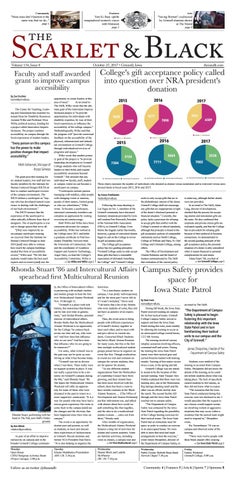
These charts represent the number of individuals who donated as alumni versus nonalumni and to restricted versus unrestricted funds in fiscal years 2015, 2016 and 2017. By Emma Friedlander friedlan@grinnell.edu Following the mass shooting in Las Vegas on Oct. 1, members of the Grinnell community have discussed monetary donations provided by Grinnell resident Pete Brownell, President of the National Rifle Association (NRA), to Grinnell College. Even before the tragedy earlier this month, however, a group of concerned alumni began to call on the College to revise its gift acceptance policy. The College gift acceptance policy has two guiding principles: “Grinnell College seeks to only accept those gifts that have a reasonable expectation of ultimately benefiting the College” and “Grinnell College
Rhonda Stuart '86 and Intercultural Affairs spearhead first Multicultural Reunion
CONTRIBUTED
Rhonda Stuart, performing with her band in The Pub, now Bob's Underground. By Ben Mikek mikekben@grinnell.edu As part of an effort to improve inclusivity on campus and in the broader Grinnell College communiMonday Open House CRSSJ Religious Activities Room (Prayer Garage), 3:00 p.m.
thesandb.com
October 27, 2017 • Grinnell, Iowa
ty, the Office of Intercultural Affairs is partnering with multiple student and alumni groups to host the first ever Multicultural Alumni Weekend Nov. 10 through 12. “Grinnell is a place with rich history, but sometimes that history can be lost over time or generations,” said Jordan Brooks, assistant director of intercultural affairs. Brooks thinks that the Multicultural Alumni Weekend is an opportunity for the College “to connect back across our time and say, who were we? And how does that influence who we are now? And how does that influence who we are going to be tomorrow?” For some, what Grinnell was in the past may not be quite as comforting as what it has become today. “Grinnell was not as diverse when I was there. There really were no support systems in place. It was not really a great time to be a minority on Grinnell’s campus during the 80s,” said Rhonda Stuart ’86. She hopes the Multicultural Alumni Weekend will offer an opportunity for some of those who were alienated in the past to return to a more supportive community. “It is a way for people who may have had a not-so-great experience like mine to come back to the campus [and] see the changes and the diversity that have happened since their time on campus.” The event is an opportunity for alumni past and present, as well as students, to meet and discuss their experiences of inclusiveness at Grinnell. Recent alumnus and former SGA President Dan Davis ’16 is also helping to organize the
festivities. “As a non-binary student on campus, I was pretty well-respected, and for the most part I never felt as if I wasn’t included,” Davis said. “I do know that a lot of my friends who were students of color, they did not have as positive of an experience.” Thus, the event aims to bring people with different experiences of Grinnell’s history together to meet each other, and to meet with and give advice to current students. Concerned Black Students has held a Black Alumni Reunion for many years, but this is the first time multiple multicultural student groups joined forces to organize an event like this. Though multicultural events are rich and common on campus for current students, they are far sparser for alumni. “As our different student organizations from the Multicultural Leadership Council have been growing, and their alumni base has been more involved with the school, there has been a want to have similar reunions to the Black Alumni Reunion. … [The Office of Development and Alumni Relations] put that information out, and talked with alumni about how could we pull something like that together, and the idea to do a multicultural alumni reunion … came out from there,” Brooks said. After months of organization, the Multicultural Alumni Weekend features a long list of activities for alumni and current students. Some are familiar activities, including visits to classes, a campus tour and >> See First Multicultural page 2
Tuesday Khutso Madubanya Presentation ARH 120, 5:30 p.m.
Wednesday Sharon Block and Ladelle McWhorter JRC 101 7:30 p.m.
Follow us on twitter @thesandb
seeks to only accept gifts that are in the philanthropic interest of the donor. Grinnell College shall not encourage any gifts that are inappropriate in light of the donor’s disclosed personal or financial situation.” Currently, this policy lacks a provision for refusing to accept gifts that conflict with the College’s mission or ethical standards, although this principle is found in the gift acceptance policies of comparable institutions such as Smith College, College of William and Mary, St. Olaf College and Colorado College, among others. The Office of Development and Alumni Relations and the board of trustees communicated to The S&B that evaluation of the current policy
is underway, although further details were not provided. In an email to The S&B, Adam Laug, director of development, clarified that the process for accepting alumni and non-alumni gifts are the same. He also confirmed that corporate and private citizen gifts are evaluated equally, and that the College has no precedent for refusing gifts because of their political or business connections. As demonstrated in the second guiding principle of the gift acceptance policy, the personal situation of a donor is only considered when it means financial or personal complications for said donor. Alana Smart ’68, co-chair of >> See Grinnell College page 3
Campus Safety provides space for Iowa State Patrol By Kate Irwin irwinkat@grinnell.edu During fall break, the Iowa State Patrol received training on campus for its four tactical teams. Grinnell College Campus Safety served to support and host the Iowa State Patrol during this time, most notably by allowing the training to occur at an unoccupied college owned house, 1212 6th Avenue. The training involved various roleplay scenarios involving officers, command staff and actors. During the training the Iowa State Patrol teams wore their tactical gear and carried firearms loaded with training rounds. Training of this nature occurs twice a year, in the spring and fall. Grinnell College was not initially meant to be the location of this tactical training. State Trooper Alex Dinkla explained that there were two training sites, one at the Montezuma Big Springs shooting ranch and the other was an off-site facility near the ranch. The second facility fell through and the Iowa State Patrol reached out to campus safety. “The Department of Campus Safety was contacted by the Iowa State Patrol regarding the possibility of the College hosting exercises for their tactical teams. The Iowa State Patrol had an immediate need for space in order to conduct an exercise in an unoccupied house. We were able to meet that need and made arrangements to host the exercise,” wrote James Shropshire, director of the Department of Campus Safety, in Wednesday Public Events: Rebirth Brass Band Herrick Chapel 7:30 p.m.
an email to The S&B.
"The Department of Campus Safety is pleased to begin fostering this important relationship with the Iowa State Patrol and in turn familiarizing their tactical units to our campus and the City of Grinnell." James Shropshire, Director of the Department of Campus Safety Students were notified of the training in an email from Campus Safety. Shropshire did not know the details of the training, so he could not inform students about what was taking place. The lack of specificity caused students to feel uneasy, as they did not know what to expect. “The scenarios that the Iowa State Patrol conducted during this exercise were not disclosed to me. I would speculate that the request to use a house would support scenarios involving violent or aggressive situations that may occur within a residence that the tactical team might need to respond to,” Shropshire wrote. Ric Tennenbaum ’18 was on campus and observed some of the training. “There were twelve people with these black assault rifles wearing >> See Iowa State Patrol page 3 Friday Family Weekend Grinnell College, 8:00 a.m.
Community 4 | Features 5 | Arts 6 | Sports 7 | Opinions 8
News
2
Edited by hermanal17@grinnell.edu & mettleca@grinnell.edu
Witness for Peace addresses feminist resistance in Colombia By Chloe Wray wraychlo@grinnell.edu At noon on Oct. 23, students and staff crowded into ARH 120 to hear Carol Rojas’ talk “Feminist Resistance in Colombia.” A member of the grassroots Colombian organization “Red Feminista Antimilitarista,” Rojas was accompanied to campus by Liz Moldan, director of Witness for Peace Midwest, and a translator from Witness for Peace who had met Rojas in Colombia. Witness for Peace Midwest invited Rojas to tour midwestern America in their speaker series, presenting on behalf of her organization and the feminist movement surrounding the negotiation of the current peace accords for Colombia. The Witness for Peace website states that the Midwest Speaker Series is designed to “work at the grassroots level to promote awareness regarding U.S. policies in Latin America through delegations, speaker tours, and local events and actions in Kansas, Iowa, Minnesota, Missouri, Nebraska, North and South Dakota and Wisconsin. With partners in Latin America, WFP seeks to build peace, justice and sustainable economies for all people.” In her introduction to the talk, Moldan elaborated on the goals of
Witness for Peace, emphasizing the group’s commitment to policy advocacy through education and support of local social justice leaders in Latin American countries to help them accomplish their goals. Simone Sidwell, Coordinator of the Peace and Conflict Studies Program, explained the College’s affiliation with Witness for Peace in an email to The S&B. “Witness for Peace has regularly come to campus over the years, often co-sponsored jointly by the Rosenfield Program and Peace and Conflict Studies (PACS). This year, the talk was co-sponsored by Rosenfield, PACS, Spanish and Latin American Studies,” Sidwell wrote. Rojas’ talk centered on the necessity of undoing the patriarchy and the demilitarization of Colombia. In a country where about half of the population is male, almost all of whom are subject to compulsory military service, the degree of militarization is extreme. Rojas argued that the established patriarchy within Colombia places women in an incredibly vulnerable position within the country’s ongoing conflict between the state, two guerrilla groups and multiple paramilitary narcotics groups. While her platform is rooted in feminism, Rojas contextualizes the efforts in which she is involved as extending past gender inequality to
freedom from violence, poverty and racism. Poor people, indigenous groups and Afro-descendent women are in a particularly precarious position within society. The undoing of the patriarchy and demilitarization are linked with the “eradication of the colonial hegemonic model of sex, class and race.”
"We want to live...not just to breate. Colombian women want the possibility of making changes. They want the tools to participate politically and tto enter into policial change." Carol Rojas In her city of Medellín, violence towards women and femicides, or the killing of women based on their gender, is common. Sex exploitation of women and youth is promoted by mafias and allowed by alliances with local governments. Along with educating women in typically poor neighborhoods on how to advocate for themselves, Rojas and Red Feminista Antimilitarista have advocated strongly for the wants and wishes of women in the new Havana Peace Accords. As a result of the gender committee for the accords, the six major reforms
or focuses that were included are as follows: rural reform and reclaim of land for farming, political participation rights, end of the conflict, solutions to the problem of illicit drugs, agreement on the victims of conflict (reparation) and implementation of verification of social groups before endorsement. This aims to give more rights and agency to women and those marginalized within the LGBTQ community. “We want to live, but not just breathe,” Rojas said. “Colombian women want the possibility of making changes. They do not want to live to mean to avoid death. They want to be given the tools to participate politically and to enter into political change.” Witness for Peace provided students with the opportunity to become involved with their organization through internships and the possibility for involvement in delegations to Latin American countries as social justice advocates. “While WFP chose the speaker and issue, the significance of, and worldwide attention given to the recent Colombian Peace Accords, no doubt informed the choice, allowing them to address various issues relating to this high-profile peace process that may not receive as much mainstream attention, including the role of feminism in this case,” Sidwell wrote.
CHARUN UPARA
Carol Rojas (right) with her translator (left) speaks to students interested in grassroots organizing over lunch.
First multicultural reunion planned Continued from Front Page a welcome dinner. Some activities, however, are specifically tailored to this event, including a performance by spoken-word artist Carlos Andrés Gómez and the Life After Grinnell networking event. “We are really excited to roll out something that’s a little different from the normal events that most of the time you will see on Grinnell’s campus,” Davis said. “We are trying to steer it away from networking in the sense of ‘I’m looking for a job.’ … We want it to be more under the common understanding that becoming an adult after Grinnell while you hold a marginalized identity can be rather difficult, so we really want to emphasize, [for example], this is how queer people are living in cities, [or] this is how it looks like it to be black and moving to a city.”
"It is a way for people who may have had not-so-great experiences like mine to ... see the changes and diversity that have happened since their first time on campus." Rhonda Stuart '86 This type of helpful advice to current students, a historical and external perspective on diversity outside the tight-knit Grinnell community, will be a key part of the Multicultural Alumni Weekend. So, with the planning nearly complete, event organizers are considering how a successful weekend will play out while thinking towards the future. “A successful weekend would be if people come, they meet students, they socialize with each other, and they have a good time,” Stuart said. “It is giving groups that may or may not regularly come back to the campus a chance to come back.” Davis is optimistic about the event’s prospects. “We want people to understand that it is difficult, there are difficulties that come with graduating from Grinnell and then taking on the rest of their lives, but at the same time, I also think that we don’t want to have everyone leave on some dreary note,” they said. “We also want to [point out] how wonderful it is to be who we are, and to continue being who we are, and to do it unapologetically.”
ITS observes "Cyber Security Week," brings activities to campus
By Ben Mikek mikekben@grinnell.edu October is National Cyber Security Awareness Month, and Grinnell’s Information Technology Services (ITS) is hard at work to spread awareness about and improve cyber security on campus. Information Technology Security Awareness Specialist Linda Ludwig said she has been making an effort to spread the word about cyber security during October. “I have been trying to do something each week of the month,” she said. The activities included an event with brochures, information and example phishing emails at the Marketplace. In addition, ITS hosted “Scam Slam,” a talk by staffers from
the Office of the Attorney General of Iowa with information about how students’ actions can impact cyber security. “They were building it to tell students how to avoid [scams],” Ludwig said. “There was a real positive interchange between the two speakers and the audience. … It was engaging.” Ludwig also led a workshop entitled “Phishing: Don’t Take the Bait,” with additional examples and more in-depth analysis of the tactics used by phishing emails. Finally, ITS prepared an escape room for groups of students. “The focus of [the escape rooms] is to be fun, but to have a cyber security focus [as] a learning opportunity,” Ludwig said. With such a great effort to raise awareness, what threats does ITS hope to preempt? Phishing scams
are among the greatest threats to Grinnell’s cyber security, and according to Ludwig, “the human factor is the weakest link.” Personally-targeted phishing scams can be remarkably convincing, and once an attacker gains access to a network user’s login credentials, they can use that account to further their malicious intentions. These can vary widely, from gaining access to other accounts at Grinnell, to obtaining information about personal accounts, such as those for banking. “Most people think of it simply as, well, I gave up my email account, they sent some spam out, big deal; I regain control of my account, no harm no foul,” Information Security Technical Specialist Mike Pifer said. “The problem with that is, what information did you have in your
email account? Did you have any banking information, anything in saved emails, passwords to anywhere else, links to logins, your contacts?” Beyond stealing information from past emails, one step which attackers may take after gaining access to an email account is to use it to send more spam to more users; emails from another Grinnell account appear more legitimate than do emails from the outside. What is more, hackers can use social information, including past patterns of messages, to learn more about users and personally tailor attacks. “It’s identity theft and social engineering; the more they know about you, the more they can socially engineer other compromises,” Ludwig said. Given these scary possibilities, ITS is hard at work protecting the college network and its users. To maintain security, ITS staff were not willing to discuss specific software tools used to maintain cyber security. The College does employ an automated filtering system, which, according to Pifer, identifies 90 to 95 percent of all phishing emails, leaving only a handful of wellengineered scams for end users to identify. “Ninety to 95 percent we should be grateful for, and we are, because that five percent can cause us a real headache,” said Rob Buchwald, director of information security. Given all the hard work behind the scenes to eliminate scam messages before they reach users, what can students, faculty and
staff do to stay safe? One longtime concern, methods for creating strong passwords, is currently being updated. Instead of complex passwords with special characters and random letters, the cyber security consensus increasingly recommends longer passwords which are easy to remember such as phrases or sentences. These are less vulnerable to a brute-force attack. “The new term is the passphrase,” Pifer said. “It might end up being 27 characters long. Cracking that by computer method becomes very difficult and time consuming, but I can easily remember it, but I can’t remember that 12-character randomgenerated with special characters stuff.” As far as detecting and avoiding scams, according to Ludwig, the best thing to do is to “think before you click.” Even taking a few seconds to consider the source and content of the message can help avoid a scam. Pifer said that users should ask themselves, “‘Does this look legit?’ If you answer is ‘I don’t know,’ stop and go further into looking into the message.” Simple precautions can go a long way, but Buchwald warned against a false sense of security. He said, “Don’t underestimate how much damage can be done if someone steals your identity or has your credentials.” National Cyber Security Awareness Month does end with a warning, but also many strategies to avoid falling for scams. It is impossible to be too careful.
News Grinnell College gift policy under scrutiny
Edited by hermanal17@grinnell.edu & mettleca@grinnell.edu
Connection to NRA president in light of gun violence worries alumni, community members
Continued from Front Page Colorado Faith Communities United Against Gun Violence and the spokesperson for the group of concerned alumni who called on President Kington to revise the College’s gift acceptance policy in relation to Brownell, first became concerned about this policy discrepancy in December of 2016. “I was contacted by a member of [the Colorado Coalition Against Gun Violence] who’d been contacted by Iowans for Gun safety, and they were very concerned about this pattern of donations that Brownell was making throughout the state to arts and education organizations,” Smart said. After learning that Brownell funds Grinnell College programs, most recently the Ignite Program, Smart sent her annual contribution to the College along with a letter expressing her concern about Brownell’s donation and asking for clarification on the College’s gift acceptance policy. In response, Smart was contacted in January 2017 by Nihad Heto ’05, the assistant director of development at the time, to set up a meeting about the donation and the policy.
said. “He said it was a personal donation from the husband and wife, not a corporate donation. … He did acknowledge at the time that the College is unlikely to accept donations from an entity like Big Tobacco.” On June 27 of this year, Kington sent a reply to the alumni wherein he recognized the lack of a principle regarding the mission value of gifts and assured them that the College would research other university and college gift policies over the summer and bring the question to the Board of Trustees. One month later, the alumni wrote back to Kington, asking to establish a contact person to keep abreast of the proposed process and urging Kington to expedite the process. So far, Kington has not established any further communication with the alumni. All three pieces of correspondence between the alumni and Kington can be found in the opinions section of this week’s S&B. For the alumni and community members calling upon the College to reconsider its monetary ties to Brownell, the issue is not about the
Second Amendment or free speech, but instead about the College’s promotion of a public health policy in line with its mission and donors who reflect the College’s values. Of special concern to the alumni was the use of Brownell’s involvement with Grinnell College as a way to promote the NRA, as demonstrated in an NRA Explore article about Brownell and the College (although mention of the College was recently expunged from the article). “There’s no way to talk about Pete Brownell as just a private citizen,” Smart said. He’s a major donor to the NRA, at the $500,000 plus level, and is president. Given that the College has indicated that they would not accept Big Tobacco money because of the public health implications, why in god’s name would they be accepting dollars from the NRA leader when we have a [gun violence] public health epidemic in this country? I personally feel … the College should return the donation, because it’s clear from Pete Brownell’s comments in the NRA Explore article that
he was using the College to advance the NRA’s agenda. It wasn’t pure philanthropy.” The anecdotes about Grinnell College in the NRA Explore article included comments about Brownell’s ability to “offset the previous anti-gun sentiment” at Grinnell and about professors who “felt giddy” after a day at the local shooting range, until all references to Grinnell College disappeared off of the website last week. In fiscal year 2017, Grinnell College received a total of $32,837,711 in commitments. These gifts were provided by 10,540 total individuals, comprised of 6589 alumni and 3951 non-alumni. 7002 donors made an unrestricted (Pioneer Fund) donation, while 3538 made a restricted donation to be used in a particular program, of which Brownell and his wife Helen Redmond’s Ignite Program donation is one example. “I think we’re hoping that President Kington will respond at this time thanks to your shedding light on this issue,” Smart said. “At that time we will evaluate our next steps.”
"Given that the College has indicated that they would not accept Big Tobacco money because of the public health implications, why in god’s name would they be accepting dollars from the NRA leader when we have a [gun violence] public health epidemic in this country?"
currently working closely with the Institute for Human Centered Design in order to ensure that all Phase One construction projects incorporate accessibility into their plans. She also leads the Grinnell Advisory Panel on Accessibility and Universal Design. As the experiences of these concerned staff members attest, advocacy for accessibility constantly evolves to correspond with changes on campus. An example of largescale accessibility advancement is evidenced in the plans for the new Humanities and Social Studies Center. Grinnell’s website states that “Major accessibility considerations” of the new HSSC designs include “bridging of the floor level differential between ARH and Carnegie and placing and pairing of elevators and stairs in and across pavilions [and] wider halls and other features to
Continued from Front Page
bullet proof vests and camo shirts. It was freaky. They were surrounding this weird shed looking thing and running through something. It was very unsettling. … It was really frightening and disturbing,” Tennenbaum said. It might seem unconventional that Grinnell College is the site of the tactical training, but in actuality this training is common on campus. Campus Safety and the Grinnell Police Department have used the College's facilities in the past. “The College has collaborated with other law enforcement agencies in the past by providing space for exercises as well as space for meetings and trainings. These collaborative efforts were primarily with the Grinnell Police Department and the Poweshiek County Sheriff’s Office,” Shropshire wrote. The Grinnell Police Department does not have their own tactical team; they rely on assistance from nearby tactical teams, such as the Iowa State Patrol. The Grinnell Police Department uses vacant buildings for their training, and often times those buildings are supplied by the College. This training usually takes place during the summer when most students have left campus.
Ric Tennenbaum '18
JENNY CHI
Alumni, community members and current students anxiously await Grinnell College Raynard Kington's donations policy changes.
Wilke and Willis win "Innovation Inspires Inclusion" grant Continued from front page
Iowa State Patrol trains on High St.
"There were twelve people with these black assault rifles wearing bullet proof vests and camo shirts. ... It was really frightening and disturbing."
Alana Smart ’68, co-chair of Colorado Faith Communities United Against Gun Violence “[Heto] told me he could not disclose the amount of the donation, that was just an overall policy,” Smart
3
enhance access by all.”
"I believe the impact of this project has many ripples that could someday grow into waves." Micki Behounek, Manager of Access Services Yet the long-term construction of this new complex poses accessibility challenges to the everyday lives of Grinnell students. Construction takes up a large portion of campus walkways, forcing students to walk around the fenced off work site in order to access the ARH and Carnegie Hall. Even a small change in the layout of campus can pose a crucial barrier to individuals with accessibility needs. Recently, students have also raised concerns about the changes in the layout of dining hall
tables. Fall break saw the elimination of the two-person tables lining one side of the dining hall. These smaller tables can provide a refuge from the commotion of the dining hall that can pose a severe challenge to those with social anxiety. Therefore, accessibility is not just the province of major planning committees. Manager of Access Services Micki Behounek, who is involved with the Innovation Inspires Inclusion project, wrote in an email to The S&B that advocates for accessibility “work to change small things such as the promotion of no bicycles parked on accessible paths” as well as “raising awareness for committees and architects to pay attention to accessibility in the construction of a new building on campus.” The Innovation Inspires Inclusion project aims to contribute to accessibility work on the large and small scale. “I believe the impact
of this project has many ripples that could someday grow into waves. This project could change the experience for anyone (student, staff, faculty, townsperson) with any type of accessibility need,” Behounek wrote.
"We felt that students would make the best user/experts ... [and] saw the opportunity to create leaders in this area of need." Professor Eliza Willis, political science As Behounek said, “Every person on this campus has the power to make positive changes that impact accessibility.” To learn more about the Innovation Inspires Inclusion project, visit its page on the Grinnell website.
"I ended up majoring in philosophy. I was truly trying to find what it was in reasoning and in the world that created the kind of circumstances I experienced" Celina Biniaz '52
CONTRIBUTED
Students learned to conduct user/expert reviews of the campus; this initiative was led by Autumn Wilke and Eliza Willis.
“Like the GPD and ISP, law enforcement agencies across the country seek this type of opportunity for a training location since the average agency does not have a mock building or set of buildings, to conduct high risk entry training. The fire services also seek out similar training opportunities since the average fire department does not have a dedicated assortment of structures for training,” said Dennis Reilly, Grinnell Police Chief, in an email to The S&B. Because the tactical training that occurred over fall break took place in a college-owned house, the College did not have to ask the Grinnell Police Department for permission to conduct this training. Shropshire contacted Reilly and informed him of the Iowa State's Patrol request to use the college facilities. “As a courtesy, James asked if I had any issues with the ISP performing such training in Grinnell and I advised him that I didn’t. … For clarification, I have no authority to grant or deny use of private property by any entity, whether that be law enforcement or otherwise. In this instance, as the chief of police, James was providing a courtesy call to allow me any input that I may have on this training, but certainly not to seek any type of authorization on my part,” Reilly wrote. Colleges and universities often allow their facilities to be used by law enforcement agencies in this manner. These interactions allow for the development of a positive relationship between law enforcement and the institution. For this training, Grinnell College did not receive any compensation. In the email to students, Shropshire wrote that “the Department of Campus Safety is pleased to begin fostering this important relationship with the Iowa State Patrol and in turn familiarizing their tactical units to our campus and the City of Grinnell.” Shropshire believes that having this relationship will be a benefit to students in emergency situations. “The most notable benefit is that officers that might respond to our campus will be more familiar with their surroundings and campus infrastructure during an emergency situation,” Shropshire wrote. Shropshire plans to continue to work with the Iowa State Patrol and other agencies to provide facilities to host training exercises. “In short, I do anticipate that there will be other exercises and trainings on campus in the future,” Shropshire wrote.
4
Community
Edited by braneckm@grinnell.edu
Candidate calls for Kiwanis club to host pancake breakfast protection of survivors By Carter Howe howethom@grinnell.edu
By Lily Hamilton hamiltol@grinnell.edu
Last week, Iowa gubernatorial candidate Dr. Andy McGuire demanded that Governor Kim Reynolds and sitting Iowa legislators do more to protect sexual assault and harassment survivors in a press release to her supporters. McGuire claimed that the stories of women who came forward to share the stories of sexual assault and harassment through the #MeToo social media phenomenon inspired her to call on state leaders to “act and be vocal about sexual assault and harassment prevention,” given their failure to do so in recent months. McGuire’s press release referenced a sexual harassment case in the Iowa senate resolved in August. The case resulted in a $2.2 million award to Kirsten Anderson, the former communications director for the Iowa Republican caucus, who was harassed and fired in retaliation just seven hours after she complained to her supervisors in 2013, according to The Des Moines Register. The state will pay the $2.2 million dollars from its general fund, which is comprised of taxpayer dollars. Throughout her trial, Anderson and other current and former Republican caucus employees described a work environment where jokes about individuals’ sex lives, race and sexual orientation were common, and where lewd comments occurred regularly. Anderson claimed that one senior policy analyst, Jim Friedrich, used vulgar terms including the “C-Word” frequently throughout the course of his divorce in 2010. Furthermore, Anderson claimed that former state senator Shawn Hammerlinck of Davenport would talk about the size of lobbyists’ breasts and the skirt-length of high schoolaged senate pages.
McGuire claimed that the stories of women who came forward to share the stories of sexual assault and harassment through the #MeToo social media phenomenon inspired her to call on state leaders to “act and be vocal about sexual assault and harassment prevention,” given their failure to do so in recent months. Anderson complained three times about the work environment between 2010 and her firing in 2013. However, the Republican defense alleged that despite her claims, Anderson was fired based on her quality of work, citing instances where her supervisors told her that her writing needed improvement. The defense also claimed that Anderson’s com-
plaints about the workplace were not individualized and that any instances of harassment would have affected everyone in the office equally. Anderson’s attorney, Mike Carroll, raised questions about the powerful “boys’ club” that is the statehouse, claiming that elected Republican leaders ignored Anderson’s claims because they were afraid to upset the status quo. Carroll argued in his closing statements that, “Powerful men do not believe the word of a woman who is speaking up for herself.” Despite Anderson’s victory, state leaders appear to be doing little to combat the culture of sexual harassment in the legislature. The senate under the direction of Senate Majority Leader Bill Dix has begun an investigation into complaints of sexual assault in the workplace. However, Dix appointed Secretary of the Senate Charlie Smithson to lead the investigation. Smithson is appointed by the Republican Senate majority caucus, and thus responds to Dix. Furthermore, Dix approved Anderson’s dismissal in 2013. Rather than contracting out to the state’s Department of Administrative Services for Human Resources (DAS) to conduct the investigation, Dix believes that an internal investigation will prove sufficient. Dix’s choice raises questions as to how thorough and unbiased the investigation will be, and whether the culture of harassment will persist as a result given that he has not fired anyone Anderson alleged to have engaged in sexual harassment. When questioned about the investigation by The Des Moines Register, Governor Kim Reynolds stated, “I have faith in Senator Dix that he will take the necessary steps and has, it’s my understanding, taken the necessary steps to make sure [sexual harassment is] not going to be tolerated.” Reynolds further stated, “I think it would be helpful to contact DAS,” but that she ultimately has no control over the legislature. McGuire’s call to action for Iowa’s legislators aligns with her campaign message of fighting for all Iowans, particularly women, people of color and other marginalized groups, in the Trump era. Her timing is also uncanny given recent developments in California where 140 women working in the state capitol signed an open letter last week calling out the insufficiency of the state’s investigation into sexual harassment allegations in the capitol. The women have named their group “We Said Enough,” and are forming a nonprofit organization to mobilize their advocacy efforts. The actions of Anderson, McGuire and the women of We Said Enough show that women are determined now more than ever to challenge and eradicate the pervasive culture of sexual harassment in state politics.
The Kiwanis Club of Grinnell will host their annual pancake breakfast fundraiser on Saturday, Oct. 28 from 6:30 a.m. to noon at Elks Lodge. The breakfast, which will feature allyou-can-eat pancakes, eggs and sausage, will raise money for Grinnell’s chapter of Kiwanis International, a community service organization whose mission is to help kids around the world. In this vein, money raised from the event will go toward local programming to Head Start, the partnership between the federal government and local charities that seeks to prepare low-income children up to age five for school, as well as toward Grinnell Regional Medical Center’s program to provide fitted bike helmets to every third-grader in the area and Grinnell-Newburg Community High School’s after-prom party committee. Tickets cost $8. “The Kiwanis Club of Grinnell has been hosting its annual pancake breakfast for probably longer than I’ve been alive, and each year we pick different youth-focused programs on which to spend that money,” said Jeanette Budding, the event’s coordinator. “So all the money is given back to various programs within the community that, for the most part, have a youth connection.” This year, Kiwanis is partnering with the after-prom committee to host the fundraiser for the first time and will donate a portion of the funds raised to their committee. The after-prom party, this year hosted at the high school, gives students a safe, fun and alcohol-free alternative
for a space to go after prom. “It just gives them a safe place to go where they can have a lot of fun, and they bring in entertainment, activities, lots of prizes. … It kind of gives them permission to stay up all night and be having fun without having risks that have historically happened a long time ago after prom,” Budding said.
“The pheasant hunters love to come in and have a breakfast before they go out." Jeanette Budding The pancake breakfast in the past has also been popular with pheasant hunters. “We historically always have it on the opening day of pheasant hunting season because the pheasant hunters love to come in and have a breakfast before they go out, and this year it might be raining, so it will be a good time to come in, have breakfast and wait until they see how that’s going,” Budding said.
The pancake breakfast is the Kiwanis club’s biggest fundraiser of the year. This year, Budding hopes to raise $4000. However, this amount is lower than previous years’ goals. “I would love to raise $4000. That’s about what we raised last year. Historically that is down. We used to raise almost five, six thousand dollars and the last probably four years, it’s been going down, and I’m not quite sure why. I’d love to know why, but that’s just the reality,” Budding said. Budding said that Kiwanis is a worthy organization and is always looking for new members and welcomes support from Grinnell students. “At the college level there’s a sort of leadership program called Circle K,” Budding said. “If there are students involved who would like to know about it I would more than gladly talk to them about it. … We’re always looking for members and people who want to serve and help youth so if people have a desire and interest in serving children in our community, we would love to welcome them.”
CONTRIBUTED
Kiwanis breakfasts of years past have raised more money than the more recent fundraisers, but they've provided just as many smiles.
Bakery coming to downtown Grinnell By Amanda Weber weberama@grinnell.edu This November, downtown Grinnell will be welcoming a new addition to its food scene: the Sunrise Bakery, operated by local business owner Melissa Vine. The bakery is tentatively scheduled to open on Nov. 17, hopefully in time for the Jingle Bell Holiday festivities. At its opening, customers will be able to experience Vine’s completed vision for a bakery with a “modern, progressive feel.” “I want it to feel like when people walk in the door, they’re kind of stepping out of rural Iowa for a moment and stepping into the city,” Vine explained. The bakery will serve everything from quiches to bagels to cakes, made with ingredients that cater to various dietary preferences, such as wholegrain wheat, natural sweeteners, gluten-free grains and local produce and eggs. Vine was inspired to use these ingredients by her experiences experimenting with healthier bread-making for her family, using techniques such as milling her own flour and using honey instead of sugar. For those look-
ing for a more classic treat, however, simple white flour and refined sugar are also involved in plenty of recipes. “One of my values … is having a place that is food positive and body positive,” Vine said. “I just want this to be a place where anyone can come and find something on the menu that they want to eat and feel good about it.” However, positivity regarding food is not Vine’s only concern. As a member of the Grinnell community herself, Vine has a passion for promoting a healthy community. Her hope is that the bakery will serve as a morning gathering space for the town of Grinnell, and that such a space will facilitate positive interactions between members of the community. If all goes according to Vine’s vision, Sunrise Bakery’s relationship with the community will be a very reciprocal one, giving back as much as it gets. “I’m excited about having another place in town for folks to get to meet together,” she said, adding, “I want this to be a place that gives back to the community.” Aside from fostering a more connected and positive community, Vine also seeks to improve some of the
more serious issues the community faces. Vine’s investment in such issues stems from her job as a mental health counselor in the City of Grinnell, her background working with Crisis Intervention Services and her experience supervising Grinnell College’s Advocates. In particular, Vine is seeking ways to use her business’ success to help reduce and eliminate sexual assault, stalking and domestic violence in the community. “[We’re] looking for ways that we can use profits from this business to support organizations that help to reduce those incidents in our communities and in the College,” Vine said. Overall, Vine seeks to create a bakery that will help foster health and happiness in individuals and the greater Grinnell community, using sweet treats, baked goods and a positive atmosphere to start off the day. “I just really want this to be a place that’s really positive and where people are being kind to themselves and kind to others,” she said. For more information about the bakery’s hours and goods, see the bakery website at www.sunrisebakerygrinnell.com.
City council candidates speak before voters at forum
By Seth Taylor taylorse@grinnell.edu
As local elections approach, Grinnell candidates are taking every opportunity they can to sharpen their edges and spread their messages. The League of Women Voters and the Grinnell Chamber of Commerce held a public candidate forum Wednesday night, at which all candidates for mayor and city council were in attendance. These candidates had the chance to outline their platform and list what they see as the major issues facing Grinnell. They then participated in a Q&A session with the audience. The candidates include Dan Agnew for mayor, running unopposed, as well as Julie Hansen and Rachel Bly, running for the councilmember position for the first and third wards, respectively, and John Clayton challenging incumbent Jim White for his position as the at-large councilmember. As the lone mayoral candidate,
Dan Agnew is set to replace 18-year incumbent Gordon Canfield. Agnew has lived in Grinnell since he was 11, attending the University of Northern Iowa and working as a teacher in Newton, Iowa, before taking a job at the Grinnell Mutual Insurance Company where he worked for 40 years, finishing his career as the President and CEO of the company. As mayor, Agnew said he would work to prioritize what he calls “nonsexy” agenda items, such as upgrading the sewer system and building a new wastewater treatment plant. Agnew also believes that continuing collaboration between the city, college, business owners and local industry is key to encouraging more people to live in Grinnell, especially those who are already employed in the city. He hopes to further develop resources such as the school system, the hospital and city recreational facilities — what he sees as the major draws to those looking to settle in Grinnell — as well as the “zone
Candidates at the forum had the chance to inform voters on their aims and goals.
of confluence” between the city and College. Julie Hansen, first term incumbent and unopposed candidate to represent the first ward, also graduated from Grinnell High School and has lived in Grinnell for much of her life, working for Grinnell Mutual for the last 20 years. Hansen believes her first term was an excellent learning experience, saying that she “looks forward to learning more” in her second term. She was proud of the work done to develop the Spaulding Transportation Museum in her first four years, and in the future she hopes to continue working towards better sidewalks across the city — something she also advocated for in her first election — and the revitalization of downtown Grinnell. Rachel Bly is also unopposed in her candidacy for the third ward seat. She is a graduate of Grinnell College and is currently the Director of Conference Operations and Events at the
MAHIRA FARAN
College. This will be her third term. Like Hansen, Bly stressed the need for continued infrastructural improvement in neighborhoods and the downtown area, as well as finishing the wastewater treatment plant. Bly also praised the ability of the city council to work both together and with other city organizations, something she claimed was unique. “Most cities don’t function in the same way that we do, that we are able to have the really good conversations within the committees and really talk things out so by the time we’re taking things to the council, good decisions are happening,” Bly said. John Clayton is contesting the at-large City Council seat, currently held by Jim White. White has been invested in the Grinnell Community for many years now, owning a local business, Bates Flowers, for 45 years and serving in a slew of community organizations. He has been a member of the City Council since 1986. In his tenure he’s taken part in decisions on the airport, swimming pool, library, public safety building and the new parks. But above all, White emphasizes transparency, communication, and “the will of the people” as priorities of his time on the City Council. “The one thing I’ve probably been most proud of is that I’m accessible. I don’t think I’ve ever said to someone, ‘I don’t have time to talk to you — I can’t talk to you’
… That’s part of what being a good councilperson is. You have to listen,” White said. John Clayton is challenging White for his seat. Clayton describes himself as a progressive and a conservationist. He emphasizes social justice issues and the risks of climate change as major issues he would address as a city council member, suggesting investing in solar energy and a city composter as initiatives the city could pursue. At the same time, Clayton would like to divert money from the downtown and focus more on improving neighborhood infrastructure, fixing the street curbs and handicap inaccessible crosswalks. “If people are coming to look at Grinnell to live they want to see nice sidewalks … they want to see curbs — street curbs — that are actually there, erected, not crumbling,” Clayton said. Also on the ballot is an initiative for a new 41-cent tax levy to renovate the Veterans Memorial Building in Central Park. Clayton voiced strong support for the levy; the other candidates avoided explicitly endorsing the levy, but they were all adamant that the decision was in the hands of Grinnell voters and that whether or not the initiative passes, the space would remain dedicated to veterans. Whatever happens in the next two weeks before the election, voters will make their voices heard Tuesday, Nov. 7 at the local Elks Lodge.
Features
Edited by mckechni@grinnell.
5
Yoni Ki Baat: vulnerable and empowering
Day in the Life: Clara Trippe
By Lily Bohlke bohlkeli@grinnell.edu Last week, Monsoon hosted Yoni Ki Baat, which means roughly “vagina talks.” The event served as a space for Asian and Pacific Islander women to share poems and stories, sticking to a common theme of sex. Monsoon United Asian Women of Iowa is a grassroots, non-profit advocacy group based in Des Moines, committed to helping survivors of sexual assault in Asian and Pacific Islander communities in Iowa. Monsoon staff members are multilingual and trained in advocacy, and Monsoon’s programs include direct service, community outreach and education, violence prevention and technical assistance.
“It was vulnerable, but not intimidating ... People were on the floor doing crafts and we were all sharing stories.” Esther Hwang '18
Monsoon was founded in 2003 by Mira Yusef and Shashi Tenneti, according to their website, muawi.com. Since then, they have built and continued to build a collective of women, working to raise awareness and support in regard to domestic violence and sexual assault in Asian and Pacific Islander communities. Esther Hwang ’19 and Mariyah Jahangiri ’20 are campus outreach coordinators, helping in Monsoon’s effort to increase their presence on college campuses, ensuring that students have it as a resource. According to Hwang, sexual violence is an extremely difficult topic to talk about in many Asian communities, in part because sex is not often discussed either. “Before we can talk about sexual violence, we have to talk about sex,” Hwang said. “In many Asian communities, sex isn’t something that’s talked about a lot, so we want to open the discussion, even to small things, like a woman having an orgasm.” Yoni Ki Baat was part of the goal to expand the discussion of sex and sexual violence in Asian and Pacific
GOVIND BRAHMANYAPURA
CONTRIBUTED
The symmetrical symbol for the Yoni Ki Baat group, which features four women in a close, interdependent embrace. Islander communities, and according to Hwang, they have created an incredibly open space where participants can be vulnerable.
“Before we can talk about sexual violence, we have to talk about sex.” Esther Hwang '18 “It was vulnerable, but not intimidating,” Hwang said. “People were on the floor doing crafts, and we were all sharing stories.” Hwang shared poetry about eating disorders and about rape culture, and while some stories and poems were serious like these, others were more lighthearted. For example, one poem that Hwang really enjoyed centered around traditions of love. “It might be that intense, but it also might not be,” Hwang said. For this event, the Monsoon coordinators teamed up with the South Asian Student Organization (SASO) and the Ana-Cha Feminist Film and Art Collective, to give as many people as possible the opportunity to participate. Hwang emphasized that Monsoon and Yoni Ki Baat strive to be inclusive to those who may not identify specifically as Asian and Pacific Islander women, for example, people with transgender or multiracial identities. This was the first time Yoni Ki
Baat has been held at Grinnell, but it is not the first event held by Monsoon. For instance, last semester Monsoon teamed up with the Asian American Association to hold a “Decolonizing Yoga” workshop, bringing Roopa Singh, founder of South Asian American Perspectives on Yoga in America, to talk about yoga’s relationship to religion and to address the appropriation of yoga.
“In many Asian communities, sex isn't something that's talked about a lot, so we want to open the discussion, even to small things, like women having an orgasm.” Esther Hwang '18
Hwang and Jahangiri plan to organize more iterations of Yoni Ki Baat and are currently working out the logistics, especially with the added momentum they have from this empowering space. “In the beginning, there were lots of pauses because we didn’t know who wanted to share … or there were people like me who had something prepared but were feeling it out,” Hwang said. “But once it got so open, people were saying, ‘I want to share next.’”
5:00 a.m.—Wakes up in a sweat because my room is 90 degrees. 5:05 a.m.—Searches for the thermostat. 5:06 a.m.—Wonders how the fuck I’ve lived in this house for months and still don’t know where the thermostat is. 5:10 a.m.—Finally finds thermostat. Returns to bed. 7:20 a.m.—Redirects my anger from the thermostat to my alarm and the fact that the sun is coming up. 8:00 a.m.—Settles into class. Realize I left my thermos at home. Realize I also left my readings at home. I also do not have a pen. 10:00 a.m.—Bemoans that my 10 a.m. intro class I took on a whim is in the same room as my major requirement, so I can’t skip it without literally walking past the professor on her way to my 10 a.m. intro class. 11:55 a.m.—Dish line shift at D-Hall. 12:50 p.m.—Redirects my anger from my alarm and the sun to the people that leave silverware on their tray instead of putting it in the silverware spot. 2:15 p.m.—Returns to High Street and immediately showers because I haven’t washed my D-Hall hat for the entire four years I’ve worked in D-Hall. 3:00 p.m.—Packs my bag with multiple poetry books, my laptop, all my chargers, my notebook, a blanket and snacks in preparation for sitting on my porch for multiple hours. 3:10 p.m.—Fully settles into porch life. 3:15 p.m.—Forgets what life was like before I had a porch to sit on for most of my day. 4:20 p.m.—Forgets there is a world beyond my porch. My world is the porch now. It is my home. My closest companion. 5:30 p.m.—Sets alarm for one hour and goes upstairs to take a nap. 5:35 p.m.—Turns off alarm because I
start being honest with myself. 7:50 p.m.—Wakes up from the nap. 8:00 p.m.—Bemoans my inability to take a short nap. Feels like I slept through the apocalypse and I am the only human left alive. Searches desperately around my house for housemates. 8:05 p.m.—Finds Emily Porter ’18, who does not live with me, on my porch. Prepares for another multiple-hour stretch of sitting on my porch. 10 p.m.—Joined by Yufei Wang ’18, who does live with me, and Artis Curiskis ’18, who does not. 10:10 p.m.—Instead of having a conversation, I listen to Artis and Yufei playing the porch guitar (we have no idea how long it’s been there) and serenading me with an improvised song outlining all my embarrassing/failed romantic endeavors. 10:20 p.m.—Listens to Yufei and Artis make plans to start a band whose entire discography will be songs about my embarrassing/failed romantic endeavors. 10:30 p.m.—Emily Porter ’18 has started to feel ignored and is now sitting on my lap. 11 p.m.—My friends listen graciously as I talk about poetry with the fervor of a Catholic religious fanatic in the 1700s. I launch into a justification of my Catholic jokes because I was confirmed in the Catholic church. Continues to make jokes at Catholics’ expense, but talks fondly about my confirmation saint, Francis of Assisi, because he liked animals, which is the actual singular reason I chose Francis of Assisi to be my confirmation saint. 11:10 p.m.—Says something along the lines of “poetry is the one true expression of the divine,” and despite this my friends still continue to humor me. 11:45 p.m.—Makes multiple packets of Mama noodles to feed the now hoard of people who have gathered on my porch. Watches as every male-identifying person on the porch passes around our guitar to play folksy songs. 12:45 a.m.—Gathers books, chargers, laptop, notebook, blanket and snacks and retires upstairs to bed, feeling loved. 1:45 a.m.—Wonders why the fuck I can’t sleep. Remembers my multiple hour nap. 2:30 AM—Finally falls asleep.
What did students do over fall break? What kinds of shenanigans did Grinnellians get into over fall break? The S&B’s Mayo Sueta asked students in JRC and Noyce to share how they spent their break, from celebrating Diwali to hiking in National Parks to kicking back in Grinnell. Photos by Mai Phuong Vu.
“I visited my sister in Denison University Columbus and we drove to New Jersey from there. We celebrated Diwali, which is my Hindu festival, with family. I have cousins and an aunt and uncle in New Jersey. I also went to New York for a day and I shopped. I didn’t want to come back to Grinnell after that.” —Indira Kapur ’20
“I’m from Grinnell so I stayed here. I went back home — the two blocks home — and I hung out with my dog and I watched a lot of ‘Friends’ on Netflix and I worked at McNally’s. … I just kinda wasted my break away.” —Kate Menner ’18
“I went around … southern Utah with some friends … [and] drove to Arches National Park. We then drove to Bryce Canyon so we hiked and camped for two nights at each place. Hiked around, took lots of photos. We arrived [back in Grinnell] eight hours later than planned … [because] half way back through Colorado there was a snow storm and we got stuck.” —Luo Yang ’20
“I went to D.C and then to New York, really just to go clubbing. I just traveled and I got to see a lot of my friends from back home. It wasn’t nice to travel actually. … It took like seven hours to get to where we were going, for each state. We [could have gone] to [a] whole … different country for that same amount.” —Adobea Williams ’18
“I went to the Great Smoky Mountains National Park. It was in Tennessee and North Carolina. I hiked and camped. It was fun.” —Dennis Chan ’19
“I was sleeping and then I partied with friends a little bit. I went to go see ‘Blade Runner’ with a friend. … I worked at Kistle … I did some homework and some internship searching and resume stuff. The last four days I went on a trip around Iowa for my exhibition seminar.” —Moises Herrera ’19
Arts
6
Edited by vitaioli@grinnell.edu
Qurrat Ann Kadwani's "Saving Brinton" depicts films connecting generations of Iowans "They Call Me Q" on her coming of age
By Chloe Wray and Zoe Fruchter wrayclo@grinnell.edu, fruchter@grinnell.edu
“Sometimes people have good sheds,” quipped Michael Zahs, lifelong Iowa resident, “retired” history teacher, saver and prolific blood donor. Zahs can now add “documentary film star” to his resume with the release of “Saving Brinton,” a new documentary about a cache of historically significant films from the late 1800s. Zahs and co-director Andrew Sherburne ’01 presented the film on Oct. 25 at the Strand movie theater in downtown
Grinnell. Zahs’s documentary career began with a shed in his yard, which housed rare and sometimes unique remaining films from the Brinton family estate, which Zahs had acquired in the 1980s. So prompted a decades-long odyssey of one man with a forgotten treasure trove, attempting to share his historical discovery with the world. Frank and Indiana Brinton, wealthy and eccentric Iowa residents and avid travelers, purchased the films in the late 1800s that Zahs later discovered. Bringing international films back to their hometown of Washington,
TOP: CONTRIBUTED, BOTTOM TWO: HELENA GRUENSTEIDL
From top to bottom: Michael Zahs inspects one of Frank Brinton's show-reels discovered in a farmhouse basement, "Saving Brinton" showed Wednesday night at The Strand theater in Grinnell, co-director Andrew Sherburne '01 and Zahs at the screening Q&A.
Boston's Vundabar rocks garage-pop in Gardner By Kelly Page pagekell@grinnell.edu It’s time to make like a geologist and rock. This Friday, Oct. 27 in Gardner Lounge, get ready to see Vundabar and Alien Girls play sets you will not soon forget. Doors open at 9:30 p.m., Alien Girls taking the stage at 10 p.m. and Vundabar following at 10:45 p.m. Hailing from Boston, the rock duo Vundabar (not to be confused with the German word for wonderful “wunderbar”) combines the attitude and aesthetics of garage rock with the inventiveness of post-punk. A pair of self-described “sludgy jangly jolly fellows” according to the band’s Facebook page, over the past few years, Vundabar has built up a cult following in Boston and gained fans throughout the country, touring with acts like Alex G and The Frights. Vundabar has put out two albums so far. 2013 saw “Antics” and 2015 saw “Gawk,” the second of which solidified them as a band to watch out for with inventive songwriting and lyrics that depict angst and boredom in a way that doesn’t take itself too seriously. More recently, their 2017 single “Acetone,” which Noisey described as a “baptism in fire,” breaks out with a flurry of drums over a simple guitar line, which lead into surfy, fuzzy chords, reflecting the volatility of the substance the song is named after. In performance, front man Brandon Hagen is known to make funny faces and sometimes switch into silly voices, doing it all with-
out losing his determined punk rock attitude. The band’s overall vibe is captured perfectly in the video for their song “Oulala,” where they make faces, high five feet and shop for cheese puffs while singing about loneliness and pain. Also performing on Friday night is Grinnell College’s own Alien Girls. According to Nate Williams ’20, “From classic rock to pop punk, Alien Girls is the best band you’ll see this year.” Alien Girls consists of Grinnell students Vera Kahn ’19, Ernie Nanetti-Palacios ’18 and Ella Williams ’19, who play guitar, drums and bass respectively. Kahn describes the band’s sound as “surfy pop punk country.” According to her, they are a tribute band to a group of aliens from 1802. “The earliest Alien Girls recordings were found the first time that a human person walked on Mars. They found a time capsule and inside that time capsule were the original Alien Girls recordings, upon which we base our performances,” she explained. Alien Girls fans can also rejoice in the knowledge that the band will release a new tape in the near future (“any day now,” according to Nanetti-Palacios), which will be available for purchase on Bandcamp along with their two past releases “acoustic aliens” and “alien girls! live!.” From garage rock to alien tunes, this Friday night at Gardner has something for everyone. Make sure not to miss a night that will rock harder than granite.
Iowa, the Brintons shared with their community a picture show unlike any in the country, let alone Iowa. The Brinton film collection included 300 magic lantern slides, non-moving pictures that would be projected onto the screen to tell a story, along with a large collection of short films that featured some of the first special effects in film history. For residents of rural Iowa at the turn of the century, this was a spectacle almost beyond belief. Although the tale of the Brintons is fascinating, “Saving Brinton” is the story of Zahs, the saver of the films and an extraordinarily charismatic history teacher with a long gray beard. Zahs began showing his films to modestly sized audiences in small town community centers across Iowa. He accompanied the presentation of the silent films at the Strand with commentary on the historical relevance of the techniques and humor. After the University of Iowa recognized the significance of the films and provided Zahs with the resources to restore and promote them, Zahs took his presentations global, showing the films everywhere from Italy to Paris to Washington, D.C. Despite its increasingly largescale recognition, “Saving Brinton” follows a theme of community connection. Zahs is not chasing fame or acclaim — he simply wants to share this unique part of Iowa history with those who care to take a look. Iowa pride permeates the film, from the footage of a livestock auction to the Grant Wood paintings that Zahs displays in his home. For Zahs, showing the film in Iowa is of equal significance to showing it at a film festival in Italy, if not more. Following a similar route across Iowa to what the Brintons would have taken to showcase their films, Zahs and Sherburne are premiering their documentary in nine Iowa theaters. Zahs’ former students have been among the crowd at nearly all of the documentary’s screenings so far, including the Grinnell event. In the Q&A portion following the viewing, many of these students attested to his lessons and role as an influential community member. His greatest lesson to former students and viewers alike lies in the power of examining life on a small scale. As Zahs said on Wednesday, “What I hope that people get from this film is not about the old movies and things but that special things happen and the most special things happen close to home.”
By Mayo Sueta suetamay@grinnell.edu A cap, a trophy, some bangles, an apron and a black jacket are among the few things that lie on the table and chairs onstage. The setup is modest, giving away very little of the energetic and thoughtful performance that is to take place. On Monday, members of the Grinnell community gathered in the Harris Center to see Qurrat Ann Kadwani perform her solo play, “They Call Me Q.” Hailed as the first solo play starring a South Asian woman, “They Call Me Q” is a coming-of-age play told from the point of view of an Indian girl growing up in the Bronx. It explores the struggles of balancing multiple cultural identities through a perfect mixture of humor and heartbreak. It asks us to embrace our identities and learn to love ourselves. Kadwani has a strong presence and is a confident performer. Her energy fills not only the stage, but the whole room. During the onehour play, she flawlessly transitions among 13 characters by adopting a unique mannerism or accent, or by altering her costume. These characters were all inspired by people in Kadwani’s own life, including her Indian parents, her teachers, her bullies and her friends. The character of Kadwani's mother leaves an especially strong impression. She appears in various scenes, sometimes as a humorously
traditional parent and other times as a woman with her own story. With the help of props, sounds and lighting, Kadwani effortlessly transforms the stage from a New York club to an American college campus to her hometown in India, and keeps the audience engaged throughout the play.
" ... Kadwani effortlessly transforms the stage from a New York club to an American college campus to her hometown in India, and keeps the audience engaged throughout the play. " Kadwani’s genuine and honest nature was also evident during the Q&A session after the show. She touched on her writing process, discussing how she had not asked permission when writing the small anecdote of her mother’s experience with cooking. When asked about the pursuit of a career in theatre, Kadwani admitted to the difficulties, but also encouraged the audience to pursue any career with hard work and to strive for excellence. All in all, “They Call Me Q” manages to be entertaining, relatable and thought-provoking. It is a play to look out for as Kadwani continues on her tour around the country.
MAHIRA FARAN
Kawandi brought the audience on a trip through her coming of age, transforming into 13 different people from her life on stage.
Edouard Duval-Carrié brings history into contemporary art By Jackson Schulte schultej@grinnell.edu Miami-based artist Edouard Duval-Carrié returned to Grinnell College’s Faulconer Gallery on Oct. 26 to talk about his recent work as both an artist and curator, and his collaborative work with Grinnell students. Duval-Carrié has been working with Grinnell students in a short course, titled “Visualizing Freedom and Abolition in the New World A Mixed Media Installation.” The course, according to its description “explores ideas and images of freedom and abolition from the Caribbean to the Midwestern frontier, resulting in a permanent installation for the new HSSC building.” On his work with Grinnell students, Duval-Carrié said, “We are looking for visual clues and images,” and he mentioned that it will be done in epoxy resin molds. The work is being done in resin because resin resembles amber, which in nature is a sort of natural time capsule, a fitting medium for a building that the College hopes will stick around for generations of Grinnellians. When talking about his own work, Duval-Carrié focused on his current exhibition, “Metamorphosis,” which is on display at North Miami’s Museum of Contemporary Art. His work there deals with the history of the Caribbean, particularly its involvement with transatlantic slavery and trade. Duval’s work is far-reaching, and for a contemporary artist, he has a unique focus on the past. When doing research for some of his recent work, he noted that he found, “A lot of the dismantling of sugar plantations had been bought and brought to North
Florida,” which Duval-Carrié found through the little-known Federal Bureau of Antiquities. Duval-Carrié also talked extensively about his interest in history. “I can’t lose sight of the fact that I’m a contemporary artist, and I can’t just look at history,” he said. However, Duval-Carrié’s work uses history to perhaps revise the way current viewers think about historical events. For example, he is interested in representing voodoo in his work, which he argues is too influenced by Hollywood. “Voodoo is a combination of 200300 tribes bringing together their culture and religion to a dire place,” Duval-Carrié said. In a few of his paintings, Duval-Carrié draws inspiration from Hudson River School artworks that depict a lush, green and tropical Caribbean landscape. In a bold effort, his paintings that rework the same image are set at night, taking away viewers’ ability to see the Caribbean’s gorgeous landscape. All of this is in an effort to
highlight the discrepancies between life in the Caribbean and life in France or the United States. “They say that Versailles was built with money from the sugar trade.” Duval-Carrié’s art is not the only way in which he brings gallery-goers face-to-face with Caribbean culture. In the last segment of his talk, he focused on his efforts as a curator, where he works to give Caribbean artists space to exhibit their work at Miami art festivals, such as Art Basel. “I’m very interested in promoting artists from the Caribbean. So, I introduced a program called Global Caribbean,” Duval-Carrié said. “We’ve supported more than 500 artists.” He said he was able to do so through money from the Haitian Cultural Arts Alliance, which he supports as a board member and artistic director. Duval-Carrié’s artistic and curatorial work is important for its emphasis on equality, justice and various identities in the Caribbean. Grinnell should consider itself lucky to have him here on the prairie.
REINA SHAHI
Edouard Duval-Carrié gave a gallery talk this Thursday in Faulconer gallery on his work as a contemporary artist.
Sports
Edited by schultej@grinnell.edu
7
Jemele Hill proves sports journalism can't just "stick to sports"
By Sam Rueter ruetersa@grinnell.edu Last Monday, Oct. 23, sports journalist Jemele Hill returned to work after serving a two-week suspension for a second violation of ESPN's social media policy. Her suspension — which was announced on Oct. 9 — came on the heels of messages she posted to her personal Twitter account in which she urged fans to boycott the advertisers associated with the Dallas Cowboys and team owner/president Jerry Jones. Hill's tweets appeared to refer to Jones’ assertion that he would no longer allow his players to kneel during the national anthem before games. Hill was previously in hot water with her employer over a series of tweets she posted on Sept. 9, in which she referred to President Donald Trump as a white supremacist who has “surrounded himself with other white supremacists,” and whose rise to power was the “direct result of white supremacy.” Although these original tweets did not lead to public punishment for Hill, her sentiments were widely decried, most notably by the president himself and his press secretary, Sarah Huckabee Sanders, who argued that Hill’s comments warranted termination from her job at ESPN. Compounding the outrage over Hill's comments was ESPN's long history of suspending some of their onair and in-print talent for various controversial statements, while seemingly letting other employees off scot-free. It doesn’t take much digging to uncover ESPN’s long history of suspending employees for saying or doing something with which the network does not wish to affiliate itself. So why then is Hill's case drawing so much attention?
We should begin with the obvious: Jemele Hill is a Black woman on television. Because she works in an industry historically dominated by white males, her gender and racial identity mean that her actions and her work are under an extra level of scrutiny. As such, it would be illogical to argue that the backlash against Hill and her commentary has nothing to do with racism or sexism, which is what many have posited. However, it would it be equally illogical, even irresponsible, to argue that these societal ills are the sole, even main reason as to why she was suspended. Although the exact details of Hill's contract with ESPN are private, the company itself has consistently asserted that its employees must “avoid personal attacks and inflammatory rhetoric” and “refrain from overt partisanship.” Whether one agrees with these views or not, that is their policy, and, as a private company, it is their right to suspend Hill for actions which clearly do violate their code of conduct. Regardless of the relative truthfulness of Hill's words, the fact that she chose to share them is problematic given the way that her employer has historically viewed the sports media landscape — that is, as an apolitical, nonpartisan space. But, as often happens, with consecration comes degradation. The more sacred a space is, the more often it comes under attack. Thus, further complicating the role of sports journalism today is the influence of a president who has a contemptuous relationship with the media, as well as the opinion of the everyday fan who views sports as an escape from the political and social turmoil of the country. Both of these issues are important to contextualize within the conversation about Hill’s suspension.
CONTRIBUTED
Jemele Hill's suspension from her job at ESPN has raised questions about whether the network is a place for politics. As long as he has been in the limelight, President Donald Trump has had a habit of using his Twitter account to support or defame local and national businesses. The fact that the President of the United States can advocate for a boycott of Apple products — which Trump did in 2016—– while a sports journalist gets punished for doing essentially the same thing, is maddeningly hypocritical. It begs the question as to whether it's fair to ask ESPN employees like Jemele Hill to “stick to sports” in a world in which the lines between sports and politics are becoming increasingly blurred. This “stick to sports” narrative, which is quite pervasive amongst the biggest sports media companies in the United States, is not born out of ignorance, but rather out of comfort. The romantic notion that sports are protected spaces, life rafts in a sea of vitriol, rhetoric and injustice, has been heavily emphasized both for monetary purposes (because, in the famous words of Michael Jordan, “Republicans buy sneakers too”) as well as because it is what is easiest for fans to digest. When we are watching world class athletes perform at the peak of their powers, rooting for teams and cities which represent connections to
our families and communities, do we want to be constantly thinking about a political climate that is typified by chasms of division and nasty dialogue? In this sense, Jemele Hill's comments and suspension are problematic not because she is calling out the president, nor because they are evidence of a systematic “liberal bias” or policies of racial discrimination at ESPN. Rather, they are problematic because they force us to confront the fact that sports are inherently political. Since their inception, sports have created a culture of insiders and outsiders, which, although potentially transcended by transcendent talents, has typically restricted the access and mobility of minorities in this country. For example, Bill Russell is famous for winning 11 titles with the Boston Celtics in the 1950s and 60s, but how often is the fact that he faced systematic racism and discrimination, even from fans within his own city, discussed? Furthermore, the U.S. Women’s National Soccer team is celebrated for its massive success on the world stage, but with that success comes no financial reward, which brings up conversations of wage discrimination that continue to impact
Men's soccer advances to MWC tournament
CONTRIBUTED
Sam Collins '18 pushes the ball upfield. The Pioneer men's soccer team's fall break victories pushed them into the conference tournament. By Kate Irwin irwinkat@grinnell.edu Last week's win over Ripon College scored the men's soccer team a spot in the conference tournament, making this the second year in a row that the team has qualified. Not only did the men's hard work help to
clinch this win, their team chemistry played a strong hand as well. Qualifying for Conference is extremely difficult. The top four highest scoring teams in the Midwest Conference qualify for the tournament. The winning team in each game is awarded three points, but in case of a tie one point is awarded.
"The most important game to win this year was against Cornell College, and they were the ones that were closet to us in number of points that could have potentially knocked us out of the tournament. And we beat them early in the season off of a 1-0 win, and that was an early indicator that we were on the right track," said Antonio DiMarco '18. Coach Brian Jaworski has seen notable improvements from the team this current season. "The team has improved in many ways over the course of the season. If I had to pick one area, I would say our communication is most improved," said Jaworski in an email to The S&B. "I'd say that a big part of the season was working on our team cohesion," said Franciso Sanchez '18. Doubling as friends and teammates helped the team to collectively improve their playing while allowing them to build lasting friendships, on and off the field. The personal connections that the players have with one another has helped to enhance their performance, something that is evident in this year's season. "We have been together for four years, we've been friends for four years, we've spent countless hours on the field together for four years, it's
physical in games in practices," said Artis Curiskis '18. "We're reading each other's minds at this point of the year," laughed DiMarco. Qualifying for conference is meaningful to all of the players on the team, but especially the fourthyears. "We never qualified for [the Conference Tournament] our first and second year, and last year was the first time we actually made it to the Conference Tournament, and I think we all realized what a big deal it was. … So making it this year means that we can end our senior year on the right now and how we want it," Curiskis added. The captains feel that qualifying for the Conference Tournament last year set a precedent to the players. This year, the entire soccer team will travel to Conference. The captains hope that the experience will serve as inspiration for the underclassmen, but the freshmen specifically, to continue this streak. "We have a large first class this year...they will be able to see that this is the end goal that you work for the entire season, and once you have that in mind, it's easier to be motivated," said Curiskis.
women well beyond the soccer field. Although the sheer presence of minorities in major American sports is undeniable, how many minorities do we see at the managerial and front office level? Physical appearance may not matter when it comes to scoring touchdowns, but it clearly still does when it comes to handling the cash, dotting the i's and crossing the t's, and getting a seat in the board room. Sports are microcosmic examples of greater societal issues that dominate the headlines and the Twitter feeds of the ordinary citizen. In the current political climate, policies based upon subjectivity are nearly impossible to enforce, and so, it may take time for someone like Jemele Hill, who wants to speak her truth, to be given a platform with the adequate regulatory mechanisms in place. But as the dust settles and the conversation once again turns to something related to Trump or police violence or gun control, it's important to remember that the underlying, universal narrative at play is that sports media needs to “stick to sports.” And it's even more important to remember that this is an impossible task.
Women's tennis wins conference By Jackson Schulte schultej@grinnell.edu The Pioneer women’s tennis team finished their season over fall break, winning the Midwest Conference with four individual title-winners. Milica Cvrkota ’21, Ali Hickey ’21, Abby Nielsen ’21 and Lily Hamilton ’19 won individual championships at the one, three, four and six slots in the lineup, respectively. In doubles, Hickey and Nielson won conference in the second flight, while Hamilton and Anushka Joshi ’18 were runners-up in flight three. Another noteworthy statistic is that Amelia Cogan ’19, before falling in the number one doubles semi-finals with Cvrkota, notched her 66th doubles win, which ties for second in all-time program history. Their conference championship caps off a season marked by tremendous success. Women’s and men’s tennis Head Coach Paige Madara received Coach of the Year honors, while Cvrkota earned Newcomer of the Year.
Arseneault Jr. to take over men's basketball and women's golf
CONTRIUBTED
Arseneault Jr. is a 2009 alum with a decorated career as a player and coach. By Kate Irwin irwinkat@grinnell.edu It's safe to say that for the Arseneaults, coaching really is the family business. Recently, Grinnell College undertook a nationwide search to find a new men's basketball and women's golf coach to replace retiring David Arseneault. Last week the College announced that Arseneault's son, David Arseneault Jr. ’09 will fill the positions, following in his father's footsteps. In addition to these coaching positions, Arseneault Jr. will hold an athletic department faculty post as assistant
professor. Arseneault Jr. is far from unfamiliar with the athletic programs at Grinnell College. During his time as a Grinnell student, Arseneault Jr. was a member of the basketball team and also picked up a couple of athletic awards. He was a three-time finalist for the Bob Cousy Point Guard of the Year Award and NCAA Division III all-time leader in career assists, with an average of 9.4 per game. Arseneault Jr. saw success not only as a player, but also as a coach. He served as the coach of the Reno Bighorns in the NBA D-League for two
seasons. The team not only won the Western Conference, but also clinched the Pacific Division title while setting a D-League title. Arseneault Jr.'s expansive and successful history with basketball as both a player and coach helped him stand out as a candidate. The hiring process was a complex undertaking spanning from early July to late October. There were approximately 13 to 15 applicants for this position. The committee then narrowed the search to three finalists who were brought to the College for interviews and presentations. Students from the Athletics Student Education Policy Committee and captains of the men’s basketball and women’s golf teams were given the opportunity to interview the candidates and give their input, but were not involved in the deliberations. “He really met all the criteria. We needed someone who could coach golf and basketball and then someone who would understand the liberal arts and understand the faculty side and be able to contribute to teaching in our department,” said Andy Hamilton, director of athletics and recreation. “For us to be able to get a candidate like David Jr. who was a strong background in both sports, we really felt good about that.”
Not only is Arseneault Jr. athletically gifted as coach and former player, he also has an engaging personality that has helped him to make an impression on current and prospective students. In the last academic year, Arseneault Jr. was able to recruit 11 student athletes, a much higher number than is seen in the typical recruitment. As a Grinnell graduate, Arseneault Jr. has a unique advantage that will enhance his coaching abilities. “I feel that my experience at Grinnell as a student-athlete gives me a better understanding of what current student-athletes are going through on a daily basis. This helps me relate to a variety of things that are going on in a student’s life outside of athletics. In turn, I can adjust my coaching and teaching style to meet the needs of each individual team member,” Arseneault Jr. wrote in an email to The S&B. “I think Grinnell graduates really understand the processes, the schedules, and the demands, and the rigors that the students go through and that their approach to the education is much more empathetic,” Hamilton added. After over two decades of losing seasons, Arseneault Sr. revitalized the basketball program using his highly
successful high-octane “System.” Arseneault Jr. acknowledges that the bar is set extremely high. “Certainly, trying to follow in [my dad's] footsteps is a big challenge. On the plus side both of the programs are in a very good spot, so it's a matter of trying to keep some things consistent, add my own flavor to it, and build on the success,” Arseneault Jr. said. Although Arseneault Jr. is taking over his father’s position, he does not plan to continue everything his father did. Arseneault Jr. plans to take his own approach to coaching styles, and to revise the programs by implementing new changes as necessary. Arseneault is confident that his son is the right person to take the job. “People say this to me facetiously, but there is some truth to this. My son seems to have inherited my better qualities and avoided most of the others,” Arseneault Sr. wrote in an email to The S&B. Arseneault Jr. is excited that these coaching opportunities have allowed him to return to his Grinnell roots. “I'm thrilled for this position at the college I went to, where I had such an amazing experience as a student athlete ... I just feel really fortunate about that.”
8
In the interest of continuing dialogue about gun culture and politics as they relate to our campus, The S&B is publishing a series of letters exchanged in recent months between President Raynard Kington and a host of concerned alumni. With the exception of this first letter, all letters are presented in their original, unedited form. The first letter is a recent letter to the editor on the subject of gun violence from concerned alumni. On June 2, we alumni sent President Kington the attached letter expressing our concern about Pete Brownell, the new president of the National Rifle Association (NRA), using strategic donations to institutions, including the College, to normalize the NRA’s agenda. We were appalled — and embarrassed — that Brownell used an NRA Explore article to cite his allegedly successful efforts to “offset the previous anti-gun sentiment” at Grinnell, in which he portrayed Grinnell as a place where professors “feel giddy” after shooting a handgun and pack when they head to New York
Opinions
Gun politics on campus: Letters from alumni and administration City. We’ve since been told that all mention of Grinnell was recently expunged from this article. We understand from our research that the donation came from Brownell family members and was not a corporate donation, but that is just an IRS detail. In his dual roles as Brownells CEO and, now, NRA president, Pete Brownell remains a very public figure and an unabashed promoter of the NRA’s “guns everywhere” philosophy.
We were also told that the college would probably not accept funding from Big Tobacco — so we needed to ask why the school accepts funding from the gun lobby, which has thwarted every public health effort to address the country’s epidemic of gun violence. In an interview with Ammoland, the “web’s leading shooting sports news service,” Brownell said: “… the NRA’s role in public safety
The following letter was sent by alumni on June 2nd and was directed to President Raynard Kington. The above letter to the editor references this piece. Dear President Kington, We are writing to express our concern that the Grinnell Gift Acceptance Policy fails to address the issue of gifts that do not align with the College’s stated values, especially those related to social justice. This omission resulted in the college’s accepting funds from the CEO of Brownells for Grinnell’s Ignite Program. Our concern has nothing to do with the Second Amendment and everything to do with Pete Brownell, the new national president of the National Rifle Association (NRA), using strategic donations to normalize the NRA’s agenda. Brownell cites his allegedly successful efforts to “offset the previous anti-gun sentiment” at Grinnell in the attached NRA EXPLORE article. Do we really want Grinnell portrayed as a place where professors “feel giddy” after shooting a handgun and “pack” when they head to New York City? Brownell is a “Ring of Freedom” donor (a designation reserved for the NRA’s largest corporate donors) and an unabashed promoter of the NRA’s “guns everywhere” campaign. He sums up his attitude thusly: “However the police cannot be everywhere at every time. Therefore, the NRA’s role in public safety is to ensure that law-abiding citizens maintain their rights to protect themselves and their families anywhere–at home, in the office, or out in public. This means we must
continue for to push for a Shall-Issue requirement for those who wish to get a concealed carry permit in all 50 states. It also means we continue to fight for Castle Doctrine legislation in all 50 states." (A Shall-Issue requirement would compel the issuing authority to grant most requests for concealed carry permits, and the Castle Doctrine states that an individual may use reasonable force, including deadly force, to defend his person or property.)
This letter was sent by alumni in response to Kington's letter on July 27th after it was disseminated to all those signing onto the original letter. Dear President Kington, I have circulated your June 27 response to all signers of our June 2 letter and allowed time for feedback. (A recent three-week trip to Russia prevented me from forwarding your letter until mid-July.) We regard your efforts to consider a change to Grinnell’s gift policy as a good start. To determine whether the college should develop a policy which would allow for the refusal of gifts that are incompatible with Grinnell College's mission, we understand that you plan to: 1) Conduct research this summer and 2) Possibly involve the Board on a proposed change this fall. Those responding thought it would be helpful to have a designated contact person at the college to keep us informed about progress on this process and a more detailed sense of the proposed timeline. Please let me know if this would be possible and whom I should contact.
you conclude such action is warranted. We continue to believe that if the requested policy had been in place, Grinnell would not have accepted the donation from Pete Brownell, President of the NRA Board, and encourage you to expedite this process as much as possible to protect the college’s reputation.
We continue to believe that if the requested policy had been in place, Grinnell would not have accepted the donation from Pete Brownell... A few signers expressed concern that the proposed time line will take too long. Given the NRA’s increasingly virulent rhetoric as evidenced by this recent recruiting ad, we believe it is in the college’s best interests to disassociate from this organization as quickly as possible, should
Brownell cites his allegedly successful efforts to “offset the previous anti-gun sentiment” at Grinnell in the attached NRA EXPLORE article. Do we really want Grinnell portrayed as a place where professors “feel giddy” after shooting a handgun and “pack” when they head to New York City? In addition to donations to Grinnell, Pete Brownell has made contributions to many Iowa arts and educational programs. But he uses Grinnell when it suits his purposes, as is clear from this statement on EXPLORE: “Brownell likes to point out that the college hasn’t always been a bastion of pro-gun sentiment, and this omission of pro-gun common sense presented Pete with an obvious hometown problem to rectify.” And it gets worse… Read on in the EXPLORE article about how “the majority of the faculty left
A few signers expressed concern that the proposed time line will take too long. Given the NRA’s increasingly virulent rhetoric as evidenced by this recent recruiting ad, we believe it is in the college’s best interests to disassociate from this organization as quickly as possible... Given your background as a physician, I thought you’d also be interested in the enclosed policy statement by the leaders of eight national health professional organizations and the American Bar Association, which concludes that deaths and injuries related to firearms constitute a major public health problem in the United States. We appreciate your actions to consider our concern. Sincerely, Bruce Auastin ’68, Ron Cogswell ’68, Chuck Connerly ’68, Sara Dreyfuss ’68, Jan Gleiter ‘68,Janet Holton ’68, Kate Kramer ’76, Pat Miles Patterson ’68, Betty Brandis Rassmussen ’68, Amy Rossman ’68, Leida Schoggen ’68, Alana Smart ’68, Nicky Wernick ‘68
is to ensure that law-abiding citizens maintain their rights to protect themselves and their families anywhere — at home, in the office, or out in public. This means we must continue for to push for a Shall-Issue requirement for those who wish to get a concealed carry permit in all 50 states. It also means we continue to fight for Castle Doctrine legislation in all 50 states.” A Shall-Issue requirement would compel the issuing authority to grant most requests for concealed carry permits, and the Castle Doctrine states that an individual may use reasonable force, including deadly force, to defend his person or property. We were also told that the College would probably not accept funding from Big Tobacco — so we needed to ask why the school accepts funding from the gun lobby, which has thwarted every public health effort to address the country’s epidemic of gun violence. Despite the usefulness of Brownell’s donations to the Ignite Program, we find this relationship to be deeply troubling. Is the Mad Max-esque world promoted by the NRA, in which
Brownells’ property giddy with excitement over having actually fired a real handgun.” The sale of firearms is less of a donor issue than the activist role played by Pete Brownell as the head of the NRA. Over 33,500 Americans die from the epidemic of gun violence every year, and the NRA’s only responses have been to quash research on gun violence, attempt to muzzle doctors, and advocate for more people owning guns. The NRA has fiercely opposed every gun safety measure aimed at reducing these tragic numbers, such as the comprehensive background checks supported by more than 90 percent
We have reviewed Grinnell’s gift policy, and it does not appear to include any explicit wording to prevent accepting another contribution like this. So we ask that the policy be revised to address the issue. Other colleges have language in their gift acceptance policies about refusing gifts that are incompatible with the colleges’ missions and have designated special committees to undertake this kind of review. of Americans. We understand from our research that the donation which concerns us came from Brownell family mem-
Edited by fentonma@grinnell.edu
In a June 27 response, President Kington acknowledged that “our policy does not currently address the refusal of gifts that are incompatible with Grinnell College's mission.” To determine whether the College
should develop a policy that would allow for the refusal of gifts, he proposed to conduct research over the summer and, possibly, involve the board on a proposed change early this fall. Given the NRA’s increasingly virulent rhetoric, we urged him in a July 27 letter to disassociate the college from the NRA as quickly as possible. We also asked him to provide a liaison and timeline for the proposed process. But our follow-up letter was met only with silence. This despite the fact that the summer of planned research has been over for almost a month, and it is well into the time to involve the board. The signers of this request (listed below) and the broader Grinnell community await a response and action by President Kington. - Bruce Austin ’68, Ron Cogswell ’68, Chuck Connerly ’68, Sara Dreyfuss ’68, Jan Gleiter ’68, Janet Holton ’68, Kate Kramer ’76, Pat Miles Patterson ’68, Betty Brandis Rasmussen ’68, Amy Rossman ’68, Leida Schoggen ’68, Alana Smart ’68, Nicky Wernick ’68
bers and was not a corporate donation, but that’s just an IRS detail. In his dual roles as Brownells CEO and now NRA president, Pete Brownell remains a very public figure. We were also told that the college would probably not accept funding from Big Tobacco—so we need to ask why the school accepts funding from the gun lobby, which has thwarted every public health effort to address the country’s epidemic of gun violence? Despite the usefulness of Brownell’s donations to the Ignite Program, we find this relationship to be deeply troubling. Is the Mad Maxian world promoted by the NRA, in which everyone is armed all the time, the socially responsible world Grinnell envisions for its students, graduates, and community? We have reviewed Grinnell’s gift policy, and it does not appear to include any explicit wording to prevent accepting another contribution like this. So we ask that the policy be revised to address the issue. Other colleges have language in their gift acceptance policies about refusing gifts that are incompatible with the colleges’ missions and have designated special committees to undertake this kind of review. We urge you to update Grinnell’s Gift Acceptance Policy and, to this end, have included some examples for your consideration. Sincerely, Bruce Austin ‘68, Ron Cogswell ‘68, Chuck Connerly ‘68, Sara Dreyfuss ‘68, Jan Gleiter ‘68, Janet Holton ‘68, Kate Kramer ‘76, Pat Miles Patterson ‘68, Betty Brandis Rassmussen ‘68, Amy Rossman ‘68,
The following letter was sent in response to alumni by President Kington shortly thereafter. Dear Concerned Alumni, I have received your letter requesting that Grinnell's gift policy be revised. As you pointed out, our policy does not currently address the refusal of gifts that are incompatible with Grinnell College's mission. When accepting gifts, the College operates under these two guiding principles: 1. Grinnell College seeks to only accept those gifts that have a reasonable expectation of ultimately benefiting the College. 2. Grinnell College seeks to only accept gifts that are in the philanthropic interest of the donor. Grinnell College shall not encourage any gifts that are inappropriate in light of the donor's disclosed personal or financial situation. The second principle is designed to avoid circumstances where, for example, an elderly alumnus donates all his money to the College, leaving himself nothing on which to live. We are researching other college and university gift policies. If we determine that a change to our gift policy is in order, such a change may require involvement by the Board of Trustees. The board does not meet again until fall. We anticipate researching gift policies and discussing the results of the research this summer. I will communicate with the board the results of our campus discussions in early fall. Sincerely, Raynard S. Kington, M.D., Ph.D
everyone is armed all the time, the socially responsible world Grinnell envisions for its students, graduates, and community? We concluded that the acceptance of this donation was at odds with the College’s social justice values and occurred because of the inadequacy of Grinnell’s gift acceptance policy, so we asked that the policy be revised to address this issue and provided examples of other colleges.
Is the Mad Max-esque world promoted by the NRA, in which everyone is armed all the time, the socially responsible world Grinnell envisions for its students, graduates, and community?
The Grinnellian Experience
by Amelia Darling
Opinions
Edited by fentonma@grinnell.edu
As Told by Aminata: Quand l’industrie de la mode recoupe avec l’aide en Afrique
by Aminata Kinana The intersection of global luxury brands and health initiatives in Africa has become increasingly interesting to me as of late. It goes beyond the narrative of “giving back” — it is an excellent example of effective Euro-Africana ties which, when done right, can be the best type of aid possible. With abhorrent income inequalities in our world, aid should not be something the givers are constantly congratulated for. In a world with an abundance of resources, it truly is the least that the most successful and profitable industries can do.
One of the most public examples of the intersection between fashion and poverty alleviation and health initiatives in the world is the Gucci-founded Chime for Change. This initiative provides education, health and justice projects focused on gender equality. One of the most public examples of the intersection between fashion and poverty alleviation and health initiatives in the world is the Gucci-founded Chime for Change. This initiative provides education, health and justice projects focused on gender equality. What I love the most about projects like Chime for Change is that they bring together firms like Gucci, Facebook and the Bill and Melinda Gates Foundation with organizations like UNICEF and The Global Fund. These connections not only allow aid to reach a larger public, but also use the wealth accumulated in several industries to
help those that are stuck in a cycle of poverty and hardship. It may sound harsh, but when one is given a lot of opportunity and success, the expectation should be to help others in any capacity possible. Depending on where one is in life, helping others is almost always possible. The best thing about the cooperation between multinationals and non-governmental organizations is that these firms have a lot of resources; therefore, they can do a lot of positive and necessary work. Another example of the intersection between fashion and social and health initiatives is Fashion for Relief. This organization focuses on humanitarian and environmental causes bringing together fashion’s most famous faces and brands — namely, Diesel and Jourdan Dunn — to raise money for important developmental issues. A large part of this connection between global brands and developmental aid is corporate social responsibility. Although these companies likely want to do good, the reality of the situation is that giving back is good business. There is nothing that presents a positive image for a brand as quickly and effectively as working for and with the underprivileged.
Depending on where one is in life, helping others is almost always possible. The best thing about the cooperation between multinationals and non-governmental organizations is that these firms have a lot of resources; therefore, they can do a lot of positive and necessary work. At the intersection of genuine discourse and more humanity, we can go a long way. The discussion surrounding how poverty became an industry is displeasing. The help that is needed ranges from direct aid for health purposes (medication, vaccinations, health education, etc.) to providing opportunities for business
models and cross-national economic engagement. Fashion and global luxury brands seem to be diametrically opposed to the values of poor countries, but they should not be. Certainly the difference between how people in different parts of the world live is unsettling, but the possibility for effective cooperation exists and has a lot of potential. As an independent major in Euro-Africana Studies, the link between what seems like two different worlds appeals to me. Between the glitz and the glamour and the hope amid difficulty, we are ultimately dealing with human beings. I refuse to believe that cooperation between the two is impossible.
Although these companies likely want to do good, the reality of the situation is that giving back is good business. There is nothing that presents a positive image for a brand as quickly and effectively as working for and with the underprivileged. At the intersection of genuine discourse and more humanity, we can go a long way. So, what is it that I hope to see happen next? I want to see more brands coming up with unique ideas and ways to work in the African continent. There would be nothing better than seeing more creative and financial collaborations that benefit all the parties involved. Playing on people’s guilt is not necessary when rationality is involved. Economic development for all is the best way to move forward. I think that questions arising from issues such as the definition of appropriation and where lines should be drawn could also be answered in this way. There is no need to balkanize. What is African and what is European? What is for the rich and what belongs to the poor? What is developed and what is developing? I leave these questions with you!
Film Perception: Just “In Time” for Another Movie
by Allison Isztok Dystopian fiction, whether in literature or film, will forever be one of my favorite genres. While it may seem pessimistic to be so invested in such unpleasant societies, it is undeniable that dystopian fiction is some of the most interesting, creative and thought-provoking of any genre. One of my favorite dystopian concepts is that of the movie “In Time.” This 2011 dystopian sci-fi action adventure thriller (that’s a lot of categorization!) is directed by Andrew Niccol and stars Justin Timberlake, Amanda Seyfried of "Mean Girls" and Cillian Murphy of "Inception" as the three main characters. The film has a host of other famous cast members including Olivia Wilde, Johnny Galecki and Matt Bomer. In this dystopian world, people are genetically modified to stop aging on their 25th birthdays. All currency is in the form of time, indicated by a digital clock on one’s forearm. Upon turning 25, you are given exactly one year of time and may only gain more through work, gambling or other illegal means, as no one voluntarily gives away their time. The movie focuses on two main “time zones”: one extremely poor where most people live day by day and the other extremely wealthy where its inhabitants can live for centuries without worry. The protagonist, Will Salas, is a 28-year-old factory worker who lives each day on edge in the poorer time zone and relies on his daily earnings to survive. One night, he rescues a very wealthy 105-year-old man named Henry Hamilton from a gang of time-knapping thugs appropriately named “Minutemen,” and in return, Hamilton secretly grants Salas over a century of time before running out and falling off a bridge. Salas is immediately the main suspect in Hamilton’s
9
death, as he was the last person to interact with him and has all the man’s time. After a sad scene I refuse to spoil, Will begins gambling with his time before being taken in by the police, the “Timekeepers.” He takes time-rich 27-year-old Sylvia as a hostage, and after an action sequence they decide to team up and become dystopian Robin Hoods, robbing time banks and upending the system. What I really enjoy about this movie and dystopian stories in general is the significant message about society that is part of the plot. In “In Time,” the idea of impending death encourages one to work hard and live each day to the fullest. On another hand, Hamilton giving away his time, essentially killing himself, serves to critique the concept of extending our lifespans far past what they naturally are. It points out the essential truth that money and time do not equal happiness. This movie really makes the viewer question their moral stance and if one would choose to become immortal if given the chance. With all of that in mind, this film recommendation might be a bit controversial considering the reviews given to it on sites like Rotten Tomatoes. Initially the reviews make it seem as if the movie is pretty bad, and you’d probably ask yourself why I would recommend a terrible movie. However, if you look through the reviews, you’ll see the main complaint involves directing choices. Most people agree the concept of the film and the acting are fantastic, but some of the choices with plot explication and timing are what bring the movie’s quality down. However, despite these negative aspects of the film, I still believe it is a very interesting movie with an incredible concept that I will continue to rewatch. Of course, there are better executed dystopian films such as “Gattaca,” “The Matrix” and “Minority Report,” all amazing movies that you should see at some point. Even so, “In Time” has a unique premise that you won’t find in other movie. I truly think everyone should see this thought-provoking film at least once and open their minds to the concepts of time, aging and mortality.
CULTURAL FILMS COMMITTEE PRESENTS You are Invited to an
Open House for the
FILM SCREENING STAR WARS: The Force Awakens Saturday, October 28 4:30 p.m. Bucksbaum 152
CO-SPONSORED BY MUSIC DEPARTMENT AND CENTER FOR THE HUMANITIES
Minors under age 18 need to be accompanied by an adult. Grinnell College is not responsible for supervision of minors on campus.
The Scarlet & Black Staff Editors-in-Chief News Editors Features Editor Sports Editor Arts Editor Community Editor Opinions Editor Copy Editors Graphics Editor Photo Editor Video Editor Business Manager Staff Writer Honorary Editor
Lily Bohlke Emma Friedlander Alice Herman Candace Mettle Caryn McKechnie Jackson Schulte Keli Vitaioli Mira Braneck Maxwell Fenton Carter Howe Mayo Sueta Lica Ishida Jeff Li Helena Gruensteidl Riley Murphy Kate Irwin Dr. Mantis Toboggan
in its new location
913 8th Avenue Grinnell
Pizza and Chicken buffet dinner provided
Grinnell College welcomes the participation of people with disabilities. If you plan to attend this event and need accommodation, please contact the Cultural Films Committee at 641-269-4803 as soon as possible to make your request.
Center for Religion, Spirituality, & Social Justice Monday, October 30, 2017 3:00-6:00 p.m. All are welcome.
(and encouraged to visit)
SPARC Policy The Scarlet & Black is published on Fridays by students of Grinnell College and is printed by Times Republican of Marshalltown. The newspaper is funded in part by the Student Publications and Radio Committee (SPARC) and also relies on advertising revenue to cover operating costs. All publications funded by SPARC are copyright of SPARC and cannot be reproduced elsewhere without specific written consent from SPARC. Contributions The Scarlet & Black welcomes story ideas from students, faculty and other members of the town and college community. If there is any story that should be covered, please email newspapr@grinnell.edu or visit thesandb.com Send letters to the editor via email at newspapr@grinnell.edu or mail them to Box 5886. The author’s name must be included, but letters can be published anonymously in certain occasions. Letters will be printed at the discretion of the editor. The opinions expressed in this section do not necessarily reflect those of the editorial staff. The S&B reserves the right to edit any and all submissions. Advertising Advertising inquiries should be directed to the business manager, Riley Murphy, who can be reached at sandbads@ grinnell.edu or by mail at 1115 8th Avenue Grinnell College Box 5886, Grinnell, IA 50112.
the
Back Page Volume 134, Issue 8
thesandb.com
"The best thing since the front page!"
Photo of the Week
Got a backpage-worthy photo? Submit it to [newspapr] and earn $5 for contributing a winner!
"The oldest and strongest emotion of mankind is fear, and the oldest and strongest kind of fear is fear of the unknown." - H. P. Lovecraft
Arbitrary Analysis Social Calendar
Olive Oyl
This week, Mira Berkson '20 and Seth Taylor '21 polled students asking: Ointments or Unguents?
4:15 p.m. The Musical World of Star Wars @ Bucksbaum 152 - Lawson Lecture Hall 7:00 p.m. Infinite Coincidence Improv Show @ Bucksbaum 154 - Wall Theatre Lab 9:30 p.m. Annabelle: Creation @ Harris Cinema
JRC
The Signs as Cryptids
Aries: Kraken Taurus: Melon Heads Gemini: Chupacabra Cancer: Loch Ness Monster
Saturday
3:30 p.m. Bioethics Film Club: Her @ Noyce 2021 4:30 p.m. Cultural Films: Star Wars @ Bucksbaum 152 10:00 p.m. Halloween Harris @ Harris Center
Leo: Bigfoot Virgo: Mothman Libra: Flatwoods Monster
ARH
Scorpio: Vampires Sagittarius: Jersey Devil
check us out:
Capricorn: Loveland Frog
@thesandb /thescarletandblack thesandb.com @newspapr
Rants & Raves:
Bluto
Wimpy
Snedge
Friday
Like what you see?
MAXWELL FENTON
Aquarius: Mongolian Death Worm Pisces: Mermaids
— Sister Aurora Impulse
Students speak about what’s on their minds in 100 words or fewer, and you’re invited! If you have a rant or a rave, email it to [newspapr] or [fentonma]
A Word on OCD
Grill Door Blues
In Search of a Date
Pub Quiz Promo
So I'm tired of people who like to say that they are so OCD just because they need to double check a paper or wash their hands perfectly. As someone with OCD, who used to be unable to get the image of slit wrists and dead friends out of my head without performing a ritual to stop it, you are disrespecting people with real mental health issues that they struggle with everyday. OCD seems to have turned into a joke but for me, it can easily destroy my life and it nearly has before.
It’s Scorpio season, AKA it’s autumn, AKA it’s officially cold outside, AKA it’s TIME TO STOP USING THE GRILL DOOR. Do not subject everyone to the wind !!!! Think about the greater good !!!!
All I want is for someone to come with me on a date to an Etiquette Dinner
I AM SO AMPED FOR PUB QUIZ AT 9 IN BOB’S NEXT WEEK! Pls come, we will play good tunes and pour one out for our beloved pub.
- Jack Walsh '20
- Hannah Boggess '18
- Ella Williams '19
- Fempire
Yours in utilitarianism,