the
Scarlet & Black Volume 133, Issue 9
November 4, 2016 • Grinnell, Iowa
thesandb.com
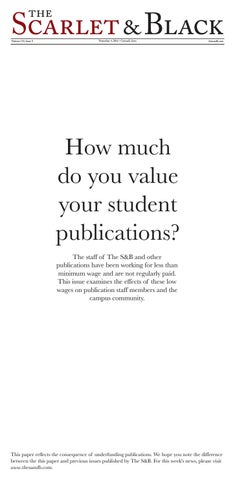
How much do you value your student publications? The staff of The S&B and other publications have been working for less than minimum wage and are not regularly paid. This issue examines the effects of these low wages on publication staff members and the campus community.
This paper reflects the consequence of underfunding publications. We hope you note the difference between the this paper and previous issues published by The S&B. For this week's news, please visit www.thesandb.com.
special edition
2
Edited by newspapr@grinnell.edu
What makes an article?
Creating publications requires a significant time committment from student leaders. Each S&B article goes through an extensive review before it reaches our readers. The following steps expand on this process.
Stage 1 2-3 hours The article is pitched during a staff meeting, assigned to a freelance writer. Necessary information is communicated between editor and writer. Stage 2 3-4 hours Freelance worker interviews sources, writes an article and sends it along to section editor. Stage 3 1 hour Section editor re-structures the article, edits for content and sends it along to one of the Editors-in-Chief. Stage 4 1 hour Editor-in-Chief edits for content and sends it along to one of the Copy Editors. Stage 5 1 hour Copy Editor edits for stylistic and grammatical errors and sends it back to the section editor. Stage 6 6-8 hours Section editor places articles and photos with captions and graphics on the page. Stage 7 1 hour The other Copy Editor and Editor-inChief read the entire section, looking for stylistic errors.
Fair pay for student journalists Students who work for campus publications and radio programs should be paid equitably and reliably in accordance with the number of hours they dedicate to their jobs each week. It is up to the Сollege to ensure that the Student Publications and Radio Committee (SPARC) receives the financial support it needs to pay minimum wage in the coming years. The current failure to provide SPARC with adequate funding to fulfill this need holds greater consequences than simply hurting students who are currently employed by publications — it renders us unable to hire a range of leaders that represent the socioeconomic diversity of Grinnell’s campus. In doing so, it stymies our ability to serve as advocates for and representatives of the student body. As of yesterday, publications have been provided supplementary funding to pay all workers minimum wage. However, we are concerned that this change comes too late. SPARC funds all costs associated with campus publications: publishing, editor wages and publication-related events. The budget SPARC receives at the beginning of each semester — $109,000 for fall 2016 — comes from the student activities fee, a $436 fee collected from students when they pay tuition. All the money raised from the student activities fee is divided between SPARC, which receives one-third of the fee, and the Student Government Association, which receives two-thirds. Past editors as well as representatives from SPARC have tried to renegotiate what has been dubbed the “one-third, two-thirds” rule. Now that student workers will be paid minimum wage, this rule will leave SPARC unable to fund the range of publications it has traditionally supported. Consequences of the financial constraints placed on publications are not merely theoretical. In the past year, a section editor was forced to step down from The S&B staff because he could not afford to work for less than minimum wage. In his absence, The S&B lost more than an accomplished and well-qualified editor — they lost a valuable perspective from an individual uniquely positioned to speak on issues that affect lower income students. Although student wages have now been increased from the $4.16 per hour rate they were paid for the first 11 weeks of the semester, this change comes too late to allow for The S&B staff to support
a diverse range of students in the fall semester. When students regularly invest up to 20 hours per week working for publications, they limit their ability to take on other work-study jobs. For students who rely on campus jobs to cover work-study and living expenses, the failure to provide an adequate hourly wage presents a barrier to leadership roles within campus publications. Students should not be forced to choose between pursuing a educational opportunity and being paid for their labor. For at least two years, S&B editors have consistently requested that their editors be paid minimum wage for the hours they work each week. They were told repeatedly that this was impossible. Until yesterday, S&B editors were paid a salary of $83.33 per week. Given that they work an average of 20 hours per week, their pay was equivalent to a rate of about $4.16 per hour, well below the Iowa minimum wage of $7.25 per hour. Though this may change in future pay periods, we feel it is necessary to address the conditions under which current and past S&B staff members have worked for years. As of the date of publication, student publication workers have received only one paycheck from SPARC and the College’s financial office in the first 11 weeks of the semester, despite a contractual obligation to pay employees on a bi-weekly basis. The payroll for the most recent pay period went unsubmitted. Students were not informed about this lapse in payment until the end of the next pay period. Many students who work for campus publications rely on their wages to pay for workstudy and living expenses. The unannounced and unexplained withholding of wages poses a serious threat to their ability to survive and succeed as students. Moreover, despite reassurance from SPARC that budgets would be distributed to allow for equitable salaries among media heads, wages paid to the leaders of other publications range from $8.00 per hour to working on a purely volunteer basis. This significant variation in pay rates is arbitrary and unfair, particularly given that many media heads work between 10 and 20 hours each week to produce a publication. When publication leaders questioned the issue of inequitable hourly pay rates among publication leaders at a SPARC budget
meeting, they were told that SPARC would revise budgets to ensure that all publications leaders were paid equitably. The budgets that were approved by SPARC did not reflect these changes, and therefore maintain the policy of unequal pay among student publication leaders. Campus publications and radio serve the dual role of providing the campus with a range of student perspectives and providing their workers with a resource to gain professional experience. When we are unable to pay our workers fairly, we fail to meet both goals by removing students who rely on their jobs for income from conversations about campus policy while simultaneously denying them access to a valuable professional resource. Under their current budget constraints, SPARC will not be able to continue to fund the diverse set of publications it currently supports. We therefore call for an increase in funds allocated to the SPARC budget. Working for student publications should be an opportunity open to all students, not a privilege reserved for those who can afford it.
The Scarlet & Black Editorial Staff Lily Bohlke Mira Braneck Louise Carhart Nora Coghlan Michael Cummings Jenny Dong Teresa Fleming Emma Friedlander Lica Ishida Jeff Li Eva Lilienfeld Candace Mettle Jon Sundby Megan Tcheng Keli Vitaioli Steve Yang KDIC Station Managers Jenkin Benson Seth Hanson Cyclone Editor Aalton Lande Grinnell Underground Magazine Editor Fintan Mason The B&S Nina Galanter Aaron Weerasinghe Julia Dursztman
Stage 8 30 minutes Section editor puts stories online, including articles, photos, captions and graphics. Stage 9 2 hours Co-Editors-in-Chief print and send pages to the printer. The Scarlet & Black Staff Editors-in-Chief Managing Editor News Editors Features Editor Sports Editor Arts Editor Community Editor Opinions Editor Copy Editors Photo Editor Graphics Editor Business Manager Staff Writer
Teresa Fleming Eva Lilienfeld Steve Yang Michael Cummings Emma Friedlander Lily Bohlke Candace Mettle Nora Coghlan Louise Carhart Jon Sundby Mira Braneck Keli Vitaioli Jeff Li Lica Ishida Jenny Dong Megan Tcheng
SPARC Policy The Scarlet & Black is published on Fridays by students of Grinnell College and is printed by Times Republican of Marshalltown. The newspaper is funded in part by the Student Publications and Radio Committee (SPARC) and also relies on advertising revenue to cover operating costs. All publications funded by SPARC are copyright of SPARC and cannot be reproduced elsewhere without specific written consent from SPARC. Contributions The Scarlet & Black welcomes story ideas from students, faculty and other members of the town and college community. If there is any story that should be covered, please email newspapr@grinnell.edu or visit thesandb.com Send letters to the editor via email at newspapr@grinnell.edu or mail them to Box 5886. The author’s name must be included, but letters can be published anonymously in certain occasions. Letters will be printed at the discretion of the editor. The opinions expressed in this section do not necessarily reflect those of the editorial staff. The S&B reserves the right to edit any and all submissions. Advertising Advertising inquiries should be directed to the business manager, Jenny Dong, who can be reached at sandbads@ grinnell.edu or by mail at 1115 8th Avenue Grinnell College Box 5886, Grinnell, IA 50112.
Edited by newspapr@grinnell.edu
special edition
3
Examining funding over the years The comments on this page are from alumni and current staff members recalling the financial challenges they faced while working for The S&B and reflecting on the impact their time working for the paper had on their professional lives. Diane Alters '71
Reporter 1971 Journalism Lecturer at Colorado College and Founder of the Mando Fund
The S&B was incredibly important in my years at Grinnell — I graduated in 1971. I can remember having long, passionate discussions about issues raised in the paper. But I have the impression that it's still as important, that Grinnell is still a newspaper campus, despite all the social media. When I was on campus visiting Mando, I'd walk around on publication day to see if anyone picked up a copy. I'd see students and faculty deeply absorbed in the paper. That was always SO exciting for this former newspaper reporter. Mando told me once that a group of Latino students stopped him late one night and told him his byline meant a lot to them, and they fell into a deep discussion about something he wrote. He never forgot this, and his story reinforces my belief that The S&B is vital to Grinnell.
Jason Rathod '06
Opinions Editor 2006
Above all, I value the training in egalitarianism that I received there. I experienced, for example, how an editorial condemning soaring tuition — that I and others on The S&B built piece-by-piece together — became an ideological cannon for student protesters to launch piercing attacks during a Board of Trustees meeting. I never forgot the exhilaration I felt in solidarity against the powerful. Today, I am a consumer protection and workers’ rights class action lawyer. In wage theft cases that I have prosecuted, I work to ensure that workers receive a fair day’s pay for a fair day’s work. As such, I am troubled to hear that S&B staffers are not guaranteed minimum wage for their labor. The Fair Labor Standards Act, which established a national minimum wage, was a cornerstone of the New Deal and designed to combat the twin evils of overwork and underpay. Overwork and underpay were familiar experiences to me as a college student. I was grateful, though, that my work at The S&B was funded through federal work study, which I understand may no longer be the case. Since I came from a family of modest means, I probably would not have been able to work for the S&B had I not been paid.
Sarah Mirk '08
Features Editor 2007 Online Editor at Bitch Media
The S&B is the best real life job training for writers that Grinnell has. My time at The S&B taught me to be a competent writer, a thoughtful interviewer and a solid editor. It's rare and wonderful to have a publication where students actually have the power to call the shots and make editorial decisions, that's invaluable. The fact that writers and editors were paid allowed me to quit my catering job at Grinnell sophomore year and focus on writing. I've been writing professionally ever since. When I applied for journalism internships, I has clips from the S&B to send in to show my writing skills. Without my experience at the S&B, I doubt I would ever have started my career in journalism.
Johnny Buse '11
Editor-in-Chief 2011 Freelance Writer for the St. Louis Beacon
The S&B was absolutely essential to my college experience. Hands down the single most influential thing, I think especially due to its nature of being student-run. Not to make everything about how much it plays into securing a job, but my experience with The S&B has been extremely helpful in the working world. The pubs office is the place where I developed who I was as a team member,
a worker, a writer, a friend, a person. I do think that minimum wage would help more students get involved in the paper, especially students who don't have the financial security to sink 25+ hours a week into a stipended job.
many millennials since the recession in '08. Don't underestimate the power of The S&B as a way of proving the benefit of paying up-andcoming skilled worked a living wage. If you can make it work at Grinnell, you can make it work in your jobs after Grinnell.
Chloe Moryl '10
Carl Sessions '15
On The S&B's salary alone, I wouldn't have been able to pay for rent and food, even as the Editor-in-Chief… I just asked Johnny Buse '11 (who was EIC with me) because he was in charge of payroll, and he said that we claimed 20hrs/week even though we often worked more hours than that. He remembers because one time we did the math and had a good laugh/cry about how we were being paid $3.50 an hour.
Working as Opinions Editor for The S&B during my senior year kept me sane. I took seriously the idea that the opinion pages are a campus public forum, and used this space to solicit input from campus voices. Without The S&B, there is no student forum to question the institution and the decisions it makes, like cutting Posse or refocusing on STEM to the detriment of the humanities. The S&B has the ability, by choosing what stories to amplify and uplift, to shift conversation and question what otherwise wouldn’t be brought to light. When we ran letters-tothe-editor from alumni calling for Kington’s resignation over his treatment of survivors, the Board of Trustees wrote a passionate response. The S&B is a model for young people to be exposed to so they can be more effective agents of change upon graduation.
Editor-in-Chief 2010
Devin Ross '12
Editor-in-Chief 2012 Contributing Writer for Mic
I also worked another job while at the newspaper. I worked at the grill on campus for two of the three years I held an editing position with The S&B. I'd definitely say the editors worked a MINIMUM of 30 hours every week.
Tessa Cheek '12
Arts Editor 2012 Reporter for the Colorado Independent
The S&B staff do the real work of journalism: they come up with articles, develop sources and report stories, edit writing, lay out the paper and manage its complex and vibrant digital presence. That labor is intellectually nourishing — for both the staff and the readers they serve — but it is also, crucially, labor. To assume that students can, or should, exchange intellectually nourishing work for less-than-fair pay is precisely the kind of classist blind spot Grinnell prides itself in challenging as an institution dedicated to social justice. It’s important to make participation in The S&B financially feasible for a diverse array of Grinnell students because working on The S&B is valuable. Former S&B staff members have gone on to write for outlets like the Associated Press, The Chronicle of Higher Education and Mother Jones. I worked for three years on The S&B as both a writer and an editor. When I graduated, my clips from The S&B Arts Section helped me get my first temp job in Public Relations at The Saint Louis Art Museum. What I learned about reporting, editing and web design at The S&B eventually got me my first serious reporting gig at The Colorado Independent, where I worked as a member of the statehouse press corps. The wider world desperately needs more diverse, nuanced and fair voices reporting the news. Grinnell has the opportunity to make concrete, structural changes to that end.
Solomon Miller '13
Editor-in-Chief, The S&B, 2012 Founding Editor, Grinnell Underground Magazine, 2013
S&B editors can work up to 30 hours a week, on top of being a full time student. The best reporters, most prolific writers, and hardest working editors should get these jobs, regardless of their financial status. No one should be precluded because they need a second or third job to make ends meet and don't have the time. Since Grinnell, I've mostly been working on political campaigns. Like newspaper, they require a lot of unpaid or underpaid work to advance. Over time, I've seen almost everyone priced out of working in politics except white kids from the suburbs. The Democratic Party is, in effect, forcing would-be future political leaders out of the party, making its staff and bench of future candidates more diluted and less diverse. Let's not force that on future journalists if we don't have to. This is, more broadly, a problem faced by
Opinions Editor 2015
Susanne Bushman '16
Arts Editor 2015 Editorial Assistant at Red Line Editorial
Working for The S&B taught me the skills that got me my job today. The exposure to the publishing and editing process and the constant writing made me qualified for internships and jobs where my degree alone might not have stood out. But because of the low, inconsistent pay (with a long period at the beginning of the semester where we wouldn’t get paid at all due to SPARC's budget process), I worked two or three other campus jobs and took fewer classes to accommodate my work schedule. For other students, in other majors or with fewer economic advantages, this wouldn’t have been possible. Working for The S&B, unfortunately, meant having more than one job or being broke.
Jack O'Malley '17 Copy Editor 2015
Coming into this semester, I was incredibly excited to start my new job with The S&B. I was chosen to be the Sports Editor this semester, but after realizing how little I would make, I just couldn’t justify working for the newspaper. This decision was a hard one to make. I had worked on staff last fall as a Copy Editor, a position I had sort of fallen into, but discovered just how much I enjoyed journalism through the job. Unfortunately, I needed to face the reality of my situation and could not commit to working the often long and grueling hours on Thursday nights that The S&B staff put in to publish the paper. This disparity in pay has a number of consequences. First, it directly limits who is able to work for The S&B. By not paying at least the equivalent of a minimum wage, SPARC is preventing students like myself, students who need to make money to make ends meet while they’re at school, from simply working for staff. Read Jack's Letter to the Editor at www. thesandb.com
advertisements
4
Edited by newspapr@grinnell.edu
One National Winner of $1000 in cash! One $50.00 Bookstore Gift Card per College Open Monday – Friday 8:30am – 6:00 pm Thursday until 7pm Saturday 9:00am – 5:00pm
Enjoy A Jazz Film Screening And Cajun Dinner November 13 at 5 p.m. Follow Up The Next Day With A Jazz Guest Lecture November 14 at 4:15 p.m. Events co-sponsored by Music Department and Center for the Humanities Not only was The Jazz Singer (1927) the first feature film with singing, music and talking, but it also provided fans of Al Jolson a somewhat fictionalized version of his life story. Filled with pop songs, high melodramatics and of course Al Jolson, The Jazz Singer is a glimpse into one of the major turning points in the history of American cinema: the beginning of the talkie era.
The Jazz Singer grew from Samson Raphaelson’s observations, on hearing Al Jolson sing in 1917: “My god, this isn’t a jazz singer. This is a cantor!” Raphaelson transformed his idea into the short story “Day of Atonement” (1922), followed in turn by the succesful play The Jazz Singer (1925) and finally the 1927 Warner Bros. feature. With each new adaptation the music changed, in particular the songs that help to characterize Jakie Rabinowitz/ Jack Robin as a musician.
We invite you
to a conversation about
intersections of identity Our Faculty Panelists will share personal reflections on their intersections of identity:
Jeremy Chen Asst. Professor of Art Theresa Geller Assoc. Professor of English Amy Holmes-Tagchungdarpa
Asst. Professor of Religious Studies
Lakesia Johnson Assoc. Professor of GWSS Asst. Vice-President and Chief Diversity Officer Fredo Rivera ’06 Asst. Professor of Art History
Tuesday, November 8th, 12 pm JRC 101 Lunch will be provided. Sponsored by the Chaplain’s Office and the Center for Religion, Spiritual and Social Justice For more info: call 641-269-4981