
UGSDW rally calls for strike as bargaining resumes
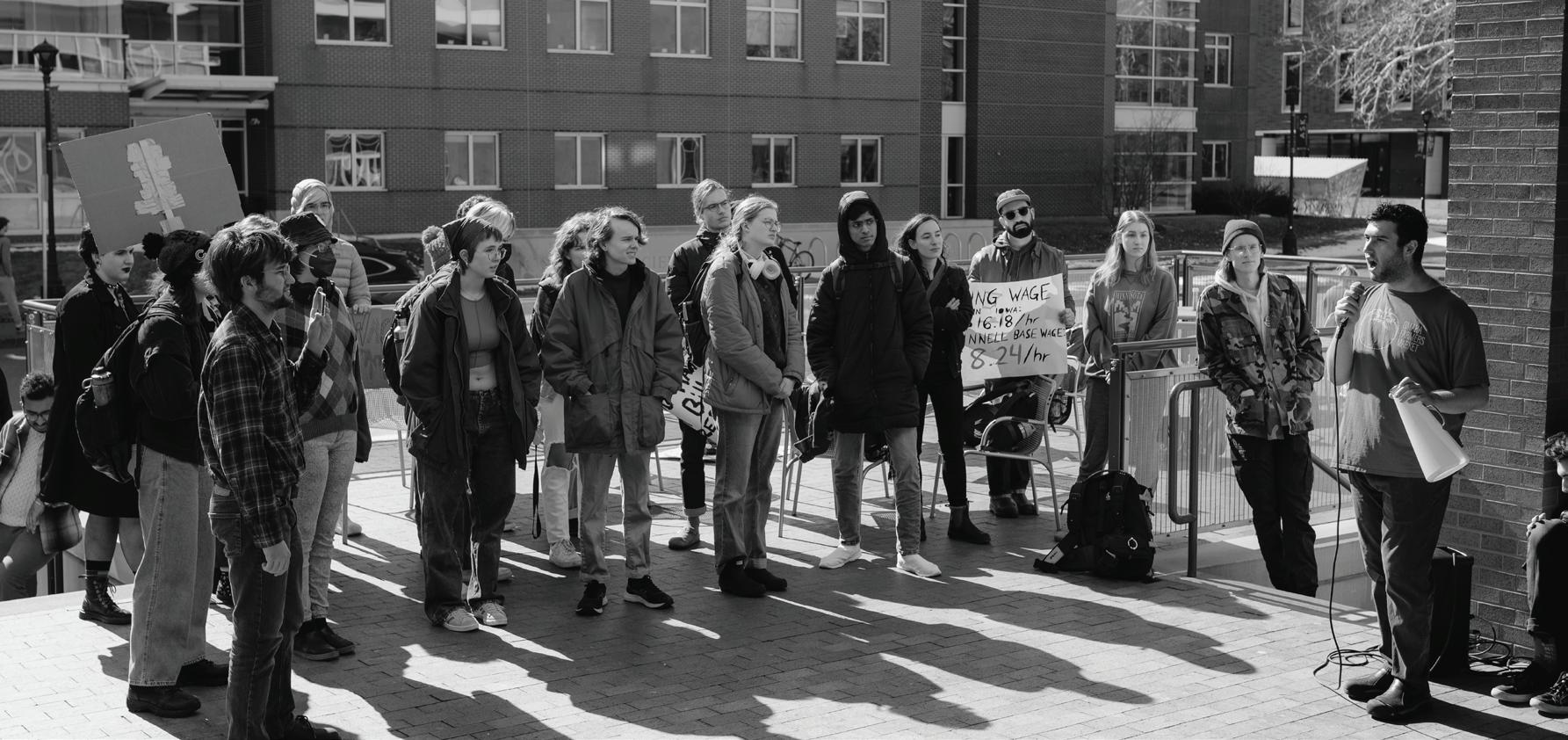
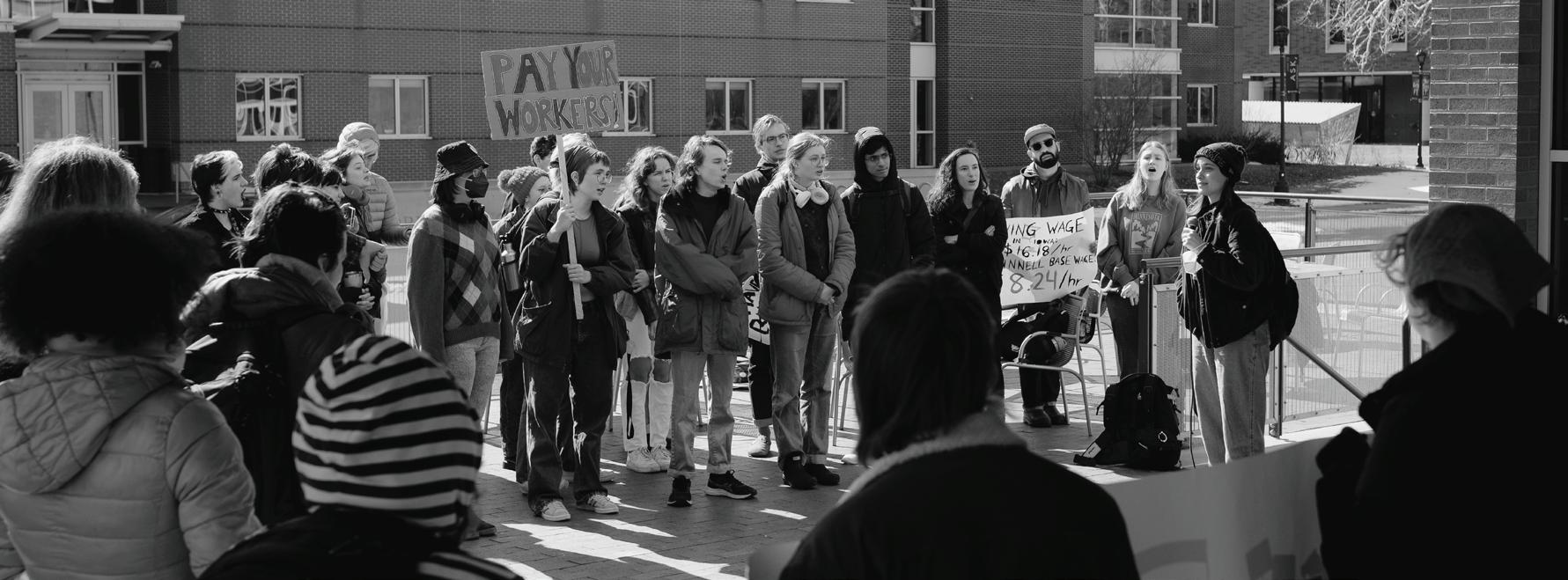
By Taylor Nunley nunleyta@grinnell.eduThe Union of Grinnell Student Dining Workers (UGSDW) held a rally protesting for a higher on-campus wage and calling for a strike date outside the Joe Rosenfield `25 Center on Monday, Feb. 20. The rally amassed about 50 attendees chanting and holding signs.

UGSDW President Lena Wiebe `25 called for a strike date on April 17, which will be voted on by union members this week amidst bargaining sessions between the UGSDW and representatives from Grinnell College to create a contract for all student workers. Bargaining sessions for the spring 2023 semester started again on Thursday, Feb. 23 following a postponement the previous week for inclement weather. At the session, the UGSDW bargaining team discussed their proposals on health care coverage, non-discrimination policy and different types of leave, which, if included, would come into effect
>> Continued on page 2
New requirements pose threat to project houses
 By Kailee Shermak shermakk@grinnell.edu

Project house residents had to justify by Friday, Feb. 24 to Residence Life why the project house they live in needs to exist.
The new application must include a one-to-two-page description of their house goals, a 10-to-15- minute audio-visual presentation, and an interview with Residence Life. All of these requirements were due on Friday, Feb. 24, two months earlier than in previous years.
Dennis Perkins, assistant dean of residence life & student conduct,
told house residents about the application deadline in a Feb. 3 email.
Phil Tyne `24, a resident of Farm House, and Marisa Goffman `24, a resident of GAME House, said they both received an email from Perkins detailing renewal requirements for their respective project houses, requirements that they had not seen before.
Perkins said the process is consistent with previous years. Each year, current students living in these project houses must decide whether to apply to renew their house or not. Based on these presentations, Residence Life awards certain houses to
Office of Admissions braces for impact of predicted end of affirmatice action
By Zach Spindler-Krage spindler@grinnell.eduGrinnell College is weighing potential changes in admissions practices in anticipation of the likely end of affirmative action. In October 2022, the U.S. Supreme Court heard two cases (Students for Fair Admissions v. Presidents and Fellows of Harvard and Students for Fair Admissions v. University of North Carolina) that threaten the use of race-conscious admissions practices.
Students for Fair Admissions (SSFA) argued in separate cases against Harvard University and the University of North Carolina that race should not be a factor in admissions for private or public institutions of higher education. SSFA claims that the consideration of race creates a de facto quota system that violates Title VI of the Civil Rights Act of 1964, which prohibits discrimination on the basis of race, color or national origin in any program that receives federal funds.
Although the court’s official decision and legal reasoning are unlikely to be released until June, Grinnell faculty and staff are progressing under the pre-

sumption that race-conscious admissions practices will be struck down. The College is planning its response, which includes the development of alternative admissions strategies that sustain campus diversity.

The constitutionality of affirmative action
In 1978, the Supreme Court’s decision in Regents of the University of California v. Bakke effectively established that colleges could consider race in admissions if done so in a holistic manner. Race cannot be a determinative factor, but it can be weighed among other variables. The Supreme Court has upheld this precedent in numerous cases since Bakke.
“The only constitutionally permissible reason that the court said a college or university could take an applicant’s race into account was to create a diverse class for the educational benefit of the students,” said Peter Hanson, professor of political science and director of the Grinnell College National Poll. “The court rejected other justifications for race-conscious
groups for the coming year.
Grinnell College is currently home to six project houses and five language houses. The project houses revolve around a common theme, like art or farming/gardening, while the language houses aim to provide an immersive environment for a specific language. These houses are relatively new to campus, with the oldest language ones dating back to 1993 while newer project ones like Farm House and GAME House began in 2018. Because of their recent arriv-
Grinnell water plant deteriorated, corroded
By Jandry Perez Garcia perezgar@grinnell.eduThe city of Grinnell is planning to build a new water plant by 2026 due to the deteriorated and corroded conditions of equipment, including the water softener and pipe gallery in the current water plant.
Grinnell is currently experiencing higher levels of water hardness compared to spring 2022 due to the Grinnell water plant shutting down its water softeners. Concerns about water hardness have since increased among members of the Grinnell community, according to a newsletter from the Grinnell Area Chamber of Commerce.

“That’s the easiest issue that I’m currently dealing with … [hardness is] an aesthetic quality,” said Grinnell City Water Director John Altenhofen. Aesthetic qualities as defined by the Water Technology Magazine are those aspects of water that are generally not related to health, including odor, taste and hardness. As opposed to other water qualities like the concentration of nitrate present in the water which, once beyond a certain level, can cause detrimental effects to people’s health, according to the Center for Disease Control.
According to Maisha Kamunde-Devonish, assistant professor
of chemistry, water hardness refers to the amount of calcium and magnesium ions present in water. These ions come from the residual amount of limestone and dolomite that results from the water’s interactions with the environment.
To treat water hardness, salt is used to replace the calcium and magnesium ions in the water, and salt water corrodes steel, according to Altenhofen. “[The softeners are] getting to the point that the steel is paper thin, it is no longer safe to keep them operational. So ultimately, I would rather have hard water than no water at all,” he said.
Altenhofen said that the condition of the water softener did not deteriorate overnight — it has been the accumulation of water hardness treatment for over 80 years according to a Chamber of Commerce blog.
To put it into perspective, a household water softener generates 1,000 gallons of water a week, while those at the plant generate approximately 267,000 gallons of water a day and use approximately $4-5,000 worth of salt a week, said Altenhofen.

thesandb.com
February 27, 2023 • Grinnell, Iowa
Volume 139, Issue 14 Arts: Faces of Freesound See inside Sports: Erin Hurley retires after long career Opinions: Addressing the stigma Scan for a digital copy of the S&B! Features 3 Community 4 Arts 5 Sports 6 Opinions 7
Check us out on YouTube! The Scarlet & Black
Continued on page 2
>>
on
4 >> Continued on page 3
>> Continued
page
PAUL HANSEN Alyssa Argent `25 (left) and Jasper Gray `24 (right) hold signs outside the JRC.
PAUL HANSEN The garden of Farm House, 1023 Park St, has been uprooted by construction. Photo taken on Feb. 22.
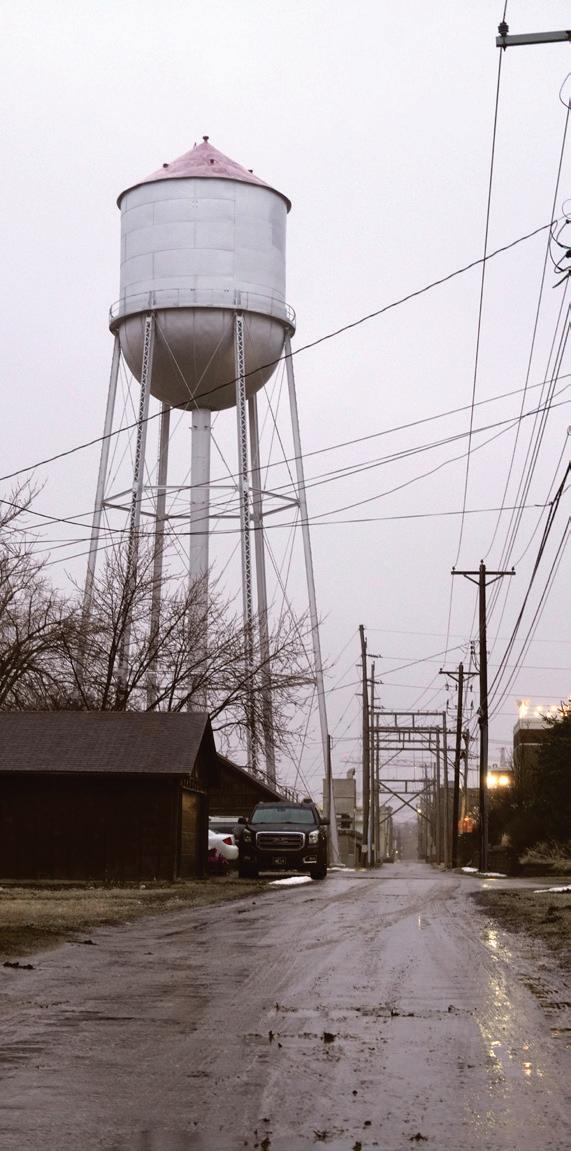
OWEN BARBATO The Grinnell city water treatment plant equipment is degrading and could fail at any point. The water tower, pictured here, can only hold approximately 23% of the city’s treated water.
GABRIELA ROZNAWSKA
Future uncertain for project houses
become more difficult.
al to campus, the technical details of facility-management, event-scheduling, and day-to-day issues are a work in progress.
“It gives students that agency as opposed to a lot of other campuses that have set topics,” Perkins said about Grinnell’s method of awarding project houses based on student proposals, making the houses dynamic.
In previous years, project houses each had a house coordinator who lived there and fulfilled the responsibilities of a Community Adviser, such as requesting work orders and providing support for residents. As of fall 2022, project houses did not have their own house coordinator living within the house. Rather, one Community Adviser living in a dorm on campus provided coverage for all of these locations.
This change has led to some maintenance issues for the houses. Tyne said Farm House experienced mice infestations that normally would be addressed by a house coordinator but were left unattended throughout the year. He said house members who undertook these responsibilities also weren’t compensated for their time, while the official position of house coordinator would have their board costs covered.
Looking to the next academic year, the College will reinstate the house coordinator position within project houses, said Perkins. Tyne and Goffman both said this would relieve some organizational stress within their houses.
In addition to the changes made to the house coordinator position, Tyne and Goffman said funding for project house events from Residence Life was reduced this year. Tyne said Farm House funding requests for certain events would bounce between Residence Life and the Student Government Association without clear indications as to where money would come from. Similarly, Goffman said funding for food-based events has

ChatGPT’s potential to rewrite the classroom
Language houses have faced similar issues over the past two years. Kayley Rönnkvist `23, the French House coordinator for fall 2021, said that language house communication channels were confusing at times. She said event plans and budgets were directed to ResLife and was loosely affiliated with the French department, which was unclear.
Despite the organizational difficulties, Rönnkvist said she appreciated the community a house provided as well as the language immersion. Goffman echoed this sentiment as she said project houses are an integral part of the Grinnell campus and a draw for potential students.
“They don’t have to go to D-Hall, but they also don’t have to pay for utilities. So it’s a good balance in my opinion. And it’s also a good way of uniting students that have the same interests and living around that,” Goffman said about the differences between living in a project house vs. a dorm.
GAME House hosts numerous all-campus and substance-free events throughout the year, including a haunted house on Halloween and a Watermelon Bash. Similarly, Farm House hosts a fall brunch and FarmStock, an outdoor concert.
Perkins said he hopes to put these houses on the infrastructure update rotation, similar to the system the dorm building updates are currently on. This would lead to eventual renovations of all the project houses, offering more comfortable living quarters for students.
By Nina Baker bakernin@grinnell.eduSince ChatGPT’s public launch on Nov. 30, colleges and universities across the U.S. have reckoned with the widespread use of the chat bot, capable of writing complex texts powered by artificial intelligence (AI). Already, the New York Times has reported that a Northern Michigan University professor caught a student submitting a religious studies essay written by ChatGPT just weeks after the software’s release. Further, a January survey with nearly 5,000 Stanford University respondents showed that 17% had used ChatGPT in submitting written work during the university’s prior term.
At Grinnell College, the public accessibility to ChatGPT and reports of ChatGPT usage by students has created questions amongst members of the College’s Committee on Academic Standing (CAS) on how to appropriately regulate, address and respond to the rise of assistive technology. For some faculty at the College, the availability of ChatGPT has already begun to affect classroom pedagogy.
Karla Erickson, professor of sociology, said she incorporated a staggered revision process to her courses, where students are required to submit early drafts of papers and explain further changes to their work.
Karla Erikson Professor of SociologyErickson said she met with a group of eight alumni, three of whom already used ChatGPT in their jobs, to gauge if and how professionals were using ChatGPT in their work. Later, Erickson had students in class review a discussion involving a response to ChatGPT’s generative
text. One student, Erickson said, described generative text as CliffNotes but on hyperdrive.
“You need to treat it like a tool and know what its limits are,” Erickson said. “In order to do that, we have to make it an object of our analysis. What is this thing, really? And what is it good at?”
Erickson said she has seen individual faculty at other colleges and universities institute more drastic changes to coursework or exam structures in response to ChatGPT, such as switching written papers to oral examinations. But Erickson said it’s essential that faculty refrain from instituting drastic changes to courses in response to an emerging, complex and misread technology like ChatGPT.
“Don’t overpivot. We don’t have to throw out everything we do,” she said. “If we get confused about the line between this and science fiction, it ascribes a significance to it that doesn’t yet exist.”
For Erickson, she sees possible violations of the College’s academic honesty policies from ChatGPT with a similar eye as previous violations. Violations of the guidelines arise when students believe they no longer have the time or energy to complete course work in line with standard academic conduct, she said.
“It doesn’t come out as an intent to get away with something,” Erickson said. “This becomes a very tantalizing tool at 2 a.m. in the morning.”
As AI advances, the College’s academic honesty policies may require some adjustments, said Christopher French, professor of mathematics and statistics and chair of the CAS subcommittee on academic honesty.
While French said the majority of the policy may not change, some language in the guidelines calls for adjustments, such as short phrases like “someone else’s idea” or “someone else’s work.” While innocuous before ChatGPT, this wording may imply that plagiarism or academic misconduct arises exclusively from ideas generated by a human being, rather than by an artificial intelligence chat system, he said.
Discussions about ChatGPT amongst CAS members are only at the beginning stages, said Cynthia Hansen, associate dean of the College. The next CAS meeting on ChatGPT has yet to be scheduled.
Karla Erikson Professor of Sociology“The use of generated material that doesn’t come from your own head is something that would already be covered in the scope of our policies,” Hansen said. “We have a college-wide expectation to cite sources that are not your own, and so in some ways, the policy already covers these types of artificial sources.”
This specific change to the academic honesty policy could take around a year to implement, according to French. Yet Erickson said that the race to produce more intelligent, more sophisticated AI is likely to proceed faster than the College can respond to the technology, especially as large companies like Microsoft invest billions of dollars in OpenAI, the organization responsible for ChatGPT.

“It would be hard for any school, even a school like Harvard, to keep up with that,” Erickson said. “There’s a kind of agility here that might be required.”
But Erickson said she does not think ChatGPT will collapse the traditional standards of academia. Some work produced by ChatGPT will go unnoticed by faculty, but some conventional violations of academic honesty have always flown underneath the radar, French and Erickson said.
“There are other ways that students have done things in the past. This just seems to make it a lot easier and create temptation,” French said. “It’s hard to detect. So yeah, that concerns me.”
Amidst bargaining, UGSDW calls for strike
during the period of the new contract.
At this session, the College bargaining team countered the UGSDW bargaining team’s $20 base wage proposal. From last semester’s base wage of $10.75, the College proposed a 40% base wage increase to $11.50 for all campus jobs. The UGSDW bargaining team said they would have a response to this wage proposal at next week’s bargaining session.
The UGSDW bargaining team also introduced a non-discrimination policy which was mostly similar to the current dining contract, but had some additions, such as stating that workers should not be discriminated against on the basis of arrest, conviction or parole status. However, the College’s bargaining team took issue with this because the current policy requires performing background checks on students applying to workplaces that have direct contact with minors, such as the Grinnell College Preschool Laboratory or other Service Learning Work Study (SLWS) jobs.
policy which would include a
healthcare rebate was introduced by UGSDW’s bargaining team. Currently, non-student workers employed by the College must work a minimum of 20 hours a week to qualify for healthcare benefits. The UGSDW bargaining team proposed a discount on the College’s student health insurance plan for student employees who worked at least a total of 140 hours, or an average of 10 hours weekly, in the previous semester and semesters when the rebate was sought.
The College bargaining team expressed concerns that students with no-to-low financial need would be favored over those with higher financial need through this rebate; no benefit would be afforded to students who receive a grant for the College’s health insurance. The College bargaining team also emphasized the discrepancy between the average 10hour work week proposed for these benefits and the current 20 hours required for non-student workers to receive them.
The College and UGSDW bargaining teams will meet at their next bargaining session to continue negotiation on Thursday, March 2.
NewS 2 Edited by chengluc@grinnell.edu and cierpiot@grinnell.edu
EVAN HEIN
Photograph illustrating a student using ChatGPT, an AI program which generates text.
It would be hard for any school, even a school like Harvard, to keep up with that.
It doesn’t come out as an intent to get away with something. This becomes a very tantalizing tool at 2 a.m.
Project houses— Continued from Front Page
A
PAUL HANSEN UGSDW
a rally on Monday, Feb. 20. outside the JRC.
UGSDW bargaining— Continued from Front Page
held
PAUL HANSEN
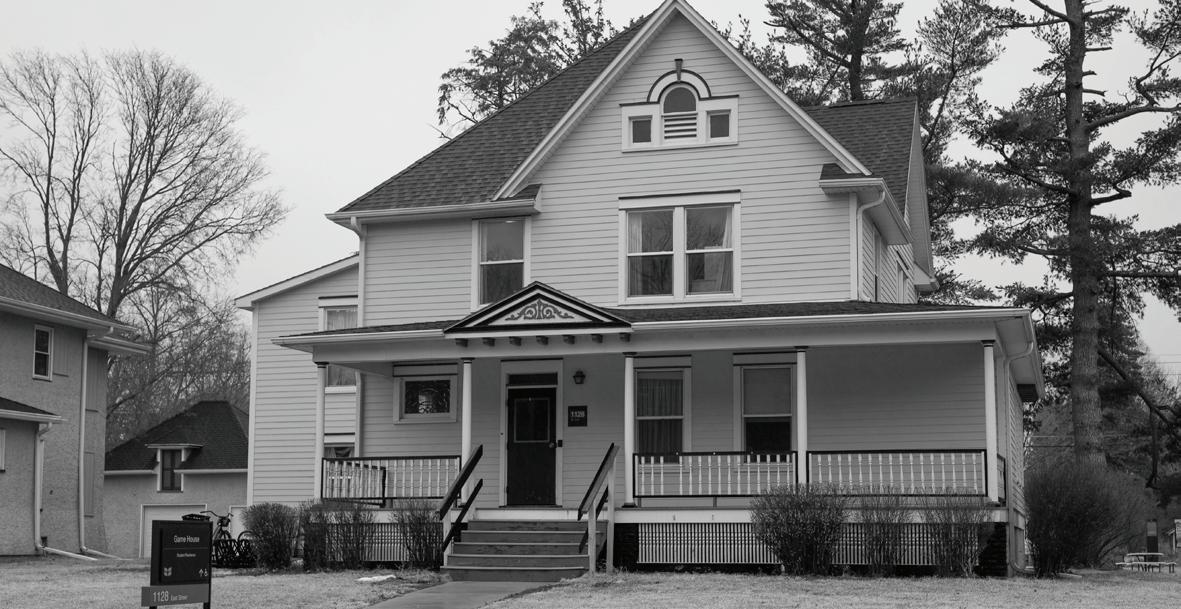
GAME House, 1128 East St, has 12 rooms to fill, and was first created in 2018.
PAUL HANSEN
Art House, 1023 Park St, hosts community art events for students on campus.
It’s also a good way of uniting students that have the same interests and living around that.
Marisa Goffman`24 GAME House Resident
Grinnell College anticipates Supreme Court decisions
admissions, including the idea that affirmative action was a way to remedy societal racism,” he said.

In Bakke, the court held Harvard as the model for constitutional race-conscious admissions practices. Now, Harvard is accused of unconstitutionally capping the number of Asian American students it accepts. Hanson said that there is no evidence that a cap exists, but that the broader issue is whether Harvard can consider race at all.
“I think that the court will latch onto the idea that even thinking about race in the admissions process is improper,” said Hanson. “My guess is that they’ll say that an applicant’s racial identity can’t come into an admissions decision.”
According to Hanson, the court will likely argue that if Harvard, the model for implementing race-conscious admissions, is unable to do so correctly, then no institution should be doing it.
Grinnell’s current admissions model
Since the establishment of affirmative action, the Grinnell College Admissions Office has relied heavily on race-conscious practices, according to Joe Bagnoli, dean of admis-
sions and financial aid and vice president of enrollment.
Bagnoli said that the consideration of race currently “sits alongside the factors of academic excellence, activities, recommendations and interviews.”
There are currently far more qualified applicants than available openings for incoming students.
Consequently, Grinnell College President Anne Harris said that race-conscious practices are used to promote the College’s core value of diversity.
“With 13,000 applications this year, a number that continues to increase, admissions can be like landing a 747 airplane on a postage stamp.”
Bagnoli said he believes that the benefits of affirmative action impact all students, not simply those that identify as underrepresented minorities. “Understanding that the world is experienced differently for different populations is an important part of becoming an educated person,” he said.
A future without affirmative action
Roughly 40% of U.S. colleges and universities currently use race-conscious admissions, so the end of affirmative action would require a vast admissions overhaul at many highly selective institutions, including Grinnell College. His-
torically, maintaining diversity has proven elusive after transitioning to race-neutral alternatives. When California passed Proposition 209 in 1996, eliminating the use of race-conscious admissions at public institutions, enrollment of domestic students of color dropped sharply.
According to Bagnoli, “California’s public universities have spent nearly a half billion dollars on attempting to recover racial diversity and, still to this day, have never entirely recovered their enrollment of domestic Black students.”
Grinnell may face similar challenges. “Right now, enrollments are hovering around 10% Latinx students and 5% domestic Black students,” Harris said. “These are precarious numbers in terms of our mission of cultivating a diverse community.”
However, Bagnoli believes that the College will sustain its diversity: “Frankly, our commitment to diversity will not wane at all in the wake of the Supreme Court decision,” said Bagnoli. “How we express that commitment and diversity will need to be different, but it will not be reduced.”
Progressing with alternative admissions practices
The Admissions Standards and Financial Aid Committee (ASFAC) and an executive leadership team have spearheaded the process of weighing potential race-neutral admissions alternatives. ASFAC consists of faculty, staff and students, and the executive leadership team includes representatives from the president’s office, academic affairs, legal counsel and the Office of Diversity, Equity and Inclusion.
“In the absence of race, we need to try to find correlations between race and other variables,” said Bagnoli. “That may leave us to use variables like household income, first-generation status and neighborhood and high school data.”
David Hudson `23.5, a senior interviewer and prior multicultural recruitment intern for the office of
John Garrison waxes poetic as Grinnell Lecture honored speaker
By Taylor Nunley nunleyta@grinnell.eduJohn Garrison, professor of English, delivered the 9th annual Grinnell Lecture, titled “It Takes a Long Time to Sound Like Yourself: Contemporary Writing in the Shadow of Shakespeare,” on Thursday, Feb. 23. His talk discussed ideas of contributing to conversations, scholarly or not, when faced with established figures like Shakespeare.
Every year, a faculty member, picked by the dean of the College and three divisional chairs, delivers the Grinnell Lecture. Determined by a faculty member’s outstanding contributions to their field and teaching ability, Garrison is the first English professor to have this such honor. He said due to the nature of his field, this year’s lecture will diverge from previous ones. Rather than only summarizing or presenting research, Garrison explored a poem: Rita Dove’s “Shakespeare Say.”
“The talk itself … is more of a communal experience of sitting with and immersing ourselves in the poem,” Garrison said. “It’s meditation on method, and it’s a guided demonstration of how I think we might read more deeply and write more profoundly.”
Shakespeare, an imposing monolith for some, dominates the world of literature; Garrison emphasized the importance of utilizing Shakespeare as a stepping stone to finding a voice rather than as an unobtainable mark of perfection. “I think if we were able to ask Shakespeare today how he feels about that [dominance], he would say he offers up his writing as a sort of plaything … Shakespeare is an example of writing that’s held up very highly, but his writing is just there to inspire us to do our creating,” Garrison said.
Garrison, who has been on sabbatical leave for the current academ-
ic year, has recently finished a book called “The Pleasures of Memory in Shakespeare’s Sonnets.” This work is related to his topic for the Grinnell Lecture, as it explores the idea of shared concepts between Shakespeare and contemporary authors and Garrison’s own feelings towards the works. He also began a new book discussing “Red Hot + Blue,” a 1990 music album’s response to the AIDS epidemic.
During this time, Garrison visited Portugal, a country he previously traveled to in the spring of 2022 through course-embedded travel for his peace and conflict studies class, Conflict Analysis.
Garrison discussed how being in an unfamiliar environment called his own identity into question and thus inspired his exploration with Shakespeare.
“Putting myself in a truly foreign environment, where it’s a different culture, different language, a whole set of different norms … has really thrown into relief for me, ‘Who am I? Who am I when I’m not deeply in relation to people who speak the same language, have the same thoughts, and ideas and politics as I did?’” he said.
“In both these books,” he continued, “I’m using Shakespeare’s poems or I’m using this tribute album to think deeply about myself, and then think about what in my experience I could describe to others that might help them think about themselves in a new way.”
Garrison ended his talk on Thursday discussing the Miles Davis quote, “It takes a long time to sound like yourself,” and how it has influenced his belief on always attempting to create.

“It seemed to me to give us permission to be human and to underscore for us that to be human demands, forgives, allows and bequeaths to us the propensity to make mistakes … of finding our voices by finding ourselves both within ourselves and within the world,” he said.
admissions, said that the College should increase partnerships with community-based organizations and high schools and prioritize alumni engagement in the recruitment process. Hudson is also a QuestBridge scholar, a program that awards grants to low-income students to receive debt-free entrance to college.
“As a QuestBridge Scholar, I can attest to the value of organizations that help underrepresented and low-income students find schools where they’ll contribute meaningfully to the community,” Hudson said.
“I was fortunate enough to know someone at Grinnell who encouraged me to apply. That type of connection with alumni is important for prospective students.”
Hudson said that financial aid may be another viable solution, pointing to the Black Student Union’s unmet request for a scholarship specific to Black students. “Say there was a scholarship dedicated to Black or Latinx students — I think significantly more underrepresented students would apply,” he said.
However, according to Harris, race-neutral alternatives must be implemented with caution. “Some race alternatives, like neighborhood data or socioeconomic status, have the potential to simply bring in a larger number of under-resourced white students,” she said. “Lower
socioeconomic status white students would, by sheer numbers, not by quality, overwhelm the number of domestic Black and Latinx applicants.”
Therefore, Harris said she believes that the best long-term recruitment strategy is to improve the experience of current underrepresented students at the College. “Grinnell is still a predominantly white institution. The most consequential response will be to use the removal of race from the admission process as a galvanizing event to support the most positive experience possible for students of color,” she said.
Hudson said the improvement of student experience is vital because “if you have a good experience at Grinnell, you’ll be more likely to recommend it to prospective students.”
The Class of 2026 was the first majority-minority incoming class in the College’s history. Harris said that the College will continue assessing options that prevent the Supreme Court’s likely decision from stifling this progress.
“This ruling is a dismantling of an enormous framework of higher education,” Harris said. “There is no quick fix, but we will use quantitative analysis and qualitative experience to continue prioritizing diversity.”
Guide to: Special Room Draws
By Molly Wilcoxson wilcoxso2@grinnell.edu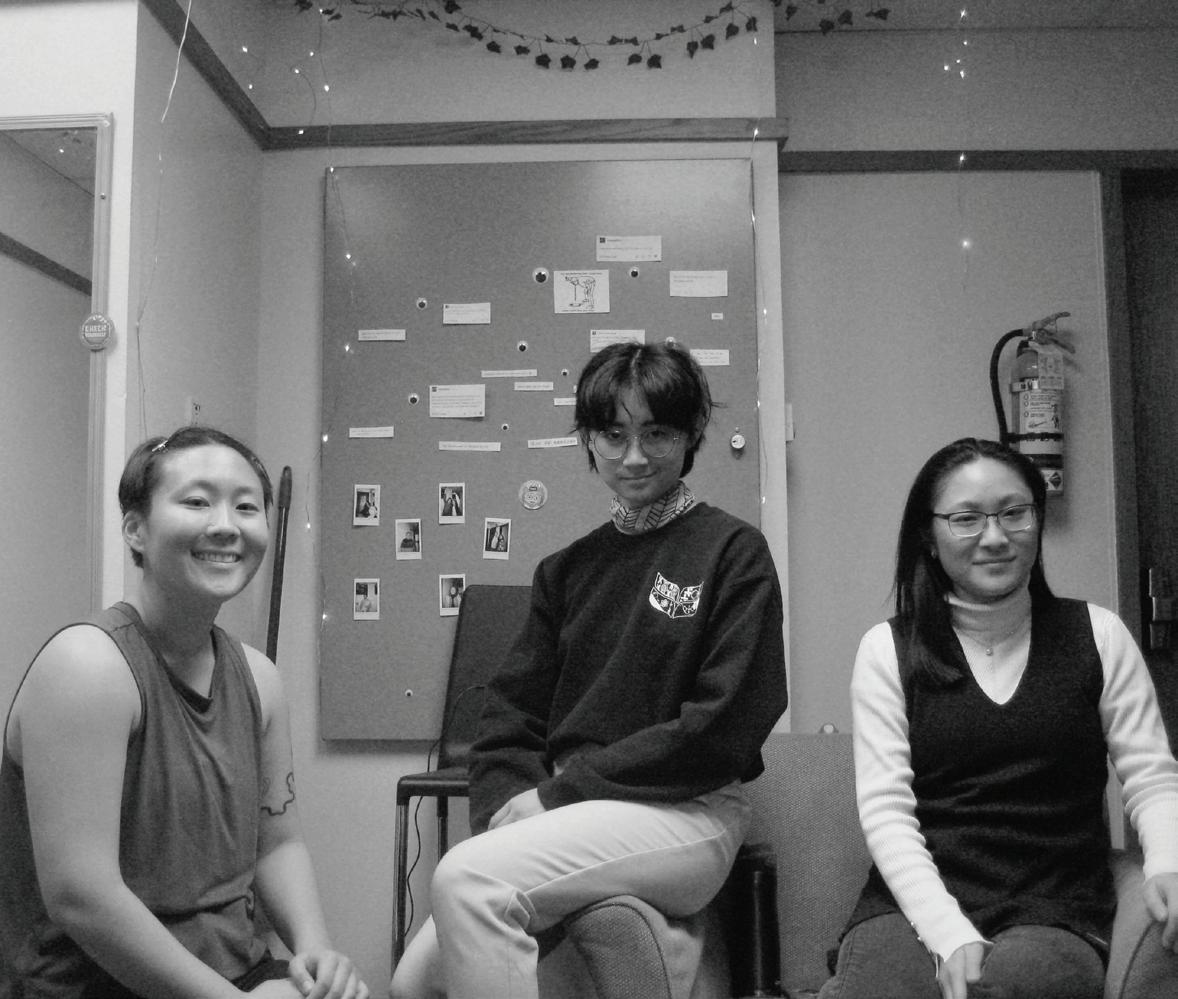
With Special Room Draw (SRD) applications due today, it may be time to do some last-minute research into possible opinions available throughout campus. Luckily for you and your prospective roommates, the S&B has highlighted four of the different SRD options at Grinnell.
SRD is a process used to determine who lives in some of the more unique housing in the Grinnell dorms, such as larger triples, quads, co-ops or student apartments. It functions by awarding points to students based on their level of seniority. Each semester completed is worth one point. For example, if four first-semester first years apply for a room, then they are awarded four points; if four first-semester fourth years apply, they receive 28. The room goes to the group with the highest total point value, prioritizing groups with the greatest total seniority first. In order to secure a SRD room, it is important to be able to get a group together, and if you want to take an extra step to better your chances at your top choice room, find friends who are upperclassmen to raise the group point total. The application requests one student to be a designated coordinator for communications related to the application, as well as the names and years for all students in a group wishing to apply.
Dennis Perkins, assistant dean of residence life and student conduct, said that the process for SRD has changed this year with the award system functioning entirely online.
“The person in the position before me would literally print out all of the information and go through oneby-one,” said Perkins. “For us, [this] makes it a lot easier.”
Options for SRD are scattered around campus and are most commonly triples or quad dorms that offer ample space for groups of people. Perkins said that Cowles Hall, located on North Campus, has the highest concentration of SRD dorms. Cowles is home to five student apartments that can house a maxi-
mum of seven people. The Cowles apartments are available in the SRD, and Perkins said that they are normally of the highest demand.
On the third floor of Cowles are quad dorms, which have a common room, four single dorms and a bathroom. Sadie Staker `24 and her three roommates currently live in one of the four quads.
“I like having the privacy of each single, but also having a common space for everyone,” she said. “It’s like the best of both worlds.” Staker recommends this dorm for people interested in rooming with three of their friends.
Also located on North Campus are the Gates Hall Tower rooms. Gates Tower’s fourth floor is closed off for a group of up to five residents. In the space, there are three common rooms, a bathroom, one double room and three single rooms. One common room looks out over Mac field.
“The actual dorms are quite small compared to the common rooms,” said current resident Maria Zhu `23. “The singles are really small.”
Trinisa Fung `23, also living on Gates Hall fourth floor, said that she appreciated the privacy the floor offers as well as the quietness of the dorm. However, she and her roommates disliked having to climb four
flights of stairs daily. “Overall, the trek up here is not the greatest for our leg health,” she said.
On the other end of campus is a SRD triple located on the first floor of James Hall. The triple has both a double and a single room as well as a bathroom for all three residents to share.
Abigail Davison `26, currently living in the triple, said that she likes the bathroom and extra space provided, but living in a triple dorm during her first year has been more chaotic than she expected, as she had anticipated living in a traditional two-person room.
Still, she recommends this space “if you’re like, ‘oh my goodness, I would love to live with my two good friends, have a bathroom and live in South.’”
This is not the only triple available on South Campus; located on all three floors of Read Hall are triple dorms or varying sizes. Henry Coen `25 currently lives in one which has three single rooms, two of which are smaller in size.
“It’s a good mix of being with roommates and friends, but also having your own space,” said Coen.
All options for the SRD are available on Grinnell College’s website on the Special Room Draw page.
Features 3
Affirmative actionContinued from first page Edited by corbinel@grinnell.edu
GABRIELA ROŻNAWSKA
CONTRIBUTED BY JOHN GARRISON
Professor John Garrison is the first professor in the English department to be the Grinnell Lecture honored speaker.
SOFIIA ZARUCHENKO From
`24, Maria Zhu `23 and Trinisa Fung `23 live together in the
tower.
left: Kendall Yim
Gate’s
True Grinnellian: Colleen Klainert
By Allison Moore mooreall2@grinnell.eduI recently met Colleen Klainert, owner and sole employee of Grinnell’s upscale wine bar, Solera, and talked about her career for nearly an hour while she continuously prepared pizzas for her evening patrons. At the interview’s end, we shared a champagne toast, and I went home with the rest of the bottle — an apt and generous gift on the day after I turned 21. The parting was a testament to Klainert’s contagious generosity and love for her customers.
In the ceiling of Solera’s kitchen, a peculiar object peers down from a hole — a Mr. Potato Head doll. “Mr. Potato Head has become kind of my thing. He’s been in every kitchen I've ever cooked in,” said Klainert. In fact, when Klainert worked her first job in a kitchen in the Alaskan bush, she brought one along. “It’s just good vibes,” she continued. “Potato Heads saved me on a lot of occasions.”
Over the years, Klainert has compiled an impressive and arguably eclectic resume featuring various jobs and restaurant gigs. But, she said that ever since her first introduction to the restaurant and alcohol sales business, her dream has always been to start her own wine bar.

For nearly 10 years, Klainert worked as a special education teacher in her hometown of St. Paul, Minnesota. In her thirties, she studied
feminist literature and Italian language at the University of Minnesota. “I wanted to major in everything. I’d been exposed to nothing — my world was really small,” Klainert said. (When I informed her that I major in gender, women’s and sexuality studies, she joked, “see you in the restaurant biz!”)
After an extended semester abroad in Italy, Klainert fell in love with the Italian culture and food and wine scene, and she won a scholarship to return to Italy after she graduated at 35. She spent the majority of her time in Milan, Bologna and Rome, all of which she said inspired her future menus and intensified her desire to start her own business.
Back in St. Paul, Klainert was surprised to secure a job interview in liquor sales despite having no experience. Klainert said that she approached the interview under the assumption that she would not land the job, but she was hired unexpectedly and later moved into fine dining. “I was a curiosity,” she said.
Throughout her various careers, Klainert has found value in unorthodox means of communicating. Once, Klainert gave a Mr. Potato Head doll to a particularly crotchety customer, and he later became a loyal patron and friend.
“Try unconventional means,” she said. “There are certain common tracks that I think we all relate to, like humor or a bad day. There’s a lot going on behind facial expressions of anybody
in any situation. So take a second try to make them laugh or something. You know, you've made an attempt to find a common humanity. It's pretty helpful.”
Klainert worked in bigger restaurants in the Twin Cities before moving with her then-partner to Ladora, Iowa. There, in a town of just a few hundred residents, they turned an old bank into a wine bar and quickly amassed a group of devoted customers.
In 2021, she left the Ladora Bank Bistro in search of new opportunities, and, after months of struggling to obtain a loan, she found a property on 829 Broad St. Initially intimidated by the space’s size and the daunting tasks ahead of her, Klainert soon opened Solera, and it has been on Broad Street ever since.
“By design, I got to start with a pretty much blank slate. I wanted to create small social spaces where people could get together, and chat and be in a dining hall environment.” She said that she does not care who you are “as long as you’re comfortable and happy.”
Since opening Solera, Klainert has remained the sole employee. Managing the books, preparing food, bartending and menu planning are only some of her responsibilities. But she would not have it any other way. “I think I probably thrive on the variety of activities that have to be done. There are days when I'm running around like an idiot, and I don’'t really mind that,”
Corrosion threatens Grinnell water supply
she said.
Four years ago, when Klainert was diagnosed with a brain tumor, her customers rallied and supported her and the business for six weeks.
After recovering, Klainert changed her menu to include pizzas because it became too cumbersome to prepare the individual and handcrafted pastries from her previous menu. Her customers were more than receptive, she said.
During the pandemic, Klainert changed to a takeout-style business model, and she praised her customers for once again keeping her afloat.
“This is a huge kudos to my customers. They would come in, and buy a stack of pizzas and several bottles of wine and just keep me going,” she said.
When she reopened the Solera storefront on May 20, 2021, Klainert said that despite her apprehension, her customers reassured and supported her. “It was like a reunion everyday,” she said. “This is my family, so it was good to have my family back.”
In fact, Klainert has printed individual pictures of her customers onto her business cards. On the back of the one currently in my wallet is a picture of a tall man holding a comparatively small accordion, a musical instrument that Klainert has grown to love over the years.
“I’ve done a lot of crazy stuff,” Klainert said, and while reflecting on her various personal and professional experiences, she advised, “Bloom where you’re planted.”
Los Girasoles' Tex-Mex style food brightens Grinnell community
By Oliver PalmerLos Girasoles, a family-owned Mexican restaurant located on West Street south of downtown Grinnell, opened six years ago in 2017. Since then, it has become known for its quality food, friendly service and as a great place to celebrate your birthday.
Los Girasoles offers indoor and outdoor dining, and it serves Tex-Mex style food along with a few traditional Mexican dishes. They offer a variety of drinks, including margaritas, cocktails and beer. They also offer catering options for businesses and sporting events.
“We try to focus a lot on good service and friendly service,” said Jairo Rosas, front-of-house manager.
Rosas said that while he used to be intimidated by large groups of customers, he has since grown to be more comfortable with bigger groups.
“We enjoy it when you guys are here, you know, the big ’ol groups of students. We enjoy making the margarita towers and stuff for you guys,” Rosas said.
brought in a lot more people in the summertime [after the remodeling was completed].”
Rosas said that Grinnell College graduations always provide a boost in customers.
“The community here is very nice to us, you know, so we like that,” Rosas said.
Rosas, who has a family of his own, said that he likes serving other families and making sure everyone has a good time.
“I enjoy just making sure everybody leaves happy, because when I go out to eat, I like a good time,” Rosas said.
Los Girasoles was opened by Rosas’ mother and her friend in April 2017, Rosas explained. “It took the restaurant a while for it to get the staff established,” Rosas said.
“My mom says that she enjoys working here in Grinnell. She loves the community here. We’ve gotten to know customers over time, and we’ve kind of built friendships with them,” he said.
Grinnell can only store approximately 23% of its daily chemically treated water production.
Altenhofen said that while residents might think that the water softener is the biggest issue tied to water in Grinnell, it is not.
The pipe gallery, which is the pipe that connects the water plant with the water distribution system, is also corroded, irreparable and irreplaceable, said Altenhofen. “This current facility is very vulnerable. Even with the softener offline, there could be a catastrophic failure here and then the town will not have water,” he said.
The pipe cannot be replaced because that would require the water plant to be offline for weeks and Grinnell does not have enough water storage capabilities to allow for the water plant to be shut off for so long, said Altenhofen.
The Department of Natural Resources has a general rule of thumb saying that a city’s treated water storage should have a capacity able to provide water to the community if the water plant needed to shut down for a day, said
Altenhofen. Grinnell does not have the capacity to do this. According to Altenhofen, the water plant generated 1.3 million gallons of potable water on Feb. 22, and Grinnell’s water tower can store just 300,000 gallons of water.

The town of Grinnell is partnering with Nuclear Engineering to build a new water plant located east of the current plant that is expected to be ready by fall 2026.
Altenhofen said the plant is estimated to cost $25 million, which the town plans to finance by taking out a State Revolving Fund (SRF) loan. SRF loans are meant to help with the cost of designing and constructing water and wastewater infrastructure. Altenhofen said the town is planning to submit the application for the loan on March 1.
“My concern is making sure that we keep water in our system, potable water for our community to keep using, and there's no way around that outside of a new treatment facility,” said Altenhofen.
He also said that the city of Grinnell's government will look
at ways to change other aspects of the current system, including water sources, and will create a failsafe for the faltering pipe gallery until the construction of the new water plant is completed.
The failsafe would include a substation located west of the water tower, meant to disinfect the water, and it would be connected to the distribution system, said Altenhofen. He said that the failsafe is estimated to be ready by early 2024.
There is no contingency plan if the pipe gallery were to break down before the substation is ready, he said.
“Now, if that pipe gallery blew apart today, ultimately there would be a water outage and we would do everything it would take to get the facility back online and running. But at the end of the day, we can’t forecast what the extent of that damage would be,” said Altenhofen.
Altenhofen said he welcomes any questions about Grinnell's water to contact him by calling his office at (621) 236 - 2635 or by email at jaltenhofen@grinnelliowa.gov.
“And we know that we are in a college town, so we try to focus a lot on giving everybody what they need when they are here, and stuff like that. We make sure everybody leaves happy,” Rosas said.
During the COVID-19 pandemic, the restaurant saw a decrease in orders, but it has since rebounded. Rosas attributed the surge in customers partly to people wanting to get out of their houses and in part because of the outdoor patio dining area that was remodeled.
“It [the patio] was there before, but it kind of wasn’t looking so great,” Rosas said. “So that definitely
His mother also owns and manages La Casa de Pancho in Maquoketa, Iowa. Rosas and his sister manage Los Girasoles. Rosas explained that his mother wanted to pick a different theme for this restaurant from her previous restaurant, which was more rustic in style.

“Another thing of the name was just so it was easier for people to pronounce,” said Rosas, “But now people have a hard time with the ‘g’ because it makes an ‘h’ sound. I don't think that [the name] worked out too well.”
Thinking about having a meal at Los Girasoles? Rosas recommends the tacos asada and a blended strawberry margarita.
4 Edited by perezgar@grinnell.edu Community
PAUL HANSEN
Colleen Klainert is the owner and sole worker of Solera wine bar at 826 Broad St.
palmerol@grinnell.edu
OWEN BARBATO
Water plant — Continued from Front Page 1
PAUL HANSEN
Jairo Rosas is the front of house manager at Los Girasoles and said the staff enjoys it when large groups of students go eat at the restaurant.
By Oliver Wolfe wolfeoli@grinnell.edu
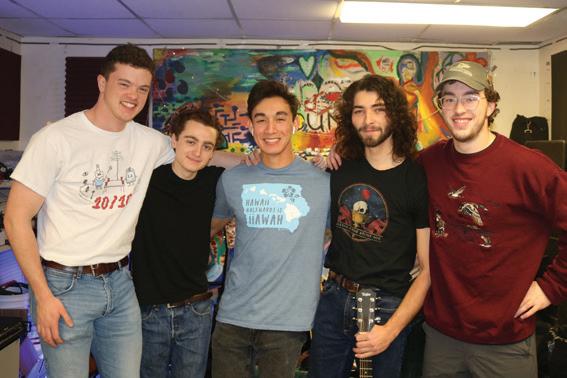
You might not know their name, especially given that it is prone to changing nearly every time they perform, but if you have attended any Grinnell College student music event, you probably recognize their faces. This southern rock, folk and blues-influenced band, made up of lead singer/writer and guitarist Nick Parker `23, bass player Will Sweek `23, lead guitarist Henry Gold `25, guitarist Dylan Laurianti `23 and drummer Kenny Atlas `23, is a prolific presence in the Grinnell music scene, having developed and performed a wide array of sets for many different shows.
In the past, the band has gone by Soi Disantra, The KGBeeGees and Feral Kenny, and they said that they are looking to continue experimenting with their stage name. “One we were kicking around yesterday was Catastrophysicist,” Parker said. “One other name we came up with was The Rolling Stones,” he continued with a wry smirk.
The name that has stuck the most, probably due to how apt and unique it is, is Soi Disantra. This made-up word is a modification of the French phrase “soi-disant,” which in English is used to mean that something is “self-proclaimed” or “so-called.” The band borrowed the adjusted phrase from one of their biggest influences, underground country-rock band Silver Jews, who coined the phrase in their 1998 track “Send in the Clouds.”
The name Soi Disantra reveals a lot about the band’s ethos. It gives a nod to the group’s stylistic influences while simultaneously reflecting their attitude — they are first and foremost friends who enjoy making music together. As Atlas said, “I kind of just enjoy hanging out in Freesound.” In this way, they
The many aliases of Soi Disantra
have become a “so-called” band for the community’s enjoyment.
Accordingly, the genesis of Soi Disantra did not come from aspirations of success — rather, they were friends who realized that they had similar tastes in music. Sweek said, “Kenny and I bonded pretty early on over a mutual affection for [The Red Hot Chili Peppers.]”
Despite their shared affinity, Soi Disantra’s music style is fairly far off from The Red Hot Chili Peppers’ funk-rock fusion.
Aside from Silver Jews, the band has many other influences. “We’ve got a little bit of John Craigie, Joe Henry, something that sounds to me a little bit like John Hiatt. Definitely Jason Isbell,” Sweek said.
Reflecting on their sound, Gold said, “I think it usually starts off
pretty folky, but then we just all have electric instruments, so it just turns into something more akin to southern rock.”
This is when the group gives these songs their eclectic, southern-rockstyle twist.
“Henry might add a slide, we’ll play weird basslines and I [will] try to write songs of weird chord progressions,” Parker said. “I think that lends itself to not being country’s very up and down, straight and simple [sound].”
much getting there,” said Gold. “I wish there were more bands. I want to see a vibrant music community here.”
When asked if they had any last words, the band recommended an album. It was “The Whole of the Moon: The Music of Mike Scott and The Waterboys.” Give it a spin, and perhaps it will make something about the group click.
For their repertoire, the group is evenly split between playing covers and original songs. Their originals are mostly written by Parker, who will often bring a “song skeleton” of sorts, consisting of just lyrics, chords and a melody, into Freesound, where the band will work to arrange it into a fuller, more complex piece.


Parker added, “We don’t have many slow and boring songs. I’ve been trying to write less slow and boring because I don’t think that’s what we want to play.”
Soi Disantra expressed their gratitude for the way they have been received by the Grinnell community and student music scene. “I think we’re maybe just starting to get to a point where we’re carving out a little space, but we’re still very
“And oh! If it’s not too much to end on,” said Sweek, “we’re kind of never not looking for a fiddle player.” If you play the fiddle and are interested in joining the group, do not hesitate to reach out.
Keep your eyes and ears open: this band of many names does not plan on stopping their raucous performances at Grinnell College student music events anytime soon.
"Fragmentary Visions" showcases work from the past millennium and beyond
By Krista Spies spieskri@grinnell.eduThis semester, four students in the ARH-360: Exhibition Seminar art history class hand-picked international ceramics, textiles and manuscripts ranging from the 13th through the 19th century to highlight in their exhibition “Fragmentary Visions: Grinnell’s Kelekian Collection,” currently on display at the Grinnell College Museum of Art through May 6. Assistant Professor of Art History Eiren Shea’s class, composed of Marina Busby `24, David Gales `23, Melena Johnson `23 and Lâl Verda Karaoĝlu `25, organized this exhibit, writing essays to accompany the curation.
“We wanted to show our objects as they are in their truest form — fragmented and a little dirty,” Karaoĝlu said. In naming the show “Fragmentary Visions,” the students celebrated the imperfection of the pieces instead of the industry standard of gluing them together to imitate the aesthetic of an original condition, Karaoĝlu said.
“They are not perfect by any means — textiles have fingerprints, the ceramics have cracks that have been painted over, the books have annotations in them. Hence, the word ‘fragmentary’ — because they are not only fragmented, but also fragments of history.”
Additionally, Karaoĝlu said
that the name is free of historical connotations and attributes, not restricting itself to a single region or time period, so it can stand for itself. Busby added, “Symbolically, these pieces are all fragments of a greater understanding of culture, region, history, art dealing, intervention practices, etc.”
The Kelekian Collection refers to the collection of roughly 160 objects that Nanette Rodney Kelekian donated to the museum from her step-grandfather, art dealer and collector Dikran Kelekian. Karaoĝlu said that Dikran Kelekian widely popularized Middle Eastern and Eastern Mediterranean art in North America, with pieces from his collections present in museums

across the U.S. to this day.
Art within these collections are broadly known as “Islamic” art, which Karaoĝlu said has problematic connotations as a term and “has long been camouflaged by the Western gaze.”
Karaoĝlu mentioned in their opening reception talk for the exhibition that by describing art as “Islamic,” it does not specify cultural origins but rather turns a wide variety of artistic styles and histories into a monolith. In comparison with specialized representations of Western art, “Islamic” does not provide adequate information about the object.
“It’s like having a miniature version of the history of so-called Islamic art production,” said Shea, who led the seminar. “I say socalled because the term ‘Islamic’ covers the area between Spain, North Africa, the Middle East and Central Asia from the 7th century to the present day, so it doesn’t really have a specific meaning.”
The Kelekian Collection, which was predetermined to be the content for the course, contains more objects than typically possible to display given the space and time limitations with the seminar’s curation, according to Karaoĝlu.
“It was up to us to pick and choose which objects we wanted to do and how we wanted to frame our exhibition,” they said.
Considering the aesthetic presentation of the pieces, their geographic placements of origin and their physical conditions, the students selected ceramics, including both whole objects and shards, textiles and manuscripts, such as Shahnameh pages, Quran pages and books.
Shea said that in the unique format of a seminar exhibition class, she served as a facilitator for student work.
“Exhibitions are collaborative by nature, and I think the students really saw how curators have to work with an entire team in order to pull off a show,” she said. “From the design of the space to the catalog that we published to accompany the show, the class was supported by a number of people every step of the way.”
Shea acknowledged and celebrated the support of the staff at the Grinnell College Museum of Art.
“It’s amazing to have such a variety of different types of art accessible to Grinnell College students,” Shea said.
Both the students and the professor spoke about the importance of displaying the Kelekian Collection at Grinnell College. “No one would expect to see these objects in Iowa,” said Karaoĝlu.
Karaoĝlu shared the personal significance that working on “Fragmentary Visions” held for them.
“As much as I am very connected to my history and heritage as a Muslim Turk, I’ve never had the chance to study medieval Middle Eastern objects in great detail,” they said. “I actually got to touch objects with so much history behind them and make use of them. It was truly incredible ... It really inspired me to take a closer look into my own culture and history.”
Arts Edited by morrishl@grinnell.edu
We don't have many slow and boring songs.
Nick Parker `23
We wanted to show our objects as they are in their truest form: fragmented and a little dirty.
Lâl Verda Karaoĝlu `25OHANA SARVOTHAM From left to right: Dylan Laurianti `23, Nick Parker `23, Will Sweek `23, Henry Gold `25 and Kenny Atlas `23. CORNELIA DI GIOIA MADDI SHINALL Left to right: Silhouette-Ware Ewer with Nashki script on shoulder . Late 12th - early 13th century, Iran. Fritware with black slip under turquoise glaze. Pitcher with Naskh inscription around shoulder . Late 13th century, Iran. Fritware with light brown luster glaze decoration. Ewer . Late 12th century, Syria. Fritware, underglaze blue and turqoise with luster over transparent glaze.
Erin Hurley retires after 28 years and 41 Midwest Conference titles
By Cadence Chen chencade@grinnell.eduAfter 28 dynamic seasons, Erin Hurley is retiring as head coach of the Grinnell College men’s and women’s swimming and diving teams.
Hurley is leaving her position with wins from both the men’s and women’s teams at the Midwest Conference (MWC) championships, which were hosted in the Russell K. Osgood Pool and Natatorium. The men’s and women’s teams have won 19 out of the last 21 and 22 out of the last 24 Midwest Conference titles respectively.
Though it was “back-and-forth,” according to Hurley, between the women’s team and the Lake Foresters, Grinnell ultimately came out on top. The teams also recently found out that Sean Colson `26 of the men’s team will be competing at the National Collegiate Athletics Association (NCAA) Division III National Swimming and Diving Championships. Colson was also named MWC Men’s Outstanding Swimmer.
ley in 2009 when she was visiting the College as a prospective student. She said that Hurley works “magic” in her office.
male coaches rather than to her.
As it was Hurley’s final season, Genevieve Martinez `24, on the women’s team, said, “Winning it was kind of for her.”
During a toast given on the last day of this year’s MWC Championships, Callie Eyman-Vavroch `14, assistant swimming and diving coach, said that Hurley made a joke that Eyman-Vavroch “has never left” the team since worrying about returning after a shoulder injury in her first year at Grinnell.
Eyman-Vavroch first met Hur-
She also said that she knows of many past and current team members who share a similar story as her, where they were unsure of whether they wanted to swim but left Hurley’s office with a new desire to stay.
Hurley has been swimming all her life. At four years old, her parents were adamant about having her swim. Swimming began as a recreational activity. She said that she found some success, which was part of the reason why she enjoyed it. Thanks to her involvement on collegiate-level swim teams, her undergraduate education at the University of Nebraska and graduate education at the University of Iowa was paid for.
In 1993, she had taken a coaching position at Illinois Wesleyan University, but she said it was too far east for her. After applying for a couple of other positions, she joined Grinnell College as the head swimming and diving coach in 1995.

As to why she decided to go into coaching, she simply said, “I felt like I had something to say.”
Earlier in her career as a coach, Hurley said she had experienced some gender bias. Her previous assistant coaches tended to be men. At conferences, coaches on other teams would speak directly to the
At the beginning, Hurley said she was more interested in winning and records than she is today. Her coaching approach has since evolved. She describes herself as “more holistic and more compassionate.”
During her tenure, and prior to the most recent championship, Hurley has coached 264 conference champions, 23 MWC Swimmers of the Year and 21 All-Americans, as well as a national champion. This year, she has collected the MWC Coach of the Year for both the men’s and women’s teams. In 2016, she won the College Swimming Coaches Association of America’s Richard E. Steadman Award, which is awarded to the coach who spreads the most happiness.
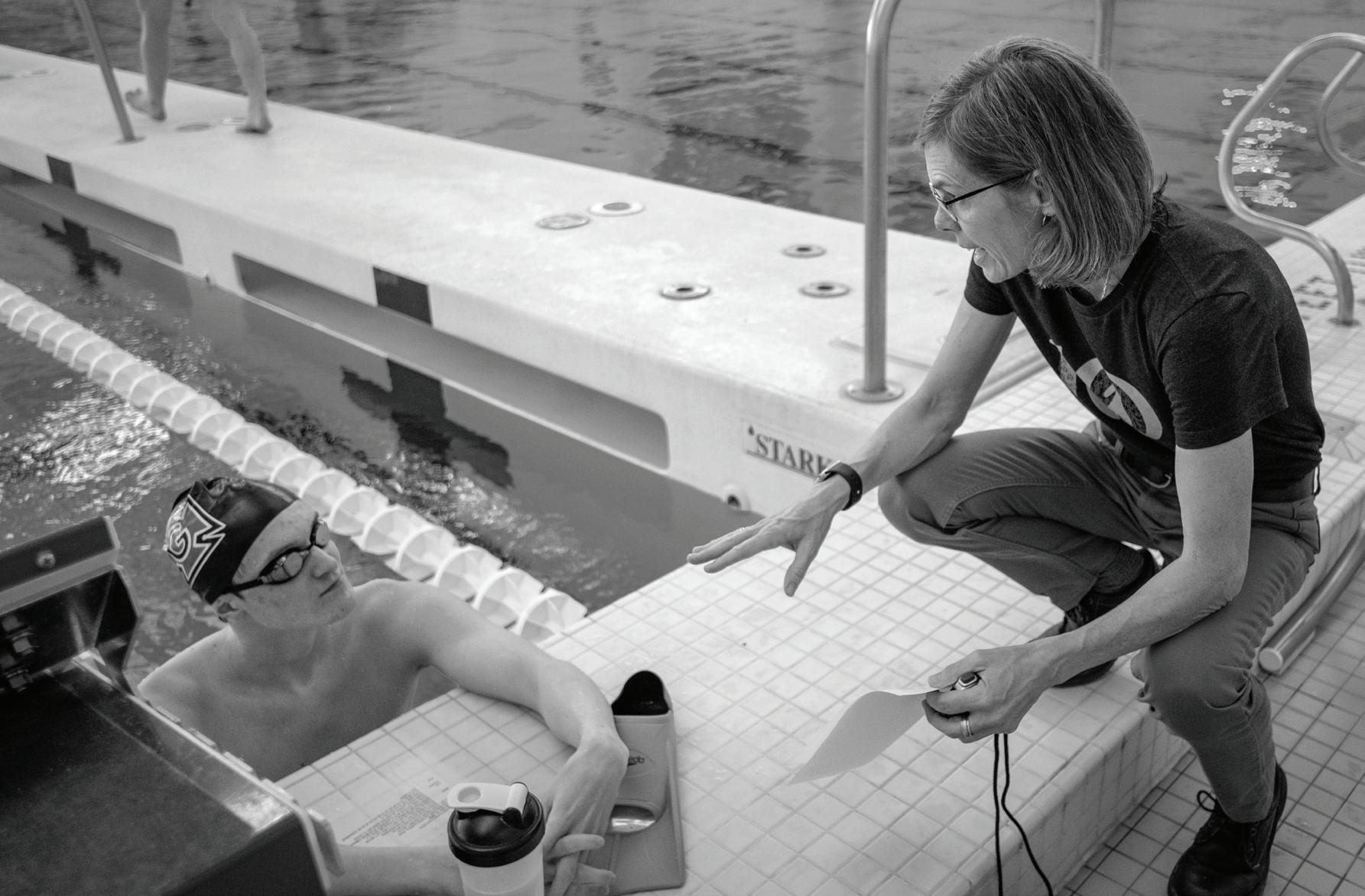
Martinez and Enrique Valero Ying `23, a member of the men’s team, both said that Hurley does not act like a “stereotypical coach,” where a coach expresses aggressive and hard-headed behaviors. They spoke to her goofy and positive demeanor when she is on the pool deck with a stopwatch and a big smile.
Hurley said she hopes to instill confidence in her students
and make swimming an experience that ends in tears of joy.
She kills us with kindness.
Because swimming is both an individual and team sport, Martinez said that the athletes can find themselves being their own worst critics. She said that Hurley knows that her students have lofty goals and are hard on themselves, but Hurley will not be disappointed in them. It was with this coaching philosophy that Martinez said she was able to make some of her best times in this year’s MWC after a COVID disruption in her first year and a knee injury in her second.
“9 times out of 10, they go out there, and surprise themselves and swim better than they thought they would,” said Eyman-Vavroch.
Martinez said that Hurley tells the members to practice the “five-minute rule.” Everyone has five minutes to “feel how you’re going to feel” after a race. After these five minutes, members will rejoin the team atmosphere. Martinez said she has applied this practice beyond swimming.
Eyman-Vavroch, Martinez and Ying said they have observed that Hurley tries to form a personal connection with everyone. In
his fourth year on the team, Ying said that he felt that his third year would be his peak. Hurley, however, would tell him that she did not care about the times and suggested that he take it day-by-day.
Though he said that he wanted to keep it professional with Hurley in his first few years, he now considers Hurley one of his “best friends.”
“When you text, she texts back,” Ying said.
Hurley said that she considers herself the beneficiary of the teams, referring to her students as gifts.
“Everybody has value, and sometimes it’s not really clear or visible what that gift might be,” Hurley said. “But, it becomes very evident as the relationship develops.”
At the end of practices, Martinez said that Hurley makes sure every player gives her an elbow bump regardless of how well that practice went.
Martinez said, “She kills us with kindness.”
According to Ying, during previous toasts after the MWC, Hurley would congratulate the team on their successes. In this final toast as head coach, he said that Hurley thanked everyone.
“It was serenity,” Ying said.
Hurley said that she feels her experience with swimming has come “full circle.”
“I’ve gone through all these years, and now I’m back to it as a beautiful experience, to be at one with the water and how the water can bring people together,” she said.
I‘ve gone through all these years, and now I’m back to it as a beautiful experience, to be at one with the water and how the water can bring people together.
Hurley will continue to be at the College with a full-time faculty position. She will help with academic administration in the physical education department, teach the firstyear tutorial class and train the new head coach for swim and dive. She said that the new coach will be identified by May of this year. She will use her extra free time to spend time with her nieces, nephews and dog.
Buzzer sounds on men’s basketball season with OT loss to Lake Forest
By Conrad Dahm dahmconr@grinnell.eduAs the clock hit zero in overtime, the men’s basketball team found themselves just one basket short of winning their Senior Day game in a nail-biting end to their season. The Pioneers lost 120-121 against Lake Forest College on Feb. 18 and ended a season worthy of the memory books. Throughout their season, the team saw new players, new records and new goals moving forward, according to multiple players and David Arseneault Jr., head men’s basketball coach.
“I thought that while it was a
challenging year from the perspective of wins and losses, I thought that there were a lot of things we did really well,” said Arseneault Jr. The team’s final record was 8 wins and 16 losses. Arsenault described the team as “an incredible group to coach” because of things like teamwork and how hard they competed.
Zachary Rosen `26, guard, said,
“It was so much fun just playing the system and being around the guys like we’re a family.” Rosen also explained that while, at times, there were disappointing losses, that did not stop the work ethic of the team. This work ethic is what Arseneault Jr. and Rosen are looking
forward to developing next season.
“Personally, I just want to develop and be the best basketball player I can,” said Rosen. He also hopes for the team to make the National Collegiate Athletics Association (NCAA) Division III national tournament.
Arseneault Jr. is also excited to work with younger players like Rosen. He said, “We have a lot of very good young players. My hope is that they’re going to make strides out of the season and be more polished in terms of their skill work.”
Arseneault Jr. said the team is specifically looking to work on outside shooting, passing and playmaking. He also said that the team is “sticking to the process and just trying to keep building and moving forward.” He added that the team is looking to win more games next season, and that the team’s prospects look good in terms of success.
“The future is bright for Pioneer basketball,” said Arseneault Jr.
For some players, this season was their final one. Dean Mazlish `23, guard, spoke highly of his last game at Grinnell. “Last Saturday, like that crowd, the atmosphere at Senior Day … even though we lost, that was the best game that we played all year for me, honestly,” said Mazlish. He also emphasized the importance of the crowd in keeping the team galvanized.
“Just having a bunch of people support you, it feels like you’re playing for something more than
just yourself and the teammates.
You’re playing for all these people in the crowd as well,” said Mazlish.
Rosen agreed, saying that the energy of the crowd was amazing during the Senior Day game. “The crowd was so much fun. It was just such a fun two hours,” he said.
Arseneault Jr. also explained that the fourth-year players provided help too and influenced younger players on the team. He said that this further influenced them to play an “unselfish brand of basketball.”

This season also held exciting moments that not only broke records at Grinnell, but also in the world of NCAA men’s college basketball.
On Dec. 8, 2022, the team set the NCAA record for most 3-point attempts in any NCAA men’s basketball game, with the team shooting 111 3-point attempts in a 124 to 67 victory over Emmaus Bible College. This record is something the team
is looking to build upon for next season, according to Arsenault Jr. “It’s on the edge of innovative basketball,” Arseneault Jr. said. For next season, Arseneault Jr. and Rosen look forward to improving the team’s performance while also capitalizing on the successes of this year. For Mazlish, his final season playing Grinnell College basketball was exciting and he was grateful for his four years. Overall, the team is looking forward to playing again and continuing the tradition of exciting games that will most likely be filled with plenty of 3-pointers.
SportS Edited by igbariam@grinnell.edu 6
EVAN HEIN
BY
SCHULTZ Erin Hurley will retire on a high note after both the men’s and women’s swimming and diving teams both earned yet another Midwest Conference title.
In her time as head swimming and diving coach, Erin Hurley has earned the title of Midwest Conference Coach of the Year 23 times. She was also awarded the College Swimming Association of America’s Richard E. Steadman Award, which is given to the coach who spreads the most happiness. CONTRIBUTED
TED
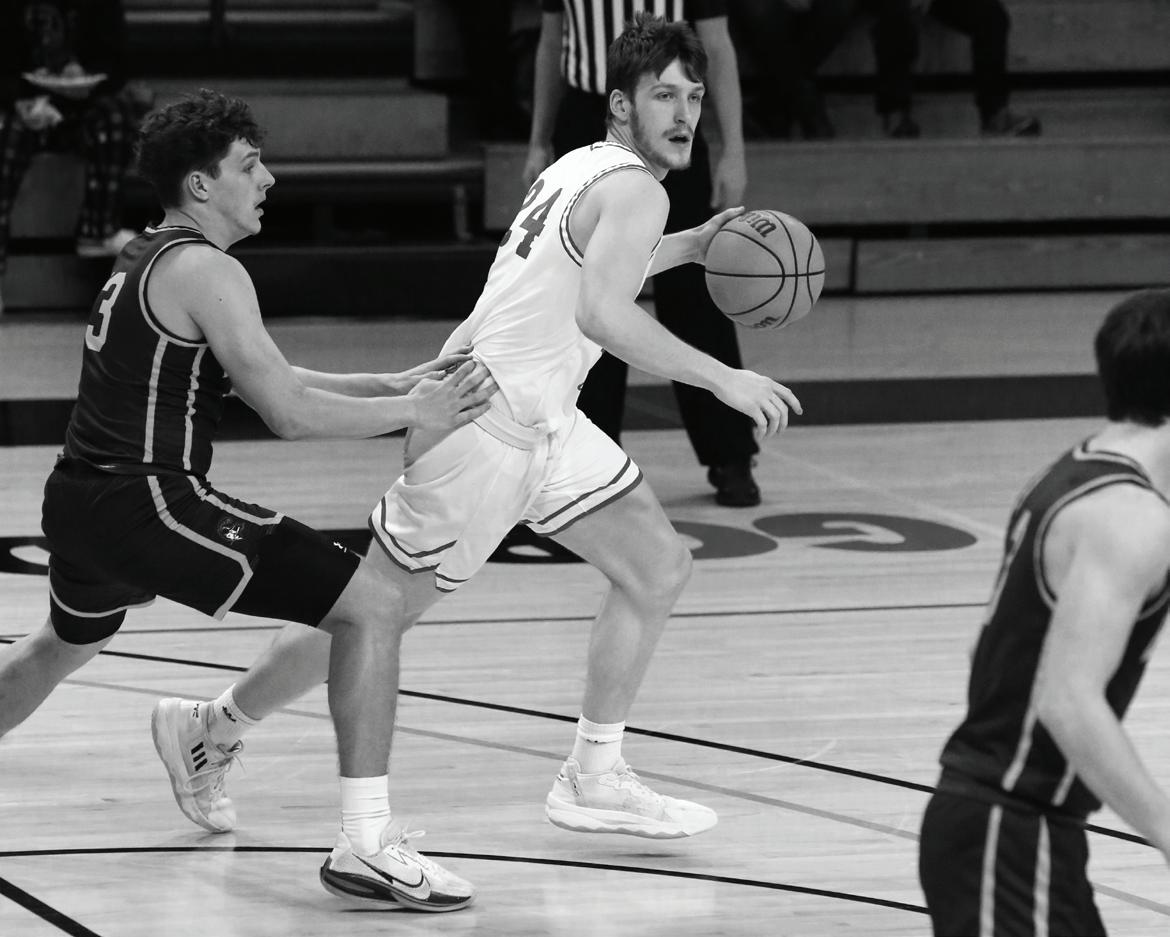
CONTRIBUTED BY TED SCHULTZ Dillon Gestring `25, guard/forward, passes a defending Beloit College player during the Feb. 14 match. Grinnell won 100-85.
CONTRIBUTED BY TED SCHULTZ Aiden Gilbert `23, guard, drives the ball down court in the Feb. 14 game against Beloit College.
you
When
text, she texts
back.Enrique Valero Ying `23
her.
Genevieve Martinez `24
Winning it was kind of for
Genevieve Martinez `24
Erin Hurley Head Swimming and Diving Coach
Just having a bunch of people support you, it feels like you’re playing for something more than just yourself and the teammates. You’re playing for all these people in the crowd as well.Dean Mazlish `23
Addressing the stigma: It’s time to talk about eating disorders
By Millie Peck peckcami@grinnell.eduCW: In this series, I will be discussing eating disorders and their devastating effects. As someone who has an eating disorder, I try my very best to never describe specific behaviors or comparative numbers, as that can be very damaging, but the material may be upsetting nonetheless. If you decide not to read, thank you for taking care of yourself.
In the last installment of my series I explained my inspiration for investigating eating disorders on campus and within the athletic department. In this edition, I will delve into the stigma and lack of information on campus surrounding eating disorders.
I reached out to dozens of athletes over several months as part of my investigation. I emailed entire sports teams to explain my project and asked if anyone would talk with me about team cultures surrounding food, body image and what resources were provided to them — by coaches, captains and Student Athlete Mentors (SAMs).

During my outreach, two notable things happened that both spoke to the deep stigma that still exists surrounding eating disorders. First, the majority of respondents stipulated that they would only speak with me anonymously, expressing that the topic was too sensitive to discuss publicly. Second, I received a scolding email from an athlete accusing me of causing harm and instructing me to warn people about triggering content, i.e. eating disorders.
I was stumped. As a journalist, I always try to assume blame for my mistakes and correct any harm that I might have caused, but I couldn’t figure out a better way I could have approached reaching out. I did not mention behaviors or ask for them to share their personal struggles — really, I hadn’t given them any information at all. All I did was allude to the fact that there were eating disorders among athletes. The athlete’s response, however, highlighted another reason why eating disorders are still such an issue on campus — if we can’t even say the name of the issue we are facing, how are we ever going to be able to overcome it?
Erin Hurley, head coach of Grinnell’s swim and dive teams, told me, “We normalize depression and anxiety, which is part of an eating disorder. But, I think we could do more on the desensitization of the topic, so it’s not a hot topic or one that you have to tiptoe around.”
As part of my investigation, I wanted to talk to an array of athletes to try to understand different conceptions existing surrounding eating disorders. At the end of each of my interviews, I asked the interviewee what they thought made having an eating disorder so difficult. People with disordered
eating experiences discussed the mental toll, explaining how it took control of their life and thoughts. But, those without personal experience focused on the physical side, describing the danger of undereating. This contrast in responses demonstrated to me the lack of eating disorder education among athletes.
I believe the ability to talk about eating disorders would be made much easier if everyone had a common understanding of what an eating disorder truly is and why it occurs. Let’s start with the fact that eating disorders are a psychological disorder — an addiction, not a diet or choice. I have always found it most useful to think of eating disorders as a coping mechanism.
Eating disorders are almost always comorbid with anxiety and/or depression. The different food and exercise rules that make up an eating disorder often develop as a way of coping with distress. When I returned to cross country my third year of college, my therapist, coach and I met to create a recovery training plan. My therapist explained that reducing my exercise didn’t have anything to do with maintaining my weight, but rather that the competitive and comparative aspect of exercise often fuels eating disorders and can very quickly cause one to relapse.
out of bed, well that could be clinical depression, and this is a physical manifestation of that. But, you can’t diagnose a disorder just by looking at someone.”
Coaches and teammates alike do not have the training or information to recognize eating disorders. Every eating disorder consists of different behaviors, so no one rulebook exists for identifying and diagnosing behaviors.
Disordered behaviors aren’t always the best way to identify eating disorders because behaviors are not always correlated with mental distress. When I finally entered residential treatment at 19, I weighed the most I ever had and engaged in disordered behaviors far less than previously. However, the mental anguish had rotted my brain and affected my daily functioning to such a level that my therapist told me I needed to seek higher care or she couldn’t see me anymore. So, I will take a moment to emphasize again: you cannot tell if someone has an eating disorder based on their physical appearance.
Diet culture has long championed the use of body mass index (BMI), which suggests that there is a certain weight range we should fall under based on our gender and height. Despite the medical field debunking this myth in the 1990s, current diet culture continues to promote the idea that we can achieve a certain level of fitness if we just eat healthy and exercise. This is not only false but can be incredibly damaging to an individual’s health, as many people resort to starving themselves in order to reach an impossible standard.
This compounds the problem because people are often unsuccessful in losing the weight they desire, and it is why many people who have eating disorders look perfectly healthy despite starving themselves. Fatphobia is still very present because we haven’t been educated about the fact that healthy bodies come in every shape and size.
all that. But, we don’t talk about that.”
Co-head SAM from 2021-2022, and former teammate of mine, Ailsa Schmidt `22 added, “People really don’t want to upset each other, especially within communities where they spend so much time together, and there’s so much focus on eating together as part of the team building.”
 Anonymous Athelete
By Ralph Savarese savarese@grinnell.edu
Anonymous Athelete
By Ralph Savarese savarese@grinnell.edu
At the end of last semester, the dean of the College announced that Andy Hamilton `85 was stepping down as director of athletics and rec-
With eating disorders, there is an almost constant internal dialogue that quickly degrades a person’s mental health. When I asked one athlete how often he thought about his body, he said, “Most of my time. Yeah, like something about my body or exercise. Even stretching. Everything that’s not revolving around school is basically athletics. I think about food probably more than I should — probably more than most people. I definitely think of what I’m going to eat, when I’m going to eat it. It’s always on my mind.”
The stigma surrounding eating disorders is compounded by the fact that they are rooted in shame and secrecy. Disordered behaviors typically occur privately, which makes an eating disorder much harder to identify than other mental illnesses. Because the feelings that trigger the behaviors are rooted in shame, individuals typically go out of their way to hide their behaviors from those around them. As Julia Welch, a Student Athlete Mentor from 2021-2022, described, “It’s more easily explained away. Like going to lunch with friends but not eating and saying, ‘Well, I’m sorry, I just ate, but I wanted to come here for the camaraderie.’
So, thinking this person’s not getting
Current health research has moved towards set point theory, which states that our bodies have varying genetically preset ranges of weight, and that even if we under-fuel ourselves, our bodies will return to that range.
My interviews led me to believe that every sports team at Grinnell seems to have a different culture surrounding food. Eating disorders are a particularly prevalent topic on teams because teammates not only exercise together, but they also often eat together. Eating disorders are comparative by nature, a fact that some teams are aware of. Some have even created culture policies to not comment on what others are eating at the Dining Hall in response. But, for other teams, the food talk is more prevalent as weight gain and loss are often emphasized in strength-based sports, and many athletes are concerned with “healthy” eating. However, despite making efforts to not discuss others’s food choices or appearance, my interviews lead me to believe that people rarely discuss eating disorders. One athlete who struggled with disordered eating said, “I feel like it’s there in the back of everybody’s mind, their body image and
Eating disorders remain a very touchy subject, one that most athletes struggle to discuss — not because they don’t care but because they don’t have the information to discuss the issue properly. They fear saying the wrong thing. However, the silence creates a stigma, and that alone is a strong deterrent for people to get the help they need. When I asked one athlete if she thought she could stay on her team if she needed to reduce her training for recovery, she told me, “I definitely wouldn’t feel like I was a part of the team in the same way anymore. I could not imagine going to the locker room with people knowing that.”
Based on the number of people who responded to and spoke with me, I believe that people care deeply about this issue and want to create a culture where we can support those with eating disorders. Currently we do not have the dialogue, proper language or ground rules necessary to combat the issue. Most athletes I spoke with who had knowledge about eating disorders gained it from personal disordered eating experience or knowing someone with experience. Sharing one’s experience can feel extremely risky, and it shouldn’t be on those of us struggling to educate others around us.
Ultimately, I believe there are systemic ways that we can build a dialogue surrounding eating disorders. I hope to share these ideas as well as the resources we need to help those around us in the next installment of my series.
reation. I wanted to take a moment to thank Andy for all he’s done at Grinnell. We often fail to adequately express our appreciation for the service of others — in Andy’s case, almost four decades as an employee.
The Scarlet & Black Staff Spring 2023
Nadia Langley
Allison Moore
Lucia Cheng
Ellianna Cierpiot
Eleanor Corbin
Lilli Morrish
Mohammad Igbaria
Jandry Perez Garcia
Millie Peck
Samuel Bates
Nora Kohnhorst
Maddi Shinall
Cornelia Di Gioia
Gabriela Rożnawska
We say thank you in a formal way, in an email, and move on. Yet, this college depends on the extraordinary devotion of individuals, devotion that is in no way mandated by the jobs these people do. They care deeply. Andy cared deeply.
As a faculty member, I can’t tell you how much I liked having an athletic director who had graduated Phi Beta Kappa from Grinnell. Andy understood just how academically rigorous this institution is. He prized that rigor, and he made sure that academics came first. At the same time, he was fully committed to the proposition that athletics play a vital role in a liberal arts education. He knew how to put the pieces of such an education together — how to help students do this. In an age of rampant specialization, holistic thinking is a
rarity.
I had the pleasure, a number of years ago, of traveling with the men’s tennis team on their spring break trip to Florida. Andy was the men’s and women’s tennis coach back then. I saw firsthand his coaching prowess, and I saw firsthand his human prowess — the way he treated people, the way he brought out the best in them. He took students where they were, and he nudged them forward in the great journey we call life. Literature, music, history, sociology, neuroscience, athletics — each is an arena of self-discovery and growth.
I would be remiss if I didn’t tell you that the man also knew how to win! At one point, 13 straight Midwest Conference championships; 18 appearances in NCAA qualification tournaments; 615 wins overall. Yet,
Andy was a process man: prepare passionately, compete passionately and let the chips fall where they may. You win in the striving; trophies are extra. I would also be remiss if I didn’t mention some of the challenges he faced as director of athletics and recreation. The pandemic, for example. The deaths of students and alumni. Through it all, he was a person of character and grace.
Did you know that, like every other faculty member, Andy produced scholarship, publishing coaching and skill technique articles in three different sports: football, basketball and tennis. He was himself a scholar-coach.
I encourage alumni to write to him and say thank you for his service. He certainly enriched my life at Grinnell.
Editors-in-Chief News Editors Features Editor Arts Editor Sports Editor Community Editor Opinions Editor Copy Editors Visual Editor Graphic Designers Honorary Editor 7 Edited by peckcami@grinnell.edu
Liv Hage Fauci’s Honorary Degree OpiniOns SPARC Policy The Scarlet & Black is published on Mondays by students of Grinnell College and is printed by the Freeman-Journal. The newspaper is funded by the Student Publications and Radio Committee (SPARC). All publications funded by SPARC are copyright of SPARC and cannot be reproduced elsewhere without specific written consent from SPARC. Contributions The Scarlet & Black welcomes story ideas from students, faculty and other members of the town and college community. If there is any story that should be covered, please email newspapr@grinnell.edu or visit thesandb.com Send letters to the editor via email at newspapr@grinnell.edu or mail them to Box 5886. The author’s name must be included, but letters can be published anonymously in certain occasions. Letters will be printed at the discretion of the editor. The opinions expressed in this section do not necessarily reflect those of the editorial staff. The S&B reserves the right to edit any and all submissions.
CORNELIA DI GIOIA
I think about food probably more than I should—probably more than most people. I definitely think of what I’m going to eat, when I’m going to eat it. It’s always on my mind.
Let’s start with the fact that eating disorders are a psychological disorder; an addiction, not a diet or choice.By Sage & Blunt Get

70%
By Allison Moore
word, they show up, they act with integrity on behalf of themself and others. With some variation, there are things we generally expect from people before we let them in — trust is intimacy. If you treat yourself like a trustworthy friend would, you’ll get that much closer to yourself. This is the first step.
The way you have phrased your letter makes me think you may still need to develop your tastes and preferences, which is something we do alone and with others; you need both. Decide not only what your tastes and preferences are but also what your values are. What is important to you? How do you think people should act in the world?
Your answers to these questions should change over time (experience is what



teaches you your values), and they should not be so rigid as to resist any kind of challenge or reconsideration. But, you need some kind of metric to live by. How else can you evaluate the merit of any criticism? If you know yourself and you know what you value, you will take the meaningful criticism to heart and disregard the rest.
Does criticism hurt because it tends to be an accurate assessment that forces you to confront the unlikeable parts of yourself, or does it hurt because you aren’t self-assured enough to hear it? Or, does it hurt because your friends are intentionally trying to hurt you?

I mean to say stay humble, but believe in your ability to cultivate a kind of compass. Maybe the most controversial thing I will say to you, on the other hand, is that I think there are few human qualities more desirable than sensitivity. The last thing you want to be is impervious to the remarks and criticisms of others. Count
yourself lucky that you’re working from this end of the spectrum rather than the other.
Finally, friends should make you feel good about yourself. Once you have begun the work of embracing your own company and carving out your truest self, you may still be left with friends whose sense of humor is basically just picking on you. If you’re noticing a pattern that

is bringing you down, forget those fools. As living legend Carole King says, they’ll take your soul if you let them.


Don’t you let them, vulnerable one!
Good luck out there — trust your gut.

Regards, Sage & Blunt

Volume 139, Issue 14 thesandb.com “The best thing since the front page!” Back page The check us out: thesandb Like what you see? /thescarletandblack @grinnellsandb thesandb.com Across: 1. Stat! 5. Pie serving size 6. Levels 7. He sent, en español 8. Unwanted lawn pests Down: 1. Type of skirt 2. Mesh sifter 3. Pungent 4. Mexican dinero 5. Marinate The Snedge
week, Charlotte Krone `25 and Hemlock Stanier `24 polled 100 students,
the topical question: Turkey Vulture or Cancel Culture? HSSC 76% 24% The S&B Mini
This
asking
KESIYA PARK The Scarlet & Black Turkey Vulture Oh Deer Beauty of Nature SOPHIA MASON LIV HAGE Sage
Dear Sage & Blunt, How do I find more trust in myself and not be easily affected by others’s remarks and criticism? I feel very vulnerable when people jokingly criticize something about me, and I immediately try to change that. How do I consolidate my personality and self-expression according to my own tastes and preferences?
Vulnerable
Very Vulnerable,
find
someone
They
& Blunt: Very Vulnerable
Sincerely, Very
Dear
To
trust in yourself, you must become
you can trust. How do you know when a person in your life is to be trusted?
keep their
Here
GIOIA
Advice
CORNELIA DI
Cancel Culture
Key 2/20 will be back next week!
30% Turkey Vulture Cancel Culture JRC Answer