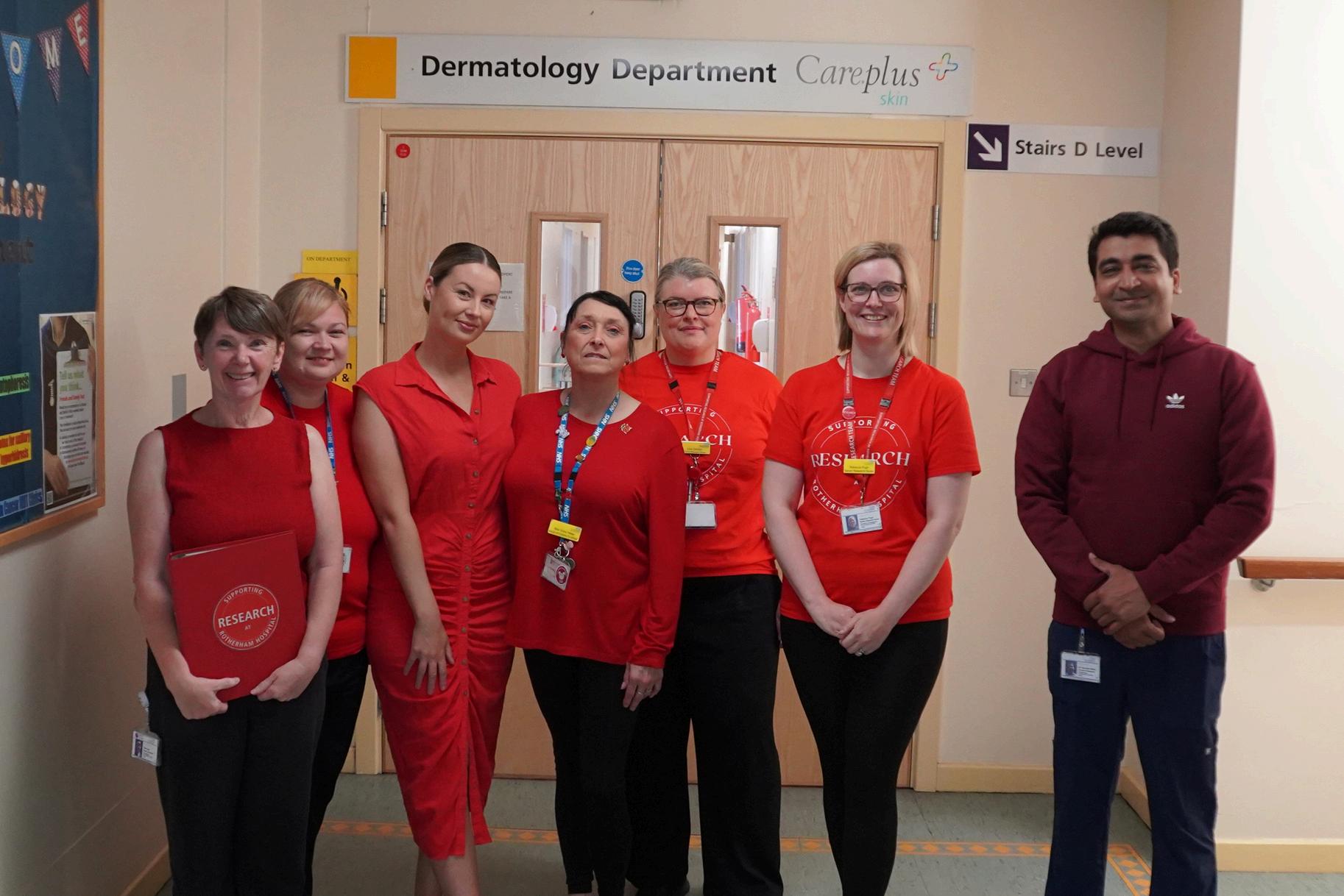
Research drives innovation in dermatology treatments
The Research and Development Team have worked collaboratively with the Dermatology department over the last few years, helping to see an improvement in dermatology departments.
Read more on page 8
More stories inside including
We recap the recent stoma care event
Page 4
Relaunch of the LGBTQ+ network Page 5 Apprentice of the Year finalist Page 6
Want to catch up on what was discussed in the last Team Brief?
The recording of July's Team Brief is now available:
The next team brief is scheduled for 1pm on Friday 14 August. You can submit question anonymously at any time using the online form. Where possible, these will be answered at the next Team Brief.
Rotherham event helps challenge stigma around stoma care
Patients, families and healthcare specialists attended a free community wellness event in Parkgate to learn more about stoma care and colorectal health on Monday 13 July.
Local people could access specialist advice, learn about new products and meet organisations offering community support.
A stoma is an opening on the abdomen that allows waste to leave the body into a pouch. It can be a life changing, but support is available at every stage.
Nikki Gittings, who organised the event, said: “There can still be a stigma around having a stoma, but events like this help patients see they are not alone. They can meet other people, ask questions and find out what support is available close to home.”
“Bringing services into the community makes the experience feel less frightening. People can speak to specialists about food, diet, products and ongoing care in a more relaxed setting.”
John Richardson (pictured below), a local resident who attended the event, said the relaxed community setting made it easier for people to talk and share experiences.
He said: “It gets you out of the house and lets you meet other people going through similar things. You can talk to the nurses, discuss any problems and hear how
others have dealt with them. It helps to talk.”
The Colorectal and Stoma Care Team supports patients with clinical care, prescriptions, product reviews and day-to-day wellbeing. It hopes to host similar community wellness days in future.
For advice, support or information about the latest products, call the Colorectal and Stoma Care Team on 01709 427154, or the Continence Advisory Service at Rotherham Community Health Centre on 01709 423240.
Colleagues celebrate Pride as LGBTQ+ Staff Network relaunches
Trust colleagues marked the relaunch of the LGBTQ+ Staff Network with a Pride event in the Wellbeing Garden on Wednesday this week.
The event was organised by the People Experience and Development team with support from the LGBTQ+ staff network. Colleagues were able to learn more about the network, meet the chair and find out how to get involved.
The Wellbeing Garden provided a colourful and welcoming setting, with colleagues able to visit stalls, take part in activities and speak with network representatives.
The relaunch aimed to help the network grow, encourage more allies and give colleagues more ways to share ideas, talk about issues and support each other.
Colleagues took part in a Pride quiz and a Pride flag treasure hunt. These activities helped explain what different Pride flags mean and why visibility matters to LGBTQ+ communities.
Information stalls shared resources on LGBTQ+ history, local LGBTQ+ support services, Freedom to Speak Up support and ways to get involved with the network.
The organisers would like to thank everyone who supported the event, including Wellbeing Team colleagues, Harj Khaira, the Freedom to Speak Up Champions and external community partners.
Jon Dickinson, chair of the LGBTQ+ Staff Network, said: “It was brilliant to see colleagues taking an interest, asking questions and showing their support.
That interest will help the network grow and make sure it reflects what colleagues need.”
The network will now focus on welcoming more members, supporting allies and giving colleagues practical ways to get involved in LGBTQ+ inclusion.
If you attended the Pride event, please share your feedback to help the network improve future events. You can do this by completing a feedback form
If you missed the event but would like to get involved with the LGBTQ+ Staff Network, please email rghtr.lgbtqnetwork@nhs.net. You can also join the next online meeting on Microsoft Teams on Wednesday 16 September 2026 at 12pm.
Full details about the network and upcoming meetings are available on the Hub.
Public Health student wins prestigious award
Congratulations to Public Health student, Emily Sanderson, on achieving the Dora Roylance Award this year.
Sharon Wright, Public Health Team Leader - Vulnerabilities Team, commended Emily’s milestone. She said: “This is a significant and prestigious achievement, recognising outstanding academic performance and commitment within the Health Visiting programme. Emily’s dedication and hard work are truly commendable, and this award reflects the high standard of practice and professionalism demonstrated throughout training.”
Emily said: “I feel incredibly honoured to have received
the Dora Roylance Award for Outstanding Student at Sheffield Hallam University. Being part of the 0–19 Service in Rotherham for almost two years has been a privilege, and I am grateful for every opportunity to learn and grow throughout my journey as a student health visitor and as a nurse.
“This award means so much to me, and I would like to thank everyone who has supported, encouraged, and believed in me along the way. I look forward to continuing my career and making a positive difference to the families and communities I have the privilege to work with.”
This is the third time a SCPHN student in Rotherham Children's Public
Congratulations to our Apprentice of the Year finalist, Dawn Watson!
Apprentice Occupational Therapist, Dawn Watson, was a finalist in this year's Rotherham Apprentice of the Year Awards, which took place last week. The awards shine a light on outstanding apprentices whose hard work makes a difference across the local community.
Dawn is currently in her third and final year of the apprenticeship and thanked her Community Occupational Therapy colleagues for their support throughout her course. She said: “I have found the apprenticeship challenging at times. It’s difficult having
to balance studying and academic work alongside my full-time role, whilst also being a mum to two young children.
"But, I have found the apprenticeship to be the most amazing experience and feel I've gained such a valuable learning experience by not only having the chance to build my knowledge and skills through completion of academic work and placements, but also from being able to develop my skills and knowledge within my workplace.
Health Nursing Service has received the Dora Roylance Award. Previous students who have achieved this have been Maria Hibbins and Dawn Wickers.
"I feel that this has given me a greater opportunity to prepare for becoming a qualified professional.
"I felt incredibly grateful and surprised to be nominated by my mentor and manager, Katie Hinchliffe. It's made me feel so appreciated and valued by the team. They have always gone above and beyond to support and encourage me throughout my apprenticeship and I can't thank them enough."
We have been recognised for the successful supported internship of Shezz Bringlow, at the Wayfinder Employee Awards earlier this month. The event took place on Wednesday 1 July, with a special certificate of thanks presented to the Trust. IT Training Team Lead, Sarah Cox was also celebrated with a special recognition award after being nominated by Shezz.
Sarah said: “There is truly no greater reward than knowing you’ve had a positive impact on someone’s life. I am incredibly proud and honoured to have been presented with an award by our brilliant supported intern, Shezz.
“Watching Shezz grow and achieve so much during her time with our team has been an absolute privilege. From
developing the confidence to email and communicate across our NHS Trust, to mastering our booking system and ensuring our training computers always have up-to-date software, Shezz’s dedication has been inspiring.
“During the presentation, Shezz gave a speech that didn’t leave a dry eye in the room. Thank you, Shezz, for your hard work, your incredible progress, and for reminding all of us why we do what we do."
People Experience and Development Manager, Graham Travis said: "Shezz's intern placement has been a great success, providing valuable learning opportunities while making a positive contribution to Sarah's team. Throughout the placement, Shezz has demonstrated enthusiasm,
professionalism, and a willingness to learn, making the experience rewarding for everyone involved.
"We are grateful to have had the opportunity to support Shezz's development and are honoured to receive this Certificate of Thanks in recognition of hosting the placement.
"We would like to continue the success by offering intern opportunities to other departments so please get in touch if you can help.”
Nominate a colleague or team in our monthly Excellence Awards
Our Chief Executive handpicks the winners based on the information provided, so make sure you explain why the person or team is a worthy winner.
Winners of three categories (individual, team and public) are announced at Team Brief.
Public category winners are chosen from the compliments received each month from patients and members of the public.
Watch the recent Excellence Awards winners announcement during July’s Team Brief.
Research drives innovation in dermatology treatments
The Research and Development Team have worked collaboratively with the Dermatology department over the last few years, helping to see an improvement in dermatology treatments.
Dermatology Nurse Consultant, Tara Lees and Dermatology Locum Consultant Dr Saurabh Mittal share an overview of working with the Research Team:
Research ensures treatments are:
Tested in clinical trials Evaluated for side effects and long-term safety Incorporated into evidence-based guidelines reducing health inequalities providing access of treatments across all the dermatology services Collect real world data to generate evidence of safety and efficacy of treatments in real clinical scenarios.
Research drives innovation in dermatology treatments, including:
New medications (such as biologic therapies for long term conditions including psoriasis and eczema) Safer topical and systemic treatments with fewer side effects Analysis of available treatments to gather comparative data in terms of their benefits and relative safety.
For patients the impact of research provides access to newer, more effective and often safer treatment options that can significantly improve quality of life. Patients can be confident that their treatment plan is based on the evidence-based practice.
For Healthcare professions, research keeps individuals up to date with guidelines, emerging treatments which supports best practice.
Current Dermatology trials supported by the Dermatology and Research Team:
BADBIR – An observational study recommended by NICE, monitoring the longterm safety of biologic treatments for psoriasis. Opened at TRFT since 2012. There have been 170 Dermatology patients recruited to the trial, with over 140 participants in active follow up.
BSTOP - This seeks to identify and characterise biomarkers of response to systemic and biologic treatments for psoriasis. Recruitment was restarted in April 2025 at TRFT and stands at over 80 participants. Through donating an extra sample of blood during routine phlebotomy appointments, patients with psoriasis are contributing to Researchers potentially being able to identify biomarkers of response to psoriasis to treatment and to
understand the genetic mechanisms of disease development, progression, and treatment response. In 2025, TRFT was the fourth highest recruiter out of over 80 sites.
A-STAR – Collects long term information from individuals with eczema starting certain treatments referred to as ‘systemic immunomodulators’. This will assist in better evaluating the long-term use of these treatments with regard to improvement in disease severity, quality of life and safety. There are currently two TRFT participants on the A-STAR study.
Dermatology patients are keen to take part in Research trials to help improve the management of their condition. In 2025, there were 52 new Dermatology study recruits and over 250 Dermatology patients have taken part in Research studies at TRFT, with multiple patients having taken part in two or more studies.
You can see a list of the current Research projects that the team are supporting on the Research and Development hub page
You can also find out more about research on the Research and Development website.
Maysoon receives national recognition
Chaplaincy Lead, Ustadah Maysoon Shafiq has been selected to receive the Pioneer in Healthcare, Faith and Inclusion Leadership Award of the Year 2026 in recognition of exceptional professional achievements, dedication, leadership, and valuable contributions.
Maysoon said: “I am truly honoured and humbled to receive this recognition. I accept this award with deep gratitude. I extend my sincere thanks to my lead, Karen Shay-Nutt, my team and wider colleagues, and all those who have supported and encouraged me throughout this journey.
“Chaplaincy is a vocation of presence, compassion, and hope. It is a privilege to walk alongside people during some of life's most significant momentsoffering support, listening without judgment, and helping others find strength, purpose, and peace. This recognition is not only a personal honour but also a tribute to the many chaplains and faith leaders who serve quietly and faithfully in healthcare. Their dedication continues to make a profound difference in the lives of countless individuals.
“As I receive this award, I remain committed to promoting understanding, inclusion, spiritual care, and
service to humanity. May we continue to build bridges between communities and work together for the common good”
Maysoon will receive her award at the '16th Annual Pakistan Achievement Awards International 2026', taking place on Friday 14 August, at the Dilly Hotel in London.
Alongside her award, this milestone will see Maysoon featured in the 'British Pakistani Power 100 annual publication', recognising influential individuals who have demonstrated excellence, leadership, and a lasting contribution to society.
Clinical Engineers - a team of 10 looking after thousands of pieces of equipment!
Between junction 1 and 2 on A Level of Rotherham Hospital, you'll find the Clinical Engineering workshop.
Based at the workshop are a team of 10 colleagues including managers, engineers and administrators. Together, they look after what they estimate to be between 10 to 12 thousand pieces of equipment.
Specialist Clinical Engineers Dipan Parikh and Michael Johnson are two members of the team. They explained more about who is in the team.
"The clinical engineering team complete a lot of the usual, important repairs and maintenance that you might think of.
"We are specialist clinical engineers - colleagues in our role work on things outside the usual repairs and maintenance as well. We also have to participate in project work.
"Then you have our managers Iain [Threlkeld, Head of Clinical Engineering] and Darren [Salt, Clinical Engineering Performance Database Manager] who get involved from the purchasing stage.
The day-to-day duties of a clinical engineer can vary depending on what they are needed to work on.
"We look after equipment from every stage of its life cycle from purchase until they are safely and properly decommissioning.
"The equipment can be any medical device used for medical treatment, monitoring and diagnosis. For example, thermometers, infusion devices, ventilators, bladder scanners, theatre equipment, endoscopy, stack systems, anaesthetic machines, defibrillators.
"In clinical engineering, it's really true that no two days are the same!"
There are three key qualities
Michael and Dipan have identified that make a good clinical engineer.
"The key to our job is being someone who can take a negative situation to a positive one."
"To do that, you have to be a problem solver. You have to work well in a pressured situation. And you have to be someone who can juggle competing priorities.
The work of a clinical engineer can take members of the team to outside of their workshop. Working at community sites, they encounter different challenges than in the hospital.
"Our work can take us anywhere. If you've ever come to our workshop looking for somebody, not found anyone and wondered where we all are, we were likely out working in a clinical environment.
"When we work outside the workshop, it could be at a
community site, on a ward or in theatres for example. Often, in these situations, it's a call out and we're against the clock. Our intervention can be the difference that means a surgeon completes their list or a clinic is able to run in entirety.
"It can present unique challenges for us.
"We might have to drop what we are doing and go because it's an urgent call.
"There are times when staff members need you to fix something and are standing right there watching the clock.
"Other times, there are patients too. When we work around patients, it's especially important to remember the need to have discretion and remember the patient's need for confidentiality and dignity."
There's more to this hidden role than repairing
equipment. Dipan and Michael shared some of the additional duties they get involved with.
"It might not seem it from the outside but we're involved in lots of aspects to do with equipment.
"The equipment library is partially covered by usbeing involved with this means making sure that everything returns in usable condition. If it's not, it's our job to find a fault and make sure it's put back how it should be.
"We offer our expertise to colleagues who are purchasing clinical equipment around the Trust.
"We're involved in investigation work as well and we complete reports for Datix.
"IT is another thing we're involved with. Especially with newer equipment, we have to understand how the
equipment works with our IT systems. Working with IT, we need to understand Health Informatics guidelines and how they work with our own."
Clinical engineers like to know about the medical equipment they will be looking after as soon as possible. Dipan and Michael said: "If we could tell our colleagues one thing, it's get us involved from the start!
"Often, with medical devices, the problem appears once the equipment is in use. We have knowledge and expertise on these issues that we can share with you to make sure the equipment you're using is fit for purpose and financially a good decision.
“We're there to support you to make good decisions about the equipment you purchase.”
Ever wondered how the Freedom to Speak Up Guardian and Champions handle your concerns?
Every colleague should feel safe to speak up. Whether a concern relates to patient safety, a workplace issue, or how we treat each other, raising it helps us learn and make positive changes.
Harj Khaira, our Freedom to Speak Up Guardian, recently hosted a lunchtime lecture sharing how the process works and how managers can support colleagues who come forward with concerns.
“When you speak up to me or one of the Freedom to Speak Up Champions, the first and most important step is that we listen,” said Harj.
Harj explained that the role of the Guardian is not to act as judge or jury, but to provide a safe, impartial and confidential space. The team will be clear about what they can and cannot do, including where information may need to be shared to keep people safe or follow the right process.
If a concern falls under an existing process, such as HR or patient safety, the Freedom to Speak Up team can help colleagues find the right route.
“We always aim to close the loop with every concern raised. Unless a report is completely anonymous, we will keep you updated on the steps being taken, where we are able to do so,” said Harj.
When a concern is raised, Harj, along with the manager responsible for addressing the concern, may also look at other information, such as staff surveys, sickness rates and turnover, to understand whether there could be a wider pattern.
In one case, several colleagues raised separate issues about the same area over a 12-month period. By connecting the dots, senior leaders were able to hold informal listening events and address long-standing problems. A year later, staff survey results in that area had improved significantly, with feedback suggesting morale had also improved.
In another case an error occurred involving personal details, the department chose to undertake an independent review which focused on learning rather than blame. The manager sent a sincere apology, changes identified in the review were made to the process, to help reduce the risk of the same mistake happening again.
Harj also explained how colleagues and managers can support the Freedom to Speak Up process. If someone comes to you with a concern, keep these four principles in mind:
Stay curious. Do not take things personally or get defensive. Ask yourself what else might be going on.
Stay practical. Look for achievable, realistic solutions.
Stay proportionate. Take a step back and look at all the facts before reacting.
Stay accountable. If you promise to look into something, follow it through and keep the person updated.
If you need to speak up, you can contact Harj, or a Freedom to Speak Up Champion, your line manager, or another trusted senior colleague. If you are unsure which route is right, the Freedom to Speak Up team can talk through your options with you.
Summer health event
The library and knowledge service’s recent summer health event was all about sharing knowledge between clinicians from different departments and between primary and secondary care staff. We brought together 32 attendees for a lunchtime session packed with useful tips, lively discussion, and (by all accounts) a genuinely good time. 14 attendees took a moment to share their feedback afterwards, and the results are well worth a read.
What people learned
Attendees walked away with plenty of new knowledge about summer health. Several picked up tips on spotting and managing conditions that tend to flare up in hot weather, while others said they came away with a much better understanding of the support Age UK Rotherham offers. One attendee even said the session covered angles they "…wouldn't have thought of" - always a good sign that a session goes beyond the basics.
Putting it into practice
It wasn't just an interesting morning out, either. Attendees said they're planning to put what they learned to good use, from spotting summer-related conditions more quickly to
Feedback Friday
Here’s a lovely compliment for the Children’s Ward team
feeling better prepared to support patients and colleagues on the ward. A few mentioned the casestudy discussions as a real highlight, calling out how practical and relevant they were: “…related to clinical practice
The verdict
The feedback speaks for itself: "very informative,", “able to share useful knowledge”, "very useful," "interesting," "interactive"and a special shoutout for the moderator, who was praised for keeping things lively throughout.
Round two, anyone?
The clearest sign of a job well done? Thirteen of the 14 people who shared their thoughts said they'd love to come to future events. That's a terrific response rate and a great excuse to start planning for the next one.
What's next?
Big thanks to everyone who came along and shared their thoughts. With feedback this positive, we're already looking forward to bringing you more knowledge sharing sessions.
The next planned session will coincide with NHS England’s ‘Knowvember’ campaign at the lunchtime lecture on Tuesday 24 November.
Join us at the next Lunchtime Lecture
On Tuesday 21 July 2026, the next Lunchtime Lecture will be all about Rheumatology, hosted by Dr Palak Aroral (Rheumatology Consultant).
Those attending the lecture will be able to enjoy a lunch and refreshments from 12.30pm. The lecture will start promptly at 1pm.
If you are unable to make the lecture inperson but can make it online, you can do so by joining the event on Microsoft Teams.
The link to join the event, along with information about other upcoming events, can be found on the Hub.
“I am writing to express our sincere gratitude for the outstanding care our daughter received during her recent stay on the Children’s Inpatient Ward at Rotherham Hospital.
“Their commitment and compassion made a difficult situation much easier for our family, and we are extremely grateful for the excellent care we received.”
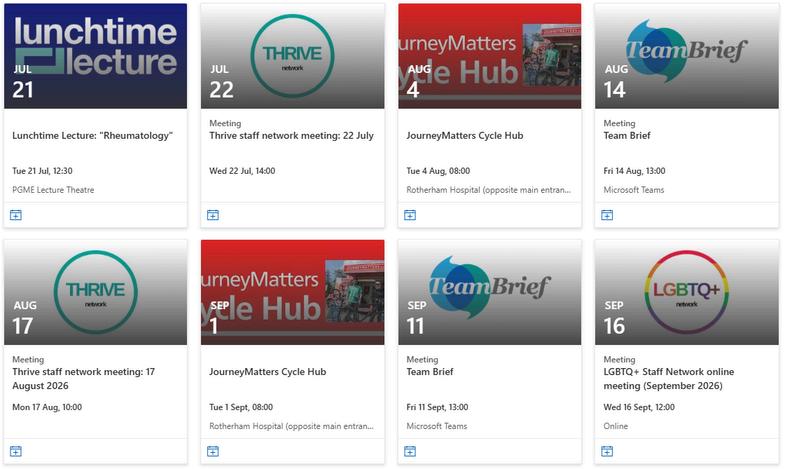
Datesforyourdiary
Lunchtime Lecture: Rheumatology
Tuesday 21 July
Thrive staff network meeting
Wednesday 22 July
August Team Brief
Friday 14 August
Thrive staff network meeting
Monday 17 August
You can find more upcoming events like these on the Hub’s events calendar