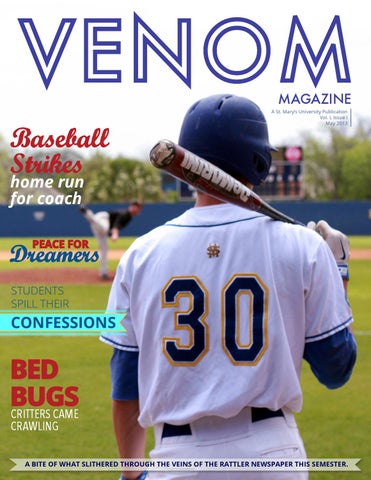
MAGAZINE
Baseball Strikes
A St. Mary’s University Publication Vol. I, Issue I May 2013
home run for coach
PEACE FOR
Dreamers STUDENTS SPILL THEIR
CONFESSIONS
BED BUGS CRITTERS CAME CRAWLING
A BITE OF WHAT SLITHERED THROUGH THE VEINS OF THE RATTLER NEWSPAPER THIS SEMESTER.
MAGAZINE
Editor-in-Chief Amanda Cano Associate Editor Nick Canedo Art Director Carla Rodriguez Graphic Designers Adriana Avila Juan Casas Rachel Grahmann Contributing Editors Felix Arroyo Alex Eakins Liliana Espionza Christina Faseler Stela Khury Arturo Osteguin Jr. Briana Perez Ashley Snipes Contributors Azhmir Acosta Travis Bowles Pablo Cruz Alex Eakins Jocelyn Garcia Tamara Garcia Rachel Grahmann Stela Khury Christina Faseler Sara E. Flores Janet Frias Sara LaTouf Kyra LIttlejohn Lauren Lundy Vivian Rodriguez Jessica Valles Richard Zepeda Disclaimer Venom Magazine is a product of The Rattler, which upholds the Mission Statements of St. Mary’s University. The publication follows the Canons of Responsible Journalism, the Associated Press Stylebook and the Student Publication Policy.
editor’s note Dear Readers, If someone told me four years ago, “You’re going to make the first online-exclusive magazine at St. Mary’s,” I would’ve laughed. I first walked into The Rattler newsroom with expectations of one day working for Seventeen Magazine and quickly learned I knew nothing about the publication world—yet. This magazine is proof that with hard work, true passion and dedication, anything is possible. In my time at The Rattler, I have spent countless hours brainstorming how to change the newsroom into a “web-first” mentality. We live in a fast-paced world where society is driven by quick and concise information. Is it sad that newspapers are a drastically declining medium? I say no—it’s an exciting time for publications to reinvent themselves and make their own rules. I can proudly say that The Rattler has definitely made some big leaps this year. I have to thank Juan Casas, our Web editor, for his hard work, enthusiasm, and kick-starting our website into the right direction—so right that the website received its first national award. My ultimate vision is for The Rattler to one day be a completely web-based news source and for VENOM Magazine to become the main print publication on campus. While the organization isn’t quite there yet, I leave St. Mary’s excited to see the progressions of what The Rattler as a news organization has accomplished over the last year. This magazine would not have been possible without my editor-in-crime, Nick Canedo. Thank you for not only accepting my decision to stay with The Rattler one more year but for making it, possibly, the best decision I made in my college career. I haven’t said it before but you always went out of your way to make sure you made my last, unexpected year at The Rattler worth my time.
Thank you to Carla, Adriana, Rachel and Juan—without you all, this magazine wouldn’t have been possible. You guys took my vision and made it far beyond what I could’ve ever hoped for. I sometimes felt I was asking too much of Carla but she always remained enthusiastic. Adriana’s critical eye pushed me not to settle for a design when it could be great. Rachel amazed me with her ability to easily transition from designing a newspaper spread to a magazine one. And Juan, you will never know how much your support while designing the prototype meant to me. I would’ve never thought of this magazine if it hadn’t been for Professor Kevin Welch’s Career Seminar course. His never ending questions pushed me to remember who I am and what I’m meant to be doing. Over the years, he never settled for my initial project ideas and always expected me to expand on them more—I’m proud of each one of those projects. Last but not least, I cannot thank Brother Dennis Bautista enough. Brother Dennis has a special ability of guiding people without telling them what to do. Since my first semester, he has been with me through every step—somehow always trusting me to find my way. For three years, he always reminded me to be humble and remember there’s always more to learn. In my final year, I finally earned his endless praise. If I have his approval, I figured I must be doing something right. So Brother Dennis, for creating the “Editor of the Year,” and from the entire staff of VENOM—each of whom you have impacted in the most positive ways—this magazine is for you. Thank you.
content COVER: Sliding for Home page 11 16 18
“Bedbugs Raid Campus” By Alex Eakins
“Dreaming” By Richard Zepeda
4 6
“Grind Over Matter” By Sara LaTouf
9
20
“Three’s Company” By Stela Khury
“#Addicted” and “Anyone selling tickets?” By Jocelyn Garcia and Azhmir Acosta
10
21
“Wire-free, worry-free” By Pablo Cruz
“Sliding for Home” By Christina Faseler, Sara E. Flores and Tamara Garcia
11
22
“Appetite for Change” By Rachel Grahmann
“Two Sides, One Election” By Stela Khury
14
24
“Tall Chai Latte with Soy” By Amanda Cano
“Campus Confessions” By Jessica Valles
26
“Keep Calm and Fight On” By Janet Frias
“Rise to the Challenge” By Travis Bowles
t I bet she’s my class bu f o t n o fr e eat in my th I used to ch l that sits at ir g r. e is h th ld e to k li on’t n with me. - I e time, and I never eve in it, I still d s g ie in v e o b m n e h v tc nger on ds, but e er hapme and wa the toilet plu ause I didn’t have frien iously nothing will ev n will talk to a t a le c th to y o ie b c n v e a nt to live b et a cute ommates be . - I joined a sorority b fessor is a hottie, but o way because I don’t wa re prices ro y m want to me d se u a in Tread d me. - I get drunk e booksto ink my pro even notice to be alone ! - I think th at night and ve to take a quiz. - I th e e t k ic u li o n I o so g . d re ld e a u wo more unit I don’t ha ork there es because I rk on being eople that w ped class so o p ip w e sk th to I t d u e b e s. , d n any frien at but we worst food school is gre . - The cafeteria is the is th k in th -I tback m in the Ou trippled roo
S U P M A C S N O I S S E F CON
Concerned University officials react to controversial Facebook confessions page.
S Shhhhhhhh......
WORDS JESSICA VALLES
A Facebook “confessions” page has rattled the St. Mary’s consequences the page might have. community to the dismay of University officials, who are legally “‘Trouble’ doesn’t really define what would happen if unarmed despite concerns of harassment but believe student a student were to post something. The goal of that conversation opposition may be the only solution would be to understand that St. Mary’s is a small community and Amy Diepenbrock, director of the Civic Engagement and Career actions have consequences here,” Wickline said. Development Center, discovered the “StMU Confessions” Facebook Anonymity raises concerns about the safety of students page while sifting through her newsfeed on the social media as well as liability. According to Carmen Nasr Lybrand, assistant website. Diepenbrock found out students were anonymously director of residence life, the ultimate responsibility falls on posting their “confessions,” which generally involved saying Facebook, but students against the page are capable of prompting anything they wanted about someone or something. change. Diepenbrock forwarded the link to Sheri King, director of “If there’s an individual post, you can report it because it’s student activities, who said she was “pleasantly surprised” when harassing,” Nasr said. the page, which had 388 Facebook “likes” at the time, was taken Nonetheless, like other universities, St. Mary’s does not down on Feb. 18 by the administrators who ran it. That same day a have the power to ground the page to a halt on its own, but not new page, “Stmu Confessions,” was created. for lack of trying. Romo was among some of St. Mary’s staff to have However, the significant amount of “likes” is not what written to Facebook about the issue. concerns John Wickline, director of judicial King believes students posting on the affairs. page could potentially face legal trouble. “Students can’t necessarily get “We can’t force them to (stop posting), but ‘Trouble’ doesn’t really in trouble for what they post,” Wickline I guarantee if something happens the law said. “Simply because a student can post will get those individuals and they will be define what would happen something doesn’t translate that a person identified and that’s something to think if a student were to post should be able to post something, if they about. And, because it’s over the Internet, something. The goal of that think it through.” it becomes a federal offense,” King said. Confession pages have become “Obviously, the problem is (that) they’re conversation would be to a social media sensation sweeping college just not thinking.” understand that St. Mary’s is a campuses nationwide, and have generally Staff psychologist Vanessa Avina is been tolerated among universities because largely concerned with how difficult it is small community and actions posting on them falls under an individual’s for the University to reach students being have consequences here.” first amendment rights. Even if legal targeted by the confessions page who may prosecution were a feasible measure, be suffering considerable distress. JOHN WICKLINE though, the anonymously run Facebook “We can’t tell students not to post and DIRECTOR OF JUDICIAL AFFAIRS page is run through Server Monkey, a not to read, but the hope is that they will third party website, making remember what the Marianist traditions it difficult to track the culprits. Legality aside, are and go more from the stand point of ethics and integrity,” Avina Wickline believes that passively reading the said. Facebook page is not the Marianist thing to The Honor Code for St. Mary’s University students requires do. that they strive for integrity, honesty and ethics in their academic Wayne Romo, director of lives and encourage all members of the community to act in an university ministry, observes an obligation equivalent manner. to rail against the Facebook page. “According to the honor code, I personally think this “This goes against everything (applies): if a student feels threatened by another student we hold and whether (there are) legal and reports it, we act on it. I think this falls under that kind of ramifications (to) stopping (this) or responsibility,” Romo said. not, we have an obligation to articulate Lybrand emphasized students leading students can be of our disapproval, our disdain for the kind great impact. of conduct that’s unfolding,” Romo said. “We are interested in helping them. My talking about Likewise, Wickline noted the students making the change doesn’t mean we’re washing our that there must be conversation that hands; we definitely want to help. We’re the resources for that. It’ll articulates an understanding of the be much better if it’s student led,” Lybrand said.
“
5
VENOM
DREAMING Students band together raising money to secure residency in the United States. WORDS RICHARD ZEPEDA
A
St. Mary’s alumna who helped mobilize funds to get legal assistance.” the nation in the battle over immigration To help the DREAMers raise the application fee, has been joined by a number of Ochoa created the DREAMers Fund to raise money for undocumented University students lined the cause. They also produced a t-shirt, sold for $18 up to seek legal residency. or two for $30 as a fundraiser. The fund has raised Alumna Benita Veliz’s refusal to be quietly deported over $4,000, enough to help support the formal filing led to the government closing the case against her of petitions for 10 of the 40-plus students in line to and to her addressing the Democratic National file. Convention. It has also led to Veliz being trailed by “We have filled out about 38 to 39 students some 40 more undocumented applications with about St. Mary’s students applying another four pending, so for residency, backed by we’re already past the 40 This issue in our comstudent and other campus mark,” Ohlrich said. munity is not about political supporters, including Ohlrich is one of seven President Emeritus Charles board members, who views or left or right wing Cotrell. include Ochoa, who are tendencies. It is about justice.” dedicated to helping Of the 40-plus students, a substantial majority are the DREAMers. Other CLAIR STROCKBINE from Mexico, at least one is members include SOCIAL JUSTICE MINISTRY COORDINATER from the Philippines, and all Cotrell and Clair range between the ages of 18 and 22, according to Strockbine, social justice ministry lawyer Anne Ohlrich, who’s been a St. Mary’s faculty coordinator and an adjunct member in law and international relations. Ohlrich professor. is contributing her time to help the students apply Cotrell, who publicly for temporary residency under President Barack supported the DREAM Act, said Obama’s Development, Relief and Education for Alien the issue is “important because I Minors Act, or DREAM act. think what we’re doing here is very much a Under this executive order signed by Obama, an part of the mission of what we, St. Mary’s, is trying to undocumented student who has been in the United do as a community.” States for over 10 years and is currently enrolled in Strockbine added, “We should be proud, here at St. school may petition for a work authorization permit Mary’s, to have DREAMers among us. These students for two years. Obtaining the permit has been anything are some of our best and brightest…this issue in our but easy for students. community is not about political views or left or right Ohrlich was inspired to help by another wing tendencies. It is about justice. It is about caring undocumented St. Mary’s student, senior political for our own family. It is what the Marianist tradition science and international relations major Tanairi is all about.” Ochoa, who had helped Veliz and other backers of Though Veliz had a lot of help outside the the DREAM act. community, St. Mary’s really came together to “These students are currently struggling with support Veliz when she finally spoke out, she said. purchasing necessities such as toiletries,” Ochoa “St. Mary’s was instrumental. St. Mary’s was very, said, “which means that the DREAMers cannot very important and extremely supportive. There was afford the $465 application fee to obtain their work a petition, a Facebook page and a rally, and all kinds authorization, and that they also do not have the of support from the St. Mary’s community,” she said.
“
7
VENOM
FALL 2013 SCHEDULE Writers Meetings August 27, 2013 September 10, 2013 October 1, 2013 October 22, 2013 November 5, 2013 Photographer Meetings August 28, 2013 September 11, 2013 October 2, 2013 October 23, 2013 November 6, 2013 Published August 20, 2013 September 11, 2013 September 25, 2013 October 23, 2013 November 6, 2013 November 20, 2013 UC 258
Office 210-436-3401
email rattlernews@gmail.com
Grind over matter
Student skateboarders take a break from riding on the bridge next to Dougherty Hall. PHOTO SARA LA TOUF
Freshmen bring St. Mary’s unoffical skateboarding subculture to light. WORDS AND PHOTO SARA LA TOUF A growing unofficial subculture has begun to make its way to the forefront of fitness-based recreation on campus as skaters of all board type and size get to class in almost half the time with double the fun. The skateboarder population has hit an influx with the arrival of freshmen this semester. “As a commuter who’s not naturally social, I think it’s cool that skating on my long board helps pass time between classes while also serving as a great ice-breaker,” Steven Ridgway, a freshman biology major, said. For skateboarders, a long board and a skateboard are entirely
different things. A long board is a longer variant of the common skateboard and tends to be flat while the classic skateboard has more curvy geometry to better serve for tricks. The more complex differences and details of design vary depending on the board model, which are engineered to better suit their intended uses such as carving, downhill racing and free riding. Also commonly ridden on campus are “cruisers,” which are a bit smaller than a typical skateboard and are usually made of sturdy plastic. Lightweight and easy to carry, cruisers are owned by many students on the go. “Long boards are cool and everything, but there’s nothing like the feeling of almost dying I experience every time I pop a trick on my skateboard,” Cory Weatherly, a junior exercise and sport science major, said. Though long boards and cruisers are arguably the most popular types of board whirring around the St. Mary’s pavement, classic model skateboards have not been forgotten. Weatherly admits to various broken
bones, most recently, pulled a screw out of the sole of his shoe. “Just the hazards of doing what I love,” Weatherly said. At least six known cases of major injury due to skateboarding have occurred this semester, but despite the risk, the sense of community offered through skateboarding at the university of both men and women is something to be marveled at. As it stands right now, the student-ran Facebook group, “STMU LONGBOARDING,” and irregular meet-ups on and off campus are about as official as it gets for the skating Rattlers. With growing interest and publicity, hopefully the campus board crew will gather a larger crowd to ollie and grind with.
9
student commentary
#addicted Social media overuse inhibits college, real-life experience
Jocelyn Garcia
T
he social media phenomena—which includes Facebook, Instagram and Twitter—has changed how people perceive others as well as themselves with the freedom to capture and publish any moment, memory or opinion in real-time. Thanks to social networking and its close-knit relationship to smart phones, it only takes a few seconds to whip out a cell phone camera and post content straight to the Web. People are readily equipped to construct memory books online, in which users are free to, for example, post special moments with family, friends and even food. However, in the midst of trying to provide an audience with uninterrupted content, it is easy to lose one’s self. Although expressing oneself by turning thoughts into words is an advantageous step toward a healthy self-image, many people spend too many hours on these websites and applications trying to record their daily lives in minute-by-minute detail. Many find themselves hiding behind a latest generation smart phone camera, trying hard to capture the moment instead of actually living it. Ever since Instagram and Twitter came on the scene, with quick posting of online images and 140 words blog posts, some people prioritize displaying their lives over living. It is a slippery slope toward simply becoming a passive observer of life. Social media offers a new platform with which to share and enjoy life, but it has also given leeway for people to choose the vanity of cyberspace over allowing the embracement of real-life experiences. These social networks have provided a way for people to hide from the hard realities of the world and busy themselves by rebuilding their image to enhance reality. People spend an excessive amount of time trying to compose a witty one-liner on Twitter, quoting lyrics on Facebook and photographing every banal meal for Instagram without noticing they might be hiding behind the touch screen of the smart phone. Social networking can be a fun and healthy activity in moderation, but there comes a time when we need to put down the phone, stand up and live.
94%
OF FIRST YEAR COLLEGE STUDENTS USE SOCIAL MEDIA, ACCORDING TO TUNHEIM.
“Anyone selling tickets?” Graduation ticket limit forces students to leave out important guests
O
Azhmir Acosta
n May 11, graduating seniors will be crossing the Bill Greehey Arena stage and saying goodbye to the place where they chose to receive their higher education. But rather than sharing this special day with their closest friends and family members, only six individuals will be allowed to attend the commencement ceremony as a guest of each graduating senior. Despite student objection, the registrar’s office has set the number of commencement tickets to six for each student because of the large amount of graduating seniors. This number may change in the next few weeks, but, until then, this limitation has taken a toll on graduating seniors who must now decide who to invite to share this special day with them. As a Hispanic-serving institution, most students come from large families with many siblings, and some students are first-generation college graduates. Other students also come from more than just single families.
So how do we choose whom to invite? Better yet, why should we be forced to choose? Our university experience has changed us, molded us and prepared us for the future. It has been our home for four years and at the time when we most want to share it with our family, we are not allowed to. Our university made the conscious choice to relocate the commencement ceremony from the Freeman Coliseum to campus in 2009 so students could share the University with their families. But if we cannot invite all those we want to celebrate with, then their primary purpose is automatically defied. So we continue on, looking forward to the day when we will cross the stage and receive our diploma. We may have to settle for having just those six people there. Or we can go around, asking people for left-over tickets, not knowing whether or not we will be able to scrounge up one or two more at the last minute. It is disappointing that our university has not found a more appropriate solution for this problem. Instead, they are asking us to choose six people—and only six people— to join us on one of the most important days of our life. While it will be a joyous day for graduating seniors, it would be made even more special if they could share it with all the people that offered them support, encouragement and help in exploring their potential—not just a select few.
Rattler baseball team overcomes pre-season struggles and goes on to achieve Coach Migl’s 1000th career win. WORDS CHRISTINA FASELER, SARA E. FLORES AND TAMARA GARCIA
>>>>>>>>>>>>>>>>>>>>>>>>>>>>>>>>>>>>>>>>>>>>>>>>>>>>>>>>>>>>>>>>>>>>>>>>>>>>>>
Left-handed pitcher, Derek Moczygemba, safely slides into home base during April 12 game against Oklahoma Panhandle State University. PHOTO KYRA LITTLEJOHN
>>>>>>>>>>>>>>>>>>>>>>>>>>>>>>>>>>>>>>>>>>>>>>>>>>>>>>>>>>>>>>>>>>>>>>>>>>>>
W
hen Charles Migl graduated from St. Mary’s in 1978, he probably didn’t think he would go on to win 1,000 games as his alma mater’s head baseball coach. But Migl reached the milestone in April, during a season when his team is defending the regional championship that was won last season. Though the season began with some unusual challenges, such as finding a place to practice, the players and coaches continue to persevere in what looks to be another deep playoff run for the Rattlers.
Pre-season challenges
Fresh off their regional win and appearance at the college world series, the baseball team began preparations for their season at the beginning of the fall semester, despite a few minor setbacks in finding a practice facility. Seen practicing in places such as the Outback, the Alumni Athletics and Convocation Center and the S.A.I.S.D. Sports Complex, the team’s main focus is to win no matter where they practice. “We just need to stay positive about our new facilities. We’re
not here to play on a professional field, we’re here to win games,” said pitcher and junior corporate finance major Kyle Bumpas. Working together and taking advantage of practice time is something that can be seen as a team goal. Due to the renovation of the baseball field as well as not being able to practice at Nelson Wolff Stadium—where they have been playing their home games—the team has been forced to travel off campus, mostly to the SA.I.S.D. Sports Complex. “The school district has really gone out of their way to make us
11
Designated hitter Brandon Bates, goes up at bat during the April 12 game against Oklahoma Panhandle State University. PHOTO KYRA LITTLEJOHN
feel welcomed and we really appreciate that they’re able to do that for us,” said head coach Charlie Migl. Between finding a place to practice and defending their championship, the freshmen are willing to do whatever it takes to help the team succeed. “Not having a stable practice facility hasn’t affected me because we still get to work out in the gym and we will also be able to use a field to work out on pretty soon,” infielder and freshman electrical engineering major Brandon Sandoval said. “I am willing to contribute in any way possible for the team and help us to get back to Carry, North Carolina (the college world series).”
The season begins
After their regional championship and a fifth place finish in the College World Series last season, the team seemed to be in agreement that, if they can buy into the same concept of winning, it will be an exceptionally successful season. “Our expectations are always to get back to the World Series,” Head Baseball Coach Charlie Migl said. “Last year we were there and it was great; we won a game and lost a couple. Our goal is to get back there and hopefully win a national championship.” Before the first pitch was thrown, the players and coaches reviewed their goals for the new season. “(Our goals) are to be the best defensive team. We’d love to lead the nation in fielding percentage, have the best pitching staff ERA and lead the nation in that,” Assistant Coach Chris Ermis said. “Last year we did both. We weren’t number one but we were top five. From an offensive stand point, we want to score a run every inning.” Short stop Derek Williams, a junior exercise and sport major and transfer from Rice University, hopes St. Mary’s can bring him confidence and restore love he once had for the game. Williams finished his sophomore season at Rice with a batting average of .151 and a fielding percentage of .943. “I plan on having a good time winning with the guys and seeing our work and commitment pay off while we try to earn another bid to the World Series,” Williams said. Pitching and catching are the battery of baseball and the coaching staff could not be more ecstatic to have most of the pitching staff back this season. Returning this year is closing pitcher Jonathon Perez, a senior political science major. Perez ended with an ERA of 1.04, leading the team, and led the nation in saves, with 18. “As a team we have not only prepared physically, but mentally, knowing we want to be back in Cary, N.C., for the World Series,” Perez said. Also returning this season is pitcher Carl O’Neal, a senior engineering management major. O’Neal finished last season second on the team in strikeouts and had an ERA of 2.18. “Our expectations are very high this year, a lot higher than last year. Having gone to the regionals three years in a row is no longer a goal but simply a part of our path to nationals,” O’Neal said.
The Pitcher of the Year
After receiving numerous distinctions such as Daktronics National Pitcher of the Year and Heartland Conference Pitcher of the Year last year, O’Neal— the baseball team’s ace—is expecting to repeat his success in his final season. O’Neal has been playing baseball since the age of 5. “My brother started playing baseball around the time I did,” O’Neal said. “We were kind of competing against each other. He got me into it.” Since early childhood, O’Neal has been working hard for his success. Contrary to many prodigies, O’Neal has not become complacent after becoming a star pitcher on a university team. O’Neal still works hard; the team work-outs consist primarily of warm ups with bands, strength and endurance circuits, long distance running and sprinting. “That’s probably why we do so good as pitchers,” O’Neal said. “We probably work harder than any of the other pitchers in the
conference. While O’Neal dedicates much of his time pushing himself to improve, he has also worked to find a way to balance his baseball schedule with school. “It’s kind of rough, being an engineering management major,” O’Neal said. “I’ve had to take at least 15 hours every semester. (Professors) work with it, though, so it makes things a little bit easier.” O’Neal’s pitching skills are able to keep the other team from scoring, while the St. Mary’s team keeps racking in the runs. “(The team works) great together,” O’Neal said. “Pitching and defense on our team is just outstanding, and our hitting comes through on the clutch for almost every game.” Although he does not have a favorite way of pitching, O’Neal said, “It’s always just trying to throw off the batter any way you can. I like to mix it up, using different speeds of getting to the plate. I constantly pitch under the stretch, that way I’m always consistent with the way I move.” Even after his many awards over the years, O’Neal’s proudest moment does not stem from any of his excellent comparative rankings. “I’m proud to make it to St. Mary’s,” O’Neal said. “It was a big thing getting a call from Coach (Chris) Ermis saying ‘we can give you a scholarship; we’d like you to come play.’ That’s my biggest thing.”
Left-handed pitcher, Derek Moczygemba, goes up to bat during April 12 game against Oklahoma Panhandle State University. PHOTO KYRA LITTLEJOHN
The Head Coach
After 12 dedicated years of service, Charlie Migl decided to step down from his role as athletic director and spend 100 percent of his time as the St. Mary’s baseball coach. “I think it’s come to a time where (my) job is two full time jobs,” Migl said. “President (Thomas) Mengler and I had a conversation and we both came to the conclusion that I probably needed to do one or the other.” During Migl’s time as athletic director, St. Mary’s received four of its six national championships – baseball in 2001, softball in 2002, an individual golf championship in 2006 and an academic golf championship in 2009. Migl regards these championships as some of the greatest accomplishments for the athletic department. “In the course of your career, it’s hard to win that last game,” Migl said. “It’s exciting because everyone who helped you is excited, the school is excited about it, the community is excited about it and it’s something that the players will have with them for the rest of their lives.” Although Migl takes great pride in the championships achieved during his tenure as athletic director, he directs the accolades to the team coaches and the athletic staff as a whole. “I was just here, I mean, I was just part of the deal,” Migl said. “A lot of people have to do a lot of things for all of that to happen, so it wasn’t just me by any means.” Migl also takes pride in his athletes’ classroom performance. “Both academically and athletically, I think we’ve done good things,” Migl said. “Winning the championships and then our athletes doing so well in school, that makes you feel good. “ A few of Migl’s other career accolades include a national title in 2001, 13 conference championships, five NCAA Division II regional appearances, two Division II regional championships and the distinction of the 2012 NCBWA. With the final out of the seventh inning in the Rattler’s April 12 afternoon game against Oklahoma Panhandle State University, the team jumped and roared to celebrate much more than their 22nd Heartland win—the victory marked the 1,000th of Migl’s long career. With this win, Migl has found his way yet again into NCAA history as only the 11th coach in Division II athletics to accomplish this feat. However, his concern isn’t on his personal accomplishments, but instead is on his baseball team’s success along with the athletic department’s as a whole.“Hopefully we can continue the success that we’ve had; making us the best Division II school that we possibly could be.”
Left-handed pitcher, Derek Moczygemba, slides into base during April 12 game against Oklahoma Panhandle State University. PHOTO KYRA LITTLEJOHN
Right-handed pitcher of the year, Carl O’Neal, began playing baseball at the age of 5 and has since won many other distinctions. PHOTO LAUREN LUNDY
The mens baseball team celebrates Coach Migl’s 1000th career win against Oklahoma Panhandle State University on April 12. PHOTO KYRA LITTLEJOHN
13
Two Sides One Election WORDS STELA KHURY
T
wo undergraduate political student organizations reemerged this semester on campus to strengthen ties between political parties and college students in midst of an unspoken competition for the student vote on Election Day. Mayor Castro’s appearance at St. Mary’s brought together for the first time these two groups—the College Republicans and the College Democrats—in front of a crowd of roughly 300 people, a large chunk made of University students. With tables side by side, the organizations handed out fliers and answered questions about the candidates they supported. The College Democrats displayed signs of support for re-electing President Barack Obama, while the College Republicans distributed bumper stickers and an assortment of goodies in support of former Massachusetts governor Mitt Romney as well as local Republican candidates. Even though the St. Mary’s School of Law has had both Republican and Democratic student ran organizations for many years, the College Republicans were the only political undergraduate student organization until recently, when they lost their status as an active organization due to outdated paperwork. Senior political science major Jonathon Angel Garza is the undergraduate student who initiated the process of bringing bipartisan diversity to campus by starting the College Democrats of StMU. “I started researching on how to start the group last spring, but most of the work has been done in the past few weeks,” Garza said. “(The College Democrats of StMU) began partly through (my) effort … to get the organization up and running, and, of course, through a great reaction from peers to want to group together in an organization like this.” Garza and the DemocRATTLERS have held weekly meetings, scheduling speakers from the local Democratic Party and volunteering for local Democratic candidates in the upcoming elections. Brother Brian Halderman accepted Garza’s invitation to be the College Democrat’s’ adviser. “We know that no political party holds all truth in what is best for advancing the common good, but we have to carefully weigh all the issues our nation faces when we consider
how to cast our vote,” Halderman said. “I think the University hopes that all of our students become faithfully engaged citizens with well formed moral consciences to bring their values and commitment to community to bear in the public square.” Junior political science major Alfonso Pacheco, a member of the disbanded College Republicans, was put in charge of refreshing the Republican’s status to an active student organization because of his experience with the group. They now have more than 15 active members, five of which sit on the executive board. Pacheco said the return of College Republicans has less to do with the College Democrats’ enthusiastic start on campus or the presidential elections; he was disheartened by the loss of status for the College Republicans. “We used to do the 9/11 memorial every year, but because none of our paperwork was up to date with the RSO (Registered Student Organizations) office, we couldn’t do it this year,” Pacheco said. “Two years ago it was big, we actually brought Mike Huckabee. Now is time to start our new tradition, to bring in people who are excited to do what we can to keep Texas red.” Pacheco feels the College Republicans voice was needed to represent their campus minority. “In academia, and all that, people tend to be more center-left,” Pacheco said. “Students tend to be center-left. We (Republicans) may not be a minority state wide, but on campus, we definitely are. Locally, too, we are a minority. I’m sure they have more members at this point, too. I don’t know if it’s because they’re new, but I know for a fact (Democrats) are not underrepresented.” Garza said, “I would definitely say that there is a big presence of Democrats, or at least liberal-leaning students, at St. Mary’s.” The Student Government Association’s Rock the Vote event on Oct. 4 promoted student involvement in the elections. Garza credits part of the event’s success to the College Democrats showing more concern with providing information to students, rather than feeding off of the rivalry between political parties, as would normally have been expected of political student organizations. Current event plans for both the College Democrats and College Republicans are scheduled only for the near future, according to both Garza and Pacheco, due to the presidential election’s distance two weeks on the horizon. “Our mindset is simple… for the coming weeks: to help the Democratic candidates of our area win,” Garza said. Garza said the group is working with Democratic candidates, such as State Representative Joe Farias, to have them come speak at the group’s meetings. “I hope that through actually meeting these candidates, we’ll see a greater turnout in the number of students who go out to the polls,” Garza said. As for the future of the groups, both agree there needs to be a public dialogue between the College Democrats and Republicans. “I see a great potential to work together with (the College Republicans) in not only debating, but serving our community and trying to create a more engaged student body,” Garza said. Pacheco agreed bringing together the College Republicans and the College Democrats is essential to fulfilling the needs of students who want to discuss politics. He feels, in the past few years, there have been plenty of speakers, but few opportunities for students to openly discuss political beliefs. “Had there been some initiative in the spring, then definitely, but we weren’t active and I’ll even take some of the blame for that,” Pacheco said For students looking for more information about both organizations, or information about the upcoming election, look for the College Republicans and the College Democrats tables in the Quad Friday.
15
VENOM
BED BUGS d i a R BED BUGS BED BUGS BED BUGS US
CAMP
Residence Life works to obliterate insects as Treadaway Hall residents dismay. WORDS ALEX EAKINS Treadaway Hall residents panicked upon news an infestation of bedbugs had burrowed their way into the walls of the fourth floor of the residence hall requiring emergency pest control treatments. Increasingly more common in residence halls in all universities, a single instance of bedbugs presented itself in Treadaway in late November, according to Director of Residence Life James Villarreal. However, treatment of the room did not prove effective enough and a couple other rooms came to harbor bedbugs. On Jan. 13, junior accounting major Sandy Guevara moved her belongings into her room only to find bedbugs visibly crawling about her mattress and soundboard. “As I walked into my dorm, I noticed some strange bugs on my wall and my bed. They were coming from the wall and crawling on my bed,” Guevara said. According to Guevara, she was the first student to alert residence life of the persistent bedbug problems despite initial treatments before and during winter break. “I first told the RA (residence assistant) on duty, and she came to my dorm and nicely asked me to take a hot shower,” Guevara said. “Then I talked to a hall director who told me to stay out of my room and try to take as few things as possible with me.” According to Guevara, at first the hall director she spoke to was reluctant to relocate her to another room until, after further protests, the hall director moved Guevara at last. She could not recall the name of the director she spoke to, only that the director was not the Treadaway Hall director. “(She) told me just to stay in my room, but I told (her) I didn’t want to,” Guevara said. Residence Life subsequently resumed its treatment procedures. The primary tactic for the obliteration of bedbugs used to be a chemical treatment, but the University moved to a heat treatment after the first tactic proved ineffective. The company in charge of the treatments, ABC Pest Control, first applies a heat treatment to heat the student’s room up to 140 degrees Fahrenheit for three or four hours, killing any trace of bedbugs, according to Associate Director of Residence Life Ann Karam. After heat treatments, the pest control
“
(She) told me just to stay in my room, but I told (her) I didn’t want to.”
company uses a chemical treatment to cap the process. Normally, this treatment would have been sufficiently effective, except bedbugs unexpectedly burrowed into the crevices of soundboards in Treadaway Hall, which shielded them from the treatments. This caused previously treated rooms to continue carrying bedbugs, which aggravated the problem. Consequently, Residence Life had to remove the soundboards before treating the rooms, prolonging treatment. In all, three rooms were heated to eliminate pests and the adjacent rooms were treated with chemicals preventively. Resident panic over the bedbug surge occurred due to the stress of relocating, sightings of bedbugs and the inability to access personal belongings, which need to be treated as well. “It really sucked that I couldn’t stay in my dorm as soon as I had gotten back and the fact that, after days of treating my room, I had to go back and clean up all the mess they left,” Guevara said. Besides a messy room, another consequence was the damage of personal property experienced by a number of residents. One resident, who wishes to remain anonymous, cried after discovering the mangled remains of prized vinyl records, which had been melted by the heat, while Guevara indicated that her printer had been damaged. Villarreal was not aware that property had been damaged, but indicated that Residence Life would be willing to consider compensating students who came forward with reports of damages. Despite Villarreal’s openness to students, one turned to local news station News 4
SANDY GUEVARA ACCOUNTING MAJOR
W O A I , rather than Residence Life, to share her concerns. According to Villarreal, some of the information presented by the student in the local news was inaccurate or misrepresentative of the problem. “If (the student) would have just come forward and said, ‘Look, I’m really frustrated; I’m going go to the press with this,’ we would have said: ‘What are you frustrated about? What are we not doing that you would like to see here,’” Villarreal said. “I guarantee you my job isn’t to come here everyday and say, ‘How am I going to frustrate students today?’ It’s the contrary.” Villarreal said Residence Life is always open to student opinions and concerns. Another resident of Treadaway Hall, who also wishes to remain anonymous, submitted an email to The Rattler Jan. 16 concerning fears for her health. “Recently, I have been very concerned for my health and well being,” she wrote. “I was informed last semester that the University has experienced several outbreaks of bedbugs during the past few years. Several students have had to dispose of personal property, and not been compensated by the University. I have noticed that the bedbugs always reappear in rooms that have been previously ‘treated’ by the school.” James Villarreal emphasized that Residence Life does not want to run away from these issues. When issues such as this one happen, Residence Life wants to address them, he said. “We followed our procedure; it didn’t work this time because there was another variable that we didn’t encounter and we didn’t anticipate,” Villarreal said.
17
VENOM
KEEP CALM AND
FIGHT ON A sorority dedicates a week to increasing breast cancer awareness on campus—a disease that has already impacted the University community. WORDS JANET FRIAS
T
he Alpha Sigma Tau chapter at St. Mary’s is currently hosting Breast Cancer Awareness Week, a topic that hits close for one University professor, who notes that minority women are significantly more likely to die from the disease than Anglo women. Breast Cancer Awareness Week began with a “Pink Out” mass Sunday evening, and will conclude Friday as Alpha Sigma Tau sends out prayers from the Quad. They will also be collecting donations for a local breast cancer research center at their “Pretty in Pink” party tomorrow. According to sophomore English-communication arts major Analissa Cantu, one of the event organizers, the chapter chose to support breast cancer awareness because it is a cause that most women seem to think that they don’t have to worry about until they are over the age of 40. “Women don’t realize that breast cancer can hit at any age, and chances are many people here on campus either know someone who has or is battling breast cancer,” Cantu said. Within five years after diagnosis, minority women are nearly three times more likely to die of breast cancer than white women, according to associate professor of history Teresa Van Hoy.
Associate Professor of History Teresa Van Hoy is a breast cancer survivor. PHOTO COURESTY TERESA VAN HOY
Alphs Sigma Tau sisters (from left to right: sophomores Analissa Cantu, Amalia Gonzalez, Tania Pena and senior Julia Samaniego) promote Breast Cancer Awareness Week. PHOTO VIVIAN RODRIGUEZ
Forty percent of minority women diagnosed with the disease do not survive to the fifth year after detection, compared to 15 percent of Anglo women, according to Van Hoy. The difference in survival depends on who can afford and access early detection—a disparity that is addressed under the Affordable Care Act, or Obamacare. “Only in the military do women of color survive at the same excellent survival rate as Anglo women,” Van Hoy said. “That’s because of the excellent medical care and early and regular screening that they have in the military. So somehow we are failing our civilian women, and they are dying at a much higher rate.” The disparity is evident every day to Francisco Garcia of American Medical Response, who transports patients to local hospitals. “We transport more white women with breast cancer than we do Hispanic women, and we rarely transport women of color,” Garcia said. “I think that Hispanic women are more reluctant to seek treatment for fear of the costs, because most don’t have health insurance.” The breast cancer mortality rate is higher for minority women, Van Hoy said, because of a lack of health promotion and awareness in their communities, opportunities to acquire health insurance and time and resources to get mammogram screenings. “Early detection saves lives. It’s so much cheaper for patients, for the community and for the insurance companies to pay for the screenings than for the cut, burn and poison (surgery, radiation and chemotherapy),” she said. In addition, the survival rate of a breast cancer patient can go up to 93 percent if cancer is detected early enough, according to the American Cancer Society. Van Hoy said Americans must assure that race is not correlated with breast cancer mortality, and not so badly split between women of privilege and women in poverty. Americans must also take steps to encourage working class people to get regular checkups. Another obstacle to breast cancer prevention for women, Van Hoy said, is simply business. Many women cannot afford to miss work to go get checked. Doing it on their own time also presents a problem, because many women with children often don’t have childcare. Van Hoy suggested daycare at the doctor’s office and paid time- off for female workers to get annual checkups as possible solutions. She also suggested that businesses declare a “National Get-a- Mammogram Day.” “When ill health no longer correlates highly with poverty or race, then maybe we’re done,” she said. Van Hoy was diagnosed with breast cancer at age 40 in February 2002, and is a proud survivor.
ONE OUT OF EIGHT WOMEN WILL DEVELOP BREAST CANCER
THE LIKELIHOOD OF DEVELOPING BREAST CANCER INCREASES WITH AGE
THE BEST DEFENSE AGAINST BREAST CANCER IS FREQUENT MAMMOGRAMS AND CLINICAL BREAST EXAMS. 19
three’s company Although overcapacity is declining in campus residence halls, the need for residents to triple remains. WORDS STELA KHURY
R
esidence halls have become less crowded this “I definitely didn’t like moving from Founders to Anthony semester as student trends help lower rates of Frederick, for one because the room is a lot smaller, but most of overcapacity, yet tripled rooms will continue to be a all the room feels crowded,” Diaz explained. “These rooms are not reality to which administration sees no end in sight. meant for three people.” Compared to fall 2011, the number of overcapacity residence Diaz said the lighting is also troublesome for her, because there halls at St. Mary’s dropped from 85 percent to 53 percent. is only one large light in the entire room and it doesn’t reach her Director of Residence Life James Villarreal provided a multifaceted desk, which is currently crammed in the corner of the room. Diaz explanation. maintains she has a good relationship with “What changed is that we had 50 less her roommates, but that her living situation rooms in Treadaway due to the renovations is not ideal and she rues having to be under We dont triple because to St. Louis Hall, so we had to put some this arrangement two years in a row. faculty and staff there,” Villarreal said. we want to, but because we Villarreal says he has heard from students “Naturally, those rooms had to be sort of who were unhappy with being tripled in have to.” shifted to other parts of campus, where rooms when they did not originally want to, we saw additional tripling last year in the JAMES VILLARREAL and the office’s policy is to be upfront. DIRECTOR OF RESIDENCE LIFE Outback.” “There is not set rule or law that says, ‘You Villarreal attributed the current drop can only have this many people in a room,’ in overcapacity to a smaller incoming freshmen class this so that’s where we come in and use our reason to see what is a academic year, and also pinpointed the role of the Access St. Mary’s reasonable way for someone to live,” Villarreal said. “We don’t triple program in the burdensome changes to residence halls occupancy because we want to, but because we have to.” during the past three years. The program offered scholarships with The possibility of a new residence hall is an option Villarreal conditions regarding on-campus room and board, which lead to a personally believes would be helpful for both St. Mary’s students hike of 150 students wanting to live on campus three years ago. As funding was lowered for the program, the number dwindled to 100 and his office, but that the ultimate decision of beginning such a students the second year and now the scholarship is not available project within the parameters of Villarreal’s vision depends on the University’s ability to tackle the debt. anymore. “Certainly there is an interest in a new residence hall,” Villarreal “Coincidentally, that was all around the same time they were opening Founders so we were able to take care of some of those said. “But we have a big project going on right now, the sports complex, and monies are tied up to that. Once that’s completed, Access St. Mary’s students,” Villarreal said. Gabriela Diaz, a sophomore corporate finance major, said she maybe there might be a situation which we can look into that again.” For now, residence life must resort to short term solutions to the has had uncomfortable experiences with tripled rooms. Diaz spent her freshman year in a tripled room of Founders Hall and this year prolonged problem. “Realistically, what we have is a temporary solution to a long she was moved to yet another tripled room in Anthony Frederick, one of the residence halls with the highest overcapacity rates of term issue,” Villarreal explained. “But still, I’m very proud of our over 20 percent. facilities and would put up them up against anybody else’s…”
“
wire-free, worry- free Wi-fi access is now available in individual rooms for students who live in campus residence halls. WORDS PABLO CRUZ
T
he University finished implementing wireless Internet services for the living areas of residence halls after years of keeping residents relying on ethernet cables. The Executive Council approved in late 2012 wireless Internet services for University residence halls, but installation concluded just before the start of the spring semester. “The first thing we tried to identify was a time that would be less evasive to residents,” Director of Residence Life James Villarreal said. “We decided the winter break during December would be the best time for everyone.” The Wi-Fi availability in dorm rooms was preceded by internal upgrades, which included new wiring. Additionally, new Cisco routers were installed to permit 146 wireless Internet access points across the residence halls. W i r e l e s s The fact that we are Internet service just getting Wi-Fi in the dorms has long been available to now while other universities residents, but only in the city have had it for some in the lounges of the residence time concerns me.” halls and not MICHAEL ROCHA in the living JUNIOR, CRIMINAL JUSTICE areas. The new implementation of full coverage Wi-Fi sways away from archaic ethernet cables and allows students to access wireless Internet in the comfort of their rooms. Junior criminal justice major Michael Rocha is satisfied with the new Wi-Fi implementation. “I think it’s really good,” Rocha said. “We needed that upgrade in our dorms for easy and fast mobile internet accessibility.” Although some students believe the Wi-Fi is a step forward for St. Mary’s, others are disconcerted by about the amount of time it took for the University to advance with this technology. “I think the installation of Wi-Fi is a great upgrade for St. Mary’s University,” senior computer information systems major Kathleen Benavides said. “But the fact that we are just getting Wi-Fi in the dorms now while other universities in the city have had it for some time concerns me.” Villarreal understands that with new changes there will always be uncertainty. “With 1300 residents on campus, it’s a truth that you can’t satisfy them all,” Villarreal said. “But we are working hard to develop new changes that will help residents have a great experience here at St. Mary’s University.”
“
21
VENOM
appe
i t
f e t
A new comm over student concer to Aramark dire
WORDS RACHE
fter almost an entire school year of mixed response from students, staff and faculty, a new student committee on the St. Mary’s campus is assuring opinions about the new cafeteria system are heard. The committee has been reviewing the new Café system, a buffet-style replacing à la carte, introduced last semester. It’s clear that, around campus, students are still having a difficult time adjusting, according to James Villarreal, director of residence life. Since August, Villarreal has encountered students with concerns about the Café. “The system changes have impacted not only students, but also staff and employees. There are growing pains and everyone is adjusting, but if students don’t take action, it’s going to stay the same.” Taking action is what sophomore political science major Jennifer “Spunky” Garcia is doing. As head of the new Food Committee, part of the St. Mary’s Student Government Association, she’s working to bring the voices of students to the Café staff and employees. The Committee, which begun after commotion from students about the cafeteria’s changes, has been teaming up with John Finerghty, Aramark food services director, to bring about improvements. “We focus on what students want and bring that information to Mr. Finerghty,” Garcia said. “My job isn’t to fight with Aramark or to fight with the student body. My job is to be a liaison between Aramark and the students, a mediator.” Last year it appeared most students had high hopes for the new cafeteria arrangement and anticipated a bigger selection, and some, such as junior political science major Mayra Torres, say there’s been at least some improvement. “After two semesters, I think they’ve gotten a little better. At the beginning of the school year the newness was really exciting,” Torres said. Although the buffet scheme promised more food and easier access to it, some do not experience this, Torres said.
for c
EL GRAHMANN
nge ha
mittee mulls rns and relays back ector and staff.
The Diamondback Café hours have also been reduced and the doors now close at 9 p.m., limiting some students’ options on campus to Chick-fil-a or Subway – which makes sophomore biology major Miguel Garcia, for one, “very unhappy.” “Especially when I get out of labs or evening class, I rarely have the chance to eat there at night,” Garcia said. “Although I think the (cafeteria’s) look is a lot better, I don’t feel like I’m getting my money’s worth anymore.” Senior biology major Robert DeLosSantos agreed, saying that he spends more money off-campus than ever in past semesters because the Café is closed when he finishes class. Junior accounting major Karen Ramirez misses the old cafeteria layout, which, she said, gave students more choice in what they ate and had more flavorful recipes. Garcia said the sentiment is common among students, and that the Food Committee has told the staff that students miss the flavors and techniques from previous years. “One thing the staff members and employees have done is to come together and try and write down recipes for some of the students’ favorite dishes to send to corporate for approval so they can start making them again,” Garcia explained. Aramark’s cooperate office must approve recipes, eliminating flexible meal options in favor of maintaining nationwide consistency, Garcia said. The Committee meets at 8 a.m. every other Thursday. During the meetings, students discuss with Finerghty, Dean of Students Tim Bessler and Villarreal the major complaints and questions that the student body has about the Café, the food and the meal plan options. One effect of the Committee is a change in the way Oyster Bake food tickets can be purchased through meal plans, Garcia said. Originally, the plan was to price Oyster Bake tickets with dining dollars, but it worried the committee that many students had already used most of their points. A compromise was reached with Finerghty, and students with a 5-7 day meal plan can now receive up to 60 tickets without expending points.
23
VENOM
I A CH
h t i w e t t a L y o S
L L TA
Students review new coffee franchise on campus. WORDS AND PHOTO BY AMANDA CANO
Coffee Culture
Double Blended Smooth with more liquid
140 Degrees A hot drink, but not hot enough to burn your tongue Upside Down Drink thoroughly mixed Skinny Non-fat milk and sugarfree Wet/Dry Cappucino with less/more foam
Among the many changes on campus this semester, Starbucks has debuted in the Charles L. Cotrell Learning Commons, replacing Java City. One of the things students enjoy about the new addition to campus is the eclectic menu Starbucks has to offer. Brandon Bates, a senior exercise and sport science major, prefers Starbucks recipes to the ones Java City featured. “I usually order the fruit smoothies from Starbucks (which are) made with real fruit,” Bates said. “I felt Java City’s were more liquid based and lacked the authentic taste.” Junior exercise and sport science major Tonya Hjaime feels the same about Starbucks but had a Java City favorite. “I like Starbucks better because there is more variety, but what I do miss from Java City is the milk shakes,” Hjaime said. The menu is not the only topic students are talking about when Starbucks is mentioned. Some students were used to grabbing a quick cup of coffee between classes from Java City, which was located near the Quad. “I feel like Java City was in a more convenient location. Having Starbucks in the library means I have to go out of my way for my caffeine fix,” senior criminal justice major Consuelo Avila said. On the other hand, some students are finding the location of Starbucks to be more convenient than Java City was. “I’m not a big coffee drinker, but Starbucks is more convenient. It is in the center of campus, close to the business building and the rest of the campus— definitely a better add for the campus,”
senior political science major Jim Schwent said. Some students are steering clear from Starbucks because of the long lines, as well as concerns about the limited amount of dining dollars on their meal plans. Senior corporate finance major Hayden Edwards has not been to Starbucks and doubts he will in the future. “I’d rather use my dining dollars for Chick-fil-A,” Edwards said. While the long lines are a common concern, Chen Du, a junior accounting major and barista at Starbucks, feels the lines are part of the transition. “I don’t think Java City people had a hard time transitioning. It’s basically the same process. I think it is the many new people they had to hire and train on the job,” Du said. Du’s training took a total of three days to learn how to make drinks. Although some students aren’t up to waiting in line, some are understanding of the transition and appreciate the convenience of having it on campus. “I freaking love Starbucks. I don’t have to drive off-campus. The long lines are sometimes intimidating but I feel they go pretty fast.“ James Ford, a junior biochemistry major, said. “If they still take long with orders by December, then there’s a problem.” Ford also understands lines may be longer during finals weeks and some of the baristas are new at their jobs. Overall, Starbucks has been welcomed with open arms by the University, but Java City will always have a nostalgic place in community hearts.
Students now have the option of working for Stabucks as part of their work-study.
12 25
VENOM VENOM
Junior Victoria Bonelli completed the Mile High Challenge last semester. PHOTO ADRIANA AVILA
RISE TO THE
CHALLENGE Students take on challenge to climb city’s second largest rockwall numerous amounts of times in a year. WORDS TRAVIS BOWLES While there are some students who climb regularly, most students only know of the rock wall as a quick stopping point during the campus tour portion of Zaragoza, which could not be a more tremendous generalization. Although it is not the highest in the city—it is second at 40 feet to the University of Texas at San Antonio’s 54-foot wall— the rock wall at the Alumni Athletics and Convocation Center is unique to any other in San Antonio. Other walls are molded to look like a famous rockface or made of wood with rubber holds built in. They are static, meaning once conquered it will be the same the second, third or 20th time up the wall. St. Mary’s wall has two sides, with the left side having a steeper, more challenging incline which requires the climber to overcome an overhanging plane. The holds are changed on a regular basis, providing a new experience every time. On a first visit, the climber can be strapped in and halfway up the wall in just a few minutes. The staff will walk beginners through every step of the process, from what equipment is used, to the knots’ functions. A staff member will keep tension on the rope connected to the
harness to prevent a fall. The main bit of advice to keep in mind when climbing was unanimous amongst the staff: push up with one’s legs, not arms. Many regular climbers take on the wall multiple times in the space of one visit. The Mile High Challenge is an ongoing event that dares students to climb the wall 132 times in one semester, the equivalent of climbing one mile. Last year, five students completed this challenge during the fall semester. AJ Laborde, a freshman biology major and mile-high awardee, chose to begin climbing based on the recommendation of his cousin. He tried it for the first time and was hooked. “It was fun,” Labrode said. “It was interesting. It got me really tired really quick and I like that.” Although many experieced climbers frequent the rock wall, beginners are not only welcomed but encouraged to try their hand at it. “We have the shoes,” Ceasar Silva, a sophomore biology major and staff member at the rock wall said. “We have the ropes. We have the harness. All you need to bring is your body and we’ll get you situated.”
AFRAID OF HEIGHTS? WHAT: CrossFit is constantly varied, high-intensity, functional training that involves cardio, weight-lifting and gymnastics— things like push-ups, pull-ups and squats DURATION: 30-45 minutes per workout WHEN: Mondays and Wednesdays in the AACC at 4:30 p.m.
27
VENOM