News The Rattler
News in Brief Campus
World
Debate Watch
Cataloguing project leads to vast discovery
Presidential Debate Watch Friday, Sept. 26, 2008 8 p.m. to 10 p.m., Diamondback Cafeteria The debate between Sen. Barack Obama and Sen. John McCain can be viewed in the cafeteria. The showing is sponsored by the Student Government Association in an effort to keep voters informed.
Hundreds of previously undiscovered tiny species have been discovered in the waters around Australia. Three weeks of exploration, two of which were spent in the Great Barrier Reef, allowed scientists to find the unknown creatures. The goal of the project is to discover all species of creatures living within the oceans, catalogue them, find their place in the environment they live in, discover any benefits to humanity and ensure the species’ futures. The next step will be to catalogue all these animals appropriately along with those we are already aware of. SOURCE: Associated Press
Time for voters to get ready Voter Registration and Mock Vote Tuesday, Sept. 30, 2008 9 a.m. to 3 p.m., University Center Students who have not yet registered to vote can do so in the Univeristy Center Atrium. Both registered and newly registered students can cast their votes in a mock election. With presidential elections being held on Nov. 4, this service learning calendar event is being held in prepation for the official voting day.
SOURCE: aol.news.com
Operating room in Guam set to reopen after gas is removed Guam Memorial Hospital had to shut down one of its operating rooms due to trace amounts of nitrous oxide that were discovered in the air. Because the anesthetic gas was in very small amounts, no patients or staff had to be concerned about exposure. The closure was a preventative maintenance measure; and the room was left open in case of emergencies. Administrators, directors and workers still do not know the source. The room is scheduled to be reopened and in full use for the hospital by next week.
SOURCE: guampdn.com
Immersion trip to coastal city
Tainted milk in China causes other countries to test their products
Service Immersion Trip: Adopt-a-Beach Fall Cleanup at Corpus Christi Saturday, Sept. 27, 2008 The Service Learning Center is sponsoring the Adopt-a-Beach program. Participants will leave to clean up a beach in Corpus Christi on Saturday. Afterwards, volunteers are allowed to experience the city. Transportation will be provided and for a fee of $35, students can partake in this event if space is still available. Photo courtesy of sxc.com
Recycling is not just for paper and plastic Electronics Recycling Louis J. Blume Academic Library Your old electronics are recyclable too. There is a drop box at the Blume Library’s circulations desk for community members to donate their unwanted electronics. Items do not have to be in full functioning condition to be donated. Students are urged to donate their unwanted items rather than discard them. The donation box will be there all semester. All proceeds will benefit the St. Mary’s University Environmental Conservation Organization to continue to help the environment.
The discovery of melamine in several infant formulas in China has New Zealand’s government testing for the chemical in the dairy products they send to Asian markets. Melamine can lead to liver failure and was the cause of death to four children and sickness of thousands in China. The chemical was also found in the nation’s yogurt. The tests were initiated by the New Zealand Food Safety Authority as a protective move for their markets. SOURCE: bloomberg.com
New medical device will clean out patient blood Aethlon Medical has created a portable blood cleaner. Dubbed the Hemopurifier®, it is a small device that works similarly to the human body’s natural immune system, aiding in cleaning blood and then sending it back into the system. The device should help in clearing out infectious bodies and toxins from the blood. Aethlon Medical has already submitted the invention to be used in human safety trials. Founder and CEO Jim Joyce hopes to have it implemented in the United State within a few more years. The current goal of the device is not to act as a cure-all to all kinds of viral infections. Instead, the main goal is to make living with infectious diseases, such as HIV, easier as the disease progresses.
SOURCE: CNN News
2 09.24.08
The Rattler News
Ike’s wake San Antonio was unaffected, but other cities were not so lucky. t Some cities along the coast were completely destroyed. Citizens were told to evacuate “or face certain death.“ Some lost everything as floodwaters and winds tore houses to pieces. t Caskets in cemetaries were uncovered by floodwaters and left above ground. Photo by Jocelyn Augustino, Source: commons.wikimedia.org
Left: Streets, roads and bridges were submerged by the floodwaters brought in by the hurricane. Right: The Hurricane Ike’s impact was predicted to be devastating for many counties including Bexar, which was unaffected by it.
Hurricane Ike indirectly affects campus By Ari Rivera News Editor St. Mary’s students are still being affected by Hurricane Ike. The Category 2 storm caused inconvenience and confusion as well as destruction. The cause of cancelled soccer games, meetings and conferences, the hurricane also prevented some gas stations from refilling their tanks, forcing them to close pumps for over 24 hours. These were minor setbacks for some students. On Sept. 10, just days before the storm’s approach, Residence Life sent out several e-mails to inform on-campus residents that, due to the hurricane, they could end up on “lockdown.” This message was sent out on behalf of the Critical Incident Response Team, a team gathered by the university to ensure student safety; its members include Director of Residence Life James Villarreal and President of St. Mary’s University Charles Cotrell, Ph.D. The team informed students of emergency policies during the time of possible natural disaster. Policies that included the temporary suspension of all visitors from the residence halls and the closure of campus business offices were possibilities residents could face. Recipients of the e-mail were also told of St. Mary’s University’s limitations: “St. Mary’s is not equipped to handle the needs of large groups of evacuees,” the message read. Next, students with friends who were seek-
ing shelter were instructed to guide them to the Port of San Antonio Reception Center. The e-mail then focused on urging students to stock up on nonperishable foodstuffs and water, remain in their rooms and keep an eye on the weather for the hurricane’s progression. Hotlines, radio stations and Web sites were provided to make the last task easier. Residence assistants were given different instructions that required them to put in extra office hours, pick up flashlights and keep their lines open. On the evening of Sept. 11, after predictions were easier to make, residents were not placed on lockdown. Crystal Valencia, hall director for the Outback, requested that residents who went off campus inform her and provide contact information in case of emergency. “Office hours cancelled today, due to beautiful weather,” read a text to Outback residence assistants on the following Friday. Though the hurricane left little evidence of its visit in San Antonio, many students are not native to this city. Many of them come from cities situated along the coast and have families that felt the effects. Aurelious Bankston, a senior computer science major, is a Galveston native who felt a loss when the hurricane finally reached shores. His family contacts him at least once a day with small updates. “My family did have to evacuate, but the
timing was bad for them. They’re staying with my older sister right now in Houston,” Bankston said. “No one can even get into Galveston right now; it’s completely blocked off.” Because Hurricane Ike struck close to the home of Bankston, members of his fraternity, Omega Delta Phi, are going to be setting up fundraising activities, such as selling T-shirts and asking other organizations for donations. They also hope to provide volunteer opportunities for those who were affected by the natural disaster. The fraternity wants to reach out and make a difference for them. “We want to set up a fundraiser to donate to the hurricane victims,” said Eric Barrera, president of Omega Delta Phi and junior marketing major. “We will be getting nothing from these donations.” Members of the community are encouraged to volunteer. Those who want to help can go to the Service Learning Center and request to volunteer for the victims of the hurricane. Most will be directed to the Freeman Coliseum, where volunteers and donations are gathering. “Everyone on campus has really shown their love, offering support by asking if I want to talk or always asking how my family is doing,” Bankston said.
Areas affected tPort Arthur
tPasadena
tGalveston
tLeague City
tSeabrook
tLa Marque
tThe Bolivar Peninsula
tBaytown
09.24.08 3
News The Rattler
Student becomes new face behind UC Rm. 226 By Caroline Hartmann Staff Writer
Photo by Robin Johnson
Many of us walk by this door on a daily basis, but few know how much work goes on behind it.
Rececca Lopez, junior criminal justice major, has recently taken on former Associate Director of Student Activities Laura Pantano’s job responsibilities, which included advising Greek life and registering student organizations. Lopez’s official position is titled Greek life intern or assistant. This position has existed since 1994. Two years prior to Lopez, senior education major Vanessa Alvarado interned. Lopez looked up to Alvarado; in fact, it was this admiration that was the reason she decided to go ahead and apply for the position. It was also seen as an opportunity for her to help all the Greek organizations here. Last semester, Lopez applied for Greek life intern and was interviewed by Pantano. Although, they worked together only for a
few weeks, Lopez said that Pantano “left a mold of what Greek life should be.” Lopez wants Greek life to stay the same as Pantano left it. Lopez currently balances cheerleading, Residence Life, Delta Zeta and Phi Eta Sigma. Pantano now works as the director of Student Affairs at Texas A&M San Antonio and has the opportunity to build Greek life from scratch. She is interested in developing her professional skills and is excited to expand and develop programs. Students say that Pantano was able to create a solid leadership for Greek life as well as for other organizations. “Pantano definitely knew her history and always helped out whenever needed,” said Valarie Cobos, junior political science major and member of the Student Government Association (SGA). “However, it’s more difficult knowing we just can’t go to her of-
fice to ask her questions.” In 2006, prior to her job as associate director of Student Activities, Pantano took on the roll as co- SGA advisor and left her mark there as well. For a few weeks in the summer, Pantano was able to work with Lopez to fully prepare her for the coming semester. She said that she was given a strong, established format for her to follow and if she had any questions, Pantano would only be a call away. On her recent leave, Pantano said that she misses all the students she knows, and getting to know and working with them was the most rewarding part of her job. Her transition to director of Student Affairs at A&M San Antonio “has been a bittersweet couple of weeks” due to her love and passion for St. Mary’s.
Dealing with strays and making our campus safer By Stephanie Hopkins Staff Writer
and Jacqueline Mendez Copy Editor
It’s not just students who roam around in packs. Stray cats and dogs are often spotted by students at various locales around campus. “The biggest [pack] I saw had five dogs of different sizes,” said senior English major Amanda Soto. “Three of them were pretty big.” Many have complained about the animals; in response, Caroline Byrd, co-director of For Paws, has notified San Antonio City Council of the issue and has kept track of all the dogs appearing on campus. Byrd’s organization, For Paws, started in 2003 as a means of controlling the large number of feral and abandoned cats that live on
4 09.24.08
campus. Thus far, the group has successfully trapped 111 cats. “Out of these 111 cats, about half have been adopted. There are currently 12 to 14 cats still living on campus,” Byrd said. The cats that live near the Louis J. Blume Academic Library are healthy and have been neutered or spayed and vaccinated. Those that have been taken into the For Paws program sport a clipped ear. In contrast, Soto stated that some of the dogs she saw seemed like they were infected with mange and possibly other diseases. Students who see a stray dog on campus are advised to contact the Physical Plant, which will attempt to catch the animal before it wanders too far. If ever a student feels threatened by one after dark, s/he ought to contact the St. Mary’s
University Police Department. “A lot of times, the dogs will come up to people, but they seem non-hostile,” said Soto. However, she also cautioned that “starving dogs can attack at any moment.” As for the stray cats, students are asked to report any felines that do not have clipped ears to For Paws immediately.
Contact For Paws Caroline Byrd Associate Director cbyrd@stmarytx.edu Photo by Nicholas Campana
Nettie Lucio Circulation Supervisor nlucio@stmarytx.edu
Patches is one of the many cats to have passed through the For Paws program to keep the feline population on campus from growing and spreading diseases. This feline is not completely feral but should not be approached.
The Rattler News
Photo by Emily Scruggs
A construction site is a dangerous place, but the outcome will hopefully meet the need of new and energy-efficient housing, according to architects and school officials.
More efficient hall on its way By Jaime Perez Staff Writer The $15 million construction of the new residence hall will soon be open to the incoming freshmen in the fall of next year, allowing them an opportunity to live in the latest economical and cost-effective building on campus. The architecture firm Randall Scott collaborated with the St. Mary’s administration for the construction, which began in March. According to James Villarreal, interim dean of students and director of Residence Life, the decision to build the new residence hall was an answer to the ever-growing need to provide more living space for students. The new residence hall will have 9,000 sq. ft. of living space and will prospectively hold about 280 students. “The school needed to accommodate the needs of its students and then we saw this opportunity to make a new addition to this school that could help the school and its residents,” Villarreal said. The updates, which Villarreal believed to be necessary in living in an environmentally- and technologically-friendly world, would mean a greater understanding of the resources available. However, despite such a challenge, the designers of Randall Scott have attempted to provide a tech- and eco-friendly structure and a building that they promise to fit into the St. Mary’s community. “We all wanted to make sure
that the new building looked like it belongs to the school, rather than it looking like an apartment complex.” said Villarreal. “To do this, the designers and the administrators on campus looked toward St. Louis Hall and thought this building most epitomized the school and hoped to emulate that.” The compromise between old and new has not been difficult for the designers or general contractors of the Keller-Martin Organization. In fact, Ron Litwornia, superintendent of the site, believes the building will not only have historical charm, but also be energyefficient and cost-effective. “We have UV, highly reflective windows, thermal insulated walls, compact fluorescent lights and other energy-reducing materials. Even with these relatively new technologies that will lower energy costs, we have a building that‘ll cost as much as a ‘standard’ building of the same size,” Litwornia said. The new building, which will be three floors high, will also contain new technologies not yet implemented in the other residence halls. E-mailed messages of dry or clean laundry will be sent to students’ cellular telephones to inform them that their items are ready to be picked up. There will also be a “cyber lounge” where both residents and non-residents can go to access high-speed Internet. “There are a lot of cool places where students could go and hang out. Apart from a cyber lounge,
there will also be a prayer and study room as well as a large stone courtyard in the middle of the building,” added Litwornia. Courtyards and cyber lounges aside, the new rooms will be similar in design to the other residence halls with each containing two beds, two dressers and a restroom adjoining another room. According to Villarreal, the decision to turn the other freshman halls into an upper-classmen living center when the new freshman building is complete is still undecided. However, he does not feel that the eventual change will be uncomfortable for students. Dougherty Hall Director John Carillo agrees. “I think it’s great,” said Carrillo. “I still think people will still want to come and live in Dougherty or Marian, but I believe that this is a great opportunity for those incoming freshman to live in this new building.” Freshman and Dougherty resident Raphael Diaz says that the new building will provide more resources to more students and help the other residence halls catch up in terms of technology and energy efficiency. “I also think that more living space will mean more people will come to St. Mary’s, which is good for the campus. And more people means more girls, and that’s a very good thing for me,” Diaz said.
Photo by Emily Scruggs
Workers on every level keep busy with hopes to finish the new residence hall in time for the next year.
09.24.08 5
News The Rattler
Festivities begin for Hispanic Heritage Month By Ari Rivera News Editor
Photo Illustration by Robin Johnson
The Mexican flag waves majestically in the sky. We celebrate Mexico’s liberation after an 11-year struggle with Spain that began on Sept. 16, 1810.
Celebrations have already started for Hispanic Heritage Month. Different shows featuring diverse Hispanic cultural aspects will be prevalent throughout the celebration time from Sept. 15 to Oct. 15. The month-long celebration began 40 years ago when President Lyndon B. Johnson established Hispanic Heritage Week. Sept. 15 was chosen because that is the day of independence for Nicaragua, El Salvador, Costa Rica, Guatemala and Honduras. Closely following that date, both Mexico and Chile celebrate their freedom. The week was expanded to a month in 1988. Events occur all across the United States to celebrate the achievements of numerous successful Hispanic Americans. Events include the International Mariachi Festival in California to the Hispanic Heritage Awards Ceremony in Washington, DC. San Antonio has “Hispanic Heritage Month: Chicano Renaissance,” which features performances from various local groups performing throughout the month. All feature strong ties to the prevalent Hispanic culture in the city. From free guitar lessons to historical sounds of classic Chicano music, this talent is showcased to the end of September. The libraries across San Antonio will be hosting many celebrations for Hispanic Heritage Month.
There will be showings of movies featuring successful Hispanics. The movies Stand and Deliver, Zoot Suit and Selena will be shown during both months. The Memorial Library, located near St. Mary’s right off of Culebra Road, is featuring the work of San Antonio-native artist Roberto Sifuentes. It will be on display for the entire month. This library will also be accepting essays for “San Antonio Essays: Reflections of Hispanos.” Entrants are to write about a Hispanic hero, and winners will have their stories posted on the library’s Web site. Entries will be accepted until Oct. 1. Winners will be announced on Oct. 8. Also, the Great Northwest Library will host Bilingual Storytime/ El Grand Tiempo de los Cuentos, encouraging the younger generation to understand both English and Spanish. The bilingual readings will continue every Sunday until the end of October. Specific event locations and times are available under the events section on the San Antonio public library homepage. On Sept. 18, University Ministry asked students to join Marianists in celebrating the lives of Marianist martyrs from Ciudad Real, Spain. A memorial altar was set up in University Ministry to honor the lives of those brothers who died spreading the Marianist traditions. That day was dedicated to Blessed Carlos Ernana, Blessed Fidel Fuidio and Blessed Jesus Hita.
Photo courtesy of sxc.hu
(Top) Different free movie
showings will be held at the Brook Hollow Branch, Carver Branch, Guerra Branch and Memorial Branch libraries in addition to showings at the Central Library Auditorium. (Right) Local Hispanic folkloric dancers will be performing throughout the month. They are often seen at the Market Square shopping center.
6 09.24.08
Photo courtesy of sxc.hu
The Rattler Commentary
Mappa Mundi A Second Cold War? By Alfonso de la Torre Commentary Editor
Source: www.public.iastate.edu
People in Ethiopia have seen food prices more than double in the last year. Rather than appealing to our emotions, this picture should remind us of our responsibility as members of one big human family.
Rising food prices hurt world’s poor
Developing countries face increasing constraints as food prices soar in global markets People need to eat, and in order to do so, they need food. The lack of this basic component of human existence has usually brought great social problems, riots, revolutions and chaos. Alvaro Zapatel Indeed, famine is one of those few great problems that no one would like to be in charge of. Unfortunately, our world has been experiencing a global food crisis for the last year. The cause: rising food prices. Several countries, most of them underdeveloped, have experienced widespread hunger and famine. These countries and their already impoverished economies have not been able to withstand the blow to the global economy, and their
governments have been unable to cope with the associated social problems. Why are food prices rising worldwide? The explanations are numerous. Two, however, seem to be pivotal: the increase in oil prices, particularly at the beginning of 2008, and a series of severe droughts in grain-producing nations. Together, these factors have reduced the food supply by increasing the costs of transportation and reducing the yield of farming lands. Yet, the influence of the price of oil does not stop there. Rising oil prices also increased the cost of fertilizers and provided incentives for the increasing use of bio-fuels, which are derived from biological material (generally grains and soybeans) in developed countries. Nevertheless, bio-fuel producers argue that the aforementioned fuel is not
the cause of the increase in food prices, but the increase in demand for grains and oil among less developed governments in order to feed their populations. Regardless of the real factors that might be causing this increase in food prices, developed countries’ governments need to address this issue. Rising food prices not only affect the economies of the poorer countries, but also ultimately have a worldwide effect. Even more important than that, both developed and underdeveloped countries have a shared responsibility in this issue: to achieve and provide the opportunities for a dignifying and fulfilling life for all peoples. In order to do so, they need to protect one of the most fundamental human rights: the right to eat.
This is not the Cold War, but West-Russian relations definitely feel very chilly. The crisis in Georgia and the disproportionate Russian reaction sent a clear message to both the European Union (EU) and the United States: We are still here. The world has wondered in astonishment about the motives for such a move that puts Russia at odds with the EU and the United States. Yet, the explanation for this is simple: The end of the Cold War was, for the United States, the triumph of one superpower over another. For Russia, however, it meant something completely different: It was capitalism that defeated communism or whatever the Soviet Union had. This difference, while subtle, proves to be significant: The former two are countries while the latter two are systems. In Moscow’s view, Russia never lost the Cold War; it simply needed time to adjust to a new economic system. Therefore, all these years, which have seen increased economic expansion as well as oil and gas revenues, were seen as a period to rebuild a superpower that never gave in. Furthermore, in the last years, we have seen a Russia that refuses to accept a unilateral world. While taking advantage of U.S. support for its incorporation into the World Trade Organization (WTO), for example, Russia under Prime Minister Vladimir Putin was eager to voice its disagreement over the U.S. plan for a missile defense, calling it an attempt to destabilize Russia. Additionally, Russia helped Iran develop its nuclear program and established close and warm relations with Syria. All of these occurred under President George W. Bush’s nose, by the way. Did he really think he had “a sense of Putin’s soul?” Should I also mention that Russia was not pleased with Kosovo’s independence and its recognition by the West? Let us just say that Russia’s government felt ignored. Not a very good idea, especially if it already sees the West as a rival. The events in South Ossetia simply gave Russia the perfect opportunity to bolster its credentials as game-changer in the geopolitical landscape. And while its abusive invasion of Georgia–far beyond the area of the conflict it claimed to put an end to–has not brought us back to the Cold War era, it has definitely made the temperature of U.S.Russian relations decrease sharply.
09.24.08 7
Commentary The Rattler
Preferential option for the poor calls us to action We tend to point fingers. As university students, faculty or staff, as voters and taxpayers or as consumers in a capitalist superpower society, do we see ourselves as part of the problem of Angela Santana economic injustice? Do we change the channel without a thought when we see homelessness, hunger and poverty? University Minister for Social Justice Bro. Brian Halderman suggests that economic justice begins Philip with a critical look at our Couture own economic system. “Is our system of capitalism a just system?” asks Halderman. “Does it allow for people to have equity in pay and quality of life?” He notes that church authorities, such as former Pope John Paul II, do not reject capitalism, though they do challenge it. The United States Conference of Catholic Bishops (USCCB) has posed similar challenges in a document titled “Economic Justice for All.” They outline fundamentals such as protection of human rights an highest priority to the poor for every just economy.
Photo by Robin Johnson
The United States Conference of Catholic Bishops (USCCB) asks us: Do you see Jesus’ face in the poor and homeless? Isn’t this common sense? Why does the USCCB have to remind us that every human being, having been made in the image and likeness of God, possesses an inherent and inalienable dignity, undermined when subjected to an unjust economic system? Why must they remind us that the Bible records a preferential option for the (material) poor and emphasizes God’s love for them? Perhaps our perspectives need adjustment. Instead of seeing economic injustice as “just another issue,” we should think of ourselves as instruments of a just and merci-
ful God. Rather than limiting our Christian response to a prayer for justice on Sunday, we should be compelled to pray with our hands and feet. In the Bible, we read about the Jubilee Year: Every 50 years, Israelites who were in debt were freed from paying them back. This was to protect them from paying back their debtors for the rest of their lives and, in the long run, prevent the accumulation of wealth in just a few hands. In our current era where people and nations are imprisoned by debt, justice may
demand a similar mercy. What duty do Christians have besides imitating in word and deed the Redeemer, the one who sets captives free and brings justice to the oppressed? Those of us who are informed by faith must learn what work needs to be done towards forming an economy that fulfills the demands of human dignity. Then, we must act, for “the life and words of Jesus call us to serve those in need” (USCCB, vii).
San Antonio offers exceptional shopping outlets Nearly every girl as well as the occasional guy loves to shop. If you’re a brand name shopper, you definitely Dana want to check out Traugot The Shops at La Cantera, located off of Loop 1604 and La Cantera Parkway. With vendors including Brooks Brothers, Fossil, Ralph Lau-
8 09.24.08
ren and Juicy Couture, this outdoor mall has every name brand boutique you can imagine. You may also want to try North Star Mall, located off of Loop 410 on San Pedro Avenue. Before The Shops at La Cantera openned, North Star Mall was the largest and most popular shopping destination, and it is still quite popular. A point of interest here is the Armani Exchange, a small boutique that is exclusive to this area
and can be found in the central corner; the store is geared toward members of the pre-professional, 18- to 25-year-old age group, and the clothes sport an amazing amount of detail. For the vintage shoppers out there, there’s a tiny, independently-owned boutique called Jive Refried, located downtown off of South St. Mary’s Street. A unique store, it sells mostly hand-medowns that you would never find
anywhere else, although the owner does make some of the clothes and jewelry. Another place that has a lot of stores exclusive to San Antonio’s culture is Rivercenter Mall, situated off of Commerce Street—across from the River Walk. It houses Coca-Cola, Elvis and Hollywood stores as well as a store that sells custom hats and T-shirts. Rivercenter Mall offers many stores and items that focus ex-
clusively on San Antonio and its unique cultural heritage. This is a highly culture-centered city, and the people who live here are proud of it. First Friday is an excellent example of that. Also, pay attention to some of the independent kiosks in the malls. It’s amazing to see how people can be so creative when given the tiniest amount of supplies. It truly is an art and something San Antonio should be very proud of.
The Rattler Commentary
Is there a solution for the crisis? Republican John McCain has the plan that will help you “save more pennies” When we are facing times of slowing economic growth and rising energy prices as we do today, we need to have a president who understands how to Chris keep our hard-earned penChildree nies in our hands. Republican presidential nominee Sen. John McCain understands this. He has consistently stood and stands on his presidential platform for the policies that are best for the economy. McCain has proposed to keep the tax rate at 35 percent for the highest bracket and at 15 percent for capital gains. McCain also wants to decrease corporate taxes from 35 to 25 percent in order to “phase out” the alternative minimum tax and prevent any implementation of an Internet or cellular telephone tax. These plans will put money in the hands of entrepreneurs, increasing investment and allowing more money to be made available to workers. This will put more money into Americans’ pockets and help stimulate the economy during these tough times. McCain understands that, at this point in the business cycle, raising taxes on corporations and capital gains is the worst action that can be taken, and that explains his new approach, which departs from his previous opposition to President George Bush’s tax cuts. Through the years, McCain has been constant in his steadfast opposition to wasteful government spending and unwavering support for free trade. His changing attitude on tax policy should not be considered a weakness, but instead a strength that demonstrates his adept understanding of the economy.
He also recognizes that Americans are struggling to pay at the pump, which is eating away our savings. Therefore, McCain has proposed to increase drilling offshore and domestically to help put an end to the nation’s dependence on foreign oil. More drilling will also increase the supply of oil, which will decrease the price and control the inflation on other items, which are caused by high resource prices. McCain takes a pragmatic approach to the economy and understands that different times call for different measures, contrary to his static detractors, who are caught in the same ideological discourse as always. McCain’s policies will help put more money in your hands, allowing you to “save more pennies.”
Democrat Barack Obama knows how to put the economy back on the right track
Miguel A. Garcia
People across the United States are losing their homes at a rate not seen in decades, and the cost of in-state college tuition has grown 35 percent over the past five years. On top of this, healthcare costs have risen four times faster than wages over the past six years, and Americans’ personal savings are at their lowest since the Great Depression. Hence, the question is simple: What are our plans to combat these crucial economic issues?
Focusing on Barack Obama, we have heard from his republican opponents that he will raise taxes. That is simply not true. Obama’s economic plan includes tax cuts for working families and plans to eliminate income taxes for seniors making less than $50,000, a proposal that would eliminate income taxes for 7 million seniors. In addition, Obama plans to simplify tax filings so that millions of Americans will be able to do their taxes in five minutes or less. One of the most popular solutions, however, is the promise of universal healthcare, something that many have deemed impossible under the current administration. Also, Obama has promised to increase federal support for research, technology and innovation for companies and universities so that the United States can lead the world in creating advanced jobs and products. In response to wages, he will raise the minimum wage according to inflation so that its purchasing power remains the same and to increase the Earned Income Tax Credit to make sure that full-time workers earn a living wage that allows them to raise their families and pay for basic needs. The exact methods to accomplish these planned solutions are not always as clear as we would like, particularly because they are highly technical. Yet, what we know is that the purpose of these policies is to stimulate the economy’s growth by increasing the purchasing power of the people. We do not need more irresponsible spending or more tax cuts targeted only at the top of the income pyramid. What we need is a candidate who knows the problems of this country and has a sincere desire to do something about it. That candidate is Barack Obama.
Illustration by Jaymee Baxley
09.24.08 9
Commentary The Rattler
The Rattler Editor in Chief Elizabeth Ruiz Managing Editor Christine Le Layout/Design Manager Jon Mike Hernandez Copy Editor Jacqueline Mendez News Editor Ari Rivera Commentary Editor Alfonso de la Torre Features Editor Sarah Mills Entertainment Editor Stephanie Sanders Sports Editor Chris Filoteo Photo Editor Robin Johnson Assistant Photo Editor Analicia Perez Staff Cartoonist Jaymee Baxley Advertising Manager Kimberly Vela Assistant Ad Manager Katie O’Donnell Faculty Advisers Margaret Luevano Brother Dennis Bautista, S.M., Ph.D. Standards The Rattler upholds the Mission Statements of St. Mary’s University. The publication follows the Canons of Responsible Journalism, the Associated Press Stylebook and the Student Publication Policy. The Rattler is a member of the Associate Collegiate Press, the Columbia Scholastic Press Association, the Society of Professional Journalists and the Texas Intercollegiate Press Association. Contact Us The Rattler St. Mary’s University One Camino Santa Maria Box 83 San Antonio, TX 78228 210.436.3401 / 210.431.4307 (fax) rattlernews@stmarytx.edu Letter to the Editor The Rattler welcomes letters to the editor. Letters should not exceed 500 words and must include writer’s name, classification, major and telephone number. Editors reserve the right to edit submissions for length, grammar, spelling and content. Letters may be delivered to Room 258 in the University Center, faxed to (210) 431-4307, mailed to The Rattler, St. Mary’s University, One Camino Santa Maria, Box 83, San Antonio, TX 78228, or e-mailed to rattlernews@stmarytx.edu. For more information, call the newsroom at (210) 436-3401.
10 09.24.08
Source: www.sxc.hu
In 2005, the federal and state governments failed to protect the people of New Orleans. Today, the city still waits for the nation to remember it .
Three years later, New Orleans has been forgotten
As Hurricanes Gustav and Ike approached, the memory of Katrina started to grow in our minds. And with Kenneth it came the image Howell of a destroyed New Orleans, a city we have learned to forget. Flooding has been a problem throughout New Orleans’ history. The Army Corp of Engineers spent the 1960s strengthening New Orleans’ defenses against flooding from rain and storm surges. Those defenses, however, went untested for decades, and the city seemed to be forever lucky. That luck, however, ran out on
Aug. 29, 2005. Hurricane Katrina barreled through Louisiana and Mississippi, leaving in its wake broken levees that turned the city into a giant swamp. The floodwaters swallowed 80 percent of the city, and heat exhaustion killed dozens as the days bled on with no help in sight. Though Katrina turned into a debacle, a surprising number of official preparations took place before landfall. Gov. Kathleen Blanco deployed the Louisiana National Guard to the New Orleans area, and Mayor Ray Nagin ordered a mandatory evacuation of the city. President George Bush, in turn, declared Southeastern Louisiana a disaster area well before Katrina made
landfall. The Federal Emergency Management Agency (FEMA) and the Department of Homeland Security readied themselves to assist those stranded. Yet, all of these preparations seemed to fall apart as local, state, and federal officials were overwhelmed by the scope and magnitude of the disaster. The hurricane left both a destroyed city and destroyed lives. Thousands of families still live in white FEMA trailers three years on, often sitting right outside their damaged homes. Roughly 10,000 homes have been demolished in the last three years, but very few have been rebuilt. Social activists in the city are quick to point out that a large
number of the rebuilt homes belong to middle- and high-class families who can afford to do so, leaving the lower classes to fend for themselves. The problems that New Orleans faces now are not as well televised as the dramatic aftermath of Katrina. No longer is New Orleans flashing on the news. The charity drives with dozens of celebrities are no longer going on. The awareness of the nation has shifted to the mortgage crisis and the election campaigns, and the subject of Katrina only comes up when a hurricane stalks through the Gulf. The country has simply forgotten New Orleans, and that is our moral failure as a nation.
New student is proud of being a Rattler I had heard it all before: “St. Mary’s University will give you an unforgettable experience” or “You will meet Brissa Renteria many people with different b a c k g ro u n d s . ” Then again, many universities say this about themselves. But what sets St. Mary’s apart
from the rest of universities? I reflected on this during the New Student Orientation. As a freshman, I was completely overwhelmed by a whole new and independent lifestyle. Yet, with time, I started to feel more comfortable. Numerous presentations and organizations helped me learned more about St. Mary’s and its rich tradition; indeed, this was my new home. Sororities, sports and classes
were all beginning to appeal to me, and I was slowly but surely losing my “college fears.” Nonetheless, I had already started to miss my family and friends. One great thing about St. Mary’s was that there was a support system for me here. I learned that each person I met was going to bepart of my family, and I felt comfortable with that thought. I immediately felt accepted, welcomed and cherished. From
my nervousness and apprehension about orientation and all through the anxious thoughts about my first week of school, St. Mary’s has been there to support me. And now, after these first four weeks, I can proudly say that forming part of this community–that is, being a Rattler– is indeed an honor. This place is not only about getting your money’s worth in education, but also about beginning a new tradition with a new family.
The Rattler Commentary
Do we live in a culture of fear?
What are you afraid of? During World War II, reacting to the sudden attack on Pearl Harbor in Hawaii, the U.S. governCristina Gonzalez ment issued Executive Order 9066. As a result, over 110,000 innocent Japanese Americans were rounded up from their homes and transported to internment camps like the Manzanar War Relocation Center just north of Lone Pine, California. People were kept there against their will until well after the war ended simply because they resembled the enemy. To say that fear automatically leads to such bad things –especially as extreme as internment of an entire ethnic group– is to be telling only a half-truth. The emotion of fear has actually done a lot of good for us. For example, it facilitates self-preservation. How else do you suppose the human species would have survived its prehistoric days if the earliest humans went without fearful res-
Illustration by Jaymee Baxley
ervations about their environment and the other things in it? We never would have survived long enough to make it where we are now. Fear is also part of the glue that holds religion together. After all, who among us wants to spend an eternity suffering in damnation? We profit from fear, too. Thrill
rides, horror movies and video games and haunted houses are all objects aimed at purposely frightening us. Art and literature implement fear as a means of making you think. But let us face facts; more often than not, fear has such a bad reputation for a reason. Keep-
ing people under a state of fear has always been a handy tool of an oppressive government. Likewise, our fear of the unknown is a grand excuse to remain living in blissful ignorance of the world around us. Even as globalization brings us into more and more contact
with the rest of the world, we are wearier of our neighbors than ever before. For a country that prides itself on being considered a cultural melting pot, we tend to have trouble getting past our own fear to understand others. Manzanar is just such an example of the profound and even extreme impact fear can have on people. We must never forget that, while it may protect us from danger and be a natural reaction to the unknown, it can also close us off from developing both as individuals and as a culture. Fear does not bode well for any member of the human species simply trying to live a good and honest life in communion with others. Whether local or national, our fears and prejudices get in the way of getting along and being open with others. Whenever fear is allowed to overrule reason, the darkest parts of history will repeat themselves. That is when innocent people get hurt. We cannot live in fear forever, whether it is fear of the communist, fear of the Muslim or fear of the immigrant. So, what are you afraid of?
International student reflects on St. Mary’s experience Before coming to St. Mary’s, the thought of being so far away from my home in Honduras, a small and beautiful counLorna Cruz try in the heart of Central America, made me feel very apprehensive. Yet, I find it surprising that I don’t call home every night to tell my parents that I want to go home. My friends say that it’s just the rush of excitement about everything being so new; I hope they’re wrong. The point is, however, that I’m an international student at St. Mary’s, and I couldn’t be happier. Moving to San Antonio for college meant that I would be independent in ways that were very new to me and that I would obtain
a better education than what was offered to me in my home country. I used to live five minutes away from my school; now, there are three countries between my university and my house. Managing my own time feels great; I picked a cellular telephone plan, opened a bank account and got a Texas ID by myself. Being here has given me the drive to go out and do stuff myself—be it go to the gym, improve my résumé or get involved in service. I’ve been in San Antonio for a month now, and the transition has been busy and quite exciting. Who would have thought that you could accomplish so much in a single day here? I’ve been able to climb up both sides of the climbing wall, give a three-minute speech in front of a class while being filmed
and meet with two CEOs of different companies. And I still have four more years to go. Something curious about being an international student is that being far away from home has made me, interestingly enough, more aware of my cultural heritage. I found greeting someone with just a handshake or smile instead of a kiss on the cheek, for example, downright weird. All in all, being an international student is, to say the least, a unique experience. We’re here for the same reason everyone else is, but our homes are a bit farther away. You will definitely hear us grumble about the food, for example. Still, I can’t complain; I’ve been welcomed by a friendly community that has made my transition surprisingly easy.
Photo Illustration by Analicia Perez
09.24.08 11
Features The Rattler
The Peanut Gallery
Fashion show aims to help others By Sarah Mills Features Editor
Fashion is a big deal already, but the pressure to be sharply dressed intensifies in the workplace. What are some of your
Biggest Don’ts?
“Don’t wear colored contacts; don’t show too much sock, and no hats.” -Evan Cunningham, sophomore corporate financial management major “No open-toe shoes or big, flashy earrings.” - Shannon Lowry, junior entrepreneurial studies major “No short skirts or revealing clothes. No exotic make-up and always wear the colors of the business.” -Lola Manzanilla, freshman biology major
and Martin Flores Staff Writer
It’s not exactly common to see a runway at St. Mary’s, yet that is not the only reason why the upcoming Business InStyle fashion show is seen as a unique campus event. “Business InStyle has three objectives: to raise money for the PLGA (Pediatric Low Grade Astrocytoma) Foundation while promoting the Marianist ideal of service, to teach students what to wear in the business place, and to bring together 12 student organizations,” said senior marketing and general business major Lance Gossen, who is the chair of Business InStyle and president of the American Marketing Association (AMA). There will be a fashion show and sponsors are providing gift cards for a silent auction at the event to help raise between $25,000 and $30,000 for the PLGA Foundation, a non-profit organization dedicated to fighting Pediatric
Low Grade Astrocymans (PLGAs). PLGAs are the most common and least researched form of brain tumors among children. St. Mary’s AMA partnered with the University of Wisconsin – Whitewater’s AMA chapter to raise these funds. “I am excited about participating in the fashion show, not only because it will be fun, but because it’s for a good cause,” said freshman international business major Didya Magana, who was selected to model in the fashion show. “When I learned it was really a way to obtain funds for a non-profit organization, I realized how important this really is. ” Gossen hopes that students will also benefit from the fashion show by learning how to dress for a business setting. “We found out by doing some research that for some reason, a lot of international students didn’t even bring a suit with them here,” Gossen said. Gossen says that it is important for students to dress the part whenever giving a presentation, speech or going to an interview. “We hope to teach students what to
properly wear; it doesn’t matter if they are marketing or engineering majors,” Gossen said. “Our goal is to teach them what to wear in the business world” Outfits will be provided by Brooks Brothers, a high-end business-clothing store that boasts Will Smith, Paul McCartney and even Abraham Lincoln as past customers. “I am looking forward to wearing the clothes we selected from Brooks Brothers at the fashion show so that our peers could see what to wear and what not to wear in the business setting,” said freshman finance major Indira Lee Gonzalez. There will be 14 female models and six male models who attend St. Mary’s, University of the Incarnate Word or University of Texas at San Antonio. There will also be tables at the event for 12 student organizations to present their clubs to students. The second annual Business InStyle will be held Wednesday, Sept. 24 in the Bill Greehey School of Business Atrium from 4:15 to 6:30 p.m.
Restored association merges cultures By Jaime Perez Staff Writer
The melting pot of St. Mary’s has once again found its chef: the International Student Association (INSTA), which has recently been enacted. The organization, which is advised by Director of International Services Margret Luévano, aims to bring awareness to the St. Mary’s community of the varied cultures the school hosts. “We decided to revive the club so that it would present students with a view of the international community,” Luévano said. INSTA, whose membership is open to all students, entered an inactive status in 2004 due to the lack of student participation. However, attendance is up this year; according to Luévano. “We had 36 students come to the first meeting of the semester. The club is not exclusive. It is open to anyone who is interested,” Luévano said. The ability to meet others from all around the world was the main appeal for freshman international relations major Mario Gonzalez, who heard about the club through a friend
12 09.24.08
and fliers. As an international student born in Mexico and raised in Brazil, Gonzalez stresses the importance of cultural awareness and club participation. “I hope to see a larger group next time, even though there was a lot of people already,” Gonzalez said. “We need to not only learn our own history, but also the cultures of other people.” Sharing similar views, freshman economics and international business major Raul Hernandez is interested in learning about other cultures in order to further understand his career in international business. “I want to exchange ideas, foods and religion with other cultures,” Hernandez said. So far, he says he has met people from Germany and Brazil. “I’m from Mexico. We are very Catholic, and we have pride in our culture,” Hernandez said. “I want to teach these different things to other students.” Throughout the year, INSTA is planning to organize events that will help international students educate others about cultural understanding while promoting the association. The first
event planned, which does not yet have a scheduled date, will be International Night. The event will be an evening of food and music inspired by a variety of different cultures and countries. Francine Masso, a freshman general business major and new INSTA member, hopes to see more events like these in the future with goals to educate her peers. Masso’s background could be used as a prime teaching tool. Born and raised in Honduras to a Cuban mother and Arab father, she has a perspective on the world unique to other St. Mary’s students. “My culture affected the way I make decisions and in choosing what to do with my life. I want to help my country and cultures like mine, economically and socially,” Masso said. “I think that’s the problem with Americans; they don’t realize these problems.” Masso believes that INSTA is a solution to this problem as well as an opportunity to meet other people. “I think it’s a great way to meet other people in our community and help students get to know my cultures.”
Photo Illustration by Robin Johnson
Currently, the International Student Association (INSTA) has members from Peru, Honduras, Uzbekistan and Tanzania.
The Rattler Features
The Top 5 Résumé Mistakes Think your résumé is perfect? Here are some common mishaps that tend to sneak their way in: 1. Your résumé should not be War and Peace. According to Hotjobs.yahoo. com, employers look for concise descriptions that allow them to quickly skim through your experience. Try deleting items that might not be interesting to your potential bosses.
Photo by Robin Johnson
Representatives from companies such as Valero Energy Corporation, United States Automobile Association (USAA) and Frost & Sullivan, offered students various internships, part-time jobs and volunteer opportunities.
Fair makes it easy for students to get ahead By Sarah Mills Features Editor
Although it may still be early in the school year, many students are already on the job hunt. The CareerZone Connect Job and Internship Fair on Sept 17 eased the workload by bringing over 50 companies to them in the University Center Conference Room A. The fair drew San Antonio-area college students hoping to find potential employers offering internships and part-time jobs. “This is the most effective job fair that I’ve ever been to. You have to be impressed by the location,” said Andrew McClung, University of the Incarnate Word English graduate student. “This isn’t like Crossroad’s mall; here it instills confidence.” McClung has had a couple of internships before and attended the fair in search of a job. “I’m unemployed, and I think I’ve come to the point in my professional life where I’m confident with what I have to offer,” said McClung. I’ve been to several career fairs and I never felt comfortable, but now that I have experience I am confident,” McClung said. He was also impressed with the quality of the companies and the enthusiasm of
the employers. “This time they seemed to be interested in me, those two gentlemen were more eager to talk to me, which is a surprise since I am an English major,” McClung said. Likewise, Rebecca Rutledge, associate director of Career Services and Service Learning Centers, says the employers were also impressed with the preparedness of the students. “The caliber of the job seekers was impressive. They had the GPAs and majors the employers were looking for,” Rutledge said. Rutledge stresses the importance of researching companies before hand in order to know which departments offer internships or jobs pertaining to a specific major. “This is a little bit more than going to a mall and getting a retail job,” said marketing senior Karla Liedtke. “This actually helps with your major.” Liedtke was searching for an internship and often goes to the Career Services Center for advice and experience opportunities. Having internships listed on résumés helps catch the attention of an employer more than if the résumé did not have any, said Rutledge. Rutledge also suggests that students start building experience as early as their freshman
year in order to build a résumé that will catch the attention of an employer. “Experiential learning is the best way to obtain expertise in the field that your major is part of,” said Rutledge. She says some ways for freshmen and sophomores to get this experience is by job shadowing, volunteering, and even applying for internships that typically juniors and seniors only receive. “If I have an internship right now it’s going to be easy for me when I’m more experienced to get a job,” said industrial engineering sophomore Gabriel Noguera. Although he is a sophomore, Noguera has been working to get internships since his freshman year and had one last year at a bank in Nicaragua. For those who are not as eager to get internships early on, Rutledge suggests the upcoming Volunteer Fair as a way to get experience. Rutledge says the fair will not be as formal, but will still allow for students to “develop some professional skills.” The Volunteer Fair, which will present 42 agencies, will be held on Wed. Sept 24 in the atrium of the University Center from 1 to 4 p.m.
2. Grammar mistakes ain’t professional. Go to Articlebase.com/careerarticles, which encourages everyone to proofread their résumé. Spelling or grammar mistakes show employers that you don’t care enough about the job if you don’t correct your own résumé. 3. Photos from Vegas should stay in Vegas. Do not list personal websites. According to Your-careerchange.com, listing sites like MySpace.com give companies the opportunity to see personal information that you don’t want them to read. 4. Do not agglomerate fancysounding words. The site Careerbuilder.com urges people not to use words or titles of jobs that your employer may not know. Rather than saying you were an exterior and interior cleaner, be honest and say you were a custodian. 5. Do not use fancy fonts or graphics. Writers at Media.www.dailyhelmsman.com say that using odd-looking fonts or pictures make a résumé look sloppy. Be conventional by using a Times or Arial font.
09.24.08 13
CRUNCH With the term “economic depression” flittering around news reports at a disconcerting rate, people outside the Wall Street microcosm might face the reality of today’s economy. According to CNN.com, the drastic measures taken within the governmental realm include President George Bush asking Congress for $700 billion for mortgage assets and an emergency bailout proposal from the U.S. Department of Treasury. It’s not just the economy that has in question its long-term welfare. Fuel and energy have been a hot topic in recent years, particularly with the offshore drilling being a pivotal election issue, or at least it should be. With their boots aptly shaken in, companies are attempting to clear out for the potential economic tsunami (and win eco-cred) by being more aware of what they spend on and keeping a keen eye on their carbon footprint. According to the Financial Times, companies such as Siemens and Phillips that make “greener” products are part of a burgeoning “energy efficiency sector” of the markets with a combined worth of $390 billion. In short, the economy is bad, energy costs are up and people
Editor in Chief
By Elizabeth Ruiz
are scrambling to do something about it. The question is: Are average Americans feeling the crunch yet? We asked a small sample of students dining in the Diamondback Café several marginally invasive questions that could enlighten us about the awareness (or empathy) of the nation’s current troubles among our students, what they do to make a difference and how they perceive themselves. When asked whether they considered themselves energy efficient, the majority of students answered “yes.” When asked whether they turn off lights when they leave a room, three-fourths of students also answered “yes.” However, when asked if they unplug their appliances when they leave the room, almost all said “no.” When asked whether they considered themselves financially efficient, the majority again answered “yes.” The responses to the follow-up questions were more diverse. When asked whether they check their meal card balances and whether they have overdrafted on their bank accounts, two-thirds answered “no” to each question. I guess we have some work to do before we start to feel the crunch too.
With impending economic strife, are students efficient with their resources?
The Rattler
Do you think you are financially efficient?
Do you think you are energy efficient?
IME
The Rattler
Have you ever overdrafted?
Do you keep track of your meal plan?
Do you unplug appliances when you leave a room?
09.24.08 15
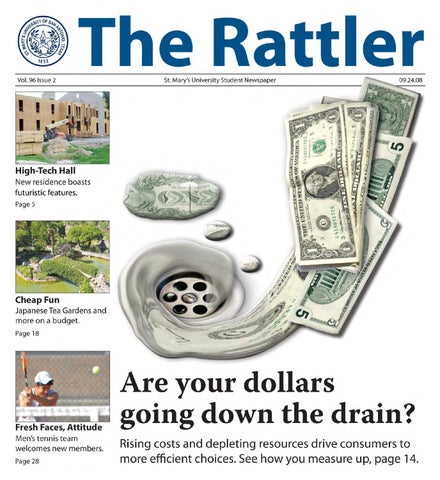
Cover and center spread graphic illustrations by Jon Mike Hernandez
Do you turn off the lights when you leave the room?
Features The Rattler
Photo by Analicia Perez
Students gather along with Bro. Brian Halderman, director of justice and vocations, at Barret Memorial Bell Tower to pray the Marianist three o’clock prayer in remembrance of the victims and those affected by Sept. 11.
Ministry has goal to unite students By Sarah Batista Staff Writer
Seven years ago on Sept. 11, a shockwave of anger, fear and grief emerged after one of America’s greatest tragedies occurred. Since that day, Sept. 11 has become a date to honor those who died because of the terrorist attacks. This year, University Ministry commemorated those who passed away by ringing the bell of the Barret Memorial Bell Tower as a circle of staff and students called out the names of almost 3,000 victims. “The atmosphere was very somber, and I was overwhelmed by the diversity of the victims,” freshman business major Analycia Villareal said. Villareal not only attended the event, but also felt compelled to take part in reading out the names. University Ministry organized the event not only to remember those who died, but also as an effort to reach out to those still suffering from the catastrophe. “I was amazed at how many people came out at one point,” freshman computer science major Pete Rivera said. “Just taking part in the circle around the tower made me feel connected somehow. I felt like we were all able to just put everything aside and reflect together.” As a part of the Social Justice Min-
16 09.24.08
istry within University Ministry, Bro. Brian Halderman, director of justice and vocations, has been encouraging the student body to reflect on the importance of peace. “It’s important that we, as a community, remember those who lost their lives,” Halderman said. “We should also pray for the many families that survived without a loved one because of that day. We are all called to pray for peace and harmony in our world, especially with people who have different ideologies.” The Sept. 11 memorial is not the only event Campus Ministry has organized in hopes to better enrich the community. Recently, the retreat team completed the New Student Retreat, which is geared towards incoming freshman and transfer students. The University Ministry is also currently planning to take part in the Greek festivities that occur every Friday in the Quad. “It is my hope that we can create a ministry that is visible in the public, much like the spirit of the organizations that gather,” said Director of University Ministry Wayne Romo. “It is my hope that we can celebrate with the joy of a community of faith.” Typically, fraternities and sororities go out into the Quad, set up their organization’s letters and welcome students
to join their group. University Ministry plans to join this tradition by putting up letters (Alpha and Omega). Romo is overseeing plans for this new activity. “Right now, we’re just trying to get volunteers together and find a place or person to make the actual letters for us,” Romo said. Along with the University Ministry staff, work-study students and ministerial assistants also help to put such events together. Dan McCarthy, who has been a ministerial assistant for three years, believes that projects such as these build up the community. “University Ministry projects are about building relationships with people spiritually in our community,” McCarthy said. “We work to create spiritual connections rather than just physical ones” McCarthy thinks that it would be beneficial to the fraternities and sororities if the University Ministry participated in the Greek life festivities once every month. “Through prayer, we can unite all of these fraternities and sororities and make them realize we are all just people of God,” McCarthy said. “But we don’t want to impose religion or beliefs on others.”
Photo by Robin Johnson
After all the names of the victims of Sept. 11 were read, “Amazing Grace” was sung during the closure of the ceremony.
The Rattler Features
Competition brewing By Christine Le Managing Editor
With a high consumer demand for coffee beverages, fast-food restaurants and gas stations have seized the opportunity to provide customers with their cup of Joe conveniently and cheaply. We tried some of these new coffees to see if they were worth the buck. MCDONALD’S PREMIUM ROAST ICED COFFEE Price: $1.79 This delicious twist on coffee is giving Starbucks a run for their money. With flavors including hazelnut, vanilla and caramel, McDonald’s makes it easier to transition from other flavored coffee. Staff says: A “definite alternative for Starbucks fans.” It is “very aromatic” and “not at all bitter” with a refreshingly “pleasant sweet taste.”
Compare to Java City JAVA CITY REGULAR ESPRESSO COFFEE Prices: $1.49 for 12 oz., $1.69 for 16 oz., $1.85 for 20 oz. The traditional, full-bodied blend is robust with a bittersweet tang. A St. Mary’s staple, this coffee is suitable for most mornings. Staff says: This coffee is “pretty decent” and tastes “well-blended.” Its flavor has a “rich” medium body with a “good aftertaste.” Mocha Bk Joe Iced Coffee photo courtesy of www.bk.com, McDonald’s Iced Coffee photo courtesy of www.flickr.com, Jack in the Box Bold Roast Coffee photo courtesy of www.foodfacts.info, Valero’s Cibolo Mountain Premium Roast, McDonald’s Premium Roast Coffee, Java City regular espresso coffee photos by Robin Johnson
BURGER KING MOCHA JOE ICED COFFEE Price: $1.99 for 22 oz. This sweet drink is made of creamy coffee blended with chocolate syrup. This is a refreshing change for coffee drinkers and dessert lovers. Staff says: It has a “predominant coffee flavor;” but it’s something “hardcore coffee fans wouldn’t like.”
JACK IN THE BOX BOLD ROAST COFFEE Price: $1.29 for small, $1.49 for large Jack promises a java that is a full-bodied brew featuring a European roast that has rich flavor. It is available in regular and decaf. Staff says: This blend is “weak” and only “slightly bitter.” It seems as it wants to be coffee but just can’t make it.
VALERO’S CIBOLO MOUNTAIN PREMIUM COFFEE Price: $1.18 for small, $1.39 for large Serving high-quality, gourmet blends, Valero offers several styles to its customers: medium roasted Columbian house blend, light roast decaf and dark French roast. Staff says: The medium roast is an “average” blend that has a “strong base” but falls short in flavor.
MCDONALD’S PREMIUM ROAST COFFEE Price: $1 Chosen as the tastiest by Consumer Reports magazine and declared “better than they brew at Starbucks.” Staff says: This blend is “strong.” Its “rich” and “bold” flavor is “definitely worth the value.”
09.24.08 17
Features The Rattler
Good times still available even for the broke By Sarah Mills Features Editor
and Katie O’Donnell
Assistant Ad Manager With prices rising everywhere, it can be frustrating for a college student to find something to do in the city that won’t leave your wallet crying. However, with a little imagination and asking around, one can find many hidden gems in San Antonio. The majority of the following hot spots are free and are within a close radius to the campus: Hermann Sons Bowling Alley Located at 525 S St. Mary’s St. Hermann Sons Bowling Alley is the perfect mixture of good clean fun and makes competition a little more entertaining with its classic bowling lanes. For only $2 a game and $1.50 for shoe rental, you can play a classic game with friends in a laid-back atmosphere. Cinemark Dollar Movies 16 Located at 5063 Loop 410 NW Miss a summer blockbuster? Cinemark Dollar Movies 16 is a great place to catch up on all the great movies you never had a chance to see. Catch the show times for The Happening, Wanted, Baby Mama, Kung Fu Panda, Hancock and many more at Cinemark.com. Tickets are $1.50 and $1 all day every Tuesday.
First Friday Located on South Alamo St. The fun festivities of First Friday are too good to pass up, especially for art lovers. This event is free and open to the public. Come and experience live music, art exhibits, shopping and restaurants in a vibrant, fast-paced setting every first Friday of the month. Japanese Tea Gardens Located at 3800 N St. Mary’s St. Waterfalls, expansive ponds, luscious greens and colorful flowers adorn the recently renovated Japanese Tea Gardens. Stop by for a picnic next to the falls or just to enjoy the scenic views; admission is free.
“
I go to car shows mainly. I’m really into cars, and you get to see a lot of things you don’t normally see. - Leo Reyes, psychology and philosophy major
18 09.24.08
”
McNay Museum Located at 6000 N New Braunfels Ave. The McNay museum exhibits 19th and 20th century American and European art. Student admission with I.D. is $5, but on Thursdays from 4 to 9 p.m., the museum is free to the public. Currently on exhibit until Jan. 4, 2009, is Tim Burton’s The Nightmare Before Christmas, a display of sets, props and figures used for the animated film Bobalicious Located at 410 and Summit Pkwy. Bobalicious offers a flavorful variety of bubble teas. Its low-key atmosphere and friendly staff makes it a great place to study or visit with friends. Bubble teas start at $2.99, and wireless Internet access comes free with purchase. Bandera Flea Market Located at 1331 Bandera Rd. One man’s trash is another man’s treasure at the Bandera Flea Market, where you can find great buys on all kinds of items. If you’re not looking to make a purchase, perusing the merchandise is a fun and free way to pass the time. Houston Street Fair Market Located on Houston St. On the fourth Saturday of every month, Houston Street fills with vendors from noon until 6 p.m. The lively family environment features music, art, food vendors and other vendors selling handmade crafts.
Woodlawn Lake Park Located at 1103 Cincinnati Ave. Woodlawn Lake Park’s 30-acre lake and array of resident ducks make it a perfect place to spend a relaxing fall day. Equipped with tennis courts, half-courts and a running path encompassing the lake, this park is an ideal place for outdoor exercise. There are also barbeque pits and tables around the park, making it easy to hold an outdoor grill with friends.
“
There’s a great mercado in the downtown area. They sell a bunch of cool traditional Mexican items, and they have great food and bargains. - Angelica Radacinski, sophomore international business major
”
Graphic Illustration by Jon Mike Hernandez
The Rattler Entertainment
Effective Entertainment Television with a Twist, page 20 Movies didn’t make him...LaFontaine made the movies, page 20
The Academy Is... Growing Young Men, page 23
Another Year of ACL, page 21
Upcoming Releases & Events Calendar, page 22
Dresden Dolls singer introduced as Boston soloist, page 21 Source: aolcdn.com, scifimoviepage.com, latimes.com, popcrunch.com, aclfestival.com, roadrunnerrecords.co.uk
09.24.08 19
Entertainment The Rattler
Writers take chance with acclaimed TV programming By Stephanie Sanders Entertainment Editor
The typical popular TV program embraces its high-status usually by signing on additional seasons, but many in the fall lineup have returned from summer vacation with serious face-lifts. How will they survive the school halls of mainstream television week
after week now? “Creativity” and “originality,” sometimes even “farfetchedness,” keep the show’s writers efficient in their work when dishing out storylines and scenarios to maintain the show’s reputation, that is, when they are not on strike or doing other writer-like things. Some shows rework their body in fear of losing fans. For the writers of other shows,
Hayden Panettiere, who plays Claire Bennet on NBC’s Heroes, lived up to season one’s tagline “Save the Cheerleader, Save the World” as the invincible high school damsel (left). The superhero act ends as she takes matters into her own hands in Heroes: Villains (below).
Source: ecorazzi.com
they spend the first couple of seasons working out all the kinks and then figure out how they want it to be. Either way, now it’s time to show everyone who’s the most popular of them all. Heroes, only a year-and-a-half old as far as seasons go, entered its third season on Monday. Returning as NBC’s new Heroes: Villains, writers make a sharp turn in the plot with hopes of keeping their large fanbase. Many viewers were left unsatisfied when the show came to a halt nearly halfway through the second season due to the Writers Guild of America 100-day strike. Other shows well into their maturity, as far as seasons go, take dramatic twists as well. Desperate Housewives, for example, premieres on ABC this Sunday but takes place five years into the future. Of course, culture does play a major role in the “what’s hot and what’s not” game. The Office serves as an excellent example for successful reconstruction of a show. It is a remake of the BBC show of the same name. The fifth season airs Thursday on NBC and interesting enough, its Source: flickr.com
Source: thatscooltome.com, bbc.co.uk
Meet The Office: NBC’s Dwight(top) acts as the American counterpart of BBC’s Gareth(bottom).
spin-off starring Saturday Night Live’s Amy Poehler premieres this January. Not all programs have that same success rate. NBC writers recreated BBC’s Coupling, only to cancel it after a few episodes. Expecting no interruptions, TV-watchers await a smooth and entertaining fall lineup. The writers move swiftly, but popularity can sometimes go to the head.
Really, YouTube? By Elizabeth Ruiz Editor in Chief
“Hockey Moms Against Sarah Palin” http://www.youtube.com/watch?v=URIypadX3n0&feature=bz301 Viewed Friday, Sept. 19, 7:55 p.m. Views on YouTube: 206, 033
20 09.24.08
Among multitudes of Swift Boat send-ups, this video seems to be the only one lampooning the new focus of this election; the emerging (and probably minute) sect of “hockey moms.” A brief aside for the youngins: “Swift Boat” refers to a political ad campaign that ran against Sen. John Kerry during the 2004 presidential campaign in reference to his famous denouncement of the Vietnam War after returning home. The “Swift Boat Veterans for Truth” alleged that Kerry’s war record was a fabrication, although there was later footage uncovered of one of said veterans praising Kerry at a function.
To paraphrase Jon Stewart, they were neither truthful nor swift. In their best “Sarah Palin” accents (formerly known as “Fargo” accents, formerly known as “Midwestern” accents), women clad in their Lillian Vernon and Eddie Bauer attire recount the disservice inflicted by Sarah Palin on the community that has been examined under a microscope for the last few weeks. The testimony included Debbie Brayton, 42, who carpooled with Sarah Palin. “I met Sarah Palin because we were supposed to carpool with our kids, and we were supposed to switch on and off who was driving, but it seemed as though I did most of the driving,” she alleged. She continues in the video. “I heard a child ask her ‘What’s
the difference between icing and off-sides?’ She didn’t know.” Later, “I’m not a pitbull.” An integral part of the YouTube experience is the commentary portion of the page. Of course, it would be considered “commentary” if that term meant a collection of excessive profanity and ill-focused political declaration that rivals the sanity quotient of IMDB.com discussion boards. If we’re spending election seasons shouting about hockey mom-centric YouTube parodies, maybe we deserve one of those hockey moms as a president.
The Rattler Entertainment
THE TOUR GUIDE By Elizabeth Ruiz Editor in Chief
LaFontaine legacy continues to be respected by fans and colleagues even after death.
Source: common.wikimedia.org
Hollywood voice lives on By Stephen Guzman Staff Writer Voiceover master Don LaFontaine died in the late afternoon on Sept. 1 following complications of a collapsed lung. Since his death, the entertainment industry has not forgotten the voiceover legend. A number of services have been held to acknowledge the contribution he made, including one held by the Writers Guild of America. In addition, the voiceover community was invited to send a series of e-mails to the grieving LaFontaine family to express their condolences. President of the Screen Actors Guild of America Alan Rosenberg said, “His contributions on and off mic enriched the profession and the Guild. He will be greatly missed by all of us.” LaFontaine began his voiceover career by accident after filling in for an unavailable voice actor on the 1964 western Gunfighters of Casa Grande.
He went on to record over 5,000 movie trailers and 350,000 commercials. LaFontaine’s monstrous, baritone voice graced TV programs on such networks as NBC, ABC, Fox, TNT and even Cartoon Network. Though he was not among the “A” class celebrities, LaFontaine made significant impacts on the entertainment industry. He was the standard for all voiceovers and even coined the now clichéd phrase “In a world ...” Having been featured on trailers such as The Godfather, Indiana Jones and Independence Day, LaFontaine acted as the backdrop of our own culture as well. Imagine sitting in the movie theater. The lights go black. Anticipating what’s to come, everyone waits anxiously in their seats. Suddenly, you hear it--that deep, booming voice which seems to roar across the theatre and out at you. There will surely be LaFontaine imitators, but none will be able to fill the shoes of the most influential voice in entertainment.
Each September, every music lover in Texas begins retaining a higher-than-average fluid level to prevent dehydration and the possibility of missing their favorite band while being stuck in the first aid tent for several hours. Yes, Austin City Limits Festival returns this weekend. It’s time to break out your wristbands and be on the lookout for Leslie, Austin’s beloved homeless transvestite, while you fight your way to the front of the crowds at Zilker Park’s eight stages. Recommendations to highlight on your downloaded PDF schedule: local Austin-based favorites and returning performers such as the Black Joe Lewis and the Honeybears (Best. Band name. Ever.), South Austin Jug Band and What Made Milwaukee Famous; Brooklyn-based indie-psychadelia acts Yeasayer and MGMT; baroque-rock quintet Fleet Foxes hailing from Seattle; and London-based indiedance favorites Hot Chip. Potential conflicts for your schedule include a Robert Plant and Allison Krauss show at the AMD stage that partially conflicts with Beck’s performance at the AT&T stage on Saturday.
Have fun learning teleportation before Sunday if you like Gnarls Barkley and The Raconteurs; they both perform at 6:30 p.m. Other major acts include TheMars Volta, Against Me!, Manu Chao and Foo Fighters. If you don’t have about $300 to drop on eBay, you can always try to catch the after shows in downtown Austin. Try to catch The Black Keys with The Black Angels at Stubb’s BBQ outdoors on Sunday at 7 p.m. Conor Oberst and the Mystic Valley Band will be joined by Jenny Lewis (sans Watson Twins, apparently) and M. Ward (sans Zooey Deschanel, the “She” of She and Him) at La Zona Rosa on Sunday at 9 p.m.
Source: wizardwebshop.com
Dresden doll successfully does it alone By Cristina Gonzalez Senior Staff Writer
Ah, Boston. Home of the Red Sox, beans and one talented young woman by the name of Amanda Palmer. The singer-pianist who is one-half of the Dresden Dolls (No, Virginia...) released her muchanticipated solo album Who Killed Amanda Palmer. Produced by musician Ben Folds, the album packs as much punch as her collaborations with drummer Brian Viglione do. This album is truly a case where hearing is believing. Palmer’s vo-
cals and piano are flawless and strong from the first note of “Astronaut” to the final soft note of “Another Year.” Paired with poetic lyrics that avoid the pitfall of clichés, she has a knack for tapping into emotion without feeling manipulative. She doesn’t have to work hard to draw you in; she just does. Tracks like “The Point of it All” and “Straight” (deluxe edition) feel almost too intimate while the jaunty “Oasis” shows Palmer’s talent for dark humor surface-perhaps bringing some terrifying social commentary.
The deluxe edition of Who Killed Amanda Palmer is highly recommended, as it extends the initial 12-song offering to 15, giving the listener an extra song (“Straight”) and alternate versions of “Leeds United” and “Guitar Hero.” And for those who may still fear this album is little more than an attempt at recreating the “punk cabaret” charm of the Dresden Dolls, you can rest easy. Who Killed Amanda Palmer does an amazing job showcasing herself as an artist and musician--and oh, what a beautiful showcase it is.
Source: jsdirect.com
Who Killed Amanda Palmer dropped Sept. 16 and is available in most stores.
09.24.08 21
Entertainment The Rattler
Directorial debut brings cult novel to life
By Elizabeth Ruiz Editor in Chief
Chuck Palahniuk aficionados beware: This is not the sleek filmmaking that set apart David Fincher’s acclaimed Fight Club from other late-1990s cult classics. Fortunately, Clark Gregg’s adaptation of the 2002 novel touts the performances of the ever-dependable Angelica Huston, who is uncannily energetic at whatever age she is, and the anti-Pitt leading man Sam Rockwell, probably best known from Confessions of a Dangerous Mind (but he should be known from the 1999 [un]guilty pleasure known as Galaxy Quest). Rockwell plays Victor Mancini, medschool dropout sex addict who finds sex partners at sex addicts support meetings. He fakes choking at restaurants then strategically aims himself into the arms and sympathy of any restaurant patron he instinctively feels he can sucker out of a few dollars. He seems psychologically incapable of not imagining any woman topless. He works with his alcoholic friend Denny at a colonial theme park where all employees are required to talk in ye olde English or are forced to face the shackles. It’s through flashbacks that we see Huston as Victor’s mother Ida, a fugitive whose rare moments with her son are spent snatching him away from a foster home. On their rendevous, Ida offers a cryptic piece of advice: “If we stopped at every playground we came across, we’d never get anything done.” What differentiates Ida from then to now
Source: rottentomatoes.com
Partners in crime Denny & Mancini trade barbs at their locale of choice, a local strip-joint. is her dementia, rendering her completely unable to recognize Victor. It’s through her dementia that her fears and disappointments about her son are exposed as he feeds her on her hospital bed and pretends to be her dead lawyer. Ida’s doctor, Paige Marshall (Scottish actress Kelly Macdonald doing her best Gretchen Mol impersonation), offers some
novel ideas for Victor to help his mother, who she admires. Those ideas involve acquiring his “seed.” In the end, Choke is a fractured romantic dramedy about finding yourself with graphic sex scenes to boot. There are several things from the source material that, it would be assumed, couldn’t be shown on film. Some were not, but some were.
This is Gregg’s directorial debut, but you can also spot him as Victor’s lovelorn colonial boss, who finds Victor in a compromising position. His first film still has some of the bite of the book; you can hear Palahniuk’s dryness in Victor’s narration. The humor and underlying sadness translate from the novel thanks to strong performances from Rockwell and Huston.
Entertain Yourself SUNDAY
21
MONDAY
22
TUESDAY
23
WEDNESDAY
24
THURSDAY
25
The Office
FRIDAY
26
SATURDAY
27
TV Season Premiere 8 p.m., NBC
28
Little Britain U.S.A.
29
TV Series Premiere 9:30p.m., HBO
5
22 09.24.08
6
30
1
DVD & Blu-ray release
Video Game Rlease X-Box360, PS3, Wii
Iron Man
Mega Man 9
7
8
Oasis CD Release
Musical 8 p.m., Majestic Theater
Dig Out Your Soul
Avenue Q
2
Celebrity Detox Rosie O’Donnell Book Release
9
Dave Attell
Comedy tour 7:30 p.m., Empire Theater
3
4
Nick & Norah’s Infinite Playlist
Music Builds
Movie Premiere
Concer Tour Third Day, Switchfoot 6 p.m., Verizon Wireless Amphitheater
10
11
International Accordion Festival Annual culture festival 12 p.m., La Villita
The Rattler Entertainment
Grindin’ your gears Media hypocrisy reaches all-time high By Jaime Perez Staff Writer
MSNBC has finally answered the proverbial whistle to the overbearingly annoying kettle that they call political coverage. In a surprisingly honest move, the network has relieved Keith Olbermann and Chris Matthew, hosts of Countdown and Hardball, as co-anchors of their political night coverage reflecting growing tension and criticism aimed at it. The cable network, owned by parent company NBC, had insisted that Olbermann and Mathews could serve the roles of diplomatic news anchors; however, like many of Olbermann’s political jokes, the attempt failed. Instead, the two were replaced with on-air journalist David Gregory, leaving Olbermann and Matthews to whine later, from a much smaller capacity, in their respective seats. The unceremonious promotion and demotion of these two political pundits signify a greater problem in today’s media coverage, specifically television, and an even greater backlash to what many call the regurgitation of today’s news. Likewise, the criticism and backlash should not be directed towards the likes of Olbermann or Mathews, but those who continue to tune in and listen. Yes, Countdown and Hardball are not news shows, and there is nothing wrong with defining one’s political beliefs when evaluating the world around them as their show prescribes and their job entitles. However, when the show becomes an hour-long send up, a constant flow of condescendence without a counter-viewpoint offered, then how are these shows participating in debate? Media Research Center, a media watchdog group, found the segment “Worst Person in the World,” in which Olbermann ranks what he believes to
be the worst in pop culture or politics; it featured 174 well-known conservative leaders versus the 23 liberals from June 30, 2005, through June 23, 2006. The segment ends immediately with no other person to respond or comment. Countdown and shows like it are often the highest-rated shows on the cable networks. The O’Reilly Factor, for instance, is the highest-rated political show and even beats veteran interviewer Larry King in the ratings, according to Nielson Media research. Edged on by their audiences’ apparent appetite for this particular brand of shows, many influential politicians have been apart of this hour-long condemnation. The sappy hug fest that is Washington must have not been enough. In the case of famous right-winger Bill O’Reilly of the O’Reilly Factor on FOX News, he had the chance to interview the once-presidential hopeful, Sen. Hillary Clinton (D-NY). On his show, in which he has full editorial control, the denouncing of Clinton was all too apparent; yet, despite this, he still claims to be fair and balanced. Opening the interview by asking a presumptive question about her then political rival and fellow democrat Sen. Barack Obama (D-IL) is not balanced. It is fitting, then, to compare MSNBC and many of these media outlets to a whiney kettle for all the criticism about other networks leaning far to the left or the right in their journalistic reporting and political analysis. Viewers can now witness the hypocrisy in the nature of today’s media and finally choose to listen to the content of a story rather than its commentary, as exemplified by the Olbermann and Matthew’s incident. Hopefully, they will be able to see it as well. Pot and the kettle, boys. Pot and the kettle.
Source images.google.com
Young men stick with tradition By Jaime Perez Staff Writer Before The Academy is… (TAI) rocketed— or at least whizzed—into fame, Chicago’s only exports consisted of inflated basketball careers and, of course, Da Bears. However, the windy city can now add another name to that list thanks to this quintet. On Aug. 19, the band released its third album, Fast Times at Barrington High. Amid mediocre reviews, it continued in the tradition of its previous albums: pop meets emo. Lukewarm reviews have not stopped it from catching on with the “tween” generations.
The album focuses on high school angst and showcases a variety of songs about the best and worst of adolescence. “About a Girl,” the first single off TAI’s third album, is available on iTunes and on the band’s MySpace.com Web site; a video for the single has not yet been filmed. The popularity of TAI’s new album was the launching pad to the Bill and Trav’s Bogus Journey Tour with label mates We the Kings; it echoes the young, school’s-out-forsummer energy. The multi-artist tour will play 40 stops, and ticket prices will start at $18 per ticket. Watch for shows in Houston and Austin.
Anyone in the spotlight grindin’ your gears?
Send entertainment commentaries to rattlernews@gmail.com
09.24.08 23
The Rattler Sports
A Texas legacy lives A devoted fan remembers Coach Don Haskins, a local hero who helped pave the way for African-American players. By Brissa Renteria Staff Writer A hero is a popular figure that people look up to because he or she made a difference in their lives. By this definition, Don Haskins could be called the hero of El Paso, Texas. Although he passed away on the seventh of Sept. 7 at the age of 78, no one can stop talking about the goals he set and how he achieved them. Books, magazine articles and now a biographical movie Glory Road have been written about Haskins and the legendary basketball game he coached in 1966 at the University of Texas at El Paso (UTEP), then known as Texas Western University. Growing up, Haskins was also an athlete who played for Hall of Fame coach Henry Iba at Oklahoma State, then known as Oklahoma A&M. In 1972, he became his assistant for the U.S. Olympic games in Munich. Haskins came to Texas Western looking to change the basketball program’s poor reputation. At the time, segregation was still practiced, so Haskins and his newly integrated team struggled for acceptance.
“He was still just full of life, as sick as he was. We talked about our old friends. Don, as sick as he was, had a little smirk on his face and was telling jokes and fibbing on one and another. It was just a blessing.” - Togo Railey Member of the 1966 UTEP Men’s Basketball Team
He led Texas Western’s basketball team to the 1966 National Collegiate Athletic Association (NCAA) tournament. That night made Haskins the first basketball coach to start five African-American players because he believed in their strategy and skill, not in race or color. The game was broadcast on national television, and viewers watched in amazement as Haskins defied society’s norms and began the desegregation of college sports. Texas Western played the allwhite University of Kentucky and, within the last seconds of the game, beat them with a final score of 72-65. That single victory changed America forever. Haskins retired in 1999 after 38 basketball seasons, and by that time, he had won seven Western Athletic Conference titles. Adding on to his basketball -coaching career, he took UTEP to the NCAA tournaments 14 times and to the National Invitational Tournament (NIT) seven times and also worked as an advisor with the Chicago Bulls. As an admirable coach and role model, Haskins was awarded a place in the Basketball Hall of Fame in 1997, and his name can now be found all throughout El Paso. Throughout his coaching career, Haskins turned down several opportunities to work in higherposition places so that he could remain head basketball coach at UTEP as one of the lowest paying coaches in the WAC. When Glory Road was released in 2006, a new generation was introduced to Haskins, his team and the difference they made. “If you were one of his guys, you were one of his guys,” said former UTEP coach Doc Sadler. “He was bigger than life. The word
I was told was that he was the John Wayne of college basketball. He had that much respect.” Many people visited his home when he first fell ill. But it only brought former team members and friends closer to each other as they mourned his illness and passing. “He was still just full of life, as sick as he was. We talked about our old friends. Don, as sick as he was, had a little smirk on his face and was telling jokes and fibbing on one and another. It was just a blessing,” said Togo Railey, a guard/forward for Haskins’ 1966 team. Through all of Haskins’ accomplishments and goals, the “Bear,” as he was nicknamed, paved the way for any athlete, regardless of race, to succeed. He encouraged people to look past race and focus on the love of the game. Growing up in El Paso all of my life, I have come to realize that meeting Don Haskins was not about just a young girl meeting her idol, but was a realization of how an unknown role model could be a simple man who just wanted a friendship from a starving fan. The conversation I had with Haskins focused primarily on college and what my expectations were for my future. He told me “to reach far,” something that he did and was able to succeed. Ryan Schuetzler, a UTEP student, stated that one word that comes to mind when Haskins is mentioned is “revolutionary.” Haskins not only changed the views of other colleges, but he also changed the perspective of segregation within America. He will be remembered for his decisions, his refusal to conform and for his idealistic goal to change the face of basketball throughout America.
Don Haskins early in his career at Texas Western, now UTEP. Inset: He inspired many people on and off the court.
Courtesy of El Paso Times
Don Haskins Career Stats n Haskins
had an overall record of 719-353, which ranks 19th among all-time Division I men’s basketball coaches
n Won the NCAA National Championship in 1966 n Seventeen
of his teams won at least 20 games, and he had only five losing records in his 38year career at Texas Western, now known as the University of Texas, El Paso.
n Haskins
tutored numerous players who went on to play in the NBA, including Antonio Davis, Tim Hardaway and Jim Barnes.
n He coached Nolan Richardson for two years, who
Courtesy of El Paso Times
later coached the University of Arkansas to an NCAA Championship in 1994. source: www.latimes.com
09.24.08 25
Sports The Rattler
Salary caps on U.S. keeping Europe best in world By Ivonne Aguilar Staff Writer
and By Christine Le Managing Editor
Soccer is the most popular sport in the world. Passion for the game resonates colorfully through every team, and stadiums fill with fans supporting their favorite players. Europe, the powerhouse of the soccer world, includes some of the oldest and most prestigious football clubs: Real Madrid of Spain, Manchester United of England and A.C. Milan of Italy, just to name a few. With Europe setting the stage for the best soccer players in the world to play, how exactly does it maintain its reign over other nations to produce world-class football clubs and quality players? Key factors include salary caps on annual transfers between clubs and the acquisitions of new players like those imposed on U.S. sport
leagues. These caps are intended to regulate trade and keep clubs at an even level. European teams that compete in the national market do not have salary caps, which gives them the opportunity to make pricey offers to lure in the best players during the “trade windows” of the summer off-season. This summer, major trades took place when Brazilian star Ronaldo “Ronaldinho” de Assis Moeira switched clubs to A.C Milan for 14.6 million pounds while Manchester City, now under Abu Dhabi United Group, paid 32.5 million pounds to buy Brazilian Forward Robson “Robinho” de Souza from Real Madrid. With these salaries, players can earn up to £200,000 per week, not including endorsements from major companies. In total, English clubs spent £500 million this summer alone, which increased from the £30 million spent last summer, according to Forbes.com. Although these figures may
come off as excessive, the expensive contracts pay off when the players continue to impress with their performances on the field and resultantly increase the growing fixation with European soccer. In fact, its popularity can be felt here at St. Mary’s with fans like sophomore political science major John Clark and sophomore undecided major Luis Gonzalez, who admire the European leagues for their professionalism and their impressive styles of play. Clark, a Manchester United fan, said, “[Manchester United is] my favorite team because of the way they play; they are really fast. It’s what got me to really play soccer.” Both soccer fans agree that the European leagues are top of the class. “The players’ professionalism and their styles of play are the best in the world,” said Gonzalez, a player for the Rattler soccer team. It’s a given that U.S. soccer hopes to develop into leagues skilled enough to rival those of Europe, but with the salary caps
Source: everystockphoto.com
Alessandro Del Piero, also known as the “little artist” , is a popular player in Europe. He has played for Juventus FC in Italy since 1993. in place, it doesn’t seem like that aspiration can be met any time soon. However, with contracts such as David Beckham’s five-year $250 million deal with L.A. Galaxy being
made, the infiltration of foreign talent will certainly contribute (albeit slowly) to efforts in making soccer develop even more of a following in the United States.
Diverse training helps prevent injury By Elizabeth Ruiz Editor in Chief During and pre-season, athletes must be ever wary of a lingering threat: their own bodies giving out. Considering this, the athletic programs have adopted several ways to prevent injury. “As the old saying goes, ‘Treat your body like a temple’ is very true,” said James Kling, head cross country and assistant softball coach. He puts longdistance running as the base of the cross country training but has athletes work on both distance and speed. Athletes are limited during their off-seasons, but Kling encourages them to practice. “It is stressed how critical it is to maintain a good running regiment at all times,” Kling added. Kling follows the notion that if the body suspends its regular exercise activity for six weeks, what gained by daily workouts will have been wasted. “I stress this to the girls that it is essential to keep running on their own.” Kling added that strictly running does not consume the team’s conditioning time. “We have used swimming, yoga and plyo-metrics in all of our condition regimens,” he said. “These benefit your body and help keep the muscles toned.” Last spring, women’s soccer coach Corwyn Ritch had his team add yoga and pilates (or “yogalates”) to their usual cardio-focused and weight-training
26 09.24.08
regimen. He says the efforts of their latest training endeavor may not be carved out in stone yet, but there have been positive results in the complete lack of muscle strains or tears among the team members. “I’m not sure if it’s working, but it’s not hurting,” he said. Ritch approached then-new fitness coordinator Angela Donnally about a new training program for the team that suffered through about six injuries this time last year. Donnally infused her own fitness philosophy in the program, which has since been adopted by other Rattler athletes, including volleyball and tennis players. “I’m a big believer in flexibility and core strength and that it goes a long way in sports,” said Donnally. “A lot of times, the athletes aren’t as efficient and flexible without.” Prior to “yogalates,” the team had been on a strict weight training program. “It was my interpretation of what athletes should do,” said Ritch. Senior defense and team captain Lizzy Redman says that the team may have trainings that are a way to supplement the exercise they do during the games. “Usually, we don’t stretch as well as we should before and during practice,” she said. Regardless of what kind of sport played, Donnally testifies to the power of yoga as a part of a well-balanced regimen. “I think it would benefit everyone,” she said. “You need a core routine that has every kind of exercise.”
The Rattler Sports
Don’t call me “Lady” Discipline and hard work characterize athletes of the Rattler Volleyball team By Jaime Perez Staff Writer
Photo by Analicia Perez
Senior Defensive Specialist Valerie Teter takes her turn greeting the crowd during player introductions at a recent home volleyball match.
The volleyball flies back and forth from either side of the court. The players of the Rattler volleyball team yell. Words of instruction and of encouragement could be heard through the grunts of the athlete’s exertion. The volleyball team, whose season began in August with a win against Missouri Southern State, is coached by Todd Caughlin and assisted by Brad Bulycz. The two believe that the team’s hard work and dedication is the cause for its success. “The team works really hard, and I hope people get to see more of that. One of the things that bothers me is when people refer to them as ‘Lady Rattlers.’ There is only one volleyball team here at St. Mary’s, so it’s not necessary,” Caughlin said. “I hope people will see them as athletes rather than lady athletes.” As they near the end of their practice the noise becomes even louder. Expressions like “keep going” and “let’s hustle” are common. The volleyball team is 4-6 so far in the season; how-
ever, the team is still set to play another 20 games. The enthusiasm shows on the faces of the team, their coaches and the manager. As they finish the game, the players congratulate and high five each other on a practice well done. According to player and junior Stephanie Solano, it’s all about teamwork. “A lot of the training we do during practice is about discipline. It’s all about controlling our side of the court and worrying about the little things so that we can improve and get back in sequence with each other. Once we do that, it sort of just falls into place,” Solano said. The girls sit around their coaches talking pleasantly about the success of their recent practice and stretch out before they are allowed to leave. This year six new freshmen have joined the team and according to Kirstin Chapman, they have high expectations for themselves along with the rest of the upperclassmen. “I’m just really excited about everything. We have worked really hard, and I have high hopes that we will pull off a bunch of wins,” Chapman said.
Flag football highlights fall season of intramural sports By Jonathan Trillo Staff Writer The arrival of fall brings not only a new semester, but also a new intramural football season. Last season, I made the transformation from full contact football to flag football. While in high school, I participated in what is known as seven on seven, which is basically one hand touch football with seven players on offense and seven on defense. There are a few differences among the individual games. However, the use of flags and a truncated field were new concepts to me. The terms “flag guarding” and blocking without hands as well as actions such as diving are considered penalties. Another rule, which most of my friends back home would love, is that linemen are eligible receivers. However, flag football does have some similarities with the seven on seven football that I’m familiar with, such as the use of seven players on offense and seven on defense, some sort of offensive and defensive line to block and of course, teamwork. Don’t let the word “flag” in flag football fool you. The fundamentals of football are still there despite the physicality of the sport being toned down. Campus Recreation offers coed and all-
Photo by Analicia Perez
Flag football is a popular intramural sport that can be played among men and women. Not for the faint of heart, a seemingly casual game can be highly competitive.
male teams, which form separate divisions. There are two forms of players who play intramural flag football here at St. Mary’s
University: those who play for enjoyment, regardless of the outcome, and those who play to win.
There are the care free individuals who do not mind losing as long as they have fun playing the game. I have a high respect for these individuals; they play, and the outcome may not really be glamorous (and yes, football can be glamorous). It takes a lot to look forward in playing a game where the odds are stacked up against you. There are also the highly competitive individuals whose sole objective is to win at all cost. These individuals can create a hostile environment for those players who are new to the game. But this win-at-all-cost mentality brings more out of not only the player, but also the game itself. I myself am in a limbo of sorts between these two different types of players. While I do not mind the role of an underdog, I do mind losing. But also, I have such a high regard for the game that in victory and defeat, I am concerned about whether or not I had fun playing. My uncle always told me that he would rather play and lose on junior varsity than watch and win on the sidelines. Though that statement applies to playing time, it also points out the importance of having fun.
09.24.08 27
Sports The Rattler
Freshmen Profiles Mat Carrion Age: 18 Hometown: Corpus Christi, Texas Major: Industrial Engineering Favorite Pro Player: Leyton Hewitt
Shawn Cavazos Age: 18 Hometown: Rockport, Texas Major: Electrical Engineering Favorite Pro Player: Roger Federer
Luis Delgado
Photos by Robin Johnson
Freshmen tennis players Marcin Marczewski (left) and Mat Carrion (right) take time to warm up before their team begins practice.
Meet the new faces of Rattler tennis By Chris Filoteo Sports Editor
Age: 18 Hometown: El Paso, Texas Major: International Business Favorite Pro Player: Rafael Nadal
Salvador Lievanos Age: 18 Hometown: El Paso, Texas Major: English Communication Arts Favorite Pro Player: Marat Safin
Marcin Marczewski Age: 19 Hometown: Warsaw, Poland Major: General Business Favorite Pro Player: Patrick Rafter Compiled by Chris Fioteo. Photos by Robin Johnson
28 09.24.08
The beginning of a semester typically consists of early classes, late nights studying and little free time. For five particular students on the men’s tennis team, their first year at St. Mary’s means all of that and more. Rookies to both college life and St. Mary’s sports, The Rattler sat down with Salvador Lievanos, Marcin Marczewski, Mat Carrion, Luis Delgado and Shawn Cavazos, the five freshmen on the team to find out more about them. With natives from places like Corpus Christi and even Warsaw, Poland, these players are coming from distinctly different backgrounds, all traveling from various distances to pursue the same aspiration: to become an All-American tennis player. What will they do after St. Mary’s? Carrion: “I want to engineer new tennis racquets.” Delgado: “Hopefully running my own business.” Lievanos: “Playing pro tennis.” Marczewski: “On my ranch driving a Denali.” What is the one thing that has happened so far that they didn’t expect? Carrion: “Trying to balance school, work and tennis consistently.” Cavazos: “It has to be falling off a treadmill.” Delgado: “How to manage my time
properly.” Lievanos: “Running so much in practice right away.” Marczewski: “The influence of the Spanish language.”
What is their favorite food? Carrion: Lasagna. Cavazos: Pepperoni pizza. Delgado: Pasta. Lievanos: Chinese. Marczewski: Chicken & Bacon Ranch Sandwich from Subway. What are their goals for this semester? Carrion: “Get in the best shape possible for spring.” Cavazos: “Make a spot on the team.” Delgado: “Gain knowledge in the classroom and on the court.” Marczewski: “Become a successful student and player.” Lievanos: “Help push my team as much as myself.” How long have they played tennis? Carrion: Five years. Cavazos: Seven years. Delgado: Nine years. Lievanos: Eight years. Marczewski: 11 years. What is their favorite TV show? Carrion: Family Guy. Cavazos: “If I have to choose one, it would be SportsCenter.” Delgado: “The Simpsons.” Lievanos: “It has to be South Park.” Marczewski: “I like to watch Deadliest Catch.”
What is the one thing they miss the most from home, other than family? Carrion: “I miss my friends.” Cavazos: “I miss the small-town atmosphere.” Delgado: “I miss going to Mexico with my friends.” Lievanos: “The dry climate; it’s too humid here.” Marczewski: “My football team from home, Legia Warsaw.” What was the first thing they learned from the coach when they arrived? Carrion: “To still have fun but work for your goals.” Cavazos: “The more shape you are in, the more things will go your way on the court.” Delgado: “You lose together and win together.” Lievanos: “To work for every point, and your mental game must be as strong as your mental game.” Marczewski: “To never give up.” Who are the people that have influenced them the most? Carrion: “My dad.” Cavazos: “My father and brother.” Delgado: “My brothers and father.” Lievanos: “My parents.” Marczewski: “My mom and dad.” The addition of so many new players will affect any team, but the confidence and optimism of these freshmen can help the Rattlers improve.