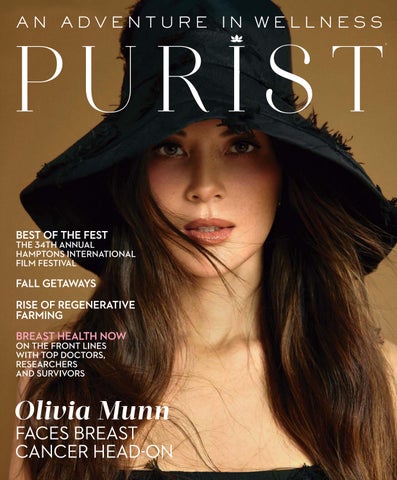
A N A D V E N T U R E IN W E L L N E S S ®
BEST OF THE FEST
THE 34TH ANNUAL HAMPTONS INTERNATIONAL FILM FESTIVAL
FALL GETAWAYS RISE OF REGENERATIVE FARMING BREAST HEALTH NOW ON THE FRONT LINES WITH TOP DOCTORS, RESEARCHERS AND SURVIVORS
Olivia Munn
FACES BREAST CANCER HEAD-ON
TRIA GIOVAN
BARNES COY ARCHITECTS 1936 Montauk Highway Bridgehampton, NY
BARNESCOY.COM
A New level of exclusivity for our guests,
First Forbes Four-Star Spa in the Dominican Republic
and still somehow, a well-kept secret.
The best. The most. The first.
The Spa Casa de Campo, has set a new precedent as the ultimate luxury wellness destination spa with cutting-edge technology and the first Forbes four-star spa ever to be built in the Dominican Republic. Guests will be able to experience an extensive and state-of-the-art hydrothermal circuit featuring expansive sauna & steam rooms, vitality & cold plunge pools, Laconium loungers, and an outdoor spa pool and oasis. With 12 lavishly appointed treatment rooms that offer an array of massage & facial therapies including an infra-red biodome room and a Binaural acoustic hands free treatment table. Discover more at casadecampo.com.do • res1@ccampo.com.do • 800-877-3643 • La Romana, Dominican Republic
2025
E D I TO R ’ S L E T T E R TIME AND TIDE
Me with my brood, Mario, Carolina and Bella
supine stillness, the ticking of my watch growing louder in the silence of my brain’s electrical outage. A now-frequent detour on the road back to their house is a long pause at the ocean in Southampton, a service station that has become my body’s biochemical booster. The thunderous surf’s impact splits water molecules apart, knocking electrons free to attach to the oxygen and newly created energizing ions that my whole body breathes in. Ah, the lure of it! I invite its bounty of minerals to absorb into my semi-permeable skin. Grounding in the sea, my soul hums a steady generator hum. I am ready to take on my father’s lawyerly opposing arguments, eager to succeed in getting him to stay in bed all night to avoid another fall. But this new soul-speak is lovely too. As I arrive with charged fortitude, my mother, in quiet shorthand, intimates, “There’s our girl of the water.”
As of late, I have become accustomed to a new language while caregiving my parents into their ninth decade of existence. Not the Italian they share with the nurse, but something that resembles the sound of clear-cut communication. This new role as caregiver of my cancer-riddled father has me arguing with his hubris on the benefits of allowing me to help him change into pajamas at bedtime. He is adamant not to succumb to the “plottings” of anyone other than me who tries to help. This language is externalized in jocundity too; his daily response to my greeting, “Hi, Daddy, Hi, Mommy” is “Who is that?” Admissions of appreciation are frequent: “Thank you, but why do you need to do this?” “Because you did it for me.” The soul expresses in nonverbal transmissions of affection too—moments of glad grace found in my parents’ handholding on the sofa, in bed, in the slowness in between. My senses are piqued by the content of their articulations—the thwack of the newspaper on the table after a completed crossword, the quiet rumbling of an afternoon nap, the glimmering joy in their eyes when my children visit. The sweet smell of baby powder that is familiar, a pleasant panacea on my shaking hands when on the phone with the ER doctor after one of their falls. It lingers on as I lay in my own bed in
@cristinacuomo @thepurist 6
From left: Courtesy of Cristina Cuomo, Noam Galai
My parents, Rainer and Regina
INTELLIGENT WATER FILTRATION SYSTEM
Raise your water standards.
Ninja HydraSense™ removes 80+ contaminants, delivering clean water for every refill, recipe, and ritual—because whole-home wellness starts here.
Do you know what’s in your water?
Enter your zip code and see what you could actually be drinking.
TKTK SLUG
EDITORIAL Founder + Editor Cristina Cuomo Executive Editor Ray Rogers Features Editor Jim Servin Associate Editor + Photo Editor Jenna Lebovits Editorial + Marketing Assistant Lauren Willett Senior Wellness + Beauty Editor Amely Greeven Beauty + Fitness Editor Beth Landman Wellness Editor Fernanda Niven Contributing Health Editors Dr. Jeffrey Morrison, The Morrison Center; Tapp Francke Ingolia, MS, CNS, Hamptons BioMed Copy Editor Michèle Filon Research Editor Jill Malter Contributing Food Editor Peter Som Special Project Editors Jenny Landey, TR Pescod Contributing Writers Lauren Aiyana, Lakeisha Allen, Isaac Boots, Heidi Brod, Donna Bulseco Camille Coy, Michaela Kennedy Cuomo, Dr. Gerry Curatola, Donna D’Cruz Simon Doonan, Dimitri Ehrlich, Melissa Errico, Pamela Fiori, Marisa Fox, Steve Garbarino Vivien Goldman, Linda Hayes, Dr. Terrie Hope, Nancy Kane, Dr. Frank Lipman Dr. Lea Lis, Ali Margo, Kevin Menard, Chris Mohr, Roxanna Namavar, David Nichtern Dr. Eunice Park, Dr. David Perlmutter, Annelise Peterson, Kelly Posner Gerstenhaber Michele Promaulayko, Dr. Christina Rahm, Lisa Roberts, Erica Schwartzberg Lavina Shamdasani, Biet Simkin, Jolene Star, Dr. Stacie J. Stephenson, Julia Szabo Valeria Talve, Abby Tegnelia, Shivani Vora, Rebecca Wallwork, Erin Walsh, Tess Weaver Regina Weinreich, Constance C.R. White, Sarah Wragge
DESIGN Contributing Design Director Ben Margherita Contributing Art Director Mikio Sakai Contributing Designer Seton Rossini Web Managers Tarin Keith, Aubrée Mercure Contributing Photographers Melanie Acevedo, Justin Bettman, Cass Bird, Bob and Dawn Davis, Gregg Delman Victor Demarchelier, Mikey DeTemple, Sophie Elgort, Francine Fleischer Marili Forestieri, Diana Frank, Sarah Krick, Kevin Lynch, Morgan Maassen Mary Ellen Matthews, Ryan Moore, Nino Muñoz, John Russo, Collier Schhorr Claiborne Swanson Frank, Simon Upton, Cathrine White, Rush Zimmerman
ADVERTISING Publisher Helen Cleland, helen@thePURISTonline.com Chief Revenue Officer Andrea Greeven Douzet, andrea@thePURISTonline.com Head of Partnerships Nicole Levy, nicole@thePURISTonline.com Executive Sales Directors Tova Bonem, Michelle Johnson, Teresa Sorkin Eden Williams, Rosalind Zukowski Luxury Art And Travel Partnerships Lisa Rosenberg Aspen Publisher Alexandra Halperin Aspen Media Consultant Cheryl Foerster
MARKETING Director of Marketing Ilene Frankel Audience Development Manager Celeste Hortet Events Director Carolyn Heft-Levinbook Events Manager Jen Brown Event Photographer Kristin Gray
8 8
Benjaminrobyn Jespersen Photo credit here.
OPERATIONS Chief Financial Officer Caryn Whitman Production Direction Digital Workflow Solutions Purist is distributed in New York City, the Hamptons, Aspen, Miami, Palm Beach, Los Angeles, and now in Chicago and Scottsdale. For advertising inquiries, please contact sales@thePURISTonline.com For editorial inquiries, please contact wellness@thePURISTonline.com For production inquiries, please contact production@thePURISTonline.com Follow us on Instagram @thePurist and Facebook.com/puristonline www.thePURISTonline.com
FLY BETTER
TABLE OF CONTENTS FEATURES 60 OLIVIA MUNN The Your Friends & Neighbors star talks about her breast cancer diagnosis, selfadvocacy, and returning to the screen after five surgeries. 66
STONE AND PETAL Artists Brendan Johnston and Katie Whipple open the doors to their Southampton studios.
70
BEST OF THE FEST
71
CINEMA CREATES COMMUNITY After 30 years in the audience, Bob Feinberg steps into the top role at HamptonsFilm.
72 11 PICKS FOR 11 DAYS Hamptons International Film Festival chief creative officer David Nugent shares must-see choices for this year’s festival. 74 THE DRUG IN OUR POCKET Filmmaker Anne Sundberg investigates the addictive pull of smartphones on young minds. 76 THE HIDDEN KINGDOM Director Josh Thompson explores the unseen world beneath our feet. 78
60
BOB BALABAN The longtime East End favorite and deadpan master of Christopher Guest comedies receives this year’s Lifetime Achievement Award at HIFF.
79 THE CONTENDER Anthony Ippolito on becoming Sly Stallone in the HIFF opening night selection, I Play Rocky
Olivia Munn
COVER AND THIS PAGE: PHOTOGRAPHY BY SARAH KRICK 10
HAT & OUTFIT BY GUCCI; JEWELRY BY 8 OTHER REASONS
HEALTH/BREAST CANCER AWARENESS 19
BREAST CANCER ALLIANCE As the nonprofit marks 30 years of funding breast cancer research, a look at the organization behind over $36 million in grants.
20 BEYOND THE TUMOR The Beljanski Foundation investigates how cells that survive treatment may hold clues to breast cancer’s return. 22
ASK THE DR. Dr. Elisa Port separates fact from fiction in breast health.
24 MODEL MOTHERS Olivia Boger turns fashion into a force for good, bringing hope and support to families impacted by breast cancer. 26
RESILIENCE IS POSSIBLE An excerpt from Beautifully Unbroken, Lisa F. Crites’ memoir on loss, breast cancer and cultivating fortitude
28 WHEN EVERYTHING LOOKED BRIGHT Valeria Talve on what she wishes she’d known about breast cancer risk, genetics and advocating for yourself
Monika Grabkowska
32 THE GIRL’S GUIDE TO GUTS Breaking the silence around bowel disease, the health issue 100 million women live with and few talk about
12
NEW ENGLAND'S #1 SPA RESORT by the Michelin Guide 2025 & 2026 This season, delight in award-winning wellness at Canyon Ranch Lenox. Our all-inclusive Berkshires resort offers world-class services and transformative experiences across health, fitness, spa, beauty, nutrition, mindfulness, and more — all in one place, for every kind of journey. CA N YON RA NCH.COM / LE NOX | 800.726.9900
WEEKEND 39
EDITOR’S PICKS Cristina Cuomo leans into fall’s rich brown hues.
40 THE NATURALS Mother-daughter duo June and Rochelle Jacobs bring generations of natural beauty wisdom to modern skincare. 41
PURE PICKS Alexa Cahill’s autumn favorites, from the lingerie she lives in to the beauty products she swears by
VIBRANT 47
55
FOOD IS MEDICINE 51
Escape to The Ranch Hudson Valley
33
ENERGY FORECAST Rev. Jolene Star’s fall spiritual insights
MINDFUL
35 IN GOOD COMPANY Vanessa Cornell weaves together female community, mindfulness and craft into a shared practice.
52 REGENERATIVE FARMING Welcome to the agrihood.
SPACE 43
46
HOT STUFF Spice up pizza night with Caulipower’s naturally glutenfree hot pepperoni pie.
NEW ALTITUDE At The Greenwich, impeccable design and restorative spaces meet 800-foot Manhattan views. WHERE HOSPITALITY MEETS ARCHITECTURE Mandarin Oriental Residences brings its storied hospitality to a new West Palm Beach address.
36 FREEDOM RIDE Strength coach Holly Rilinger’s riveting animal rescue mission 14
MINDFUL TRAVEL 55
TOP RESORTS AND RETREATS Purist ’s guide to the best getaways across the globe. Plus, an Adriatic reset.
PLAY 80
NUMEROLOGY A by-the-numbers look at Grammy winner Sheryl Crow
Courtesy of The Ranch Hudson Valley
HEALTH
LUXURY OR LONGEVITY? Dr. Stacie Stephenson on what really works for healthy aging
1. Hampton Bays Multi Family For Sale $2.95M | 0.8± Acre | 5 Separate Structures 4BR | 3 BA Main House | 4 Rental Units Well Maintained Grounds | Near Bay Beaches 127InletRd.com Anthony C. Cerio 516.456.2031 | tcerio@bhshamptons.com Mitchel L. Natter 516-318-5858 | mnatter@bhshamptons.com Jared Schiavoni 631-786-9353 | jschiavoni@bhshamptons.com
2. 2± Acre Oasis in Sagaponack $3.950M | 3,989± sf | 6 BR | 6.5 BA Pool | Hot Tub | Outdoor Shower Bonus Studio Apartment 111MerchantsPath.com Ani Antreasyan 917.701.8801 | aantreasyan@bhsusa.com
1
3. Southampton Village Beach House $3.250M | 0.49± Acre | 1,948± sf 3 BR | 2.5 BA | Gunite Pool Beautifully Landscaped for Privacy 770HillSt.com Jeanne Galante 203.984.0438 | jgalante@bhshamptons.com Elizabeth C. France 917.415.5411 | efrance@bhsusa.com
4. West Banks Gated Waterfront Community
2
3
$7.795M | 1.27± Acres | 5 BR | 5 Full | 2 Half BA Gated Waterfront Community | Private beach Westerly Sunsets | Deep Water Dock Heated Saltwater Gunite Infinity Pool with Pool House and Cabana 1FoxCrossing.com Korine M. Konzet 631.258.8577 | kkonzet@bhsusa.com
5. Quogue South Renovated Contemporary $3.895M | 1.0± Acres | 3,500± sf | 3 BR | 3 BA Recently Renovated | Heated Gunite Pool 1AcornPath.com Georgia K. Hatch 516.639.3263 | ghatch@bhshamptons.com Robert Hatch 516.639.3263 | rhatch@bhshamptons.com
6. A Rare Find In Springs $1.695M | 0.31± Acre | 2,700± sf | 4 BR | 3 BA Heated Salt-Water Pool | Hot Tub Finished Lower Level 70GardinersLane.com
5
6
Elizabeth A. Phenis 516.241.1188 | ephenis@bhshamptons.com Andrea L. Ackerman 516.356.0900 | aackerman@bhshamptons.com
Mastery of the Craft. It’s Timeless.
4
CO N T R I B U TO R S shared expert advice on breast health (page 22). WHAT IS THE BIGGEST MISCONCEPTION ABOUT BREAST CANCER? The biggest myth is that if you don’t have a family history, you are not at risk for developing breast cancer. 90 percent of women who develop breast cancer have no family history. So we are all at risk, and that underscores the importance of getting screened regardless of family history. Dr. Elisa Port is the chief of breast surgery for the Mount Sinai Health System. She is involved in clinical research, and is a trusted source for the media. She is also the author of the recent The Breast Advice: All You Need to Know About Breast Health, Screening, and Treatment.
VALERIA TALVE, who sat with her two doctors for a candid conversation about her breast cancer journey (page 28). WHAT DOES SURVIVORSHIP MEAN TO YOU? Survivorship has taught me that time and energy are precious. I try to start every day with gratitude, live authentically, protect my peace, and spend time on the people and things that truly matter. Most importantly, it has given me a deeper sense of compassion and purpose— to use what I’ve been through to make the road easier for someone else. Valeria Talve is a community builder, breast cancer advocate, founder of The Fitizens and creator of Baila With Val. Through movement, meaningful connection and philanthropy, she has turned her own experience with breast cancer into a mission to help young women feel supported, connected and less alone.
RUSH ZIMMERMAN, who photographed artists Katie Whipple and Brendan Johnston (page 66). WHICH PHOTOGRAPHERS HAVE INFLUENCED YOUR WORK? Developing my own style has always been really important. I spent probably the first 10 to 12 years of shooting just focused on myself before allowing others’ work to inspire me. Once I did, it really helped me expand myself in ways I couldn’t otherwise. The artists who inspire me most are Sally Mann, Herb Ritts, Annie Leibovitz and Slim Aarons. Originally from Detroit, Rush Zimmerman is a lifestyle, family and fine-art photographer known for her authentic style and evocative black-and-white photographs.
SARAH KRICK, who photographed cover star Olivia Munn (page 60).
HOW DO YOU APPROACH STORYTELLING AS A PHOTOGRAPHER? Through intentional moments, beautiful lighting and imagery that feels both effortless and cinematic. Sarah Krick is a fashion photographer based in Los Angeles who loves creating portraits that feel effortless and elevated. She is drawn to natural lighting, strong narratives, and the energy that emerges when everything comes together on set. 16
Clockwise from top left: Stephanie Mann, Walter Savage, Courtesy of Sarah Krick, Courtesy of Rush Zimmerman
DR. ELISA PORT, who
INSURE
YOUR WORLD
Photography & Architecture by: Bates Masi + Architects
Let us protect your world… so you can enjoy it. At Amaden Gay, we’ve been insuring fine homes in the Hamptons, and across the U.S., for over 100 years. From homeowner and flood, to auto, valuable collections, and umbrella, our agency can customize a solution to protect your family. We deliver the highest level of expertise and personalized service – including an excellent claims team when you need it.
LOCAL, NATIONAL AND INTERNATIONAL INSURANCE
631.324.0041
AMADENGAY.COM
Insuring Your World Since 1890
H E A LT H
A true wellness warrior, Olivia Munn proudly shows her mastectomy scars in a Skims campaign. 18
Vanessa Beecroft
“In the middle of this latest Skims campaign shoot, I decided I was done being insecure about my mastectomy scars. Every mark life has left behind on my body is proof of how hard I fought. I hope other women who have been self-conscious about their scars see these photos and feel all the love I’m sending.” —Olivia Munn
H E A LT H / B R E A S T CA N C E R AWA R E N E S S
BEYOND THE CURE
Photo credit here.
Eugene Golovesov, Insets courtesy of Breast Cancer Alliance
Breast Cancer Alliance faces the disease with grit and perseverance, funding breakthrough research, improving access to lifesaving care and investing in the next generation of surgeons. BY JENNA LEBOVITS
Thirty years ago, five friends sat around a kitchen table in Greenwich, Connecticut, with a burning question: How could they help their friend battling breast cancer? From their conversation came Breast Cancer Alliance, a nonprofit that has since awarded more than $40 million in grants funding innovative breast cancer research, surgical training and low- or no-cost screening and diagnostics. Today, it’s a small but very mighty team of three paid employees and an equally passionate board of volunteers. For BCA president Lori Kron, the mission is as personal as it gets. “I got involved with BCA as the daughter of a survivor, and loved the community,” she says. “I loved everything about what they were doing and became a board member. Then I was diagnosed through regular mammograms. I had DCIS [ductal carcinoma in situ], or stage zero breast cancer.” After a double mastectomy and thinking the cancer was behind her, an unrelated heart test 16 months later revealed enlarged lymph nodes, a sign the cancer was back. She underwent two more surgeries, chemotherapy and radiation, all while serving on BCA’s board and eventually as president. “This was my rock,” says Kron. “I used everything—our medical advisory doctors, anything I could— from the resources that we have.” Through its funding—of which it commits more than $1.4 million annually—BCA supports nearly every stage of the breast cancer journey: breakthrough research, surgical training and accessible screenings.
Lori Kron
Michael Kors at BCA’s 29th Annual Luncheon and Fashion Show
Catherine Davis, of BCA’s Models of Inspiration
It helps close some o of the e gaps that exist between a promising new idea and the early results often needed to pursue federal grants. “These are the people who are going to change 19
the course of cancer treatment,” says Kron. It’s also currently the only nonprofit to fund breast surgical oncology fellowships which support an additional year of specialized training. The organization also helps underserved and underinsured patients receive free or low-cost mammograms and follow-up diagnostics, with programs like Hartford Hospital’s “Take the Time” Mobile Mammography Van, a BCA grantee, bringing screenings directly into communities. “I had a mammogram one day, the next day I had a biopsy, and then quickly had my diagnosis,” recalls Kron. “We want everyone to have that.” As BCA celebrates its 30th anniversary, its three decades of direct impact and tight-knit community will take center stage at its 30th Annual Breast Cancer Alliance Luncheon and Fashion Show in Westchester County on October 22. This year’s soirée will honor actor, breast cancer advocate and Purist cover star Olivia Munn, whose own public story has brought greater awareness to risk assessment— which can be calculated with a free, five-minute online test, Kron notes— and early detection. “We’ve accomplished so much in our first 30 years, but there’s still much more to do,” says Kron. “I hope we can f fund even more early-stage research, i invest in the next generation of fellows, e expand access to screening and early d detection, and continue to support those impacted.” Learn more at breastcanceralliance. org and calculate your potential risk at magview.com/ibis-risk-calculator
H E A LT H / B R E A S T CA N C E R AWA R E N E S S
BEYOND THE TUMOR
which has been submitted to what Chen describes as a high-impact scientific journal and is currently under review. Peer-review timelines vary widely, she notes, making it hard to predict when a decision might come. According to Chen’s data, some of the botanicals may kill cancer stem cells outright, others may push them to “grow up,” as she puts it, differentiating into more mature cells that respond better to conventional treatment, and still others may work by changing the tumor’s microenvironment or modulating the body’s broader response. “If we can encourage them to differentiate, they may become easier to eliminate,” she says. Asked what tends to get lost when research like this moves from a lab paper into public conversation, Chen says: “The most important distinction is that promising laboratory results are not the same as proving that something treats cancer in people. Our results provide evidence that these botanical formulations can affect breast cancer stem cells in experimental models, but they should not be interpreted as evidence that taking these botanicals or supplements will prevent or treat breast cancer in patients.” Sylvie Beljanski, founder and president of the Beljanski Foundation, makes a similar point from the philanthropic side, framing it as a question of what integrative medicine is for: “Not as a replacement for surgery, chemotherapy, radiation, hormonal or targeted therapies, but in rigorously investigating complementary approaches that might address unanswered questions. We owe patients both hope and scientific rigor.” The breast cancer study was already fully funded by the time the foundation held its Hamptons Sweat Fest fundraiser this past summer; the event instead built support for the next chapter, prostate cancer stem cells, following a progression that has already carried this work from ovarian to pancreatic to breast cancer. “We have the scientific question,” Beljanski says. “We have the foundation of previous research. Now we need to fund the study that can provide the answer.” beljanski.org
Recurrence is the fear that lingers long after breast cancer treatment ends, often longer than memories of the treatment itself. Breast cancer remains the most commonly diagnosed cancer among American women after skin cancer, and for all the progress made in treating it, that fear hasn’t gone away. A new body of research, funded by the Beljanski Foundation and led by Qi Sylvie Beljanski Chen, PhD, at the University of Kansas Medical Center, is trying to address it at the cellular level, by targeting the specific cells thought to be responsible for cancer coming back. “Not all the cancer cells in a tumor bulk are the same,” Chen explains. Cancer stem cells are a small subset capable of both reproducing themselves and generating new tumor cells. “You can think of them as the ‘seeds’ of a tumor,” she says. “They are often more resistant to chemotherapy and other treatments than the bulk of cancer cells. If they survive treatment, they can potentially regenerate the tumor.” The Beljanski Foundation, having already funded published studies on the botanicals pao pereira and Rauwolfia vomitoria in ovarian and pancreatic cancer stem cells, turned to breast cancer next. Chen’s team tested those two extracts alongside a specific green tea extract and a Ginkgo biloba golden leaf extract, individually and in combination. The most striking result came from a mouse model of triple-negative breast cancer: about 30 percent of untreated mice developed metastatic lesions, while none of the treated mice did. It’s a number that invites more excitement than the research, at this stage, can support. The mice used had compromised immune systems, necessary for the human cancer cells to take hold and form testable tumors, and the tumors were inoculated rather than naturally occurring. “This is encouraging, but the results need to be further validated,” Chen says. “Carefully designed clinical trials would be required to determine whether a similar benefit occurs in people.” The findings are now written up in a manuscript, 20
Aaron Burden, Inset courtesy of The Beljanski Foundation
Inside the research the Beljanski Foundation is funding to target cancer’s hardest-to-kill cells.
Take Charge of Your Breast Health Early detection is the best prevention.
Dr. Edna Kapenhas pictured above.
At Stony Brook Southampton Hospital’s Ellen Hermanson Breast Center, we offer a wide spectrum of breast health services including:
• 3D mammography, high resolution breast ultrasound and MRI • Genetic testing for high-risk patients • Biopsies and breast surgery • Post-treatment care and support
The Ellen Hermanson Breast Center is proud to be designated as a Breast Imaging Center of Excellence by the American College of Radiology.
SCAN THE QR CODE
SCHEDULE AN APPOINTMENT Call (631) 396-6400 LOCATIONS East Hampton | Hampton Bays | Southampton TO LEARN MORE Visit stonybrook.info/southampton-breast-center
Ellen Hermanson Breast Center SBM2608 1801
H E A LT H / B R E A S T CA N C E R AWA R E N E S S
ASK THE DR.
Mount Sinai’s chief of breast surgery, Dr. Elisa Port, talks hormone therapy, full-body scans and the questions patients are too afraid to ask—timed to her latest book, The Breast Advice. BY CRISTINA CUOMO
PURIST: What lifestyle factors can reduce breast cancer risk? Does birth control? DR. ELISA PORT: The two main lifestyle factors that can decrease breast cancer risk are maintaining a healthy body weight and minimizing or eliminating alcohol intake. Long-term use of hormonally based birth control does increase breast cancer risk. The increased risk is quite small, but it does have an effect, and the longer one is on birth control medication, the higher the risk.
How do you assess your own risk? Risk assessment involves knowing your own risk factors. These can involve genetic predisposition, family history and many other factors. Getting Dr. Port genetic testing is one way to find out if you are at very high susceptibility. Another is to use a breast cancer risk calculator, an online tool, to assess ballpark risk. Importantly, these risk models can both overestimate and underestimate risk, and I have had patients come into my office with printouts of risk estimates that they did themselves or their doctors did with them, that are not reproducible. When I run their model, the numbers are completely off. This can result from family history factors that are inaccurately entered into the model that either overestimate or underestimate risk, or lack of understanding about prior biopsies one might have had, and the results from those biopsies. High risk for breast cancer is defined as 20 percent or higher. The average woman’s risk is 10 to 12 percent.
When should you do a screening? Screening should be individualized, and should be based on risk for breast cancer, with those at increased risk perhaps starting earlier and getting more than just a mammogram. The general guideline for those at average risk is to start mammograms at age 40 and continue yearly after that. We often recommend adding sonograms or ultrasounds for those with dense breasts, which can make cancer harder to detect on a mammogram—in the 40- to 50-year-old age group, almost 50 percent of women may have dense breasts. We may also add MRIs to a woman’s screening regimen if her risk is significant. The book has chapters on each of these—mammogram, sonogram, MRI—which can help a woman navigate and determine when she might want to
What about hormone replacement therapy? What happened there, and did it set breast cancer rates back? Hormone replacement therapy (HRT) is a critically important tool for women suffering from menopausal symptoms. The usual regimen is a mixture of estrogen and progesterone. But here’s the tricky part: that combination does increase the risk of breast cancer. The increased risk is quite small, a percentage point or two, but it does grow further over the amount of time and number of years that one is taking it. Estrogen alone, also called unopposed estrogen, does not increase the risk of breast cancer; however, it does increase the risk of uterine cancer, and is therefore rarely prescribed by itself. Most important here is an individualized approach. Women who have not been diagnosed with breast cancer are candidates for HRT to 22
Courtesy of Dr. Elisa Port
do these tests, how frequently, when to start early and how to assess risk. When it comes to screening, there is no one-size-fits-all, and it’s important for women to know what tests they should be getting for screening, and how to advocate for themselves.
Dr. Elisa Port has spent over 25 years operating on breast cancer, and just as long fielding the questions patients ask in the exam room but rarely hear answered in full. Her latest book, The Breast Advice: All You Need to Know About Breast Health, Screening, and Treatment, is her attempt to close that gap—a plainspoken guide to risk, screening and treatment, built on the real cases she’s managed as Mount Sinai’s chief of breast surgery. Purist sat down with Port to work through some of the book’s thorniest chapters: birth control and cancer risk, the murky math on full-body scans, and why she tells patients to be just as skeptical of holistic cures as they are of anything a pharma rep hands them.
H E A LT H / B R E A S T CA N C E R AWA R E N E S S
every test. In a very small percentage of cases, a new cancer will be discovered that might be lifesaving because of early detection. Of course, we all hear these stories, which are so profound and get a lot of attention. Here are the facts: The likelihood that a full body scan will pick up a cancer in an otherwise asymptomatic person is approximately 1 percent. That’s the benefit. The downsides are the expense—a few thousand dollars, an amount many can ill afford—and the high number of false positives. These scans do find things other than cancer, and when we’re not sure what those findings are, which is often, we have to do additional tests, and even invasive biopsies or surgery, to find out if we’re dealing with cancer. Even when no biopsy is recommended and “follow up in three months” is the plan, the anxiety and uncertainty during that time can be unbearable for some people. Lastly, please know that a full body scan doesn’t in any way replace standard, tried-and-true screening tests. A mammogram is far better and more detailed at picking up breast cancer, and a colonoscopy is far better for early colon cancer detection. The book chapter on this, as well as on liquid biopsies and other blood-test screenings, describes all of the pluses and minuses if you decide to go down this path and explore these newer options.
combat menopausal symptoms, and even with the increased risk for breast cancer, a woman can consider it, weighing the risks and benefits to her as an individual. What we can’t do is tell women there is no added risk. The book goes through all of these options related to hormone replacement and how to navigate them. So much has changed. One chapter is called “Chemotherapy”—what does science and intuition tell you about that? How is the medical system working to individualize treatment and scale it down? The theme of de-escalation—trying to dial down treatment and spare people its toxicities—plays prominently in the type of care we give today for breast cancer. We have better tools than ever before to understand who does and does not need chemotherapy, and who does and does not benefit. This is a huge advancement: sparing women the toxicities of a treatment they wouldn’t even benefit from, while making sure that women who do need it, get it. The same goes for radiation and surgery—there are so many ways we’ve figured out how to safely scale back. These efforts are all backed by serious, rigorous research trials conducted over the last decades, thanks to dedicated researchers, doctors and patients. Everyone thinks there is a financial incentive to treat cancer. What do we need to know about what oncologists are trying to do with research, surgery, etc.? Critically important to getting the best cancer care is making sure that a doctor—any doctor—is not financially incentivized to advise for more or less treatment: a double mastectomy instead of a smaller lumpectomy, chemotherapy versus no chemotherapy, and recommendations for or against radiation are all examples of ways doctors can be pushed toward more aggressive treatment than what might be needed. Doctors employed at most major academic medical centers, like myself and my colleagues, do not have any financial incentive to give more or less treatment, or perform more or less aggressive surgery.
Let’s talk about a holistic path to treatment. Ivermectin, does it work? Lidocaine trials—is there any data and science out there? When it comes to “holistic” or alternative therapies, be as skeptical about them as you are about mainstream treatments. Many people turn to alternative therapies out of fear of side effects, but supplements, vitamins and any substance that’s biologically active will have side effects too. Nothing is all good and no bad, whether you ingest it, inject it, or apply it as a cream that gets absorbed. So my advice is to ask whoever is recommending it—a doctor, a friend, a colleague—“What are the side effects?” If the answer is “none,” or you get a blank stare, walk away. It means the thing they’re selling probably hasn’t been adequately studied, trialed or evaluated to fully understand what you’re getting and not getting, and the harms and side effects that may come with it. The Breast Advice: All You Need to Know About Breast Health, Screening, and Treatment is published by HarperOne, an imprint of HarperCollinsPublishers.
There’s a chapter about full body screening. One patient says it saved her life, and another says don’t do it, it almost ended her life—talk about that. Full body scanning is a new area of cancer screening that has taken hold. There are pluses and minuses, as with 23
H E A LT H / B R E A S T CA N C E R AWA R E N E S S
MODEL MOTHERS
Olivia Boger 24
When Olivia Boger lost her mother, Cande, to breast cancer in 2001, the then-20year-old educator wanted to honor the woman who spent her final decade protecting her family’s sense of normalcy. Diagnosed when Boger was 10, Cande chose not to tell her children she was sick, believing it would spare them from losing their carefree childhood. A few years after her mother’s passing, Boger gathered 10 women from her hometown in Concord, Massachusetts—all of whom had been impacted by breast cancer, one having lost her mother and the others having been in treatment—to model in a fashion show directly benefiting children whose parents died of cancer. From the start, Cande’s colorful spirit shaped the design of the runway shows. “She was the most fun and wonderful dance-in-the-kitchen kind of mom,” recalls Boger. “So it had to be upbeat. I didn’t want it to be sad.” What Boger expected to be a small, one-off event has since grown, over nearly two decades, into a nationwide celebration of support, strength and survivorship with its Boston, New York and Southern California runway shows. The nonprofit also provides family grants, from $10,000 to $30,000, for those affected by breast cancer, to help cover everyday costs like groceries, childcare, counseling and extracurricular activities. “Our greatest hope is that the funding can create consistency and normalcy for the children,” says Boger. “We know we can’t take away a metastatic diagnosis, we can’t bring back a mother, but we can show up for the family and lift some of the financial stressors that come with cancer.” Learn more and apply to model at runwayforrecovery.org.
Darielle Rose/The Awakened Creative
Olivia Boger, founder and executive director of Runway for Recovery, channels a passion for fashion into helping families impacted by breast cancer. BY JENNA LEBOVITS
WE WE
LEAD WITH HOW OW O W Opened Fall 2026
FUTURE-FOCUSED ACADEMICS
COLLEGE PREPARATION
WELL-ROUNDED EXPERIENCE
40+ AP & post-AP college-level classes & a newly opened Dr. Kristen Walsh Hall of Science & Entrepreneurship featuring a Bloomberg Financial Terminals Lab
College counseling beginning in Grade 9 that prepares students for entry to UPenn, Vanderbilt, Cornell, Brown & Georgetown
Robust after-school offerings, including theater, athletics & clubs
Open Houses Saturday, Oct. 3 10:00 a.m.
SRDS is one of few high schools in the U.S. to partner with Columbia University’s research department, allowing students to work directly with Columbia professors on real, impactful research and projects.
Tuesday, Oct. 27 6:00 p.m.
Information Session & Tour Wednesday, Nov. 18 9:00 a.m.
Pre-K 3 to Grade 12 Saddle River, NJ
SADDLERIVERDAY.ORG/TODAY
Transportation available from Manhattan’s Upper West Side
H E A LT H / B R E A S T CA N C E R AWA R E N E S S
RESILIENCE IS POSSIBLE
In her moving, bestselling new memoir, Beautifully Unbroken, award-winning entrepreneur Lisa F. Crites details her harrowing journey through a breast cancer diagnosis that led to a bilateral mastectomy. In this selection, she shines a light on the mental and emotional challenges that breast cancer patients and survivors face, and offers powerful words of hope. left. Chronic fear, grief, and trying to rebuild a sense of normalcy after my mother’s death and my divorce were powerful fuel. Even now, 15 years later, I still feel moments of FEAR—False Emotions Appearing Real—when I think about the original diagnosis, the months of treatment, the infections and the ongoing uncertainty surrounding my reconstruction. Survivors often struggle with anxiety, depression, avoidance, diminished self-esteem, body image issues and even survivor’s guilt. Fatigue, sleep disturbances and changes in identity or sexuality are also common. Add in the cognitive effects of chemotherapy, mental fog, memory lapses and slower thinking, and it becomes clear that the psychological impact can be just as significant as the physical one. But here’s the truth: Resilience is possible. Life is about how we adapt, how we recover and how we grow. Like a rubber band that stretches but does not break, or a tree that bends in the wind but remains rooted, resilience is not about avoiding pain. It is about developing the strength to move through it. Practices like gratitude, mindfulness and therapy can make a meaningful difference. It has taken me years, but I have found healthier ways to manage my emotions. When anxiety creeps in about future health complications, I talk myself through it. “Lisa, take the emotion out of this. Focus on the facts. You are healthy today. You have no infection today. You are strong and resilient. If complications arise, you will find the best of care.” On days when fear or PTSD begins to surface, I remind myself: I live by a personal acronym, CARGO: Courage. Authenticity. Resilience. Gratitude. Originality. That framework keeps me grounded and moving forward. Excerpt from Beautifully Unbroken by Lisa F. Crites © 2026. Reprinted with permission. Available on Amazon and wherever books are sold.
As a former health and medical television reporter, and now a medical print columnist, I’ve interviewed hundreds of people with chronic or terminal illnesses. I’ve learned how to pull raw, unfiltered emotion from patients so readers can truly feel their journey. And no matter the story, my last question was always the same: “What’s the one message you want our viewers to take away?” Now, as I relive so much of my own breast cancer experience while writing Beautifully Unbroken, I ask myself that same question: “What is it that I want my readers to take from this book?” Here’s what I want you to know: Breast cancer does not only effect physical change but can also effect psychological change. There’s life before a breast cancer diagnosis, and life after. And let me tell you, before and after are as different as black and white, night and day. It’s like watching the rain from inside your house versus standing in it. Inside, you stay dry. Outside, you are soaked. And after a breast cancer diagnosis, you are drenched. Soaked with fragility, sorrow, fear and trauma. “You have breast cancer.” Those words changed my life at 41 years of age, just like they do for hundreds of thousands of women every year. That’s why I want to focus on the before and after of the disease and its psychological impact. I often wonder if my mother’s death, my father’s lack of paternal empathy after her passing, and my divorce a few years later all contributed to my diagnosis. According to UT MD Anderson Cancer Center, chronic stress has a profound effect on how your body’s systems function. Adrenaline and cortisol, the fight-or-flight hormones, can create an environment where cancer cells are more likely to thrive. In hindsight, I believe that’s what happened to me. My body was under so much emotional and psychological strain that it created the conditions for a tumor to form in my right breast and possibly set the stage for cancer in my 26
Courtesy of Lisa F. Crites
Lisa F. Crites
Move Well, Live Better.
Alexander Mignogna
Richard Steinberg
Charles Beda
Licensed Real Estate Agent 410.456.8875 | amignogna@compass.com therichardsteinbergteam.com
Licensed Associate Real Estate Broker 917.676.0150 | rsteinberg@compass.com therichardsteinbergteam.com
Licensed Associate Real Estate Agent 347.804.3217 | charlesbeda@compass.com therichardsteinbergteam.com
The Richard Steinberg is a team of real estate licensees affiliated with Compass. Compass is a licensed real estate broker and abides by Equal Housing Opportunity laws.
H E A LT H / B R E A S T CA N C E R AWA R E N E S S
WHEN EVERYTHING LOOKED BRIGHT Two of the physicians who have been central to that journey are my breast surgeon, Dr. Lisa Newman, and my medical oncologist, Dr. Tessa Cigler. They have cared for me through different chapters of my experience, and together they represent something I have come to understand deeply: Breast cancer care isn’t one moment, one surgery or one doctor. It is a continuum. It is science and surgery, genetics and prevention, treatment and survivorship— but it is also about the woman living through all of it. Today, I can teach a workout class, raise my boys, build community, laugh with friends and look healthy on the outside while still being a patient. Treatment remains part of my life. So does the awareness that comes with having experienced cancer at such a young age. That is why I wanted to have this conversation. There was so much I didn’t know until suddenly I had to know it. What does breast cancer risk look like for younger women? When should we think about genetic testing beyond BRCA? What does lymph node involvement really mean? Why doesn’t treatment necessarily end after surgery? And how do we continue living fully while treatment and surveillance remain part of our lives? Newman and Cigler approach these questions from two distinct but complementary perspectives: Newman through younger women and risk, hereditary breast cancer, genetic testing and surgical care; and Cigler through ongoing treatment, recurrence-risk reduction, quality of life, survivorship and movement.
At 33, breast cancer was nowhere on my radar. I was young, healthy, active and a mother of two young boys. I had just started teaching my own workout class, something that brought me so much joy and made me feel strong and connected to my body. The Fitizens, the community I had created out East, was growing into this vibrant village of women centered around movement, wellness and genuine connection. Life felt full. Things were looking bright. And then, in June 2024, everything changed. On June 14, I went for a mammogram and sonogram. Three days later, I had a biopsy. On June 21, I was diagnosed with breast cancer. Within weeks, I went from teaching movement and raising my boys to learning an Valeria Talve entirely new language: invasive ductal carcinoma, estrogen receptors, HER2, chemotherapy, genetics, lymph nodes, radiation and recurrence risk. Genetic testing revealed that I carry a PALB2 mutation. Before my diagnosis, I knew about BRCA1 and BRCA2 (an abbreviation for BReast CAncer genes 1 and 2), but I had never even heard of PALB2. Suddenly, genetics wasn’t an abstract conversation about family history. It was my life, my treatment and something that could have implications for my family. I started chemotherapy in July 2024 and underwent a double mastectomy that November. During surgery, we learned that five of the 21 lymph nodes removed contained cancer. What I had once imagined might end with surgery became a much longer journey—radiation, reconstruction and continued treatment and surveillance. 28
Courtesy of The Fitizens
A breast cancer diagnosis at 33 sent Valeria Talve down a path she never expected. Here, she turns to her breast surgeon and medical oncologist for the answers she wishes she’d had sooner. BY VALERIA TALVE
H E A LT H / B R E A S T CA N C E R AWA R E N E S S
Most importantly, advocate for yourself. I never imagined I would need to know any of this at 33. But if sharing what I have learned—alongside the expertise of the doctors who have helped guide me through it— encourages even one woman to ask a question earlier, pay closer attention to her body or better understand her own risk, then telling my story has purpose.
My hope in sharing my story is not to create fear. It is to create awareness. Know your body. Know your family history. Get the screenings that are appropriate for you. Ask questions. If something doesn’t feel right, speak up. And understand that genetic risk extends beyond the genes we hear about most often.
BREAST CANCER, GENETICS AND WHAT WOMEN NEED TO KNOW EARLIER
Maria Lavezzo
Valeria Talve in conversation with Dr. Lisa Newman and Dr. Tessa Cigler VALERIA TALVE: I was diagnosed at 33 and felt completely healthy. What do you want younger women to understand about breast cancer risk? DR. LISA NEWMAN: For reasons we do not yet understand, breast cancer incidence is rising in young women. We do not typically initiate screening mammography until women reach age 40, so it’s extremely important for younger women to be aware of the potential danger signs of breast cancer—a new lump in the breast, a new lump in the underarm, bloody nipple discharge, or changes in the skin appearance of the breast such as swelling, redness or a rash, especially a rash near the nipple. All of these symptoms can also be caused by benign, noncancerous problems, so women shouldn’t panic if they develop—but they should prompt a woman to seek medical attention promptly. For women old enough to undergo routine mammography screening, it’s important to remember that mammograms aren’t perfect, so any danger signs still need to be evaluated by a breast specialist even if the mammogram is normal. Before my diagnosis, I knew about BRCA but had never heard of PALB2.
roid cancer, in addition to breast and ovarian cancer. It’s helpful for women to know their complete family history across a variety of cancers, since that history can influence the type and extent of genetic testing recommended, and whether a woman is a candidate for supplemental or enhanced breast cancer screening—starting mammograms at a younger age, whole-breast ultrasound and/or breast MRI. Developing breast cancer at a young age is itself a hallmark of hereditary susceptibility, and any premenopausal woman with a new diagnosis of breast cancer should automatically be referred for genetic testing. Valeria Talve, Dr. Lisa Newman and Brooke Korine at the Pretty With Purpose launch
What should women understand about hereditary breast cancer beyond BRCA? LN: Genetic testing for inherited predisposition to breast cancer has advanced dramatically since the BRCA genes were first sequenced more than 20 years ago. We can now test for hereditary syndromes associated with colon cancer, melanoma and even thy29
During my double mastectomy, five of the 21 lymph nodes removed contained cancer. What does lymph node involvement tell you about a breast cancer diagnosis? LN: For any breast cancer, regardless of its size or microscopic pattern, the cancer cells we worry about most are the ones that have likely already escaped the breast before diagnosis, traveling directly into the bloodstream. From there they can reach other organs—the liver, lungs, bones. These microscopic cells are too small to cause symptoms and are invisible on tests
H E A LT H / B R E A S T CA N C E R AWA R E N E S S
When treating a young woman surgically, how do you account for her life beyond the operating room— including reconstruction, body image and long-term physical function? LN: It’s critical to account for every priority and perspective of each individual woman diagnosed with breast cancer, and these issues are especially complex in a young woman. Some are rooted in body image, others relate to breast function for nursing after pregnancy following treatment; still others come down to a woman’s willingness to commit to lifelong intensive imaging and surveillance versus a more extensive surgery, like bilateral mastectomy, to lower her odds of facing another diagnosis. It’s not easy to sort through these perspectives, but fortunately, women don’t need to decide immediately after a diagnosis. We don’t want to see treatment delayed beyond four to six weeks, but taking time to gather information about the best plan isn’t dangerous. VALERIA TALVE: Dr. Cigler, I thought my double mastectomy would be the
oncologist is to help manage these side effects. And better therapies are increasingly available. For example, just recently we have two drugs approved specifically for hot flashes, and we are supporting GLP-1 inhibitors for weight gain associated with therapy.
Talve and Dr. Cigler
finish line, but my care continued long after surgery. Why is breast cancer treatment often a continuum of care? DR. TESSA CIGLER: The management of early-stage breast cancer is a multidisciplinary process, including care by surgeons, radiation oncologists and medical oncologists. Surgery and radiation work to eliminate the visible cancer, and medical oncologists prescribe systemic therapy to reduce the chances that the breast cancer will return. Systemic therapy options can include chemotherapy, immunotherapy, antibody therapy and antiestrogen therapy, and the recommended program depends on the details of the cancer. For younger women who may remain on treatment for years, how do you balance reducing recurrence risk with quality of life? TC: Breast cancer treatment is highly individualized, taking into account the specific characteristics of each woman’s tumor as well as her overall health. And, of course, the benefits of each therapy are carefully weighed against side effects. For the two-thirds of breast cancers that are estrogen receptor positive, antiestrogen therapy taken for up to 10 years is highly effective. Side effects can include weight gain, joint pains, altered libido, decrease in bone density and vaginal dryness. As you can imagine, many of these side effects are particularly difficult for young women. A big part of my job as a medical 30
How do you help women live fully while ongoing treatment and surveillance remain part of their lives? TC: Breast cancer treatment can last for many years. One of the greatest challenges for women following a diagnosis of breast cancer is learning to live fully despite ongoing treatment. And it sometimes takes a village! In addition to symptom management by medical oncology, I often refer patients for physical therapy, acupuncture and other complementary therapies, nutrition counseling, weight management and social work support. What do you wish people understood about women who may look healthy again, but are still managing treatment and its effects? TC: For women with early-stage breast cancer, medical therapy is preventive, designed to reduce the risk of breast cancer recurrence and to keep them healthy. These prevention therapies, though, can have many side effects. Movement has been one of the ways I’ve found my way back to my body. What role can exercise and lifestyle realistically play during treatment and survivorship? TC: Exercise, a heart-healthy diet, maintaining a good weight and limiting alcohol intake have welldocumented benefits for many health issues, including breast cancer risk. While these lifestyle choices can’t replace the benefits of medical therapy, which provides the bulk of the breast cancer risk reduction, I strongly encourage them in addition to therapy to optimize overall health.
Courtesy of Valeria Talve
like CT or even PET-CT scans, but left untreated, they’re what can eventually progress into metastatic breast cancer—cancer that has formed lumps visible on imaging. Fortunately, we now have effective medical treatments that can eliminate those microscopic cells before they get the chance. Providing the optimal treatment for each individual patient is essential. The original biopsy characteristics—estrogen receptor, progesterone receptor, HER2/neu—provide important clues about which medical therapies will work, but lymph node involvement adds more: Its presence and extent often shape the chemotherapy regimen, and help determine how much lymph node surgery or radiation is needed to minimize the risk of the cancer recurring in the underarm or chest wall.
UTI BIOME SHIELD
H E A LT H
GUT FEELING
Journalist Chloe Melas talks about her new book, The Girl’s Guide to Guts, co-written with Judy Batalion, and why she decided to put a face on ulcerative colitis, a disease millions of women live with—and rarely talk about. Melas goes deep sharing personal experiences, from diagnosis and flares to dating, parenting, and building a career around a chronic illness. BY CRISTINA CUOMO
from a bathroom. Just this week, I had to cancel a lunch meeting and make it a Zoom because I wasn’t feeling well. It makes me sad, but at the same time, it’s incredible to have turned this darkness into purpose. I somehow haven’t let it stop me from traveling the world and pursuing my dream job, and I hope this book gives someone the confidence to get out of bed when they’re feeling like they can’t.
PURIST: This is such an important topic. Tell us why you decided to write this book. CHLOE MELAS: A few years ago, I remember doing a Google search and being shocked to see that there aren’t many women with a platform who are outspoken about living with inflammatory bowel disease (IBD). Sure, #hotgirlshaveIBS trended on TikTok last year, but where are the women who are pursuing big careers and raising families who have been suffering like me? I decided, along with my friend Judy, that we might as well be the ones to put a face on this disease, in hopes of building community and helping women feel less alone.
You also discuss IBS, colon cancer and celiac disease in the book. Why broaden the focus? The prevalence of IBS, colon cancer and celiac disease are all on the rise, and we wanted to reach a larger audience. Experts estimate that about 4 million people live with IBD in the United States, but up to 45 million Americans live with IBS (irritable bowel syndrome)—that’s a huge percentage of the population, and most of these conditions are underdiagnosed. We wanted to educate women on the signs and symptoms because a lot of times, we tend to dismiss them or self-diagnose. Hopefully someone sees themselves or a loved one in these pages and schedules an appointment with a gastroenterologist.
These are some very personal stories, but you also did a lot of research. What surprised you most while writing this over the past three years? Since we started writing, the statistics have continued to grow and become staggering. Colorectal cancer is now the No. 1 cancer killer of men and women under 50. Living with IBD increases risk of developing colon cancer, and for me, this book is a call to action: We need to start speaking about gut health just like we’ve normalized the conversation around heart health, breast cancer and perimenopause.
What do you hope to achieve with the book? I hope that once November 10 arrives and the book is out in the world, anyone who has felt defeated by these conditions sees hope. As they say, it’s always darkest before the dawn. The Girl’s Guide to Guts: Everything Your Doc Didn’t Tell You (But Your Bestie Would), by Chloe Melas and Judy Batalion, is out Nov. 10 from Random House.
What has it been like raising kids and pursuing a career while also battling a chronic illness? Raising kids while living with this invisible disease has stolen a lot of joyful moments. It loomed large over my wedding day—I barely ate anything, worried that I might trigger what’s known as a flare. I’ve missed sports games, had to skip work events because I couldn’t stray too far 32
H E A LT H
ENERGY FORECAST
Be fearless. Make magic. Make love. Remember. BY REV. JOLENE STAR
ly. Make love with your life—not only with another person, and that too—but with the mornings, the music, the meals, the conversations, the changing light and the beautiful strangeness of being alive on this planet at this exact moment. This is a fragile life, and being here now is a treasure not everyone is granted. Stay present to the breath, and remember that every inhale creates a little more space in the body for the soul to expand. Love the life that is happening now, not only the one you’re imagining for later.
Nostalgia begins to move from the ground up. A subtle breeze passes through the air, the light shifts almost imperceptibly, and just like that, the opulence of summer begins its rise into fall, seamlessly. This season calls you to fold into yourself and fall away from the noise. It’s getting quieter outside, but louder on a soul level. If you’re tempted to tune out, I highly suggest you tune in and tune up. As seasons change, your intuition heightens, paying attention to what you feel, sense and know before you know why. There is a convergence happening of the life that has been lived and the one forming in front of you. Change is coming, and you can feel it. Summer moved swiftly, but this isn’t necessarily the time for rest. Fall asks us to move differently: not slower, but deeper and dialed in.
REMEMBER Be there for your own life. Put the phone down. Take the trip. Gather around the table. Stay up late laughing. Say yes to the invitation you almost declined. Remember the people who feel like home, the places that wake something ancient inside you, and the dreams that have followed you through every version of yourself. Someday is made of days exactly like this one. Remembering this season may go deeper than nostalgia. There may be moments when something new feels strangely familiar, when a place, person, idea or experience seems to awaken something you can’t quite explain. Trust what resonates. Some things aren’t meant to be learned for the first time. Perhaps they are meant to be remembered. And while you’re moving through this shift, watch your words. Your words truly are your wand, so cast only what you want to expand. Don’t waste your words—they are creating your reality in real time. Remember, what we repeat, we reinforce. What we declare, we direct. So choose your words like spells and your thoughts like prayers. The season is changing, the colors are bright and the world is whirling—hold on, let’s take flight. We’re headed toward the light. New senses are stirring. New frequencies ignite. What once lived somewhere beyond our awareness may suddenly begin coming to sight. Listen differently and look beyond what you already know. There is magic in the mystery and wisdom in letting go. So this season, Be fearless. Make magic. Make love. Remember. Follow what illuminates you, and fall away from the noise so you can fall deeper into yourself and closer toward wonder. And as the leaves begin their beautiful descent, perhaps we can do the same—not falling apart, not falling behind, but falling into the luminous. Love is the message. theenchantedheart.com, @jolenestar_ or text 551.404.8022
Photo credit here.
BE FEARLESS Being fearless is the opportunity of the moment. It’s time to fear less about what’s coming and trust more in what’s calling you forward. There is an invitation inside the unknown, so walk toward it—your heart open, eyes wide and with a willingness to create something different out of the collision between the old you and what you are becoming. Nothing stays the same. As the human spirit rises, align with what feels timely for a better world. Use your own compass, don’t just go with the masses. Be fearless to stand apart from the crowd. Courage isn’t knowing what happens next. It’s knowing you’ll meet yourself on the other side of this threshold. MAKE MAGIC Take this season to turn the ordinary into a ceremony. Follow synchronicities—they light the way. Raise a candle. Say a prayer. Take the chance. Answer the invitation. Notice what keeps appearing and what refuses to leave your awareness. Magic doesn’t always arrive with thunder and lightning, although there was plenty of that this summer. Sometimes it’s a whisper, a perfectly timed meeting, a song on the radio, a dream you can’t shake, the stranger who says exactly what you needed to hear, an idea that arrives out of nowhere and refuses to leave. Pay attention, and when the magic shows itself, don’t look away. Acknowledge its arrival with gratitude. Gratitude tells the universe: I noticed. And perhaps that’s when the invisible becomes more visible. MAKE LOVE Love what you’re doing. Love who you’re becoming and who you have left behind. Love wildly, deeply and unapologetical33
M I N DF U L
Rafael Peier here. Photo credit
Researchers at the University of California San Diego found that a seven-day meditation retreat produced measurable changes in brain activity, blood chemistry, immune activity and metabolism.
34
MINDFUL
IN GOOD COMPANY
Julie Skarratt Photography
Vanessa Cornell’s Stitch Club invites women of all skill levels to discover the restorative rhythm of crochet and the simple pleasure of creating alongside one another. BY LAUREN WILLETT
Amid the world’s endless noise and a constant feeling of rushing to the finish line, it makes sense that people are looking for spaces in which they can slow down, connect and create. Throughout time, people have always turned to each other to find community in their hobbies. “Women have been stitching around a table for generations, sharing stories, exchanging ideas, receiving and giving gentle support,” says NYC community builder Vanessa Cornell. A student of East Asian studies at Harvard, Cornell went on to a career at Goldman Sachs, following, by her own admission, every external signal of what a promising young woman should want. As a kid, she’d spent afternoons in the Woolworth’s aisle choosing yarn and beads, simply for the joy of making something—and it took her years to admit she missed that. Vanessa’s Stitch Club was the result: a place where community and craft could finally share a home. Community building, for Cornell, began as something closer to a survival instinct, a way of finally letting herself be known after years of holding everything at arm’s length. “I became dedicated to creating spaces for people to do exactly that: to feel safe to unmask and let themselves be seen,” she says of the work that followed. That impulse to help other women feel safe enough to do the same is the architecture behind everything she has built since. Stitching gives that connection a natural place to begin, allowing conversation to unfold while the hands are busy and the mind begins to soften. It’s a fitting moment for the instinct: Handmade luxury is having something of a cultural reawakening. For decades, luxury has been defined by the reassurance of a factory’s “perfect” process. Now, in a market flooded with things built
to be replaced, value has started to shift to the opposite: the noticeable touch of the maker, the slight imperfection that proves a person, not a machine, put the heart and effort into making this. A handmade piece carries the fingerprints of the hours spent on it, and Cornell believes those hours transfer something real. Cornell sees crochet as one of the more accessible forms of mindfulness, and a way to ease anxiety that suits a distracted culture better than meditation does—it doesn’t ask anyone to sit still and empty their mind, which is often where meditation falls apart. It asks for light, repetitive attention instead. “Without grasping or gripping, your mind lightly settles on the rhythm and repetition,” she says. It’s not a project that can be rushed. Making Vanessa Cornell something with your hands can be a way back to yourself, and doing it alongside other people can be a way back to each other. Cornell has built a structure around that discovery, generous enough for anyone to walk into. Her monthly virtual stitch gatherings w welcome beginners and experts a alike, creating a space outside of The monthly virtual h home and work where creativity gatherings welcome stitchers of all skill levels. a and kindness rule. “I love carving o a space for adults to be in out th i childlike hildlik wonder, d where they can simply dream and their investigate colors and shapes, surrounded by others who are as enthusiastic as they are,” she says. Whatever brings someone to their first Stitch Club gathering, the pleasure of creating alongside others gives them a reason to return. Their hands are busy, their guard is down, and they remember what it feels like to be part of something. Asked what that something is, Cornell says simply, “In a word, joy.” vanessastitchclub.com 35
MINDFUL
Second Chance Rescue volunteers Holly Rilinger, Vanessa Piazza and Liz Liguori with members of the Pilots to the Rescue crew.
FREEDOM M RIDE
told me the adrenaline was as intense as I am used to pushing. As a strength coach, going to war. founder of the Lifted Method and a former We had been asked to choose our professional basketball player, my entire life comfort level before arriving: red, orange has been built around strength, energy and or yellow. Red meant physically going in to driving people past their limits. But nothing remove dogs, with the risk of a felony charge. in my life—no game, no workout—could Yellow meant ground support. I chose red. I have prepared me for the literal battlefield wanted to be there when the doors opened. I encountered when I decided to put my But going in, I’d already decided I would not body on the line for animal rescue. get arrested, whatever else happened. The I’ve always loved dogs, but for a long plan was for Wayne Hsiung, the attorney and time, I didn’t know any better and bought Finn in his element, at Flaggy Hole Beach in Springs activist leading the action, to approach the from breeders. Then, during COVID, down police, hand over a folder documenting in the Dominican Republic, I came across more than 300 welfare violations at Ridglan, and explain two puppies on the beach. I adopted them both—my we were acting under a legal loophole. Instead, the chihuahuas, Rocco and Luna. I started looking into the moment Wayne spoke to the officer, he was arrested. Our numbers: we euthanize an estimated million dogs a year leader was gone before we’d even reached the fence. in the U.S. alone. From there, I started fostering with rescues When we arrived, the air was already thick with smoke— like Second Chance Rescue and Wags and Walks, and pepper spray and tear gas, launched at a crowd that volunteering at the Animal Rescue Fund of the Hamptons hadn’t yet done anything. The facility looked like a castle. (ARF). When I found out that beagles were still being bred for Men with guns stood everywhere. laboratory testing in this country, I knew I had to get involved. Within five minutes of stepping out of the van, I was That is how I found myself flying to Ridglan Farms, a dogtackled with brute force. I consider myself a strong person. breeding and research facility in Blue Mounds, Wisconsin. In my mind, I can compete with anybody. That’s a fault. There were former Marines and Army veterans there who 36
Courtesy of Holly Rilinger
Strength coach Holly Rilinger was tear-gassed, zip-tied and sent home empty-handed from a raid on a Wisconsin dog-testing facility. Weeks later, she went back—and came home with the most broken beagle in the yard. By Holly Rilinger, as told to Ray Rogers
Courtesy of Holly Rilinger
MINDFUL
wheel the entire way despite her healing injuries, while I stayed in the back with the cargo, holding terrified puppies and cleaning up sickness. Blondie sat behind Liz’s seat the whole time, eyes locked on the corner of his crate. Every time I touched him, I repeated the same thing: “This is a freedom ride, buddy. You’re safe now.” We brought five of those dogs back to the Hamptons with us. I adopted Blondie and renamed him Finn. The first 90 days were an emotional roller coaster. Finn didn’t know how to be a dog. Every unfamiliar sound—dropped keys, a closing door—sent him spiraling. Every morning, I could see it in his eyes: He had to relearn that I wasn’t going to hurt him. He searched constantly for a way out. He knew nothing from human hands but pain. Goose, a pit bull-Lab mix who belongs to my business partner, Laura McGarrity, became the real breakthrough. Finn was terrified of me, but he trusted his own kind—he watched Goose move through the house, eat, play, and began to copy him. Goose brought the dog out of him. Then came the afternoon that changed everything. I took Finn to the beach in East Hampton. He’d spent his whole life in a metal cage; he’d never seen a body of water, let alone the ocean. I carried him to the shoreline, holding him against my chest as the waves rolled in. Before his paws even touched the sand, his legs started moving in midair—perfect, rhythmic paddle strokes. I stared down at him, my heart exploding, and gasped, “You wanna go swim, buddy?” This little soul, bred to be a research object, still carried the untamed instinct of a dog underneath it all. The cage hadn’t erased who he was meant to be. Progress with Finn is still measured in millimeters, but the wins keep coming. He emerges from his crate on his own now. He plays with toys. He leans into me for comfort. The other night he fell into such a deep sleep beside me that he started snoring, and I just sat there in the dark and cried—because for the first time in his life, he felt safe enough to actually rest. By this summer, approximately 1,500 beagles had been released from Ridglan Farms through the combined efforts of rescue organizations including Big Dog Ranch Rescue, and the facility’s breeding operation was shut down for good. Wayne Hsiung and dozens of other activists are still fighting felony charges for what they did that day. In a world that feels so divided, thousands of people came together anyway to save these dogs. Finn’s healing is going to be a long road. But every time I look at him— or remember him paddling in the ocean air for the first time—I know that patience and love win in the end.
You cannot compete with an armed 200-pound man. He body-slammed me to the ground, drove his knee into the back of my skull, pulled my Rilinger being head back by my hair, and pinned to the sprayed Mace in my face at ground, zip-tied point-blank range. As he zip-tied and maced at Ridglan Farms my hands and threatened to tase me, I screamed, “No, no, no.” I wasn’t resisting. I couldn’t breathe, and I couldn’t open my eyes for an hour. I crawled away blindly until some advocates laid me on the ground and poured saline into my eyes. My friend Liz Liguori had it worse. She ran into a second line of defense, hands raised, and an officer smashed her in the face with a can of bear spray, breaking her nose. Blinded, she crawled away and fell into one of the trenches—which, we later learned, had been intentionally filled with imported, bacteria-laced manure to deter exactly this. It took weeks for the physical damage to clear—the Mace and pepper spray burned our skin and lungs for days, and Liz needed medical care for her nose and the exposure from the trench. For the rest of that day, we stood back at the road, technically peaceful but still targets—they kept shooting pepper spray and rubber bullets at us even from a distance. Family members of the owner rode around on four-wheelers the whole time, taunting and yelling. One of them, Jerry Blizzard, is the Blue Mounds town constable and the Ridglan Farms owner’s son-in-law. I asked him directly how it felt to abuse animals. He told me, “I fucking love it.” We left that day with nothing. Not one dog. I remember thinking, what was it for? Standing in that field, emptyhanded, I didn’t feel righteous. I felt defeated. Then the tide turned. The public pressure and legal scrutiny that followed the rescue mission were enormous, and Ridglan agreed to surrender its breeding license and release its dogs. A few weeks after being body-slammed on that same dirt, Liz and I returned—legally this time, with NYC’s Second Chance Rescue—to a holding area off-site, where hundreds of the newly freed beagles were finally loose in the grass, some feeling sun on their backs for the first time in their lives. Then I saw him. Out of all those dogs—tricolor beagle after tricolor beagle—he was the only lemon, pale and golden, sitting alone in the corner with his nose pressed to the fence while the others ran wild around him. I named him Blondie. Looking at him, I felt an immediate, fierce commitment. I was never leaving him, I thought. We loaded 20 of the newly freed beagles into the transport van, Blondie among them, and started the drive east. The drive home was a grueling 17 hours. Liz took the 37
WEEK| END
Sam PhotoHayes credit here.
Prepare for the season ahead with Mackage’s Autumn/Winter 2026 collection, inspired by the spirit of adventure. Grace Smith wears the Bethany jacket ($1,350) with the Jude-WZ beanie ($170). mackage.com
38
WEEKEND
EDITOR’S PICKS
This fall, Purist founder Cristina Cuomo embraces the colors of the season through her favorites for cozy attire and stylish living.
“This Celine cross-body bag is perfectly sized for travel.” Deep brown soft triomphe besace in supple shiny lambskin, celine.com
“This ‘Carafe’ color cardigan with vegan leather elbow patches is a fall must-have from this dreamy new recycled cashmere company from style maker Lauren Parrish.” The cardigan in carafe, bettyandgeorge.com “Love these classic Maysale Manolos in suede.” Maysale brown suede buckle mules, manoloblahnik.com
“I love this Ralph Lauren bustier—it’s perfect for fall.” Carolin lambskin bustier, ralphlauren.com
“Whether sable, sienna, copper or clay—it’s all brown this season! Here in my Me+Em blazer with our spring issue cover star, Leila George, at the US Open.”
“Gearing up for chilly nights with Rome’s famed bespoke pajamas from Schostal in soft cotton flannel for cozy at-home dinners or sleeptime.” Premium cotton flannel pajama set in chocolate brown, schostaloriginals.com
“Make all that brown sparkle with these exquisite cast brass, goldplated candelabras from award-winning architect Ramona Albert.” Ramus candle holders, directly through the studio: ramonaalbert.com or info@ramonaalbert.com 39
WEEKEND
THE NATURALS
before there was a Sephora.” Launched in 2018, Naturally Serious Skincare is built around such essentials as Supercharge Anti-Oxidant Moisture Serum for daily hydration, and Major Moisture Gentle Cream Cleanser, with coconut oil and pomegranate enzyme for exfoliation. “Our goal was to make sure we were the first to market with clean beauty,” says Rochelle. “It’s a supertight line, easy to navigate, and it allows the customer to incorporate a product or two, or a full routine. Either way, the goal is to make effective A potent antioxidant blend is skin care simpler, without designed to combat signs of compromising performance.” environmentally caused aging. A resident of Wainscott (where June frequently visits her two grandsons, Jake and Luke), Rochelle takes a sensible approach to coastal living. “I spend as much time as I can outside,”she says, “but the key is to enjoy it responsibly,” Their sunscreen of choice: Naturally Serious Mineral Sun Defense Moisturizer Broad Spectrum, SPF 30. Rochelle loves all Rochelle (left) and June Jacobs the Hamptons have to offer, including dinners at Bistro Été, Tutto il Giorno, Le Bilboquet and Rosie’s in Amagansett, and wellness offerings like sound baths at Shou Sugi Ban House and energy sessions with Lauren Aiyana. That same respect for the body—care without excess— runs through everything the Jacobs family has built. In 2013, June’s breast cancer diagnosis and reaction to radiation inspired one of the company’s most innovative products, Rapid Repair Healing Cream, also perfect for elbows and dry patches, and as a balm for sunburn. “My mother,” says Rochelle, “just steps in and gets things done.” naturallyseriousskin.com, junejacobs.com
Three generations of women in this family have shared one obsession—natural skin care that works—passed down and still going strong. June and Rochelle Jacobs are the mother-daughter team carrying it forward, the duo behind the thoughtfully formulated Naturally Serious Skincare. The line’s 17 products are nontoxic, made with raw ingredients rather than synthetic ones. Their flagship brand, June Jacobs Skincare, delivers high-end botanical extracts and soothing active ingredients in attractively packaged products to spas, luxury hotels and retailers worldwide. June Jacobs cofounded the clinically driven Peter Thomas Roth with Peter Thomas Roth in 1993. Their products are sustainable and cruelty-free— designations that are nearly a given now, but not so when June Jacobs, single mother of Rochelle, based in Queens and then the Upper East Side, set out in the 1990s to change the beauty landscape, and in the process launched her own lab and manufacturing facility (one that is FDA-approved and Procter & Gambleapproved) in New Jersey. “Skin care has always been a passion,” says June Jacobs, ensconced at Wildflower Farms in the Hudson Valley, and about to enjoy a rejuvenating treatment. “It started with my own mother, who was way ahead of her time.” “My grandmother grew up in Iran, where women made the products themselves, using tea leaves, goji berries, all these different antioxidants,” adds Rochelle Jacobs, co-founder of Naturally Serious Skincare, calling in from Manhattan en route to Italy. “She grew up seeing all that 40
Courtesy of Naturally Serious Skincare
June and Rochelle Jacobs, mother-daughter pioneers of clean beauty, raise the sustainability bar with Naturally Serious Skincare. BY JIM SERVIN
WEEKEND
PURE PICKS
Since taking the helm of Kiki de Montparnasse, Alexa Cahill has been shaping the next chapter of the iconic house around one idea: Intimacy deserves real design. Here, she shares her fall favorites. “I found Cible Skin in a Paris pharmacy, a peptide serum developed at the city’s first skin longevity clinic, and it has been the only one I use and travel with since.” Cible Skin Skinbooster 1-LGVTY 7.5%, $259; us.cibleskin.com
“Le Boy is our newest collection and our answer to everyday lingerie: modal cotton that is soft enough to live in, with a fit that is unmistakably Kiki de Montparnasse.” Le Full Demi and Le Thong in Ivory, by Kiki de Montparnasse, $110 each; kikidm.com
Courtesy of Alexa Cahill
“Confidence is private before it is public. It starts with what you wear underneath, the rituals you keep for yourself and the choices that make you feel most like you. That idea has shaped Kiki de Montparnasse from the beginning.” “Sexual wellness has always been central to KIKIDM, and the Cloud Massager is my favorite of our instruments of pleasure. Discreet, intuitive and beautiful.” Kiki de Montparnasse Cloud Massager, $145; kikidm.com
“This is what I love about tailoring from a lingerie house: impeccable fit, precise construction and lace exactly where you don’t expect it.” Prince of Wales Double-Breasted Blazer, $1,095; Midi Skirt, $675; and Bustier, $325, all by Kiki de Montparnasse; kikidm.com 41
“I love how these he weightless ss drops blend seamlessly into my skin for natural, buildable coverage that still looks like me.” Victoria Beckham Beauty The Foundation Drops with TFC8 in Shade 6 Light Medium, $110; victoriabeckhambeauty.com
“I give the skin on my body the same attention I give my face, and this cream leaves it feeling smoother, firmer and deeply hydrated.” Dr. Sue Sculptisse Body Contour Cream, $129; drsueskincare.com
S PAC E
Courtesy of The Greenwich
At The Greenwich, NYC’s 88-story downtown tower, more than 27,000 square feet of amenity space crowns the top floors. thegreenwichnyc.com
42
S PAC E
The interiors draw inspiration from the sky, harbor, and urban vistas.
NEW ALTITUDE
Courtesy of The Greenwich
The Greenwich takes downtown wellness to the top of the tower—900 feet up, with the skyline built in. BY RAY ROGERS kind luxury experience that all residents can share.” The 86th floor holds a screening room, private dining and a resident lounge wrapped in glass; even the 16th floor, once slated to be a full-floor residence, became a shared lounge with a terrace and firepit. The interiors, by MAWD (formerly March and White Design), favor tactile detail over ornament: deep storage, pocket doors instead of swinging ones, and an entry vestibule in every layout, clad in veined marble that continues, as MAWD co-founder Elliot March puts it, “across all four sides to create a complete, bookended composition.” Even the studios, which start midway up the tower, also a rarity, have views typically reserved for 2- and 3-bedrooms. For March, the program’s real success lies in its range—spaces built for “community, play, family life, relaxation and entertaining,” not just exercise—creating, as he puts it, “a shared experience of the building that works for many different types of residents.” Wellness here is a full sensory experience from the moment you step into the triple-height, marble-clad lobby, which carries a faint, calming scent—notes of frankincense, myrrh, cedarwood and vetiver—to set the tone. New residents also get a handcrafted diffuser sphere as a closing gift, so the scent follows them home. Between the altitude, the light, and 27,000 square feet of indoor and outdoor amenities, The Greenwich redefines what downtown living looks like from the top. thegreenwichnyc.com
At 88 stories, the Technogym treadmills look out on New York Harbor, the Verrazzano-Narrows Bridge and, on a clear day, a hint of open Atlantic beyond. This is the fitness center at The Greenwich by Rafael Viñoly, reportedly the highest in Manhattan, with cardio, a weight room, and a yoga-andPilates studio split into three separate rooms, so no one has to work out to someone else’s kettlebell clatter. A floor down, residents can clock their daily swims in a 50-foot saltwater lap pool under a double-height, marble-clad ceiling, with the adjacent women’s sauna facing south toward the Statue of Liberty and New York Harbor, and the men’s sauna the mirror image to the north. At sunset, gold light pours over the water and across the downtown skyline. Most towers keep their amenities in the basement or tack them onto a second floor. At The Greenwich, situated at the corner of Greenwich and Thames Streets, one of the last residential projects designed by the late Rafael Viñoly, the developers did the opposite, handing the top three floors of the crown, more than 900 feet up, over to a membersclub-style program. The tower holds 272 residences, from studios to 3-bedrooms, plus an exclusive suite of penthouses and loft-style residences. “The guiding idea was to rethink the traditional hierarchy of a residential tower,” says Jim Herr, AIA, partner at Rafael Viñoly Architects. “By placing the amenities at the top, space typically reserved for the most valuable residences, the design creates a one-of-a43
------ OPEN 7 DAYS ----- LUNCH
BRUNCH DINNER
PRIVATE BAR AND DINING ROOM GOURMET MARKET
■■■ Pierre's Restaurant 2468 Main Street Bridgehampton (631) 537-5110 pierresbh.com
JIii
\\\neSpecta1nr
WineSpectator
WineSpectator
WmeSpectator
�
�
�
�
WineSpectalor
\lineSpecllllor
w w �I w r t
Wine Spectator Wine Spectator Wine Spectator Wine Spectator
v
11111[
AWARD AWARD AWARD AWARD BEST OF BEST OF HEST OF BEST OF BEST OF Hl::SI m OF OF OF OF AWARD OF AWARD OF AWARD OF AWARD OF AWARD OF AWARl)Of EXCELLENCE EXCELLENCE EXCELLENCE EXCELLENCE EXCELLENCE EXCELLENCE EXCELLENCE EXCELLENCE EXCELLENCE EXCELLENCE
2013 2014 2015 2016 2017 2018 2019 2020 2021
2022
S PAC E Moshe Safdie’s 31-story Mandarin Oriental Residences will offer 87 homes on West Palm Beach’s waterfront.
MASTERS OF DESIGN
Courtesy of Mandarin Oriental West Palm Beach
The first stand-alone residences from Mandarin Oriental in South Florida bring together Safdie Architects, Studio Munge and 150 years of design pedigree. hotels and residences worldwide, brought its hospitality-driven expertise to West Palm Beach, reimagining the brand’s approach to service, wellness and understated elegance. Mandarin Oriental has long conceived its residences as extensions of its celebrated hospitality, where every detail works hand in hand with intuitive service to create effortless living. That vision defines Mandarin Oriental Residences, West Palm Beach. Located along North Flagler Drive, the collection of 87 residences delivers a private waterfront setting moments from the city’s cultural institutions, dining and shopping. Ranging from 2- to 4-bedroom homes to two multilevel waterfront villas and a full-floor penthouse, each residence offers private elevator access and seamless indoor-outdoor living. With Mandarin Oriental’s timeless philosophy of wellness, Safdie Architects’ design and Studio Munge’s craftsmanship, Mandarin Oriental Residences, West Palm Beach delivers a singular experience. It is an expression of how thoughtful architecture and interiors can shape the way people live, creating spaces that are deeply personal and unmistakably Mandarin Oriental. mo-residenceswestpalmbeach.com
Luxury is often defined by exclusivity and amenities. Truly exceptional residences, however, are defined by design. For 150 years, Mandarin Oriental has built a global reputation not only for impeccable hospitality but for creating environments as memorable as the destinations themselves, mastering the art of crafting spaces balancing timeless beauty with a profound sense of place. That philosophy is now taking shape in West Palm Beach with Mandarin Oriental Residences, West Palm Beach, the brand’s first stand-alone residential offering in South Florida. Developed by award-winning developer Great Gulf, recognized for five decades of design-led residential communities, the project brings together a team of globally respected collaborators. Rising 31 stories along the Intracoastal Waterway, the tower’s sculptural form is the work of Safdie Architects, while the interiors, designed by acclaimed Studio Munge, reflect Mandarin Oriental’s masterful craftsmanship through warm materials and an understated palette drawn from the water. Studio Munge, celebrated for its work on prestigious 45
VIBRANT LUXURY OR LONGEVITY?
Bob & Dawn Davis Photography & Design
Dr. Stacie Stephenson’s guide to myth-busting wellness practices.
Dr. Stacie Stephenson 46
VIBRANT
may not mix safely. Until we have real human trials and trustworthy sources, I’d say that while peptides might eventually move the needle, they are not worth the risk of potentially accelerating aging. (Note: GLP-1 drugs like semaglutide and tirzepatide have been widely studied in humans, so while these are also peptides, there is more evidence that they are beneficial for metabolic health. That being said, this only applies to the brand-name versions. There are more risks associated with cheaper compounded versions.)
Walk into any upscale gym, spa or wellness clinic these days and you’ll find a menu that reads more like a luxury hotel’s than a doctor’s office: peptide injections, IV vitamin drips, infrared saunas, cold plunge tanks and red-light booths promising younger skin, more energy and revitalized mitochondria. The price tags can run from hundreds of dollars per session to tens of thousands for a “longevity package.” I get the appeal. Who doesn’t want to step into a booth for 20 minutes and step out looking and feeling 10 years younger? But the bigger question is whether these futuristic-seeming interventions actually improve longevity and health, or whether they mostly make us feel pampered, proactive and temporarily health-conscious. Are the antiaging benefits real, or are they just hype dressed up to look hightech? When you’re worried about aging well (and who over 40 isn’t these days?), it’s tempting to believe that spending more means doing more for your health. But is it true? After years of study and advanced training in integrative and antiaging medicine, I’ve learned a lot about what moves the needle when it comes to healthy aging. Let’s break it down by looking at some popular longevity interventions and whether or not they will really make any difference in how long or how well you live.
Vitamin Infusions: Expensive, and Mostly Unnecessary if You’re Not Deficient IV vitamin therapy (the “Myers’ cocktail” and its many trendy descendants) has become a wellness staple, marketed as an instant energy and immunity boost. But do they really help? They might be an efficient way to restore your nutrient status. If you are dehydrated, IV fluids and electrolytes can quickly get you back in line. However, the evidence for any longevity benefit is essentially nil. In 2018, the Federal Trade Commission took action against a company that had been claiming these infusions could help treat conditions like cancer and multiple sclerosis. These claims had no credible scientific backing. And there are risks, like electrolyte imbalances, infection at the injection site, and in rare cases, serious complications. If your diet is doing its job and you are drinking enough water, your kidneys are already filtering out the water-soluble vitamins you don’t need. Depending on your goals, vitamin infusions might move the needle a little bit, but probably will not affect your longevity.
Peptide Injections: Promising in Theory, Unproven in People Peptides are all over the news because the FDA has recently loosened restrictions on them, in an effort to curb “black market” sellers offering potentially hazardous products. But there is still a lot we don’t know about peptides like BPC-157 for healing (BPC stands for “body protection compound”), TB-500 for injury recovery and anti-inflammatory effects, and Epitalon, a synthetic peptide derived from an extract of pineal glands from cows for lengthening telomeres, the tips of chromosomes, which allegedly lengthens lifespan. Peptides like these and many others have become darlings of the biohacking world, but as tempting as they may sound, they have mostly only been tested in cell cultures and animals, not on people. Because of this, most of them are currently considered legal for research use only. But that doesn’t stop people from wanting to try them. Yet, as aging researchers have pointed out, treatments that work in cell cultures, fruit flies or nematode worms don’t necessarily translate to people. They might do something, or nothing, or they might even be harmful. We just don’t know enough yet. The FDA hasn’t approved these compounds for antiaging use, and roughly two dozen sit on the agency’s “unsafe” list. The reasons are worrisome. Because most of these peptides encourage cell regeneration, there’s legitimate concern about whether they could also encourage the growth of cancer cells. Also, unregulated sources have been tested and shown to be adulterated with ingredients that may or
Cold Plunges: Short-Term Effects Cold water immersion is an interesting idea. There is some legitimate research behind it, although longevity in particular is not one of the proven benefits. A recent systematic review found modest short-term improvements in stress and sick-day frequency, but those benefits showed up hours later, not immediately, and quality-of-life gains faded within a few months. Interestingly, inflammation markers actually rose immediately after cold exposure, the opposite of what a lot of marketing claims suggest. If you’re strength training, timing matters: Cold plunging within about four hours of a workout may blunt the very muscle-building signals you’re trying to trigger, so they may be counterproductive, even if they feel invigorating. On the other hand, some people report deep relaxation and mental clarity after cold plunges. Bottom line, this probably won’t move the needle as a longevity intervention, but it can be an enjoyable quality-of-life intervention. Red-Light Therapy: Mostly Still a Hypothesis 47
VIBRANT
does? Here’s the part of this article I most want you to remember: The interventions with the strongest, most consistent evidence for actual mortality reduction, healthier aging and lower risk of chronic disease cost little to nothing: WALKING: A lot of research supports longer life at around 4,000 steps a day, with IV therapy roughly a 15 percent reduction in mortality can quickly risk for every additional 1,000 steps, and the replenish fluids and biggest gains showing up past 6,000 to electrolytes. 7,000 steps. You don’t need 10,000 steps and a fancy watch to benefit; you just need to walk more, especially if you sit for most of the day, like so many of us do. STRENGTH TRAINING: A study of 216,000 older adults for roughly 15 years showed that any regular weight training was associated with a 6 percent lower risk of Sleep Tracking: Useful Data, Risky Obsession all-cause mortality, with even larger benefits Many popular peptides remain This one is a little different, since it’s a mon(12 percent reduction) for women. The unapproved for itoring tool rather than a treatment, but it effect was strongest when resistance antiaging use. deserves a mention given how much money training was paired with aerobic activity, and mental energy goes into “optimizing” and meaningful benefit showed up even at those numbers so many pore over each modest, non-heroic doses. You don’t need morning. to become a powerlifter or a long-distance Consumer wearables are decent at runner (or walker). You just need to get detecting when you fall asleep, but they’re moving and lift something heavy on a notably worse at identifying wakefulness and regular basis. What you do over time distinguishing real sleep stages, compared matters most. Utilize sleep to the gold-standard measurement, polyMEDITERRANEAN-STYLE EATING: There is a trackers to spot patterns over time. somnography, in a sleep lab. Just because huge body of research, including one of the your watch, band or ring tells you that you largest dietary intervention studies ever only got 20 minutes of deep sleep doesn’t conducted, that have found a Mediterranean mean it’s true. diet to be effective at reducing a wide range Yet, it feels true, when you look at charts of chronic diseases, especially cardiovascular and graphs and numbers, and that can be disease. Basically, eat real food—especially seductive—or addictive. In fact, there’s a lots of vegetables and seafood. name for the new downside of sleep trackCONNECTING. Social connection appears Red-light therapy ing: orthosomnia, an unhealthy fixation on in many studies to be even more closely may improve skin’s appearance, but its hitting a “perfect” sleep score that can, in correlated with health and longevity than long-term benefits and of itself, cause anxiety and insomnia. quitting smoking, improving diet or remain unproven. My advice: Use your tracker for long-term exercising. So reach out. Find your people. trends, not as a nightly verdict. Sleep trackers And nurture those relationships. You’ll live only move the needle if they help you to get more sleep, but longer and be happier, too. not if they worry you into insomnia. What really moves the needle for healthier aging? Seven or eight good solid hours So yes, some longevity interventions can be interesting, of sleep on most nights. feel-good and even fun. But consistent basic health habits, practiced over years, are what really move the The Free Stuff: Legitimately Life-Extending needle. Then you can consider whether you want to try So if good sleep really does move the needle, what else that cold plunge. drstaciestephenson.com Photobiomodulation (those light panels promising smoother skin, faster recovery and reduced inflammation) is having a major cultural moment. You can find red-light booths at gyms and spas, and buy red (and other color) light masks for home use. The ones dermatologists say actually make a difference usually cost well into the hundreds of dollars, so are they worth it? The evidence is scant. Most of the supportive studies are small, unblinded, conducted in animals, or limited to cells in a dish rather than living humans. So why do some say that red light has helped with their acne, eczema, or fine lines and wrinkles? If you want to try it, it’s not going to hurt you, and it might make a difference in how your skin looks, but it probably won’t make any difference in your health or longevity.
From top: Juneta Jurgaityte, Courtesy of Getty Images, Allison Saeng, Amanz, George Dagerotip
Cold plunges can be invigorating and stress-relieving.
49
FOO D I S M E D I C I N E
Monika Boryshere. Photo credit
Globe zucchini is a source of vitamin C, potassium and fiber, while pumpkin seeds deliver a healthy dose of magnesium, zinc and plant-based protein. 50
FOOD IS MEDICINE
HOT STUFF
Hot honey, fresh basil and ricotta give this cauliflower-crust pizza a sweet and savory upgrade. Caulipower’s cauliflower-crust pizza is naturally gluten-free.
INGREDIENTS: 1 Caulipower Uncured Pepperoni Cauliflower Crust Pizza 7–8 dollops of ricotta (about 1–2 tablespoons each) Hot honey (to taste) 4-5 fresh basil leaves Crushed red pepper flakes (to taste)
Courtesy of Caulipower
DIRECTIONS: 1. Preheat oven to 425 F. 2. Top frozen pizza with 7-8 dollops of ricotta cheese (about 1-2 tablespoons each). 3. Bake directly on the oven rack until edges of pizza are golden brown and crust is crispy. 4. Top with a drizzle of hot honey, fresh basil, red pepper flakes, and enjoy! Find more recipes on eatcaulipower.com.
51
FOOD IS MEDICINE NE
Jeffrey Collé 52
FOOD IS MEDICINE
THE RISE OF REGENERATIVE FARMING For the sake of individual health, community and global wellness, the time of the agrihood, an agricultural neighborhood, is now. Hamptons developer and environmentalist Jeffrey Collé, who brings the 40-acre concept to Wainscott, intertwining six house lots with the 1802 Edwards farmhouse and a 28-acre organic agricultural reserve, gives Purist an overview. PHOTOGRAPHY BY DIANA FRANK
agronomist. I met John Kempf 18 years ago, and when he explained this to me, it made common sense. It isn’t about telling farmers they’ve been doing everything wrong. It’s about giving them better tools, and ultimately connecting the farm, the food and the community. Today, because of commercial agriculture, much of our food can come from halfway around the world. That’s how disconnected we’ve become from where our food originates, who grows it and how it’s grown. That’s where the agrihood comes in. An agrihood isn’t just houses with a cute little farm out front. The agriculture should actually be part of the community. The homes themselves should also be part of the idea. They can be built sustainably, without many of the toxic materials commonly used in construction. It’s not just about creating healthier food. It’s about creating a healthier place to live. People should know where their food comes from. Kids should know where their food comes from. We’ve disconnected people from the land and from the people who grow their food. An agrihood gives us a chance to reconnect them. And this can’t just be for wealthy people; if we really believe better food matters, it has to be accessible to regular families and low-income families, too. To me, it all connects: healthy soil, healthy plants, healthy food, healthy homes, healthy people and healthy communities. The goal isn’t to build one agrihood. It’s to create a model that works and can be repeated around the country, and then around the globe. The impact goes beyond farms and the people eating the food. If we can improve the soil, use fewer unnecessary inputs, grow healthier food and build healthier communities, it ultimately makes a positive impact on the world. jeffreycolle.com/agrihood
Regenerative agriculture is really pretty simple. It starts with making the soil and the plants healthy. Healthy soil grows healthier plants. Healthier plants produce better food and healthier people. One of the major advantages of regenerative agriculture is nutrient density—food grown using regenerative practices can contain higher levels of important micronutrients. Those nutrients end up in the food we eat, and can contribute to better human health. Regenerative agriculture is not just about growing more food; it’s about growing more nutritious food. We’ve spent years treating health problems after they happen. Regenerative agriculture is about getting the system healthy in the first place. In order to encourage farmers to consider making regenerative agriculture their practice, they have to know they will come out winning. You can’t ask farmers to change the way they farm if they’re going to make less money. AEA (advancing eco agriculture) is doing this work with farmers. The creator of AEA, John Kempf started the regenerative agronomy consulting company after seeing something very simple on his own family farm. The same crop could be sick in one field. and healthy in another. He wanted to understand why. AEA works with farmers to understand what their plants actually need, and help them grow healthier, stronger crops. A truly healthy plant becomes naturally more resistant to insects and disease; this can mean fewer chemicals, fewer unnecessary inputs. It’s really no different from people. A healthier person generally needs fewer medicines and treatments. The idea is to create agricultural health rather than constantly treating problems. I’m a real estate and construction guy. I’m not an 53
Escape to Casa de Campo on November 12–16 for a restorative Purist retreat, with daily meditation and movement led by The Life Glow Project founder Erika Halweil, elevated cuisine and plenty of time for connection, community and Caribbean fun. Email accounting@thepuristonline.com for more information and to reserve your spot.
PHOTOGRAPHY BY TKTKTKTKT
54
Courtesy of Casa de Campo Resort and Villas
M I N D F U L T R AV E L
M I N D F U L T R AV E L
WELLNESS RETREATS Purist’s guide to top global getaways for health and well-being.
Courtesy of Iniala Harbour House
Iniala Harbour House, Malta
personalized concierge service, fresh Dominican cuisine and daily boat trips exploring hidden beaches or whale-watching in season. ocama.com
indulge with Costa Brazil products. fasano.com.br
AUSTRIA Aqua Dome This spa-focused hideaway has sound bowl sessions, thalassotherapy (therapeutic use of seawater), a kids sauna menu, anti-cellulite treatments and seven luxury saunas. It is also located near Sölden, a renowned winter sports area. aqua-dome.at/en
DOMINICAN REPUBLIC Casa de Campo Enjoy gourmet dining, rejuvenate at the state-of-theart spa or unwind on pristine private beaches. It’s also home to the Caribbean’s No. 1-ranked golf course. casadecampo.com.do
BRAZIL Fasano Angra Dos Reis After a trek up Pico do Frade or a cruise around the archipelago’s 300 islands, decompress with a guided meditation beneath a cascading waterfall, or
Ocama With just eight private eco-villas tucked into the lush hills of the Samaná Peninsula, Ocama offers a nature-based escape to one of the Caribbean’s last unspoiled corners. Expect 55
Island. There is a full-service marina, a surf school and 60 luxury residences. sixsenses.com
Punta Cana Find your perfect moment of rest and relaxation at Punta Cana Resort, where lush living meets nature. Enjoy gorgeous beaches, world-class golf and five-star accommodations. puntacana.com
FINLAND Arctic TreeHouse Hotel Experience a traditional Finnish sauna and iceswimming in an Arctic Circle forest where you’ll hopefully catch a glimpse of the northern lights while staying in sustainably built housing. arctictreehousehotel.com
FIJI Six Senses Fiji Sleep on a Naturalmat organic bed in one of 24 villas located on Malolo
FRANCE Hôtel du Cap-Eden-Roc, the Dior Spa Eden-Roc A true Riviera sanctuary blending luxury wellness
M I N D F U L T R AV E L
The Ranch, Hudson Valley, New York
INDONESIA NIHI Sumba by Chris Burch Engage in philanthropic work with the Sumba Foundation, embark on a spa safari, go deepsea fishing and visit the chocolate factory. nihi.com ITALY Palazzo Fiuggi Perched on an ancient hilltop
A restorative wellness escape set along Valletta’s Grand Harbour. Sundrenched suites, private plunge pools and sweeping views of the Three Cities await. Recharge at the tranquil spa or dine at the two-Michelin-starred ION Harbour. inialamalta.com
in its own private 8-hectare park, Palazzo Fiuggi offers unrivaled views over an exquisite landscape. At 700 meters above sea level, the Fiuggi water that originates within the region’s natural springs and mountains has been celebrated for its healing powers and has been scientifically proven to cleanse and purify. This state-of-the-art medical clinic offers programs in longevity, wellness and movement. palazzofiuggi.com
MEXICO Cuixmala An extraordinary visual feast, this exquisitely appointed eco-estate on Mexico’s west coast features palatial villas and a vast private nature reserve complete with majestic wild zebras and eland antelopes roaming free. cuixmala.com
Tenuta di Murlo The historic family estate in Umbria spans thousands of acres of woodlands, olive groves and vineyards. Authentic Italian luxury is guaranteed with beautifully restored villas, nourishing, seasonal farm-to-table dining and horseback rides. murlo.com
Nizuc Resort & Spa Spend your days snorkeling coral reefs, sailing around the waters near Cancún aboard a private yacht, or mastering the fine art of sushi-making, all before unwinding at the award-
MALTA Iniala Harbour House 56
winning spa. nizuc.com PERU Inkaterra A pioneer in ecotourism and the world’s first climatepositive hotel brand, its eight properties span Machu Picchu’s cloud forest, Amazon lodges accessible only by river, Cuzco, the Sacred Valley and Cabo Blanco. Across each location, organic cuisine and immersive cultural experiences unfold in harmony with Peru’s extraordinary landscapes. inkaterra.com UNITED STATES COLORADO Aspen Meadows Resort Located on 40 acres beside the Roaring Fork River, this secluded sanctuary is in Aspen’s historic West End. Enjoy an art walk at the Herbert Bayer-designed property. aspenmeadows.com
Courtesy of The Ranch Hudson Valley
with the natural beauty of the Mediterranean. Unwind in secluded treatment suites, open-air cabins and a hydrotherapy space inspired by the sea, sun and surrounding landscape before indulging in rituals like the Escale à Eden-Roc for a sculpting face-and-body treatment, and D-Stress Thérapie, a deeply relaxing ritual designed to release tension. End your restorative journey with a spritz of Eden-Roc, Dior’s luminous fragrance inspired by the Côte d’Azur. dior.com
M I N D F U L T R AV E L
MONTANA Paws Up Just a half-hour drive or so from Missoula International Airport, the premier luxury ranch resort is located on 37,000 acres in Greenough, Montana, offering guests an active, outdoor-driven escape. Stay in one of the upscale safari-style tents or historic homes, and partake in Western adventures like horseback riding, fly-fishing and ATV tours. pawsup.com PENNSYLVANIA The Lodge at Woodloch Personal awakening is the order of every day at the Lodge, nestled in the Poconos, an hour and a half from New York City. Choose from 50 unique offerings, including inspirational guest speakers (from nutrition and life coaches, to Reiki shamanic healers and sommeliers). thelodgeatwoodloch.com
Paws Up, Montana
October 2026), each with world-class wellness menus. Choose from 1,500 services in settings that inspire holistic healing and transformation. canyonranch.com
TARGETED RETREATS Canyon Ranch Voted America’s Most Outstanding Wellness Resorts of 2024 by the Michelin Hotel Guide, with locations in Tucson, Arizona; Lenox, Massachusetts; Las Vegas, Nevada; Fort Worth, Texas; and Austin, Texas (opening in mid-
The Ranch The Ranch fosters a complete health reset, based on the principles
of movement, mindful nutrition, wellness in nature and authentic human connection. With two spectacular locations— New York’s Hudson Valley, as well as Malibu— restoration and recovery are just as important at The Ranch as building strength and endurance. theranchlife.com
Courtesy of Paws Up
PSYCHEDELIC HEALING Atman Retreat Located on a historic 18thcentury property off the shores of the Montego Bay Lagoon in Jamaica. Gain emotional clarity and insight at one of the four-day experiences, which include preparation, a psilocybin ceremony, integration support and body-based Theand Franciscan Church practices treatments. and Monastery, atmanretreat.com Dubrovnik
Beckley Retreats Spring-clean your psyche and heal alongside a world-class team of facilitators at one of Beckley’s signature five-day programs in the Netherlands or Jamaica. A seamless blend of global wisdom traditions with clinically informed approaches to psychedelic care makes this one of the best psychedelic retreats in the world. beckleyretreats.com
57
Rythmia Life Advancement Center Nourishing farm-totable meals, luxurious amenities and community connection awaits at this all-inclusive retreat in Guanacaste, Costa Rica. Accelerate your personal growth and self-discovery with up to four optional ayahuasca medicine ceremonies. All stays include special extras like
dance therapy, massage, hydrocolonic cleanses, breath work and more. rythmia.com
Soltara Specializing in medically supervised ayahuasca ceremonies, this ecoretreat provides safe, transformative spaces for spiritual growth and emotional breakthrough. soltara.co
M I N D F U L T R AV E L
THE ADRIATIC RESET
From ancient olive groves to bioclimatic bays, Croatia’s most luxurious sanctuaries offer deep, mindful wellness along the coast and islands. Boutique Hotel Alhambra (Lošinj) Set in Cikat Bay, a historic microclimate prized for healing sea air, this sophisticated estate blends belle epoque charm with rigorous medical wellness. Guests experience highly specialized marine therapy, inhalations and
The Franciscan Church and Monastery, Dubrovnik
Old Town. Its sprawling, two-floor Albaro Wellness & Spa features expansive thermal suites and therapies infused with local olive oil, lavender and local herbs soaked in Istrian liqueurs. maistra.com
customized aromatherapy rituals utilizing the island’s abundant medicinal wild plants. boutiquehotel alhambra.com Falkensteiner Hotel & Spa Iadera (Zadar) This striking contemporary coastal oasis houses a sprawling Acquapura Spa. Dedicated to complete physical and mental renewal, it features a spectacular Turkish hammam, extensive thalassotherapy pools, and panoramic Adriatic vistas that still the senses and revitalize the body. falkensteiner.com
Maslina Resort (Hvar) A pioneer of “mindful luxury,” this eco-chic sanctuary is tucked into a Mediterranean landscape of olive and pine trees. It offers organic garden-to-table cuisine, restorative sound healing, and bespoke wellness treatments rooted in local herbs, sea salt and targeted bodywork. maslinaresort.com
Grand Park Hotel Rovinj (Istria) A sleek, Piero Lissoni-designed hotel, nestled in a pine forest, cascades down to waterfront promenade, with views of Rovinj’s
Meneghetti Wine Hotel & Winery (Istria) Nestled amid rolling vineyards and olive trees, this private
stone estate offers an elegant countryside reset. The tranquil spa uses grape seed and olive oil derivatives for antioxidant-rich therapies, complementing the property’s focus on slow food, fine wines and deep, quiet relaxation. meneghetti.hr Villa Dubrovnik (Dubrovnik) Perched on the cliffs above St. Jacob’s beach, with the Old Town and City Walls just a short walk away, this boutique hideaway looks out over a hidden beach and straight across to Lokrum Island. The Sodashi-partnered Villa Spa pairs Mediterranean botanicals with a sauna, steam room, and indoor pool wrapped in floor-toceiling glass. villa-dubrovnik.hr
NATURE IMMERSIONS MONTANA The Ranch at Rock Creek Experience ranch life by glamping on a 19thcentury homestead with the entire family. Find flyfishing, archery, shooting sports, forest bathing and cross-country skiing at Discovery Ski Area. theranchatrockcreek.com
JAPAN Azuma Farm Koiwai The newly opened 24villa retreat set within the 130-year-old Koiwai Farm offers private wood-fired saunas, farm-to-table dining and immersive experiences like horseback riding and mountainside cycling. azumafarms.com
58
SAUDI ARABIA Banyan Tree Alula A tranquil desert retreat nestled in the secluded Ashar Valley, the hotel is surrounded by sweeping desert sands and towering sandstone cliffs. banyantree.com/saudi-arabia Arber Pacara
COSTA RICA Playa Cativo Lodge Accessible only by boat, this remote sanctuary offers complete nature immersion deep within the rainforest. Discover a wild paradise that pumas, anteaters, scarlet macaws and dolphins call home. playacativo.com
F E AT U R E S
“I find the art work through empathy with the materials, learning their language.” — BRENDAN JOHNSTON
Read on for more of his and artist Katie Whipple’s work.
PHOTOGRAPHY BY RUSH ZIMMERMAN
59 7
Photo credit here.
Johnston’s life-size Eidolon Series, with carvings in Persian travertine, Grand Canyon onyx, Picasso marble, honeycomb calcite and Carrara marble.
“I feel like I softened the edges of my soul,” says Munn, on how motherhood and breast cancer have changed her.
ENTIRE OUTFIT BY CHANEL
FIGHTING THE GOOD FIGHT
Actor, host and women’s rights advocate Olivia Munn, currently starring in the dark Apple + comedy-drama Your Friends & Neighbors, and named one of Time magazine’s Women of the Year in 2025, embarked on a hero’s journey in her battle with breast cancer, facing challenges that included a double mastectomy, a hysterectomy and other surgeries. In the process, Munn has emerged as a fierce advocate for breast cancer patients, while maintaining a thriving career and family life with her husband, comedian John Mulaney, and two young children. Here, she shares with Purist founder Cristina Cuomo her war stories, lessons learned, and future plans for supporting breast cancer patients and their families by crusading for early detection. Photography by Sarah Krick 61
In a single assessment, anything over 20 percent is high risk. When you received your 37.3 percent score, what do you remember about that moment? I didn’t really grasp it. In fact, I was talking to a friend yesterday about this, and she said 37.3 is not high. I said, 20 percent is high, and mine was almost double that. You’ve been specific in sharing what happened to your body and the multiple surgeries. The surgeries before the double mastectomy, the hysterectomy, ovaries and fallopian tubes removed. Was that level of sharing and advocacy a conscious choice? When I was diagnosed, the first thing that I did after telling my family was pick up the phone and search for stories from other women who have battled breast cancer or are currently battling it. I needed to know exactly what I was in for, to know that if I was going to go through this battle, that if I would make it out the other side, I’d be OK. I just kept thinking, the goal is to get back to a life where you don’t have to think about it. I realize now that that doesn’t exist if you have cancer. It’s a life that is always affected by it, and you are always looking over your shoulder a little bit. I knew that I wanted to talk about it in a way that was really direct and open and honest, and also give women hope that we can take steps to move us forward. You’re not just a wellness warrior. You’re also a mother. Having a toddler must have been very difficult while you were going through this. But you stopped treatment in the middle to do more egg retrieval and in vitro fertilization. What was that like? We weren’t done growing our family, and I had my son who was just over a year old at this point, and it wasn’t apparent how far things had spread. There was a very strong possibility that I would have to go into a surgically induced menopause. At that point there would be no more options if I hadn’t made embryos or frozen my eggs. We got really lucky because I was able to get two healthy embryos. My daughter Méi Méi is one of them. She’s so vibrant. I was like this little girl. That’s a credit to you. Another credit to you is a massive spike in women getting their own risk assessments done now. What’s it like knowing your story pushed so many women to act? When I spoke about it for the first time, I was hoping that I could help women, and there’s no way I could have ever known how widespread it would get, how many women would learn about it and how many lives it would save. I’m filming, but I have my family and then a huge part of my life is about advocating for all women and women’s health, and especially helping early detection with breast cancer. This is the one thing that I really need
Purist: You’ve shown incredible strength in all that you’ve been through. Thank you for keeping awareness going. Breast cancer incidence rates are rising faster in women under 50 than in older women. What do you think is responsible for that rise? Olivia Munn: I don’t know what’s causing it, but I do know that early detection can save your life. It saved my life and it saved my mother’s life. All we can do is to be our biggest advocates, push for knowledge. The more I know, the more I can do about it.
You had a mammogram, an ultrasound, a genetic test, and found no BRCA gene, mutations or any other obvious genetic risk factors for breast cancer. And yet your doctor recommended a lifetime risk assessment test. Why do you think the yield in a mammogram is so low? Mammograms are extremely successful for a lot of people, but not always for those who have dense breasts. It’s really important when you have dense breasts to get an MRI. Insist on ultrasounds, which are also very good at also detecting, and find out your lifetime risk assessment score. Let’s talk about the lifetime risk assessment test. It’s a questionnaire. There’s no blood test. At what age should you start doing a risk assessment, and how often should you take it? My doctor, Dr. Thais Aliabadi, said you start taking it at about 30. Any time there is a change in your health or a relative’s health, take the test again. (Access the lifetime risk assessment test at bcrisktool.cancer.gov.) What are some breast cancer risk factors to be aware of? The lifetime risk assessment factors in the age you were when you first had your period. If you had a child after the age of 30, that increases your risk. I learned that we all have cancer cells in our body and they just get activated. It’s really important to think about the things that are going to activate these dormant cancer cells. I try to mitigate the stresses in my life. If people in my life are causing more stress, I remove myself from those situations. 62
The actor credits daily meditation and weight training as essential parts of her wellness routine.
TOP AND PANTS BY LOEWE; JEWELRY BY JENNY BIRD 63
Munn is working with Sen. Mark Kelly on legislation to make lifetime breast cancer risk assessments a standard part of women’s health care.
DRESS BY LOUIS VUITTON; JEWELRY BY TIFFANY & CO. 64
“I knew that I wanted to talk about it in a way that was really direct and open and honest, and also give women hope that we can take steps to move us forward.”
The plan for that currently is, shut down hormone production in the body. And when you say, “What about replacing the hormones? What about brain fog? What about lethargy? What about risk of dementia and Alzheimer’s?” The answer is, “Nope, this is all you can do.” So then you do what you know to do, which is to work out, weight train, eat healthy, try to sleep as much as possible. What’s your relationship with the Breast Cancer Alliance, BCA, and why does their work matter to you? They’re really committed to helping women who are battling breast cancer. They represent hope and strength and truly the power of people coming together to make a difference. Breast cancer affects so many lives, and they have a commitment to supporting patients and families. With BCA, it’s a reminder that no one ever has to face this journey alone. Your show, Your Friends & Neighbors, is dark and delicious. It’s an escape from the stressors of life. There’s a lot of good in it, too. It’s a fun show to do. You’re currently working on Season 3. Your character is so up-front in Season 2. In Season 1, you were marred by so many secrets. What can you say about where the show goes from there? We ended Season 2 with a cliffhanger, and we start Season 3 right where it ended. You really get to see how secrets as big as this can really destroy friendships, relationships and yourself. When you look at scripts now, do you look for something different, now that you’ve gone on this journey with breast cancer? I look for the same things I was looking for before, but I feel that being a mother and going through breast cancer has softened me a lot. For a long time, I played strong characters. Now I’m looking for more vulnerable characters. I’m interested in exploring other feelings that you go through, just by existing. It’s something that I can relate to, something I really want to explore.
to be focusing on, outside my family. Tell me about the legislation you’re working on now. I’m working with Sen. Mark Kelly on a bill that would help make the standard of care for every doctor to have a lifetime risk assessment test for every woman. When you’d visit a doctor, they’d take your blood pressure, cholesterol, and also your lifetime risk assessment. How are you reclaiming your body now? What does a wellness routine look like for you? Once I went through breast cancer, I looked at myself differently. I feel like I softened the edges of my soul, and seeing the scars on my body it was like, OK, this is just this. This is proof that I fought really hard, and that I’m here. I just really try to step away from anything that creates more anxiety and stress. Are you conscious about negative things in products like face cream, shampoo and things like that? Yes, 100 percent. I have reduced my skincare to just five things. I drink a lot of water, and I’ve been working on figuring out my supplements. They say that the pharmacy is inside of us, that it’s just about activating the things inside that help. One thing that is really important: I meditate every day. I have a spiritual guide who helps me through meditation. He said something that really stuck with me: If you don’t have 10 minutes a day for yourself, then God help you. I realized I can find 10 minutes. For me right now, it’s about getting up 15 minutes earlier than I normally would have. I also work out with weights. Weight training is the best thing you can do for your body and longevity, and your muscle strength. You’re shining a light on this. It’s so important. Well, thank you. I’m happy to survive. I would just really love and appreciate it if money, research and time were put into figuring out how we can truly live our best lives, equivalent to other opportunities out there. Longevity studies have been coming up with so many great solutions and ideas. There just hasn’t been enough attention on women who have gone through hormonal breast cancer. 65
Whipple and Johnston outside Whipple’s studio at their home in Southampton Village 66
From left: Whipple’s studio, with a study for her zinnia commission on the easel and additional studies and works in progress on the walls; Johnston’s life-size “Eidolon I,” made from honeycomb calcite
Stone and Petal
In neighboring Southampton studios, sculptor Brendan Johnston and painter Katie Whipple have spent a decade building parallel creative lives—his carved patiently out of centuries-old stone, hers grown from flowers she plants and paints herself.
BY R EGI NA WEI N R EICH • PH OTOG R APHY BY R US H ZI M M ER MAN 67
Johnston in his studio, in front of a series of mixed-media paintings on stone, with oil paintings on linen above
boundaries. For example, this piece of stone is called Norwegian Rose.” He caresses a smoothed facial cheek, mottled in pinkish red and white. “This was particularly difficult to carve, because the red is extremely hard, and the white is extremely soft. The challenge of working with irregular materials is paying close attention to how much pressure to apply with a chisel. Sculpting is an exercise in patience and precision.” Johnston curates each stone, naming them and their properties: Picasso marble from Utah, Persian travertine, Grand Canyon onyx from Arizona, classic white Italian Carrara marble. He made a portrait of his son on a piece of Namibian sodalite from Africa. Beautiful, yes, and rich, and costly. “Copper leaf is not very expensive. Gold leaf is expensive,” he says. “Yes, the gilding is pricey, and the abalone is too. But for me, it’s worth it. I’ll go to almost any expense as long as I can try and get what’s in my head out.” Aware of the rich history of abstract expressionism on the East End, Johnston acknowledges that his love for antiquity and early modernism comes first. “I love Jackson Pollock, Lee Krasner’s work, especially those 1940s, ’50s abstract painters,” he says.”I want to see how each stage feels to make. I haven’t gotten to abstract yet. I’m like an iceberg. My work is slow and meticulous, and my career is very slow and meticulous. As a creative iceberg, I don’t know exactly which way the current of the ocean is going to take me.” Being nearby in Southampton inspires the journey:
In the heart of Southampton, two artists make art together, and in separate spaces. Katie Whipple quips: “If you draw next to someone long enough, you can end up married with kids.” She met Brendan Johnston in art school in Midtown Manhattan and fell in love; they started dating. “Painting together and going to museums and just being immersed in art. It’s hard to say how we influence each other now,” she says. Think: flowers and stone. “I find the artwork through empathy with the materials, learning their language,” says Brendan Johnston, showing Purist around his Southampton studio, a refashioned garage in his parents’ estate. In his case, speaking to the variety of materials, the job is multilingual. Old Master-influenced traditional landscapes hang juxtaposed with leaning large portraits on granite embedded with hand-cut tiles, alabaster and gold leaf. Chiseled busts sit on industrial shelves in a variety of stones, faces like those in classic Greek statuary set in rough, unfinished surroundings. “There’s no material more beautiful than stone,” he says. “All made by Mother Nature over billions of years. Stone is the oldest ground for art: cave paintings, Egypt, Mesopotamia.” His sculpture process is arduous, inventive, laborintensive and risky. “Stone is purely reductive,” he says. “You can’t add or subtract as with clay. You must respect 68
Whipple in her studio, next to an in-progress oil-on-wood panel commission of zinnias
Whipple grew up in Avon, in the suburbs of Indianapolis. “My mom was my first painting teacher, so I grew up painting my whole life,” she says. “In high school, I wanted to learn how to draw well. When I visited GCA, it was love at first sight. I need to be here now. I convinced my parents. I wanted them to know that I was serious and not just applying out of nowhere, showing up as an 18-yearold. Few students came straight out of high school.” You have to really know what you want to pull a move like that. But with her parents’ support, it didn’t seem gutsy. “It felt so clear to me. That’s what I need to do, where I want to go,” says Whipple. “As to Southampton, I purely married in,” she says. This is the place where she can cultivate her art—and the subject of her art. She grows the flowers she paints. A giant easel sits squarely at studio center, holding the work in progress. “My heart is in the flowers. The unfinished canvas is a commission. The client specifically asked for a colorful zinnia painting, in this size.” She curates the seeds as Johnston does his stone, “from different breeders all over the country to find interesting nuanced colors.” Whipple points to large beds in her yard. “The climate and soil here are amazing for growing things,” she says. “This is my third summer working on this project. I’m definitely going to miss it when it’s done.” Saying goodbye, she offers a generous bouquet. “Everyone who comes leaves with flowers.”
landscapes, 100 percent. He paints the flowering trees in the yard. When Whipple shared the studio space, flowers would creep into his work. Southampton gives them the space and the quiet, especially in the winter. At Grand Central Academy (now known as Grand Central Atelier), Whipple won an award to stay at the American Academy in Rome. They lived in Italy for a year and did the grand tour, what artists used to do in the 19th century—visiting the great museums, and came back to New York. Each year they spent a month longer out East. “We wanted to be out here where there’s space, light,” he says. “Now we’re here full time.” Recently, he became a board member at the Southampton Arts Center, a lovely honor, he says. He will help fill out their programming, teaching landscape painting there every summer. While his studio is in the house his family built, with its “Southampton vibe,” he loves the historical structures, too. They bought an 1850s home closer to town, renovated by the previous owner. “We love that it’s old, and the interior layout is a little quirky.” Katie Whipple’s studio is a converted pool house at this home, where they live with their children (ages 5 and 1) and a fluffy white Samoyed named Theo after van Gogh’s brother. Katie can work and look in on the children a few steps away. A self-styled painting nerd, she eschewed college for the atelier where they met. 69
BEST OF THE FEST
Lights, camera, action: The 34th annual Hamptons International Film Festival returns, celebrating megawatt talent, fresh voices and local legends alike across 11 days of jam-packed programming. See the full schedule at hamptonsfilmfest.org.
70
Almond Zigmund Courtesy of Almond Zigmund
“Red, White and Blue” (2025), Almond Zigmund
F E AT U R E S : H I F F
CINEMA CREATES COMMUNITY
Courtesy of HamptonsFilm
HIFF’s new executive director, Bob Feinberg, spent 30 summers watching the festival from the audience. Now he’s the one running it. BY RAY ROGERS
PURIST: You’re stepping into a role that’s changed hands twice in three years. What made you want to take this on now, and what did you make sure to ask about before you said yes? BOB FEINBERG: My son, James, was hired by my predecessor at the Hamptons International Film Festival— he’s the one who told me the job was opening up. After almost 20 years as general counsel at Thirteen/WNET and WLIW, I was ready for my next chapter. I asked the board’s search committee whether their vision aligned with mine. It did. You spent years building the Montclair Film Festival essentially from scratch. What from that experience translates directly to running a 34-year-old festival with its own identity? I started Montclair Film from a thought that hit me at Sundance [Film Festival] in 2009: bring that same energy to New Jersey. Our first tagline was “It’s Sundance, only Jersier.” Today, Montclair Film owns its building, runs two year-round theaters, and puts on a well-regarded 10-day festival. HIFF has a longer history, and a board and staff with decades of memory. I’m still learning—but I also push. You and your wife have owned a home in East Hampton for 30 years— you’ve presumably been going to HIFF as an audience member long before you ran it. What does the festival look like from this side that a seat in the audience never showed you? HIFF was the first film festival I ever
Bob Feinberg
attended, long before Montclair Film, Sundance, New York Film Festival or Toronto International Film Festival. I remember driving past the Regal 30 years ago, seeing lines of people in all black, and assuming it was some industry event. What audiences don’t see is the months of planning—from a year-round staff and board, plus a seasonal crew. HIFF now runs across multiple venues over 11 days. As the festival keeps growing, where’s the line between expanding its reach and losing what makes it feel like a hometown event? Growth isn’t about footprint or boldfaced names. It’s about reaching the East End community that calls this 71
home long after closing night, and bringing in younger audiences. All of it serves this year’s tagline: Cinema Creates Community. A year from now, what would have to be true for you to call your first festival a success? When I started Montclair Film, I told our head programmer I wanted people walking out of opening night laughing, weeping or hugging a stranger. No one should be unmoved. That’s what I want for HIFF34: stories our audience wouldn’t otherwise see. Thirty years in the same East Hampton house means 30 years of watching the town change around you. What’s different about East Hampton now, versus when you and your wife Maggie [Drucker] first bought here—and has any of that shaped how you’re thinking about the festival’s future? There’s more of a year-round community now, and new arts institutions we partner with, like The Church and Sag Harbor Cinema. The festival’s future is tied to this community, with more education and outreach, while we keep drawing audiences from the city and beyond. What does a perfect festival day look like for you? Early morning on the beach with Maggie and our dogs, Seymour and Maeby, off-leash. Farina for Maggie; a fried egg, American cheese and Canadian bacon on an English muffin for me, at home. And Sam’s, if the movie doesn’t run too late. Festival season is famously grueling. How do you protect your own bandwidth during the 11 days, and has that changed at all since your Montclair days? That’s a challenge—just between us, I’m not that good at protecting my bandwidth. But I get energy from my family and my colleagues, and I remind myself I’m doing something I really love. I’m lucky.
F E AT U R E S : H I F F
11 PICKS FOR 11 DAYS
In honor of HIFF’s 11-day run, chief creative officer David Nugent hand-picks essential moments from this year’s 34th edition—from a poignant new film by 83-year-old master Mike Leigh to the U.S. premiere of an IMAX mountaineering epic. BY RAY ROGERS
Shorts Program 8: Top of the World
with Flywheel and Peloton. Indoor-cycling pioneer Marion Roaman opened one of her first studios in East Hampton before Flywheel acquired the business; she later became a founding member of Peloton’s team. Katie Couric, who lived through New York’s boutique-fitness boom firsthand, is among the film’s colorful chorus of insiders. “This documentary will really resonate with our audiences, as much of the action depicted began right here in the Hamptons cycling world,” says Nugent.
From directors Julie Cohen and Betsy West, the Oscar-nominated team behind RBG, this documentary short revisits Windows on the World, the restaurant that once sat 107 stories above Manhattan atop the World Trade Center’s North Tower. Built on firsthand accounts from the restaurant’s former staff, the film traces its rise as a symbol of the city’s ambition before recounting the morning it was lost, along with 79 of its employees and 91 guests. “On the 25th anniversary of 9/11, I can’t help but feel especially moved by this shorts program about Windows on the World and other restaurant stories,” says Nugent. “They are beautifully and movingly told.”
Mouse Set in 2002 in North Little Rock, Arkansas, this coming-of-age drama traces a fractured teenage friendship and the unlikely bond that grows in its place, anchored by a breakout performance from newcomer Katherine Mallen Kupferer opposite a devastating, understated turn from Sophie Okonedo. Written by Kelly O’Sullivan and co-directed with Alex Thompson, the team behind 2024’s Ghostlight, the film carries the same tenderness that’s become their signature. It makes its New York premiere here after debuting at the Berlin International Film Festival earlier this year. “From our 2020 Screenwriters Lab, this NY premiere is one of the most moving films in the entire lineup,” Nugent notes.
Iron Boy Winner of the Special Jury Prize in Cannes’ Un Certain Regard section, this hand-painted animated film trades the CGI director Louis Clichy used on Pixar’s WALL-E and the Astérix franchise for ink brushes and watercolor. It follows 11-year-old Christophe, voiced by the director’s own son, who develops scoliosis and is fitted with the iron brace that gives the film its name, forcing him away from his family’s struggling farm and into the unlikely refuge of the church organ. Nugent’s take: “A handcrafted, family-friendly French film.”
Burgundy
Tender Loving Care At 83, Mike Leigh, the seven-time Oscar-nominated writer-director behind such searing, insightful social dramas as Secrets & Lies and Vera Drake, may have made his final film with Tender Loving Care. Kate O’Flynn stars as a London social worker whose aging parents, played by Marion Bailey and Paul Jesson, face a crisis of their own. “One of the most beautiful films I’ve seen about what it means to live in our world,” says Nugent. “A reminder that caring for others is the most important thing we do.”
Everest: The Other Side Jimmy Chin and Elizabeth Chai Vasarhelyi, the directors behind Free Solo, follow ski mountaineers Jim Morrison and Hilaree Nelson as they train for an unprecedented goal: climbing Everest’s treacherous north face and skiing back down a route no one has ever
Spin Wars Director Philip Byron traces SoulCycle’s rise from a small studio to a multimilliondollar empire, alongside its fierce rivalry 72
Courtesy of HamptonsFilm
Michael Dweck and Gregory Kershaw, the duo behind the Oscar-shortlisted The Truffle Hunters (which showed at HIFF in 2020), turn their lens on France’s storied wine region, following a vineyard patriarch, a young cellar hand and an apprentice sommelier, among others, through a year of grand cru viticulture. “For lovers of fine wine, France, classic cinema and so much more,” says Nugent, “this love letter to the Burgundy region is pure joy.”
F E AT U R E S : H I F F
Everest’s north face, where mountaineer Jim Morrison attempts an unprecedented descent in Everest: The Other Side
written in the wake of losing two close friends—her former manager, Chad Joseph, to cancer in 2020, and Broadway co-star Gavin Creel in 2024. “An incredibly moving film,” Nugent says. “We’re thrilled that Sara will be joining us for the screening.”
completed. Nelson died in an avalanche on Manaslu while training for that climb; the film follows Morrison as he finishes it in her memory. HIFF hosts the film’s first U.S. IMAX screening. Nugent’s take: “A stunning film from the Oscarwinning team behind Free Solo.”
Courtesy of HamptonsFilm
Best in Show with Lifetime Achievement Award recipient Bob Balaban
The Oldest Person in the World Documentarian Sam Green, an Oscar nominee for The Weather Underground, spent a decade traveling the globe to meet each successive record holder for the world’s oldest living person. The film is as much a meditation on mortality, fate and Green’s own life as it is a study of longevity. “Nobody makes films like Sam Green,” enthuses Nugent. “This one-of-a-kind film is not to be missed.”
HIFF honors longtime East End resident Bob Balaban with its Lifetime Achievement Award this year, marked with a screening of Christopher Guest’s iconic 2000 mockumentary, in which Balaban plays the president of a kennel club on the competitive dog show circuit. Balaban has become one of the great straight men of American comedy, playing pompous authority figures with total, deadpan sincerity across four Guest films. “Balaban is a national treasure and one of our own,” says Nugent. “This is a wonderful reminder of his great work and of how beloved Christopher Guest films are.”
Anatomy of a Scene: Project Hail Mary Phil Lord and Christopher Miller, the directing/producing duo behind The Lego Movie and Spider-Man: Into the Spider-Verse, sit down at HIFF to unpack their $684 million sci-fi hit, starring Ryan Gosling as a lone astronaut racing to save Earth. “A rare opportunity to hear directly from the two filmmakers behind one of the best films of the year on how they put it all together,” says Nugent.
Sara Bareilles: Good Grief Director Josh Alexander spends six days in an upstate New York studio with Grammy winner Sara Bareilles as she records Good Grief, her first album in seven years, 73
F E AT U R E S : H I F F
THE DRUG IN OUR POCKET Filmmaker Anne Sundberg examines what smartphones are doing to a generation of kids, and why she believes the industry’s day of reckoning is only just beginning, in anticipation of her documentary’s world premiere at the Hamptons International Film Festival.
For over two decades, Anne Sundberg has documented some of the most consequential fights of the modern era—wrongful conviction in The Trials of Darryl Hunt, geopolitical upheaval in The Devil Came on Horseback, and reproductive rights in the Emmynominated Reversing Roe—all alongside her longtime directing and producing partner, Ricki Stern. In her new film, The Drug in Our Pocket, premiering at this year’s Hamptons International Film Festival, Sundberg shifts Anne Sundberg her lens from courtrooms and capitals to kids’ own daily lives, examining how smartphones have rewritten childhood and adolescent mental health. True to the character-first approach behind her intimate portraits like Joan Rivers: A Piece of Work and The Fashion Fund, the film embeds with a generation of young people and parents working to reclaim their attention, and their sense of self, from the pull of the feed. PURIST: The title comes from something one of the young people in the film said. What was it about that phrase, in that moment, that made you know it belonged in the title? ANNE SUNDBERG: Larissa (“Larz”) May was one of our first interviews for this film. She’s highly intelligent, ambitious, driven, and like the rest of us, completely susceptible to the dopamine hits and the energy that comes with connecting online. In our first sit-down with Larz, she shared her personal journey: a fast rise to online reach that came with a ferocious dark side. When things crashed down for her in college, doctors asked about all her habits, sex, drugs, sleep, alcohol, but no one asked her about “the drug in her pocket” that she could not put down. For Larz, it was crystal clear that her time in digital worlds was at the core of her depression, and it put her on a path to talk with young people about digital wellness. Social media and time spent on our devices can be exactly that: a drug for our minds, our emotional development, our psyches. But for producer Beth Kojima and me, the connotations of a drug aren’t always negative. A drug can harm, but it can also help when used correctly, and we wanted to explore what this drug does to kids, and the rest 74
of us, and how we navigate a life of constant digital connection. Your earlier work confronts external, systemic battles: wrongful conviction, geopolitics, legislative change. What made you shift focus this time, to a fight playing out in kids’ everyday, waking lives? This film is very personal for us. Beth and I both have kids in the zone, ages 13 to 18, and this was the topic on everyone’s mind when we first connected about making it. Every parent we knew was talking about the “damn phones.” But it’s not the phone. The phone is a tool. It’s what gets loaded onto that phone, and how we use it. We are in a massive systemic fight, as big as anything out there: a fight for our attention, for how we engage with one another, and for our emotional and intellectual health. We wanted to ground this film in the voices of young people who learned things about themselves growing up online that they felt were important to share with other young people. Right now, film and visual mediums are the way to help young people reach each other. What did you learn about what parents are up against, being, as you put it, the first generation tasked with protecting their kids’ mental health in a digital world they didn’t grow up navigating themselves? One of the things that really hit me is that kids will always find a workaround if a parent says no. Kids are smart and crafty, and phones are part of their lives too. If a kid wants to do something online, they will find a way to do it. Almost everyone we spoke to feels the phones aren’t going away. They have been baked into our existence. We adults are just as guilty as our kids of losing ourselves in a digital existence. The best thing we can do as parents right now is have fully open conversations with our kids that take the shame out of online experiences and platform use. Parents can talk about what they’re using, trying, enjoying, and where these platforms get it right and wrong, and ask the same of their kids. My hope is that young people develop a desire for agency in their own lives that makes them want to put the phone down and connect in real life. Some of the most damning material in the film
Courtesy of HamptonsFilm
BY RAY ROGERS
F E AT U R E S : H I F F
Courtesy of HamptonsFilm
A scene from The Drug in Our Pocket
revenue. Do these judgments hurt the companies? I don’t isn’t an interview, it’s Meta’s own internal messages, think so, not yet. This number is still too small to radically unsealed in litigation, with employees calling themselves change how they operate. But there’s a much larger hurt “basically pushers.” How did you decide to use company that comes from the court of public opinion. Awareness of documents like that alongside your interviews? harm can be radical in shifting behavior. If you get enough It was important for us to show that for decades, these penalties levied over a period of time, user and consumer companies have been aware of the harms. It fuels a sense behavior starts to shift. We now know how of outrage at the fact that this is a wholly “We are in a massive dirty the water is that we’ve been drinking. unregulated industry, with no regard for the health and safety of its youngest users, and systemic fight, as big as A lot of people draw the parallel to civil liability and the cigarette manufacturers: it shows what whistleblowers like Arturo Béjar anything out there: clear, causal science that a company was were up against inside Meta. When Arturo’s team, which was essentially responsible a fight for our attention, knowingly addicting and killing people. The lawsuits emerging now are painting a much for user safety and integrity, was put under for how we engage with clearer, more human picture of the harms the growth team, it was game over. Warren Buffett’s business partner Charlie Munger one another, and for that have come from social media. You’ll be in the room for the film’s world put it so clearly: “Show me the incentive and our emotional and premiere at HIFF. What are you expecting I’ll show you the outcome.” Since you finished the film, New Mexico intellectual health.” it to feel like, watching something this personal with an audience for the first time? Attorney General Raúl Torrez, who appears We can’t wait to bring this film to HIFF. The in the documentary, won a $375 million premiere is always an emotional roller coaster for me, a verdict against Meta—exactly the kind of accountability tremendous amount of nerves, but I’m always excited to the film gestures toward. Do you see that as proof the talk with people after. It’s an incredible gift to hear what an system can hold these companies to account, or as a audience is feeling when the lights come up. Given that number too small to change how they operate? our film is very much about finding ways to connect with Even the recent $17 billion Meta settlement, with all each other, unmediated by technology, the experience of its contingencies, has been equated to the pain of a going to a movie together and sharing that is magic. speeding ticket compared to the company’s annual 75
F E AT U R E S : H I F F
Kingdom Fungi follows four field mycologists across England, Chile and Bhutan.
THE HIDDEN KINGDOM Kingdom Fungi unfolds at a languid pace: Long shots follow mushrooms breaking through soil and root networks spreading underground while the seasons turn around them. First-time director Josh Thompson follows four field mycologists—Nikki, Jasper, Max and Andy—through England, Chile and Bhutan, each devoted to the study of underground fungal networks that scientists are only beginning to understand. Purist sat down with Thompson to talk mycology, patience, and the hidden systems that shape life on Earth, ahead of the film’s premiere at the 34th annual Hamptons International Film Festival. PURIST: How do you see field mycology functioning as a practice of mindfulness for the mycologists you followed? JOSH THOMPSON: Field mycology is a wonderful way to get out in the woods exploring and “tuning out,” and as an avid amateur mycologist myself, I can speak firsthand about the mindfulness that being out in nature provides. I think in this day and age of competition coupled with relentless social media, crazy world politics and financial woes, it can get really overwhelming for some. Just this
Josh Thompson
morning, after dropping my daughter off to school, I decided to take a walk through my local woodlands to see what fungi was popping up—we’ve had a long and overly hot summer here in the U.K., but fall is starting to settle in, bringing rain. For me, field mycology enables me to turn all that noise off—you are deep in the woodlands without signal, just listening and looking at everything around you. I don’t really think of anything; I just turn my attention to what’s growing around my feet, listening to the wind rustling through the leaves or the morning birds. It’s about being present in the moment, which we don’t really do anymore without some sort of distraction. 76
The film spends a lot of time on what mycelium networks do underground. What do you think that has to teach us about our own relationships? Well, I think you can look at this a couple of different ways. The mycelium network acts a bit like how we use the internet (or how we should use the internet!)—connecting and sharing information such as messages and nutrients to make the ecosystem stronger. Making this film, I got to explore three totally unique fungi festivals in completely different parts of the world, where people from all areas come together to share their knowledge and education. It’s not capitalized on or exploited—no one is charged a subscription service or denied access to the information based on their creed. Everyone is there together, sharing and learning without prejudice. Community is key to understanding each other and makes us better when we all work together. You filmed across England, Chile and Bhutan—three very different relationships to land and policy. What did that range show you about how unevenly the world protects fungal ecosystems? England and Chile are making some huge advances in promoting and
Courtesy of HamptonsFilm
Ahead of Kingdom Fungi’s world premiere at the Hamptons International Film Festival, director Josh Thompson discusses his debut documentary, which explores the mysterious universe of mushrooms. BY RAY ROGERS
F E AT U R E S : H I F F protecting fungal ecosystems. The Fungi Foundation, for example, is really spearheading this campaign and actively involved in speaking to governing bodies about turning the tide on public policy and global conservation. There is legal protection status when it comes to flora and fauna, but fungi is overlooked. There is a lack of understanding in what fungal ecosystems actually do and how interconnected everything is—and not just in forests. Take, for example, a farmer’s field, which is plowed, pumped with chemicals and then extensively farmed. It eventually loses all its bioavailability and natural organic matter and is unable to grow crops after a few cycles. You need living organisms and mycelium in the ground to encourage healthy soils. Rain washes off toxic fertilizers, which leak into our river systems, disrupting other delicate ecosystems—another huge problem in both the U.K. and other “developed” countries. Bhutan has an amazing approach to land and policy when it comes to protection and sustainability. I believe the government mandates that 60 percent of the country is to stay forested, which means pristine and protected ecosystems where fungi flourish along with the flora and fauna. Foraging is monitored and cooperatives are in place to avoid exploitation, and some areas are out of bounds entirely aside from authorized locals—particularly the high-altitude cordyceps fungus. For a country deemed economically inferior to Western countries like the U.K., Bhutan is exceptionally rich in its environmental approach and is the world’s only carbon-negative nation. How long did it take to follow four mycologists across three continents, and what made fungi worth that kind of commitment? I spent a year with Nikki, Jasper, Max and Andy filming the doc—not all the time, obviously, but mostly during the autumn season when fungi peaks in the U.K. The opportunities with Max in
Bhutan and Nikki in Chile took place at other times throughout the year. I find fungi fascinating, so that’s where my commitment is. Initially I reached out via the British Mycological Society’s Facebook page (a hub where members can upload pictures of fungi to aid with identifications, etc.) looking for mycologists who might want to take part in some filmed forays where we could go out and identify species and create some social media films—something that combined my love of filmmaking with my passion for mycology. The four people who expressed interest are the same four people in the doc! Once
“I would like for people to stop and take a breath, and by that, I mean going out and enjoying nature in any way that works for them.” we started filming, I got to know each of them and discovered they all had fascinating backgrounds and careers focused on everything fungi. I knew immediately this needed to be a film. As filming progressed, it drew attention and gained momentum, and was actively endorsed by the Fungi Foundation, giving it credibility. Fungi have gone from a scientific niche to something people put in their coffee. What do you hope this film adds to that shift? I’d love to see more money going toward their conservation and protection, to be honest—essentially that shift back to science. It’s great that there is a bigger awareness surrounding mushrooms and their health benefits, but it would be brilliant to channel funds to where it’s really needed: protecting habitats. If this film could help that in any way, it’s achieved its goal. 77
The film favors observation over dramatization. How did you resist the pull to make it more sensational? I wanted it to be true to life—real facts, real people and real community, and avoiding stereotypes. There are so many incredible environmental documentaries out there with real messages, but the majority of factual programs now on streaming platforms are either highly dramatized true-crime horror stories or sensational nonsense like “Cake or Fake.” Is this really good watching? There are some wonderful fungi films out there, but there are also many which just focus on psychedelics. While we do mention them in Kingdom Fungi, I really wanted to avoid any stereotypes often associated with mushrooms, and instead highlight the science of identification, conservation and education. What practices or shifts in perspective do you hope this film leaves people with after the credits roll? I would like for people to stop and take a breath, and by that, I mean going out and enjoying nature in any way that works for them, and appreciating being there in that moment, whether that’s looking for mushrooms in the forest, going on a hike with friends or family, or cycling through your local nature reserve. If we can all appreciate the natural world around us a little more, then it might change the way we look at things in the future, especially when it comes to protecting it better. You spent years in the field, often alone with a handful of mycologists in remote places. What’s it like handing that off to a festival audience for the first time? A bit nervous, if I’m totally honest! But really excited to be coming over to the USA to be there in person for it. It’s also the beginning of another journey for the film, and hopefully, setting the foundations of my next fungi feature film. Kingdom Fungi screens Saturday, Oct. 3, at 1:45PM at Sag Harbor Cinema, and Monday, Oct. 5, at 8:15PM at Regal UA East Hampton.
F E AT U R E S : H I F F
MASTER OF THE CRAFT
Bob Balaban on receiving HIFF’s Lifetime Achievement Award—and three decades on the East End. BY RAY ROGERS Bob Balaban
home base, not just an escape from the city? Before I came here, I had a group of Hamptons friends who were writers, actors, artists and generally smart people. Nora Ephron was the Hamptons linchpin for me. She was the Hamptons linchpin for so many of us.
Whether you know him as the brilliant, dry-witted cornerstone of Christopher Guest’s mockumentaries or the French translator in Close Encounters of the Third Kind, Bob Balaban is a singular force in American cinema. But here on the East End, he is also a longtime neighbor and HamptonsFilm board member. This October, HIFF honors Balaban with a Lifetime Achievement Award, marking a three-decade relationship that goes back to 1994, when his directorial effort The Last Good Time won the HIFF Audience Award.
Is there a spot out here that’s become part of your routine or that you’d point a visiting filmmaker toward? For me, there’s nothing like breakfast or a milkshake at the Candy Kitchen. Or Carissa’s for a spiffy lunch. Or Nick & Toni’s for dinner—I don’t know if it inspires my filmmaking, but I always run into friends there, and I always eat well.
PURIST: You’ve been a fixture on the East End for decades, and a HamptonsFilm board member. What does it mean to receive this honor from a festival you’ve watched grow up over the past three decades? BOB BALABAN: A fixture makes me sound like a table lamp, but it’s a great feeling to be celebrated by your friends. The Last Good Time won the HIFF Audience Award back in 1994. What do you remember about that night? Our previous screenings had been small. HIFF was the first time I had seen the film with a sizable audience. The film played well, so that was fun. It never occurred to me it would win any kind of award. On the last day of the festival, I was racing to get into the car and get back to the city, when the then-festival-head literally threw his body in front of me to stop me from leaving. He told me I had to stay, but he wouldn’t tell me why. So, I tried to leave again, and he stopped me again. At that moment I sort of figured out the evening would end well for me and the film.
In Fantasy Life, you play opposite Amanda Peet in Matthew Shear’s directorial debut. What made you want to be part of a first-time director’s project? I love first-time directors because I was one. I remember how grateful I was when I directed my first movie and actors like Mary Beth Hurt, Randy Quaid and Sandy Dennis supported me. Is there anything you’re working on now, or hoping to take on, that you can tell us about? I’ve been working at this acting/directing/producing thing for more than 60 years. I need a nap.
You’ve watched the East End’s film community take shape. Who were the people who made this feel like a creative 78
Courtesy of HamptonsFilm
Close Encounters of the Third Kind still finds new audiences, decades later. What’s it like to have a role from your 30s still be many people’s first introduction to you? I adore Close Encounters of the Third Kind. I adore Steven Spielberg. I adored François Truffaut. I even adore my bushy, insane beard in that film.
F E AT U R E S : H I F F
WINNING ROUND
Actor Anthony Ippolito scores a knockout as a hungry young Sylvester Stallone in HIFF’s opening night film, I Play Rocky. BY DIMITRI EHRLICH
Courtesy of HamptonsFilm
Anthony Ippolito
I was 10 years old when I saw the original Rocky in 1976. The next morning, inspired by the movie’s infectious spirit of perseverance, grit and determination, my younger brother and I attempted to drink a glass of raw eggs and jog around the block. We were but two among the millions of fans for whom the Rocky films became more than a franchise, growing into an integral part of America’s culture of optimism and belief in the possibility of winning as an act of sheer willpower. In I Play Rocky, a movie about the making of the Rocky film, Anthony Ippolito manages to capture that same spirit. The film tells the story of how an unknown Sylvester Stallone wrote the screenplay for Rocky in three-and-a-half days. After selling his script to two Hollywood producers, Stallone—who was utterly broke at the time—was willing to turn down $360,000 if that meant he couldn’t play the starring role. He convinced the producers to give him a shot, and the rest is history. Directed by Academy Award winner Peter Farrelly (Green Book), the film is a feel-good story within a feel-good story. The crowd-pleasing themes of refusing to quit and overcoming incredible odds are at the heart of both the original Rocky movie and I Play Rocky. But Ippolito manages
to elevate a film that might otherwise have come off as sentimental, bringing a bruised physicality to the role, and a magnetic raw self-confidence that feels pitch-perfect. The 27-year-old Purple Hearts actor stands out as the iron-willed underdog, amid a terrific cast that includes Matt Dillon and AnnaSophia Robb. With the bulky muscles and pallid porcelain skin of a young Stallone, he looks like a body double for Rocky Balboa, and spent 18 months in the gym training for the part. “I’d always been pretty slim my whole life,” Ippolito says. “Stallone plays a heavyweight boxer, so I had my work cut out for me. I trained myself on a strict regimen and ate to gain size for over a year. Then I began working with two incredible trainers who helped me attain the shape Stallone was in.” Most importantly, Ippolito nails the slightly slurred Philadelphia tough-guy accent without making it sound like a caricature, and captures Stallone’s droopy-eyed doggedness. “In the fight scenes in the original Rocky films, each feels like a personal war, and Rocky keeps getting up in spite of being beaten to a pulp,” Ippolito says. “That same indominable conviction and heart was displayed by Stallone throughout.” 79
P L AY
NUMEROLOGY
A by-the-numbers look at Sheryl Crow, as the nine-time Grammy winner returns with her 12th studio album, Pick You Up, out October 9.
50,000,000+
Albums sold globally across a career that has moved freely through rock, pop, country and Americana.
44
Years her music career has spanned, shaped by reinvention, survival and an enduring instinct to write and create.
100+
Crow’s age when a routine mammogram detected ductal carcinoma in situ, a form of breast cancer, in 2006. With no family history or significant risk factors, she underwent a lumpectomy followed by seven weeks of radiation and was declared cancer-free. “I am a walking advertisement for early detection,” she has said.
Personal items Crow donated in 2016 for an auction benefiting Stand Up To Cancer, part of an advocacy story that continued well beyond her own recovery.
1984
2023
The year Crow was inducted into the Rock & Roll Hall of Fame, recognized for a body of work that helped define the ’90s singer-songwriter revival and broaden the space occupied by female voices in rock.
33
The year Crow graduated from the University of Missouri with a degree in music education. She went on to teach elementary school music near St. Louis by day, while singing in bands on weekends.
13 100 42,000 Weeks Crow’s 1993 debut, Tuesday Night Music Club, spent on the Billboard 200.
“No matter how chaotic it is, wildflowers will still spring up in the middle of nowhere.”
The paycheck Crow earned from singing a McDonald’s jingle that gave her the opportunity to pursue music full time in LA. 80
Age when she wrote her first song. Raised in a musical household in Kennett, Missouri, she learned piano as a child before beginning to find a voice of her own.
Austin Hargrave/AUGUST
16
Months Crow spent as a backup singer on Michael Jackson’s Bad World Tour, an experience she has called a “crash course in the music business.”
SCAN FOR FULL LISTING
Fully Furnished 11,600 SF, 7 Bedroom Estate in Bridgehampton South Gary R. DePersia Licensed A s sociate Real E s t ate Broker m 516.3 8 0.0 53 8 | g d p@corcor an.com
Bridgehampton. Bridgehampton. Matthews Lane is a stunning Hampton estate designed by award-winning James Michael Howard, blending timeless aesthetics with modern style. Completed in 2017 with McAlpineTankersley Architecture and Landscape Details, this 7-bedroom, 11,600 SF home spans three levels of elegant living. Entering under the porte-cochere, you step into a reception hall leading to a great room with 30-ft. beamed ceilings, multiple seating areas, a gallery, and a custom fireplace, all flooded with natural light through expansive windows. The eat-in kitchen boasts its own fireplace. Additional spaces include a media room and an intimate living room. The first-floor primary wing offers a sitting area, fireplace, and luxurious bath, while upstairs are 4 guest suites including a secondary primary suite with a roof terrace. Bedrooms are strategically placed with no shared walls. An elevator connects all floors to the lower level featuring two bedroom suites, a 16-seat state-of-the-art theater, powder room, gym, and a recreation room with fireplace and billiards. Highlights include hand-hewn oak floors, geothermal heating, Control4 technology, Lutron lighting, and full audio/visual systems. The manicured grounds behind stone walls showcase specimen trees, espalier apples, and a lush lawn, centered around an 18’ x 60’ heated pool and spa with a covered cabana housing a pool house, bath, dressing room, outdoor fireplace, and built-in kitchen, all connecting to a two-car garage via stone patios. Turnkey and perfectly located midway between village and ocean beaches on iconic Ocean Road. Exclusive. $19.795M WEB #934512 Real estate agents affiliated with The Corcoran Group are independent contractors and are not employees of The Corcoran Group. Equal Housing Opportunity. The Corcoran Group is a licensed real estate broker located at 590 Madison Ave, NY, NY 10022. All listing phone numbers indicate listing agent direct line unless otherwise noted. All information furnished regarding property for sale or rent or regarding financing is from sources deemed reliable, but Corcoran makes no warranty or representation as to the accuracy thereof. All property information is presented subject to errors, omissions, price changes, changed property conditions, and withdrawal of the property from the market, without notice. All dimensions provided are approximate. To obtain exact dimensions, Corcoran advises you to hire a qualified architect or engineer.
PURIST
WWW.THEPURISTONLINE.COM
AN ADVENTURE IN WELLNESS
PRINTED ON 100% RECYCLED PAPER
ISSUE 57, FALL 2026