Premier
THE PREMIER IS NOW ONLINE!
IN FAIRNESS AND VERITY
Official Student Newsletter of BNHS-SHS • Volume I Issue II
05 | OPINION
What the Soil Could Never Bury EDITORIAL
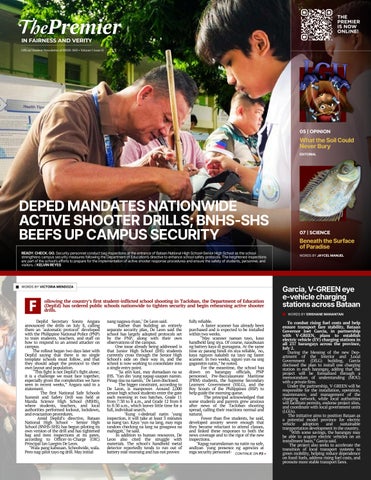
DEPED MANDATES NATIONWIDE ACTIVE SHOOTER DRILLS; BNHS-SHS BEEFS UP CAMPUS SECURITY READY. CHECK. GO. Security personnel conduct bag inspections at the entrance of Bataan National High School–Senior High School as the school strengthens campus security measures following the Department of Education’s directive to enhance school safety protocols. The heightened inspections are part of the school’s efforts to prepare for the implementation of active shooter response procedures and ensure the safety of students, personnel, and visitors. / KELVIN REYES
WORDS BY VICTORIA MENDOZA
F
ollowing the country’s first student-inflicted school shooting in Tacloban, the Department of Education (DepEd) has ordered public schools nationwide to tighten security and begin rehearsing active shooter drills.
DepEd Secretary Sonny Angara announced the drills on July 8, calling them an "automatic protocol" developed with the Philippine National Police (PNP) to train students, teachers, and staff on how to respond to an armed attacker on campus. The rollout began two days later with DepEd saying that there is no single template schools must follow, and that they should adapt the protocol to their own layout and population. “This fight is not DepEd’s fight alone; it is a challenge we must face together, especially given the complexities we have seen in recent weeks,” Angara said in a statement. The first National Safe Schools Summit and Safety Drill was held at Manila Science High School (MSHS), where students, teachers, and local authorities performed lockout, lockdown, and evacuation procedures. Amid DepEd’s directive, Bataan National High School - Senior High School (BNHS-SHS) has begun piloting its own version of the drill and has tightened bag and item inspections at its gates, according to Officer-in-Charge (OIC) Principal Ian Luegim De Leon. "Wala pang kabuuan. Schoolwide, wala. Pero nag-pilot tayo ng drill. May initial
nang nagawa riyan," De Leon said. Rather than building an entirely separate security plan, De Leon said the school has largely adopted protocols set by the PNP, along with their own observations of the campus. One issue already being addressed is that Junior High School (JHS) students currently cross through the Senior High School's side on their way in, and the school is now working to consolidate into a single entry point. "Sa atin kasi, may dumadaan na sa JHS. ‘Yan din 'yung napag-usapan namin. Pinag-iisa na namin," De Leon disclosed. The bigger constraint, according to De Leon, is manpower. Around 2,000 senior high school students enter the gate each morning in two batches, Grade 11 from 7:30 to 8 a.m., and Grade 12 from 8 to 8:30 a.m., which leaves little time for a full, individual search. "Kung i-dedetail natin ‘yung inspection, it will take at least 3 minutes sa isang tao. Kaya ‘yun na lang, may mga random checking na lang na ginagawa na mahigpit," he said. In addition to human resources, De Leon also cited the struggle with materials. The school's handheld metal detector reportedly tends to run out of battery mid-morning and has not proven
fully reliable. A faster scanner has already been purchased and is expected to be installed within two weeks. “May scanner naman tayo, kaso handheld lang siya. Of course, nauubusan ng battery kaya di gumagana. At the same time ay parang hindi rin siya reliable, ‘no, kaya ngayon nakabili na tayo ng faster scanner. In two weeks, siguro yun na ung gagamitin natin,” he noted. For the meantime, the school has drawn on barangay officials, PNP personnel, Pre-Baccalaureate Maritime (PBM) students, the Supreme Secondary Learners' Government (SSLG), and the Boy Scouts of the Philippines (BSP) to help guide the morning queue. The principal acknowledged that some students and parents grew anxious after news of the Tacloban shooting spread, calling their reactions normal and natural. Fewer than five students, he said, developed anxiety severe enough that they became reluctant to attend classes, and linked these responses to both the news coverage and to the rigor of the new inspections. "Kapag naramdaman na natin na safe, andiyan ‘yung presence ng agencies at mga security personnel- CONTINUE ON P3 >
07 | SCIENCE
Beneath the Surface of Paradise WORDS BY JAYCEL MANUEL
Garcia, V-GREEN eye e-vehicle charging stations across Bataan WORDS BY ERISHANE MANANTAN
To combat rising fuel costs and help ensure transport fare stability, Bataan Governor Joet Garcia, in partnership with V-GREEN, plans to establish electric vehicle (EV) charging stations in all 237 barangays across the province, July 2. During the blessing of the new Department of the Interior and Local Government (DILG) building, Garcia disclosed the plan to install one charging station in each barangay, adding that the project will be formalized through a memorandum of understanding (MOU) with a private firm. Under the partnership, V-GREEN will be responsible for the installation, operation, maintenance, and management of the charging network, while local authorities will facilitate permits, endorse project sites, and coordinate with local government units (LGUs). The initiative aims to position Bataan as a potential model province for electric vehicle adoption and sustainable transportation development in the country. “With some savings, the barangay may be able to acquire electric vehicles on an installment basis,” Garcia said. The project also seeks to accelerate the transition of local transport systems to green mobility, helping reduce dependence on fossil fuels, address rising fuel costs, and promote more stable transport fares.
HEADLINES
VOLUME I • ISSUE II • THE PREMIER THE OFFICIAL ENGLISH STUDENT PUBLICATION OF BATAAN NATIONAL HIGH SCHOOL - SHS
BYLINES BEGIN. Aspiring student journalists attend the launch of the Bawat Balengueño Henyo–Special Program in Journalism (BBHSPJ) at Bataan National High School–Senior High School. Conducted in collaboration with the City of Balanga, the program provides specialized training across various journalism fields to develop students’ skills for campus press work, competitions, and responsible media practice. / KELVIN REYES
NEW JOURN-EY NEW JOURN-EY
BBH-SPJ to boost campus journalism, empower student journos WORDS BY DENISE FRIAS
F
ostering passion for journalism, publications The Premier and Ang Talaghay launched the applications for the Bawat Balengueño Henyo (BBH) - Special Program in Journalism (SPJ), providing students with platforms to enhance their journalistic skills.
The program, in collaboration with the City of Balanga, serves as the primary training ground for student journalists of Bataan National High School - Senior High School (BNHS-SHS), tackling individual, writing, and group categories in preparation for competitions. According to Officer-in-Charge (OIC) School Principal Ian Luegim De Leon, BBH-SPJ is vital in educating students to speak up, especially when media oppression is prevalent. “Kung ‘yung kamalayan nila [students] ay bubuhayin natin na, ‘Huy! Malaki ang part natin as kabataan para marinig ng gobyerno ang boses natin,’” De Leon said. “Dapat ‘yung kabataan ay ma-educate din natin kung paano timbangin ang mga issues na nangyayari sa bansa natin. At the same time, ay magkaroon sila ng critical thinking nang makapagpahayag sila ng opinyon at saloobin nila nang responsable,” he added. Additionally, De Leon highlighted that the program will teach campus scribes the importance of fact-checking and responsible journalism. “Kailangan lang maging totoo at balanse para mainform nang maayos ang ating audiences or consumers,” he said.
De Leon also added that he envisions the students of BBH-SPJ going beyond the National Schools Press Conference (NSPC) and becoming the pioneers of community change. “Sila ‘yung magsisimula ng patak para magkaroon ng ‘ripple effect’ na ma-educate ‘yung kapwa nila kabataan na maging mapanagutan sa anumang ilalabas na saloobin nila o opinyon nila,” he expressed. “Napakalaki at iba ang impluwensiya ninyo. Iba ang kapangyarihan ng pluma, at iba ang kapangyarihan ng boses ninyo,” De Leon further emphasized. The school principal also underscored that BBH-SPJ is not only preparing campus journalists for competitions but, more importantly, for real-life situations and responsibilities. “Hindi dahil sa competition lang namin kayo hinahanda, that’s not the main goal—bonus lang ‘yun. Habang nag-gogrow kayo sa journalism, nakikita n’yo kung ano ang responsibilidad ninyo,” he said. As part of BNHS-SHS’ curriculum for journalism, BBHSPJ is an initiative where all bona fide students of the school are given the chance to explore the various fields of media reporting through specialized classes and be chosen as representatives for journalistic contests.
In boosting climate resilience
BPSU, UPD ink ties thru WISER Cities Project WORDS BY JEYXTERZ GREGORIO
Bataan Peninsula State University (BPSU) has officially partnered with the University of the Philippines Diliman (UPD) after signing a Memorandum of Understanding (MOU) and Memorandum of Agreement (MOA) for the WISER Cities Project, which aims to establish climate-resilient cities and bolster sustainable water management, June 30. The ceremonial signing was held at the UPD Institute of Civil Engineering (UPD-ICE) in Quezon City; representing BPSU were University President Dr. Ruby B. Santos-Matibag and Engr. Rigor G. Regalado, Dean of the College of Engineering, alongside Balanga City Mayor Hon. Raquel Francis D. Garcia and Vice Mayor Hon. Francis Anthony S. Garcia. The partnership aims to help local government units improve the way they plan, manage, and protect urban water systems through research, innovation, and capacity-building, particularly for developing a simplified water footprint that will support an integrated decision and visualization system. Its objective will be to enable local governments to make informed decisions regarding water resource management; it would also encourage the use of green infrastructure solutions that improve water resilience and protect ecosystem health. The program highlighted the importance of collaboration among universities, government agencies, and local governments. During the event, UPD-ICE Director Dr. Jose Regin F. Regidor emphasized that strong partnerships are essential in promoting sustainable water resource management and strengthening climate resilience, along with Project Leader Dr. Gil G. Cruz Jr., who also presented the objectives and expected outcomes of the WISER Cities Project, emphasizing its role in providing the scientific-based tools for urban planning and policymaking. Messages of support from UPD Chancellor Atty. Edgardo Carlo L. Vistan II and Mayor Raquel Francis D. Garcia reaffirmed the importance of cooperation among higher education institutions, research organizations, and Local Government Units (LGUs). In her message, Dr. Santos-Matibag stressed the University's dedication to environmental sustainability, meaningful partnerships, and evidence-based governance, emphasizing that BPSU will continue advancing its research and innovation programs that deliver practical solutions to local and regional challenges while also improving the lives of communities. The initiative is expected to help local governments build more resilient cities and ensure sustainable water management for future generations.
IN CAMPUS
BNHS-SHS sets new schedule, opens Quezon building WORDS BY JEYXTERZ GREGORIO
In preparation for the School Year 2025–2026, Bataan National High School–Senior High School (BNHS-SHS) has implemented a new class schedule beginning June 15, coinciding with the opening of the Manuel L. Quezon Building. Following DepEd Order No. 009, s. 2026, Officer-InCharge (OIC) School Principal Ian Luegim De Leon announced that the schedule for Grade 12 students at BNHS-SHS would follow a 1-hour-and-30-minute schedule per subject, with 15-minute and 45-minute health breaks, and Homeroom Guidance (HRG) every Monday. The schedule was implemented to accommodate the students’ academic needs while helping the students gradually readjust to a full class schedule after being away from formal education for five years. “Ginawa rin ‘yung schedule para sa mga bata at magulang para maiwasan ang kaba nila, ganun, ‘yung gabi na at nasa school pa rin ang mga bata,” De Leon said. To keep up with the pace of growing students and the new schedule, BNHS-SHS placed students at the reopened
02
Diosdado Building, newly opened Manuel L.Quezon Building (MLQ), along with rooms from the Quirino Building and the Aguinaldo Building. De Leon also expressed his gratitude to Bataan National High School–Junior High School (BNHS-JHS) for providing rooms from the Emilio Aguinaldo Building and the Quirino Building to accommodate the growing number of senior Arellanistas. The newly opened MLQ Building not only houses students but also ancillary rooms, like faculty and administrative offices, for the school utilities and staff. With the implementation of the new school schedule and the opening of the MLQ Building, BNHS-SHS also aims to improve the quality of education while addressing the growing student population. ROOM TO GROW. Students attend classes inside the newly opened Manuel L. Quezon Building at Bataan National High School–Senior High School as the school implements a new class schedule for School Year 2025–2026. The facility, together with classrooms from the Aguinaldo and Quirino Buildings, supports the new schedule and accommodates the growing senior high school population. / KELVIN REYES
03
NEWS
VOLUME I • ISSUE II • THE PREMIER THE OFFICIAL ENGLISH STUDENT PUBLICATION OF BATAAN NATIONAL HIGH SCHOOL - SHS
DoF pushes for US-led Pax Silica AI initiative amid backlash WORDS BY DENISE FRIAS
Despite concerns drawn from critics and progressive groups, Finance Secretary Frederick Go marked the advancement of the United States-led Pax Silica artificial intelligence (AI) project as the “top economic priority” for technological advancement. According to the Department of Finance (DoF) Secretary, the initiative will allow the Philippines to play a bigger role in AI development. “If we want to be a player in the AI industry in the future, we need to start somewhere. This is a really great start because now, once you have the ecosystem, one thing leads to another,” he said during a press briefing on July 10. Additionally, the project will ensure supply chains for semiconductors, critical minerals, and other forms of technology, which government officials say will attract high-value investment, reduce reliance on rival economies, and create jobs for more
... FROM P1 >
nare-relieve tayo roon kahit papaano. Tingnan niyo ngayon, parang back to normal tayo, ‘di ba?" De Leon said. Asked what the public most needed to understand, he pointed to the trade-off behind the inconvenience. “Kailangang maintindihan at maunawaan nila na ginagawa natin ‘to para mapanatili ’yung security sa loob ng paaralan natin. Sa una, ‘yun talaga ‘yung magiging reaction ng mga tao: 'Bakit ganyan,' 'Ang tagal naman,' at 'Ang haba naman.' ‘Yun lang ang gusto kong maunawaan ng public na ginagawa natin ito para rin sa security nila. ‘Yun ‘yung highest objective natin, na maprotektahan natin ang lahat ng nandito. Mapa estudyante, empleyado, o kung sino pa man na pumupunta sa school natin," De Leon disclosed.
Filipinos. “We are changing our outlook,” Go stated. However, progressive groups expressed rejection of Pax Silica, particularly with the proposed construction of the 4,000acre Economic Security Zone (ESZ) in New Clark City, which will house the firstever AI industrial hub for the USPhilippine partnership. According to Pambansang Lakas ng Kilusang Mamamalakaya ng Pilipinas (Pamalakaya), the initiative could greatly militarize strategic locations in the country. “A decade after the tribunal ruling, we are facing a bigger and more urgent threat to national sovereignty and territorial integrity—the U.S.’ direct military interventionism,” Pamalakaya National Chairperson Fernando Hicap said in a protest on July 13. At the same time, farmers’ rights
groups have also joined in protest, arguing that it would seize ancestral land. The Philippines formally joined Pax Silica in April as part of the broader Luzon Economic Corridor (LEC). Definitive agreements are expected to be finalized in August for the property of the ESZ, which will be managed by the Bases Conversion and Development Authority (BCDA) as the "landlord.” Furthermore, Taiwanese electronics giant Foxconn is conducting due diligence as the designated anchor investor of the project, which Secretary Go predicts will bring in billions of dollars worth of investments. “If Foxconn does come in, I imagine it will be the single largest [investment],” he said. Currently, the DoF reaffirmed that the Pax Silica initiative will remain a priority for both the U.S. and the Philippine economy as project drafts are being finalized.
PHOTOS LIFTED FROM WIKIMEDIA PHOTO FROM NAME NAME COMMONS, SOUTH CHINA MORNING POST
Iran foreign minister to debate Hormuz as traffic slows amid tensions WORDS BY JAIDEN GATDULA
I
ranian Foreign Minister Abbas Araqchi arrived in Oman on Saturday, July 11, for a discussion of the safe passage of ships through the Strait of Hormuz, as the US demands Iran publicly commit to halting the assault of ships in the strait and keep all lanes open without tolls.
US President Donald Trump said on Friday the US and Iran had agreed to continue talks despite an escalation of hostilities this week, while also declaring an end to the ceasefire between the two countries. No attacks were reported on Friday or Saturday; however, a senior Iranian source told Reuters that Iran, the US, Qatar, and Pakistan had agreed to negotiate in a call that mediators were trying to arrange for Saturday while Araghchi is in Oman. It was not immediately clear whether the efforts were successful, but Araghchi and Omani Foreign Minister Badr AlBusaidi “exchanged views on appropriate mechanisms for the safe passage of ships through the Strait of Hormuz,” in accordance with the ceasefire deal, according to a statement from the Iranian foreign minister. Oman’s state news agency later said that Omani and Iranian negotiators would continue talks “at the
technical and political levels.” Oman is helping to mediate an end to the war that has destabilized the Gulf and raised prices around the world since the US and Israel launched airstrikes on Iran on February 28. About a fifth of the world’s oil supply transited through the Strait of Hormuz before the war, and Iran;s effective blockade, caused oil prices to skyrocket, fueling global inflation. Senior US officials told reporters on Friday that the United States is demanding the release of Iran’s public statement to stop attacks on ships in the strait and that all lanes will be open with no tolls. Meanwhile, Three Qatari and Saudi commercial tankers came under fire earlier in the week, prompting the US to hit Iranian sites, and Iran to respond with strikes on US military sites in Gulf states. Araghchi accused the United States of violating the ceasefire agreement; the US
revoked the license authorizing the sale of Iranian crude on Tuesday after the vessels were hit. “The Islamic Republic of Iran has asked us to continue ‘talks.’ We have agreed to do so, but the United States has stated to them, in no uncertain terms, that the Cease Fire is OVER!” Trump posted on his Truth Social platform on Friday. A written statement from Iran’s new supreme leader, Ayatollah Mojtaba Khamene, on Saturday threatened vengeance for the death of his predecessor and father, who was killed on February 28. “We pledge to avenge the blood of the martyred leader and all the martyrs.” the messenger said. Trump had posted on Friday that he had ordered the US military to be prepared to launch thousands of missiles against Iran if Tehran attempted to assassinate him.
Bataan kicks off National Disaster Resilience Month WORDS BY DENISE FRIAS
PHOTO LIFTED FROM PROVINCIAL GOVERNMENT OF BATAAN
The Province of Bataan officially marked the observance of National Disaster Resilience Month on July 2 at the Bataan People’s Center, highlighting its commitment to building safer, more resilient communities. With the theme “Naghahanda at Kumikilos Tungo sa Panatag na Bagong Pilipinas,” the province underscored its continued efforts to promote preparedness, improve coordination among authorities, and amplify the use of technology to better protect lives and communities. Organized by the Provincial Disaster Risk Reduction and Management Office (PDRRMO), the event was spearheaded by Governor Jose Enrique “Joet” S. Garcia III, who was joined by various members of the provincial government and organizations that specialize in disaster risk reduction. In his speech, Governor Garcia emphasized the definition of resilience and the essence of National Disaster Resilience Month.
“Resilience is not only about recovering from adversity. True resilience means having the foresight to prepare, the wisdom to prevent risks, and the commitment to protect one another, and this is the essence of National Disaster Resilience Month,” he said. Moreover, the month-long observance featured various activities aimed at strengthening emergency response, such as Geo-Risk Initiatives, a DRRM Static Display, and the first-ever Provincial First Aid Olympics. Philippine Drug Enforcement Agency (PDEA) Bataan Provincial Office, led by the Assistant Provincial Officer under the leadership of the Provincial Officer, together with Seaport Interdiction Unit (SIU) Bataan personnel, also participated. Furthermore, the provincial government relaunched the 1Bataan Film Contest with the theme “Inspirasyon ng Matatag na Pamilyang Bataeño,” where participants of all ages and backgrounds can share their original films for a chance to earn awards and monetary prizes.
NEWS
VOLUME I • ISSUE II • THE PREMIER THE OFFICIAL ENGLISH STUDENT PUBLICATION OF BATAAN NATIONAL HIGH SCHOOL - SHS
JULY12,2016
PH marks 10th year West Philippine Sea victory WORDS BY JOHN RIC DE GUZMAN
T
04
he Philippines commemorated the 10th anniversary of the 2016 arbitral ruling on the West Philippine Sea on July 12, 2026, affirming its maritime rights under international law.
The commemoration marks the 10th anniversary of the 2016 Hague tribunal ruling, which invalidated China’s expansive maritime claims and upheld the Philippines’ rights under the United Nations Convention on the Law of the Sea (UNCLOS). The ruling remains a cornerstone of the country’s sovereignty efforts. Kirk Obdin, a Social Science teacher at Bataan National High School - Senior High School (BNHS-SHS), stated, “It is important to remember and celebrate, because in 10 years, we hold it as a memory for many young minds to grow knowledgeable about the issues.” “Do not lose care, hope, and stand towards the past history of our nation, where we defend our freedom and
U.S. completes 7th night of strikes vs Iran, sends ceasefire deal in disarray WORDS BY ABBYGAIL MINA
The United States (U.S.) Central Command confirmed on July 18, Eastern Daylight Time, the completion of its seven consecutive nightly attacks against Iran, with the Islamic country declaring that it has suspended its commitments under the interim peace deal signed last month. According to Iran’s deputy foreign minister, Kazem Gharibabadi, they will be “no longer implementing” their previous agreement with the U.S., despite President Donald Trump stating last week that it was over. “We were in negotiations. Unfortunately, it was the Americans themselves who, in fact, took these aggressive actions, in violation of their own commitments,” Gharibabadi claimed on state TV. Meanwhile, Iranian Health Ministry spokesperson Hossein Kermanpour said that the death toll has reached 50, with over 500 injured since June 27. “Among those killed were five women and two children and teenagers under 18,” Kermanpour addressed on social media. As tensions rise, neighboring countries in the Middle East are now starting to grow apprehensive after the relentless back-to-back conflict between the U.S. and Iran. On Saturday, the U.S. allied Gulf Cooperation Council SecretaryGeneral, Jasem Mohamed Albudaiwi, alleged that the Iranian missiles fired at its members were acts of “war crimes” in a statement. “Iran's actions constitute a highly dangerous escalation, a grave violation of international law and the United Nations (UN) Charter, as well as war crimes requiring international accountability and prosecution...and a persistent determination to destabilise regional security and stability,” Albudaiwi said.
sovereignty,” he added. In the Philippines’ history, government officials, educators, and student journalists gathered in Manila for symposiums to highlight the significance of the decision. Legal experts presented documents and findings that reinforced the Philippines’ maritime rights, while environmental groups emphasized the need to protect the biodiversity of the West Philippine Sea. The Department of Foreign Affairs noted that the ruling has strengthened international support for the Philippines, reminding the global community of the importance of respecting international law. Meanwhile, schools across the country held forums and exhibits to
educate students about the historical and legal significance of the case. “Sobrang napakahalaga talaga ng pag-alala sa history natin lalo na sa pinaglalaban natin kasi natututo iyong mga mag-aaral sa nangyayari sa bansa natin,.” Mr. Mhel Lopez, another Social Science teacher at BNHS-SHS, said. The decision was first announced by the Hague tribunal on July 12, 2016, after years of disputes over China’s “ninedash line” claim. The Philippines’ victory was celebrated worldwide as a milestone in international maritime law. Since then, annual commemorations have been held to remind citizens of the continuing struggle to safeguard national sovereignty and independence.
Rep Roman pushes local fiscal autonomy bill WORDS BY JEYXTERZ GREGORIO
Bataan 1st District Representative Tony Roman is seeking greater fiscal autonomy for local government units (LGUs) through House Bill No. 9488, or the Local Fiscal Autonomy Enhancement Act. The proposed bill intends to increase the share of national tax revenues allocated to LGUs, allowing them to improve the delivery of basic and essential public services and further strengthen local governance. Under the bill, LGUs would be granted an additional five percent share on top of the existing National Tax Allotment (NTA). The increased allocation would be implemented gradually over five years through a one-percent annual increase. Roman states that the bill aims to provide local governments with more sufficient and predictable funding, while also ensu-
ring that the current NTA shares of LGUs will not be reduced. The proposal expects communities to benefit by enabling local governments to invest more into addressing their needs, including healthcare, social welfare, infrastructure, disaster response, and other essential services. This also includes provisions for additional support that prioritizes municipalities and lower-income LGUs to promote a more equitable distribution of resources. Roman emphasized that strengthening the financial capacity of local governments will allow them to respond more effectively to their constituent. House Bill No. 9488 is expected to empower LGUs with greater financial stability while also improving the quality of public services across Bataan.
Chinese scholars claim ownership over Batanes; Defense Sec cries foul WORDS BY VICTORIA MENDOZA
A group of Chinese scholars has claimed that Batanes belongs to China, arguing that Manila has no valid historical or legal grounds for governing the islands in what analysts see as the newest move in Beijing's "lawfare" strategy that uses legal and academic arguments to strengthen its claims in the region's waters. The claim came from a symposium at Jinan University in Guangzhou on June 30, where a dozen scholars from top Chinese universities and governmentlinked institutions argued that the Batanes islands are a "natural geographical extension" of Taiwan, and should therefore be considered Chinese territory. According to NewsGD, a stateaffiliated outlet that reported on the symposium, the scholars also declared that upcoming talks between the Philippines and Japan aimed at defining the boundaries of their exclusive economic zones (EEZs) and continental shelves in waters east of Taiwan are "illegal and invalid."
The symposium was organized in direct response to a joint statement issued after the May 28 summit between President Ferdinand Marcos Jr. and Japanese Prime Minister Sanae Takaichi, where both leaders agreed to begin negotiations on delimiting their respective EEZs and continental shelves. Meanwhile, Defense Secretary Gilberto “Gibo” Teodoro asserted that these allegations only confirm Manila’s long-held assessment that Beijing intended to expand its influence on more maritime areas. “It also validates what we’ve been saying, that they have a plan to control the whole Pacific Ocean. We know there is no basis for this [the scholars’ claim]. It’s a joke. It’s ludicrous, ” Teodoro said on the sidelines of the National West Philippine Sea Summit in Pasay City. The National Historical Commission of the Philippines (NHCP) likewise condemned these claims, saying that they have no substantial basis in substantive research and operate from “evident bad faith.”
ON THE DOT. United Nations Convention on the Law of the Sea (UNCLOS) Arbitral Tribunal released its decision in favor of the Philippines on most of its submissions on the West Philippine Sea (WPS) contention. SOURCE FROM INQUIRER
DepEd, Australia unveil P1.6B EQUIP program for SHS employability WORDS BY DENISE FRIAS
To better align senior high school (SHS) education with modern global industry standards, the Department of Education (DepEd) and Australia formally launched the P1.6 billion Education Quality for Inclusive Prosperity (EQUIP) program at Mariano Marcos Memorial High School in Manila, July 21. Spearheaded by Education Secretary Juan Edgardo “Sonny” Angara and Australian Foreign Affairs Minister Penny Wong, the flagship initiative will be implemented in collaboration with the Technical Education and Skills Development Authority (TESDA) under the guidance of Director General Jose Francisco Benitez from 2025 to 2030. As part of the Australian-Philippine partnership, the five-year program could potentially include a three-year extension worth AUD 20 million, raising the total investment to AUD 60 million and stretching the timeline until 2033. “As emphasized by President Ferdinand R. Marcos Jr., the education system we are building must open more pathways to success for every Filipino learner,” Angara said. According to the education secretary, the EQUIP program aims to advance inclusive economic development by providing learners with the competencies and training needed to enhance their technical and vocational skills for their future careers. “Through this partnership, let us continue building an education system that equips our learners with the competencies, confidence, and character they need to succeed in the future they deserve,” he said. Under the initiative, improved work immersion programs are to be conducted alongside professional Australian institutions in schools within the country, while also enhancing literacy and numeracy support together with capability training for teachers. “The EQUIP Program will support the Philippine government to improve and enhance the quality of senior high schools. It will help ensure that graduates are well prepared for their future whether in continuing education or in seeking employment,” Wong stated. Priority locations for its first year include schools in Manila, Valenzuela, and Parañaque before implementation in other regions in the next few years.
05
VOLUME I • ISSUE II • THE PREMIER THE OFFICIAL ENGLISH STUDENT PUBLICATION OF BATAAN NATIONAL HIGH SCHOOL - SHS
OPINION
EDITORIAL
WHAT THE SOIL COULD NEVER BURY Some things are buried because they have ended. Others are buried because no one wants to answer for them. Soil has a peculiar way of convincing people that something is over. It conceals what lies beneath and offers the comfort of forgetting. Yet the earth has never been capable of keeping secrets forever— what is buried may, sooner or later, find its way back to the surface. Kara David's Ibinasurang Paraiso unearthed one of those truths. Beneath what appears to be ordinary ground in Sitio Tibag, Barangay Naugsol, Subic, Zambales, lies more than years of accumulated waste. Buried alongside it are broken promises, neglected responsibilities, and the quiet suffering of an Ayta community whose existence remained unseen until the nation finally looked. The story began in 2019 with what was presented as a temporary solution. A natural ravine within the Ayta community's ancestral forest would serve as a dumpsite while the Municipality of Subic searched for a permaanent waste disposal site. When the COVID-19 pandemic disrupted existing disposal facilities, the arrangement remained. What began as an emergency response eventually became a failure of governance. Truck after truck emptied garbage into the ravine before covering it with soil. Temporary measures cease to be temporary the moment authorities allow them to outlive the crisis they were meant to address. The ravine did not disappear overnight. It vanished one truckload at a time until what was meant to be temporary no longer looked temporary at all. The creek that once supplied water for drinking, cooking, and washing gradually turned discolored and foul-smelling, forcing families, including those of Erlinda Capistrano, to rely on collected rainwater. For Tatay Mariano, the greater loss was the forest that had long sustained food, medicinal plants, livelihood, and traditions passed from one generation to the next. As the landscape changed, so did the lives rooted in it. By the time the damage demanded attention, the landfill had already buried more than garbage. It had buried the promise that it would only ever be
The Winner Takes it All WORDS BY LIZETTE AGCAOILI
In the lives of the Filipino people, the winner takes it all, and it often sides with those who stand tall. But as the Senate continues the impeachment trial, I am left to wonder: will justice finally be served on our side, or will it once again be led by the blind? After being impeached for the second time on May 11, 2026, according to reports from the Inquirer, Vice President Sara Duterte faces her trial with four Articles of Impeachment. These charges include the alleged misuse of ₱612.5 million in confidential funds, ₱500 million from the Office of the Vice President (OVP), and ₱112.5 million to the
CARTOON BY PHILLIP PEREZ
temporary. On January 20, 2022, the Department of Environment and Natural Resources (DENR) ordered the closure of the Naugsol dumpsite after determining that it violated the Ecological Solid Waste Management Act of 2000, or the Republic Act No. 9003. Yet the dumping continued, and the Ayta community remained beside the landfill while its consequences deepened. A closure order means little when the conditions it seeks to end are allowed to persist. The municipality maintained that the dumpsite had been established as an emergency response during the COVID19 pandemic. It also admitted that the protective liner intended to contain contamination had never been installed because the site was expected to operate only temporarily. Municipal Environment
Department of Education (DepEd)—as well as associated bribery involving DepEd officials and accusations involving the assassination threat against President Ferdinand Marcos Jr. As a student leader myself, I have always viewed effective leadership as a role rooted in transparency—something the Vice President fails to demonstrate. Under the countryʼs current standards, everyone can possess power—but not all have the commitment and capability to do good. The issue of misusing funds just proved her incompetence and dishonesty in front of the community she serves. A case is not built on a single accusation; it was gathered, stacked, examined, and investigated for a long time. The impeachment trial is not merely for entertainment. The ongoing process
and Natural Resources Office (MENRO) Officer-in-Charge Mary Grace Molina further stated that they did not know a community was already living in the area. Yet the National Government Geoportal identifies the site as part of the Ayta ancestral domain. The issue, therefore, was never the absence of information but the failure to recognize and protect a community that had long called the land home. Perhaps the most troubling fact emerged only after Ibinasurang Paraiso aired. Only then did the Department of Environment and Natural Resources (DENR) and the National Commission on Indigenous Peoples (NCIP) coordinate the site's closure and rehabilitation. While that response deserves recognition, it also reveals a deeper institutional failure: meaningful government action arrived only after national attention demanded it. Accountability that begins only after public exposure is not accountability fulfilled, but accountability compelled. Sitio Tibag was never simply a waste management failure. It exposed how institutions can neglect environmental and Indigenous rights despite laws already in place. Republic Act No. 9003 prohibits open dumpsites, the Indigenous Peoples' Rights Act of 1997, or Republic Act No. 8371, protects ancestral domains, and Article II, Section 16 of the 1987 Constitution guarantees every Filipino's right to a balanced and healthful ecology. The country's failure was never the absence of legal safeguards, but the failure to enforce them before irreversible harm had been done. The Municipality of Subic now estimates that rehabilitating the site will cost around ₱78 million. Rehabilitation should not be mistaken for accountability. It must restore not only the land but also the dignity of the Aeta community while ensuring that no indigenous people are rendered invisible by institutional neglect again. As Erlinda Capistrano pleaded,
Hindi naman po namin kinakalaban ang mga tagababa. Pero huwag naman po sana nilang ganunin itong bundok na ito. For what the soil could never bury was never the waste below, but the truth the public deserved to know.
carries the trust and hope of every Filipino family seeking justice and answers. Change starts with awareness, moves to opening our minds, and leads to calling for action. It is important to remember that we live in a democracy. The power belongs to us—not with the public servants who are merely entrusted with positions of authority. We must demand accountability and transparency, and once given, may we remember that it is the bare minimum and the rights of every family. The case of VP Sara Duterte serves as a great example of why we should vote for candidates not based on the surnames they carry, but on what they can do for our country. If we do not answer the questions involving corruption, people will continue living their entire lives searching for a cure to a rotting institution.
Profess-or Else WORDS BY CHEZTER ATIENZA
A professor's job is to search for truth. Not to redraw borders. That responsibility was called into question after Chinese academics, during a symposium hosted by Jinan University in Guangzhou on June 30, argued that Batanes is a "natural geographical extension" of Taiwan and therefore belongs to China. On the surface, it may seem like nothing more than an academic discussion. But ideas rarely remain inside conference halls. They travel. They influence. And when they concern sovereignty, they deserve more than a passing glance. For generations, Batanes has stood as the Philippines' northernmost province, home to the Ivatan people and known for its quiet resilience rather than territorial disputes. Yet in a single symposium, it was treated as though its place on the Philippine map were merely another theory open for debate. That should unsettle us. Some will argue that these were only the opinions of scholars and not the official position of Beijing. That is true. China has not formally adopted the claim. Yet the Philippine government did not dismiss the issue as harmless. The Department of Foreign Affairs (DFA) declared that Philippine sovereignty over Batanes is "settled and not up for debate" and rejected attempts to cast doubt on the country's territorial integrity. It also noted that the Philippine-approved consular district of the Chinese Consulate General in Laoag includes Batanes, a detail that contradicts the symposium's narrative. If China's own diplomatic arrangements recognize Batanes as Philippine territory, then the burden of proof falls even more heavily on those attempting to argue otherwise. Scholarship is meant to resolve contradictions through evidence, not create them through speculation. History suggests that ideas can precede policy. Narratives are introduced, repeated, and gradually normalized until they become familiar enough to shape public discourse. That is precisely why claims concerning sovereignty deserve scrutiny long before they become official positions. The timing also invites legitimate scrutiny. The symposium came as the Philippines marked the tenth anniversary of the landmark 2016 arbitral ruling, which invalidated China's sweeping claims in the West Philippine Sea (WPS). It also followed maritime boundary discussions between the Philippines and Japan in waters east of Taiwan. While those events do not, by themselves, prove intent, they make it difficult to dismiss the symposium as an isolated academic exercise. The National Historical Commission of the Philippines (NHCP) also rejected the scholars' assertions, saying they have no rational basis in historical research. It cited historical and archaeological evidence showing continuous Philippine sovereignty over Batanes since 1783 and noted that there is no historical record of Chinese governance over the islands. Those facts matter because extraordinary claims demand extraordinary evidence. When centuries of documented history point in one direction and a symposium points in another, credibility belongs to the evidence, not to the conclusion that ignores it. Defense Secretary Gilberto Teodoro Jr. was equally justified in dismissing the assertions as baseless. Sovereignty is not weakened because someone questions it, nor is it transferred because someone presents a paper about it. Academic freedom remains essential. It gives scholars the liberty to pursue knowledge wherever evidence leads. But freedom is not freedom from responsibility. The moment scholarship is used to advance territorial ambition instead of pursuing truth, it ceases to be an honest search for knowledge. A professor's legacy should be measured by the minds they enlighten. Not by the borders they try to erase.
FEATURE & LITERARY
VOLUME I • ISSUE II • THE PREMIER THE OFFICIAL ENGLISH STUDENT PUBLICATION OF BATAAN NATIONAL HIGH SCHOOL - SHS
06
L L t t e e o o f f t t Sw S wa alllloow Thing Thing L a s e e w t h Th T WORDS BY ALEXANDRA PERELLO & SOPHIA RAMOS
I. The Offering I know death when I see it. It comes to me, not always as a man dressed in a cloak. Sometimes, he beckons me with the promise of peace. Mostly he just yells at me to follow. Today, he is nothing more than a ringing alarm: date night. There is a rumbling hunger in my stomach, braided with acid as it thunders inside. I check the clock like a determined toddler, trying to catch my reflection blinking a second too late. I hide myself under silk that whispers “stay awhile.” I tousle my hair until it learns to say “see you tomorrow.” I practice my smile—careful not to bare teeth—until it yells “come home.” 7:05 PM, the doorbell rings. I fix the dress clinging on my skin like a life line. For you, exclusive tonight, I am a cake for sale. I offer you, me— digestable. What I wish I could be everyday: perfect. Am I edible enough? Never mind the ache within. The sickness hitched in my brain, grasping on it like an itch that never goes away. The nights I wish would leave. The record scratches. The sharp clank of the silver meeting fine china. And I shake—a plea flying out of me. My eyes darted to check yours, wondering if they would tell me. Do you see? I think back to old dinners. To calloused hands and bitter teeth—and I almost ran. Almost. But I cannot look away from you. From something hidden beneath your eyes: hunger. You turn away, and the knot unties itself. The fear in my tongue lingers as I watch the way your face morphs from yours to a date’s laugh from two months ago, to a smile I loved a decade ago. I pray. For although I rarely ever taste the same meal from different restaurants — I almost always seem to order the same thing. I chew faster, almost mechanical, like the food will run out of my molars. I was always a quick diner, afraid the sound of me eating bores you. That the sound of me sustaining myself shatters the fantasy I am offering. That the thought of me full
What crosses your mind when the word 'space' meets your ears? You may imagine a rocket launching through the sky towards vibrant stars glimmering so high or simply a white blank canvas that serves as an avenue for something fresh and new. In the case of Kristine Jane Atienza, she vividly captured the essence of the varying meanings—making it her mission to combine the two. Stargazing with two little eyes. Residing in Bataan, as young as 5 years old, her eyes are already set for the stars— she wants to be an astronomer. As she grew older, her initial plan was to study hard and get into her desired program —the Physics Program of the University of the Philippines—wherein, after such, she would pursue graduate school in astronomy, This was the outline of the path towards her dream. However, there has been a sudden turn of events—one that ultimately rerouted her future. As she started to doubt herself if astronomy or physics were fitted to her, she shifted to nutrition—a whole new world away from what was familiar to her.
makes your stomach churn. I breathe like it will be the last time—it could be. If you happen to be a serial killer, a psychopath who hunts down women like me. Or worse. If you were kind. If you want me to lay bare just to trace stars on my back. To count the marks on my thighs, to hold me like I am sacred. Like I am more than me. Like I could be more than me. Because you being kind means I am allowed to be human. Not a display, a desperate dance of trying to escape the rattling in my bones. You being kind means I am allowed to simply be. You don't take me home, not tonight. Not the next following nights, either. By the seventh, we hurry in your car. I swallow, and I think to myself. Once I have put my clothes back on, I wonder if you are full. If after the flesh, you choose to stay. For the spit, the bile, the blood. The bones I wish to shatter, the skin I wish to crush. I pray this lasts, long enough for me to learn that it is alright to savor. That it is alright to let my coffee simmer, to actually feel the food. For I know you will consume me. Maybe through anger, maybe shame— horrifically, could be love. But I wonder if you can handle what is beyond my skin. For I know you will consume me someday. But I wonder… Can you? II. The Consuming The question settles beside the untouched bread basket, warm enough to steam, untouched enough to grow cold. You think the danger begins with teeth. By the time hunger reaches the mouth, it has already wandered through the eyes, lingered on the tongue, and decided what it believes the meal will taste like. That has always been the cruelest part of consumption, not the eating, but the certainty that arrives before the first bite. You smooth the silk over your knees while pretending not to notice me watching. The waiter pours us wine neither of us has touched. Between us sits a table
dressed for a feast, though I have yet to find anything worth consuming. Not because you have offered me too little. Because you have offered me what everyone else already gets; the smile, the practiced laugh, the careful little pieces trimmed neatly from larger stories. You serve them with steady hands, arranging each one as though beauty alone could satisfy appetite. They are lovely. Tender, even. But tenderness has always belonged to the flesh and flesh is generous. It arrives first, warm and fragrant, eager to be admired. It glistens beneath candlelight, seasoned with good manners and rehearsed answers, hoping no one asks for anything that wasn't written into the recipe. Most people stop there. They praise the presentation, compliment the cook, and leave believing they have tasted the whole of you. Such hurried eaters. One mouthful of sweetness, and they swear they know the fruit. One grain of bitterness, and suddenly the meal is spoiled. One awkward silence, one careless sentence, one rumor passed from one table to the next, and your name is sent back to the kitchen before anyone has thought to ask whether it was ever prepared correctly. I have never trusted diners who finish too quickly. Even bread asks for patience. Leave it in the oven too briefly, and the center remains raw. Leave broth to simmer, and it learns a language salt alone could never teach. The finest meals reveal themselves slowly, each bite borrowing meaning from the one before it. Strange, then, that we grant dinner more grace than we grant each other. Your fork slips against the porcelain. The sound is small enough to disap-pear beneath the music, but your hands betray what your smile refuses to. They tighten around the handle as though you have dropped more than silverware, as though you have scattered something far more difficult to gather back together. There. The first honest course of the evening.
w T o g W n i o g r l d d i r s B WORDS BY JAYMEE PASCUAL
Though she did not exactly become w-hat she first dreamt of, still, a new voyage awaits her. Rerouting aspirations. After a whole rollercoaster ride, Kristine Jane Atienza eventually grew up to become a public health nutritionist and dietitian, and humanitarian. She has embraced the unfamiliarity into something that would benefit communities – serving her country. For more than 8 years, she worked in humanitarian response and public health nutrition, going to the most remote communities and places in the Philippines responding in emergencies and fighting food insecurities. She is bearing a crucial role in com-bating the ongoing crisis in the Philippines, wherein millions upon millions of Filipinos are affected. A problem so severe yet overlooked by some—turning a blind eye to the impending doom that it slowly becomes. Filling in the gaps. As years have gone by, the hue of her
first love—the cosmos—did not fade in her heart. Eventually, she found a way to merge space and nutrition into one—venturing into the world of space nutrition. She became the first Filipino analog astronaut. Up until now, many believed that space may feel too out of reach from reality here on Earth. Even though that is the case in most cases, Kristine has defied all odds and has written a new narrative. "When I talk about satellites, I would think about disaster response. And when I talk about food for astronauts, I would always think about food insecurity here on Earth. And when I think about innovation, I would always think, 'How can this benefit Earth, or people living on Earth?’" For a space communicator like Kristine, the connection has always been there— lingering and lurking in all aspects. As the Philippines continues to become one of the most affected by climate change and natural disasters, the continuous widespread of problems in nutrition, edu-
You look at me the way people look at broken plates, waiting to see whether I'll decide you are no longer worth serving. Instead, I wait. You mistake my silence for hesitation. It is reverence. Because flesh has never been my favorite part. I came for the marrow. Not the kind tucked quietly inside your bones, but the one you have hidden beneath years of careful seasoning. The one you have diluted with sugar so no one notices its bitterness. The one you have kept simmering beneath rehearsed smiles until even you have forgotten its original flavor. That is the part I cannot rush, because marrow was never meant for impatient mouths. It asks to be lingered over, not conquered. To be savored, not swallowed whole. It does not surrender itself to those hungry for certainty, only those willing to leave the table still curious. So no… I will not consume you tonight. Not yet. You have only served me the appetizer. III. The Aftertaste Can you stomach me? When the sweetness has dissolved and the wine has gone flat, when the silk no longer catches the candlelight and every careful seasoning has been washed from my tongue, will you still linger at the table? When the flesh has finished introdu-cing itself, when admiration has scrapped the plate clean, when there is nothing left for you but the marrow hidden deep within my bones, will your appetite remain? When all that was easy to love has be-en consumed, and only the hardest, quietest parts of me endure, will you still trace them with gentle hands? Will you still learn the language they have spent a lifetime trying to speak? Or were you only ever hungry for the first course? So tell me, when there is nothing left to savor but that of me, when every beautiful lie has been picked clean, when all that remains are my bones… Will you consume me—bones and all?
cation, and food insecurity also come along with it. With all of these, space storytelling became her medium to voice what is the real story behind her region—especially her country. As for her, space is not just a luxury; it's a tool we can use to solve those arising problems. Reaching for the stars. Now, just two years after making his-tory, Kristine is now in the queue for another. She is in line for one of the remaining slots on Blue Origin’s New Shepard via the SERA Space Program for an 11-minute suborbital flight. She is bridging two distant worlds. She is now aiming to launch through the sky towards vibrant stars glimmering so high and currently painting the once-blank canvas that serves as an avenue for nutrition and space to merge as one. For her, the goal is not simply to help people look up at the glistening light of the stars. It is to help the mass to see how space can improve life here on Earth. As for little Kristine, she is now slowly reaching the dream she once shot to the moon and once wished upon a star.
07
SCIENCE
VOLUME I • ISSUE II • THE PREMIER THE OFFICIAL ENGLISH STUDENT PUBLICATION OF BATAAN NATIONAL HIGH SCHOOL - SHS
Balanga City, BPSU, and Prakalpa Innovation Launch HIRAYA for Intelligent Research Collaboration WORDS BY ALYANNAH IYO
~
The City of Balanga, Bataan Peninsula State University (BPSU), and Prakalpa Innovations Services Private Limited formally entered into a Memorandum of Agreement (MOA) signing ceremony for HIRAYA (Honing Intelligent Research and Advanced System Application) on July 1, 2026, at the City Hall of Balanga. Through the HIRAYA initiative, the three institutions will work together to foster meaningful research, innovations, and solve real-world problems. Using workshops and special programs focused on the empowerment of adaptive technologies as a way to promote collaboration between students, government employees, and local communities. With the help of international experts from Prakalpa Innovations, HIRAYA aims to utilise intelligent systems and
PHOTO COURTESY OF BATAAN PENINSULA STATE UNIVERSITY
ELNINO
WHAT TO EXPECT AND HOW TO PREPARE
Growing Concerns as the Niño Episode Looks to Peak WORDS BY AZEAH DIZON
E
l Niño, the weather phenomenon associated with major changes to the climate of the world, is gaining strength, and countries around the world are preparing for its impact. Meteorologists have predicted extreme weather changes, and authorities have mobilized resources to minimize possible damages.
On June 15, 2026, the World Meteorological Organization (WMO) announced that a powerful El Niño episode had taken place. The change in climate is expected to lead to extreme weather conditions such as droughts, floods, and heatwaves in many parts of the world. Global Impact Australia, Indonesia, and parts of Africa are preparing for a serious drought that could bring water shortages and agricultural concerns. In other regions, heavy rain and flooding threaten parts of South America, affecting infrastructure and communities. “This El Niño is developing rapidly and could be one of the strongest on record since 1950,” says Emily Becker of the University of Miami. Situation in the Philippines The Philippines’ National Disaster Risk Reduction and Management Council (NDRRMC) has issued advisories in preparation for possible typhoons and flooding. Local governments should put contingency plans in place to protect communities. Under the presidency of BY THE NUMBERS
El Niño’s Impact on Philippine Agriculture
Ferdinand R. Marcos Jr., the focus is on giving vulnerable sectors such as farmers and fishermen the information that will help them prepare for such environmental hazards. Understanding El Niño El Niño is a warming of sea surface temperatures in the central and eastern Pacific Ocean that disrupts normal weather patterns. El Niño doesn’t mean no rain. It can bring drought, and it can bring heavy rains, depending on where you are. The event disrupts typical climate patterns and triggers a chain reaction of changes in the environment. This year’s event is expected to be “powerful” and requires more preparedness. Preventive measures The United Nations recommends reinforcing early warning systems and emergency preparedness. Communities should conserve water, secure food supplies, and build infrastructure to withstand extreme weather events. By taking action in advance, we can reduce the adverse impacts of El Niño, foster cooperation, and build awareness.
promote collaborative platforms for a future-ready community.
This collaboration is more than just a signed agreement; it's a shared commitment to advancing research, intelligent systems, innovation, and digital transformation that will create more opportunities for our students, researchers, employees, workforce, and the entire community. Hon. Raquel Francis D. Garcia BALANGA CITY MAYOR
Following the signing ceremony, a Capacity Building Activity on Artificial Intelligence (AI) hosted by BPSU- College of Computer Science (CCST) and Prakalpa Innovations was held on July 2, 2026, at St. Joseph College of Balanga. The participants were shown how AI tools can support and enhance government preparations while also strengthening the capabilities of government employees. Founder and Director of Prakalpa Innovations, Dr. Pratik Rajan Mungekar, served as a resource speaker along with Mr. Kalpesh Jadhav, a Director from the same institution, sharing their expertise to promote a better use of AI.
BENEATH THE SURFACE OF WORDS BY JAYCEL MANUEL
he air smells of salt, roasted coffee, and sunscreen. Surfers from across the globe paddle out into glass-like barrels, framed by thousands of swaying coconut palms. To the eye, Siargao feels like an untouched sanctuary—a tear-dropshaped slice of paradise protected under Philippine law as the Siargao Island Protected Landscape and Seascape (SIPLAS). Yet beneath the turquoise surface, a microscopic crisis is unfolding.
L
The Unseen Tide A study published in Water Science by marine scientist Shaliemar Bajan and a team of coastal researchers reveals that Siargao’s protected waters—and its most vital reef-dwelling fish—are silently accumulating microplastics. Every morning, local fishermen navigate wooden outriggers into the calm shallows, hunting for danggit—the mottled rabbitfish (Siganus) that graze like gentle underwater herds along the reef. They are the unsung gardeners of Siargao, nibbling algae off limestone to keep the corals breathing. These are also a staple on nearly every breakfast plate from local homes to beachfront cafes. When researchers dissected rabbit-fish collected around the island—from the tourist-buzzing shores of General Luna to the busy docks of Dapa—they found that nearly 80% of the fish had plastic inside them. For one species, the Siganus guttatus, the contamination rate was a heartbreaking 95.5%. These weren’t bottle caps or plastic bags, they were the unseen tide–tiny synthetic fibers, thinner than a strand of hair. "Over 98% of the particles extracted were synthetic fibers," the study reveals. To a grazing rabbitfish scraping its lunch off a rock, a microscopic nylon strand tangled in algae is impossible to distinguish from food.
PARADISE
The Anomaly of Paradise How does an island designated as a national marine protected area get swept up in a plastic storm? The island is catching its breath after an unprecedented tourism boom— welcoming thousands of tourists every year. With every load of laundry washed at hotels near the shore, tens of thousands of microfibers enter local runoff. Every frayed synthetic fishing line and lost blue rope slowly disintegrates under the tropical sun. And then there is the ocean itself. During the Northeast Monsoon, powerful offshore currents act like a giant conveyor belt, sweeping drifting microplastics from distant ocean gyres straight into Siargao’s sheltered lagoons. In every cubic meter of Siargao’s surface water, scientists calculated an average of 1,000 microplastic particles drifting alongside the plankton.
Preserving The Gem Siargao’s name comes from Siargow, a native tree that once blanketed its shores. It is an island built on resilience—having rebuilt itself time and again after fierce Pacific typhoons. Microplastic pollution isn't a death sentence for the island, but it is a mirror reflecting a global crisis back onto one of its most delicate corners. Protecting this gem in the Pacific will take more than sweeping marine laws on paper. It will take advanced graywater filters in ecolodges, smarter municipal waste systems, and a shared promise between local islanders and traveling wanderers to guard what makes Siargao wild. Because true paradise isn't just about how clear the water looks from a surfboard—it’s about keeping it pure for everything living beneath it.
700K ₱9.5 200K+ METRIC TONS
BILLION
HECTARES
possible palay production loss
estimated agricultural damage
of agricultural areas at risk
SOURCE FROM THE DEPARTMENT OF AGRICULTURE (DA)
CARTOON BY PHILLIP PEREZ
Premier
IN FAIRNESS AND VERITY
Official Student Newsletter of BNHS-SHS • Volume I Issue II PHOTO COURTESY OF ABS-CBN
DENR turns over logs to improve Bataan schools
DOE: Bataan, 2 other sites eyed for nuclear zones
RENEWED POWER. The mothballed Bataan Nuclear Power Plant (BNPP), along with two other areas, is being considered as an energy source for the national grid after President Ferdinand Marcos Jr.’s fifth State of the Nation Address (SONA) on July 27, 2026.
WORDS BY ALYANNAH IYO
To enhance the learning environment of public schools in Bataan, the Department of Environment and Natural Resources (DENR) donated 10 cubic meters of logs to the Department of Education (DepEd) Bataan Eastern District. Led by the DENR Community Environment and Natural Resources Office (CENRO), the donation was formalised in Pilar, Bataan, through the signing of a Deed of Donation— a document that formalises the transfer of properties or assets between different parties. According to CENRO Pilar Chief Marivic Santos, the logs came from lawful tree-cutting activities, ensuring the public that they were obtained in compliance with rules, regulations, and standards befitting public use. “The donated materials will be used for the construction, repair, and improvement of school facilities, including ceilings, tables, and other essential fixtures. Through this initiative, we hope to help provide students with a safer and more conducive learning environment,” Santos said. The initiative demonstrates the responsible use of natural resources that benefits the community and supports education, as said by the DENR Regional Executive Director Ralph Pablo. Highlighting the agency's commitment to reliable resource management aimed at improving public service.
WORDS BY CHRISTIEN PANGANGAAN
B
ataan and two other areas are now being monitored as the frontliners for developing the country’s push toward nuclear energy, according to the Department of Energy (DOE), just days after President Ferdinand Marcos Jr. emphasized on his fifth State of the Nation Address (SONA) that it was the time to “revisit” nuclear energy as a power source, aiming to boost the country’s power supply and bring down grid rates.
“We're shortlisting about three areas. I just don't really want to mention yet because wala pa ‘yung evaluation na final. But Bataan is one of those three,” DOE Secretary Sharon Garin told reporters. DOE also said that it will make sure that future nuclear energy projects will be safe. "I just want to emphasize that we will be very stringent on the implementation of this project. We have the international community watching, IAEA [International Atomic Energy Agency], which is the international agency,” Garin said. However, the energy department said that the country’s first working nuclear power plant may take a decade to materialize. “Hopefully, we can have it in the next decade. Because you cannot build it by just permitting, building, and the construction. It will take time. It will be longer,” Garin said. From BNPP to nuclear options The Philippines’ nuclear power ambitions materialized during the tenure
of the late former President Ferdinand Marcos Sr., who pursued the construction of today’s 620-megawatt Bataan Nuclear Power Plant (BNPP). However, in 1979, three years after construction began, the Commission on Nuclear Reactor Plants deemed the plant “not safe” and posed “a potential hazard to the health and safety of the public.” Following the monumental 1986 People Power Revolution, Marcos Sr.’s successor, Corazon Aquino, issued an order formally halting the operation of BNPP, citing safety and economic concerns. The BNPP, which cost about US$2.3 billion, remains one of the most expensive infrastructure projects in Philippine history. Nearly four decades later, former President Rodrigo Duterte signed Executive Order (EO) 164, committing the government to introducing nuclear power into the country’s energy grid. The EO stated that the “government will assess, review and develop nuclear energy plans using integrated approaches
that consider both the provision of energy supplies and the role of energy efficiency in meeting increasing demand for energy." In September last year, Marcos signed into law the Republic Act 12305, or the Philippine National Nuclear Energy Safety Act, which provides for the establishment of the Philippine Atomic Energy Regulatory Authority (PhilATOM), a quasi-judicial body that will oversee nuclear energy regulation. However, environmental advocates and groups consistently pushed back on nuclear initiatives, calling it “beyond alarming.” “The so-called ‘Philippine Nuclear Safety Act’ shows how the government undervalues public safety and highlights their long history of ignoring people’s opposition,” Greenpeace Philippines Campaigner Jefferson Chua said in a statement. Still, Malacañang assured the public that it “will not push through with the initiative if it would endanger public safety.”
RDC Spearheads Community Health Caravan with PRC - Bataan Chapter WORDS BY JAYCEL MANUEL
round 500 residents of Barangay Sumalo in Hermosa, Bataan benefited from a joint Health Caravan organized by the Riverforest Development Corporation (RDC) in partnership with the Philippine Red Cross (PRC) Bataan Chapter on July 4, 2026. The collaborative outreach aimed to bring essential health and wellness services directly to remote community members who face financial and geographical constraints in accessing primary medical attention. Throughout the day-long event, local beneficiaries received a comprehensive package of health interventions, including general medical check-ups, free prescription medicines, dental extractions, and complimentary haircut services–wherein a local resident shared in an interview that the free dental services brought immediate relief to community members. Highlighting the organization's sustained efforts, RDC Administrative Officer Ms. Chricel Sacdala-Bartolome shared
A
PHOTO COURTESY OF 1BATAAN
that this outreach initiative is a long-standing practice of the company, carried out through the consistent support of RDC Manager Angela Litton-Falcon and Chief Executive Officer Jojo Litton-Gallego. The successful execution of the caravan was made possible through multi-sectoral collaboration, pooling resources from PRC-Bataan Chapter, volunteer dentists from Manila, local physician Dr. Kay Alonzo-Gaza, and the Barangay Council of Sumalo under the leadership of Punong Barangay Mark Rufo. Complementing its health programs, RDC has also teamed up with the government and academic entities such as TESDA and Bataan Peninsula State University (BPSU) to provide livelihood training. Through combined health missions and workforce development initiatives, RDC and its partner agencies continue to build stronger community relations, ensuring that local residents remain primary beneficiaries of local economic growth and social protection efforts in Bataan.