special report
Official Student Newsletter of BNHS-SHS ⋅ Volume I Issue I
Campus teacher earns Top 10 spot in TOGA 2026
WORDS BY VICTORIA MENDOZA
WORDS BY VICTORIA MENDOZA
Gloperlyn de Guzman Chavez, a teacher at Bataan National High School - Senior High School (BNHS-SHS), was named one of the Top 10 awardees of the Ten Outstanding Guro Awards (TOGA) 2026 held at PHINMA Plaza, Makati City, June 20. The awarding ceremony was organized by Junior Chamber International (JCI) Manila, in partnership with the Department of Education (DepEd), to recognize educators and serve as a platform for broader educational advocacy. The TOGA is among the country’s recognition programs which honor the diligence and commitment of Filipino educators. In her reflection on the recognition, Chavez expressed gratitude for being selected among many teachers nationwide. “Sa dami naming teachers, isa pa rin akong napili. Ibig sabihin, parang pakiramdam ko na ang pagtuturo ko, may nakakakita man o wala, parang nagbunga na ang lahat, and at the same time, I’m super blessed,” Chavez said in an online interview, June 24. She mentioned that the award was influenced by the strong support from colleagues, and her dedication to teach and care for her students. “Siguro, number one ay ang buong pusong kong pagbibigay sa mga estudyante ng pagtuturo at pagmamahal. Pangalawa, ang suporta sa akin ng mga kasamahan ko sa BNHS, at sa suporta ng ating Schools Division Superintendent na siya’y laging nag-pu-push na kaya mo ‘yan,” Chavez stated. She also added that the submitted achievements and best teaching practices, which is part of her application portfolio, contributed to her recognition. Other awardees came from various parts of the Philippines, from the Ilocos Region (Region I) to Northern Mindanao (Region X).
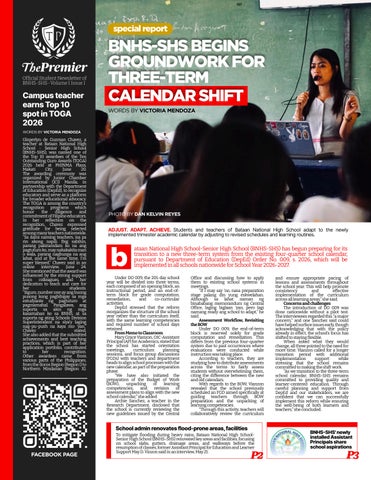
PHOTO BY DAN KELVIN REYES ADJUST. ADAPT. ACHIEVE. Students and teachers of Bataan National High School adapt to the newly implemented trimester academic calendar by adjusting to revised schedules and learning routines.
b
ataan National High School-Senior High School (BNHS-SHS) has begun preparing for its transition to a new three-term system from the existing four-quarter school calendar, pursuant to Department of Education (DepEd) Order No. 009, s. 2026, which will be implemented in all schools nationwide for School Year 2026-2027.
Under DO 009, the 201-day school year will be divided into three terms, each composed of an opening block, an instructional period, and an end-ofterm block for grade computation, remediation, and co-curricular activities. DepEd stressed that the reform reorganizes the structure of the school year rather than the curriculum itself, with the same learning competencies and required number of school days retained. From Memo to Classroom Mary Grace Vianzon, OIC-Assistant Principal (AP) for Academics, stated that the school has started orientation meetings, curriculum planning sessions, and focus group discussions (FGDs) with teachers and department heads to align school processes with the new calendar, as part of the preparation phase. “We have also initiated the preparation of the Budget of Work (BOW), unpacking of learning competencies, and revision of assessment plans to align with the new school calendar,” she added. Archie Sanchez, a teacher in the Research Department, disclosed that the school is currently reviewing the new guidelines issued by the Central
Office and discussing how to apply them to existing school systems in meetings. “If I may say ‘no, nasa preparation stage palang din yung eskwelahan. Although sa lahat naman ng binababang memorandum ng Central Office, laging biglaan ‘yan, pero lagi namang ready ang school to adapt,” he said. Assessment Workflow, Revisiting the BOW Under DO 009, the end-of-term block is reserved solely for grade computation and remediation. This differs from the previous four-quarter system due to past occurrences where evaluations were conducted while instruction was taking place. According to teachers, they are studying how to distribute assessments across the terms to fairly assess students without overwhelming them, citing the difference between the new and old calendars. With regards to the BOW, Vianzon revealed that the school previously scheduled an FGD aimed specifically at guiding teachers through BOW preparation and the unpacking of learning competencies. “Through this activity, teachers will collaboratively review the curriculum
School admin renovates flood-prone areas, facilities
FACEBOOK PAGE
To mitigate flooding during heavy rains, Bataan National High SchoolSenior High School (BNHS-SHS) renovated key areas and facilities, focusing on school slabs, gutters, drainage areas, and walkways before the resumption of classes, former Assistant Principal for Education and Learner Support May D. Vinzon said in an interview, May 21.
P2
and ensure appropriate pacing of lessons and assessments throughout the school year. This will help promote consistency and effective implementation of the curriculum across all learning areas,” she said. Concerns and challenges The introduction of DO 009 was done nationwide without a pilot test. The interviewees regarded this "a major concern," and one Sanchez said could have helped surface issues early, though acknowledging that with the policy already in effect, the school’s focus has shifted to staying flexible. When asked what they would change, all three pointed to the need for more time. Vianzon called for a longer transition period with additional implementation support while stressing that the school remains committed to making the shift work. “As we transition to the three-term school calendar, BNHS-SHS remains committed to providing quality and learner-centered education. Through careful planning and support from DepEd and our stakeholders, we are confident that we can successfully implement this reform while ensuring the well-being of both learners and teachers,” she concluded.
BNHS-SHS' newly installed Assistant Principals share school aspirations
P3
Headlines 02
DepEd clarifies 3-term calendar, maintains implementation
WORDS BY CHRISTIEN PANGANGAAN
t
he Department of Education (DepEd) is set to implement a three-term school calendar system beginning School Year 2026–2027 across all public schools nationwide as part of a broader reform to address the current education crisis while improving the welfare of both educators and learners.
Through DepEd Order No. 009, s. 2026, titled “Guidelines on the Implementation of the Three-Term School Calendar in Basic Education,” the reform restructures the academic year into three academic terms while maintaining the existing K to 12 curriculum, required learning competencies, and number of school days. Education Secretary Sonny Angara said that the new system is aimed at “allowing longer and more flexible instructional periods, reducing teacher workload, and promoting higher-quality instruction through improved organization of the academic year." How the new calendar operates Under the new system, classes for S.Y. 2026–2027 will begin on June 8, 2026, and will end on April 8, 2027, covering a total of 201 class days. The school year will be divided into three academic terms instead of the previous four-quarter structure. Each term will contain three components: Opening Block, Instructional Block, and End-of-Term Block. DepEd explained that the Opening Block will cover orientations and student profiling, while the Instructional Block will focus on the bulk of concentrated teaching and learning activities. The End-of-Term Block will include grade assessments, remediation, enrichment, co- and extracurricular activities, In-Service Education and Training (INSET), and wellness break. The department stated that this structure is intended to create longer uninterrupted teaching periods and provide dedicated time for interventions and teacher planning, stressing that the instructional block is “protected," which ensures that teaching periods are not disrupted. Addressing the current crisis DepEd has largely cited recurring class interruptions as among the primary reasons for restructuring
the school calendar. According to the Second Congressional Commission on Education (EDCOM II), 53 out of 180 school days during School Year 2023–2024 were affected by weather disturbances and non-instructional activities—halting almost three months of potential learning opportunity. This creates a cascade of dismal learning outcomes: students get less time to comprehend lessons, remediation opportunities become limited, and teachers struggle to accomplish both teaching and administrative workloads. With the new calendar, buffer periods that can “absorb disruptions" without sacrificing learning time are introduced. It also aims to resolve limited remediation by establishing structured sessions in both instructional and end-of-term blocks. Not a trimester system DepEd clarified that the reform does not convert the basic education system into a college-style trimester curriculum. The agency emphasized that the curriculum, subjects, and instructional standards remain unchanged—only reorganizing how time is used in schools, not changing what is taught. The department also stated that extracurricular and co-curricular activities will continue, but may be rescheduled to avoid disrupting instructional periods. In addition, DepEd said the reform seeks to streamline grading cycles and reduce overlapping administrative responsibilities among teachers. Implementation concerns Despite the calendar already approved for nationwide rollout, several education alliances stress that no school calendar reframing improves the quality of education. Alliance of Concerned Teachers (ACT) Chairperson Ruby Bernardo especially denounced the new system,
pointing out that there were no studies and “transparent evaluation" that support the new calendar. “We already called for consultations, but in the end, [the school calendar] was imposed in a rush," Bernardo said. Presently, there is a shortage of 165,000 classrooms. Based on the EDCOM II report, about 2,000 schools implemented multiple shifts to accommodate students during the 2023–2024 period. The Teachers’ Dignity Coalition (TDC) also called for the prioritization of salary increases for teachers, urging lawmakers to deliberate on proposed measures such as the P15,000 across-the-board wage hike. “Any measure that seeks to institutionalize reforms in the education sector must place the rights and welfare of teachers in paramount consideration; otherwise, even the most well-intentioned programs will fall short of their purpose,” TDC National Chairperson Benjo Basas said. The broader context DepEd, however, maintained that the three-term calendar is part of a broader reform agenda that includes classroom construction, expanded school feeding programs, strengthened literacy interventions, and improved access to learning resources. It added that the policy was developed through consultations involving teachers, school leaders, learners, parents, and stakeholders from both public and private education sectors, with feedback gathered through a nationwide orientation. Despite this, the implementation of the three-term calendar continues as public schools follow the mandatory rollout, while private educational institutions retain the flexibility to adopt their own academic calendars, provided they comply with existing curriculum standards, especially with Republic Act 11480’s required 201 school days.
PHOTO BY DAN KELVIN REYES CAMPUS REVAMP. Laborers push through the summer heat as they condition areas near the school's covered court for concrete slabbing prior to the resumption of classes on May 20, 2026.
School admin renovates flood-prone areas, facilities WORDS BY RISSE FLORES To mitigate flooding during heavy rains, Bataan National High School-Senior High School (BNHS-SHS) renovated key areas and facilities, focusing on school slabs, gutters, drainage areas, and walkways before the resumption of classes, former Assistant Principal for Education and Learner Support May D. Vinzon said in an interview, May 21. The renovations covered the pathways leading to the Magsaysay Building, the Philippine Amusement and Gaming Corporation (PAGCOR) Building, and the covered court, areas commonly affected by standing water during the rainy season. The projects are part of the school's preparations for the reopening of classes on June 8 and the approaching rainy season. Flood concerns Vinzon recalled that several areas of the campus became difficult to cross during periods of heavy rainfall, particularly the paths near the Magsaysay Building and the covered court. “Sa may court papuntang Magsaysay, ang hirap. Even teachers, tumatabi doon sa nakasako na puno na rin naman ng tubig. Hindi naman din maayos,” she said.
Vinzon emphasized that the improvements were intended to address these concerns and improve conditions in vulnerable areas. Campus initiatives Efforts to improve drainage systems and pedestrian routes were prioritized to help address concerns related to flooding and muddy passageways during inclement weather conditions. Aside from enhancing campus accessibility, the renovations are also expected to reduce safety risks caused by slippery walkways and standing water during unfavorable weather conditions. These enhancements are expected to support a more convenient movement for students and teachers, particularly during periods of heavy rainfall. With the rainy season approaching, the administration expects the completed renovations to contribute to a safer and more convenient environment for both students and teachers throughout the school year. “Siguro, a safer place for the learners ang ating school this time,” Vinzon noted.
In Campus 03 BNHS-SHS' newly installed Assistant Principals share school aspirations WORDS BY JAYMEE PASCUAL
e
dryll R. Contreras, OIC-Assistant Principal for Operations, and Mary Grace V. Vinzon, OIC-Assistant Principal for Academics, clarified anticipated outcomes for S.Y. 2026-2027, June 11.
Contreras shared his expectations for this academic year, in consideration of the full implementation of the Strengthened Senior High School (SSHS) Curriculum. "For the teachers, I'm expecting them to be more equipped with the updates and details. For the learners, we are expecting them to be more cooperative as we undergo the transition," Contreras stated. Meanwhile, Vinzon expected this academic year to be a year of growth, excellence, and meaningful learning for students and teachers. "I hope that every learner in Bataan National High School–Senior High School will be equipped with the knowledge, skills, and values needed to achieve their goals and become responsible members of society," Vinzon added. In terms of having specific and general objectives, Contreras and Vinzon briefly discussed their visions. Contreras aimed to be conscious of the spending of Bataan National High School - Senior High School (BNHS-SHS) and will be procuring
and maximizing the Maintenance and Other Operating Expenses (MOOE), while following the policies of DepEd. "I will look after the welfare of our learners, learning, and the regulation of the school operation," he added. Subsequently, Vinzon aimed to strengthen academic programs and support teachers in delivering quality instruction, while promoting excellence, innovation, and continuous improvement in teaching and learning. "I want to ensure that every learner receives quality education, develops the competencies needed for their chosen career path, and graduates ready for higher education, employment, or entrepreneurship," she stated. In accordance with the mandates and issuances coming from the organizational levels of the Department of Education (DepEd), Contreras also added that the school administration is promising to keep the faculty updated and will be adjusting the school's offerings, such as electives, for the learners.
I want to ensure that every learner receives quality education...for their chosen career path. Mary Grace Vinzon ASSISTANT PRINCIPAL FOR ACADEMICS
I will look after the welfare of our learners, learning, and the regulation of the school operation. Edryll Contreras ASSISTANT PRINCIPAL FOR OPERATIONS AND LEARNER SUPPORT
PHOTO COURTESY OF MANILA STANDARD
national news
DepEd to end mass promotion practices; phase out ‘grade transmutation’ WORDS BY MARKUS AGUINALDO The Department of Education (DepEd) is moving to abolish practices associated with “mass promotion,” following mounting concerns over declining student competency and literacy rates across the country. This February, Education Secretary Sonny Angara confirmed that the agency will review grading and promotion systems that allegedly allow students to advance to higher grade levels while lacking mastery of basic proficiencies. Furthermore, Angara also stressed that DepEd does not have an official policy to automatically pass learners. “While we don’t have a policy on mass promotion, there are certain practices, like if the teacher will also tutor the student who did not pass, the tendency, the human nature is he will pass the learner,” Angara said in an interview in Tagaytay City on February 3. This issue gained national attention following the Second Congressional Commission on Education (EDCOM II) urging DepEd to end the said practices contributing to mass promotion. According to the commission’s “Turning Point: A Decade of Necessary Reforms” report, 48.76% of Filipino learners in Grade 3 were not reading at grade level by the end of S.Y. 2024– 2025. Angara then acknowledged the findings of EDCOM II that the cumulative effect of existing rules has led to what critics describe as “mass promotion” in public schools.
POWERING FUTURE ENGINEERS. Aboitiz Power Corporation has extended ₱2 million in financial grants to 200 engineering students from Bataan during a ceremony held on April 29 at The Bunker.
“Although it is not a formal policy, EDCOM is correct that when the various policies are taken together, they effectively amount to a mass promotion policy,” he said. Phasing out of ‘grade transmutation’ Angara said that one of the key policies to be discontinued is “grade transmutation,” which converts failing grades into passing marks through numerical adjustments. The education secretary noted that they will ‘gradually end’ the practice, stressing that it only delays learning gaps instead of addressing them.
Alam naman ho natin sa mga international assessments...wala naman ‘yong transmutation. So parang hindi talaga siya akma sa pangkalahatang sistema.
Power grid firm grants P2M fiscal aid to engineering Bataeño undergrads
Sonny Angara
Through its private limited partnerships, GNPower Mariveles Energy Center (GMEC) and GNPower Dinginin Ltd. Co. (GNPD), the energy giant distributed the sum among Bataan Peninsula State University (BPSU) students who are also under the provincial government's flagship Iskolar ng Bataan initiative. "Our partnership with Bataan goes beyond generating energy. It is
EDUCATION SECRETARY
Angara stated that the said reforms were aligned with the suggestions of EDCOM II, which were recommended following reports of poor performance of the country in international learning assessments.
WORDS BY CHRISTIEN PANGANGAAN To further boost local innovation among the youth, AboitizPower, one of the largest electric power companies in the Philippines, has invested P2 million in financial grants for 200 engineering majors in Bataan during a ceremony at The Bunker, April 29.
about fueling the dreams of the community we serve," AboitizPower GMEC-GNPD Vice President for Corporate Services Andrea Madrid said. The initial P2 million distribution is part of AboitizPower's broader P10 million educational vow, with its annual release of P2 million for 5 years to assist with the financial backing of selected students. "Through this partnership with the Iskolar ng Bataan program, we want to give these bright engineering students the peace of mind to focus on their studies and reach their full potential. We thank the Provincial Government for allowing us to be a part of their educational journey," Madrid stated.
Local News 04 Bataan Rep pushes responsible tech use at DICT Summit
PLAN. PROTECT. PREVENT. A police officer briefs students during the school’s flag ceremony as BNHS and the Philippine National Police introduce new traffic and security measures set to take effect this school year.
WORDS BY ERISHANE MANANTAN Together with other government officials, industry leaders, and representatives from digital platforms, Rep. Roman recently took part in discussions on the topic “Generative AI, Digital Rights: Innovation but with Responsibility”. They discussed how the continuous advancement of artificial intelligence and other technologies must be used appropriately to minimize potential risks of misinformation. He highlighted the rapid growth of technology in the country, saying it presents both opportunities and challenges for citizens and that its use should be accompanied by proper guidance to help protect the safety, rights, and well-being of users. He added that promoting responsible innovation is essential to ensuring users' privacy protection and digital security, along with the accountability that comes with it. Through the collaboration of local government units, citizens, and the Department of Information and Communications Technology (DICT), efforts to strengthen digital competence, promote online safety, and encourage the responsible use of technology will continue as part of the country's drive to build a safer and more innovative digital nation.
INNOVATE. INFORM. INSPIRE. The DICT Summit brings together public and private sector representatives to discuss the role of responsible artificial intelligence in promoting innovation while addressing misinformation and privacy concerns.
PHOTO COURTESY OF BNHS-JHS FACEBOOK PAGE
BNHS, PNP to execute new traffic plan, security measures WORDS BY ABBYGAIL MINA To ensure the safety and order within the campus, Bataan National High School - Senior High School (BNHS-SHS) issued School Memorandum No. 054, s. 2026 or the “Implementation of New Traffic Scheme and Security Guidelines”, with BNHS - Junior High School (BNHS-JHS), local traffic enforcement, and the Philippine National Police (PNP), July 2. As per the memorandum, the proposed traffic scheme and security measures include the mandatory entrance of all vehicles
through the Vicarville Gate, as well as the prohibition of private vehicles from entering BNHSSHS premises, with an exception for certified school employees. “The cooperation of all students, parents, and stakeholders is highly encouraged to ensure the successful implementation of these measures and to maintain a safe and orderly learning environment,” the school memo emphasized. Furthermore, learners are now strictly banned from carrying
Balanga CHO joins Nutrition Month campaign ‘26
WORDS BY ABBYGAIL MINA
i
sharp items like scissors, knives, cutters, and other objects that may pose harm to the students, in relation to the recent school violence incidents, particularly in Tacloban and Cavite. In accordance with the security and safety protocols, confiscated objects will also be yielded to the security office of the school. “Wide dissemination of and strict compliance with this Memorandum are hereby enjoined,” the memorandum stated.
SCAN. Below are the codes viewers may use to access The Premier’s second episode on Spotify, dubbed as:
'Pens and Knives'
n accordance with the Philippine Plan of Action for Nutrition (PPAN) 2023 to 2028, Balanga City Health Office (CHO) participated in the 52nd Nutrition Month celebration for the promotion of sustainable diet and protection of natural resources, with the sub-theme “Nutrisyon at Kalikasan, Ating Pangalagaan!”
After its official kick-off in Dumaguete City, as mandated by Presidential Decree No. 491, the celebration aims to prompt the public to adopt nutritional food systems and support climateproof local agriculture. Guided by the main theme, “Sa PPAN, Sama-Sama sa Nutrisyong Sapat Para sa Lahat,” the nutrition month drive also strives to strengthen the connection between nutrition and the environment. According to the National Nutrition Council (NNC), this year’s theme serves as a “call-to-action” for all government units, private sectors, communities, and more to cooperate for the protection of both the environment and human health. “Safeguarding forests, oceans, agricultural lands, and water resources helps secure our food sources and ensures that future generations will continue to have access to nutritious and sustainable diets,” the council’s official government page stated.
Additionally, the nutrition council emphasized on the integration of climateresilient agriculture, sustainable fisheries, diverse crop production, and more for addressing malnutrition and mitigating climate change in the country. Pursuant to the PPAN 2023 to 2028, the NNC also officially coordinates the Nutrition Month campaigns in Bataan which focus on promoting the “Pinggang Pinoy”, featuring the Go, Grow, and Glow food palate. Starting this July, the Balanga CHO official Facebook page is planning to roll out community-based nutritional initiatives, as well as dietary seminars for the campaign. “Fellow Balangueños, let us work together to promote proper nutrition and environmental stewardship. By choosing nutritious food, supporting local produce, and avoiding food waste, we help build healthier families and a stronger community,” the health office posted on their page, July 1.
Want to know how school management ensures the safety of students? Join Jahzeel & Yuan along with Guidance Designate, Life and Career Skills, and Teacher II, Ma'am Gladys Vitangcol, as they spread awareness about school violence and how the school takes action; give advice as to how we can prevent violent activities; and share opinions of where violence starts.
Editorial 05
Opinion In This Economy? WORDS BY CHEZTER ATIENZA
Of All the Wrong Reasons
f
ollowing the grim incident that transpired at San Jose National High School in Tacloban City, questions were immediately raised on the state of juvenile detention and rehabilitation across the country, and government officials were quick to blame every other aspect besides what truly mattered.
Sen. Robin Padilla came fast to point the blame at the Juvenile Justice and Welfare Act, which he said has compelled children to think they could be let off for committing heinous crimes. Meanwhile, Sen. Risa Hontiveros quickly invited into a Senate enquiry the Germany-based developer of the video game GoreBox, from which the suspecs have allegedly been influenced. All of these, of course, were simply a reactionary stance to establish the fact that they care, which they do, while simultaneously sidestepping the cracks and failures within the nation’s rehabilitation facilities. Add to that the more bizarre response of Vice President Sara Duterte: that this tragedy supposedly exposes the underbelly of the government in identifying threats before lives are lost. What she said was essentially true, but ironic considering that she is being impeached on four consolidated grounds in the Senate after being indicted in the lower chamber two times for misuse of public funds. What’s amiss is how these two high schoolers got their hands on a .38calibre revolver and a Glock 17 pistol. Based on initial police reports, the pistol was determined to be a service firearm issued to a police officer—the aunt of the 14-year-old suspect. Meanwhile, the 15year-old suspect used a revolver linked to a Cebu City-based security agency, where his grandfather previously worked. How these children ended up possessing guns, no matter the angle, is a grave shortcoming on the part of the guardians who were meant to supervise them. And perhaps the more chilling fact about this incident is that the school where these teenagers study only had one guard on duty. For a campus that
has more than 1,600 students and 110 teachers, having one layer of protection is not just a reflection of deep systemic failures within the nation’s education system but a failure that destroys how schools are supposed to be seen as a haven for learning. Imagine the distress of parents when they learn of the chaos unfolding within the classrooms and the trauma that the children experienced. What’s worse is that the suspects were not part of any shadowy gangs or syndicate. They were the quiet ones who have allegedly been bullied. Of course, the people that have allowed such crimes must be investigated and questioned, but in this particular case, the murders were premeditated. Case findings showed screenshots where the two students exchanged remarks on the consequences of the act. Which is why the Department of Justice is purporting that the shooting may have stemmed from a pattern of nihilistic violent extremism, or NVE, rather than a simple case of school bullying. Though, under the Anti-Bullying Act, or RA 10627, where schools are mandated to implement programs that provide counselling to vulnerable students, many schools can barely make do with what few resources they have to assist every school kid going through a rough time. Following this tragedy, the government must show through practice that rehabilitation facilities and juvenile detention centres are in place with the necessary resources. Strengthen campus security. Implement system-wide digital literacy drives. And most importantly, ask what it can do for the victims and affected people, not what it can blame, and for every other reason besides what’s at stake.
“Really? In this economy?” has long been used to mock irresponsible spending or overpriced purchases. The phrase usually carries the message: “No, that is a bad decision.” But lately, Filipinos are no longer saying it over luxuries. They are saying it while trying to afford basic necessities. Rising Costs Inflation continues tightening its grip on Filipino households, particularly low-income families whose spending already revolves almost entirely around necessities. According to the Philippine Statistics Authority (PSA), inflation among the bottom 30% income households accelerated to 8.5% in April 2026, exceeding the national rate of 7.2%. Rice prices surged by 15.3%, with regular varieties that once sold around ₱45 per kilo now reaching ₱52 to ₱60 in several markets. Fish and seafood climbed by 11.1%, making common sources of protein such as galunggong and tilapia noticeably more expensive for lowincome households. Vegetables rose by 11.6%, while corn increased by 22.7%, eventually affecting the prices of poultry, eggs, and other daily food products. The situation becomes dangerous when the fastest-rising prices come from the very goods people cannot survive without. Food and non-alcoholic beverages accounted for 53.6% of inflation’s impact on the poorest households, showing how price pressures now concentrate on basic survival needs. Families can postpone wants. Hunger is not one of them. Transportation inflation among low-income households climbed to 19.5%, with minimum jeepney fares rising from ₱13 to ₱15 as fuel costs continued to increase. Housing, electricity, water, gas, and other utilities rose by 9.9%, with electricity rates in some areas exceeding ₱12 per kilowatt-hour. Cooking gas and water expenses continue to take up a larger share of already limited household incomes. These are fixed daily costs that households cannot simply cut. Every increase immediately tightens already strained budgets. Shrinking Value The crisis extends beyond inflation. The Philippine peso now trades at around ₱61.65 per US dollar. On paper, the number looks stable. For low-income households, it is not. Imported fuel becomes more expensive. Transport fares tighten. Electricity and utility bills rise against incomes that remain unchanged. ₱5,000 once filled several grocery bags. Today, it is gone after one trip, spent on rice, eggs, canned goods, cooking oil, and a few kilos of meat. Grocery shopping no longer feels routine. It feels like elimination. Hands now linger over shelves longer than they should, not from confusion but from calculation. Every product placed inside the cart is followed by the same exhausting question: “Do we really need this?” Inflation is now measured in
hesitation. The troubling part is that the question is no longer about unnecessary spending. It is now asked of basic necessities once bought without hesitation. Inflation should never force survival into negotiation, yet it has become the quiet reality for millions of Filipinos as incomes fall behind the rising cost of living. Constant Adjustment According to Metrobank budgeting guides, Filipinos are encouraged to use meal planning, grocery lists, and stricter budgeting habits to cope with rising costs. Filipinos are no longer budgeting to save money. They are budgeting just to make it through the week. One of the more unsettling realities is how households now treat expensive food as a long-term condition rather than a temporary difficulty. Families reduce portions, shift to cheaper alternatives, buy in smaller quantities, and sacrifice nutrition just to stay within budget. The growing dependence on “tingi” culture reflects how fragile household finances have become. Inflation hits low-income households hardest, particularly minimum wage earners, daily wage laborers, commuting employees, and informal workers, because necessities already consume most of their income before prices even move. Rising costs also reshape life decisions. For many, starting a family is no longer a personal milestone but a financial impossibility. The country’s declining birth rate reflects this shift, where economic stability has become a prerequisite for family life. Normalized Sacrifice Perhaps the most disturbing part is not that prices continue to rise, but how quickly people are expected to adjust to it. Smaller portions feel expected. Delayed bills feel routine. Exhaustion feels unavoidable. Filipinos are praised for resilience, but resilience starts to lose meaning when it simply becomes endurance without relief. Minimum wage growth continues to lag far behind the rising cost of basic goods, leaving income constantly chasing expenses it can never fully catch up to. Price monitoring and wage policies exist, but enforcement often moves slower than price increases themselves. Stronger wage protection, stricter monitoring of price manipulation, affordable public transportation, stronger agricultural support, and expanded food assistance are no longer optional policy ideas. They are urgent necessities. An economy should not only be measured by growth, but by whether families can live without constant compromise. No Filipino family should have to stand beneath supermarket lights calculating which basic necessity they can afford to lose just to survive another week.
Opinion 06 Déjà Vu: Ctrl+C, Ctrl+Flood WORDS BY CHEZTER ATIENZA Picture yourself standing on your rooftop as floodwaters swallow the streets below. Rescue boats arrive. Cameras roll. Officials promise solutions again. Then the water recedes—but nothing changes. And next year, it happens again. It feels like the same scene being copied and pasted every year. The Philippines does not lack warning. The Philippine Atmospheric, Geophysical and Astronomical Services Administration (PAGASA) records around 20 tropical cyclones every year. This is not rare. This is routine. The country is not surprised by rain. It is surrounded by it. Yet flooding still arrives like something new every time, as if memory resets when the water rises. That is where the illusion begins. Flood control is assigned to the Department of Public Works and Highways (DPWH). Local Government Units (LGUs) maintain drainage. Congress approves the budget. Contractors build the projects. The Commission on Audit (COA) checks what was done after the damage is already visible. Every part exists. Every part is working on paper. But when the water returns, the system feels like it forgets itself. From 2023 to 2025, nearly ₱980 billion was allotted for flood control projects under the DPWH based on government budget records. In 2024, the agency also recorded around ₱165 billion in unobligated or unused funds according to Department of Budget and Management (DBM) data. And still, the same streets flood. The same homes fill with water. The same lives stop temporarily, then resume as if nothing happened. So the question slowly changes shape. Not “where is the budget?” But “why does nothing change?” Not because the country lacks engineers. Not because floods arrive without warning. And not because solutions do not exist. The deeper problem is that flooding is treated as an emergency to respond to rather than a problem to prevent. Prevention is less visible than rescue,
maintenance attracts less attention than construction, and accountability often becomes harder to trace than the flood itself. The flood has a clear destination. Responsibility often does not. COA reports have been saying it in quieter language for years. Delayed projects. Incomplete flood control structures. Poor implementation. Different reports. Same pattern. The kind of repetition that stops sounding like warning and starts sounding like routine. Even Typhoon Ondoy in 2009 already showed what Metro Manila looks like when rainfall overwhelms a system recorded by PAGASA as extreme. It did not just flood the city. It exposed how fast everything collapses when drainage cannot breathe. That moment was treated like a lesson. But lessons are only real if they are remembered. Now the pattern repeats like a command. Rain falls. Water rises. Roads vanish. People move to higher ground. Relief arrives. Reports are written. Investigations are announced. Then silence. Then the next storm arrives and performs the same sequence again without hesitation. And between storms, life pretends the cycle is paused. Drainage is called improved. Projects are called ongoing. Plans are called progress. But water does not respond to words. It responds to capacity. And when capacity does not change, neither does the outcome. That is why people stop reacting like it is new. They already know what the rain means. Not hope. Not surprise. Pattern. Families lift appliances before the storm even arrives. Students already expect suspended classes. Workers already prepare for
CARTOON BY PHILLIP PEREZ lost income. Entire communities adjust not for uncertainty, but for certainty that repeats too often to question. That is the quiet part no one says out loud. You do not prepare for floods anymore. You prepare for repetition. You are not outside this system watching it fail. You are inside its results, moving through the version of the country it leaves behind every time it resets. This is not missing information. It is not confusion. It is a pattern already known, already experienced, and already endured. Breaking the cycle does not begin when rescue boats arrive. It begins long before the storm—with drainage systems that are regularly cleared, waterways kept free of obstruction, flood-control projects completed on schedule, and public funds translated into infrastructure that can withstand the next downpour rather than reports that explain the last one. These are not new solutions. They have been discussed for years. The challenge is not knowing what to do but consistently doing it. Until prevention receives the same urgency as disaster response, every flood will continue to feel less like an unavoidable disaster and more like a repeated failure to act. Nothing about it feels new anymore. Only the water still does.
Scroll, Spread, Surrender WORDS BY RENZON DAMPIL
i
n today’s nation, where information propagates faster than facts can catch up, disinformation is not just a distraction but a weapon even used in politics. From elections to everyday conversations, manipulated narratives shape public opinion and blur reality.
And that is the danger, for democracy weakens when citizens can no longer differentiate truth from deception. Imagine a country in which people choose to believe content creators rather than law enforcement officials themselves. Seeing a large share of Filipinos rely mainly on social media platforms such as Facebook and TikTok for news— platforms where about two-thirds of users regularly access new content, according to the 2023 Institute Digital News Report of Reuters—they become more vulnerable to misleading information. Coordinated internet networks that back certain figures while denigrating others, using dummy accounts, manipulated media, and false claims, have been documented by fact-checking organizations such as VERA Files and Rappler, as well as in reports from the Oxford Internet Institute’s Computational Propaganda Project. This kind of manipulation gravely disrupts democratic processes. Look at sensational headlines and short-form videos taken at surface value and shared repeatedly without actual context. Even in some cases, AI videos of political personalities are often more acclaimed without them realizing the deception than actual statements of the same asset. An example of this can be seen in viral social media
posts falsely claiming that former President Rodrigo Duterte, who has been imprisoned by the International Criminal Court (ICC), was receiving support from celebrities such as LeBron James, Sean ‘Diddy’ Combs, and Cecil Stedman of the Global Defense Agency, with the latter being the most controversial example. Fact-checking organizations such as Rappler and VERA Files later debunked these claims, adding that ‘Stedman’ is a fictional character in the American animated TV series “Invincible.” Yet many users continued to engage with and believe the content of satirical posts, sometimes not even bothered to check their validity at all. This illustrates how easily fabricated narratives—no matter how implausible—can spread rapidly and shape public perception. Even truth-seekers aren’t safe. When fact-checkers try to knock down misleading assertions, they can run into intimidation or cyberattacks. Case in point, several journalists have reported being red-tagged, including Cagayan de Oro-based journalist Cong Corrales, who reported being repeatedly red-tagged online and even receiving a “wanted poster”-style threat, forcing him to temporarily leave his home for safety. These incidents, documented by the National Union of Journalists of the Philippines (NUJP), show how red-tagging contributes to
the weakening of press freedom in the country. Congruent to this is the lack of media literacy, where a 2025 Reuters Institute Digital News Report found that around 51% of Filipinos struggle to distinguish between factual information and fake news. The same 2025 report also noted that about 67% of Filipinos express concern about online misinformation, highlighting the prevalence of the issue. In answer, critical thinking should be emphasized in schools, and people should be accountable for checking what they consume. I really admire the journalists and fact-checkers who risk their lives to do this work as one of the last bastions for truth in a world awash in distortion. Yet they cannot carry this burden alone. Democracy has evolved into an incredibly intricately woven system, in which only those who actively engage in it will see the fruits of its labor. In this sense, they did not merely seek to create a visual representation; they intended for viewers to see themselves reflected within the artwork. Democracy cannot proceed with mistrust. If truth is optional, then freedom itself will be fragile. We need to challenge what we read, fact-check before passing it on, and hold our ground fighting for the truth. The people are to be in control, not managed.
Fragile Beauty: The Philippine haven in the face of decline WORDS BY RUTH DIWA As the sun rises in the pearl of orient seas, birds chirp with purpose—as they soar through the skies and mountains. Fish foraging for food early in the morning to replenish their energy after a long sleep in the depths. Carabaos help farmers till the field for harrowing and tramping the rich mud where rice and wheat grow. But lately, it has grown fragile from the human touch. The Philippines is currently one of the 17 megadiverse countries that collectively host two-thirds of the world’s biological wealth. According to the Department of Environment and Natural Resources (DENR), it has 52,177 described species with half of them being endemic or can only be found in the Philippines. There are about 10,000 species of plants residing in the country, which maintains 5% of the earth’s total flora population. The Philippines' biodiversity is rich both in land and water, being the center of marine biodiversity; it anchors the coral triangle with a total of 500 coral species. Ranging from big animals like the Blue Whale (Balaenoptera musculus) to the smallest species, the Tarsier (Carlito syrichta), Philippines boasts its biodiverse species. Also, we should not forget about the infamous Rafflesia, also known as corpse flower, for its distinguishable smell and our Waling-waling (Vanda sanderiana) the queen of Philippine flowers. This country has its very own endemic species, the most popular of them all is the longest eagle — The Philippine eagle (Pithecophaga jefferyi). This majestic bird is a treasure for the entire country and our wildlife. Unfortunately, because of human activities, it is now critically endangered and in the brink of extinction. Due to the staggering rise of wild poaching, at least one Philippine eagle is killed every year from shooting. “As more of our forest is lost, Philippine eagles go farther and farther from their usual hunting grounds in search of prey to hunt. This usually brings them towards human settlements and their livestock, which often results in conflict-with the Philippine eagle on the losing end.”stated by the Philippine eagle foundation in their page. These are just some of the human activities that caused them to be endangered. They are treated as a pest to their domesticated livestocks when they do not realize they are also searching for food due to their habitat being destroyed by illegal loggers. Under Philippine law, killing an endangered species can result in a jail sentence, a fine, or both. Additionally, a Philippine eagle sexually matures around 5-7 years. The pair of eagles can only produce only one egg every two years and they have a very low reproduction rate. Tarsiers category is nearly threatened due to habitat loss and illegal pet trade are the main threats according to the Tarsius Project. While the biggest threats to the tamaraw's survival are habitat loss due to human encroachment and illegal hunting for meat and horns, deforestation and habitat-loss is the root-cause of their population declining. Not only does deforestation harm them but also us. Trees serve us as a shade against the heat, an anchor to prevent landslides,sips excess water from rainfall, and a filter against air pollution. These simple acts extend a civilian's life just by being there. There will be no trees without preservation; preserving trees is our mission. Reducing the consumption of paper, recycling cardboard or any paper, and using reusable products such as towels, etc., is the key. Let us not forget to join different organizations that help wildlife and nature to be preserved. Be the voice to the species who cannot speak for themselves. PHOTO COURTESY OF PIXELS
Science 07 Future Investment: Schools as Pillars for Digital Competencies WORDS BY ALYANNAH IYO
a
s the rapid surge of new technology floods our world, there are times we fail to see what's lurking behind — the dangers, dependencies and unrelenting wave of misinformation, creeping without a sign.
Digital literacy is no longer an option — but a foundation for a tech-driven future. And to achieve that, schools play a crucial role in making it happen. It’s not only about being tech-savvy or good at computers, but also the ability of an individual to search, evaluate and communicate information safely and effectively. Take the internet, for example, it has a vast library of educational resources such as research articles and online courses, that students can access anytime, anywhere. However, not all of them are authentic nor factual. Students would still need to learn what's to be trusted, and how to verify the contents and sources. But it doesn't stop there. They can take full advantage of the available information by applying the knowledge they gained to solve real-world problems. For that to happen, teachers need to guide them through the learning process and promote practical use of knowledge. Instead of simply telling students what to do, they can show them how to navigate the internet using interactive lessons. Another reason why digital literacy is relevant stems from the rise of artificial intelligence (AI). As AI continues to advance, so is the demand for individuals who understand proper and ethical use of AI. Based on the AI Ready ASEAN Research, as reported by GMA News Online, 83.40% of students and 73.07% of educators have utilized generative AI tools in education. With 75.95% of students saying they used AI for writing and paraphrasing, compared with only 42.21% of educators. Showing the younger generation’s tendency to pick up new technologies. Despite this, the report also warned about uneven levels of readiness, weaknesses in digital skills, public trust, online security and responsible use of technology. ASEAN Foundation Executive Director Piti Srisangsam, also pointed out that many students turn to AI not because they fully understand how to use it properly or ethically, but because it's easy to adopt. This is why proper training, clear policies and basic tools are needed to teach AI etiquette, as only half of institutions across ASEAN provide them. By giving teachers the resources and preparation they need, they can in turn, teach students proper and ethical use of AI. The importance of AI literacy goes beyond the four walls of classrooms. Concerns regarding online safety and news accuracy continue to rise as more AI-generated content enter social media. There are even cases where people deliberately use deepfakes or AI-generated images and videos to mislead or scam others. It becomes especially dangerous in a country known for spending a long amount of time using social media platforms. According to the Digital 2026 Global Report, there are approximately 98 million internet users and 95.8 million social media identities recorded in the Philippines, out of a total population of roughly 117 million. This indicates that millions of Filipinos are constantly exposed to digital platforms, content and social media influences that could be harmful to them. Issues regarding fake news, phishing scams and online harassment also continue to grow.
Some scams are obvious — calls from unknown numbers, ads on sketchy sites, prizes from a lottery you never signed up for. Those are common scams that are easy to tell apart. But what if the swindlers used the face of someone you know? Someone you trust? What if it used the name of a wellknown brand or company? For instance, the Labor Day scam that circulated on Facebook last May 1. Where 51GB of free data is supposedly given as a Labor Day reward for internet users. It used the names of internet providers like Smart and Globe, and created a fake Facebook page with fake reviews to convince users to give personal information. It also encouraged the users to share the link to others under the guise of a claim procedure, causing it to spread to more people. Students and adults alike fell victim to it not out of foolishness, but because of a lack of awareness. Fake news could spread the same way. Usually through misinterpretation of facts, sharing of unverified sources, and sometimes — through deliberate distribution of false and misleading information. Such actions can create anxiety, distrust in media and even physical or mental harm to a person. That's when being informed reduces the risk of fraud. Understanding media literacy allows people to assess, evaluate, and question information in digital spaces to avoid manipulation and deceit. Reinforcing students’ skills to identify misinformation will help them distinguish the difference between real and fake — whether it be news, offers, or scams. It might not give full immunity to online threats, but it could delay the spread of false information and promote safe browsing. Technology continues to change and improve people's way of life, whether it be in education, work, or daily tasks. While not everyone is going to enter a tech-based career, learning the fundamentals of technology will still benefit them in their future career. Digital literacy is becoming a baseline requirement in the vast majority of jobs as companies began to prioritize candidates who can easily adapt to new technology. As such, training students to be familiar with online tools will be critical to improve their work efficiency. However, teaching these students through PowerPoint presentations alone may not be sufficient when learning technology. Memorizing features and concepts is not the same as learning through practice. One gets forgotten within a week, the other survives the long run. Instead of making students sit for hours reading slides, schools should give practical exercises, and host workshops. By doing so, they will get to experience hands-on training and make the concept easier to understand. There is no perfect way to teach digital competencies to students, and no one will ever be completely safe from online threats. But with the combined efforts of the students and teachers alike, building critical skills and promoting digital literacy will be a whole lot easier. For every consistent and productive discussion, the future gets a little brighter.
Users of Generative AI in Education
Students Educators
83.04% 73.07%
BNHS-SHS amps up disaster readiness in earthquake drill
BNHS-SHS welcomes new batch of senior Arellanistas in 1st-day program WORDS BY VICTORIA MENDOZA PHOTO BY DAN KELVIN REYES
WORDS BY CHRISTIEN PANGANGAAN
t
o strengthen student alertness during sudden disasters, Bataan National High School - Senior High School (BNHS-SHS) conducted an earthquake drill among Grade 12 students, June 19.
According to Alain Morales, a Grade 12 teacher, the drill was to ensure that students are aware of what to do during earthquakes and emergencies. “Para maiwasan ang panic sa mga students na hindi alam kung ano talaga [ang nangyayari],” Morales said. He added that students must know where the emergency exits and evacuation areas are located during dire situations. “Pwede kasing magka-stampede, masaktan o magkasalubungan dahil ‘di aware [ang students] sa drill na ginagawa,” Morales stated. Meanwhile, for Luke Baldeo, a Grade 12 student, conducting timely emergency drills is crucial for molding risk-averse learners. “It benefits the students’ well-being and increases their chance of survival for actual real-time earthquakes,” he said. In the case of disaster preparedness, Morales disclosed that more precautionary measures should be taken by the school. “Dapat bawat poste may posters tungkol sa mga evacuation areas [ng school]. Dapat regular ang mga earthquake drills. Di pwedeng once a year or twice a year lang para mas applicable sa mga sakuna,” he stated. Morales also said that information drives should be strengthened for the knowledge of Senior Arellanistas. “Included dapat kung anong pwedeng survival steps na gawin like ‘Duck, Cover, Hold’ and also dapat alam ng lahat ang basic first aid,” he said.
FRESH PATHS OPEN. Faculty and students gathered at the covered court of Bataan National High School - Senior High School on June 8 to officially welcome the new set of students and open the academic year 2026–2027 through a flag ceremony. Bataan National High School-Senior High School (BNHS-SHS) faculty and learners gathered in the covered court to officially open the Academic Year 2026-2027 with its newest batch of students, June 8. The Grade 11 program began at 8:00 AM, while the Grade 12 program ran in the afternoon, starting at 12:45 PM. The program’s attendees were divided into batches, and among the first to be welcomed were students from the Science, Technology, Engineering, and Mathematics (STEM) cluster who lined up at the covered court ahead of the ceremony. The program opened with the national anthem, followed by a prayer led by an officer of the Supreme Student Learner Government (SSLG). The Panunumpa sa Watawat and Panatang Makabayan were likewise led by SSLG officers. Officer-in-Charge (OIC) Assistant Principal for Operations and Learner Support, Edryll Contreras, delivered the school's reminders and message to the incoming batch of Grade 12 students, stressing the level of discipline now expected of them as the school's seniors. Contreras noted that the new batch of Grade 12 students is expected to carry the same standards set by the previous batch, telling students that they will serve as a guide for the incoming Grade 11 students as they adjust to changes in the class schedule, particularly concerns surrounding dismissal time.
Addressing the issue directly, Contreras acknowledged that both parents and students have raised concerns over the matter. "Nararamdaman namin 'yung power ng issue ng mga parents and students sa issue ng pag-uwi, so ginagawa ng school 'yung best to deliver 'yung system ng sabay-sabay na pag-uwi," he said. He added that despite these efforts, shifting remains necessary, explaining that the school continues to face a shortage of classrooms, making it impossible to render a fixed schedule. The assistant principal then called on the students to help take care of the school facilities and focus on their studies. Contreras also reminded the batch of the significance of their year level, noting that they are set to graduate during the school's 10th anniversary, and encouraged them to take pride in this milestone while remaining cooperative throughout the school year. He further stated that the Grade 12 batch will be under his supervision, alongside their respective teachers. OIC-Principal Ian Luegim De Leon then delivered his opening remarks, encouraging the students to take their studies seriously. "Laging tandaan na mag-aral nang mabuti para maka-graduate at makasama ninyo ang mga katabi ninyo ngayon sa People Center," he said. The program then concluded with OICAssistant Principal for Academics Mary Grace Vianzon introducing the advisers assigned to each section housed in the PAGCOR building.
Anti-nuclear coalitions resist BNPP restoration Anti-nuclear unions and advocates at the No Nukes Asia Forum (NNAF) on June 19 said that several Asian countries continue to reject proposals to rehabilitate the previously discontinued Bataan Nuclear Power Plant (BNPP) in Morong, Bataan.
BE DISASTER READY. Grade 12 students participated in an earthquake drill aimed at strengthening their awareness and preparedness during emergency situations.
Fang Long Shi of the Taiwan Environmental Protection Union (TEPU) said in an interview that Taiwan had already shut down its three nuclear power plants as part of its massive shift toward renewable energy. Fang added that Taiwan has since moved away from nuclear power due to cost and safety concerns, with an estimated 4,700 tons of highlevel radioactive waste still present within the country's vicinity. Meanwhile, in the Philippines, the national government has established the Philippine Atomic Energy Regulatory Authority (PhilATOM) under law to advance nuclear energy development, yet critics
noted that it has yet to finalize key regulatory structures for managing radioactive wastes. The Department of Energy (DOE) likewise said that the government is open to considering nuclear energy proposals from private sectors, though small and medium-sized reactors are not yet commercially available. In Morong, BNPP has already been declared a "nuclear-free" zone according to the Nuclear-Free Bataan Movement (NFBM). The Sangguniang Bayan of Morong has previously passed a Non-Nuclear Zone ordinance on June 22, which disallowed the construction, operation, and storage of nuclear facilities and radioactive materials within the municipality. NNAF reported that while countries such as Australia, Japan, South Korea, and India continue to use nuclear power for energy, pushback to nuclear energy and weapons remains steadfast in various Asian countries.