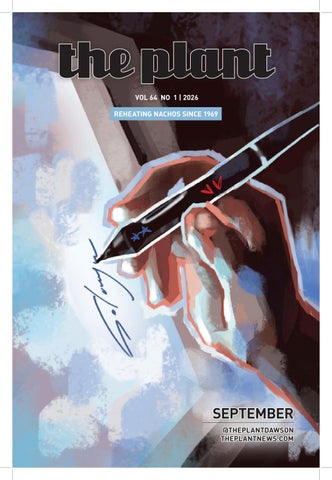
the plant
1 THE PLANT
VOL 64 NO 1 | 2026 REHEATING NACHOS SINCE 1969
SEPTEMBER @THEPLANTDAWSON THEPLANTNEWS.COM
2 THE PLANT
Letter from the editors Dear reader, After four months of sunshine and wild orange daylilies to greet me on my walk to the bus stop, your newspaper has found itself back in your hands – or perhaps, this is the first time we find ourselves acquainted. After a summer spent carefully preparing and planning, gratitude consumes me: the September 2026 publication is out! As I write my first letter from the editor, I cannot help but think of the girl I used to be. A storyteller, that’s who! Under the very desk I report from, you may still find piles upon piles of storybooks, circa 2011. And, those who know me know I am passionate, stubborn – a list of unattractive qualities continues – but all my traits are somehow interlinked with love of writing. Be it about my day, my desires, the world around me, or the love I have inside me, I most often write about what has me vexed: politics and social issues are what fuel my soul and drive me to be a journalist. My English teacher in the ninth grade once gave me some advice: “If you love your mind, you should nourish it with books.” I hope that The Plant can provide that comforting presence – something to be relied on month-to-month. And, if there is anything I hope you take from these pages, it is this: put into the world what you wish to get out of it. Read what challenges you. Write what moves you. Create the world you wish to live in. Give love where you can. Perhaps that begins with publishing a piece with us. Perhaps it starts with sharing your art. Whatever it looks like, I hope you find something of yourself in these pages – and maybe even, like me, make the discovery that, the more you write, the more you become yourself. Yours, Chloe
Dearest gentle reader,
Index NEWS 3 VOICES 6 ARTS & CULTURE 14 CREATIVE WRITING 24 SCI & ENVIRONMENT 26 SPORTS 27 25CURIOSITIES 28
September, to me, is the month where we can most feel the changing of a season. We are stepping into a threshold, going up moss covered steps into something a little more enchanted. It’s my personal favorite season, a time where we can let ourselves believe, just for a second, that there is still a hint of magic in the world. This section of the year is when everything comes alive for me, contradictory I know. But life seems to glow a little brighter as we get back into the groove of school, the humdrum of social life picking back up and most of all, it seems to be the time in which my thoughts feel at reach. We can never truly know ourselves; but every now and then we reach our hands down into the still, dark waters of our subconscious and pull out a new thing from the depths. When all things are putting on a show for us as they’re slowly dying, my thoughts lie closer to the surface and I can see myself a little clearer. And to me that means writing, being creative, and trying to learn as much as I can before the world and I reach our final hibernation. While I don’t know your creative habits or how the seasons speak to you, I hope this first issue of the Plant can give you something. My biggest wish is that it could be a source of magic for you: that something in it catches your eye, gets you to know yourself a little more, makes you want to create, or at least teaches you something you didn’t know before. I know this issue and the wonderful people that have contributed to it is for me. Orion
The Plant is an editorially autonomous student paper. All opinions expressed in The Plant do not necessarily belong to The Plant, but are those of individuals. All content submitted to The Plant or its staff belongs to the paper. We reserve the right to reject or edit all submissions for brevity, taste and legality. The Plant welcomes typed and signed letters to the editor under 400 words. Copyright 2026
NEWS 3
A
lamingo Revolution behind it quickly sparked outrage in Zvernec, which, after a private security personnel's assault on a protester, turned nationwide. For most, however, the outrage went beyond environmental destruction. The flamingos they began to hold up stood for not only the natural habitat at stake, but a broader need – “like a desert needs water”-- for state transparency and accountability.
VIA TRUTHDIG
MARTIN KALOSHI CO-MANAGING EDITOR Take a stroll down Tirana, Albania's main boulevard after 6 pm, and you'll find yourself caught in a sea of flamingos. For the 100th consecutive day, tens of thousands of young Albanians have ditched the afternoon cafe culture and instead procured themselves cardboard flamingo cutouts and signs, taking to the streets with a clear message: Albania is not for sale. The turmoil started on May 23rd, when residents of Zvernec – a village in the country's south home to flamingos and Europe's last wild river delta – arrived at their local beach only to find it fenced off with barbed wire. "There was no sign whatsoever, neither by the lagoon where they were cutting the road, nor on the beach where the machinery was working … of any kind of license or permits or even just declaration of who they were," tells Ariel Brunner, Europe Director for the environmental charity BirdLife International, in an interview with CNN. It was only from media reports that locals became aware of the development barring their access to the sea: a luxury resort dreamed up by American billionaire couple Ivanka Trump and Jared Kushner, backed by Albanian Prime Minister Edi Rama. 4 years ago, Trump and Kushner made their first visit to Albania. Aboard their friend Nathaniel Rothschild's yacht, the couple traced the country's entire southern coastline, stopping to swim and window shop by places like Sazan: a lush, uninhabited ex-military base and Albania’s largest island. "We swam to the island,
we went on a hike barefoot to the top and we were just captivated," Ivanka Trump remembers. The next step, she added, was to "help realize its potential," a pledge that PM Edi Rama, who met them on the yacht, was keen to ratify. Rama granted the Sazan Island project "strategic investment" status in December 2025, which would give Kushner and Trump fast-track access to land and building permits. Albanians remained unaware. "We can't afford to not exploit a gift like Sazan," Rama told the Guardian, "We need luxury tourism like a desert needs water." In Zvernec, the plans included another mega-resort. There, it would occupy parts of the Vjosa-Narta Protected Landscape, home to more than 2,300 total species of flora and fauna, including the endangered Mediterranean monk seal, Egyptian vulture, and over 200 bird species such as the flamingo and Dalmatian pelican, according to BirdLife International. In order to carry on with the resort, Rama swiftly amended Albania's Protected Areas Law, which previously prohibited development in vulnerable natural zones like Vjosa-Narta. Now, it exempts "structures of excellence, 5 stars or more." Environmental biologist Melitjan Nezaj tells CNN that construction has already "blocked one of the two openings connecting the Narta Lagoon to the sea, cutting off tidal exchange with immediate, cascading consequences for fish, birds, and the entire food chain." The resort and the opaque planning
Protesters are students and workers, overwhelmingly Gen-Z, fighting for completely fresh political air. They demand the reinstatement of the Protected Areas Law, as well as Rama’s immediate resignation after 13 years in office. They point to larger issues, too, like the country’s crumbling education and healthcare systems and unrestrained corruption: issues that for decades have pushed their relatives out. In the capital of Tirana, crowds reached 250,000 at their height.
“It was the largest protest in the country since the fall of communism.”
Solidarity demonstrations quickly ensued across the world. In cities like New York, Toronto, Milan, Montreal, and 80 others, the Albanian diaspora joined in on the newly named “Flamingo Revolution.” Beyond its scale, the Flamingo Revolution also got acclaim for its propriety. Parents regularly brought their young children. Artists performed. Everyone cleaned up the streets afterwards. Protesting quickly became the new 6 pm go-to for Tirana residents, as they shunned their prior ways with signs reading “Get up from the cafe!” Some more creative signs read, “Stop it, Ivanka! Girlie pop, this isn’t you!” The Flamingo Revolution has already caught the European Union's attention, which Albania has been trying to join for decades now. The European Parliament backed protesters, urging Rama to repeal his Law on Strategic Investments as well as his amendments to the Law on Protected Areas. Rama, yet to resign, insists both projects must go on.
4 THE PLANT
Democracy Now: Upcoming Quebec Elections ATIKA UME FAZAL NEWS EDITOR Quebec finds itself at the eve of what could be a huge change in politics. On the 27th of August, Quebec’s National Assembly was dissolved, calling elections for the 5th of October. For the past 8 years, the Coalition Avenir Quebec (CAQ) has been winning decisive victories. In 2018, the party secured 74 of 125 seats, with the Liberal Party winning 31 to form the official opposition. In 2022, the CAQ’s seats increased by 16, bringing its total to 90 andproviding them with another majority government. For almost the entirety of the CAQ’s tenure, Francois Legault was the leader of the party. He stepped down on the 14th of January 2026, leading to Christine Fréchette taking his spot after winning the party’s leadership election. A study was conducted by The Plant to see what subject students are most concerned about for the upcoming election. These were the results and the promises the main parties have made regarding these subjects:
Cost of living Students find themselves in a precarious situation regarding their buying power.
“While virtually everything keeps getting more expensive, wages have struggled to keep pace.” Even with the recent raise in the minimum wage in Quebec, going from 16.10$ to 16.60$, the gap to a livable wage stays enormous. IRIS calculates that a single person living in Montreal would need an hourly salary of $30.00 in order to be comfortable. Hence, the augmentation of the minimum wage was received with quite a bit of criticism. Jean Boulet, the CAQ’s Minister of Labour, claimed it was necessary to keep a low augmentation in order to be able to provide support to small and medium businesses. Parties have proposed various solutions in order to combat the cost of living. The Parti Quebecois (PQ) promises to abolish QST (Quebec Sales Tax) on used goods. Currently, most used goods stores must have the Quebec sales tax on their
products. Moreover, they also pledge to propose a bill banning surveillance pricing. This intrusive way of pricing uses personal data in order to create individualized prices for different consumers, explains Emily Osbourne, a policy researcher at the Canadian Shield Institute. For the CAQ, providing specific groups with financial aid is the solution. Senior citizens and parents are a priority for the CAQ. They pledge to invest 1000$ in the Registered Education Savings Plan of every Quebec-born child from fall 2027 onwards. They wish to abolish income tax on up to $35,000 for seniors who might wish to return to work in essential services that are facing a labour shortage. The Liberal Party of Quebec’s (PLQ) promises are mostly focused on providing financial and reglementary help to small and medium businesses for now. Quebec Solidaire (QS) pledges many different solutions to help combat the cost of living. They also wish to abolish Quebec taxes on used goods, as does the PQ. Moreover, Quebec Solidaire pledges to raise the minimum wage to 20$/hour within a year of their mandate. Rising grocery prices on the other hand will be combatted by creating state-run grocery stores, capping grocery margins at 2%, and
ILLUSTRATION VIA MAXPREVO
NEWS 5
increasing consumer rights. Furthermore, QS also claims it will make contraception and female hygiene products in public spaces free. The Conservative Party of Quebec (PCQ) is another party that wishes to abolish the QST on used products. They also pledge to remove provincial tax on gas for five months in an effort toalleviate the financial stress on consumers. Furthermore, the Conservatives want to raise the basic personal account — that is the amount of your income you do not have to pay taxes on — to $35,242, almost double the current amount of $18.952.
Education and Language Students, especially those from francophone backgrounds who wish to pursue higher education in English, have found themselves in a precarious situation the past few years. In recent years, multiple bills and laws have been passed in the hopes of protecting the French language. This makes it harder for such students to access higher education, and ends up disproportionately affecting newcomers. Moreover, the state of the education system as a whole has been raising concerns. Experts from Montreal Public Health have recently been flagging the three-tier schooling system — that is to say the system in Quebec that divides education into private, specialized public schools, and general public schools — to increase educational disparity between youth. Of even greater concern:
“Montreal is also the city most affected by a lack of teachers, with over 3% of teaching jobs being vacant according to Le Devoir.” The PQ pledges to investigate how the French language is affected by cultural exchanges in Montreal and Laval, while reinforcing the language and its rules in classes. They would do this by demanding that 10% of whatever school work be graded on the language. Moreover, they also want to extend the Charter of the French Language to CEGEPs, forcing them to hold a considerable part of their activities in French. The CAQ, under Fréchette, denies the fact that Quebec has a three-tier education system, even as facts clearly contradict this point of view. They would, therefore,
not hold a convention to get an overview of the Quebec school system. Liberals, on the other hand, claim that they will hold a general convention on the state of education in Quebec, which would provide answers for the future of this sector. They also wish to eliminate the provisions that make it so that Englishlanguage CEGEPs have progressively fewer spots for non-Anglophone students, rather choosing to keep a set percentage (15%) of eligible students from francophone backgrounds. QS also vows to hold a general convention on education. Additionally, they also want to invest $200 million so that every child has a chance to participate in educational projects offered by their school. Ghazal has also promised to establish a common education system, where public and private schools are more accessible to everyone, countering the effects of the three-tier system. The Conservatives, on their end, seem mostly concerned by physical education courses. They wish to see more of them included in the curricula of CEGEPs, secondary schools, and primary schools. However, we do not have much more information on this plan for the time being.
Sovereignty
Quebec’s independence movement has often been at the core of political life. After two close referendums back in 1980 and 1995, the nationalist movement is shown to be swindling. According to a study by Leger, only 31% of Quebecers look favourably to an Independent Quebec. Nevertheless, a huge surge in interest in the matter has been demonstrated by the youth. For the Parti Quebecois, the independence movement has always been at its core. They still vow to hold a referendum, yet have introduced a caveat that many other parties criticize. In fact, the PQ has claimed that it will only hold a referendum once Trump has left office. Paul Saint-Pierre Plamondon, leader of the party, claims this is the right way to go about this,
“for [The question of independence] must not be hijacked by the upheavals of American Politics, the attentiongrabbing antics of an unpredictable president, or fear-mongering campaigns.”
Quebec Solidaire is the only other party that wishes to hold a referendum on independence. They will hold theirs independently of what is happening at the south of the border. Moreover, Ghazal’s party pledges to create a constitution for the referendum by consulting Indigenous populations of Quebec, something the PQ has not spoken on. The other three parties will not hold a referendum on independence if voted into office. Milliard’s Liberals also take it a step further and vow to not renew the Notwithstanding Clause — a constitutional right that provinces hold to override certain federal rules. This clause is also what allowed recent bills regarding laicity to become provincial laws.
Decisive change For many CEGEP students across Quebec, this is the first time they will get to vote in matters that affect them directly. Ipsos Quebec points out that many of the youth feel alienated from political discussions, making them choose not to vote. In the 2018 elections, only 53.4% of eligible 18-35 years old exercised their right to vote according to Elections Quebec.
“Yet, with the polls showing a very close battle between parties, and a very high chance of a change of office, voting becomes more important than ever.”
6 THE PLANT
“Strava Or It Didn’t Happen”: On Our Obsession With Tracking for a neatly organized and visually appealing digital space.
LARA JUDAH STAFF WRITER We all do it. Whether it is writing a Goodreads review about the latest book you’ve read, carefully selecting your “top four” on Letterboxd, or uploading your morning run to Strava, tracking seems to have become an inherent part of being human. Nowadays, it is easier than ever to track every aspect of our lives. Apps such as Letterboxd and Strava entice us to keep detailed logs of our actions and consumption patterns. With their visually appealing look and intoxicating social element, these apps take tracking to the next level. In an individual sense, tracking can be a useful and revelatory process. By logging our behaviors — runs, movies, books, restaurant reviews, daily steps — we get a broader understanding of who we are, where we’ve been, and what we want to become. Features such as daily streaks keep us motivated, giving us quantifiable goals to aim for: one book a week, 10 minutes of Duolingo every morning, a 20-kilometre bike ride on Fridays. The notion of logging something is extremely alluring; we love to organize and rate things, classifying titles on different scales. And in a world stuffed with an overwhelming amount of information and types of media, digitally logging our experiences and material possessions can provide us with a sense of comfort and control. It allows us to expel our energy outwards, trading a portion of our cluttered mind
But sometimes, we start to become too immersed in this digital realm, finding pleasure in attributing integer values to subjective and personal experiences, as when we reduce a complex and multifaceted movie to a five-star scale. When taken too far, our obsession with tracking can start to counter this initial sense of order, distorting that strange relationship between our real and digital selves. What exactly do I mean by this? Tracking draws us into the false idea that everything can be ordered and quantified. Amidst our busy lives and heavy media consumption habits, we seek the comforting presence of categories, which psychologist Gregory L. Murphy describes as “the glue that holds our mental world together.” On Letterboxd, for example, we group the movies we have watched based on a five-star rating scale. When I first downloaded the app, it was my favorite feature; I was easily able to determine how my most recently watched movie would fit into my curated hierarchy. But things can start to get complicated extremely quickly — it suddenly seemed wrong that I had placed Superbad, a raunchy comedy featuring the iconic McLovin, in the same category as All Quiet on the Western Front, a sobering account of a young World War I soldier. And how am I supposed to interpret each star’s value? Is it based on the quality of the acting? What about cinematography, dialogue, or level of enjoyment? As Murphy puts it, “every category is a simplification to some degree; it throws away information about the thing.” Similarly, Strava can make us focus on achieving specific distances and paces, subtly dismissing the joys that come with discovering unplanned paths or taking a minute to pause and observe our surroundings. Thus, tracking becomes a strenuous task, something to be accomplished rather than a natural output of our lived experiences. When reading, I much too often find myself looking at
VIA PINTEREST
the page number, my book becoming a numerical entity that I start to perceive linearly rather than properly absorbing the malleable, non-linear structures that stories take on. In this way,
“the act of tracking starts to distort the very actions it is meant to record.” Additionally, the social element that is often integrated into apps can exacerbate the negative effects of tracking. Hobbies that were once considered mostly individual and isolated are suddenly becoming extremely social; the acts of reading, exercising, and watching movies now have corresponding apps that allow for user interactions and followers. Even apps that might not be considered “social” are affected. First implemented in 2016, Spotify Wrapped allows users to share their personalized yearly listening summary across their social media pages. These types of features cause us to start anticipating how others will perceive our habits, which has vast implications in of itself. When we integrate social media into everything that we do, it becomes difficult to distinguish our digital personas from our authentic selves. By logging, tracking, and rating all facets of our lives, we reaffirm the sense that everything requires an answer, where abstract pieces of media need to be quantified, and experiences reduced to small, curated reviews. In a world filled with well-defined answers and concrete opinions, perhaps it is best to leave certain aspects undissected. Tracking is helpful, but it only conveys a small part of our existence. Sometimes it is important to simply let ourselves wander freely without any restrictions or expectations: to run without a distance in mind, to watch without the intent of reviewing, to read without a self-imposed deadline. Because it is often in these moments, when we allow our experiences to imprint themselves naturally in our minds and bodies, that we find a real sense of comfort and internal order.
VOICES 7
“Not Enough People Are Mad”: Reporting Bill 9 in Conversation CHLOE BERCOVITZ CO-EDITOR IN CHIEF
“Before Bill 9 was implemented, I would use the prayer room during my break.” On September 1st, Bill 9 took effect, expanding Quebec’s legislation on secularism. The National Assembly has changed, fundamentally, the way that those belonging to a religious minority may exist in CEGEP. I had the pleasure of interviewing Dawson student Lamiah to better understand such changes. “It’s not easy,” she told me. Laicity is overwhelmingly rooted in Quebec’s political identity, dating back to the Quiet Revolution of the 1960s. During this period, the government began taking control of systems that had previously been governed by the Catholic Church. Religious authority was no longer meant to determine the functioning of public institutions. Laicity was, in this sense, a safeguard for freedom and equality. The manner in which the bill affects Cegep students is primarily trifold: religious practice is prohibited on campus, requesting religious absences has become far more convoluted, and full-face coverings are no longer accepted — as per the National Assembly of Quebec’s “An Act respecting the reinforcement of laicity in Québec.” Anyone receiving service from a higher-education institution ought to leave their face uncovered. Should this not be complied with, the college has the right to refuse a student service. As for religious holidays, students who cannot attend an exam or class due to a religious observance may be denied accommodation if it “conflicts with the requirements of their program of study,” according to the National Assembly. For many, however, the most transformative and heartbreaking change lies in the total ban of prayer
rooms. Overt religious practices are no longer permitted on campus. Students are now expected to retreat to a formal place of worship during times of prayer. Yet, praying multiple times a day is common for many. The government of Quebec outlines that being a CEGEP student is on average a 35hour commitment. For a student who spends most of their day at CEGEP, I ask: how could leaving campus for each moment of prayer possibly be realistic? Right now, many students are resorting to empty classrooms, which are hard to find and far, far from a long-term solution. “I don’t know of any mosques nearby that I can get to quickly enough during breaks,” she says. Laicity, as per its definition, is meant to entail religious neutrality within a state. Bill 9 dictates what religion ought to look like in the public sphere. And while the law does apply formally to all religions, such restrictions
disproportionately affect Quebec’s many minority religions. According to Social Studies Professor at York University Dr. Amélie Barras, laicity is rendered quite ambiguous in cases such as Bill 21, which restricts one’s appearance. She questions whether the state is indeed exhibiting neutrality, or rather, imposing a particular conception of how a secular person should appear and behave. Lamiah used the term anti-religion: "Separating religion from institutions is one thing, but stopping people from practicing their faiths is terrible.” She had always hoped to become a teacher as well, but feels as though this dream has been stolen from her ever since Bill 21. So then, who gets to define laicity? Barras points out that those most affected by secularism laws in Quebec
are unrepresented in oral consultations on the matter. For Bill 21, The Islamic Center of Quebec hoped to participate. They were denied. Another definitional loophole lies in the fact that many Christian symbols are often treated as part of Quebec’s cultural heritage — and not as religious. Therefore, can secularism ever be truly neutral when its boundaries are defined without the voices of those most affected? For Lamiah, the answer to this question seems increasingly clear. In essence, separating religion from the state should never seperate students from their identity while at school. This semester, it has become harder for her to practice her faith. She described becoming sadder, which in turn affects her studies. The question of neutrality is crucial. On paper, a policy may apply the same rule to everyone, but that cannot mean that everyone will experience it in the same way. A student who does not need a prayer room will never experience its removal in the same way as a student who used it every day. A student whose religious holidays never conflict with an exam will never have to negotiate an VIA PINTEREST accommodation. And a student who does not wear a religious garment will not experience restrictions on religious appearance in the same way as someone who does. Lamiah’s hope, right now, is for everyone to share her anger. In that, what is unsettling stretches far beyond the scope of what the law prohibits: even those who may not feel personally affected by Bill 9 should consider what could come next. Her fear is not only what this law changes, but what our future might lead to.
8 THE PLANT
Thank you to our sponsors:
To request advertisement space, kindly contact: theplantexecs@gmail.com
9
Fall Favourites Side A: Rikean Heart - Cocteau Twins Across the Universe - Fiona Apple Lloyd, I’m Ready To Be Heartbroken - Camera Obscura Family Tree - Belle and Sebastien How to Dream - Sam Phillips Side B: I Want You - Marvin Gaye Death of a Ladies’ Man - Leonard Cohen Here’s Where The Story Ends - The Sundays Love Me or Leave Me - Nina Simone Blue Spanish Sky - Chris Isaak I’ve Gotta Stop - Mazzy Star
10 THE PLANT
Pop’s Patriarchy: How We Hold Women to a Higher Standard KARINA AWAD-BATTISTA STAFF WRITER
Clothes Aren’t A Crime Let’s examine one of the most recent celebrity clothing scandals: Olivia Rodrigo’s babydoll dress. If you’ve seen the music video for “drop dead,” the lead single off Rodrigo’s new album, you seem pretty sad for a girl so in love, you know that it’s notable for being one of the few music productions ever permitted at the Palace of Versailles. Throughout the video, we see Rodrigo running around the palace, lovestruck, sporting a babydoll-style dress with ruffled shorts. However, the historical achievement and artistry behind the video were not primarily what caught people’s eye. Instead, the project OLIVIA RODRIGO ON THE SET OF HER DROP DEAD MUSIC VIDEO VIA COSMOS
It’s no secret that life as an artist is not all sunshine and rainbows. While success in music can bring fame and fortune, it can also bring lots of unwanted attention and negativity — for some more than others. Criticism is expected when you’re a celebrity, but that expectation is sometimes used to normalize various forms of discrimination. Female A-listers tend to receive more hateful comments than men, both from the press and from fans. Whether it’s their fashion choices or scrutiny about their bodies, there always seems to be something to pick at. This discrepancy becomes even more apparent when you narrow the sample size down to artists in the pop genre. In 2023, women made up 35% of the artists in major United States popular music charts, according to a report published by The Guardian. While this is far from an equal
proportion, it shows an increase from previous years and shines a light on just how many women are killing it out there. Despite this, there always seems to be just a bit more spite reserved for them, rather than for their male counterparts.
“When we disguise sexism as regular hate comments, it becomes a lot more socially acceptable”
was met with a wave of critics, whose response was anything but predictable: “YOU are normalizing pedophilia that style of clothing is not intended for adult women you are sexualizing children’s wear [sic],” one user wrote on X. The
claim is that Rodrigo is feeding into pedophilic fantasies by “dressing like a toddler” and “sexualizing the clothing,” despite never actually doing anything sexual while wearing it. She seems to disagree with the critics: “What’s really disturbing is I feel like I have worn outfits that are revealing on stage. And that wasn’t ‘inappropriate’ — but me fully covered up in a dress that people deem to be childlike was inappropriate.” She also speaks about the societal tendency to shift blame towards women by telling them that they are responsible for dressing in ways that will not provoke men, rather than teaching men to control themselves. In high school, one of my classmates told a teacher that she was being harassed by a guy; he told her she could help herself by unrolling her skirt. When we teach women that the reaction to their clothing is their fault, we’re actively excusing rape culture by telling men that they should not be held responsible. Even worse, we show them that they can do whatever they want to women while not expecting the same reaction to what they wear. Men never seem to be told that their clothing is too sexual; at the 2026 Grammy Awards, Justin Bieber chose to perform in nothing but a pair of silky purple boxers. Certain critics called the performance “cringe,” but nothing was ever said about him needing to cover up, about how he might provoke a woman watching this performance at home. When asked what inspired the look for Rodrigo’s video, she said she wanted it to look pyjama-like, mentioning that she was trying to pay homage to the many riot grrrl artists that originally used the dress as a political statement. The piece was a staple of the Kinderwhore style, which paired the dress with more rough, punk rock pieces in order to escape traditional feminine stereotypes. The entire idea behind it was far from pedophilic, rather the complete opposite. As for Bieber, the idea behind the outfit was to promote his brand Skylrk, which the boxers are from. Despite wearing less than Rodrigo, he managed to skirt the criticism that she was subjected to. This is not a case against Bieber; it is
VOICES 11
JUSTIN BIEBER PERFORMING WITH HIS BACKUP DANCERS DURING THE BELIEVE TOUR.
to let artists wear whatever they want. Neither of these outfits contained any hate symbols or were conceptualized with any malice. Why do we look at Rodrigo’s body so much more harshly when Bieber was wearing an outfit that should arguably be more controversial?
VIA PINTEREST
The Right To Sexuality Women’s sexuality has always been taboo, but the frequency at which it is sexualized when you are in the spotlight becomes exponentially larger. Sabrina Carpenter, Disney Channel star-turned-pop icon, has been heavily scrutinized for her infamous “Juno” poses. Carpenter’s song “Juno” shares its name with the 2007 movie about a pregnant teenager. Every night of her Short n’ Sweet tour, Carpenter struck a suggestive pose at a key moment during the song, coming up with a new move for each show. There were even themed ones, such as a Halloween performance where she simply exclaimed “Boo!” in lieu of posing. Despite being appreciated by many, the tradition irked some concertgoers who believed it “vulgar” and inappropriate for any children in attendance. The same attitude hasn’t been reserved for male pop stars. During Harry Styles’ Love on Tour, his performances featured gestures like grinding and sliding his hands down his groin during his more sexual songs such as “Watermelon Sugar” and “Woman”. The general consensus
of fans seemed to be that this was “the hottest he’d ever looked”. Certain fans raised the point that Carpenter got her start on Disney Channel, meaning she might have a young audience looking up to her. Similarly, though, Styles’ main listening demographic has always been young girls, ever since his big break with the popular boy band One Direction. Artists are entitled to their own sexual expression and shouldn’t forever be tied to what they were like when they were 15. Styles’ image is arguably even more sexual, considering the fact that he owns and actively promotes a brand of sex toys. So why is Carpenter’s sexuality criminalized when Styles’ isn’t?
better dance breaks and dances before”, one commenter said under a video showcasing Ariana Grande on tour. No matter how much effort they put in, we always seem to have a problem with how women perform. Meanwhile, we’re lucky if the male stars have just one choreographed dance break. If we look back just over a decade, we can see that this wasn’t always the case. During the Believe Tour in 2013, Justin Bieber had a full array of backup dancers and singers, pyrotechnics, and a crazy wardrobe. Michael Jackson is possibly the best example of a man excelling at a pop performance: big entrances, sparkly outfits, his signature moonwalk, and, once, a tank on stage.
Big Productions, Bigger Expections
“It seems that, over the years, the caliber of what we expect from men on stage has decreased a lot more than for women — and dare I say, the bar for women has risen even higher.”
No genre of music seems to expect as much of a spectacle from the artists than pop does. A Taylor Swift concert features peppy choreography and 15 backup dancers, while Ariana Grande sports a new outfit for each “act” of the Eternal Sunshine tour and ascends to the ceiling at the end. Beyoncé literally rode an electric bull on stage during her Cowboy Carter Tour in 2025. And what do all these concerts have in common? They are shows performed by female pop stars. Male pop stars of similar caliber generally have smaller-scale productions, even though their shows will have similar attendance rates. At Lollapalooza 2026, Sombr drew one of the biggest crowds throughout the 4-day event. The show was certainly inspired: He wore a feathered jacket, strutted across a New York City-inspired stage, and even brought out musical guests. Nevertheless, it’s important to note that this is about as elaborate as these performances get. Male singers in this genre don’t generally have backup dancers, rehearsed choreography, elaborate stage props or costume changes. This isn’t to say that their shows aren’t good, but they certainly receive similar amounts of praise when their performances are not as intense. Female artists are expected to constantly interact with the crowd and have a new gimmick every few shows to keep the audience entertained. Even when they deliver, it never seems to be good enough. “It’s so cheesy. She did way
This is indicative of a much larger problem and demonstrates how we’re always asking more of women. As a child, I’d sometimes be told by teachers that it was my job to take the moral high ground when fighting with boys because girls are “naturally more mature”. As I got older, I started to question this; was I mature in nature, or just forced to be by society? Although female pop stars are now more represented in the field, dealing with these subtle (and not so subtle) forms of sexism is still especially hard on them. Especially in a music genre that is often considered more “girly” and taken less seriously, it’s shocking how harsh we still are on these stars. Pop music is ultimately about having fun and is meant to be accessible; there’s a reason why it’s so widespread. There is no reason why female singers shouldn’t be able to succeed without being subjected to constant hate. They say that having haters means that you’ve made it, but I’m sure it doesn’t feel that way when the message behind those haters is that you’ll always feel inferior because of your gender.
12 THE PLANT
Immigrante de souche Since the launch of the provincial election campaign last month, I have been frantically following every new announcement and press conference alike. As one of 325 000 new voters this year, I was so excited to do my part and to contribute to our democracy. However, my enthusiasm was unfortunately cut short. Perhaps naively, I expected to come across healthy debates about the many subjects that touch our society: the cost of living, the environment, or how we can preserve our educational system. Instead, the same incessant rhetoric was thrown in my face. The same antiimmigration script repeated by far-right politicians in France and the United States seems to have threaded its way into our own media and daily debates and is employed by politicians who are meant to represent their people. But which people? For some, you are Québécois. You were born here, and you screamed at the top of your lungs on Place Bell last spring when the Montréal Habs finally made it to the Series. While your name may not be Catherine or Tremblay, you are still part of the “nous autres” collective, a multicultural mosaic all united by their participation in Québecois culture. For others, you still carry the weight of your parents’ immigrant status, as an “immigrant de deuxième/troisième génération.” You can never really own your Québécois identity. I was born here, speak French, even use Québécois expressions, and sat my whole life on the school benches of Quebec institutions, and I still feel like I will inevitably be crushed by the weight of having to perform this identity to be able to truly call it my own — to be recognized as Québécois. Gradually, you leave your mother tongue at home, only for the ears of your immigrant parents. You leave your real name at home, simplifying the pronunciation so as not to irk ears that are too sensitive to difference. In all of my years of schooling, I have yet to hear my name the way my mom or dad says it, the way that truly makes me feel at home, because I had accepted that these conversations about differences were never straighforward. Someone was always bound to conceid, to conceal a part of themself to avoid the discomfort
of questions around identity and belonging. You simultaneously endure two cultural uprootings: the same one your parents went through, and another that violently strips you of the persona you have carefully crafted and molded yourself into. MARCH 11-12 1989. ASSEMBLY OF IMMIGRANT WOMEN (PHOTO BY NORMAN RAJOTTE) VIA LE COLLECTIF DES FEMMES
ALAA ETTAOUTH VOICES EDITOR
When you turn on the TV or scroll on social media, everything leads you to believe that the same persona you thought would undeniably make you one of them is merely a hollow facade. You will always bear the burden of not being a “Québécois de souche.” The label of a foreigner plastered on your forehead obliterates everything else that constitutes your being. Despite your attempts to hide behind the shield of imitation, the traits of your face, the texture of your hair, and the color of your skin scream the story of those who walked here before you, of those who certainly do not belong. Recently, Paul Saint-Pierre Plamondon, Parti Québécois’ current leader, held a press conference where he declared that the schools are overflowing because of the “excessive” number of immigrants Quebec let into its territory. For him, Quebec’s “capacité d’acceuil” has been saturated for years and therefore, each newcomer’s child should carry the responsibility of an already fractured school system. But what he failed to recognize is that our educational system is actually victim to an “absence of medium-term planning” and not to kids exercising their inalienable right to education. According to Bifan Sun’s article in the media outlet Pivot, following a mid-2000s baby boom, the Montreal School Board was already facing a shortage of space within its
territory. During the early 2010s, it urged the Ministry of Education to invest more in school expansion and construction projects, deeming the investment levels at the time insufficient to meet long-term needs. I cannot help but notice that this phenomenon is not isolated. Rather, it is a symptom of a larger problem at hand: the easily taken route of scapegoating immigrants, especially immigrants who do not have the ability to hide their affiliation to another culture. The immigrant that looks like me is rarely valued for his humanity. He either serves as a political tool to justify social problems or, if given an ounce of consideration, is only valued for his capitalist benefit. We love the good immigrants, the ones who quit their homes to come here and do the jobs nobody wants to do.
“We love the immigrants who stay silent and endure, because that way, we do not have to come face to face with our detached sense of humanity.” They serve a purpose in our economy, therefore they probably feel fulfilled, as if the entirety of the human experience should be reduced to what they bring to a capitalist system that values egocentric desires more than the connecting human struggle. Even as I am writing those words, I find myself filled with the impression that I need to justify my existence. To be able to criticize the order established, I must first proclaim my gratitude to a place I wrongfully assumed I belonged to and attempt to repress the hurt created by my identity being called in question. Immigrants and children of immigrants deserve more than to be stripped of their human dignity and reduced to the tears and sweat of their labor. They deserve to belong to a place and to rightfully call it home without having to debate their dignity. So, before casting your vote in this upcoming election, let this be a critical reminder that the dehumanisation of some might just mean the degradation of the rights and freedoms of all.
VOICES 13
Needs and Spaces: How Often They Should Work Together LEO BARON STAFF WRITER Café Alphabet is the church of secular consumerism. Like a congregation coming to church every Sunday, dog walkers, morning people and stroller-pushing millennial parents form a heterogenous group that participates in the communal gathering every day of the week. Bread and wine is what they offer behind the ornate façade; cookies and coffee is the other deal you get within the large window walls. Functionally, the ritual is the same but hidden under a different form. The barista is essentially an indie pastor whose small talk provides welcome and reassurance to regulars. The pride of one’s loyalty to a church is the same pride that one may have towards a particular café. This way, the words “I found this cool new café, you should check it out,” hold the same value as converting someone to a religion — a long-term membership that could be hard to unsubscribe from. At the root of it all, the need to belong isn’t attached to a structure. So, what is the true architecture of the need if a café is a church and a barista is a priest? Here the need gets recognized, but what happens when the same need doesn’t get recognized in forms that don’t have heritage or legimacy? The post-COVID resurgence of commercial business in the Mile End area has since become gentrified by the Big Three: Bernie Beigne, Dalmata, and Café Alphabet. This can be interpreted more broadly as a “rebirth of capitalism” after the years of isolated living we had to succumb to during the pandemic, where I suggest, we could have thought harder on what kind of urban life we wanted to return to. During COVID, in the absence of a place to belong, we stylized consumption as a lifestyle. I would argue that businesses were very quick at getting our attention back to them, without giving a chance for communities to decide for themselves how or where to belong in a “new world”.
Henri Lefebvre was a French philosopher who thought that the usage and creation of public space should be in the hands of the people who live in it. Cities tend to compartmentalize and restrict natural flow by designating distinct places to skate and streets to shop, which more or less decides for you how you should walk on a given day. In his work, Le Droit à la Ville, he promotes the idea that people should have the right to appropriate a space as a function of what they need — a right that belongs to them in practice, not manufactured and designated to them by capital and zoning.
VIA THERDWAVE
Third places are the third social environments after home and then work or school. Examples of third places are parks, libraries, gyms, cafés, shops and religious places, which are all extensions of our aesthetic appeals. In reaction to needing a specific kind of third place, or by the inconvenience of how first, second and third places are connected via paths and roads, there are some cultural rebellions that have become invasive to a city’s infrastructure that examplify what Lefebvre is theorizing. As absurd as it may seem, the Eisbachwelle — an artificial surf wave which was created in the heart of Munich, in the Eisbach river — is an example of how culture is a need-based phenomenon that doesn’t depend on the intended function of a space. Ever since its appearance, the Eisbachwelle has become a tourist destination and a symbol, I think, of a modern urban renaissance where the usage and meaning of space in a city is not only defined, but self-governed by people for their common interest. The desire path, a concept that has been made popular online, is another example of an undomesticated need. It is an unplanned trail that is visually distincted
by foot traffic that diverges from the designed main path. The desire path is the rejection of a trail that is improperly optimized or even helpful to the user. The mere existence of these paths suggests that sometimes our needs are not always validated, or even frankly seen, by administrators. Sometimes administrations will look at a need and try to remove it without giving it a solution. For example, just recently, the City of Montreal actively tried to delegitimize sleeping encampments under the Van Horne Overpass, giving the residents 7 days to leave. But without clear alternatives, the court rejected its proposition to lift the ban on dismantling. Still, the city tolerates sheltering in public parks, such as in Jeanne Mance Park. Apparently, one place is “better” than the other? The unhoused people need a fixed place to be, just like the people who go to Café Alphabet. Ironically, both groups live just a couple of streets away from each other in the same neighborhood. For a couple of recent summers, there was a trend where hundreds of teenagers would get together late at night in the parking lots of Wawas, 24/7 convenience stores, across the United States. Parking lots became spaces where teens could freely socialize, functionally becoming uninstitutionalized places for youth congregations to thrive in, similar to the surfers on the Eisbachwelle. In a town where I go to see family, the police got involved, settled down reckless behaviour, and even imposed a curfew to further control the situation.
“Cities are rejecting our physical requests and making it harder for anybody to understand what they actually need from an environment.” These subtle physical ways in which people use spaces differently from their original intended purposes could tell us something about how we are growing out of our current cities completely. Where is it that I need to be? I don’t know. Right now, I need some coffee.
14 THE PLANT
Culture Paints Time a Different Colour ORION PEYROL CO-EDITOR IN CHIEF Time beats a drum heard by all: the blood rushing in your ears, your back hurting a little more each year, and your breath getting a little harder to catch (that fickle thing runs away a little faster everyday). The passing of time is a heavy weight that hangs over all of us and yet we are subjugated to it: using it to mark our lives, our memories and shape our senses of self. Really, I’d argue that memory is who we are— snapshots stitched together into a multicolored coat we put on and call identity. But our coats aren’t all made the same, and time isn’t as universal as one might think. Personal identity is difficult to truly pinpoint, we tend to use our nationalities or ethnic identities as signalers to explain why we view or do things a certain way. But that’s much too
simplistic of a picture and ignores what exactly they view differently. There are different concepts that affect the way we see the world, but the difference in cultural views on time is the one that paints the largest brushstrokes –it’s so variable– and has a much bigger influence on who we are than we might think. So, let’s complicate this picture a bit, shall we? I’m not the first person to tell you that cultures differ on many different points. The one we’re going to keep coming back to —our background color if you will— is the idea of collectivism versus individualism, which describes how much a society stresses independence and individuality. Collectivism describes a culture that emphasizes the unity of the group and its identity, while individualism emphasizes the individual and their selfhood. There is a tendency to try and separate these two terms into Western and Non-Western, but that isn’t really the
most accurate way to portray it. There are many places around the world we describe as collectivist: Latin America, Eastern Europe, Africa, and certain cultures within South Asia. All of these places have their own version of collectivism and it’s important to acknowledge that it isn’t a monolith within a continent or a nation. It’s not even an immutable part of a culture. For example, we tend to say that Eastern Asian countries are collectivist because they emphasize group cohesion and consensus, but research has shown that traditionally collectivist Japan might be slowly shifting towards individualism. A more accurate way of describing it is that Western cultures tend to emphasize a certain type of individualism and independence but are not the only countries that are individualistic.
“The individualism present in Western societies and especially in North America is about placing oneself as being apart from others, in control of their direction and expression.” Cultures also differ in how they orient themselves within time — what they tend to focus on. A person and a people can be more past, present or future oriented, all of which can be positive or negative. There are six “temporal frames” coined by Philip Zimbardo and John Boyd in their 2008 book The Time Paradox : past negative (an aversive past orientation), past positive (a warm, nostalgic past orientation), present hedonistic (a pleasure focused present orientation), present fatalistic (a hopeless, helpless view of the present), future (a focus on planning and achieving future goals), and future transcendental (an orientation focused on a future after death). These concepts refer to what time frame a culture views as the most important to focus on and in what way. We can see this as being the composition and framing of our painting. There is a correlation between a culture being individualistic and it being more future oriented, meaning they focus more on planning for the future and the
HOLE BY PHIL HALE
ARTS & CULTURE 15 achievement of future goals. This is partially because they tend to believe that they have more control over the future; that the actions of the individual today are the main driving force leading to tomorrow. Comparatively, collectivist cultures tend to be more present oriented. They tend to focus more on concrete events in the here and now, while promoting a mentality of adaptation to the future rather than trying to control it. Another way we view temporal differences in a culture is by describing whether they measure time by clock time or event time. Clock time is the reliance on the actual clock to divide up a day, so societies like these tend to value scheduling and punctuality. Event time, on the other hand, is when a place relies on the event ending to move on to something else, not really worrying about the clock itself and allowing things to take the time they need. You probably guessed it — the latter is more common in collectivist, present oriented countries, while the former is heavily present in individualistic, industrialized countries that prioritize efficiency, production and succinctness. These changes in how we view time can most be seen in the way we tell stories, the types of stories we tell and the stories we tell about ourselves. Most Western societies tell stories in a very linear fashion following a beginning, middle, and an end. One action begets another until the ending. The main character is often the driving force of the story and the one the story acts upon. Suspiciously similar to the narrative Western society tells itself: the individual being in charge of their own fate, doing one thing after the other in pursuit of a goal.
“Our version of time gets reflected in our stories or perhaps our view of time is just reflecting the stories we’ve given it to fit into — the only type of painting we’ve ever been shown.” It’s what we’re used to but it isn’t the only way of telling stories. Indigenous storytelling, for example, has a structure more akin to a spiral, a circle or even a nesting of stories within stories. Often, there isn’t a specific beginning, middle or end; it entirely depends on when the storyteller feels they should start or stop the story. A story is not something
NUDE DESCENDING STAIRCASE, NO.2 BY MARCEL DUCHAMP
individual, even the experience of being told a story is a collective thing. Stories are viewed as something communal that will continue to grow and evolve with the generations. Personal achievements and life milestones are not the end goal rather it’s the evolution of the community and of your family that matters. Our stories also affect the way we view time spatially. The direction we read affects the way we conceptualize the flowing of time. In places where reading goes from left to right, time is viewed as going from left to right, usually in a straight line. Whereas in places like China, people view time as moving from top to bottom because that’s the way they write. This means that even the way we read and receive information changes our experience of time. For example, the Aymara culture in South America has a proverb saying “knowing is seeing”, and they view the past as being in front of them because it’s something they know and can see, whereas the future is behind them
because it’s unknown. The words and sayings we have about time change the way we perceive it. There isn’t a wrong or right way to view time. The point of this article wasn’t to tell you about a better way of conceptualizing time, rather to remind us that concepts are fluid. Things that seem as rigid and unaffectable as time are actually just things we’ve made up. Especially as students, trying to work towards adult life, it’s easy to feel like we’re being herded and funneled into set paths dictated by society. Let this be your reminder that time isn’t always money, it isn’t actually as quantifiable as we think, and you always have time to start over and make a painting you can be proud of.
Visual 16 THE PLANT
A Message from the Curator
This first month has brought an admittedly sparse crop of artworks. Luckily, what wants in quantity makes up for in quality: Kaya’s pastels have the freshness of the first clear, ringing notes of a melody, and Andrea’s colours have a ripe and youthful air. I can only hope the renewal of a new academic year might herald many an artist’s submissions — I’m sure there are countless great ones out there!
S e p t
A r t s
17
Truth Under The Sun Kaya Collao
@mcds_k4 (Instagram)
Study of Jacques Louis David’s Coronation of Napoleon Andrea Borbolla Fabila @aa.rray
(Instagram)
p t e m b e r
18 THE PLANT
Were We Really There for the Pizza? SAMANTHA LEVINE ARTS AND CULTURE CORRESPONDENT
The poster read: garden show, limited capacity, BYOB and woodfire pizza to follow. Vocalist Loren Ipsum stands before us, feet planted in the warm grass, guitar in hand. To the musician’s right, an ensemble: Jensen Grieve on bass, Mim Al on electric, and behind them, Emilio Leto, his silver drum set nestled between the foliage of an intimate garden. Onlookers sprawl across the yard, some splayed up the black spiral steps, typical of any Plateau dwelling, while others perch against the balcony rail, ash floating down like prayers from above. In this garden, we have begun the formation of our own little sanctuary. Where better a place to be on a late summer’s eve than a stranger’s backyard? It is here that we sit, shoulder to shoulder, backs pressed to damp trees. The air hums with the thrill of a shared anticipation. It is an entrancing feeling, that waiting for the first note; it is nearly enough to subdue the murmur of the cicadas. We maintain that we have wandered here for the music, for the promise of woodfire pizza, but really, we are all here to witness the coming-together of a community.
An Inescapable Destiny The show is hosted by Ipsum, herself, in rocket engineer and pizza enthusiast Nikil Menda’s back garden. The two met during her studies at McGill, a 4 year Bachelors in Psychology and Environment - a choice founded on the basis of a societal practicality and parental insistence. As it turns out, this decision was not sustainable. Ipsum reveals that living a life separate from that of music and art proved to be impossible. The artist explains:
“Some things there’s heart, and some things there just isn’t [...] when I’m performing I feel like I’m on fire; my heart’s really in it”. No matter where she went in this city, the artist found herself entrenched in conversation with the most fascinating people. Painters, musicians, tattoo artists, all studying to be lawyers and architects, whilst still pouring their distinctly remarkable talents into creative projects on the side. Every one of these artists served as a mere glimpse into a world she had yet to discover.
Unconventional Spaces During her time at McGill, Ipsum turned to event planning, assisting in organizing spaces for the community to display its music, fashion, and heart. Here, she learned the importance of a space; how an entire community can form around a single guitar and the inescapable desire for refuge. Because of this, she opens her home to strangers every week as a means of providing others with the chance to share their own voices. Ipsum remarks that if she could share any wisdom from her time spent planning events, it would be that:
“music can happen anywhere – we can be in a park, in a forest, on a rooftop [...]”. Music was not invented to be confined; it was born to expand and permeate a space. This belief will be showcased in her upcoming Mobile Home Series. For her next few events, Ipsum will be organizing shows in everyday settings: restaurants, outdoor parks, rooftops, and maybe even at a local church. Ipsum describes how, prior to moving from Toronto to Montreal, she had viewed the city as an idyllic fantasy of music and architecture. And yet, after having spent nearly half a decade wandering in and out of our
endless cafés and crawling pubs, the thing the artist cherishes most is the connection. Somehow, despite the city having over 3.4 million people, it is as though everybody knows everybody. Somewhere along the line, we became inextricably interwoven into a single community.
A Ritual of Intimacy In terms of her own songwriting, Ipsum reveals that her most notable inspirations were the sharp female voices of Joni Mitchell and Adrianne Lenker of Big Thief. Their music felt grounded, authentic. Ipsum feels that music fosters connection, allowing for a profound intimacy between the artist and the viewer. For this reason, the musician leaves a wake of scattered tealight candles and mismatched lamps at any park her beloved guitar frequents. If not to maintain this ritual of intimacy and to scare the mosquitoes, then as a promise to city officials: we artists are everywhere. We will leave our mark.
Swimming to the Surface A few weeks after the garden performance, I find myself splayed out on the grass at Parc Lafontaine, watching Ipsum and her friends run after one another in a communitywide game of ManHunt. This rite unlocks a cherished memory from childhood, of recesses spent chasing one another through the snow in colourful snowpants, soaked to the bone. Ipsum shares that a significant source of inspiration for any of her events is this idea of calling upon a collective nostalgia. Beside me sits 22 year old Jihad Houssain. Born in Bangladesh, he has lived in various places across Canada, facing poverty and homelessness, before finding his way to Montreal in 2024. It was through one of his girlfriend’s performances at Bar de Courcelle – a local staple of Montreal’s Saint Henri neighbourhood – that he met Ipsum and became a part of her
community. He expresses, “Meeting Loren was amazing.” Houssain shares that although Montreal has shown him struggle, his interactions have been endlessly inspiring. It is the only place that has ever allowed the 22 year old to display his authentic self. Houssain compares himself to a fish, stating that Montreal is the sea, “I need the water, but Montreal doesn’t need me.” The truth is that Montreal needs every one of our voices to uphold its culture. Today, the music scene is threatened by restrictive policies, as well as the city’s rising expenses. Over the last decade, numerous venues have closed, including Le Divan Orange, Katacombes, The Diving Bell Social Club, and historic concert hall, La Tulipe. Despite these setbacks, youth culture continues to ooze out of poster-tacked walls. On nearly any night, chords can be heard filtering out of local spots like La Sala Rossa, P’tit Ours, L’Escogriffe, as well as from narrow balconies, hidden rooftops, and abandoned parking garages. As with any scene, it will change over time, but there will always be an underground.
A Love Letter to Montreal Montreal has always been home to a thriving music scene. For decades, bands have rattled the walls of their basements, bass lines thrumming through the neighbourhood. Youth collect in alleys and skateparks, baring their souls into the haze of the Van Horne underpass – a mass of bodies and voices screaming to be heard, pleading to be lost amidst the hundreds of others. In this city, everybody has a place under that bridge; every person has a home in the unpredictable certainty of a crowd of strangers. In this ancient city, we have strolled hand-in-hand with Leonard Cohen and dancer Suzanne Verdal, sipping orange teas along the fleuve; we have cried alongside Patrick Watson, hiding love letters in every stone crevice; and we have dredged tunnels through harsh winter nights with Chassagne and Butler of Arcade Fire. We, the people who compose this humming melody of a city, who make up its crumbling stone walls, its tall brick facades. We, the souls who inhabit its flickering bar signs, who sing our
drunken prayers into the thrumming streets of Saint Laurent, pouring our pleasures into her overflowing drains in the form of half-chugged ciders, our tears streaked into the essense of her flourishing murals. We, who paint our names in dark lipstick across the bathroom walls of its bustling pubs, engraving our initials, sculpting our fates into the linings of its park benches and lamp posts. We, the vessels of an ever-evolving city, its very foundation.
ARTS & CULTURE 19
20 THE PLANT
The Art of Doing Nothing: The Fantasy of the Euro Summer SIBORA DIBRA ARTS AND CULTURE EDITOR Coffee drunk black, perfectly ripe tomatoes piled onto a slice of wholewheat sourdough, and a tall glass of sunset-colored Aperol spritz under a blazing afternoon sun. Linen dresses and sun-kissed skin, long walks down cobblestone streets, and dinners that stretch well past dusk. Behind you on the terrace, glasses clink and spill onto the floor while conversations dissolve into the sea-salt air. Somewhere along the way, a souvenir shop’s inviting glow catches your eye. Across the window, the words dolce far niente curl in delicate cursive. Nothing, in this utopic vision of the warmest season of the year, is urgent or rushed. This is il dolce far niente–’the art of doing absolutely nothing’–and it’s precisely the kind of summer social media has been selling us. ‘Euro Summer,’ known online as ‘euromaxxing’ or ‘tomato girl summer’, is less a travel trend than it is a lifestyle fantasy. Its appeal lies in the digitized fantasy of a life steeped in leisure, pleasure, and camaraderie. Long before TikTok christened the concept, European culture had been wedging itself into the mainstream through cinema, fashion, and celebrity culture, displaying its most seductive components for foreign consumption. From Audrey Hepburn wandering through Rome in Roman Holiday (1953), to the sun-drenched Greek islands of Mamma Mia (2008) and the bittersweet romance of Call Me by Your Name (2017), popular media has long been presenting Europe as a place of beauty, passion, and escapism. What began as a superficial ideal was gradually consumed by the masses, leading these images to become increasingly detached from their true integral significance. What’s left is a trend that repackages food, clothing, music, and language as an aesthetic rather than as important elements of culture. Just as there is no singular European
culture, there is no singular European summer–to package a whole continent under one aesthetic is to flatten centuries of regional differences, linguistic traditions and societal identities into an individual, easily digestible stereotype. The “en vogue” notion of Europe doesn’t extend past a narrow selection of just a few Mediterranean countries like Italy, Spain, and Greece. In reality, it is composed of roughly fifty countries with their own distinct cultures. There are political tensions, immigration issues, environmental crises, and–most recently–consequences of extreme heatwaves; things which simply do not have their place in this trend built around an unattainable fantasy.
“Ultimately, the term ‘Euro Summer’ in itself becomes an inaccurate vehicle for escapism–the picture of what a desirable life looks like.” It becomes an alternative to a reality most are desperately trying to flee: the hustle, the grind, the constant pressure to work, improve, and achieve in North American society. Rooted in individual freedom and upward mobility, the American Dream is entirely founded on the belief that a more prosperous life can be attained through nine-tofives, burnouts, and corporate ladders;
be willing to work hard, and you’ll build something great for yourself! In this way, Euro Summer introduces a narrative in which the two continents become opposites—while North America grows increasingly expensive and draining, Europe becomes the perfect illusory solution for an exhausted people to get away. Still, the trend’s tempting effortlessness becomes something to be purchased. Woven hats, expensive hotels, extravagant drinks… In trying to escape the consumerism associated with North American life, Euro Summer instead imitates it, making profit off of something as intangible as desire for freedom. That’s the fundamental irony at the core of Euro Summer: it promises a break from pressure, allowing us, for a short instant, to daydream of another life. In truth, Europe isn’t a carefree one-dimensional antidote, and North America cannot be reduced to a continent of hustle and excess. Each is infinitely more profound than the fantasies we’ve designed about them. Maybe what we’re truly longing for isn’t a vacation or an escape, but simply the possibility of embracing il dolce far niente, of doing absolutely nothing. VIA PINTEREST
ARTS & CULTURE 21
Spinoza, God, and Brahman RAUL ROMERO CONTRIBUTOR
This summer, I was extremely fortunate to have been given a copy of the Ethics by Benedict “Baruch” de Spinoza by my lovely partner. It’s a five-part philosophical text aiming to, among other things, encourage living a “rational” life of knowledge and reason. What’s not to love? I’ve always been interested in these sorts of documents, even if I don’t entirely understand them at times. He shares his beliefs with fellow pre- Enlightenment era intellectuals such as René Descartes and Thomas Hobbes, but where he differs from these other thinkers is in his belief on the nature of God. To explain (not so) briefly what took pages to explain: Spinoza claims that all objects and beings derive from one infinite substance, the Abrahamic God. All other finite substances are but attributes, or modes, of this infinite substance. Because something that is finite cannot sustain itself, an infinite source of an infinite number of attributes and modes must necessarily exist; and whatever is said to “necessarily” exist means that it is their nature to exist. Therefore, God exists because it is in its (we’ll get back to this later) very nature to exist. The world exists because it is its nature to exist; and since we necessarily exist, it is necessarily within God’s nature to make us exist. Because we feed from its infinite wellspring, we contain bits of God’s essence (parts of its attributes and modes), which is also in our nature to have. Are you following? No? That’s okay! Neither was I. Scholars still debate over whatever Spinoza really meant. He was a real weirdo. That’s probably why he was kicked out by the Sephardic community back home in Amsterdam, but that’s just a hunch. This isn’t exactly what I wanted to talk about today, though. Recently, in one of my classes, the topic of Hinduist belief and tradition came up–more specifically that of the Advaita Vedanta school.
Here, I learned about the concept of Brahman, the “ultimate reality”, as per Jim Greene in his EBSCO article. Brahman has no singular correct interpretation; it is the supreme god, the truest reality, the beginning and the End. Within the Advaita Vedanta school of philosophy, Brahman is commonly thought of as the universe, or rather the forces behind it. According to Sangeetha Menon of the National Institute of Advanced Studies in an article on the Internet Encyclopedia of Philosophy, the word “Advaita” translates to “non dualism”, meaning that there is no “one” or “other”. All is one with each other and with the Brahman whereas, according to Menon, the concept of plurality is a result of the ignorance towards the true reality, Brahman.
Advaita Vedanta suggests that everything is one with the Brahman, that it is within all. This similarity slowly fades out starting from here, as the Advaita tells us we are all siblings. Meanwhile, Spinoza prefers baptizing everything as cousins with varying levels of familial affiliation.
The last parallel is that of the attributes and modes of God and the Trimurti, the three Hindu deities. This triad consists of Brahma, Vishnu, and Shiva. They all represent different aspects of life (creation, preservation, and destruction, respectively). Greene states that this trio, alongside various other associated deities, are considered expressions or manifestations of Brahman. In a similar way, every substance derived from the infinity of God, according to Spinoza, contains an attribute of it. VIA HTTPS://OMNISM.CHURCH/NON-DUALITY/ These attributes can come in different manifestations, which he calls modes. The correlation I’m making here is that both have expressions of the divine outside of itself. Where one is in characters, the other is in qualities. That’s what I love about learning – being able to interpret and compare ideas and, hopefully, understand them a little more. I’m sure I have… I think? Maybe I’ll get further in the book and I’ll be proven entirely wrong. Who knows! That’s the joy of philosophy, baby! Now, these are very large oversimplifications of two very distinct and very complex beliefs, and they shouldn’t be mistaken, these tiny close-up shots, as the whole image. You unfortunately lose some details when attempting to be concise. What I found interesting, though, were the many parallels between both systems of thought–the most obvious parallel being that the divine godhead encompasses the universe and its inhabitants. Spinoza’s God (I told you we’d get back to this) differs from the Bible’s God. He prescribes the name “God or Nature” to it. The word “or” here is the Latin “sive”, which denotes equivalence. God, for Spinoza, is not an entity; it’s the gravity that pulls quarks together, that create the protons and the neutrons, that create the periodic elements, and so on and so forth.
22 THE PLANT
What is Tony Actually Guilty of? ELSIE DUQUE HILLS CO-MANAGING EDITOR
a far-cry from the introspective, welltravelled author the world has come to love.
As I shifted into the shabby maroon armchair and the theater lights dulled, I couldn’t help but taste the distinct tang of dread on my tongue. The bitterness lingered, slowly slithering down my throat and settling in my stomach, where it seemed to eat away at me. I shut my eyes tightly, desperate for alleviation. But the relief never came. Instead, I was swiftly engulfed by a suffocating sea of smoke.
Although entertaining, A24’s cinematic reenactment lifted straight from Kitchen Confidential’s first chapter has brewed a steady unrest in the culinary and arts world alike. Certain critics–myself included–have fostered a sense of familiarity toward the chef–a relationship bloomed from doggyeared page corners and episodes of No Reservations binged on lonely nights.
The stench came first, and second came the man. Perhaps it was fugazi–I thought to myself–a mere dream constructed by fan-like admiration. Regardless of my suspicion, I couldn’t deny it–there he was in all his glory…or lack thereof: Tony Bourdain, roguish in his frayed leather jacket–clear as day on the IMAX 70mm. A24’s Tony is a coming of age story, which presents itself as a testament of Anthony Bourdain’s spoiled, miserable, narcissistic, and self-destructive beginnings in Provincetown. The film undeniably provokes its audience, with Dominic Sessa portraying a deeply unlikeable expression of Bourdain: A perverted, arrogant 19 year-old boy who I never once found myself rooting for. This is
With heavy hearts and endless devotion, many have expressed their disdain for the production.
“Tony
would’ve this…”
hated
fans argue–as if they themselves were ripping marlboros and sipping Stellas with the man. But alas, Bourdain was known for being unpredictable–nuanced in his ways. Moreover, it can be argued that Tony may be a bullet-point lens of the chef’s turbulent escapades, somewhat of a non-comprehensive taste of the 13 books and four series made by and starring Bourdain. In a world driven by consumerist culture, is this movie, based on a cherished “oeuvre”, a necessity? Shouldn’t we focus on redirecting society back to legacy media rather than
repackaging it into content digestible for the masses? Whilst there may be an undercurrent of truth to these questions–that Anthony Bourdain, notorious free-thinker would abhor the commodification of his cultural footprint–it is well within reasonable doubt that these arguments may be a direct reflection of that which they condemn: A parasocial contempt born from said media. But the charts don’t lie: Tony stands tall and proud with a 93% Tomatometer score, a testament to the film’s technical prowess despite its growing criticism surrounding its ethical choices. The poignant homage delivers a complex delivery, crowd-pleasing in its conclusion. A saccharine ending of a reformed Anthony Bourdain–with much growing left to do. (I invite any curious person to read chapter two of Kitchen Confidential for a somewhat different suite). Like many of Bourdain’s self-made works–it is a standard to expect some great, introspective aftertaste of tragedy caressing the narrative. However, Matt Johnson, Tony director, leaves all doom as intimations–an inkling tucked far away in the backs of our minds. We all know how the story ends–there is no happy ending, so why does it taste so sweet? The story itself is the furthest from honest–with quite little integrity attributed to its validity. Bourdain never survived some extravagant fire–never had to make the heartbreaking choice between the Culinary Institute of America or his high school sweetheart Nancy Putkoski. Any devoted fan is easily able to pick out the myriad inaccuracies used as dramatizing agents. But is that an entirely fair claim to the movie’s worth?
VIA A24 TONY
“I’d like to think that [Bourdain] would be watching through the crack of the door, saying, ‘While this is factually incorrect, it is metaphorically true.”
23 ARTS & CULTURE
VIA ROLLING STONE, MIKE PRESSON
years into a neat coming-of-age arc, gives us a boy who has not yet become the man we remember, and allows us the comfort of believing that somewhere ahead of him, everything will turn out alright. It is a beautiful lie. Maybe the fairest way to watch Tony is to extend that same skepticism to the film itself. It is not Bourdain. It is not a definitive portrait. It is another interpretation of a man who has already been interpreted a thousand times.
director Matt Johnson expresses in response to fan-pushback. Johnson’s defense points to the uncomfortable balancing act at the heart of every biopic. The genre asks us to believe we are watching a person’s life while simultaneously giving filmmakers permission to bend it. A two-hour film cannot contain a lifetime without cutting, condensing, and embellishing. Somewhere in that process, fact inevitably gives way to storytelling. The question, then, is not whether a biopic will take liberties, but how many liberties are too many before the person being portrayed becomes a character rather than a person? But perhaps the problem isn’t simply that biopics fictionalize real people. It’s that we have become increasingly comfortable consuming the lives of real people as stories in the first place. All the nasty, the bad, the addiction, the raunch becomes either inflated to sell to the masses a thrilling, daring tale–or it becomes softened, molded into a digestible version of one’s life. These manipulations of darker truths–the act of placing complex humans on pedestals– is formally referred to by critics as hagiographies. And few worlds have been as susceptible to this kind of mythmaking as the culinary one–especially in modern media. Think of the hit series The Bear as an obvious example. It has become increasingly common to see Chefs being painted as tortured artists or self-destructive visionaries. Their weaknesses turned legendary, almost formative as part of a greater journey. Belittling nicknames and burnt hands
transformed into rites of passage. Bourdain, perhaps more than anyone, occupies this mythology. His drug use, profanity, cynicism, and self-destructive tendencies were never entirely separate from his appeal. They were part of the persona that made him so compelling. His chain-smoking habit and melancholic poems became a commodification, a brand. And that is exactly what makes portraying Bourdain such a tricky task. To buff those darker elements would betray the very qualities that made him Bourdain, but to exaggerate them risks turning a complicated man into another romanticized caricature. The film is thus caught between two equally tempting distortions: making Bourdain more heroic than he was, or making his demons more dramatic than they ever needed to be. So let us reflect: what is Tony actually guilty of? Some may resent Johnson’s film for reducing Bourdain to a character while forgetting that Anthony Bourdain was, to some degree, a self made character. The chef published his own books, appeared on his own shows, and carefully curated the irreverent, chain-smoking, hard-drinking persona that became synonymous with his name. We forget, he wasn’t our friend. He was a celebrity whose intimacy with his audience was in part, the product he sold. But, Bourdain chose what parts of himself to put into Kitchen Confidential. He chose what stories to tell. He chose what persona to perform on television. Tony makes choices on his behalf after his death. Maybe that is why the film’s sweetness lingers so uneasily. Tony gives us the redemption we know Bourdain’s real story could never provide. It packages the ugly
Still, as the credits rolled in the dark theater, I couldn’t shake that lingering sweetness. Maybe Johnson was right, maybe the film is factually incorrect but metaphorically true. Or, just maybe, that distinction is exactly what makes Tony so difficult to swallow. We have taken a complicated, contradictory human being and turned him into a story once again. The lights came back on. The smoke had disappeared. But the taste remained.
C reative 24 THE PLANT
Opening Statement
With the start of the next semester, our very fitting theme for the submissions this issue was renewal. I feel like renewal has a very binary connotation: transitioning from a flawed past to an improved present. However, I feel that it’s much more nuanced than that. Our lives are not memoir, we don’t have one defining incident that separates our life into a distinct before and after. Like a muscle, throughout our lives our own character undergoes hundreds of micro-tears that reinforce it, making it stronger each time. While that does seem daunting, I think it helps me situate myself in the course of my life. I can look at myself and say, “yYou can get up, you’ve gotten up before and you will again, it’s not gonna stop so neither should you.”. So here’s to renewal, over and over again. Sal Francis, Creative Writing Editor
A Familiar Place Morad Zidoune Contributor
Under the stars, Over the mountain Sitting, on the layers of superficialities Night after night, the body loses gravity resisting what is not known. I shut my door, the soul drifts off To follow its heart’s desires, Crack open the veil, I do not belong And continue to wander along The grass is greener, the stars shine bright The sky is the blue from a child’s sight My body is light, my body is light I have been here before.
Film Crews & Fascism
25
COLM GRIFFIN CONTRIBUTOR
For power, power’s made. Under great golden arches, That provide no shade For those who don’t attend marches, He stood addressing dots Dappled neat in the landscape. When done, the gun shot And we filmed it on tape. The tyranny is televised, The revolution is not. The film crews are incentivized And hope not to be shot. When I recall everything I got, For shooting that reel That made them feel Like it was all quite real (Our fates were sealed),
In My Memories KAYA YEPES COLLAO CONTRIBUTOR
I’m thankful that I was not shot.
I will never look at Calvin and Hobbes the same The idea that you’re just gone is so strange. All that’s left are memories in a heavy mind, In these memories it is you I find. With a gruff hand to your puffed chest You swear that life will be grand and yet, You’ve already moved on, now I am blind Except in these memories where it is you, I find. How should I remember your voice without you? You did warn me, and time flew. The moon, the stars and the Sun are kind, In these memories it is you I find Now, I await for for some curtain to close Where I can look upon you and the red rows Of bright poppies that lay behind Within these memories it is you I find.
Writing
26 THE PLANT
SCI & ENVIRONNEMENT
Math, now, … Thinking Outside the Box BY CHARLIE REUTER SCI & ENVIRONMENT EDITOR Allow me to show you a problem. It’s not a hard one; you know all the math required since Secondary III. Solving the math is not the point, though. What makes it my favourite problem is the fun one has trying to visualize the completely counterintuitive solution. Are you ready? Let’s go. Picture a 4-by-4 square. We’re starting with two dimensions for now. Inside your mental square, place 4 circles of radius 1. These are our packing circles. They should fit nicely and touch all the edges — but there’s still a space left in the middle. Imagine placing a circle in that space. Now here’s the question: what is the radius of that smaller circle? Let’s look at only one quarter of the square, to simplify things. You now have a 2-by-2 square with one circle touching all sides, and a quarter circle in the corner, as shown in the figure below. Using the Pythagorean theorem, you can find the diagonal of the square, which is Now divide that in half, and you get the distance from the center of the packing circle to the center of the smaller circle, . But wait, we already know the radius of the packing circle — it is 1! This means that the radius of the smaller circle is -1 ≈ 0.41.
CALCULATING THE RADIUS OF THE SMALLER CENTER CIRCLE
“Okay,” you say. “That doesn’t seem too surprising.” Well, then let’s take it one dimension higher. In 3D, we now have a 4-by-4-by-4 cube, with 8 packing spheres of radius 1, and a smaller sphere in the middle, as shown in the figure on the right. Did you know that the Pythagorean theorem works for higher dimensions as well? In 3D, the formula for the length of the hypotenuse is We can use the same method that we used in 2D to find the radius of the center sphere, by taking the diagonal of an eighth of the cube, dividing it in half, and subtracting 1: 1 This simplifies to Why, now, the object in the middle which was first a circle and now is a sphere has grown bigger!
Huh. This is a classic paradox; it has been around at least since the 1960s, when Martin Gardner mentioned it, referencing an unpublished problem by Leo Moser. It is often used to demonstrate the counterintuitiveness of higher dimensions. The conundrum doesn’t stop there, either. There are those who say that higher-dimensional spheres are “spiky,” extending their spikes beyond the box, while others argue it is the box which becomes “spiky.” Math educator Grant Sanderson (known as 3Blue1Brown) recently gave a great talk entitled “The Most Beautiful Formula Not Enough People Understand.” If this puzzle interests you, I recommend checking it out! And I hope you have fun twisting your brain further into a pretzel.
“It turns out, if you upscale the problem from 2D to 3D, you can fit a larger sphere in the center.” One step further, in the mysterious fourth dimension, the radius of the center (hyper-) sphere will be , the same size of the packing spheres (I will call them all spheres from this point on, regardless of their dimension). In fact, one can generalize this relation: the radius in the nth dimension is . In 5D, the radius is . In 9D, the radius is 2 - the sphere is touching (the correct math term is “kissing”) the sides of the box. In 10D, the radius is . This means the center sphere now has a diameter of 4.32, while the box is only 4 wide — it has escaped the box, despite the 1024 packing spheres trying to contain it.
THE PROBLEM IN 3D: A CUBE PACKED WITH 8 UNIT SPHERES AND ONE CENTER
SPORTS 27
Figure Skating With a Stick
At four years old, Emily Fischer was given a choice: figure skating or hockey. Her answer was simple. “Figure skating with a stick.” Fischer has been playing hockey ever since.
“What started with a four-year-old choosing ‘figure skating with a stick’ became a dream of playing hockey at Dawson.” Growing up, Fischer spent plenty of time at the rink watching her older brother play. Her father had also played hockey and the sport had always been a big part of his life. It quickly became a big part of hers too. By the Peewee or Bantam level, Fischer already had her sights set on Dawson College. At the time, she was doing private sessions with former Dawson coach and hockey player Kayla Tutino, who toldher about the program. “Ever since then, I wanted to pursue my hockey at Dawson,” Fischer said. “I am very lucky to be able to live that dream.” But getting to Dawson was not always an easy path. In Secondary II, Fischer played on her school’s hockey team, which was made up entirely of boys. She and a friend were the first girls to play on the team. “We felt we had to work harder and prove that we were not only good enough, but better, to be on the team and accepted by the boys,” Fischer recalled. Fischer described the experience as a stressful time in her life. While she eventually felt accepted by her teammates, she credits her coach for making sure she and her friend felt welcome and were treated like any of the other players.
By the end of the season, Fischer had become a member of the team’s leadership group and was selected as captain. She helped lead the team to a championship game. Her experience was not completely negative, but it showed Fischer what it could feel like to enter a sport
VIA INSTAGRAM
MARISSA HODGSON SPORTS EDITOR
where girls can sometimes feel like they have to prove themselves. “I know many girls have had it harder than I have when coming to being accepted in a male-dominated sport,” she said. At Dawson, Fischer found a different kind of environment. “Playing on the women’s hockey team at Dawson has been the best thing to ever happen to me,” she revealed. The program has helped her develop both on and off the ice. Fischer said her nutrition, workouts, and concentration on her studies have all improved since joining the team. But most importantly, she has built relationships with her teammates. “I have made lifelong sisters that I know have my back, and the environment is very welcoming,” she said. For Fischer, the path forward in women’s hockey still has its challenges. She believes there are fewer opportunities for women to continue playing at different levels compared to men, particularly after CEGEP. She also believes that the financial realities of playing professionally can make it difficult for players to rely on hockey as their only career.
Her solution is simple: create more opportunities. “I believe that there need to be more teams available for girls to join,” Fischer asserted. “We need to stop using the past as an excuse and just focus on making the future better.” More teams, she believes, means more players getting the chance to develop and potentially reach the professional level. Fischer hopes to be one of those players. After Dawson, she wants to continue playing at university, while still putting her academics first. She plans to keep playing for as long as she can and, if playing eventually comes to an end, she could see herself becoming a coach. “I will continue to play hockey for as long as I am able to,” Fischer said. “And if I can’t play for any reason I will most probably go into coaching so it will always be part of my life.” From choosing “figure skating with a stick” at four years old to becoming captain of an all-boys team and eventually reaching the Dawson womens’ hockey program she dreamed about, Fischer’s path has not always been easy. But she has never stopped choosing hockey. Her advice to the next generation of girls is to do the same, but to remember why they started. “Be who you are and work with the obstacles,” Fischer recommended. “And make sure that you love it. If you don’t love it, then you’re not doing it for the right reasons.” For Fischer, it seems that love started with a stick, a pair of skates and a four-year-old’s version of figure skating.
28 THE PLANT
UPCOMING
Events in Montreal
Sep 24th - SAMWOY, Mellonella, Palomine & Taupe Doors 7h30 @ Quai des brumes (POP Montreal - tickets available online)
Sep 30th - Romance Book Club - Love is a War Song Doors 7h00 @ Pulp Books & Café (free entry)
Sep 26th - Think About Life, Pigeon Phat & Underpass Doors 8h30 @ Rialto Hall (POP Montreal - tickets available online or in person)
Oct 2nd - Hayley Bleho + Super Pyramid Doors 7h00 @ Bar de Courcelle (tickets available online)
CROSSWORD
Oct 7th - GIRL NIGHT ON TOUR! AN ALL-WOMEN COMEDY SHOW Doors 9h00 @ P’tit Ours (entry fee)
CURIOSITIES 29
30 THE PLANT
31 THE PLANT
HOROSCOPES Aries (Mar. 20 - Apr.18): For a short period of time, your least wise friends will give you the most sage advice. Keep your eyes and ears open around them. Taurus (Apr.19 - May 20): Use your brain less and your heart more. Not just in love but in your day-to-day life. You’ll see, that’s the way to go. Gemini (May 21 - June 20): Unless you’re classy, you will not be having a classy month. I’d wish you good luck, but nothing can save you from this disastrous month. Cancer (June 21 - July 22): It’s going to be a rough couple of weeks with many lows and only a few highs. As ever, there is a silver lining to everything, and you’ll come out of this stronger than ever. Good luck. Leo (July 23 - Aug. 22): You should revisit old hobbies and old friends. For better or for worse, you’ll find the most eventful things of the month to be in the past. Virgo (Aug. 23 - Sept. 22): Good things will happen to you this month. These things will be cherished looking back at them. So go out and do things!
Libra (Sept. 23 - Oct. 22): Your birthday will be exceptional, but even more so the novelties which will enter your life. Hold your judgement and take it all in, for you are human and must soak up all the experiences you can, especially this month. Scorpio (Oct. 23 - Nov. 21): Remember that thing you’ve always wanted to do? Go ahead and do it because you cannot fail. Use this special period carefully and don’t be cocky while you’re at it. Sagittarius (Nov. 22 - Dec. 21): Patience is the theme for the month. Of course, with family and friends but more importantly with yourself. When going about doing something, take your time and do it well. Capricorn (Dec. 22 - Jan. 19): Perhaps you’re too devoted to people who do not love you the same way. Be careful which groups you hang with. Don’t put all your eggs in one basket, have some variety. Aquarius (Jan. 20 - Feb. 18): You might not want to, but you’ll have to walk on eggshells for a little while. It’ll all be worth it in the end even if it might annoy you now. Be considerate. Pisces (Feb. 19 - Mar. 19): Now is the time to focus on your studies and personal projects. Your brain will be a well-oiled machine, don’t waste this productive period with the rust of scrolling.
WORD OF THE ISSUE Absqualate verb [ab-skwa-chew-late] To run off suddenly | skedaddle, scamper Bobby absquatulated at the sight of the police
0
32 THE PLANT
MASTHEAD CONTRIBUTORS Raul Romero Kaya Yepes Collao Andrea Borbolla Fabila Morad Zidoune Colm Griffin
Chloe Bercovitz Editor in Cheif
Marissa Hodgson Sports Editor
Orion Peyrol Editor in Chief
Noe Di Profio Curiosities Editor
Elsie Duque Hills Managing Editor
Sal Francis Creative Writing Editor
Martin Kaloshi Managing Editor
Simon Jaffary Osowski Visual Arts Editor
Valentina Lippman Digital Managing Editor
Karina Awad-Battista Staff Writer
Ingrid Gantt Copy Editor
Lara Judah Staff Writer
Sabrina Coccimiglio Copy Editor
Leo Baron Staff Writer
Atika Ume Fazal News Editor
Marie Jade St-Georges Social Media Manager
Alaa Ettaouth Voices Editor
Rebecca Lees Graphic Designer
Sibora Dibra Arts & Culture Editor
Alexander Solovyev Cover Artist
Samantha Levine Arts & Culture Correspondent
Angela Cortez Secretary
Charlie Reuter Science & Environment Editor
theplantnews.com theplantnewspaper@gmail.com @theplantdawson
The Plant Newspaper Dawson College 3040 Rue Sherbrooke O Montréal, QC H3Z 1A4 2C.12