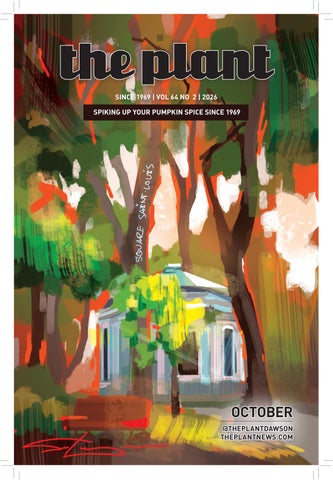
the plant
1 THE PLANT
SINCE 1969 | VOL 64 NO 2 | 2026 SPIKING UP YOUR PUMPKIN SPICE SINCE 1969
OCTOBER @THEPLANTDAWSON THEPLANTNEWS.COM
2 THE PLANT
Letter from the editors Dear reader, It’s funny to think that, already, we are halfway through our semester together! I have made it a mission of mine to enjoy the month more; all it has to offer. The trees that arched overhead in September are now golden. I think there is a particular kind of beauty in this brief, cosy interval, before the trees are bare and the cold settles in for good. And in that same vein, halfway points, I find, are most forgotten. We’ve lost the novelty of the start, and the end isn’t quite palpable yet. We are somewhere in between. Consumed by midterms, starting to forget the summertime, all while winter break seems too far, far too out of reach. But there is something lovely about being halfway through! I do not think that everything has to be a new beginning. Not everything has to lead somewhere. Sometimes, it is enough to be here, together, for the time being. So, for just a moment, at least, hold my hand; reflect, relish October’s consummation! Thank you for picking up the paper. Thank you for reading, for sharing a moment with us, and for letting us share ours with you. Yours, Chloe
Dearest Gentle Reader, I have found that in the past month I cannot speak to anyone without them pointing out how tired I seem. They ask me how I’ve been and no matter how chipper I am when I answer, the conversation ends with them telling me I should rest more. You might have found yourself in a similar state after midterms, and like myself you might find it fundamentally hard to rest. Asking for help sets my heart racing, a nap feels luxurious when time is so precious, and to-do lists keep piling up. The thing I have a hard time articulating is that in a way I enjoy this. It feels akin to the rush of dopamine after a particularly hard workout, or the satisfaction of putting the last piece in a jigsaw puzzle.
a high is only felt once the struggle is over, which is still a ways away (9 Index But weeks and counting). I’ve found myself needing to find smaller joys to grab onto,
NEWS 3 ARTS & CULTURE 4 VOICES 14 SCI & ENVIRONMENT 22 CREATIVE WRITING 24 SPORTS 27 25CURIOSITIES 29
gaps for light to get through. Little reminders that you can take a breath, close your eyes for a moment and enjoy the feeling of your body existing within the world. You do not need to continuously make things harder for yourself; laziness is a myth sold to us by the people that profit from our exhaustion. Here’s your, and my, reminder that you cannot keep walking endlessly. Every once in a while you must stop to look around and enjoy it. There is no rush, Vienna waits for you. If you crave a moment to just sit and read something other than twenty page pdfs assigned to you, you’ve found the right place. Always with love, Orion
The Plant is an editorially autonomous student paper. All opinions expressed in The Plant do not necessarily belong to The Plant, but are those of individuals. All content submitted to The Plant or its staff belongs to the paper. We reserve the right to reject or edit all submissions for brevity, taste and legality. The Plant welcomes typed and signed letters to the editor under 400 words. Copyright 2026
NEWS 3
L'islamophobie au Quebec: une crise? ATIKA UME FAZAL NEWS EDITOR La société québécoise est fière de ce qu’elle est. Une place où deux systèmes de loi différents te protègent, où les droits de l’homme sont respectés, où chacun a la liberté d'exprimer sa personne dans la société. En ayant cela en tête, l'hésitation des chefs de partis à répondre à la question du port du voile en public, dans des restaurants ou des parcs par exemple, a fait réagir. Ces derniers ont dû prendre position, pour ou contre, sur certains sujets sur l'émission Tout le monde en parle. L’animateur, Guy Lepage, pose la question qui a semé beaucoup de confusion. En effet, seule Ruba Ghazal, Co-porte-parole de Québec Solidaire, a répondu qu’elle était pour le port de ce symbole religieux dans l’espace public sans aucune hésitation. Paul Saint-Pierre Plamondon, chef du Parti Québécois, d’autre part, a carrément refusé de répondre à la question. Deux semaines plus tard, c’est ce même parti qui prend le pouvoir. Les opinions floues des membres de l'assemblée générale, à l’egard des droits de communautés musulmanes, ne s'arrêtent toutefois pas là. Valerie Assouline, députée du Parti Liberal du Quebec à Saint-Laurent, a fait face à des critiques dûes à ses commentaires à caractères islamophobes. En 2017, cette dernière publie un message fort contre une prière de rue se produisant au Parc Safari, allant jusqu'à affirmer qu’elle allait boycotter le parc pour cela. Assouline s’excusera plus tard pour ses commentaires à travers le journal The Rover. Cependant, le fait qu’une députée qui est censée représenter SaintLaurent, un quartier énormément diversifié, ait des opinions de même a fortement fait réagir. En effet, en 2021, plus de 50% de la population de cette circonscription font partie de minorités visibles, tandis que presque le quart sont musulmans.
PHOTO: SAMIR BEN
Oussama Chobah, un résident de Saint-Laurent en parle à The Rover: « C'était un peu bizarre. On s’est tous demandé ‘Pourquoi le Parti Liberal du Quebec mettrait une personne si ouvertement islamophobe dans une circonscription avec autant de voteurs Musulmans?’» Ces types de commentaires, aspirant à réduire la liberté d’expression de la foi musulmane, se retrouvent de plus en plus commun partout dans les médias. Un sondage du Journal de Québec démontre que près de 54% de leur échantillon serait d’accord avec une loi québécoise qui interdit les prières de rue, comme la loi 9 a pu le faire par la suite.
« Il est important de noter que ces discours ne restent pas rhétoriques: des personnes de la communauté en vivent les conséquences tous les jours. » Des regards, des gestes, des insultes, et plusieurs autres formes d’intimidation sont de plus en plus communs dans la vie des musulmans. Statistique Canada affirme même que les crimes haineux déclarés à la police à travers le pays ont augmenté de 169% de 2018 à 2024. Pour les incidents reliés à l’islamophobie pendant cette période, le nombre a presque triplé, allant de 84 à 229. Pour un pays ou seulement ~5% de la population est musulmane, ce nombre est énorme.
Encore plus, les discours haineux sont plus susceptibles de se produire dans des endroits publics, c’est-àdire transports en commun, rues et institutions publiques. The Plant en a parlé à une jeune issue de la communauté:
« Il y avait un bout, [quand je portais le Hijab], ou j’avais peur de quitter la maison parce que je me sentais jugée tout le temps. » Elle ajoute: « Tout le temps, je me faisais dévisager négativement. » Lorsque même la Commission canadienne des droits de la personne appelle « l’ensemble de la population canadienne à faire front commun [...] pour lutter contre l’islamophobie », il devient vite évident que ce n’est point un problème personnel: il y un système entier de discrimination présent.
4 THE PLANT
Kill John Lennon: The Dark Side of The Catcher in the Rye SIBORA DIBRA ARTS AND CULTURE EDITOR Close your eyes, have no fear. December 8th, 1980 It hadn’t even been a month since John Lennon had reemerged on the world’s music scene. After five years away from the spotlight, he was back in New York, releasing a brand-new collaborative album, Double Fantasy, with his wife, Yoko Ono. On his way to a recording session, just outside The Dakota — his residence on Manhattan’s Upper West Side — he stopped to sign a fan’s copy of that very same album. The fan’s name was Mark David Chapman.
J.D. Salinger’s The Catcher in the Rye.
“The novel would become, in Chapman's hands, a manifesto.” That same day, he’d bought a fresh copy and wrote “this is my statement” in it, signing as “Holden Caulfield”, the protagonist of the story. More than four decades later, the world-renowned musician, the murderer, and Salinger’s novel remain irreversibly entangled.
VIA EXCLAIM.CA
Published in 1951, Salinger’s The Catcher in the Rye follows sixteen-yearold Holden Caulfield in the days following his expulsion from an elite prep school. Readers accompany him through 1950s New York City, drifting between hotels, bars, old acquaintances and fleeting new encounters, all while he desperately tries to make sense of a world he finds increasingly unbearable. The book–a bildungsroman (or a coming-of-age story)–explores the psychological changes its protagonist undergoes in that troubling, foreign space between childhood and adulthood. Salinger describes Holden’s position unconventionally: old enough to recognize the hypocrisy and the “phoniness” that surround him in the adult world, but still young enough to hold onto the sweet innocence of childhood.
VIA EARLY BIRD BOOKS
The moment remains, to this day, immortalized in an almost banal photograph: Lennon bent over the record with Chapman standing behind him, seemingly looking through him. Nothing in that particular snapshot would suggest that the two men would meet again, let alone that one of them would, soon enough, be dead. Chapman was still waiting outside by the time Lennon returned to The Dakota that night and, shortly before 11 p.m, five shots rattled the building’s walls and the entire world along with it. The Beatles’ lead singer was fatally struck in the back four times before being rushed to Roosevelt Hospital, while the culprit made no effort to flee the scene of the crime. Instead, he remained there, reading a particular paperback copy of a short, red book.
Holden Caulfield, then, stands as a one-of-a-kind take on the traditional literary lead–far closer to the concept of the antihero than to that of the virtuous, morally honourable figure readers are generally encouraged to look up to. He is a disillusioned, cynical, and often profoundly unlikable character scornful of societal norms and defined by his alienation rather than his courage or selflessness. In other words, he lacks the conventional qualities that make a protagonist “heroic”. The concept of “antiheroes” is hardly a new invention–characters resisting the strict boundaries of righteousness and morality have long existed in literature. We can trace this phenomenon all the way back to Odysseus and follow it through to more modern examples such as Dorian Gray, Amy Dunne and Patrick Bateman. Holden is riddled with a thousand dislikeable qualities, which make him unreliable and hard to sympathize with at first. He says so himself: “In my mind, I’m probably the biggest sex maniac you ever saw” (Salinger 81) and “I’m the most terrific liar you ever saw in your life” (Salinger 22). He openly acknowledges the very flaws that bother readers, from his dishonesty to his obsession with sex. In fact, his unlikeability has become synonymous with his character; readers are often warned before encountering him that he is a protagonist they may not appreciate.
It’s this honesty that makes Holden so appealing and easy to project onto. Holden does not ask to be admired or held in high regard; instead, he offers readers of all ages the possibility of looking into a cracked, distorted mirror–one in which they can pinpoint their own flaws and unspoken thoughts written down in a relatable string of words.
ARTS & CULTURE 5 One of the novel’s passages, spoken to Holden by his former teacher Mr. Antolini, speaks to this idea: “Among other things, you’ll find that you’re not the first person who was ever confusedand frightened and even sickened by human behavior. You’re by no means alone on that score, you’ll be excited and stimulated to know. Many, many men have been just as troubled morally and spiritually as you are right now. [...] You'll learn from them—if you want to. Just as someday, if you have something to offer, someone will learn something from you.” (Salinger 246) This is precisely where Mark David Chapman’s relationship with the novel becomes unavoidable. While it can’t be known precisely what Chapman thought of the novel, he appears to have merged Holden and his own self as interlinked entities who saw the world exactly as it truly was: fake, oppressive and–most of all–“phony”. He seemed to fixate on “phoniness” as the ultimate moral failure, while adopting Holden’s desire to protect children from growing up in a fundamentally corrupt world. Chapman may have twisted Holden’s anxiety about growing up into something literal and violent. Once idolized by Chapman, Lennon gradually became, in his eyes, a poser: a man living in wealth and comfort while simultaneously preaching the notions of peace and love. Contradiction in the flesh. In this warped viewpoint, Chapman seemed to have become, in his own way, a “catcher in the rye”, imagining that he was exposing the very “phoniness” that Holden repeatedly tries to expose. Widely read and taught around the world, The Catcher in the Rye has become one of the most recognizable works of American literature. From the 1960s onward, Holden Caulfield’s cynical view of the world–and the words through which he expresses it–became the subject of bans and removals from classrooms and library shelves. The novel’s profanity, sexual content and crude language were among the principal reasons it was challenged, while its link to Lennon’s assassination only further amplified its already controversial reputation.
Still, Chapman’s comprehension of Salinger’s great American classic does not paint a complete picture of how the rest of the world perceives it. Art has the power, whether we like it or not, to move us beyond measure. A painting can make one person feel warmth, and another feel unsettled; a song can revive an old memory within one listener but mean absolutely nothing to the next.
“In the same way, like any novel, The Catcher in the Rye can mean something entirely different to each person who flips its pages.”
Perhaps the most upsetting thing about The Catcher in the Rye’s link to Lennon’s murder is not that Chapman found himself in its pages, but that his individual reading of the novel has become part of how we remember it. The crime he committed has attached a concrete horror to a work that had been facing controversy for decades, making it difficult to separate the offence from the book’s lasting cultural impact. But association is not causation. Chapman being caught with the novel during the act does not make it responsible for the scandal, nor does his identification with Holden’s character transform Salinger ’s protagonist into an instruction manual for brutality.
VIA ALL THAT'S INTERESTING
For some, Holden is the quintessential embodiment of adolescent alienation– his hostility and reluctance become recognizable traits rather than threatening ones, his hatred of “phoniness” being a stark reflection of the confusion that undeniably comes with growing up. For others, including the people who censored or challenged it, his rejection of authority, profanity and sexual encounters make the novel an inappropriate and dangerous depiction of a vulnerable stage of life. The contrast between these perceptions of Salinger’s novel, however, raises an uncomfortable question: if we remove a work of art in light of some individuals’ negative interpretations of it, what happens to all the other meanings someone else might have found in it? When schoolsand libraries remove a book because of a scandal, its language or its characters, they settle their own conscience at the cost of every other positive interpretation that could emerge from it.
That red paperback became a symbol we’ve collectively attached to The Catcher in the Rye, giving the crime a memorable narrative that could be repeated. Just a few months later, John Hinckley unsuccessfully attempted to assassinate Ronald Reagan–Salinger’s novel was found in his hotel room after the shooting. Eight years after that, Robert John Bardo murdered 21-year-old rising star Rebecca Schaeffer–he was also found carrying a copy of the book. Decades later, The Catcher in the Rye remains, like Holden himself, stuck between two worlds: what it truly is and what a certain group of people deem it to be.
6 THE PLANT
Lights, Camera, Seltzer ! : POP Montreal 2026 SAMANTHA LEVINE ARTS AND CULTURE CORRESPONDENT
VIA HANAKO AT THE RIALTO THEATRE, VIA SAMANTHA LEVINE
On Thursday, September 23rd, we entered the Rialto Theatre, silver hoops twinkling with anticipation. Ciders were poured, theatre lights dimmed. A murmur passed through the crowd, followed by the hush of a collective held breath: Pop Montreal 2026 had begun. Marking History This year, POP Montreal celebrates its 25th anniversary. Founded by Daniel Seligman in 2002, the festival serves as a tribute to Montreal’s indierock music scene, seeking to revive, exhibit, and embolden indie bands and their devoted listeners. In the days preceding the celebration, posters could be seen tacked up to shop windows up and down Parc Avenue. From Cheskie’s to Double’s, bands could be spotted lounging along the bustling avenue at all hours of the day, Belmonts steaming out over their Olimpico coffee cups.
An Unflinching Legacy The celebration began 25 years ago with a bang, showcasing 80 artists, both local and international, in 40 distinct venues scattered across the city’s Mile End neighborhood. Throughout the years, the festival has showcased word-reknown artists Franz Ferdinand (2004), Patti Smith (2007), and Angel Olsen (2016). It has displayed screenings of local films, held rooftop performances, church raves, and a homecoming party at The Salvation Army Citadel, in 2004, where Arcade Fire promoted their debut record Funeral as a thank you to Montreal. Now celebrating a quarter of a century, the influential festival has established itself as an invaluable part of the city’s vibrant music history.
A Dichotomy of Old and New The festival presents a series of shows at venues throughout the neighbourhood, including bars La Sala Rossa, La Scotterenea, Casa del Popolo, La Toscadura, and P’tit Ours, as well as in Mario Park and the Rialto Theatre. In utilizing diverse spaces, Pop Montreal allows for local venues to become a hub of the community’s passion and spirit. It is a unique phenomenon of an event, with participants beginning their evenings enraptured in the imposing neo-baroque style of the Rialto Hall marvelling up at the expansive domed ceiling that displays the architecture of another time - and ending their nights stumbling in and out of various dive bars strewn down Saint-Laurent Boulevard, wide-eyed and awestruck. The Rialto Theatre: An Outremont Staple With its façade inspired by the Paris Opera House, the Rialto Theatre has been a staple of the Outremont Neighbourhood for over a century. Designed by Montreal architect JosephRaoul Gariépy in 1924, the theatre initially served as a space for students to catch quick films on their days off, but saw its close in 1983 with the rise of at-home movie watching. Since then, the remarkable building has found itself the site of various scenes, with former long-time owner Elias Kalogeras having even attempted to configure the building’s main hall into a steakhouse. Although it was deemed a Historial Monument by the City of Montreal in 1988, the theatre faced nearly 3 decades of neglect causing it to fall into disarray. In 2010, the theatre was bought by current owners, Ezio Carosielli and Luisa Sassano, who vowed to restore its unique architecture and atmosphere. They succeeded immensely. The theatre has since been the site of numerous concerts, weddings, and other cultural events, having even hosted a Gatsby-themed party for the community to display its admiration for the music and attire of the Roaring 20s.
The Impact of a Space It is just past 9pm when Hanako takes center stage at the Rialto Theatre. Ciders are down to their halfway mark; this is the moment we’ve been waiting for. It is the second year that Montrealbased indie rock singer Hanako has performed with POP Montreal. The year before, the artist had performed at La Sotterena, a bar just off of Saint Joseph Boulevard. In smaller bar venues such as this one, the performer finds themself a mere few feet away from the audience. The space is charged, intimate as can be.
“The performer addresses their audience directly, bass lines pouring straight from string to pulse. In this way, we become complicit.” In this way, listeners find themselves becoming a part of the rhythm. In comparison, the Rialto Theatre provides Hanako’s lyrical, melodic voice with the chance to expand and float out, past the hall’s imposing architecture, towards its captive audience, unwinding and unfolding around her crowd. In this theatre, beams of violet and fuchsia light reach out to grasp listeners, pleading that they give themselves completely to the striking performance unraveling before them. To Many More This year, POP Montreal saw the performances of local bands Palomine, Underpass, Superstar Crush, and numerous others making their debut in the vast scene. Having been given the chance to witness these passionate young artists display their sound, lyrics, and heart, it is our hope that the city will continue to embolden its dedicated artists, both old and new. Here’s to many, and countless more, years of POP.
ARTS & CULTURE 7
Come for the Borsch. Stay for the Culture. It is a sunny October afternoon, and I am sitting in Square Viger eating a bowl of warm borsch. This is what was advertised as the point of the whole event. On their poster, in bold, blue letters: “Free borsch, served to everyone.” In reality, it is so much more. There is a small stage set up in the square where musicians are gathered. A Ukrainian song starts playing, prompting a group of young women in traditional clothing to start marching through the square, holding Canadian and Ukrainian flags. The public space has become a sea of yellow and blue, where even some dogs sport yellow handkerchiefs. Above all, there is a semblance of community and pride. For those of you who are unaware, borsch is a traditional soup dish originating from Ukraine. There are infinite variations, but the most wellknown is made with beets and garnished with sour cream, served with some bread rolls on the side. Today, borsch is a staple in many eastern european households and is seen as an integral part of Ukrainian culture. Merci Borsch started in Montreal in 2023, not just as a way of sharing Ukrainian culture with the city, but primarily as a way of giving back. It’s organized by the Ukrainian Canadian Congress, who state in their advertisements that the goal is to say thank you to Canadians for being so welcoming to immigrants arriving due to the war. The event is strategically placed close to Thanksgiving to honour the spirit of the holiday. “[The newcomers] didn’t have much to give, but what they can give is their cooking. That’s what it’s all about today: to say thank you to all the Montrealers, all of the Quebecers [...] for their hospitality,” said spokesperson Michael Shwec during the event. This is the third edition of Merci Borsch (there was no event in 2023/2024), and it has grown lots in such a short period. Originally exclusive to Montreal, it is now taking place in 5 cities across Quebec: in addition to Montreal, they’ve added Quebec City, Saguenay, Granby, and Sherbrooke. Since it’s completely free, the event relies entirely on community support. This year, volunteers made over 500 liters of borsch, coming out to about 2 000 bowls. The event is set
up in the form of various tents, each with a different kind of borsch to try. There were a total of 5 varieties offered, each with their own particularities: classic, with aubergines, with cranberries, etc. Throughout the event, the chefs from the tents each took turns presenting what made their borsch special, how exactly they came up with the recipe. Some were independent chefs, while others were from restaurants: Perogie Lili, a Ukrainian restaurant in the Mile End known for their varenyky, had their own variety of borsch offered. Another booth offering the classic borsch was manned by l’immigrant, a non-profit that offers support for immigrants throughout Quebec. Each bowl that was served came with the option of sour cream, garlic bread, and various other snacks. The choice of dish served is anything but random; borsch has become a symbol of hospitality over the years for several reasons. It’s cooked in large quantities, easy to make, and can be cooked with ingredients that are usually on hand. It has become so important in Ukrainian culture that UNESCO has even declared it a piece of “Intangible Heritage”. In short, it represents everything that the event holds at its core. Although the premise is focused on food, the event is certainly not lacking in entertainement. One of the tents was set up by the Ukrainian Library in Outremont, with a table of various Ukrainian books and upcoming community events. The building that
houses it, which will soon be undergoing renovations, is full of books about Ukrainian history and culture, both in their native language and in English. The aforementioned performance with the flags was done by the Korinnia Dance Troupe, who performed an elaborate Ukrainian dance to open the occasion. One of the most impressive parts of the event was a fashion show of sorts focused on traditional clothing. A group of around 30 people came on stage in a variety of outfits, each presenting the purpose of the garments. Some were meant to be used during certain events, while others came from specific regions of the country. Most included intricate embroidery and, above all, they were all clearly priceless. Despite some of them being quite old, they all seem to have been very carefully preserved by the independent collector that owns them. Merci Borsch is an event that is focused on so much more than just celebrating Ukranian culture, but actively including others in it. The purpose is to bring everyone, no matter the culture, into one space to try new foods and explore the beauty of Ukraine’s culture. Rare is it these days to find events that are affordable and fun, but Merci Borsch has managed to do just that. It’s an excellent place for anyone, Ukrainian or not, to find a sense of community, make new friends, and eat a warm bowl of borsch.
THE KORINNIA DANCE TROUPE MARCHING IN SQUARE VIGER, VIA KARINA AWAD-BATTISTA
KARINA AWAD-BATTISTA STAFF WRITER
8 THE PLANT
Thank you to our sponsors: To request advertisement space, kindly contact: theplantexecs@gmail.com
100 CAFÉS GRATUITS!!
100 FREE COFFEES!! 100 free coffee stickers have been placed in this edition of the Plant! Find a shiny free coffee sticker on this ad, cut it up and bring it to the shop to claim your FREE COFFEE!
See you soon!
THE PLANT 9
Side A
Only You — Portishead I'm Your Man — Leonard Cohen I Ran All The Way Home — Black Box Recorder Just Call Me Joe — Sinead O'Connor Angel — Massive Attack
Side B
Angel — 8mm I Want You To Love Me — Fiona Apple The Background — Third Eye Blind Passing on the Stairs — Elysian Fields Kill Me — Phoebe Bridgers
10 THE PLANT
The Iceberg of Safdie’s Stairs LEO BARON STAFF WRITER
VIA CULT MTL
Here’s the tip of the iceberg. If you have ever been to the Montreal Museum of Fine Arts on Sherbrooke Street, you will have noticed that the flight of stairs to the right of the lobby, designed by the giant of architecture Moshe Safdie, are unusually treacherous. The steps are inordinately wide, with heights less than a fifth of what they should be. The unsatisfying walk up the stairs is precisely awkward because it asks the user to step outside of a habit. One who has walked up these stairs will understand the singular experience that I am referring to. But more symbolically, these stairs purposefully alter the perception of movement for the user to slow down from their fast-paced life. It is not the same experience you get on a tensecond high racing down the metro stairs to catch a shutting door and a fleeting sense of satisfaction. Rather, this experience feels calmer — like it should be a meditation, but it isn't.
In fact, you can’t survive these stairs without being constantly interrupted by self-consciousness. Safdie’s stairs are either a playground for children to run and screech loud echoes of beautiful nonsense that are hushed by the lungs of other frequent museum-goers or… what? What is the appropriate reaction to this physical phenomenon that disrupts casual transition? The most natural paradigm of thought gradually drifts from thinking about mundane absurdities like the unusual text you received in the morning, to “Who the hell designed these stairs?”, to “Where do I put my next foot?”, over and over again. Until finally, practically without noticing, you’ve entered a room full of Matisses that has been quietly conquered by posturing critics and big-time wanderers. This all points to a particular aspect of architectural design: it is not neutral. It directs how we think by subtly engaging our emotions. The stairs of an Apple store have empty gaps in between them, allowing customers to peek through at everything in the store.
The stairs of a triplex apartment are spiralled, brittle and shaky, demanding more urgency. But in most cases, stairs are just stairs. They might be blue or Victorian with motifs, but really, most have no symbolic depth to them. The average staircase is boring and doesn't ask the user to feel anything because… why should it? It’s just a staircase. Safdie does not want us to conform to the rhythm of infrastructure. Perhaps Safdie wants us to unlearn how steps should feel in order to learn how to pay attention. Perhaps Safdie wants art viewed exactly the way we view the stairs, that is, to wander and to critique simultaneously, in a place that does not tell us how to feel.
ARTS & CULTURE 11
It’s a funny thing. Online, the Safdie stairs have been seriously condemned for their hazardous nature. This is true. The stairs have the potential to make an inattentive person fall. Does a piece of art need to ask for the user’s consent beforehand? According to the Régie du batiment du Quebec (RBQ), implemented a decade after the stairs’ installment, by law, Safdie’s creation shouldn’t exist. But there’s an ethical layer that protects Safdie. Is the idea of consent and the user’s complaint even justified in the first place if there is an elevator right beside the stairs? In essence, Safdie is asking the user to slow down, but when the user decides to take one step that is arguably worth five Safdie steps, they trip, then go to Reddit or Facebook and bring out their pitchforks. It is an impossible task to not laugh at the absurdity of this situation. Some say they are the worst set of stairs in North America, and some applaud their very existence. This whole situation compares itself to controversies surrounding the lack of censorship of horrific images online. Knowing that these images can sometimes appear, the user voluntarily continues to scroll nevertheless, even though there is an option to not open the app.
However, more pervertedly, is the intent of Safdie’s stairs to ruin a user’s ability to walk? Safdie uses his stairs as a very meta device to critique the history and making of art as a spectrum of all kinds. This piece that comes close to harming someone challenges the purity of an artistic concept. Perhaps the definition of art has changed over time to excuse improper behaviour or to be the realm of invincible ethics. It is important to note that the wholeness or the acceptance of a trend, especially one that appears aesthetic and popular, doesn’t objectively make it ethical. Titles distract from people’s inexcusable actions. Perhaps artist is the only title that forgives Degas from being a misogynist or an antisemite. The point is, Safdie is not Degas. Safdie wants us to feel how equivalent not questioning art is to not questioning stairs that feel normal. Safdie’s stairs criticize how little we appreciate the mundane. How little time we take out of our days to consciously reflect on things as banal as our own steps. If the meaning behind this piece of art could be extracted and visualized, it would look like a mirror. Can we ever escape our own image? Safdie's intentional answer is “No,” but when you enter the exhibit, it changes to “Yes.” In a weird way, the discomfort of the initial contact with the first step before and after the exhibit signals a segmentation of the museum experience into two parts — the first part being the stairs and the ego, and the second being the admiration of paintings and the egoless. Perhaps the egoless is only known through analyzing and remembering where the ego was left. That itself is an egoistic quality.
Here is one final truth. Imagine repeating the name of a person fifty or so times. Eventually, the familiarness of that word causes it to utterly lose its meaning. The loss of symbolism is horrific. The words become unfiltered and raw sound vibrations that make you rethink what is coming out of your mouth. Similarly to Safdie’s stairs, the muscle memory of leg movement wears out, and the symbolism of a leg — the tool of navigation — is lost. Walking, like a word you repeated too much and are trying to reformulate into meaning, feels forced. You are confronted with something that destroys the symbolism of walking, and at a certain point, you forget how to walk, what to do, and why you are doing it. That feeling is a flicker of Jacques Lacan’s psychoanalytic theory of the Real, which is the remnant of what is repealed from the habitual, an area of experience language can’t name. Through the glamourized trend of the anti-intellectual comment on social media, you can destroy the whole sincerity of a thought just by saying, it’s just blank followed by bro. An example of that would be to say, “They’re just stairs bro.” So let’s not get ahead of ourselves. They are technically illegal and slightly dangerous, but they aren’t twenty-foot ocean waves. They’re just weird, inappropriately sized stones that represent the function of how space orients and disorients you all the time, without you even knowing or questioning. And Safdie’s exaggeration of that idea, through his intentional design, drops you dead on your feet. Literally. No more gatekeeping — go try them out.
12 THE PLANT
Say “Coffee” Again! I Dare You. ELSIE DUQUE HILLS CO-MANAGING EDITOR I thought I knew it all. I mean, Pulp Fiction reformed me. Jimmy makes the best coffee–“Some serious gourmet shit.” What other caffeinated truth could possibly be out there? But, of course, my inner empiricist had questions. And so there I sat, recreating a scene from your mother’s favourite spaghetti western: a stare-down between myself and a black cup of coffee. Could I find truth in those velvet-roasted swirls? How had Jimmy made the single, universal, greatest cup of Joe out of such a seemingly inconspicuous liquid? Well, here’s the good news: you don’t actually have to visit Jimmy for a decent cup. These days, specialty coffeehouses line our streets like stars light the sky. Iced lattes, flat whites, cortados, cold brews, nitro brews. The world’s favourite vice has become more than a morning stimulant and has instead transformed into a multi-faceted experience. And the plug? Your local barista. Society’s most artistic dealer might just be Dave, the overworked student microfoaming three-percent milk at six in the morning. The modern barista engages in a precarious waltz, perfecting a careful dance of steady hands and talkative mouths. First, you feel seen. Then, you feel patient. Finally, you feel buzzed. Steaming milk is rehearsed into choreography and espresso becomes an emblematic hue.
“The barista does not simply make your coffee. No—those days are long gone. The barista now curates the drink.” Somewhere along our long-winded timeline, coffee became something we no longer consume half-heartedly. It has flourished into something we appreciate, something we yearn to observe. An edible Monet. But who–or what–has framed this artistic perception?
VIA PULP FICTION
Well, we can start with the unsung hero who sits behind the counter. Interestingly enough, as espresso machines proliferated and became synonymous with daily routine, the role of barista became ever-so-demanded. Diverse regions have tailored coffee brewing in accordance to their respective populations. From the Italian cappuccino to the Spanish café con leche, baristas have consistently added their personal touch to each preparation. Perhaps the most diverse interpretation is the North American demand for artisanal coffee, which has undeniably shaped and transformed the way we consume the beverage. And now, I implore you to reflect. What have you been ordering lately at Myriade? Chances are most of us have been quite gourmet with our poison. The modern coffee industry has undergone a remarkable shift from classic brew to extravagant house syrups. The surfacing metrics like quality, intricacy, and origin have infiltrated the world that baristas govern. However, do not be fooled. Your local ‘barista’ is nothing short of a coffee connoisseur. Not only does your pumpkin-spice latte taste unreal, but it looks ever so mesmerizing. Quick—take a picture before that first sip feeling. Thus, we can establish a fact: intricate coffee orders are visually appealing. Sure, this may seem rather mundane, but a closer inspection reveals an underlying truth about our cultural habits. The digital age has without a doubt accelerated the commodification of taste and flavours. From the virality of mukbangs to Hailey Bieber, the trendsetting model behind the now-infamous smoothie, consumption has become a curated experience as well as something
to witness firsthand. Naturally, we do not want to just observe indulgence, we want to participate in it as well. So when your favourite influencer posts a review of the world’s most eccentric cup of coffee, perhaps a coconut-lavenderEarl-Grey concoction that looks more like a chemistry experiment performed by Dr. Frankenstein, it is only natural to feel incentivized. Suddenly, that $8 cup is not just coffee, but rather a transcendental experience, an aesthetic that helps you attain some unachievable cultural cachet. As journalist Michael Pollan put it, capitalism and caffeine go hand in hand. It may be a truth that coffee is the modern canvas–but it can also be highlighted that this artistic quality stems from our current consumerist culture. Accentuated by the chase for culinary trends and the romance of a dark mocha latte, coffee has become as much a feast for its observers as it is for the palate. After all, we eat with our eyes first. In finality, I would not dare reduce Jimmy’s indubitable brewing talent, for baristas are genuine artisans, and there is no single doubt of it in my mind. Regardless, the way in which consumerism has made coffee's artistry commercially valuable should not be lost on us. So go ahead. Order the ube cold foam. Try the lavender matcha. Indulge in the six-dollar cup of coffee that tastes so saccharine it leaves a film in your mouth. There is nothing inherently wrong with enjoying the eccentric.But perhaps, before that first sip, it might be worth asking yourself why you wanted it in the first place — and who exactly has been telling you to crave it. After all, Jimmy may have made ''some serious gourmet shit.'' But lately, it seems we have made an entire culture out of it.
ARTS & CULTURE 13
“Men’s Clothing I’ll Wear On”: Gender Roles and Expression in the British Ballad SIMON JAFFARY OSOWSKI VISUAL ARTS EDITOR “Today marks ten years since I kissed a very attractive twink in a club in Brighton and then found out she was a lesbian who thought I was a lesbian,” mused X user Ryan Burgess in a 2018 tweet. We tend to think that this type of confusion of gender roles in romantic or sexual relationships is a brand-new invention of the twentyfirst century, but upon the examination of the British popular ballad, the opposite seems true: people have been fascinated with this same phenomenon for centuries. What about these songs reminds us of the present day? More interestingly, how are they not at all the same? One very renowned marine ballad of Irish origin, dating from at least the eighteenth century and known variably as The Rakish Female Sailor, Short Jacket and White Trousers, and A Maid That’s Deep in Love, recounts the tale of a woman set on reuniting with her love in the Americas by dressing up as a young sailor boy to board a ship heading across the Atlantic Ocean. While on board, the sea captain makes a move on her, all while thinking, of course, that she is some attractive young lad: “Your rosy cheeks and ruby lips they are enticing me / And I wish to God with all my heart, a maid you were to me.” The eyebrowraising description of the captain’s advances has implicit gay undertones, all while maintaining plausible deniability of the situation, since it is technically a heterosexual attraction. In passing, it is also interesting to note that, according to the National Maritime Museum, women’s cross-dressing to join the navy or the army in the British Isles during the seventeenth and eighteenth centuries was not at all uncommon, and there are multiple examples of sailors and soldiers revealed to be women.
In passing, it is also interesting to note that, according to the National Maritime Museum, women’s cross-dressing to join the navy or the army in the British Isles during the seventeenth and eighteenth centuries was not at all uncommon, and there are multiple examples of sailors and soldiers revealed to be women. A jolly English ditty by the name of The Merchant’s Son and the Beggar Wench from the seventeenth century or earlier, tells the story of a wealthy young man who gets “rolling fu’” (intoxicated) with a beggar woman at a drinking house. The two have a onenight stand, and, in the early morning hour, the beggar woman rises, puts on all the merchant’s clothes, and is proudly on her way. The merchant, waking, has no choice but to shamefully put on her “ragged petticoat and [...] linsey gown” and angrily leave the inn. One wonders at the interesting conception of masculinity as a thing to be coveted, and as a thing which can be stolen away by a woman of “low degree. ”The Jolly Tinker, an old Irish song, features an exchange of gender roles in a more subtle manner. ‘Tinkers’ (known now as Irish Travellers) were a nomadic people in Ireland who brought tinsmithing services from cottage to cottage, and this tale recounts the story of one lady of the house who was in the market for a bit more than frying pan repair services. After bringing the man to her chambers and having her way with him, “She put her hand into her pocket and she pulled out fifty pound, / Sayin,’ “Take this, me jolly tinker, and we’ll have another round”. This is of course an intriguing reversal of the typical configuration of prostitution. Ballads of the British Isles come in many forms: innocent and sweet, blithe and bonny as nursery rhymes, sprawling and bloody and full of haunting and murder, or, as we have seen, teeming with the same explorations of gender that echo present-day feelings on the topic. The thing all these ballads have in common, though, is their narrative form: they are more focused on spinning a story than a single person’s expression, and the tie between singer and text is far looser. According to the academic
researcher Lucie Duggan, in British folk tradition, a male singer might sing from the point of view of a female character, and a female singer might sing from the point of view of a male character. The emphasis on narrative takes up more space in these songs than what might otherwise be allotted to a furthering of personal identity. Perhaps the storytelling nature of these songs paints gender in all its variations as a thing more situational and less closely related to personal identity. What’s important in A Maid That’s Deep in Love, for instance, is not the personal identity of the heroine, the way gender expression is tied up in today. It is rather her situation, the description of her story, which shapes her unusual gender expression.Strong narrative structure and the use of third-person perspectives is the standard of Western music no longer. Perhaps this change is indicative of a larger shift in gender ideology; one which is more focused on personal identity, and in the process, sheds the idea of a gender understood through storytelling.
VIA PINTEREST
14 THE PLANT
The Existential Horror of AI ORION PEYROL CO-EDITOR IN CHIEF October— while being a time of laughter, candy and silly costumes— can also be a time that makes us reflect on our fears. A fear is never just a fear, it's always rooted in something deeper. The older I grow, the less afraid I am of the things that go bump in the night. The supernatural creatures of the world don’t keep me up anymore, the world we live in does. I recently asked my mother if it has always felt like things were changing this quickly. Everyday I wake up and I feel like something else has been ripped from under our feet. Nothing feels assured anymore. I have been feeling… Existential. I can only describe it as having a crisis of faith—my devotion to the future is being tested. I think a lot of people have been feeling this way. There’s a blanket of uncertainty thrown over the next few years— mainly because of AI. There is no denying that AI is the biggest shift within the 21st century. It has metaphorically (and physically, thank you AI assisted bombing drones) blown uplife as we know it. Now, this isn’t the first time humanity has had a shift this big, and it’s definitely not the first time we’ve had to grapple with a loss of meaning.
SISYPHUS BY JEFFREY HUMMEL
After World War II and its atrocities, people, understandably so, found it hard to return to daily life. Fears that people had long held had come true in unimaginable ways— industrial warfare, the atomic bombings, and the unimaginable horrors of the Holocaust left people feeling nihilistic like never before. You can’t unmake the atomic bomb and you can’t undo a technological revolution that’s already well underway. Motown was ahead of its time. Out of that desolation and fear, existentialism was born. The existentialist philosophers (Jean-Paul Sartre, Soren Kierkegaard, Albert Camus, and Simone de Beauvoir, to name a few) tried to make a philosophy to give life its meaning back, one you could actually apply to your everyday life. When I first came across existentialism, thank you Jessica Lim, I felt as though somebody was speaking directly to me across the sea of time. Thoughts and feelings I had had for years but never been able to aptly explain, had been put into words by people long dead. They had four main tenets to their philosophy, a philosophy that has served us well for decades at this point— but I also couldn’t help but feel that these tenets are under threat. That at least my way of seeing life, which tends to align with existentialism, simply could not coexist with AI.
“There’s a new Halloween monster in town and this one doesn’t get packed back up in a cardboard box at the end of the season.” Tenet 1: Existence before essence. This first point refers to the existentialist belief that humans are not born with an innate purpose. Rather, they believe that your purpose and meaning is shaped by you, and the choices you make throughout life. For them, there isn’t something or someone out there that has decided your fate before your birth. I love thinking this way, I feel it gives our choices so much more power— every choice we make is an act of building who you are and why you’ve decided to be here. It’s traditionally a philosophy that denounces the existence of a God, at least of a God that decides who you are before you’ve even been born. As Nietzsche said, “God is Dead” but AI is trying to revive Him at the altar of the chatbox. AI does have a purpose to it, it is literally given one before it’s even programmed. They have a voice in the clouds (or The Cloud) telling it who to be and how to do it; its God is the programmers that give it existence. An artificial intelligence doesn’t have to grow up and grapple with its existence like the rest of us. It comes out already grown and ready to work for the capitalistic overlords of the world. That makes us, or at least me feel… inadequate. If AI’s become the majority in the workplace we will no longer have the luxury of being unsure of where we want to go in life, or of learning along the way and changing our minds. Why would the big boss want someone fickle with wants and needs when they could have a robot whose entire purpose has been designed by him, or by people with his interests in mind, to do his exact bidding?
VOICES 15 Tenet 2: Death is what gives our choices and life meaning. There is no human nature in existentialism. Humans are not inherently good or bad; they can always choose to be something else as long as they’re alive. This is why death is the thing that makes our choices have meaning, because it’s what prevents us from infinitely changing. Eventually you will no longer exist, and only at that moment can you look at the choices you’ve made and define yourself as a person. AI cannot die. It is not human; it will not perish unless we shut it off or stop maintaining it. Humans as a species don’t love things that can’t die or that come back from death. It’s a theme you can see throughout the monsters we’ve made: zombies, vampires, ghosts, Frankenstein’s monster, etc. We fear things that cannot die or are undead because that’s what definitively makes them not human. We’ve made something that could theoretically outlive us and outlive humanity as a species. That is an existential threat to our way of life; humans must die eventually but we really don’t want to. We chase legacy, fame and power as our philosophical stone to keep part of us alive even after we are gone. AI is just that, neverending, and we can’t help but find it uncanny that AI could hypothetically go on… forever. Tenet 3: Ethical responsibility is first philosophy Every philosophical theory, or most, have a point they view as their “first philosophy”, what you must initially consider when making a choice. For existentialism, it's the idea of taking responsibility for your actions. It’s a philosophy that acknowledges that often the premise of situations are not in our control, you do not often have a choice in what happens to you. However, existentialism says that within those premises you are still responsible for the choices you make. You're also accountable for making the choice you genuinely think is the right one, for yourself and humanity as a whole. Existentialism doesn’t really peddle a certain set of ethical guidelines, it’s a subjectivist philosophy that believes you must determine your own ethics. The only morally wrong choice is to avoid making choices as to avoid the responsibility and consequences of making a choice.
Artificial Intelligence is undermining this in two ways. Firstly, the choice to interact with it is no longer a choice, it’s completely unavoidable. The premise has been set without our input or control. Secondly, AI operates as an active removal of human choice, it consolidates our options into a singular AI overview or one program. Those AI’s have been trained on previously made human choices and puts them together in new ways but can never make something new only regurgitate what it’s been given. By making something through AI your choices are filtered through what the AI knows, nothing new is allowed to exist through this filter. We’re outsourcing our agency to a thing that has no morality or ethical reasoning. Our choices are barely our own anymore, the premise is encroaching on our ability to act within it and our ability to make meaning. Artificial Intelligence is undermining this in two ways. Firstly, the choice to interact with it is no longer a choice, it’s completely unavoidable. The premise has been set without our input or control. Secondly, AI operates as an active removal of human choice, it consolidates our options into a singular AI overview or one program. Those AI’s have been trained on previously made human choices and puts them together in new ways but can never make something new only regurgitate what it’s been given. By making something through AI your choices are filtered through what the AI knows, nothing new is allowed to exist through this filter.
“We’re outsourcing our agency to a thing that has no morality or ethical reasoning.” Our choices are barely our own anymore, the premise is encroaching on our ability to act within it and our ability to make meaning. Tenet 4: The only two modes of life are Authenticity and Inauthenticity Inauthenticity in existentialism refers to the expected mode of life, the daily humdrums: school, work, metro, eat, sleep, repeat. We do them without really thinking, we just keep going forward.
Authenticity is the opposite, it’s these lapses of time where we see ourselves outside of quotidien life, as specs in the grand scheme of nature. When the fundamental lack of meaning present in what we’re doing presses down on us. Now, existentialism says that while our moments of Authenticity are important to us and have their own use, as humans, we will always return to a state of inauthenticity because it’s how we survive. As a species we wouldn’t be able to keep going if we were constantly doing mushrooms, staring at the moon and crying at her beauty and how nothing really matters. .
CAN’T HELP MYSELF BY SUN YUANG AND PEN YU
AI is actively putting our inauthenticity into peril. The stability of the jobs and daily lives we rely on to survive and keep going have now gone wobbly. There’s a very real fear that our jobs will replace us and we will no longer have a reality to rely on. If we do not have our Inauthenticity to fall back to all we have left is Authenticity. Which is not a state that we can maintain, it always leads to despair. We need a structure to feel safe, to feel grounded within reality. Our fears around AI always lead back to the rapidly changing world and the way it’s shaking the foundations of society. I’m a very optimistic person by nature, I fundamentally believe that eventually things will be okay. But AI makes me feel dumb for feeling that way. It’s hard to believe the way I want to believe in my own future and the future of my generation. We don’t know what world AI is making for us. But what I do know is that in the aftermath of it we will need a new way to see the world. A philosophy for the new generation.
VISUAL
16 THE PLANT
A MESSAGE FROM THE CURATOR
Another month, another bantam batch of artworks. Nonetheless, Mi Ti Sol flourishes vibrantly in the last flushes of colour fall brings us before winter’s damp darkness, whose hues are coldly represented in Chloe’s portrait. As we slowly make our way into the cooler months, let us toast artwork as an instrument to understand the changes we, as the seasons, so routinely go through.
Mi Ti Sol Olive Justicia @oliveoil.toons (Instagram)
ARTS
17
Portrait of Kurt Cobain Chloe Toia @chloe.toia (Instagram)
18 THE PLANT
How Generation Z is Quietly Leading a Revolution ALEXANDER LOPEZ RICAURTE CONTRIBUTOR Generation Z is often labelled lazy, spoiled, and constantly complaining about the circumstances of the world we live in. We are told to simply accept an economy that does not provide for the working majority, yet we are blamed for being unable to afford a house or let alone the basic necessities needed to live comfortably. Instead we are told that we should “pull ourselves up by our bootstraps” and just “work harder”. But the truth is that we are living through a major transitional period in history marked by economic uncertainty, wealth inequality, exploitative monopolies, and a growing sense of awareness that things need to change for the better. We were born in a world that was already starting to crumble as governments began to prioritize profit over people in the late 1970s. Now, we are left with the responsibility to help address these issues so that the next generation can live in the world that we envisioned. Although the idea that Gen Z has inherited a world facing social instability may seem negative and unfortunate on our part, we should see it as hopeful and encouraging that the future of our society isn't completely doomed, but rather just changing. As Mark Twain’s novel The Gilded Age: A Tale of To-Day suggests:
“We’re outsourcing our agency to a thing that has no morality or ethical reasoning.”
accumulate wealth at unprecedented rates. This parallel suggests that history has not repeated itself but instead spiralled back to familiar problems from more than a century ago. The Gilded Age may have not been driven by the rise of A.I and modern technology, but the underlying struggles between corporate power and wealth inequality are remarkably similar. Thomas Piketty’s chart Figure I.1. Income inequality in the United States, 1910-2010, highlights the similarities between the economic issues of the Gilded Age and today’s world. Income inequality in the U.S. was at its highest during the early 20th century before drastically declining by the early 1950s. However, inequality began rising again in the late 1970s, with the income inequality rate rising to 45% by the 2000s. This increasing surge in income inequality mirrors the economic divide seen during the Gilded Age, suggesting that many of the same economic problems have resurfaced in today’s world. In addition to this growing income inequality, things aren’t getting any cheaper either. The basic commodities that make up our everyday lives are becoming increasingly more expensive. A Washington Post analysis of the Bureau of Labor Statistics found that people from the ages of 14 to 24 years old are spending more on essentials such as food and housing than previous generations. These issues have developed a growing frustration among younger generations, leading many to question the point of working hard if it doesn’t even guarantee financial security.
Although Gen Z has become one of the generations most affected by wealth inequality, it doesn't necessarily mean that nothing is being done to change it. Instead, living through the consequences of economic instability has actually encouraged young people to become more politically involved. Rather than just accepting the system as it is, Gen Z has shown resistance towards these institutions primarily through online activism on social media. The internet has provided young people the ability to bring awareness and support towards social issues that may not be covered by major news outlets. There are already signs of Gen Z’s influence on the political landscape, with democratic-socialist candidates like NYC Mayor Zohran Mamdani gaining support from a predominantly young voter-base after advocating for better working conditions. Across North America, Generation Z may not be leading a revolution in a traditional sense. We’re not overthrowing governments or completely rebuilding our society, instead we are internally questioning our institutions and advocating for change through what we share on social media. Perhaps our generation isn’t just “lazy” or “unmotivated,” but rather we are simply refusing to accept a broken system that doesn't provide for our society as a whole. If we continue to resist, our world may just change for the better.
The historical era most similar to our own is the Gilded Age, which lasted from the 1870s to the early 1900s. This era marked a time of major technological expansion, much like the times we are living in now. The overwhelming growth in railroad construction and steel production of those times mimic the rise of A.I and modern computers in today’s age. Although both periods show a rapidly growing economy and further technological advancements, beneath this progress reveals a society that allows corporations to prioritize profits over workers' wellbeing to further VIA THE WASHINGTON POST
VOICES 19
Femme, et c’est tout VIA PINTEREST
ALAA ETTAOUTH VOICES EDITOR En septembre 2026, une histoire de viol collectif qui aurait eu lieu sur le campus de l’Université américaine Cornell en 2024 a fait surface. La plaignante et ancienne étudiante de l’institution Jane Doe (nom d’emprunt) a intenté une poursuite au civil contre entre autres l’université, la fraternité Chi Phi et sept de ses membres. Le caractère violent de l’affaire a rapidement déclenché un tollé sur les réseaux sociaux. Des comptes Instagram et TikTok ont commencé à relayer les événements en détail : les messages dégradants qui auraient été partagés sur le groupe Snapchat de la fraternité invitaient quiconque à se joindre à eux pour profiter sexuellement de Jane Doe, complètement intoxiquée. Ces échanges ont attisé une colère nationale, qui s’est propagée à l’internationale. Cependant, ce qui a réellement enragé l’opinion publique, c’est la légèreté des sanctions imposées par l’université Cornell envers les accusés: seuls deux d’entre eux ont été renvoyés, d’autres ont été suspendus et ont dû réfléchir à leur actions en écrivant une vulgaire dissertation. Jane Doe avait pourtant porté plainte contre l’université trois semaines après l’événement survenu en 2024 à son université et son traumatisme a été balayé d’un revers de main, le procureur de l’État de New York Matthew Van Houten refusant de présenter l’affaire à un grand jury. Aujourd’hui, son affaire a dû être étalée sur la place publique afin que notre société daigne enfin s’indigner. Qu’est-ce que cela nous prendra en tant que société pour mettre fin à l’abus sexuel, mental et physique des femmes? Après l’éclatement de l’affaire dites des « Cornell Seven » mon fil Instagram a été rempli de la même publication partagée en boucle qui affirmait que c’était inhumain pour une femme de subir un viol collectif durant sept heures. Une affirmation qui, du moins je l’espère, ne suscite pas de débat quant à sa véracité. C’est justement une partie du problème: affirmer l’évidence ne touchera jamais le fond du problème, cela ne contribue qu'à la survie du récit
dans les sphères d’opinion publique, jusqu’à tant qu’une autre histoire encore plus virulente ou choquante ne vienne lui voler la vedette. L’activisme numérique peut paraître comme l’option la plus accessible pour exprimer notre désaccord, notre frustration sociale ou même notre appui envers une cause et elle est efficace. En revanche, elle a ses limites.Il est facile de se prétendre justicier l’instant d’un repost, d’un like ou d’une story éphémère, mais c’est un travail bien plus exigeant de se battre tous les jours contre la culture du viol et les violences sexuelles parce que cette tâche demande de la consistance. Le combat ne s’arrête pas à ce qu’on le clame, mais il débute par les actions que nous posons pour réellement perturber le statu-quo. La lutte contre les violences sexuelles ne peut pas se résumer aux cas les plus choquants et violents ou ceux qui donnent le plus de « matière à débat ». Je refuse de croire qu’il est nécessaire pour la femme d’être violentée, déshumanisée ou de subir les pires attrocités pour enfin éveiller les masses et faire avancer la cause. Quand est-ce que nous n’aurons plus besoin d’un motif précis, d’une affaire d’une telle brutalité et d’un tel graphisme pour se révolter contre cette culture du viol qui prend essence dans notre silence et notre inaction?
« La violence faite au femme n’est pas lointaine et unique aux grands cas médiatisés. Elle continuera de subsister tant et aussi longtemps que l'attention que la société lui portera sera sélective. »
En tant que femme, cette violence ne m’est pas nouvelle. Elle a une forme définie, une forme dont je connais chaque recoin car j’y ai vécu de près ou de loin. Parfois, elle se présente comme un commentaire, une moquerie ou un rire approbateur. Quelques fois, elle est physique et viole profondément l’intimité d’une âme. La culture du viol persiste parce qu’elle a des pilliers. Elle demeure parce qu’il est devenu acceptable d’objectifier le corps des femmes, de les fétichiser ou de leur accorder une valeur moindre parce que’elles sont femmes. Elle se permet de monter d’un cran, de suivre les femmes dans la rue ou de partager une photo intime sans consentement. Elle étire les barrières de l’acceptable si bien que l’agression sexuelle en devient une suite «logique» allant même jusqu’à laisser place aux féminicides. Écouter les vécus de vos mères, de vos sœurs et de vos amies, cela n’a jamais été assez. Contrer la culture du viol c’est interpeler votre ami qui se permet un commentaire misogyne. C’est, au-delà de croire les femmes lorsqu’elle dénonce une agression, leur donner un soutien indéfectible lorsqu’elles seront heurtées au dur jugement sur la légitimité de leur traumatisme. Contrer la culture du viol c’est passer au travers du malaise que cela crée de bousculer l’ordre établi pour maintenir le bien commun. Je ne veux pas avoir à accepter que j’ai besoin d’être autre qu’une simple femme, qu’un être humain pour que l’on considère mes revendications et que l’on se batte pour toutes celles qui subissent les dérives du système patriarchal. Nous devrions qu’avoir à être femmes, et c’est tout.
20 THE PLANT
On Mental Health’s Legalities and Limits: Analysing P-38 CHLOE BERCOVITZ CO EDITOR-IN-CHIEF
“It just felt really disheartening and I felt defeated and powerless,” says student Gina Nicoll via Global News. “It made me feel I was doing something wrong just by being unwell, and I felt I was criminalized for it.” In the past decade, researchers have become increasingly fascinated by the intersectionality that strings mental health with the criminal justice system. And, namely affecting students, this issue raises a question that has become more and more necessary to divulge: why does seeking psychiatric care so often become a matter for the police? My answer lies, overwhelmingly, in an analysis of Quebec’s Act P-38.001 – which governs the involuntary intervention of individuals whose mental state presents a danger to either themselves or others. “Before I was in the system, I didn’t realize how intertwined policing was with mental health,” Nicoll continues, an undergraduate at the time who was living on campus. An episode of hers landed her in the hands of police. She was then taken to hospital for assessment.
“Such a paradox is an everyday reality; a product of what I believe to be a broken system. Mental health has, finally, become understood as healthcare – and yet serious cases intrinsically provoke an involvement of the law.” P-38, Quebec’s Act respecting the protection of persons whose mental state presents a danger to themselves or to others, establishes the circumstances under which a person may be involuntarily taken for psychiatric assessment or confinement. Intended to protect individuals whose mental state presents itself as dangerous, this legal framework intrinsically restricts one’s liberties. How contradictory.
But this act has become more relevant than ever: Quebec adopted Bill 23 in June of this year. This legislation has made amendments to P-38, changing the standard from “grave and immediate danger” to a broader “situation where there is a danger.” Further, the Government of Quebec has now allotted $104.4 million in funding, over five years, to support the collaboration between police officers and psychosocial workers. However, such reforms beg certain questions: can changing the process of intervention garner those in mental health crisis the appropriate care? And can a change in the law necessarily revisit and/or alter how intervention feels to the person subjected to it? Involuntary psychiatric intervention, I would argue, inherently blurs the line that is marked between individual liberty and public safety. There are circumstances in which a person may be unable to recognize the gravity of their condition; intervention shall forever be necessary in preventing harm. The existence of such circumstances should not be dismissed. But with that being said, the authority to intervene does not absolve anyone of the responsibility to consider how that intervention ought to be carried out. For an individual in the midst of acutely severe psychological distress, the arrival of police will, oftentimes, introduce an entirely new dimension to an already frightening situation. Police officers have responsibilities with regard to public safety – and indeed, their training prepares them to respond to a range of emergencies. Mental health professionals, by contrast, are trained to assess psychological distress, provide treatment, and help individuals manage their conditions. So, while these roles may overlap, they cannot be considered interchangeable. Nicoll’s experience illustrates the grave importance that is considering the perspective of the individual in distress. She felt as if she were a criminal.
Bill 23 revises when and how the state may step in; it does little to stop crises from happening. Not enough care is being given to the conditions that bring someone to such a point. As we live amid a healthcare system full of red tape, I wonder why legislative change hasn’t been met to address the root causes of the matter at hand.
“A myriad of solutions exist: a healthier future, to me, is palpable.” Mental health crises commonly emerge through a pattern of neglect that looks like waiting for a counsellor, a referral, or a psychiatrist. A budget that stretches north of a 100 million has the very capacity to fund and expand a variety of resources. Every individual who can receive help early is one fewer person whose first encounter with the system is a uniform at the door. Crisis centres, offering walk-in services without any means of a referral, are something that we already see in Quebec. A working alternative that provides assessment, stabilization, and connections – more government attention to such establishments could be the life-saving alternative to an emergency room. In a similar vein, I have taken inspiration from the crisis café: a model that has begun adoption in the United Kingdom. Quite different from a crisis center, these are more informal, community spaces, allowing those in distress to speak with trained staff and peers. They are not intended for those in immediate danger, but rather, to reach individuals earlier and before the law becomes involved. Even though there will forever be cases in which intervention is necessary, necessary should never, ever, feel punitive. Better care before a crisis, a safer place to go during one, and mental health professionals on scene, would make intervention what it was always meant to be: protection that no one should have to fear.
VOICES 21
On Resonance MARTIN KALOSHI CO-MANAGING EDITOR Some weeks ago, my Organic Chemistry teacher started class off with the topic of resonance. Imploded my worldview, in short. See, before this class, I held the common conviction that electrons lie on atoms. They might shift from one atom to another, or even from one compound (multiple atoms together) to another, but at any stable moment in time, electrons are positioned on a single atom of their choice. It turns out, electrons only sometimes belong to one atom.
VIA MARTIN KALOSHI
The model for electrons being spread over multiple atoms at once is resonance. But, because it is impossible to draw multiple electron arrangements at once, chemists instead draw the resonance contributors: fictional depictions of one arrangement of the electrons in space. Together, the ensemble of these (untrue) contributors aims to represent the (true) compound. Take the resonance contributors of NO3 :
VIA MARTIN KALOSHI
This summer, I spent my Tuesday nights trying cider and playing trivia with my cider-and-trivia-savvy friend group. These people, mostly all in Liberal Arts and admittedly far smarter and artsier than me, took on the theatre, history, and music trivia questions with ease. It was only when questions about the volume of clouds came up that the pressure of maintaining the flow of free cider turned to me, the only Science kid in the room.
Alone, these configurations are fake. While the double bond and negative charges appear to change locations from one configuration to another, the truth is a blend: a compound with three oxygens of 1 ⅓ bonds and -⅔ charge each. The fact that NO3 ’s electrons are delocalized is actually a good thing. It makes the compound much more stable: delocalization energy being the name for this phenomenon. Being all over the place is NO3 ’s greatest strength. And yet, all we can muster are its contributors.
Among my Arts friends, my own artistic knowledge became shallow and unremarkable. In this setting, it was my identity as a cloud volume connoisseur (roughly one cubic kilometre) that instead sprung out most, all other facets of me rendered, contextually, not as interesting. In other words, I got to wear the Science hat. But when I told my Science friends last winter that I was joining The Plant, that I enjoyed writing as a hobby, and that I continually got better grades in my English and humanities classes, my Science persona went dormant. In front of these physics wizzes, my cloud volume knowledge was commonplace and ignorable. It was now my good grammar and love of literature that best framed my identity. Welcome to: the Arts hat.
Back in late May, when I told some of my hardest-working peers at Dawson that I'd spent my Tuesday night in the company of ciders and trivia in NDG (during exam season), I was met with mild disapproval. I'd stack the reckless hat to my collection. But when I revealed to those same people the truth– that I'd only gone out once during exams, and even then returned home early to spare myself from Calculus doom– I (like to think I) subbed the reckless hat with the radically cool school-life balancer hat. Then when I retell almost throwing up from pre-exam nerves, it's onto the anxious hat. And when I ultimately did alright, back to the decent student hat. The thing is, I almost never wear hats. They mess up my hair, and make me look terribly unflattering. My hats–sciency, artsy, reckless, cool, decent at school– are mere resonance contributors of my personality: palatable arrangements of my current interests that are, ultimately, entirely illusory on their own. Labels, like resonance contributors, are necessary and incredibly effective at what they do. Sciency represents me better than no representation at all: just as one configuration of NO3 reflects NO3 better than no configuration at all. But blend three configurations, and NO3 will come alive. We need resonance, when we're only given contributors. And though we may never fully picture what a complete person looks like, just as we may never fully picture what a complete NO3 - looks like, we can always start by drawing more than one contributor.
22 THE PLANT
Math, now, … A Klein Bottle in St. Michel CHARLIE REUTER SCIENCE & ENVIRONMENT EDITOR
You might have figured from last month’s math column that I am a big fan of the higher dimensions. The Klein bottle is just my cup of tea. In fact, this weird, loopy, twisty thing is the 3D shadow of a shape that exists in four dimensions.
This shape is related to the Klein bottle, and shares some of its interesting properties. It is non-orientable: for example, if an ant were to walk along a Möbius strip, it would soon find itself back where it started - but on the other side and upside down. A Möbius strip has a single surface and a single edge. Mathematicians spend their time asking extraordinary questions, for example: if a Möbius strip has only one edge, what shape would one get if one (theoretically - you’d need to be 4 dimensional to actually do this) glued the edges of two such strips together?
(Try using your hands to figure this out - both tips of your index fingers are the arrowheads and touch your thumbs, the arrow tails.) Sadly, the true Klein bottle only exists in the 4th dimension, where it does not intersect itself. The shape I bought in St. Michel is a Klein bottle that is “flattened” with respect to the 4th dimension - a “shadow”, if you will.
Named after mathematician Felix Klein (1849 - 1925), the bottle has some very interesting topological properties. For one thing, despite being called a “bottle”, it has zero volume; it does not A mathematician named Klein divide the universe into an “inside” and Thought the Möbius band was divine. an “outside”. To understand why this As far as I Said he: “If you glue seemingly arbitrary shape is of interest know, Cliff Stoll to mathematicians, let’s go do some The edges of two, is the only person You’ll get a weird bottle like mine.” who produces mental origami. Limerick by mathematician Leo Moser glass Klein botPicture a strip of paper (represented tles, which is why by rectangle #1 in the diagram). Now, In rectangle #3, the pair of short I am so excited to imagine gluing the left side to the right arrows and the pair of long arrows need have found one in side so that the two arrows line up and to be glued together, each pair pointing St. Michel! When point in the same direction. The shape in the same direction. The result should I bought it, the you get is a hollow cylinder. be a donut (a “torus”). vendor wondered what would hapWhat happens now if the short ar- pen if you tried rows (as in the Möbius strip) point in to put water in a opposite directions (see rectangle #4)? Klein “bottle”. This means we have to somehow glue This is totally possible! The question one edge of the tube to the other from you ask yourself as soon as you acthe inside. The only way to do that is to tually own one, however, is “how on pass one end of the tube through itself. earth do I get all this water out of my The resulting shape is a Klein bottle. Klein bottle?!”
VIA CLIFF STOL
Enough theory, you are probably asking yourself: who comes up with the idea to make Klein bottles out of glass? Well, that would be Cliff Stoll. Cliff lives in California and runs the company Acme Klein Bottles™ (www.kleinbottle. com), where you can actually buy one if you like. He stores them in the crawl space under his house, and has built a DIY warehouse robot to maneuver the bottles in and out. I can heartily recommend his very enthusiastic Klein bottle explanations on Numberphile, YouTube!
MÖBIUS STRIP AND KLEIN BOTTLE DIAGRAMS VIA WIKIPEDIA
Can you believe what I found at the St. Michel flea market this summer? A Klein bottle!
Next, take a look at rectangle #2. Notice that the two arrows point in different directions. This means we need to twist the paper once before gluing the two (short) sides. You might have heard of this shape before: the Möbius strip.
SCIENCE & ENVIRONMENT 23
Why We Dream: A Search for the Elusive LARA JUDAH STAFF WRITER It is difficult to define what a dream is– it seems to lay on the precipice between the physical and the intangible; elusive in its explanation, but vivid in its imagery. From playing a central role in mind-bending movies such as Inception, to being used as a powerful device in historical speeches, dreams are all around us. They are also within us; some dissolve by morning, as our foggy brains clear up and forget about the images that had so troubled us during sleep. Others come back, again and again, repeatedly infusing us with a particular combination of emotions that are unique to that specific dream.
“ In a sense, dreams can serve as a gateway to a whole array of new feelings and experiences– they allow us to explore parts of ourselves that might otherwise be inaccessible. ” Considering the impact of our dreams on our psyche, it is surprising that this topic remains one of the biggest mysteries within the field of neuroscience. Over the years, numerous attempts have been made to provide an answer to the question of why we dream.
VIA PINTEREST
In 1899, Sigmund Freud took a fascinating approach, as described within the pages of his magnum opus, The Interpretations of Dreams. He suggested that dreams reveal our hidden desires. Freud’s hypothesis, formed before the discovery of REM sleep, stated that dreams “released” our repressed wishes, often disguising them as symbols. According to Freud, this would allow us to subconsciously fulfill our desires without having to directly— and uncomfortably— deal with them during our waking hours, when we are operating under the moral and ethical constraints of society. Though this psychoanalytic theory was later criticized for its lack of scientific evidence and reductionistic qualities, Freud established the idea that emotions do connect with our dreams in a fundamental way, even if their function is not yet clearly defined. However, emotions do not play a role in all hypotheses concerning the “why” behind dreams. Perhaps one of the most widely accepted theories in oneirology (the scientific study of dreams) is the activation-synthesis model, which provides a rather disappointing answer: dreams are completely random. In the late seventies, two psychiatrists, J. Allan Hobson and Robert McCarley, proposed that during REM sleep, the brain seeks to synthesize all the random electrical impulses that are created in the brainstem. Essentially, that dream in which you fail the calculus final that you’re so worried about? Purely coincidental, apparently.
VIA PINTEREST
And yet, we cannot deny that our dreams must surpass mere coincidence. Though Freud’s theory has been met with skepticism, Hobson and McCarley failed to explain why we often dream so coherently and intensely. Having visions of various integrals and derivatives the night before your math exam or dreaming about awkward interactions with acquaintances are not merely products of randomness. They are related to our fears and aspirations in some form, though the exact connection has yet to be identified. Alternative theories are continuously being pursued, such as the Threat Simulation Theory, where dreams serve as a biological defense mechanism, and the novel Overfitted Brain hypothesis, which integrates Deep Learning and artificial neural network concepts. Perhaps these advances will someday allow us to decode this foreign language that we dream in. But maybe this lack of information is a gift; it is precisely the mystery of dreams that allows our minds to pleasantly meander through all the possibilities regarding their significance. They can be a source of comfort, a means of escape. To embrace the strange and wonderful world of dreams— devoid of the anxieties that so often impede our daily lives— is freeing.
24 THE PLANT
OPENING STATEMENT SAL FRANCIS CREATIVE WRITING EDITOR
Creativ
October is the strangest month. Everything feels in transition, the weather, the season, time, as well as it being full of midterms, holidays, and big decisions. I find every October is a period of introspection, to realize things about yourself you never had before. That’s what this month’s poems evoke to me: looking inward, having an intimate moment with yourself. There are many contributions this month so I’ll just say, get some soup, some blankets, and spend an evening with these poems, they might reveal something about yourself you never knew existed. Happy reading!
Magellan Leaves Sacha Uloth Contributor
The great wings took flight Caught a west-bound wind They woke him up and spoke of its departure. Such harsh waters to set sail A mast head, had they heard his pleas? He sat long after, silenced in the wake… Feed me, moma! He said or Take me back! You left a man ashore squawking up that tree.
Nonsense
Kaya Yepes Collao Contributor If not for the plethora of songs I have stored and hidden, I am afraid my heart would ache harder and crack open My toil with mediocrity seems yet to bind me And it leaves no space for me to break free. I die by the hand that grips the pen, Murder—my death—not even by subconscious intention, In shadow of great arts I grip my finest piece The piece I sacrificed to brave perception that in the ground, cannot find peace. Were we so dull to deserve dying subjective death Was our heart too hard to comprehend, perhaps too dense? The meaning of lines lost in the literary laurels Was it so weary and weak to warrant life? I find myself in questioning of what I love Asking if a shepherd must be good at tending flocks to love his herd Will I ever escape this line between what is great and what occupies the podium in third.
dfdf
ative Writing
25
Adante
Frances Juntilla Reporter Believe me, I tried to shape up But my hands trembled in tremolos And my heart pumped in presto You showed up like a scherzo A God-sent-from-above to end my nocturne Florist’s labour is not bad after all What should’ve been dissonant Turns out to be a magnum opus Did my F-sharp meet half-way with your C note? I wish to sneak a ballad in your bouquet For you to hear Venus’s melody Or did Apollo beat me into it? Oh, can’t you hear my call? Your diatonic tint to my chromatic shade May our melismas hum sweetly in this song Andante, my heart beats in this pace And oh, can’t you hear me out? Dancing to a waltz all night long May this lullaby finish in a major chord Andante as I sing you to sleep Believe me, I tried to shape up But these cornflowers sway in swing Now a ballad found its way within them Don’t you want to hear its tune?
Confession Raphaëlle Prévost Contributor
Day falls to death; I reminisce Soft day of Fall, there was a kiss Then; eternally of a bliss Sweet love of mine; always I miss Infinite cascades dry my whole Quiet in vain; love left a hole Photographs erase tomorrow, Yet my aching Fall has to know Winter brings memory of woe Love, for you set my heart aglow
26 THE PLANT
Beyond the Body: The Sexualization of Women in Sports MARISSA HODGSON SPORTS EDITOR Sydney Sweeney is no stranger to the spotlight. As one of Hollywood’s most recognizable young actresses, she has built a career around roles that have made her both critically acclaimed and widely discussed. But when Sweeney became the face of a sports-betting advertisement, the criticism surrounding the ad brought attention to a larger question: how are women represented in the sports world? The advertisement for Novig, a sportsbetting company, places Sweeney at the centre of a campaign designed to attract attention in a heavily male-dominated industry. Her appearance and sexuality are a major part of the advertisement’s appeal. Rather than featuring an athlete discussing competition, training or the experience of playing sports, the campaign relies on Sweeney’s sex appeal to sell a product connected to sports. That raises a question that goes beyond one celebrity or one betting company: when women’s sports are fighting for recognition based on athletic ability, why does sexuality continue to be such a powerful marketing tool? There is nothing inherently wrong with a woman embracing her sexuality. Women should be able to dress however they desire, present themselves how they want and feel confident in their bodies without being judged for it. But having that freedom does not mean every use of sexuality is beyond criticism. Context matters. Sweeney is not being presented as an athlete. She is not being celebrated for a sporting achievement or discussing what it takes to compete. She is being presented as a celebrity, with her appearance and sexuality driving the advertisement’s appeal. That choice matters because women in sports are still fighting against the perception that their appearance matters as much as, or more than their athletic ability.
When a female athlete scores a goal, breaks a record or wins a championship, the conversation should be about what she accomplished. Yet women in sports are consistently expected to navigate conversations about how they look, what they wear and whether they fit conventional standards of attractiveness. An advertisement like Sweeney’s does not create that problem by itself. But it can contribute to its proliferation. Luciana Ciccarello, a young hockey player at St. Mark’s, believes there is an important distinction between women expressing their sexuality and sexuality being used in a way that affects how women are perceived in sports. “I feel like women’s sexuality has a right to be expressed,” Ciccarello said. “But there is a difference between being comfortable with one’s body and actively participating in the degradation of women’s sports and female fans.” A woman choosing to express her sexuality is different from a sportsrelated campaign using sexuality as the primary tool to attract attention. The first is an individual choice. The second is a marketing decision, one made by a company that could have chosen to highlight an athlete and her accomplishments instead.
VIA NOVIG
That leads to another question: why Sweeney? There are thousands of female athletes who dedicate years of their lives to their sports. They train before and after school, compete through injuries, sacrifice time with friends and family and work toward opportunities that can be difficult to obtain. Many struggle to receive the same media attention, sponsorship opportunities and financial support as male athletes. Yet when a company wants to create an advertisement connected to sports, a Hollywood actress can become the face of the campaign. Sweeney’s existing fame undoubtedly made her an attractive choice for the campaign. But the decision to feature her raises questions beyond marketing. In a sports industry where women continue to fight for recognition as athletes, the choice to centre a Hollywood celebrity in a sports-betting advertisement invites a closer look at how women are presented to sports audiences. Rather than highlighting a female athlete’s achievements or connection to the game, the campaign relies on a celebrity whose public image is closely tied to her appearance and sexuality. Whether intentional or not, that choice raises questions about which qualities are being used to attract sports fans and what that suggests about the place of women in sports culture.
SCIENCE & ENVIRONMENT 27
If the goal is to connect an audience with sports, why not put an actual female athlete at the centre of the campaign?A female athlete could bring her own experience to the advertisement. She could talk about competition, preparation, pressure and the reality of participating in sports. She could introduce viewers to her sport and potentially bring attention to a career that might otherwise receive little coverage. Instead, the advertisement puts the focus on a woman whose fame comes from entertainment rather than athletics. That does not mean Sweeney is responsible for the larger culture surrounding women in sports. Nor does it mean women should have to stop expressing their sexuality to be taken seriously. The issue is the choice to make sexuality such a prominent part of a sports-related advertisement when another form of representation was possible. For Ciccarello, t h a t c h o i c e has consequences beyond one advertisement. “It really just shut the door on women and girls who look up to athletes or love that atmosphere and fan culture, turning it into spectacles for men’s pleasure,” she said. Putting a woman in an advertisement does not automatically mean women’s sports are being represented. Representation depends on who is being shown, what they are being shown doing and what audiences are being encouraged to value about them. A female athlete being featured because of her achievements sends a different message than a woman being featured primarily because her sexuality can attract attention. One puts athleticism at the centre. The other puts appearance at the centre. For young women and girls watching sports, that difference can matter. Ciccarello worries about the message that repeated sexualization can send to younger fans. “For every little girl who loves sports,” she said, “all you’ll ever be in their eyes are puck bunnies or people to be gazed at, rather than part of the culture.”
Women’s sports have spent years fighting for legitimacy. Female athletes have had to prove that their games deserve audiences, sponsorships, media coverage and investment. As women’s sports continue to grow, athletes are finally receiving more of the attention they have worked toward. But increased visibility is not automatically meaningful representation.
“ If women’s sports are marketed through women’s bodies, audiences may continue to associate female athletes with appearance before achievement. ”
The sport becomes the backdrop rather than the focus. Advertisers have the ability to decide whose stories are placed in front of audiences. They can choose the celebrity who already has millions of followers, or they can use their platform to introduce audiences to an athlete whose accomplishments deserve more attention. They can sell sports through appearance, or they can sell sports through the people who actually play them.
Women do not need to stop being sexual to belong in sports. They do not need to hide their bodies to earn respect.
“ But sports should not have to sexualize women in order to make them interesting. ” The athletes are already interesting. Their rivalries are interesting. Their accomplishments are interesting. Their sacrifices, failures, personalities and victories are interesting. Women have spent years proving that they belong in sports. As the visibility of women’s sports continues to grow, the next step should not simply be putting more women in front of cameras. It should be making sure they are being seen for the right reasons. Because there is a difference between giving women a spotlight and giving them a platform. One can make them visible. The other can make them heard.
The difference is representation.
VIA OFFSIDE NEWS
28 THE PLANT
CURIOSITIES 29
Halloween Costumes Most of us who attend Dawson are on the periphery of being in the socially acceptable age to wear costumes during the spooky season. However, time and time again, I find myself disappointed seeing all these CEGEP students without a costume. In truth, we should be enjoying it while we still can. I understand that trickor-treating is a little outdated, but surely costumes aren't below us yet? So here, I both implore you to partake in this act of (borderline) youthful festivities and suggest costumes ideas. I find these to be at the same time classic and recognizable, whilst also not common enough. I'd like to see more costumes like these. For all the dyed hair folk out there: Team Rocket from Pokémon or Scott and Ramona The very hungry caterpillar Any sort of historical characters Frankenstein and his monster Anything inspired by an album cover (but not an actual album, don't be a square for Halloween) If you're feelin' romantic and jazzy: Mia and Sebastian from Lalaland If you're low effort and procrastinated: Rick and Morty is as simple as it gets Ben 10 is a 10/10 costume Would make my day if I saw Paddington bear at a Halloween party Marty Mauser but specifically from either of his games against Endo Kiki from Kiki's delivery service Wallace and Gromit (mandatory cheese as an accessory) Mr. and Mrs. Fox No. Zero (the lobby boy) and Agatha from The Grand Budapest Hotel
30 THE PLANT
Crossword
Untitled 1 2 3
4 7
5
8
9
10 11 12
13
14
15
16 17
18
Across 3. German celebration 8. The modern Prometheus 9. Insatiable and cannibalistic creature of Algonquian folklore 11. Nightmare before _______ 12. German silent horror film from 1922 13. Complementary colour of orange 14. Saruman's orb 15. Witch's brewing pot 16. Double, double toil and _____ 17. Wrapped up in Egypt 18. I come out on Friday 13th
Down 1. I feed off the fear of children 2. Mary Shelley lost her virginity here 4. Vlad the Impaler, aka: 5. I'm both a batman villain and farming tool 6. Carve this 7. Movie of Robert Pattinson's worst role 10. RL Stine wrote this series
6
CURIOSITIES 31
Horoscopes ARIES (MAR 21 – APR 19) A strong sense of motivation may come upon you. When making the choices that follow, it's important that you trust your gut instinct. Make sure you are well rested for as much as they are rewarding, these new projects will be exhausting. TAURUS (APR 20 – MAY 20) Think about what you plan to do this phase of your life. Many bad decisions will be made (with a few good ones sprinkled in between) which you will have to learn to live with. A best of bravery is incoming. GEMINI (MAY 21 – JUNE 20) Curiosity will lead you to some sort of novel experience or engaging conversation. Case in point, be true to yourself and do what you want to do and not what you should do. CANCER (JUNE 21 – JULY 21) As adventurous as you might be, remember you have comforts and to use said comforts. The advice of a good friend in an emotional matter should be heeded. LEO (JULY 23 – AUG 22) You will attract both wanted and unwanted attention during this period. Most of this attention is the universe screaming at you to show off your magnetic personality, so please, don't be afraid to be yourself. VIRGO (AUG 23 – SEPT 22) Make sure to catch all the details. These fine margins will be the ones to help you make a monumental choice. Do not fret, however, the details will be obvious. So obvious you might miss them. LIBRA (SEPT 23 – OCT 22) Both old friends and new passions will take center stage in your life. Care for both, since they both care for you. SCORPIO (OCT 23 – NOV 21) Your intuition will play an important role during this time. Pay attention to others whilst not revealing too much. There is more than meets the eye to the situations you'll find yourself in.
SAGITTARIUS (NOV 22 – DEC 21) The slightest of changes in scenery will transform your entire perspective. Do not let any sort of obligation, to yourself or to others, stop you from exploring new dimensions. CAPRICORN (DEC 22 – JAN 19) You just gotta wait a little bit longer to get the recognition you deserve for all your hard work. Ideally, you'll learn to understand that the recognition was never the real goal. You will come to be satisfied with yourself. AQUARIUS (JAN 20 – FEB 18) New ideas will challenge some of your core beliefs. Be open to them for they will open doors you never would have imagined. You will live a new sort of joy never experienced before. Enjoy! PISCES (FEB 19 – MAR 20) You'll have much to tell your friends for all the best reasons. Your selflessness is appreciated by all even if you might not think so. If presented with a way to show it, those that love you will.
32 THE PLANT
MASTHEAD CONTRIBUTORS Alexander Lopez Ricaurte Olive Justicia Chloe Toia Sacha Uloth Kaya Yepes Collao Frances Juntilla Raphaëlle Prévost
Chloe Bercovitz Editor-in-Chief
Marissa Hodgson Sports Editor
Orion Peyrol Editor-in-Chief
Noe Di Profio Curiosities Editor
Elise Duque Hills Managing Editor
Sal Francis Creative Writing Editor
Martin Kaloshi Managing Editor
Simon Jaffary Osowski Visual Arts Editor
Valentina Lippman Digital Managing Editor
Karina Awad-Battista Staff Writer
Ingrid Gantt Copy Editor
Lara Judah Staff Writer
Sabrina Coccimiglio Copy Editor
Leo Baron Staff Writer
Atika Ume Fazal News Editor
Marie Jade St-Georges Social Media Manager
Alaa Ettaouth Voices Editor
Maina Farias Yanez Graphic Designer
Sibora Dibra Arts & Culture Editor
Alexander Solovyev Cover Artist
Samantha Levine Arts & Culture Correspondent
Angela Cortez Secretary
Charlie Reuter Science & Environment Editor
theplantnews.com theplantnewspaper@gmail.com @theplantdawson
The Plant Newspaper Dawson College 3040 Rue Sherbrooke O Montréal, QC H3Z 1A4 2C.12