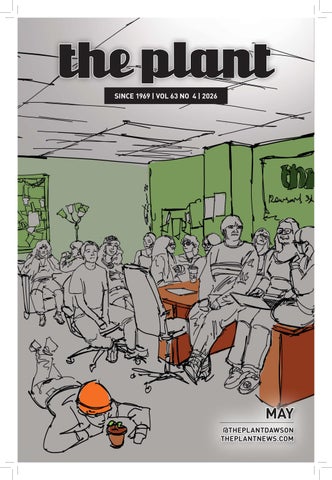
the plant
1 THE PLANT
SINCE 1969 | VOL 63 NO 4 | 2026
MAY @THEPLANTDAWSON THEPLANTNEWS.COM
2 THE PLANT
Letter from the editors Dear readers, Class of 2026… We did it! As May’s doting weather and perfumed flowers lull us into the promise of summer, I try to turn my tears to crystals that will decorate my legacy at The Plant. I knew I’d cry when I’d have to greet “Goodbye.” In my heart, I will forever hold 35 crystals for each member of the team that became my anchor. When hard nights of work kept me up until the moon came down, it was the dedication, talent, and perseverance of those surrounding me that kept me going. What I would have done without my happy band of creators, I’m not quite sure. At 19 years old, I stand taller and more loved than I ever thought I would be. I raise my glass to your next Executive team—Orion, Chloe, Elsie, and Martin— and the miracles they will bring to The Plant. Thank you Dawson for having me. Thank you The Plant for making me. Thank you Jackie, my partner in crime and the Good Cop to my Bad Cop, for shining your light on me. This is not the end of the story, With all my undying love, Minola Reader, September 2024. 17. Anxious. Aimless. Regretting my program choice constantly. Then, at the Fall clubs fair, I discovered it. The Plant. I consumed every issue hungrily. Desperate to be a part of an important conversation. And then, I applied. Winter 2025. I submitted a stupid article about Musical Theatre that has since been refurbished and published (see “Voices” Fall 2025). A shaky interview. Then, Arts and Culture Correspondent! First ever for The Plant.
Index NEWS 3 ARTS & CULTURE 6 VOICES 20 CREATIVE WRITING 24 SCI & ENVIRONMENT 26 SPORTS 28 25CURIOSITIES 29
My journey at The Plant has been beyond rewarding. I have gained experience, and knowledge; and had the privilege to work with an extremely talented community of intellects and writers. I am in forever debt to this impeccable print team, who are no doubt going to be the future of journalism. This experience and this team are utterly irreplaceable. To Maya for trusting to hire me and listen to all my silly ideas. To my dad and nana for encouraging me to make my start here. And to Minola, always by my side, for sharing her position with me, for dealing with all of my frantic thoughts and reminders at 2am, and being the incredible friend I needed to find. The Plant has given me a place to belong in CEGEP. To discover a career path that excites me. To give me the experience of a lifetime I could never have even dreamt of. Running a non-profit newspaper at 18/19 and carrying a 50+ year legacy was not in my peripheral view for college by any means. But I am so beyond lucky that I got to call myself Editor-in-Chief. Thank you. Reader, you’re in great hands with Chloe and Orion. Keep reading and consuming media. It’ll keep you alive. All my love, Jackie
The Plant is an editorially autonomous student paper. All opinions expressed in The Plant do not necessarily belong to The Plant, but are those of individuals. All content submitted to The Plant or its staff belongs to the paper. We reserve the right to reject or edit all submissions for brevity, taste and legality. The Plant welcomes typed and signed letters to the editor under 400 words. Copyright 2026
NEWS 3
What’s Next for Books at Dawson? JACQUELINE GRAIF EDITOR-IN-CHIEF
near the metro entrance, letting students pick up books and supplies on their way to class.
In November of last year, Dawson’s former Director General, Diane Gauvin, announced that the school’s bookstore would be closing its doors permanently.
The current solution set in place by the Dawson Administration is to send students to the Concordia University bookstore, which is located at GuyConcordia metro station. However, there are many limitations to this solution. There are augmented wait times because of the volume of students from both schools, books being out-ofstock, higher prices, an added commute time, and persistent inconvenience.
Not long after this announcement, a petition spearheaded by the Dawson Student Union was released on Instagram, in hopes to save the bookstore. The DSU’s post made on November 26th included a QR code to sign the petition, a summary of the announcement made by Gauvin, and all the effects of the closure. 1,504 students signed this agreement to keep the bookstore open, and these numbers were turned over to the Senate and Dawson Board. Students were shocked and upset at the news. Instagram user @ matthewplourde wrote, “absolutely unacceptable, what??” Another user @sapaincapachacuti said, “and with a private company, now everything will be more expensive. amaaaazing :/.”
The DSU explains that it has been receiving a high volume of complaints from students about the current bookstore, and the college has been made aware of student dissatisfaction. The college, in essence, had not been expecting a level of discontentment this high and is monitoring the situation. Dawson had released a mandatory consultation form on Omnivox earlier in the Winter 2026 semester to ask students' opinion on the current bookstore situation. While Maxwell Jones, Director of Student Services, says the college is “interested to hear what the students think,” the college does not have active plans to reinstate an on-site bookstore at Dawson.
of the high turnover rate at the DSU, plans like this coming into fruition is a difficult process. However, she says that the DSU always wants to keep “the student’s best interests in mind.” Yet, she wants to “lay the groundwork for Dawson [...] to see that we need to have a bookstore on campus,” which was the goal of the online petition. Jones also claims that a co-op is not a feasible solution, as the management is complex, financially and staffing-wise. He explains that the bookstore “was no longer generating profits, and [...] fac[ed] severe staffing challenges,” which led to its ultimate closure. Dawson merchandise, such as hats, sweatshirts, shirts, socks, etc… are currently not being sold anywhere and, as Tobar-Icaza says, have become “lost media.” Tobar-Icaza also says the temporary loss of merchandise is “really unfortunate, and [Dawson merch has] been a staple for a lot of years.” Dawson has stated that an alternative plan is in the works for a point-of-sale of Dawson merchandise by Fall 2026.
In an interview with the DSU’s VicePresident Operations and Services, Emilia Alina Tobar-Icaza, she explained that
For an attempt at “bridg[ing] the gap with the bookstore closing,” the DSU houses The Swap, a student-run secondhand book service according to Tobar-Icaza. It was originally made for people who struggled to afford the books being offered at Dawson. The Swap lets students sell their old books, and has new students buying the secondhand books at reduced prices. The Swap, however, has a limited selection in that they only sell re-used books from previous years.
“the bookstore was not gathering enough income to remain in operation and was not gaining any additional profits for the college.”
The Swap and the Concordia bookstore have proven to be inadequate solutions to an on-site bookstore with augmented student frustration. Students continue to hope for a re-instated bookstore at Dawson College, or more convenient solutions from the college and the DSU.
Some of the effects of the closure of the bookstore included the loss of jobs, limitation on secondhand alternatives, added commute time, students being redirected to a private company to purchase books, and the discontinuation of Dawson merchandise.
Dawson, essentially, could no longer afford to keep it afloat, and ultimately decided to shut it down. When the Dawson bookstore was in operation, books were offered at the lowest price possible, keeping it an affordable entity for students. The bookstore was also conveniently placed
VIA DAWSON COLLEGE
The DSU had previously planned to propose a not-for-profit co-operative bookstore, similar to the one that closed down last year at Vanier College. This co-operative service would work independently from Dawson, be managed by an external company, and would simply be renting the space the college-operated bookstore used to occupy. The co-op would create student jobs in the bookstore, keep pricing affordable, and be a more convenient solution than the current one. Tobar-Icaza explained that because
4 THE PLANT
Cuba @ Dawson ATIKA UME FAZAL NEWS EDITOR Since January, the almost 11 million citizens of Cuba have received one singular shipment of oil, according to Al Jazeera. The singular Russian tanker provided mild relief to the small island country that has been in a constant state of energy deficiency for decades. This deficiency is a direct result of the embargo that the United States has put on Cuba. Blockades—whether they be economic, diplomatic, or mediatic— are not a new concept for Cubans. In fact, they have been living under U.S.sanction for over 60 years, making them one of the longest-running victims of an American trade embargo in history, according to the OHCHR. Yet, the capture of Venezuela’s president (Nicolás Maduro)—the country where a great part of Cuba’s oil used to come from—has amplified the energy crisis there. After Maduro’s capture by U.S. forces from his home in January, Trump intensified the U.S.’ longstanding embargo. This became a huge source of worry for Cuba. According to CNN, the country relied heavily on Venezuela’s oil and aid packages that the U.S. intervention shut down. Trump continued on to threaten to cut diplomatic ties and impose tariffs on any country that sold or sent oil to Cuba. According to AP News, this move would be made primarily to put pressure on Mexico, a country that has long been a lifeline for the Caribbean state, to further alienate Cuba from other countries. Moreover, Trump continues to threaten attacks and annexation of the country as well, claiming that “[i] t’s possible we’ll make a stop in Cuba after we finish [the war in Iran].” Fuel shortages have hit Cuba hard— hospitals have had to cancel surgeries, universities have had to reduce classes, and many families find themselves incapable of preserving their food. Mariana Duque, a Social Change and Solidarity (SCS) student at Dawson, provides additional insight on the situation there: “We tend to think that we know what is happening in Cuba, but the scarcity is worse than we think, and it is getting worse. People now have less than 4 hours of electricity per day, and that doesn't only affect them switching on a light or off; it stops people from taking transport to
get to work, worsening their economic situation. They can't maintain their food in the fridges because it just doesn't work. Lifestyle becomes harder and it's not an individual role, [for] Cuba, to do something about it, but rather a global responsibility.” Organizations and states across the globe have indeed been trying to provide some form of aid. Global Affairs Canada vowed to send 8 million dollars in aid to specifically "strengthen food security and nutrition” within the country. Sara Louise Kendall, SCS profile Coordinator and Geography teacher, claims Canada should be doing so much more: “Canada has sent 8 million dollars of aid, which is less than a dollar per person on the island. It's a tiny drop compared to the aid that Canada sends elsewhere. Canada could have given more aid. Canada has oil, Canada can send oil. Canada should denounce the blockade. Canada should deepen economic ties with Cuba. There's so much that Carney could be doing to live up to the values that he got celebrated for saying at Davos. And we've seen very, very little.” A lot of the humanitarian work has been done through grassroot international organizations, the Nuestra America Convoy being a prime example of it. They describe themselves as “an international coalition of individuals and organizations dedicated to delivering critical humanitarian aid to the Cuban people,” and accomplished a big part of their mission in March. 650 delegates from over 33 different countries—including Brazilian activist Thiago Ávila, Irish rap-trio Kneecap, and American streamer Hasan Piker—managed to bring over 20 tons of humanitarian aid to the island. According to AP News, the aid consisted mainly of medicine, food, solar panels, and hygiene products. At Dawson, especially in the SCS program, the fight against American imperialism stays constant. Their yearly solidarity trip to Cuba allows them to bring countless products demanded by their Cuban associates on the ground. Kendall talks about their last trip: “We brought 23 suitcases filled with donations, and that was a mix of [different things]. For a youth organization, they had requested costumes and toys and sports equipment, but it was mostly medication. So we
THE SOCIAL CHANGE AND SOLIDARITY STUDENTS VISITING LA CAMORRA COMMUNITY PROJECT IN PUERTO ESPERANZA. VIA MARIA ALEJANDRA ACOSTA ARDILA
purchased a bulk order of 300 pounds of medications from an organization [to bring to Cuba].” The activism on their part doesn’t stop there. Locally, they have assisted numerous Table de concertation de solidarite’ Quebec-Cuba meetings that allow for different organizations concerned with the situation in the Caribbean country to find a voice. Moreover, they have produced a petition, made by students for students to sign, in order to make demands from the government regarding the embargo. “We’re [...] making it known that we are fighting, and we want more justice for Cuba, especially knowing that so many people from Quebec are always going there to vacation. But when it's time to actually help the people you depend on, we don’t do it,” says Anna Gueye, also part of the SCS program. One of the most basic things the students find themselves advocating for remains education and awareness on the matter. Duque insists “Cuba is more than just a communist narrative like the U.S. tries to paint. Cuba is a country, and there are human beings living the cost of imperialism by the US.
“By us ignoring the issue, it legitimizes the fact that it's an ongoing blockade. And it has been for more than 60 years.” “There's no way you can justify the way they're being treated,” adds Gueye. Cuba’s socio-economic situation continues to evolve, and as the students urge, it stays imperative to keep an eye on it. Thank you to Sara Louise Kendall, Mariana Duque, Anna Gueye, Chloe’ Cauvin, and Maria Alejandra Acosta Ardila for providing insight into the SCS program and its missions.
NEWS 5
No Way Home: Female Migrant Workers Caught in Iraq’s Crossfire CHLOE BERCOVITZ MANAGING EDITOR Any name in this article is a pseudonym. The stories of Moira, Priya, and Amara are drawn from reporting by freelance foreign correspondent Rachel Hagan of More To Her Story. Once the bombing rattles her dimly lit bedroom, she thinks of her baby’s cries. Moira, 29, lies alone in Erbil, the capital of Iraqi Kurdistan, unable to return to her family back in Ghana. Unable to speak to her family, her phone, along with her passport, was stolen by her employer. The precious objects being pried from her hands, fighting back led to a beating. There are over 65 million female migrant workers, according to the ILO. Many of whom have succumbed to regions of conflict, with no way home. Iraq hosts over one million of them, as per 964 Media data. Iraq has found itself in a unique position, being the sole country struck by both sides of the current conflict. Now, over nine weeks in, the nation remains caught between American and Iranian rockets alike. While Iran and the United States trade strikes across Iraqi airspace, Moira’s employer keeps hold of her
documents. Millions of women flee their families, raise strangers’ children, cook, clean – in order to send home the very remittances that ensure their family’s survival.
“I came here leaving my country, my home, my family. I left them behind to work. Now I stay here to earn money for them. But my boss started beating me. They hit my stomach, and then they locked me in the small room, and they started beating me more,” told Moira in conversation with More to Her Story. Not all endure physical abuses. However, with long hours and the deprivation of their passports, these conditions, despite their legality, culminate in such an utter loss of freedom that it becomes difficult to return home at all. Priya, 22, who arrived from Nepal just shy of a year ago, had never heard gunshots until recently. She did not know what she heard. Priya has never had a day off, earning $300 a month while residing just outside of the airport. In close enough proximity for her windows to rattle. Priya misses her mother. “At home, there is no one who works except me. My mother is ill. Because of that, no one gave me work in Nepal. That's why I came to this country,” she cried. She cannot remain in touch with her, for she is always at work. Even with an expired visa, Priya has no way of returning to her mother. Her employer keeps her working. She cannot afford legal aid. She cannot afford to go home. Many migrant women entering Iraq came from informal recruitment networks, many of such being Facebook groups that are only recently being investigated. Talk amongst these groups normalizes abuse; employers mock women and share their exploitative practices. A woman was called
VIA THE BUSINESS AND HUMAN RIGHTS CENTER
“spoiled” for requesting shampoo. The same Facebook group uncovered a post in which an Ethiopian woman, described as “lively and obedient, [who] wears makeup,” was bought for $6,000 and “resold” for $4,000, according to the Business and Human Rights Centre. This dialogue fosters an unsettling pipeline – a dialogue filled with diction of ownership. This pipeline has brought women, namely from the poorest African countries, into a system that treats them as commodities. The question, then, of whether such practices could be legal remains rather convoluted. Passport confiscation is technically prohibited under Iraqi law. However, state bodies, as well as recruitment agencies, remain exceptions. This is what holds so many women in place: their ability to flee warfare lies with the very institutions that capitalize off of them. And, compounding the legal entrapment just illustrated, these women are further stripped of any means to defend their rights; the Iraqi government forbids unions. Amidst a period of unrest, migrant workers have been, and continue to be, disproportionally harmed. According to The Human Rights Watch, Filipino and Nepali workers were taken hostage by Hamas. Thai farm workers were among the largest group of foreign victims killed in Gaza. Killed, displaced, or taken hostage – isolated from their families and stripped of their documentation, millions of these women across warzones have been left alone to navigate such challenges. However, a recent diplomatic development provides a faint, urgent lifeline for those currently stranded. Given the closure of Iraqi airspace, a new agreement was signed in March: temporary visas, which are processed within a week, allow for workers to travel from Iraq to Türkiye. This solution may be a window of escape for many of those who have spent months praying for a way to return to the arms of their families. "I said, God, please help me. I didn’t come here to die," says Amara, 27. Having come to Iraq from Ghana, she had never heard a bomb before, and misses her six-year-old boy more than anything else in the world.
6 THE PLANT
ARTS & CULTURE 7
8 THE PLANT
ELSIE DUQUE HILLS STAFF WRITER And so it goes—the cool breeze of spring slowly dwindles away, summer creeping onto us like an old friend—all too familiar in its arrival. Sun rays burst through blue skies, rosy cheeks saturate Montreal's bustling terrasses astalks of aperol spritz’ and sandy, turquoise beaches fill the streets. Of course, summer bliss is a scarce good, it’s cost-benefit analysis ever so bittersweet. For every iota of joy, rush of endorphins, and freckle-dotted faces follows a sinister force: the sweltering, unapologetic heat. Luckily, I’ve curated a humble yet essential list of refreshing desserts scattered throughout the streets of Montreal—each distinct in flavour yet equally capable of softening summer’s bite. A powerhouse of Japanese sweets, Matcha Zanmai on Mackay Street consistently exceeds expectations. Offering a distinct selection of traditional desserts crafted with precision and care, the shop blends refined pastry techniques with delicate, nuanced flavours. The matcha soft-serve is a non-negotiable: deeply herbal, almost earthy in the best way, and balanced by a subtle sweetness that lets the quality of the tea shine. It’s the kind of dessert that feels both indulgent and refreshing, perfect for humid downtown afternoons, and a convincing introduction into the depth of Japanese flavours. VIA INSTAGRAM, MATCHAZANMAI
If variety is what you crave, Ca Lem delivers with an impressive lineup of sixteen distinct, house-made ice cream flavours. From honey lavender, to Vietnamese coffee, with a must-try in pandan coconut, the range feels inventive and, at the same time, thoughtfully balanced—offering something for every palate, even the indecisive ones. What sets Ca Lem apart is its use of coconut milk across all its sorbets and pints, lending each scoop a velvety, almost lavish texture without the heaviness of traditional dairy. Beyond the flavours, the parlour itself adds to the experience, being welcoming and designed to foster a quiet sense of comfort and community. VIA CA LEM WEBSITE
A haven for the sweet-toothed, Meetha Ice Cream on rue de Liège feels less like a shop and more like a destination. A cult favourite in Montreal, it pushes far beyond the norm, offering flavour combinations that are as inventive as they are rooted in tradition. “Unique” hardly does it justice—the complexity demonstrated is deliberate and memorable. A standout is the Ghee Ne Gaur: a base delicately infused with clarified butter, ribboned with ghee and jaggery caramel, a rich non-centrifugal sugar widely used across South Asia. It’s rich without being too overwhelming, balancing depth with warmth. Behind it all, owners Deexit Patel and Aakruti Patel lean into nostalgia, crafting flavours that carry both comfort and cultural ingenuity, and then sharing that experience with our deeply lucky city.
VIA INSTAGRAM, @MEETHAMTL
THE PLANT 9
10 THE PLANT
Leave the Children Out of This MINOLA GRENT EDITOR-IN-CHIEF Every story has the right to be told. Even difficult stories of abuse and manipulation do. So, with an asterisk: leave the children out of this.
From ages 4 to 12, Eva was posed and photographed nude just like all her mother’s adult models. In the name of “art,” Eva had been naked on the covers of Playboy, Penthouse, and Der Spiegel magazines by the age of 11. The horror Eva lived through did not end once she was removed from her mother’s custody in 1977, when she was just 12-years-old. By the time she turned 13, Eva was the ‘70s’ Parisian night-life sensation as clubs, drugs, and sex became her second home. She was stuck in the vicious cycle her mother placed her in. Eva eventually found solace in the arts and shared her life experiences through movies and books. One such movie sparked international discourse: My Little Princess (2011). This semiautobiographical exploration of Eva Ionesco’s childhood and relationship with her mother wants to be, as Eva explained to L’Express magazine, a “monstrous story, but [told] like a fairytale.” As will be explored with further examples, Eva Ionesco’s words perfectly depict a common but no less dangerous standard for the representation and denunciation of child sexual abuse, grooming, and pedophilia in contemporary media. For My Little Princess (2011), actress Anamaria Vartolomei stepped into her first acting role as Violetta, a 10-year-old girl whose mother begins taking erotic pictures of her. The aforementioned characters represent Eva Ionesco, the director, and Irina Ionesco, her mother. On the positive
VIA MY LITTLE PRINCESS (2011)
In the midst of the 1970s cultural confusion, Franco-Romanian photographer Irina Ionesco turned her daughter, Eva, into her muse. Harmless, right? Well, the catch lies in the nature of Irina’s style; she was known for her baroque and erotic photographs emphasizing the female figure.
side, Eva offers excellent criticism of the ‘70s’ art scene and hypocrisy of those who engage with or defend it. In the movie, during a public art exhibition of Violetta’s pictures, a female attendee exclaims: “J’aime le décalage entre l’immaturité du corps et la perversité du regard.” This comment objectifies, corrupts, and sexualizes the image of Violetta’s childhood through an adult’s point of view. Hanna (Isabelle Hupert), Violetta’s mother, is at the center of this objectification of her daughter. She repeatedly rebukes her daughter’s concerns or protests by reminding her everything is art. For example, when Hanna first asks Violetta to uncover her genitals in a photograph, she protests, saying, “Je ne veux pas [être] toute nue, je n’ai pas assez de poils. On verra que je suis petite.” In response, her mother scolds her: “C’est ça qui est somptueux [...] On dirait une fleur vénéneuse. C’est ça qui est beau.” Her mother continues to shame her daughter, calling her prudish and uptight until Violetta gives in. Actors are often criticized for being too recognizable in a film, unable to disappear behind the character, which effectively breaks the viewer’s immersion in the story. In the twisted case of Vartolomei’s work on My Little Princess (2011), it is not the actress’
face or past movies that make the watch uneasy—this was her acting debut—but rather her age. Anamaria Vartolomei was only 10 years old during the filming of My Little Princess (2011). Suddenly, the scenes during which Violetta sits on the laps of older men and kisses fictional English rockstar Updike, played by 20-year-old Jethro Cave, turn sour. Vartolomei fails to disappear behind the character of Violetta, not by any fault of her own, but because of the unease the audience can’t shake throughout the movie.
“The line between fiction and reality blurs when it isn’t just 10-year-old Violetta, the character, being placed in these inappropriate situations, but also 10-year-old Anamaria, the young actress.” She is put through scenes like sitting on the laps of older men and kissing 20-year-old Jethro Cave as he grips her chest and waist, until the take is just right. Very few interviews with Vartolomei and Eva are available regarding this movie and only one of them inquires
ARTS & CULTURE 11 11 into Vartolomei’s experience. In 2024, at 25 years old, she tells Le Mag Cinéma that she was very prepared for the role because Eva insisted she be fully aware of all the emotions she’d have to portray and the difficult situations in the script. “J’avais complètement conscience de ce que j'étais en train de jouer,” she tells Le Mag Cinéma. She describes her personal life at the time as quite healthy and explains that, for this reason, she found Violetta’s situation and hypersexualization to be simply intriguing rather than traumatic. Yet, Vartolomei seemingly contradicts herself in the following question regarding her parents’ role in her casting and performance in My Little Princess (2011). She talks of the innocence that accompanied her first acting experience and how little she knew. Vartolomei recounts her shortlived belief that her work was done after the first day of shooting when, in reality, she still had 40 more days to go. She says, “Comme je débutais et que je n’avais aucune conscience du fonctionnement de l’industrie, mes parents ont été très utiles, parce qu’on l’a découvert ensemble.” Vartolomei insists on her parents’ positive influence and commitment to protecting her on set. However, despite all the precautions taken both by Eva and Vartolomei’s parents during casting and on set, could a 10-year-old child have truly understood and consented to appearing in her underwear and being depicted as a seductress? Eva Ionesco’s cinematic retelling of her sexualized childhood is disturbing, not just because of the narrative, but because it also fails at protecting child actress Anamaria Vartolomei the way Eva would have certainly liked to have been protected at her age. Though the film ultimately brings awareness to the negative effects of Hanna’s photography and sexualization of her daughter, its artistic direction causes more harm. On 5 separate occasions, which span over 15 minutes of the movie’s 1 hour and 40 minute runtime, the viewer is presented with elongated sequences of Hanna photographing Violetta in suggestive
clothing and, oftentimes, downright pornographic poses. This does not include other scenes during which Vartolomei acts like a ‘mini femme fatale’ or like a ‘femme-enfant,’
LOLITA (1997) VIA IMDB
culturally known as a “Lolita.” This term, describing a nymphlike female child that is aware of her sexuality and uses it to attract men, was introduced by Vladimir Nabokov in his 1955 novel Lolita. Nabokov’s book follows Humbert Humbert, a French man in his late thirties, who marries a widow because of his infatuation with her daughter, Dolores Haze. Over the course of 36 chapters, Humbert kills Dolores’ mother, kidnaps the 12-yearold little girl, and, using her grief and fear, traps her in a pedophilic and pseudo-incestuous relationship. The book is a masterpiece in first person perspective work, immersing the reader directly into the twisted mind of Humbert as he endlessly justifies his actions. The manipulation the reader is subjected to bleeds through Humbert’s voice. Nabokov depends on the adult consumer's good moral judgement to be disgusted and appalled. Lolita (1955) was given two adaptations throughout the years: one in 1962, in which 14-yearold Sue Lyon played Dolores Haze, and one in 1997, in which 15-year-old Dominic Swain portrayed her. In both, Nabokov's intention is lost through the change of artistic medium. Humbert’s sugarcoated abuse of Dolores as the unreliable narration loses its impact on the screen, where subtleties of this kind are difficult to achieve. Worst of all, this
story depends on the public recoiling at the simple sight of a young girl with an older man, which cannot be achieved without a child actress.
“How to portray Humbert and Hanna’s perversity, sexualization, and graphic abuse of Dolores and Violetta without compromising the mental health, image, and dignity of a child?” Therein lies the contradiction that makes a faithful and ethical adaptation of Lolita (1955) and future abuse stories impossible. In the case of Sue Lyon’s Dolores Haze, the filmmakers wanted to market the young actress as the sexualized object that Lolita is portrayed as in the movie and to make Lyon indistinguishable from her character, says The Teen Mag. The press’ distortion of the character of Dolores Haze and Sue Lyon watered down the message of the movie. The Teen Mag even reports some critics calling Lyon a “deceitful child-woman” and saying that “Humbert’s desire for her comes off as ordinary.” “My destruction as a person dates from that movie. Lolita exposed me to temptations no girl of that age should undergo,” later said Sue Lyon. Though Dominique Swain didn’t express similar sentiments regarding her experience with the character of Lolita, Andrian Lyne’s publicly stated perception of his movie as a love story taints the 1997 adaptation’s making and reception. My Little Princess (2011) and all Lolita (1955) adaptations have failed to assure a safe environment in the process of bringing awareness to infantile sexualization. Certain stories don’t belong on a screen because the physical projection of sexuality on a child is enough to endanger them and their image. Remember, children cannot consent, even for playing pretend.
12 THE PLANT
Re-Play the Games from your Childhood SABRINA COCCIMIGLIO COPY EDITOR The winter 2026 semester is coming to an end. Slowly, though it may not feel like it right now, the academic stress will cease, and summer will be just around the corner. Think of the fresh sun on your skin, and the light breeze passing by you. Although life may seem pretty serious right now, as some of us may be wrapping up our last semester at Dawson and moving onwards towards adulthood, there’s one fundamental thing (in my opinion) to bring back some fun in your life: nostalgic games.Though your academic future is important, there is no need to worry about university, your grades, or, really, any of your life’s problems when games, especially nostalgic games, exist! Take this summer to rediscover (or just discover) your next gamerelated addiction and bring back the fun you deserve in your life.
(the franchise) The Papa’s franchise first started with the launch of Papa’s Pizzeria in 2007 by Flipline Studios, according to the fan-made Flipline Studios Wiki. This marked the release of their first Gameria, a game focused on restaurant management. The franchise now has 13 other variations of the game, including fan-favorites, such as Papa’s Freezeria, Papa’s Wingeria, and Papa’s Doggeria. The game varies witheach version, but the main storyline they share is that Papa Louie, the owner, has run away and left you, the player, in charge of his business. Your job is to keep the business running as you navigate each customer’s personalized order. Once the order has been registered, you must follow the steps to prepare it by going through different stations. Each version of the game has 4 different stations. The ordering and cooking/baking stations
are always included, whereas others vary, such as the assembly, decoration, or drink stations. Once you have successfully completed an order, the customer gives you a rating out of 100 points. Depending on how well you prepared it, you may even receive tips. Points help you level up, whereas tips act as the game’s currency. Some versions of the game include a weekly paycheck to collect more money, where being at a higher level allows you to recieve a higher paycheck. With your money, you are able to unlock new decorations for your restaurant, purchase new outfits, and buy game boosts, such as alerts to tell you when your food is done cooking or when a customer walks in, to make the workday easier. Other features of the game include mini games after every workday, depending on the game version you are playing. Another feature is unlocking new customers as you level up, who are then showcased in a parade (if you choose to view it). Papa’s games are available to play on mobile devices, costing from $0.99 to $2.99 CAD, or playable on PC on Steam for $7.79 CAD. It is also still possible to play Papa’s for free on Crazy Games and other game platforms such as Cool Math Games through your web browser!
First launched in 2010 by WildWorks, Animal Jam may be the wholesome game you’ve been searching for. Although it is marketed toward children, rest assured, it is a game everyone can enjoy. The nostalgia lives on as old and new players, called Jammers, continue the games legacy.
Guaranteed to keep you interested, you can choose between Animal Jam Classic for the original 2D style of the desktop game or join Animal Jam Play Wild, an updated version with a 3D design playable on mobile and desktop devices. The game contains two currencies: gems and sapphires. Gems are the common currency of the game, while sapphires are the highervalue currency, usually harder to come across. While the game is fully free to play, it also offers various memberships, ranging from 1 month for $6.99 CAD to 12 months for $4.83 CAD (per month). These memberships allow Jammers to receive more perks, such as exclusive items, 5 sapphires daily, weekly member gifts, and more! One classic feature of the game is the customization of your own animal, varying from the starter choices (bunny, fox, wolf, tiger, etc.) to rarer animals (deer, cougar, fox, etc), which are not always available to purchase. One crucial aspect of Animal Jam is its trading system, you can visit places on the map or go to parties available to you to trade for rare items and expand your collection of valuable items. Another possibility to collect items that aren’t available in shops is buying items from other Jammers using the My Shop Explorer in Coral Canyons, where you can search for items and the best deals. You also have the possibility of setting up your own My Shop for 100 sapphires (non-members), where you can sell your own items for gems or sapphires. Another enjoyable feature of Animal Jam is decorating your den, which is your own personal home. The possibilities for decorating are endless as shops rotate with new items, such as couches, plants, rugs, posters, beds, etc. There’s also the possibility to upgrade your default den to other designs, ranging from a treehouse, an alpine lodge, a moonlight manor, among others. Jammers also have the opportunity to play minigames, such as Pest Control, Phantom Dodger, Treasure Hunter, to name a few, rewarding them with gems and sapphires in exchange.
ARTS & CULTURE 13 Other features of the game include learning wildlife facts, chatting and interacting with other Jammers, and accomplishing missions, providing players with a multiplicity of things to do. Shops can be found all over the map, each with a specific purpose, such as shops for sapphires, den items, clothing items, or items sold by other Jammers. Go and explore around the map and discover the unique designs of places, such as Jamma Township, Lost Temple of Zios, Apondale, Mesoterra, and many more. You’ll be transported into different climates, varying from the dry desert of Kimabara Outback to the freezing cold of Mt. Shiver, with lots of things to discover and collect.
MovieStarPlanet (MSP) first launched in June 2009 in Denmark by Danish company MovieStarPlanet ApS. It rapidly expanded to 16 countries, including Canada, Australia, and New Zealand. It now has over 400 million registered profiles, reaching its peak engagement between 2013 to 2015. By 2011, the game became playable on mobile and desktop. Though MovieStarPlanet 2, a new version of the game was released in 2020, most of the nostalgia lies within the original game. To create an account, you’ll be able to customize your own character with default items. Once that’s done, you'll be able to visit 5 places: the games, chatrooms, shops, movietown, and pets. The currency in the game is Star Coins, and “fame” are the experience points in the game, which are the building blocks to leveling up. These can be accumulated through signing and receiving autographs from other players, buying any items from the shops, watching movies, opening gifts, etc. Although there are VIP packs you can buy to make this process easier, the game is still accessible without a
membership. Shops introduce you to a variety of items to buy, from clothes to furniture, character animations, and backgrounds. Every week, there’s a new theme, such as Toxic Trance, Grey Skies, Waves, and many more, providing new items to the shop. If you’re visiting Movietown, animation and backgrounds will be useful, as you can use them to make your own movies, artbooks, looks, etc. However, lately, the chatroom and games won’t be of much use, specifically in the Canadian server, due to a lack of players. Although MSP is not the game with the most active players in Canada, its legacy is being kept alive by old players who choose to revisit. If you enjoy fashion, conversation, and a game you can play passively, MSP may be for you.
Friv isn’t a game, but this plateform contains all the games you could want and more. It first launched in 2006, allowing users to play games on the web for free by licensing games from independent game developers. The original fan-favorite Friv used to be powered by a technology called Adobe Flash, which shut down in 2020 due to its incompatibility with mobile devices. This problem didn’t just affect Friv, but all the games previously discussed. Due to Adobe Flash’s shutdown, Friv and many other games were forced to adapt to new HTML5 technology. Though Friv was forced to rebrand its website completely, the classic Friv model was remade and is available to revisit today. Friv is perfect for everyday passive gameplay because it includes a variety of games to choose from. Not only are there barely any ads on the website, but you can rest assured that you will always find a game to play. Some of the most popular games are Fireboy
And Watergirl Forest, Fancy Pants Adventure, Electric Man, and The Right Mix! It depends on what type of game you like, but once you’ve figured that out, Friv most likely has it. So while you still have the chance, go revisit the games that made life enjoyable. By searching for the nostalgia in things that once held meaning and presence in your life, you might just realize why they held such a huge impression. Give yourself a well deserved break after a hard week of exams, and rediscover your inner child.
14 THE PLANT
On Manon from KATSEYE: How K-Pop Takes Its Roots from Black Culture ALAA ETTAOUTH STAFF WRITER
VIA PINTEREST
In February 2026, Manon Bannerman, member of the global girl group KATSEYE, halted her activities to “focus on her health and wellbeing,” according to a joint statement from labels HYBE and Geffen. This announcement sparked a visceral reaction in the K-Pop community because it seemed to contradict the personal message of Manon to her fans: “Sometimes things unfold in ways we don’t fully control, but I’m trusting the bigger picture.” Discourse immediately started to intensify online, stemming from fans’ allegations of Manon liking Instragram posts suggesting that she was another victim of the “the lone Black girl in girl groups” trope. Furthermore, Manon’s categorization as “lazy” in the reality TV show Dream Academy, where 20 candidates competed in missions to form an international girl group, KATSEYE, has been following her like a shadow.
Manon is not an isolated case of the deeply flawed K-Pop industry. She is rather a blatant example of how modern K-Pop has been treating Black culture and the bearers of its art since its emergence in the late 1900s. American music first made its way into Korea at the end of the Korean War in 1953 via the many military bases and “camps” set up in small towns all over the country. Because of their close proximity to these bases, the towns provided one of the earliest introductions of African-American music to South Koreans. In their quest for freedom after a disastrous war, Korean music shifted and molded into a mosiac, inspired by many genres. Koreans adopted soul music, rock 'n’ roll, and even psychedelic rock, musical genres originating from Black traditions. The inspiration exceeded the mere borrowing of Black musical history,
it completely shaped how the modern Korean-pop industry opperates and creates its musical scenery. As a matter of fact, the “idol” culture that sets K-Pop artists apart from Western musicians originates from Detroit, a predominantly African-American town. Motown Records was founded by Berry Gordy in 1959, an era marked by racial discrimination. This corporation managed to attain a fulgurious commercial success by producing a record number of charttopping artists, including Diana Ross and the Supremes, The Jackson 5, Stevie Wonder, and Marvin Gaye. What made the Motown Records label so unique was its Artist Personal Development Department that sought to help young inexperienced artists with talent to develop their presentation style, celebrity etiquette, poise, and choreography. Does this ring a bell? For J.Y. Park, founder of JYP Entertainment, a leading South Korean entertainment company and record label, it certainly reigned true. Park has credited Gordy’s work as an inspiration for the development of his own musical prospects. In a 2022 interview for his new international show, America to Korea (a reality TV show where American artists are trained using the K-Pop system), Park declared that he started his company based on the American model of Motown Records, influenced by how they trained raw talent. Motown was ahead of its time. This record label saw music as not only something music enthuasts could consume, but also as a personal bridge between a fan and an artist. The marketing strategy from the Motown era included: creating polished album covers, offering exclusive fan items (such as photocards), and closely monitoring the creative steps all under one roof, the Hitsville U.S.A. This was all part of a larger goal to make the fans personally resonate with the artists, and it is a strategy that has since defined K-Pop labels’ marketing approaches. Unfortunately, even if K-Pop’s history is intrinsically intertwined with Black music practices, Black artists were never genuinely valued in the artistic process of creation. Often, labels and groups have no shame in
wearing Black culture as a costume to sell a certain image, usually one that is sterotypical. In the early ages of BTS, the biggest boy band in the world, their concept was heavily inspired by hip-hop music. There were many instances of RM (the group’s leader and main rapper) wearing dreads, using AAVE (African American Vernacular English) in his rapping, even going as far as employing the N word in a cover of SHINHAW’s song “T.O.P” (another K-Pop group known for unapologetically appropriating Black music…) More recently, ALLDAY PROJECT’s “Tarzzan” (his real name being Lee Chae-won) has been under fire for wearing protective Black hairstyles, showing off grills, and for his poor attemps to rap; profiting off Black culture without ever really interacting with the roots of the culture.
“The 'coolness' K-Pop artists want to embody so desperately is done by usurping Black cultural identity and voids all the historical meaning that defines it.”
K-Pop appeals easily to its audience because it offers a watered-down version of Black American music: K-Pop strips Black American music from its social context, making it more digestable to listeners who do not necessarily want to interact with the historical bagage Black music carries. Nonetheless, the history of AfricanAmerican music is an important story of resistance and survival. When Black people raised against the racial segregation during the Civil Rights Movement from 1954 to 1968, songs were used in protests and heavily influenced Soul music . In order to persist, marginalized communities had no choice but to create their own subcultures when the majority drastically rejected them. Hence, it is crucial to never dissociate the struggles and the fights that led to the blooming of African-American art forms, distinct styles and sounds. I sincerely hope that the awareness around Manon’s case will serve as a first step to better recognize the work of Black artists in making the K-Pop industry the commercial success it is today.
ARTS & CULTURE 15
Who Gave You Your Dream?: An Exploration of GhettoPhysics NICOLE MOTTA ARTS & CULTURE EDITOR As Dawson students, the big “next step” creeps towards us. With university applications and career path decisions weighing on students’ minds, we feel we no longer have that leg room we once had in high school to dilly dally. There is an imminent sense of: the real world is coming. This “real world” can be a thrilling thought to some and a horrifying one to others. Many of us use confident words in our application essays to describe our future in this new place: dreams, passions, and goals. I remember a time, long ago, when our dreams were shaped more by imagination than the confines of a 9 to 5. I guess somewhere along the way, we chose, or complied, to dreaming different dreams. However, some still struggle to engage with this process of compulsivity. A lingering question arises, one that we might prefer to stick our heads in the sand than answer: are my “dreams” really mine?
VIA ROTTEN TOMATOES
GhettoPhysics: Will the Real Pimps and Hos Please Stand Up!, a 2010 docudrama film written and directed by William Arntz and E. Raymond Brown, asks us to take a firm look at the power structures that make up the “real world” and which shape us at the most personal level. Indeed,
power doesn’t leave much room for authenticity. At the documentary’s core, it describes the global interplay of two fundamental, long-standing, human archetypes using simplified prostitution street language terms: the “pimp” and the “ho.” The “pimps” are those in positions of power—kings, presidents, billionaire shareholders, and elites—while the “hos” are the masses who produce great value, yet do not control it. Pimps are dependent on our bodies and resources as their “game.” Today, these interactions are so multilayered and complex that it can be hard to recognize them. GhettoPhysics points out that it is the pimp’s job to teach the ho how to play the game and convince them, not that they must participate in it, but that they want to. How, you ask? Well, you guessed it: through inserting the pimp’s dream into the mind of the ho, like planting a little seed. It’s very possible for one to learn to love the seed; once the tree has fully grown, it’s natural to feel possessive of it. After all, you were the one who grew it meticulously and tirelessly, in all its glory and magnitude. You just weren’t the one who originally put it there. Everytime we mass upload our CV on Indeed or curate the perfect university applications, we are hoping that our “game” gets “pimped,” that someone in power will recognize and use our value. At a company, for example, students often work minimum wage jobs because we are conditioned to believe that our work is worth considerably less than a CEO’s. But really, this dynamic exists at any level of the pyramid. However, if you think about it, the CEO wouldn’t profit from his multi-million dollar company at all without its workers' cheap labour. Essentially, without its hos, a pimp is left with nothing. If you’re suddenly feeling empowered, good, that’s exactly what GhettoPhysics wants to achieve. In fact, the whole ho and pimp talk isn’t meant to offend. GhettoPhysics isn't reducing us to this inevitability,
rather, it offers hope and the potential for liberation. The documentary expands on what it calls the self-degenerative ho: the victim archetype. The victim lacks the spunk to fight because of this overwhelming sentiment that the power is out of the ho’s hands: feeling like the world happens to the ho, by the pimp.
“However, understanding and internalizing the power we truly possess leads us to a place where we can start defining the rules of the game for ourselves.” In a certain sense, humans are creators of their own realities through their operative conceptions of the world called paradigms. GhettoPhysics suggests that, to change the dream born from the pimp-dependant paradigm—to find and water that second little seed that has existed within us all along—is to change our reality. When we break archetypes, we make room for a larger world vision, a world where game can be returned to the hos. Say it with me: power to the people! In fact, the documentary talks about these two archetypes, not as dichotomies, but as a Yin and Yang dynamic. While one person can embody the Yang and another the Yin, it is also possible to cultivate the interplay of these two roles within ourselves, once we recognize our agency and ownership of our resources. As Dawson students, reclaiming power might not necessarily mean escaping the game entirely, but becoming conscious actors within it, aware of our capability of redefining the rules. GhettoPhysics notes that “the game doesn’t change, the players do.” It might be time to pull our heads out of the sand and ask ourselves, “Who gave me my dream?”
16 THE PLANT
VISUAL ARTS 17 17
18 THE PLANT
Elephant: What Invisibly Shapes a Room
Elephant is the current exhibition at Warren G. Flowers Gallery at Dawson College (running until May 1, 2026). The exhibition brings together works by Joshua Vettivelu and Alex v. Pouliot to explore “how experiences of desire, anxiety, love, damage, and repair accumulate in the spaces we inhabit.” The questions for the following interview were written by Visual Arts students Bethany D’Souza and Ana Luiza Strazzi Nogueira. Question for Joshua Vettive and Alex Pouliot: The title of the exhibition alludes to what “invisibly structures a room.” You both exhibit pieces that contain architectural elements. Why and how were these works curated within the exhibition space to comment on how we frame ourselves and one another? “In general, I’m really interested in how immaterial experiences of power eventually become physical things, like borders, prisons, community gardens, and even art galleries. My interest in architecture stems from the idea that the buildings that shape our social lives (for better or worse) are the product of the language we use to determine value. Oftentimes, the power dynamics that shape these spaces are rendered invisible. When things cannot be named/identified, they are able to operate without interference.” “Alex and I decided to title the exhibition Elephant as a reference to the idiom ‘elephant in the room,’ to explore how power is a substantial presence that can be felt, but remains invisible and unnamed.” Question for Joshua Vettivel: A lot of your artworks possess an archaic quality in the materials that are being used (i.e. stoneware, terracotta, metal, leathers). Is the employment of these historical materials pertinent to the messages you're trying to convey? “We learn a lot about the social lives of past civilizations through the material records they kept. In this way, I am very interested in making the ephemeral social dynamics of our present moment archivable by using materials that have the potential to
Via Valeria Yenlin Ponce Flores
BETHANY D’SOUZA, POHANNA PYNE FEINBERG, AND ANA LUIZA STRAZZI NOGUEIRA CONTRIBUTORS
survive the future.” “The images used in the clay tablets are all taken from real images of men interacting with each other. Within these images we can view the social lives of men and see some of the rituals men use to regulate each other, creating hierarchies through humiliation, dominance, or camaraderie. Sometimes I fantasize that these clay tablets will be discovered in the deep future, providing future civilizations a glimpse into how we understood ourselves and our own undoing.” “Leather also has an interesting (albeit morbid) relationship to time. Leather is [extends that which] was once alive … into the future. I am interested in how our society transforms life into extractable resources. The leathers I use are from snakes and eels that have been caught in industrial ocean fishing. These creatures are the “accidental” and unwanted catch of industrial extraction and are killed and turned into leather to provide some profit from their undesirability. Generally speaking, these creatures that slither on their belly are alien (and sometimes even threatening) to us, making it hard to empathize with. This lack of empathy rationalizes the devaluing of life into extractable resources or collateral damage. I believe this dynamic repeats itself in many ways, including our relationship with the environment, other animals, and each other.” Questions for Alex V. Pouliot: Your artworks Through the Looking and Dead Ringer are beautiful twoway mirror installations that create
interesting and dynamic shadows. How would you describe your artistic process of creating these sculptures and defining the shapes/contrast of the shadows? “All of the soldered glass pieces shown in the exhibition are a testimony of my apprenticeship of the stained glass copper foil technique. Wanting to learn this craft, without having to think about the shapes of the work I would create and the colour I would use, I restrained myself using only found clear glass. In wanting to work with such a fragile material, there was a lot of trial and error and there still are. So to learn, I broke [discarded] glass and repaired it. What is left to see is the result of a negotiation between matter and my desire to control it, like the scars of both destructive and healing processes.” “What characterizes Through the Looking and Dead Ringer is that they were shattered by the same impact. Taped to one another, like a final embrace before their fall, they were dropped on the concrete floor of the studio together. That is why they share similar fractures. They resemble one another, yet they are different. Like twins. What sparked this idea was simply the fact that I had two identical pieces of this thick two-way mirror. They felt so different from the glass I was used to working with that I wanted to highlight their specificity through a shared trauma. The shadows, like most of what I do, are the result of happy accidents.”
VOICES 19
Gothic Cinema Rises from the Grave TESSA H. CHABOT CONTRIBUTOR I find myself sitting in the cinema every couple of months when the newest Gothic movie arrives from Poor Things (2024) to Lisa Frankenstein (2024). The audience and I keep our eyes fixed on the screen as the monster comes on screen, strangely the creature seems to reveal something that is far too personal for many to handle. There’s certainly not been a shortage of gothic cinema in the last couple of years. For the first time, in what seems like forever, we finally have a new array of Gothic films. The recent surge of Gothic films reflects the collective anxieties humanity has for the future. Historically, Gothic literature and, later, Gothic cinema typically rose in popularity in times of political turmoil. Moretti argues in the article “Gothic Film Revival” that, “The monster serves to displace the antagonisms and horrors within society to outside society itself," turning collective horrors into a tangible being. " This tangible being allows us to recognize the unease we feel around us. This genre is a perfect outlet for it. The most famous Gothic novel, Dracula (1897), was born from European fears of foreign invasion and the 'Other.' Just over 30 years later, Dracula, the film, (1931) premiered when western world was in the center of the most severe financial crisis in history. The Great Depression marked a societal transition from Xenophobia into a fear of being taken advantage of by the rich. This trend seems to happen time and time again— the current wave is no different. The current wave of contemporary Gothic cinema was started by Yorgos Lanthimos’ Poor Things. The movie explores bodily autonomy and sexual liberation for women. Current Gothic author Cameron Esbenshade explained, “Both horror and nostalgic (…) aesthetics tend to follow social uncertainty. We are seeing a dramatic
rise in horror demand across types of media." In fact, during 2022, women across the globe sat in fear as witnesses to 22 million women in America losing access to part of their basic medical care: the access to abortion. Poor Things came as a reaction to the overturning of Roe v. Wade. This contemporary interpretation of Frankenstein, exploring themes of reproductive control and bodily ownership, mirrored women's anxieties about losing their rights to controlling their bodies controlled to the government. Dawson’s Gothic Literature professor J.A. Shea says “I think that that narrative, you know, fits neatly with some of these feminist retellings that we've seen, which were often about women's empowerment and female agency.” Newer looks at Gothic films hold a mirror to today’s problems.
VIA SEARCHLIGHT PICTURES
The empowering story of Bella from Poor Things rejecting manipulation from men to define her own humanity and bodily autonomy becomes an eye-opening story during these trying times. Gothic media enjoyer Patrick Chabot says, "They're fantasies. It's a place where you can escape", in certain cases it becomes a place to enjoy. The morbid fascination becomes a sense of escapism for many. We often need that escapism from the real horrors we see in our world. Gothic films give that to us through their exploration of romance. My favourite Gothic romance that has come out as of recent has been Lisa
Frankenstein by Zelda Williams. Lisa Frankenstein is a modern retelling of Frankenstein. The film shows a great love story between the monster and Lisa Swallows, the main character. The interesting thing about Lisa Frankenstein as opposed to regular Frankenstein stories is the monster isn’t the one seen as the freak, it’s the main character, Lisa. She is visibly a goth and is oftentimes ridiculed by those around her because of her appearance and her reaction to her mother being killed in front of her. The movie puts an emphasis on personality and attitude rather than appearances. Lisa is proud of her weirdness despite being ridiculed for it. Unfortunately, the people in her town judge her appearance and her quirks,leading people to isolate her. The romance between the Creature and Lisa reflects a healthy alternative to the issues of modern romance. In recent years, romance has dwindled from its fiery passion and audiences’ yearn to escape from their mundane situationships for a deeper connection. Gothic media has consistently held mirrors up to society’s problems and most of the time those voices were ignored—but not anymore. With Gothic cinema on the rise, the genre became a place for people to discuss societal issues. If cinema has started to have these hard conversations, I believe the rest of the world can too.
20 THE PLANT
Étranger: The Struggles of Immigrating in Adolescence ORION PEYROL MANAGING EDITOR When I first moved to Montréal, coming up on four years ago now, the smallest things made me feel like an étranger. There isn’t really a good translation of that word in English. Literally it means stranger or foreigner, but it speaks to something more in French. When you are visiting a foreign country you’re going “à l’étranger,” but when you move there you become “l’étranger,” the foreigner. You are estranged from your own culture, a stranger to this new one and trying desperately to find the balance between the two of them. Being an étranger is feeling like a puzzle piece from a different box that’s trying to find a spot that fits in an entirely new picture. There is no place made for you, so your only options are to stay apart or to carve out your own space. When I first got here nothing felt even close to being right. Even as I crossed the streets of this cultural collage of a city, I could feel my étranger-ness. I would look up to try and spot the traffic lights, used to them being hung above the street, and find myself doing a double take when they weren’t there. Thankfully, I already spoke French when I got here, but I spoke FranceFrench, and none of the expressions or slang were familiar to me; I was so confused when someone had referred to the girl beside them— a girl with bright purple hair— as their blonde, that the language didn’t even feel like my own anymore. As Carl Jung once said, “Loneliness does not come from having no people about one, but from being unable to communicate the things that seem important to oneself, or from holding certain views which others find inadmissible” and for many immigrants communication, because of language, is a struggle. Often, adolescents who are learning the language find themselves feeling split, like they have different personalities for different languages. Speaking to other teen immigrants a lot of us had similar feelings: “French still feels like a more ‘professional’ language to me. I sometimes find it hard
to use it in everyday conversations or when making friends.” said one CEGEP student who arrived from Kyrgyzstan at twelve years old. One language comes easier to us and we find our identities being further fractured by this. Adolescence is the time for identity formation and always comes along with its own difficulties: loneliness, mood swings, and acne. But when you add this gap between your experience and the ones of your peers, nothing quite fits. According to a 2024 study published by the International Journal of Adolescence and Youth, immigrant adolescents experience more symptoms of depression, social, and emotional loneliness, and this is an even higher percentage in recent, first generation immigrants. Trying to make an identity for yourself when the part that is supposed to be stable— your nationality, your home— gets shifted beneath your feet is so disconcerting and indescribably hard.
“Immigration, no matter the age, comes with suitcases upon suitcases of struggles but even more so for teenagers.” A 2023 study in the European Journal of Ageing found that adolescent and young adult immigrants experienced more loneliness compared to other ages. Immigrating at a young age makes assimilation a much smoother process, and at an older age, identity formation and social relatedness is much less of a factor. The need for social interaction, belonging, and secure attachment is primordial to us all and we do not react well to loneliness. The National Library of Medicine found that loneliness over long bouts of time can lead to both your psychiatric and physical wellbeing decreasing over time. It’s no surprise then just how many young immigrants struggle in these areas. Connection is especially a present need in adolescence, when you are actively trying to find peers to relate to. But as a brand-spanking, straight off the boat immigrant there is no one to relate to. Your experience becomes unrelatable, you try to find other
immigrants, expatriates of a similar age but none of your experiences are comparable. You all came from different places, at different ages, have different difficulties, and different cultures that you are desperately, desperately trying to hold on to. These transitions are made easier for some thanks to classe d’acceuil, classes in french schools made to acclimate immigrant children, but eventually that bubble will burst. “[...] I felt like I was really thrown into the unknown. That’s when it became harder for me to relate to people and express myself” said that same source.
MY FIRST NIGHT IN MONTREAL VIA ORION PEYROL
As an immigrant, you are forced to make an identity that only you can uphold, one that can contain the multifacetedness of your experience. I carry a claim to four separate countries that I could call my origins and no simple story to tell when someone asks where I come from. There is no one out there with the same path as me, and I’m sure the same can be said for most of you. That’s terrifying to think of: no one else has experienced exactly this but also no one else has experienced exactly this. You have a story that no one else can tell for you, you are the future. Globalization will make more of us— is making more of us— and a multi-cultural identity is a beautiful one, despite the difficulties it brings along with it. There are no spaces made for us, but we are actively making them, and things do get easier. You get used to your new environment and find a place in the world. I no longer look up when trying to cross the street.
VOICES 21
On Joy and Pleasure MAYA JABBARI VOICES EDITOR If you ask a writer what made them pursue writing, many will name other writers and their works who have inspired them so dearly and so intensely, left them speechless even, that they automatically, after putting down the book, knew who they wanted to be and what they wanted to do. This doesn’t happen for every writer, and saying it does is a generalization. But for me, that is precisely, to a tee, what happened. Before Zadie Smith’s book of essays, Feel Free, entered my life and into my arms, the questioning of my life’s path was all up in the air. But then, this very book, a gift from my teacher, Mr. Oconnoll, in my last year of high school, guided me in ways I almost feel were and still are magical. “Joy” on page 435, the last essay in Feel Free, is personal; it cuts you deep and forces you to question your life in ways both subtle and overt. Here, she examines the distinction between joy and pleasure in her life and asks you to consider it as well. And, don’t be fooled, it’s a difficult task. Smith approaches joy through personal life stories, cultural references, and philosophical reflection. As per her suggestion, joy is fleeting, involuntary, and often tinged with something beyond simple happiness. In contrast, pleasure is more accessible, more predictable, and often tied to consumption or personal gratification. Pleasure is easier to grasp; you can kind of expect it. Pleasure is reliable. Joy is not. Joy hits you out of nowhere and lifts you out of yourself. The thing about these two (joy and pleasure) is that, even though this is Smith's way of distinguishing them, it isn’t everyone’s way. She doesn’t outwardly say that, but it’s there, you feel it, and your head and your heart float off somewhere else, to a state of introspection.
I used to think of joy and pleasure as points on the same spectrum, with joy simply being the more intense version. But Smith resists that idea. Joy is not just “more pleasure.” It is qualitatively different. Pleasure can be anticipated and repeated; joy cannot always. Pleasure often reinforces the self; joy, paradoxically, seems to take you out of self and into an unknown. Moments of pleasure are often easy to catalogue because these experiences are real and meaningful, but they tend to be contained. They begin and end within a predictable frame. But joy, God, joy feels rarer, almost accidental. For these are not moments we schedule into our lives. They emerge, often disrupting the very structures we rely on for stability. Smith emphasizes this disruptive quality, suggesting that joy can even be inconvenient. It can arrive in moments where it feels out of place, complicating rather than simplifying our emotional state. In a culture that prioritizes consumption, pleasure is easier to market and package. Joy is not. You can’t schedule it, buy it, or optimize for it. And yet, in chasing pleasure, we sometimes convince ourselves we are chasing joy. I’ve noticed this especially in how I document my life. These moments look like joy from the outside, but the actual feeling of joy, when it happens, is usually too immediate and too absorbing to document. It doesn’t occur to me to document them. And by the time I think about catching and holding the moment tight so it’s forever there and with me, it’s already gone. If joy cannot be engineered, what do we do? Smith doesn’t offer a clear answer, and maybe that’s the point. The pursuit of joy, if treated like a goal, risks turning it into another form of pleasure and, with that, another item on a checklist. I’ve come to realize that that realization is both freeing and frustrating.
VIA PINTEREST
But no, joy can exist in times when I’m fully present without trying to extract something from the experience. These are not things you can force, but they are things you can make space for. Openings. This doesn’t mean rejecting pleasure. Pleasure matters. It sustains us in quieter ways. But confusing it with joy can leave us feeling almost unsatisfied, even when we’re surrounded by things we truly do enjoy. Recognizing the difference doesn’t diminish pleasure; it simply just puts it in perspective. With that, I now ask you: tell me moments when you experienced joy and when you experienced pleasure. Distinguish them. Search for them. Long for them. And always look ahead. Because, right now, writing my last article for this paper, I feel joy.
22 THE PLANT
On Conversations with Strangers ORLA JEANES STAFF WRITER
In public spaces specifically, the ubiquity of electronic devices has had a deadening effect. Whether it's in waiting rooms, lineups, or apartment building hallways, people come across as more taciturn, appearing almost as if they are purposefully avoiding eye contact. With most of their attentions diverted, either by some forbidding screen blocking their face or a pair of noise-cancelling headphones tuning out the world around them, their use of technology only serves as a tool to ward off potential conversationalists. Propelled by the restrictions of the COVID-19 pandemic, the tendency to keep to oneself has grown exceptionally popular and, seeing as we are creatures of habit, the act of striking up a conversation has resultantly become more challenging. Held back by fears of awkwardness, of judgment, or even of rejection, our attitudes towards socializing, especially with people we don’t really know, have largely turned cynical. But what about when we do find ourselves, unexpectedly, having a oneoff chat with a stranger? Maybe it was with an old man who, while waiting for the bus, felt compelled to share a friendly anecdote, or maybe it was the girls who complimented your outfit in a graffitied bathroom on a night out. Regardless of the exact circumstances,
we all inevitably collect stories of such exchanges in which we’ve deviated from our habitual circumspection. And, for the most part, we look back on these memories not with embarrassment or discomfort, but rather, with fondness. Although fleeting, these anomalous interactions strangely leave their mark, crystallizing in our minds as warm and vivid recollections that stand out amidst a backlog of routine conversations with friends and family. For a few minutes, we are drawn out of our technologyinduced introversion and reimmersed amongst fellow human beings, an experience the Canadian psychologist Gillian Sandstrom refers to as being “woven into the fabric of [our] community.” Not only conducive to a better mood, random, micro-moments of connection remind us of our shared humanity, making individuals more empathetic and less bent towards prejudice. Most importantly, to counter the silence that is slowly fragmenting our society, these kinds of interactions are essential in keeping our social network alive—that is, the offline one. In the end, as my train finally neared our Gare Centrale, exhausted as I was, I still managed to make note of a conversation that had materialized nearby. Just a few seats over, a McGill freshman was explaining his struggles to learn French to an attentive, older québécoise woman. From his unassuming confessions to her welldisposed tips, this heartwarming scene of one stranger opening up to another served as a reminder that, however disheartening the state of our social skills may be, the silence is breakable. And, as it turns out, every now and then, we do break it.
ILLUSTRATION BY VICTORIA SEMYKINA
As my train pulled out of Union Station, bringing me home from an Easter weekend in the midst of Toronto skyscrapers, one of the first things I noticed about my surroundings was the overt lack of conversation. Besides the mechanical humming of the engines, and the occasional murmur of the PA announcing approaching stops or, unsurprisingly, apologizing for delays, the six hours it took to make the journey back to Montreal were almost entirely silent. With most of their gazes fixated on some form of device, it seemed as though my fellow passengers could not be bothered with the idea of idle chitchat. Given my similar predicament, occasioned by the bright laptop screen sitting in front of me, I could hardly pass judgement. That being said, I couldn’t help but find it somewhat strange that seemingly no one was choosing to pass the time conversing with their seat neighbour. Had I just so happened to find myself in a train filled exclusively with introverts? Were they, like me, urgently attending to neglected Perusall assignments for their philosophy class? Or was this perhaps part of a greater trend, one in which people seem to be generally more inclined to keep to themselves than to socialize with those around them? At its inception, the Age of Digitalization was full of promise as to the future of communication. Gone were the days of shared landlines and indeterminate meet-up plans; instead, it had suddenly become possible to contact whomever, whenever, wherever, all but with the simple click of a mouse or the quick tap of a screen. Engrossed by the novelty of this burgeoning internet realm, we hardly noticed the silence that was encroaching upon our daily lives. Paradoxically, the very devices that offered us this incredible ability to reach anyone we so desired in a matter of seconds were also causing us to retreat into selfinflicted states of solitude. Rather than thrive from a newfound accessibility, our propensity to socialize had found itself placed under threat.
“As it happened, modern technology has more commonly been relied on as a way to escape spoken interactions than as something that can facilitate them.”
23
24 THE PLANT
OPENING STATEMENT SAL FRANCIS CREATIVE WRITING EDITOR The semester’s already over! I honestly can’t believe we’re already 4 issues into 2026. With summer finally coming around the corner, I invite everyone reading to do the things they wish they could’ve done during the school year. Maybe it’s practicing a new hobby or revisiting an old one, maybe it’s making a new friend, cultivating more memories, or maybe contributing to The Plant next semester… I don’t know… Just a thought… However, in the little time left before summer does finally come, I hope you enjoy the last few weeks of school. Whether you’re graduating or staying for a few more semesters, I hope these wonderful submissions can brighten up your day. HAGS readers! :)
Out of Ink
Anonymous Contributor Out of ink Anonymous Contributor The words that crawled out from my pen To bite the pulp of my journal Escaped my grip, once thought to be eternal. I was pushed into the lion’s den And hugged by the copper bricks My dominant hand itched to fix. My dilated pupils danced with my collarbones, The sandpaper in my mouth Weighed my words down like stones. Vitriol coursed through the vein of my pen, Idle, with my past fingerprints As its only shield against being forgotten. The writings I dressed in ink Fell on shallow pupils Whose retinas crumpled before they could blink. My pen and I aren't sorry For we spoke our truth Against the ringmaster of this country. My body begins to falter, My pen runs dry Until it fails at laying down the ashes Of my soul as it mumbles “goodbye”.
Chelsea Boots
Joey Scozzari Contributor
totally, you can do your thirties and forties limp-wristing red solo cups with girls bumped up on the ether, until the ravine trembles and croaks, burping up bile and scratching its gut, asking to see pictures and videos of them crawling and laughing and crying and you haven’t a clue in your immaculate chelsea boots.
25
Handsome Boy Theo Simons Contributor
Handsome.boy____ of Hyderabad packs his bowl in the horn with hands and fingernails and sets it down, pulls out twin tinfoils cut to rectangles and wraps Tinfoil Two around a Ten Rupee Bill. Tin Foil One gets an initial round with the match and, smudging off the fingernail, there comes the smack. And here's the trick he's been mastering: Match Two, Tin One held in his hands— two awkward objects ungivingly squished between fingerpads which had long evolved for grasping at branches or sticks. Tin Two rolled around Rupee Ten, limp in his lips. The bivalve instrument constricts it tight as the fire of Match Two brings the hidden droplet in the powder bouldering to life to run down Tin One, held acute. With the running moves the straw and Match Two too. And the smoke stays coming out and Tin One is safe. Hurray! And in the haze he sees The Image of one of those human eyed monkeys welling with tears. He almost thinks about it as he finishes the hit. Behold this mastered human act you animal who has long evolved for grasping at branches or sticks. he sputters out a cough and is past The Image and animal scorn. With an echo of an exhale lighting up Match Three. He chases it, hits the handpipe of the horn.
The Bricklayer
Paul-Eliot Uzel Contributor
Last night, on the other side of the glass. I met the bricklayer singing with delight What was the price of capricious respite. He moved in unsure stumbling, lacked a little class. But anything goes to climb out of your crevasse. Said he wasn't the one to blame, so easy to feel light. That those joyous nights helped him forget his plight, Tired of this labor, of this mass. So muffle this lullaby, And feel what seems far away. You know now’s not a time to bawl, You’re here, in the new Versailles. Stop sipping away this grey, There’s solace behind this wall.
Pandora's Box
Kaya Yepes Collao Contributor
The ringing in the room, The ringing in my ear A place no seed can bloom, The space the petals fear There is no wind There is no air Green will rescind Our skin is fair We’ll suffocate among the trees Half-drunk tea With stagnant lees What of Passion? What of Color Now grey plagues all reflection In its wake, I grow duller
26 THE PLANT
Sit On This MARTIN KALOSHI SCIENCE & ENVIRONMENT EDITOR - Coca-Cola, Michael Jackson, Ronaldo, that one white plastic chair. I crafted this list of reminders myself (very proudly, I must add) upon hearing that humanity needed a quick rescue. There you go, humans. No one tell me we live in divided times ever again. Because sure, we might be waging wars on each other every other week now, or getting out of hand on TikTok comment sections about whether we should or shouldn’t care less that Justin Bieber is feeling nostalgic, but as long as we have Coca-Cola, Michael Jackson, Ronaldo, and that one white plastic chair, we’re probably going to get through it. My rationale with this lineup was: universally recognisable, able-to-uniteus-all stuff. Of course, each item is wonderful and deserving of an article in its own right, but secret recipes are anticlimactic, Michael Jackson has been dead for some time now, and I’ll leave it to someone sportier to discuss Ronaldo. So, that leaves one behemoth humanitarian loved by all including Bad Bunny: that one white plastic chair. It’s impossible to meet someone who doesn’t recognise the modelled piece of plastic. A guy in Baghdad got his hair cut on it last week. A Nonna in Napoli shared on it the hottest gossip ever heard last night. The Monobloc is our most successful piece of furniture to date, and with good reason: it’s affordable, durable, and pretty revolutionary. As the name Monobloc suggests, the chair is made of one single piece of polypropylene, the thermoplastic polymer that food containers and bottle caps are also made of. It gets heated to 220 °C before being injected into a single metal mold. In just over a minute, the polypropylene cools to reveal the Monobloc. According to Domus magazine, we have the 60s to thank for the idea of sitting on one-piece plastic. In 1960, Danish designer Verner Panton created the Panton Chair: the stackable design icon that unfortunately – due to its polyester-reinforced fibreglass composition – was too costly to be
A BEACH IN NAPLES, ITALY. BRENT LLOYD VIA SAIGONEER
mass marketable. 1972 saw French designer Henry Massonet’s Fauteuil 300 hit the markets. With a production time of under two minutes and a very practical shell, the chair paved the way for new Monobloc models, like French company Grossfillex’s Resin Garden Chair, released eleven years later (note how all list items, save for Ronaldo, peaked in the 80s). This rendition was comfortable, weatherproof, lightweight, and cheap enough to produce – three euros, according to Elle Decor Italy – to set the chair out on its world domination. Still, Monobloc, though familiar to everyone, is not loved by everyone. Critics say the chair strips away the cultural context that makes goods unique, on top of being ugly and plastic (thus non-biodegradable). To these anti-globalisation environmentalists I say: I’ll sit on it. But I’d add that coke and Michael Jackson are also very globalised phenomena, and that Ronaldo probably owns a fossil fuel-spewing private jet somewhere, and these still made my list of world saviours. Pivotal and surely not filthy, therefore, is the chair. Calling the Monobloc filthy would also mean overlooking the awesome, different uses it has increasingly been taking on. In some African countries, the Monobloc is being turned into makeshift wheelchairs to lower costs for those who need more mobility, as Saigoneer notes. The chair has also struck the attention of artists like Bert Loeschner, who reheats and remolds Monobloc into unique sculptures. You
couldn’t do that without some tackiness. And while it is the same chair everywhere, the memories it evokes needn’t be. For me, it’s cheffing up sugar water at the lakeside lokal in Albania, informing my grandpa about my second-grade shenanigans and that the capital of Morocco is Raba, assuring him this is the reason why his crossword is suggesting a double-A for three across. After, it’s ripping the plastic tablecloth with the cousins and collecting the shreds until the waiter notices. When the waiter does notice, it’s tossing away the evidence and sitting straight, hands stoically on the armrests, determined to divert all attention from the crime. You have your own Monobloc memories, I’m sure. But I can almost say for certain that we’ve both drunk a Coca-Cola on one at our local bar, perhaps with Michael Jackson blasting in the corner and Ronaldo playing on the TV screen before us. We forget sometimes, I think, just how much we all have in common. Particularly in the way of tacky, globalised, plastic things. Maybe let them be the glue sometimes.
SCIENCE & ENVIRONMENT 27
Eating for the Earth and from the Heart SIMONE MUDIE VISUAL ARTS EDITOR Every day, you wake up and probably have a cup of coffee, breakfast with maybe some berries, cereal, or even bacon. But, are you aware of where all those grains, meat, and fruits come from? One of the biggest impacts of globalization is the somewhat taken-forgranted reality of global food trade. Our grocery stores hold rice from India or China, avocados from Mexico, bananas from Brazil, and coffee from Ethiopia. As for local products, do we recognize the people, energy, and resources it took to extract your local wheat or red meat? Many of us are not aware of how food got on our plate, or that about a third of all human-caused greenhouse gas emissions are linked to food. Subsistence systems are the ways in which a society acquires and gathers its food; it encompasses the skills, technologies, and cultural norms used to feed a community. Canada, and most of the world now, are agricultural societies. We separate the act of production from that of consumption, contrary to some societies whose everyday practices are intrinsically tied to their ways of getting food. Through globalization, we have become less and less aware of our subsistence systems; and the way the crops are returned to our plate is more delayed than ever. Does this narrow perception of our food’s journey allow us to truly know the ways in which it affects our environment, or reversely, the ways a changing environment affects our food resources? Indeed, the United Nations states that a third of greenhouse gas emissions come from cattle’s digestive processes (their population numbering today at around 1.5 billion heads according to HYDE database of the UN), such as fertilizers used in crop production, carbon dioxide from deforestation, and farmland expansion; and other factors like manure management, rice cultivation, and burning of crop residue. While there is a fraction of this ⅓ that
comes from transportation, packaging, and food waste, it is a significantly smaller share than we might tend to believe. Meat production is the most harmful agricultural production, as it demands extensive land, produces lots of waste, and needs substantial amounts of fertilizer for the production of cattle feed. Something that we often forget is that animals too need to be fed, creating a whole new population to produce for. Indeed, while 363 million people are at risk of acute hunger in 2026, according to the World Food Programme, around 21.4 billion chickens and 1.5 billion cows are being fed everyday. By simply being aware of the impacts of food on our planet, we can try to eat more mindfully (but let’s not forget this is not our fault as individuals, but rather it is on the back of the big food corporations and monopolies, who control this production that affects our earth ).
COLLAGE VIA MAYA LAND
However, food resources and production are set to change significantly with climate change. By 2025, food demand could go up by between 59 to 98%, according to the Columbia Climate School. This would mean that we need to increase production, which is becoming harder and harder with the changing climate. Proceedings of the National Academy of Sciences conducted a study which concluded that vegetable and legume
crops yields would be cut by 35% by 2100 if environmental changes, like emissions, climate change, air pollution, water scarcity (or flooding), and salinization (caused by continuous cropping), follow their current trend; this could be affecting crops yield all over the world. The PNAS report also states that every increase in degree Celsius will in turn cause a 5 to 15% decrease in worldwide crop production. Climate Data Canada also documents that climate change will enable certain weeds, parasites, and crop pests to thrive in new environments, as a fluctuation in temperature allows for a bigger territory for these parasites to boom. Other factors that greatly affect our food access, especially today, are politics and active wars. The wars in Iran and West Asia are affecting our North American, and global, resources for food. The Strait of Hormuz carries a significant share of the world’s energy and agricultural input. Máximo Terero, chief economist of the Food and Agriculture Organization, explains how 20 to 30% of the world's fertilizers are not moving in the supply chain since the blockage of the strait. This supply bottleneck could result in a crisis, and agriculture producers may have less access to fertilizers, thus creating lower yields for the next harvest. The PNAS claims that research about the environmental impacts on our food and crop yields are, for the moment, very limited. They highlight how further understanding of the scale of environmental impact on global food production is essential to protect our population’s health and access to food. It is important to remember that none of this is our fault. Sure, we can participate in some ways or others, but at the end of the day it lies in the production corporations who would benefit from looking at the science.
28 THE PLANT
SPORTS
From the Bottom Up: The Buffalo Sabres End a 14-Year Drought MARISSA HODGSON SPORTS EDITOR The moment the Buffalo Sabres clinched a playoff spot, it did more than close out a season. It signaled a turning point for a franchise that has spent over a decade searching for direction. For the first time in 14 years, the Sabres are back in the postseason, ending the longest playoff drought in NHL history. For a team that has long been associated with rebuilding and disappointment, the breakthrough feels significant. For years, the Sabres were defined not by potential, but by failure to meet it. Since their last playoff appearance in 2011, the organization went through coaching changes, front office turnover, and repeated roster resets. Promising players emerged, only for progress to stall. Each season brought renewed hope, but the outcome rarely changed. The team remained stuck near the bottom of the standings, unable to translate development into results. That pattern shaped how the Sabres were viewed across the league. Analysts and fans came to expect underperformance. While other teams managed quick turnarounds, Buffalo’s rebuild seemed endless. The playoff drought became more than a statistic. It became part of the team’s identity, something that defined expectations before a single game was played. This season, that identity began to shift.
Part of that transformation can be traced to the emergence of key
Equally important has been the team’s structure. In past seasons, defensive breakdowns and inconsistency often undermined strong stretches of play. This year, those issues have been reduced. The Sabres are playing with more discipline, limiting turnovers and managing the pace of the game more effectively. Their ability to execute in key moments has turned close contests into wins, a difference that has defined their season. There is also a noticeable change in the atmosphere surrounding the team. What once felt predictable has been replaced by uncertainty in a positive sense. The expectation of failure is no longer automatic. Instead, there is a growing belief that this group can compete. That belief extends beyond the locker room. Fans who endured years of frustration are beginning to reconnect with a team that finally offers something to invest in.
in years, the Sabres are not defined by what they lack, but by what they have built. The narrative has moved away from rebuilding and toward progress. Questions still remain. One playoff appearance does not guarantee long term success, especially in a league where momentum can change quickly. The challenge now is sustainability.
“Buffalo will need to prove that this season is not an exception, but the foundation of something more stable.” Regardless of what comes next, the significance of this moment is clear. The Sabres are no longer a team defined by absence. They are a playoff team. After 14 years, that alone represents a meaningful change, and a story that reflects both persistence and the possibility of a new direction.
This shift is not only about results. It is about identity. For the first time VIA NHL
The Sabres entered the year with limited attention, but gradually established themselves as a competitive team. They started winning close games that would have slipped away in previous seasons. Defensive play improved, and mistakes became less frequent. Instead of collapsing under pressure, the team showed an ability to respond. Over time, those small changes translated into consistent results.
players who now define this group. Tage Thompson has developed into a reliable offensive presence, combining size and scoring ability in a way that makes him difficult to defend. On the blue line, Rasmus Dahlin has taken on a larger role, contributing in all situations and setting the tone defensively. Their growth reflects a broader shift within the roster, where young talent is no longer just developing, but delivering.
CURIOSITIES 29
Crossword
30 THE PLANT
Quiz: Find out What K-Pop Band You Should Start Listening To! 1. What’s your favourite childhood movie? a. Lilo & Stitch b. Barbie in a Mermaid Tale c. Shark Tale d. Tangled
6. Is a hot dog a sandwich? a. Is the sky blue?? b. I guess it’s more of a taco. c. NO IT’S NOT d. Are you crazy?
2. What do you use for background noise? a. A show you’ve seen hundreds of times b. Music that motivates you c. An unserious podcast d. ASMR sounds
7. Pick a beach day activity! a. Beach ball b. Swimming c. Sandcastle d. Tanning
3. What’s a beige flag you can overlook? a. They unironically use “swag”, “coolio” and “aura”. b. They can’t help but hit you when they laugh. c. They will shake ass to any and every song. d. They only ever order chicken nuggets in restaurants.
Mostly B: Stayc—Cutesy bubbly surfing wave Mostly A: BoyNextDoor—Joyful summertime party
Comic
Mostly C: P1harmony—Electric sour candy
5. If you were an idol, what animal would be your representative emoji? a. Dog b. Bear c. Fish d. Bunny
Mostly D: NewJeans—Magical fluffy bunnies
4. Choose a colour combo <3 a. Orange and blue b. Purple and pink c. Green and black d. Blue and white
CURIOSITIES 31
Horoscopes ARIES (MAR 21 – APR 19) You should buy a sticker for your laptop that says “kill them with kindness”. The people who have wronged you and made you miserable are now suffering under the karmic spell. Sit back and enjoy the show! Artist: Fromm TAURUS (APR 20 – MAY 20) You can feel your creative brain cells itching for new work. Something has shifted in your mind and you're finally feeling that good old desire for artistry coming back. Artist: Pomme
SCORPIO (OCT 23 – NOV 21) You’re the only one overthinking this right now. Random strangers do not care what you look like, sound like or act like. Their lives are stressful enough as they are. Artist: Ben Howard SAGITTARIUS (NOV 22 – DEC 21) Let it go, Sag. Not everything authentic and genuine is necessarily cringe. Only when you learn to sit with the feeling of embarrassment will you be truly free. Artist: carwash
GEMINI (MAY 21 – JUNE 20) Take a risk with your appearance, Gemini. Dye your hair, get a piercing, try a new clothing style. Customize your character as if you were in a video game! Artist: Clay and Friends
CAPRICORN (DEC 22 – JAN 19) Enough with the energy drinks!!! I’m serious. A tall glass of cold water is way more refreshing than a third monster before lunch. At this point, a shot of espresso with every meal will be less damaging. Artist: Hayley Williams
CANCER (JUNE 21 – JULY 21) That “to-do” list is growing bigger day by day, when it should be doing the opposite. You should consider doing the things you set out to do. That would be optimal. Artist: XG
AQUARIUS (JAN 20 – FEB 18) Confiding in someone who can listen proactively is truly magical. And being that person for someone else is equally wonderful. You understand the beauty of community. Artist: Infinity Song
LEO (JULY 23 – AUG 22) At times, plan A doesn’t work out, but that’s why we have plan B and maybe even plan C. Don’t work yourself up more than necessary. You know you bounce back almost naturally. Artist: Unlike Pluto
PISCES (FEB 19 – MAR 20) I suggest looking deeper into the meaning of those strange dreams you’ve been having lately. Our subconscious is a fascinating phenomenon. Artist: Se So Neon
VIRGO (AUG 23 – SEPT 22) You’re not yourself when you're hungry, Virgo. Indulging in little daily pleasures is a great motivational boost. Your mind and body will forever be grateful if you prioritize their happiness. Artist: Panchiko LIBRA (SEPT 23 – OCT 22) Stay away from Geminis. Artist: Naomi Sharon
Salut, salut dear readers! I just wanted to pop in and express my appreciation for W2026’s Print Team! I’m so proud to have been able to bring these creatives’ ideas to life. Print team, thanks for allowing me to experiment, for helping me think outside the box, and for your eagerness to think about your articles past writing. I’m incredibly glad to be leaving my mark alongside you all in The Plant’s legacy. Keep on dreaming! You are all stars ;) Xoxo, Jiane
0
32 THE PLANT
MASTHEAD CONTRIBUTORS Tessa Chabot Bethany D’Souza Ana Luiza Strazzi Nogueira Pohanna Pyne Feinberg Joey Scozzari Paul-Eliot Uzel Kaya Yepes Collao Theo Simons
Minola Grent Editor-in-Chief
Marissa Hodgson Sports Editor
Jacqueline Graif Editor-in-Chief
Daria Gladchii Curiosities Editor
Chloe Bercovitz Managing Editor
Sal Francis Creative Writing Editor
Orion Peyrol Managing Editor
Simone Mudie Visual Arts Editor
Cathy Wang Digital Managing Editor Nadira Zibirov Copy Editor Sabrina Coccimiglio Copy Editor Atika Ume Fazal News Editor Maya Jabbari Voices Editor Nicole F. Motta Arts & Culture Editor
Orla Jeanes Staff Writer Elsie Duque Hills Staff Writer Alaa Ettaouth Staff Writer Romane Randria Social Media Manager Jiane Keizha Pau Graphic Designer Alexander Solovyev Cover Artist
Joséphine Savard Arts & Culture Correspondent
Ana Temmers Cartoonist
Martin Kaloshi Science & Environment Editor
Yasmine Bouanani Secretary
theplantnews.com theplantnewspaper@gmail.com @theplantdawson
The Plant Newspaper Dawson College 3040 Rue Sherbrooke O Montréal, QC H3Z 1A4 2C.12