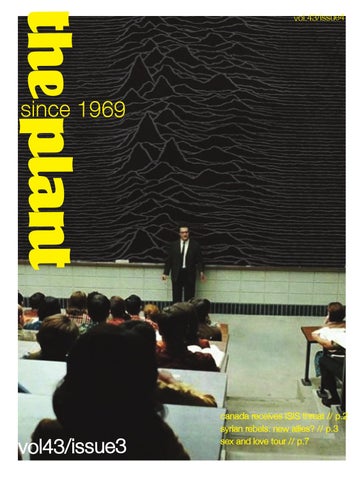
the plant
vol.43/issue4
since 1969
vol43/issue3
canada receives ISIS threat // p.2 syrian rebels: new allies? // p.3 sex and love tour // p.7
the plant letter from the editor Dawson College 3040 Sherbrooke Street West Westmount, QC, H3Z 1A4 Tel: (514) 931-8731 ext:1115 theplantnewspaper@gmail.com Copyright 2014
Editorial Staff
Dearest plant enthusiasts, Welcome to the 4th week of The Plant. This week we have a very unsettling story about Isis releasing an audio calling on Muslims worldwide to target disbelievers,
including Canadians. I strongly encourage you to read about it on pg. 02. These are the kind of events that spark the need to keep a closer eye on the news. In another light, a state judge
just ruled Louisiana’s gay marriage ban unconstitutional. All in all, a glass case of emotion. I shall leave you with a painting that reflects your
Editor in Chief this week, one of my favourites: The Jester by Jan Mateijko, Poland, 1862. Thank you readers writers and staff.
Editor-in-Chief Hannah Gerber Managing Editor Kristiana Alcancia Shaw News Editor Bronwyn Haney International News Edito Nachman Reich Arts & Culture Kaitlin Fitzgibbon Voices Editor Alyssia Rubertucci Sports Editor Jordan Stoopler & Justin Silver Comics Aleks Seweryn Cover Art thepoorhouse
Contributors
table of contents News 02
Bronwyn Haney Milos Kovacevic Jessical Kenwood Sara Capanna Nachman Reich Cassandra Ryan Antonietta Covelli
Int News
03
cup arts
05 08
voices
09
Sports
10
life
06
Jesse Calauti Maryam Elkalhaui Marina Gentile Kaitlin Fitzgibbon Annabelle Irakiza Ally Rubbertucci Mia Fischlin Frank Pavan Jordan Stoopler
MY BEST FRIEND
Source:mystery artist / genius
the plant the plant the plant the plant the plant the plant the plant the plant the plant the plant the plant the plant the plant the plant the plant the plant
2 EDITOR: Bronwyn Haney
CONTACT: bronwyn.haney@yahoo.ca
VOL. 3 ISSUE 4 - Thursday, September 25, 2014
Canada receives threat from ISIS Terrorist group ISIS sends threat directed at Western countries BRONWYN HANEY NEWS EDITOR
This past Sunday, a threat was received by the Canadian government from a spokesman representing the Islamic State of Iraq and Al-Sham who called for attacks on Canadian citizens. These threats were made in what appears to be an attempt to counteract the efforts of the military alliance that has formed to challenge the terrorist group. The 42-minute speech given by Abu Muhammad Al-Adnani encouraged the ruthless killing of any non-believers, primarily Canadians, Americans, Australians, French and other Europeans regardless of their status in their country, and whether or not they are involved with military forces, by ISIS supporters. Excerpts from the speech quoted Adnani in saying: ‘‘Rely upon Allah, and kill him in any manner or way however it may be. Do not ask for anyone’s advice and do not seek anyone’s verdict. Kill the disbeliever whether he is civilian or military, for they have the same ruling,” He continued: “Both of them are disbelievers. Both of
Members of ISIS
them are considered to be waging war. Both of their blood and wealth is legal for you to destroy, for blood does not become illegal or legal to spill by the clothes being worn.” Stephen Harper recently addressed the issue in a press conference, stating that efforts were being made to further the fight against threats like the one made by ISIS. The Prime Minister said that the codes and regulations put in place in dealing with these threats were currently being reconsidered, in order to better prepare for
Photo credit: ISIS
the events of threats similar to this, as well as to better protect Canadians. Canada has become a part of an alliance lead by the United States, which has begun mobilization in order to defeat ISIS, who are responsible for the atrocities that have been recently occurring against Syrians and Iraqis. The crimes being committed by ISIS have been an attempt to forcibly impose the barbaric version of Islamic law being followed by ISIS members into the religion.
To date, about 30 Canadians are taking part in the conflict in Syria, some as members of ISIS. It has recently been revealed that those Canadians who have left to fight with ISIS have had their passports revoked by the government. Last week, President Barack Obama outlined a strategy to ultimately defeat ISIS, in which the terrorist group responded to by ramping up their propaganda campaign by releasing multiple videos that are apparently designed to interpret Western military intervention as fu-
tile. This latest threat, which has proved to be the more extreme of those received, warns of attacks within Western nations. ‘‘You will not feel secure in your bedrooms […] We will strike you in your homeland, and you will never be able to harm anyone afterwards,” Adnani said. Canadian Muslim organizations have publicly condemned ISIS for opposing Islamic teaching. They have expressed their discontent, calling the group imposters who do not belong within the Muslim community and holding them responsible for the thousands of deaths of Muslims in Syria and Iraq. The National Council of Canadian Muslims reacted to the ISIS threat by calling it ‘‘un-Islamic and deeply repulsive”, and also stressed upon the fact that Muslims have an obligation to report any plan whose goal was to cause “hurt or harm”, as taught in the religion of Islam. Last week, what appeared to be an attempt by ISIS to follow through with a beheading in Australia was interrupted by police officers, and the suspects involved have been arrested. This raises a deep concern as to how far of a range the terrorist group is capable of reaching, beyond the unregulated area of land it currently occupies in Syria and Iraq.
Mtl immigrants face gov’t rejection MILOS KOVACEVIC & JESSICAL KENWOOD THE CONCORDIAN
The continuing travails of a LaSalle family who say they face female genital mutilation and death if deported and a Pakistani grandmother who recently lifted her self-imposed asylum are highlighting the difficult situations of families and individuals ordered out by the federal government. The Fuh-Cham family have called Canada home long enough for two of their youngest members to be born here. The looming conclusion to a 4-year fight for refugee status is set to come to a head on October 9, threatening to send them back to their native Cameroon and, according to their supporters, real danger. Father Hilary Fuh-Cham claims that ever since the death of his father in his birth village, the role of community chief has devolved to him – with all the tribal and cultural requirements that come with it. Besides polygamy, which the Catholic Fuh-Chams do not adhere to, he says his wife Yvette and two daughters will be forced to undergo genital mutilation. His fate may be worse. “For me, because I have already refused to do the traditional rights that warrant me to succeed my father, they will try to kill me and put my son as the chief,” he said. “I think the government is looking for any reason [to reject their application],” said fellow parishioner and longtime family friend Wendy de Souza. She named one example in particular: the government’s insistence on having the death certificate for Hilary’s father, despite the fact
Minister of Citizenship and Immigration, Chris Alexander
that they hail from a rural region where such bureaucratic formalities are unheard of. Though there was a mixed crowd of supporters from all walks of life, it was their fellow Cameroonians who most closely identified with their plight of familial pressures and traditional cultural. “All those things happen. It’s a normal tradition,” said Montreal Cameroonian Goodwill Association President Julius Ashu of female genital mutilation, which isn’t limited to Cameroon and occurs in neighbouring countries across the region. “I am pleading with the Minister of Immigration to try to look at my file once more because I have a strong conviction that we do qualify to remain here as permanent residents on humanitarian and compassionate reasons,” added FuhCham. “I don’t have anywhere to go,” he said repeatedly when asked to contemplate a life back in Cameroon. One of many attending the event was Patrick Asch, Circonscription Assistant to LaSalle-Emard MP Hélène LeBlanc, whose office has been fighting the govern-
ment’s decision all the way to Ottawa. So far their efforts at reaching out to those who could help the family, such as Minister of Citizenship and Immigration Chris Alexander, have been met with very little success. “It doesn’t represent the reality,” said Asch of the governments dissenting opinion of the danger the family, and in particular the women, face in Cameroon. “The questions of tribal rituals, the dangers linked to it, the questions of kidnapping [and taking them back to the community] are known. Experts say they occur, however our government chooses to ignore the reality.” “The basic reason they left is because they wanted to practice their religion,” he said. “If the Conservatives have the gall on the one hand to decide they’re going to create an office of the Freedom of Religion…and then completely ignore it…this is not acceptable,” he said of the campaign to convince Canada’s ambassador for the Office of Religious Freedom, Andrew Bennett. “Why do we forcibly take people out at great cost to Canadian society when these
Photo credit: src
people are hardworking tax-paying citizens, and then we put them in a situation when our government afterwards maybe will accept them on humanitarian grounds? In the end, it’s a lose-lose situation for the family, it’s a lose-lose situation for the government.” Asch said that despite signatures and rallies and protests, MPs were ultimately incapable of going against the decisions of offices such as Immigration and the Canadian border services, and that the stay of deportation could only come from on high. The crowd meanwhile remained defiant. “Since it is a fight between David and Goliath, all we need is a little faith,” said one attendant to the sound of amens. Meanwhile the Anglican Church on Union St. held a press conference on Sept. 22 to demand the denied refugee status of Pakistan-native Khurshid Begum Awan be overturned. Awan’s daughter Tahira Malik moved to Canada at the age of 16 in 2000 after suffering conjugal violence from her husband, who’d joined a Pakistani anti-Shia
extremist group. Awan, her husband and 16-year-old grandson Ali followed her in 2011 after being targeted and beat by the extremists. The Awan family’s refugee claim was rejected in December 2011. Mr. Awan was deported in April 2013. Malik claims that he was “sent back in a wheelchair, we didn’t even get to say goodbye”. He is now living in hiding in Pakistan. Suffering from heart failure and mental illness, Mrs. Awan was invited by Bishop Barry Brian Clarke to live in sanctuary at his church; as were Malik and Ali who tried their best to take care of her despite deterioration due to lack of proper medical attention. Mrs. Awan was forced to leave the church in August to file for her refugee status reassessment, which led to her arrest and released on $5,000 bail – paid by Bishop Clarke. Currently Awan’s lawyer Stewart Istvanffy said that she’s under no risk of immediate deportation. He also noted that while he says his client has a very strong case, the government wasn’t budging. “The Canadian government doesn’t believe in correcting mistakes,” he explained at the press conference. “They are deaf, dumb and blind in front of human misery, in front of human suffering”. Malik and her son Ali have been granted Canadian citizenship but Malik explained that they will follow her mother if it comes to expulsion. “My son won’t leave my mother,” she tearfully explained. “If they go back, I have to go.” Last week, Montreal resident of 6 years Winifred Agimelen and her three children were deported back to Nigeria despite the kidnapping and possible female genital mutilation she said awaited them there.
the plant the plant the plant the plant the plant the plant the plant the plant the plant the plant the plant the plant the plant the plant the plant the plant
3 EDITOR:Nach Reich CONTACT: reichnachman@yahoo.ca
VOL. 43 ISSUE 4 - Thursday, September 25th, 2014
Syrian rebels: new allies?
lect opposition groups in their fight against IS and Assad’s army. Fifteen days before the program's beginning, the Obama administration is to report to Congress on the training and equipping of the Syrian rebels, as well as how it fits into the general strategy to defeat IS. Other matters, such as the military's plans to evaluate its armed forces on the ground and the rise in attacks on American forces in Afghanistan by minors, are also addressed in this bill.
SARA CAPANNA STAFF WRITER On September 17th, the American Senate was scheduled to vote on whether Obama’s proposal to train the Syrian rebels in order to combat the Islamic State (IS) should pass. According to Republican leaders, their party would only agree to the proposition if they received a detailed account outlining the President’s strategy to conduct this military operation. Clearly, undertaking it is fraught with complexities. Among the biggest is which Syrian opposition groups are America’s allies. NPR's Deborah Amos, reporting from the Turkey-Syria border, believes that when assessing this, decision makers ought to rather ask which groups are not something, namely “hardcore Islamists.” This is very difficult to do, according to Democratic Senator Chris Murphy, who comments that "it's very hard to sort out the moderate rebels from the extremists.” As such, there is a big worry that “once [America] sends the rebels back into the battle space there is very little [America] can do to prevent them from locking arms with al Qaeda or elements of IS." As the House of Representatives was discussing this matter, Speaker Boehner urged for the objectives of any such military campaign to be clear, saying that "if [America’s] goal is to destroy IS, [it] has got to do more than train [the opposition],” and also “drop some bombs.” Any such request to broaden the military operations in the future would have to go through Congress, however. As it stands, the bill under discussion provides for a comprehensive, behind- thescenes U.S. military operation to help se-
President Barack Obama is pushing hard for a bill to train and arm Syrian rebels
Photo credit: Politico
Limiting this operation, on the other hand, is the clause that this bill only authorizes the training of Syrian rebels and not a broader strategy against IS. Also, no additional money will be allocated for this mission, although contributions from foreign powers, in whatever form, will be accepted. To ensure the hasty passing of this bill, both Republicans and Democrats will have to work together. A filibuster by the former could result in the delay of this proposition by up to a week. This has happened before, and given that President Obama might not budge on discontinuing the Import-Export Bank, which the Conservatives are adamant about shutting down, the latter might use this bill to pressure the Administration. In anticipation for this possibility, Senate Democratic aides say that they are counting on Senator Mitch McConnell to keep the delays to a minimum and allow the senators to return to their states. Much rests on a ‘yes’ majority. In the words of Secretary Chuck Hagel, "if Congress would not agree [to the president's] request, it would be a pretty devastating message to the rest of the world."
“Limiting this operation, on the other hand, is the clause that this bill only authorizes the training of Syrian rebels and not a broader strategy against IS.”
Scots stay UK NACH MAN REICH INTERNATIONAL NEWS EDITOR
Last Thursday, the Scottish people voted in a referendum to remain in the United Kingdom. Despite a late surge in the ‘Yes’ side, once the votes were tallied, the ‘No’
British and Scottish flag flying side by side
side emerged as the clear winner with 55% of the vote. Negotiations are currently ongoing between the British government and the Scottish political elite, to discuss the promises the former made before the vote. In the past few days, the British Pound has hit a two year high, evidence of currency traders’ relief at the status-quo stability.
Write for The Plant
Photo credit: Norfolk Chamber
the plant the plant the plant the plant the plant the plant the plant the plant the plant the plant the plant the plant the plant the plant the plant the plant
4 EDITOR:Nach Reich CONTACT: reichnachman@yahoo.ca
VOL. 43 ISSUE 4 - Thursday, September 25th, 2014
Brazilian presidency race kicks off ANTONIETTA COVELLI STAFF WRITER In the Brazilian elections for presidency, there are two main candidates running against each other: Dilma Rousseff, heiress to President de Silva, and Marina Silva. These two candidates have different values, ideas, and visions that they want to bring into effect if elected. Ms. Rousseff is a developer who wants to take Brazil out of the clutches of big companies, and give economic power back to the people of Brazil by harnessing the country’s natural resources including iron, ore, and offshore oil. This, she believes, will expand Brazil’s economy and democratize Brazil’s wealth. Ms. Silva, on the other hand, is seen as an environmentalist against the exploitation of Brazil’s natural resources. Her prime objective is to focus on renewable energy sources like solar, wind, and biomass, and to protect the Amazon rain forest. Economically, she hopes to attract foreign investors. Marina Silva is an extremely popular choice among Brazilians. Not only would she be the first black president in Brazil’s history, but she is seen as a fighter who has succeeded against tremendous odds. Born to rubber tappers with 10 other children, Ms. Silva was very poor and during her childhood went through many life-threatening diseases including mercury poisoning, malaria, hepatitis, and a flesh eating disease called leishmaniasis. Despite this, she played an active role to ensure her own success by bringing herself to a Roman Catholic convent when she was only a teenager. Astonishingly, despite her being illiterate until the age of 16, Ms. Silva
The two candidates for Brazilian presidency in an embrace
Photo Credit: The Telegraph
“Marina Silva is an extremely popular choice among Brazilians. Not only would she be the first black president in Brazil’s history, but she is seen as a fighter who has succeeded against tremendous odds.”
The two candidates during a debate
Photo Credit: Miamiherald
Migrant boat capsized at sea CASSANDRA RYAN STAFF WRITER On September 15, a boat carrying hundreds of illegal migrants, travelling from Egypt to Malta, was capsized by human traffickers. An estimated 500 passengers, including 100 children, have been confirmed dead as a result of this tragedy. According to the International Organization for Migration (IOM) and witness reports, the smugglers wanted their passengers to transfer to a smaller boat. They refused, deeming that the boat was not seaworthy. In response, the traffickers rammed the vessel with their boat, capsizing it and leaving the passengers to drown. This boat wreck is just one of many violent incidents involving migrants, according to Peter Walker of The Guardian. Statistics released by the IOM show that approximately 2,900 migrants have died in the Mediterranean in 2014, compared to 700 in 2013. While many incidences involving the undocumented are not reported, on file this is “the worst shipwreck in years,” according to the organization. Survivors being rescued off the coast of Sicily Survivors say that the passengers on the While there were 9 survivors, the IOM has yet to piece wrecked ship were mainly from Palestine, Syria, Sudan, and Egypt. According to the United Nations High Commissioner for has contributed to the increased number individuals, willing to flee by any means Refugees, the civil unrest in these regions, of migrants from the region fleeing to Eu- possible, are “very much at the mercy of specifically in Palestine, Libya, and Syria, rope. Leonard Doyle, a spokesperson for traffickers.” the IOM, reports that these “desperate” The shipwreck of September 15th,
Photo Credit: AFP/Getty Images
together the whole story. along with the rising number of migrant deaths in the Mediterranean, is alarming those responsible for the welfare of the undocumented, including the IOM, the
completed her high school equivalency program and later attended university. On the other side, Ms. Roussef is with the centrist Brazilian Democratic Movement. Rocked by scandals, Ms. Silva decided not to join it, despite the advantages doing so would have conferred on her. Also viewing the Workers Party and the Brazilian Social Democracy Party as part of an old establishment that has not brought meaningful change to Brazilians, she decided against joining these other parties as well. While Brazilian political parties in the last two decades have brought the country greater wealth, they have, according to Ms. Silva, refused to fight corruption and problems of inadequate schooling and medical hospitals. As such, she purportedly subscribes to “New Politics,” which holds social issues to be of the greatest importance. Despite these promises, there are some things Ms. Silva has Brazilians feeling anxious about. Unlike Ms. Rousseff ’s $55 million war chest, Ms. Silva’s is five times smaller. Furthermore, while her adversary has promised to maintain close ties with Cuba and Venezuela as in the past, Ms. Silva has not publicly spoken about these matters. Her choosing to speak of her Christian roots at length has, on the other hand, worried voters of the impact that her views could have on the secular underpinnings of the Brazilian government. Despite voters’ anxiety over these matters, they have two excellent choices in these women. Ms. Rousseff ’s participation in an urban guerilla group, and her being jailed and tortured subsequently, shows her to be a dedicated individual and a leader who is prepared to confront challenges; while the obstacles Ms. Silva overcame and her ties to the highest levels of Brazilian politics show her to be a leader who has the connections and drive to f
UNHCR, and the European Border Agency. The IOM recently issued a statement informing the public that it is looking into the recent naval disasters, including unconfirmed speculations. These include the unverified report that 200 people are missing after leaving Libya and that 15 have drowned off the coast of Egypt. The IOM is simultaneously investigating the September 15 shipwreck. While there were 9 survivors of it, the IOM has yet to piece together the whole story. According to a spokesperson for the Italian Coastguard, a search of the shipwreck area has yet to uncover any traces of the boat. Unfortunately, conclusive reports of the incident cannot be made until all witnesses have been interviewed, or until more evidence of the wreck is uncovered. Despite the incomplete investigations, these disasters have brought the welfare of undocumented migrants to the fore. As a result, many human rights organizations have pledged to invest more time and effort to lessen the dangers these face. This is welcome news, given the growing conflicts in the Middle East and Africa which are only increasing the number of migrants. Hopefully, the events of this past month will result in those leaving their homes for Europe experiencing safer journeys.
the plant the plant the plant the plant the plant the plant the plant the plant the plant the plant the plant the plant the plant the plant the plant the plant
5 VOL. 43 ISSUE 4 - Thursday, September 25th, 2014
The human cost of torture JESSE COLAUTTI THE FULCRUM
Karl-Heinz Richter was 17 when he was first tortured at the hands of the Stasi, the Ministry of State Security of the former German Democratic Republic. A resident of East Berlin when the wall was put up in 1961 to divide the two halves of the city, Richter was part of a plot to escape the German Democratic Republic (GDR) on trains passing through Berlin on their way into the West. Seventeen of his friends successfully leapt onto trains, most of whom went on to attend university in the West and lead successful careers. But Richter wasn’t so lucky. Attempting to escape on board a train destined for Paris on the night of Jan. 30, 1964, Richter leapt onto the steps of the last car. But as his fingers gripped cold metal, his legs couldn’t make it onto the steps. Eventually his grip gave way and he slipped back into East Berlin, into more than three years of solitary confinement at the hands of the Stasi, into a future haunted by the devastatingly invasive effects of torture. To this day, when Richter closes his eyes he can see the dwindling red lights of the train as they vanished into a future that he would never know. My tour guide Fifty yars after his failed escape attempt, I meet Karl-Heinz Richter while in Berlin for a summer field research course to study the Cold War. He greets our class while we arrive at the eerily well-preserved gates of the Berlin-Hohenschönhausen Memorial, the central Stasi prison during the years of the GDR. The only thing we know about him is that he’s our tour guide. He begins by discussing his early years in the GDR. Within the former authoritarian state, all resistance to the state was forbidden. Public signs of protest were met with zero tolerance by the police; higher education was reserved only for members of the socialist party youth group, the Free German Youth; and one in seven citizens was either a voluntary or coerced informant for the Stasi. “I didn’t want to be part of this,” Richter says as he walks us past the concrete outer walls of the prison topped by barbed wire. “Three of my friends had been shot and killed at the wall trying to escape. I couldn’t have this be my country.” Richter then leads us to steps that plunge beneath a large, red brick building into a dark corridor below. “This is where I spent most of my first six months in prison,” he says. “It is called the submarine.” Broken and imprisoned After Richter’s fingers slipped off the Paris-bound train, he was left face down on the tracks with very few options for survival left. He was surrounded by GDR guards who somehow hadn’t seen him up to this point, but who were trained and willing to shoot him. His only option was to get off the elevated tracks as soon as possible, so he sprinted towards the edge of the tracks and, without looking, leapt over the railing and into the East Berlin street below. The drop was more than seven metres, and upon impact with the asphalt Richter instantly broke both his legs and his right
Torture device (above] , Karl-Heinz Richter (below)
wrist, and was knocked unconscious. He came to minutes later and dragged his broken body two kilometres back to his parents’ home, where he was arrested by the Stasi a week later and brought to BerlinHohenschönhausen prison. He was not given any medical treatment for his injuries during the six months he spent there. Richter leads our group through a long passage of cells to one particular door on the right. Inside is an eight-by-four-foot cell devoid of any furnishing, walled in by bricks covered in cracking white paint. “This is my old cell,” he says. “There used to be a bucket in the corner for a toilet and a wooden plank bed at the back to sleep on, but it still looks and smells as it did then.” Richter tells us how inmates would have to go months without a shower, how the amount of filth on his body became so unbearably itchy that he became covered with bloody sores from scratching too deep. He tells us that many inmates died after their sores became infected. “I remember the first time I peed into my hands to clean myself,” he recalls. “It was the only way to keep my wounds from becoming infected, but it was the most degrading thing I had ever done.” Torture Richter leads us next into a building farther back into the grounds of the prison. We descend to the lowest level and walk to the door of a cell covered in black padding. Inside there is no window or light of any kind, but there is just enough light from the outside corridor to see faint patterns of torn upholstery on the walls, ripped up by fingernails decades ago. The stench is almost unbearable. As Richter begins to explain the dark room, he pauses for a moment. His eyes close, his shoulders tense, and he leans his head away from our group. “I still find it difficult to be here.” The Stasi’s methods of torture were intricately planned, precisely designed to test the physical and mental weaknesses of each inmate. As an attempted deserter,
Photo credit: Jesse Colautti, Emily Niles, and Camille Tremblay/the Fulcrum
and worse, someone who was thought to have assisted others in escape, Karl-Heinz Richter was subjected to the full extent of the Stasi’s methods. There was the physical torture. Five times he was put into a cell three-quarters filled with water for a 72-hour period. Sleeping or sitting would mean drowning. This for a man with two broken legs. There were the dozens of nights he was kept up by guards beating him for turning over in his sleep, or when they would turn on the lights periodically throughout the night to make sure he was never fully rested. But even more disturbing was the mental torture. The night he was told he was to be executed in the morning, when he didn’t sleep at all as he heard the guards outside laughing about how they were going to enjoy killing him, only to have a guard come into his cell in the morning with breakfast, laughing that it was all a joke. Or the endless hours he spent knocking on his cell walls in Morse code to talk to Monika in the cell next to him, pouring out his fears and desires in excruciatingly slow progress for weeks, only to be told later that Monika wasn’t in fact a prisoner or a real person at all, but a series of Stasi agents trying to get information from him. “They hated me, which meant they used any sign of disobedience or resistance from me as an excuse to send me to the dark room,” says Richter. “Here they would keep me in complete darkness for week-long stretches, in which the only light I would see was from when they dropped in a plate of gruel or cup of water.” He explains how once, in an attempt to reach the water, he knocked the cup over onto the floor. He had no other option but to lick up the water off of the filth- covered cement. “I can still taste that floor today.” Justifying cruelty A memory keeps replaying itself in my mind as Richter leads us away from the dark room. It is of a class discussion I had
a year earlier in a counter-terrorism class. We’re discussing torture, its justifications, and how it’s used in today’s war on terror. The major justification behind it is that terrorism is an exceptional threat, with such unimaginable consequences that it must be fought with whatever tactics possible. I hear my own voice rehashing the hypothetical ticking bomb scenario, arguing that in the case of a known and immediate threat, the treatment and well-being of one terrorist should not be prioritized over the lives of thousands, or even millions, of people in danger. It is a form of this argument that is used to justify the “enhanced interrogation” techniques used at Guantanamo Bay during the last two decades—when techniques such as sleep deprivation and water boarding have allegedly been used in the name of preventing another 9/11. A knot grows in my stomach as I can hear my own voice justifying such evils in the name of utilitarianism. The legacy of torture Richter leads us out of the basement, through a strikingly bright corridor of laminate flooring and fluorescent light bulbs, into a seemingly normal office with a large wooden desk, old fashioned green telephone, two comfortable upholstered chairs at one end of the room, and one small meek wooden chair at the other. “This was the room I was interrogated in,” he says. Richter sits, and our class crowds around him noticeably relieved, believing the worst of his story to be over. It is here Richter tells us about the most devastating part of his story: his release. He tells us how after six months in this prison, due to pressure put on the GDR government from sympathizers in the West who had heard of his story, he was released to a hospital. After 18 months and 15 surgeries he was allowed back in to East Berlin, “a symbol of the GDR’s humanity.” He attempted to regain a normal life, but this was cut short on a night in No-
vember 1967. His father, who Richter believes hadn’t recovered from the shock of what happened to his son, died in his arms of a heart attack. “It broke me,” he says. “I climbed up onto my roof and yelled, ‘You did this, you killed him.’” Within weeks of this outburst he was brought back to the Berlin-Hohenschönhausen prison for again defying the state. Here he would spend another two and a half years in solitary confinement, subject to much of the same treatment as before. When he finally got out for good in 1970, he tried again to start a normal life. He got married and had a daughter. Eventually, the GDR gave up trying to turn him into a loyal citizen and approved his application to leave to the West. But before this, his wife was arrested and brought to the Berlin-Hohenschönhausen prison, and his daughter was taken away from him. By this point our whole group is in tears, and Richter takes a long pause before telling us what happened next. “My wife was beautiful, a real looker. But when she was in jail the guards forced themselves on her,” he says. “She couldn’t get her mind over what happened in prison and how she was treated. When she got out of prison, I told her what happened to her daughter. It was then she lost touch of reality. “After two and a half years my daughter was returned to us, and we were allowed to leave to the West. But my wife’s soul was broken.” His wife has spent most of her adult life in a psychiatric hospital, while his daughter has not spoken to him in 15 years—the pain of the memories he stirs within her is too much. Richter concludes the tour at a small enclosed courtyard. High walls loom over us, and our view of the sky is disturbed by metal bars. “This is the only place we were allowed to get fresh air,” says Richter. “I used to look up at the sky and see birds as a symbol of freedom. They were all I saw of an outside world. They were free and I was not.” Facing my own guilt As we say our goodbyes to Richter, my head pounds as I am brought back to that classroom a year ago. I hear the way I’m discussing the threat of terrorism. It is not unlike the way Richter has told me his Stasi interrogators discussed the threat of desertion in the GDR—evils that must be avoided at all costs. But I understand now what I didn’t then: justifying human cruelty in the name of preventing some unimaginable evil precludes the effectiveness of any other method to prevent it. In hindsight, there were many other ways the GDR government could have dealt with the fleeing of its citizens to the West other than building a wall or torturing its citizens. There are ways we can stop terrorism today without using torture. There must be. As I walk away from Richter and back into the streets of Berlin I am left with a guilty and sick feeling of responsibility. Even in a classroom, I will never defend torture again. The bright future that once eluded KarlHeinz Richter by inches as he stared up at the quickly receding red lights of a train bound for Paris has become my responsibility to share. It is the cost of torture.
the plant the plant the plant the plant the plant the plant the plant the plant the plant the plant the plant the plant the plant the plant the plant the plant
6 EDITOR: Maryam Elkahlaoui CONTACT: mb.kahlaoui@gmail.com
VOL. 43 ISSUE 4 - Thursday, September 25th, 2014
Grandma’s ways to deal with a cold
ple is quite simple : you heat up the equivalent of a tablespoon of honey with three tablespoons of orange juice. You mix those well and you swallow. Your voice should be back in no time. 2) Flax seed and milk Effective in stopping a cough. It may not taste great, but it is useful as hell. You basically heat the milk until its boils. You pour the milk into a small cup and you add a teaspoon of ground flax seeds, you mix the two well and swallow as fast as possible. Not finger-licking-worthy, but effective. 3) Saffron and milk That is the cash-requiring method, since saffron is the most expensive spice on earth. If you do not mind the cost, or, like me, you have an ounce stashed in your house by a mother nostalgic of "the taste back home", you may want to add some filaments (for a lack of a better word) to warm milk, let it rest for a couple of minutes, then drink it. This will seem like it's aggravating the problem, but in fact, the extreme coughing and oral-rejecting of mucus will only last a couple of days before all cold symptoms vanish.
MARYAM ELKAHLAOUI LIFESTYLE EDITOR I am sick. My voice is closer to a dying car's last attempt at moving than to its usual shrill. I sneeze a lot, and apologise all the time for it. I replace the punctuation when I speak by a cough, and that is not even close to how bad it was last week. The weather literarily changed overnight, and our poor immune systems, weakened by this turn of coat, could not stop the opportunist rhinovirus (or its friends) from entering our bodies. You would think that, with such medical advances, we would have been able to cure a disease as old as humanity. Sadly, no one can cure a cold. We can only get rid of the symptoms (which are due to the immune response to the virus rather than the virus itself). Here are several "Grandma" ways to get rid of a cold's syndromes. 1) Honey and orange juice I know every and anyone has tried this method, and discovered that it works marvellously. For those of you who might not know what I am talking about, the princi-
sick lady
Photo Credit: top10homeremedies
The Infinitely many Commandments for a better lifestyle night and at least nine hours on the weekend. Go to bed early! Don't chase away your need for rest when it comes, unless necessary, since it is not very easy to get back when needed. Also, you know when someone you are somehow friends with shows up with a ton of paper, asking you and everyone around you to do a survey for them, right ? Well, every time I get to fill up one asking about my sleep patterns, I get incredulous looks mostly from my fellow science students, and to my "How can you function with five hours of sleep?", their answer is a loud "How can you get any homework done?". You might think it is an issue, but believe it or not, you can do anything with a bit of organisation : put strict study times in your schedule (strict as in "Hey Bob, wanna go out for a drink/game/party...?" "No man. I have to study for Calc"), keep time for a social life and entertainment, and you should be fine. And believe me, showing up with less than six hours sleep in the last three nights for an exam is never good, no matter how long you studied for it. Never.
MARYAM ELKAHLAOUI LIFESTYLE EDITOR Sleeping is great. Sleeping is fun. Sleeping is the meaning of life, but you sleep for living as much as you live for sleeping (candy to the first who got the reference!). You need to wake up rested, lively, and ready to kick your daily duties in the butt because you are full of energy, and not a polar bear in December/ overcooked turnip hybrid (red-eyed, half dead, unable to lift your forearm). You may manage to dig into your last resources and activate Rocky-mode to be able to crawl to the bathroom and turn yourself on (in the "start functioning" sense, you perv!) with that holy resuscitating splash of water, before limping to the kitchen to ingurgitate the brownish-black and caffeinated mixture that finishes the process of turning you into a creature with relatively developed communication skills. This does not mean you are doing things right. YOU SHOULD SLEEP !!! And you should sleep enough. By that, I mean a minimal minimum of seven hours per night, every
fluffy pillows
Photo credit: thrivehealth
Write 4 The Plant
the plant the plant the plant the plant the plant the plant the plant the plant the plant the plant the plant the plant the plant the plant the plant the plant
7 EDITOR: Kaitlin Fitzgibbon CONTACT: Kaitlin.fitzgibbon@live.ca
VOL. 43 ISSUE 4- Thursday, September 25th, 2014
Sex and Love Tour Enrique and Pitbull heat up the Bell Center MARINA GENTILE STAFF WRITER While the weather outside may have been chilly, the Bell Center was on fire last Tuesday night. The third stop for Enrique Iglesias and Pitbull’s Sex and Love tour was right here in Montreal. J. Balvin, Colombian reggaeton singer, opened the show with an energetic set. He had the entire audience on their feet. While all eyes were on him, I couldn’t help but notice a ‘hooded man’ to my right watching the show. As I turned around, I immediately spotted that it was Enrique Iglesias, attempting to disguise himself. I may have let my emotions get the best of me as I pointed to my friend and screamed, “Oh my God, it’s Enrique!” Suddenly, everyone in my section shifted their focus on him and began rushing towards the barriers. He then scurried away behind the curtains before it could get out of hand. After a short intermission, Mr. Worldwide took the stage for a solid hour and a half.
He quickly turned the Bell Center into a dance club along with his dancers as he performed his hits: “Rain Over Me,” “On the Floor,” “Timber,” “Feel this Moment,” and many more chart topping hits. After Pitbull’s set, while setting up for Iglesias, the crew faced technical difficulties. It was ten o’clock and still no sign of Iglesias. His guitarist and drummer were keeping our section entertained by banging drumsticks on the railings and singing along to the music playing. Finally, around 10:30 p.m., the problems were solved and a cheering crowd welcomed Iglesias on stage. He apologized for the delay and thanked the audience for their patience. He wasted no time singing hit after hit, both in English and Spanish. From his latest singles “I’m a Freak,” and “Heart Attack,” to his classic hits “Bailamos,” and “Rhythm Divine,” he had the audience swaying side-toside and singing along to every word. Like usual, his fan interaction was on point. He constantly ran to the sides of the stage, getting up-close and personal with the audience. He jumped over barriers into the
crowd, serenading and taking pictures with fans. He also walked through the crowd to a little stage at the back of the venue, where he chose a fan from the audience to join him on stage and offered him his favourite drink ‘Atlantico Rum.’ He then covered one of his favourite songs “Stand by Me” with the help of his guest on stage. One of the most special moments of the night was when he sang his classic number one ballad “Hero.” The Latin heartthrob thanked the au- Pitbull getting the crowd to their feet dience for sticking with him for the past 19 years, and said we were, “Fucking amazing!” He asked the production crew to turn off the spotlights and the audience turned on their cellphone lights, waving them back and forth in the air. The audience became a sea of lights, creating an intimate environment. He ended the show with a bang by having Pitbull join him back on stage to sing their hit “I Like It.” Despite the technical difficulties, Iglesias did not disappoint. The sexy heartthrob had the ladies (and some men) swooning all night long.
Photo Credit: Marina Gentile
Enrique Iglesias up close and personal (;
Foreign Finds
Photo Credit: Marina Gentile
Awesome International Artists
African Skinflint Band ANASTASSIA TARASSOVA STAFF WRITER Originated from Gaborona, the capital of Botswana, this band defies the stereotype that the metal genre is typically only for angry, lower middle-class, Caucasian males. Skinflint is a trio founded in 2006, and is currently composed of Giuseppe Sbrana (lead guitar and vocals), Kebonye Nkolso (bass) and Alessandra Sbrana (drums). This band skilfully blends African cultures and the typical sonorities of traditional heavy metal. They are rapidly gaining popularity, not only throughout the continent, but across the entire planet. Still, most of their fanbase is concentrated in the southern parts of Africa. The heavy metal subculture is rapidly becoming popular there: African metalheads are becoming more and more present and noticeable. This is partly due to their increasing number, as well as the fact that they look like badass leather-clad cowboys from the 80s. Don’t believe me? Check out the pictures. Surprisingly, the sound of Skinflint exceeds our expectations and is pretty attractive. Their music is vaguely reminiscent of old school bands, like Queensrÿche, Manowar and Diamond Head, which is not a bad thing at all. It is very good, even. Skinflint underwent their first European tour in 2013, where the African trio has performed along such
acts as Carcass and Parlotones, in multiple festivals across Europe, as well as their native continent. Apart from a few short EPs, the band has released four full-length albums so far. Their most recent success ,’’Nyemba’’, was released approximately two weeks ago. The opus features eights tracks, which sound quite ‘’old-school’’ and relatively predictable, but with a faint blues-y touch and, nevertheless, just as badass. According to the Botswana Gazette, a fifth album from the trio is expected somewhere in February or March of 2015. Currently, more and more interest is given to the metal scene from continents other than Europe and North America
Giuseppe staring into yo soul Photo Credit: DanieleTamagni.com
Yookie! - Yaah
I.D.G.A.F.O.S - Dillon Francis Shook - Megalodon Galvanize - Datsik
Hold On - SBTRKT Shakedown - Jackal Rattle -Bingo Players Do I See Colour - Adventure Club My World - Kill the Noise Defiant Order - Birdy Nam Nam Revolution - Nervo Basshead - Bassnectar
Told you. Leather clad cowboys...
Photo Credit: Blogspot.com
the plant the plant the plant the plant the plant the plant the plant the plant the plant the plant the plant the plant the plant the plant the plant the plant
98 EDITOR: Kaitlin Fitzgibbon CONTACT:Kaitlin.fitzgibbon@live.ca
Beautifully Grotesque
VOL. 43 ISSUE 4- Thursday, September 25th , 2014
Contemporary Montreal Based Artist at Dawson KAITLIN FITZGIBBON ARTS AND CULTURE EDITOR Tammy Salzl is a unique Montreal based artist. She is originally from Edmonton and moved to Montreal to pursue her Masters of Fine Arts at Concordia. She very much wanted to be part of Montreal’s “rich and cultural atmosphere” and wanted to attend a school known for its wonderful “reputation and the great painters involved there.” Montreal is now lucky to call her our own. Salzl has had multiple exhibitions across the world. Her series have been mainly based in Canada, such as Edmonton, Ontario, Saskatoon, Calgary, Nova Scotia, and the Yukon. She has even showcased her Tell-Tales series in Berlin. From August until the early weeks of September, Salzl held an exhibition at Dawson’s Warren G. Flowers Gallery to showcase her Simplest of Gestures series. During her presentation, she explained he rinspiration behind this series. She realized that she did not need such eccentric backgrounds and sceneries to provoke the audience’s emotions. She could capture the stories of fellow artists, family and riends, and make a connection between these simple, solitary paintings and the audience. She could transform “a feeling, into a deeper meaning.” Salzl’s work is very self-reflexive. “I narrate histories – the real, the imagined, and the invoked. Gesture as subject, form as expression and paint surface as energy serve as platforms for self-evaluation
and social critique.” Her works provoke viewers to question how society sees us, how we see each other and how we see ourselves. “I am drawn to people’s stories and to the things they do. I am attracted to their singularities, to their individuality and humanity and specifically to the way they reflect or question norms,” said the Canadian artist. She does not believe that all of her works have the same message, yet she finds herself working with the same theme. “The common thread through all my work is my exploration of the disconnect present in western society: within ourselves, between each other and between civilization and the natural world.- and what impact that disconnect has on our individual and social psychologies and physical selves,” said Salzl. “Ultimately, I'm asking myself and the viewer "What does it mean to be human in this time?” Some of her other series are Monster Babies, Contingencies, Into the Woods, Entitlement and Catfight! With most of Salzl’s pieces, we find that the flesh of her figure’s hands and knees are often very red and raw. She explained that this is because she was inspired by a philosopher’s idea that “we are thrown into life”. We did not choose to be here. We are thrown into it, vulnerable and inexperienced, and it is up to us to pave our own way, as well what we make of our connection to the world. “Beauty collides with the grotesque as luminous pigment transmutes into mottled flesh, reflecting our vulnerability and mortality,” said Salzl, in her artist statement. Salzl always looks for inspiration.
T he Creative Corner! What is my worth Is it a wage A job, for which I am paid Am I worth less Than the man above me? Am I worth nothing Or everything? A disguised slave I am the money I am your currency Without me, The economy Would collapse in ruins Full of every commodity I’ve ever consumed. We are the collateral For which our owner’s Borrow against us What is worth, But fiction.
Payton Bernett -2014
Everyone is inspired by different things and, in her case, she is very inspired by her surroundings. “Stories inspire me. The natural world inspires me. I'm inspired by artists who make work that moves me and challenges me. My children inspire me.” Currently, Salzl is working on a new series of oil paintings; some will be of figures and some of landscapes. “I'm also working on making some large scale paper dioramas based on a series of smaller mixed media drawings from my Tell-Tales series. That's new for me,” said the artist. “They will be narrative and allegorical, with colourful settings and The Swan Song characters whose sweet faces contrast with brutally honest implications and grotesque metaphors.” I believe this series will represent the truths in life beautifully, as do so many other of Salzl’s work. Her style is different and, having gone to see her exhibition at Dawson myself, I can tell you firsthand how emotionally evoking her pieces are. They do in fact have the audience reflecting upon them selves and their surroundings. I love her use of simplicity in Simple Gestures and her unique twists on fairy tales and such in Into The Woods. There is so much truth behind her work and it is very inspiring. Salzl has two upcoming exhibitions, one in Ottawa and one in Edmonton. Some of her work will also be featured in the Toronto Art Fair this October with Dc3 Art Projects (Edmonton based contemporary art supporter). If you are interested in reading more about Salzl and seeing more of her work, visit her website at tammysalzl.com
Photo Credit: TammySalzl.com
“Beauty collides with the grotesque as luminous pigment transmutes into mottled flesh, reflecting our vulnerability and mortality,”
The Compromise (depicting the last boy on earth)
Photo Credit: TammySalzl.com
Weekend Wanderings 1. Stick your Fall fashion back in your closet and pull out those short shorts! Thanks to MTL weather it’s guna be 25 degrees all weekend. 2. Do something productive....like your homework....or start a girl band. Yeah I like that idea better. 3. Go to the Plateau’s weekly Karaoke block party and belt some outtunes. I heard the Mayor is going to join in. 4. Write for The Plant...You know you want to. 5. Eat as many fortune cookies as you can. Then make a collage with all the unoriginal fortunes you collected. 6. Have a house party and invite all Plant Staff. Thanks in advance. 7. Be preventive and cure that cold you are definitely going to get. Halls, tea, and cold meds. Brace yourself Dawsonites, Winter is coming.
the plant the plant the plant the plant the plant the plant the plant the plant the plant the plant the plant the plant the plant the plant the plant the plant
9 EDITOR: Alyssia Rubertucci CONTACT: alyssia_rubertucci@hotmail.com
VOL. 43 ISSUE 4- Thursday, September 25th, 2014
Ten signs that indicate you’re broke
3. You do most of your every day shopping at the dollar store. You forgot about Target, Wal-Mart and all other big stores. You bought all your school supplies and snacks, and tools at the dollar store. Not because you wanted to save up, but because the other places sounded too expensive for your budget. 4. You have to make a budget plan. Forget #3. You don't have a budget. That's why you're making a budget plan. If you find yourself having to calculate your expenses then that probably means you're tight on the money you can spend. RED FLAG, again. 5. You start thinking of being a coupon addict. You watched "Extreme Couponing" on TLC and asked yourself if it wasn't such a bad idea to start couponing. Believe me, as
soon as you start thinking coupon, you're already at the lowest level. You're WAY TOO YOUNG to be addicted to any of that. 6. You looked for a second job/third job. If you can't keep up with your current job or jobs and realize you have to find money through an extra source of income, you passed the red flag. As a matter of fact, you ran all the way through it. As college students, working while studying is already really hard. Don't you be in a position where you need two jobs to support yourself. It's plain suicide. Just plain suicide. 7. You look for money everywhere. Don't hide it. You've checked all the pockets of all the vest and coats you have, went though the couch's cracks and all the corners of your house to find some forgot-
I don't even need to explain. There's nothing wrong with selling a couple items you don't use anymore on the Internet. It's better than throwing them away, right? As long as you don't start selling your house furniture, your useful stuff, or like a kidney or something. It's okay. 10. You beg/ask for money to your parents - ULTIMATE RESSOURCE. You've tried everything, I mean, everything on your own and it still isn't enough. You must turn to your folks to pay some bills or go out with the boys/girls. We both know that's an undeniable sign of being more than desperate because you're willing to take the talk "If you saved your money, you wouldn't have to ask me," or "You would have money if you didn't spend it on these useless things," that they Picture Credit: prairieecothrifter.com are going to give you. And all that only beten and unclaimed money. The despair is cause you really need the money. real. Those are my 10 signs that indicate you 8. You find yourself calling your might be going or might already be broke. friends to talk about the money they In their individuality, each one of these owe you. signs aren't this bad. But if you have more You feel really tempted to call Josie who than two in this list, then you might want borrowed $5 in the 7th grade and never to start thinking about what's going on gave it back to you, don't you? And how with your finances. about Travis, you gave him a ride last week Remember, Christmas isn't that far and he promised to pay the gas money but away and you don't want to be the cheap while calculating, you realize he was short family member who bought ramen nooof 2$. Your mom too! Didn't she take a dles packs as gifts. Believe me, I've been 20$ bill from your wallet for grocery and there. It's not a great look. swore she was going to give it back to you Until next time America! as soon as possible? That's about 27$ in (Yes, I am still using it). just three calls. Sounds like a deal... If what I just said made sense to you, you've got issues. 9. You consider selling some of your objects online for extra money.
ality and obedience in school. Although the uniform was first worn by orphans who represented the lower class, the school uniform, slowly but Shirley found its way to be a symbol of status. The school I attended was quite strict; the skirt could not be shorter than an inch above the knee, there could be no visible holes in the clothing, the socks had to be pulled up to the knees, our bras could not be any colour other than white, there could be no more than two piercings on each ear, no unnatural hair colour was permitted and makeup and nail polish were not allowed. All of this was fine, but it was hard to keep up with all of the rules because the uniform also applied to our faces, hands, hair and ears. I would usually get into trouble, which would end up taking time off of learning in class. I remember being sent out of class because I was wearing nail polish that I had not
taken off from the weekend and ended up missing 20 minutes of class. Instances like this kept happening to me and many other classmates and many of these uniform infractions would end in detention. Today the school uniform is used for many different reasons; it helps encourage discipline, it can reduce distractions, it helps students resist peer pressure to buy trendy clothes, it helps identify intruders in the school, it diminishes economic and social barriers between students, it increases a sense of belonging and improves attendance. “I think that having a uniform would have helped prevent some judgment among my peers,” says Amanda a public school attendant. In other views, school uniforms can be seen as a burden since it violates the students right to freedom of expression, it is simply a band-aid on the issue of bullying, it allows everyone in the streets to know
where you go to school, it can be a financial burden for poor families, it is an unfair additional expense for parents who pay taxes for a free public education, the uniform may be uncomfortable in an hot/cold environment and it can present a potential drawback for gay, lesbian and transgender students who might desire to dress according to their sexual or gender orientations. “I do not agree that an outfit affects education, I think its the person’s mind set and dedication to their work that affects education. I think the school just wants to decrease the chance of someone wearing something inappropriate,” says Dima Wazzan a former uniform wearer. There are positive attributes to wearing a school uniform but the whole idea of how uniforms improves learning and bullying all goes to waste when a student gets into trouble because their uniform is not
on point. In Oakleaf High School in Orange Park, Florida, Miranda Larkin was stopped by a teacher and sent to the nurse’s office because she did not fit the dress code regulations. She was forced to wear a neon yellow shirt and red pants that had the words “DRESS CODE VIOLATIONS” printed in large block letters all over the outfit. Uniforms are supposed to protect students against bullying but instead the school has said, “This is to embarrass you, so you don’t do it again.” “I like that I can finally pick out an outfit now in College, because it's a way for me to express myself and for others to understand my personality better,” says Zuha Talat a Marianopolis student. Countless schools may be in favour for uniforms but sometimes the school can go a tad bit too far in reinforcing these rules instead of focusing on what the uniform was created for in the first place.
that there are required texts, you can automatically assume that you’ll need those books to pass the course. Teachers, from then on, will begin to verify if you have those books or not. Ultimately, it’s our responsibility as students to get everything we’ll need, and most of us do. I feel like I’m always on top of what I’m supposed to do and what I’m supposed to bring to class, which means that my bag is always pretty heavy. I carry around all the required textbooks
that my teachers asked me to get, but then I end up being disappointed when we don’t need those books that day. So here I am, lugging around extra weight for no good reason. I find myself needing a massage at the end of the day because my bag weighed so heavily on my shoulder. I think every teacher should send out an announcement on Léa about when to bring the 1,000-pound books and when not to bring them. Teachers, please consider this because it would be weight off
my shoulders – literally and figuratively. Now, let’s get to the best teachers. The ones who “require” you to buy the textbooks but never use them. Not even once. I remember having to buy a teacher’s coursepack expecting that we’d be learning straight from it. My, was I wrong. By the end of the semester, I realized that we opened the book only once to refer to an article that could’ve been distributed or presented digitally. My mind was boggled at the fact that the class spent money on a book that was
ever so briefly looked at. Although coursepacks tend to be the least expensive items on our bookstore course lists, it’s still money that could’ve been spent elsewhere – like Thai Express! Us students shouldn’t have to spend money when it’s not necessary, especially on our budgets. TEACHERS: don’t force the class to buy material that we won’t use. It’s infuriating.
ANNABELLE IRAKIZA CONTRIBUTOR
It's almost that time of the year again. School started not too long ago which means: Tim Hortons stop before the first class, lunch at the Alexis Nihon food court, textbooks and all that good stuff purchased for school purpose. It doesn't show yet, but the rough times are coming really quick. And who knows, maybe they're already there for you and you don't even know. Don't worry; your girl is going to hook you up on some pointers that you might be going broke! 1. You can only afford the dollar menu in McDonald’s. Admit it, you were pretty upset when the price of the Junior Chicken and the McDouble went up from $1,60 to $1,85. This extra 25 cents killed every inch of your greedy and cheap soul. If you only eat at McDonald’s because that's all you can afford (and still can't afford a real trio), it's a red flag buddy! 2. You have to be warned three weeks in advance for any activities that involve money. You need time to save up! You don't have the money to just go out on a dinner whenever the occasion presents itself. Your friends know that if they want you somewhere, they must inform you early enough for you to save money. Otherwise, you're not turning up. And let's be honest, who wants to turn up with only a few quarters in their pockets?
Where ma money at?
School uniform rules going too far MIA FISCHLIN CONTRIBUTOR
A uniform is a certain type of clothing worn by members of an organization to create an identity to that group. Some organizations today that require a uniform are the armed forces, sports teams, the police force, emergency services, security guards, inmates in prison and certain schools. School uniforms are popular throughout the globe but are some of the rules regarding uniforms going overboard and focusing more on the look of the school rather than education? Uniforms started becoming popular in the 16th century because of England, who happened to be the global power of the world. England stated that wearing a uniform was compulsory to enforce punctu-
Rant of the week: required texts ALYSSIA RUBERTUCCI VOICES EDITOR
Visiting the bookstore for most students can often lead to a hefty bill on the way out. Whether books are used or brand new, they end up costing quite a bit of money because the majority of our classes require specific and expensive textbooks. When you read the class syllabus and see
the plant the plant the plant the plant the plant the plant the plant the plant the plant the plant the plant the plant the plant the plant the plant the plant
10 EDITOR: Justin Silver CONTACT: justinsilver01@gmail.com EDITOR: Jordan Stoopler CONTACT: jordan.stoopler@gmail.com
VOL. 43 ISSUE 4- Thursday, September 25th, 2014
A group of leaders FRANK PAVAN STAFF WRITER
Just because there isn’t a “C” on someone’s chest, doesn’t mean there aren’t any leaders in the locker room. The Montreal Canadiens announced on September 15th that there would be four alternate captains for the 2014-15 season, rather than giving one player the captaincy. The four chosen were Andrei Markov, Tomas Plekanec, Max Pacioretty, and PK Subban. Whenever hockey is the subject of talk in Montreal, there will always be those who agree and disagree. Personally, I am totally fine with having four assistant captains because there is more to the team than just the captain. The Canadiens have a great group of players and none of them are shy to express their opinions to one another. The team is filled with
leaders who go under the radar, such as Carey Price, Brandon Prust and Travis Moen. Having four assistant captains can also be beneficial because there won’t be pressure on the sole “captain” throughout the season, especially since we are playing in Montreal, the mecca of hockey. As much as I would’ve loved for PK Subban to have been given the role of captain, I think it was a very wise and mature move made by the coaching staff and management. It would’ve put an awful lot of pressure on someone who is already criticized all over the league for his “type of play”. Also, with PK just coming off his monster 8 year contract, making him a 9 million dollar man, it would’ve been too much for him. Subban is Montreal’s franchise player and I definitely see him being chosen as captain a couple years down the line. However, for now, the decision to announce four assistant captains was a bril-
liant idea. Tomas Plekanec and Andrei Markov are both veterans who have played in Montreal their entire careers. Anointing them as assistants was almost an automatic move. Max Pacioretty is an up and coming star for the team and is someone that players from all around the league have respect for. I think that the four players chosen best represent the Montreal Canadiens as an organization. I expect not only them, but many other players to step up and be leaders on this team. The Canadiens have a very bright future and have formed their team in such a way that they’ll be powerful playoff contenders for many years to come. "I consider P.K. a very close friend and an unbelievable player, so it's an honour for me to share a letter with him," said Pacioretty. "We have so many guys in this room who can step up and be leaders, so this is a good feeling right now”.
new alternates
Photo Credits: National Post
Questions at Habs Camp "We want to see where he's at. . . We know sometimes it's harder for a young player to play center in the NHL, especially down low. -Bergevin JORDAN STOOPLER SPORTS EDITOR
The captaincy issue may have been resolved before any skates hit the ice at training camp in Brossard, but multiple questions still abound that have left media, management, and players perplexed. The Canadiens raised some eyebrows when, in an exclusive sit down interview with TSN’s Bob McKenzie, they announced that the team will be giving young center- turned winger, Alex Galchenyuk, an opportunity at his natural center-man position. With spots already seemingly grabbed by David Desharnais, Plekanec, Lars Eller and Manny Malhotra, many wondered just where Galchenyuk would fit in. It seems that for now, “Chucky”, as he is affectionately called by his teammates, will center Brenden Gallagher and Travis Moen. Bergevin says there is no guarantee when it comes to Galchenyuk’s positioning come the start of the regular season schedule, but is nevertheless open to seeing just where this training camp experiment takes him. "We want to see where he's at,” Bergevin said. “We know sometimes it's harder for a young player to play center in the NHL, especially down low. But with two years under his belt, we want to evaluate where he's at in the center position and then we'll make a decision." Another question that has yet to be answered is who will fill the backup goaltending position. There is no doubt that
photo credits: http://allhabs.net/
Alex Galchenyuk
Carey Price holds the keys to the Canadiens starter’s net and is the undisputed driving force behind the Canadiens team. Questions still loom, however, when it comes to who will be backing up the star goalie. Peter Budaj, who has been with the Canadiens for the past three years, has close to 300 games of NHL experience
under his belt and has had a close rapport with Price in the past. He has been a hard worker at practice and has never complained about his limited duties in the Habs crease. But, a late season surge by youngster Dustin Tokarski left Budaj on the sidelines where he was forced to watch the unheralded Tokarski stand on his head in the Eastern Conference Final
against the New York Rangers when Price was sidelined with an injury. The team has stated that they may start the year with all three goaltenders up with the big club, but such situations have been known to be sticky in the past and rarely work well in the long run. The Canadiens are unable to send Tokarski down to their American Hockey League
“with two years under his belt, we want to evaluate where he's at in the center position and then we'll make a decision.” -Bergevin
affiliate in Hamilton without passing him through waivers first. Due to his prowess in the pressure-packed playoffs last year, a team is sure to snatch up the underpriced goaltender if he is made available, a situation the Habs want no part of. The Canadiens will attempt to answer these looming questions and others that are sure to arise over the course of their pre-season schedule, which continues until next weekend. The official schedule gets underway on October 8th in Toronto against the rival Maple Leafs.
the plant the plant the plant the plant the plant the plant the plant the plant the plant the plant the plant the plant the plant the plant the plant the plant
TAKE WHAT YOU NEED