
WORDS AND POWER
Holocaust
Remembrance Assembly
ZOE ARGENTIERI (IV)
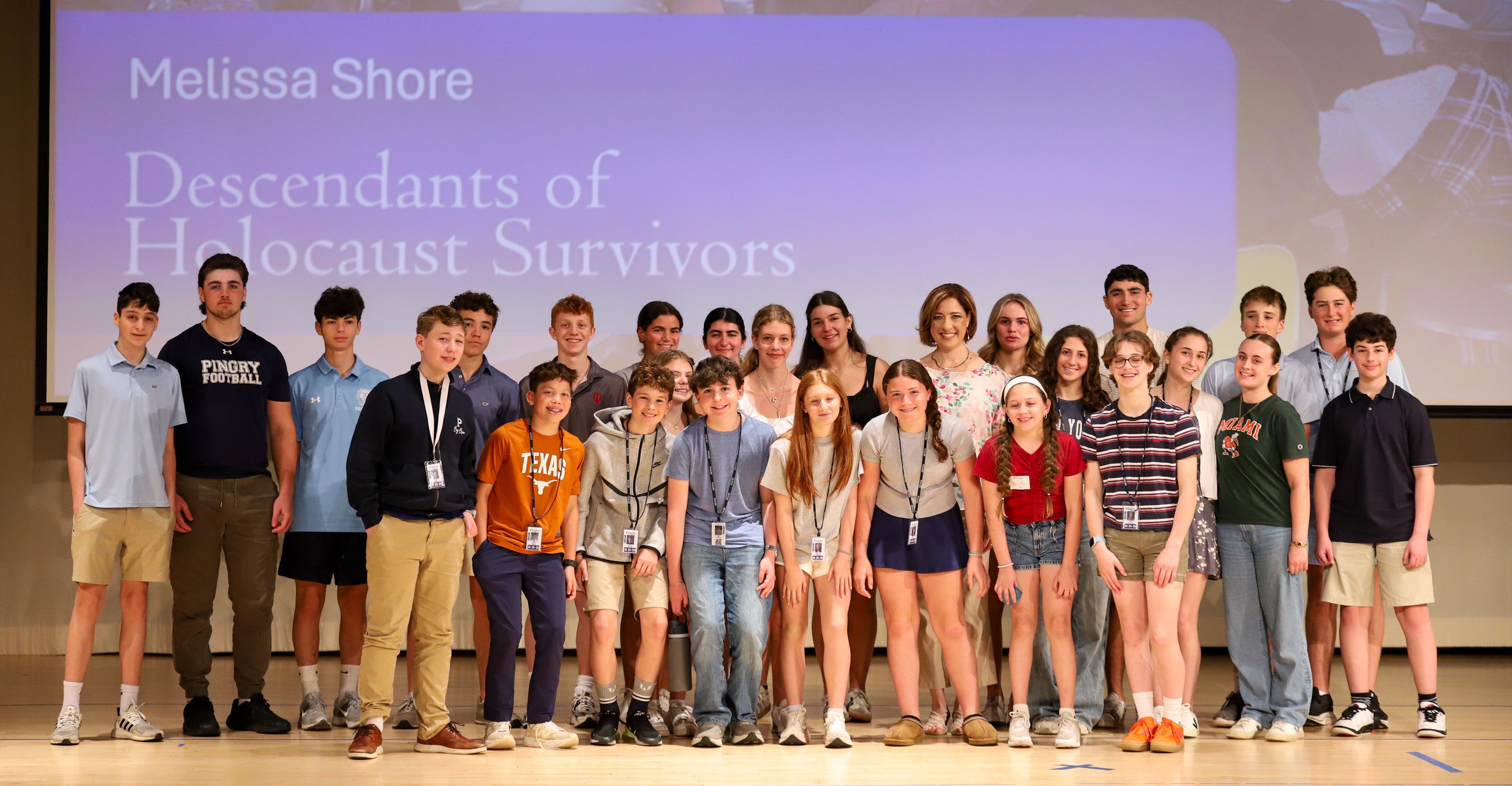
On April 18, Upper School students, seventh and eighth grade students, the Middle School Jewish Affinity Group, and faculty gathered in Hauser Auditorium to honor Holocaust Remembrance Day. The assembly began with Dr Olvera explaining that the assembly was held around Yom HaShoah, the Israeli commemoration of the Holocaust. Shortly after, Upper School Jewish Affinity Group leaders, Jack Sherman (VI) and Sarah Novofastovsky (VI) introduced speaker Mellisa Shore, a member of the 3G organization. The 3G organization is an educational nonprofit organization founded by grandchildren of Holocaust survivors. Their mission is to educate communities about the perils of intolerance and to provide a supportive forum for the descendants of survivors. Shore shared the story of her grandfather, Markus Warszawski, a Holocaust survivor. Being named in honor of her grandfather, Shore often wondered about him and his experience, but it was never talked about in her family. She emphasized the importance of discussing and remembering what the victims of the Holocaust went through in order
to ensure the lessons learned from the Holocaust are not forgotten.
Shore began looking into her grandfather’s life by searching the internet, reading books, watching films, and even traveling to Poland and Germany several times. Before World War II, her grandfather, Markus, grew up in a small town in Poland called Zdúnska Wola, which was 40% Jewish. Shore explained that he had a “normal childhood,” in which he grew up with his mother, father, and six siblings, while later working as a tailor.
Shortly after Markus turned 24, however, WWII began. In November of that year, the Nazis invaded his town. Markus’ life changed rapidly, and his whole family was forced to wear a yellow star at all times. They were forced into a ghetto with all of the other Jewish people in the town. Shore discovered that Markus only spent a year in the Zdúnska Wola ghetto before being separated from his family and forced to move to the Lodz ghetto. Markus spent a year there working as a tailor, a skill Shore stated may have saved his life, before he was moved to Janowska, a forced labor camp in Lviv, Ukraine. In this camp, Markus was forced to break rocks all day, every day, no matter the weather, with extremely little food or water.
Shore also explained what Markus’s life was like after WWII, when he was freed from the forced labor camp in 1945 by the Russians. She asked the audience to imagine what Markus must have been feeling at that time. He was emotionally and physically scarred from his time in the camp, and with no idea where his family was, or if they were even alive. Following his release, Markus went back to his hometown looking for his family, but left very shortly after fearing for his own safety. He then moved into a displacement camp.
The displacement camp was run by the United States and founded as a place for Jewish survivors of the Holocaust to live, heal, and find community. Markus ended up having an extremely positive experience in the displacement camp, finding friends and a support system. He also met his wife, Ela, in the camp, who was from his hometown, and they got married and had their first child, Shore’s mother, in the camp’s hospital.
Shore explained, however, that Markus still had questions about his family. After some research, Markus was able to determine that he was the only survivor out of his family. He also discovered that out of the 10,000 Jews from his hometown,
only about 100 survived. Shore explained that on August 24, 1942, the Nazis lined up the people in the Zdúnska Wola ghetto and marched them to a Jewish cemetery. Anyone unable to walk was killed. Upon reaching the cemetery, the Nazis separated the children, the elderly, and the disabled and killed them all. The remaining people were forced to stand in the cemetery in the extreme heat for three days without food or water, and many died of dehydration. The survivors were then put in trucks and brought to the Chelmno extermination camp. At the camp, the victims were brought to a church and told to leave their belongings there. The Nazis told the survivors that they were going to be disinfected before being sent east to work. The group was sent to a large mansion and asked to take off their clothes, and the victims were then locked in a large truck and gassed to death. They were later buried in a mass grave. However, Markus’ story does not end there. Through a program called the “Tailor Project,” offered to him because of his sewing ability, he and his family immigrated to Montreal, Canada, and lived there for 14 years. Restarting in a completely new country was extremely hard on Markus and Ela, and Shore
described their sacrifice and hard work. Fourteen years later, they immigrated to Paterson, New Jersey, where Markus continued to work as a tailor. They had another child and lived a beautiful life full of love and community before Markus’ passing at the age of 47. Shore ended the assembly by reflecting on the help that Markus received throughout his journey, help that is perhaps responsible for his survival. She asked the audience, “How will you stand up to hatred?” Shore allowed the audience to reflect on their answers and then provided a few suggestions. She invited the audience to each try to complete three acts of honor to commemorate Markus’ story and carry lessons from today into a better future. She asked the audience to share what this story made them think or feel, speak up against antisemitism or other forms of hate, and perform acts of kindness.
The assembly concluded with Julia Ronnen (VI) inviting members of the community to a candlelighting to honor Yom HaShoah. This assembly highlighted the importance of kindness, tolerance, and understanding in an increasingly divided world, and it was a beautiful way to pay tribute to the victims of the Holocaust.
Photo Credits: Pingry Communications
Justin Society Assembly
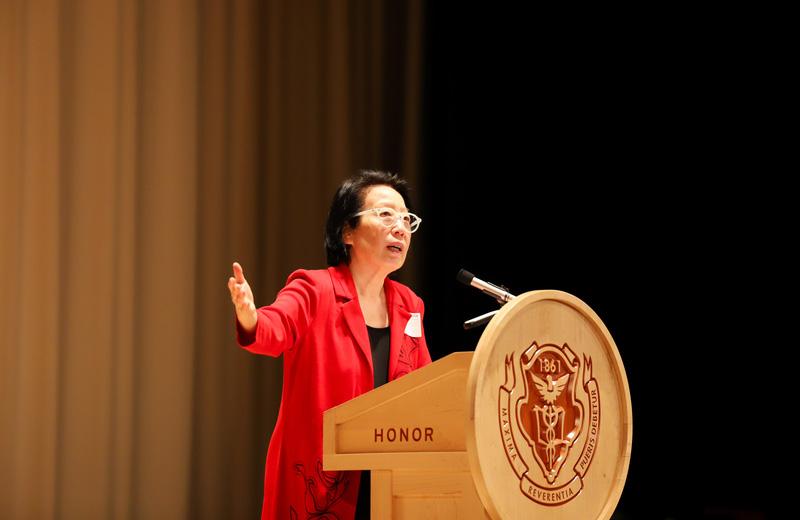
On March 25, Pingry welcomed acclaimed author Gish Jen to speak at this year’s Justin Society assembly. Gish Jen is the author of six novels, numerous short stories, and two works of nonfiction. She has been published in The New Yorker, The Atlantic Monthly, and The New York Times. She has received NEA, Guggenheim, and Radcliffe fellowships, as well as a Lannan Literary Award. In addition to her writing, Jen has taught at Harvard University and NYU Shanghai, among other prestigious institutions.
Jen read multiple excerpts from her books, most notably from her latest novel, Bad Bad Girl, a multigenerational mother-daughter epic. She spoke about how this fictional memoir, largely based on her mother’s experience growing up in China and then moving to the United States, required her to toe the line between fiction and reality in order to create a more compelling story and get closer to the actual “truth,” even if that meant adding fictional details.
Much of Jen’s work is inspired by her Chinese-American identity and upbringing as the daughter of two immigrants. She spoke
about her debut novel, Typical American, and the challenges she faced in the writing process. Typical American portrays a Chinese immigrant family as it navigates the challenges of assimilating into American society in the late 1940s. Jen reflected on the courage required to center immigrants in her debut novel, acknowledging that she anticipated criticism for describing their experiences as those of “typical Americans.” She recognized that Chinese immigrants, in particular, are not always perceived as representative of the American mainstream, making that characterization especially risky. However, Jen stayed true to herself and her craft, committing to writing the novel she wanted to write, something she believes is essential to genuine artistry.
Following the assembly, she conducted workshops with students in Creative Writing, The Contemporary Short Story, Gold Gush, and Literature of the Common Good. There, students were able to ask questions about the writing process, Jen’s experience as an author, and how to develop a unique voice.
Thank you, Gish Jen, for your time and wisdom!

Taiko Drumming
CORINNE WILSON (III)
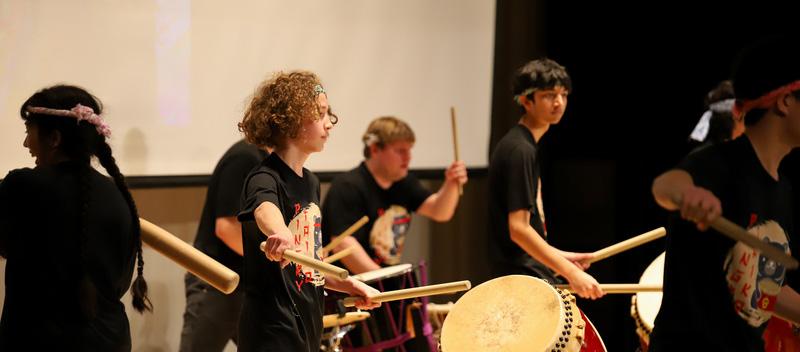
If you walk past Hauser Auditorium on a Tuesday or Thursday afternoon, you’ll hear the sound of drums, and inside, you’ll see a group of students pounding away, eager to recruit you. This club is Pingry Taiko.
Taiko can refer to the traditional Japanese percussion instruments or to the performance art itself. Taiko drumming has been practiced since the 6th century, mainly used in religious ceremonies and festivals. Kumi-daiko, a faster-paced modern version, was developed in the 1900s. Drummers use bachi (drumsticks) and a range of traditional drums, such as chu-daiko, odaiko, okedo-daiko, and shime-daiko, to put on high-energy, often choreographed performances.
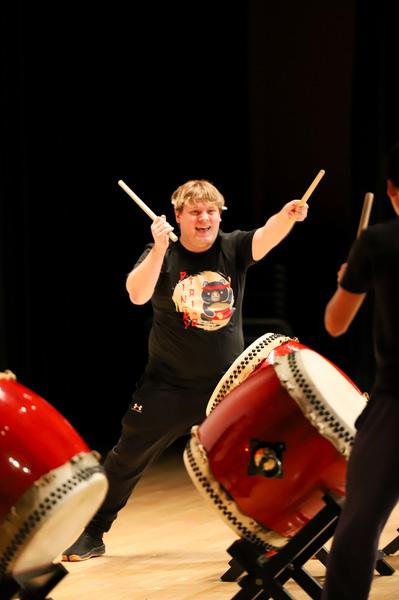
Pingry Taiko was founded ten years ago and currently has 22 members. This year, they are performing “Ready Set KaDON,” “Shin-En,” and “Jack Bazaar.” Alex DeLorenzo (V) says, “‘Jack Bazaar’ is enormously challenging, but it’s
SHANTI SWADIA (V)
From February 25 to February 28, the cast and crew of this year’s Winter Musical, Cabaret, performed the final result of three months of preparation. The show was a clear success, thanks to the hard work of the actors, tech crew, orchestra pit, and directors, and the risk the entire community took on, bringing such a complex and sensitive story to life.
Written by composer John Kander, lyricist Fred Ebb, and book writer Joe Masteroff, Cabaret is set in early 1930s Berlin during the rise of the Nazi Party. The musical contrasts the indulgent nightlife of the Weimar Republic with the growing threat of fascism. At the center of the story are English singer Sally Bowles (played by Durga Menon (VI)) and American writer Cliff Bradshaw (played by Aadi Stewart (VI)). Their relationship unfolds at the Kit Kat Klub, where performances are flashy and entertaining on the surface but, underneath, reflect a darker political reality.
The musical deals with heavy themes,
super rewarding every time you get the hang of a section of the piece.”
In addition to learning these pieces, the club attended the Columbia Taiko Festival, where members met fellow Taiko players from other schools and learned from experts. Taiko has also placed a strong emphasis on workshops this year — they hosted one on March 5 with Mark Rooney and Clarkstown High School, and had another with Kris Bergstrom, who wrote “Jack Bazaar,” on April 29. The group performed at an Upper School assembly on April 24 and plans to perform again at Celebrate Pingry on May 8.
including antisemitism, political extremism, and the slow collapse of society. For a high school production, that kind of material was at first overwhelming and uncomfortable. It required the cast to think carefully about how to portray these issues with both honesty and respect, while still delivering a compelling performance.
The Emcee, the central narrator and host of the Kit Kat Klub, was played by Alex Ege (V). When asked what the most challenging part of portraying the Emcee was in a story like Cabaret, he reflected, “I’d say the hardest part of playing the Emcee was the duality of the character. Having to switch between a welcoming host and an evil, unsettling character in seconds was a very difficult task.”
Preparation for the production began in November, with Upper School faculty members Mr. Alan Van Antwerp, Mr. Joseph Napolitano, Mr. Jay Winston, and Dr. Andrew Moore guiding the process. Their direction was evident in the final performances, which felt polished and cohesive, and the show was sold out all three nights!
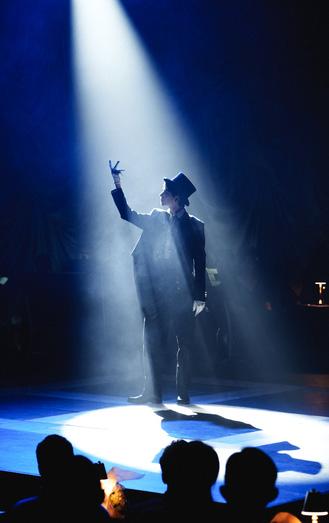
An additional factor that made Cabaret so meaningful was the number of graduating seniors involved. On Saturday night, a whopping 14 seniors joined their parents onstage to take their final bows as members of the Pingry Drama Department. Whether they were on stage, behind the scenes, or in the pit, their presence was felt throughout the production. However, they are sure that next year's cast will deliver a fantastic show as well! See you in Macrae next year!

SOPHIE SCHACHTER (V)
Winter Musical: Cabaret
Photo Credits (Top to Bottom): Pingry
2026 Lebow Oratorical Competition
LEAH HOLMES (V)
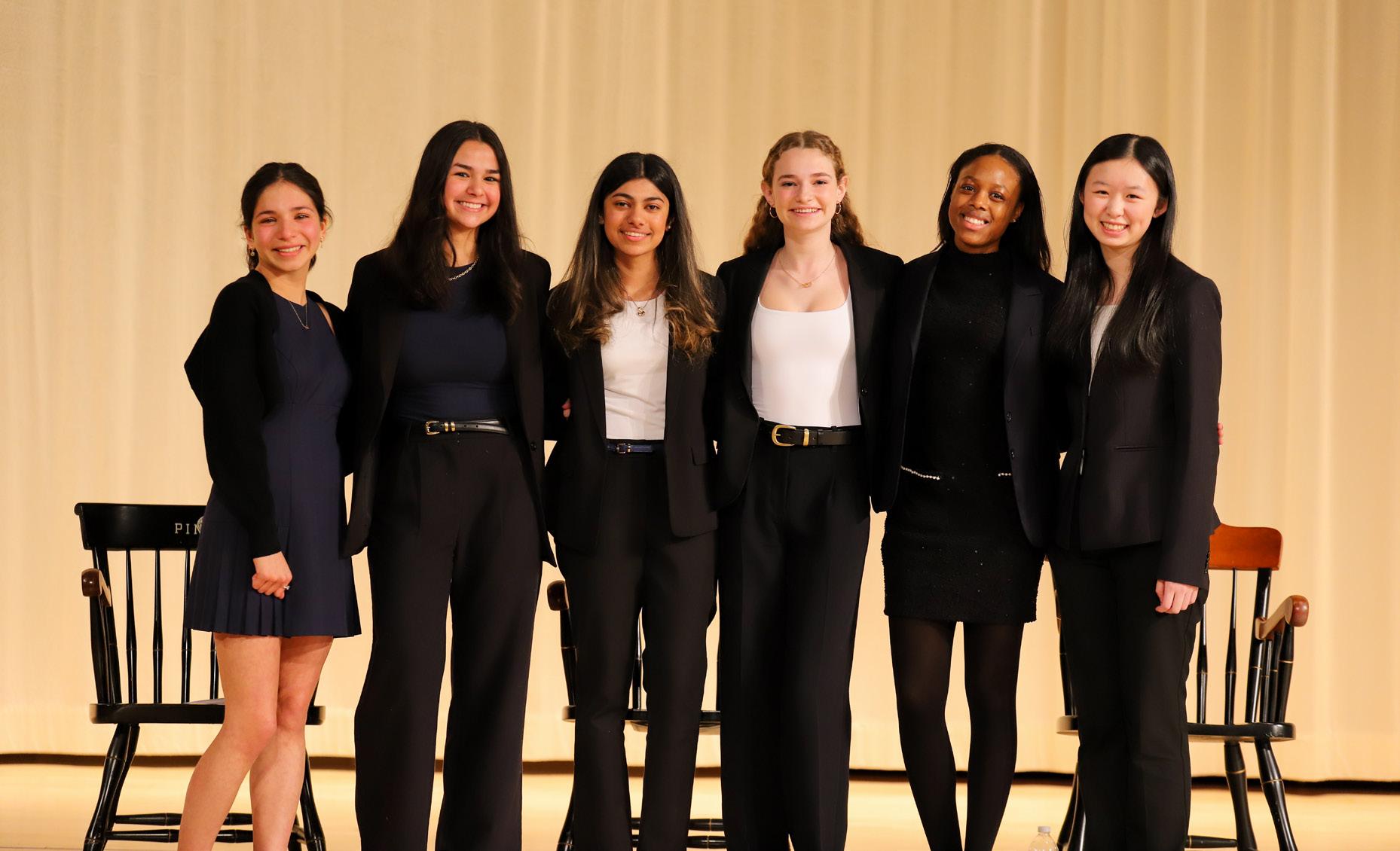
On March 4, 2026, six finalists gathered in Hauser Auditorium before the entire Upper School to compete in the annual LeBow Oratorical Competition, an event founded by the classmates of Robert H. LeBow ‘58 to honor his passion for public speaking. A strong advocate for global healthcare reform, LeBow used his speaking skills to share powerful messages during his travels to developing countries, where he also provided medical services. Today, sophomores and juniors continue his legacy by writing and delivering four- to six-minute speeches on a topic of their choice.
In the preliminary round, all participants presented their speeches to two judges. The top six speakers advanced to the final round. This year’s finalists were Mia Gulati (V), Sophie Schachter (V), Samaya Shah (V), Zoe Snider (V), Sophie Hao (IV), and Nina Hassimi (IV). Hassimi opened the competition with a metaphor comparing the four seats of a car to the stages of growing up. She described the progression from passenger to driver as a reflection of increasing independence and responsibility. Snider followed with a speech about the importance of embracing
BRYNNE DRAGERT (V)
The annual Stifel Award Assembly is named after Henry G. Stifel III ‘83. In his junior year at Pingry, Stifel suffered a car accident that left him paralyzed, drastically changing his life. Despite the tragedy, Henry G. Stifel made it his mission to graduate from Pingry with his classmates and went on to attend The College of William and Mary, where he earned a degree in finance. Today, he is the senior vice president of the Christopher and Dana Reeve Foundation for paralysis research, and he currently works as a private wealth advisor at Morgan Stanley. He also remains a dedicated supporter of Pingry and has frequently expressed his immense gratitude for the support he received from both peers and faculty while he was a student. Henry G. Stifel navigated the aftermath of the crash with resilience and admirable optimism, compassion, and endurance, which inspired the Stifel family to create the award in 1984. The assembly honors and acknowledges those
change, particularly during high school. She acknowledged the difficulty of change, especially when it involves stepping outside of one’s comfort zone, but emphasized that it is essential for personal growth.
Next, Schachter’s speech challenged the audience to think critically about everyday decisions and their ethical implications. Using an example of routinely purchasing items from companies with questionable practices, she highlighted how small choices can create far-reaching consequences.
Gulati then addressed systemic racism within the SEC football, presenting statistics that revealed a stark imbalance between the number of Black players and Black head coaches. She connected this disparity to deeper historical inequalities and called for meaningful change.
Shah, who competed in the previous year’s final, took the stage. In an unexpected moment, she dropped her papers while approaching the podium, prompting a wave of secondhand embarrassment from the audience. However, she quickly regained composure, joking, “That was embarrassing,” which seamlessly transitioned into her speech, titled “Embarrassment: The Epidemic We Invented.” Shah argued that people often feel embarrassed over minor
actions due to an exaggerated belief that others are constantly judging them. In reality, she explained, most individuals are too focused on themselves to scrutinize others so closely. Her message resonated strongly, encouraging the audience to consider how much power they give to perceived judgment.
Hao concluded the competition with a reflection on the true purpose of education. She questioned the widespread emphasis on grades, rigorous coursework, and college admissions, proposing instead that education should focus on developing well-rounded individuals. Hao emphasized the
importance of the humanities in fostering critical thinking and independent thought, especially in an increasingly AI-driven world. All six speeches demonstrated exceptional writing, insight, and delivery. A panel of faculty and staff judges, along with last year’s winner, Shanti Swadia (V), evaluated the finalists across multiple categories.
At the conclusion of the event, Schachter and Gulati were named runners-up, and Shah was declared the winner of the 2026 LeBow Oratorical Competition.
Reflecting on her speech topic, Shah explained that frequently hearing phrases like
“I’m so embarrassed” led her to question why people experience embarrassment so intensely. She believes social media has amplified this feeling and hopes her speech encourages others to recognize that most people are not paying as much attention as we think. While she does not expect people to eliminate embarrassment entirely, she hopes it no longer feels overwhelming. When asked for advice on public speaking, Shah offered a simple but powerful message: “Just be confident — the rest will follow.” Congratulations to Shah, Schachter, Gulati, and all of this year’s finalists for an outstanding competition!
The Stifel Award Assembly
in the Pingry community who have demonstrated the same qualities Stifel displayed after his accident, while fighting through hardships in their own lives.
At the 2026 Stifel Award presentation, two students were recognized for their empowering stories of strength and perseverance. The first award was presented to Sam Davydov (Grade 2), who was diagnosed with leukemia while in kindergarten. Lower School Teachers Mrs. Jamie Nanfara and Ms. Shalini Parikh presented the award to Davydov, praising his endless curiosity and optimism while undergoing long hospital stays and a bone marrow transplant. He never let boredom or fear take over while in the hospital. Davydov filled his days reading many books, making art, completing STEM projects, and keeping up with the school curriculum while staying connected to his friends. The week of the assembly marked Davydov’s eighth birthday, and the first anniversary of his bone marrow transplant. The Lower School honored Davydov by wearing his favorite color: green.
The second recipient was Blythe Hoffman (IV). Blythe was born in Hunan province in China, where she spent her first 18 months in an orphanage, undergoing five surgeries on her cleft lip. Since then, she has persevered through continued treatment and speech therapy, handling her challenges with grace and courage. Today, Blythe is a threeseason varsity athlete competing as a sailing skipper, swimmer, and lacrosse goalkeeper. Mrs. Deirdre O’Mara, Hoffman’s
swim coach and biology teacher, described Hoffman as a vital part of any team who truly embodies the word “grit” and is always willing to lend a helping hand or give words of encouragement. In addition to her school commitments, Hoffman has worked with her family to establish a nonprofit organization called A Birthday Wish, which provides gifts to children in foster care in New Jersey. She also works with Operation Smile, an organization that provides
children around the globe with life-changing cleft palate surgeries. Operation Smile is the same organization that provided Hoffman with surgical care in China, and she is committed to giving back to those affected with the same condition. Hoffman has continued to demonstrate relentless perseverance and positivity throughout her life, accomplishing great feats along the way and solidifying herself as an integral part of the Pingry community.
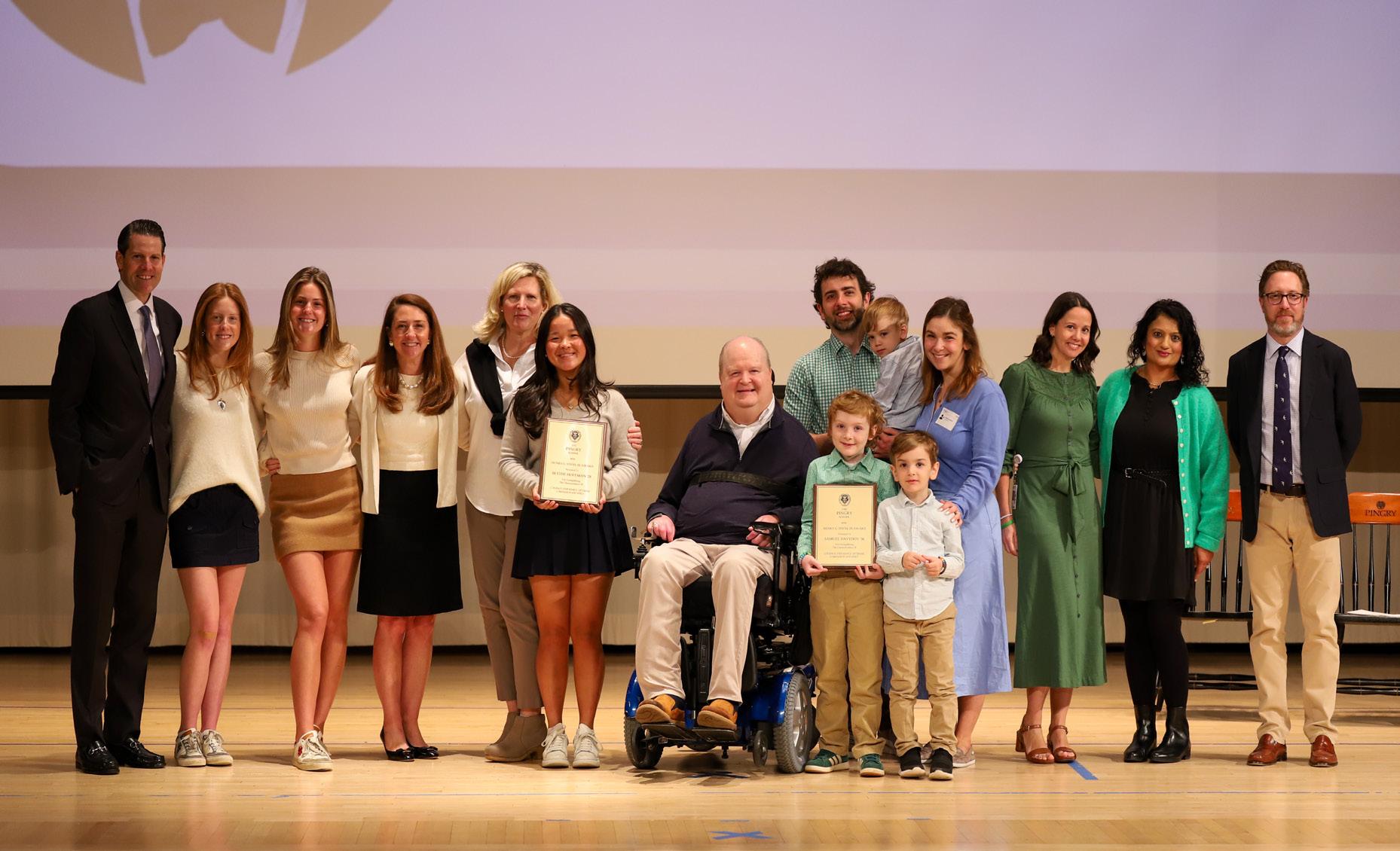
Photo Credits: Pingry
AMELIA LIU (V)
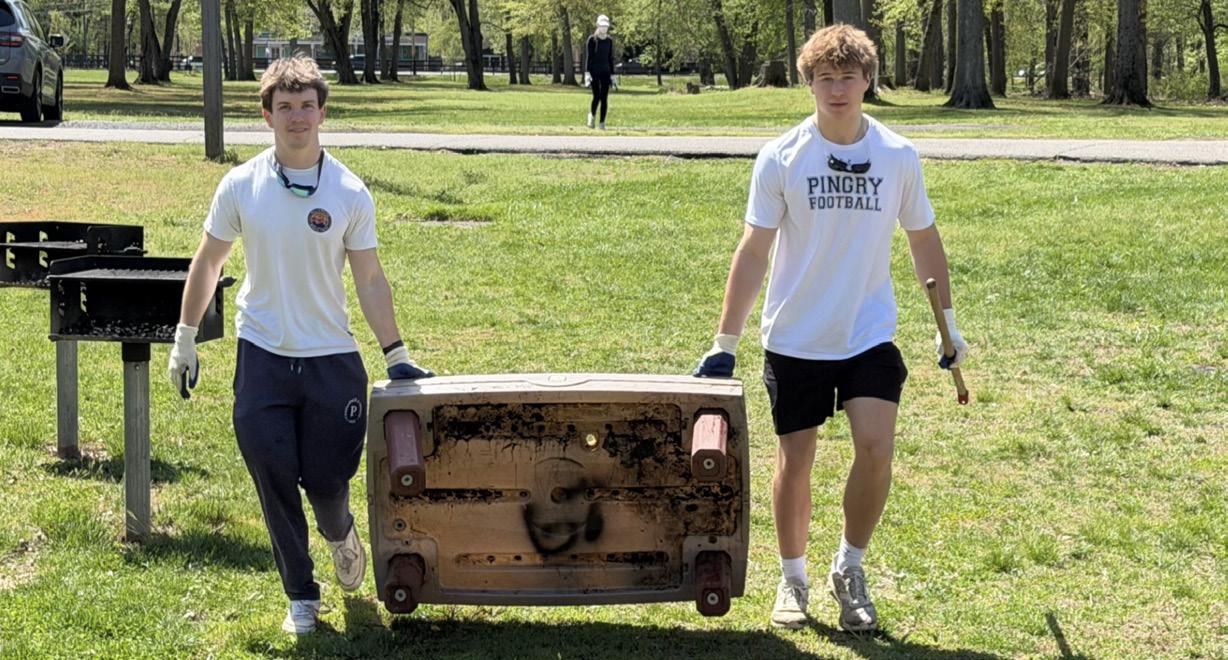
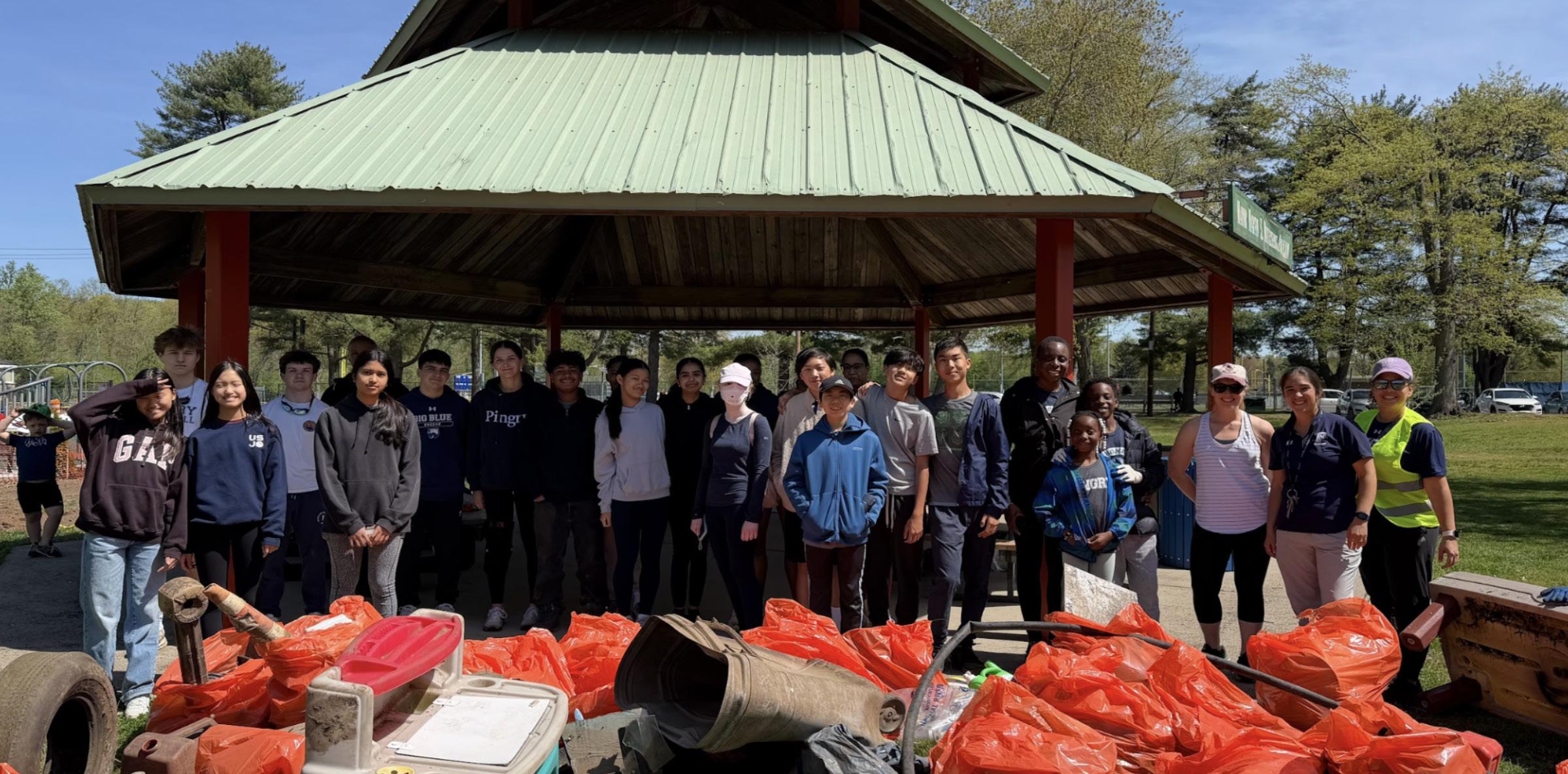
On Thursday, April 23, Upper and Middle School students gathered in Hauser Auditorium for the annual Earth Day assembly to emphasize the importance of environmental protection. Officially, Earth Day occurred the day before and is celebrated globally through advocacy, education, and direct action. Common activities include community cleanups, tree planting, or hosting public events to raise awareness. At Pingry, Earth Day is celebrated for the entire week, starting on Monday. Each day featured a different activity for
students to participate in, including campus walks, a bake sale to benefit the Raritan Headwaters, and planting berry plants.
The assembly started with a performance of “Monkey Gone to Heaven” by the Pixies, which featured middle school band members, receiving resounding applause after the song ended. Next, the winners of the Art Contest were announced, with featured artworks winning in categories from “Most Impactful” to “Best Drawn.” Then, the Middle School Green Group shared an informative presentation about the impact of humans on the planet, and steps that the community
Earth Day
can take to help, one of which was composting. The students shared that Pingry’s composter has processed over 9500 tons of food, or 590 pounds of methane that would have otherwise gone into the atmosphere.
Sarah Diao (III) and Mehar Arampulikan (III), both members of the Artificial Intelligence (AI) HIRT, spoke about the impacts of AI on the environment. According to Diao, every ten questions asked of an AI chatbot equates to about one bottle of water. They explained how AI data centers require massive amounts of water to cool down their
Prom 2026!
servers, causing dire environmental consequences. The students then shared a groundbreaking alternative to water cooling implemented in Helsinki, Finland. There, heat from data centers is redirected to homes and businesses, cutting down energy costs and emissions.
Next, Henrik Goodwin (III) and Jonathan Lewis (III) recapped the Raritan Headwaters Stream Cleanup, which aimed to remove trash from streams and ensure that local wildlife has enough clean water to survive. Out of all the trash they picked up along the
stream, they found items ranging from a wheelbarrow, six tires, and even part of a basketball hoop. Then, they shared the results of the corresponding bake sale. In total, they raised $189 to support the Raritan Headwaters Association. Finally, Rowan Shapiro (V), Sonya Seideman (V), and Maria Pontoriero (V) engaged the entire audience with a fun Stand Up, Sit Down trivia game. This year’s Earth Day celebrations were a great way to demonstrate the school’s unwavering commitment to environmental stewardship and community impact.
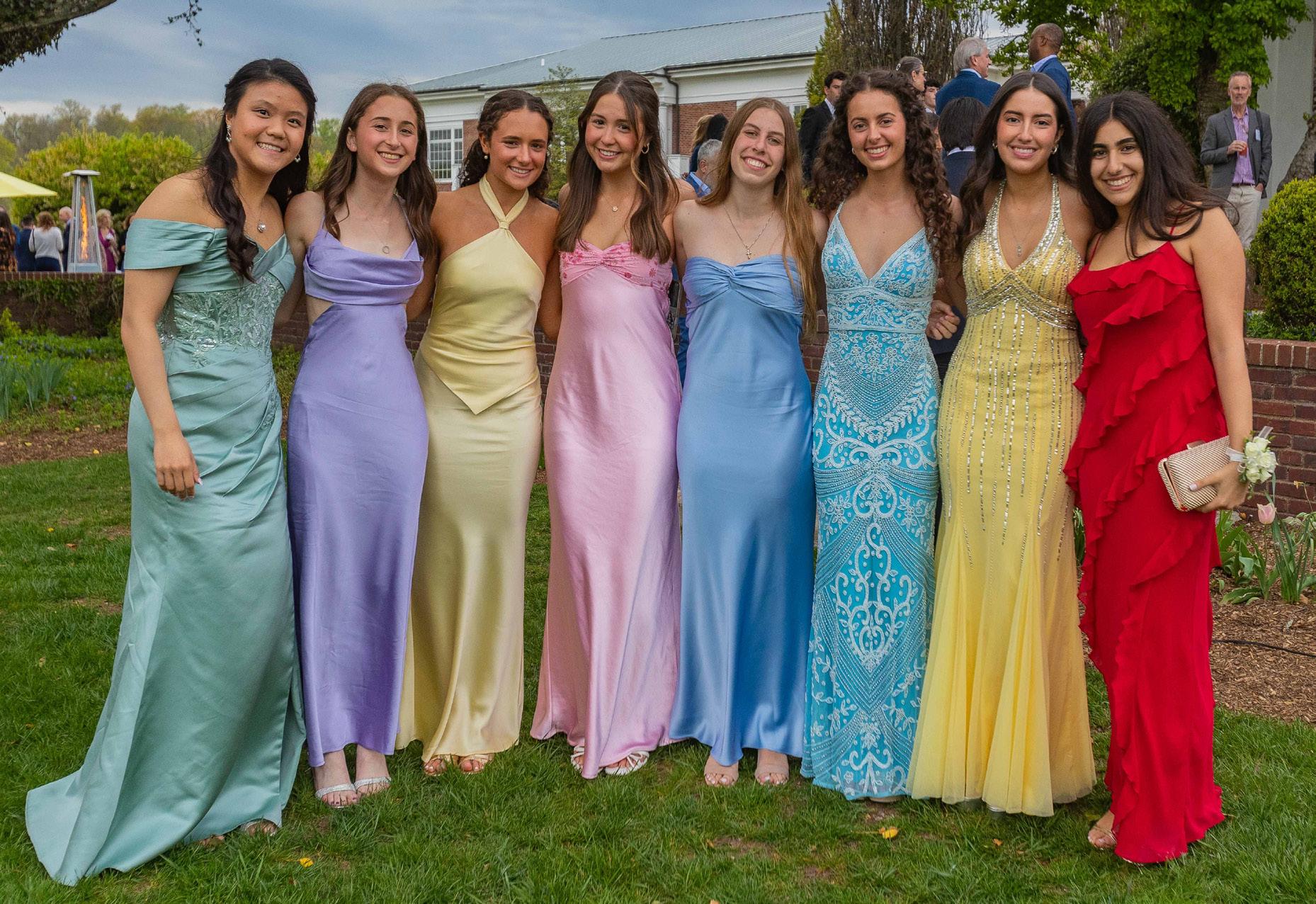
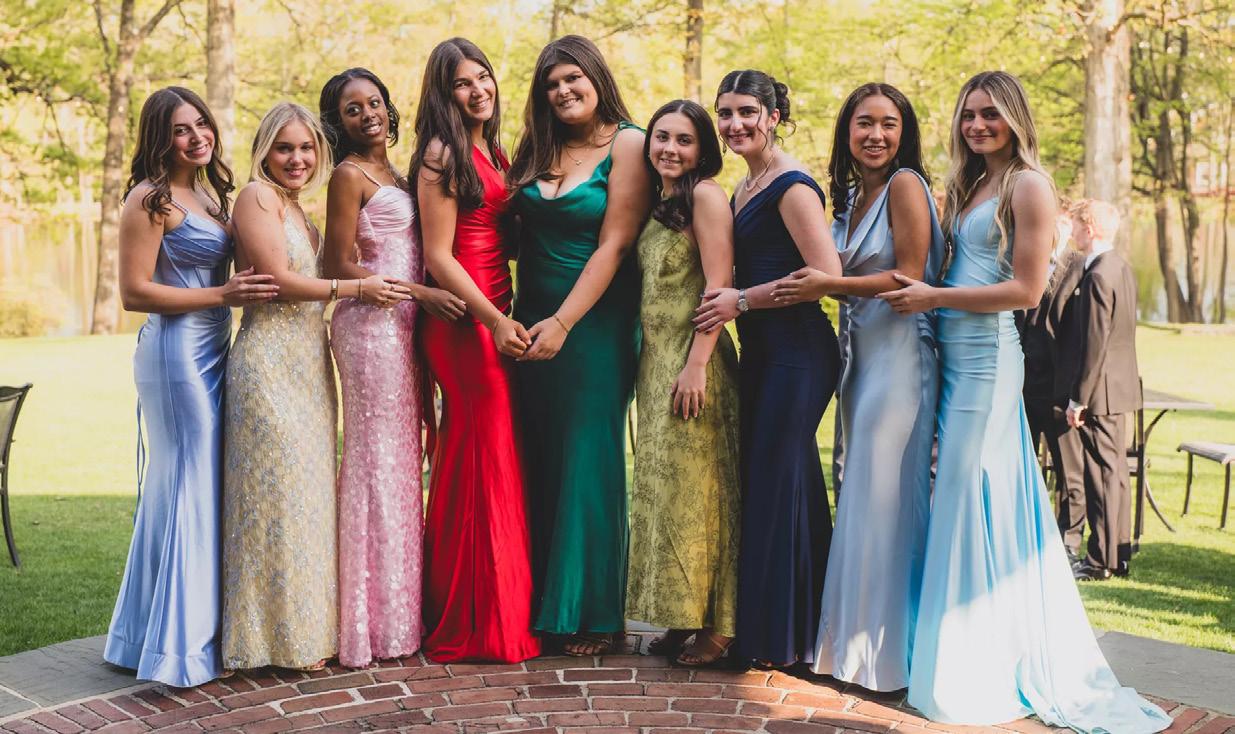
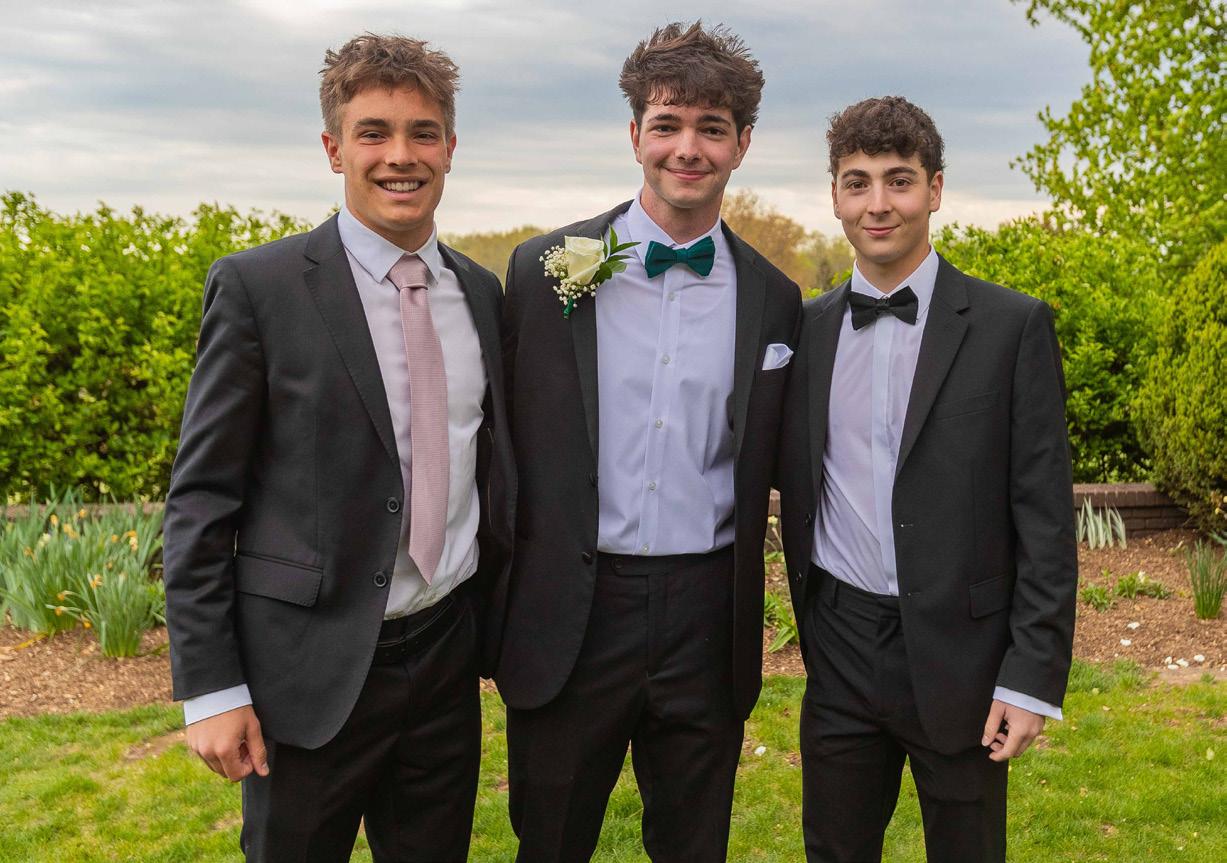
On April 24, Juniors and Seniors gathered for Prom 2026 at American Beauty Events, marking one of the most anticipated nights of the school year. The event, held from 7:00 to 10:00 p.m., brought together students dressed in formal attire for an evening that blended celebration, tradition, and a sense of finality as the school year draws to a close. The day began well before the event itself, with Juniors attending their pre-prom event at the Short Hills Club and Seniors attending theirs at the Hamilton Farm Golf Club. Families and friends came together to converse, take photos,
and share light appetizers. As the evening approached, students made their way to the venue in buses and cars, where they were welcomed by Upper School Director Dr. Reid Cottingham, Deans of Student Life Ms. Julia Dunbar and Mr. Robert Hoepfl, and Dean of Student Life for Advising and Peer Leadership Mr. Alan Van Antwerp. Their presence at the entrance, along with the presence of other faculty chaperones, set a warm and celebratory tone as students entered the space. Inside, the atmosphere was lively and energetic. Dinner and dessert were served buffet-style, offering a wide variety of options,
including dumplings, pasta, chicken tenders, and French fries. As in past years, Shirley Temples remained a popular beverage choice among students, adding a nostalgic touch to the evening.
One of the most crowded spots of the night, besides the dance floor, was the photo booth. A long line stretched across the room as students waited for their turn, eager to capture the moment with friends. By the end of the night, many left with printed photo strips in hand.
On the dance floor, the DJ played a mix of songs that kept the energy high throughout the night. Familiar favorites like “Hotline Bling,” “Party in the USA,” “Unwritten,” “Cotton
Eye Joe,” “Gasolina,” and “Crank That” brought students together, with groups forming and dissolving as everyone joined in at different moments. The mix of throwbacks and upbeat hits ensured that there was a song for everyone.
As the night progressed, the combination of music, food, and shared experiences created an atmosphere that felt both celebratory and meaningful.
Junior Angelina Gao shared that
“Prom was a memorable night filled with music, friends, and an amazing atmosphere. It was a once-in-a-lifetime experience I’ll always remember.” Prom 2026 was about the memories formed, whether on the dance floor, photo booth line, or during pre-prom gatherings. Students left with moments of connection and celebration that will likely stand out as one of the defining experiences of the school year.
SHANTI SWADIA (V)
Photo Credits (Top to Bottom): Ms. Olivia Tandon, Bruce Morrison ‘64
MATIAS STEVENSON (V)
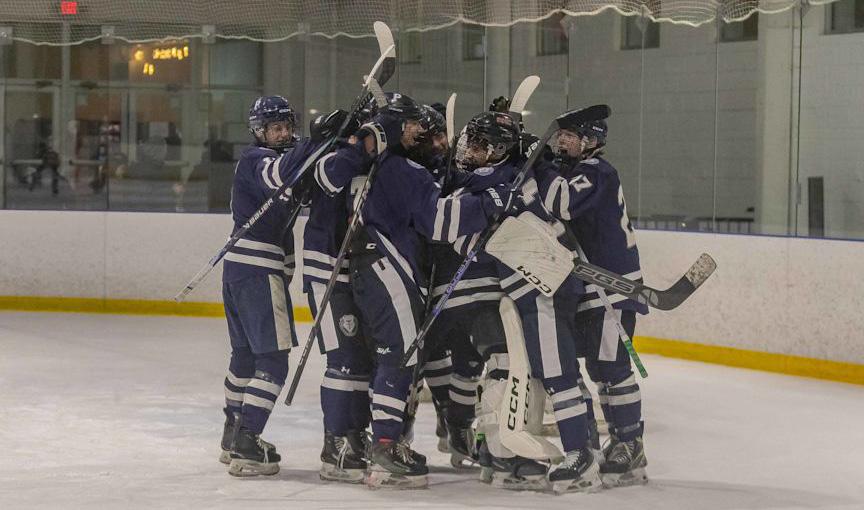
Schools love to celebrate wins, and Pingry is no stranger to celebrating the many successes of our teams. Seeing Instagram highlights of victorious scores and cups being lifted, whether in academics or sports, makes us proud of both our classmates’ accomplishments and our school. As I reflect on the 100 years of the Honor Code, I cannot help but think about what we do as a community when one of our teams is not doing so well. How do we respond as a community to situations when our teams need our support on the stands?
For anyone unfamiliar with hockey, a team roster contains at least 18 skaters and 2 goalies. This year, the Boys’ Hockey Team started the season with 15 skaters and 1 goalie (later in the season, our other goalie rejoined the team). Hockey, as a sport, combines many complex elements at once. It is a full-contact sport in which you constantly collide with other players while trying to avoid injury. People skate full speed on the ice and try to run you through the
ARJUN SHEKDAR (III)
Showing Up and the Honor Code
boards; blocking shots hurts. In hockey, you need the ability to take collisions like football, have endurance like soccer, and have hand-eye reflexes like basketball.
Pingry’s Honor Code says that honorable behavior is “a matter of attitude and spirit,” rooted in integrity, concern for others, and working for the common good. It asks us to act in ways that “further the best interests of the school, our class, and any teams or clubs to which we belong.” That does not just apply to academics or leadership roles. It applies to how we show up for each other. Supporting a winning team is exciting and quite easy. Supporting a team that is struggling is honorable. When we talk about “the common good,” we often think of big, abstract ideas, but sometimes the common good looks like choosing to be in the cold rink for an hour because your classmates are out there giving everything they have, even when the outcome is almost certain. Supporting each other also looks like recognizing effort over results. It looks like valuing the people in the arena, not just the
ones who walk out with a trophy. I recently read the poem “Man in the Arena” by Teddy Roosevelt, and it resonated deeply with me. Roosevelt writes about the person “who strives valiantly; who errs, who comes short again and again […] but who does actually strive to do the deeds.” That was our Boys’ Hockey Team this season: falling, getting back up, and always skating out to our next shift. This poem reminds us that the person who dares, who gets
out and keeps at it, is worthy of honor. Those who stay on the sidelines and laugh at the results are in no position to comment. I would argue that in our school community, if we are not the ones in the arena, we should continue to show up for those who are. When we only support each other during the good times, we are not really living up to the Honor Code. Showing up in good times is convenient. True integrity shows up when it is inconvenient. Real
concern for each other comes when we need it the most. A community shows up even when the scoreboard is not in our favor. Next season, the team might have more bodies and may win more games, but what will truly matter is whether, as a community, we decide that every team, every club, every student that steps into their “arena” deserves to feel seen and supported. Victory is sweet, but solidarity is honorable, and we can choose to be supportive every single day.
Does Being Different Make You Less?
People decide who you are before they actually get to know you. They give you titles that aren’t even close to your character, such as “weird” or “has no life.” I’ve been on the receiving end of these assumptions multiple times, even on the regular. It used to bother me so much when someone told me I had no life just because I didn’t go out every weekend, or when
people told me I was weird for still playing Fortnite in 2025. I’ve never seen myself as weird, or without a life. I knew I was different from everyone else, but I never knew that being different made me less Every day, whether I’m at school, home, or even out on a weekend, I see people judging others they don’t even know, talking about them like they’re somehow below them. The truth is, almost no one is who they look like on the surface.
I’ve been told by too many people that I appear as the quietest kid in the room, but this couldn’t be further from the truth; when I get comfortable around someone, they see how much I really talk. When I wasn’t the happiest about my grade on a math test, I was told all I wanted was attention and sympathy from people, but all I really wanted was to make my parents proud. The point is, the people who claim to not care about any of that are the

ones who will judge you the most for what you do, as long as it’s different from their routine. In their head, if someone is different, has different habits, likes different hobbies, and chases different goals, then that someone is somehow below them.
Whether you’re the kindest, purehearted kid one could ever meet, an incredibly talented athlete, or the smartest person in the room, people will only see you staying quiet, eating junk food, playing video games, and doomscrolling on your phone. Not only do people see a fake version of you, but they assume the false actions are an accurate representation of who you are, earning you those titles, which you don’t exactly want to have under your name.
While being judged without a fair evaluation irritates me incredibly, there’s one thing that bothers me more: the way people switch sides when they learn who you really are.
When those who judged me for not going out saw me at a party, they were shocked to see that the “nolife loser” went to a party. From that night on, I was seen as one of them, and “on the same level” as them. It blew my mind how quickly they switched up; the same kid who they found weird was the same kid they treated as if he was one of them. I never switched anything to
make that happen, they’d just seen where the real me was all this time. I’ve learned that no matter what people want to assume about you, their labels don’t define you. Being different isn’t bad, and it’s definitely not a weakness — it’s what makes you, you. I hope the next time someone else, or even you yourself, jumps to a conclusion about someone they barely know, they take the time to look closer. You might just be surprised by the type of person they really are. Judgements, new or old, flow in every day, and almost everyone has or will be misjudged at some point. The truth is, we’re all more than what people see on the surface. For all we know, what people see on the surface may not even be a part of who we really are. It’s more than a slight possibility that we’re seen by someone else for the first time while we’re out of character. If we stopped assuming before knowing, maybe we’d start to see the true value in each other rather than trying to rank everyone based only on what we see, without being open to learning. Most importantly, being different isn’t less. It’s not weird, and it doesn’t mean that you don’t “have a life.” It’s simply being real. It’s being true to yourself. It’s being yourself, and maybe that’s exactly what we need more of in the world.
Photo Credits (Top to Bottom): Pingry Communications, Google Images

SIMRIN SHAH (VI)
Are we participating in our own lives? A typical day runs like clockwork: alarm, notifications, classes, assignments, repeat. Somewhere between opening a tab and closing another, hours pass. You respond to messages you barely remember receiving. You finish work you don’t remember starting. At the end of it, you’re exhausted, but it’s hard to say from what. We’re not exactly disengaged,
LEAH HOLMES (V)
Stories don't just entertain us; they help us make sense of things, especially as young children. That's partly why the Hero's Journey shows up everywhere: Harry Potter , The Hunger Games , and basically half of Disney's catalog. The structure is familiar: we follow a protagonist, something goes wrong, and suddenly, they’re dealing with a challenge they never asked for. They struggle, they grow, and they come out the other side a changed person. But what makes these stories actually stick, especially for kids and teens, is how closely that character arc mirrors what growing up feels like. Many of these stories start with some kind of loss or disruption. Harry grows up without his parents. Katniss volunteers to take her sister's place in a brutal competition.
we’re just not fully there. Loneliness is usually framed as a social problem — the absence of other people. But there is also a version that can stem from the absence of yourself. You can fill a schedule, keep up a dozen conversations, and still feel strangely missing from your own life.
Especially now, as seniors, it’s easy to fall into that mindset.
Everything feels like preparation: for college, for careers, for the next version of ourselves that we’re apparently supposed to be constructing. We are always looking ahead and trying to optimize what comes next. Frankly, it’s a system built on forward motion. But in doing that, we risk turning our present into something purely functional, a stepping stone rather than something worth inhabiting.
We’ve learned to treat our lives like rough drafts, something to
M.I.A
refine later once things “settle down.” But they never do and the pace just changes. The irony is hard to ignore. The odds of being here at all — conscious, aware, capable of noticing anything — are astronomically low. Yet, we experience almost all of it halfway. Half-attentive, half-engaged, and already thinking about what’s next. We reduce something as rare as life to something routine. Though it’s unrealistic, and a little exhausting, to suddenly become profound or hyper-aware of every moment, it is still, in my opinion, worth asking where our attention is truly at in our own day. Participation is not actually about doing more or filling up more time, but about making sure no one can replace you in your own life. The word is right there: own. In order to own something, you have to be in charge.
Senior year, as well as high school, should be memorable. That’s the expectation. Memory comes from attention and from actually registering what’s happening while it’s happening. Otherwise,
it all blurs and you’re left with a full calendar and very little you can clearly say you experienced. So maybe the question isn’t just what are we doing with our lives? but are we here for them at all?
The Hero’s Journey
In Disney movies, it's usually a broken family, a missing parent, or a world that's suddenly gone sideways. For younger audiences, this lands a lot harder than it might seem. Growing up already comes with a lot of upheaval: new expectations, new environments, and moments where things feel completely out of your hands. These stories take that feeling, blow it up and make it more dramatic, but still leave a recognizable essence underneath.
What keeps people hooked, though, is that the story doesn't end there. The hero isn't confident or ready at the start. If anything, they're kind of a mess. That's a big part of the appeal. Younger readers and viewers aren't watching someone who already has everything figured out; they're watching someone figure it out in real time. That makes the journey feel attainable. It
suggests that being lost or uncertain isn't some personal failure, but where things begin. There's also something appealing about how much agency the hero eventually develops. In real life, kids and teens don't always feel like they have much say over anything. School, family, expectations – a lot of it feels fixed. But in these stories, the hero's choices actually change things. Even when everything's stacked against them, their decisions matter.
And then there's the ending. The hero usually wins. That might be the simplest reason we love these stories, and it's not a small one. However, real life doesn't always work that way: things don't resolve cleanly, and effort doesn't guarantee anything. But in these stories, it does.
The struggle means something. For younger audiences, that's especially comforting. No matter how bad

things get, there's a sense that everything will work out in the end.
Science fiction and fantasy crank all of this up. Places such as Hogwarts or Panem feel nothing like everyday life: there's magic, strange technology, and entirely different rules. For kids and teens who often feel boxed in by routine, those worlds feel wide open. They suggest that life could be bigger than what they're currently looking at. At the same time, they're not completely detached from reality. The themes of fear and identity are still there at arm's length. It's a little easier to sit with big, uncomfortable ideas when they're wrapped in fiction rather than staring you in the face. Even Disney movies, which get written off as simple, follow the
same shape. A character doesn't know who they are, something forces them to find out, and they change because of it. For younger viewers, that idea tends to stick, a reminder that figuring yourself out isn't a single moment, it's something that happens gradually.
The Hero's Journey stays with us because it manages to do two things at once. It reflects what growing up actually feels like: messy, uncertain, and often overwhelming. But it also offers something like reassurance, that those hard moments aren't random, that they're part of something. We don't love these stories just because the hero wins. We love them because they make us feel, at least for a little while, like we might too.
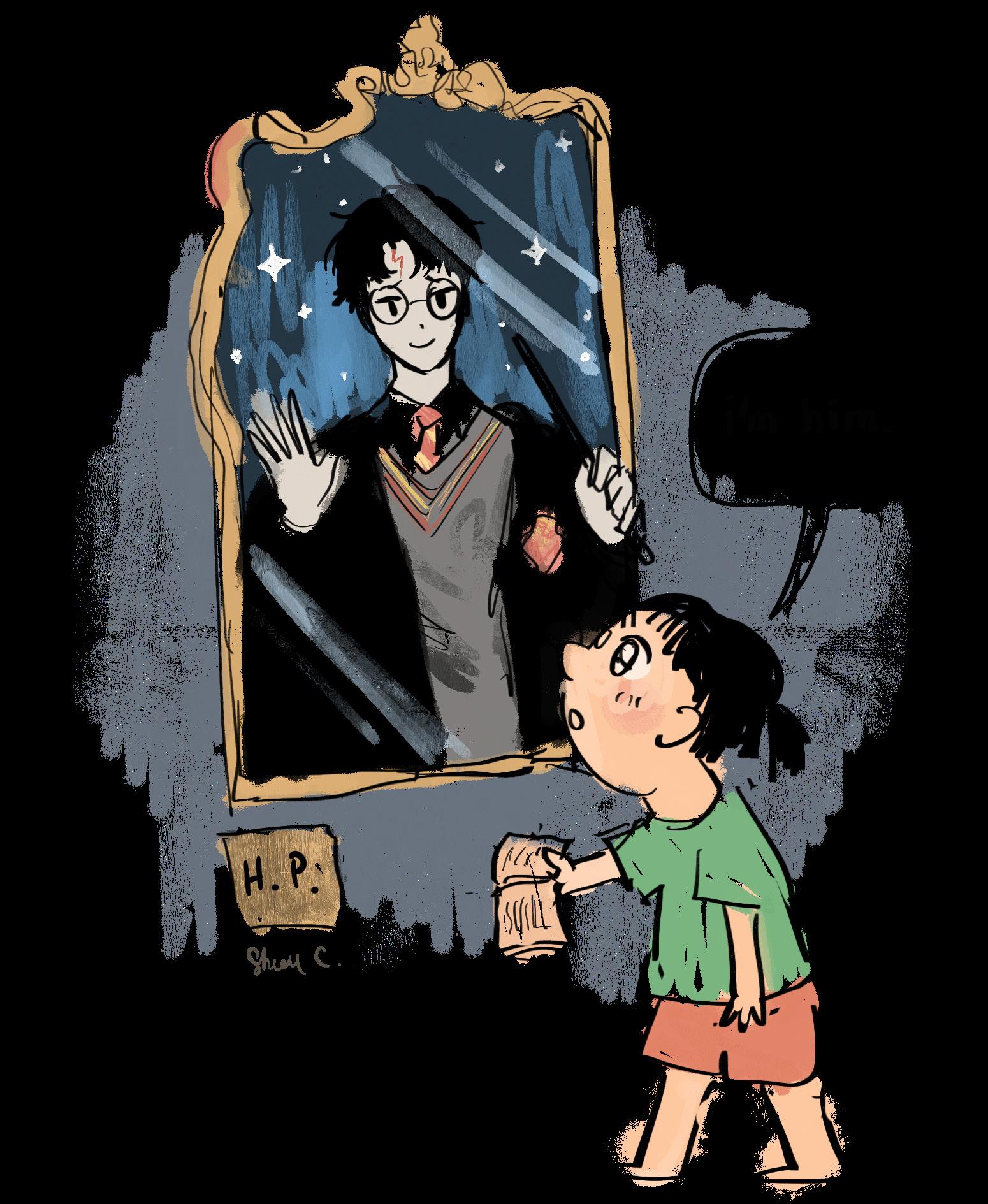
Photo Credits (Top to Bottom): Google Images, Sheryl Chen (VI)

TINGTING LUO (VI)
Graduation. June 7. The date on all of our (seniors’, at least) minds. The ultimate “finale” of this chapter of our lives. The idea of graduation is closure — a neat, ceremonial bow tied around our formidable teenage, pre-teen, and even childhood years. We clear out lockers (for those of us who have them; not me, unfortunately, so I’ll be skipping this step), return library books (which I regret not borrowing more of), and cross stages to shake some hands and act as if the end geographically means the end literally. But the most successful goodbyes aren’t about closing doors, saying, “Bye, Pingry, and everyone I’ve ever known! I’m off to bigger and better things.” That’s just not true. Well, hopefully, we’ll be off to bigger and better things, and move in a direction towards achieving whatever aspirations we may have. But this
Goodbye to Our Favorite Pages?
goodbye shouldn’t be the permanent end to our journey together.
The pressure to have a “perfect” final week often leads to a frantic sort of mourning. We treat every coffee run and late-night study session as if it’s the last time we will ever feel that spark of connection with our peers. But that’s wrong. We might be busy writing thank you notes to special mentors, which is 100% necessary, but that doesn’t mean we won’t come back to visit any chance we get, right? That doesn’t mean we won’t periodically shoot them an email or maybe even a text in college, right? By seeing graduation as “the end,” we’re inadvertently telling our brains that these relationships belong in the past, when in reality, they should carry on forever and after.
To say goodbye to a place without losing the people, we have to change how we see our relationships. In school, some friendships are maintained by “accidental proximity” — seeing someone because you’re in the same building or sharing many classes. Leaving the building requires transitioning to “intentional proximity” — scheduling to watch a movie together or hang out at the beach. This “intentional proximity” is what we have to channel from now on. So, before we scatter, make that one “unnecessary” plan.
Instead of “we should stay in touch,” say, “I’m calling you every first Sunday of the month.” I know this is something I should’ve done with my sister, because now our calls are spontaneous and sometimes awaken me from my deep-needed slumber. Instead of a generic goodbye, I urge you to try to identify one specific recurring habit you shared with someone. You aren’t leaving your friend for the year and just seeing them on the rare occasions they visit you or you visit them. You’re just changing the coordinates of where you meet. Yes, college schedules may be super busy, and you may be thousands of miles away, which I know is something I haven’t fully registered yet. Breaks may meet at different times, so you won’t even be home together. But this is not the 1800s. Distance is no longer the dead-end it used to be. A voice memo from a dorm room or a spontaneous
2 A.M. FaceTime during a cramstudy session can cross time zones, proving that the rubber band tying us together won’t snap just because it’s been stretched. And if we’re lucky, maybe someone will hop on a plane to visit us. I know that I will definitely be visiting some people, even if it means going through the long drive to the airport and even longer flight on a stuffy plane.
And we should trust that the bonds forged in these Pingry hallways are durable enough to survive a few months of radio silence. We can’t always be standing in the same room, but we must remember why we wanted to be in that room together in the first place.
Graduation isn’t just turning a tassel, throwing a cap, taking pictures, and driving off into the sunset. It’s not finality with people we still love. We only need closure with the hallways, the commute, the
food (Thank you Sage. I’m so sad to leave the wonderful food here; it’s better than almost all college food), and the advisory seats in Hauser (that not everyone even uses).
This might sound a bit odd, but treat this place like shed skin. It served its purpose, protected our growth, gave us countless memories to look back upon, and now, we can outgrow it, at least until our next visit home. But the people? The people are the travelers, ones we should always carry close to our hearts. We leave these halls behind, but we also leave them changed. Every loud laugh in the hallway and every quiet moment in the library is baked into the bricks (or whatever the school is built of) now. We’re handing the keys to the next group of travelers.
The bow might be tied on this chapter of our lives, but we’re the ones holding the book, and who says we can’t reread our favorite pages?

Learning to Love Silence
While doomscrolling on TikTok a few months ago, I watched a video of a girl who forced herself to sit in silence, without her phone, for ten minutes. Fingers outstretched towards her phone, but always stopping herself before picking it up. Eventually, the timer ended, and she quickly sprang up to grasp her precious phone again. At first, I laughed at her lack of self-control, in disbelief at her inability to stay away from her phone and do nothing. At the time, I asked myself: Are our attention spans as a society really that bad? Has social media completely ruined our brains? I decided to put my own self-control to the test, determined to prove that I could do better than a random
TikToker. A few minutes in, I realized the video might not be exaggerating the challenge's difficulty, and that all my time staring at a screen had disrupted my ability to focus. I desperately wanted to pick up my phone and continue scrolling to get that much-needed dopamine rush. I decided to push through it, motivated to overcome such a simple yet difficult task. For the remainder of time, I noticed parts of my room that I’d never seen before — odd ridges and textures scattered across the ceiling and fading paint strokes from when I thought it would be cool to add splashes of color to my wall. In a world where digital devices are the norm and the constant search for dopamine is normalized, I often wonder what life was like before we
became overreliant on technology. Before COVID-19, I never really had to use a device for elementary or middle school, because life was on easy mode back then. During the lockdown, I remember thinking that Roblox was the best thing to ever happen to me. Nowadays, a day doesn’t go by that I don’t use a piece of technology, whether it's for homework, texting my friends, or continuing to keep up with my Roblox addiction. The answer to slowly mending this tech pandemic is complex. When I wrote this opinion piece a few days ago, I proposed a seemingly simple solution: silence. Boredom. Taking the time to sit in silence, not as a TikTok challenge, but as an opportunity to rest our brains and pause from the chaos of


our daily lives. Now, I’m not saying that we should ban technology and send messages by pigeon, but I am saying that it may be beneficial for us all to spend at least a few minutes every day embracing silence. When we embrace silence, we allow our bodies to heal, our brains to relax, and our emotions to slow down.
According to a 2013 study by researchers who tested the effects of different auditory stimuli on the brains of mice, silence acts as a novel stimulus, fostering the formation of neurons. In simpler terms, periods of stillness provide beneficial brain changes by allowing our brains to rest and adapt. Although silence in a controlled lab setting is completely different from the human silence we experience (and mice and humans aren’t even the same species), this study provides compelling evidence that intentionally quiet environments might help with mental restoration,
focus, and even relieve stress. So the next time you feel the urge to hop onto TikTok or Instagram Reels, I encourage you to pause and think about a better way to spend those 15 minutes than riding a dopamine high. Maybe you could have a go at the five minute silence challenge. As The New York Times author Melissa Kirch explains, replacing your screen time matters less about restricting ourselves, but what we do to fill up the “empty space.” Other solutions include spending time writing whatever your heart desires in a journal. You could pick up meditation. Or, since we all live very busy lives, you could dedicate a few minutes to sleeping instead of scrolling. At the end of the day, it is time for all of us to reclaim our attention spans, because when we choose silence over stimulation, our minds can grow, heal, and learn to be truly present.

AMELIA LIU (V)
Photo Credits: Google Images, Serena Shi (III)
CAROLINE OUYANG (III)
As my sore hands came in contact with the touchpad during my 200 breaststroke final at the swim state championships, the scoreboard flickered: 2:29.85. And that was it: I missed the YMCA Nationals cut by 0.06. Six hundredths of a second. My teammates immediately offered condolences, focusing on the narrow miss rather than the race I’d actually swum. After I got out of the pool and cooled down, I realized how far I’d come. During that meet, I dropped
What the Milliseconds Don’t Show
a tremendous 3 seconds in the 200 breaststroke, breaking 2:30 for the first time, and I finaled and improved in both of my events.
So why was I letting the 0.06 overshadow my accomplishments and the thousands of minutes I’d put into swimming leading up to this meet? When I returned to school, I realized that this 0.06 mindset isn't just in the pool; it’s in our classes and our college portals. There’s a reason coaches remind us to focus on our own lane: the moment you look at the person next to you, you lose your rhythm.

SHANTI SWADIA (V)
At this year’s LeBow Oratorical Competition finals, I was one of eight judges. When it came time to vote, my decision would help determine the winner, an outcome that could shape how someone saw themselves going forward. Winning might give someone a sense of confidence and that their voice matters to people.
At this time of year, we’re all peeking at the next lane. Seniors are preparing to graduate, and it might feel like the past four years feel reduced to a set of outcomes: where you got in, or how your resume compares to someone else’s.
I’ve gotten to know quite a few seniors this year, and their journeys are all so much more than their college results and transcripts. They’ve become resilient athletes, expressive artists, dedicated scholars, and inspiring leaders. They’ve shaped an intricate community of friends, classmates, teammates, and mentors. They haven't just filled a resume, but created a lasting impact in the fabric of this school.
Fellow underclassmen, many of us are so busy strategizing to avoid a possible 0.06 miss that we forget to come up for air.
If you treat every class, every club, and every friendship as something to put on your resume

or transcript, you’re basically holding your breath for four years. The truth is, whether you notice it or not, we’re all making our own “three-second drops.”
It looks different for everyone: finally grasping a concept in math, finding the confidence to speak up in a Socratic seminar when you used to stay silent, or discovering a group of friends who help make school feel like home.
If you spend all your time at school “holding your breath,”
Where Power Lies
Not winning might leave someone questioning whether they were ever good enough in the first place. What surprised me the most was how nervous it made me. I kept thinking about the possibility of getting it wrong. Choosing a different speech than everyone else was one thing, but making a decision that could affect how someone understood their own
abilities scared me. It felt strange to realize that something as simple as a score on a sheet of paper could carry that kind of weight.
Of course, there were seven other judges. My vote alone could not decide anything, but that moment made me start thinking about power as showing up in everyday moments.
We usually think of power as something grand, like positions

of authority and titles. But as I sat there with a pen in hand, I did not feel powerful in the way those definitions suggest. I just felt aware that my opinion carried weight because we had all agreed that it did.
My idea kept circling back to a line from Game of Thrones: “Power resides where men believe it resides. It’s a trick, a shadow on the wall. And a very small man can cast a very large shadow.” The more I thought about this quote, the more I started to understand its truth.
I believe that power is something other people hand to you. At the LeBow finals, the judges only had power because everyone else accepted that we did. The competitors trusted the process, and the audience respected the outcome. Without that shared belief, our votes would mean nothing. The same is true in so many other places.
A teacher’s authority depends on whether students take it seriously.
A leader’s influence depends on whether people are willing to follow.
Even something like popularity is a form of power that only exists because others agree to give it value. That raises a more uncomfortable question. If power comes from us, why are we so willing to give it away and continue reinforcing it?
Part of the answer might be knowledge, but not in the simple way we usually think about it.
The idiom “knowledge is power” is nuanced. Knowledge changes
terrified of a close call, you might miss the “three-second drop” that's already happened. Once the season ends and the decisions have been made, what remains isn't a list of acceptances or rejections, but the person you became while working and learning. The muscle you built and the character you forged are yours to keep, regardless of what the scoreboard or the email says. 0.06 is less than a blink of an eye. Don’t let it blind you from the miles you’ve already covered.
how easily someone’s power can be questioned. When people understand how decisions are made, they are more likely to challenge them. When they do not, they are more likely to accept their authority. In that way, a lack of understanding makes it easier for power to stay where it is. At the same time, knowledge does not explain everything. There are plenty of situations where people know something is flawed, but still choose to support it. Someone’s belief in something is shaped by their comfort, habit, and sometimes fear of it. It is easier to accept existing structures than disrupt them, and easier to follow than question, especially when questioning carries risk.
Looking back at that moment as a judge, I realized that power can exist in very small ways. It could be a decision, a vote, or an opinion that someone else takes seriously. And if power depends on collective belief, then that belief is also a form of control. The same people who hold power can take it away, making power less stable than it appears.
I believe that we should strive to be aware of when we have power, and be even more aware of when we are giving it to someone else, and why. In the end, I believe power is constantly being created, reinforced, or withdrawn by the people around it.
The Quest for a Perfect Bracket
SOPHIE SCHACHTER (V)
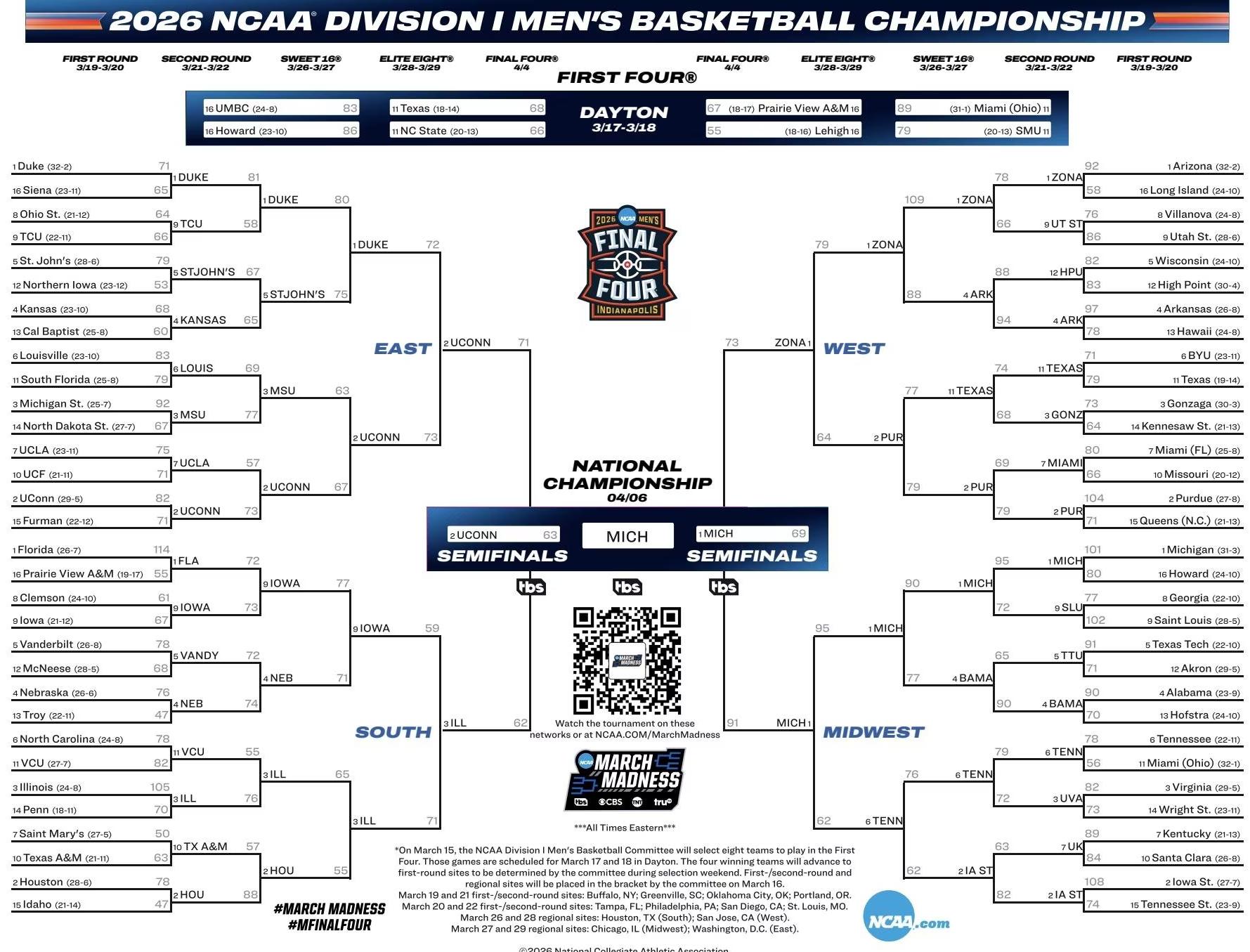
The chances of getting a perfect March Madness bracket are so minuscule — one in 9.2 quintillion — that Warren Buffett has offered a billion-dollar prize to anyone who achieves this miraculous feat. And yet, every year, millions of people participate in bracket competitions, telling themselves that they will be the lucky soul who somehow predicts all 63 games correctly.
I am one of those people myself. I follow the big games throughout the regular season, stay updated on the AP poll, and take my own notes on which teams I think have the talent to go far. So when Selection Sunday finally rolls around, I spend hours tweaking my bracket, watching college basketball TikToks, and agonizing over my upset picks. My perfect bracket dreams came to an end during the third game of the very first round, when my dark horse, USF, fell short against Louisville. It didn’t get much better from there. I ended the tournament ranked around two million globally, and in the middle to bottom half of my various bracket pools.
So why do we continue to chase something that is statistically impossible? What is it about this tournament that sends people into a frenzy? I say, it’s the unpredictability, the drama, and the infectious nature of college basketball.
In the college world, it just means more. There’s something about seeing 18-yearold prodigies give it their all on the court, fighting for every rebound, with hopes of continuing their stay in the Big Dance just a bit longer. When they wear their university logos on their chest, it’s with pride, knowing that they’re representing an institution, and that there’s an entire school of fans behind them. The roots of school spirit run deep, and every game feels like a championship when the players, the fans,
and the coaches are this invested.
The unpredictability. There’s something electric about watching a 12-seed High Point beat a 5-seed Wisconsin on a lastminute layup from a guy who hasn’t made a two-pointer all year. No matter how much research you do, there’s always going to be some mid-major team that breaks your heart, somehow playing like the 2016 Warriors when you haven’t heard of them all year. Not to mention, making the perfect upset pick is an art. You have to look at the rosters of future accountants and realtors — not NBA lottery picks — and determine which ones you think will show up when it counts. While they’re not on the most elite teams, all these guys can compete on any given night, so you can’t underestimate anyone.
The drama. Watching UConn freshman Braydon Mullins hit a three-point buzzer beater to take down the Duke Blue Devils — who had been up by as much as 19 points — and secure their trip to the Final Four was cinema at its finest. Dan Hurley screaming on the sidelines, the roar from the crowd, and the heart-sinking looks on the Boozer twins’ faces were simply priceless. Every year, the tournament is filled with hundreds of electric moments: shocking upsets, mind-boggling buzzer-beaters, and roaring student sections that keep you glued to your TV. It’s precisely why March Madness is hailed as one of the greatest events in sports, and why the quest for a perfect bracket takes the world by storm.
The closest I’ve ever gotten to Buffet’s billion-dollar prize was the 2022-2023 season, where my bracket placed in the top 200 in the world. It’s been a rocky road since then, but I, like millions of others, will not lose faith. Come March next year, I’ll fill my head with rebounding stats and visions of legendary dunks once again, because surely, it’ll finally be my year
Where Do We Draw the Line on College Sports Eligibility and Recruiting?
RYAN DICKS (IV)
College sports have always been built on a simple idea: student-athletes compete for their schools, earn scholarships, and move on after four years with a degree and a set of experiences that shape the rest of their lives. But that model is not just outdated now; it is essentially gone. Between the explosion of NIL deals, a transfer portal that looks more like free agency every season, and eligibility rules that bend further each year, college athletics are drifting further from their original purpose with every passing season. The athletes competing today are still called student-athletes, but the system surrounding them increasingly treats them as assets to be bought, moved, and replaced. There is no doubt that reform is needed. The question now is whether the people running college sports have the courage to actually do it.
The chaos roots back to a 2021 Supreme Court ruling that paved the way for athletes to profit off their name, image, and likeness, better known as NIL. What started as a reasonable idea to help college athletes get paid and gain sponsorships quickly grew into something else entirely. NIL rights have now grown into a roughly one billiondollar market, with booster-backed collectives funneling money to recruits as an incentive to join their school. The NIL idea itself is not the problem. Athletes deserve to profit off of their own name and abilities, and the old system that made the schools, conferences, and the NCAA billions off players while they received nothing was unfair. The problem is that NIL has become the primary reason players choose schools when it should be one of the last. NIL should just be a bonus incentive and reward for the players for playing well and maintaining a positive image. Education and a real commitment to a program should still mean something

for these players, instead of just focusing on NIL money. For most college athletes, a professional career is never coming. The decisions they make about where they go to school and what they major in will shape the rest of their lives far more than any minor fast food sponsorship.
The transfer portal has done even more damage to what college sports are supposed to look like. In college football alone, about 25% of FBS players entered the portal during the 2026 cycle. Coaches cannot build programs when rosters are rebuilt and scrambled every offseason. In college sports, teams willing to spend the most on players shouldn’t automatically get the best players; rather, coaching and education should be incentives for players to join schools. Loyalty and worth have been lost between athletes wearing the jerseys of historic teams and playing under proven coaches. Athletes should be allowed one transfer in their college career, and after that, the power should return to the school. This is not an extreme proposition; it is a return to accountability and honesty between players and programs.
The part of this conversation that nobody seems to be looking at, though, is how we can reward athletes who stay and commit to a program. Right now, the system has created every possible incentive for players to transfer and chase money, but no incentive to commit to one school for a college career and see it through. That needs to change. A player who uses all four years of eligibility at the same school, with no redshirts, transfers, or exceptions, should earn


Editors-in-Chief
Tingting Luo
Simrin Shah
Faculty Advisors
Ms. Lynne Cattafi
Ms. Sara Courtney
Senior Assistant Editors
Durga Menon
Gabriel Raykin
Managing Editor
Aanvi Trivedi
Head Layout Editor
Gabriel Raykin
Assistant Editors
Leah Holmes
Amelia Liu
Sophie Schachter
Shanti Swadia
Layout Editor Matias Stevenson
Cartoon Editors
Sheryl Chen
Anna Ojo
Serena Shi
the right to play a fifth year at that school. Loyalty should mean something and have value to players. If we are serious about restoring the integrity of college athletics, we must start by making it worthwhile to stick around and commit to a program’s future. None of this reform, however, should be coming from Washington D.C. A couple of weeks ago, on April 3, President Trump signed an executive order directing the NCAA to cap athletes at a five-year playing window and one transfer, with schools risking losing federal funding if they don’t comply. The intentions may be pointed in the right direction, but the federal government has no business governing college sports and their policies. The NCAA and its conferences are the right institutions to fix this. They built the system; they allowed this chaos; they have the standing and the power to fix these issues. What’s been missing isn’t federal pressure or threats; it’s the will and courage to act and admit mistakes. There also needs to be consistency across every sport, not just the ones that bring in the most money, like Men’ s Basketball and Football. The same eligibility and transfer standards that apply to a quarterback should apply to a swimmer or a fencer. Beyond that, conferences cannot keep operating as isolated islands playing in different leagues entirely. The Power Four conferences (SEC, Big Ten, ACC, and Big 12) need to align on a unified framework for every sport they govern everywhere. And this should apply to every conference, big and small, in college sports, from the Patriot League all the way to the two-member Pac-12. College sports are worth saving, but the solution will never come from an executive order. It will come from the people who actually run these programs and decide that the current system and regulations need to change, who can bring back the fairness and legitimacy of college athletics.
Copy Editors
Zoe Argentieri
Sarah Diao
Ryan Dicks
Brynne Dragert
Caroline Ouyang
Arjun Shekdar
Kallie Stern
Corrine Wilson
Victoria Xie
TOMAS ALLARIEZ (III)
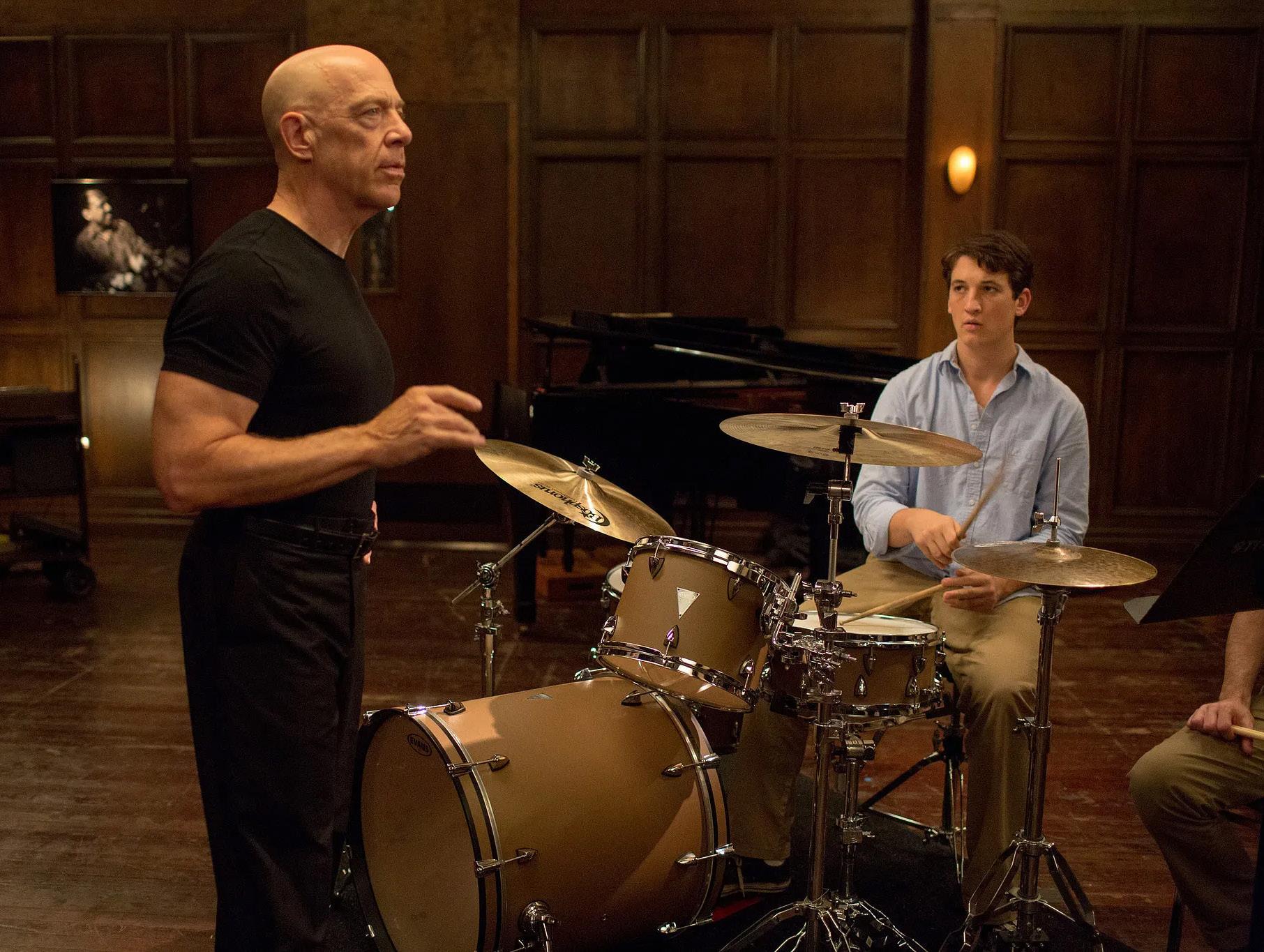
The movie Whiplash , released in 2014 and directed by Damien Chazelle, is a must-watch. It explores the story of a drummer named Andrew Neiman who is working to become one of the greatest jazz musicians of all time. Andrew is very passionate about drumming, practicing for hours every day to get better. While attending a top music school in New York City, Andrew meets Terence Fletcher, a strict instructor. Fletcher notices Andrew’s talent and invites him to join the school’s top jazz band. This is when Andrew notices that Fletcher is different from a typical professor. Fletcher yells, insults, and pushes his students to their limits because of his belief that pressure creates success. Throughout the movie, Andrew struggles emotionally and physically to meet Fletcher’s high standards and to prove his worth.
One of the themes in Whiplash is
SHANTI SWADIA (V)
The Sound and the Fury by William Faulkner is not the type of book you can just sit down and read straight through without thinking. It requires attention, patience, and a willingness to be confused for long stretches of time. I went into this novel expecting a classic Southern family story, but it quickly became clear that Faulkner was subverting the reader’s expectations. The book follows the Compson family, but it is told through four different sections, each with its own narrator and style. The first section, told by Benjy, is probably one of the most confusing chapters in literature I have ever read. Time jumps around without warning, scenes shift mid-paragraph, and memories can interrupt the present at any moment. For example, a simple image like Benjy's sister, Caddy, climbing a tree suddenly
Whiplash by Damien Chazelle
the cost of ambition. Andrew sacrifices his relationships, time, and mental and physical health to be the best musician he can be and try to live up to Fletcher’s standards. Throughout the movie, Andrew continuously breaks down from the pressure and the challenges he faces, showing the pain and struggle on his journey to achieve his dream. The best scene, in my opinion, is at the end of the movie, where Andrew finally takes control of his journey and shows his true potential. The scene gives the viewers a sense of satisfaction when Andrew finally accomplishes his goal at the most important and challenging performance of his life.
Overall, Whiplash is a powerful movie that shows that it takes ambition, pressure, and hard work to achieve greatness. Now, think of a passion you have where you could do whatever it takes to be the greatest at it. Whiplash shows a new perspective on just how far you could go to achieve a dream.
The Sound and the Fury
pulls Benjy across years of memory without any transition, leaving the reader to figure out where and when the scene is happening. It is frustrating and disorienting, but it also forces the reader to pay closer attention than they normally would.
What makes this book stand out is how each section reflects a different way of thinking. Benjy’s section is entirely sensory, built on sights, sounds, and associations rather than logic. Quentin’s section is fragmented and obsessive, revealing how his mind is trapped in cycles of guilt and anxiety. Jason’s section is bitter and angry, shaped by resentment and self-interest. The final section shifts to a more external perspective, which feels like a relief after everything that came before.
At the center of all of this is the Compson family’s decline, and much of it revolves around Caddy. Even though she never narrates a section herself, Caddy is arguably the most
important character in the novel. Each brother constructs a different version of her based on his own needs and insecurities. For Benjy, she represents comfort and stability. For Quentin, she becomes tied to his rigid ideas about honor and purity. For Jason, she is a source of anger and blame. Because we never hear directly from Caddy, she exists only through these distorted perspectives, which suggests that memory is not objective but shaped by emotion and bias. In that sense, Caddy is a symbol of how people reshape others to fit their own narratives.
That being said, this is not an easy or universally enjoyable book. It can feel slow, confusing, and even repetitive. If you prefer clear plots and straightforward storytelling, this will probably frustrate you. There is no clean narrative arc, no simple resolution, and no moment where everything suddenly makes sense. Even by the end, important

details about the family’s history and motivations remain unresolved.
But maybe that is the point. Faulkner captures how people actually experience time, memory, and emotion. Life is not linear, and neither is this novel. The structure of the novel reflects that messiness.
Reading this book has also urged me to ponder what it means to “understand” something. Do you need to catch every detail for a book to be meaningful, or is it enough to feel something while reading, even if you cannot fully explain it? There were moments in this novel that I did not completely understand, but they still stuck with me. Caddy, standing in the rain, muddy and disheveled, is a symbol of the family unraveling. Quentin’s fixation on clocks and his attempt to break them reflect his inability to escape time. Benjy’s repeated memories of loss, especially tied to simple sensory details, make certain moments feel powerful. Overall, The Sound and the Fury is not a book I would recommend to everyone. It requires effort, and it will probably confuse you. But if you are willing to work through that confusion, it offers a reading experience that feels completely different from most novels. It forces you to engage with literature more deeply, and that is exactly what makes it worth reading.

Photo
Complex French Desserts (Made Way Less Complicated)
French pastries and desserts are infamous for their difficulty. Macarons require complex techniques and specific environmental conditions; otherwise, you’re left with hollow or cracked shells. A croquembouche, whose name is probably as hard to pronounce as the dessert is to make, requires piling puff pastries into a tall tower and handling hot caramel. Here are a few tips, tricks, and shortcuts to turn anyone into a seasoned french pastry chef without having to go through significant amounts of training.
1. Macarons: Ah yes, macarons. My favorite dessert to mess up ten
times before finally, finally nailing down the most tender, crispy, and smooth macaron shell. No wonder 12 macarons cost 20 or 30 dollars. The difficulty comes from the macronage, the technique of folding the dry ingredients into the wet until the mixture becomes smooth and lavalike. Too little folding results in lumpy, cracked shells, while over-folding creates flat and runny batter. The trick is patience and practice. Once the batter becomes shiny and flows off the spatula with a characteristic lava texture, you’re ready to pipe. Drying and tapping out excess air bubbles in the macaron shells is also a crucial part of the process and will help lead to your success.

2. Croquembouche: The croquembouche is honestly a very impressive dessert that one could make for a fancy dinner party, and frankly, it’s not too complicated. Traditionally, to make croquembouche, you have to become a master in choux pastry, pastry cream, sugar work, and artistic precision. These are all skills that take years to become familiar with. However, if you’re lazy but looking for something that can impress a crowd, look no further than premade mini cream puffs and a bag of Werther’s originals. Now, all you have to do is coat each puff in the caramel and slowly stack them into a tower. Then, finally, drizzle caramel in a circle around your beautiful creation. And you’re done!

3. Entremet Cakes: Have you ever seen those beautiful, multi-layered and multi-textured dessert cakes?
They’re actually called entremets, derived from the word entremes, which means “between dishes.”
An entremet typically consists of several textural and flavor elements.
It starts with a layer of cake — usually sponge or biscuit joconde. From there, other layers such as fruits or ganache are added, and then the entremet is surrounded by a light and airy mousse. Finally, a mirror glaze is poured on top, and decorative pieces (such as chocolate) are added to the cake.
For any home baker, the cake layer can simply be a regular yellow sheet cake layer from a Betty Crocker cake mix. Next, for the crunch layer, while most pastry chefs use something called feuilletine, you can just take graham crackers or nilla wafers and
crush those up. For an additional textural layer, you can use homemade or store bought caramel sauce, or make ganache, which is just hot heavy cream (microwave works!) poured over chocolate chips, mixed, then cooled. As for the mousse, which usually requires tempered eggs and gelatin, you can use any remaining heavy cream and chocolate from the ganache, but just add additional heavy cream to keep the characteristic fluffy texture. And the mirror glaze can also just use chocolate and heavy cream! As for the chocolate decorations, chocolate shavings or no decoration at all work perfectly. Ultimately, the hardest part of these beautiful French desserts is the sheer amount of time they each take. However, that shouldn’t deter you from making one of these cakes for your next big event, or to impress someone special!

Nothing Stays In
If there’s one defining trend of 2026, it might actually be the inability to stick to just one. Every few weeks, there’s a new pattern, a new aesthetic, a new micro-style that suddenly feels like “the thing,” until it doesn’t. One minute it’s clean, minimal basics; the next it’s loud prints and layered accessories. Instead of a clear direction, fashion right now feels like a constant search for what’s next.
This obsession with the “new” isn’t random. The speed of social media fuels new trends, but also quickly burns them out. Platforms like TikTok and Instagram push aesthetics into the spotlight almost overnight, but that same visibility shortens their lifespan. Once something becomes too recognizable,
it starts to feel overdone. The result is a cycle where originality is always just out of reach, because the moment a style is widely adopted, people are already moving on.
You see this play out especially in patterns. Leopard print has its moment, then suddenly it’s stripes, then polkadots, then something completely unexpected. No single look has dominated for long enough to define the year yet. Instead, what stands out is the constant rotation itself. It’s not about what is trending, but how quickly trends replace each other.
There’s nothing inherently wrong with experimenting. In fact, trying different styles can be a way of figuring out what actually feels right for you. But the pressure to always be “on trend” can turn
that exploration into something closer to performance. When every outfit fights to keep up with an invisible timeline, style stops being expressive and becomes reactive. At school, this pressure is subtle but real. Outfit choices can start to feel less personal and more responsive to the internet the night before, to what’s suddenly “in,” to what hasn’t been worn yet. The result is an unspoken competition to stay ahead of the cycle, even though the cycle itself is still accelerating. Ironically, in trying to stand out, people often end up dressing more similarly than they realize.
What’s interesting, though, is that this constant change is starting to create its own backlash. There’s a growing awareness that always chasing the next thing is exhausting and not rewarding. When everything is new all the time, nothing actually feels new. Trends lose their impact because they’re replaced too quickly to actually mean anything.


That’s why some of the most distinctive styles right now aren’t the ones changing every week. They’re the ones that stay consistent. Whether it’s sticking to neutral basics, leaning into vintage pieces, or wearing the same silhouettes on repeat, there’s something noticeably confident about not constantly switching in the midst of these fast-paced trends.
This doesn’t mean ignoring
trends completely, but using them differently, not as rules to follow, but as options to choose from. Instead of asking what’s next, the better question might be what actually lasts. Which pieces do you keep reaching for, even after the trend fades? Which outfits feel natural and not forced? Fashion in 2026 isn’t defined by a single pattern, color, or aesthetic, but by the constant shift from one thing to another. But in the middle of all that motion, there’s an opportunity to step back, to stop chasing every new style and start paying attention to what actually feels like your own.
AMELIA LIU (V)
SARAH DIAO (III)
May Crossword
Word in the Halls: Surviving Finals Edition
“Enjoying every moment” - Caroline Ouyang (III)
“Studying, followed by lots of rest and swimming” - Zoe Snider (V)
“Playing Roblox” - Max Li (V)
“Sleeping a lot” - Ariella Allariez (V)
“Binging my favorite TV Show” - Riya Reddy (IV)
“Eating tiramisu” - Fiona Rovito (V)
Photo