1
FOUNDED 1895 • THE NATION’S OLDEST COUNTRY DAY SCHOOL NEWSPAPER
Wednesday, December 17, 2025
Volume CLII — No. II
record.pingry.org
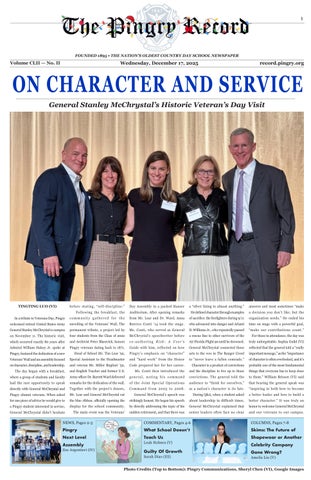
ON CHARACTER AND SERVICE General Stanley McChrystal’s Historic Veteran’s Day Visit
TINGTING LUO (VI)
before stating, “self-discipline.”
Day Assembly in a packed Hauser
a “silver lining to almost anything.”
answers and must sometimes “make
Following the breakfast, the
Auditorium. After opening remarks
He defined character through examples
a decision you don’t like, but the
In a tribute to Veterans Day, Pingry
community gathered for the
from Mr. Lear and Dr. Ward, Anna
of sacrifice: the firefighters during 9/11
organization needs.” He ended his
welcomed retired United States Army
unveiling of the Veterans’ Wall. The
Butrico Conti ‘14 took the stage.
who advanced into danger and Arland
time on stage with a powerful goal,
General Stanley McChrystal to campus
permanent tribute, a project led by
Ms. Conti, who served as General
D. Williams Jr., who repeatedly passed
“make our contributions count.”
on November 11. The historic visit,
four students from the Class of 2022
McChrystal’s speechwriter before
a rescue line to other survivors of the
For those in attendance, the day was
which occurred exactly 80 years after
and Archivist Peter Blasevick, honors
co-authoring Risk: A User’s
Air Florida Flight 90 until he drowned.
truly unforgettable. Sophia Guild (VI)
Admiral William Halsey Jr. spoke at
Pingry veterans dating back to 1871.
Guide with him, reflected on how
General McChrystal connected these
reflected that the general told a “really
Pingry, featured the dedication of a new
Head of School Mr. Tim Lear ‘92,
Pingry’s emphasis on “character”
acts to the vow in The Ranger Creed
important message,” as the “importance
Veterans’ Wall and an assembly focused
Special Assistant to the Headmaster
and “hard work” from the Honor
to “never leave a fallen comrade.”
of character is often overlooked, and it’s
on character, discipline, and leadership.
and veteran Mr. Miller Bugliari ‘52,
Code prepared her for her career.
Character is a product of convictions
probably one of the most fundamental
The day began with a breakfast,
and English Teacher and former U.S.
Ms. Conti then introduced the
and the discipline to live up to those
things that everyone has to keep close
where a group of students and faculty
Army officer Dr. Barrett Ward delivered
general, noting his command
convictions. The general told the
to them.” William Brisson (VI) said
had the rare opportunity to speak
remarks for the dedication of the wall.
of the Joint Special Operations
audience to “think for ourselves,”
that hearing the general speak was
directly with General McChrystal and
Together with the project’s donors,
Command from 2003 to 2008.
as a nation’s character is its fate.
“inspiring in both how to become
Pingry alumni veterans. When asked
Mr. Lear and General McChrystal cut
General McChrystal’s speech was
During Q&A, when a student asked
a better leader and how to build a
for one piece of advice he would give to
the blue ribbon, officially opening the
strikingly honest. He began his speech
about leadership in difficult times,
better character.” It was truly an
a Pingry student interested in service,
display for the school community.
by directly addressing the topic of his
General McChrystal explained that
honor to welcome General McChrystal
General McChrystal didn’t hesitate
The main event was the Veterans’
sudden retirement, and that there was
senior leaders often face no clear
and our veterans to our campus.
NEWS, Pages 2-3
COMMENTARY, Pages 4-6
COLUMNS, Pages 7-8
Pingry
What School Doesn’t
Skims: The Future of
Next Level
Teach Us
Shapewear or Another
Assembly
Zoe Argentieri (IV)
Leah Holmes (V)
Guilty Of Growth Sarah Diao (III)
Celebrity Company Gone Wrong? Amelia Liu (V)
Photo Credits (Top to Bottom): Pingry Communications, Sheryl Chen (VI), Google Images
THE PINGRY RECORD SCHOOL NEWS DECEMBER 17, 2025
2
LGBTQ+ History Month Assembly SHANTI SWADIA (V) On October 29, the Upper and Middle Schools united in Hauser Auditorium for the annual LGBTQ+ History Month Assembly to celebrate the history of queerness and queer activism in the United States. LGBTQ+ History Month was created in 1995 and is held in October, with National Coming Out Day on October 11. The assembly was a product of the combined efforts of faculty and students, featuring presentations, poems, singing, and more. As students trickled into Hauser, songs by LGBTQ+ artists filled the auditorium, including “Sailor Song” by Gigi Perez, a popular artist who identifies as lesbian, and “Not Strong Enough” by boygenius, a band with many members who identify as LGBTQ+. To begin, Middle School English Coordinator Ms.Lori Esmond read a student-authored poem titled “Womanhood,” which gives voice to someone whose womanhood is questioned by others. Next, the projector showed a video of Dean of Student Life Mr. Alan Van Antwerp reminiscing about Stephen Sondheim, an American composer and lyricist who revolutionized Broadway musicals, and who identified as gay. Afterwards, Upper School English teacher Dr. Barrett Ward spotlighted Virginia Woolf, one of the most influential and inventive authors of her time, who wrote
scenes of lesbian eroticism.
Jolly presented on Alan Turing,
1973, homosexuality was listed
life in all of its amazing diversity.
Dr. Ward then presented on his
the brilliant mathematician and
as a “personality disorder.”
After Mrs. O’Mara’s presentation,
former LGBTQ+ student in the
logician who played a crucial part in
She spotlighted two queer
Upper School English Teacher
military, Katie Wilson, who went on
the Allied victory over Nazi Germany
individuals, Noah Adams and Dr.
Mr. Tom Keating read an untitled
to graduate and become one of the
in WWII. Turing was also gay and,
Anneliese Singh, who are queer
poem, also written by a student,
very first female Infantry Officers
unfortunately, faced persecution
advocates for transgender rights.
which detailed queer love and
in the 82nd Airborne Division.
for his sexuality in 1950s Britain.
Next, Upper School Science Teacher
the limits of the law, insisting
After Dr. Ward’s insights,
Visual Arts Teacher Ms.
Mrs. Deirdre O’Mara presented
that legislation should not decide
Middle & Upper School Latin
Nancy Ring shared five LGBTQ+
on Rachel Carson, an American
who someone loves or marries.
Teacher Ms. Margaret Kelleher
artists to celebrate, including
marine biologist and writer whose
To close off the assembly, Saige
presented on the Ancient Roman
Ester Hernandez, Simone Leigh,
book, Silent Spring, changed the
Smith (IV) sang Billie Eilish’s “The
Emperor Hadrian, who had a
Mickalene Thomas, and more.
world. Carson shared a deep bond
Greatest,” earning thunderous
lifelong homosexual relationship
Following Ms. Ring’s presentation,
with Dorothy Freeman in a world
applause. Thank you to the
with a man named Antinous.
AP Psychology Teacher Ms. Lauren
that didn’t protect her right to exist
students and faculty who helped
Next, Computer Science
Kelly shared the psychological
as her fullest self. However, she
make this assembly a success!
Department Chair Dr. Marie-Pierre
side of sexuality and how, until
was a woman who protected all
Club Fair participated in this event. By the
previewed spring performances,
end of the first half-hour, many
while competitive teams shared
On October 1, the Upper School
leaders reported long interest lists
tournament dates and schedules.
buzzed as students packed into Hyde
and nearly empty munchkin boxes.
Some underclassmen used the
and Watson Gym for this year’s Club
This year’s Club Fair emphasized
event to map out potential programs
Fair, where rows of trifolds, posters,
discovery as well as recruitment.
to join, while some presented their
and demonstrations showcased
Clubs explained which problems
own clubs to engage listeners.
the variety of student life. More
they’re trying to solve, whose voices
Similarly, upperclassmen signed
than 150 student-led organizations
they hope to amplify, and which skills
themselves up for clubs they were
signed up for the event, including
members will build. Academic teams
a part of in prior years, joined
academic teams, affinity groups,
highlighted how beginners can get
new ones, and introduced their
publications, service initiatives, and
started without prior experience.
own. Advisors stationed near
special-interest clubs. They ranged
Service groups outlined concrete
the exits reminded students to
from highly technical to pure fun.
projects and partnerships beyond
pace themselves, prioritize a deep
More than 400 students
campus. Creative organizations
interest in a club over quantity, and
SHANTI SWADIA (V)
actually attend the first meetings. The fair also served to demonstrate the school’s evolving interests. New tables this year included Piano with a Purpose and Pingry Artificial Intelligence Club, while several longrunning organizations presented new initiatives and missions. As sign-up sheets circulated, it became clear that student life
was only as strong as the people
the passionate student body
who participated in it. Anna
continues to foster community.
Ojo (V) enthusiastically noted,
For anyone who missed a table
“I loved the Club Fair because
or signed up for too many clubs,
it made me realize how much
most clubs will host introductory
the student body is engaged
meetings over the next two weeks.
with this school. I also enjoyed
The Club Fair showcased
eating the snacks and candy!”
that there is something in the
The year’s projects, performances,
Pingry community for everyone
and service days are just beginning,
— whether you’re competing on a
brought to life by the students
national stage, mentoring younger
who stepped up to lead. The
students, writing and performing,
Club Fair was a reminder of how
or just trying something brand new.
Photo Credits (Top to Bottom): Pingry Communications
THE PINGRY RECORD SCHOOL NEWS DECEMBER 17, 2025
3
Pingry Next Level Assembly ZOE ARGENTIERI (IV)
of 2026 who are committed to
they brought to the team culture
playing sports at the collegiate
and the playing field. While these
On Friday, November 14,
level. The assembly started with a
messages were personalized to
families, students, faculty,
speech from Director of Athletics
each athlete, a common theme
and staff gathered in Hauser
Carter Abbott, who highlighted
of dedication and leadership was
auditorium for the annual Next
the sacrifices each athlete and their
present. Each athlete signed a
Level Assembly. The assembly
families made to reach this point.
letter of intent and was presented
honored 17 members of the class
She emphasized the discipline
a poster that included photos of
required to balance schoolwork
moments from their high school
with athletic commitments,
athletic career, as well as a gift
a challenge that reflects each
box to recognize their success.
student’s dedication to their sport.
Out of these 17 athletes,
Mrs. Abbott also thanked the
seven of them will compete in
families for their support and for the
Division I programs, including
time and resources they invested
three Ivy League schools.
to help the athletes succeed.
The Pingry community is so
Then, as each athlete walked on
proud of these athletes and is
stage, Mrs. Abbott shared a message
excited to see what they do at
from their coach describing what
the next level! GO BIG BLUE!
Buttondowns Assembly AMELIA LIU (V)
far in the Buttondowns, Hayden
a magical serum that could enhance
Chiang (III) explained that there are
the musical abilities of the members
On November 21, Upper School
a “lot of elements” he enjoys, such as
in the group. The seniors conducted
students attended the Buttondowns
“making the movie, the nice seniors,
several experiments to perfect the
Assembly in Hauser Auditorium.
and the sense of community there.”
serum, incorporating questionable
The Buttondowns, Pingry’s male
The assembly began with the
ingredients until one of their test
a cappella group, performs every
iconic Buttondowns movie, which
subjects obtained a “majestic” singing
year to showcase their talents as
is written, edited, and produced
voice. Over the course of the rest of
singers, producers, and actors. When
entirely by members of the group.
the movie, a group of Buttondowns
asked to reflect upon his time so
The film focused on the pursuit of
went on a hunt to find the serum, which was hidden among the woods. When they finally procured it, they realized that the serum had actually
trademark dress shirts and lack of
the third song, Langer was joined
expired six months prior and that it
shoes to begin the performance.
by fellow senior Aadi Stewart, and
wouldn’t work. In true Buttondowns
The crowd was treated to a series
the two sang “The Way You Look
fashion, senior Cole Langer explained
of songs, starting with “Sway” by
Tonight” by Frank Sinatra. The
that the “real serum was the friends
Michael Bublé, arranged by and
assembly ended with a captivating
we made along the way.” With
featuring Langer. During the song,
performance of Sean Kingston’s
that, the Buttondowns began to
the Buttondowns each threw a rose
“Beautiful Girls” by Overdeck. It
run around school, concluding yet
to the enthusiastic crowd. Next,
was the best way to send students
another crowd-pleasing movie.
senior Will Overdeck enchanted the
and faculty off into a well-deserved
After the film, the Buttondowns
audience with a beautiful rendition
week of Thanksgiving Break, and it
ran down from the stairs in their
of “Yesterday” by the Beatles. For
will certainly be well-remembered.
Joseph Napolitano, Mr. Alan Van
and behind the scenes) and win
crew on stage-operating scenery)
Antwerp, Ms. Stephanie Romankow,
EVERY night. There are hundreds
and I’m very proud of them.”
and Dr. Charlotte Madere led the
of small details that must go
Before the paid performances,
students to the play’s success.
according to plan, and moment-to-
the cast and crew had a community
When asked what most
moment critical thinking, problem
performance for senior citizens,
contributed to the play’s success,
solving, and communication that
which a few drama classes also
Mr. Napolitano, one of the directors,
happens to create a performance
viewed. There were three paid
responded, “The entire cast and
like The Grapes of Wrath. You
evening shows, all of which
crew’s teamwork. Our group of
have to be locked-in, listening,
had high attendance rates, so
dedicated students are indeed a
reacting, and ready to score;
thank you to all who participated
team that must go out (on stage
they were (particularly our run
in or attended the play!
Fall Play CORINNE WILSON (III)
are forced to leave their farm, the
and even a truck that the actors
Joads travel to California, facing
drove onstage. Preparation for the
This year, Pingry’s fall play,
hardships and obstacles along the
production began in September.
The Grapes of Wrath, was a
way. This is a more mature story
The tech crew built and painted
resounding success, thanks to the
compared to some of the plays
fences and set pieces, including
hard work of the actors and tech
Pingry has done in the past, but
a fully functional truck, while
crew. Written by John Steinbeck
the crew and actors executed it well.
the actors diligently learned and
and adapted by Frank Galati, the
All of the actors and tech crew
rehearsed their lines and added
play chronicles the journey of the
members brought this moving
a backstory to their characters.
Joads, a family living in Oklahoma
story to life, using special effects,
The company included more
during the Dust Bowl. When they
acting techniques, costumes,
than 40 dedicated members, and it showed in the quality of the play! Upper School faculty members Mr.
Photo Credits (Top to Bottom): Pingry Communications
THE PINGRY RECORD COMMENTARY DECEMBER 17, 2025
4
Assembling Your Own Constellation find someone to imitate completely,
His very public fall could’ve been a
into a coherent body of wisdom. We
re d uc ing the c o m p le x w ork of
story of ruin. Instead, it taught a rarer
can engage in intellectual redemption
building character to the simple
virtue: accountability. In his refusal
without litigating his entire past.
act of copying a finished product.
to offer excuses, he demonstrated,
This process isn’t unique to a
True influence isn’t a single
with almost surgical precision, how to
general. It’s how we can engage with
North Star. The world’s true leaders,
own a catastrophic failure. We should
anyone. You don’t have to think
innovators, and artists learned to
take this lesson, separate it from the
your teacher is the coolest person
navigate by assembling their ethos
controversy that necessitated it, and
ever to learn how he structures an
from disparate points of light.
see what integrity looks like when
argument. You don’t have to be best
This perception allows us to
General Stanley McChrystal’s recent
everything is on the line. In the years
friends with the star athlete to adopt
learn from complex, flawed, and
visit offered many lessons. We’re
that followed, he exemplified the
her disciplined practice routine. You
surprising places without requiring
not asked to approve of his entire
skill of synthesis, rebuilding a life of
can even learn from a super popular
total allegiance. It also dismantles the
record or to see his life as a seamless
purpose by integrating all experiences
influencer, not by wanting their life
paralyzing pressure of being a perfect
picture. We’re presented with
but by noticing how they’ve built a
“role model” ourselves. Our task should
We are taught to look for role
separate points of brilliance within it.
community.Think about Taylor Swift.
be to live in a way that might offer, even
models in heroes, singular figures
One point is the strategist, who
A songwriter can study her lyrical
in isolation, a single point of light for
whose paths of ascent we can follow.
architected a relentless form of warfare.
storytelling without idolizing every
someone else’s constellation. So, stop
Look at the visionary entrepreneur,
We can study that model of intellectual
career move. An entrepreneur can
wracking your brain for a single hero
the flawless leader, or the star athlete,
agility and networked leadership
investigate her brand evolution and
to copy. Let’s start with the much
and follow their blueprint for success.
without endorsing the grueling
strategic control of her own work
more interesting work of assembling
But this search is a trap. It makes
personal austerity that accompanied
without enjoying her music. A “role
ourselves, stemming from the wisdom
you feel like a failure if you can’t
it. Then, there is the leader in defeat.
model’s” value is not their wholeness,
to select and the courage to combine.
TINGTING LUO (VI)
but their specific, usable insights.
What School Doesn’t Teach Us LEAH HOLMES (V) I’m sure that at some point, we have all been told that Pingry provides us with an excellent education, evident in the
rigor of our courses, our standardized test scores, and what many of us consider paramount, the colleges we attend. But when we break it down, what exactly are we being educated
in? We learn math, sciences, and humanities to gain knowledge in those areas, but is that truly an education? The Oxford Dictionary offers two definitions for the word education. The first: the process of receiving or giving systematic instruction, especially at a school or university. This is the education that we are most familiar with, receiving instruction based on plans that have been curated for us. However, I find the second definition more interesting: an enlightening experience. While some may have had such moments, for most of us, the educational system does not regularly provide enlightening experiences. Does this mean that Pingry is offering us a bad education? No, it does not. It means that educational systems and institutions, as we know them, need to be reimagined. But how could that be accomplished? The first part of this process is to identify the problem: what is it that educational systems fail to teach
us? Obviously, the list could go on and on, but here are my top two: an ability to learn real-world skills, and the ability to fail and learn from it. Step two: propose solutions. Instead of solely emphasizing tests, focus on learning how to manage money, write resumes, and function in the workplace. Instead of waiting for ISPs and colleges to provide internships, students should learn from the best teacher there is: lived experience. And for the other problem, in an environment like Pingry, students face so much extrinsic and intrinsic pressure to get good grades and do well in school that we forget that good grades do not equal happiness or future success. We spend so much time working to prevent failure that we become less equipped to confront it when we inevitably face it. While I believe objective assessments are necessary to ensure students are keeping up with their work, they should not be the largest, or sometimes the only,
parts of our grades, as that reinforces the incredibly flawed idea that failure is not an option. If we are not able to learn to come back from failure now, how will we cope with it later in life, when the stakes are inevitably higher? Step three: Put the plan into action. Now, this part of the plan is not straightforward. Indeed, some parts of this plan could be accomplished, but it would require a large group effort at a high level, which, of course, begins with recognizing the problem that while school prepares us for college-level coursework, it does not prepare us for the real world and overcoming inevitable adversity. We need more freedom in school to pursue our interests, not just follow the educational framework most schools in this country follow. Only then will we be able to learn more about ourselves through experience and adversity, which will bring about the enlightening experience we all need and clarity and purpose in our lives.
Life Lessons in Driving AMELIA LIU (V) Ever since I received my learner’s permit, one of my parents has always been in the passenger seat whenever I drive somewhere. At first, I thought they were just there to make sure I don’t do anything reckless. But somewhere between drives to Costco and early-morning trips to school, I realized my parents weren’t just teaching me how to drive. They were teaching me how to navigate life. Growing up, I always thought driving was like Mario Kart 8 — a game where you can go as fast as you can, bumping into Bowser and Donkey Kong to get ahead. The controls for Mario Kart 8 are simple: just press A to go fast, navigate using the mini joystick with your left hand, and press ZR if you want to drift like a pro. To drive a car, on the other hand, requires a little bit more concentration and precision. Understanding the controls is relatively simple, but instead of hitting other cars to go faster, you have to drive strategically in order to anticipate dangerous
situations or pass slower cars. Most importantly, the cars around you aren’t controlled by a computer. They’re controlled by humans and you have no way of knowing whether or not they’re having a bad day. That’s the first piece of driving advice my mom gave me: always be ready for unexpected movement, and keep your foot near the brake at all times. This translated to the life lesson of embracing the present and not letting the past dictate the future, because anything can happen at any moment. Similarly, before I even started driving, my mom would always give me tips for when we got into tricky situations. Every time a car overtook her or sped past her for whatever reason, she would calmly maintain the same speed, sometimes even going slower. I was confused, because why didn’t it bother her that someone just rudely cut her off? Every time, she would smile, and explain to me that “there is no need to rush. We all stop at the same red light eventually.” And every time she said that, our car and the car that had just passed us would
end up side by side, stopped by the same red light. Watching my mother drive taught me that there’s no need to compare ourselves to those who are speeding ahead or boasting their great achievements. Just like on the road, we each have our own pace and path, and at the end of the day, we’ll reach where we are meant to be. My dad, on the other hand, is an expert at calming me down whenever I get too stressed on the road. In the days after my required driving lessons, I developed the habit of always checking in the rearview mirror to make sure I wasn’t holding anyone up because I was driving too slow. Every time I saw a long line of cars forming behind me, I tended to speed up really quickly, afraid that the other drivers were calling me too slow. Once, when a driver honked at me for not reacting quickly enough at a green light, I panicked and hit the gas too hard, nearly swerving into the opposite lane. My father, seeing that my panicked actions could cause even more danger to others on the road, reminded me to stop caring about the other drivers. He instructed me
to keep my eyes on the road, paving my own path without worrying about what others think. As I began to drive more frequently, I noticed that his advice was working, not just on the
road, but in life. He taught me that it is okay to move at my own pace, because the path is wide enough for everyone to find their place on the road.
Photo Credits (Top to Bottom): Serena Shi (III), Google Images, Anna Ojo (V)
THE PINGRY RECORD COMMENTARY DECEMBER 17, 2025
5
A Modest Proposal for a Little Privacy
SIMRIN SHAH (VI) In an era that celebrates openness, privacy can feel almost subversive. Public life increasingly rewards those who explain themselves fully, through personal statements, touching childhood vignettes, and emotional
transparency. Writing in particular, often seems to demand unfiltered self-disclosure, as though sincerity can only be proven by revealing one’s inner life. While this culture of openness is admirable in theory, it can be exhausting in practice. Anticonfessionalism offers a necessary corrective. The stance argues that writing and conversation improve when we refuse to rely on personal experience to make a point. It shifts attention from the individual to the idea, a distinction that is not trivial. It determines whether we judge an argument by its reasoning or the emotional appeal attached to it. A confessional default runs the risk that dissent becomes too
delicate and that challenging a claim automatically challenges a person as well. Anticonfessionalism, on the other hand, does not necessarily reject transparency, but rather refuses to treat personal experience as mandatory evidence for an argument. Essentially, a well-made argument should be able to stand without biographical backing. There is no requirement for every opinion to have a memoir attached. Arguably, the biggest advantage to the anticonfessionalist approach is its ability to strengthen intellectual flexibility. When one’s identity is not tethered to every statement, it becomes easier to reconsider, adjust, or even reverse a position, allowing
for personal growth. A person is now allowed to change their mind without feeling they have betrayed themselves. None of this means that personal experience has no value. It has tremendous power when used deliberately. It brings humanity through its self-expression and emotional nakedness. However, when confession becomes an expected currency of discourse, we lose the ability to engage with the idea apart from the individuals presenting them. Arguments begin to be treated as extensions of identity, rather than contributions to a shared conversation. Anticonfessionalism simply restores balance by keeping the “I” in proportion and placing
emphasis on the thought itself. To an extreme degree, it can take the self out of a piece of art entirely. While this may be controversial, as identity and self-expression often constitute art entirely, anticonfessionalism can serve a purpose in the development of ideas. It extends the reach of an author’s work from merely internal reflection to external, real world application. In a culture that often equates personal revelation with honesty, it is worth remembering that clarity can emerge from restraint. The unseen can still be sincere. Most importantly, there is a strength in choosing what to reveal and a wisdom in choosing what to keep.
Guilty of Growth SARAH DIAO (III) High school students are afraid to be inconsistent. In an age where influencers are dragged for revising old opinions, teenagers have absorbed a troubling message: evolving is embarrassing. High school, supposedly the place where our thinking should stretch and shift the most, has instead become a stage where we perform consistency at all costs. One reason for this shift is the rise of “consistency culture,” the idea that the best stance is one that never shifts. With the rise of the internet, changing your mind is often reframed as hypocrisy. Screenshots live forever and group chats archive every offhand comment. If you supported a now-unpopular idea or expressed an opinion that no longer reflects who you are, the evidence can be resurrected instantly. In this environment, teenagers begin to interpret flexibility as inconsistency. A comment you made as a joke can be brought up in an argument months later. A political stance you held
before taking AP Government can be used to discredit you. As a result, students cling to positions because abandoning them feels socially dangerous. A freshman makes a bold claim in a humanities class, and then spends their entire high school career defending it — not because it still makes sense, but because it became engrained into their reputation. Meanwhile, real-world issues are becoming more complex. Climate science is updating rapidly. Economic theories are shifting as inflation patterns change. Even nutrition guidelines, once stable, are constantly revised as new research emerges. If adults in these fields are allowed to adjust their positions based on new evidence, why are students punished for doing the same? This cultural rigidity actively undermines the purpose of education. The entire process of learning rests on the assumption that new information shapes us. If you take a science course and don’t revise some of your beliefs about the world, something has gone wrong. If you read literature and your
perspective remains identical, you’re not actually engaging with the ideas. Even socially, changing your mind is a sign of emotional intelligence: realizing you misjudged someone, reconsidering a rumor, or rethinking a conflict is all a part of maturing. And when people feel socially punished for reconsidering their views, they stop listening. They double down on bad arguments rather than admit they’ve learned something new. They choose the safety of static opinions over the vulnerability of intellectual honesty. The solution to this rigidity is surprisingly simple: we must start praising rethinking. This means creating classroom environments where students are encouraged to revise their opinions without embarrassment. It means normalizing the sentence “I used to think that, but now I think this.” It means treating intellectual evolution as a strength, a sign of engagement, curiosity, and courage. And socially, it means refusing to weaponize old comments as if they define someone forever. Changing your mind is not a flaw. It’s
not indecision. It’s not inconsistency. It is, in many ways, the clearest evidence that learning is happening. If high school is supposed to shape
our minds, then we should not fear the moments when our minds actually change. Instead, we should recognize them for what they are: growth.
Does Soccer’s Future Lie With Video Assistant Referees? RYAN DICKS (IV) As I have watched soccer lately, a major topic of debate has been the presence of two additional referees in front of monitors, who critique and change calls that the officials on the field make in important moments. Video Assistant Referees, better known as VAR in the soccer world, were meant to fix the sport’s biggest problem: human error. Instead, they have created a new challenge between precise decisions down to the millimeter and inconsistent refereeing. VAR was first introduced in the spring of 2018, before the World Cup, which took place in Russia. It was presented as the “future of refereeing” that would minimize most of the errors taking place. The first statement from FIFA was that these “virtual officials” would only intervene on “clear and obvious errors” from the on-field referee. Because FIFA didn’t want to interrupt the flow of the game, they stated that VAR could only be used to alter penalty decisions, possible red cards, and fouls and offsides in
the build-up to a goal. Six years prior to the introduction of VAR, FIFA had succeeded in the creation of goal-line technology: placing cameras and sensors on the goal posts to accurately receive information on whether the ball crossed the line. This happened in real time, and the information was sent to the referee’s watch. Fans responded in many different ways after the first trials of VAR. Some praised the new system, believing it would end years of controversy over missed penalties or goals that should not have stood. Many thought of some of the most famous and debated goals of all time, such as Diego Maradona’s “Hand of God” goal in the 1986 World Cup against England, which Argentina went on to win. In contrast, Frank Lampard was on the opposite end of the spectrum. At the 2010 World Cup, his shot clearly crossed the line to equalize the match against Germany, but the referee did not see the goal. England went on to lose the match 4-1, dropping out of
the World Cup in the Round of 16. The more VAR becomes part of the game, the more it detaches the fans inside the stadium from the players in the game. Right
now, in the Premier League, fans are unaware of what is actually going on during these VAR reviews. All they are shown is a graphic on the video board
that says there is an ongoing VAR check and the general play they are looking at. Additionally, the time used for goal, penalty, and red card checks has begun to increase since the introduction of VAR, and players are suffering the consequences. A match between Tottenham and Chelsea in 2023 had a total of 12 minutes of VAR intervention in the first half alone. After a six-minute check for a red card on Tottenham player Christian Romero, two other Tottenham players suffered long-term muscle injuries. By the end of the game, five goals had been disallowed by VAR, and two red cards were issued. Watching this intense match myself, I felt frustrated and distracted as the flow of the game was continuously lost. How can we fix these issues before the World Cup comes to the United States next summer? The first step is transparency. Fans in the stadium
should not be left guessing during long pauses. Other sports, like rugby, let people hear the conversation between the referee and video officials. Soccer should follow that model so everyone knows what is happening and why. VAR also needs to return to its original purpose. If a call is not clearly wrong within a minute, it should stand. The referee on the field must regain authority, instead of every close play being slowed down and re-officiated from a booth. However, the VAR technology itself is changing too. Semi-automated offside, which is already used in the Champions League, uses tracking data and 3D mapping to make offside decisions faster and more consistent. This could remove the endless freeze frames and drawn lines that frustrate players and fans. If implemented correctly, it might allow offside calls to be accurate without stopping the match for several minutes. Soccer is a sport best played through emotion, flow, and skill. Technology should help to aid and improve the game, without stripping it of its identity.
Photo Credits (Top to Bottom): Sheryl Chen (VI)
THE PINGRY RECORD COMMENTARY DECEMBER 17, 2025
6
How Holden Would Feel Today
Do Statistics in Sports Really Matter That Much Anymore?
CAROLINE OUYANG (III)
ARJUN SHEKDAR (III)
He’d also feel lonelier, despite the rise
records, creating history, and having an
is now paying closer attention to detail.
all time season should win the award.
They’re more focused on who brings more
If Holden Caulfield were a teenager in
where digital connection is encouraged,
January is almost here, and while most
In fact, out of the last seven recipients,
to their team, especially in those critical
2025, he would flip out at the filtered,
with accessible notifications, group people are excited for the fresh start chats for every occasion, and even and all the New Year celebrations, I’m apps to track your friends’ locations most looking forward to something else. at all times. On the surface, it looks As a huge fan of the National Football like we’ve never been closer. But these League, I can’t wait to witness tools can just as easily make someone who will be crowned this like Holden feel frustrated, invisible, season’s most valuable and excluded. He understands these player. While thinking feelings intimately as he wanders about who’s name will be through New York, surrounded by written into NFL history this year, I thought back everyone else’s happiness while he feels to last year’s MVP race, lonelier than ever. It’s the same feeling between frontrunners you get when you see all your friends’ Lamar Jackson, the Bitmojis coming together somewhere quarterback of the on Snapchat, while you weren’t invited. Baltimore Ravens, and Teenagers today face even more Josh Allen, quarterback pressure. We’re told to start planning of the Buffalo Bills. the rest of our lives the moment we When you take a look step into high school. We need to at their statlines from the balance extracurricular activities, find regular season, it’s clear who your internships, build a strong résume, winner is. In the 2024-25 regular and chase perfect grades. There’s barely season, Jackson beat Allen in nearly any time left to enjoy being young. every single stat you could think of. He Holden barely knew what he wanted broke many records, both on the ground to do tomorrow, let alone in the next and through the air. So with this, surely decade. He’d be overwhelmed by all he won MVP, right? Wrong. After a long the expectations and talk of the future. and highly controversial voting process, What is striking is that Holden Allen came out on top, winning his first would feel the same way we teens ever award. When two candidates are do now: lonely, lost, nostalgic, and up for the same award, and the one stressed out. Although the world has who clearly excelled doesn’t win, that changed dramatically in the 70 years raises the question: Do statistics in since The Catcher in the Rye was sports really matter that much anymore? written, Holden’s story still resonates In most years, when a player has with many of us in 2025. Perhaps sensational numbers and performances we’re more like Holden than we’ve all throughout the season, they end up realized. And perhaps, we’re more winning the award. There’s absolutely like each other than we’ve realized. no denying that someone who’s breaking
five of them won due to their incredible
moments. Those fourth-down plays in
seasons when it came down to the
the final minutes against the undefeated
numbers. While this number in itself
teams, where a quarterback can run
demonstrates that
in for a touchdown, or those games
of digital messaging. We live in an age
curated, “phony” world we live in today. This character from J.D. Salinger’s The Catcher in the Rye would likely fold under the weight of social media, complicated relationships, and the immense pressure we teens face today. Modern life often encourages us to conform to what is popular and to fit into a superficial norm, leaving little room for individuality. Today, these norms and trends are more extensive than ever: the rise of skincare and fashion, often targeted directly at children and teens, pushes young people to conform to a single standard. Anyone who can’t meet said standard is made to feel like they’re falling behind. Holden would be disgusted by this pressure — he already cannot stand the idea of pretending to be someone he isn’t. Today, open any social media app and you’ll find post after post with the same “aesthetic” filters, forced smiles, overconsumed products, and clichéd captions. Holden would “lose it,” as he’d believe even actors are phony for pretending to be people they’re not.
where he can run, catch, and throw for a touchdown, are what separate the most valuable players from the best players. It’s those moments where he can put the team on his back and still take home the victory, even when all odds are against him. As the league and its players have evolved over the years, the importance of statistics in award voting has only dropped lower and lower. To me, with players getting stronger, smarter, and better overall, whether they’re
numbers win awards, these five recipients all happened before the 2023-24 season. That’s right. In five consecutive years we saw those who dominated the leaderboards win MVP, but in these last two years, there appears to have been a shift in the motives of the voters. Lately, the league’s voters seem to have focused more on the most valuable player, rather than the best performer. Rather than searching for who has the best stats and broken records, the league
rookies or veterans, the impact a player has on the game is far more important than the numbers they can put up. Nowadays, when you’re comparing players with one another, it’s hard to heavily rely on the stats. There may have been one or even multiple times a player started all minutes of the game, while the other had their team up by so much they didn’t need to be in anymore. With the way competitive sports leagues have grown, statistics are quickly getting closer and closer to becoming completely irrelevant.
If I Can’t Trust a Video, How Am I Supposed to Vote? SHANTI SWADIA (V) A few months after the New Hampshire primary, I read about a consultant who spent around
150 dollars to clone Biden’s voice with AI and blast robocalls telling Democrats to “save” their vote and stay home from the primary. He admitted doing it, was later acquitted
in court, and still faces a multimillion dollar fine from the FCC. The story broke something in my brain. I am supposed to walk into a voting booth in two years and make responsible, informed choices about the future of this country, but if a random person with a laptop can hijack a president’s voice for 150 dollars, how exactly am I supposed to trust anything I hear during an election season? To be blunt, I believe that political deepfakes are fundamentally incompatible with free and fair elections. If we care about voting at all, we need to treat deepfakes like a direct threat, not just a weird side effect of new technology. Deepfakes are AI-generated images, videos, or audio clips that impersonate real people. I used to think that I could “just tell” when something was off, but the research says I’m wrong. A recent study in Communications of the ACM found that people asked to spot AIgenerated content across images, video, audio, and mixed media performed as well as a coin toss. In other words, my confidence that I can spot fakes is almost pure illusion. For me, the scariest part is what
deepfakes can do to our sense of reality. If a candidate looks terrible in a clip, their supporters can just yell “AI fake” and feel justified in ignoring it. If a fake clip confirms what I already believe about someone, I am more likely to share it without checking. Scholars at Brookings and Brennan Center call this the “liar’s dividend.” Once deepfakes exist, anyone trying to manipulate the public can exploit them in two ways: by creating lies, and by calling the truth a lie. Now, imagine that a convincing deepfake of a candidate drops on social media 48 hours before an election. The video shows them insulting a key group of voters or admitting to a crime. It spreads everywhere before fact-checkers can put out the fire. By the time journalists prove it is fake, early voting is over, and minds are set. If I cannot trust that a video of a candidate is real, then I am not making an informed choice; I am guessing in a sea of emotionally manipulative content. I believe that AI-generated impersonations of real candidates or public officials should be banned in campaigns. If you are running
for office or spending money to influence an election, you should not be allowed to use cloned voices or photorealistic fake videos of real politicians. Satire and art should exist, but they should be aggressively labeled so that a reasonable person could not mistake them for news. I also believe we need laws that treat deceptive political deepfakes like voter suppression, platforms that flag suspicious content, and schools that teach us how to verify media as a basic civic skill. When I picture my first time voting, I want to argue with friends about real choices, grounded in what people actually said and did. I do not want my vote influenced by a model running on some stranger’s graphics card. Deepfakes make me question every shocking clip I see about a candidate. They encourage politicians to deny reality and supporters to believe whatever feels good, but I am not willing to accept that. If we let political deepfakes spread unchecked, we are saying that whoever makes the best artificial content can rewrite reality before we vote. I refuse to let my future ballot be decided by the highest quality deepfake.
Photo Credits: Sheryl Chen (VI), Serena Shi (III)
THE PINGRY RECORD COLUMNS DECEMBER 17, 2025
Reading 1984 in 2025 SHANTI SWADIA (V)
7
December Crossword
stream of content. In 1984, the telescreen is always on, delivering
It’s easy to joke that a website
propaganda. There is no time to
asking for cookies is “so 1984,” but
think quietly. Today, much of
the world Orwell describes looks a
the content we consume pushes
lot closer to our own world in 2025
emotions and narratives that keep us
than many of us would like to admit.
watching and reacting, not reflecting.
In George Orwell’s 1984, Winston
Surveillance is another obvious
Smith lives in Oceania, a totalitarian
connection. In the novel, the Party
state where the Party controls
watches citizens through telescreens
everything from food to jobs,
and informants, threatening
language, and even people’s facial
them: Step out of line, and you
expressions. Big Brother’s face is
disappear. In our world, tech
everywhere. Telescreens watch you
companies track our clicks and
at home and at work. The Thought
locations, governments can request
Police punish anyone who even
data, and schools add monitoring
appears to be thinking the wrong
software to student laptops. You
thing. Winston works at the Ministry
might lose a job, a scholarship, or
of Truth, where his job is to rewrite
a reputation over one moment.
old newspapers so the past always
What scares me most in 1984 is the
matches whatever the Party currently
implication that if someone controls
claims is true. If the Party says they
your information, they can eventually
have always been at war with Eastasia,
control your mind. Winston’s final
then they have always been at war
defeat is mental because he betrays
with Eastasia. He knows it is all a lie,
Julia and repeats Party slogans
and his tiny act of rebellion is to write
until he believes them. In reality,
in a diary and fall in love with Julia.
once your memory is shakier than
But the Party eventually crushes both
the truth, resistance feels pointless.
his body and his mind, and by the
So, why should anyone still read
end, he genuinely loves Big Brother.
1984 in 2025, when we have our own
Today, we do not have telescreens
problems to deal with? It pushes us
bolted to our walls that scream at
to ask vital questions: Who benefits
us to exercise, but the creepy part
if I believe this headline? Has this
is how familiar the bigger themes
clip been edited? Why do I see
of the novel are: surveillance, the
this story and not another one?
rewriting of reality, and the pressure
Many dismiss 1984 as exaggerated,
to agree with whatever your “side”
since our world is not Oceania. But the
says, even if it makes no sense.
book matters because it shows what
In 2025, it is so easy for information
our world could devolve into. For truth
to morph online. Posts get edited.
to erode, you just need enough people
Headlines change. Videos can be
to stop caring whether something
taken down, reuploaded, or replaced.
is real, as long as it feels right.
With AI tools, images and audio can
Reading 1984 might make you
be manipulated so realistically that
notice who controls the facts and how
you can no longer trust your eyes
they present them. And that, in a time
and ears to verify what happened.
of edited posts, algorithmic feeds, and
Orwell probably did not imagine
AI-generated “evidence,” it is a pretty
the internet, but he definitely
good time to read George Orwell’s
understood the power of a constant
critically acclaimed, timely novel.
Please email your responses to tluo2026@pingry.org or sshah2026@pingry.org. If you are the first to respond, we will contact you about a prize!
The Best First Bite VICTORIA XIE (VI)
We ordered Peking Duck,
sweet and savory, and the fried
Shrimp into the perfect entree.
Francisco's Chinatown, stop by
Sichuan Braised Eggplant, and
exterior of the shrimp was thin yet
As my family and I left the
the restaurant that roasts richly
S o m e t i m e s , I r e m i n i sce
Honey Walnut Shrimp. The Peking
crisp. Even the garnish of candied
restaurant and stepped back into
flavored Peking duck and stir-fries
about the summer days I spent
Duck had a thin layer of crisp skin
walnuts added a striking sweetness
the bustling streets of Chinatown,
spicy Sichuan braised eggplant.
in San Francisco, California. It
and was perfectly paired with
and an earthy aroma to the dish.
I found myself still savoring that
Stop by Z & Y Peking Duck, and
was there, on a crowded street
hoisin sauce and green onions.
Without a doubt, the chefs had
first bite of Honey Walnut Shrimp.
take your first bite of Honey Walnut
in San Francisco’s Chinatown,
The Sichuan Braised Eggplant
elevated the modest Honey Walnut
If you ever find yourself in San
Shrimp. It will not disappoint.
that I took the first bite of the
was spicy, yet savory. The dish
best dish I've tasted in my life.
that stole my heart, however,
After taking a red cable car
was the Honey Walnut Shrimp.
to Chinatown, my family and I
Nothing could have prepared
stepped into the Z & Y Peking Duck
me for the dramatic entrance of
restaurant and were greeted by a
what would become my favorite
wall of cool, fresh air. The brick red
dish. The waitress slowly lifted
walls and the rustic, contemporary
the glass lid off of the platter
setup of the restaurant created
of shrimp. White nitrogen gas
a warm, yet inviting, ambiance.
glided off the edges of the dish,
The room was not packed, but
revealing caramelized walnuts and
customers talked merrily and
a generous stack of honey walnut
freely amongst themselves. As a
shrimp lightly coated in a sweet,
waitress led us to our seats, I had
white sauce. Eagerly, I took my first
the impression that I was heading
bite. The shrimp's creamy glaze
towards a truly unique experience.
struck the right balance between
Photo Credits (Top to Bottom): Sarah Diao (III), Google Images
THE PINGRY RECORD COLUMNS DECEMBER 17, 2025
8
Skims: The Future of Shapewear The Money Problem: What to Do about Sports Betting? or Another Celebrity Company SOPHIE SCHACHTER (V) Gone Wrong? XCX. During the release of White
Lately, it seems like you can’t open
Lotus season 2, Skims featured stars
ESPN without being hit with yet
Skims, a fashion brand co-
Simona Tabasco and Beatrice Grannò,
another major gambling scandal or
founded by American socialite Kim
appealing to audiences at just the
news that more professional teams
Kardashian, has recently secured
right time. Sometimes, however,
are being investigated. And don’t
$225 million in funding, which has
their marketing strategy, particularly
think you can just turn on the TV and
skyrocketed the company’s value to
when it comes to the products
watch the game in peace — DraftKings
$5 billion. Armed with this funding,
themselves, comes up short of its mark.
is waiting to accost you with a deluge
which Goldman Sachs Alternatives
Kim Kardashian’s fashion company
of ads, glorifying sports betting.
primarily backed, Skims plans on
was originally named Kimono
So what exactly happened to the
expanding its physical retail presence
Intimates. After facing backlash
sanctity of professional athletics? And
worldwide. This investment, which
for appropriating the traditional
when did it start to feel so artificial?
follows a recent marketing campaign
Japanese outfit, she quickly rebranded
Although there is no exact answer,
featuring models Nara and Lucky
as Skims. Despite recovering from
we can pinpoint the start of this
Blue Smith, cements Skims as an
this inconsiderate naming choice, it
innovative force in the fashion industry.
cultural change to May 14, 2018,
would only be the beginning of the
Skims was cofounded in 2018 by
with the Supreme Court's decision in
many controversies the company
Kim Kardashian and Jens Grede as a
Murphy v. NCAA. The court ruled that
would face. Most recently, and perhaps
shapewear brand that is, as Kardashian
the 1992 Professional and Amateur
the one that you’ve seen on social
described on Instagram, “the closest
Sports Protection Act, which banned
media, was the release of a particular
thing to someone’s skin, skimming
article of clothing adorned with faux
states (except Nevada) from legalizing
with amazingly soft and supportive
hair. Now, I won’t go into too many
fabrics which accentuate the best parts
details of the launch, but I will say
of our bodies.” Since its initial launch
that you’ve definitely seen it on social
six years ago, Skims has expanded into
media. It created vast media attention
the lounge and athletic wear markets,
and sparked chatter across social
facing competition from companies
media platforms. It was completely
such as Lululemon and Alo. However,
sold out. This wasn’t the first time
what lies in Skims’ success is more than
Skims launched such evocative pieces,
just from Kardashian’s fame — it's tied
as August introduced a $68 face
to their loyal customer base and unique
wrap and 2023 brought a different
products. Skims pieces are flexible,
type of undergarment to the market.
comfortable, and foundational for any
As for the future of Skims, there’s
wardrobe look. They live up to their
no telling when the powerhouse
inclusivity, offering tailored products
will slow down. The recent cash
in a wide range of sizes, diverse shade
boost has enabled the company to
options, and featuring models with
grow and develop. And with Kim
different body types. The company is
Kardashian still as CEO, there’s no
considered part of the accessible luxury
doubt that her celebrity status will
category, which falls between cheaper
keep Skims in the running for at
fast-fashion brands such as Shein and
least a few more years. Unless she
high-end brands like Gucci or Burberry.
gets cancelled again, or her company
Another aspect of Skims that
comes up with something even more
contributes to its success is its
diabolical. But so far, it seems that
marketing strategy. As mentioned
the more outrageous the product, the
previously, Skims partners with many
more people want to purchase it. Who
influencers and celebrities. During the
knows? Maybe in the future, we’ll all
peak of Brat summer, for example,
own a piece of clothing created by a
they landed a partnership with Charli
billionaire trying to become a lawyer.
AMELIA LIU (V)
Editors-in-Chief Tingting Luo Simrin Shah Faculty Advisors Ms. Lynne Cattafi Ms. Sara Courtney
Senior Assistant Editors Durga Menon Gabriel Raykin Managing Editor Aanvi Trivedi Head Layout Editor Gabriel Raykin
sports betting, was unconstitutional. And so, the modern American sports-betting industry began. Today, sports betting dominates American athletic culture, and its corrupt influence is evident in recent headlines. In 2023, the world’s most famous baseball player, Shohei Ohtani, became the topic of conversation not for his versatility in pitching and batting but for his involvement in a 16-million-dollar illegal gambling scandal. While the MLB cleared Ohtani of any wrongdoing — his interpreter was found guilty of bank and tax fraud — the incident made it clear that even America’s pastime wasn’t safe from the allure of gambling. And if a star of Ohtani’s caliber could get wrapped up in sports betting, would other athletes? Portland Trail Blazers coach Chauncey Billups and Miami Heat guard Terry Rozier answered this question with their arrests. Rozier was accused of feeding insider
Assistant Editors Amelia Liu Leah Holmes Sophie Schachter Shanti Swadia
NBA information to gamblers as
they’ve been approached by someone
part of an illegal sports betting
attempting to influence a game.
scheme. Billups was charged with
Returning honor and character
helping rig underground poker
to sports proves difficult in the face
games backed by Mafia families
of this billion-dollar industry, but
and is also suspected of being a
tighter guardrails on sports betting
co-conspirator in the Rozier case.
are not impossible. And if there’s
These incidents all prompted an
anywhere those guardrails are
outcry from league officials, and
most urgently needed, it’s around
yet, the leagues are just as complicit
microbets: dangerous, rapid-fire
in promoting gambling. The NFL,
wagers. These bets turn seemingly
NBA, MLB, and NHL all have
insignificant moments — a pitch, a
official partnerships with major
possession, a free throw — into quick
sportsbooks. These deals are worth
cash opportunities. Not only are they
hundreds of millions of dollars,
increasingly addictive, but they’re
and leagues now openly encourage
also the most corruptible of all the
fans to “make every moment
bets and nearly impossible to track.
more.” When the organizations
No one notices if a pitcher throws a
responsible for maintaining fair play
ball on his 53rd pitch. And still, simply
simultaneously profit from fans’
missing the strike zone by a few
gambling on outcomes, can they really
inches is enough to turn a nice profit.
be surprised when the athletes and
For athletes, it’s incredibly alluring
coaches get pulled into gambling too?
and almost justifiable; it doesn’t have
The rise of sports betting isn’t
any major influence on the game, but
isolated to professional sports;
it’s enough to make a quick buck.
college sports have also become
Fans, leagues, and players must
fertile ground for gambling scandals.
recognize that these seemingly
Young athletes, many of whom are
inconsequential cash opportunities
not yet 20 years old, are struggling
erode the very unity that sports are
to manage betting pressures they
supposed to promote. Sports betting’s
are unprepared to handle. In 2024,
looming influence isn’t going to go
the NCAA reported an increase
away, but maybe it can be curbed.
in harassment of student-athletes
Banning microbets is an essential
by angry gamblers, and about ten
first step to preserving the sanctity
percent of men’s D1 athletes said
and tradition of professional sports.
Layout Editor Matias Stevenson Cartoon Editors Anna Ojo Sheryl Chen Serena Shi
Copy Editors Zoe Argentieri Sarah Diao Ryan Dicks Brynne Dragert Caroline Ouyang Arjun Shekdar Kallie Stern Corinne Wilson Victoria Xie
Photo Credits (Top to Bottom): Google Images, Kevin Mazur/Getty Images