May 2020
VOLUME 6, ISSUE 7
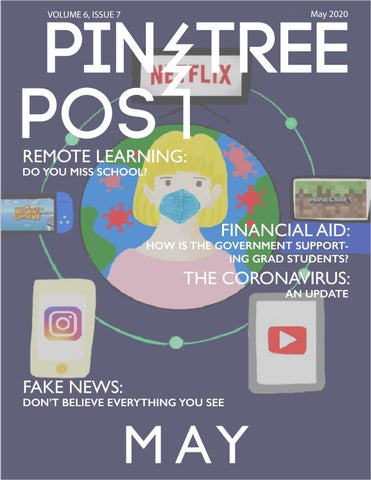
PIN TREE POS REMOTE LEARNING: DO YOU MISS SCHOOL?
FINANCIAL AID:
HOW IS THE GOVERNMENT SUPPORTING GRAD STUDENTS?
THE CORONAVIRUS: AN UPDATE
FAKE NEWS:
DON’T BELIEVE EVERYTHING YOU SEE
M AY
2 FIRST GLANCE P.4: WORLD
P.8: SCHOOL
The Pinetree Post
STAFF
FOUNDERS Russell Kim, Felix Guo EDITORS-IN-CHIEF Briana Ho, Raymond Gao ARTICLE EDITOR Briana Ho CONTRIBUTORS Harim Chang, Kaleigh Morrow, Florin Lee, Julia Ye, Amy Lee, Esther Kim, Alexandra Mandewo GRAPHIC DESIGN Raymond Gao ONLINE CONTENT Raymond Gao SPECIAL THANKS TO The Pinetree Administration, Mr. Lau, Ms. Hopkin, Ms. Browne
Covid-19 in Canada and Fake News
P.10: FEATURED
Post-Secondary Financial Aid
School, Hobbies and Animal Crossing
P. 12: OTHER
Comics
GET INVOLVED IN THE PT POST! Although we at the Pinetree Post try our best to represent the voice of the everyone at Pinetree, we are only a small group of students. To find the most pressing topics and interesting avenues to explore, we rely on input from readers to curate relevant content only. Anyone is welcome to suggest a topic or provide an opinion for Pinetree Post writers and
contributors to look into further. Do you have something to say that needs your voice? The Pinetree Post also welcomes guest content, any time, of any kind. Feel free to submit an article on a topic you are passionate for, a comic you think everyone deserves to see, maybe even a letter to the editor! You can submit your original content to us at thepinetreepost@gmail.com.
Have a question or a request? Contact us at: facebook.com/thepinetreepost
3
First Glance EDITOR’S NOTE
Freedom is Only a Breath Away Go outside once in a while, ya hermits! Briana Ho, Raymond Gao Editors-in-Chief
up with suspicious disappearances of particularly irritating siblings. Tommy is not back to bless us with his delicious voice because he hasn’t received any recent questions! He’s getting antsy in his restraints, so please, if you’d like us to feed him, email your questions to pinetreepost. asktommy@gmail.com - they can literally be about anything. Are you still not getting that hot bod? Are you not sure how to tell your crush how you feel? Are you an amateur journalist, chained up in a deranged editor’s basement, forced to write advice columns for a school newspaper as you subtly use them as a means to cry for help? Tommy’s got you covered! Also, go find our beloved monthly comic as well (Comic, page 12). In other news, we’d like to welcome our new Design Editor, who will be taking over Raymond’s job next year: Julia Ye! This entire year she’s been managing our website (check it out: https://pinetreepost.wordpress.com/) as well as our monthly events calendar (which doesn’t exist this issue because frankly, there aren’t many school events going on right now). This issue she’s taken her first shot at editing, which is awesomely brave since it’s harder for us to guide her through the process virtually. We’re sure she’ll do great in the year to come! Hope you enjoy this issue of the Pinetree Post! Remember to like us on Facebook, check out our website (https:// pinetreepost.wordpress.com/), and send questions to Tommy (pinetreepost.asktommy@gmail.com) for a chance to be featured next issue. Missed the last issues? Read them (in colour) at https://issuu.com/ thepinetreepost .
Hey Pinetree! Sorry we didn’t release last month - I was mortally wounded in a fight for the last pack of Charmin in the personal hygiene aisle. Oh, and we wanted to give our PTP staff time to settle in with the whole online school thing. How many of you are still alive? Rather, how many of you are holed up in your rooms with Animal Crossing, instant ramen, and the fading memory of that bright ball of light that sometimes appears in the sky? Honestly, can’t blame you - even with the wonderful invention of social media (emphasis on “social”), my interpersonal skills have receded faster than the hairline of a middle-aged office worker. Now, I spend my days sitting at the desk in my bedroom with my physics workbook, reminiscing about the times I could hunch over my calculations at school in the comforting odour of perspiring teenagers... I suppose there are some things I don’t miss. Besides the obvious need for us to get up and exercise once in a while, take regular showers (please I beg you), and overall maintain our sanities, we also should stay informed. Unless you have a person in your home like my mom who consumes Global News like a rabid goat in a squash field (or you are that person), you might not be that exposed to current events. While getting updated every time Donald Trump claims that injecting bleach into your body will kill viruses isn’t important to most of us, we should all keep decently aware of changing regulations (COVID-19 In Canada, page 4) and new opportunities to receive support (Post-Secondary Financial Aid, page 10). Additionally - especially now when chaos and confusion have barely settled - it’s important to watch out for unreliable information (Fake News, page 6). Stay gold, Staying aware could even mean checking up on your friends (School, Hobbies, and Animal Crossing, page 8), perhaps Briana Ho and Raymond Gao to see how they’re doing or, most often, to quench both your thirsts for social interaction so that neither household ends When you get assigned
homework on a weekend
4 WORLD NATIONAL INTEREST
COVID-19 In Canada
A tentative update.
Clothing retailers such as Zara are preparing to reopen for business.
Florin Lee Writer When Canadian communities went into lockdown and our borders closed in March, our lives changed greatly. We were no longer allowed mass gatherings of any purpose, and visits with friends and families were discouraged. Throughout our entire country, there have been a total of 87 000 confirmed cases and 6 671 deaths, but there have also been 46 000 recoveries. As of May 27, British Columbia has recorded 161 deaths out of 2 541 total cases, but there have also been 2 122 recoveries. The provinces that were hit the hardest by the virus are Ontario and Quebec, with 26 000 and 49 000 cases, respectively.
For a population that is greatly accustomed to spending time outdoors, the changes that took place over this past month and a half have been difficult to adjust to. However, through strength and community resilience, we are beginning to approach the end of the first wave. The spread of the virus has begun to slow down. In B.C., there were only nine new cases on May 27, and 860 nationwide. Two months since the lockdown began, in May, we are slowly beginning to reopen, with BC schools planning on restarting in June. For secondary school students, this means one in-person session per week. Attendance is voluntary, and most of the schoolwork will still be completed online, but this is only the first step in our return to normalcy. This gradual relaxation of lockdown measures
WORLD
5
is mirrored in other provinces as well. Beginning mid-May, our provincial government is allowing medical services such as dentistry and physiotherapy to resume services, as well as reopening parks and outdoor spaces. Hair salons and barbershops are also reopening for business, providing much needed services. We are slowly beginning to return to our normal lives, but there is still much to be cautious about.
express their frustrations through blaming others. It is very easy to hate someone thousands of miles away that one has no personal connections to. Many people have also started to claim that the pandemic is a government ruse to steal peoples’ civil rights. It is crucial to not succumb to such hysteria and calmly refer only to health officials for advice and facts.
Recently, there has been an increase in hate between different groups, both within one’s community and online. Due to stress and numerous negative developments in society, the economy and perhaps in one’s personal life, many people have begun to point fingers and
As of yet, there have been no announcements of successful vaccines or scientific proof that those who have recovered from COVID-19 are immune from future infections. These are two factors that will affect when we are able to host mass events again, such as concerts and sports matches. Until there are further medical breakthroughs, our foreseeable future is one with a layer of plastic between every face.
People getting tested for COVID-19 in Montreal. © Ryan Remiorz/The Canadian Press
6 WORLD
NATIONAL INTEREST
Fake News
Is seeing really believing?
Harim Chang Writer
In such a technologically advanced world, fake news has always been a part of society. From coronavirus conspiracy theories, to flat earthers, to anti-vaxxers, it seems like there’s always some sort of need to explain certain phenomena in a way that makes it easy to blame one person or thing. For some reason, false information almost always outperforms the truth… why is that?
In the case of the coronavirus, most people try to find ways to cope with the severity and abruptness of it all by blaming others. Rumours spread that the coronavirus was created in a lab, or that the Chinese government deliberately spread the virus - both of which have absolutely no evidence. Well, some people might blame Twitter and its bots for being the ones to spread false info, but according to a huge MIT study done on fake news, bots were just as likely to spread false news as true news. This meant that bots are not the main perpetrators of fake news - instead, it’s humans. This study can be found online on The Atlantic called, “The Grim Conclusions of the Largest-Ever Study of Fake News” and was led by Soroush Vosoughi, a data scientist at MIT who has studied fake news since 2013. According to the same study, there are two main reasons why people are more likely to retweet fake news than real news. First, fake news “seems to be more ‘novel’ than real
news,” meaning that it gives a more exciting and interesting take on a topic, regardless of the fact that it’s fake. Second, it “evokes much more emotion than the average tweet,” meaning that while the truth might be boring, a more exciting fact might catch the interest of the user. A retweet of one tweet can grow at an exponential rate because of how Twitter works. The MIT study sums it up in the following paragraph: “Meanwhile, someone without many followers sends Tweet B. It goes out to their 20 followers—but one of those people sees it, and retweets it, and then one of their followers sees it and retweets it too, on and on until tens of thousands of people have seen and shared Tweet B.” Essentially, fake news can spread like a wildfire. Want an example? In August of 2015, a rumour spread that Donald Trump allowed a sick child to use his plane to get urgent medical care - according to Snopes (a fact-checking website) it was confirmed as true. However, only about 1,300 people shared the story. But in February of 2016, a rumor spread that Trump’s cousin had died recently, and that he opposed the magnate’s presidential bid in his obituary. It read, “As a proud bearer of the Trump name, I implore you all, please don’t let that walking mucus bag become president.” Snopes confirmed that it was false information, but the rumour nonetheless was shared by 38,000 Twitter users. Just for your information,
WORLD Snopes fact-checks through investigative reporting, and “lights the way to evidence-based and contextualized analysis.” Now one can see how the two factors that were talked about play into this example. First of all, the second rumour would appeal to a lot more Trump haters (which consists of
most of the Millennial and Gen-Z generation) and therefore spread a lot more than something that made Trump look good.
Don’t believe everything you see.
7 Spreading fake news is hard not to do - it’s easy to fall into the deceptively enticing looking piece of fake news and spread it around, but we have to remember that fake news can cause damage. Like anti-vaxxers who refuse to vaccinate their children because they believe it causes autism, which in turn puts their children and the world at risk. Or flat earthers who don’t believe in science or the government… so before you press that retweet button, take a moment to check if it’s real or fake, because seeing isn’t always believing.
8 SCHOOL
STUDENTS
School, Hobbies and Animal Crossing Student Isolation Experiences Kaleigh Morrow Writer, Interviewer Life has been different lately. Since April, students no longer wake up at 7 a.m. to make it to school at 8 a.m., attend classes, eat lunch with their friends and leave at 3:30 p.m.. Now students are setting their own schedules. They decide when they sleep, eat, learn, work and relax. All of this is new, so The Pinetree Post interviewed students to hear about the changes in their lives.
Anonymous
PTP: How’s life with online school? A: My life right now is basically what it was before, but with online school and Animal Crossing.
Deep Cove, North Vancouver, January 2017. Source: Xicotencatl, Wikimedia Commons
Kimberly Buenaventura PTP: How’s isolation? K: It’s fine I guess. PTP: How often do you go outside? K: 1-2 times a week to either go grocery shopping or, if the weather is nice, spend the day out at a park with my family. PTP: When’s the last time you were in the sun? K: Yesterday, we went out to Deep Cove to hike but it was closed, so we just walked around the area instead. PTP: Without physical school, how is your sleep and exercise? K: I don’t really have a sleep schedule I follow, so nothing has changed, but I do usually still get the recommended hours of sleep, and I try to exercise a bit every day at home. PTP: Is there anything/anyone you’re missing? K: I definitely miss getting to see my friends, I mean everyone does. PTP: Have you ever done school online before? K: Nope. PTP: Are you enjoying online/isolated school? K: It has its pros and cons, but I do like getting to experience what it is like if I did online school. PTP: Is it different for you? Is it easier or harder than physical school? K: I’d say that it is harder than physical school for me because I am just the worst when it comes to time management, so actually going to school made it easy since you had to spend like an hour working in each class.
School PTP: Is there anything you’ve gotten to do while you stay at home, that you couldn’t do with school? I’ve been able to have the time to discover and K: start new hobbies.
M.W. PTP: How’s isolation? M: Isolation is fine. PTP: How often do you go outside? M: Once a month. PTP: When’s the last time you were in the sun? M: Last weekend. PTP: Without physical school, how is your sleep and exercise? M: Bad sleep no exercise. PTP: Have you ever done school online before?
Deep Cove, North Vancouver, February 2007. Source: Tim Hollosy, Wikimedia Commons
9
M: Yes, Intro Japanese 11. PTP: Is it different for you? Is it easier or harder than physical school? M: Kinda? Doesn’t feel too different. PTP: Is there anything you’ve gotten to do while you stay at home, that you couldn’t do with school? M: Cook lunch. PTP: Do you think your health and schoolwork are doing better or worse online? M: Worse. I miss classes and assignments. PTP: Do you prefer physical or online schooling? M: Physical. PTP: Are you planning to do optional physical classes in June? M: No. PTP: After doing online schooling, which would you prefer to continue with next year? Or is there a combination of both, or third option you’d like? M: Physical school is best.
10 FEATURED STUDENTS
Post-Secondary Financial Aid
Government financial aid options for grad students without part time jobs already attending post-secondary school and high Alexandra Mandewo Writer
With our regular school coming crashing down around us, many Pinetree grads have lost the comfort that they had supporting their last year. Many students have already received acceptance letters from universities but I’m sure after the initial excitement of acceptance, a little bit of worry sets in. If you’re a Canadian citizen, the average tuition for post-secondary is $6,838.00 per year. Nearly two million Canadians have lost their jobs amidst this global pandemic. That includes parents saving up money for their children’s post-secondary schooling and students with part time jobs trying to save up for the same. Maybe, you didn’t have a part time job before the pandemic and were planning on getting a summertime job. That too, won’t be easy.
Do you have enough in your piggy bank for post-secondary?
It is projected that financial aid will be needed more than ever this year for students
school students planning to attend this fall.
What exactly is financial aid? It’s exactly what it sounds like, ‘aid for finances’. Specifically, for post-secondary school. The money is intended to help students (graduating Grade 12) pay for their college and/or university expenses. This will cover not only tuition, but other fees, board and books. Scholarships, grants and student loans are all types of financial aid. The great thing about financial aid is that there are many options of how you can receive it and not all options require you to pay back the money. With the COVID-19 pandemic, a new form of financial aid has come about. Prime Minister Justin Trudeau has introduced a $9 billion student aid program. It’s called the Canada Emergency Student Benefit (CESB). From May through August, (the typical span of a summer job), you could be eligible for $1,250.00 per month. This applies to all graduating Grade 12 students planning on working this summer and attending post-secondary in the fall. Unfortunately, CESB is not available to international students. There are group specific financial aid programs that increase your chances of getting some monetary assistance. There are apprenticeship loans and grants where you ‘earn while you learn’ with additional aid to start and complete an apprenticeship. One of the most well-known forms
School of student aid is merit-based scholarships. These are available for undergraduate, graduate and postdoctoral studies. Indigenous learning funds which include scholarships, bursaries, education programs and schools for Indigenous peoples. If you plan on joining the military after you finish high school, you can be eligible for aid set aside for reservists. There are funds that are also set aside to assist protected persons who can apply for the same loans and grants as a Canadian citizen. Canadian athletes who are preparing for and participating in international sports can utilize the aid available for the support of high performance athletes. Student loans are relatively easy to get. They vary by province and require an application. Once you receive a student loan, it can be managed at the National Student Loan Service Centre (NSLSC). Loans are expected to be paid back, usually in installments.
11 more extensive professional experience. There are some key differences between bursaries and scholarships. Bursaries are offered to students with financial need. Scholarships are offered to students based on academic excellence, athletics, volunteer experience, and also by specific research areas. Both however require applications. The amount of money you can receive depends on factors such as family income, the tuition fees for the school you plan on going to or if you have a disability. These are just a few. There are also options for financial aid for international students wanting to continue their education in Canada at Canadian universities. A good place for international students to begin to look for funding is in their home countries. This can be through an education department or ministry, who are likely to have financial aid programs available for students studying abroad. You also have many of the financial aid opportunities as a citizen. Entrance scholarships are a good resource for academically strong students. International students can apply for scholarships, bursaries, awards, grants, fellowships, and loans. For more information be sure to check out websites like The Government of Canada website, Student Aid BC, EduCanada and Canadian Universities. Net. It’s in times like these we remember our school motto “Accepting ChallengesTogether (ACT)�. Good luck to all Pinetree 2020 grads and stay safe everyone!
The picture depicts a loan or money designed to help students pay post-secondary school.
Scholarships and bursaries are forms of financial support that are available to international students to help them finance their education. Neither source requires repayment and they often consider work and volunteer experience. This may be a benefit to any international students with
There are plenty of financial aid options for 2020 grads.
12 OTHER Comic by Amy Lee
Let us know what you think or submit guest content at thepinetreepost@gmail.com Like our page and follow for extra online content at facebook.com/thepinetreepost Visit our online archive at http://pinetreepost. wordpress.com/ or at issuu.com/thepinetreepost