A JOURNAL WHERE PILATES PROFESSIONALS COME TOGETHER TO LEARN, DISCOVER AND SHARE IN THE JOY OF MOVEMENT.
CLASSICAL PILATES MEETS THE CIRCUS
WHY IS MAT HAVING A MOMENT
DISCOVER YOUR TEACHING STYLE
How Classical Pilates helps circus athletes perform at their peak.
Tracey Mallett on why mat Pilates is resonating with a new generation.
Learn your Pilates Teacher Archetype™ and amplify your impact.
ISSN 2982-043X
ISSUE 40 - AUGUST 2026
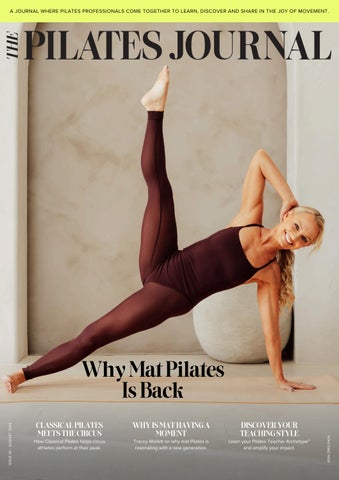
Why Mat Pilates Is Back
MIAMI 12–13 SEPTEMBER
GET TICKETS
ISSUE 38 — PILATESJOURNAL.COM
Note from the Editor
CONTRIBUTORS
Welcome to the latest issue of
Tracey Mallett, John Garey, Teneice Bowie, Misty Lynne Cauthen, Illaria Cavagna, Connie Holen, Jessica Spillane, Chaz Knight, Heidi Marie Coles, Solmaz Sahraeyan, Agi Falenta and Zayna Gold.
The Pilates Journal. For years, the reformer has been the face of modern Pilates. It has introduced millions of people to the method and transformed the way our industry has grown. But as this month's cover story with Tracey Mallett reveals, something exciting is happening: mat Pilates is having a moment. Not as a replacement for the reformer, but as the natural next step for those wanting to deepen their understanding of the method.
CONTACT US Editorial Editor-in-Chief Cie’Jai Zarb hello@pilatesjournal.com
That idea of going deeper runs throughout this issue. John Garey introduces The 5 Pilates Teacher Archetypes™, encouraging us understand our teaching style, while Teneice Bowie demonstrates how classical Pilates is helping circus athletes perform at their peak. We also celebrate 2025 Pilates Journal Mentor of the Year, Chaz Knight, who reflects on the journey from student to mentor and the experiences that shaped him along the way.
Photography Tracey Mallett, John Garey, Teneice Bowie, Misty Lynne Cauthen, Illaria Cavagna, Jessica Spillane, Chaz Knight, Bodyrok, Wipex, Club Pilates, Heidi Marie Coles, Solmaz Sahraeyan, Agi Falenta, Speir Pilates, FOLD reformer, Delicia Gordon and Zayna Gold.
If you're ready to continue the conversation in person, we'd love to welcome you to The Pilates Journal Expo Miami this September. Join hundreds of Pilates professionals from around the world for a weekend of education, connection, and inspiration.
PO BOX 2193 Clovelly West NSW 2031
Advertising Cie’Jai Zarb 61412209460 hello@pilatesjournal.com Questions/Feedback If you would like to contribute or have any questions, please contact us at hello@pilatesjournal.com
See you in Miami.
On the Cover Tracey Mallett from Pilates Next.
CJ Zarb FOUNDER AND EDITOR-IN-CHIEF
3
MARIA LEONE
TRACEY MALLETT
JASON WILLIAMS
ANDREA SPEIR
KENLIE REED
MICHELLE LEACH
SAMANTHA WOOD
NICKY LAL
WHERE THE PILATES INDUSTRY MEETS Learn from Industry Leaders Refine Your Teaching Grow Your Business Expand Your Network Be Part of the Conversation
MIAMI 11 - 13 SEPTEMBER
TICKETS NOW AVAILABLE
Thanks to our Partners SUPPORTING PARTNERS
PILATESJOURNALEXPO.COM
ISSUE 39 — PILATESJOURNAL.COM
Contents
4
EDITOR’S NOTE Welcome to the latest issue of The Pilates Journal.
8 16
Tracey Mallett shares why Pilates mat is resonating with a new generation of clients and instructors.
WHAT IS YOUR TEACHING STYLE? Discover your teaching style and expand your impact with The 5 Pilates Teacher Archetypes™ with John Garey.
18 22
MAT IS HAVING A MOMENT. BUT WHY NOW?
PRECISION UNDER PRESSURE How Classical Pilates helps circus athletes perform at their peak.
I DON'T SCHEDULE ME TIME. MY SPINE SCHEDULES IT FOR ME. How the BALLance® method supports both clients and practitioners.
27 30
HOW BODYROK BUILT A 100-STUDIO BRAND From boutique concept to global expansion, HOW BODYROK scaled to 100 studios.
CLEAN SMARTER. GROW STRONGER. Why Wipex is redefining studio cleaning.
34
YOU WERE TRAINED TO LOOK UP. START LOOKING DOWN Most Pilates instructors are trained to prioritise the core, but the foot meets the ground first and influences everything above.
6
The Pilates Journal would like to acknowledge and pay respects to the Gadigal people of the EORA nation as the traditional custodians of the place we call home Sydney - where this journal is produced. The Pilates Journal pays respects to their elders, past, present and emerging, and acknowledges all Aboriginal and Torres Strait Islander peoples.
ISSUE 39 — PILATESJOURNAL.COM
Contents
37
THE MENTOR IN THE MACHINE: AI’S ROLE IN EDUCATION AI Won't Replace Great Teachers. It Can Help Create More of Them.
39 42
The first years of teaching can define the instructor you become.
SHE WAS JUST TRYING TO KEEP HER CLIENTS. How Cara Schroter scaled CS Fit Pilates with Zipper.
THE ROLE OF REFORMER PILATES IN THE GLP-1 ERA As GLP-1 use grows, Pilates is playing an increasingly important role.
50 54
What it really takes to become an educator with leading Pilates educator Chaz Knight.
DON’T UNDERESTIMATE YOUR VALUE: A NEW TEACHER’S GUIDE
46 48
MENTOR BEFORE THE MOMENT
56
FINDING COMMUNITY THROUGH CLUB PILATES
58
INSTRUCTOR SPOTLIGHT: DELICIA GORDON
Krista Borg shares her journey from first-time business owner to opening a Club Pilates studio.
SPINE IN MOTION: RETHINKING ACCESS BEFORE MOVEMENT Why the spine deserves a closer look with Agi Falenta.
BEYOND THE REPERTOIRE: TEACHING IN REAL TIME As Pilates education grows, the focus is turning knowledge into confident teaching.
7
We speak with Pilates Instructor Delicia Gordon about her Pilates career to date and her teaching focus.
ISSUE 40 — PILATESJOURNAL.COM MAT PILATES FOUNDATIONS
Mat Is Having a Moment. But Why Now? AS MAT PILATES GAINS MOMENTUM, TRACEY MALLETT SHARES WHY THE FOUNDATION OF THE METHOD IS RESONATING WITH A NEW GENERATION OF CLIENTS AND INSTRUCTORS. by Tracey Mallett and CJ Zarb
For years, the reformer has been the face of modern Pilates.
"The reformer has opened the door, and mat work is becoming the natural next step for clients and instructors who want a deeper understanding of the method."
It has fueled the industry's rapid growth, introduced new audiences to the method, and become the entry point for countless clients around the world. But according to global Pilates educator and studio owner Tracey Mallett, something interesting is happening alongside the reformer boom.
The Foundation of the Method
As mat work evolves and attracts new audiences, Tracey believes there are certain elements that should remain unchanged. "The essence of true mat work is the relationship between breath, control, precision, concentration, and full-body integration," she says. "It's learning how to move your own body efficiently without relying on external resistance."
Mat Pilates is making a comeback. Not as a replacement for the reformer, but as a natural next step for many clients looking to deepen their understanding of the method. "I believe mat work is experiencing a resurgence because the popularity of the reformer has introduced a whole new audience
For Tracey, mat work develops more than strength alone. "Mat work teaches us to create stability, mobility, strength, and coordination from within."
to Pilates," says Tracey. "Many people initially fall in love with Pilates through the reformer and begin to realize that there is much more to the method than one piece of equipment."
While programming styles may change and new tools may be introduced, she believes the principles that underpin the method should remain intact.
As clients become more curious about Pilates beyond the reformer, many are discovering just how demanding mat work can be.
"The exercises may evolve, props may be added, but the intention and principles behind the movement should remain intact."
"The younger demographic especially enjoys the burn, the control, and the strength demands of mat Pilates," she says. "What surprises many people is that mat work often feels harder because you're working entirely against gravity and your own body weight."
Evolving Without Losing the Method
The resurgence of mat work comes at a time when Pilates programming continues to evolve.
For Tracey, this moment feels different from previous cycles in the industry because Pilates itself has reached a level of mainstream popularity never seen before.
Studios are increasingly incorporating props, standing work, dumbbells, and contemporary movement patterns into their classes. For Tracey, innovation itself is not the issue.
9
ISSUE 40 — PILATESJOURNAL.COM MAT PILATES FOUNDATIONS
"Today's clients want variety, creativity, and a workout experience that feels engaging," she says. "The opportunity is to evolve mat work without abandoning its roots." She sees props as valuable teaching tools that can make exercises more accessible and help clients better understand movement patterns. At the same time, she cautions against confusing novelty with progress. "Repetition remains important because mastery comes from practice, not constant novelty."
"The reformer created
The challenge for instructors, she says, is ensuring that contemporary programming enhances the method rather than replacing it.
awareness, but mat work creates understanding,"
"The key is intentional programming. Evolution should enhance the method, not replace it."
The Reformer Created Awareness. Mat Creates Understanding.
One of Tracey's most compelling observations is the role mat work plays in helping clients move beyond simply doing Pilates and towards understanding it. Many of today's Pilates participants first encountered the method through group reformer classes. As their interest grows, mat provides an opportunity to explore the principles behind the movements they have been practicing. "They want to understand the 'why' behind the movement rather than simply following choreography." Accessibility also plays a significant role. "Mat work is more accessible. It requires less equipment, can be practiced anywhere, and gives clients a way to continue their Pilates journey outside the studio."
Defining Pilates in a New Era
As mat Pilates grows in popularity, so too does the conversation around fusion, sculpt, and Pilates-inspired movement. Tracey is clear that these formats have value. "I love fusion formats and have been teaching fusion since the 1990s," she says. "They absolutely have a place in our industry." The distinction, however, lies in how those classes are positioned. "Pilates-inspired classes can borrow principles from Pilates while incorporating fitness trends, strength training, barre, cardio, or sculpt methodologies." But she believes borrowing Pilates principles does not automatically make something Pilates. "I often use an 80/20 guideline," she explains.
10
ISSUE 40 — PILATESJOURNAL.COM MAT PILATES FOUNDATIONS
Yet she believes this creates an opportunity rather than a problem. "Once they're introduced to authentic mat work, they're often fascinated by it. They discover a level of challenge, precision, and complexity they weren't expecting." For instructors programming mat classes today, Tracey believes there is another important lesson.
"If approx 80% of
"Sometimes instructors underestimate how much clients enjoy learning and progressing."
the class is grounded in
While there can be pressure to constantly introduce new exercises and variations, she believes clients also value repetition and skill development.
classical Pilates movement patterns and principles,
"Repeating exercises, layering progressions, and helping clients understand why they're doing something creates a much deeper experience."
there is room to incorporate contemporary...variations."
Because there is no equipment guiding movement, teaching quality becomes even more important. "Mat classes require exceptional cueing because there is no equipment guiding movement." "Strong cueing, thoughtful progressions, and clear objectives are often more valuable than endless exercise variations."
Shaping the Future of Pilates
Looking ahead, Tracey believes mat work will play an increasingly important role in the future of Pilates.
When the balance shifts too far, she believes the class should be identified differently.
"I believe mat work will become increasingly important because it is the foundation of the method."
"When classical Pilates exercises become a small percentage of the workout and the focus shifts primarily to fitness-based training, it should be identified as fusion, sculpt, or Pilatesinspired movement rather than Pilates itself."
As Pilates continues to expand globally, she sees mat work offering something the industry needs: accessibility, scalability, and authenticity.
"That distinction protects both the integrity of the method and the expectations of the client."
"It allows more people to experience the true depth of the method regardless of whether they have access to equipment. At the same time, mat work will continue to influence the broader movement industry through fusion, sculpt, and contemporary fitness formats.
What Today's Clients Still Need
According to Tracey, one of the biggest misconceptions among newer Pilates participants is that they already understand mat work because they have attended Pilates-inspired classes. "I don't think many newer clients fully understand the depth of classical mat work, and that's not their fault," she says. "Many people genuinely believe they've been doing Pilates for years when they've actually been taking sculpt or fusion classes that incorporate Pilates-inspired elements."
"The challenge for our industry is to celebrate innovation while clearly defining what Pilates is," she says. "If we can do that, mat work won't just support the future of Pilates, it will help shape it."
She sees the same realization occur regularly during teacher training programs. "New instructors arrive believing they know mat Pilates, only to realize they've been exposed to a small fraction of the repertoire." 14
Tracey Mallett is a globally recognised Pilates educator, creator of the BootyBarre® program, and a Master Instructor with Balanced Body. She is known for her dynamic, accessible teaching style that blends classical Pilates with functional fitness. An author and international presenter, Tracey continues to inspire both instructors and clients worldwide through her innovative approach to movement. She also offers PilatesNext teacher education. Find out more.
ISSUE 40 — PILATESJOURNAL.COM TEACHING CAREER
The 5 Pilates Teacher Archetypes™: Expanding Your Teaching Range DISCOVER YOUR TEACHING STYLE AND EXPAND YOUR IMPACT WITH THE 5 PILATES TEACHER ARCHETYPES™ by John Garey
The Pilates Educator™ is grounded, intellectually curious, and clear. This teacher helps clients understand movement not just through what it feels like, but through what it means. They translate complexity into something clients can apply right away.
Every Pilates teacher has a natural teaching style. You might not have a name for it yet, but your clients already feel it. It is the energy you bring into the room before you say a word. It is the way you deliver a correction, celebrate a breakthrough, or guide someone through a moment they did not think they could handle. Your teaching style is not just what you say. It is how you make people feel when you say it.
The Pilates Pal™ brings warmth, emotional intuition, and deep empathy to the teaching space. This teacher reads the room, senses unspoken needs, and meets clients exactly where they are. With the Pilates Pal, clients do not just feel supported. They feel seen.
In writing The Pilates IT Factor Guide, I wanted to give teachers a way to see their own communication patterns clearly, and then expand them with intention. That is how The 5 Pilates Teacher Archetypes™ were born. These are not personality types or rigid labels. They are dynamic, trainable communication styles that any instructor can learn to access and develop. In the Guide, each archetype comes with its own signature energy, superpowers, and practical tools for bringing it to life in your teaching. The Pilates Entertainer™ brings expressive, magnetic energy into the room. This teacher thrives on joy, humor, and creativity, using storytelling and personality to keep clients engaged. Their gift is creating a class that feels energetic and memorable without ever losing depth.
The Pilates Motivator™ is momentum in human form. This teacher supports clients with uplifting language, high-energy presence, and a contagious belief in their potential. They shine when spirits are low or a challenge needs to be met with courage. Their superpower is reminding clients of their own strength. The Pilates Coach™ is clear, focused, and purpose-driven. This teacher leads with direction and intention, setting goals and helping clients pursue progress with precision and consistency. Their message: let us set the goal, and I will help you get there one step at a time.
GET TICKETS
HERE 16
ISSUE 40 — PILATESJOURNAL.COM TEACHING CAREER
Most teachers default to one or two of these archetypes without realizing it. That natural style is great, but it can limit your audience over time. A teacher who leads with warmth may struggle to push a client who needs structure. A teacher who excels at motivation may miss the moment when someone needs to slow down and feel safe. The archetypes are not about labeling. They are tools you can add to develop more range. The best teachers I have worked with know how to shift from one archetype to another seamlessly to match any given moment. That ability brings more structure when the class needs focus, softness when a client needs care, and a lift when energy drops. The ability to shift with purpose is what separates good teaching from teaching that transforms a room. In The Pilates IT Factor Guide, you will find the complete Archetype system, including a self-assessment to discover your natural style, along with the vocal foundations and body language skills that bring each archetype to life. The Archetypes are one of nine modules in the Guide, all built around a single idea: how you teach matters as much as what you teach. And every one of these skills is trainable. To learn more, visit The Pilates IT Factor Guide: Mastering the Art of Connection in Every Class at pilatesitfactor.com.
John Garey, MS, NCPT is the founder of Pilates & Fitness TV and Pilates Grad School. With a Master’s Degree in Adult Fitness from NYU and decades of teaching and presenting worldwide, John is known for his dynamic style and ability to inspire instructors at every level. He created The Pilates IT Factor™, a groundbreaking approach that blends communication science with teaching presence and connection.
Subscribe for free pilatesjournal.com/subscribe
ISSUE 40 — PILATESJOURNAL.COM PILATES CAREER
Precision Under Pressure HOW CLASSICAL PILATES HELPS CIRCUS ATHLETES PERFORM AT THEIR PEAK by CJ Zarb
For many Pilates teachers, the studio is where the work happens. The familiar rhythm of reformers, mats, and dedicated clients provides a controlled environment to teach the method. But for classical Pilates teacher Teneice Bowie, from Miami Florida, one recent opportunity took her far beyond the walls of a traditional studio and into a world where bodies fly through the air, precision is non-negotiable, and performance is measured not just by aesthetics, but by safety.
Working as a Pilates instructor within a Miami circus residency training tent, Teneice found herself applying the classical Pilates method in one of the most demanding movement environments imaginable. "I worked with the team in the afternoons for about two hours at a time," she explains. "Each day was different and varied greatly on the artists' needs and what their body may have been experiencing that day." Under the big top, there was little of the calm and order often associated with Pilates. "It's a circus in every sense of the word!" Teneice laughs. "Loud music, people walking around and tons of other distractions. Being under the tent really challenges the Pilates principle of concentration." Yet it was precisely this environment that highlighted the enduring relevance of Joseph Pilates' original work.
A Method Built for Every Body
The artists Teneice worked with perform at an elite level night after night, placing extraordinary demands on their bodies. Despite their incredible strength and athleticism, common movement concerns emerged. "There were lots of shoulder and hip mobility concerns," she says. "Whether they came from injury prevention or from recent aggravation." For Teneice, the experience reinforced one of the greatest strengths of the classical method.
GET TICKETS
HERE
18
ISSUE 40 — PILATESJOURNAL.COM PILATES CAREER
"I had a game plan of the exercises I may have wanted to teach going into the start of my shift with them in the event that their bodies felt fine," she says. "I'd offer about ten exercises per session. Half went to teaching Pilates as I would for a regular client and the other half went to Pilates for performance and rehabilitation." The performers themselves impressed her with their ability to focus amid chaos. "They are excellent listeners and can pretty much tune out all of the distracted noise to hear cues," Teneice says. "They also do an amazing job at tuning out visual distractions." The experience prompted a broader reflection on modern movement culture.
"The beautiful part of classical Pilates is that it is designed to
"It made me think how much of our day-to-day lives are operated through distraction, which has caused the general population to have a very short attention span," she says. "This shows up in Pilates studios as the need for loud music, unnecessary variety in classes and anything else to stop the client from being bored when instead, they should be learning focus and concentration."
support the body regardless of the athletic needs of the individual"
Beyond Flexibility
Many circus artists possess extraordinary mobility and flexibility, but Teneice quickly learned that physical capability alone wasn't the goal. "Asking an artist to do a full split is no big deal because they can," she explains. "But are they feeling the connection?" For Teneice, this shifted her teaching focus toward helping performers deepen their internal awareness. "Working with them pushed me to become more in tune with what I was seeing in their body and relying on verbal feedback to make sure that what I was cueing was connecting internally, which is the purpose."
she says. "It's then up to me as their teacher to prescribe the correct exercise that already exists in the repertoire to address focused needs of the specific artist for that night."
That heightened body awareness also plays an important role in injury prevention.
Rather than inventing new exercises or chasing novelty, Teneice relied on the depth of the existing system.
"In this instance, Pilates teaches the artists how to be more aware of their bodies so they can immediately make adjustments to prevent possible injuries."
"Knowing the work - the classical repertoire - is key. There is already a library of exercises that I can choose from. It's extremely important for teachers to know which exercises assist and which ones may be contraindicated for certain ailments or concerns."
Precision Can Be Life-Saving
If there is one Pilates principle that took on an entirely new meaning under the circus tent, it was precision.
Concentration in a Distracted World
Perhaps one of the most powerful lessons Teneice took away from the experience was a renewed appreciation for concentration, one of the six classical Pilates principles.
As a combat veteran, I was already big on the principle of precision," Teneice says. "Doing things correctly was already deeply instilled in me."
To stay prepared, she arrived with a clear plan. 19
But watching performers execute highly complex movements elevated her appreciation even further.
ISSUE 40 — PILATESJOURNAL.COM PILATES CAREER
"I think we can all learn to pay more attention to the direct feedback our bodies provide if we slow down enough to focus on the internal connection."
""These artists do the most amazing things with their bodies, with props and often in mid-air," she says. "Not being precise is a recipe for possible disaster."
Teneice Bowie is a 4th Generation comprehensive classical Pilates instructor in the lineage of Romana Kryzanowska, certified through VIDA Pilates in Washington, D.C. A U.S. Air Force combat veteran and former U.S.intelligence professional, her work is defined by discipline, clarity, and an uncompromising commitment to the classical method.
For performers whose bodies are literally their instrument, precision isn't optional, it's essential.
Lessons for the Industry
She is the founder of Matte Pilates, her private instruction practice, and LISTED, a large-format class brand known for its precise, unapologetic return to the original work, delivered with a modern, fashion-forward edge. Across both platforms, Teneice develops strong, highly capable movers while shaping a new standard for how Pilates is taught, experienced, and scaled. She also mentors instructors and studio owners to refine their teaching, elevate their positioning, and build profitable, high-level careers within the industry.
So what can the wider Pilates profession learn from working with elite performers? For Teneice, the answer is surprisingly simple. In an industry increasingly driven by trends, variety and entertainment, she believes the foundational principles remain as important as ever. "A lot of the industry is trying to keep up with the demand for variety so that studios can remain competitive," she says. "But we lose the plot without concentration, control and repetition." And perhaps that's the biggest takeaway from Pilates under the big top. Whether you're teaching a circus performer suspended high above the stage or a client in a local studio, the principles that Joseph Pilates built his method upon remain remarkably relevant. Sometimes it takes stepping into the most extraordinary environment imaginable to remind us of the power of the fundamentals.
20
Latest News STRONG Pilates Targets 25 U.S. Studios by the End of 2026 Australian-founded fitness brand STRONG Pilates is continuing its rapid expansion across the United States, announcing new studios in nine states as it builds towards 25 U.S. locations by the end of 2026. The boutique fitness franchise, which combines Pilates, strength training and cardio, has confirmed a number of studios currently in pre-sale, including Tribeca (New York City), Santa Monica, Westlake Village, Back Bay and Fenway (Boston), Kendall Square (Cambridge), Columbia and Gambrills (Maryland), South Park (Charlotte) and Wayne (Philadelphia). The company has also signed franchise agreements that will see it expand into Miami, Portland and Charleston in early 2027. Founded in Melbourne in 2019 by Michael Ramsey and Mark Armstrong, STRONG Pilates has grown into one of the world's fastest-growing boutique fitness franchises. The brand now operates more than 120 studios across 15 countries, serves over 50,000 members globally, and has generated $75 million in net revenue over the past 12 months. More than 200 additional studios are currently in development worldwide.
Ponies and Pilates this October A new wellness event is coming to South Florida this October, bringing together Pilates, community and the region’s equestrian culture for a good cause. Created by Pure Moments Events founder Melanie, Ponies & Pilates will take place in Wellington, Florida, on 10 October 2026, inviting around 100 guests to enjoy Pilates sessions, wellness activations, local vendors and ranchinspired experiences under the theme “Move With Purpose”. The event will also support a nonprofit ranch dedicated to helping teenagers heal through equine connection and mentorship, with organisers currently seeking partnerships with wellness, lifestyle, hospitality, beauty and equestrian brands.
Find out more here.
21
ISSUE 40 — PILATESJOURNAL.COM SPONSORED
I Don't Schedule Me Time. My Spine Schedules It For Me. HOW THE BALLANCE® METHOD SUPPORTS BOTH CLIENTS AND PRACTITIONERS by Misty Lynne Cauthen
ISSUE 40 — PILATESJOURNAL.COM SPONSORED
Movement professionals live a peculiar kind of paradox. We spend our professional lives fluent in the language of the body. We cue breath, refine alignment, notice tension in a client's shoulder before they have named it themselves. Yet our own bodies are so often the last ones we truly listen to.
For someone who spends so much time encouraging other people to care for themselves, I am surprisingly bad at taking my own advice. I constantly tell my students and clients about the importance of rest, recovery, and the unglamorous work of tending to your own body before it demands attention. Yet after nearly three decades in the Pilates trade, I still struggle to intentionally make that time for myself.
We are the conductors. We set the tempo for everyone else's session, everyone else's recovery, everyone else's permission to rest. Somewhere in all that conducting, many of us have forgotten what it feels like to simply be inside our own bodies, rather than managing them.
The conductor rarely writes herself into the program. I don’t share this because I think it’s ideal. I share it because I know I’m not the only teacher who lives this way.
If you have taught movement for any length of time, you know what I mean. It shows up as the ache you push through because there are three more clients on the schedule. It shows up as the stiffness in your own spine that you would never allow a client to ignore, yet you’ve quietly stopped noticing in yourself. We become so skilled at reading other bodies that we lose the practice of listening to our own.
The Permission We Withhold From Ourselves Here is the truth: BALLance creates the conditions for release, but it cannot make it happen. As movement professionals, we're conditioned to stay in control. We analyze. We adjust. We solve. Even recovery has a tendency to become another task to complete before moving on to the next responsibility. BALLance asks something different: It asks us to stop managing the experience.
This is the challenge BALLance is built to answer.
More Than Decompression
BALLance, developed by Dr. Tanja Kühne, uses a patented springbased system to gently decompress and elongate the spine, helping restore the space that years of teaching, driving, and simply carrying life gradually compress. Clinically, it addresses thoracic kyphosis, muscular tension, and the postural patterns that accumulate in bodies that spend their lives giving more than they receive. That’s the science. The experience is something else entirely. The first time I lay on BALLance, I expected relief — the kind of relief you get from a good stretch or a satisfying crack of the back. Instead, I experienced something I couldn’t quite explain. Initially, the firmness of the balls created sensations I couldn’t quite interpret. My instinct was to analyze them - to figure out whether I was “doing it right.” Then something shifted. My body, so accustomed to holding, to positioning, to performing readiness for whoever needed me next, did not know at first how to simply be held. There was a moment where I stopped anticipating the next cue, the next session, the next thing I was responsible for; and I just dropped in. I was suddenly present in my breath, in my spine, in my body - in a way that left me free to simply receive. And that, more than the decompression itself, was what stayed with me: BALLance didn’t just create space in my spine. It created space for me to arrive in my own body again.
A Confession From the Conductor's Chair
I should admit something. 23
ISSUE 40 — PILATESJOURNAL.COM SPONSORED
What We Owe Ourselves, Not Just Our Clients
When I introduce BALLance to fellow teachers, I see the same instinct I had. They want to control the release. Stay one step ahead of the sensation. Manage the experience.
Whether we meet at The Pilates Journal Expo or somewhere else along the way, I hope you give yourself the gift of BALLance.
BALLanceUSA.com equips movement and wellness professionals with evidence-informed tools, education, and certification in the BALLance Method®. Our mission is to expand access to gentle spinal decompression while helping practitioners support healthier movement, better posture, and lasting well-being in the communities they serve.
My job isn't to correct their form. Instead, I give them permission: Finish the exhale. Allow the spine to settle. Embrace the productivity of stillness. Again and again I watch teachers leave with more than a looser back. They leave remembering that their own body is still worth listening to.
An Invitation, Not a Guarantee
If any of this feels familiar, I hope you'll give yourself permission to experience BALLance—not because it promises perfection or because it’s a “quick fix,” but because it offers something increasingly rare in our profession: The opportunity to stop conducting for a little while. The release of the spine it's been quietly asking for. The comfort within your own body as you show it kindness.
24
SYDNEY 19 - 21 FEBRUARY 2027
SAVE THE DATE
ENTER NOW
Nominate now
NOMINATE A FRIEND. NOMINATE A PEER. NOMINATE A COLLEAGUE. NOMINATE A MENTOR.
ISSUE 40 — PILATESJOURNAL.COM PILATES INNOVATION
How BODYROK Built a 100-Studio Brand FROM BOUTIQUE CONCEPT TO GLOBAL EXPANSION, HOW BODYROK SCALED TO 100 STUDIOS. by CJ Zarb
With BODYROK reaching the 100-studio milestone, the brand has firmly established itself as one of the leading names in modern Pilates. What began as a boutique concept has evolved into a globally expanding business shaped by strong brand identity, elevated experiences and a clear understanding of today’s Pilates consumer. For founder and CEO Jake Irion, however, the journey started far more simply - with a Pilates class his wife convinced him to take more than a decade ago. Jake describes the early days of BODYROK as an exploration. Together with his wife, he was searching for something different from the conventional gym model. “What can we do that’s different?” he recalls asking. What emerged was a concept focused not only on Pilates itself, but on the entire experience surrounding it - the routines, the instructors, the environment and the emotional connection clients feel when they walk through the door.
“We focus on creating a great experience. Creating community,” Jake says. “It becomes part of their daily routine.” That community element remains central to BODYROK’s identity. Jake speaks passionately about creating spaces where people particularly those who may feel intimidated by fitness - can feel comfortable beginning their journey. “I like to find those clients who are a little bit uncertain of their fitness journey and help them to feel comfortable and safe,” he says. While the brand’s demographic may skew toward a mid-30’s female clients in urban markets, Jake is quick to point out that BODYROK’s audience is broader than any one profile. “I don’t look at my customer as just this,” he explains. “Anyone who walks through the door is a potential customer.” He still remembers one of BODYROK’s earliest loyal members - a 65-year-old first-grade teacher who attended class every morning at 6am. Those stories, he says, are what make the work meaningful.
ISSUE 40 — PILATESJOURNAL.COM PILATES INNOVATION
Scaling Without Losing the Soul
As BODYROK expanded, maintaining consistency became one of the company’s greatest priorities and Jake credits much of the brand’s success to its people. “Our team is critical,” he says. “We had a great team from the beginning.” Some of the company’s earliest instructors and staff members remain part of the business today, growing alongside the brand as it evolved from a small studio concept into a national franchise network.
“We don’t want to grow too quickly...our goal is to be a
BODYROK currently operates a mix of corporate and franchise locations, with approximately 20 stores still corporately owned. If you ask Jake what are the most successful franchises, he’ll tell you.
premium provider in this space for years to come.”
“The successful franchisees are the ones that find value in creating community within their own market – they are focused on their community,” he explains. Even as Pilates continues to expand rapidly across the fitness industry, Jake does not believe market saturation is the threat many people claim it to be. “You can put five Pilates studios in the same shopping centre and they will be successful,” he says. For him, the continued growth of Pilates reflects increasing public awareness of its benefits rather than a shrinking opportunity. “There’s more customers out there that are falling in love with the impact Pilates has – there is room for everybody” he says.
Designing an Elevated Experience
The Evolution Continues
One of BODYROK’s defining characteristics is its highly curated studio environment.
Despite BODYROK’s rapid growth, Jake insists the company still sees itself as evolving.
Jake speaks enthusiastically about the company’s focus on design, lighting and atmosphere - elements he believes significantly shape how clients feel during class. “Our design of stores is super elevated,” he says. “We have proprietary lighting systems that enhance the experience.” Inspired partly by experiences in boutique fitness and wellness spaces in New York, BODYROK began experimenting with lighting systems that could change colour and evolve throughout the class experience.
“I don’t know that the journey is done for us,” he says. “It’s an evolution.” That mindset influences everything from instructor education to programming development. BODYROK now runs its own training systems and instructor development pathways, supporting teachers across the country every week. “You’re not going to be a great instructor at first,” Jake says. “It takes time.”
“Control over light in the studio became part of the experience,” Jake explains.
The company also places strong emphasis on instructor milestones and long-term development rather than quick certifications alone.
The company has also invested heavily in creating its own proprietary equipment - a decision Jake describes as a pivotal moment for the business.
Looking ahead, BODYROK’s next milestone is clear: 200 studios. International expansion has already begun, with London becoming the company’s first international location and additional partnerships emerging globally. Yet Jake remains cautious about scaling too quickly.
“We wanted to be in charge of our own destiny,” he says. “Not be beholden to another provider.” Rather than selling the equipment externally, BODYROK uses it internally to create consistency across locations and better support franchise operators.
28
ISSUE 40 — PILATESJOURNAL.COM PILATES INNOVATION
“I’m not overly concerned by AI or screen-driven fitness trends. I’m more focused on supporting our communities.” Even after opening four studios in a single day recently, Jake admits the responsibility still weighs heavily on him. “A lot of people have invested their life savings and we take that really seriously,” he says. “I get nervous every time a franchisee signs a lease.” “I’m also greatful for the support of our Partners Phil and Kim Palumbo who shared in our vision to turn BODYROK into an amazing franchise system.” For BODYROK, growth may be measured in studio numbers - but the deeper ambition remains creating spaces where people feel connected, challenged and inspired to move.
Jakob (Jake) Irion is the Co-Founder and CEO of BODYROK, one of the world's fastest-growing Pilates-inspired fitness brands. Since launching the first studio in San Francisco in 2012, Jake has helped scale BODYROK into an international franchise network through a focus on innovation, premium studio experiences and sustainable business growth.
29
ISSUE 40 — PILATESJOURNAL.COM SPONSORED
Clean Smarter, Grow Stronger WHY WIPEX IS REDEFINING STUDIO CLEANING by CJ Zarb
ISSUE 40 — PILATESJOURNAL.COM SPONSORED
Wipex has positioned its products around a different philosophy: delivering laboratory-verified cleaning performance while preserving the materials studios rely on every day. “Our goal has always been to create a solution that doesn’t force studios to compromise,” Dean says. “You shouldn’t have to choose between effective hygiene, equipment preservation and member wellbeing.” That balance is becoming increasingly important as clients place greater value on the overall studio experience. In a competitive market, cleanliness has become a visible reflection of a brand’s standards and professionalism.
“The wrong cleaning product can cost far more than you think- shortening the
A reformer that feels cared for, a studio that smells fresh rather than clinical and an environment that communicates safety all contribute to how members perceive a business.
life of your equipment.”
“Clients notice the details,” Dean explains. “They notice whether equipment looks worn, whether the studio feels fresh and whether the staff care about their wellbeing. Those moments shape trust and, ultimately, retention.” For many operators, the challenge lies in navigating a marketplace crowded with competing claims around sustainability, safety and performance. “There are countless products promising to do everything,” says Dean. “Studio owners are already managing instructors, schedules and member experience. They don’t have time to decipher complicated ingredient lists.”
In the premium fitness space, studio owners spend countless hours refining programming, investing in equipment and elevating the client experience. Yet one operational decision is often overlooked: the products used to clean and maintain the studio every day.
Wipex says its approach is grounded in independent testing and ingredient transparency, providing studios with confidence that the products they use will clean effectively while protecting the surfaces they come into contact with.
As operating costs continue to rise and studios face an overwhelming number of cleaning products all claiming to be “the best”, choosing the right solution has become about far more than hygiene alone. Increasingly, studio owners are asking a different question: how can cleaning products help protect their investment, extend the life of expensive equipment and strengthen the reputation of their brand?
The company believes that smart product selection can have a direct impact on profitability over time, not only by reducing maintenance and replacement costs, but by helping studios build stronger relationships with members. “In boutique fitness, reputation is everything,” Dean says. “The studios that succeed long-term are the ones that create spaces where people feel safe, cared for and proud to return to week after week.”
For Dean Tansman, President of Wipex, the answer lies in understanding that cleaning is no longer simply a back-of-house function.
As the wellness industry continues to mature, cleaning products are becoming part of a much broader business strategy. Because in an era of rising expenses and endless choice, the smartest investment may not be the product that promises the most, but the one that quietly protects the business for years to come.
“Studio owners are navigating rising costs across rent, staffing and equipment, while also trying to deliver an exceptional member experience,” Dean explains. “The products they choose to clean with can either add to those pressures or help reduce them over time.”
GET TICKETS
Reformers, mats and upholstery represent some of the largest capital investments a studio will make. Yet many cleaning products, particularly harsh chemicals and disinfectants, can gradually damage finishes, dry out materials and shorten the lifespan of equipment.
For Wipex, that means helping studios do more than clean.
HERE
It means helping them preserve what they have built.
31
ISSUE 40 — PILATESJOURNAL.COM SPONSORED
Backed by Testing, Not Just Claims
Independent cleaning tests:
Evaluated at the TURI Laboratory at the University of Massachusetts Lowell, with strong results for removing sweat and body oils from studio surfaces.
Equipment compatibility:
Wipex conducted 21-day soak tests on common studio materials, including upholstery, reformer platforms and rubber flooring, to confirm the products clean effectively without accelerating wear and tear on high-value equipment.
Skin safety:
Wipex Studio’s fitness wipe formulations have undergone testing to evaluate skin tolerance, helping studios feel confident about repeated member contact with the products.
Corporate practices:
Transparent environmental and social commitments
Ingredient transparency:
Wipex products have achieved EWG Verified® status, meaning the ingredients and safety claims have been independently reviewed, giving studio owners greater confidence in what they are using every day.
Subscribe to The Pilates Journal today pilatesjournal.com
Feature your product or business here. Contact us for more information. WWW.PILATESJOURNAL.COM
55
ISSUE 40 — PILATESJOURNAL.COM SPONSORED
You Were Trained to Look Up. Start Looking Down MOST PILATES INSTRUCTORS ARE TRAINED TO PRIORITISE THE CORE, BUT THE FOOT MEETS THE GROUND FIRST AND INFLUENCES EVERYTHING ABOVE by Ilaria Cavagna
In a recent article on Men’s Health Magazine (May 2026) I read something that immediately caught my attention: Chris Paul one of the most accomplished NBA players of all time said, “Your feet are literally your foundation, you could have a dope house with artwork and pianos, but if the foundation isn’t good, the house is going to crumble.” Paul came to this observation at 40 years old after playing decades of basketball. He started focusing on his feet only recently, once he realized that high intensity weights were not enough, something had to change, his approach had to evolve if he wanted to stay relevant in the game! He shifted his attention to alignment, mobility, joint mechanics from the ground up! Starting at the feet!
Our clients can’t wait 20 years to “evolve” and to make that change that allows them to “trust” their bodies and live pain free. We need to initiate that change. And the good news is that it is simpler than it sounds. Most Pilates instructors are trained to read the body from the spine down, we prioritize the core, but the foot hits the ground first, and everything above it is a response to that contact. Here is my suggestion: Every time a new client walks in, observe the way they stand and walk because that’s what gives us most of the information we need! As they stand in front of you telling you about their day, look down! How are they standing? How are their feet positioned? What do you see?
ISSUE 40 — PILATESJOURNAL.COM SPONSORED
ISSUE 40 — PILATESJOURNAL.COM SPONSORED
We can “read” the feet for hours! The feet tell us many stories but there are 3 things that we should always look at because they carry with them many repercussions. These 3 observations will help us solve situations that often felt out of reach, and get to the solution a lot faster! 1.Overpronation: are your client’s feet “falling in”? Is the medial longitudinal arch missing? This situation creates stress, compensations and overuse in two directions: in the body above and in the forefoot! A collapsed foot opens the door to forefoot pathologies like bunions and Morton’s Neuroma and also creates a sequence of reactions above: internal rotation at the leg and femur, knocked knees, pelvic anteversion and low back compression due to an increased lordosis. 2.Weak and tight toes: Did you know that toe strength is one of the most important factors to prevent falls in the elderly population? The small intrinsic muscles of the foot, which are also referred to as the “core of the foot”, are fundamental to allow stabilization and micro-movements. The power house of the foot contributes to a stronger and supported arch structure (that by the way is fundamental for the overpronation issue #1) and also has a major role in toe reinforcement so that we have a more powerful push off when we walk and we can avoid falls that can lead to far greater consequences in the elderly: hip replacement, loss of independence, increased fear and isolation. 3.Lack of proprioceptive awareness in the foot: How many times do you see strong clients practicing beautiful Pilates but being completely unaware of the feet? Can you picture the feet of many Pilates clients while they do the abdominal series on the mat? Toes curled, ankles twisted and energy that dissipates instead of being channeled in the right direction! The feet are very rich in nerves endings that communicate with the brain! The central nervous system (the brain and spinal cord) set up our posture according to the information received by the eyes, the internal ears, the TMJ and the skin of the feet (peripheral nervous system). The cleaner this communication is, the better posture we have. I find this very fascinating! The more we work on awareness and proprioception on the feet, the smarter they get! Let’s give them a chance.
2. Integration: every single time our feet are in contact with the foot bar, the jump board, the paddle, the blocks and even the straps, not only are we doing specific foot exercises, but we are also connecting that work to the body above! When you are doing leg springs on the Cadillac, don’t just “place” the feet inside the loops, but do it with purpose! If your goal is to open up the back ask for the feet in a praying position (with the soles touching), if instead you want more inner thigh connection, request a specific intention of pushing the inside of the foot (the medial arch) into the strap! Did you know that we have 8 different inner-thigh muscles? As we change the foot position from parallel to maximum turn out during our leg circles and frogs we can hit them all! We often rely on what is more comfortable and avoid what is challenging for our bodies. Hint: that’s what we should be doing instead!
There are 2 paths to proceed and both are more accessible than you might think. 1.Groundwork: for those clients whose feet require a little more attention or if you don’t work on the apparatus but only on the Mat, add 5 minutes of focused foot activation exercises: place your feet flat on the floor and looking at them try to splay the toes. Then start wiggling the toes as if you were playing the piano (I call this “Playing Mozart” and then (this is the hardest part) try to lift only the big toes off the floor and then alternate by lifting only the 4 lateral toes. This is just an example of foot activation that would be very helpful in the context of a Mat session and specific foot pathologies. Another recommendation is to end the session standing so that the client can incorporate the work of the Pilates Mat in the upright position: calf raises, balance exercises, 2X4, calf stretches….Alternate these exercises at each session until you find what your clients need the most. Ilaria Cavagna is the Founder of FEET | NESS and an international Pilates educator known for her innovative approach to movement and foot health.
We just broke down a new way of approaching the work: three observations about the feet and two paths to bring that knowledge into your sessions. As you start observing your clients’ feet, proceed with groundwork, integration or a mix of both depending on what you see. Your elderly clients will move with more confidence and prevent falls. Your athletes will add longevity to their performance, just like Chris Paul did. Your clients with bunions, ankle sprains and chronic lower back pain will start getting results that nothing else could deliver. I’ve been focusing on this part of the body for more than 10 years and what I see, every time an instructor makes this shift, is the same thing: they stop guessing and start seeing. That is the moment everything changes. Starting tomorrow, look down.
36
ISSUE 40 — PILATESJOURNAL.COM PILATES EDUCATION
The Mentor in the Machine: AI’s role in Education AI WON'T REPLACE GREAT TEACHERS. IT CAN HELP CREATE MORE OF THEM. By Jessica Spillance Founder of EYT Training & Chat EYT
Let's start with what AI is not. It is not a replacement for a great teacher. It cannot lay hands on a client, read the room, or feel the subtle shift in a body that tells an experienced instructor to change course. Anyone who tells you AI will replace the human at the front of the studio is selling something. So let's set that aside and talk about what AI can actually do for Pilates education - because the honest answer is more useful, and more urgent, than the hype.
“Knowledge that used to be transmitted teacher-to-
The way teachers receive their training has changed. Certifications are earned faster than ever, often online, often on compressed timelines. That has opened the door to more people than the profession has ever welcomed. But it has also changed what a new teacher walks away with. The classroom hours are there. The mentorship - the slow, human apprenticeship that used to move a teacher from good to great to exceptional - increasingly is not.
teacher is simply not being passed down at the rate it's being certified out.”
The mentorship most students are told to find on their own
Many programs - including some of the biggest names - do not guarantee an apprenticeship. Students finish their coursework and are sent to find their own hours, their own studios, their own mentors. Scroll social media on any given day and you'll see it: new teachers posting in group after group, asking if anyone, anywhere, will let them complete their required hours. That's not a fringe case. That's how things have become. And even the students who do get access to a master teacher often get them briefly. A renowned instructor flies in for a weekend seminar, delivers something extraordinary, and flies home. It's inspiring - and then it's over. Who does that student ask on Tuesday, when the material meets a real client and a real question? The master teacher rarely carries an ongoing relationship with every attendee. The seminar ends, and the learner is alone with their notes. A widening gap, and a thinning craft
Two forces are making this worse. The teachers who hold twenty, thirty, forty years of hands-on wisdom are aging out - retiring, scaling back, or simply out of bandwidth to mentor. And Pilates, long concentrated in major cities, is now growing fastest in secondary and tertiary markets where an experienced mentor may not exist within a hundred miles. Fewer mentors, spread thinner, further from the students who need them. 37
ISSUE 40 — PILATESJOURNAL.COM PILATES EDUCATION
The result is a watering-down of the craft. Not because new teachers lack talent or heart, but because too many are building their practice without anyone to check their thinking against. Knowledge that used to be transmitted teacher-to-teacher is simply not being passed down at the rate it's being certified out. Where Chat EYT fits - helping, not replacing
This is the gap Chat EYT was built to fill. It is a closed AI mentor, trained 100% on our own classical curriculum - the body of knowledge we've developed, tested, and refined over twenty five years in the industry and eighteen years of teaching teachers. It doesn't scrape the open internet for a plausible-sounding answer. It speaks from a single, coherent, deeply vetted methodology: ours. Think of it as the mentorship voice for the student who has none. It's there at 9 p.m. when a new teacher is prepping tomorrow's session and something doesn't add up. It's there for the apprentice still hunting for a studio, and for the seminar attendee who ran out of questions to ask before the master teacher flew home. Ask it about anatomy. Ask it about contraindications for a specific injury. Ask it how to cue a movement that keeps falling flat, how to price a package, how to hold space for a nervous firsttimer, or how to have a hard conversation with a client. And it's meant to be conversed with - not just queried. Challenge it. Push back. Flex an idea against it the way you would with a mentor over coffee. Ask the follow-up. Disagree, and ask it to defend the answer. That back-and-forth is where thinking sharpens, and it's exactly what a lone teacher has been missing. AI won't replace the human lineage of this work, and it shouldn't. But where that lineage is thinning - where the mentors have aged out, moved on, or were never guaranteed in the first place - Chat EYT can help hold the line. It keeps eighteen years of hard-won wisdom available, always on, ready for the next question and the next teacher who simply needs someone to ask.
Jessica Spillane is the Owner and Founder and Education Director of EYT Pilates Teacher Training, with 25 years of teaching, 23 years of studio ownership, and 18 years spent training teachers. She has watched the industry’s fastest period of growth firsthand - and the widening gap it has created between the number of studios opening and the number of senior teachers equipped to mentor the people staffing them. Her mission is to make the highest quality Pilates education accessible rather than gatekept, built on the belief that knowledge should be shared, not hoarded. She champions the responsible use of technology as a support for real mentorship - not a replacement for it - including through Chat EYT, her AI mentor tool, and the Chat EYT podcast. Jessica also administers the Pilates Studio Owner Network, a Facebook community of nearly 3,000 studio owners navigating these exact challenges together. Find out more about Chat EYT here.
Subscribe to The Pilates Journal today pilatesjournal.com
ISSUE 40 — PILATESJOURNAL.COM MENTORING
Mentor Before the Moment WHAT IT REALLY TAKES TO BECOME AN EDUCATOR.
by Chaz Knight
There’s a tendency in the Pilates industry to look at educators as if they arrived fully formed - confident, articulate, and certain in their voice. But for Chaz Knight, named Mentor of the Year at the 2025 Pilates Journal Awards, the path has been anything but immediate. “My journey wasn’t overnight,” he says. And it’s in that statement that the real story begins.
The unexpected starting point
“I originally sought out Pilates because my feet were very stiff and weak,” Chaz shares. What began as a practical solution quickly became something more. “I remember my ankles and feet burning from all of the focused footwork, but the improvement in my ballet technique was almost instant, so I was sold.” That early experience, the direct relationship between focused work and tangible change, would shape everything that followed. “I realized early on that I loved the structured approach to building a body,” he says. “I was able to apply the same logic to my dance training.” Within two years, that discipline translated into rapid progression: “I went from ballet with six-year-olds to the best schools in NYC on full scholarships.” Even then, the seeds of education were there - just not fully defined. “At the time, I knew I would eventually teach movement, but I had no idea which path that might take.”
Seeing what others don’t
For some, the transition into education is gradual. For Chaz, it was immediate - and perhaps, premature. “Shortly after completing my first certification…
39
ISSUE 40 — PILATESJOURNAL.COM MENTORING
“ I realized I saw bodies and understood movement in a way that the other teachers did not” That awareness didn’t go unnoticed. “The owner of the school saw this and offered me the position as lead educator of the mat portion of the program.” Looking back, he’s clear-eyed about it: “This should have been a red flag. I had only been certified for a few months!” But instead of stepping back, he leaned in. “There was more money and a chance to really step into a role that I knew would make me grow. So I accepted, and devoured every book or video on Pilates mat work I could get my hands on.” It’s a defining trait of educators who last: not certainty, but responsibility.
For Chaz, that lineage is clear. “The work of Kathi Ross-Nash had an invaluable impact on my early teaching… the logic and clear processes had a huge impact on how I approached the method.”
“The weight of the responsibility never felt like a burden; it gave me a reason to keep exploring the work.”
Then came the humbling recalibration. “I went into Trish Garland’s studio thinking I had everything figured out, she had learned from Romana Kryzanowska and…quickly realized I had barely scratched the surface.”
The invisible work
From the outside, growth can look like momentum. Behind the scenes, it often looks like resistance.
And finally, the shift that changed everything: “Discovering the work of Inelia Garcia (chosen by Romana to bring the Pilates method to Brazil and Latin America) was a seismic shift for me…it changed my entire approach and my life.”
“At first I found it very difficult to put myself out there,” Chaz admits. “I didn't like how my voice sounded on camera, I hated all the videos I filmed and would delete almost everything.” What changed wasn’t just consistency - it was support.
This is the through-line: education isn’t built on knowledge alone, it’s built on being undone and rebuilt, again and again.
“It was my partner Sam who turned everything around…he would film with me sometimes for six hours. His help and support changed everything and helped me believe in myself.”
Evolving the voice
And perhaps most telling: “I never would have kept going if it hadn’t been for him.”
The mark of a true educator isn’t just what they teach, but how they evolve.
The mentors who reshape you
Every educator is, first, a student - and the depth of that studenthood defines the quality of their teaching. 40
“I had to shed the intensity of the dance world and my early training,” Chaz reflects. “I'm striving to be much more patient and to foster a sense of well-being and calm in my lessons now.” It’s a shift many never make - from performance to presence. “By creating a relaxing environment, people can be fully present… and really learn new ways of moving.”
ISSUE 40 — PILATESJOURNAL.COM MENTORING
The mindset that sustains it
If there’s a single thread that defines Chaz’s approach, it’s this: the refusal to rush. “You have to love the climb, because there is no top to this mountain.” In an industry where visibility and growth often move quickly, it’s a grounding perspective. “I’m an eternal student…it’s the one thing in my crazy life that allows me to slow down and remember why I’m doing all that I’m doing.”
The truth about becoming an educator
There’s a misconception that readiness arrives before responsibility. Chaz dismantles that idea completely. “People think they will feel ready one day. You will never feel ready - you just have to go for it.” But this isn’t an argument for shortcuts - it’s an argument for commitment. “Teach, study and practice - never stop. When opportunities present themselves, if you’ve done your work you will be ready.” Looking back - and forward Chaz Knight began his Pilates journey in 2006 at the Fletcher Pilates School in Tucson, Arizona, before continuing his training with Whole Body Method, Romana’s Pilates, Fletcher Pilates and Authentic Pilates. A soughtafter educator and mentor, he leads weekly mentorship sessions in Beverly Hills, advises studios on hiring and class design, and is a featured instructor on Pilatesology. Chaz also teaches at conferences around the world, sharing his passion for both classical and contemporary Pilates.
When asked what he would say to his younger self, the answer is both simple and telling: “Slow down and trust yourself. Stay curious, and never stop looking for answers.” It’s advice that underpins those who build longevity in their work. Because becoming an educator isn’t about arriving. It’s about staying in it long enough - and deeply enough - to keep evolving.
41
ISSUE 40 — PILATESJOURNAL.COM NEW INSTRUCTOR
Don’t Underestimate Your Value: A New Pilates Teacher’s Guide THE FIRST YEARS OF TEACHING CAN DEFINE THE INSTRUCTOR YOU BECOME by Heidi Marie Coles, Balanced Body Educator/NCPT/BASI
You have just spent thousands of dollars and hundreds of hours on reputable Pilates training. You have studied your movement principles and your anatomy diligently. You have practiced your cueing skills. You have maintained a consistent personal practice and you have FINALLY and SUCCESSFULLY completed your Pilates Test Out. You’re Certified! Yahoo! And then your first job offer comes in…it’s less than ideal… Low pay. No mentorship. Unclear expectations. BUT you say yes anyway, because you’re excited for the opportunity and want the experience. If that sounds familiar, you’re not alone. But it’s also not something you have to accept. The struggles many new Pilates Teachers deal with
Most new Pilates instructors don’t struggle because they lack skill or passion. They get trapped into an environment that doesn’t support their growth. It often looks like: — Saying yes to the first opportunity without asking questions — Accepting low or inconsistent pay — Teaching outside your scope of practice — Feeling like you have to “prove yourself” before being valued — Being misaligned with the values of the studio ownership As a new teacher, the yearning to prove one’s self is huge and insecurities can often run high and be taken advantage of. Red Flags to Watch For When Applying For Work
Not all studios are created equal. Some will help you grow into an exceptional teacher- others will burn you out before you’ve even found your voice. 42
ISSUE 40 — PILATESJOURNAL.COM NEW INSTRUCTOR
Here are signs to pay attention to: — No audition process or request for proof of certification You become part of a team that does not value your teaching ability. — No onboarding or mentorship You’re thrown onto the schedule with little to no preparation. — Vague or inconsistent pay structure You’re unclear on what you’ll earn - or payments feel unpredictable. — Pressure to teach beyond your scope of training You’re asked to teach formats or clients you’re not prepared for. — Program/Exercise Gatekeeping You’re told what you can and cannot teach to your clients and classes. — Micromanaging Your Teaching Strategies You’re criticized in a way that forces you to teach in a voice that is far from your own. — Lack of investment in continuing education There’s no support for you to continue to learn.
“Most new Pilates instructors don’t struggle because they lack skill or passion. They get trapped into an environment that doesn’t support their growth.”
Green Flags of a Transformative Studio
The right environment will feel…well…RIGHT! Look for studios that: — Offer mentorship, feedback, or teacher development — Have clear, transparent pay structures — Respect your scope of practice and level of experience — Encourage continuing education and growth — Treat you as a professional-not just another warm body on the schedule These studios absolutely exist and will fully support your growth as a teacher. A significant question for you to ask yourself is, “Do my values as a teacher align with the values of the studio owner?” The basis of the studio-from the team to the clientele to the studio environment, all comes down to the Values that start at the top. A Mindset Shift Every New Teacher Needs
Being new does not mean being less valuable. You gain experience and more knowledge by DOING. You are a trained professional who has invested time, money, and energy into learning a complex system of movement. Your value is not determined by how long you’ve been teaching it’s reflected in: — Your education — Your attention to detail — Your ability to create safe, effective movement experiences — Your energy that you bring to your teaching
Ask questions like: — What is the pay structure? — Is there mentorship or feedback available? — What are the expectations outside of teaching? — Will I be asked to teach modalities outside of my scope of practice? — How are cancellations and schedule changes handled? The answers will tell you everything you need to know about how a studio operates and how they will treat you. In the grand scheme of things, the studio you choose at the beginning of your career can have a significant impact on your teaching trajectory. It shapes: — Your confidence — Your teaching habits — Your understanding of your own value You don’t have to earn your worth by overworking, undercharging, or staying quiet. BUT you also have to be realistic in the time it will take for you to build your schedule. Be patient with the process.
You SHOULD ask questions! You SHOULD expect clarity!
The Pilates Community needs skilled, thoughtful, wellsupported teachers. And that includes YOU!
Don’t just say YES! Ask questions! Before taking a new position, gather your data. 43
Choose the spaces that recognize your value - not just the ones that will hire you!
Heidi Coles is a Balanced Body Educator with a Pre/postnatal Pilates Certification, a BASI Comprehensive Certification w/Dance Specialization, and holds a degree in Dance from California State University, Long Beach. Heidi is known for the high energy she brings to the spaces she teaches in.
"Starting in the right environment accelerates your growth. Starting in the wrong one can lead to burnout, self-doubt and leaving the industry altogether."
MIAMI 12–13 SEPTEMBER
GET TICKETS
ISSUE 40 — PILATESJOURNAL.COM SPONSORED
She was just trying to keep her clients. HOW CARA SCHROTER BUILT CS FIT PILATES - FROM A $600 INDUSTRIAL-PARK UNIT TO THREE STUDIOS ACROSS BERGEN COUNTY by Connie Holen
When everything shut down in March 2020, Cara Schroter wasn't thinking about opening a business - she was thinking about her clients. A personal trainer and Pilates instructor at Lifetime Fitness, she'd been told the closure would last two weeks. "I was one of those people that actually thought it was going to be two weeks," she says. Her worry: the clients she trained daily would come back deconditioned. The next day, she moved everyone to Zoom. Five days a week became six, then seven. It wasn't a plan - it was a bridge. "It was never the plan to open a studio. It was like, I just need to keep these people going." The bridge held longer than two weeks. About a year later, she took the smallest space she could find - a $600-a-month unit in an industrial park. She bought a reformer and two towers off Facebook Marketplace; one reformer became five. Trained as an interior designer, she spent as little as possible: a coat of paint, a Pergo floor laid over the existing rug, "and I called it a deck."
A second-time founder
What looked like a leap was actually a return. Cara had opened a studio once before, around 2009, and it hadn't gone well - the rent too high, her experience too low, and an unlimited membership she now calls "the kiss of death in Pilates," impossible to forecast against a room that seats only a handful. The failure taught her what coordinating the Pilates program at Lifetime later reinforced: the numbers matter. So the second time, she tiptoed in - low rent, equipment she owned outright, a clientele that already trusted her. "I wanted to go into it knowing it was going to be fine. I didn't want to fail."
Growth she didn't go looking for
She wasn't planning a second location either. That idea came from her husband, Nick, after the year's taxes showed him what the studio had done. "He's like, we need to duplicate this. And I was like, but you can't duplicate me." She made herself one bet: if Nicole - a manager she'd known since 2014 - said yes, she was in. Nicole said yes and Allendale followed, then a third studio in HoHo-Kus that "completes this triangle" - three locations eight minutes apart whose combined radius covers much of Bergen County. 46
The rule she won't bend
The constant through every location is a number: six clients per class, maximum - the opposite of the high-volume reformer model, and a line Cara won't cross. With six, she can keep notes on every client - who has a herniation, who used to dance, who plays pickleball - and pair the same people together so they progress as a group and hold each other accountable. "You get a text message if you don't show up, from someone in your class that's used to seeing you." Bigger rooms can't do that, she says, and can't safely spot advanced work. "Six is even a lot."
ISSUE 40 — PILATESJOURNAL.COM SPONSORED
What's next
So what comes after three studios? Not, she's quick to say, a fourth - at least not yet. The next chapter isn't about square footage; it's about giving herself and her team room to breathe. With instructors teaching all day and Cara still wanting a pulse on every client who walks in, the bottleneck is time, not demand. That's why she's excited about Zipper's new AI assistant, which she beta tested ahead of launch. For her, the appeal is simple: it takes daily admin off her plate. Freezing a membership, sorting out a sub, pulling numbers she used to dig for by hand…for an owner who's done all of it herself for years, that time back is, in her words: “a game changer.”
“It lets her keep the personal touch without drowning in admin. “
Years in, Cara is still catching up to what she's built. "I don't think it's clicked that this is happening," she says. "I've just been in the midst of building, building, building. But I'm so proud of what we've made - an amazing teaching team, a community that looks out for one another, and all the people whose lives have been dramatically changed by Pilates."
That level of attention only scales if the back end can carry it. After years cobbling together other platforms - Mindbody, Glofox, MyBestStudio - Cara moved CS Fit onto Zipper, which runs scheduling, payments, memberships and client management cleanly across all three locations. She holds the line on pricing, too: no sales, no unlimited memberships. "I think it devalues the talent." Her prices are built around paying good instructors well - and finding those instructors, she says, is the hardest part of the business. So she let the solution grow out of a passion: a devoted Peak Pilates instructor, she made CS Fit a host studio for classical training, so candidates log certification hours there in what becomes a months-long audition. "It kind of turned into this really cool internship program without it being an internship." She hires for personality first. "There's no snooty in my studio."
What she tells other owners
Cara's advice is disarmingly simple: be kind, and be present. Even with three studios, she insists on knowing every member by name - when an unfamiliar face turns up, she'll call her manager to find out who they are. "I want to know everyone who's coming in there." She jokes that as an owner she has "500 bosses" and no freedom - "but it's my choice." Fitness, she warns, is a dime a dozen; you can't run it from the sidelines. "You have to be in the trenches with your people."
Discover how Zipper can help your studio grow. Contact them here.
47
ISSUE 40 — PILATESJOURNAL.COM EDUCATION
During a recent trip to Japan, I was struck by how naturally functional movement is integrated into everyday life. People walk as part of their routine, carry groceries, and navigate stairs without a second thought. Movement is not scheduled. It is continuous. In contrast, much of Western life has been designed to remove physical effort. Groceries arrive at the door. Cars replace walking. Daily tasks require minimal movement. As a result, many individuals enter later life with reduced baseline strength and coordination.
The Role of Reformer Pilates in the GLP-1 Era
When this environment is combined with rapid weight loss from peptide therapies, the risk of muscle loss and functional decline increases. What daily life once provided through natural movement must now be intentionally rebuilt. This is where structured, intelligent exercise becomes essential. Reformer Pilates offers a uniquely effective approach. The system provides controlled resistance, joint support, and the ability to scale intensity with precision. For patients who feel fatigued or unwell, this matters. Movement must feel accessible to be sustainable. The reformer allows for progressive loading, coordination training, and balance work in a way that adapts to the individual rather than overwhelming them.
AS GLP-1 MEDICATIONS RESHAPE HEALTH AND WEIGHT MANAGEMENT, PILATES IS EMERGING AS AN IMPORTANT TOOL TO SUPPORT CLIENTS THROUGH THESE CHANGES.
Posture is a critical part of this equation. In clinical terms, efficient muscle recruitment depends on alignment. When the spine and pelvis are not well organized, the body compensates, limiting its ability to generate strength. Pilates addresses this directly. By restoring alignment and improving coordination, it creates the foundation required for effective muscle development. Posture is not simply about how someone looks. It determines how well the body can actually build and use strength.
by Solmaz Sahraeyan
A quiet shift is underway in medicine, and it is beginning to intersect with the Pilates studio in ways many instructors and owners have not yet fully considered. The rise of peptide-based drugs, particularly GLP-1 receptor agonists such as Ozempic (semaglutide), Wegovy (semaglutide), Mounjaro (tirzepatide), and Zepbound (tirzepatide), has transformed the landscape of weight management and metabolic health. Millions of patients are now achieving levels of weight loss that were once difficult to sustain. Alongside this success, a new and important clinical need is emerging, one that aligns directly with the work already happening on the reformer.
At the same time, preserving and building muscle requires sufficient load. This is an important evolution for the Pilates field to consider. Light resistance and endurance-based work alone are not enough to counteract muscle loss associated with GLP-1 therapies. Progressive overload remains essential. This means integrating higher spring tension, slower tempo work, and, when appropriate, external weights into reformer programming. Thoughtfully combining reformer exercises with heavier resistance creates the stimulus necessary for muscle preservation while maintaining the control and precision that define Pilates. For instructors, this represents a meaningful shift. The future of Pilates will require not only expertise in movement quality, but also a deeper understanding of how to dose strength effectively.
These medications create profound metabolic changes. While highly effective for weight loss and glycemic control, they are often accompanied by reduced energy intake, fatigue, and decreased tolerance for traditional exercise. A meaningful portion of the weight lost can come from lean muscle mass. From a medical perspective, this matters. Muscle is not simply aesthetic. It is central to metabolic function, stability, and long-term independence. Without intentional intervention, patients may improve weight metrics while quietly losing the strength that supports daily life.
The implications extend well beyond the studio. Muscle loss is strongly associated with increased risk of falls, fractures, and loss of independence, all of which carry significant healthcare costs. Interventions that preserve strength and coordination can play a meaningful role in reducing these risks across aging populations.
This becomes even more significant as the population using these therapies ages. Baby boomers are increasingly turning to GLP-1 medications to extend both lifespan and healthspan. The conversation in medicine is shifting accordingly. It is no longer enough to lose weight. The focus is now on whether patients maintain the ability to move well, prevent injury, and remain independent. Functional health is becoming a defining measure of successful aging.
This positions Pilates to evolve beyond fitness and into the broader health ecosystem. Programs that demonstrate measurable improvements in strength, balance, and functional capacity may begin to align with existing health and wellness initiatives. There is particular potential for reformer-based programming to connect with established benefits such 48
ISSUE 40 — PILATESJOURNAL.COM EDUCATION
as SilverSneakers and other Medicare Advantage wellness offerings, which already support physical activity for older adults. While Pilates is not currently a standard covered service, alignment with these programs represents a realistic and important step toward broader accessibility. Additional pathways may emerge through collaboration with healthcare providers. Working alongside metabolic health practitioners, obesity medicine specialists, or physical therapists creates an opportunity to position Pilates within a structured care plan. In some cases, practitioners may provide documentation that allows patients to use HSA or FSA funds for medically supported exercise interventions. While not universal, this reflects a growing recognition of movement as part of health management. For this evolution to continue, structure and evidence will be key. Programs must be designed with clear goals such as muscle preservation, balance improvement, and functional strength. Outcomes need to be measurable and consistent. Research demonstrating that resistance-based movement supports muscle retention and functional outcomes in patients using GLP-1 therapies will further strengthen this position. For Pilates instructors, this moment reframes familiar principles in a broader context. Core stability supports spinal integrity and fall prevention. Alignment improves efficiency and reduces injury risk. Resistance training preserves muscle and supports metabolic health. What has long been practiced in the studio translates directly into meaningful outcomes in everyday life. The opportunity ahead is not about turning studios into clinics. It is about recognizing the clinical relevance of the work already being done and positioning it within a larger conversation about health, aging, and function. Programs designed for patients using GLP-1 peptide therapies, integrating reformer work with progressive resistance, have the potential to become an important part of how we support long-term health. This shift is already beginning, and it places reformer Pilates in a position few movement systems have achieved, at the intersection of medicine, function, and the future of aging well.
Solmaz Sahraeyan Vadiee is a clinical pharmacist with a Doctor of Pharmacy degree and board certification in pharmacotherapy. She is also a certified integrative nutrition and health coach. With a background in ICU care, she focuses on preventive health, sustainable habits, and helping people understand their bodies through movement, nutrition, and informed lifestyle choices.
ISSUE 40 — PILATESJOURNAL.COM SPINE HEALTH
Spine in Motion: Rethinking Access Before Movement WHY THE SPINE DESERVES A CLOSER LOOK.
by Agi Falenta
When I first began working on my Spine in Motion – Reformer Pathways for Spinal Health , I didn’t intend to create a project solely focused on the spine.
And yet, in real-life teaching, I kept encountering the same challenge: Many clients simply cannot access their spine.
After all, Pilates already does that beautifully. We teach flexion, extension, rotation, lateral flexion. We cue articulation. We speak about segmental control and spinal stability in almost every session. The spine sits at the center of our method.
Not because they don’t understand the movement but because something else in the body is holding it back.
GET TICKETS
HERE
ISSUE 40 — PILATESJOURNAL.COM SPINE HEALTH
The Missing Entry Point
In theory, the spine is mobile, responsive, and adaptable. In practice, it is often: — Restricted by sedentary lifestyles — Shaped by postural habits — Limited by injury or discomfort — Compensating for immobility elsewhere Over time, I realised something fundamental: We often try to move the spine before we make it accessible. And that changes everything. A Connected System, Not an Isolated Column The spine does not move in isolation. It is influenced by: — The shoulder girdle — The ribcage — The pelvis and hips
If one part of this system is restricted, the spine will: — Compensate — Move inefficiently — Or stop moving altogether A stiff ribcage limits expansion and extension. Restricted scapulae affect thoracic mobility.A locked pelvis reduces access to lumbar articulation. So the question becomes: Are we truly working the spine or working around its restrictions? Why I Built “Spine in Motion” Differently This manual was created from a simple but powerful intention: To restore access before demanding movement. Instead of beginning with full spinal exercises, I often start with: — Shoulder girdle awareness — Scapular mobility — Ribcage breathing and expansion — Gentle pelvic organisation
So instead of removing the exercise, we adapt it: — Performing Mermaid on a short box to reduce strain in the hips — Sitting on the standing platform to allow more space and less compression — Supporting the body to “hang” or release the knee rather than forcing rotation
Only then do we layer spinal articulation. This approach is slower but far more effective.
The result is the same intention - spinal movement but through a completely different, more accessible pathway.
One Exercise, Many Pathways A key element of this work is understanding that one exercise does not belong to one position.
The same principle applies throughout the manual.
In the manual, I share many familiar movements but explored through multiple setups.
Even a simple movement like Cat–Cow is not limited to one setup. It can be explored: — Standing — Kneeling — Sitting in front of the footbar — Positioned inside the shoulder rests
Because if one position doesn’t suit the body in front of us, we must have another option. Take the Mermaid. Traditionally performed seated on the carriage, it can be deeply effective but also inaccessible for many clients due to hip or knee discomfort.
Each variation offers a different entry point. Because every body is different and every body needs options. 51
ISSUE 40 — PILATESJOURNAL.COM SPINE HEALTH
Working With the Body in Front of You
This layered approach allows teachers to adapt in real time. If one variation doesn’t work, there is another. If one position creates tension, we change the environment. It becomes less about delivering the “correct” exercise and more about finding the right access point for that individual.
These sessions create space to: — Ask questions — Break down exercises — Explore specific client cases — Share challenges and solutions It becomes not just a manual, but a guided learning process and a growing community of teachers supporting each other.
The Role of Tactile Cueing
What began as a small section in the manual evolved into one of its most significant chapters. Because touch transforms understanding. Tactile cueing can: — Enhance awareness — Guide movement patterns — Reduce compensations — Deepen connection to the body
Final Thought
The spine is often described as column , the center of the body. But perhaps more importantly- it is the center of connection. And before we ask it to move, we must first create the conditions that allow it to be accessed.
But it is never one-size-fits-all. Each placement, each direction of touch, must respond to the individual body. And that requires both knowledge and sensitivity.
Slowing Down to Move Better
One of the most valuable aspects of this approach is the emphasis on slowing down. Sometimes, the most effective work is: — Breathing into the ribcage — Expanding through the back body — Releasing unnecessary tension — Creating space before movement Because when we rush into spinal exercises, we often reinforce limitations rather than resolve them.
Beyond the Manual: Building Understanding and Community
While Spine in Motion is a practical resource, it was never intended to be just a book. I recognise that we all learn differently: — Through images — Through written instruction — Through discussion and experience That’s why the manual is supported by ongoing monthly masterclasses.
Agi Wolan Falenta is an international Pilates educator and creator of Functional Pilates, specialising in hip, knee and spinal health. Following her own hip replacement, she developed a practical approach to rehabilitation and movement, helping instructors and clients restore function and move with confidence. Discover more in Agi's latest book, Spine in Motion: Reformer Pathways for Spinal Health - a comprehensive manual for Pilates professionals looking to deepen their understanding of spinal health and movement. The book is available in English and Spanish.
ENTER NOW
Nominate now
NOMINATE A FRIEND. NOMINATE A PEER. NOMINATE A COLLEAGUE. NOMINATE A MENTOR.
ISSUE 40 — PILATESJOURNAL.COM TEACHING EDUCATION
Beyond the Repertoire: Teaching in Real Time AS PILATES EDUCATION CONTINUES TO GROW, THE OPPORTUNITY LIES IN HELPING INSTRUCTORS TRANSFORM WHAT THEY LEARN INTO CONFIDENT, IMPACTFUL TEACHING. by Zayna Gold
Pilates education has evolved tremendously. Programs are more comprehensive and more widely respected than ever before. And yet, there is still a consistent gap I see across instructors at every level. It’s not a lack of exercises. It’s the missing bridge between learning the work and actually teaching it. Most certification programs do an excellent job delivering repertoire. Instructors learn what to teach, the order, the setup, and the choreography. What often remains underdeveloped is how to think in real time, how to see the body in front of you and make decisions moment by moment. Because teaching Pilates is not about executing a sequence. It’s about interpreting movement.
They do not meet the individual in front of you, and they do not evolve in the moment. Great teaching requires more than variety. It requires understanding.
The Role of Mentorship Where Instructors Actually Grow
This is where mentorship becomes essential. The skills that define strong instructors, precise cueing, thoughtful progression, and clear observation, are not developed in isolation. They are refined through feedback, guided practice, and real-time problem solving. Mentorship builds something deeper than knowledge. It builds decision-making.
The real work of teaching lives in three places: cueing, progression, and observation. Cueing is the ability to translate anatomy into something a client can feel immediately. Progression is knowing when, why, and for whom to layer or simplify. Observation is the trained ability to recognize patterns and adjust in real time. This is where instructors either grow or plateau.
Learning Beyond the Repertoire Why Choreography Isn’t Enough
The industry has moved toward more dynamic and athletic programming, and this has real value. Having options for varied, engaging choreography allows instructors to meet different bodies, learning styles, and client preferences in meaningful ways. However, choreography alone does not create effective teaching. Without a deep understanding of the classical repertoire, and the time spent practicing, observing, and completing extensive apprentice hours, instructors risk building classes that lack intention and progression. True skill comes from knowing the work at its foundation, and then having the experience and judgment to adapt it. Without the ability to respond in real time, even welldesigned sequences become rigid.
Joy Puleo (@balanced_body) Director of Education, Balanced Body “Learning an exercise is like baking. Follow the recipe and you will get a reliable result. Learning to teach is like cooking. It requires understanding the outcome you want, adapting in the moment, and developing the skill to pivot when needed. Exercises are the foundation, but teaching is the art. It is developed over time through experience, mentorship, and the ability to see what is possible, cue what is necessary, and guide clients toward meaningful change.” 54
ISSUE 40 — PILATESJOURNAL.COM TEACHING EDUCATION
Korin Nolan (@korinnolanpilates) Studio Owner, Pilates Instructor & Online Educator
Where to Start
For instructors who recognize they need more support, the next step does not need to be complicated, but it does need to be intentional. Seek out mentorship or observation opportunities. Being in the room, live or through recorded sessions, and seeing how experienced teachers think, cue, and make decisions in real time is where the most meaningful growth happens. Focus on depth over volume. Rather than adding more exercises, refine how you teach one. Clearer cueing, more intentional progressions, and a better understanding of what you are trying to achieve will build real skill. Begin to notice patterns across the repertoire and how different bodies respond. Over time, this creates a more connected understanding of movement that extends across apparatus and informs more confident decision-making. And most importantly, ask why. Understanding the intention behind each exercise leads to clearer teaching, stronger progressions, and more effective results.
“Your teacher training is just the beginning. Teaching real bodies is where the learning truly starts. Many new instructors move quickly into full schedules without continuing their own practice, often relying on pre-built flows without clear intention. Take as many experienced teachers’ classes as you can and study how they cue and progress. When something resonates, apply it and observe how your clients respond. You need to feel it in your own body to teach it with clarity and confidence.”
Tabatha Russell (@tabathalrussell) Studio Owner & Pilates Educator
“Start with structured observation and guided teaching practice, focusing on how the body moves while receiving clear feedback from an experienced mentor. Confidence develops through repetition, reflection, and understanding why you are teaching, not just what you are teaching.”
Raising the Standard
If we want to continue elevating Pilates education, we need to look beyond what we teach and focus on how we develop teachers. That means placing greater value on mentorship, critical thinking, and the ability to adapt in real time. Because great teaching is not defined by how many exercises you know, but by how well you understand the body in front of you.
“Mentorship is not an addition to education. It is what transforms knowledge into mastery.”
Zayna Gold is the Founder of Boston Body Pilates and Program Director of Boston Body Education, a Balanced Body faculty member, and creator of Balanced Body Barre. A leader in instructor mentorship for over 30 years, she’s known for her virtual studio, Pilates to Go, and as host of “It’s a Pilates Party,” with her studio recognized as a top Balanced Body Host Site since 2008. 55
ISSUE 40 — PILATESJOURNAL.COM SPONSORED
Finding Community Through Club Pilates KRISTA BORG SHARES HER JOURNEY FROM FIRST-TIME BUSINESS OWNER TO OPENING A CLUB PILATES STUDIO BUILT AROUND MOVEMENT, SUPPORT AND COMMUNITY. by CJ Zarb
Opening a Pilates studio wasn’t originally part of Krista Borg’s plan. In fact, before discovering Club Pilates, Pilates itself wasn’t even a major part of her life.
“Exercise has played a huge role in helping me manage stress, anxiety, and even work through injuries with modifications when needed, so Pilates was a natural fit.”
“To be honest, my relationship with Pilates before opening my studio was almost non-existent,” Krista says. “It was when I first started looking at a Club Pilates franchise that I began taking some classes.”
“One motto I’ve always tried to live by is: ‘Don’t stop moving.’ That mindset naturally fitted with the Pilates method.”
Like many people, her relationship with movement had evolved over time. “I’ve always been very active and have been doing bootcamp style training for years, however, as I started to get older I felt that I needed something different that grows with me,” she explains.
For Krista, the decision to open a studio came from wanting to build something meaningful of her own. “I had always thought about owning my own business, but the right opportunity had never really come up,” she says. “Having never owned a business before made this a new and exciting challenge, but I knew I would be able to bring transferable skills from my previous career into a wellness environment.”
ISSUE 40 — PILATESJOURNAL.COM SPONSORED
She also says helping people has always been a major part of what motivates her. “I’m also heavily involved with the Mother’s Day Classic as Chair of the Parramatta Volunteer Committee, in Sydney’s South West,” she says. “Helping people improve their wellbeing and quality of life is something I’m genuinely passionate about.” When conversations with Club Pilates began, the model immediately stood out. “I was immediately drawn to the strength of the business model, but it was more than that,” Krista explains. “The Club Pilates philosophy that ‘Pilates is for every Body’ really resonated with me and was something I wanted to be able to deliver to those in my community.” For a first-time business owner, having an established system behind the Pilates business made the leap feel far less overwhelming. “The nearly 20-year history of the brand, the 1,300+ studios worldwide, and the variety of class offerings were all very reassuring,” she says.
“As someone who isn’t an instructor myself, having access to support from the Head of Education, the Master Trainer, and the wider franchise network was also a major advantage.” Still, opening the studio came with plenty of unexpected challenges. “Our journey was quite long as it took us a long time to secure our location,” Krista says. “Funnily, where we are now was the very first location we looked at and wanted, but for one reason or another it took many, many months to secure.” “My previous project management experience definitely helped me navigate a lot of the process confidently,” she says. “At the same time, I quickly learned that ‘you don’t know what you don’t know.” But perhaps what’s most refreshing is her honesty about the experience. She doesn’t attempt to romanticise business ownership. “Exhausting,” she says when describing the first two months. “The first month involved a lot of very long days, often up to 16-hour client-facing shifts.” Yet alongside the exhaustion sits something equally clear: fulfilment. “Without a doubt, it’s the community we’re building,” she says. “Meeting so many wonderful people, hearing about their goals, and already seeing members experience progress and health benefits within just the first eight weeks has been incredibly inspiring.”
“Everything had already been tried and tested, which gave us confidence as first-time studio owners.”
Krista also says the wider Club Pilates network has continued to reinforce why they made the decision to join the franchise. “The systems and operational processes developed by Head Office have been fantastic and provide a really strong foundation for running the business,” she explains. “Beyond that, the willingness of other Club Pilates franchise owners to share advice, feedback, and support has been incredibly valuable. It truly feels like a collaborative community.” Looking ahead, Krista says her focus is simple - continuing to help people feel stronger, healthier and more confident through movement. “I’m really looking forward to hearing more success stories from our members - the achievements, the health improvements, and the confidence people gain through Pilates,” she says.
Own a Club Pilates franchise in Australia and bring one of the world's leading Pilates brands to your local community. Find out more.
57
ISSUE 40 — PILATESJOURNAL.COM
Instructor Spotlight: Delicia Gordon
INSTRUCTOR SPOTLIGHT
ISSUE 40 — PILATESJOURNAL.COM INSTRUCTOR SPOTLIGHT
Q.
Tell us a little about yourself and your Pilates background?
Q.
A.
Hi, I’m Delicia - though on socials you’ll find me as @moveshewantstomove. I’m a Londoner through and through. Pilates has been my practice for 14 years, and after two decades of management in the Corporate world, I shifted fully into teaching. Today, I lead as Pilates Manager at Nobu Pilates, founded by Marsha Lindsay in West London, as well as contributing to the Education team at James Shaw Pilates.
A.
Q.
How did you discover Pilates?
Q.
How do you stay motivated?
A.
Following my second abdominal surgery at 30 for fibroids - a myomectomy that left me with a c-section scar - I needed a practice that could hold me gently while rebuilding my strength. The reformer became that place, restoring me and helping me return to the modalities I loved.
A.
I plan my schedule ahead of time to keep myself replenished, yet I still welcome spontaneity and the chance to say yes to something fun and off the cuff.
Q.
What makes you laugh the most?
A.
It’s one of those things that’s hard to explain, because the simplest things set me off - an honest comment, an infectious laugh, a shared memory. I watched House Party with Scott Evans recently, and it had so many laugh-out-loud moments.
Q.
What’s your favourite way to spend a day off?
A.
It all depends on which day I have off - sometimes it’s a Pilates 1:1, sometimes it’s family time, a proper deep-clean in the home with a good playlist, or a great podcast episode. Whatever it is, I choose something that genuinely replenishes me, so I can keep showing up fully
Q.
How many pairs of grip socks do you own?
Q.
How do you keep learning? What inspires you in your work?
A.
At a minimum, I aim to take a weekly 1:1 session, a group equipment class, and a weekly mat class, either in person or online. Each year, I commit to at least three in-person workshops; this year I trained with Christos Niaros and Mariano Dolagaray, and as a bonus, met Brooke Siler. Come July, I’ll be attending a workshop led by Kathryn Ross-Nash.
Q.
The best advice you were ever given as a teacher?
A.
To believe in myself
Q.
Is there something you try and instil in each of your clients?
A.
Ideally, my clients understand what they’re doing, what we’re focusing on, what the work gives them, and what they personally need from each session.
Q.
The best Pilates course you ever did was?
A.
The real learning starts once the course ends - applying the work, sharpening your eye, cueing what you see, and protecting your own practice. That consistency is what builds depth.
A.
“Keeping the work in your body is the truest way to stay connected to the method.” 59
What’s your favourite piece of equipment to use with clients in studio and why?
I’d love for everyone to experience the Wunda chair, my favourite apparatus, but most clients typically start on the reformer - footwork provides immediate insight into the body on that day. The reality is that everything depends on the individual: what they need, how often they train, their age, and any injuries. You can’t pre-plan a session; the body decides.
Honestly, I prefer a regular sock over a grip sock or going barefoot - it’s just more comfortable for me.
Q.
Does your family ‘really know’ what’s involved in your job?
A.
Of course not, haha - my family know I teach Pilates and that’s pretty much it.
ISSUE 40 — PILATESJOURNAL.COM
Upcoming courses
TRAINING COURSES
NATIONAL PILATES TRAINING National Pilates Training (RTO21716) is Australia’s leading Pilates Instructor Training organisation with the most experienced Faculty in Australia offering pathways to full qualifications and Advanced courses starting each month, In person, in a location near you, ‘online only’ wherever you are, when you choose to start. Are you wanting to teach in a group setting, clinical setting, private/rehab setting, work with athletes, part time career, full time career, or add to existing skill base. :August intake -Canberra, Brisbane, Sydney - Randwick :September intakes - Brunswick- Melbourne, Hunter's Hill - Sydney and Central Coast Advanced Diploma - delivered hybrid model. Available for immediate start in all locations. Online only – anywhere, anytime in Australia and world- wide. Find out more www.nationalpilates.com.au. Book a phone call today. Chat with Director of Training Katrina Edwards – katrina@nationalpilates.com.au Online only – global - anywhere and anytime.
UNITE HEALTH Become a globally-recognised Pilates instructor with Unite Health’s APPI Pilates Instructor Certification - trusted in over 24 countries worldwide and accredited by AUSactive, Physical Activity Australia and ESSA.
KX INSTITUTE
Choose from in-person courses in Melbourne, Sydney, Brisbane, Adelaide, Perth and Auckland, or complete your training 100% online at your own pace. Save $600 of our APPI Pilates Instructor Certification. Enrol before June 26th.
Dynamic Reformer Certification
Book a free course consult here. Download course guide here. Learn more about the course here.
Build the confidence and practical teaching skills needed for modern reformer instructing through this accredited, entry-level, self-paced online certification, supported by KX Institute mentors and real-world studio application.
Intensive (Weekdays in-person for 3 consecutive weeks) Melbourne: 1 Sep-18 Sep | 5 Oct-22 Oct | 20 Oct-6 Nov | 2 Nov-19 Nov Sydney: 8 Sep-25 Sep | 10 Nov-27 Nov Adelaide: 5 Jan-22 Jan
Dynamic Mat Certification Part-time (Weekends online via Zoom with in-person reformer training over 6 months) Melbourne: 15 Aug-6 Dec | 19 Sep-6 Dec Geelong: 19 Sep-14 Mar Sydney: 15 Aug-7 Feb | 19 Sep-7 Feb Adelaide: 15 Aug-10 Jan | 19 Sep-10 Jan Brisbane: 15 Aug-7 Mar | 19 Sep-7 Mar Perth: 15 Aug-7 Feb | 19 Sep-7 Feb
Designed for aspiring Pilates Instructors, this accredited, entry-level, self-paced online certification combines Dynamic Mat education, practical learning, and mentor support to help develop confident and capable instructors.
Hybrid (Weekends online via Zoom and 8 day in-person reformer training over 3 months) Melbourne: 15 Aug-7 Oct | 19 Sep-7 Oct Sydney: 15 Aug-2 Sep | Start now-2 Sep Adelaide: 15 Aug-7 Oct | Start now-7 Oct Perth: 15 Aug-2 Sep | Start now-2 Sep
Combined Mat & Reformer Certification
Develop a comprehensive foundation in both Dynamic Mat and Reformer Pilates through this accredited entrylevel, self-paced online certification, combining flexible learning with practical studio application and support from KX Institute mentors.
100% Online (Self-paced) Start anytime!
60
Learn more: www.kxinstitute.com
ISSUE 40 — PILATESJOURNAL.COM
Upcoming courses
TRAINING COURSES
PILATES ITC New South Wales (Sydney) 5 August 2026: Diploma of Professional Pilates Instruction (11332NAT) 5 August 2026: Professional Matwork and Small Apparatus Instruction Pathway 5 August 2026: Professional Matwork and Reformer and Small Apparatus Instruction Pathway 7 October 2026: Diploma of Professional Pilates Instruction (11332NAT) 7 October 2026: Professional Reformer and Small Apparatus Instruction Pathway 7 October 2026: Professional Reformer and Matwork and Small Apparatus Instruction Pathway Western Australia (Perth) 27 August 2026: Diploma of Professional Pilates Instruction (11332NAT) 27 August 2026: Professional Matwork and Small Apparatus Instruction Pathway 27 August 2026: Professional Matwork and Reformer and Small Apparatus Instruction Pathway 21 October 2026: Diploma of Professional Pilates Instruction (11332NAT) 21 October 2026: Professional Reformer and Small Apparatus Instruction Pathway 21 October 2026: Professional Reformer and Matwork and Small Apparatus Instruction Pathway Queensland (Brisbane) 28 October 2026: Diploma of Professional Pilates Instruction (11332NAT) 28 October 2026: Professional Reformer and Small Apparatus Instruction Pathway 28 October 2026: Professional Reformer and Matwork and Small Apparatus Instruction Pathway South Australia (Adelaide) 7 October 2026: Diploma of Professional Pilates Instruction (11332NAT) 7 October 2026: Professional Matwork and Small Apparatus Instruction Pathway 7 October 2026: Professional Matwork and Reformer and Small Apparatus Instruction Pathway All Pilates ITC Courses and Pathways can be studied online from anywhere globally. Our Courses: Our Courses: Book a chat: Our Courses:
WOLLONGONG PILATES STUDIO — Comprehensive Teacher Training — Or Modular Formats available (Mat only, Reformer only, Mat and Reformer combo) — Mentoring opportunities available (on all topics) — Supervised Teaching Opportunities for students of other courses looking for "hours". — Intakes available all year round — Specialised short courses on Pilates Application for Pathologies and Heath Conditions — Delivery can be online, face to face, zoom, or delivered in your own workplace (conditions apply). Course can start anytime your ready. Contact Donna by email: dandon3103@gmail.com or text a message to set a time to chat 0429 307 140
POLESTAR PILATES Polestar Pilates Australia (RTO 91620) offers the government accredited (10828NAT) Diploma of Polestar Pilates Comprehensive Instruction Method. All courses, Mat (Standard and Intensive), Reformer (Standard and Intensive), Comprehensive Studio/Rehab are all open in all cities for 2026 including Sydney, Melbourne, Perth, Adelaide, Newcastle, Lismore, Brisbane, Canberra, Tasmania, Darwin and the Sunshine Coast. Anatomy: Online (anytime) https://www.polestarpilates.edu.au/courses/ Ultimate Reformer Sydney (Brookvale): 14-16 August Adelaide: 21-23 November Complete Matwork Sydney (Brookvale): 7-9 August Studio Rehab Series Sydney (Brookvale): 1-2 August View all Continuing Education below; https://www.polestarpilates.edu.au/continuing-education/
61
ISSUE 40 - AUGUST 2026
A JOURNAL WHERE PILATES PROFESSIONALS COME TOGETHER TO LEARN, DISCOVER AND SHARE IN THE JOY OF MOVEMENT.
HELLO@PILATESJOURNAL.COM PILATESJOURNAL.COM