A JOURNAL WHERE PILATES PROFESSIONALS COME TOGETHER TO LEARN, DISCOVER AND SHARE IN THE JOY OF MOVEMENT.
Expand Your Perspective
PILATES PREDICTIONS FOR 2026 We uncover leading CEO predictions for the year ahead
DO YOU REALLY UNDERSTAND WHAT YOU’RE TEACHING?
ISSN 2982-043X
ISSUE 33 - DECEMBER 2025
A reminder that great teaching begins with a great understanding
ISSUE 32 — PILATESJOURNAL.COM
Note from the Editor
CONTRIBUTORS
Welcome to the latest issue of
Kenlie Reed, Mira Hassan, Julie Driver, Katrina Edwards, Amy Sasso, John Garey, Andrea Speir, Samantha Wood, Khetanya Henderson, Unite Health, Chelsea Streifeneder, Gabrielle Robinson, Marianne Marchesi and Roberto Cerini with Elizabeth Larkam.
The Pilates Journal.
CONTACT US
As the year comes to a close, I find myself returning to one idea again and again: insight isn’t something we stumble upon — it’s something we cultivate. It grows in the quiet moments between sessions, in the questions we dare to ask, and in the willingness to look deeper into our craft, our industry, and ourselves.
Editorial Editor-in-Chief Cie’Jai Zarb hello@pilatesjournal.com
In this issue, we invite you to deepen that insight with perspectives shaping the year ahead. Our 2026 Pilates Predictions bring together leading CEOs to share what they see emerging across the industry. We highlight Kenlie Reed’s remarkable journey and her role in confidently guiding athletes, and Mira Hassan’s reminder of the art we can’t afford to lose in our mat work.
Photography Speir Pilates, Kenlie Reed, Darmawan, National Pilates Training, Amy Sasso, John Garey, Samantha Wood, KKru, Unite Health, Gabrielle Robinson, Marianne Marchesi, Your Reformer, @scanpilates, Vi2o, Laura Lucchino and Sarah Watson. Advertising Cie’Jai Zarb 61412209460
And Andrea Speir offers clear, grounded wisdom on what makes a studio truly stand out in a saturated market and much more to inspire your practice.
PO BOX 2193 Clovelly West NSW 2031
hello@pilatesjournal.com
Wishing you a safe and restorative festive season.
Questions/Feedback If you would like to contribute or have any questions, please contact us at hello@pilatesjournal.com
CJ Zarb FOUNDER AND EDITOR-IN-CHIEF
3
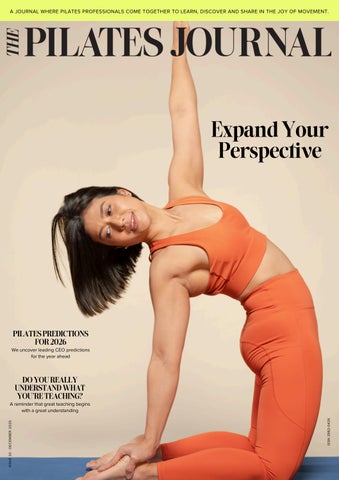
On the Cover Mira Hassan from @flow.with.mira Darmawan @dartjong
USA
10 - 11 JANUARY 2026 CALIFORNIA
Why You Can’t Miss The Pilates Journal Expo World-Class Educators Inspiring Workshops and Cutting-Edge Topics Industry Networking Shop & Explore Business Panels Exclusive Giveaways and more!
LIMITED SESSION AVAILABILITY TICKETS STILL OPEN
PILATESJOURNALEXPO.COM
Thanks to our Partners SUPPORTING PARTNERS
PILATESJOURNALEXPO.COM
ISSUE 33 — PILATESJOURNAL.COM
Contents
3
EDITOR’S NOTE Welcome to another edition of The Pilates Journal.
8 10
The path from nervous new instructor to confident guide for athletes.
This story is proof that our greatest strength often starts with the smallest movement.
Because when you grow, your clients don’t just see the difference - they feel it.
I THOUGHT I WAS STRONG... UNTIL I WASN’T A few key strength training principles every Pilates teacher should know.
The Pilates Journal would like to acknowledge and pay respects to the Gadigal people of the EORA nation as the traditional custodians of the place we call home Sydney - where this journal is produced. The Pilates Journal pays respects to their elders, past, present and emerging, and acknowledges all Aboriginal and Torres Strait Islander peoples.
DO YOU REALLY UNDERSTAND WHAT YOU’RE TEACHING? A reminder that great teaching begins with a great understanding.
29 28
THIS IS THE ART WE CAN'T AFFORD TO LOSE
WHY YOUR GROWTH AS A TEACHER MATTERS
20 26
We speak with leading CEOs across the Pilates industry to uncover their predictions for the year ahead.
PILATES, PERFORMANCE, AND COLLABORATION
14 18
2026 PILATES PREDICTIONS
DISCOVERING THE PILATES IT FACTOR™ A Journey From Instinct to Science with John Garey.
WHAT MAKES A STUDIO STAND OUT IN A SATURATED MARKET Andrea Speir is launching a new program to help studio owners thrive and you’re invited to be part of it.
6
ISSUE 33 — PILATESJOURNAL.COM
Contents
31
SAM’S WORLD VIEW Each month Sam shares the latest research on Pilates for rehabilitation in the Pilates industry.
32 36
A structured pathway to deeper awareness, grounded in the APPI 5 Key Elements.
EQUIPMENT MAINTENANCE TRAINING EVERYONE NEEDS Finally- expert guidance that makes equipment upkeep safer, simpler, and more consistent across every studio.
GROWING PAINS Your studio is booming BUT you're struggling to manage your growing team and the business plan.
44 47
The Heart, Grit & Grace of Khetanya Henderson.
INSIDE THE APPI PILATES APPROACH
40 42
KEEP REACHING UP
PURPOSE-BUILT MOVEMENT How Inna Essence Built an Award-Winning Studio on Merrithew Equipment.
WHAT TO CONSIDER WHEN OPENING A STUDIO Your partner in building a confident, compliant, and thriving Pilates business.
48
51
INSTRUCTOR SPOTLIGHT: SARAH WATSON We speak with Pilates Instructor Sarah Watson about her Pilates career to date and her teaching focus.
A POETIC DIALOGUE BETWEEN CERAMICS AND PILATES Journey to Italy to witness Pilates transformed into living art at Nest-Pilates’ groundbreaking exhibition, Materia viva.
ISSUE 33 — PILATESJOURNAL.COM YEAR AHEAD
2026 Pilates Predictions From the Industry’s Top CEOs We find out what 2026 holds for the Pilates industry
All research today in fitness and rehabilitation show that Pilates is in the top 3 if not number 1 movement modality. The growing demand for Pilates in the large fitness chains, boutique studios, and medical facilities are all on the rise. The demand for qualified Pilates teachers goes up significantly every year, and we are no where close to saturation in the global market. Ask me, what is the future of Pilates? Overwhelmingly bright! Dr. Brent Anderson CEO, Polestar Pilates
The year ahead signals a powerful phase of expansion for the global Pilates industry. Consumer demand for mindful movement, instructor-led experiences, and high-quality equipment continues to accelerate across studios, clubs, hospitality, and at-home environments. As new demographics enter Pilates and group Reformer formats gain mainstream traction, the industry is shifting from niche to necessity. This creates significant opportunity for those who deliver consistency, quality, and innovation. Merrithew and STOTT PILATES are focused on leading this growth through elevated education, reliable equipment, and digital solutions that help studios scale sustainably. Stay close to your clients by offering consistent education, refreshed programming, and clear pathways for progression. This is the fastest way to drive loyalty, retention, and revenue. Jim Heidenreich CEO, Merrithew®
Pilates begins its second century in 2026. This longevity – and continued power of the Pilates brand -- is unheard of in the fitness industry. Maintaining the trajectory is our responsibility and opportunity. We cultivate the Pilates brand by ensuring our clients know that Pilates supports bodies and minds at all ages. Pilates is a progressive methodology built on quality of movement and most effective when guided by skilled instructors dedicated to supporting individual goals. Ken Endelman Founder & President Balanced Body
While Pilates has entered the mainstream in many countries around the world in 2025, 2026 will see the practice spread even further, driven by faster adoption from major players in the fitness industry. Although quality will always remain a topic of debate, the good news is that this growth will help even more people experience Pilates; and that’s something we can all get behind. For a Pilates studio, this should be seen as a very positive development: more people will become aware of the benefits of Pilates, and just as there’s room in our world for both McDonald’s and Michelin-starred restaurants, success will come through differentiation, particularly in the quality of instruction and equipment. Matthijs Wilhelmus Former CEO, Basi Systems 8
ISSUE 33 — PILATESJOURNAL.COM YEAR AHEAD
Pilates is no longer seen as a fleeting TikTok trend or passing fad. Those who "jumped on the bandwagon" in 2025 now truly appreciate the deeper benefits - both physical and mental - that Pilates offers. It’s become more than just a workout; it’s a valued lifestyle choice by the masses. In 2026, Pilates is here to stay. Think long-term, not short-term. Focus on building a strong reputation and a name that stands for integrity and excellence. Don’t chase trends either. Stand out by being consistent in the quality of your teaching, your genuine passion for helping others, and your commitment to continuous learning and growth. When you lead with purpose and professionalism, the right opportunities will find you. Selina Bridge CEO, KX Pilates
Pilates will dominate the fitness industry the way HIIT did a decade ago. In 2026, people will shift toward efficient, intelligent training that actually builds longevity -- and that’s where Pilates Addiction will lead in the category. The era of break down workouts is over; Pilates is how people will build themselves up.” Provide your members with movements that translate to real-world strength....Make Pilates feel powerful -- your clients should walk out stronger! Sarah Luna CEO, Pilates Addiction
Pilates continues to be the most popular fitness format around the world, and we can expect to see continued innovation driven by growing competition, the rise of hybrid formats and the role of technology in personalising the fitness experience. With more studios and gyms offering Pilates alongside other complementary disciplines, it's clear that consumers are seeking holistic solutions that meet multiple fitness needs. My key takeaway for studios and instructors is to understand what the customer really wants from their fitness experience so you can evolve and define your point of difference. Michael Ramsey Co-founder of STRONG Pilates
In 2026, Pilates will enter its ‘intelligent era.’ We’ll see reformers and platforms that quietly adapt to the individual, measuring effort, guiding alignment, and elevating technique without breaking the flow. Technology won’t replace instructors; it will empower them, creating more personalised, precise, and intuitive experiences. Pilates will feel more connected, more accessible, and more elevated than ever before. Studios should start exploring tech partnerships that enhance, not disrupt their teaching. Yvette McGaffin Director of Product Marketing Pilates, iFIT
Pilates is poised for another massive growth year, driven by its unique ability to retain clients longer than almost any other modality. At Arketa, we’re seeing instructors want to get certified on an apparatus, so that they can teach multiple modalities, digital engagement, and overall revenue. From reformer to mat, Pilates continues to bridge boutique fitness and wellness, proving it’s not just a workout it's a movement with staying power. You can charge more for classes and especially privates when equipment is involved because clients don’t have it at home. If you’re a class-only reformer studio or a mat studio, finding a way to carve out a space for equipment-based privates will help drive up your revenue! Rachel Lea CEO, Arketa
9
ISSUE 33 — PILATESJOURNAL.COM WORKING WITH ATHLETES
Pilates, Performance, and the Power of Collaboration THE PATH FROM NERVOUS NEW INSTRUCTOR TO CONFIDENT GUIDE FOR ATHLETES, SHAPED BY NEARLY 20 YEARS OF LEARNING AND LINEAGE.
by Kenlie Reed
I first found Pilates almost 20 years ago. It wasn’t trending on Instagram, and there wasn’t a studio on every corner. I was a college kid from Arkansas- a “gym girly” with an athletic streak, a love for sports, and a dance background. While getting my degree in Psychology at UCF, I came across a reformer for the very first time. The moment I got on it, I was hooked. Pilates blended everything I loved: strength training, stretching, precision, and control. I didn’t just feel my body working, I felt it working differently. Not long after that first session, I knew this was the path I wanted to follow. I wanted to help people feel what I had felt. I had no idea it would lead me to work with some of the most elite athletes in the world.
“I think the balance of contemporary and classical training is what keeps my teaching true and effective.”
In the Beginning Shaping My Teaching Style
I can still remember how nervous I was when I first started working with professional athletes. I was 5’2”, in my early 20s, newly certified and I didn’t know anyone else who was working with athletes. I was so worried they wouldn’t feel challenged or listen to me. Remember most of these guys are almost 7ft and close to 300lbs! That nervousness quickly went away, I realized they were stepping into my world, and this form of movement was completely foreign to them.
I got my comprehensive certification through Balanced Body, which I believe is one of the most thorough and detailed programs available. I completed that 500 hour certification feeling prepared to work with any client or situation. But the more bodies I taught, the more I wanted to know about the essence of Pilates. I wanted to understand why Joseph Pilates designed things a certain way, why some exercises were meant to remain pure but some could be modified. That led me to study with teachers from classical lineages and many second generation instructors.
They were shaking, sweating, and fighting to focus on their form and control instead of the explosive movements they were used too. Every week they kept coming back, and usually bringing friends. One thing I noticed was how what they had already done that day affected our sessions. If they did a lower body lift, if they had just come off their therapist table, if they were super dehydrated from a full morning of field work, all of these things came into play and affected how I could program and train them that day.
Today, my approach blends both worlds: the contemporary adaptability of my Balanced Body training with the respect and integrity of the classical method. I’ll absolutely modify exercises for the body in front of me, but only if it preserves the principles of the work.
I would ask ‘what did your physical therapist say we should avoid today?’ Their answer was usually NOT what I needed to hear. Most days it was ‘I think we’re good’. So I asked them to connect me with their performance coaches and therapist to help streamline those conversations, so we could avoid making an injury worse. My emails and text fell on deaf ears for a while. At first, it was tough to get other professionals to believe Pilates could make a real difference. But the results started speaking for themselves. Athletes doing Pilates with me were getting hurt less, recovering faster, and moving more freely. That’s when doors started opening, and true collaboration became possible. 11
ISSUE 33 — PILATESJOURNAL.COM WORKING WITH ATHLETES
Building Trust
Trust is everything in this line of work- both with clients and with their teams. I push my clients hard, and we change the way their bodies move, but I also follow doctors orders. I follow their lead on the intensity I should demand from each client. Not all torn muscles or broken bones are equal. Each case is different and should be treated accordingly. I want everyone else working with this client to know I take their work just as seriously as I take mine. Results are the number one reason my clients keep coming back. Pilates changes the way their bodies move, and they feel the difference, they feel better! Whether it’s hitting more home runs or rehabbing from an old injury, the results speak for themselves. But I also care about what’s happening in my clients lives outside of training. Did they make the playoffs? Are they coming off an injury? Are they planning a wedding this offseason? Did the new baby keep them up all night? Are they entering free agency? These things matter because they impact performance, recovery, and mindset. I don’t just see my clients a couple times a week, bark orders, and send them on their way. I get to know them. Some of them I’ve known their entire career. My clients are not just bodies on a reformer, they’re people I care about. Their success and helping keep them off the injured list is my top priority.
The Power of Teamwork
A lot of times as Pilates instructors I think we can get a little selfrighteous and we think we can do it all. We think Pilates is the only way, and sometimes we can be a little set in our ways. Maybe it’s because we’ve had to fight so hard for our seat at the table? If I could say one thing to instructors - it’s ok to ask for help! We can’t do it all. We aren’t doctors or coaches, and we should stay in our scope of practice. We are a piece of the puzzle and when you can understand that and embrace the power of teamwork, that’s when your clients will really start to see and feel the difference.
Collaboration That Transforms
I’ve had the privilege of working alongside physical therapists, performance coaches and position specific trainers. And if there’s one thing I’ve learned, it’s that Pilates is often the missing piece of an athlete’s training. For so long, the focus for athletes has been “bigger, faster, stronger.” Those qualities are crucial, of course but I think Pilates helps blend all of those modalities together.
I’ve learned that collaboration doesn’t compete with the clients loyalty, it strengthens it. Many of my clients are actually referred to me BY the coaches and therapist. Clients don’t have to remember to tell me what the terminology their physical therapist said, what they lifted that day, if they ran sprints or threw a bull pin before Pilates. Because I already know, and because I already know, we eliminate a lot of guessing and wasting time. Time is money. When athletes know their team is all on the same page, trust and confidence build naturally. It’s not about competing for their attention; it’s about working together to get them where they want to be with urgency. I will choose certain exercises and modifications based on what I know about their day and what their coaches and therapist tell me. Maybe they just had a cortisone shot or prp in their knee, so now extreme knee flexion is off the table for that session. You can imagine the number of exercises that takes out of the equation. But without that info- I could have absolutely made an already sensitive area worse.
When athletes do real Pilates, their lifts improve because their muscle groups are firing in the right order instead of relying solely on the big global muscles. Their sprints get faster because their core is finally coming into play. Their jumps get higher because their feet and ankles are working properly, reducing the risk of rolled ankles, dropped arches, or Achilles tears. Stronger feet and ankles mean fewer injuries. Those are things that keep athletes performing at their peak and keep them doing Pilates year after year. And those are the things that help secure my relationship with the rest of their team. Pilates helps make their job easier. I work hand in hand with their trainers to find corrective exercises they can implement into their lifts, and their speed and position coaches have helped me understand what each position really needs to excel. What muscles do defensive backs use to back pedal and cut, what muscles can I help strengthen and elongate to help a receiver gain more rotation to catch a ball over their shoulder while running downfield, how can I help my switch hitter be equally as powerful when he bats left and right handed, how can we keep our 3rd baseman out of chronic low back pain? It truly takes a team and constant collaboration. And I’m honoured to be a part of it.
Sure, there are still skeptics. Some people aren’t eager to embrace Pilates. But with social media showing so many top athletes incorporating it into their training, the resistance has lessened. 12
ISSUE 33 — PILATESJOURNAL.COM WORKING WITH ATHLETES
Usually, my clients do the convincing for me. They preach about how Pilates has changed their game and about how they want to do it forever, they bring their teammates with them to Pilates and honestly, that’s the best business card I could ever ask for. When I think back to that first day on the reformer, I couldn’t have imagined where this journey would lead. But one thing that hasnt changed: I’m still hooked. And I still want to share this work with as many people as possible.
Kenlie Reed is a Pilates instructor with nearly 15 years of experience working with elite professional athletes as well as clients from ages 9 to 90. Comprehensively trained through Balanced Body and further educated in classical methods including Lolita and Fletcher work, she specialises in adapting Pilates to the unique demands of each athlete’s position. Kenliee is also a top-viewed instructor on the YourReformer app and has worked with notable names such as Bobby Flay and Bianca Jagger.
Feature your product or business here. Contact us for more information. WWW.PILATESJOURNAL.COM
13
"The Pilates equipment is a wonderful dance partner, but the mat teaches you how to dance alone."
ISSUE 33 — PILATESJOURNAL.COM IMPORTANCE OF MATWORK
This Is The Art We Can't Afford To Lose THIS STORY IS PROOF THAT OUR GREATEST STRENGTH OFTEN STARTS WITH THE SMALLEST MOVEMENT. by Mira Hassan
I was lying on my mat, eight weeks after each of my emergency Csections, searching for any sign my body still belonged to me. As a former dancer with twenty years of teaching Pilates, I thought I knew my body. But after pregnancies, that body felt foreign, and the strength I once owned felt like a distant memory. The starting point of my recovery wasn't a grand movement. It was a single breath. With a hand placed gently over my C-section scar, I inhaled, searching for a response. The first two breaths were shallow. On the third, I felt it: a tiny, deep flicker of movement beneath my palm. A signal. That signal became my entire practice. For weeks, I simply lay on the mat, breathing life back into my fragile body. I began with one shaky movement at a time. My first Pelvic Curls were wobbly, my modified Hundred left me trembling.
“But the mat, in its beautiful simplicity, demanded nothing more than honesty. It met me exactly where I was.”
GET TICKETS
HERE 15
ISSUE 33 — PILATESJOURNAL.COM EDUCATION
Without springs or straps, it forced me to generate strength from the inside out. I was reclaiming my body, not with a dance partner, but alone.
The mat work doesn't always look impressive on social media. But I keep thinking about my clients who avoided surgery through fifteen minutes of daily mat practice. Or my late father's pure joy at touching his toes again. These "basic" movements can feel like miracles to someone who thought they were lost forever.
This humbling return taught me something profound. Mat Pilates is the REAL work. Not just an introduction before you start equipment. It's the foundation upon which everything else is built, and it's where the magic of Pilates happens.
These are the clients who stay with you for years, who become walking testimonials for what Pilates can really do. This is how you build a lasting business—not through flashy marketing or trendy moves, but by creating real change in people's lives.
This truth I rediscovered connects directly to what Joseph Pilates himself called "Contrology"—a practice centred on the mind's control over the body. This philosophy wasn't born in a pristine fully-equipped studio; it was forged from wartime necessity. The result was a sequence of powerful exercises that required nothing but focus, control, and connection to your own body.
This is why I created my online membership Flow with Mira. No commute, no intimidating equipment, no waiting for the "perfect" time to begin. Just you, your mat, the fundamental movements and your transformation.
The mat is an honest mirror. It reflects our imbalances without the aid of springs or frames. In this space, we use only our body against gravity to build real strength. This is why, at BASI Pilates, founder Rael Isacowitz honours the matwork as the "Crown Jewel" of the system. When we build our power on the mat, equipment becomes a tool to deepen our practice, not a crutch to begin it.
In our equipment-focused fitness culture, I'm here to remind you that your most powerful tool is already within you. The mat doesn't lie, but it also doesn't judge. It meets you exactly where you are—whether you're a former athlete or someone taking their first conscious breath in years. When you roll out your mat , you're participating in a century-old dance of finding strength in simplicity. Through precision over power. Through honouring your body's wisdom rather than forcing submission.
My rediscovery didn't stay personal. After years of teaching and running studios, I understood that real change happens not in complexity, but in simplicity. Mat Pilates strips away everything except what truly matters: your breath, your awareness, and your willingness to be open.
This is the art we can't afford to lose.
But in our rush to create the next viral movement, we risk losing what makes Pilates so powerful. I watch studios add more machines, more complex moves, more Instagram-worthy poses. Don’t get me wrong… I love creativity in movement—my successful YouTube channel, online membership and growing studios prove that innovation works.
“But when complexity and likes’ becomes the goal instead of transformation, we've
Mira Hassan’s Pilates teaching journey began in Australia (2005). Her Pilates journey has unfolded across continents, taking her to studios in London, Amsterdam and now her home in Jakarta. Mira is a BASI Pilates faculty member, owner of studios in Jakarta (Asia Award winning studio - Aalaya Pilates & BASI Pilates Indonesia HQ), and creator of Flow with Mira. Find her work at www.flowwithmira.com and on YouTube @FlowWithMira. Beyond her professional achievements, she is a proud mother to Kaia (8) and Theodore (2).
missed the point (of the work).”
16
Los Angeles
Sydney
10 – 11 JANUARY 2026
21 – 22 FEBRUARY 2026
THE WATERFRONT BEACH RESORT A HILTON HOTEL 7AM - 7PM
THE BRIGHTON HOTEL MGALLERY COLLECTION 7AM - 6PM
PILATESJOURNALEXPO.COM
ISSUE 33 — PILATESJOURNAL.COM YOUR CAREER
Progress with Purpose: Why Your Growth as a Teacher Matters BECAUSE WHEN YOU GROW, YOUR CLIENTS DON’T JUST SEE THE DIFFERENCE — THEY FEEL IT. by Katrina Edwards, Director of Training, National Pilates Training
“The best teaching starts with
In Pilates, progression is everything. Clients expect their programs to evolve, to get stronger, more refined, and more attuned to their needs over time. This is just as true whether you’re leading a dynamic group Reformer class or working oneon-one in a studio setting. But what about the teacher? If your clients are progressing but you’re standing still, the experience starts to lose its edge.
how you grow, not just what you know.”
As Pilates teachers, we’re wired to invest in others. We guide, we observe, we adapt. But the most sustainable and impactful teaching happens when our own growth keeps pace or even leads the way. SPONSORED
18
ISSUE 33 — PILATESJOURNAL.COM YOUR CAREER
The Hidden Risk of Stagnation
At first, teaching feels expansive. Every new client, class, and cue stretches your capacity. But over time, as the day-to-day routines
The Hidden Risk of Stagnation
At first, teaching feels expansive. Every new client, class, and cue stretches your capacity. But over time, as the day-to-day routines settle in, it’s easy to plateau. And when you stop evolving, something subtle starts to shift - confidence, creativity, and even job satisfaction can begin to fade.
What Sets You Apart
So what makes a client choose you? It’s not just your program design or cueing precision. It’s your ability to see them, to understand their goals, respond to their energy, and guide them with insight. It’s your ability to keep growing alongside them.
Your clients will feel it too. Whether they know how to name it or not, they can sense when sessions begin to feel flat or repetitive. In a crowded market where people are looking for more than just exercise, they’re looking for transformation, staying sharp isn’t just a nice-to-have. It’s what keeps your classes compelling, your teaching fresh, and your clients coming back.
The best teachers don’t just deliver movement, they create momentum. They bring curiosity, clarity, and care. These qualities aren’t innate, they’re cultivated. And they take deliberate investment in your own growth.
Growth That Goes Beyond Repertoire Professional development is often seen through the lens of repertoire and anatomy. But true progression as a teacher means more than adding tools to your toolkit, it’s about nurturing the whole person behind the teaching.
Your Teaching, Recharged
Personal growth means reconnecting - with what matters to you, with why you started, and with what kind of teacher you want to be next. Take a moment to reflect: — What part of your teaching feels energised right now? — Where do you feel a bit stale or stuck? — What kind of learning would stretch you in a good way? — What support would help you feel more grounded, more inspired, more confident?
This growth spans: — Emotional Wellbeing: Building self-awareness, strengthening resilience, and managing your energy so you can stay present and engaged — Relational Insight: Developing empathy and curiosity to foster connection and trust, whether with one client or a whole class — Evolving Your Teaching Style: Shifting from instructor to facilitator -refining how you cue, how you engage, and how you create space for clients to explore, reflect and take ownership of their movement journey
When you grow with intention, your clients do too. Katrina Edwards oversees three boutique fully equipped Pilates studios known as Aligned For Life Pilates in Melbourne, Australia and is the Founder and Director of National Pilates Training. Head to www.nationalpilates.com.au to find out more about the NEW “Growth Series’ built for you.
This kind of growth is about how you show up in your role, how you stay connected to your purpose, and how you keep your spark alive.
SPONSORED
19
ISSUE 33 — PILATESJOURNAL.COM STRENGTH TRAINING
I Thought I Was Strong... Until I Wasn’t A FEW KEY STRENGTH TRAINING PRINCIPLES EVERY PILATES TEACHER SHOULD KNOW. by Amy Sasso
I used to think I was strong. I had been doing Pilates five times a week for about 10 years, swimming regularly, and teaching movement for a living. But one hike changed everything.
So I started asking: “Why aren’t we being taught this in our Pilates Teacher Training programs?”
I went for a demanding hike with a couple of girlfriends—both with desk jobs—and I could barely keep up. My legs were tired. I was so far behind them. And I remember looking at their legs and thinking, “Why do they look so solid? Why do they move so powerfully… and I don’t?” Spoiler alert: they both strength trained in a gym 2 - 3 times a week.
“If Pilates is a form of exercise… why aren’t we taught about exercise science when we become certified?”
I’ve come to believe that every Pilates instructor should understand the basics of strength training. Not to become a personal trainer—but to be better at what we already do. Because strength training isn’t just about weights. It’s about principles. And many of these can be applied within the Pilates studio—if you know what you’re doing.
I thought Pilates was enough. But that day made something painfully clear: it wasn’t giving me strength. The kind of strength that lets you carry your body + a heavy backpack up a giant mountain with ease, or toss your own luggage into the overhead bin without hesitation. That hike was the turning point. The week after I joined a gym and started weight training. And within months, everything started changing.
A few key strength training principles every Pilates teacher should know: 1. Progressive Overload Muscles get stronger by gradually increasing challenge over time. If your client is doing footwork on 3 springs for 15 reps and never changes anything, their strength gains will stall. You have to increase resistance (add a spring)—or change the exercise (like switching to single-leg footwork)—once they are able to do 15 reps.
For the first time ever, I had visible muscle in my legs. I could hike comfortably. I can now do 12 full chest-to-floor push ups— something that used to feel laughably out of reach. Even my back pain changed. What used to sometimes spiral into a 2-week shutdown now barely lasts a day, and doesn’t stop me from living my life. After all this, I studied Clinical Pilates and learned about the physiology of getting stronger. I learned about exercise science, what happens inside the muscles when they get stronger, and how to tweak the way I teach Pilates to elicit this response in my clients.
Progressive overload = keep making the work slightly harder over time. Always.
I started applying these principles with my clients—especially those dealing with pain, injury recovery, or post-surgical rehab— and they got stronger too. Not just “feeling better,” but genuinely capable. They reached goals they had struggled with for years.
To build strength, we need to challenge the muscle close to the point where it physically can’t do another solid rep. That point is called muscle failure—and getting close to it is what tells the body, “Hey, we need to adapt and get stronger.”
2. Muscle Failure
21
ISSUE 33 — PILATESJOURNAL.COM STRENGTH TRAINING
In Pilates, we usually stop well before that point. We might program 5 roll-ups in a class because that’s what the manual says. But if Jane can actually do 20 roll-ups before her abs even start to fatigue, those 5 reps aren’t doing anything for her strength. To help Jane actually get stronger, we need to make the roll-up harder so that she can’t do more than 15 reps. Maybe that means lifting her legs into a Teaser. If she can only do 10 good Teasers? Perfect—that's her working range. Once Jane gets stronger and starts breezing through 15 Teasers, we need to up the challenge again—maybe by holding a weight overhead, or adding spring resistance with a push-through bar sprung from below. The good news? Pilates teachers are already great at this. We do it all the time—we just call it progression. When we want to bias strength, we simply need to keep progressing the exercise until it’s hard enough that our client is working close to failure in 15 reps or fewer. That’s how the body knows it’s time to get stronger. Caveat here: We don't need to arrive exactly at failure each time. We can stop a few reps before. And how can we know if we are a few reps before failure? The movement will start to involuntarily slow down. Form and technique will start to degrade. When you see that happening, you will know you are close to muscle failure.
3. Volume
Current strength guidelines recommend that beginners work every major muscle group with around 3–5 challenging sets per week. These sets should be close to muscle failure (see point above). Intermediate and advanced people will need more sets per week in order to keep getting stronger. This doesn’t all have to happen in one session. You can spread the volume across multiple workouts in the week. But as teachers, we need to think beyond just whether our clients are “moving.” We need to ask: Are they getting enough stimulus to actually build strength? That means ensuring our clients are working all the major muscle groups. We can make sure most muscles are targeted by including: — A leg exercise (like footwork, squats, or lunges), — A push (like chest press, overhead press, or push-up variations), and... — A pull (like rows, pulling straps, or arm springs). If we only see a client once a week and the client isn’t getting strength training anywhere else, we may not hit that target unless we’re very intentional. So the key takeaway here is: don’t just plan sessions—plan weekly strength volume.
22
ISSUE 33 — PILATESJOURNAL.COM STRENGTH TRAINING
And this matters most for clients who aren’t doing any strength training outside of Pilates—because if Pilates is the only form of resistance work they’re doing, we need to make it count. In these cases, we’re their only shot at hitting the physical activity guidelines for muscle strength.
And yes—strength training literally helps us live longer. The World Health Organization and the American College of Sports Medicine both recommend: — 2–3 full-body strength sessions per week — 150+ minutes of moderate cardio per week
4. The Best Exercises For Strength Are The Simplest Ones
Meeting these minimums reduces all-cause mortality by 50%. Let that sink in. Strength training can literally make our clients half as likely to die for any reason in the next 10 years.
To build strength, the exercise shouldn’t demand a huge range of motion or tons of skill. Simpler movements like squats, rows, or push-ups (done well, with effort) are better strength builders than complex choreography.
It improves physical function, blood sugar, bone density, heart health, and even mental health. And results can start to appear with just one session per week.
Strength lives in the simple, not the fancy.
So if we, as Pilates teachers, want to help our clients feel stronger, move better, and age resiliently—we can’t ignore this.
5. Muscle Endurance ≠ Muscle Strength We don’t have to abandon Pilates. But we do need to upgrade it.
Pilates is great for muscle endurance. Most Pilates exercises are submaximal—that means they don’t take us anywhere near muscle failure. If we mistake the “burn” (caused by hydrogen ions from repeated contractions) for strength gains, we’ll miss the mark.
Let’s teach with intent. Let’s stop being afraid of strength. Let’s use the science that already exists—and combine it with the beautiful method we already love. That’s how we help people thrive.
Burn is not the same as strength. Burn isn’t the goal—adaptation is (which is caused by getting close to failure)
23
Amy Sasso is a Clinical Pilates teacher and mentor who helps instructors bring science, clarity, and strengthtraining principles into their teaching. She supports teachers in understanding pain, injuries, and special populations so they can work confidently with a wide range of clients. Drawing on 15+ years of experience, mentorship with Lolita San Miguel, and a Clinical Pilates Diploma, Amy blends evidence-based insight with classical foundations to offer practical, ongoing education for instructors who want to grow.
Los Angeles 10 – 11 JANUARY 2026 HUNTINGTON BEACH, CA
TICKETS NOW AVAILABLE PILATESJOURNALEXPO.COM
ISSUE 33 — PILATESJOURNAL.COM EDITORIAL
Do You Really Understand What You’re Teaching? A REMINDER THAT GREAT TEACHING BEGINS WITH A GREAT UNDERSTANDING by Julie Driver
One of the best pieces of advice I was ever given early in my teaching career was this: If someone walked into your class mid-session and asked you to explain what you were teaching your client, could you? Could you articulate how the movement they are doing fits into the bigger picture of your client’s progression? Does it have a reason? That idea has stayed with me ever since. Because if you can’t express why you’re teaching something or what you’re asking your client to do, it usually means you don’t yet understand it deeply enough yourself. And if that’s the case, perhaps you shouldn’t be teaching it. At least, not yet. I share this thought with all my teacher-trainees because I believe that in order to teach an exercise effectively, you need to feel it in both your heart and your head. You need to understand it and embody it to be able express it.
The Power of Questions
You can layer on all the cues, modifications, props, and creative variations you like, but if you don’t understand the heart and structure of the original movement, then everything else is just decoration.
And as teachers, we should welcome those questions. They keep us sharp. They make us reflect. Sometimes, they even reveal the gaps in our own knowledge, gaps we can then explore and fill.
Students, clients, trainee teachers and experienced teachers should always feel empowered and safe to ask why.
That’s how we grow as teachers, and as movers. As teachers, we must know why we’re choosing an exercise, not just how to perform it Embodiment Doesn’t Mean Perfection
Because at the end of the day, teaching Pilates isn’t about imitation, it’s about understanding and passing that understanding onwards when we teach.
Now, that doesn’t mean we have to be able to perform every exercise perfectly in our own bodies. Life happens, injuries, age, accidents, asymmetries, all of which can influence what we’re physically capable of doing.
In short: Don’t just do it: know it. Don’t just teach it: embody it. And never stop asking why.
But what we do need is a genuine understanding of the essence of the exercise: its purpose, its direction, its breath, its relationship within the system.
Julie Driver is a UK-based Pilates educator with over 25 years’ experience teaching in the UK and internationally. She delivers in-depth teacher-training programmes and mentors Pilates professionals across all levels. Julie’s work is shaped by her own rehabilitation journey following a serious skiing accident in 2008, which required her to relearn how to walk and profoundly deepened her understanding of movement, Pilates, rehabilitation, and resilience. Her first book, The Pilates Equestrian, will be published in April 2026.
Challenge of the “Copy and Paste” Era
In today’s world, it’s easier than ever to see an exercise on social media and think, “Oh, that looks good, I’ll teach that today.” But seeing and doing are not the same as understanding. The integrity, the nuance, the why behind an exercise can’t be learned from a 30-second clip. 25
ISSUE 33 — PILATESJOURNAL.COM SPONSORED
Discovering The Pilates IT Factor™ A JOURNEY FROM INSTINCT TO SCIENCE By John Garey
I have trained, coached, hired, and observed fitness and Pilates instructors for nearly four decades, including some of the best in the field. During this time, one question has always lingered in the back of my mind:
I could sense it instantly, whether during an audition or simply watching someone teach. I knew this person had “it,” but I could not define what “it” was. It was not knowledge or perfect cueing or flawless technique. It was something more. It was a feeling. Everything began to crystallize when I started hiring instructors to teach on camera for Pilates & Fitness TV. Instructors who were magnetic in person were not always magnetic on camera. When you teach on camera, there is no feedback, no reaction, and no energy to play off. The camera strips everything away and all that is left is you. Every communication skill becomes amplified: your voice, your body language, and your presence. Suddenly it is all right there in its purest form.
“What gives an instructor that special something, that spark, that keeps their classes full and
That is when I realized that beyond knowledge and programming, exceptional communication is what transforms a class into an unforgettable experience. This realization pushed me to study communication not only as an art, but also as a science.
their clients loyal?”
For two years, I explored fields outside of Pilates. I studied Keynote Speaking, neuroscience, psychology, vocal theory, emotional intelligence, and movement education. After nearly four decades of searching, I finally had the answer. 26
ISSUE 33 — PILATESJOURNAL.COM SPONSORED
The Pilates IT Factor™ is exceptional communication.
It is how an instructor uses their voice, body language, energy, and presence to help clients feel seen, safe, and inspired. It is the bridge between what you know and what your clients actually receive. Without great communication, even the best knowledge can fall flat. I have spent the past two years turning this understanding into a comprehensive program to help Pilates teachers find their own IT factor. In 2025, I traveled to nineteen cities across the United States teaching The Pilates IT Factor™ Foundations Workshop. Now I am thrilled to make the next phase available to every instructor through The Pilates IT Factor Guide and the On Demand Course.
The Origin Story: How The Pilates IT Factor Guide Came to Life
The idea did not start in a classroom. It began when I sold my Pilates studio after eighteen years. I did not expect the flood of letters and messages from clients who shared how our classes had supported them through illness, grief, divorce, burnout, and some of the hardest seasons of their lives. I always knew Pilates could change bodies. What I did not fully understand was how deeply communication, our words, tone, presence, and energy, could change someone’s life. That insight made me look differently at the thousands of instructors I have trained. Some were technically brilliant yet struggled to connect. Others, even with less experience, lit up a room from the moment they walked in. Why?
Meet Me at The Pilates Journal Expo! I am thrilled to share this work at The Pilates Journal Expo. At our booth, you will be able to:
I studied how the nervous system responds to tone, pacing, facial expression, and posture, and how hormones like oxytocin and cortisol shift based on how we communicate. Layer by layer, the pieces came together and The 5 Pilates Teacher Archetypes™ emerged. They are dynamic and trainable communication styles that any instructor can use with intention.
— Explore The Pilates IT Factor Guide - being debuted at The Pilates Journal Expo — Learn about the On Demand Course - coming soon — Connect with Pilates & Fitness TV — Discover continuing education through Pilates Grad School
Why This Work Matters Now
I hope you will stop by and experience this work firsthand. The IT Factor is not something you are born with.
The Pilates industry is expanding rapidly. More instructors are entering the field, more are teaching online, and more studios are opening every day. It is exciting, but it also means that connection matters more than ever.
The Pilates IT Factor is something you build with intention, awareness, and the right tools.
Technique alone does not set an instructor apart: Communication does. Presence does. Connection does. The Pilates IT Factor Guide is my way of giving back to the industry that has given me so much. I cannot wait to hear how it enhances your teaching, your confidence, your connection with clients, and your impact.
GET TICKETS SPACE IS LIMITED
27
ISSUE 33 — PILATESJOURNAL.COM SPONSORED
What Makes a Studio Stand Out in a Saturated Market ANDREA SPEIR IS LAUNCHING A NEW PROGRAM TO HELP STUDIO OWNERS THRIVE—AND YOU’RE INVITED TO BE PART OF THE VERY FIRST COHORT. by Andrea Speir
The Pilates and boutique fitness world is more crowded than ever. Every block seems to have its own take on “the method,” every influencer has a new flow, and every brand claims to be the one that will finally change your life. And honestly, that’s exciting—it means people are moving, exploring, and valuing wellness more than ever. But it also means the pressure is on, and the ability to lose a clear focus on functional, science-based training with a clear north star can get diluted. In this new landscape, a studio can’t just be good. It has to be memorable, and it has to be based in actual exercise science to work. The studios that truly stand out today aren’t necessarily the ones with the biggest marketing budgets or the fanciest reformers. They’re the ones that have clarity. They know exactly who they are, what they teach, and how they want people to feel when they walk out the door. Consistency becomes their secret weapon. When programming has purpose and the client experience feels intentional, people trust you. That trust is the quiet magic that turns drop-ins into devotees and visitors into brand ambassadors. At Speir Pilates, we’ve learned that what happens inside the four walls of the studio is just as much about communication and alignment as it is about choreography. A great workout might bring someone in, but a great team keeps them coming back. A studio’s teachers are its heartbeat—the ones who translate the brand’s vision into human connection. When instructors feel supported, mentored, and creatively engaged, that energy radiates through every cue, correction, and playlist. Clients feel it immediately. Beyond programming and teaching, experience is everything. A client might not remember exactly how many springs were on for their footwork series, but they will remember how the lighting made them feel confident, how the front desk greeted them by name, and how a single cue helped them finally find their core in an upper body sequence. Every detail, from the class flow to the tone of voice in an email confirmation, communicates who you are. Authenticity and intention leave the kind of imprint that no amount of ad spend can replicate. 29
ISSUE 33 — PILATESJOURNAL.COM SPONSORED
And perhaps most importantly, longevity in this industry doesn’t come from chasing trends. The studios that endure evolve thoughtfully without losing their essence. It’s tempting to chase the next viral fitness hybrid, but the truth is that timeless functional programming, skilled teachers, and genuine connection never go out of style. There’s an elegance in knowing what you stand for and refining it rather than reinventing it every six months. When teachers throw creative choreography into a class with no clear reason why, no specific guidance, it’s not for the clients, it’s for the teachers. That urge to be creative for no clear gain will not inspire clients to come back. Teachers that train bodies, not algorithms, will grow a robust roster of returning clients. That philosophy is what led my business partner, Liz Polk, and me to create Studio Plans by Speir Pilates. After a decade of building studios, training instructors, and developing scalable systems, we wanted to help other owners find their footing in a crowded market. The Pilates community thrives when we collaborate, share, and support one another—because our collective standard rises when each studio succeeds with integrity. Standing out today isn’t about being the flashiest name in fitness. It’s about being grounded, consistent, and clear in your message. When your studio knows exactly who it is—and operates from that place of purpose—clients don’t just notice. They stay.
Andrea Speir has been teaching, innovating and educating in the Pilates industry for 19 years. Her passion for creating form focused, inclusive and fun movement can be seen in her California-based studios and digitally on the fitness app Speir On Demand. You can reach out to Speir Pilates to find out more about this Studio Owner program.
30
ISSUE 33 — PILATESJOURNAL.COM COLUMN
Sam’s world view EACH MONTH WE WILL SUMMARISE THE BEST/MOST RECENT PUBLISHED ARTICLES IN THE INDUSTRY
Associate Faculty for BASI Pilates
SAMANTHA WOOD
Pilates for Chronic Pain Syndromes & Neurological Conditions Over the past months, we've explored how Pilates supports recovery from orthopedic injuries and improves balance in older adults. Now, I'm excited to shift our focus to an equally important but less-discussed area: the application of Pilates for chronic pain syndromes and neurological conditions. This new direction aligns with my upcoming course, "Pilates for Injuries & Pathologies: Chronic Pain and Neurological Conditions" and the recently released 2nd edition of my book "Pilates for Rehabilitation" both of which delve deeply into these complex conditions. I believe all Pilates teachers can benefit from understanding the research behind this work, as more clients are seeking movement-based therapies to complement their medical care. Research has demonstrated promising results for Pilates as an effective rehabilitation approach for various neurological conditions and chronic pain syndromes. While conventional treatments for these conditions have traditionally focused on medication management and general physiotherapy, there is growing interest in how Pilates' emphasis on core strength, body awareness, and controlled movement can address the specific challenges faced by these populations. Over the next few months, we'll review evidence for Pilates in treating fibromyalgia, rheumatoid arthritis, multiple sclerosis, Parkinson's disease, and stroke. Each of these conditions presents unique challenges—from the widespread pain and fatigue of fibromyalgia to the motor control deficits of Parkinson's disease and stroke—yet all may benefit from Pilates' whole-body approach to movement. The research I will summarize points to Pilates' potential to improve balance, reduce pain, enhance functional capacity, and ultimately improve quality of life across these diverse conditions.
Samantha Wood, MPT, MBA, NPCT, RYT, is a licensed physical therapist, a National Pilates Certified Teacher (NPCT), and a Yoga Alliance–certified teacher. She created and teaches BASI’s Pilates for Injuries & Pathologies advanced education courses. Click here to view 2026 course dates and locations. Her new book, Pilates For Rehabilitation, 2nd edition was released at the beginning of December and is available now from HumanKinetics.com and Amazon.com.
While many of these studies are preliminary and have methodological limitations such as small sample sizes, they provide valuable insights into how Pilates principles might be integrated into comprehensive rehabilitation programs for patients with chronic neurological and pain conditions. My hope is that by sharing this research, we can collectively expand our understanding of how to serve these populations effectively and safely. 31
ISSUE 33 — PILATESJOURNAL.COM HUMAN INTEREST
Keep Reaching Up THE HEART, GRIT & GRACE OF KHETANYA HENDERSON
by CJ Zarb
When the world abruptly closed its doors in March 2020, many instructors were forced to rethink how to show up for their communities. For Khetanya Henderson the shift wasn’t just logistical, it was spiritual.
“If I can help just one person
“You know, it was probably the most present I had ever been,” she recalls. “It was a whirlwind, one day I was seeing clients faceto-face, and the next, on March 13th, the world stood still. I couldn’t ignore the fact that people still needed to stay healthy, stay alive (yes, that’s honestly where my mind was at the time), and feel connected to community.”
breathe deeper, move better, or feel less alone, that’s enough. And that purpose carried me.”
Her decision to offer free online classes was never part of a marketing plan. It was instinctive. “I didn’t have all the answers, but I knew I could lead with presence and positive energy. Offering
free classes online wasn’t part of a strategy, it was a response. A way to stay grounded in service. I kept telling myself: That purpose continues to guide her - from her personal practice to the community she’s cultivated worldwide.
A Love Story With Pilates
For Khetanya, Pilates arrived through the door of her performing career and then quietly became the foundation of her life. “Pilates found me through my performing career, first as a dancer, then as an instructor searching for the deeper connection between strength and grace,” she says. What keeps her inspired is the method’s constant evolution. “Short answer: it’s always evolving, from my personal practice to witnessing others fall just as deeply in love with it. What I love most is how it brings awareness to every inch of the body. For me, it’s not about perfect form, but about feeling aligned and powerful from the inside out.” Watching clients discover their own strength is one of her greatest joys: “I love watching my clients surprise themselves rediscovering their strength, building trust in their bodies, and showing up consistently with love and curiosity.” 33
ISSUE 33 — PILATESJOURNAL.COM HUMAN INTEREST
When KKRU Went Global
A Community Rooted in Care
What began as a temporary pandemic solution quickly transformed into something far bigger.
Ask her to describe the KKRU community, and the words come easily: “Empowered. Compassionate. Diverse.”
“Seeing how far we've reached worldwide, from Australia to South Africa to Los Angeles still amazes me. I didn’t set out to build a global community; I just wanted to meet people where they were.”
Their strength lies not only in movement but in support for one another: “They root for one another, and that shared support is the heartbeat of KKRU.”
And yet, community is exactly what formed - one that moved, breathed, laughed, and healed together. “We laughed, cried, moved, and healed together. That collective energy, even across time zones, became sacred. And it’s still growing.”
The Way She Teaches: Dance, Strength, Mindset
Khetanya’s movement philosophy is woven from every chapter of her life. “It’s all woven together. Dance taught me how to hold a multifocus, to be fully present with the bodies in front of me while staying connected to the flow. Strength taught me structure. And mindset? That taught me discipline, the glue, the why behind the what.”
A Mantra That Became a Mission
At the centre of everything Khetanya teaches is one philosophy: Keep Reaching Up. “‘Keep Reaching Up’ is more than a phrase - it’s my life compass,” she shares. It’s a lesson she carries from her brother, who passed in 2017. His resilience shaped her outlook.
Her classes invite both intensity and introspection. “We don’t just build bodies, we build awareness. I want anyone who experiences my classes to walk away with more than just a toned body. I want them to leave with knowledge that empowers them.”
“It reminds me that growth is a journey, not a destination. It’s about reaching for something greater, healing, hope, strength, or joy, even when it feels just out of reach.”
And her hope for every member?
The mantra also represents her approach to community uplift: “And for me, it’s not only about rising, but about lifting others as I go. KKRU is that shared journey, a space where we all keep reaching, together.”
“That they remember who they are powerful, capable, worthy - not just in movement, but in life.”
So what’s next for Khetanya? Moving for How the Body Feels, Not How It Looks
“Expansion with heart, mission, and intention,” she says. I’ve now opened a physical studio, deeper teacher training, and accessible programs for underserved communities in Atlanta are all underway.
Khetanya’s teaching centers on empowerment rather than aesthetics. “The body is constantly evolving, and we should honor that change with love and respect. I want my clients to feel empowered not punished.”
“I believe we each have the power to change our lives and create a better existence. That’s the work and the invitation of KKRU.”
At KKRU, capability is celebrated: “As clients begin to feel more energized, aligned, and resilient, the aesthetics often follow naturally. But more importantly, they begin to fall in love with how their body supports them, every single day.”
KKRU Pilates Studio & Wellness is a community-centered movement space in Atlanta’s West End offering classical Pilates, intentional movement, and holistic practices through group classes and private sessions. Founded by Khetanya Henderson, the studio provides mat-based modalities along with semi-private and private apparatus Pilates for deeper, individualized support. Rooted in its philosophy “Keep Reaching Up,” KKRU brings accessible, high-quality wellness to the West End with expert instruction and an inclusive, growth-driven environment.
What She Held Onto and What She Let Go
The pandemic clarified what truly matters. “I held on tightly to my love for community, family, and friends and let go of everything that no longer served my inner being.” “The pandemic taught me the true meaning of presence: to slow down, listen deeply, and live with intention.”
Khetanya will be presenting at The Pilates Journal Expo California January 10–11, 2026 Join her in person and experience KKRU live.
34
EARLY BIRD TICKETS NOW ON SALE
2026
21 - 22 FEBRUARY 2026 SYDNEY
ISSUE 33 — PILATESJOURNAL.COM SPONSORED
The Art of Integration: Inside the APPI Pilates Approach Rib Cage Placement: The bridge between breath and movement
A STRUCTURED PATHWAY TO DEEPER AWARENESS, GROUNDED IN THE APPI 5 KEY ELEMENTS
The rib cage is not a rigid frame but a dynamic bridge connecting the upper and lower body. Its position has a powerful influence on breathing, spinal alignment, and core activation.
By Unite Health
When the ribs sit in balance over the pelvis, the diaphragm moves freely and breath flows with ease. This balance supports both posture and movement efficiency. If the rib cage lifts or flares, the connection to the centre can be lost, the breath may become shallow. The goal is the middle ground, a soft balance that allows expansion without rigidity.
In Pilates, self-observation can be considered a form of connection. It is the process of bringing all the fragments of practice together - technique, awareness, and intention - to create effective, integrated movement.
For instructors, rib awareness is a practical cue for linking breath to movement and improving control. The ribs respond to breath. They expand and settle in rhythm, reminding us to teach with fluidity, not fixation.
At Unite Health, this approach is built into the foundation of our APPI Pilates teacher training. The APPI 5 Key Elements - breathing, centring, rib cage placement, shoulder blade placement, and head and neck placement - provide a clear framework for understanding movement and teaching it with purpose.
Shoulder Blade Placement: Building a stable base Breathing: The anchor of awareness
The shoulder blades provide the foundation for arm movement. When the shoulder blades rest gently on the rib cage, not forced down but supported, the arm movement, is in turn, more efficient and coordinated.
Every movement intertwines with the breath. In the APPI Method, breathing is an active tool. Breath provides access to the deeper stabilising muscles of the trunk, it can also be the rhythm that helps to steady the mind and prepare the body for controlled, conscious motion.
This awareness also reminds us that strength does not come from gripping or strain. By letting go of unnecessary effort, we can invite ease into every action.
When instructors and students use the breath intentionally, movement becomes more efficient, and awareness increases.
Centring: Strength from the inside out
Centring as a concept encompasses deep core muscles activation, the connection to an efficient breath pattern and an appropriate spine and pelvis position to support the intended movement. It is the link between these concepts that can create a sense of stability from within. A proficient breath pattern allows for coactivation of the deep stabilisers of the abdomen, spine, and pelvic floor. An optimal starting position allows the body to function with more balance and control.
37
ISSUE 33 — PILATESJOURNAL.COM SPONSORED
Head and neck alignment completes the chain of integration.
For new teachers, mastering this framework builds confidence and clarity. For experienced instructors, it’s a reminder to return to the fundamentals that underpin every class.
When the head aligns with the spine and the neck maintains its “natural curve”, deep spinal stabilisers are activated, tension may ease through the upper body, and breath can flow more easily.
Integration is ongoing. It’s about constantly refining how we move and how we teach - coming back to alignment, awareness, and connection.
Optimal alignment is not just for aesthetics, it is functional. Cueing small adjustments, such as “imagine a piece of string lifting from the crown of the head” can distribute effort evenly, improve posture and encourage length through the spine.
Self-observation is an effective place to start.
Head and Neck Placement: Completing the Chain
About Unite Health Unite Health is Australia’s leading Pilates educator and the exclusive provider of APPI Pilates training, an evidence-based method developed by physiotherapists and allied health professionals.
Integration in Practice
The APPI 5 Key Elements are practical tools that guide movement and teaching.
Through Unite Health, you’ll gain globally recognised APPI certifications that are trusted by studios and employers in over 30 countries around the world.
When instructors cue from these elements, they help clients move with awareness, efficiency, and control. It’s about understanding how each part of the body connects to the next, creating movement that feels coordinated and balanced.
Learn more at unitehealth.com.au.
38
Join us for a 2-Day Workshop Learn from Industry Leaders Catering included Networking Drinks Earn PDP’s or CECs Expo Showcase and more! Book now - tickets selling fast!
MAJOR PARTNERS
SUPPORTING PARTNERS
SUPPORTERS
INDUSTRY PARTNERS
PILATESJOURNALEXPO.COM
ISSUE 33 — PILATESJOURNAL.COM SPONSORED
The New Standard in Pilates Equipment Maintenance FINALLY—EXPERT GUIDANCE THAT MAKES EQUIPMENT UPKEEP SAFER, SIMPLER, AND MORE CONSISTENT ACROSS EVERY STUDIO.
by Chelsea Streifeneder
Pilates professionals - from studio owners to instructors- share one essential tool: the apparatus. Reformers, Chairs, Cadillacs, Barrels - they are the instruments that make effective, safe training possible. Yet, while countless teacher training programs exist worldwide, there are none that address a crucial component of the industry: maintaining the equipment itself.
This program is for anyone interested in Pilates equipment maintenance - not just instructors. Whether you’re handy with tools, own a studio, or are seeking an additional income stream, this program equips you with the skills and knowledge to succeed.
Why This Program Stands Out
As the owner of Body Be Well Pilates for nearly seventeen years, I have always sought to fill gaps in the Pilates world. From business mentoring to creating innovative workshops and programs, my mission has been to provide high-quality resources that empower instructors, studio owners, and students to thrive.
— Unique and in-demand: No other program provides this level of education and training in Pilates equipment maintenance. — Flexible learning: Weekly chapters can be completed at your own pace, from anywhere on your own time. — Interactive support: Live weekly Q&A sessions provide personalized feedback, with recordings available for later viewing. — Business skills included: Learn to provide estimates, run a small equipment maintenance business, and access tools for long-term success. — Professional certification: Completion earns a certificate, boosting your credentials as a certified Pilates equipment technician. Accredited by the National Pilates Certification Program, the course also offers and is approved for 19 CECs.
During the COVID-19 pandemic, my longtime colleague, Suzanne Hazelton, discovered the Fit Reformer Online Training Course. She and her husband, Guy, began maintaining my three studios’ equipment, as well as that of dozens of East Coast studios. But the workload quickly became overwhelming - a familiar story of burnout in our industry. Fast forward a few years: Suzanne, my sister Shannon Schober (who has managed Body Be Well studios for over 14 years), and I decided to take action. We recognized a critical gap in Pilates education and created a high-quality, online Pilates equipment maintenance program accessible to anyone, anywhere.
2026 Training Dates
— April 13, 2026 — September 14, 2026
We reworked the original Fit Reformer program, filmed in five local Hudson Valley studios, expanded the content to cover multiple brands of apparatus and studio styles, and got the program accredited for 19 CEC’s by the National Pilates Certification Program. The result: an eight-week online program delivering indepth training on all apparatus and brands.
Take this opportunity to join a transformative program that fills a critical void in the Pilates industry and positions you as a skilled, in-demand professional. For more information and registration, visit www.bodybewellpilates.com or message 914-466-3173.
Subscribe to The Pilates Journal today pilatesjournal.com 44
ONLINE TRAINING Completely Virtual Go At Your Own Pace
19 CEC’s
No Previous Experience Required Expert Support & Mentorship
Currently available in three styles: Balanced Body Studio Reformer. Gratz & Balanced Body Contrology Reformers.
Questions? Call or Text 914-466-3173 bodybewellpilates.com/#sticky-feet
2026 COURSES April 13 & September 14 ENROLL NOW! Questions? Call or Text 914-466-3173 email: maintenance@bodybewellpilates.com
PILATE’S JOURNAL ADVERT
ISSUE 33 — PILATESJOURNAL.COM SPONSORED
Growing Pains YOUR STUDIO IS BOOMING BUT YOU'RE STRUGGLING TO MANAGE YOUR GROWING TEAM AND THE BUSINESS PLAN BEHIND THE REFORMERS. by Gabrielle Robinson
The leap from teacher to studio owner can happen quickly and we often find ourselves with a business that appears to be thriving but behind the scenes is a stressful mess of communication issues, staff turnover and the constant juggling between managing your business, leading your team and planning for the future. Across movement studios, the focus on practical teaching skills and customer experience has resulted in many happy clients (a great result!) but what is the next step? Focusing on YOU! Clarity in your business offering, strong leadership of your team and planning and development to future-proof your businesses. Ultimately, this focus reduces stress and creates the most vibrant and positive studio environment for your staff and clients to thrive. Try some of these easy actionable tasks to help you develop strong studio leadership:
Communication
Planning
Clear communication helps teams know what’s expected and keeps operations running smoothly. Our hot tip: Begin each week with a short staff briefing. Highlight priorities and celebrate one team win.
Schedules often run the studio instead of the other way around. Proactive planning creates freedom and agility to respond to opportunities. Our hot tip: Reserve a weekly “leadership hour” to reflect and plan one strategic action for the week.
Teamwork
Growth
A studio can feel like individual instructors on a roster unless connection is intentionally built and nurtured. Trust, collaboration, and understanding create togetherness and a shared purpose. Our hot tip: Pair team members to rotate responsibilities occasionally to see things from another perspective and help each other share the load.
Teams plateau without opportunities to learn or innovate. Continuous growth keeps energy alive, motivates staff, and strengthens the studio culture. Our hot tip: Encourage your team to explore new skills and take time to develop themselves. Would you like to know more about how to level up your leadership in five simple steps? Reach out to Empowerdance today — leaders@empowerdance.com.au.
Wellbeing
Burnout can sneak in when the pace is intense. Prioritise wellbeing to protect energy, creativity, and long-term performance. Our hot tip: Recognise performance! Write a thankyou card, leave a note of appreciation, or shout out one team member for something they did well this week.
SUBSCRIBE FOR FREE NOW HERE 42
ISSUE 33 — PILATESJOURNAL.COM
SPONSORED
Purpose-Built Movement HOW INNA ESSENCE BUILT AN AWARD-WINNING STUDIO ON MERRITHEW EQUIPMENT
by CJ Zarb
“In our view, no other supplier
When Inna Essence opened its doors in Brisbane, its founders set out to create more than a Pilates studio, they wanted to build a beautiful, nurturing, and technically excellent movement space. As they put it, “Our philosophy has always centred on mindful, safe, and empowering Pilates instruction,” said co-owners Anna and Andrea. That vision has shaped every decision since, from the studio’s teaching approach to the equipment they chose, right through to the education pathways they now offer.
provides the quality and consistency across all Pilates apparatus.”
Today, Inna Essence stands as one of Queensland Australia’s leading movement studios - multi-award-winning, deeply community-centred, and powered exclusively by Merrithew equipment, supplied by Australian distributor Leisure Concepts. Their story is a case study in what happens when thoughtful design meets world-class engineering and uncompromising values.
A Partnership Built on Education and Excellence
For Inna Essence, the relationship with Merrithew began long before they opened their doors. “Our relationship with Merrithew began when we enrolled into the STOTT PILATES® Intensive Matwork and Intensive Reformer courses, the education arm of Merrithew,” said Andrea. That early introduction to the STOTT PILATES® methodology made an impression. The Merrithew approach, scientific, structured, and deeply considered, aligned perfectly with the teaching culture the studio hoped to cultivate. So when it came time to invest in equipment, the choice was obvious. “When we opened our studio, we made a significant investment in purchasing four Merrithew SPX Max Reformers. We were immediately drawn to the integrity of their equipment, their reputation for high-quality education, and their commitment to science-based movement.” From that first purchase in their opening year to the fully equipped studio they run today - 11 SPX Max and V2 Max Reformers, Stability Chairs, a Cadillac Trapeze Table, and a full range of Barrels. Over that time, Merrithew has remained their preferred provider. As the team explains,
44
ISSUE 33 — PILATESJOURNAL.COM
SPONSORED
Why Merrithew? Precision, Performance, Longevity
Elevating Queensland’s Education Landscape
With countless equipment brands on the Australian market, Inna Essence’s decision was grounded in both experience and longterm vision.
One of the most impactful parts of Inna Essence’s partnership with Merrithew is their role as a Merrithew/ STOTT PILATES® Education Host Centre. “Partnering with Merrithew/ STOTT PILATES® has allowed us to contribute significantly to professional development in Queensland.” Students travel from across the state to study with their educators, drawn to the clarity, structure, and depth of the program. “Students appreciate the depth and clarity of the STOTT PILATES® curriculum, noting that it prepares them incredibly well for real-world teaching.”
“Merrithew quickly became our preferred choice because of their equipment’s precision engineering, smooth performance, and exceptional build quality.” The team emphasises how the feel, stability, and responsiveness of the Reformers elevate their teaching and deepen client trust an essential ingredient for a studio that prides itself on mindful, technically driven movement.
This commitment extends to their own team, who continue refining their skills through ongoing Merrithew training. “The STOTT PILATES® method encourages precision, fluidity, and intelligent programming, values that align closely with our own.”
And with more than 50 weekly classes, durability matters. “Merrithew equipment has proven incredibly durable despite highvolume daily use. Even with over 50 weekly classes and 7 day operation, our Reformers and Stability Chairs maintain their structural integrity.”
Award-Winning Impact
Inna Essence’s dedication to excellence hasn’t gone unnoticed. Their recent industry awards reflect both their community focus and their commitment to elevating movement quality in Queensland.
Clients notice too. Many comment on how smooth and supportive the equipment feels, so much so that Inna Essence even customordered a Long Rehab Reformer for their tallest clients. “Their class experience on this modified Reformer has been totally transformed.”
“These awards are a testament to our team’s dedication to excellence, education, and community. They reflect our alignment with Merrithew’s values of professionalism, integrity, and continuous learning.”
Looking Ahead
As Inna Essence continues to grow, expanding their classes, their teacher training programs, and their community offerings, their partnership with Merrithew and Leisure Concepts remains central. “Merrithew will continue to be a cornerstone of our growth, both in equipment and education. Their commitment to innovation and excellence supports our mission to provide exceptional Pilates experiences.” For a studio built on purpose, this approach has helped them create one of the most respected Pilates environments in the country.
45
If you’re interested in finding out more contact Mark from Leisure Concepts at mark@leisureconcepts.com.au or call 0434 149 440.
Find out more about Leisure Concepts
ISSUE 33 — PILATESJOURNAL.COM SPONSORED
What to Consider when Opening a Studio
— What is the bank guarantee/security deposit, and is it reasonable? Large guarantees can tie up your cash. — Outgoings: Does the landlord need to consult with you before incurring any significant outgoings that you’ll be contributing to? — Assignment: If you want to sell your studio in the future, what does the process look like? Is it a straightforward transfer to a buyer, or will the landlord make you jump through Pilates rings?
YOUR PARTNER IN BUILDING A CONFIDENT, COMPLIANT, AND THRIVING PILATES BUSINESS. By Marianne Marchesi
Congratulations – you’re embarking on the exciting journey of studio ownership! Just like a well-sequenced Pilates class, a successful studio needs a strong foundation. Aside from polished floorboards, perfect playlists and slick Pilates equipment, there are a few legal boxes to tick to give your studio the best chance of long-term success.
Having your lease properly reviewed before you sign can help you negotiate fairer terms and avoid nasty surprises mid-term.
Equipment Corporate Structure
Your equipment is the heart of your studio experience. Whoever you source it from, make sure you have clear warranties and guarantees from the supplier. If a reformer rail cracks or a spring fails, you want to know who is responsible for repair or replacement – and how quickly it will happen.
Choosing the right business structure is like setting up your client correctly on the reformer – get it wrong at the start and you may be dealing with discomfort later. You want a structure that can grow with you and is fit for purpose as you add more classes, instructors and possibly locations.
If you expect any maintenance or servicing from the supplier or manufacturer, get this in writing. This might include regular safety checks, replacement parts or response times for repairs. Don’t rely on handshake deals or casual emails – if it’s important to your studio running smoothly, it should be in a written agreement.
A sole trader structure, for example, can be very risky for a studio business. With clients moving, twisting and loading their bodies, there’s always a risk of injury. As a sole trader, you can be personally liable if something goes wrong – which means your personal assets (like your home) may be on the line. Not a smart move when you’re working this hard to build something.
In short? Taking the time to set things up properly – structure, lease and equipment – won’t be as exciting as choosing your logo or playlist, but it’s the behind-the-scenes work that gives your studio strength, stability and room to grow.
There are also tax implications and potential benefits to different structures (such as companies or trusts), particularly as your revenue grows or if you’re going into business with a partner. The “cheapest and quickest” option at the start may cost you more down the track in tax, liability and restructuring fees. Before you set up your structure, make sure you get both legal and accounting advice. Think of it as your pre-opening assessment: getting clarity now can save you a lot of pain later.
Marianne Marchesi is the Founder of Legalite an award-winning Australian law firm that makes legal simple — helping Pilates studios and wellness businesses grow with confidence through clear, practical, and people-first advice.
Lease
It’s easy to get overexcited and sign a lease the minute you find the perfect light-filled space. But take a breath before you grab the keys. A commercial lease is often one of the biggest financial commitments your studio will make, and many standard leases are heavily weighted in favour of the landlord. Some key items to consider include: — Does the retail leasing legislation in your State apply? If so, you may have extra protections as a tenant. — Do you have an option to renew? This can be crucial once you’ve built a loyal client base in that location. — How will rent be reviewed each year? Is it a fixed percentage, CPI, or market review – and is it consistent with current market rates? 47
ISSUE 33 — PILATESJOURNAL.COM LEGACY AND ART
A Poetic Dialogue Between Ceramics and Pilates JOURNEY TO ITALY TO WITNESS PILATES TRANSFORMED INTO LIVING ART AT NEST-PILATES’ GROUNDBREAKING EXHIBITION, MATERIA VIVA. By Roberto Cerini with Elizabeth Larkam
When we hear the word ‘Pilates’, we may picture elegant studios with sculpted machines in an intimate, hushed atmosphere. We may envision the linoleum floors of dance schools or vibrant gym spaces lined with Reformers. We hardly expect to discover Pilates in the rooms of a museum, especially a ceramics museum in the hills of Piedmont. Yet in Mondovì, Italy, overlooking verdant farmland between the sea and the mountainous French border, you will find Materia viva (Living matter), an exhibition that explores the relationships between the method of J.H. Pilates, craftsmanship, and art. Only when we overcome our habit of identifying the machines and ideas of Joseph Pilates as work tools and see them with new eyes will these machines and practices become more than a training system. They encapsulate many different eras, paths, and approaches to understanding the human body, its role in our lives and in society. We may be inspired to examine different images of the body and appreciate unexplored paths to happiness and fulfillment.
The designs of J.H. Pilates highlighted in the exhibit include a Contrology Reformer, an Allegro 2 Reformer, the Magic Circle, Neck Stretcher, Foot Corrector, Chair, Ladder Barrel, Ped-o-Pole (sp) and Spine Corrector. Alongside these exhibits are rooms housing works by artists who have grappled with problems related to those faced by J.H. Pilates. Each ceramic artist chose different materials and solutions to design and craft their inventions. When Mr. Pilates was living and working between two continents the craftsmen in the ceramics industry that flourished in the valleys around the museum created vases, ceramic dinnerware, and decorative pieces. Comparison between the two stories of creativity yield an appreciation of similarities. One man spent his life working with human material to make each person more capable of expressing himself and living to the fullest. Each ceramicist working in Modovi used tools to form clay that brought art and beauty to function in daily life.
48
ISSUE 33 — PILATESJOURNAL.COM LEGACY AND ART
“I firmly believe that a contemporary cultural institution, a museum, should not limit itself to preserving the past, but should transform itself into a living organism, capable of producing knowledge, surprising, dialoguing with the present, and generating new perspectives” says Christiana Fissore, director of the Mondovì Ceramics Museum and curator of the exhibition. “This conviction gave rise to Materia viva: a poetic dialogue between ceramics and Pilates. The exhibition is structured around three key concepts origin, transformation, and presence -and includes prestigious ceramic artworks that represent the body in its gestures and dynamics alongside the iconic Pilates machines, historical photographs of Joseph Pilates' New York studio reinterpreted in a poetic key, anatomical models, manuals, and ancient anatomical tables.” In addition to the exhibition, which runs from October 10, 2025 to January 11, 2026, Nest-Pilates at the museum has organized a series of events for teachers and enthusiasts of the Pilates Method. Visitors and teachers are offered a broad overview of the thousand voices of the Method in the beautiful rooms of the exhibition with breathtaking views of the surrounding valleys, and in the Boulegan Studio of Laura Lucchino in Cuneo. Roberto Cerini opened the schedule teaching Anatomy in 3D, restoring an artisanal and sculptural dimension to the construction of muscles with clay. One of the anatomical models sculpted in clay is included in the exhibition. Angelica Stella shared her experiences teaching movement for endometriosis. Physiotherapist and Osteopath Claudio Zimaglia brought his experiences on the circuit with professional tennis stars such as Djokovic into the Pilates studio. Fabrice Lamego brought a historical perspective by retracing Eve Gentry's approach to the vocabulary of J.H.Pilates. Among guest presenters the name of Elizabeth Larkam stands out. “Her talk was a moment of rare intensity,” adds Christiana, “she confirmed one of the pillars of Materia viva: form is never just what it appears to be. Form is what we perceive, what we feel, what movement makes possible. Like the clay in ceramics, the body is also a material that holds tension, density, fragility, and potential: a living material entrusted to care, capable of being shaped and guided towards its best balance.
Nest-Pilates at the museum is produced by: Roberto Cerini, Balanced Body® Educator and author of “Springs”, Trieste, Italy Elisa Pavan, Balanced Body® Educator and owner of Idea Pilates, Vicenza, Italy Laura Lucchino, owner of Boulegan Studio, Cuneo, Italy The Exhibition runs from October 10, 2025 to January 11, 2026.
“The three days with Laura, Elisa, Roberto, Pilates professionals, and enthusiasts in Mondovi and Cuneo were transformative” confirms Elizabeth. “The curated Pilates pieces in the exhibit gave me a new perspective on a movement I have lived for forty years. Disparate times and cultures seemed to merge, creating a uniquely rich present that promises a valuable Pilates future.”
For additional information please contact Elisa Pavan, www.ideapilates.com
Materia Viva" is curated by Christiana Fissore; in partnership with Boulegan/Idea Pilates/Roberto Cerini; with the special collaboration of Balanced Body® and Genesi Pilates Company. Promoted by the “Vecchia Mondovì” Ceramics Museum Foundation and funded by the Cassa di Risparmio di Cuneo Foundation.
At the Museum in Mondovi we realize that Pilates is not so different from the valleys you see from the gallery windows. Valleys where rivers born from J.H. Pilates’ original idea have carved out their paths. Even today, with the flood of Pop Pilates, those valleys retain their impressive vitality and fascination. Pilates is not just a training method, but a story with a thousand rivulets that have now become rivers with consolidated banks. No different from the products protected and safeguarded by the Slow Food movement, born a few kilometers from the museum, no different from the infinite variations of craftsmanship that has created and continues to create unique pieces that fill the world with the beauty of Made in Italy. We are accustomed to thinking of Pilates in studios, dance schools, and gyms, but perhaps we now recognize that it exists in our minds and even in our hearts.
Photography credits Vi2o Laura Lucchino. Courtesy of Fondazione Museo della Ceramica di Mondovì . Photo by Agostino Osio
50
ISSUE 33 — PILATESJOURNAL.COM INSTRUCTOR SPOTLIGHT
Instructor Spotlight: Sarah Watson Q. Tell us a little about yourself and your Pilates background? A.
Hey, my name is Sarah Watson and I am Pilates instructor teaching out of Total Fusion Platinum (TFP) in Newstead. I have been teaching for 9 years now, teaching out of TFP since it first opened. I would say my friends would describe me as a very determined and a hard working person, but I also know how to have fun, which I think is important.
Q. How did you discover Pilates? A.
I discovered Pilates from my mum. She was an instructor and I was curious about what Pilates was about, as I had never done it before and she seemed to enjoy it a lot.
Q. How do you keep learning? What inspires you in your work? A.
I’m a lifelong learner and continuously expand my knowledge by attending workshops and seminars. I also love drawing inspiration from the amazing people I work with. Collaborating with peers - sharing ideas, exchanging perspectives, and learning from those with different areas of expertise - keeps me growing as both an instructor and a student of movement.
How do you stay motivated?
A.
I stick to my plan and not my mood.
Q.
What makes you laugh the most?
A.
Dad jokes.
Q.
What’s your favourite way to spend a day off?
A.
Going to the beach and just laying by the ocean.
Q.
How many pairs of grip socks do you own?
A.
I think I have about 25 pairs… Mostly all Club Martyn!
The best Pilates course you ever did was…
Q.
Does your family ‘really know’ what’s involved in your job?
I did my training through Studio Pilates 9 years ago, it wasn’t super extensive, but it gave me all the foundations I needed to build simple and effective classes which is still what I teach today.
A.
I don’t think anyone really knows what’s truly involved, until they do it for themselves. They definitely know I need to give a lot of energy, both physically and mentally and that I also have many super early mornings ha-ha.
The best advice you were ever given as a teacher…
A.
To be your authentic self.
Q.
Is there something you try and instil in each of your clients?
A.
To just do what you can, it’s ok to take breaks and it’s ok if some days you come in and can’t do everything. The fact that they showed up, is going to get them further than staying at home. I want people to come in and feel like they accomplished something. It might be that they’re more comfortable doing planks on their knees - but they held a few seconds on their toes, and those small wins are what compound into real progress over time.
A.
and resistance all in one.
Q.
Q.
Q.
What’s your favourite piece of equipment to use with
Q. clients in studio and why? A. I love using the Reformer, you get that balance of matwork
51
ISSUE 33 — PILATESJOURNAL.COM INSTRUCTOR SPOTLIGHT
Sarah Watson teaches at Total Fusion
51
ISSUE 33 — PILATESJOURNAL.COM
Upcoming courses
TRAINING COURSES
BASI AUSTRALIA Comprehensive Teacher Training Course BRISBANE @ BASI Pilates Academy Australia Comprehensive- 7th Feb - 19th April Mat and Ref- 7th Feb- 1st March Matwork- 7th Feb- 1st March https://basipilatesacademyau.com/teacher-training/ Find out more basipilates.com.au/education/
BODY ORGANICS EDUCATION Brisbane Mat & reformer and comprehensive certification start dates 3 Jan and 13 Feb Sydney Mat & reformer and comprehensive certification start date 3 Jan Melbourne Mat & reformer and comprehensive certification start date 15 Feb Canberra Mat & reformer and comprehensive certification start date 13 Feb
Find out more www.bodyorganicseducation.com or contact info@bodyorganicseducation.com
BODY LOVE ACADEMY Intensive Mat Pilates Teacher Training: Summer 2025 - 8 - 18 Dec Bodylove Penthouse, Sydney CBD. Find out more www.bodylove.academy/course-schedule/
POLESTAR PILATES Polestar Pilates Australia (RTO 91620) offers the government accredited (10828NAT) Diploma of Polestar Pilates Comprehensive Instruction Method. All courses, Mat (Standard and Intensive), Reformer (Standard and Intensive), Comprehensive Studio/Rehab are all open in all cities for 2026 including Sydney, Melbourne, Perth, Adelaide, Newcastle, Lismore, Brisbane, Canberra, Tasmania, Darwin and the Sunshine Coast. Anatomy: Online (anytime) https://www.polestarpilates.edu.au/courses/ Continuing Education: 2026 coming soon. View all Continuing Education below; https://www.polestarpilates.edu.au/continuing-education/
53
ISSUE 33 — PILATESJOURNAL.COM
Upcoming courses
TRAINING COURSES
PILATES ITC New South Wales (Sydney): 24 January, 2026: Professional Studio Instruction Pathway. 24 January 2026: 11332NAT Diploma of Professional Pilates Instruction. 24 January 2026: Professional Matwork and Small Apparatus Instruction Pathway. 7 February 2026: 11332NAT Diploma of Professional Pilates Instruction. 7 February 2026: Professional Reformer and Small Apparatus Instruction Pathway. Queensland (Brisbane): 24 January 2026: Professional Studio Instruction Pathway. 24 January 2026: 11332NAT Diploma of Professional Pilates Instruction. 24 January 2026: Professional Reformer Instruction Pathway. South Australia (Adelaide): 15 March 2026: 11332NAT Diploma of Professional Pilates Instruction. 15 March 2026: Professional Reformer and Small Apparatus Instruction Pathway. 12 April 2026: Professional Studio Instruction Pathway. Tasmania (Hobart): 7 February 2026: 11332NAT Diploma of Professional Pilates Instruction. 7 February 2026: Professional Matwork and Small Apparatus Instruction Pathway. Western Australia (Perth): 11 January 2026: 11332NAT Diploma of Professional Pilates Instruction. 11 January 2026: Professional Matwork and Small Apparatus Instruction Pathway. 31 January 2026: Professional Reformer and Small Apparatus Instruction Pathway. 31 January 2026: 11332NAT Diploma of Professional Pilates Instruction. 14 February 2026: Professional Studio Instruction Pathway. New Zealand (Wellington): 8 February 2026: Complete Pilates Instruction. 8 February 2026: Reformer and Small Apparatus. All States and Territories: 11333NAT Advanced Diploma of the Pilates Method – enrol and start any time. All Pilates ITC Courses and Pathways can be studied online from anywhere globally.
UNITE HEALTH
Our Courses: Our Courses: Book a chat: Our Courses:
Become a globally-recognised Pilates instructor with Unite Health’s APPI Pilates Instructor Certification - trusted in over 24 countries worldwide and accredited by AUSactive, Physical Activity Australia and ESSA.
NATIONAL PILATES TRAINING
Choose from in-person courses in Melbourne, Sydney, Brisbane, Adelaide and Perth, or complete your training 100% online at your own pace.
National Pilates Training (RTO21716) is Australia’s leading Pilates Instructor Training organisation with the most experienced Faculty in Australia offering pathways to full qualifications and Advanced courses starting each month, In person, in a location near you, ‘online only’ wherever you are, when you choose to start.
Book a free course consult here. Download course guide here. Learn more about the course here. Intensive (Weekdays in-person for 3 weeks) Melbourne: 20 Jan-6 Feb | 3 Feb-20 Feb | 2 Mar-19 Mar Sydney: 16 Mar-2 Apr
Are you wanting to teach in a group setting, clinical setting, private/rehab setting, work with athletes, part time career, full time career, or add to existing skill base.
Part-time (Weekends with a mixture of online via Zoom and in-person sessions over 7 weekends) Melbourne: 17 Jan-24 May Sydney: 17 Jan-10 May | 17 Jan-12 Jul | 21 Feb-12 Jul Adelaide: 17 Jan-19 Apr | Start now - 19 Apr Brisbane: 17 Jan-17 May Perth: 17 Jan-17 May
Join us in 2026…………………………………… In person — Melbourne HQ - February 2026 — Central Coast, NSW - March 2026 — Randwick, Sydney - March 2026 — Hunter’s Hill, Sydney - March 2026 — Canberra, March 2026 — Brisbane, March 2026 — Brunswick, Melbourne - April 2026 — Bronte, Sydney- April 2026 — Greensborough, Melbourne- May 2026
Hybrid (Mixture of weekends online & in-person weekday intensive over 3 months) Melbourne: 17 Jan-11 Mar Sydney: 17 Jan-4 Mar Adelaide: 17 Jan-6 May Perth: 17 Jan-17 May
Online only – anywhere, anytime in Australia and world- wide. Find out more www.nationalpilates.com.au. Book a phone call today. Chat with Director of Training Katrina Edwards – katrina@nationalpilates.com.au Online only – global - anywhere and anytime.
100% Online (Self-paced) Start anytime!
54
ISSUE 33 — PILATESJOURNAL.COM REFERENCES
TENSEGRITY TRAINING
WOLLONGONG PILATES STUDIO
Cert IV in Contemporary Pilates and Teaching Methodology Cert IV of Contemporary Pilates and Teaching Methodology (52855WA) with Reformer (Cert IV and Reformer) Integrated Diploma of Contemporary Pilates and Teaching Methodology
— Comprehensive Teacher Training — Or Modular Formats available (Mat only, Reformer only, Mat and Reformer combo) — Mentoring opportunities available (on all topics) — Supervised Teaching Opportunities for students of other courses looking for "hours". — Intakes available all year round — Specialised short courses on Pilates Application for Pathologies and Heath Conditions — Delivery can be online, face to face, zoom, or delivered in your own workplace (conditions apply) — Course can start anytime your ready. Contact Donna by email: dandon3103@gmail.com or text a message to set a time to chat 0429 307 140
Sunshine Coast — 7th November Melbourne — 5th December For a full list of dates in all states visit tensegritytraining.com.au/accredited-training/
Feature your product or business here. Contact us for more information. WWW.PILATESJOURNAL.COM
55
ISSUE 33 - DECEMBER 2025
A JOURNAL WHERE PILATES PROFESSIONALS COME TOGETHER TO LEARN, DISCOVER AND SHARE IN THE JOY OF MOVEMENT.
HELLO@PILATESJOURNAL.COM PILATESJOURNAL.COM