Piedmont Highlander
>>
VOLUME 101
The
FEBRUARY 9, 2015
ISSUE 6
TPH
Course Selection Guide >> How
to use the Guide:
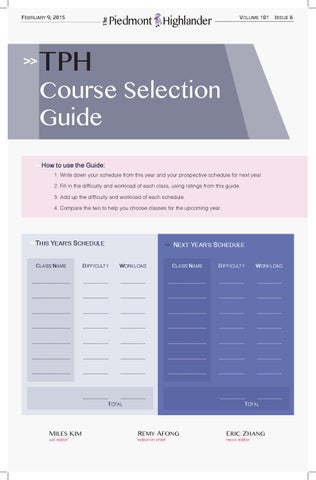
1. Write down your schedule from this year and your prospective schedule for next year. 2. Fill in the difficulty and workload of each class, using ratings from this guide. 3. Add up the difficulty and workload of each schedule. 4. Compare the two to help you choose classes for the upcoming year.
>> THIS
YEAR’S SCHEDULE
>>
NEXT YEAR’S SCHEDULE
CLASS NAME
DIFFICULTY
WORKLOAD
CLASS NAME
DIFFICULTY
WORKLOAD
_________________
___________
___________
_________________
___________
___________
_________________
___________
___________
_________________
___________
___________
_________________
___________
___________
_________________
___________
___________
_________________
___________
___________
_________________
___________
___________
_________________
___________
___________
_________________
___________
___________
_________________
___________
___________
_________________
___________
___________
_________________
___________
___________
_________________
___________
___________
___________
___________
___________
___________
TOTAL
MILES KIM acl editor
REMY AFONG editor-in-chief
TOTAL
ERIC ZHANG news editor
2
A CLOSER LOOK
FEBRUARY 9, 2015
TPH Course Selection Guide
>>
hard-earned A
Homework load is rated across all departments. (e.g., you can compare AP Environmental Science to ROP Culinary Arts.)
HW LOAD
Difficulty is rated within a department. (e.g., you can compare Honors Statistics to AP Calculus AB, but not String Orchestra to Spanish II.)
>>
DIFFICULTY
>> This course selection guide reflects the opinions and research of The Piedmont Highlander staff. We hope that this guide will inform students in chosing courses that are suitable for them.
easy A
time-consuming assignments
minimal/no homework
*These classes are new and have not been rated AP COMPUTER SCIENCE “It’s a great course to try out computer programming if you’re curious about how computers work. AP Computers teaches you Java and is a good introductory course. It gives you a lot of freedom to work on projects alone, but make sure you stay focused and do not go off task. Even if you haven’t tried out programming before, it’s a good chance to gain some skills for the future. Mr. Mattix is also one of Piedmont’s finest, and so are his Scrabble game skills.” GATES ZENG senior ART
“In Art I-IV, you experiment with a lot of different themes, styles and mediums like graphite, ink, charcoal, oil pastels and paint. As the levels progress, you get more freedom with the project ideas and mediums. With AP Art, you have to come up with a concentration. You design all your projects by yourself under that topic. Homework includes things like sketchbook assignments and planning outside of class.” JOHANNA RAPPORT senior AP MUSIC
“We do busy work, but it actually helps ingrain skills in you. There are a lot of difficult concepts to comprehend and the class is also time consuming. Sometimes we do theory problems over and over again, other times we listen to or look at music and analyze what we heard or read. You definitely can’t go in without playing or knowing anything about music before. For people who don’t have musical experience, Mr. Piazza gives you summer work to help you prepare.” LIAM SCHINDLER senior
COMPUTER STUDIES Exploring Computer Science* AP Computer Science difficulty
workload
Joy of Computing difficulty
workload
Web Development — Design and Coding*
Mobile Applications Development* >> THE NEW COURSES
With the implementation of the CSTA standards, three new classes have been added to the course catalog: Exploring Computer Science, Web Development — Design and Coding and Mobile Applications Development. Exploring Computer Science will be a lower level class, while Web Development — Design and Coding and Mobile Applications Development will be AP level or above.
CREATIVE ARTS Art I-IV
difficulty
Ceramics I-IV workload
AP Art 2-D Portfolio difficulty
workload
Acting I difficulty
workload
AP Art 3-D Portfolio difficulty
workload
difficulty
workload
A Capella Advanced Choir workload
Acting III-IV difficulty
workload
A Capella Beginning Choir
Acting II difficulty
difficulty
workload
Directing and Production for the Stage*
difficulty
workload
A Capella Chamber Choir workload
difficulty
Symphonic Band/String Orchestra difficulty
ROP AP Music difficulty
workload
>> THE NEW COURSES
workload
Jazz Band difficulty
workload
Acting teacher Kim Taylor will be teaching a new class called Directing and Production for the Stage, introducing students to theatrical education outside of acting. Only juniors and seniors may enroll. “I think it’s a great skill to learn how to lead people, how to organize people,” Taylor said. “It says ‘for the stage,’ but we’ll definitely do stuff with movies, with writing, with stage managing.” Taylor recommends that students take the class if they are interested in learning more about any aspect of the entertainment field. The class will primarily be project-based, and she anticipates guests such as costumers and directors coming into class to talk about their professions and share their experiences.
A CLOSER LOOK ENGLISH LANGUAGE ARTS
FEBRUARY 9, 2015
English 1-2 difficulty
workload
English 5-6 difficulty
workload
English 7-8 difficulty
workload
Creative Writing difficulty
workload
English 3-4 difficulty
workload
English 5-6 Honors difficulty
workload
AP English Literature difficulty
workload
Public Speaking difficulty
workload
MATHEMATICS
Geometry
Integrated Math I* difficulty
Algebra II difficulty
Math Analysis workload
AP Calculus AB difficulty
workload
Statistics difficulty
workload
difficulty
workload
AP Calculus BC difficulty
workload
Honors Statistics workload
difficulty
workload
PHYSICAL EDUCATION Freshman PE difficulty
workload
PE: Weight Training*
Upper Division PE difficulty
workload
ROP Sports Medicine difficulty
Intermediate Dance difficulty
workload
Physics: Alternative Energy Design and Construction* Chemistry difficulty
workload
Advanced Dance difficulty
workload
Biology difficulty
SCIENCES workload
Honors Chemistry workload
Physics (College Prep)
difficulty
workload
Honors Physics
3 ENGLISH 5-6 HONORS “We have lots of class discussions and essays. We usually spend about two weeks per book with thorough annotations for homework.” AIDEN FRASER junior AP ENGLISH LITERATURE
“You learn to analyze different texts like poetry and Middle E n g l i s h . The page-long homework responses come and go.” CHARLOTTE MOXLEY senior HONORS STATISTICS “It’s a really challenging class, but has real world applications. You need to be detail-oriented because the class is English-based too.” GRAHAM LOW senior AP CALCULUS AB “Take the class because you need to experience Mahoney’s teaching style, especially the 10 percent grade boost and the fact that there is no homework.” DANIEL LIN senior
>> THE NEW COURSES PE: Weight Training is a new semester PE elective that sophomores, juniors and seniors can take to earn PE credit. It teaches advanced weight lifting techniques to help students maximize their athletic and strength potential. Athletes wanting to improve their performance in sports, as well as students hoping to learn more about weight training are encouraged to enroll. The class is currently pending board approval.
AP BIOLOGY
“To do well, you need to want to learn about biology. It’s a difficult class if you don’t do the work, but if you put time into reading the textbook and doing the labs, you should be fine.” TUCKER JOHNSON senior AP ENVIRONMENTAL SCIENCE
difficulty
workload
ROP Biotechnology difficulty
workload
difficulty
Anatomy and Physiology difficulty
ROP AP Environmental Science difficulty
workload
workload
workload
AP Biology difficulty
workload
“The class is based around PowerPoint l e c t u r e s with labs in between. We also learn about trees. It’s hard at times, but everything is applicable to real life.” STUART ASHFORD junior
4
A CLOSER LOOK
AP US HISTORY
“APUSH is a high-intensity and fast-paced class, but you go into a lot of depth and interesting material. This year, with Chromebooks, we get discussion questions in small groups and then discuss them as a class. About once or twice a week, you will have a chapter due for reading. Sometimes he will give you a quiz. There are two big tests a semester and around two DBQs and two LEQs. Always plan your reading out ahead of time. If you slack off and have to read a chapter in one night, then it’s not fun.” COLIN DIXON junior AP EUROPEAN HISTORY “In class, we have lots of discussions, mainly in small groups then later join into larger class discussions. There’s a possibility of a quiz every time a reading is due. We also analyze primary sources and fill out worksheets. We do DBQs and FRQs about every month, but he tells us in advance. We read between one to two chapters a week, which are about 30 pages each. You have to be good at retaining information and time management to succeed.” CLAIRE SCHANE senior SPANISH III IN ACTION “We learn Spanish, but also about the culture and country itself. Instead of having finals, we do projects instead. As long as you try, you can get an A. It’s less about writing answers and doing paperwork, and more about having conversations. If you don’t want to continue far into Spanish and want to have a more relaxed class, but still learn some grammar, definitely take the class.” REBECCA HARRIS junior
>> THE NEW COURSES Finding Community will be a discussion-based class focused on examining current questions and events related to community. The main topics of discussion will be issues of inclusion and exclusion, bullying, the isms, and what makes a community. “The course will touch on those issues using the lives and experiences of current students, as well as current events,” social psychology teacher Anne AldridgePeacock said. She also anticipates a service learning component to the class.
SOCIAL SCIENCES
World Cultures and Geography difficulty
workload
US History difficulty
FEBRUARY 9, 2015
Modern World History difficulty
AP US History workload
difficulty
Civics difficulty
workload
Economics workload
Psychology difficulty
workload
workload
difficulty
workload
Law and Society difficulty
workload
AP European History difficulty
workload
WORLD LANGUAGES French I
difficulty
workload
Mandarin I difficulty
French II difficulty
Mandarin II workload
French III difficulty
French IV
workload
difficulty
workload
Mandarin IV workload
AP French difficulty
difficulty
Mandarin III workload
difficulty
workload
difficulty
workload
AP Mandarin workload
difficulty
workload
Spanish I difficulty
Spanish III workload
difficulty
Spanish IV
Spanish II difficulty
workload
difficulty
workload
NON-DEPARTMENTAL ROP Culinary Arts
difficulty
workload
workload
AP Spanish
Spanish III in Action difficulty
workload
difficulty
workload
Social Psychology difficulty
workload
Finding Community*
UNRATED
The editorial board decided not to rate the following courses: ASB Yearbook Introduction to Publications ROP Journalism
English Language Development Special Studies/Learning Center Teacher/Office Assistant Unscheduled