2. Is there an optimal launch angle with driver for lower scores in golf?
3. What are the philosophical implications of quantum mechanics?
4. But how does a CPU actually work?
5. Recreating the first microsecond after the big bang
6. Fun home experiment
7. Physics crossword
8. CPC Lectures
9. PhysSoc programme
10.Physics clubs and activities
11. Your Feedback
12.Writers
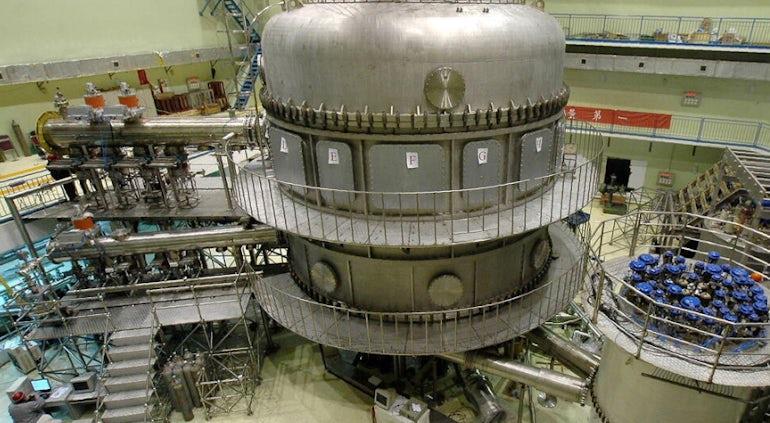
China’s ‘Artificial Sun’ Nuclear Fusion has been surpassed by Previous obstacle in development of
By Nachiketh
East China’s Tokamak nuclear fusion reactor. Courtesy Iter.
Nuclear fusion is the process of two light atomic nuclei colliding with one another to create a heavier nucleus, which releases energy.
One major stumbling block for scientists in the nuclear fusion development sector was the process of keeping plasma stable at very high densities.
Plasma is the ‘fourth state of matter’ and consists of ionized gas containing free electrons and positively charged particles. It must be kept at high densities to increase the probability of collisions and therefore increase the energy output.
The East reactor, dubbed the ‘Artificial Sun’, succeeded in doing exactly this. It used a tokamak, a device that uses powerful magnets to create a very strong magnetic field capable of confining plasma. The tokamak heats isotopes of Hydrogen (namely deuterium and tritium, which contain 1 and 2 neutrons respectively) within the magnetic field to extremely high temperatures, often six times hotter than the surface of the Sun, hence the name.
Whilst it is yet to achieve ignition – wherein more energy is produced than it takes to run – the length of time where a steady, highly confined loop of plasma can be kept has increased.
The scientists in China believe that this is a huge step towards near-limitless clean energy, something mankind and Earth have been aiming for decades.
Original article (requires account): https://www.nucnet.org/news/scientists-announce-majornuclear-fusion-breakthrough-at-china-s-artificial-sun-1-1-2026
Is there an optimal launch angle for driver in golf for lower scores?
In golf, the tee shot is a very important part of the hole, with some arguing the most important, as hitting the fairway can put you in a much more likely position to achieve a good score on that hole. Not only accuracy, but distance off the tee can fly a golfer ahead of his opponents literally and metaphorically, also giving mental wins over opponents from distance domination. This distance and accuracy partially boil down to your launch angle with the driver off the tee.
Firstly, we can look at how professionals drive the ball.At all PGAgolf competitions, every shot is recorded, with loadsof different data point measured like ball speed, launch angle and carry. Carry is better to look at than distance as it is seen as the true yardage in golf, as it doesn’t depend on ground conditions.
Fig. 1
Looking at the immediate correlation between launch angle and carry, there appears to be no correlation whatsoever. This is due to ball speed being the dominating factor in carry and not launch angle. Therefore, to find a correlation between the launch angle and the carry, we must factor out ball speed.
This can be done by least squares regression, a method which finds the line of best fit between multiple points by adjusting for variations in carry for the same ball speed. The calculated regression equation is xCarry = 3.41(speed) – 2.45. This means for each 1 m/s increase in ball speed, the ball will travel 3.41 meters further. Using this, we can calculate, for a certain ball speed, what the expected distance would be (xCarry), and then subtract the actual distance from the expected distance to find the residual distance (rCarry).
Fig. 2
Hendy, T. (n.d.). Titrist golf ball near golf hole [Photograph]. Pexels.
Now we have calculated a residual carry, we can find the correlation between the launch angle and the carry not accounted for by ball speed. This can be done by finding the Pearson Correlation Coefficient between the launch angle and rCarry. The Pearson Correlation Coefficient (r) measures the strength and direction of a linear relationship between two variables where +- 1 values are strong relationships, and 0 values have no relationship.
The calculated value of the Pearson Correlation Coefficient between launch angle and the residual carry is 0.92. This is a value very close to 1, meaning there is a very strong positive correlation between a high launch angle and “overperformance” of carry – suggesting the higher the launch angle, the better.
So, a higher launch angle means more distance, but is distance actually a good thing? The obvious answer is yes: but to test this, I looked at the top 10 golfers for shots gained off the tee and compared their average carry to the top 19 golfers and the whole field.
Fig. 3
The average distance of the top 10 golfers off the tea was 301 yards, compared to 289 yards for the top 19 golfers and a 286 yards tour average. These 10 – 15 yards can be large margins in golf, being an extra club of distance. In a sport where major championships can be decided by missing the hole by mere millimetres, or a tenth of a rotation of the ball, these extra distances is where competitions are won and lost.Also, looking at the right column, I collected where each of these top 10 golfers ranked on carry distance compared to the rest of the field, with the average being 21st, and half of the top 10 furthest hitters also gaining the most shots off the tee.All of this evidence heavilypointstowards more distance meansmore shotsgained.
Accuracy is also a very key factor in how good you are with driver, there’s no point hitting the ball 350 yards, if you’re missing the fairway by 50 yards each time. I looked at the same top 19 golfers and compared their launch angle with their percentage fairways hit.
Fig. 4
Using the same Pearsons Correlation Coefficient analysis between launch angle and fairways, the value calculated is -0.04. This value is very close to 0, suggesting there is absolutely no correlation between launch angle and accuracy off the tee. Therefore, having a higher launch angle does give more distance but doesn’t compensate accuracy at all, further implying the higher the launch angle the better.
So why don’t all golfers hit the ball higher? The key reason is trade-offs when achieving a higher launch angle. There are two keyways of increasing launch angle, the degree of loft on the driver and the angle of attack. Increasing the degree of loft on the driver increases launch angle as club face is at more of an angle. Though, this can cause a decrease in ball speed, and a rise in spin rates. High spin rates reduce distance, which can be explained by the Magnus effect. The Magnus effect states a spinning object moving through a fluid creates a pressure differential due to different relative air speeds on opposite sides of the object. In terms of a golf ball, the bottom of the ball is spinning with the direction of motion and the top against, therefore meaning the air moves faster over the top of the surface than the bottom, creating low pressure above and high pressure below, ultimately creating lift. If spin becomes too high, this effect grows too large and a ball will create too much lift, wasting too much kinetic energy on gravitational potential energy. This is only a problem as it effects the ball flight and results in a very steep decline after the peak, where the GPE is converted into kinetic energy and vertical velocity rather than horizontal.
The other method of increasing launch angle is angle of attack, the angle of the plane your club is moving along as it hits the ball. The way of increasing this is to make adjustments to the swing, to hit more up on the ball. The downside of this is control and comfort – many professional golfers don’t like making too many changes to their swing as it can be uncomfortable and they feel as if they lose control.
Therefore, the optimal launch angle is quite subjective, as despite the data showing higher launch angles mean more distance, and more distance means shots gained, the downsides of achieving higher launch angles may result in decreased performance off the tee.
R. J. Haake and C. G. Good, “Optimising golf driver performance: the influence of launch angle and spin,” Proc. Inst. Mech. Eng., Part P: J. Sports Eng. Tech., vol. 235, no. 3, pp. 203–215, 2021. [Online]. Available: https://journals.sagepub.com/doi/abs/10.1177/1754337120987857. Accessed: Feb. 20, 2026.
S. Cochran, “Biomechanical analysis of the modern golf swing,” SeanCochran.com, 2025. [Online]. Available: https://seancochran.com/biomechanical-analysis-modern-golf-swing/. Accessed: Feb. 20, 2026.
What are the philosophical implications of quantum physics?
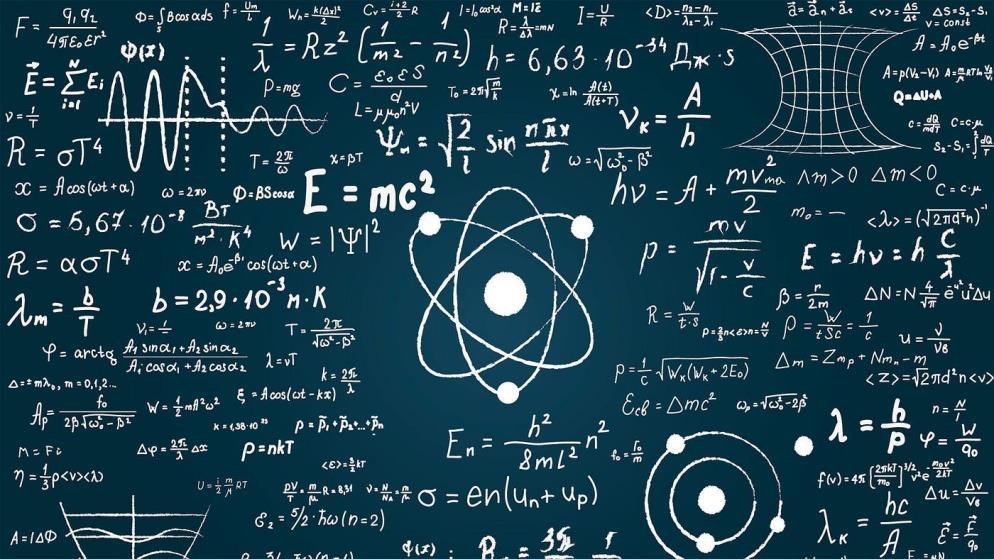
i000pixels. (2018). Blackboard inscribed with scientific formulas and calculations in physics and mathematics [Vector illustration]. iStock. https://www.istockphoto.com/vector/blackboard-inscribed-with-scientific-formulas-and-calculations-in-physics-and-gm939444810-256858406
The dominant model of physics for hundreds of years has been classical physics - built on the pillars of Newton’s three laws, Maxwell’s electrodynamic equations, and classical thermodynamics – all with the core principle that given certain information about a system at a point of time, the future of that system can be calculated and predicted with certainty.
Classical physics therefore offers an entirely deterministic explanation of the universe; it says that we live in a world where everything is predetermined by what has come before. The philosophical implications of this are enormous; how can one have free will if the future is already set? How can we be held accountable for our actions if our actions are merely part of a predetermined causal chain?
However, at the start of the 20th century, with Plank and the advent of quantum mechanics, the classical deterministic interpretation of the universe seems to have been turned on its head. This short article will attempt to take a dive into the world of quantum mechanics, and how its different interpretations offer the space for free will to exist.
Quantum mechanics, at its core, is the study of systems at their smallest scales, and is a model that introduces uncertainty, with the inability to know simultaneously the position and velocity of a particle (the Heisenberg Uncertainty Principle) and the apparent random wave function collapse at measurement. These uncertainties are not due to some inherent inability to measure position of an electron, or due to some fault in our method of measurement, but rather an intrinsic property of an electron – that it does not possess definite values for certain pairs of properties until measured. Therefore, these uncertainties and probabilities introduced at the smallest of scales lead to a sea change in the philosophical interpretation of the universe; how can the universe be viewed asdeterministic, if the data required fordeterminism simply doesn’t exist at the quantum level? It seems it cannot.
However, many scientists were not happy with this apparent indeterministic interpretation of
Suppose you choose to believe in an indeterministic interpretation of quantum mechanics, The simple answer is yes, and no. us onto the philosophical debate; can determinismsurvive the advent of quantum mechanics? the universe, with Einstein famously stating that, “God does not play the dice.” So, this leads
However, suppose you chose to believe in a deterministic interpretation of quantum mechanics is a fundamentally probabilistic and random scientific model. would lead you to believe in an indeterministic universe, as it states that quantum used to calculate probabilities, collapses randomly on one definite position. This interpretation before measurement, think of Schrodinger’s cat!) and after measurement the wave function (all possible outcomes of measurement are weighted probabilities calculated by the Born rule interpretation states that particles exist in superposition of states before measurement interpretation, developed by leading scientists at the time such as Heisenberg and Bohr. This such as the Copenhagen interpretation, historically the most accepted and acclaimed
Deterministic interpretations of quantum mechanics fundamentally rely on the principle that overall multiverse remains deterministic as all probabilities are realised. each outcome, and each probability, does occur, just in a separate universe, and therefore the evolves according to Schrodinger’s equation, and the Many Worlds Interpretation states that particles have a definite position at all time, and move according to a wave function which believe in a deterministic universe. Bohmian Mechanics (or Pilot Wave Theory) states that mechanics, such as Bohmian Mechanics, or the Many Worlds Interpretation, you would
It may seem like an underwhelming conclusion, the fact that whilst there is validity of these interpretations with current technology. whilst we cannot empirically disprove the existence of these variables, we cannot disprove the variables on the local scale; however, it does not rule out non-local hidden variables, and all outcomes are realised in the Many World’s Interpretation. Bell’s theorem disproves hidden in Bohmian Mechanics that defines a particles position, or the many other universes in which we as observers are ignorant of some hidden variable, whether that be the pilot wave
Quantum mechanicsdoes not settle the debate between determinism andfree will – it reopens this interpretation is any more correct than the other mentioned interpretations. a prevailing philosophical opinion that our universe is indeterministic, we cannot prove that a historically prevailing interpretation, that being the Copenhagen interpretation, and therefore
Styer, D.F. (1999). A Brief History of Quantum Mechanics. [online] Appendix A of The Strange Katie, L6 universe, have freedom in how we decide to interpret it. conclusion, I see it as an example of how we, as observers, with a limited knowledge of the it. And in that uncertainty lies a surprising kind of freedom. Rather than this being a weak
Vaidman, L. (2014) ‘Quantum theory and determinism’, Quantum Studies: Mathematics and World of Quantum Mechanics
Margenau, H. (1967) ‘Quantum Mechanics, Free Will, and Determinism’, The Journal of Foundations. doi: 10.1007/s40509-014-0008-4.
It is probably common knowledge in this century that the Central Processing Unit (CPU) of a computer is made up of billions of transistors, all at incredibly small sizes. They can have an ‘on’ or ‘off’ state, meaning each transistor is known as a bit. Multiple transistors can create binary, or the base 2 number system.
But all of this is from a Computer Science perspective. How does a CPU work from the perspective of Physics? It is all very good that it can be abstracted into arbitrary 0s and 1s, but what is actually happening?
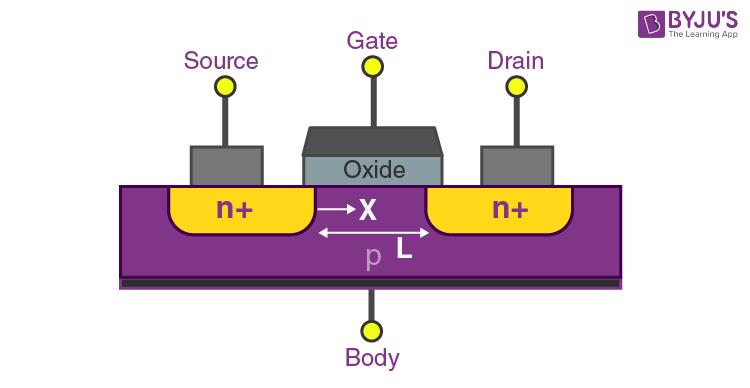
Let us begin by examining what the transistor actually is and how it works. Transistors contain 2 regions of silicon, known as the source and drain. This silicon has had impurities added to it which allows for extremely precise control of current flow. The silicon is then covered above with an insulating layer (silicon dioxide is commonly used for this). Finally, there is a metal gate above the silicon dioxide.
The metal gate acts as a capacitor, which is simplyan electrical component that stores charge. It is created when 2 conducting parallel plates are separated by an insulating material known as a dielectric. When a voltage is applied across the gate, opposite charges build on the parallel plates, creating a uniform electric field. This is the key part.
As the voltage is applied across the gate, the electric field that is created can easily penetrate the thin silicon dioxide layer. This attracts the electrons in the source upwards towards the dioxide layer and pulls them into a small channel between the silicon regions, allowing current to flow. This is the transistor’s ‘on’ state, and it only occurs if the voltage is high enough. If the voltage is too low, the channel disappears and the current cannot flow. This is the off state.
But the CPU makes everything happen because of the logic gates. So how is that made? By combining transistors. We will cover how the NOT gate works here.
Getty Images. (2023). Circuit board. Technology background. Central computer processors CPU concept. Motherboard digital chip, tech science background. Integrated communication processor. 3D illustration [Photograph]. Unsplash. https://unsplash.com/photos/circuit-board-technology-
Each transistor is connected to either a fixed electric potential relative to ground (known as Vdd) or GND (ground / reference voltage level, defined as 0V). If a transistor’s output is connected to Vdd, the electrons flow such that the gate’s electric potential rises towards Vdd,
Image of a typical transistor. The purple is the silicon base that has been doped, hence the p and n+ symbols. Courtesy BYJU’s.
PMOS turns on with 0V, we essentially input 0 to the gate and output 1, just like a NOT gate. connected through Vdd and, if you remember, the PMOS is connected to the Vdd. Since the PMOS turns on, and vice versa if a voltage is supplied. When the input is 0V, the output is as NMOS. They are essentially opposites – when both receive 0V, NMOS remains off, but Transistors connected to Vdd are known as PMOS, and ones connected to GND are known potential drops to 0V, creating the ‘0’ bit. creating a ‘1’ bit. Likewise, if a transistor’s output is connected to GND, the gate’s electric
The opposite is also possible, where a voltage is supplied from Vdd and output is connected
transistors in either series or parallel. And once you have these gates at your disposal, you Other gates, including AND, OR, NAND and so on, can be made by combining these to GND, the output is 0 when the input is 1. This is how the NOT gate works. to GND. When there is a voltage, NMOS turns on but PMOS is off. Since NMOS is connected
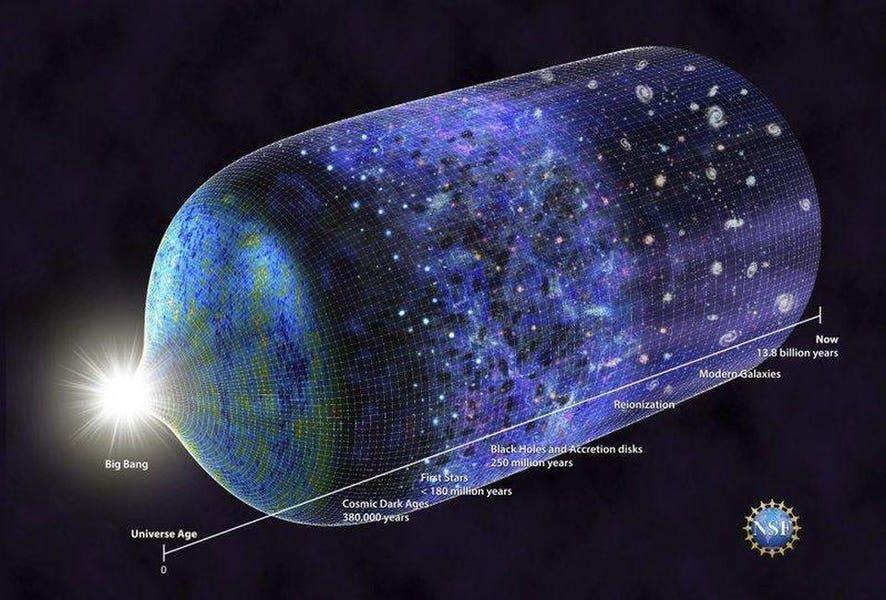
Recreating the first microsecond after the Big Bang
Siegel, E. (2019, November 6). What really put the “bang” in the Big Bang? Forbes. https://www.forbes.com/sites/startswithabang/2019/11/06/what-really-put-the-bang-in-the-big-bang/
In the earliest moments after the Big Bang, the universe did not contain atoms, molecules, or even protons and neutrons. Instead, it existed as an extremely hot and dense mixture of fundamental particles moving freely in a state unlike anything we encounter today. Modern physics experiments are now able to recreate tiny versions of these conditions, allowing scientists to study how matter behaved at the very beginning of the universe. The results have revealed something unexpected. The first matter in the universe behaved less like a gas and more like an almost perfect liquid.
This exotic state is known as quark gluon plasma. Understanding it helps physicists answer a fundamental question: how did the universe transition from a hot, uniform state into the structured cosmos we observe today?
Ordinary matter is made of atoms, which contain protons and neutrons in their nuclei. Protons and neutrons are not elementary particles. They are made of smaller constituents called quarks, which are held together by gluons through the strong nuclear force. Under normal conditions, quarks cannot exist independently. They are confined inside larger particles and separating them requires enormous energy.
However, theoretical physics predicts that at extremely high temperatures and densities, this confinement breaks down. Instead of being trapped, quarks and gluons form a dense, interacting medium where they move freely over short distances. This is quark gluon plasma, and it is believed to have filled the universe during the first microsecond after the Big Bang.
Creating such conditions on Earth requires advanced particle accelerators. Facilities such as the Large Hadron Collider accelerate heavy atomic nuclei to speeds very close to the speed of light and then collide them. These collisions briefly generate temperatures more than one hundred thousand times hotter than the core of the Sun. For a fraction of a second, protons and neutrons melt into their constituent quarks and gluons before cooling and reforming into ordinary particles. Sophisticated detectors then measure the particles produced in the aftermath, allowing scientists to reconstruct what happened during the collision.
One of the most important discoveries from these experiments is how quark gluon plasma behaves. Early predictions suggested it would resemble a gas of weakly interacting particles. Instead, measurements showed strong collective motion, similar to the flow of a liquid. The plasma appears to have extremely low viscosity, meaning it flows with very little internal resistance. In fact, it may be the most perfect fluid ever observed in nature.
This result has significant implications for our understanding of the strong nuclear force. Rather than becoming weaker under extreme conditions, interactions between quarks remain strong enough to produce coordinated behaviour across the entire system. In practical terms, the particles do not move independently. They move together, forming patterns similar to waves in a fluid.
Studying quark gluon plasma also provides insight into cosmology. As the universe expanded after the Big Bang, it cooled rapidly. During this cooling process, quarks combined to form protons and neutrons in a transition sometimes compared to condensation. By recreating the earlier high energy state in laboratory experiments, physicists can investigate this transition directly and test models of the early universe with real data.
There are additional applications for extreme matter research. Conditions similar to quark gluon plasma may exist inside neutron stars, where matter is compressed to densities far greater than those found in atomic nuclei. Understanding particle interactions at these extremes improves models of stellar evolution and gravitational phenomena. Although this research does not currently lead to immediate technology, advances in fundamental physics have historically produced unexpected long-term benefits, particularly in areas such as medical imaging, computing, and materials science.
Another important aspect of this research is the scale of collaboration involved. Experiments require detectors the size of buildings, advanced electronics capable of recording millions of events per second, and large international teams analysing vast amounts of data. Modern physics isno longer the work of individual scientistsbut of coordinated global efforts combining engineering, computing, and theoretical modelling.
Quark gluon plasma demonstrates how physical theory connects phenomena across vastly different scales of nature, linking subatomic particle interactions to the large-scale evolution of the universe. Investigating particles smaller than atoms can reveal information about the largest structures in the universe. It also illustrates how experimental evidence can challenge theoretical expectations. The discovery that early universe matter behaves like a liquid rather than a gas shows that even well-established theories must be tested through observation.
Ultimately, recreating the first microsecond after the Big Bang is about more than understanding exotic particles. It is about tracing the origins of all matter. Every proton and neutron that exists today formed as the universe cooled from this primordial state. By studying quark gluon plasma, physicists are uncovering a chapter of cosmic history that occurred billions of years ago yet can now be explored in laboratories on Earth.
The ability to reproduce conditions from the birth of the universe represents one of the most remarkable achievements of modern science. It shows how far experimental physics has progressed and how much remains to be discovered about the fundamental nature of matter.
Chenning, L6
E. V. Shuryak, “Quantum chromodynamics and the theory of superdense matter,” Physics Reports, vol. 61, no. 2, pp. 71–158, 1980. doi: 10.1016/0370-1573(80)90105-2.
K. Adcox et al. (PHENIX Collaboration), “Formation of dense partonic matter in relativistic nucleus–nucleus collisionsat RHIC,” Nuclear Physics A, vol. 757, no. 1–2, pp. 184–283, 2005. doi: 10.1016/j.nuclphysa.2005.03.086.
J. Adams et al. (STAR Collaboration), “Experimental and theoretical challenges in the search for the quark–gluon plasma,” Nuclear Physics A, vol. 757, no. 1–2, pp. 102–183, 2005. doi: 10.1016/j.nuclphysa.2005.03.085.
K. Aamodt et al. (ALICE Collaboration), “Elliptic flow of charged particles in Pb–Pb collisions at 2.76 TeV,” Physical Review Letters, vol. 105, no. 25, 252302, 2010. doi: 10.1103/PhysRevLett.105.252302.
B. Müller, J. Schukraft, and B. Wyslouch, “First results from Pb+Pb collisions at the LHC,” Annual Review of Nuclear and Particle Science, vol. 62, pp. 361–386, 2012. doi: 10.1146/annurev-nucl-102711-094910.
Home experiment
Dancing corn experiment:
Equipment:
Glass (taller the better)
White vinegar
Baking soda
Corn kernels
Water Method:
Water in a glass and add 1-2 tablespoons of baking soda
Add the kernels and watch them sink to the bottom
Add a generous amount of white vinegar and watch them dance!
Send photos of your results to mcyoung@perse.co.uk to be included in the next newsletter!
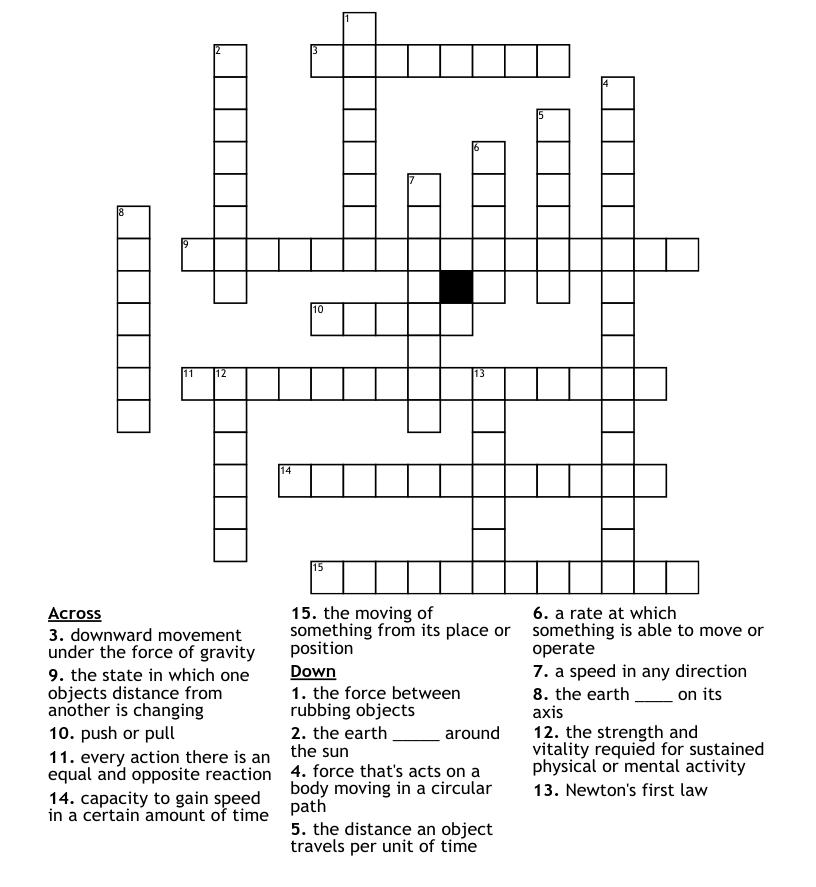
Crossword
Physics Clubs
Club Time and location Year Group
Lego Robotics Club Tuesday and Thursday lunchtime activities
Tuesday 4.105.30.
P1
PhysSoc Wednesday lunchtime activities
P3
Engineering Club: UK Rocketry Challenge
Description
All Work in a team to design, build, and programme an autonomous robot to compete in the First LEGO League Challenge or build your own motorised LEGO masterpieces from four trolley-loads of parts.
Tuesday 4-5.30pm
Engineering Club Wednesday 4-5.30pm
Aviation Club Tuesday activities in P4
Pitched at 9-13, all welcome
Sixth form only
Sixth form students give talks on a physics topic they are interested in. Talks will be accessible for students in year 9 and above, but keen year 7 and 8s are welcome to.
Students are working as part of the UK Rocketry Challenge and Scratch Team to build a rocket which will reach an exact height with an exact time of flight.
Sixth form only General Engineering activities/talks including Greenpower Challenge car build.
All Leo Segerstrale is the lead here. Sessions include:
· Talks: Short student or guest presentations on aviation topics
· Discussions: Talking about aviation news, technology, or accidents
· Fun activities: Organising the flying day
Lower School Science Club
Monday activities Years 7 and 8
Extension Physics After school Monday
January in L6 to December U6
Physics in Michaelmas term, Chemistry in Lent Term and Biology in Summer term. Get involved with an experiment and topic you wouldn’t usually see in Lower School each week.
Sixth form only Working through extension concepts and problems under the guidance of Dr Goodson.
Physics events
Your Contributions
We hope you have enjoyed reading the first edition of this physics newsletter. This is the first
If you have completed any cool physics work experience, we would love toshare your please write a short article (approximately 1 side of A4) and share it with us forconsideration. reading about/doing too! If there are any cool areas of physics that you know lots about, edmiddleton@perse.co.uk. We would love to hear about the exciting physics you have been newsletters, or you have any feedback on this edition, please email Elise Middleton at newsletter – so there’s much to improve! If you have anything you would like to see in these