12 minute read
A NEW DIRECTION FOR THE COMMONWEALTH

The new Commonwealth Secretary-General reflects on her first six months in office.
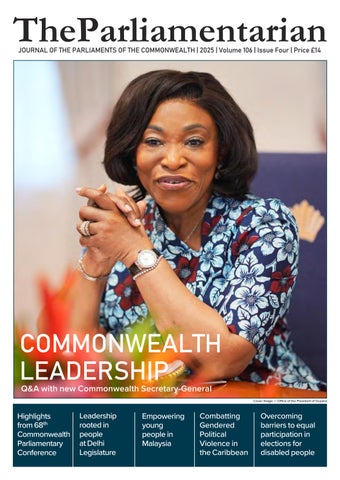
Hon. Shirley Botchwey is the 7th Secretary-General of the Commonwealth and the first woman from Africa to hold this office. She was appointed by Commonwealth Heads of Government at their biennial meeting in Samoa in 2024 and assumed office on 1 April 2025, bringing more than 20 years of leadership experience in diplomacy, international relations, governance and public service to the position.
A lawyer, diplomat and politician, she was previously the Foreign Minister of Ghana (2017 to 2024) and was a member of Ghana’s National Security Council. Her previous roles include Deputy Foreign Minister, Deputy Minister for Trade and Industry (2001–2009) and a Member of Ghana’s Parliament (2005 to 2021) for the Weija and later Anyaa-Sowutuom constituencies, representing the largest population base in the country’s legislature across four consecutive terms.
Prior to entering politics, Shirley Botchwey led a successful marketing and communications firm and served as a consultant in the tourism sector.
Q: You have now completed your first six months as the Secretary-General of the Commonwealth – what have been the biggest challenges in your new role?
A: One of my first tasks as Secretary-General of the Commonwealth was to deliver a new Strategic Plan — not only for the Commonwealth Secretariat but for the whole Commonwealth. We needed a blueprint to have clarity for our mission: to make the Commonwealth a source of solutions in a world that badly needs them.
Change is never easy. The first six months in my tenure required me and the team at the Secretariat to think differently, to collaborate across boundaries and to let go of habits that no longer serve us. We have had to be patient, resilient and open, and we have had to trust each other on this journey. Our Strategic Plan 2025-2030 was approved in September 2025 by our Board and gives us that blueprint for transformation — for our member countries.
It is a reality of our time that the resources from member countries have declined. The world we live in today has never existed before, neither would the world we would live in tomorrow. The rules-based international system is under strong attack and development cooperation no longer serves the interests of any State. And this is challenging. Like our member countries, we too need to seek new and creative partnerships, looking laterally - to non-Commonwealth states, foundations, the private sector, universities, civil society and regional organisations - beyond the usual sources.
Our effectiveness will come from how well we understand the changing needs of our member countries. And that requires a clear-eyed assessment of the expectations of our people and the different ways in which we can deliver on their current needs, as opposed to holding on to what or how we have done things in the past.
Q: You highlighted the Commonwealth’s recently launched Strategic Plan for 2025 to 2030 - what are the main priorities for you as Secretary-General for the years ahead?
A: In September 2025, on the side-lines of the UN General Assembly in New York, Commonwealth Foreign Affairs Ministers endorsed the new Commonwealth Strategic Plan 2025-2030 - the product of months of consultation with all 56 member countries and partners, including the CPA.
It is organised around four integrated pillars:
1. Democratic resilience - defending and renewing democracy and strengthening institutions of accountability and inclusion, including a robust early warning system and a fragility index to guide support for our Members.
2. Economic resilience - driving trade, investment and innovation, while ensuring that small and other vulnerable states are at the centre of our collective growth.
3. Environmental resilience - leading on climate action and sustainable development, unlocking finance and technology for transformation, including a renewable energy revolution.
4. The resilience of our people - especially women and young people, through inclusion, health, accessibility, education, skills and opportunity.
Finally, the needs of small and vulnerable countries will inform every aspect of our work.
The Strategic Plan recognises that the Commonwealth’s potential lies in its networks - governments, Parliaments, businesses, accredited organisations, universities and citizens - working in concert for shared progress.
And for me, this is where Parliamentarians are indispensable. They shape the debates that sustain public understanding of the Commonwealth. They hold their governments to account for their commitments. They must enhance representation and participation of civil society in a social media age. And they can ensure that our shared association remains visible in foreign policy, in trade strategy and in development cooperation.
I recently had the opportunity to meet with the Commonwealth Parliamentary Association's UK Branch. And I shared with them that the Strategic Plan has at its core a simple ambition: to make the Commonwealth more relevant, resilient and results oriented. That is also my ambition. We must work closely together with the CPA and its constituents across all pillars of the Strategic Plan.
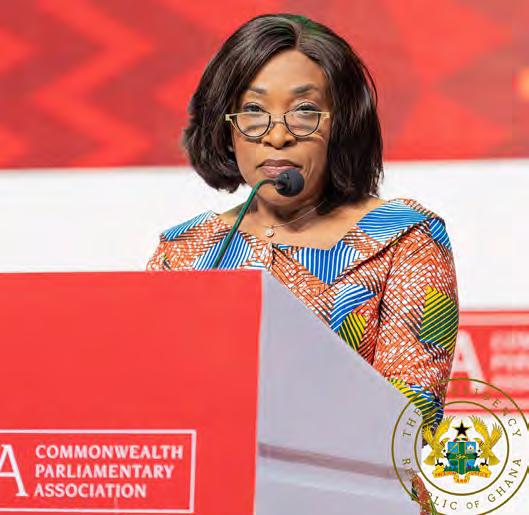
Q: You spoke recently at the opening of the 68th Commonwealth Parliamentary Conference – in your view, how can we reverse the declining global trust in Parliamentarians and our public institutions?
A: I am keenly aware of the importance of our Parliaments in responding to the growing threats to our democracies and restoring confidence, especially among young people.
It took quite a long time for modern society to recognise that progress was not linear and that each generation had to fight to expand rights and social protections. It has taken us even more time to begin to recognise that there are no guarantees for democratic governance, and that there are no established democracies and institutions.
All democracies today face similar challenges - the dominant influence of money in politics, the changing expectations of representation and participation in the era of social media, slower growth, and the active weaponisation of misinformation and disinformation for the purposes of state capture. The diplomatic networks that provided the checks and balances for effective multilateral action are increasingly becoming ineffective. Yet, Parliamentarians are elected representatives of people. Their voices matter because they represent people - the people of the Commonwealth.
Governments propose, but Parliaments debate, amend and decide. Parliamentarians scrutinise budgets, ratify treaties, pass laws that give life to our commitments and hold the Executive to account. Through public hearings, Members of Parliament enable effective participation by the people. In fact, we cannot ensure public support for multilateral solutions without parliamentary hearings. MPs hold our feet to the fire.
My position, as Commonwealth Secretary-General, is that at a time when democracy is under strain, Parliamentarians accept that their role is more important than ever. Strong, inclusive, accountable Parliaments are the foundation on which all our ambitions rest. Without them, there can be no trust, no legitimacy and no progress. That is why the CPA’s work is so vital - building capacity, sharing best practice, empowering women and young Parliamentarians, and defending the integrity of our democratic institutions.
Q: The Commonwealth Parliamentary Association played a key role in the development of the Commonwealth Charter and the Commonwealth Latimer House Principles on the Separation of Powers – how important are these Principles and the Rule of Law in protecting democracy in the Commonwealth?
A: Our Commonwealth Principles on the Three Branches of Government, generally known as the Commonwealth Latimer House Principles, are fundamental to the wider values and principles of the Commonwealth Charter. The Principles help us to navigate the relationship between the Executive, the Legislature - generally our Parliaments - and the Judiciary, and the necessary separation of powers.
This is critical because through good governance we deepen democracy, and this is how we ensure our Commonwealth Charter is lived - through free and democratic societies, and in the promotion of peace and prosperity. It is our North Star, and it guides us to continue striving to do better for all the people of the Commonwealth.
From Guyana to my own Ghana, we’ve supported peaceful transitions, upheld constitutional governance and mediated crises. However, in many countries around the world, we are seeing reversals - military takeovers, constitutional manipulation and democratic backsliding. So, we need to work closely with the CPA, youth and women’s groups, the media and civil society, to ensure the most auspicious conditions for democratic institutions, civic space and electoral integrity.
We will strengthen our election observation missions. And we will strengthen the targeting and evidence base of our interventions through a credible intergovernmental early warning system that tracks key indicators of governance, democratic integrity and fragility. This data will help identify priority entry points in at-risk countries, enable deeper stakeholder engagement and support co-created resilience-focused interventions.
We will expand our technical assistance on parliamentary and judicial reform to reverse the decline in support for democracy. And we will centre young people and women in our governance support - because they are not just the future of democracy, they are its present.
That means standing firm on our values - peace, democracy, the rule of law and the right to freedom of expression and peaceful assembly - and acting on them, not by taking sides, but by showing that these values are the key to prosperity and the democratic dividend.
In this context, I underline the importance of transparency, especially during times of national reflection and public mobilisation. A free and responsible media plays a vital role in strengthening democracy and ensuring accountability.
Q: You are a highly experienced former Parliamentarian and Minister - what advice would you give to someone who is thinking of standing for election? What skills are required to be an effective Parliamentarian?
A: I served as a Member of Parliament for 16 years. One thing I know for sure is that as an elected representative you must communicate constantly with your constituents. Today, that means social media, and that is a double-edged sword: you need it, but you need to be aware that it can and will be used for spreading misinformation and, worse yet, disinformation. Social media can be used to harm your constituency and undermine the democratic dividend we are building.
We need to make our democracies more representative and inclusive. For some MPs that will mean representing people in the remotest parts of their country. The digital divide is your biggest barrier. Your priorities, out of necessity, must include connectivity, distance learning and the tools to ensure that no one is left behind.
On the campaign skills that Parliamentarians need, I should reflect on my most recent experience when I campaigned to become Commonwealth Secretary-General because I employed what I learnt as an MP:
• Potential lies in networks. Build bridges of friendship and influence, cutting across regions and political blocs.
• Engage, listen and lead - not through hard power, but through partnership, and
• Connect the global to the local - ensuring that the Commonwealth’s values of democracy, rule of law and respect for diversity are lived realities in communities.
Q: The challenges facing the Commonwealth’s smallest jurisdictions were highlighted at COP30 in Brazil - how can Parliamentarians in the Commonwealth work together to bring effective responses to these issues?
A: Our network of 56 nations offers a space for global solutions. Our Parliamentarians can deliver those solutions.
The CPA, with its collective experience, knowledge, networks and reach, is invaluable. You can help us make our commitments into lived realities. And environmental resilience is of great importance because it is directly linked to the lifeblood of so many of our member countries.
By collaborating at a technical level, we will improve our support to capacity building, we can increase resource mobilisation and funding, and we can enhance our joint advocacy efforts in international forums, like COP. The transformative Commonwealth agenda that has been outlined in our new Strategic Plan requires us to forge new partnerships and build stronger relationships with likeminded stakeholders. Parliamentarians must pick up the torch at a local level with strategic partners and like-minded stakeholders and ensure responsive climate action is built into the fibre of society. This means:
• Honour the Paris Agreement and push for Nationally Determined Contributions (NDCs) that include gender and youth responsive climate action, to mobilise a renewable energy transition, and
• Ensure fair access to finance for the climate fightback. And our Commonwealth Climate Finance Access Hub, which has already mobilised almost US$500 million in resources for mitigation and adaptation, stands ready to assist.
Q: 60% of the Commonwealth’s 2.7 billion population is aged under 30. How can the Commonwealth and Parliamentarians engage with more young people? How can we involve young people in politics?
A: There are more than 1.6 billion young people in the Commonwealth - this is our superpower. They lead in innovation and start-ups - from science and technology to finance, from fashion, culture, the arts to cuisine and services.
At COP30, young people advocated for more green skills. And yet, they are not waiting for us, they are forging ahead. Our current Commonwealth Youth Award winner, Stanley Anigbogu - a young Nigerian energy innovator - is lighting up and powering communities. But we need to step up our engagement so that we make the most of this youth superpower. The advances in ICT, automation and AI, and the innovations of social media for distance learning and producing the tech workers and entrepreneurs of this century require historically unprecedented investments - in education, skills, digital access and platforms for voice, leadership and new ways of doing things.
The Commonwealth is modernising its youth development programmes to ensure they are transformative by design and transformative in impact. We will champion youth and work to centre minority voices in every programme we run - because no narrative is complete without including them. For this reason, we have made Youth a crosscutting priority in our Strategic Plan. We need to learn from young people and the politics that speak to their interests. The recent International Court of Justice Advisory Opinion on Obligations of States in respect of climate change came about due to youth-led action. Pacific Island students moved the world’s highest court to affirm that states have binding legal obligations to prevent climate harm and to protect human rights.
We need to listen more. Parliamentarians are in the best position to do so. When you engage with your constituencies, we all need to ensure young people are included and heard. It all begins here.