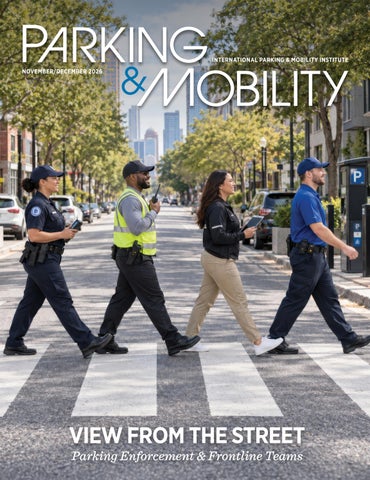
INTERNATIONAL PARKING & MOBILITY INSTITUTE NOVEMBER/DECEMBER 2026
VIEW FROM THE STREET Parking Enforcement & Frontline Teams
INTERNATIONAL PARKING & MOBILITY INSTITUTE NOVEMBER/DECEMBER 2026 VOL. 8 / N0. 6
FEATURES
26
36
40
46
26 36 40 46 52 58
What Is the Job?
Professional Identity and the Future of Frontline Parking By Captain Nick Nicholas, PECP
Built from the Sidewalk Up
Why the Best Parking Enforcement Tools Start with Understanding the People Who Use Them By Brittany Yokley, PECP
Static Patrols to Predictive Scheduling
Improving Certainty in Parking Enforcement By Adam Isen, PTMP, and Matt Darst
The View from Terminal A
How Sacramento International Airport Rebuilt Curb Enforcement Around Its Officers By Andrew Kirk
The Cost of Non-Payment
Seeing the Future of Parking Compliance By John Conway
The Real ROI of Parking Enforcement
It Isn’t Enforcement Revenue! By Sean Glavin
52
2 PARKING & MOBILITY | NOVEMBER/DECEMBER 2026 | PARKING-MOBILITY-MAGAZINE.ORG
58
COVER PHOTO: STOCK.ADOBE.COM / BCFC
FROM THE EDITOR
COLUMNS
View from the Street
3 FROM THE EDITOR
Where Programs Meet the Public
View from the Street
4 BOARD PERSPECTIVE
WE SPEND A LOT OF TIME talking about technology,
AI in the Parking Enforcement World By Shawn McCormick
8 BOARD PERSPECTIVE It Was Just a Minute By Julie Dixon
12 PARKSMART IN ACTION
Beyond the Parking Space By Karen Peris, TDM-CP, and Victor A. Hill, PTMP, MPA
16 PARKING COMPLIANCE & SAFETY
From Ticket Writing to Public Trust By Kenneth Simon, PTMP, PECP
18 INNOVATION & TECHNOLOGY
How Drone Automation Is Transforming Occupancy Data Collection for Cities By Cameron Callicutt
20 HR SPOTLIGHT
Understanding Trauma and Focusing on Resilience By Dr. Pamela J. Pine, PhD, MPH, RCHES
22 ASK THE EXPERTS
What are the biggest challenges facing parking enforcement and frontline teams today?
25 SPONSORED CONTENT
When Parking Works, Nobody Notices
32 SPONSORED CONTENT
The Future Belongs to Connected Systems, Not Standalone Solutions
62 THE BUSINESS OF PARKING
Stop Overthinking, Start Connecting
and for good reasons. License plate recognition, mobile payments, digital permitting, data analytics, AI, and other innovations have helped us build smarter, more convenient, and more efficient parking and mobility programs. But technology can’t replace one thing: people. Especially the people on the front lines. Parking enforcement and compliance professionals are where our programs meet the public. Every day, they answer questions, solve problems, explain regulations, help customers, and navigate interactions that aren’t always easy. For many, these professionals may be the only people from our organization they ever meet. That interaction can shape how someone feels not just about parking, but about a downtown, university, airport, hospital, or entire community. They’re also essential to making our programs work. Policies, technology, curb management, accessible parking, loading zones, permits, and time limits all depend on compliance. And compliance depends on people. Technology can make enforcement more accurate, consistent, and safe. But it can’t help a confused visitor understand where to park, recognize when someone needs patience and an explanation, or replace the judgment and humanity a well-trained professional brings to an interaction. That’s why I’m particularly excited about IPMI’s new Parking Enforcement & Compliance Professional (PECP ®) micro-credential. It’s an opportunity to invest in the people doing this important work, give them more tools to succeed, and elevate a role essential to our industry. Parking enforcement and compliance should be seen not simply as a job, but as a profession, one requiring knowledge, skill, judgment, communication, and a commitment to serving the public. These professionals deserve opportunities to grow and recognition for the expertise they bring every day. Technology will continue to transform our industry, and incredible innovations lie ahead. But no matter how sophisticated our systems become, successful parking and mobility programs will always have something very human at their foundation: People. And it’s time we made sure the people on our front lines know just how important they are.
By Jordan Weiss
64 IPMI CALENDAR Melissa Rysak, Editor
67 STATE & REGIONAL CALENDAR
rysak@parking-mobility.org
PARKING-MOBILITY-MAGAZINE.ORG | NOVEMBER/DECEMBER 2026 | PARKING & MOBILITY 3
BOARD PERSPECTIVE
AI in the Parking Enforcement World PUBLISHER
Shawn Conrad, CAE
s.conrad@parking-mobility.org
Promise, Pitfalls, and the Path Forward
EDITOR-IN-CHIEF
By Shawn McCormick
Melissa Rysak
rysak@parking-mobility.org MANAGING EDITOR
Courtney Turner
turner@parking-mobility.org TECHNICAL EDITOR
Rachel Yoka, PTMP, LEED AP BD+C yoka@parking-mobility.org
ADVERTISING SALES AND SUBSCRIPTIONS
Tina Altman, CEM
taltman@parking-mobility.org PUBLICATION DESIGN
BonoTom Studio
info@bonotom.com For subscription changes, email editor@parkingmobility.org. Parking & Mobility (ISSN 0896-2324 & USPS 001436) is published bi-monthly by the International Parking & Mobility Institute P.O. Box 3787 Fredericksburg, VA 22402 Email: info@parking-mobility.org Website: parking-mobility.org Send address changes promptly via email to editor@ parking-mobility.org. Interactive electronic version of Parking & Mobility at parking-mobility-magazine.org. Copyright © International Parking & Mobility Institute, 2026. Statements of fact and opinion expressed in articles contained in Parking & Mobility are the sole responsibility of the authors and do not necessarily represent an official expression of policy or opinion on the part of officers or the members of IPMI. Manuscripts, correspondence, articles, product releases, and all contributed materials are welcomed by Parking & Mobility; however, publication is subject to editing, if deemed necessary to conform to standards of publication. The subscription rate is included in IPMI annual dues. Subscription rate for non-members of IPMI is $500 per year (U.S. currency) in the U.S., Canada, and Mexico. All other countries, $750.
A
RTIFICIAL INTELLIGENCE is no longer a distant concept for
municipal agencies; it is actively reshaping the day‑to‑day realities of parking enforcement. Advanced license‑plate recognition cameras, edge‑computing sensors, and rule‑based analytics promise to shorten patrol cycles, reduce administrative backlogs, and improve compliance with curbside regulations. Yet every technological leap comes with questions of governance, privacy, and public consent. Let’s explore a balanced overview of AI’s most compelling benefits — speed, accuracy, transparency, and cost reduction — while also scrutinizing the ethical and operational pitfalls that can undermine those gains. Drawing from real pilot projects in Santa Monica, San José, and other early adopter cities, we can explore how algorithmic bias, loss of human discretion, and fragile public trust can derail well-intentioned deployments. By discussing actionable best practices centered on transparency, human oversight, data equity, and community engagement, you can decide whether the future of fair enforcement belongs to machines, humans, or a thoughtful partnership between the two.
The Promise of AI in Enforcement Artificial intelligence holds transformative potential for modern parking enforcement programs. The headline advantage is speed. Vehicles outfitted with high‑resolution
4 PARKING & MOBILITY | NOVEMBER/DECEMBER 2026 | PARKING-MOBILITY-MAGAZINE.ORG
license‑plate recognition systems can scan thousands of plates per hour, a task that would take human officers days of manual patrol and chalking. That speed is matched by unprecedented precision, as the cameras capture clear photographic evidence and the underlying software cross‑checks each plate against digital rule sets in real time. Accuracy at scale means fewer erroneous citations, lower appeal volumes, and reduced administrative overhead. Cost savings follow naturally. Once the capital investment in hardware and software is made, automated systems can handle routine violations with minimal staffing, freeing sworn or civilian officers to address complex curb‑use cases, safety concerns, and community outreach. Equally significant is transparency. AI platforms automatically log the location, timestamp, and plate image for every alleged violation, creating an audit trail that drivers, judges, or the press can access on demand. In Santa Monica, for example, a yearlong pilot reported a 47% reduction in manual labor hours while providing photo evidence with each citation, an outcome that illustrates how AI can improve both productivity and accountability when thoughtfully deployed.
Ethical & Operational Pitfalls Despite its compelling promise, AI introduces thorny ethical and operational dilemmas that cities cannot afford to ignore. The most widely cited concern is algorithmic bias. AI models are trained on historical data, and if that data skews toward certain neighborhoods, socioeconomic groups, or driver profiles, the system will reproduce those skews at machine speed. In effect, yesterday’s inequities risk becoming tomorrow’s automated policy. The 2018 MIT‑Stanford “Gender Shades” study, though focused on facial recognition, demonstrated how technical systems can misinterpret under‑represented populations by orders of magnitude. Parking applications rely on license‑plate imagery rather than faces, but the lesson remains: unchecked data inputs create systemic outputs. A second pitfall is the erosion of human judgment. Parking officers often weigh context: a stalled vehicle awaiting tow, a driver assisting a disabled passenger, or ambiguous curb signage under construction. Purely rule‑based AI can flag these instances as violations without nuance, potentially breeding community resentment. To mitigate the risk, jurisdictions like San José have adopted a hybrid “human‑in‑the‑loop” model. AI handles real‑time detection and evidence gathering, but contested or ambiguous citations are routed to trained staff for final disposition. Operational resilience is also a challenge. High‑tech systems demand continuous calibration, cybersecurity safeguards, and clear data‑retention policies. Without robust governance,
municipalities may find themselves hostage to vendor lock‑in or public‑records litigation. Therefore, any serious AI rollout must include bias audits, scenario‑based override protocols, and contingency budgets for updates, maintenance, and staff training.
Building Public Trust Public acceptance often determines whether a new enforcement technology becomes a trusted utility or a perceived cash grab. Residents rarely object to fair parking rules; what they resent is opacity and the feeling that the city is using technology to ambush unsuspecting drivers. When Santa Monica first deployed automated LPR patrols, community advocates demanded clarity on data retention, appeal workflows, and the program’s true goals. The city responded with open‑house demonstrations, an online evidence portal, and quarterly performance dashboards. Those measures did not quell every complaint, but they shifted the conversation from “Why are we being targeted?” to “How can we improve the process?” Transparency, however, is only the first pillar. Cities must also provide intuitive, human‑centered appeal mechanisms. If a driver believes a ticket was generated in error, they should be able to view photos, read the applicable regulation, and submit a contestation without navigating byzantine forms or paying upfront fees. Equitable outreach is equally important. Public workshops, multilingual FAQs, and partnerships with community organizations signal that the city values inclusion, not just revenue. In short, trust is earned when residents can see the rules, understand the technology, and feel their voices influence policy refinement.
Best Practices for Responsible AI Rollout A responsible AI strategy for parking enforcement rests on four interlocking pillars: Transparency: publish algorithms, data sources, and performance metrics so that stakeholders, from elected officials to civilrights groups, can evaluate the tool’s integrity. ● Human Oversight: embed review checkpoints where trained staff validate violations, reverse edge‑case errors, and provide compassionate discretion when warranted. ● Data Equity: conduct pre‑deployment audits to identify imbalances, then retrain models with representative samples of license‑plate imagery, geographic zones, and violation types. ● Community Engagement: treat rollouts as public‑service projects, not IT upgrades. Host pilot phases, publish findings, and adapt policies based on resident feedback. ●
Operationally, cities should establish cross‑functional
PARKING-MOBILITY-MAGAZINE.ORG | NOVEMBER/DECEMBER 2026 | PARKING & MOBILITY 5
BOARD PERSPECTIVE
governance boards that include legal, IT, enforcement, and community‑relations personnel. This body oversees procurement, performance benchmarks, and periodic bias evaluations. Budgets must account for cybersecurity, data‑retention compliance, and staff up‑skilling to ensure the system evolves with regulatory standards and community expectations. By grounding AI deployment in these best practices, municipalities can harness automation’s efficiency while safeguarding fairness and public trust.
Final Verdict: Let the Machine Scan, But Let Humans Decide So, should the ticket write itself? After weighing the evidence, the answer is a qualified yes, if humans remain in the driver’s seat of governance. Automation excels at repetitive data collection, rapid rule matching, and objective timestamping. Yet justice requires empathy, context, and a path to redress, all of which are
uniquely human attributes. When cities pair AI’s computational power with transparent processes and compassionate oversight, they create an enforcement ecosystem that is not only efficient but also seen as legitimate by the people it serves. Conversely, rolling out opaque systems that lack bias checks or human appeal channels risks eroding public confidence and inviting legal challenges. The future of parking enforcement therefore lies in a balanced partnership: let machines do the scanning, let humans make the final call, and let communities shape the policies that govern both. Achieving that equilibrium will not happen by accident; it requires continuous dialogue, iterative improvement, and a steadfast commitment to fairness in the age of algorithms. ◆ SHAWN MCCORMICK is the Director of Parking Enforcement and Traffic for the City and County of San Francisco (SFMTA) and a member of the IPMI Board of Directors. He can be reached at shawn.mccormick@sfmta. com.
6 PARKING & MOBILITY | NOVEMBER/DECEMBER 2026 |PARKING-MOBILITY-MAGAZINE.ORG
The Parking Barrier
MHTMTM MicroDrive Vehicle Barriers
MHTMTM MicroDrive barriers from Magnetic AutoControl are the ideal solution for professional parking applications. MicroDrive barriers are designed for long-life use in heavily frequented facilities and feature:
• Rapid opening times • Detection of tailgating vehicles • 2 Million Cycle Warranty* • Low energy consumption • Low-maintenance
• Articulated arm options • Laserscanner options • Breakaway ange options • LED barrier arm options *2 Years or 2 Million cycles, whichever occurs rst.
MAGNETIC AUTOCONTROL • 3160 MURRELL RD ROCKLEDGE, FL • WWW.MAGNETIC-ACCESS.COM
BOARD PERSPECTIVE
It Was Just a Minute When Minutes Add Up By Julie Dixon
“I
T WAS JUST A MINUTE.” Ask almost any parking enforcement officer to name the
phrase they hear most often, and this one is likely near the top of the list.
“I was just running inside.” “My meter just expired.” “I was only dropping something off.” “I was waiting for someone.” “I was going to move.” And, of course, “You must have been waiting for me.” To the person receiving the citation, the explanation seems completely reasonable. After all, what difference can a minute really make? For the parking enforcement officer standing at the curb, however, it is rarely just one minute. It is one of hundreds of individual minutes that collectively determine whether a parking system works. And the officer is the person expected to manage the consequences.
Everyone’s Minute Is Different Most people who violate a parking regulation have a reason. Often, it is a perfectly understandable one. The delivery driver has a schedule to maintain. The parent needs to pick up a child. The coffee order took longer than expected. The meeting ran late. The restaurant didn’t have the takeout order ready. The person feeding the meter got distracted. Individually, each circumstance feels unique. The challenge is that parking enforcement officers encounter all of them. A motorist experiences one interaction with an officer and naturally views it through the lens of that particular situation. The officer may have already had the same conversation 20 times that day. That creates one of the fundamental challenges of parking enforcement: How do you consistently enforce a regulation when nearly everyone believes their particular circumstances deserve an
exception? If five extra minutes are acceptable for one motorist, what about the next? If a delivery driver can occupy the loading zone for “just a minute,” what about the rideshare driver behind them? What about the customer picking up food? What about the contractor who just needs to unload a tool? At some point, “just a minute” becomes the rule rather than the exception.
The Officer at the Curb This is where the role of the parking enforcement officer is often misunderstood. The officer typically did not establish the parking rate. The officer did not decide that a particular block should have a two-hour limit. The officer did not set the enforcement hours, designate the loading zone, set the fine amount, or write the municipal code. Yet the officer becomes the face of every one of those decisions. When a motorist disagrees with a parking policy, the enforcement officer often hears about it. That places officers in a difficult position. They must enforce regulations consistently while also exercising professionalism, judgment, patience, and empathy. They may need to explain a regulation to someone who is frustrated, embarrassed, late, angry, or convinced that the officer is personally responsible for the citation. And then they must walk to the next vehicle and potentially do it all over again. The emotional labor involved in parking enforcement deserves more recognition. Staying calm and professional during repeated confrontational interactions isn’t incidental to the job; it is a skill.
8 PARKING & MOBILITY | NOVEMBER/DECEMBER 2026 | PARKING-MOBILITY-MAGAZINE.ORG
When Five Minutes Becomes Hours Consider a busy commercial district with a two-hour parking limit. One driver stays an extra ten minutes. It doesn’t seem consequential. But multiply those ten minutes by dozens of vehicles throughout the day and hundreds of parking spaces across downtown. Those minutes become hours of lost parking availability. The same principle applies to metered parking. The person whose meter expired five minutes ago sees five minutes. The driver circling the block looking for a space sees an occupied parking space. The enforcement officer must see both. That distinction is important. Parking regulations generally aren’t meant to punish someone for staying an extra minute. They are intended to manage the cumulative behavior of thousands of people competing for a limited public resource. Without reasonable compliance, the system begins to break down.
The Delivery Dilemma Perhaps nowhere is the “just a minute” challenge more apparent today than at the curb. Online shopping, food delivery, rideshare, courier services, passenger pickup, commercial loading, and traditional parking are all competing for the same finite space. A delivery driver may legitimately need only three minutes. But another delivery driver arrives five minutes later. Then another. Then a rideshare vehicle. Then someone picking up a takeout order. Each interaction is temporary. Collectively, the curb can be occupied continuously. Once again, the parking enforcement officer is placed directly between competing needs. Enforce the regulation and the officer may be accused of being unreasonable. Don’t enforce it and the loading zone may become unavailable to the vehicles it was designed to serve. Enforcement can also provide valuable information to parking managers; if officers repeatedly encounter the same violations in the same locations, the answer may not simply be “more enforcement.” Persistent violations may indicate that curb regulations no longer match demand. Parking enforcement officers often see these patterns before anyone else because they experience the curb at street level every day. Their observations should be part of the curb policy conversation.
Some Minutes Matter More There is also an important distinction between a minute that affects parking turnover and a minute that affects access or safety. “I was only there for a
minute” takes on an entirely different meaning when a vehicle occupies an accessible parking space, blocks a fire hydrant, obstructs a bike lane, interferes with a crosswalk, reduces visibility near an intersection, or prevents someone from using a passenger loading zone. For the person who needs that space, one minute can matter. That creates another challenge for enforcement officers: not every violation should necessarily be viewed through the same lens. Professional enforcement requires understanding the purpose behind the regulation. Some rules primarily support turnover and access to parking. Others protect accessibility, visibility, emergency response, or public safety. Knowing the difference is part of the job.
Compliance, Not Citations None of this means that the goal of parking enforcement should be writing more tickets. The best citation is often the one never written because the motorist understands and follows the regulation. The objective should be compliance. Successful parking programs combine thoughtful policies, understandable signage, appropriate technology, education, consistent enforcement and, where appropriate, discretion. They should also give officers the training and organizational support necessary to handle the human side of enforcement. That means training officers not simply on codes and citation procedures, but also on communication, de-escalation, customer service, and the purpose behind the regulations they enforce. An officer who understands why a regulation exists is better equipped to explain it. And sometimes a 30-second explanation can change an interaction.
Listen to the People Who Walk the Curb Another lesson is hidden inside “it was just a minute.” Parking enforcement officers possess an extraordinary amount of operational knowledge. They know which loading zones are constantly occupied. They know which signs confuse motorists. They know where delivery vehicles have limited options for loading and unloading. They know which meters create recurring problems. They know where drivers routinely overstay time limits and which regulations generate constant complaints. They hear directly from the public every day. That makes parking enforcement officers more than the people responsible for issuing citations. They are the eyes and ears of the parking operation. Agencies should create opportunities for that knowledge
PARKING-MOBILITY-MAGAZINE.ORG | NOVEMBER/DECEMBER 2026 | PARKING & MOBILITY 9
BOARD PERSPECTIVE
to move upstream. What are officers seeing? What are motorists telling them? Which violations happen repeatedly? Where are officers constantly being placed in confrontational situations? Those conversations can reveal opportunities to improve signage, technology, curb allocation, regulations, public education, and even enforcement practices themselves. Sometimes the officer needs to enforce the rule. Sometimes the organization needs to reconsider the rule. Knowing the difference is good parking management.
It Was Just a Minute The next time a motorist tells a parking enforcement officer, “It was just a minute,” they may be right. For that motorist, it was one minute. But the officer has already seen someone else’s minute and will probably encounter another one on the next block. One minute becomes five. Five becomes ten. Multiply those minutes by hundreds of vehicles, thousands of
parking transactions, and 365 days a year, and they become something much larger. They become lost turnover. They become reduced access. They become a delivery vehicle without a loading space. They become a customer circling the block. They can become an accessibility or safety issue. And standing in the middle of all those competing minutes is a parking enforcement officer who is expected to be consistent, knowledgeable, patient, empathetic, and professional, often while being blamed for a policy they didn’t create. So yes, maybe it really was just a minute. But those minutes add up. And perhaps no one understands that better than the person monitoring the curb. ◆ JULIE DIXON is the President of Dixon Resources Unlimited, and a member of the IPMI Board of Directors. She can be reached at julie@ dixonresourcesunlimited.com.
10 PARKING & MOBILITY | NOVEMBER/DECEMBER 2026 |PARKING-MOBILITY-MAGAZINE.ORG
PARKSMART IN ACTION
Beyond the Parking Space Designing Sustainable Facilities That Strengthen Communities By Karen Peris, TDM-CP, and Victor A. Hill, PTMP, MPA
S
USTAINABILITY IN PARKING DESIGN and construction often starts with familiar
elements: energy-efficient lighting, electric vehicle charging infrastructure, solar panels, and environmentally responsible building materials. These features are important, but they represent only part of what makes a facility sustainable. A truly sustainable parking facility should do more than reduce its environmental footprint. It should contribute to the community it serves. Parking facilities occupy valuable real estate, influence how people move through neighborhoods, and shape the surrounding built environment. Their design can either reinforce barriers between destinations or connect them. They can serve a single purpose or accommodate multiple community needs. They can become infrastructure that communities must work around or infrastructure that works for the community.
Design for People, Not Just Vehicles Parking facilities are traditionally designed around moving and storing vehicles. Engineers and architects consider circulation patterns, parking efficiency, structural requirements, and access points. Sustainable design expands the conversation to include the people and communities around the facility. Consider pedestrian connectivity. A large garage can interrupt movement through a neighborhood, forcing pedestrians to travel around an entire block to reach a destination that might be only a short distance away.
12 PARKING & MOBILITY | NOVEMBER/DECEMBER 2026 | PARKING-MOBILITY-MAGAZINE.ORG
Cloud-Based PARCS Solution • Powerful, Responsive Design • Manage Parking Operations from Any Device • No Apps Needed • Portfolio Management • Quick-Scan Onboarding • Seamless Updates • Auto-Scale for Optimal Performance • 24-Hour AWS Monitoring
EASY INTEGRATION API
TICKETLESS LPR
Call Us (866) 572-9815 www.amanomcgann.com
USB PLUG-AND-PLAY
PARKSMART IN ACTION
A thoughtfully designed facility can incorporate pedestrian pathways that connect surrounding streets, buildings, and public spaces. The connections can improve walkability and make the surrounding environment more accessible. The garage has become more than a place to park. It has become part of the community’s transportation network.
Creating Space for Choice Sustainable parking design recognizes that transportation is evolving. A facility designed exclusively around automobiles may miss opportunities to support broader mobility objectives. Incorporating bicycle storage, repair facilities, micromobility accommodations, and connections to transit can transform a parking facility into a multimodal transportation resource. For example, a bicycle center can provide amenities that encourage cycling while creating opportunities for interaction and community engagement. Secure bicycle storage can make cycling a more practical transportation option. Pedestrian connections can improve access to nearby businesses, transit stops, and public spaces. These features are most effective when incorporated into the original design rather than added after construction, which can require significant modifications. The result is infrastructure that supports transit choice rather than just vehicle demand.
Building Resilience Parking facilities are substantial investments with service lives measured in decades. During that time, communities may experience severe weather, flooding, power outages, and other disruptions that challenge the built environment. Designing parking facilities to support community resilience creates opportunities for these structures to serve purposes beyond their everyday operations. Depending on their location and structural characteristics, parking facilities may be incorporated into emergency response plans, provide staging areas, support evacuation operations, or accommodate critical equipment and vehicles. These opportunities require coordination with engineers, emergency management professionals, and community stakeholders. A parking structure should not be assumed suitable for emergency use simply because it provides elevated or covered space. In this context, sustainability means designing infrastructure that remains useful when the community needs it most.
Sustainability Begins with Better Questions The parking industry has made meaningful progress in incorporating environmentally responsible practices into facility design and construction. Energy efficiency, stormwater management, sustainable materials, and reduced construction impacts remain essential considerations. But the opportunity is broader. Ask how the next lot or garage will interact with the neighborhood, whether it can improve pedestrian connectivity, how it might support alternative transportation, and what role it could play during an emergency. The questions promote a more direct evaluation of sustainability, not just by the features incorporated, but by considering the value the parking facility creates over its lifetime. A parking facility can either sit beside a community or participate in it. Sustainable design is what makes the difference. ◆ KAREN PERIS, TDM-CP, is a Consultant at Walker Consultants. She can be reached at kperis@ walkerconsultants.com.
VICTOR A. HILL, PTMP, MPA, is a Consultant at Walker Consultants and the Chair Elect of the IPMI Certification Board. He can be reached at vhill@ walkerconsultants.com.
Want to learn more about sustainable design in parking? Parksmart, a partnership between IPMI and GBCI, is the world’s only certification system designed to advance sustainable mobility through smarter parking structure design and operation. Discover how Parksmart-certified parking structures are leading the way to tomorrow’s sustainable mobility network, and how you or a member of your team can become a credentialed Parksmart Advisor. Visit https:// parksmart.parkingmobility.org/ for more information.
14 PARKING & MOBILITY | NOVEMBER/DECEMBER 2026 | PARKING-MOBILITY-MAGAZINE.ORG
2027 Parksmart Advisor Training REGISTER NOW!
Online, Instructor Led. February 16, 18, 23, and 25, 2027 from 10:30 a.m. to 12:00 p.m. ET. Limited class size. IPMI / USGBC Member Rate: $325 Non-Member Rate: $425 IPMI is the exclusive USGBC Education Partner, and the only provider of the education required to earn this valuable certificate. Offers 9 Certification Points and 9 GBCI CE Credits.
Photo Credit - AO Reed and Co
UCSD Scholars’ Parking Structure LaJolla, California
PARKING COMPLIANCE & SAFETY
From Ticket Writing to Public Trust Why Consistency in Enforcement Matters By Kenneth Simon, PTMP, PECP
P
ARKING ENFORCEMENT is often evaluated based on whether a violation meets
the legal standard. In practice, however, the public experiences enforcement very differently. A citation can be technically correct and still feel inconsistent or unfair depending on how it is applied, communicated, and supported. Before I worked in parking enforcement, I had no idea there were ordinances against things like front yard parking or even parking in front of your own driveway. That perspective stayed with me throughout my career in the profession. It reminded me that what may seem obvious to those in enforcement is not always clear to the public. That gap between internal understanding and public awareness plays a significant role in how enforcement is perceived. Many of the challenges agencies face stem not from the ordinance itself, but from inconsistent interpretation and application. When similar situations are handled differently, or when documentation standards vary from one officer to another, public trust can suffer even when enforcement actions are legally sound. Over time, inconsistency creates confusion not only for the public but also within enforcement teams themselves. I saw this firsthand early in my time as a supervisor. One officer, trained under a system that emphasized citation volume, was highly productive in terms of numbers.
16
However, a closer review revealed that a significant portion of those citations lacked the documentation, consistency, or supporting evidence needed to defend them effectively. At the same time, other officers were issuing fewer citations but with much stronger quality and consistency. That experience reinforced an important lesson: effective enforcement is not simply about how much is done, but how well it is done. As our training philosophy evolved, the focus shifted from numbers alone to defensibility, professionalism, and consistency. Officers were encouraged to think beyond whether a violation technically existed and instead evaluate whether the citation could clearly withstand review, explanation, or appeal. A defensible citation is not built on the ordinance alone. It is supported by context, proper documentation, clear evidence, and the officer’s ability to articulate the reasoning behind the action taken. That shift changed more than citation quality. It improved confidence and consistency among officers in the field. Clear expectations and stronger training standards reduced uncertainty in decision-making and created a more unified enforcement approach. Officers are often expected to make immediate decisions in dynamic environments while balancing ordinances, public expectations, safety concerns, and professionalism. Scenario-based discussions, documentation reviews, and practical field training reinforced not only what officers were enforcing, but why. Communication also became a critical part of the conversation. In many cases, frustration is not driven entirely by the citation itself, but by whether the individual understands the reasoning behind
Professionalism and communication often determine whether an interaction escalates into conflict or becomes an opportunity for understanding. the enforcement action. Professionalism and communication often determine whether an interaction escalates into conflict or becomes an opportunity for understanding. The ability to explain an ordinance clearly, remain professional under pressure, and communicate consistently can significantly influence public perception. In some operations, officers have limited discretion and must issue citations whenever a violation exists. In others, officers are given greater flexibility. Regardless of the structure, public expectations remain largely the same: fairness, consistency, and reasonableness. Parking enforcement plays an essential role in
safety, accessibility, turnover, and mobility. But beyond its operational purpose, how enforcement is carried out ultimately shapes public confidence in the profession itself. When consistency becomes the standard, enforcement does more than regulate behavior. It reinforces trust in the system, the officers carrying it out, and the profession. KENNETH SIMON, PTMP, PECP, is the Parking Enforcement Supervisor for the City of Greensboro Police Department – Special Operations Division. He can be reached at kenneth.simon@greensboro-nc.gov.
That’s Not Santa in Your Rearview Mirror. Our camera-based Parking Guidance System directs drivers to available spaces, reducing frustration and congestion. Drivers spend less time worrying about parking and more time worrying about what matters. Let’s chat about options for your garage. Visit tkhsecurity.com/US
PARKING-MOBILITY-MAGAZINE.ORG| NOVEMBER/DECEMBER 2026 | PARKING & MOBILITY 17
INNOVATION & TECHNOLOGY
How Drone Automation Is Transforming Occupancy Data Collection for Cities By Cameron Callicutt
I
N RECENT YEARS, cities have increasingly turned to drone technology to improve the
quality, accuracy, and consistency of the data they rely on for critical mobility and planning decisions. One of the most impactful advancements in this space is automated drone flight planning. These repeatable, precise, and highly scalable missions are changing how agencies collect on and off-street occupancy data. ●
Consistent Coverage at Any Scale Traditional occupancy studies often require large field teams and complex logistics to ensure comprehensive coverage across neighborhoods or entire cities. Automated drone flight plans reduce that complexity by letting operators fly the same route, at the same altitude and angle, every time. This consistency offers significant benefits: Repeatable Coverage: Automated plans allow teams to observe the same geography across different time windows: peak, midday, evening, and different days of the week, including weekends or special event periods. ● City-wide Scalability: While manual surveys can be labor-intensive, drones can cover expansive areas quickly and with uniform precision, making citywide occupancy studies not only feasible but efficient. ●
8am
11am
Reduced Human Error: By relying on a programmed flight path, cities receive datasets that avoid the variability that can occur with manual survey methods.
Reliable Data for Trend Analysis With repeatable drone flights, agencies can build a robust historical archive of occupancy conditions. This means: Month-over-month and year-over-year comparisons become far more reliable. ● Seasonal trends, event impacts, and evolving travel patterns can be assessed with greater confidence. ● Planning teams gain access to consistent, highresolution imagery to support parking studies, curb management initiatives, land-use planning, and mobility policy. ●
2pm
18 PARKING & MOBILITY | NOVEMBER/DECEMBER 2026 | PARKING-MOBILITY-MAGAZINE.ORG
5pm
Flexible. Friendly.
TICKETING SOLUTIONS FOR EVERY NEED.
When paired with automation and repeatable flight plans, 360° drone imaging represents a future where cities have an even more powerful, reliable, and efficient source of truth for understanding mobility patterns.
Because the images are captured from identical vantage points and processed with the same analytic workflows, the result is a clean, comparable record that supports more defensible decision-making.
Optimize your parking operations with solutions designed for performance, reliability, and flexibility. Toledo Ticket Technologies delivers products that integrate seamlessly with your systems, support efficient workflows, and keep operations running without interruption. Engineered for OEM compatibility and customized to your needs, our solutions help parking operators stay organized, secure, and in control—every step of the way.
Parking Violation Rolls
A Look Ahead: The Future of Aerial Data with 360° Drone Imaging As drone technology continues to advance, the next major leap for cities lies in 360° view drone systems. These emerging platforms capture immersive, multi-directional imagery in a single flight, expanding the depth and variety of data you can derive from the same mission. This next generation of drone-based observation will help cities: Identify more nuanced curbside behaviors, such as loading, ride-hail activity, and double parking. ● Capture contextual environmental data, including signage, road markings, bike lanes, and pedestrian activity. ● Improve accuracy through comprehensive visual coverage that leaves fewer blind spots or inference gaps. ● Develop richer digital twins, supporting simulations, scenario planning, and infrastructure design. ●
When paired with automation and repeatable flight plans, 360° drone imaging represents a future where cities have an even more powerful, reliable, and efficient source of truth for understanding mobility patterns. ◆ CAMERON CALLICUTT is a Project Coordinator with Dixon Resources Unlimited. He can be reached at cameron@dixonresourcesunlimited.com.
Reliable thermal rolls designed for clear, consistent printing of parking citations. Available in multiple specifications to suit your enforcement equipment and operations.
Envelopes
Durable, customizable envelopes designed for parking notices and payment collection, with options for branding, instructions, messaging, sizes, and materials.
Additional parking solutions include: • Machine Issued Tickets • Valet & Self-Park Tickets • Parking Permits & Decals • RFID Hang Tags • Key Fobs
• Thermal Roll Tickets • Matrix Tags • Access Cards • Citation Rolls • And More
SCAN to Learn More 800-533-6620 ToledoTicket.com
PARKING-MOBILITY-MAGAZINE.ORG| NOVEMBER/DECEMBER 2026 | PARKING & MOBILITY 19
HR SPOTLIGHT
Understanding Trauma and Focusing on Resilience The Next Competitive Advantage in Parking & Mobility By Dr. Pamela J. Pine, PhD, MPH, RCHES
W
ORKERS IN THE PARKING AND MOBILITY SECTOR face high levels of psychological,
environmental, and physical stress and are under more pressure than ever. Your teams are managing evolving technology, rising public demands, and frequent high-stress situations that can take a real toll. If you lead people in this field, you already know the job isn’t just about meters, apps, and logistics. Every day, your frontline staff absorb public complaints, defuse tense encounters, and respond to unpredictable incidents. Over time, those experiences show up in ways that reach far beyond any single shift — affecting morale, retention, productivity, safety, and financial well-being (of people and organizations), and these conditions can further impact issues already present in workers’ lives. Through years of work in public health, with a 25-plus-year commitment to childhood and other trauma prevention, I’ve come to see addressing trauma and resilience not as a soft skill, but as the key to long-term operational (and financial!) success. When leaders build environments where staff feel safe, supported, and equipped to handle stress, teams
don’t just survive demanding conditions; they thrive in them, and companies and bottom lines do better.1 Resilience begins by recognizing and addressing the early signs of strain and possible trauma, rather than waiting for a crisis to force the issue. That means talking openly about stressors, offering real support, and making room for honest feedback.
20 PARKING & MOBILITY | NOVEMBER/DECEMBER 2026 | PARKING-MOBILITY-MAGAZINE.ORG
STOCK.ADOBE.COM / JORSVEJN
Leaders who do this consistently see lower turnover, higher engagement, and a culture where people want to bring their best. In an industry competing hard for reliable frontline talent, that culture is a genuine advantage. In practice, this work is often simpler than leaders expect. It can look like regular check-ins, clear crisis protocols, and easy access to mental health resources. It means training supervisors to spot red flags — not only in performance numbers, but in well-being. A normally steady enforcement officer who grows short-tempered, a dependable team member who starts calling in sick, a rise in near-misses: these are signals worth reading early — and they may be a sign of something immediately impacting individuals or something that needs particular attention due to long-term issues like adverse childhood experiences (ACEs), which can substantially impact individuals’ ability to perform well at work as well as a host of other adult outcomes (e.g., mental and physical health, ability to get along with others, substance use). It also requires a mindset shift: acknowledging that demands on parking and mobility teams are growing, and that risks increase when we fail to respond. Companies can address short-term issues (like an unusual flare-up or missed work) and long-term issues (like the outcomes of ACEs) by fostering a trauma-informed, compassionate work culture that prioritizes psychological safety, mental health, and flexibility. Key actions include training managers to recognize signs of trauma, expanding Employee Assistance Programs (EAPs), encouraging open communication, and offering supportive, flexible policies.
Key Strategies for Companies include: 1. Building Trauma Literacy Among Leaders: Provide leaders and HR personnel with education and training on trauma, ACEs, and chronic stress and how these factors shape workplace performance, framing the goal as compassionate insight rather than blame. 2. Strengthening Employee Support Services: Expand and improve EAPs so staff have easier access to counseling, mental health support, and related wellness resources. 3. Fostering a Psychologically Safe Culture: Build an environment where employees feel safe raising mental health concerns with appropriate staff/leadership, incorporating recognition practices such as “high
fives” and encouraging genuine compassion among colleagues. 4. Introducing Workplace Flexibility: Provide options like flexible scheduling, remote work arrangements, and sufficient paid leave to help ease employee stress levels. 5. Coaching Managers on Empathetic Dialogue: Equip supervisors to conduct one-on-one, non-punitive conversations that explore the underlying causes of performance issues before turning to disciplinary measures. 6. Leveraging External Support Networks: Link staff to outside resources addressing needs like housing, food security, or childcare, potentially through a designated “Community Resource Navigator” who ensures confidentiality. I’ve watched organizations transform by embracing trauma-informed leadership. Staff become problem solvers instead of task-doers. Teams recover faster from difficult incidents and stand better prepared for the next wave of industry change. Most importantly, they serve the public better because they feel supported themselves. A frontline worker who feels respected and resourced brings a steadier, more professional presence to every interaction on the street. None of this asks leaders to become therapists, or to add one more program to an already full plate. It asks for something more durable: a culture where innovation, safety, and people can all thrive together. The tools are within reach for organizations of any size, and the return, measured in retention, performance, and public trust, compounds over time. For parking and mobility leaders, investing in resilience is an investment in the future of the industry itself. The view from the street is changing fast. The teams who navigate it best will be the ones whose leaders chose to build resilience before they needed it. ◆ DR. PAMELA J. PINE, PHD, MPH, RCHES, is the Director of Stop the Silence® – A Department of the Institute on Violence, Abuse and Trauma. She can be reached at pamelap@ivatcenters.org. REFERENCES 1. For further discussion on these issues, see Pine, P. (2026). Addressing childhood trauma in the workplace: Increase healing, productivity, and your bottom line. In S. Mahaffee et al. (Eds.), When people rise: HR secrets for small business growth, success, and legacy (pp. 27–39). Brave Healer Productions.
PARKING-MOBILITY-MAGAZINE.ORG | NOVEMBER/DECEMBER 2026 | PARKING & MOBILITY 21
ASK THE EXPERTS
ASK THE EXPERTS
What are the biggest challenges facing parking enforcement and frontline teams today?
What are the biggest challenges facing parking enforcement and frontline teams today, and what strategies have proven most effective in addressing them? Larry Cohen, PTMP
Matt Feagins, MBA
Executive Director Lancaster Parking Authority
Parking Consultant WGI
I would put the highest level of thought and implementation into the safety of our employees, with priority on de-escalation training to protect our most important assets — our staff!
Ann Young, PECP Enforcement & Events Manager Old Dominion University Transportation & Parking Services The biggest challenges facing parking enforcement and frontline teams today are staffing shortages, employee retention, and balancing enforcement responsibilities with customer service and campus operational demands. Limited staffing can strain resources, especially when supporting events, traffic control, construction impacts, and other changing campus needs. The most effective strategies have been cross-training employees, maintaining flexibility in staff deployment, and ensuring clear communication and consistent expectations. Investing in frontline employees through training, support, and professional development also improves service quality, adaptability, and retention, helping teams respond effectively to evolving campus and operational demands.
The biggest challenges are balancing parking enforcement with a high level of customer experience — especially for systems without parking control gates or other physical barriers. Modern parking operations need to view enforcement as part of the customer journey rather than simply issuing citations. To improve customer satisfaction, operators should measure compliance rates, resolution time, customer satisfaction, and appeals outcomes, thus shifting toward compliance-focused enforcement instead of citation quotas.
Leo Pelle, PTMP Parking Enforcement Supervisor City of Boulder Parking enforcement teams are being asked to do more than ever — manage evolving technology, enforce various transportation and mobility modes, meet increasing public expectations, navigate complex regulations, manage staffing pressures, and address greater safety concerns, all while enforcing in extreme weather conditions and often remaining the most visible face of local government. The most effective strategies have been investing in consistent training, clear policies, strong frontline leadership, PPE, and giving employees the context behind decisions, not just the rules they are expected to enforce. When teams understand the “why,” they are better equipped to use judgment, communicate effectively, and build public trust.
HAVE A QUESTION? Send it to editor@parking-mobility. org and watch this space for answers from the experts. 22 PARKING & MOBILITY | NOVEMBER/DECEMBER 2026
The opinions and thoughts expressed by the contributors do not necessarily reflect the opinions and viewpoints of the International Parking & Mobility Institute or official policies of IPMI.
Andrew Stewart, PTMP
Jose Obando, PTMP, PECP
Associate Director UC Riverside, Transportation Services
Parking Operations Manager City of Miami Beach
Consistent staffing, training, and strong policies are central to enforcement and frontline staff success. Uninformed staff and weak or mixed messages lead staff to focus on settling disagreements instead of providing consistent service. Hiring, training, and supporting quality staff will lead to a quality program with fewer problems.
Ahmed Darratt, PE Chief Product Officer INRIX The biggest challenge is doing more with less. Enforcement headcount is static at best, while curb pressure intensifies — shorter stays, higher turnover, more double parking. At times, staff patrol blocks that don’t need attention, and enforcement that looks random erodes public trust. What works is targeting enforcement with occupancy data based on actual vehicle demand, not using payment transactions as a proxy. Comparing occupancy to paid sessions shows where non-compliance concentrates by location and time. Teams can focus on where behavior needs to change and where demand stays high, justifying permanent camera-based monitoring. The goal isn’t more tickets — it’s better compliance with existing staff.
Shylah Hales, PTMP Regional Manager Diamond Parking Services One of the biggest challenges is giving frontline teams enough discretion to solve problems without creating inconsistency or the perception of unfair treatment. The most effective operations establish clear decision-making boundaries, provide practical scenario-based training and immediate supervisory support, and allow employees to educate and resolve issues before citing when appropriate. When staff understand both the purpose of a rule and the limits of their authority, they make better decisions, improve compliance, and strengthen public trust.
The biggest challenges facing parking enforcement and frontline teams today are effective leadership and change management. Technology is forcing major changes at high speed, and employees must be properly trained and guided to assimilate new technologies and regulatory frameworks. In our profession, change is the constant, and the greatest challenge is often the human factor. Both enforcement officers and customers must adapt to new systems. Leaders need a systems view, recognizing that failures are often rooted in the system, not the individual. The best strategy is investing in better-educated leaders, more training, meritocracy, and the development of systems thinking.
Troy Richter, PTMP Director of Parking Services University of Wisconsin – La Crosse Parking enforcement and frontline teams face both internal and external challenges. Internally, low pay, outdated systems, inadequate training, and lack of support can lead to turnover and job dissatisfaction. Organizations can address many of these issues by investing in competitive wages, better technology, and training that gives employees the tools they need to succeed. Externally, frontline staff face increasing hostility from the public. While we cannot control how people behave, we can better prepare employees to handle difficult situations safely. Body-worn cameras and de-escalation training can help build confidence, improve safety, and support positive interactions. Being on the front line is not easy. As leaders, we need to make sure our employees know we have their back. When we invest in our people through fair pay, strong training, meaningful support, and the right tools, we build stronger teams, improve retention, and deliver better service.
PARKING-MOBILITY-MAGAZINE.ORG | NOVEMBER/DECEMBER 2026 | PARKING & MOBILITY 23
ASK THE EXPERTS
Tope Longe, DSL, MBA, MBEF
Brooke Krieger, MPA
Consultant Walker
Director of Strategic Partnerships Passport
The biggest challenges facing parking enforcement and frontline teams today include staffing shortages, rising customer expectations, safety concerns, and the need to adapt to rapidly evolving technology. The most effective strategies have been investing in workforce development (what you put into an organization affects what you get out of it!), leveraging technology to automate routine tasks and improve compliance, strengthening customer communication and education, and fostering collaboration across parking, mobility, and public safety functions. Organizations that combine technology with a well-trained, customer-focused workforce are best positioned to improve operational efficiency, employee satisfaction, and overall customer experience.
One of the biggest challenges facing frontline enforcement teams is that we still ask people to find problems our technology may already know exist. Officers spend valuable time patrolling compliant spaces instead of being guided to where attention is actually needed. The opportunity isn’t simply more enforcement; it’s smarter enforcement. By connecting occupancy, guidance, payment, permit, and compliance data, operators can shift from broad patrols to targeted, data-informed deployment. That improves efficiency and consistency while protecting turnover and access. The goal shouldn’t be more citations. It should be better compliance. Visibility tells us what’s happening; connected systems help frontline teams actually do something about it.
YOUR NEXT STEP STARTS HERE. Turn a job into a career, and enforcement into community impact.
Earn your Parking Enforcement & Compliance Professional (PECP®) micro-credential.
®
Scan to start your journey today. This micro-credential is ideal for frontline and enforcement personnel, and specifically tailored to the needs of the changing face of enforcement and compliance.
24 PARKING & MOBILITY | NOVEMBER/DECEMBER 2026 |PARKING-MOBILITY-MAGAZINE.ORG
SPONSORED CONTENT
This article is sponsored content provided by our advertising partner, IPS Group.
SPONSORED CONTENT
When Parking Works, Nobody Notices When Parking Works, Nobody Notices
W
HEN PARKING WORKS, nobody notices it. Drivers find spaces without circling the block.
Merchants enjoy increased foot traffic. Employees and students are on time. Hospital visitors reach their appointments stress-free. That ease matters: a 2025 survey of 2,000 frequent users of municipal parking found that 54% had used rideshare or public transportation to avoid parking stress.1 The benefits extend beyond the parking space. Cyclists aren’t forced out of bike lanes by illegally parked cars. Buses can reach the curb instead of stopping in traffic. Delivery drivers have places to load and unload. The curb supports movement, access, and commerce without calling attention to itself. How do parking operators measure the quiet? Many programs track negative metrics like citations, complaints, and equipment failures, because they’re highly visible and easy to count. That emphasis is reflected across the industry: a 2025 parking compliance survey found that 83% of respondents track total citations issued, making it the most common enforcement metric.2 Those numbers alone don’t tell operators if their parking program is serving the community. A fuller scorecard helps operators understand what’s working rather than what went wrong. If a team tracks how quickly it responds to equipment issues and steadily shortens that time, for example, it has a clear measure of better customer service. If turnover improves in a busy commercial district, more customers can reach local businesses. If curb violations decrease, buses, cyclists, delivery drivers, and pedestrians all benefit. The difficulty is bringing all that information together for an accurate, real-time picture. The same survey found that 34% of respondents identified data living in multiple, disconnected systems as the biggest obstacle to using compliance data effectively; 27% lacked the staff to act on insights, and 20% struggled to interpret or analyze the data. Meters are tracked in one system, permits in another, and enforcement in a totally different department. By the time operators can pull together a report, the information is likely outdated. Data isn’t only necessary for looking backward. A quietly successful program identifies issues before the public does.
Frontline employees need actionable information to solve issues before the noise begins. When operators can’t get real-time equipment and operational visibility, the entire operation becomes reactive rather than proactive. Technology makes all this easier. Parking technology connects the hardware, software, data, and services behind a successful parking program. IPS Group has created an entire parking ecosystem connected by Elevate™. Elevate brings parking and curb data together so teams can recognize trends, identify emerging problems, and make better-informed operational decisions. This is what quiet success looks like. Make quiet success possible. View a short demo and schedule a consultation with an IPS parking specialist.◆
1 Two-thirds of city drivers waste up to 15 minutes searching for parking, T2 Systems Study finds. International Parking & Mobility Institute. (2026, January 30). https://www.parking-mobility. org/news/t2-systems-study/ 2 Global passport report 2026. Global Citizen Solutions. (2026, July 1). https://www.globalcitizensolutions.com/report/global-passport-report-2026/
PARKING-MOBILITY-MAGAZINE.ORG | NOVEMBER/DECEMBER 2026 | PARKING & MOBILITY 25
WHAT is the JOB? Professional Identity and the Future of Frontline Parking By Captain Nick Nicholas, PECP What is the job? That question may sound basic to parking and mobility professionals, but it is not meant to reopen familiar debates about whether frontline parking work is important or complex. We already know it is. The more useful question is whether the professional identity surrounding frontline parking staff has kept pace with the expectations placed on the people doing the work. We ask frontline employees to exercise judgment, explain complex policies, manage conflict, use sophisticated technology, treat people fairly, protect public trust, and represent our organizations well. We train them in safety, de-escalation, customer service, technology, policy, and compliance. Yet some frontline roles are still structured more like entry-level jobs than enduring professions. The parking industry has a frontline professionalization gap. For decades, the parking industry has professionalized management, operations, planning, technology, data, and policy. The next question is whether we have been as intentional about the identity and career architecture of the people who
implement those systems at the curb and counter. If we expect professional judgment, the organizational experience surrounding the position should look and feel like a profession.
A Disconnect Worth Understanding One thing has struck me in the parking industry: many people I meet through IPMI, conferences, agencies, universities, consulting firms, and vendors stay in parking and mobility for years. They change organizations, specialties, or roles, but remain in the profession. Parking becomes a career. At the same time, my work training frontline compliance personnel around the country has shown me a different experience. Agencies regularly describe turnover, vacancies, recruitment challenges, and employees who view frontline roles as temporary stops on the way to something else. I do This is the final part of the author’s year-long series focused on the Frontline. Scan here to read the other articles in the series:
26 PARKING & MOBILITY | NOVEMBER/DECEMBER 2026 | PARKING-MOBILITY-MAGAZINE.ORG
SHUTTERSTOCK / PAGINA
PARKING-MOBILITY-MAGAZINE.ORG | NOVEMBER/DECEMBER 2026 | PARKING & MOBILITY 27
WHAT IS THE JOB?
not have national parking-specific data showing this is universal, and turnover is not the focus of this article, but the contrast is worth examining. Why does parking become a decades-long career for so many people after they move into management, technology, consulting, operations, or leadership, while some frontline employees struggle to see that same future? That contrast exposes a larger academic problem: we know far more about parking systems than about the professional lives of the people who implement them. The industry has deeply examined pricing, demand, technology, policy, compliance, and transportation outcomes, while frontline parking professionals’ occupational identity and career experience remain comparatively understudied. Rye and Llewellyn observed that relatively little empirical research focuses specifically on parking enforcement; much of the literature emphasizes enforcement models and compliance.1 Research is even thinner on how frontline parking professionals understand their occupational identity, so we must borrow carefully from public administration, policing, service work, and organizational psychology. That brings us back to the central question: What is the job? Professional identity is more than a title, uniform, or classification. It is how people understand who they are at work, what knowledge and behaviors define competent practice, what values guide their decisions, and how they see their role in relation to the organization and the public. Echeverri and Åkesson found that professional identity among frontline service workers develops through capabilities, understanding of the work, customer interactions, and organizational conditions.2 Organizations cannot simply tell employees to be service-minded and expect professional behavior to emerge; employees need context to understand what professional performance means. Peter Drucker’s Managing Oneself offers a useful frame: people should understand their strengths, values, where they belong, and ask, “What should my contribution be?”3 A frontline employee who can describe only assigned tasks has a job description. One who can explain how those tasks contribute to access, mobility, fairness, safety, and public trust has the beginnings of a professional identity. Public-administration research describes street-level bureaucrats as public employees who translate formal policy into real-world outcomes while interacting directly with citizens and exercising discretion.4 Lavee and Cohen similarly found that frontline police officers often understood “the job” beyond formal duties, as a broader responsibility to citizens and public value.5 The question is not simply what appears in a job description, but what employees believe those tasks add up to.
If a frontline employee understands the job primarily as issuing citations, the citation becomes the product. Productivity becomes a count, and interactions that do not result in enforcement can feel secondary to the “real” work. But if the employee understands the job as managing fair access to limited public space, supporting mobility, encouraging compliance, protecting accessibility, implementing community policy, solving problems, and exercising authority fairly, the citation becomes one tool within a larger professional purpose. The task has not changed. The meaning of the task has.
The People Who Wear the Policy There is another reason professional identity matters. Frontline employees often physically carry policy into the world. They usually did not set the meter rate, write the ordinance, establish the permit district, select the payment platform, set the fine, redesign the curb, or approve the loading restriction. Yet when the public asks why those things exist, the person standing in front of them becomes the organization. In that sense, frontline professionals wear the policy. This is where professional identity and organizational education intersect. We cannot expect frontline professionals to explain the purpose behind our policies if we have never adequately explained that purpose to them. Knowing that parking is prohibited is different from understanding why it is prohibited. A restriction might preserve sight distance, protect accessible space, maintain emergency access, create commercial turnover, allow street sweeping, support loading activity, or allocate a scarce public resource among competing users. Employees who understand that purpose are better prepared to explain the decision, recognize unusual circumstances, and exercise whatever discretion the organization has lawfully provided. That is professional judgment, and professional judgment cannot be built entirely through a rulebook. Research on frontline public services supports that point. One study found that professional learning mechanisms were associated with stronger professional discretion among frontline social workers.6 Parking is different, but the implication is relevant: learning environments help develop judgment. Training should include not only what the rules are, but why they exist, how they fit together, what values the organization is advancing, and what good judgment looks like when the answer is not obvious.
“Why Did You Stop Me?” My policing background provides a useful parallel. During a traffic stop, one of the first things a driver wants to know is, “Why did you stop me?” They may debate the speed, signal, or statute, but the first question is often about the exercise of authority itself: Why me? Why now? Why are you doing this?
28 PARKING & MOBILITY | NOVEMBER/DECEMBER 2026 | PARKING-MOBILITY-MAGAZINE.ORG
A randomized field trial demonstrated that procedurally fair encounters can improve how people evaluate both the interaction and the legitimacy of the authority involved. Decades of procedural justice research help explain why those questions matter. Perceptions of procedural fairness are central to public judgments of police legitimacy and, in turn, cooperation and compliance.7 The framework emphasizes that people want a voice, want decisions to appear neutral and consistent, want to be treated with dignity and respect, and want to believe the person exercising authority has trustworthy motives. A randomized field trial demonstrated that procedurally fair encounters can improve how people evaluate both the interaction and the legitimacy of the authority involved.8 The important lesson is not that every enforcement outcome can be made popular. It is that the process through which authority is exercised matters. The parking equivalent is immediate: “Why did I get this citation?” A professional response requires more than reciting a code section. It begins with understanding the answer well enough to explain it, allowing the person to speak without promising a different outcome, applying policy consistently, treating the person respectfully, and explaining the next options. This is where professional identity becomes visible to the public. An employee who understands only the mechanics of enforcement can explain what happened. An employee who understands the professional purpose of the work can explain why it happened. That distinction can affect whether the public experiences an encounter as arbitrary or legitimate.
Customer Service Is Not Customer Satisfaction This also suggests that the parking industry should be precise about what we mean by customer service. Customer service is an important competency, but enforcement is not a conventional retail transaction. The objective cannot always be a satisfied customer because the organization cannot always provide the outcome the person wants. The citation may remain valid, the permit may still be denied, and the vehicle may have to move. Professionalism should not be interpreted as an obligation to apologize for legitimate enforcement or avoid appropriate action
SHUTTERSTOCK / IGOGOSHA
because someone is unhappy. Procedural justice gives us a better standard. Was the person given an opportunity to speak? Was the decision applied neutrally? Were they treated with dignity? Did the employee explain the reason for the action? Did the person understand what options remained available? A person can disagree with the outcome and still believe the encounter was fair. Professionalism is not the absence of enforcement. It is the competent, fair, and respectful exercise of it.
When Identity is Weak If professional identity helps employees understand the meaning and purpose of their work, what happens when the occupational narrative sends the opposite message? Parking has long carried labels such as “meter maid,” “ticket writer,” or simply “just parking.” The academic literature on occupational stigma suggests we should not dismiss those labels as harmless background noise. Ashforth and Kreiner examined how workers in socially stigmatized occupations construct positive identities.9 Their work shows that strong occupational and workgroup cultures can help employees reframe the meaning and value of work outsiders may disparage. Negative outside perceptions do not have to define employees, but the meaning communicated from within the organization becomes especially important when outsiders disparage the work. More recent longitudinal research involving public employees has linked occupational stigma with emotional labor, emotional exhaustion, and eventual job-withdrawal behavior.10 Separate research on citizen incivility has similarly associated hostile public interactions with exhaustion and turnover intention among frontline public servants.11 Those studies were not conducted with parking personnel, so they should not be treated as proof of why an individual leaves a parking organization. They do, however, provide a plausible framework for thinking about the disconnect described earlier. Consider the signals a frontline employee may receive. The
PARKING-MOBILITY-MAGAZINE.ORG | NOVEMBER/DECEMBER 2026 | PARKING & MOBILITY 29
WHAT IS THE JOB?
If the strongest messages an employee receives are citation counts, angry customers, occupational jokes, and the perception that the position is interchangeable or temporary, those messages will define the job. public calls the person a “meter maid.” Angry customers question the legitimacy of the job. Success inside the organization may be reduced to transactions or outputs. Training may focus on technical tasks while career pathways remain unclear. If those are the dominant messages, it should not surprise us that some employees view the position as temporary. We cannot spend the morning calling someone a professional, spend the afternoon measuring them almost entirely by transactions, give them little voice in how the work is designed, and then wonder why they do not develop a strong professional identity. Contrast that experience with an employee who develops expertise, relationships, credentials, recognition, organizational voice, and a clear understanding of how the work contributes to a larger public purpose. That employee has an identity to grow into. Changing the narrative therefore cannot be merely a publicrelations campaign. We cannot replace one title with another and declare the occupation professionalized. The underlying organizational experience has to support the identity. Professionalization cannot be achieved by changing a classification title, redesigning a uniform, or telling employees to take greater pride in the work. The identity becomes credible only when the systems surrounding the employee consistently show that expertise, judgment, development, and experience have value.
Building Careers, Not Filling Positions If we expect professional judgment, then we should build professional careers. Professional identity is not a substitute for competitive compensation, safe working conditions, adequate staffing, good supervision, or organizational support. Calling a position a career while leaving the underlying conditions unchanged is branding, not professionalization. Identity becomes credible when expectations, compensation, development opportunities, working conditions, and respect for expertise tell the same story. Not every frontline employee needs to aspire to management. A mature profession should allow people to become more expert without necessarily becoming someone else’s supervisor. Career development can remain flexible and still be meaningful. Organizations can recognize increasing expertise, create leadership and mentoring opportunities, develop trainers and subject-matter experts, support continuing education, and provide pathways into
specialties or leadership. Structures will differ, but the message should be clear: there is knowledge worth mastering, judgment that improves with experience, expertise worth recognizing, and somewhere to go. If the only way to have a career in frontline parking is to stop being frontline, then we have not actually created a frontline career path. That matters because the frontline itself needs experienced professionals. Losing every strong employee to a supervisory position, another department, or another industry strips organizations of expertise at the point where the public actually encounters the system. There is also a role for frontline voice. Procedural justice tells us that voice matters to the public. It should matter inside our organizations too. Frontline employees know which signs repeatedly confuse customers, which technologies create friction, which policies generate unnecessary conflict, and which explanations actually work. They see the gap between policy as designed and policy as experienced. If experience is expertise, excluding experienced frontline professionals from conversations about the policies and systems they implement is not only an employee-engagement problem. It is an organizational-learning problem.
Purpose, Practice, And Pathway Professional identity will develop whether the industry shapes it intentionally or not. Organizations can make that work concrete by answering three questions for frontline employees: What is our purpose? What does excellent practice look like? What is the pathway for someone who wants to grow here? Purpose answers why the work exists and connects daily tasks to mobility, access, safety, fairness, and public value. ● Practice defines professional excellence through technical ●
30 PARKING & MOBILITY | NOVEMBER/DECEMBER 2026 | PARKING-MOBILITY-MAGAZINE.ORG
SHUTTERSTOCK / GOLDEN SIKORKA
competence, judgment, procedural fairness, communication, safety, and policy knowledge. ● Pathway answers whether there is a future worth investing in by showing how expertise develops, how learning is recognized, and how someone can grow without having to abandon the frontline. Purpose, practice, and pathway are different questions, but together they communicate what the work means, what the profession expects, and whether the organization values someone who chooses to master it. If an organization cannot clearly answer all three for a newly hired frontline employee, that may be a useful starting point for examining its own professionalization gap. If the strongest messages an employee receives are citation counts, angry customers, occupational jokes, and the perception that the position is interchangeable or temporary, those messages will define the job. We can choose a different set of signals. We can teach the purpose behind policy, not only the mechanics of enforcement. We can define professional standards around judgment, fairness, communication, safety, technical competency, and service. We can build continuing education into the job, recognize expertise, provide credible career pathways, include frontline employees in operational conversations, and measure more than output. Most importantly, we can give people a coherent answer when they ask why their work matters.
Putting It All Together When this series began, the goal was practical: to help frontline professionals stay safer. We talked about seeing risk sooner, deescalating difficult encounters, working around vehicles, responding professionally when a camera appears, maintaining wellness, and protecting people inside offices. Each topic remains important. But they’re connected in a larger way. We ask frontline employees to learn these skills because we expect professional performance: situational awareness, emotional control, judgment, technical knowledge, procedural fairness, communication, adaptability, and professionalism under pressure. Safety knowledge exists. Training exists. Technology continues to improve. What still requires intentional development is the identity that ties it all together. People need to understand not only how to do the work, but what kind of professional they are becoming by doing it. That identity cannot come from the employee alone. Organizations reinforce it through compensation, working conditions, training, culture, career development, recognition, and the way leaders talk about frontline work. The industry reinforces it through education, certification, research, and the stories we tell about what a career in parking can become. Perhaps the most important question we can ask a frontline employee is not, “How many citations did you write today?” It is, “What is your job?”
The answer should reveal something bigger than a transaction. It should reflect stewardship of public space, fair implementation of policy, service to the community, professional judgment, and a responsibility to treat people with dignity even when the answer is no. It should also be an answer someone can build a career around. As this final article closes the series, I want to thank Parking & Mobility and IPMI for giving me space this year to talk about the people on the frontline and the issues that affect them. More importantly, I want to thank the people doing the work: walking the blocks, working the lots and garages, answering the counter, troubleshooting the technology, explaining the rules, absorbing frustration, helping the public, and exercising judgment when policy meets reality. Policy, technology, data, and new ways of using the curb will certainly shape the future of parking and mobility. But those systems ultimately become real through people. Those people deserve more than job training. They deserve a profession they can identify with, take pride in, grow within, and choose to build a career in. ◆ NICK NICHOLAS, PECP, is a Captain with the City of Seal Beach, California, Police Department. He can be reached at nnicholas@sealbeachca.gov. REFERENCES 1. Rye, T., & Llewellyn, R. (2016, November 28). Parking enforcement activity and public attitudes to enforcement: A case study of Edinburgh, Scotland (UK) in the context of the EU Push and Pull project [Conference presentation]. International Workshop on the Economics of Parking, University of Barcelona, Barcelona, Spain. 2. Echeverri, P., & Åkesson, M. (2018). Professional identity in service work: Why front-line employees do what they do. Journal of Service Theory and Practice, 28(3), 315-335. https://doi.org/10.1108/JSTP-11-2016-0212 3. Drucker, P. F. (2005). Managing oneself. Harvard Business Review, 83(1), 100-109. 4. Lipsky, M. (2010). Street-level bureaucracy: Dilemmas of the individual in public services (30th anniversary expanded ed.). Russell Sage Foundation. 5. Lavee, E., & Cohen, G. (2025). Street-level bureaucrats’ perceptions of “the job”: Deviation from professional particularities and micro creation of public value. Public Administration, 103(1), 335-353. https://doi.org/10.1111/padm.13025 6. Zhang, H., Yang, L., Walker, R., & Wang, Y. (2022). How to influence the professional discretion of street-level bureaucrats: Transformational leadership, organizational learning, and professionalization strategies in the delivery of social assistance. Public Management Review, 24(2), 208-232. https://doi.org/10.1080/14719037.202 0.1805919 7. Sunshine, J., & Tyler, T. R. (2003). The role of procedural justice and legitimacy in shaping public support for policing. Law & Society Review, 37(3), 513-548. https:// doi.org/10.1111/1540-5893.3703002 8. Mazerolle, L., Antrobus, E., Bennett, S., & Tyler, T. R. (2013). Shaping citizen perceptions of police legitimacy: A randomized field trial of procedural justice. Criminology, 51(1), 33-63. https://doi.org/10.1111/j.1745-9125.2012.00289.x 9. Ashforth, B. E., & Kreiner, G. E. (1999). “How can you do it?”: Dirty work and the challenge of constructing a positive identity. Academy of Management Review, 24(3), 413-434. https://doi.org/10.5465/AMR.1999.2202129 10. Miao, Q., & Guo, Y. (2025). The effect of occupational stigma on job withdrawal behavior: A chain mediation model based on an emotional labor perspective. Review of Public Personnel Administration, 45(4), 671-696. https://doi. org/10.1177/0734371X241252940 11. Lee, K.-J., & Youm, J. (2024). Effect of citizen incivility on self-sacrifice of public service motivation and turnover intention of street-level bureaucrats: Mediating effect of emotional exhaustion. Public Performance & Management Review, 47(6), 1376-1398. https://doi.org/10.1080/15309576.2024.2390621
PARKING-MOBILITY-MAGAZINE.ORG | NOVEMBER/DECEMBER 2026 | PARKING & MOBILITY 31
SPONSORED CONTENT
This article is sponsored content provided by our advertising partner, Trellint
SPONSORED CONTENT
The Future Belongs to Connected Systems, Not Standalone Solutions
The Future Belongs to Connected Systems, Not Standalone Solutions Parking professionals are accustomed to change. New mobility services emerge, enforcement programs evolve, regulations shift, and public expectations continue to rise.
mobility services be introduced without disrupting operations? What happens when policy changes alter priorities or funding becomes available for a new initiative?
Yet technology decisions are often made as though today’s priorities will remain unchanged for the life of a contract.
The agencies that respond most effectively tend to have something in common. They have created space for change.
By the time a system is implemented and embedded, organizations are often navigating a new set of priorities. A solution can successfully address the problem it was purchased to solve while leaving an agency less prepared for the challenges that follow.
That flexibility is no longer determined by a single system. It is increasingly determined by how well systems work together.
Increasingly, the question is not whether a technology investment meets today’s needs. It is whether that investment will make tomorrow’s decisions easier or harder.
Adaptability Is Becoming an Operational Requirement Today, leaders are increasingly being asked to respond to challenges that could not have been anticipated when existing systems were procured. How should automated enforcement fit into current workflows? How can new
In many cases, the greatest barrier to innovation is not the absence of a new solution. It is the difficulty of connecting that solution to everything that already exists.
Progress Is Rarely Linear There is another reason integration matters. Modernization rarely follows a neat progression. Yet technology decisions are often evaluated as though organizations will move through a predetermined sequence of milestones without interruption. In reality, some initiatives accelerate faster than expected,
.A o predict t lt u c fi if od simply to is e diness. r a u e t r u e r u t The f fu ful goal is e s u e r o m
New capabilities can be introduced without rebuilding existing workflows. Data can move between departments instead of being trapped in separate applications.
while others slow down as funding priorities shift, legislation evolves, leadership changes, or operational demands take precedence over long-term plans.
Operational processes can evolve without requiring organizations to replace the technology already in place.
As a result, modernization increasingly happens through a series of interconnected decisions rather than a single transformation program.
n volving lo e p e e k n hat ca
g after
ations t
niz s to orga g n lo e b e . The futur complete is n io t a t n impleme Each investment becomes part of a broader technology environment, where its value is determined not only by what it can do on its own, but by how effectively it works alongside existing and future systems. That makes integration more than a technical consideration. It becomes a source of organizational flexibility. When systems can connect, adapt, and evolve together, organizations are better able to respond to changing priorities without having to start over each time circumstances shift. The organizations best positioned for the future are often not those with the most detailed transformation roadmap, but those with the flexibility to adapt as conditions change. Not because they can predict what comes next, but because they recognize that uncertainty is part of the journey.
Rethinking What Future-Proofing Means The future is simply too difficult to predict. A more useful goal is future readiness. Future readiness acknowledges that change is inevitable. Instead of attempting to anticipate
every requirement in advance, it focuses on creating the conditions that make future decisions easier. In practice, that means building an environment where new technologies, data sources, and operational capabilities can be integrated as needs evolve. It means avoiding situations where every new initiative requires another replacement project, another migration effort, or another round of organizational disruption. Future readiness is less about selecting a platform that can do everything today and more about ensuring future investments can work together tomorrow. The most resilient organizations are not necessarily those with the most comprehensive systems. They are often the ones with the fewest barriers to sharing information, connecting processes, and introducing new capabilities as priorities change. These considerations may ultimately be more important than individual feature comparisons. They focus attention on an organization’s ability to evolve rather than its ability to predict.
Modernization as a Continuous Capability Perhaps the most significant shift facing the parking industry is the need to stop viewing modernization as a project with a finish line. The organizations most likely to thrive over the next decade will not be those with the newest technology, but those with the capacity to adapt. That requires a different approach to technology decisions. The value of an investment is measured not only by what it delivers today, but by how well it supports the broader ecosystem an organization will rely on tomorrow. The future of parking and curb management will be shaped by how effectively organizations connect technologies, data, and services over time. The future belongs to organizations that can keep evolving long after implementation is complete.
If you would like to speak to our experts further please contact us via the QR code or find out more today at www.trellint.com.
Expert training. Built for your team. Bring IPMI expertise to your team with customized, on-site training. You pick the location. We bring the knowledge.
Don’t take our word for it – take theirs! “IPMI on-site training is not only engaging but also incredibly practical, allowing our team to apply what they learn immediately. Since the training, we’ve seen a noticeable improvement in our team’s performance and cohesion. Highly recommend!” Maria Irshad, MPA, PTMP / Deputy Director, City of Houton (ParkHouston)
“Having on-site IPMI training is an invaluable resource and great learning tool for our staff. IPMI’s ability to tailor the training to the parking and mobility industry resonates with staff and makes it applicable.” Gabe Mendez, PTMP / Director of Transportation, UW-Madison Transportation Services
Employees are an organization’s most valuable asset. An investment in staff training and education brings a high rate of return in job performance and satisfaction. IPMI offers on-site, customized, agency-specific training delivered where your team is most comfortable and ready to learn. You pick the location, we bring the knowledge. Our professional trainers will bring the training to you, and will bring your team to the next level of performance.
Just a few of the topics IPMI Trainers offer. Frontline Courses •
Customer Service Excellence
•
Addressing Customer Anger and Hostility: When Enough is Enough
•
Managing Workplace Conflict and the Impacts of Contempt
•
Developing Workplace Resiliency and Organizational Agility
•
Tactical Communication 101: Dealing Effectively with Difficult and Aggressive Behavior
Leadership Courses •
Strategic Process Development
•
Introversion and Extroversion: What’s Your Personality Superpower?
•
Team Dynamics and Their Effect on Organizational Agility
•
Identifying and Addressing Team Dysfunction
•
Retaining Great Employees: What’s Your Company Culture?
Get In Touch With Us.
Find out more about on-site training today!
Built from the Sidewalk Up
Built from the Sidewalk Up
Why the Best Parking Enforcement Tools Start with Understanding the People Who Use Them By Brittany Yokley, PECP
36 PARKING & MOBILITY | NOVEMBER/DECEMBER 2026 | PARKING-MOBILITY-MAGAZINE.ORG
Why the Best Parking Enforcement Tools Start with Understanding the People Who Use Them
By Brittany Yokley, PECP
N
OBODY BECOMES a parking enforcement officer
because they love conflict. The drive toward public service behind each enforcement officer is palpable: confirming curb access, ensuring the right of way is clear for a biker, or unblocking the driveway for a child walking to school. What most people don’t see, standing on the sidewalk watching an officer tap away at a device, is what’s actually happening behind that screen. A single citation is the tip of a much bigger system that ensures officers stay moving and safe. The officer walking their beat isn’t thinking about the entire platform powering their workflows; they’re thinking about getting through their route safely and effectively. Technology is supposed to disappear into the work, not compete with it. But that’s the point: everything they touch, every plate scan, every citation, every payment check, is drawing on infrastructure they never see. The platform doesn’t announce itself; it just makes them work seamlessly among their community. Their first stop is a two-hour residential zone that’s notorious for repeat offenders. A few years ago, this meant literal sidewalk chalk on a tire, a squint at your watch, and a memory that had to outlast a coffee break. Today, the officer tapped the plate into their handheld. The system marks the tire position digitally, timestamps it, and will flag the same vehicle if it hasn’t
SHUTTERSTOCK / JO PANUWAT D
PARKING-MOBILITY-MAGAZINE.ORG | NOVEMBER/DECEMBER 2026 | PARKING & MOBILITY 37
BUILT FROM THE SIDEWALK UP
Here’s the part that’s easy to miss if you’ve never sat in a room with the people who build this software: the best version of it doesn’t come from an office. It comes from riding along, watching an officer squint at a screen in direct sunlight.
moved when they swing back through. No guessing. No arguing about whether the mark washed off in the rain. The system remembers so they don’t have to. Later, on that same beat, a plate comes back flagged: 11 unpaid citations, a pattern that would’ve been harder to find for an officer working off memory and a paper list. The system surfaces it instantly, right at the point of issuance, so the officer knows exactly what they’re dealing with before they ever walk up to the windshield. They’re working with information that’s already assembled, pulled from a data set spanning the client’s full citation history. This is where buzzwords like “boost compliance” and “unlock revenue” in a slide deck become a person’s morning. These are not abstract concepts. In reality, it shows up as a scofflaw who’s been avoiding consequences for months, and the city finally getting a chance to recover revenue. Not because an officer got lucky, but because the system connected dots across time that no individual could hold in their head. Here’s the part that’s easy to miss if you’ve never sat in a room with the people who build this software: the best version of it doesn’t come from an office. It comes from riding along, watching an officer squint at a screen in direct sunlight. It comes from watching them fumble a workflow that made perfect sense on a whiteboard, but no sense at all with cold hands and a moving line of traffic. Teams have spent real hours on real streets in cities like Green Bay and Boston, watching officers work an actual shift before redesigning a single screen. The officers who tested early versions of a redesigned mobile app didn’t hold back, and that feedback went straight
back into what shipped. That’s the difference between a vendor and a partner. A vendor ships a product and moves on. A partner shows up on the sidewalk, asks an officer what’s actually slowing them down, and builds the fix with them, not for them. Cities don’t need another piece of software handed down from a boardroom. They need a team that treats their curb like it matters as much to them as it does to the city. The goal was always to make the parts that used to eat an officer’s day — remembering, cross-referencing, or hunting for information — disappear into the background. Ideally, what’s left is the part that actually needs a human: judgment, fairness, and a little bit of grace on a rainy Tuesday. Compliance goes up. Revenue that was leaking through unpaid citations gets recovered. Streets move a little more smoothly. But those are outcomes, not the point. The point is a city (and the officers who work its curb every single day) gets a partner who actually understands what an eight-hour shift looks like from the sidewalk, not just from a dashboard. ◆ BRITTANY YOKLEY, PECP, is a Group Product Manager at Passport. She can be reached at brittany.yokley@passportinc.com.
38 PARKING & MOBILITY | NOVEMBER/DECEMBER 2026 | PARKING-MOBILITY-MAGAZINE.ORG
SHUTTERSTOCK / NEXUSBY
The IPMI Conference & Expo June 6-9, 2027 Orlando, Florida
The must-attend event that brings together parking, transportation, and mobility professionals for education, knowledge sharing, networking, and exposure to the latest technology and service providers.
Register Now!
Static Patrols to
Static Patrols to Predictive Scheduling
Predictive Improving Certainty in Parking Enforcement By Adam Isen, PTMP, and Matt Darst
Scheduling Improving Certainty in Parking Enforcement
By Adam Isen, PTMP, and Matt Darst
40 PARKING & MOBILITY | NOVEMBER/DECEMBER 2026 | PARKING-MOBILITY-MAGAZINE.ORG
F
OR DECADES, allocating parking enforcement resources was as easy
as following the instructions on a shampoo bottle.
1. Divide. Split the city into zones. 2. Schedule. Create shifts. 3. Assign. Direct compliance officers to their zones or “beats.” Maybe hand them a fixed route to work. Pretty simple. Lather. Rinse. Repeat. But the curb is no longer simple. It has evolved, becoming increasingly complex and shaggy, outgrowing our one-size-fitsall approach. Maintaining and enforcing parking meters, once the heart of curb management, competes with other uses and priorities. The curb has expanded to include freight and delivery logistics, rideshare and TNC disruption, EV charging, autonomous
SHUTTERSTOCK / TIPPAPATT
vehicle staging, and bike and bus lane compliance. Demand has skyrocketed while curb supply has remained static. Expectations have shifted as well. Merchants and residents don’t just want tickets written; they want assurances that enforcement is being allocated where it’s needed most. Cities are being asked to show their work and to prove enforcement is driving safer streets, reduced congestion, and fairness. Revenue is the byproduct, a key indicator, not the goal. The shampoo bottle instructions of divide, schedule, assign don’t meet that bar. While fixed schedules and zones are easy to plan, they rely too heavily on habit and assumptions.
PARKING-MOBILITY-MAGAZINE.ORG | NOVEMBER/DECEMBER 2026 | PARKING & MOBILITY 41
STATIC PATROLS TO PREDICTIVE SCHEDULING
Three Ways the Old Model Fails Static enforcement scheduling doesn’t fail in just one place. It tends to fail at three separate layers, each compounding the last.
The zones themselves are drawn without data and rarely redrawn. Enforcement zone boundaries are often set once, based on administrative convenience, geography, or historical precedent, and then left alone for years. Even where the underlying pattern of violations, congestion, and risk shifts — e.g., new development, a changed bus route, a construction detour — the zone map usually doesn’t move with it. Boundaries drawn a decade ago still govern where officers are deployed today. And those zones are usually assigned without data or, worse, based only on historic citation volumes. The latter creates a circular, self-fulfilling prophecy: a zone patrolled heavily in the past will show more citations, which then justifies patrolling it heavily in the future. Inevitably, some areas will get disproportionately enforced while others get unjustly ignored. In cities where this occurs, enforcement may drift into marginalized communities. Rather than focusing on critical challenges like double parking and obstructed bike lanes, compliance officers end up writing an ever-growing number of tickets for expired plates. Within a zone, routes are worked in two ways: 1. As fixed, static patterns, or 2. Based on the officer’s knowledge of the zone. The former suffers from limited, incorrect, or missing data, while the latter tends to rely on habits and heuristics. Which block gets patrolled first, at what time of day, and on which side of the street is frequently left to routine or informal officer judgment rather than any explicit prioritization. Even if we assume an officer’s tacit knowledge and enforcement in an area align with the likelihood of infractions, that expectation doesn’t scale. Without a mechanism for prioritizing enforcement in a zone, new staff walk into a new assignment blind. An elaborate system of schedules, zones on a map, and routes looks organized on the surface. But in reality, these structures are almost entirely disconnected from where and when violations occur. That quiet gap may not show up in budget lines, but it will
show elsewhere: rising inequity, growing challenges and hearing requests, public skepticism, and officer frustration.
Two Cities, Two Layers of the Fix Some cities have aggressively begun challenging this model. Chicago was among the first to rethink traditional zone assignments, expanding its enforcement footprint from 46 zones to 192 and redrawing their boundaries. Chicago used regulatory data, street-cleaning schedules, meter transactions, and 911/311 complaints, along with historic issuance, to determine where citations tied to safety and congestion were most likely. The zones became data-driven and adjustable, prioritized based on the likelihood of the most egregious parking behaviors. Recently, Indianapolis pushed the idea a little further, asking whether zone prioritization and schedules align with citation probabilities.
Building a Different Kind of Schedule Indianapolis began by questioning assumptions, pulling together disparate data sources into a single operational picture: meter transaction records showing turnover and payment compliance, crash data identifying corridors with elevated pedestrian and cyclist risk, community complaints logged through 311 and other channels, and historical citation patterns, weighed carefully rather than treated as a self-reinforcing proxy.
None of these sources tell the whole story on their own. Meter data shows payment behavior but not double-parking or blocked lanes. Complaints reflect what residents notice and report, which, in some ways, can be biased. Crash data lags the conditions that produced it. Historical citations reflect where officers patrolled in the past, which can just as easily encode old habits as real violation patterns. But together, these sources began to paint a picture of where and when enforcement effort was most likely to matter. That picture became the basis for a predictive, data-informed deployment model. Instead of officers following the same walking route regardless of conditions, patrol priorities and schedules began shifting toward corridors and time windows with the most violations. Meter zones with persistent overstays were flagged in a way they had not been before. Corridors with a history of
42 PARKING & MOBILITY | NOVEMBER/DECEMBER 2026 | PARKING-MOBILITY-MAGAZINE.ORG
It’s time to renew your membership!
2027 is going to be an exciting year for the IPMI community. Make sure you're a part of it!
Membership... simplified. Renewing is easy with online payments!
IPMI’s membership term is a calendar year.
IPMI emailed 2027 dues invoices to billing contacts on or around October 1. You can view, download, and securely pay invoices* in the Member Portal, and we also accept ACH payments and paper checks. Not all members will receive an invoice*. To see if you owe dues for 2027, log into the portal and click on “Pay Balance” after October 1. Unpaid invoices, including dues invoices, will be shown here.
Our memberships are active from January 1 through December 31 each calendar year. Renewals begin in October.
*Only primary, billing, and management contacts can access invoices in the portal.
Questions? We’re always here to help.
Email us at membership@parking-mobility.org.
Scan the QR code for more information!
Add the domain "@parking-mobility.org" to your email provider’s Safe Senders list to make sure you receive
Stay in the Know! IPMI's account-related emails, including renewal notices and invoices.
STATIC PATROLS TO PREDICTIVE SCHEDULING
crashes tied to double-parking or blocked bike lanes received enforcement attention. Habits and heuristics gave way to evidence-based prioritization.
What Changed on the Ground
consistent with what we would expect. When illegal parking is addressed more efficiently, turnover increases, congestion declines, and driver distraction and frustration are alleviated, leading to safer journeys for pedestrians and cyclists.
The most immediate effect showed up in the numbers measuring how officers spend their time. The gap between hours worked and hours issuing citations, the clearest available measure of wasted patrol effort, narrowed dramatically. Officers were simply in the right place at the right time more often.
What This Means for Other Agencies
That efficiency translated directly into output. With no increase in frontline headcount, citation issuance rose 69%. Productivity gains came from better timing and pinpoint allocation, not more aggressive enforcement. A schedule aligned with actual violation patterns produces more citations in the same way a well-placed radar sign produces more speed compliance: not because it is punitive, but because it is present where the behavior is happening.
Every enforcement agency is sitting on more data than it currently uses to build its schedules. Meter systems, complaint logs, citation histories, and crash reports already exist in most cities; the opportunity is in connecting them to the daily and weekly decisions about where officers are deployed. Redrawing zone boundaries, optimizing how those zones are prioritized, and fixing how officers move within them are three distinct challenges that can improve how our streets function. Efforts like this do not require abandoning officer judgment or local knowledge. What it requires is a willingness to treat the patrol schedule as a variable that should improve over time, rather than a fixed structure inherited from a previous era. In an environment where every agency is asked to do more with the staff it has, that’s a consequential opportunity. The lesson from Indianapolis is not that enforcement needs to be tougher. It is that it needs to be smarter about where and when it shows up. Smarter scheduling and allocation, done well, benefits officers, agencies, motorists, and the pedestrians and cyclists sharing the street with them. ◆ MATT DARST is the Head of Professional Services at Trellint. He can be reached at matt.darst@trellint.com.
A Safety Story, Not Just an Efficiency Story The most encouraging part of this shift was not the productivity number by itself. The operational improvements coincided with measurable public safety outcomes, including meaningful reductions in pedestrian crashes and in the frequency and severity of pedestrian fatalities and serious injuries. Correlation does not mean causation, but the direction is
ADAM ISEN, PTMP, is Director of ParkIndy and Customer Success Director at Trellint. He can be contacted at adam.isen@trellint.com.
44 PARKING & MOBILITY | NOVEMBER/DECEMBER 2026 | PARKING-MOBILITY-MAGAZINE.ORG
When it’s time to park, make it easy to pay Welcoming Discover® Network gives U.S. drivers the freedom to pay and park their way. From credit and debit to tap and swipe, our cards support the secure, modern payment methods consumers trust and expect. By expanding your acceptance to include Discover Network, you’ll connect your business to even more drivers who are ready to spend.
Expand your reach with Discover Network
Our combined global network has 30 network alliances1
378M+ cards that run on our global network2
Our global network facilitated nearly $622B in transaction volume3
Access the Discover Network Acceptance Toolkit to test terminals, order signage, and more.
1. Based on signed Network Alliance Agreements. 2. Total cards include open cards on Discover Network, Diners Club International and network alliances. Based on information provided by network participants, and RBR Data Services published as of 2024. 3. Discover Financial Services Earning Summary, 2024.
The View from Terminal A How Sacramento International Airport Rebuilt Curb Enforcement Around Its Officers By Andrew Kirk
46 PARKING & MOBILITY | NOVEMBER/DECEMBER 2026 | PARKING-MOBILITY-MAGAZINE.ORG
SHUTTERSTOCK / SKORZEWIAK
By Andrew Kirk
P
ICTURE THE AIRPORT CURB
outside any busy arrivals hall. Cars pull in, stop, and pull out of loading zones. Somewhere along the block, a parking enforcement officer is working an area that might cover a quarter mile of curb. They are entrusted with a delicate operational balance: welcoming customers to the airport while ensuring proper vehicle turnover keeps traffic moving. At Terminal A at Sacramento International Airport (SMF), more than 175,000 vehicles a month pass through this curb. A curb running over capacity creates its own hazards: blocked sightlines, cars doubleparked against the flow, and traffic piling back into the connecting terminal roadway. For years, keeping that curb moving meant three or four officers stationed there full time, watching for vehicles that lingered past the posted limit, waving stopped vehicles along, and writing citations when they didn’t. It worked, in the sense that citations got written. It didn’t solve the underlying problem: at an airport serving 14 million travelers a year, officers couldn’t be everywhere the curb needed them, and by the time a violation was confirmed, the backup it caused had often already happened. “We had visibility gaps in our staff,” Ciara Gamble, Airport Manager, Landside Operations at Sacramento International Airport (SMF), told GovTech in March.1 Airport staff knew the curb was busy, she said, but during the busiest periods couldn’t pinpoint which cars at which stretches of the curb needed the most attention. The Sacramento County Department of Airports set out to close that gap. The airport installed cameras across Terminal A that use computer vision to track how long each vehicle sits in a curb zone, automatically starting a four-minute clock the moment a car pulls in and alerting the nearby officer, via text message, when the clock runs out. From project kickoff to go-live took about six months: location and planning began in mid2025, cameras were installed across Terminal A that fall, and several months of training and testing followed before directed enforcement went live in January 2026.
PARKING-MOBILITY-MAGAZINE.ORG | NOVEMBER/DECEMBER 2026 | PARKING & MOBILITY 47
THE VIEW FROM TERMINAL A
A Human in the Process
What Changed for the Officers
What happens next is deliberately not automatic. Officers at the curbside receive a text message with a link to open a violation in progress. The violation details include an image of the vehicle, the license plate number, the vehicle make, and the violation type. Then an officer contacts the driver and politely asks them to move along, as they’ve exceeded the maximum dwell time. If the driver moves, the officer closes the case with one click of the red Void button, and no citation is issued. If the driver doesn’t move, the officer clicks the blue Issue button, and a citation is mailed to the vehicle’s registered owner. No more handwriting a carbon-copy paper ticket and handing it to the driver. Gamble has been clear that to keep a person in that loop was non-negotiable. She told Abridged, a PBS KVIE outlet, that she never wanted a system that would auto-issue citations, adding that staff are trained to always approach the vehicle first. 2 By the numbers, the shift has been substantial. Before the system went live, roughly 40% of vehicles at Terminal A overstayed the four-minute limit. Gamble told GovTech that within a couple of months of enforcement going live, that had fallen to about 11%, or 89% compliance. And she told Abridged in July that the average curb dwell time dropped from roughly five minutes to about a minute and 44 seconds — a nearly 70% decrease.
Training was a deliberate part of the rollout, not an afterthought. Before Terminal A’s system went live, enforcement staff went through shared, in-person training on the new alerts and citation workflow. That mattered for safety as much as consistency: an officer walking up to a vehicle that’s overstayed a curb limit is walking into live traffic, and knowing exactly why they’re approaching a specific car, rather than scanning a full curb for a violation, cuts down on the time they spend exposed to it. It also meant every officer, on every shift, was applying the same fourminute threshold and the same warn-first approach, rather than an individual read on enforcement. For the people working that curb, the more telling number may be different. Roughly one in 10 cars that stop at the curb at SMF still run past the four-minute limit, each one flagged automatically as a violation. But a flag isn’t a ticket. In a more recent stretch, officers were directed to 1,962 of those flagged violations, and in 71% of those cases the driver moved along the moment an officer made contact, no citation needed. For the majority, a knock on the window was enough. That’s a meaningful change in what the job looks like day-today. Staff can now be pulled to a specific vehicle only when there’s an active violation and spend part of the shift on other priorities.
48 PARKING & MOBILITY | NOVEMBER/DECEMBER 2026 | PARKING-MOBILITY-MAGAZINE.ORG
6
CERTIFICATION POINTS
2027 Webinar Series Bundle
Take part in the full series to earn a Certificate of Completion and 6 Certification Points.
LIVE WEBINARS INCLUDE*: JANUARY 13
JULY 14
Presented by: IPMI’s Education Development Committee
Presented by: IPMI’s Parksmart & Sustainable Mobility Working Group
Learn. Grow. Lead: Professional Development in Parking & Mobility
MARCH 10
Tech in Motion: Navigating the Future of Parking & Mobility Presented by: IPMI’s Technology Committee
MAY 12
Built for What’s Next: Planning the Future of Parking & Mobility Presented by: IPMI’s Planning & Built Environment Committee
Moving Toward a Greener Future: Parksmart & Sustainable Mobility
SEPTEMBER 8
Mobility for All: Advancing Equity & Accessibility Presented by: IPMI’s Transportation Equity & Accessibility Committee
NOVEMBER 10
Leading the Way: Developing Leaders in Parking & Mobility Presented by: IPMI’s Leadership Development Committee
* Webinars can be viewed live or on-demand.
Train your team all year long with six webinars from industry experts.
Before Terminal A’s system went live, enforcement staff went through shared, in-person training on the new alerts and citation workflow.
The posture shifts from reactive and citation-first to something closer to a customer-service role. After the success at Terminal A, SMF extended the same approach to Terminal B, a more complex layout with separate upper and lower curbs for departures and arrivals. SMF installed 20 additional cameras, and full live monitoring across both terminals went live late this summer.
What It Looks Like from the Curb For travelers, the change is mostly invisible. A curb that clears in under two minutes on average produces less circling, fewer horns, and fewer of the tense pickup-lane standoffs that used to end with a paper citation stuck under a wiper. None of that shows up in a compliance percentage, but it’s the kind of outcome that frontline teams and street-level success is really pointing at: not a bigger enforcement operation, but a curb that works better for the people using it and the officers running it. The goal isn’t parking violations; it’s changing behavior. Airport leaders and enforcement officers want travelers to use the pickup curb and time allotted and then clear it for the next car. The citation is a backstop, not the point.
rideshare traffic stacked against a fixed amount of pavement, are asking the same question: how do we better equip our enforcement officers on the ground with technology and data-driven approaches to mitigate overstays at the curb? Officers still interact with drivers, use their judgment, and help keep traffic moving. What’s changed is where that judgment gets applied: less time spent patrolling and guessing, more time spent on the interaction that resolves a curb problem. For an industry where frontline staff are often stretched across competing priorities, SMF’s experience so far suggests the fix isn’t necessarily more people at the curb. It might be making sure the people already there know exactly where to go and having a clear policy for what happens once they get there. ◆ ANDREW KIRK is the Vice President of Growth for Automotus. He can be reached at andrew.kirk@automotus.ai.
REFERENCES 1. https://insider.govtech.com/california/news/ sacramento-airport-taps-ai-powered-curb-monitoring-tech 2. https://www.abridged.org/news/ new-ai-backed-technology-comes-to-the-smf/
What Other Agencies Might Take From SMF SMF isn’t the only place to test this balance between technology and human judgment. Airports and cities under similar curb pressure, with more delivery and
50 PARKING & MOBILITY | NOVEMBER/DECEMBER 2026 | PARKING-MOBILITY-MAGAZINE.ORG
2027 VITRTUAL PROGRAM CALANDAR
A Full Year of Impactful Learning
2027
Fresh Ideas. Industry insights. Professional growth. Find your next opportunity to learn. Explore the events Cclendar.
FRONTLINES • INSTRUCTOR-LED WEBINARS • ROUNDTABLES • CHATS + MORE
The Cost of The Cost of Non-Payment Seeing the Future of Parking Compliance By John Conway
52 PARKING & MOBILITY | NOVEMBER/DECEMBER 2026 | PARKING-MOBILITY-MAGAZINE.ORG
ISTOCK / GOLDEN SIKORKA / SESAME
Non-Payment
By John Conway
Seeing the Future of Parking Compliance
F
OR DECADES, parking operators have accepted a certain amount of revenue leakage as an unavoidable cost of doing business. A parker forgets to pay. Another enters the wrong license plate. Someone pays for two hours but stays for three. Others simply
decide not to pay and assume there will be no consequences. Individually, those transactions may represent only a few dollars. Across thousands of parking facilities and millions of transactions, however, they add up to enormous lost revenue. Estimates suggest that private parking assets in the United States generate approximately $110 billion to $145 billion annually when direct parking fees and parking-related property value are considered. Industry estimates have placed losses attributable to non-payment and underpayment at as much as $1.3 billion annually. At individual facilities, the impact can be even more striking. Some gateless operations have experienced revenue leakage approaching 10% to 15%. That makes parking non-compliance more than an enforcement problem. It is a fundamental business problem. More importantly, it raises the question parking owners and operators increasingly need to ask: Why are we still relying on enforcement to recover revenue after a payment failure when technology increasingly makes it possible to prevent the failure in the first place?
Understanding the Payment Gap The parking industry has invested heavily in making parking easier. Mobile payment, license plate recognition (LPR), digital permits, reservations, contactless transactions, and gateless parking have eliminated much of the friction associated with
traditional parking. Drivers no longer necessarily need to pull a ticket, visit a pay station, or stop at a gate before leaving. That is unquestionably progress, but removing physical controls has also changed payment economics. A gate creates a simple transaction in which payment is generally required before the vehicle leaves. In a frictionless environment, the responsibility often shifts to the parker. The driver must see the signage, understand the payment requirements, initiate a transaction, enter the correct information, purchase enough time, and complete payment. Every one of those steps creates an opportunity for failure. The result is what can be thought of as the payment gap: the difference between vehicles that consume parking and parking sessions for which the appropriate revenue is actually collected. Drivers may recognize that no gate prevents them from leaving and gamble that they will never receive a parking notice. Some of that gap is intentional. But much of it isn’t. A customer may enter the wrong license plate number. Someone may forget to extend a parking session. A visitor unfamiliar with the facility may
PARKING-MOBILITY-MAGAZINE.ORG | NOVEMBER/DECEMBER 2026 | PARKING & MOBILITY 53
THE COST OF NON-PAYMENT
misunderstand the instructions. A mobile payment may fail. A reservation system may not properly communicate with the parking management platform. From the owner’s perspective, the distinction ultimately matters less than the financial outcome. The parking space was occupied, but the operator didn’t collect the appropriate revenue.
The Real Cost of NonCompliance Lost parking fees are only the beginning. When a payment isn’t collected at the time of parking, the operator may need to identify the vehicle, determine whether payment was made through another channel, obtain registered-owner information, generate a notice, and mail it. If payment still isn’t received, there may be additional notices, customer service interactions, disputes, and collection activity. The process is time- and resourceconsuming and can be expensive. There are less obvious costs as well. Revenue leakage makes financial forecasting less accurate. Incomplete transaction information compromises occupancy and utilization data. Payment disputes consume staff time. Aggressive enforcement can damage customer relationships. Property owners may find themselves fielding complaints from tenants or visitors weeks after the original parking event. For commercial real estate owners, airports, universities, hospitals, and municipalities, those consequences extend beyond the parking department. Parking revenue contributes to property net operating income (NOI), transportation programs, facility maintenance, capital improvements, and public services. When significant portions of that revenue disappear, someone ultimately absorbs the loss. Typically, it is the people who do pay.
Revenue leakage makes financial forecasting less accurate. Incomplete transaction information compromises occupancy and utilization data. Payment disputes consume staff time. Aggressive enforcement can damage customer relationships. Property owners may find themselves fielding complaints from tenants or visitors weeks after the original parking event. When leakage is excessive, owners and operators must make up for those losses, often by increasing parking rates.
From Voluntary Payment to Automated Payment None of this means enforcement is going away. There will always be drivers who intentionally refuse to pay. Parking rules also exist for reasons beyond revenue collection. Plus, enforcement protects accessible spaces, loading zones, reserved parking, fire lanes, and other areas where compliance is essential. Enforcement also protects fairness. A parking system in which compliant customers pay while others routinely avoid payment eventually undermines confidence in the entire operation. But technology is increasingly making enforcement a less prominent part of parking operations, and that trend will continue and even increase. Ultimately, it will become the backstop rather than the primary mechanism for achieving payment compliance. Traditional parking compliance often works retroactively. The driver parks and fails to pay. The operator and its compliance partner identify the violation, issue a notice, and initiate the collection process. Emerging technology allows the industry to reverse that model. The recent introduction of automated
54 PARKING & MOBILITY | NOVEMBER/DECEMBER 2026 | PARKING-MOBILITY-MAGAZINE.ORG
parking payment platforms has been particularly important. Now, when the driver enters a facility that’s utilizing an automated payment platform, the system identifies the parking session. When the driver leaves, the platform determines how much is owed and automatically facilitates or completes payment via the operator’s payment platform of choice. It’s a fundamentally different approach to revenue management. Automated parking payment begins with AI-powered LPR cameras. LPR has long been used to identify when vehicles enter and leave facilities, and parking management platforms can connect that information with mobile payments, reservations, permits, validations, and other transaction sources. The missing piece has often been a single authoritative platform that can define the parking session. Was the vehicle actually parked, or did it merely drive through the facility? When did the parking session begin? When did it end? Was there one continuous stay or multiple movements? Was the vehicle covered by a reservation, permit, or validation? How much should the customer owe? With the introduction of automated payment platforms, operators can now reliably answer those questions, allowing them to move away from depending entirely on customers to initiate and
Running a successful parking and mobility operation is hard. Let Mobi make it easy!
Meet Mobi, your AI Assistant for all things parking and mobility. Mobi the Parking Unicorn is the IPMI Parking & Mobility AI Assistant, ready to help you find answers to your most pressing parking, transportation, and mobility questions. Mobi has been trained using the valuable content, resources, and data that IPMI offers its members, and can help your parking and mobility operation thrive.
What Can Mobi Do For You? Mobi helps you quickly find answers, resources, and solutions related to parking and mobility. Drawing from IPMI’s website, member resources, Parking & Mobility magazine, Conference & Expo content, and educational programs, Mobi connects you with the information you need to learn, solve challenges, and stay informed.
Introduce yourself to Mobi today, and start getting the answers you need to succeed!
THE COST OF NON-PAYMENT
correctly complete every transaction. With the technology, a registered customer could enter a parking facility, park, and leave. The system identifies the vehicle, calculates the appropriate parking charge, and completes the transaction automatically through an established payment method. Customers don’t have to predict how long their visit will last, and they don’t need to extend a session or risk accidentally paying for two hours when the actual stay is two hours and fifteen minutes.
Better Data Means Better Compliance Automated payment management can also help address the increasingly important parking challenge of disconnected data. A modern parking operation may have information coming from LPR cameras, payment applications, pay stations, reservations, permits, access control systems, and enforcement platforms. Those systems don’t always agree. One platform may show a vehicle entering the garage. Another records payment. A third maintains permit information. Yet another handles enforcement. When those technologies operate independently, operators must reconcile different versions of the same parking event. A unified parking session changes that. Instead of asking each technology provider what happened, the management platform establishes a common record against which payments, reservations, permits, and enforcement activity can be compared. That doesn’t just improve payment collection. It improves the quality of the operation’s data. Owners gain a clearer understanding of actual occupancy, duration, turnover, revenue and customer behavior. That information can subsequently support pricing, staffing, forecasting and investment decisions.
The future of parking compliance will therefore be less about catching people who don’t pay and more about designing systems in which successful payment is the normal outcome. Designing Compliance into the Parking Experience The future of parking compliance will therefore be less about catching people who don’t pay and more about designing systems in which successful payment is the normal outcome. That doesn’t mean eliminating customer choice or creating systems that automatically charge drivers without appropriate authorization. Nor does it mean abandoning signage, customer communication, or enforcement. It merely means reducing the number of opportunities for transactions to fail. Technology should recognize a legitimate payment even if the parker accidentally entered a plate incorrectly. Systems should know whether a reservation corresponds with the vehicle that actually arrived. Customers should be alerted when
56 PARKING & MOBILITY | NOVEMBER/DECEMBER 2026 | PARKING-MOBILITY-MAGAZINE.ORG
sessions are about to expire. Operators should be able to distinguish genuine nonpayment from technology or data errors before issuing notices. And in facilities with automated payment programs, the system should be able to complete transactions without requiring unnecessary action from the parker. Every payment successfully completed at the time of parking is one less transaction to recover later. Parking owners have traditionally evaluated compliance largely through enforcement metrics: citations issued, notices mailed, collection rates, and enforcement costs. The more important metric in the future will be much simpler: What percentage of legitimate parking revenue did we actually collect? The goal isn’t to issue more notices or catch more violators. And it certainly isn’t to make parking more difficult simply to ensure payment. The goal is to close the payment gap. As parking becomes increasingly frictionless, the industry has an opportunity to rethink compliance around that objective. LPR, integrated management platforms, digital payments, and automated payment technologies can increasingly identify parking activity and connect it directly with the appropriate transaction. Enforcement will always remain part of parking management. After all, people will always look for ways to game the system. But the most successful parking operations won’t necessarily be the ones that get better at pursuing people after they fail to pay. They will be the ones that become better at making sure the payment doesn’t fail in the first place. ◆ JOHN CONWAY is CoFounder and Chief Business Officer of PRRS. He can be reached at jconway@ prrsparking.com.
STOCK.ADOBE.COM / STOCKLUME
What’s Your Next Step? Earning the PTMP certification is an opportunity to expand your knowledge, make valuable connections, and become a more well-rounded professional. Erik Hamilton, PTMP, PECP General Manager, The Car Park
Scan the qr-code to find out why Erik earned his PTMP and how it impacted his career.
2026 Exclusive Sponsor
The Real ROI of Parking Enforcement It Isn’t Enforcement Revenue! By Sean Glavin
THE REAL ROI OF PARKING ENFORCEMENT By Sean Glavin
58 PARKING & MOBILITY | NOVEMBER/DECEMBER 2026 | PARKING-MOBILITY-MAGAZINE.ORG
STOCK.ADOBE.COM / NOVITASARY
I t I s n’ t E n f o r c e m e n t R e v e n u e !
P
arking enforcement has traditionally been viewed through
a relatively narrow lens. To many parking owners and operators, enforcement is either a necessary but unpopular operational function or a source of incremental revenue. Drivers who fail to pay receive citations or notices; some percentage of those notices are collected, and that revenue helps offset enforcement costs. But that measure may significantly underestimate enforcement’s value.
A comparison of parking performance at similar facilities — some with consistent, visible enforcement and others with a more passive approach — revealed an important pattern. Locations with stronger enforcement generated significantly more parking revenue per space. At first glance, the explanation seems obvious. More enforcement must mean more enforcement revenue. Except it didn’t. Revenue generated directly from enforcement activities remained relatively flat. The meaningful increase came from parking payments. Drivers were simply more likely to pay for parking when they knew the rules were being consistently enforced. That distinction changes the economics of parking enforcement. Enforcement isn’t primarily a mechanism for generating citation revenue. It is a mechanism for generating compliance. And in a paid parking environment, greater compliance translates directly into greater parking revenue.
Looking at the Wrong Number Parking owners understandably tend to evaluate enforcement using enforcementspecific metrics. How many violations were identified? How many notices were issued? What percentage were paid? How much revenue did those notices generate? How much did enforcement cost? Those are useful operational measurements, but they don’t necessarily reveal enforcement’s most important financial contribution. The more important question may be what happens to payment behavior when enforcement is present. Consider two comparable parking facilities in Charleston, South Carolina. The first, a 152-space lot, uses consistent, visible enforcement. The other, a 63-space lot, takes a more passive approach, with less frequent enforcement and a lower likelihood that nonpayment will result in consequences. Otherwise, the two lots are remarkably similar. Both are in prime downtown areas surrounded by shopping, restaurants, and bars, and both experience significant tourist traffic. Their parking rates are also very similar, and the average transaction is nearly identical. The revenue data reveals a clear distinction. On a per-space basis, the actively enforced facility generates significantly more parking revenue. Given the similarities in location, clientele, rates, and average transaction value, the data strongly suggests consistent enforcement influences payment behavior. The value of enforcement isn’t simply what is collected from violations. Its greater value is creating an environment in which more drivers choose to pay in the first place. When enforcement revenue remains relatively constant while parking payment revenue rises, something more important is happening. Drivers are changing their behavior, and they are paying when they park.
Enforcement Changes the Calculation Every paid parking transaction involves a simple decision by the parker. They either pay the required rate or they don’t. Most customers pay because they understand that payment is part of using the parking facility. But when enforcement is inconsistent, or perceived to be nonexistent, the calculation can begin to change.
PARKING-MOBILITY-MAGAZINE.ORG | NOVEMBER/DECEMBER 2026 | PARKING & MOBILITY 59
THE REAL ROI OF PARKING ENFORCEMENT
Suppose parking costs $10. A driver who believes there is virtually no chance of detection has a financial incentive not to pay. That behavior becomes even more likely if the driver uses the same facility repeatedly. If someone parks there 20 times and never sees enforcement activity, receives a notice, or observes consequences for nonpayment, the parking fee can gradually begin to feel optional. The opposite is also true. When drivers regularly see enforcement personnel, vehicles equipped with license plate recognition technology, or other visible signs that payment requirements are being monitored, the perceived likelihood of detection increases. Importantly, most drivers don’t need to receive a notice themselves. They simply need to understand that the parking rules are real and consistently applied. That is why enforcement can increase revenue without a corresponding increase in enforcement revenue. Its economic impact occurs before a violation occurs.
When drivers regularly see enforcement personnel, vehicles equipped with license plate recognition technology, or other visible signs that payment requirements are being monitored, the perceived likelihood of detection increases.
The Goal Should Be Fewer Violations This creates what might seem like a contradiction. An effective parking enforcement program should ultimately produce fewer violations. If enforcement revenue is the primary performance metric, fewer violations can look like failure. If compliance is the objective, however, fewer violations represent success. Imagine that a facility issues 1,000 notices per month and generates $30,000 in enforcement-related revenue. After introducing more consistent enforcement and clearer communication, violations fall to 500. Looking only at enforcement revenue could suggest that the program is performing worse. But suppose parking payment revenue simultaneously increases by $50,000 because more customers are purchasing parking sessions. The operation hasn’t lost revenue. It has shifted revenue from an adversarial transaction to the transaction the facility was designed to facilitate in the first place. The customer pays the posted rate, and the operator receives the revenue it is owed. No notice needs to be processed, no collection effort is required, and no customer service dispute occurs. Everyone benefits from compliance. This suggests that parking owners should view enforcement as part of the facility’s broader revenue management strategy. Pricing determines what customers are expected to pay. Payment technology gives them a mechanism to
pay. Enforcement creates confidence that the payment requirement will be consistently applied. All three functions are interconnected. A parking owner could have ideal pricing and frictionless payment technology, but if customers learn payment is effectively optional, the asset’s financial performance will inevitably suffer. This matters even more as parking operations become increasingly automated. In traditional gated environments, compliance was largely built into the infrastructure. Drivers typically couldn’t exit without paying. The gate physically enforced the transaction. Gateless parking changes that dynamic. Removing gates can reduce congestion, eliminate expensive equipment, simplify entry and exit, and create a more convenient customer experience. But it also removes the physical mechanism that historically guaranteed payment. That makes effective enforcement more important, not less.
Visibility Matters Visible enforcement isn’t meant to intimidate customers. It establishes a reasonable expectation that
60 PARKING & MOBILITY | NOVEMBER/DECEMBER 2026 | PARKING-MOBILITY-MAGAZINE.ORG
STOCK.ADOBE.COM / THIEN
parking requirements matter. A frontline enforcement team that is rarely seen has limited deterrent value. The same applies to enforcement technology if customers don’t understand that it exists. Drivers who see enforcement personnel regularly circulating through a facility understand that payment activity is being monitored. Appropriate signage can reinforce that message by clearly explaining rates, payment requirements, and the consequences of nonpayment. Technology can strengthen the effect. License plate recognition, mobile enforcement applications, and integrated parking management platforms can help enforcement personnel identify noncompliant vehicles more efficiently. These systems can also connect payment and enforcement information, so officers aren’t simply issuing more notices. They are identifying actual instances of noncompliance more accurately. The objective should always be consistent enforcement rather than maximum enforcement. This also changes how owners and operators should think about frontline enforcement personnel. Enforcement officers are often viewed simply as the people who issue citations, but their economic role is much broader. They are protecting the integrity of the parking system. Their presence reinforces the expectation that customers will pay for the service they consume. Their work protects revenue that would otherwise disappear through nonpayment and underpayment. When enforcement is handled professionally and consistently, it also helps create a system in which compliant customers aren’t effectively subsidizing those who choose not to pay. Frontline personnel shouldn’t be measured solely on the number of notices they issue. In fact, quotas or incentives tied to citation volume can undermine the larger objective by encouraging enforcement activity rather than compliance. Better performance indicators include payment compliance, revenue per occupied space, repeat violation rates, accuracy, and changes in parking revenue following enforcement initiatives. The question isn’t “How many citations did we issue?” It’s “How much compliance did we create?”
Measuring the Compliance Effect
occupancy, enforcement activity, and revenue across individual facilities and time periods. They can examine what happens when enforcement hours increase or decrease, compare similar facilities with different enforcement strategies, and measure payment behavior before and after new enforcement technology is deployed. Most importantly, they can separate enforcement revenue from enforcement’s broader revenue impact. Suppose an owner increases enforcement spending by $10,000 per month and generates only $3,000 in additional notice revenue. Viewed traditionally, the investment appears unsuccessful. But if parking payment revenue increases by $25,000 because compliance improves, the economics look entirely different. That is the metric parking owners should be trying to understand. It is the incremental parking revenue associated with increased compliance, or what might be called the compliance effect of enforcement.
A Different Way to Think About Enforcement Parking enforcement will probably never be popular. Few customers enjoy receiving a notice for not paying. But popularity isn’t the right standard. Fairness, consistency, transparency, and effectiveness are. Customers should know what parking costs, how to pay, how long they can stay, and what happens if they don’t follow the rules. Owners, in turn, should enforce those rules consistently and professionally. When that happens, enforcement largely disappears into the background. Most customers simply pay. The financial value of enforcement shouldn’t be measured primarily by how much money an operator collects from violations. In a well-run parking operation, citations are a means to an end, not the end itself. The real objective is voluntary compliance because the most successful enforcement program isn’t necessarily the one issuing the most notices. It’s the one convincing the most people they should never need to receive one. ◆ SEAN GLAVIN is the Chief Technology Officer for HAH Parking. He can be reached at sean.glavin@hahparking.com.
Modern parking technology makes that increasingly measurable. Owners can compare payment activity,
PARKING-MOBILITY-MAGAZINE.ORG | NOVEMBER/DECEMBER 2026 | PARKING & MOBILITY 61
THE BUSINESS OF PARKING
Stop Overthinking, Start Connecting Why ‘Done’ Exceeds ‘Perfect’ in Mobility Business Development By Jordan Weiss
P
ARKING AND MOBILITY PROFESSIONALS are built for systems. We thrive on data,
precision, and efficiency, and we delight in yielding algorithms, curb space utilization, and EV infrastructure rollouts. But when we pivot from operational logistics to marketing and business development, that same analytical strength often turns into a bottleneck: overthinking. The Internal Barrier (Anxiety & Over-Analysis): Worrying about sounding pushy, fearing you’ll say the wrong thing, or over-analyzing a prospect’s tone. ● The External Barrier (Productive Procrastination): Spending weeks tweaking RFP cover letters, redesigning pitch decks, or sitting on cold leads while competitors simply execute faster. ●
Whether editing a follow-up email 12 times, hesitating to network at an IPMI event, or delaying a marketing campaign because collateral isn’t “100% polished,” overthinking stalls momentum or can prevent it from starting at all. In today’s fast-moving mobility landscape, perfectionism isn’t always a quality standard; sometimes it’s friction. To win contracts and build lasting client relationships, treat business development not as a high-stakes, flaw-free performance, but as a series of simple, iterative conversations. Overthinking typically manifests in two connected ways:
Spending 80% of your time perfecting the final 5% of a proposal pays diminishing returns. Realworld market response beats internal speculation every time. When you’re trapped in internal review, a campaign gets no data to iterate on, and prospects stay cold.
62 PARKING & MOBILITY | NOVEMBER/DECEMBER 2026 | PARKING-MOBILITY-MAGAZINE.ORG
STOCK.ADOBE.COM / WHATAWIN
Better to launch a campaign at 70% and iterate than wait for 100% perfection. Shipping early isn’t amateurish; it’s how agile companies operate.
A Low-Anxiety Playbook for HighAction Business Development By combining cognitive strategies for managing social anxiety with agile marketing principles, professionals can get out of their own way and streamline outreach.
1. Lead with Authenticity and Curiosity, Not a “Perfect Pitch” Overthinking can get even experienced presenters stuck in their heads. Trying to deliver a pristine, scripted pitch usually results in nervous rambling. Shift your focus outward. Instead of stressing over how you sound, ask thoughtful, low-pressure questions about the client’s actual operational headaches, like curb friction, staffing shortages, or compliance issues. Author David Foster Wallace offered a freeing perspective: “You’ll worry less about what people think of you when you realize how seldom they do.” Decision-makers don’t buy hyper-polished scripts; they partner with authentic, curious problem-solvers who understand their pain points.
2. Embrace “Minimum Viable” Marketing LinkedIn co-founder Reid Hoffman famously said, “If you aren’t embarrassed by the first version of your product, you shipped too late.” The underlying principle applies directly to mobility business development: stop delaying outreach in pursuit of perfection. A straightforward one-page case study delivered today will always outperform a polished ten-page brochure stuck in a month of committee approvals. Prioritize clear value over design perfection. Waiting to announce a product until it reaches critical mass, or trying to cram every feature into a single message, is counterproductive. Building buzz early drives awareness and fuels user adoption. Let marketing pave the way so sales can focus on relationship-building rather than basic market education.
3. Standardize Small Interactions to Reduce Friction To eliminate decision fatigue, build standardized, flexible frameworks for routine outreach. Simple templates for post-conference follow-ups or LinkedIn connection requests remove the urge to start from scratch and overanalyze every word.
Real-World Application: Lowering the Stakes on the Floor Imagine attending an IPMI trade show or a municipal stakeholder meeting. An overthinker approaches the room with a heavy goal: “I need to secure three major leads.” That self-imposed pressure creates anxiety, which leads to hesitation. Instead, lower the stakes by framing effort around simple actions: The New Goal: Have three brief, genuine five-minute conversations about current management challenges. ● The Follow-Up Rule: Send standard, low-pressure followup notes within 24 hours without over-editing them. ●
Framing business development as small, repeatable actions minimizes anxiety, builds confidence, and creates a predictable pipeline.
Action Creates Momentum—Perfection Creates Delay Municipalities, university campuses, and private asset owners aren’t looking for flawless pitch machines. They want reliable, adaptable partners who communicate clearly and take action. Growth in mobility doesn’t come from pristine strategy documents sitting in a folder. It comes from active market interaction. Identify one proposal, marketing campaign, or follow-up email currently sitting on hold in your queue, simplify it, and send it out this week. Remember Winston Churchill’s famous reminder: “Perfection is the enemy of progress.” ◆ JORDAN WEISS is Principal of W4 Marketing Consulting, Inc. He can be reached at jordan@ w4marketingconsulting.com.
PARKING-MOBILITY-MAGAZINE.ORG | NOVEMBER/DECEMBER 2026 | PARKING & MOBILITY 63
IPMI CALENDAR
IPMI Events Calendar 2026 NOVEMBER NOVEMBER 3 Free Member Roundtable
Cities & Municipalities Using the Data You Already Have to Improve Operations *Open to cities and municipalities
NOVEMBER 4 Free Learning Lab
Presented by JustPark What the World Cup Taught Us About Fan Experience, and What It Means for Events at Your City or Campus
NOVEMBER 10 Webinar
Redefining Campus Mobility: Exploring Industry Trends
NOVEMBER 12 Free Member Chat
DECEMBER 3 Free Member Chat
NOVEMBER 18 Webinar
DECEMBER 9 Frontline Fundamentals
DECEMBER
DECEMBER 10 Free Member Chat
APO Chat
Communicating Through Change: Leading Teams and Customers with Clarity and Confidence
PTMP Chat
See Something, Do Something: Empowering Frontline Staff to Protect and Enhance Facilities
New Member Chat
DECEMBER 1 Free Member Roundtable
Higher Education Preparing Your Campus and Team for 2027: Anticipating Trends and Challenges *Open to members from academic institutions
2027 JANUARY
FEBRUARY
MARCH
JANUARY 13 Webinar
FEBRUARY 4 Free Industry Roundtable
MARCH 4 Free Member Roundtable
Learn. Grow. Lead: Professional Development in Parking & Mobility Presented by: IPMI’s Education Development Committee
JANUARY 14 Free Member Roundtable
Cities & Municipalities *Open to city and municipal members
JANUARY 19 Call for Nominations
IPMI Board of Directors & Certification Board Nominations close on February 9.
Technology Trends & Topics Hosted by IPMI’s Technology Committee
FEBRUARY 10 Frontline Fundamentals FEBRUARY 11 Free Member Chats Certification Chat
FEBRUARY 16, 18, 23, 25 Online, Instructor-Led Training 2027 Parksmart Advisor Training
JANUARY 21 Free Member Chats New Member Chat
64 PARKING & MOBILITY | NOVEMBER/DECEMBER 2026 | PARKING-MOBILITY-MAGAZINE.ORG
Higher Education *Open to academic members
MARCH 10 Webinar
Tech in Motion: Navigating the Future of Parking & Mobility Presented by: IPMI’s Technology Committee
MARCH 11 Free Member Chats Accreditation Chat
MARCH 16 Election Open
IPMI Board of Directors & Certification Board Election closes on April 13.
MARCH 23, 25 Online, Instructor-Led Training APO Site Reviewer Training
APRIL APRIL 8 Free Industry Roundtable
Planning & Design Trends & Topics Hosted by IPMI’s Planning & Built Environment Committee
APRIL 14 Frontline Fundamentals APRIL 15 Free Member Roundtable
Cities & Municipalities *Open to city and municipal members
APRIL 22 Free Member Chats New Member Chat
JUNE 23 Frontline Fundamentals JUNE 24 Free Member Chats Accreditation Chat
JULY JULY 8 Free Member Roundtable
Cities & Municipalities *Open to city and municipal members
JULY 14 Webinar
Moving Toward a Greener Future: Parksmart & Sustainable Mobility Presented by: IPMI’s Parksmart & Sustainable Mobility Working Group
JULY 22 Free Member Chats New Member Chat
MAY MAY 6 Free Member Roundtable
JULY 27, 29 Online, Instructor-Led Training APO Site Reviewer Training
Airports *Open to airport members
AUGUST
MAY 11, 13, 18, 20 Online, Instructor-Led Training
AUGUST 3 Free Member Chats
MAY 12 Webinar
AUGUST 5 Free Industry Roundtable
2027 Parksmart Advisor Training
Built for What’s Next: Planning the Future of Parking & Mobility Presented by: IPMI’s Planning & Built Environment Committee
MAY 27 Free Member Chats
Certification Chat
Transportation Equity Trends & Topics Hosted by IPMI’s Transportation Equity and Accessibility Committee
AUGUST 10 Free Member Chats
Certification Chat
How to Respond to the #IPMI2028 Call for Presentations
JUNE
AUGUST 11 Frontline Fundamentals
JUNE 1 Free Member Chats
Conference & Expo First-Timers Chat
JUNE 6-9 IPMI Parking & Mobility Conference
2027 IPMI Parking & Mobility Conference & Expo
AUGUST 12 Free Member Roundtable Higher Education *Open to academic members
AUGUST 17 Call for Presentations
#IPMI2027 Call Opens Call closes on September 14.
AUGUST 24, 26, 31 SEPTEMBER 2 Online, Instructor-Led Training 2027 Parksmart Advisor Training
SEPTEMBER SEPTEMBER 8 Webinar
Mobility for All: Advancing Equity & Accessibility Presented by: IPMI’s Transportation Equity & Accessibility Committee
SEPTEMBER 14 Call for Entries
2028 Awards Program Call closes on October 28.
SEPTEMBER 15 Free Member Chats
Prepare a Winning Entry for the Awards of Excellence
SEPTEMBER 16 Free Member Chats Accreditation Chat
SEPTEMBER 17 Free Member Chats
Prepare a Winning Entry for the Professional Recognition Awards
SEPTEMBER 22 Free Member Roundtable Airports *Open to airport members
SEPTEMBER 28, 30 Online, Instructor-Led Training APO Site Reviewer Training
OCTOBER OCTOBER 7 Free Industry Roundtable
Parksmart & Sustainability Trends & Topics Hosted by IPMI’s Parksmart & Sustainable Mobility Task Force
OCTOBER 13 Frontline Fundamentals OCTOBER 14 Free Member Roundtable
Cities & Municipalities *Open to city and municipal members
PARKING-MOBILITY-MAGAZINE.ORG | NOVEMBER/DECEMBER 2026 | PARKING & MOBILITY 65
IPMI CALENDAR
OCTOBER 21 Free Member Chats New Member Chat
NOVEMBER 10 Webinar
NOVEMBER
Leading the Way: Developing Leaders in Parking & Mobility Presented by: IPMI’s Leadership Development Committee
NOVEMBER 4 Free Member Roundtable
NOVEMBER 18 Free Member Chats
Higher Education *Open to academic members
Certification Chat
DECEMBER DECEMBER 2 Free Industry Roundtable Leadership Trends & Topics Hosted by IPMI’s Leadership Development Committee
DECEMBER 7, 9, 14, 16 Online, Instructor-Led Training 2027 Parksmart Advisor Training
DECEMBER 8 Frontline Fundamentals
Register Now!
June 6-9, 2027
66 PARKING & MOBILITY | NOVEMBER/DECEMBER 2026 | PARKING-MOBILITY-MAGAZINE.ORG
STATE & REGIONAL CALENDAR
Industry Events and State & Regional Calendar 2026 NOVEMBER 2-6
NOVEMBER 30–DECEMBER 4
California Mobility & Parking Association (CMPA) Annual Conference
Mid-South Transportation & Parking Association (MSTPA) and Florida Parking & Transportation Association (FPTA) Joint Conference & Tradeshow
Los Angeles, CA
Miramar Beach, FL
2027 APRIL 12-15, 2027
OCTOBER 25-27, 2027
NOVEMBER 8-11, 2027
Texas Parking & Transportation Association (TPTA) Conference & Trade Show
Southwest Parking & Transportation Association (SWPTA) Annual Conference
California Mobility & Parking Association (CMPA) Conference & Expo
Sugar Land, TX
Las Vegas, NV
San Jose, CA
APRIL 26-29, 2027 Mid-South Transportation & Parking Association (MSTPA) Conference & Trade Show Lexington, KY
Stay up to date on industry events and activities! Visit parking-mobility.org/calendar for the latest updates. PARKING-MOBILITY-MAGAZINE.ORG | NOVEMBER/DECEMBER 2026 | PARKING & MOBILITY 67
YOUR BUYERS ARE HERE. Make sure you are, too. Reserve Your Booth Today
Become an Exhibitor.
Expo Hall Floor Plan.
Scan to explore exhibit opportunities.
Current Exhibitors.
JU N E 6- 9, 2027 Gay l ord Pa l m s R e s o r t & Co nven t i o n Cen t er
I
O r l an d o, Flor ida
VIEW FROM THE STREET / PARKING ENFORCEMENT & FRONTLINE TEAMS
NOVEMBER/DECEMBER 2026