INTERNATIONAL PARKING & MOBILITY INSTITUTE JULY/AUGUST 2026
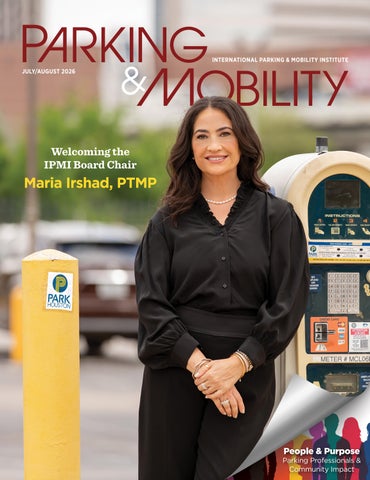
Welcoming the IPMI Board Chair
Maria Irshad, PTMP
People & Purpose
Parking Professionals & Community Impact
INTERNATIONAL PARKING & MOBILITY INSTITUTE JULY/AUGUST 2026 VOL. 8 / N0. 3
FEATURES
20
26
30
20 26 30 34 38 44 50
At Her Best When It Matters Most: IPMI’s New Board Chair
How Maria Irshad built a career solving complex problems through collaboration, resilience, and community-driven leadership. By Melissa Rysak
Building a Powerful Team
Why Mentorship Matters More Than Ever By Jacob Gonzalez, PE
My Year in the Rearview
Lessons in Collaboration, Technology, and the Politics of Parking By Meredith Garrett, PTMP
Beyond the Citation
Redesigning Parking Enforcement for Trust and Compliance By Colin Heffron, Jr.
Reframing Municipal Parking
How Operators Can Turn Parking into a Civic Asset By Jason Sutton, PTMP, PECP
People Don’t Fail Systems—Systems Fail People Lessons from Evolving Parking Operations By Dr. George Mclean, PTMP, MPA, DBA
2026 IPMI Awards
Chair Award, Lifetime Achievement Award, Awards of Excellence, and Professional Recognition Awards. By Dorothy J. Verdon, CPSM
44
34
2 PARKING & MOBILITY | JULY/AUGUST 2026 | PARKING-MOBILITY-MAGAZINE.ORG
38
44
FROM THE EDITOR
COLUMNS 3 FROM THE EDITOR Who Makes This Industry Move? 4 THE PEOPLE OF PARKING Beyond the Citation By Sherrie Poitier, PECP, and Luquette Thames, PECP
6 PARKING & TRANSPORTATION EQUITY Can I Park Here? By Gina Hurny, PhD, PTMP, and Andy Santos
10 PARKING COMPLIANCE & SAFETY Wellness and Resilience By Captain Nick Nicholas, PECP
14 HR SPOTLIGHT What AI Can’t Teach By Kathleen Federici, M.Ed.
16 ASK THE EXPERTS How can parking professionals contribute to the social and economic vitality of their communities? 43 SPONSORED CONTENT Barry’s Built a Fitness Empire. 48 SPONSORED CONTENT As the Curb Grows More Complex, Structure Matters More Than Ever 115 IPMI CALENDAR 117 STATE & REGIONAL CALENDAR
Who Makes This Industry Move? SPEND ENOUGH TIME in the parking and mobility industry, and you will notice something. The headlines may be about technology. The conference sessions may focus on innovation, emerging trends, new challenges, and the future of parking. Yet behind every advancement in our profession is something far less tangible, but far more important. The people. As we developed this issue, dedicated to the people of parking and mobility, I found myself reflecting on the individuals who have shaped this industry over the years. They are the professionals who see challenges and find solutions. They are the mentors who reach behind them to embrace and guide the next generation. They are the leaders who build strong teams, the innovators who challenge assumptions, and the frontline employees whose daily work and industry impact often go unnoticed but never go unfelt. What has always impressed me about our community’s professionals is their willingness to adapt. Our industry has navigated changing technologies, evolving customer expectations, shifting transportation patterns, and growing demands on our communities. Through it all, the constant has been the people who show up each day, committed to making things work. That commitment is on full display in this year’s award winners. In these pages, we recognize the recipients of the 2026 Awards of Excellence, whose projects demonstrate creativity, collaboration, and a clear vision for the future. We celebrate the individuals honored through our Professional Recognition Awards, whose leadership and contributions have strengthened both their organizations and the profession. We also congratulate our 2026 Organization of the Year, an honor that reflects not only achievement but a culture built on purpose, service, and excellence. And we spotlight two professionals who are impacting our community in ways we will feel for years to come, our Lifetime and Chair Award recipients. Awards celebrate accomplishment, but more importantly, they remind us who accomplished it. Every award-winning project began with someone asking a question, proposing an idea, solving a problem, or rallying a team. Every professional recognition reflects years of dedication that often extend well beyond a job description. Every successful organization is ultimately a collection of people working toward a shared goal. As you read this issue, I hope you’ll see more than accomplishments. I hope you’ll see the individuals behind them: the people whose efforts continue to move our industry forward in both large and small ways. Because while parking and mobility may be evolving faster than ever, one thing remains unchanged: our greatest asset has always been our people.
Melissa Rysak, Editor-in-Chief rysak@parking-mobility.org
3
THE PEOPLE OF PARKING
Beyond the Citation PUBLISHER
Enforcement Officers are Building Smarter Cities
Shawn Conrad, CAE
s.conrad@parking-mobility.org EDITOR-IN-CHIEF
Melissa Rysak
rysak@parking-mobility.org MANAGING EDITOR
Courtney Turner
turner@parking-mobility.org TECHNICAL EDITOR
Rachel Yoka, PTMP, LEED AP BD+C yoka@parking-mobility.org
ADVERTISING SALES AND SUBSCRIPTIONS
Tina Altman, CEM
taltman@parking-mobility.org PUBLICATION DESIGN
BonoTom Studio
info@bonotom.com For subscription changes, email editor@parkingmobility.org.
By Sherrie Poitier, PECP, and Luquette Thames, PECP
P
ARKING ENFORCEMENT is often viewed narrowly as a citation-
driven function, yet the reality on today’s streets tells a very different story. Across cities, parking enforcement officers serve as frontline ambassadors, balancing safety, mobility, and public access in increasingly complex urban environments. Their role has evolved far beyond issuing citations; they are now essential to how cities function and move forward.
Parking & Mobility (ISSN 0896-2324 & USPS 001436) is published bi-monthly by the International Parking & Mobility Institute P.O. Box 3787 Fredericksburg, VA 22402 Email: info@parking-mobility.org Website: parking-mobility.org Send address changes promptly via email to editor@ parking-mobility.org. Interactive electronic version of Parking & Mobility at parking-mobility-magazine.org. Copyright © International Parking & Mobility Institute, 2026. Statements of fact and opinion expressed in articles contained in Parking & Mobility are the sole responsibility of the authors and do not necessarily represent an official expression of policy or opinion on the part of officers or the members of IPMI. Manuscripts, correspondence, articles, product releases, and all contributed materials are welcomed by Parking & Mobility; however, publication is subject to editing, if deemed necessary to conform to standards of publication. The subscription rate is included in IPMI annual dues. Subscription rate for non-members of IPMI is $500 per year (U.S. currency) in the U.S., Canada, and Mexico. All other countries, $750.
From the officer’s perspective, parking enforcement begins with public safety. Officers routinely address vehicles that block crosswalks, loading zones, bike lanes, access points, and emergency routes. These violations are not minor inconveniences; they can create dangerous conditions for pedestrians, cyclists, drivers, scooter riders, and people with disabilities. By maintaining order, officers help prevent crashes, improve traffic flow, and keep emergency access clear. Parking enforcement also plays a critical role in reducing congestion. Officers witness firsthand the effects of drivers circling blocks in search of parking, double-parking, or stopping in travel lanes out of frustration. Effective curb management and consistent turnover reduce unnecessary traffic, improve mobility, and enhance the efficiency of the transportation network. In this way, parking enforcement directly supports safer, more efficient urban environments. Equally important is the profession’s growing role in public engagement and education. Modern parking systems increasingly rely on mobile apps, license plate recognition, and data-driven curb management technologies. For many residents and visitors, these tools can be confusing. Parking enforcement officers often serve as the first point of contact, helping users navigate these systems, understand regulations, and
4 PARKING & MOBILITY | JULY/AUGUST 2026 | PARKING-MOBILITY-MAGAZINE.ORG
Flexible. Friendly.
TICKETING SOLUTIONS FOR EVERY NEED. avoid future violations. They serve as the “eyes and ears” of their organizations, relaying public feedback and helping communities adapt to rapidly changing technologies. The work also supports economic vitality. Well-managed curb space promotes turnover, giving customers access to local businesses, restaurants, and commercial districts. When spaces are monopolized or misused, economic activity suffers. Officers understand that curb access is not simply about parking vehicles; it is about supporting commerce, encouraging repeat business, and helping communities thrive. Technology is transforming the field, but it is not replacing officers. Data analytics, digital enforcement tools, and realtime monitoring systems help officers work more strategically and efficiently. Yet common sense, communication, and community engagement remain irreplaceable. The future of parking enforcement depends on blending technology with strong customer interactions and public trust. Fundamentally, the future depends on workforce development. As the profession evolves, organizations must invest in training, certification, mentorship, and career pathways that position parking enforcement as a respected public service profession. Organizations such as the International Parking and Mobility Institute are advancing standards, education, and professional growth across the industry. To attract the next generation of parking enforcement officers, the profession must present itself as it truly is: a technology-enabled, community-centered career focused on safety, mobility, and urban problem-solving. Cities need adaptable, service-oriented professionals who can navigate the evolving demands of increasingly complex transportation systems. When the parking system works, the city works. Investing in the professionalism and future of parking enforcement is ultimately an investment in safer, smarter, and more livable communities for all. ◆
Optimize your parking operations with solutions designed for performance, reliability, and flexibility. Toledo Ticket Technologies delivers products that integrate seamlessly with your systems, support efficient workflows, and keep operations running without interruption. Engineered for OEM compatibility and customized to your needs, our solutions help parking operators stay organized, secure, and in control—every step of the way.
Thermal Roll Tickets
Available in many roll specifications and designed to suit your equipment and operations.
Matrix Tags
Versatile, multi-part identification solutions with customizable layouts, numbering, barcoding, technology, and perforation options to streamline tracking and organization.
Additional parking solutions include: • Machine Issued Tickets • Valet & Self-Park Tickets • Parking Permits & Decals • RFID Hang Tags • Key Fobs
• Parking Violation Notices • Access Cards • Citation Rolls • And More
SHERRIE POITIER, PECP, is Manager of Operations — Enforcement for the Miami Parking Authority. She can be reached at spoitier@miamiparking.com.
SCAN to Learn More LUQUETTE THAMES, PECP, is Manager of Operations — Enforcement for the Miami Parking Authority. She can be reached at lthames@ miamiparking.com.
800-533-6620 ToledoTicket.com
PARKING-MOBILITY-MAGAZINE.ORG| JULY/AUGUST 2026 | PARKING & MOBILITY 5
PARKING & TRANSPORTATION EQUITY
Can I Park Here? Clearer Communication Leads to Inclusive Parking By Gina Hurny, PhD, PTMP, and Andy Santos
T
HROUGH INTENTIONAL LEADERSHIP and meaningful allyship, we can better align
our work with the evolving needs of drivers and the broader community, advancing accessibility and safety, and promoting equitable access throughout the parking ecosystem. In this article, we focus on accessibility in parking signage, examining how clearer, more inclusive communication can help ensure parking information is easily understood by all drivers. Accessibility Challenges in Parking Regulatory Signage According to Collano et al., drivers’ interpretation of road signage is directly affected by information density, and language plays a central role in promoting consistent and accurate understanding of the messages displayed.1 Empirical research suggests that parking regulatory signage is often misunderstood, particularly when it relies on complex or text-dense messaging. Reduced clarity disproportionately affects individuals who are not fluent in the dominant language, increasing the likelihood of unintentional non-compliance. Failure to incorporate language-accessible or universally recognizable signage can create inequitable barriers. These barriers include confusion, unintentional violations, and financial consequences that may be avoidable with clearer communication. 2 Individuals who are not fluent in the dominant language often struggle to understand the rules. The lack of comprehension makes it difficult to know when, where, and how long they can park. According to Chen and Park, much of the signage we see in our daily communities is inconsistent. 3 Visual communication is highly dependent on cognitive fluency, and unclear signage results in an immediate 37% drop in comprehension. 3 Furthermore, Tan and Reyes noted that fragmented or multilingual signage often fails to account for cultural and linguistic diversity, leading to a disconnect between the intended message and how users perceive it.4 Even for fluent English speakers, parking signs
6 PARKING & MOBILITY | JULY/AUGUST 2026 | PARKING-MOBILITY-MAGAZINE.ORG
REINFORCING THE FUTURE: HOW NSC’S INNOVATIVE CONNECTIONS ARE REDEFINING PRECAST PARKING STRUCTURES By Northford Structural Connections (NSC)
Northford Structural Connections (NSC), a leading developer and manufacturer of advanced connection systems, has stepped forward with innovative solutions designed to eliminate these chronic issues. Their flagship products—the Double-Tee Flexible Connection (DTFC) and the Double-Tee Connection (DTC)—represent the next generation of resilient, field-ready technology for both retrofit and new construction. In the world of precast concrete construction, structural connections are the unsung heroes that determine a parking structure’s long-term performance. Over time, the industry has seen a recurring challenge—shear connection failures in single- and double-tee flanges that compromise safety, durability, and seismic stability.
UNDERSTANDING THE CHALLENGE: WHY FLANGE CONNECTIONS FAIL
A PARALLEL SOLUTION FOR NEW CONSTRUCTION
The results are familiar to engineers and owners alike—joint movement, bouncing at the seams, and water infiltration. These visible symptoms often mask a deeper problem: once the flange connection fails, the cantilevered precast elements become unsupported, compromising the deck diaphragm’s seismic integrity and overall safety of the structure.
Designed for new precast production, the DTC not only simplifies fabrication but also extends the service life of the structure, representing a proactive rather than reactive approach to connection design.
Precast-tee flange connections often fail for three fundamental reasons: • Corrosion of embedded or exposed reinforcement • Restrained tension during temperature changes, especially in colder months • Fatigue loading from daily vehicular traffic
WHY TRADITIONAL REPAIRS FALL SHORT
For decades, repair approaches have focused on addressing the symptoms, not the cause. Spall repairs attempt to bond new concrete to a stressed substrate—a losing battle from the start. Likewise, weld repairs at fatigue fractures simply restart the clock without resolving the underlying issue of cyclic stress and tension restraint. The result? Short-lived fixes that delay, rather than prevent, structural deterioration.
THE NSC APPROACH: ENGINEERING FOR MOVEMENT AND LONGEVITY
Recognizing that rigid connections were part of the problem, NSC’s engineers sought a new path—a connection that could move when the structure moved. The result was the Double-Tee Flexible Connection (DTFC), an underside-mounted, stainless steel system designed specifically for retrofit applications. Its flexible geometry allows controlled movement across the joint, relieving tensile stress while maintaining shear integrity. The DTFC’s corrosion-resistant stainless steel design and fatigue-resistant construction ensure that it performs reliably under the demanding conditions of parking decks, all while allowing installation without garage closures or traffic disruption—a critical advantage for owners and
Building on the success of the DTFC, NSC developed the Double-Tee Connection (DTC)—a modern evolution of the traditional slug weld used in precast fabrication. The DTC’s refined geometry enhances fatigue resistance, reduces stress at the weld interface, and significantly improves out-of-plane bending performance.
INNOVATION THROUGH COLLABORATION
Both the DTFC and DTC were developed in collaboration with industry experts, laboratories, and field professionals who understood the practical realities of parking structure performance. This partnership-driven approach allowed NSC to bridge the gap between theoretical engineering and real-world construction demands, creating products that are both technically advanced and field-friendly.
CONTINUING EDUCATION: BUILDING AWARENESS THROUGH AIA-CES
NSC is committed to collaborating with engineers, architects, and contractors on the evolving science of connection performance. Through its AIA Continuing Education (CES) program, NSC offers accredited webinars and presentations that explore fatigue behavior, connection mechanics, and modern retrofit strategies—empowering design professionals to make informed, durable choices.
A LASTING IMPACT
From restoring aging garages to constructing the next generation of precast decks, NSC’s mission is clear: build stronger, smarter, and longer-lasting connections.
To learn more about the DTFC and DTC systems, access technical data sheets, or schedule an AIA-CES presentation, visit nscclips.com or contact admin@nscclips.com.
(203) 777-0751 • nscclips.com
PARKING & TRANSPORTATION EQUITY
are notoriously confusing due to their design and inconsistency. English-only signs exacerbate these existing problems by relying solely on complex text rather than universal symbols.
are not fluent in the dominant language. Observing how individuals interact with signage enables parking professionals to identify points of confusion, assess comprehension gaps, and refine design to improve clarity while ensuring compliance. 2,3,4
How to Advance Accessibility in Parking Signage
Conclusion
As parking professionals and members of multiple communities, it’s important that we ensure the accessibility, clarity, and consistency of parking signs to help alleviate the challenges experienced by individuals who are not fluent in the dominant language. With this in mind, how can parking professionals serve as allies advancing accessibility and equity in parking signage? Chen and Park, Tan and Reyes, and Kaplan et al. suggest implementing several strategies to reduce challenges and confusion experienced by individuals who are not fluent in the dominant language, including:
Research consistently demonstrates that poorly designed or linguistically inaccessible signage contributes to confusion, misinterpretation, and unintentional parking violations. Studies by Chen and Park, Tan and Reyes, and Kaplan et al. emphasize that improving comprehension requires strategies that go beyond mere text translation. 2,3,4 Implementing even one of the highlighted strategies can improve comprehension and compliance, reduce unintentional violations, enhance perceptions of equitable outcomes, and increase overall accessibility, clarity, and consistency of parking signage. ◆
Stakeholder collaboration; Intentional information dissemination; and ● Direct observation of the end users interacting with the signage.2,3,4 ●
ANDY SANTOS is the Senior Director, People and Culture, at SpotHero and a member of IPMI’s Allyship & Equity Committee. He can be reached at andy.santos@ spothero.com. ALLYSHIP
●
Effective stakeholder collaboration requires engaging a diverse group of campus/community constituents in the review and redesign of parking signage. By incorporating lived experiences into the design process, parking professionals can ensure that signage reflects the linguistic and cultural diversity of the community it serves. This inclusive approach strengthens clarity, improves usability, and promotes equitable access to parking information. Strategic information dissemination includes moving beyond static signage to deliver clear, concise, and multimodal communication. This may include multilingual digital resources, simplified visual icons, or QR codes linking to language-accessible parking guidance. Providing layered communication ensures that users can access information in formats that best support their understanding. In addition, conducting observational assessments and pilot testing is essential to evaluate how users interpret parking signage in everyday environments. Methods may include feedback surveys, walk-through simulations, or usability testing with individuals who
& EQUITY COMMITTEE
umbc.edu.
MEMBER GINA L. HURNY, PHD, PTMP, is the Director of Parking Services at the University of Maryland, Baltimore County, and a member of IPMI’s Allyship & Equity Committee. She can be reached at glhurny@
REFERENCES 1. Collano, J. K. D., Elizondo, F. M., Perez, M. A. F., Roa, T. G. L., Suarez, S. P., & Tan, J. G., Jr. (2025). Public signs, private errors: Examining grammar in urban communication. International Journal of Research and Innovation in Social Science, 9(6), 395–400. https://doi. org/10.47772/IJRISS.2025.90600033 2. Kaplan, S., Bortei-doku, S. & Prato, C.G., (2018). The relation between the perception of safe traffic and the comprehension of road signs in conditions of ambiguous and redundant information. Transportation Research Part F: Psychology and Behaviour, 55, pp.415–425. https://doi. org/10.1016/j.trf.2018.03.021. 3. Chen, L., & Park, J. (2023). Signage legibility and viewer response in urban infrastructure. International Journal of Visual Communication, 12(1), 55–72. https://doi.org/10.1016/j.viscom.2023.01.005 4. Tan, R. L., & Reyes, M. A. (2021). Language, culture, and clarity: Challenges in public signage design in multilingual communities. Journal of Public Information Systems, 9(3), 112–129. https://doi. org/10.1109/JPIS.2021.3090215
8 PARKING & MOBILITY | JULY/AUGUST 2026 | PARKING-MOBILITY-MAGAZINE.ORG
The Parking Barrier
MHTMTM MicroDrive Vehicle Barriers
MHTMTM MicroDrive barriers from Magnetic AutoControl are the ideal solution for professional parking applications. MicroDrive barriers are designed for long-life use in heavily frequented facilities and feature:
• Rapid opening times • Detection of tailgating vehicles • 2 Million Cycle Warranty* • Low energy consumption • Low-maintenance
• Articulated arm options • Laserscanner options • Breakaway ange options • LED barrier arm options *2 Years or 2 Million cycles, whichever occurs rst.
MAGNETIC AUTOCONTROL • 3160 MURRELL RD ROCKLEDGE, FL • WWW.MAGNETIC-ACCESS.COM
PARKING COMPLIANCE & SAFETY
Wellness and Resilience Taking Care of the People Who Take Care of the Frontline By Captain Nick Nicholas, PECP
W
E CONTINUE THIS ONGOING COLUMN on frontline safety, a practical, people-first
series for everyone who works the curb, the counter, and the garage, or has any interaction with the public.
In Part 1, we focused on situational awareness. Noticing sooner gives frontline professionals more time, more space, and more options. In Part 2, we moved into de-escalation: de-escalate yourself first, create distance, use calm language, set respectful boundaries, and know when to disengage. In Part 3, we discussed advanced concepts, including vehicle operations, being filmed, communication discipline, and high-consequence moments where small habits can prevent big problems. This article focuses on wellness and resilience. Wellness is not a side issue; it is a safety issue. A tired, burned-out, dehydrated, unsupported, or emotionally overloaded employee is less able to recognize risk, communicate clearly, and make sound decisions when pressure rises.
The Data Problem: We Know More About Officers Than Professional Staff In public safety, there is a growing body of research
on officer wellness, stress, suicide, trauma, sleep, and long-term health. Some of it is alarming. The Officer Down Memorial Page (ODMP) tracks line-of-duty deaths, and when ODMP on-duty death data from the last 25 years is grouped by category, more officers have died from medical issues than from felonious assault or vehicle accidents.1 This does not minimize the danger of violence or vehicle operations. It reinforces a critical point: wellness is not separate from safety. In many ways, it is safety. Other research has examined the long-term health impacts of policing. One study compared the life expectancy of male police officers in Buffalo, New York, with that of the general U.S. male population and found that officers in the sample lived an average of 21.9 fewer years than U.S. males. The study also found that a male police officer in the 50 to 54 age group had nearly a 40% probability of death, compared with about 1% for males in the general population in that same age group. Possible contributing factors included job-related stress, shift work, sleep deprivation, obesity, poor lifestyle habits, and hazardous environmental exposures. 2 Does this sound familiar to our frontline staff? Officer suicide is also part of the wellness conversation. Police officers are nearly three times more likely to die by their own hand than be feloniously killed by a bad guy. 3 These numbers help explain why wellness has become central in policing. But they also raise an important question for this industry: what about the professional staff working beside officers, supporting public safety agencies, enforcing rules in public spaces, and serving the public in conflict-heavy environments? For professional staff, the data is thinner. That does not mean the impact is not real. It means we have not measured it well enough.
10 PARKING & MOBILITY | JULY/AUGUST 2026 | PARKING-MOBILITY-MAGAZINE.ORG
STOCK.ADOBE.COM / PRESSMASTER
What We Can Infer from the Research We Do Have At this point, I know what some readers may be thinking: those statistics are troubling, but I am not a police officer. And that is exactly why this research matters. One recent study examined work-related stress and PTSD among both sworn (gun-carrying) and non-sworn personnel from two large urban law enforcement agencies in Minnesota between May and October 2021, during the COVID-19 pandemic and the civil unrest following the murder of George Floyd.4 The researchers found no significant difference in operational stress, organizational stress, or probable PTSD between sworn and non-sworn personnel. In other words, stress exposure was not limited to sworn officers. That finding matters for parking and mobility professionals. Parking professionals may not always wear badges, but many work in environments filled with conflict, public frustration, safety risks, organizational pressure,
repeated confrontations, and sometimes traumatic information. Stress is stress. The nervous system responds either way.
Wellness Became Personal for Me On October 12, 2011, a gunman entered the Salon Meritage in Seal Beach, California, shooting nine people and killing eight in what remains the deadliest mass shooting in Orange County history. This event had a profound impact on my life, and it changed how I understood trauma, community grief, organizational stress, and the long emotional tail that follows a violent event. It also changed how I talk about wellness. Before tragedies like that, wellness in public safety was often treated as private; something you handled quietly or addressed only after someone was already in crisis. Afterward, it became harder to ignore how deeply trauma extends beyond direct victims to families, witnesses, first responders, professional staff, volunteers, and entire communities.
Finally, Evidence. The Truth is in the Video. Know what happened. Know when it happened. Know where it happened. Our camera-based Automated Parking Guidance System with Park Surveillance records HD video continuously, or when motion is detected, to help operators resolve incidents quickly and confidently. Visit tkhsecurity.com/US
PARKING-MOBILITY-MAGAZINE.ORG| JULY/AUGUST 2026 | PARKING & MOBILITY 11
PARKING COMPLIANCE & SAFETY
That experience reinforced something I believe deeply: talking about stress early is not a weakness. It is prevention.
Homeostasis and The Emotional Rollercoaster Homeostasis is the body’s ability to maintain a stable internal environment despite external changes. When you are hot, you sweat. When you are cold, you shiver. That sounds clinical, but it is very practical. When you are hot, cold, tired, hungry, dehydrated, stressed, or overstimulated, your body is working harder to maintain balance. That affects patience, focus, emotional control, and recovery after a confrontation. Dr. Kevin Gilmartin describes a related idea as the “hypervigilance biological rollercoaster.” His point is that people in high-alert public safety roles often operate above their normal emotional and physiological range while
on duty. They are alert, engaged, watchful, and ready to respond. But when the shift ends, the body may swing in the opposite direction, leaving the person tired, detached, isolated, or apathetic in their personal life. 5 While developed for law enforcement, the pattern is familiar across many frontline professionals. Parking and mobility work may not always involve the same calls as policing, but it can still require long periods of public contact, confrontation, environmental stress, risk assessment, and emotional restraint. A driver yells at you. A customer films you. The sun is beating down. You skipped water because you were busy. Then, later, when you are finally home, you have nothing left for the people or activities that normally restore you. That is the rollercoaster. Wellness means recognizing that cycle early and building recovery into your job and your life before your job becomes your whole identity.
www.TagMasterNA.com
LPR Cameras RFID Readers
Experience our world class AI-powered LPR Cameras and RFID Long Range Readers. Purpose-built for seamless parking operations.
12 PARKING & MOBILITY | JULY/AUGUST 2026 | PARKING-MOBILITY-MAGAZINE.ORG
Intelligent Vehicle Identification
Where Parking Meets Intelligence.
Learn more at
Tactical Breathing: Small Tool, Real Value
Putting It All Together
One of the simplest stress-management tools is tactical breathing, often taught as box breathing: inhale, hold, exhale, hold, typically in four-second intervals. A meta-analysis of randomized controlled trials on breathwork and mental health found that breathwork was associated with reduced stress compared to control conditions. They also found significant effects for anxiety and depressive symptoms.6 For frontline professionals, a few controlled breaths can slow your voice, steady your hands, and create space between stimulus and response. Before you respond to the person yelling at the counter, before you key the radio, before you walk up to the occupied vehicle — take a minute and breathe.
Wellness is not separate from safety; it is the foundation that makes safety possible. Situational awareness requires alertness. De-escalation requires emotional control. Advanced concepts require discipline under pressure. None of this works well when people are exhausted, isolated, dehydrated, burned out, or afraid to ask for help. The next step for our industry is to widen the lens. We should continue learning from law enforcement wellness research, but we also need to take professional staff wellness seriously on its own terms. Parking and mobility professionals may not always be sworn law enforcement officers, but they stand on the same front lines of public frustration, conflict, confusion, and service. They deserve training, support, recovery, and workplaces where asking for help is understood as a strength. In the end, wellness is not about being perfect or untouched by stress. It is about returning to balance before the job becomes your whole identity. Take care of the people who take care of the public. That is not extra. That is the work. ◆
Physical Wellness is Frontline Safety Wellness is not only mental health. It is hydration, nutrition, movement, sleep, and basic physical readiness. Heat, sun, concrete, long walking routes, stairwells, garages, traffic noise, and constant public contact wear people down. A person who is dehydrated is not just uncomfortable. They may be less alert, more irritable, and more vulnerable to mistakes. Wearing PPE, including high-visibility gear and sturdy shoes, is part of wellness, too. A reflective vest, supportive footwear, sunscreen, water, and real rest breaks may not look like resilience, but they are part of it.
Peer Support, Professional Help, and Stigma No one should have to carry frontline stress alone. Peer support groups, regular check-ins, counseling, and occupational stress resources should be treated as the norm rather than the exception. Frontline employees often normalize abnormal stress. They joke about it. They minimize it. They say, “It’s just part of the job.” But if “part of the job” means constantly absorbing hostility without recovery, the organization has a responsibility to pay attention. The wellness conversation must be normal, visible, and practical. Make mental health as routine to discuss as physical health. Emphasize that seeking help is a proactive and courageous step, not a weakness. Wellness must be modeled by leadership, supported by supervisors, and made practical for the people doing the work.
Disclaimer: This column shares general safety and wellness concepts for parking professionals and does not replace your agency policies, procedures, legal guidance, medical guidance, mental health treatment, or training. Strategies are not universally applicable; assess local conditions and adapt to your jurisdiction, facilities, staffing, and agreements. Behavioral and wellness descriptions are for general awareness, not diagnosis or medical advice. When behavior suggests medical risk, crisis, or self-harm risk, request appropriate resources per protocol. When in doubt, choose distance, dignity, policy compliance, and appropriate support.
NICK NICHOLAS, PECP, is a Captain with the City of Seal Beach, CA, Police Department and a member of IPMI’s Policy & Legislative Cohort. He can be reached at nnicholas@sealbeachca.gov.
POLICY & LEGISLATIVE COHORT MEMBER
REFERENCES 1. Officer Down Memorial Page. (2026). Officer Down Memorial Page statistics dashboard. Retrieved May 11, 2026, from https://www.odmp.org/ 2. Violanti, J. M., Fekedulegn, D., Hartley, T. A., Andrew, M. E., Gu, J. K., & Burchfiel, C. M. (2013). Life expectancy in police officers: A comparison with the U.S. general population. International Journal of Emergency Mental Health, 15(4), 217-228. 3. Lilly, Z. (2023, May 9). Reducing the stigma surrounding mental health. FBI Law Enforcement Bulletin. 4. Nam, Y.-S., Frazier, P. A., Everson-Rose, S., Kim, H., Ryan, A. D., & Ramirez, M. R. (2025). Work-related stress among sworn and non-sworn law enforcement personnel. International Journal of Police Science & Management, 27(2), 131-143. https://doi. org/10.1177/14613557241292963 5. Gilmartin, K. M. (2002). Emotional survival for law enforcement: A guide for officers and their families. E-S Press. 6. Fincham, G. W., Strauss, C., Montero-Marin, J., & Cavanagh, K. (2023). Effect of breathwork on stress and mental health: A meta-analysis of randomized-controlled trials. Scientific Reports, 13, Article 432. https:// doi.org/10.1038/s41598-022-27247-y
PARKING-MOBILITY-MAGAZINE.ORG | JULY/AUGUST 2026 | PARKING & MOBILITY 13
HR SPOTLIGHT
What AI Can’t Teach Curriculum Mapping, Human Connection, and the Future of Learning By Kathleen Federici, M.Ed.
T
HE TRAINING 2026 CONFERENCE & EXPO is the training industry’s leading conference,
and this year, I had the privilege of being selected as a speaker. I presented a case study on how the International Parking & Mobility Institute (IPMI) recognizes the importance of using curriculum maps to identify and close gaps in training content. For those not familiar with the concept, a curriculum map is a holistic illustration of training offerings aligned with the knowledge, skills, and abilities (KSAs) required for a role or roles. It can also be used to support career advancement within an organization. A curriculum map provides a comprehensive overview of training content aligned with identified KSAs and highlights where there is too much content, not enough content, or alignment is just right. For the organization, a curriculum map serves as a blueprint to ensure training content aligns with organizational priorities, mission, and values. It supports intentional development of content within professional development and training departments. A curriculum map also improves budget consistency by reducing unexpected content surprises within
a fiscal year and promotes unified learning and consistent KSAs. Curriculum maps can highlight the skills needed both for job performance and for advancement within an organization. When career advancement is tied to a curriculum map, the organization can ensure that completed training is directly relevant to the role being sought. In this way, a curriculum map can also be used as a career development roadmap. Human resources departments can use it to identify potential future leaders by asking, “Who are we developing for leadership roles?” It can also be used to improve employee retention by helping employees identify clear pathways to promotion. As an educator, I was in my element, sharing and teaching others how to replicate and advance their learning and professional development departments
14 PARKING & MOBILITY | JULY/AUGUST 2026 | PARKING-MOBILITY-MAGAZINE.ORG
STOCK.ADOBE.COM / DIANE MUNRO/PEOPLEIMAGES.COM
through curriculum maps. I also enjoyed attending a few sessions and am now sharing a few key takeaways. Two sessions in particular resonated with me, each offering a different perspective on artificial intelligence (AI) and how humans must adapt. I expected to hear the common narrative that AI will replace jobs and humans will be displaced by automated, unemotional processes. Instead, both sessions offered a more balanced and refreshing perspective. The first session highlighted the many things that humans excel at that AI cannot replicate. For example, AI cannot interpret human feelings and behaviors. AI cannot build trust, demonstrate empathy, offer safety, or engage in a lighthearted, humorous exchange. When we engage with AI, we are working with a machine — not building a genuine human connection capable of incorporating empathy into its responses. AI gains our attention, but it cannot command a room of humans in a way that keeps them engaged and forms that connection and bond through lived experiences. AI cannot hold space, demonstrate compassion in times of crisis, or provide comfort during times of sorrow, sadness, or insecurity. This session provided a powerful reminder that I will carry with me as we create new instructor-led online and face-to-face training. The second session focused on the contextual blindness of AI. This session centered on our global communication and cultural awareness, including how to train global teams using cultural communication patterns and behavioral psychology. A colorcoded world map was used to illustrate regional communication styles. AI lacks this type of cultural context. It cannot fully interpret or adapt to the communication preferences of other cultures. Humans outsmart AI in workplace communication versatility. We can adjust our style based on audience, purpose, and context, including cultural norms and relationship dynamics. This can be accomplished, for example, using the social styles theory, which identifies four communication styles that people tend to exhibit: 1. Those who identify with the analytical social style seek knowledge, predictability, and are detailoriented. Communicating with an analytical style person is about grounding conversations in tangible data.
2. Those who identify with the driving social style are industrious, dream big, and see opportunities that others do not. Communicating with a driving-style individual is about being clear, concise, fact-based, and efficient. 3. Those who identify with the amiable social style (the default style) are people pleasers and want to see everyone happy. Communicating with a person in an amiable style involves the democratic process, a slower decision-making pace, and fostering a supportive atmosphere. 4. Those who identify with the expressive social style are people who seek excitement and recognition and are very social. Communicating with an expressive style person is about being animated and enthusiastic, and building rapport through warmth, humor, and emotional engagement. AI cannot perceive or adapt to these communication nuances when corresponding and suggesting email language between people and cultures. AI cannot style-switch between email writing and the various unique human personalities to meet the cultural needs and global considerations of relationships. Humans, however, can shift communication styles depending on situation, audience, and context – an ability that is especially critical in global education and international communication. AI can assist in creating curriculum maps, but humans must validate on-the-job KSAs. AI can assist in drafting communications, but humans must adjust the tone and style based on the need, culture, relationship, and situation. When it comes to connection, a sense of belonging, creativity, and shared emotional experiences, those remain distinctly human. Humans are resilient. We adapt, empathize, grieve together, hope together, teach, learn, and connect. We hold one another in spaces that are uniquely messy, deeply emotional, and unmistakably human. ◆ KATHLEEN FEDERICI, M.ED., is the Vice President of Professional Development for the International Parking & Mobility Institute. She can be reached at federici@parking-mobility.org.
PARKING-MOBILITY-MAGAZINE.ORG | JULY/AUGUST 2026 | PARKING & MOBILITY 15
ASK THE EXPERTS
ASK THE EXPERTS
How can parking professionals contribute to the social and economic vitality of their communities?
In what ways can parking professionals move beyond operations to become active contributors to the social and economic vitality of the communities they serve? Armaan Dhillon, PECP
Marlene Cramer, PTMP, LEED Green Associate
Account Manager Reimagined Parking Parking professionals move beyond operations by adopting a people-first mindset, guided by datadriven insights and authentic community engagement. Understanding usage patterns while actively listening to local stakeholders ensures parking systems reflect the needs of the communities they serve. This approach encourages a mindset of growing together, where parking is not managed in isolation but as part of a broader mobility ecosystem that supports access, economic activity, and community connection. Ultimately, moving beyond operations requires translating insights into actions that improve accessibility, support local economies, and contribute to more inclusive and resilient communities.
Chuck Boddy, PTMP Chief, Parking Management Division Revenue Authority of Prince George’s County Engage with the community in every way possible. Whether it’s hosting forums, attending town halls, or volunteering your time in the community, make it a priority to listen closely to their needs. Use those insights to develop strategies that can help create more livable neighborhoods while staying aligned with the community’s broader goals.
Director, Transportation California Polytechnic State University When access is easy, predictable, and affordable, people expand their range of choices. A student is more likely to live farther from campus if transit is reliable. Visitors stay longer and spend more if getting around is easy. Staff may choose different housing markets depending on commute options. Transportation directly influences land use, housing demand, and local business vitality. Strategic transportation investments are key economic development tools. Decisions about parking pricing, transit frequency, micromobility, or even wayfinding can shift spending patterns and shape growth.
Joseph R. Madison II Branch Chief, Metro Planning Georgia Department of Transportation Parking and mobility professionals can become active contributors to community vitality by participating in the public engagement process. When communities undertake master planning efforts and request public feedback, the unique perspective of industry professionals will elevate the overall outcome for the generations to come. Additionally, it can provide insight into a field that is often overlooked.
HAVE A QUESTION? Send it to editor@parking-mobility. org and watch this space for answers from the experts. 16 PARKING & MOBILITY | JULY/AUGUST 2026
The opinions and thoughts expressed by the contributors do not necessarily reflect the opinions and viewpoints of the International Parking & Mobility Institute or official policies of IPMI.
Gabe Mendez, PTMP
Rezwan Islam
Director of Transportation Operations University of Wisconsin – Madison
IT Manager Toronto Parking Authority
Volunteer! As parking professionals, we develop a wide array of skills, including stakeholder engagement, fiscal responsibility, coaching, and project management, to name a few. Many non-profit, philanthropic, and civic organizations can greatly benefit from these skills. Your organization is likely already partnering with a non-profit or philanthropic organization, and you can dip your toes in the volunteering world with people you probably already know.
Alyssa Alt Parking Enterprise Manager City of Colorado Springs Successful and vibrant communities are built on collaboration. By coordinating parking assets with transit, bike, and micro-mobility networks, as well as walkable street design, parking programs can expand mobility choices and reduce congestion for residents and visitors. Reimagining frontline staff as knowledgeable, customer-focused ambassadors contributes directly to a more inviting and safer environment that benefits both local businesses and parking personnel.
Todd Drager, PE Director of Parking Design Services O&S Associates Ultimately, parking exists to support people in places. Strategies that improve access to businesses, enhance user safety and experience, or better integrate parking into the fabric of the community have a real and positive local impact. Parking can become more than infrastructure; it can be a tool to support economic activity and strengthen community connections. As parking professionals, we can approach new initiatives and projects with those strategies as driving factors.
Parking professionals can create community value by reframing parking as civic infrastructure rather than a standalone operation. From an IT leadership perspective, the opportunity lies in leveraging parking data to inform urban planning, support local businesses, and guide curbside policy. Digital platforms can advance equity through accessible design, transparent enforcement, and flexible payment options, while supporting sustainability through EV infrastructure and demand management. By integrating parking systems with broader city mobility and economic strategies, parking organizations become strategic partners in citybuilding — using technology not just to manage vehicles, but to strengthen neighborhoods, improve access, and enable inclusive economic vitality.
Melissa D. Yates, PTMP Partner Program Manager Arrive Parking professionals can expand their impact by engaging directly with their communities through downtown business partnerships, collaboration with local stakeholders, and ongoing grassroots outreach. This approach allows them to better align parking strategies with economic development goals and contribute to a more vibrant, accessible community.
Christopher Jones, PECP, Parksmart Advisor Operations Manager Calgary Airports Parking professionals can show up as civic leaders, not just service providers. That can include serving on downtown or business improvement boards, accessibility and mobility advisory committees, and public-safety or homelessness task forces. It also includes supporting charitable efforts such as food banks, holiday donation drives, community clean-ups, and employee-led fundraising initiatives. By partnering with nonprofits, supporting workforce development, and contributing beyond their operational mandate, parking leaders can apply strong financial, analytical, and operational skills to broader community challenges — strengthening quality of life well beyond parking stalls.
PARKING-MOBILITY-MAGAZINE.ORG | JULY/AUGUST 2026 | PARKING & MOBILITY 17
Graham Rossmore
Kelsey Owens
Transportation Planner City of Los Angeles (LADOT)
VP, Account Management IPS Group, Inc.
Parking is more than operations — it’s a way to shape how our communities function. The curb is a valuable public space and treating it only as car storage limits its potential. Through my work on the LA Al Fresco program, I’ve seen how converting parking spaces into dining areas creates economic and social value, boosts businesses, activates streets, and strengthens communities. It shifted my focus from parking metrics to outcomes like economic vitality, foot traffic, and overall experience.
Parking professionals have a broader role than just managing spaces. We sit on valuable data and infrastructure that can directly support local businesses and improve community access. By partnering with city planners, local businesses, and residents, we can turn parking into a tool to activate underused spaces, such as converting them into pickup/drop-off zones or outdoor dining areas. These shifts can ease congestion, support economic activity, and improve how people move through and experience a city.
Parking professionals should think of themselves as curb managers, using data, supporting local economies, and creating flexible spaces for dining, mobility, and public use. Ultimately, our role is to help build streets that are more vibrant, productive, and sustainable.
18 PARKING & MOBILITY | JULY/AUGUST 2026 |PARKING-MOBILITY-MAGAZINE.ORG
When it’s time to park, make it easy to pay Welcoming Discover® Network gives U.S. drivers the freedom to pay and park their way. From credit and debit to tap and swipe, our cards support the secure, modern payment methods consumers trust and expect. By expanding your acceptance to include Discover Network, you’ll connect your business to even more drivers who are ready to spend.
Expand your reach with Discover Network
Our combined global network has 30 network alliances1
378M+ cards that run on our global network2
Our global network facilitated nearly $622B in transaction volume3
Access the Discover Network Acceptance Toolkit to test terminals, order signage, and more.
1. Based on signed Network Alliance Agreements. 2. Total cards include open cards on Discover Network, Diners Club International and network alliances. Based on information provided by network participants, and RBR Data Services published as of 2024. 3. Discover Financial Services Earning Summary, 2024.
At Her Best When It Matters Most IPMI’s New Board Chair By Melissa Rysak
G
o ahead. Put Maria Irshad, PTMP, in a corner. The corner is where she thrives. When her back is against the wall, when she must come up with a solution under serious pressure, that is when Maria (pronounced mah-ree-uh) shines. When you ask her what energizes her most about leadership, Maria doesn’t mention titles, authority, or accomplishments. Instead, she laughs and says, “Put me in a corner. I’m going to do great.” It’s an unusual leadership philosophy, but one that perfectly captures the new Chair of the International Parking & Mobility Institute (IPMI) Board of Directors. For more than two decades, Maria has built a career by walking directly into difficult situations, untangling complex challenges, and bringing people together around practical solutions. Whether modernizing Houston’s parking operations, launching innovative curb management programs, mentoring emerging professionals, or helping shape the future of the parking and mobility industry through IPMI, her approach has remained remarkably consistent: listen first, collaborate often, and never stop moving forward. Now, as she steps into one of the industry’s most influential volunteer leadership roles, Maria brings not only deep operational expertise but also a perspective shaped by strong family ties, public service, community connections, and a renewed understanding of what matters most.
20 PARKING & MOBILITY | JULY/AUGUST 2026 | PARKING-MOBILITY-MAGAZINE.ORG
“What keeps me passionate about this work is simple: people. Parking may look like operations, technology, and policy on the surface, but at its heart, it’s about serving communities.”
PARKING-MOBILITY-MAGAZINE.ORG | JULY/AUGUST 2026 | PARKING & MOBILITY 21
IPMI’S NEW BOARD CHAIR
An Accidental Beginning Like many parking and mobility professionals, Maria did not set out to build a career in the industry. “I didn’t apply for this job,” she says with a smile. “It just happened to me.” In 2005, Maria was working as a public information officer for the municipal courts department in Houston. With a journalism degree and a communications background, she envisioned a future in corporate communications and fully expected to leave government service for the private sector within a few years. Then everything changed during a vacation to India.
Just weeks after accepting a promotion in municipal courts, Maria boarded a plane for a previously planned trip overseas. While sitting in New York’s airport, she received a call informing her that her boss had been reassigned amid a massive city reorganization. By the time she returned to Houston, she too had been reassigned. To parking. “At the time, parking was part of municipal courts,” she recalls. “And honestly? All I knew about parking was what I read in the newspaper.” That coverage was not flattering. Broken parking meters, frustrated customers, citation complaints, and public criticism dominated the headlines. Maria walked into the department skeptical, frustrated, and unsure of what her future would hold. Her first weeks were brutal. Each day, calls from angry residents were routed directly to her office. Complaints poured in. Customers yelled. Some cursed. She would close her office door and cry.
22 PARKING & MOBILITY | JULY/AUGUST 2026 | PARKING-MOBILITY-MAGAZINE.ORG
After two difficult weeks, Maria realized something had to change. “You either figure it out or you leave,” she remembers thinking. “You cannot cry every day at work.” So, backed into a corner, she chose to figure it out. She started learning. She began researching parking policy, curb management, and urban mobility. She
discovered Donald Shoup’s landmark book, The High Cost of Free Parking. She became fascinated by concepts like parking benefit districts and the role parking plays in economic development and city planning. Most importantly, she found a mentor in then-Houston parking director Liliana Rambo, whose leadership transformed Maria’s understanding of the profession. Liliana was, in fact, one of several female managers with whom Maria worked in her career. She feels lucky to have had such strong female role models in a maledominated industry. “Liliana took a broken system and not only rehabbed it, but totally remodeled it,” Maria says. “That changed everything for me.” Within weeks, the reluctant communications officer who once dreaded parking had become fully immersed in the industry. Twenty one years later, she’s still here.
Building a Career in Public Service Maria’s rise through Houston’s parking and mobility operations reflects both her adaptability and her willingness to take on increasingly complex challenges. She began as an administrative coordinator focused on communications, customer service messaging, and public outreach. At the time, even basic customer service systems were underdeveloped. “We didn’t even have FAQs for the 311 operators,” she recalls. “So, every complaint was getting transferred to us.” Maria immediately began modernizing communication practices, improving customer information, and developing clearer processes to help residents navigate parking services. From there, she moved into an administration manager role
overseeing customer service operations, citation management, permitting, and technology implementation. She led procurement and project management efforts for a new citation database and helped guide major operational improvements. Later, as Deputy Assistant Director and eventually Assistant Director, Maria played a central role in reshaping Houston’s parking program into what became known as ParkHouston. During that period, the city introduced mobile payments, modernized parking technology, implemented new neighborhood parking strategies, and launched Houston’s first parking benefit district, an initiative directly inspired by the policy concepts Maria had studied years earlier. Throughout her career, one theme consistently emerged: she was less interested in revenue generation than in the broader public good. “I think what changed for me was realizing that the bottom line is not always the bottom line,” she says. “In public service, you have to think about what creates the best outcome for the most stakeholders.” That philosophy ultimately anchored her long-term commitment to government work. After initially planning to pursue a graduate degree in communications, Maria instead earned a master’s degree in public administration, a decision that reflected her growing passion
PARKING-MOBILITY-MAGAZINE.ORG | JULY/AUGUST 2026 | PARKING & MOBILITY 23
IPMI’S NEW BOARD CHAIR
for civic operations and public-sector leadership. Today, Maria serves as Deputy Director within Houston’s Administration and Regulatory Affairs Department, overseeing not only parking and mobility operations, but also vehicle-for-hire programs, micromobility, regulatory permitting, and a wide range of city licensing functions. Her portfolio has expanded dramatically over the years, but her favorite part of the job remains surprisingly simple. “The people,” she says immediately. “You spend eight to ten hours a day at work. You’ve got to love the people you work with.”
The Power of Professional Community Maria credits much of her professional growth to the communities she found through her involvement in the industry. Encouraged by Liliana Rambo, she became active in both the Texas Parking & Transportation Association (TPTA) and IPMI. In 2008, she attended her first Certified Administrator of Public Parking (CAPP – now PTMP) in-person training class in Albuquerque, New Mexico. The experience left a lasting impression. “I walked in not really knowing anyone,” she says. “But people were so welcoming and generous with their knowledge.” Over time, Maria became deeply engaged at both the regional and national levels. She
served for eight years on the TPTA Board of Directors and participated in numerous IPMI committees and initiatives, including the awards committee and the early development of the Accredited Parking Organization (APO) program. For Maria, these associations became far more than professional networking groups. They became communities. “There’s not a problem out there that someone else hasn’t already solved,” she says. “You don’t have to reinvent the wheel.” That collaborative spirit remains one of her strongest beliefs about the industry.
Why She Chose to Lead When asked why she pursued leadership within IPMI, Maria’s answer is immediate. “IPMI has given me so much over the years,” she says. “I wanted to give something back.”
24 PARKING & MOBILITY | JULY/AUGUST 2026 | PARKING-MOBILITY-MAGAZINE.ORG
That sense of responsibility — to preserve and strengthen the community that shaped her career — sits at the center of her leadership philosophy. As Board Chair, Maria hopes to continue fostering the welcoming, collaborative culture that first drew her into the industry. She also wants IPMI to stay ahead of the rapid technological transformation reshaping the parking and mobility landscape. “The pace of technology is incredible right now,” she says. “Especially with AI.” While she sees enormous opportunity in emerging technologies, she also recognizes the risks. Fraud schemes, cybersecurity concerns, and rapidly evolving digital tools are already creating new operational challenges for parking organizations across the country.
“The bad guys are often faster than we are,” she says candidly. Maria is committed to educating the IPMI community on how to avoid becoming victims of the “bad guys” and to advancing positive technological innovation.
A Changed Perspective Over the past year, Maria’s perspective on leadership and community has become even more personal. Following a recent cancer diagnosis — caught early through a routine mammogram — she found herself reassessing priorities, relationships, and the meaning of professional community. “When something like that happens, you start thinking differently,” she says. “You think about what really matters.” The experience reinforced her belief in the importance of connection, wellness, and support systems both inside and outside the workplace. Now that Maria is on the other side of her diagnosis and doing well, she wants to make sure that all members of the IPMI community take care of themselves and foster important personal and professional connections. “It’s the people,” she says. “The experiences. The friendships. That’s what you remember when you take inventory of your life.” As she steps into the IPMI chair role, Maria hopes to encourage broader conversations around professional well-being, including physical health, mental health, and work-life balance.
Rooted in Family Maria’s commitment to service, resilience, and hard work traces directly back to her family. Especially to her mother. “She would never take no for an answer,” Maria says. “She just hustled.” Rosie Khan was a force for good in her community, always looking to serve. She raised money for the causes important to her, doing so with a forceful compassion and intelligence that most found hard to resist. It is clear where Maria gets her resolve and her commitment to being a source of good in the community. Today, family remains central to her life. She speaks proudly about her daughter, Zayna, a pre-med student at McGill University who hopes to become a neurologist. “She’s perfection to me,” Maria says with unmistakable pride. Outside of work, Maria enjoys gardening, a passion passed
down from her mother. When time allows, she likes walking through Houston parks to enjoy the beauty of her hometown, and her newest hobby — mahjong. “For a game, it really makes you think!” she says with a big smile.
Looking Ahead As Maria prepares to lead IPMI into its next chapter, she does so with both realism and optimism. She recognizes the challenges ahead: rapid technological disruption, evolving transportation systems, shifting political dynamics, workforce development concerns, and the growing complexity of curb and mobility management. But she also sees extraordinary opportunities. Maria believes that parking and mobility professionals are uniquely positioned to help shape the future of cities, public spaces, and transportation systems. Fortunately, the skills and knowledge required to do so are exactly what Maria has spent her entire career cultivating. She listens carefully. She values community deeply. She embraces difficult problems instead of avoiding them. And when challenges arise? Put her in a corner. She’ll find a way forward. MELISSA RYSAK is Vice President, Communications for the International Parking & Mobility Institute, and Editor-in-Chief of Parking & Mobility magazine. She can be reached at rysak@parking-mobility.org.
PARKING-MOBILITY-MAGAZINE.ORG | JULY/AUGUST 2026 | PARKING & MOBILITY 25
Building a
Building a Powerful Team Why Mentorship Matters More Than Ever By Jacob Gonzalez, PE
Why Mentorship Matters More Than Ever By Jacob Gonzalez, PE
M
ENTORSHIP HAS SHAPED MY CAREER in ways I couldn’t have predicted. Early on, I had the privilege of working alongside professionals with more than 20 years of experience. I had a formal mentor, but I also built my own mentoring network within the company by seeking out leaders I respected. Looking back, I can clearly see how much that access accelerated my growth. At the time, it felt like I was simply learning how to do my job. In reality, I was learning how to think, lead, and navigate complex projects and challenges. I came to parking through engineering, an industry with a long tradition of mentorship. Long before leadership development programs and digital training platforms became common, engineers learned by working shoulder to shoulder with those who had already managed demanding clients, solved difficult problems, and delivered high-stakes projects. Technical education has advanced dramatically, but the need for mentorship has not diminished. If anything, it has become more important.
We operate in an environment defined by rapid innovation, compressed timelines, and constant pressure to do more with fewer resources. In that context, mentorship is a strategic necessity. If we want professionals who can innovate, manage ambiguity, and deliver lasting value, we must invest in developing them beyond technical skills. Much of the value of mentorship only becomes obvious in hindsight. Exposure to experienced professionals accelerates learning in ways no classroom
26 PARKING & MOBILITY | JULY/AUGUST 2026 | PARKING-MOBILITY-MAGAZINE.ORG
STOCK.ADOBE.COM / TIDA
Powerful
Team
can replicate. Mentors do more than transfer technical knowledge. They model how to approach ambiguous problems, communicate with stakeholders, develop recovery plans, and balance precision with pragmatism. Those lessons compound quietly over time. They shape judgment and confidence long before a young engineer realizes it. Growth in this profession is rarely linear. Engineers are trained to analyze problems rigorously, but real-world projects introduce variables that textbooks cannot anticipate. Clients have competing priorities. Budgets shift. Constraints emerge late in the process. Mentorship bridges the gap between theory and practice. It helps engineers understand not only what can be done, but what should be
done in each situation. That distinction is critical because technical excellence alone is not enough.
Partners Are Not Commodities One trend I have observed in our industry is the gradual shift toward transactional relationships. As firms grow, people can begin to feel interchangeable. Client engagements can narrow to deliverables rather than long-term value. I believe
strong mentorship cultures counteract that shift. When senior professionals invest time in developing others, they create an environment where colleagues develop into true professional partners — and communicate something powerful: partners are not commodities. The people you partner with are professionals capable of growth, innovation, and earning trust. That mindset extends outward to clients. When we operate relationally
PARKING-MOBILITY-MAGAZINE.ORG | JULY/AUGUST 2026 | PARKING & MOBILITY 27
BUILDING A POWERFUL TEAM BEGINS WITH MENTORING
mentorship programs set high expectations and provide the support necessary to meet them. That combination creates an acceleration effect. Younger professionals assume responsibility earlier, while maintaining accountability and quality. Acceleration doesn’t happen by accident. In my experience, the strongest mentorship cultures blend structure with organic connection. Formal mentor-mentee relationships provide consistency and accountability. Informal mentoring networks broaden perspective. I benefited enormously from both. I sought guidance across departments and disciplines, and that crosspollination prevented insular thinking. It prepared me to collaborate more effectively as projects grew in scale and complexity.
Mentorship As Multiplier
rather than transactionally, clients see us as partners instead of vendors. Trust becomes central. The more complex the problems we can help solve, the more indispensable we become. Mentorship accelerates that progression. By exposing younger parking professionals to higher-level thinking earlier in their careers, we help them learn how to frame problems creatively, ask better questions, and synthesize insights across disciplines. Innovation follows, and innovation creates business value. There is also a direct connection between mentorship and profitability. Firms that cultivate professionals with the confidence and capability to tackle complex challenges differentiate themselves in competitive markets. Innovation doesn’t emerge from isolated brilliance. It grows in environments where knowledge is shared, ideas are tested, and experience is accessible. Mentorship shortens the distance between expertise and application. It turns accumulated experience into a renewable resource rather than a static asset. Talent attraction and retention further underscore this point. The most capable parking professionals want to be challenged. They want to grow quickly and solve meaningful problems. They are not looking to stagnate within rigid hierarchies. Effective
As leaders, mentorship becomes a multiplier. The larger a team becomes, the more individual success depends on collective performance. No leader can personally solve every problem or oversee every detail. By mentoring others, we extend our influence through our teams’ capabilities. When experienced engineers step in to resolve escalated issues, younger team members gain invaluable insight simply by observing. They see how trade-offs are weighed, how decisions are communicated, and how pressure is managed. Over time, observation leads to judgment, which in time leads to independence. These principles apply universally. It doesn’t matter what type of organization you are in — an engineering and consulting firm, operator, university, healthcare organization, or technology company — whenever you have young, talented people joining your team, it is incumbent upon you and your fellow leaders to help foster their growth for team gains. This dynamic is especially important today, as new professionals enter the workforce with powerful technical tools, including artificial intelligence and advanced modeling software. These tools increase efficiency, but they don’t replace experience. Mentorship provides context. It teaches when to trust automated outputs and when to question them. It shows how to interpret results for non-technical stakeholders and how to integrate technology into broader problem-solving frameworks. I also believe that mentorship must extend beyond technical development. Relationship-building skills are often underdeveloped in traditional professional training. But people who understand how to nurture client relationships, communicate value, and build trust become far more versatile. When possible, I involve younger professionals in client
28 PARKING & MOBILITY | JULY/AUGUST 2026 | PARKING-MOBILITY-MAGAZINE.ORG
interactions and strategic discussions. Exposure to the commercial side of the industry demystifies it. It prepares them to lead significant projects with confidence. Some of the most impactful mentoring relationships I have seen occur outside direct reporting lines. Cross-functional mentoring reduces perceived power dynamics and encourages open dialogue. It also broadens perspective. Professionals learn from different organizational cultures and problem-solving styles. Innovation often emerges when ideas from one domain are adapted to another. When former mentees become trusted advisors, project executives, Formal mentorship programs help scale these benefits. They or industry innovators, the ripple effects extend far beyond create structured opportunities for individual careers. That continuity strengthens the profession. connection and ensure that access to mentorship is not limited to those who are already well-networked. When mentees have a voice in sophisticated coordination. The need for technically fluent selecting mentors, trust forms more quickly. Structured programs leaders who can manage complexity has never been greater. can also support self-awareness by helping professionals identify Mentorship directly addresses this need by developing parking strengths and blind spots. With clarity about where growth is professionals who can think holistically, innovate responsibly, needed, development becomes intentional rather than accidental. and lead effectively. For senior parking professionals, mentorship is also about For me, mentorship is not a program to be delegated or a box legacy. There is deep satisfaction in seeing those you have to be checked. It is a mindset. It requires being present, sharing mentored grow into leaders themselves. When former mentees networks, telling the stories that define our organizations, and become trusted advisors, project executives, or industry intentionally investing in others. When leaders commit to that innovators, the ripple effects extend far beyond individual careers. approach, mentorship becomes a powerful engine for progress. That continuity strengthens the profession. Building a powerful team doesn’t begin with systems or Mentorship also encourages healthy risk-taking. People software. It begins with people willing to invest in others. sometimes remain in roles out of comfort rather than growth. When we treat experience as something to be shared rather A mentor can provide perspective, helping to evaluate than guarded, we ensure that the next generation of parking opportunities and when to take a calculated risk. In a field professionals is not only technically proficient but also fully where career paths are increasingly diverse and non-linear, that prepared to lead. ◆ guidance matters.
Delivering More Value Our industry faces growing pressure to deliver greater value with fewer resources. Clients and customers expect efficiency without sacrificing quality. Projects demand increasingly
STOCK.ADOBE.COM / TIDA
JACOB GONZALEZ, PE, is VP, Client Solutions, for WGI Inc. He can be reached at jacob.gonzalez@wginc. com.
PARKING-MOBILITY-MAGAZINE.ORG | JULY/AUGUST 2026 | PARKING & MOBILITY 29
My Year in the Rearview Lessons in Collaboration, Technology, and the Politics of Parking By Meredith Garrett, PTMP
My Year in the
Lessons in Collaboration, Technology, and the Politics of Parking
Rearview
By Meredith Garrett, PTMP
30 PARKING & MOBILITY | JULY/AUGUST 2026 | PARKING-MOBILITY-MAGAZINE.ORG
STOCK.ADOBE.COM / KEITH J SFINX
I
AM REL ATIVELY NEW TO MY ROLE DIRECTING Parking and Transit Services at Kent State
University and, as expected, I’ve had some challenges and learning experiences along the way. I’ve found it both cathartic and beneficial to reflect on those moments since stepping into a leadership role in this industry. Through that reflection, I’ve come to better understand how naturally collaborative I am and how that has strengthened my leadership. I’ve navigated the strain of operating while understaffed, maintaining service levels while also managing burnout for both my team and me. Finally, dealing with the politics of parking has challenged me in new ways and spurred my growth as a leader.
PARKING-MOBILITY-MAGAZINE.ORG | JULY/AUGUST 2026 | PARKING & MOBILITY 31
MY YEAR IN THE REARVIEW
Collaboration: The Secret Sauce Until I became the parking leader at Kent State University, I never realized I was the quintessential millennial who loves collaboration. My tenure has afforded me the opportunity to fully harness my love of collaboration, and I couldn’t be more grateful to my boss, the Director of Public Safety, and to my staff for allowing me to bring them into the challenges we face as a parking provider. Much of my background in parking has been focused on systems management and customer service. I had very little exposure to planning and managing special event parking prior to stepping into my current role. Fortunately, I work with a staff that brings deep knowledge and experience into this area. They’ve come alongside me, sharing their wisdom and experience with event parking. We’ve been able to work together to tackle large-scale, logistically complex events.
Staffing Challenges Fifteen years ago, when I began my career at Kent State, full-time positions were difficult to obtain. Over
the last five years, however, we have struggled to stay fully staffed due to high turnover — something we did not experience in the same way years ago. To remain operational and meet our mission, we have had to adapt. We have done this by leveraging technology, adjusting work duties, and temporarily modifying operating hours during new employee onboarding. We also evaluated why turnover was happening and how to address it. That evaluation revealed that the pay rate was an issue. Several long-standing positions had not been overhauled in years to reflect evolving job responsibilities and appropriate pay levels. With the support and collaboration of several campus partners, we revised two administrative positions to better reflect job changes and current pay standards. Within the last few months, we have filled those positions with capable, qualified individuals eager to learn their new roles.
Harnessing Technology The staffing challenges over the last several years have also pushed us to explore creative ways to become more efficient with fewer staff. When we updated aging PARCs equipment, we saw an opportunity to go cashless in this facility. This change eliminated the need for staff cashiers — an ongoing challenge — and reduced the demand on our administrative staff, who were responsible for processing incoming cash by counting, depositing, and reconciling the funds. Our cash processing used to take about two hours daily; now it takes ten minutes to reconcile credit card transactions! This has been a huge win and has also eliminated some of the liability that cash inherently brings to an operation. Another area where we identified we could harness technology to alleviate staffing demands for our administrative positions was the implementation of license plate recognition (LPR) for permitting and enforcement. Manually pulling and stuffing permits, long lines of customers picking up permits, lost or stolen permits, and the paperwork associated with these issues all require in-person processing. Implementing LPR technology will streamline the in-person tasks while improving enforcement capabilities. We plan to roll out the first phase of this new system with our student population in the fall of 2026. Our hope is that this staggered approach will allow us to identify areas that need to be addressed before implementing the new system university-wide.
32 PARKING & MOBILITY | JULY/AUGUST 2026 | PARKING-MOBILITY-MAGAZINE.ORG
The Politics of Parking The politics of parking has been both the biggest learning opportunity and the most challenging part of taking on this leadership position. While I always suspected politics played a role in parking, I didn’t fully appreciate its complexity until I had to manage those dynamics. It’s a constant balancing act between the needs of those parking and the needs of the university, and I’m still learning to navigate these dynamics while setting aside my own ideas about parking. There is also an ongoing education piece that I’ve had to learn to manage due to the frequent turnover among staff and student leaders. An openness to communication and collaboration has been the linchpin of success in navigating the politics of parking. I recall being in a training where someone mentioned that we, as parking professionals, are the biggest advocates for others. This statement has stayed with me, and I constantly remind myself that this is a central responsibility of my leadership position. One challenge I’ve faced over the last year has been the need for easy, accessible visitor parking for Admissions while maintaining adequate availability for students and employees. Addressing this challenge involved working with campus partners to understand the dynamics of the request and problem-solving to develop a parking solution that worked for everyone.
Driving Ahead After reflecting on the past, I now look toward the future and how I can continue to steer my organization in the right direction, improve efficiency, and strengthen our commitment to customer service. There is no doubt that this journey will continue to present both challenges and opportunities for growth. I’m thankful for the support of IPMI, the leadership at Kent State, and my staff for helping me navigate this journey. ◆ MEREDITH GARRETT, PTMP, is the Assistant Director of Public Safety, Parking, and Transit Services for Kent State University. She can be reached at mgarre12@kent.edu.
PARKING-MOBILITY-MAGAZINE.ORG | JULY/AUGUST 2026 | PARKING & MOBILITY 33
Beyond Redesigning Parking Enforcement for Trust and Compliance
Beyond the Citation Redesigning Parking Enforcement for Trust and Compliance By Colin Heffron, Jr.
Citation By Colin Heffron, Jr.
the
34 PARKING & MOBILITY | JULY/AUGUST 2026 | PARKING-MOBILITY-MAGAZINE.ORG
I
MAGINE THIS: you just got out of the movie Redefining What Success Looks Like For too long, effective enforcement has been measured by citation theater after a three-hour movie. You get back volume and revenue collections. Those metrics fail to capture what to where you parked your car, and it’s gone. the industry actually cares about — or how the public perceives Panic sets in immediately. Did I forget where I enforcement. According to the same Passport report, nearly 50% of parked? Was it stolen? Did I get towed? Why would parking professionals say driving compliance is their top objective, ahead of revenue, efficiency, and safety. This is a positive shift. someone tow my car? You paid for two hours of parking and even updated the session midway through the movie. You walk the block a couple of times, looking for a sign you might have missed. Nothing. You end up calling the police to rule out theft, and they point you to another number to confirm whether it was towed for unpaid tickets. Is that a good outcome? Is that the kind of customer experience parking enforcement should create? More importantly, what perception do we want parking enforcement to carry? Parking rules and enforcement will never feel fair to everyone, and not everyone listens to the rules or pays attention to signage. Still, the way people experience parking enforcement shapes how they feel about it, and that directly drives compliance — or the lack thereof. If our policies and practices don’t align with how we want the public to perceive parking enforcement, then the question becomes: why not, and what can be done to change that? There’s also a broader cultural backdrop worth acknowledging. Americans have a deeply personal relationship with their cars, the open road, freedom of movement, and the sense that the streets belong to everyone. That cultural identity makes any parking restriction feel personal, and enforcement feels like an intrusion. Understanding this dynamic isn’t an excuse to soften enforcement, but it does provide important context for how we design programs. When Passport’s 2025 Parking Compliance Trends Report shows that 35% of parking professionals cite public resistance as their top compliance obstacle, and that human factors account for 72% of all compliance challenges, it’s hard to avoid the conclusion that, as an industry, parking has not yet fully captured the hearts and minds of the public.1 In a recent IPMI forum discussion, Kenneth Simon, PTMP, PECP, Parking Enforcement Supervisor at the City of Greensboro, NC, put it well: “Public frustration is not driven by the rule itself, but by how the decision is understood or misunderstood.” So how do we build enforcement programs that are robust, clear, and efficient, and, most importantly, aligned with the perception the industry wants to project? Kenneth Simon,
We’re also seeing more parking departments transition enforcement officers into community service officers or department ambassadors. Faye Morrison, PECP, Parking Manager in the City of Manchester, NH, is a great example of this in practice. She has built a team culture that is genuinely self-aware of the negative reputation parking enforcement can carry and has used that awareness to reframe what success looks like. For Faye’s team, success is measured by the quality of enforcement decisions, not the quantity. Staff are trained in deescalation and encouraged to flag signage and operational issues immediately so Faye Morrison, PECP problems can be addressed at the source rather than enforced downstream. The move toward compliance as the primary goal and the ambassador mindset are not separate ideas. They reinforce one another, and both begin with intentional program design.
The Missing Middle: A Gap in the Enforcement Ladder Even the most well-intentioned enforcement program can’t fully succeed if the tools available don’t match the range of situations officers and parkers encounter. According to Passport’s report, 92% of agencies rely on officers to issue citations, yet only 11% use warning notices beforehand. Most parkers go from no formal notice directly to a citation, with no intermediate signal. And when escalation beyond a citation is needed? Only 18% of agencies use immobilization or towing for repeat offenders, meaning most programs have no meaningful escalation path. If most of the enforcement consists of issuing citations over and over, with nothing before or after, there is no ladder of gradual escalation—often only a single rung. Towing is facing a growing and very public reckoning. The National Insurance Crime Bureau reported an 89% increase in predatory towing claims in the US between 2022 and 2024.2 In 2024 alone, five states — Colorado, Florida, Mississippi, Tennessee, and Virginia — passed new predatory towing legislation. Tennessee even named its reform law the MOTION
PTMP, PECP
PARKING-MOBILITY-MAGAZINE.ORG | JULY/AUGUST 2026 | PARKING & MOBILITY 35
BEYOND THE CITATION
Act: Modernization of Towing, Immobilization, and Oversight Normalization. The political and community exposure to aggressive towing is real, growing, and increasingly landing on operators and municipalities. This isn’t to suggest that citations or towing are inherently wrong; they are necessary tools. The real question is whether the available tools are proportional to the situations being managed and whether gaps in the enforcement ladder are creating outcomes misaligned with broader goals. As Kenneth Simon noted, “The challenge wasn’t tied to the ordinances themselves, but to how they were being interpreted and applied.” The same principle applies to enforcement tools, because the options available directly shape how every decision is made in the field.
vehicle compliance alerts will likely reach drivers before they even pull into a parking space. But we don’t have to rely on the future — we can make progress today. Better pre-arrival communication is now achievable and can directly address the 35% of parkers who cite public resistance and confusion as root causes of non-compliance.
2. Make the Path Forward as Obvious as Possible
I want to be careful not to underestimate the complexity of what parking professionals manage every day. Parking is critical infrastructure, a revenue driver for agencies, a high-exposure touchpoint for businesses and entertainment venues, deeply tied to public safety, and still navigating a shift from “parking is free” to today’s expectations. With that in mind, here are four principles worth building toward:
There will always be a small group that deliberately ignores the rules, but for everyone else, the path to resolution matters. As Angela Steele-Hargrove, Senior Compliance Management Analyst of Hartsfield-Jackson Atlanta International Airport, noted, “The Angela Steele-Hargrove challenge is rarely the absence of rules: it’s consistency in how they’re applied, communicated, and documented.” The resolution path is a key part of that consistency. Passport’s 2025 report reinforces SteeleHargrove’s point: less than half of citations issued are paid online. That suggests that, for many people, the path forward remains unclear or difficult to navigate.
1. Reach Parkers Before They Park
3. Design for Safety on Both Sides
Clear, consistent signage sets expectations before anyone steps out of a car, and a culture where staff are empowered to flag and report issues makes the system more responsive overall. As vehicles, streets, and city infrastructure become more connected, real-time
A clearer resolution path doesn’t just help parkers; it directly protects enforcement officers. When people have an obvious next step, tense confrontations are less likely. Violent incidents involving enforcement staff have increased since 2019. A
What a More Complete Enforcement Program Looks Like
36 PARKING & MOBILITY | JULY/AUGUST 2026 | PARKING-MOBILITY-MAGAZINE.ORG
Thank You To Our Elite Partners
Driving Innovation in Parking, Mobility, and Technology Together
IPMI’s Elite Partners invest $50,000 or more in supporting IPMI’s programs, events, and initiatives. Interested? Email sales@parking-mobility.org
BEYOND THE CITATION
Confidence at the Curb
2022 Philadelphia Parking Authority (PPA) report found that attacks on PPA enforcement officers more than tripled over the previous two years, from 76 in 2019 to over 286 in 2021.3 In 2023, the City of Chicago introduced Ordinance 8-4-077, criminalizing threats and assaults against parking enforcement officers for the first time.4 No enforcement officer should feel trapped in an avoidable confrontation. They should be supported by systems designed to be safe, clear, and efficient.
The industry is already showing us what it wants. Compliance is now the number one stated goal, ahead of revenue. The gap is not about desire, but rather how we design our systems. Closing that gap isn’t about being more lenient; it’s about being complete and consistent. It’s about giving enforcement teams the right tools, giving parkers a clearer path forward, and giving communities a program they can trust. ◆ COLIN HEFFRON, JR., is the President of Barnacle Parking. He can be reached at colin@ barnacleparking.com.
4. Listen, Learn, and Iterate The best systems and programs are not static; they evolve. The Allentown Parking Authority (APA) offers one of the best examples of what that looks like in practice. Through its “What to Know” series, “Ask the APA” community outreach program, and an active social media presence built entirely around education and guidance, APA has reframed how a parking authority can show up in the community.5 APA also participates in local events, from Halloween parades to
REFERENCES
hosting International Parking Day. They invite residents to ask questions, share concerns, and offer feedback, in person, one-on-one, or at community events. This isn’t just good public relations; it’s a builtin feedback loop, supported by a consistent commitment to helping the public understand why parking matters, what’s changing, and how to navigate the system.
38 PARKING & MOBILITY | JULY/AUGUST 2026 | PARKING-MOBILITY-MAGAZINE.ORG
1. https://www.passportinc.com/trends-report 2. https://www.nicb.org/prevent-fraud-theft/ predatory-towing 3. https://whyy.org/articles/ philadelphia-parking-authority-officers-assaultssafety/ 4. https://codelibrary.amlegal.com/codes/chicago/ latest/chicago_il/0-0-0-2700876 5. https://www.facebook.com/ watch/?v=1603484934270642
2026 Exclusive TM
Sponsor
Take the next step in your career path as a parking enforcement professional today!
TM
This online, on-demand micro-credential is
PECP™ is open to all industry professionals
designed to advance your knowledge and
with a minimum of one year of
skills and provide you with the foundation
employment in the industry. This
for greater advancement in the parking,
micro-credential is ideal for frontline and
transportation, and mobility industry. Take
enforcement personnel, and specifically
seven job-specific courses on-demand, on
tailored to the needs of your staff.
your schedule, and pass the assessment to
Course Credit: 9 Certification Points.
earn this valuable new micro-credential.
Register Now.
Reframing Municipal Parking How Operators Can Turn Parking into a Civic Asset By Jason Sutton, PTMP, PECP
R E F R A M I N G Municipal Parking 40 PARKING & MOBILITY | JULY/AUGUST 2026 | PARKING-MOBILITY-MAGAZINE.ORG
STOCK.ADOBE.COM / KEITMA
How Operators Can Turn Parking into a Civic Asset By Jason Sutton, PTMP, PECP
C
ITIES OFTEN THINK of their municipal
parking programs in terms of revenue, enforcement, and efficiency. Spreadsheets dominate decision-making. Utilization targets, rate structures, and citation volumes come to represent success. But this framing misses something fundamental. Public parking isn’t a commercial asset in the same way as a private garage or office building is. It is civic infrastructure. It shapes how people experience a city, how they access opportunity, and how inclusive and livable the community can be. For cities that want vibrant commercial districts, equitable access, and community trust, the approach to parking must shift. The goal shouldn’t be to maximize revenue from parking facilities or the curb. The goal should be to maximize access, participation, and quality of life. That requires reorienting municipal parking programs around community needs, accessibility, and long-term urban vitality.
Ask Different Questions This shift starts by asking different questions. Instead of asking how much revenue a parking system can generate, municipal leaders should ask how parking supports the broader ecosystem. Does it help local businesses thrive? Does it make it easier for residents to access services? ● Does it enable visitors to navigate downtown with confidence? ● Does it serve people with different abilities, incomes, and levels of familiarity with the city? ● ●
Parking operators play a critical role in helping cities answer these questions. They are closest to day-to-day operations, with visibility into real-time usage patterns, customer behavior, and operational friction points. Additionally, operators often know how other cities approach downtown parking program management and can provide information about how those cities addressed similar challenges, what worked, and what didn’t. When properly engaged, operators can move beyond transactional responsibilities and act as strategic advisors, translating data into insights that reflect how people actually use parking across a city. When framed this way, pricing becomes a tool for managing behavior rather than extracting value. Setting rates isn’t about pushing revenue higher each year. It’s about encouraging turnover where it matters, preserving access for short-term visitors, and preventing long-term vehicle storage in high-demand areas. Data
PARKING-MOBILITY-MAGAZINE.ORG | JULY/AUGUST 2026 | PARKING & MOBILITY 41
THE ROLE OF THE OPERATOR IN REFRAMING MUNICIPAL PARKING
plays an essential role, but it must be interpreted through a community lens. An increase in rates might improve turnover on paper, but if it discourages visits to small businesses or pushes parking into adjacent neighborhoods, it may undermine broader goals. Operators implement and monitor these strategies in real time. Their ability to observe how changes affect occupancy, dwell time, and customer feedback allows cities to refine policies more quickly. Rather than relying solely on periodic reports, municipalities benefit from continuous operational insight grounded in lived experience. Cities that do this well recognize that downtowns are not uniform environments. They are collections of smaller “pocket communities” with distinct needs. Restaurant districts rely on short visits and frequent turnover. Retail corridors depend on convenience and predictability. Residential areas require stability and fairness. Cultural venues operate on unique peak schedules. Treating all these areas the same undermines the city’s urban plan. Effective programs engage directly with these groups. That means attending community meetings, speaking with business owners, listening to residents, and working with advocacy organizations. It requires going beyond surveys and participating in the places where decisions have a real impact. When civic leaders and parking administrators meet people where they are, they gain a more nuanced understanding of how parking shapes daily life. Parking operators can extend the reach of this engagement. Because they interact daily with customers, businesses, and residents, they can detect recurring concerns, identify emerging issues, and provide a continuous feedback loop between the public and city leadership. When operators are empowered to share these insights, engagement becomes more dynamic and responsive. This engagement must be ongoing. When community members see that their input shapes outcomes, they are more likely to support changes, even when tradeoffs are involved. Without that connection, even wellintentioned policies can face resistance.
Accessibility Is Key Accessibility must be central to this conversation. Municipal parking serves the entire public, including
The goal is not to preserve outdated systems, but to ensure that progress doesn’t come at the expense of equity. Operators sit at the center of these decisions. those often overlooked in planning processes. For example, some cities are eliminating cash options in the name of efficiency. Yet roughly 15% of users still rely on cash. Removing cash may streamline operations, but it creates barriers for unbanked or underbanked populations. For these users, access to parking affects their ability to work, shop, and participate in civic life. Cities can modernize without excluding people. Reducing cash infrastructure may be appropriate over time, but maintaining some level of access ensures inclusivity. The goal is not to preserve outdated systems,
42 PARKING & MOBILITY | JULY/AUGUST 2026 | PARKING-MOBILITY-MAGAZINE.ORG
ISTOCK / HISPANOLISTIC
but to ensure that progress doesn’t come at the expense of equity. Operators sit at the center of these decisions. They manage payment systems and understand user behavior, preferences, and friction points. Their input helps cities strike a balance between modernization and accessibility. They also play a key role in educating the public and easing transitions to new systems. The same principle applies to digital tools. Mobile apps, license plate recognition, and automation can improve efficiency, but they must be intuitive and inclusive. Public infrastructure shouldn’t assume a single type of user. Providing clear instructions and alternative options is essential. Accessibility also extends to physical design. Compliance with the Americans with Disabilities Act is only a baseline. Cities must consider how people with disabilities navigate the full parking journey. This includes space placement, curb ramp conditions, signage clarity, and safe pathways. A compliant space that is difficult to access doesn’t truly serve its purpose. Operators contribute here by identifying maintenance issues, monitoring usage, and ensuring facilities remain functional and safe. Their daily presence allows them to catch problems that planning documents may miss.
STOCK.ADOBE.COM / BOONJUNG
Safety is another critical component. Well-lit facilities, clear sightlines, and visible security measures create a sense of comfort that encourages use. In many downtowns, perception influences behavior as much as reality. Investments in safety are also investments in economic activity and community confidence. Operators are responsible for executing many of these measures, from maintaining lighting and cleanliness to coordinating security responses. Their role in creating a safe environment is highly visible to the public.
The Human Face of Municipal Parking The human element of municipal parking is often overlooked. Frontline personnel shape public perception every day. Enforcement officers, customer service staff, and maintenance teams are the face of the system. Their interactions can either reinforce trust or erode it. In many cities, these teams are managed by the parking operator. That makes the operator central to defining the system’s tone. Training, culture, and expectations directly influence how enforcement is carried out and how customers are treated. Customer service training should be a priority. This includes not only technical tasks, but also communication, empathy, and professionalism. Parking enforcement is inherently sensitive. When handled thoughtfully, it is seen as fair and necessary. When handled poorly, it can feel punitive. Cities that emphasize service over enforcement tend to see better outcomes. Clear communication, reasonable grace periods, and transparency build understanding and improve compliance. Parking also plays a direct role in downtown vitality. It is often the first and last touchpoint in a visitor’s experience. If it is confusing or frustrating, it can overshadow everything else. A well-managed system, by contrast, makes a downtown feel welcoming and easy to navigate. Operators influence this experience through signage, wayfinding, cleanliness, and responsiveness. Their ability to execute consistently across facilities and curb environments is essential to delivering a cohesive experience. Coordination with broader planning efforts is critical. Parking policies should align with goals related to economic development, transportation, and land use. Encouraging turnover supports local businesses. Clear wayfinding reduces congestion. Integration with transit
PARKING-MOBILITY-MAGAZINE.ORG | JULY/AUGUST 2026 | PARKING & MOBILITY 43
THE ROLE OF THE OPERATOR IN REFRAMING MUNICIPAL PARKING
Operators should not be evaluated solely on revenue collection or cost control, but on how well they support broader civic outcomes. This includes customer satisfaction, accessibility, community engagement, and contribution to economic vitality. expands access. Operators serve as a bridge between policy and execution. They translate planning goals into operational realities, ensuring that strategies are practical and effective. Importantly, not every challenge should be addressed through pricing alone. Time limits, permit programs, validation partnerships, and targeted investments all play a role. In fact, when applied in conjunction with enforcement, this is the definition of curb management. The key is to apply these tools in ways that reflect community priorities rather than relying on a one-sizefits-all model. The distinction between municipal and commercial parking is critical. In private settings, the goal is to maximize revenue and return on investment. In municipal systems, revenue is a means, not an end. It supports operations and improvements but should not drive decisions at the expense of accessibility and community well-being. Just as parking programs support local business development and the quality of life for local residents, they can also help generate new revenue sources. In fact, a successful municipal parking program can positively
impact many elements of city operations, including sales and use taxes, property taxes, hospitality and tourism taxes, business and licensing fees, transit and mobility revenue, compliance fees and fines, development-driven revenue and one-time funds, and special districts and dedicated funding mechanisms, to name just a few. The impact of successful municipal parking operations extends far beyond the parking revenues collected in city parking facilities. This is where the role of the parking operator must evolve. Operators should not be evaluated solely on revenue collection or cost control, but on how well they support broader civic outcomes. This includes customer satisfaction, accessibility, community engagement, and contribution to economic vitality. When aligned with these goals, operators become partners in delivering public value. Financial sustainability still matters. Municipal systems must cover costs and plan for the future. But financial considerations should be balanced with social and economic objectives. A system that generates revenue while limiting access or discouraging activity cannot be considered successful.
Mindset Shift Ultimately, reorienting municipal parking requires a mindset shift. It means seeing parking not as a standalone function, but as part of the urban fabric. It requires collaboration, public engagement, and a willingness to adapt. It also requires fully leveraging parking operators as strategic partners who can help translate vision into action. Cities that embrace this approach can create parking systems that do more than store vehicles. They can support local economies, enhance accessibility, and improve quality of life. They reflect community values and contribute to a stronger sense of place. Reimagining municipal parking isn’t about abandoning efficiency or innovation. It’s about aligning those efforts with the needs of the people the system is meant to serve. ◆
44 PARKING & MOBILITY | JULY/AUGUST 2026 | PARKING-MOBILITY-MAGAZINE.ORG
JASON SUTTON, PTMP, PECP, is Executive Vice President of Municipal Services for Reimagined Parking. He can be reached at jason.sutton@reimaginedparking.com.
STOCK.ADOBE.COM / MARYNA
SPONSORED CONTENT
This article is sponsored content provided by our advertising partner, IPS Group Inc.
Barry’s Built a Fitness Empire. SPONSORED CONTENT
Built a Fitness A Parking Barry’s Garage Nearly Stopped Them. Empire. A multimillion-dollar fitness club almost didn’t make it past month three. The reason had nothing to do with the workout.
that 68 cents of every dollar spent at a small business stays local. When a small business loses money, the community loses more. What turned this potential disaster around, and what every city, developer, and garage operator should learn from, is what the Barry’s founders did to create the kind of infrastructure that most cities don’t have.
It’s a beautiful weekday morning in late ‘80s West Hollywood. On the corner of La Cienega and Holloway, a line of cars patiently awaits entrance underneath a building. The gridlock is for the newly opened Barry’s gym, located in a twostory office building with a small, shared parking garage. Barry’s, co-founded by Rachel and John Mumford and Barry Jay in 1989, has since become a multimillion-dollar phenomena with gyms around the world. But, within six months of opening, Rachel Mumford (now Coxton) was wondering if they would even survive their first year. The cause for her concern wasn’t a revenue problem, as Barry’s brought in enough money in the first five months to pay off all their business debts and profits steadily increased each month. The reason why Barry’s almost didn’t pull through was parking. In L.A., location is everything. Densely populated hotspots like WeHo attract people from all over the city, but parking is scarce. Rachel picked a prime location to open their gym, and more importantly, she was excited about the parking garage underneath. But things didn’t go the way she planned.
We were competing for spaces with other high traffic businesses in the building, like a toddler gym, acupuncture clinic, law offices, and a photography studio. Our dark, cramped garage didn’t have many spaces and our neighbors’ complaints about us to the city were escalating. If we lost access to the garage, we’d have to move or close the business.” In LA, where locals tend abandon their destination if they can’t find a space, no readily available parking means certain death for businesses. As a small business owner, Rachel wasn’t alone. According to a 2017 INRIX study, 63 percent of drivers worldwide report that they avoid driving to a destination due to parking challenges. The 2025 Small Business Economic Impact Study found
IPS has the ability to solve the same kind of infrastructure problem for parking operations of all sizes with our technology ecosystem managed by the Elevate platform. Elevate aggregates data streaming from single and multispace meters, enforcement software, LPR technology, curb and mobility data, parking apps, third party data, and is enabled to restructure older data so it can be analyzed in a insightful dashboard. If the city had access to this kind of technology when Barry’s opened, the founders wouldn’t have had to take matters into their own hands. But fortunately, they came up with a plan and saved their business, which went on to sell for $700M in 2024. As for what exactly they did to save their business, the entire industry can take note…
Read what saved Barry’s gym here:
For more information visit: ipsgroup.com
PARKING-MOBILITY-MAGAZINE.ORG | JULY/AUGUST 2026 | PARKING & MOBILITY 45
People Don’t Fail Systems—Systems Fail People Lessons from Evolving Parking Operations By Dr. George Mclean, PTMP, MPA, DBA
People Don’t Fail Systems—
Systems Fail 46 PARKING & MOBILITY | JULY/AUGUST 2026 | PARKING-MOBILITY-MAGAZINE.ORG
STOCK.ADOBE.COM / FRESHIDEA/ CHATGPT
By Dr. George Mclean, PTMP, MPA, DBA The Disconnect We Don’t Say Out Loud In the business of parking, there is a silent disconnect we encounter every day, even if many seasoned professionals are reluctant to name it directly. We see it in emails, hear it in phone calls, and feel it in our daily interactions. It comes from employees, customers, and business partners alike. At its core, it reflects a deeper truth about how parking systems operate: when things do not go as expected, the blame often lands on the people closest to the work, even when the issue begins with the system itself. This scenario plays out the same way time and time again. Our frontline employees, often working under outdated rules and procedures, carry out their responsibilities and begin to receive complaints. From the outside, it looks like inconsistency or poor judgment. From the inside, it is a system that no longer matches the reality of their work.
A Pattern Begins to Emerge
What we ask our employees to do is shift in real time, but the systems meant to support them are not evolving at the same pace. This gap is the problem.
Over time, it became clear this was not a series of isolated issues, but a pattern. After years of managing operational and service functions, I realized our employees were being asked to operate within policies that no longer reflected how the street actually works. Especially in a city like Miami, where we are constantly deploying and piloting new technology, the nature of the work is evolving faster than we can adapt as an organization. What we ask our employees to do is shift in real time, but the systems meant to support them are not evolving at the same pace. This gap is the problem. This was not a workforce issue. Our team was doing exactly what they were trained to do, following policies and expectations. The problem was that the system itself was no longer aligned with the customer’s experience.
Where It Becomes Visible When you really look at the problem, this disconnect is most visible in parking enforcement, one of the most public-facing functions in our industry. It sits at the center of how we manage access, turnover, and mobility within a city. It raises a fundamental question when our teams are on the street: Is enforcement driven by systems and policies, or by individual discretion? In practice, it is both. And when that balance is not clearly defined or supported, what should feel structured begins to feel inconsistent for both the employee and the public.
People
Lessons from Evolving Parking Operations
PARKING-MOBILITY-MAGAZINE.ORG | JULY/AUGUST 2026 | PARKING & MOBILITY 47
PEOPLE DON’T FAIL SYSTEMS—SYSTEMS FAIL PEOPLE
Employees were required to make judgment calls in situations that did not fit within existing guidelines, not because they lacked training, but because the system did not account for those scenarios.
We have all heard the complaints: “Why did I get towed and they did not?” “I was sitting in my car and still got a ticket.” “I park there all the time, why now?” These are not isolated incidents. They are signs that, from the public’s perspective, enforcement does not feel predictable or aligned with how the system is intended to work.
A Broader Industry Reality In trying to understand why, we spoke with peers across the industry, reviewed training approaches, and examined operational structures. What we discovered was that this was not unique to Miami. This same pattern existed across municipalities, universities, and private operators. This was when the issue became clearer. Our policies were lagging behind real-world conditions. We operate in constantly evolving environments, yet the systems guiding our decisions remain relatively static. As that gap widens, it becomes more visible. Technology has not only changed how we approach enforcement and service, but it has also outpaced our ability to adapt. In many cases, we are still measuring performance using metrics that no longer reflect what is happening on the street or what the customer is experiencing.
What appears to be inconsistent execution is often only a mismatch between what the system was designed to do and what the current environment requires.
What It Looks Like in Practice A Parking Enforcement Officer may be doing their job exactly as they were trained to do. In practice, they are applying policies to real-world situations. But those situations do not always align with how the policies were written. A loading zone, for example, may function as a delivery space in the morning and as a pickup or staging area in the evening. The rules do not change, but the behavior does. In those moments, the officer is not just enforcing. They are interpreting. Do they allow time for the vehicle to move, or do they cite and tow immediately? I remember a situation in which an officer cited a monthly customer for failing to display an active permit. The customer immediately showed proof of renewal on their phone. But the issue was that the system had not yet updated. From the officer’s perspective, the violation was valid. From the customer’s perspective, everything was done correctly. The problem was not the decision. It was the gap between what the system showed and what was happening in real time. We began to see this pattern extend beyond enforcement into
48 PARKING & MOBILITY | JULY/AUGUST 2026 | PARKING-MOBILITY-MAGAZINE.ORG
STOCK.ADOBE.COM / PHOTOPLOTNIKOV
customer service. Employees were required to make judgment calls in situations that did not fit within existing guidelines, not because they lacked training, but because the system did not account for those scenarios. At this point, the pattern was undeniable. The issue was not the people. It was the system guiding them.
Why Systems Create Inconsistency When we stepped back, three issues became clear: 1. Policies no longer reflected real-world conditions. 2. Performance measures focused on activity instead of outcomes. 3. Technology increased visibility, but not always clarity or context. Policies built for stable environments struggle in dynamic ones. A single curb space can serve multiple purposes within the same hour. When policies do not reflect that reality, they create gaps, and those gaps are filled by interpretation. That interpretation is what gets labeled as inconsistency. Performance measurement creates a similar challenge. When success is defined by activity, such as coverage or output, we reinforce activity, not effectiveness. An officer may appear highly productive, but if behavior does not change or turnover does not improve, the system has not improved. In many parking systems, compliance rates often remain below expected levels despite consistent enforcement activity, highlighting the gap between what is measured and what actually changes. Measuring the wrong things creates pressure in the wrong places. We have all seen situations where officers were evaluated against expectations that did not reflect actual field conditions. Some areas simply do not require the same level of enforcement, yet expectations often remain uniform in the name of fairness. Over time, this leads to decisions that may look productive on paper but do not improve outcomes. Technology, while valuable, can amplify these challenges. It provides more data, but not always a better context. A plate may show no payment, but the driver may have just paid or be within a grace period that is not consistently applied. Industry benchmarks suggest that even high-performing license plate recognition systems achieve match rates of 85-90%, underscoring that decisions are often made with incomplete information. When information is incomplete, our decisions naturally rely more on individual judgment.
Designing for Better Outcomes It is important to note that these issues do not exist in isolation. Policies shape behavior, metrics reinforce it, and technology
influences real-time decisions. When they are not aligned, the system depends more on individual discretion than it was designed to. And that is where the disconnect becomes most visible, not in the system itself, but in how it is experienced by both the customer and the employee. If the issue is not the people, but the system, then the question becomes: how do we design systems that produce consistent outcomes? The answer is not to remove discretion, but to reduce the need for it. That begins with designing policies around real behavior. A customer may have done exactly what was required, such as renewing a permit or making a payment, but the system may not yet reflect that action. From the system’s perspective, the vehicle appears in violation. From the customer’s perspective, they have complied. When policies do not account for that gap, the burden shifts to the employee, who must interpret the situation in real time. But policy alone is not enough. If we continue to measure activity, we will reinforce inconsistency. When we measure outcomes, such as turnover, compliance behavior, and customer experience, we begin to align the system with its intended purpose. This is ultimately a leadership responsibility. System design, policy alignment, and performance measurement are not operational details; they are leadership decisions that shape how employees perform and how the public experiences the service.
What Changes When Systems Align When policies, metrics, and technology align, the employee’s role changes. They are no longer filling gaps in the system. They are operating within it. That shift matters. When systems fall behind, trust is the first thing to erode. What feels inconsistent to the public is often a reflection of a system that has not kept pace. Parking professionals are among the most visible parts of the system, but they are not the source of its challenges. They are the outcome of how it is designed. Because in the end, people do not fail systems. Systems, when left behind, fail people. ◆ DR. GEORGE MCLEAN, PTMP, MPA, DBA, is the Senior Operations and Data Insight Manager for Miami Parking Authority and a member of IPMI’s Education Development Committee. He can be EDUCATION reached at gmclean@miamiparking.com. DEVELOPMENT COMMITTEE MEMBER
PARKING-MOBILITY-MAGAZINE.ORG | JULY/AUGUST 2026 | PARKING & MOBILITY 49
SPONSORED CONTENT
This article is sponsored content provided by our advertising partner, Trellint
SPONSORED CONTENT
As the Curb Grows More Complex, Structure Matters More Than Ever As the Curb Grows More Complex, Structure Matters More Than Ever By Matt Darst, Leader in Data-Driven Urban Mobility, at Trellint The curb is not simply something to operate. It is something to steward.
The Procurement Blind Spot
That distinction matters more than it used to. A decade ago, parking programs operated within a relatively narrow set of functions: enforcement, payment, adjudication, collections. The vendors who served those functions were accountable to a narrow set of outcomes. Performance was visible. Responsibility was traceable.
Most procurement processes are built around a familiar set of questions: Does the vendor have relevant experience? Is the team qualified? Can it deliver what is being asked? Those questions matter, especially at launch. They help ensure a program gets off the ground.
That environment has changed dramatically. Curb responsibilities now extend to dynamic pricing, equity monitoring, multimodal coordination, real-time data integration, and designing the curb for a myriad of stakeholders and competing uses. Parking programs are more interconnected, politically visible, and difficult to manage. And the procurement and governance structures that cities rely on have not always kept pace. In my experience working with cities across the country, the programs that struggle most are rarely struggling because of vendor incompetence. They are struggling because of structural drift, the gradual erosion of clarity of ownership and alignment with city objectives.
Where Common Delivery Models Break Down When disparate curbside functions sit inside a single organization, decisions that appear integrated from the outside still compete internally for investment and attention. Performance signals blend. Over time, optimization drifts toward what works best for the organization rather than what produces the best program outcomes. A vendor that controls both meter payment processing and citation issuance, for example, has a structural incentive to
ms e as syste c a r t o t r arde ecomes h b y it il ib s ted. Respon e connec r o m e m beco
They matter much less once the program is operational and the environment starts to shift. Once programs reach a certain level of complexity, the most important question is no longer who you hire. It is how responsibility and authority are distributed across the system. And that question is rarely addressed in vendor selection.
route decisions in ways that protect platform revenue, even when that is not the city’s stated priority. How likely is a vendor dependent on meter transaction fees to recommend rate increases that will reduce those transactions? How likely is this vendor to prioritize the enforcement of safety infractions when focusing on meter fines will increase meter compliance and vendor transaction revenue?
her n is whet io t s e u q The s. ally want u t c a y it c
r what th
izing fo it is optim
e
Alternatively, when responsibilities are distributed across multiple vendors, the pressure point shifts rather than disappearing. Each partner may perform well within their own scope, but no one clearly owns how those parts interact. Coordination becomes a city function by default, and accountability tends to move sideways rather than upward.
Drift compounds over time. Programs become harder to adapt. Switching costs rise. What once felt like a flexible arrangement begins to feel fixed…even when contracts technically allow change.
In both cases, contracts express intent. They do not resolve ownership.
The cities I have seen that manage this well share a common design principle: they do not try to eliminate complexity or consolidate their way out of it. Instead, they build in a layer of accountability that sits above individual vendors and is not beholden to any of them.
Incentive Drift Is the Real Risk Every system optimizes for something. The question is whether it is optimizing for what the city actually wants. Without vendor accountability, optimization follows the clearest and most immediate signals available. Metrics tied closely to revenue or platform utilization naturally gain influence. Outcomes that are harder to quantify—like equity impacts, long-term compliance behavior, curbside user experience— receive less attention. Not because anyone decided they were unimportant, but because the system was not designed to surface them consistently.
What Resilient Programs Do Differently
I think of that function as a deep generalist role. Not an abstract advisor. Not a platform owner with a stake in the outcome. But an entity fluent enough across enforcement operations, collections, technology, data, and policy to understand how the system is actually behaving, and independent enough to say so clearly when it is not behaving well. Where accountability exists, issues surface earlier and are easier to address. Adjustments happen incrementally rather than through disruption. Cities retain leverage as technology,
policy, and mobility evolves because the structure was designed to adapt, not just to perform.
The Structural Question Cities Should Be Asking As curb programs become more interconnected and more politically, financially, and socially visible, the central questions become structural. How is responsibility assigned across the system? How are incentives aligned with the city’s actual goals? Who is watching how the pieces interact, and what authority do they have to act on what they see? Stewardship depends less on who is involved than on how the system is designed to behave as conditions change. That is the conversation worth having — before the next procurement, not after the next problem.
Matt Darst is Head of Professional Services at Trellint. He partners with cities on the design and operation of complex parking and curb programs, with a focus on using data to align operations, technology, and policy to support long term outcomes.
Is your curb program structured to hold itself accountable - or just to operate? Contact Trellint to talk through how we help cities design and govern complex programs with clear responsibility, aligned incentives, and long-term flexibility.
2026 IPMI Awards Chair Award, Lifetime Achievement Award, Awards of Excellence, and Professional Recognition Awards. By Dorothy J. Verdon, CPSM
AMANDA SCALA, PTMP
52 PARKING & MOBILITY | JULY/AUGUST 2026 | PARKING-MOBILITY-MAGAZINE.ORG
Setting a Standard of
Excellence 2026 IPMI Chair Award By Dorothy J. Verdon, CPSM
T
HE IPMI CHAIR AWARD recognizes individuals who positively impact parking,
transportation, and mobility through their professional accomplishments and engagement within the industry, propelling it forward with foresight and purpose. Amanda Scala, PTMP, is this year’s worthy recipient, and we are delighted to share her story leading up to this honor.
Growing up in Dry Fork, Virginia (pop. 4,160), Amanda aspired to become a doctor and enrolled in the University of Virginia (UVA), intending to pursue a degree in biology. As a firstgeneration college student, she didn’t have much exposure to what college life could be like, and once there, found herself completely immersed in student life, connecting with people in residence life and student services more than in the sciences. She pivoted, receiving a Bachelor of Arts in American Studies and English from UVA, and a master’s degree in education with a focus on higher education administration and student affairs from the University of South Carolina. Her first job after finishing graduate school in 2009 was at the University of Maryland’s Health Center as campus alcohol education programs coordinator, a role that aligned with her studies. More than the subject matter, she enjoyed working with people, and after nearly four years, was ready for a new challenge on campus. The University of Maryland’s Department of Transportation Services (DOTS) is the primary agency responsible for administering parking and transportation programs on the College Park campus, which has about 16,500 parking spaces across five garages and more than 100 surface lots. It has a workforce of 400 regular and student employees to serve 50,000 students, faculty, and staff. When an entry-level position at DOTS opened in 2013
STOCK.ADOBE.COM / KSU_OK
PARKING-MOBILITY-MAGAZINE.ORG | JULY/AUGUST 2026 | PARKING & MOBILITY 53
SETTING A STANDARD OF EXCELLENCE
with great benefits and growth opportunities, Amanda made the move. Starting out as a Customer Service Coordinator, she was quickly promoted to Parking Administration Manager, then Assistant Director of Parking Administration, before assuming her current position as Associate Director for Parking Administration and IT in 2015. The role focuses on overseeing frontline and administrative services and working closely with IT. Amanda has now dedicated more than a decade to advancing parking, transportation, and mobility initiatives. Throughout her tenure, she has consistently demonstrated a deep commitment to delivering high-quality customer service to faculty, staff, students, and campus visitors by thoughtfully managing the university’s comprehensive parking program. Her work reflects a clear and compelling vision: To foster a dynamic, forward-thinking community that supports its members, champions innovation, and sets a standard of excellence for the industry at large. She has been instrumental in spearheading a number of department initiatives and advancements, among them the transition to pay-by-plate visitor parking and the launch of the campus’s first hardware-free visitor parking locations; shepherding campus parking through the pandemic using a multifaceted plan for providing customer service when most staff were still teleworking; and re-envisioning employee parking to better accommodate the evolving campus workforce. According to colleague Emily Hunter Cosci, DOTS’ Assistant Director of Marketing and Communications, “Amanda’s leadership
has been central to major operational improvements. Recently, she led the transition to a new parking management platform, which required immense project management skills and attention to detail. Even with work at that scale, she stays very connected to day-to-day operations; you’ll often find her out in parking lots in a neon vest, checking signage, looking at capacity, and troubleshooting issues firsthand.” Central to her success is her ability to build meaningful connections, promote education and professional growth, and advance solutions that truly benefit the communities she serves. She is a passionate advocate for mentorship, collaboration, and shared success, believing that the strongest programs are built through collective effort. Her inclusive approach has earned the respect of peers like Director of Parking Services for the University of Maryland, Baltimore County, Gina Hurley, who is proud to call Amanda a mentor, colleague, and friend, saying that “Every interaction with Amanda leaves me feeling more confident, more capable, and more courageous as a female director of parking services.” A member since 2013, Amanda credits IPMI with her professional development, stating, “IPMI has been incredibly valuable for me. When I started, I didn’t really understand the industry, and IPMI helped broaden my perspective. I’ve led roundtables and now teach the Parksmart course, most recently teaching the first class under the updated pilot standard.” As an instructor for the program, Amanda regularly works with
54 PARKING & MOBILITY | JULY/AUGUST 2026 | PARKING-MOBILITY-MAGAZINE.ORG
love for the sport. When she’s off the field, Amanda likes crafting, making “anything that brings a little joy or makes people smile.” When asked whether there is anyone she would like to recognize as a mentor or influence, Amanda credited Armand Scala, PTMP, PECP — whom she met while working at UMD’s Health Center in 2011 and married in 2020 — as a key influence, stating, “We have grown up together in the industry getting our PTMP and Parksmart advisor credentials together and frequently supporting one another’s work both in the office and at home.” An avowed “people person,” Amanda not only found her true calling at UMD-DOTS, a “forever job,” but she also found support through Armand and the many co-workers whose lives she has touched with enthusiasm, resourcefulness, compassion, empathy, and a sense of humor. “Amanda is tireless, knowledgeable, and deeply committed to both people and outcomes. She makes the work better, and she makes the people around her better too,” said one colleague. The accolades go both ways, with Amanda praising her colleagues and DOTS’ executive director, David Allen, for his vision, adaptability, and the level of trust he has built within the larger organization. Through her leadership, service, and commitment to education, Amanda Scala exemplifies the values of the parking, transportation, and mobility profession and is truly deserving of this recognition. ◆
international participants from vastly different operational and cultural environments. She takes the time to understand each registrant’s unique challenges, providing thoughtful guidance and unwavering support to ensure their success. Her leadership extends beyond active involvement in IPMI initiatives. She has fulfilled several speaking engagements, including an AIMS User Conference presentation on permit redemptions, a podcast, and, most recently, co-presented a standing-room-only session at the 2026 Conference & Expo: “Higher Education Shoptalk: Campus Crossroads - Rethinking Academic Parking & Mobility.” She became involved with the MidAtlantic Parking & Transportation Association (MAPTA) after having her first child and wanting to re-engage professionally in a different way. She joined the board, and got involved in conference and education programming. She has found her current role as president to be “a great opportunity to connect with people across different sectors.” Outside of work, Amanda enjoys spending time with her husband, their two boys, ages three and five, and the family dog, Dexter, a “mutt” rescued during the pandemic. She is a head coach for McLean (Virginia) Little League’s tee-ball program and spends weekends with four- and five-year-olds, sharing in and growing their
DOROTHY J. VERDON, CPSM, is the owner of Bright Bunny Communications and a consultant to IPMI. She can be reached at verdon@parking-mobility.org.
PARKING-MOBILITY-MAGAZINE.ORG | JULY/AUGUST 2026 | PARKING & MOBILITY 55
C I N DY C A M P B E L L
56 PARKING & MOBILITY | JULY/AUGUST 2026 | PARKING-MOBILITY-MAGAZINE.ORG
A Career of Service to the Industry 2026 IPMI Lifetime Achievement Award By Dorothy J. Verdon, CPSM
M
ANY OF YOU KNOW CINDY CAMPBELL as an International Parking & Mobility
Institute (IPMI) employee who specializes — and excels — in training and development. But before joining us in 2015, she had a long and remarkable career elsewhere that enabled her to bring a truly unique perspective to her current role as senior specialist for training and development.
Like so many people in the parking and transportation industry, Cindy did not aspire to become a parking professional. Instead, it was a very different path that led her here. Since high school, she had known she wanted to be a police officer and serve the town she grew up in, San Luis Obispo, California. After graduating from the police academy at the age of 19, she worked as a 911 emergency communications technician and reserve police officer from 1979 to 1981. From there, she joined the police department at California Polytechnic State University (Cal Poly), starting as a dispatcher, and then moving into parking enforcement, parking supervision, and management. As Associate Director, Cindy helped shape Cal Poly’s Parking and Transportation Division into a well-coordinated, forwardlooking operation. Her influence spanned daily services and long-term planning, from managing campus parking programs to guiding future mobility initiatives. Known for her steady leadership and focus on customer service, she also built lasting relationships throughout the university community — earning the trust of students, faculty, staff, and administrators alike. Cindy made a lasting impression on her former boss at Cal Poly, Tony Aeilts, who was hired as Chief of Police in 1999. Describing her as extraordinary, an organizer with people skills and a can-do
STOCK.ADOBE.COM / KSU_OK
PARKING-MOBILITY-MAGAZINE.ORG | JULY/AUGUST 2026 | PARKING & MOBILITY 57
A CAREER OF SERVICE TO THE INDUSTRY
attitude, he appointed her Civilian Commander for the Services Division after a reorganization. The job entailed not only major parking and traffic flow responsibilities but also police administrative work: dispatch, budgeting, records, personnel, and more. According to Aeilts, Cindy excelled: “I depended on her a lot. She was the backbone of our police agency. In my 38 years of police work with significant responsibility in a variety of state and local positions, there is no doubt in my mind that Cindy Campbell was the best person I’ve ever worked with.” While at Cal Poly, she became aware of the larger parking industry beyond the campus and quickly got involved with IPMI (then known as IPI) and California Public Parking, which is now the California Mobility and Parking Association (CMPA). A member of IPMI since 1991, Cindy enthusiastically engaged with her cohort of parking professionals. She joined the board of directors in 2003, serving as chair-elect in 2007, chair from 2009 to 2011, and Past Chair from 2012 to 2015. Her plan to retire from Cal Poly after 34 years coincided with the end of her term on the board, prompting her to consider her next steps. Cindy knew she wasn’t ready for full retirement, and training had always been a passion of hers. As the saying goes, timing is everything, and a serendipitous conversation with IPMI CEO Shawn Conrad led to a job offer and the position she has held now for more than 11 years. Coming into it, she had what some might call “street cred,” having been on the front lines herself, with an abundance of stories about irate customers, tense situations, and negative attitudes among both parkers and parking enforcement personnel. As the subject of several podcasts, Cindy has been refreshingly
candid about her own failings on the front lines, stating that the stories she tells are never about how well she did, but how she failed and eventually learned from her mistakes to be better and do better. She has successfully parlayed these hard lessons into her training sessions with both humor and purpose, which has made her so relatable and authentic to the people she trains — they recognize her as one of their own. As the senior trainer for IPMI, Cindy has written numerous blog posts and articles for Parking & Mobility magazine, drawing in readers with compelling titles such as “The Crippling Effect of Contempt,” “Earthquakes and Adaptability,” and “Welcome to the Recombobulation Area.” She has presented at conferences, leveraged webinars during the pandemic, designed training programs, and traveled across the country to conduct on-site, customized team training. Her current repertoire includes courses that range from 90 minutes to three hours, among them Customer Service Excellence; Addressing Customer Anger & Hostility: When Enough is Enough; Managing Workplace Conflict and the Impacts of Contempt; Breaking Bad: Identifying and Breaking Habits that Hold Us Back Professionally; Dysfunction Junction: What’s Our Malfunction?; Ethical Leadership: Doing What’s Right, Not What’s Easy; and Introversion & Extroversion: What’s Your Personality Superpower? When podcaster Brian Wolfe, CEO of Parker Technology, interviewed Cindy for Harder Than It Looks: Parking Uncovered last year, he asked what the hardest part of her training job was. Not missing a beat, Cindy responded, “Trying to get the ‘bulldogs’ to recognize they’re learning new tricks. I can spot them in the
58 PARKING & MOBILITY | JULY/AUGUST 2026 | PARKING-MOBILITY-MAGAZINE.ORG
back row, scrolling on phones. I always say to myself, “Challenge accepted!” I’m going to try to make an impression. If you don’t go there, I can’t do anything about it, but I’m going to try to make a difference in your quality of life at work.” Known for her sage advice, one of Cindy’s most memorable phrases is “If it only feels good for a moment, don’t say it.” She is a tireless advocate for “chaos prevention” in the industry, a proponent of active listening, and a firm believer in continual learning, no matter what your career stage. When Wolfe asked what she was most proud of, Cindy replied, “Family accomplishments, but also my ability to be an adult learner at this advanced age. I’m proud that I recognize that I still have lessons to learn.” Though her job can be as demanding as it is rewarding, Cindy views herself as a “family girl,” with her husband Jim, two adult sons, a stepdaughter, grandchildren,
and friends at the heart of her personal life. She enjoys cooking for company (chicken meatballs, anyone?) and recreational travel, where she can do one of her favorite things: people-watch. Cindy loves being with people and regards life as being “a mix of strange, wonderful, and fun … and I’m sure enjoying mine.” To all who have known her, worked with her, or experienced her training, it is clear why Cindy is the recipient of IPMI’s prestigious Lifetime Achievement Award. Roamy Valera, PTMP, now president of Reimagined Parking, but a former IPI colleague who played a key role in mentoring her as an on-site training specialist, sums it up best: “I have always admired Cindy for her selfless approach to leadership and her deep commitment to advancing the parking industry. She has devoted her career not just to improving operations and education, but to empowering people. Cindy’s legacy is one of service, mentorship, and a genuine passion for helping the industry and those in it reach their full potential.” ◆ DOROTHY J. VERDON, CPSM, is the owner of Bright Bunny Communications and a consultant to IPMI. She can be reached at verdon@parking-mobility.org.
PARKING-MOBILITY-MAGAZINE.ORG | JULY/AUGUST 2026 | PARKING & MOBILITY 59
2026
AWARDS OF EXCELLENCE 21 Projects Recognized for Creativity and Innovation By Dorothy J. Verdon, CPSM
60 PARKING & MOBILITY | JULY/AUGUST 2026 | PARKING-MOBILITY-MAGAZINE.ORG
T
HIS YEAR’S AWARDS OF EXCELLENCE PROGRAM drew an impressive range of submissions from across the country and beyond, presenting 25 judges with the daunting task of identifying the best among a field of outstanding contenders. Projects across the seven categories spanned diverse settings, from urban environments and university campuses to casinos, airports, and healthcare complexes. Notably, the Innovation in a Mobility, Transportation, or Parking Program category received 19 entries, underscoring both the industry’s dynamism and the creativity of its practitioners.
The Apex Award recognizes projects or programs with significant industry impact that set a high standard for creativity, effectiveness, and achievement. Ten submissions earned this top honor, each demonstrating distinctive approaches to design, operations, technology, environmental responsibility, or cultural context. Across all, a clear emphasis on user experience prevailed. Eleven submissions received Honorable Mention, recognizing projects and programs with meaningful local and/or regional impact. The Facility Design: Stand-Alone, Marketing and Communications, and Innovation categories each had three recipients, with the remaining awards presented in the Architectural Design and Restoration: Structured Parking Facility categories. At the heart of the Awards of Excellence program is the opportunity to showcase exemplary work from our member organizations. The following pages highlight projects and programs that not only advance the industry but also inspire continued innovation. IPMI congratulates these outstanding teams and thanks all who submitted for their willingness to share forward-thinking ideas, for the benefit of peers, partners, and the communities they serve.
PARKING-MOBILITY-MAGAZINE.ORG | JULY/AUGUST 2026 | PARKING & MOBILITY 61
Architectural Design
Convention Center Carpark AWARDED TO: DESMAN and Kennedy & Violich Architecture, Ltd. CATEGORY: Architectural Design LOCATION: Springfield, MA
APEX
AWARD ARCHITECTURAL DESIGN
OWNER: Massachusetts Convention Center Authority (MCCA) PRIME CONSULTANTS: DESMAN (Structural Engineering, Parking); Kennedy & Violich Architecture, Ltd. (Architect of
Record); Vanasse Hangen Brustlin, Inc. (Civil Engineering); R.W. Sullivan Consulting Engineers (MEP Engineering); Tillotson Design Associates (Lighting Design); Richard Burck Associates, Inc. (Landscape Architecture); O’Reilly, Talbot & Okun Associates, Inc. (Geotechnical and Environmental Engineering); Pentagram (Graphic Design and Wayfinding); PCM Company (Cost Estimating); Daniel O’Connell’s Sons (Construction Manager); Executive Parking (Operator) TOTAL COST: $55,230,000
Judge’s Comments:
“The new Convention Center Carpark created a significant positive impact on its environment and community. By integrating a massive civic plaza, retail, and a ‘kinetic’ façade, it transcends the building type to become a true urban destination.” “This structure is a work of art, I’m in awe! Very rarely does a project illicit an “Oh WOW” reaction from me. It is beautifully designed, inside and out. The team really took into consideration those who will see and drive past this project, as well as those who will be using it!”
T
he new Convention Center Carpark (Carpark) in downtown Springfield opened to the public on March 31, 2025. The five-story, 817-space facility replaced the Civic Center Garage, originally built in 1971. Due to extensive structural deterioration, more than two-thirds of its spaces were unusable. A collaborative process with key city stakeholders determined that the most practical solution was for the Massachusetts Convention Center Authority (MCCA) to purchase, demolish, and replace the structure. That redevelopment transformed the 3.5-acre site into a vibrant new destination for the city.
62 PARKING & MOBILITY | JULY/AUGUST 2026 | PARKING-MOBILITY-MAGAZINE.ORG
Carpark supports the MassMutual Center, a multi-purpose arena hosting conventions, exhibitions, concerts, and the AHL Springfield Firebirds, while also serving as a catalyst for downtown renewal by linking Springfield’s Museum District with the Connecticut River waterfront. Activation of the streetscape was further enhanced by the development of an adjacent parcel into a civic plaza featuring flexible open space, outdoor seating, and a 10,000-square-foot commercial zone connecting the Convention Center and the Carpark lobby. The façade design drew inspiration from Springfield’s legacy as the birthplace of the American manufacturing system of interchangeable parts. Recycled aluminum panels, folded at varied angles, reflect shifting light and sky tones to create a dynamic, kinetic pattern that changes with each viewpoint. While reinforcing openness and ventilation, the interplay also imparts a distinctive architectural identity. The garage’s structural elements consist of prestressed precast concrete and a double-tee floor slab system. A central
lightwell enhances natural ventilation, draws daylight deep into the structure, and aids wayfinding. Two stair towers flank the lightwell, including one outside the garage footprint, providing clear sightlines to the civic plaza and MassMutual Center upon exit. All stair and elevator cores incorporate exterior glazing and interior mesh barriers for openness, daylighting, and passive security. Wayfinding and safety are facilitated via large-scale, color-coded graphics and LED fixtures that link the lightwell to circulation cores on each level and illuminate crosswalks and accessible parking areas. Carpark is organized into three bays with a central vehicular ramp that optimizes circulation and efficiency. At the top of the ramp, the lightwell serves as a visual anchor across all levels. Vehicle access was reconfigured to improve pedestrian safety by relocating egress points away from major crosswalks. The thoughtful design also incorporates retail frontage, bike racks, benches, and a rebuilt PVTA bus stop along the pedestrianized Bruce Landon Way, supporting seamless multimodal connectivity. On the ground floor, the lobby includes pay stations, restrooms, elevators, and an innovative stair that integrates a leasable, revenue-generating balcony overlooking plaza events and green space, blurring the line between interior and exterior experience. Sustainability was prioritized from the outset. The existing castellated steel-beam garage was carefully demolished so that steel members and concrete could be recycled or reused as structural fill. Where feasible, foundations were preserved to reduce material waste and site disruption. The new facility advances sustainable design through dark-sky-compliant lighting, an expanded urban tree canopy, permeable paving, and multimodal access for bicycles, transit, and pedestrians. It also includes 20 EV charging stations, 23 spaces for low-emission, fuel-efficient vehicles, and 18 bicycle racks. Praised by the MCCA and the city of Springfield, Carpark stands as a model for civic reinvestment—an inclusive mobility hub that seamlessly integrates infrastructure, architecture, and public life.
PARKING-MOBILITY-MAGAZINE.ORG | JULY/AUGUST 2026 | PARKING & MOBILITY 63
Architectural Design
Froedtert Hospital Parking — Blue Structure AWARDED TO: Bendheim
HONORABLE MENTION
ARCHITECTURAL DESIGN
CATEGORY: Architectural Design LOCATION: Wauwatosa, WI OWNER: Froedtert Hospital PROJECT TEAM: Bendheim (Architectural Glass Supplier); GRAEF (Parking Design Consultant, Civil and Structural
Engineering, Landscape Architecture); EUA (Architect of Record); IBC Engineering Services, Inc. (MEP Engineering, Lighting Design); MC Group LLC (Program Management); CG Schmidt (Construction Manager, General Contractor); Metropolis (Operator) TOTAL COST: $80,000,000
Judge’s Comment:
“The technical innovation inherent in the ventilated glass façade proves that high design can also drive cost and energy efficiency.”
A
double Honorable Mention winner, Froedtert Hospital’s new Blue Structure demonstrates how design excellence, innovation, and technology can elevate parking into an integral part of a patient-centered healthcare experience. Completed in 2025 as a replacement for an outdated 1,200-space facility, the sixlevel, 2,400-space structure functions as both a mobility hub and a welcoming gateway to the campus. From the outset, the project was conceived as more than parking. As a primary arrival point, it connects seamlessly to the hospital via an enclosed skybridge and supports a full spectrum of mobility options, from private vehicles to mass transit and alternative modes, with an emphasis on bicycle facilities. Sustainability strategies are embedded throughout, including the use of low-carbon concrete and life-cycle assessment tools that reduced embodied carbon by approximately 24%. Architecturally, the defining feature is the building’s innovative ventilated glass façade. The system combines 11-foottall Bendheim glass shingles with folded perforated aluminum panels manufactured by American Metalcraft. Arranged in a rhythmic composition that balances openness and protection, the translucent rainscreen allows daylight and natural ventilation to permeate the structure, eliminating the need for mechanical
ventilation and reducing energy consumption. A custom compression-clip mounting system enabled installation in just over three days, reducing structural steel requirements and lowering both cost and embodied carbon. Inside, the garage prioritizes efficiency and user comfort through thoughtful design, technology, and advanced wayfinding. A oneway circulation system and double-helical ramp minimize vehicle conflicts, while a rare internal roundabout improves traffic flow and reduces congestion during peak periods. Smart parking technologies feature real-time occupancy sensors, LED guidance, and clearly marked EV and ADA spaces to foster intuitive navigation. The pedestrian experience is equally refined. Elevator and stair cores are located to minimize walking distances, and open, daylit lobbies provide a seamless transition to the hospital. A comprehensive security system is complemented by passive safety features such as extended parapets, discreet rooftop fencing, and snow-melt systems that support winter operations. Froedtert Hospital’s Blue Structure exemplifies how the convergence of design and technology can transform a traditionally utilitarian facility into a new benchmark for healthcare parking—one where the journey begins not at the hospital door, but at arrival.
64 PARKING & MOBILITY | JULY/AUGUST 2026 | PARKING-MOBILITY-MAGAZINE.ORG
2026 Parksmart Advisor Training REGISTER NOW!
Online, Instructor Led. July 7, 9, 14, & 16
from 12:30 p.m. to 2:00 p.m. ET. Limited class size. IPMI / USGBC Member Rate: $325 Non-Member Rate: $425 IPMI is the exclusive USGBC Education Partner, and the only provider of the education required to earn this valuable certificate. Offers 9 Certification Points and 9 GBCI CE Credits.
9
CERTIFICATION POINTS
PARKING-MOBILITY-MAGAZINE.ORG | JULY/AUGUST 2026 | PARKING & MOBILITY 65
FACILITY DESIGN: MIXED-USE
UC San Diego Theatre District Living and Learning Neighborhood Parking Garage AWARDED TO: Walter P Moore
APEX
AWARD FACILITY DESIGN MIXED USE
CATEGORY: Facility Design: Mixed-Use LOCATION: La Jolla, CA OWNER: UC San Diego PRIME CONSULTANTS: Walter P Moore (Structural Engineering, Parking); HKS Architects (Architect of Record); EYRC
Architects (Consulting Architect); WSP USA (Civil Engineering); MA Engineers (MEP Engineering); SWA Group (Landscape Architecture); Kitchell Contractors (Design-Builder) TOTAL COST: $508,400,000
Judge’s Comments:
“This project demonstrates how parking can be seamlessly integrated into a vibrant mixed-use campus environment, prioritizing safety, sustainability, and user experience while supporting long-term operational success.”
A
s part of the University of California San Diego’s (UC San Diego) master plan to accommodate growing enrollment, the 1.5 million-square-foot Theatre District Living and Learning Neighborhood (TDLLN) transformed a former surface parking lot into a lively and sustainable campus hub. Developing a new mixeduse student residential community that doubles as a welcoming campus gateway required replacing a 10-acre, 800-space surface parking lot with five high-rise mixed-use buildings housing 2,000 undergraduate students, a food court and restaurant, a conference center, and campus art venues. Parking for residents, theater patrons, and UC San Diego faculty and staff is provided by a 1,200-space, four-level underground garage located beneath three of the five towers. Site circulation and parking were important considerations for UC San Diego. Structural engineer and parking consultant Walter P Moore was involved in the design-build project early on to assist with key program components. These included connecting the
Theatre District with the main campus via a pedestrian and micromobility corridor; offering drivers entering the campus from the south a choice between the theater drop-off and the parking facility; and providing faculty and staff with an alternate entrance to avoid peak-use periods at the main southern access. A new designated bike lane, rideshare drop-off/pick-up, and shuttle/bus stop further connect the TDLLN with the campus and the La Jolla community. Two split-level parking ramps, one connecting to the southern entry/exit and the other to the northern entry/exit, are positioned along the perimeter of the parking floor to separate the main vehicular flow from the central pedestrian zone. The flat, open parking plates maximize sightlines for drivers and pedestrians, enhancing safety and security. Lightwells embellished with murals representing the La Jolla ecosystem have been integrated into the pedestrian cores to enhance visibility and introduce natural light into the subterranean structure.
66 PARKING & MOBILITY | JULY/AUGUST 2026 | PARKING-MOBILITY-MAGAZINE.ORG
Accessible parking spaces are located on the uppermost level, along a continuous protected path connecting both pedestrian cores. A parking guidance system with overhead space-availability displays and red/green lights, EV charging stations, and frictionless entry/exit with convenient pay-app technology and pay-and-display options simplifies the parking experience for drivers. The TDLLN is UC San Diego’s largest project to date. In total, the integrated design cut construction costs by nearly $55 million and accelerated delivery. Among the cost-saving measures designed by the Walter P Moore team were extending the columns in the three towers through the full height of the structure, eliminating the need for costly transfer beams and girders, and making the residential floor slabs as thin as possible. A highfidelity LOD 350 model was developed to precisely locate rebar, post-tensioning tendons, electrical conduits, utility penetrations, depressions, and slopes within a limited space, virtually eliminating field conflicts. Sustainable design measures included access, parking availability, and payment systems that reduce idling and emissions; EV charging stations; UC San Diego sustainable purchasing and recycling programs; a construction waste management program; use of regional materials and labor; parking spaces for low-emitting, fuel-efficient, and alternative fuel vehicles; the use of no/low VOC coatings, paints, and sealants; energy efficient lighting; a stormwater management system; and drought tolerant native plantings that reduce water usage and heat retention. The project has been submitted for LEED Platinum and Parksmart Silver certifications.
PARKING-MOBILITY-MAGAZINE.ORG | JULY/AUGUST 2026 | PARKING & MOBILITY 67
FACILITY DESIGN: STAND-ALONE
APEX
San Diego International Airport Terminal 1 Parking Plaza
AWARD
AWARDED TO: Watry Design, Inc.
FACILITY DESIGN STAND-ALONE
CATEGORY: Facility Design: Stand-Alone LOCATION: San Diego, CA OWNER: San Diego Regional Airport Authority PRIME CONSULTANTS: Watry Design, Inc. (Architecture, Structural Engineering, Parking); Gensler (Consulting Architect);
Latitude 33 (Civil Engineering); MA Engineers (Mechanical Engineering); Michael Baker International (Electrical Engineering); Murray Company (Plumbing Engineering); Rick Engineering (Landscape Architecture); Swinerton (Design-Builder, General Contractor for T1 Parking Plaza); Turner Construction Company and FlatironDragados (Design-Builder for full Terminal 1 project, which included the Parking Plaza up to 30% DDs) TOTAL COST: $217,560,043
Judge’s Comments:
“The Terminal 1 Parking Plaza delivers a highly efficient, traveler-focused parking experience at a massive scale, balancing technology, sustainability, and operational clarity in a demanding airport environment.” “The environmental performance is staggering; capturing and treating 39 million gallons of stormwater a year sets a new bar for sustainability.”
S
ince its construction in 1967, San Diego International Airport’s Terminal 1 has grown from serving 2.5 million passengers to more than 12 million annually. In response, the San Diego Regional Airport Authority launched a comprehensive transformation of Terminal 1, anchored by a new facility with additional gates, an updated passenger concourse, and an improved roadway system. Integral to the $3.8 billion program is
the Terminal 1 (T1) Parking Plaza, a five-story, 2 million-squarefoot structure. With 5,221 stalls, the Plaza more than doubles the capacity of the former surface lot, making parking more convenient, efficient, and user-friendly. To address construction constraints and alleviate parking shortages, the Plaza was delivered in two phases. Phase 1 opened in August 2024 as a fully operational facility, operating
68 PARKING & MOBILITY | JULY/AUGUST 2026 | PARKING-MOBILITY-MAGAZINE.ORG
independently of Phase 2 systems, and generated revenue a year ahead of full project completion. Phase 2 was finalized three months prior to the opening of the new Terminal 1. Aligned with the San Diego Regional Airport Authority’s goal of delivering an exceptional parking experience, the T1 Parking Plaza incorporates advanced technology that allows passengers to reserve parking in advance and access real-time availability. Upon arrival, a license plate recognition system identifies those with reservations, while others can use a QR code for entry. Drivers without reservations benefit from a fully ticketless system, entering and exiting with the same credit card, while pay-on-foot kiosks near the elevators provide an additional option. Efficient traffic circulation was a key design priority. Drivers enter and navigate a series of cascading speed ramps that move vehicles quickly through the structure, while a dedicated exit ramp minimizes conflicts between arriving and departing traffic. Drive aisles are oriented north to south, creating a natural separation between incoming vehicles and pedestrians heading toward the terminal.
The structure’s façade features metal louvers that complement the adjacent terminal’s “Luminous Wave”—a 14-foot-high glass installation inspired by the surrounding San Diego Bay. Three expansive lightwells serve multiple purposes: breaking down the building’s mass, eliminating the need for costly expansion joints, and acting as intuitive wayfinding elements guiding travelers to elevators and the terminal. By day, they introduce natural light and ventilation; by night, landscaped plazas with catenary lighting animate the space. Building on the success of the 2018 Terminal 2 Parking Plaza, also by Watry Design, the T1 Parking Plaza incorporates an even more robust stormwater management system. The 900,000-gallon system captures, treats, and reuses more than 39 million gallons of rainwater annually. Additional sustainable features include 185 EV charging stations and more than 1,000 spaces designated for clean-air vehicles. Travelers can also purchase carbon offsets through the Airport’s “Good Traveler” program, with each $5 contribution offsetting approximately 1,000 miles of air travel. These and other strategies support the project’s pursuit of Parksmart Gold certification.
PARKING-MOBILITY-MAGAZINE.ORG | JULY/AUGUST 2026 | PARKING & MOBILITY 69
FACILITY DESIGN: STAND-ALONE
Froedtert Hospital Parking – Blue Structure AWARDED TO: GRAEF CATEGORY: Facility Design: Stand-Alone LOCATION: Wauwatosa, WI OWNER: Froedtert Hospital PROJECT TEAM: GRAEF (Parking Design Consultant, Civil and Structural Engineering, Landscape Architecture); Bendheim
(Architectural Glass Supplier); EUA (Architect of Record); IBC Engineering Services, Inc. (MEP Engineering, Lighting Design); MC Group LLC (Program Management); CG Schmidt (Construction Manager, General Contractor); Metropolis (Operator) TOTAL COST: $80,000,000
Judge’s Comment:
“Froedtert Hospital’s Blue Structure set a new benchmark for healthcare parking by combining architectural elegance, innovative circulation, and measurable sustainability into a facility that is both highly functional and deeply human-centered.”
F
roedtert Hospital Parking – Blue Structure was a double award winner, in both this category and Architectural Design. See project showcase on Page 64.
70 PARKING & MOBILITY | JULY/AUGUST 2026 | PARKING-MOBILITY-MAGAZINE.ORG
HONORABLE MENTION
FACILITY DESIGN STAND-ALONE
FACILITY DESIGN: STAND-ALONE
The Graton Resort and Casino Parking Garage AWARDED TO: Walter P Moore CATEGORY: Facility Design: Stand-Alone
HONORABLE MENTION
FACILITY DESIGN STAND-ALONE
LOCATION: Rohnert Park, CA OWNER: Federated Indians of Graton Rancheria PRIME CONSULTANTS: Walter P Moore (Architecture, Structural Engineering, Parking); Bergman Walls & Associates
(Consulting Architect); FEA Consulting Engineers (MEP Engineering, Lighting Design); Lochsa Engineering (Civil Engineer); Apex Compliance (Planner); Fuhrman Leamy Land Group (Landscape Architect); HKA Elevator Consulting, Inc.; ECL Development LLC (Developer, Construction Manager); SMC Construction (General Contractor) TOTAL COST: $81,000,000
Judge’s Comment:
“A polished resort parking solution that combines high-capacity guest convenience, strong sustainability commitments, and technologyforward guidance, all delivered within a cohesive architectural identity for a major campus expansion.”
T
he first phase of the Graton Resort & Casino project—a casino with a connected parking structure—opened in 2013 to much fanfare. Located in Sonoma County, 50 miles north of San Francisco, its popularity as a gaming destination quickly propelled expansion. In 2016, a 200-room hotel was added, and in August 2024, the 90-acre campus was further enhanced with the completion of a second parking garage. The five-story structure, which added 1,600 spaces, was designed to prioritize convenience, comfort, and an elevated guest experience. Features include 18 dedicated VIP spaces and a valet zone with a separate express ramp to a dedicated drop-off area. Next-generation wayfinding technology and LED displays provide real-time parking availability on every level. Elevated floor heights, nearly two feet higher than those of traditional parking garages, accommodate taller vehicles in an open, airy,
and well-lit interior. The high bay at ground level can hold up to 48 tour buses. Sustainability goals were met through the use of low-VOC concrete, paints, and adhesives; energy-efficient LED lighting; drought-tolerant landscaping; and a 1-megawatt photovoltaic solar array on Level 5. The system offsets the building’s electrical demand while the canopy formed by the panels shades rooftop parking spaces. As with many complex projects, challenges sparked innovation. A continuous exterior access ramp was introduced to accommodate the garage’s increased height, while the space beneath it houses the central plant, electrical room, and staff and motorcycle parking. The structure’s intricate façade design visually connects it to the broader campus while providing the structural support required for a large exterior video board.
PARKING-MOBILITY-MAGAZINE.ORG | JULY/AUGUST 2026 | PARKING & MOBILITY 71
FACILITY DESIGN: STAND-ALONE
UC San Diego Hillcrest Medical Center First Avenue Parking Structure AWARDED TO: Watry Design, Inc.
HONORABLE MENTION
FACILITY DESIGN STAND-ALONE
CATEGORY: Facility Design: Stand-Alone LOCATION: San Diego, CA OWNER: UC San Diego PRIME CONSULTANTS: Watry Design, Inc. (Architect of Record, Structural Engineering, Parking); Arcadis (Consulting
Architect); Latitude 33 (Civil Engineering); Glumac (MEP Engineering); KPFF (Consulting Structural Engineer); Spurlock Landscape Architects (Landscape Architecture); DPR Construction (General Contractor) TOTAL COST: $61,000,000
Judge’s Comment:
“What truly sets this project apart is the empathy in its engineering. The underground spine routing medical transport and vulnerable patients under a busy street so they can access care safely and privately shows laser focus on patients’ experience.”
T
he First Avenue Parking Structure and adjacent McGrath Outpatient Pavilion represent the first phase of a 15-year, $2.5 billion redevelopment of Hillcrest Medical Center. The 1,850-stall, nine-level concrete structure, serving both staff and patients, was designed with a focus on accessibility, convenience, micromobility, technology, safety, and sustainability. Pedestrian circulation within the garage and between the garage and pavilion was carefully orchestrated. A bank of four of the tallest modular elevators ever built increased efficiency and reduced construction time. Two pedestrian bridges link the garage directly to the pavilion, and patients with mobility challenges have access to an escalator to the underground lobby connected to the facility. An innovative connective “spine” beneath First Street allows safe, indoor passage without requiring pedestrians to cross a busy roadway. This 60-stall zone prioritizes ADA parking, valet
services, and patient pick-up and drop-off, with increased floor-tofloor heights to accommodate medical transport vehicles. The site’s sloping terrain enables entrances and exits on multiple levels, improving traffic flow. Two scissor park-on ramps allow vehicles to travel up or down two levels in a full 360-degree rotation, eliminating dead ends and accelerating circulation time. A parking guidance system provides real-time availability at entry points, along drive aisles, and at individual spaces. Patients and visitors can pay by phone, while license plate recognition controls staff access. The gateless design further enhances throughput and reduces congestion during peak shift changes. Targeting Parksmart Silver certification, the facility has EV charging for 10% of spaces, two DC fast chargers, and infrastructure to support future expansion of charging capacity and photovoltaic systems.
72 PARKING & MOBILITY | JULY/AUGUST 2026 | PARKING-MOBILITY-MAGAZINE.ORG
Innovation in a Mobility, Transportation, or Parking Program / Innovation and Technology
Los Angeles Automated Bus Lane Enforcement Program AWARDED TO: Trellint, A Modaxo Company CATEGORY: Innovation in a Mobility, Transportation, or Parking Program / Innovation and Technology
APEX
AWARD INNOVATION & TECHNOLOGY
LOCATION: Los Angeles, CA OWNERS: City of Los Angeles, Department of Transportation (LADOT), Los Angeles County Metropolitan Transportation
Authority (LA Metro) PRIME CONSULTANTS: Trellint (Software Supplier); Hayden AI (Hardware Supplier) TOTAL COST: $10,500,000
Judge’s Comments:
“Amazing enforcement results showing initial increase and eventual decreases in events, proving the fines do what they are intended to. This is a trailblazing effort to improve safety on bus lanes and stops.” “Expansion of this type of technology solution to cities across the country could have an immeasurable positive impact on the safety of bus users, pedestrians, bicyclists, and others who are imperiled by illegal parking behaviors in bus lanes and at bus stops.”
A
successful public-private partnership among the Los Angeles Department of Transportation (LADOT), Los Angeles County Metropolitan Transportation Authority (LA Metro), Trellint, and Hayden AI led to the Los Angeles Automated Bus Lane Enforcement (ABLE) program. It represents the first large-scale deployment of AI-powered automated bus lane enforcement in California and the nation’s first program structured as a multijurisdictional partnership. Each partner has a unique role. LADOT manages citation review and approval and establishes enforcement policies. LA Metro provides operational support, oversees deployment of AI-enabled camera systems on buses, and leads community outreach. A shared revenue model between the agencies creates a sustainable funding mechanism for ongoing operations. Trellint, serving as technology vendor and systems integrator, coordinates citation processing from issuance through resolution, while Hayden AI supplies and integrates the camera technology used to monitor bus lanes and stops. Program goals focused on improving bus reliability, enhancing operational efficiency, and strengthening enforcement of bus-lane and bus-stop violations. Innovation is evident in the seamless integration of AI-powered camera systems across 100 buses on five major routes, coupled with a streamlined evidence review process and strong interagency coordination. The ability to accurately identify, document, and manage violations from detection through citation issuance represents an exceptional advancement in urban mobility management. Before ABLE became fully operational in late 2024, enforcing bus lane and bus stop violations was difficult due to the transient nature of offenses and limited staffing resources. Illegal parking reduced bus speeds and created unsafe boarding conditions,
particularly for elderly and disabled passengers, by forcing buses to stop in active travel lanes. With ABLE, enforcement is more consistent and effective. Camera systems act as a force multiplier, enabling continuous monitoring while allowing LADOT parking enforcement staff to focus on other critical priorities across the city. The foundation for this initiative was established through California Assembly Bill 917, enacted in January 2022, which authorized transit agencies to use bus-mounted cameras to enforce parking violations. Implementation required a coordinated, multi-step process, including approvals from the LA Metro Board and Los Angeles City Council, a competitive technology RFP, development of a Memorandum of Understanding between LA Metro and LADOT, system deployment, and a multichannel outreach campaign. The rollout also included a 60-day warning period prior to full citation enforcement. The data-driven nature of ABLE supports transparent reporting and continuous improvement for the agencies and the public. The program has measurably changed driver behavior, with month-over-month declines in repeat non-commercial parking violations indicating increased compliance. From February 2024 to September 2025, bus lane citations in Los Angeles increased by approximately 2,400%. In June 2025 alone, the system documented 15,787 violations. These results highlight both the scale of the issue and the program’s effectiveness in addressing persistent violations.
Innovation in a Mobility, Transportation, or Parking Program / Innovation and Technology
NRG Park and Houston Texans Gameday Mobility Experience AWARDED TO: Walter P Moore
APEX
AWARD INNOVATION & TECHNOLOGY
CATEGORY: Innovation in a Mobility, Transportation, or Parking Program / Innovation and Technology LOCATION: Houston, TX OWNER: Houston Texans PRIME CONSULTANTS: Walter P Moore and Associates, Inc. (Parking Consultant); ASM Global-NRG Park (Operator) ESTIMATED PROJECT COST: $1,200,000 to $1,800,000
Judge’s Comments:
“A highly innovative program that enhances accessible parking, mobility services, and last-mile connectivity. It demonstrates strong cross-agency collaboration—integrating traffic control, parking operations, and communication strategies—and sets a new benchmark for major event management.” “A great effort to improve game day situations, with demonstrated results through fan surveys.”
N
RG Park, a 350-acre complex in Houston, hosts more than 750 events annually and includes one of the NFL’s largest parking inventories, with 27,000 spaces. As attendance for the Houston Texans surged, Walter P Moore partnered with NRG Park and the Texans to transform gameday mobility operations across the 2023, 2024, and 2025 seasons. For the first time, all key stakeholders—including Metropolitan Transit Authority of Harris County, Texas Department of Transportation, Houston TranStar, and security teams—met weekly to align traffic control, parking, and communication strategies.
Securing stakeholder buy-in was an early challenge, addressed through collaborative, solution-driven planning that balanced diverse priorities. Fan adoption also required careful attention. Consistent communication, press outreach, and user-friendly tools helped ease the transition. Unique approaches included “boots-on-the-ground” observations at every home game, benchmarking against peer venues, and iterative improvements informed by real-time data and fan feedback. Operational enhancements included contraflow traffic plans, dynamic message signage, redesigned wayfinding, and strategic
74 PARKING & MOBILITY | JULY/AUGUST 2026 | PARKING-MOBILITY-MAGAZINE.ORG
lot-loading procedures—significantly reducing congestion and improving ingress and egress. Real-time traffic monitoring was conducted from the command center inside NRG Arena, where the Texans and TranStar coordinated live decisions on signal timing, routing, and lot management. Highly visible feather-flag lot signage, active police traffic control, and strategic staffing at lot entrances—scanning multiple passes while directing vehicles to open lanes—further improved adjacent street flow and reduced wait times. Digital transformation played a central role. Previously difficult to access, parking information is now prominently featured on the Texans’ gameday webpage and app. Fans can opt in to receive alerts with embedded links and reminders, while integration of ticket purchases with parking passes increased prepaid adoption, streamlining entry and reducing delays. Pre-game communications incorporating live Waze and Google Maps links guided fans along routes engineered by TxDOT and Walter P Moore’s traffic team to specific lots, minimizing congestion. Safety and consistency were enhanced through creation of a permanent rideshare zone in Yellow Lot, supported by geofencing and pedestrian signage with QR codes for walking directions. This centralized approach funneled traffic more efficiently than prior event-specific setups and successfully handled more than 3,000 rides during its inaugural deployment. Collaboration with Uber and Lyft strengthened adoption and ensured consistent operations across events. Performance metrics demonstrate the program’s impact. Pre-sale parking increased from 5% to 20% of total transactions following website enhancements and targeted outreach. Most notably, the Houston Texans achieved a record rise in the NFL’s Voice of the Fan rankings, moving from 28th to the top 15—the biggest jump in survey history. Success was measured through real-time monitoring of arrival and departure statistics in the NRG Park control room, iterative adjustments based on observed traffic patterns, and postevent feedback. These data-driven strategies encouraged continuous improvement and validated the program’s impact. By combining advanced technology, operational design, and sustained collaboration, this initiative delivered a scalable, futureready mobility system that enhanced the fan experience and established a new benchmark for major event operations.
PARKING-MOBILITY-MAGAZINE.ORG | JULY/AUGUST 2026 | PARKING & MOBILITY 75
Innovation in a Mobility, Transportation, or Parking Program / Innovation and Technology
Seamless Trip Planning: Integrating Global Platforms and Local Tools for Campus Mobility
APEX
AWARD INNOVATION & TECHNOLOGY
AWARDED TO: Texas A&M University Transportation Services CATEGORY: Innovation in a Mobility, Transportation, or Parking Program / Innovation and Technology LOCATION: College Station, TX OWNER: Texas A&M University Transportation Services PRIME CONSULTANTS: Tripspark Technologies (Software Supplier) TOTAL COST: $60,783.00
Judge’s Comments:
“Improving the campus transportation experience on such a large and dynamic campus is an achievement to be celebrated.” “This multi-platform mobility initiative is impressive in how it integrates Apple Maps, Google Maps, and a purpose-built MyRide app to eliminate traditional barriers tied to app downloads or platform limitations.”
T
exas A&M’s integration of Apple Maps, Google Maps, and a purpose-built, MyRide-powered Bus Routes app represents one of the first university-led examples of truly multi-platform mobility innovation. Riders can now access transit information through their preferred tools, eliminating traditional barriers
associated with app downloads or platform limitations. The initiative replaced a legacy in-house system that had long frustrated students, faculty, and visitors seeking reliable trip planning. By meeting riders on the platforms they already use while also offering a centralized, data-driven app, the
76 PARKING & MOBILITY | JULY/AUGUST 2026 | PARKING-MOBILITY-MAGAZINE.ORG
project improved accessibility and usability across campus and established a scalable model for other institutions. At its core, the project reimagined how users interact with campus transit by combining globally familiar navigation platforms with a data-rich local application tailored to Aggieland’s unique operations. The Bus Routes app delivers real-time vehicle locations and live arrival estimates, while Apple Maps and Google Maps provide static schedule and stop information sourced from the General Transit Feed Specification (GTFS). Integration of GTFS data improved reliability and reduced confusion for both new and returning riders. By centralizing route data and synchronizing it across third-party platforms, Transportation Services enhanced operational efficiency while reducing the burden of maintaining multiple systems. Delivering this initiative required extensive data transformation and a phased implementation strategy to ensure uninterrupted service. Transitioning to GTFS involved a complete rebuild of legacy route data structures and internal systems. To maintain continuity, Transportation Services deployed an interim web solution while the MyRide-powered app was developed and tested. A load-balancing server was also introduced to manage peak demand. The effort required collaboration between Transportation Services, IT, Marketing
and Communications, and external partners, including TripSpark (MyRide) and global mapping providers. Each phase was executed deliberately, beginning with backend data restructuring, followed by limited public testing, and culminating in a full-scale launch supported by targeted communications. Through disciplined project management and adaptive planning, the team delivered a transformative system upgrade without disrupting daily transit operations. The launch verified the system’s resilience under heavy demand, with 250,000 visits recorded on the first day. Sustained engagement across Apple Maps, Google Maps, and the MyRide app confirmed long-term value, with analytics showing consistent daily usage and positive rider feedback. Further proof of success is a noticeable reduction in customer support calls and emails related to bus information. Texas A&M’s return on investment extends beyond convenience. The initiative has strengthened the perception of campus mobility as dependable, modern, and user-focused, and reinforced the university’s position as a national leader in innovative and sustainable transportation.
PARKING-MOBILITY-MAGAZINE.ORG | JULY/AUGUST 2026 | PARKING & MOBILITY 77
Innovation in a Mobility, Transportation, or Parking Program / Innovation and Technology
Tigers Commute – A Unified Mobility & Real-Time Parking and Transportation Experience
APEX
AWARD INNOVATION & TECHNOLOGY
AWARDED TO: Clemson University CATEGORY: Innovation in a Mobility, Transportation, or Parking Program / Innovation and Technology LOCATION: Clemson, SC OWNER: Clemson University PRIME CONSULTANTS: eleven-x and RidesShark (Software Suppliers); eleven-x (Hardware Supplier) TOTAL COST: $3,462,613
Judge’s Comments:
“I’ve seen this program ‘live’ and it’s really impressive. Well done, Clemson, in pulling this complex project together!” “Clemson’s integrated parking and mobility system exemplifies what large, complex, multi-modal campuses should aspire to.”
C
lemson University’s Tigers Commute program has evolved from an app, recognized with an Honorable Mention in last year’s awards, into an unprecedented and innovative campus-wide mobility and parking ecosystem led by Parking & Transportation
Services (PATS). The initiative aimed to reduce parking search time, increase the use of alternative mobility options, improve customer satisfaction, and support sustainability. Its flexible architecture also enables future enhancements such as dynamic
78 PARKING & MOBILITY | JULY/AUGUST 2026 | PARKING-MOBILITY-MAGAZINE.ORG
pricing, micromobility integration, rideshare coordination, and predictive demand modeling. By consolidating multiple services, the program has shifted the campus from a traditional first-come, first-served parking model to a managed, user-informed mobility system. Tigers Commute integrates real-time parking occupancy, permit demand management, transit and shuttle services, bike and e-bike micromobility, EV charging status, and rideshare coordination within a single, user-focused platform. Previously, parking demand relied on static lot assignments and permit categories, with limited visibility into occupancy or user behavior. Today, ground-mounted IoT sensors and 23 LoRaWAN gateways provide live occupancy data for more than 10,000 spaces, feeding both the user interface and operations dashboard. Students, faculty, staff, and visitors can view real-time availability by permit type, plan alternative-mode arrivals, and make informed parking decisions. The platform also integrates “Text to Park” functionality for visitors, along with transit schedules, real-time bus tracking, and micromobility availability, making alternative travel modes options more visible and convenient. Implementation occurred in four phases: baseline mapping and geocoding of permitted spaces; sensor installation during non-peak periods; platform integration; and analytics rollout with user engagement. Challenges included coordinating installation without closures, calibrating sensors, aligning permit categories with actual use, and driving adoption—all of which were addressed through careful sequencing and targeted outreach. Program benefits were measured through system data, app and web analytics, and pre- and post-implementation surveys. Results demonstrate measurable gains in efficiency, user experience, and sustainability:
Average parking search time decreased by 20–30% during peak periods. ● Transit and bike-share use increased by approximately 15% within the first academic year. ● Lot utilization improved, with a 12% reduction in overflow in previously overused areas. ● Customer satisfaction increased, with users citing reduced stress and improved access due to real-time availability. ● Reduced vehicle circling contributed to an estimated 50,000 minutes of idle-time reduction per semester, lowering campus emissions. Tigers Commute has significantly enhanced operations, service delivery, and the overall user experience at Clemson. By reimagining campus mobility as an integrated ecosystem rather than a static parking supply, the university set a new standard for higher-education mobility management. The program not only delivers local value but also offers a scalable, replicable model for institutions, municipalities, or campuses seeking to transition to mobility-centered operations. ●
PARKING-MOBILITY-MAGAZINE.ORG | JULY/AUGUST 2026 | PARKING & MOBILITY 79
Innovation in a Mobility, Transportation, or Parking Program / Innovation and Technology
JTA U2C Bay Street Innovation Corridor
HONORABLE MENTION
INNOVATION & TECHNOLOGY
AWARDED TO: WGI, Inc. CATEGORY: Innovation in a Mobility, Transportation, or Parking Program / Innovation and Technology LOCATION: Jacksonville, FL OWNER: Jacksonville Transportation Authority PRIME CONSULTANTS: WGI, Inc. (Architecture, Engineering, Lighting Design, Landscape Architecture, Parking
Consultant); Balfour Beatty (Construction Manager, General Contractor); Beep, Inc. (Operator) TOTAL COST: $65,000,000
Judge’s Comment:
“What a fantastic and innovative program to set Jacksonville up for future success while simultaneously serving as a model for other cities to emulate. Well done!”
T
he Autonomous Innovation Center (AIC) is a first-of-itskind facility supporting the Ultimate Urban Circulator (U2C) Phase 1 Bay Street Innovation Corridor, a transformative transportation initiative led by the Jacksonville Transportation Authority. Serving as the centralized hub for operating, maintaining, and expanding a fleet of autonomous vehicles (AVs), the AIC is a key component in replacing and extending the city’s aging Skyway monorail system. The facility was designed with future phases in mind, including elevated Skyway integration, expanded service zones, and next-generation technologies. Opened in April 2025, the AIC consolidates a high-tech control room, AV maintenance bays, EV charging infrastructure, and a vehicle wash station into a single, highly coordinated complex. Delivered through a design-build approach, the facility enables real-time management of an all-electric fleet, improving the speed,
reliability, and sustainability of transit operations. Sustainable design features include 126 rooftop photovoltaic panels that generate 100% of the building’s energy needs, as well as capacity for future solar expansion and energy storage systems. More than a support facility, the AIC serves as a catalyst for Downtown Jacksonville’s broader urban transformation. It facilitates a shift away from car-dependent infrastructure toward a more connected, efficient mobility network that is safer, cleaner, and more accessible. The phased expansion of autonomous service will increase access to jobs, housing, and education while reducing traffic congestion and reliance on personal vehicles. By establishing the infrastructure necessary for autonomous transit, the AIC has set a national precedent and positioned Jacksonville as a leader in progressive, technology-driven public transportation.
80 PARKING & MOBILITY | JULY/AUGUST 2026 | PARKING-MOBILITY-MAGAZINE.ORG
Innovation in a Mobility, Transportation, or Parking Program / Innovation and Technology
Manchester Airports Group Cloud Migration Project AWARDED TO: BookFlowGo
HONORABLE MENTION
INNOVATION & TECHNOLOGY
CATEGORY: Innovation in a Mobility, Transportation, or Parking Program / Innovation and Technology LOCATION: Manchester, UK OWNER: Manchester Airports Group PRIME CONSULTANTS: BookFlowGo (Project Manager, Software Supplier) TOTAL COST: 250,000£
Judge’s Comment:
“To complete this type of transformation in a 24/7/365 airport environment with zero disruption of the customer experience is truly an accomplishment.”
T
he partnership between Manchester Airports Group (MAG) and BookFlowGo exemplifies strategic collaboration in digital transformation. Together, the teams successfully migrated MAG’s legacy Meet & Greet valet parking operations across seven carparks at Manchester, London Stansted, and East Midlands airports to a robust cloud-based platform with zero operational downtime. At the center of the 13-month transition was BookFlowGo’s ParkIT platform, which provides real-time vehicle tracking, data insights, and enhanced operational control. The result is a more seamless and reliable passenger experience, along with greater visibility and flexibility for airport managers. The system was supported by integrated and upgraded hardware, including handheld devices, kiosks, lockers, peripheral equipment, and an automated damage capture solution. The round-the-clock nature of airport operations added significant complexity and risk. The team was required to manage the physical transition of thousands of keys and vehicles across multiple active sites while maintaining precise, one-to-one verification of every key and vehicle location. Absolute accuracy was critical, as even a single mismatch could disrupt operations and affect customer trust. At the point of system cutover, an instantaneous switchover was essential, with no opportunity for rollback. Achieving a successful outcome required months of rigorous testing, rehearsals, and scenario simulations. Teams across all three airports collaborated continuously, completing thousands of rehearsal hours and extensive staff training to ensure flawless execution. Implemented in a complex, high-pressure environment, this partnershipled project redefined operational resilience and efficiency, setting a new benchmark for collaborative innovation in airport parking.
PARKING-MOBILITY-MAGAZINE.ORG | JULY/AUGUST 2026 | PARKING & MOBILITY 81
Innovation in a Mobility, Transportation, or Parking Program / Innovation and Technology
Metropolis Technologies Parking Platform Installation AWARDED TO: George Mason University
HONORABLE MENTION
INNOVATION & TECHNOLOGY
CATEGORY: Innovation in a Mobility, Transportation, or Parking Program / Innovation and Technology LOCATION: Arlington, VA OWNER: George Mason University PRIME CONSULTANTS: Metropolis Technologies (Operator, Parking Consultant, Hardware and Software Supplier) TOTAL COST: $85,366
Judge’s Comment:
“I love the statistics supporting how this project has improved the parking experience. The process now takes only 5–10 seconds per vehicle, a 70–85% reduction in exit time, and vehicle entry has improved by about 90%, as gates automatically lift for registered permit holders and guests without manual intervention.”
F
use at Mason Square opened in 2025 as a state-of-theart technology research hub supporting George Mason University’s (GMU) College of Engineering and Computing. The facility incorporates a 200-space garage that connects directly to the 577-space Van Metre Garage and is adjacent to the 670-space Vernon Smith Garage, forming a high-density parking network. All three garages are operated by Metropolis, a longstanding partner of GMU Parking & Transportation. From the outset, the design of the Fuse building and garage was guided by a shared vision to create an environment that reflects innovation. This vision extended to the implementation of Metropolis’s Recognition Platform, an AI-powered license plate recognition system that delivers a seamless, ticketless, and gate-free parking experience. The cutting-edge solution aligned perfectly with the university’s move towards smarter, technologydriven campus operations.
Nine months after its initial installation at the Fuse garage, the platform was expanded to the Van Metre and Vernon Smith garages, unifying all three under a single system. Built on a hardware-light model, the platform eliminates traditional ticket dispensers, access card readers, and payment terminals. Fixed LPR cameras identify registered vehicles in real time, allowing entry gates to open automatically. The result is a streamlined, frictionless process that reduces mechanical failures, lowers maintenance demands, and presents a modern aesthetic at entry and exit points. Reflecting GMU’s tagline, “Where Innovation Is Tradition,” this project demonstrates measurable gains in operational efficiency and sustainability, and an enhanced customer experience, while reinforcing the university’s commitment to a more connected campus environment.
82 PARKING & MOBILITY | JULY/AUGUST 2026 | PARKING-MOBILITY-MAGAZINE.ORG
Differentiate Yourself & Your Organization
Call for Presentations OPEN AUGUST 17, 2026
Submit your presentation for the 2027 IPMI Parking & Mobility Conference & Expo. Submit by September 10, 2026 to position yourself as a thought leader and share your expertise to move the industry forward.
Watch for more information soon!
Marketing and Communications
Meeting Riders Where They Are: Transforming Rider Engagement AWARDED TO: Texas A&M University Transportation Services CATEGORY: Marketing and Communications
APEX
AWARD MARKETING AND COMMUNICATIONS
LOCATION: College Station, TX OWNER: Texas A&M University Transportation Services PRIME CONSULTANTS: None. Completed entirely in-house. TOTAL COST: $0
Judge’s Comments:
“This transportation application goes BIG in the land known for everything being a bit larger than life! You can tell engineers were involved as this solution hits all the bases and does so with precision and on point performance!” “The campaign delivered a significant adoption of the new transportation app…and did it with no dedicated marketing dollars. Very impressive results!”
T
exas A&M University Transportation Services operates one of the nation’s largest campus transit systems, serving tens of thousands of riders daily and supporting a population of more than 90,000 students, faculty, and staff. For over a decade, the department relied on an in-house, web-based Bus Routes application supported by a small local team. As technology
advanced and user expectations evolved, the once-innovative platform became outdated. In 2023, Transportation Services launched a transformative initiative to replace the legacy system with a multi-platform solution responsive to rider habits and feedback. The effort included integrating GTFS data into Apple Maps and Google
84 PARKING & MOBILITY | JULY/AUGUST 2026 | PARKING-MOBILITY-MAGAZINE.ORG
Maps, as well as deploying a new Bus Routes app powered by TripSpark MyRide. Because the project required a complete data restructuring and phased rollout, the department implemented a strategic communications plan to set expectations, explain transitions, and build excitement ahead of launch. Aligned with each phase, the campaign emphasized transparency—alerting the community to upcoming changes, supporting interim tools, promoting the new app, and explaining expanded trip-planning integration across platforms. Transportation Services partnered with the university’s newly centralized marketing and communications division to deliver Texas A&M’s first cohesive, cross-functional branded campaign through official university channels. Through strategic partnerships, platform-specific messaging, and creative media, the campaign was executed without paid advertising and at zero cost beyond staff time. Communications were distributed through campus-wide emails and weekly digests, while branded visuals and notifications appeared prominently within the university app. Animated graphics ran across hundreds of digital signs, directing users to a centralized web hub with project details, FAQs, and support tools. To maintain clarity, messaging outlined each rollout phase, highlighted new features, and emphasized user benefits. Shortform videos on Instagram and YouTube built awareness and engagement, while long-form tutorials provided deeper guidance, and Facebook posts delivered more detailed explanations. Outreach through campus partners, social media, and in-person onboarding events positioned the new Bus Routes app as the definitive source for real-time transit information and laid the groundwork for strong adoption. The app launched in January 2024 and, in its first week, reached 76.6% of the campus community, recording 1,259,682 views from 68,976 unique users, with average engagement of nearly five minutes per user. During the first week of fall 2024, which included the season’s opening football game, usage climbed to 87,463 unique users and 2,070,500 views, indicating strong uptake among visitors and eventgoers. Rider experience improved significantly, as live arrival data replaced unreliable projected schedules, often affected by traffic and weather. Social media complaints about delayed buses dropped by 40%, signaling increased satisfaction and confidence in system reliability. By combining thoughtful audience analysis, phased implementation, and diversified content delivery, Transportation Services achieved clarity without overwhelming users. This structured approach reinforced confidence, sustained engagement, and guided the campus community through a seamless transition—ultimately modernizing transit communications and creating lasting improvements in how users interact with the system.
PARKING-MOBILITY-MAGAZINE.ORG | JULY/AUGUST 2026 | PARKING & MOBILITY 85
Marketing and Communications
Student-Focused Social Media Campaigns AWARDED TO: Old Dominion University Transportation & Parking Services CATEGORY: Marketing and Communications LOCATION: Norfolk, VA OWNER: Old Dominion University PRIME CONSULTANTS: None. Completed entirely in-house. TOTAL COST: $15,962 (2025)
Judge’s Comment:
“ODU demonstrated how a simple campaign can be super effective and make a huge difference. Brilliant and benevolent!”
I
n 2023, Old Dominion University launched a trio of studentfocused campaigns that leveraged social media and mobile technology to improve parking operations and strengthen community engagement through proactive, measurable communication. The Student Parking Permit Raffle streamlined permit sales by encouraging early purchases, reducing first-week citation volume, and simplifying enforcement. Promoted via Facebook, Instagram, and SlickText, the campaign increased commuter permit sales by an average of 5% and resident permit sales by 8.5% over three years. The SlickText initiative replaced manual email alerts with targeted SMS notifications, improving message speed, clarity, and reach. By meeting students where they are—on their phones—the program improved compliance. Game-day relocations and towing operations dropped from 42 in 2023 to 28 in 2025, a 33% reduction, while seasonal relocations decreased by 23%. Peanut Butter for Parking creatively combined enforcement with community service. Students, faculty, staff, and visitors could pay off citations through peanut butter donations, supporting local food pantries while reducing outstanding balances. The initiative collected more than 13,000 ounces in 2024 and 16,000 ounces in 2025. Managing three distinct initiatives took strategic planning, cross-departmental coordination, and adaptability. Challenges included shifting communication platforms, ensuring data privacy, and handling high-volume engagement. Each was addressed through thoughtful program design, stakeholder collaboration, and continuous refinement. Collectively, these social media campaigns marked a shift from reactive enforcement to proactive education and support, improving service delivery and strengthening TPS’s reputation as a responsive, community-focused campus partner. Users benefited from clearer communication, fewer penalties, and meaningful opportunities for positive engagement.
86 PARKING & MOBILITY | JULY/AUGUST 2026 | PARKING-MOBILITY-MAGAZINE.ORG
HONORABLE MENTION
MARKETING & COMMUNICATIONS
Marketing and Communications
Shifting Gears, Building Momentum: A TDM Journey AWARDED TO: UC Riverside
HONORABLE MENTION
MARKETING & COMMUNICATIONS
CATEGORY: Marketing and Communications LOCATION: Riverside, CA OWNER: University of California – Riverside PRIME CONSULTANTS: None. Completed entirely in-house. TOTAL COST: $7,500 (Annually)
Judge’s Comment:
“Through data-driven campaigns, refreshed branding, and strong community partnerships, TDM delivered measurable gains in ridership, micromobility adoption, and digital engagement.”
U
niversity of California – Riverside’s (UC Riverside) Transportation Demand Management (TDM) program has redefined how a campus connects with sustainable mobility. By blending humor, storytelling, and hands-on education, the program reimagined how a university communicates about commuting. Led by a two-person Transportation Services team, the endeavor required balancing operational updates, cross-departmental coordination, and creative campaign development, each with its own challenges and timelines. At the heart of this transformation is a shift from traditional, information-heavy messaging to experience-based learning and character-driven storytelling. Campaigns such as Passenger Princess and Don’t Be That Person departed from conventional transit marketing, using playful visuals and relatable narratives to attract attention. The donkey mascot, inspired by a visiting herd of burros, introduced a distinctive, campus-specific identity that resonated with students. Signature outreach efforts further reinforced this approach.
The Commuter Pit Stop attracted more than 300 attendees, and Ride & Learn travel-training events, developed in partnership with organizations such as The Cheech Museum and the International Students Office, made transit education interactive and memorable. By integrating modern marketing with community partnerships, this program shows how thoughtful communication can drive behavioral change and make sustainable transportation not just an option, but a campus movement. Over the past year, TDM achieved a 22.1% increase in RTA UPASS ridership, launched a new micromobility brand, and recorded 616 new bike and scooter registrations in just three months. A 15.7% increase in Instagram followers reflects the success of more frequent posting, short-form video, interactive content, and cohesive visual branding. By combining levity, design, and real-world learning, UC Riverside’s TDM proves that innovation is not just about technology; it’s also about shaping how people feel, learn, and connect through transportation.
PARKING-MOBILITY-MAGAZINE.ORG | JULY/AUGUST 2026 | PARKING & MOBILITY 87
Marketing and Communications
U-Pass Referendum Get Out the Vote! AWARDED TO: UC San Diego
HONORABLE MENTION
MARKETING & COMMUNICATIONS
CATEGORY: Marketing and Communications LOCATION: San Diego, CA OWNER: UC San Diego Transportation Services PRIME CONSULTANTS: None. Completed entirely in-house. TOTAL COST: $3,500
Judge’s Comment:
“This campaign delivered a key measurable impact in a student election environment that historically saw less than 10% voter participation, with the highest student voter participation in UC San Diego’s history setting a new benchmark for campus civic engagement.”
M
ore than 40,000 undergraduate and graduate students were the focus of UC San Diego’s campus-wide U-Pass Get Out the Vote initiative, related to a referendum to preserve and expand public transportation access. The measure proposed a $5.25 quarterly fee increase and permanent fee authority to considerably enhance transit services and sustainability on and around campus. Educating students about the referendum and motivating them to vote was critical. Historically, fewer than 10% of students participated in campus elections, and this referendum required both majority approval and a minimum 20% turnout to pass. Through a combination of innovative digital marketing, on-campus engagement, and collaboration with regional transit partners, the initiative exceeded expectations, achieving a 54% student turnout. Innovation was central to the campaign’s success. Recognizing that student engagement is largely digital, the team developed a dynamic social media strategy that included a Reddit AMA (Ask Me Anything) and leveraged the reach of college and student organization Instagram accounts. Content was timely, visually engaging, and tailored to the platforms students use most. The campaign also extended into physical spaces through tabling events, informational sessions, and themed “parties” that made participation easy and fun. Executing a campaign of this scale required close coordination among campus groups, transit agencies, and communications teams. Aligning messaging across multiple stakeholders and platforms presented challenges, but consistent collaboration ensured a unified and effective outreach effort. UC San Diego’s U-Pass campaign achieved exceptional operational coordination and service impact through its broad, inclusive outreach model. By aligning messaging across diverse student populations and external partners, the campaign adroitly strengthened awareness of transportation equity and sustainability on campus.
88 PARKING & MOBILITY | JULY/AUGUST 2026 | PARKING-MOBILITY-MAGAZINE.ORG
The 2027 Call for Entries Open September 14, 2026
Submit an entry in one of our two recognition programs by October 15 to celebrate your organization’s achievements and tell the industry about your fantastic projects, programs, staff, and accomplishments.
2026 Award of Excellence Winner Apex Award, Architectural Design Convention Center Carpark, Springfield, MA
Restoration: Structured Parking Facility
APEX
AWARD
Mint Street Parking Garage
RESTORATION: STRUCTURED PARKING
AWARDED TO: Pivot Parking CATEGORY: Restoration: Structured Parking Facility LOCATION: Charlotte, NC OWNER: ANiMAL Group PRIME CONSULTANTS: Pivot Parking (Operator); Walker Consultants (Engineering, Parking); Stone Restoration of
America (General Contractor); Western Specialty Contractors (Building Envelope Contractor); Flash Parking and Parking Guidance Systems (Hardware Suppliers) TOTAL COST: $5,000,000
Judge’s Comments:
“Mint Street redefines what a modern parking garage can be, integrating advanced technology, live-construction phasing, and placemaking to deliver a high-performing facility without disrupting operations. This project sets a new standard for innovation in urban parking management.” “Love the garage navigation and real time data. Parking should not be difficult. With this technology, reality met expectations and elevated the user experience to a whole new level.”
L
ocated at 410 S. Mint Street in the heart of Charlotte between Truist Field and Bank of America Stadium, the six-level, 2,200-space Mint Street Parking Garage has long supported Charlotte FC soccer matches, Knights baseball games, concerts, and other events. Originally constructed in 1996, the facility underwent a comprehensive modernization completed in 2025,
transforming it into a next-generation mobility hub for the city’s evolving urban core. What was once static infrastructure now operates as an intelligent, data-driven ecosystem. Every upgrade was guided by clarity, durability, and design integrity, redefining the urban parking experience for users. Advanced technologies, including
90 PARKING & MOBILITY | JULY/AUGUST 2026 | PARKING-MOBILITY-MAGAZINE.ORG
AI-powered license plate recognition, automated vehicle identification, and touchless payment, enable seamless movement during peak periods. Intelligent lane management and real-time guidance systems optimize circulation, reduce congestion, and enhance safety and reliability at scale. The upgraded platform also supports an adjacent hotel, integrating guest, event, and monthly parking operations to improve efficiency across user groups. Sustainability is embedded throughout. The project includes 28 EV charging stations, motion-activated LED lighting, and baylevel occupancy sensors that reduce circling, idling, and emissions while supporting Charlotte’s clean-energy goals. Improvements to pedestrian pathways, curb transitions, and stall layouts enhanced ADA compliance and intuitive accessibility. The project also redefined the facility’s relationship with its surroundings, with contextual placemaking complementing the operational upgrade. A renewed courtyard now hosts food trucks, pop-ups, and community events, strengthening connections to the urban fabric. Delivering the modernization required precise project management to upgrade a high-volume, fully operational facility without disruption. Each phase was carefully sequenced to maintain continuous service for daily commuters, event parkers, and hotel guests. Temporary pop-up lanes equipped with handheld payment devices maintained traffic flow and preserved access and revenue throughout construction. This approach allowed the facility to operate at near-full capacity during complex system replacements, minimizing downtime and customer impact. Noise mitigation, dust control, and clearly defined pedestrian routes ensured the garage remained safe, clean, and navigable. The team implemented a lane-by-lane, nighttime cutover strategy, executing phased upgrades to access equipment, guidance systems, and conduit infrastructure under controlled conditions. Challenges associated with aging conduit, deteriorated slabs, and legacy wiring were addressed through targeted engineering and adaptive reuse. Where replacement was necessary, modular equipment allowed for rapid “hot swaps” without lane closures. Each phase concluded with full inspection and real-time system validation before proceeding. Rigorous quality control included pre-installation mockups, iterative subsystem testing, and post-launch audits to verify performance, accuracy, and durability. Innovation isn’t just what you install; it’s how you build, adapt, and keep a city moving even as you strive to reinvent it. Mint Street Garage is more than a renovation; it’s a model for how design, technology, and operations can converge to move people faster, safer, and smarter while delivering lasting civic value.
PARKING-MOBILITY-MAGAZINE.ORG | JULY/AUGUST 2026 | PARKING & MOBILITY 91
Restoration: Structured Parking Facility
C7 and C10 Parking Structure Rehabilitation AWARDED TO: Walker Consultants CATEGORY: Restoration: Structured Parking
HONORABLE MENTION
RESTORATION: STRUCTURED PARKING
LOCATION: Urbana, IL OWNER: University of Illinois Urbana-Champaign PRIME CONSULTANTS: Walker Consultants (Architecture, Structural Engineering, Parking); JUNEAU Associates, Inc.
(Civil Engineering); Primera Engineers (MEP Engineering); Atis (Elevator Consultant); Grunloh Construction (General Contractor) TOTAL COST: $20,000,000
Judge’s Comment:
“This project transformed an aging parking structure into a safer, more durable, and future-ready facility through thoughtful rehabilitation and engineering excellence.”
T
he partial collapse of a masonry veneer wall, combined with the discovery of widespread deterioration in slab post-tensioning tendons, prompted this extensive restoration of two central campus parking structures: C7 (Sixth and John Streets) and C10 (Fifth and Daniel Streets). Executed in two phases between early 2021 and late 2024, the ambitious program addressed safety, accessibility, and modern functionality through a comprehensive series of structural and façade improvements. Long-term durability was secured through repairs to floors, walls, ceilings, beams, and stairways, and was further supported by new waterproofing systems, window glazing, and door frame sealants. To restore structural integrity, the original post-tensioning system was abandoned and replaced with an innovative steel “exoskeleton” installed beneath the existing slabs. Galvanized for durability and fireproofed for safety, the system was anchored to existing single T-beams using clip angles and adhesive anchors. This predictable, repetitive installation enabled efficient phasing, minimizing disruption and accelerating construction. The approach also avoided extensive demolition, preserved most of the original structure, and extended the service life by more than 20 years at a fraction of the cost of replacement.
Improvements extended to installation of new EV charging stations, accessible parking stalls, LED lighting, MEP and emergency backup systems, and enhanced telecom and fiber connectivity. Vertical transportation was augmented with a modernized elevator in C7 and a new six-story elevator tower in C10. Safety enhancements included new surveillance cameras, selfharm-prevention fencing at upper levels, and improved circulation. By prioritizing rehabilitation over replacement, the University of Illinois Urbana-Champaign delivered a safer, more sustainable solution through inventive, cost-effective methods that minimized disruption to campus operations.
92 PARKING & MOBILITY | JULY/AUGUST 2026 | PARKING-MOBILITY-MAGAZINE.ORG
Join the Conversation. Connect with potential customers.
Ask questions.
Find vendors, consultants, and solution providers.
Start discussions.
Network with peers.
IPMI's Forum is the most robust online community for parking, transportation, and mobility professionals. Log in today to engage and connect.
https://forum.parking-mobility.org/
Sustainable Design
APEX
UC Davis Health Parking Structure 7
AWARD SUSTAINABLE DESIGN
AWARDED TO: McCarthy Building Companies, Inc. CATEGORY: Sustainable Design LOCATION: Sacramento, CA OWNER: UC Davis Health PRIME CONSULTANTS: McCarthy Building Companies, Inc. (General Contractor); Choate Parking Consultants, Inc.
(Architecture, Parking); Culp & Tanner Structural Engineers (Structural Engineering); Siegfried Engineering (Civil Engineering, Landscape Architecture); Air Systems Service and Construction (MEP Engineering); Square Peg (Signage and Wayfinding) TOTAL COST: $51,649,862
Judge’s Comments:
“It’s exciting what can be done with a laser-like focus on sustainability! This project highlights very detailed thinking on how environmental success stayed at the forefront of every building and design decision!” “The UC Davis Health Parking Structure 7 stands out for its thoughtful sustainability features, strong design, and impressive commitment to reducing environmental impact.”
U
C Davis Health (UCDH), part of the University of California system, is a leading academic medical center serving the greater Sacramento region. Its main hospital campus is undergoing a major transformation as part of the Vision 2030 growth plan, which will double its building footprint from 3.6 million to 7 million square feet, increase campus population from 13,600 to 21,200, and expand parking capacity from 7,600 to 12,000 spaces. Parking Structure 7 (PS7) was developed to support this growth, with sustainability as a central priority. Delivered through a design-build approach, the four-and-a-half-level, 1,257-space
staff facility was completed three and a half months ahead of schedule. The 380,000-square-foot structure is currently on track for Parksmart Gold certification, exceeding its original Silver target. The design-build team evaluated every opportunity to integrate sustainable materials, systems, and construction methods. A rooftop photovoltaic array generates 225 kW annually, reducing reliance on the grid. Lighting systems use sensors and photocells to optimize performance based on occupancy and daylight levels, reducing energy use. Natural ventilation eliminates the need for mechanical systems, reducing power consumption while
94 PARKING & MOBILITY | JULY/AUGUST 2026 | PARKING-MOBILITY-MAGAZINE.ORG
improving air quality. Additional strategies include parking technologies that reduce circling and idling, such as license plate recognition (LPR), level-by-level parking counts, and dynamic wayfinding, as well as drought-tolerant landscaping, a bioretention system incorporating low-impact development features, low- and no-VOC coatings, and a proactive maintenance plan. Seamlessly integrated into the campus mobility network, PS7 supports alternative transportation through secure bicycle enclosures, protected bike lanes, a shuttle stop, and infrastructure for 128 EV charging stations. Features such as adaptive reuse planning and e-bike charging promote long-term flexibility. A targeted marketing and education program uses on-site signage to highlight sustainability features and explain cycling amenities, turning daily users into informed partners in emissions reduction. McCarthy Building Companies implemented sustainable construction practices to improve material efficiency, local sourcing, waste diversion, and trip reduction. The Cunningham formwork system was assembled offsite and reused, improving quality, reducing onsite waste, and limiting construction vehicle trips. The cast-in-place concrete mix incorporated fly ash to reduce virgin cement content, conserve resources, and enhance durability. During construction, waste management efforts achieved more than 90% diversion, excluding soil and land-clearing debris. Materials were sourced within 450 miles to reduce transportation emissions and support local industry, while employing 60% of labor from within 75 miles further minimized travel impacts.
Materials with high recycled content—up to 80% by cost—reduce embodied carbon while meeting performance requirements. Construction logistics further minimized impacts through bulk procurement, consolidated hauling, idle reduction, and just-in-time delivery. Active QA/QC processes and durable detailing reduced rework, conserving resources and protecting the schedule. Jobsite best practices limited offsite noise, dust, and stormwater runoff while safeguarding adjacent operations. Every element of PS7 was thoughtfully designed to reduce environmental impact, improve operational efficiency, and enhance the user experience. Looking towards the future, the project team also delivered an expansion-ready building that can be efficiently extended to add parking capacity as campus needs grow. DOROTHY J. VERDON, CPSM, is the owner of Bright Bunny Communications and a consultant to IPMI. She can be reached at verdon@parking-mobility.org.
PARKING-MOBILITY-MAGAZINE.ORG | JULY/AUGUST 2026 | PARKING & MOBILITY 95
2026
Professional Recognition Awards By Dorothy J. Verdon, CPSM
Y
OU KNOW WHO THEY ARE — the dedicated professionals who propel our industry forward. They are the innovators and change agents, the strategists and problem solvers, and those on the frontlines of customer service. Together, they shape the projects and programs that define parking and mobility. IPMI’s
Professional Recognition Awards (PRA) program exists to celebrate these individuals and share their achievements with colleagues and peers across the industry.
96 PARKING & MOBILITY | JULY/AUGUST 2026 | PARKING-MOBILITY-MAGAZINE.ORG
STOCK.ADOBE.COM / IRAWAN
Meet the Nine Exceptional Winners
This year, a panel of 30 volunteer judges reviewed an outstanding slate of nominees across four categories: Organization of the Year, Industry Professional of the Year, Emerging Leader of the Year, and Professional Excellence. The selection process was rigorous, and the nine recipients represent the very best of our member organizations, from cities and universities to private-sector partners advancing the industry in meaningful ways. You’ll be wowed by the Organization of the Year, a city that set the bar high for customer and community service and embraced pivotal changes through the development of a unified parking, mobility services, and curb management ecosystem. Two
individuals received the Emerging Leader of the Year award for their remarkable achievements and bright futures, and you may recognize the Industry Professional of the Year as a longtime leader who continues to shape policy and practice. Five dedicated individuals were honored with Professional Excellence awards for contributions that elevate their organizations, the communities they serve, and their customers. Thank you to all who submitted nominations and to our volunteer judges. It is with deep appreciation that we congratulate this year’s worthy recipients for their ingenuity, dedication, and commitment to advancing the parking and mobility industry from the inside out.
PARKING-MOBILITY-MAGAZINE.ORG | JULY/AUGUST 2026 | PARKING & MOBILITY 97
ORGANIZATION OF THE YEAR
City of Omaha, Parking and Mobility Division — Park Omaha Judge’s Feedback:
“The Park Omaha program stands out as both a forward-thinking parking and mobility program and an industry spokesperson with how they share their innovative story with the broader industry.”
A
N AWARD-WINNING ORGANIZATION does not evolve in a vacuum, but is shaped
by the foresight, ingenuity, and tenacity of its leadership. IPMI recognizes Park Omaha, the parking and mobility division of the city’s Public Works Department, as Organization of the Year for its comprehensive operational excellence across innovation, customer service, organizational culture, and strategic growth. Since its formation in 2013, Park Omaha has advanced its mission through a clear vision grounded in collaboration and accountability. Parking & Mobility Manager Hannah Adeponu, PTMP, and General Manager Karen Taylor lead the division with a strong emphasis on staff development, fostering an open-door environment that builds trust and engagement. Operating as an enterprise fund, Park Omaha generates revenue to support operations, maintenance,
and infrastructure improvements while balancing parking supply and demand and advancing broader mobility and curb management goals. Early strategic planning identified inefficiencies in legacy on- and off-street parking systems, setting the stage for a transformation that has reshaped both the management and public perception of parking in this Midwestern city of approximately 500,000 residents. Today, the division oversees nine garages and three surface lots, totaling 13,171 spaces, as well as a micromobility network comprising 1,000 scooters and 420 e-bikes across 83 bike-share stations. These assets are managed by a dedicated team of nine internal city staff and more than 40 additional personnel, all aligned around the central goal of delivering a positive user experience. A pivotal moment came with a 2020 parking and mobility study that reexamined the original strategic plan in light of urban growth. The study emphasized maximizing existing assets, minimizing costs, and integrating parking into a broader transportation system. One of its most transformative recommendations was the development of a fully integrated technology platform to unify parking, mobility services, and curb management, and to introduce a progressive, tiered pricing structure for onstreet parking. Preparing for the new ecosystem required an in-depth financial analysis and a detailed project management plan. Specifications were drawn up for
98 PARKING & MOBILITY | JULY/AUGUST 2026 | PARKING-MOBILITY-MAGAZINE.ORG
“Park Omaha has consistently demonstrated forward-thinking leadership, operational innovation, and a deep commitment to improving downtown mobility and economic vitality.” TONY BISESI, PARKING MANAGER, CITY OF LINCOLN, NE
a system that now comprises multi-space meters in the garages and the on-street environment, gateless off-street parking management with fixed LPR cameras, electronic variable messaging signage, a curb management mechanism that displays predictive occupancy in metered districts and identification of loading areas, and a centralized operating system that integrates data across all platforms, including enforcement. The rollout began in 2023, marking a year of significant transformation. By 2024, the first full year of operation, the impact was clear. Park Omaha recorded 118,639 new parkers and 1.55 million total transactions, the highest in its history. The progressive rate structure has delivered measurable benefits: improved street safety, increased compliance, and stronger financial performance. Citations decreased by 17%, mobile payments increased by 10%, and overall revenue rose by 35%, enabling reinvestment in infrastructure while building public trust. Clear signage, targeted communications, and user education initiatives further strengthened system understanding and compliance. Beyond parking, the ecosystem integrates right-of-way permitting for short- and long-term uses with ESRI GIS tools, mobile payment platforms, and open data standards. An interactive mapping interface, cohesive branding, color-coded
“When I contacted Hannah Adeponu about Park Omaha partnering with a class I was teaching on urban studies, she responded without hesitation. Our need for a meaningful handson opportunity was met when the class helped the city with a traffic study in South Omaha. The value Park Omaha brought to the endeavor will be lasting, not only in their facilitation of the kind of experiential education that is so impactful for students, but also in their elevation of the class’s perspective on learning. By willingly exceeding their professional roles, the engagement of Park Omaha’s staff has paid itself forward in the new insights students have gained about the ways in which the city works for all its citizens.” LUCY MORRISON, PHD., PROFESSOR OF ENGLISH, UNIVERSITY OF NEBRASKA AT OMAHA
zones, and consistent facility design reinforce safety, usability, and a unified identity. Other ecosystem features include an eventrate parking program that has streamlined high-demand conditions, increasing garage reservations by 25%, expanding mobile app adoption to 1.1 million users, and driving a 136% increase in digital transactions; and strategic partnerships, including a business spotlight program, collaboration with Heartland Bike Share, and the allocation of $400,000 in citation revenue to Omaha Public Schools that exemplify community commitment. Through data-driven strategies, innovative technologies, and a people-centered approach, Park Omaha continues to redefine urban mobility by making streets safer, transportation more efficient, and the city more accessible and sustainable.
PARKING-MOBILITY-MAGAZINE.ORG | JULY/AUGUST 2026 | PARKING & MOBILITY 99
INDUSTRY PROFESSIONAL OF THE YEAR
Adam Kriegel, PTMP
Vice President, Business Development & Partnerships Passport Labs, Inc.
Judge’s Feedback:
“Adam’s vision and partnership-driven approach have shaped some of the industry’s most forwardthinking curb management strategies. His leadership continues to elevate both his organization and the broader mobility community.”
T
HE INDUSTRY PROFESSIONAL OF THE YEAR award recognizes
individuals who demonstrate exemplary leadership, service, and industry contribution. Adam Kriegel checks all the boxes.
A native New Yorker, Adam graduated from the University at Albany–SUNY as a four-year Presidential Scholar, earning a degree in business marketing and management. His introduction to the parking industry began in college, when he worked as a valet parking manager overseeing operations at multiple venues. After graduation, he gained entrepreneurial experience, then spent six years at an international information technology consulting firm, followed by leadership roles at PayByPhone, Cleverciti Systems GmbH, and Passport. Today, as Vice President of Partnerships and Business Development at Passport, Adam leads efforts to bridge parking rights and compliance through innovation and teamwork, building partnerships across the public and private sectors to deliver mobilityforward solutions. He has been instrumental in helping municipalities develop effective curb management strategies, including guided enforcement models and policy frameworks that support system automation. Adam’s leadership philosophy is rooted in collaboration. At Passport, he is known for fostering trust and consensus, both internally and externally. His previous work at Cleverciti reflected the same approach, in which he helped cities secure federal funding through U.S. Department of Transportation grant programs, advised municipal leaders on dynamic pricing and enforcement strategies, and supported the launch of operations in key North American markets. His ability to translate complex ideas into practical, scalable solutions has helped shape a more open and flexible mobility ecosystem. Since 2017, he has been a vocal advocate for multi-vendor procurement
models—an approach that encourages cities and technology providers to collaborate rather than compete for full project ownership. He articulated this concept in his February 2025 Parking & Mobility article, “A Delicious New Approach to Procurement: The Rise of the ‘Dump Cake’ Bid,” using a memorable analogy to illustrate how diverse providers can combine their strengths into a cohesive, effective solution. Adam’s commitment to professional excellence is reflected in his 2025 PTMP certification and his active involvement with IPMI. He has served on the Research & Innovation Committee (2021–2022), the Smart
100 PARKING & MOBILITY | JULY/AUGUST 2026 | PARKING-MOBILITY-MAGAZINE.ORG
Transportation Task Force (2023–2024), and currently contributes to the Policy and Legislative Cohort. His thought leadership also includes the April 2022 Parking & Mobility article, “Serving the Unbanked While Giving Retailers a Boost,” which explored equity considerations in the adoption of mobile payment technologies. A dedicated educator and mentor, Adam regularly leads learning labs, webinars, and conference presentations at IPMI’s Annual Conference & Expo and at state and regional affiliates, fostering relevant dialogue across the industry. He has also served on the OMF Academy Advisory Committee (2025–2026), where he continues to advocate for open collaboration between public and private partners. Beyond the industry, Adam contributes his time to the Carbon Crew Project’s advisory board, supporting sustainability and climate awareness initiatives. Whether advancing policy discussions, mentoring peers, or building partnerships, Adam Kriegel exemplifies the collaborative, forward-thinking leadership shaping the future of parking and mobility— and the communities they serve.
“Having worked in this industry for more than 19 years, I’ve seen many talented professionals, but Adam stands out. He’s admired by his colleagues not just for his skill, but for his character. He represents the spirit of collaboration and innovation that is driving the industry forward.” MEGAN LEINART, PRESIDENT, LEINART CONSULTING
“In a time when our industry is being redefined by technology and cross-sector collaboration, Adam stands out as a leader who is not only effective but deeply committed to helping others succeed. His influence extends far beyond our company, and his work has elevated the reputation of the entire parking and mobility profession.” KHRISTIAN GUTIERREZ, CHIEF EXECUTIVE OFFICER, PASSPORT LABS, INC.
PARKING-MOBILITY-MAGAZINE.ORG | JULY/AUGUST 2026 | PARKING & MOBILITY 101
EMERGING LEADER OF THE YEAR
Madison Huemmer Vice President of Revenue Throne Labs
Judge’s Feedback:
“Madison exemplifies the highest standard of emerging leadership, pairing groundbreaking industry innovation with a deep commitment to mentorship, equity, and community impact. Her influence is felt across organizations, agencies, and even countries, making her a truly exceptional candidate for this award.”
W
HEN MADISON BEGAN HER CAREER I n the parking industry with
iParq in 2013, she approached it at full throttle from every vantage point. Her rise was swift and sustained, advancing from Client Advisor to Executive Vice President of Sales and Marketing in just eight years. Along the way, she became a sought-after speaker for industry events, webinars, and frontline training programs. A strong advocate for smart technology, Madison collaborated with iParq’s leadership to help launch Green in 2018, the company’s handheld LPR citation writer, which improved officer safety and set a new standard for parking enforcement technology. In 2021, she joined the National Cooperative Purchasing Alliance (later acquired by OMNIA Partners) as Director of Strategic Relations. There, she established DEI and sustainability requirements for Region 14 contracts, which emphasized social responsibility and influenced how more than 600,000 public agencies qualify parking vendors. She also led the development of curb management and gunshot detection contracts and supported technology onboarding for major agencies, including Washington, D.C., LA Metro, Pasadena, and the University of California, San Diego. Madison later joined ParkMobile, part of the Arrive global mobility platform, where she spearheaded market transformation across North America and collaborated with European counterparts to promote adoption of paid parking policies and Open Market parking technology. In this high-profile role, she worked with peers and competitors alike to increase parking app standards across the U.S. and help cities achieve compliance in a revenue-friendly environment. As a leading voice of free-to-paid parking advocacy, she helped guide municipalities such as Burbank through complex operational and policy changes, equipping city staff with the tools and data needed to succeed.
102 PARKING & MOBILITY | JULY/AUGUST 2026 | PARKING-MOBILITY-MAGAZINE.ORG
“Madison’s extensive involvement in industry volunteer work, most significantly her creation of the CMPA Mentorship Program, has positively impacted dozens, if not hundreds, of lives in our industry, leading to multiple promotions across the group.” DAVE HOLLER, VICE PRESIDENT, SALES, PARKMOBILE BY ARRIVE
Throughout her career, Madison has contributed to the industry as an active volunteer with IPMI and the California Mobility & Parking Association (CMPA). She is co-chair of IPMI’s Allyship & Equity Advisory Committee and has contributed to Parking & Mobility, in articles such as “The Business Case for Diversity: Why Inclusive Businesses Outperform” and “CMPA Launches Mentor Program.” In 2021, shortly after becoming a mother, Madison co-founded the CMPA Mentorship Program. Now supporting more than 40 participants across cities, transit agencies, universities, and private-sector companies, the free program has led to promotions, professional certifications, and the creation of similar initiatives in other organizations. She chaired three other committees (Conference, Professional Development, and Publicity/Social Media) during her six years on the CMPA board, elevating the industry’s visibility and helping members stay informed about legislative developments. Outside of the industry, Madison is deeply committed to community service. She enjoys volunteering with the San Diego Food Bank and has completed more than 80 projects with Cakes4Kids, helping to distribute food and support foster youth and families in need. Madison holds a Bachelor of Arts from the University of California, Santa Cruz, and currently serves as vice president of revenue at Throne Labs. Through her leadership, advocacy, and service, she continues to shape a more sustainable, inclusive, and community-focused mobility industry.
“Madison is a true connector who leads by example, building relationships that foster collaboration and benefit the entire community, across competitors and sectors. She actively fostered a culture where my team and I felt empowered to develop our skills and take on new challenges.” KRYSTELA GOMEZ, SENIOR ACCOUNT MANAGER, PARKMOBILE BY ARRIVE
PARKING-MOBILITY-MAGAZINE.ORG | JULY/AUGUST 2026 | PARKING & MOBILITY 103
EMERGING LEADER OF THE YEAR
Brooke Krieger, MPA Head of Strategic Partnerships Passport Labs, Inc. Judge’s Feedback:
“Brooke represents the future of mobility: strategic, creative, and profoundly committed to elevating people, policy, and technical innovation. Her contributions already shape industry thinking, and her leadership trajectory makes her an outstanding candidate for this Emerging Leader award.”
A
t the top of Brooke’s resume is a succinct tagline: “Visionary Mobility Leader, Strategic Sales Executive, and Published Author and Speaker.” It’s an accurate summation, yet only part of the story behind her selection as one of IPMI’s 2026 Emerging Leaders. As a published author, Brooke’s Amazon bio describes her as “a forwardthinking leader in mobility and urban technology, known for her work at the intersection of autonomous vehicles, parking innovation, and the future of city living.” That level of credibility is the result of years of dedication, hard work, measurable results, and a willingness to push the industry’s boundaries. A master’s degree in public administration from Florida State University solidified Brooke’s approach to bridging civic priorities with scalable, data-driven solutions in the mobility space. Following earlier positions involving marketing, strategic planning, and public policy for government and nonprofit organizations, she entered the parking and mobility industry in 2018, joining Arrive as an Account Manager in the Northeast before advancing to Regional Sales Manager for the Southeast. Promoted to Regional Sales Director in 2023, Brooke was tasked with leading a national team, driving business-to-government growth, and helping to position ParkMobile as a leader in urban mobility solutions. In January, she was named Go-toMarket Director, and in April, she joined Passport Labs, Inc. (which Arrive announced in March that it intended to acquire) as head of strategic partnerships. Brooke’s industry influence extends beyond her day-to-day role and has taken multiple forms. Her book, “Parking in the Future: How Autonomous Vehicles Will Transform Urban Mobility,” was published in October 2024. Directed at parking and mobility professionals, policymakers, urban planners, and technology
developers, the book provides actionable strategies for more efficient, equitable, and sustainable cities as a new era of transportation looms on the horizon. In 2025, performing as the artist “Queen of AV,” she released Mobility Fever Dream, a concept album available on major streaming platforms. Divided into four acts, it explores themes ranging from the hectic pace of industry conferences and procurement cycles to
104 PARKING & MOBILITY | JULY/AUGUST 2026 | PARKING-MOBILITY-MAGAZINE.ORG
the tech-fueled evolution of AI, EV, and AV integration in our cities. Defying categorization, the music spans pop, hip-hop, country, and even K-pop genres. Brooke is fiercely committed to advancing people within the profession. As a founding member of Mobility Pathfinders, she helped establish a network focused on elevating women across the mobility sector. She also created and hosts the Mobility Mavericks Podcast, which amplifies voices and leadership stories that have historically gone unheard. Listened to in 15 countries, it is the first women-led podcast in the industry. Colleagues respect Brooke as a leader who develops leaders, and her team members describe her as clear, supportive, and outcome-driven. She invests deeply in mentorship, sharing frameworks, negotiation strategies, and professional development guidance with rising industry leaders. By combining structured coaching with transparent expectations, Brooke nurtures talent and helps it grow. Brooke serves on the board of directors for the Florida Parking & Transportation Association, where she founded the newly created Policy Committee, led the first legislative initiative, and leads membership and professional development initiatives. Currently enrolled in Wharton Executive Education, she continues to expand her strategic and business acumen. Through her leadership, authorship, and creative work, Brooke is helping to create a more equitable, connected, and progressive future for mobility.
“Brooke is precisely the kind of leader this award aims to recognize: An up-and-coming professional whose impact is already significant on people, on customers, and on the industry’s trajectory. If there’s one thing I’ve learned about her, it’s that when she sets her mind to something, the sky is the limit. Brooke’s dedication to her team is unparalleled, unlike anything I have experienced in my professional career.” ASHLEE BARTON ZAGARENA, REGIONAL SALES MANAGER, ARRIVE
“While at ParkMobile, I worked closely with Brooke and observed that not only does she see the future of mobility before most others are ready to talk about it, but she is also someone who leads with clarity, consistency, and an uncommon ability to make complex strategies actionable.” DAVID HOYT, CHIEF STRATEGY OFFICER, HONK
PARKING-MOBILITY-MAGAZINE.ORG | JULY/AUGUST 2026 | PARKING & MOBILITY 105
PROFESSIONAL EXCELLENCE — LEADERSHIP
Austin Britt, MURP
Parking and Micromobility Planning Coordinator City of Tampa Judge’s Feedback
“Austin’s commitment to spreading access to alternative modes of transportation, in the form of e-bikes, is inspiring. The cost of some micromobility devices can be insurmountable to certain potential users, making Austin’s work to secure grants for the purchase of e-bikes hugely impactful.”
A
USTIN REPRESENTS THE NEXT GENERATION of leadership in
the parking and mobility space. With more than a decade of experience in transportation planning, he has held key roles at HDR, the Tampa Downtown Partnership, and Forward Pinellas. Since joining the City of Tampa in 2022, he has led transformative initiatives for the Mobility Department’s Parking Division that integrate innovation, sustainability, and community impact within an evolving transportation network. Among these efforts is Tampa’s eBike Voucher Program, a groundbreaking model for sustainable and equitable transportation that is now influencing similar programs nationwide. Austin also played a central role in launching a multi-app payment system that streamlined parking across more than 16,000 spaces, improving accessibility and user experience. In addition, he led the development of a parking master plan, creation of a public-facing online map, and introduction of a comprehensive GIS platform that documents every on- and off-street parking space in the city, including type, hours, pricing, and accessibility. The first initiative of its kind in Tampa, this centralized database now supports both day-to-day operations and long-term policy decisions. A natural leader, Austin is known for his approachability, motivational style, and ability to create a work environment where communication and collaboration flourish. Soon after joining the Parking Division, he introduced the “Game Changer” program, a peer recognition initiative that celebrates team achievements and promotes a culture of appreciation. He also developed monthly engagement activities—from department “Olympics” to trivia challenges and escape rooms—that strengthen camaraderie, break down silos, and boost morale. Extending this philosophy beyond his division, he conceived and led the Mobility Department intramurals, bringing city staff together through bowling, softball, and basketball leagues.
106 PARKING & MOBILITY | JULY/AUGUST 2026 | PARKING-MOBILITY-MAGAZINE.ORG
“Austin has consistently demonstrated exceptional leadership, dedication, and a commitment to innovation within the City of Tampa Parking Division. His dedication to providing equitable and accessible transportation to both citizens and visitors is evident in his numerous achievements.” JASON WINDQUIST, PARKING SUPERVISOR, CITY OF TAMPA
Austin is equally committed to the professional development of others. As planning co-chair of the 2024 Florida Planning Conference, he helped guide statewide conversations on integrating transportation, sustainability, and accessibility into planning practice. He leads Tampa’s partnership with the University of South Florida’s NExT program, mentoring students pursuing careers in transportation and mobility, and participates in the East Tampa Community Redevelopment Area’s summer youth program, introducing high school students to opportunities in the field. Through his professional and community efforts, Austin personifies how insightful leadership can expand access, create opportunities, and strengthen connections. His work reflects a commitment to innovation, mentorship, and building a more sustainable and equitable future for parking and mobility.
“Austin actively collaborates with local community organizations to provide youth with educational opportunities within the Parking Division. By inspiring the next generation of transportation leaders, he is not only nurturing future talent but also ensuring that our community continues to evolve in its approach to transportation challenges.” FED REVOLTE DIRECTOR OF PARKING AND CURB MANAGEMENT SERVICES, CITY OF TAMPA PARKING DIVISION
PARKING-MOBILITY-MAGAZINE.ORG | JULY/AUGUST 2026 | PARKING & MOBILITY 107
PROFESSIONAL EXCELLENCE — TECHNOLOGY
Amelia A. Capone
Director of Curbside Management – Office of the Parking Clerk City of Boston, Department of Transportation Judge’s Feedback
“Mia has provided high value to the city in a short period and is exactly the type of person we want to encourage to further develop in our industry.”
T
HE CITY OF BOSTON’S Director of Parking and Curbside Management,
Amelia (Mia) Capone, has led one of the most ambitious municipal technology transformations in the country. Joining Mayor Michelle Wu’s administration in 2024, she inherited a 40-year-old parking infrastructure tied to a single vendor and guided the city through a bold modernization to create a unified, flexible, and data-driven curb management system. Drawing from her experience in civic innovation and procurement reform— most notably overhauling Syracuse, New York’s procurement systems as a fellow with the Harvard Kennedy School Government Performance Lab—Mia was instrumental in orchestrating Boston’s transition to a modular, interoperable platform that streamlines enforcement, permitting, and payments across departments. She brought together operations, technology, and finance teams to replace outdated systems with tools that enhance transparency, compliance, and customer experience. Key elements of the switchover included partnering with IT leadership to bring core technology, like telecoms, office hardware, networking, and analytics, under city management, resulting in 42% savings on foundational technology services, all while strengthening internal expertise and accountability; migrating 30+ million records across legacy systems with no service disruption, enabling real-time coordination across enforcement, permitting, and payments; integrating parking and curb data into the city’s enterprise data warehouse to inform policy and optimize curb use; and founding the Curb Coordination Committee to support sustainability of the curb management ecosystem by aligning transportation planning, data, and operations across multiple departments. As a result of this collaborative effort, Mia set a new national standard for how cities modernize parking and curbside operations through technology. Her modular
108 PARKING & MOBILITY | JULY/AUGUST 2026 | PARKING-MOBILITY-MAGAZINE.ORG
RFP structure, which deconstructed a massive singlevendor contract into flexible, interoperable components, is now recognized as a best practice for public-sector procurement. The innovative approach, which was featured in an August 2025 article, “Seeking Better Parking Data, Boston Breaks Up its Giant Contract,” by Harvard’s Data-Smart City Solutions, has enabled Boston to remain agile, competitive, and futureready. Additionally, it opened doors for new industry participation and established a foundation for scalable, API-driven integrations across enforcement, payments, and permitting. Mia’s ability to align policy with technology continues to position Boston as a national model for digital mobility management, and her leadership has brought greater transparency, operational efficiency, fiscal responsibility, service equity, and resilience to Boston’s mobility infrastructure.
“Mia led the Boston Transportation Department’s Curbside Management Solution (CMS) development, procurement and transition to our new partner, Passport. Throughout this process, she consistently demonstrated exceptional leadership and project management skills as well as a thoughtful, forward thinking commitment to business process improvements through rigorous workflow and technology development.” NICK GROVE, BOSTON TRANSPORTATION DEPARTMENT COMMISSIONER, CITY OF BOSTON
PARKING-MOBILITY-MAGAZINE.ORG | JULY/AUGUST 2026 | PARKING & MOBILITY 109
PROFESSIONAL EXCELLENCE — OPERATIONS
Syreeta Cox, PECP
Compliance Enforcement and Events Manager University of South Carolina, Parking & Transportation Services Judge’s Feedback:
“Syreeta seems to be the type of person everyone wants to be on their team, fostering operational excellence, while demonstrating compassion and transparency with the public.”
S
INCE JOINING THE University of South Carolina’s Parking and
Transportation Services department in 2024, Compliance Enforcement & Events Manager Syreeta Cox has played a vital role in managing both day-to-day parking operations and large-scale events. Through strategic planning and targeted improvements, she has helped increase event revenue by nearly $1 million, enhance staff productivity, streamline enforcement programs, and elevate the overall customer experience. Elected by her peers to the University Staff Senate (2025–2027), she also serves as a liaison between staff and administration, advocating for employee interests and a positive work environment. Syreeta supervises a team focused on fair access, safety, and compliance with campus regulations across more than 85 surface lots and 13 parking garages totaling approximately 18,000 spaces. In addition to overseeing routine enforcement, she serves as the strategic lead for event parking—designing parking plans, coordinating with athletics, campus events, public safety, and external partners, and deploying staff and signage for graduations, concerts, and high-attendance sporting events. Her contributions to policy development and workforce optimization are measurable and impactful. Syreeta authored comprehensive standard operating procedures for event operations and compliance teams, developed a dynamic, data-driven staffing matrix, and introduced body cameras for frontline personnel. Most recently, she led the cross-training and integration of the transit and compliance dispatch centers, ensuring uninterrupted service coverage, quicker response times, and greater flexibility in staff deployment. A strong advocate for professional growth, Syreeta leads by example. She has earned her Parking Enforcement & Compliance Professional (PECP) certification and has recently completed her credentials as a Parksmart Advisor, expanding her expertise in sustainable facility management. As a key member of the university’s Accredited Parking Organization
110 PARKING & MOBILITY | JULY/AUGUST 2026 | PARKING-MOBILITY-MAGAZINE.ORG
committee, she has been actively preparing her department for accreditation. Syreeta also participates in the Darla Moore School of Business Capstone Operations and Supply Chain Center Student Engagement Program, collaborating with graduate students to evaluate staff utilization and deployment strategies during peak events. This partnership, which is expected to yield actionable insights that improve efficiency and strengthen compliance coverage, reflect her ability to translate academic research into real-world operational improvements. Prior to joining USC, Syreeta served as parking operations manager for the City of Miami Beach, where she led more than 100 employees across 66 surface lots, 12 garages, and 19 residential zones, managing a $3.8 million budget while improving efficiency and service delivery. She also spent three years with Central Parking
“Syreeta will always make a space for you, not just in her office, but anywhere she has access to. She will make sure you are heard, validated, and appreciated. Syreeta is truly a unique professional in this field.” KARLEE URSTA, MLIS, PECP, SYSTEMS SUPPORT MANAGER, UNIVERSITY OF SOUTH CAROLINA, PARKING & TRANSPORTATION SERVICES
“Whether mobilizing staff for high-capacity events or optimizing daily operations, Syreeta consistently demonstrates the rare ability to execute with both speed and strategy. Beyond her technical skill set, Syreeta possesses an extraordinary ability to connect with people. Her leadership style is both approachable and empowering, fostering loyalty, motivation, and trust within her team.” DOUG HELMS, ASSOCIATE DIRECTOR, UNIVERSITY OF SOUTH CAROLINA, PARKING & TRANSPORTATION SERVICES
System (SP+), managing multimillion-dollar municipal contracts and implementing new pay station technology for Charlotte’s ParkIt! program. Through her leadership, creativity, and commitment to excellence, Syreeta Cox continues to elevate parking operations and customer service in a complex and dynamic campus environment.
PARKING-MOBILITY-MAGAZINE.ORG | JULY/AUGUST 2026 | PARKING & MOBILITY 111
PROFESSIONAL EXCELLENCE — CUSTOMER SERVICE
Darla Guerra
Manager, Customer Service Texas A&M University Transportation Services Judge’s Feedback:
“The sheer magnitude of the customer service operation at Texas A&M must make Darla’s role incredibly challenging. However, it is clear from the submission that she excels in this role and goes above and beyond to try to improve both the customer experience and her team’s management of all aspects of customer service.”
D
ARLA GUERRA’S CAREER at Texas A&M University (TAMU) reflects
a deep and enduring commitment to service. She began as a student worker in the Bush School of Government and, after earning a Bachelor of Science in Agricultural Leadership and Development in 1999, went on to serve as a recruiting supervisor for Reynolds and Reynolds, a leader in automotive technology and digitization. In 2013, she returned to TAMU as assistant manager for human resources in the Transportation Services department. In 2019, Darla became the department’s manager of customer service, where she now oversees all customer-facing operations for parking and permit administration at one of the nation’s largest universities. She leads a diverse team responsible for citation appeals, cashiering, billing, permit sales, accessible parking, and coordination with more than 500 departmental parking representatives across campus. In this position, Darla provides both strategic direction and day-to-day leadership. She plays a key role in policy interpretation, resolves complex customer inquiries, and ensures compliance with ADA requirements for accessible parking. She also manages the university’s annual online permit registration and renewal process, coordinates parking for vendors and external partners, and administers supplemental parking privileges. Beyond daily operations, Darla is engaged in longterm planning, budgeting, and process improvement. She develops and implements goals that advance customer service excellence while maintaining rigorous audit and safety standards. A particular passion is mentoring and developing staff—recruiting, training, and supporting team members to sustain a highperforming, service-driven culture that meets the needs of the campus community. Over the past seven years, Darla has contributed to several initiatives that have elevated the department’s
visibility and effectiveness. These include facilitating the redesign of the online parking portal, supporting the integration of the Texas A&M Health Center into the T2 Flex parking management system, and leading a strategic reorganization of the Customer Service unit to better serve key campus stakeholders. Darla is known for building strong, lasting relationships across campus and within her department. She follows through on commitments, actively seeks customer feedback, and consistently looks for ways to
112 PARKING & MOBILITY | JULY/AUGUST 2026 | PARKING-MOBILITY-MAGAZINE.ORG
strengthen communication and trust. Through her collaborative leadership and dedication to service, she has enhanced operations, improved customer experience, and set a high standard for professional excellence. An active member of the Texas Parking and Transportation Association, Darla is currently helping to plan an upcoming roundtable. Outside of work, she enjoys spending time with her two daughters, three pets, and a close network of family and friends.
“Darla is a great listener who makes her customers, employees, and peers feel at ease, valued, and worthy of excellent service. She is the type of leader who considers each piece of feedback or complaint without prejudice and searches for ways to consider this input to make service improvements based on those customers’ experience.” DEBBIE LOLLAR, PTMP, ASSOCIATE VICE PRESIDENT, TEXAS A&M UNIVERSITY OPERATIONS, TRANSPORTATION SERVICES
“Darla is an integral part of not only our daily operations, but of both our strategic and tactical planning. She strives daily to serve her customers, both external and internal, to the absolute best of her ability.” DELL HAMILTON, MANAGER, PARKING SYSTEMS, TEXAS A&M UNIVERSITY OPERATIONS, TRANSPORTATION SERVICES
PARKING-MOBILITY-MAGAZINE.ORG | JULY/AUGUST 2026 | PARKING & MOBILITY 113
PROFESSIONAL EXCELLENCE — LEADERSHIP
Fed Revolte
Director of Parking and Curb Management Services City of Tampa Parking Division Judge’s Feedback:
“Fed’s executive leadership successfully combines operational modernization, financial stewardship, and a peoplecentered approach to advancing municipal parking services.”
F
ED’S CAREER IN PARKING began in 2007 with a part-time cashier
position at a national parking company. Over the next 12 years, he advanced steadily through management roles before joining the City of Tampa in 2019 as parking operations supervisor. Subsequent promotions led to his current leadership role, where he is driving a transformative agenda for the city. Under Fed’s guidance, the division has evolved from a longstanding financial deficit into a multimillion-dollar operation that reinvests in the community it serves. In 2025, it achieved Accredited Parking Organization (APO) status for the first time. His strategic vision has led to key modernization initiatives, including converting municipal garages to frictionless operations that eliminate paper tickets and reduce vehicle idling, and implementing a unified digital platform that integrates enforcement, permitting, and paid parking. Together, these improvements have significantly enhanced customer experience. Fed’s people-first leadership style has been central to this success. He has cultivated a culture of empowerment and accountability, prioritizing mentorship, training, and internal advancement. Staff engagement and retention have increased, and the division has become a workplace where employees feel supported and valued. His open-door policy encourages communication, and his emphasis on professional development has led to greater internal mobility and cross-departmental collaboration. This strong internal culture translates directly into improved service for customers. Through training in conflict resolution, customer service, and technology, staff is well-prepared to deliver efficient, safe, and welcoming experiences at every touchpoint. As a result, public satisfaction scores and key operational metrics have improved. Fed’s influence extends beyond Tampa. He is an active thought leader, contributing to presentations, panels, and collaborative initiatives focused on sustainability, technology integration, and customercentric service models. Within IPMI and its affiliates, he promotes staff certification, supports professional
114 PARKING & MOBILITY | JULY/AUGUST 2026 | PARKING-MOBILITY-MAGAZINE.ORG
“During his tenure, Fed has not only managed but transformed the City of Tampa’s parking and curb services. Through operational rigor and inclusive team empowerment, Fed fully embodies the meaning of leadership in the parking and mobility profession: The ability to inspire, innovate, execute with excellence, and uplift both an organization and a community.” BRANDON CAMPBELL, DIRECTOR, CITY OF TAMPA MOBILITY DEPARTMENT
“On a personal note, working with Fed has been one of the most rewarding professional experiences in my public-service career. He challenges me to raise my own standards. He listens, he mentors, and he recognizes contributions. His leadership has lifted the whole team’s morale and performance. I can say without hesitation that Fed makes me, and others, better.” AUSTIN BRITT, PARKING & MICROMOBILITY PLANNING COORDINATOR, CITY OF TAMPA PARKING DIVISION
development programs, and encourages the exchange of ideas that elevate industry practices. As a past member of the Florida Parking and Transportation Association board of directors, he contributes to policy development, education, and industry advancement. He is widely respected among peers for his integrity, inclusivity, and forward-thinking approach. Fed’s commitment to community engagement mirrors his professional work. Through civic partnerships, sustainability initiatives, and volunteer efforts, he supports greater accessibility and mobility equity across Tampa, positioning the Parking Division as a true community partner. Through his combined efforts in professional service, mentorship, and civic engagement, Fed embodies the core values of leadership, innovation, and public service.
PARKING-MOBILITY-MAGAZINE.ORG | JULY/AUGUST 2026 | PARKING & MOBILITY 115
What’s Your Next Step? “Obtaining my PTMP credential reinforced for me that successful operations maintain a strong focus on customer service, efficiency, and technological advancement opportunities.” Broxton Harvey, PTMP General Manager of Parking City of Sarasota
Scan the qr-code to find out why Broxton earned his PTMP and how it impacted his career.
2026 Exclusive Sponsor
IPMI CALENDAR
IPMI Events Calendar 2026 JULY
AUGUST
SEPTEMBER
JULY 1 Free Member Roundtable
AUGUST 12 Frontline Fundamentals
SEPTEMBER 1 Free Member Roundtable
Higher Education Transportation Demand Management (TDM): Behavioral Strategies to Reduce Single-Occupancy Vehicle Use *Open to members from academic institutions
JULY 7, 9, 14, & 16 Online, Instructor-Led Training 2026 Parksmart Advisor Training
JULY 8 Webinar
The Full Lot: How Your Leadership Capacity Impacts Team Flow
JUL. 15 – AUG. 12 IPMI Call for Volunteers
Submit to participate in committees.
JULY 16 Free Member Chat APO Chat
Stronger Together: Building Solid, Supportive, and Successful Teams
AUGUST 13 Industry Chat
How to Respond to #IPMI2027 Call for Presentations
AUG. 17 – SEPT. 10 IPMI Call for Presentations Submit to present at the 2027 Conference & Expo.
AUGUST 20 Free Member Chat New Member Chat
AUGUST 27 Free Member Chat PTMP Chat
Cities & Municipalities Staffing, Recruitment, and Retention: Overcoming Challenges to Build a Great Lasting Team *Open to cities and municipalities
SEPTEMBER 8, 10 Online, Instructor-Led Training APO New Site Reviewer Training
SEPTEMBER 9 Webinar
Leading with Authenticity: The Power of Introverted and Extroverted Leadership
SEPTEMBER 10 Free Webinar
Prepare a Winning Entry for the Awards of Excellence
SEPT. 14 – OCT. 15 IPMI Call for Award Submissions Submit for Awards of Excellence, Professional Recognition Awards.
SEPTEMBER 15 Free Member Chat
Advertising & Sponsorship Chat
SEPTEMBER 17 Free Webinar
Best Practices for Winning Entries for the Professional Recognition Awards
PARKING-MOBILITY-MAGAZINE.ORG | JULY/AUGUST 2026 | PARKING & MOBILITY 117
IPMI Events Calendar 2026
(continued)
OCTOBER
NOVEMBER
DECEMBER
OCTOBER 6, 8, 13, & 15 Online, Instructor-Led Training
NOVEMBER 3 Free Member Roundtable
DECEMBER 1 Free Member Roundtable
2026 Parksmart Advisor Training
OCTOBER 14 Frontline Fundamentals
Ask, Observe, and Improve: The Power of Curiosity on the Frontline
OCTOBER 15 Free Member Chat New Member Chat
OCTOBER 20 Industry Chat
How to Respond to the 2027 Call for Articles, Frontlines, and Webinars
Cities & Municipalities Using the Data You Already Have to Improve Operations *Open to cities and municipalities
NOVEMBER 12 Free Member Chat APO Chat
NOVEMBER 18 Webinar
Communicating Through Change: Leading Teams and Customers with Clarity and Confidence
OCTOBER 19–30 IPMI Call for Content
Submit ideas for 2027 Webinars, Frontlines, and magazine features and columns.
118 PARKING & MOBILITY | JULY/AUGUST 2026 | PARKING-MOBILITY-MAGAZINE.ORG
Higher Education Preparing Your Campus and Team for 2027: Anticipating Trends and Challenges *Open to members from academic institutions
DECEMBER 3 Free Member Chat PTMP Chat
DECEMBER 9 Frontline Fundamentals
See Something, Do Something: Empowering Frontline Staff to Protect and Enhance Facilities
DECEMBER 10 Free Member Chat New Member Chat
STATE & REGIONAL CALENDAR
Industry Events and State & Regional Calendar 2026 JULY 21–22
OCTOBER 13–16
OCTOBER 26-28
Midwest Parking & Mobility Association (MPMA) Annual Conference & Trade Show
Mid-Atlantic Parking & Transportation Association (MAPTA) Fall Conference & Trade Show
Southwest Parking & Transportation Association (SWPTA) Annual Conference
SEPTEMBER 15–18
OCTOBER 18-21
NOVEMBER 2-6
Carolinas Parking & Mobility Association (CPMA)
Campus Planning & Transportation Association (CPTA) Annual Conference
California Mobility & Parking Association (CMPA) Annual Conference
OCTOBER 20–22
NOVEMBER 30–DECEMBER 4
Pacific Intermountain Parking & Transportation Association (PIPTA) Conference & Expo
Mid-South Transportation & Parking Association (MSTPA) and Florida Parking & Transportation Association (FPTA) Joint Conference & Tradeshow
Des Moines, IA
Greenville, SC
Williamsburg, VA
Columbia, SC
SEPTEMBER 28-30 New England Parking & Transportation Council (NEPTC) Annual Conference Providence, RI
Spokane, WA
OCTOBER 5–7
Las Vegas, NV
Los Angeles, CA
Miramar Beach, FL
New York State Parking & Transportation Association (NYSPTA) Annual Conference Niagara Falls, NY
Stay up to date on industry events and activities! Visit parking-mobility.org/calendar for the latest updates. PARKING-MOBILITY-MAGAZINE.ORG | JULY/AUGUST 2026 | PARKING & MOBILITY 119
What’s Your Next Step? “I have tremendous respect for those who’ve earned this certification before me, and I am grateful for the opportunity to expand my knowledge base and gain exposure to new perspectives.” Adam Kriegel, PTMP VP, Partnerships Passport
Scan the qr-code to find out why Adam earned his PTMP and how it impacted his career.
2026 Exclusive Sponsor
PEOPLE AND PURPOSE / PARKING PROFESSIONALS & COMMUNITY IMPACT
JULY/AUGUST 2026