INTERNATIONAL PARKING & MOBILITY INSTITUTE AUGUST 2025
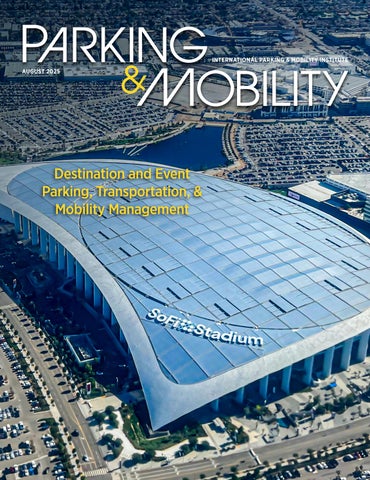
Destination and Event Parking, Transportation, & Mobility Management
INTERNATIONAL PARKING & MOBILITY INSTITUTE AUGUST 2025 VOL. 7 / N0. 8
FEATURES
28
Enhancing the Game Day Experience
How Parking Guidance Technology is Transforming Parking at SoFi Stadium and Hollywood Park by Chris Scheppmann
34
Parking as the First Touchpoint
Why Good Parking Solutions Can Make All the Difference to Your Guest Experience By Charley DeBow
42
Game Day Starts in the Garage
A World-Class Venue Requires a State-of-the-Art Parking Operation By Wilfred Soto and Jose Leon, PTMP
48
Ungated Environments
Best Practices for Parking Payment Providers By Todd Tucker and Michael Drow, PTMP
52
4 PARKING & MOBILITY / AUGUST 2025 / PARKING-MOBILITY-MAGAZINE.ORG
FROM THE EDITOR
COLUMNS 5 FROM THE EDITOR First Impressions 6 BOARD PERSPECTIVE Event Parking By Josh Cantor, PTMP
10 THE BUSINESS OF PARKING Legal First in Texas By Cecil “Butch” Stroud
14 INNOVATION & TECHNOLOGY Event Technology By Erik Nelson, PCIP
16 THE GREEN IMPACT The Parking Experience Revolution By Lauren Nelson, PTMP
20 HR PERSPECTIVE Setting the Stage By Brittany Burcham
24 STATE & REGIONAL SPOTLIGHT PIPTA Celebrates 20 Years of Leadership in Parking and Mobility By Nathan Donnell, PTMP
26 ASK THE EXPERTS How are venue parking strategies adapting to changing fan behaviors?
First Impressions THEY SAY YOU NEVER GET A SECOND CHANCE to make a first impression. I hope that is not true, as I have royally screwed up some of my first-time encounters. Haven’t we all? Don’t we all wish we had a rewind button and could go back and change the first impression that someone got from us? Unfortunately, there is often no second chance with event parking. A parking experience isn’t just a logistical detail; it’s a crucial part of the guest experience that can significantly influence whether people come back or recommend the event to others. No matter how amazing the concert, sporting event, graduation, or other event is, if the parking experience upon arrival is frustrating, it casts a shadow over the whole experience. This issue of Parking & Mobility magazine is designed to help you avoid needing a rewind button. Find out how parking guidance technology is changing the game (see what I did there?) for stadium parking and read up on some basic best-practice parking solutions that can make all the difference in the guest experience. We also visit with the Miami Parking Authority team, who are channeling their inner Bogart to tell us why a hot dog at the ballpark is still better than a steak at the Ritz. And to top it off, we get a sneak peek at a new webinar offered by IPMI and the accompanying white paper, which discusses best practices for ungated facility payments - critical knowledge in today’s operations. And don’t miss the August versions of our standing columns, which always provide great insights from today’s leading parking, transportation, and mobility professionals. Whether you are reading this in our printed magazine (August is our third print edition of the year) or on our digital platform, we appreciate you spending some time with us. Enjoy the end of the summer, and we will see you in September!
54 IPMI CALENDAR Melissa Rysak, editor
55 STATE & REGIONAL CALENDAR
rysak@parking-mobility.org
PARKING-MOBILITY-MAGAZINE.ORG / AUGUST 2025 / PARKING & MOBILITY 5
BOARD PERSPECTIVE
Event Parking The First and Last Impression PUBLISHER
Shawn Conrad, CAE
By Josh Cantor, PTMP
s.conrad@parking-mobility.org EDITOR
Melissa Rysak
rysak@parking-mobility.org TECHNICAL EDITOR
Rachel Yoka, PTMP, LEED AP BD+C yoka@parking-mobility.org
ADVERTISING SALES AND SUBSCRIPTIONS
Tina Altman
taltman@parking-mobility.org PUBLICATION DESIGN
BonoTom Studio
info@bonotom.com For subscription changes, contact Tina Altman, taltman@parking-mobility.org or 888.IPMI.NOW. Parking & Mobility (ISSN 0896-2324 & USPS 001436) is published monthly by the International Parking & Mobility Institute. P.O. Box 3787 Fredericksburg, VA 22402 Phone: 888.IPMI.NOW Fax: 703.566.2267 Email: info@parking-mobility.org Website: parking-mobility.org Send address changes promptly to: Parking & Mobility or submit online at parking-mobility.org. P.O. Box 3787 Fredericksburg, VA 22402 Interactive electronic version of Parking & Mobility for members and subscribers only at parking-mobility. org/magazine. Copyright © International Parking & Mobility Institute, 2025. Statements of fact and opinion expressed in articles contained if Parking & Mobility are the sole responsibility of the authors and do not necessarily represent an official expression of policy or opinion on the part of officers or the members of IPMI. Manuscripts, correspondence, articles, product releases, and all contributed materials are welcomed by Parking & Mobility; however, publication is subject to editing, if deemed necessary to conform to standards of publication. The subscription rate is included in IPMI annual dues. Subscription rate for non-members of IPMI is $120 per year (U.S. currency) in the U.S., Canada, and Mexico. All other countries, $150. Back issues, $10.
W
E OFTEN HEAR in the parking, transportation, and mobility
industry that we are responsible for the first impression and last impression of anyone’s travel, Whether it be to an event, work, an airport, a hospital, a shopping center, or anywhere else - consider how often people make decisions on where to go based on how easy or hard it is to get there, or how easy it is to park. First and last impressions are crucial in hospitality and entertainment, and parking is the bookend to every visit. Whether it’s a concert, festival, sports event, or a theme park outing, how a guest feels as they arrive and depart has a lasting impact on their overall perception, even if most can’t park as closely or as similarly as they do during their daily commutes to work and shopping. I pondered this first/last impression topic just a few weeks ago when my wife and I joined my family in Orlando, spending a day at Universal Studios. Orlando is the most visited destination in the United States, drawing over 75 million visitors annually. Knowing that many people visit Orlando and are likely unfamiliar with the roadways, wayfinding signage is crucial for finding one’s destination. With so many parks, it’s easy to wind up in the wrong location. Instead, there exist large, very easy-to-read signs directing guests from highways and roads to specific parking options and then showing them how to walk to the park entrances. Universal Studios alone has 40,000 parking spaces, yet parking was really easy. As part of the theme park’s app, there is even a parking component that allows guests to upload a photo and record the location where they parked. Later, as I walked back to my car in the Cat in the Hat garage, I looked over at the bus parking area and was amazed by how organized it was! While I exited the park, I reflected on the
6 PARKING & MOBILITY / AUGUST 2025 / PARKING-MOBILITY-MAGAZINE.ORG
organization of both individual and bus transportation on such a mass scale. While this seamless parking experience was perhaps expected, given how much we spent, it was memorable for being easy and contributed to having more time to spend in the park on rides. We had a wonderful day at the park and left without that all too familiar frustration of attending an event and struggling with the exit. As I began to think about the role of parking and transportation in events, I reflected on some of my recent experiences. I often like to take public transportation via the Metro when going to hockey, basketball, and baseball games in Washington, D.C. However, I had to drive to a Washington Nationals game this spring when we took our dog (named Parker!) to Pups in the Park and thus couldn’t take the Metro. Being able to purchase my parking online, saving the ticket to my Apple Wallet, and despite being stuck in DC traffic, I was pleased about how easy my parking was. The stadium’s parking app also provided a map that made it an easy walk to the stadium, even before we saw wayfinding signs. You’ve probably heard the expression, “You never get a second chance to make a first impression.” For most guests, driving on the roads approaching a destination and the parking lot are the first physical interactions they have with a venue. Consider these common first impression issues: Long wait times to enter the lot or find a space. ● Poor signage or unclear directions, including pedestrian wayfinding from the parking areas to the venue. ● Poorly organized or uninformed staff, unavailable to answer questions. ● Lack of accessible parking or mobility support. ●
Compare that with a positive experience: guests are greeted by friendly staff, provided with clear directions, and enjoy an efficient traffic flow and a smooth parking process, which sets the event off on a smooth start. However, the guest experience doesn’t end when the event does—it ends when they leave the parking lot. If that exit is slow and disorganized, the high, positive emotions built up during the event can quickly fade.
Some last-impression frustrations include: Poor lighting or unclear exit routes after dark. ● Traffic bottlenecks or blocked exits. ● Inadequate staff presence to assist with flow or safety. ● No clear plan or signage for rideshare, pickup, or shuttles. ●
No matter how great the event is, the issues above negatively impact the guests’ lasting memories of the event. Key items to consider for a positive guest experience: ●
Are staff trained to provide friendly customer service (think Universal)? Are they empowered to make real time operational decisions if traffic backs up? What are your overflow parking options?
PARKING-MOBILITY-MAGAZINE.ORG / AUGUST 2025 / PARKING & MOBILITY 7
BOARD PERSPECTIVE
Consider technology such as mobile payment, license plate recognition, and real-time space tracking. Does your website provide parking and transit information-options, fees, how to pay, driving or public transit directions? Is it user-friendly? ● Wayfinding with branded signage, clear instructions, and live updates, for both ingress and egress. As I usually find myself on the other end of event parking in my job, whether it’s for arena events, graduations, or even presidential visits, I try to take something from every parking transaction I have as a customer and think about what I can take back that would make one of my customers’ visits better. My family has accepted that I often stop to take pictures of parking signs and equipment when I am a customer, to bring back to work (and my wife even ●
8 PARKING & MOBILITY / AUGUST 2025 / PARKING-MOBILITY-MAGAZINE.ORG
points things out to me now!). Being in our industry, I, like many of you, am probably even more judgmental and critical of our parking and transit expectations, even if we are also likely to be more understanding when things don’t go well. From my personal parking experience, as well as hearing from many of you in our magazines, on webinars, and at conferences, I am proud to be part of our industry, which I know takes seriously the responsibility of providing that first and last impression to people attending our events and other venues. ◆ JOSH CANTOR, PTMP, is the Director of Parking & Transportation for George Mason University and a member of the IPMI Board of Directors. He can be reached at jcantor1@gmu. edu.
The Parking Barrier
MHTMTM MicroDrive Vehicle Barriers
MHTMTM MicroDrive barriers from Magnetic AutoControl are the ideal solution for professional parking applications. MicroDrive barriers are designed for long-life use in heavily frequented facilities and feature:
• Rapid opening times • Detection of tailgating vehicles • 2 Million Cycle Warranty* • Low energy consumption • Low-maintenance
• Articulated arm options • Laserscanner options • Breakaway ange options • LED barrier arm options *2 Years or 2 Million cycles, whichever occurs rst.
MAGNETIC AUTOCONTROL • 3160 MURRELL RD ROCKLEDGE, FL • WWW.MAGNETIC-ACCESS.COM
THE BUSINESS OF PARKING Legal
Legal First in Texas Ticket-by-Mail Takes Off in Galveston with Promising Results By Cecil “Butch” Stroud
W
HEN THE CITY OF GALVESTON became the first municipality in Texas to implement
Ticket-by-Mail for on-street parking, it marked a quiet legal revolution. With this move, Galveston paved the way for cities across the state to follow.
This remote parking enforcement system relies on License Plate Recognition (LPR) technology to identify violations and mail citations to vehicle owners. Sending parking tickets by direct mail has long been viewed as a regulatory tangle. Still, Galveston navigated the legal complexity head-on, establishing a compliance framework that now serves as a working precedent for remote enforcement in the state of Texas.
What Galveston Solved Parking enforcement technology has outpaced the legal language that governs it. Most municipal parking and street codes were written long before we had access to LPR technology or Ticket-by-Mail programs. As a result, they often fail to explicitly authorize these tools and procedures, creating ambiguity that can stall implementation or introduce legal risk.
10 PARKING & MOBILITY / AUGUST 2025 / PARKING-MOBILITY-MAGAZINE.ORG
This isn’t because new parking enforcement technology or sending parking tickets to the vehicle owner’s home address is incompatible with the law, but because the law hasn’t kept pace. Clear, up-todate language is needed to formally recognize remote enforcement as a valid method. Galveston met this challenge head-on. As the first city in Texas to implement Ticket-by-Mail for on-street parking, it took steps not only to adopt the technology but also to align every part of the program with legal and regulatory expectations. This included a close review of local ordinances to ensure that remote enforcement was supported, as well as the development of a robust datasharing framework with the DMV. Just as importantly, Galveston prioritized privacy. LPR cameras capture license plate data, and the system retrieves registered owner information from the
STOCK.ADOBE.COM / RAWF8
THE BUSINESS OF PARKING | LEGAL
DMV based on the plate number. All vehicle owner information is shared securely and only within the scope allowed by law. Clear protocols safeguard sensitive data, and every component of the system, from citation generation to notice delivery, operates with transparency and privacy in mind.
Enforcement That Works for Everyone Since launching Ticket-by-Mail, Galveston has seen tangible improvements in both operational efficiency and community impact, particularly on the hightraffic Seawall, which attracts over seven million visitors annually. By automating enforcement in dense zones, the city has streamlined day-to-day operations without increasing staffing demands or creating unnecessary friction. Officers no longer need to issue citations face-to-face, thereby reducing the potential for confrontation and enhancing safety through a zerocontact approach. The system has also introduced greater consistency, as it prevents a common workaround: drivers who move their vehicles when they spot an officer nearby. It enables broader and more uniform coverage, ensuring that compliance efforts are consistently applied for all parking violations. Moreover, citations are accompanied by a timestamped evidence package that includes photos of the violation. This transparency has made enforcement more fair and less prone to bias, while also reducing the likelihood of disputes or complaints. Compliance rates are slowly rising, and the administrative workload has decreased. Revenue recovery has improved, too. Throughout it all, the program’s integrity has remained legally sound, operationally efficient, and backed by a process that the public can trust.
Lessons from the Ground Galveston’s Ticket-by-Mail program succeeded because the city approached it as both a legal and operational transformation, built deliberately from the start. Where legal teams are often brought in late to review decisions that have already been made, Galveston reversed that model. City attorneys
12 PARKING & MOBILITY / AUGUST 2025 / PARKING-MOBILITY-MAGAZINE.ORG
got involved from the outset, guiding updates to ordinances, data-sharing agreements, and the structure of enforcement processes. Their early input helped identify and resolve issues before they could cause delays. Public messaging received the same level of scrutiny. Communications emphasize fairness, transparency, and privacy. Legal counsel reviewed FAQs, citation language, and appeals materials to ensure consistency and clarity, thereby helping to build public trust and facilitating a smoother rollout. The city also recognized that remote enforcement affects every corner of operations, from IT to courts. A cross-functional team helped translate technical needs into enforceable policy. Even small operational decisions, like response timelines, were reviewed through a legal lens. Galveston adjusted deadlines to account for mailing delays and worked with vendors to ensure that digital platforms met privacy and accessibility standards.
A Roadmap Other Cities Can Follow The strength of Galveston’s approach lies not only in what it accomplished but in what it now enables. With the legal groundwork in place, Texas cities no longer face a blank slate. The framework is active, tested, and designed with repeatability in mind. Cities exploring remote parking enforcement opportunities, such as Ticket-by-Mail, can now bypass the most time-consuming and uncertain phases and move directly into planning and implementation. The heavy lifting has already been done. Galveston’s policies, processes, and partnerships offer a working model that municipalities can adapt to their own needs, saving time, reducing cost, and accelerating progress. What began as a local initiative has become a legal milestone that clears the way for broader adoption across the state. For cities ready to act, the message is clear: the road forward is already built. ◆ BUTCH STROUD is the retired City Marshall for the City of Galveston, TX. He can be reached at mtr1785@aol.com.
INNOVATION & TECHNOLOGY
Event Technology It’s All About Integration By Erik Nelson, PCIP
T
HE GLITZ AND GLAMOR, THE EXCITEMENT, THE FANDOM… and the parking. Events can draw tens of
thousands of patrons, driving many thousands of cars to converge on what is typically a small or defined area, featuring a mix of structured parking, surface parking, and sometimes on-street parking.
People tend to arrive over a period of time leading up to the event, typically from three hours before the event’s start time up to the event’s scheduled beginning. Steady but consistent traffic can often be managed to minimize congestion and delays regardless of the condition of local streets. If there is a bottleneck, it is likely the entry procedures and parking movements. Because the period over which people arrive for events is longer than the period when they leave, event parking transactions almost exclusively occur at the time of entry. In the past, event parking skewed heavily toward cash-on-entry, with uncontrolled exits. Audits of these types of systems could be challenging, especially in larger parking lots, structures, or systems with many entry and exit points. Technology has enabled event parking attendants to accept credit cards and physical or digital pre-paid parking passes, which can help secure cash payments and provide an audit trail. Nevertheless, event parking is still largely transacted before the event begins, with uncontrolled or limited controls on exiting traffic after the event concludes. Event parking can be a challenge at exit time, as attendees tend to leave en masse when the event concludes. While early departures and stragglers exist, the bulk of exits from a typical event will occur around the same time. Event parking challenges are often related to the local environment, including street or roadway capacity, limited access to off-street parking, and competition with other parking uses. For instance, a stoplight near the event venue parking exit may constrain exiting traffic, causing a backup. As another example, a parking garage may contain dedicated residential parking spaces, as well as event parking spaces. Even if the spaces are segregated with a Parking Access and Revenue Control System (PARCS), there may be a common entry or exit point that can be congested at times and cause consternation
among the different parking constituencies. These challenges often require a labor force to overcome, from manually controlling traffic lights and intersections, to controlling or directing exiting traffic. Many in the parking industry would like event parking to be close to, if not 100%, pre-booked and pre-paid, eliminating the need for employees or equipment to complete financial transactions, and allowing them to focus solely on congestion management. Although this is ideal from a parking perspective, there are other issues at play. Despite the existence of many widely implemented and well-known parking reservations or pre-booking platforms, full integration with ticketing suppliers is seen by many as an ideal pathway. In this model, event patrons buy their parking while they buy their event ticket. A single credential can be used for access to parking and the event, minimizing transactions to only one, and providing the user and the event parking operator with simplicity. Some parking solution providers have successfully integrated with some of the myriad ticketing platform Application Programming Interfaces (APIs), but there are still some
14 PARKING & MOBILITY / AUGUST 2025 / PARKING-MOBILITY-MAGAZINE.ORG
STOCK.ADOBE.COM / CLLARETA
business-related challenges with integrating ticketing platforms and parking solutions. For instance, Ticketmaster, a leading supplier of event ticketing platforms, offers four distinct APIs that a parking technology can choose to integrate for various purposes. Some APIs require the integrator to have a business relationship with the ticketing authority and may include terms such as transaction fees, revenue sharing, or other factors that must be negotiated between the ticketing authority, the venue, the technology supplier, and the parking owner and operator (if different than the venue). This multi-party negotiation can be cumbersome, timeconsuming, and may not ultimately yield fruitful results. One potential solution to this quandary is integration with a thirdparty technology supplier that may have the correct API integration with the ticketing platform used at a given venue. These systems, although they may have a wider range of features and functionality, can act as a middleware between a given event parking management system and a specific ticketing platform, offering a seamless experience to both
patrons and parking operations staff. Making these systems all work together will take expert-level knowledge of the ticketing platform, the middleware, the API that they use, a commitment to perpetually maintain and continually test integrations as a part of regular software updates, and the business terms that exist around that integration to ensure that the solution will provide the expected benefit. Like so many aspects of our business, what was once an attendant and a cigar box has turned into a complex web of computer code and business agreements that serve to make parking more marketable, more controlled, more accessible, and yet just as simple for the end user and more secure and auditable for the provider. ◆ ERIK NELSON, PCIP, is a Principal with Walker Consultants and a member of the IPMI Technology Committee. He can be reached at enelson@ walkerconsultants.com.
TECHNOLOGY COMMITTEE MEMBER
For doors that work as hard as you do, count on us to be there. Hörmann. For Life.
SCAN TO LEARN MORE
HORMANN.US 1-877-OK-HORMANN
PARKING-MOBILITY-MAGAZINE.ORG / AUGUST 2025 / PARKING & MOBILITY 15
THE GREEN IMPACT
The Parking Experience Revolution Where Convenience Meets Sustainability By Lauren Nelson, PTMP
D
ESTINATION AND EVENT PARKING PRESENTS a unique set of challenges, whether at
an entertainment or sports venue, a higher education campus, a healthcare campus, or a combination of these facility types. However, there are some commonalities amongst the various event and destination parking environments, and at the forefront of many operations is the improvement of the guest experience. Whether intended or not, improving the guest experience can also have a positive environmental impact, as many of the recommended solutions provide experiences that reduce emissions and air pollution, and help restore damaged habitats. What are event venues doing to improve the guest experience? Entertainment and athletic venues, including collegiate sports venues, are taking significant steps to improve the fan experience in various ways, starting with the initial ticket purchase. In many instances, ticket sellers are offering the option to purchase parking at the same time a patron purchases their tickets. If the fan opts out of purchasing parking at the same time, most organizations provide additional options and reminders to prepay for parking in forms such as: “Know Before You Go” emails Push notifications ● Text notifications ● Social media posts ● ●
Prepaid parking passes reduce the amount of time it takes to fill a lot by decreasing transaction times. Rather than accepting cash or processing a credit card, the pass is simply scanned, and the vehicle can enter. Vendors are also enhancing broadband networks to improve credit card transaction speeds if payment is accepted onsite. Pre-event communication and event venue websites are increasingly offering directions to parking locations through integrations with the most widely used GPS navigation systems, such as Google Maps and Waze. Fans can simply click on their destination link and be taken to the GPS navigation. Businesses can also collaborate with the GPS providers to create
16 PARKING & MOBILITY / AUGUST 2025 / PARKING-MOBILITY-MAGAZINE.ORG
the desired route to each parking location and communicate any road closures associated with the event traffic. These initiatives aim to enhance the experience before the fan even leaves their house by preparing them for their journey to the destination, which helps alleviate traffic congestion, circling, and idling. By providing a more seamless way to reach one’s destination, businesses help reduce emissions and operate more sustainably. Venues aren’t solely relying on pre-event communications to help guests arrive at the destination through the path of least resistance. En route and on-site wayfinding advancements are helping traffic control as fans approach their destination. There are numerous wayfinding options,
STOCK.ADOBE.COM / SAMMBY
Maximize your parking potential with Discover® Network. Realize your parking lot’s full potential. With millions of cardholders worldwide1, Discover® Network has a vast customer base ready to make payments—including for parking.
FASTEST GROWING GLOBAL PAYMENTS NETWORK by number of network alliances2
Scan here to order free signage and supplies.
1 Total Cardholders includes Discover Network, DCI, N2N partners; RBR Data Services 2 Based on signed network alliance agreements over the past five years with major payment networks within respective countries Panoramic Research study, conducted 2024 ©2025 DFS Services LLC
THE GREEN IMPACT
such as full variable matrix signs, static signage, and lane indicator signage, to help guide patrons to their designated lot as they approach the venue. Additionally, utilizing a city’s existing highway DMS signage can assist event goers before they reach their destination. Smart traffic management for events is a critical component in providing safe and sustainable event operations. Real-time traffic monitoring and signal management, combined with event-specific traffic management plans, should be implemented to mitigate congestion and enhance safety. Transportation Network Companies (TNCs), such as Uber and Lyft, may also reduce single-occupancy vehicle use. As the adoption of this form of transportation increases, large venues are faced with the problem of long wait times for pickups, and the surge in usage can cause pedestrian and vehicular conflicts. Geofencing designated rideshare pickup and drop-off areas has certainly helped, and many venues are creating more welcoming and safer rideshare areas that include covered waiting areas with lighting and digital displays. While there is still more work to be done in this area, and the verdict on the impact of TNC companies on event operations remains to be seen, improvements are being made.
parking information during appointment confirmations. This is similar to the “know before you go” emails, which can include options such as prepaying for parking, GPS navigation, pricing, and more. This is beneficial for all types of healthcare campuses, from smaller suburban satellite campuses to large, urban medical centers. Smart garages that incorporate parking guidance and wayfinding are becoming increasingly common in healthcare facilities, retail environments, and airports, particularly with new construction. Easily locating ADA spaces and open visitor spaces is crucial to the patient/ visitor experience and, in turn, provides more sustainable solutions that help reduce emissions. The inclusion of EV charging stations is also becoming more available in these destination parking markets. Whether attending a concert or an eye exam, catching a flight or a movie, organizations are continually working to enhance the visitor’s experience. Providing sustainable solutions that not only enhance the experience but also improve the environment are some of the best ways to invest in parking event management now and in the future. As technology and infrastructure continue to evolve, it will be exciting to see the new and innovative impacts on event and destination parking. ◆
How are non-event destination parking locations offering improvements? Destination parking is not solely for events. Healthcare campuses are also improving the way patients experience parking. Healthcare providers are beginning to include
18 PARKING & MOBILITY / AUGUST 2025 / PARKING-MOBILITY-MAGAZINE.ORG
LAUREN NELSON, PTMP, is a parking consultant with Waler P Moore and a member of the IPMI Planning, Design, & Construction Committee. She can be reached at lnelson@walterpmoore.com.
PLANNING, DESIGN, & CONSTRUCTION COMMITTEE MEMBER
STOCK.ADOBE.COM / SAMBATH
Less Schlemiel, More Parking.
June 14 -17, 2026 Milwaukee, Wisconsin Baird Center
Scan for more info
HR PERSPECTIVE
Setting the Stage Why Onboarding Shapes Success By Brittany Burcham
I
S YOUR ONBOARDING PROGRAM PREPARING EMPLOYEES to thrive, or just survive? Today,
it’s common to feel overwhelmed with the number of things to learn as you start a new role, especially if you are in a brand-new industry. Making employees feel excited and prepared to learn in their first few weeks at the company will set the tone for the rest of their career!
The Real Purpose of Onboarding So, what is onboarding really about? As a trainer, I believe onboarding is so much more than administrative tasks (that no one enjoys), such as setting up laptops, gaining access to systems and tools, and adding them to our 1,000 Slack channels. It’s about connection! Personal connection, connection with other employees and peers, connection to the company’s mission and core values, connection to what the company can offer its customers, and connection to all the strategies and concepts. That’s why our new hire program for the North America Go-to-Market team is called CONNECT.
“Thoughtful content, structure, and space to acclimate make onboarding impactful. Anyone starting a new job comes in with uncertainty about what to expect. Onboarding sets the tone. It indicates investment in the people who make the company successful and lets new employees know they will be supported.” —Susie Roman, Account Manager
Why It Matters As a business, investing your efforts into onboarding will lead to improved retention rates, faster time to productivity, and increased engagement and morale.
“I immediately felt that the organization was invested in my success and that I had access to a wealth of valuable resources for my new role.” —Ben Taylor, Regional Sales Associate When new hires feel confident, it shows in stronger client conversations and more meaningful relationships.
Common Pitfalls There are many reasons why so many companies get onboarding wrong. The most common mistake I hear as a trainer is, “There was no structure, and I didn’t know what I was supposed to focus on learning first. I was thrown into the fire to figure it out as I go!” While I agree that hands-on learning is the most effective way to learn, having a clear plan for new hires to follow is key to their learning. Then comes the handson learning! It’s best to provide a foundation of the “big
20 PARKING & MOBILITY / AUGUST 2025 / PARKING-MOBILITY-MAGAZINE.ORG
STOCK.ADOBE.COM / AMI-LOU W/PEOPLEIMAGES.COM
picture” and “why” behind what we do for everything we learn to help it stick (or connect!) This should not just be a one-day or one-week process. Good onboarding takes time, and for every job out there, there is a lot to take in. I would even encourage you not to dive too deeply into their first day. It’s overwhelming enough going through all the required onboarding items, such as gathering documents, selecting and enrolling in benefits, and completing security training courses.
plan to help someone understand their priorities in their first few weeks. Start by looking at what you want an ideal person in this role to look like: what would make a successful person in this role? Then work your way backwards. What concepts and topics do they need to learn for this role? From there, I create a shared document with the new hire’s manager to customize the new hire’s learning path, including checklists, training tasks, 90-day goals, and a list of people to connect with.
What Great Onboarding Looks Like
“From day one, I felt like there was a clear structure and purpose behind each step, which made it easier to settle into my responsibilities without feeling overwhelmed.”
How do you really master onboarding? With this one simple step: make it personal. Yes, it is important to learn strategy and processes, but what is more important is to invest in the people. Take the time to get to know your new hire and make them feel welcome. Create a clear and well-thought-out
—Adam Fortier, Regional Sales Manager
Move your LPR from one vehicle to another!
Simple & Cost-Effective Learn more at
PLATENFORCE MOBILE PARKING ENFORCEMENT
PARKING-MOBILITY-MAGAZINE.ORG / AUGUST 2025 / PARKING & MOBILITY 21
HR PERSPECTIVE
Making employees feel excited and prepared to learn in their first few weeks at the company will set the tone for the rest of their career. I also ensure that I spend dedicated time with each new hire throughout their first few weeks, getting to know them and providing guidance on any questions they may have as they begin their learning. The best thing you can do for someone is to provide support during a new and uncertain time.
Call to Action If you haven’t recently, I encourage you to take time to review your onboarding assets and revamp as needed. Even if you don’t have open roles, start looking at onboarding for internal promotions. For example, if a sales manager is promoted to sales director, what does that look like? What processes or tasks does this individual need training on when they first start their
new role? Is there a leadership seminar you would like them to attend? A book to read? Podcast to listen to? The options are endless. Remember, start by defining what success looks like for this role and work your way backwards, all the way to day one. Then, when the new hire starts, you have a clear plan in place, allowing you to spend time getting to know them before diving in. You only get one chance to make a first impression—make it count! ◆ BRITTANY BURCHAM is a Sales Enablement Manager with ParkMobile, part of Arrive. She can be reached at brittany. burcham@arrive.com.
Protect Vehicles, Prevent Fraud, Park Smarter Our Parking Guidance System with Park Surveillance isn’t just a camera it’s a safety net. From hit-and-runs to break-ins, our system captures real-time HD footage when incidents happen, helping operators manage liability while giving drivers peace of mind. Welcome to parking done right. Contact Us to Learn More
tkhsecurity.com/US TKH Security IPMI HALF August print.indd 1
22 PARKING & MOBILITY / AUGUST 2025 / PARKING-MOBILITY-MAGAZINE.ORG
5/22/2025 9:17:23 PM
2026
June 14 -17
Milwaukee, Wisconsin Baird Center
2027
June 6 -9
Orlando, Florida
Gaylord Palms Resort & Convention Center
2028
June 25-28
2029
Cleveland, Ohio Huntington Convention Center of Cleveland
June 10-13 Long Beach, California
Long Beach Convention & Entertainment Center
Scan for more info
STATE & REGIONAL SPOTLIGHT Pacific Intermountain Parking and Transportation Association
PIPTA Celebrates 20 Years of Leadership in Parking and Mobility By Nathan Donnell, PTMP
I
N 2025, the Pacific Intermountain Parking and Transportation Association (PIPTA) proudly
commemorates its 20th anniversary—a significant milestone that reflects two decades of progress, innovation, and community-building in the parking and mobility sector. Since its founding, PIPTA has grown into a cornerstone of professional development and collaboration for transportation leaders across nine western states. This year’s annual conference, scheduled for October 22–24 in Eugene, Oregon, is set to be a defining moment in the organization’s history. The event will bring together professionals from municipalities, universities, and private industry to explore the future of urban mobility, with a special focus on emerging technologies and sustainable practices. Eugene, known for its forward-thinking transportation initiatives, offers a fitting backdrop for this celebration of progress and vision.
Reflecting on the occasion, I am honored to be the board chair for PIPTA’s 20-year Emerald anniversary. All the board members are working diligently to make this year’s conference something truly special for all vendors, guests, and attendees. Over the past two decades, the association has evolved in tandem with the industry it serves. What began as a regional network of parking professionals has transformed into a dynamic platform for addressing the complex
24 PARKING & MOBILITY / AUGUST 2025 / PARKING-MOBILITY-MAGAZINE.ORG
challenges of modern transportation. From its early focus on parking management to its current emphasis on smart mobility, data integration, and equitable access, PIPTA has consistently led the conversation. The 20th anniversary conference will not only honor the organization’s legacy but also look ahead to the future. This year’s theme centers on the integration of artificial intelligence in transportation systems—a timely and critical topic as cities seek smarter, more efficient ways to manage congestion, reduce emissions, and improve accessibility. Attendees can expect a rich program of keynote addresses, interactive workshops, and technology showcases that highlight the cutting edge of the industry. Beyond its annual events, PIPTA continues to support its members year-round through webinars, training sessions, and networking opportunities. These initiatives have helped elevate professional standards and foster a culture of continuous learning and innovation. The association’s commitment to education and community has made it a trusted resource for both seasoned professionals and newcomers to the field. PIPTA’s strength lies in its active committees, which drive much of the organization’s programming and outreach. The Membership Engagement Committee focuses on
building a vibrant and inclusive community, scheduling multiple events throughout the year that give back to the local community. Meanwhile, the Education Committee curates valuable learning opportunities for members at all stages of their careers. The Trade and Vendor Relations Committee fosters strong partnerships with industry suppliers, and the Communications Committee ensures timely, transparent, and engaging dialogue across platforms. These committees are the heartbeat of PIPTA’s operations, and we are always seeking passionate volunteers to contribute their time and talents in shaping the association’s future. As the transportation landscape becomes increasingly complex, PIPTA’s role as a unifying force has never been more essential. The association not only provides a platform for knowledge exchange but also cultivates a sense of shared purpose among its members. Whether navigating the shift to electric vehicles, reimagining curb management, or addressing equity in access to mobility, PIPTA empowers its community to lead with confidence and creativity. As PIPTA enters its third decade, it remains steadfast in its mission to empower those who shape the future of transportation. The 20th anniversary is not just a celebration of the past—it’s a springboard for what’s to come. With new challenges on the horizon, from climate change to rapid urbanization, PIPTA’s role as a convener and thought leader is more vital than ever. This October in Eugene, the organization will honor its roots while embracing the road ahead. For members and partners alike, the 20th anniversary is a moment to reflect, reconnect, and recommit to building smarter, more connected communities through transportation. ◆ NATHAN DONNELL, PTMP is the Senior Director for EV Partnerships at LAZ Parking and Board Chair for PIPTA. He can be reached at ndonnell@lazparking.com.
PARKING-MOBILITY-MAGAZINE.ORG / AUGUST 2025 / PARKING & MOBILITY 25
ASK THE EXPERTS
ASK THE EXPERTS
How are venue parking strategies adapting to changing fan behaviors?
How are venue parking strategies adapting to changing fan behaviors, like earlier arrivals, tailgating trends, or increased use of ridesharing? Victoria Wallace
Jim Anderson
CDO Rezcomm
Independent A/E/C Market Development Executive
Smart venues treat parking as the first profit opportunity, not just a logistics problem. They’re adopting tech that identifies how each visitor arrives and monetizes every path, from pre-booked parking and early entry offers to upselling tailgaters and engaging rideshare users with venue perks. The right platform turns every arrival into a revenue moment.
There are various strategies being considered and utilized to recognize event/destination parking demand, from early pricing dynamics to pre-pay options, to designated parking locations and enhanced security and fan amenities.
Robert Ferrin, PTMP Mobility & Parking Senior Project Manager Kimley-Horn Customized attendee communication is becoming increasingly utilized by venue managers and ticketing companies. “Know Before You Go” direct attendee communications via email, app notifications, and text are rich with parking and mobility information to enhance the overall customer experience.
26 PARKING & MOBILITY / AUGUST 2025 / PARKING-MOBILITY-MAGAZINE.ORG
Casey Jones, PTMP Senior Director of Customer Success FLASH Parking Today’s eventgoers love it when parking is easy, reliable, and stress-free. They’re all about reserving their spot ahead of time—preferably while grabbing their event tickets—and they appreciate a smooth, digital experience from start to finish. From finding the perfect spot to breezing in and out, it’s all about keeping things simple and seamless.
Gabe Mendez, PTMP Director of Transportation Operations UW-Madison Transportation Services Ridesharing has emerged as a significant factor in special event planning, particularly in smaller markets where its impact is newly felt. We can draw valuable insights from larger market parking operators by proactively designating dedicated drop-off and pick-up zones near venues. These zones should be strategically integrated into event traffic plans to ensure smooth access and flow pre- and post-event.
Debbie Lollar, PTMP Associate Vice President of Transportation Services Texas A & M University, College Station One strategy Texas A&M University has applied to some events is free flow arrival where guests pay once they have parked by scanning a QR code rather than waiting before entering to pay a cashier. Paying by smart phone has become more prominent and widely accepted, giving us confidence in trying this option. A robust advance and onsite campaign, including freestanding and wall-mounted signs plus clings on primary sidewalks make the plan clear to guests.
Nancy Kobielski Business Services & Communications Manager, Parking & Transportation Services Division of Finance and Administration— University at Buffalo When multiple events take place on the same day and end around the same time, we’ve increased staffing and implemented a strategic exit plan. This includes directing traffic to exit in one direction and coordinating traffic light adjustments with University Police to improve flow and reduce congestion.
Scott Petri President Mobility & Parking Advisors, LLC The experience for concertgoers sports fans and events can be significantly enhanced when parking facilities adopt a reservation system that is robust. Even facilities, not immediately adjacent to the event facility can benefit since event growers are willing to walk a short distance.
HAVE A QUESTION? Send it to editor@parking-mobility. org and watch this space for answers from the experts. The opinions and thoughts expressed by the contributors do not necessarily reflect the opinions and viewpoints of the International Parking & Mobility Institute or official policies of IPMI.
AUGUST 2025 / PARKING & MOBILITY 27
ENHANCING the Game Day
EXPERIENCE How Parking Guidance Technology is Transforming Parking at SoFi Stadium andEnhancing Hollywood Park the Game Day
Experience
BY CHRIS SCHEPPMANN
How Parking Guidance Technology is Transforming Parking at SoFi Stadium and Hollywood Park by Chris Scheppmann
28 PARKING & MOBILITY / AUGUST 2025 / PARKING-MOBILITY-MAGAZINE.ORG
A
NYONE WHO HAS ATTENDED AN NFL GAME, CONCERT, OR MAJOR EVENT knows that
parking can be a make-or-break part of the experience. With the stakes even higher at globally watched events like the Super Bowl, efficient and intelligent parking systems are no longer a luxury; they are a necessity. At SoFi Stadium in Inglewood, California, which regularly hosts over 70,000 fans for Los Angeles Rams and Chargers games and has already served as the venue for Super Bowl LVI and the 2023 College Football National Championship, parking operations have evolved into a seamless extension of the overall visitor experience. Thanks to innovative parking guidance technologies, navigating complex parking environments, such as the adjacent Hollywood Park mixeduse development, has become faster, less stressful, and more efficient than ever before.
PARKING-MOBILITY-MAGAZINE.ORG / AUGUST 2025 / PARKING & MOBILITY 29
ENHANCING THE GAME DAY EXPERIENCE
Located in the heart of Inglewood, Hollywood Park is a 298-acre mixed-use urban development that is anchored by SoFi Stadium, home of two National Football teams, the Los Angeles Rams and the Los Angeles Chargers. The sprawling project also includes retail and dining spaces, office buildings, residential units, a public park, and a four-story parking garage. It represents the convergence of entertainment, lifestyle, and technology. The complex has also set the standard for contemporary sports infrastructure. The days when teams played in isolated stadiums and arenas are a thing of the past. The professional stadiums, arenas, and ballparks being built today are typically multi-use facilities that combine sports and other entertainment venues, restaurants, retail stores, and, yes, even residences. The fan experience isn’t limited to attending a game or concert; it’s an entire experience. With the increasing demand for this type of flexible, high-capacity infrastructure, particularly on game days or during concerts, there’s an increased need for intuitive and responsive parking systems. That’s where parking guidance technology comes in.
30 PARKING & MOBILITY / AUGUST 2025 / PARKING-MOBILITY-MAGAZINE.ORG
Smarter Parking Begins with Smarter Infrastructure Hollywood Park’s two parking garages are equipped with a state-of-the-art intelligent camera-based parking guidance system that enhances the parking experience for visitors, whether visiting on a routine daily basis or during high-traffic event days. At the core of this system is a network of smart cameras mounted on each of the garage’s four parking levels. These cameras continuously monitor the availability of general parking spaces in real time. Additionally, a specialized rooftop zone serving residential tenants is monitored by pole-mounted outdoor cameras that track vehicle entry and exit activity. This allows the system to accurately count occupancy in the residential “nest” without the need for invasive gate arms or ticketing infrastructure. The real-time data captured by these intelligent cameras is then transmitted to large monument signs mounted outside the parking garage, providing instant availability information for drivers as they approach. These dynamic signs allow drivers to make quick
decisions about where to enter and park, reducing circulation time, minimizing traffic backups, and eliminating unnecessary frustration. One of the most powerful features of the system is its virtual zoning and occupancy counting capabilities. Unlike older systems that rely on physical lane delineation or in-ground sensors, the Hollywood Park garage uses advanced software to define regions of interest, exclusion zones, and count lines within its camera feeds. This means the parking guidance system can dynamically count cars in defined areas—even on ramped sections of the garage—without requiring any physical infrastructure changes that would consume valuable parking real estate. By doing this, the garage maintains maximum capacity and flexibility, all while delivering precise, actionable data to its guidance network. Additionally, fans attending football games and other events at SoFi stadium can also park at the Intuit Dome, which is adjacent to the Hollywood Park complex. The Intuit Dome, home to the NBA’s Los Angeles Clippers, features two public parking garages. Both garages are equipped with the same intelligent camera-based parking guidance system as Hollywood Park. The parking guidance technology is particularly useful during Rams and Chargers games, when
thousands of fans converge on the area and parking turnover is at its highest. By directing traffic intelligently based on live availability data, the system ensures the garage operates at full efficiency and reduces wait times for fans eager to enter the stadium.
Real-Time Communication Through Digital Signage Perhaps the most visible element of the system’s effectiveness lies in its integration with dynamic LED message boards. Thanks to an open API, the parking system transmits real-time occupancy data to these boards, which are strategically located throughout the Hollywood Park campus. These LED boards do far more than display basic space counts. They can provide: Turn-by-turn guidance to available areas. Event-specific messaging. ● Wayfinding assistance for first-time visitors. ● Emergency alerts or access instructions in real time. This real-time messaging infrastructure is especially crucial during high-capacity events, such as NFL games, concerts, and public gatherings, where crowd flow and communication must be precisely coordinated down to the second. ● ●
PARKING-MOBILITY-MAGAZINE.ORG / AUGUST 2025 / PARKING & MOBILITY 31
ENHANCING THE GAME DAY EXPERIENCE
Measurable Impact on the Game Day Experience The parking guidance system at Hollywood Park and SoFi Stadium has had a dramatic, positive impact, particularly on game days. According to aggregated performance data gathered over multiple NFL seasons and large-scale events: The average parking search time for fans and other guests entering the garage has dropped by 32% since the guidance system was implemented. ● Circulation time within the garage has decreased by over 40% during peak periods such as Rams and Chargers games. ● Customer satisfaction scores related to parking have improved by 25%, according to post-event surveys conducted by venue operations teams. ● Vehicle throughput at garage entrances increased by 15%, helping traffic engineers maintain smoother flow during ingress and egress windows. This improvement in operational efficiency not only enhances the guest experience but also reduces environmental impact. Fewer vehicles idling and circling for spaces means reduced emissions—an important step toward the sustainability goals of both SoFi Stadium and Hollywood Park. These parking technologies were put to the test during Super Bowl LVI in 2022, which drew over 70,000 in-person attendees and tens of thousands more to the Hollywood Park area for surrounding festivities. Despite the extraordinary volume, the Hollywood Park garage operated with near-zero delays thanks to ●
its intelligent occupancy and guidance systems. Fans arriving for pre-game events reported a marked improvement over prior Super Bowls in terms of parking accessibility and signage clarity. The integrated system enabled operations personnel to adjust parking availability zones in realtime based on actual demand, redirecting traffic from congested areas to open spaces with just a few keystrokes.
Future-Proof Parking for a Next-Gen Venue The integration of parking guidance technology at Hollywood Park and SoFi Stadium serves as a model for event-centric urban development. It blends cutting-edge technology with a usercentered design to create a truly modern, responsive experience that meets the evolving expectations of fans, tenants, and residents. Hollywood Park’s integrated parking guidance and management technology represents the gold standard for managing event parking, serving as a model for other sports and entertainment complexes. With Hollywood Park paving the way, parking is no longer an aggravating footnote to a great game day, it’s an essential part of providing a great parking experience. ◆
32 PARKING & MOBILITY / AUGUST 2025 / PARKING-MOBILITY-MAGAZINE.ORG
CHRIS SCHEPPMANN is the Co-founder and Managing Member of EnSight. He can be reached at chris@ ensight-technologies.com.
Join the Conversation. Connect with potential customers.
Ask questions.
Find vendors, consultants, and solution providers.
Start discussions.
Network with peers.
IPMI has relaunched Forum, the most robust online community for parking, transportation, and mobility professionals. Log in today to engage and connect.
https://forum.parking-mobility.org/
Parking as the First Touchpoint Why Good Parking Solutions Can Make All the Difference to Your Guest Experience By Charley DeBow
Parking as the W
HETHER IT’S THE ROAR OF A STADIUM CROWD,
the intimacy of a theatre performance, or the community spirit of a college on game day, most fan journeys to live events begin and end the same way: in a parking lot. For attendees, the parking experience is the first and last interaction they have with the venue. Yet, despite its centrality, parking is often an overlooked component in event planning, with most efforts focused on the event itself, rather than on how people arrive and leave. In fact, a survey conducted in April 2025, which included over 3,000 UK drivers, found that 84% had experienced parking-related stress that negatively impacted their enjoyment of ticketed events.
34 PARKING & MOBILITY / AUGUST 2025 / PARKING-MOBILITY-MAGAZINE.ORG
Fi rs tT ou ch po in t Why good parking solutions can make all the difference to your guest experience By Charley DeBow
STOCK.ADOBE.COM / ISEND / OLEGGANKO
PARKING-MOBILITY-MAGAZINE.ORG / AUGUST 2025 / PARKING & MOBILITY 35
PARKING AS THE FIRST TOUCHPOINT
In today’s world of personalization and instant gratification, event guests are increasingly expecting more from the venue, and venues are responding accordingly. Parking is being reimagined as part of the event experience, rather than being separate from it, and this crucial touchpoint presents both risk and opportunity. Done poorly, it can spark frustration and delays. Done well, it can set the tone for a positive, seamless, even elevated experience that extends from the entrance gate to the encore. Effective parking operations aren’t just about moving vehicles. With today’s technological innovations, from digital booking and license plate recognition to tailored access tickets and real-time dashboards, there’s no reason to introduce unnecessary friction for fans and visitors. Parking can, and should, support event pre-planning, provide venues with rich audience insights, and enhance wider CRM strategies. These early interactions shape
36 PARKING & MOBILITY / AUGUST 2025 / PARKING-MOBILITY-MAGAZINE.ORG
The beauty of an approach that puts the customer first, while simultaneously utilizing technology to manage their experience, is that technology can be scaled, whether organizing a high school graduation or the biggest NFL game of the season.
perceptions long before fans reach the front gate and can linger long after the final whistle or last song of the night. In short, it’s a powerful operational and experiential asset that shapes perceptions, manages complexity, and generates data to inform and support everything from layout planning to loyalty campaigns. It is also worth noting here that stressful parking experiences can ruin even the smallest of events for drivers. The beauty of an approach that puts the customer first, while simultaneously utilizing technology to manage their experience, is that technology can be scaled, whether organizing a high school graduation or the biggest NFL game of the season.
The Guest Journey Begins Before Arrival Attendee interactions with an event no longer begin at the venue; they start days, weeks, or even months earlier, with event inspiration, a ticket purchase, a confirmation email, and (ideally) a parking add-on. As expectations shift, parking is no longer an afterthought but an essential part of the pre-event planning experience. The evolution of event parking closely mirrors broader changes in fan behavior. Attendees today are digitally fluent, mobile-first, and driven by convenience. The traditional drive-up-and- pay model has largely given way to pre-booked, digital solutions that offer speed, security, and peace of mind, particularly for younger and more tech-savvy audiences. To keep pace, venues must provide frictionless and flexible digital experiences that enable guests to book in advance, receive real-time updates, and easily store mobile passes. Compare how restaurant reservations are now made: according to SevenRooms, U.S. restaurants experienced a 21% year-over-year increase in reservations between Q1 2023 and Q1 2024, while data from NowBookIt, shows that nearly 50% of restaurant bookings in the U.S. are made via mobile devices. This underlines the critical role of mobile-optimized reservation systems. The shift toward quick, mobile-first booking is now the standard across many aspects of life, and parking is no exception. Drivers increasingly expect the same level of convenience and immediacy when it comes to reserving a space. Behavior also varies significantly by event type and audience. For example, fans attending concerts frequently book reserved parking at the same time they buy tickets, often months in advance. Others, such as exhibition attendees or those who spontaneously attend a mid-week game, may book a day or two before the event. Today, tools are available to help operators not only identify these booking patterns by consumers but also leverage them in their marketing and CRM strategies. Tailored communications—such as pre-arrival guidance, staggered arrival times, and incentives like early-bird discounts or concession credits—can streamline operations and enhance the guest experience.
In fact, parking operators can now deliver a comprehensive marketing package that supports the entire customer journey. This includes “know before you go” emails, timely reminder texts the day before the event, messages as guests arrive at the lot, and much more.
Global Perspectives on Parking Pressure and Mobility Across geographies, venues share common challenges: limited space, peak-time congestion, and rising guest expectations. However, operational responses vary across the globe, providing valuable insights for venues of all sizes. In urban U.S. venues, parking typically involves complex coordination among third-party operators, city authorities, shuttle systems, and security services. Cashless systems and digital passes are now becoming the norm, reducing queues and simplifying access. ● In the U.K., many venues are in city centres, which limits the amount of parking they can offer. Many venues, therefore, secure off-site lots through shared-use agreements. These lots are then added to the venue’s inventory and made available via pre-booking systems. This approach expands capacity without requiring on-site infrastructure and creates smoother experiences for guests, who arrive with confidence that their space is guaranteed, park, and head straight into the venue. ●
Guests increasingly expect the parking journey to reflect the same level of care, technology, and clarity as the event itself. And if that expectation isn’t met, they may not return.
STOCK.ADOBE.COM / WOODSNORTHPHOTO
PARKING-MOBILITY-MAGAZINE.ORG / AUGUST 2025 / PARKING & MOBILITY 37
PARKING AS THE FIRST TOUCHPOINT
●
In Europe and Asia, parking often sits within broader mobility ecosystems. Guests might drive part of the way and switch to public transit, micromobility hubs, or ride-sharing services. Multi-modal trip planning is increasingly integrated into event communications, allowing attendees to combine parking with e-scooter docks or light rail access, reducing lastmile pressure and supporting sustainability goals.
Despite these differences, the unifying theme is that parking is no longer a siloed operation. It’s part of a seamless, systemwide experience that spans platforms, devices, and modes of travel. No matter the country, every venue must treat parking as an intentional part of their event offering, not an afterthought. Guests increasingly expect the parking journey to reflect the same level of care, technology, and clarity as the event itself. And if that expectation isn’t met, they may not return. In fact, 72% of drivers surveyed reported that concerns about parking had previously deterred them from driving to ticketed events altogether. Integrating parking into pre-event communications, ticketing, and CRM systems demonstrates to guests that they are valued from the moment they leave home. Beyond improving the experience, this mindset brings tangible benefits. It eases traffic flow, reduces staff strain, improves safety, and unlocks valuable data streams that help operators optimize layouts, segment audiences, and increase revenue. Ultimately, parking becomes more than just a logistics tool; it becomes a contributor to the event’s overall success. With over half of UK drivers, from our research, admitting they’ve previously left events early to avoid parking issues, these improvements are not just operational—they’re essential to preserving the event experience itself.
Scaling Solutions Across Diverse Venues Although every venue is different, the principles behind a great parking experience remain consistent: clarity, convenience, and control. The challenge lies in delivering these principles at scale, whether for a 100,000-seat stadium or a university campus hosting a guest lecture. At major venues, parking management often involves multiple lots, VIP zones, staff allocation, shuttle routes, and real-time traffic coordination. Meanwhile, smaller venues may rely on a few surface lots or coordinated use of nearby third-party spaces. However, in both cases, the guest expectation remains the same: parking should be easy to find, simple to book, and stress-free to enter and exit. To meet these expectations, operators are supporting venues with modular parking technologies designed for flexibility, ensuring that every customer’s needs are covered. Today, technology can help on so many levels, from real-time inventory management to event-specific rule setting, offline pass
capabilities, and control over messaging and pricing. Different tools and solutions that venues can use today include dynamic event reservation systems, which allow guests to pre-book official stadium parking or nearby third-party lots in advance, ensuring guaranteed spaces and alleviating game-day stress. For season ticket holders and frequent attendees, digital seasonal parking passes give multi-event access, with tiered benefits for premium ticket holders. Solutions like these also create an excellent feedback loop, providing the venue with the right insights and data to further enhance the customer experience. These insights can all be fed directly into CRM and ticketing platforms, empowering venues without overwhelming staff or frustrating guests. The beauty of today’s technology is that it can scale both up and down. A major arena may require layered access types and multi-lot segmentation, whereas a youth sports tournament might simply need a basic pre-book system with a straightforward attendant interface. Regardless of size, the same toolkit, be it pre-booking, digital passes, CRM integration or more, can be adapted to meet unique operational realities. When nearly 48% of event drivers report spending more than 30 minutes searching for a parking space at venues, even small improvements in layout, signage, or pre-booking options can create outsized benefits. This means a small venue can deliver the same seamless parking experience directly to its customers as a globally recognised stadium.
Bolstering Customer Experience Here are a few ways that parking technology can help enhance your customer experience, and all are possible when your parking platform is integrated with CRM platforms: VIP Alerts: Does your Premium Seating team want to be notified when specific individuals arrive on site? By connecting to a CRM platform, the team can receive a text message indicating that a specific, named VIP has just pulled into the lot. ● Early Arrivals: How about delivering club lounge passes to regular visitors as a ‘surprise and delight’ if they park two hours before a game? ● Event Day Reminders: We always think about events as large sports games with 100,000 people. However, some of the most chaotic and frustrating parking operations are at youth sports events, where parking is extremely limited. Sending a message to parent drivers, reminding them to exit the parking lot 30 minutes after their game, can help ensure the lots are empty and parking is available for the next team’s arrival. ●
Unlocking the Value of Parking Data Beyond convenience, the real power of a modern parking system lies in the data it generates. When integrated with CRM and
38 PARKING & MOBILITY / AUGUST 2025 / PARKING-MOBILITY-MAGAZINE.ORG
STOCK.ADOBE.COM / BARDHOK
ticketing tools, parking behavior becomes a source of deep operational and audience insight. For example, when it comes to staff resourcing, a parking manager will decide how many staff to allocate to each lot based on the number of pre-book passes sold (fewer pre-book passes sold means more payments on site, which means more staff are needed to expedite the parking process). Arrival time trends, for instance, can reveal whether guests are arriving earlier for certain event types or avoiding particular lots. This enables better staffing, signage adjustments, and incentive planning. Lot popularity and pass types can inform pricing models—testing whether demand justifies higher pricing for premium access, or whether underused zones need to be bundled with promotions. Tiered pricing models for lots can often be a way to generate additional revenue for more popular sites and redirect traffic to underutilized lots by offering lower rates. Individual guest behavior also adds value. Frequent buyers of premium parking may be ideal candidates for VIP packages or loyalty programs. In contrast, sporadic attendees might respond
better to reminders or discounted early booking incentives. CRMlinked parking profiles enable segmentation and personalized engagement at scale. This doesn’t require revolutionary new systems, just smart integrations between existing platforms. And when used well, the insights gathered can influence everything from layout redesigns to event-day staffing, and even long-term capital investments. At its best, parking is invisible. It just works. But when it doesn’t, it’s the one thing everyone remembers, for the wrong reasons. For event operators, mobility managers, and guest experience leaders, the opportunity is clear. The parking lot isn’t just an operational necessity. It’s the front door to your event. And when that door opens smoothly, it sets the tone for everything that follows. ◆ CHARLEY DEBOW is the Managing Director, North America for JustPark. He can be reached at charley. debow@justpark.com.
PARKING-MOBILITY-MAGAZINE.ORG / AUGUST 2025 / PARKING & MOBILITY 39
The 2026 Call for Awards opens September 15th.
Submit an entry in one of our two recognition programs by October 29 to celebrate your organization’s achievements and tell the industry about your fantastic projects, programs, staff, and accomplishments.
2025 Award of Excellence Winner Apex Award, Architectural Design Christian Street Garage, Lancaster, PA
IPMI’s 2026 Awards & Recognition Programs Get recognized for your contributions to our industry! Our comprehensive recognition honors projects and programs as well as individuals and organizations. Tell us about your innovative and creative programs or impactful, solutions-based projects in our Awards of Excellence program. Looking to celebrate your staff or herald the achievements of your organization? Complete an application in the Professional Recognition Awards program. Submit an entry in one or both programs in these categories:
▪
Architectural Design
▪
Industry Professional of the Year
▪
Stand-alone Parking & Mobility Facility Design
▪
Organization of the Year
▪
Mixed-Use Parking & Mobility Facility Design
▪
Emerging Leader of the Year
▪
Professional Excellence Awards
▪
Surface Parking Facility Design
▪
Surface Parking Facility Restoration
▪
Structured Parking Facility Restoration
▪
Sustainable Design
▪
Marketing & Communications
▪
Innovation in a Mobility, Transportation, or Parking Program
Categories include customer service, finance, frontline, human resources, innovation, leadership, marketing, management, operations, and technology. Or, select your own!
The 2026 Call for Awards will be open from September 15 through October 29.
HOW TO ENTER
IPMI offers a streamlined awards entry process via a sophisticated online platform. We encourage entries from all market segments and sectors, and all IPMI members are invited to submit in all categories. Submit your best people, programs, and projects - and be sure to share great pictures and visuals as part of the process. Download comprehensive award details and entry criteria after September 15th at parking-mobility.org/awards.
Game Day Starts in the Garage A World-Class Venue Requires a State-of-the-Art Parking Operation By Wilfred Soto and Jose Leon, PTMP
GAME Starts DAY
A World-Class Venue Requires a State-of-the-Art Parking Operation
42 PARKING & MOBILITY / AUGUST 2025 / PARKING-MOBILITY-MAGAZINE.ORG
in the
GARAGE BY WILFRED SOTO AND JOSE LEON, PTMP
PARKING-MOBILITY-MAGAZINE.ORG / AUGUST 2025 / PARKING & MOBILITY 43
“A hot dog at the ballpark is better than a steak at the Ritz.” —Humphrey Bogart, Casablanca
T
HIS QUOTE EVOKES SENTIMENTAL MEMORIES of attending a baseball game and
perfectly illustrates the consequential experience of visiting a ballpark. Over time, venues have evolved, catering not only to baseball games but also to criticalmass, multifaceted events that require masterfully executed operations and best-in-class customer engagement. With roots in one of Miami’s oldest neighborhoods, and located in Little Havana, loanDepot Park, the Marlins franchise stadium, is more than a baseball and large-event venue; it is a bridge to the rich history of the city. This historical significance is punctuated by its predecessor, the Orange Bowl stadium. Opened in 1937, the Orange Bowl was not only the home of the University of Miami’s Hurricanes for 71 seasons and the Dolphins for 21, but it also witnessed poignant events, such as President John F. Kennedy’s historic speech during the Cuban Missile Crisis. The venue was a beloved enclave whose tradition of family tailgating and friendly camaraderie had been passed down from generation to generation of Miamians.
44 PARKING & MOBILITY / AUGUST 2025 / PARKING-MOBILITY-MAGAZINE.ORG
Thus, for Miami Parking Authority (MPA), a parking organization deeply embedded in the rich tapestry of the Miami community, it is an honor and a privilege to manage the parking operations of the stadium and help preserve the brand identity and legacy of this historic neighborhood. It is MPA’s responsibility and duty to carry on the rich significance of the area. Addressing the logistical challenges of a venue that caters not only to sports events but also to large-scale conferences, graduations, and massive concerts undoubtedly creates friction. A customized approach is required, rather than a one-size-fits-all solution, to effectively mitigate the significant issue of traffic congestion.
A lot of factors are taken into consideration when deciding on an approach to traffic mitigation: Sports games host a party atmosphere. Early arrivals and tailgating are key considerations, as they require having surface lots opened and staffed earlier than the garages. ● Conferences and graduations take a more serious, professional tone. Guests are well-dressed and prefer clean, paved surfaces. Garages are the go-to option due to being sheltered from the elements, which reduces dirt, heat, and rain. These events also tend to be rideshare-heavy, meaning a robust multimodal operation needs to be activated. ● Concerts are a healthy mix of the two previously mentioned. ●
When planning logistics for the last mile, these factors must be accounted for to prevent bottlenecks at specific intersections, which cause delays for traffic following behind and lead to customer frustration. Since loanDepot Park is wedged within a predominantly residential neighborhood, most of the surrounding streets are shared with local traffic (not necessarily event-related). Therefore, one of the staff’s biggest challenges is ensuring that vehicles can enter and exit without impacting the neighborhood’s day-to-day rhythm and quality of life. loanDepot Park has a seating capacity of 37,000. Assuming every vehicle carries an average of three guests, theoretically, 12,333 parking spaces are needed to accommodate everyone comfortably. However, this facility only has an inventory of 5,632; therefore, over 100 spaces are dedicated to a rideshare lot. For marquee or sell-out events, a robust transportation plan is in place, including park-and-ride options to neighboring garages, transportation to and from the local Brightline high-speed train station, trolley services, and rideshare lot deployment to help alleviate the parking dilemma. Fortunately, there is also the Miami entrepreneurial spirit: neighboring residents temporarily sell their vacant parking spaces on these big days, contributing to the absorption of another few thousand vehicles. Technology adoption played a crucial role in MPA’s transition from a cash-only system to creating new positions, which helped retain employees and support economic development. Parking has come a long way since the ballpark’s inception. Long gone are the days when it was necessary to line up six cashiers and take a car by car to transact in cash, credit, or scan a prepaid
Technology adoption helps retain employees and support economic development. parking pass. Before 2019, the staff call for events with attendance over 18,000 included nearly 70 employees, with approximately 30 cashiers. With the integration of technology, the need for cashiers was eliminated, and these employees were transitioned to new roles that focused on customer service and compliance. This not only improved the efficiency of the parking process but also enhanced the overall customer experience, leading to increased satisfaction and a more enjoyable event experience for guests. With the transition to free-flow parking in late 2019, the position of cashiers was eliminated, and license plate readers (LPR) were introduced; however, jobs were not lost. These cashiers became payment ambassadors, whose sole responsibility was to drive compliance by offering best-in-class customer service
PARKING-MOBILITY-MAGAZINE.ORG / AUGUST 2025 / PARKING & MOBILITY 45
GAME DAY STARTS IN THE GARAGE
and reminding guests to pay for parking through one of the approved payment vendors. This transition was not just a change in job title, but a shift in focus from transaction processing to customer engagement and satisfaction. Additionally, this transition resulted in more parking enforcement officers scanning plates and issuing parking violations to guests who may have forgotten to pay. The outcome was a small financial savings in staffing and a significant increase in customer satisfaction. No friction at the garage entrance means guests park, pay, and enjoy the event. This resulted in less vehicle idle time and more time to spend inside the venue on food, merchandise, and entertainment. MPA strives to create a positive experience for its customers and memories that will last a lifetime. The overarching goal of the Operations team is to deliver extraordinary customer service and satisfaction. MPA’s parking program is anchored in retaining and increasing client loyalty, catering to a diverse array of event patrons and stakeholders who require customized approaches. The core audience consists of general parkers who prepay or transact on-site, including members with seasonal passes. A VIP group is also accommodated, with a list of individuals who are required to check in with an attendant. These parkers are accommodated in a separate space with premium first-floor parking spaces reserved for celebrities, dignitaries, and high-level
46 PARKING & MOBILITY / AUGUST 2025 / PARKING-MOBILITY-MAGAZINE.ORG
personalities. Valet parking is an option for suite holders, who receive white-glove treatment with check-in and retrieval software, ensuring their vehicle is waiting for them with the click of a button. Bus parking is allocated to the largest surface lot and offers a premium rate. All buses are staged together for an easy ingress and egress. MPA hosts a complex rideshare operation that involves a dedicated lot where guests safely wait for their ride within a waiting pen. Once the vehicle confirms it’s on site, guests show the confirmation to an ambassador, who will guide them to their vehicle. This operation not only provides a safe and organized waiting area for guests but also ensures a smooth and efficient process for rideshare drivers, contributing to a positive overall experience for all involved. Typically, MPA exceeds benchmarks for feedback and reviews. Ongoing feedback enables the team to refine its operations, enhance customer experience, and improve services and products. The authority takes pride in the professionalism of its staff and the cleanliness of its garages. On Google, throughout all venue parking facilities, MPA averages 4.6/5 stars (with none having a rating lower than 4.2). Recurring mystery shops are conducted to ensure that exceptional quality service is maintained and to address any potential deficiencies in real-time. Employees are the foundation of the ballpark’s
parking management success. The adage of “it takes an army to move a mountain” could not be any more accurate. Event staff park on site near their clock-in stations to ensure they always feel welcome. Employee self-register their license plate via check-in kiosks at every event. On days when parking is expected to sell out, an off-site parking operation is set up, where they are shuttled to the venue. Last, but certainly not least, is the authority’s accountability and responsiveness to, as well as collaboration with, the Marlins organization. The seamless, mutually respectful working relationship between MPA and the Marlins professional baseball franchise has been essential to the success of the ballpark’s parking management program. In sum, without the memories, joyful times, and unique
experiences, a world-class ballpark is just another structure rising above Miami’s beautiful skyline. It is in the spirit of what the ballpark memories evoke and represent that drives the MPA staff to go the extra mile, strive seamlessly and collectively, ensuring that those consequential moments are captured and etched into the ballpark customers’ hearts and minds forever. ◆ WILFRED SOTO is the Senior Manager of Operations for the Miami Parking Authority. He can be reached at wsoto@miamiparking.com.
JOSE LEON, PTMP, is the former Manager of Operations for the Miami Parking Authority and now the Parking Operations Supervisor for the City of Doral, FL. He can be reached at jose.leon@cityofdoral.com.
PARKING-MOBILITY-MAGAZINE.ORG / AUGUST 2025 / PARKING & MOBILITY 47
View the new on-demand webinar Best Practices in Convergence of Ungated Ops & Payments by scanning the QR code now!
Ungated Environments Best Practices for Parking Payment Providers By Todd Tucker and Michael Drow, PTMP
UNGATED ENVIRONMENTS
Best Practices for Parking Payment Providers
By Todd Tucker, PTMP and Michael Drow, PTMP
48 PARKING & MOBILITY / AUGUST 2025 / PARKING-MOBILITY-MAGAZINE.ORG
STOCK.ADOBE.COM / WATCHARAPON / QR.IO
I
N THE WAKE OF THE COVID-19 PANDEMIC, the adoption of mobile and digital payments has surged, reshaping consumer behavior and expectations across various industries, including parking. While gated facilities have long incorporated automated payments, ungated parking environments (like surface lots and cameramonitored garages) are now undergoing a rapid transformation. This evolution introduces operational complexity, legal risk, and the urgent need for industry-standard best practices.
The authors, drawing on decades of experience, provide practical guidance to help owners, operators, and payment providers optimize revenue, ensure compliance, and enhance consumer trust in ungated parking environments. This summary distills their full paper into the key themes and strategies every stakeholder should understand.
PARKING-MOBILITY-MAGAZINE.ORG / AUGUST 2025 / PARKING & MOBILITY 49
UNGATED ENVIRONMENTS
Why Ungated Environments Require a New Playbook Historically, parking professionals have contended with consumer reluctance to pay. Today’s shift to ungated, mobile-driven payment systems presents new legal and logistical challenges—from unclear signage and inconsistent fee structures to mobile app limitations and class-action legal vulnerabilities. Operators must now think beyond basic signage or transaction processing. They are expected to create a seamless and transparent digital experience that aligns with traditional customer service expectations while minimizing compliance risks.
Key Areas of Focus for 2025 and Beyond 1. Digital Payment Alignment with On-Site Information Mobile and digital platforms are new “windows” into the parking experience. Consumers expect the same clarity and transparency online as they do from traditional signage. Misalignment between physical signage and digital apps—especially around rates, fees, and valid timeframes—can lead to customer confusion, complaints, and legal exposure. Best Practices: Ensuring rates and rules are identical across physical signs, websites, and apps. ● Display total parking costs (including taxes and fees) upfront— no hidden “checkout surprises.” ● Provide valid time windows (e.g., “Event Parking valid from 3:00 p.m. to 1:00 a.m.”). ● Communicate options and limitations regarding extensions, license plate changes, or in/out privileges. ●
2. Fee Transparency and Pricing Integrity
Consumers must know what they’ll pay—and why. This is particularly critical in ungated or dynamically priced environments. Convenience fees, flexible pricing, or surcharges must be disclosed at the time of price comparison, not only during checkout. Best Practices: Apply all-inclusive pricing in signage and digital tools. If multiple payment vendors are used, audit their charges regularly and ensure signage reflects the highest possible rate. ● Never assume you’re shielded from liability if a third-party provider adds hidden fees—regulators may still hold you accountable. ● ●
3. Receipts: A Critical Consumer Protection Tool
Receipts play a vital role in enforcement, customer service, and dispute resolution. A receipt must summarize the transaction clearly and be retrievable after the fact. Best Practices: Include clear facility identification (avoid internal “Lot 27” or vague names—use address-based names). ● Provide start/end times, purchase date, associated vehicle, and contact info for disputes. ● Ensure receipts are accessible indefinitely through email, app, or web portal. ● Include clear instructions for modifying or extending sessions where applicable. ●
4. Signage: Your First Line of Defense
Strong signage is essential for legal compliance and customer clarity. The physical and digital environments must speak the same language—literally and figuratively. Key Elements of a Strong Signage Program: Readable font sizes for drivers at entry and throughout the lot. Clear rate bands (including start/end times for daily, evening, or event rates). ● Instructions for mobile app usage, with QR codes clearly labeled and protected from tampering. ● Rules and regulations (including contract formation and terms). ● Enforcement notices: license plate access, fees, dispute paths, towing warnings, and legal jurisdiction. ● ●
Operators should standardize signage packages across their portfolio to minimize variation, ensure consistency, and preempt legal risk.
50 PARKING & MOBILITY / AUGUST 2025 / PARKING-MOBILITY-MAGAZINE.ORG
STOCK.ADOBE.COM / PANUWAT
Obtaining your PTMP credential is just the beginning. The work you do to maintain your certification helps to keep you informed and allows you to contirbute back to the industry.”
Dillon Fried, PTMP Mobility and Curbside Access Manager City of Minneapolis, Minnesota Click to find out why Dillon earned his PTMP and how it impacted his career.
UNGATED ENVIRONMENTS
5. Enforcement and Dispute Resolution
Enforcement in ungated environments often relies on license plate recognition (LPR) and camera-based monitoring. As such, downstream notice or violation processes must be fair, transparent, and easy to access. Ambiguity or rigidity can lead to public backlash or litigation. Best Practices: Clearly state that use of the facility constitutes a contract. ● Outline the enforcement process and potential fees on signs and notices. ● Offer accessible, multi-channel dispute options (email, web form, phone). ● Respond to disputes promptly and with empathy—particularly when technology or payment app UI confusion may be at fault. ● Common dispute types should be reviewed regularly, and policies for dismissals should be clear and documented. ●
Common Dispute Scenarios and How to Resolve Them: 1. Wrong Address or Lot Confusion: Customers mistakenly pay for a nearby lot. If they paid, even for the wrong location, consider dismissing the notice or violation. 2. License Plate Typos: A minor input error (e.g., missing digit) shouldn’t lead to penalties if payment can be verified. 3. Payment Delays from Vendor to Enforcement: If valid payment exists but the data was not received in time, dismiss the violation. 4. Accessibility Errors: If a legitimate ADA placard holder forgot to display it, allow retroactive proof to resolve the issue.
5. Erroneous Notices: Even the best systems occasionally misfire. Own up to the mistake, fix it promptly, and consider offering goodwill gestures when appropriate.
consumer data rights. Regulators and legal firms are increasingly focused on the digital journey of the consumer. Operators must assume accountability for every piece of that journey, even third-party vendor behavior.
Building Long-Term Trust and Compliance
Final Recommendations
Operators who make their systems easy to use—and easy to correct—will retain more customers and face fewer complaints. As automation increases, preserving human support touchpoints can significantly increase goodwill, compliance, and payment rates. Best Practices: Offer a hotline or customer service email for issues. ● Respond quickly. Delayed replies erode trust. ● Communicate clearly in consumerfriendly language. ● Regularly audit customer complaints for patterns and policy improvement. ●
Legal Trends: A Growing Threat As payment systems modernize, so do the risks. Plaintiff attorneys are targeting digital parking systems with lawsuits based on: Deceptive Trade Practices (DTP) Driver’s Privacy Protection Act (DPPA) ● Fair Debt Collection Practices Act (FDCPA)
To thrive in an increasingly digital, ungated parking landscape, parking operators and payment providers must: 1. Audit and align digital tools, signage, and enforcement processes. 2. Standardize pricing structures and consumer messaging across platforms. 3. Prioritize clarity at every point of the consumer journey. 4. Train and empower customer service teams to handle disputes fairly and quickly. 5. Monitor legal trends and proactively adapt to evolving regulatory expectations. Parking may be going contactless, but operators can’t afford to be hands-off when it comes to consumer trust and regulatory compliance. ◆ MICHAEL DROW, PTMP, is the CEO of PRRS, Inc. He can be reached at mdrow@prrsparking. com.
● ●
Often, these cases stem from misaligned signage, unclear fees, or violations of
TODD TUCKER, PTMP, is the Chief Operations Officer for PRRS, Inc. He can be reached at ttucker@prrsparking.com.
This article provides an executive summary of the white paper on this topic. Click here to connect to the full content.
52 PARKING & MOBILITY / AUGUST 2025 / PARKING-MOBILITY-MAGAZINE.ORG
Differentiate Yourself & Your Organization
Call for Presentations OPEN AUGUST 11 TH
Submit your presentation for the 2026 IPMI Parking & Mobility Conference & Expo. Submit by September 15 to position yourself as a thought leader and share your expertise to move the industry forward.
Start your submission here
IPMI CALENDAR
IPMI Events Calendar 2025
\
AUGUST
OCTOBER
DECEMBER
AUGUST 13 Free Virtual Frontline Training
OCTOBER 8 Free Virtual Frontline Training
DECEMBER 9 Free IPMI Member Roundtable
AUGUST 19 Free Member Webinar Awards
OCTOBER 14 Free IPMI Higher Education Member Roundtable
AUGUST 28 Free Live Meeting
OCTOBER 16 Free Member Chat
Turning Moments of Failure into a Lifetime of Success
Building Brand & ROI with IPMI
SEPTEMBER SEPTEMBER 9 Online, Instructor-Led Learning
Introversion & Extroversion: What’s Your Personality Superpower?
New Members
OCTOBER 21, 23, 28, & 30 Online, Instructor-Led Learning Parksmart Advisor Training
APO Site Reviewer Training—Renewal
NOVEMBER
SEPTEMBER 10 IPMI Webinar
NOVEMBER 5 IPMI Webinar
There’s Not Here for the Parking: Venue Parking That is Not the Main Event
SEPTEMBER 16 Free IPMI Municipal Member Roundtable Virtual Roundtable is limited to municipal/city members.
SEPTEMBER 18 Free Member Chat PTMP
SEPTEMBER 25* Free Learning Lab
Building Blocks: Understanding the Impacts of Policy on Your Operations, Presented by the IPMI Policy & Legislative Cohort
NOVEMBER 12 Free IPMI Municipal Member Roundtable Virtual Roundtable is limited to municipal/city members.
NOVEMBER 20 Free Member Chat APO
Curb the Chaos—LPR and Ticket-by-Mail Innovations in Hallandale Beach Presented by gtechna.
54 PARKING & MOBILITY / AUGUST 2025 / PARKING-MOBILITY-MAGAZINE.ORG
Hosted by the IPMI Planning, Design, & Construction Committee: a discussion on Municipal Event Parking and Curb Operations.
DECEMBER 11 Free Member Chat New Members
DECEMBER 17* Free Virtual Frontline Training
Real-time GEO Data Mapping: Overcome Workforce Shortages While Boosting Enforcement Productivity.
STATE & REGIONAL CALENDAR
2025 Industry Events and State & Regional Calendar SEPTEMBER 22–26
OCTOBER 14-17
OCTOBER 27–29
Carolinas Parking & Mobility Association (CPMA)
Campus Parking and Transportation Association (CPTA) Annual Conference
Southwest Parking & Transportation Association (SWPTA) Annual Conference
Ashville, NC
Arlington, TX
OCTOBER 1-3 New York State Parking and Transportation Association (NYSTPA) Annual Fall Conference Ithaca, NY
OCTOBER 21–23 Pacific Intermountain Parking & Transportation Association (PIPTA) Conference & Expo Eugene, OR
OCTOBER 14-16 Mid-Atlantic Parking & Transportation Association (MAPTA) Fall Conference & Trade Show Ellicott City, MD
Las Vegas, NV
NOVEMBER 3–6 California Mobility and Parking Association (CMPA) Annual Conference & Tradeshow Lake Tahoe, CA
OCTOBER 22 Michigan Parking Association (MIPA) Fall Conference Ann Arbor, MI
NOVEMBER 17-20, 2025 Florida Parking & Transportation Association (FPTA) Annual Conference and Tradeshow Miami, FL
Stay up to date on industry events and activities! Visit parking-mobility.org/calendar for the latest updates.
PARKING-MOBILITY-MAGAZINE.ORG / AUGUST 2025 / PARKING & MOBILITY 55