Wednesday, July 1, 2026
www.thepapersonline.com
Serving Kosciusko County and parts of Elkhart, Marshall & Noble Counties
Know Your Neighbor . . . . . 2➤ Entertainment . . . . . . . . . . 6-7
Vol. 56, No. 1
Milford (574) 658-4111 • Warsaw (574) 269-2932 • Syracuse (574) 457-3666
114 W. Market, Warsaw, Indiana 46580
Safety Focus on Local Lakes By ABBY OLIVER Staff Writer As more boats fill the county’s lakes for the summer, Lake Patrol Officer Matt Goodnight said some boaters are unfamiliar with boating laws and basic courtesy rules . Goodnight and conservation officers encourage people to enjoy the water but say they should also be prepared for potential hazards on the lakes . Before heading out, boaters should check the weather forecast and inspect their vessel before launching . That includes steering and throttle controls, navigation lights, fuel system and engine compartment, along with hose connections for leaks or cracks . Drivers should also ensure the bilge plug is secure, the battery is charged, fire extinguishers are operational and, if equipped, the engine cutoff switch and wrist lanyard are working properly . Besides maintaining a well-working vessel, boaters can save lives by ensuring all required personal flotation devices are on board and in good condition . Indiana law requires each person on board to have a wearable U .S . Coast Guard–approved life jacket . Swimmers and boaters alike should always wear a life jacket when boating, swimming in open water or being towed . Tevin Tomlinson, a conservation officer who works for the Department of Natural Resources law enforcement division, said it is critical to have “the right life jacket for each person on board .” If the life jacket is too big, the person will slide right out of it . Conversely, if the jacket is too small, it will not be buoyant enough to keep the person afloat . Tomlinson also said boaters struggle with remembering to have the right throwable devices on board . On boats that are 16 feet or longer, Tomlinson said, “You must have a throwable-type life preserver on board .” There are several kinds of throwable-type life preservers, also classified as Type IV personal flotation devices, that can
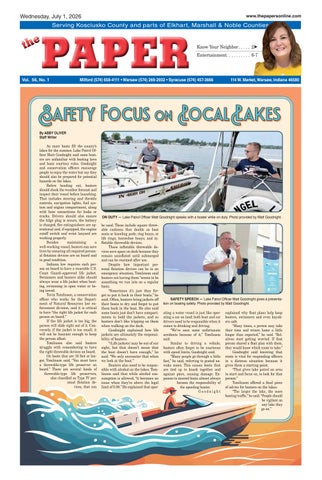
ON DUTY — Lake Patrol Officer Matt Goodnight speaks with a boater while on duty. Photo provided by Matt Goodnight. be used . These include square throwable cushions that double as boat seats or kneeling pads; ring buoys, or life rings; horseshoe buoys; and inflatable throwable devices . These inflatable throwable devices save space on deck because they remain uninflated until submerged and can be rearmed after use . Despite how important personal flotation devices can be in an emergency situation, Tomlinson said boaters not having them “seems to be something we run into on a regular basis . “Sometimes it’s just they forget to put it back in their boats,” he said . Often, boaters bring jackets off their boats to dry and forget to put them back in the boat . He also said some boats just don’t have compartments to hold the jackets, and so boaters don’t like tripping on them when walking on the deck . Goodnight explained how life jackets are ultimately the responsibility of boaters . “(Life jackets) may be out of our sight, but that doesn’t mean that the boat doesn’t have enough,” he said . “We only encounter that when we look at the boat .” Boaters also need to be responsible with alcohol on the lakes . Tomlinson said that while alcohol consumption is allowed, “it becomes an issue when they’re above the legal limit of 0 .08 .” He explained that oper-
SAFETY SPEECH — Lake Patrol Officer Matt Goodnight gives a presentation on boating safety. Photo provided by Matt Goodnight. ating a water vessel is just like operating a car on land: both boat and car drivers need to be responsible when it comes to drinking and driving . “We’ve seen some unfortunate accidents because of it,” Tomlinson said . Similar to driving a vehicle, boaters often forget to be courteous with speed limits, Goodnight said . “Many people go through a little fast,” he said, referring to posted nowake zones . This causes boats that are tied up to knock together and against piers, causing damage . Expenses to moored boats almost always become the responsibility of the speeding boater . Goodnight
explained why float plans help keep boaters, swimmers and even kayakers safe . “Many times, a person may take their time and return home a little longer than expected,” he said . “Relatives start getting worried . If that person shared a float plan with them, they would know which route to take .” Goodnight said knowing that route is vital for responding officers in a distress situation because it gives them a starting point . “That gives lake patrol an area to start and focus on, to look for that person .” Tomlinson offered a final piece of advice for boaters on the lakes . “The larger the lake, the more boating traffic,” he said . “People should be vigilant on any lake they go on .”