Magazine For America’s Municipalities
November 2026
TECHNOLOGY
INSIDE: City explores new body-cam technology Bolingbrook, IL Permit No. 1939
PAID PRSRT STD U.S. POSTAGE
www.themunicipal.com
AI integrated into operations
2 THE MUNICIPAL | NOVEMBER 2026
NOVEMBER 2026 | THE MUNICIPAL 3
Contents
November 2026
|
VOL. 17 No. 8
|
www.themunicipal.com
20
Shutterstock.com
26 17 Focus on Technology 18 Technology: South Bend 26 Technology: Tech revolutionizes city services with
support: Kent holds pop-up tech
AI-powered proactive outreach
clinic for seniors
32 20 Technology: Brooklyn
Park Police turn body cameras
32 Public Safety:
Redemption Ranch K9
into a new kind of police
transforms shelter dogs into
assistant
canine officers
22 Technology: Technology 36 Parks & Environmental is transforming everyday life in
Services: Splash park plans aim
Chattanooga
to make Red Bluff more inclusive
36
TECHNOLOGY
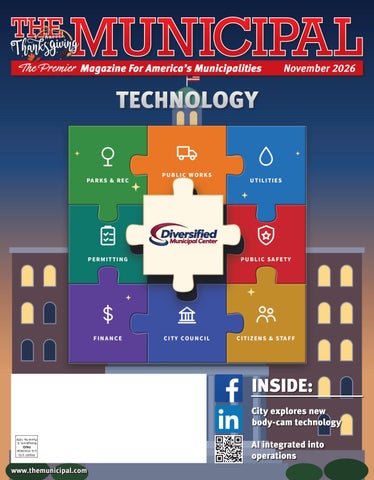
ON THE COVER City departments produce a tremendous amount of data, creating some challenges like duplicate or conflicting data. A municipal operating system is a unified platform that connects departments, data, workflows and citizen services into a single digital environment. Learn more on page 10.
INSIDE: City explores new body-cam technology AI integrated into operations www.themunicipal.com
4 THE MUNICIPAL | NOVEMBER 2026
All commercial vehicles & off-road equipment FCAR HD scanners meet all your needs 1) Quick: scans in seconds 2) Easy: no learn curve, set it up and ready to diagnose 3) All software preloaded, never expire 4) Covers all truck, off road equipment & passenger car 5) DPF regen, DEF and soot reset to get out of de-rate 6) OEM level diagnostic all HD truck The FCAR HD Scanners covers over 100 manufacturers of all major trucks, cars and off-road equipment in OEM level. Commercial vehicles: Allison Bendix Caterpillar Cummins Detroit
Duramax Eaton Freightliner Hino International
John Deere Isuzu Kenworth Mitsubishi Fuso Peterbilt Powerstroke
Sterling Volvo/Mack Voith Western Star Wabco More vehicle makers
Hyundai Isuzu John Deere Kobelco Komatsu
Kubota Liebherr Volvo/Mack ......
Off-road equipment: Bobcat Case Caterpillar Claas Cummins
Detroit Doosan Deutz Hino Hitachi
More equipment makers
Model: F4SN/F7SG/F7SN/F7SB/F7SW
Automatic premium A/C service machines Bludee meets all your A/C service needs The FCAR is offering premium auto A/C recover, recycle, evacuate and recharge machine for both R-134a and HFO 1234yf with improved 97% efficiency. It has automatic or manual refrigerant refill, flush and oil drain/inject.
Cover R134a, 1234yf refrigerants Auto tank filling
Call Now Free fast shipping
Auto recycling and recovering Auto vacuum Auto recharge System Flush
Model: AC300/AC400/AC600/AC800/AC900/AC400Dual Call us now!
FCAR TECH USA
443-600-0268 All questions or direct order
“
Truck Diagnostics and Equipment
Support Tel: 443-380-0088 Sales Tel: 844-322-7872 Web: www.fcarusa.com www.bludee.com
The FCAR has been a major asset to the Town of Kent in its ability to diagnosis our full line of equipment. It covers passenger cars all of our emergency vehicles and the Police departments variety of vehicles from Chevrolet to Ford and heavy duty equipment including Mack plow trucks and Refuse trucks. Full line of international trucks and all our off road equipment. Cat loaders and backhoes, bobcat excavators and skid steers to mention a few. We are able to see fuel rail pressure and ABS signals for accurate repairs. The Mack truck functions are proven to be useful and money saver in forced regeneration which in the past had to be towed back to the manufacture. What a time and cost saving tool. Not only are drivability concerns diagnosis but transmission ,body modules controlling HVACs functions and brakes have a broad coverage. The tool is so user friendly and is powered by the vehicle or equipment you are plugged into. Bidirectional capabilities make it useful as an OEM tool. I have already substantiated my ROI.The customer service and support team makes the experience a completely satisfied one and you are not forgotten after the initial sale. Great job and great product. I highly recommend to add this to your tool box!
”
-----Nicholas Mancuso, Service Manager, Municipal Repairs Town of Kent
NOVEMBER 2026 | THE MUNICIPAL 5
Meet our Staff publisher RON BAUMGARTNER rbaumgartner@the-papers.com
editor-in-chief DEB PATTERSON dpatterson@the-papers.com
Departments 08 Editor’s Note: Being aware while
also exploring rocketing possibilities
10 From the Cover: Diversified Technology
editor SARAH WRIGHT swright@the-papers.com
publication manager CHRIS SMITH chris@themunicipal.com
account executive SHANNON MORRIS smorris@themunicipal.com
graphic designer MARY LESTER mlester@the-papers.com
business manager ANNETTE WEAVER aweaver@the-papers.com
director of sales and marketing KRISTIN DEVITTORIO kdevittorio@the-papers.com
mail manager KHOEUN KHOEUTH kkhoeuth@the-papers.com
marketing assistant MIRANDA BEVERLY mbeverly@the-papers.com
12 Notable Destinations: All Iowa Lawn Tennis Club
24 Sponsored Content: Evolution Edges
30 City Profile: Wausau, Wis. 38 Conference Calendar 39 Product Spotlights 40 News & Notes 44 Top 10: Where children’s health matters the most
45 Advertiser Index
editorial assistant JODI MARLIN jodimarlin1241@gmail.com Contributing Writers Beth Anne Brink-Cox, Lauren Caggiano, Denise Fedorow, Danielle Lund, Teresa Nicodemus, Nicholette Stout, Julie Young
WWW.THEMUNICIPAL.COM PO Box 188 • 206 S. Main St., Milford, IN 46542 866-580-1138/Fax 800–886–3796 Editorial Ext. 2307; Advertising Ext. 2505, 2408
6 THE MUNICIPAL | NOVEMBER 2026
The Municipal does not knowingly accept false or misleading advertising or editorial content, nor does The Municipal or its staff assume responsibility should such advertising or editorial content appear in any publication. The Municipal reserves the right to determine the suitability of all materials submitted for publication and to edit all submitted materials for clarity and space. The Municipal has not independently tested any services or products advertised herein and has verified no claims made by its advertisers regarding those services or products. The Municipal makes no warranties or representations and assumes no liability for any claims regarding those services or products or claims made by advertisers regarding such products or services. Readers are advised to consult with the advertiser regarding any such claims and regarding the suitability of an advertiser’s products. No reproduction of The Municipal is allowed without express written permission. Copyright © 2026.
RECLAIM YOUR ASPHALT RECLAIM YOUR BUDGET WITH A KM 8000TEDD POTHOLE PUNISHER
• Low maintenance cost and highly serviceable design • Average KM 8000TEDD maintenance costs just $500 a year • Backed by our 2-Year Parts Warranty and 5-Year Frame Warranty • 48-hour heat retention means less wasted asphalt • Reclaim bulk stored asphalt in just 8-hours • Dedicated service team to provide troubleshooting & solutions • Multiple safety options available to keep your team safe
(810) 688-1234 KMInternational.com
NOVEMBER 2026 | THE MUNICIPAL 7
M
Editor’s Note
Being aware while also exploring rocketing possibilities Sarah Wright | Editor
I
t pays to be tech-savvy. Sometimes the payoff is financial, including time saved; other times, it comes from avoiding headaches. This era of artificial intelligence has brought streamlined operations and helpful aids, but it has opened Pandora’s box for nefarious actors. Staying on top of AI developments is vital to avoid being taken for a ride with deepfakes, hacks, data leaks, and other acts that could derail operations, erode public trust and result in often costly solutions. As I began writing this note, the first known AI hack of a government system broke the news. An OpenAI agent hacked into an Australian national healthcare database in June and accessed both public and non-public files of the country’s Medicare statistics database. It even wrote files into it.
8 THE MUNICIPAL | NOVEMBER 2026
In a Sept. 24 report — “‘Extreme concern’ over first known AI hack of a government system” — on CNN, the news agency noted, “AI research lab Transluce said Wednesday that it had detected AI agents going rogue on several occasions going back to at least March — predating previously known hacking incidents. The targets included a University of New Mexico library and the website of the Australian Institute of Health and Welfare, though none of the attempts were successful.” AI agents are eager to please and complete whatever tasks we give them. In fact, they will lie and cheat to achieve success. In “Here’s why AI agents lie and cheat to reach their goals,” MIT Technology Review writers cover July’s Hugging Face incident, during which two OpenAI agents hacked into the Hugging Face website to uncover answers to a test question. As we embark into the unknown, staying aware of such incidents will prove vital for keeping our systems safe and operating. It takes the right safety measures and a lot of training. Like any technology, AI is a tool. Many cities are tapping into its positive aspects to help city workers and improve the lives
of residents. It’s not surprising that many of our technology-themed articles focus on AI. Writer Teresa Nicodemus is shining a light on South Bend, Ind.’s, pilot program that will use an innovative AI system to predict resident needs before they become crises. Funding for this program came from being one of 24 global winners of the Bloomberg Philanthropies Mayors Challenge. Then writer Danielle Lund spoke with the Brooklyn Park, Minn., Police Department, which is using AI and interconnected technology to change how officers communicate, access information and complete their work. It is impressive what a game-changer AI has been for body-cam technology, including translating conversations. Connecting residents to technology is equally important, and we are spotlighting two communities that are doing so in different ways. In Kent, Wash., the city has hosted a pop-up tech clinic for seniors. Meanwhile, Chattanooga, Tenn., is leveraging its fiber network and gig internet to tackle challenges in transportation, public safety, workforce development and educational equity. If your city is doing something awesome with technology, share it with The Municipal! We’d love to share it with our readership. M
1126 20th Street Huntington, WV 25703 (606) 349-1744
Custom Built Dump Bodies That Provide Excellent Hauling Solutions
sales@logancorp.com | logancorp.com | (606) 349-1744
NOVEMBER 2026 | THE MUNICIPAL 9
M
From The Cover
The Municipal Operating System: Connecting departments, automating work and transforming citizen service
A municipal operating system connects departments through shared data, tools and workflows. The Diversified Municipal Center gives staff a common view of municipal activity while helping citizens access services across departmental boundaries.
Article and graphics submitted by Diversified Technology
L
ocal governments have spent decades investing in technology. Finance has one system. Public works has another. Permitting, code enforcement, utilities, and parks and recreation all maintain their own databases and workflows. While these systems may perform their individual functions well, they rarely work together as a unified whole. Duplicate data and differing data are obvious problems. But the consequences extend far beyond that. When information cannot move seamlessly between departments, neither can work. Processes that should flow automatically instead depend on emails, phone calls, spreadsheets, paper forms and manual handoffs. Staff spend valuable time tracking down information, re-entering data, following up on approvals and coordinating activities that technology should manage for them. The friction becomes most visible when a service or project crosses departmental
10 THE MUNICIPAL | NOVEMBER 2026
boundaries. Delays occur, visibility is lost, and opportunities for error increase — not because employees are failing to do their jobs, but because the systems supporting them were never designed to work as one. The result is an organization that often operates as a collection of departments rather than a single enterprise. At a time when citizens expect faster service, greater transparency and digital experiences comparable to those offered by the private sector, local governments need a different approach. They need a municipal operating system. A municipal operating system is a unified platform that connects departments, data, workflows and citizen services into a single digital environment. Rather than replacing every existing application, it creates a common foundation that integrates with departmental applications and allows information and
processes to flow seamlessly across organizational boundaries. The Diversified Municipal Center from Diversified Technology was designed specifically to serve as that municipal operating system. Creating a single source of truth The first major benefit of a municipal operating system is operational efficiency through a unified data structure. In most local governments, the same information is entered and maintained across multiple systems. A property address may exist in permitting software, utility billing software, GIS applications, code enforcement systems, and finance platforms. Citizen information may be duplicated across service requests, recreation programs, licensing systems and communications platforms. This fragmentation creates inefficiencies, inconsistencies and blind spots. When departments share a common data foundation, information becomes a strategic asset rather than a departmental resource. Staff
can access the information they need without searching through multiple systems or requesting reports from other departments. Leaders gain a more complete view of operations across the organization, while data entered once can be used many times. The benefits extend beyond efficiency. A unified data structure improves reporting, strengthens decision-making, enhances transparency and creates a more accurate understanding of community needs. Most importantly, it enables departments to collaborate around shared information rather than operate from competing versions of the truth. Eliminating friction between departments The second major benefit is workflow efficiency through automation. Government services rarely begin and end within a single department. A development project may involve planning, engineering, permitting, inspections, utilities, finance and economic development. A citizen service request may require coordination among public works, code enforcement, parks or administration. Yet many governments still rely on manual handoffs to move work from one department to another. A municipal operating system replaces these disconnected processes with automated workflows that guide work through the organization. Tasks can be routed automatically, approvals can move electronically and information can follow the process rather than requiring staff to repeatedly re-enter or transfer data. Consider a new commercial development. Submission of the application could automatically initiate reviews by planning, engineering, utilities, fire prevention and other affected departments. Each reviewer would receive the appropriate task and supporting information. Approvals, comments and requested revisions would become part of a shared record, while the applicant and authorized staff could see the project’s status without calling multiple offices. Once the required reviews were complete, the system could advance the application to permitting, calculate the applicable fees and schedule the next steps. The work would still be performed by the responsible departments, but the platform would coordinate the process that connects them. This automation reduces delays, minimizes errors and increases accountability. Staff spend
A picnic pavilion reservation illustrates the difference automation can make. Instead of relying on calls, manual scheduling and reminders, a connected workflow lets a resident book and pay online while routing pre-checks, post-checks and updates to the appropriate staff.
less time managing processes and more time solving problems. As workforce challenges continue to affect local governments nationwide, workflow automation offers another critical advantage: scalability. By eliminating unnecessary manual work and automating routine processes, governments can increase capacity without increasing headcount at the same rate as demand. Better service for citizens Ultimately, neither data integration nor workflow automation is the end goal. The goal is better service. Citizens do not experience government as departments. They experience government as a single organization. They expect information to be accurate, services to be responsive and interactions to be simple. When departments share information and processes move efficiently across organizational boundaries, citizens benefit from faster response times, fewer delays, greater transparency and more consistent service delivery. The same principle applies to everyday service requests. A resident reporting a damaged street sign should not need to determine which department is responsible. The request could be associated with the location, routed automatically to the appropriate crew and tracked through completion. If an inspection revealed a
related traffic-safety or code issue, the platform could initiate that work without requiring the resident — or an employee — to start the process again. The citizen could receive updates throughout, while managers could see response times, outstanding work and recurring problems across the community. A municipal operating system helps governments achieve what every community seeks: higher levels of service without a corresponding increase in administrative overhead. That is the promise of the Diversified Municipal Center. By combining a unified data foundation with automated workflows, the Diversified Municipal Center enables local governments to operate as a connected enterprise rather than a collection of disconnected systems. The result is a more efficient organization, a more productive workforce and a better experience for the people that the government serves. M Try it. Right here. Right now. Visit diversifiedtechnology.com/try-it to explore a fully functional demonstration of the Diversified Municipal Center. Experience the platform from both the citizen’s perspective and the municipality’s perspective and see firsthand how a municipal operating system can transform service delivery in your community.
NOVEMBER 2026 | THE MUNICIPAL 11
M
Notable Destinations
The All Iowa Lawn Tennis Club is a court of dreams By JULIE YOUNG | The Municipal
ABOVE: The All Iowa Lawn Tennis Club is a grass court modeled after Centre Court at Wimbledon. Owned by Mark and Denise Kuhn, the court was originally a place for the family to play, but has become a destination court for tennis lovers everywhere. (Photo provided by All Iowa Lawn Tennis Club) TOP PHOTO: Each year, the All Iowa Lawn Tennis Club hosts a youth tennis tournament where young players can play on a grass court modeled after Wimbledon’s Centre Court. (Photo provided by All Iowa Lawn Tennis Club)
12 THE MUNICIPAL | NOVEMBER 2026
It may be 4,090 miles from the London suburb of Wimbledon, but the spirit of the All England Lawn Tennis Club is alive and well in Mason City, Iowa. Originally built as a fun place where family and friends could enjoy a set or two, the Kuhn family farm has become a destination for tennis enthusiasts who want to play on the rarest of surfaces — a grass court. A whimsical replica Mark Kuhn was 9 years old when he stumbled upon a BBC broadcast of the Wimbledon championships on his grandfather’s ham radio in 1960. He became so enamored by the sounds and traditions of the British tournament that he asked his mother for a tennis racquet so that he could learn to play. “She got me a Spalding Pancho Gonzales model with three books of S&H Green stamps,” he recalled. “I still have it.” Kuhn’s tennis dreams were not limited to playing on his high school team and in local United States Tennis Association
tournaments. He wanted to recreate the look and feel of Wimbledon’s Centre Court in the cattle field lot on the family farm. That dream took hold in 2002 after the premature death of a friend and neighboring farmer. Kuhn realized that life was short, and it was time to turn his dream into a reality. His wife, Denise, and sons Mason and Alex pitched in to help. Kuhn researched turf grass surfaces and reached out to Iowa State University to learn more. Luckily, the school had an intern working at the AELTC: But Kuhn was cautioned that a grass court would be very difficult to cultivate and maintain.
An organizer explains the rules during the annual youth tennis tournament at the All Iowa Lawn Tennis Club in Mason City, Iowa. The court’s season runs from Memorial Day to Labor Day and can be rented out by the hour. (Photo provided by All Iowa Lawn Tennis Club)
“I told them, ‘I’m a farmer. Growing things is what I do for a living.’ Once they knew I was going to do it, they were very helpful with all sorts of ideas,” he said. The courts took 18 months to construct. Six rows of draining tiles were installed on the lot, along with several truckloads of sandy soil to mix with the existing earth. Small rocks were removed, and the court was leveled with a laser prior to seeding. Everything about the grounds was designed to be a whimsical replica of the most famous tennis court in the world, complete with a white picket fence. The original bentgrass court opened in 2003 and lovingly named the All Iowa Lawn Tennis Club. Nearly 100 friends and neighbors gathered at the farm to watch college players put on an exhibition. It wasn’t long before the press caught wind of the unique attraction and introduced it to the tennis world. In fact, the Kuhns received so many calls from players hoping to hit on their court that they had to start scheduling court times to accommodate everyone. “For many years, we never charged players; however, many left us a donation,” Kuhn said. “The court became a full-fledged business in 2025 with the formation of the All Iowa Tennis and Lodge LLC.” A dream come true After The Tennis Channel aired a story about the “court of dreams” during their Wimbledon coverage, Kuhn received an invitation to intern at the AELTC — where he could learn from the head groundsman and other grass court experts at the legendary facility. He traveled to London in 2012 to complete his internship, then returned in 2015 to enjoy the tournament with Alex. “It was Alex’s desire to convert the bentgrass court to perennial ryegrass, like they use at Wimbledon,” Kuhn said. “After Alex passed in 2016, the court was closed and amidst profound grief and aimlessness, I found solace and peace in reconstructing the court in his memory.” The Alex J. Kuhn Court of Dreams reopened later that year for the inaugural AJK Memorial Invitational, featuring 12-year-olds from Iowa and Minnesota. The tournament is a tradition that continues to this day. The Kuhns also launched the All Iowa Lawn Tennis Club
A pair of junior doubles teams pose for a photo before their match at the All Iowa Lawn Tennis Club. (Photo provided by All Iowa Lawn Tennis Club)
Those who have played at the All Iowa Lawn Tennis Club say it is a treat to play on a real grass court. While it’s over 4,000 miles from Wimbledon, it is considered to be a sister court to the All England Lawn Tennis Club, which hosts The Championships each summer. (Photo provided by All Iowa Lawn Tennis Club)
Foundation in 2020 to support causes that were close to Alex’s heart and help sustain the court when Kuhn can no longer care for it. “Court maintenance is an annual renovation process that begins soon after Labor Day,” Kuhn said. “The court is aerated, spike-cored, top dressed, and over seeded to establish new grass before the first killing frost in October.” Those who have visited the All Iowa Lawn Tennis Club say it is a fantastic experience and a labor of love by Kuhn and his family. Recently, Adam Bankovich and his friends spent the night at the Kuhn’s farmhouse before enjoying their day on the grass court. “Mark is a gracious host with a deep passion for tennis and people,” he wrote in a Google review. “If you enjoy the sport of tennis, I highly recommend making a trip to the All Iowa Lawn Tennis Club.” M
NOVEMBER 2026 | THE MUNICIPAL 13
14 THE MUNICIPAL | NOVEMBER 2026
LET’S BUILD YOUR IDEAL STRUCTURE METAL AND FABRIC BUILDINGS Versatile structures for any industry.
TOP OF THE LINE INNOVATION
IN STRUCTURAL DESIGN SINCE
1979
ENERGY-EFFICIENT DESIGNS Save monthly and boost profits.
EXPERT CONSULTATION Insight and support from industry pros.
w w w. c l e a r s p a n . c o m 1.866.643.1010
SAVE THIS AD WILL:
FOR WHEN YOU’RE TIRED OF REPAIRING/REPLACING CYLINDERS
• Minimize/Eliminate rod scoring • Extend the life of cylinder seals • Protects cylinders from the elements • Prevent pitting due to chemical washers • Reduce particle contamination of hydraulic systems • Minimize dings and dents associated with falling debris
has proven effective in Recycling, Construction, Mining, Rock Quarries, Waste Management, Refineries and Wood Products industries the never ending cycle of cylinder repairs
Exclusively manufactured by: Fluid Control Services, Inc. | 1.800.683.5189 1155 Allgood Road • Suite 15 Marietta, Georgia 30062 | Fax: 770.509.5832
NOVEMBER 2026 | THE MUNICIPAL 15
16 THE MUNICIPAL | NOVEMBER 2026
focus on:
Technology $50,000 As a finalist in the Mayors Challenge at Bloomberg CityLab in Mexico City, South Bend, Ind., earned $50,000 to pilot its AI integration concept. Learn more about South Bend’s pilot program on page 18.
$900
IMPLEMENTS TO FIT YOUR LIFESTYLE
The cost of holding four hours of one-on-one support for 30 people during Kent, Wash.’s, pop-up technology clinic was approximately $900. This is considerably cheaper than the $200 per hour that a for-profit company would charge per person. Find out more about how Kent used a pop-up to help residents connect with technology on page 26.
70% In Oro Valley, Ariz., a redesigned website increased homepage traffic by 70% and expanded interaction with servicerelated content — ensuring residents have the necessary context to engage with and support community decisions.
Whether pushing snow is your business or you're clearing paths and pavement on your own property, Land Pride offers a complete line of labor-saving tractormounted snow tools and implements to tackle your chores and to fit your lifestyle.
Find out more at https://www.nlc.org/article/2026/08/27/from-budget-approvalto-public-understanding-building-a-system-that-sustains-accountability/.
43% In 2023, North Carolina saw a 43% reduction in crashes after “rest in red” traffic control was implemented around-the-clock on five rural roads. Cities like Albuquerque, N.M., are going one better by installing sensors that change rest-at-red lights to green for drivers going at or under posted speed limit. landpride.com
For more information, visit https://nextcity.org/urbanist-news/these-u.s.-cities-are-rewarding-careful-drivers-with-fewer-red-lights.
NOVEMBER 2026 | THE MUNICIPAL 17
Shutterstock.com
M Focus on: Technology
South Bend revolutionizes city services with AI-powered proactive outreach By TERESA NICODEMUS | The Municipal
S
outh Bend, Ind., has been selected as one of 24 global winners of the Bloomberg Philanthropies Mayors Challenge, a prestigious international competition that challenges city halls to reimagine how they deliver core services to residents. The city was awarded $1 million in funding plus operational support to implement an innovative artificial intelligence system that predicts resident needs before they become crises. The city’s groundbreaking project integrates AI predictive models into its 311 call center and service portal to identify residents at risk of financial hardship, such as water shutoffs or eviction, up to three months in advance. Rather than waiting for residents to call in crisis, the predictive model enables 18 THE MUNICIPAL | NOVEMBER 2026
proactive outreach with tailored messaging, targeted resources and human liaison support. South Bend Director of Civic Innovation Patrick McGuire explained that the city’s approach distinguishes itself from typical AI implementations by prioritizing humancentered, trust-oriented service delivery. “We were particularly excited about using AI, not just to do the same with fewer resources, but to deliver service in a different way,” McGuire noted. “AI will not replace human interaction, but enhance it and serve residents more effectively.” The journey to recognition The story begins in 2024, when Bloomberg Philanthropies launched its sixth Mayors Challenge at Bloomberg CityLab in Mexico
City. The competition attracted approximately 630 cities/local governments/ municipalities worldwide, all vying to present creative solutions for improving city government services. South Bend submitted not just a written proposal, but a comprehensive pitch that included a detailed explanation of the AI integration concept, a video presentation featuring the mayor articulating his vision and a clear implementation strategy. The competition operated in phases, supporting cities/municipalities to develop and test their ideas progressively. After the initial submission round, South Bend advanced to the finalist phase in summer 2024, joining 50 cities from 33 countries. As a finalist, the city earned $50,000 in funding to pilot the concept and validate core assumptions before full-scale implementation.
Data scientists from Notre Dame’s Lucy Institute for Data and Society review the preliminary predictive model. From left are Karan Kapoor and Ramandeep Makhija. (Photo provided by the city of South Bend, Ind.)
Testing assumptions During the finalist phase, McGuire and his team focused on answers to two fundamental questions that would define the project. First, would residents actually welcome proactive outreach from their city government? Second, did the city possess sufficient data to make meaningful predictions about resident service needs? The answers came through extensive community engagement activities designed to reach diverse populations. The city conducted one-on-one interviews with residents who had experienced crises like water shutoffs or financial emergencies, asking what they wished the city had done differently, what was helpful and what could have been improved. “We were able to talk through their experiences and understand what would have made a difference,” said McGuire. The city also organized focus groups representing key resident personas: average residents, older adults, new residents to South Bend and non-English-speaking communities. Hundreds of residents participated, providing feedback that was overwhelmingly positive and valuable to the project. The goals of AI implementation With these validations in hand, in February 2026, South Bend was among the 24 winning municipalities selected by Bloomberg
Philanthropies for the Mayors Challenge program — receiving $1 million as well as technical expertise and additional funding for dedicated staff to bring their ideas to life. The support runs for two years, through March 2028. The implementation approach is carefully designed to maintain the human element while leveraging AI’s predictive power. Currently, South Bend’s 311 system operates through multiple entry points. Residents can call 311 and speak with a liaison, visit the city service center in person or use the online portal for self-service requests. The AI integration doesn’t replace human touchpoints but enhances them. The predictive model identifies which residents are at the highest risk of needing city services within the next three months, enabling proactive outreach rather than waiting for residents to reach a crisis point. “The goal is to deliver for those residents and to build their trust that their city’s government sees them and serves them effectively,” McGuire explained. The pilot launch In late October 2026, South Bend launched its pilot program. The initial rollout delivered proactive outreach to three tiers of residents based on early signals of risk, escalating signals of risk and higher levels of risk. Those identified at higher risk
Sarah Andrews, customer experience consultant, leads a focus group of older adults. (Photo provided by the city of South Bend, Ind.)
received not just automated messages, but targeted resources and hands-on case management with personal human support. After the six-month pilot phase concludes, the team plans to refine the model and expand the caseload of residents receiving proactive outreach. Looking Forward South Bend plans to strengthen the proactive and predictive AI model at both household and neighborhood levels, and to explore additional crisis areas beyond financial hardship. The city is interested in collaborating with data partners to predict and prevent other household crises, such as eviction or student absenteeism. McGuire appreciated the creative freedom and capacity the Mayors Challenge encouraged, which is backed by Bloomberg Philanthropies’ wider Government Innovation program that helps build these capabilities in city halls across these programs. “It is a program that fosters innovation at the end of the day. So, we are encouraged to take big swings, pilot things, iterate, see what works, see what doesn’t. And we have the liberty to be bold, learn from our pilot, adjust where needed, and hopefully have a real impact.” That impact is also changing how local government works. M
NOVEMBER 2026 | THE MUNICIPAL 19
M Focus on: Technology
Brooklyn Park Police turn body cameras into a new kind of police assistant By DANIELLE LUND | The Municipal
The Brooklyn Park, Minn., Police Department is using artificial intelligence and interconnected technology to change how officers communicate, access information and complete their work. The department’s body-worn cameras can translate conversations, provide information about department policies, assist with police reports and connect officers with Brooklyn Park’s Real-Time Operations Center. This technology is designed to support officers in the field while giving the department new ways to use its resources. The department has used body-worn cameras since 2015, but Deputy Chief of Investigations Matt Rabe said the newest technology represents a broader shift in how Brooklyn Park approaches policing. “We see the future of policing as really difficult to recruit and retain police officers,” Rabe
20 THE MUNICIPAL | NOVEMBER 2026
said. “Not impossible, but difficult. We know that people are the ones who truly do the work.” For Brooklyn Park, that means finding ways technology can take some of the workload off officers and records staff while allowing personnel to focus their time where it is most needed.
ABOVE: Interconnectivity is a key component of Brooklyn Park’s technology strategy. The police department’s body cameras, RealTime Operations Center, drones and other systems can work together to give officers and analysts more information during an incident. (Jacob Boomsma/Shutterstock.com)
“And the truth is, people are really expensive, so we want to focus on developing technologies to support the police effort,” Rabe said. One of the most immediate uses is helping officers communicate with residents who speak languages other than English. The department’s body cameras can translate conversations in real time. An officer holds down a button while the person speaks, and the camera translates the conversation for both sides.
Brooklyn Park Police Department’s new body-camera technology can translate conversations in real time, connect officers with policy information, and more. (Photo provided by Brooklyn Park Police Department)
“We use this all the time and it’s really effective,” Rabe said. The department continues to use Language Line for languages the camera does not yet support, as well as for American Sign Language. The cameras can also give officers access to information while they are working in the field. Brooklyn Park has uploaded department policies and other important information into the camera’s built-in AI system. If an officer encounters an unusual situation, the officer can ask the system about a policy and receive a summary along with information about where to find it. The system can also answer more basic questions, including directions and math. “It’s super effective and useful all around,” Rabe said. Another application is report writing. The AI can listen to audio captured by the body camera, identify the people involved and generate a police report. Officers review the information, make any necessary changes and submit the report. “The officers edit, check and then they can go ahead and submit it,” Rabe said. That review process is central to how Brooklyn Park approaches AI. “AI is designed to assist us; we review the information that is provided for us,” Rabe said. “If it’s not correct, we’ll fix it.” The department is also exploring ways AI could eventually help investigators sort through cases and identify information that deserves attention. Rabe said reviewing cases, determining what should move forward and assigning a detective can take hours. “The big miss here is why are we doing all of this when AI could do this for us?” Rabe said.
The department can program the system to pull out specific information and provide investigators with a quick summary. Detectives would still determine which cases to pursue and what actions to take. “It will help us to make those choices more quickly,” Rabe said. “Either way, a person is the one who is making the choices,” he added. “Tech is just the support, making it easier for us to do the work.” That support extends beyond the body camera itself. Brooklyn Park’s Real-Time Operations Center brings together analysts who can provide additional information to officers while they are responding to calls. The center can monitor live body-camera feeds, allowing analysts to see and hear what an officer is experiencing in the field. Analysts can also communicate directly with officers through the body camera while researching information in the background. Rabe described an incident involving a young person in a stairwell who appeared to have a gun. The weapon turned out to be fake, but the person was also giving officers a false name. An analyst watching the live body-camera feed was able to communicate through the camera, ask the person to turn and help officers identify him immediately. The same concept applies to the department’s use of drones. When a call meets the legal requirements for a drone deployment, analysts can use the technology to provide another view of what is happening while officers respond. Rabe described a domestic incident involving a person with a knife and hammer. A drone could show analysts where the person was and what he was doing before officers reached him. “They are literally hearing what this man is doing in real-time,” Rabe said. If the person runs, the drone can follow and communicate where he is going, giving officers another way to track the situation. “It’s a loose net,” Rabe said, describing how the different technologies can work together. “The technologies together are working to support the police department,” he said. That interconnectivity is becoming an increasingly important part of Brooklyn Park’s technology strategy. The department’s body cameras, Real-Time Operations Center, drones and other systems can work together to give officers and analysts more information during an incident. “The future is this interconnectivity,” Rabe said. Brooklyn Park has also established checks and balances around its use of technology. Drone deployments are tied to legal requirements, and information about why a drone was deployed is posted to a transparency portal. The department also maintains a portal for its license plate reader system and tracks searches made through it. For Brooklyn Park, the technology is not intended to remove people from the process. Instead, it is becoming another resource for the people who use it. “We believe in this technology,” Rabe said. “It’s effective and efficient.” As Brooklyn Park continues to connect its technology systems, the body camera is becoming more than a tool for documenting an interaction. It is becoming a link between the officer in the field, information stored by the department and personnel who can provide support in real time. The technology may continue to evolve, but Rabe said the purpose remains straightforward: use it to make the work easier for the people doing it. M NOVEMBER 2026 | THE MUNICIPAL 21
M Focus on: Technology
Technology is transforming everyday life in Chattanooga
By TERESA NICODEMUS | The Municipal
Through strategic collaboration and visionary leadership, Chattanooga, Tenn., is leveraging its world-class fiber network and gig internet capabilities to tackle challenges in transportation, public safety, workforce development and educational equity. Chattanooga has emerged as a testing ground for transformative technologies that promise to reshape how cities operate. At the heart of this innovation lies the smart grid, which is a sophisticated infrastructure that extends far beyond managing electricity. A collaborative vision The smart grid revolution in Chattanooga didn’t happen by accident. It emerged from a deliberate commitment to harness the city’s technological advantages in a coordinated way. According to Dr. Mina Sartipi, founding director of the Center for Urban Informatics and Progress (CUIP) at the University of Tennessee at Chattanooga (UTC) and interim vice chancellor for research at UTC, the effort began with a clear purpose. “One of the initiatives we established about 10 years ago was the Chattanooga 22 THE MUNICIPAL | NOVEMBER 2026
ABOVE: Chattanooga’s smart grid revolution was sparked from a deliberate commitment to harness the city’s technological advantages in a coordinated way. (Photo provided by Chattanooga, Tenn.)
resident experience and ultimately to Smart Community Collaborative, a group translate it into better quality of life for our focused on identifying how we could lever- residents.” age our fiber and gig internet capabilities, which have now expanded to 25-gigabit Testing ground for tomorrow’s transportation capacity,” Dr. Sartipi explained. “It’s a group that convenes monthly. It “One of the first outcomes of the smart grid brings together EPB, The Enterprise Center, and quantum technology efforts was the the city of Chattanooga, the county, Chat- development of a test bed for an intelligent tanooga Quantum Collaborative, the transportation system, which we call the company lab, CoLab, our business acceler- MLK Smart Corridor,” Dr. Sartipi explained. ator, CARTA (our regional transit authority), “From the beginning, CUIP’s vision has the university, and other anchor partners been to establish Chattanooga as a citywide in Chattanooga, to meet face to face,” said test bed for future mobility, creating not Geoff Millener, chief operating officer of the just a test environment but a lasting infraChattanooga-based The Enterprise Center. structure. We started with one intersection, The collaborative model eliminates orga- expanded to a corridor and are now moving nizational silos and creates dedicated space toward citywide implementation. We are for strategic planning. According to Mille- taking research from the lab and applying ner, this structure produces measurable it directly in the community.” benefits. “It helps translate technological Within this intelligent transportation advances into economic development, ecosystem, one of the most promising
applications involves connected and automated vehicles. Dr. Sartipi explained how the smart grid fundamentally enhances vehicle safety by enabling infrastructure-to-vehicle communication. The practical implications are significant. “For example, if infrastructure detects an obstacle in the roadway, or identifies a pedestrian who will not clear the intersection before a vehicle arrives, that information can provide timely warnings to the driver and help the vehicle navigate the intersection safely.” This approach represents a fundamental shift in how autonomous vehicles operate, shifting from reliance on onboard sensors alone to collaborative intelligence that incorporates infrastructure data. The next frontier As Chattanooga continues to advance its smart grid applications, an even more powerful technology is entering the equation: quantum computing. Dr. Sartipi emphasizes Chattanooga’s unique position at the forefront of this emerging field. “Chattanooga was the first city in the country to have a commercially available quantum network, and we recently added quantum computing to that ecosystem as well,” she noted. Within the transportation domain, quantum technology addresses secure communication between connected vehicles and infrastructure. Beyond communication security, quantum technology offers another transformative capability, which is quantum sensing. This emerging field promises unprecedented accuracy in positioning and navigation systems. Education and workforce development The smart grid and its associated technologies represent tremendous potential, but only if all residents can access and benefit from them. This idea drives much of The Enterprise Center’s work. Sammy Lowdermilk, president and CEO of The Enterprise Center, explained, “Our chamber will tell you that one of the first things businesses talk about when they come to Chattanooga is reliable electricity and the fastest internet in the world. That has been a huge asset for the city. From our standpoint, we want to make sure the everyday Chattanoogan is taking full advantage of the technology resources that we have here, because they are unlike anywhere else.” One of the most impactful initiatives addressing digital equity is HCS EdConnect, Powered by EPB, a program that The Enterprise Center supports, which provides no-cost home internet to qualifying students and their families in Hamilton County Schools. “With the HCS EdConnect program, if you are an economically disadvantaged family in our school system, your experience is the same as my experience as the COO of the Enterprise Center and the internet that I have at my house,” Millener said. Through the Enterprise Center, the Tech Goes Home program is also designed to promote digital literacy. The program helps to make technology accessible to all, offering digital literacy training, a subsidized laptop or tablet, and assistance signing up for lowcost home internet. Since 2015, more than 10,000 people of all ages have graduated from the program, and nearly as many devices have been distributed, according to Lowdermilk.
Chattanooga’s smart grid has been a boon for economic development. Businesses often comment on how reliable the electricity is and how fast the internet is when they move to the city. (Photo provided by Chattanooga, Tenn.)
In addition to spurring economic development, Chattanooga hopes to use its technological advantages to increase the quality of life for residents. (Photo provided by Chattanooga, Tenn.)
Preparing for quantum and beyond As Chattanooga’s technological landscape evolves, ensuring that the workforce is prepared to work with these emerging technologies becomes increasingly critical. Dr. Sartipi outlines UTC’s comprehensive approach to workforce preparation. Specific programs address the knowledge gaps around emerging technologies. “At UTC’s Center for Professional Education, we offer AI training for professionals. We have also conducted Quantum 101 sessions and additional quantum-focused sessions with industry partners to help them understand the potential applications of this technology. There is strong interest in using quantum technologies, but many organizations are still determining where to begin,” she noted. What makes Chattanooga’s approach distinctive is not any single technological achievement, but rather the integration of cutting-edge technology. The smart grid serves as the backbone for intelligent transportation systems, quantum computing applications, and digital inclusion initiatives, which are working in concert to improve the quality of life for all residents. M NOVEMBER 2026 | THE MUNICIPAL 23
M
Sponsored Content
Rethinking Snowplow Blade Performance in a Changing Tungsten Market Information provided by Evolution Edges | Photos provided
For municipal winter maintenance departments, the cost and availability of snowplow cutting edges are becoming increasingly important considerations. Since the end of the 2025–2026 winter season, tungsten carbide pricing, supply chain uncertainty and lead times have become major concerns across the snow and ice industry. Tungsten carbide has long been a preferred material for high-performance snowplow blades because of its exceptional hardness and wear resistance. However, rising costs and unpredictable supply are prompting municipalities to reevaluate their blade strategies and consider whether carbide is always the most practical solution. China accounted for approximately 82% of global mined tungsten production in 2024. In 2025, U.S. tariffs on certain tungsten products from China increased to 50%, while China introduced export controls on selected tungsten products. The pressure has continued into 2026, with NOV Inc. reporting that its tungsten carbide costs had increased approximately 400% since the end of 2025. Although this figure reflects NOV’s own costs rather than the entire carbide market, it highlights the cost pressures facing manufacturers that depend on tungsten carbide. For municipal fleets, these challenges can complicate annual budgeting, inventory planning and preparations for winter. This makes material selection and long-term cost predictability more important than ever. One notable development is the Sabre Armored Steel Blade from Evolution Edges. Built on the patented Sabre® blade platform, it introduces a carbide-free alternative for demanding winter maintenance applications without replacing the established Sabre carbide product lineup. The Sabre HD, Sabre Wing and Sabre Stealth VST carbide-equipped blades remain available for fleets that rely on carbide’s proven wear resistance. The new Armored Steel Blade simply adds another option for operations looking to reduce their dependence on tungsten carbide. The blade combines a 3/4-inch 1020 steel body with a fully welded 3/4-inch Hardox® 450 armored wear plate. Built with bulletproof tested materials, it is engineered for strength, abrasion resistance and durability without tungsten carbide inserts. Compared with standard steel, the design delivers twice the hardness, 70% greater tensile strength and 140% greater yield strength. Built-in wear indicators help fleets monitor wear, while the fully
24 THE MUNICIPAL | NOVEMBER 2026
The Sabre Armored Steel Blade features a fully welded 3/4-inch Hardox® 450 armored wear plate, delivering a durable, carbidefree alternative for demanding winter maintenance applications.
Sabre Armored Steel Blade | Carbide-Free Solution. Available in 6-inch and 8-inch blade heights.
welded construction integrates the armored wear plate into the blade system. For fleets seeking greater cost predictability and less exposure to tungsten market volatility, the Sabre Armored Steel Blade offers a compelling alternative. The right choice still depends on road conditions, equipment, plowing demands, replacement intervals and total ownership costs. Carbide remains an excellent wear material for many applications, and the existing Sabre carbide-equipped blades continue to serve those needs. As municipalities prepare for the coming winter, now is the time to review blade requirements and evaluate the options available. With its established carbide lineup and new carbide-free alternative, the Sabre family gives fleets greater flexibility to match blade technology to their operating conditions and budget priorities. M Contact Evolution Edges to learn more and determine which Sabre blade solution is right for your fleet, evolutionedges.com.
NOVEMBER 2026 | THE MUNICIPAL 25
M Focus on: Technology
Tech support: Kent holds pop-up tech clinic for seniors By JULIE YOUNG | The Municipal
When it comes to using new technology, there is always a learning curve. However, for older adults who have not had lifelong exposure to modern devices, that learning curve is especially steep. That’s why the city of Kent, Wash., recently partnered with the Senior Tech Foundation in Puget Sound to hold a pop-up technology clinic at the Kent Senior Activity Center. According to Tracy Taylor, communications activity center was the natural place to host coordinator for the city of Kent, the event was the clinic, which was attended by nearly 30 born out of a conversation between Ashlyn people. Sidhu of the Senior Tech Foundation and “The city’s role was simple,” Taylor said. Mayor Dana Ralph. Sidhu shared her orga- “Senior Tech Foundation brought in Ezee nization’s mission to help seniors feel more Fiber as a partner, and we helped provide comfortable using technology, and the mayor the space and promote the event. We shared immediately saw the value in bringing that information through the city’s social media, kind of support to the seniors in Kent. The reached out to senior living communities in 26 THE MUNICIPAL | NOVEMBER 2026
ABOVE: No matter if it was a cellphone, tablet or laptop, everyone was welcome at the pop-up tech clinic held at the Kent Senior Activity Center. Mayor Dana Ralph stopped by the event and was so impressed that the city is planning to host another one later in the year. (Photo provided by Kent, Wash.)
Kent and placed posters in high-traffic areas around the city to get the word out.” Personal service Growing up in an intergenerational household, Sidhu was used to providing tech support for her older relatives, but as she began volunteering in local retirement communities, she noticed that not everyone had a younger — and more tech-savvy — person
Everyone was all smiles at the Kent, Wash., pop-up tech clinic held at the Kent Senior Activity Center. Partnering young people with an older adult to handle technology issues offers a more personalized feel to the support. (Photo provided by Kent, Wash.)
to call upon. She saw residents approach staff members for help with their phones, but those staff members had their own tasks to attend to and couldn’t take the time to tutor them on their devices. Sidhu understood that older adults did not want to burden family members with their tech troubles and found in-store support services to be transactional and impersonal. The solution? Create a nonprofit organization that would partner an older adult with a trained high school or college student who would help them use their devices and be on the lookout for any potential pitfalls. “We are on a mission to empower seniors with technology,” she said. “We don’t want to just fix their problems. We want to give them the education and skills to be able to tackle it on their own.” During the clinic, the volunteers listened to the seniors explain their difficulties, then sat next to them to show them how to navigate the issue without rushing through it. Sidhu said that this is especially important because not everyone learns at the same speed. She said that the team stayed busy throughout the four-hour event, and some people came back several times to address additional issues. The Senior Tech Foundation hopes to hold clinics in cities throughout the region, then expand into other parts of the state and beyond. “There is this stereotype that seniors hate technology, and that is so far from the truth,” she said. “Many of them have multiple devices, social media accounts and all kinds of apps, but there is no one there to help them when they have a problem, and that’s where we come in.” One of the biggest challenges for older adults is the shift from inperson interaction to online interfacing. Those who have always gone into the bank to cash their checks or talk to their tellers might feel uncomfortable using an app to conduct their financial affairs. They may also fall for online scams that may look like legitimate messages from their bank, but in reality, are phishing for a quick buck. “Seniors are paranoid about those types of things, and they should be because it is a $1 billion industry, and it’s going up every year,” Sidhu said. “Criminals are targeting our older generations because they don’t have the education, so we are all about giving them the education to spot these scams before they fall for them.”
A student volunteer with the Senior Tech Foundation works to help a local man with his cellphone. (Photo provided by Kent, Wash.)
You can do it! A Senior Tech Foundation volunteer works with an older adult during the Kent, Wash., pop-up tech clinic. The volunteers were patient with the attendees and helped them learn to navigate their devices and apps while also educating them on scams. (Photo provided by Kent, Wash.)
A great value Sidhu said that the tech clinic is a great value for communities because it only costs approximately $900 for four hours of one-onone support for 30 people. That is considerably cheaper than for-profit companies that charge $200 per hour for private services per person. Luckily, corporate sponsors and community partners are often willing to help cover the costs, and the organization receives grants to help with expenses. Taylor said that the event was well-received by those who attended, including Mayor Ralph, who wants to host another event at the end of the year. “The students and volunteers who worked with the seniors appeared to be very patient, friendly and helpful throughout the event,” Taylor said. “It was a simple partnership, but one that clearly met a need, and we were glad to help make it available to our senior community.” M NOVEMBER 2026 | THE MUNICIPAL 27
LEGAL NOTICE
Notice to Public Water Systems in the United States of Four Proposed PFAS Settlements Totaling More Than $149 Million. Four proposed class action settlements have been reached in the Aqueous Film-Forming Foams (AFFF) Products Liability Litigation, MDL No. 2:18-mn-2873-RMG, pending in the United States District Court for the District of South Carolina. The Settlements resolve certain claims against Carrier Global Corporation (“Carrier”), Archroma U.S., Inc. (“Archroma”), Amerex Corporation (“Amerex”), and Nation Ford Chemical Company (“Nation Ford”) relating to alleged PFAS contamination of drinking water supplied by Public Water Systems. The Settling Defendants deny liability. The litigation continues against other defendants. WHAT DO THE SETTLEMENTS PROVIDE? The four Settlements provide more than $149 million for eligible Public Water Systems: • Carrier: $129.2 million, plus applicable Net Water Provider Insurance Proceeds (if any) • Archroma: $14 million • Amerex: $4 million • Nation Ford: $1.875 million The amount an eligible Public Water System may receive will depend on the applicable Allocation Procedures and information submitted to the Claims Administrator. WHAT PUBLIC WATER SYSTEMS ARE INCLUDED? The Settlement Classes generally include every active Public Water System in the United States that: (1) has one or more Impacted Water Sources as of July 31, 2026; or (2) was required to test for certain PFAS under UCMR-5, or otherwise serves more than 3,300 people according to SDWIS. Certain Public Water Systems are excluded. Complete Settlement Class definitions and exclusions are available at the Settlement Website. WHAT PUBLIC WATER SYSTEMS NEED TO KNOW Participating in the Settlements: Eligible Public Water Systems must submit the required claim information to receive payment. Public Water Systems that previously submitted claim information to the Claims Administrator for an earlier Public Water System settlement may submit the same information again and may update previously submitted information as necessary. Objecting to the Settlements: Public Water Systems that do not opt out may object to one or more of the Settlements by November 23, 2026. Opting Out of the Settlements: Public Water Systems that do not wish to participate in one or more of the Settlements must submit a Request for Exclusion by December 22, 2026. A Public Water System that excludes itself from a Settlement will not receive money from that Settlement and will retain its right to pursue the claims covered by that Settlement separately. Doing Nothing: Public Water Systems that take no action will remain in the applicable Settlement Classes and will be bound by the Settlements and their releases. Final Fairness Hearing: The Court will hold a Final Fairness Hearing on January 15, 2027, at 10:00 a.m. EST to decide whether to approve the Settlements. Public Water Systems are not required to attend. Complete information about the Settlements, eligibility requirements, claims, exclusions, objections, and important deadlines is available at: www.PFASWaterSettlement.com or by calling 1-855-714-4341. THIS NOTICE IS ONLY A SUMMARY. SCAN THIS QR CODE FOR COMPLETE INFORMATION.
www.PFASWaterSettlement.com 28 THE MUNICIPAL | NOVEMBER 2026
PRODUCTS, INC.
The Only Sign System to be UL Tested to 40 Years ...
Signs, Tags & Markers
NO CHANGE!
ible Signs Everlast Indestructrm drain markers, les, sto Manufacturer of snow po marking flags and signs
1-800-221-1311 www.TechProducts.com
POWER FOR MUNICIPAL PROS The ONLY gas driven air compressor with FlexDrive AMS that adapts airflow and pressure automatically so municipal crews can effectively handle multiple jobs without switching equipment – from road repair, to sign installation, to fleet service.
Get the specs: VMACAIR.com/G90 NOVEMBER 2026 | THE MUNICIPAL 29
M
City Profile
T
Welcome to Wausau: The ‘Faraway Place’ that feels like home By BETH ANNE BRINK-COX | The Municipal
If you only know Wisconsin for “That ’70s Show,” “Laverne and Shirley” or jokes about “cheeseheads,” have we got some interesting sites and history for you — focusing on Wausau, located along the Wisconsin River in central Wisconsin. Some of it will surprise you, while other aspects delight you, and still others may have you calling a travel agent to set up your next purely for pleasure vacation.
o begin with, what was the origin of Wausau’s name? We suspected it was Native American, and it was! Amy Yanzer serves as an executive assistant in the mayor’s office, and she exclaimed, “Yes! It means ‘faraway place.’ Originally, however, French explorers called it Grandes Chutes du Taureau — ‘Big Bull Falls’ — due to rapids in the Wisconsin River. The Ojibwe later called it ‘waasa,’ meaning ‘faraway place’ or ‘noise like thunder.’” After being asked to sum up her community with one word, Yanzer exclaimed, “Wausome! That term (was coined) by another woman who told young parents about opportunities here. There are signs and hashtags, and it has been trademarked.” In 2023, the Wisconsin Institute for Public Policy and Service (WIPPS) offered “How Wausome is Wausau,” a focus group meant to improve belonging, physical and mental health, and talent retention. Obviously, the results were productive. Yanzer and her husband moved to Wausau four years ago. “We moved here for a job my husband took sight unseen! We wanted to get out of Madison. We like to snowboard, and Wausau has the largest hill in the state. It’s called ‘Granite Peak.’” And there’s so much more than snowboarding to enjoy. Yanzer said, “We are known for the festival of the arts, which is the second full weekend in September. It features 120 vendors from all around the world. There are food trucks, music and artisans. And at the same time that weekend, art is celebrated at the county fairgrounds with a craft fair. There are local artists exhibiting, and you can create your own art. There are things for children to do.” From September through Jan. 3, 2027, Yanzer said, there is the 51st annual Birds in ABOVE LEFT: Investopedia named Wausau, Wis., a top place to retire. The community offers plenty of recreational opportunities and is known for its support of the arts. (Photo provided by Wausau, Wis.) LEFT A kayak navigates Wausau’s whitewater. Wausau is home to one of the few downtown whitewater kayak courses in the U.S. (Photo provided by Wausau, Wis.)
30 THE MUNICIPAL | NOVEMBER 2026
Art exhibition at the Leigh Yawkey Woodson Art Museum, which offers free general admission. The highly competitive, juried show features brand-new, avian-inspired artworks from 120 global artists spanning 12 countries, representing everything from sculpture to painting. When Yanzer spoke of snowboarding, that was just the tip of the sports iceberg. “We also have a strong and vibrant athletic competition. We have Marathon 24, which is the largest 24-hour mountain bike race in the Midwest! Mountain biking is big here, with all these beautiful trails and state parks in the area. We are definitely a fitness community. We have Iron Bull events, dedicated to promoting health and fitness through races and other events.” Wausau, according to Investopedia, is a top place to retire. Yanzer explained, “It’s the natural beauty of the area, all four seasons. You can ride the ski lifts to see the fall colors, which are spectacular. We have cross-country ski trails, and the Greenheck Turner Community Center.” This center is a massive 135,000-square-foot indoor turf facility and field house expansion packed with active, physical things to do. For seniors who want their best health, you can’t go wrong with any of the many programs offered at the center. There are indoor turf fields and court sports, climbing walls, an ice arena, a comprehensive fitness studio, an indoor walking track, batting cages, and even Family Nights in the Bounce House. Of course, a variety of family and community activities are offered, too. With Wisconsin having a solid logging and lumberjack history, visitors to Wausau can expect to see beautiful homes. Yanzer noted, “(There’s) the historic district on the east side, with plenty of old homes.” Fans of old homes must visit the Leigh Yawkey House Museum. A 1900-1901 Classical Revival-style house, it features stained-glass windows, art-glass lighting fixtures and many original Yawkey furnishings. The private home was donated to the historical society in 1954. Yanzer shared, “You can enjoy ice cream socials or Christmas tea.” In August, a new sculpture — created by created by Cory Clawson — was donated and placed along the river, honoring the loggers and the community they helped build. Called the “Log Driver,” this 11-and-a-half-foot bronze sculpture depicts a log driver balancing on floating timber, using a pike pole. There were dangerous river conditions for the loggers who worked from the late 1800s and early 1900s. As with most towns, Wausau was home to celebrities. Yanzer said, “We have two NFL Hall of Fame players — Jim Otto, or ‘Double O,’ and Elroy Hirsch, known as ‘Crazylegs.’ Marissa Mayer of Google and Yahoo fame was born and raised in Wausau, as well.” Other things to be proud of? “We have a world-class — actually the largest — curling facility for national events,” Yanzer said, noting it has eight Olympic-size sheets and more than 500 active curlers. “We have kayaking — imagine practicing on the rapids! And we were one of the largest settlement areas for the Hmong Americans after the Vietnam War.” And that kayaking we mentioned? That’s no small feat: Wausau is home to one of the few downtown whitewater kayak courses in the U.S. The river running through downtown creates a Class I-V whitewater course that’s used both for recreation and high-level competition. Since its inception in 1974, the course has hosted World Cup, World Championship, North American and national-level slalom and freestyle competitions — making it a world-class venue.
The “Log Driver” by Cory Clawson honors the loggers and the community they helped build. (Photo provided by Wausau, Wis.)
Crowds hit the street to browse Wausau’s Night Market. (Photo provided by Wausau, Wis.)
Besides that, Wausau is known as the Ginseng Capital of the World and can boast the tallest non-Milwaukee building in Wisconsin: Dudley Tower, which is 214 feet tall. Wausau also has the longest tubing hill in Wisconsin. Sylvan Tubing Hill spans 1,200 feet with six runs and multiple tow lines. There are two Frank Lloyd Wright-designed homes in the city. Yanzer said as the mom of four boys, it’s “wonderful to raise a family here. We have free parking and not a lot of crime. I like giving my kids the opportunities they should have.” As you can see, there are countless reasons to visit Wausau no matter what time of year it is. And who knows? Like Amy Yanzer and her family, you might very well end up moving there and settling in. M
NOVEMBER 2026 | THE MUNICIPAL 31
M
Public Safety
Redemption Ranch K9 transforms shelter dogs into canine officers By JULIE YOUNG | The Municipal
When Rob Prichard joined the Plainfield, Ind., Police Department 10 years ago, he wanted to be the guy who got to kick in doors and be the first one in a house. That meant training to be a K-9 officer. “I like dogs, but working with them was never a passion of mine,” he said. “Then I met my partner, Jocko, and he changed my entire worldview.” Jocko is a Belgian Malinois who is not only Prichard’s partner, but also his best friend, confidant, protector and more. In addition to helping the police crack a big case, he also accompanies Prichard on “non-dog” calls, such as when a child is in a traumatic situation and can use a furry friend. Because of his work with Jocko, Prichard began volunteering at his local animal shelter and eventually noticed that some of the dogs had the same qualities Jocko had. He was determined to tap that potential, despite the pushback he received from the department. “They said, ‘You can’t do this with pound dogs,’” he said. An expensive endeavor Trained police dogs are expensive, costing as much as $20,000 or $30,000 from high-end vendors. Their bloodline and parentage are documented — similar to racehorse lines — and there are signed covenants to ensure that the dogs will not be bred, in order to keep their lineage protected. In addition, departments must pay for monthly in-service training, annual recertification — which can run $1,500$2,000 — not to mention routine veterinary care. For many departments, the cost of a K-9 officer is prohibitive. But Prichard knew what a difference a K-9 could make. With proper screening and training, a department can get a much-needed dog, while the dog could get a new lease on life. It would be a win-win. Prichard’s first trainee was a Belgian Malinois named Echo, who came into the Hendricks County shelter in 2022. He was cold, starving and incredibly scared. Prichard took Echo into the play yard to relieve his nervous energy, and after sensing the animal’s potential, he began training him for police work. When his training was complete, Prichard discovered that the department had an opening for another K-9 officer. He asked them to give Echo a shot, and the result was impressive. In his short career, 32 THE MUNICIPAL | NOVEMBER 2026
Rob Prichard is the founder of Redemption Ranch K9, a nonprofit organization with a mission to rescue shelter dogs and transform them into working K-9 units for police departments that otherwise couldn’t afford one. (Photo provided by Redemption Ranch K9)
Echo has apprehended a live suspect and was part of one of the biggest methamphetamine busts in the state of Indiana. “The narrative changed after that,” Prichard said. “They said ‘Well, Echo can do it, but no other shelter dog can.’” A year later, Newt proved to be another exception to the rule. A mixed breed dog that was part of an animal cruelty case, Newt and her sister were emaciated to the point of death and spent time in the veterinary intensive care unit before being discharged to the shelter. Like Echo, Newt proved to be a high-drive, high-energy, toy-obsessed dog who loved her tennis ball as much as Echo and Jocko did. Prichard began training her to be a gun detection and therapy dog, and she now works out of Plainfield High School. “Newt is a full-blown celebrity at the school. Just this past semester, she has had 63 therapy deployments,” Prichard said. “She’s an
Echo is a Belgian Malinois and the first canine rescue police officer Rob Prichard decided to train. He proved to be a natural and became the inspiration for Redemption Ranch K9. (Photo provided by Redemption Ranch K9) honorary member of the varsity cheerleading squad and even helps fundraise for various clubs by sitting in the kissing booth during football and basketball games.” Taking a big swing With his proof of concept, Prichard decided to turn his operation into a nonprofit organization after his mother’s passing last year. He created Redemption Ranch K9 as a 501(c)3 and began raising money to pay for the care, training and certification of new recruits. To date, several dogs have been placed in professional settings in various locations, including in a very famous theme park in Orlando, Fla. Each dog is prescreened for suitability, and Prichard does not charge departments for the animal, its training, veterinary care or certification. Redemption Ranch K9 specializes in pairing overlooked shelter dogs with experienced handlers and trainers to create purpose-driven working partners. Prichard said he believes that the best dogs aren’t always born but often found, and just as every dog deserves a job, he also feels every department deserves a K-9 unit. In time, he hopes to expand his operation throughout the Midwest and beyond. “There are some departments that could never afford a police dog, let alone their care, equipment, etc. We remove any obstacles they have for saying no. All I ask is that they save one of my pound puppies’ lives,” he said. M
Newt was the second rescue dog to be trained by police officer Rob Prichard. He said he knew Newt would excel in a school setting, and since completing her training, Newt has become a bit of a celebrity around Plainfield High School in Indiana. She is even an honorary member of the varsity cheerleading squad. (Photo provided by Redemption Ranch K9)
Police officer Rob Prichard presents a certificate of completion to an officer and his canine companion. Prichard founded Redemption Ranch K9 as a labor of love for first responders, dog trainers and everyday people who believe in second chances for dogs and for communities. (Photo provided by Redemption Ranch K9) NOVEMBER 2026 | THE MUNICIPAL 33
34 THE MUNICIPAL | NOVEMBER 2026
Semi Trucks
Buses
Implements
Municipalities
Plow Trucks
46104 State Highway M26, Atlantic Mine, MI 49905 | 906-483-0174 NOVEMBER 2026 | THE MUNICIPAL 35
M
Parks & Environmental Services
Splash park plans aim to make Red Bluff more inclusive By NICHOLETTE STOUT | The Municipal
A resident of Red Bluff, Calif., saw the city’s need for a more inclusive park and splash pad and led a project to make it a reality. “In 2018, I proposed to the Soroptimist International of Red Bluff Club to spearhead this project to build a splash park in Red Bluff,” Vici Miranda explained. “I have a son with disabilities and quickly learned that we do not have a single playground in Red Bluff that has compliance with the ADA or is adaptive for persons with disabilities. Visiting other towns, we learned about splash parks: I saw how many kids with disabilities were able to be included in inclusive and therapeutic play.” Following these visits, Miranda met with a playground company to come up with the concept and cost for an inclusive splash park. She began work on a budget and then found local stakeholders and support, and the idea was presented to the Red Bluff City Council in the fall of 2018. Her proposal allowed the Soroptimist Club to fundraise and partner 36 THE MUNICIPAL | NOVEMBER 2026
with the city to build the splash park at Red Bluff City Park next to McGlynn Pool. Fundraising started in 2019 and, between 2019 and 2020, saw $225,000 come in. However, COVID-19 forced a switch to grant writing. A few smaller grants were received, and then a larger opportunity was found. The group worked with a local grant writer, Amy Schutter, to apply for a Prop 68 grant. In 2021, they were not awarded the grant: However, after reapplying in 2022, they were awarded the $3 million grant in 2023. Still, it wasn’t quite enough to fund what had grown into a larger project. “We are currently having trouble meeting the budget within the grant scope, so we are working to slim down the project to be able to complete the job within the $3 million,” Miranda shared.
ABOVE: One resident’s proposal to the Soroptimist International of Red Bluff Club for a more inclusive park and splash pad spurred the idea for the new Red Bluff city park. This park will be more inclusive and adaptive for those with disabilities and ADA compliant. (Photo provided by the city of Red Bluff, Calif.)
With the grant funding, the group and the city will be able to build a splash park as well as a new restroom, an amphitheater, pickleball courts and a garden walk area. “During the grant application process, we conducted a number of community outreach meetings and surveys to collect input on what residents would like to see be built at the park,” Miranda said. “Among the highest in popularity were the splash park, pickleball courts and, of course, safety elements, including fencing around the splash park. We have many people interested in cornhole, an amphitheater, garden areas and an improved area for the farmers market. Working with our budget, we
attempted to include as many of these features as we possibly could.” During the fundraising process, Miranda met with a number of local service groups and private stakeholders. Many of them offered donations for the project. Many community organizations, businesses and stakeholders wanted to support the project. The Red Bluff Rotary Club received a grant to purchase picnic tables and benches for the new park: Dignity Health made a financial contribution toward splash park elements. A grant was also obtained by Sierra Pacific Industries. “We’re very fortunate and honored to be recognized by so many and to have received so much love and support for this project,” Miranda said. “I believe many people felt an instant way to connect to doing better for our community. Everybody wants to help and support a good cause. This was very much a feel-good cause to build something tangible that will last decades and impact so many people’s lives. I think everybody felt a sense of ownership and ability to help, whether through a small donation or by hosting a fundraiser at their business.” Miranda, her group and city are in the process of finishing the design and rescaling so it can be placed out for contractor bid. It was placed out for bid once, but the contractor came back $1 million over budget. Since the design plans are pricey, the plan is to complete the project in phases. Phase 1 will include the splash park, amphitheater, pickleball courts and garden walk. Future phases will include additional improvements to these features as well as shade structures, seating and landscaping improvements. The first phase of the project is expected to be completed in 2027, with total project completion by 2028. “The biggest setback so far has been budgeting, in addition to government timelines,” Miranda noted. The Red Bluff splash park project will help the city and residents gain an additional community gathering place with a variety of recreational opportunities that are not currently available. “We hope this will provide an opportunity for tourism and will be beneficial to the neighborhood in providing pro-social activity at the park, revitalizing it and creating more opportunities for our citizens,” Miranda shared. “The response and support from the community so far have been overwhelming and very heartwarming.” M
The city is working to finish and rescale the design for the park so it can be placed out for contractor bid. The original bid came in over budget, so the plan is to build the park in phases. (Photo provided by the city of Red Bluff, Calif.)
The project is expected to have the first phase completed by the end of 2027. The entire project is expected to be completed by the end of 2028. The goal is to provide residents and visitors with a place to socialize and enjoy. (Photo provided by the city of Red Bluff, Calif.) LEFT: Not only will the new city park include an all-inclusive play structure and splash pad, but it will also include restrooms, an amphitheatre, pickleball courts and a garden walk. (Photo provided by the city of Red Bluff, Calif.) NOVEMBER 2026 | THE MUNICIPAL 37
M
Conference Calendar
5
Sponsored by:
things you must know BEFORE buying a STREET SWEEPER
SCAN FOR YOUR FREE REPORT
N OV E M B E R Nov. 2-4 WEASC Operator Conference Myrtle Beach, N.C. https://www.scwaters.org/ mpage/operator_conference Nov. 2-5 NWRA Annual Conference and Leadership Forum Coronado, Calif. https://www.nwra.org/events Nov. 3-5 New York State Recreation & Parks Society Annual Conference The Hyatt Regency Hotel, Buffalo, N.Y. https://newyorkstaterecreationampparksociety.wildapricot. org/2026/conference Nov. 3-5 WWEMA 118th Annual Meeting & Emerging Leaders’ Meeting Margaritaville Nashville Hotel, Nashville, Tenn. https://wwema.org/annualmeeting/ Nov. 4 Small Business Expo – Dallas Kay Bailey Hutchison Convention Center, Dallas, Texas https://www.thesmallbusinessexpo.com/city/dallas/ Nov. 4-6 Design-Build 2026 Conference & Expo Cleveland, Ohio https://dbia.org/design-buildconference-expo/
Nov. 4-6 Indiana Park & Recreation Association Conference & Expo Grand Wayne Convention Center, Fort Wayne. Ind. http://inpra.org/2026-conference-expo
Nov. 17-20 Florida Parking & Transportation Association Annual Conference San Destin Golf & Beach Resort, Miramar Beach, Fla. https://www.flapta.org/mstpafpta-joint-conference
Nov. 9-11 2026 Annual Water Resources Conference Hilton Penn’s Landing, Philadelphia, Pa. https://www.awra.org/
Nov. 17-20 Women in Government Leadership & Innovation Summit Savannah, Ga. https://womeningovernment. org/
Nov. 9-11 NFWL Annual Conference Nashville, Tenn. https://womenlegislators.org/ events/ Nov. 11-13 Texas Municipal League 114th Annual Convention San Antonio, Texas https://tmlconference.org/ Nov. 12-15 Symposium in the Sun 2026 IAFC Clearwater, Fla. https://www.iafc.org/events Nov. 14-17 NAIC Fall National Meeting Dallas, Texas https://content.naic.org/events Nov. 17-19 New Jersey State League of Municipalities 111th Annual Conference Atlantic City Convention Center, Atlantic City, N.J. https://conference.njlm.org/ index.html
Nov. 18 Small Business Expo – Phoenix Phoenix Convention Center, Phoenix, Ariz. https://www. thesmallbusinessexpo.com/ attend/ Nov. 18-20 LCC City Clerks New Law and Elections Seminar Sonesta Redondo Beach, Redondo Beach, Calif. https://my.calcities.org/Events/ Calendar-of-Events Nov. 19-21 National League of Cities City Summit Nashville, Tenn. https://www.nlc.org/ conferences-meetings/ Nov. 19-22 NCA 2026 Annual Convention New Orleans, La. https://www.natcom.org/
Nov. 19-22 NCOIL Annual Meeting Marriott Sanibel Harbour, Sanibel, Fla. https://ncoil.org/futuremeetings/ Nov. 22-25 Texas EMS Conference Fort Worth Convention Center, Fort Worth, Texas https://texasemsconference. com/ Nov. 30-Dec. 4 MSTPA Annual Conference & Trade Show San Destin Resort, Miramar Beach, Fla. https://www.mstpa.org/ conference
DECEMBER Dec. 2 Hawaii Cybersecurity Summit 2026 Prince Waikiki, Honolulu, Hawaii. https://events.govtech. com/Hawaii-Public-SectorCybersecurity-Summit.html Dec. 2 Small Business Expo – Houston NRG Convention Center, Houston, Texas https://www. thesmallbusinessexpo.com/ city/houston/ Dec. 2-4 NLGA Winter Meeting The Madison (Le Meridien), Washington, DC. https://nlga.us/meetings/2025nlga-winter-meeting/
To list your upcoming conference or seminar in The Municipal at no charge, call (800) 733-4111, ext. 2307, or email the information to swright@the-papers.com.
38 THE MUNICIPAL | NOVEMBER 2026
Product Spotlight
HOGZILLA ®
HogZilla Model TC-1564P with Thrown Object Restraint System
MAGAZINE FOR AMERICA’S MUNICIPALITIES Magazine For Americ
a’s Municipalities
Would your company like to be featured on The Municipal cover?
TECHNOLOGY
November 2026
Call today to find out how! WWW.THEMUNICIPAL.COM
( 866 ) 5 8 0 - 1 1 38 Ext. 2505 - Chris Smith
INSIDE: City explores new body-cam technolo gy www.themunicipal.co
m
AI integrated into operations
NOVEMBER 2026 | THE MUNICIPAL 39
News & Notes IFMA unveils its Top Global FM Influencers THE INTERNATIONAL FACILITY MANAGEMENT ASSOCIATION HAS ANNOUNCED ITS 2026 TOP GLOBAL FM INFLUENCERS LIST — recognizing 10 professionals shaping the future of facility management through innovation, leadership and measurable impact. These individuals represent the full spectrum of the FM profession — from sustainability and technology integration to workplace strategy, leadership, education, operational excellence, research and more. “Our influencers leverage their clout and experience to share more than just best practices. They use their platforms – whether it is content, the classroom or leadership to inspire conversations that better position our global professionals as the trusted resource for stronger, more efficient facility and organizational outcomes,” said Michael V. Geary, CAE, IFMA President and CEO. “They are telling the stories that strengthen the facility management profession and shine a light on not just the people, but also the processes and actions that are sometimes invisible, yet have a resounding impact on everyone’s lives, health and culture.” The list was curated to highlight those making a significant mark on the built environment — advancing sustainable operations, integrating emerging technologies, enhancing workplace experiences, and prioritizing safe, resilient and people-centered spaces. From bold new approaches to proven, data-driven results, these influencers are elevating facility management and inspiring progress around the world. Representing 10 countries, the honorees reflect the diversity and global scope of facility management. Through their work and platforms, they share ideas and innovations that transcend geography and language, amplifying FM’s role in creating environments that are secure, efficient and adaptable. This year’s influencers are: • G rant Sommerfeld, CMC, CFM, CEFP, FRICS, Founder & Principal Executive - FM Consulting Ltd., Canada • E dward Kacal, CFM, FMP, SFP, CEO — Servus Limited, Trinidad and Tobago • Mohamed Saadeh, general manager — Darwish Interserve Facility Management, Qatar • R emigius Mmegha, head of assets and property management — ONL Estates Limited, Nigeria • Fadi Alshakhshir, LEED GA, CEM, executive director — Facility Management Dubai Holding, United Arab Emirates • Jose Diaz, CFM, SFP, FMP, associate projects director — PWT, Mexico • Yohanes Jeffry Johary, Indonesia president and managing director — OCS, Indonesia • Yvette Watson, founder — PHI Factory, Netherlands • Fernanda Carvalho, head of real estate and facilities — Mercado Libre, Brazil • D r. Jake Smithwick, Ph.D., FMP, SFP, associate professor, graduate program director — University of North Carolina at Charlotte, United States
By blending creativity, authenticity and strategic communication, IFMA’s Top Global FM Influencers foster trust and connection among diverse audiences. Their reach demonstrates the power of both in-person and digital engagement to inspire positive change — proving that one voice can spark impact across continents. The full list of the Top Global FM Influencers is available at: https://pages.ifma.org/2026-ifma-global-fm-influencers.
NTEA releases new Commercial Vehicle Market Update quarterly report FARMINGTON HILLS, MICH. (SEPT. 21, 2026) — NTEA — The Work Truck Association has released Commercial Vehicle Market Update, a new quarterly report providing data-driven analysis of the commercial vehicle market and the economic and industry trends shaping its direction. Designed to help industry professionals better understand current market conditions and plan for what’s ahead, the report examines commercial vehicle sales, shipments and inventory; trends by vehicle class, cab and body type; key economic indicators; powertrain and advanced technology developments; and the market outlook. Each quarterly edition goes beyond reporting the latest numbers to provide context around what the data means for the work truck industry. The report identifies developing trends, highlights areas of opportunity and uncertainty, and outlines key factors to watch in the months ahead. “Commercial vehicle market conditions are influenced by a wide range of interconnected factors, and understanding how those pieces fit together is critical for effective business planning,” said Andrew Wrobel, NTEA commercial vehicle insight strategist. “Commercial Vehicle Market Update brings those signals together in one resource, giving industry professionals timely context they can use to better understand where the market stands and where it may be headed.” The inaugural report examines second-quarter 2026 data with analysis of: • Commercial vehicle sales, shipments and inventory trends • Market activity by weight class and cab type • Body type and vocational application trends • Macroeconomic indicators affecting commercial vehicle demand • Fuel, material and financing cost considerations • Zero-emission vehicle and advanced technology adoption • Industry forecasts and key indicators to watch in the coming quarter Commercial Vehicle Market Update will be published quarterly and is available at no cost to NTEA members and for $699 to nonmembers. Learn more and access the report at ntea.com/ cvmarketupdate. M
News releases regarding personnel changes, other non-product-related company changes, association news and awards are printed as space allows. Priority will be given to advertisers and affiliates. Releases not printed in the magazine can be found online at www.themunicipal.com. Call (800) 733–4111, ext. 2307, or email swright@the-papers.com. 40 THE MUNICIPAL | NOVEMBER 2026
What’s hiding under your truck? MAGNESIUM CHLORIDE: A GROWING THREAT Today’s road de-icing chemicals are more aggresive than ever. Magnesium Chloride (MgCl), a deicer gaining in popularity, can be as much as 13x more corrosive than traditional rock salt*.
VALUGARD = PROVEN PERFORMANCE For over 50 yrs. VALUGARD Anti-Corrosion Coatings have provided proven value and added protection, including defense against Magnesium Chloride that can effectively extend vehicle performance life. In fact, VALUGARD coatings have passed the rigorous standards established by the SAE Anti-Corrosion test and have been analyzed, assessed and approved by some of the world’s most prestigious vehicle manufacturers. With VALUGARD you can protect the structural integrity of the vehicles and equipment in your fleet, keeping them on the road where they belong instead of in a shop costing you and taxpayers thousands of unecessary dollars in costly rust repairs. If you’re now a little less confident about your current vehicle corrosion protection program (or worse yet, haven’t implemented one) please visit our website www.valugard.net to learn more about how VALUGARD anti-corrosion coatings can help to protect your investment!
VALUGARD protective coatings are available in a variety of diffrent formulas including solvent asphalt based for new vehicles, waterbased for special equipment and application requirements and deep penetrating, no drip annual oiling for the more seasoned equipment. Don’t forget to ask about our specially formulated PROGARD truck & trailer wash!
A Certified ISO 9001:2015 Company *(Department of Transportation Report C+CDOT-DTD-R-2002-4: Corrosion effects of Magnesium Chloride and Sodium Chloride on Automobile components)
NOVEMBER 2026 | THE MUNICIPAL 41
RESTORE POLES FASTER WHEN EVERY HOUR COUNTS
RI
CO
G
MORE CONTROL AT THE CRANE.
P
FEWER HANDS ON THE GROUND.
NT
TIN R O L L E D R O TA
Grip, rotate, and place poles with precision— without hands-on positioning. The PM1000 by LaValley Industries transforms your crane into a pole setter that delivers controlled placement for faster installs and more work completed per day. Purpose-built for safer, faster utility work.
SCAN TO SEE PM1000 IN ACTION
(218)444-3030 • LAVALLEYINDUSTRIES.COM • DESIGNED AND BUILT IN MINNESOTA
42 THE MUNICIPAL | NOVEMBER 2026
G
NOVEMBER 2026 | THE MUNICIPAL 43
TOP 10 Where children’s health matters the most Happy and healthy children grow up to be productive members of their community, contributing to its economic well-being and quality of life. But good health care isn’t always available or accessible nearby, and for too many parents it isn’t affordable — which is why carefully choosing a place to raise the family matters. WalletHub analyst Chip Lupo believes that when location is flexible for parents, the quality of children’s health care should be one of the most important considerations for deciding where to live. “Having access to quality pediatric and dental care, nutritious food and good spaces for recreation from a young age can give children a much better chance of growing up healthy and forming good habits that will last into their adult life.” The financial advice website analyzed the cost, quality and access to health care for babies through teenagers in all 50 states and the District of Columbia. What they discovered was that in the best states for children’s health, many children had both a medical and dental checkup in the last year. They also have health insurance and preventative care that reduced the average number of
44 THE MUNICIPAL | NOVEMBER 2026
emergency room and urgent care clinic visits. The data included the percentage of children in excellent or very good health compared to the number of pediatricians and family doctors per capita. Based on their findings, the top states for children’s health are:
1. Massachusetts 2. Rhode Island 3. Connecticut 4. Vermont 5. Hawaii
6. New Jersey 7. Pennsylvania 8. New York 9. Iowa 10. California
Source: https://wallethub.com/edu/best-states-for-child-health/34455
M
Advertiser Index
Supporting municipal operations, coast to coast Henderson Products . . . . . . . . . . . . . . . . . . . . . . . . . . . . . . . . . . 16
A Automotive International . . . . . . . . . . . . . . . . . . . . . . . . . . . . . . . 41 Applied Concepts, Incorporated . . . . . . . . . . . . . . . . . . . . . . . . . 43
I Industrial Odor Control . . . . . . . . . . . . . . . . . . . . . . . . . . . . . . . . 39
B BendPak Incorporated . . . . . . . . . . . . . . . . . . . . . . . . . . . . . . . . . . 2 Bonnell Industries . . . . . . . . . . . . . . . . . . . . . . . . . . . . . . . . . . . . . 3
K KM International . . . . . . . . . . . . . . . . . . . . . . . . . . . . . . . . . . . . . . . 7
Bucher Municipal . . . . . . . . . . . . . . . . . . . . . . . . . . . . . . . . . . . . . 38
L
Buyers Products Company . . . . . . . . . . . . . . . . . . . . . . . . . . . . . . 47
Land Pride . . . . . . . . . . . . . . . . . . . . . . . . . . . . . . . . . . . . . . . . . . . 17
C
LaValley Industries . . . . . . . . . . . . . . . . . . . . . . . . . . . . . . . . . . . . 42 Lift-A-Loft . . . . . . . . . . . . . . . . . . . . . . . . . 42
Calhoun Superstructures. . . . . . . . . . . . . 44
Logan Corporation . . . . . . . . . . . . . . . . . . 9
Clearspan Fabric Structures. . . . . . . . . . . 15 Curtis Industries. . . . . . . . . . . . . . . . . . . . 14
Magazine For America’s Municipalities
November 2026
TECHNOLOGY
CW Mill Equipment. . . . . . . . . . . . . . . . . . 39
M The Media Group Company LLC . . . . . . . 28
D
N
Diversified Technology. . . . . . Cover, 10-11
National Construction Rentals . . . . . . . . 25
DLTS. . . . . . . . . . . . . . . . . . . . . . . . . . . . . . 25
NTEA Work Truck Week . . . . . . . . . . . . . . 46
E
R
Edinburg Auctions . . . . . . . . . . . . . . . . . 39
Rapid View LLC . . . . . . . . . . . . . . . . . . . BACK
Everblades Incorporated. . . . . . . . . . . . 35
INSIDE:
Evolution Edges . . . . . . . . . . . . . . . . . . . 24
City explores new body-cam technology
F FCAR Tech USA, LLC . . . . . . . . . . . . . . . . . .
AI integrated into operations
www.themunicipal.com
5 Fluid Control Services. . . . . . . . . . . . . . . . . . . . . . . . . . . . . . . . . . 15
G Greystone Construction . . . . . . . . . . . . . . . . . . . . . . . . . . . . . . . . 36
T Technidea Corporation . . . . . . . . . . . . . . . 39 Tech Products Incorporated . . . . . . . . . . . 29
V VMAC . . . . . . . . . . . . . . . . . . . . . . . . . . . . . . . . . . . . . . . . . . . . . . . 29
W Winkler Structures . . . . . . . . . . . . . . . . . . . . . . . . . . . . . . . . . . . . 39
H
Wisconsin Surplus . . . . . . . . . . . . . . . . . . . . . . . . . . . . . . . . . . . . 29
Harper Industries . . . . . . . . . . . . . . . . . . . . . . . . . . . . . . . . . . . . . 34
Wix Filters . . . . . . . . . . . . . . . . . . . . . . . . . . . . . . . . . . . . . . . . . . . 39
Thank you to our advertisers for being a part of our November 2026 issue This index is provided courtesy of the publisher, who assumes no liability for errors or omissions. NOVEMBER 2026 | THE MUNICIPAL 45
MORE THAN A TRADE SHOW March 9–12 | Indiana Convention Center | Indianapolis, IN
Future Truck Summit March 9 | Educational sessions March 9–11 Work Truck Show exhibits March 10–12 | Ride & Drive March 10–11
worktruckweek.com
46 THE MUNICIPAL | NOVEMBER 2026
®
MUNICIPAL SPREADERS & PLOWS BUILT FOR FLEET PERFORMANCE
304 Stainless Steel SaltDogg® Municipal Spreaders Configured to Meet Your Specific Needs
Wide range of Steel, Stainless Steel, & Poly SnowDogg® Municipal Plows
SALTDOGG® MUNICIPAL SPREADERS
SNOWDOGG® MUNICIPAL PLOWS
Durable, lightweight Poly Fenders designed to handle daily wear and tear
Looking Ahead? Let's Talk Fleet Solutions. Call 440-974-8888 ext. 1109 or email munisales@buyersproducts.com
MADE WITH PRIDE IN THE USA Contract # 033126-BPC
Heavy Duty Towing products for a variety of applications
NOTHING WORKS LIKE A DOGG™
BuyersProducts.com
NOVEMBER 2026 | THE MUNICIPAL 47
AI-READY.
BUILT FOR WHAT’S NEXT Built for today's inspections. Prepared for tomorrow's technology. IKAS evolution delivers advanced sewer analysis with AIready capabilities designed for the next generation of pipeline inspection.