
O XFORD S TUDENT
Peter Mandelson unsuccessfully lobbied senior Labour gures to mobilise Oxford alumni in his bid to become Chancellor of Oxford University, the latest trove of Mandelson les show. e released materials further show that Mandelson did so while pursuing the role of United Kingdom ambassador to the United States.
On 1 June, the Cabinet O ce released approximately 1,500 les of documents, emails, and other records relating to Peter Mandelson’s appointment as the United Kingdom ambassador to the United States. e les detail a campaign around
the 2024 Chancellor election at the University, where Mandelson, a Labour gure, was a candidate, with William Hague as the main Conservative rival. rough WhatsApp messages to Labour ministers, Mandelson lobbied for assistance with his Chancellor campaign. Records show a coordinated e ort to register “as many Labour-leaning people as possible” to vote in the election. “Oxford Labour students really want this election to go Labour’s way for the rst time in the university’s history,” Mandelson wrote in text messages contained in the les. Continued on page 5
Professor Michael Foran (Keble College) has cancelled the remaining lectures in a series discussing the themes of his new book, Sex, Gender Identity, and the Law, following disruption from protestors on 29th May.
At the beginning of his lecture, following the protest, Foran stated that “it is a shame that protestors do not want to engage in the exact kind of work that a university is supposed to be engaged in.”
On X, Foran later wrote: “I have made the decision to cancel the remaining lectures in the
series as I cannot guarantee for attendees, including students, that further disruption won’t occur,” which he called “deeply lamentable.” Furthermore, he claimed that “in attempting to shame students into deplatforming these lectures, they manifest the antithesis of what a university stands for.”
In a video posted online, the group of protestors asserted that they “were there fully within the realms of free speech expression,” and “were not there to intimidate anyone or personally attack.” ey stated that “as always happens, we have
been made out to be aggressors impinging on the rights of others”, and noted that “the main result so far is that Michael has a nice article presenting him as the victim, whilst his supporters are calling for us to be kicked out of the University. So much for preserving access to education.”
In a statement to e Oxford Student, the protestors stated that “protest is not anti-intellectual.” ey added that the protest created their “own space for expression,” as opposed to challenging Foran in a Q&A. Continued on page 3
Reform has famously been on the rise and much has been attributed to the salience of the so-called ‘immigration issue’. is sentiment seems to be prominent here in Oxford too, as was revealed to me at the counter-rally to the Stop the Far Right protest by the local group, the Oxfordshire Patriots. Yet, the issue of immigration is also mired in opaqueness and controversy: neither the Conservative governments, nor the current Labour government have formulated a clear immigration policy (beyond Rishi attempting to send them to Rwanda, I suppose); the media have bombarded us with
talk of immigration, but a lot of the coverage has been sensationalist; and, at the local level protests like the one I attended have become more common-place. It has come to a point where we have to accept that this is part of our political reality today, as is Reform (and the Greens!) a real competitor to the traditional parties. But what our media discourse seems to lack, and what became clear from my interview with an Oxfordshire Patriots protester, is a nuanced interrogation about what kind of immigration we approve of and oppose as a country. Continued on page 4
Read more on page 15
Read more on page 17
Read more on page 20
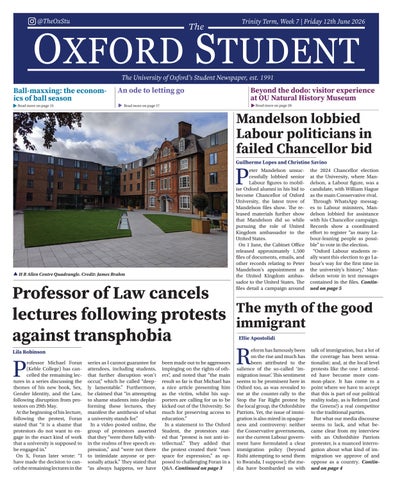
H B Allen Centre Quadrangle. Credit: James Brahm

Scan this code to listen to our weekly podcast on Spotify!
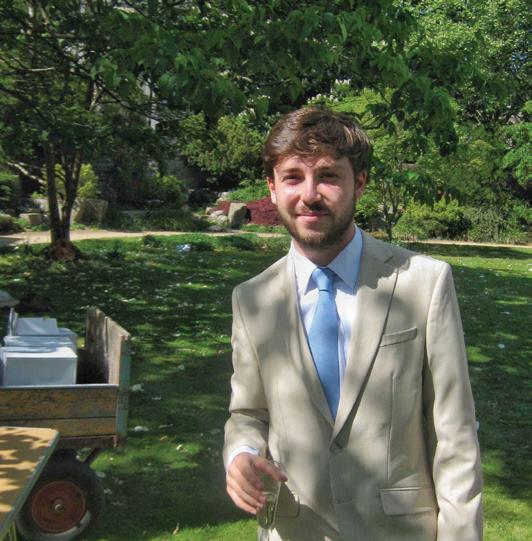
As Trinity draws to a close, and with it this academic year, so does my editorship. I rst contributed to the paper in Hilary of my rst year, with an opinion piece on how economics is taught. I then o cially joined this Michaelmas as a Section Editor, also branching out of the opinion section for the rst time and writing pro les. In Hilary, I had the pleasure of building up the new Business & Finance section, still one of my proudest achievements in student journalism. Now, as my tenure concludes, I look back with great pride in what has been one of the paper’s biggest terms in recent memory. I will, however, spare you a self-important

And that’s all folks! Our nal print of the year. As we wave goodbye to another academic year at Oxford, I warmly invite you to sit down and enjoy reading through these pages that our
list of accomplishments. Student journalism matters not because we’re going to change the world, but rather because it is in this environment that the journalists of tomorrow are created. Nowhere in Oxford have I found a set of people so truly and completely dedicated to what they are doing. It is this drive which I have seen in so many around me, and translates into journalists prepared to go into the real world holding the values of truth, ethics, and integrity close to heart. I may have allegedly neglected my degree ever so slightly, but it was worth it, and this print is the last piece of evidence of that. My personal favourites are a great news story on a showdown between protestors and a professor, as well as an insightful piece on the economics of Oxford balls. With that, dear readers, I say goodbyealthough I’m not done yet.

It’s the nal print! All at once, Trinity, my degree, and my time on the OxStu comes to an end. I joined the paper at the start of my third year, as Investigations Deputy Editor, and have been unable to leave ever since. My only regret is not getting involved sooner, but I am so grateful to have had the experience of working on this paper. e most important thing that I have gained from the OxStu is the desire to make a career out of journalism, for it truly is the most important thing and I have seen rst-hand how much it matters. At the start of term, breaking the story about Tommy Robinson being secretly invited to the Union, I saw just how much of an
talented team has been hard at work on. From Opinion articles on domestic violence within the football sphere, to Culture reviews of the rst-ever garden play shown at Green Templeton College and re ections on the weird and wonderful traditions here at Oxford, this print promises to be a worthwhile read!
You can also tune into our latest episode of our podcast, e OxStu Supplement, in which we discussed all things access with the Jesus College internet sensation, Matt Wil-
liams! I’m personally very proud to have witnessed the evolution and growth of this project of mine. Working with Gabriella (my co-host) and Catherine (podcast editor this term) has been a pleasure, and it’s been incredible to have met and interviewed so many fascinating people over the course of these past two chaotic terms!
I hope readers have enjoyed reading the prints from this term, and now we can all (nally) enjoy a long summer vacation away from the chaot-
impact journalism can have, and just how quickly this can unfold! It’s been a strong term for news, and I have loved being a part of investigating and breaking the biggest stories that truly matter to Oxford students, as well as the wider public. Unlike Gui, I am not being so sparing in listing accomplishments, because I feel like everyone deserves to shout about what they have done! Of course, I could not have accomplished everything without the help of such a fantastic team, who I have seen grow and accomplish so much. A special thanks must be given to Ellie Apostolidi and Guilherme Lopes, without whom the news that we have done this term would not have materialised. After some di cult decisions, I want to wish Ellie Apostolidi and Luke Erly (Michaelmas’ Editors-in-Chief) the best of luck - I know that they will smash it. Goodbye, it’s been a blast!
ic, frantic and non-stop bubble world where we attend university!
Here’s to another year of the OxStu – and long may this wonderful paper continue to providing fascinating breaking pieces, giving a platform and outlet for Oxford students at our university who want to use their voice for the good! Farewell (for now) OxStu - now it’s time for my year abroad!
Doing so at the end of the talk would place Foran “in the role of moderator [giving] him unfair power over our speech,” the protestors argued.
Suella Braverman, MP for Reform UK, has joined many on social media who are critical of the University’s supposed suppression of freedom of speech. In a letter addressed to
tached from reality.”
On 9th June, Lord Hague posted a video to X, in which he stated
Lord Hague, she wrote that “Professor Foran was doing precisely what universities exist to do: examining important legal questions, testing arguments and exposing ideas to scrutiny.” Furthermore, she states that this disruption “re ects a broader problem across much of higher education”, where “too many universities have become ideological bubbles de-
that “civil protest should be civil to other members of the audience as well as to the person who is exercising their freedom of speech.” On the cancellation of Foran’s lecture series, Hague asserted that he wishes for the remaining talks to be reinstated, and stated that both he and the Vice-Chancellor, Professor Irene Tracey, believe that to do so is “very important.” Hague hopes for this to be done in a way “that maintains the right to legitimate, respectful protest.”
Contrary to the claims made by Suella Braverman, he maintained that the “overall atmosphere” of free speech in British universities “is actually very strong.” Furthermore, he wrote that “Freedom of speech is a fundamental
academic freedom and it must be upheld. Equally, legitimate and lawful protest has an important place in university life”, adding that “the task is to maintain both.”
A spokesperson from Oxford University similarly a rmed the right to freedom of speech and legitimate protest: “Members of our academic community must be able to teach, research, speak and debate within the law, including on issues that are controversial or strongly contested. Equally, we support the right to lawful protest and civil disagreement.”
An Oxford University spokesperson said:
“Freedom of speech and academic freedom are fundamental to the Uni-
versity of Oxford.
“Despite interruptions by protesters at the start, the rst two talks in Professor Foran’s series proceeded and continued uninterrupted. We are concerned that the series will not now be completed as planned. e talks were being delivered alongside the publication of Professor Foran’s recent book, and the University will work with him to explore how the remaining events can take place.
e University remains committed to freedom of speech, academic freedom and respectful debate.”
Professor Michael Foran has been approached for comment.
Common Ground Cafe, on Little Clarendon Street, will reportedly be o ered a space in the University’s redeveloped building at 25 Wellington Square (whose back facade faces onto Little Clarendon).
In a document seen by e Oxford Student, a source familiar with the matter states that demolition is necessary, as retro tting cannot be done due to the building failing safety tests and being deemed unrepairable. Common Ground allegedly accepts this logic. According to the document not only will the cafe be allowed to remain in place until works begin, it
will also be o ered a location in the new building. What will happen to the community space during redevelopment is currently unclear.
Plans for the demolition and redevelopment of the building were led in January by Oxford University Development (OUD), a joint venture partnership between the University and Legal & General, a nancial services rm.
OUD manages and develops a large estate across Oxford. Its planning application to Oxford City Council outlined a two-phase redevelopment plan. e rst phase would mean
the demolition of the site Common Ground currently inhabits.
In comments to e Oxford Student, a spokesperson for OUD said “ e University has been pleased to support Common Ground by providing space at 37-38 Little Clarendon Street on signi cantly discounted terms as a temporary use since 2018, whilst the University prepared its re-development proposals for the building.”
However, OUD rejects that Common Ground’s future in the new building is certain. ey stated that “from the outset, this arrangement was time-limited and while the University recognis-
es the positive contribution Common Ground has made to the local community, there has never been a commitment to provide them with space in the new development.”
Further, OUD argues that in “seeking to occupy the space permanently,” Common Ground “undermines the basis on which it was o ered in the rst place and could limit opportunities for similar temporary uses in the future across the city.”
e spokesperson concluded: “We are continuing to assist Common Ground with their search” Read more online at www.oxfordstudent.com
Photo shared by the protestors. Credit: Valerie Mann
The myth of the good immigrant - insights with an Oxfordshire Patriots protester
Continued from Front Page...
After all, not all immigrants are the same and pretending like this is the case makes the creation of a coherent immigration policy difficult. Nowhere is this clearer than in Oxford.
When I interviewed one of the protesters on the Oxfordshire Patriots side one sentiment was clear: the speaker opposed “mass immigration” and “open borders.” In the interview, however, he was eager to note that he did not oppose legal immigrants who “come through the proper channels.” In my head I immediately thought: well, I am an immigrant here, and I came through a proper and legal channel based on these people’s definition, but I was only able to do that because of the EU’s open border policy between member states. Of course, being white and Christian (as the speaker reminded me in the language commonly used by far-right groups, I have “integrated” into British society), I do not get treated in the media the way other immigrants might. Yet, be-
yond stating the obvious that racism exists, I fail to understand how lumping all immigrants together and highlighting some big problem of immigration helps us when forming policy on the matter.
The problem is that “immigration” has become a catch-all term, which, more than anything else, serves a political need for the far-right to be the ones doing the agenda-setting. Without this issue, how is Reform meaningfully different to the Tories and why would people mass vote for them? Indeed, anti-immigration is the very basis of Reform’s political project; all other issues (housing, cost-of-living, unemployment, crime) are, in their rhetoric, inextricably linked to those who weren’t born here.
Yet, when politicians promise to “reduce immigration,” it is rarely clear which of these group of immigrants they are referring to - international students that pay exorbitant fees to keep our universities afloat? Healthcare providers that staff the NHS? Asy-
lum seekers? Economic migrants from poorer countries? It’s very easy to say Reform will stop all immigrants, but do we want that really? Some, like the speaker I interviewed, may say that we should keep the ones who contribute, but clearly our tiered immigration and visa situation is not working very well at the moment. It is hard to set concrete requirements (like a salary cut off, an education level, or a DBS check) for what “the good immigrant” is without inadvertently excluding some people we may want and including some of those whom we don’t. I want to be clear that I am not in favour of closed borders, but I also think that, if we are to confront the looming threat of Reform, we cannot sweep such conversations under the rug. We also ought to bring things back to the local level: it is clear that many of the people who oppose immigration feel strongly about their local communities and this is where the left ought to meet them. And though peculiar at first glance, it is no wonder that in my
interview, the speaker chose to highlight the local charity initiative of the Oxfordshire Patriots and stated that every Sunday the group gives food and clothing to the homeless. Interestingly, when asked about what he thinks the UK would look like under Reform (given that the group seemed to be endorsing the Party), especially the NHS, he answered: “I’m not a reform supporter - I’m actually more to the left,” stating that he is “a bit worried about Reform,” and highlighting his fears that they will pass through “tax cuts for the rich and benefit cuts for the poor.” He was also concerned about the future of the NHS under them. On a personal level, he states that while he is not aligned with any party at the moment, he liked the Blue Labour faction, referencing, in particular, Paul Embery (a columnist, trade unionist and author). His sentiment was that the left, oftentimes being middle class, do not understand the working class. Read more online at www.oxfordstudent.com
Graduation day highlights a double standard around Muslim religious attire
Every year, millions of graduates across the world proudly wear long robes, dark gowns, and mortarboard caps covering their heads. This modest attire symbolises academic achievement, intelligence, and scholarly tradition. Yet, in the same light, many Muslim women like myself grew up very aware that when we cover our heads or wear long black gowns (otherwise called an abaya), our religious or modest attire is instead seen as a sign of backwardness, oppression, or lack of education.
Throughout my life, I’ve heard the abaya be compared to bin bags, sacks and batman. During my first year, someone told me that it’s unbecoming for a person who studies at Oxford to also wear a hijab. They argued that in people’s minds, it is associated with lack of education and incompatible with intelligent decision making.
In my first term at Oxford, when I told someone where my grandmother studied, they responded with “Wait what? So she’s actually smart?” A year
prior, when filling in my UCAS forms, my sixth-form teachers were shocked that my mother attended university.
The broader stereotype persists that visibly Muslim women are less intelligent or less ambitious. Rarely do people consider, however, that with several European countries having imposed full or partial bans on the hijab in schools and/or universities, it is hijab-wearing Muslim school girls in Europe that are fighting one of the hardest battles to attend school. Ironically, maxi dresses and balaclavas, not much different from abayas and face veils, were not banned in most of these schools because they were not “religious” attire. Yet when Muslim girls simply wore maxi dresses or even skirts deemed too long by teachers, they were interrogated and sent home; in many cases expelled.
But come graduation day, society has no problem associating (black) covered clothing with intelligence when it is called “academic dress”. In fact, expectations that modest cloth-
ing be worn in professional, and respected spaces and occasions such as graduation days, or before a judge in the courtroom, are commonplace. But it seems that it is only when Muslim women wish to wear black gowns or head coverings, that we are scrutinised, especially in places of education. When I was ten years old, Of-
sted was questioning visibly Muslim primary school girls across Britain, in front of their teachers and peers, on why they were wearing the hijab. Not long ago, I was questioned by a family member on whether I still wear a hijab now that I study in Oxford.
Read more online at www.oxfordstudent.com
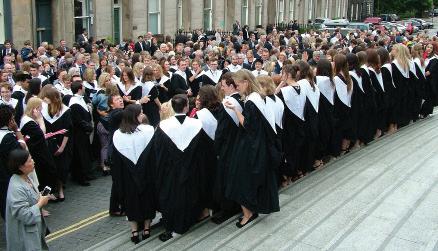
Graduation Day. Credit: Peter Evans
Saba Ahmadzadeh Noughani
Mandelson unsuccessfully lobbied Labour politicians to mobilise Oxford alumni for Chancellor position, files reveal

He sent several WhatsApp messages in this vein to various Labour politicians, including Torsten Bell, Stephen Doughty, and Georgia Gould in August 2024.
Prior to the registration deadline in August, he wrote: “We need as many Labour leaning people as possible to register. Could you please have one last think about anyone in your networks who might be eligible and might not yet be registered, and forward them this link?” On 11th August, Mandelson wrote that “[n]ow that voting is online we have our first real shot for a Labour figure to win.”
The tenor was echoed by Labour Oxford students who campaigned for Mandelson. One Labour student told The Oxford Student in 2024 that the Chancellor role “has almost always been dominated by Tory politicians,” although online voting meant that there was “a real chance for alumni to send a message and stand up for students.”
A source involved in Oxford University Labour Club (OULC) at the time (MT24) told The Oxford Student
that “OULC carried out no campaign actions in the election period. Given that there were two Labour-affiliated candidates in the race, OULC offered both campaigns the chance to promote events and articles” through their social media channels.
As a club, OULC did not formally support Peter Mandelson’s bid to become Chancellor. Our source stated that students were broadly aware of the controversies surrounding Mandelson, “although differently for different people. People were not aware of the extent of the Epstein link.”
According to a source familiar with the campaign who spoke on the condition of anonymity, Mandelson was generally “insecure” and “self-deprecating” during the period. He reportedly told students that the La-
“ Mandelson was generally “insecure” and “self-deprecating”
bour Party “hated him.”
Throughout the campaign period (September-October 2024),
ter Mandelson was interviewed at the Oxford Union, just weeks before voting commenced. Then-President Ebrahim Osman-Mowafy told The Oxford Student that he “reached out to all the campaigns - an open invitation to all leading candidates to come speak at the Union.”
In his message to Streeting, Mandelson refers to Osman-Mowafy as a “for Labour supporting President,” a categorisation that the latter contested – “if by Labour you mean the Mandelson wing, then absolutely not.”
Bernard
wins 2026 Corpus tortoise race
Mandelson was offered and took up a room at St Catherine’s College, although the College clarified “accommodation was not provided for campaign purposes.” The Oxford Student understands that he also used the Senior Common Room, made possible by Mandelson being an Honorary Fellow of St Catherine’s. In comments to The Oxford Student, the College clarified that it “did not provide facilities to support his Chancellor campaign.”
“ Mandelson wrote to Wes Streeting [...] asking him to “consider speaking at the Oxford Union”
On 1 September 2024, Mandelson wrote to Wes Streeting, then Secretary of State for Health and Social Care, on WhatsApp, inquiring whether Streeting would “consider speaking at the Oxford Union again in their no confidence in the government debate on October 17?” Streeting declined due to a scheduling conflict.
On 15 October, Pe-
Osman-Mowafy added that the Union had already confirmed several Labour speakers for that term, and that “Mandelson did not help organise any of this.”
According to Osman-Mowafy, Mandelson volunteered in a standard pre-interview phone call that he knew Wes Streeting, and that he’d follow up on the invite the Union had already made to Streeting. The former President stated that he did not hear back from Mandelson on this matter.
Indeed, Osman-Mowafy stated that he believed Mandelson was “clearly very angry” following the interview; “He had expected this to be a friendly thing.” During the event, Mandelson was asked about having allegedly stayed at Jeffrey Epstein’s home during the latter’s prison sentence in 2008. Epstein pleaded guilty to state charges in Florida, on one count of soliciting prostitution and one count of soliciting prostitution from a minor.
On the confrontation, Osman-Mowafy claimed that “one of the only occasions where he [Mandelson] was actually asked about Epstein was in Oxford, by students, at the Union, just weeks before the Chancellor election.”
On 18 November 2024, the start of the final-round polling week for the Chancellor election, Mandelson handwrote a letter to David Lammy, then-Secretary of State for Foreign, Commonwealth and Development Affairs, urging Lammy to appoint him as the United Kingdom’s ambassador to the United States.
The text reads: “As today (and all week) is polling day in Oxford and I am returning to London, I wanted to drop you a line, personally, about Washington…I just wanted you to know that if you were minded to appoint me I would make sure you never regret it…For me, it would be the last thing I do in public life and it would be a huge honour to serve you and the government in this role. So if you are up for it, so am I.” Mandelson ultimately placed fourth in the Chancellor election, losing to William Hague.
Months later, on 10 February 2025, Mandelson was appointed as the British Ambassador to the United States. He was dismissed on 11 September of the same year, amidst further revelations of his connections to Jeffery Epstein.
Two months later, Mandelson resigned as Honorary Fellow of St Catherine’s College. Read more online at www.oxfordstudent. com
Bernard the Tortoise won the 2026 Corpus Christi Tortoise Race on 7 June, emerging victorious from all three sub-races.
Although the event traditionally consists of a single race, Corpus Christi porter James Serjeant introduced a last-minute “best of three” format after Bernard won the opening round in approximately 10 seconds, thanks to a smaller-than-usual lettuce ring around the contestants. Bernard is owned by Corpus Christi Bursar Mr Luke Webster and is thus considered “Corpus-adjacent,” according to Corpus tortoise keeper Vivi Alabaster. Corpus Christi’s official tortoise, Foxe, also competed in the 2026 race, having won the 2013 and 2025 iterations.
Asked whether Bernard’s victory should be counted as a win or loss for Corpus Christi, Alabaster explained: “Bernard and Foxe are brothers-inarms. For tortoise races, it’s them together against everyone else.”
Tortoises Wendy from Balliol, Kale from Nuffield, and Truffle from Regent’s Park rounded out the field.
The race, first held in 1974, has become one of Oxford’s more idiosyncratic Trinity term traditions. It forms a key part of Corpus Christi’s annual Tortoise Fair, a charity event in which tortoises from across Oxford colleges compete to be the first to reach a lettuce-lined finish and students sell tortoise-themed goods. The fair produces suitable reward – the 2026 event raised £5,700 for the Royal Society for the Prevention of Cruelty to Animals (RSPCA) Oxfordshire.
Credit: UKinUSA, CC BY-SA 2.0
Christine Savino
Continued from Front Page...
Content warning: domestic violence, abuse
Flags are out, pubs are open, shirts are on sale, and the question on everybody’s lips: can England nally bring it home? e ree Lions are set to kick o their World Cup campaign on 17th June in Arlington, Texas, with hopes of making it out of group L and all the way to lifting the trophy for the rst time since 1966. As the tournament gets closer, you can feel the anticipation, the hope that this year might be England’s year. It’s exciting, the possibility ofnally tasting international victory and uniting the country with a more positive cause for patriotism. But I have to question whether all the excitement is worth it when the very realistic prospect of los
ing turns some football fans’ enthusiasm into unthinkable violence.
Research by Lancaster University shows that domestic violence cases increase by 26% every time the England national men’s team plays, with this gure increasing to 38% if the match ends in defeat. While this study was initially published in 2013, a more recent report by the National Centre for Domestic Violence corroborates this, and research performed by the BBC following the last European Championship in 2024 revealed 351 incidents of football-related domestic abuse recorded by Police across England and Wales during the tournament. Furthermore, these gures only re ect cases that have been reported by survivors and recorded by police forces, meaning the numbers are likely much higher than they seem. Rise UK esti-
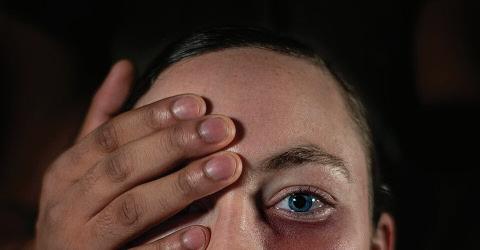
mates that only 24% of domestic violence crimes are reported to the police, due to factors such as fear, shame, or worries that reporting will worsen the issue.
Of course, this isn’t to say that everyone who watches England lose a match will turn violent, or indeed even that football causes domestic abuse. ose who perpetrate domestic violence make the choice to do so, and the sport should not be used to hide behind. But it is hard to ignore

e ideal Oxonian prizes reason above all else. ey ought to evidence their opinions robustly, employing the art of logic to navigate counterarguments whilst also leaving ample room for concession. Positions must be well-defended, yet not in exibly held. Discursive spaces, ranging from tutorials and subject societies to the Oxford Union, should in theory provide genuine opportunities for either side to convince the other of its merits – in-
tending to create good-faith conversation, not entrench existing divisions. Whether or not this standard is consistently upheld in practice, it is nevertheless one which students strive towards. Reason and argument are central to Oxford degrees across STEM and the Humanities alike. Is there anything wrong with such norms of debate? ey seem entirely ‘rational’ on paper – any reputable institute of higher education surely works to make its students better thinkers. Reason, when appropriately wielded, can over-
the heightened risk factors of excessive alcohol consumption, intensi ed emotions and an unruly crowd in which frustration and testosterone swarm.
During some of the more recent international football tournaments, domestic abuse charities have run campaigns to raise awareness of the crisis and provide support to those who need it. Women’s Aid’s ‘No More... Read more online at www.oxfordstudent.com
come the starkest of communicative barriers. It bridges gaps fostered by polarisation and irreconcilable ideological di erences, forcing individuals to confront biases and assumptions held on unsound grounds. Rational discourse is, in principle, intellectually good and societally crucial. My issue lies not with the vital concept of reason itself, but rather what it is commonly con ated with in Oxford and its academic circles: the performance of reasonableness. To be perceived as ‘reasonable ‘, is to be politically pliant. It is to cede as a rule, to arti cially water down convictions so that they converge to some arbitrary ‘centre’. e concept hinges on calculations of agreeableness, and maximising convenience. is is fundamentally distinct from reason.
To help visualise this di erence, imagine your ve-year old self. A teacher has promised you a packet of sweets for exceptional behaviour, yet decides at the last minute that you are to split it with a frustrated classmate. Any protestations are met with the claim that it is unreasonable to
Twelth of June is a highly in uential date in global history. Today, many celebrate Philippine Independence Day, commemorating the 1898 declaration of independence from Spanish colonial rule.
In 1942, Anne Frank received the diary that would later become one of the world’s most famous personal accounts of the Holocaust, on her 13th birthday.
In 1964, Nelson Mandela and several fellow anti-apartheid activists were sentenced to life imprisonment in the Rivonia Trial.
In the United States, in 1967, the Supreme Court’s decision in Loving v. Virginia unanimously struck down state bans on interracial marriage, a landmark victory for civil rights.
In 1987, U. S. President Ronald Reagan delivered his famous Berlin speech saying, “Mr. Gorbachev, tear down this wall!”
hoard sweets, and entirely reasonable to share with an upset fellow student. Yet this appeal is not inherently one of logic. ere is an entirely concrete argument for why you are entitled to the whole pack; your refusal is not irrational, but rather socially inconvenient (and therefore, perceivedly unreasonable).
As a woman, and admittedly one with oftentimes solid-left politics, there are two levels at which I notice this conceptual misconstruction of reason occur. e rst relates to undue presumptions of logicality which tail centrist takes on contentious topics. e second concerns the deeply selective accessibility of ‘performed’ reasonableness itself, and how this shapes perception bias.
If asked to consider some of today’s de ning political issues – abortion rights, trans rights, immigration, Palestinian statehood – many of us students are undoubtedly reminded of some spirited conversations. e most unscathed participants of such debates tend to be those ... Read more online at www.oxfordstudent.com
Credit: Michael D Beckwith via Wikimedia Commons
Credit: Sgt. Apolonia L. Gaspar via Wikimedia Commons



The story of how jazz entered the education system is an interesting one. It not only narrates the process in which it became something taught in front of rows of students, but it also depicts the changing attitudes towards jazz itself. Before its envelopment into institutions in the mid-twentieth century, jazz was predominantly an “urban genre”, with players and listeners living and working near each other. Older, established musicians passed this music down to their younger peers, who were motivated to pick up an instrument and follow the “leader”. Jam sessions played an important role in the localised education process, helping to establish and maintain core jazz repertoire as well as performance and

behavioural guidelines. With the introduction of recording technology from the 1920s and ‘30s, records, tapes and CDs not only acted as physical texts of jazz, but they also served as the pre-eminent textbooks of the music and facilitated the learning process.
us, before its institutionalisation, jazz was seen as a ‘natural expression’ of performers, passed mysteriously between people. Especially since the twentieth century was characterised by notated music, jazz, which did not have this characteristic, was something of an enigma. But perhaps more importantly, it was seen as a genre that came from and almost belonged to the African American population. It was seen as something that came from a unied and synchronised ‘voice of the people’.
e 1930s was the era in which things started to
change. Along with the growing use of recording technology, jazz-related method books and teaching studies such as DownBeat magazine began to be published. ere was an increasing professional and commercialised jazz performance environment as well, exempli ed through the popularity of big bands at the time. Because of the contemporary environment, North Texas and Berklee facilitated the early onset of jazz programs in the 1940s.
But perhaps the biggest turning point in jazz education’s history was in 1953, when George Russell published a pamphlet called e Lydian Chromatic Concept of Tonal Organization. Widely regarded as the rst major contribution to the eld of jazz music theory, it took the world by storm. Why? Because it was a theory which showed musicians how to improvise. Prior to this develop-
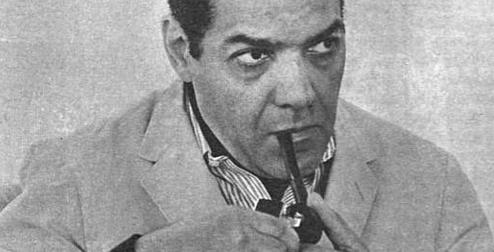
ment, jazz improvisation was conceptualised as something based on harmonic chords and, crucially, it was seen as something natural, something which owed uniquely from certain virtuosos. With the creation of a theoretical framework, jazz education could now be viewed as a movement, as it had the tools to enable large-scale instruction. All it needed now was acceptance and inclusion into music academia. is started o as an increase in the number of university jazz bands in the 1960s and
‘70s, combined with student protest movements regarding the inclusion of non-Western and popular musics.
In 1967, the Tanglewood Education Symposium addressed the validity and perpetuation of American jazz education programs by re-evaluating the central philosophies and practices that governed music teaching, leading to the implementation of more jazz schools and curricula throughout the US.
Read more online at www. oxfordstudent.com
I am of heavy feet, dragging across vast lands.
I am of restless people, who do not sleep, even in stillness, even in peace.
Shoulders bear the sweetness of memory: Portable as a prayer, heavy as a solemn secret , light as rising ash, warm as the low lament of a duduk, in nite as the folds of dolma.
It’s a so kind of heavy that one does not mind -- y far and wide carry these memories home but sleep my sweet nightingale
Read the full poem at www.oxfordstudent.com
A stalk coils around a citadel I heard it reaches heaven –– each sprig, a ngerprint that traces things not yet shared. If you sing to it, pomegranates appear staining like henna tracing ngerprints, tracing sprigs.
What were the lyrics? I swear I remember.
e ascent is picked and axed, With steps crumbling into fragments of stone. Red stains, feet slipping on edges, begging to sever coils.
Yet I see them climb, in the name of promised warmth; a claim to roots.
Read the full poem at www.oxfordstudent.com
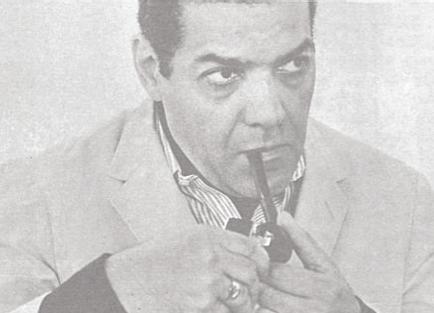
George Russell, American jazz artist. Credit: Suomen Kuvalehti
Iconic, magnetic, mesmerising – just some of the adjectives one could use to describe Marilyn Monroe. Reams have been written about her life and character on and o screen; the various faces of Marilyn have been interrogated, juice squeezed from every morsel of information about her private life and psyche. I won’t claim to o er a new perspective on the star’s tumultuous trajectory, but a brief and inexhaustive walk through Monroe’s onscreen portrayal might serve as a humble gesture to commemorate the 100th birthday of one of the most in uential women of the 20th century. Hollywood rarely gave Marilyn the opportunity to display the full breadth of her talent. Although she did take on more serious roles, the image
of her as the “dumb blonde” has crystallised posthumously. But even between the ditzy personalities she plays there are subtle di erences that might shed some light on her position in the lm industry of the 50s and 60s, her significance as a sex symbol, and serve as perhaps even more of a testament to her ability as a performer.
To prepare for this article, I rst watched Henry Hathaway’s Niagara, a 1953 noir that features Marilyn in one of her rst big roles. Femme fatale Rose Loomis plots with her lover to kill her older, neurotic husband George (Joseph Cotten). e beginning foreshadows the lm’s dramatic climax – the credits roll in blood red set to ominous string music, shots of Niagara Falls come crashing down, a metaphor for (sexual) passion, made obscenely clear by the lm’s poster that brandishes Marilyn’s
Do not be fooled by the promotional imagery. e butter ies and silk and general air of theatrical mischief suggest a romp. What you get instead is something considerably more interesting: a portrait of a man who was, depending on your perspective, either a veritable visionary or a disaster, and quite possibly both at once.
Madfabulous tells the story of Henry Cyril Paget, the 5th Marquess of Anglesey, who inherited a fortune worth roughly £200 million in today’s money and spent it on butter y balls, theatrical productions, and yards of luxurious silk, before dying penniless of tuberculosis at twenty-nine. Director Celyn Jones treats this not as a cautionary tale but as a love letter to a man born in entirely the wrong
century.
What makes the story resonate so deeply in 2026 is how urgently modern Henry feels. In an age that prizes authenticity above almost everything else, here is a man who lived those values a hundred years too early, at an enormous personal cost. One thinks of David Bowie dissolving the boundary between costume and identity, or Elton John reaching for the feather boas and platform boots as an act not of vanity but of de ant self-expression. Henry Paget belonged in that tradition. e tragedy is that he lived in an era with no framework for him. Today he would have an audience. en, he had only creditors.
Callum Scott Howells, best known from the television series It’s a Sin, carries the lm with extraordinary delicacy. Henry is fragile, childlike, and desperately in need of a father’s approval that never arrives. e lm’s most quietly devastating scene has
body, awash with the water from the Falls above the line ‘a raging torrent of emotion that even nature can’t control!’. Marilyn plays Rose with cleverly feigned disquiet. Her slippery character and a ected cluelessness are key instruments of her sexuality. Marilyn’s curves disrupt the quiet monotony of the 1950s American domestic idyll; she is incompatible with the cookie-cutter, nuclear family mold. Her presence on screen embodies uncon-
trolled desire, irrationality, a fantasy threatening to domestic functionality.
As in all of Marilyn’s roles, her sexuality is customised and enhanced by clothes. Rose’s cinching gowns accentuate her voluptuousness – enjoyed by men, revered and observed with some apprehension by their wives. e meticulously curated, almost theatrical out ts re ect the arti ce of their wearer. Read more online at www. oxfordstudent.com

Henry alone with a mirror, talking to his own re ection: a man performing even for himself, because there is no one else left to watch. Howells does not overplay a single beat of it. at vulnerability is also what made the real Henry so easy to prey upon. His French valet stole jewellery worth £50,000 in a single evening while Henry attended a theatre premiere, later claiming to have acted on the instructions of a woman who disappeared to France and was never found. Beyond outright theft, Henry was surrounded by merchants, theatre managers, and hangers-on who
recognised a soft target in an isolated, trusting young aristocrat. By 1904, his debts stood at £544,000; everything was sold, down to a parrot in a brass cage. e lm makes clear that Henry was not simply reckless, but genuinely vulnerable.
e butter y dance is the lm at its most ravishing. Swathed in owing transparent silk, Henry becomes briefly transcendent, less a man and more an idea of freedom. Dan Baboulene’s score carries him there with complete conviction, pulling 1890s ragtime and brassy jazz through the sinew of a full philharmonic orchestra until it becomes something that belongs to no particular era at all. e precisely right register for a man who belonged to none. Rupert Everett, as the loyal butler Gelert, turns two hours of studied restraint into a single electrifying moment of barely contained fury. Read more online at www.oxfordstudent.com
Marilyn Monroe in ‘Niagara’. Credit: 20th Century Fox
Everything Hungarian you may have missed in Biedermann’s ‘Lázár’
Ivett Berényi takes a deep dive into Swiss author Nelio Biedermann’s epic of a Hungarian aristocratic family
Nelio Biedermann’s Lázár was originally published last year in German, with Jamie Bulloch’s English translation hitting the shelves this year. The novel was met with immense critical acclaim with both The Sunday Times and The New Yorker calling Biedermann a “wunderkind” in their review headlines. Indeed, for an author aged twenty-three, this novel is a remarkable achievement. However, as a Hungarian, I assume that a number of readers in my homeland would be focused more on two other aspects. Firstly, we are clearly intrigued by the surname serving as the title. Secondly, it references Biedermann’s heritage as a young man living in Switzerland, with Hungarian heritage on his paternal line. Hungary and Hungarian authors have been making serious waves in Anglophone media over the past year. In 2025, Dávid Szalay won the Booker Prize and László Krasznahorkai the Nobel Prize for Literature, making the latter the second Hungarian Nobel Laureate in this field after Imre Kertész’s win in 2002. In terms of heritage alone, Biedermann is perhaps closest to Szalay, an author born in Canada to Hungarian parents and brought up in London. While perhaps nationality should not be a factor in literary reviews, I feel a mixture of intrigue and scepticism as I open books about my home written by authors living away from it.
Even so, a particular passage compelled me to review Lázár through a Hungarian lens. As the blurb will tell you, we are following an aristocratic Hungarian family, whose fortunes acquired and maintained during the dual monarchy sharply decline under Soviet rule. First we meet Sándor and Mária von Lázár at the birth of
Lajos, with Ilona already present as the elder of the children. Lajos grows into the protagonist of the novel, marrying Lilly, who gives birth to Pista and Éva shortly after they marry. It is this family who experience the burdens of writing history. It is precisely this aristocratic lineage which gives rise to the novel’s most striking and folklore-filled imagery, including a peculiar, magical child, and, importantly, an enchant-
“ History, and those who seek to write history, negate the power of poetry and lyrical prose.
ed forest. Biedermann needs such a family to create the forest – it, obviously, belongs to the Lázárs. Similarly, since they are aristocrats, they will, obviously, go hunting in said forest. With that proximity established, Biedermann may then illustrate the haunting and threatening potential of nature, so close to the heart of the family. Indeed, the forest “swallowed” Sándor von Lázár’s father, “killed his mother and driven his brother mad”. While this sequence of events may apply to any folklore, here we have a “dead stag”. It is absolutely crucial that the forest “let the stag run until it collapsed outside the music room with its large windows”.
The stag is not simply Biedermann’s harbinger of death; it is a stab in the heart for Hungarian readers. Any child who grew up in Hungary would have encountered legends about the csodaszarvas, rendered in a translation as The Legend of the White Stag. The stag in this
legend leads the sons of Nimród, Hunor and Magor (folkloric forefathers of the huns and magyars), into a seemingly fruitless hunt. They fail to capture the stag yet discover a land of peace and plenty. With the imminent death of Nimród, the sons realise they must expand, migrate, discover lands which may accommodate their offsprings and a new society. Hunor and Magor return to the bountiful land, marry two women (with the question of consent uninterrogated by the tale), and establish a new society. This tale fosters our narrative of honfoglalás, or the migration of ancestral tribes from Asia to the Carpathian basin, to the land destined to be our home.
Killing a stag in a tale concerning Hungarians disrupts the line of history both in temporal and geographical terms. Without the stag, we are frozen within the historical narrative of how we arrived in Europe. Without the stag, we are homeless with no viable direction and destination. Without the linear migratory tale embedded in the stag-hunt, we become vulnerable to rupture, instability, and chaos.
Those adjectives are fitting descriptors of the horrors twentieth-century wars brought to Europe. While WWI does not rattle the family to a great extent, WWII and the Soviet occupation expand and dramatise stylistically a sentiment linked to the Lázárs’ haunting forest. After a traumatic accident Ilona experiences there, she cannot articulate what had happened because her mother tongue, “full of symbols and metaphors, linguistic gems and verbal flourishes does not allow such a tale to be told. Trauma throttles language and style in the novel. In no other character is this more painfully and dreadfully de-
picted than in Lajos himself. At first glance Lajos is “this wrinkled, pale-blue and bloated creature”, a peculiar child who bonds easily with his even more peculiar uncle, Imre. He had the potential to be the peripheral figure, who holds the picture together and thus to negotiate the central role of the patriarch. The peculiar child, often with blue eyes, is a common motif in Hungarian folktales (especially rise narratives), although some aspects of his character are also evocative of the Irish and Scottish changeling lore.
So, what is it that makes Lajos particularly Hungarian? To make that argument we must turn to Biedermann’s use of history for his novel. While Lajos has the potential to be subversive, to be different, considering his presentation as a strange and inexplicable child.
However, in the midst of World War II, the narrator says: “The time for poetry was over.” Nowhere is this sentiment
“ exposes the fallacy of believing that synthesis to be possible
more acutely painful than in Chapter 33: “Lajos looked after organisational matters.”
This sentence is repeated three times before the narrator clar-
ifies: “The Jews had to be listed, labelled, stripped of their rights, expropriated and ghettoised.”
The symbols and folklore surrounding the Lázárs’ manor and forest must break down because Lajos chooses to be complicit in the Holocaust. His peripheral position is shattered as he is brought to the centre of a system which carried out a genocide in Hungary, and in Europe at large. In that way, he does not deserve the privilege of semiotics and stylistic ornaments. In that way, folkloric meaning is subsumed under the rupture, instability, and chaos of history. Perhaps unbeknownst to Biedermann, this stylistic and narrative shift may be neatly paralleled with Sándor Márai’s ‘Mennyből az angyal’ (‘Angel from Heaven’).
Although here it is the oppression of the Hungarian Uprising of 1956 that Márai sets out to capture, it is nevertheless resonant with the horrors of WWII. He reworks a popular Christmas ballad – one which most kindergarteners in Hungary must learn – and thus demonstrates the conflict of poetry and politics. In the 20th century, as in Lázár, these two elements become a confusing mixture, dark materials which God himself cannot ordain into new worlds, into order.
Read more online at www. oxfordstudent.com
The white stallion. Credit: Flocci Nivis (Wikimedia Commons)

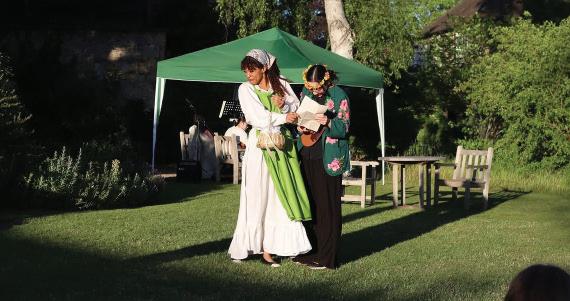
The garden play is an Oxford Trinity Term special, and yet not every college offers one. Or rather, not every college offers one, yet. Hoping to start a new tradition at Green Templeton College (GTC) this weekend – staging As You Like It in the college gardens – I caught up with the producer Kapil Narain and director Fitzroy ‘Pablo’ Wickham. After convening at the Schwarzman Centre only a stone’s throw away from GTC, they greet me with big smiles as we settle down to discuss.
Since this is their first garden play, I inquire with Kapil why now is the time they have decided to bring the tradition to GTC and how he has become the standard-bearer. He tells me he

Holywell
Ivett Berényi on Krúbi’s
‘Pirates of the Hungarian Sea’.
is simply passionate about drama in general, and while indeed he watched various garden plays last year, he looked around his own college and realised they did not have the same opportunity. “GTC just didn’t have anything there, when we have loads of people who love theatre – I thought let’s get something going!”.
Of course, he adds, it ended up being slightly more complicated than this, but his motivation and college cooperation was able to carry it through to actuality: “I did have to think of all the steps and processes of starting something new, but luckily college is so supportive and we soon got a full team, crew and cast”.
A part of this was selecting similar theatre-enthusiast
On 10th April this year, two days before the general elections in Hungary, activist and public figure Róbert Puzsér organised an anti-Fidesz musical event (rendszerbontó nagykoncert), with some of the biggest names in the Hungarian music scene, including Azahriah, BetonHofi, Carson Coma, Dzsúdló, and Krúbi. It was centred around polgári ellenállás, or the resistance of citizens. Although not explicitly aligned with the now victorious Tisza party, the event shared with Prime Minister Péter Magyar the emphasis on the people. It was our responsibility to vote Fidesz out of power. Contemporary music became a crucial tool of mobilisation among the Hungarian youth.
I must highlight that neither of the artists listed above
‘As You Like It’: Green Templeton’s first play
An interview by Flóra
Pablo as director, who may be at St John’s College, as opposed to GTC, but this actually leads him to appreciate the GTC gardens as a particularly unique space. He tells me that in his first tour of the premises, he sensed that the gardens lend themselves to a natural playing space, “so many colleges have beautiful gardens but they end up being not so good as a stage space. GTC has so many creative elements that can be incorporated seamlessly, so much going on with entrances and exits, for example – it is not another boring quadrilateral!”. This is the first time he mentions college Head Gardener Michael Pirie for his work and partnership; his name keeps popping up in admiration and appreciation as we continue our conversation.
needed Magyar’s voice to express their anti-Fidesz and anti-establishment sentiment. Important songs of this era include Azahriah’s ‘utema,’ ‘cipoe,’ and ‘four moods (pt. 2),’ BetonHofi’s ‘Be vagyok zárva,’ and Mehringer’s ‘Szar az élet.’ Due to restrictions of scope and breath, the focus of this article is narrowed to Krúbi and his most recent album, Pirates of the Hungarian Sea (originally Magyar Tenger Kalózai, and referenced as PHS henceforth). Released on 13 March 2026, PHS’s ‘Államhajó’ (more on the title and the song later) became Krúbi’s choice for Puzsér’s event.
This album marks a significant point in the contemporary history of Hungarian rap, and in Krúbi’s discography. It registers the acute political tension brought
Molnár
Sticking with Pablo, I ask him why he decided on Shakespeare’s As You Like It for this inaugural production. To my surprise though, he reveals that it was Kapil who chose the play, as GTC’s garden play originator and thereafter searched for a proper crew including director. Kapil blushes and tells me it was a big decision; he initially found a group of passionate students and at first they considered doing a series of short plays.
But, the more he thought about it, the more he realised that never having done a garden play (let alone any play at the college) before was the very reason to go big: “this is our first production, let’s do a full, serious play!”. A “full, serious play”, of course, equals Shakespeare. As an English Literature student, I could not agree more.
about by Fidesz’s weakening grasp on the country as well as Krúbi’s wavering control over fame, influence, and even his identity. While I do admittedly lack knowledge and terminology about the technicalities and music production, I have always been attentive and appreciative of songwriting, finding resonance and power in those words despite the actions of our previous oppressive government. Public politics and explorations of the self have been inextricable in Krúbi’s discography. However, no album has been as holistic and self-referential across its songs as PHS, forming and insistently reforming the seafaring and pirate imagery, subsequently establishing and unsettling political and social commentary. These semantics are intro-
I can also immediately see why As You Like It lends itself particularly to outdoor production, with a forest setting making up a large proportion of scenes.
Kapil adds that As You Like It emerged as a perfect choice being one of Shakespeare’s not unknown but not-too-frequently performed plays, “it straddled the balance nicely”.
It turns out that Pablo too, despite not having meditated with As You Like It for too long before being brought on board (“what’s your vision… well I don’t have a vision” he jokes was what the experience was like) is closely familiar with Shakespeare, including having acted in The Two Gentlemen of Verona directed by Sir Gregory Doran at the Oxford Playhouse. Read more online at www. oxfordstudent.com
duced in ‘Kapitány’ (‘Captain’), where Krúbi’s central purpose is to form an image of himself as captain, utilising familiar motifs such as the speaker’s heartache. What is compelling to me about the opening number is the subtle layering within the semiotics of captain. On the surface, we have an artist struggling to write “humble songs” (“szerény dalok”) and one who lives for himself yet is ready to die for his crew (“csakis önmagamért élek, de a legénységért halok”). Implicitly, such a figure reminds the listener of charismatic Hungarian leaders (as true of Orbán, albeit in his younger years, as of Magyar), prompting us to question our adoration of any influential and compelling public figure.
Read more online at www. oxfordstudent.com
Green Templeton garden play. Credit: Sophia Yvonne Hall
Extending the ladder
Lennon Airey reflects on the need to increase representation from the North East.

At the end of the day, what’s the point? These universities are too expensive, too pompous and I wouldn’t fit in there, especially being from the Northeast. That’s without talking about how I’m just not actually that clever in comparison to other applicants. I may as well not bother…
That sounds defeatist and negative. That dialogue, however, was all too real for me. It is the exact text message that I sent to my best friend Grace only months before applying to the University of Oxford.
“ That sounds defeatist and negative. That dialogue, however, was all too real for me.
I’m glad I didn’t listen to myself, because I got in. I don’t know exactly what got my application over the line in the end, but I do know one thing for sure:. I only got in because I applied so there was an ap-
plication to assess. But my decision to apply isn’t common, and those questions I started with loom too large for some state-school students in the North East of England and they follow my initial advice:, they don’t bother.
There is a confidence barrier in the North East of England in applying for top universities. Time and time again last year, Grace and I spoke to talented students from the region who didn’t feel like they would fit into a top university, and didn’t feel like they had the academic credentials to boot.
I remember sitting opposite my mam at the kitchen table in the summer before I applied to Oxford. We got talking about the application process that was fast approaching and we were sat reading a provisional draft of my personal statement. For me, an application to Oxford was a shot in the dark; I was the first in my family to apply to university, and it was only after a conversation with my History teacher that I had even considered Oxford as an option. As we were reading through the personal statement, my mam stopped and said, ‘You’re going to do this, aren’t you? You’re going to get in.’ I looked up and saw my mam starting to tear up.
sities in the North East. I also won’t accept that there isn’t talent and academic drive in the region either. StateElevate matches that desire and drive and has a concrete plan to turn the aspirations of students into a reality, because I know the difference that attending a top university can make.
It was at that moment that I realised that this application wasn’t just my application – I was carrying the hopes of my family with me. Me getting into Oxford was to be their success too, and, from that moment, I was more motivated than ever to get in.
It was a simple conversation with my mam that motivated
“ That problem runs far deeper, and it is one word: confidence.
me to put my all into the application. It was having someone throw their belief behind me that made me believe in myself. I know how strong the pride is in working-class families in the North East, built around the simple desire for children to do better than their parents. It is not for the lack of belief from families, nor is it the lack of ambition and hunger among the students that prevents them from applying to top universities from stateschools. That problem runs far deeper, and it is one word: confidence.
I won’t accept that there isn’t a desire to attend top univer-
Attending Oxford has changed my life. Surrounding myself with some of the brightest minds in the country, being taught by the best tutors and being surrounded by incredible buildings are just some of the examples of what brilliant universities can offer. For me, however, it’s in the doors that have opened since I started my journey with the university. Since starting, I have received awards, achieved academically and made a name for myself as a ‘gobby northerner’, but it has developed so much more in me. Oxford has transformed me from a state-school student who felt out of his depth heading to university into a confident public speaker, someone who puts themselves into uncomfortable situations and someone who has formed views about the world with the ability to put them into action. I want more students from the North East to have that same opportunity.
I always felt my upbringing was normal. Built around family, sport and a good comprehensive education, my upbringing was one that instilled pride in where I came from. It was attending Oxford that made me realise that my story from a northern comprehensive school was anything but normal: it was the exception.
I was mortified to see the lack of representation from the North East of England at Oxford, an experience that Grace also experienced at the LSE. There wasn’t an absence because students from the South are cleverer than students from the North East. Far from it! It’s because state-school students from the North East don’t apply. As per the University of Oxford’s own statistics, only 2.5 percent of all students admitted to the university between 2022 and 2024 were from the
North East. This statistic may appear shocking, given that the region is only a four-hour train journey away. The statistic is less shocking if we look at the application rates from the North East, which stands at just 2.2 percent. The university admission process is not the problem here; the problem lies in the North East itself.
But it doesn’t have to be that
“ A 2.5 percent acceptance rate simply isn’t good enough for a region with the heritage, pride and passion of the North East.
way. That’s why Grace and I started StateElevate. StateElevate harnesses the skills and aspirations of state-school students in the North East of England and transforms that ambition into opportunity. It’s about investing time into students, with no financial cost. It’s about building connections between students in the North East of England and high-achieving professionals and undergraduate students. It’s about instilling confidence into students and making sure that the structural confidence barrier is broken for good. In short, Grace and I turned our own challenges in applying for top universities into StateElevate to ensure that success is determined by aspiration and ambition, not background. A 2.5 percent acceptance rate simply isn’t good enough for a region with the heritage, pride and passion of the North East, nor is a 2.2 percent application rate. This needs to change, and I hope that StateElevate can play a small part in transforming the mindset of students in the North East, so that they believe in their capabilities and aspire to fulfil their full potential. Read more online at www.oxfordstudent.com
Grace Wilson and Lennon Airey, Co-Founders of StateElevate. Credit: Lennon Airey
Lennon Airey
Iwas sitting in the JR recently. It was 10pm on a rainy Monday night, and I was about to settle in for a wait in A&E with a friend. Quite quickly, it became a caricature of itself; overcrowded, slow and undignifying. You had one lady abandoned in a bed in the middle of a bustling corridor and walking past her a man handcu ed to a police o cer after swallowing a battery, probably nding an escape from his hefty armed robbery sentence. Walking back to college later that night down a beautifully lit Turl Street with the gentle chatter of smokers on the roof of Lincoln, I thought to myself: this experience would put the relative tranquility of life here into perspective for anyone. Surely, by any metric, Oxford does still maintain a very positive aesthetic.
erefore, upon hearing people say that the Oxford aesthetic is not true to life, all I can think is that that is plainly not the case. After a quick Google search, I found the Radcli e Camera sitting patiently beneath a beautiful sky, shots of libraries which look almost endless and wisteria tangled up within quads. Of course this is overplayed and not every library experience is going to feel like Matilda escaping her house for the rst time, walking away with her rst stack of borrowed novels. You have not actually signed up to attend Hogwarts (al-
though I do vividly remember tourists stopping my friends to ask for a picture dressed in Gry ndor robes and magic wands). Upward comparison to carefully curated social media posts and lms will let us down every time, and it’s easy to forget that Oxford does give us beautiful shots of the Radcam, and gorgeous quads – any one of our camera rolls can attest to this.
Let’s remember, the very fact that we get to
be found elsewhere. Neither am I pretending that formals are ‘magical’: benches can be uncomfortable, halls lack air conditioning and the food can at times be quite questionable. Still, this does not take away from the fact you get to sit in beautiful halls, eat a three course meal, and enjoy an hour or two with friends and acquaintances alike. Expectations may fall slightly short but it’s hardly a sharp drop o of a cli edge. ere is a real need to point out genuine issues with the university, and it is by no means a perfect institution, but complaining that the aesthetic is not lived up to is quite o the mark.
spend time here already places us in a position which is simply unattainable to most people. Such exclusivity, combined with the tradition of the place is the very reason why people still attach these dream-like assumptions to Oxford. It’s all well and good to point out why this is not entirely accurate but it’s still a more fortunate place than most. We should at least acknowledge, for example, the opportunity to go to a formal meal at a relatively low price. Not because you should be relentlessly grateful but because it’s quite a nice opportunity that others will naturally view as extravagant. I’m not saying that a fteen pound dinner is realistic every night, but it is much better than could
A ten minute journey can really put into perspective the relative fortune enjoyed here, complete with guaranteed accommodation and too many libraries to keep up with being just two examples of the privileges many of us enjoy. Within a city with such intense inequality, it seems wrong to complain that an aesthetic which has worldwide fame doesn’t fully exist when coming anywhere close to it is an incredible opportunity in any case. Despite its aws, Oxford’s wealth and extravagance is exceptional even in comparison with other reputable institutions. Maybe it’s not literally magical but you could do a whole lot worse.
Oxford’s aws are numerous, the closure of college buildings due
to RAAC or the deeply embedded problems with the union being among the most publicised. Of course, there is no denying that such issues are pertinent and ought to be addressed, but imperfection is not a justi cation to lack perspective. is is a matter of focus – if we devote our time to looking for imperfection, then that is what we will nd. It has been argued elsewhere that modern life has never been so good, and, whilst I do think this is an exaggeration, it does speak to a greater issue. It would be nice to approach life with optimism. Where could one consider to be genuinely ‘aesthetic’ if not Oxford? It is not that problems don’t exist, but rather that problems will exist anywhere.
Looking at the world around us, it is quite clear that there are places far less ‘aesthetic’. It is only too easy to stop appreciating what you have until you are forced to understand how well you fare next to others. e university should always be aiming higher and genuine complaints should never be silenced. Reworking this mindset to acknowledge that falling below perfection does not mean that the aesthetic of Oxford does not exist could be helpful. Relative to other places, it certainly does, even though Oxford, like the world, is still a work in progress. Read more online at www. oxfordstudent.com

Swoon Gelato is where my friends and I go to satisfy a sweet tooth between study sessions. Located on High Street in Oxford, the gelato bar celebrated its 8th birthday last ursday, and I had the lucky chance to attend their press preview for the shop’s announcement of their Gold Card competition.
ough I was already familiar with the shop, I was still impressed with the selection of gelato and gelato inspired treats when I attended the preview. Upon entering, I was immediately greeted warmly by the shop workers and the owner, Ana Forte, and o ered a tasting plate of three avours: pistachio, chocolate covered vanilla, and mango. I found all three to have a rich, creamy texture, although my personal favourite was the pistachio with its toasty nutty taste. In addition to gelato, there are several sorbetto options, including raspberry, and my personal favourite, dark chocolate.
While I de nitely prefer chocolatey avours like tiramisu and bacio, their sweeter avours did not disappoint either. In particular, amarena cherry cheesecake has a decadent taste, with the crushed biscuits bits complementing the tartness of the cherries quite nicely. eir gelato milkshakes are similarly delicious: I sampled a sugary caramel shake that could rival any milkshake shop. ough Swoon’s competition in the gelato business is Amorino Gelato, I found the richness and strength of the former’s avours to win over Amorino’s special rose shaped cones.
e shop itself is small, but on a cold day there are a few cozy tables available. Like Amorino Gelato, Swoon’s sweets are best enjoyed on a college quad or outside the RadCam on your next revision break. Overall, I would highly recommend stopping by Swoon for your next sweet treat x, especially during the weekdays when they o er a student discount. e selection of avours is excellent, the prices are fairly reasonable and slightly cheaper than Amorino, and the store is an expanding family-owned business. Out of stars, I would give it a 5/5 based on the gelato’s thickness, strength of avour, and perfect amount of sweetness.

Some of Swoon’s gelato avours. Credit: Anna Little
Credit: Dom Fou, Unsplash
The Home O ce has allegedly overcharged international students for visa fees in excess of the amount prescribed by law since 2023. According to an analysis from e Times, an estimated £120 million in surplus has been accumulated by the Home O ce from student visa applicants to the UK. is error was reported by the House of Lords Secondary Legislation Scrutiny Committee (SLSC), who pointed out that the Home O ce has raised immigration service
fees beyond the amount prescribed by the legislation. Since 2023, student visa fees have risen by 54% from £363 to £558. However, the last ofcial change of fees set by line 1.3.11A of Schedule 1 to the
Immigration and Nationality (Fees) Regulations (2018) was

Elon Musk’s SpaceX is set to go public on Friday, 12th June, the date of publication. Writing this a few days before, I sadly cannot see into the future. However, the $1.75 trillion target valuation Mr Musk is gunning for seems to me a frankly delusional fever dream. If successful, that market cap would make the company the 5th largest in the US, just behind Amazon ($1.99T) and ahead of established giants such as Meta, Walmart, and JP Morgan. Overnight, SpaceX would become the most valuable com-
done in March 2022 to £363. Originally, application fees were set out in line 1.3.11A of the Immigration and Nationality Regulations. at line originally followed line 1.3.11, which concerned a di erent entry clearance fee, but line 1.3.11 was deleted in 2020. When the Home O ce later sought to increase Student visa fees, it appears to be referring to the deleted line 1.3.11 rather than the operative Student visa line, 1.3.11A. As a result, the later increases may not have been properly re ected in the underlying legislation, creating an argument that the Home O ce charged more than the law prescribed.
pany to ever go public at the point of IPO.
is is a reality that emerges from a changing nancial context. Up until 2008, fast-growing, high-potential companies would raise capital for a few years in the private market from institutional investors, and go public at a relatively early stage; when Amazon did so in 1997, it was valued at $438 million, and still pitched itself as the “leading online retailer of books,” rather than the Goliath internet company it is today. Post2008, banks faced large restrictions on the investments they were able to make, and the private equity/credit market ourished. Now, companies are able to gestate pri-
is issue has been raised by student unions at several universities including LSE, University of Manchester, University of Surrey, and University of Sussex. eir websites provide instructions for how international students may demand a refund, but it is unclear whether any cases have been successful so far. e error was taken up with the Minister for Migration and Citizenship at the Home Ofce, Mike Tapp. In response, Tapp acknowledged the error, and plans to change the future processes for setting Home O ce fees legislation. However, he also denied that the fees were unlawfully charged,
vately, continuously drawing cash from hawkish investment rms and hedge funds, going public only when they are already extremely valuable.
Nonetheless, the SpaceX case remains extraordinary. For one, it is severely loss making. It is not only that it made a $4.7B loss in 2025, but more importantly that it did so on really mediocre revenue of $18.7B. Simply on the face of it, SpaceX seems like a bad investment. is is compounded by its valuation multiple. If the company successfully meets its target valuation, that would be almost 100x its current revenue. If dropped into the S&P today, SpaceX would be the 175th largest
and thus stated that the Home O ce is not intending to take further action.
e Home O ce website’s general principle of refunds states that if an incorrect fee has been charged and paid to the Home O ce, a refund may be eligible. Currently, it is unclear whether international students may rightfully demand a refund. Although the Home O ce acknowledges the legal imprecision in amending fees, it does still refute the accusation that any such changes were against the law.
Read the full article online at www.oxfordstudent.com
company by revenue, just behind Avnet (who?!). Over the past 24 years, SpaceX has accumulated over $37B in losses, more than any company that has gone public before. It is, currently, a cash burn. Does any of this matter? Will Elon Musk crash and burn, or will he be crowned king of the nancial world? Well, SpaceX took out a $20B loan in March of this year. erefore, when investors fork over historic capital this Friday, much of it will not go into AI infrastructure, space exploration, or satellite development. It will go back into the pockets of the very banks lending it money. Alas, dear reader, this is why it will work.

Ball-maxxing: the economics of ball season
Leila Hoffpauir looks at the economics behind some of the most expensive nights at Oxford.
The sun is up past dinner time, the weather is warm and the punts are back in the water. In Oxford, this means ball season is upon us. Over the coming weeks, colleges will open their gates for nights of drinking, live music, food stalls and dancing until dawn. St John’s, Oriel, Magdalen and Trinity all have balls falling on the final weekend of June, just as Trinity term comes to an end.
But as any precocious Oxford student will tell you, ball season is not free. Tickets for the most high-profile events can cost well over £200 before dinner packages, VIP entry, clothes, transport, hair, makeup and the inevitable
late-night food are added into the equation. St John’s Commemoration Ball, for example, is priced at £240 for guests not including the booking fee, or optional add ons such as an £80 banquet dinner and a £50 VIP entrance supplement.
Trinity College’s Commemoration Ball, held the night before, is priced at £265.
For some students, the total cost is far higher than a single ticket. One student in a one-year taught graduate programme, who preferred not to be named, told The Oxford Student she is planning to attend six balls this year and has already spent more than £1,000 on tickets alone. She estimates that dresses, accessories,
of her Oxford experience itself.
“This is my one year at Oxford, and I wanted to make the most of it”.
That sense of scarcity is central to the economics of ball season. Students are not simply buying food, drinks or music. They are buying access to a version of Oxford that feels historic, cinematic and ephemeral. The best balls, this student said, are those that feel impossible to recreate elsewhere. They’re “whimsical, almost fairytale-like”, and made memorable by being there with friends. Merton’s Winter Ball, for example, “stood out for its swings, bumper cars, music and immersive atmosphere”.
are but a suggestion. Tales of methods of sneaking into balls range from posing as ‘security’ in high-vis jackets to literally jumping fences.
The largest cost, according to Oakley, is not the headline act (a surprise yet to be announced) or the fairground rides but logistics and security. “With the tradition of students ‘breaking in’ to Oxford balls we have to be vigilant
“

shoes and transport brought the total closer to £2,000. “It’s a little scary to think about”,
“ The best balls, this student said, are those that feel impossible to recreate elsewhere. They’re “whimsical, almost fairytale-like”
but she explained that the expense felt tied to the shortness
Yet, even those willing to pay recognise the limits of value for money. “Once you get to a certain price point, you know you’re not really getting that value back through the food or drink alone”, the student said. “It comes down to how unique the experience is — the atmosphere, the music, the people and whether it feels special”. From outside the college gates, it might be easy to imagine the ticket price just disappearing into the coffers. However, according to the president of St John’s Commemoration Ball, Karina Oakley, the event is “mostly financially self-sustaining” and does not receive any additional money from the college. Instead, in the case of St John’s, the budget is built around ticket sales, alongside partnerships with brands such as Nyetimber, an English sparkling wine, and Geipel Brewery, which provide free or discounted products in exchange for advertising.
Oakley said pricing was set for this year by looking at the previous ball in 2023, inflation, and other recent commemoration balls, including New College and Christ Church. She also said the committee had worked to keep access tickets lower than they were in 2023 for students receiving the Crankstart Scholarship, Oxford Scholarship or Reuben Bursary. Lower prices for St John’s students and access-ticket holders were partly offset by alumni and general Oxford student tickets. However, for some, tickets
However, for some, tickets are but a suggestion. Tales of methods of sneaking into balls range from posing as ‘security’ in high-vis jackets to literally jumping fences.
with our security”, she said. Food and drink follow closely behind, especially after sharp increases in supplier prices and alcohol costs.
This creates one of the stranger feedback loops of ball season. The more students try to sneak in, the more balls must spend on security. The more they spend, the more expensive tickets become, and the more tempting it may seem to find a way in without paying. In other words, the ticket price is doing several things at once. It pays for ten hours of music, entertainment, food, drink, staff, security, photographers and insurance. It also helps manage access, risk, and the expectation that an Oxford ball should feel “whimsical” and “special”.
As the gates open this summer, ball season will continue to sell the fairytale promise. But for Oakley, the real test of whether the event has been worth its £245 price tag will come much later. If it’s “an event that people talk about and remember at least until the next one in three years’ time, then I will know that we pulled it off”.
Merton Winter Ball, Credit: Margueritte Norton

Identity
An ode to letting go
Mai Nguyen discusses the challenges of being a finalist moving on from Oxford and exploring what life post-degree entails.
10 years ago, when I first read Life of Pi, I was confused by one particular moment. Basically, Life of Pi is a story about a guy who lives on a boat with a tiger for 227 days. They face many challenges, even experiencing starvation and dehydration together. But when they finally get the chance to return to land, Richard Parker, the tiger, turns his back on Pi and never looks back. They could almost live happily ever after together, but why does the tiger have to go?
“He did nothing of the sort. He only looked fixedly into the jungle. Then Richard Parker, companion of my torment, awful, fierce thing that kept me alive, moved forward and disappeared forever from my life.”
As a Creative Writing stu-
dent, I can easily find interpretations suggesting that the tiger represents Pi’s primal survival instinct and that he has to go because Pi no longer needs that violent part of himself. But as a reader, my heart still aches when the tiger turns his back on his friend and goes away forever. The tiger is more

Something or someone they connect with for a long time, then suddenly, that thing or person decides to leave. Most of us can think of close friends who have unfriended us or stopped talking to us without any kind of goodbye, without looking back, not once. We are all Pi in this vast life, and as Pi said:
to prove to myself that I am growing into one.
But when it is time to graduate, it hits me. After graduating, I am no longer someone who is “wanting to be a writer”. I must BE a writer. Learning Creative Writing at Oxford has become my identity. It helped me hide behind all the work that a writer must do: finish the damn book, write countless emails to agents to make them read it, and accept silence from more than one person. There is no one to tell me what I am doing wrong. There is no one to discuss my work with or grade it. I am not ready for that. To be fair, I think I would never be ready for that.
I think Oxford has become our tiger, an identity that we build to protect ourselves from the world. In my country, studying Creative Writing is usually not an option. People believe that you cannot make money as a writer and that being a writer means you’re unemployed, a joke based on a true story. But when I say that I am a Creative Writing student, I still have the name of my university behind me. Now, I will have nothing backing me up.
I know some people who continue studying because they do not want to step out into the world and deal with reality. That can be an option. However, because I want to become a writer for the rest of my life, I must write, and
“ I know some people who keep studying because they do not want to step out into the world and deal with reality. However, because I want to become a writer for the rest of my life, I must write. “ If I could, I would never want to leave my Oxford years so quickly “
I think Oxford has become our tiger, an identity that we build to protect ourselves from the world
than that.
I think everyone has more than one tiger in their life.
“I suppose in the end, the whole of life becomes an act of letting go, but what always hurts the most is not taking a moment to say goodbye.”
Our lives suddenly become lessons in saying goodbye.
I have spent several years dedicated to being a Creative Writing student at Oxford. Whenever I introduce myself as a Creative Writing student, I can proudly believe that I am practicing being a writer. I write thousands of words
I must finish what I write. A diploma or a master’s degree can help me with one book, but after that, I need to write the next one, and the next one.
After months adrift upon the vast ocean, haunted by memories of suffering and loss, if Richard Parker had decided to stay, would Pi have found the
courage to return to reality? In the end, the tiger must go so that Pi can move on and live a new life. If I could, I would never want to leave my Oxford years so quickly. Sometimes, university is all about preparation. And after I have had enough of it, I must let go. I must let go of thinking, “I can’t do it”, after five to seven writing tasks every week. I must let go of the fear that I am not a poet by writing poetry. I must let go of the procrastination that keeps me from finishing my novel draft. In the end, what Oxford has taught me is all about letting go. One of my poetry teachers once said, “You are already a writer. You are here only to figure out which kind you want to become.” The seed of writing that had always existed within me. Oxford helped me recognise it, and my fellow writers in class gave me the confidence to believe that I could truly become one. But I, too, must learn to let go. My tutors cannot stay beside me forever. Like Pi standing on the shore, watching Richard Parker disappear into the jungle without looking back, I must also turn away and keep moving forward. I must leave behind those years of learning, vanish from the sheltered world of the classroom, and step into the uncertain, solitary life of a writer.
At least I have the chance to say goodbye.
Michael D Beckwith via Wikimedia Commons
In debt to greatness Antonio Reis
Ihave never been especially convinced that I conned my way into Oxford. The process is far too draining and bureaucratic for that. Various people had gone over my grades, examined my personal statement, marked my TSA, and tolerated me through three separate interviews. They would all have had to be tricked into believing I merited an offer. I’m a good liar, but not that good.
So, I have always denied any sort of ‘imposter syndrome’. I thought of it as a fear that everyone else was more clever, prepared, and naturally at home than I was. It’s true that at Oxford, I have met extraordinary writers, world-class debaters, national activists, and people who excel in every way you can imagine someone excelling. Yet, I have also seen far too many poorly written essays, blundering speeches, and sloppy arguments to glorify our student body too much. So, no, I never stressed about ‘imposter syndrome’. Still, in those weeks of boredom before October, a more unsettling thought crept into my mind. Regardless of whether Oxford made a mistake, I was in. I had to do something with that chance. Now what?
The possibilities are endless. I signed up for more than twenty societies at the freshers’ fair and filled every one of my evenings for the first month of term. I attended debating events, auditioned for A Cappella groups, and snuck into graduate seminars. In between, of course, I planned to attend every lecture on my schedule and a few others for good measure.
Part of this ambition comes from being swallowed by Oxford’s atmosphere. You walk past chapels, portraits, libraries, dining halls, and names carved into stone, literally and figuratively. In my first year here, I have met jolly tutors who taught me Logic whilst wearing tweed suits in rooms stacked high with books about Descartes, studied Rousseau
in libraries built in the 1400s with golden Latin inscriptions on the ceiling, debated the economics of AI drinking wine in a suit at a formal dinner, regularly jogged past the pub frequented by J.R.R Tolkein and C.S. Lewis, and worn black tie more times than I could count.
Everything is grandiose and theatrical to the point of near ridiculousness. You don’t just go to class;, you go to a ‘tutorial’. You don’t study in a library;, you study at the ‘Bodleian ‘Bodleian’. You don’t have tests;, you have ‘collections’ or ‘prelims’. When you scroll reels in the Taylorian, you don’t just procrastinate: you procrastinate with paintings of kings and scholars gazing down at you with disapproval.
At first, this is thrilling. It should be. That’s the point. Oxford is anso renowned because it is this intense, concentrated centre of learning that has been dedicated to the pursuit of knowledge for aeons. You are standing on the shoulders and treading in the paths of giants. The world feels so much larger than you ever could have imagined. You want to read more, speak more, think harder, write faster, and reach the next level in every way imaginable. This is a gift.
But then there inevitably comes the first morning you sleep through a lecture. At some point, you realise you won’t have time to finish that reading you were really looking forward to because the essay is due in four hours. What grips you then is the feeling of guilt: you had a chance to do something cool, and you missed it.
This is the burden of the Oxford student. You are perpetually surrounded by greatness, and so obviously doused in opportunity and privilege that every unused opportunity can start to look like a moral failure. Any kid would have killed for your spot. Many kids cried themselves to sleep because they didn’t get the offer you did. What excuse do you have
not to be extraordinary? Gratitude begins to curdle into pressure. Because every speaker event, reading list, and fancy building is so special, you feel obliged to extract the maximum from it. You do not simply enjoy the Rad Cam; you feel you ought to be transformed by it. You do not simply attend a tutorial; you feel you ought to emerge better for it. You do not simply spend three years here; you must convert those years into proof. Join that society. Apply for that role. Attend that talk. Write that article. Go to that dinner. Speak in the debate. Email the important person. Read the book that you will absolutely not understand. Take the opportunity—you may never again have access to so much. You cannot waste it.
This is by no means wholly false. We are lucky to be here. It would be grotesque to pretend otherwise. I do not intend to sit here and complain about the ‘poor Oxford student’ whose libraries are ‘too pretty’. But the fact that we are privileged to have these anxieties does not make them
“ We are lucky to be here. It would be grotesque to pretend otherwise. I do not intend to sit here and complain.
imaginary. In fact, the more aware one is of this fortune, the harder it becomes to experience it lightly.
The result is a peculiar type of paralysis. The fear of wasting Oxford often does not make students happier, wiser, or even more productive. It makes them frantic. As my year progressed, I found myself joining everything and enjoying nothing. I spent each hour thinking about the next one. I clawed my way
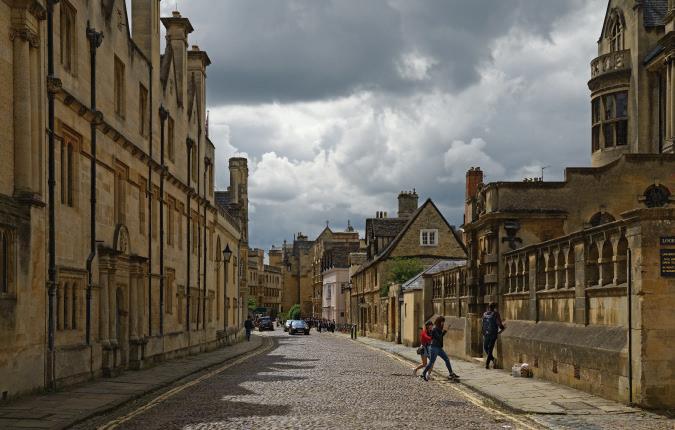
through assignments, only considering their looming due dates. I couldn’t bear to have an evening to myself or take a few hours off—I felt guilty for resting, but too tired to work properly. It was go, go, go. Yet, once I got there, I spent these opportunities obsessing over whether they were the optimal use of my time.
Oxford produces this so distinctly because its opportunities are incredible. In my first year, I saw Alex O’Connor, Martin Wolf, Conan O’Brien, and more in person. Every week seems to contain something one really ought to attend. I’m still kicking myself for missing Mike Pence. Could it have been the formative experience I am looking for? Would he have made eye contact with me through the crowd and offered me an internship at that very moment? I’ll never know. A thousand theoretically better versions of me have died in the past few months.
This pressure also distorts your sense of self. Instead of asking what I cared about, I asked what a sufficiently ambitious Oxford student should care about. I collected opportunities, but didn’t really choose them.
There is a paradox here. The fear of wasting Oxford can itself become one of the easiest ways to waste it. You may never look at these dreaming spires because you are always looking at the next step ahead. Justifying everything leaves you little time to experience anything.
A university so saturated with achievement will inevita-
bly make it feel like the measure of existence. A city built around excellence will always risk making ordinariness feel like failure. So, the answer is not to pretend Oxford is ordinary. It is not. Nor is it to cultivate some false indifference to ambition. Ambition is not the enemy here. It is good to want to do things. It is good to be changed by a place like this. But perhaps living up to Oxford means something quieter. It means smiling to yourself at how much you liked that line you just read. It means taking a few extra seconds to enjoy walking down Queen’s Lane. It means laughing with your friends at the pub regardless of who went there in the past, because you are going there now.
There is a lovely and fitting parable told in Pixar’s Soul about a fish. It goes something like this: a young fish swims up to an older fish and asks, “I’m trying to find this thing they call the ocean.” Puzzled, the older fish responds, “The ocean? That’s what you’re in right now.”
Laughing, the younger fish dismisses him: “This?! This is water. What I want is the ocean!”
You cannot spend so much time planning your Oxford story that you do not end up living it. The late conversation, the failed essay, the afternoon apparently wasted—these are all as much a part of that story as anything else. Oxford is a place to inhabit, to be challenged by, to be unsettled by, and, occasionally, simply to enjoy. Most of all, it is just a place to live in.
Beyond the dodo
Himasweeta Sarma shares a conversation with the visitor experience management at the OUNHM.
Just as for Maya, the Visitor Experience Deputy Manager at the Oxford University Natural History Museum (OUNHM), who grew up locally and cherished her visits to these museums with the OUNHM as her favourite, museums have always served as spaces of curiosity, engagement, and increasingly, debate for children and adults worldwide. However, how often do we pause to acknowledge the kind faces with warm smiles ready to guide us on this journey through the past? The invisible backbone of museums everywhere, the visitor experience management team bears responsibility not only for caring for vis itors, but also for keeping the museum’s operations running
smoothly. Ellie, Visitor Experience Manager; Maya, Visitor Experience Deputy Manager; and Jane, Eleanor, and Agnibeena, Visitor Experience Assistants at the OUNHM, share their perspectives on being the face of the museum, the
“ I [...] think of all the collections in the museum...
architects behind the scenes, and perhaps most importantly, the hands that distribute joy through lovely stickers and genuine human connection.
Walking beneath the pale
journey; I’m uncertain what the future of museums will look like, but the things inside them are certainly in motion.”
I sit down in what Ellie describes as the ‘noisy’ annexe, with Ellie and Maya to glimpse what it feels like to work in a managerial role at a “cool workplace like the OUNHM,” in Maya’s words. Ellie describes her remarkably diverse career path across law and theatre yet notes that these experiences share a common thread: making “intimidating spaces feel welcoming.” Maya’s journey took a different turn, after graduating from the University, she initially considered pursuing an academic path, but after teaching abroad for a few years, she returned to the UK seeking a more fulfilling workplace and joined the GLAM sector as an assistant. She became the Deputy Manager last summer, and there’s been no looking back since.
to become increasingly educational spaces for all types of learners, as Ellie remarks. “The specimens and themes in a museum teach us about the present, and also about how we can create an impact for a better future,” she reflects. Maya adds that when this museum building first opened, it primarily served as an educational resource for the University; now it has transformed into a wellbeing space that holds knowledge, fun, and a genuine sense of community.
Discussing their role further in shaping both the first and lasting impressions visitors take away, Ellie emphasises her primary goal: creating a positive experience for everyone. Maya raises an important observation how some visitors may feel intimidated by the museum and its association with the University, perceiving it as an exclusively academic space. However, the
marble pillars of the OUNHM, I was struck by how alive the building feels. Jane, one of the museum’s Visitor Experience Assistants, put that sensation into words when she told me: “There’s nothing quite like having something tangible in your hands; when you’re handling an object, like a medieval piece of fabric, you’re almost holding hands with the person who made it.”
Her reflection made the museum seem to speak through its statues, specimens and shadows, reminding me that every object here has travelled through countless hands before reaching this place as Ellie, the Visitor Experience Manager noted: “I like to think of all the collections in the museum as a stage in their
When discussing their leadership of the visitor experience team, while both Ellie and Maya ensure their staff complete essential training, empathy remains the cornerstone of their approach. “Visitors are the centre of what we do,” Maya explains, with Ellie elaborating on her passion for introducing first-time museum visitors to proper etiquette with kindness - an approach that might eventually transform them into devoted museum-goers. On personal growth from leading this large team, Ellie emphasises the power of pausing before responding. “I love leading this team because it’s such a positive atmosphere,” she reflects with a smile. Maya highlights how she has learnt the importance of recognising each person’s unique talents and the value of working collaboratively.
Ellie and Maya note how museums are inherently dynamic spaces, especially when housed in a historic building and affiliated with one of the world’s most prestigious universities. In recent years, museums have evolved beyond simply displaying collections
“
...as a stage in their own journey.
visitor experience team, who undertake “lots and lots of planning” as Ellie describes, ensures that experiences are tailored to every visitor’s needs; whether someone is asking about dinosaurs or seeking a quiet café space upstairs. This diversity brings its own challenges, Ellie adds, explaining how the building represents different worlds to different people: a museum space for some, a university space for others, and a family destination for still others. This multiplicity keeps the visitor experience team particularly busy, especially since the historic building wasn’t designed to accommodate 5,000 visitors simultaneously.
Read the full article online at www.oxfordstudent.com
Ellie Talbot and Maya Lucas in front of one of the most coveted residents of the OUNHM, the T-Rex.

Reflections on Samsara, Oxford, and Buddhism
Kinoli de Silva speaks to a Buddhist monk, Reverend Samitharathana, about the philosophy of life, his learning experiences, and having an open heart
Reverend Samitharathana’s path from his ordination in Sri Lanka to his current studies at Oxford is the result of years of disciplined scholarship and monastic dedication. Since becoming a Theravada monk in 2009, he immersed himself in Buddhist doctrine and the classical languages that support its study, including Sinhala, Pali, and Sanskrit. His early academic achievements, such as winning the National First Prize in the 2013 Buddhist Religious Final Examination and earning the distinguished title of Royal Pandita in 2016, reflected both his intellectual promise and his commitment to Buddhist learning. These foundations eventually led him to the University of Peradeniya, where he deepened his study of philosophy and canonical Buddhist texts. His academic journey soon expanded beyond Sri Lanka. Recognised for his accom -
plishments, he received the Outstanding Young Buddhist Scholar Award from the International Buddhist College in Thailand.
Reverend Samitharathana shared a quote he learnt from his studies in Indian philosophy: “there is one
“ There is one truth in the world, but it’s expressed in different ways [...]
truth in the world, but it’s expressed in different ways by different people”. He spoke with such deliberateness. There was no rush to his answers, no sense of performance - only a careful attention to what
was being said. The quality of his presence amplified the conversation about
“ A reminder to avoid becoming just another repositoryof theoretical frameworks.
lian ethics and the Buddhist concept of Nibbana. Alongside his studies, he presented research at conferences across Europe, Asia, and North America, applying Buddhist principles to contemporary global challenges such as climate change, public health crises, and mental well-being.
his academic journey, his spiritual outlook, and, perhaps most powerfully, how the two intersect.
This formative outlook was cultivated through his thorough and transcontinental education. It began when he was ordained as a monk by the chief abbot of the Sri Vijaya Buddhist Centre in Sri Lanka, which started his training on the core aspects of Buddhist philosophy, alongside the development of other skills like languages. This was followed by a bachelor’s in Western philosophy at the University of Peradeniya and Oxford Brookes. Further postgraduate work at SOAS allowed him to examine Buddhaghosa’s critique of meditation, strengthening his interest in the intersections between Buddhist thought and ancient Greek philosophy, which later resulted in a comparative study between Aristote -
This led him here in Ocford, to St Cross College, for an MPhil where he works on a prominent Pali commentary, the Saddhammappakasini, through the lens of hermeneutics. His journey was an intellectual one, shaped by movement between distinct traditions of thought. What became clear through our conversation is that he did not move from one system to another, rather he learned to think within both. This notion became even more apparent when I asked about his different experiences of learning in an Eastern and Western context. His answer was that his Sri Lankan education favoured memorisation, whereas he found that the West favoured analysis, questioning and deconstruction. The key here was for him to “open [his] heart and mind to see things clearly and distinctly rather than just memorising things as they are.”
The discussion built on
“ Knowledge gained through studies is incomplete without its embodiment in practice.
this, as Reverend Samitharathana detailed how he integrated his layered education into his life as a Buddhist monk. His key point was that he saw himself as a “scholar-practitioner”, as he has never seen himself as just a scholar. He aims to apply the knowledge he accumulates through his study onto his daily life. He drew on some Buddhist cornerstones to emphasise this. It starts with pariyatti which is learning, something all monks and novices do. This then progresses to patipatti , which is crucial as it is a means of practicing the learning. He uses this as a reminder to avoid becoming just another repository of theoretical frameworks, which is the kind of thinking that leads toward pativedha : enlightenment. He was keen to emphasise that knowledge he has gained through his studies is incomplete without its embodiment in practice. What emerged very clearly
“
Open [his] heart and mind to see things clearly.
during our discussion was that his calmness was inseparable from his capacity to adapt. To him, being a Buddhist monk in the UK was “another opportunity to learn and grow to some degree of my practice”, and living within a society that tests his values only reaffirms the strength of them. He did not speak about this with any sense of struggle. It seemed, rather, like the most natural thing in the world; the quote he shared with me at the end of our conversation - that there is one truth, expressed differently by different people - was not something he had just studied, but something he had learned to live within.
Image credit: the courtesy of Reverend Samitharathana.
M. T. Barry has seen the inside of the John Radcli e A&E facility one too many times during his time in Oxford. And so, he would like to take a moment to re ect on his experience with something the British public just can’t shut up about: the NHS. Here are a few re ections, roughly in order of ridiculousness:
On M. T. Barry’s rst A&E adventure, the waiting room was walled o with a divider as a dead body was wheeled into, not out of, the hospital. Is there not a separate entrance for that kind of thing? How have I somehow come on the one time they are taking a dead body into the hospital?
Druggies are a feature of emergency rooms around the world. However, never in my 19 years on this planet have I seen these individuals unattended, high, and left to their own devices in the waiting room. is time, our lovely friend walked barefoot in a wet bathrobe from seat to seat, falling into each
while talking to herself the whole time. After asking the A&E sta multiple times to heat up her frozen pizza (she genuinely had one), she decided to throw it on the oor and refuse to be seen by the sta . No matter! Our lovely A&E employees came in and out, ignored her requests, let her talk aimlessly to the rest of us in the waiting room, and did nothing! Why bother! She only stumbled around for a while before faceplanting in the middle of the waiting room. Fantastic stu , lads. ank god for the NHS!
At the same time, I swear to the heavens above, a policeman walked into the waiting room handcu ed to his prisoner. A pair of o cers came in behind, seemingly laughing at their colleague who drew the short straw. ey navigated to the co ee machine, comically navigating the buttons and nally achieving their black drip. In an e ort to guarantee their (quite normal looking) prisoner didn’t escape the hospital, they decided the best case scenario was to
And just like that, another Union election is upon us. Who will live to ght another day? Who will strike out?
I surely hope this one lasts, although if the past few terms have taught us anything is that the soon to be President-Elect ought to watch their back. And their front. And all their sides. And probably the Telegraph, while they’re at it. However, the loser should fear not! Again learning from recent history, when one loses the rst time, it is purely because the competition was better. If one loses the second time, maybe the slate is to blame. However, if one loses for the third time, then surely it is the time for introspection. I wish no such tumultous Union careers on anyone.
If we may make one recommendation to the victor, it is that they appoint a very serious Director of Press, as they are sure to be tormented by this publication. is is indeed the perfect opportunity to sincerely apologise for any headaches that may have been caused;
at least one may take refuge in the Parisian way of life. Or on GB News, although this is not advised. It is with great sadness that we must inform our readers that the hugely successful exit poll conducted by this paper last term (they’re saying it was the best exit poll ever done) will not go ahead for these elections. Alas, that is the cost of scrutinising this beautiful institution. We would like to take this moment to highlight that we projected a true dark horse to win it last time around, and indeed, through pure luck, willpower, or most likely divine intervention, we have been vindicated.
Every Union hack has been led to believe that we face a two-man race this term, but the OxStu has uncovered a third, secret manifesto, that promises to disrupt the space.
Believe us when we say no-one saw this coming, and yet it all feels so predicatble... Almost like the storyline has been generated in advance. Anyways. We present, the future of the Union.
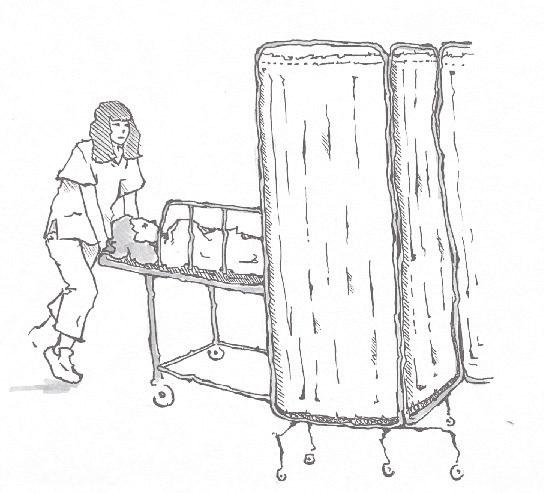
physically tie him, like a challenge from Taskmaster, to a police o cer. e most ironic bit, the prisoner gave a “get out of that life” pep talk to a 16 year old brought in by another set of police. Whose decision was that? Where is this guy going to go from the middle of a hospital?
I’m not here to attack the NHS sta ; I’m sure they are doing what they are told under massive amounts of pressure. But the high horse Britons get on when the NHS comes up is ridiculous. “Well at least we don’t pay”, but you get what you pay for.


The 2026 FIFA World Cup is here. What are England’s chances?
By Charles Prestwich
Here we are again. But where to start with England? Thomas Tuchel has decided to leave behind both Foden and Palmer as he sets off for America for his first major tournament with England. Both have pedigree (Foden was Premier League Player of the Year in 2024 and has won the league six times; Palmer scored for England in the Euro final and came 8th in last year’s Ballon d’Or). But they have both had very underwhelming seasons. Foden is the shadow of his 2024 self and has only 10 club goals in all competitions. He has also fallen behind new arrival Rayan Cherki in the pecking order at City. Mean-
while, at Chelsea, Palmer’s goal return is hardly better than Foden’s (11 goals in all competitions, many of which were penalties) and with only three assists to his name. After suffering from a couple of injuries mid-way through the season, he has seemed off-colour ever since. Therefore, whilst it is bold of Tuchel to leave out two big names with such talent, it is difficult to blame him (unless you are a Man. City or a Chelsea fan!). Players who occupy a role similar to Foden’s and Palmer’s include Eberechi Eze and Morgan Rogers, two playmakers who have had outstanding seasons (Eze contributing in no small part to Arsenal’s Premier League
title; Rogers winning the Europa League with Aston Villa). Most importantly, they have both grown in confidence throughout the season, peaking in recent weeks (especially true of Eze, who featured more and more in Arsenal’s starting XI as the season went on). Some of Tuchel’s other big calls include leaving out Alexander-Arnold, a decision which is difficult to understand considering the unique game style that Trent possesses – he can unlock an opposition team with one long pass precisely arrowed across the pitch from defence. At centre-back, Stones’ inclusion is also a surprising decision; the 32-year old has played very lit-
Summer 8s in review.
By Hannah Suckling
Trinity term’s 5th week is known for one thing: Summer 8s. For all college rowers, this is the most anticipated event of the year – four days of intense racing and at least one night of intense celebration (win or lose). After a cancelled Torpids in Hilary, this is what intense training all year and many early wakeups has culminated in. Unfortunately for me, an early hand injury in Trinity prevented me from racing my first ever bumps
race, but on a positive note it allowed me fully to enjoy the incredible atmosphere that can be experienced throughout the week as a supporter (and, of course, my crew getting blades did help with this).
The non-rowers are probably fed-up hearing words such as ‘bumps’, ‘blades’ and ‘spoons’ thrown around. To explain: the aim of Summer 8s is to catch up to the boat in front of yours, and ‘bump it’ (this can be done through contact between boats, overtake or
by concession from the cox of the boat being bumped). Each division has 12 boats that are lined up in order, as opposed to the usual side-by-side race. The head of each division starts closest to Donnington Bridge and the boats extend past the Isis Farmhouse. A team that bumps every day of Summer 8s is said to earn blades, and one that gets bumped every day: well, they get spoons. All of this is simple in theory, but quite chaotic in practice, with some races

tle this season (a total number of Premier League minutes the equivalent of fewer than five matches!). Yet a manager who is unafraid to make big calls that are contrary to popular opinion is refreshing to see. This squad is capable of going all the way, yet perhaps
Tuchel and England need the experience of a major tournament together before they can go and win one. Buckle up for the ride this summer. It’s anyone’s game.
Read more online at www.oxfordstudent.com
having to be ‘klaxoned’ (called off) due to multi-boat pile ups in the river.
We were all devastated to hear about the events on Wednesday, and the following days of racing were conducted with upmost respect, dampened celebrations and a sombre attitude.
The sun and heat of week 5 facilitated the building of a great atmosphere that gained momentum as the week progressed. Every rower had many a unisuit tan (or burn!)
Upcoming Fixtures
line, an ice cream van seemed permanently placed under Donnington Bridge and BH island was swimming with crowds. Every bump across the event was celebrated greatly – none more so than on Saturday when crowds of students, townsfolk, parents, friends and tutors surged at the announcement of each success: this is what rowing is all about.
In 2018 , England made the semi-finals. Credit: Voltmetro