@TheOxStu
Michaelmas Term, Week 7 | Friday 27 November 2026
OXFORD STUDENT The
The University of Oxford’s Student Newspaper, est. 1991
Rocco Pagel on Berlin: then and now Read more on page 23
Parenting in Oxford - and other adventures
Mihwa Kim doesn’t see herself as an entrepreneur Read more on page 19
Read more on page 21
‘The easy decisions have all been taken’: Justin Trudeau reflects on a decade in power Diya Singh
F
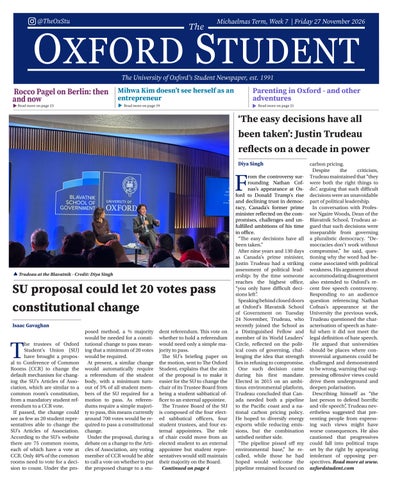
Trudeau at the Blavatnik - Credit: Diya Singh
SU proposal could let 20 votes pass constitutional change Isaac Gavaghan
T
he trustees of Oxford Student’s Union (SU) have brought a proposal to Conference of Common Rooms (CCR) to change the default mechanism for changing the SU’s Articles of Association, which are similar to a common room’s constitution, from a mandatory student referendum to a CCR vote. If passed, the change could see as few as 20 student representatives able to change the SU’s Articles of Association. According to the SU’s website there are 75 common rooms, each of which have a vote at CCR. Only 40% of the common rooms need to vote for a decision to count. Under the pro-
posed method, a ⅔ majority would be needed for a constitutional change to pass meaning that a minimum of 20 votes would be required. At present, a similar change would automatically require a referendum of the student body, with a minimum turnout of 5% of all student members of the SU required for a motion to pass. As referendums require a simple majority to pass, this means currently around 700 votes would be required to pass a constitutional change. Under the proposal, during a debate on a change to the Articles of Association, any voting member of CCR would be able to call a vote on whether to put the proposed change to a stu-
dent referendum. This vote on whether to hold a referendum would need only a simple majority to pass. The SU’s briefing paper on the motion, sent to The Oxford Student, explains that the aim of the proposal is to make it easier for the SU to change the chair of its Trustee Board from being a student sabbatical officer to an external appointee. The Trustee Board of the SU is composed of the four elected sabbatical officers, four student trustees, and four external appointees. The role of chair could move from an elected student to an external appointee but student representatives would still maintain their majority on the Board. Continued on page 4
rom the controversy surrounding Nathan Cofnas’s appearance at Oxford to Donald Trump’s rise and declining trust in democracy, Canada’s former prime minister reflected on the compromises, challenges and unfulfilled ambitions of his time in office. “The easy decisions have all been taken.” After nine years and 130 days as Canada’s prime minister, Justin Trudeau had a striking assessment of political leadership: by the time someone reaches the highest office, “you only have difficult decisions left”. Speaking behind closed doors at Oxford’s Blavatnik School of Government on Tuesday 24 November, Trudeau, who recently joined the School as a Distinguished Fellow and member of its World Leaders’ Circle, reflected on the political costs of governing, challenging the idea that strength lies in refusing to compromise. One such decision came during his first mandate. Elected in 2015 on an ambitious environmental platform, Trudeau concluded that Canada needed both a pipeline to the Pacific coast and a national carbon pricing policy. He hoped to diversify energy exports while reducing emissions, but the combination satisfied neither side. “The pipeline pissed off my environmental base,” he recalled, while those he had hoped would welcome the pipeline remained focused on
carbon pricing. Despite the criticism, Trudeau maintained that “they were both the right things to do”, arguing that such difficult decisions were an unavoidable part of political leadership. In conversation with Professor Ngaire Woods, Dean of the Blavatnik School, Trudeau argued that such decisions were inseparable from governing a pluralistic democracy. “Democracies don’t work without compromise,” he said, questioning why the word had become associated with political weakness. His argument about accommodating disagreement also extended to Oxford’s recent free speech controversy. Responding to an audience question referencing Nathan Cofnas’s appearance at the University the previous week, Trudeau questioned the characterisation of speech as hateful when it did not meet the legal definition of hate speech. He argued that universities should be places where controversial arguments could be challenged and demonstrated to be wrong, warning that suppressing offensive views could drive them underground and deepen polarisation. Describing himself as “the last person to defend horrific and vile speech”, Trudeau nevertheless suggested that preventing people from expressing such views might have worse consequences. He also cautioned that progressives could fall into political traps set by the right by appearing intolerant of opposing perspectives. Read more at www. oxfordstudent.com
Friday 27 November 2026 | The Oxford Student
2 | Editorials
Editorials A Note from the Oxstu Team
The Oxford Student is an independent, fully student-run newspaper that has been providing truthful, open, and free journalism to all of Oxford for over 30 years. This includes important investigative journalism, holding the University, its colleges, and institutions accountable every term. Our work also provides a training ground for some of the most successful journalists around the world, including Stephen Bush, Lewis Goodall, Anoosh Chakelian, and many more, as well as leading figures in politics, business, technology and creativity. The Oxford Student – supported by an engaged alumni community plays a key role in building the next generation of journalists, holding our society, economy, and democracy accountable. We need your Common Room’s support to keep this going. Our work is mainly funded through JCR and MCR subscriptions, which gives Common Rooms access to the newest student journalism in the city. Every 2 weeks, The Oxford Student delivers a 24-page print to every Common Room with a subscription. This Freshers Guide, funded solely through ad sales, is a great example of what you can expect if you bring the paper into your common room, at low costs, helping to keep student journalism flourishing in the city.
Contents News Opinion Culture Features Business Identity Profiles Sport
Contact us at oxstu.editor@gmail.com I would like to take a moment to has made all our efforts truly thank someone that would not worthwhile. I hope Michaelusually pop up in an OxStu editomas Term has been as amazing rial: Cherwell. Our stereotypical for you as it has been for me – super-villian, I want to reiterate the that you’ve found new and old magic that makes Oxford student friends to light up your rooms, journalism so vibrant. Without this avoided any major life cricompetition, without having the ses (or survived the ones that Reds stare back at us from across came your way), and enjoyed Oriel Square, I wouldn’t be half the all that Oxford has to offer. journalist I am today. Every Rocky I can’t quite believe it’s over. ear Reader, the end has But then again, I’m sure I’ll find ive prints, 120 pages, hun- Balboa needs their Ivan Drago. So dreds of stories, and one thank you, Cherwell, for pushing us come, I fear, and the an excuse to come back and fantastic term. I’m so proud forward, for making me lose sleep nostalgia is already hit- bother everyone soon enough. ting in. It’s seriously quite hard Happy reading, merry Oxmas of what the OxStu has done, from as we try to break a story, and, most 10,000 copies of a Freshers Guide of all, for making us look like the to quit something you’ve been and see you next term! (with a profit) to 400,000 views best student newspaper in Oxford. involved in for the past year and on Cofnas coverage. That only When I arrived in Oxford, I sporta half, through all the highs and scratches the surface of what this ed one piece of motivation that lows (seriously, I feel like “Make team has done, fighting against has carried me through it all. the OxStu Great Again” is a fitting illness, 5th week blues, and the Referenced in all my editorials, slogan for my time at the paper). lingering allure of the pub… Rocky Balboa, the cornerstone I am writing this editorial while While my time with the OxStu may of what makes me proud to be a bunch of amazing OxStu team or may not be done, I know that I an American, shall give you members are playing Mafia in will look back at my time this year one final line, one final quote my room – a place that would with immense pride and satisfac- to keep you going in this wonfeel far too big and lonely withtion. From the ‘vandalism’ to scoo- derful world of dreaming spires: out the company of my sepettes, Nathan Cofnas through “I just wanna go the distance.” nior editorial team every other Rhodes Scholars, the journalism And go the distance, we have. night (Gui, I dare you to leave we’ve produced this term has been Till next term, Up the Stu. my room sober at least once). of the highest quality, continuTo all our readers, thank you ing the OxStu’s leadership in the for tuning in and helping us alEllie Apostolidi competitive student journalism most hit a million views on InLuke Erly Balliol College scene this University has to offer. stagram in the past month. It Regent’s Park College
D
I
n the past few weeks, as the craziness of term flew by, I have wondered what I would write here – what it would feel like to be writing my last editorial in the pages of the OxStu. I’m not sure I can quite
Editorial Team
4 6 10 14 18 20 22 24
Editorial Board Ellie Apostolidi and Luke Erly (Editors-in-Chief) Elliott Wang and Gabriella Bedford (Associate Editors) Guilherme Lopes (Managing Director) News Isaac Gavaghan (Deputy Editor) Abdul Olagunjuadekunle, Samuel Govier, Ansu Bhattarai, Tristan Clark Lam, Greta Pezzolato, Diya Singh, Leen Almasri, Saba Ahmadzadeh Noughani, Christine Savino, Bay Ross, Sylvia Kline, Joe Parsons (Section Editors) Opinion Christian Wang (Deputy Editor) Antonio Reis, Eleanor Harris, Yiran Su, Leen Almasri, Zar Motik
F
put my finger on the feeling, now that the day has arrived. Perhaps it hasn’t hit me yet. If you know me, you know how many stories I’ve obsessively chased, how many hours I have poured into this paper, and how many times it has driven me crazy. You also know, however, how much joy being part of it has brought me, how much I have been inspired by the people I have met here, and how much I care about the OxStu. Each lay-in joke, legal check, last drink at the print social, 3am Whatsapp
message, and Google Docs comment means the world to me. The things I have experienced in student journalism over the past year I will genuinely never forget. I do not want this to be soppy, so I will spare the sentimentality and simply thank those who have made my time at the OxStu so special, in particular: Lila, Ellie A., Luke, Yashas, Ellie P., Isaac, Gabriella, Elliott, Leila, Hannah, Ava, Meira, Zoe, Joseph, David, and of course the many more,
Adisuryo, Samuel Govier, Greta Pezzolato, Abdul Olagunjuadekunle, Tristan Clark Lam, Joannie Lao, Yiran Su, Lucy May, George Murphy, Freddie Russell, Georg Haslam, Jessica Ellis, Ruby Torsney, Malavika Rudrakumar, Shannon Wang Lee, Lily Malligan (Section Editors)
Akheel Kale, Chauncey Robinson, Claire Frost, Zar Motik Adisuryo, Fathan Mahardika (Section Editors)
Features Ellie Pemberton (Deputy Editor) Ben Futter, Hannah Ison, Phoebe Payne, Carolina Perotto, Richard Kühl, Yiran Su, Aaron Butters, Charlize Morrey, Lily Aldred, Yash Kothari, Tessa Stanier, Nihaarika Shrikant, Amun Chaudhary, Poppy Geyman (Section Editors) Business and Finance Leila Hoffpauir (Deputy Editor)
Investigations Ivett Berenyi (Deputy Editor) My Anh Ngoc Nguyen, Hannah Ison, Ava Doherty, Abdul Olagunjuadekunle, Mimi Berridge Shea, Sze Wai Yun, John Yannis Liddel, Joe Parsons (Section Editors) Culture Flora Molnar (Deputy Editor) Jasmine Joyan (Poetry Deputy Editor) Aamina Thava, Aidan Kane, Carolina Perotto, Kadija Owusu-Kabba, Siena Tracey, Phoebe Payne, Lucia Clark, Ruhi Visaria, Isaac Simeon Sinclai, Joseph Walford, Sofia Di Stazio, Sarah Chew, Georgia Kennedy, Cerys Williams, Isabella Jones, SongHa Choi, Reyhan Ali Mawjee,
all of whom I couldn’t possibly mention. Now, all that is left is to quote a fellow John’s student, and say “that is that, the end.”
Guilherme Lopes St John’s College
Sheridan Hauser, Michelle Luo, Ionna Dionissiou (Section Editors) Anja Woosnam, Oliver Weston, Christina Robinson, Anya Tindall, Carolina Perotto, Ben Futter, Briann Stephens (Poetry Section Editors) Identity Katrina Roach (Deputy Editor) James Stratmann,Ben Futter, Joseph Walford, Nguyen Thi Ngoc Mai, Yasmin Morgan, Yeliz Ece Evgen (Section Editors) Profiles Martha Kiyan (Deputy Editor) Diya Singh, Saba Ahmadzadeh Noughani, Ansu Bhattarai, Richard Kühl, Sharanpreet Padda (Section Editors) Sport Charles Prestwich (Deputy Editor) Ruhi Visaria, Siena Tracey, Finn Perry (Section Editors)
The Oxford Student | Friday 27 November 2026
Op-Eds | 3
Op-Eds Did feminism lose Gen Z men before the manosphere found them? Christian Wang
I
Ellie Apostolidi
n the wake of the Grand Theft Auto VI release, men (of a type we are all familiar with) have denounced the game as “woke” for the introduction of protections against violence towards certain marginalized groups – take, for instance, the inability of players to draw a weapon in a gay nightclub or shoot protesters in-game. Trivial as the complaint may seem, it shows how a generation of young men has come to understand feminism: not as a movement for equality, but as a voice passing judgement on what they enjoy. For decades, it was social conservatives who blamed violent games for producing aggressive, antisocial boys; it is relatively new that the moral scrutiny of male entertainment, once the preserve of the right, now issues from the left. This is precisely because feminism, as a developing ideology, has become more assertive in passing moral judgements upon gendered consumption – rightly so – but in a way that many young men have interpreted as an attack on what they view as “private” and “harmless” decisions of consumption and enjoyment. The modern ‘manosphere’, while having existed in certain forms since the countercultural revolutions of the 1970s, can only be understood today as a reactionary movement against fourth-wave feminism. Most crucially, it is a reaction against fourth-wave feminism’s critique of digital yet nevertheless patriarchal forms of male
consumption. One may recall the targeted, misogynistic harassment campaigns organized against Anita Sarkeesian as part of Gamergate. #MeToo then problematized further sexualized notions of heterosexual male desire. Many of the alpha-male types responded by withdrawing from women altogether and turning instead to “artificial intimacy”, a symptom which we now associate with online incel culture. Did feminism, then, lose Gen Z men before the manosphere found them? In a sense, yes – though not because its critique was mistaken. For Gen Z men who were socialized into these patterns of consumption, feminism arrived first to them as a series of prohibitions: what not to play, what not to watch, what not to desire. The manosphere, for all its toxicity, offered a sense of identity in a space where young men felt ostracized for – what to them was – as simple as “enjoying a video game.” It did not so much win young men over as fill a vacuum feminism had left open. The solution is not for feminism to abandon its critique of male consumption. It is, going forward, a difficult responsibility for modern feminists now to balance the creation of a new identity for Gen Z men in the vacuum of patriarchal consumption that capitalism has perpetuated, while nevertheless critiquing and restricting harmful behaviors that many Gen Z men are now socialized into.
The Grapevine
Stinkin’ lefties!
Wadham College has been hit by a wave of laundry CHAOS, with every single machine breaking down at some point over this term. Grapevine even hears none were working during week 6. So, if you’ve felt an unpleasant waft as you turn off Parks Road, or if Lemonade and Leftism has been smelling of more than lemons, then you know why. Stay away!
SPOTTED: Cambridge SU officers show cross-campus solidarity at Cofnas protest In an unprecedented breakdown of the Oxbridge divide, Cambridge SU’s Postgraduate President and Vice-President for Education and Widening Participation attended the protest against self-proclaimed race realist Nathan Cofnas, who spoke at Oriel on 17 November.
M
en did not find the manosphere – it found them, and it has been a powerful vehicle for turning their insecurities and material anxieties into grievances, and turning those into an ideology. To describe the manosphere as a reactionary movement against feminism does injustice to how a lot of the recruitment for this cause happens: via lifestyle content on social media. We have been living, after all, in the age of the male podcaster (and the trad wife influencer, which I would argue is the female counterpart). It starts with a cottage-core aesthetic or gym-bro tiktok, and eventually may escalate to advice on why and how one should be a stay-at-home-wife or an alpha male. Yet, oftentimes it goes even further. For instance, a Media Matters experiment found that, after engaging with seven trad-wife accounts, nearly a third of the 327 videos recommended to its research account contained conspiracy theories or apocalyptic fearmongering, amongst other similar content within the wider orbit of the far-right. And while this is a study on trad-wife content, rather than the manosphere, it shows that the entry point into these movements are not necessarily political. For many men, their first dip of the toe in the manosphere world is either humorous and somewhat unserious, or triggered by personal circumstances. This is why induction happens more often via the red pill discourse,
In a statement, Cambridge SU called Cofnas’ views “abhorrent”, adding that “Racism in Oxbridge has a long and troubling history” and that they attended to support “Black students and staff at both Cambridge and Oxford”. Of course, Cofnas played a prominent role in the campaign against the late Professor Jason Arday, who held a professorship on the sociology of education at Cambridge. The SU said that the events of the summer have led to “significant harm amongst our Cambridge community.”
OxStu makes national media… in the worst possible way
Our very own Ellie Apostolidi, half of this term’s Editor-in-Chief pairing, was caught on camera by the good people at GB News, appearing on the propaganda machine broadcaster’s Instagram page looking VERY puzzled and disoriented. She is further seen chatting to right-wing grifter free speech activist Connie Shaw.
pick-up artists or looksmaxxing, rather than the more extreme and insular communities like black pill. As for the influencers themselves, we have seen time and time again how they become rich from selling yet another course on how to up one’s game. This is without me getting into the conspiracy theory that manosphere and trad-wife influencers are secretly plants of the US government. It is such that these movements don’t always attract Gen Z men because they are already against feminism, but because they are looking for an aspirational lifestyle, and in the process learn to oppose feminism. The manosphere world is one for men, created by other men, some of whom seek to exploit those more vulnerable than themselves.
Andrew and Tristan Tate, two pariahs of the manosphere. Credit: KaoriKellyBarbie under CC 4.0.
In comments to Grapevine, Ms Apostolidi said “of all the news outlets that could film me…”
Union elections oh my goodness does anyone even care...
You’re holding a week 7 print of the OxStu, so you know that means: Union elections. In a quick poll of our newsroom, we receive on average a cool 5 hack messages. One outlier receives over 40! So, on Friday, avoid St Michael’s Street with all you have, unless you’re going to Aromi. I tried it out for the first time a few days ago and I was impressed by their pizza slices. Deserts were slightly mid.
SU races heating up The end of Michaelmas also means we can all look forward to SU elections in a few months. Grapevine would like to pre-emptively endorse anyone who will break the worrying streak of libdem domination.
4 | News
News
The Oxford Student | Friday 27 November 2026
oxstu.news@gmail.com | Deputy Editor: Isaac Gavaghan Section Editors: Saba Ahmadzadeh Noughani, Bay Alexandra Ross, Leen Al-Masri, Ansu Bhattarai, Tristan Clark Lam, Sam Govier, Sylvia Kline, Freddie Lewis-Hedley, Abdul Olagunju-Adekunle, Joe Parsons, Greta Pezzolato, Freddie Russel, Christine Savino, Diya Singh
SU proposal could let 20 votes pass constitutional change Isaac Gavaghan Continued from front page
T
he SU claims that “the role of chair is more akin to that of the Speaker of the House of Commons than to Prime Minister” and that as such being chair makes it difficult for the sabbatical officer to “speak freely”. The idea of having an external chair was suggested to the SU by an external review into the effectiveness of the Board. Following this, the proposal to allow CCR to facilitate this by changing how the SU’s Articles of Association are amended was brought for-ward. In their briefing paper, the SU describe how in their view the “high quality, nuanced scrutiny” provided by CCR makes it a better space to discuss constitutional change in comparison with “A public referendum run via social media campaigns [which] simply cannot match this quality of scrutiny, or consultative approach.” CCR votes are conducted online and voting members do not have to attend CCR in order to vote. The proposal to allow CCR to change the SU’s Articles of Association is currently being voted on, with a result to be published on the SU website next week.
Charity Commission watchdog expresses concerns over college governance Abdul Olagunju-Adekunle
T
he CEO of the Charity Commission, David Holdsworth, has expressed concern over the governance of many of Oxford’s 39 colleges and 4 PPHs. In an interview with Bloomberg News, Holdsworth announced that the organisation would be asking “specific questions” at New College, Oxford after “multiple complaints about governance” some of which had not been reported. The article highlighted issues raised about Oxford college governance structures and their fitness for purpose. In particular, around the size of governing bodies and their ability to effectively respond to and root out misconduct. This comes amidst conversations around sexual misconduct and its handling in academia. At the Week 3 Conference of Common Rooms, a vote took place to “support mandating policy change in relation to employed staff accused of staff on student sexual misconduct.” The motion, which passed unanimously, attempts to deal with the phenomenon of senior officials resigning out of their positions while actively undertaking sexual misconduct proceedings. A 2025 Bloomberg investigation revealed that Soumitra Dutta, former head of the Said Business School had taken leave supposedly due to ill health after an investigation by the University of Oxford had upheld complaints about Dutta’s violation of the University’s harassment
policy. The article also revealed that four members of New College had remained in their roles for “months or years” after they had been accused of wrongdoing. This also included the social psychologist Miles Hewstone, who at the time of the investigation, was still in his post as a Professor Emeritus. Hewstone had stepped down from his full-time post in 2019 over allegations of sexual misconduct. As of November 2025, Hewstone had also stepped down from his post as a Professor Emeritus. The Oxford Student reported in January that the University had been accused of failing to adequately share information with New College about any proceedings against Hewstone. The interview speaks to questions about whether the current Governing Body-system of Oxford college governance, which often consists of a group of usually 30+ academics, is robust enough to deal with sexual, financial and serious misconduct allegations. In 2024, Times Higher Education reported that the Charity Commission had asked Oxford colleges to modernize their governance structures, with the focus being on all members of an often 30+ person Governing Body being trustees of the charity. Questions about the unwieldiness of such a structure, particularly when having to deal with harassment and serious financial cases, as Christ Church College struggled with in
2022, have also been brought to the forefront. A Charity Commission spokesperson told The Oxford Student: “Since our intervention at Christ Church College, Oxford in 2022, we have encouraged Oxford colleges more widely to encourage trustees to modernise their structures and processes to help prevent problems arising, and to address governance weaknesses we identified.” They also emphasised that they continued to have “positive, constructive discussions across colleges.” In November 2022, the regulator issued Christ Church with a formal warning over their handling of a dispute. It had been found that £6.6 million had been spent on legal and public relations fees in relation to the handling of this dispute. In relation to this, The Charity Commission commented that the case displayed the issue of “potentially unmanaged conflicts of interests with trustees also being effectively employees of colleges”. The Charity Commission serves as the UK Government’s independent regulator for charitable organisations in England & Wales. Due to Oxford colleges being separate legal charitable organisations, they are regulated by the Charity Commission rather than the Office for Students (OfS) which the federal University of Oxford is regulated by. Read more online at www.oxfordstudent.com
Gail’s announces new branch in Westgate Joe Parsons
G
ail’s has announced when its new café and bakery in Oxford’s Westgate shopping centre will open its doors. The new Gail’s will open on Thursday, December 3. It will take up a spacious 3,095 square foot unit with an external seating area overlooking the family play area Leiden Square, on the Lower Ground floor of the shopping centre. Gail’s already operates two shops in Oxford, one on Little
Clarendon Street in Jericho, the other in Summertown. Clare Martin, Centre Director at Westgate, said: “We’re pleased to confirm that Gail’s will officially open its doors on 3rd December, providing another exceptional option for our guests to enjoy.” She added that “[c]ommunity is at the forefront of everything we do at Westgate Oxford, so we’re delighted to welcome a new brand which echoes those values so strongly.” In recent years, there has been some opposition to the expan-
sion of Gail’s. For example, in August 2024, a petition objected to a Gail’s opening in Walthamstow Village in London, on the grounds that it risked “overshadowing” local businesses. In April of this year, a Gail’s in Archway, London was vandalised with graffiti and had its windows smashed. More recently, anti-gentrification activists launched a poster campaign against the opening of a new branch of Gail’s in Brixton. Image Credit: Andy Li, CC BY 0 via Wikimedia Commons
Friday 27 November 2026 | The Oxford Student
News | 5
Knot your average escape
Students sleep on street for housing
Toads rescued from Worcester
Isaac Gavaghan
Saba Ahmadzadeh Noughani
9
0 trapped toads, a common frog, and two newts were rescued from Worcester College on 10 November by Amphibian and Reptile Groups of the UK (ARG UK). The knot of toads and other assorted amphibians were trapped in the alcoves of Worcester’s basement. The rescue mission began after students working in the basement law library heard knocking against the windows. Head of Gardens and Grounds at Worcester College, Simon Bagnall, has said that college is a toad hotspot, and this is not the first time that the college has dealt with trapped amphibians in basement alcoves. Worcester College is home to a lake, ponds, orchard, and the site has areas of longer grass and shrubby borders, making it the perfect habitat to attract common toads. This problem has been occurring for several years, and to r e s -cue any trapped toads, col-l e g e gardeners usually relied on a member of the team to climb down into the alcoves to retrieve the animals one by one. On Tuesday, Amphibian and Reptile Groups of the UK (ARG UK), were called to assist with the latest incident of trapped toads. ARG UK installed amphibian ladders to allow the animals to find their way out and climb to freedom. The bespoke ladders were designed by Trevor Rose, founder of Friends of Angus Herpetofauna (FAH) and Secretary of the British Herpetological Society. Rose is best known for designing and developing these amphibian ladders which help frogs, toads, and newts escape from drainage gully pots and other traps.
A
Image Credit: Shinigurai, CC BY 3.0 via Wikimedia Commons
ARG UK’s coordinator, Dr Angela Julian, said that for many years, “the solution was for Jacob, a tall member of the gardens’ team to climb down into the alcoves and bring them out”. The newly installed amphibian ladder now aims to provide a permanent solution to allow toads to escape without any human intervention. The population of toads in the UK is declining, with a 2025 Cambridge study finding that the population of the common toad species has dropped by 41% between 1985 and 2021. This is likely caused by road mortality, habitat loss and urbanisation, and a decline in the population and availability of prey like beetles, earthworms and slugs. The 90 rescued toads were released into a specially built hibernaculum shelter (or ‘toad hotel’) on site where they can overwinter. Since 2025, Worcester College has also taken an active part in conservation research and the college grounds also became part of ARG UK’s Travelling Toadlets project, which investigates and tracks the survival of young toads, who leave Worcester’s ornamental ponds, during the first year of their life. Read more online at www.oxfordstudent.com
round 15 students from the University of Oxford and Oxford Brookes University spent a night camped out on St Clement’s outside of estate agent Finders Keepers to have their choice of privately rented accommodation in the following academic year. On Tuesday 24 November at 9am, Finders Keepers released its houses, for groups of three or four, for rental in the following academic year. A third year student from St Peter’s College told The Oxford Student that he and his flatmates were taking three hour shifts and had arrived in the queue at 5pm on Monday 23 November. The Oxford Student also spoke to two Oxford Brookes University students studying International Relations and Politics who had brought along military grade sleeping bags to the queue along with laptops, toothpaste and toothbrushes, and books to read. One of the students, Henry Lockhart-Smith, explained that the pair were reservists with the British Armed Forces and described how they looked forward to their monthly weekends camping and training with the army as a welcome break from the poor quality of their privately rented accommodation in Oxford. According to Lockhart-Smith, his current Cowley accommodation was “derelict, mouldy, and gop-
ping” and the unpleasant experience of living there had convinced him that “24 hours of suffering for a year of housing” was a worthwhile trade-off. The other, Milo Barret, described the camp-out as “not particularly safe” and expressed worries that particularly in flu season this would be bad for the health of students. For Barret, the only silver lining was the mulled wine offered by The Oranges and Lemons pub next door to Finders Keepers. Henry Crees, a trainee teacher also at Oxford Brookes paused his extended edition of The Lord of the Rings to tell The Oxford Student that he was camping out for the third year in a row because good quality housing in Oxford was very hard to find and the Finders Keepers rental properties were, in Crees’ view, “reasonable prices and good quality”. He said that each year he and his housemates had tried to find a house online and eventually given up due to the competitive market and limited supply. At the front of the queue were students Ethan Cinnit and Will Jones (pictured below) who when asked whether queuing up for housing was a good system for allocating private student accommodation emphatically said “f**k no” and argued that it was a problematic system since “it depends on how much grit you’ve got.”
Clubs unite to keep OUP sports ground Isaac Gavaghan
T
hree local sports clubs are campaigning against a proposed housing development at Jordan Hill, the sports ground of Oxford University Press (OUP). Summertown Stars Football Club, Wolvercote Cricket Club, and North Oxford Lawn Tennis Club (NOLTC), who all use the ground, are joining together to campaign against the proposal. Earlier this year in May, OUP told their Bowles Club they would have to leave their premises and in June told the 130-year-old Oxford Cricket Club that they could no longer play at Jordan Hill. The proposed development is a part of Oxford City Council’s Oxford Local Plan 2036 and the Council
told The Oxford Student that the site has been earmarked for development for a decade and that they will provide alternatives for “lost facilities” either at Jordan Hill or at another site. The clubs are working with Oxfordshire Cricket who declined to comment but submitted evidence to the Local Planning Inspectors which argued that the proposal would make playing cricket at Jordan Hill impossible. The submission argues that there is a demand for the provision of sport. According to Summertown Stars, 138 children play home football matches at the ground and data collected by NOLTC from October 2025 until September 2026 shows that 1,754 hours of tennis were played at the site.
Students camp outside estate agents Finders Keepers on the Cowley Road Image Credit: Isaac Gavaghan, with permission.
Friday 27 November 2026 | The Oxford Student
6 | Opinion
Opinion Stop Pretending That You Want to Be Chinese Yiran Su
W
e are all, or so social media will have us believe, ‘in a very Chinese time of our lives’. A few months ago, social media platforms became inundated with posts and reels and memes referencing various aspects of Chinese culture, be it tourist destinations, songs, customs and practices, or politics. Even the mere mention of ‘being Chinese’ was enough to propel a post into virality. Chineseness became a trend to be performed, shown, referenced and shared. So, as a Chinese person, why doesn’t it feel gratifying? Chinese culture is being celebrated by the West more than it has perhaps ever been. Playing Mahjong is chic and mainstream. Drinking hot water is no longer strange but a niche health tip — the Chinese aunties and grandmas are onto something. Square dancing, a long-standing tradition that takes place in parks across China in the evenings, is being hailed as a novel communal activity. China is, at least nominally, replacing European tourist destinations in the hearts and minds of Instagram and Tik Tok creators. When I scroll, I find that my culture is increasingly visible. What little positive Western representation of China that did exist in the 2010s and early 2020s — often of the ‘white boy speaks fluent Mandarin’ variety — has ballooned into an entire online community. More mundane cultural practices are being showcased than I ever thought possible, all of it at the break-neck speed of social media virality. It is important to note that some creators hopping onto the trend are of Chinese origin. They are getting to share that aspect of their identity
loudly and proudly for the first time, no longer forced to assimilate into other cultures while dissimulating their own. I am not denying that there is a euphoria in being celebrated for an aspect of your identity you have been taught to minimise; I feel the same way myself, especially with the visibility from which Chinese and Asian creators are now benefitting. But far more often, the trend of Chineseness appears insincere. Young white content creators and celebrities are putting on a performance, guided by the simple equation that to be Chinese is to be popular. The performance of Chineseness replaces any real effort to explore and connect with a culture they are curious about. Using revolutionary songs that were popular in the last century replaces the discovery of modern music and artists that are actually consumed by audiences in China. Sprinkling Mandarin in a text post is easy, but actually learning the language isn’t worth the effort. Dressing as a revolutionary soldier is in fashion, but learning Chinese history is not. Corporations, too, have caught on. Qipaos and Mahjong sets are being commodified, often insultingly so. Chinese characters on tiles are being replaced with unoffensive, easy-to-read pictograms with no relation to Chinese culture. Traditional Chinese dress — undergoing a revival in China — is being pumped out by Western brands too, only with as much cultural influence removed as possible. Everything from material to fabric patterns to altered silhouettes caters toward fast fashion and Western profit. Chinese culture is not unique in this respect; it is the most recent among a line of victims of Western capitalism.
oxstu.comment@gmail.com | Deputy Editor: Christian Wang Section Editors: Leen Almasri, Eleanor Harris, Tristan Clark Lam, Greta Pezzolato, Freddie Russell, George Murphy, Georg Haslam, Joannie Lao, Lucy May, Zar Motik Adisuryo, Antonio Reis, Yiran Su
Even more insultingly, the Western world appears to be undergoing mass amnesia. The hatred and animosity spewed at Chinese and otherwise East Asian people during the COVID-19 pandemic, ranging anywhere from name-calling, rampant usage of the term ‘China-virus’ to physical violence against Asian individuals, has been all but forgotten. The current celebration of Chineseness does nothing to recognise the racism that Asian individuals have faced and continue to face, nor the underlying social acceptance of casual racism that became all the more visible during COVID. The pandemic was less than a decade ago, yet we are already suppressing the memory of the ugliness it brought to the surface of Western society. Decades of racial stereotypes, prejudice and institutional discrimination is being buried, not by a true instauration of racial equality but a barrage of empty, feel-good cultural ‘appreciation’. There is no soul-searching within the trend of Chineseness for the mass hysteria that happened during COVID; we simply seem to have forgotten that it happened at all. Other elements of racial prejudice have also snuck their way into the trend. Chinese individuals are too often associated with Chinese politics without provocation. In fact, any East Asian appearance can become an excuse to mention the CCP and its policies, usually with the goal of challenging the individual, under the assumption that they will agree with the Chinese government. It is all the more telling that these conversations are not truly discussions at all, but rather carefully framed attacks. More than once, within conversations totally unrelated to Chinese politics, I have been asked ‘what I think’ about one thing or another tangentially related to the colour of my skin. These topics are not approached with an interest
in good-faith discussion, but rather a sort of moral posturing against a government which I did not claim to identify with in the first place. The trend of Chineseness is no different. While cultural celebrations will often incorporate discussion of modern politics, and it is indeed important to have conversations surrounding the use of cultural revival in national politics, Chinese culture continues to be inextricably associated with the CCP. You will hardly find a reel on ‘Chineseness’ without some mention of Mao, communism, 20th century revolutionary politics, or all of the above. The most popular audios used repeatedly in ‘Chinese’ posts are revolutionary songs such as Red Sun in the Sky. Revolutionary posters that were common in my parents’ childhoods are making a resurgence, treated as inside jokes but upheld as ideological tenets, showcasing China’s greatness in the modern age. White boys are even dressing up as revolutionary soldiers as if participating in the Long March. As for modern politics, recent news of former Nvidia CEO Jensen Huang’s affair has brought a barrage of jokes about Chinese women being spies. It has never occurred to these creators, it seems, that participating in Chinese culture does not have to come with a side of becoming the perfect follower of the CCP no matter the era. This new trend seems like a stunning reversal of previous rhetoric — that China’s cultural resurgence and ideology is a threat to the world as we know it — but there is more continuity to be found in it than at first glance. Chinese people and culture remain inextricably linked to Chinese politics and the CCP in the minds of the West. There is a continued inability to imagine a Chinese individual who is not a vessel for the Chinese government: it is painfully apparent in how anyone seeking to ‘become Chinese’ cannot
have appreciation for the culture while reserving potential criticism for the state. The internet has never been good at nuance, but there must exist a space between rampant Sinophobia and the celebration of all things Chinese. In both extremes, there is no differentiation between Chinese individuals and the Chinese government; it is deeply insulting to me that my existence must remain inherently political no matter the trend, that I cannot be seen as distinct from the positions of a government that I am linked to through something as surface level as my appearance. I am given the choice between being part of a dangerous wave of Chinese political and technological domination threatening to destroy the West, or a soldier of the glorious, uncriticisable national revival ushering in prosperity; that is no real choice at all. Is it any wonder that I am angry? Once we move past this trend, where will we stand? I want to imagine a future where Chinese individuals are not lumped together with the Chinese government, where political discourse can exist alongside appreciation for our culture, but I am not optimistic. Sooner or later, we will devolve back into open racism and Sinophobic prejudice; after all, the current trend of Chineseness is the same thing in a softer coating. For now, ‘being Chinese’ has its uses. After we move on, who knows?I am not suggesting that white creators shouldn’t engage with these trends, or that we should gatekeep our culture. I am not saying that all appreciation of Chinese culture from the West is fake. I only want to call the bluff of the majority of white ‘Chineseness’ content creators: if you did not want to be Chinese during COVID, if you do not want to be Chinese if it means your very existence is political, then you do not want to be Chinese now.
The Oxford Student | Friday 27 November 2026
Opinion | 7
Diplomacy Has To Change Greta Pezzolato
F
Vladimir Putin, Xi Jinping and Donald Trump at trilateral talks in Shenzhen, 19 November 2026. Credit: Daniel Torok / The White House
-ntial matters? The complete failure of the COP-31 talks in Turkey appears to demonstrate countries’ inability to deal with the ever-growing danger posed by the climate crisis. Crucially, the “cover text”, a broad document outlining the summit’s decisions, was rejected by the European Union. Ireland’s Minister for Climate, Energy, and the Environment Darragh O’Brien said on behalf of the EU that “we will not endorse a decision that does not respond to the science and that actually risks deepening the chasm between global commitments and the action required”. Meanwhile, the failure to endorse a transition away from fossil fuels, arguably a cornerstone of climate talks, suggests that nations are anything but equipped to deal with our rapidly changing world. The inability to simply come to an agreement but also recognise the crux of the climate problem speaks to an increasingly divided international scene. It is natural for nations to have diverging views on what is best for them and the wider world. However, there is a clear line between healthy debate and complete diplomatic collapse. Gridlock is becoming the defining trait of international talks and organisations. The failure of COP-31 is only the latest instance. In fact, the United Nations has
repeatedly been called “broken” in recent years. The inability to enforce international law in rogue countries as well as the veto powers of the Permanent 5 nations (China, France, Russia, the UK, and the USA) in the UN Security Council have removed much of the prestige the organisation used to hold in the aftermath of the Second World War. International institutions are unable to keep up with our rapidly changing world. As such, the incremental breakdown of a consensus-based system is underpinned by systematic failures to deal with the changing political landscape. The modus operandi of the UN Security Council is now obsolete in the face of multipolarity. Similarly, the challenges posed by the rise of AI and the worsening climate crisis have highlighted that institutions can no longer cope with the rapid changes around us. Steeped in bureaucracy and concentrating power in the hands of a few powerful countries, international organisations not only fail to represent our current world, but are also unable to deal with its changes. Effective diplomacy does not necessarily mean completely avoiding conflict. Indeed, whilst excessive disagreement will not lead to conducive debate, neither will the appearance of total consen-
sus. The tripartite discussions between China, Russia, and the USA arguably show just that. It is important to recognise the momentous character of these talks, which saw the leaders of the three superpowers sit down together for the first time. With President Vladimir Putin defining the discussions as an “important chapter in the history of diplomacy” and President Donald Trump calling the trip “great and highly consequential”, at first glance the talks appear to be a step forward for diplomacy. Admittedly, the threat posed by nuclear war was discussed at length, resulting in the powerful declaration that “nuclear war cannot be won and must never be fought”, but what else was there? With AI becoming an increasing threat and the war in Ukraine raging on, it appears that the three leaders conveniently picked and chose issues they could all agree on. At the end of the day Russia continues to threaten European security
rom trade agreements to ending wars, diplomacy has certainly shaped our modern world, becoming an integral part of International Relations. Yet, the recent COP-31 as well as trilateral talks between China, Russia, and the United States have shown that diplomacy has fallen short of being
truly effective. Indeed, considering the breakdown of COP-31 as well as Xi, Putin, and Trump’s artful dodging of crucial issues, it seems that diplomacy no longer works. Although countries still come together to discuss, are talks still effective if they consist of mere bickering and tip-toeing around conseque-
and China’s alleged espionage has not halted. Meanwhile, Trump’s America fails to be an island of stability for its Western allies. Ignoring contentious points will not improve the state of diplomacy. In fact, glossing over central issues will merely exacerbate tensions in the long run. It is the ability to resolve disagreements and find a mutually beneficial solution that makes for successful diplomacy. It is not the complete breakdown of talks over minor disputes, nor is it buddying up with your international enemies around a table and pretending to be allies. The recent talks between the EU and the UK offer insight into how diplomacy could and should look like. Prime Minister Andy Burnham described the talks as “rebuilding the bridges that were broken all those years ago”, with a similarly positive reception on the European side. The ability for the two sides to come together and find common ground surrounding youth mobility
schemes, carbon levies, and trade restrictions should be lauded. The sticking points, such as fees for international students, did not define the talks but were certainly not sidelined either. The final agreement as well as the promise to pursue further talks demonstrates that effective diplomacy is possible and should be something every country strives for. Diplomacy requires a complete structural overhaul and whilst the task is daunting, it is not impossible. With the rise of multipolarity and challenges to global security, diplomacy needs to be fundamentally reassessed. It has never been enough to sit around a table and merely talk. Now, more than ever, there is simply no place for that. Nations around the world need to learn the careful art of balancing personal interests with mutual good, staying true to themselves without polarising debates.
The podium at the first COP31 closing plenary in Antalya. Credit: Xuthoria / Wikimedia Commons, CC BY-SA 4.0 (cropped)
8 | Advert
Friday 27 November 2026 | The Oxford Student
Could you be one of Oxford’s next student leaders? In Hilary term, Oxford students will elect SU Presidents and Part-time Officers who will represent you to the University, as well as Student Trustees who will support the governance of Oxford Students’ Union. If you are looking to take on a leadership opportunity and represent students, why not nominate yourself for one of the roles below? SU Presidents (£30k+ yearly salary)
Represent students across key areas of student life, these full-time roles are the SU Presidents for Undergraduates, Postgraduates, Communities and Common Rooms, and Welfare, Equity and Inclusion. Equity Officers (part-time)
Represent students from marginalised communities, focusing on equalityrelated policy, campaigning, and lobbying. Community Officers (part-time)
Represent students involved in student communities across the University. Student Trustees
Sit on the Students’ Union trustee board, helping set strategic direction and oversee organisational risk. For more information, visit oxfordsu.org/elections.
O ford SU ELECTIONS
The Oxford Student | Friday 27 November 2026
Advert | 9
Make your community’s voice heard at our RepComs Representative Committees (RepComs) are a space for students from marginalised communities to raise issues, share experiences and help influence change across the University and colleges. Meeting once a term and chaired by the relevant Equity Officers, RepComs bring together student representatives across colleges to identify shared concerns and make sure they are heard by the SU Officer Team. RepComs are a core part of the Conference of Common Rooms (the SU’s democratic forum), helping turn the experiences and priorities of students into issues for wider discussion and action. Find your RepCom Connect with students from your community, raise the issues that matter to you, and help make sure your experiences are heard. Any student who selfidentifies can attend. Find the RepCom that represents you: •
Class RepCom
•
LGBTQ+ Students' RepCom
•
Black and Ethnic Minorities Students' RepCom
• • • •
International Students’ RepCom Women*s RepCom Suspended Students’ RepCom Disabled Students’ RepCom
REPRESENTATIVE
REPCOMS COMMITTEES
10 | Culture
Culture
The Oxford Student | Friday 27 November 2026
oxstu.culture@gmail.com | Deputy Editor: Flora Molnar Section Editors: Amun Chaudhary, Lucia Clark, Ioanna Dionissiou, Jessica Ellis, Sheridan Hauser, Isaac Hole, Isabella Jones, Aidan Kane, Richard Kuehl, Michelle Luo, Rayhan Ali Mawjee, Kadija Alisha Owusu-Kabba, Phoebe Payne, Natalie Perera, Carolina Josephine Perotto, Christine Savino, Aamina Thava, Ruby Torsney, Siena Tracey, Ruhi Visaria, Joseph Walford
What’s black and white and red all over? Michelle Luo reviews the original student play ‘And Red All Over’
S
harp, self-aware and occasionally weighed down by its own exposition, Sam Drury’s affectionate, if often merciless, satire of journalism is at its best when it remembers the people behind the headlines. At the centre of And Red All Over are Jim (Bailey Finch-Robson) and Lucy (Taeja Dawson-Smith) — an uptight, neurotic journalist and his more relaxed, louche counterpart — whose competing temperaments provide a neat microcosm of press. Between the name-dropping, the controlling tendencies and the almost pathological need to be taken seriously, Drury captures a particular species of journalist with uncomfortable accuracy. Here, everything is a “scoop”, an “exclusive”, or a matter of “vast”
Poetry
Jasmine Joyan Poetry Deputy Editor
importance. Investigations are “scrapped”, decisions “shelved”, and political careers threatened with suicide by bad “optics”. The language of journalism becomes a kind of self-aggrandising performance, one in which the characters seem as preoccupied with the significance of their work as with the work itself. The script is at its funniest when puncturing this inflated sense of importance. References to Phillip Schofield sit alongside lines like “I need you annoying investors like I need a pint of cholesterol”, while one character’s assessment that “give or take, and to be honest Jim, that’s mostly take” exemplifies Drury’s talent for throwaway absurdity. It is a world in which the investigations section of a small local paper with all its petty grievances has somehow acquired the existential seriousness of All the President’s Men. Like the cryptic title of the
play that hinges on the homophones red and read, the play operates on multiple levels. On the surface, it’s a satire of student journalism, with all its scoops, exclusives, egos and editorial politics. Underneath, it’s concerned with the real suffering that journalists turn into stories. There’s also a third interpretation — the death of the local newspaper itself, and beneath its jokes about search engine optimisation and editorial politics lies a more serious investigation into the state of child welfare in Oxfordshire. Yet it is also here that the script becomes more difficult to navigate. The exposition is often dense, with lengthy discussions of funding, reform, scrutiny and institutional responsibility threatening to overwhelm the dramatic action. The script seems aware of this problem: characters repeatedly acknowledge how boring the subject is (Dawson-Smith’s
‘And Red All Over’. Credit: Crazy Child New Writing.
exasperated delivery of “Feel like I’ve died” is most memorable), contrasting the bureaucratic intricacies of child welfare with the more immediately sensational prospect of a murder on Cowley Road. But maybe there is something deliberately uncomfortable about this juxtaposition, in readership’s appetite for the lurid over the important, preference for murder over municipal policy. The play’s most compelling moments arrive when these abstractions acquire a human face. An emotionally charged
interview involving a passionate Esme Pritchard (Mimi Berridge Shea) cuts through the procedural language, lending the investigation a weight that the preceding discussions of policy struggle to achieve. Suddenly, questions of what can be published become questions of what should be published. The journalist’s instinct to pursue a story collides with the responsibility owed to the vulnerable people whose experiences make that story possible. Read more online at www. oxfordstudent.com
The Aspirant
Swoop and dive away, please
Christina Robinson
Oliver Weston
Three days old settled down on feather filled down then ripping into it as newborn tears tear at the atmosphere he used his tears, congealing, to assemble wings “Fly you feathered thing” the furniture said, and he span into the air.
Sitting in my garden, another late afternoon amongst the birds, sifting through Nadja, sitting and smoking and remembering what it was to know you
It was more like coming up to breathe, gliding past the trees than clawing up above, at last he saw the sun, drank it in it brimmed his brain, spilling over and he found that he couldn’t come down pulled into orbit, flying but falling, passing by the ISS, calling out to Icarus.
Knowing and loving you was much more like being you, (the us that was and will never be), a becoming that undid us both. There are days I only sleep and sleeping and sitting become such a fight, so instead I watch the robins bicker on the fence, like / / Their small flickers hold so much of you in them I hope the berries are poisoned.
Friday 27 November 2026 | The Oxford Student
Culture | 11
The Devils (1971) Uncensored: A Review
Zhuo Chengsheng reviews the uncensored release ‘The Devils’, returning 55 years later to cinemas. ‘The Devils’. Credit: Official Poster.
I
remember first coming across this film two to three years ago while aimlessly scrolling Letterboxd. I was (and still am) a big fan of The Who, and Ken Russell had also directed the film adaptation of their 1969 rock opera Tommy. It seemed an intriguing film at the time, but only recently did I come to know that it was one of the longest-running censored films. Nobody had ever seen the full version ‘as intended’ – until now. Most controversial films still manage to have short theatrical runs, at least in their home country (such as Salò, or 120 Days of Sodom (1975) or A Clockwork Orange (1971)), or have complete versions floating around on the Internet in poor quality (such as Todd Haynes’ student film Superstar: The Karen Carpen-
ter Story (1987). Clearly this theatrical release is a monumental event. Even more so because 55 years later, this film is still so daring and explicit that it is unlikely to ever release in many theatres outside the Global North. Another interesting thought was that unlike watching other older films in theatres, where you can read reviews beforehand or know that some of the audience must be rewatching it, for The Devils I was consciously aware that all of us would be experiencing this film in its full uncensored state for the first time. In a strange way it felt akin to being transported back to 1971 and watching a new film for the first time in a packed hall. The Devils was partially adapted from Aldous Hux-
O
Holywell
Credit: Official Album Cover
Isaac Hole on Suede’s ‘Dog Man Star’
nly a year after their Mercury Prize-winning debut album, English rock band Suede released “one of the most pretentious albums ever released by a major label”. This is how American music journalist Rob Sheffield described 1994’s Dog Man Star, and it is on the face of it difficult to disagree. The album is laced with obscurantic lyrics referencing everything from Byron to James Dean; the final track ‘Still Life’ features the Sinfonia of London orchestra and the centrepiece of the album is the almost ten-minute-long ballad “The Asphalt World”. It is hardly possessed of the snappy elegance of most industry albums. Pretentious or not, however, the album is astonishingly sophisticated, creative and mature. The chant-like
ley’s 1952 non-fiction book The Devils of Loudun which describes the story of a witchcraft trial that begins after a convent of Ursuline nuns claimed to be possessed by demons. The Church investigations eventually lead to the burning at the stake of a local priest called Father Grandier (Olivier Reed). The key element in the film which departs from contemporary eyewitness accounts and makes the film so much more captivating is an additional plot arc regarding the Mother Superior of the convent, played by Vanessa Redgrave. She catches sight of Father Grandier once and is seized by sexual fantasies of him. Her desire builds up and leads to a cascade of events that bring about Grandier’s downfall. There are a multitude of elements in this film that are
simply stunning. Ken Russell and his costume designer (and wife) Shirley Ann Russell bring to life the colours of 17th century Protestant Loudun with simple but stark clothing choices. For example, in the trial sequence we see masquerade masks, black robes, nun’s habits, punctured by the occasional white shirt sleeve, creating a wall of darkness threatening to swallow up Father Grandier. This effect is accentuated by the exaggeratedly raked seating of the hall where the trial audience seems literally stacked one-atop-another. This elevates the pressure and intensity of the scene because Father Grandier is all alone before the judges, who are in sharp colour contrast dressed in full white robes with hoods. There is also a great establishing shot early in the film when the old Governor of
Loudun dies and a funeral is held. Great blocking and use of colour contrast is once again seen through the costume design, but this time it is paired with an unorthodox depiction of the city as it is depicted with spotless, geometric buildings and bleached walls. I was pleasantly surprised to discover that the production designer was Derek Jarman in his first film credit! Jarman would go on to become one of the great queer filmmakers of the 1980s and 1990s but even in his early career, one can see his excellent eye for shot composition. He manages to find just the right balance between historical recreation and artistic sensibility in how Loudun comes across to the audience. Read more online at www. oxfordstudent.com
opener ‘Introducing the Band’ sets the tone by going through the key themes of the album by using a set of highly cryptic lyrics evenly intoned by frontman Brett Anderson: drugs (“Dog Man Star took a suck on a pill / and stabbed a cerebellum with a curious quill”), transgressive sexuality (“Get him shacked up, bloodied up and sucking on a gun / I want the style of a woman and the kiss of a man”); our psychotic relationship with fame and spectacle whilst the world around us crumbles (“And as the sci-fi lullaby starts to build / see them whipping all the women, crack, governments killed”). It’s heavy going made yet heavier by the extremely dirty mix featuring a constant buzz of feedback, and a trancelike pounding drum that dominates the instrumentation.
Following this explicit introduction, we are sent directly into the lead single and most explicitly violent song on the album, ‘We Are the Pigs’. The song is told from the perspective of a bourgeois class facing proletarian revolution: the refrain throughout is “We are the pigs / we are the swine / we are the stars / of the firing line”. It is not subtle, and it gets even less so. The latter third of the lyrics is simply the line “we’ll watch them burn” repeated some sixteen times. Of course, the subject matter itself is not exactly one that warrants delicacy of touch: there is nothing subtle about having one’s head caved in by the mob. The anger in Anderson’s voice is palpable throughout the song, and the excellent solo by lead guitarist Bernard Butler achieves a similar effect by building
tension, with two consecutive scales, only to release it in a crashing wave. Much of the lyricism of Dog Man Star is inspired by Romantic poetry, in particular Blake. However, it is Byron who is quoted directly in ‘Heroine’, an artfully witty song that implicitly compares parasocial behaviour and idolisation to addiction. The opening line, “She walks in beauty like the night” is taken from a Byron poem, but is bathetically contrasted with the immediately following “Discarding her clothes in the plastic flowers / pornographic in black and white”. Those who develop parasocial obsessions with film stars aspire to Byron’s romantic view, but in reality their gaze is voyeuristic and objectifying. Read more online at www. oxfordstudent.com
12 | Culture
What’s On? You Can See Everything
In cinemas from 20th November.
Focker-In-Law
Starring Ariana Grande, in cinemas from 25th November.
Good Morning, Midnight
Performed at the Keble O’Reilly Theatre from 25-8th November.
Why He Killed The Fascist Performed at the Michael Pilch Studio from 1st-4th December.
Aphrodite: The Making of a Goddess
This Ashmolean exhibition runs from 8th October 2026 - 11th April 2027.
The Oxford Student | Friday 27 November 2026
“Are we Discussing Nutmegs or the Life of a Woman?” – The Welkin Aidan Kane reviews Fennec Fox Productions’ show ‘The Welkin’
F
ennec Fox’s newest choice of play, Lucy Kirkwood’s The Welkin, is certainly relevant to our present day. In the performance’s programme “the Lindsay Clancy mistrial, the failed execution of murderer Christa Pike, and the conviction of Russell Brand for rape” are all cited as contemporary touchstones for this play’s discussion of the trial of a woman on the basis of her sex, and indeed, on the basis on her preganancy. The play opens on an unlit stage, the only source of light being a single candle carried by Frederick Poppy (Ezana Bertu), as he returns home to his wife, Sally Poppy (Roselynn Gumbo). This scene is decidedly atmospheric, filled with unease as neither Betru nor Gumbo’s features can
be made out – a fact made all the more unsettling by his euphemistic command for her to lean against the wall as he undoes his belt. When Gumbo is revealed, however, she is shown to be adorned in blood, a shocking moment that immediately reverses the power dynamics. The scene then shifts to Elizabeth Luke (Rosie Sutton) labouring, churning butter, as Mr. Coombes (Rohan Joshi) enters to request her attendance at court, not to assess Sally’s guilt, but rather, whether she is pregnant (therefore deferring her imminent execution). Sutton’s Elizabeth never for a moment stops her work, and, as Joshi’s Coombes moves closer and closer, eventually encouraging a kiss from Elizabeth, the unequal gender dynamic is again demonstrated with unnerving ease. When the scene shifts again, it is in deep red lighting, with the sounds of
a baby crying accompanying the entrance of eleven women, who are subsequently forced to swear (by kissing a Bible), their intention to investigate whether or not Sally Poppy is indeed pregnant. Though this establishes the atmosphere as primarily unnerving, the description each woman gives, when forced to swear their position on the jury (by kissing a Bible), tends more to the comical, where the gendered norms of women as subservient to
their husbands is intentionally undermined by the anecdotes each gives – one woman dreams of her husband being press-ganged, whilst another compliments her husband’s ability to take long walks – despite the fact that these anecdotes still rely on their positions primarily as wives or mothers, and all of which is done at the service of an omnipresent male speaker. Read more online at www. oxfordstudent.com
‘The Welkin’. Credit: Fennec Fox Productions.
A Ukrainian lens on postcolonial writing Kateryna Savienkova reflects on a conversation between Kiran Desai and Homi Bhabha
L
ast Sunday, people gathered at the theatre of the Schwarzman Centre to listen to a conversation between the Indian author Kiran Desai and Indian scholar and critical theorist Homi K. Bhabha. The discussion revolved around the importance and meaning of Desai’s two critically acclaimed novels – The Inheritance of Loss and The Loneliness of Sonia and Sunny. The Loneliness of Sonia and Sunny is a story that explores and fills the gaps between different worlds, generations, genders, social classes, and families. It is hard to pick one central theme for this book, because as you read you learn how all of them are intertwined. Just like the events in the plot, the themes only appear under influence of each other. In the conversation, Bhabha praised this unchronological, vertical
narrative building. Desai explained it as a direct translation of how she experiences life with memories and weight of past generations being always present in ways which can be hard to put on a strict timeline. The book provides readers with a rare insight on how America contaminates the lives of those it touches:not only immigrants but also visitors or their families and friends. Sonia and Sunny both come from India and study in universities in the United States. You might think at first that you are there for the love story, but the novel quickly proves you wrong. They don’t know each other, nor do they know their personal worlds well, which keep growing and changing, breaking and hurting in complex ways. In between the lines you can see an unanswered question: Is discovering the United States a blessing or a curse? The conversation between the two speakers was energetic and construc-
““Emigration equals
myriads of perspectives,” concluded Desai. tive. With a predominantly Indian audience, many cultural and social references were met with knowing laughter, though some nuances may have been less familiar to those outside that cultural context. As an international student and a refugee from Ukraine, I loved Desai’s work and the conversation, even if they weren’t meant for me. I saw a lot of my experiences reflected in the story about Sonia and Sunny: burdening but essential family dynamics, a search for self-identity, love and loneliness — all complicated by the ever-expanding gap between two worlds, America and your home.
An important aspect of the conversation about Desai’s works was her effort to translate social class dynamics from lived experience into her novels. Desai reflected on how generative it was for her to recognize for the first time “the place of her culture in the hierarchy of countries” after leaving home for the first time at 15. It couldn’t have been a pleasant experience, but she admitted that “if you want to be a good writer, you have to undo your class privilege.” Being able to read Desai’s work is a privilege for me because where I come from, speaking and reading in English fluently is only available to the middle-upper class of society. Leaving my country for the first time as a teenager also shed some light on what role my country played in the global system – not an important one until 2022 when it became the center of international conflict attention. Read more online at www.oxfordstudent.com
Friday 27 November 2026 | The Oxford Student
Culture | 13
“Nadie desaparece del todo”: La bola negra refuses to let Spain forget Kadija Alisha Owusu-Kabba reviews the film ‘La bola negra’ (2026), diving into the historical context and relevance today.
G
ranada, 1932. A young man named Carlos waits anxiously to find out whether he will be accepted into the local gentlemen’s social club. The vote is secret: a white ball means acceptance and a black ball – “la bola negra” – means you’re out. His father is certain he will pass, yet one by one, the black balls are cast. From the surviving fragments and oral history of Federico García Lorca’s unfinished 1936 play La bola negra, directing duo Javier Calvo and Javier Ambrossi (Los Javis), alongside co-writer Alberto Conejero, build a sprawling epic that crosses the barriers of time, memory and literature. La bola negra is a 2026 adaptation that weaves together Lorca’s fragmented play – whose protagonist was openly gay, a remarkable choice for its time – with Conejero’s own stage drama La piedra oscura (2013). It’s as much about those who have come before us as it is about who we are now. Across three timelines, it follows Carlos, a young bourgeois man in 1932 Granada; Sebastián, a young soldier on the Civil War front in 1937; and Alberto who in 2017 inherits the lost pages of Lorca’s play. Examining gay male desire, both repressed and open, the film casts a warning against a Spain that ‘votes’ out its own people – from society, from the law and ultimately from its memory. It confronts both the state violence that buried queer lives and the internalised shame that broke families and convinced generations to bury their history a second time. Spain is at a legal and cultural crossroads when the story of Carlos’ (Milo Quifes) begins in 1932. Under the Second Republic, barely a year old, the country is living through
a moment of reform. The 1931 Constitution secularised the state and permitted divorce, and the 1932 Penal Code decriminalised homosexuality. It is the calm before the storm of the 1936 Civil War. Yet outside progressive hubs like Barcelona and Madrid, old customs remain intact and elite spaces such as Granada’s casino are bastions of bourgeois conservatism, enforcing a conformity the law has already
“It’s as much
about those who have come before us as it is about who we are now. abandoned. When students attempt to disrupt the proceedings, the elders’ response is telling: “Ni en cien años han suspendido una votación” (Not in a hundred years have they suspended a vote). Tradition and order rule. Los Javis’ use of sweeping music and close camera focus on the black balls cascading down the stairs transform this private club ritual into something far more ominous. Apprehension is etched across Carlos’ face as the weight of his family’s reputation hangs in the balance of a few coloured spheres. The film shows that this social order traps everyone in its reach. In a scene taken verbatim from Lorca’s surviving pages, Carlos’ sister Valentina (Natalia de Molina) tells him, “Si fuera un hombre como tú, no pensaría, nunca. Me gustaría andar, irme a los ríos, trepar a los árboles” (If I were a man like you I wouldn’t think, ever. I’d like to walk, go off to the rivers, climb trees).
When he asks why she does not, she replies: “Porque soy mujer. Y me conformo con ser mujer” (Because I am a woman. And I settle for being a woman), voicing her painful resignation to the domestic life she was taught to accept. Elsewhere, two men corner Carlos in an alley to threaten him over his openly gay friend Lorenzo, declaring that “las cosas van a volver donde estaban” (things are going to go back to how they were) and sneering at “las nuevas costumbres” (the new customs). As in Lorca’s play La casa de Bernarda Alba, ‘el qué dirán’ (the fear of what people will say) hangs over every decision long before the troops marched into villages. Survival is the thread binding 1932, 1937 and 2017. It lies in a single line spoken by Carlos’ friend Enrique, branded an anarchist for his free-thinking ways: “Me da igual lo que eres. Yo solo quiero vivir” (I don’t care what you are. I only want to live). For Carlos, ironically however, surviving on society’s terms is already a slow death. In the climactic final vote, anxious and humiliated, he denies his sexuality aloud: “No, no lo soy” (No, I am not). The moment this denial leaves his lips, an explosion tears through the building – a stark image of how forced conformity destroys the self. Long before his physical death amid the real-life Sanjurjada, the failed coup of 1932, Carlos has died within, admitting he has never truly lived, because his hours never belonged to him. Poignantly, his is the only storyline with no living link to the others, as though he dies in memory too. While Sebastián lives on through his grandson Alberto, Carlos has no one to remember him in the film. He exists solely as Lorca’s character, a directorial choice that honours the four surviving
pages of the manuscript Lorca never lived to finish. What is the price of survival? In 1937, your soul, it appears. Caught fleeing the ruins of his bombed town, where his mother has been killed in the opening scenes, Sebastián (Guitarricadelafuente) surrenders to the Nationalists with a desperate cry of “¡Arriba España!”. Just as Carlos denies his sexuality, Sebastián denies his convictions, fighting for the Nationalist side simply to stay alive: “Pusieron un arma en mi mano y me mandaron aquí” (They put a gun in my hand and ordered me here). In his first acting role, the singer gives Sebastián a haggard, hollow exhaustion throughout. There is no time to mourn his old life. Drawing directly from La piedra oscura, the film then shifts from Lorca’s unfinished play to an imagined final chapter for his real-life lover, Rafael Rodríguez Rapún (Miguel Bernardeau), seen through
“The film refus-
es to let Spain’s queer dead remain erased. the eyes of his Nationalist guard, Sebastián. Rapún, now a Republican prisoner of war, spends the entire film insisting that he would rather die
than betray his side. Yet when soldiers drag him out to be executed, he fights and screams. This animalistic, base instinct to survive outlasts every conviction, even when someone has lived true to their ideals. The scenes between Rapún and Sebastián are among the film’s most tender and tragic. Their bond is never grandiose or extravagant: instead it unfolds quietly through stolen glances and hushed, prolonged conversations. In one of the most intimate moments, Sebastián hovers his hand over the wounded body of Rapún, tracing his body in the air before finally making contact, hastily gathering his blood on his fingers, and tasting it. A sympathetic soldier, Riccardo (Lorenzo Zurzolo), allows them to meet in a dimly lit ward. The scene taps into a classic trope of queer literature, popularly crystallised by the central metaphor of James Baldwin’s Giovanni’s Room: a closed-off, temporary sanctuary where two men are free to love beyond society’s gaze, though doomed by the hostile world waiting just outside the door. “Nadie desaparece del todo” (No one disappears completely), Rapún insists in this dark. Surrounded by war and impending death, their devotion becomes a radical act of preservation. Read more online at www. oxfordstudent.com
‘La bola negra’. Credit: Official Poster.
14 | Features
Features Deep Diving, Head-First Joannie Lao
B
egin descent. Name an animal that stings. Okay, 25 seconds. Immediately: bees, wasps, jellyfish. 20 seconds. Ants. Ants! P. rastellata, P. pallidus — they don’t take scientific names, ugh. I cannot, for the life of me, remember their common names. Ten seconds. Ants, ants, ants. H. saltator, a species native to… India, I think. Massive. Small colonies. I remember them pouncing onto live crickets — jumper ants! I recall once seeing a photograph of the mascot for the Tasmania JackJumpers, a dopey anthropomorphic ant somewhere between a child’s Ant Man costume and the Greendale Human Being from Community. There it is, my buzzer-beater: Jack jumper ants. 85 points. Nice. Krillion is a daily trivia and word game with one goal: produce unconventional answers to trivia questions ranging from geography to popular media to human
anatomy. Seven prompts, 25 seconds each, five tiers of answer rarity, ten-point Planktons for the pedestrian, then Schoolers, Rares, Deep Cuts, and finally, to the elusive, coveted, hundred-point One-In-A-Krillion. Launched only four months ago by a 22-year-old computer science graduate, the game has amassed a player base estimated by the Reddit community to be in the seven figures. Two years ago, I took up an undergraduate assistant role at an ant lab. On my first day, I was introduced to the ants under my care: 23 colonies of H. saltator. I had two tasks. First, I tended to their nests, disposing of waste, which they piled conveniently into a corner for me, and rewetting the plaster so the inside of the plastic Tupperware container in which they resided bore some resemblance to the humid air of South India. I also disposed of dead ants — “waste” — although
An Unequal Uptake Poppy Gaymen
T
he gender divide in achieving firsts is a problem unique to Oxbridge. Upon discovering that an average of only 34.4% women achieve firsts, in comparison to 42% men, I fell down a rabbit hole looking for why this is the case. That’s when I discovered a paper published by Harvard Business School regarding the disparity in the uptake of AI between men and women. It made me wonder: does AI have the potential to deepen the divide in academic attainment at Oxford? The consistent trend that women, on average, outperform men in top UK universities can be traced from primary school, throughout the entire education system. Women match and outperform men in school, women
match and outperform male IQs, and Oxford carefully selects based on academic ability. Why then, the divide? Papers have theorised various reasons for the divide between men and women’s attainment. The first is the expectation of achieving a first, or academic self-concept. According to the study, ‘Sex differences in degree performance at the University of Oxford’, men’s academic self-concept at Oxford is typically higher than women’s: a strong academic record alongside greater self-confidence and the belief that they can achieve a first creates a self-fulfilling prophecy. The same study also proposed the close interrogation of a student’s thinking in tutorials and adversarial criticism privileges men. Indeed, wom-
Friday 16 October 2026 | The Oxford Student
oxstu.features@gmail.com | Deputy Editor: Ellie Pemberton Section Editors: Ben Futter, Carolina Perotto, Hannah Ison, Yiran Su, Joannie Lao, Aaron Butters, Richard Kühl, Phoebe Payne, Cerys Williams
I sometimes found bodies nestled in the pincers of their nestmates, imagined the ants mourning, and left them another week against my instructions. Second, I was to feed them live crickets, tossing in about a cricket for every five ants and slamming the lid shut on the attempted escapees. The ants were curious, climbing up the prongs of my forceps, the hilt of the dollar-store paintbrush I used to dust the crooks of their homes. “Be careful,” my supervisor once told me. “They bite. You won’t die. But it’ll burn.” I watched Ant hunt oblivious Cricket, pouncing on Cricket from behind, delivering a paralysing sting that cemented its fate as Colony Dinner. One week, I was given a group of carpenter ants to feed instead of H. saltator. Their colonies held at least five times as many members. They lived in test tubes. I fed them dead cockroaches instead of live crickets. I found them so painfully boring — they seemed to have no interest in anything entering their nest, swarming, scurry-
ing, into the tubes, over the tubes, knocking the upright belly-up and the belly-up back upright, some mindless hive. “I miss my ants,” I told my co-assistant. And I did think of them as my ants, these ants just some temporary babysitting arrangement before I got to care for my own clever, brave, curious ants once again. And, two years later, my ants have scored me 85 points in today’s Krillion. It’s hard to see a superstar like Krillion and not wonder what about it captivates a global audience. The game rewards holders of niche, wacky, zany knowledge: chemists who come up with yttrium, geographers who come up with Tuvalu, movie buffs who come up with The Cabinet of Dr. Caligari. At the same time, we see much of the developed world shuffling, head down, arms out, toward slop: computer scientists have stopped writing code, graduate students have stopped reading papers, English majors are paying tens of thousands of pounds to not write essays, and some-
one’s parents just sent them an AI-generated video of James Talarico rewriting the Bible. So here we are, swarming, scurrying, into the tubes, over the tubes, upright, belly-up, some mindless hive. Krillion emerges as the antithesis, an unlikely hero. Large language models, statistical models gravitating toward conceptual conformity — averageness, maybe — might say “Billboard” or “Flyer” when asked for a mode of advertising; “Diamond pickaxe” for items in Minecraft; “Germany” for countries with at least four neighbours. Plankton — ten points to Gemini! I am not an expert on everything. I have had a few shameful Planktons and many frustrating Schoolers in the few weeks I have been playing Krillion. I, too, came up only with “Germany” for countries with at least four neighbours. But sometimes, I’ll remember that Josh Donaldson, who played for my city’s baseball team in the 2010s, won an American League MVP award. Read more online at www. oxfordstudent.com
en have reported a relatively higher negative impact from criticism of their written work in the Arts, Life and Medical Sciences. The exam-oriented system at Oxford, in contrast to the emphasis placed on coursework at other universities, further disadvantages women. A HEPI report by Famke Veenstra-Ashmore on the gender awarding gap at Oxbridge highlights that women, typically more organised and consistent than men, perform better at coursework. The report even advises the universities reevaluate the balance of examinations to coursework. The heavy emphasis on exams at Oxford therefore contributes to the gender disparity. To top things off, the structure of terms at Oxford is not set up for women. Everyone who has suffered from fresh-
ers’ flu this Michalemas will agree that there is little room for illness in a packed eightweek term. The realities of menstruation, or conditions such as endometriosis, are not compatible with already tight schedules. Ever since a friend pointed this out to me it has been difficult to ignore. Once a month every month, work gets delayed and women are put at further disadvantage.
So how could AI developments exacerbate this differen Women are much less likely to use AI than men. According to a review by Harvard Business School, the AI adoption rate for men is 47.8%, compared to 39.3% for women. While it is true that 95% of students at university use AI, women use it for less time, have more ethical concerns over its use and spend less time persisting if AI fails to provide a satisfactory answer to their prompt. This undermines the positive stance, a stance indeed encouraged by the University, regarding AI’s productive use as a tool for improving the efficiency of research, sharpening thinking and explaining concepts.
Photo credit: Gordon Griffiths
Read more online at www. oxfordstudent.com
Features | 15
The Oxford Student | Friday 16 October 2026
Britain ruled Palestine for 30 years. Did it ever have the right? Diya Singh discusses a talk that took place at Trinity College challenging the history British rule in Palestine
A
t Trinity College’s ‘What Does Britain Owe Palestine?’ panel, leading historians and lawyers challenged the legality of British rule in Palestine and called for an official apology. Diya Singh reports on the discussion, drawing on exclusive interviews with Professor Avi Shlaim and Dr Victor Kattan. “Britain stole Palestine from the Palestinians and gave it to the Zionists.” It was an uncompromising assessment from Oxford historian Professor Avi Shlaim, speaking at Trinity College on 17th November. But the question confronting the audience was more fundamental than whether Britain had governed Palestine unjustly, what if it had never possessed the legal authority to govern it in the first place? Shlaim was joined by barrister Danny Friedman KC; international law scholar Dr Victor Kattan and Professor Dawn Chatty, an Oxford expert on forced migration, for a discussion that ran for two hours, beyond its scheduled finish time. Chaired by Trinity historian Dr James McDougall, the panel examined a 400-page legal petition accusing Britain of unlawfully occupying Palestine, repressing its population and contributing to its partition in 1948. Submitted on behalf of 14 Palestinians, it calls for an official apology and a process of reparation for Britain’s actions between 1917 and 1948. Ahead of the panel, I interviewed Shlaim and Kattan about the evidence behind the petition, the arguments they believe Britain has yet to answer and what accountability might look like today. Did Britain ever have the right to rule? Britain governed Palestine for three decades under a League of Nations Mandate. But Kattan challenged the assumption that the League had originally granted Britain its authority. “Everyone assumes that the League of Nations created this institution, but in fact, it was purely a British construction”, he said. The petition cites statements made by Lord Balfour in 1922, which its authors argue show that Britain regarded the Mandate as an arrangement im-
posed upon lands that were claimed through conquest, rather than through authority granted by the League. For Friedman, the legal problem began even earlier. “Illegality begins with occupation”, he told the audience. Friedman argued that while the Balfour Declaration of 1917, which expressed British support for a Jewish national home in Palestine, was not itself unlawful, Britain subsequently exceeded the powers permitted to an occupying force by transforming Palestine’s political institutions. The petitioners contend that neither military occupation nor the subsequent Mandate gave Britain lawful authority to reshape Palestine’s political future while denying its inhabitants a meaningful say in their government. But is this simply judging Britain’s actions by today’s legal standards? “We’re not arguing retrospective law. We’re arguing the law applicable at the time”, Kattan explained. He pointed to ouster clauses in British legislation, which restricted legal challenges against the colonial administration. Kattan argued that these provisions showed how British authorities used the law to protect their decisions from judicial scrutiny. He described this as “rule by law” rather than “rule of law”, a system in which colonial authorities exercised power through legislation while limiting challenges to their decisions. “There were rules, and those rules were breached”, he argued. When Palestinians could not challenge British rule For Palestinians, the consequences extended far beyond disputes over the Mandate’s legality. By the mid-1920s, they had “no lawful constitutional means to change their situation”, Friedman told the audience. A decade later, during the Arab Revolt of 1936–39, British forces responded to Palestinian resistance with emergency measures, collective punishment and house demolitions. Kattan highlighted the demolition of Palestinian homes in Jaffa, where British authorities invoked town-planning regulations to justify measures taken for military purposes. Even British offi-
cials, he noted, questioned the legality of some of these practices. “This tragic and awful conflict was made in Britain”, Kattan told the audience. But the consequences did not end when Britain withdrew in 1948. Professor Dawn Chatty drew attention to the generations of Palestinian refugees whose lives remain shaped by displacement and the loss of their homes. Among the petition’s 14 Palestinian claimants is Munib Al Masri, who was shot by British soldiers as a teenager. Decades later, he is among those seeking an official acknowledgement of Britain’s conduct.
Photo credit: Diya Singh
Why don’t we learn about this history? For Shlaim, Britain’s failure to confront its role in Palestine begins much closer to home, in British classrooms. When I asked why this history receives so little attention, he pointed to an “amnesia about Britain’s imperial role”, arguing that schools have long presented Britain as an international “force for good” while overlooking the consequences of colonial rule. He wants schools to “decolonise the curriculum”, but his involvement in the petition also reflects a desire to take the debate beyond academia. Shlaim admitted that he initially questioned what he could contribute to a legal petition as a historian rather than as a lawyer. It was Friedman who con-
vinced him that historical evidence could help establish the legal case. This collaboration brought historians and international lawyers together to challenge not only how Britain’s actions in Palestine are remembered, but whether the government should be held accountable for them. An apology, or something more? More than a year after submitting the petition in September 2025, its authors say they are still waiting for a substantive government response. The petition calls for an acknowledgement of wrongdoing, an official apology and discussions about reparations.
Friedman emphasised that it does not challenge Israel’s existence, but seeks accountability for Britain’s own actions. Asked whether the lack of a response could lead to legal proceedings, Kattan did not rule them out. “That’s not an avenue we’d like to go down”, he said. Instead, he hopes the government will engage in discussions about reparations, which could extend beyond financial compensation to changes in school curricula and museum exhibitions. “We don’t have any fixed ideas”, he explained. Read more online at www.oxfordstudent.com
16 | Advert
Friday 27 November 2026 | The Oxford Student
Think TWICE near open water T Temperature Water remains dangerously cold all year W Water level Depth can change suddenly I
Injury Submerged hazards can cause serious injury
C Control Never swim under the influence or alone E Emergency Float on your back and call 999 for help
The University’s Security Services are here to support you 24 hours a day, 7 days a week. You can reach them on 01865 2 72944 or security.control@admin.ox.ac.uk.
In an emergency always dial 999
The Oxford Student | Friday 27 November 2026
Advert | 17
OXFORD SU
ADVICE
YOU ARE NOT ALONE.
Oxford SU Advice is here to support you whilst you are at Oxford, whether it's by guiding you through the processes of the collegiate University or by helping you navigate the support options available at Oxford and beyond. It is staffed by experienced and trained professionals who provide clear information and realistic advice.
www.oxfordsu.org/advice
advice@oxfordsu.ox.ac.uk
18 | Business & Finance
Business & Finance
The Oxford Student | Friday 27 November 2026
oxstubusinessfinance@gmail.com | Deputy Editor: Leila Hoffpauir Section Editors: Akheel Kale, Michelle Ma, Zar Motik Adisuryo, Claire Frost, Chauncey Robinson Sarah Carliner
Budgets: how do governments spend our money?
Credit: Sarah Agnew, Unsplash Luke Erly is the Editor-in-Chief of The Oxford Student.
A
What Nvidia’s shake-up means for the EU
few weeks ago now, John Healey raised that little red box. The focal point of so much media attention, the UK Budget is one of the central political events of the year. Everyone knows it has the potential to shake up Westminster, but, just like many other years, this Budget flattered to deceive. Most Chancellors take their moment in the spotlight to tinker round the edges; 1% change here, 0.5% cut there. But, as we all know from Year 3 maths, there’s 100% in a pie! So what is really involved in
a government budget? What do governments spend our money on? Why does it feel like Healey has no power to change anything? How come he can feel so helpless in helping our lives while controlling a budget of £1.45 trillion? How
“
The project looks great on paper, but whether the benefits can be translated into practice is a separate concern. does Britain compare to the rest of the world? Unfortunately, for most countries, this data is hardly
D Sarah Carliner on how the controversy surrounding Nvidia CEO Jensen Huang has exposed Europe’s dependence on American technology.
uring a recent visit to Oxford, titan BBC journalist and author Misha Glenny bemoaned that Europe’s AI market appeared to be “caught between an American rock and Chinese hard place.” Glenny argued that while EU models overrely on US security technology like cloud services, software, and private-sector giants like Starlink, they also depend on Chinese supply chains—like rare earth extraction—that facilitate AI development. In light of recently-reinstated CEO Jensen Huang’s extramarital affair with a Chinese spy, I have spent the last two weeks wondering how much smaller that measly cubbyhole between the U.S. and
accessible. In the UK, however, a new website called wheredoesitallgo.org gives taxpayers a breakdown of where their money currently goes, as well as has gone, since 1950. For the ordinary student of British government, there are four main takeaways: Welfare and Health spending combined now total just shy of 40% of the 2026 budget compared to roughly 24% during MacMillan’s “era of good feelings” in the early 60s; Defense spending has decreased to 4.7% from 18% in 1950 or 15.2% in 1963; Education spending has decreased from 10.5% in 1963 or 12.4% under New Labour to 7.1% in China will become, as one of the EU’s primary chipmakers falls out of geopolitical favor. By now, audiences can agree the blow has been dealt: Nvidia stock prices have plummeted by nearly 30% since late October, with Huang expected to testify before Congress early next month. Thousands of online memes and scathing reprimands from world leaders have ensured that Huang suffers through one of the worst PR disasters of the decade. But what could this mean for Europe, which has spent nearly five years lagging behind the global AI race? Perhaps in the vacuum of Nvidian hegemony, European chipmakers might finally have a chance to compete
2026; and finally, the housing budget is now 0.5% compared to 4-7% across the mid-20th century. Fundamentally, the story of the UK budget is as follows: education, defense, and housing funding has been axed in exchange for unrestrained spending on health and welfare. In the most recent 2026 budget, the top 5 spending categories were: Welfare (24.3%), Health (15.6%), Debt Interest (8.5%), Local Councils (7.8%), and Education (7.1%). While this article will not ponder on the efficacy of such decisions, it will highlight the range of choice a government has in making these decisions. with U.S. or Chinese heavywights. On November 19th, shares in Franco-Italian STMicroelectronics and Dutch manufacturer ASML each rose by about 5%. In addition, last week, UK-based startups like Fractile and Olix reported they reached multibillion-dollar valuations. Maybe it was finally time to pop some champagne and lean back. At a recent summit in Dublin on November 13th, the President of the European Parliament huffed, “I hate the mantra that Europe has somehow lost the AI race,” although dismissing that widespread defeatism feels rather premature. According to Politico, the bloc is still heavily reliant on
The Financial Times has a very stressful game on their website which places you into 11 Downing Street and lets you craft a budget. While your spad’s (special advisors) yell at you, any decision is a tradeoff. Cut the triple lock? Say goodbye to your parliamentary majority at the next election. Want to move a little money from disability benefits to supercharge British education? Get ready for protests in front of Westminster. While many, would love to shame the government’s lack of decisiveness, how can you blame them? Read more online at www. oxfordstudent.com. Nvidia—the EU’s pledge to purchase €40 billion worth of U.S. chips under the 2025 EUU.S. trade deal is just one reason why radical digital sovereignty might take longer than expected. What is more, Europe’s status as a digital ‘client state’ makes it acutely vulnerable to the kind of sanction wars regularly waged between Beijing and Washington. For example, under Congress’s proposed MATCH Act, EU companies such as ASML could be forced to halt chipmaking exports to China, potentially losing a huge chunk of their profits. Read more online at www. oxfordstudent.com.
Friday 27 November 2026 | The Oxford Student
Business & Finance | 19
Credit: Biodance
Mihwa Kim doesn’t see herself as an entrepreneur
Leila Hoffpauir on how a life-changing car accident inspired the Korean
skincare founder to launch Biodance, turning her search for effective skincare into a global beauty brand.
M
ihwa Kim, the founder and Chief Product Officer of Biodance, a Korean skincare company known for its viral hydrogel masks, says she never envisioned herself doing this job. Speaking at an Oxford Women in Business event in November, Kim reflected on her unexpected path to founding and running one of the most popular Korean skincare brands. “I don’t really think of myself as an entrepreneur or a businessperson,” Kim said. “I’ve loved cosmetics ever since I was young.” After a car accident in 2013, Kim’s love for skincare became personal. The accident left her
face badly injured and her career as a TV shopping presenter in Korea in question. Kim says she was left asking: “Why isn’t there anything that actually works… something that actually changes your skin?” This was when she discovered hydrogel, an ingredient typically used in wound dressing to help hydrate and heal skin. According to research from the National Institute of Health, hydrogels swell up in water and can mold to fit different skin shapes depending on where the wound is. But this ingredient is not typically used in commercial skincare, Kim says once she started developing Biodance and the hydrogel mask she came to
understand why. “Hydrogel is an incredibly difficult material to work with”, mostly because it doesn’t have an accompanying fabric or structure. Instead, the product itself solidifies onto the skin. Kim contacted almost every Korean skincare manufacturer to find the right fit. At the time, Kim was operating an influencer commerce business in Korea. In 2019, Kim and her co-founder, current CEO Jae Bin Park, “were looking for a place where a small team could actually make an impact.” This led her to start thinking about bringing her ideas around hydrogel to life. The decision to take on Bio-
dance as a full time project was not easy. “Our influencer commerce business was doing extremely well.” But, ultimately, she and Park decided that they wanted to concentrate on Biodance. They took the idea global with a small team first. Then, when Mihwa and her team saw strong results, they decided to pivot their entire focus to Biodance. “We didn’t pivot because we had this vision and believed in it hard enough. We tested it, and our customers gave the answer through data. And then we scaled.” Kim says at the time some people thought she was crazy for leaving a successful influencer commerce business. Fast forward seven years, and Biodance has sold more than 360 million products worldwide and achieved the number one ranking for beauty and personal care products on Amazon US. Biodance’s success didn’t just come from TikTok videos of users donning the famous masks that goes from opaque to clear as you wear it. Kim says the focus on the product is what made the difference. “A great product doesn’t sell itself. People need to understand what’s different and feel it for themselves.” In the company’s global expansion Kim says she saw this effect firsthand. “For example, in the US, when we first launched, we
didn’t see immediate success because people were not really using the mask the way that we designed them to be used.” Kim says US users left their masks on for only 20 minutes or so instead of the recommended 2-3 hours. “So we have to create situations where you could use a mask. Maybe you could use it inflight or when you were sleeping.” The masks don’t come cheap, a pack of four runs anywhere from £13-14 at Boots. But Kim says rigorous market testing and strong results gave her the confidence that a company built around this product could generate huge success. Looking ahead, Kim sees Biodance expanding its hydrogel line even further. She says she doesn’t “think hydrogel should be limited to face masks.” Now, Kim is looking to develop a wider variety of products that can use hydrogel in new and different ways. Her advice to aspiring founders: build a good team. “No matter how big we get… I try not to let a week go by without asking, ‘do we have the right people in the most important seats right now?’” Kim says building a good team starts from knowing your strengths and weaknesses and ensuring those around you complement what you bring to the table. Read more online at www.oxfordstudent.com.
The Oxford Student | Friday 27 November 2026
20 | Identity
Identity
oxstu.identity@gmail.com | Deputy Editor: Katrina Roach Section Editors: Anya Tindall, Joseph Walford, Yasmin Morgan, Ben Futter, George Murphy, Lily Aldred, Yeliz Ece Evgen, Nihaarika Shrikant, Poppy Geyman
Christmas as an Adult Anya Tindall
I
t’s an inevitability of getting older that magic and excitement fade. There are only so many times you can experience something before it loses its spark, and disappears into the vastness of mundanity. Even though Christmas is undeniably here, with shops plastered in decoration and the sense that random trees are erected wherever you look, the bone-deep thrill that used to accompany it is missing. For me, and most people my age, this feeling that Christmas isn’t really the same anymore has been around for a few years. It’s hard to know exactly why. Maybe it’s the expansion of a world that was once certain and sheltered. For many of us, remembering the smallness of your childhood brings a sense of loss. Although in growing up you meet new people, explore new things, there is maybe something of that comforting insularity that is missing.
For me, The Oxen as a poem itself is an analogy for this feeling. I first heard it sitting cross-legged at a carol service in primary school. I didn’t really understand it at the time. I remember thinking that the speaker was himself a donkey, and the last lines, which use the dialect of Hardy’s Dorset childhood, naturally went over my head. Although at the time I was still excited for Christmas, and the magic of it all still seemed real, and alive, even then it filled me with a certain melancholy, and a longing for something that once was. The image of a kneeling ox brought to Thomas Hardy’s mind the same nostalgia. On its surface, The Oxen is a look back at something which once was — something whose innocence and purity can never be returned to. But anyone who reads the poem again, or surfaces from a swim in the pool of nostal-
gia, can soon see there is more to the poem, and to life, than wallowing in misery. The poem isn’t sad. There is a genuine hope that rings through – the speaker’s feelings at the end are described with only that word. Our world as it is now doesn’t seem to bring a lot of hope. It isn’t just a symptom of getting older – often it really does feel like things just are getting worse. Although of course counter-statistics can be found, global conflict, climate change and politics often feel like they are purposefully, maliciously combining to create a constant backdrop of gloom. And as it gets darker, and colder, it’s easy to let yourself slip into a general air of misery. But this can be resisted. When you’re a child, the people around you are in charge of Christmas. It is their job to plan the events, buy the presents and play the music that makes Christmas feel magic
Image Credit: Kim Hansen via Wikimedia Commons al. As an adult, these responsibilities fall on you. Waiting for the excitement to come is an exercise in futility, and dwelling on the inevitable fading of that excitement with age only makes the hollowness that replaces it feel deeper. Instead, take a look around, and notice what still is beautiful. Children tend to have all the time in the world to notice these things, but responsi bilities and stress in adult life
mean they often blur into the background; the result is that the atmosphere which characterised Christmas is lost for most adults. That any belief in Santa or real magic has been extinguished long ago makes this still worse. Perhaps having that hope, and making the effort to hold on to it even it feels like it may be gone, is the way to bring a little of it back. Read online at www.oxfordstudent.com
Do we have any mutuals? Tessa Stanier
A
lmost one term into life at Oxford, Freshers’ Week feels completely alien to me. Lacking context accumulated over the last seven weeks, memories of people and places that I have since become familiar with appear warped and strange. Having been dropped off in the car right outside college, I may as well have just been beamed down by a UFO. It took time for my brain to calibrate the directions of Catte Street and Broad Street, Exam Schools and Spoons. I remember trying to break into All Souls to get my bike registered, mistaking their huge wooden doors for those of the Hertford Porters’ Lodge. A few other memories stand out more clearly. On the first
day, I met someone on my staircase who went to a school near mine. We had a couple of mutuals, and though we knew next to nothing about each other, it was a relief to be able to trace an element of my new life back to a setting I knew. Coming from London, I soon discovered that I had mutuals with a few other Hertford freshers. Back when people were only identifiable by name and course, minuscule connections like this provided a semblance of intimacy. When I asked a friend (who lives in Preston) if she had any lasting impressions from our first few weeks, particularly with respect to where people had lived before com-
ing to Oxford, she exclaimed that ‘it seems like everyone’s from London!’ There is truth in this - students from London constitute 24.3% of the University’s acceptances in contrast with 16.4% coming from the North East and West, and Yorkshire and the Humber combined (2023-2025). She explained how X had already known Y, and Y knew Z’s boyfriend and so on. This network, though ultimately meaningless, was nonetheless unnerving, destabilising the comforting thought that we are all in the same boat, that everyone is equally as lost as everyone else. Yet it speaks to the superficiality of these pre-university connections - welcome to me and surprising to
others - that two friends from college, who both come from Ireland, ‘didn’t realise’ that they existed. Their impression differed vastly from my own massively oversimplified London/ not-London binary. Oxford being ‘one of the most international’ universities, ‘you don’t feel like the odd one out… they’re odd ones out for knowing somebody.’ Freshers’ week disorientation and the isolation that comes with it seems to be a universal experience. Though they live miles apart in Ireland, the two students described a sense of relief at meeting someone with a ‘common background – an understanding of how you grew up.’
The first term is a vital part of an exhausting and by no means complete process of getting to know your new companions, while simultaneously subconsciously or intentionally sharing parts of your own identity to discover common traits, interests, values – the foundations of new relationships. While a past connection can seem soimportant initially, it is often the first casualty of the journey. As we’ve started to build more complete pictures of each other in this totally new context, pre-university links and impressions based on people’s hometowns or countries have become irrelevant. Read more online at www. oxfordstudent.com
Friday 27 November 2026 | The Oxford Student
Identity | 21
Parenting at Oxford - and other adventures Siobhán Daly As the only Families Rep in the entire university and a parent on their second Oxford degree, I have a lot of lived experience of studying while raising children and navigating the system. There are many unexpected things that have happened to me in life but finding myself pregnant during the second term of my first year of my MSt has to be up there at the top. As a successful producer, happily making films and travelling the world, I found myself longing for intellectual companionship. I had recently discovered Said’s Orientalism and longed for like-minded people who would be keen to discuss cultural theory with me. I searched for ways to enhance my own understanding and found the part-time MSt in Literature and Arts. I hit send on my application, and surprised myself by being offered a place, a dream come true to study my favourite subjects in the city of dreaming spires. I loved coming up to Oxford. Matriculation was a beautifully sunny autumn day and my Bod card gave me access to the world’s best libraries. The first term even involved Said as a set text and was quickly followed by my first essay on Orientalism. I couldn’t have wanted more. My new life of work and study was perfect. Then came Hilary term and the development I was least expecting. A blue line developed and changed my life. A baby. This was not the future I was planning: mornings spent rowing, afternoons spent in the library, evenings spent debating with friends. My life was about to change beyond my imagination. Trying to pluck up the courage to talk to my supervisor
about suspending my studies was quite a struggle. I was beset with anxiety. Would she support me? Think I had wasted another student’s space? Would I ever be able to come back? I had the extraordinary good luck to study under Professor Sandie Byrne, one of the most compassionate tutors I’ve ever encountered. Her steady kindness ensured that I encountered the challenge of navigating maternity policy with a calm heart, certain that I could at least keep my access to SOLO and read journal articles in the long sleepless nights ahead. Like many high-achievers, I thought I could just plough on, but once I was hit by the onslaught of hyperemesis gravidarum, Sandie assured me that all was not lost. I took the maternity leave, and adjusted to a new normal. No travel, no academia, no rowing, just a whole new focus on adjusting to parenthood. I kept reading, kept thinking, kept mulling over my interests during those late nights, alone again with my thoughts. I longed to get back to study, this time with my new little plus one. Maternity leave lasted one academic year. Alongside juggling the full-time childcare of a rapidly growing toddler, I set about going fullout to finish my dissertation, particularly after I found myself expecting, again. Writing through the exhaustion of the final trimester, with the random medical issues that crop up and small feet kicking me from the inside, I kept going. I handed in my dissertation the day before I gave birth. When I graduated, with Professor Byrne in attendance, I had both children with me. We had made it, thanks to the support of one unwavering tutor.
I am now reading for my DPhil at the incredibly supportive Linacre College. There are high-chairs for the dining hall, nappy changing facilities, family accommodation, family guest night dinners and even a room for private breastfeeding, if that is something a student would prefer. My children love coming into college. They are made to feel welcome, whether they are in the common room or playing in the garden. I am grateful to the staff for their warm welcome to us all. Knowing that we are in a nurturing environment makes studying so much easier, on what is already one of the world’s most challenging degrees. However, I know that this ultimately positive outcome is not everybody’s experience. Whilst I appreciate the university cannot force colleges into making changes, it can do a lot to set the culture. There is very little available online from the university for students who are parents, or staff. What exists is primarily policies around leave. There are so many more issues. What about students and staff who struggle when their children are on half-term, and Oxford has no reading week? It is rare to find childcare that is ad hoc, holiday camps are expensive and a charge to be borne by the parent. Do you bring the children into tutorials? What if it is a toddler unlikely to sit still for an hour? My DPhil supervisor has been happy enough to listen to Peppa Pig in the background - shout out to the legendary Dr Dan Hicks - but I consider myself fortunate to have such support. What if you are doing the school run and have to be at a lecture first thing in the morning? Where do you park? Is that an extra charge?
Image Credit: Siobhán Daly
What about evening events? Is there childcare provided? Most likely not, as venues hide behind insurance poli -cies or building regulations instead of trying to address the accessibility that is preventing engagement for so many. There are many questions that have been dismissed or remain unconsidered. I remember sitting in the archive at the Weston Library, heavily pregnant, trying to read a small pocket book with the tiny, scrawling script that any Victorian would be proud of. I couldn’t bend over the table to read, so I held it on my bump. Dear reader, this is not allowed. A tower of foam blocks was built up for me to see more clearly, but I wondered, would it not be more helpful for little tips like this to be suggested before the fact? How can we make everyone feel welcome and able to do their best work? As far as I have been able to discover, these types of
structural accessibility issues have not been successfully addressed by the university. As mentioned, I may be the only Families Rep — according to the SU — but I know I’m not the only student parent. How can we connect and support each other? Last year, I heard the Vice-Chancellor speak about how she wishes she had made her parenting more visible when she was running labs, and how that leadership encourages others in their own parenting journeys. I also believe that making our parenting visible is essential. I hope that my time at Oxford will bring more than another DPhil deposited at the Bodleian, but leave a pathway that encourages others with caring and parenting duties to build supportive networks and effect genuine change. The will is there, it is up to us to make it happen.
22 | Profiles
Profiles
The Oxford Student | Friday 27 November 2026
oxstu.profile@gmail.com | Deputy Editor: Martha Sinclair Section Editors: Yeliz Ece Evgen, Sharanpreet Padda, Fred Lewis-Hedley, Ansu
Bhattarai, Diya Singh, Richard Kühl, Saba Ahmadzadeh Noughani, Georgia Kennedy
Dr Eric Schluessel. Image credit: Wilson Centre, China.
The unexpected paths of a social historian
Yeliz Ece Evgen profiles Dr Eric Schluessel, Tutor in History at Keble College.
I
was a bored kid from a small town,” Eric Schluessel recalls when asked how he first found his way into academia. It is perhaps not the beginning one might expect from a recently appointed Associate Professor at Oxford, known for his book Land of Strangers: The Civilizing Project in Qing Central Asia, the first full English translation of the nineteenth-century Uyghur chronicle Tarikh-i Hamidi, and in his new role as chair of the Nizami Ganjavi Centre. Schluessel’s academic journey was never really a matter of following a predetermined path: he didn’t set out with a particular vision of becoming an academic, let alone of arriving at Oxford. Instead, one interest led to another, taking him across languages, countries and disciplines, often
simply because he wanted to understand something a little bit better. In conversation, he is exceptionally approachable and good-humoured, with an enthusiasm that makes it easy to forget how much of a specialist he is in his field. Yet beneath that lightness there is a noticeable seriousness
“[...] curiosity
and commitment helped to shape his career. and commitment when he discusses the histories, people and colleagues he cares about; and perhaps it is this combination of curiosity and commitment, more than any carefully laid-out ambition,
that has shaped his career. When his parents wanted him to pursue higher education, Schluessel began studying languages, specialising in Chinese. The degree taught him discipline as Chinese was difficult, and learning it demanded patience. But language also opened up a much wider set of questions. Alongside Chinese, he began exploring Turkic and Mongolic morphology, as well as the languages of China’s minority populations, including Manchu, Mongolian and Uyghur. It was a term paper on Uyghur phonetics that developed his interest further, eventually taking him to Ürümchi, the regional capital, where Xinjiang Normal University was accepting international students. Schluessel recalls how much going to Xinjiang changed the direction of his studies. Before, he had approached the region largely through its languages; now, he found himself confronted with how little he actually knew about its history. Knowing the language was simply not sufficient to understand the society around him, and so what had begun as an interest in languages had turned into something considerably broader: an attempt to understand the people, traditions and historical experiences behind them. The next step was a PhD at Harvard, where Schluessel
continued developing the historical methodology and social-scientific approach that would shape his later work. His dissertation became his first book, Land of Strangers: The Civilizing Project in Qing Central Asia. Yet what distinguishes his research is perhaps not simply the period or region he studies, but the way he approaches the past. Rather than beginning with a question and searching the archive for an answer, Schluessel often begins with the archive itself. Historians, he observes, tend to approach the past with set questions already in mind: “How did a particular institution work, or why did a particular political event happen?”. By doing so, he says, “we are missing a lot”. His own research instead “begins with lower-level documents” and the less prominent traces people left behind: “What did ordinary people actually care about? What problems were they trying to solve? What did they worry about?”. For Schluessel, these seemingly insignificant details can reveal an entirely different understanding of the past. Sometimes answers can be found in a single word. Schluessel is especially interested in terms that entered Uyghur from Chinese, because they can show where different systems of power met with everyday life. One example is tongshi, which is associated with the role of an interpreter. In Qing Xinjiang, interpreters could become important intermediaries between officials and local communities, influencing how people communicated with the state and, in some cases, its decisions. Another word is li, which is associated with ritual and propriety in Chinese thought. Its significance lies in the questions it raises about the encounter between Qing ideas of proper social conduct and the religious and social practices of local Muslim communities. Such words reveal not only linguistic exchange, but also the social problems people encountered and how different communi-
ties negotiated everyday life under imperial rule. This attention to the everyday is central to Schluessel’s understanding of himself as a “social historian”. While Chinese historiography has a long tradition of social history, this approach is newer in parts of Central Asian historiography, he notes. Bringing ordinary people into historical narratives also means questioning the categories through which those narratives have traditionally been constructed. The lives of individuals rarely fit neatly into the political and historical frameworks through which they are subsequently understood. This approach lies at the heart of Land of Strangers, which examines the Qing imperial project in Central Asia and its attempts to transform Turkic-speaking Muslim communities
“
The lives of individuals rarely fit into the historical frameworks . in Xinjiang. Rather than telling the story of imperial policy alone, Schluessel seeks to understand how it was experienced in everyday life: how people navigated new forms of authority, how relationships between officials and local communities changed, and how individuals responded to the demands placed upon them. He is also wary of imposing present-day categories; contemporary discussions of Uyghur identity, for example, can make it tempting to imagine that identities have always existed in the same form. He applies a similar caution to accounts of Qing rule that begin in 1884, when Xinjiang became a province of the empire... . Read more at www.oxfordstudent.com
The Oxford Student | Friday 27 November 2026
Profiles | 23
Rocco Pagel. Image credit: Fred Lewis-Hedley
Rocco Pagel on Berlin: then and now Fred Lewis-Hendley speaks with a German artist on his home town.
B
efore I met Rocco, I felt that my stay in Berlin had primed me for talking to an artist, or “Bildermensch” (‘visual person’) as he describes himself. Visiting Berlin at any time of year, you are confronted by sudden, massive architectural contrasts at every turn: the old East German TV tower looms over most landmarks – the gilded domes of the New Synagogue and the urban scar tissue of the old wall alike. For virtually anywhere in Berlin I noted in our conversations, Rocco would have some kind of anecdote or observation – too numerous to list here – drawn from the decades he has lived in the city. Hailing from Prenzlauer Berg in East Berlin, Rocco has lived in Berlin – both the capital of the former GDR
(German Democratic Republic) and that of the reunified German republic – his whole life. He has worked as an artist through some of modern Germany’s greatest political upheavals, and his knowledge of the city is unusually extensive. We met up in West Berlin:
“I’m maybe more
influenced by the landscape around [Berlin]. the noisy, typically hip Cafe Engels in Schillerkiez. Later, wandering through Alexanderplatz, an authoritarian cluster of monumental Plattenbauten surrounding the TV Tower – what Rocco calls
the old ‘symbol of East Berlin’ – it occurred to me how aesthetically separate from his urban surroundings Rocco’s work on canvas is. “Yes, I mean my work really has nothing to do with Berlin; I’m maybe more influenced by the landscapes around it, like in the Burgenlandkreis [southern Saxony-Anhalt]”. He remarks that this rural state is often branded ‘Toskana des Ostens,’ (‘The Tuscany of the East’) and indeed – though I’ve only visited the former – I find the warm greens and browns of the Saale-Unstrut wine valleys do evoke something more southern than you might expect from an erstwhile corner of the Eastern Bloc. Rocco’s mid-career work uses a similar palette. The images play with murkier variations on one or a few colours, while tight, abstracted compositions of trees in similar muted shades are strangely engrossing. Certainly, the pieces don’t have much of Berlin about them. The character of the Middle German landscape isn’t present either, though its hues do mix in. Rocco’s work has a dreamy, tentative quality, but he relates memories of the old East to me in bold, arresting images – there is something in his self-identification as “Bildermensch”. As we walk across the vast,
windy Tempelhofer Feld, the airfield at the heart of the 1948–9 Berlin air lift, a defining image of reunification comes to mind: one day in a school classroom, a portrait of Erich Honecker, the long-time GDR head of state, was replaced with a map of the West Berlin metro system. In its discreet concision, the image seems almost more moving to me than videos of the fall of the Berlin wall. Shortly after, Rocco mentioned that “it was very strange as a teenager to be told that your whole life was determined for you by the state, especially as an artist”. Again, there is no sense of historical drama in this snippet; Rocco simply told me what it was like from the ground, in his everyday. In this month’s ‘Tabu! Und du?’ ‘Taboo! And you?’, running from 22nd November until 13th December, exhibition at the Munich Pinakothek der Moderne, Rocco’s 2019 piece, ‘Blau’ (‘Blue’) is situated within a plethora of works, in a political context. Yet ‘Blau’ is more abstract and challenging than his 2014 work. Alongside the exhibition’s themes of ‘silencing,’ ‘shame,’ ‘stigmatisation,’ and ‘exclusion,’ the work is considered in the context of what gallerist Christian Pixis regards as Rocco’s turn from explicit ‘revolt’ in his earlier post-reunification work, towards a more muted style, expressing ‘a Romanticism silenced in the GDR.’ I can certainly see a manifestation of that famous Romantic Sehnsucht (‘longing’) in the painting’s intense deep blue, the turbulence of its brush-strokes, even if – perhaps inevitably – I’m at a loss discerning its political significance. In any case, Rocco told me, “I still absolutely sense something of that spirit of revolt in the painting”. He said he’s excited to see the work in a context where “many taboos meet and perhaps
converse with each other.” Indeed, the political undercurrents of Rocco’s work are drawn from visceral experience of ‘revolt.’ Though his earlier work more “explicitly” confronted the conditions in the GDR, the Munich exhibition keeps in mind his experience in the small redbrick Gethsemanekirche in Prenzlauer Berg during the ‘Peaceful Revolution’ which toppled the Socialist regime. In October 1989, weeks before the Wall fell, he attended a ‘fasting vigil’ in the church: “I was, as it were, right in the middle of the action, …, so in the church I felt very protected.” The inf luence of this “formative experience” can be traced through Rocco’s oeuvre. It is more concretely evident in ‘Blauer Versuch’ (‘Blue Attempt’). The 2017 installation was made up of blue items of
“
[On ‘fasting vigil’] ... in the church I felt very protected. clothing – jeans, shirts, even towels – ironed and draped over pews in Halle Cathedral. The colour blue also has clear relevance here – at least less abstractly than in ‘Blau.’ Rocco told me: “it’s funny how a cathedral is supposed to be a kind of cosmic model – it’s God’s house – but that special colour isn’t there”. Equally, though, the sparse setting allowed him to exhibit “a variety of blues”. You’re not meant, it seems, to be struck by some kind of devout, blinding awe when you enter; the eye is trained to appreciate subtly varied hues, and this simple challenge, as well as the eminently open church space, makes the work immersively accessible. Rocco still appreciates church... . Read more at www.oxfordstudent.com
24 | Sport
Friday 27 November 2026 | The Oxford Student
Sport
sport@oxfordstudent.com | Deputy Editor: Charles Prestwich Section Editors: Finn Perry, Ruhi Visaria
The price of talent.
Why sporting success is a privilege few can afford.
By Ruhi Visaria
W
hat does it cost to become Olympic Champion? For some athletes, the answer is far more than dedication, sacrifice and hours of practice. It is also thousands of pounds in training fees, equipment and competition fees that don’t even guarantee rewards. The sporting world operates in a vicious cycle where financial investment comes as a result of sporting success, rather than it being a platform for talent to shine through in the first place. It’s time for that to change. India is a prime example of how success in sport can increase its visibility, which can then be invested positively into the young to allow talent to shine through. In 1983, India won the men’s cricket T20 World Cup held in Britain. This was a massive shock to the world but instilled a confidence and belief in Indian cricketing ability that has inspired generations. India co-hosted the next World Cup, in 1987, which allowed locals to watch the live sport. This is a transformational experience, the atmosphere being extraordinarily different to watching it on TV or hearing about it on the radio. Over the decades, the interest of the public steadily increased, but so did the interest of large businesses in India, which prompted the founding of the Indian Premier League by Lalit Modi, a businessman. Many businesses and influential families bought teams and began looking for young talent to sponsor. More recently, Indian businesses have begun investing in cricket overseas, partly through buying shares in teams in The Hundred,
based in England. All of this was kick started by that World Cup win in the ‘80s. This story shows that the value of a sport isn’t fixed. It can create opportunities for future generations through access, investment and visibility. More countries should be following India’s example – but crucially, it shouldn’t require a massive success story to encourage investment into a sport. The investment should come first. Public interest in a sport isn’t enough. There needs to be funding for young children to practise more and become more competitive. Swimming is a prime example of an expensive sport which lacks sufficient funds for underprivileged children to become competitive. There are many funding schemes that allow schools to facilitate swimming lessons, but this is very different from the sport of competitive swimming. The upfront cost for entering competitive swimming is incredibly high with equipment, coaching and competition fees. All of this is a huge investment for an activity that you aren’t necessarily sure you are going to enjoy, because competitive swimming is very different from recreational swimming. There is also the problem of travelling to and from the swimming pool which puts a bigger burden on parents or guardians. It is clear that money plays a big factor in allowing an athlete to develop. It is a fundamental problem that athletes need to succeed before getting financial returns through club deals or sponsorships. While running may appear to be one of the most accessible sports, requiring little
more than a pair of trainers, other athletics disciplines, such as pole vault, demand specialist equipment, facilities and coaching. These expenses create barriers to entry long before an athlete has the opportunity to demonstrate their potential. In the UK, elite athletes can receive financial assistance through Athlete Performance Awards (APAs), funded by the National Lottery and administered through UK Sport’s World Class Programme. These awards help eligible athletes cover living and sporting costs, allowing them to dedicate more time to training and competition. However, this funding is primarily directed towards athletes who have already demonstrated the potential to achieve success at Olympic or Paralympic level. This creates a paradox: why do athletes need to show potential, and therefore invest a lot of money, before being compensated financially? If investing in yourself is the
best way to show potential, can this be right? Ultimately, the issue is not that successful athletes receive a lot of funding, but that aspiring athletes may receive too little, too late. If sporting organisations genuinely wish to discover and develop the best talent, investment must extend beyond those who have already proved themselves. Otherwise, sporting success risks becoming a reflection not only of natural ability and dedication, but of who could afford to pursue their potential in the first place. This issue can be vastly improved by improving visibility of sports. I have read newspapers where someone scoring a goal in a football match has dominated the front page, whereas a swimming world record has barely taken up a third of a page. This disparity needs to change, and this is not to say that football should receive less attention, but that other sports should receive more. Social media is becom-
ing more of a tool for athletes to post about their lives and training and it allows not only the public but also potential sponsors to get to know the athlete better. However, athletes should not have to post about their lives to be able to support themselves financially. Some people are more private and they should be able to obtain the opportunity to follow their passion without posting online. If sporting success is supposed to reward talent, determination and dedication, why does the ability to pursue it remain so dependent on wealth, gender and commercial appeal? Perhaps the greatest inequality in sport is not how much athletes earn once they reach the top, but how many talented individuals are never given the opportunity to get there. Read more at www.oxfordstudent.com PHOTO CREDIT: Images Money via Wikimedia.