@TheOxStu
Michaelmas Term, Week 5 | Friday 13 November 2026
OXFORD STUDENT The
The University of Oxford’s Student Newspaper, est. 1991
The Pulse of the Book Industry: Romantasy Read more on page 12
How the Burnham’s government plans for Oxbridge Corridor Could Reshape the Startup Ecosystem
Reclaiming Remembrance Read more on page 21
Read more on page 18
Oxford colleges respond to new ECHR guidance on single sex spaces Ellie Pemberton
F
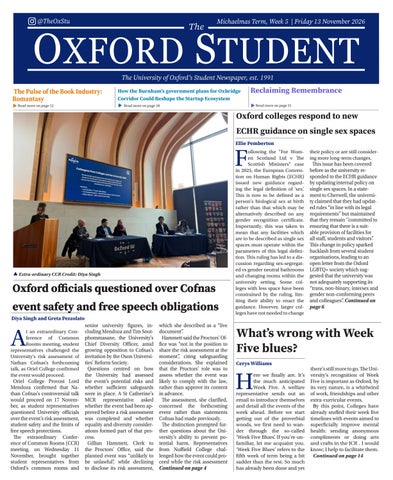
Extra-ordinary CCR Credit: Diya Singh
Oxford officials questioned over Cofnas event safety and free speech obligations Diya Singh and Greta Pezzolato
A
t an extraordinary Conference of Common Rooms meeting, student representatives challenged the University’s risk assessment of Nathan Cofnas’s forthcoming talk, as Oriel College confirmed the event would proceed.
Oriel College Provost Lord Mendoza confirmed that Nathan Cofnas’s controversial talk would proceed on 17 November, as student representatives questioned University officials over the event’s risk assessment, student safety and the limits of free speech protections. The extraordinary Conference of Common Rooms (CCR) meeting, on Wednesday 11 November, brought together student representatives from Oxford’s common rooms and
senior university figures, including Mendoza and Tim Soutphommasane, the University’s Chief Diversity Officer, amid growing opposition to Cofnas’s invitation by the Oxon Universities’ Reform Society. Questions centred on how the University had assessed the event’s potential risks and whether sufficient safeguards were in place. A St Catherine’s MCR representative asked whether the event had been approved before a risk assessment was completed and whether equality and diversity considerations formed part of that process. Gillian Hammett, Clerk to the Proctors’ Office, said the planned event was “unlikely to be unlawful”, while declining to disclose its risk assessment,
which she described as a “live document”. Hammett said the Proctors’ Office was “not in the position to share the risk assessment at the moment”, citing safeguarding considerations. She explained that the Proctors’ role was to assess whether the event was likely to comply with the law, rather than approve its content in advance. The assessment, she clarified, concerned the forthcoming event rather than statements Cofnas had made previously. The distinction prompted further questions about the University’s ability to prevent potential harm. Representatives from Nuffield College challenged how the event could proceed while the risk assessment Continued on page 4
ollowing the “For Women Scotland Ltd v The Scottish Ministers” case in 2025, the European Convention on Human Rights (ECHR) issued new guidance regarding the legal definition of ‘sex’. This is now to be defined as a person’s biological sex at birth rather than that which may be alternatively described on any gender recognition certificate. Importantly, this was taken to mean that any facilities which are to be described as single sex spaces must operate within the parameters of this legal definition. This ruling has led to a discussion regarding sex-segregated vs gender neutral bathrooms and changing rooms within the university setting. Some colleges with less space have been constrained by the ruling, limiting their ability to enact the guidance. However, larger colleges have not needed to change
their policy or are still considering more long-term changes.
This issue has been covered before as the university responded to the ECHR guidance by updating internal policy on single sex spaces. In a statement to Cherwell, the university claimed that they had updated rules “in line with its legal requirements’’ but maintained that they remain ‘’committed to ensuring that there is a suitable provision of facilities for all staff, students and visitors”. This change in policy sparked backlash from several student organisations, leading to an open letter from the Oxford LGBTQ+ society which suggested that the university was not adequately supporting its “trans, non-binary, intersex and gender non-conforming peers and colleagues”. Continued on page 6
What’s wrong with Week Five blues? Cerys Williams
H
ere we finally are. It’s the much anticipated Week Five. A welfare representative sends out an email to introduce themselves and detail all the events of the week ahead. Before we start getting out of the proverbial woods, we first need to wander through the so-called ‘Week Five Blues’. If you’re unfamiliar, let me acquaint you. ‘Week Five Blues’ refers to the fifth week of term being a bit sadder than the rest. So much has already been done and yet
there’s still more to go. The University’s recognition of Week Five is important as Oxford, by its very nature, is a whirlwind of work, friendships and other extra-curricular events. By this point, Colleges have already stuffed their week five timelines with events aimed to superficially improve mental health: sending anonymous compliments or doing arts and crafts in the JCR . I would know; I help to facilitate them. Continued on page 14
Friday 13 November 2026 | The Oxford Student
2 | Editorials
Editorials A Note from the Oxstu Team
The Oxford Student is an independent, fully student-run newspaper that has been providing truthful, open, and free journalism to all of Oxford for over 30 years. This includes important investigative journalism, holding the University, its colleges, and institutions accountable every term. Our work also provides a training ground for some of the most successful journalists around the world, including Stephen Bush, Lewis Goodall, Anoosh Chakelian, and many more, as well as leading figures in politics, business, technology and creativity. The Oxford Student – supported by an engaged alumni community plays a key role in building the next generation of journalists, holding our society, economy, and democracy accountable. We need your Common Room’s support to keep this going. Our work is mainly funded through JCR and MCR subscriptions, which gives Common Rooms access to the newest student journalism in the city. Every 2 weeks, The Oxford Student delivers a 24-page print to every Common Room with a subscription. This Freshers Guide, funded solely through ad sales, is a great example of what you can expect if you bring the paper into your common room, at low costs, helping to keep student journalism flourishing in the city.
Contents News Investigation Opinion Culture Features Business Identity Profiles Sport
calité, Souveraineté” examines politics of remembrance. This the current state of the French issue in particular brings back financial system. For anyone some left-wing representainterested in macroeconomtion (if it ever left us, that is). ics, the future of the EuropeWith Week 5 behind us, we an Union as we know it, or the can only hope that the return safety of their post-term trip to of balls, bops and a generalParis, give it a read! Finally, Elly more active social calendar lie Pemberton’s investigation will restore some much-needinto the response from colleges regarding the ECHR ruling on ed momentum for the rest of single sex spaces is a fascinating term. After all, there are only elcome to Week 5 with read. We looked through college ear Reader, these past so many essays one can write the OxStu: for the faculty meeting minutes, findtwo weeks have been before needing a night out (or first years, the novel- ing some incredibly interesting intense (at least for three). Here’s to a slightly less differences between colleges me, as a poor third year who is blue remainder of Michaelmas ty might be starting to wear off. For the rest of us, it already had. on how they’ve followed the trying to employment-max) – – happy reading! But let the OxStu cheer you up! guidelines, including my own the Week 5 blues are infamous OxMas is upon us, the rain has Regent’s Park College. Sufferand we are right at the crux of held off for a few days this past ing from the seemingly endless them. But this is why we are week, and my current education burden of work this University here: to make them slightly less in Adam Sandler’s Thanksgiving gifts its students, I was in need blue… or perhaps more, given Song (thanks Leila) has firmly of a pick-me-up. As one does, I lifted my spirits. I’m now 80% found myself re-watching bits of that this is our colour, after all. done with OxStu prints from this Creed on a “study break”. WatchThis week, we return with more term, and already trucking along ing a boxing match in the Radcoverage of right-wing speakers with our final edition in Week 7. cliffe Camera was not on my Oxin Oxford. Sometimes, it feels This week’s print has some fan- ford Bingo Card… but I’ve done like that is all there is to report on tastic entries. I’d like to shout out it far more times than I’d like to in this city. It almost makes me the Op-Eds once again, talking admit. Rocky Balboa reminds quite glad to have semi-retired about populism in light of the re- us to take “one step, one punch, from news reporting. Yet, there cent US midterms. It’s a fantastic one round at a time.” I’m taking is plenty more in this week’s discussion by Antonio and Gui it one article, one essay, and one with their Portuguese takeover of print at a time. See you in two print, with an array of topics the page. Next, the Business and weeks. ranging from how Oxford’s colEllie Apostolidi Finance section’s article with the leges are navigating questions Luke Erly fantastic headline “Égalité, FisBalliol College around single-sex spaces to the Regent’s Park College
D
T
his edition’s lead story is The Oxford Student’s fifth article covering Cofnas. Yet in paying such close attention to the invitation’s rippling effects through Oxford’s community, there is
Editorial Team
4 6 8 10 14 18 20 23 24
Contact us at oxstu.editor@gmail.com
Editorial Board Ellie Apostolidi and Luke Erly (Editors-in-Chief) Elliott Wang and Gabriella Bedford (Associate Editors) Guilherme Lopes (Managing Director) News Isaac Gavaghan (Deputy Editor) Abdul Olagunjuadekunle, Samuel Govier, Ansu Bhattarai, Tristan Clark Lam, Greta Pezzolato, Diya Singh, Leen Almasri, Saba Ahmadzadeh Noughani, Christine Savino, Bay Ross, Sylvia Kline, Joe Parsons (Section Editors) Opinion Christian Wang (Deputy Editor) Antonio Reis, Eleanor Harris, Yiran Su, Leen Almasri, Zar Motik
W
a risk that the wider significance of the Reform Society’s decision might be obscured. A less parochial perspective on the rise of the right can be found on page 9, where Greta Pezzolato argues that “The left has won, but not leftism.” What leftism is, however, is an open question. In a Swiss alpine village in August, I met a professor of international relations who told me he viewed multiculturalism as a failure. His mind moved most easily towards what was wrong. At the same time, The Oxford Stu-
dent’s Freddie Lewis-Hedley was in Saxony-Anhalt, where the AfD won sweeping victories rejecting multiculturalism and the German political consensus of the preceding decades. His piece is on The Oxford Student’s website. Back in Britian, Burnham too turns away from decades of political consensus by promising an end to 40 years of neoliberalism. Across Europe, there is a thirst for change. But, as Starmer showed, change is harder to define than to call for. This climate of uncertainty
Adisuryo, Samuel Govier, Greta Pezzolato, Abdul Olagunjuadekunle, Tristan Clark Lam, Joannie Lao, Yiran Su, Lucy May, George Murphy, Freddie Russell, Georg Haslam, Jessica Ellis, Ruby Torsney, Malavika Rudrakumar, Shannon Wang Lee, Lily Malligan (Section Editors)
Akheel Kale, Chauncey Robinson, Claire Frost, Zar Motik Adisuryo, Fathan Mahardika (Section Editors)
Features Ellie Pemberton (Deputy Editor) Ben Futter, Hannah Ison, Phoebe Payne, Carolina Perotto, Richard Kühl, Yiran Su, Aaron Butters, Charlize Morrey, Lily Aldred, Yash Kothari, Tessa Stanier, Nihaarika Shrikant, Amun Chaudhary, Poppy Geyman (Section Editors) Business and Finance Leila Hoffpauir (Deputy Editor)
Investigations Ivett Berenyi (Deputy Editor) My Anh Ngoc Nguyen, Hannah Ison, Ava Doherty, Abdul Olagunjuadekunle, Mimi Berridge Shea, Sze Wai Yun, John Yannis Liddel, Joe Parsons (Section Editors) Culture Flora Molnar (Deputy Editor) Jasmine Joyan (Poetry Deputy Editor) Aamina Thava, Aidan Kane, Carolina Perotto, Kadija Owusu-Kabba, Siena Tracey, Phoebe Payne, Lucia Clark, Ruhi Visaria, Isaac Simeon Sinclai, Joseph Walford, Sofia Di Stazio, Sarah Chew, Georgia Kennedy, Cerys Williams, Isabella Jones, SongHa Choi, Reyhan Ali Mawjee,
throws into relief the chilling clarity of Cofnas’ vision of “Hereditarian revolution”. Is there a left-wing programme with such exactness? As the left struggles for a vision to replace the neoliberal consensus, figures like Cofnas fill the limelight. The jagged and divisive politics of the right imagines many things that the left opposes. But can opposition become imagination?
Isaac Gavaghan
Wadham College Sheridan Hauser, Michelle Luo, Ionna Dionissiou (Section Editors) Anja Woosnam, Oliver Weston, Christina Robinson, Anya Tindall, Carolina Perotto, Ben Futter, Briann Stephens (Poetry Section Editors) Identity Katrina Roach (Deputy Editor) James Stratmann,Ben Futter, Joseph Walford, Nguyen Thi Ngoc Mai, Yasmin Morgan, Yeliz Ece Evgen (Section Editors) Profiles Martha Kiyan (Deputy Editor) Diya Singh, Saba Ahmadzadeh Noughani, Ansu Bhattarai, Richard Kühl, Sharanpreet Padda (Section Editors) Sport Charles Prestwich (Deputy Editor) Ruhi Visaria, Siena Tracey, Finn Perry (Section Editors)
The Oxford Student | Friday 13 November 2026
Op-Eds | 3
Op-Eds Populism is how we may deliver a better world Guilherme Lopes
T
The Grapevine
his country is in perhaps the worst position it has ever been. We have been put here by Conservative and Labour governments alike. If the left wishes to make an electoral proposition that may be successful, it must return to the roots with which it has fought its toughest battles: the people, broadly conceived, versus the rich and powerful elite who increasingly dominate our economy, society, and indeed our lives. Populism is the expression of a mass popular movement, and it is the defining tactic which will deliver hope for the West. It is therefore not only useful or good; it is central to our political offering. It is now the moment for the left to re-encounter that which had once made it popular - a discourse that is centred on a dialectical opposition in society between us and them. This works because people feel it in their wallets every day. Importantly, progressive populism also works because it enables a description of the current state of affairs which both the centre and right fail to capture. The centre cannot bring itself to link economic and political power. The right might, but it riles against ‘woke’, intellectuals, or more often immigrants, because to admit that economic elites are intimately linked to political power would be to dismantle their project (‘billionaires give us money so we can fight for our national culture!’). By defining our political sphere in this adversarial ‘us versus them’, the left is
Populism isn’t the problem. ‘The people’ is Antonio Reis
able to conceptually join together the power of capital, which has produced inequality abound, and the political power on which it rests. In turn, the inability of both right and centre to combat the economic elite can be explained either by showing that these political actors have a stake in that elite (Trump), or that their political existence is sustained by it (Orban, Farage, Cameron, but also Biden and Starmer). Populism is often the stuff of the farright. These grifters are correct when they say we have been robbed of a good life, but the left must be loud and clear here. It is the wedding of concentrated economic power to political scaremongering that has committed this assault. I believe the left has a very simple mission: to show what they, the real elite, have taken from us. Gutting council housing programmes. Dismantling the NHS. Killing our climate, heatwaves, and more drilling in the North Sea. Wage stagnation. Increasing poverty. Home ownership out of reach for even the traditionally affluent sections of the middle-class. AI everywhere, threatening to take our jobs with no real plan for the day after, all the while enriching the same dozen people. The NEETS crisis. And all this while we live in a society in which fewer and fewer people have more and more wealth. Let them know we will not rest easy.
University hears concerns from students on Cofnas This author understands that a group of students, who have chosen to remain anonymous, have raised concerns regarding the Cofnas event with the Chair of the Graduate Access Subcommittee, in hopes that these would be communicated to the University and Oriel College. The students made requests to the University, including calling for a condemnation of both the event and Cofnas’ views. In the case of the event going ahead, students also called on the University to keep students safe and informed, primarily by publishing the risk assessment of the event and making adequate provisions to protect student welfare on the day. The University and Oriel have not, so far, agreed to any of the requests made by these students.
P
opulism is having a moment. Zack Polanski has recrafted the Greens around what he calls ‘eco-populism’; last week’s Democratic sweep of Congress was built on messaging some would call ‘economically populist’; and the past decade has been defined by the ‘rightwing populism’ of Trump, Le Pen and Farage. If a label is claimed by anyone from the Greens to Reform UK, it’s worth asking what it actually describes. Most often it describes nothing. A “populist” may be a demagogue, extremist, or simply a politician-I-dislike-who-draws-crowds. But there is a sharper and more useful definition. Populism is an ideological description of the political world as two camps: a virtuous and homogenous majority ‘people’ and a set of dangerous minority ‘other’. It’s less an economic or social programme in itself, it attaches to ‘thicker’ traditions like nationalism, socialism or nativism. That is why the ‘other’ is so interchangeable: the rich, minority groups, the deep state, immigrants, or whoever else you choose. In a global world where everything is in flux and half a step away from being AI-generated, Populism is refreshingly simple. The ‘us’ is everyone you know and the ‘them’ is mysterious enough to be threatening. Pluralism, in contrast, with its messy overlapping groups and compromise, is nuanced, complicated, and unsat-
These discussions involved students across various societies and degree and scholarship programmes, which according to a source familiar with the matter were intent on “showing solidarity with the black students and staff at this university.” The individual added that, given an agreement seems “unlikely”, students should take action: “If the University won’t stand up to protect the equality of its black students, then we must protest this event ourselves at 5pm in Oriel Square on 17th November.”
Tired of racist speakers at Ox? Here’s three events to go to instead Oxford Economics Society is hosting Oliver
isfying. Populism offers unity, energy, and a sense of attack. Corrupt elites do exist and should be fought. The problem is that a charge about conduct can be disproven, but a charge against a whole group cannot. Defending its members only counts as proof of complicity. The notion of a ‘homogeneous people’ is a myth. In a diverse world, there are innumerable ‘others’ who can be added to the crusade – it is the most mobile category in politics. Immigrants, religious minorities, judges, and journalists and more have all been assimilated into it, while populists themselves somehow never are, even when in power. Nothing in populist logic stops it from running over nuance, checks and balances, a free press, or individual rights because each one, by definition, stands between the people and their will. Chávez’s attack on rich elites expanded into one on the judges and the press. Of course, this may not dissuade the populist: everyone else is fearmongering, but they have found the real enemy. But, in the quest against this enemy, none are safe. Of course, we should not confine ourselves to technocratic, boring politics. You can run hard against concentrated power without rhetoric that turns adversaries, whom you fight but accept, into enemies of the people, whom you must eliminate. That distinction is the whole thing, and it is the one populists cannot make.
Bullough, an investigative journalist, on the very same day. The University is holding a DEI Roundtable on the morning of the 17th, with the topic ‘Progress and pushback: the contested future of equality.’ Finally, MediaSoc is hosting Vicky Spratt, Housing and Society Editor at the i Paper for a speaker event. Date TBD.
UK students to join European youth in planned day of solidarity It seems the young people of this glorious country have realised they too have been dealt a bad hand! As youth protests continue across Europe, those of us in the UK will have our own fun on the 20th. Oxford meetup is 12:15, Carfax Tower.
4| News
News
The Oxford Student | Friday 13 November 2026
oxstu.news@gmail.com | Deputy Editor: Isaac Gavaghan Section Editors: Saba Ahmadzadeh Noughani, Bay Alexandra Ross, Leen Al-Masri, Ansu Bhattarai, Tristan Clark Lam, Sam Govier, Sylvia Kline, Freddie Lewis-Hedley, Abdul Olagunju-Adekunle, Joe Parsons, Greta Pezzolato, Freddie Russel, Christine Savino, Diya Singh
Oxford officials questioned over Cofnas event safety and free speech obligations
Diya Singh and Greta Pezzolato Continued from front page
remained ongoing, particularly given the national attention surrounding the invitation and concerns about student safety. Hammett maintained that the University was applying the law as it understood it. Officials also acknowledged plans for a protest on public land outside Oriel, noting that activity beyond University property fell outside its control. Citing the “statutory duty to protect and promote free speech”, the Provost reiterated that the event is being organised by the Oxon Universities’ Reform Society. As such, Mendoza claimed that the College does not automatically endorse it by providing a venue and denied Oriel is “responsible for the content”. He also stressed that student societies have significantly fewer restrictions than individual colleges or the University when organising events. Regardless of the backlash faced, he argued that “the event must go ahead” and that Oriel was “un-
likely to change our policy [surrounding student bookings]” in the future. Soutphommasane, echoed Mendoza’s emphasis on the University’s duty to protect lawful expression and repeated the distinction between invitations issued by academic departments and events organised independently by student societies. He welcomed students’ scrutiny of the decision, describing their willingness to challenge the University’s position as a sign of a “healthy university” environment. However, the discussion also exposed concerns about the implications of the invitation for students from minority backgrounds. A St John’s College representative told the panel: “I sit here as a Black man and my life is not treated equally.” He questioned whether the University would condemn the invitation of a speaker accused of promoting antisemitic views or “take no stance”.Read more online at www.oxfordstudent.
Pro-diversity event to be held at Mansfield day before Cofnas talk principles.” The panel at Mansfield has not been billed explicitly as a response to Cofnas. However, the title of the event echoes that of Cofnas’ own talk (Is DEI undermining higher education?). The Oxford Student also understands that the pro-diversity discussion was organised some time after the speaker event at Oriel was first announced. The event at Mansfield appears to have been publicly advertised Mansfield College Credit: HiraV, CC BY 3.0, via Wikimedia Commons only as early as 5 November, almost a month after the Oxon Joe Parsons lege. According to Mansfield’s Universities’ Reform Society first n event discussing the events page, the panel will dis- announced they would be hostmerits of diversity and cuss “why diversity and plural- ing Cofnas on 10 October. pluralism in higher ed- ism – of both people and ideas In a statement, a spokesperson ucation will take place at Man- – are fundamental to the intel- for the organisers of the panel sfield College on Monday 16 lectual strength of universities, event said that, while “[f ]reeNovember, one day before the challenges they face, and dom of speech is fundamental self-proclaimed “race realist” how universities can protect and to university life, including the philosopher Nathan Cofnas is promote them.” freedom to express and chalset to deliver a talk at Oriel ColThis is in stark contrast to Cof- lenge ideas with which we may lege, hosted by the newly formed nas, who – in a controversial strongly disagree [...] it is equally Oxon Universities’ Reform Soci- blog post that saw him lose his important to ensure that individety. position at Emmanuel College, uals are treated respectfully, and How Diversity and Pluralism Cambridge – called for a “hered- not bullied, harassed or belittled Enrich Higher Education will itarian revolution” and argued because of their personal charbring together the heads of six that “[i]n a meritocracy [...] the acteristics. Universities should Oxford colleges in conversation number of black professors at foster a culture of respectful dewith Professor David Ruebain, Harvard would approach 0%.” bate, where different perspecFree Speech Officer and Pro A spokesperson for the organ- tives can be explored and disVice-Chancellor for Culture, Di- isers of the Mansfield event also cussed thoughtfully, and ideas versity, and Inclusion at the Uni- said that the discussion “would can be considered on their merversity of Sussex. explore how universities can its.” Read more online at www. One of the college heads due uphold freedom of expression, oxfordstudent.com to speak at the event is Lord Neil and champion diversity and inMendoza, Provost of Oriel Col clusion as mutually reinforcing
A
Oxford University Press connects AI to its “academic content” Isaac Gavaghan and Abdul Olagunju-Adekunle
T
he “academic content” of Oxford University Press (OUP) has been fed into ChatGPT Edu. The pilot scheme, announced on Tuesday 3 November, has been running since October and allows some users of ChatGPT Edu to “securely connect” to use “peer-reviewed content” which OUP ordinarily would provide to their institution. OUP explained in a press release sent to The Oxford Student that the aim of the pilot was to increase the level of trust researchers have in AI by making “high-quality trusted content” accessible through the models. OUP’s “academic content” will be accessible to ChatGPT Edu via a “Model Context Protocol” which is a server linking a database with an AI tool. Par-
ticipants in the pilot will be able to access content which their institution already subscribes to through OUP, through ChatGPT Edu. The Oxford Student asked OUP whether concerns had been raised regarding how this use of “academic content” might affect copyright. John Campbell, Product Strategy Director for OUP’s Academic Division commented: “we’re putting researchers’ needs at the heart of our work, helping them harness the power of this evolving technology in a secure and reliable way.” Richard Ovenden, Bodley’s Librarian, said: “This collaboration will allow us to review how readers use AI technology in their studies and to help develop approaches to ensure that students and researchers
can confidently rely on the information they discover.” The announcement of the pilot comes six weeks after it emerged from an investigation by Ethan Penny and Dan Milmo at The Guardian that the Bodleian Libraries allowed Open AI to train its models on its books. The Bodleian subsequently issued an updated AI policy, which said it was committed to “academic integrity” and “human oversight”. The University of Oxford, as well as Harvard Library and Pennsylvania University’s Wharton School, will be participating in the pilot until December 2026. The results of the pilot will be used to decide whether to further integrate AI into academic publishing in future.
Friday 13 November 2026 | The Oxford Student
News | 5
Cowley’s Ultimate Picture Palace shortlisted for prestigious
government revives reorganisation Diya Singh
Freddie Lewis-Hedley
T
A
rthouse favourite of Oxford students, the Ultimate Picture Palace (UPP) in Cowley has been shortlisted for the prestigious 2026 Cinema of the Year award at the British Independent Film Awards (BIFA). UPP is one of five shortlisted cinemas selected from over 70 competing establishments. Cinemagoers cast votes for the cinemas, which came to nearly 50,000 in all. Founded in 1911, the UPP is one of the oldest purpose-built cinemas in the country and the oldest among the other nominees. Like the second-oldest cinema on the list, the Hippodrome Cinema, founded in 1912, the UPP has opened and closed multiple times since it first opened, and now it says it’s fighting for its survival again. As of May this year, Oriel College, which owns the Grade II listed building housing the UPP, has refused to extend the cinema’s lease past 2037. The UPP argues that a lease extension is necessary for its survival, so that they are allowed to carry out sustainability and access developments crucial for its financial viability. Since then, the cinema has launched the ‘Save the UPP’ campaign whose flyers can be seen posted in the windows of businesses all over the city. Micaela Tuckwell, former Executive Director of the UPP, claims Oriel has been ‘taken aback’ by the campaign and the awareness it has raised has ‘harmed the college’s reputation’. It is, though, unclear whether the UPP’s BIFA award nomination has anything to do with popular
Oxford City Council faces abolition as
Image Credit: Freddie Lewis-Hedley, with permission
support from Oxford residents who fear the cinema’s closure. Oriel College, whose provost Lord Mendoza has attended a “Save the UPP” screening at the cinema, has stated it is ‘very proud’ of the UPP, as ‘one of the country’s historic cinemas’, for its nomination. Meanwhile, Chair of the UPP Alastair Phillips says he is moved by the ‘outpouring of supportive affection’ for the cinema since its nomination. Asked whether the UPP’s shortlisting could positively impact any negotiations with Oriel, Philipps declined to comment, however he mentions that he and colleagues are ‘in the very early stages of discussions [with Oriel] about how to enable a mutually beneficial facility’ for the cinema and college. News that the UPP has reentered discussions with Oriel marks progress since former Executive Micaela Tuckwell complained of the college’s ‘refusal’ to negotiate a lease extension several months
he government has revived plans to replace Oxfordshire’s existing councils with three new authorities by 2029, despite opposition from Oxfordshire County Council and the prospect of legal action. Oxford City Council and Oxfordshire County Council face abolition after the government revived plans to replace seven councils across Oxfordshire and West Berkshire with three new unitary authorities by April 2029. The announcement on 29 October follows a national review that suspended the reorganisation in September. Ministers have retained their preferred three-council model despite opposition from Oxfordshire County Council, which is considering further legal action. Under the proposals, Greater Oxford Council would cover Oxford and its immediate surroundings, while North Oxfordshire Council would serve most of Cherwell and West Oxfordshire. Ridgeway Council would cover most of South Oxfordshire and Vale of White Horse, alongside West Berkshire. The new unitary councils would combine responsibilities currently divided between city, district and county authorities, including housing, planning, transport, education and social care. Oxford City Council leader Susan Brown welcomed the announcement, saying: “The government has
chosen the right proposal for Oxford, Oxfordshire and West Berkshire.” Brown argued that the changes would simplify local government, keep decision-making local and give Oxford greater capacity to deliver housing and employment opportunities. The proposals have faced opposition from Liberal Democrat-led Oxfordshire County Council, which favours a single authority covering the county. Council leader Tim Bearder said he was “deeply disappointed” by the decision, citing concerns over public service delivery, costs and accountability. “We believe a single Oxfordshire council offers the strongest foundation for financially sustainable services, clear accountability and effective working across the county,” he said. The county council issued a legal letter and a protective court claim in October after requesting evidence supporting the government’s original decision in July. Bearder said the council would consider further legal options following the latest announcement. The reorganisation could reshape local decision-making on issues affecting Oxford students, including housing development, transport and public services. Greater Oxford Council would assume responsibility for services currently administered separately by the city and county councils. Read more online at www.oxfordstudent.com
Former Canadian PM becomes Blavatnik Fellow Abdul Olagunju-Adekunle
Image Credit: Justin Trudeau, CC BY 3.0 via Wikimedia Commons
T
he Right Honourable Justin Trudeau, who served as the 23rd Prime Minister of Canada from 2015 to 2025 and leader of its Liberal Party from 2013 to 2025, has been named as a Distinguished Fellow of the University of Oxford’s Blavatnik School of Government. In a 6 November press release, the Blavatnik School of Government announced that Trudeau had become a member of its World Leaders Circle. The group runs the World Leaders Fellowship, which has the stated goal of helping “global leaders who are transitioning from steering their countries or organisations to the next stage of their public leadership journey”. Trudeau will join the likes of Jacinda Ardern, former Prime Minister of New Zealand from 2017 to 2023 and Rishi Sunak, Prime Minister of the United Kingdom from 2022 to 2024. Professor Ngaire Woods, who has served as the Dean of the Blavatnik School of Government since its inception in
2011, expressed her welcome to Trudeau, saying: “We are delighted to welcome Justin Trudeau to the School as a Distinguished Fellow and member of our World Leaders Circle, a forum to exchange ideas and foster international collaboration among leaders. He brings with him a wealth of experience, forged through a decade of public service.” Trudeau had previously spoken at the Blavatnik School of Government in June, having been invited to speak on “the future of democracy in a technology-driven world” While there, he met with Canadian and Master of Public Policy students. Speaking on his appointment, Trudeau said he looked forward to providing his experience and to “engaging with the next generation of government and policy leaders”, and that this would help “build a more hopeful, inclusive and prosperous future for everyone”.
6 | Investigations
Friday 13 November 2026 | The Oxford Student
Investigations
oxstu.investigations@gmail.com
Oxford colleges respond to new ECHR guidance on single sex spaces Ellie Pemberton Continued from front page The letter amassed 700 signatures and accused the university of being “exclusionary” and having “notoriously unclear enforceability”, arguing that the university should be making good use of the institution’s status and suggesting that resistance to the new guidance is the best way forward. Many colleges, including Green Templeton, do not note a change in their policy on bathroom facilities within the last three years. They did report that the college currently has 10 gender neutral bathrooms in communal spaces as well as 46 in student accommodation. Moreover, the college clearly says in their transgender policy statement that they are committed to keeping the records of members’ biological/birthsex absolutely confidential as well as making a conscious effort to actively update records to reflect an individual’s chosen name and gender identity. Similarly, Wadham College stated that they follow ‘prevalent practice within the collegiate university, and see no need to create policies on such matters’. They also said they have two male and female only changing rooms, in addition to one set of male and female only toilet facilities but all other facilities are gender neutral which are over one hundred in number. The nature of responses remains fairly consistent across colleges with consistent provision for male only, female only, and gender neutral facilities across communal and private spaces. However, the response from Nuffield College differed. Nuffield notes that all bathrooms on site are gender neutral, unlike having all three options as seen else-
where. Regent’s Park College responded to a Freedom of Information request from The Oxford Student saying that there had been no policy change in the last three years, suggesting that there had been no discussion for implementing changes based on the new guidance. However, in an email sent to all students by the PPH’s Welfare Fellow on 3 November with the subject line “Bathrooms”, the college stated that “over the summer a new ECHR Statutory Code of Practice came into effect… This has meant that there have been changes within the college in order to ensure that it is legally compliant in the provision of single sex spaces.” Such measures have resulted in changes to bathroom access within first year accommodation. Whereas previously the bathrooms in the ‘Main’ block were gender neutral, signs have been placed on the doors to designate them as single sex spaces. Notably, this has caused some discomfort within the JCR as one transgender member told The Oxford Student, “The effects of having gendered bathrooms affects transgender individuals immensely. I know from my first year, before these changes were implemented, that there is a certain level of anxiety around people ‘figuring’ out that you are trans, partly due to its stigma but also the knowledge that this may change how people view or think about you. This anxiety must only be worsened with the implementation of gendered bathrooms, as it signals individuals out. It is clear in Regents that facilities can offer privacy for everyone within shared bathrooms, such as the Vinson block,
but due to the lack of funding and resources this cannot be enacted throughout college. This barrier to better privacy and security has been made worse due to the lackluster communication from the college”. The member refers to the Vinson block, one section of the first year accommodation, in which there are single user bathrooms as opposed to the other blocks which are multistall toilets/showers. Regent’s Park College did not respond to a request for comment.
for colleges to make changes. Whereas Lady Margaret Hall and Jesus College already had a significant number of single occupancy or ensuite bathrooms, whereas Regent’s Park College, a PPH, remains restricted by the multi-stall system. Whether or not the university has chosen the best path in terms of handling the ruling, it seems quite important to question the feasibility of the
new guidance in a collegiate university. The information provided demonstrates that whilst colleges are able to claim that they are acting within the requirements of the university’s central statement, the nature of the collegiate system means that the practical outcome differs across the city, which has the potential to impact student experience. Read more online at www.oxfordstudent.com
“Whether or
not the university has chosen the best path in terms of handling the ruling, it seems quite important to question the feasibility of the new guidance in a collegiate university. Whilst Green Templeton College has 161 student toilets, Regents Park College has only 44 student toilets. Alternatively, Lady Margaret Hall presents a different outcome, having 214 ensuite bathrooms and as such provides ‘gender-neutral’ facilities in a way which is only possible for a limited number of colleges, dependent on wealth and space. Factors such as college location and the setup of facilities prior to the guidance evidently play a significant role in the scope
‘Main’ Corridor Bathroom inside RPC, Credit: Lily Aldred
The Oxford Student | Friday 13 November 2026
Advert | 7
Friday 13 November 2026 | The Oxford Student
8 | Opinion
Opinion
oxstu.comment@gmail.com | Deputy Editor: Christian Wang Section Editors: Leen Almasri, Eleanor Harris, Tristan Clark Lam, Greta Pezzolato, Freddie Russell, George Murphy, Georg Haslam, Joannie Lao, Lucy May, Zar Motik Adisuryo, Antonio Reis, Yiran Su
Oxford’s Reform UK society proved my point by inviting Nathan Cofnas Saba Ahmadzadeh Noughani
E
arlier this year, I raised concerns about the rhetoric and political environment surrounding Reform UK, and argued that such political organisations with a record of anti-Muslim hostility are not entitled to institutional endorsement, or use of the university’s facilities to recruit and gain legitimacy. Some Oxford students dismissed my safety concerns and responded to points I did not make but that they would have preferred me to argue, the ‘freedom of speech’ argument being one of them. Though I am sure that they know very well that freedom of speech protects expression from unjustified state censorship or criminalisation, and does not obligate Oxford to grant a prestigious platform to figures whose speech creates dangerous environments for vulnerable student groups. And of course, these Reform UK supporters who apparently care about free speech had nothing to say about free speech, freedom of expression, freedom of thought, freedom of protest, or the British values they apparently care so much about like tolerance of different beliefs and ideas, when thousands of protesters have been arrested and charged as terrorists for simply holding placards. These same students had not written any comments or Substack articles when Reform MP, and former Home Secretary Suella Braverman urged police to consider whether the protest chant “From the river to the sea, Palestine will be free” could constitute a criminal offence. Surely free speech
should extend to speech that others may disagree with? It does seem that these students only started caring about free speech to excuse Reform UK’s hate speech. Reform’s political rhetoric has consequences and directly contributes to the political and social environment in which Muslims and minorities are discussed and treated. I do not argue this in isolation. In 2025, Reform Party leader Nigel Farage’s comments were cited as a case study in the hate-crime training session for North Yorkshire Police where officers were shown footage of Farage discussing Muslims. As back as 2016, in the House of Commons’ Hate crime and its violent consequences evidence ses- sion, Farage’s rhetoric was cited as an example of rhetoric by mainstream politicians that could contribute to promoting Islamophobia and hate crime. Today, those same students who disputed my claim that a Reform UK society will encourage anti-BME rhetoric on university grounds, remain silent as the Oxon’s Reform UK society has proved my point for me by inviting Nathan Cofnas as a guest speaker. Oriel College has provided them the Harris Lecture Theatre for 17 November. In a statement, the college said that it “permits events booked by students who are committee members of registered societies except in exceptional circumstances. Permission does not imply endorsement by the College…”. Oriel College is telling us very clearly that they had the ability to choose to not host this event but that they do not consider this an “exceptional circumstance”, and were therefore willing to provide Cofnas the
Oriel College’s First Quad. Credit: Alf via Wikimedia Commons
space to spread his pseudo-science and racist ideas. Despite the continuous campaigning of the Rhodes Must Fall movement, it is not enough for Oriel College that they are still honouring Cecil Rhodes with a statue and that their ethnic minority student body must endure walking past it, but even after Professor Arday’s death, they must also provide Cofnas a room to speak. “Permission does not imply endorsement” Oriel says, but whether they endorse his racism makes no difference when they are providing someone the space to spread racist andwhite-supremisist ideas. The University, and Oriel, did not condemn the invite and are instead facilitating the event and its smooth running by providing a room. If this is not endorsing it, then what is? Oriel’s statement claims that the college is “committed to upholding freedom of speech…This includes the freedom to express views that many find deeply offensive”. “Deeply offensive” however, does not suffice to describe the hate speech that Cofnas has spread. Surely, Oriel College is
aware that Cofnas had expressed ambitions of becoming the “head of the Department of Eugenics and Race Science at Harvard”? Surely, they are aware that he has said that there “must be some barriers between races”, and argued in favour of “the preservation of racial distinctions”? Oriel continues that it is ”committed to promoting inclusion and maintaining an environment that is free from all forms of discrimination and harassment, including racial discrimination.” If they are being truthful, then they would not be willing to host Cofnas, who has claimed that there are “intelligence differences” among racial groups. Cofnas is most known for stating that black people are biologically less intelligent than white people and in a true meritocracy “would disappear from almost all high-profile positions outside sports and entertainment”. Nobody is in any doubt about what Cofnas will say on 17 November, or who it will be targeted at. All speech, and such hate speech, has consequences. The University of Oxford, which is apparently “committed to tackling
racism, and to protecting the safety and welfare of its members”, has permitted a Reform society to register and is permitting its colleges like Oriel to facilitate Reform UK society events. I stand firmly with what I argued a few months ago: such a society puts Muslim and ethnic minority students at risk. very hard to “Ittakebecomes Reform UK’s deni-
als of racism seriously when its student society invites someone like Cofnas.
Leading British Muslim representatives have also raised concerns that Reforms rhetoric reinforces stereotypes and hostility towards Muslims. Consider Brett Muscroft, the new Reform UK councillor for the Castleford Central & Glasshoughton ward. His Facebook account shows a post of a bottle of Glenfiddich whisky with the caption “finally, a 12 year old that a Muslim won’t touch!”, a ‘joke’ about a cannibal tribe accepting refugees because they would be eaten, and a claim that “Britain has looked like a third world ... Read the full article online at www.oxfordstudent.com
The Oxford Student | Friday 13 November 2026
Opinion | 9
The left has won, but not leftism Greta Pezzolato
R
ecent elections in the Indeed, he particularly United States and Bra- stresses Jesus’ message to zil have seemingly put love one’s neighbour in the a pause on the growth of the context of social reform far-right, yet it would be an from expanding the Child overstatement to argue that it Tax Credit to improving is on its way out. It is tempt- healthcare. He has also ing to see the results as an appealed to local ranchers indication of a resurgence of and farmers through his the left however the rejection vow to repeal harmful ecoof right-wing parties does not nomic policies. By tailoring necessarily constitute an em- the ‘big tent’ Democrat polbrace of leftism. icies to uniquely local anxIn the USA, the sweeping ieties, Talarico was able to Democrat midterm victories garner Texan support. are far more an indication of Although Trump has ofpopular disapproval towards ficially entered into a lame the Republican Party than duck presidency, his interapproval for the Democrats. national allies are all but Flipping seven Senate seats weakened. Indeed, despite and over forty House seats, of popular support across the Democrat victories re- Europe, the left continues flect a widespread rejection to tail behind far-right parof the Trump administration. ties. In France, Le Pen’s From ICE operations which National Rally polls at have led to the deportation of 35% whilst the AfD’s vicover 600,000 immigrants, in- tory in Saxony-Anhalt in cluding American citizens, to September has consolithe encroachment on judicial dated the German party’s powers, Trump’s second term claim to power. From anhas shown that no country is ti-immigration rhetoric to immune from authoritarian- the embrace of traditional ism. family values, the far-right Crucial Democrat wins possesses unmistakable came thanks to the candi- characteristics which cadates’ ability to appeal to ter to widespread fears and local worries, merging tra- misconceptions held by the ditional Democrat rhetoric electorate whilst giving it a with states’ needs. For in- seemingly cohesive messtance, James Talarico, Sen- sage, which the internaator-Elect for Texas, promot- tional left critically lacks. ed liberal policies including In the recent Brazilian defending LGBTQ+ rights presidential election, the and upholding press freedom line between rejecting auwhilst refracting his policy thoritarianism and emplatform through the prism bracing the left becomes of Texan conservative tradi- blurred.The threat of Boltions. With 67% of adults in sonaro’s authoritarianism the state identifying as Chris loomed large following his tian, religion was a corner- victory in the first round of stone of Talarico’s campaign elections, arguably spur-
Democratic senators-elect meet with Chuck Schumer in November 2026. Credit: user Scoutguy138 via Wikimedia Commons
ring electoral mobilisation. An extra 3 million voters turned up for the second round of votes on the 25th of October, leading President Lula to win a second term with 51.8% of the vote. The unexpected victory indicates a clear rejection of the far-right in Brazil, in favour of Lula’s leftist agenda. The politicians indeed pledged to increase social spending and achieve the target of zero deforestation in the Amazon Rainforest by 2030. Meanwhile, his historic connections to the workers’ party put him in sharp contrast to Flávio Bolsonaro’s privileged upbringing. However, interpreting the outcomes through the prism of leftism risks oversimplifying the election into a binary left versus right conflict. Indeed, political scientist Miguel Lago opined that “the second round was about Brazilian society saying no to the farright”, declaring that the results were a victory for democracy rather than the left. Although there is little doubt that Brazil was eager to avoid Bolsonaro’s victo-
Pro-Lula rally, runoff, Campinas. Credit: user Mtvdanilo via Wikimedia Commons
ry, it is crucial to also acknowledge Lula’s populist rhetoric. Much like in the USA, his campaign catered around popular demands which the Workers’ Party harnessed for an electoral advantage. With Bolsonaro threatening to encroach on civil liberties and jeopardise the rich Brazilian environment, the electorate voted for the candidate promising to do just the opposite. Despite of his electoral success, Lula now faces critical challenges in government. With a predominantly conservative Congress, passing his agenda may prove even harder than winning a second term. The challenges ahead further reveal that dismantling authoritarianism is not simply determined by electoral results. Good governance and the ability to uphold promises ultimately determine how well a party fares, crucially influencing future elections. In an increasingly polarised world, electoral success is oftentimes determined by what party can exploit popular grievances
to their advantage, independently of their political leanings. It has been established that appealing to common misconceptions and discontent is something the far-right does exceptionally well. From simple messages to an organised international front, authoritarianism seems to be far more united than the global left. Although the wins in the USA and Brazil give hope for a leftist resurgence, it remains to be seen how the newly elected representatives will live up to their promises. The advance of the far-right may have been momentarily stopped, but it is doubtful how long it will last. Elections are coming up in France, Germany, and Italy in 2027. Far-right parties will seek to weaponise misinformation in their campaigns and push authoritarian policies in the form of conservative values onto the electorate. It is now up to the European left to follow in the steps of the USA and Brazil, halting the farright once and for all.
10 | Culture
Culture
Friday 13 November 2026 | The Oxford Student
oxstu.culture@gmail.com | Deputy Editor: Flora Molnar Section Editors: Amun Chaudhary, Lucia Clark, Ioanna Dionissiou, Jessica Ellis, Sheridan Hauser, Isaac Hole, Isabella Jones, Aidan Kane, Richard Kuehl, Michelle Luo, Rayhan Ali Mawjee, Kadija Alisha Owusu-Kabba, Phoebe Payne, Natalie Perera, Carolina Josephine Perotto, Christine Savino, Aamina Thava, Ruby Torsney, Siena Tracey, Ruhi Visaria, Joseph Walford
Is this bait? How Digger loses the plot Isaac Hole reviews the 2026 black comedy film ‘Digger’
I
n mathematics, there is a famous result known as Euler’s identity. It combines the constants pi and e, both transcendental numbers that run to an infinite number of decimal places, with the number i, the imaginary number derived from the seemingly impossible square root of negative one. Add one to this selection of indescribably fascinating numbers, and you’ve completed the expression. It all adds up to exactly zero. Watching Digger is a bit like this. The film isn’t bad, as has been insisted in too many newspaper columns to count. It isn’t great either, however: it adds up to an experience that was solidly okay, neither really positive nor really negative. The film certainly seems to have a point or several to make, but each of these the-
Poetry
Jasmine Joyan Poetry Deputy Editor
matic ideas is never developed in concert with the others, the result being many interesting studies that distract from rather than reinforce one another, and seem to be mostly discarded by the end. Digger begins as a promising, if ostentatious, modern adaptation of Kubrick’s satirical masterpiece Dr. Strangelove. A disaster is imminent in the form of a massive ice shelf heading towards Europe, the consequence of Digger Rockwell’s (Tom Cruise) devil-may-care approach to oil extraction in Greenland; his company’s scientists watch in horror as the finest political minds in the President’s cabinet suggest nuking the shelf and suppressing all information about it. What sticks in the mind most about these early scenes however is the remarkable mise-en-scène: the film opens with the drapes of Digger’s window opening in a manner identical to a theatre
curtain, onto a scene of foggy countryside uncannily reminiscent of a Claude Lorraine painting. This approach becomes wincingly unsubtle at times: Digger’s house is ornamented with a baroque tastelessness that manifests itself mainly in a panoply of stuffed animals and bones. The office of the serial icecap melter is adorned with a polar bear skin rug that is often forced into the forefront of the shot. This reaches its apogee with a tree that collapses right outside the window after Digger utters an optimistic platitude to President Compson (John Goodman). The film up to this point is imperfect but, as a satire, pretty serviceable. The contrast between Digger’s love for his cat Maggie and his blatant disregard for the people dying in the methane explosion on the Greenland rig is crude but gets the point across fairly well. It’s like eating a choco-
‘Digger’. Credit: Official Poster.
late brownie: relatively enjoyable, easy to chew over, but ultimately not a defining part of your week. This is until around the thirty-five minute mark, a moment more like finding out that that brownie is actually laced with illicit substances. The scenery is literally taken away in front of our eyes: Cruise and Goodman stop playing their parts and step away from what is revealed to be a massive theatre set. Metafiction is an all-or-nothing gambit. If the artwork can survive the ironic detachment that the viewer is forced to
adapt in response to it, it may well be brilliant: but this is a difficult price to pay. Borges achieves the effect very well in his Tlön, Uqbar, Orbis Tertius by adopting an ironic, essayistic style from the beginning; Laurence Sterne takes the opposing approach in The Life and Opinions of Tristram Shandy, Gentleman by setting up the eponymous diarist as a self-important sentimentalist whose own seriousness undermines itself through his incompetence. Read more online at www. oxfordstudent.com
Common Movement
wake up in a life by the seaside
Sophia Verai
Oliver Weston
Threads of time and lives take each other by the hands and dance. One, two, three. One, two, three.
I used to be fascinated by water.
Glide in sleek silence along the sleeker floor, or grapple and rage for the leading role. The threads might lock neatly together as intended, or with wilful frivolity upset the pattern like it's a stroke of genius. Together they dance along the infinite loom in unconcerned harmony, in an ever-changing room. The universal journey is linear time.
big bodies of water, moving water: rapids. foam. the sea, oh the sea– / wet mulched sand between toes moved me
i loved the gentle tides ebb
sea froth / the mirror of the lake always
we’d count the pulse between the waves Trying to guess when the next big crash would hit. when salty fury would rise up and (swallow us both) Read more online at www.oxfordstudent.com
The Oxford Student | Friday 13 November 2026
Culture | 11
Behind the Till: Next Customer, Please!, reviewed Amaan Ahmed reviews Likehearted Productions’
original comedy-drama at the Burton Taylor Studio ‘Next Customer, Please!’ performance. Credit: Amaan Ahmed.
T
he corner-shop bossman. We see them every day manning the tills, stocking the shelves and refusing to sell us that latenight energy drink because we’ve forgotten our ID. They are, for many of us, a cornerstone of the areas we grew up in. But behind this tough exterior, do we really know them? That is precisely what Likehearted Productions’ Next Customer, Please! sets out to answer. Co-directed by Yusuf Naeem and Angwyn Loynes, this original comedy-drama is a short but powerful taste of home for those of British South Asian heritage, exploring family, belonging and the generational divides within our community. For those less acquainted, it is an invitation to see a familiar es-
tablishment in a whole new light. As the audience trickled eagerly into the sold-out Burton Taylor Studio (a late 9:30pm slot mind you), we are introduced to Uncle Iqbal’s (Riaz Ahmad) humble and cosy domain. The set is simple: a counter sits centrally, with various sweets, treats and vapes adorning the counter, with little else on stage aside from a box of fruits and a stool. It is reminiscent of the monastic life that many shopkeepers live and how their job means everything to them. Uncle Iqbal stands thoughtfully, pen in hand as he scribbles away, pre-occupied with something the audience can only guess at for now. What follows is a set of short, snappy scenes to introduce
T
Holywell
Credit: Official Album Cover
Cerys Williams on Florence + The Machine’s album ‘Everybody Scream’
here’s been a recent trend in pop music that reckons with and dissects ideas of the self, and how one’s famous persona differs from behind the curtain. Albums that explore this territory include Taylor Swift’s The Life of a Showgirl and The Tortured Poets Department, Charli XCX’s Brat and to a lesser extent Olivia Rodrigo’s Guts. The best of these records present a cohesive vision that introduces us to the writer who is investigated in a new light as each track peels back another layer. What emerges is a complete picture of both the character we see performing and the often frantic constructor of that image. No album in this subgenre achieves this better than Florence + The Machine’s Everybody Scream. Everybody Scream is the
our small ensemble of characters. There’s the scrawny, self-styled ‘shop manager’ Sohail (Yusuf Naeem); wannabe roadman Hamza (Ayma Fasih), whose determination to get a vape is borderline heroic; and the volatile and uncanny ‘Unkempt Lady’ (Aisha Hassan), whose loud vocals left my ears ringing a good couple hours after the play. Brief appearances by Isabella Heffer and Lida Zhu as eccentric patrons of the shop also brought out many laughs from the crowd. However, this comedic introduction is not representative of the rest of the play. Underneath the chaos and vape-related delinquency lies something rather more sombre. “If you want to make people feel something,” Naeem said in an interview ahead of the play, “make them laugh and
then punch them in the gut.” The humour is meant to disarm, lulling you into a false sense of security. What begins as an affectionate caricature then delves into a more solemn premise, where Uncle Iqbal’s tragic history is revealed. The unlikely bond between Sohail and Uncle Iqbal lies at the heart of the play. Separated by age, experience and background, the story is dedicated to connecting these two distant characters together. Iqbal belongs to a generation that went through trials and tribulations we could only imagine. I think as a second-generation South Asian, I often forget the immense sacrifice our elders made. Having left behind the security and familiarity of his homeland in search of a better opportunity, Iqbal embodies the stoicism we see
in many first-generation immigrants, South Asian or not. Ahmad’s measured performance as Uncle Iqbal highlighted this issue beautifully. Moving from a more gruff and reserved character, he slowly opens up, revealing a tenderness beneath the façade. The more ‘westernised’ youth of today can’t as easily connect with the reclusive generation that came before them that were not born here, and Sohail’s interaction with Uncle Iqbal is a good representation of this. Aspiring to study law but always finding himself back at square one, Sohail seems to represent the anxieties many in our generation have. He is constantly overwhelmed by the expectations set by his father, as he tries to make something of himself. Read more online at www. oxfordstudent.com
band’s sixth studio album, released in 2025, following a brief hiatus after 2022’s Dance Fever. While on tour for Dance Fever, Florence Welch, the frontwoman of the band, had lifesaving surgery following an ectopic pregnancy, challenging her to reckon with her own mortality. The question presented itself of how Welch would absorb this tragedy into the art she would create going forward. This mirroring of public and private is present right from the beginning. The album opens on the title track. The escalating, sustained notes followed by a sharp scream put us squarely in a venue where the band is performing. She’s just emerged and the crowd are entranced by her. Here, we are introduced to our first version of Welch: her public persona. She’s
self-confident, almost bordering on cocky, declaring that her onstage is her at her best. She’s got permission to “take up the whole of the sky”, and the larger than life quality of the woman onstage gladly expands to fill it. She then segues into ‘One of the Greats’. While ‘Everybody Scream’ lets us laud her brilliance as we look up at her from the audience, in ‘One of the Greats’ we are dragged into a room away from prying eyes. She collapses, artfully rambling as she negotiates her public image in the context of the music industry. Her refrain of “arms outstretched back from the dead” in the chorus positions her as an artist almost past her prime, startled from rest by the public’s constant pressure on her to be exceptional. On this
track, she certainly is. The resulting eight-minute epic is scathing. While it could meander as she tackles record labels, the fans and her difficulty in recognising herself as a person in private, she deftly positions herself as first and foremost a survivor of the music industry. Despite everything, she can still be publicly victorious in the face of its inherent misogyny (“I’ll be up there with the men and the ten other women / in the hundred greatest records of all time”). Her almost resigned but constant questioning of “why did you dig me up for this?” taps into another theme running through the record - that of her private persona feeling entirely out of place in the music industry. Read more online at www. oxfordstudent.com
The Oxford Student | Friday 13 November 2026
What’s On? Blackout Songs
Performed at the Burton Taylor Studio from 10th14th November.
Cloud 9
Performed at the Michael Pilch Studio from 11th-14th November.
Prima Facie
Starring Cynthia Erivo, in cinemas from today.
Hunger Games: Sunrise on the Reaping The 6th film from the franchise, in cinemas from 18th November.
Dancing at Lughnasa Performed at the Michael Pilch Studio from 18th-21st November.
Aphrodite: The Making of a Goddess
This Ashmolean exhibition runs from 8th October 2026 - 11th April 2027.
Culture | 12
Botticelli to Beyoncé – Ashmolean’s Aphrodite: The Making of a Goddess Phoebe Payne reviews the Ashmolean Museum’s exhibition this season
A
phrodite. A goddess, an image, an icon. The goddess of love, beauty, and sexuality, known by the Romans as Venus, has appeared countlessly over the past 5000 years across a wide variety of different media. The expansive use and adaptation of her image has helped to solidify Aphrodite as “one of the most recognisable figures in Western culture”, as the Ashmolean Museum write on their website. Beginning with her birth from the seafoam near the Greek island of Cyprus, the Ashmolean Museum’s new exhibition, Aphrodite: The Making of A Goddess, explores the ways in which Aphrodite and her image have been revered and adapted through time. The exhibition, which is on display
at the Ashmolean Museum, Oxford, until 11th April 2027, is made up of over 150 pieces, spanning from the ancient world to the modern. This collection illustrates the vast array of ways in which the image of this goddess has been captured in media such as ceramic, sculpture, art, mosaic, and fashion. The exhibition begins by submerging the viewer in the sea from which Aphrodite was born. Encompassed by deep blue walls, I felt at once transported into an oceanic world. Ornate ceramic pots tell the story of Aphrodite’s control over fertility and the natural world, as well as detailing her extra-marital affairs. At the end of the room sits a detailed mosaic that once adorned a Roman house, depicting the goddess on a barge, accompanied by dolphins. This piece was one of my favourites from the collection. I admired the intricacy with
which the mosaic was assembled, as well as the signs of wear and missing segments that help to illustrate its long, fascinating history. I then moved into the second room, ‘Aphrodite’s Island’ which contained an array of offerings and dedications to the goddess, such as a small copper ingot of the nude goddess. This was an item considered to be the earliest surviving representation of the Cypriot goddess, according to the placard.
The pieces themselves were delicate and exquisite but became all the more compelling when their shadows were cleverly cast against the simple white walls, amplifying the presence of each piece. In wandering through the second room and into the third, which presented modern interpretations of the goddess, I was struck by the recurrent theme of nakedness that runs through the art. Read more online at www. oxfordstudent.com
Outside the Ashmolean Museum. Credit: Phoebe Payne.
The pulse of the book industry: Romantasy Aamina Thave reflects on the rise of the romantasy genre within literature today
A
mid the literacy crisis, there is a ray of light in the form of the romantasy genre with the release of A Court of Splintered Harmony (sixth book in the A Court of Thorns and Roses series by Sarah J. Maas). Romantasy’s 2025 book sales reached over a billion in the US and in the UK. The industry shows no sign of slowing down with midnight release parties, billions of views across social media platforms, and production companies fighting for film rights (Michael B. Jordan’s production company picked up the Fourth Wing series, by Rebecca Yarros). Despite their commercial success, these books are not without fault. Particularly because of the authors’ use of ethnic tokenism and cultural appropriation in their books, and their political affiliations, their suc-
cesses have changed the publishing industry’s valuation of the female pen. Yet commercial success is not synonymous with literary progress. While romantasy has encouraged millions to pick up a book, it has also exposed the contradiction in how we celebrate female empowerment, commodify diversity, and consume fiction. For a genre that promises limitless potential, romantasy remains somewhat constrained by the patriarchal and racial hierarchies of our own world. Romantasy is a subgenre of fantasy that distinguishes it from The Hobbit, Lord of the Rings, and Red Rising, due to its focus on ‘female protagonists and epic love’. But this is a rudimentary definition, which is made worse as it is seen as an inferior genre. But why are stories about female power – a human girl becoming the chosen one (Shadow and Bone); an underestimated girl ascending to the throne (The Cruel Prince); an impoverished, orphan girl
“Cultural appropria-
tion and racialised stereotypes are woven into the worldbuilding becoming a divine power (The Poppy War) – not just labelled fantasy? When did the presence of a female character, or a female author, become sufficient grounds to classify a fantasy novel as a romantasy? When stories about female ambition, political upheaval, and moral complexity are marketed primarily through their romantic relationships, the implication is that women’s power is seen through the lens of their desirability: their ability to be attractive, loved, and chosen by men, before they can be recognised as individuals with ambitions, agency, and power of their own.
The centrality of female characters should not dictate that the story is fundamentally about their romantic endeavours. Terming Sarah J Maas as romantasy, therefore, reflects a gendered double standard, particularly when Throne of Glass is (eerily) similar to Game of Thrones. My last straw was reading The Priory of the Orange Tree (Samantha Shannon) and The Poppy War (R. F. Kuang) marketed as romantasy seemingly because they were written by women… This categorisation also carries the connotations that women’s writing is inherently frivolous. This frames the FMC’s (female main character) identity in relation to men, rather than treating her as an individual character. It is also frustrating that due to the popularity of these books the market starts churning out formulaic slop, leading to superficial tales. Read more online at www.oxfordstudent.com
Friday 13 November 2026 | The Oxford Student
13 | Culture
The Light of Greece: Greek Play Iphigenia at Aulis at the Oxford Playhouse, reviewed Lucia Clark reviews the 2026 Oxford Greek Play, Euripides’ ‘Iphigenia at Aulis’, directed by students Kelly Yu and Wally McCabe at the Playhouse.
W
hen I take my seat in the Playhouse stalls on Wednesday evening, ready to watch the triennial Oxford Greek Play, I feel two things. The first is anticipation for the evening ahead: this year we are treated to Euripides’ Iphigenia at Aulis, masterfully co-directed by Kelly Yu and Wally McCabe. The second is satisfaction – I think back to my first trip to the Playhouse, before I arrived in Oxford as a student, to watch the last Greek play, Medea. Now I am here, three years later, writing my review. Yu spoke wistfully in an interview about her own experience of the same previous production, as a chorus member. We have, it seems, come full circle. While time may move in cohesive circles for some of us, the characters of Iphigenia are less lucky: the Fates do their worst in this production, fragmenting families, nations, identities. As the lights go down, I look to the stage, and my eyes move downwards. We have a large sheet drawn across the space, which will double as a tent and the horizon, with stars at the top, the ocean in the middle. On the stage itself rests only a kitchen table. Above hangs a moon, whose light is snuffed only when Iphigenia dies. The whole cosmos, from the highest stars to domestic living, stretches before us. This is tragedy at its most transcendent and most human. The performance of ancient Greek tragedy in twenty-first-century Oxford is inevitably an act of reception and revival. We must therefore consider two things: does this production amplify the human aspects of tragedy, to which a modern audience can relate, and with which we can empathise? Or, does it instead highlight the inherent foreign-
ness and primitivism of the genre? Yu and McCabe’s interpretation excelled precisely because it managed to balance both. As Agamemnon collapses with grief while wrestling with the competing needs of family and fatherland and Clytemnestra wails over her daughter’s body, we are drawn to the human stories that this tragedy tells. However, as the chorus danced behind a transfixed Iphigenia, who was con-
“While time may
move in cohesive circles for some of us, the characters of ‘Iphigenia at Aulis’ are less lucky torted with religious fervour and singing madly in stumbling Greek trimeters, we are confronted with how removed the Greek tradition is from our lives. The chorus is an important instrument in the foreignisation of tragedy. As I discussed with Yu, the chorus members’ jobs are often the hardest: they must speak in perfect time with each other, often at the same time as dancing. They are almost constantly on stage, and, in this production, provide both comic relief and tragic effect. At every level they excelled, and I commend them. Another archaising presence in the production is the music. Composed by the persistently brilliant Peter Hardisty, the score was in keeping with Yu and McCabe’s desire to unite the tradition of tragedy with elements of Irish and Celtic ritual and paganism. It emerged as a powerful emotional anchor in the production and as an ex-
pression of cultural depth and beauty. However, at times the rhythm of the music was out of keeping with the metre of the Greek verse, meaning that both aspects of the production became slightly confused, diminishing their effect. Another interpretative choice that the director must make is whether to present Iphigenia as a victim or a patriot. While some poets choose to see Iphigenia as a helpless and unwitting sacrifice in an ignorant and superstitious ritual, this performance instead conveyed the blazing determination and bravery of a woman laying down her life for her country. This is a difficult task for Ademide Obagun to carry in her presentation of Iphigenia, and yet, as she appeared for her sacrifice in her white gown, I felt she had succeeded completely. Her spellbinding performance was almost eerie, underlining the sacral, archaic elements of this production. While classical literature tends to amplify the voices of men, we can be in no doubt that the dominant voice of this production was that of Clytemnestra, brought to light by our wonderful star Michelle Rodrigues. Rodrigues captured the maternal grief and anxiety with which her character is plagued, while still providing welcome comic relief in the first act in her interactions with minor characters and Achilles. Her ability and versatility were impressive, and her screams of pain and anger viscerally conveyed the intensity of motherhood. The performances of Agamemnon (Seb Foster) and Menelaus (James Harper-Jones) were less impactful. The two worked well together to convey a complex bond of brotherhood. However, while the character of Agamemnon is naturally meant to be highly
emotional, I felt that Foster’s interpretation was almost overacted, to the extent that the moments of his daughter’s death and confrontation with his wife then lost their resonance. In addition, Foster was at times unable to command the stage presence which we might expect from the Greek general and warrior. At the same time, I found it refreshing to have these hegemonies of masculine heroism challenged through Foster’s portrayal. Harper-Jones presented Menelaus as a charming and tender character. However, his delivery of his lines often felt clangingly English, as if derived from the classroom of a 1950s public school. In the context of foreignisation which I have discussed, this was an interesting choice. I felt at times that I was watching Hugh Grant’s interpretation of a Greek hero, rather than a man filled with rage and pain at losing his wife, or a desire to go to war. There are many ele-
“This is tragedy at
its most transcendent and most human. ments of modern culture with which I believe we can infuse Greek tragedy: 1990s British rom-com is a fun one, but not at the top of my list.
As the play developed, Tristan Morse was very believable as Achilles in his embodiment of a young, lithe, Phthian warrior, dynamic as he leapt across the stage with emotion. He successfully conveyed a human, grounded character. In a marketing interview, McCabe observes that a key aspect of Greek tragedy is its ability to make us think carefully about language and what it is communicating. The production amplifies this ability by leaving some passages in the original Greek, and translating some into English, a choice made for both thematic reasons and accessibility. Something that shone through to me as I thought about the language I was hearing was the focus on the female body as an agent of war and of peace: the Greek troops are described as having been stirred up to war by a “whore’s body” – i.e., Helen. Contrastingly, Greece can only be saved by Iphigenia’s body – the Greek soldiers are “buying a whore” with “children’s blood”. Therefore, female sacrifice and injustice is a dominant message in the play: Iphigenia must give up her body, Clytemnestra must give up her daughter’s. So, Yu and McCabe have thrilled me so much that I’m going back for a second viewing. You’ll learn about nationhood, motherhood, humanity, and a world entirely apart from everything you know.
‘Iphigenia at Aulis’. Credit: Official Poster.
14 | Features
Features
Friday 13 November 2026 | The Oxford Student
oxstu.features@gmail.com | Deputy Editor: Ellie Pemberton Section Editors: Ben Futter, Carolina Perotto, Hannah Ison, Yiran Su, Joannie Lao, Aaron Butters, Richard Kühl, Phoebe Payne, Cerys Williams
What’s wrong with Week Five blues?
During welfare week, Cerys Williams considers whether week five is really the bluest week of term Continued from front page
S
ure, they’re a lovely circuit breaker, providing everyone an opportunity to come together and do something that’s not the endless cycle of work, eating, doomscrolling, sleeping. The events promise breathing space but offer only the appearance of it. Yes, it’s crucial that in a university with terms as intense as Oxford does that we address those who slip through the cracks. But the way we talk about Week Five is fundamentally flawed, and the set up of events therein don’t really help. Ironically, in a push to attend everything, it can promote more burnout. Showing up to all the events can actually push most of Week Five’s workload into Week Six, making Week Five a holiday we haven’t really earned. The balance to strike between work and play actually becomes even more delicate when, against your better judgement, you’re pushed even more towards the latter just so colleges can show that they care. We also restrict our feelings of adverse mental health into just one week so we can focus on our work throughout the rest of the term. Obviously that’s taking the logic to its natural extreme but there’s definitely a kernel of truth to the notion. Piling funds into one week’s worth of activities implies that every other week doesn’t need to
matter as much to maintain people’s welfare. If you can just get to the slight circuit breaker in Week Five, and then to the end of term after Week Eight, then there’s no problem. Right?
far better pick; it’s just so tantalisingly close to the end of term. At the end of Michaelmas, when the sun sets at around four in the afternoon, it becomes even harder to find motivation and inspiration. Just picture it. You’re walking to the Rad Cam after a lecture and lunch, intending to sit down in the Glink for a couple of hours. You come up the stairs, satisfied with your work and ready to enjoy the rest of the day only to find the sky has entirely darkened already. Maybe there’s still more work to do but the feeling of having wasted all the daylight hours feels sickeningly heavy. There’s a consistent sense of depression about University Church in blue, the week as holiday plans credit Cerys Williams haven’t quite been crystallised and you identify Ironically, in a the work you need to do. The romanticisation of Oxpush to attend ford’s most beautiful term everything, it has well and truly been left behind. can promote It’s for this reason that me and a good friend of mine more burnout. try to disregard Week Five Blues entirely, in favour of It’s also a self-fulfilling Week Seven Blues. prophecy. All of those murmurs about the dreaded ‘Week Five Blues’ and It’s for this reasuddenly, against your bet- son that me and ter judgement, you’re feeling a bit blue yourself even a good friend of though nothing’s gone mine try to diswrong. And is Week Five even regard Week Five the right week to gain the moniker of being particu- Blues entirely, in larly ‘blues-y’? I wouldn’t favour of Week say so. Week Seven would be a Seven Blues.
Returning to Oxford from the relative calm of the vacation is also unsettling. The consistently lazy mornings and time spent with family are replaced with fire drills at unorthodox times and college parents who don’t answer any questions whatsoever. Collections in Week 0 certainly don’t make that adjustment any easier. There’s little more demotivating for revision than sitting in a room that’s still half packed up, a pinboard looking temptingly empty in the corner. So, where does that leave me? Week Five as a notion is helpful in what it offers, but a bit facile in what it promises. The events of Week Five feel the most educationally acceptable as they aren’t asking you to explain everything that’s wrong and reckon with the impact of your wellbeing
on your academic work. But it can’t really provide a proper pause when the work doesn’t pause around it. It offers no moment of calm and instead, creates an environment that forces you to schedule your impending mental health low point around Week Five. The University can’t impose a one-size fits all model for promoting student welfare in the week that’s the most convenient for them and expect us to all fit in around it. It’s simply not possible, not when we’re all different, with different workloads. But Week Five does have a lot of free food. And I’ll never say no to events with free food.
The bridge of sighs, credit Cerys Williams
Features | 15
The Oxford Student | Friday 13 November 2026
Please Keep Photographing the Rad Cam
Niyanthri Arun defends the tourists who crowd the city and admits that they make her slow down and take notice of the small things
A
s far as possible, I never get in the way of tourists taking pictures. Now, I know it’s hard, and I can’t say I haven’t been tempted, especially on those days when I’m in a rush and everything seems to get in my way and no one walks fast enough. There are also valid complaints about tourist behaviour, with intrusive photographs and a shocking lack of spatial awareness on cramped pavements chief among them. In the blur of essays, tutorials, lectures, and the million other things that make up university life, Oxford just becomes a city instead of a place that people save up to visit, charge their digicams for, and create story highlights of. During the transition into making the city our home for the academic year, the constant crowd on the pavement quickly becomes an inconvenience. We sideeye the tourists in their Harry Potter scarves or those posing in front of the Bridge of Sighs for not realising that these are just places people live and study, and there’s nothing magical
about them. Because we treat these places as ordinary, we think that we know them on a level tourists cannot. On the contrary, I think tourists are what make the city magical. Each time I go home, I search for beauty harder, and find it in more and more places, because the tourists I have seen in Oxford see it everywhere that I go daily. And if Oxford has beauty on display in places I have begun to consider mundane, perhaps the places I come from do too. This shift happened partly because of one particularly cold and miserable day. I was darkening the pavement of High Street, prowling back to the library after eating a meal deal that was my main food source for the foreseeable future. My terrible mood was not helped by what awaited me: I had an essay due early the next day, and very little writing to show for it. As I weaved through the throngs of people crowding outside St. Mary’s Passage and the Covered Market, I was filled with irritation. That is, until I came up against a father taking a
photo of his young daughter, posing in front of the Radcliffe Camera in University of Oxford merch, grinning ear to ear in a display of happiness I hadn’t felt at the sight of the RadCam since Matriculation Day. In a moment that almost felt fake for how lucky it was, the clouds broke and the afternoon sun shone a spotlight on the building. I had to take a picture. I don’t come from cities that people
The Radcliffe Camera from the tourists’ POV, credit Katie Erly
often take pictures of and post on social media to aesthetic film
soundtracks. It’s not that they’re not beautiful; they certainly are to me. But coming here has made me realise that something being normal to me is not a sign that I should stop being amazed by it. Take the way there’s always a circle of tourists around buskers on Cornmarket, even though I’m certain they exist in many, many cities world over. The fact that it is happening there, at that moment, is what makes it special. I’ve started being open to being awed by beautiful things just because they exist and I’m glad that they do, even if they’re not rare. A rusting statue with a billboard halo that I barely used to blink at on my way to school has now been immortalised in my camera roll alongside Magdalen Tower. The sun setting over a movie theatre parking lot near my grandparents’ house sits next to a picture of Duke Humphrey’s. tourist at home. Read more online at www.oxfordstudent.com
Rethinking the Commonwealth Diya Singh
A
s the international order faces growing pressure, Commonwealth Secretary-General Shirley Ayorkor Botchwey speaks to The Oxford Student about sovereign equality, democratic resilience and why international cooperation must deliver more for the people it represents.
“Business as usual in international affairs will no longer cut it. We need bold and urgent change.” It is a striking assessment from the head of an organisation built around international cooperation. But Commonwealth Secretary-General Shirley Ayorkor Botchwey is not calling for countries to retreat from multilateralism. Instead, she believes the institutions and relationships connecting them must adapt to a world increasingly shaped by conflict, economic insecurity and climate change. Speaking to The Oxford Student,
the former Ghanaian foreign minister argues that the Commonwealth’s future lies in demonstrating how cooperation between 56 independent countries can deliver meaningful results for their citizens. “For many, the world feels like it is spinning out of control,” she says, pointing to conflicts, economic shocks, rising living costs and trade tensions. With public finances under pressure and development challenges mounting, she believes established approaches to international cooperation are no longer sufficient.Yet Botchwey sees an opportunity for the Commonwealth within this uncertainty. Representing 2.7 billion people across five continents, the organisation brings together countries with vastly different economies, political systems and development challenges. “Our strength lies in the trust and practical connections built up over seven decades across 56 indepen-
dent countries that come together as equals,” she explains.Unlike organisations built around collective defence or economic integration, the Commonwealth relies largely on voluntary cooperation and shared commitments. Botchwey argues that these longstanding relationships provide a foundation for addressing challenges that individual countries cannot resolve alone. However, her vision also rests on a criticism of the international order within which the Commonwealth developed. “The rules-based international system established after the Second World War has helped restrain conflict, expand trade and establish standards of conduct,” she acknowledges. But its achievements, she argues, have not been shared equally. “For all its achievements, the postwar system did not deliver resilience or prosperity equally or fairly. It was conceived in the smaller
world that existed before decolonisation.” This historical context is particularly significant for an organisation whose own origins lie in the British Empire. “Yes, the Commonwealth emerged from empire. We should neither deny that fact nor minimise its injustices,” Botchwey says. She argues, however, that the modern Commonwealth represents a transformation of that relationship rather than its continuation. “Former colonies took an imperial relationship and remade it as a voluntary association of sovereign equals.” For Botchwey, this transformation offers a foundation for cooperation based on shared interests rather than historical hierarchies. Read more online at www.oxfordstudent.com
16 | Advert
Friday 13 November 2026 | The Oxford Student
The Oxford Student | Friday 13 November 2026
Advert | 17
18 | Business & Finance
Business & Finance
Friday 13 November 2026 | The Oxford Student
oxstubusinessfinance@gmail.com | Deputy Editor: Leila Hoffpauir Section Editors: Akheel Kale, Michelle Ma, Zar Motik Adisuryo, Claire Frost, Chauncey Robinson Sarah Carliner
How the Burnham Government’s plans for Oxbridge corridor could reshape the startup ecosystem
Credit: Marcin Nowak, Unsplash Michelle Ma is a section editor of the Business & Finance Section at The Oxford Student.
T
What Is Oxford’s Quantum Technology Actually Worth?
he Burnham government has recently announced it will continue supporting the East West Rail project to boost development of the Oxbridge arc. The line will connect Oxfordshire to Cambridgeshire through Milton Keynes, stringing the areas along the way into one thriving economic cluster. This railway project was initially outlined by ex-chancellor Rachel Reeves in 2025 to support the ambition of turning the region into ‘Europe’s Silicon Valley’, and could add
up to £78 billion to the UK economy by 2035. This line is central to the government’s development plans for the corridor. The project’s economic implications are clear. It is aimed to address the region’s economic growth that
“
The project looks great on paper, but whether the benefits can be translated into practice is a separate concern. is currently dragged down by the lack of infrastructure. Research suggests the major cause of stagnation is ex-
O Chauncey Robinson in a two-part series on Oxford’s pioneering quantum research.
xford has helped develop quantum technologies that investors are willing to spend hundreds of millions of pounds on. However, the financial accounts of the companies emerging from that research deserve a closer look. Oxford Quantum Circuits (OQC) raised £260 million in June 2026. Its latest published accounts show why the company needed further financing. Revenue fell from £4.66 million to just £338,859 in the year preceding June 2025, while its operating loss reached £22.61 million. The directors warned that the company’s ability to continue operating depended on securing additional invest-
cess demand for housing and commercial space. Lab rent in the Oxcam region is on par with San Francisco, However, right now supply for lab space is 850,000 square feet short of demand. This builds a strong case for the EWR. The completion of the line would enable flexibility by creating more commutable housing and working space across the region. According to a scenario modelling project from Public First and the Oxford-Cambridge Supercluster Board, an estimated 374,000 homes will be within 10 minutes of an EWR station, and an additional of 305,0000 homes within 20 ment. Almost all OQC’s revenue came from one European customer, recorded under hardware deployment. In 2024, that customer accounted for £4.62 million. The following year, the figure fell to £337,812. Revenue from cloud access to its quantum computers amounted to just £1,047 in 2025. Oxford Ionics attracted a buyer instead. In June 2025, American quantum computing company IonQ agreed to acquire the Oxford spinout for approximately $1.075 billion. When the deal closed in September, IonQ’s financial reporting recorded purchase consideration of approximately $1.59 billion. Much of
minutes of these stations. According to the Department for Transport, the project is also estimated to support up to 100,000 homes and boost the regional economy by £6.7 billion per year by 2050. The project looks great on paper, but whether the benefits can be translated into practice is a separate concern. MPs of the line-associated regions collectively wrote to the CEO of EWR, Secretary of State and Rail Minister, raising the concern that the project risks “repeating the time and cost failures of every other major British rail project of the past decade.” The full EWR line opening has been delayed the increase came from the higher market value of the shares used in the transaction. The potential market helps explain the investment. McKinsey’s April 2026 Quantum Technology Monitor estimates that quantum computing companies generated between $1.1 billion and $1.4 billion in revenue globally in 2025. It projects a quantum computing market worth $43 billion to $71 billion by 2035, depending on how the technology develops and is adopted. The forecast is substantial, although it remains uncertain how much of that market individual companies will capture or what they will have to spend to compete for it.
from 2028 to late 2030s, and costs have risen drastically. For startups and businesses across the Oxbridge corridor, the hope that this project will boost access and visibility is high. A successful project could mean more talent, increased connectivity between startups and funders, and improved access to commercial and residential space. However, whether the corridor can become Europe’s Silicon Valley will ultimately depend less on the hopes of business owners and founders across the corridor and more on the Burnham government’s ability to deliver the infrastructure needed to support them. Oxford is also training students who may eventually work for companies like these. Its first MSc in Quantum Technologies welcomed 29 students in October 2025, with industry seminars and a four-month research project built into the course. For graduates considering jobs at quantum spinouts, a company’s headline valuation may be attractive, particularly if an offer includes equity. The value of those shares depends on the terms of the offer, future fundraising and whether employees eventually have an opportunity to sell. Read more online at www. oxfordstudent.com.
The Oxford Student | Friday 13 November 2026
Business & Finance | 19
Credit: Anmol Ramanujam, Unsplash
Égalité, Fiscalité, Souveraineté: French Debt and EU Austerity Politics Sarah Carliner on how France’s mounting debt crisis is exposing deeper tensions within the eurozone, raising questions about the future of European fiscal governance and economic sovereignty.
I
n the wake of France’s recent political turmoil, economists and financial pundits alike have invoked the ghosts of sovereign debt past, as yields on France’s benchmark 10-year government bond surged above 5 percent in late October. While the monetary bildungsroman of the 21st century has featured various defining chapters, from the 2008 financial crisis to the sudden onslaught of a global pandemic, the country hasn’t faced borrowing costs this steep in over twenty years. Parliament’s inability to pass a 2027 budget has been widely cited as the reason for the rise, as a unanimous vote would determine the coun-
try’s fiscal future and quell investor panic over projected bond returns. Prime Minister Sébastien Lecornu’s proposed budget, so far rudderless and short on allies, aims to cut the deficit from 5.4 percent of GDP in 2026 to 5.0 percent in 2027—a measure worth about 54 billion euros in spending cuts targeting local government, transport, state wages, pensions, and healthcare. Union members and highschool students took to the streets in response, outraged by what many see as an already failing public service system. Overcrowded classrooms, rodent infestations, and leaky buildings were among the many grievances
that drove the first demonstrators to mobilise. Beyond public discontent, the government’s deficit-reduction plans have struggled to win over even elite parliamentarians, leaving investors doubly uncertain as to how France will balance popular and partisan demands. To no avail, rival PMs have spent months trying to overcome their differences in the hostile corridors of the Palais Bourbon. Accordingly, political point-scoring between Marine Le Pen and Jean-Luc Mélenchon ahead of the upcoming 2027 elections has so far proved easier than achieving policy consensus. Mujtaba
Rahman from the popular Eurasia Group think tank warned over a year ago, ‘A far-right or united left government would actually widen the fiscal deficit.’ Et voilà: a budgetary gridlock becomes a bond-market crisis. But like most market storms, the clouds over France’s financial future have been looming for quite some time. Since Emmanuel Macron dissolved the National Assembly in 2024, successive governments have failed to secure durable budgets without a parliamentary majority. Repeated no-confidence motions or qualms over individual budget provisions have prolonged the usual annual deadlines. For nearly two years, the country’s legislative engine has been sputtering. Couple that with the US–Israel war with Iran, which has driven up inflation due to rising energy prices. As a result, the European Central Bank has had to keep interest rates higher, even as calls for easing bellow from Paris. For some, the parallels with Greece in 2010 are hard to ignore. Crippling debt initially sent the economy into a downward spiral, hiking up borrowing costs and later threatening to exclude the country from international financial markets altogether. Yet while Greece faced an inevitable default and relied on international bailouts, France remains the eurozone’s second-largest economy. Greece couldn’t service its debt, but for now, France still can. Tracing the evolution of austerity over the past decade and a half makes the vicious feedback loop between political instability and borrowing costs clear: investors’ assessments often devolve into moralistic finger-wagging over whether debtor nations can be trusted to govern responsibly. The irony is that France, alongside Germany, helped shape the eurozone’s response to the Greek debt crisis, yet the European powerhouse now finds itself on the receiving end of similar scrutiny. The latest blows involve the trail of credit-rating downgrades since mid-October. Although Moody’s much-anticipated rating decision on the 23rd left the rating unchanged
at Aa3, agencies such as S&Ps have been less forgiving. In an earlier statement, Moody’s said that its ‘negative outlook’ depended on whether France’s institutions could ‘tackle its key policy difficulties despite the political fragmentation in parliament’. A polite nudge, or slap on the wrist? Only the end of Michaelmas will tell. Images of a ransacked Place de la République, including scenes of vandalism and shattered Louis Vuitton or Burberry storefronts, have provided a potent visual shorthand for a nation seemingly descending into chaos. Critics such as US President Donald Trump and Russian President Vladimir Putin have seized on the protests of 17–18 October to advance narratives of Europe’s supposed ‘decline’, somehow linking immigration to the scale and drama of the unrest. Such rhetoric risks reproducing the same blame and moral hazard that shaped power relations between creditor and debtor states during the first eurozone crisis, when northern European leaders accused their southern counterparts of ‘reckless behavior’ to justify stricter austerity measures. Like a disapproving parent, ECB President Christine Lagarde has already made it clear that it will be up to France to deal with its own debt mess, ‘not Frankfurt.’ Upon closer inspection, it is worth asking exactly why and how the line for borrowing gets drawn. EU fiscal rules infamously treat a 3 percent deficit and 60 percent debtto-GDP ratio as set in stone. However, as with most financial policy, no ‘standard’ can be truly universal; rules can’t accommodate every nation and fiscal profile. In fact, these same thresholds have failed to reflect reality for several years now. Since 2024, over a third of EU member states have had debt ratios well above 60 percent of GDP, while several (such as France, Belgium, Hungary, Poland, Romania and Slovakia) have run deficits between 5 and 10 percent. Read more online at www.oxfordstudent.com.
The Oxford Student | Friday 13 November
20 | Identity
Identity
oxstu.identity@gmail.com | Deputy Editor: Katrina Roach Section Editors: Anya Tindall, Joseph Walford, Yasmin Morgan, Ben Futter, George Murphy, Mai Nguyen, Lily Aldred, Yeliz Ece Evgen, Nihaarika Shrikant
The Fear of FOMO Lily Aldred
I
t’s 9:30 PM. You’re in the library. Your eyes are strained, a dim lamp your only source of light. Occasionally, the door creaks, and your gaze shoots up and then drifts back down at the sight of an unfamiliar face. More frequently, your phone buzzes and lights up in the corner of your eye, and you grab it immediately, only to be met with spam email or news notification. For an hour (at most), the words on the laptop have been staring back at you, the little blinking line has been begging you to write something down, to grant it the freedom of movement. The library is quiet, undisturbed aside from brief footsteps or the odd rustling of papers, but outside something stirs. Outside, you can hear voices. They are loud and yet muffled. The drone of the music renders them anonymous, yet you swear you rec-
ognise them as your friends’ voices. The noise gradually crescendos, seeping through each open window until it is impossible to ignore. In your stomach, an odd hollow feeling begins to gnaw. You don’t know how, perhaps it was a message from a friend, or a certain song that came on, or you just unconsciously wandered over, but you end up in the college bar. It’s loud and it’s busy and it’s filled with people you know. The feeling in your stomach hasn’t gone away, but you can distract from it with conversation and alcohol (heavy on the latter). In between the drinking and the shouting, a plan forms to head out to some pub or club or equivalent. Plagued with a chronic inability to say no, you go. It’s 3:08 AM. You’re outside. A takeaway container of chips sits in your lap, smothered in salt and drowned in vinegar.
A reward for surviving the events of the evening. You’ve found some steps to sit on and are joining in with the ongoing conversation as best you can. A cold chill finds its way to your skin and fatigue piles up behind your eyes. Your head aches and throbs, and you blame it on the alcohol. Watching other groups walk, or stumble, pass, your mind drifts to what other people might be doing. That hollow feeling from before has shifted, now a heavy weight. You can feel it in your stomach and in your chest, contorting and constricting and reminding you of that essay due tomorrow and the conversation you’re missing out on by thinking too much about this feeling. Eventually, you find your way back to college, yet you try to prolong the inevitable. You stop by the JCR, see if anyone is in there. You offer
Image Credit: Lily Aldred
to walk friends home, ensure no one has drank too much, volunteer to go on a side quest. Hours are spent talking within metres of your room, sticking it out till you’re the last person to go to sleep, just in case you miss anything. It’s 7:00 AM. Your alarm goes off. Throughout the day, and
the evening, and the subsequent days and weeks, that heavy feeling never really goes away. You can temporarily alleviate it, but there will always be another essay to write and another event to go to. Read more online at www. oxfordstudent.com
Yearning for Home: An American International Student’s Reflections Sajal Shukla
I
t’s hard to believe it has been a month since I arrived in Oxford. One of the most wondrous aspects of life at this university is that with a calendar saturated with lectures, formal dinners, society meetings, and social events, you suddenly become aware of the fact that there truly are twenty-four hours in one day. Ironically, I have not found that to be nearly enough time to take advantage of every opportunity of interest. As an American who had never been to Europe or traveled much outside the United States prior to this, there are times when this city seems full of limitless potential and other times when I deeply
miss the comfort of home. At the most practical level, getting used to traffic on the opposite side of the road and walking twenty minutes to get anywhere was jarring at first. The minor linguistic differences have been more of a source of amusement than a bother (e.g. the blunt use of terms such as ‘toilet’ instead of ‘bathroom’ or ‘bill’ rather than ‘check’). Other quirks about life in Oxford took longer for me to discover. For instance, I recently made the trek to four local grocery stores in an unsuccessful attempt to find a box of pancake mix. I am starting to realize much of American consumerist culture is cen-
tered around convenience, and that is not always the case here, particularly when it comes to food. Currently, my favorite area of Oxford is Cornmarket Street, which, lined with fast food restaurants and chain grocery stores, reminds me of the kind of large-scale commercialization that dominates my hometown in suburban Chicago. Attempting to adjust to life in a new country has given me a newfound perspective on my family’s immigration to the United States. I am cognizant of the fact that coming to England from the U.S., I am fortunate in ways that many other international
students, including my own father, were not. I have experienced little to no language barrier. I can call my parents at any time. I can enter nearly any public space and immediately spot influences from home, whether it’s the Taylor Swift music playing on the radio in an Uber or the fast food options along Cornmarket Street. My father came to the U.S. as a graduate student from India when he was only slightly older than me. He often speaks of arriving with just a few hundred dollars in savings, navigating vastly different customs and ways of speaking, and arranging
a weekly time to make overseas calls to my grandparents who would anxiously wait for the telephone to ring on Sunday mornings. I know these experiences are shared by so many immigrants who make sacrifices in pursuit of a brighter future. Each day, I am starting to grow a little more fond of this place. However, I admittedly do not know that I possess the kind of courage it takes to stay here and build a life thousands of miles away from home. I deeply admire the international students who have made such a bold leap, and my peers who plan to follow suit.
The Oxford Student | Friday 13 November 2026
Identity | 21
Reclaiming Remembrance Katrina Roach
T
en or so years ago, I sat in my primary school classroom with a pound coin, fidgeting in my seat and glancing towards the door every few minutes. What was I waiting for? The two lucky Year Six students who got to walk around the school for the week, visiting classrooms and setting up camp on the playground to try and raise money for veterans by selling all sorts of poppy-adorned merch. Wristbands, hairclips, badges — whatever they could entice us with. And it worked; I dropped my pound in their pot when they finally made it to my classroom and stood over their stash, painstakingly trying to choose which item I wanted. I would wear that wristband with pride for the whole month of November. Remembrance seems as though it is being forgotten. Ironic, I know. Now I am a history student, and self-proclaimed empath, so it won’t surprise you that these stories are important to me. But I’m also someone whose ancestors fought for
this country. I’m someone who watches conflicts unfolding worldwide through my phone screen, and wishes I could do something to help. I must admit, I don’t wear a poppy anymore. Life is busy, money is tight, it’s often seen as performative. Those wristbands sit at the bottom of one of my memory boxes, collecting dust, and the only people I see donning the flower are the elderly. What used to be a symbol of respect and remembrance has grown into something entirely different, and pretty divisive. Some see it as a political act, showing support for nationalism and the state-backed military. Some feel as though it’s lost its meaning and is just worn for show. Even I wonder whether the average person would see the flower pinned to my jacket and make an assumption about me that is untrue. These misconceptions remind me of the similar trajectory of the St. George’s flag, a symbol nowadays associated with far-right politics and anti-immigrant views. I find
people’s determination to put these flags up on lampposts and bridges across the country so fascinating, as if their thin veil of patriotism does enough to hide their racist undertones. Politics so often distorts the meaning and broader discussions that these symbols actually represent: the flag’s heritage has been obscured by inflammatory hate speech, and the poppy’s connotations of respect and remembrance by pro-war campaigns and public performance. Shouldn’t we reclaim these symbols, rather than removing them altogether? Some people are simply apathetic. They think that the world wars were so long ago, everyone who fought in them is now lost to history. Or perhaps they have no personal connection; they don’t know anyone who has fought in war. I do not accept this argument, but I don’t think I can blame the people who make it. It is difficult to feel as though you are making a difference to the lost lives
of soldiers from World War I by wearing a small red flower. But the poppy is not really what matters, is it? You don’t need to dig out a history book, although I’ll always recommend that too. You simply need to make time, space, and conversation for those who have fought, and continue to fight, in conflict. Speak to your grandparents, if you’re lucky enough to be able to, and ask them questions. Go through photo albums if you have them. It’s not about historical fact, or about whether you wear poppy, but about showing solidarity and gratitude for the soldiers, the ordinary people, who have more courage than
you or I could ever imagine. This Remembrance Day, this November, this year, this lifetime, remember. Remember those who fought for the world we are living in today. Those who fight in battles they should not have to fight. Those who lose loved ones they should not have to lose. Talk about them, tell their stories, and ensure that their sacrifices do not go unvalued. It doesn’t matter how you feel about politics, or world leaders, or the escalation of armed conflicts; what matters is that these were real people, with lives, families, and hopes and dreams they never got to fulfil. So take this as your reminder, to remember.
of 45-odd years. His French as rusty as it was, I struggled to make out much of their conversation, but he peeled away certain details. She was waiting for her own teenage son, who was arriving from a holiday with friends in Berlin which had taken a dangerous turn following one of the lads’ collapse in a techno night club her son had put down to a spiked drink. The woman, her own accent fringed with the forced constraints of Parisian politesse, sounded sceptical of this story. Her voice drifted up and down in flamboyant exasperation, punctuated with practised, rippling sighs and spectacular eye rolls. I translated what I could: “He
has all these grand visions for the future. He works hard, he draws all the time, but he also wants to travel and go to parties, you know how it is. He thinks that he can imitate the lives of all these friends, who are doctors and lawyers… these friends, whom I don’t know, they all seem the same when he describes them.” The driver leaned back against a pearl white pillar under the airport veranda. “So, you have a talented artist, who works hard, and who would prefer to do his thing all the time in his bedroom. But is it healthy, that? Socialising and travelling… These are good things for discovering.” “Bah ouais, but if he starts to forget his passion for art, what
does the future hold for him?” “Something exceptional. I do a bit of climbing…” “Really now? You any good?” “I’m very good, I assure you, even if I am not as fast as in my youth... I imagine all young people can see the future easily during their childhood. They know all the routes they will traverse up the mountain, because there are not a lot of circumstances that they know of, or tricky routes they have travelled. But, at eighteen, nineteen, there are less rocks to hold on the mountain face. There are more problems to solve. They no longer see the horizon, because they are searching for the next rock.“ Read more online at www.oxfordstudent.com
Image Credit: Radomianin via Wikimedia Commons
Marseille George Murphy
M
y Skin prickled with the first kisses of the Marseille sun. It was a promise in the sky, whose shimmer crowned in gold the coach that was rumbling in. The airport was a polished, gleaming world: the smell of Pret sandwiches, endless directions and smooth, filtered English for the unpractised tongue. All faux and familiar. The great kraken sprawled on the edge of the horizon. Marseille. Jungle of everything raw and unforgiving. My soft, stubborn breath, even still 10 miles away, mixed in the air of its uncouth grandeur, a vacuum of certainty, and a thundercloud of cultural electricity. It was the world that I needed, if only I was truly
prepared to leave my old one behind. For perhaps until now, I had felt the most certain man in the world. Earlier that year, a man, dying of cancer, had told me he had never seen a boy so sure of who he was. ‘A wise head on young shoulders,’ he had said. It was a thought which, luggage still doing the rounds on the conveyor belts and an unzipped jacket pocket 20 euros the shorter, I nevertheless allowed to echo through my mind, on setting first foot out of the gentle shades of the airport taxi rank. Beside me, one of the many spontaneously manifesting taxi drivers, his voice thick with the gravel of the south, was talking with a woman
22 | Advert
Friday 13 November 2026 | The Oxford Student
The Oxford Student |Friday 13 November 2026
Profiles | 23
Profiles
oxstu.profile@gmail.com | Deputy Editor: Martha Sinclair Section Editors: Sharanpreet Padda,Yeliz Ece Evgen, Fred Lewis-Hedley, Ansu Bhattarai, Diya Singh, Richard Kühl, Saba Ahmadzadeh Noughani
Dr Helen Lacey , Senior Tutor at Mansfield College. Credit: Keiko Ikeuchi
“Oasis in my day”: Dr Helen Lacey Sharanpreet Padda in conversation with the Senior Oxford tutor
P
erhaps the mark of an Oxford tutor is the little trinket in their office, the one thing (or many things) that you see as you enter their office and make clear the subject they are very proud to teach. For Dr Helen Lacey, this was a calendar decorated with medieval drawings. “It’s last year’s so it’s folded up,” she jokes, but it is also not too far from all the “medieval books and things around me.” Dr Helen Lacey is a tutor of Medieval History alongside being the Senior Tutor at Mansfield College. In her twenty years in this role, Lacey is more than qualified to reflect upon the Oxford system and the relationship between students and tutors, arguably, the defining relationship of your time at Oxford with tutors being at the centre of your
academic life. Lacey herself felt she “wasn’t Oxford at all” having never applied to Oxbridge and completing her undergraduate, master’s and doctorate at the University of York. It was here that she found her love of medieval history and “never looked back,” having amazing
“[...] marking an
essay is probably easier than writing one. tutors and the one who eventually became her PhD supervisor, Professor W.M. Ormrod. Lacey is particularly interested in the “history from below,” being “drawn to the history of those lower down the social
spectrum,” because “I think their voice is important but often neglected in the scholarship on medieval politics.” This is seen in her interests of study around social contexts of the law, government, and political culture in the late medieval period. She began her teaching career with a small group there. Having also taught small groups at the University of Nottingham and Durham, she stated the transition to teaching at Oxford was more of an “extension of what I was already doing.” However, she felt that you can know your students better within the tutorial and college system that makes Oxford different. For instance, students don’t have to worry about feeling shy at Oxford because your tutors get to know you in class and can pick up on whether you enjoy a chit-chat in the corridor or prefer to have your own space. A ‘typical’ day for Lacey involves “lots of committees, lots of meetings” including the senior tutor committee which connects the colleges across the university and more. As well as the routine fire alarm check, that blared through our conversation on more than one occasion. Her role also involves supporting undergraduate students with finance and any issues students face that come to her. Then as a tutor she teaches her college students as well as
those who come from other colleges who can see her “nice office” and “experience different colleges” because she believes “it’s really nice to have that experience of that wider Oxford world.” Perhaps they can also take notice of the medieval décor. Lacey is very understanding of how much students are given. She encourages students to always talk to her about any worries around work, “it’s that balance between not letting them fall behind because then you’re doing them a disservice” but also never wanting to “make a student completely stressed out.” She remembers being a student and knows the challenges that entails. While not wanting to compare the workloads of tutors and students she acknowledges that “marking an essay is probably easier than writing one.” In our conversation about her role as a tutor, reading lists naturally formed a key part of the discussion. What was particularly interesting was that a reading list not only supports your academic study but forms a relationship with your tutor. Lacey talks about looking forward to meeting students as an “oasis in my day” to talk about medieval history. Teaching, she said, is “something that I really enjoy doing, fundamentally.” Students looking at a text or article for the first time can bring new ideas that “drive me to carry on because that, at its core, is what I’m here to hopefully communicate to students.” The ideas brought about from reading reflect a student’s personal interests and build on the passions of a tutor, who will often sneak their niche into the reading list. Tutorials are not something to be intimidated by but a place where academics can hopefully find their own “oasis” in being led by their interests and share them. A part of constructing these interesting conversations is the careful choices tutors make during the application process. A process that is currently ongoing,
beginning in early Michaelmas. As a tutor, Lacey is involved in the process for history but also in the whole system for the College as Senior Tutor. The first round of cuts is called “deselection” which aims to get candidates to three per place. Oxford colleges are well connected so student applications can move across colleges “to give the candidate the best chance.” Towards the end of the term, interview preparation begins with colleagues getting together to tailor the interview to each candidate’s interests and learning. Standardisation and points of comparison are involved, often with a “visual source” for history, but for Lacey “the interview isn’t there to catch people out or make them have a bad time, we want everyone to come away thinking that they have done themselves jus-
“
[teaching her studens Dr Lacey describes as] an oasis in my day. tice.” Interviews, for history at Mansfield, are set to take place in week 9 and 10 but it will differ for subjects, so this continues into the run up to Christmas. Lacey says “it’s tiring” but she holds onto the “excitement of meeting new students and, sort of, seeing the new year group take shape.” Mansfield is also proud to have 93% of its UK students from state-school, and ensures the necessary steps are taken to guarantee spaces are accessible. Lacey feels it is a privilege to be a part of this selection process and appreciates that she “can do my small part in encouraging people from non-traditional backgrounds to consider Oxford as an option.” One of the differences but also the joys... . Read more at www.oxfordstudent.com
24 | Sport
Friday 13 November 2026 | The Oxford Student
Sport
sport@oxfordstudent.com | Deputy Editor: Charles Prestwich Section Editors: Finn Perry, Ruhi Visaria
The exuberance of youth.
Sports stars are reaching the top younger than ever: here’s why.
By Charles Prestwich
S
porting champions are becoming younger and younger. This is the shift that many sports fans claim is taking place: and it is more than a mere impression. To illustrate this, let’s take a few recent examples from across a selection of sports. In football, teenager Lamine Yamal is the youngest ever player to finish in the top 3 in the Ballon d’Or rankings. In tennis, the rapid rise of Carlos Alcaraz in 2022 saw him become the youngest ever world number 1 in the sport. In cycling, Paul Seixas became the youngest rider to compete at the Tour de France in around 90 years in July before becoming the youngest ever winner of one of cycling’s most prestigious races, Il Lombardia, in October. In F1, Kimi Antonelli secured the world title at 20 years of age recently, becaming the youngest ever F1 champion. In athletics, 17-year-old Cooper Luktenhaus won the indoor world title over 800m at the start of the year. Wherever you look, it seems as though ‘youngest ever winner’ is a prominent sporting headline at the moment. So, why are sporting champions reaching the top faster than before? The main reason is the modern facilities in place to help youngsters progress to senior ranks as early as possible. This infrastructure is reaching young talent sooner and allowing future stars to start their professional development earlier. Take football as an example. Scouting at academy level targets players who are extremely young. Lamine Yamal signed his first contract with La Masia, the Barcelona academy, when he was seven. This means that
despite being only 19 today, he has already spent 12 years at Barcelona honing his skills and developing physically and emotionally in a professional environment. Thirty years ago, this scouting did not exist. Football academies in this country as we know them were only introduced in 1998, after the publication of the FA’s Charter for Quality in 1997. It was only in 2012 that the Premier League’s Elite Player Performance Plan was put in place, which was the first time that professional academies were ranked into tiers (of which there are four). Prior to 1998, professional clubs did not run youth teams for players as young as Yamal was when he joined Barcelona. This meant that players did not enter a professional environment until much later. A striking example is David Beckham, who was as old as 16 when he joined Manchester United’s youth setup in the early ‘90s. Even in Formula 1, the FIA’s Global Pathway, which assists drivers in their progression through the ranks from karting to the top of motorsport, was only introduced in 2014. Similarly, whilst the top écuries all have driving academies today, that was not the case 30 years ago. Antonelli signed for the Mercedes Junior Programme in 2019, but that was also only founded in 2014. The exposure to a professional Formula 1 environment from the age of 12 has no doubt helped Antonelli become the driver he is today. Joe Eisenmann has 30 years of experience as a professor, researcher and sports scientist, amongst other roles, and he spoke to The Athletic earlier this year asserting the
belief that, despite the injury risks that a young athlete faces from overtraining, early sports specialisation will remain in vogue. Eisemann insisted that the key is to develop the young sportsperson holistically. As long as that is achieved, “we can do early sports specialisation right.” Another reason for the rise of sports stars at an increasingly young age is the arrival of social media, which have provided greater visibility for young sporting talent, allowing young teenagers to build an online profile, gain recognition and become known by coaches and scouts. This can then lead to sponsorships, contracts or other opportunities which can kickstart a professional career. Yes, the athlete can be victim of public scrutiny, which can be tough to deal with as an early teenager. However, this exposure to the public from a young age can be good preparation for the senior professional sporting world, where scrutiny and
pressure are inescapable and, at times, overbearing. By the time young talents are in their late teens, being thrust into the limelight may not seem so daunting to them if they have been exposed to public and media scrutiny for a number of years already. Maturity is the key for these precocious stars, both physical and mental. For young talents like Kimi Antonelli or Paul Seixas, this mental maturity is evident every time they speak to the press. Earlier this year, French sports media giant L’Equipe interviewed Antonelli and asked him if it was easy to be the youngest ever leader of the F1 World Championship. His answer was simple: “Yes, yes. Even when it’s difficult. It’s a dream that I had since I was very young.” Seixas has also been interviewed by L’Equipe, in a year where he has broken countless precocity records. His maturity is also manifest: “The sort of pressure mixed with excitement [that one feels before a race or com-
petition], it’s always part of the life of an athlete, no matter your level or your ambition. When I was younger, and it is still the case today, the idea was simply to let myself go and to do things naturally. That bit of pressure, you have to cast it aside.” The increasingly coherent programme of youth competitions in a number of sports has no doubt played a part in the growing maturity among young athletes. Competitions such as the Youth Olympic Games, which were first held in 2010, give athletes the chance to experience high-pressure environments such that the mental demands of sport at the highest level are not alien to them when it comes to competing at senior level. Today, it is a surprise to see champions so young, particularly in sports which require top physical conditioning. Yet perhaps in a decade or two, this will have become the norm. PHOTO CREDIT: Yu Chu Chin via Wikimedia Commons.