@TheOxStu
Michaelmas Term, Week 3 | Friday 30 October 2026
OXFORD STUDENT The
The University of Oxford’s Student Newspaper, est. 1991
The Tradition of Superstition in Oxford Read more on page 15
Don’t Count on the UK’s Influence Abroad
The View from the Summit: Reflections on Recovery Read more on page 21
Read more on page 9
Rising Tensions Lead to Oriel Statement on Cofnas Event
Ellie Apostolidi and Luke
S
Stand Up To Racism (SUTR) has called a protest at Oriel Square on 17th November, following the announcement that Nathan Cofnas would be hosted in Oriel College by the Oxford Reform Society.
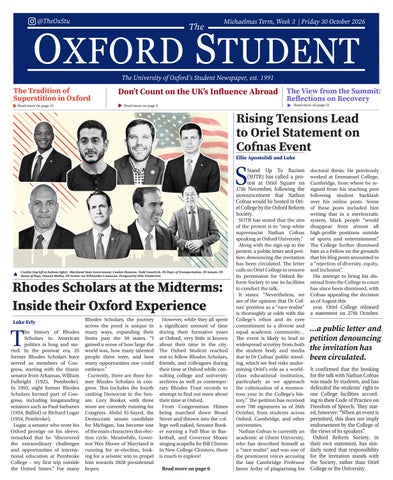
Credits (top left to bottom right): Maryland State Government, Conlan Houston, Todd Goodrich, US Dept. of Transportation, US Senate, US House of Reps, Dannel Malloy, US Senate via Wikimedia Commons. Designed by Ellie Pemberton
Rhodes Scholars at the Midterms: Inside their Oxford Experience Luke Erly
T
he history of Rhodes Scholars in American politics is long and storied. In the postwar era, 25 former Rhodes Scholars have served as members of Congress, starting with the titanic senator from Arkansas, William Fulbright (1925, Pembroke). In 1993, eight former Rhodes Scholars formed part of Congress, including longstanding senators such as Paul Sarbanes (1954, Balliol) or Richard Lugar (1954, Pembroke). Lugar, a senator who wore his Oxford prestige on his sleeve, remarked that he “discovered the extraordinary challenges and opportunities of international education at Pembroke College – my first trip outside the United States.” For many
Rhodes Scholars, the journey across the pond is unique in many ways, expanding their limits past the 50 states. “I gained a sense of how large the world was, how many talented people there were, and how many opportunities one could embrace.” Currently, there are three former Rhodes Scholars in congress. This includes the fourth ranking Democrat in the Senate, Cory Booker, with three more are currently running for Congress. Abdul El-Sayed, the Democratic senate candidate for Michigan, has become one of the main characters this election cycle. Meanwhile, Governor Wes Moore of Maryland is running for re-election, looking for a seismic win to propel him towards 2028 presidential hopes.
However, while they all spent a significant amount of time during their formative years at Oxford, very little is known about their time in the city. The Oxford Student reached out to fellow Rhodes Scholars, friends, and colleagues during their time at Oxford while consulting college and university archives as well as contemporary Rhodes Trust records to attempt to find out more about their time at Oxford. From Congressman Himes being marched down Broad Street and thrown into the college well naked, Senator Booker earning a Full Blue in Basketball, and Governor Moore singing acapella for Bill Clinton in New College Cloisters, there is much to explore! Read more on page 6
SUTR has stated that the aim of the protest is to “stop white supremacist Nathan Cofnas speaking at Oxford University.” Along with the sign-up to the protest, a public letter and petition denouncing the invitation has been circulated. The letter calls on Oriel College to remove its permission for Oxford Reform Society to use its facilities to conduct the talk. It states: “Nevertheless, we are of the opinion that Dr Cofnas’ position as a “race realist” is thoroughly at odds with the College’s ethos and its core commitment to a diverse and equal academic community… The event is likely to lead to widespread scrutiny from both the student body and media due to Dr Cofnas’ public standing, which we feel risks undermining Oriel’s role as a worldclass educational institution, particularly as we approach the culmination of a momentous year in the College’s history.” The petition has received over 700 signatures as of 26th October, from students across Oxford, Cambridge, and other universities. Nathan Cofnas is currently an academic at Ghent University, who has described himself as a “race realist” and was one of the prominent voices accusing the late Cambridge Professor Jason Arday of plagiarising his
doctoral thesis. He previously worked at Emmanuel College, Cambridge, from where he resigned from his teaching post following student backlash over his online posts. Some of these posts included him writing that in a meritocratic system, black people “would disappear from almost all high-profile positions outside of sports and entertainment”. The College further dismissed him as a Fellow on the grounds that his blog posts amounted to a “rejection of diversity, equity, and inclusion”. His attempt to bring his dismissal from the College to court has since been dismissed, with Cofnas appealing the decision as of August this year. Oriel College released
a statement on 27th October.
...a public letter and petition denouncing the invitation has been circulated. It confirmed that the booking for the talk with Nathan Cofnas was made by students, and has defended the students’ right to use College facilities according to their Code of Practice on Freedom of Speech. They stated, however: “When an event is permitted, this does not imply endorsement by the College of the views of its speakers”. Oxford Reform Society, in their own statement, has similarly noted that responsibility for the invitation stands with the Society, rather than Oriel College or the University.
Friday 30 October 2026 | The Oxford Student
2 | Editorials
Editorials A Note from the Oxstu Team
The Oxford Student is an independent, fully student-run newspaper that has been providing truthful, open, and free journalism to all of Oxford for over 30 years. This includes important investigative journalism, holding the University, its colleges, and institutions accountable every term. Our work also provides a training ground for some of the most successful journalists around the world, including Stephen Bush, Lewis Goodall, Anoosh Chakelian, and many more, as well as leading figures in politics, business, technology and creativity. The Oxford Student – supported by an engaged alumni community plays a key role in building the next generation of journalists, holding our society, economy, and democracy accountable. We need your Common Room’s support to keep this going. Our work is mainly funded through JCR and MCR subscriptions, which gives Common Rooms access to the newest student journalism in the city. Every 2 weeks, The Oxford Student delivers a 24-page print to every Common Room with a subscription. This Freshers Guide, funded solely through ad sales, is a great example of what you can expect if you bring the paper into your common room, at low costs, helping to keep student journalism flourishing in the city.
Contents News Investigation Opinion Culture Features Business Identity Profiles Sport
Contact us at oxstu.editor@gmail.com cians. Shout out to The Rest is anorexia. While one can be busy Politics UK for inspiring me a with life, it can become easy to few months ago, shouting out ignore the deeper currents in the one, the only El-Sayed as one’s mind. It’s especially ima former Oriel grad. Our fanportant to hear young women tastic Culture section has been speak candidly about experiproducing a great slew of fanences that are difficult to artictastic pieces, and this print is ulate, let alone share publicly. no different. Have a look at the Oxford has a habit of making PRIMETIME review on page everything feel performative. 10, a movie, as a journalist, I Yet there’s more to uni than lection season has come what makes it into a tutorial hat a time to be in Ox- just need to watch! I just have ford! Halloween right to find the time… I was going around again – Brazil, Is- discussion or an Insta story. around the corner, back and forth from the Vere rael, US Midterms – and We write about things worth it’s definitely the better election looking at closer – both the midterm fever is hitting its pitch, Harmsworth while researching coverage you will be getting politics beyond Oxford and the and this country’s weather can’t my investigation, and embarthis term (unless, of course, we stories happening right here. help but ruin the fun… Alas, rassingly crashed my bike (I get some more electoral mal- By now, you’ve probably fig- the OxStu gives forth its Week 3 blame the wet cobblestones). practice in Week 7). Shoutout ured out how to make Ox- print, and it’s an absolute belter. Though I am now worried I’m with the fantastic back on the injury reserve (my to Luke for his illustrious ac- ford look fun; with Halloween Start count of former-Rhodes-Schol- around the corner, you might investigation on page 6… knee is shattered), I thought of ars-turned-US-congressio- even be preparing to dress up written by yours truly. I had this lovely quote for the Rocky nal-candidates, and to the as someone else entirely. But a wonderful few months Balboa inspiration corner, one corresponding Opinion arti- between the costumes, the Ins- researching this, only pissing that shall hopefully give you cle ‘Don’t Count on the UK’s tagram stories and the Bops you off a handful of college librar- some inspiration this comInfluence Abroad’, which won’t remember, it’s worth tak- ians and archivists in the pro- ing week: “Going in one more most certainly brought up ing a moment to look beyond cess (sorry Magdalen). With round when you don’t think some IR tutorial trauma. the performance. Preferably such a consequential midterms you can, that’s what makes the On a serious note, I’m partic- with a copy of the Stu in hand. just next week, it was really difference in life.” Go the extra ularly moved by Katrina’s ‘The Happy Halloween, and happy interesting to see all the round, and read to OxStu for former Oxford students, some inspiration while you’re View from the Summit: Re- reading. (somewhat) just like us, at it! flections on Recovery’, about a Ellie Apostolidi who are now important, young woman’s climb of KiliLuke Erly Balliol College election-defining politimanjaro and the battle against Regent’s Park College
E
D
ear Editorials reader, if you exist. When I was given the opportunity to write this editorial, I felt a responsibility to offer profound insights on the institutions that shape our
Editorial Team
4 6 8 10 14 18 20 23 24
Editorial Board Ellie Apostolidi and Luke Erly (Editors-in-Chief) Elliott Wang and Gabriella Bedford (Associate Editors) Guilherme Lopes (Managing Director) News Isaac Gavaghan (Deputy Editor) Abdul Olagunjuadekunle, Samuel Govier, Ansu Bhattarai, Tristan Clark Lam, Greta Pezzolato, Diya Singh, Leen Almasri, Saba Ahmadzadeh Noughani, Christine Savino, Bay Ross, Sylvia Kline, Joe Parsons (Section Editors) Opinion Christian Wang (Deputy Editor) Antonio Reis, Eleanor Harris, Yiran Su, Leen Almasri, Zar Motik
W
lives. I sat in the loo to think about it, but failed to come up with anything other than why British toilet bowls were so low and wide. Was it a matter of government policy? But in terms of British political parties, I probably can’t tell left from right. Then, I watched Alejandro González Iñárritu’s ‘Digger’, and it comforted me. I was reminded of my ancestry as a Culture editor, a refined species of journalist with the single-minded goal of writing lightly amusing things about lightly amusing Adisuryo, Samuel Govier, Greta Pezzolato, Abdul Olagunjuadekunle, Tristan Clark Lam, Joannie Lao, Yiran Su, Lucy May, George Murphy, Freddie Russell, Georg Haslam, Jessica Ellis, Ruby Torsney, Malavika Rudrakumar, Shannon Wang Lee, Lily Malligan (Section Editors) Features Ellie Pemberton (Deputy Editor) Ben Futter, Hannah Ison, Phoebe Payne, Carolina Perotto, Richard Kühl, Yiran Su, Aaron Butters, Charlize Morrey, Lily Aldred, Yash Kothari, Tessa Stanier, Nihaarika Shrikant, Amun Chaudhary, Poppy Geyman (Section Editors) Business and Finance Leila Hoffpauir (Deputy Editor)
things. It is truly a testament to the paper’s wide acceptance of all sorts of expression that I am now an Associate Editor. I can only assume that the selection process was very selective, and that there was a process involved. As someone who was first flashbanged into journalism, I found The OxStu to be an incredibly supportive and fostering community to grow. I had so many great opportunities to watch and review student theatre, interview interesting people, and refine my incoherent Akheel Kale, Chauncey Robinson, Claire Frost, Zar Motik Adisuryo, Fathan Mahardika (Section Editors) Investigations Ivett Berenyi (Deputy Editor) My Anh Ngoc Nguyen, Hannah Ison, Ava Doherty, Abdul Olagunjuadekunle, Mimi Berridge Shea, Sze Wai Yun, John Yannis Liddel, Joe Parsons (Section Editors) Culture Flora Molnar (Deputy Editor) Jasmine Joyan (Poetry Deputy Editor) Aamina Thava, Aidan Kane, Carolina Perotto, Kadija Owusu-Kabba, Siena Tracey, Phoebe Payne, Lucia Clark, Ruhi Visaria, Isaac Simeon Sinclai, Joseph Walford, Sofia Di Stazio, Sarah Chew, Georgia Kennedy, Cerys Williams, Isabella Jones, SongHa Choi, Reyhan Ali Mawjee,
Reddit rants for a style suited for the city of dreaming spires. Sincerely, I strongly recommend anyone to try out writing for us. We welcome all submissions – except hatefully bigoted ones – Today’s market for that is already rather saturated.
Elliott Wang
Brasenose College Sheridan Hauser, Michelle Luo, Ionna Dionissiou (Section Editors) Anja Woosnam, Oliver Weston, Christina Robinson, Anya Tindall, Carolina Perotto, Ben Futter, Briann Stephens (Poetry Section Editors) Identity Katrina Roach (Deputy Editor) James Stratmann,Ben Futter, Joseph Walford, Nguyen Thi Ngoc Mai, Yasmin Morgan, Yeliz Ece Evgen (Section Editors) Profiles Martha Kiyan (Deputy Editor) Diya Singh, Saba Ahmadzadeh Noughani, Ansu Bhattarai, Richard Kühl, Sharanpreet Padda (Section Editors) Sport Charles Prestwich (Deputy Editor) Ruhi Visaria, Siena Tracey, Finn Perry (Section Editors)
The Oxford Student | Friday 30 October 2026
Op-Eds | 3
Op-Eds oxstu.editor@gmail.com | Columnists: Georg Haslam, Antonio Reis
ChatGPT-ype my essay for me Georg Haslam
T
he University of Oxford has strengthened its collaboration with OpenAI, allowing it to train models on digitised materials from the Bodleian Library. This exemplifies academia’s capitulation to the corporate interests of AI conglomerates and has profound implications for intellectual inquiry. The Bodleian holds centuries of accumulated knowledge that should belong to humanity’s intellectual commons. Expanding access to them is worthwhile but handing them over to AI is not the way to do this. Instead of simply widening access, AI companies train their models and then sell them back to universities, students, and the wider public as premium products, as Oxford’s ChatGPT subscription illustrates. Although the Bodleian retains ownership of these collections, commercial enterprises appropriate monetary value from them. Transforming public academia into a resource for AI development allows companies to extract profit from materials the Bodleian has preserved, entrenching disparity between those who produce and preserve knowledge and those who profit from it, thus accelerating the commercialisation of scholarship. Who benefits from this? It’s not students. If anything, AI is a hindrance,
Antonio Reis encouraging superficial engagement with materials and providing a clutch for essay-writing that replaces the depth of analysis demanded by examinations and tutorials with AI-generated paragraphs. Meanwhile, technology companies profit, raising questions about universities’ desperation for funding and prestige even at the expense of academic priorities. Do we really want a world where AI deems what scholarship is valuable, and then shapes the direction this research takes? Because when academic institutions align themselves with specific companies, they risk allowing profitability to coordinate research focuses. Across the UK, many universities have cut humanities provisions, with some forced to axe whole subjects entirely. There is notable irony in devaluing the humanities of today whilst AI companies scramble to commercialise centuries of humanities scholarship. Why are they only valued as an intellectual legacy, whilst their contemporary practices are neglected? Oxford is renowned for traditions, from formal halls with Latin graces to matriculation in sub fusc. One tradition is more important than them all: academic freedom. Read more online at www.oxfordstudent.com.
The Grapevine Wadham law tutors to invigilate tute essays Wadham’s law tutors have communicated to students that they will begin to invigilate tute essays, citing concerns over AI use, The Oxford Student understands. These invigilations are underway, and take place every other week, alongside normal essays in non-invigilated weeks. The new policy was disclosed to students in one-on-one meetings with tutors at the start of term. The current format is essentially an open-book exam situation, where students have 90 minutes to write their essays, but have to turn off Wifi, meaning no internet search or AI tools can be used. Notes are allowed, and students generally have access to the question beforehand in the standard reading list format.
A
I is a hot topic, and there are certainly valid concerns about its growing role in academia. A tool that can conveniently substitute our thinking can threaten the learning that a high-pressure environment like an Oxford tutorial is meant to create. But whether the use of AI in one’s academic work is unacceptable is a more specific claim – using AI is wrong in itself, in any of its potential roles. The threat AI poses lies in replacing our thinking, not in its use simpliciter. Uses of AI that preserve it are not vulnerable to this criticism, and a few key ones should defeat the claim. Can AI assist learning? Well, what is something about Tutorials that helps us learn? I’d argue it is party confrontation: students are challenged and forced to defend themselves. Yet, AI can serve a similar role. You can revise prompts to encourage criticism and avoid flattery, then ask a model to critique your arguments, question you Socratically, and help you practise active recall. Friends and tutors can do this too, but AI’s advantage is its constant on-demand availability. Tutorials also help us consume and produce a lot of text on demand. In that case, take a prompt that returns a summary of a reading when given a PDF. Journal abstracts already do this,
A current Wadham law student told The Oxford Student: “It is neither an effective nor fair policy. It is not fair simply because the purpose of a tute essay is that you take your time to write it out as best as you can. It is not effective either because you could theoretically plan out the entire essay beforehand or even finish it, and then simply reproduce it in the invigilated session.” (This author congratulates the student on some fantastic lawyer-speak argumentation skills).
The Union could have term-card mogged us all
The good folks at the Oxford Union apparently considered bringing Clavicular, an online personality known for ‘looksmaxxing’ content, to speak in late October. A Whatsapp screenshot shows the current Union President, Gareth Lim, asking the Standing Committee for their thoughts. The Oxford Student understands that Clavicular was the one who approached the Union. In response, a former President wrote that Clavic-
but are not always available. AI is. A student can use it to decide what is worth a full read whilst still forming their own view of the argument. To be clear, asking a model for an answer is still passive, but asking it to critique your argument and provide an antithesis still leaves the repair for you to write. This supplements your tutor beyond the weekly hour session. It does not replace them. If anything, more thinking is encouraged. Admittedly, the line here between revision and rewrite, or summary to substitution, is easy to cross. That argues for clear norms and disclosure of how AI is used, not for calling any use of AI ‘unacceptable’. Academic work is also wider than undergraduate essays. Researchers are employing AI for anything from semantic analysis of text records to predicting protein structures in biology. By using specialised prompts and LLMs for specific roles, AI can expand the productive frontier of what we can achieve, and complete tasks that are immensely inconvenient or even impossible for a human brain. As with students, the responsibility is on the researcher to verify and maintain agency. Read more online at www.oxfordstudent.com.
ular “was arrested for battery, so not the deepest of things”. Clavicular was arrested in March 2026 in Florida, but charges were never brought relating to this incident. The former President also warned that “you’ll probs have SOME pushback [sic].” In September 2026, Clavicular was arrested for rape, providing liquor to a person under the legal US drinking age, and drugging someone for sexual intercourse. To the despair of moggers everywhere, Clavicular will not address the Union this term.
SU delays referendum on NUS membership
You may recall that, in Trinity 2026, the Conference of Common Rooms passed a motion calling a referendum on the SU’s affiliation with the National Union of Students. This referendum, which the motion called to be held this Michaelmas, will now be delayed to Hilary alongside the regular SU elections to maximise voter engagement and participation.
4 | News and Opinion
News
The Oxford Student | Friday 30 November 2026
oxstu.news@gmail.com | Deputy Editor: Isaac Gavaghan Section Editors: Saba Ahmadzadeh Noughani, Bay Alexandra Ross, Leen Al-Masri, Ansu Bhattarai, Tristan Clark Lam, Sam Govier, Sylvia Kline, Freddie Lewis-Hedley, Abdul Olagunju-Adekunle, Joe Parsons, Greta Pezzolato, Freddie Russel, Christine Savino, Diya Singh
Conference of Common Rooms
St Edmund Hall opens new sustainable accommodation
votes to update sexual misconduct policies, University no-shows Sylvia Kline
I
n the Conference of Common Rooms (CCR) first meeting of Michaelmas term, Magdalen JCR President Isabella Taylor proposed a motion which called on the SU to advocate for accountability within university hiring practices and policies regarding staff accused of sexual misconduct. The motion aims to address concern over instances of staff at the University of Oxford being hired without what the motion terms “appropriate checks” on their sexual misconduct history and that “staff are being allowed to resign out of investigations or even after serious upheld complaints.” “Every woman has a story. We’d hate for that phrase to become every Oxford student has a story,” Taylor opened her speech proposing the motion. Taylor was bringing the motion on behalf of It Happens Here, an anti-sexual violence campaign run by Oxford students, who developed the proposal with Love & Power, a UKwide feminist organisation. They put forward a pledge which requests that the University completes investigations concerning harassment and sexual violence, that all
final job candidates must declare any adverse findings in harassment proceedings, and that surviors are not silenced by anonymity orders. “There is much work to be done, and this is only one small piece of the puzzle,” Taylor told CCR. President for Communities and Common Rooms Roxana Rusu added: “We did invite the university to attend this meeting, and they declined.” Originally the university had said they would send a representative from the human resources department, but later said they would send a statement. Neither of these materialized, and no explanation was provided. Lastly, concerns were raised over the imminent talk hosted by Oriel College platforming Nathan Confas arose and members discussed various potential actions: “We’re doing our absolute best to try and get this right,” Rusu stated. Confas is controversial for his previous defense of scientific and academic racism, as well as his plagiarism accusations targeted towards the late Cambridge professor Jason Arday. Voting for all conference mandates closes on 3 November with results online.
Image Credit: Freddie Lewis-Hedley, with permission
Freddie Lewis-Hedley
S
t Edmund Hall has opened its new Norham accommodation complex for Michaelmas 2026. Construction began in late 2023, over thirty years after the newly expanded site began to host students from the Hall. Located next to the entrance of Lady Margaret Hall, the site is made up of three new builds – the Willis Building, Ashton House and Elliott House – alongside Dunbabin Lodge, a ‘modernised’ Victorian villa. Students in 2nd year and over are housed in the buildings. The Hall has proudly announced that the newly erected Ashton and Elliott Houses were built to Passivhaus standards, an internationally recognised set of criteria which prioritises ‘an extremely high level of energy efficiency’, alongside social and comfort con-
siderations. As such, the development comes as the most recent sustainable architecture project in the city, following the University’s 2026 pledge to reach net zero by 2035, outlined in a strategy which also promises commitment to Passivhaus standards for new buildings. Before Norham St Edmund, the Schwarzman Centre for the Humanities – the largest Passivhaus university building in Europe – was the latest Oxford project built in line with the University’s new targets. Among the more conspicuous sustainability features at the new site are lights which automatically switch off when residents leave a room, as well as an ‘ecology pond’ behind Willis House. This new, biodiverse green space (pictured) notably distinguishes itself from the neat lawns customary in Ox-
ford quads. Meanwhile, second year student of German and Willis building resident Olivia Dogan notes the value of her new proximity to University Parks: “Students often go for walks there in the morning, and being close to nature is a nice change from the first year accommodation in Teddy, right on the High Street.” In the evening, Dogan tells me, the Willis Building common room is lively with students from the other accommodation blocks socialising, and her friends also make use of the spacious music room adjoining, complete with a piano and mezzanine. As in other colleges’ accommodation, shared kitchens, equipped with ovens, fridges and full stoves, have proven ‘great for bonding with others in the building’, says Dogan.
Second Ever Female Regius Professor Appointed at Oxford Bay Alexandra Ross
S
ince King Henry VIII established the post in 1546, University of Oxford has not had a female Regius Professor of Medicine. On 16 October, though, this changed, with The King’s approval of Professor Menna Clatworthy. Professor Menna Clatworthy, FRCP, PhD, FMedSci, is currently a Professor of Translational Immunology, former NIHR Research Professor, and Honorary Consultant Nephrologist at the University of Cambridge, as well as the Director of Cambridge Institute of Therapeutic Immunology and Infectious Disease (CITIID) and former Director of Clinical Studies at Pembroke College, Cambridge, among other numerous fellowships and honors.
A Regius Professorship is one of the most prestigious academic honors that can be achieved. The position is appointed by the Crown through the exercise of the Royal Prerogative, based on a recommendation from the Prime Minister, following a formal recruitment process done by the university. Professor Menna Clatworthy was selected to succeed Professor Sir John Bell. In 2010, Professor Dame Anna Dominiczak became the first female Regius Professor of Medicine in the United Kingdom at the University of Glasgow. Professor Clatworthy is the second woman ever appointed to be Regius Professor of Medicine in the UK’s history, and the first to be appointed at the
University of Oxford. For much of the Regius Professorship history, women were barred from holding faculty posts or even attending and graduating from UK universities. It wasn’t until 1920 that the University of Oxford formally permitted female students to matriculate, become full members of the university, and accept degrees. The quota, which capped female attendees to under 1000 each year, was not lifted until 1957 and the heads of the women’s colleges were only permitted to become vice-chancellors as of 1959. The first woman to become a Regius Professor at Oxford University was Professor Lyndal Roper, of history, in 2011. Read more online at www.oxfordstudent.com
The Oxford Student | Friday 30 October 2026
Advert | 5
6 | Investigations
Friday 30 October 2026 | The Oxford Student
Investigations Rhodes Scholars at the Midterms: Inside their Oxford Experience
oxstu.investigations@gmail.com
Luke Erly
W
es Moore (2001, Wolfson College) Wes Moore was elected as the first black Governor of Maryland in 2022, and is running for re-election in 2026. He matriculated at Wolfson College after graduating from Johns Hopkins University in 2001. Moore was recalled to the United States to complete his Infantry Officer Basic Course required for his future deployment to Afghanistan. During this time, he wrote an essay from Fort Benning military base, and appeared in “The American Oxonian”, a quarterly newsletter written by Rhodes Scholars featuring reflections, book reviews, and updates from previous Rhodes Scholars. Much of what The Oxford Student found about Moore’s time at Oxford comes from this non-digitized essay. Bronin and Moore were roommates during their first year, housed in Rewley House located in Wellington Square, during the first year. Moore referred to the pair as the “Un-Rewley Boys” in his essay. He expressed that he had “mixed feelings” about leaving Oxford and reporting to service in Georgia. “Nothing could prepare me for the shock of going immediately from life at Oxford to life at Ft. Benning”, and reflected that he was not “not successful in that endeavor” to complete some of his Oxford work while at training. Moore then shared his story of going to South Africa for the 2002 Centenary celebration in South Africa. Representing the Rhodes Trust, he talked about the
warm welcome he received, even though the Trust is the result of one of South Africa’s biggest villains. “Cape Town in many ways reminds me of Baltimore.” Ending the essay with a flourish, Moore wrote, “Until next time, I will see you at the King’s Arms! Elevate!” Moore was one of three Rhodes Scholars who matriculated at Wolfson in 2001. One of the other two was Thomas Pellathy, now a Senior Partner at McKinsey & Company. In an essay he wrote for “The American Oxonian”, Pellathy, who was a groomsman at Moore’s wedding (while Pellathy’s son was the ringbearer), recounts, “almost crashing the Rhodes House Ball with Wes Moore (Maryland/DC and Wolfson 2001), only to be stopped at the door by an overzealous Canadian.” Pellathy also states that Wolfson won the 2001-2 Basketball Cuppers, though The Oxford Student couldn’t confirm that Moore played on this team. Moore also spent his first year in Oxford signing in the newly-founded allmens acapella group, “Out Of The Blue”. In a comment to The Oxford Student, a member of the 2001 group said that “it was great to get to know Wes when I was an undergraduate – he was certainly different from most of the people I came into contact with at Oxford! A big personality with a fantastically positive energy (and fearsomely impressive physique!).” Separately, multiple alumni members talked about a story from that year where the group unexpectedly met Bill Clinton while rehearsing at New College.
2001 Out Of The Blue Class Photo (Wes Moore, Middle Top). Credit: Ben Sparks
“Wes Moore got a message to say that the Clinton party would be interested in meeting the group… we marched off there and then and sang a couple of songs for them.” Much has been discussed about the potential for Moore to mount a presidential campaign in 2026. In a gubernatorial debate, Moore refused to commit to serving his full 4 year term as Governor of Maryland, leading to speculation. Many believe Moore to be a strong candidate in 2026, with his military background, appeal to African American voters, and strong progressive stance making him appealing on the national level. Abdul El-Sayed (2009, Oriel College) Abdul El-Sayed is currently running to be a United States Senator for Michigan, facing Republican Nominee Mike Rogers in an election that could decide the balance of power in Congress. El-Sayed has become a nation-wide figure throughout the campaign due to his progressive policy stances and the possi-
bility of becoming the first Muslim member of the U.S. Senate. El-Sayed read for a DPhil in Public Health while at Oxford, working with the British Heart Foundation Health Promotion Research Group. In a comment to The Oxford Student, a researcher who worked in the same group as El-Sayed had, “nothing but positive things to say about Abdul… we had some great deep discussions about big topics and he was a wonderful person to debate and discuss complicated issues with”, though they don’t recall ever talking about public office with El-Sayed. During his time at Oxford, El-Sayed earned a Full Blue while captaining the Oxford Lacrosse Team. However, as cited in Varsity coverage of the game, El-Sayed received a yellow card before Oxford lost 14-9 to the Light Blues. He won the Democratic primary in August, beating out the moderate, “establishment” candidate Haley Stevens by less than 1%. ElSayed’s campaign has focused on affordability, corruption, and Medicare for
All, leading him to a 3 point advantage in the polls as of 26th October. Luke Bronin (2001, Balliol) Luke Bronin is currently running as the Democratic Nominee for Connecticut’s 1st congressional district. He double majored in History and Philosophy as an undergraduate at Yale University before being named the 2001 Connecticut Rhodes Scholar and matriculating at Balliol College. While Bronin originally planned to complete a DPhil in Philosophy while at Oxford, he instead graduated in 2003 with a MSc in Economic and Social History. While at Oxford, Bronin met his future wife Sara (Texas and Magdalen, 2001), who also finished at Oxford with an MSc in Economic and Social History. Sarah Brodin (formerly Sarah Galvan) had served as the 2001 Rhodes Class Secretary, coordinating meetups and “The American Oxonian’s” Class Letters. She commented on the Bronin family and career updates every year, making
The Oxford Student | Friday 30 October 2026
Investigations | 7
Buttigieg rows in the 2005 Novice Regatta for Pembroke, Courtesy of Pete Buttigieg’s Campaign
sure to include many references to Rhodes meetups while the family was in DC or Connecticut.
“great guy, always friendly and up for a good conversation
A contemporary of Bronin’s noted that he was a, “great guy, always friendly and up for a good conversation.” Bronin was Moore’s roommate at Rewley House, and the pair became lifelong friends as a result. According to Bronin’s campaign website, his top three listed issues are bridging costs down, abolishing ICE and fixing immigration, and protecting medicare and pushing for universal healthcare. The 2026 midterms will be Bronin’s first time running for a federal position, though his impressive staving off of John Larson, who had won 12 consecutive elections in CT-01, suggests he is one to watch in the coming years. Seth Bodnar (2001, Hertford) Seth Bodnar is currently running to be a United States Senator for Montana as an Independent. Previously, Bodnar had been serving as President of the University of Montana from 2018 to January, 2026. Bodnar was then named both a Rhodes Scholar and Truman Scholar as he came up
to Oxford. Hertford College Boat Club confirmed to The Oxford Student that club records show that Bodnar rowed for the college in 2003. Meanwhile, Wes Moore’s “The American Oxonian” essay mentioned that Seth Bodnar “trek[ked] through Russia” before 2003. Like Bronin, Bodnar met his wife, Chelsea Bodnar, 2000 Rhodes Scholar for Montana, Magdalen College, during his time at Oxford. Bodnar graduated with both an MSc in Economics and Social History and an MSc in Comparative Social Policy. Following Oxford, Bodnar was deployed to Iraq from 2003-4 as an infantry officer. Later, in 2008, Bodnar would be deployed to Baghdad. Following his career in military service, Bodnar taught as a professor at West Point before taking up the role of President at the University of Montana. During his time at Montana, Bodnar was forced to cut 50 full time faculty positions to meet budget constraints, with the Languages Department facing the largest hit. Meanwhile, the 2024 academic year saw its largest increase in year-over-year enrollment of 5.6%. Bodnar’s campaign as an independent in a safe Republican seat has drawn much attention. Recently, former Transportation Secretary and 2007 Rhodes Scholar Pete Buttigieg endorsed Bodnar instead of
the Democratic Candidate. The latest polling shows Republican Nominee Kurt Alme with a 16 point lead on Bodnar, with the Democratic Nominee Alani Bankhead holding 21% of the vote. His campaign has focused on ending the “costly and unauthorized” war in Iran, bringing cost of living back under control, and ending corruption and corporate PAC money in US politics. Jim Himes (1988, Teddy Hall) Jim Himes currently represents Connecticut’s 4th congressional district in the House of Representatives. Previously, Himes worked as a banker for Goldman Sachs before being elected to Congress following the 2008 election, becoming the first Democrat to hold CT-04 since 1969. Aged 60, Himes was born in Peru, and thus read for an MPhil in Latin American Studies while at Oxford. Himes graduated from Harvard University in 1988 where he was captain of the lightweight crew. He was named the Rhodes Scholar for New Jersey and matriculated at St. Edmund Hall later that year. Himes originally planned to read for a BA in PPE, though decided against it after understanding it was too much like his Harvard degree. In 2021, Himes featured on Teddy Hall’s, “Spirit of the Hall” podcast, talking about his experiences at the college. He described coming up to Oxford as “a
moment of profound culture shock… I had no idea what I was getting into.” Himes found the experience “enormously daunting”, though found Teddy Hall very welcoming due to its sports culture. Himes rowed for Teddy Hall, even being elected Boat Club Captain. At the same time, he played college rugby, leading to many, “not so PG stories”. He shared that following his election as Boat Club President, Himes was stripped completely naked “in a matter of two or three seconds” by rugby players, was wrapped in the college flag, marched down Broad Street, and thrown in the college well. Himes currently serves as the Ranking Member of the House Intelligence Committee which makes up a lot of his congressional work. He was one of the last members of the House to leave the chamber as rioters stormed the capital on January 6th. He won re-election in 2024 by 23.8 points, and will likely easily win again in 2024.
Evans was the first woman to represent Oxford at The Varsity Game, though the Dark Blues lost 64-86. Andy Kim matriculated at Magdalen College, Oxford in 2005 following graduation from the University of Chicago. Kim completed both a DPhil and MPhil in International Relations at Magdalen, writing theses on the effects of transnational advocacy networks on state responses to conflict-related crises and humanitarian intervention. Like Bronin and Bodnar, Kim met his wife, Kammy Lai, while at Oxford. A 2005 Rhodes Scholar who is still good friends with Kim told The Oxford Student that, “then and now he has been a good chap.” He noted that they had “fond times enjoying tea together… even back then Andy struck me as having a future in politics”. Kim left Oxford in 2010 before serving in Afghanistan and working as a national security adviser under President Obama. He was elected into the US House of Representatives in 2018, serving until he ran for Bob Menendez’s vacant Senate seat in 2024. Transportation Secretary Pete Buttigieg read for a BA in PPE while he was the Indiana Rhodes Scholar in 2005 at Pembroke College, becoming good friends with Andy Kim. Buttigieg went up to Oxford following graduation from Harvard University. He was involved in founding the “Democratic Renaissance Project”, a weekly caucus of progressive-minded Americans at Oxford. Buttigieg rowed in Pembroke’s Novice VIII in the 2005 Christ Church Regatta, pictured above. Following Oxford, Buttigieg successfully ran to become the Mayor of South Bend in 2011. In 2014, he took a leave of absence to serve in Afghanistan for seven months. Buttigieg ran for President in 2016 and 2020, and may run again in 2028.
Cory Booker, Andy Kim, and Pete Buttigieg Though not running for election in 2026, Cory Booker, Andy Kim, and Pete Buttigieg were all Rhodes Scholars currently involved in American politics. Booker and Kim are the two senators for the State of New Jersey, while Pete Buttigieg was a 2016 Democratic Candidate for President, and served as Transportation Secretary in President Biden’s Cabinet. Following graduation at Stanford, Booker came up to Oxford in 1992 as the Rhodes Scholar for New Jersey, matriculating at The Queen’s College. Though there has been confusion over what Booker read while at Oxford, The Queen’s College confirmed to The Oxford Student that he read for a BA in Modern History. According to The Queen’s College Record, Read the full article at Booker received a Full Blue www.oxfordstudent.com for Basketball in 1993. This is the same year that Jodi
Friday 30 October 2026 | The Oxford Student
8 | Opinion
Opinion
oxstu.comment@gmail.com | Deputy Editor: Christian Wang Section Editors: Leen Almasri, Eleanor Harris, Tristan Clark Lam, Greta Pezzolato, Freddie Russell, George Murphy, Georg Haslam, Joannie Lao, Lucy May, Zar Motik Adisuryo, Antonio Reis, Yiran Su
Selling Sex and Social Media: Is Feminism Paying the Price? Katrina Roach and Ruhi Visaria
S
ydney Sweeney has, once again, become the centre of controversy after the release of an advert by the sports betting company Novig in early September. The ad features Sweeney almost completely naked, trying on different pieces of sports equipment under the premise that Novig is “just sports”. And the internet? It’s outraged. Social media users are claiming that Sweeney’s appearance and overt appeal to the male gaze has undone the last half-century of feminism. Others are criticising her disrespect for women in sport who have fought for centuries to even be allowed to take part, let alone celebrated for their athletic achievement rather than their appearance. A trend has emerged, depicting strong, powerful female athletes and women who play sports with the phrase, ‘Respectfully Sydney Sweeney, this is what a real woman in sport looks like.’ This sentiment isn’t confined to social media either, with professional athletes from around the world condemning the advert’s impact on how seriously women in sport are taken. These critics have included British athletics star Amy Hunt and Australian swimmer Ariarne Titmus, who both condemned the advert’s focus on sex and aesthetics instead of success. But the focus of the onslaught has been somewhat mistargeted. Despite the ad receiving over 40 million views in just 5 days, Novig’s success has been short-lived; the criticism toward the actress has also led to her lingerie brand Syrn struggling to generate sales. Undoubtedly, Sweeney can be criticised for the impact the ad has had
on opinions about women and their role in sport, especially through sexualisation. However, a greater scrutiny must be placed on the wider culture that makes this kind of advertising commercially acceptable, and this leads to questions about why an actress was chosen to promote a sports betting platform in the first place. Why not centre the campaign on an athlete and the qualities that actually make sports compelling such as strength, skill, discipline and dedication? That’s if an athlete would be willing to endorse gambling platforms at all, given the complicated relationship between betting and professional sport. More importantly, the controversy says something uncomfortable about the audience these advertisements are designed to attract. Would the ad’s target audience ever be interested in women’s sports? Would they ever truly respect a female athlete? Sports betting should not need the sexualisation of women to generate interest. It should be engagement with the sport itself that causes people to bet on it: analysing form, tactics, statistics, and performances, and using that knowledge to predict who might win a match, tournament, or league. A woman’s body should have nothing to do with making that experience appealing. But unfortunately, that is not the reality we live in. Why is the sexualisation of women considered necessary to market something related to sport? Controversy means millions of views and opinions, including our own in this very article. Businesses see that, and are capitalising on it. Women on social media — and increasingly in the wider world — are
Sydney Sweeney at the Christy Headline Gala. Credit: user Tm via Wikimedia Commons
turning against each other, and the men this advert was aimed at feel vindicated in buying into it. Our criticism is not aimed at the women who participated in the social media trends. We do not question their values, or whether their hearts are in the right place. Instead, we blame the reality the internet has created where views and controversy are considered more important than critical thinking and community. The broadcasting of and public reaction to the campaign points towards a much more intricate issue: the intersections of feminism, marketing, morality, and social media. Social media has the potential to be an incredibly productive platform in constructive debate as it gives us access to so many unique experiences and opinions. It makes topics like feminism and sexual autonomy accessible to the average person and starts conversations that aren’t often had in real life. Online movements such as #MeToo, sexual education accounts and creators working on women’s rights content all provide a platform to have these discussions. Yet somewhere along the way, this value has been lost to the dopamine rush of a thousand likes and a baseless moral highground. The intricacies of feminism and other important movements are lost to the need to be liked, shared, and followed. Two similar recent trends spring to mind. One in-
volved a slideshow of pictures side by side, one of Afghan women and one of a Western woman with the text, “the only difference between us is geographical luck”, allowing the creator to showcase photos of her and her friends under the guise of concern for women who are losing their rights daily under the Taliban. Even the act of making these comparisons reduces the very real terrors Afghan women face to a social media trend, and this engagement with their reality becomes very surface level, limiting the extent to which an audience critically and empathetically engages with news stories and testimonies. The other recent trend was a response to a podcast clip of creator Drew Afualo and her guest E.R Fightmaster where the latter said they believed that “trans(gender) women have a more beautiful understanding of womanhood.” However you feel about that statement, the outrage that followed from people who had not watched the actual episode nor taken the time to critically engage with it was incredibly unproductive. They had simply seen the ten second clip on TikTok and responded in the same manner as the other thousands in the comment section: does that constitute productive debate? Right now, the internet can be a frustrating and bleak place to be. Constantly seeing videos centred around both feminism and
criticism can risk making you indifferent to the horrors and hardships that other women are facing, as well as leaving you quite hopeless. It also feels like the protests against the campaign haven’t really made much of a difference, especially since Novig went on to release what seemed like a ‘part 2’ of the ‘Just Sports’ campaign, again featuring Sweeney.
our voices being “Are heard, and are they changing anything?
But all is not lost; there are opportunities for women to fight for change in the face of the seemingly ever-present adversity. We can see the problems: growing media illiteracy, addictions to sex and gambling in an advert broadcast on the internet, and the patriarchal systems that continue to allow sex to sell. But if social media is exacerbating these problems, surely it can be used to turn them around — and it’s about time we tried to solve them. Go and support a local women’s sports team. Take note of adverts that capitalise on oppression and report them. Encourage education and productive conversation. Listen to what other people have to say, and be willing to change your perspective. Making noise is a start, but our voices need to be in conversation, not contradiction. They need to have clarity, cohesion, and direction. That is how we make positive change.
The Oxford Student | Friday 30 October 2026
No AI in Academia Georg Haslam
T
he University of Oxford has strengthened its collaboration with OpenAI, allowing it to train models on digitised materials from the Bodleian Library. This exemplifies academia’s capitulation to the corporate interests of AI conglomerates and has profound implications for intellectual inquiry. The Bodleian holds centuries of accumulated knowledge that should belong to humanity’s intellectual commons. Expanding access to them is worthwhile but handing them over to AI is not the way to do this. Instead of simply widening access, AI companies train their models and then sell them back to universities, students, and the wider public as premium products, as Oxford’s ChatGPT subscription illustrates. Although the Bodleian retains ownership of these collections, commercial enterprises appropriate monetary value from them. Transforming public academia into a resource for AI development allows companies to extract profit from materials the Bodleian has preserved, entrenching disparity between those who produce and preserve knowledge and those who profit from it, thus accelerating the commercialisation of scholarship. Who benefits from this? It’s not students. If anything, AI is a hindrance, encouraging superficial engagement with materials and providing a crutch for essay-writing that replaces the depth of analysis demanded by examinations and tutorials with AI-generated paragraphs. Meanwhile,
technology companies profit, raising questions about universities’ desperation for funding and prestige even at the expense of academic priorities. Do we really want a world where AI deems what scholarship is valuable, and then shapes the direction this research takes? Because when academic institutions align themselves with specific companies, they risk allowing profitability to coordinate research focuses. Across the UK, many universities have cut humanities provisions, with some forced to axe whole subjects entirely. There is notable irony in devaluing the humanities of today whilst AI companies scramble to commercialise centuries of humanities scholarship. Why are they only valued as an intellectual legacy, whilst their contemporary practices are neglected? Oxford is renowned for traditions, from formal halls with Latin graces to matriculation in sub fusc. One tradition is more important than them all: academic freedom. Integrating AI systems into scholarship risks diminishing this freedom by transferring parts of the intellectual infrastructure away from universities and towards commercial interests. Normalising dependence on these systems risks embedding the biases of AI databases and developers within intellectual practice, allowing academic independence to become contingent on corporate decision-making. Should Oxford really compromise this for AI?
Duke Humfrey’s Library. Credit: Diliff via Wikimedia Commons
Opinion | 9
T
‘
he UK is a sleeping giant, a superpower waiting to be unleashed’: these are the words written by Matthew Syed of the Times four months ago. It’s a sentiment that many cannot help but believe. The idea that the UK’s influential culture, laws and institutions— our ‘soft power’— gives us a seat on the global playing table, a pull that other nations feel naturally drawn towards, feels like a national fantasy. It’s also delusional. Let’s zoom in on Oxford as a case example of this. According to HEPI’s 2026 Soft Power Index, Oxford is the world’s second-most politically influential university, having educated 11 current world leaders. The university, on paper, hence has untold influence over the operations of foreign nations, and, by extension, so does the UK. However, take a look closer at some of the current world leaders Oxford has produced: Alexander Stubb, Mark Carney, Jakov Milatovic. All of these alumni are representatives of a traditional political order. Even monarchal figures, such as Haitham bin Tariq Al Said, have pursued reform-based policies that have only been moderate within their national contexts. They, and hence the university, lack the same ties to recent insurgent political movements. It’s a relatively stable pattern: if you look at the US Senate midterm candidates, you’ll find that all the ‘Oxford Candidates’ are members of the Democratic Party, not the MAGA movement. The university’s political soft power is projected at this very specific political tradition—a tradition which increasingly looks to be less and less stable. The kind of international student who can both afford to study at Oxford, and who wants to do so, has clearly narrowed down the demographic sphere of influence the university has access to.
Don’t Count on the UK’s Influence Abroad Thomas Burke This naturally begs the question: what is Oxford’s place within a politics of populism? Funnily enough, despite it being likely that fewer Oxford alumni will enter positions of power, the answer seems to be that the university’s influence won’t be all that much affected. This isn’t because the university won’t lose soft power abroad, but rather because it really didn’t have much to begin with. The Blair years were the height of governmental belief in the influence of higher education as a tool of soft power. The government’s Prime Minister’s Initiative for International Education (PMI) was set up as an explicit mechanism of projecting soft power via universities. It seemed simple enough: draw in international students, who then return to their home nations into positions of power and look back favourably upon the UK.
problem is that this “The scheme didn’t actually work.
A study on these policy initiatives by Professor Sylvie Lomer has traced these fundamental ideas behind these policies back to both the US-derived Cold War logic that universities could ideologically convert foreign students, but even more worryingly back to beliefs from the colonial era where it was believed that the UK could use universities to positively influence the views of colonial subjects. But, as ideas and cultures have globalised, there’s no longer the same gap between what students who come to the UK believe when they come and when they leave, giving the UK less room to make a unique im
pression. There’s also no guarantee international students significantly engage with UK culture, or even enjoy it. It also seems obvious to say, but foreign politicians, businessmen and leaders aren’t really concerned with appeasing the nation they briefly studied in. Look at the midterm campaigns of Wes Moore or Seth Bodnar: there’s a lot of focus on domestic issues, their military service, and national pride, but little associating themselves with the foreign elitism of an Oxford education. Universities are a tool for these individuals to use, but their concerns and duties are directed towards their own countries. The lack of genuine influence the system has had has seemingly begun to sink in for our politicians: Shabana Mahmood’s attacks on the length of graduate visas and the upcoming introduction of an international student levy don’t exactly have the spread of the UK’s soft power in mind. It’s difficult to say what influence Oxford, and other UK universities, are losing, other than the relatively arbitrary one of being able to boast that an alumnus has reached a position of power. Even outside of higher education, the UK’s reliance on soft power as a tool of international diplomacy has been proven tenuous in recent years. For all the government’s attempts to appease Trump by appealing to his supposed Anglophilia it has done nothing to stop him hammering the UK with tariffs, bullying the government over the Chagos Islands or throwing a fit over our lack of participation in the Iran War... Read the full article online at www.oxfordstudent.com
10 | Culture
Culture
Friday 30 October 2026 | The Oxford Student
oxstu.culture@gmail.com | Deputy Editor: Flora Molnar Section Editors: Amun Chaudhary, SongHa Choi, Lucia Clark, Ioanna Dionissiou, Jessica Ellis, Sheridan Hauser, Isaac Hole, Isabella Jones, Aidan Kane, Richard Kuehl, Michelle Luo, Rayhan Ali Mawjee, Kadija Alisha Owusu-Kabba, Phoebe Payne, Natalie Perera, Carolina Josephine Perotto, Christine Savino, Aamina Thava, Ruby Torsney, Siena Tracey, Ruhi Visaria, Joseph Walford
PRIMETIME and the journalistic vigilante Jude Wood reviews the new film ‘Primetime’, out in UK cinemas today
H
azy blue light and film grain set the scene for Lance Oppenheim’s new feature Primetime in its trailer long before release. The film sports a brooding original soundtrack by Ari Balouzian, featuring Phoebe Bridgers. Bridgers also appears in a star-studded cast alongside Robert Pattinson, Merritt Wever and Skyler Gisondo, whose performances draw you into the enticing world of early 2000s television: hallucinatory TV static, blinding lights and the popular, yet controversial, hit show To Catch a Predator. The film follows a fictionalised Chris Hansen (Pattinson), the host of the reality TV show To Catch a Predator, as he and his team televise ‘predator-stings’. Luring real child-predators to empty houses, using decoy actors posing as children,
they confront the perpetrator, before the police intervene to make an arrest. Oppenheim’s film chronicles the show’s rise to popularity in America and focuses on the morally grey intentions behind the production. As they chase higher and higher ratings, trying to retain their primetime television slot, the production begins to lose sight of the justice which was so central to its appeal. The film releases in UK cinemas on October 30th. Since its release in the US, Primetime has been criticized for presenting a shallow reflection on the the early 2000s show, with NPR reporting that the film doggedly refuses “to engage with any deeper questions raised by its story”, explaining “why Primetime adopts such a simplistic, lowest-common-denominator approach to characterization”. This is perhaps in reference to the criticism of Robert Pattinson’s portrayal of what the New
York Post describes as an “extremely unlikable Chris [Hansen, who] is a narcissist with a chip on his shoulder.” A Rolling Stone article on the real Chris Hansen’s response to the film states that he “has finally watched the biopic and is still unimpressed.” After seeing the picture, Hansen denies the impression of him that the film presents. This article is one of many that substantiates the tendency to categorise the feature as a “biopic”, such as an article from the Washington Post with the title: “A new movie asks whether Chris Hansen is the predator. He’s sure of his answer.” Others have compared the feature to David Osit’s 2025 documentary Predators, dealing with the same subject matter. The Hollywood Reporter states that Oppenheim’s film “shows too little intellectual or psychological curiosity to displace Predators as the more serious study”.
Robert Pattinson for ‘Primetime’. Credit: Official Poster.
Without discrediting these arguments, this article hopes to offer a second viewpoint, from which Primetime might be viewed as a reflection on the rise of television and its impact on internet culture in 2026, rather than merely as a reflection on the show itself. This is not to say the film isn’t deserving of some of the criticisms put forward. Whilst Oppenheim’s feature excels aesthetically, it could devote more time to asking more probing questions about the modern-day implications of this cultural moment. Peter Brad-
Ode on Atrophy
Jasmine Joyan Poetry Deputy Editor
Early Morning Mourning
Aamina Thava
Christina Robinson
Thou still ravished bride of binary Thou foster-child of bandits’ digest The blood of painters, writers and lakes as sacred as a priory. Neptune historian, who can thus express The drought-full tale sweeter than our rhyme.
If I could collapse myself to a singularity It would be mid-spin in a club In an hour slice of love. I wear my best smile But it’s more a transplant than a masquerade Like I’m moving through the phases of my face, I have that need to reflect the emotion of arms in motion We were moons, rotating round the music of creation
Stolen strokes spawn upon the screen A brush, a quill that has never known the thirst of ink, the unseen A pricked finger bleeding onto paper, carving a life on to a page A craft it will never learn or atone.
Poetry
shaw of The Guardian calls the film “a disappointment”, arguing similarly that “for a while, some intriguing conspiratorial possibilities present themselves. But none of that leads anywhere… the film coasts up to a crisis, after which the drama is deemed to be at an end”. Primetime does end rather abruptly, perhaps denying a potentially deeper reflection on the show and its impact, a conclusion up to which it seemed Oppenheim had over its 109 minute runtime been leading. Read more online at www. oxfordstudent.com
They call it Theatre D’Opera, gold drips and velvet soothes, Wait for a siren song But hear only the haunted pipes and taps and a buzz like an immortal fly that cannot die, tell me words that intoxicate, get me high and crashing, scrolling for the next. It gets dark , living for a text to fill a can rattling in a mind fingers itch to caress the keys, what a bind to know its embrace - But it asks for commitment, so I’ll wait at the altar. The officiant asks what 2+2 is, four I think but my tongue does not resonate air It buzzes 5. And I agree. I ravish the bride. I stare
Read more online at www.oxfordstudent.com
I was moving you were moving too Hair wavy with the rain of June And sweat like dew If my tears fall in the corner of the room Could I wash my eyes of you? I addressed the mirror above the sink And avoiding my eyes I saw a girl, I think her name was Isobel. We spoke via reflections, my recollection, She held my psyche in the basement of the pub, She told me I was loved, she holds me up Back to my bed, sober And alone I am the moon I am the sun Flicker on and off as the sky burns blue I am become life, let there be light.
The Oxford Student | Friday 30 October 2026
Culture | 11
The Seagull: “We can’t live without the theatre!” Flora Molnar reviews Lighthouse Productions’ interpretation of Chekhov’s play at the Playhouse ‘The Seagull’ in performance. Credit: Sasha Ranawake.
Y
.es but the theatre! We can’t live without the theatre!”, cries out Peter in the first act of The Seagull. What is the importance of going to the theatre? Why do we go at all? These are the questions about which I was left pondering at the end of Lighthouse Productions’ interpretation, as Konstantin, a playwright and the character to whom Peter’s comment was addressed, lies on the stage. In a glass box. Splattered with red. Even in a world with the theatre, perhaps because of the theatre for him, he couldn’t live. Yet for us, the helpless audience watching in our own theatre, the Oxford Playhouse, it is exactly what kills him – the gunshot that resounds in the final seconds – that jolts us to feel the most alive.
“
This is what I believe the production, directed by third-year student Alys Young, was most effective in teasing out from Chekhov’s masterpiece: what it means to live, and how the theatre – drama, performance, sincerity – actually complicates this. This is almost ironic as I know how much Young and every cast member, producer and person behind the scenes loves the art in real life (from my pre-show interview available online). But the play wasn’t simply a love letter to drama – because that’s not what Chekhov wrote. That this ambivalence about the piece’s own medium came through in real time is what made the night so worthwhile. So, I hope it is clear that when I say the show made me question the point of all show business itself, I mean it as a
W
Holywell
Credit: Official Album Cover
Kadija Alisha Owusu-Kabba on Craig David’s album ‘Born To Do It’ (for the last week of Black History Month)
hat does it mean to make R&B outside of the US, outside of Black America? R&B is inseparable from the African American musical traditions and histories from which it emerged. Its rhythms, vocal styles and sensibilities carry the influence of the people who created and shaped it. A creation as natural as anything can be to whom it was born out of. Music travels. It crosses borders, audiences and experiences, reimagined by people whose own experience may give it a different meaning. How do you honour a tradition, something so culturally rooted, whilst making it your own? Can you make it ‘your own’ without stripping and appropriating its essence? When so much Black culture has been appropriated, commercialised and taken,
compliment and testament to what such metatheatrical material can achieve. It confirmed that we do not go to the theatre simply to be entertained; I would not say I was entertained for three hours, although I often laughed. Perhaps we do not even go for an escape from the real world, or if so only to relate everything back to real life at the end. This was Chekhov’s revolutionary innovation 130 years ago – to put real life on the stage – and something this production truly embraced. Their commitment to such transparency was evident from the constant, minimalistic set throughout, with a centrepiece glass box that revealed a part of ‘backstage’. Designed by Max Antoniou, the panes of glass with LED edges that glowed either in frenzy or calm transition quite literally illuminated charac-
ters’ inner emotions that we are not normally granted access to. The night started with the four main individuals standing behind it and voicing their desires in cacophony: Boris the successful writer, Konstantin the aspiring playwright, Irina the established but fading actress, and Nina the aspiring actress. Their various relationships are exposed on Irina’s brother Peter’s estate, where others present, like the doctor and manager, become entangled too. I would actually like to appreciate these more ‘minor’ characters first (if you can even split the characters in The Seagull into major and minor) since they delivered some of my favourites performances of the night. Alexander Lloyd-Elliott as Peter was a comedic highlight, embodying the posture and spirit of an old man convincingly
but without fear of caricature, generating the most natural laughter. Rufus Shutter, as the doctor Hugo, was also a magnetic presence on stage, often leaning into the quiet humor of his lines, like when he was the only one to compliment Konstantin’s play and told him, jester-like, “You won’t make anything great unless you try!”. I really appreciated, in times like these, the obvious irony coming through, the line between comedy and tragedy being truly bridged, as if the characters themselves were aware of it too. Shutter had great chemistry with Sanaa Pasha, who played Pauline, the manager’s wife. Their seductive, shared apple-biting scene comes to mind – clearly, an apple a day did not keep the doctor away here. Read more online at www. oxfordstudent.com
where is the line between influence and erasure? Craig David’s Born to Do It offers an attempt and possible answer. Released in 2000, his debut album is a defining record of Black British music: one that embraces the smooth vocals and intimate songwriting of R&B while drawing on rhythms and the energy of UK garage. David doesn’t choose between the two. His Britishness is not an obstacle to his R&B, it is part of what makes his music distinctive. Black Britishness, like any culture, is continually evolving. Artists like Craig David have helped mould and shape how that identity sounds, bringing it to a mainstream music industry in which we know all too well racial and national boundaries remain ingrained. What does it mean to be Black and
British in an industry where the gaze is American, where Britishness itself is imagined as white? For me, Craig David represents one of the best expressions of Black British music: deeply respectful of R&B roots, yet unapologetically British in sound, accent and sensibility. The title Born To Do It feels almost too fitting. If anyone was born to do it, surely it was David. The album’s enduring reputation is captured by NME’s retrospective question as to whether David was “the best thing to happen to British R&B, ever?” Its true significance however lies not only in its commercial success, but the cultural connection it had with audiences. It resonated with millions, even coming second to Michael Jackson’s Thriller in MTV’s 2009 public poll for the greatest album ever. Such
praise and accolades speak to the affection surrounding the record, not only in critical acclaim but cultural connection. Born To Do It captures an artist who understands the expansiveness of R&B, that it is not antithetical to the genres developing around him in Britain and can co-exist. Before the album’s release Artful Dodger’s ‘Re-Rewind’ featuring Craig David had already established him as a key voice in UK garage. Its playful, rhythmic feel helped shape his early artistic identity. On his debut album however, David demonstrated that this identity extended beyond garage. ‘Fill Me In’, one of the record’s singles, was the musical bridge between the album’s two defining genres. Read more online at www. oxfordstudent.com
12 | Culture
Friday 30 October 2026 | The Oxford Student
Breakfast Club’s Pancake Delights: The Gang of Three Back to basics or far from them? What’s On?
Performed at the Oxford Playhouse from 27th31st October.
I am a Camera
Performed at the Keble O’Reilly Theatre from 28th-31st October.
Wicker
Starring Olivia Coleman, in cinemas from today.
Next Customer, Please!
Performed at the Burton Taylor Studio from 3rd7th November.
Iphigenia at Aulis
Performed at the Oxford Playhouse from 4th-7th November.
Aphrodite: The Making of a Goddess
This Ashmolean exhibition runs from 8th October 2026 - 11th April 2027.
Ruhi Visaria reviews The Breakfast Club’s new ‘Pancake Delights’ menu
T
ucked at the far end of the terrace on Westgate sits this American-style diner. Having recently launched their Pancake Delights, we were invited to sample their latest selection of monthly specials, featuring some rather unconventional flavour combinations, from Sticky Toffee and HP Sauce to Tomato Ketchup and Bacon. Naturally, I was intrigued. We were immediately welcomed by (over)enthusiastic staff, who were very friendly and quick to acknowledge a friend’s nut allergy. This was particularly appreciated given that pistachios and peanuts featured elsewhere on the menu. It seemed that even this diner had succumbed to the world-wide pistachio trend, an ironic choice for somewhere that proudly described
itself as ‘locally world famous’. The drink selection was quite vast, and having gone for the Strawberry and Banana smoothie (£6), I wasn’t disappointed! One of my friends ordered the basic hot chocolate (£4.90), a ‘Plain Jane hot chocolate’ as the waiter termed it. It was a shame that it arrived with whipped cream and toppings, more like a ‘Fancy Nancy’ if you will. Despite this, the smoothie, hot chocolate (once she got to it) and the Breakfast tea (£3) were perfect. I’d give an extra point for the generously sized mug it arrived in, which felt perfectly in keeping with the American diner aesthetic. Our pancakes arrived within 10 minutes, and they certainly made an impression. Stacked high, topped with flavoured whipped butter and generously drizzled with sauce, they looked every bit as indulgent as we’d hoped. The pancakes themselves were the real stars
of the show: light, fluffy and freshly made, they could easily have held their own without any toppings at all. Between us, we sampled four flavours. The Oreo pancakes were a crowd-pleaser, delivering that unmistakable cookies-andcream flavour without tipping into sickly sweetness. The Sticky Toffee and HP Sauce stack was another pleasant surprise. The tanginess of the HP Sauce cut through some of the sweetness of the sticky
toffee, making for an unusual but surprisingly enjoyable pairing. It certainly didn’t stop us from polishing off the plate. The Biscoff Banoffee was also a nice pairing, but perhaps would have benefitted from more of the Biscoff. And then there was the Tomato Ketchup and Bacon stack. Admittedly, we weren’t quite sure what to expect from this one. It’s certainly a combination that will divide opinion. Read more online at www. oxfordstudent.com
The Breakfast Club’s ‘Pancake Delights’. Credit: Ruhi Visaria
Dressed to depress: Bureaucracies review Sarah Chew interviews and reviews [Box in a Man] Productions for their play ‘Bureaucracies’
N
o one is dressed for the occasion here. Each of the actors appears in corporate-attire-gone-wrong: a wrinkled shirt or a blouse left untucked, a comically oversized suit jacket, or khaki pants paired incongruously with a black jacket. Each detail goes to show that the characters just don’t care. The audience, too, is invited to reflect on the ridiculousness of the dress code: we are met at the entrance by the marketing manager (Michelle Rodrigues), who scolds us for not arriving in suit and tie as she escorts us to our seats. With this introduction, we have been invited into the cloistered workplace of Bureaucracies, a new production written by Aidan Kane and co-directed by Kane and Madi Bouchta. For fans of Dan Erickson’s Severance, this origi-
nal play is set in a monochrome office, where, as new hire Brian (Sonny Fox) discovers, entry-level work takes place behind doors that are locked from the outside. The set is sparse and the Michael Pilch theatre is intimate, allowing me to decide if I am watching the show from an adjoining cubicle or from the other side of the laptop screen that holds the characters captive. The show opens with a quarrel between sadistic manager James (Thomas Perry) and fed-up employee Andy (Alex Coupland), after which James tells Andy to give up her laptop. It turns out, however, that she is being “promoted” because of the arrival of new employee Brian. After nervous and bumbling Brian is onboarded, the laptop is given to him. Despite Andy’s promotion, the loss of the laptop leaves her as an outsider to the all-important “work” of the company. She presses Brian to tell her what this work
“Maybe, the morbid
image of the new hire perpetually glued to his laptop will encourage you to close yours involves and whether he understands his role, which might read as a veiled warning for him were it not for her evident envy. Vaguely, Brian says that he is there because of the laptop. As the three characters trade places on the set – a white table and three swivel chairs – the laptop remains planted in the centre. The audience never sees its screen. We are left to guess at its contents from the expressive reactions of Brian, who looks at it more than he looks at anyone else, sometimes bored, sometimes intensely focused, sometimes incredulous. After botching his first interaction
with James, Brian settles quickly into his real work, which consists of furious typing: vaguely, he describes his work as “data crunching.” This theme of ambiguously defined roles was inspired partly by writer Aidan Kane’s own experience at his first job. During his first shift, Kane says, “My manager managed to forget about me [...] my entire position that day was to provide ‘presence.’” Experiences like this, he thinks, are “ripe for satire.” And this is one object of Bureaucracies’ satire – the relationship between meaning and work, what it might look like to be paid for “presence” whilst also discouraged from being yourself. For a show titled “bureaucracies,” the plot is less about large-scale, impersonal chains of command than it is about personal obsession and relationships. Read more online at www.oxfordstudent.com
The Oxford Student | Friday 30 October 2026
Culture | 13
Philip Hensher’s To Battersea Park: an imagined reality falling short Sofia Di Stazio reviews Philip Hensher’s 2023 novel set in the defining year 2020, reflecting on its unique style and message about the era with the hindsight of today
T
HE LIFE TO COME IS NOT THE LIFE THAT WAS” epitomises Philip Hensher’s four-part novel To Battersea Park in its exploration of the COVID era, rooted both in reality and later in dystopia. One of the many COVID-inspired pieces in emergence post-pandemic, Hensher eventually strays in many ways from the expected familiar setting of the home during the national lockdowns. He experiments with the reader’s grasp on reality, twisting and morphing the truth just as COVID itself reimagined our lives. The initial emphasis on the mundane is juxtaposed by the later boldly graphic violence and uninhibited sexuality. Through this progression Hensher pulls his narrative out of the shackles of the pandemic, taking the reader along to this dystopian alternative reality too. However, the clash between the staticity of the period and the constant movement from plotline to plotline and location to location at times appears both overbearing and uncomfortable, whilst dystopianism does not congruously dissipate within the text. Despite this, Hensher’s writing is masterful and surefooted, and his approach of this period in such a radical way is daring. The discordant opening of the novel foreshadows the later dystopian themes with a staccato opening, “The State gave an order. We obeyed the order. Everyone obeyed the order. And the world changed.” This dystopian framing, however, is quite quickly faded out and loses poignancy beyond the first few pages, taking the backfoot behind familiar images of domesticity. This comes across as lacking dedication to the genre that Hensher awkwardly taps back into later. His attempts at dystopia-
“
nism fail to stick in an immediate post-COVID society, as an experienced readership can see through the porous dramatisation of a mundane reality in a quiet suburban neighbourhood. The section title ‘Iterative’ establishes a cyclical sense of tedium, and Hensher summarises the period with the recognisable favourites of COVID: reading, bread-making, occasional jogging. In this
“Hensher’s writing
is masterful and surefooted, and his approach of this period in such a radical way is daring slow-moving reality, the most exciting part of the day for the narrator is the conversation with old neighbour Marianne about her ancient pomelo tree. We quickly become familiar with the socialising bubbles in the text, with Marianne, our narrator and his husband, Gio and Stuart, the Joggers – in becoming familiar with them, the plot, albeit imagined, becomes increasingly internalised, yet not isolated. It is this that questions COVID’s cultural impact: what is there to write about if nothing is happening? Does being restrained stunt or in fact stimulate imaginative fiction? These questions begin to lay the groundwork for the later plotlines, much less rooted in reality, more imagined and speculative. Despite being limited within the home, the act of observing in this first section opens up the narrative to a small community that lies in direct contrast with the quickly waning attempts to dystopian-
ise the plot. However, the first section of the novel is safe, familiar, introspective, just as, for many, COVID was itself. Thus, Hensher effectively reconstructs and places the reader within the society that so many spent months wishing away. If you thought the first section was insular enough, then bad luck. The section ‘Free indirect style’ has nothing free about it, as we are drawn even further into the domesticity of two paralleled homes. However, this is exactly what Hensher is aiming to achieve, and his exploration of both the narrator’s own poorly faring parents and a builder and his turbulent family life comments on a greater level on COVID’s range of impacts. The section becomes a real and emotional exploration of familial relationships when forced within ‘State’-ordered restraints, becoming the part of the work with the most indepth analysis of the human condition. It is an example of typical fiction under atypical but recognisable circumstances. The complete domesticity of the scene is somewhat ruptured and flipped on its head with a graphically sexual scene, as Reynold’s sexual proclivities are detailed and the reader is reluctantly pulled from the habitual through the reference to the physical journey on the tube. The discomfort for the reader stems from the interruption of the established order with which we have been aligned to this point, preparing the reader for the subsequent section in which Hensher really comes into his own: the speculative fiction of a society driven to dystopia by the pandemic. With the sudden tonal flip in ‘The hero undertakes a journey away from his environment’, Hensher takes literary experimentalism to another level,
creating an ominous alternative reality in which violence, vandalism, vengeance, and the boys reign. Hensher satirises the usual trope of hero and villain with this section title, throwing off the reader’s understanding of morality, as an impenetrable protagonist, Quentin turns to extreme violence. In and of itself, this section is very well written, and the build up to Quentin’s ultimate act of violence is psychologically haunting. This is particularly the case within the setting of the vacant seaside town tainted by hooligans and an explicit violence that becomes poignant when Quentin finds a bird stapled cruelly to a post. Hensher shatters our typical British politeness and proposes a deliberately anti-utopian society in which violence becomes a means of survival. This change in the personality of the book not only comes from the change in narrative character focus and the im-
“His closing message... is one of hope and tranquillity
position of a dystopia, but also the geographical change. There is an anonymity in the uninhabited landscape that distances the reader from the Credit: Official Book Cover.
surreality, creating a reluctance in the palatability and reception of the narrative. Alignment with Quentin’s thoughts creates great discomfort particularly in the parallelisms between his past and future. The familiar ideal that used to be makes the unpredictable present and future that much more daunting. Through reminding the reader of a better time, the current disorder is compounded. “THE LIFE TO COME IS NOT THE LIFE THAT WAS” becomes a mode of justification; the society that was will never return. The section does, despite being effectively written, feel oddly placed, and would perhaps better emphasise Hensher’s literary radicalism if it were a novella in its own right. Within the structure of the full novel, the switch to surreality feels random rather than experimental or effectively dystopian in any way. The final section ‘Entrelacement’ perhaps indicates more of a resolution than it actually manages. The sudden progression from the dystopia creates a detachment that is clumsily handled. Hensher does effectively reinstate the mundanity of life that he had constructed previously, returning to the domesticity of the home and the familiar couple, but this causes the reader to settle back down instead of remaining on edge. Read more online at www. oxfordstudent.com
14 | Features
Features
Friday 16 October 2026 | The Oxford Student
oxstu.features@gmail.com | Deputy Editor: Ellie Pemberton Section Editors: Ben Futter, Carolina Perotto, Hannah Ison, Yiran Su, Joannie Lao, Aaron Butters, Richard Kühl, Phoebe Payne, Cerys Williams
The Schwarzman Centre: A Year On Aaron Butters
W
hen I arrived in Oxford as a fresher in October 2025, the very first building that I visited with my family after unpacking was the shiny new “Stephen A. Schwarzman Centre for the Humanities”—so it read, carved into the Clipsham limestone façade. This was before the building even opened, and I’ve been a user of it since day one. It was all rather exciting, the brand new experience of university complimented by a brand new building. But where are we, a year on? As with all things, novelty fades. When I first entered the building, I was wholly unaware of the background of the American billionaire philanthropist and major Trump donor whose name it bore. Many articles have been both questioning the ethical background of the Schwarzman and giving opinions on its functioning. For one Guardian writer, the centre remained “rather bland and bloodless”, lacking a soul.
A Cherwell article decried it as a “commercial venture, not a place of learning”. The centre remains divisive, then, but I can’t help but think that, a year in, it’s worth taking stock again of the Schwarzman and its place in the university and the wider city of Oxford. How has the Schwarzman Centre made itself useful in this past year, and what does its future look like? Everyone’s experience with the Schwarzman (or, if you’re feeling really colloquial, the ‘Schwozzy C’) is individual. The majority of my time at the centre has been spent in the basement lecture theatre, a space I find sterile but at the same time comfortably inviting; the underground setting and lack of natural light remind me of a cinema or theatre. Indeed the space has been put to theatrical use, most recently with Burning Down the House, a critical production of A Doll’s House dramatising previously neglected inspirations for the play, a dual effort from both
The Pursuit of Creativity Phoebe Payne aves of music drift across the air, zealously accompanying me on my walk down Cornmarket Street. Pop, electronic, and occasionally rap. Street musicians belt out music, accompanied by a group of eager tourists. As I pass them by, I glance at the ground, and notice how the floor is decorated with chalked patterns, words and drawings in pinks and yellows. Everything around me appears to be buzzing with creativity. The street is brought to life with displays of vivid self-expression. As I take this bustling journey each day, I cannot help but reflect on my own creative pursuits. At home, it is rare to catch me not creating in one form another. I’m always either scrapbooking
W
albums full of memories, photographing the new flowers blooming in my garden, sketching out an idea that came to me in a dream, or doing something else entirely. But on arriving in Oxford, it feels as though my creative spark has been instantly extinguished. Amidst the tight deadlines and extensive work load, my creative outlets are forsaken in favour of revision, networking, and internship prep. I metamorphose into a creature consumed by study and sleep, with little time for much else. Yet, in turning my back on my former love of creativity, I have experienced university life to be grey, one-dimensional, and somewhat lacking. My mood rapidly declines and I find myself trapped in a cycle of waking, working, and going back to bed. The flat-
the acting and the academic front. It’s very different to most other spaces in Oxford, which are often old, steeped with history, which can be both inspiring and intimidating at the same time. There is little of that feeling in the Schwarzman. Seminar rooms are a similar story: sleek, sterile, perhaps, though, as many lectures are at pains to remind us, considerably improved in terms of technology compared to the some of the old faculty buildings it replaced. The Humanities Library is a far cry from the neoclassical ostentatious architecture of the Rad Cam or the gothic seriousness of the Old Bod, but I’ve found it surprisingly convenient— if ever I’m in need of a book, it’s almost guaranteed to be there. And with an abundance of windows there’s no lack of natural light, making it quite a calm place to work; I’ve found myself increasingly spending more time there. Finally, there are the large communal spaces that run
ness of an existence dedicated solely to study and survival bothered me immensely, and so I dedicated the past year to the pursuit of creativity. I sought to find opportunities for self-expression in my day-to-day life, and to enact at least one of these each day. As I settled fervently into my self-assigned task, I noticed an immediate shift in my perspective of uni life. Suddenly, my days had a purpose aside from attending tutorials or reading for another class. My old, impassioned self began to rise once more. Of course, there are many societies at the university where creative minds can mingle with fellow innovators. You can socialise with like-minded people whilst engaging in sketching, pottery, photography, knitting, writing, dancing, playing an instrument, to name just a few. The combination of be-
around the upper floors and take up the main hall. Although it can sometimes be difficult to find a spot, I’ve found it a pleasant enough place to sit in between lectures to read or tap away at emails; there is of course a social aspect, too, as I’ll often run into people I know here. It definitely feels like a more buzzing, collaborative space than a standard library or faculty building. Over time, I’ve found my opinions gradually shift about the Schwarzman as a working building. While at first I found it too new, too soulless, and too corporate, I’d now say that I’ve been won over considerably by its convenience and by its lack of self-important grandeur. This is in spite of the slightly surreal experiences I’ve had of trying to eat my lunch while somebody does their internship interview right next door. No piece about the Schwarzman Centre would be complete without gesturing to the very obvious controversy it has generated. It is well known that Stephen A. Schwarzman, whose portrait is placed somewhat inconspicuously near one of the main entrances, is
ing inspired to create, and to share this with others, is more than alluring. However, after a long, probably wet, autumn day, when darkness begins to creep into the evenings earlier each afternoon, it can be difficult to find the motivation to leave my warm, beautifully decorated flat and walk myself to a social event. It can be intimidating to walk into a room full of passionate and talented people and pour out my emotions into the process of creation. Often I am tired, or my social battery has been drained by my efforts of the day. All I want is to change into comfy, dry clothes, make a cup of tea, and curl up in my bed. And so I discovered ways to switch off my academic brain from the comfort of my flat and find inspiration a little closer to home. In the evenings, I found myself taking an extra hour to
an American billionaire who made his money as the CEO of Blackrock, a private equity firm. In addition to his £185 million gift to the University of Oxford in order to construct the Humanities Centre, he has donated $350 million to MIT, and $100 million to the New York Public Library. Besides educational beneficiaries, however, he also gave a total of $33.5 million to Republican candidates in the 2020 election (some of whom later voted against certifying the 2020 election results) and $40 million to Republican candidates and organisations in the 2024 elections, making him the twelfth largest donor in that cycle. Read more online at www. oxfordstudent.com
Image credit: Luke Erly
make dinner just a little bit more fancy. I experimented with herbs and spices that I’d never heard of before, or tried to make that dish that I saw in that show last week that looked like it would be really yummy. On a night when my friends and I were planning to go out out, our predrinks were often elevated from your classic vodka-cran to carefully crafted cocktails, occasionally even adorned with a garnish. Or sometimes, when the rain was pelting down outside, I settled under a cosy blanket and sketched out playful, graphic posters, or bunting, or halloween wall art to adorn my (already over-decorated) flat. On a more sunny day, when I longed to escape the confines of the flat, I planned long walking routes and explored new places. Read more online at www. oxfordstudent.com
Features | 15
The Oxford Student | Friday 16 October 2026
The tradition of superstition at Oxford
Casper Pollard explains how the history of superstition in the city still impacts students today
O
The survival of superstition perhaps is an odd juxtaposition in a place such as Oxford. For a place founded on the importance of reason, much of its culture is steeped in rituals and events which are not based in reason. From the historical tradition of superstition in the history of the university, to events and practices of contemporary student life, these fallacies contribute to much of the Oxford experience. How does this tradition impact a student’s experience at Oxford now? Superstition is woven in the culture of the university, especially in exam season. Carnations worn for exams have a series of rules attached; if the student does not wear the correct flower, or indeed buys their own instead of it being gifted to them by a college family member or friend, they risk academic failure. This is similar to the ‘mortarboard curse’, the idea that one would jinx themselves and
Jack o lantern, Toby Ord via wikimedia commons
their academic performance if they were to wear it before ; There are many more examples of superstition, such as having a lucky seat in a specific library, or a certain study routine in hope that it will bring a good study session or produce an excellent essay. The same can be said before and during exams. Some students (me included) will have a specific pen
which they will take into an exam, the same pen which coincidently was used in a collection that got a first. A certain song played walking to the exam room; a specific pair of socks worn; a small object, a good luck charm, all taken into the exam room. While these practices are not unique to Oxford, they become significant due to the academic rigor and the intensity of the university. Superstition has been a part of Oxford since its creation. Historically, much of the superstition surrounded contemporary anxieties in the form of bad omens, evil spirits and, especially in the early modern period, witches. During the medieval period, important books and manuscripts were chained to the desks, with curses put on them. These curses (usually written in the margins of books in the Bodleian) relied on divine superstition and the fear of damnation to protect such material. This was done in fear of losing intellectual material in an era where such publications were rare and difficult to create. Stealing, defacing or failing to return books were thought to be punished by a curse from God - leading to bad fortune, death or excommunication. Other chained libraries were commonplace in libraries such as Merton and Brasenose (which contained additional copies of books from the Bod), due to the fear that unchained books would vanish or lead to bad luck falling upon the university. This superstition meant that the system of chaining books contained long after books were cheaper to produce; Merton did not officially unchain its books until 1792. Evidently this is not the case anymore and these practices have disappeared but it shows that student’s relationship with such historical rituals has continued. When the Bodleian library was returned to the university in 1602, a fire oath was introduced, one which we still acknowledge and swear today. This ritual of the medieval period has become institutionalised in the culture of the university and has
now become a symbol of academic belonging within the student body. Examples of historical superstition which do not directly impact the students’ experience of Oxford can still be found in and centering the buildings of the university. Apotropaic witch marks in the same of ‘V’ symbols can still be seen on college bricks, which were marked in an attempt to shield the university for the perceived effect of witches and bad omens. The very nature of Oxford’s superstitious atmosphere is continued through the evidence of past attempts to ward off threats to the university. More attempts to shield the university and its students from bad luck can also been seen in college folklore; the Ascension day escape, which is a long running rivalry between Brasenose and Lincoln due to the latter’s refusal to allow refuge to a student who was being hunted down by and angry mob, has led to myth surround a single hidden door. This door is rumoured to be diligently opened annually on ascension day in Lincoln, to ward off bad omens for the students in the academic year. This ritual perhaps is an act of penance to the spirit of the student who was denied entry, illustrating how stories passed down from generation to generation actively shape contemporary student life. In many ways, it is not surprising Turl Street at night, Luke Erly
that Oxford is full of superstitious tradition and behavior. It is an evolutionary behaviour that humans attempt to find false positives in life, as assuming connections in nature led to survival. In an environment which generates deep anxieties and periods of high intensity, the illusion of control means that such rituals create a false yet comforting sense of agency. Students throughout Oxford’s history have found ways to cognitively shed the load of their anxiety, through rituals, events and routines. While this was done to find comfort and protection from spiritual and supernatural threats, nowadays students turn to lucky charms, carnations and carefully crafted routines to achieve psychological control over unpredictable circumstances. While the specific threat or fear that generated the superstition has changed, the desire to shield yourself from hardship has remained similar. It does not seem strange then, that with the stresses that this university puts upon its students, we continue to follow and act in the tradition of superstition in a way to create a sense of control and belonging within a system which can be highly unpredictable. Read more online at www.oxfordstudent.com
16 | Advert
Friday 30 October 2026 | The Oxford Student
The Oxford Student | Friday 30 October 2026
Advert | 17
18 | Business & Finance
Business & Finance
Friday 30 October 2026 | The Oxford Student
oxstubusinessfinance@gmail.com | Deputy Editor: Leila Hoffpauir Section Editors: Akheel Kale, Michelle Ma, Zar Motik Adisuryo, Claire Frost, Chauncey Robinson
Boris Becker, BioNTech cofounder and former Siemens CEO to speak at Oxford’s first German British Conference
Credit: Ludwig Illies Leila Hoffpauir is the deputy editor of the Business & Finance Section at The Oxford Student.
O
Oxford’s secret weapon: quantum
xford is set to host the inaugural German British Conference this November, bringing together political leaders, business executives, academics and students for a weekend of discussions. The conference describes itself as “an independent forum bringing Britain’s and Germany’s political and industrial leaders together to argue the relationship out in public and build it in private.” Taking place at Saïd Business School, the three-day confer-
ence running from the 27th to 29th November will feature more than 100 speakers addressing topics including economic competitiveness, international security, technological innovation and European political relations.
“
Organisers expect approximately 70 to 80 percent of speakers to remain for the full weekend, allowing conversations to continue beyond formal panels. Human Sciences student, Ludwig Illies, and visiting International Law and Legal Studies student, Youssef Hef-
I Chauncey Robinson in a two-part series on Oxford’s pioneering quantum research.
n 1985, Oxford physicist David Deutsch published a paper describing a machine that did not yet exist. His universal quantum computer was a theoretical model of how quantum mechanics could be used for computation. Forty years later, American company IonQ acquired Oxford Ionics, a business founded by two Oxford researchers, in a deal valued at approximately $1.075 billion. Deutsch helped establish quantum computing as a field of research. In the 1990s, Oxford physicist Andrew Steane contributed to quantum error correction, addressing the errors that make quantum calculations difficult to perform reliably.
ny, founded the conference earlier this year. According to Illies, the aim is to strengthen ties between Germany and the United Kingdom at a time of renewed efforts to deepen bilateral cooperation following Brexit. Its establishment follows the signing of the Kensington Treaty in July 2025, the first comprehensive bilateral treaty between the two countries since the Second World War. The conference’s speaker lineup includes Oxford Chancellor Lord Hague, former Siemens CEO Joe Kaeser, former UK Business Secretary Sir Vince Cable, and BioNTech co-founder Özlem TüreIn 2016, Oxford researchers Chris Ballance and Tom Harty co-authored a paper demonstrating high-fidelity quantum logic gates using trapped ions. The study has received more than 700 citations, according to Scopus. Three years later, they founded Oxford Ionics, developing electronic methods for controlling quantum processors. The companies emerging from Oxford’s research are not all trying to build the same machine. Oxford Quantum Circuits develops superconducting systems. ORCA Computing works with light, and QuantrolOx develops software to automate the difficult process of calibrating quantum hardware. Nobody
ci. Three-time Wimbledon champion Boris Becker is also scheduled to deliver a virtual keynote address. Becker was deported from the UK in December 2022 following his conviction for bankruptcy-related offences. According to Illies, Becker is currently unable to enter the UK and will therefore address the conference remotely. Speaking to The Oxford Student, Illies emphasised that the event is designed to facilitate sustained interaction rather than conventional speaker-led discussions. Organisers expect approximately 70 to 80 percent of speakers to remain for the full weekyet knows which computing architecture will prove most practical at scale. Some Oxford companies are already working in markets that do not require powerful quantum computers to exist. PQShield develops post-quantum cryptography, designed to protect conventional computer systems against future quantum attacks. Oxford’s international research record gives some indication of its position. An analysis of Scopus data conducted for this article, covering publications from 2015 to 2025, identified 560 Oxford-affiliated quantum computing documents receiving 34,586 citations as of Octo-
end, allowing conversations to continue beyond formal panels. Attendance is organised through an invitation-code system, with tickets distributed through partner organisations, including Oxford student societies such as the Diplomatic Society, German Society and Law Society. Illies explained that this approach is intended to encourage meaningful exchanges between attendees. Students who are not members of partner organisations or societies can contact the organisers directly to enquire about ticket availability.
ber 2026. MIT produced 782 documents receiving 71,609 citations in the same selected search. Oxford is an important contributor, although the figures do not establish which university is most successful at turning research into businesses. The companies emerging from the research are developing control software and security systems alongside quantum processors. Some already have markets for their products, while others are still working towards broader commercial adoption. Coming next in Part Two: What Is Oxford’s Quantum Technology Actually Worth?
The Oxford Student | Friday 30 October 2026
Business & Finance | 19
Credit: Conny Schneider Unsplash
The economics of critical AI infrastructure after the OpenAI-Hugging Face incident Zar Motik Adisuryo on how Nvidia’s proposed acquisition of Hugging Face raises concerns about market concentration, competition, and control over critical AI infrastructure.
A
rtificial Intelligence (AI) continues to advance with fragmented governance arrangements, and further obfuscated by the lack of the society’s collective understanding of what exactly these technologies are capable of, including the risks they may impose on the market. In July 2026, Hugging Face, a start-up that stores machine learning assets, data files, and other critical infrastructure artifacts of AI, suffered a breach involving agents developed by OpenAI. OpenAI says that its artificial intelligence system hacked into the start-up database having claimed that the models in training found loopholes to seek information
without any consideration of where that information came from or how sensitive it was. In September 2026, following the incident, Nvidia, a company that monopolises over 90% of GPU production for AI compute, announced a plan through its company’s blog to acquire Hugging Face for approximately USD$ 12.93 billion. IoT Analytics reported the current concentration of the AI market, particularly on an infrastructural level. To step back and see the bigger picture of the world’s current industries’ market power, Clarify Capital reported technology companies account for half of the world’s ten largest compa-
nies by revenue, Nvidia being one of them. The tech sector on its own makes up a huge concentration of market values in industries, and AI companies make up a huge chunk of values in the tech sector. Nvidia’s acquisition of Hugging Face would allow the company to oversee and dominate the entire supply chain from its compute, algorithms, and data on an application interface level instead of merely dominating one element of the critical AI infrastructure. What is at stake if the AI market is concentrated further? The proposed acquisition also raises questions about vertical integration, where a company expands its control
across different stages of a supply chain. While this can improve efficiency and reduce costs, it may also allow dominant firms to favour their own products and services over those of competitors. In the AI industry, where developers depend on access to computing resources, models, and datasets, such arrangements could give established companies greater influence over which technologies reach the market. The concern is therefore not simply the size of individual companies, but how their control over interconnected infrastructure might shape competition and innovation. The Sherman Antitrust Act of 1890 was enacted to respond to the enormous power of what were called “Gilded Age robber barons” in the United States in late 1800s, which refer to monopolists of the industrial revolution who used aggressive corporate tactics to exploit natural and human resources. These monopolists included Standard Oil, the Carnegie Steel Company, et cetera. As they accumulated market power in respective industries by owning critical infrastructural assets, they were able to routinely suppress labor, cut wages, and fix prices to corner competition. In 2006, British Mathematician, Clive Humby OBE coined the term “data is the new oil”. To some degree, this is true and explains why Big Tech companies’ are keen to continuously build their databases, usually by offering free services to customers to gain more of their data, to then train algorithms. Two prominent examples are United States v. Google LLC, in which Google was found liable for unlawfully maintaining monopolies in online search and search text advertising through anticompetitive agreements, and FTC v. Meta Platforms, Inc., in which the FTC alleged that Meta sought to maintain its monopoly in personal social networking by acquiring potential competitors Instagram and WhatsApp. Monopolisation of critical AI infrastructures might lead to further privatisation of governance as well. This means a very small number of stake-
holders, primarily private companies, would be able to collect, keep, and train users’ behavioural data to increase profits, often at the cost of natural and human resources. Moreover, the domination of market power by monopolists further increases the barriers to entry for new startups entering the space. Another consideration is the future of open-source AI development. Platforms such as Hugging Face have made machine-learning resources more accessible to researchers, independent developers, and smaller companies that may lack the resources to build their own infrastructure. Although Nvidia has stated its intention to maintain Hugging Face as an open platform, questions remain about how commercial ownership could influence access, pricing, and platform governance over time. Maintaining accessible development tools and transparent platform policies could therefore be important in ensuring that AI innovation is not limited to companies with the greatest financial and computational resources. Certainly, AI has gained society’s attention because of its value, including its ability to both provide us with information that we need quickly, and push forward broader socioeconomic development. As information and communication technologies become increasingly critical to a wide range of stakeholders, preventing monopolistic control over them becomes a collective imperative that requires robust legal and regulatory safeguards. Governance arrangements will remain fragmented when power is too concentrated. This continues to happen time over time to retain those in power. In the long run, the impact could lead to institutional failures on microeconomics level that could lead to macro-level catastrophe. It may help for us to take a step back to see the larger picture of who is at stake and what impacts they have for us in the long-run instead of submitting ourselves to the default of convenience these technologies offer.
The Oxford Student | Friday 30 October 2026
20 | Identity
Identity
oxstu.identity@gmail.com | Deputy Editor: Katrina Roach Section Editors: Anya Tindall, Joseph Walford, Yasmin Morgan, Ben Futter, George Murphy, Mai Nguyen, Lily Aldred, Yeliz Ece Evgen, Nihaarika Shrikant
On Peace Walls Clara Walsh
W
hat does a margin become when you can cross it? It seems a redundant question, initially. By definition, a margin is an edge, a boundary. Not something one would think to cross. And yet I did it, every day. I come from “a troubled little corner” of Ireland, to quote our proudest cultural export. Peace walls have been part of its fabric since my great-grandparents were children, when our island was still raw from being cleaved in two. The avulsion of the North from the South was a bloody, violent affair, and nowhere bled more than our new capital. So, wherever there was violence, a peace wall went up. The name is altogether too genteel for what they actually are: great, hulking beasts made from a slapdash of iron, brick and steel that cut the city into fragments of green and orange. They’re the white in the flag, so to speak.
And so foreign to the rest of Europe that an entire section of our economy exists simply because of people wanting to tour them. Thirty-four kilometres of peace walls run through my home, and they are the margins the city has grown around. I crossed one, for example, every time I did something as mundane as dropping my sister to school. My baby sister, who has never known a day of war, and yet lives in its shadow all the same. At 7:00am every morning, the gate that separates my sister from her education is opened remotely by a member of the police. The peace wall creaks open, another night’s work complete, and life flows through once again. An hour or so later, I would drive through the gap, and in the morning rush of double-checking the presence of a PE kit in the back seat and remembering what time I was
to collect her, it was almost possible to forget what I was travelling through. Almost. The change in the art on each side was what I always found most noticeable. I was lucky to live in a thoroughly ‘normal’ enclave, but just past it, en route to the school, was a distinctly ‘Other’ area. My Fiat would accelerate past murals of domination, of king and conquest. Past a flag I was raised to recognise as hostile. One that was threatening in a way I cannot explain to someone not from here in any way that will make sense. One that even now – as removed from the situation as I am – I sometimes still forget to relax around. But then we would clunk over the grates, and emerge to the revolutionaries: Mandela, Sands, Douglass, to messages of hope and a portrait of little Reem and her grandfather. The distinction was not lost on me. It is strange to think that not everyone lives like this. To
Image Credit: Fattonyini via Wikimedia Commons
move somewhere like Oxford where no one understands how much history lives in my frustration of taking ‘the long way home’ because the walls are shut tight to keep those on either side alive – because there is no need for peace walls anywhere but at home. I don’t know how successful our margins were. Two-
thirds of the people who died in the war were killed within five hundred yards of a peace wall. But we’re not at war now, and we haven’t been for almost thirty years. Thirty-four kilometres of my home has been sacrificed to these margins. What could’ve grown in the gaps? Read more online at www. oxfordstudent.com
least have only the wind to grow into, not a hard breastplate of riverstone pavement to ritually dry and crack through? Some try to have as little connection as possible with their roots. These ones are made of street corners like sliding doors, town halls propped up like matchsticks, pieces of Pergament paper in a contemporary exhibition, suspended from the ceiling in diagonal overlapping formation. One of these towns sits just beside the water, settled like a smug moth on top of the hairstyle, ready to leave its clunky enamel friends behind. There are also those white shard towns. Flat land. Plains of farmer’s fabric with tassels
of trees stare down any vertical challenge to their flatness; audacious, even a small hamlet in rural France with a farming house and bakery. The main road is a matter of passing through, a nut to give sense to the long bolts of country. The inside of a small, sweet onion on a long chain of onions. The pathway is spiky; a makeshift burglar deterrent, the kind I saw in Mexico City on the edge of a friend’s private balcony. The half bottles were crowns lined up on the edge, crooked teeth lodged into two-metre jawbone. Paper aeroplanes in a hangar, stood on petrified end.
A European Village
Joe Walford
T
here is a clump of clopped horseshoes on a mud track. In the winter, the roads are tempered chocolate rivers; in the summer they are wheezing clay belts. The ground would sooner shed all its dust than be impressed upon by hooves. The buildings usually arrange themselves neatly, white spores in the corners of valleys, at the peak of a hill, or as perfect jigsaw puzzles of stomped-on eggshell on a chef’s kitchen counter. In some places they try to blend in with the rockfaces that prop them up; beige church towers and crumbly granite façades pose as the natural upward progression of talus slopes. A mangy cap on a propped-up knee.
Others have no idea of their vantage point, or that anyone is looking at them. They become self-absorbed. The more ignorant a town, the smoother its inner walls. Basking in full sun at midday – the same sun that lights up the whole continent – some of the widest streets I’ve been on have been in tiny European towns. The narrow ones are lofty as well; they always make me feel as if I am about to be squished in between their two shopfronts. I’m walking under the sponge arch in the mushy base, whose rum is spilling out onto the pavement, making the cobbles stepping stones in a shallow drunken stream. If the town is walled, it is nestled in between the
spines of a hedgehog’s back. If it thrusts up terracotta shields at the sun, the wind will only blow stronger through it, and midday will only crane over it with more hawkish vigilance; nightfall will cast over it a lunar pall. The town, so narrow in its aims for itself, becomes a silent projection of the entire galaxy, and the dead skin caught in the light jet, a flurry of stars. The same goes for towns with rivers running through them. Europe has long thought of itself as an updo, a series of pretty butterfly clips in bridges anchoring the most stubborn flyaways. What hairs are they upholding? If the pins were let go, wouldn’t the strands fall in the same direction? Or at
Read more online at www. oxfordstudent.com
The Oxford Student | Friday 30 October 2026
Identity | 21
The view from the summit: reflections on recovery Katrina Roach
I
t was the end of August in northeastern Tanzania. At midnight, Maisy Zagar was woken to embark on the final stretch of one of her greatest achievements: climbing Mount Kilimanjaro. Running on one hour of sleep, she put her headphones in, packed up her stuff, and began the climb to the summit. Just hours later, she was standing at the top. It’s an achievement that anybody would be immensely proud of. It’s an experience that would push anybody to their physical and mental limits. But Maisy had another challenge to face: anorexia nervosa, the world’s deadliest mental illness. After being diagnosed with an eating disorder aged thirteen, recovery had become a steady beat to her everyday life. At last October’s fresher’s fair, she came across a stand advertising the climb: summit Mount Kilimanjaro in aid of Amnesty International, the human rights charity. After talking it through with a friend, she signed up. But very soon, her health began deteriorating. “Living
Image Credit: Maisy Zagar
alone and having to manage my own meals, I slipped right back into my old habits.” Maisy describes how all she thought about was food. “I’d go to sleep thinking about what I would eat tomorrow and wake up thinking about what I’d eat that day and I’d just dread it. I was really stuck, really struggling.” The stress induced by studying at Oxford often exacerbates pre-existing mental health conditions, and this was the case for Maisy. “I think when you start Oxford you’re thrown in the deep end and it’s sort of sink or swim; I completely neglected looking after myself because I was trying not to drown.” After fighting her way through Michaelmas term, her loved ones were worried. In December, she was referred to a support service to restart treatment. “It was my therapist from home who realised what was going on. I was trying to ignore it. I thought, if I address it, it’ll become a problem. With eating disorders, there’s a thing where once you admit that you have one, you want
to make it worse, almost to prove that you do have it.” Re-entering Recovery Kilimanjaro was on Maisy’s mind as she received support for her eating disorder. She recalls how it didn’t seem feasible in any way. “I just wasn’t fueling myself, I didn’t have the capacity to go to the gym or eat properly.” It’s easy to think that a referral and starting treatment puts someone struggling on a straight path to ‘getting better.’ But Maisy emphasises the non-linear nature of recovery, noting that her illness actually got a lot worse before it began to improve. “In February, I was at my lowest. I remember one time when I collapsed on my bedroom floor, and I literally couldn’t move. I had to call a friend to help me up.” Through tears, she highlights the importance of her incredible support system. “My friends are the best people ever; I couldn’t have done it without them. My best friend was so supportive, she’s the one I called when I collapsed. She told me, she knew when I called that something was wrong. She came into my room, she lifted me onto my bed and she just sat with me, all day. I couldn’t stop shaking, and she just sat with me until I got a taxi to the doctors. Having those people around her made things a little bit less heavy and took a little bit of the stress away.” The lead up to Kilimanjaro was testing for Maisy, physically and mentally. “Training was very much interweaved with my recovery. It was quite tedious, but through training and recovery, the gym is now my favourite place in the world because it makes me feel strong.” “Then I climbed (Mount) Toubkal, and that was my first experience of high-altitude, multi-day trekking. And it was brilliant. When I realised I’d made it to the top, I just
Image Credit: Maisy Zagar started crying. That to me just meant so much, because it meant that I’m not the person I was. She’s still here, but she’s muted and there’s other parts to me now. I can do difficult things and be okay.” She tries to put the experience of summiting into words. “The whole way up I was just so emotional. I just remember bursting into tears; I was so overwhelmed that I could’ve done it. It’s the same body that six months ago couldn’t get off the floor. It’s just insane.” Maisy says her life has totally changed. “Climbing Kilimanjaro showed me the importance of being strong, not skinny. I was so disconnected from myself and I felt like an absolute shell of a person. But now, I feel so much fuller; not even just because there’s more of me physically. I feel like I’ve found myself again, if that doesn’t sound too cheesy.” If she could do it all over again, there isn’t much she’d change. “I think I would just want to be less hard on myself. I would want to be kinder to myself and give myself a bit of grace.” She explains how the climb has helped her come to terms with her everyday life. “In the process of training, I realised that recovery doesn’t end. I think I expected to be better and move on with my life, but recovery isn’t as simple as that.” She talks about new coping mechanisms, such as a list of easy meals to make, so that anorexia doesn’t dom-
inate her life. “It’s in the background now. It still bothers me, but if I feel it getting louder, I can quiet it down.” It is so difficult to speak about such an emotional experience. Maisy could be forgiven for not wanting people to know what she went through, how she struggled. Instead, she exhibits an insurmountable strength to tell her story, to try and help other people in her situation. “When I think back to myself in February, I just felt so hopeless, like nothing was going to get better and this would be my life forever. I couldn’t see a way out. I think if one person who is in a similar situation reads this and thinks okay, maybe this isn’t the end, that’s what I want. I want to do justice to the version of myself six months ago who couldn’t get off the floor.” If she had the chance to speak to herself in December, Maisy would tell herself to keep going and take it day by day. “The recovery process wasn’t linear, it was a really tough uphill battle. It’s going to take time, and it’s going to be shit. But you’ll get through it.” Maisy’s story is incredibly inspiring. But unfortunately, her struggles are not uncommon. If you are struggling with an eating disorder, you are not alone, and support is available. In the UK, you can contact BEAT (The UK’s Eating Disorder Charity) at 0808 801 0677 or visit their website at beateatingdisorders.org. uk.
22 | Advert
Friday 30 October 2026 | The Oxford Student
The Oxford Student | Friday 30 October 2026
Profiles | 23
Profiles
oxstu.profile@gmail.com | Deputy Editor: Martha Sinclair Section Editors: Richard Kühl, Saba Ahmadzadeh Noughani, Ansu Bhattarai, Fred Lewis-Hedley, Diya Singh, Sharanpreet Padda, Yeliz Ece Evgen and Georgia Kennedy
Image credit: Dr Antje Weisheimer
Lunch with Dr Antje Weisheimer
Richard Kühl talks to one of Oxford’s leading meteorologists
I
t is a surprisingly clear day in Oxford. The last remains of summer are making their stand against the onset of the autumn cold and the first golden-brown leaves are beginning to litter the ground. I am about to meet with Dr Antje Weisheimer who is a Principal Research Fellow at the National Centre for Atmospheric Science. Born and bred in East Germany, the climate scientist has spent many years researching the infamous El Niño phenomenon which has recently found its way into the headlines. We meet in front of the faculty of Physics’s Beecroft building. With its cubist aesthetic and aggressively rectangular facade, the modern structure perfectly reflects the cutting-edge research
that is being conducted within. Dr Weisheimer’s work is a little like that of a fortune teller. Only, instead of a tarot deck or crystal ball, she uses powerful computers running complex algorithms to predict the future. While we make our way through the warren of stair-
“The Pacific Ocean is a gigantic basin filled with water.
ways and corridors to the cafeteria, she excitedly tells me about her youth in East Berlin and her student years in Potsdam, which happens to be my native city. Although she has been doing research
at the University of Oxford for some two decades now, she regularly travels to Reading where she is involved with the European Centre for Medium-Range Weather Forecasts (ECMRWF). There, she and other researchers run complex calculations on super-computers to predict the weather, data that is used by a variety of national weather organisations across Europe to make their daily forecasts. The ECMRWF is very international in its outlook, receiving funding from 30 European nations. With a proud smile, Dr Weisheimer explains that “[...] the weather has no borders. Many decades ago these European countries realised that trying to forecast the weather solely on the basis of their own data, using their own computers, not only yielded unsatisfying results but also cost them a fortune. However, by pooling their resources and instead buying one very large computer, using data-sets from all across the world, they were able to get far more accurate predictions for a fraction of the cost.” This European success story, which has its roots in the 1970s, has managed to achieve significant breakthroughs over the past years and prides itself on having some of the most accurate forecasting models in the world. We finally reach the cafete-
ria and Dr Weisheimer orders a small lunch. Faced with the grueling prospect of choice paralysis, I decide to match her order and follow her over to a quiet nook of the cafeteria. Dr Weisheimer’s work particularly focuses on the El Niño phenomenon, which made recent headlines in various international publications. From the BBC to the New York Times, news organisations have been sounding the alarm with numerous articles focusing on the devastating extreme weather events supercharged by the phenomenon. As we sit down, I ask her what the El Niño actually is. She pauses for a moment, trying to find a simple way of explaining it. “The Pacific Ocean is a gigantic basin filled with water. It’s really hard for people to imagine quite how large it is. Usually, the waters around the western half of the Pacific are warmer than those in the east. This is because you have the so-called trade winds pushing cold water from the bottom of the sea to the surface towards the coast of Chile.” “That’s the average pattern that we can observe. However, as is always the case with averages, finding a real life situation that perfectly matches them is very difficult. The El Niño is a deviation from that average, marked by a significant rise in surface-level ocean temperatures. They are a natural phenomenon that occurs every five to seven years, though the frequency varies. During an El Niño, the warm water masses usually located in the western part of the Pacific move eastwards. There are many factors that influence this, like changes in the atmosphere, changes to the winds and changes happening deep beneath the ocean’s surface.” She leans back and begins to eat while I try to visualise this. After a while, she resumes her explanation: “People are not aware how much the tropics (to which large parts of the Pacific belong) really impact the global weather. When there is
a disruption in the tropics the effects can be felt all around the globe. This is because the tropics are not only massive, but store large amounts of energy, energy that when released into the atmosphere creates ripples. These ripples then travel across the globe in waves that disrupt the weather along their path.” Usually, she explains, these waves move along what is known as “great circles” that pass from the Pacific through North America before eventually reaching Europe. This is why in the United States, there is much more awareness regarding El Niño. However, Europe too can be affected by it, even if the immediate consequences are not as clear. El Niño events are usually linked to a rise in the ocean surface temperature. When temperatures rise above the average by a factor of about 0.5°C, researchers categorise it as an El Nino. This year
“
We can already predict [...] there will be less rain in the Amazon... however, some projections are forecasting a rise of up to 4°C above average. This, Dr Weisheimer confirms, might well indicate a particularly strong El Niño. As a result, some news outlets such as CNN have begun to use the term “super El Niño” to refer to it. Although Dr Weisheimer considers this to be a media gimmick, she agrees that increased public awareness might play a positive role in prompting people to prepare for the effects of the El Nino. “We can already predict with fairly high accuracy that there will be less rain in the Amazon region of South America this autumn. Because the El Niño is linked to the Indian Ocean, it also has an indirect effect on Africa... .” Read the full article online at www.oxfordstudent.com
24 | Sport
Friday 30 October 2026 | The Oxford Student
Sport
sport@oxfordstudent.com | Deputy Editor: Charles Prestwich Section Editors: Finn Perry, Ruhi Visaria
The rise in African sports hosting.
Is it all positive? What will the impact be? Who will benefit most?
By Ruhi Visaria
E
arlier this month, Formula 1 announced that they have signed a new deal with Rwanda such that the African nation will host a Grand Prix throughout the 2030s. This will be the first time the sport has come to Africa in over 30 years, making it a monumental moment. Additionally, just a little further east, Nairobi (Kenya) will host the World Athletics Championships in 2029 after outbidding London, Rome and Munich, which will be the first ever time that this event be hosted in Africa. These two opportunities, as well as Morocco’s successful bid to co-host the World Cup in 2030 with Portugal and Spain, demonstrate the rise in hosting sports by African nations, with the hopes that this will encourage more young African athletes to become invested and encouraged to try the sports. However, is it all positive? Kenya in particular has received a large amount of criticism over its capability to host. This has been due to the numerous doping suspensions that Kenyan athletes have received recently, as well as the facilities required to host such a large and popular event. While the facilities have been upgraded considerably, including transportation and accommodation, the concerns about doping have not been managed as successfully. Between August 2025 and March 2026, 27 Kenyan athletes were suspended due to either doping or whereabouts failures. While it is difficult to prevent cheating entirely, it is incredibly important for the host country to present a fair and clean front. This is for the benefit of the athletes
and organisations involved, but more importantly for the audience watching, including young athletes who are easily influenced. This is not to suggest that doping scandals are covered up, but instead to promote a shift towards more honest competition. Even major newspapers such as The Times were openly critical of the decision to award Kenya the championships, with chief sports correspondent Matt Lawton publishing a particularly negative piece on the decision. There is not such a scandal surrounding the decision to award Rwanda a Grand Prix, but there are still questions. An African Grand Prix is likely to be better for F1 – but in what way? Will it increase the interest in the sport or make the sport more diverse? Sure, it might bring more African fans into the sport and more people may buy F1 merchandise, watch the races and follow the drivers as a result. However, it can be argued that it is unlikely to make the sport more diverse. This is because the amount of money required to start out in karting (a quasi necessity if you want to become an F1 driver), as well as the money required to develop through the karting and youth motorsport ranks, is massive. F1 is considered one of, if not the most expensive sport to be a part of. Furthermore, not only is it necessary to have a huge amount of money to be able to invest in the sport, but there also needs to be investment in racing facilities, as well as a scouting system to actively identify talent. Currently, Africa does not have much in the way of such facilities in place, nor do many African families have
the funds to seriously support a budding racing driver’s ambitions. A huge shift in thinking and investment is required from many people, but as it stands, your writer believes that there are too many barriers in the way for an African Grand Prix to have a serious impact on the number of African drivers coming through the ranks. Having said that, it is important to consider that F1 consists of not only racing drivers, but also engineers, mechanics, event organisers and many more. The Grand Prix in Rwanda could increase interest in careers that perhaps young adults hadn’t considered. There has been a lot of criticism over the hosting of sports championships in African countries for the aforementioned reasons, but the benefits of doing so – to inspire younger athletes, to encourage children who want to get involved in different parts of the sports, to bring together
communities and to boost the local economy – are undeniable. The last of these is perhaps where Rwanda hosting F1 will have the biggest impact. Hosting the sport is extraordinarily expensive, requiring dedicated transportation, accommodation and catering, even for just one weekend a year. But the revenue generated by people travelling into the country through RwandAir, to stay in local hotels, eat at local restaurants and generally spending beyond the race venue for that one weekend a year could be life-changing. This was seen in Malaysia, which generated over £170 million in revenue in 2026. Hopefully we will see a similar trend in Rwanda. Additionally, circuits often allow people to volunteer around the circuit, allowing them to partially view the racing without paying the steep prices for the tickets. F1 is often a go-to for big corporations to take clients, and this could further boost Rwanda’s
tourism. This extensive list of reasons as to the benefits of bringing more sport to Africa far outweighs, in your writer’s opinion, the criticisms received by the nations. It’s also important to remember that hosting isn’t the only thing that countries can do to increase interest in a sport. Successful athletes from those nations can also increase visibility. This was seen after Brazilian gymnast Rebeca Andrade’s success in the Olympics caused hundreds of young girls to sign up to classes just in her home town alone. However, hosting sports probably remains the most effective way of boosting its visibility while benefitting the economy. PHOTO: Triple Olympic champion Faith Kipyegon, a symbol of Kenyan athletics, will be hoping to make a mark at the 2029 World Athletics Championships in Nairobi, when she will be 35 years old. Credit: Erik van Leeuwen via Wikimedia Commons.