@TheOxStu
Michaelmas Term, Week 0 | Friday 02 October 2026
OXFORD STUDENT The
The University of Oxford’s Student Newspaper, est. 1991
Postcards from Home: While Stocks Last: The Oxford Union’s Café Crawl: Best Library Spots (and Library Alternatives) in Oxford An Ode to a New World How to Sell a Scarf in May Identity Crisis Read more on page 4
Read more on page 10
“Oxford is as foreign as
Middle-earth, and the ethnic societies offer a piece of home away from home... Read more on page 10
Read more on page 18
Read more on page 16
the Guardian reported “ Inthat2025, Oxford academics at
Worcester College drank from a human skull which allegedly belonged to an enslaved Caribbean woman... Read more on page 3
Family friend who I’d “Anever met, drove me to traversed the confusing “ Having morass of Oxford the first time, I’m entering my second postgrad year with a considerable home-field advantage.
Oxford, dropped me off in front of Pusey Street, and said, “good luck”! Read more on page 6
Read more on page 21
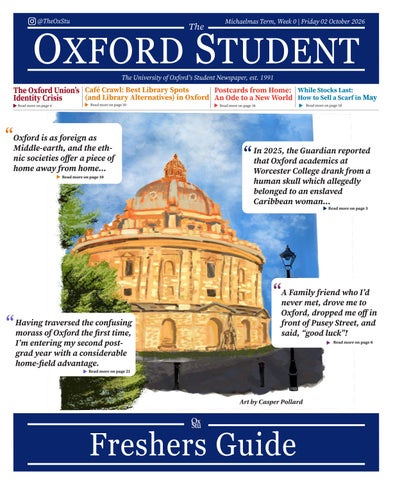
Art by Casper Pollard
Freshers Guide
2 | Editorials
Friday 02 October 2026 | The Oxford Student
Editorials
A Note from the Oxstu Team
The Oxford Student is an independent, fully student-run newspaper that has been providing truthful, open, and free journalism to all of Oxford for over 30 years. This includes important investigative journalism, holding the University, its colleges, and institutions accountable every term. Our work also provides a training ground for some of the most successful journalists around the world, including Stephen Bush, Lewis Goodall, Anoosh Chakelian, and many more, as well as leading figures in politics, business, technology and creativity. The Oxford Student – supported by an engaged alumni community - plays a key role in building the next generation of journalists, holding our society, economy, and democracy accountable. We need your Common Room’s support to keep this going. Our work is mainly funded through JCR and MCR subscriptions, which gives Common Rooms access to the newest student journalism in the city. Every 2 weeks, The Oxford Student delivers a 24-page print to every Common Room with a subscription. This Freshers Guide, funded solely through ad sales, is a great example of what you can expect if you bring the paper into your common room, at low costs, helping to keep student journalism flourishing in the city.
Contents News Opinion Profiles Culture Features Business Identity Sport
D
ear Fresher, Welcome to Oxford, the Oxford Student and our Freshers Guide — this one is all about you. Freshers Week (or even better, the entire Freshers Term) is a reward for all the hard work you’ve put in to be here. Every test, interview and the whole nerve-wracking summer of waiting for Results Day will be washed away with a tad too much wine at Freshers’ Formal. Then it will all come back in your first tutorial, when you realise you know nothing…or, even worse, during the urban legend that is Week 5 Blues, when you start to miss home. This Guide is for all of those situations. It will help you navigate daily survival, aca-
W
elcome to Oxford, freshers! It is a pleasure to have you, and I hope this guide serves you well as you navigate your first few weeks in this city. The OxStu team
Editorial Team 3 4 6 8 14 18 21 23
Editorial Board Ellie Apostolidi and Luke Erly (Editors-in-Chief) Elliott Wang and Gabriella Bedford (Associate Editors) Guilherme Lopes (Managing Director) News Isaac Gavaghan (News Deputy Editor) Abdul Olagunjuadekunle, Samuel Govier, Ansu Bhattarai, Tristan Clark Lam, Greta Pezzolato, Diya Singh, Leen Almasri, Saba Ahmadzadeh Noughani, Christine Savino (Section Editors)
Contact us at oxstu.editor@gmail.com demic stress, homesickness, the quest to explore student societies and, ultimately, the quest to feel like you belong. There will be a lot to work out along the way. Which societies are actually worth joining? How many times can you wear the same outfit to a formal? Why is everyone getting into relationships so soon? Some of these will be answered in this Guide, some you accept you may never find the answer to. And when this Guide runs out, there’s always The Oxford Student. We’re here to tell you what’s happening around the university, investigate the important stuff, and provide a platform for students to have their say. If you have something to tell us, we’d like to hear it. Take this as your starting point, but remember: your time to explore is now. Once again, welcome to Oxford. We’ll see you in print.
D
From hours spent learning how to sell advertisements to rallying the troops for a Week -1 layin, these are memories I will not be quick to forget. I’d like to give a massive thank you to the OxStu board, specifically Zoe Flood and Joseph McAuley, who have donated invaluable hours and expertise in the name of this paper. We couldn’t captain this ship without these hardy sailors. As is my constitutionally-bound duty, I must cite the American Icon, Rocky Balboa, to give any fresher reading this one piece of Oxford advice: “You see that guy staring back at you? That’s your toughest opponent.” A lack of self belief has ruined many great Oxford students, and so I urge you, dear fresher, to not let yourself waste your own potential. History is waiting, and I can’t wait to see you write it.
Balliol College
earest reader, Welcome to the wonderful world of Oxford! After one incredible year, this city has come to mean so much to me. I’ve changed my glasses, learned roughly how much I can drink in a night, and even discovered a new true love: student journalism. Since entering this wonderful paper with my trademark reflection pieces, I’ve come to enjoy just about every aspect of it: culminating in my first foray into news reporting on that infamous night on Wednesday of Week 8… We are so proud to bring you this Freshers’ Guide edition, and have been hard at work all summer to make sure we deliver the best product we can.
has been hard at work all summer to make this set of 24 pages possible, and I couldn’t be happier with the outcome. I would like to particularly draw your attention to our Identity section. You will read a wide array of student experiences, each unique, but somehow also deeply shared. This is exactly what this paper stands for: providing an alternative view on the issues that matter to our community, allowing individuals to express themselves, and of course, reporting with integrity and
purpose. Being a fully independent paper is not easy. It is paramount that Oxford hosts a diverse and competitive student journalism scene. We have exposed stories that would otherwise have gone untold. To continue doing so, we need your support. Help student journalism thrive, and consider suggesting a subscription to the OxStu for your Common Room. In my time in student journalism I have seen the OxStu grow and improve itself. I
know it will continue to do so with this term’s fantastic team. I hope that you will find value in our work, and would call on anyone who is even slightly interested in student journalism to give it a shot. Engage with our stories, pitch your own, react to what we’re saying. The narrative belongs to you.
Opinion Christian Wang (Deputy Editor) Antonio Reis, Eleanor Harris, Yiran Su, Leen Almasri, Zar Motik Adisuryo, Samuel Govier, Greta Pezzolato, Abdul Olagunjuadekunle, Tristan Clark Lam (Section Editors)
Investigations Ivett Berenyi (Deputy Editor) My Anh Ngoc Nguyen, Hannah Ison, Ava Doherty, Abdul Olagunjuadekunle (Section Editors)
Aamina Thava, Carolina Perotto, Ben Futter (Poetry Section Editors)
Ellie Apostolidi
Features Ellie Pemberton (Deputy Editor) Ben Futter, Hannah Ison, Phoebe Payne, Carolina Perotto, Richard Kühl, Yiran Su (Section Editors) Business and Finance Leila Hoffpauir (Deputy Editor) Akheel Kale, Chauncey Robinson, Claire Frost, Zar Motik Adisuryo (Section Editors)
Culture Flora Molnar (Deputy Editor) Jasmine Joyan (Poetry Deputy Editor) Aamina Thava, Aidan Kane, Carolina Perotto, Kadija OwusuKabba, Siena Tracey, Phoebe Payne, Lucia Clark, Ruhi Visaria, Isaac Simeon Sinclai, Richard Kühl, Joseph Walford (Section Editors) Anja Woosnam, Oliver Weston, Christina Robinson, Anya Tindall,
Luke Erly
Regent’s Park College
Guilherme Lopes St John’s College
Identity Katrina Roach (Deputy Editor) James Stratmann,Ben Futter, Joseph Walford, Nguyen Thi Ngoc Mai (Section Editors) Profiles Martha Kiyan (Deputy Editor) Diya Singh, Saba Ahmadzadeh Noughani, Ansu Bhattarai, Richard Kühl (Section Editors) Sport Charles Prestwich (Deputy Editor) Ruhi Visaria, Siena Tracey, Finn Perry (Section Editors)
The Oxford Student | Friday 02 October 2026
News | 3
News
news@oxfordstudent.com | Deputy Editor: Isaac Gavaghan Section Editors: Saba Ahmadzadeh Noughani, Leen Al-Masri, Ansu Bhattarai, Tristan Clark Lam, Sam Govier, Abdul Olagunju-Adekunle, Greta Pezzolato, Christine Savino, Diya Singh
Re-fresher Five stories to put the upcoming year’s news into context Union uproar Section Editor, Tristan Clark Lam
A
s the oldest student debating society in the world, the Oxford Union historically had a prestigious reputation. However, recently, the Union has been brought into disrepute. From racism scandals to protests, the institution has suffered something of an annus horribilis – with no-confidence motions being called against no less than three presidents over the past year. Last October, Union President-Elect George Abaraonye was forced to step down after it emerged that he had written in a private WhatsApp group chat: “Charlie Kirk got shot, let’s f****** go”, just months after debating the conservative activist in the Union chamber. Since then, Brayden Lee, the Union Librarian, resigned after being secretly recorded using racist language to describe other Union members. To add to the uproar, Arwa Elrayess, the most recent President, made national headlines by inviting hard-right activist Tommy Robinson to speak at a debate on Islam. The invitation sparked widespread outrage, with protests outside the debating chamber costing Thames Valley Police around £100,000 in policing. This leaves Gareth Lim, President for Michaelmas Term, with the task of restoring the society’s reputation, having only secured the position after previous President-Elect, Catherine Xu, was found guilty of electoral fraud by a Union tribunal. Palestine protests Section Editor, Abdul Olagunju-Adekunle
T
he political life of the University has never been limited to just Union scandals or debates over controversial figures. Oxford, like many other universities, found itself involved in a growing pro-Palestine movement which gained significant traction, beginning in 2023 in the wake of the October 7th attacks, the resulting Gaza War and the ongoing genocide. Students spoke out against what they considered to be University complicity and complacency. Controversy over pro-Israel speakers such as Ben Shapiro and frustration with perceived University inaction led to the establishing of en-
campments from 6 May to 8 July 2024, per year is still 82.6% of the maximum in line with similar actions conducted Student Finance England maintenance by students across the United Kingdom loan. and the United States. Common Rooms The decade-long squeeze on higher across the University spoke out in faeducation finances has created cost-ofvour of the student protesters. A sit-in living gaps between colleges, conflicts at the University offices at Wellington between students and fellows, and will Square on 23 May led to arrests which continue to shape the news in Oxford was criticised by the Somerville College this year. JCR. It was only on 6 June 2024 that the University agreed to meet with memAI academia bers of Oxford Action for Palestine and Section Editor, Zar Motik Adisuryo student representatives. Rhodes statue, Oriel College. Image Credit: While the last encampment was dis- Isaac Gavaghan, with permission. hilst student rent differs by mantled on 8 July 2024, questions are cant backlash, the normalisation of the college, every Oxford stustill being raised by news outlets on Ox- ritual gives a worrying insight into the dent has the equal access to ford’s investments into Israel along with extent to which imperialist traditions ChatGPT Edu. In 2025, the University allegations of the use of private intelli- permeate the University. became the first in the UK to offer the gence to monitor protestors. model to all students and staff. Rent racket The rollout began following a pilot inImperial inheritance Deputy Editor, Isaac Gavaghan volving around 750 staff and students Section Editor, Greta Pezzolato across the University and Colleges. isputes over the Union, Pales- ChatGPT Edu, differs slightly from bahilst most recently stories tine, and Oxford’s links to im- sic ChatGPT. OpenAI says it is a univerabout Oxford’s impact on perialism are not the only po- sity-focused version of ChatGPT with the international stage have litically contentious stories in Oxford. enhanced privacy and information centred on Palestine, for much of its In the last decade the amount of rent security, with data retained within the modern history, Oxford was an imperi- students pay their colleges has risen University. For examinations, candial cultural hub. Although the University sharply. dates will be told in advance whether AI has taken significant steps to reconcile Since 2016, the student loan has in- is permitted. Students remain responits colonial history to modern values, its creased from £8200 to £10,830. In the sible for the accuracy, originality and links to the British Empire continue to same period, rents taken in by some col- quality of submitted work, and must fuel significant debate. leges have rapidly grown as the funding formally declare permitted AI use when The Rhodes Must Fall Campaign was from the government for higher educa- required. AI use in exams is otherwise instrumental in forcing it to come face tion has shrunk. Over the past ten years, prohibited, unless specifically allowed analysis from UniversitiesUK has shown in the assessment instructions. For “Oxford’s links to the that the amount of money UK universi- research, substantive uses including British Empire continue ties receive per undergraduate has fall- analysing data, generating code, tranto fuel debate” en by 35%. In this worsening financial scribing interviews, et cetera, should be to face with its imperialist past. Orig- context, colleges have raised rents. declared whenever AI tools are used. inating in South Africa in 2015, the Last Trinity at Wadham College, stu- Unauthorised AI use in assessed work campaign aimed to remove the stat- dents engaged in a letter-writing cam- constitutes cheating and plagiarism ue of British imperialist Cecil Rhodes paign to every College fellow in an at- under the University rules. Submitting from the University of Cape Town. Ul- tempt to halt a proposed rent rise which AI-generated text as your own could timately, the movement acquired glob- would have seen rents of £9,470 for sec- result in penalties such as failing an asal recognition, leading to calls within ond-year accommodation. Whilst their sessment or even expulsion. the University of Oxford to take down efforts translated into a real-terms de- The Oxford Union. Image Credit: Isaac Rhodes’ statue in Oriel College. When crease in rent, the agreed sum of £8,950 Gavaghan, with permission. Oriel refused to take down the statue in 2016 due to high costs, intense protests followed. With the statue still standing, the University has far from let go of its connections to the Empire. In 2025, the Guardian reported that Oxford academics at Worcester College drank from a human skull which allegedly belonged to an enslaved Caribbean woman. The scandal reinforces that imperialism continues to seep into Oxfordian traditions. Although the practice stopped in 2015 after signifi-
W
W
D
Friday 02 October 2026 | The Oxford Student
4 | Opinion
Opinion
oxstu.comment@gmail.com | Deputy Editor: Christian Wang Section Editors: Antonio Reis, Eleanor Harris, Yiran Su, Leen Almasri, Zar Motik Adisuryo, Samuel Govier, Greta Pezzolato, Abdul Olagunjuadekunle, Tristan Clark Lam
The Oxford Union’s Identity Crisis: Reflections from Four Terms of Stockholm Syndrome Ellie Apostolidi
T
his time last year I sat in a solo tutorial that went horribly off-topic: we started talking about the
Union. At the time, I was actively involved in its electoral politics, and used to be friends with some of the Union lot; unfortunately, just like everything else in that place, the people have gone down in quality. So, I’m not going to give the same complaint about Union hacks or bad debates that everyone in Oxford seems to have – primarily because I am not a hypocrite, and more importantly, I think there is a deeper problem.
like British society, the “ Just Oxford Union is having an identity crisis.
For my entire time at Oxford (and, from what I hear, even a year before my time), the place was a battleground between people who wanted to conserve what one may coin its “British identity” and those who, often coming from very different political and cultural backgrounds, had little interest in preserving its traditional conventions. Like every electoral matter, the place is filled with scheming, backstabbing and shifting alliances; half the people never stand for anything substantial (definitely not the 60 seccies per election). Yet, from four terms of Stockholm syndrome at the place, I noticed that beneath all this chaos, the factional divide had a demographic and ideological character. International students were often prominent in the faction challenging the Union’s traditional conventions, accused of treating it as a stepping-stone
for political careers back home. Meanwhile, many domestic students – overwhelmingly regular P&P goers (dear freshers, please protect your P&P virginity…nothing good has ever come from losing it) – saw the Union as a “national treasure” whose constitution and “British” character should be protected. And if you are like me, you feel like an anthropologist in the wild, finding no comfort within either camp. Not only is the Union like British society because it doesn’t know what it wants to be, it resembles it even more so in the absence of left-wing politics. Sure, you find the occasional Labour-supporting Union hack (who somehow spends more time campaigning for OUCA than their own party), or even self-proclaimed leftists (who will jump at the first chance to lick the feet of the far-right when presented with an opportunity). Yet the average Union hack and hack-adjacent person? They are liberal at best, most likely Conservative. Welcome to Parliament at the moment, I guess. The sad truth is that electoral politics is often being shaped by the right (especially the far-right, whose ideas get co-opted by more moderate conservatives). I wonder how long un-
til the newly established Reform Society integrates into the Oxford Union. And what about the average member? Watching a society I loved as a third space in first year slowly decline due to factional decline is hard to come to terms with. The truth is that the infighting got increasingly vile (we really reached a new low when we decided that leaking a Freshers group chat to bring down a political opponent was worth it) and turned away many people who would have been casual members. The debates have just become sites of sensationalism: famous speakers who know little about a topic and provocative titles are not what many people want to watch. Perhaps with a new President, who is actually a professional debater with no history of political involvement, the place has a hope of changing? Maybe now that much of the old guard has graduated (some I am convinced will never leave), the deep factional divide is over? This remains unclear… assuming the society is financially stable enough to survive a takeover by financially responsible adults, that is.
To Fix Oxford’s Education System Elliott Wang
A
ttending a 9am lecture at Oxford is like picking the garden side salad over the fries at McDonald’s. You wake up inspired to walk through your empty college quad with a Fjällräven Kånken and Patagonia jacket (sponsor us). Reaching your department’s lecture theatre, you feel rather pleased with yourself for being one of the first dozen students to arrive. Two hours later, after having scribbled a few perfunctory notes and ChatGPTing whatever the lecturer was talking about (content that you will not learn until a few weeks later), while highlighting completely unrelated PDFs on your MacBook for your essay due in two days, you and the other dozen students walk silently out wondering whether this was what you really came to Oxford for. This is not to disparage the lecturers themselves. I would personally love to talk to any of them one-to-one in a tutorial. But in a lecture, it’s simply not a great sign if the main form of audience engagement is “Any questions? No?”
and “Don’t worry, this lecture will be recorded”. It’s time to remove course-related lectures. Is that really such a radical proposition? Fellow law students will agree that precedent is, by itself, no justification to keep a convention; faux historians will insist that history should not repeat itself; and anyone who’s managed to consistently attend lectures will know the cheapest place to find Monster Energy (they’ll probably need it). Replace lectures with college-specific classes (essentially, larger tutorials), and, for some courses, the average attendance might actually increase. If complete removal is too extreme, and if compulsory attendance is too un-British, then the alternative would be to have smaller groups as well as coordination between tutorials and lectures. Bilal Moin rightly pointed out in a piece for The Oxford Student: “There is no Oxford, not really.” The thirty-six colleges have different reading lists subject to the whims of the professors’ personal preference, forcing students into a loselose situation: attend the lecture blind and struggle to follow along, or attend the lecture prepared and struggle to keep awake. Thus, lecture-tutorial
Exam Schools. Credit: Tejvan Pettinger via Wikimedia Commons
coordination is needed. Why not have smaller lectures combining colleges with the same tutor or reading list? This would probably also increase audience engagement and attention. Or how about having broader-interest lectures about skills that are not covered in tutorials for lack of time? For instance, seminars on essay writing, research skills, or Q&As with high-impact guest speakers (this would also make it easier for student societies without a budget to host these guests). Hosting lectures online on Zoom might be an idea. The element of ‘disguise’ may just be the prime strategy for the era of the self-conscious, the socially anxious, the tech-savvy and tech-jugated. Last term, I remember entering the Law Faculty for a lecture on tort law. The
Gulbenkian lecture theatre was closed even though it was already fifteen minutes past the lecture’s start time, and in the lobby there was just me and another man. I took out my MacBook to double-check the venue of the lecture, and that man just looked at me silently, and I smiled awkwardly back. “Why is no one else here?”, I thought. Later, to my mortification, I realised that the man looking at me was the lecturer, and neither of us had been sure enough that the other was a student or tutor to say anything. The final tutorial, then, is simple: stop serving side salads when the fries are right there. The crowning jewels of Oxford are its small class sizes and intellectual resources. If lectures really must remain as they are, then so must their Panopto recordings on two times speed.
The Oxford Student | Friday 02 October 2026
Opinion | 5
academic space, we Who is Oxford For? inaren’tthe alone in a vacuum. Christian Wang
W
Oxford Union Main Building. Credit: Barker Evans via Wikimedia Commons
Is the Tutorial System Actually as Good as People Say It Is? Chauncey Robinson
B
y the time you arrive at Oxford, you have heard quite a lot about tutorials for someone who probably has not had one yet. The University calls them “central to learning at Oxford” and promises a “very rare level of personalised attention from academic experts”. Oxford is very fond of its tutorial system. Soon, you will find out why Much of that reputation is deserved. Few universities give undergraduates such regular access to academics in groups this small. Oxford is also trying to deliver that experience across dozens of colleges, different subjects and thousands of students. The experience varies more than the reputation suggests. A study of undergraduate Law tutorials found that students valued the academic rigour, critical thinking and detailed feedback the format encouraged. Giving an academic an hour with a couple of students allows for close discussion and individual feedback that become harder with 200 people in a lecture theatre. Oxford then has to make that idea work across an entire university. Colleges organise much of their own teaching, subjects use tutorials differently, and individual tutors have considerable control over what happens during the hour. The Law study found variation in how tutors structured discussions and gave feedback. Some variation is worth preserving. Tutors need room to respond to their subjects and the students in front of them. Oxford should still be able to provide a strong standard of teaching across tutors and colleges. The calendar adds pressure. Most undergraduate teaching happens during three eight-week periods of Full Term. Tutorials sit alongside lectures, class-
es and the independent work required for the next meeting. Eight weeks can accommodate a remarkable amount of work. It offers less space for an idea that refuses to become interesting by Thursday afternoon. Oxford prizes the intensity of its academic terms. The tutorial system should give students enough time to follow an argument somewhere unexpected. There is also an employment system undeneath all this individual attention. UCU data reported by The Guardian found that academics on fixed-term or hourly-paid contracts delivered 61% of tutorial teaching across 24 Oxford colleges in 2023–24. Every tutorial requires someone to read the work, prepare and teach. Oxford should be more candid about its reliance on these academics and the conditions under which they provide one of the University’s defining educational promises. The tutorial system deserves much of its reputation, including some of its variation. Individual academic judgement gives tutorials much of their value, so complete uniformity would work against the personalisation Oxford celebrates. Oxford should give that freedom the support it needs: enough time for students to think, proper conditions for the academics teaching them, and a strong standard of teaching across colleges and subjects. Your first tutorial will tell you something about your tutor, your subject and perhaps Oxford itself. Oxford has already told you that its tutorial system is exceptional. There is enough evidence to take that claim seriously, and enough variation to keep judging it once you get here.
hen I turned from George Street onto Cornmarket when first visiting Oxford, one fact was unmistakably clear: Oxford is a university town. Whether it’s tour groups scrambling Shibuya-style across the intersection at every green light or the never-ending supply of tourist shops selling wizarding wands situated next to fast food joints, the centre of the city is dominated by the omnipresent shadow of the University of Oxford. The world around Carfax is far removed from the neighborhoods of Summertown and Blackbird Leys. For a long time, Oxford has, quite famously, been home to one of the clearest divisions between town and gown of any university town, leading to a particularly unique cultural geography. While there hasn’t been a proper riot since St Scholastica’s Day in 1355 (a pub argument that ended with 63 students dead - and the University, naturally, somehow coming out of it with more power over the town than before), the divide between the university and the city has never gone away, only becoming subtler, but far more physically entrenched in the built environment. As an Oxford University student, one can spend an entire term shuttling between college, the Rad Cam, and a faculty building without ever setting foot east of Magdalen Bridge (bar if you’re at St Hilda’s) or north of St Margaret’s Road, and subsequently experiencing the Oxford that most of its residents actually live in. “Cowley,” to students, means Cowley Road, and as my college’s Welfare Coordinator quippily points out, true “Cowley” isn’t until “Cowley Road” becomes “Oxford Road.” The terraces on Holywell Street, Ship Street, Turl Street, and Bear Lane look privately owned, but a Salto reader or college crest usually gives away that Merton, Wadham, Jesus, Lincoln, and co. manage them - for students and staff only - along with many of the shops around them; the blocks surrounding Cornmarket, while they look like Oxford to the untrained tourist’s eye, are really a university wearing a city’s cloak. I often spot my own college’s tenant cafés delivering leftover pastries to our plodge to stay in our fellows’ good graces (a win-win, from what I can tell). But it would be a mistake to see modern-day Oxford as solely our university masquerading as a town; many of our buses, even, are branded under the “Brookes” name, which is a gentle reminder to many students that, even
The contrasts with the local community are stark, too: according to the Gatehouse, Oxford regularly places in the UK’s top five for rough sleepers as a proportion of the population – something evident to anyone who walks down Cornmarket. Oxford isn’t unique in this. Yale, like our colleges, is landlord to much of downtown New Haven, but the city has spent decades pressing it for “voluntary” payments in lieu of the property taxes the university is exempt from – most recently a $230 million deal over seven years, agreed this March, which the city’s alders still thought too small. Oxford has no equivalent; with its wealth split across the University and thirty-odd colleges, there doesn’t seem to even be an obvious party for the town to negotiate with. What Oxford does have is a growing effort to close the gap from both sides. The central University has committed to paying its staff the Oxford Living Wage, a council-set rate above the national minimum, since 2020, and funds local projects through its Community Partnership Fund. And unlike our college grandparents many, many generations ago, students are increasingly getting involved and creating new initiatives. Turl Street Homeless Action has, since 2013, sent volunteers out several nights a week with hot drinks, food, and conversation for rough sleepers in the centre and Cowley; earlier this year, it joined New College Curry Runners and Food Rescuers to form the Oxford Student Social Action Coalition, with the explicit aim of bridging the divide between students and the homeless community. It’s small next to a $230 million cheque, but it’s symbolically powerful as it genuinely demonstrates the gown willing to serve the town. Whether any of this closes the divide is hard to say; nearly seven centuries of division in Oxford’s geography is hard to overcome solely with student mobilization. But it does suggest that plenty of students aren’t content to stay inside the bubble either, and for that, hope remains that the symbiosis of town and gown can create an even brighter future for Oxford – “City Council” or “Uni of”.
View of Broad Street from Cornmarket intersection. Credit: Christian Wang
6 | Profiles
The Oxford Student | Friday 02 October 2026
Profiles
Welcome to Oxford: Years in Conversation
Tristan Clark-Lam and Luke Erly
O
n a glittering September morning Luke is already at home in the rhythms of University life. A second-year History and Economics student at Regent’s Park, he knows the rituals, unspoken rules and peculiarities of Oxford life that can take freshers months to understand. Tristan, meanwhile, is about to discover them for himself. An incoming first-year English student at Pembroke, he arrives with the familiar mixture of excitement and apprehension that comes with starting somewhere entirely new. Sitting together in Luke’s college JCR, the two begin an exchange about what lies ahead, and what Tristan can expect from his first year, from the exhilaration and excesses of Freshers’ Week to the quieter realities of Imposter Syndrome. Socialising Tristan: How did you spend Freshers’ Week? What’s the reality of Oxford’s social scene? Luke: I have a great memory of my first day coming here. I’d been to Britain twice before and had gone into Oxford just to visit, but I came here alone. A family friend who I’d never met, drove me to Oxford, dropped me off in front of Pusey Street, and said “good luck!” I’m from a rural part of Southern Maryland. There’s no such thing as going out there. I did that for the first time, going to the bar, meeting everyone. That’s really what I remember: just meeting so many people. The people I met in Freshers’ Week who I thought were going to be my friends
did not end up being my main friends. I think that’s something people should keep in mind. But the presiding emotion of Freshers’ Week was just go, go, go, all the time. But you keep doing new things, trying new things, and it sort of works itself out. Tristan: What’s the best college bar? Luke: I can’t say Regent’s… It is in the top three, though, even if I remove my bias. It’s really, really good because it’s the cheapest! Generally people think Balliol is the best, and is generally the most consistently lively. Jesus is also considered quite good, and open to holding events. But you’ll learn quickly that some colleges are stricter about letting visitors in. Lincoln, for example, you can only bring in something like two guests for every one member. Some colleges don’t care. Regent’s doesn’t care. Balliol pretty much doesn’t care. So that’s another important factor.
“...dropped me off in front of Pusey Street, and said, “good luck!”
Away from home Tristan: Did you ever get homesick? Luke: I didn’t get homesick until Week Five, and then I had a very, very bad bout of homesickness. People always talk about the ‘Week Five Blues’. No one believes it until
oxstu.profile@gmail.com | Deputy Editor: Martha Sinclair Section Editors: Diya Singh, Ansu Bhattarai, Richard Kühl it happens to you. Almost because you’re so busy for the start of term, you don’t have the time to think about missing home. But once you settle into a rhythm and start being less busy, it really starts to hit you. You’ve got to register it, deal with it, and then try and move through it. Oxford traditions Tristan: What’s your favourite Oxford tradition? Luke: You’re going to have to wait for Hilary: Burns Night. It’s a specific night that not every college celebrates, on the first or second week. Usually you have a formal for it, and it’s to celebrate the Scottish poet Robert Burns. There are all sorts of Scottish traditions, the ceilidh [traditional Scottish dancing], and there’s always a bagpipe player. You have haggis. If you’re Scottish, you wear a kilt. It’s so much fun! Usually you get some free whisky. Luke: What do you think your favourite Oxford tradition will be? Tristan: I like Christmas, so Oxmas sounds fun. I like the idea of having Christmas dinner in the fancy halls. It sounds like it’ll be pretty festive. And who wouldn’t want to celebrate Christmas twice? It’s a win-win. Academic pressure Luke: Do you feel any pressure coming to Oxford? Do you feel academic pressure? Tristan: Definitely! Because the application process is such a long and hard one, I feel like I’ve done so much work to get here, and now I have to live up to expectations and really commit to my subject. But it’s also exciting to be able to spend the next three years with people who are literally the best in the world at your subjects, so it’s a pretty cool privilege to have. Luke: What do you think the relationship with your tutors will be like? Tristan: I’ve been wondering about this. Both of mine seem really nice. I was interviewed by both of them, so hopefully they liked me. They let me in! But I don’t know if it’s going to be like school — teach-
er-student vibes — or something slightly more casual. What is it actually like? How have you found it? Luke: It depends on who, that’s for sure. On the whole, however, I think it’s much more personal than I thought it would be. I remember writing an email to my tutor and showing it to my college father. I had “Dear Dr. Read,” at the top. My college father took my laptop, deleted it, and put “Charles”.
“ I like the idea of Christmas dinner in the fancy halls.
“You’re calling him Charles.” I was told! You learn so much about your tutors. At Regent’s, we have History drinking events every term. I would never do that with my school teachers. The whole thing is ridiculous and hilarious in so many ways. I think people are too scared about relationships with tutors. If you put up a wall at the start, you’ll damage your ability to make a casual relationship with them. They’re real people too. If you try and lay your guard down a bit and talk to them about things other than your schoolwork — just chit-chatty stuff — you’ll reap the benefits
and know them on a personal level. That’s really useful in a variety of ways, because tutors can really stick up for you more than you think. If you have a tutor who is really in your corner, who likes you, respects you, then that can go a long way. Advice Tristan: If you could give your 1st year self one piece of advice, what would it be? Luke: A lot of people come to Oxford with the idea that they’re going to do X, Y, Z things. They’re going to be in the Union, or they’re going to do political societies, or they’re going to do these sports. Or the reverse, where they say “I’m not a sports person” or, “I don’t like drama.” But really, you never know what’s going to excite you, until you try it. Luke: This time next year, what would you hope to have accomplished? Separate it into academically, emotionally, and socially. Tristan: Academically, I hope I’ll still be here... Make it through the Prelims. Socially, I hope to find my people, have a nice group of friends, and hopefully spend summer having a good time with them too. Emotionally, I hope I’ll be excited to return! Credit: Ellie Pemberton
Advert | 7
The Oxford Student | Friday 02 October 2026
STUDENT LIFE S TARTS HERE
WE STGATEOXFORD.CO.UK
8 | Culture
Culture
Friday 02 October 2026 | The Oxford Student
culture@oxfordstudent.com | Deputy Editor: Flora Molnar Section Editors: Lucia Clark, Isaac Hole, Aidan Kane, Richard Kuehl, Kadija Alisha Owusu-Kabba, Phoebe Payne, Natalie Perera, Carolina Josephine Perotto, Christine Savino, Aamina Thava, Siena Tracey, Ruhi Visaria, Joseph Walford
Drink through History: Pub Crawl! Managing Director Guilherme Lopes recommends his favourite pubs.
W
elcome to Oxford! Have you waved goodbye to your parents? Or have they invited you to a celebratory pint? Well, then you are about to witness the most important part of Oxford life – and I am glad to be your guide. Lamb and Flag Located just off my own St John’s, this was the first pub I visited as an Oxford student. I am particularly fond of its large windows, with a view onto St Giles’. Many post-tute drinks have been had here. In operation since at least 1566, L&F is steeped in literary heritage. You’ll find some elvish engraved above its side entrance, a homage to Tolkien and CS Lewis who used to meet here in their Inklings group. This pub is a hallmark of Oxford, and rightfully earns
its place as the first stop on our route. The Renegade lager, whilst slightly off the beaten path, is pleasant and won’t make your wallet cry. Amazing entertainment and cultural programming as well! Eagle and Child From the Lamb and Flag, cross St Giles’ towards the Eagle and Child. Although currently finishing up renovation, it is set to open in early 2027. It has been closed since March 2020, so I’ve never had the pleasure of going inside, but this is actually the original meeting place of the Inklings, before works in 1962 prompted the Lamb and Flag migration (clearly this pub has a renovation habit). White Rabbit After gazing at the Eagle, walk down towards Tesco and turn right on Friars Entry – here you’ll find the White Rabbit. This pub has two major pros in my book: a fantastic garden with heated seats, ideal for
the chilly winter months, and the best pub pizzas I’ve tasted. Whilst the beer selection is not out of this world, you’ll find a reliable European lager to keep you company. Prices are attractive. Jude the Obscure Continue Northwest and you’ll reach my favourite area in the city centre. Jericho is a gorgeous place with wine shops, top restaurants, and fun cocktail bars. If we’re talking pubs, however, then nothing beats Jude the Obscure. Great garden, and a wide array of beers on tap. One thing I’d say about Jude, however, is that it is definitely a summer pub. White Horse Next up, a tiny pub on Broad Street. I have a confession, though. I cannot stand ales. Why would you want room temperature, flat, heavy beer?! Well, if you hate yourself and decide that’s what you’re looking for, there’s no better
Lamb and Flag. Credit: Flickr userRobert via Wikimedia Commons
place than White Horse. In all seriousness, the interior is beautiful, and congregating at the tables outside after exams is a holy experience. Turf Tavern Past Hertford, the oldest pub in Oxford. “An education in intoxication,” promises its entrance. Low-hanging ceilings, cozy vibe, and a nice outdoor area - what more could you want? Live out your Oxford dream here. I recommend the Limoncello Spritz. Oranges and Lemons Let’s move towards Cowley. I love this pub, mostly for its
name. They host quiz nights on Wednesdays at 8pm, so if you’re done with your essay (or, most likely, are not), then compete here for a £50 tab. Star This might just be my favourite Oxford pub, and it rightfully concludes our trip. I don’t actually have all that much to say, other than get the ‘megapints’ (it’s just two pints in one glass, but oh so fun). They also have a more exquisite selection than other central Oxford pubs - it was at this lovely place that I first tried ‘Beamish.’ Mixed feelings.
Freshers’ Feels – Film & Book Recs Section Editor Aamina Thava & Deputy Editor Flora Molnar share their Freshers’ Week recommendations.
F
reshers’ Week is notoriously a week of chaos, excitement and frankly, existing in a quasi-separate time zone. However, if you happen to find that spare hour of peace, and can finally reflect on memories as opposed to creating new ones, our Culture team has picked out a few works that capture some element of the early Oxford experience - at least according to their own hazy recollections. Film: Lady Bird by Greta Gerwig (2017) ~ Aamina Thava My Oxford Year is the film to watch before term if you want to be rage-baited, Legally Blonde for motivation, and Pitch Perfect for a laugh. But Lady Bird is the film I would recommend to help place the rather more complicated emotions of actually leaving home.
Lady Bird is desperate to escape Sacramento for university in New York, while caught in a relationship with her mother that is simultaneously loving, restrictive, and co-dependent. As an Indian Muslim who grew up with restrictions of my own, that contradiction resonated: wanting independence does not necessarily make achieving it painless. Gerwig captures the strange guilt of freedom – missing home without missing its restrictions, loving your family while realising you need distance from them, and discovering that becoming your own person does not require rejecting where you came from. Lady Bird arrives at university and makes mistakes (her first night ends in hospital after drinking too much), which is perhaps another useful reminder for Freshers’ Week: nobody becomes an effortlessly functioning adult the moment their parents leave. Your twenties are meant to be wasted
away. Literally and metaphorically. You have the freedom to try on different versions of yourself, make questionable decisions and figure it out.
twenties “ Your are meant to be wasted away.
For anyone simultaneously excited, guilty and terrified about moving away, Lady Bird is a reminder that those feelings can coexist – and that university might be where you finally get the space to decide who you are for yourself. Book: Practice by Rosalind Brown (2024) ~ Flora Molnar With the pages of this novel spanning the course of a single day, Practice not only fittingly documents the ‘average’ day of an Oxford student with meticulous detail, but is even realistical-
ly able to be finished over Freshers’ week. Annabel is studying English Literature and has an essay deadline looming – I may be biased having been in exactly the same situation with Shakespeare, but I guarantee whatever subject you study you have something similar waiting. Annabel’s thoughts we are privy to may spring from such set material, but the beauty of Brown’s writing is documenting the meandering, undiscriminating tendencies of the mind. As Annabel takes a studybreak outside, her wandering leads to her wondering about anything from her boyfriend to bodily functions, inventing some of her own Shakespearean characters along the way. A unique read to encourage you to similarly slow down, and prove that even a mundane day in the future normality of term time can end up unexpectedly remarkable and revelationary, if not academically productive.
Culture | 9
The Oxford Student | Friday 02 October 2026
Music, Fashion &... Tea? Five Oxford Societies Worth Knowing About Section Editor Kadija Alisha Owusu-Kabba shares five underrated socities to check out.
F
reshers’ Week comes with a deluge of information: which societies to join, which clubs to go to, where to eat in town, and roughly 350 other things you’re expected to remember. At the Freshers’ Fair, the biggest names inevitably demand your attention, from the Oxford Union and sports clubs, to law and finance societies. With so much on offer, plenty of societies can easily slip under the radar; here are ones not to miss. Wadham College Music Society You don’t have to be a classical musician to enjoy music at Oxford. Wadham College Music Society (WCMS) is student-run and hosts everything from open mics and folk nights to its famous live album playthroughs. Previous years have seen performances of Amy Winehouse’s Frank, Stevie Wonder’s Songs in the Key of Life and The Beatles’ Abbey Road. This term, the society turns to Raye’s
My 21st Century Blues, with auditions currently open for singers and musicians of all years and instruments. Perhaps this is a shameless self-plug from a former member and current Wadhamite, but WCMS is a great way to make and enjoy music and definitely worth checking out. Auditions are open until 8th October, with the sign-up form available via their Instagram. Oxford Media Society For anyone who has ever considered a career in, or simply enjoys journalism, film, television, publishing or advertising, Oxford Media Society is worth putting on your list. The society connects Oxford students with the global media industry through panels and interviews with speakers, journalists and other media professionals. Past speakers have included BBC journalist Reeta Chakrabarti, football commentator Peter Drury, Financial Times foreign editor Alec Russell and former Vogue editor Alexandra Shulman CBE. The society also facilitates student discussion of media thoughts its newsletter, which takes
open submissions from all students. African & Caribbean Society The African & Caribbean Society (ACS) offers a space to connect with and explore all things African and Caribbean. From hip-hop and afrobeats-themed events to study sessions, watch parties, sports events and movie nights, there’s plenty to get involved with. And ACS is far from the only option. Oxford’s cultural societies range from Arab and Desi to Spanish, Polish, Brazilian and the newly created Ghana society with plenty of opportunities for cross-cultural events. Whatever your cultural background, there’s a good chance there’s a community for you. Oxford Fashion Society Fashion may not be the first thing that springs to mind when thinking of Oxford extracurriculars, which is exactly why the Fashion Society deserves a place here. Whether you’re interested in styling, designing, sewing or simply enjoy clothes, the society offers a creative alternative to Oxford’s traditional activities. Its events range from crafting and
styling sessions to its annual fashion show which calls on student designers and aspiring models to get involved. Previous speakers and guests have included Adam Baidawi, Global Editorial Director of GQ; Jonathan Kiman Chief Marketing Officer of Burberry; and Jessica Giles former Editor-in-Chief Cosmopolitan. Tea Appreciation Society And finally, because this is Oxford after all, apparently we need a society dedicated to tea. Tea Appreciation Society is the perfect reminder that your extracurricular life doesn’t have to be strategic, serious or even useful. If you’ve been bombarded with advice to network and grab every opportunity that comes your way, I’m guessing what you really need is a cup of tea. The Freshers’ Fair can only introduce you to so much without becoming overwhelming. So no worries if you leave with nothing but a tote bag full of flyers and discounts codes: Oxford societies are worth exploring long after Week 0. And if there isn’t a society for your specific interest, create it!
“I’m sick of hall food – where to eat?” Editor-in-Chief Ellie Apostolidi gives her best food spot recommendations for daily survival
A
s an unfortunate soul who had to share a kitchen with five dirty blokes, I have come to know the ins and outs of Oxford’s culinary scene. Below, I want to share six food spots – some more affordable and some reserved for special occasions – for when you don’t want to eat plain hall chicken and rice for the billionth time. Ramen Kulture/ Ramen Korner Both locations have the same menu, the same anime playlist, and I ate there at least once a week in second year…still hasn’t gotten old. Cheaper than other ramen places in Oxford, their meat portions are more generous than equivalents. Personal favourites are the duck donburi, spicy tonkotsu ramen and
the chicken karaage. Alpha Bar I discovered this in the middle of the heat wave this past summer and it satisfied something other places can’t: the desire for something light and cold. A salad bar that has much better options than college, and is actually filling enough to be a standalone meal. Brothers Cafe & Georgina’s Though these are two different spots, both serve Greek food (though neither seem to be run by Greek people, unfortunately for Greek me), are relatively cheap and are located in the same block in the Covered Market. Their menus are somewhat complementary, with Georgina’s serving their famously cheap wraps and Brothers Cafe having the superior savoury pastry selection. Personally, I go for neither and always get the halloumi and beans, because, apparently, I eat
like I’m recovering from a famine.
the way, “ Along we introduced all of our friends to it.
Al Andalus We came for the big sangria jugs, but stayed for the honey goat’s cheese. Along the way, we introduced all of our friends to it. Seriously, I’ve never found this dish anywhere else, and I will keep coming back to Oxford just to eat it one more time. Zhang Ji (Cafe Orient) Countless birthdays have been celebrated in the private room in the back, and enough dishes ordered to feed an army each time – still somehow the bill has been beyond
reasonable. The service is extremely fast (enough that it makes up for the trek to Cowley) and the food is, in my opinion, the best Chinese food in Oxford. My top recommendations are the cumin lamb, steamed bbq duck, the twice cooked Szechuan pork slices, and the spicy aubergine pots for our vegetarian friends. Zhang Ji. Credit: Yashas Ramakrishnan
10 | Culture
Friday 02 October 2026 | The Oxford Student
Café Crawl – Best Coffee Spots (and Library Alternatives) in Oxford Deputy Editor Flora Molnar shares four of her favourite spots to study around the city.
I
t is no secret that Oxford has an abundance of libraries, but that may not stop you from getting bored of them, or at least craving a change of scenery for your study sessions. Indeed, sometimes the only source of motivation to get you through that last assignment comes in the form of a coffee and sweet treat – I don’t make the rules. Luckily for you, Oxford similarly has no shortage of coffee shops. Whilst I don’t recommend replicating this café crawl all at once (you might spend your weekly food budget in a day), these are my underrated spots to keep in mind for the term. The selection is based on places that offer something extra or particularly valuable, so by no means exhaustive, but hopefully something new. Tree Artisan Cafe To start with what I would call the epitome of a small, independent cafe, and a favourite especially among the OxStu team, Tree Artisan tucked
into Little Clarendon Street is a hidden-gem. If you can snag a table here, you know you are about to have the cosiest essay-writing session of your week. The hot drinks come with the most unique latte-art – from a mystical seahorse or pegasus, to seasonal reindeers or rabbits – and they all taste as good as they look. Amongst plenty of other drinks (notable mention to the iced chocolates of three different varieties!), as well as sandwich and cake options, the only major downsides are a few laptop free tables and no bathroom on site. Gulp Fiction (and the case for bookshops) Now in the Covered Market, I would encourage you to pop into Gulp Fiction right in the centre, an independent bookshop that also offers drinks and tables for reading/studying. From book-covers printed onto said tables, to real books surrounding you on shelves, this is quite literally the halfway point between a library and cafe: you get the academic inspiration but retain the possibility for caffeine consumption. In other words, it’s the best of both worlds – not least because if
you buy a book from them, you get a free drink! Along the same vein, you can also study in Blackwell’s, either in their own cafe or in the Norrington room, and the same goes for Waterstones and bookshops in general, but Gulp Fiction is the clear winner amongst these. Ole & Steen (and the case for chains) But, I do have a case to make for chains. As much as I love all independent cafes around here, I have to admit, they are not always geared towards studying with cramped spaces, short opening hours and entertaining but distracting conversation right next to you. So sometimes, it’s those bigger chains that provide the cafe atmosphere but still practical environment: Ole & Steen in Westgate being my favourite example. Commercial yes, but with two-storeys of seating, massive windows and multiple bathrooms, you are guaranteed to actually have a productive day here. The points-loyalty app may even keep you coming back more than you thought. Alfonso Gelateria Back to talking about independent cafes on Little Clarendon Street (a
great street for those in general), one of the newest additions to the scene opening only this summer is a wildcard I have to plug, Alfonso’s! As the name suggests, their main sweet treat offering is ice cream – nothing short of Oxford’s best, in my humble opinion. They have an authentic Italian recipe and specials like Mascarpone & Profiterole (which they also offer in half scoops so you can try more flavours). But let me stop marketing their ice cream as these are recommendations for October, even if I would genuinely recommend trying a scoop whatever the weather. The reason they deserve a spot on the list is because they do offer great coffee too, in such a sleek and clean space, which is open until 10pm on the weekdays. I can already see myself writing half my dissertation here. Gulp Fiction. Credit: Flora Molnar
Home Away from Home: Ethnic Societies Section Editor Aamina Thava shares the value of the ethnic societies Oxford has to offer.
O
xford is as foreign as Middle-earth, and the ethnic societies offer a piece of home away from home. Growing up in London, and only ever hearing about how ‘white’ Oxford is, I was scared… mostly because what was I going to do if Indian, Chinese, Turkish, Ethiopian cuisine (to name only a few) were a 15-minute train ride away? What if I couldn’t find my people? Living in a city, in a country, away from everyone I have ever known is terrifying and lonely – and that can be dangerous. But I was pleasantly surprised by how much of home I found in both the unknown and the familiar. You are going to be living in a
city where everyone has moved away from home, and I found a piece of mine in some of the ethnic societies. Talking to people from the Islamic, Pakistani, African-Caribbean, Bengali, Asia-Pacific, Arab, and Egyptian societies, I found that they all said they were surprised by the overwhelming sense of community these societies create. They host events to celebrate cultural and religious occasions: a crazy night out with some Mahjong, soju and karaoke; biryani and Bollywood; prayer and gratitude circles; jollof rice and welfare teas – there are events for everyone, whether you want to find a piece of home or discover something new. Most of these societies also host their own balls – my favourite being Desi Ball in Hilary Term. It’s a night where we listen to ‘Kala
Chashma’ and ‘FE!N’, hold on to
I found “ Home in both the un-
known and the familiar.
our tikkas, take a break to scoff down some butter chicken, while Aunty Seema plays matchmaker in a way that makes you question why Netflix gave her a show with many, many seasons… Ignore the stereotypes. Ignore your nerves. Ignore the introvert in you and just explore! You’ll be surprised by the people you meet who might just end up becoming your best friends. Although, finding authentic, non-Western food in central Oxford is… try Cowley.
Desi Ball. Credit: Aamina Thava
The Oxford Student | Friday 02 October 2026
Culture | 11
Behind the Scenes – Oxford Theatre Scene Explained for Beginners Lighting designer Gabriela Panova, actor Caeli Colgan, and Deputy Editor Flora Molnar’s student theatre guide
O
ne of Oxford’s most valuable cultural opportunities comes in the form of the rich student theatre scene. However, the workings are more complicated than many realise, especially with so many components holding it together: production companies, tech and costume departments, actors, and some terms that mind sound alien at the moment, namely the ‘garden play’. Who better to take you behind the scenes than OxStu Culture? Below Lighting Designer Gabriela Panova, actor Caeli Colgan and our own reviewer Flora Molnar hope to explain how drama at Oxford operates as well as encourage you to get involved – a peep behind the curtain may show that you are closer to the stage than you thought. Gabriela Panova Introduction Student theatre at Oxford is incredibly developed: so developed in fact, that there are about 30 productions per term, ranging from Broadway musicals to original scripts. These shows, enjoyed by Oxford students and locals alike, are brought to life by enthusiastic cast and crew members, many of whom have caught the theatre bug here. No past experience required and plenty of tech and acting veterans eager to share their craft creates the perfect environment for learning. It transformed me, a complete beginner, to someone applying for the Lighting Designer role in ambitious projects in less than a year! Before taking you through the tech journey, however, I’ll lay the broader mechanism out. Theatres & Production Companies The University of Oxford owns several theatres around the city and has contractual agreements with others.
From small black box theatres like the Burton Taylor Studio to the 600-seat Oxford Playhouse, students are welcome to apply to put on a play and are supported by OUDS (Oxford University Drama Society) and OUTTS (Oxford University Technical Theatre Society) in the process. To do so, anyone can register a production company under OUDS for free, which grants that production company the right to bid for venues, i.e.
“Many cast and
crew members have caught the theatre bug here to apply for a slot. Once the founders have decided on a project, they gather a team of Heads of Departments via a crew call, complete the application form and attend an interview. Once greenlit, a cast call is released and rehearsals start soon after. Crew and Cast calls are released at oxfordstudentthreatre.org or on the Oxford University Drama Portal on Facebook. Funding comes primarily from JCR motions and grants like those provided by OUDS, with ticket sales covering most expenses. Tech & Other Departments And now, tech! My biased self will tell you this is the most rewarding experience: creating the spotlight actors shine under! So how can one get involved? Where does tech fit in the picture I described above? At the early stages, a production only needs Heads of Department. These include Director, Producer, Lighting, Sound, Set, Costume designers, Stage manager, Production Manager, Marketing, Welfare, Choreographer, to name some. While these de-
velop the main aspects of their respective field and make the executive decisions, however, they need assistants. Just like the Crew and Cast calls, companies open Assistant crew calls. This is the option most suitable to those who want to try out a department under the supervision of someone more experienced who will guide you in carrying out your task. Anyone can apply to be an assistant for any show all throughout the academic year. Even better for beginners: join a training show or an OUTTS workshop! Training shows are specifically designed to accommodate trainees in the process, give them the opportunity to shadow and be taught by their head of department. Sign up for one at OUTTS.org. OUTTS also host tech workshops throughout the year where industry professionals visit to share their expertise - definitely keep an eye on these as well. It is this mechanism that allows Oxford students to adapt acclaimed pieces or to put on something of their own by tapping into the university’s talent pool and reinforcing the story with professional equipment. We are so excited to welcome you and we hope to see you at the SU Freshers’ Fair and the Student Theatre Fair! Caeli Colgan Acting It can seem daunting to think about auditioning for an OUDS show as a fresher, but getting involved in acting is one of the best ways to make new friends outside of your own college. The number of production companies within OUDS can likewise seem a little overwhelming, but because there are so many shows being put on that means there are lots of opportunities to audition. At the
beginning of every term each production company will post a cast call for their play on the OUDS Facebook page and you can respond to the cast call by either signing up for an audition slot or sending in a selftape depending on the specified requirements. Sometimes after the initial audition the production company might invite you to a second audition in the form of a group callback and while this can seem scary, everyone there is in the same boat as you. Don’t be deterred if you don’t get cast in the first show you audition for, that is completely normal! The rehearsal period for a show is a lot of fun and because things are so fast paced in Oxford you become quickly bonded with the rest of the cast. I have made so many of my best friends through acting and the wonderful thing about OUDS is the more friends you make, the more shows you end up going to watch. Some of my favour-
“I have made so
many of my best friends through acting ite memories in Oxford have been celebratory post-show pub trips! There are so many different kinds of plays being put on that there is some-
thing for everyone but if nothing takes your fancy you can also put on your own show! Whether you’ve acted before or you want to try something new, being a part of OUDS is a great way to learn more about theatre and meet other likeminded creative students. Flora Molnar Oxford Specials The Garden Play Perhaps not so relevant now, but something to remember when June rolls around: every Trinity term, some colleges put on what is known as a ‘garden play’. Essentially a play outside instead of in an indoor theatre, it’s a great way for colleges to use their green spaces, seeing as they hold some of the most beautiful gardens in the world. It’s completely student organised and produced – think of it like an OUDS production on a college-level scale – but you can cross-audition between colleges (usually necessary for numbers for a smaller one). Being involved in any capacity, and especially seeing the finshed product as a specator, is the epitome of summer; watching the sun set at 10pm among ancient walls and flowers feels like a fairy tale. The tradition is often a Shakespeare comedy (A Midsummer Night’s Dream screams the genre), but more and more colleges have been experimenting with modern or even self-written plays we’ll see what 2027 holds!
Lighting designer behind the scenes. Credit: Gabriela Panova
12 | Culture
Friday 02 October 2026 | The Oxford Student
Oxford Date Already? (no date… take a mate!) Oxford Botanic Garden. Credit: Flora Molnar
T
his is a non-exhaustive list of Oxford’s most special date spots, of which I’ve compiled my personal highlights (and I’m sure the editor-in-chief - the g*rl, not the hot guy - would agree). My qualifications: I have gone on multiple dates, the bulk of which took place over a relationship of (a year? 8 months? 18 months? God knows how it’s truly defined). I have EXHAUSTIVELY done everything, and these are my personal picks. First dates: Of course we start our list with coffee shops: low stakes, easy to gauge a vibe, intimate setting at any time of the day (provided the sun’s still out, because no damn thing is open past 5pm in Oxford). My picks for a first date are: Independent Cafe - great
place for a light brunch and a nice walk in Christ Church Meadows after to extend the yap. Opera Cafe, Jericho - cute food, cute neighbourhood (Jericho is really the ideal place to take any date) and really cute vibes on both the outside on Walton St, and the inside outdoor garden; can be a nice location for a study date (if the Schwarzman ground floor stink gets overwhelming) If you are not a daytime person or you are hoping for the night to progress further (though you should really consider if you want THAT your mindset to be on a first date, but I digress), these are the best bars in Oxford to take someone out: Lynrace/Popina, Jericho - Lynrace is my personal favourite cocktail bar in Oxford, with a lower floor that
Ex-Editor-in-Chief Yashas Ramakrishnan rounds up his favourite date spots (ft. current EiC Ellie Apostolidi) turns into a cosy cinema on Sunday evenings (and the owner Joe, a man with certified taste, always picks the best films to screen). Popina is the wine bar with cheese boards and a pork belly to die for, high quality wine, great lighting and probably my favourite playlist for a chill night - what better place to get to know who’s gonna be in your bed later on? Duke of Cambridge, Little Clarendon - a more reasonably priced cocktail bar that always gets the classics right. Another thing they get right is perfecting that first date atmosphere: there is just the right number of people around at any given point in time and the staff will go out of their way to assist you with making the best first impression. Or if you just can’t stand
A
Poetry
Deputy Editor for Poetry, Jasmine Joyan
s part of our Freshers Guide, The Oxford Student held a competition asking Freshers to submit a poem about Oxford. Whilst we received many great submissions, Maria Njoya’s ‘Willow over Castle Mill Stream’ stood out for its sombre encapsulation of the willow. Thank you to everyone who participated.
with poetry by winner, Maria Njoya Winners of the micro-poem competition will be published closer to Michaelmas and will appear in our online collection of seasonal micro-poems.
to sit for too long, these are some activities that won’t break the bank: Botanic Garden - a worldwide collection of vegetation to collect even lovelier memories with someone. Ice Skating - took my girlfriend out on Valentine’s Day for this, albeit in London; still, when the ALTS guys aren’t using the rink, it’s a lovely place to learn, taught by a (wo)man way better than you are! More established couples: At some point you are going to have to take your date to a restaurant, and no hate to the Kebab food culture at Oxford, but a post-Bridge Hussain’s as your only meal of the day won’t cut it. This is an escalation in pricepoint, so make sure to take a person you really like. My recommendations are: La Cucina, St Clement’s -
probably has the nicest ragu bolognese in Oxford and a great choice of pizzas too, would recommend the five seasons. Kibou - high-end sushi and cocktails; the spider roll is definitely a favourite. The Parsonage Grill - a great place to take your partner for an anniversary (or term-iversary), or any other special occasion. And if you are anything like my friends, you pretend like you are a gay couple on their anniversary to get yourself some of the free cake they give. Not sure if I’ll ever get to experience these beautiful things again... mainly because Oxford is small and I’ve done each of these at least five times. When I do come back to England, I’m taking her to London (provided I can also secure a double bed, that is).
Willow over Castle Mill Stream I dreamed of that swollen old stream, Of its rudeness right down to the coast, Of the bridge, so mottled and sweet, And the willow’s slouching throat. He has such heavy bark, hung with feathers From pagans; his roots are hobnails. We have watched with our missals and letters From the bridge, as he stoops and wails. When stained glass and stone have done sighing, And the tree’s emerald feathers are dry, One malcontent river, then dying, Will choke down its currents and fly To the crinkling brow of the estuary, Towing the ghost of the willow tree And if inmates of heaven may sleep, I will dream of green tears at the coast.
The Oxford Student | Friday 02 October 2026
Advert | 13
AND JUS
T A FEW MINUTES AWAY…
street food. independent traders. local makers.
SHOP STREET FOOD INDEPENDENT
STOCK UP
20+ cuisines and plenty of veggie options.
Fresh fruit, veg and everyday essentials.
Vintage, jewellery, gifts, clothing and more.
SEE WH O TRADIN ’S G TODA
SAVE WITH STUDENT ID Look out for participating stalls throughout the market.
Gloucester Green, Oxford, OX1 2BU
ENT STUD TS OUN C S I D BLE! A L I AVA
14 | Features
Friday 02 October 2026 | The Oxford Student
Features
oxstu.features@gmail.com | Deputy Editor: Ellie Pemberton
Section Editors: Phoebe Payne, Hannah Ison, Richard Kühl, Carolina Josephine Perotto, Yiran Su
Where do I find my feet? setting the ground rules worlds is etched into the very stone of the buildings; it sparkles amidst the spires. Oxford is a film set, a place for dreamers to escape modernity. Walking around these cobbled streets, you cannot help but feel the presence of the great stories that have been told here. Gaze upon the Bridge of Sighs and remember Charles Xavier strolling beneath it in X-Men: First Class or find yourself transported into the sleuthing world of Inspector Morse. Wander further onto View of University Church from New College Lane and notice the Radclliffe Camera Credit: the hairs on your aims prickEllie Pemberton le in terror as you remember the undead villain that once Stories Amongst the haunted this street in The Spires Mummy. Visit Brasenose College and Phoebe Payne Dreamers, romantics, nos- gaze upon the teenage detectalgists. Welcome to your new tive’s school in Young Sherhome, the city of stories, a lock Holmes or recall the inplace where mystical worlds famous meeting of Felix and come alive and age-old sto- Oliver here in the opening ries whisper from the lime- scenes of Saltburn. Just outstone walls. Step into the pic- side of these walls, glimpse turesque Oxford scenery and the iconic Radcliffe Camera get lost in the stories that lin- where, if you listen closeger on every stone street. ly enough, you may still be For those who once perused greeted with the soft song of the pages of Pullman’s North- Chalamet’s Wonka, wistfully ern Lights, the real-life Jor- singing ‘Pure Imagination’. dan College is now a passing Journey to the Divinisight as you journey to tuto- ty School and find yourself rials, and on a rainy Monday whisked away into the Parliamorning, you may gaze upon ment chambers in The Favou‘the irregular Alps of the col- rite, the Privy Council chamlege roofs’ that Lyra once ran ber in Mary Queen of Scots, across. In this magical city, or the lecture hall in Transyou could even transform formers: The Last Knight. As your fervid childhood dreams you look upon the pale stone of attending Hogwarts into a floor, remember with a smile reality. Journey up the grand McGonagall teaching a relucChrist Church staircase where tant Ron Weasley to dance in Potter first met Malfoy or, Harry Potter and the Goblet in an afternoon of studying, of Fire. Travel to Oxford and wander through Duke Hum- find yourself transported into frey’s library where Harry the pages of a novel, or the donned his invisibility cloak scenes of a movie. Surroundtwenty-five years ago. Here, ed by legacies of great and these stories come to life. beautiful tales, what story will The magic of these fictional you write for yourself?
A Student’s Unusual Guide to Oxford
Yiran Su Best place for a late-night kebab: Hassan’s, Broad Street Hassan’s is one of Oxford’s five competing kebab trucks, and my personal favorite for when I don’t want to eat in college but don’t know what else to have. It pulls up on Broad Street at 6 p.m. and stays open well into the night, putting it in the perfect position to make money off of drunk students returning from the club who want to grab a portion of chips. Otherwise, their döner kebabs are very popular, but I like their hummus falafel wraps best. I was once (mortifyingly) remembered for my order after too many late dinners at Hassan’s, but I’ve heard that they have a discount for regulars, so maybe I’m working towards that! Where to look for woodland creatures: Great Meadow Believe it or not, Magdalen College doesn’t have a monopoly on Oxford’s deer population. While procrastinating for Prelims, I wandered past St. Catz to the end of Manor Road and discovered Great Meadow. It was gorgeous around sunset, and I was able to spot several deer, as well as many different species of birds. If you venture into the woods at the edge of the field, you’ll also find a trail along the River Cherwell. I really like this lesser-known alternative to Christ Church Meadows for a nature walk, even if I do feel like I’m reaching the end of the known world when I get there…
Weekly haunt: Black Sheep Coffee, High Street As I will tell anyone who listens, Black Sheep has a £2 drink deal on Mondays, and sometimes it’s exactly what I need to motivate myself to get out of my room to work. Libraries can be really daunting when I know I’ll have to spend the whole day doing my reading, so having this weekly ‘appointment’ gives me something to look forward to. I find myself rotting in my room less as a result. If you’re ever looking for vme on Mondays around lunchtime, you know where to find me! Suggestion for a (slightly creepy) walk after dark: New College cloisters If you have friends at New College, I recommend you ask them to take you for a walk at night in the cloisters. It is a gorgeous space in the daytime, albeit filled with tourists in Harry Potter scarves on weekdays, but is completely transformed after nightfall. The cloisters aren’t lit up at all, and though stars are visible through the open space in the middle, it can feel a little creepy. The statues of saints lining the walls aren’t visible, as you can’t see more than a few feet in front of you, but you can almost feel them looming down at you if you are brave enough to walk past. Despite that, it’s a fun experience and I recommend you try it if you have the opportunity.
Stereotypes
Ava Doherty If we are talking about Oxford stereotypes, there are several: many inconsequential. The top three concern net worth, darlings; the second concern the tutors, and lastly, they concern people who have recently understood the idea of socialisation. Hoorah Henrys will probably make up a lot of Oxford. These are aggressively pop-
ular people, with net worths bigger than your family’s. I think that’s kind of okay, so long as they’re not twice your age. Don’t worry. Oxford isn’t that bad, and you’ll be fine. Alternatively, you’ll meet a lot of people trying to be people they’re not. That’s okay. I was one of them. Then there are your tutors. They’re as clever as they think they are, so don’t try to tell them otherwise. Just wait until you can point out the spelling mistake in the second line of their email, when they’re really hungover from being out on the town. Except they don’t really go out on the town. They drink Pinot Grigio in the house with their friends. They don’t really have any. I don’t really believe in all this tutor hate. I’m just writing this because it’s hilarious. Some will try and treat your essay like a crime scene, in which case step over the donot-cross line and challenge them if you see fit. Others will intensely encourage you. You’re not brilliant, you are not terrible. Beautifully, you are probably somewhere in between. Lastly, if you meet transactional people, who view socialisation as a way of getting somewhere to pause, they might be useful. Just kidding. Tell them to bog off. Pull a full Tracy Beaker, bonus points if one of them dresses like Elaine the Pain. But it’s unlikely you’d find any of the Union hacks (Oxford Union people who want votes) doing that. They’d probably dress more like Mike.
“
Dreamers, romantics, nostalgists. Welcome to your new home, the city of stories, a place where mystical worlds come alive and age-old stories whisper from the limestone walls.
Features | 15
The Oxford Student | Friday 02 October 2026
The Oxford casting list: meet the characters Baby Shark, and Other Oxford Predators
Ellie Apostolidi was a fresher once, and dear God, did the sharks go hunting. This is for my old, naive self, who had not been exposed to the idea of sharking when they slid into my DMs. The first one I met on a date that I hadn’t even realised counted as one, proceeded to outright tell him I wasn’t interested (including moving his hand away from my leg)...and then had to sit through months of confessions of love and even a poem I never read. Several guys in older years hitting on me later – proud to say that in first year I had been hit on by older undergrads, masters students and DPhils – and I actually dated one (who also happened to be my adoptive college father). That relationship defied expectations of the traditional sharking power distribution, though it’s hard to say whether it was a matter of character, or the fact that a one year age gap is hardly substantial in real life terms.
I
And here comes a matter of debate: how much is too much for an age gap at Oxford? For the rest of society a year out you’re basically peers, but at Oxford one earns the title of a shark. This is not me being a shark apologist, for the record – as much as some of my friends want to convince me that the cycle of sharking trauma is going to
turn me into a predator myself. The thing is, at Oxford time moves faster. A year here feels like an entire degree’s worth of growing up. Probably because so many people come to this university almost completely unsocialised, first year ends up having a tough learning curve not only in tutorials, but also for one’s love and social lives. It’s no wonder that it’s so weird when a person who’s had a year’s worth of life education (or more) tries to go for someone who’s still figuring out their alcohol limits. Which is why, ultimately, age matters, but the gap between two people cannot be measured in years of study alone (that said, your Oxford frontal lobe is NOT developed until you’ve survived at least one Michaelmas). All yap aside, dear freshers, the baby sharks and their entire families are roaming free. Image credit: Casper Pollard
Top-tier tutors and how to find them
Ivett Berényi etween the reading lists, feedback and, of course, your blood, sweat and tears – it is very easy to forget about the impact of tutorials. Oxford is famed for the tutorial system, through which students receive personalised attention from academics. Initially, I expect most of you will be intimidated as you hand in your assignment to a literal expert. However, that intimidation will distract you from the fun. While this adjective is not a very widespread description of a tutorial, those small moments of creativity contain the greatest benefits. In fact, a great score on your exams requires play and experimentation in the tutorial space. Firstly, I think every Humanities student should find that one tutor who is completely fine with their students going over the wordcount. I recognise the irony of me talking about going over the wordcount for an essay that seems difficult to be-
B
gin with. However, it is always easier to cut and polish than to dig out a whole new idea. Secondly, you need a storyteller. You need a tutor who can tell you about the history of a flood meadow in your college because that insight may lead to an 80+ mark in your finals. Tangents can be golden, so listen closely. Lastly, and this applies to everyone, find the one tutor who is just as invested in the details of your project as you are. Over my dissertation research, I tackled one of the biggest names and biggest theoretical frameworks of my chosen field. This was a silly decision, as my wonderful supervisor pointed out. However, he also pointed at a little footnote I included in an early assignment. Over the next few months, that footnote developed into a First-Class paper. Overall, play will never feign perfection. But you will learn very quickly that perfect essays are not allowed to exist at this university. Therefore, it is so important that you explore your passion in its entirety, with all the spontaneity and unlikely discoveries the project involves. Allow yourself to briefly fall in love with an author, or get worked up about a conflict. And, most importantly, embrace the excitement of imperfection.
The OxStu guide to Oxford traditions Sam Govier I’m coming up to prelims, so I make a mental note to stop at plodge and pick up carnations from my pidge. Of course, this also means my sub fusc needs to be located, something which I’ve completely forgotten about since matriculation – even President’s Collections didn’t need that! At least I’ve got the post-prelim trashing to look forward to… That paragraph probably made very little sense – it certainly would have to me when I arrived! Thankfully, the OxStu has charged me with putting together a guide to some of the more prominent (and confusing) Oxford traditions and jargon. Here goes! Matriculation - This is the ceremony at which you officially become a member of the University and are allowed to wear your gown. Happens in the Sheldonian with lots of Latin and cap doffing Sub Fusc - Academic dress, worn for matriculation, exams and graduation. Consists of a black suit or shirt, black skirt and tights, alongside a gown and mortarboard - always carried, never worn before graduation! Prelims - Exams sat by most courses at the end of 1st Year. Some exceptions - law and classics for example sit mods in Hilary of 1st and 2nd Year respectively Michaelmas, Hilary and Trinity - Autumn, Spring and Summer terms Collections - College exams, sat at the start of most terms Trashing - A celebration held after exams. Students absolutely ruin their sub fusc with Holi powder, wine, and just about anything else they can find before jumping into a body of water (often Hinksey Lake) Punting - An Oxford summer tradition. Flat-bottomed boats are pushed along the Cherwell using a long metal pole. Harder than it looks, especially after the traditional bottle of wine May Day - Arguably the most important day on the Oxford calendar. Traditionally, students stay up all night before going to watch the Magdalen Choir sing at daybreak. This is followed by a pint and a Hall breakfast, then hopefully bed… Hall - College-served food. Also the name for the room where it’s served Formal Hall - Usually a 3 course meal, where formal clothes (and often your gown) must be worn Plodge - Porters’ Lodge, found at the entrance to colleges. Also where you will find your pidge - a pigeon hole with your mail in Tute - A tutorial
Sight from Prelims, Credit: Luke Erly
Friday 02 October 2026 | The Oxford Student
16 | Features
In search of peace; a journey Postacrds from Home: An Ode to a New World Luke Erly
S
ix thousand kilometers. 12 hours of travel. Two suitcases. Ten deep breaths. One new home. When it comes to new beginnings, I’m not sure a young 18 year old American from the tobacco fields of Southern Maryland could have asked for one any larger. When I got into Oxford, my world was no larger than a selection of states, a rural high school where Friday Night Lights reigned supreme, and a handful of vaguely interesting stories about my father’s single trip to England 20 years ago. We all have to move from home to come here. It’s an Oxford experience from which none of us are spared. What does that homesickness feel like? When will it hit you? Can you make it stop? How can you channel it into something useful, something powerful, something you control? So, dear reader, I hope these postcards, my most physical form of connection to my childhood home, helps show how you can learn to love home by leaving it behind. Snuck into Suitcase, Sunday of Week 0 Hope you are settling in well, Luke! So excited for you, and are so sad we aren’t there to help move you in. We are both so proud of you, and can’t wait to hear all about all the new experiences you’re going to have. Try your best, and make sure to call us! Love, Mom and Dad Thursday of Week 2 Hey Mom and Dad! I’ve been so busy, everything just seems to come so quickly here! I’m jamming 48 hours of activity into 24 hours, every day! Lectures, tutorials, societies, for mals, the bar, and then all over again! And everyone thinks I have a funny accent. Best, Luke The Week 5 Blues, Monday of Week 5 I’ve heard you are having a hard time. Please make sure to call me. Do they feed you well? Do you have a roommate? It’s getting cold here. Cowboys won last night. I’ll have to get Liam to go up into the attic to
get the Thanksgiving decorations down. When will you be back? Before Christmas? Kisses, GiGi Thursday of Week 5 I’m not sure what happened. It all just hit at once. I was going, going, going, then it all slowed down. Whiplash hit, and then the loneliness set in. I’d never been surrounded by more people my age, and never felt more isolated. It doesn’t feel like this will end, but I really hope it does. - Luke Wednesday of Week 6 I think I’m getting better. My college father helped me calm myself, and I think I’m getting more comfortable here. It’s so rainy, but I’m getting used to it. It’s really loud as well. City life is new for me, but I’m starting to enjoy it. Can’t wait to see you all, Luke Tuesday of Week 7 We missed you at Thanksgiving. I baked a key lime pie, your mother wouldn’t let me do anything else. Cowboys lost. The Christmas lights are coming on in the beaches soon. I’ll have to fix you a Thanksgiving dinner when you’re back. Let me know what you’d like. Hugs, GiGi
“
When it comes to new beginnings, I’m not sure a young 18 year old American from the tobacco fields of Southern Maryland could have asked for one any larger I am not a homesickness doctor: I will not be able to predict exactly when, or exactly how, this gut-wrenching urge to call your mother will hit you. I can only give you the belief that you will get through. You have two homes now, and you’re all the better for it.You will leave this city in December yearning for home: for hot meals at a dining room table, for slow mornings in your (far more comfortable) childhood bed, and, most of all, for the comfort that familiarity brings. Homesickness is the appreciation for what was familiar. What you are feeling now, that
urge to get out into Oxford, is appreciation for what is unknown. Don’t make the mistake of believing these are contradictory. Instead, learn to cherish both of them at once. Life is too short to stay hidden at home, and similarly too beautiful to forget where you came from. In Debt to Greatness Account holder: Antonio Reis | Account type: Oxford Student Opened: October 2025 | Initial credit: One place at Oxford Balance due: Unknown I’ve never truly worried that I conned my way into Oxford. I’m a good liar, but not that good. At Oxford, I’ve met extraordinary writers, debaters, activists, and people who excel in every way imaginable, but I’ve also seen far too many sloppy essays and blundering arguments to glorify our student body too much. So, I’ve always denied any sort of ‘imposter syndrome’. Regardless, even if Oxford made a mistake, I was in! I had to do something about it. Now what? DEBT 1: OVERDRAWN The possibilities are endless. I joined over twenty societies, crammed into my evenings. I attended debating events, auditioned for A Cappella groups, and snuck into graduate seminars. In between, of course, I planned to attend every lecture on my schedule and a few more for good measure. In my first year, I saw Alex O’Connor, Martin Wolf, Conan O’Brien, and more in person. Every week seemed to contain something one really ought to attend. I’m still kicking myself for missing Mike Pence. Would he have made eye contact with me through the crowd and offered me an internship at that very moment? I’ll never know. A thousand theoretically better versions of me have died in the past few months. DEBT 2: COLLATERAL Part of this ambition comes from being swallowed by Oxford’s atmosphere. In my first year here, I’ve been taught Logic by jolly tutors in tweed suits, combed through Rousseau in medieval libraries with golden
Latin inscriptions carved into the ceiling, drank at pubs frequented by Tolkien and C.S. Lewis, and scrolled reels in the Taylorian under the disapproving gazes of kings and scholars. Everything is grandiose and theatrical to the point of near ridiculousness. You go to ‘tutorials’, not classes; you read in the ‘Bodleian’, not the library; you take ‘collections’, not tests. These traditions are seemingly, and at times literally, carved in stone. At first, this is thrilling. It should be. That’s the point. Oxford is so renowned because it is this intense, storied centre of learning. You stand on the shoulders and tread in the paths of giants, and want to read, speak, think, and write till your hands are numb. This is a gift. DEBT 3: THE FIRST MISSED PAYMENT Inevitably, though, you will sleep through your first lecture. Eventually, you’ll realise there’s no time to finish that reading you loved because the essay is due in four hours. What grips you then is the feeling of guilt: you had a chance to do something cool, and you missed it. This is the burden of the Oxford student. Perpetually doused in privilege, every one of your unused opportunities begins to feel like a moral failure. Any kid would have killed for your spot. Many cried themselves to sleep because they didn’t get that offer. You did. What excuse do you have not to be extraordinary? DEBT 4: COMPOUND INTEREST Gratitude begins to curdle into pressure. You feel obliged to extract the most from it all. Enjoy a lecture? You ought to be transformed by it. Attend a tutorial? You ought to emerge better for it. One does not simply spend three years here; those years must be converted into proof. Apply for this role. Attend that talk. Accept the bounty—you may never again have access to so much. You cannot waste it. By all means, we are lucky to be here. But the fact that we are privileged to have these anxieties does not make them
imaginary. In fact, awareness of this fortune makes it even harder to bear it lightly. DEBT 5: DEFAULT The result is a peculiar type of paralysis. As my year progressed, I found myself joining everything and enjoying nothing. I spent each hour thinking about the next one – each event was evaluated over whether it was ‘optimal’. Instead of asking what I cared about, I asked what a sufficiently ambitious Oxford student should care about. I collected opportunities, but didn’t really choose them. But justifying everything left me little time to experience anything. Guilty for resting, but too tired to work properly, I couldn’t bear to have an evening to myself or take a few hours off. I became frantic. It’s a paradox. The fear of wasting Oxford itself became one of the easiest ways to waste it. BALANCE DUE: NOTHING A university so saturated with excellence will inevitably make mundanity feel like failure. But do not pretend Oxford is ordinary. It is not. Excellence is not the enemy here – it’s good to want to do things. It’s good to be changed by a place like this. Pixar’s Soul contains a lovely parable along these lines: a young fish swims up to an older one and asks, “I’m trying to find this thing they call the ocean.” “The ocean? That’s what you’re in right now,” the older fish responds. “This?! This is water. What I want is the ocean!” Perhaps living up to this University is more about taking a few extra seconds to enjoy that line you just read, or laughing with your friends at the pub regardless of who went there in the past, because you are going there now. The late conversation, the failed essay, and the afternoon apparently wasted are all as much part of your Oxford story as anything else. Don’t spend too much time planning. Oxford is a place to inhabit, to be challenged by, to be unsettled by, and, occasionally, simply to enjoy. Most of all, it is just a place to live in.
Features | 17
The Oxford Student | Friday 02 October 2026
Navigating the pressure cooker Notes on how (not) to thrive in Oxford The perils of saying yes Gabriella Bedford re you a relentlessly ambitious Oxford student who has no concept of how much time your commitments will take? Want to get involved in literally everything this University has to offer because you’re only here for three years? Think that being president of multiple societies will give you the edge in the graduate jobs market? Welcome to your new favourite pastime (or the future bane of your existence) – being on the committee of university societies (lots of them)! Soon, you will (probably) be hit by a deluge of opportunities to be involved in societies, some of which you will be active members of, some you will have never turned up to but apply anyway because it’ll look good on the CV (allegedly). Better yet, a senior member of a society you do care about will approach you in some random location and offer you a position that sounds really impressive which you feel obligated to accept. But be warned, that role which will definitely only take an hour a week and won’t be any pressure on you at all might not be all it’s cracked up to be. It won’t at all involve you booking rooms at 3am because someone else didn’t do it; you won’t be spending your days trying to find speakers for a society that you know nobody will attend; and nor will it make your academic work seem the least stressful thing in your life. In other words, think carefully before you agree to joining the committee of every society you find vaguely interesting, otherwise you will end up like me – writing multiple columns on the train to an event I never wanted to go to, with a to-do list as long as my arm, constantly being nagged by my friends to do less (and that’s before you even consider the Union).
A
Signed, A President, ex-Treasurer, JCR Officer, Co-Chair Elect and Associate Editor
Exams at Oxford Anya Tindall or most A-Level students, the halcyon days of summer, though they may lose some of their sparkle as the novelty wears off, will stretch far beyond the end of September. Their university terms will be filled with partying, drinking and clubbing, while the Oxford student watches from a small barred window in the library. I exaggerate, but Oxford does have more exams than any other university I know bar Cambridge, but better not to dwell on them. Oxford exams fall into two categories. There are collections, which are termly mocks, and prelims, the big set of exams sat at the end of first year. Collections are a fairly minor affair, sat in college and set by your tutors, but prelims are set by the Department and sat alongside your entire cohort, deep within the aptly named Examination Schools. The sheer volume of exams does sometimes feel cruel; there is rarely a time that is entirely free. But there is one wonderful bright side - everyone has them. Though sometimes it feels as though your world has shrunk to the confines of your library walls, the world outside doesn’t disappear. It comes in with you, as your friends and coursemates fill the tables around you with their own notes and snacks and distracting whispering and invite you to share it all.
F
“
The sheer volume of exams does sometimes feel cruel; there is rarely a time that is entirely free.
And, as someone who has passed linguistics prelims, I can tell you that preliminary comes from the Latin word praeliminaris, meaning ‘before the threshold’. I’ve chosen to take that to mean that whether you stumble or leap through that threshold, first year exams are only a run-up on your way to a future so vast that very soon you won’t remember how it felt to sit an exam at all - so savour it now!
“GiGi’s Postcards” Image Credit: Luke Erly
Footnotes Ellie Pemberton
Y
ou’ve probably seen the gorgeous buildings which give this city its charm many times by now. Be that on an open day, or through your mother getting rather giddy and sending you a few too many Facebook posts of the official uni page’s Boll. And now that you’re here, you can spend the whole of Michaelmas posing amongst the Autumn leaves to keep your friends at home slightly jealous. Better yet, invite them down for a weekend and take them on a scenic tour, stop at the Brunch Bar and the Lamb and Flag, and make sure you let them know that you get to live in the same place as Harry, Ron, and Hermione. Do all of this, engage in the stereotypes, but please don’t leave yourself behind. Oxford is a peculiar place, as you’ve seen. We have our own language, we can be just a little pretentious, and even have more balls than Wimbledon. It is very easy to get drawn into the bubble and lose sight of the real world. I have heard many people reflect upon how Oxford ‘isn’t real’ and, in all honesty, it does feel slightly divorced from reality. Unlike your friends, we don’t have flat parties and just one essay per term. We have BOPs and freshers week will probably involve writing an entire essay or completing a problem sheet. You will want at least thirty hours in the day for weeks on end and sleep will become a secondary thought because who actually has time for that? Well, you do, you have time to sleep and socialise and put a good dent into your reading list, it all just requires some discipline and grace. You probably won’t make it on every pub trip or read as many books as you thought every single week. Maybe, you’ll have to occasionally leave early from a society event. There are some people who would have you convinced that unless you have joined twenty societies in Michaelmas, become some sort of editor
or president-in-waiting, then you’re already behind. Like I said, divorced from reality. Your CV will not be worthless because you haven’t become EiC within a few months and you won’t fail your degree if you ask for an extension at the crunch time of term. People become so bogged down in trying to live like the people around them that they fail to live for themselves. We need to bring back joining societies because they’re fun and not for CV building, reading for pleasure over pressure, and getting into bed at a reasonable hour. So, freshers, when that feeling hits and the whimsy of Oxford feels like it’s disappearing, don’t look to those around you and toil over whether you’re already behind. Remember, you’re here to live for yourself, and not for an invisible ticking time bomb. Please listen to the pieces within these pages. Don’t join so many societies that it makes you miserable and you start to see your essays as down time. May you also be more cautious when society elections and selections come after you and think twice before accepting each and every role. Take heed of Gabriella’s advice and don’t end up on a delayed train, with no refund in sight, and a to do list longer than your reading list. I also invite you to take care of yourself, follow Yiran’s underground map of Oxford and engage in some wellness activities; treat yourself to that coffee or an hour of yourself walking around Westgate. Remind yourself, as Phoebe said, that you are living in an amazing new place, walking along cobblestones that many of your favourite fictional characters have too gone down. But, don’t be surprised when that insatiable need to call home reaches you, and do pick up the phone and, as Noah Kahn once said, Call Your M(u)m and get ready for all that your first term has to offer.
Friday 2 October 2026 | The Oxford Student
18 | Business & Finance
Business & Finance
oxstubusinessfinance@gmail.com | Deputy Editor: Leila Hoffpauir Section Editors: Akheel Kale, Michelle Ma, Zar Motik Adisuryo, Claire Frost, Chauncey Robinson
A guide to money management whilst at Oxford Credit: Christopher Bill , Unsplash
Gabriella Bedford is an associate editor at The Oxford Student.
C
oming to the second-most expensive university city presents a unique set of challenges for your personal finances, especially as few of you will have experience of managing your own money before. But fear not, here’s our guide to the best student bank accounts, how to save money on eating out, how to make sure you know where your money is going, and then what to do if, after all that, you still can’t make it all add up. By the time you are reading
Ellie Pemberton is the deputy editor of the Features section of The Oxford Student.
Y
ou may have spent your summer travelling around Europe, discovering a new city or moving between uni and your hometown, but it turns out that none of us are more well travelled than a pub that has been sedentary for centuries. Well, at least this is what I found to be the case. My Instagram feed showed me the far flung adventures of the Lamb and Flag merchandise. From the Great Wall of China to Australia and Peru, one small Oxford pub managed to travel across the globe. The Lamb and Flag has its origin in the 17th century, 1613 to be precise, and yet it
this, you should have opened a student bank account. These function just the same as normal current accounts but banks offer special incentives to lure you in. I would caution against opening an account just as you are reading this as the switching process takes seven
“
However, if you haven’t opened a student bank account, it’s not too late... days and Student Finance England needs five days notice of
a change of bank account details to pay your maintenance loan into a new account so delaying switching should prevent your money appearing at the wrong bank. However, if you haven’t opened a student bank account, it’s not too late, there are multiple banks offering £100 in cash and various other incentives. If you have exhausted the free food vouchers offered by your bank, there are still ways to save on eating out. The app Too Good To Go allows you to purchase food at the end of the day from restaurants and eateries that they did not sell at a massively cut price. The
risk, however, is you don’t know what you will end up with. Should you prefer to cut the cost of eating out, if you or someone you know has bought insurance through Compare the Market this year, you are entitled to 25% off food and drink at various places. Many student discount apps like Unidays and Student Beans offer exclusive free trials, which are great, provided you remember to cancel them. So, maybe after a few weeks, do an audit of your subscriptions and regular payments. There are apps which can do this automatically for you, but it is an easy way to save.
If after exhausting your money saving options you are still struggling to make the sums add up, it may be worth looking at ways to make money. Oxford is peculiar in that it doesn’t allow undergraduate students to work in term-time, and student visas limit weekly working hours. However, you can work on open days, offer holder events, and other outreach work your college or department does. Finally, if you are genuinely struggling to make ends meet, your college and department likely has hardship funds available to support you, so look into what is available.
While stocks last: how to sell a scarf in May
remains unusually relevant through a genuinely impressive marketing strategy. Whilst it may have been its summer Instagram competition which first brought this to my attention, when I thought about it for a second I realised that it goes far beyond this little bit of fun. From their all day service to exclusive launch drops, the Lamb and Flag marketing team needs a raise. I am very sure that many of you will know about the slightly elusive and ever exclusive Lamb and Flag scarf, only released at specific times of the year and always in small batches, this symbol of the Oxford pub scene is sought after more than seems reasonable.
It really is an excellent strategy - to purchase a scarf you need to make your way over and order one from the bar, so why not buy a pint at the same time? Better still, why not buy a scarf, a drink and then take a seat on a red stool at a small brown table and post it on your Instagram. But, a pub can’t rely on scarves alone - what about the summer months? Lamb and Flag has that covered too; a range of T-shirts, football shirts and bucket hats are also available. Some fanatics may see them as potential collectables and the rest of us see the opportunity to get involved in the fun just with a little less pressure. Pressure indeed, in
February the scarf stock sold out within two days and again a second time back in May who is wearing a scarf in May? The real charm of this branding is the attempt to complement it with other offers. A student friendly pub (after all it is owned by St John’s), it aims to promise student friendly prices. Their selection of daytime refreshments hammers this point home coffee and cake, not separately but a two-in-one deal and the coffee, £2.50, what more could you want? An institution which is steeped in history, keeps up its relevance, ironically, by making us scramble for ‘limited editions’. People at
this university are obsessed with aesthetics and looking the part. Everyone buys into the college puffer trend and takes pictures outside of the Rad Cam on matriculation or when celebrating the end of prelims. My summer has been filled with what has felt like endless Canva tabs open and yet I don’t think I will ever be able to trot an Oxford organisation around the globe quite like this pub has, well, at least until we bring out a fresh winter clothing line. The worst thing is, because this strategy works so well, I can’t get my hands on a scarf and unfortunately will have to settle for the next college stash drop for now.
The Oxford Student | Friday 2 October 2026
Business & Finance | 19
Next, what does it mean to “join” these societies? Joining a society can mean anything from following its Instagram account and attending two talks a term to committing several hours a week to an investment fund or consulting project. You do not need to join everything. In fact, I would recommend committing very selectively. Oxford terms are already very busy times, so I would encourage subscribing to the mailing lists of lots of organisations but only committing your time to one or two that you find genuinely interesting.
Tips and tricks for society applications Credit: Ben Seymour, Unsplash
Guide to finance and consulting at Oxford
Kate Wang breaks down Oxford’s finance and consulting societies.
O
xford has no shortage of societies for students interested in finance and consulting, but the reality of getting involved can often be slightly overwhelming. If you’re anything like me, you arrive wide-eyed at the Freshers’ Fair and put your name down on as many societies’ mailing lists as you can. Before you realise it, your inbox is filled with stock pitch competitions, consulting bootcamps, mentorship schemes, invitations to networking dinners, and promises of helping you ‘break into’ various industries. The question isn’t whether there is something at Oxford for you to join, but figuring out what each society actually does and which one is the best fit for you. Over the past year, I’ve had
the opportunity to gain insight on how exactly finance and consulting societies operate at Oxford. Consider this guide a map to navigating that ecosystem.
An overview of Oxford’s finance and consulting ecosystem The first thing to understand is that finance and consulting societies fall into several broad “buckets,” each of which serves a different purpose. First, there are broad career societies that primarily host speaker events as well as offering networking opportunities and providing recruitment information. Next, there are the “hands-on” finance societies and funds. Their members get directly involved in
investing, stock pitches and markets or opt to first receive technical preparation through the various training programmes. Their counterparts are the consulting societies, where members can participate in actual student consulting projects for real clients or receive case training. Then, there are identity-based societies, often female-focused, that combine career exposure with mentorship and community. Lastly, there are some more specialised groups that are involved in a diverse range of fields, such as economics, VC, private equity, entrepreneurship, quant, etc. Most of the societies host a mixture of professional events, such as fireside chats and networking dinners, and social events, such as President’s Drinks.
A lot of Michaelmas recruitment can happen ridiculously early, so you should follow societies you are interested in before or during Freshers’ Week. Once these applications open, you will typically go through two “rounds” before you receive your decision. 1. Application Round You will initially apply through an online application, typically a Google Form. You’ll be asked for your name, email, year, etc., as well as your CV and a few written response questions. Please make sure your CV is properly formatted, as the importance of having a correctly formatted CV cannot be stressed enough. The written responses typically ask about your past experiences, interest in the field and the particular club you are applying to. Societies do read through each and every response, so make sure to put effort into your responses. 2. Interview Round Depending on the society and position you are applying for, the interview process can range all the way from a technical skills-based interview to what is essentially a vibe check. Common interview questions are: 1. Tell me about yourself. 2. What is your biggest strength/weakness? 3. Why do you want to join this club? 4. What is one event you
would plan if you were to be accepted? Remember that your interviewer is a human too and if you are accepted by society, then you will be working together for months at a time, so being a good culture fit is as important as your qualifications. “Technical” portions of interviews are modeled after work that real analysts and consultants do, so if you enjoy learning about these topics while preparing for an interview, it may indicate you would enjoy the work that these societies (and eventually firms) do. While technical interviews for finance societies are not my expertise, I know they will typically cover topics such as basic accounting and valuation methods, such as walking through a DCF and a stock pitch. Similarly, consulting society interviews will typically include a case interview where you will be presented with a hypothetical business problem that you have to reason through a solution to. Potential cases include market sizing and profitability. Remember, they are testing how you think and approach problems. The focus is less on your final answer and more on how you got to it.
My final thoughts The finance and consulting industries seem to dominate the discussions of potential careers in many circles at Oxford. However, they should not function as the default career paths, and their prominence isn’t the same thing as them being the right path for everyone. With that being said, if you are interested, Oxford is an exceptionally great place for you to seriously explore that interest. On-campus societies provide technical training, real consulting and investing experience, mentorship schemes and numerous networking and speaker events. Oxford puts you in an incredibly strong position to explore many different career paths and the greatest advantage is having the opportunities available to pursue whatever interests you may find yourself having at university.
20 | Advert
Friday 02 October 2026 | The Oxford Student
## ##
Identity | 21
The Oxford Student | Friday 02 October 2026
Identity
oxstu.identity@gmail.com | Deputy Editor: Katrina Roach Section Editors: Anya Tindall, Joe Walford, Tamar Okunhon, Ben Futter, James Stratmann, Mai Nguyen
Mum, I think I want to drop out of Oxford Katrina Roach
Y
ou’re standing in your room in college, looking out onto the quad. You plan to explore the Covered Market via the Rad Cam before your freshers’ formal that evening. You take a deep breath and think wow, I’ve made it. Three weeks later, you’re sitting in the college library at 2 a.m, three coffees deep, trying to write the essay that’s due tomorrow, wondering who on earth offered you a place at Oxford and whether to just pack up your stuff and catch the next train home. This is imposter syndrome, and it’s going to get to you. Whether or not they admit it, almost every single Oxford student either has experienced, or will experience, it. Attending an institution as historic and prestigious as Oxford would cause anyone to doubt themselves a little, but it’s especially common if your path to the city of
dreaming spires wasn’t entirely straightforward. What matters is not that you experience it, but how you respond. Self doubt is normal. It is not a reflection of your ability whatsoever. The tutors chose you, and no, they didn’t make a mistake. You’re reading this because you earned your place; you deserve to be here. You have the intelligence, the work ethic, the curiosity and everything else admissions teams look for in an Oxford student. You’re here because you deserve to be. It’s all well and good me telling you this, but I know it won’t be too helpful on those nights where you’re struggling (of which there will be at least a few). So instead, here’s my imposter syndrome survival guide. 1. Recognise it. Call it what it is: a thought, a feeling. Not a fact. 2. Get outside. Go for a walk,
explore somewhere you haven’t been before, perhaps pick up a coffee from a cafe you’ve been wanting to try. Look around you, be present, breathe. 3. Call someone you love. Being at university can feel lonely at times, but reminding yourself of your support system can make those hours feel a little easier. 4. Lean on a new friend. Even if everyone around you seems like they have everything together, I can guarantee you they have their own doubts, fears and nights staring at the ceiling wondering if they should be here. Talk about it; a problem shared is a problem halved! 5. Get organised. If you’re feeling overwhelmed by the work, break it down into small tasks and take it one step at a time, ticking each one off as you complete it. 6. Ask for help if you need
Credit: Casper Pollard
it. Your college and the wider university provide lots of different welfare support options, so make sure to use them if you need to! Asking for help is not a weakness, but a sign of strength. 7. Step outside of the Oxford bubble. You’ll find yourself surrounded by incredibly talented people with big dreams, and it’s easy to feel like you’re not doing enough. But Oxford brings together some of the brightest students in the world, and things that seem paramount here are wildly insignificant everywhere else. 8. Remind yourself how far you’ve come. You’ve already
achieved so much, and although it’s normal to doubt yourself, don’t forget that you’re standing where you once dreamed of. You’ve got through everything that’s been thrown at you so far – you’ll get through this too. So next time you’re panic-searching different universities and apprenticeships at 3am, take out this article. Follow the steps above, and reassess when the sun is shining. It’s okay if Oxford isn’t for you. That is not a sign of failure. But nine times out of ten, those thoughts are simply insecurity out to get you — don’t let it!
My second Oxford Year Leila Hoffpauir
W
hat’s better than one year as a postgraduate at Oxford? Two, of course. Having traversed the confusing morass of Oxford the first time, I’m entering my second postgrad year with a considerable home-field advantage. For those just arriving, here are a few things I wish I had known. Pick one thing you want and go after it relentlessly For most postgraduates, your time here is significantly shorter than that of the undergraduates. For some, it can be as little as nine months. This means there is not a lot of time to do whatever it is you came here for.
Whether you have been working for a few years and see this as a pseudo-vacation from your career, or you have transitioned straight from another institution, there are endless opportunities to be blown off course. Before you get here, sit down and think about the one thing you most want to have achieved by the time you leave. Then check in every once in a while and make sure you are still headed in that direction. Oxford is a playground of distractions. This place has a way of making everything feel like a once-in-a-lifetime opportunity, and most of the time it is. However, sometimes that means the dinner you had no
intention of attending suddenly feels unmissable, the society you had never heard of needs you on its committee, and your calendar is full of things that have very little to do with why you came here in the first place. Touch grass Leave Oxford sometimes. I don’t care where you go. Perhaps make it somewhere where people till soil, or fold clothes, or work in a fluorescent-lit building. But remember that this place is just one bubble in a universe of places, and what seems so important here does not matter to the vast majority of people on Earth. Go somewhere
where no one cares which college you’re at or what your dissertation is about. Talk to people who have never heard of the Union election everyone spent the week discussing. Then come back. Oxford is much more enjoyable when you don’t take it quite so seriously. Be bad at something I spent the first half of Michaelmas convinced there was a polo star trapped somewhere inside me. There was not. I discovered this after paying more money than I am willing to put in print for a package of lessons that I barely used. Still, I recommend the experience. Not necessarily polo,
but becoming a beginner again. By the time you get to Oxford, most people have become reasonably good at at least one thing. Oxford surrounds you with people who are exceptionally good at theirs. It’s refreshing, occasionally, to get on a horse and discover that you are completely useless at something. Postgraduate Oxford goes by quickly. Know what you want from it, don’t let the place convince you that everything matters, and leave enough room to do something completely pointless. You may only get nine months here but maybe, if you’re lucky, you’ll find an excuse to stay.
22 | Identity
The Oxford Student | Friday 02 October 2026
Experiencing Oxford as... The ‘Oxford experience’ Katrina Roach
A
rriving in Oxford is really exciting, but it can also feel slightly terrifying, especially if you come from an underrepresented background or your path to Oxford was a little unconventional. The following reflections are from people who stood exactly where you are now, with the same mix of excitement and fear, the same questions over whether or not they were ‘the Oxford type’. But what I hope this page shows you is that the Oxford type doesn’t actually exist, aside from the fact that everyone loves to learn. Whoever you are, wherever you come from, there’s a place for you here.
A BAME student Darshini Pitchamootoo
B
eing the only non-white person in a room can feel intimidating and discouraging, and it occurs far too often at Oxford. However, through the work of other BAME/GMEM reps like myself as well as societies such as WOCsoc, rooms are being filled with colour, community
Credit: Katrina Roach
and celebrations of culture. Being a person of colour at Oxford, especially a woman of colour, often worsens the inevitable flare-ups of imposter syndrome that many encounter during their time here. It is exhausting feeling as though you have to earn your right to be at every table in a tutorial, every leadership position within a society or JCR, and even feeling alienated in conversations among friends. This is why I have persisted in hosting welfare events for the BAME community at my college, however small the turnout, and pushed for a BAME formal - the first of its kind at Regent’s. Promoting and hosting anti-racism events are equally crucial in educating and encouraging respect because it isn’t enough to deal only with the debris left behind from racism; instead it must be struck at the source by encouraging respect and cultural sensitivity. At the heart of this issue is a gap between people of different backgrounds, widened by misunderstanding and a failure to try to understand different cultural perspectives and experiences. However, it is by fostering moments of inclusivity and validation that students like myself, coming from BAME backgrounds, can recognise that we are not alone in the struggle of being part of a minority community at Oxford. And it is this emphasis on community that makes all the difference.
A working -class student Ellie Pemberton
B
efore you actually see the Rad Cam, you have probably already been reminded several times about your family’s ‘low income’ status. You have gone through the process of student finance and been quite confused when people spoke about the varsity ski trip. Do people really ski that much? It’s all a not so gentle reminder of being twelve years old again while your two close friends are going on the school ski trip to Vermont followed by a shopping trip in New York City.. But, in all honesty, I can’t pretend that being in Oxford has actually made me feel like I’m stuck at the back of the race. It’s not a perfect system, but it is also not one that operates in the way you might expect. We are not all divided into class camps constantly talking about money. From only paying term time rent in my first year to having guaranteed accommodation in all three years, as well as having access ticket prices for so many events, I would’ve been much worse off somewhere else. I have also been very fortunate in the people who I have met here and I have yet to encounter a friend who has looked at me differently because of my background - northern accent included. When I look back at the twelve year old me who felt like the odd one out in her trio as they went to after school ski lessons and bought a whole new ski wardrobe, I am reminded that I was able to stay in US this summer with a family I had only met a few months earlier who allowed me to visit so many new places, including New York. A city which seemed completely out of reach to me and which my friends never actually made it to thanks to Covid. You really can’t predict what is going to
happen next so don’t place yourself into a box before you arrive…
A disabled student Frankie Baldry
C
oming to Oxford is a big change and can be an incredibly overwhelming experience, especially if you have a disability. You find yourself worrying about accessibility, flare-ups, reaching out for support and fitting in socially on top of the traditional challenges of moving to university. My biggest piece of advice for disabled students starting at Oxford is to remember you are at an incredibly well resourced institution, and often the battle is just finding the right channel to access the support you need, be it an office or an email address. Finding welfare support within your college to help you advocate through the wider university service can also be invaluable. Try to be as open as you can with your tutors; communicate your needs and if they haven’t seen you have a student support plan then make sure you flag it up and advocate for yourself rather than suffering in silence. Above all, remember that comparing yourself (particularly to non disabled peers) based on perceived hard work will always end up making you feel worse: you are on your own path at Oxford!
An international student Ivett Berenyi
A
fter receiving an offer to study English Language and Literature at Oxford, getting a 7 for the same subject on my IB diploma programme, and making my way through approximately 70% of my summer reading list, I thought I would be all set for my first term. Instead, I
realised I barely spoke the language. It can be quite a slap in the face for international students to realise they have not unlocked levels of English their British peers are all fluent in. I am not talking about technical or academic phrases here; I’m talking about casual, conversational English. Admittedly, I barely had a grasp on the slang, idioms, and cultural references littered into every conversation – something I did not struggle with since I learnt my connectives at the age of fifteen. However, I must emphasise a fundamental truth about the University: it has no vernacular. Only a miniscule percentage of students lived in Oxford before attending the university, meaning the overwhelming majority of the student body brings their own vernacular along. Therefore, if I could do first-year all over again, I’d remind myself to embrace the capacity of the English language, whose domain reaches beyond its native speakers. The University provides a home to brilliant minds across the United Kingdom and the world at large. Trust me, that home is capacious enough to temporarily house idioms from across the world, accents, and customs before another cohort comes in, bringing souvenirs and slang of their own. Instead of blending in, make your mark on the people who truly see, hear, and understand you.
So... Katrina Roach
I
hope that hearing from Darshini, Ellie, Frankie and Ivett has shown you that there is no single Oxford experience, and you do belong here. Now more than ever, the stereotypical early 20th century Oxford student is fading into the backgroundYou know, if you look for it, I’ve got a sneaky feeling you’ll find that community and support actually is all around.
The Oxford Student | Friday 02 October 2026
Sport | 23
Sport
sport@oxfordstudent.com | Deputy Editor: Charles Prestwich Section Editors: Finn Perry, Ruhi Visaria, Siena Tracey
The social side of college sports...
A frank and unbiased perspective from a sports social sec. By Finn Perry
D
iscounting a ten-minute international cameo against the Lisbon Casuals, I haven’t exactly made my mark on Balliol’s footballing history. Counterintuitive as it may seem, a social member is, in many ways, a better representative of what college sport at Oxford represents than an actual player. Once you strip away the seriousness of university-wide sport, you are left with tournaments that often take a back seat compared to the socials and tours they provide an excuse for. College-level competitions have become long-standing institutions, with, most notably, the football Cuppers tournament being the second-old-
est football competition in the world behind the FA Cup. But what college sport is really known for is the weekly social. All socials fit into three distinct categories. The most ordinary of socials are bar socials, primarily focusing around absurd games designed to test the wits of the country’s supposed brightest after they’ve had a few. These games, and the rules that dictate them, make up the core of college socialling. I would have thought you were mad if you had told me at the start of the year that some of my favourite memories from Oxford would involve weeks spent trying to work out how many sheep are in the field or how to wombo correctly. Per-
haps these games were originally developed to foster respect for hierarchy and rules among the civil servants and soldiers who would go on to administer countries; however, I find the excuse to drink a more convincing explanation. The next, and potentially most infamous, type of social is a crewdate. The basic premise is that a men’s and women’s team, usually from different colleges, hire out a small restaurant to drink wine and humiliate each other with the aforementioned games. Then there is the out-andabout social. These take place in the pubs and college bars across Oxford rather than in the confines of a college or restaurant. Highlights include
...and the sporty side.
Yes, the sport itself (usually) comes second.
By James McInerney
W
ake up, 8:30am, game starts at 11am. Feel horrendous, sweating, head pounding. Is it pre-match nerves? Or the eight pints at Lamb and Flag the night before? Hard to tell. Walk out of college and on to Sainsbury’s. Electrolytes to be acquired. Only thing I can stomach is two small pork pies and a Lucozade sport. Feeling great now. Open google maps, see that Iffley Road is 25 minutes away. Sigh. Flag down taxi. 15 quid gone. Get to Iffley Road, see the shining lights and the pitch inside the running track. This is why I came to Oxford. Walk into changing room. Wrong one. Opposition look good. One of them has a beard, must be a postgrad. Shit. Walk into the other changing room,
my changing room. See the boys. My Boys. Fresh from team breakfast and a drinking ban the night before. One of them has shaved his head for a laugh. Patriot. One of them is eating a banana, staring blankly at the wall. Athlete. Another’s in the stalls, groaning. Substitute. I take my place. Strike partner is next to me. “Nice to meet ya,” he says. A good omen. I strip off, rustle through my bag for shorts and socks. Socks and shorts on, shin pads loaded. Boots on, laces tied. Shirt on, chitchat with the boys. Rustle further into my bag. Eureka. ‘Deep Heat’. Shorts back off. Spray loins religiously, begin to choke on the fumes. Centre mid chirps up, “Is that Deep Heat?”. I nod. “I’ve run out of
Voltarol, back’s killing.” Spray centre mid’s entire back. Warm up time. Walk outside, the soft crunch of studs on tile music to my ears. Begin running about, kicking balls. Shooting drills. Strike partner and I don’t score one between us. Game ready. Look to the stands, few familiar faces, all looking glum. Head back inside. Team talk. Stench of Deep Heat hits the nostrils and then the throats of every team member walking back in. Coughing starts. It’s called warming up the lungs. El Capitán rouses the team. I look around me. I no longer see boys who have never had a job, who have never spoken to a woman, who have never lifted a trophy. I see a cohesive unit of distinctly average
hunting a social sec dressed as a chicken across the many pubs in the city and trying to escape the gulag (Balliol Bar) in Warzone. Finally, there is an additional form of college sports social: tour. Yet they too are known to often end in carnage, with very little sporting activity taking place, other than the min-
imum required to get at least some funding from the college. Take it from me - college sport offers an opportunity to make some of the best friends you will make at Oxford, regardless of your athleticism. There is much more to college sports teams than meets the eye: I could not recommend getting involved enough.
Balliol Bar - the scene of many, many crewdates. Credit: Finn Perry
footballers. I see dedication to the cause. I see people willing to lay down their lives, and their degrees, for this club. I see winners. Back out to the pitch. Chafing has meant Deep Heat has reached testicles. Starting to sting rather badly. I’ll run it off. Meet strike partner on the halfway line. Assess the centre backs. “Which one d’ya want?”. “I’ll have the big lad,” I say. I’m 5’7. Whistle goes. First few sprints, feel good. Press the big lad. Big lad fumbles, dodgy back pass. Strike partner runs through. Strike partner scores. Early goal. Job done. Cries of joy across the pitch. Screaming, whistling, chanting from the sidelines. Crowd and team go wild. Whistle goes again, play restarts. Few more sprints. Fresher runs through and bangs it home, 2-0. Wow, that boy has energy. More celebrations, slightly muted this time. Opposition are pants. Half time. Lucozade and a satsuma. More Deep Heat. Hip starting to go. Testicles
burning severely. Feel warm though. Back out for second half. Whistle goes, few more sprints. Hip eventually doesgo. I’m back off. Well-earned rest, watching the final 20 minutes from the sidelines. The boys are easily dominating, I’m dreaming of pints after. 5 minutes to go, 2-0 up. Time for the bomb squad. Bomb squad come on. We immediately concede. Bomb squad come off. Nail-biting finish. Minutes feel like hours. Ref’s timekeeping is a joke. Whistle blows. 2-1 victory. Elation. Pitch invasion. Hip starts to cramp again. Handshakes with the opposition. Sportsmanship. Back with the boys for the team celebration and medal ceremony. Historic moment. Emotional speech from El Capitán: some of the boys are in tears; all are winners. Begin the long walk to Cape for victory beers. A warm down is important for athletes. Get to Cape, sweet sweet Pravha on club tab. Result. I can die happy.
24 | Sport
Friday 02 October 2026 | The Oxford Student
There’s more to Oxford than rowing. An introduction to some of the lesser-known Oxford sports. By Ruhi Visaria
O
xford may be famous for its more wellknown sports such as rowing and rugby, but there are plenty of more niche sports for people of all abilities to enjoy, try out and compete in. Many of these sports run primarily at the university level, as they are not in enough demand or require equipment that is too expensive for a single college to host. Therefore this can be a great way to meet people outside your college or course. Additionally many of these clubs have Q&A and welcome sessions during Freshers week and week 1 that can give you more information, as well as allow you to meet other Freshers that
might be interested. Some of these clubs even have college reps that will take you to the first couple of sessions from college and answer any questions you may have. There is typically a mailing list you can join, often advertised on their stall during Freshers’ Fair which provides information about location, price, weekly notices and last-minute changes. Often the underground sports require a fee due to the equipment and grounds that need to be rented out. Some ask for an annual fee such as Taekwondo, where you can attend any number of 4 available sessions during the week. On the other hand, some ask
for a fee for every time you attend, like ice hockey where you pay to rent skates and skate on the ice. There are many different levels that you can play these sports at. Most will run beginner sessions because it’s unlikely that the majority interested will have tried to play them before. For example, ice hockey has ALTS sessions on a Wednesday and Friday evening as well as a skill improvement session on Sundays, whereas the university squad trains at different and more frequent times during the week. Some of the teachers are also university students, as is the case in dance society, but they have been practising
The japanese sport of Aikido. Credit: Norkiña
that particular dance style for long enough for their teaching to be helpful, engaging and comprehensive. So, before you launch yourself into the world of college football, or university-level rugby, have a look on the University sport website to see
Interview with the OURFC President. All you need to know on rugby at Oxford. By Luke Erly
B
efore heading off on the rugby squad’s summer tour of France and Spain, Oxford University Rugby Club (OURFC) President Stuart Brown (3rd Year PPE at Magdalen), sat down with The Oxford Student to talk about rugby at different levels within the University and why even freshers who have never touched a ball before should get involved.
College vs University Rugby
As with many sports in the University, students can play at both the college and university level. Representing your college is open to everyone. This provides an accessible entry point for any student to try new experiences and involve themself with college life. “College rugby is the foundation of the sport at Oxford. A lot of colleges have joint teams, so you might play with another college just to make sure you always have enough numbers.” University rugby, on the other hand, is a
larger commitment for those who want to compete at a more serious level. “We have three men’s teams and three women’s teams. On the men’s side, we’ve got the Blues, the Greyhounds and the Whippets. On the women’s side, you have the Blues, Panthers, and Pumas.” The women’s sides, Brown noted, are increasingly prominent, with space for new players to get involved. “If you play for the University Rugby Club, you train all together a couple of times a week, maybe a couple of gym sessions as well.” The 2nd and 3rd teams generally play against local clubs, while the 1st team has a set of historical fixtures that lead up to the Varsity Match in February. “Over the last couple of years, we’ve had real success in those Varsity Match fixtures, and there’s nothing quite like it: working towards a full season, then beating Cambridge in the end.” Both men’s and women’s sides defeated Cambridge in 2026, and Brown wants to repeat that.
The Beauty of College team, regardless of their Rugby level of experience. “You’re “OURFC is trying to put an helping your college rugby increased focus back on col- team by being there, bringlege rugby. We want to make ing energy, bringing enthusure the University players siasm and making sure those can still play for their college trainings and games can go teams and give back to the less ahead. College rugby is such experienced players.” College a good community.” Most rugby culminates in the excit- college clubs have weekly ing Cuppers tournament with socials, letting students ingames spread across Hilary tegrate into the college enand Trinity. Teddy Hall won vironment even further, and in 2026, beating Brown’s joint form strong friendships, Magdalen/Hilda’s/Regent’s even with people outside of side in the final. “College rug- their usual circle. “You feel by is completely accessible to a part of that college compeople who haven’t played munity beyond your year or the sport before, that’s what subject group.” Brown makes makes it so valuable. Train- sure to say that college rugby ings are pitched particularly at is a very welcoming environbringing everyone up to speed, ment. “It’s less that sort of and particularly at new play- toxic rugby culture, and reers. We do a lot of skills work ally a place where someone and are very careful about happens to play rugby while bringing people up to contact also loving Charles Dickens at their own pace. You’re not or is super passionate about just arriving and then thrown physics.”Brown, a lifelong into things you don’t want to rugby player with true comdo.” Many college sides lack petitive experience, loves numbers, meaning that every seeing new players play for player is valuable to the his side.
if anything takes your fancy. What we can almost guarantee is that you will find more sports available to try out than you had previously imagined. From aikido and baseball to windsurfing and yachting, there is a sport at Oxford for everyone.
Lifelong Memories Smile creeping onto his face, Brown recounted his favorite college rugby memory. “In my 1st year, my college side played against Teddy Hall in the Cuppers semi-finals. No one expected us to put up a fight, so much so that Teddy Hall already made plans for the final. Our star player, 3-time Blue, decided it wasn’t worth his time and instead decided to study for his upcoming finals. We got off to this amazing 14-0 start, desperately hanging on till the half. Someone on the sideline desperately called back to the library and explained the situation.We defended and defended, and eventually Teddy came within one score of us.” “All of a sudden, the clouds parted, and over the horizon came stomping our hero. He came striding past the Teddy Hall fans, which must have been half the college, who literally gasped in surprise. He put on his boots, grabbed a shirt, subbed himself on, and was absolutely smashing through people. We held on for the final five minutes and won! What made it so special was that the best 3-4 players that day were college players who had no experience with University rugby at all.”