www.ownersillustrated.com myspace.com/ownersillustrated
THE OFFICIAL GUIDE FOR THE URBAN ENTREPRENEUR
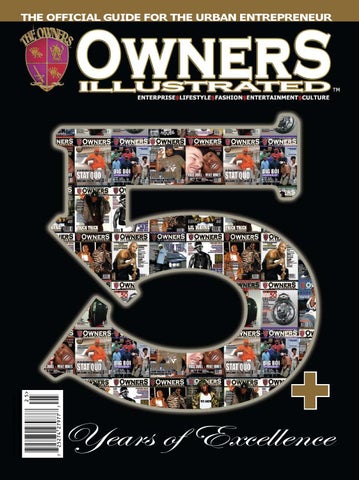
+ Years of Excellence
Table of Contents
6 I nside Jay-Z’s $2.5 Billion Deal: From Marcy To Madison Square and back (Originally Published in Issue II) 10 MD LT. Governor Michael Steele “Building Legacy Wealth (Originally Published in Issue III) 14 50 Cent 2050: The Future is Now (Originally Published in Issue IV) 20 Why Buy The Car When You Can Own The Dealership: Meet Steve ewing, Dealership Owner By Age 29 (Originally Published in Issue V) 24 Harbor Bank’s Joe Haskins, Jr. (Originally Published in Issue V) 28 Jim Jones: Harlem’s Native Son Goes From the Streets To the Corporate Suites (Originally Published in Issue V) 32 Lil Wayne: Taking Over The Reigns of Cash Money (Originally Published in Issue VI) 40 Roy Jones, Jr.: Fists Are Quicker Than Lightening But The Mind Is More Frightening (Originally Published in Issue VII) 43 Sylvia Rhone: More Than a Legend, The Standard For Excellence In The music Recording Industry (Originally Published in The Women Issue) 46 Busta Rhymes: Hustlenomics 101 The Paperwork Part II (Originally Published in Issue IX)
HUSTLENOMICS.COM myspace.com/hustlenomicsceo
LETTER FROM THE PUBLISHER
Editor-in-Chief/Publisher Damola Idowu Design Travis Alford Copy Editor Keyla McNeely for Keywords Communications Photography RichardFlood.com Wil David Banks Damola Staff Writers Damola Da Great Deity Dah Andrea “Misery” Wilson Keyla McNeely Marketing & Promotions Damola Quincy Taylor Mike Ernest Dawoud Shadeidu Brian Williams Reggie Mathews RW Collection Models Advertising Damola RichardFlood.com Quincy Taylor Jay Alexander Sales Damola Richard Flood Jalil (Southwest Rep.)
It all started with a belief that urban entrepreneurs will be to this generation what Bill Gates and Steve Jobs were to the last. I remember my numerous debates about this theory and eventually the passion became a living testament...Owners Illustrated. After several hip-hop lists, and landmark multi billion dollar deals like 50 Cent’s Vitamin Water and JayZ’s Nets related Brooklyn development. I think we have an argument. In honor of the fascinating and accomplished subjects we have interviewed over the past 5 years we have compiled this very special collectors edition, Owners 5. In these tough times its great to reflect and learn from people who have defied the odds and achived the unimaginable. May you find the same inspration I did from their stories. Owners till Infinity Yours Truly,
College Representative Kunle Idowu Intern Chris Barnes Newsstand Consultant John Blassingame Legal Counsel Reginald E. Greene, Esq.
THE HUSTLENOMICS ACADEMY “I sponsored the movement.”
Damola “Da Great Deity Dah” Idowu Publisher/Editor-in-Chief/Founder Owners Illustrated Magazine
www.myspace.com/ownersillustrated www.myspace.com/hustlenomicsceo
Owners Illustrated Magazine is published bi-monthly by Royal Alchemist Productions, LLC. © 2009 Royal Alchemist Productions, LLC P.O. Box 65484 Washington, D.C. 20035 Sub. rates: 1 year – $14.99, 2 years – $28.99 All Rights Reserved. Reproduction in whole or in part without written permission of the publisher is strictly prohibited.Visit us online: www.ownersillustrated.com Phone: 202.607.3629 Fax: 301.588.1011
Inside Jay-Z’s $2.5 Billion Deal
From Marcy to Madison Square and Back STORY: Deity Dah CONTRIBUTING WRITER: Reginald A. Greene, Esq.
“You know your ass is Willie when they got you in the Mag for like half a Billie”
A
s Jay-Z matures from jerseys to button up shirts, he also plans to buy the New Jersey Nets and put them in Brooklyn jerseys. Jay-Z is lauded as a Rap Icon, one of the best to ever bless a mic. Judging by his growing business portfolio and tremendous success as an entrepreneur, however, it is clear that Jay-Z’s success in the music industry is as much a reflection of his lyrical prowess as it is of his business savvy, know-how, credibility and determination – quite simply, his hustle. Without so much as a High School Diploma, but with a boat-load of hustle, Jay-Z has aligned himself with some of the most powerful people in New York City to become a partner in a $2.5 Billion dollar project centered around the purchase of the New Jersey Nets NBA franchise, but including residential, commercial, and retail development. In doing so, Jay-Z has partnered with Bruce Ratner, CEO of Forest City Ratner Companies, a New York based development firm that is part of Forest City Enterprises, Inc. based in Cleveland, Ohio. 6 • OwnerS Illustrated • 5 Years + of Excellence
Forest City Enterprises, Inc. has been in business for nearly 80 years and although publicly held, the company is reportedly controlled by the Ratner family that immigrated to the United States from Poland in 1920. So, how does a self-professed, former drug dealer from Brooklyn align himself with such a powerful family and become partners with one of the most successful sports and entertainment franchises that America has to offer? The intriguing story and details of the massive project and it’s implications will follow, but first, let’s examine the history of the parties involved. JAY-Z Shawn Carter a/k/a Jay-Z has “held you down for eight summers,” selling over 22 million albums since launching Roca-fella Records in 1995 with savvy partners Damon “Dame” Dash and Kareem “Biggs” Burke and he has “the hottest chick in the game (Beyonce’)” rocking his chain. Jay-Z, Dame and Biggs have created an empire that earns over $500 million annually according to Fortune Magazine. Jay-Z also has won all of the major awards including Billboard, MTV, American Music, BET, Billboard, Grammy’s, MTV and Soul Train. His 50/50 partnership deal with Reebok for the S. Carter shoe collection marks the first time a non-athlete has ever had a signature shoe line. That venture has been so successful according to a Bloomberg News report that it contributed significantly to Reebok’s 14% increase in profits in the third quarter of 2003 with net sales of $1.04 billion. Not only does he contribute to Reebok’s bottom line, he also outsells other shoe lines endorsed by athletes. Always ahead of the fashion curve, Jay-Z will soon release new S. Carter styles plus classic variations like the retro styled, red white and royal blue edition on July 4, 2004. The S. Carter shoes’ launch was so successful that it is the fastest selling sneaker in Reebok history. As a result of Jay-Z’s success, fellow rapper, 50 Cent, was able to get a deal for his G-Unit shoe line with Reebok that has also been wildly successful. Jay-Z’s other endorsements include Belvedere, Heineken, Mercedes-Benz and Nokia, which released a Jay- Z inspired line of “Black” phones that double as MP3 players and came pre-loaded with Jay-Z’s Black album. Jay-Z’s other business ventures include Roc-A-Fella Films, which released documentary style films such as, Streets is Watching, Backstage, State Property; and feature films such as Paid in Full and the soon to be released Paper Soldiers and Death of a Dynasty; Rocawear clothing, which carries mens, womens, girls, boys, big and tall, lounge wear, hats and belts with a reported $350 million in sales in 2003; Armadale Premium two grain, triple distilled Scottish vodka distributed by Roc-a-fella in the United States (See OIM Premier Issue); and 40/40 Club, which is an elite sports bar in New York City. Jay-Z also has ownership of the wildly successful “Roc The Mic Tour,” which earned $29 Million in 2003 with Jay-Z and 50 Cent as headliners with Busta Rhymes, Sean Paul, Snoop Dogg, Missy Elliot, and Fabolous co-starring. Lastly, Jay-Z’s autobiography entitled, the Black Book, will soon be released. On the philanthropic level, Jay-Z’s Shawn Carter Scholarship Fund pays for the college tuition of Marcy area high school students who meet certain criteria and the Jay-Z Santa Claus
Toy Drive supplies thousands of dollars in toys each year for the children of Marcy in Brooklyn. Adding to his many diverse holdings and successful ventures, Jay-Z is now president and CEO Def Jam, and retains sole control of Rocafella Records. Rapstress Foxy Brown was the first artist signed to Def Jam/Rocafella under Jay-Z’s watch. On the real estate front, nearly two years after his attempted purchase of an exclusive penthouse in Manhattan, which was thwarted by a stubborn co-op board due to cultural prejudice, Jay-Z is in the process of acquiring the Tribeca New York penthouse of acclaimed actor, Robert Dinero, for a reported $13 million. Jay-Z has come a long way from the crime infested Marcy Projects in Brooklyn, New York where he saw his first murder when he was 12 years old. Not even Hollywood could have predicted his level of success. THE RATNER FAMILY Bruce Ratner has been President and CEO of Forest City Ratner Companies since the company was formed in 1982. Under his 22 years of leadership, the company has become one of the foremost urban developers in the country with projects throughout the five Boroughs of New York City, New Jersey and Pennsylvania. Their projects focus on commercial retail and residential developments and include over 10 million square feet of space and more than 900 hotel rooms in two urban hotel complexes. In addition, they have 4.5 million square feet of residential, office, and retail space in development. Their flagship project is the Metro Tech Center (photo inset). It is a $1 billion, 7 million square foot office, academic and hightech development in Downtown Brooklyn, New York. This 14 building complex began in 1988 and the two final buildings include 9 Metro Tech Center South, which is a 675,000 squarefoot, 19 story office building that opened in the summer of 2003 with Empire Blue Cross/Blue Shield, the largest health insurers in New York State, as tenants. The other building is 330 Jay Street (also known as 12 Metro Tech Center), a 32 story building with 1.1 million square feet of space that houses the Kings County Supreme and Family Courts, along with commercial office space. Other notable projects in Brooklyn include the Atlantic Terminal office and retail complex, the Atlantic Center, and One Pier Point Plaza. Forest City Ratner Companies is also responsible for the Harlem Center at Malcolm X Blvd. and 125th Street in Harlem, New York and the Hilton Times Square, Entertainment and Retail Development in Manhattan. Bruce Ratner is the son of Harry Ratner and a graduate from Harvard, cum laude, in 1967 Columbia Law School in 1970. He has held many civil positions with the New York City Government. From 1978 to 1982 he served as Commissioner of Consumer Affairs during Mayor Ed Koch’s Administration. Prior to that, he taught at NYU Law School and was director of the Model Cities Program and head of the Consumer Protection Division during Mayor John Lindsay’s Administration. An Art lover, Bruce Ratner sits on the boards of the Museum of Jewish Heritage/A living Memorial to the Holocaust, Metropolitan Museum of Art, Brooklyn Academy of Music, City Parks Founda tion, International Rescue Committee, the Brooklyn Chamber of Commerce, and the New York City Partnership. 5 Years + of Excellence• OwnerS Illustrated • 7
The Metro Tech Center Complex (outlined in yellow).
Roof Garden view of the planned Brooklyn Arena. Bruce Ratner comes from a powerful and proud family who came to America from Poland as the Ratowczer’s in 1920. Upon arrival at Ellis Island, they soon moved to Cleveland and adopted the family name of Ratner. In 1921, Charles Ratner, who had come to America several years before the rest of his family, started Forest City Materials, which was a lumber company. By 1925, the Ratners had expanded their operation to include the building of garages for homeowners when the automotive industry began to boom. By 1929, Forest City Materials and the Ratner’s Buckeye Materials companies combined into one family owned venture in the lumber and building materials business. Siblings Leonard, Max and Fannye were co-founders with Charles. Today, Leonard’s son, Albert is the Chairman of Forest City Enterprises, Inc. Forest City Enterprises, Inc., is based in Cleveland Ohio and has almost $6 billion in assets. It has been traded on the New York Stock Exchange since 1960 (NYSE: FCEA/FCEB). The company owns, develops and manages a diverse portfolio of real estate in 22 states and the District of Columbia. The principal business segments of Forest City Enterprises include a 8 • OwnerS Illustrated • 5 Years + of Excellence
commercial, a residential, land development and lumber trading. The commercial business segment, which is the largest, has more than 77 completed retail, offices, hotels and mixed-use properties as well as 12 regional malls with gross leasable areas of 4 million square feet, 29 specialty retail centers with 5.7 million square feet, 28 office buildings with 7.8 million square feet and 8 hotels with 2941 rooms. One of their notable projects is the re-development of Tower City, a retail and office complex in Cleveland, Ohio. The residential business segment owns and/ or manages 125 apartment communities with 36,904 units. The land development business unit works with major corporations and individual landowners in developing master planned communities and acquiring land for residential, commercial, and industrial use. The company owns 6,600 acres of developable land and 32 projects. Lastly, the lumber trading segment sells approximately 8-billion board feet of lumber annually. THE DEAL On January 23, 2004, a distinguished group that included, Bruce Ratner, New York Governor George Pataki, New York Mayor Michael Bloomberg, Senator Charles Schumer, Brooklyn Borough President Marty Markowitz, Assemblyman Rodger Green (who’s district falls within the planned construction site), NBA Legend Bernard King, and Jay-Z were present at the Brooklyn Academy of Music to announce the purchase of the Nets. This announcement was significant, in that, it also included a plan to create a $2.5 billion development project called The Brooklyn Atlantic Yards. The bid to purchase the Nets was approved for $300 million. With this announcement, Jay-Z became the first hip-hop entrepreneur to participate in the purchase of a professional sports franchise. As Jay-Z joins this exclusive partnership, his urban background and proven “hustle” certainly will be an asset to the venture. The Nets deal is part of the massive $2.5 billion mixed-use development in Downtown Brooklyn, New York that will include residential, commercial, a sports and entertainment arena, and open areas. The project is expected to take 10 years to complete. When completed the project will include 2.1 million square feet of commercial office space, 300,000 square feet of retail space, 4.4 million square feet of residential space consisting of 4500 units of affordable, middle income, and market rate housing. In addition, this six block development will contain 6 acres of parks and open space. JPMorgan Chase served as advisor in the acquisition of the Nets and will likely be involved in the financing of the Brooklyn Atlantic Yard Project. The NBA is one of the world’s most popular sports associations. The 29 franchises had revenues in excess of $2.3 billion during the 2001-02 season. The NBA sells its entertainment product internationally by broadcasting its game to 205 countries and over 750 million households.
Houston Rocket, Yao Ming, is a native of China, which has over one billion people with 250 million TV households. He is expected to further expand the NBA reach as the 2008 Olympics approach in Bejing, China. Jay-Z’s direct involvement in this deal is a major coup because, typically, the artists who make the music are often not the primary beneficiaries of the financial windfalls. Case in point. Bob Johnson created the BET network to showcase the music videos created, financed and produced by entrepreneurs like Jay-Z. Mr. Johnson was able to leverage the popularity of music videos into a deal with media giant, Viacom, that made Bob Johnson a billionaire. Bob Johnson recently purchased an NBA expansion franchise, the Charlotte Bobcats, for a record $300 Million. Jay-Z has obviously been taking good notes and is similarly poised to join the ranks of the NBA owners. The Nets were established in 1976 as an ABA team, but later joined the NBA. The team has made impressive showings in the past two NBA Championship Series and have long term broadcast agreements with the YES Network, which is owned by George Steinbrenner, the owner of the N.Y. Yankees Baseball Team. Rod Thorn, a well-respected league executive who was responsible for drafting Michael Jordan to the Chicago Bulls in 1984, is the Team President and General Manager of the Nets. The Nets are led on the basketball court by the ever exciting Jason Kidd, a perennial All Star, and one of the best players in the NBA. They also have a group of young and promising players such as Kenyon Martin who has his own Reebok sneaker deal, and Richard Jefferson. The site for the new Brooklyn Arena will be adjacent to the Atlantic Terminal, which is the third largest transportation hub in New York City. The Atlantic Terminal provides service to 9 subway lines, and the Long Island Rail Road, and will provide convenient transportation to the Arena for patrons of games and entertainment events. This location is also historic. It is the site where Walter O’ Malley, the legendary owner of baseball’s Brooklyn Dodgers, had planned for the team’s home in 1957. When O’Malley’s bid to build the stadium proved unsuccessful, he moved the Dodgers to Los Angeles. The project, which will be completed in two phases, is expected to create 15,000 construction jobs and 10,000 permanent jobs. The first phase will include the development of the $483 million Arena, which will cover 800,000 square feet and seat 19,000 for basketball games and 20,000 for entertainment and concert events. Construction is slated to begin at the end of 2004 and is scheduled for completion by the summer of 2006. In addition to the Arena, there also will be 300,000 square feet of commercial space, with the possibility of one residential building. The Arena is expected to create 400 permanent jobs for the Brooklyn community. The second phase will include the development of the massive mixed-use facility over a ten year period. Internationally acclaimed, Frank Gehry, and his firm, Gehry Partners, have been tapped to be the architects for the project. Gehry’s accolades include 100 national and regional awards from the American Institute of Architects. Gehry Partners will
View from a luxury suite in the planned Brooklyn Arena. team up with Laurie Olin and Olin Partnership for the landscaping on the project. Laurie Olin is currently a professor of Landscape Architecture and Regional Planning at the University of Pennsylvania. He served as Chair of the Landscape Architecture Department at the Graduate School of Design at Harvard University from 1982-1986. Olin Partnership was founded by Laurie Olin and three other principals, Lucinda Sanders, Dennis McGlade and Susan Weiler in 1995. This development is going to be a tremendous economic opportunity for the Brooklyn community and for Jay-Z. He is now a globally recognized Icon in music, fashion and business. He is living proof that one can truly go from “Rags to Riches” with the right combination of attributes – the right hustle. Not only has Jay-Z proven he can sell out Madison Square Garden in a day, but he also has proven that he can buy an arena that is likely to sell out for years to come. While some will continue to argue “who’s the best Biggie, Jay-Z or Nas?” Jay-Z ended the debate on the cut “What More Can I Say” from his Black Album: “Look what I embody. The soul of a hustler, I really ran the street, got a CEO’s mind that marketing plan was me . . . add that to the fact I went plat a bunch of times, times that by my influence on Pop Culture, I’m supposed to be number one on everybody’s list.” True Indeed. Brooklyn, Stand Up! ∞ Jay-Z: The Early Days – Reflections from The Editor-in-Chief
Although I had some inclination that Jay-Z would be successful during a chance meeting at BET, which was then headquartered in Washington, D.C., before Bob Johnson became a billionaire by selling the company to Viacom in 1996, I could not have foreseen the level of success he has achieved in relatively short time frame. When I first met Jay-Z he had not yet released Reasonable Doubt. He was mild mannered but focused, wearing a customized Rocafella jacket and still beaming for the success of the “Ain’t no Ni**a” and “Dead Presidents” singles. Jay-Z was preparing for the release of Reasonable Doubt which according to him “turned the people out.” He was on a promotional tour with then distributor, Priority Records. Rocafella had a single deal for the song “In My Lifetime” on a label called “Payday.” When that project failed to make an impact and the majors were still showing no love, Jay-Z partnered with dance music distributor, Freeze Records, and released the “Ain’t no Ni**a” single featuring Foxy Brown and my personal favorite “Dead Presidents.” Their marketing slogan was You Can’t Change a Player’s Game in the Ninth Inning. I met Jay-Z again later that year at a Vibe party honoring Russell Simmons where Jay-Z, now certified Gold, performed on stage with a bottle of Cristal. After the performance, Jay-Z appeared to enjoying festivities with partners, Dame Dash and Kareem “Biggs” Burke, with the Wu Tang Clan also in VIP. Little did I know that they were probably negotiating the Roc-a-Fella deal with Russell Simmons to join Roc-a-Fella Records with Def Jam for what would become the greatest bargain in the industry at less than $2 million. The rest is history. 5 Years + of Excellence• OwnerS Illustrated • 9
Maryland Lt. Governor Michael Steele “Building Legacy Wealth”
F
or an urban entrepreneur, the state of Maryland offers a number of excellent opportunities to establish businesses and build “legacy” wealth. That is, wealth for generations to come. To get the inside scoop, Owners Illustrated met with the Lieutenant Governor of Maryland, Michael Steele, at the State House in Annapolis, Maryland and confirmed that knowledge is indeed power. “Legacy wealth is about creating the free wheeling entrepreneurial spirit,” explained Lt. Gov. Steele. “The focus should be legacy wealth - - creating a legacy of wealth for this and future generations . . . Jay-Z represents Legacy wealth. He is going to create jobs with his ventures. Russell [Simmons] is the quintessential entrepreneur. He took what we knew about in our community to build an empire.” As a minority leader, Lt. Gov. Steele knows what motivates the urban community and he is determined to expose urban entrepreneurs to all the benefits of doing business in Maryland. “I want us to focus more on investments than bling bling,” he says. “I feel obligated as an elected official to make certain resources we have available to entrepreneurs. We create pathways to capital and resources that will get minority entrepreneurs off the ground.” 10 • OwnerS Illustrated • 5 Years + of Excellence
To that end, Maryland does over $5 billion in contracts annually and, by law, at least $500 million must go to minority and small businesses. In retail, the state of Maryland ranks fifth nationally, with combined sales of $105 billion. Maryland’s residents are very affluent, boasting the fourth highest per capita personal income in the United States at $37,331. This is 18% more than the national average. Maryland also has the fifth highest buying income at $182 billion per year. Montgomery County, Maryland, which is just to the North of Washington, D.C., is one of the most affluent counties in the nation, with a per capita personal income of $51,750. On the opposite end, Maryland has one of the lowest poverty rates in the nation - - 8.2 percent of Marylanders live below the poverty line as compared with 12.7 percent nationally. Maryland is the 42nd largest by size, but with its 5.5 million residents, it ranks 19th by population. More importantly, that number is projected to increase 10 percent by 2010. Maryland has an abundance of prime workforce-age residents, with nearly one-third of the state’s population between the ages of 25 and 44, a higher percentage than the national average. Approximately 90 percent of Maryland’s 5.5 million residents live in the densely populated corridor between Baltimore and Washington D.C. Jurisdictions with
the greatest population densities include Baltimore City and Baltimore, Anne Arundel, Montgomery and Prince George’s Counties, which border Washington D.C. Maryland also has many of tax advantages for an urban business seeking to locate there. Case in point, suppose Rocawear wanted to locate in Maryland. Below are some of the advantages. The state has: • No gross receipts tax on manufacturers • No corporate franchise tax • No unitary tax on profits • No income tax on foreign dividends (if the corporation owns 50 percent or more of the subsidiary) • No separate school taxes By locating their next facility in Maryland, companies can take advantage of over $5 million in tax credits under the One Maryland Tax Credit Program. In addition, businesses that invest in an economic development project in a “qualified distressed county” may qualify for project tax credits of up to $5 million and start-up tax credits of up to $500,000 • Companies locating in a “One Maryland” jurisdiction may qualify for up to $5.5 million in income tax credits. • Companies locating in the targeted areas receive favored consideration for other project support such as low cost financing and new employee training grants. • Other advantages may include Job Creation Tax Credits, and Enterprise Zone property and income tax credits. Project Tax Credit Project tax credits of up to $5 million are based on qualifying costs and expenses incurred by the business entity in connection with the acquisition, construction, rehabilitation, installation, and equipping of an eligible economic development project. Eligible costs may include, among others, land acquisition, performance and contract bonds, insurance, architectural and engineering services, environmental mitigation, and utility installation. Eligible project costs must be at least $500,000. Project costs in excess of $5 million are not eligible for the project tax credit. Start-up Tax Credit The start-up tax credit is for the expense of moving a business from outside Maryland and for the costs of furnishing and equipping a new location for ordinary business functions. Examples of eligible start-up costs include the cost of fixed telecommunications equipment, office equipment, or office furnishings. The start-up credit earned may not exceed the lesser of $500,000 of eligible start-up costs or $10,000 times the number of new, qualified positions created. Film production is a growing industry in Maryland. In 2003, Maryland hosted 286 days of filming for major film and television productions. In addition, there were 79 other productions including short films, commercials, documentaries, industrials, and music videos. This production activity generated approximately $65 million in direct expenditures,
resulting in an economic impact of $141 million. For the avid cinematographer or videographer, Maryland offers a rich array of landscapes and natural scenery. Whether it’s the mountains in the west, the rolling hills and farmlands in the center, the beautiful waterfront and sandy beaches of the Eastern Shore, or the gritty and grimy urban streets, Maryland has something for everyone. Architecture that spans the centuries from colonial to modern and illustrates a wide range of socio-economic backgrounds can be found throughout the state. In fact HBO’s The Wire, is based on Baltimore Maryland and filmed there. Qualified feature, television, cable, commercial, documentary, music video and other productions may take advantage of an available exemption from the 5% state sales tax. The exemption is for sales, rentals and services there is an office dedicated to attracting such projects. The Maryland Film Office is a marketing arm of the Maryland Department of Business & Economic Development. It works to attract feature film, television, video and commercial production to shoot on location in the State of Maryland. The Maryland Film Office offers the following services for major productions: • Location scouting • Photo library • Pre-production research • Government and community liaison • Full service throughout production The Maryland Film Office is located at 217 East Redwood Street, 9th floor Baltimore, MD 21202 (410) 767-6340 As you have seen, there are many lucrative and exciting opportunities in the state of Maryland. In fact, we could easily do an entire issue on the opportunities in fields like Bio Technology with the NIH (National Institute of Health), located in Bethesda, Maryland and Medicine with the prestigious John Hopkins Medical Center where noted Dr. Ben Carson performed the world renowned separation of the Siamese twins joined at the head. In the technology sector, Maryland is second only to Silicon Valley, California and has programs that invest in ideas and entrepreneurs. In short, there are many ways to get money by creating or expanding business opportunities in Maryland. For more information, visit www.maryland.com or www.mdminoritybusiness.com and browse the many links.
“I want us to focus more on investments than bling bling...I feel obligated as an elected official to make certain resources we have available to entrepreneurs.” — Lt. Governor Michael Steele 5 Years + of Excellence• OwnerS Illustrated • 11
Interview with Michael Steele
Damola: Minority Business Enterprise Reform. How did that work? From what I hear it’s 10% of state contracts and they have to list their MBE’s. Lt Gov. Steele: What we did is a bottom up evaluation of our minority business system. We looked at what was current in state law; what was currently required; what was working and what was not working; what was efficient and what was not efficient. And the commission that I chaired on MBE did that bottom review. The consensus of that we were able to gather from actually business owners, actual entrepreneurs; men and women who risk capital, who risk their livelihoods in some cases, to start their own business to on the table what their experience, was. As a result of that there were 50 recommendation that our commission sent to the governor. Damola: Those business, what sector were they in? Lt. Gov Steele: All of them, everything. Everything. If it was a business it was covered. We had the service industry; we had construction, from Big Daddy’s Barber Shop to Harbor Bank. So, we had a cross section of minority business that were represented at the table, who had an opportunity to speak and present and teach us what was really going on. Damola: How long did this go on? Lt. Gov. Steele: This was a 6 week commission that was conducted between July and Sept 2003. We submitted legislation we produced. There were 2 bills I introduced on behalf of the administration. One bill would require that a prime contactor would have to identify at the time of bid who is minority sub-contractor was going to be. The reason for that was to avoid, basically a 12 • OwnerS Illustrated • 5 Years + of Excellence
sub-contractor being used to get a bid but not be a part of the deal. So for example if I wanted to bid, ok I get your company as a prime. So when the state called you to get relevant information or to find out what was going on, you would say. “What? I didn’t see it on this contract, I just used your name…” Damola: Oh, I see what you’re saying. So to prevent companies from using the minority business name to gain an advantage you wanted to make sure… Lt. Gov. Steele: That was actually part of the deal. Damola: Full disclosure. Lt Gov. Steele: Full disclosure that’s exactly right. We want full disclosure for the requirement…we put in place this requirement that at the time you place your bid not only do you tell us who your sub-prime is, your minority, your MBE firm is, you should also tell us…show us the paper work that speaks to the relationship so there is a contract between you and me; a memorandum of understanding, a formal agreement as part of the deal. So, that the state knows you have vested interest in this contract as well. That was the first the thing. The second piece which is actually more significant was, the state will now require 10% of all its procurement statewide will be placed into a reserve account for small business and these small businesses can compete head to head against each other for a piece of that pie. So, break it down, each department has to go through what it’s annual procurements are. So, lets say the Department of General Services has an annual procurement of $100 million. So they procure a $100 million worth of services a year. Under the state law…under the legislation we have had the Depart-
ment of General Services will now have to carve out 10% of that or $10 million and put it into a reserve account and they can do it any number of ways. Damola: Let’s say for a young entrepreneur how can you package yourself to now win… Lt. Gov. Steele: What we have also put in place and putting in place right now. We kind of looked at MBE from a holistic point of view. I got kind of tired running into brothers who were… have the technical capacity, they don’t have the organizational capacity to out together their firm so that they can market their firm, so that they can make it. When a fella tells me I’m doing $100,000 – lets make it realistic $300,000, $400,000 of business a year; and you ask them where’s their business plan and they go “I don’t know”. Or you ask them how much you’re paying yourself and they say “I pay myself about half that”, then you know they have a problem. They don’t understand the fundamentals of running a business. So what we’re trying to is to put in place technical assistance, there’s educational opportunities for these small business owners to learn how to be small business. We’re putting in place all the resources that are available to state government to help a small business become successful. Now it doesn’t guarantee success, it doesn’t …not every business that’s created is going to be a Fortune 500 company. But, out goal is if your business fails it wouldn’t be because you didn’t know how. It won’t be because you didn’t have access to resources. That is market determined. In other words if you business is successful or it fails and you have done everything that you should as a business owner of as an entrepreneur it is because the market determined that and that’s what markets do. The other side of that is the protégé program we want to put in place. Damola: So, how much of a budget is there and in what form is it resource centered? Lt Gov. Steele: It’s actually being developed now, right now. What we are trying to do is centralize the process, so everything is oriented out of the Governor’s Office for Minority Affairs. And what they do is they have access to the network of people who provide technical assistance, economic financing, capital assistance, and all other components. Damola: Yeah talk about that. Lt. Gov. Steele: The protégé program is another to help a budding entrepreneur a small business owner to get a foothold in the business world. Going back to my IT example, on that contract… on that $40 million contact with $4 million carved out you find yourself in that situation, instead of you and I being competitors, you work with me. I’m the new kid on the block; you’re the more established business. We try to partner…or the state would say “Why don’t you two partner up and start your own company because there is a synergy there between your two companies. You will benefit directly from it and I will benefit directly from it because even though we’re competitors I will learn from expertise, which would make me a better competitor later on. That’s good for you later on because if you have good competition in the market place it’ll push you to go a little further to think a little bit more outside the box. Like “How can we be more creative with this? How do we deal with now with the heat I’m getting from the young dogs behind me?” And you get to see up close and personal whether or not your mode of thinking is outdated. Damola: Exactly. Lt Gov. Steele: It might have been the same 5 years ago, but now you got a brother taking that widget and spinning it in a new
way. He is marketing differently and he’s carving his own nice and that’s good and you got some flaws along the way that you would identify that he would need some help. He needs help on the financing side. He needs help on how to position himself to take some advantage from his marketing capability. So, that protégé is a way we can create competition but also create opportunities for businesses to learn from each other because I have always believed in a competitive environment there is nothing I can shut u enough to learn from what you’re doing. Damola: Where can people get the information about that? Lt. Gov. Steele: The key website for that is www.mdminoritybusiness.com Damola: So now we are talking about Maryland’s focus, where are we investing ourselves? Lt. Gov Steele: Yeah exactly. The question is where are we focusing our efforts in terms of investing in ourselves as community because like I said we can afford more than one Oprah Winfrey or Ben Johnson. We are not limited. The only limitation we have is we have is what we place on ourselves. So, if we are going to be about legacy of wealth creation then we’ve got to be serious about investing in the legacy. Now that requires us to look at entrepreneurial spirit in a way where we see it as an assest, so that we get beyond what is traditionally expected of African Americans in business. In other waords not just rap CD’s and Nike products; we don’t need to rely just on someone else to sign us up for a contract to create another millionaire. I’m saying in our historically black colleges and universities there are saying young men and women who will be the next Charles Drew, who will be the next Bill Gates. And, those are the one we need to focus on; those are the ones we need to invest in as well because they are the ones that are going to create the real legacy of wealth. You know how many black kids know that every time you come to a spotlight it is a black man that invented that and because of the time that black man invented that he couldn’t capitalize on his invention. Can you imagine if the state of the feds or whatever had to write a check they put up a stoplight in this country. That’s legacy wealth. That’s what I’m talking about. That’s what we need to capture. And we don’t do that. We’re one shot, it’s all about me. What I’m saying is take back that one shot and spread a little bit of the love and investing back in that community. That’s what Jay-Z is doing. Jay-Z is a very smart entrepreneur. He’s taking the wealth of his talent, the wealth that is generated by his talent and he’s creating a legacy of wealth. That’s what he is all about. He is going to have it, if he stays on point, if he stays true to the deals he want to do. If he stays true to the commitment he made to the community he going to have a legacy of wealth to show for future generations.
“Legacy wealth is about creating the free wheeling entrepreneurial spirit. Creating a legacy of wealth for this and future generations. In the civil rights movement the objective was reaching the lunch counter the post civil rights struggle is not about access it’s about ownership. If you can buy the lunch counter you can eat for the long term.” — Lt. Governor Michael Steele 5 Years + of Excellence• OwnerS Illustrated • 13
14 • OwnerS Illustrated • 5 Years + of Excellence
50 CENT
5
2050
0 cent is a phenomenon unlike any we have ever seen in urban culture save for another Jackson, Michael. In just two years he has made himself into an over a half a billion economy that includes; Music where the 25 million records he and his G-Unit Record Company has sold in the past 2 years including over 3 million copies of his latest The Massacre has generated over $300 million at the counter. He has sold over a million copies of his G-Unit Sneakers and recently added a boot line which is a first for Reebok which traditionally hasn’t had one in its offering. The B1 boot retails for as high as $110 and his G6’s retail for $80.50 when added with sales from his hats headbands and athletic accessories under the pack you have over $100 million in revenue created in the deal. In Fashion he has a men’s, women’s, and children’s line all under the Marc Ecko umbrella and according to G-Unit clothing rep their combined earnings toped $100 million. We have yet to count his foray into the adult entertainment world with the Groupie love DVD and his highly lucrative touring schedule that existed since he and DJ Whoo Kid along with partner Sha Money XL put out G-Unit mixtapes to build his buzz. The Rock the Mic Tour he did with Jay-Z in 2003 generated over $29 Million and the entire G-Unit crew has been touring worldwide ever since. The are plans for a tour with Eminem and if their two sold-out shows in Detroit at Ford Field were any indication then this tour is due to become the most successful ever. Yet we have not even touched on his publishing which generated him massive benefits from deals with ring tones companies and fees from use of his music. This year 2050, 50 Cent will add a watch line, an interest in Vitamin water, a movie, a videogame, and maybe even a communications company to his existing empire. We at Owners Illustrated Magazine follow the stories and the business models that create the trends and movements in the urban marketplace which in turn impacts the global economy driven by the X, Y, and digital generation, 50 Cent is far ahead of his peers that his ten day performance on the billboard charts with The Massacre was greater that the last releases of all artist( Fat Joe, Nas, Jadakiss, Shyne) mentioned on “Piggy Bank” combined. In his own words he speaks on his next move. From December 2002 to right now, what has changed? For me, a lot. I’ve been so busy behind the scenes that I don’t even think they even realize what I got to do. I mean, I got to make sure everything is right with Banks and Buck first with their solo projects, “Beg for Mercy,” away from actually doing “Get Rich or Die Trying”, the success of “Get Rich or Die Trying” allowed me the opportunity to actually do business. When you have a record that sells 11 million
WORDS: Damola PHOTOGRAPHY: Banks
records people begin to realize how lucrative it is to do business. You know, companies like RBK. How did that come about? Getting the RBK deal? Well actually, Jay did the deal first. Jay-Z did the shoe deal first and, at the time, they had started asking if I would be interested following that. Considering Jay has done great with his career. In no way can anyone ever take anything away from him. He was definitely the “leader of the pack” at that particular time. Exactly. And now it’s like I use other people. I use other artists and people who do business ahead of me as a reference. So, I watch their success and where they have success, then I’ll do similar things. And I don’t have a problem doing things behind them as long as I have more success than what they did. I believe I should have more success because I have the United States and I’m universal.What I’m doing right now, wasn’t acceptable ten years ago. Like, an artist…he couldn’t endorse products or do anything like that. So you got to be within your own. Within my own head, I decide that, “Who cares what they say ain’t right?” I’m going to tell them what’s right and what’s wrong and my intentions are to do business. So, I look forward to turning G-Unit into a brand that, worldwide, is known. It’s worldwide right now. I mean, it’s crazy. I was at the auto show in Detroit last year and I was at the Ferrari booth and when Andrea Soriani saw the cover [of Owner’s Illustrated], he was like, “50!” Yeah, I had got some cars from them. Yeah, and it was like they know it, no matter who you are, you just came in on the scene and just put your mark and it’s the G-Unit stamp. Yeah and I think that also it’s there because of me not sugarcoating anything—telling them exactly how it is. I’ll tell them openly that I never filled out a job application in my life. I came straight from hustling to the music business. I found what I felt works for me. And as far as the talent, I don’t think I could tell anybody that I do it well. It’s just I held that as an option. But I looked at that as…you know what? When I decided to write music for a living, I quit [hustling] cold turkey. Like I was f*@ked up for a minute and they don’t notice. RG [creative director of G-Unit clothing] said you freaked out
THE FUTURE IS NOW 5 Years + of Excellence• OwnerS Illustrated • 15
when he handed you that briefcase [seen in the first ad of G-Unit clothing with t-shirts wrapped like drugs]. RG is great. When you can get people who can actually tie everything that you do into you, to my personality, my character…like if you see me, every time that you see me, you’re going to see something that says “GUnit.” We wear this kind of stuff (boots) and that’s why I added that to my collection. RBK hasn’t been able to have success out of, on a boot, because everybody is athleticallyinspired. G-Unit is a lifestyle brand. So we can do things outside of athletic apparel and that’s why I went to the boots and do different things. That motorcycle line is real crazy! Yeah, we changed it up. We try to style everything into something that will grab your attention and ideas. I mean everybody is different. Like what you do for enjoyment is a little different and we try to add all that into the campaign and marketing. But you were talking about how you was really f*@ked up when you quit hustling cold turkey to get in the game. How was that transition for you? Was that when you got down with Jam Master Jay? I was pretty good. People thought you were pretty wealthless or something. A lot of people need to know that regardless, before you made it in this or not, you were going to make that dough. As long as I provide for myself all of the foul s*@t they heard about me, it’s true. I’m going to tell you I’m f*@ked up when I’m f*@ked up. If I ain’t got nothing, if I ain’t eatin’ . . . I’m going to do what I got to do. And at the end of the day, I’m not even trying to shake it, ‘cause I know it ain’t going nowhere. I mean, for me, I was doing good in the streets but I looked at this like ultimately, this is where I need to be headed. The rap game is bigger, right? Yeah and now it’s exactly what I needed it to be for me. As far as my options, different options opened up for me. I can do business on levels that…
Buck and the thing that I thought was phenomenal about what these cats were saying about you was “50 already planned this way before he even met Em.” And my whole thing to you is, I know when you in the mirror you got to be like, “Damn, it all happened how I planned.” I think everybody should have a five-year plan; make short-term goals and long-term goals – short term goals to get to the longterm goals. I had created a plan for all the situations and I kind of thought out different scenarios so I would be prepared for these situations when they came. The success of “Get Rich or Die Tryin” allowed me the opportunity to do things that I planned in five years in six months. I was able to do the deal and set up the companies and move forward at a faster pace. Everybody else’s crew waited while the solo artist did two albums.You know what it feels like to me? It feels like I’m running uphill. They say that I’m hot but I still don’t feel like I’ve peaked. I heard JayZ write things that made me feel like he was actually there. But he said, “What more can I say?” That supports his decision to retire. Because when you feel like creatively there is nothing else for you to do, like you gave them the best, you should graciously bow out; and bow out on top. It makes perfect sense for him to do what he’s doing right now. And him with the Def Jam situation, I think that’s great. Yeah, that was a smart move. And from that move he went right back into being in control of Roc-A-Fella too. That was slick. Yeah, but I don’t think everybody else involved in Roc-A-Fella was happy with that deal. Most people get in this game to eat. And that’s what the average person wants to know about. Yeah, I mean, I’m in the music business. It’s a business. Really, think about it like that. Some people are in the music business, some people are in the business of selling music.
That just emphasizes the 50 million in a year where you don’t even release an album and just one album solo. So what was the vision from December 2002 when you signed the contract with Em, going out into the studio, tightening up those last rhymes, etc.? Well, I had already had full intentions of creating G-Unit Records.
Why don’t you explain that? The difference is there are some people that are creatively so overwhelmed with what’s going on that they just get stuck…they might as well have smocks and be painters. While you got the other class of people, that are actually doing business. They are looking at what works and what doesn’t work, how you maneuver in certain situations, and what happens next. You kind of think out those different scenarios that could possibly become and be prepared for them. And they ought to see me go at a pace faster than anything they’ve seen so far.
That’s what I’m saying. We had an interview with Lloyd and we’d interviewed
How did you turn the J. Lo situation [50 Cent’s verse was removed from the “Be
16 • OwnerS Illustrated • 5 Years + of Excellence
Alright” remix] around to help you build momtentum to push you forward? How did you set up your team and say “Here’s how we’re going to go about this…they’re really not trying to let me eat right now”? How did you really crowbar it in? You know what it is, I’ll tell you right now. Gangsters are always going to side with the weakest side. And I’m going to tell you why: I don’t walk with a crutch, I don’t need n*@#as for support. I’ve always been that way, even as a youngin’. I’m the n*#@a that they might utilize for something that they needed to get dealt with. So, they’ll look at that and go, “Let’s go with shorty ‘cause this lil’ n*@#a will try to piss out his a*@ if we ask him to.” You’re not sure if he’s a man or a woman. [On the other hand] This n*@#a is hard-headed. He going to do want he wants to do anyway. But my intentions are, they don’t realize, I got what I got and what’s better than me, the morals and shit, from being around the same type of n*@#as that’s making the decisions to ride with their own thing. So I look at them like, we ain’t no different. Me, I’m not different from you, you’re just a lil’ older. Them n*@#as ain’t never liked me. Before I got into music, the didn’t like me ‘cause I’m 18 years old riding around 400 on 18s. What I want to ask you is, we all know that there is another cat named 50 Cent. Out of your history, knowledge, and experiences, what made you decide to take on that title right there? The other 50 is similar to myself. He provided for himself by any means. I didn’t want to name myself after somebody who wouldn’t say what’s up to me or shake my hand if I ever interacted with them in life. And I took on the name because it already had notoriety in New York City. But outside the country, and around the world, they know 50 Cent as me. In my head, I was making that live on. So if it was up to me, my whole crew, they built everything they had off of me. It’s in two parts, people don’t notice this: 50 Cent, Lloyd Banks, Tony Yayo, Young Buck. Each name is broken up in ways that make it the same, but different.Meanwhile, everybody else will come and they are just set. Their format is different. We followed and suit the same way. Is that why Game is The Game? Yeah, and outside of that, we have a relationship that’s tight. Like I don’t have any brothers, I’m the only child. But I have four brothers. I have Lloyd. I got Young Buck. I got Tony Yayo. I got The Game. Young Buck said, that out of everything that everybody else said, you’re the only one that backed up everything you proclaimed you would do. For Buck and them, so many n*@#as say things they don’t mean in this business. All I
have is my word. A lot of times, as the head of the success, why would I say I’m going to come back for you and I don’t have shit when I’m talking to you at that point? If I don’t feel like I actually want to mess with him or do business with him, I wouldn’t say that to a n*@#a. I don’t say yes when I mean no. That’s what many people in the business do. People let the business change them to do that. Let me tell you why I utilize Chris Lighty. I utilize Chris Lighty in negotiations because they are not accustomed to doing business with the actual artist. I ultimately make the business decisions, at the end of the day, with Chris Lighty also. He just brokers the interests I generate. So while he sits and has the meetings, he’ll come back to me and I’ll tell him exactly which direction we are going in. I don’t have the meeting though because the system is set up for him to deal with someone else outside the artist. Regardless of if the artist is capable of doing business himself. Because I come to you and say, “I need 6 million dollars,” you tell me you got 2. I say, “I don’t think you understand what I said. I said I need 6 million dollars.” They go back and forth, like “We got 2.5.” Then a few months later, “We got 4.” Then finally, “Ok, we got 6.” Now ultimately, you still reach your goal. But when you do the bulls*@t that they consider doing business, going back and forth, it takes time and it alters the artist’s perception of who he’s doing business with. While I’m asking you for 6, and you’re saying 2.5, you’re making me feel like, you don’t even think I’m worth 6. So it’s like f*@k it, and f*@k you. And they don’t want that to happen. So, they don’t actually ever want to do negotiations with the artist. They want to do business with business people. They understand that when you’re going back and forth it doesn’t mean that we don’t think you’re worth it, we’re just doing business. While they’re doing that, they don’t want to affect the creativity of the artist at the same time. When you’re not making the record that you would’ve made today because these n*@#as just pissed you off, you’re saying something else. Your mind frame is different after having a conversation with someone. A lot of people don’t understand how, for example, there are a lot of crews in New York: Ruff Ryders, D-Block, Terror Squad, DipSet, Murder Inc., Roc-A-Fella. But there is something different about 50 Cent and G-Unit, I read in an article that quoted you saying: “Aight, we going to do 40 million my first year.” You did that. You’re going to do 100 million this past year, and you ended up doing more than 100 million. I’m hustling. The difference is I own G-Unit. See, while everybody else is cool as it is, they got partners. Jay-Z had a partner, and he just
“
They say that I’m hot but I still don’t feel like I’ve peaked.
”
made the move that he made to not have partners anymore. It’s time for him to do business by himself. How long you going to have partners doing everything that you do? And then you got the other companies, where you got ni@#as that know it all, they can’t learn anymore, ‘cause they know it all. So they got that mentality that they just got it. So they just sit there. Once they start to f*@k up a little bit, they continue to f*@k up and not know
how to fix it because they are too arrogant to figure how to fix it and put us back in a good position. So they stay f*@#ed up. If you watch artists that come out of places like Atlanta, them ni@#as all f*@k with each other. I just came from Texas and it’s the same thing. These young 23, 24 year olds are eating better than platinum artists on MTV ‘cause they work together.
5 Years + of Excellence • OwnerS Illustrated • 17
“
They hustle, they f*@k with each other. And you could have a conversation with one of them, and end up blending in with some of them ni@#as down there and making some money. Out here, it’s different. Everybody feels so competitive. Like, “Nah, you don’t f*@k with them ni*@as.” . . . I can’t f*@k with these ni*@as because these ni*@as are like this. These cats over here are crazy. Everybody has issues. Ultimately, when you get hot in New York, you’re hot in New York.
It’s too many chiefs, too few indians.
”
Not the whole New York. Atlanta feels like it’s hot because it’s always something else. Lil’ John and Ludacris will be on Usher’s record to catapult his a*@ up out of here. In New York, personalities clash; it’s too many chiets, too few indians. Let’s focus on your perspective. What do you think gives you an advantage over other New York rappers?
18 • OwnerS Illustrated • 5 Years + of Excellence
I’m open. I’m still learning. I’m still watching and absorbing new information. They believe they know it already. They believe they got it already, like they run s*@t. So while they’re thinking like that, I’m thinking “let me see what else is out there.” How much time out of your year do you spend in New York and how much time do you spend outside New York? I spend the least time in New York City because this is not my biggest market. It’s one of my smaller markets. They are one of the slower markets for me. Not saying that New York City doesn’t support me, because they do, but they come late. They come when the rest of the country is already f*@king with me. New York is the home of music. If you were trying to make it in the music business, you were supposed to be making your way towards New York City because all the major companies have office space, employees, and representation of every one of them labels, here. If you trying to be on television, as an actor, you should be making your way to Los Angeles ‘cause that’s the place to be in Hollywood. So, for me being from New York City, and not receiving my dues from a New York City-based situation, it already shows you that they would look at me and be more like “nah” and it’s not ‘cause of the music. They shy away from me, not because of the music, but because everything else around me is real. My music works because it’s real. When I go outside of the country, I’m in countries where there is next to zero gun-violence. Zero gun-violence. I’m like, “What are you talking about?” They say, “No, nobody gets shot here.” So when you hear that you think, how would they be entertained by this? But they’ll come out and it’ll be 30,000 people there to see 50 Cent. Why? Because they read through these publications, and these publications confirmed that it was truth. So, they watch me, kind of like how we watch a movie based-on-a-true-story. Because that’s not their reality, they can’t identify with it. If they can’t ID with it, they have to be into it because they heard it’s real or know it’s real So basically, they’re picking up whatever the media conveys as the story. So more or less, it’s like that movie, The Legend. They are coming to get a firsthand look at the legend 50 Cent. And that’s what they buy into. And they’re enjoying it. It all translates, it trickles. Like me, I’ll say things on a mixtape—I utilize the mixtape to talk directly to my hood. That’s all that is to me—so I can talk right to them. I’ll put out a mixtape and f*@k up a ni*@a’s whole day and I’m in Canada touring and they’re back home talking about what I said on the tape. On that Eminem song (Toy Soldiers), he
said something that really struck me about your personality, “In the beginning, you weren’t even trying to answer Ja for all that bulls*@t.” I wasn’t even going to say nothing to him. That’s deep. Listen, you do a deal with Eminem and Dr. Dre, none of them are from New York City. So, all they hear is the music. The reason they didn’t sign me here, was because of everything outside of the music. So, when I go to them, they don’t know that outside stuff like that. They don’t know the mixtapes, the beefs, the streets, the politics, all of that b#llsh*t. They just listening to the music saying “He’s definitely who we need to work with.” The music end was where it needed to be. It’s just been a wild experience for me. After getting the deal with Em and Dre, the last thing you want is to make these people feel like they just bought a problem. So I’m like, “Nah, I ain’t going to say nothing. Let me do what I’m doing.” Do you know what the last record I recorded for Get Rich or Die Trying was? “Back Down”. That was the record where I actually addressed Ja and them. Nothing else on my album was talking about that. I mean, the mixtape circuit, they went as far as having fake papers printed up saying that I went into preaching. I’m like, “Man, if you don’t get the f*@k out of here with that bulls*@t.” Like I’m going to make you stand 100 feet from me. I don’t know anybody in my life that would ever do no s*@t like that. And that was an attempt to make themselves look hard, saying that I was afraid of them to the point that I went and got an order protection to keep them a hundred feet away from me. That’s what that is. How do you feel about the same cats that went at you? What I take from Jay-Z is that he’s definitely a hustler. I think Jay will hustle around ni*@ as. Like, he’ll hustle with these a*@holes around; on the strip with ni*@as out there. See, I hustle too. But I’ll hustle until I man up, I got enough ni*@as around me, we got pistols, and then I’m going to move all those other motherf*@#ers off the strip. That’s the only difference in the two of us. It’s the aggressive nature. So you don’t have any tolerance for that? The same ni*@as throw shots at Jay, and he sits back and doesn’t do nothing about it because he knows he’s eating and he’s doing good. He’s like, “These bum a*@ ni*@as ain’t doing nothing.” What they don’t want, is once I decide that I’m going to go in that direction, I’m going to go into that direction until they can’t eat. Like it’s one thing, if you throw them a shot and then you fall back;
and it’s another thing when you throw them a shot and then you tour across the country, and you’re in everybody’s face and every momma’s living room. Right now if they decide to respond back, they got to respond on a mixtape, while I can respond on every format. You got the Digital Sins thing, then you got the movie. How is that set up? Oh, the movie is great. It’s through Paramount and MTV. Terry Winters, Jim Scheridan, and the rest of the cats are being put together now. So we go into production in April. Is there going to be a videogame tied into the movie? No, the videogame will be coming out shortly after the release of the film. So the film comes out in the fourth quarter. Now talk about the videogame, it’s with (Vivendi Universal). How did that come about, because for awhile I thought you were going through something with Rock Star and G-Unit/50? I went to meet with Rock Star and they already, prior to meeting with me, had a plan for their new Grand Theft Auto. So, they didn’t want to totally alter what they already created. So I was like, “that’s cool.” And then, what I did with Universal/Vivendi was a better deal for me. I went to Universal/Vivendi and created my own videogame.
panies give employees stock options? Well they had stocks and they freed up enough for me to buy enough to make it a priority. I understand that you have a book coming out. Tell us about that. The book has been taking so long to actually get it done with the publishers. Everything is straight, it’s just the actual creativity with the writer, piecing everything together. It’s about done now, I actually did the photo shoot for it in Los Angeles about a week ago. So, they should be anticipating it coming soon. The footwear, the ringtones, the film’s coming out. You had your five-year plan before you came into the game. Now that you’re in and you’re where you are, what’s your five-year plan now? I’m looking forward to doing G-Mobile Communication; a telephone service. I’m going to lean towards doing a lot of pre-paid.
What can we expect out of the new game 50? Aw man, it’s going to be aggressive. It’s going to be the competition for Grand Theft Auto. Your situation with Vitamin Water, how did that come about? How do you decide what companies you’re going to invest in? I watch other artists endorse products like alcohol, syzzurp, s*@t like that, and that’s not really a part of my lifestyle. You don’t smoke? You don’t drink? I have to maintain my physical appearance, my health. So you’re clean? Yeah. I remember when you used to be chubby. Yeah, you see I got that s*@t off of me. I’m more health-conscious now than I was then. So I decide to go towards that direction with the products I involve myself in. So, how did you decide to buy a piece of it? It’s always better to have a bigger piece of the pie – Especially when there are a lot of opportunities there for you. Vitamin Water is a privately-owned company and it’s actually based in Queens. You know how some com5 Years + of Excellence • OwnerS Illustrated • 19
Why Buy The Car When You Can Own The Dealership? Meet Steve Ewing Dealership Owner By Age 29
20 • OwnerS Illustrated • 5 Years + of Excellence
INTERVIEW&PHOTO: Damola
Damola: Mr. Steve Ewing what’s is your official title Steve: President and CEO of Wade Ford. How did you get your start in the automobile industry? I graduated from Delaware State in 1983, which at that time was a predominantly black institution. I had a major in English, with an emphasis in journalism. My dream was to work in the media field, writing or something of that nature. At the time, I couldn’t get a job in New York City at all. I lived right outside of NYC in Montclair, NJ and couldn’t get a job. I didn’t come from a major media school, so I didn’t have the credibility for a lot of these companies on my resume. But, I had to work. So, I started working for a short time at UPS, loading trucks. One day, I was looking in the paper and saw an opportunity to sell cars. I was actually going to look for a job at a Buick dealership. I had an uncle who worked at General Motors. He said, “If you want to sell cars, I’ll send you to one of my buddies and he’ll teach you the car business.” So I went to work for a Chevrolet dealership and started out as a salesman. I went from a salesman to a Sales Manager, to General Sales Manager, to a Dealer. From there, I was approached by another brother from Ford Motor Company, a close family friend. He told me that Ford was looking for help and looking to expand their opportunities to African-Americans at ford dealerships. At the time, General Motors was offering the same type deal. But, the gentleman that approached me from Ford said, “Steve this might be appropriate for you.” Well, I went to an interview and they told me what kind of money I needed and it scared me. I actually went back to my parents. They knew of my experience in the industry (I’d been working for almost eight years, at that time). I learned the business very fast. I soon decided I was willing to go for this opportunity. Ford’s program at the time was a 20% investment. Ford would put up the other 80% reinvestment. You needed 20%? Yes. Twenty percent of incumbent funds, your own cash. Ford would put up the other 80% at the time. At that time you could buy franchises. It wouldn’t be uncommon for it to be about a million and a half dollars. 1.5 would buy your franchise. How has that changed from then until now? Now, those numbers are a medium-sized investment. Now, it’s probably somewhere from 3 million to 5 million. Is it still the 80-20? Because of the program, now it’s dropped down to a 10% investment. You can get in at a 10%. The idea is, they don’t want people just with money; they want people with automotive experience. They want people who have had a successful track record within the automobile industry. So, having the money is just one thing. That doesn’t make you a qualified dealer. They want you to be experienced in the business and to understand how to run their franchise. So you went to your parents… I went to my parents and said, “Listen, I’ve been saving a little bit of money, but I surely don’t have the investment.” And my parents, who believed in me and were proud of the things I’d accomplished, mortgaged their house to give me the opportunity to make up the difference to make my first investment. I was 29-years-old. Wow, 29-years-old when you purchased your first dealership. What was the dealership called? The first dealership was called Crossroads Ford, and it was in East Orange, NJ. And they figured if they put a young African-American guy in an African-American town, I would survive. But what they didn’t tell me was that unfortunately the banks don’t lend money the same way they do in other communities. So, where the average dealer in the
buying market area, somewhere between five and six of his customers on average would get approved, somewhere between one and two of mine would get approved. So the average dealer was at a 58% approval rate with the bank, and I was at a 22% approval rate. They actually had a big case about that recently. A huge, huge case! Because they actually considered that redlining. I don’t necessarily say that it was Ford Motor credit that was doing that. But I would say that the people in that community did not have the same opportunity for financing that other communities have, for whatever reason that might be. So how did long did you survive faced with that obstacle? I survived in that dealership from 1989 to 1992. So, what did you do next? In 1992, I was struggling in business. I went to some corporate guys at Ford Motor Company and said, “Listen, I, myself, and my parents put everything we had to get an opportunity at Ford Dealers. I don’t think we were given necessarily an opportunity that was equal on a level playing field with my competition. And based on what’s going on here with the franchise, it’s necessary that we make a decision here about what we’re going to do because I’m running out of money. I’m losing money every month and a decision needs to be made.” Some executives at Ford Motor Company agreed with me and said, “Steve, let me tell you what we’re going to do. We’re going to put you in a closed facility, and unfortunately we’re going to have to buy you out.” So they bought me out, dollar-for-dollar, from what we had invested. So, it allowed me to buy my parents home and put me out of business. But what they decided to do was not just buy me out but put me on the list for the next good opportunity that came along. They realized that I ran the franchise extremely well. It just wasn’t a market there for the franchise to survive in. That’s very interesting. Yes, I go out of business and Ford hired me as what they call a ‘Hired Young Might.’ I was running dealerships in Maine and Massachusetts for Ford. I actually ran two dealerships and then I was assigned to go work in a dealership in Pennsylvania, which was called, at that time, Champion Ford. I bought Champion in Scranton, PA in 1993. I changed the name and invested my money. By October, I had purchased the dealership and turned the name to Champion Fordland. I operated Champion Fordland from 1993 to 2002 So what was the difference in the conditions in Jersey to those in Scranton, PA? It was a whole different market. And I was in a market where people believed in buying the best in American-made automobiles. It was an old coal mining town. There were people who believed in buying American products and it gave me an opportunity to sell my cars to all types of people. So running a good business and having the right marketing conditions you were able to be successful? I was able to be successful. Not only to be successful, but we went from being an acquired dealership to becoming a very top performing Deal Development. And Deal Development is name of a program that Ford Motor Company had for acquiring opportunities for minorities. These days, that program is working for Asians, Hispanics, and African-Americans. I became the top profit dealer for many years consistently under the Deal Development program. When I went to Scranton not only did we grow the business, we groomed the business. At that point, Ford Motor Company was extremely happy with the job and my performance. They offered me another franchise in Hazelton, Pennsylvania. In Hazelton, I operated a Ford and Lincoln Mercury franchise. Soon after, Nissan began inquiring about me and offered 5 Years + of Excellence • OwnerS Illustrated • 21
“It’s your franchise. You own it, run it, and are responsible inside and out.” — Steve Ewing
me an opportunity to open up a chain with Nissan. We were growing and our business was growing. We were taking care of our customers and were being recognized by different manufacturers as an organization that could get the job done. I’m very proud of what we did. How did you come to Atlanta? One day, I was riding to work and my phone rings. A gentleman called me from Ford Motor Company and said, “Steve, you ever think about Atlanta?” He was not someone I knew very well. I became acquainted with him over the years. However, when I got the call, I got very excited. Shortly after, I traveled to Atlanta to talk to the gentleman who owned the franchise here in Atlanta. He and I were able to come to terms that this would be an opportunity for me to go into Ford Motor Company and express to them that I wanted to buy this dealership. This dealership had been in Atlanta since 1933. It had never been owned and operated by an African-American and it was around the area where I wanted to move and raise my family. So I was able to come down to Atlanta.
Ford Fusion
second largest national distributor in the history of Enterprise RentA-Car. Enterprise would buy a high percentage of their automobiles for the nation through my franchise. Enterprise chose specifically my operation. One factor they liked most was the way our fleet department operated. The other factor was that they saw the value in having a diverse dealer. They had never had a national distributor that was an African-American. They saw that I ran a great business and wanted to be a part of the reinforcement. I was really excited because that’s a brand new opportunity that has come into our lives. So, I was excited about what that is going to bring to us.
It’s different than being in the mountains of Pennsylvania? Yes, I sold all my franchises up in Pennsylvania. At the time, the only ones I had left were Nissan and Ford. We sold one in Hazelton, so I went back home and I had to figure out how I was going to pay for this one down here. One good thing was that I ran a good business that was worth a lot of money. Another good thing was that I had some people at Ford Motor Company who really respected the job I did and assisted me with making a smooth transition to acquire this franchise.
When Ford helps to put up the rest of the money, are you able to acquire that other part of the money? Yes. What happens is, Ford basically lends you the money in a similar way that you would go to a bank. The only difference is that Ford knows their franchise and understands the franchise business. Where as an independent bank or a national bank may, specifically for startup businesses, make it very difficult to lend money without having you go through enormous requirements to close a loan. Ford understands its their products and their services. They understand how to finance and capitalize the dealership. So, what has happened is under this program on an annual basis, you’re buying down the debt. Which is the same as if you’re paying off a loan. The difference is you are buying it through stock. So, every year you do the profit distribution, which allows you to buy down the amount of ownership that Ford owns via the stock. But it’s your franchise. You own it, run it, and are responsible inside and out.
I guess this was a lot more money – a totally different league. This one was much more pricier being in a metro area. The quality of life was a little greater. So I came home one day and asked my wife, “What do you think about Atlanta?” She was like, “Why, do we have to go there?” Then everybody else said, “I’m not really happy in Pennsylvania.” I didn’t necessarily like the environment that my children were going to be raised in because of certain values we have. So, we took a trip down to Atlanta. All it took was one trip, one good weekend down here together and it was over. So, we built a brand new home and we expanded across the street to expand our used car operation. Wade Ford, has just become the
That’s very interesting. With your background in the Communications field, such as journalism, English and Arts, how did you obtain your smart business sense. What goes into the operation of the dealership? How did you learn these different steps? First of all, I gained experience by working. I worked for some guys who took the time to teach me. I came out of college and started working for the Chevrolet dealer. And these gentlemen had franchised before and were really good teachers. Importantly, they took the time. If I wanted to work hard they were prepared to teach me. I acquired a strong work ethic from my parents. I was working so hard, at that time, I really don’t remember my 20s. I worked six days a week in
22 • OwnerS Illustrated • 5 Years + of Excellence
the dealership. But, it was giving me hands on experience about service, parts, etc. Although my emphasis was on the sales end of the business, I had exposure to all the different parts of it. So, truly that was my first college because it was work experience. I did not have a business degree and currently do not have a business degree. But Ford had what they called the FMI (Ford Motor Institute), which would help me with automotive accounting and other things. I surrounded myself with extremely bright people. I made sure I had the best CPAs I could find and always had the best people watching me, protecting me, and counting the dollars to make sure the moves that we made were good. The Ford Dealer Development Process gives you a tremendous amount of support obviously both for your protection and theirs, especially because they are investing money in you. They want to make sure that those monies are being protected and are being used for which the purpose that they gave it to you. So, they come in on a regular basis and just verify, check and audit. Same as if you did it with an individual person, he would want to come in and review your books and make sure you’re doing business properly, paying taxes; just doing business the right way. What are the different parts of one dealership? You have multiple departments. We start out with the new car department, which is retail new cars and trucks. That is a revenue stream. Then you have the used cars department. We sell all kinds, all makes and models of used automobiles, cars, and trucks. Then you have the finance department. The finance department… Please explain that in detail because that’s what everybody is curious to understand. What does it all entail? The finance department in a dealership is the portion where most people who don’t have their own money to write their own check, can pay for their car. Financing an automobile is the second largest purchase that most people make. In African American markets, a car is the number one purchase because most of us rent our homes. So a car would be their number one largest purchase. What happens is the average guy goes in, fills his application out, and then it goes to the finance department. In the finance department, the application is submitted to the bank. Then all the paperwork is prepared. Then the other products and services, i.e. extended services contracts and any other protection packages you may want for your automobile, are offered to you at that particular time. And what goes into the financing? Fortune is based on one of the three major credit bureaus. The three major credit bureaus analyze a person’s fortune by a beacon score. That score rates your credit based on how you pay your obligations and how many obligations you have. And then you are put together a score. That score is used to determine the amount of financing you can receive and the amount of your interest rate. Banks set interest rates, now. Banks have what they call tier financing. If you have a good credit score you get the lowest rates they have. If you have a low credit score than you are a different risk customer and they assign a higher interest rate. What’s the range of a beacon score? Beacon scores can be anywhere from zero up to 800. Most banks, major banks, don’t want to consider somebody with under a 600 credit score. There are banks that will do loans with people with a credit score less than that. And how does that work? We call that sub-prime financing. And a sub-prime financer source has different criteria. They may require somebody to provide many more ways to verify their income, verify their residence, their utility bills and other things to make sure that individual has all the things they need. So if something does go wrong, they have a credible person. So
that bank would normally make a person go through a few more steps than a normal savings and loans check. But, at the end of the day if somebody needs an automobile and they step up and pay at a higher interest rate, they want to make sure they are going through a bank. One of the first questions I would ask is to make sure the sub-prime lender reports to all of the creditors. So while your banking payments are on time, you’re gaining the benefits of that. So with future loans you qualify for a lower rate with another bank. A lot of times people go to buy here, pay here lots. They make their payments directly to a franchise and that is when a dealer is financing loans himself. A dealer will take his own money and lend it out to a purchaser. That doesn’t normally help a person’s credit. It only gives them a car. It doesn’t help them in the future. That person’s interest rate can be as high as 28 or 29%. What other departments are involved? The next franchise department you would go to would be the Service Department. This department is when service is provided to your new and used automobiles. In this particular department, you have technicians. They repair and do warranty repairs to the automobile. Next, would be the Parts Department. Obviously, this department supports your service department. It also sells parts externally, when people bring their cars to service centers or gas stations, the people who need to buy Ford parts. And then you have, in my franchise, a body shop. The body shop speaks for itself The seventh department is the Commercial Fleet Department. We are happy to have this department. Our commercial fleet department is the department in which we go after small businesses. We have eight outside sales people. And they go to small businesses, such as dry cleaners, plumbers, electricians, etc. They go and sell to small fleets. Small fleets would be somebody who maintains 30 or 40 trucks. We’re looking for small business fleets and in that department we can be very successful. Annually, what is a good dealership making? I would say that number changes. In the Scranton franchise, we did about $40 million total sales. In Atlanta, we would do over $100 million in annual sales. On a great year, from a retail standpoint, my dealership would sell about 3,000 cars, and that’s new. What do you see as the future of this automotive environment that you made, and how do you foresee yourself in that future? First, I believe that the automobile industry is always going to be around. There is a bright future for the automobile industry. I think there are too many brands, in my opinion. There needs to be some type of consolidation. At this point, there are just too many franchises all over. And, what happens is that the cost of running these businesses is going to continue to increase and make it very difficult for the smaller franchises to survive. It’s going to be very difficult. I’m steadily trying to figure out how to keep my business extremely healthy and protect the assets that I purchase and make way for the investment to grow. That’s a challenge that has factors that I can control, and some I can’t. I’m interested in the ones I can control. I can’t control fuel prices. I can’t control interest rates. I can’t control what the unions will do, ok. I can’t control any of those things. And all of those external factors that effect are injury. I can’t change what the dollar does. What I can change is what happens here at Wade Ford. I watch my business on a daily basis, controlling expenses. Those expenses include advertising and all the other things [the health costs] as best we can. So I can maintain 100+ employees that work here and maintain them and keep a good operation. As a business owner, you’ll have great years where you’ll make great profit and you’ll have tough years where you’ll make less of a profit. Both of them are things you have to deal with, and that’s where I’m coming from.
5 Years + of Excellence • OwnerS Illustrated • 23
Harbor Bank’s Joe Haskins,Jr.
WORDS: Saudia Harris INTERVIEW: Damola PHOTO: Dawoud
M
r. Joe Haskins Jr. doesn’t have a name that is immediately recognized such as, Jay-Z or the Notorious B.I.G. Nonetheless, just as these two rappers have left an indelible mark on the hip-hop game, Mr. Haskins has and is continuing to leave his mark in the financial world. Jay and B.I.G. reached the Black community through their lyrics, but Mr. Joe Haskins has reached the community teaching lessons of economic empowerment. As chairman, CEO, and president of Harbor Bank Shares Corporation, Mr. Haskins and his financial team have created a financial institution with the primary goal of bringing financial resources to people of color. Economic and financial security, access to capital, and home ownership were among the plethora of financial resources Haskins wanted to make available to African Americans. Through hard work and dedication, he sought out, achieved, and created a Baltimore based institution named, Harbor Bank, where African Americans could not only achieve financial stability, but could also lay the foundation to creating, keeping, and passing down wealth amongst themselves. 24 • OwnerS Illustrated • 5 Years + of Excellence
Damola: We are here to talk about how people can improve their financial status and build their legacy wealth. Please tell us more about Harbor Bank. Joe Haskins: We technically have three subsidiaries—we have the Harbor Bank of Maryland, which is the mother ship subsidiary of the Harbor Franchise - this not-for-profit has a specific focus on assisting in their city development. Then, we have a third (for profit) community development entity, CDE as we refer to it. CDE provides new market tax credits in the amount of $50 million to assist in economic development throughout the Baltimore metropolitan area. The Harbor Bank of Maryland, as an organization entity, was funded in September of 1982. I have the dubious distinction of being one of the organizing directors of this bank. I’m the link between the idea guys and girls and those who made it happen. That’s my role. I’m sort of the link. What was your vision? We had a vision of creating a financial institution that would principally have a focus on bringing financial resources to people of color. We had specifically focused on the African American community and those who were a part of the inner city. The idea was that the guys and girls who first envisioned the bank saw it as a need. In the early
70s, the feeling was that the next major steps could not be achieved by the African American community, unless they have access to capital. I wanted to help buy homes and build businesses and so forth. So, that idea took me throughout most of the seventies. There were several efforts to raise the capital and get it organized. My involvement actually started in 1978, having come out of a banking experience Which bank was that? Well, I have an economic undergraduate degree from Morgan State College, now University. I went on to earn an MBA in finance from NYU and an advanced degree from JHU, with a concentration in Economics and Political Science. I also, have an advanced banking certificate out of University of Pennsylvania’s Worton School of Business. So that’s academically. I did my banking training in NY on Wall Street at Len Chemical Bank. The merged companies of that is Chase. But, Baltimore is home and I wanted to have whatever impact I could make on the financial moves in NY made at home. I’d worked with others in NY who had formed minority owned banks, so I had some knowledge insight.
mind the time here, the first visionary folks were starting around 1971. Now, we’re talking nine to ten years later. The world is changing, of course. So, we next transitioned to soften the blackness. Because, we said that the day is changing and we were becoming not a black owned, black operated business, to a minority owned-minority controlled business. So, lets redesign our model in such a way that it isn’t all black and it isn’t all minority. But, that it is successful black and white, so what we wanted to become is a future model saying how we can bring together black and white. To integrate? Yes, to integrate so that we have a small microcosm of what the future should be and an example of how it can be successful. So we brought in individuals from the Jewish community, from the Greek community, etc. So you changed the focus a little to be able to accomplish your true vision of Harbor Bank and its growth? I changed the focus a little to accommodate and to hedge some bets. Because, what we began to see that the times were changing, along with the demographics. This happened especially after the passage of the civil rights acts, Kennedy’s assassination and Rev. Martin Luther King’s assassination in the late 1960s and early 70s. What developed was greater access to living environments. So, where you had heavy concentrations of middle class African Americans living in the inner cities and around from 1974-75, they began to move to the suburbs looking for the green grass, picket fences, etc It’s important to pick up on those trends. The establishment of the bank was never designed, initially, to bank the unbankable, although that was the perception out there. The bank was intended to provide financial resources for those who were bankable, but were being denied because of race or because of the communities they lived in. There were many African American businesses that couldn’t get loans simply because whites didn’t feel comfortable with loaning African American businesses money. Inevitably, they couldn’t grow their businesses. You see, it’s not by lack of intelligence or lack of knowledge that African American businesses have not gotten larger; they haven’t gotten larger because they never had equal access to the capital. When you look at companies that grow and expand to the next level, the reason they get there is somebody provides them with enough capitol to buy the bigger plant, to invest in the next piece of equipment or machinery that gives greater production, etc. We were limited. When, we finally opened the doors we had a very diverse board. That gave us a little bit more of a definition. We would keep 70 percent of the bank in a minority ownership and 30 percent would not be minority. We opened as a minority owned, minority controlled institution with a focus principally on the African American community and the inner city. That was our focus. We wanted to be particularly sensitive to two areas- small minority-owned businesses and home ownership. We saw minority business as economic engines for our community.
“See it’s not by lack of intelligence or lack of knowledge that African American businesses have not gotten larger; they haven’t gotten larger because they never had equal access to the capital. “ — Joe Haskins
How did you do that? Cause you’re talking about late 70s, early 80s right? Yes! Well, a formal application is required to organize a bank and that application must be approved of by the regulators; the banking commissioner’s office, the Federal deposit insurance corporation (FDIC) and if you’re a Federal chartered bank, the office of the control of the currency. So there are regulating authorities that you must approve of. Then there are minimum capital levels that are required before you can open the doors. At that time, the capital requirement was $2 million. We were having challenges raising the money. Part of the reason for the difficulties, was that the initiative was being led by those who were civic leaders, social work types, professionals and sort of “well intentioned do-gooders.” A bank, a financial institution is a business enterprise. It’s hard to raise capital for a business enterprise by people who are not business types. Because not having enough on your track record, where others can see you as being qualified and substantial is not good. So, the effort not coming into fruition for that reason - what I brought to the table was that very fact. I said if we’re going to make this happen, we’ve got to have some turnover. I feel sensitive about it. I was a young guy, probably the youngest guy at the table. But said it very matter of factly. We had to get successful business people into our venture if it’s going to happen for us. And with that, we gained some acceptance. It did take time for that to happen, because this was the conversation that started in about 1978. As you recall I stated the bank opened its doors in September of 1982. So it took 4 years? It took close to 4 years to get through the turnover and the refilling that was necessary to get the organization where it needed to be. So some of the initial people had to removed and replaced with people that had better credentials? Better credentials and successful business people. You had to have successful business people involved. That was the model that I was operating with and wanted to achieve first. So I sought after the most successful African American businesses to get involved. Now keep in
5 Years + of Excellence• OwnerS Illustrated • 25
They provided jobs, products and services to the community. On home ownership, it has been validated and documented that, communities that have high homeownership levels, provides less crime and higher education levels. Also, the African American church has been the stallworth. It has provided us with our leadership. By recognizing that, it is an area where we have to become particularly strong, in addition to the other two areas that I mentioned. Faith based? So we have probably done more faith based loans over the past 27 years in this city than any other bank around. I mean, I’ve done everything you can think of with the church, in terms of building and helping finance. Building them from ground zero to having new roofs, to helping them do senior citizen housing projects, affordable housing projects, moderate rate housing projects, daycare centers, recreational facilities, rehab facilities, halfway houses, etc. If you name it, we’ve financed it for faith-based organizations. There’s no other financial institution that is better at faith-based lending then we are, because we’ve taken the time to be experts in that arena. With the entities I mentioned is how we helped develop the city and have solid business for ourselves. We helped make a difference. I had so many people
You saw opportunity and you saw a void. And so, you created something that helps to fill a void. Now, you’re relevant. I felt a void in the banking system. Since I couldn’t get training in an African American facility, because of the lack there of, I had to go into a majority institution, gain some knowledge and some understanding. I did the educational piece and then rolled out.. It’s important to understand the advantages you have and know how to play to those advantages. That’s the uniqueness of going into business. Once you identify that there is a gap that you can fill, you then have to think about what can I do, what do I bring that’s unique that keeps me with an edge. You always have to give yourself the edge. What we’ve done at this organization over the years is continue to look out and see needs and move in to fill those needs. To this day, we are successful because we bring added value. If you wanted to do a commercial real estate deal, I’d say up to five million dollars, there’s nobody who can be more competitive than we can. Even, if it is Bank of America, not in this market place. If it’s up to 10 million dollars, we probably are still right up in the top three. The reason we can do that is because there is nobody who understands this market better than I do. I’ve been doing this for 17 years.
“And you’ve gotta understand the advantanges you have and play to those, that’s the uniqueness of going into business.” — Joe Haskins who had invested because of me. I have some great stories to tell. I will never forget this one…
You have been developing the name Joe Haskins, Jr. and your vision for years.
We were at Israel Baptist Church. We were one of the first investors. Rev. Harland Wilson said to me, at the time, “Joe, I believe in it, but this is new, its risky,” he said. “When I get matters like this, I take it to my full congregation.” He said on Wednesdays they have a church community meeting time and he wanted me to come and make a presentation. After the presentation, he was going to ask if there was support for their church to write a check for me. He said, I would know the right answer from that. So, I came in and I gave my information and my plea. At the end, he said “are there questions for Mr. Haskins?” Some lady, I’ll never forget this, she was sort of on the left side, back area, I think it was packed, she must have been about 65 or 70 years old stood up and said “Pastor, I’m a housekeeper, I’ve worked that way all my life.” She said, “ I don’t know a lot about all this special financial banking, but there’s something about this young man that I like, I believe that he will do what he said he’s going to do, and If you need somebody to say let’s do it, I’m telling you lets do it.”…I got one or two more questions and then a couple of people said, “if [Ms. So and So] sees it, then there must be something to it.” I got a check that day.
Yes, and there is a trust that I’ve earned. Many of the majority developers have learned that there is something value added to me. A lot of the deals they approach me with are not limited to just getting them money, now. Sometimes, the way I help them may be better than just giving them money. I can change a permitting period from three months to one month. I can get a planning council to give you authorization…its relationship building. Which is another point that I want to make. Its an ongoing, working, developmental thing. So much of business is done through relationships. That is what our people need to know. And relationships today cannot be limited, in terms of, to one ethnic group. We need to have relationships across the board, because the world is changing so fast. We are influenced and affected by people 3,000 miles away, whether we want to be or not. Hip- hop is not a culture only now, today in the U.S., but Hip-Hop has spread…..
That’s inspirational. As a business owner I can definitely relate. The support of sincere people is a great driving force. 26 • OwnerS Illustrated • 5 Years + of Excellence
Its international. Its international. Guys like Puffy, Russell Simmons and Kevin Lyles understand that. They’re seeing it. The cost of money today is influenced globally. It is not a local phenomenon, anymore. When I first started banking twenty five to thirty years ago, the cost of funds were determined locally, now it’s globally.
HustlenomicS
5 Years + of Excellence• OwnerS Illustrated • 27
Image Courtesy of Koch Records
68 • • OwnerS OwnerS Illustrated Illustrated • • Issue Issue V V 68
JIM JONES Harlem’s Native Son Goes From the Streets to the Corporate Suites
W
hen you think of New York music and crews that are enjoying financial success, you think G-Unit. But, there is a crew from Harlem that is also adept at taking advantage of available opportunities and generating commerce for themselves independently. Straight from the streets of Harlem, where according to Jim Jones, “We set the trends for everything in the world,” to the corporate suites, you will find the Co-CEO and Capo of the Diplomats. Taking matters into their own hands since they reunited with longtime mentor Dame Dash at Rockafella in 2001, they have been able to build an empire that includes deals with three major record corporations: Koch, Warner Music Group and NBC Universal’s Def Jam. On their joint venture or better arrangements (which means they receive 50 % of all profits or better from all their agreements), Jim Jones said, “We go Diplomat Records which is first and foremost. Then, we are able to get money from anywhere we want to, that is why we have Dipset Koch, Dipset Def-Jam, and Dipset Asylum.” He also said it helps to have great lawyers that can structure such agreements that provide the freedom for them to deal with so many entities. This approach has been very lucrative, for example, his first release on Koch, sold over 300,000 copies and his royalties were at $8 per CD, grossing over $2,400,000 for him. Those sales put him at a level that is far more advanced than artists at Major record labels. This success is bound to continue. At press time, his current release, “Diary of a Summer,” has sold over half that amount in only three weeks of release. The Diplomats or Dipset, as they are more commonly known, also sell their music directly to their fans thru their own website, www.dipsetmixtapes.com, and have been doing so since 2001. They also sell merchandise and other items to their fans thru the site, and as such, have developed a very strong fan base, regardless of other affiliations. This leadership caught the attention of new heads of the recently public Warner Music Group, Kevin Lyles and Lyor Cohen, who came over from their tremendous success with Russell Simmons at Def Jam. “My dudes, Kevin Lyles and Lyor Cohen, respected my gangster as far as the success and how the whole Dipset thing was going,” comments Jones.
WORDS: Damola PHOTOGRAPHY: Banks
JIM JONES “They got a new situation-Warner Music Groupso they wanted me to be a part of that, the foundation from the ground floor of what’s about to be a conglomerate.” His title officially would be Director of A&R for Warner Music Group. His responsibilities, according to him, will be to “find the next Camron , the next Jay-Z.” A hard task, since both have repeatedly gone platinum with their sales and are both fashion icons, which have strongly influenced the hip-hop culture. But, being Jimmy aka ‘One-eye Willie,’ he is up to the task. The Diplomats have sold millions of records and have had successful ventures that have provided them the best of life’s luxuries. He is humble in his words, “If I’m a star, then Harlem is the Big Dipper,” he explains. “God blessed me with the ability to grasp a lot of things and regurgitate them and do it big.” And, to do that he says, “I’m on my Grustle, my grind and my hustle.” His Grustle, has him laughing all the way to the bank because as he says, “we refuse to be prisoners of our fame. We refuse to compromise ourselves. They can hear the sincerity in our music.” And music is not the only game they are dominating. Their partnership with Rappin Brands, where they own their own liquor (Sizzurp), a purple punch that was influenced by a Texas drink of the same name, according to him, is “currently one of the top 20 brands in the world.” Realizing that “everyone is broke to somebody,” he leads his crew to hustle hard. The result? They have a new venture in fashion, with their own line of shoes. They are proud to say that they own the company and are not just endorsers. Jim Jones is getting into the movie business also. He has secured an agent and is already getting roles. Growing up in Harlem with the Ultimate Hustler, Dame Dash, he and co-CEO Camron, learned a lot from him, “Dame gave us a breath of fresh air…He has been a mentor to me. You have to respect his grind and his hustle, so I always give it up to him. Much Respect to that dude.” Dame was CEO of Rocafella Enterprises, with then partner, Jay-Z, where they built their company from scratch to a $500 million a year enterprise. Their enterprise included interests in music, liquor, fashion, music, movies and more. With the benefit of mentors like Dame Dash, Kevin Lyles and Lyor Cohen, and his unbelievable grind and tenacity, Jim Jones along with Dipset, are going to keep getting money, like Harlem has been long known to do.
“If I’m a star then Harlem is the Big Dipper… God blessed me with the ability to grasp a lot of things and regurgitate them and do it big…I’m on my Grustle, my grind and my hustle”. 30 • OwnerS Illustrated • 5 Issue Years XI + of Excellence
HustlenomicS
5 Years + of Excellence • OwnerS Illustrated • 31
Lil Wayne
Taking Over the Reigns of Cash Money 32 • OwnerS Illustrated • 5 Years + of Excellence
Images Courtesy of Universal Records
RichardFlood.com
C
ash Money Records has long made its mark in the Southern Music landscape. A part of this mark is having released several hits and recorded culture influencing artists, including the Label CEO Bryan “Baby” Williams and his adopted son since the age of 12, Lil Wayne. Baby and his Brother Ronald “Slim” Williams, have helmed Cash Money Records for over 13 years and their success has enhanced the independent music blueprint that is now being enjoyed throughout the south in cities from Houston, TX to Atlanta, GA. We recently published a cover feature on Baby in issue IV. But since then, changes have occurred at Cash Money; longtime producer and composer Mannie Fresh has left the fold, along with star talent Juvenile. In the mist of this turmoil rumors began to swirl that Lil Wayne himself was leaving the fold for greener pastures to join Jay-Z at Def Jam, sister label to their distributor Universal Motown Records. When the smoke and chaos finally settled, Lil Wayne emerged with a phenomenal album that is without any contributions from Mannie Fresh; and a newfound responsibility as the new President of Cash Money Records, along with being CEO of his own imprint Young Money Records.
Words: Deity Dah
5 Years + of Excellence • OwnerS Illustrated • 33
34 • OwnerS Illustrated • 5 Years + of Excellence
“Our reality is different from everybody else...In New Orleans, you got a 70% chance of failing, failure meaning dying.” Owners Illustrated Magazine had the pleasure of sitting down with Lil Wayne, a.k.a. Wheezy F Baby, a.k.a. Birdman JR, a.k.a. the Fireman, to discuss his evolution from Cash Money fan to Cash Money President and the impact of Hurricane Katrina to him and his family. “You get a 25 year old, 30 year old person and ask who their old school south rapper is, and I may fall in that picture, I’m still here.” Lil Wayne These are words you wouldn’t anticipate to hear from a twenty-three year old who as “The Fireman,” has been influencing the Southern Hip-Hop landscape and global culture as an artist of Cash Money Records since 1995 with mega-hits including the coined phrase “Bling Bling”. Lil Wayne has had a tremendous career as a pioneer and icon that made girls ‘drop it like its hot’ long Before Snoop Dogg and Pharell paired for their massive hit. Wayne is a native of New Orleans’ notorious 17th Ward, in a neighborhood called Hollygrove. “Our reality is different from everybody else…. In New Orleans you got a 70% chance of failing, failure meaning dying,” speaks Lil Wayne of his reality. Out of this environment he listened to and idolized early Cash Money recording artists such as Pimp Daddy and UNLV, who he cites as some of his early influences. It is only fitting that a few years later he would meet Label co-CEO’s brothers, Baby and Slim and to go on to have Baby adopt him. In 1995, he would release his debut album True Story at age 12 on Cash Money Records, as the duo “B.G.’s” with rapper B.G. With several platinum albums under his belt and numerous guest appearances, Lil Wayne’s presence has been felt. However, with the leadership set in place by Baby, it was natural for him to aspire to get more and be more involved behind the scenes. As he was getting comfortable in his new role as President, tragedy struck the Gulf Region and devastated New Orleans. Even though a millionaire, he and his brethren were not immune to the disaster that took the new home he had just built for his mother. “I have got to rebuild my momma’s house, my momma had no insurance or nothing,” Lil Wayne says. His plight is endemic to a lot of people in the region who had home insurance but not flood insurance, for a flood like this has never hit this country before. Faced with the tragedy however, his remains undaunted and defiant, Lil Wayne says, “Personally I’m a hustler and you can’t let tragedy touch you at all if you’re a hustler… let me tell you something, a hustler never worries about what you lose. You try to figure out what you can gain. To even worry about what I lost is a loss; it’s gone; only time you got to dwell on the past is when it’s great history.” Yet as he has a determination to rebuild what has been lost personally from his stock, he empathizes with others who have been affected. “I feel for everyone that’s been affectedmy family and people that is not my family and for people that have been affected worse” As efforts get underway to rebuild and reshape New Orleans, Lil Wayne got a pulse on the situation but has a focus on rebuilding his community Lil Wayne says, “Donald Trump was about to build the Trump Towers over there [before the Hurricane]…. If I do anything with real estate in my city, it’s going to be in the hood.” Lil
5 Years + of Excellence • OwnerS Illustrated • 35
Wayne is not a novice at real estate having learned to diversify his interests from Baby and Slim. He joined them in investing in the red hot Miami real estate market. “My hands are in real estate in Miami. So, if you are looking to get a condo, holla at your boy.” Real estate is not the only venture Lil Wayne has outside of Music. He has just recently signed on as a spokesperson for Reebok to endorse a line of sneakers. “I got a sneaker deal with Reebok. It’s supposed to drop February 28…. They do the urban thing and they haven’t lost yet …I felt it’s time for me, of course, to have a shoe or something outside of records”. To augment his ventures and enhance his personal growth, Lil Wayne is currently studying Psychology at the University of Houston. All this is a lot to maintain for any twenty-three year old, but Lil Wayne is undaunted and focused- especially on his music. ‘Tha Carter II’ is the first album to be released under his new role as President of Cash Money Records and CEO of Young Money Records. In putting the album together, he utilized new in-house producers and his relationships built over many years in the industry. When asked about his process of crafting memorable lines, he reveals he doesn’t write his lyrics down, it’s all improvisational. “I don’t write. When you don’t write, it’s you. It’s natural.” Notoriously absent, however, is longtime collaborator Mannie Fresh. Of his absence, Lil Wayne stated flatly, “We don’t need him.” Instead he utilized new blood and the energy is evident in the product. For his packaging of his CD, Wheezy put together one of the years best covers and an all-time classic that was inspired by another President Carter, Shawn a.k.a. Jay-Z. On Jay-Z’s best selling disk to date “The Hard Knock Life, Volume II,” he posed on the cover of his CD in front of his Bentley Azure to illustrate his success level and position. As a member of the crew that created Bling Bling and promoted that esthetic to the fullest, it is only fitting Young Wheezy does the same. “I had just got my Phantom. So, I was like why not, I got a Phantom and I’m like 22. I’m about to throw my sh*t on my cover with no shirt, I got 20 G’s in both pockets sticking out and some shine; Just me, my money and my whip – “Tha Carter II.” Well loved by the females, Lil Wayne states, “I’m a playa.” It’s not surprising he has caught the interest and attention of Hip-Hop diamond princess, Trina. But, he remains coy about their relationship, simply stating “She’s a cool girl”. Always the hustler, he is involved in other projects outside of Cash Money records. Having recently finished a tour with former
“Personally, I’m a hustler, and you can’t let tragedy touch you at all if you a hustler... To even worry about what I lost is a loss – it’s gone – only time you got to dwell on the past is when it’s great history.” 36 • OwnerS Illustrated • 5 Years + of Excellence
5 Years + of Excellence • OwnerS Illustrated • 37
38 • OwnerS Illustrated • 5 Years + of Excellence
“It was nothing for him [Diddy] to ask me to do anything. I’m there just like if we were to ask him to do anything we would expect the same.” ‘Boyz in Da Hood’ member Young Jeezy, and T.I., he now replaces Jeezy in the group and appears on some songs with T.I. on the project. “Me and T.I. just became the new members of Boyz in da Hood. The album drops May 24th, beware.” When asked exactly how the deal materialized with Diddy to record as a member of the group, he replied, “It was nothing for him [Diddy] to ask me to do anything. I’m there; just like if we were to ask him to do anything, we would expect the same”. A lesson well learned in the art of diplomacy that will serve him well in his new role as the spearhead of the careers of R&B Legend Tina Marie, along with songstress’ Lil Mo and Kiki Wyatt, with Boo & Gotti still in the fold and female rapper Tateeze. As for aspiring acts looking to sign with his company, Lil Wayne is looking for hustlers like K-Gates from New Orleans who didn’t make it to the Ultimate Hustler finale but has impressed Wayne with his grind - from a fan; to collaborator; to foe; to the couch on 106&Park. I once learned if you want to join an organization and flourish, one must learn the corporate culture and adapt yourself to it. Lil Wayne is leading Cash Money Records into a very prosperous future. In fact, it is safe to say that he is personally betting on it.
5 Years + of Excellence • OwnerS Illustrated • 39
40 • OwnerS Illustrated • 5 Years + of Excellence
ROY JONES
THE BOXING GAME
FISTS ARE QUICKER THAN LIGHTNING BUT THE MIND IS MORE FRIGHTENING
S
INTERVIEW: Damola
ince he dazzled fans, and audiences alike at the 1988 Summer Olympics in Seoul, Korea, Roy Jones has been a legend in the Boxing ranks dismantling opponents with such ease that he made his competition look non existent. Roy Jones once played in a professional basketball game and still fought to a victory the same night. While most people can appreciate his pugilistic prowess it’s his business sense that amazed me when I had the opportunity to spend some time with him. He has been his own manager since the beginning of his career and as such has been able to avoid the pitfalls of the boxing sport that leaves a lot of fighters spent and wasted. He was gracious enough to share his experiences and approaches that have allowed him to command top dollar for all his fights and also retain his earnings, following are the transcripts of our dialogue. Let’s talk about your boxing career, when’d you first start managing yourself? From the gate pretty much I was my own manager. My daddy was my manager for the first year in a half then I took over. So what made you decide to manage yourself? I just felt like I knew where I wanted to go, knew where I wanted to be. I prefer to know my own business. If my life is on the line, then I should be making the calls. You been pretty much able to get top dollar for your services, yet you been self managed. How’d you go about that? What do you feel gave you that edge to be able to come to the table and negotiate? Cause I was like that from the top……….my first big fight, well my second big fight, but my first really big fight I opted to get out of it cause I wanted to be on my own terms….I wanted to get out of this promotional deal. It wasn’t no managerial deal, it was a promotional deal. I said I want out of this promotional deal or else I’m not fighting for you. and he wanted the fight so bad he was like, ‘no, no, no, no, no, no, you gotta fight.’ [I said] I’m not fighting. I want either out or I’m not fighting. Which fight was this? James Toney. I was like let me out the deal and I’ll fight cause I was my own manager. And that was God telling me to take a stand. And, ‘if you take a stand right now you can be free. If you don’t get free you gonna have a problem. So I told em that and my lawyer said don’t do it, but the dude Bob …actually what happened
was he was so sure they fighter was gonna beat me he was like, ‘you know what…ok we’ll do that.’ And I knew a loss would put me in a rough spot but that’s….when you know you fighting for your life. I was never worried that I was gonna lose cause I knew I was fighting for my life. You can’t beat me when I get like that. A lot of people just see what they see on TV: they see the fights, they see the payper-views and you might see a little bit of the lifestyle but then now people seeing Mike and he lost his money. Give us a picture of the boxing industry. It’s like the music industry, but it’s a little different in that it’s a few more leeches. And nobody has a together system to be able to come in and you know show you what, where and why. And that’s why I stay away from all that. You go try to deal with a boxing promoter [like] ‘let me get this fight’ and you gotta pay so many damn people that you don’t know what you may end up with. A lot of times he doesn’t read it and these guys sign these deals and think it’s a good deal, before it’s over they go in with nothing, they come out owing somebody. And that’s a bad situation. And you wonder ‘how in the hell does that happen.’ It depends on what kind of deal you sign and most of the times people don’t know what they really signing. They see this and they say ‘oh ok they giving this and giving me that.’ They don’t give you nothing. You don’t get nothing free in this world, you look at the normal boxer who go in: he gotta pay promoter…who ain’t fighting nobody. All he do is make a few calls and set the fight up for em. He gotta pay a cut man, he gotta pay a trainer, he gotta pay a manger-that’s five people already. And what is he gonna do? I mean you make money but you ain’t making nothing. Look at all the people you gotta pay. You might have an assistant trainer-everybody want they money. So you go in there and you come out and you’re like ‘what am I fighting for?’ You see where I’m coming from? So at the end of the day you be like ‘man’ and you get tired of it. And you be like….and a lot of these guys they ain’t making top dollar. Look how long Bernard stay hungry. If I was as hungry as Bernard right now I…But I’m not that hungry. I made mine. Like you say I was able to get top dollar thank God. He wasn’t able to get it for a minute, now he getting it at the end of the line. I thank God he do, but I’m saying if you not making it – just like I told you how I was when I fought James Toney, I wasn’t fighting for my life. I’m a different fighter. Now talk about negotiating with a network? Same thing –negotiating with a network is almost like negotiating with a record company.
You take money from them, you almost belong to them. They gonna tell you what you gonna do cause they need to make they money. So you were with HBO for a minute. In a deal like that they front you money? Sometimes, but it all depends on how much they front you and how much they pay you all depends. Cause if they front you a lot of money then you got a lot of obligations. They don’t front you a lot of money you don’t have a lot of obligations. So they front you a little bit, but I never take a lot up front cause I ain’t wanna have a lot of obligations. I want to be able to call my own shots. Now long as I knew what they was paying me and I could pay my own people-I know what I’m paying out-I was cool. But if you got a promoter and they paying the promoter, he’ll tell you what he’s gonna pay you and what you gonna pay everybody else around you. know where I’m coming from? And I don’t want that. I don’t need a middle man. Pay me! I’ll pay em. My life on the line. that’s how I saw it. How’d you get the relationship with brand Jordan? Well I had a deal with Nike. And I felt good about it at first but then they wasn’t using me for much…just every now and then. And I’m not the kind of guy that’s gonna beg or ask for too much. I don’t want nothing for free cause if you not gonna have me working for it I really don’t want it. And some of the relationships I made while I was with Nike-guys knew me, knew how I was, knew how I operated and Jordan. He was like ‘I want you to meet the people I’m working with to help build supportThis was like ’99? Yeah….and they got me and its been going strong ever since. So what kind of deal was it with brand Jordan? Just a clothing deal pretty much-clothing and apparel. Cause I know you had the TRunner. Yeah they do stuff like that for me too that they don’t have to do. They develop shoes for you, they do all types of things to keep you at an elite status and try to serve your fans with things that are of you. things that fit your character where you coming from, Like ‘damn it’s a trunner shoe. I can run train and do everything with em cause they help my training.’ So where’s your relationship with them now? I still got the same relationship. I’m doing the same thing.
5 Years + of Excellence • OwnerS Illustrated • 41
“I prefer to know my own business. If my life is on the line I should be making the calls.” — Roy Jones, Jr. So now I seen you on HBO doing the sports commentatingThat’s another job I have. And that was always my plan for once I got through boxing that was my first job I wanted to do was commentate because I can bring it to you like nobody else can. Because I was the best at it-still am if I wanna be-so you know I’m the best explaining it cause I know what they’re doing. So I can tell it to you any kind of way you wanna hear it. I can make you understand it and you don’t even know what they’re doing, but I make you understand what they’re doing because I know how to bring that to you in a way that you feel what I’m saying and understand my concept. I can explain it to you. So how did that come about then? Another blessing from God. I went to a fight one time to go watch a fight and I think Pernell Whitaker was supposed to commentate, he didn’t show up, so they gave me the job. I said I’ll do it so then they like, ‘oh my goodness. A star is born. You’re the best we ever seen at this.’ And like that and I been doing it ever since pretty much-off and on. As far as fighting nobody’s done it as big as George Foreman; as far as getting their own endorsements, creating a brand-with the grills generating hundreds of millions of dollars. What other ventures or products do you see yourself pushing out there? Oh that’s about it pretty much. I don’t see myself pushing much else, cause like I said I don’t do a whole lot. I’m a big hunter, a big fisherman, big outdoorsman. And if God blessed me with something like that I’d be very, very happy and elated to get it, but I just see myself doing the music, doing maybe a clothing line, doing the commentating and that’s pretty much good enough for me. What do you see in the boxing field for the next generation now? Andre Ward gonna be the next thing coming anytime soon. the guy that won the gold medal at the last Olympics gonna be the baddest thing coming out for a while cause he fight just like how I used to fight. So as far as training to be a champion, moving through different weight classes and getting so many belts-how do you take those experiences and apply that to building a business? Well the hunger you have to have. The setting of goals and all that I had to have-it’s the same thing you gotta have here. you know I go in the studio and stay with him until three in the evening till eight o’clock the next morning. I do however we gotta do it to make it happen. I’m not afraid to use my work ethic and take it into the studio you see where I’m coming from? So everything is pretty much parallel. You gotta live, eat and sh-t rap if you gonna do it. If you not gonna do it get out of it. Same thing with boxing. You gotta live, eat and sh-t boxing or else don’t do it. So for your whole career as it stands right now-did you invest? Investments and managing wealth-speak on that. I own two other things. I own a cash advance store. I own another small weight lifting gym. I do a lot of different things. I got a lot of different
42 • OwnerS Illustrated • 5 Years + of Excellence
investments at places like Merrill Lynch. I do a lot of little things on the side. I enjoy what I do. I used to own a carpet place, I closed that. I did very well with what I’ve done. People know about Mayweather and his investments and how he kept his money right. So what do you think prevented you from falling in the same pitfalls as Tyson? I’ll say again with a person like Tyson-it’s not that nothing in particular caused it because when you come out the ring you gotta pay everybody around you almost. That’s why so many people hang around you and it’s hard because the bigger the entourage you got the more problems the more bills you got. So it’s like very difficult. I kept mine kind of small so I didn’t have all the problems. When you have a big one you gotta pay all of them. And that’s kind of how it happens. And you don’t realize it till the end of the day-until everything’s gone. You ain’t spend it, most of them took most of it. Most of em benefited from most of it. He didn’t spend it all. They spent…probably as much as he did. And a lot of times you get a boxer that see stuff in they contract and think when money coming good that it’s gonna always come. And no boxer or entertainer or any other type of athlete should be in the that mind frame because you could get hurt, anything could happen. And that’s gonna stop it and what you gonna do then? So we get used to it coming and we think it’s never gone stop. Oh it’s gonna stop one day. So how close did y’all come to negotiating that fight with you and him? We came very close. We had meetings a couple times in Houston. We came very, very, very close. And because it didn’t happen it really kind of left me hanging in limbo because that was the only other thing I really wanted to do in boxing-was go in the ring and face Mike Tyson-after I won the heavyweight title. After that…ain’t nothing else to do. I mean I fought Tarver one time cause I told em I would then I fought em a second time cause people wanted to see us fight again, so I did it again. Then the last fight we did because I just felt like I probably should try to fight one more time to see if I really don’t have it no more, or if I’m really just not interested no more. And I don’t have that fire no more. I got the talent, got the hand speed, got the quickness, but I don’t have that fire in my heart cause I’m not hungry. I did everything. How much money you think you would have made and where would the money have come from? It would have been really a lot of money. It would have been like: probably would’ve charged $70 for pay per view which we probably would’ve split 50/50. So we probably would’ve got seventeen dollars a piece. And had 2 million homes-probably bout $34 million. So you doing the pay per view with HBO, so really the split is good for a boxer. It’s like they can split 50/50 off those tickets. So it would have been real good for me. And that’s all I was looking for was just half of it.
Sylvia Rhone More Than A Legend, The Standard For Excellence In The Music Recording Industry
INTERVIEW Damola IMAGE Matthew Jordan Smith
5 Years + of Excellence • OwnerS Illustrated • 43
V
Sylvia Rhone — Music Industry Icon
ery few, if any, can claim the pedigree of Sylvia Rhone. With over a 30 year tenure that started out as a secretary and elevated to being the first woman to become chairman/CEO of a major recording company in 1994 when she was appointed to that post at Electra Records, her legacy is unmatched. In a past ad campaign, Nissan Motor Company honored her in a series of shorts honoring black legacy achievers. However, her path has not been easy as a pioneer having to battle sexism and racism along the way and recently corporate restructuring after the sale of Warner Brothers Music Group to the Bronfman’s. That change left her without a post, but always the fighter, she landed on her feet with a new post as Executive VP of Universal Records and President of Motown. It was 1974 when her illustrious career began at Buddha Records. From Buddha she moved on to Atlantic Records, where in 1986 she became Vice President/ General Manager of Atlantic’s Black Music Operation and in two short years she was promoted to Senior Vice President of Atlantic Records. Her first historic milestone occurred in 1990 when she became the first African American woman to head a major record company when she was named CEO/ President of Atlantic’s new East West Records America division. A year later, when the East West artist roster and operations were combined with Taco Records, Ms. Rhone was named Chairman/CEO of Atco/EastWest, and subsequently EastWest Records America. On her mantle you could see over two dozen awards for achievements during her career including the Turner Broadcasting 2004 Trumpet awards and an induction into National Association of Black Female Executives In Music And Entertainment Hall Of Fame. As a graduate of the Wharton School of Business, at the University of Pennsylvania, Ms. Rhone was named an Alumni Trustee of the University of Pennsylvania, and is a recipient of the Black Alumni of Pratt’s Lifetime Achievement Award. Her career has been a touchstone for women in the entertainment industry, but even greater are the artists she has been involved with by launching their careers. Missy Elliott, Busta Rhymes, Fabulous, Das Efx’s, En Vogue, Gerald Levert, Pantera, Dream Theater, Metallica, Jet, Staind, Tami, Yolanda Adams, Tracy Chapman, and Jason Mraz, among others have all had the privilege to benefit from her expertise. Still as impassioned now as she was over 30 years ago, she is now ushering a new era at the legendary Motown records. With an acute music ear and a capable team, Ms. Sylvia Rhone is now overseeing the careers of artists like Stevie Wonder, Erykah Badu, Michael McDonald, Brian McKnight, India.Arie, Q-Tip, Toni Braxton, Nick Cannon, David Banner, Nelly, and new talents like Chamillionaire, Remy Ma, J Millz, among others. During a junket for a core of independent publications, I had the fortune to speak to this legend and gain insight into how she ascended to her position and what lessons she can pass on to future generations. Sylvia: So, tell me about your week…. Who did you like, what was hot?
44 • OwnerS Illustrated • 5 Years + of Excellence
Damola: Q-Tip, Yummy, I loved Remy Ma, Chamillionare was a nice surprise and J Millz. What track did you like off the Q-tip record? The Jackson 5 one, that was real hot. That’s what I’m feeling. Also the one with Andre because I could see a vision of how that could move his product. To give him his space to where he could breathe in today’s market and be successful in his environment, because you have to be conscience of that. Right. I think Q-tips project is going to be off the hook because he is an icon and he hasn’t been out for a long time. I think he can add something fresh to the game right now. I’m excited. I’m glad everyone likes that move record, that’s a hot record. It’s a very hot record. I think one good thing about the junket is that a lot of your artists come from different spectrums of urban music, so it was a great thing to give us an experience of people from different spectrums. I really appreciate that comment because that is one of the initiates of the company, to really diversify the company, and you have just witnessed what we have in the hip hop area. But we do have some new, other artists that are more kind of R&B, urban R&B. They are young and fresh. A new girl we signed out of Detroit named Sway can play the keyboard and play acoustic guitar. She is opening up for a lot of the college dates with John Legend, who’s going to be off the hook. We have about 6 projects signed that are going into production now. We just gave you a taste of the new Motown, but you’re going to see that a lot of things are going to be unique. I hope visionary to most people, and that will add something fresh and new to music because I think things get very stale quickly in music and people try to follow the leader. So you know one person heads there and then everybody tries to be Ciara, for example. Exactly Or everybody tries to copy somebody else. We are trying to be trendsetters rather than followers. But how do you find what to look for? It is really hard. It comes from so many different places and not just one place. It comes from a brother you might meet in a club that says, “Could you listen to my CD?” I mean, its so many different places, you never know when you are going to find it. How do you integrate working with a lot of your partners, because they are so different like SRC, Big Face, David Banners company, DTP, to name a few. Even at this junket, it seems to be a lot of coordination of a lot of people that are doing their own independent thing to all come together and be fluid in how they present it. How do you coordinate all of these different artists together and equally present them to the press? I think a lot of the effort of coordinating this really is a responsibility and credit to Wendy Washington and her department. They did an excellent job and they were excellent in keeping your senses titillated with the different designs
in the room and the food and the places. A lot of creative effort went into this week for you guys. Know and appreciate that. But on the real, we do business together, and we try to work as a family. And SRC, Cash Money, and Blackground are all extensions of the family, so we really try to work together to coordinate even our creative efforts. We exchange our assets when we have collabos with certain acts. We let you know that [David] Banner will do something on one of our acts and produce one of our acts and vice versa. We try to keep the family strong and it is getting stronger and stronger as a result of our people. A Member of Press court: For an artist that is not in a major market how would you suggest them to get to an A&R? An A&R person is always reachable. If an artist is a new artist that needs to be developed, then they should try to develop themselves locally. Take for instance Chamillionaire, Mike Jones and those cats that came out of Swisha House, or even in the early Cash Money days before they went and got a big deal with Universal. These guys were working and grinding it out in their hometown. They were selling records out of their trunks and going into radio stations themselves. So, I think a lot of it has to be on that artist. Artists need to ask themselves, “how bad do you want it that you can go out there and be a self starter and an entrepreneur?” It takes some responsibility. If the needle starts to tick, people will catch it right away. But you have to be able to move the needle yourself because nobody is going to give you anything for nothing. You need to be an entrepreneur. Be an Owner; own your own thing. Yes, you have to. You can own your own thing, or you can just make the awareness and the word of mouth within your home base so hot that you know, when you bring it in, you have a story to tell. It is harder to get signed now because it is so competitive. There are so few labels and the money is squeezed. So, when you come into an office you really need to be hot. To do that, get your record hot in the clubs and go to your local radio station and try to get some love from there. There are so many ways that you can create that heat locally. (In reference to junket) Did interns work on putting this together? Yes, exactly. There definitely are openings to young kids if they want that record position experience. I think we only think about artists, but there is a whole business side that is open to a lot of people that can provide far more security than becoming an artist. Listen to this woman. There was a poster that said, “Universal, under new management” that I observed from the listening session the other day. Who are some of these key people and what is the new direction that you guys are taking Universal? Some of the key people are myself, Tone from trackmasters, Wendy Washington, Shanti Das, etc. It is not so much under
new management. That was really kind of a concept and a new philosophy, not different people so to speak. That new philosophy is defining new artists that we are signing. That is why we are saying under new management. Such as Motown going through several transitions of being neosoul; it was kind of not defined, so we’re just trying to define it. This is a new chapter, and hopefully we have some great success in the next chapter of Motown. Having the history that you have and seeing things evolve over the years into this new digital convergence, how do you perceive what’s going on and how do you take advantage of some of the new responses from the consumer base and the new environment? That is a big question, but I’ve been doing it for 30 years and there have been periods where you are doing the same thing. But, you can’t do the same things you used to do yesterday. Everyday you have to look at what you are doing with a different point of view because technology has changed dramatically, such as the way that we sell music and we are just catching up with that wave. We have created new media departments just to deal with how we are going to market through an online experience because 10 years from now, we will not be buying records from the store. CD’s will be non-existent; they will be like the 8-track and cassettes. So, we are preparing ourselves for how we are going to market that and be a part of the future. What do you think has given you the ability to be a pioneer not only as a woman, but also as a black woman to come into this industry and become CEO, a person of power for so long? How can a person see your path, and what has made you or given you the ability to traject such a path to be at a CEO level in this industry? I started as a secretary. I do have a degree, but my degree wasn’t really applicable to what I wanted to do. So, when I made a decision to get into the business, I started as a secretary and I still am as passionate about my job as I was back then. I worked my way up a very long ladder. A lot of it is based on my commitment and my work ethic and my passion most of all, and a component that none of us can really control, luck. Basically, I was in the right place at the right time and I earned the opportunities I got and I was able to hold onto them. However, certainly I have had my ups and downs. I feel so fortunate to have been able to survive because a lot of people I entered the business with are no longer in the business. It’s a very cruel business, it can either be very good to you or it can chew you up and spit you out.
I worked my way up a very long ladder.
A lot of it is based on my commitment and my work ethic and my passion most of all, and a component that none of us can really control, luck. — Sylvia Rhone 5 Years + of Excellence • OwnerS Illustrated • 45
BUSTA RhyMES
Part II
HUSTLENOMICS 101: THE PAPERWORK Interview: Damola - Photography: Banks
I
n continuation of our interview with Busta Rhymes published in Issue VIII we had discussed a variety of issues with Busta including his real estate ventures, recording contract structure, his beginnings, and his endorsements. Following is a continuation of that interview, as he discuss the intricacies of a recording contract. As Busta preps up his forthcoming Album Before Hell Freezes Over on the heels of The Big Bang selling over 700,000 copies for Aftermath/Interscope this interview will give you a better perspective of the man who has mastered the rap entertainment field and has been generating tremendous revenue for himself for over 18 years. Like how did (the) Courvoisier® thing come about? Courvoisier® for example, the way we did that situation was beautiful to me because what had ended up happening was initially they ain’t want to give us nothing. We had the song done and we stepped to Courvoisier® in the beginning of the album process happening and when we stepped to Courvoisier® they was like nah, I said alright cool. We knew we was going to do the record so pass the Courvoisier® could be easily said like pass it around all day so when we did pass the Courvoisier® and we had the song done and we went in there to see them and they
46 • OwnerS Illustrated • 5 Years + of Excellence
was trying to act like they wasn’t with it we said alright cool not only do we have a smash that is called Pass the Courvoisier® completely promoting your product but the song is four minutes long. You can’t advertise any alcohol legally for four minutes on no television station that’s number one. Number two you can’t even advertise a liquor brand on TV outside of late hours because of school and children and so on and so forth. Number three there ain’t no way you gonna get a commercial that’s four minutes long, a hit record, you can’t buy as much advertising time as I’m gonna get the video spun on MTV and BET and you ain’t gonna have Mr. T, Monique from The Parkers, Kim Whytley from Oh Drama, when that was on BET, Pharrel, Puff, Jamie Foxx, and myself seven superstar in the video. So it’s either you gonna miss out on all of this free advertisement and break me off with a nice check or I’m ah just switch it around to pass it around all day and I could just be talking about every kind of liquor not yours and they changed their mind rather quickly and blessed me with a substantial check and they definitely was trying to fight crazy but you know I got the Ivy League, I got the elite force support system with the whole Violator movement and my legal team that be going in there and be really handling there business… From my first Leaders of the New School album to When Disaster Strikes I never got a mechanical royalty I was getting robbed crazy. When the success of The Coming album popped off and “Woo-Hah!” went platinum as a single and the album went platinum and this is back in ’96 I had a different kind of money so I hired different staff members to come through and rep my s**t and support my business moves got a new lawyer Steve Chappelle and Andrew Bergman, these dudes went in and renegotiated my s**t so crazy that I was hit off a seven figure apology check that was non-recoupable just so that they could make peace with me. It wasn’t until I got the new lawyer and he’s just going through the terms of my renegotiation and he was just like look did you know your whole career your whole time up at Elektra and I’d been signed there since ’89 to ’96 and I didn’t get this check for mechanicals. So it was like this is what we gonna do for you and of course the more bread they make for you the bigger their cut so it was just in everybody’s best interest to go get all of this bread. So it was just all of these different scenarios and situations we ain’t even looking for. Now just talk about that because that’s a very interesting point. Like how many checks do you get off of doing one album? Your mechanical royalty is from what you physically do. Your physical labor, that’s mechanical labor. For every song that you appear on is a mechanical royalty that’s attached to that. Then you got your publishing check royalty. You should be getting three checks off of every song. Every artist needs to know that. There’s no such thing as one check. You put one record out
you just get money off sales. You get money off sales, you get money off publishing, you get a mechanical. The only time you miss out on a publishing check is if you use a sample on your record and who you sample it from takes one hundred percent of the publishing. Other than that if you got a sample and there’s a nice percentage that’s worked out that’s still cost effective and worth putting it out anyway you should still be getting a piece of that publishing. Whatever’s left you split it with the producer unless you produce it yourself you get your mechanical royalties still, and you get your sales royalties still. Of course you gotta make whatever bread back that you gotta make for your record label but that still ain’t got nothing to do with your publishing check.
got a three year window to audit and you check on the three hundred and sixty-sixth day the first day after that three hundred sixty-fifth day of the third year you a wrap
Does that have anything to do with the mechanicals? Has nothing to do with your mechanical royalty neither. What they recoup they money from is your royalty from sales. From your sales royalty they recoup that other s**t. It also depends on the negotiation on the agreement.
Make sure people are getting their job done. Absolutely if these {people} are there to work and they commissioning you and they getting paid a salary however way you paying em make sure they working for their bread man because that’s the only way they gonna get the money that you need to pay them. {If} They ain’t making sure that you’re money coming in that you secure your rent and food on the table you ain’t gonna be able to feed nobody, not even your own personal well being. So s**t like that is like real s**t that ni**as need to start getting into just as much as y’all ni**as apply your pen game to those notebook papers when you gotta spit a verse on a beat. Apply that information that you need to be sponging up just as effectively man and y’all rhymes might get a little better. You get to understand how crazy that s**t is that you can talk because you getting that bread and you can see how you can rally finagle agreements to s**t on these ni**as that be trying to dig they hands in your pocket. You might be able to pop s**t bout it in your rap instead of talking about what you doing on the corner making a hand to hand sale all day.
Like what happened with the Lox were they were like (Diddy) you have my publishing for ten years? How does that happen? What kind of deal was done where you haven’t recorded over there but your publishing’s still going in the pot? Right. See now it’s all in the negotiation. If you agreed to some s**t where that supersedes what you’re really capable of delivering them you’re gonna be stuck to that regardless where you go. There’s really no way around that and it’s about ni**as just taking the time out to just revisit their s**t. One thing ni**as really don’t make the time to do is audit. Audit? There should be an audit clause in every agreement that you make with every person that you are in business with if there’s any revenue that’s being generated between your agreement with them on any level of business. It needs to be a audit clause. A audit clause gives you the right to go in and open books, see what they doing with the money. How much money came in has to be justified by whoever you’re in business with. Where is the money going, how it’s being delegated, how it’s being distributed out, how it’s being broken up, who getting what, when they getting it, how they got it, where did they get it from. All that gotta be justified in your audit clause when you go in there send your accountants and your accountants to watch them accountants to make sure that they ain’t f**kin up when they do the first audit. Have another team of auditors coming in to double check them accountants that’s doing the audit so that even the accountants you hired to do the audit is getting cross examined by other accountants that’s there to scrutinize their paperwork to make sure that what they doing is accurate to the information that they’re being given, you know what I’m saying because a lot of the times we sit there and might have a audit clause and not even know it.
You a wrap You a wrap because it’s one day late of the audit clause that was supposed to be exercised by you just taking a little time out to just tell your accountant ‘set that up’ even though it might take two, three months to get to the bottom of it just do that s**t. It ain’t even nothing you gotta deal with, that’s what hired staff is delegated to do. Stay on your high life type of whatever celebrity life you living and just have your {team} on it but know your contract so that you can exercise those clauses.
Damn. A ni**a might sit around and know that damn after two, three years I got the right to go in there and see what was happening with these people and my bread for the last two, three years that I been in business with these people. But they be so caught up on the high life of their celebrity that on the fourth year or the third year and the three hundred and sixty-sixth day your window of opportunity for your audit clause to be exercised is out the window. So if you don’t audit within the window… Within the window you can’t audit within that timeframe…you Issue XI • OwnerS Illustrated • 47