AUGUST 2026
ISSUE 6
OUTSTANDING
Voices
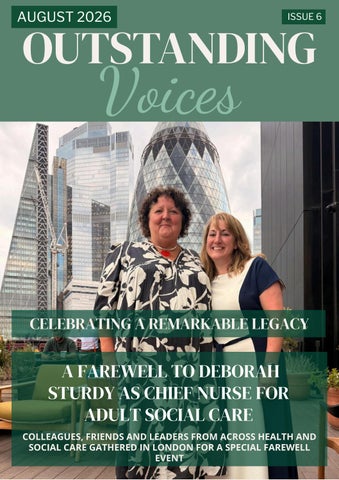
CELEBRATING A REMARKABLE LEGACY
A FAREWELL TO DEBORAH STURDY AS CHIEF NURSE FOR ADULT SOCIAL CARE COLLEAGUES, FRIENDS AND LEADERS FROM ACROSS HEALTH AND SOCIAL CARE GATHERED IN LONDON FOR A SPECIAL FAREWELL EVENT
Join Today!
You don’t have to be ‘Outstanding’ to be a member! Collaboration Support & Resources
Joining The Outstanding Society (OS) is completely free and offers the opportunity to become part of a passionate community dedicated to sharing and celebrating best practice across the care sector.
Events & Networking
As a Community Interest Company, the OS brings together like-
Knowledge Sharing
continuous improvement in the quality of care delivered to
minded professionals and organisations who are committed to learning from one another, recognising excellence, and driving people who rely on services every day.
Join today!
The Outstanding Society DIRECTORS Zoë Fry OBE
Executive Director Nursing & Residential Care
James Rycroft
Executive Director Specialist Dementia Services
TEAM
Alan Fry
Head of Operations
Sonia Pritchard
Executive Administrator
Ruth French
Lucy Knight
Samantha Crawley
Mike Slator
Director of Policy & Regulation
Director of Leadership & Wellbeing
Vivaldi Social Care Lead
Project Specialist
Sanjay Gasiorski-Dhrona Director of Diversity, Equality & Inclusion
Caroline Cosh
Director of Homecare
Lara Bywater
Director of Learning Disability, Autism & Mental Health Care
info@theoutstandingsociety.co.uk www.theoutstandingsociety.co.uk
Editor Notes Welcome to this edition of Outstanding Voices. This month, we take a moment to recognise and celebrate the remarkable contribution of Professor Deborah Sturdy CBE as she steps down from her role as Chief Nurse for Adult Social Care.
unwavering champion for adult social care, bringing visibility, credibility and influence to a sector that has too often struggled to have its voice heard. Her leadership has helped ensure that adult social care been
conversations,
firmly
represented
shaping
policy,
in
national workforce
development and system-wide thinking at the highest levels.
her determination to ensure that adult social care is not viewed as an afterthought, but as an equal partner within the wider health and care system. Time and again, she has advocated for adult social care to be “at the table”, ensuring the expertise, experiences and challenges of the sector are
Throughout her tenure, Deborah has been an
has
Perhaps her most significant achievement has been
recognised when decisions are made. Beyond her national role, Deborah has inspired countless professionals through her authenticity, accessibility and unwavering belief in the value of the social
care
workforce.
She
has
consistently
championed excellence, innovation and professional development, helping to raise the profile of care and nursing across the sector. Her departure marks the end of an important chapter, but her legacy will endure. The stronger voice that adult social care enjoys today, the greater recognition of its contribution, and the growing confidence of its workforce all bear the imprint of her tireless efforts. On behalf of the Outstanding Society community, we extend our sincere thanks to Professor Deborah Sturdy CBE for her outstanding service, leadership and advocacy. We wish her every success for the future and look forward to building upon the foundations she has helped create.
Alan Fry
Editor and Head of Operations
04 Outstanding Voices
August 2026
Highlights 06
Farewell to our Chief Nurse for Adult Social Care
Tributes, memories and inspiration took centre stage at the special event marking Deborah Sturdy’s departure and enduring legacy.
11
Outstanding Spotlight
Outstanding Voices celebrates adult social care services that have achieved an Overall Outstanding rating.
Everyday Work of Supported 22 The Living The Care Workers’ Chairty reflect on the unsung heros working in Supported Living.
26
Behaviour Matters
Skills for Care look at supported living in their new Behaviour Framework.
34
Chief Nursing Officer Summit 2026
Following the recent CNO summit, has Adult Social Care profile been raised?
Diversity Forum 36 Outstanding Shines at Brighton Pride 2026 Over 100 colleagues and people who use services proudly came together to march as one Adult Social Care team at this year's Brighton Pride.
Farewell to our Chief Nurse for Adult Social Care
Colleagues, friends and leaders from across health and social care gathered in London for a special farewell event kindly hosted by Howden Insurance to
celebrate
the
outstanding
contribution
of
Professor Deborah Sturdy CBE as she marked her final day as Chief Nurse for Adult Social Care. The event brought together an impressive crosssection of the sector, including Chief Nursing Officer for England Duncan Burton, chief executives from leading
social
care
trade
associations,
former
colleagues from across Deborah's distinguished career, and many of the social care nurses whose professional journeys have been shaped by her leadership. The atmosphere was one of warmth, gratitude and celebration. It was also a powerful reminder of the Speaking on behalf of the Outstanding Society, event host Sanjay Dhrona reflected on Deborah's unique ability to connect people and create opportunities. He described how Deborah had helped ensure adult
influence one person can have in championing a profession, strengthening a workforce and bringing people together around a shared purpose or ‘North Star’,
as
Lucy
Gillespie
from
Skills
for
Care
pertinently reflected.
social care gained the visibility and recognition it deserved, often creating space for others to be heard
Throughout her career, Deborah has been a tireless
and succeed.
advocate for adult social care nursing and the wider social
care
workforce.
She
has
consistently
As Sanjay observed, while many people collect
championed the importance of recognising the
contacts, "Deborah collects people" – a tribute to her
expertise, compassion and innovation that exists
talent
and
across the sector, ensuring that adult social care has
nurturing a community united by a passion for
a voice at national tables and within wider health
improving care.
and care conversations.
for
building
genuine
06 Outstanding Voices
relationships
August 2026
It was evident, without question, just how much Deborah will be missed as she embarks on new opportunities. Her remarkable ability to connect people was a consistent and heartfelt theme throughout the evening, echoed by speaker after speaker. My special thanks go to those involved from The Outstanding Society in making this happen, particularly Zoë Fry for helping us organise the event, Sanjay Gasiorski-Dhrona
for
his
inimitable
speech
and
masterful role as MC, and everyone who played a part in creating such a fitting celebration for a genuinely brilliant ambassador and influencer in the world of social care.” The tributes shared during the event highlighted not only Deborah's professional achievements but also her generosity, kindness and unwavering support for others. Time and again, speakers returned to a common theme: Deborah's commitment to lifting others up, creating opportunities and helping people realise their potential. Reflecting back on what David Taylor ACII, Executive Director and Head of Health & Social Care UK at Howden, whose team kindly hosted the celebration, captured the spirit of the occasion perfectly:
shaped Deborah, long-term colleague and friend Abi Masterson spoke about the difference Deborah had made to the life of a woman with learning disabilities in long-term care whose voice had finally been heard by Deborah after being silenced by others for too
“It was an absolute honour for Howden to be able to
long.
host an event on behalf of The Outstanding Society at our London offices to celebrate the departure of one of the care sector’s true greats – Deborah Sturdy CBE FRCN, Chief Nurse for Adult Social Care. The great and the good from across the sector came together to celebrate the
incredible
achievements
and
leadership
that
Deborah has become synonymous with, evidenced by some truly touching and emotional speeches. The event highlighted what an amazing, influential and leading light Deborah has been throughout her career, bringing people together and making things happen. There are simply too many superlatives to repeat them all here, but each reflected the exceptional inspiration, leadership and trailblazing example Deborah has provided, the legacy she leaves behind and the path she has carved for others to continue making a difference to the lives of those who need support.
07 Outstanding Voices
August 2026
One of Deborah's most enduring achievements was the creation of the Social Care Nursing Advisory Councils (SCNACs). Recognising the need for a stronger and more connected voice for nursing in adult social care, Deborah established these councils to
bring
together
expertise,
experience
and
leadership from across the sector. Under her guidance, the SCNACs have flourished and
Nursing is a very important part of that, and I hope
expanded, becoming a respected and influential
people will use their voices and talents to keep pushing
platform that ensures the perspectives of social care
for change."
nurses are heard at local, regional and national levels. Today, they stand as a powerful testament to
Those words perfectly captured the spirit of the
her vision, providing a genuine voice for adult social
occasion. While the event marked the end of
care and helping to shape the future of nursing
Deborah's tenure as Chief Nurse for Adult Social
within the sector.
Care, it was far from a goodbye to the sector she has done so much to champion. Instead, it was a
In her own heartfelt reflections, Deborah spoke with
celebration
characteristic humility and pride about the sector she
recognition of the lasting impact she has had on
has served so passionately:
individuals, organisations and communities across
of
an
extraordinary
legacy
and
a
the country. "My last day as Chief Nurse for Adult Social Care, but not my last supporting the phenomenal work of the sector.
As guests raised a glass in her honour, there was a shared
sense
of
appreciation
for
Deborah's
I consider myself so lucky to have had this role, meeting
leadership, advocacy and friendship. Her contribution
so many enthusiastic and passionate people striving for
has helped transform conversations about adult
change and wanting to make a difference to help people
social care and nursing, creating a stronger platform
live their best lives.
for future generations to build upon. Deborah’s tenacity and sense of fun have always been at the
A bigger workforce than the NHS and deserves the
heart of her work, as has her ability to influence
recognition for what it does. Entrepreneurial, energetic,
politicians and be the ‘wheeler dealer’ critical to social
kind, innovative and hard working. Proud to have been
care.
part of it, and I know it will now grow and thrive with the new opportunities ahead.
Everyone in attendance left with the same message: Thank you, Deborah. Your influence will continue to be felt throughout adult social care for many years to come, and the sector is stronger because of your dedication, vision and belief in its people.
08 Outstanding Voices
August 2026
Deb’s is our foundation and our inspiration. Now we must build on that foundation and create an amazing future for all of Health and Social Care through heartfelt collaboration. We are one.
Scarlett and Joanna with the rest of the SCNAC CoChairs preparing special Social Care handmade gift for Deb’s Farewell.
A precious and heartfelt gift for the ‘Mother’ of SCNACs. A sad farewell, but we know we’ll meet again.
Sanjay brilliantly hosts an evening dedicated to the lifetime transformational work of Professor Deborah Sturdy who brought the SCNACs into existence to amplify the voice of Social Care and ensure that voice is at all the right tables.
09 Outstanding Voices
August 2026
What Is Keeping You Awake at Night?
Running an adult social care service has never been more demanding. Whether it’s creating a positive workplace
culture,
responding
to
increasingly
complex coroner’s investigations, retaining great people, or preparing for CQC assessments, today’s leaders are balancing multiple challenges every day. These were exactly the topics explored during July’s Outstanding Society virtual meeting, where providers came
together
to
share
experiences,
practical
solutions and honest conversations about the realities of leading in social care.
Samantha Crawley challenged attendees to think beyond policies and procedures, arguing that culture is created through every interaction, every conversation and every leadership decision. Among the practical ideas shared were: Create
absolute
clarity
around
your
transparency
non-
organisation’s values. Make
openness
and
negotiable. Build psychological safety so people feel safe to speak up. Use
language
consistently
throughout
the
organisation. Remember that culture includes everyone—not just care staff, but housekeeping, maintenance, catering, administrators, residents and families. Rather than focusing on theory, the session
Perhaps the most memorable advice of the
concentrated on advice from experienced sector
afternoon was:
leaders
and
approaches
partners, that
any
highlighting provider
can
practical begin
implementing immediately.
“Find the person causing the most trouble… and become their best friend.”
Culture isn’t a project – it’s every decision you make One of the strongest themes throughout the discussion was that culture cannot be separated from leadership.
10 Outstanding Voices
August 2026
Outstanding Spotlight Every month, Outstanding Voices will celebrate adult social care services that have achieved an Overall Outstanding rating in their most recently published Care Quality Commission (CQC) report. Registered Manager
Report Published
Paulina Pronczyk
30/07/2026
Anda Marin
16/07/2026
Thimbleby Court
Hazel Whittaker
01/07/2026
Home Instead
Sandra Morison
09/07/2026
Respectful Care Nottingham South
Emma Peach
15/07/2026
Collingwood Court
Chloe Jelley
08/07/2026
West 1 Reablement Service
Claire King
24/07/2026
Harry Priestley House
Anne Stobart
16/07/2026
Brook House Care Home
Michelle Hood
21/07/2026
Service Name
Oxford Beaumont
Burlington Hall Care Home
Congratulations! Behind every Outstanding rating is a team with a story worth sharing. If your service has recently achieved an Overall Outstanding rating, we’d love to hear from you. Whether you’re a Registered Manager, provider, nurse, care worker or another member of the team, we invite you to work with The Outstanding Society to showcase the approaches, innovations and everyday practices that have contributed to your success. Get in touch with us at comms@theoutstandingsociety.co.uk – together, we can share and celebrate best practice for the benefit of everyone.
More Than Training: Creating Meaningful Employment Through the Oliver McGowan Mandatory Training For many Experts with Lived Experience, delivering the
disability, this is their first experience of paid
Oliver McGowan Mandatory Training is about far more
employment.
than standing at the front of a room. For some, it is their
first
paid
job.
Their
first
experience
of
That creates both an opportunity and a responsibility.
employment. Their first opportunity to be recognised and valued for the expertise that comes from lived
Supporting people into work goes far beyond meeting
experience.
the reasonable adjustments required under the Equality Act. It is about creating an environment
The Oliver McGowan Mandatory Training on Learning
where people feel confident, supported and genuinely
Disability and Autism was co-produced and is co-
want to work with you. Delivering this training often
delivered by people with a learning disability and
involves sharing deeply personal experiences, which
autistic people. Every learner begins with free e-
can be emotionally demanding.
learning
before
progressing
onto
one
of
two
pathways: a one-hour Tier 1 webinar for people who
Organisations have a responsibility to recognise that,
do not provide direct care or make decisions about
provide meaningful support and avoid creating
care, or a full-day, face-to-face Tier 2 course for
additional barriers or hardship.
everyone else. Many
workplaces
have
limited
experience
of
Whichever route delegates take, every session is
employing people with a learning disability, and the
delivered alongside Experts with Lived Experience,
challenges can begin long before someone delivers
with both an autistic person and a person with a
their first session.
learning
disability
sharing
their
knowledge,
experiences, and perspectives.
Every stage of employment deserves careful thought. From
For many Experts, particularly those with a learning
applications
and
interviews
to
gathering
employment documentation, onboarding, delivering
As Trainer Lead for the programme at Ashfield Services, Jax Blunt works across both Tier 1 and Tier 2. Late-diagnosed autistic themselves, Jax also delivers training as an autistic Expert with Lived Experience, facilitates Tier 1 sessions and recruits, coordinates and supports Ashfield's growing team of Experts. One of the most important things to understand about the Oliver McGowan Mandatory Training is that Experts with Lived Experience are paid professionals. The Code of Practice sets a minimum rate of pay equivalent to NHS Band 5, currently around £16.42 per hour, although many organisations, like Ashfield Services, choose to pay more.
12 Outstanding Voices
August 2026
training and receiving payment, each step should be
These
connections
help
viewed through the perspective of someone who may
employment,
have little or no previous experience of work,
advocate for fair treatment. Creating those networks
communicate differently or face additional barriers to
is especially important for Experts with a learning
understanding.
disability, who often have fewer opportunities to build
navigate
people
workplace
find
further
difficulties
and
professional connections. Completing an application form or writing a CV may be entirely new. Requirements such as GCSEs in Maths
The Oliver McGowan Mandatory Training is changing
and English or a driving licence, criteria Jax has seen
how health and social care professionals understand
included in recruitment adverts for Experts with Lived
learning disability and autism. Just as importantly, it is
Experience, can unintentionally exclude exactly the
creating meaningful employment, opening doors and
people organisations are hoping to employ.
demonstrating the value of lived experience in the workplace.
Instead, employers need to ask a different question: what barriers have we created, and how can we
Sometimes the greatest impact of the training
remove them?
happens long after the classroom has emptied. Because the Oliver McGowan Mandatory Training
When those barriers come down, the impact can be
doesn't just change the way people deliver care. It
remarkable.
changes the lives of the people who deliver the training too.
Jax has seen Experts with a learning disability go on to build successful self-employed careers, with some growing their businesses to the point of employing others. Finn Cavanagh, an Expert with Lived Experience with a learning disability, reflected on what the work has meant to him: "It means a lot to me to have paid work doing the Oliver McGowan work as this is a full-time job for me as being self-employed. I have learnt a lot from it. It has made me think on how I go about ways of delivering trainings." Ryan Holywood, who works as both an autistic Expert and a facilitator, shared a similar experience: "In terms of how has it impacted my life? I mean, in all honesty, it's given me the opportunity to work towards and develop a teaching career. Originally, I never thought that teaching would be something that would be for me." The benefits extend far beyond employment itself. Behind the scenes, Experts are building professional networks, sharing opportunities and supporting one another through the unique challenges that come with this work.
13 Outstanding Voices
August 2026
Driving social care excellence: How the National Institute of Health & Care Research (NIHR) supports and enables research to be delivered in the social care sector At the NIHR Research Delivery Network (RDN), we
were available, older residents with capacity benefited
know that outstanding care and high-quality research
immensely from the teams' face-to-face approach. For
are intrinsically linked. For care providers, research
residents lacking capacity, the teams did a huge
can empower the workforce, refine daily practices,
amount of work contacting relatives and consultees to
and directly improve the lives of people who use social
secure vital advice on their participation.
care services. Whether it is maximising inclusivity in care home research, or celebrating practitioner-led
For care home staff entirely new to research, having
triumphs like the Darlington “Experts in Practice”
our teams visit the home was invaluable. They
project, the NIHR RDN enables the social care system
assisted with practical research tasks, such as data
to attract, optimise, and deliver high-quality research
entry, all the way through to study close down.
that is inclusive and accessible to all. This partnership proves that when national research Here, we share some of the NIHR RDN’s impact stories
infrastructure handles the logistical and administrative
and case studies that demonstrate how we can
demands of recruitment, care homes can successfully
support the social care sector to deliver research.
lead high-impact research that shapes the future of social care.
Maximising inclusivity in care home research: Lessons learned from the AFRI-c randomised
Darlington
researchers
win
gold
in
NIHR-
controlled trial
sponsored social worker award
How does a major nationwide study succeed inside
At the Social Worker of the Year Awards, a team of
busy care homes? The “Air Filtration to reduce
practitioners from Darlington won gold in the NIHR-
Respiratory Infections (including COVID-19) in care
sponsored Practitioner-Led Research Award for their
homes (AFRI-c)” randomised controlled trial, which
outstanding work on the Experts in Practice (EXIP)
evaluated whether air filtration units could reduce
project.
winter infections, is a prime example of how the NIHR RDN’s support for care home research turned academic design into front-line success. By embedding their specialised knowledge of care home research at the early development phase, NIHR RDN teams provided end-to-end support that directly drove the study’s progress. Our Agile Research Delivery Teams were instrumental in identifying care homes and supporting them to set up the study nationally. They managed the essential groundwork, including
staff
training
and
navigating
complex
research paperwork. Whilst flexible consent models
14 Outstanding Voices
August 2026
The EXIP project is a research-based initiative that
By embedding researchers directly within local
supports professional development by giving staff
authority and care settings, the NIHR RDN is
dedicated, protected research time. This enables them
fostering a culture of co-production. This ensures
to co-produce training, tools, and resources directly
that research is designed with the social care
for their colleagues and partner agencies.
sector, rather than just for it.
Importantly, this success story highlights how NIHR
The NIHR RDN’s regional leadership provides
funding can spark major professional achievements.
strategic oversight and hands-on support to help
The EXIP project directly evolved from the Social Care
local care providers participate in research. By
Internship
working
Scheme,
funded
and
sustained
over
together
across
local
boundaries,
multiple years by the NIHR North East and North
providers can share best practices and help build
Cumbria Regional RDN.
the regional evidence base.
By funding these roles, we helped turn academic
This
theory into front-line reality. These experts work in a
academic insights directly to front-line staff,
wide range of teams, using relational and strength-
ensuring they have the tools and support needed
based approaches to support the people they work
to engage with research as a routine part of their
with. They are content creators, using national and
professional development.
regional
approach
focuses
on
bringing
international information, alongside local co-produced knowledge, and expertise to develop training, tools,
Dr Gradinger’s insights show that when we collaborate
information, and resources that support their peers
regionally, we build a stronger, more connected social
and multi-agency partners, to enable them to support
care research community. By matching NIHR RDN
the communities and people they serve. This initiative
national resources with regional expertise, we ensure
proves that social care staff can blend both practice
that research directly supports service improvement
and research to drive excellence across the sector.
and outstanding care across the South West and beyond.
The NIHR North East and North Cumbria RRDN’s longterm commitment to underwriting this scheme demonstrates
how
targeted
funding
builds
the
Summary
capacity of the social care workforce, ensuring that research directly shapes and improves daily care. Collaborating for impact across the South West Peninsula To
ensure
that
research
addresses
real-world
challenges, we must build connections between researchers, local authorities, and front-line social care providers. The NIHR South West Peninsula Regional Research Delivery Network (RRDN) is actively funding and facilitating these vital connections to make research more inclusive and accessible. Dr Felix Gradinger, NIHR South West Peninsula RRDN’s Regional Specialty Lead for Social Care, highlights how local
research
infrastructure
collaboration:
15 Outstanding Voices
is
driving
regional
As the above impact stories demonstrate, research is
a
powerful
development,
mechanism
collaboration,
for
workforce
and
embedding
inclusive practice in the care system. Through hands-on delivery support, multi-year funding, and building regional networks, the NIHR RDN is committed to making research accessible to all and achievable for care providers. Regardless of where you are in your research journey, we encourage you to get in touch with us to find out how we can support social care providers to attract, optimise, and deliver research.
August 2026
Patient needs never stand still. Neither should the equipment supporting them. In supported living, patient needs are rarely fixed.
Just as importantly, we've designed this equipment to
Growth, changes in muscle tone, the progression of
belong in a home. Supported living is someone's
conditions and simply the passage of time can all shift
home, not a ward, and postural equipment shouldn't
what good care looks like- sometimes gradually,
announce itself as clinical apparatus. Getting the
sometimes suddenly.
balance right- proper postural support without an institutional look or feel- is central to how we think
We've seen how easily equipment provision can fall
about design, not an afterthought once the clinical
behind that reality. A bed or chair chosen five years
requirements are met.
ago may have been exactly right at the time, but if it can't move with the person, it eventually stops helping
Why we take person-centred care seriously
and starts limiting them. Adaptable equipment is only half of the picture. It Positioning that once supported comfort and function
does its job properly only when it sits inside a
can become a source of pressure damage, reduced
genuinely person-centred approach to care.
mobility, or lost independence - not because anyone did anything wrong, but because the equipment itself
For us, person-centred care means clinical reasoning
couldn't change when the persons needs did.
that starts with the individual in front of you, not a generic protocol applied regardless of circumstance. It
Building equipment around change, not around a
means support staff who feel confident handling
moment in time
postural equipment and recognising changes in someone's presentation day to day, not just at
Our approach starts from the assumption that patient
induction.
needs will change, and that equipment should be designed to change with them.
And it means real, ongoing collaboration between support staff, Occupational Therapists and the patient
Our beds, chairs, supports and accessories are built to
themselves- so that decisions about someone's body
be adjusted incrementally- repositioned, reconfigured,
and their home are made with them, not simply for
adapted- as a person's needs shift, rather than
them.
requiring a full replacement every time something does. Training as the thread that holds it together That matters practically, because it means support staff and Occupational Therapists can respond to a
This is why we put so much weight on training
change in muscle tone or a new pressure area with an
healthcare professionals with our Accora Academy to
adjustment, not a procurement process.
be the best they can be. Clinical reasoning and staff training aren't separate items on a checklist- they're
It matters for the person too: fewer disruptive
what allows the collaboration above to actually
equipment changes, and support that keeps pace with
happen in practice.
them rather than lagging a step behind.
16 Outstanding Voices
August 2026
Services that treat training this way tend to catch small
Clinical reasoning and training that gives staff the
issues before they become significant ones- and tend
confidence to notice and respond to change, not
to have staff who feel more confident and more
just follow a fixed plan.
connected to the people they're supporting. Genuine collaboration between support staff, Find out more about our free training, and the Accora
Occupational Therapists and the patient, so that
Academy here: https://accora.care/academy
care stays a shared, person-centred process.
What this looks like in practice
Confident,
well-trained
staff
without
adaptable
equipment run into limits no amount of good practice Bringing these threads together, the practical picture
can overcome. It's the combination- equipment,
is straightforward:
training and collaboration moving together- that keeps care genuinely person-centred as someone's needs
Equipment that adapts with the person, reducing
continue to change.
the need for disruptive full replacements every time a need changes. Design that respects the home, so postural support doesn't come at the cost of dignity or a domestic feel.
17 Outstanding Voices
by Emily Bradley
Digital Marketing Coordinator
August 2026
ch ar se Re
How One Footstep's Sponsorship Has Impacted My Journey For many people working in social care, pursuing higher education can feel like an impossible ambition alongside the demands of work, family, and financial responsibilities. In this inspiring personal account, Lucy Knight shares how sponsorship from One Footstep has helped turn a long-held dream into reality. Receiving sponsorship funding from One Footstep to cover half of my degree has been life-changing. It has provided me with an opportunity that I never thought would be possible and has given me the confidence to pursue my ambitions within the social care sector.
working in social care, I have had to balance work I have worked in social care since I was 18 years old
with family responsibilities
As a parent, and
and have dedicated my career to supporting others.
particularly as a mother to a son with additional needs, the financial and practical challenges of
Over the years, I have worked my way up through
pursuing higher education often felt overwhelming.
different roles, gaining valuable experience and
Although I always wanted to continue learning and
developing a deep passion for the sector. Social care
develop my career, I never believed studying for a
is more than just a job to me; it is something I
degree would become a reality.
genuinely care about and want to see valued, recognised, and improved.
The sponsorship from One Footstep has changed that. By helping to fund half of my degree, they have
Despite my passion and commitment, further
removed a significant barrier and opened a door
education always felt out of reach. Like many people
that I thought had closed.
18 Outstanding Voices
August 2026
ch ar se Re
This support has not only eased the financial burden but has also shown me that others believe in my potential and the contribution I can make to the sector. Studying for a degree in Public Health and Wellbeing will allow me to expand my knowledge, develop new skills, and better understand the wider factors that influence health and wellbeing. Most importantly, it will help me build on the experience I have gained throughout my career in social care. My passion lies within social care, particularly in care homes for older people. Having worked in this area for many years, I have seen both the challenges and the
incredible
difference
that
dedicated
care
professionals make every day. I strongly believe that the sector deserves a stronger voice
and
greater
recognition.
Through
this
opportunity, I hope to develop the knowledge and confidence needed to advocate for social care, influence positive change, and help ensure the experiences of both care workers and those receiving care are heard. I am incredibly grateful to One Footstep for investing in my future. Their support is not only helping me achieve a personal goal but is also enabling me to continue working towards making a meaningful
“From the moment we heard Lucy’s story, it was clear how passionate and committed she is to both her own development and the wider social care sector.
contribution to a sector that I am passionate about.
At One Footstep, we believe in removing barriers
This opportunity represents more than funding a
driven to make a difference.
degree, it represents hope, opportunity, and the chance to create a positive impact within social care for years to come.
and creating opportunities for people who are
Supporting Lucy felt like a natural decision, and we are excited to see where this journey takes her.” Ram Goyal
19 Outstanding Voices
August 2026
Results from the AFRI-c study. A team of researchers at the University of Bristol wanted to find out if using air filters in care homes could
prevent
respiratory
infections,
including
coughs, colds, flu and COVID-19. This research was
ch ar se Re
Do air filters prevent respiratory infections in older care home residents?
Care homes were randomly allocated to either receive air filters, or not. Care homes in the Air Filter group were given up to five air filters to use in their communal areas and air filters for some residents’ private bedrooms. Staff were asked to keep the air filters switched on continuously from September
called the AFRI-c study.
until May. The care homes in the Usual Care group
Outbreaks of respiratory infections can cause serious
care homes were asked to continue with their usual
complications for vulnerable older residents in care homes. In addition, infection outbreaks mean that staff can become unwell, which can be problematic for care homes. Respiratory infections spread through droplets when people sneeze or cough. Current infection control methods mainly rely on keeping surfaces clean, washing hands, wearing face coverings and using vaccinations to reduce the spread of germs. High Efficiency Particulate Air (HEPA) filters (“air filters”) are known to capture germs from the air in a laboratory. We wanted to find out whether using air filters could reduce the spread
did not use any air filters during that period. All 91 methods of infection control and cleaning. Around 11 residents in each care home gave consent to
complete
study
questionnaires
and
for
researchers to collect information from their medical records (about infections, antibiotic prescriptions and stays in hospital). For care homes with the air filters, the same residents also agreed to have an air filter switched on in their private room for the whole winter period. If residents couldn’t give consent for themselves, we asked someone who knew the resident (usually a relative) to advise whether they
of respiratory infections in care homes.
would have wanted to be included in the research.
Ninety-one care homes for older people took part in
how their residents were feeling. They also told us
the research across England between 2021 and 2024. Each care home took part for one winter period.
Care home staff collected information each day on how many days their staff took off work due to sickness. Residents, relatives, and staff told us how satisfied they were with the air filters, and about their beliefs and experiences of them, in interviews and surveys. We compared information from care homes with and without the air filters. We found that air filters did not make any difference to: the number of respiratory infections in residents the number of gastrointestinal, urinary or skin infections
20 Outstanding Voices
August 2026
ch ar se Re
numbers
of
antibiotic
prescriptions
and
hospitalisations
Full results of the study are available on our website: Results of the study – The AFRI-c Study
residents’ physical health, including the number of falls/near falls
Clinical results paper link: High efficiency particular
the number of staff reported sickness days.
air filters to prevent symptomatic winter respiratory infections including COVID-19 in care homes: the
The study showed that air filters don’t prevent
AFRI-c pragmatic cluster randomised trial’ by Alastair
coughs, colds, flu or COVID-19. We found no benefit
Hay
of using air filters on the health of older adults and
doi:10.1001/jamainternmed.2026.2199.
et
al.
in
JAMA
Internal
Medicine.
DOI:
staff in care homes. We recommend that care homes don’t invest in air filters to reduce infections. Instead,
Links to summary study results videos-
we recommend that they continue with their normal
Link with subtitles: https://youtu.be/dPmV7DXyiX0
infection control methods, including vaccinations,
Link without subtitles: https://youtu.be/0gS8zSJnPRY
regular cleaning and hand washing. This project was funded by the NIHR Public Health We also found that people were generally happy with
Research Programme (NIHR 129783). The views
the air filters and they didn’t interfere much with
expressed are those of the authors(s) and not
everyday life and work in the care home. However,
necessarily those of the NIHR or the Department of
they weren’t suitable for every resident, and some
Health and Social Care.
didn’t like the cold draught they produced. Prevention of infections was important to staff, but residents and relatives were more concerned with residents’ overall quality of life and care in the home. Thank you to all the care home staff who took part in this research and the research delivery teams supporting them. This research study was a success because
of
their
tremendous
support
and
engagement.
21 Outstanding Voices
August 2026
The Everyday Work of Supported Living There is a particular kind of care that rarely makes headlines. It doesn't happen in hospitals or in the glare of national campaigns. It happens in ordinary houses, on ordinary streets, in the early hours of the morning and the quiet hours of the night. It happens when a support worker helps someone get dressed for a job interview or sits with them while they make a phone call they've been dreading, or simply shares a cup of tea and a conversation that reminds someone they are not alone. This is supported living, and the people who do this work are among the most remarkable in the entire care sector. At The Care Workers' Charity, we speak to care workers across every part of the profession, from residential homes to domiciliary care to hospices. But there is something distinct about supported living that deserves its own spotlight. It is a model of care built
not
around
institutions
but
around
independence. It exists so that people with learning disabilities,
physical
disabilities,
mental
health
conditions or complex needs can live in their own homes, or shared homes, with support that's tailored to exactly what they need, giving them independence without being over-supported or under-supported. And it is precisely because that support is so tailored and so personal that the workers who provide it carry
The support that wraps around them is designed to
an extraordinary weight of responsibility.
help them exercise choice and control over their own lives, not to manage them.
What supported living actually looks like For a care worker, this changes everything about Supported living is often misunderstood, even within
how the job is done. There is no ward round, no
the adult social care sector itself. It isn't residential
shift handover in a staff room down the corridor, no
care, and it isn't quite the same as domiciliary care
hierarchy of clinical oversight sitting just above
either. People living in supported living arrangements
them. Often it is one worker, sometimes two,
are
tenancy
present in someone's home, making decisions in
agreements, their own front doors, and their own say
real time about how to support that person to live
over how their homes are run.
the life they want to live.
usually
tenants,
22 Outstanding Voices
with
their
own
August 2026
profession. It takes emotional intelligence, patience, and a genuine belief in the person's right to dignity and risk, all delivered on pay that rarely reflects the complexity of what is being asked. The relationships at the heart of the work Ask any supported living worker why they do the job and very few will mention the pay. Almost all will talk about the people. Supported living is, by its nature, relational. Workers often support the same small group of people for years, sometimes decades. They come to know someone's favourite meal, their sense of humour, the exact tone of voice that means they're having a good day rather than a bad one. They celebrate birthdays, help pack for holidays, sit through hospital appointments, and quietly notice when something isn't quite right long before anyone else does. The pressures behind the scenes Staffing
shortages
mean
many
workers
are
stretched across multiple households, sometimes covering shifts alone that were designed for two people. Lone working brings its own risks: the isolation of being the only person on shift, personal safety concerns with no one else on hand if a situation escalates, the responsibility of managing safeguarding concerns or medical emergencies without immediate backup, and the emotional toll of supporting people through crisis without a colleague nearby afterwards. Pay in supported living, as across much of adult social care, often fails to reflect the skill and responsibility involved. Many workers are on It might mean helping someone budget for their weekly shop so they can afford something they've been saving for. It might mean supporting someone through a panic attack at three in the morning. It might mean standing back and doing nothing at all, because the whole point of the visit was to let someone attempt a task independently, even if it takes them three times as long. That balance, between stepping in and stepping back,
or
close
administering
to
the
minimum
medication,
wage
managing
despite complex
behaviours, or supporting people with conditions such as epilepsy or diabetes, tasks that would demand formal qualifications and higher pay in almost any other setting. Zero-hours contracts, unpaid travel time between visits, and the general cost of living hit low-paid care workers especially hard,
meaning
some
are
themselves
one
unexpected bill away from crisis while supporting other people's independence.
is one of the hardest skills in the entire care
23 Outstanding Voices
August 2026
This is exactly why The Care Workers' Charity exists.
fundraising one. Every participant who takes part
Every crisis grant we provide, every piece of wellbeing
helps ensure that The Care Workers' Charity can
support we offer, is there because a workforce
continue providing crisis grants and wellbeing
cannot keep giving to others if there is no one looking
support to workers facing hardship.
out for them in return. Please note the deadline to sign up for this event is Why we shone a light on supported living
Tuesday 18th August 2026.
In July, we made supported living a part of our "Why You Care" campaign, running across our social media
Wear It Orange
channels and our blog throughout July 2026. Running from 21st to 25th September 2026, Wear It Supported living workers are too often the invisible
Orange is a week-long celebration that turns
thread running through the social care story, present
workplaces, communities and homes across the UK
in every conversation about independent living and
bright orange in honour of the people who care for
personal choice, yet rarely given the recognition
others every day. It is designed to be simple and fun
afforded to more visible parts of the sector. The
to take part in, whatever the size of the organisation
response from our community was heartfelt, with
or group involved.
workers and supporters sharing stories of colleagues who had gone above and beyond, and of the pride
Taking part can be as easy as choosing a day to wear
they feel in work that so rarely gets a public thank
orange, from a T-shirt to face paint to a full head-to-
you.
toe outfit, and encouraging colleagues, friends or family to join in. Many supporters also choose to
Recognition matters, but it isn't enough on its own. It
host an orange-themed fundraiser, such as a bake
is exactly because of workers like these that we run
sale, coffee morning, raffle, quiz or dress-up day,
our fundraising calendar throughout the year, raising
turning the celebration into a fundraising event in its
the money that allows us to step in with crisis grants
own right. Sharing photos, videos and fundraising
and wellbeing support whenever a care worker needs
stories using #WearItOrangeForCWC helps spread
us most. This September, there are two ways to get
the message further and encourages others to get
involved.
involved too.
Thames Moonlight 10
The
On Friday 11th September 2026, we're hosting the
celebration, the better, and every pound raised goes
Thames Moonlight 10, a fully supported evening walk
directly towards helping The Care Workers' Charity
through Central London starting at The Oval Cricket
provide support to care workers across the UK
Ground.
facing financial hardship and crisis.
Participants can choose either a 10km or 10-mile
Get involved
bigger,
brighter
and
more
creative
the
route, taking in some of the city's most iconic sights as it lights up after dark. The event offers a
Both events sit within a wider season of advocacy
memorable
and
for the care workforce, alongside Professional Care
supporters to come together for an evening walk
way
for
colleagues,
friends
Workers' Week itself, and both exist for the same
while raising vital funds for care workers across the
reason: because the people who spend their days
UK.
supporting others deserve a charity that has their back in return.
Group
bookings
are
especially
welcome,
and
workplaces, care providers and community groups
Find out more and sign up at:
are encouraged to sign up together, turning the evening into a genuine team occasion as well as a
24 Outstanding Voices
thecareworkerscharity.org.uk/events
August 2026
New podcast: Understanding cyber risk in social care As care providers become increasingly reliant on digital technology to deliver safe, effective care, cyber security has become one of the most significant operational risks facing the sector. From care planning systems and medication records to payroll and resident data, a cyber incident can have serious consequences for service delivery, regulatory compliance and organisational resilience. To help care leaders better understand these challenges, The Outstanding Society's trusted insurance partner, Howden, has released a new podcast exploring the evolving cyber threat landscape and the practical
steps
providers
can
take
to
strengthen their resilience. Hosted by Richard Lawson, the episode features cyber security specialist Neil Hare-Brown, CEO of STORM
Guidance,
Divisional
Director,
alongside
Jonathan
Taylor,
Head
Corporate
Risks,
of
Howden. Together, they discuss the cyber risks most likely to affect social care organisations, the potential impact of ransomware, phishing and data breaches, and the actions providers can take to reduce their exposure and respond effectively if an incident occurs. Drawing
As one of the UK's leading insurance brokers for the care sector, Howden works alongside providers to understand the unique risks they face and deliver specialist advice, risk management support and tailored
insurance
solutions
that
protect
organisations, their people and the communities they serve. We encourage all care leaders to listen to this insightful discussion and share it with colleagues
on
Howden's
extensive
experience
supporting thousands of care providers across the UK, the conversation also explores how effective risk management, staff awareness and specialist cyber
responsible
for
operational
resilience,
digital
transformation and governance. Click here: https://hubs.li/Q04qskmB0
insurance can work together to help organisations navigate an increasingly complex risk environment.
25 Outstanding Voices
August 2026
Behaviour Matters: What
Skills
for
Care’s
new
Behaviour Framework means for supported living [and others!]
Every day, supported living staff help people make decisions, develop skills, maintain relationships and
Looking beneath the surface
achieve the outcomes that matter most to them. Whether supporting someone to build confidence using public transport, manage anxiety, develop healthy
routines
or
make
choices
about
independence and safety, behaviour change is already an integral part of adult social care practice. The
new
Skills
for
Care
Behaviour
Change
Competencies Framework provides an opportunity to make that practice more visible, consistent and effective.
In supported living behaviour is often communication.
Developed for the whole adult social care sector, the framework
promotes
a
shared
language
and
approach to understanding behaviour, strengthening professional
practice
and
supporting
positive
outcomes. For supported living services in particular, its principles align closely with the values that underpin high-quality, person-centred support.
For example, a person who regularly declines support with daily tasks may not be "refusing support" at all. They may be seeking greater independence and control over their routine. Someone who becomes distressed when plans change may be communicating anxiety about uncertainty
People who draw on supported living services want the same things as everyone else: choice, control, meaningful relationships and opportunities to live
or difficulties processing new information. A person who withdraws from activities
fulfilling lives in their communities. However, when
they
people experience anxiety, frustration, pain, sensory
experiencing a physical health issue, low
overload
mood or sensory challenges.
or
barriers
to
communication,
these
previously
enjoyed
may
be
experiences can be expressed through behaviours that others may find difficult to understand.
The framework encourages staff to be curious rather than make assumptions,
The
framework
encourages
providers
and
practitioners to look beyond the behaviour itself and ask a more meaningful question: what is this behaviour telling us? Looking beneath the surface In supported living, behaviour is often communication.
26 Outstanding Voices
building a fuller understanding of the person's
strengths,
preferences,
communication styles and life experiences. This shift in thinking helps services respond in ways that reduce distress, increase trust and improve quality of life.
August 2026
The framework encourages staff to be curious rather than
make
assumptions,
understanding
the
a
person's
fuller
strengths,
At its heart, the Behaviour Change Competencies
and
life
Framework reinforces a principle that high-quality
experiences. This shift in thinking helps services
care and support begins with understanding the
respond in ways that reduce distress, increase trust
person.
preferences,
of
building
Supporting good lives
communication
styles
and improve quality of life. When staff take time to understand the factors Building confident teams
influencing behaviour, they are better equipped to build trust, promote independence, uphold rights
One of the framework's key strengths is its focus on
and support people to achieve the outcomes that
developing confidence and consistency across the
matter most to them. Rather than focusing on
workforce. It recognises that social care staff already
managing behaviour, the framework encourages
use behaviour change skills every day and provides a
services to understand what sits behind it and to
structure
respond
for
strengthening
those
existing
in
ways
that
are
compassionate,
capabilities.
personalised and effective.
For supported living teams, this might mean:
For providers across adult social care, the framework
recognising early signs that someone is becoming
offers a practical foundation for developing skilled
anxious or overwhelmed
and confident teams, creating greater consistency in
adapting communication approaches to suit
practice and strengthening a culture of curiosity,
individual needs using everyday conversations to
reflection and continuous improvement. Ultimately,
encourage positive choices and independence
this leads to better experiences for people who draw
reflecting on what helps someone feel safe,
on care and support, while helping services deliver
valued and in control
person-centred care that enables people to live well,
sharing learning consistently across the team.
on their own terms.
A shared approach helps staff make informed decisions
while
reducing
reliance
on
Access the framework and associated guidance here.
reactive
responses. Prevention through understanding The framework also supports a more preventative approach to care. By understanding the factors influencing behaviour, services can often identify concerns before they escalate. In practice, this could involve adjusting routines, reviewing
environmental
triggers,
supporting
healthier habits, involving family members earlier, or working
with
health
professionals
to
address
underlying needs. Small changes made at the right time can prevent distress and help people maintain independence for longer.
by Rob Hargreaves
Central Engagement Lead
27 Outstanding Voices
August 2026
Supporting future nurses through social care placements
Skills for Care is encouraging more care providers and nursing education providers to help shape the next generation of nurses by offering high-quality practice learning experiences across adult social care. The Strategy to enable social care placements for student nurses and nursing associates sets out a clear ambition for every student nurse and nursing associate to experience a placement in social care as
One organisation leading the way is Care First 24, a complex home care provider that became the first
part of their professional education.
care provider to achieve the recommendations set
This is not simply an aspirational goal. As health and
building strong relationships with local nursing
out in the strategy. Their journey has involved
care services work more closely together to support prevention, population health and care closer to home,
nursing
students
need
a
broader
understanding of professional practice across a range of settings. That means moving beyond the perception that social care placements are only based in residential care and recognising the valuable learning opportunities available in complex home care, supported living and community-based services.
28 Outstanding Voices
education providers and developing trust and understanding around the role social care can play in nursing education. Today, student nurses can undertake practice learning experiences with Care First 24's clinical leads and care professionals, gaining first-hand experience of supporting people in their own homes, workplaces, schools and colleges. These placements help students develop the adaptable
August 2026
professional knowledge, clinical skills and personcentred approach needed to support people with complex needs, as well as providing valuable insight into governance, accountability, leadership and decision making within social care organisations. Reflecting on the achievement, Jayne Easterbrook,
Event
Clinical Lead at Care First 24, said: "We are incredibly proud to have met the recommendations of the student strategy. As a complex homecare provider, enabling practice
22nd Sept 2026 11:00 to 12:00
learning in people's own homes is, in our view,
Winter pressures: Practical advice to refine your contingency plans This webinar is designed to help registered managers, care leaders and providers prepare effectively for the challenges that winter can bring. Delivered in partnership between Skills for Care and The Outstanding Society, the session offers practical, actionable guidance to strengthen contingency planning and support safe, highquality care during periods of increased demand.
essential to understanding high-quality personcentred care."
Drawing on sector expertise and examples from Outstanding-rated services, the webinar explores how to build, test and refine winter plans, manage operational risks, and maintain service resilience in the face of workforce pressures, disruption and rising costs. Attendees will also learn about effective communication, partnership working and governance approaches that support continuity of care.
Since launching the strategy, Skills for Care has celebrated a growing number of care and education providers that have achieved the recommendations
Participants will gain practical insights into operational preparedness, risk management and the resources available to support winter planning.
and received Gold Commendation status. This work is particularly important given findings from the
The session is ideal for registered managers, deputy managers, service leads, adult social care providers and anyone involved in workforce planning or service delivery.
Adult Social Care Workforce Skills Survey, which showed that 69% of participating care providers
CLICK HERE TO REGISTER
found it somewhat or very difficult to recruit nurses and nursing associates with the right skills for vacant roles. Skills for Care would welcome more care providers and nursing education providers to get involved. Start by reviewing the strategy and relevant checklist for your organisation, connect with the forums and networks for support, and work towards achieving Gold Commendation as a visible demonstration of your commitment to excellence in nursing education. Together, we can help ensure future nursing graduates gain the breadth of experience needed to deliver high-quality care wherever people need it.
by Catriona Wilson PR & Content Officer
29 Outstanding Voices
August 2026
Skills for Care’s ‘Filled posts in the adult social care workforce in England’ becomes an official statistic
Skills for Care has reached an important milestone
Using ASC-WDS data and new statistical methods,
with the publication of its first official monthly
Skills for Care can now produce more frequent and
workforce statistic using Adult Social Care Workforce
accurate
Data Set (ASC-WDS) independent sector data. The
Government and sector leaders a more up-to-date
new ‘Filled posts in the adult social care workforce in
view of workforce trends.
workforce
estimates,
giving
the
England: monthly statistic’ provides a picture of current workforce trends, moving from annual
This official statistic highlights the value of ASC-WDS
estimates to monthly reporting. The statistics are
and the importance of up-to-date workforce data.
displayed in a data visualisation and can be filtered
Providers are encouraged to regularly update their
by regions of England and by CQC service type.
ASC-WDS
accounts
to
strengthen
workforce
intelligence across the sector. This achievement has only been possible thanks to the thousands of adult social care providers who
Visit the Skills for Care Workforce Intelligence
regularly share workforce information through ASC-
website to view the latest workforce statistics and
WDS. Their contributions help create the most
log in to your ASC-WDS account to update your data.
comprehensive picture of the adult social care workforce in England and support better workforce planning, policy development and decision-making across the sector.
30 Outstanding Voices
August 2026
WHEN: Tuesday 17th November to Wednesday
UK Dementia Congress is the largest annual multi-
18th November 2026
disciplinary dementia-focused event and exhibition
WHERE: Doncaster Racecourse, Leger Way,
in the UK and the only event that enables delegates
Doncaster, DN2 6BB
to comprehensively update their knowledge of dementia care, policy, practice and research. You
Dementia Community invite you to the 20th UK
will leave feeling better informed and connected,
Dementia Congress for two days of learning, sharing
with valuable insights and actionable takeaways that
and
you can use to drive meaningful change.
being
inspired
to
improve
everyone’s
experiences of dementia both in care and in wider society. Confirmed speakers so far include Professor
Early Bird ticket prices run until 31st August
Dawn Brooker, Paul Edwards, Chief Nursing Officer
2026.
at Dementia UK, Professor Jeremy Isaacs, National Clinical Director for Dementia and Older People’s
Further discounts and concessions are also
Mental Health at NHS England, David Truswell,
available. Visit to find out more.
Director of Dementia in Dub, Ronald Amanze, a Music Producer living with dementia, and Professor
Become a Member of Dementia Community (£1 for
Jill Manthorpe CBE. The full programme (available
lifetime membership) and enjoy a 10% discount on
soon) will include more experts by experience, sector
your UKDC ticket.
leaders and frontline practitioners from across the dementia, health and social care sectors.
31 Outstanding Voices
August 2026
Standards for Nursing Student Placements in Social Care Learning Environments.
We are inviting you to take part in an important
Your responses will be analysed and used to
national study, funded by the General Nursing
develop a second-round questionnaire. If you
Council Trust (GNCT) to help shape the future of
choose to continue participating, you will be invited
nursing, and nurse associate student placements in
to review your original ratings alongside the group's
adult social care.
responses before providing your final ratings.
As part of this work, we have developed a set of draft
Please note that this questionnaire is not intended
Standards for Nursing Student Placements in Social
for staff working in services that provide care into
Care Learning Environments. These standards have
adult social care settings, such as community
been produced to help social care organisations
nursing, Hospital at Home, virtual wards, GP nursing
recognise, prepare, support and sustain placements
teams or frailty teams.
for nursing students and nursing associate students. We have presented these standards around a model
Your expertise and experience are invaluable to this
called The CARES framework
work, and we would greatly appreciate your contribution.
You are invited to participate if you are a: Nursing and Midwifery Council Registered Nurse; Nursing
Here’s the link to the survey:
Associate or Registered Manager with the Care
https://app.onlinesurveys.jisc.ac.uk/s/salford/standa
Quality Commission (CQC) in England, or Social
rds-for-student-nurse-placements-in-social-care
Care Wales, or working in, or directly supporting, adult social care in England or Wales through
If you wish to know more about the project we have
practice, education or policy.
produced a short video telling you how we developed the standards, which is available here:
We would be grateful if you could complete the
GNCT Survey
questionnaire which takes approximately 10 minutes to complete.
32 Outstanding Voices
August 2026
Are you a registered nurse or nursing associate working in social care? Discover exciting opportunities to connect, influence and expand your network, as well as access continuing professional development (CPD). Join a network and build your professional nursing voice:
We’re pleased to let you know that the Adult Social Care Nursing Offers resource has now been published. This
resource
opportunities,
brings
together
networks,
a
wide
professional
range
of
development
offers and support available to people at different stages of their adult social care nursing career.
■ SkillsforCarenursing community: Workforce forum for leaders to explore practice innovation, continuing professional development, and career opportunities. Education forum for individuals and organisations committed to strengthening the role of social care within nursing education through teaching, practice learning, or research. Global Majority Nursing network for the Black and Asian nursing workforce to share insight and experiences, network and access personal development and leadership opportunities.
■ ■ ■
■ Queens Institute of Community Nursing host an Adult Social Care Nursing Network. Become a part of Regional Social Care Nursing Advisory Councils with The Outstanding Society. Explore the professional body for nursing in the Royal College of Nursing’s work for members in independent health and social care
■ ■
Build your professional expertise in social care, explore the following opportunities to advance your nursing career:
■ Queens Institute of Community Nursing - Transition toC areHome Nursing. ■ Queens Institute of Community Nursing - Education and Practice Standards for Care Home Nurses. ■ Adult social care nursing insights into the latest developments in research, education, and professional practice. ■ Develop your skills to support nursing students. ■ Cred talks – a forum to discuss what matters for social care. ■ Foundation of Nursing Studies - Resilience Based Clinical Supervision for Social Care. ■ Royal College of Nursing Foundation – Education grants. ■ Burdett Trust for Nursing – Grant programmes. ■ Standards of proficiency for community nursing specialist practice qualifications (SPQ) - The Nursing and Midwifery Council. ■ National Institute for Health and Care Research - Researcher Development Programme for Social Care Nurses. ■ Royal College of Nursing – Educational programmes and services. Our forums and networks are open to new members. Get in touch at socialcarenursing@ skillsforcare.org for help finding the right space for you.
Are you a student nurse or nursing associate aspiring to join the social care nursing workforce? Explore theseresources todiscover exciting opportunities in social care perfect for students, nursing associates, and professionals looking to grow their professional network and future career.
Are you a nursing leader in adult social care? Whether you’re a nursing leader ora care professional leading a nursing team in social care, there are lots of ways to get involved and access resources to support and develop your workforce and organisation to inspire the next generation.
■ If you’re looking for peer support join the Social Care Network for students
■ Skills for Care Workforce forum for leaders to explore practice innovation, professional development, and career opportunities. ■ continuing Host student practice learning opportunities - Developing nursing ■ placement opportunities in social care.
■ Take a look at the diverse opportunities to see where your nursing career
■ Valuing social care in nursing education Join the nursing community.
■ Find out how you can make the most of student nurse placements in social care settings.
and early career nurses. can go in social care.
■ Join your regional Social Care Nursing Advisory Council with The Outstanding Society.
Embed Preceptorship supporting the transition of pre-registration nursing
■ and nursing associates into practice.
Join your regional Social Care Nursing Advisory Council with The
Society. ■ Outstanding National Institute for Health and Care Research – Funding programmes.
Our forums and networks are open to new members. Get in touch at socialcarenursing@ skillsforcare.org for help finding the right space for you.
Our forums and networks are open to new members. Get in touch at socialcarenursing@ skillsforcare.org for help finding the right space for you.
DHSC contacts and news For nursing or general queries, email MCPE.Correspondence-Inter nalMB@dhsc.gov.uk; for Adult Social Care, use ASCBriefing@dhsc.gov.uk. Stay updated via the DHSC GOV.UK page or sign up for GOV.UK email alerts.
DHSCcontactsandnews For nursing or general queries, email MCPE.Correspondence-InternalMB@dhsc.gov.uk; for Adult Social Care, use ASCBriefing@dhsc.gov.uk. Stay updated via the DHSC GOV.UK page or sign up for GOV.UK email alerts.
Chief Nursing Officer Summit 2026: Social Care Takes Centre Stage in Shaping the Future of Health Services
opportunities that were missed and challenged delegates to consider how different the outcome
On 23 July 2026, nursing leaders from across England
might have been had Darren been truly placed at
gathered in London for the Chief Nursing Officer
the centre of coordinated, person-centred support
(CNO) Summit, bringing together chief nurses,
within his community.
executive nursing leaders, policymakers, educators and representatives from health and social care.
His story served as a poignant reminder of the importance of listening to individuals, working
The event was opened by Duncan Burton, CNO for
collaboratively
England,
compassionate, timely support is available to those
who
outlined
the
importance
of
strengthening nursing leadership across all sectors
across
services
and
ensuring
who need it most.
while recognising the unique contribution made by nurses working beyond traditional NHS settings. He
The summit provided delegates with an opportunity
reaffirmed his commitment to ensuring that social
to reflect on the future of nursing leadership at a
care nursing expertise continues to influence national
time of significant change across health and care
policy and welcomed delegates from the Social Care
services.
Nursing Advisory Councils (SCNACs), particularly
development and integrated working were recurring
during the transition following Professor Deborah
themes throughout the day.
Collaboration,
innovation,
workforce
Sturdy's departure as Chief Nurse for Adult Social Care.
A particularly significant feature of this year's summit was the strong representation from the
Rt Hon Yvette Cooper MP delivered one of the
SCNACs. Their attendance reinforced the growing
keynote addresses, speaking just four days after her
recognition that social care nursing is fundamental
appointment as Secretary of State for Health and
to the sustainability of the wider health and care
Social
for
system. Throughout the day, delegates returned to a
fundamental reform of health and social care
clear message: the future of health services cannot
services, echoing Prime Minister Andy Burnham's
be shaped without social care being recognised as
vision for a more integrated, community-focused
an equal strategic partner.
Care.
She
emphasised
the
need
system that delivers better outcomes for people. Presentations from senior nursing leaders across Acknowledging that the current model is not
NHS England, adult social care, Integrated Care
consistently meeting the needs of individuals or
Systems and professional organisations explored
communities, she called for bold, collaborative action
the
to redesign services around prevention, partnership
challenges, leadership development and the need
and person-centred care.
for closer integration between health and social
increasing
complexity
of
care,
workforce
care. One of the most moving presentations centred on the story of Darren, whose death by suicide
SCNAC representatives provided an important voice
highlighted the devastating consequences of unmet
for the thousands of registered nurses working in
support needs. Shared by healthcare professionals
care homes, community services, home care,
alongside
learning disability services and other social care
members
of
Darren's
family,
presentation offered a powerful reflection on the
34 Outstanding Voices
the
settings.
August 2026
They
highlighted
how
social
care
nurses
are
supporting people with increasingly complex needs, including
multiple
long-term
conditions,
frailty,
dementia and palliative care, often delivering highly skilled clinical care outside hospital environments. Zoë Fry, Director of Nursing for The Outstanding Society (OS) said, ‘This year’s summit has felt different to previous years and there is a changing picture
by Cindy Willcocks
emerging across health and social care which is
South West SCNAC Co Chair
exciting’ A recurring theme was the need for stronger, more
succession planning for nurses working within social
visible leadership structures within social care.
care.
Delegates recognised that while NHS organisations benefit
from
well-established
executive
nursing
Strengthening leadership capability at every level
leadership and governance arrangements, equivalent
was seen as essential for attracting, developing and
leadership opportunities within social care remain
retaining the nursing workforce.
inconsistent. There was widespread agreement that social care requires greater representation at system
The summit concluded with a shared commitment
level, with senior nursing leaders contributing directly
to strengthening nursing leadership across all
to Integrated Care System (ICS) decision-making,
sectors and ensuring that social care has a stronger
regional planning and national policy. Stronger
voice within strategic decision making. The active
leadership would not only improve quality and safety
contribution of the SCNACs demonstrated that
but also ensure that social care nursing expertise
social care nursing is increasingly recognised as a
helps shape future service redesign.
strategic
partner
in
improving
outcomes
for
individuals and communities. The importance of integrated working was another key discussion point. As people increasingly move
Chief Nursing Officer Summit 2026: Social Care
between
hospital,
community
care
Takes Centre Stage in Shaping the Future of Health
services,
delegates
agreed
organisational
Services Perhaps the strongest message from the
and
that
social
boundaries should no longer determine how care is
day was that social care should not be viewed as a
planned or delivered.
destination after healthcare but as an integral part of the health and care system. As integrated care
Examples of successful collaboration demonstrated
continues to evolve, the leadership, innovation and
improvements in hospital discharge, prevention of
expertise of social care nurses will be essential in
avoidable
shaping sustainable, person-centred services that
admissions,
medicines
optimisation,
palliative care and end-of-life services, reinforcing the
meet the needs of future generations.
value of health and social care professionals working as equal partners. The pressures of system failures
For more information about the SCNACs and
for individuals was recognised and courageous
opportunities to get involved, reach out to The OS
leaders shared personal and professional stories about the impact of these pressures.
https://theoutstandingsociety.co.uk/scnac/ contact Sonia on
Leadership development also featured prominently,
Admin.SCNAC@theoutstandingsociety.co.uk) or
with delegates recognising the need for clearercareer
speak to your regional contacts today.
pathways, education, research opportunities and
35 Outstanding Voices
August 2026
Outstanding Diversity Forum Shines at Brighton Pride 2026 United
by
Adult
Social
Care,
Empowered by Diversity Brighton Pride 2026 was a day of celebration,
Reflecting on the significance of the day, Sanjay
visibility, community and belonging as more than
Dhrona, OSDF Lead for the Outstanding Society, said:
100 people from across the Adult Social Care sector came together to march under the banner "United
"Brighton Pride demonstrated the very best of what
by Adult Social Care, Empowered by Diversity."
adult social care can be: inclusive, compassionate and unapologetically proud of its diversity. Seeing people
Led by the Outstanding Diversity Forum (OSDF), the
supported by our sector marching, celebrating and
group represented the very best of the sector,
embracing who they are was a powerful reminder of
bringing together people who draw on care and
why OSDF exists. One individual told me, 'This is the best
support
day ever. I feel special, loved and I belong.' Those words
services,
frontline
support
workers,
managers, leaders and colleagues from partner
capture everything we are striving for.
organisations. Together, they demonstrated that diversity is one of Adult Social Care's greatest
Our role as leaders is to create environments where
strengths and that everyone deserves to feel
nobody feels they need to hide who they are and where
respected, valued and able to be their authentic self.
every person feels valued, respected and empowered to be their authentic self."
36 Outstanding Voices
August 2026
These powerful words perfectly captured the spirit of
Society for making us feel welcome and giving us the
the event. Pride is more than a celebration. It is an
opportunity to take part in the parade."
opportunity to create visibility, build confidence and demonstrate that inclusion is at the heart of
The march also served as a visible reminder of the
everything we do in Adult Social Care.
values that underpin high-quality Adult Social Care. Inclusion, equality, dignity and respect are not simply
As the parade moved through the streets of Brighton,
aspirations;
participants were met with incredible support from
compassionate and person-centred care.
thousands
of
people
lining
the
route.
they
are
essential
ingredients
of
The
atmosphere was filled with joy, encouragement and
Joanna Grant, SCNAC Co-Chair London, reflected on
celebration, making the day particularly meaningful
the importance of those values:
for many of those taking part for the first time. "It was a privilege to stand alongside colleagues at Pride, For Addison, the experience was unforgettable:
celebrating diversity, inclusion and belonging. Creating environments where everyone feels seen, valued and
"It was such an amazing day, and a day I will never
respected isn't just important, it's fundamental to
forget. It really helped me with my confidence. I did not
compassionate care."
think that I could do it, but I did. Thank you."
🌈
Addison's reflection highlights the transformative impact that events like Pride can have, creating opportunities for people to build confidence, connect with others and celebrate who they are in a safe and supportive environment. The sense of welcome and togetherness was evident throughout the day. Beverley, Deputy Manager at Lifeways, said: "What a brilliant day we had, with amazing company. So many people that came to watch the parade giving their support. A big thank you to the Outstanding
37 Outstanding Voices
August 2026
The Outstanding Diversity Forum would like to thank By coming together as one united group, participants
every person who marched, volunteered, supported
sent a clear message that Adult Social Care is
and cheered from the sidelines. Together, you helped
committed to creating workplaces and communities
create a powerful celebration of diversity and a
where everyone can thrive, regardless of their
lasting reminder of what can be achieved when
background, identity or lived experience.
people come together with a shared commitment to equality, inclusion and belonging.
Sometimes, however, a few words are enough to sum up a remarkable day. Kate, an expert by experience
United by Adult Social Care. Empowered by
from Salutem, put it simply:
Diversity. Proud together.
"Brilliant! - What else is there to say?"
☺️
🌈💜
As Brighton Pride 2026 came to a close, participants left with memories, friendships and a renewed sense of purpose. The Outstanding Diversity Forum's presence at Pride showcased a sector that is proud of its people, committed to inclusion and determined to ensure that everyone feels they belong.
38 Outstanding Voices
August 2026
The
University
of
Sunderland
is
hosting
an
Delegates will have the opportunity to:
international conference exploring the future of the Gain insight into current career pathways across social care
care and health workforce. Whether
you
are
responsible
and health, including the opportunities, barriers and changing
for
supporting,
demands facing the workforce.
developing or leading the care and health workforce,
Explore practical approaches to supporting recruitment,
work directly within care and health services, or bring
retention and progression within care careers.
lived experience of receiving or providing care, this conference offers an opportunity to be part of an important conversation about the future of the sector.
other registered professional roles, and their contribution to delivering complex care. Hear from employers, practitioners, educators and people
Bringing together employers, workforce development leads, practitioners, educators, researchers, students and people with lived experience, the conference provides a space to explore how career pathways across care and health can be strengthened, the profile of care can be raised, and a workforce equipped to meet increasingly complex health and care needs can be developed.
and
challenges
with lived experience about what supports successful career development and high- quality care. Examine how the profile, value and visibility of the care workforce can be strengthened locally, nationally and internationally.
The programme also includes lunch and an optional tour of the University's state-of- the-art healthcare teaching facilities, offering an insight into how the
Throughout the day, delegates will explore the opportunities
Consider workforce preparation for social care nursing and
in
supporting
next generation of the care and health workforce is being prepared.
progression across care and health, including routes
Places are limited, so early booking is encouraged.
into higher education and professional regulatory
Join colleagues from across the sector to share
programmes. The programme also considers how
perspectives, build connections and contribute to
different perspectives and experiences can inform
shaping the future of the care and health workforce.
workforce development and help shape the future of care delivery.
39 Outstanding Voices
Register here
August 2026
Celebrating Care South West Co-Chair reflects on her judging experience and the unforgettable stories she had the privilege to hear. by Cheryl Angco, Co-Chair SW SCNAC As my biology teacher always reminded me, ‘Use a picture. It’s worth a thousand words’ Arthur Brisbane 1911. Each year, SCNAC volunteers their time in support of the Care Awards, both through judging and presenting awards. This year Cindy, Scarlett and myself had the honour.
The Dementia Care Awards 24th June 2026
The Palliative & End of Life Care Awards 2nd July 2026
The Inspirational Person Living with Dementia AwardRobert Nichols (Bluebird Care)
Scarlett MacDonald, Dr Mevhibe Hocaoglu (Cicely Saunders Institute of Palliative Care, Policy and Rehabilitation), Cindy Willcocks, Kate Garraway (Celebrity Host), Jonny Grady (The Care Worker’s Charity), Cheryl Angco
The Royal Chelsea Pensioners bring music, dancing and joy to the celebrations.
Ana Regis, The Brendoncare Foundation awarded the Support for Family Carers Award
40 Outstanding Voices
July 2026
Event Directory
Over the following pages are upcoming events that reflect our commitment to sharing
and
celebrating
best
practice
across Adult Social Care. If you would like your event to be considered for the next issue, please contact us at comms@theoutstandingsociety.co.uk
Featured Event Join us for the latest update from the CQC Trade Association meeting and explore how providers can shape quality improvement.
20th August 2026
CLICK HERE TO REGISTER
Event Directory Raising the Profile of the Care Workforce
10th Sept 2026 09.35 to 15:15 IN PERSON
An international conference exploring opportunities and challenges in supporting career pathways across Care & Health
CLICK HERE
Thames Moonlight 10 Walk
11th Sept 2026
Take in London’s skyline, riverside views, and historic landmarks under the glow of the evening sky. Starting and finishing at The Oval Cricket Ground, this looped walking event showcases the capital at its best.
CLICK HERE TO REGISTER
IN PERSON
Winter pressures: Practical advice to refine your contingency plans
22nd Sept 2026 11:00 to 12:00 ONLINE
This webinar is designed to help registered managers, care leaders and providers prepare effectively for the challenges that winter can bring. This session offers practical, actionable guidance to strengthen contingency planning and support safe, high-quality care during periods of increased demand.
CLICK HERE TO REGISTER
Join us for the 20th Dementia Care Congress - Doncaster
17th - 18th November 2026 IN PERSON
Dementia Community invite you to the 20th UK Dementia Congress for two days of learning, sharing and being inspired to improve everyone’s experiences of dementia both in care and in wider society.
CLICK HERE
Resource Library
Over the following pages are resources that reflect our commitment to sharing and celebrating best practice across Adult Social Care. If you would like your resource to be considered for the next issue, please contact us at comms@theoutstandingsociety.co.uk
Featured Resources Do you want to understand more about local population needs and what services your local authority wants to commission? Get Adult Social Care Data (GASCD) is a new, free digital service for CQC-registered care providers. Developed with input from providers, it gives you instant access to data and trends for your area, region and across England.
CLICK TO FIND OUT MORE
Resources Join the nursing community Stay informed and up to date with the latest news and developments in the nursing field by subscribing to our nursing newsletter. Learn about new research, trends, and best practices to enhance your nursing career.
CLICK TO FIND OUT MORE
Claims defensibility podcast. How care homes build claims defensibility and trust Insurance claims can be stressful, but they don’t have to be chaotic. What you need to do from the first hour after an incident, how to manage CQC scrutiny and the importance of staff training. A must listen that offers practical steps to help care providers to reduce risk and protect your residents.
CLICK TO FIND OUT MORE
Championing leadership development opportunities for student and early career nurses and midwives around the world The Nursing Now Challenge works with health employers as well as universities, colleges and individuals around the world to create leadership development opportunities for student and early-career nurses and midwives.
CLICK TO FIND OUT MORE
The OS are proud to partner with : Headline Partner