




BY WYLDER ROBISON
The first thing visitors notice when stepping into Joe Galiardi’s Cupertino home is the golf balls peeking out of the doorway in “the golf room.” Inside, a plethora of autographed golf balls are neatly organized on the walls in glass cases alongside hats,
photos, books and other wellpreserved golfing memorabilia, most of the items autographed.
At 90, Galiardi’s 35-yearold collection contains 431 autographed golf balls and counting, earning him a Guinness World Records title.
Galiardi has autographed golf balls from nine U.S. presidents, movie stars such as Sean
Connery, and famous athletes and golfing icons such as Arnold Palmer and Jack Nicklaus.
Galiardi said his passion for collecting started well before he was interested in golfing. At age 7, he bought World War II model airplanes and assembled them in his parents’ cellar. By 1945, Galiardi amassed what he believed was the largest
BY LORRAINE GABBERT
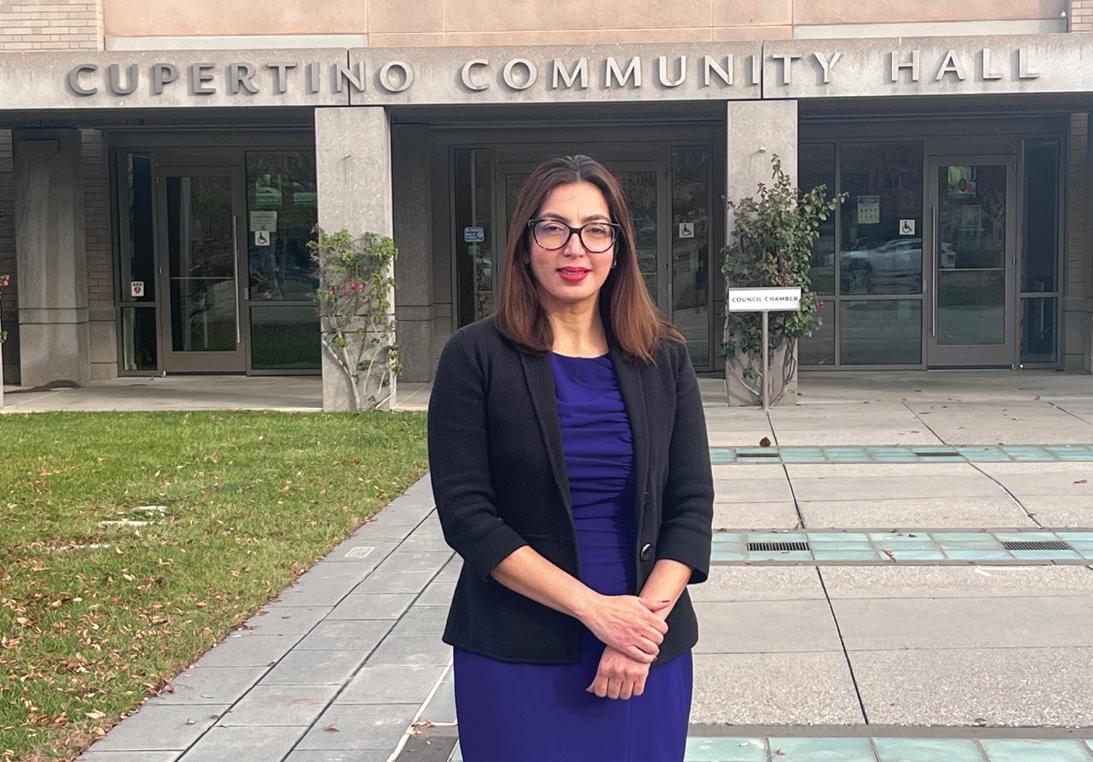
Following a unanimous appointment by the Cupertino City Council in November, Tina Kapoor serves as city manager, drawing on decades of public service and values shaped by her roots. Kapoor grew up in Meerut, India near Delhi. Her grandfather’s family endured terror and heartache when they were forced to escape from Pakistan after the partition of India to avoid being killed for being Hindu, she said.
As British rule ended in India in 1947, amidst demands for KAPOOR, PAGE 4
collection of model planes in his hometown of Connellsville, Pennsylvania.
“I had stamps, marbles, baseball cards and a comic book collection,” Galiardi said. “I've been a collector all my life.”
After graduating from Penn State in 1957 and serving two years in the U.S. Army, Gailiardi began a career in
public relations and advertising.
In 1989, Galiardi moved to Rancho Deep Cliff, a gated community in Cupertino. Because of the California weather and the Rancho Deep Cliff golf course nearby, Galiardi developed a routine of playing golf.
In his memoir, “Hooked on
To help you prepare for the June 2 statewide direct primary election, which determines the candidates that advance to the general election in November, let’s take a look at how California’s primary election system works and which state and county offices are on the ballot.
In California, except for the U.S. President, county central committees, and local offices, most offices are "voter-
nominated.” This means that the top two candidates from the primary election, without regard to political party, move on to the general election. General elections for an office are required even if one candidate receives more than 50% of the vote in the primary election. The State Superintendent of Public Instruction and certain special elections operate under different election rules and are not governed by the top-two voter-nominated system.

STAFF:
Executive Editor & Publisher
Tylor Taylor
tylor@sascc.org
Managing Editor
Brandy Maddox
brandy@sascc.org
Designer
Tanya Marutova
tanya@sascc.org
CONTRIBUTORS:
Wylder Robison
Lorraine Gabbert
Amy Vu
Joshua Hascall
Mendy Mao
Lloyd Russell
Sue Fenton
Marcia Farris
The Outlook is a collection community newspapers Los Gatos, Saratoga, Monte Santa Clara, and Cupertino. deliver accessible, uplifting, hyperlocal journalism that connection, encourages civic engagement, and people, events, and everyday moments that enrich
AUDIT COMMITTEE:
Jan. 26, 4 p.m. (Quinlan Conference Room)
ARTS AND CULTURE COMMISSION: Jan. 26, March 23, 6:30 p.m. (Quinlan Conference Room)
CITY COUNCIL: Jan. 27, Feb. 3, 19, March 3, 17, 6:45 p.m. (Council Chamber)
PLANNING COMMISSION: Jan. 27, Feb. 10, 24, March 10, 24,
Please note, all council, commission, and committee meetings are subject to change or cancellation. Check the city website prior to each meeting or call the city clerk at 408-777-3223. If the agenda for an upcoming meeting is not yet posted, check back closer to the meeting date for updated information.
View meeting info at: cupertino.legistar.com/Calendar.aspx
6:45 p.m. (Council Chamber)
BICYCLE PEDESTRIAN COMMISSION: Jan. 29, Feb. 18, (Quinlan Conference Room)
LIBRARY COMMISSION: Feb. 4, 7 p.m. (Cupertino Library)
PARKS AND RECREATION COMMISSION: Feb. 5, 7 p.m. (Quinlan Conference Room)
MONTHLY CHAT WITH MAYOR MOORE: Feb. 11, March 11, 5-6 p.m. (Monta Vista Recreation Center)
Mayor Kitty Moore is hosting a Monthly Chat Series in Cupertino throughout 2026, inviting residents and local businesses to discuss any topic with one of the city’s decision-makers. These informal gatherings offer a welcoming space for meaningful conversation and community connection.
TECHNOLOGY, INFORMATION, AND COMMUNICATIONS
COMMISSION: March 4, 7 p.m. (Quinlan Conference Room)
TEEN COMMISSION, March 11, 6 p.m. (Quinlan Conference Room)
PUBLIC SAFETY COMMISSION: March 12, 6 p.m. (Quinlan Conference Room)
HOUSING COMMISSION: March 26, 5:30 p.m. (Quinlan Conference Room)
Send letters to the editor, story ideas, feedback, and questions to outlook@sascc.org . Letters may be edited for length and
We are committed to accuracy and fairness. If you notice error or believe a story clarification, please email outlook@sascc.org with “Correction” in the subject We will review all requests promptly and publish
of serving Sereno, We and fosters highlights the community life for all ages. clarity. an requires line. corrections or updates as appropriate.
Interested in reaching readers in Los Gatos, Saratoga, Sereno, Santa Clara, and Contact us at advertise@sascc.org for advertising opportunities.
Monte Cupertino?
PUBLISHED BY

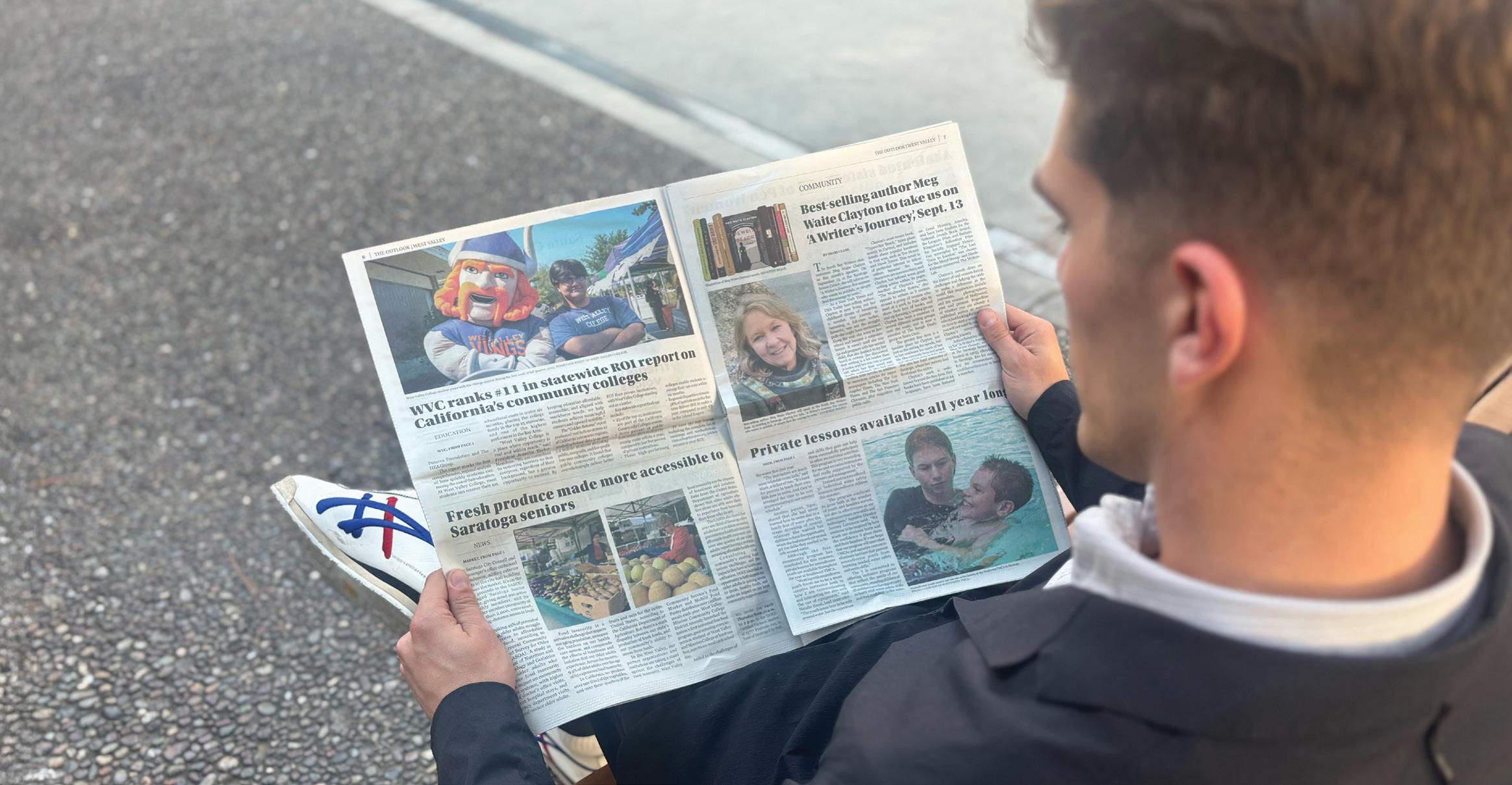
Your community paper thrives when readers like you get involved. HERE’S HOW YOU CAN JOIN IN:
Write a story: We’re looking for local features, community spotlights, student voices, and articles that celebrate life in West Valley.
Advertise your business: Reach a potential audience of more than 100,000 households across Silicon Valley.
Write a letter to the editor: Share your perspective on community issues or stories we’ve published.
Send a story idea, tip, or feedback: Help us cover what matters most to you.
CUPERTINO CITY COUNCIL APPOINTS
MOORE AS MAYOR, CHAO AS VICE MAYOR
The Cupertino City Council unanimously appointed Kitty Moore as mayor and Liang-Fang “Liang” Chao as vice mayor during its Dec. 11 City Council reorganization meeting at Cupertino Community Hall. Moore has served on the council since 2020, and served as vice mayor from December 2024 to 2025, when Chao was mayor.
“I appreciate the council’s confidence and look forward to continuing our work on behalf of Cupertino residents,” Moore said in a press release.
SWEETHEART SOCIAL
FEB. 7
The City of Cupertino will host its annual Sweetheart Social on Saturday, Feb. 7, from 6 to 8 p.m. at the Quinlan Community Center, 10185 N. Stelling Road. The familyfriendly Valentine’s Day event includes themed crafts, games, desserts and a keepsake photo opportunity. Children must be accompanied by an adult, and children under age 2 attend free. Registration is $5 for Cupertino residents and $6 for nonresidents.
Details and registration are available at cupertino.gov.
JOIN-A-RANGER: INTRODUCTION TO NATURE PHOTOGRAPHY
FEB. 14
Cupertino Park Rangers will lead Join-A-Ranger: Introduction to Nature Photography on Saturday, Feb. 14, from 9 to 10 a.m. at McClellan Ranch Preserve, 22221 McClellan Road. The guided program introduces participants to basic outdoor photography techniques, including composition, lighting and photographing wildlife responsibly. The hike covers approximately one mile on mixed dirt and paved terrain and is suitable for all skill levels. A modest program fee applies, with discounted rates for Cupertino residents. Pre-registration is required. More information and registration are available at cupertino.gov
LUNAR NEW YEAR CELEBRATION
FEB. 19
The Cupertino Chamber of Commerce will host a Lunar New Year celebration recognizing the Year of the Horse on Thursday, Feb. 19, at the Residence Inn by Marriott San Jose Cupertino at Main Street Cupertino. The event brings together community members, business leaders and residents to celebrate the Lunar New Year with cultural
programming and community festivities. Registration is required, and ticket pricing varies depending on membership status and selected options.
Event details and registration information are available at cupertinochamber.org
CONVERSATION WITH ASSEMBLYMEMBER
PATRICK AHRENS
FEB. 6
The Cupertino Chamber of Commerce Legislative Action Committee will host a conversation with Assemblymember Patrick Ahrens on Friday, Feb. 6, from 12:30 to 2 p.m. at Cupertino City Hall, 10300 Torre Ave. Attendees may register with or without lunch. Advance registration is required, and pricing varies depending on lunch selection and membership status.
Details and registration are available at cupertinochamber.org
CUPERTINO HOLI FESTIVAL OF COLORS MARCH 28
The City of Cupertino will host the Cupertino Holi Festival of Colors on Saturday, March 28, from 10 a.m. to 4 p.m. at Memorial Park, 21121 Stevens Creek Blvd. The outdoor celebration marks the arrival of spring and features music, dance performances, food vendors and traditional colorthrowing activities inspired by the Indian festival of Holi. The event is open to all ages. Admission is free, though food and vendor purchases are available for an additional cost.
More information is available at cupertino.gov
SPRING INTO YOUR FUTURE AT DE ANZA COLLEGE
De Anza College is welcoming prospective students of all ages to spring quarter enrollment, with classes beginning April 6. Whether students are starting college for the first time, changing careers or building new skills, De Anza offers associate degrees and certificates in more than 100 fields, including business, healthcare, technology and environmental science. Flexible scheduling options include online, evening and hybrid classes designed to fit around work and family commitments.
High school students may enroll through dual enrollment, while recent graduates can save significantly on tuition before transferring to a four-year university. Adult learners and career changers are also encouraged to apply.
Registration for all students opens Feb. 27. Financial aid is available, and De Anza’s Promise program may cover enrollment fees for eligible students.
More information is available at deanza.edu or by calling 408-864-5300.
De Anza College recently celebrated the reopening of The Hub, its basic needs resource center, with a ribbon-cutting ceremony attended by college, district and community partners. Now located in the Baldwin Winery Building, The Hub consolidates multiple services into one expanded space. Resources include food support through Roary’s Market, clothing and coats through Roary’s Closet, essential supplies, referrals, and access to hot meals provided weekly by World Food Movement.
In a single recent month, The Hub distributed more than 5,000 pounds of groceries to approximately 1,000 students, highlighting the ongoing need for basic support services.
Students in De Anza’s Automotive Technology Club also contributed by collecting 5,000 cans and packages of food during their annual fall food drive, a tradition they have maintained for more than two decades.
The Cupertino Senior Center offers instructor-led classes and programs for adults ages 50 and older, with options ranging from educational courses and recreational activities to social events and volunteer opportunities.
Classes are open to members and nonmembers, though nonmembers pay an additional $10 per class, per session. Program details are published in The 50+ Scene, the Senior Center’s quarterly newsletter. Registration for March and April programs opens Monday, Feb. 23.
The center will also offer a 50+ Pickleball Spring Season from March 30 through May 18, Mondays from 8 to 11 a.m. at the Cupertino Sports Center. The $32 seasonal fee includes court use; Senior Center membership and advance registration are required.
The Senior Center hosts a monthly movie screening on the last Wednesday of each month at 1:30 p.m., with upcoming showings Feb. 25 and March 25.
More information is available at cupertino.gov/ senior
ELECTION, FROM PAGE 1
California State Constitutional Offices
State offices are elected every four years in nonpresidential election years, with four-year terms generally limited to two per office. Some officials may serve more than eight years if they were first appointed to fill a vacancy and later elected to two full terms.
All constitutionally defined state offices are up for election this year, including governor, lieutenant governor, secretary of state, controller, treasurer, attorney general, insurance commissioner, and members of the State Board of Equalization.
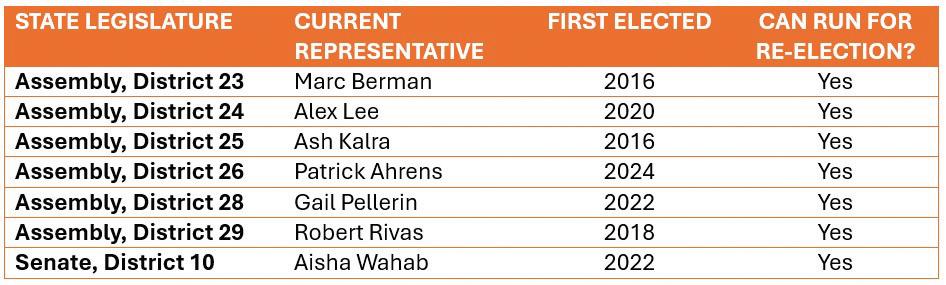
California State Legislature
There are 80 members of the State Assembly and 40 members of the State Senate. Assemblymembers serve two-year terms while Senate members serve four-year terms.
Members of the Assembly and Senate elected in 2012 or later may serve a maximum of 12 years in the California State Legislature, whether in the Assembly, the Senate, or a combination of both.
Members of the Assembly and Senate who were elected prior to 2012 can serve two four-year terms in the State Senate and three two-year terms in the State Assembly.
All State Assembly offices are up for election in 2026. Only even-numbered State Senate districts will hold elections this year.
The four U.S. House districts representing Santa Clara County currently are:
• District 16: Sam Liccardo
• District 17: Ro Khanna
• District 18: Zoe Lofgren
• District 19: Jimmy Panetta
Santa Clara County offices
Santa Clara County has four elected countywide offices:
• Board of Supervisors (five districts)
• County Assessor
• District Attorney
• Sheriff
In 2026, voters will elect:
• District 1 Supervisor
• District 4 Supervisor
• County Assessor
• District Attorney
• Sheriff Supervisors serve fouryear terms with a three-term limit. All other countywide offices have four-year terms with no term limits. Greg Monteverde is currently acting county assessor. Neysa Fligor won the Dec. 30, 2025 special general runoff for county assessor and, after certification, will be sworn in to complete Larry Stone’s term. Fligor must run again in 2026 if she seeks a full term.
Santa Clara County Superior Court Judges
Santa Clara County has 77 Superior Court judge
To find out which district you live in, use the Find My Representative tool on the California State Assembly website, assembly.ca.gov/ assemblymembers/find-myrep
United States House of Representatives California has 52 representatives in the U.S. House of Representatives, all of which are up for election every two years. There is no term limit for U.S. House members.
Voters should confirm their current district with the California Secretary of State, their county elections office, or at selc.senate.ca.gov/proposedcongressional-map
positions. In 2026, 29 judges are scheduled for re-election. Superior Court judges serve six-year terms with no term limits. If an incumbent judge files for candidacy and has no opponents, they are reelected automatically without appearing on the ballot. Find the judges who are up for re-election in 2026 at vote.santaclaracounty.gov/ superior-court-californiajudicial-officers
Voters are encouraged to review their districts, learn about the candidates, and confirm election dates and rules through official county and state election resources.

KAPOOR, FROM PAGE 1
separate Muslim-majority and Hindu-majority states, the region was divided along religious lines into the Union of India and Dominion of Pakistan. Widespread violence followed, killing millions and displacing 12 to 20 million people.
“There are different things that someone could take away from such a traumatic experience,” Kapoor said, “but for my family, and for my grandfather in particular, I think the experience reinforced the belief that prejudice based on religion, caste, or anything else was wrong.”
Her grandfather, who fought in the Indian Independence movement, taught Kapoor the importance of standing up for what’s right and that everyone deserves to be treated with fairness and respect, regardless of their background or beliefs.
“I try to live my life with that lesson in mind,” she said.
In India, Kapoor attended a private Catholic school from kindergarten through high school and was raised with a mixture of Catholic and Hindu traditions. As a child, she
enjoyed playing outdoors until sunset and hearing stories told by her tight-knit family. Some things remain dear to her from those times.
“I miss the festivals and the simple, small joys,” she said. Kapoor’s father was a wellknown television actor before working for the State Bank of India. Later, her parents started a preparatory elementary school as they valued education.
“Not everyone could send their kids to a private school,” she said, “and they wanted to provide that opportunity to kids in our community.”
At 19, Kapoor relocated to the United States. Curious about how local government decisions affect the community, she worked for the City of San Jose as junior staff in the finance department and soon joined the city manager's office. She rose through the ranks in the city’s economic development department to become the downtown lead. In this role, she focused on business growth and retention, quality of life, cultural events like the first Bollywood Week and sporting events such as Super Bowl 50.
“I enjoyed the dynamic and
diverse nature of downtown,” she said, “and I enjoyed meeting so many creative and interesting people.”
Kapoor said she was lucky to have numerous mentors through the years who both taught and supported her. They include Shawn Spano, founder of Public Dialogue Consortium; Kelly Kline, associate vice president for Local Government Affairs at Stanford University; and Laurel Prevetti, retired Los Gatos City Manager, who reminded her to believe in herself and be ready for opportunities.
“I owe so much of my success to them,” she said. “I would not be here now ... without them.”
After working as Fremont’s Economic Development Manager, Kapoor came to Cupertino in 2021 to assist in to assist in building out its economic development department and later became deputy city manager. She is proud of guiding the city manager’s office staff through leadership changes while maintaining a high level of service for residents and strong staff morale, she said.
“I bring quiet, steady
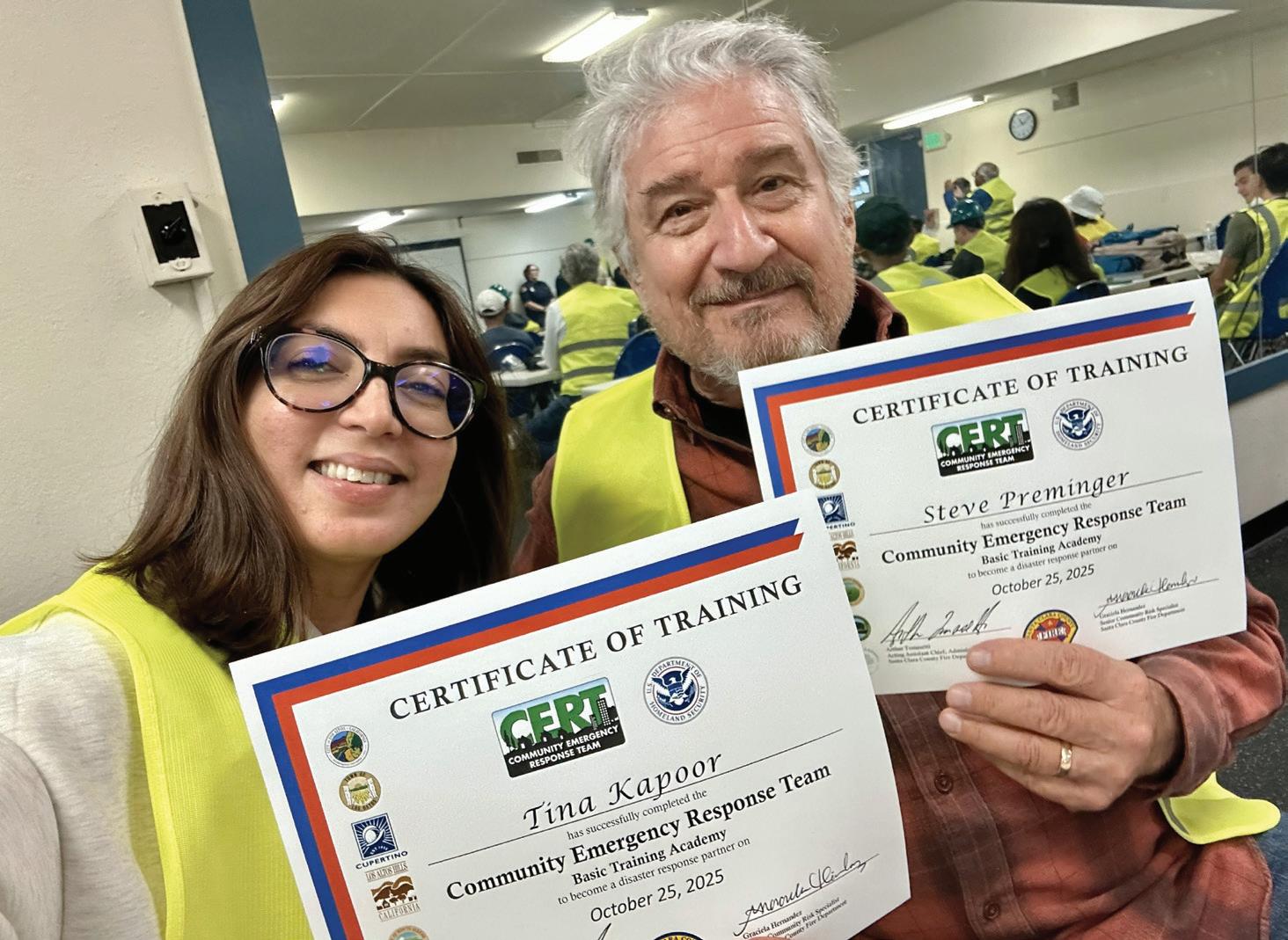
leadership, decades of local government experience and the ability to remain calm under pressure,” she said. “My priorities for Cupertino are high quality and responsive public service, strong economic growth, long-term fiscal and environmental sustainability, and thoughtful management of development and change.”
A city manager implements policies set by the city council, manages staff, prepares budgets and provides objective input. Kapoor appreciates the confidence the city council has shown in her since appointing her to acting and then interim city manager.
“I understood the challenges of accepting the city manager position in Cupertino,” she said. “I have been heartened by the breadth of support I have received from the city council and the community since my appointment.”
Kapoor believes her collaborative leadership style and ability to work across political divides provides Cupertino an opportunity to strengthen relations among its city council, staff, and the community.
“A diversity of viewpoints is critical in a democratic political process,” she said, “I hope even when people disagree, they can try to find common ground. And even when they can't find common ground, they can still disagree respectfully and ultimately respect each other. I will encourage the city council to continue embracing these values, expect my staff to work in accordance with them, and will do my best to model them in my own conduct.”
Kapoor is optimistic that her welcome reception from the community bodes well for bringing needed stability to the city administration, benefiting the city council, staff, residents, and local businesses. She is focused on working collaboratively to address upcoming challenges, including ensuring Cupertino’s long-term fiscal health and navigating future growth.
“We have a strong leadership team in the city administration and councilmembers who are uniformly committed to serving Cupertino’s long-term interests,” she said. “I am honored to be able to work with all of them to address these challenges and make the most of the opportunities.”
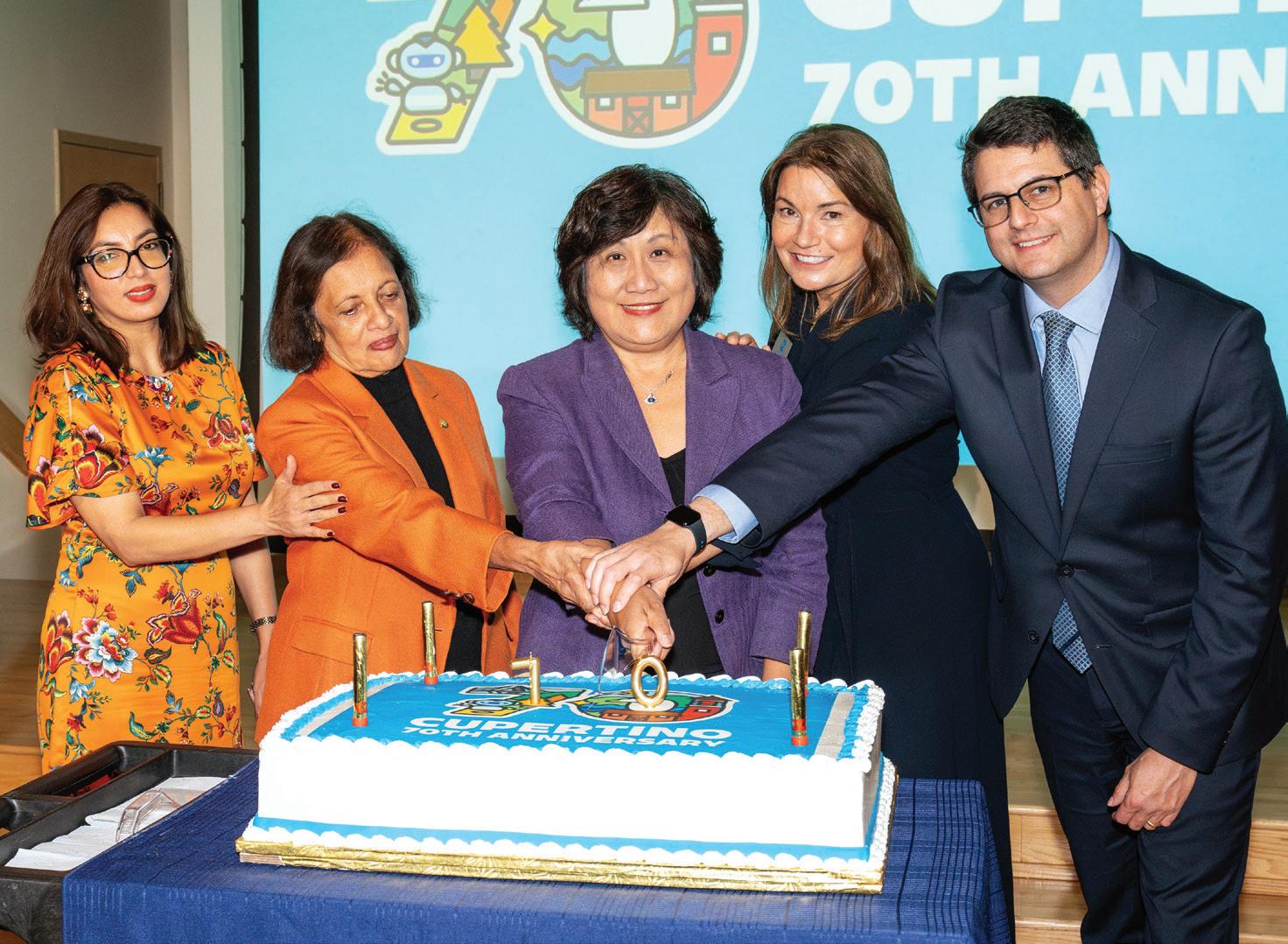
FROM PAGE 1
Autographs,” Galiardi writes that around this time he began a new project: collecting logo golf balls from the courses he visited. The project later pivoted to collecting signed golf balls along with books, photos, and other memorabilia.
“I had hoped that my newfound passion would offer a greater level of excitement, challenge and enjoyment,” Galiardi wrote. He also realized the new hobby would give him the opportunity to meet renowned professional golfers.
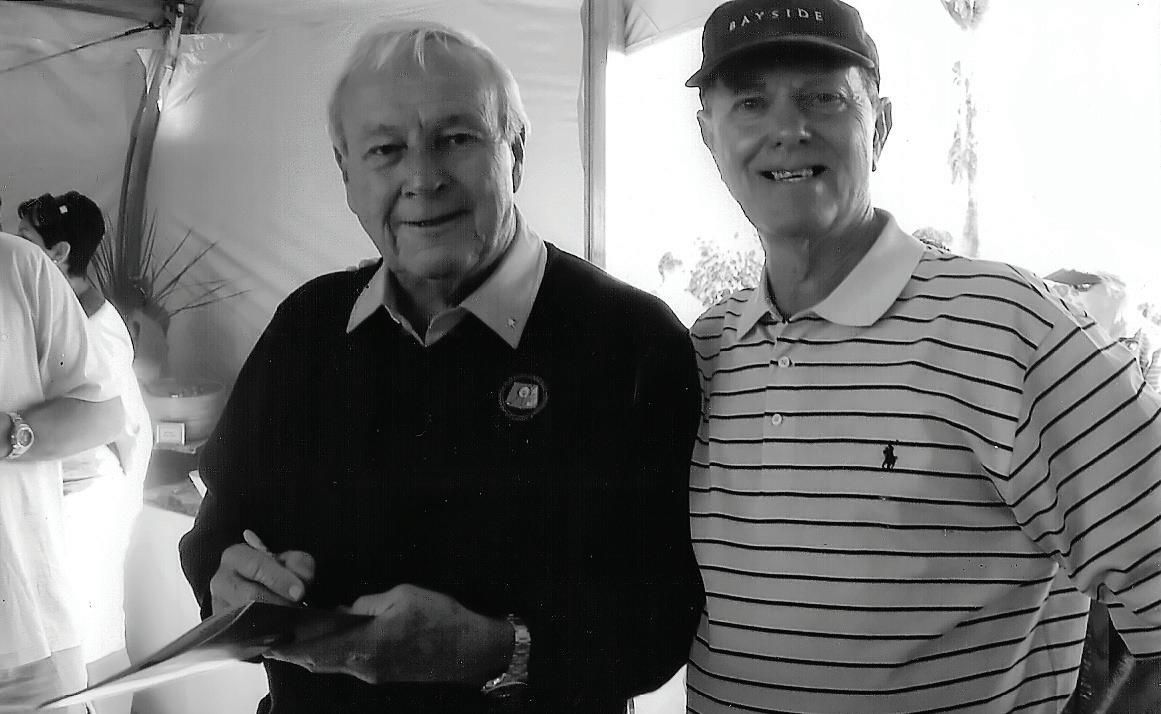
Galiardi knew who he wanted to sign the first ball of his collection: professional golfer Arnold Palmer. In 1989 Gailardi learned that Palmer would be playing in the inaugural Transamerica Senior Golf Championship at Silverado Country Club in Napa.
“I thought, ‘Here’s my chance to get Arnold Palmer’s signature, and he’ll be the first one to start my collection,’” Galiardi said.
Galiardi drove to the country club and found Palmer on the putting green, then followed him for all 18 holes, watching Palmer make an eagle on the final hole. Galiardi said when the time came for autographs, he was 20th in line and unsure whether Palmer signed golf balls.
Galiardi was going to tell Palmer that they grew up 20
miles apart from each other, but Galiardi decided against it “I thought, 'No, don't do that. Just ask him.”
“I said, ‘Arnie, would you be kind enough to sign this golf ball?’ And he just looked at me, and he signed the ball, and I walked away,” Galiardi said. “I felt like a six year old kid who just got a dog for a birthday.”
A year later, Galiardi had another golfing icon, Jack Nicklaus, sign a ball at Pebble Beach Golf Links.
After Nicklaus’ autograph, Galiardi said he “went rampant” and was hooked on his new hobby.
“I traveled all over the country for autographs,” Galiardi said.
Galiardi said he used a mix of approaches to collect autographs, from sending letters to seeking people out in person.
In “Hooked on Autographs,” Galiardi writes that after a failed attempt to obtain Olympic swimmer Michael Phelps’ autograph through a friend in Baltimore, he tracked Phelps to Santa Clara, where he learned the swimmer would be practicing ahead of the 2009 Santa Clara International Grand Prix.
“For this one you had to have a lot of balls, because no one could have gotten his autograph that day,” Galiardi said.
Galiardi arrived in Santa
Clara to find the practice closed to the public, with access limited to swimmers and coaches.
Rather than leave, he writes in “Hooked on Autographs” that he slipped past an attendee at a side gate, found Phelps, and asked for an autograph.
“Without uttering a word he took the ball and the black Sharpie from my grasp, then signed the ball,” Galiardi wrote.
Aside from building a record-holding collection, Galiardi also devoted his time to public service, playing a role in establishing Mothers Against Drunk Driving in Northern California in 1980 and later
receiving an award of merit from the San Francisco City Council.
A veteran himself, Galiardi also sought to give back to other veterans. He chaired the Paralyzed Veterans Golf Open for five years, which benefits the Paralyzed Veterans of America (PVA).
“We raised about $40,000 every year [for the PVA],” Galiardi said.Galiardi also donates half of the proceeds from his book to the PVA, he said as a way to give back.
Galiardi said the piece of the collection that means the most to him is the first autographed
golf ball he received from Palmer in 1989.
“He started this whole thing. He started my book and he's helped all the paralyzed vets,” Galiardi said. “Because I give back to them.”
Galiardi said he has received offers from golfing clubs asking him to donate his collection, but he is not ready to give up the hobby yet.
“Life goes on. That collection goes on, and I'm not going to stop,” Galiardi said. “The Heisman Trophy winner was announced [recently] from Indiana and I'm going after him.”

BY JOSHUA HASCALL
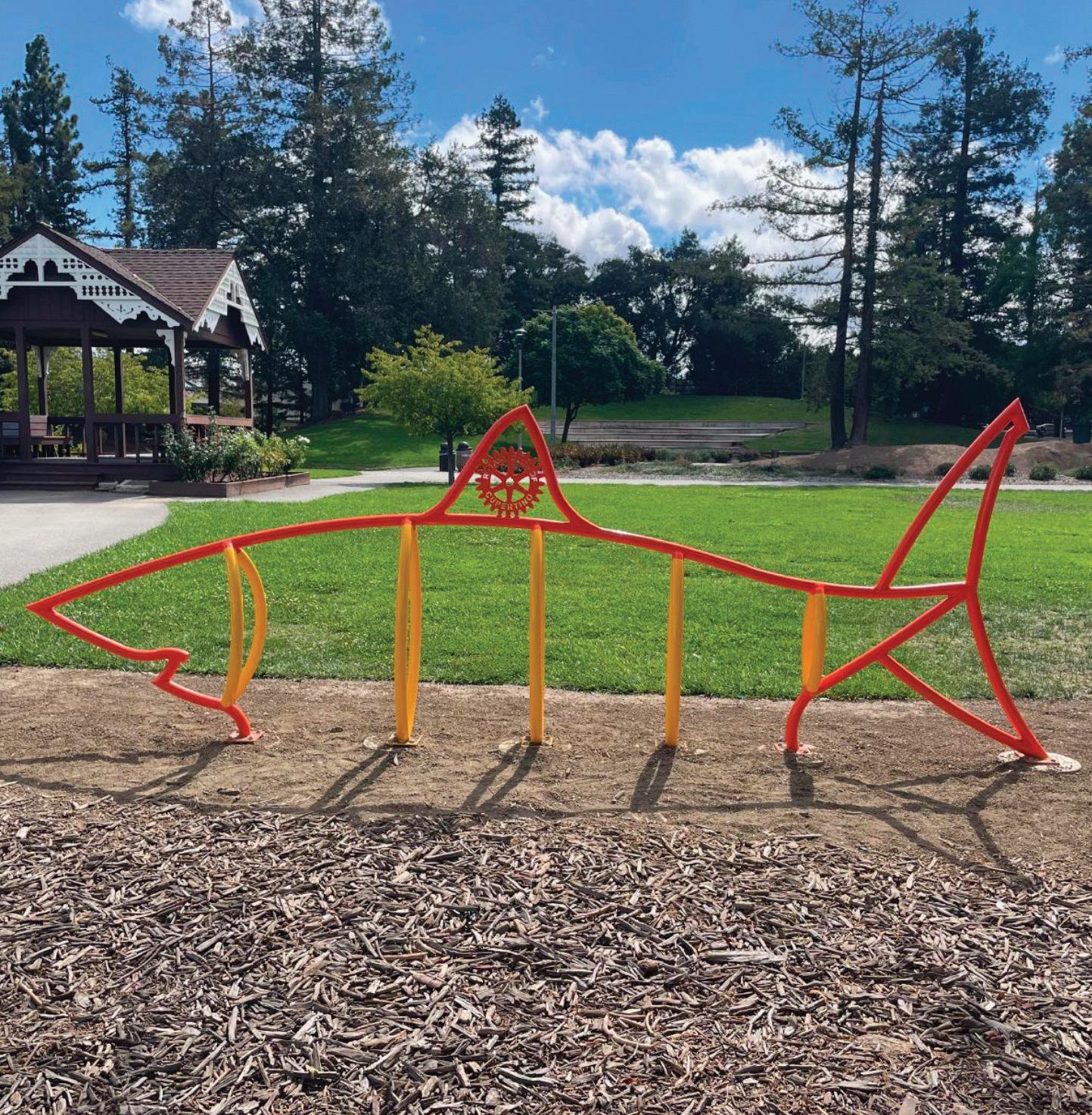
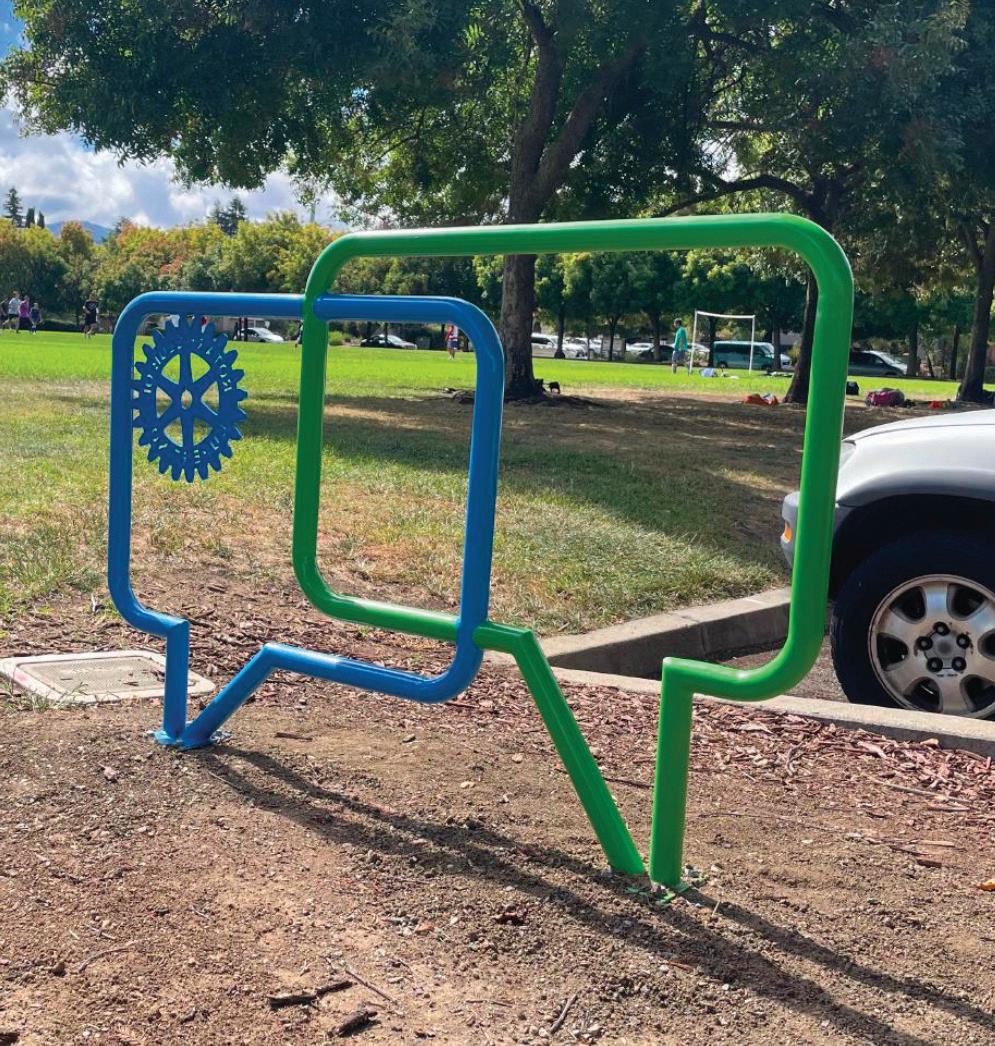
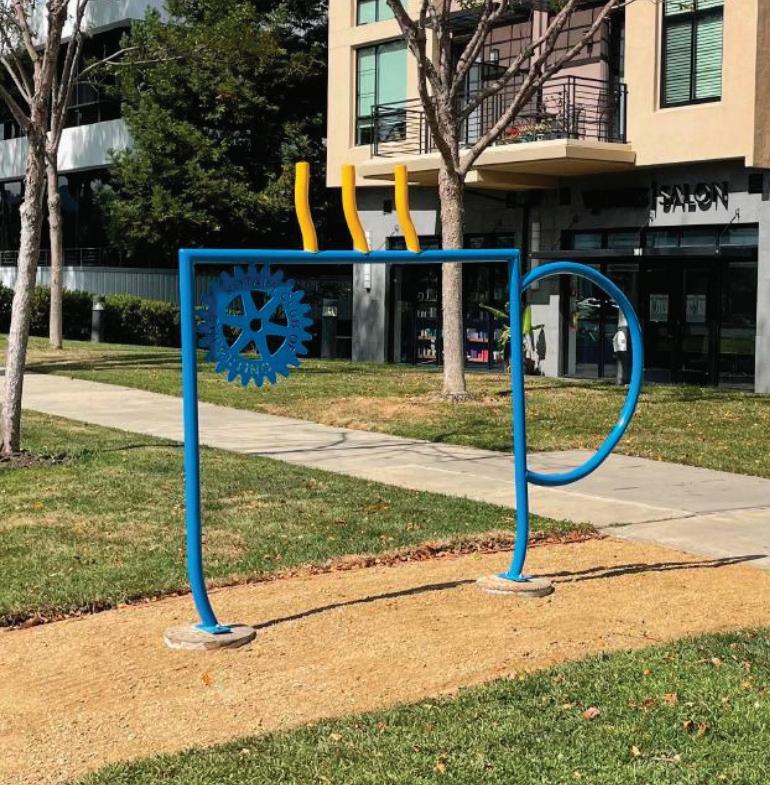
A great white shark rises from the ground at Memorial Park, not as a sculpture but as a functional bike rack. The shark is one of six newly installed artistic bike racks created through a partnership between the Cupertino Rotary Club and the City of Cupertino.
“We wanted something that would make this community happy and bring joy but also serve a useful purpose,” said Seema Lindskog, a Rotary member and project lead for the bike rack project. “We want to encourage people to bike more places and give them a joyful reason to do that and a safe place to park their bike.”
People visiting Memorial Park, Wilson Park, Library Field, McClellan Ranch, Wild Tea, and Café Latté will notice bike racks that differ significantly from typical public bike racks. Unlike standard inverted-U racks, the new installations double as public art, adding character while encouraging cycling and other non-gas-powered transportation options.
The City of Cupertino initially budgeted $50,000 to install inverted-U bike racks in various locations around the city. To turn the racks into public art, the Rotary Club proposed upgrading the designs and covering the additional costs, and the city agreed.
The city’s Bicycle Pedestrian Commission identified potential bike rack locations, from which the Rotary Club selected six sites best suited for the artistic bike rack program. Rotary members connected with Dero, a company that designs and manufactures bike racks, after colleagues
from a similar Los Altos project recommended them.
“They're a very experienced company,” Lindskog said. “You can sketch a design on the back of a napkin and give it to them, and they know exactly how to turn it into a bike rack that meets the municipal code requirements of cities.”
With approvals in place, the Rotary Club began installation of the bike racks. Because city codes strictly regulate installation and materials, the Rotary Club turned to Rotarian George Denise, who has extensive construction management experience.
“Luckily one of our rotarians is amazing and used to manage all the Oracle properties, and he's very knowledgeable about construction in general,”
Lindskog said. “George became my partner. I helped organize the volunteers, and he basically told us what to do, how to do it, and what tools to bring.”
About 30 to 40 Rotarian volunteers took part, digging trenches, building concrete forms, hauling heavy racks, and securing them permanently to public property.
“It's a fair amount of work. I learned a lot. I knew nothing about concrete. Now I know a lot more,” Lindskog said.
Each rack was designed to reflect its surroundings.
At McClellan Ranch, a wagon wheel represents the site’s agricultural history. Memorial Park features a great white shark, while Wilson Park’s rack takes the shape of a salmon.
Café Latté and Wild Tea have a coffee mug and ice cream coneshaped rack, and Library Field, located near Cupertino City Hall, features a rack in the form of chat bubbles, representing
community engagement through communication.
The community has responded positively to the new bike racks.
“They're nice, and the idea of encouraging cycling — that's a good thing,” Cupertino resident Mark McKenna said.
“It's definitely better than your usual bike rack, the typical one,” Cupertino resident Sagar Shelke said. “Looks nice in the park. It's a fish where the water used to be,” said Shelke, referring to the shark-shaped rack’s placement in an area of Memorial Park that once held a pond.
“I love when people look at the shark and laugh and smile, and it's functional art,” Lindskog said of the Memorial Park rack. “It brings joy and delight, but it also serves a purpose — a very useful purpose. When Fall Fest happened, lots of people sent me pictures. The shark rack was just packed with bikes of all kinds.”
Rotary clubs are nonprofit organizations operating in cities worldwide. In Cupertino, the Rotary Club has supported numerous community projects, including the Norwell Park gazebo and a Thanksgiving meal program that delivered more than 1,225 meals to 159 homes.
The project’s success offers a model for long-term community enrichment through functional art.
“I feel like if there's an opportunity for residents to have a moment of delight or a moment of joy or something that brings a smile to your face as you're walking in the park, I think it's worth it,” Lindskog said. Learn more at cupertinorotary.org

BY LORRAINE GABBERT
The Cupertino-Toyokawa, Japan Sister Cities program has fostered community ties since 1978, imbuing participants with a deeper level of cultural understanding and appreciation.
Sister Cities International was founded by former President Dwight Eisenhower in 1956 to promote peopleto-people connection and cultural, educational and trade exchanges around the world. Former Mayor of Toyokawa, Yoshio Yamamoto, shared this vision and sought to establish lasting peace between countries by educating future generations.
In 1979, a student exchange program began between the two cities with a visit by six Toyokawa middle school students and two teachers to Cupertino. That year, an adult delegation visited Toyokawa with a gift of 25 redwood tree saplings. A visit by eight Cupertino Union School District middle school students and chaperones to Toyokawa followed in 1983. Marking the fifth anniversary of the sister city relationship, Cupertino received a gift of 200 young cherry blossom trees from Toyokawa, kicking off its Cherry Blossom Festival.
Alysa Sakkas, the longstanding president of the Cupertino-Toyokawa Sister Cities program, said it’s heartwarming to see how much this program means to both cities. Sakkas became involved in the program when her son George was selected as part of a student delegation. She said families who host exchange students or chaperones bond, sharing meals and staying together. Sakkas has remained in touch with a student she hosted in her home nearly 20 years ago.
“You’re getting to spend quality time with them and share ideas and information,” she said. “We all have the same dreams and aspirations. President Eisenhower, when he started the Sister Cities International Program, had the right idea; it takes grassroots connections to help build world peace. That's what the sister city programs try to do.”
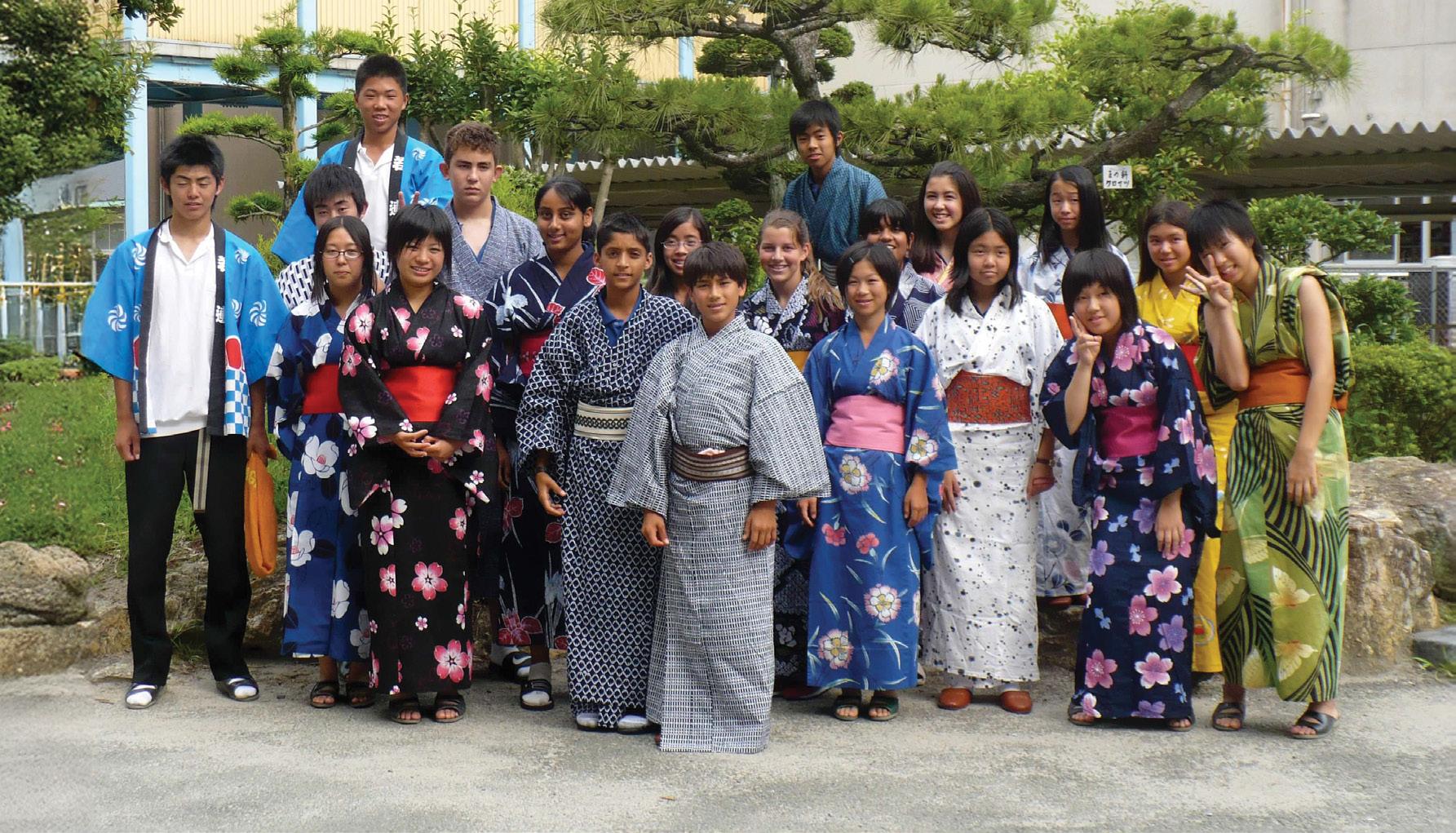
Students go to school and spend weekends seeing the sights with their host families and chaperones. Two students of the same gender stay with a family, fostering a close relationship and the opportunity to experience daily life. This year, Toyokawa students toured McClellan Ranch Preserve in Cupertino where they watched a blacksmith in action and learned about nature. The students were also introduced to the 4-H farm and beekeeping, toured the Google campus, and went paddle boating.

Families are responsible for the costs of their students to participate, but the organization pays for chaperone expenses and activities, Sakkas said, through funds raised at the Cherry Blossom Festival. Cupertino also covers a portion of the program’s. The student exchange program is open to seventh- and eighth-grade CUSD students.
In preparation for their trip, Cupertino students attend cultural classes, learn Japanese phrases, etiquette and practice a performance they present in Toyokawa.
“They love learning about Japanese culture,” Sakkas said. “The relationships and interests that bloom from participating in the program make it all worthwhile.”
This summer, 16 Cupertino students and three chaperones visited Toyokawa, and a delegation came to Cupertino. Jocelyn Fu, who participated in the 2024 student exchange program, embraced a deep dive into Japanese culture and staying with a Japanese family.
“Staying with them, we got to see how Japanese people live,” Fu said. “They focused on eating dinner together and eating breakfast together, which I thought was really nice. And they talk to each other a lot.”
Fu said classmates are close knit as students stay in one classroom while teachers rotate. She finds it cool that students clean their classrooms, halls and bathrooms.
Outside of school, students attended a night festival wearing yukatas they were gifted, visited Japanese shrines and made soba noodles. Fu is grateful for the experience and being a bridge between the two cities connecting their cultures. She urges other students to consider participating in an exchange program.
“You might learn a lot,” Fu said, “and you're going to have a lot of fun.”
Through the years, the sister cities have exchanged numerous meaningful gifts. In 1988, Cupertino presented Toyokawa with a full-size replica of its Morian helmet sculpture to commemorate the 10th anniversary of their relationship. After 9/11, Toyokawa raised about $20,000 for New York City and in 2011, Cupertino raised about $28,000 to support recovery efforts following Japan's earthquake and tsunami.
Cupertino Vice Mayor Liang Chao (who was mayor at the time of this interview) hopes the sister city relationship brings economic development
socially distant bell ringing in Memorial Park and have continued the tradition annually.
Annie Wu, who visited Toyokawa with the 2024 delegation, said there are many differences between American and Japanese schools and households. People often say a prayer before and after they eat, she said, and wear numerous pairs of slippers.
“Lunch is mostly served by students, and they're also the ones who clean up. Students would help clean up the classroom, sweep the floors and wipe the desks,” she said. “It was nice that the students took responsibility and it’s a fun way to end the day at school.”
Wu visited a few major cities and shrines and appreciated vending machines offering hot tea and cocoa. Her hosts made her feel like part of the family and she came away with a better understanding of Japanese culture, she said.
Japan's always held a special place in exchange student Vihaan Shah’s family. He grew up hearing stories about Japan as his father had lived there.
“When I heard about the exchange program, it sounded amazing,” Shah said. “The opportunity to go to a foreign country ... and experience a culture that I wouldn't have gotten to experience as a tourist was an opportunity I didn't think I could pass up.”
opportunities to both countries. She said the program is lifechanging for students, providing a global perspective. Except for the pandemic and times of natural disasters, a student exchange has continued annually, and an adult exchange every five years.
The student exchange program spans generations. Cupertino welcomed the third generation of the Imaizumi family to Cupertino in October. Yakumo Imaizumi joined Cupertino’s delegation almost 40 years after his father, Fumiaki Imaizumi, was a student delegate. His grandfather, Tokuyoshi Imaizumi, was part of an adult delegation to Cupertino in 2018.
The same year, a Cupertino adult delegation paid their respects at a Peace Park honoring women and children killed in 1945 when Toyokawa was bombed. Moved, members of the sister city organization sent one thousand origami cranes to Toyokawa. In 2020, to commemorate the 75th anniversary of the end of World War II, sister city members shared in an online peace ceremony, along with city representatives and the Consul General of Japan in San Francisco. Organization members also gathered for a
Part of the 2025 delegation, Shah enjoyed creating washi paper from scratch and learning to play the Japanese harp at school. He said students don’t bring lunch to school. Instead, a few students from each classroom pick up a cart with food from the cafeteria and bring it to the classroom. But overall, he said staying with his host family left the strongest impression.
“The entire experience of spending time with a different family was amazing. They were incredibly welcoming,” Shah said. “Even with limited language, laughter and gestures did most of the work. I feel like I have two homes; one in Cupertino and one in Toyokawa.” He urges students considering participating in an exchange program to “apply with their whole heart.”
“You'll create friendships ... and you'll get to see a version of Japan tourists wouldn't get to,” Shah said. “It's creating new bonds that will last a long time. You'll come back differently, in probably the best way possible. You'll most likely be more organized, more disciplined, more responsible, more openminded and more connected to a world a lot bigger than you may have thought it was.”
Visit cupertinotoyokawa. org to learn more.
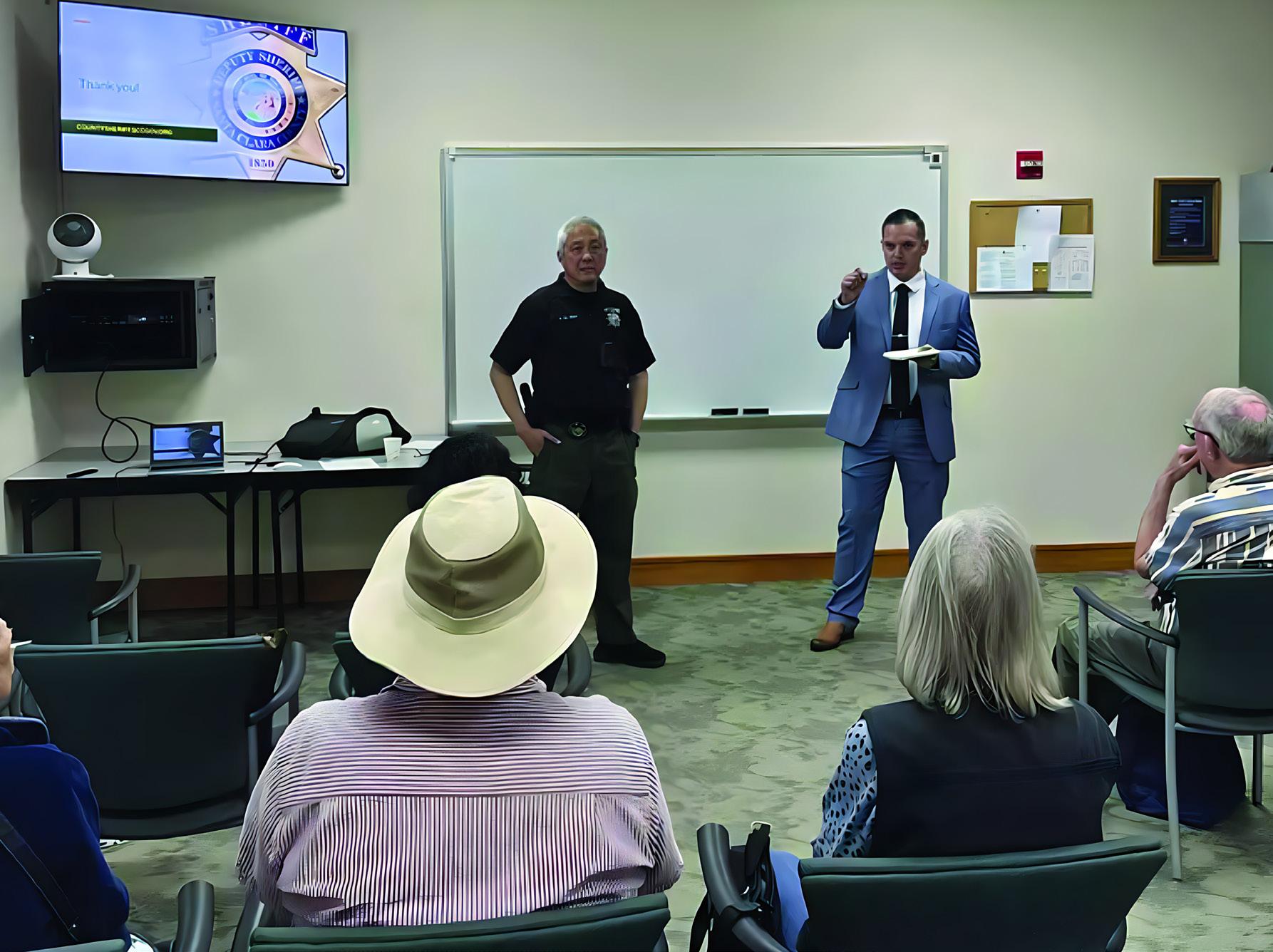
Following fraud prevention seminars held in Cupertino last summer, the Santa Clara County Sheriff’s Office is continuing its community education efforts with a free presentation in February at the Saratoga Senior Center, offering another opportunity for residents to learn how to recognize and avoid scams targeting older adults.
The “Stop Scams Against Seniors” seminar will take place Wednesday, Feb. 18, from 12:30 to 1:30 p.m. at the Saratoga Senior Center, located at 19655 Allendale Ave. The event is open to the public and designed to help older adults, caregivers, and family members identify common fraud schemes and reduce their risk of victimization.
The presentation will be led by Deputy Robert Yee of the Santa Clara County Sheriff’s Office, who has been actively involved in fraud prevention outreach across West Valley communities, including Cupertino. The seminar will cover scams frequently reported by older residents, such as romance scams, Medicare fraud, fake tech support calls, utility scams, and impersonators posing as government officials.
Participants will learn practical strategies for
protecting personal and financial information, with an emphasis on slowing down and verifying unsolicited communications received by phone, email, mail, social media, or in person. Attendees will also have the opportunity to ask questions and discuss real-world scenarios.
According to Yee, scams represent a rapidly growing problem nationwide. In a recent conversation with Santa Clara County Supervisor Susan Ellenberg, he noted that reported scam losses exceeded $16 billion nationwide in 2024, based on data from the FBI’s Internet Crime Complaint Center, with losses rising sharply in recent years.
Older adults are disproportionately affected, accounting for the highest number of reported scam complaints and billions of dollars in losses annually. California consistently ranks among the states with the highest number of reported cases and financial losses, underscoring the importance of local prevention efforts.
Organizers say the Saratoga seminar is especially timely as tax season approaches and economic uncertainty continues, making older adults more vulnerable to financial exploitation. For Cupertino
residents who may have missed the earlier presentation, the upcoming seminar offers another opportunity to access the same prevention tools and guidance.
The seminar will also connect attendees to local support services available through the Saratoga Senior

Center, including Senior Adults Legal Assistance (SALA) appointments, AARP TaxAide, and technology support to help seniors navigate digital communication more safely.
The event is free to attend, and doors will open 15 minutes before the scheduled start time. No registration is required.
For additional information on scam prevention and protective resources, residents can visit the Santa Clara County Sheriff’s Office scam prevention webpage at tinyurl. com/sccsheriffscamprevention or contact the Sheriff’s Office at (408) 808-4400.
Chefs of Compassion brings together Silicon Valley’s culinary talent for an evening that pairs great food with community impact. The annual fundraiser supports West Valley Community Services (WVCS), a nonprofit that has served low-income and unhoused individuals and families in Santa Clara County for more than 50 years.
WVCS provides food, housing assistance, referrals, and case management to residents facing food and housing insecurity across Cupertino, Los Gatos, Saratoga, Monte Sereno, West San Jose, and surrounding mountain communities. The organization works in partnership with local governments, donors, volunteers, and foundations to support more than 15,000 people living in poverty throughout its service area.
At the event, professional
chefs from across Silicon Valley each prepare a course inspired by ingredients commonly found in the WVCS food market. Chefs are judged live on taste, presentation, and creativity by a panel of guest judges, with attendees also voting for a People’s Choice award.
In addition to a threecourse dinner and wine, the evening includes stories from WVCS clients, offering insight into the real-world impact of the organization’s work.
Past participating chefs have represented a wide range of acclaimed local institutions, including All Spice, Manresa, Alexander’s Steak House, Stanford Health Care, Taverna, Google, Flights, AXL Gastropub, and others. For tickets and more information, visit chefsofcompassion.org/ tickets/2026

BY MENDY
With cooler winter weather settling in, it’s an ideal time to lace up your boots and head outdoors. As an avid hiker, I’m always searching for the best local spots to explore during the quieter season. These are some of my favorites, from challenging treks with sweeping views to relaxed nature strolls. Each trail stood out for its scenic vistas, lush winter landscapes, or abundant wildlife.
5. Parker Ranch Loop Trail (Saratoga) — Hard, short, sunny views
Starting at Prospect Creek or farther in at the Fremont Older Connection trailhead, Parker Ranch Loop features fenced orchards, steep climbs and stunning views. Most of the year, it’s dry and dusty with little shade, but the view makes it worth it.
After ascending a flight of wooden stairs, hikers can reach Vista Point, a hilltop lookout offering a panorama of Saratoga and the valley beyond. From there, you can retrace your steps for a short half-mile
out-and-back, or continue on the ~2.2-mile loop. For those looking for more mileage, the trail also connects to Fremont Older Open Space, where routes stretch several more miles, up to around 6.5 miles. Located right off Prospect and walkable for nearby residents, Parker Ranch doubles as a workout trail with its tough climb. Don’t forget water and sun protection for this exposed hike.
4. Big Basin Redwoods State Park: Redwood Trail (Boulder Creek) — Easy, iconic trees
About a 30-minute drive from Saratoga, Big Basin is California’s oldest state park and home to some of the most iconic coastal redwoods. The diversity of trees here makes it worth the trip.
For hikers who want something light, the Redwood Trail is a flat, half-mile loop that shows off many of the landmark redwoods, including one that’s hollowed out so you can step inside. It’s a short walk with a huge payoff. Parking costs $8 with a reservation or $10 without.
3. Sanborn County Park:
Sanborn Loop to Indian Rock (Saratoga) — Moderate, long, lush forest
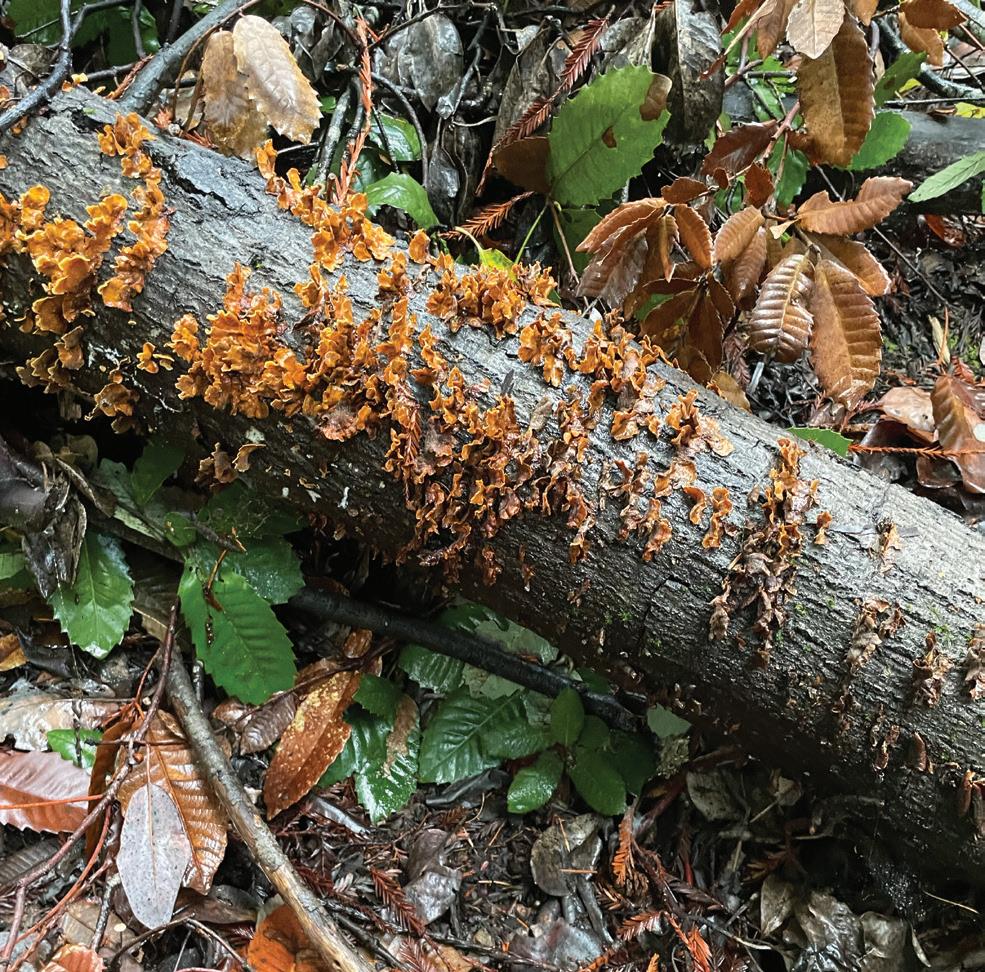
Just a few miles west of Saratoga, Sanborn feels remote and wild with its spread of redwood forests. Even on sunny winter days, the trails stay shady thanks to the canopy. In winter, mist and fog often roll in, covering everything in moss and fungi and giving the woods a gothic, almost otherworldly feel.
My favorite route connects Sanborn Loop with Indian Rock, coming in at around 8 miles. Hikers of different levels can use the park map to shorten or extend the trip. The higher elevations bring out sweeping views of the mountains and highlight the forest’s diverse plant life. Daily parking is $6.
2. Rancho San Antonio: Deer Hollow Farm Trail Loop (Cupertino) — Easy, wildliferich
Rancho San Antonio is one of the most popular local hiking spots, with trails that feel like a step into the wild. The Deer Hollow Farm Trail Loop is about 3 miles and mostly flat, making it accessible for nearly
everyone. The trail leads to Deer Hollow Farm, where livestock and gardens are a big draw for families with kids.
Wildlife is everywhere here. Owls nest in the trees, turkeys strut across the path, and mule deer often graze nearby. On cooler winter days, snakes may still be spotted in sunny patches. Around dusk, visitors sometimes report bobcats slipping through the grass or coyotes on the move—one reason the preserve closes its gates at sunset. The trail has little shade, so bring water and sunscreen if you’re out during the day.
1. Villa Montalvo County Park: Lookout Point Loop (Saratoga) — Moderate, shady retreat
Located at Saratoga’s landmark Villa Montalvo, the Lookout Point route is about 2 miles round trip and offers a blend of history and nature. Rustic stone stairs, wooden trail signs and towering redwoods make the path feel magical, with fungi often lining the damp, shaded ground during the winter months.
At the top, Lookout Point
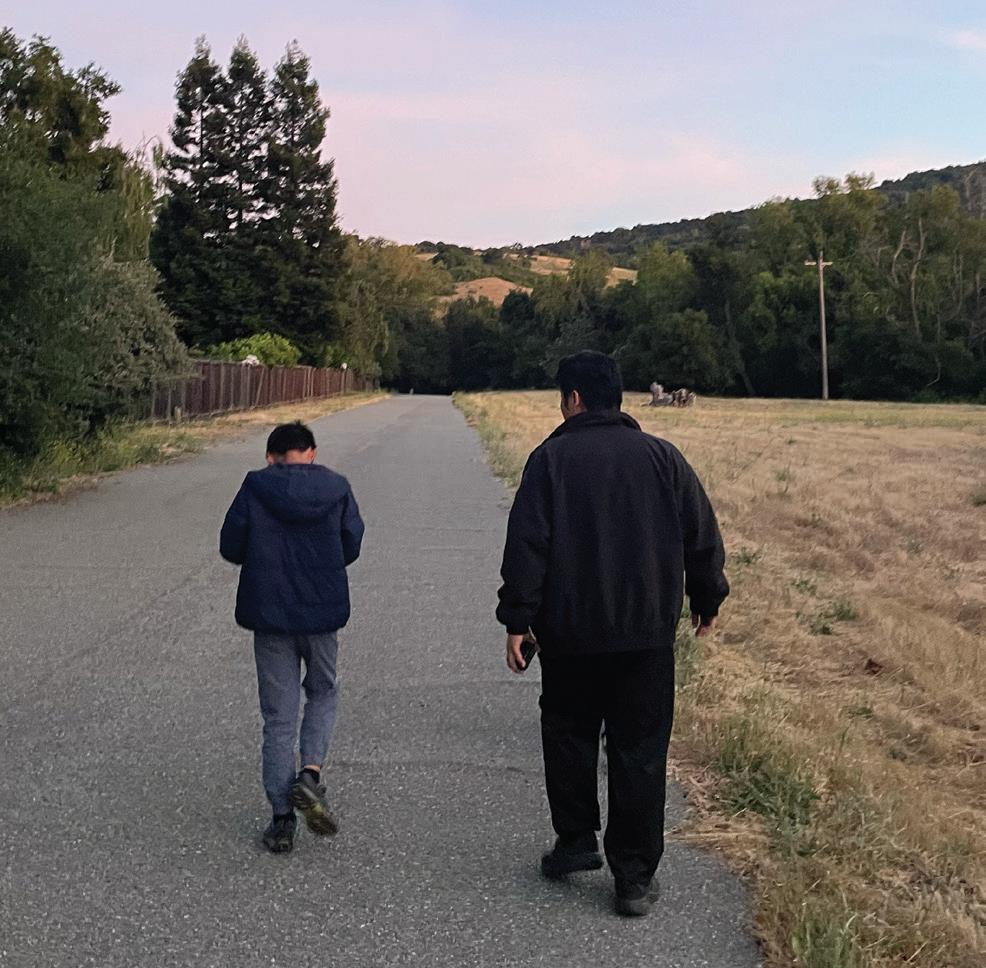
opens to a wide view of Saratoga and the forest beyond. Afterward, visitors can explore the Montalvo Arts Center grounds, which feature Mediterranean-style architecture, gardens and sculptures. Once the estate of California Sen. James Phelan, it’s now both a cultural site and a perfect picnic spot.
This trail is my personal favorite for its beautiful views, lush winter landscape and the bonus of Montalvo’s historic grounds.
Honorable Mention: Alviso Marina County Park: Alviso Slough Trail (San Jose) — Easy, lakeside wildlife
Known for its salt ponds, marshes and migratory birds, Alviso Marina County Park is a must-stop for bird-watchers. The Alviso Slough Trail is a flat, roughly 8-mile loop along raised walkways with wide views of the wetlands.
Winter sunsets are especially striking here, when the sky turns orange and reflects across the water. Bring a windbreaker or jacket, as the breeze off the water can be especially chilly this time of year.

BY LLOYD RUSSELL

Everybody knows about beachy summer reads — the books you take to the beach or other vacation spots while you sit in a chair or lie on a towel. But what about reads for when it’s cold outside? When you’re stuck indoors with time on your hands? What do we call those? Until now, I don’t think they had a name.
Well, now they do: Comfy Winter Reads.
And since winter is close at hand, here are a few titles I recommend.
“How the Grinch Stole Christmas!” by Dr. Seuss. Everybody knows this one.
“Harry Potter and the Prisoner of Azkaban” by J.K. Rowling. The “Harry Potter” series is the best-selling series of all time, with more than 600 million copies sold. This particular book takes place during the winter months.
“The Chronicles of Narnia” by C.S. Lewis. Another hugely popular series, with more than 120 million copies sold and translations into 47 languages. Book 1, “The Lion, the Witch and the Wardrobe,” takes place in the heart of winter.
“Last Christmas in Paris” by Hazel Gaynor and Heather Webb. A terrific book I read late last year. Here’s a synopsis from a review I wrote in December: “Last Christmas in Paris” centers on Thomas Harding and Evie Elliott. Evie is the younger sister of Will Elliott, Tom’s best friend. They all grew up together. When Britain enters World War I, Tom and Will enlist and are sent to France. The story — told entirely in letters (epistolary form) — explores the relationship between Tom and Evie, as well as the experiences of soldiers, the changing role of women, and the struggle to keep
communication lines open from the front.
“Winter Garden” by Kristin Hannah. I’ve read many of her books, and they’re all excellent. This one has a particularly interesting storyline: Two sisters couldn’t be more different. One stays home to raise her kids and manage the family apple orchard; the other travels the world as a photojournalist. When their father becomes seriously ill, they come together — and learn about their mother’s past in war-torn Leningrad five decades earlier. What they discover changes their lives forever.
“City of Thieves” by David Benioff. Besides being a screenwriter and producer (he co-wrote “Game of Thrones” for HBO), Benioff is an author. “City of Thieves” is unlike anything you’ve read — or
will read: During the siege of Leningrad by Germany in World War II, when supplies to the city are cut off, a Russian colonel decides he needs fresh eggs for his daughter’s wedding cake. So he frees two prisoners and sends them into the countryside to find eggs. The book follows their escapades.
That’s it for now. But if you want more Comfy Winter Reads, let me know: llo ydrrussell@ gmail.com
THIS MONTH’S TRIVIA
Which author — and childhood friend of Truman Capote — helped him research “In Cold Blood?”
A. Carson McCullers
B. Harper Lee
C. Norman Mailer
D. William F. Buckley Answer to last edition’s trivia: C. Colson Whitehead.
BY SUE FENTON
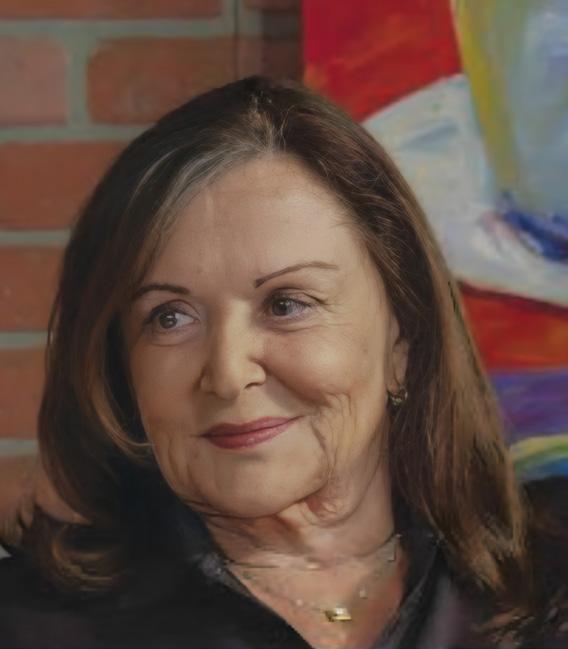
Recently, the longevity discussion has finally shifted to women. Well, it’s about time. For years, we’ve only heard about men and longevity. Now,
women finally get their chance. The longevity of women has long been a mystery. Let’s explore the new data with the inclusion of actual science. Could female hormones hide the secret? Sue on the Street is very interested in exploring the research. We always knew that women live longer than men — but why? It turns out that the age a woman goes through menopause is a key indicator of longevity. It also affects the longevity of her daughters, sons, sisters and brothers. Her husband is not included in the data — more on that below.
So why is Sue on the Street so interested? When my older
brother and I went to school one day, my mother went to the doctor because she thought she had the flu.
“You didn’t get the memo that you should be in menopause,” the doctor said. “You’re pregnant!”
She had a healthy baby at the age most women go through menopause. My mom used to say that my baby brother kept her young. Suffice it to say, the menopause symptoms that most women have were nonexistent in my mother. Some women have a lousy menopause. Some women barely know they had it.
I am not suggesting that 50-year-olds should have
children. But my mother did live to be 100. It wasn’t that she used up all her energy running after my little brother. She just ran out of steam. Sue on the Street is now 80, and I plan to keep going as long as I can, if you’ll have me. I was thinking this column should be for women only. But my husband said that isn’t fair; menopause affects men as well as women. As a matter of fact, it affects everybody in the family. The season of menopause can put a strain on relationships. So those ovaries are not just for making babies but also for keeping women feeling young — and for keeping husbands and children happier.
Disclaimer: Sue on the Street is not a medical professional, nor do I expect to become one at age 90 (which is how long it would take). So this article is not the gospel on menopause. As a matter of fact, it is not the old testament on menopause, even though some people in the Old Testament lived to nearly 1,000 years. When I looked up longevity in the Old Testament, I found that seven men lived more than 900 years. What happened to the women? I wonder how they managed their menopause. After all, Abraham’s wife Sarah had her first baby at age 90. Must have been late menopause.
BY MARCIA FARRIS
Cleaning one’s ears seems to be a frequent topic of discussion, so this column will address several aspects of safe cerumen (ear wax) removal.
Many of us remember being told never to put anything smaller than our elbow in our ear. While that adage is much older than many of us, it remains good advice. Most people don’t actually need to clean their ears. The natural movement of cerumen is outward, allowing it to fall or wash out on its own. Cerumen also serves an important purpose: it lubricates the ear, traps dirt, and acts as a water repellent. In most cases,
it’s best to leave it alone.
Q: I was told never to use a Q-tip or a hairpin to remove wax. Why not?
A: Cotton swabs and similar objects can leave fibers in the ear, worsening the problem. More often, they push cerumen deeper into the ear canal, where it can become impacted against the eardrum. Impaction may lead to reduced hearing, pain, tinnitus, or infection. Sharp objects can irritate or scrape the ear canal, causing bleeding, and both cotton swabs and sharp objects can perforate the eardrum. There are many “horror stories” of cotton-tipped swabs being pushed too far into the ear, resulting in permanent
damage. Some people have even used screwdrivers or toothpicks—an extremely dangerous and ill-advised practice.
Q: What about “candling” to clear wax?
A: Ear candling is another dangerous old “home remedy.” It can result in burned hair or melted wax dripping into the ear canal or onto the eardrum. While proponents claim it creates a vacuum that “sucks” wax out of the ear, it simply doesn’t work. Doctors routinely find cerumen buildup even after patients say they’ve used candling.
Q: My hearing aids get blocked by ear wax. What should I do?
A: Cerumen in a hearing aid earmold can usually be removed fairly easily. Most hearing aids have wax guards that wearers can change themselves, and tools are available to remove wax from the earmold. If wax blocks the tiny tubing, an audiologist or hearing aid specialist may remove the blockage or replace the tubing altogether.
Q: If I’m not supposed to use cotton swabs, what should I do?
A: Several safe options are available. Over-the-counter ear wax removal products can be effective if used exactly as directed. However, these should not be used if you
have a perforated eardrum. Your doctor may also advise against OTC products if you’ve had certain ear surgeries or recurrent ear infections.
Professional cerumen removal is another safe option. ENT doctors, primary care physicians, trained nurses, and some licensed audiologists can remove ear wax safely.
The bottom line: no cotton tips, lit candles, or sharp instruments in your ears. If removal is necessary, see a professional. Please do not hesitate to send in questions! Send them to The Outlook or directly to: hear@gizmology.com
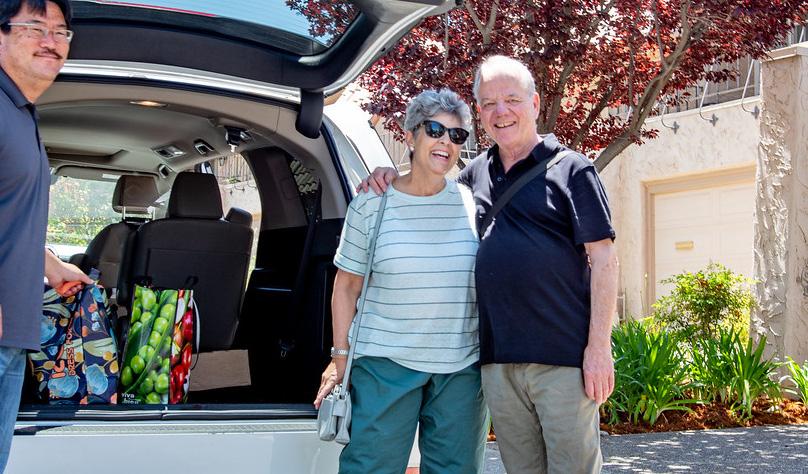
RYDE PROVIDES COMPASSIONATE CARE & CONNECTION Do you or someone you know need support with transportation?
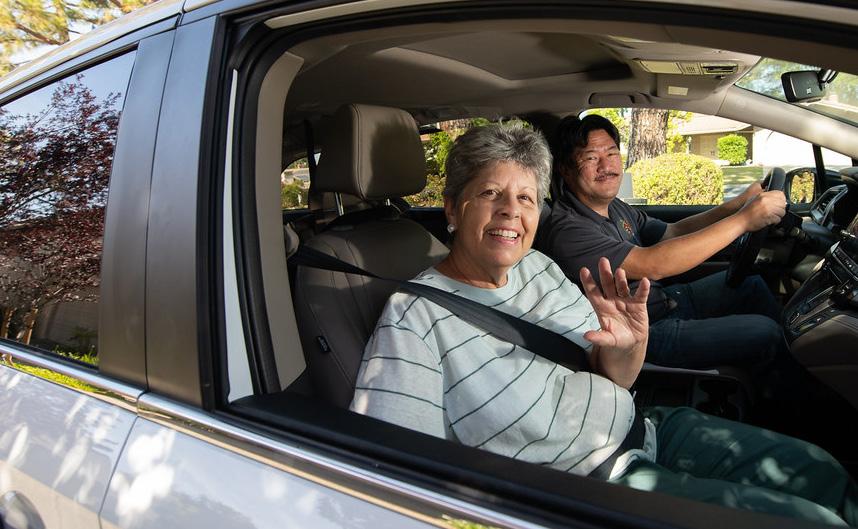
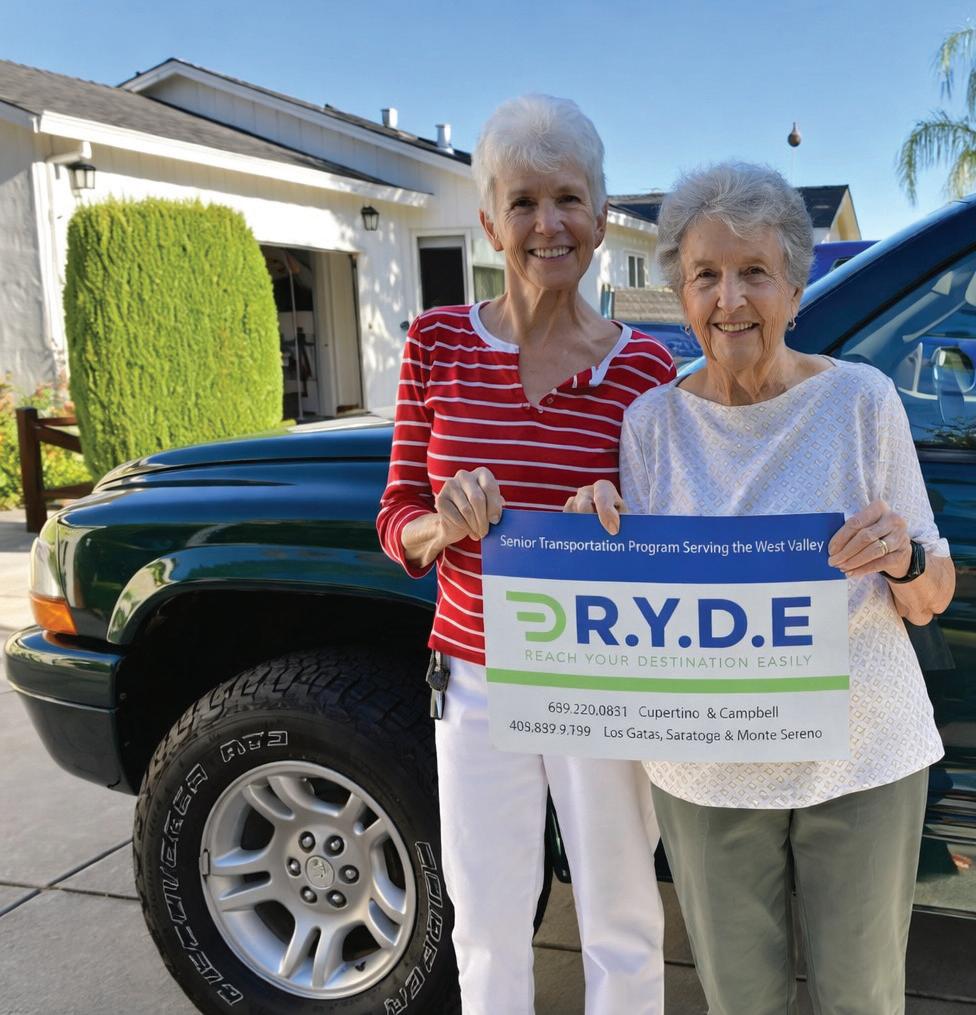
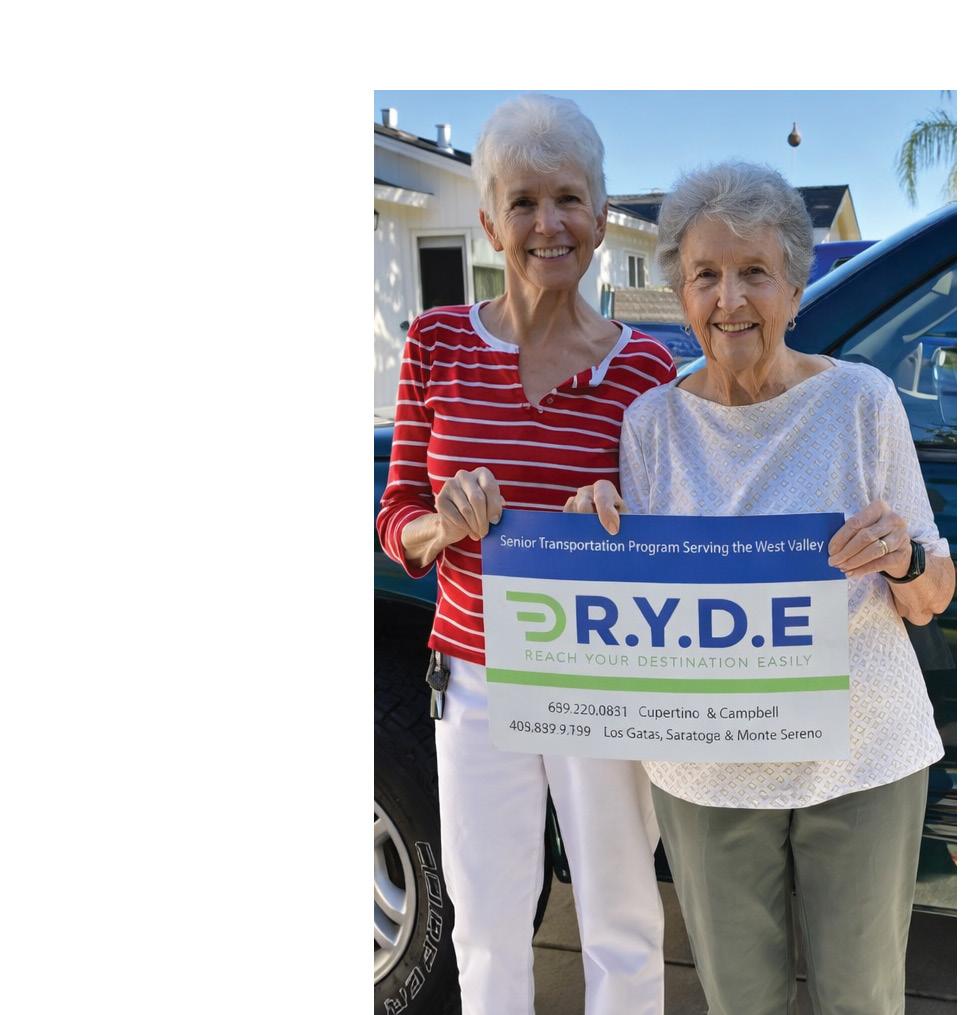
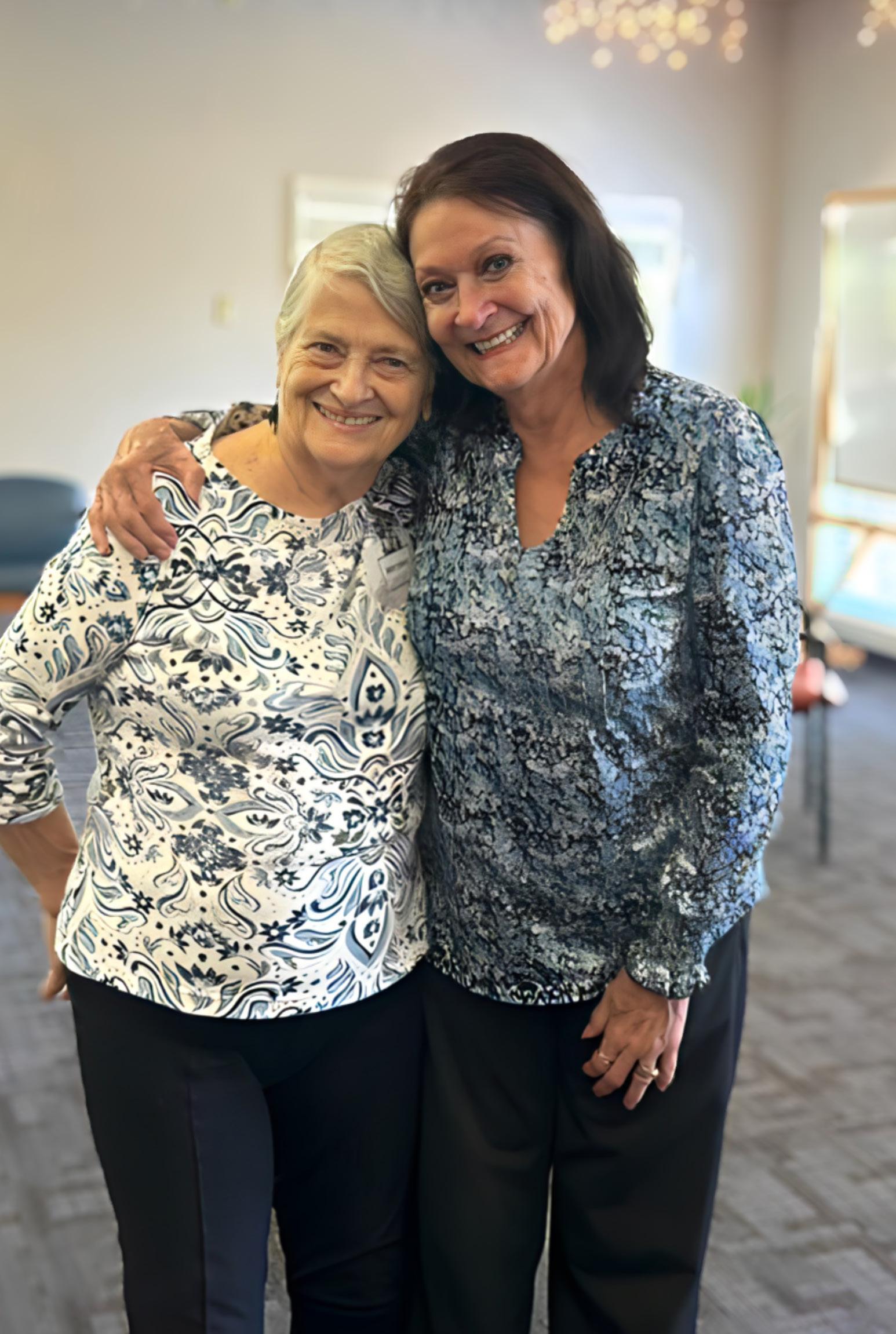
When Gloria’s had to stop driving at the age of 90, she was unsure how she’d be able to get around. Gloria remembered she had cut out a RYDE Senior Transportation advertisement from a newspaper, so she gave RYDE a call.
Her local RYDE Coordinator set Gloria up with a volunteer driver, Carolee, who Gloria says has become “like a sister.”
“They couldn’t have sent me a better angel,” she said. “We clicked like two sisters right away.”
She said Carolee is always on time, is a safe driver, she watches Gloria while she’s walking, and provides her with support if she needs it.
Gloria said she also appreciates RYDE’s affordability, offering sliding scale price options for people of all income levels who are 65 years and older.
CONTACT RYDE TODAY.
RYDE is available to ambulatory residents ages 65+ living in Cupertino, Campbell, Saratoga, Los Gatos, Monte Sereno, some areas of San Jose, and Morgan Hill.


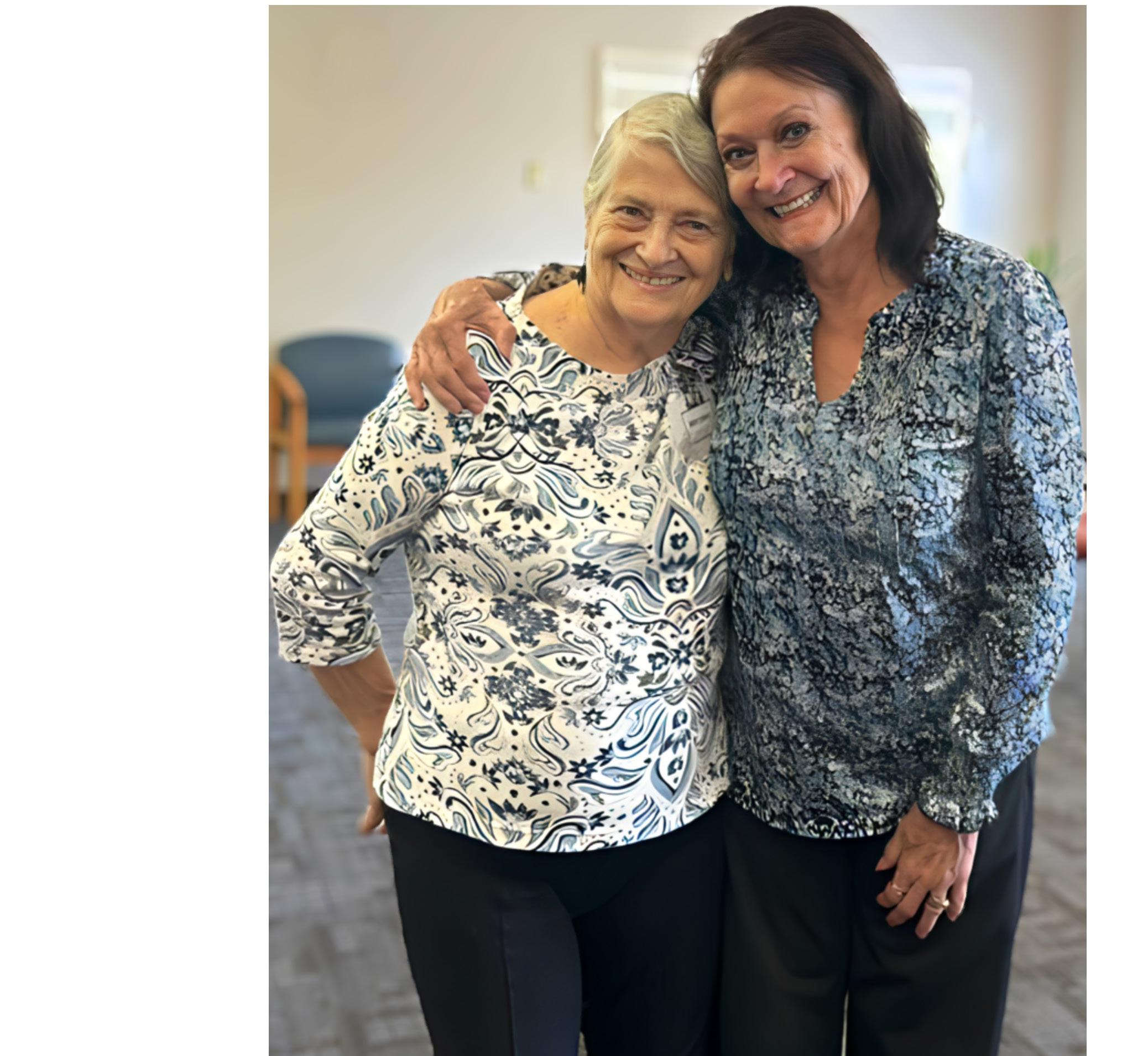
• Safe and Supportive Environment
• Evidence-Based Activities
• Social Connection
• Nutritious Meals and Snacks
• Personalized Assistance
• Extended Care Hours
• Specialized Dementia Care
• Caregiver Respite
COUNTY ADULT DAY SUBSIDY PROGRAM INCOME LIMITS
STEP 1: How many people do you live with?
STEP 2: Does your entire household make less than the Low Income Limit?
STEP 3: If YES, you qualify for Free Participation, up to 5 days per week!
RATES AND ADMISSIONS
Offering affordable and easy-to-access Adult Day Care!
FREE PARTICIPATION: Available through the County Adult Day Subsidy Program*
PRIVATE PAY: Income-based sliding scale, from $85 - $120 per day
VA: Veterans may receive financial support through the VA. Call for details!
SCHEDULE A FREE VISIT TODAY!