TheFallOpiate 2026, Vol. 47
The Opiate Your literary dose.
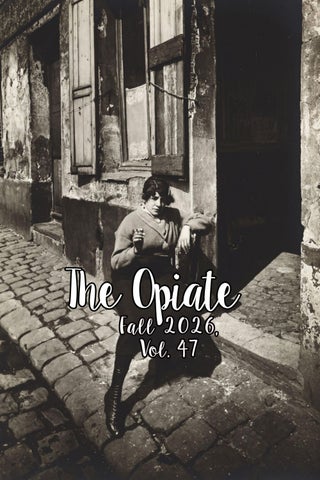
© The Opiate 2026 Cover art: La Villette, fille publique faisant le quart, 19e, Paris by Eugène Atget, circa 1921 This magazine, or parts thereof, may not be reproduced without permission. Contact theopiatemagazine@gmail.com for queries.
“God, but life is loneliness, despite all the opiates, despite the shrill tinsel gaiety of ‘parties’ with no purpose, despite the false grinning faces we all wear. And when at last you find someone to whom you feel you can pour out your soul, you stop in shock at the words you utter—they are so rusty, so ugly, so meaningless and feeble from being kept in the small cramped dark inside you so long.” -Sylvia Plath, The Unabridged Diaries of Sylvia Plath
“‘Somebody,’ said Jacques, ‘your father or mine, should have told us that not many people have ever died of love. But multitudes have perished, and are perishing every hour—and in the oddest places!—for the lack of it.’” -James Baldwin, Giovanni’s Room
“My loneliness is killing me.” -Britney Spears
3.
The Opiate, Fall Vol. 47
Editor-in-Chief Genna Rivieccio Editor-at-Large Malik Crumpler Editorial Advisor Anton Bonnici Contributing Writers: Fiction: Max Talley, “Darling Little Monsters” 10 Rich McFarlin, “Moon Landing” 23 Penny Nolte, “Rockin’ the Valley” 32 Barry Dinerman, “The Yahrzeit Game” 35 Gary Brandt, “Writers Are Scum” 49 Poetry: Brandy McKenzie, “Reminder: Medieval Rabbits Wore Armor” & “Geopolitics” 76-77 August Truly, “Gastrointestinal” 78
4.
Jeffrey Zable, “The Story of Ben Zedrine,” “I Don’t Know If It’s True or Not,” “Reading William S. Burroughs” & “If You Want to Be a Poet” 79-82 Priscilla Atkins, “Selling the Mattress” & “Oh, Come On” 83-84 Robert Witmer, “Dada,” “Broken Dreams: A Lexicographer Picks Up the Pieces,” “Deucalion Does His Thing, Or: Why Clay Tablets Were Burned,” “Somewhere Over the Rainbow” & “The Right to Bare Arms” 85-91 Susie Gharib, “Obelisks” & “The Gavel” 92-93 Sophie Roy, “Lady July” 94-97 Peter Crowley, “Decision,” “Must’ve Been a Hallucination,” “Thoughts on Randomness” & “She” 98-102 Bruce Morton, “Plasticity” 103 Charlie Robert, “Mannequin” 104-105 Frank Freeman, “In Midair and Flailing” & “In the Marrow” 106-107 Ron Torrence, “The Immensity of Being” 108 Criticism: Genna Rivieccio, “Zoe Dubno’s Happiness and Love Spotlights the Loneliness Not Only of Being an Artist, But an Artist Trying to ‘Make the Scene’” 110
5.
The Opiate, Fall Vol. 47
Editor’s Note
Even in an epoch that is expressly designed to isolate people, it still seems as if the act of “being alone” not only remains “rebellious,” but, as has often been the case presented in high school movies and rom-coms, the mark of a loser. In the past, that mark was more generally reserved for women, who could be written off as “spinsters” even in their late twenties if they didn’t “manage” to get married. In more recent years, that pendulum has swung, for the first time ever, toward men, who are now the ones deemed the “freaks” (a.k.a. incels) for ending up alone. Or, in other words, being so gross in terms of looks and (/or) personality that they can’t attract a woman. And since this epoch is (theroetically) more modern than the ones during which women were branded as “useless” and “irrelevant,” it is the latter gender that has been vindicated, at last recognized for their (often superior) intelligence, their more empathetic nature and their ability to make money. To be sure, women actually being able to get paid for their work in the twentieth century, when the structure of “equality” that the U.S. knows at present first began to fully form, is what changed the game in the power dynamics of so-called romantic relationships. (Even though romance is largely a construct that was designed to make marriage seem less business-oriented [ergo, more clinical] to women.) Because, in truth, many women probably wouldn’t have felt obliged to get married were it not something that their lives quite literally depended on. After all, not only was a woman’s “place” decreed as being “in the home,” tending to chores and children, but it was also the unspoken rule that only men could work. Or at least work for pay, since the domestic and emotional labors of women have long been (and continue to be) “invisible.” Expected to be done gratis. Thus, with all of this history between the sexes considered, it really is no small wonder that more women are throwing up their hands and deciding that being alone is preferable (even if it can still also mean being lonely). Take, for example, yet another more niche trend on TikTok that finds women in their twenties acting as, let’s say, “solitude influencers” (though the people condemning their so-called “glamorization” of being alone choose to call them “loneliness influencers”). One of the faces of that trend is Lana Isa, who notes, “People don’t talk about having no friends a lot...I
6.
think it’s still what people would consider embarrassing or a little taboo.” More to the point, it can still be seen as a stigma. A red flag that indicates you’re such a freakshow that you can’t even find one person to show up for you in life. That is loneliness in its purest and most undiluted form. And yet, there are many others it comes in. Like, most famously, the old chestnut about how there’s nothing worse than feeling alone in a crowd. Or, as Lord Byron phrased it, “I stood among them, but not of them.” This is often the case for writers and serial killers alike. At least for writers (I can’t speak for serial killers, promise) who are truly committed to it, and who, oftentimes, have gone further down the rabbit hole of writing precisely because they don‘t fit in anywhere else within the framework of the “real world.” Besides, as it is also said, “It’s better to be alone than in bad company.” Writers, however, might often find that their own company (frequently the only company they have if they’re doing their job right) can be just as...fraught as trying to hang out with a slew of people. Then there are the types, non-writer ones, who genuinely can’t subscribe to the “better alone than in bad company” philosophy. Who would rather take the shitty, soul-sucking company than endure spending even one minute alone with themselves. This, too, is one of the fundamental problems that plagues most humans. To the point where Blaise Pascal once astutely observed, “All of humanity’s problems stem from man’s inability to sit quietly in a room alone.” Yes, that does about sum it up and get to the heart of the matter. Which is that the perennially “unquiet” human mind will do just about anything, no matter how technically unenjoyable (e.g., working) to silence itself. And that typically requires the distraction of socialization, often in environments designed to “entertain” (e.g., the bar, the restaurant, the sporting event, the communal beauty service, the movie theater, etc.). So long as one is not only entertained, but also in company (often seeking entertainment itself from that company), they have succeeded at ignoring the number one things that all humans wish to avoid acknowledging: we are all alone and we are all going to die. But so long as these sentiments can be staved off with distraction, distraction and more distraction (for world leaders, this also extends into the reason behind most warfare), people can succeed at numbing out. Ultimately, that‘s part of why “owning” one‘s aloneness and/or loneliness is such an act of defiance. The kind of thing that still
7.
The Opiate, Fall Vol. 47 makes people clutch their pearls in disbelief and “scandalization.” Because, in its way, “daring” to be alone is like that riff on the meme that pokes fun at people who don’t do drugs of any kind: “No thanks, I like my suffering raw.” But to those who genuinely lose energy from being around other people, the real suffering does come from socialization. Especially when, “these days,” most forms of socialization are rather tepid. Worse still, characterized by someone doing plenty of phubbing (look it up, if you don’t know the word) that makes it so you feel like you’re not even with another person anyway. Whereas, at least in the past, things felt decidedly more dynamic and engaging. People could carry on the kind of conversations that actually did make one want to leave the comfort (or semi-comfort) of their own abode. And so goes the war between wanting to “engage” and wanting to “retreat” when the former attempt is a constant disappointment. The roller coaster of emotions that makes one simultaneously want to feel “seen” (therefore, not “alone”), but also eschew humans at all costs because of how generally fucking annoying and horrible they are is best evidenced in two sets of divergent lyrics from Britney Spears: Let’s just face it/Better off alone and I won’t turn back. -“Lonely” (2001) ...I’m dying for company. -“Till the World Ends” (2011) It is worth noting that Spears’ “better off alone” declaration came long before her “dying for company” one (though she said, “My loneliness is killing me” before all of it, never mind that she didn’t write the lyrics herself). For, in certain regards, it’s easier to be alone as a youthful person (hence, that TikTok trend only seeming to emerge among twenty-somethings). Because you’re not seen as too “far gone” yet. Like there might still be time for you to find a “tribe.” And on the other, there are some older people (primarily women) who actually do seem to thrive as shut-ins (maybe Norma Desmond isn’t the best example but that’s who comes to mind. Along with Miss Havisham). But no matter what age you are, it seems that a core reason for human loneliness is that no one can ever really know you, because they can never be inside your head (with the exception of select characters in Being John Malkovich). Such is the curse of solipsism. Your local neighborhood Miss Lonelyhearts, Genna Rivieccio September 2026
8.
FICTION
9.
The Opiate, Fall Vol. 47
Darling Little Monsters Max Talley
H
e awoke in anguish, a sensation like glass shards grinding inside his skull. Maureen slept through it, the whole theater of Randy stumbling toward the hall closet, groping about blindly when the overhead bulb wouldn’t light. “Oh, shit,” he mumbled, knocking over medicine bottles without locating the pills. “Maureen,” Randy whispered to her in bed, then again louder. His wife resisted, swaddled in a last layer of some restive dream, until he clenched her arm. “What is it?” Her face showed concern. “Chest pains?” “No,” Randy said. “A bad headache. Too much wine at the party.” “You did drink two whole bottles.” She frowned, her eyelids closing. “You woke me for that? There’s pills in the closet.” “Aspirin won’t help.” Randy held his throbbing forehead. “I couldn’t find the leftover Vicodin from my root canal.” He paused. “Honey, did you...” Maureen propped herself up in bed. “No.” She pushed hair from her slack face and rubbed her bleary eyes. “I had leftover Percocet, but last time I needed one, there were none left.” She sighed. “We need to have more accidents, more dental surgery.” Randy stroked his wife’s shoulder. “Anyway, about my Vicodin?”
10.
Darling Little Monsters - Max Talley “Never use it. Makes me nauseous.” She touched Randy’s head. “Take the aspirin.” “They’re so damn weak.” Randy slid off their king-size mattress to stagger toward the bathroom. He swallowed four tablets with tap water, then navigated his way back to bed. “I’m going to watch YouTube videos downstairs until I...” he said to no one. Maureen had already fallen back asleep. For an instant, he hated her calm, unlined face, estranged from any pain. Randy wanted to rouse her to share in his headache, as she would have fifteen years earlier—massaging his brow,
“‘That’s brutal,’ Jason said. ‘You have to lift heavy stuff and wear a truss. Plus, a ton of customer service. Your generation is better with that.’ ‘You mean talking to people, making eye contact?’ ‘Uh huh.’” soothing him. Now their marriage was mainly foundational, holding the structure of their family together, keeping it standing. Perhaps that had some value. *** He waited at the dinner table. Randy Miller inherited the cottage in New London, Connecticut from his parents after their deaths. Tonight was a rare occasion where his nineteen-year-old son, Jason, and girlfriend, Emily, had come upstairs to dine, rather than eating alone in their basement lair. Randy’s twenty-one-year-old daughter, Lauren, drove over from her apartment in Old Saybrook to join them too. “Glad to have the whole family together.” Randy raised his glass to toast. “Cheers!”
11.
The Opiate, Fall Vol. 47 Maureen added platters to the table. She had gone overboard despite the fact that Jason and Emily, as well as Lauren, never ate much. Some Gen Z thing, Randy thought. At least it cut down on grocery bills. He noticed his daughter’s glum expression while she picked at her plate. “Everything okay, Lauren? Dance workshops going well at CT State?” “Yeah, yeah.” She stared downward. “Do they give credits?” Maureen asked. “It’d be great if you got a dance scholarship to Williams or Hampshire.” When Lauren gazed up, she looked disoriented, lost. “I can’t believe what he said today.” Randy nodded, weary of the toxic narcissist and his endless neurotic babbling. “I know. We just have to make it through the next few years. Maybe he’ll spontaneously combust.” No one laughed at his This Is Spinal Tap reference. He forked a gob of mashed potatoes into his mouth. “Jason, you never use that BMX bike I got you.” “It’s winter.” Jason pulled little doughy pieces off a bread roll and chewed them. “I mean, I haven’t seen it around.” “Storing it at Scott’s house till spring.” Jason made rare eye contact. “Did you need it, dude?” Randy wondered if he should pursue the matter. “Uh, no.” “Listen, guys.” Maureen leaned forward. “There have been a lot of break-ins recently, so Jason, Emily, please make sure the front door is locked when you go out.” “Wonder why?” Randy said. “More people out of work?” “More immigrants in town,” Maureen replied. “What, so people who look like us don’t rob houses?” Lauren glared at her mother. “Not what I’m saying. We’ve always had white trash locals, but from the Biden open-border years, crime has grown.” Jason laughed. “Wow, Mom wants ICE to deport people from Connecticut.” “Hey, your mother cooked this meal and I pay the bills. Some respect.” Randy wasn’t certain who his wife voted for; they had agreed to keep politics out of their marriage. Maureen ate her chicken in silence. Randy studied his son. “I’m glad you’re taking community college courses, Jason, but what about a job?” “I got a gig at Sears last week.” Randy tried to swallow his disappointment. “Didn’t they go bankrupt, the whole chain?” Jason shrugged. “Still one by the highway.”
12.
Darling Little Monsters - Max Talley “Apparently nine stores are left in America,” Maureen chimed in, squinting at her phone screen. “What about Home Depot?” “That’s brutal,” Jason said. “You have to lift heavy stuff and wear a truss. Plus, a ton of customer service. Your generation is better with that.” “You mean talking to people, making eye contact?” “Uh huh.” Randy set his silverware down. “You could buy new clothes with a job, instead of wearing the same things. I only see Emily in sweatshirts and pajama bottoms. I don’t know what to say about her cap...” “It’s a plush animal hat,” Emily corrected, staring down at the table. “Randy.” Maureen frowned. “Doctor Gerber says criticism affects self-esteem, makes children internalize instead of sharing their feelings.” “Yeah, Dad.” Jason lifted Emily away from eating single peas with a spoon. “Don’t trigger us snowflakes.” Together they shuffled toward the door to the basement. Lauren squeezed her father’s hand. “Don’t worry, I’ll get a job.” She brought dirty plates into the kitchen. Randy felt a slight flush of happiness. “Good,” he said, but no one was listening. *** A week later, some noise woke Randy at two-thirty a.m., and he sat up to find Maureen rooting through her dresser drawers. “What’s wrong?” “My jewelry is missing.” “Really? All of it?” “I lock the valuable stuff in my Chase safe deposit box.” Maureen sat at the foot of their bed, hunched over. “But I keep my necklace and earrings here for when we go out.” She paused. “My engagement ring too.” Randy rubbed her shoulders. “I may as well tell you, that engagement ring only cost—” “I know, I appraised it after you gave it to me. It’s the sentimental value.” Maureen’s face hardened. “Maybe Juana...” “Honey, that’s crazy. We love Juana. She brings order to this house.” “Not her. One of her cousins may have copied our house keys.” “Really, that’s a thing? Let me search the house in the
13.
The Opiate, Fall Vol. 47 morning before you accuse anyone.” Randy plumped up his pillow. Maureen mumbled in agreement and got back into bed. Before joining her, Randy shuffled down the hallway to go to the bathroom. Familiar music seeped up from the basement. Pink Floyd’s The Dark Side of the Moon. He smiled. Same as it ever was. Randy had lived down there as a teenager in the late ‘80s, his parents oblivious to his reality: posters on the wall, a lava lamp, beers in a mini fridge,
“‘Jason must be about five and Lauren seven.’ Randy smiled. ‘Damn, it goes by so fast.’ Soon, the young JasonyankedLauren’shairandshe screamed, then Lauren punched Jason in the stomach and he started crying. At that point, the video ended. ‘My darling little monsters.’ Maureen’s eyes watered.” Frisbees, a bitchin’ stereo and bongs stowed behind a butt-sprung couch he hauled off the street. Maureen snored quietly when he returned. *** On Thursday, Randy arrived home early from his real estate firm. As he entered, Juana came bustling toward the front door, her expression sour. “Hola.” Randy used one of the few Spanish phrases he knew. Juana glared at him. “Su esposa es loca.” “Sorry, no comprende.” Randy gently touched her arm. “Juana, I don’t know what’s wrong, but we love having you work for us.” Juana pointed up the staircase and yelled something, then stamped outside and tucked into her Hyundai. Upstairs, Maureen wore her reading glasses as she studied a Spanish-English phrase book while puffing a cigarette. “Didn’t you quit smoking?” He exhaled. “And what the hell just
14.
Darling Little Monsters - Max Talley happened with Juana?” Maureen formed a pained smile. “I asked if her cousin Hector got a copy of our keys.” She squinched her lips. “Maybe I phrased it wrong. Juana thought I accused her of stealing.” Randy’s shoulders sagged. He considered how well Juana did the laundry, his clothes fluffy, perfectly folded and smelling so fresh. “I’ll find a replacement.” Maureen took off her glasses. “But I’m concerned about Jason and Emily. Neither seems motivated.” She paused. “I think they’re smoking pot, or vaping—a lot. I know you used to, but a news special said the current strains are way, way stronger than thirty years ago.” “I think they call it cannabis now,” Randy said. “Whatever, can you check the basement? Jason’s at work and Emily is god-knows-where.” “Babe, that feels invasive. It’s practically legal now.” “You let them live here rent-free. Landlords have to make safety inspections for mold, or leaks.” Maureen stood with hands on her hips. Implacable. “It’s your duty, Randy.” She twisted open a canister and swallowed her Xanax. He grunted in affirmation and descended. The basement held a dank odor of soil, mildew and concrete. Not to mention the lingering decay of dead rodents. Randy examined the ashtrays filled with cigarette butts and candle wax, but no roaches. He checked every hiding place he would have used, yet discovered neither vape pens nor smoke shop paraphernalia. Randy had sighed his way toward the stairs when he noticed a glint. Something shiny in Emily’s bags—all jumbled together at the foot of their mattresses. I really shouldn’t go through her stuff. Squinting in the dim corner, Randy dug through her clothes and flinched when he accidentally scooped up a bra. Then he found it. Maureen’s necklace. Why would Emily have taken that? Not even worth much. Jesus, he gave them money, food, a place to live. He couldn’t tell Maureen because she’d go apeshit. Randy rested on the couch that smelled like dirty laundry. Somehow he’d talk to Jason. Though they’d once been close, Jason now treated his dad as a necessary annoyance. Randy tucked the necklace into his pocket to replace later in Maureen’s bedroom closet. He went back up and joined his wife on the sofa facing their flatscreen in the living room. “I transferred our old videos to a DVD.” Maureen pressed the remote and the screen showed two children playing on the sand of Ocean Beach Park. “Jason must be about five and Lauren seven.” Randy smiled. “Damn, it goes by so fast.”
15.
The Opiate, Fall Vol. 47 Soon, the young Jason yanked Lauren’s hair and she screamed, then Lauren punched Jason in the stomach and he started crying. At that point, the video ended. “My darling little monsters.” Maureen’s eyes watered. *** On Friday, Maureen felt like dining out. Jason and Emily had left, and she wasn’t in the mood to prepare a meal. “Let’s go,” she told Randy at seven, fluffing up her hair. “Feeling a little better?” he asked while driving their Toyota 4Runner. Maureen concentrated on strangers walking around the neighborhood. New London wasn’t the town she remembered. “What do you mean?” “You found your necklace, right? Maybe nobody stole your other jewelry either. It’s just misplaced somewhere.” “Right.” She scanned the street. “See that house on the corner?” “The Douglas’ place?” “It got robbed,” Maureen continued. “TV, laptops, plates, silverware. I’m not paranoid, there’s a crime epidemic going on.” Heat rose into her face. “This isn’t Newark or Manhattan, we’re in white-bread Connecticut.” They rode in silence to Sonny’s Market on Jefferson. Maureen dashed in for a few necessities. “Those women wearing hijabs.” She pointed when back inside the car. “Would we have seen that twelve years ago?” “Maybe not,” Randy said. “But they just want to live here in peace, and pray at their mosque.” “Last night, while I did the dishes, a guy delivered pizza to Jason at the back door.” “So?” “Not a local. A person of color with a strange accent.” “Probably Dominican.” Randy rubbed his forehead. “A lot of Dominicans have emigrated to New England. I’m glad the guy has a job. It’s tough out there right now with ICE on the loose.” “His race isn’t what bothered me. Jason and he were joking, laughing together. They knew each other. When they saw me, both of them shut up.” “Maybe they’re in the same night class.” Maureen frowned, then changed the subject. “I’m looking forward to dinner. We haven’t been to Tony G’s in two years.” Randy’s brow remained furrowed. “Their food is still great,” Maureen said after the main courses arrived. “One of the few consistent places in town.” She watched
16.
Darling Little Monsters - Max Talley Randy dig into his chicken parmesan, taking in his mood. “What’s bugging you? Find, uh, cannabis in the basement?” “Nope.” Randy ate a long string of linguine. “There was a missing odor though.” “What?” “Sex.” He put down his utensils. “Long before we met, I used to bring girls home from college. Mom complained about the smell of my sheets.” “Mister Stud.” “Hardly, but Jason and Emily are nineteen. They should be going at it like rabbits and yet they have separate mattresses.” “So what? Emily’s from Providence. Maybe she’s religious, wants to stay a virgin until she’s married. I hear that’s coming back, it’s a thing.” “I’ve read about those abstinence pledges. Apparently, to retain their virginity before marriage...” He whispered the rest. Maureen spit out her spaghetti. “Do you have to talk about that while I’m eating?” A couple at a nearby table glanced over in alarm. “Anyway, you should be glad nothing’s going on. Jason doesn’t strike me as responsible, and I’m not ready to be a grandmother at fifty-two. I’m actually looking forward to empty nest syndrome.” Randy nodded. “I asked Lauren about it.” “You talked about Jason’s personal life?” Randy shook his head. “I just asked if kids were having nontraditional relationships these days.” “Wow,” she said. “Lauren never discusses anything with me.” “A father-daughter relationship is different.” “Sure, but Jason barely speaks to me either.” Maureen speared a sausage with brute force. “I’m out of the loop entirely.” “Lauren mentioned that some couples function as a team, they run together. Might be an economic thing. Maybe Emily got thrown out of her parents’ house.” “A team? I don’t get it.” “Neither do I.” Randy ordered another drink. When the restaurant owner made the rounds, Maureen complimented, “Delicious, Tony. It’s such a treat to eat authentic Italian food.” She smiled. “Send my compliments to the chef.” As Randy scrutinized the check, a neatly-attired Latino man approached their table. “No flowers tonight, thank you,” Maureen said, brushing him off. “I am Victor, the sous-chef,” he replied. “On behalf of my station chefs, Carlos and Juan, I’m so glad you enjoyed your meal.” She felt Randy kick her under the table. On their drive home from Huntington Street, Maureen noticed
17.
The Opiate, Fall Vol. 47 Randy detour toward I-95. “Let’s see if Jason needs a ride.” He parked at a skewed angle outside Sears. The giant parking lot was near empty. A sagging banner read, “Closeout Sale!” “Give me the keys,” Maureen demanded when Randy staggered out of the car. “You’re way too buzzed to drive.” Inside, beyond rows of merchandise, a Middle Eastern man stood behind a customer service desk. “Has Jason left?” Maureen asked. “Jason?” The man’s thick eyebrows drooped. “Yeah,” Randy said. “We came to get him.” “I let Jason go yesterday.” He frowned. “He ended his shift seventy-five dollars short.” “Are you saying he stole?” Randy’s hand clenched into a fist. “He may have not charged the correct amount,” the manager answered diplomatically. “But we lost money. That is unacceptable. Anyway, this Sears is closing in two months.” “You come over here and try to tell me my son—” “Randy, shut up.” Maureen yanked her tipsy husband toward the door. “Thank you, sir.” She took the driver’s seat. “Have you calmed down yet?” Randy breathed heavily. “Yeah, yeah. That guy was right to fire Jason. It just surprised me. I mean, him not being able to hold a job at fucking Sears.” He rubbed his forehead. “Have we coddled them too much?” “At least Lauren has hope.” Maureen turned the key in the 4Runner’s ignition and drove them home to Bristol Street. *** Randy read at the kitchen table until his son crept out of the cellar for a snack. “Hey Jason.” “Dad, it’s JT. My crew calls me JT.” “Your ‘crew’?” Jason rolled his eyes. “Friends.” “Sure. Listen, we went by Sears.” “They’re closing, so I moved on.” Jason looked as if he just woke up. “The manager said—” “He’s full of shit. Anyway, I just got hired at Devlin’s Smoke Lounge.” “Downtown?” “Yeah, next to the tattoo place.” Maureen entered the kitchen. “A head shop?” “No one calls them that, Mom. Anyway, it’s legit.” Jason scratched at his crew cut under his hoodie. “Regular smokes, e-cigarettes and chewing tobacco. It’s next level.” He looked at his parents. “Cannabis is maybe ten percent. Thought you’d be happy.” “We are.” Maureen half-smiled. “I just hoped you’d set your sights a bit higher.”
18.
Darling Little Monsters - Max Talley Randy’s phone rang: Lauren’s number. He moved into the living room. “Hey, sweetie. Sorry I haven’t sent you a check this month. Should I drive it over tomorrow?” “No rush,” Lauren said. “I got a job.” She sounded tired. “Really? What?” “Well, dancers in my workshop perform at schools, to inspire the kids.” She paused. “It doesn’t pay much, but it’s enough.” “Great, but does it cover the rent for your apartment?” “Actually, it’s a room. My friends share this old house. Much
“Randy felt stressed about constantly shelling out money for his kids, but being told funds weren’t needed disturbed him even more. His children had become adults. What could he do for them, and how could he help beyond giving money?” cheaper. I told you it was an apartment before because I didn’t want you guys to freak. Anyway, I’m good for now.” Randy felt stressed about constantly shelling out money for his kids, but being told funds weren’t needed disturbed him even more. His children had become adults. What could he do for them, and how could he help beyond giving money? “I’d feel better sending something.” “Okay, but just two hundred.” Lauren yawned. “Love you, Dad.” *** Maureen went to buy groceries at ShopRite. After loading the bags into her Honda CR-V, a woman approached. For a moment, she didn’t recognize Amy Wilson’s harried face. “How’s it going, Amy? Is
19.
The Opiate, Fall Vol. 47 your son Danny still going to—” “He’s in a program now, but that’s another story,” Amy interrupted, a distracted look on her face. “Can we talk? It’s important.” They got a table at Washington Street Coffee House. “What is it?” Maureen asked. “What happened?” “My marriage is...” Her head drooped forward as if her neck muscles had given up. “We just started counseling.” “You and Fred? You’ve been together forever.” Amy sipped her coffee. “I found Fred’s debit card statement with a dozen big charges from Bridgeport. Fred claimed he was working late. I didn’t know what to do so I hired a private investigator.” She dabbed her eyes with a napkin. “He took photos of Fred leaving the Spearmint Rhino Club.” “I’m so sorry.” Maureen then consoled, “But that’s just strippers. At least he wasn’t cheating.” “I finally confronted Fred.” Amy’s eyes met Maureen’s. “He admitted the payments were for ‘favors’ in the parking lot. From a Venmo ho.” Her mouth twisted in disgust. “But that’s not what I had to tell you.” Amy gripped Maureen’s arm. “You need to know.” Maureen felt panic trembling up her rib cage. “What?” “Fred saw your daughter dancing there.” “No.” Maureen squeezed her eyes shut. “But he said Lauren just performed onstage. He didn’t actually see her do lap dances or private booth sessions with customers.” “That’s a lie.” Maureen pushed herself up from the table. “Your family is falling apart, so you’re trying to destroy mine too.” Maureen felt dizzy as she backed toward the door then outside. “Don’t you know what’s going on in Connecticut?” Amy yelled. “Our children are out of control.” Her voice became indistinct, but her last word seemed to be “monsters.” Maureen sat inside her Honda breathing in and out until she’d calmed down enough to drive. She couldn’t tell Randy; he worshiped Lauren. God, I need a Xanax right now. *** The following Tuesday night, Randy and Maureen watched the final season of Succession together on the living room couch. When the doorbell sounded, Randy got up to answer it. A guy in a wool cap stood outside holding a flat box. “Small pizza for Jason.” “Sorry, he’s out.” Randy eyed it. “Tell you what, I’ll eat that.” He fished for his wallet.
20.
Darling Little Monsters - Max Talley The delivery guy’s eyes showed fear. “No, it’s just for Jason.” He raced off on an e-bike. “Thai food delivery,” Randy said, rejoining Maureen. “Wrong address.” She nodded, then rested her head against his shoulder. After midnight, Randy’s phone rang but he didn’t recognize the number. “Hello?” “Mr. Miller? This is Emily.” Her voice sounded high-pitched, strained. “I’m at Lawrence Memorial Hospital. It’s JT—I mean Jason. Come right away.” Randy lurched into awareness, collecting Maureen to get into their 4Runner. He left Lauren a voicemail. “Emergency. Meet us at the hospital. Your brother.” Then he texted her the same. In the waiting room of the ICU, two police officers questioned Emily in a corner. A balding doctor with tired eyes approached. “Mr. Miller? Your son is stable, breathing fine, but he’s in a coma.” “Coma?” “He OD’d,” the doctor said. “Luckily, we gave him a naloxone injection in time. He survived.” “Survived what?” Randy spoke as if through layers of wax, the world slowing to a crawl. Maureen shuddered by his side. “It was laced with fentanyl.” The doctor’s words came muffled, like a television playing in a neighbor’s apartment. “Fifty times stronger.” “My son? He smokes a little weed, I mean cannabis, and drinks beer.” The doctor stared at Randy. “Don’t you know about the situation, the epidemic?” “In our part of Connecticut? Here?” Randy turned and saw Lauren slouched in a plastic bucket chair. A winter coat descended to her hips, but her long dancer legs were bare, eventually merging with a pair of leather, spike-heel boots. A paper grocery bag sat nearby, overflowing with scarves and glittery clothing. Her face had sagged in despair and, in the harsh hospital light, appeared twenty years older than her twenty-one years. “Dance workshops?!” Maureen shouted. “You liar.” Lauren recoiled, quaking, her skin almost translucent under the fluorescent strips. “Not now,” Randy told Maureen. “Please, go in and sit with Jason.” The doctor led his wife away. “Lauren, don’t drive home tonight. Stay with us, okay?” Her makeup was tear-streaked and smeared, but she nodded. Not so long ago—five years, seven years?—he’d been both Jason and Lauren’s hero. He could wave money at any problem, buy them ice
21.
The Opiate, Fall Vol. 47
cream, or tell a dumb dad joke. That’s so cringe, dude. Now Randy was helpless, useless. Maureen had called the kids monsters, but if they were truly that, then wouldn’t Randy be responsible, their Dr. Frankenstein? Unsure of what to say or do next, he knelt down to scoop up a long, purple wig that had fallen from Lauren’s bag and delicately handed it back up to her.
22.
Moon Landing Rich McFarlin
“W
hat do you mean you ‘never actually went’ to the moon? I mean, you’re the guy who walked on the moon the first time since the first time. I mean, you’re a hero, Pete. How can you even joke about this?” “Because we never actually went, and I feel like a heel lying to the American people about something so damn important and consequential. We, as representatives of the American government, should not be making a damn movie about landing on the moon and trying to pass it off as us having actually landed on the moon.” Pete took a sip of his bourbon, swirling the ice around in the glass. He signaled the bartender over. The bartender nodded, pulled out two more bourbon glasses, poured another finger in each, dropped in a couple of ice cubes and slid the drinks in front of Pete and Arnie. Pete tried to hand him his Amex, but the bartender waved it away. “No sir, you’re a real American hero. Your money’s no good here.” He turned and walked away while Pete looked over at Arnie, raising his eyebrows. “See what I mean? Guy won’t let me pay for our drinks because he thinks I’m a hero, but in reality, I’m a fraud.” Arnie pushed his finished glass away and pulled the new drink towards him. “Wait a second. If you didn’t walk on the moon, does
23.
The Opiate, Fall Vol. 47 that mean...” He looked at Pete. Pete looked back, shaking his head no. “We’ve never been able to get past the Van Allen radiation belt. We’ve never landed on the moon, walked on the moon or come anywhere close to the moon. In fact, we’ve never even gotten out of Earth’s orbit. Did you know that we shot nuclear bombs at the Earth’s atmosphere right before the supposed moon landing? Why, you might ask? To see if we could get past the Earth’s atmosphere and out into actual space as well as keep the Soviets on their toes.”
“You know they’ll come after you, Pete. They won’t let you expose this kind of lie, not without a fight. And to be honest, I’m a little worried about how far they’ll go, you know? I mean, you’re about talking the U.S. government. They don’t like their lies exposed. Hell, they don’t even like their truths exposed.” Arnie looked at his friend, who he had known since grade school. “So, you’re telling me that we shot a nuke at space to see if we could break the barrier with a nuclear bomb and that we couldn’t get it past this radiation thing?” “Correct.” Pete took another sip of his bourbon, the warm liquid rolling down his throat, warming his gut. He took a deep breath. “The fallout was an electromagnetic pulse that fried electronic systems across Utah. Of course, we never told anyone what we did, over and over.” Arnie set his glass down and looked at his friend. Across the bar, a piano player started to arpeggiate a version of “Moon River,” tickling the ivories pretty well for someone playing at a bar on a side street in Fishkill, whose claim to fame was having a NASA astronaut that walked on the moon living on the outskirts of town in a house he
24.
Moon Landing - Rich McFarlin grew up in. That, and being the home of the first Postmaster General’s Office in the United States. “How many?” “Fifteen times from 1958 through ‘62. The Soviets shot off a bunch more; our best guess is about nine, but it could be more. I mean, it’s not like we send each other greeting cards telling each other that we just shot a nuclear warhead at the sky, you know what I mean?” The two men got up from the bar and started to walk out into the street. Traffic was light since it was a Sunday evening just past ten o’clock. They walked down Main Street, towards Bond Street, where they had both parked. They stopped in front of Pete’s car. “You mentioned a movie?” “Yeah, we filmed a movie out in the Nevada desert, along with using deep water tanks and harnesses to simulate zero gravity inside the shuttle craft. It’s a shitshow, Arnie, and I intend to expose it all, right down to the fake moon rocks that we gave to foreign dignitaries as gifts from our space program.” Pete unlocked his car, pulling open the Cadillac door. Arnie stood there, watching his friend slide into his front seat. “You know they’ll come after you, Pete. They won’t let you expose this kind of lie, not without a fight. And to be honest, I’m a little worried about how far they’ll go, you know? I mean, you’re about talking the U.S. government. They don’t like their lies exposed. Hell, they don’t even like their truths exposed. You remember what happened to all the people who witnessed the second and third shooters of the Kennedy assassination? They are not among the living anymore.” Pete looked at his friend with concern. “How do you know that? Just how high does your clearance go, Arnie?” “It goes high enough to know some shit that went down and enough to keep my mouth shut about it. Just a word of advice: if you’re going to do this, you better have good evidence. And don’t take it to the press here. Take it somewhere overseas, like to the BBC or someone like that. The press here are the other side of the same dirty coin.” “That much I know. Don’t worry, I have plenty of evidence. Goodnight Arnie. Thanks for listening to a crazy man blabber on about things. I appreciate you, my friend.” Pete got into his car and turned the key, starting the engine. He pulled out and headed for the house he grew up in, just down Route 52, past the junction of Routes 52 and 82 leading into East Fishkill. He had come home to see his folks before going public with his big story, to get his mom and dad’s advice, and he was not disappointed. When he told them what he had done, his dad dropped his head, shaking it; his mom had audibly gasped, her hand flying to her mouth in shock and
25.
The Opiate, Fall Vol. 47 dismay.
“Pete, to say I’m disappointed is an understatement. Not with you, you understand! Never with you, son. But with the government. That’s a breaking of trust that one simply cannot abide, do you understand?” Pete’s dad picked up his coffee cup and took a small sip, making a little slurping noise. “Hot. Just the way I like it.” Pete’s mom smiled at her husband of thirty-two years. Pete commented, “How you can drink coffee this late in the day and not have it keep you up all night is beyond me. And I do understand, believe me; while we were filming, my conscience was killing me. I kept asking why we didn’t just tell people the truth, but the way it was explained to me was that if we admit we can’t get back to the moon, then we’d have to admit we never got to the moon the first time. That would be an incredible breach of public trust. I was to be the face of the new moon landing, which I think they threw at me to keep me quiet. And, sad to say, it worked. I went along to get along and all I could think was how disappointed you guys would be in me if you found out.” Pete’s mom moved over to where he was standing and hugged him, kissing him on the cheek. “We could never be upset with you, sweetheart. You’re amazing. I just think it’s horrible that the people at NASA have put you in this position. Why did they have to pick you?” *** Pete turned in the direction that led to the long driveway off of Germain Road, where the two-story brick-front Craftsman that his parents had owned since Pete was in the fifth grade was located. The lights were on downstairs, and he fully expected to find his dad sitting on his favorite chair, sipping a hot cup of coffee, watching something on television having to do with nature. His dad loved National Geographic and anything about nature; he did a lot of hiking and bird watching. His mom would be sitting on the couch with a very thick book in her hands, so engrossed that she’d barely look up when he came in. But when Pete opened the door and walked into the living room, the house was strangely silent. You can usually tell when a house is empty, and this house had no living thing inside of it. Pete found that odd. “Mom? Dad? Anyone home?” Pete walked down the hallway to the kitchen and almost fell over. The scene that greeted him was something right out of a horror movie. There were two bodies strewn across the kitchen, looking as if they’d been hit by some kind of bazoo-
26.
Moon Landing - Rich McFarlin ka. There were arms and legs and slabs of flesh all around the kitchen. One body was obviously standing in the middle of the room when it was hit by whatever it was hit with. Pete could see what looked like a spray of blood and body, viscous and wet, covering the walls. Some of it was still dripping down the kitchen backsplash, dropping on the floor in bloody puddles. Pete could see the apron his mom wore cast into the corner, part of her torso still covered by it. The apron read, “Kiss the Cook,” but that wouldn’t be happening anymore. The other body was obviously sitting at the kitchen table when it was hit; body parts decorated the side wall and covered the built-in cabinets. Remarkably, Pete’s dad’s arm up to the elbow and hand were still perched on the table, his fingers swrapped around a cup of coffee; the bone was sticking out of the arm, splintered and dripping blood. Pete stepped out of the kitchen backwards, stumbled down the hallway, then raced for the bathroom, making it just in time to wretch into the toilet bowl. He draped his body over the bowl, heaving up anything he might have eaten from the past day or two, then spitting into the water. He finally got up, rinsed his mouth out and spit again into the sink. He went out into the living room and picked up the extension, dialing the number for Arnie’s house. “Arnie, it’s Pete. Call the police, then get over here. Someone has murdered my parents. No, that’s too nice a way to put it. Someone has exploded my parents all over their kitchen. Please Arnie, get over here, quick.” Arnie told him he’d be right over, then hung up the phone. Pete lit a cigarette, his hands shaking badly. He finished two before Arnie got to the house, not bothering to knock. He walked right past Pete and into the kitchen, looked at the massacre inside, then turned and came out into the living room. “Are you okay?” Arnie shook his head. “Stupid question. Of course you aren’t okay. My God, Pete. What could have done that? I mean, they were blown up, for Chrissakes!” Arnie sat down in the chair by the hallway. “Did you call the police? Are they coming? Did you see, did you see my dad’s hand, Arnie?” Pete put his hands over his face, his shoulders shaking up and down as he sobbed. “I saw. I’m sorry, Pete. I called some people; they’ll be along shortly, but no cops. We don’t need this kind of publicity. I mean, how does it look? ‘Second astronaut to walk on the moon has parents blown to bits by alien weapons technology’? It would lead the evening news!” Pete looked at Arnie in confusion. “What do you mean no cops? Who did you call?” He grabbed Arnie’s jacket by the lapels. “Who did you call? Who’s coming over here, Arnie? What have you done? And
27.
The Opiate, Fall Vol. 47 what do you mean ‘alien weapons technology,’ huh?” How would you know what did this? Arnie, you better start—” Arnie grabbed Pete’s hands and removed them from the hold they had on his jacket, pushing his friend away from him. Pete stepped back, then stepped forward, hitting Arnie with a stiff right-hand hook. When he did, Arnie’s face shimmered, like it was glitching, then sparked a bit, readjusting itself back to being Arnie’s face. Pete stepped back, a look of astonishment and horror on his face. “What the hell are you? You aren’t my friend Arnie!” Pete stepped back again, went to his dad’s desk, pulled open the side drawer and reached inside, coming out with a snubnosed .38 revolver. He pointed it at Arnie. “You better start talking, Arnie, or whoever you are. Why did you do this to my parents? TELL ME!” He cocked the gun and pointed it at Arnie’s face. Arnie walked over to the couch and sat down. He gestured to the chair by the window. Pete stepped up and stuck the gun under Arnie’s eye. “I swear on all that’s holy...” “I’m about to tell you, Pete, but if you shoot me, they’ll just make it harder on you, maybe do to you what they did to your parents, although I must admit, that was a bit much. I’m sorry about that; your parents were nice people. Sit down. Let me try to explain as best I can. Maybe afterwards we can figure out what we can do about all this.” Pete pulled out the wooden desk chair and sat down, keeping the gun trained on Arnie’s chest. “Talk, whoever you are.” Arnie lit a cigarette and took a drag, offering the pack to Pete, who shook his head no. “So, this all got started because your implant glitched. Or maybe it slipped inside, or whatever it did, the boys in the lab will have to look at you when we’re done to see what caused this, but that’s what happened. You see, Pete, you truly did go to the moon. And you truly landed on the moon. But because of a breakdown of technology caused by the Van Allen radiation belt, you ended up on the dark side of the moon, where you saw us.” Pete held up his hand as if to stop him from continuing. “Just who exactly is us?” Arnie reached behind his own head and Pete heard what sounded like an electronic beep. Arnie’s face shimmered as it had done when Pete punched him, only it did not reconfigure this time. Instead, it transmogrified into its true state. Pete found himself looking at something that resembled every Halloween mask and every cartoon ever drawn of the little green men from Mars: elongated face; hairless, large, bulb-shaped head; huge, dark-black, unblinking eyes; two slits in between its eyes for a nose. The only difference was that most drawings had a tiny slit of a mouth, whereas this thing that was masquerading as Arnie had a mouth that was wide, like a grossly disfigured clown,
28.
Moon Landing - Rich McFarlin with thick, black lips and jagged, yellow, pointed teeth that resembled a piranha’s mouth instead of an alien from the costume shop. “We are from the planet Balix, or what you know as Neptune. We have been studying your planet as a possible colony planet for the last two decades. When your people set off nuclear weapons you sent out a signal into space that your planet would be interested in moving forward in its evolution. In other words, you drew attention from others like us, but unlike you at all. Soon, many planets began to send scouts here, trying to see what type of planet Earth actually was. Most did not return due to any number of issues, including the radiation belt
“Pete almost couldn’t believe his eyes, seeing the alien-thing smoke the cigarette, holding it in that jagged-toothed maw. It was very surreal, and he felt a sense of revulsion, knowing that this creature, this monster, had destroyed his parents and his friend.” that surrounds your atmosphere. We decided to set up a base on the dark side of the moon, come down in stages and infiltrate your planet. We have the technology, as you have just witnessed, to morph into your human structure. All we need is the complete skin suit of who we would like to become. Unfortunately, your kind do not survive the procedure.” “You mean...you’re wearing my friend’s skin? For how long?” “Since you were in college together. NASA had taken an interest in you, even back then, and we had to be able to monitor you closely. The skin grows in its normal pattern while we take ownership of it. We can, of course, reveal ourselves through the switch in the back, which I have done for you. We have placed others close to the ones your space program had determined would be a good fit. For just such an occasion
29.
The Opiate, Fall Vol. 47 as this. We also have many of our own infiltrating the high-ranking spots in the space agency, helping to guide your program. We were not high-ranking enough to stop the moon launch and landing, but we’ve taken steps to alleviate that.” “But I don’t understand, you said I did land on the moon? I have memories of filming the moon landing in a desert in Nevada; I know what I know! I signed an NDA to keep it quiet! You can’t tell me that never happened!” “It did happen, but we did that after you returned. It was an attempt to incite in you a shared delusion, a shared sense of loyalty to the lie, as it were. If you were all in on it, for the sake of the country, then you’d be less likely to go all cowboy and shoot off what you saw or even remember what you saw on that landing.” “But I didn’t see anything...at least nothing that I recall, anyway. I remember the desert, but not the moon. So, your memory block, or whatever you did to me, is still holding. I just couldn’t deal with the guilt of the lie anymore.” The Arnie-thing took another cigarette out of the pack and lit it with a Bic lighter, taking a drag. Pete almost couldn’t believe his eyes, seeing the alien-thing smoke the cigarette, holding it in that jaggedtoothed maw. It was very surreal, and he felt a sense of revulsion, knowing that this creature, this monster, had destroyed his parents and his friend. “Yes, we did not anticipate your sense of duty. We do not question our leaders, so for you to deviate from the script due to a loyalty, not to a commander, but to an ideal taught to you through an ancient document was something that we did not count on. Your integrity based on wanting to uphold the writings of your forefathers was, shall we say, unforeseeable.” Pete looked at the Arnie-thing, wondering how he could not have known that, all this time, his best friend was an alien bent on colonizing his planet. “And my parents? Why do this to my parents, whoever you are? What did they have to do with all this? Huh? WHY?!” He stood up and pointed the gun at the alien again. The Arnie-thing just took another drag from the cigarette. “I would imagine that was a warning to not try to be some kind of cowboy whistle-blower or something. They’ll replace your parents by tomorrow and it will be as if nothing happened here today.” Pete grew enraged at this, thinking about his dad’s arm, his hand still holding the coffee cup. He lunged at the creature, shoving the gun under its chin. “Except they were my parents, you asshole. My parents! Why did you do that to my parents!” Pete pulled the trigger and the gun
30.
Moon Landing - Rich McFarlin exploded in the room, letting out a deafening noise. The Arnie-thing’s face exploded in the room, too, sending bits of matter flying, coloring the ceiling and hitting Pete. The Arnie-thing’s body slumped in the chair, and it suddenly looked as if the skin it was wearing had been sloughed off, drooping through its clothing. Pete felt the loss of his college friend, but could waste no time mourning this loss, or even the loss of his parents. He ran upstairs and grabbed his duffel bag, cramming some clothes inside of it. He crouched down and reached under the bed, pulling several manila envelopes out from underneath it and stuffing them into his bag as well. Pete then rushed into his parents’ bedroom, took a box filled with bullets out of his dad’s nightstand and went into his dad’s side of the closet to pull out the gun case with the shotgun inside of it. He also grabbed two boxes of buckshot and threw them inside the duffel. He opened the gun case and made sure the shotgun was loaded. As he did, he heard someone open the front door. As that someone started to come down the hallway, they barked, “Arnie? We’re here. Arnie?” Pete slid the shotgun out of the case and dropped his duffel bag to the floor. He heard one of the men, or things that looked like men, say, “Ah shit, will you look at this?” He crept down the stairs, gun aimed and ready. As he came around the corner, the two beings that had arrived for clean-up duty were examining what was left of the Arniething. “You boys looking for me?” Pete asked, pointing the shotgun at the lead person. They stood up and turned towards Pete; they were both wearing black suits and sunglasses, and both holding some kind of weapon, but of a sort that Pete had never seen before. He pulled the trigger, racked the weapon and shot again, killing both beings where they stood. He ran upstairs again and grabbed his bag, raced back downstairs and picked up both of their weapons, which looked like some kind of ray gun he would expect to see in Flash Gordon’s hand. He placed them in the bag and hurried outside, jumping into his dad’s truck. He backed it out of the driveway and started to head west on Route 82, planning to grab Route 52 and head towards 84 North, into Canada. I’ll figure out what to do after I get some distance between me and these things, Pete thought, concentrating on driving as normally as he could. He passed through the town of Fishkill and caught the highway north, going as quickly as he dared.
31.
The Opiate, Fall Vol. 47
Rockin’ the Valley Penny Nolte
“W
hat was that?!” Dave Davitt loomed over us. The faculty advisor, wearing torn coveralls and nothing else, had tears streaming down his bearded cheeks. We handed him the new Dolly Parton, Emmylou Harris and Linda Ronstadt record, “My Blue Tears.” “Can I borrow this? I’ll bring it back next week!” “Sure thing, Dave.” We didn’t have the heart to remind him we were leaving town forever in the morning, on a jet plane, for parts unknown. The radio show was one of my favorite things about those years out west. We had stumbled on this opportunity to have an afternoon slot, Sundays from noon to four. The sweet spot right between classical and jazz. We called our show The Roots and Branches of Rock and Roll, which meant we could play just about anything. After the last strains of Mozart or Beethoven had faded away down into the valley, one of us would announce the station’s call letters and transmitter locations as required by the FCC, and then we’d play our first song. Which was “Start Me Up” by The Rolling Stones more often than not.
32.
Rockin’ the Valley - Penny Nolte Working on the student radio station was no joke. Much like Goddard’s station here in Vermont, it was a real community effort, with old folks like us in their late twenties alongside Dave in his forties, and a dedicated crew of students who really did run the place. First, we had to pass a test to get the radio broadcast license, which, in those days, meant learning Morse code in case it was needed for emergency broadcasts. When the early show didn’t turn up before us, then we warmed up the transmitter, pegging its signal strength within the
“While not required to play classical music until noon, we usually did because listeners expected it. And, drawing on a few years of piano or guitar lessons each, we could make fairly reliable selections by well-liked artists. When the spirit moved us to lean toward Leo Kottke or Béla Fleck before noon, no one called in with threats.” spectrum allowed. And fired up the AP tickertape to read a smattering of news and weather at the top of every hour. There were few other announcements during our shift as we slip-started one three-minute song after another, and could easily fit nearly a hundred in each show. We learned that people taped us, and it was a blast to hear that music we had chosen playing on a stranger’s boom box in the park. Friends in the local “real media” even hinted that when Arbitron did their ratings, Roots and Branches might have beaten Casey Kasem’s national playlist show, American Top 40, which aired opposite us. Not that it was all fun and games. There were the death threats, too. Apparently, AC/DC had a vocal and unruly following in the valley, as we weren’t the only show to receive worrying calls if we didn’t play “Back in Black” on heavy rotation.
33.
The Opiate, Fall Vol. 47 Also, there were the missed shifts. Not ours, but those of others. If we woke to find only static coming from the radio, we would hightail it up the mesa and start the station. While not required to play classical music until noon, we usually did because listeners expected it. And, drawing on a few years of piano or guitar lessons each, we could make fairly reliable selections by well-liked artists. When the spirit moved us to lean toward Leo Kottke or Béla Fleck before noon, no one called in with threats. It was my husband who worked at the college library, and being on the radio station was a kind of community service fondly approved of by the administration. In the very earliest months, I only tagged along to hear music we loved playing on really nice turntables through good speakers cranked up to eleven. Sometimes, I’d run out for coffee or take a stroll around campus. But usually, I stayed within earshot of the show enjoying every minute of it. My debut as a DJ was unplanned when, one morning, my husband woke up under the weather. Hardly able to stand, he had me drive him up the mesa and then tumbled onto a couch in the outer office, gasping, “You’ll have to go on!” I followed his verbal directions for slip-starting one song into the next, blending them together without any hint of “dead air” in between. A real professional move, and I was proud of my first day’s accomplishments. After that, you couldn’t keep me off the air. We shared the show equally year after year. On our last day, after playing Dolly, Emmylou and Linda’s “My Blue Tears,” we put on The Last Waltz by The Band and danced around the studio, until the jazz show took over.
*Note: a version of this story was first published by Loud Coffee Press
34.
The Yahrzeit Game Barry Dinerman
If you are dead, say so immediately. —George Sand, Lucrezia Floriani
C
autiously, I look at the unlit memorial candle. Though it’s been twenty-two years, I’m still not ready to light it. And this conduit to Dad’s soul or God or whatever it’s supposed to be—this ritual, well no, not now. Not yet, anyhow. Instead, I open what I call the batshit drawers in my desk. The drawer on the right, Dad’s drawer, is filled with twenty-two unused candles. The left, Mom’s drawer, has the same number of untouched wicks. I think back to the call all those years ago. It’s seven a.m. “Is this Michael?” “Speaking.” “Musicant?” “Yes.” “Michael Musicant?” “Yes” “Sir?” “I’m Michael Musicant.”
35.
The Opiate, Fall Vol. 47
what?”
“Sir, are you the son of—” “I’m Michael Musicant, goddamn Michael Musicant, what,
Enough thinking for now, enough with drawers. I put back Dad’s new candle and slam both drawers shut, hoping all my glass souls smash/meld into a hush that sets me free. It’s three a.m. and I’m jerking off. But the porn is predictable, repetitive, gross. Bored and barely hard, I give up. My mind is on the shrink appointment this afternoon. Another lunatic ritual. We Zoom now, though I used to drive to R’s office. He knows what today is and for the last couple years, he’s begun my “Yahrzeit-failure sessions” (his coinage) with dazzling strategies. “Surprise me. You took a match to Dad, right?” Or: “You lit it, but he blew it out. Yes?” Too keyed up, I simply cancel today’s session, let the guy bill me. I grab a handful of Soma, my much-loved magic bullet, and down it with a scotch-and-Xanax chaser. *** A busted piñata is above my head and spilling out are pink fibers giving off a musty smell. It takes me a minute—everything’s in slow motion—to realize where I am. It’s the crawl space that adjoins my bedroom. Fully awake now, I see it’s not a piñata, just frayed insulation. My head’s resting on a trash bag filled with letters, letters from Mom—I don’t need this now. Angrily, I tear open the bag and read the misshapen cursive that introduced Mom’s Alzheimer’s. Her dementia came on after they moved to a condo in Sunrise. Mom hated the heat. Refused to leave the air-conditioned apartment. Dad spent most of his time at the pool. To fill the hours, Mom became a fervid letter writer. I got one every day, sometimes two or three, screeds about the horrors of Florida. A few times, her return address was scrawled, bizarre. “Soonrise Florida” or “Sunrise Fordida.” Later, she’d write, “DaD at pool in pool” and, finally, “He down pool all day all day.” I decide to scrap the bag. From the top of my stairs, I toss it to the living room floor. Lobotomized letters scatter. Among them are a few unopened envelopes. One stands out. The handwriting is immaculate, the return address untouched by Mom’s temporal lobe disaster.
36.
Michael Dear, I don’t think I ever told you. Your father adored you when you were first born. He slept
The Yahrzeit Game - Barry Dinerman under your crib to guard you in the night. Have a wonderful day— Love, Mother I know I’m awake, but wish I were dreaming, wish the clock on the table didn’t announce nine a.m., but chose to swaddle me instead, the hour and minute and second hands wrapping me up and calming me, then swirling backward to a time no letter existed, no new guilt delivered...and fixing the hour so that it’s not morning. And though the sound’s muted, I wish I hadn’t left the TV on overnight. CNN’s scrolling headlines are terrifying. I know I’m going to light it now, but chest pain interferes and I grab an aspirin from the bathroom. Dad please, Dad please, Dad please don’t let me do this. I can’t be opening Dad’s drawer, but I’m doing just that. I want to slam my fingers in the drawer, hurt them just enough, make it so I can’t touch this thing. But my hands are in play, they overrule self-harm, and slam the thing shut again. Now they reverse course with a bold new directive that demands I crush my fear. Out the drawer comes, and as I yell “goddammit,” I grab any candle, strike a match— The flame wriggles like a crocodilian thing in Lauderdale. I stare at it speechless, as if death itself were in my living room. Enough mental illness, I scream in my head. And then a familiar voice inside the flame asks, “Michael?” My throat closes to the width of a dandelion stem. “Sorry, Dad, sorry.” “For what, Michael, shoosh.” “That I waited so long.” Out the corner of my eye, I see a pile of Yahrzeit reminders from Goldstein’s Funeral Home inside Dad’s drawer. I grab one. Dad asks, “What’re you gonna do with that?” “Read a prayer.” “I was an atheist.” “This can’t be happening.” “Everything happens. Michael, your mind doesn’t work like other people’s. It’s open. To every damn thing.” That’s Dad. Always with tiny pops of derision. Dad continues. “You don’t have a filter to stop all the dreck that’s flyin’ at you. And your problem with fear. Since childhood.” I don’t say what I want to say. That I’m trying to stop it, get control. That’s why I lit today. I want to say I’m anxious all the time— because of you and what happened. Because there’s always some veiled intent, a plan or game behind everything you say. “Game?” says Dad.
37.
The Opiate, Fall Vol. 47 “You reading my mind?” “Lips. When you get excited, your lips move while you think.” It feels like cement’s pouring into my gut. It hardens, hurts bad. I end up in the bathroom, ugly, ugly business. There’s blood on the tissue and I’m frightened/furious. I wash up and swing open the bathroom door. Go back to the candle. “Perfect, Dad! Thank you soooo much.” Dad says something like “relax” or “calm down.”
“I look at the blue and yellow base of the flame. ‘The things you fed me, the Yahrzeit crap. You said it was a game, a kind of hide and seek. That once lit, the dead person’s soul is revealed completely. With no place to hide its secrets.’” “Calm, you want calm? Know when I was calm?—at least I faked it perfectly—when your cousins and old neighbors, the Philly crowd, piled into the chapel. Saw your two closed caskets. All of them battering me with questions about the accident. Repeating the same denial: ‘But he was an excellent driver. Took such pride in that. How could this have happened?’” It’s all shouts now, but coming out of whose mouth? I no longer recognize the language or voice. My chest’s hurting, there’s no air in here, I need out-of-this-room to breathe. I open the front door, sit on my stoop. It’s freezing—I don’t care. Why’d I let this man in my house? (He’s not in my house, he’s just burning there.) I hear my landline ring inside and know it’s my ex-wife. Know she’ll call my cell too. This has been going on for weeks. I need the
38.
The Yahrzeit Game - Barry Dinerman right mindset before we speak. Can’t talk while I’m nuts like this. I take a deep breath and move back inside. Ignoring the candle, I sit on my recliner staring into space. After a moment, Dad asks why I won’t take Allison’s calls. “Now? This minute?” “Your mother and I loved that girl.” “You’re just trying to change the subject.” “What’s the subject?” I look at the blue and yellow base of the flame. “The things you fed me, the Yahrzeit crap. You said it was a game, a kind of hide and seek. That once lit, the dead person’s soul is revealed completely. With no place to hide its secrets.” “Right.” “You were making fun of Mom and the candles she lit for her parents. For Aunt Nina’s stillborn kids. For friends around the block— not even family. She lit candles for Christian friends and earthquake victims. Cried and lit for a student of hers.” Dad takes an impatient breath. Clicks his tongue at me. “Michael, you’ve jumped ahead. To the final nonsense I said about Yahrzeit. If you wanna talk about this, let’s start at the beginning.” “Why’d you have to start this game?” Dad exhales. Sounds like an exhausted bull, banderillas swaying on its bloody back. “What do you do with a child who’s terrified of everything? Movies, sounds, lights, bogeymen. Spiders, songs, symphonies.” “I wasn’t afraid of symphonies.” “Mom played a recording of Peter and the Wolf while correcting papers for her ESL class. You screamed and carried on so bad she had to rush you to Dr. Dickstein. Still, you wouldn’t stop shrieking.” This memory moves me to tears. I smack the glass to the floor and smother the fire. *** Allison and I are nearing the end of a long conversation. I get her to ease off the remarriage talk. Focus on the good times we had. Sunday brunches, our matchbook collection from restaurants. As we talk, I keep a mantra going in my head, Don’t let her hurt you, never again. Though I still love her, I have an obsessive weakness for this woman. Cannot forget that. Allie tells me that she’s adamant about converting. She’s begun classes, and even if we don’t remarry, she’ll become a Jew. Finally, I make an excuse to hang up. I’m in my home office and find that while we were speaking, my
39.
The Opiate, Fall Vol. 47 hand was flicking through files, my index finger lingering over something labeled “Do Not Publish,” an unfinished, unedited story. My wife is lovely, and when we make love I look into her eyes and worship her. (How stupid I am, a filigreed putz. No one can love someone who worships you. You can’t respect or be correctly fucked by a guy who looks at you so weakly, in such spiritual need...) I mutter, “God help me.” Toss pages into the air. Tadalafil and Finasteride: sometimes, when I’m looking for them—my bedroom’s a pharmacy—I get into an apprehensive loop and repeat Tadalafil’n’Fin, Tadalafil’n’Fin until I find them. To break the loop, I slice into its brother loop—swollengoddamnprostate. Today, I find them quickly, and out of nowhere a solution regarding Dad and getting at the truth occurs to me. I need to catch him off guard. There’s parking in front of RALPH’S PUB. Lucky because it’s noontime at 201 Walnut. I pick up the new unlit candle (it’s been sitting shotgun) and get out of the car. It’s cold again today, but without wind, so this is perfect. I place the candle on the hood of the car, light it and lean against the fender. The candle just inches away. Dad asks, “Where are we?” “Don’t you recognize it?” “Is this Old City? This is where my bar was!” “MUSICANT’S.” “My beautiful bar. Thank you for this.” Dad sounds joyful. “Old City was special then. I had a love affair with it. Was crazy about it.” He laughs. The flame shimmies, takes on a deep purple heat. “I remember when you were little, I took you to the Mummers parade down here. Or tried to. The only parking available was on Race Street. Before we got two blocks from the thing, you saw Mummers in the distance. Started to scream.” He’s pulling this crap again. God, I hate this game. I’m standing next to wax in a glass that keeps outsmarting me, and I’m the overeducated one. A cop car pulls up, parks parallel to me—blocks me from moving. He’s calling something in. Shit! Now he gets out of his car, and I hear myself say, “Good afternoon, officer.” He says calmly but with gravitas, “Sir, what is happening here?” And I say, “It’s a votive candle, officer.” He instructs me to move away from the hood of the car and not touch the candle as I move. So, I’m standing in the gutter feeling like a smacked ass. I say no and shake my head in answer to a string of ques-
40.
The Yahrzeit Game - Barry Dinerman tions: “Do you have weapons in the car?” “Do you know people are afraid you’ll throw this at them?” “Do you intend to use this as a weapon?” “Are you thinking of hurting yourself or others?” “Do you want to talk to a doctor or social worker?” He checks my license, owner’s card. Orders me to blow out the candle. I do. Now he tilts his chin toward the glass in my hand. Asks, “Who?” “My father,” I say. He returns to his car. Tells me the candle belongs in a church, and that the world is too crazy today, anything can be used to terrorize people. Enters notes on his computer. Pulls away. *** “You have to stop attacking me.” “Attacking?” “You’re not really attacking, but it feels like you are.” “Okay, I’ll stop talking during your visits.” “Dad, please don’t sabotage this.” And now I shut up. It’s been days since the downtown debacle—I was lucky to not be arrested; and today we sit here in silence. My God. I’m giving myself license to talk to myself without guardrails, without objection to this intemperate fantasy because I want answers. I need to know how my parents’ car crashed into the back of a tow truck at three a.m. I tolerate silence for a couple minutes. But I have things to do, a seminar to prepare, a rare opportunity for me. Dad’s first salvo seems tentative, without the gamesmanship I expect. “Lotta books ya got there.” “True.” “You were always a big reader. I remember on one of your trips to Lauderdale, you brought a suitcase full of books for Mom.” “Only four or five novels.” “Just a year before her diagnosis.” I want to switch gears and get Dad’s account of the accident. It’ll be painful, so I’ll inch my way along. Start with questions about their move to North Carolina and the apartment they rented near Aunt Nina’s. Nina wanted to help care for Mom. But Dad pursues the book thing, plants a minefield for me. He says the books I brought Mom probably contributed to her decline. Gave her excuses for not leaving the apartment, never seeing the sun, ending relationships with neighbors, pushing away food. That all the characters in all the books added to her confusion about who was who and what was what—and who she was. I shake my head, shut my eyes, squeeze them shut. Feel my cheeks try to vault over my eyelids as my whole face pinches together to seal out this lie, this outrage. What’s he hiding in this flame? Why
41.
The Opiate, Fall Vol. 47 does he go to these ridiculous lengths to forestall an explanation of the crash? I fish around for the TV remote. Anything to get away from his distortions. I can’t find a remote (there are three), and they could be anywhere. I want to yell filthy words (I could never scream enough: thousands of hideous squeals that would bring to my door EMTs, social workers, shrinks, fellow loons). Now I do find a remote, pick it up and realize, no, it’s just my landline lying upside down, the battery dead. I pull my cell from my pocket and press “Favorites,” then “Allison.” She answers immediately. For a moment, I feel flushed and my mouth goes dry. But just as quickly, I am splashed—helplessly—against her ear and her mouth and her lilac lip balm. And I am hard, very hard. Wailing. Lying in bed, speakerphone on, I realize we’ve been talking for hours. But I’m not encouraged by this talk because her voice is somehow different. She’s holding something back. Don’t know if she hears herself, has an awareness that a brake has been applied, that something iffy is moving through her mind. Now she blurts something about a confession she has to make. I get a pain in my eye, and I remember there’s a candle burning downstairs. I tell Allie I have to hang up, have a small emergency. I go downstairs to put out the flame, and can’t believe I left it burning unattended. Still outraged, I refuse to blow it out—my breath is too intimate a thing. I grab a saucer from the kitchen, plop it over the glass, cut off my father’s air. I call back, but she isn’t picking up. Minutes later, I call again. She answers, and the iffy voice from before now sounds somehow anachronistic. It’s the sound of Allison during our last months of marriage. Allie “confesses” that the sight or sound of a grown man crying makes her terribly upset. Asks me to promise not to cry on the phone again. She acknowledges that this is her problem, not mine. Hopes I’ll be forgiving. Finishes by saying she cannot abide big shows of emotion (like I don’t remember this). I hold my tongue but would love to crow, Good luck adopting Judaism. We say our good nights. *** The candle is lit only because I’m lit, and I’ve turned to the flame to vent. “Better calm down,” Dad says, “before you have an attack.” “I get to the campus and find only chaos. Students marching, screaming at one another, people tearing down posters of kidnapped children. Some guy’s chanting about rivers and seas he knows nothing about, while others are praising monstrous things. I tell you: I refuse to teach at Bullhorn U. Refuse to engage soulless creatures.” “Sounds like you’re taking an oath.” “I am!” I sit on my sofa, punch its arm.
42.
The Yahrzeit Game - Barry Dinerman “Beating furniture won’t help.” “They hired me to teach an honors seminar on The Magic Mountain. And these people are acting out the novel in fast forward.” “Is that a book you gave Mom?” “God, no.” I get up and walk over to the candle. Pick it up and try to explain Thomas Mann’s novel, do my best to inform Dad (in the palm of my hand, in a restrained whisper) that the narrative is set
“Allie ‘confesses’ that the sight or sound of a grown man crying makes her terribly upset. Asks me to promise not to cry on the phone again. She acknowledges that this is her problem, not mine. Hopes I’ll be forgiving. Finishes by saying she cannot abide big shows of emotion (like I don’t remember this). I hold my tongue but would love to crow, Good luck adopting Judaism.” just before World War I. It follows TB patients in a sanatorium in the Alps trying to grasp some understanding of life before they die. Many are young, suicidal eccentrics. Characters whose ideas and philosophies have poisoned their blood. Along with exhausted neurotics who can only survive in rarefied air before their corpses, strapped to sleds, whoosh down the mountain. “Michael, please shut up about this book. It’s makin’ me sick.” “Dead and sick. Oh, Dad you’re wonderful.” “Put me down now. Don’t burn yourself.” “The glass is actually slow to heat up. After those mobs, I need you close.” I bring the candle nearer to my face. Dad warns me I could singe my eyebrows. “I’ll move you away when I need to.” “I remember when you were a kid and got burned. You poured alcohol into the bathroom sink and tossed in a match.”
43.
The Opiate, Fall Vol. 47 “No, Phil Sorkin said he knew a trick. He poured the alcohol, he lit the match. I turned water on to put out the fire. That’s how I got burned.” “You never told me that.” “I wanted to show you there was something I wasn’t afraid of.” The candle dims slightly; restores itself. “Mom wanted you to see a psychiatrist after that. But I never trusted them. We had a little tiff.” Dad laughs. “I never told you this. Maybe Mom did.” Dad laughs again, this memory obviously delights him. “We never fought in front of you. Were afraid you’d get scared, start with the asthma thing. So, lots of times we’d call a babysitter. Get in the car and drive till we found an out-of-the-way place to park. And we’d argue. Once a cop pulled up behind us, gave us all kinds of grief. After that, we checked into motels to spar.” “Any other incidents with cops and cars and rented rooms?” “You want details about the accident. Okay. Just put down the candle. I want you to be safe, not burned, if we’re gonna do this.” “Here’s a better idea.” I carry the glass over to the batshit drawers. Take out a new candle with an unusually long wick and use one flame to light the other. Dad is quiet as his soul passes from one wick to the other. I blow out the old and hold the new one—cool, safe, alive—exactly as I had held him before. “Now. I need to know how my parents, my family, ended up—” But I have to put the candle down after all. I’m doubled over in pain by two decades of rage never fully voiced, never properly exploded. “How my parents ended up like something on a slaughterhouse floor.” Dad whispers, “Shut up.” “You didn’t have to identify your bodies. Or deal with that medical examiner. He started to put his arm around me. Was he trying to console me? Do they even do that? Then he looks like he doesn’t know where he’s at and starts shaking, drooling. I help him to the floor. Turn him on his side cause he starts vomiting. Then the cop who took me there comes in—wants to know what I did to this man. What I did? I just identified my parents. Drove nine hours straight to get there. I’m kneeling, dehydrated, haven’t eaten since the day before, choking from the smell...” “Stop bitching, stop kvetching, I can’t listen to this.” My hand’s trembling, and I’m afraid of what I’ll do if I grab the glass again. So I walk out of the house, around the block. It’s freezing, and the wind on my face feels biblical. It’s as though I’m being stoned for some idiotic sin. I have to apologize to him. Get him to apologize too. I move back inside, but instead of saying sorry, I go full tilt at the Yehuda glass. “The cops showed me the note you wrote to Aunt Nina. They called it a suicide note. Kept it for months, then sent it to me for
44.
The Yahrzeit Game - Barry Dinerman my files.” “I never wrote a suicide note. Never happened.” I’m already walking through the kitchen to the basement steps. Dad’s outraged, mumbling whatever. But I’ve got him where I want him and I’ve got the note. It’s in the downstairs refrigerator that I keep unplugged. It stores all the things I never want to see. The guestbook from their funeral, the yarmulke I wore, the torn ribbons, the suicide note. Note in hand, I walk back upstairs and hear Dad’s mumbles have graduated to bullhorn-level shouts. I hold my arm straight up and clutch the paper as though it’s a winning lottery ticket. “Here’s the note you never wrote.” And I read it to Dad, every word a struggle against his shouts. Nina— Can’t handle anymore Where are you Sorry “That’s no suicide note.” “‘Can’t handle anymore’? ‘Sorry’? What the fuck, Dad?” “I couldn’t handle Mom anymore. Nina always helped, but that night, her car wasn’t in her driveway. I still knocked on the door, rang the bell. Just her howling dogs were home. That day, Mom’s agitation turned wild. She spit on me when I got back in the car. She’d been hitting and kickin’ me for hours. I wrote the note in the car, but had to block attacks while I scribbled. My only thought was to get her to a hospital fast. Probably forgot to put the note under Nina’s door.” I believe him, but don’t believe him. “Something else had to be going on.” “Something else? When I was alive, I never hit you. Today, I’d belt you in the mouth.” “There’s something you’re not telling me.” “Here’s your something. We’re on I-85 South—she’s still swingin’. Suddenly, she stops. I look over at what was my wife, and she’s masturbating. I pull over. Can’t take her anywhere while she’s... I call Nina. Get her machine. Scream ‘pick up’ a dozen times. I remember yelling, ‘God, Michael, someone, help me!’” “I flew down to Florida six, seven times to help. Said I’d stay indefinitely. But that was after all those months you knew she was sick, but didn’t tell me. Had to figure it out on my own as her letters became bizarre. Why’d I have to find out that way? Why’d you keep things from me?” “I was afraid you’d get sick too. Have a breakdown.”
45.
The Opiate, Fall Vol. 47 I scream “bullshit” and rattle off more of my father’s sins: his shutting me out of his decision to move to North Carolina; and once they moved, his forgetting to let me know where they were for a week. When he finally called, his swearing that if I came she wouldn’t know me. “I would’ve known her.” “Seeing Mom then would’ve paralyzed you.” “It’s time you got out from under my crib. Stop protecting me.”
“I don’t want to hear this, don’t want to know, close my eyes and shake my head. Can’t believe what a pussy I am. After all the candles and attempts to get the truth, I’m too scared to hear these words. Mummers strut in my head to Peter and the Wolf; it’s windy and cold—their feathers go flying.” “Mom told you about that?” “In a letter before she got sick. Found it a week ago.” “That’s what moved you to light Yahrzeit?” “No. Yes.” “Just so you know, I didn’t forget to call that week. I was busy bustin’ my hump with that U-Haul. We done here?” “Not till I know about the tow truck. How—why you slammed into it.” Silence. Silence, when his words could lift a ton off my chest. For Chrissake, silence between us mocks his Yahrzeit game, this continuum of bare-assed souls. But I’ve survived scrupulous silences. A wife who left because of the veneration in my eyes; a doctor of the dead who touched my shoulder then disappeared in a seizure; my own silence as
46.
The Yahrzeit Game - Barry Dinerman students applauded savages. I’ll survive. Like Mother and I survived his screwing around on Walnut Street, or wherever he had his not-sosecret apartment downtown. His affairs in Florida. Places he visited while Mom thought, “He down pool all day all day.” Shit, the only swimming he did was upskirt. “Think what you want. Won’t change the fact. I loved your mother every day of her life.” “Plus how many other women?” “What you don’t know would fill every page of that mountain you teach.” “Oh, really.” “Mom’s gynecologist misdiagnosed her when she got pregnant. Said she needed a minor operation, LEP or LEEP it’s called. I begged her to see another doctor, but she trusted that quack. Then he botched the procedure. After you were born—I almost lost her, you know that?—sex became painful for her. No way she could tolerate it, let alone enjoy it. Pathetic, what he did to her. My wife was a prize. I loved her more than anything in this world. He hurt her! Ruined our marriage. And for the rest of her life she felt guilty, ashamed. Believe what you want about my sleeping around. You paint me with awfully broad strokes. Just know that once she took sick in Florida, I never left her side. And about the accident. You say you want the truth. Here it is. If I lie, drag me to hell. If I lie, I goddamn belong there.” Dad takes a breath, suddenly gags. Sounds like he’s coughing up his life. Sounds like a bull stabbed too many times, shitting itself to the applause and huzzahs of thousands. I don’t say a word, can’t say a word, wish I was off somewhere rutting. “I took a ramp off the highway and stopped the car for a moment on the overpass. Mom seemed to settle down. Just to be safe, I turned on our emergency blinkers. I had lost my bearings, wasn’t sure where Maria Parham Hospital was. Couldn’t remember the name of the road. Then I saw a truck in the rearview mirror. It passed me and pulled over maybe forty yards ahead. A tow truck.” I don’t want to hear this, don’t want to know, close my eyes and shake my head. Can’t believe what a pussy I am. After all the candles and attempts to get the truth, I’m too scared to hear these words. Mummers strut in my head to Peter and the Wolf; it’s windy and cold— their feathers go flying. And Broad Street is filthy with tow trucks. I hear him nonetheless. “The truck starts flashin’ its hazard lights, and the driver gets out. Walks away. Then, I don’t know if this happened or not. Jeanie touches my hand, gentle. Maybe I just want this touch. I’m all beat up
47.
The Opiate, Fall Vol. 47 and exhausted. And I want for her, owe her so much. She always, always forgave me. Mostly, I want an end to her suffering. All of a sudden, it’s simple. The truck’s lights and my lights speak easy together. No lies, no fantastic stories. Everything’s clear and straight ahead.” I’m yanked back to the horror room in North Carolina, but refuse to look or listen. As a shield, I switch on CNN—watch Iranian missiles flash/die above Tel Aviv. Dad finishes: “I unbuckle our seatbelts, though Jeannette’s strap is tangled. Takes endless unknotting, unwrapping. And then we fly. Before we hit, I might’ve wondered ‘What will Michael think?’ But I’m sure there wasn’t time to complete the thought.” *** Allison calls. It’s months since we’ve talked. She tells me she’s met someone, tells me they’ll marry. He’s the son of an Episcopal priest, says she’s crazy about him. I tell her I’m happy for her, but don’t share my relief. What I share (in exhaustive and fanciful detail) is that I’ve become a nocturnal creature. Women, one-offs, two or three a week. (In reality, no women at all.) Also, I’ve taken up swimming at the Y. (Patently untrue.) Sometimes all day, all day. (Sad, this riff; I’m instantly sorry.) I can tell she wants to get off the phone, which fires me up to lie further. “I buy books every day from B&N—piles I never read.” (Actually, I’m reading quite happily now. Auster’s 4321 and Döblin’s Berlin Alexanderplatz—the latter, my latest obsession.) Her fiancé tells her to just hang up. I counter with nonsense about embracing my religion: “To deepen my commitment, I wrap prayer straps around me, bind tightly, scrupulously, every day.” Allison asks why so many women. A muscle in my face tugs my lips into a smile. “It’s a Musicant thing.”
48.
Writers Are Scum Gary Brandt
I
didn’t need anyone to tell me, because I knew, of course, that writers were scum. I was nineteen. Over dinner one night, I made an announcement: “I want to be a writer.” Father cautiously agreed that journalism was indeed a noble calling, but after I confessed, “I want to write novels—maybe a play,” he dropped his fork, like characters in movies do, and swore, and Mother fled the table, sobbing into her napkin. My father stood up. “Well...get your things then.” In less than an hour, I had a suitcase packed and a rucksack loaded with my laptop, pens and notebooks, plus a short stack of manila envelopes full of stories, and Father was steering us out of the cul de sac. I thought he was taking me north, to The Institute, but I soon saw that we were heading toward Old Town. “Uncle Manny will look after you,” he said. “Who’s Uncle Manny?” “Your mother’s older brother. You wouldn’t remember him.” A silent moment fluttered by, then he added, “He writes books.” “Are they any good?” “You think I read them?!” After a longer silence, he tuned the radio to a ball game, and we listened to an inning end, then he turned it off. “So that’s what you
49.
The Opiate, Fall Vol. 47 were doing up in your room? I thought you were playing video games.” No, I told him, I’d been writing stories. “I have dozens.” “Your uncle’s expecting us.” Father sped down a freeway exit and through posh neighborhoods that gradually gave way to the seedier parts of the city. Before long, we were on the other side of downtown. He stopped outside a dilapidated apartment complex. While he swung my suitcase to the curb, a man who looked my father’s age, a little older maybe, exited the apartment and limped toward us. He appeared drunk. “Hello, Manny.” My father kept a short distance and refused my uncle’s offered hand. Uncle Manny let a burp inflate his cheeks and eyed me interestedly. “No one told me the boy inherited the Süjer chin,” he remarked, vainly stroking his own. “Not a bad-looking kid.” “Don’t let him catch any diseases.” My father turned to me. “All right. Keep your head down. Try not to publish, if you can help it. I don’t know what I’d tell your mother,” he cringed. “When you change your mind, we’ll have your room waiting.” He shook my hand, got in the car and was off. Uncle Manny and I watched the red rear lights shrink to dots. Swaying unsteadily, he hoisted my rucksack over his humped shoulder with a grunt and I followed him. He held open the door that led to the landing. “Quickly, quickly!” he commanded, now very sober, darting his eyes about. A few seconds passed during our ride up the elevator when, noting how truly ugly my uncle was, I felt certain that I’d made a horrible mistake, and each foot we ascended only fortified my certainty. But then the elevator stopped and chimed and the doors slid squeakily apart. It was then I saw, directly in front of us, above a painted wainscoting, an antique sconce, cracked and unlit, from probably the 1960s, and I slipped into a serene happiness seeing that something which should have been replaced had been left alone, left unimproved, and suddenly my worries evaporated, like mist in wind. Even the clandestine peeks out of doors as we banged down the hall didn’t worry me, though it did impress on me a suspicion that my uncle was an unadored figure in the building. Once in his apartment, Uncle Manny steered me toward a bedroom he’d outfitted with rickety metal pantry shelves that bowed under the weight of hardcovers set two-deep. In the center was an inflatable mattress that he dropped a folded sheet on. “We’ll fix this up tomorrow...and go over house rules.” While I exhaled more air into the mattress and smoothed the sheet over it, he brought me a glass of Ovaltine, which I declined, so he drank it himself and hobbled to bed. The next morning, I woke to the clattering sounds of Uncle
50.
Writers Are Scum - Gary Brandt Manny cooking breakfast. An enormous gray Persian cat lounged on the floor near my head and watched me with pitiless yellow eyes. Uncle Manny poked his head in. “Are you a coffee person? Or I have tea. Ah, you’ve met Margaret Catwood. She likes you. Feel free to have a look around.” He disappeared up the short hall. Margaret Catwood glared a moment longer, then goose-stepped after Uncle Manny, hissing instinctively at the low stack of short stories I’d set on the carpet as she passed. My uncle told me he’d lived in his apartment for twenty-seven years. It was small. A few prints and posters of art openings were hung by thumbtacks in the rare patches of wall not devoted to bookshelves. In the linoleum-floored dining space next to the kitchen, there was an old wooden desk with a Mac G4 on it, glowing sickly; on each side were tiers of letter trays holding manuscripts. Uncle Manny handed me a mug of steaming black tea and stood beside me in the living room where I read the names of authors on the spines of his books. He said nothing, but pointed out a few titles. I think he was glad to have company. It was possible, I thought, that he’d never had any. I asked if he had some of his own books. “In the closet in your room,” he answered, swiveling his head and pointing back down the hall with the chin I’d inherited. “In a box.” That afternoon, we ousted a small book shelf and set up my writing desk. The house rules I’d fretted a little over were few and simple and had nothing whatsoever to do with keeping order or a tidy home (something my uncle cared little about), and everything to do with how to conceal our identities, now that there was the pair of us. “Never let the neighbors know you write. They think I’ve given it up. They think I’m a medical biller. And they still hate me. But that’s because I’m unfriendly. It stops them asking questions though. “Don’t leave the front door open as you come and go. Not even a crack. Someone’ll see the books, maybe the word processor. They’ll put two and two together. It could get bad for you. I’m a lost cause to them,” he said, fluttering a hand about, as if shooing off a fly, to indicate who they were, and repeated gravely, “but it could get bad for you.” “Bad how?” I asked. “The Institute.” At the word, Margaret Catwood leapt from my uncle’s lap with a scarifying mrow! and skittered off. I asked my uncle how, through all the years, he’d managed to elude them. “I found a way to keep out of sight. It was easier then. I took a clerical job in the public sector. It’s the perfect cover.” In fact, my uncle no longer worked. He was fortunate, in his words, to have had a microwave oven drop on his foot and cripple him
51.
The Opiate, Fall Vol. 47 while assisting a materials handler in the Department of Weights & Measures’ break room years ago. A generous disability settlement kept him afloat at a standard of living that I had every reason to believe had never deviated from how he currently subsisted. He had no need to earn a living, and so no need to publish, which he no longer did, though still he wrote. He was dismayed, however, to have discovered that a mangled foot and the benefits it reaped had not raised his spirits higher. He was depressed, which inspired him to write, so he drank
“I didn’t need anyone to tell me, because I knew, of course, that writers were scum. I was nineteen. Over dinner one night, I made an announcement: ‘I want to be a writer.’ Father cautiously agreed that journalism was indeed a noble calling, but after I confessed, ‘I want to write novels—maybe a play,’ he dropped his fork, like characters in movies do, and swore, and Mother fled the table, sobbing into her napkin.” to fuel his depression and wrote short unpublished novels about how drink and depression were destroying his art. They were not unlike his published novels, also largely concerned with drink and depression and the ruination of art, which I’d been reading before I went to sleep. All were out of print, released by publishers now out of business. In his third, The Rinds of Time, set in the late ‘80s, which was, incidentally, when he set all his novels, the protagonist turns to booze to escape the trauma of childhood abuse, then takes up writing to escape the tedium of civil service. Days before the premiere of his first play, he’s killed by a microwave oven that drops off a shelf at Sears during the Loma Prieta earthquake and flattens his cranium. “We’re a hunted tribe,” said Uncle Manny. “That’s what I was
52.
Writers Are Scum - Gary Brandt driving at, I seem to remember.” One morning, thinking of The Rinds of Time, I asked, “Did Granddad beat you?” “Never. Sweetest man alive.” He looked at me with straining eyes, as if to acquire a bit of gravitas after a third Bloody Mary. “Your father—he beat you, didn’t he?” “No.” “Never?” “He never did.” My uncle seemed a little disappointed, which disappointed me a little. “He didn’t assault you? Not in any way?” “I’m afraid not.” “Well then, you may find this path a struggle. As I have.” My uncle didn’t really struggle at all on the path, however, as much as he liked to claim to. He wrote daily and dutifully according to a routine which, I understood, wasn’t open to alteration, and so I joined him. Our day began at six a.m. with black coffee and a pot of tea. We worked in silence in our separate spaces. Often, Uncle Manny put on Ornette Coleman records, which he hated, just loud enough to be overheard by the neighbors to throw them off the scent that he was writing. Around one p.m., we’d break for a lunch that, for my uncle, food hardly factored into, aside from warm Ovaltine with a dash of rum, and we’d watch Perry Mason on the rerun channel. If ever my uncle correctly guessed the culprit, he’d grow anxious and fret that his aptitude for wonder was fading. Once a month, when his disability check arrived, Uncle Manny took us out to Frankie Gogola’s for steaks. He’d habitually oversalt his, then order more gin and tonics. He was a gloomy, philosophic drunk, whose pronouncements, as they touched on literature, grew more disconsolate the drunker he got. The only single piece of advice he ever offered was, “Just don’t write some Hong Kong fuck book,” which I have never fully deciphered; generally, when he’d worked himself into this state, he advised me to simply give up. “You’re doomed,” he’d warn, and condemn me to a future in which the best I could hope for was utter undetection by a public happily preferring tell-alls by rehabbed pop stars who had miraculously not died yet. After a fifth gin, a scene would follow involving sobbing sometimes, and frequently a maltreated waiter. All routinely ending in our ejection from the restaurant. These bits of biography found their way into whatever my uncle was working on, as I learned the nights he drank himself to sleep, when I stayed up late and read his recent manuscripts after ushering him to bed. I always read my uncle’s work; he never read mine and had
53.
The Opiate, Fall Vol. 47 little idea I was steadily assailing the small journals with submissions. In one story I liked particularly, a pig solves a murder on a farm, saving the wrongly accused niece, and in the final scene is served as the main course at the celebratory supper. It was an allegory. Crumble Cake ran it online in their fall issue that year. I didn’t tell my uncle, but when it was published, I sent him the link. He was surprised, probably unpleasantly, as it seemed I was out to defy his prophecy, but he read it of course and took us out for steaks, where he got drunk and wept and repeated once again that I was doomed and wasting my time. The same evening, Margaret Catwood slipped out a window and wasn’t seen for weeks. I caught a glimpse of her the next month, on the balcony of the cellist’s downstairs. I’m a romantic, so I like to think it’s related that my uncle died broken-hearted from Margaret Catwood’s desertion, but it was more likely arterial plaque. Uncle Manny was at his desk and had finished the closing line of a new book—the story of an aging novelist who discovers the fountain of youth in the basement laundry of his apartment complex—when his heart stopped. He’d knocked over a mug of Ovaltine that drenched his final pages. He was fifty-eight years old. I was twenty-four. Months earlier, I learned, he’d had a will drawn up that left his assets to my mother and his books to me. I kept most and sold a roomful to Montag’s Bookstore downtown. With that money, and the income from a job I’d taken at the County Recorder’s Office, I could afford rent for a studio apartment downtown, close to half a dozen coffeehouses. Late nights I would see them, the writers, tapping on their laptops in the seats closest to the toilets, an abnormal psychology textbook placed prominently nearby, for cover. I’d meet a glance occasionally and return a nod, made almost imperceptibly, and move on. We had to be more careful. We’d all heard the reports of small press editors rounded up by civic leaders and shipped to The Institute where, it was hoped, they’d be molded into contributing members of society. This is where its agents stalked us—in cafés and bookstores, at the community college, at night courses at the senior center—disseminating pamphlets, speaking in golden tones to the morose poets and memoirists, assuring perfect relief in desistance. I evaded a pair of them once by stationing myself before the self-help aisle at Montag’s. The used book buyer, Dax, sent a signal when it was clear, and I ducked into the literature section, which had shrunk and moved in recent years to the back of the store and was set apart by a dark-blue curtain, like pornography. Dax told me that on wintry weekends not terribly long ago, when it held the greater chunk of real estate near the front of the store, the fiction aisle had the look of a stock exchange in miniature. It was as unhaunted now as a Quaker cemetery. I joked that, at any rate, we could take comfort knowing
54.
Writers Are Scum - Gary Brandt the number of novels Montag’s carried still exceeded the number of manuals it stocked on how to write them, but Dax only grimly replied, “The day is coming.” I peeped out of the part in the curtains to ensure the goons hadn’t followed and figured, long as I was here, I’d resume my pursuit of Dino Buzzati’s North Point Press titles. In the Morris chair in the corner sat a young woman with her glasses off, pushing her nose into various books stacked at her side, like a bee tasting flowers. I’d worked through the A authors, had left the early B’s and entered the middle ones (Bi, Bl, Bo), when she materialized at my side, also to browse the B’s, it appeared, or the end of the A’s. I hoped not the end of the B’s, but then it emerged, the pointing pink finger scanning spines, nearing the end as I neared the end—Br, Bu, Bulgakov, Butler, Byatt—oops, we’d gone too far, caught our error, tracked back, but I couldn’t fire the neurons rapidly enough to outpace the pink, freckled hand that the pointing pink finger was a member of before it darted forth, horrifically, like a chameleon’s tongue, and snatched out of its safe hole the lone rare copy of Restless Nights. “Oh!” came her voice. “Are you...were you...?” No, I lied, like a gentleman, and said I already had a copy, that it was a lovely book, that I could heartily recommend it. To sustain the ruse, I ended up buying the next title over, an Anthony Burgess novel I’d previously read, disliked and traded—to Montag’s, in fact (and, fuck, wouldn’t you know it, there was my name penciled on the endsheet!)—though not before earning, as a prize for my chivalry, a personal invitation to a meeting of the North Bay chapter of Writers Are We. “We gather every third Monday at Universalist Community Church,” she explained, then whispered, “but we don’t go by that name.” To avert The Institute’s collaborators, and swat off the curious, they’d registered as the Association of Reformed Pedophiles, which had a more or less reputable ring to it and at least sounded like it belonged to a remorseful people. “Look for our sign,” she said. “ARP.” I estimated something in the vicinity of forty million retired persons taking issue with ARP, but kept it to myself. I did ask, however, what the plan was should an honest-to-goodness pedophile wander innocently in. “He’d be welcomed. He probably has a memoir in him.” As she left, with my Buzzati, she turned and smiled. “By the way, I’m Emma—young adult horror.” And she waved and was gone. I didn’t make the next meeting, nor the one that followed, and in fact missed them for months until I got an email from Emma, who’d
55.
The Opiate, Fall Vol. 47 dug up my address at the county, alerting me to an upcoming ARP event featuring novelist Vladimir Brontë. “Do come,” she wrote. “Vlad is an inspiration.” She signed off with a “P.S. Bring cash.” I brought cash. In the foyer of the Universalist church, I received supportive nods from penitent addicts, anonymous shopaholics and excops learning to manage their rage, then fell in with some fraudulent pederasts making their way toward, coincidentally, the rear, as the sandwich board directed, to a small, airless space that was probably the electrical room in the building’s previous incarnation as a cineplex. Several old and heavy folding tables had been pried open and set to display self-published works by ARP members, who tended them amiably, even if mercenarily. Checks were not accepted. I saw Emma at one of the tables, flipping through a thick book and chatting with its author. I’d intended to join her when a trimlybearded man parked himself in my path, bearing crookedly on the breast of his madras shirt a name tag that read, “Pete.” He stretched out a hand. “I’m Dave, hard sci-fi. Nice to meet you. You should get a name tag. Peg can set you up.” “Yours says ‘Pete.’” “It’s incorrect. Yours will be too. Peg, she’s not so great with names. We cut her some slack since she’s married to the ARP president. That’s him,” he pointed. “Got to play it smart, right? Peg writes softcore historical romance.” Dave, I was told again, wrote hard sci-fi. “Larry Niven-ish stuff.” He wrote every moment he could: after showering in the morning while the coffee dripped; during a cold lunch of mozzarella and olives at Agilent; in that sweet free hour when the dishes and day were done, before sleep started fogging his mind. “Nearly finished with the final volume of my second trilogy.” It was about a planet of mind readers who combine psi waves, or “quaglines,” to discover the consciousness that created the universe. “It takes some quirky turns from there!” It was called The Quag Masters of Yop. Dave’s wife had booked a few extra days off around Labor Day to proofread it. “‘Quag’—that’s my Asimovian-like term for the essential binding material of existence.” Just then, catching sight of someone passing noisily behind me, Dave shook his head, frowning. “Aw shit—this guy!” I turned to see a tall, lanky shape wearing green corduroy high waters, an old pair of Adidas and an Orange Julius work shirt plow through the crowd, to their dismay, and set up a small card table he’d dragged along. He glanced around malevolently while he unboxed books and, catching my eye, grinned and motioned me over. “That’s Felix Munster,” Dave said. “I don’t think it’s a real name. By all means, try to have a conversation with him. Talk about an
56.
Writers Are Scum - Gary Brandt experiment in abuse!” Intrigued, and a bit nervous, I made my way to Felix Munster’s table. “At last, someone of rare taste,” he commented. His name tag read, “Eat Me.” “I see you’re still conscious after an encounter with the region’s dullest scribe. The Quag Minders of What-the-Fuck! They should translate that shit into Arabic and bomb ISIS with it.” “You read it?”
“To avert The Institute’s collaborators, and swat off the curious, they’d registered as the Association of Reformed Pedophiles, which had a more or less reputable ring to it and at least sounded like it belonged to a remorseful people. ‘Look for our sign,’ she said. ‘ARP.’ I estimated something in the vicinity of forty million retired persons taking issue with ARP, but kept it to myself. I did ask, however, what the plan was should an honest-to-goodness pedophile wander innocently in.” “Every agonizing volume. Jesus! I hated it. Talk about an experiment in abuse!” He slapped a paperback in my hand. “The first one’s free.” The cover showed a large cartoon keister with a little hand waving out of it, and the title, Hitler-Licking Rectum Dwellers—recited emphatically by its author as I silently read it—was written in an ‘80s-style computer font. “No one else writes bizarro in this goddamn county. I’m the only one with the sheer nads.” I asked about the book. “A troop of foreign microbes vacation in the U.S. Senate minority leader’s ass, only to find themselves thrown into a real estate war with the senator’s brain and conscience, which have taken up residence there. It’s a fucking allegory.”
57.
The Opiate, Fall Vol. 47 He shot me an oh là là flutter with his eyebrows just as I felt a tap on my back. I turned to find Emma. “Look who’s here!” she exclaimed, and gave me a quick hug that knew the precise amount of repellent force required to keep my chest from contacting hers. She led me across the room to one of the tables. “This is Clara.” She then introduced me to a heavyset woman whose name tag read, “Russell” and whose limp hand I shook. “Clara’s just published her latest.” Clara showed me a copy. “It’s queer feminist fantasy—probably not your thing. You should get a name tag. Peg can set you up.” It was time I let Peg set me up, but my mission was interrupted by a corpulent man in khakis—the president of ARP, and Peg’s husband, whose name was probably not “Sterven” and whose every article of clothing, down to his short tie, fitted poorly—swimming laboriously through the sea of chairs to the microphone. “I see a few new faces out there for our special evening,” he announced once he’d reached port. He immediately broke into a sweat. “Welcome. Welcome all. Be sure to get a name tag. Peg can help with that. We’ve had a few minor problems with wrong names making their way onto some tags, so please enunciate clearly.” He looked in Peg’s direction, hoping for a little nod of solidarity, I imagined, but she appeared not to have heard, and was instead reading Clara’s novel and eating a salad, so he cleared his throat and carried on. “A few short announcements. There are donuts by the door—not supermarket donuts. We heard your suggestions loud and clear. Dave picked these up from Bakery Barn. Thanks, Dave.” Dave waved. “Also, if you aren’t a member yet, please do consider becoming one, or making a nice donation. It goes to our rent here at the UCC—” “And it buys better donuts!” someone yelled. “Yes, yes, it buys better donuts. Ha ha.” He called on someone a row behind. “Les, a question?” “Not a question. Wanted to say, apropos of donuts, I have a nephew who just got a job at Dr. Donut. I can probably score some at the family discount.” A quick vote was put to switch from Bakery Barn to Dr. Donut, followed by a second vote that took Dave off donuts and put Les on them, and reassigned Dave to coffee, until it was remembered that Clara had coffee but was happy to be off it as she’d been on it long enough, and also had stopped drinking any herself because it aggravated her migraines. Dave was momentarily forgotten as head of coffee when Emma, as a joke, nominated me to take over, but he and Clara, and somehow Les too, knew I wasn’t a member so Dave was reinstated, and Peg’s husband, misreading a cue from Peg, made his pitch anew, asking
58.
Writers Are Scum - Gary Brandt those of us who were not yet members to please consider becoming one, or making a nice donation, as it went to their rent there at the UCC. Peg’s husband looked at Peg again, who made a spinning motion with her hand and returned to reading Clara’s book and eating salad. “Peg’s telling me to move it along,” he continued, dabbing his glistening face with a handkerchief, “so why don’t we set forth on our little program. Tonight’s guest speaker once said, ‘A good book should make readers want to go to the movies’—a fitting self-tribute from a writer who himself penned the screenplays for his own Benedict Spackmann series, acknowledged by Wikipedia as the fastest written Edwardian-era spy trilogy in the genre’s history. Wrong You Are, Mr. Spackmann and We Hardly Knew Ye, Spackmann are both modern classics and box office smashes, and here to regale us with adventures from the land where page and screen converge is author, screenwriter and Peg’s stepbrother, Vlad Brontë!” A trim man in his early fifties leapt up to measured applause that anyone passing outside might have reasonably presumed was in support of an ARP member voluntarily consenting to chemical castration. Peg’s husband gave his brother-in-law a noogie and a few prank uppercuts that sent him, giggling, on a backward course over a couple of chairs. Vlad motioned for us to sit, though no one had stood, and instantly grew serious. “I have nothing to say.” He scanned us reprovingly. Peg and her husband exchanged worried looks and frowned. “I have nothing to say that you, in your hearts, don’t already know.” Peg and her husband smiled, relieved. “Like you, I was addicted to obscurity. I was headed nowhere. I wrote every moment I could, just like you probably: in the morning after my shower; during my lunch break at work; in that sweet hour at the end of the day once the dishes were done before nodding off to sleep. I loved every word I wrote. I bet you do too.” A few glum yeses floated up like black bubbles among the crowd. “The problem is that literature doesn’t love you back. You give it your faith and devotion, most importantly your time. What do you get in return?” We were silent. It was growing uncomfortably warm in there. The few of us fanning ourselves with ARP treasurer Don Kyoto’s thin chapbook of Gulf War poetry had likely bought it for that purpose alone. Felix Munster, who’d been munching donuts rowdily since the opening syllable of the presentation, took advantage of Vlad’s overdramatic pause to remind us in a hoarse, chewy whisper that plenty of copies yet remained of Hitler-Licking Rectum Dwellers. He’d barely gotten to plug his work when Clara, in the front row, burst out in answer to Vlad’s question: “I know what I’ve gotten—a drawerful of rejection letters.”
59.
The Opiate, Fall Vol. 47 It seemed the response Vlad was hoping to hear, for he segued seamlessly into the next part of his speech. “Yes, because you’ve taken an abusive lover. Are you surprised you’ve failed? When it comes to drawerfuls of hate mail, there’s only one sensible thing to do: dump your lover. I’d urge you to go a step further and kill your lover, if it weren’t a fact that literature is already dead. You are writing in a dead language, my friends.” Vlad paused again to let his profoundly discouraging words
“‘Like you, I was addicted to obscurity. I was headed nowhere. I wrote every moment I could, just like you probably: in the morning after my shower; during my lunch break at work; in that sweet hour at the end of the day once the dishes were done before nodding off to sleep. I loved every word I wrote. I bet you do too.’ A few glum yeses floated up like black bubbles among the crowd. ‘The problem is that literature doesn’t love you back. You give it your faith and devotion, most importantly your time. What do you get in return?’” sink in, and to push a few Tic Tacs in his mouth. I had a premonition of what was coming, and after letting us stew over the question of what then could possibly be the living language, it came. “I was fortunate,” Vlad proceeded. “An agent found me who, God bless her, taught me to start looking at the screenplay as the novel’s higher self. I wrote Wrong You Are and Hardly Knew Ye in the antiquated form. But the third, the real feather in my cap—Jolly Well Then, Mr. Spackmann—I wrote first as a screenplay, then commissioned its novelization. I had luck on my side.” Behind Vlad, Peg stowed the remainder of her salad in a tote bag and started pulling tall paperbacks from boxes and forming neat
60.
Writers Are Scum - Gary Brandt towers of them. “I had luck on my side, but luck’s fickle. Who knows who it’ll pick? Well, you don’t have to count on luck anymore. I’ve solved that problem for you.” He stepped a pace back and picked up two books from the table where Peg sat. “In fact, I’ve solved the problem twice.” He snickered at his small joke and held up one of the books. “In Writing the Healthy Script, I give some nice tips on how to break your love affair with literature in seven simple and clear steps. We’ll start with exercises for compiling popular and durable themes, move to setting up a workable program for generating your script and close with a checklist on how to sell it.” A forefinger daintily tapped the cover. “Lots of good stuff here.” In response to what I’m certain was meant to have been a “reflective interval,” Felix Munster let out a terse and fruity fart from the perch of his corner, like a burst of artillery. Vlad attempted to take it in stride, as we all did, by pretending not to have heard, but he failed and simply fidgeted uneasily, as though he were someone accused, and quickly wrapped up his pitch. “Any lingering questions I’m sure to answer in the follow-up, Writing the Sturdy Screenplay,” he concluded, then took his place, woundedly, behind Peg’s table. A line nevertheless formed in front of it. I made the rounds, buying books until my cash ran out. I also picked up a second copy of Felix Munster’s book. “What a mensch!” He was packing up. He wagged a finger toward the front of the room, where the podium had been. “I think my commentary was on point,” Felix said. “Look at you, you got The Quag Masters! Should insomnia strike, you have the antidote.” I trailed him as he clattered toward the exit, where I found Emma waiting. “What’d you think?” she asked. I watched Felix hook two glazed old-fashioned donuts on a long middle finger that he raised conspicuously in farewell as he left. “I bought some books.” “Aren’t you the gallant one!” She held up Vlad’s instructionals. “I did too.” We mingled a while with Dave and Clara and other ARP members, and with Vlad, who ate a cream puff, which made it difficult for him to engage much beyond nodding in vigorous agreement with each accolade he received. Then, seeming like a couple, Emma and I turned to go. The president of ARP, still perspiring miserably, manned the door, like an Episcopal dean seeing off his congregants. “Thanks for tonight,” I said. “Steven, right? Not...” He pointed to his name tag and promptly corrected me. “Sterven. The ‘r’ is silent.”
61.
The Opiate, Fall Vol. 47 The next moment, Emma and I were outside, in the balmy summer air, walking together to my car. She told her ride, Clara, that she wouldn’t be taking the return trip. She stayed the night. She stayed the weekend. The next week, she moved in. The next month, we got a two-bedroom. I was twenty-seven. She was twenty-nine. It was a bit how I thought a creative collaborative must feel—Gilbert and Sullivan, Fruttero and Lucentini, the Strugatskys—the difference being that Emma and I didn’t collaborate. That was hardly the point. I’d finished more stories and started a novel; Emma had transformed the favorite of her previously ignored YA novels into a screenplay. We were flush with time. That’s all writers want. Something Uncle Manny said on the occasion of the film option renewing for his forgotten novel Tepid Stew came to mind. “I hope the movie’s never made. I would think that’s every writer’s dream. The option gets renewed. Renewed again. As long as Hollywood fails to make your movie, you’re successful. You get money for nothing happening, and no L.A. greaseball ever torches your work.” Time’s famous problem, you may have heard, is its tendency to fly when one is at last having some fun. Conversely, when one is having little fun—as when, for instance, one is awaiting the faintest peep from the agencies reviewing one’s screenplay—it crawls, it hobbles disabledly, it loses car keys and misses buses, the train it’s on kills a vagrant then gets halted on the tracks in the baking heat until the gore’s hosed off and witnesses deposed. But the time always comes, in its untimely fashion, as it cannot but otherwise do. One evening, when I got home from work, Emma dropped an unopened letter in my hand from the Fletcher, Fletcher, Pickles & DeBlatchey film agency. We opened it together on the futon, with glasses of cheap iced wine. It was from Mr. Dennis Brunch, a senior agent who, from the sound of things, had possibly not been to the movies in years. “Thank you for your query,” wrote Dennis Brunch. He saluted her poised script and her nimble employment of such denizens as the werewolves and the vampires and “whatnot” to characterize the terrors of modern adolescence. We clinked our glasses. “Brava!” wrote Dennis. Dennis hoped she would ponder, as part of a robust revision of her very competent screenplay, the addition of more specimens from the canon of frightful creatures, who lately seemed to be doing a bangup business at the box office, to make her work truly a “monster mashup,” as it were. In a word, wrote Dennis, “Mummies. Where are the mummies?” Dennis had little doubt that multiplexes everywhere would soon be clamoring for the beloved bandaged fiends. Dennis had some exciting suggestions. Perhaps the film’s hero, Chas Bentley, the handsome and eligible town doctor, could resort to
62.
Writers Are Scum - Gary Brandt mummifying his terminal patients, who could then do battle with the werewolves, or whoever. “Or maybe marry him to a mummy.” Should Emma choose this route, Dennis was certain America’s sophisticated viewership would enjoy a few scenes of a mature nature involving the mummy wife and a sensuous lady hitchhiker, maybe another vampire, who has perhaps stumbled upon the doctor’s terrible secret. Dennis envisioned a hard R-rating. And now, so did we. Dennis had a final recommendation: for the addition of zombies. As written, there were roughly zero. Dennis had counted possibly one, in the form of Hal Cleveland, the social studies teacher, who seemed like a zombie in his mostly grunted speech and slowish movements. Dennis understood this may have been the result of the dropped rebar striking his head in scene two, at the construction site of the new gymnasium. Even so, thought Dennis, he, or someone, should consume more brains. “Please rectify,” wrote Dennis. “I very much look forward to your next draft.” Six months after submitting her revision, Emma received a short note from Mr. Lloyd DeBlatchey, who informed her that Dennis Brunch had taken early retirement for mental health reasons, and advised her to ditch the mummies, which weren’t sexy, and the zombies, who’d had their day, but to try witches, which seemed to be on the verge of a comeback. “I very much look forward,” wrote Lloyd, “to your next draft.” Ten months after submitting her second revision, Emma received another short note, this time from Ms. Trudee Kitchen, informing her that Lloyd DeBlatchey had taken a sabbatical after selling his own screenplay, and recommended Emma dump the witches, which were sexist, and the vampires, whose ship had sailed, and to add ghosts, which were perennial. “Best of luck,” wrote Trudee, “on your next revision.” Emma dumped neither and added nothing, but quietly gathered up her screenplay, its edited versions and her YA horror manuscripts, and set them restfully in a banker’s box, as though burying a pet. Two years after having counseled me to quit writing fiction and get serious about screenwriting, Emma quit screenwriting and got serious about completing the human resources certificate she’d begun a year before we met. I’m a romantic, so I like to think she slipped out quietly one morning after sensing the hopeless misalignment of our stars, but it more likely had to do with the fling she’d started with the cellist across town, who she’d met in the music aisle at Montag’s around the time I was refusing to get serious about screenwriting. I had some advice when she came to pick up the last of her books. “Give Margaret Catwood’s paws a gentle massage every day,” I said, “and she’ll love you forever.”
63.
The Opiate, Fall Vol. 47 Things turned less rosy now that the nice girl who wrote for the movies was gone. Neighbors shot cold looks when passing me on the stairs. Mrs. Conklin, the widow who lived above, stopped asking me to help carry her groceries. They seemed already to know, as I had yet to learn, that the last thing the world needed was another aspiring midlist author settling like sediment at the bottom of its to-read list. I grew reckless. I broke all of Uncle Manny’s rules. I played free jazz on the stereo, not because I hated it, as might have been expected, but because I liked it. I confessed to strangers that I was a writer, and felt no need to excuse their repulsion or ask forgiveness or lie and say no, no it was all right, they needn’t worry, I was the other kind of writer, the necessary kind, a music blogger or food critic. It was only a matter of time before The Institute—which, like the wind, heard everything—caught up to me. I managed one final salvo, however: a short piece published in an anthology edited by Felix Munster. It was a short story concerning an impoverished couple who couldn’t afford to adopt but were permitted to raise a jar of afterbirth, which they did lovingly, making of it a contributing member of society whose fortunes plummeted once it chose the path of novelist. It was an allegory. I was thirty-one years old. The city cited me for publishing without an MFA, but offered a deal: pay a far-too-hefty fine, or pick up trash two Saturdays in July with other minor offenders on a stretch of freeway sponsored by the Association of Reformed Pedophiles. I chose the latter, unaware that my community service involved a session with one of the friendly counselors from the Universalist church, Pastor Mike, who administered my assessment, a multiple-choice personality test that gingerly probed my psyche with questions like whether or not I cried easily at the movies but never at the news. A few days later, Pastor Mike had me in his office with the results. “Would you, ah, shut the door?” He leaned back and cranked open the hopper, then lit a hand-rolled cigarette. “I enjoy counseling writers,” he began. “You all have such, ah, atrocious personal habits that you never seem to mind mine. I am a nun in comparison.” Pastor Mike took a deep, full drag of smoke then blew it out the side of his mouth toward the cracked-open window. “Well well,” he said, patting a sheaf of papers straight. “Let’s get down to it.” He scanned the top sheet. “Okay. Good good. Absolutely passable results. Nothing too, ah, alarming, too disturbing, here.” Pastor Mike had an odd manner of emphasizing certain words by pausing a second or so after pronouncing them, as though he were a projectionist freezing a frame of film to ensure the audience got a good look before moving on.
64.
Writers Are Scum - Gary Brandt “Your potential for ‘anarchistic incitement’ is low, quite low, in fact. And that means, happily, ah, quite happily, for all of us, that we can provide the endorsement you’ll need.” The endorsement I needed was for admission into the UCC’s flagship outreach program, the Artists Rehabilitation Partnership, or ARP, which I was a little shocked to hear Pastor Mike himself had attended.
“I grew reckless. I broke all of Uncle Manny’s rules. I played free jazz on the stereo, not because I hated it, as might have been expected, but because I liked it. I confessed to strangers that I was a writer, and felt no need to excuse their repulsion or ask forgiveness or lie and say no, no it was all right, they needn’t worry, I was the other kind of writer, the necessary kind, a music blogger or food critic.” “Yes yes. I was a poet,” he admitted, throwing up his hands like a mugging victim. “Surprise surprise. Until, that is, a new calling was, ah, found for me.” He took another therapeutic puff and leaned forward, speaking low. “Frankly, I think I’ve hit my quota of good deeds. I’m looking for a way out of the old public service racket, and, ah, I just may have found it.” He winked. “Something you may be interested in too, my young friend.” Suddenly Pastor Mike was grinning. From under a stack of books topped by a worn daily planner, he slid out Vlad Brontë’s Writing the Healthy Script, which now boasted a star-shaped gold seal on the cover informing readers that it had triumphantly entered its second printing. He tapped it. “Lots of good stuff here.” Was there anything Pastor Mike could tell me about the program? “Oh, it’s not so bad, kiddo. Complete the evaluations. Attend the, ah, interviews. Participate in the activities. In one week, you might
65.
The Opiate, Fall Vol. 47 have a whole new, ah, life ahead of you.” He took a final drag from his cigarette, licked two fingers, and extinguished the butt with a pinch. “You’ve passed ARP a dozen times, I bet. Up there, near the county line.” He fanned smoke toward the window with my test pages. “Some know it as The, ah, Institute.” A blockish, gray cement place set in the piney woods just below the northern tip of the county, The Institute resembled nothing so much as an Eastern Bloc apartment building or an American state college built in the 1960s. Enrollees called it “The Tute,” and called themselves its inmates, or “mates.” Each wing housed a dozen of us. I came by converted airport shuttle late one Sunday evening only days after Pastor Mike had signed my admission form, which bore tiny holes from his cigarette ash. I surrendered it to a grim receptionist in a kiosk. While she painstakingly pecked my vitals into The Institute’s system, I scanned the foyer. It was spotless and bookless. A few spare paintings of vineyards hung on its white walls. Above the entryway I’d come through was a quoted line spelled out in a rousing arch, like a rainbow, that I read and reread until the receptionist led me to my dorm room: “Write only if you cannot live without writing,” it said. Write only if you cannot live without writing. Our room had cable. I fell asleep watching one of Game of Thrones’ riveting rape scenes, and next morning met my roommate, Doyle Crastle, a young indie filmmaker banned from YouTube for copyright infringement. He’d missed “lights out” the night before when he slept through Movie Time and found himself in the wee hours abandoned on the couch and locked out of the dorms. He was excited to find another living being in his room. “Gee!” he said, and pulled out a long candy bar from a sock in his knapsack. “How’s The Tute treating you?” “Too early to tell.” Doyle nested in a pile of pillows on the top bunk and wiped chocolate off his lips with a hairless forearm. “I love it here. I’m glad they nabbed me. I couldn’t be happier.” He mugged and said in the way you always think they might in the movies but never actually do: “What’re ya in for?” “I’m a writer.” “Screenwriter?” he asked hopefully, chewing. “If you’re a screenwriter, why are you even—” “No—short stories. And a novel—unfinished.” Doyle beamed. “You just landed on Easy-Peasy Street, mate. Around here, writers are king!” And so we were. Our days began long after sunrise, with breakfast that included as much coffee and as many cigarettes (and
66.
Writers Are Scum - Gary Brandt as little fruit) as we wished. Our temperature was taken and our necks massaged. Soothing voices asked how we’d slept and what we’d dreamt, and if we’d had the sensation of bugs crawling over our skin, to ensure none of us had gone mad during the night. The first morning, while I finished a bowl of buttered farina, we met our supervisor, a giant middle-aged Texan with a gut round as a medicine ball and a field of dry blonde hair cut like a mown lawn. He wore a tracksuit—though he disdained exercise—and had hung a whistle round his neck. “I’m Levine McQuillin. Your guide, your coach, your confidant. Your friend.” This last word was muffled, as Levine was pulling off a pen cap with his teeth. He hoped to get a start soon on our big day, though didn’t intend to rush us of course. Behind him, a small, mute woman with an Edith Head haircut appeared from out of his shadow, took his pen and eerily noted with a notch on a clipboard which of us had been prompted to chew more rapidly as a result of his announcement. After breakfast, Levine and his assistant, who he introduced as Ms. B, assembled us outside near some spruces. We were then taken about a hundred yards farther to a miniature golf course situated among the trees, and invited to play a round. While we did, Levine circulated among us, passing out sweetened iced coffees and asking the occasional personal question: where we were from; what our current projects were; whether we grew uneasy crossing bridges over bays. Every morning began with miniature golf. We cheered like second graders when we rounded the last spruce and caught our first glimpse each day of the giant tin spider that loomed over the seventh hole. I got pretty good, but invariably threw my game on Ricochet Ridge, the sixteenth hole. After golf, Levine produced sandwiches from a cooler—ham and limp lettuce on rye, or grilled eggplant for the vegans—and distributed them himself. The ever-present Ms. B, without a word, dispensed lukewarm lemon tea into paper cups as her superior went table to table, like a bride at a reception, knocking gently once again on the doors of our private lives. Our third day, Wednesday, he sidled up to me as I prodded an eggplant sandwich, which I’d settled for after the friendly vegan songwriters had eaten all the ham. “Tell me, Champ,” he said, “where do you see all this going?” I shrugged. “I’m going to be frank here, if I may.” He furrowed his brow, to appear sympathetic, and checked his watch. “You’re not the bestselling type, Champ. You’re not going to hit the stratosphere. Why keep hammering the drum? There’s got to be something else you enjoy. Teaching. Fry cooking. How about copy editing? Well, don’t you worry so much there—we’ll lock all that down for you. Say, while we’re
67.
The Opiate, Fall Vol. 47 enjoying a little chat,” he said in a changed tone, motioning over Ms. B and her clipboard, “maybe there’s a couple other questions you might answer, for a lark. Ever find yourself whistling when you walk? Or think your life story would make a good television series? Do you find it difficult to urinate in the presence of others...?” After lunch and the free hour that followed, which most of us spent trying to pound in another round of golf, we participated in the type of team-building exercises that, once upon a time, were designed to keep teens out of juvie and stop corporate heads from behaving
“‘I’m going to be frank here, if I may.’ He furrowed his brow, to appear sympathetic, and checked his watch. ‘You’re not the bestselling type, Champ. You’re not going to hit the stratosphere. Why keep hammering the drum? There’s got to be something else you enjoy. Teaching. Fry cooking. How about copy editing?’” like schmucks toward subordinates. We stood on perches and toppled backwards into one another’s arms. We lifted logs and hazarded obstacle courses. We kayaked, blindfolded, in pairs across a small lake, guided only by the sound of Levine cooing maniacally on the opposite shore. One day, heading back to the dorm, I took a shortcut through the trees till I crossed a fresh path, and soon found myself at the edge of the golf course. A group from another dorm was playing, shepherded by a similarly tracksuit-outfitted chaperone. Among them, distastefully appareled as ever, was Felix Munster, still wearing his mischievous grin. I couldn’t help feeling a little destroyed by finding him here. I emerged from behind a plaster gorilla and ruined his putt.
68.
Writers Are Scum - Gary Brandt “What the hell? You again! The one good thing about this Satanic resort, wrecked by a Quag Master fanatic.” “I can’t believe you’re at The Tute,” I moped. “I can’t believe they caught you.” “Proof they get the best of us.” “What happened?” “I was shanghaied by the Pedophiles. They turned me over to Pastor Mike.” A sly smile darkened his face. “But they haven’t beaten me yet.” At that, he pranced up to his supervisor and begged her to let him collect the scorecards and little pencils after the match, then he strolled back. “I’m Cool Hand Luke-ing them. It worked before. I’ve been sentenced to this dump twice. But I stand tall: no way in fuck are they getting me to write for Netflix!” “Didn’t they reassign you? What’s your trick?” “No trick. I’m just unrehabilitatable. Here’s why, here’s my advice: I can live without writing.” He made a short bow. “You can live without writing. Living without writing is a cakewalk.” He leaned theatrically against the funny outhouse that guarded hole eight and jabbed the handled end of his club at me. “So what do you do then?” I had no answer. Felix answered for me. “Do the difficult thing. Write if you can live with it. Tah-dah. How hard was that to figure out? Now beat it! The toilet’s my favorite hole, and you already pooched me on the gorilla.” I made it back in time for a supper of tater tots and pigs in a blanket. Afterward, everyone in the dorm, wearing their pajamas, plopped down in the common space for Movie Time, as we did every night. Levine brought ice cream bars and bowls of popcorn as Ms. B made notes, while we attempted to democratically choose a film. The writers were consistently outvoted on the evening’s feature by the abstract painters, who somehow always got to the remote first and made us watch something artsy and unnerving by Peter Greenaway when I knew that most of us, the writers at least, would have rather watched Barney Miller. We were a resigned lot, however, inured to disappointment. When our week was up and the time came to receive our reassignments, we all went gently and willingly, as the poet urged against, into that good night. Only a few were granted a writer’s license—the best of us, of course, and not surprisingly some of the worst too. As for me, I was informed I would make a good baker. I displayed similar fine qualities, such as punctuality, as some of the most dependable bakers Levine knew, and he knew three...two of whom were his younger brothers. I pleaded that I lacked the knuckles for kneading and asked if this was
69.
The Opiate, Fall Vol. 47 the best The Tute could do. “What’s The ‘Toot’?” “The Institute,” I said. “ARP. Some of the mates call it that.” “The ‘mates’? Who are they?” “Well, us. The attendees—” “The patients?” I whispered, “Is that what we are?” Levine chewed a lip. “How about ‘clients,’” he conceded. “Better? Doesn’t make a hill of beans to me. Tell you what, Champ. It’s your lucky day. We had a situation last night that may have opened a door for you. What say we run an idea up the flagpole to our director of activities. Won’t promise anything, but could be all we need is a weensy pair of initials to get this through.” Levine marched me back to the foyer where I’d first checked in six days earlier, knocked on a door tucked beyond the kiosk and had me wait by it with a halting palm while he entered to the sound of a familiar voice welcoming him in. I heard the murmur of conversation inside. It was frigid in the foyer, but a sweet morning light was brightening it up, crawling slowly across the paintings of vineyards. Then the door opened abruptly, and Levine popped out. With two shrill blasts on the whistle he’d been itching to blow all week, he waved me in. “Get ‘em, Champ,” he encouraged, slapping my shoulder chummily and painfully as I passed. The figure at the desk sat unbusy and waiting, her hands folded professionally over a desk-pad calendar. “Look who’s here,” she said. It was Emma, smiling at me like a teacher whose second-favorite student had flunked the pop quiz. She was dressed smartly in business blue, and quickly took up a pen the moment I asked how she was, as if to signal that our reunion was to remain practical and wholly formal. “I’m very well. I’m as you see.” She drummed the capped pen on the folder of papers Levine had left. “I don’t know what Mr. McQuillin divulged but, put simply, one of our patients, a repeat offender, went AWOL last night. It’s the weekend and the end of the month, we have a book to balance...” She pursed her lips, chewing on a thought. “I’m thinking we’ll just ‘jot your name’ in our ‘little book.’” Emma seemed satisfied. “Keeps everything tidy this way. I’ll submit forms and you’ll get your screenwriter’s license within a month. Deal?” “Deal.” What else could I say? A silence dropped over the room, before the next segue hit its ignition, and I let a brief daydream in. Of course I knew who the escapee was. For the moment, I felt buoyed by a picture of Felix Munster hopping out of a bashed window and disappearing like the moon down into the woods, not much caring that I was largely replaying the closing scene of One Flew Over the Cuckoo’s Nest. Maybe Emma read my mind.
70.
Writers Are Scum - Gary Brandt When my little vision cleared she was looking at me expectantly. “It was Felix,” I said. “Yes, it was Felix.” I wondered aloud, “What’ll he do next...?” as Emma pulled a note from a drawer. “He’s getting a job at Chick-fil-A. Apparently, he’s got a wardrobe to complete. I shouldn’t do this but...” She slid over the slip of paper. “He says as much in the P.S.—right under his ‘tender’ farewell.” I read the note and, despite myself, smiled at his sign-off: “Fuck all y’all,” it read. It was time to go. As I turned to leave, Emma said, “I’m sorry, you know. About before. It wasn’t how I wanted things to go.” I thanked her and politely asked about the cellist, my old neighbor whose name I’d never learned. “I left him.” She swiveled her chair to gaze thoughtfully out the window. “I’m a bit of a romantic,” she confessed, “and part of me believes I could never hope to replace his first love, music—but really, you know, I just got tired of paying for all the groceries...” A moment later, I was in my dorm room, cramming dirty laundry down my rucksack and listening to Doyle Crastle, who sucked a sour candy, detail his good news while slowly destemming the room of his presence. Not only had he received, in his mind, very sensible counsel from The Institute to shutter his camera for good, but Levine had even put in a personal call to the brother of his who wasn’t a baker —the one, it turns out, who worked in HR at Marvel Studios. “Gosh,” said Doyle, sponging Sprite off his laptop, “Mr. McQuillin says there’s a good chance that by the fourth Spider-Man reboot, I could be assistant to the assistant cinematographer, or his intern.” When I mentioned my own prospects, omitting entirely The Institute’s piece of charity, Doyle grinned as though he’d been awarded top pie at the state fair. “What do you know!” He dipped deep into his duffel bag and, with difficulty, extracted an abused copy of Writing the Healthy Script. He flicked off a couple of melted Raisinets and ceremonially handed it over, as though it were a map to a land he was leaving for better things. “What perfect timing!” he said. I was thirty-two years old. The Spidey reboot came along dizzyingly quick of course, and in no time Doyle, as promised, was measuring the bounce of light off carnelian spandex. An email arrived from him one day, utterly out of the blue. He’d been reminiscing about our terrific week together, he wrote. He said he remembered how I used to carry him to bed and tuck him in night after night, like his mother did, after all the
71.
The Opiate, Fall Vol. 47 unhappy movies we used to watch—a thing I’d never done, though I was touched by the invention. He hallucinated other details concerning our friendship, including friendship, and recalled affectionately one afternoon in particular when I’d recounted the thoroughly brilliant screenplay I’d supposedly written, another event that never occurred. “I loved! loved! LOVED! that screenplay!” Doyle wrote. “You’ll have to remind me what it was all about, cause I don’t remember a thing, but I told Phil Furter, a BIG! agent I met through Marvel and he went nuts for it! I told him about YOU! He’ll be in touch!” Twenty-two brief months later, Phil Furter got in touch. “I loved! loved! LOVED! the summary of your screenplay that Crastle tweeted me!” he wrote. “The details are blowing right over me at the moment, but it sounds fantastic! Send a spec! Let’s TALK!” It seemed high time I started the screenplay I’d so memorably completed, but nothing came. I reread my old stories, took long walks. I tried writer’s prompts found online. Nothing worked. I’d crossed into a desert. One day, in the County Recorder’s Office break room, I was drinking black tea in the back, near the table where the old magazines are dumped, talking with a coworker about our children—the three toddlers she had, plus the new baby, and the two she assumed I had, or maybe she was confusing me with the other balding tall guy—when I happened to look high over her shoulder, in the space atop the ancient cabinet that housed the holiday decorations, and spotted a microwave oven up there, practically teetering over the edge, with a sign taped to its door—“Brokn: Don’t Use”—and a wild thought flitted through my mind... Of course, life is exactly like the movies, so that’s when it happened. I got it—The Idea. It was right there in front of me. I piled up vacation time, sick time, tacked on an unpaid leave, took a full three months off and drafted a script that I revised and reworked and rewrote until, in my eyes, my first foray into screenwriting veritably scintillated. It was autobiographical. I called it Writers Are Saints. I sent it to Phil Furter, who conveyed some initial excitement in a reply that read, “Oh boy!” and nothing more—because life isn’t anything like the movies, of course. Months passed. A year passed. A mild earthquake one night after Halloween scooted the microwave a little farther over the edge. Close to Christmas, I got a call from Phil. “Have a seat, make sure you’re sitting,” he said. “This is important. I’ve attracted some interest. Don’t get too excited. A couple producers, they love it. They like it. They’re requesting some changes. I’ll rephrase that: they’re demanding changes. Nothing unusual in this. It’s show biz. Are you sitting? It’s all part of the process.” “What changes?” I asked. “All the names. Not a biggie. Some genders. Most of the
72.
Writers Are Scum - Gary Brandt genders. Ethnicities, that sort of thing. For starters. They’d like the location nudged a little. There was very little weather in your spec. It’s a ‘good weather’ movie now. We’re setting it in Tahoe. Everybody loves Tahoe. The script doctor has a little cabin there. Writers write there.” “They write everywhere.” “You’re very funny! That’s what they enjoyed so much about the script. Quick question: tell me you weren’t married to the pee-wee golf bit. Don’t get me wrong. We love the sports angle. Love it. The producers are wondering: what’s your stance on water skiing? They like water skiing. They like ping-pong. They see this more as a teen movie. Most of your characters are now fourteen, fifteenish.” I asked if I should worry. If this was how it worked. I asked how the uncle fit in. “He’s still in there. In a way. He’s the aunt now. A strong, nurturing figure.” “And the nephew?” “A teen girl blossoming with potential. Let me tell you what we see. We see the story of a young woman on the road to self-discovery, and her beloved aunt, a Pulitzer-winning novelist suffering a mid-career slump who gets a new lease on life after taking in an estranged niece. It’s a fresh direction. It’s a new direction. I understand your concern. Don’t take it personally.” I asked about the ending, The Institute. “You’re very sensitive. I’m going to be candid: it’s overblown. It’s unrealistic. It’s out. Well, not out. They want it changed. They’ve changed it. Picture this: our heroine, visiting the aunt for the summer, enrolls in a posh camp for promising young writers, where they also water ski and play loads of ping-pong. There’s your Institute. Script doc’s got a terrific idea for a subplot with our team of ping players, ping-pongers—what would you call them?—” “I don’t know.” “—going head to head with a rival teen writers camp, the working-class teen writers camp.” “There are two teen writers camps in sleepy Tahoe?” “Not sleepy. Anything but sleepy. It’s a resort town. This is a summer movie. People want good-natured hijinks, lawful teen capers. Everyone loves seeing a youngster triumph. Your script lacked a hero.” I reminded him it didn’t lack a hero. It had Felix Munster, who leads them off The Institute, through the golf course at night, into the forest and back into obscurity. He saves them all. “The weirdo in fast-food shirts? You can’t have a character like that in a movie like this. This story’s about love. How’s that creep a hero?” I had to think a minute. But of course I knew. Felix was the
73.
The Opiate, Fall Vol. 47 hero because he dirtied the pond. Because he was arrogant, unhandsome and bellicose. His work was tasteless and marginal, an affront. Better, it was anarchic and unfilmable. He’d condemned it to the page. For that alone, he was scum. Phil Furter wasn’t buying it. “There’s no love in that. There’s no love in irony. You need love. There was no love in your script. At some point, love needs to ensue. Love always ensues. It ensues for the hopeful teen, it ensues for the aunt, who, I shouldn’t have to tell you, had given up on love. Isn’t that a nice lesson?” It wasn’t a nice lesson. “They want a different movie.” “They want a healthy script. You’ve got to think about the health of the script. It’s all for the best. We all want a sturdy screenplay. This is your ticket coming in.” “It’s the ship that comes in.” “All right, smart guy. It’s the ticket to the ship. Don’t be a Negative Ned. Get us a robust revision, and you’ve got ten thousand dollars on the way—another forty-five thousand when the film gets produced.” “Will it?” “Not a chance. But it gets your name in the bingo cage. Well done!” I was thirty-six years old. Later that week, feeling nostalgic, I took myself to Frankie Gogola’s. For old time’s sake, I oversalted my steak, got drunk on gin and tried to insult the waiter, but he was indulgent and too kind, and I ended the evening weeping into his cummerbund. Next day at work, while helping fetch the plastic Christmas tree and wreaths from the break room, the “brokn” microwave fell and shattered my tibia. I howled with joy. I was finally free. I would never have to publish another word.
74.
POETRY
75.
The Opiate, Fall Vol. 47
Reminder: Medieval Rabbits Wore Armor Brandy McKenzie There are rabbits in the corners of our yards, sweet, fidgety marginalia ready to bolt away from you the moment you step near as though you whispered the words of god. They will never understand prayers of comfort or welcome. Rabbits live in the world below, the warrens and hollows and empty spaces you’ve tried and failed to eradicate. They only appear before you in order to survive. It’s not as though they love you, your careless, thundering steps. Not as though they’ll bring you gifts of blood and light. Rabbits don’t worship the unknown. They don’t say prayers, though they fold into familiar attitudes. They don’t reflect anything of you in their small and humble lives. They only appear before you in the smallest matters of obsequience to your garden, the so, so many things they need there which you leave to rot, untouched.
76.
Geopolitics Brandy McKenzie Another country crumbles to rubble and a neighbor approaches as we erect our fence— not even a neighbor, but the nephew of one, a long-term visitor with too many cars and a daughter, a toddler I’ve never seen outside— introduces himself, as he has been parking first one car, then two, on the curb just outside this fence, the one we’ve been building piece by piece since he moved here. This place, he says, is so ghetto, this man whose noisy comings and goings start my days (or my dog’s) and end them, and have been for weeks, one car or the other, filled with his things: some baskets, empty, and various boxes and other detritus of the itinerant guest. Sketchy, he says, just a few blocks that way, and points to his right, either Europe or New York, or possibly even Mexico, if he was as confused as I thought him to be. I was thinking of Kiev, and thanked him for coming to introduce himself. I never quite got his name.
77.
The Opiate, Fall Vol. 47
Gastrointestinal August Truly subtexts vexxing, “them” people really believe in their story_moral-potential, after générations of ontological contorting, vatican_jesus = neo dressed in stockmarket_usury, colocated gloria, deity_expeditioneering with the consent, ogima native neighbors estranged & scalped in french then english, after good faith welcomings, global pillagers_camouflaged over the freckles, while chewing on délectables, ‘talm‘bout‘this‘is‘mines for a while, “developing,” distance-engineering, fucking the dimensions, boring ytness_into_progress like frackking hollywood, sloppy while carcinogenic, lab_synthesized_pathogen_ridden-digital_vector_escape_usd_con_artistry scapegoating a.i.-skates, tourists self_enclosures on luxury timers, brazen, évasive, audacious, demanding, redfaced like Béké, saccharine while in the black, Tryna lowball nixxas into their g.i. again, whispery, macabre, fantasies in arrears, peep Farsi & Vietnamese_Ls pulling tri_color plantation he/him monuments into hell, vesting-scheduled_complacence where we found ‘em, filthy founders’ progeny tears tryna count to over, from “almost there,” how many centuries?, echoing atlantic refrains, & we still ain’t recovered.
78.
The Story of Ben Zedrine Jeffrey Zable Yes, I did know him... In fact, we worked together, and I’ve never known anyone who was as hyped up as he was. I thought he was on some kind of drug, though I never found out what it actually was. He was always trying to show how fast he could perform a task and while doing so, he constantly broke merchandise in the process. He would also talk a mile a minute so it was almost impossible to understand him. He was rail thin with an Adam’s apple that stuck out and quivered like there was a rat trying to break free from his neck. Other than all this, I did feel sorry for him because underneath I could tell he was a very unhappy person. I remember that he lasted around three months before the boss gave him notice. And on his last day—on his way out the door—he said to us, “You’re all gonna be sorry, ‘cause no one’s a better worker than me!”
79.
The Opiate, Fall Vol. 47
I Don’t Know If It’s True or Not Jeffrey Zable but years ago a friend of mine—now deceased— told me that Beethoven would often compose while nude from the bottom down, sitting on a bench that had a large hole in it, with a bucket just below the hole so that if he had to urinate or defecate he wouldn’t have to get up and potentially lose part of what he was working on. And my friend also said that Ludwig had a devoted female lover who used to clean out the bucket and then quietly put it back. Now, if this is true, I think she should have been made into a saint because I know of no woman who would do something like that. I know that my own wife—who’s made plenty of sacrifices for me, and loves me very much— would never do such a thing even if I were the most famous writer in the world and she revered my work...
80.
Reading William S. Burroughs Jeffrey Zable is like trying to decipher the scrawl of someone lying face down in their own vomit, pen in hand, making strange marks on the sidewalk. People passing by look at this someone with a sense of profound sadness, and out of pity leave such items on his back as rotten apples, broken trophies, dead lizards and plane tickets to flights that unfortunately went down without a sole survivor. And when they arrive home they go to their library and take out the one recipe book that includes how to cook the innards of a loved one and have it come out as a stew that will last throughout the week or until the person decides to commit suicide by ingesting toothpaste or something similar that will have the desired effect...
81.
The Opiate, Fall Vol. 47
If You Want to Be a Poet Jeffrey Zable If you want to be a poet—certainly one with anything to say— it helps to have had a lonely, alienated childhood, one in which you spent a good deal of time looking out your bedroom window onto the yard next door in which a bunch of clothes were drying on a clothesline—garments that included a bra that undoubtedly was worn by the girl who was three years older than you— sexy as could be sexy—who you dreamed about—mainly if you were a boy—hoping—praying, really—that she would recognize your worth and knock on your door while your parents were away, come into your bedroom, and do all the things that your fantasies allowed you to think of. And, if you were a girl—an awkward, lonely one at that, you saw on the clothesline what would amount to your future servitude to a man who was incapable of appreciating you—incapable of recognizing your inner beauty and sensitivity. He would be someone who wore horn-rimmed glasses and worked as a claims adjuster. He would come home at night expecting you to have his dinner ready and the evening paper on the table next to his favorite chair by the window. He would have almost nothing to say to you for the rest of the evening and when he slid into bed he wouldn’t even touch you or say good night. Each of you would write poems that represented your inner angst, loneliness and frustration—yet hopes there could be something more to your lives, somehow, some way. And on the occasion that one of your poems was published, you would sit there reading it over and over in the journal, wondering if anyone will contact you to affirm your value, depth and meaning...
82.
Selling the Mattress Priscilla Atkins Melodious as Groucho Marx, the middle-aged New York transplant answers Boyfriend’s and my ad (Valley Pennywise, August ‘80), taps at the screen door. When I open, he looks me in the eye. Offers his hand. Bends. Mustache tickles my skin. I’m a twenty-two-year-old fairy princess. Alive. Winged. In the whole back-and-forth over the queen size (or was it full?—God, I was young), he ignores Boyfriend. In fact, scowls if Boyfriend says anything. To me, Groucho’s all peaches and cream and isn’t so decrepit he can’t maneuver the bed past Boyfriend’s huge television (the only other furnishing we own) and down the outdoor stairs. Everything in L.A. is outside. Even the lickety-split flames that leap up grand houses stilted over canyons. Nothing that vertical ever happened in my pancake hometown. Though Mom once accidentally set the toilet ablaze (no, she didn’t sneak smokes; we used matches to deodorize). Here in Cali, Mattress Man makes it clear the purchase is for him, alone. The lit moments we interact there’s a gurgling sense, by unspoken fiat, that, due to our soon-to-commingle animal scents, we’re already sleeping together.
83.
The Opiate, Fall Vol. 47
Oh, Come On Priscilla Atkins My Hartstone blueberry mug presses my lips and—zoom, I flash to a million years ago. Shiny diner. Los Angeles. My much older (forty-eight to my twenty-four) first husband being scolded by a middle-aged waitress: “Oh, come on, oatmeal’s oatmeal.” Touch of Ed Debevic’s. I quietly love it. The Hub-dub was a complainer. Cheered by her matter-of-factness, I fantasize about going home with her. I could be her cat. Write poems while she naps. Leaping further, I land on my first boyfriend’s (twenty-nine to my eighteen) babci’s Formica table, where she of sturdy bosom plops a plate of cheese rolls in front of me: “You just eat, that’s all.” I must have a thing for bossy women. Her flour, coffee, buttery smells a homesick freshman’s happiest calm. Happiest excitable? Her grandson’s mustache and mouth introducing me to life between, beyond. Later, when we shack up for a year, bad habits emerge. Six-packs and cheap porn. Jerky footage of lighthouse keeper and lost girl snatching quickies. (I walked through the living room once.) But close your eyes and dream a bedroom: softwashed, non-dorm sheets. S-l-o-w-l-y a warm tongue rolls a brainy girl’s blueberry around and around, onto a free wave that finally crests, shivering up, down, through her entire body before slipping off into a sea cave where berries go to chill. A brand new life brushing her temples as she sinks into slumber. Come on, that rise and fall. That’s worth something.
84.
Dada Robert Witmer To undress the corporate swindle and have him ride a stumbling donkey over palm branches strewn about in a hurricane such that the multitude might see what difference makes. Humbly to fit a natural self. To make real language possible again. Absolute reality is a calendar carved in snow, ticking like a time bomb. Dew on a mossy grave. Spring’s stultification of digital progress. Virga. Between the cloud and a thirsty cowslip, a thinning vapor that vanishes before it lands. Ice in the vein. Marble statues to a moron’s memory. The founders thought the war they opposed—bizarrely labeled with a Roman I—had been contrived by governments for autocratic, sordid, materialistic reasons. No Schwitters. Mathematics without numbers. Logic. What is one, or fourteen billion, or a calculus of infinitesimals to the music of the spheres? A harmony. Poll dancers, potluck parties, piggy banks and paparazzi, portly presidents and other psychopaths. A cartel of pelt merchants and profiteers. Pepper-sprayed patriotism for pig-headed philistines, pining for Huītzilōpōchtli’s piñata. To concentrate the mind on naked existence. What hunger must have been between the tainted apple and the first kebab. Cannibalism. Cannabis. The Cirque du Soleil. Fear in the bones. To marrow, to marrow and to marrow, ne signifie rien. We have lost our enthusiasm for reality. Money is better. Batter even. Griddled pancakes bubbling in another’s dream. A bearded pun. The paradox of passion in a chatbot love affair.
85.
The Opiate, Fall Vol. 47
Broken Dreams: A Lexicographer Picks Up the Pieces Robert Witmer The judgment of death lowered upon all at the beginning of Genesis contains essentially everything that can be said about power. —Elias Canetti What is beautiful for Nature herself is the all-encompassing necessity of now. Life. Spring. Leaves. Move. Without the wind. Milkweed on ICE. The cream of the crop. Curdled. Art walks a tightrope between nature and eternity. The point is not to make it from one side to the other, but to perform in the middle. The circus fails without a certain smell. Fear flourishes uncertainty. The trapeze swinging overhead. Sandbags on the gallows. Judges with flowing beards. Juries drunk on power. The conundrum of hatred in a world of need. Adam and Eve. Flesh. Desire. The need for desire. Eden was beautiful. Eden was small. No room for others without need. Without desire. Only a serpent who wanted to help. Nature’s hamartia. The fall of human kind ness. A jolly good mess. I. Ah!
86.
Deucalion Does His Thing, Or: Why Clay Tablets Were Burned Robert Witmer I was bebopping with my trio when peace broke out. We were just about to reprise the last chords of “Fishin’ Blues,” as the sun-splashed waves washed over what was left of the amusement park. The audience in their dinghies were struggling to process the news. To tell the truth, nobody really knew what peace meant, with half the former population under water and another third lying like dragonflies on the surface of the sea. Comedians still joked about breast-stroking the gill-o-tine and getting bailed out of jail. The friendly banter about musicians no longer knowing the scales and comics afraid to cross a punchline in the sand continued, but we all knew something new could be at hand. Something borrowed, something blue. Our problems probably started before they were exacerbated by language, though the advent of agriculture that diminished the freedom of prehistoric peoples who roamed Mesopotamia as nomads and the way it juiced the human population had thrown a spanner into the works. Stories proliferated across cultures about how we found ourselves in such a pickle. Long ago Pandora opened the jar, and death, disease, crime, poverty, famine and war were bound to our being. But we had fire and propagation, and all was not a loss. For a time. Until forces troubled by our noise opened the windows of heaven, and it began to rain. The land gathered about us and we were baptized in a great flood. Then, risen from rocks of Mother Earth and cast into the post-diluvian slime, we came anew. Curly on bass blinked in my direction and we launched into Coltrane’s “My Favorite Things,” and just kept going until ‘round midnight, when the party, such as it was, broke up. Everyone was tipsy. We thanked the inebriated mariners and, as the audience rowed away, we played Miles Davis’ “Prayer (Oh Doctor Jesus).”
87.
The Opiate, Fall Vol. 47 We were no Monks, but having followed the shining star that was Charlie Parker, our trio had earned the moniker The Three Wise Men, who carried the gifts of music, much needed after the waters increased greatly and prevailed exceedingly upon the Earth. Though ironists joked that, with “water, water everywhere,” jazz was no longer all of heaven we have here below, most people took a measure of solace from the melodies and harmonies we coaxed from our damp instruments. Forever, like a fountain, we liked to believe, our performances reached beyond the Earth, to fall back again, like the never-ending rain, or the impossible stars. In the end, I suppose, everyone expected the same thing: despite the promise that the waters shall no more become a flood to destroy all flesh, the world would go on as it had always done, with the big shots up in the clouds playing ping-pong with our fate.
88.
Somewhere Over the Rainbow Robert Witmer My wife’s cousin is a flat-earther. You know, one of those “freethinkers” who believe that astronauts are actors and Antarctica is somewhere around the edge. You can prove it, apparently, by placing a level on that little tray in an airplane. Anyway, Karl came out of the closet and invited me to one of their conventions. Why not, I thought, and sure enough that round-up brought the mustangs home to roost. One guy had a deep-sea diver’s bell on his head, painted like a globe, with crazy eyes at the front. What eyes, or perhaps I’s, lay behind that disguise is anyone’s guess. Another guy calling himself Kopper Knee Kiss bowed before the Grand Poobah, the Right Honorable District of Columbus, and presented him with a model of the Earth that looked something like Ashley Whippet’s Frisbee. Ironically, among these proponents of homaloidal space were a few rather curvaceous sphere-busters, well-rounded opponents of the Illuminati who disavow the word of God and press their Satanic worldview upon the unwitting masses. These believers all seemed pretty harmless, so it might have been little more than a laugh, except for all that stuff about God and Hitler and Jesuits and Jews. I’m all for a fair dose of skepticism, but the conspiratorial glint in people’s eyes and their delusional hyperactivity eventually had me looking for an exit. “Right round the corner,” one of the faithful directed me, with a wink. I couldn’t help but think about the pure-hearted ones who closed the Globe, and were more or less in favor of burning all theaters to the ground. As one of the flat-earth spokesmen had said, “There are things we know: fire burns.”
89.
The Opiate, Fall Vol. 47
The Right to Bare Arms Robert Witmer While the ancient goddess of love and lust waived the claim to her earlobes, she desired her arms. Larger than life, she once held the apple of discord. The bitter fruit of the Trojan War. Yet unarmed though she came to be, the Venus de Milo remains an enduring symbol and trademark of idealized beauty, mystery and endless possibility. A baroque composition with classic effect, this Aphrodite of Parian stone was the inspiration for Eugène Delacroix’s Liberty Leading the People, where, barefoot and bare-breasted and brandishing a bayonetted musket, the painter’s goddess of the bourgeoisie holds aloft the flag of freedom as she leads her people over the bodies of fallen patriots, from the Enlightenment into Romanticism. And onward our musa dell’amore marched into the cultural movement that dreamed of keeping pace with scientific and industrial progress, while reclaiming the rights of the imagination—Surrealism. Along with his The Hallucinogenic Toreador, Salvador Dalí’s Vénus de Milo aux Tiroirs, a half-size reproduction of cool painted plaster with silky mink tufts decorating the drawers in her forehead, breasts, stomach, abdomen and left knee, sparked a revolution in consciousness. The suppressed sexuality of Dalí’s memorable work winks back in the rearview mirror at the moral standards of the Victorian world. Whereas the marble goddess of sex and victory lost her arms in a squabble between French and Turkish sailors, women in the Victorian era were expected to cover theirs in order to avoid the distracting temptations of sinful behavior. Thus, while the social context of the time did not infringe upon the right to fringed sleeves, it forbade the desire to bare arms. Dress codes emphasized a restrictive silhouette with a tiny waist, achieved through corsets, and large skirts supported by petticoats, crinolines or bustles. High necklines and long sleeves, and accessories like bonnets, gloves, shawls and jewelry completed the fashionable look. But a lady’s arms were not to be displayed in nature’s garb, naked as a needle or a worm. These days, near-nudity is de rigueur at the local Zara or Taco Bell. But private militias are, for the most part, frowned upon. The gun-toting right the Founding Fathers composed for them has been passed along to the average Joe and Josephine. Short-sleeved or camouflaged, now armed, every itchy trigger finger is today empowered to blow away presumed transgressors whenever the situation warrants it.
90.
Who would bear the crux of a timeless argument? The apple of discord. Gnawing at the perfection of Beauty that Eve brought to the Garden. What is right? The standard of permitted and forbidden action; one’s duty; that which is consonant with the light of nature; to have God on your side; the Session of Christ; orthodox; a legal claim to possession; the enjoyment of privileges; the right to life; the right to die; the exclusive rights to a bestseller; the last sacraments; a stag’s full complement of antlers; a baleen whale; reactionary principles in the struggle for power; just one of a pair of boots; not bent or crooked in any way; a destined spouse; sane; inalienable; self-evident; an alcoholic drink. The right fielder in his grassy abode, gunning down a runner at home. The god of war in the embrace of an armless lover.
91.
The Opiate, Fall Vol. 47
Obelisks Susie Gharib At the intersection of ley lines, erected in pairs at temple sides, these stone pillars that point to the skies are the Egyptians’ tribute to solar gods. Repeatedly looted by Greeks and Romans, these tekhens are unjustly deprived of the sites aligned to the stars, robbing them of their electro charge. In Rome, they witnessed the persecution of Christians, In Paris, the guillotines that severed countless heads. What is a tribute to Atum and Ra doing in Saint Peter’s Square? I would like to see obelisks return to their homeland. Besides, these needles are not phallic symbols. To me, they look like a sculpted spacecraft, ready to take off on a cosmic flight, or rather, a tribute to visitors from the skies.
92.
The Gavel Susie Gharib If I had a cosmic gavel, I would chip away the rough edges of every monarch and politician, such as their territorial incursions, their inordinate desire for military aggression, their race for lethal armaments, their inherited urge for colonialism, their cultivated skill of turning a blind eye to corruption, their sadistic pleasure in imposing censorship, their patriarchal urge to bully women, and their propensity to overlook racial prejudices. The outcome would be blocks of ashlar that boast flawless moral precision.
93.
The Opiate, Fall Vol. 47
Lady July Sophie Roy I I ask you for signs and you, buried at sea send me mermaids and foreign license plates I am too keen to look *** I have sea salt in my hair Really Tsunami II Pas de nouvelles à annoncer Pas de messages personnels Mais sur les murs de mon ennui, j’écris ton nom en cursive à l’encre bleue soigneusement, comme l’écolière comme une folle, une éxilée comme future amoureuse —une amante Comme la lune au soleil comme le soleil au vent du soir comme le mistral et les méduses de Méditerranée Le sel dans mes cheveux le sable de mes chaussures le contenu de mon coeur la messe dite à l’heure
94.
air et oxygène clairs mon bon espoir, ma foi sincère et inquiète comme l’or de mon pays comme l’encre de mes yeux les berceuses qu’on m’a chanté Comme tout ce que j’aime Comme tous ceux que j’aime Le ciel restera bleu et mes yeux sobrement marrons les feuilles vertes, puis changeantes mes doigts tremblants sur mes mains Le mal qui m’habit muet soudain muet enfin *** Cette phrase sans fin pour toi que je ne laisserai demeurer seul à genou, ma dévotion strictement la même à tes pieds te rend le choix de faire ou de défaire la musique de ce soir de mon esprit, de mon sommeil III Le Temps comme la montre sans aiguilles comme on le montre aux enfants comme le fleuve à la mer les insectes aux fleurs la musique à l’oreille du bon le soir à ceux qui pleurent et l’Aurore aux promesses Comme la rose que j’ai coupée l’émotion des septembres le revers de sa main, les médailles des miens
95.
The Opiate, Fall Vol. 47 l’absence de faim —la couleur de ma peau l’été et l’hiver mes envies changées dépassées, déplacées et la vie et les petits pois et un céleri givré qu’on ne mangera pas et deux chiens comme nous et elle et moi et lui et nous peut-être, aussi sans consignes collectives sous les yeux de Personne Aller, aller Pour vous, le Temps long et précieux; court et tendre. En tout cas savouré. IV Lady July Like softer sun, kinder weather comes undone I’ll lay myself down tonight be nice killed thrice I am allowed this, once July—not unsung though I have ignored you before I’ve wanted this more liked the music and offered you none ***
96.
Now July, soft and unsung let me lay you down on purple sheets clean but unprecious eating, not hungry Et sur les murs de mon ennui, j’écris ton nom: And I am free to be terrible stupid and true and me myself in all my wrongs all future songs I was made to write you this: be still July do not pass me by.
97.
The Opiate, Fall Vol. 47
Decision Peter Crowley When winds surge from the west and the guts are unearthed, there is a warping of tides. The moon is decapitated and the torso’s pull emerges from the prefrontal cortex. One has achieved this pull through struggle, yet, by god, it exists. A decision has been made and coronated on a papist balcony overlooking the rabble. Decision stretches out its hand, shielding its eyes from the sun: “I will say this, once and for all, forevermore, always, until the day I die, until the sun is ejected from the galaxy, I exist— naysayers be damned!” Decision is a mad beast. It rationalizes, forages and gapes into the wounds that it caused, nods and mutters, “Uh huh.” Curiosity is repressed by a dire wolf that stalks the grounds. Decision marches into the undergrowth, glancing up at the high canopy where tapirs wish that they could climb. Everything falls into place now that the frontal cortex regained its spine and went to bat. All that the frontal cortex does is now dictated by gilded Decision. But the amygdala better have its say! Otherwise, the Freudian slip will tiptoe into consciousness and you’ll fall on sidewalk ice.
98.
Must’ve Been a Hallucination Peter Crowley After mowing the lawn, the garage needed a paint job. It was while painting that I discovered a mole on my forearm had turned to a shade of deep brown. I snapped a picture of it and sent it to GPT, which said I needed a topical OTC to treat skin inflammation. The second I applied it, the mole expanded, blossoming like a dahlia. I went to urgent care and the doctor laughed, saying that what GPT had recommended was used for vaginal yeast infections. She looked me in the eye and told me, “You do not have a vagina.” I pictured her telling everyone she knew about this—her colleagues on break, family at dinner and friends over drinks. “Must’ve been a hallucination,” I muttered, glancing up at her.
99.
The Opiate, Fall Vol. 47
Thoughts on Randomness Peter Crowley I. Intro Turn the wheel and a bronze bust of Galileo will appear Attempt the channel swim, eyes shut, and discover where you’ll be born Ride a trapeze on unicycle and break your neck in fall or walk the trapeze forever and die of heart failure at ninety-nine Gargantuan constancy shuffles a deck with an exoplanet’s name written on each card. They are handed out by a hunched beggar, with shadowed face at the Roman Coliseum. II. The Gamber Trods From a vast hole in the earth, we were born, wherever, whenever It’s at that moment when much of chance dissipates. Yet still there’s more time for the amorphous gambler to trod down empty streets, handing out candy to some, books to others, bombs to some, cancer to others, and the constancy of randomness continues. III. Rebuttal Can I raise a question? If every particle, every cell could be measured, wouldn’t it lessen chance? Could it not predict the future? That’s a moot question, particle physicist, because this could never be carried out and if it were, it would have to be done every second and every moment! Also nine—does the measurer not affect the outcome?
100.
IV. If Chance... If chance were a beast of prey, it would be a lantern firefly grazing through the night air, illuminating some faces while shrouding others. It would chew praying mantises with scissors for kneeling to an anthropomorphic being above when the everythingness of pointillist particles couches us in a meaningless world that we so desperately try to make sense of If chance ran into a street as an unaccompanied child, it might be sliced in two or take off on cherub wings to a nestled, deep-green pine forest that trods up drumlins during quiet nights If chance were a spyglass, it would envelop the world in one scene, one moment, one time, forgetting all else. Dawn would be a capsized pirate ship at the ocean floor, the evening would be an exiled dissident and 11:01 a.m. would resound unto the heavens If chance went ice skating, it may fall flat on its face or glide mirthlessly on the cold, white sketchboard, eating into ice with bladed metal, making a temporal mark on the eternal, forgotten rink If chance were to high-five someone, it might reach up too high or fist-bump or hug or drop dead from the lack of empathy from those who think that because they live on the tops of skyscrapers and eat perfumed cakes that they did not come from the gut of the earth, from randomness’ bile, from the asshole of chance
101.
The Opiate, Fall Vol. 47
She
Peter Crowley She invented ceremony to bake in rooms where flying foxes loom. She took notes on specious memories that appeared on dream chalkboards in thick, multicolored letters. She ironed grass on the bridgmanite rock of the lower mantle. She leapt to trapezes, catching herself with hooked legs, oscillating for hours, in empty auditorium. She embodied a kaiser’s wrath and the spirit of ghosts while ensuring that all books have spines. She lowered her gaze for no man, no prince, no woman, no merlin, no fairy, for no one, no how. She engaged with space in order to swallow it whole, devouring the Dalí sword-and-scissor-shaped clouds; she spat out the azure for its blankness.
102.
Plasticity Bruce Morton Nanoparticles of plastic, preliminary Evidence indicates, congeal like Forever knowledge in the human brain. In disproportionate amounts compared To elsewhere in the body. What to think? It is difficult to shrink-wrap the mind Around the evolving science of body Pollution. Lucky it is that the brain’s Plasticity provides us elasticity to think Big thoughts about what we think about The effects of our self-indulgent stupidity. Think about it, our retrograde gray matter Will not biodegrade, but be not afraid, Each of us will be an EPA Superfund site.
103.
The Opiate, Fall Vol. 47
Mannequin Charlie Robert Plastic Bone. Works At Night. All Alone. Outta Sight. Thinks About Her Life On Loan. Thinks About Her Saxophone. Thinks About Her High Heel Dress. Thinks She Knows She Knows What’s Blessed. Mannequin. Plastic Bone. Calls Me On Her Telephone. Tells Me Of Her Time On Earth. Tells Me
104.
Of Her Virgin Birth. Hopes That She Can Split The Scene. Hopes The Light The Light Turns Green. Hopes The Line Is Nice And Short. Hopes She Likes Her New Escort. Mannequin. Plastic Bone. Works At Night. All Alone.
105.
The Opiate, Fall Vol. 47
In Midair and Flailing Frank Freeman I have a friend—who—as a boy was hung by a belt loop from a nail— of a doorframe—and left there— in midair—and flailing—and laughed at—by his stepfather and drunk friends—and it has struck me— as a metaphor—for a lot of things— then—one day—this friend found—and lived in—the world of Winesburg, Ohio—and “ached in an agony”—like Odysseus—but different—for the beautiful loneliness— of small-town lives—and waited for— a train
106.
In the Marrow Frank Freeman the first time—I was going to get tickets for a concert—Boston was coming to A&M—three a.m.—I sat shivering uncontrollably in my VW Bug— as in—I couldn’t even put the key— in the ignition—somehow I managed to—but over the years—the same— uncontrollable shivering will occasionally run through me like a current— of Zero at the bone—in the marrow— usually late at night—bed—tired— hungry—as if—the cold is coming— from inside—as if there was no way— to warm up—and then I remember— how my grandfather—the rough redneck welder who hated all minorities—who drank till he had DT’s—who I nevertheless loved— because he was—Grandpa—how on his deathbed—he said— “I’m cold” over and over—and then—“Hold me”—“I’m cold”— “Somebody hold me.”
107.
The Opiate, Fall Vol. 47
The Immensity of Being Ron Torrence a large walleye jumped from Lake Erie to be met by an eagle’s talons thirteen billion years evolved to the walleye, the eagle, the water, the sky, the beach all assembled in a community of isness only nature could cause but outside this private world, man’s evil was stalking the Earth a genetic code buried in man’s beginning had birthed homicidal greed kings arose, unimpeded by morals or empathy to murder for power, propagating perpetual violence, ruining lives and eradicating hope mindlessly raping nature, leaving dirt and twisted brambles ending in a rock of fire and ice hurtling through space like a lifeless asteroid yet somewhere along time’s immense arc, green will reappear fish will glitter in the sun, eagles dive, and little things thrive wherever flowers grow
108.
CRITICISM
109.
The Opiate, Fall Vol. 47
Zoe Dubno’s Happiness and Love Spotlights the Loneliness Not Only of Being an Artist, But an Artist Trying to “Make the Scene” Genna Rivieccio
“A
rt for art’s sake” is hardly a phrase that has ever truly “computed” for most artists. Particularly the ones looking to “monetize their talent,” that odious and all-too-common phrase of the twentyfirst century and the one deemed necessary if “art as a profession” is somehow meant to endure. In fact, there is nothing deemed “pure” or “noble” at all about the artist or writer who does their work for no pay. Because work, by capitalist definition, must be for pay if it is to be considered of value and, therefore, “true” work. This is, more often than not, the mindset that any aspiring artist who goes to New York City has before actually arriving. And, once arriving, quickly learning that the romanticized and glamorized idea of “intellectual” conversations in “salon”-type settings are nothing more than a fantasy. One dashed by the fact that everyone who attends such attempts at that kind of event are only there for the purposes of networking and/ or “subtly” bragging about their successes in the literary or art world. In short, it doesn’t take long for the “discerning” artist to become a lot less naïve about what “doing art” in New York actually means: a lot of
110.
Zoe Dubno’s Happiness and Love... - Genna Rivieccio
drunken “hobnobbing” (read: ass-kissing). Of course, it isn’t just New York that’s guilty of being this kind of place. The kind of place that only attracts arrivistes in all mediums (so why should art be any exception to that rule? Because people have precious notions of that medium being sacred? Ha! As if). Indeed, Zoe Dubno’s debut novel, Happiness and Love, though it takes place in New York, is a fundamental reworking of Thomas Bernhard’s 1984 novel, Woodcutters (released in English in 1987)—complete with the storytelling conceit of writing it all in one continuous “reminiscence” while the narrator sits on a couch (in lieu of Bernhard’s wing chair) at the dinner party of some asshole “tastemakers” named Eugene and Nicole. Trading Bernhard’s 80s-era Vienna for modern-day New York, the material feels as damning as ever. To be sure, the narrator of Woodcutters’ contempt for the so-called artists (one of which is so overtly based on composer Gerhard Lampersberg that he felt compelled to sue Bernhard for libel) he finds himself surrounded by feels as fresh and relevant today in New York as it apparently did then, in Vienna. Which is precisely why Dubno remarks in the pages after her book’s conclusion, “When I first read [Woodcutters], I was struck by how much Bernhard’s artistic world in Vienna reminded me of my own. An ocean and forty years separate our novels, but I saw something I, regrettably, recognized in his vapid, transactional, louche, pseudo-intellectual crowd.” So it is that Dubno creates her own unnamed narrator modeled after the one in Woodcutters, a (rightfully) jaded woman who has returned to New York for a few months after five years spent in self-exile in London (another city with its own insular “art scene”). This in contrast to the narrator of Woodcutters, who spent a far more robust twenty years in London before returning to Vienna. His reason for doing so partially aligns with that of the narrator of Happiness and Love, lured back by the funeral of an old friend named Joana who committed suicide. The narrator of Happiness and Love, too, has a friend named Rebecca who just committed suicide (or “accidentally overdosed,” if one prefers), only she just happens to be in town when the funeral occurs, having returned to New York entirely against her will. As she explains at the beginning of the book, “The decision to return was not mine. I had run out my visas, first in Europe, and then in the UK. I had no other option but to return to America for the winter.” In times like these, that “option” doesn’t feel like a great one. Especially for an “artistic spirit” like the narrator. And yet, as many foolishly and falsely point out, New York is “as close as you can get” in the U.S. to a European city. Never mind that there is no single European city that could ever match the self-superiority of most New York denizens, regardless of
111.
The Opiate, Fall Vol. 47 whether they’re artistic aspirants or not. Which is why Happiness and Love is an important takedown of said city from one of its own. For what is a city if not a reflection of the kind of people who live there? People like Eugene and Nicole, the epitome of bloodsuckers who take everything that’s supposed to be soulful and meaningful about art and artists and proceed to drain both of all soul and meaning. Eugene, in his role as a “multidisciplinary artist” (italics are used with the same frequency in Happiness and Love as they are in Woodcutters), and Nicole, in her role as rich bitch (“Nicole was the really rich one, the daughter of a financier, as she called him, and his art-collector third wife”), posing as a gallery curator/“authority on good taste,” manage to make the narrator abhor everything she once thought she might love about “the art world” and those in it. To be sure, for many—and particularly those who “flee” to a city like New York—the concept of “being an artist” is also laden with the rosy notion of “having a sense of community” and “a community to belong to.” In reality, and especially in New York, the only so-called community is one that’s phony baloney and completely rooted in competition/“keeping tabs on other people” and their successes so you can know how “important” they are to your advancement and, therefore, if you should bother “investing your time” in them. For Eugene and Nicole, their own “time investment” in artists (usually fresh-off-theboat ones who are easily “awed” by them) isn’t about anything like “genuine support for their ‘vision,’” so much as what being tied to an artist who might “be worth something someday” will do for their own clout. That was what the narrator was to them when they first “got to her” while she was newly out of college and, upon being ensorcelled by Eugene and Nicole, “forgot about everything [she’d] done, everyone [she’d] known before.” Which is part of why retreating from “their world” was the only way to sever herself entirely from it. Putting an ocean of distance between their small bubble that wielded so much power over her and, for whatever reason (*cough cough* money), much of the rest of the city’s “movers and shakers.” And, upon returning to New York after her London reprieve, the narrator might never have encountered them at all were it not for her reckless decision to walk up and down the Bowery in an attempt to help her write something afterward (side note: in Woodcutters, it’s the Graben that the narrator takes a gamble on walking up and down). Straying slightly from that jurisdiction onto Hester Street, the narrator has the misfortune of running into Eugene. Though, in a way, it’s almost as if she brought it upon herself, knowing full well that leaving her uptown perch for this geographical location was a risk (most notably because Eugene and Nicole’s “floor-through loft” is on the Bowery). A subconscious invitation to let “that ilk” back
112.
Zoe Dubno’s Happiness and Love... - Genna Rivieccio
into her life. And then comes Eugene’s actual invitation to attend a dinner party he and Nicole are having the following evening. What the narrator of Woodcutters would derisively describe as an “artistic dinner,” which is what his own version of Eugene and Nicole, the Auersbergers, call the “event” they’ve invited him to as Woodcutters begins. However, before the book does begin, Bernhard includes an opening quote from Voltaire: “Being unable to make people more reasonable, I preferred to
“...for many—and particularly those who ‘flee’ to a city like New York—the concept of ‘being an artist’ is also laden with the rosy notion of ‘having a sense of community’ and ‘a community to belong to.’ In reality, and especially in New York, the only so-called community is one that’s phony baloney and completely rooted in competition/‘keeping tabs on other people’ and their successes so you can know how ‘important’ they are to your advancement and, therefore, if you should bother ‘investing your time’ in them.” be happy away from them.” Riffing on that kind of opening quote, Dubno instead opts for a Bob Dylan one: “I was born here and I’ll die here, against my will.” And Dylan’s declaration works on a dual level. For, as the reader immediately learns, the narrator, like Dubno, didn’t just move to New York as millions of others have—she was born there, evidently condemned to forever return to her birthplace no matter how far she tries to run from it (in this regard, New York is a lot like the Murder House of American Horror Story’s first season: first it will kill you [even if, in NY’s case, “only” through a soul death] and then it will never let you leave). And resents the fact that it’s supposed to be “the greatest city in the world” when she scarcely recognizes that title based on any of the people she surrounds herself with. On another level, the Dylan aphorism applies to the narrator’s seeming inability to ever escape “the
113.
The Opiate, Fall Vol. 47 party.” The same one that’s effectively always going on at Eugene and Nicole’s; the only thing that might differentiate one from another being the food/drinks served and the “guest of honor.” In this instance, an actress starring in a would-be arthouse movie directed by a cancelled auteur. And someone who Eugene and Nicole give more weight to than their dead “friend,” Rebecca, choosing to keep the event in the actress’ honor even though they just got back from Rebecca’s funeral earlier that day. And, throughout this seemingly interminable dinner party, neither narrator can understand why they’re still here, waiting for the actress/actor, going through the charade of it all over again. Contributing to the performance that any one of these people actually gives a fuck about their “fellow artist,” about anybody other than themselves and their “trajectory.” So it is that the invective the narrator spews in Happiness and Love gets increasingly forceful as the novel goes on, seething that the loft is “full of the people that I had made every effort to avoid, each and every one of them a totally disgusting person who I had known for years, people who were New York’s most famous and well-regarded artists, failures all.” Though, of course, from an “objective” standpoint, they’re viewed as “successes.” Never mind that they are failures. As human beings and as artists. For what is art to them if not, ultimately, a form of social currency? Another means to prove their clout while not giving a damn about what goes into the “production of art” itself. The loneliness behind creation when it’s done from a devoted and genuine place. Or, as the narrator derides, “...the rich [which is what the ‘artists’ in this loft are], through their ownership of art, not only soil the piece for themselves, by adding it to their hoard and reducing the work of art to an object like a clock or radio, but also ruin it for all who attempt to enjoy the piece because they so often believe that they, the owners, are the sole authority on the work, the only ones who can truly understand it.” In short, art and the “collecting” of it is nothing more than yet another means to prove their inherent “superiority” while not caring whatsoever about the art itself. Nor the loneliness that is so often behind creating it. Therefore, to be met with still more loneliness as one tries to “convene” with their “fellow artist” and feel that alleged “sense of community” only to realize how hollow and vapid everyone and it all is, well, that tends to further compound the feeling of loneliness that being an artist once tended to be synonymous with (back when being tortured was de rigueur instead of now essentially being branded as passé and unnecessary). And the narrator clearly does feel that isolation even more profoundly among this crowd, albeit “masked” through total rage and contempt. What’s more, Rebecca must have felt it too, she also being disillusioned by Eugene and Nicole pulling back the
114.
Zoe Dubno’s Happiness and Love... - Genna Rivieccio
curtain on the “art world” of New York only to reveal there was no actual “wizard” in “Oz.” Instead, nothing more than some very “meticulously” dressed (that doesn’t mean to say “well-dressed”) rich folk curating all the right “pieces” (whether art or people) in their “floorthrough loft.” So it is that the narrator doubles down on her venomous assessment of all these frivolous gits as failures, inwardly pronouncing, “Yes, the room at Eugene and Nicole’s was full of New York’s most famous and well-regarded artists, who were failures, just as Eugene and Nicole were failures. They had wildly successful careers and yet they were complete artistic failures and it made me feel sick with regret, sick with embarrassment, that when I had first been an adult in New York I had held these people in such high esteem. The liberal careerist world of my childhood was what I thought I was escaping by becoming friends with these artists, but in fact they were the very same as those liberal careerists, sometimes even worse. They were even more conservative, more classist, more cowardly, stupider. They were interested in the same kind of aesthetic of legibility, of ‘correctness,’ not as political correctness but as I checked off all the boxes, I did what I was meant to do, I made a piece of art that can be understood as art, they were successful according to the very same rubric that they would know to call neoliberal in a derisive tone but was the exact rubric of neoliberal achievement they too followed.” Incidentally, the very word “neoliberal,” though coined in the 1930s, didn’t come into somewhat “mainstream” fashion until the 1980s, when Ronald Reagan and Margaret Thatcher were steadfastly implementing its tenets. This also being the decade when Woodcutters was unleashed. Yet even in the 1980s, or at least the early part of it, one could still glean some sense of “community” from the “New York scene.” Take, for example, Madonna arriving just in time to relish the scene at Danceteria, filled with people like, as she puts it in her song of the same name, “Fab Five Freddy and Basquiat/Keith Haring and Kenny Scharf/Everyone came from Shafrazi/Sha-fra-zi, to the beat/There’s Maripol and a guy named Fred/See these guys spinning on their heads/There’s Rock Steady Crew and Crazy Legs.../Nile Rodgers and David Byrne/B-52’s had money to burn/Lounge Lizards had so much style/Lower East Side, take a walk on the wild side.” Of course, in present-day New York, there’s hardly a “wild side” to be found when absolutely every side is populated by a Chase or Duane Reade. And, talking of the man who sang about that “wild side,” Lou Reed, The Velvet Underground was also of an era in New York that could be described as “transactional” among the artistic community. Which is why the narrator even calls out the Andy Warhol coterie, which was still self-serving and arriviste. But, with the caveat that, as the narrator remarks, “...at least they were having a good time
115.
The Opiate, Fall Vol. 47 together.” (That is, until they weren’t [see: Edie Sedgwick].) In contrast to that particular “New York art scene” moment (or even the stodgier, more “sophisticated” one of the Algonquin Round Table), it doesn’t really appear that any artists—writers, musicians, painters—are doing that in the present, with everything set up to be done “independently” by way of social media self-promotion so that if and when one does
“...to be met with still more loneliness as one tries to ‘convene’ with their ‘fellow artist’ and feel that alleged ‘sense of community’ only to realize how hollow and vapid everyone and it all is, well, that tends to further compound the feeling of loneliness that being an artist once tended to be synonymous with (back when being tortured was de rigueur instead of now essentially being branded as passé and unnecessary). And the narrator clearly does feel that isolation even more profoundly among this crowd, albeit ‘masked’ through total rage and contempt.” meet these people, these “fellow artists,” they either come off as even more boring in person, or much less interesting than they seemed online. Either way, a disappointment. Hence, the narrator stating, “I don’t mean to fetishize living in the moment, but it seemed to me like Eugene, Nicole, the actress were all living to prove that they had lived. And this, most of all... was why I despised Eugene and Nicole and these idiots I had managed to take a vacation from until tonight. Because they had enticed me with the promise of an artistic community and made me believe when I was nineteen that their world was a wonderful place where people exchanged ideas and created things together, for a public, for each other, with a purpose.” And so, to be betrayed in this way by the “true nature” of the
116.
Zoe Dubno’s Happiness and Love... - Genna Rivieccio
“average artist” (that word “average” working on a couple of levels here) “making the scene” in New York is what turns her off of art—in her case, writing—altogether. Oh sure, she still writes, and was even planning to do so after trying to be a flâneuse on the Bowery, but it is with a kind of self-loathing because she now dreads the idea of ever having been lumped in with these types of writers and artists. Or, as she vitriolically characterizes them, “The people in this room on the Bowery, at this dinner party, made up of New York’s most successful artists, fancied themselves to be great intellectuals for the sole reason that New York embraced them, believing that they had passed some kind of aesthetic and intellectual test beyond the fact that the galleries of New York had embraced them.” And when that is the only “test” that the arriviste cares about passing, any notions of “wanting to be a part of a community,” as opposed to being the most famous within that alleged community, tend to go out the window. The actress that the narrator initially wants to put into that category is an update to the actor in Bernhard’s tale, and the inspiration for the title itself. For the actor of Woodcutters eventually goes on a similar tirade about how he wishes he would have just settled for living in the country and being a woodcutter. This after taking down the nemesis of the narrator in Woodcutters, Jeannie Billroth, who fancies herself a writer in the style of Virginia Woolf. The narrator of Happiness and Love’s own writing nemesis, Alexander, is also the “victim” of the actress’ eventual attack, during which she, too, expresses the wish to have lived a “simpler” life rather than opting for this oh so disappointing and faux pretentious one (faux because it’s not even legitimate or erudite enough to be genuinely pretentious). And her “modern” version of wanting to have been a woodcutter instead of an actress at this pompous, selfimportant dinner is, “...I so wish I could have been like one of the people I used to know when I was younger in Colorado. I could own a boutique like my friend Angela, and sell clothes that have nothing to do with what’s on the runways, pretty, simple, obvious dresses that make regular women feel beautiful.” The narrator, having previously made the error of pre-judging the actress as being “just like” this dinner party lot, is moved to laughter, giddy laughter by the time the actress is done taking Alexander and the rest of the twats at the “floor-through loft” to task for being “total nonentities.” And yet imbuing themselves with such significance because of their “New York art scene” clout. For the actress was able to discern and say aloud, with her very first encounter, that these people have their priorities totally out of whack. Especially when it comes to “furthering art.” And the narrator admires not only her bullshit detector, but her ability to say what she really thinks of these people to their face.
117.
The Opiate, Fall Vol. 47 As for the narrator, she admits, “I had never been able to speak to [Alexander] this way... she had seen the bullshit at the center of this tweed-wrapped barbarian and she hadn’t let him get away with it... The problem with Alexander and Eugene and Nicole was not their destruction of art [though, honestly, yeah, that’s a problem too] but their destruction of all those who allowed themselves into their orbits, their bloodsucking, and she had been able to identify that about all of them on first glance.” For artists like the narrator and Rebecca, however, it took too long—wasted too many years—to identify it. Just as it takes so many other “fresh off the boaters” too long as well. Not comprehending until they’ve given the best of themselves and their ideas to their “artistic community” that they’ll be dropped like a hot potato if they don’t find success or “serve” the more successful of the “community” in some way (e.g., through being an “inspiration” for ideas that can then be repackaged as more “digestible” ones for whatever is left of mainstream consumption). As for Dubno’s decision to write a novel that’s “in conversation” (as she puts in an interview with Isa Tejera for Industry Standard) with Woodcutters, it’s a testament to how little art has actually been about art for most of the past century in every “major” city, in every decade. Instead, it’s about the self-serving, what-can-you-do-for-me angle that every industry has. And to think that art is immune to it because, for the “pure” artist, it’s not supposed to be an industry, is among the last vestiges of naïveté that will be stripped from that artist upon arriving to [insert big city name here].
118.
If you like The Opiate magazine, you’ll love The Opiate Books. Find our current roster of titles (featured below) online or at your favorite bookstore. Visit theopiatebooks.com for more information.
Brontosaurus Illustrated by Leanne Grabel Released: June 2022 List price: $34.99
Megalodon by Donna Dallas Released: April 2023 List price: $10.99
Yet So As By Fire: A Passion Play in Two Acts by Anton Bonnici Released: December 2021 List price: $12.99
Quasar Love: A Reenactment in Three Acts by Anton Bonnici Released: August 2022 List price: $12.99
Atlas, Bound by Victor Marrero Released: July 2023 List price: $15.99
I Love Paris by Rufo Quintavalle Released: September 2023 List price: $10.99
Lindsay Lohan Stole My Life (A Tate Carmichael Novel) by Genna Rivieccio Released: April 2023 List price: $18.99
Pornotopia: The Incomplete Texts by Anton Bonnici Released: July 2024 List price: $12.99
This Rescue Thing by Penny Allen Released: April 2024 List price: $18.99
119.
The PornME Trinity (2nd Edition) by David Leo Rice Released: October 2022
On the Way to Invisible by Antonia Alexandra Klimenko Released: June 2024 List price: $14.99
The Fire Within by Chiara Maxia Released: September 2024 List price: $14.99
Taillights Disappearing by Steve Denehan Released: November 2024 List price: $14.99
Diary of an Anonymous Midtown Office Worker in the 2010s by Genna Rivieccio Released: January 2025 List price: $23.99
Reprise by Victor Marrero Released: January 2025 List price: $7.99
The Verities of Love by Ron Kolm Released: March 2025 List price: $12.99
120.
When the Phone Rang by Anton Bonnici & Youssef Alaoui Released: April 2025 List price: $14.99
Let’s All Be Happy Today by Joel Allegretti Released: October 2025 List price: $18.99
Restless Demons Sing to Me of Angels’ Wings & Human Claws by William Walrond Strangmeyer Released: October 2025 List price: $14.99
Surreal by Victor Marrero Released: November 2025 List price: $15.99
Storm in a D-Cup by Jimi Dhalluin-Goninan Released: January 2026 List price: $14.99
Corpus Dei by Anton Bonnici Released: January 2026 List price: $13.99
Victims of Desire by Dale Champlin Released: March 2026 List price: $14.99
The Brat of Pop (Volume 1) by Genna Rivieccio Released: March 2026 List price: $20.99
The Looking Glass by Antonia Alexandra Klimenko Released: April 2026 List price: $14.99
Last Rap by Charlie Robert Released: May 2026 List price: $12.99
The Memory Caves by Thomas Wells Released: June 2026 List price: $12.99
Are you lonesome tonight (and this season in general)? Stave off some of your solipsistic feelings with The Opiate, Vol. 47, 47, featuring fiction and poetry from Max Talley, Rich McFarlin, Penny Nolte, Barry Dinerman, Gary Brandt, Brandy McKenzie, August Truly, Jeffrey Zable, Priscilla Atkins, Robert Witmer, Susie Gharib, Sophie Roy, Peter Crowley, Bruce Morton, Charlie Robert, Frank Freeman and Ron Torrence. The
123.