ACADEMIC ESSAY
Riley Barfoot 221183
5 JUNE 2024

Riley Barfoot 221183
5 JUNE 2024
There appears to be more to the saying ‘hot under the collar’ than meets the eye. Social commentators have noted the effect of the weather on human behaviour for centuries –Cicero (106-43 B.C.) noted that “The minds of men do in the weather share, dark or serene as the day’s foul or fair” while in The Merchant of Venice, Shakespeare stated that “the brain may devise laws for the blood, but a hot temper leaps o’er a cold decree” (Anderson, 1998).
Recent studies have proven what Cicero and Shakespeare knew all along – that violence and aggression increase as temperatures rise (Hermosa, 2023). Based on Anderson’s temperatureaggression hypothesis, Hermosa states that “uncomfortable temperatures cause increases in aggressive motivation and (under the right conditions) in aggressive behaviour”.
Filmmakers too have used temperature and extreme weather to shape their storytelling. Stanley Kubrick’s The Shining (1980) is a superb example of weather as narrative device – the snow-covered surroundings serve as a chilling metaphor for isolation and confinement, with the increasing intensity of the weather mirroring the protagonist’s descent into madness. Similarly, heat is a driving force for the action in Spike Lee’s Do the Right Thing (1989).
In this essay I will argue that the elements can be used as a vital storytelling tool, not only to enrich narrative, but also to underscore issues of morality. I will look specifically at extreme heat as a narrative device, considering semiotics and using Do the Right Thing, as well as other cinematic works, as reference.
Although signs and codes have been part of filmmaking from the beginning, film semiotics only truly emerged in the 1960s and 1970s (Carboni, 2007). Since then, there has been much
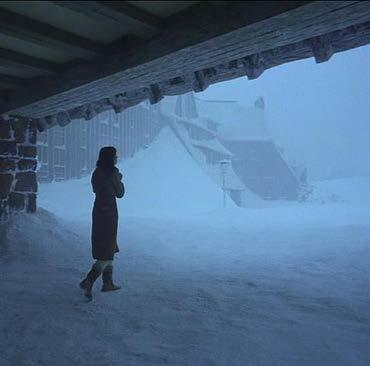
Screenshot from the 1980 film,”The Shining”
Note: Stanley Kubrick (dir), 1980.
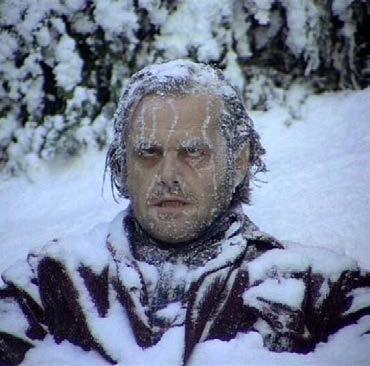
Screenshot from the 1980 film,”The Shining”
Note: Stanley Kubrick (dir), 1980.
debate about film semiotics and reception, and whether viewers “possess power in their relationship with the film” (Carboni, 2007).
Carboni (2007) explains that while early semiotics theory proposed the idea of passive viewers who simply watched and absorbed, this evolved to a more active viewing role, “which rejects the notion that the viewer has no control over the reception”, stating that the viewer can ‘read the film’s meaning and manage its effects”. Johannes Ehrat’s Cinema and Semiotic, published in 2005, also made a valuable contribution to my research by highlighting that, when considering semiotics in film, it is important to distinguish between representation and narration. He suggests that “instead of investigating the cinematic use of conventions and their power to marshal meaning by rules, we should look into the mind-expanding, meaningcreating cognitive processes made possible by cinema” (Ehrat, 2005).
Combined with various sources cited elsewhere in this essay, I was able to apply the theoretical framework of semiotics to my analysis of Do the Right Thing, looking specifically at how meaning was created and communicated to the viewership through various elements. My research provided me with a deeper understanding of how heat was used in the film to communicate meaning and engage with viewers on a symbolic level.
Ryan and Lenos (2012) describe movies as “a marriage of technique and meaning”. While some meanings are “consciously intended”, others are not as deliberate or intentional. Unintended meaning often stems from the fact “that movies are connected to the social world in which they are made” (Ryan and Lenos, 2012). This is true for Do the Right Thing, which is best known for its commentary on race relations, and which was the “first major film
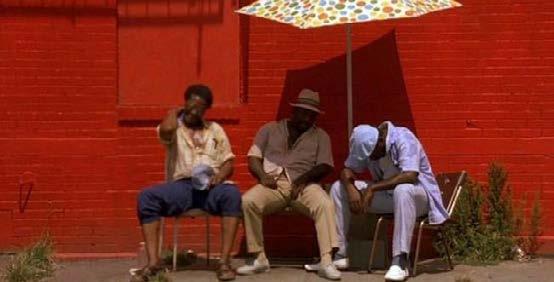
Screenshot from the 1989 film, “Do The Right Thing”
Note: Spike Lee (dir), 1989.

Screenshot from the 1981 film, “Body Heat”
Note: Lawrence Kasdan (dir), 1981.

Screenshot from the 1954 film, “Rear Window”
Note: Alfred Hitchcock (dir), 1954.
to be written and directed from an African-American perspective… and which provides a unique view of “black subculture through the eyes of its own ideology” (Hirschman, 1994).
The film takes place on the hottest day of summer in the Brooklyn neighbourhood BedfordStuyvesant, “the heat serving as a catalyst to bring simmering racial tensions to a roiling boil” (Fabe, 2004). In the film, heat is used as a narrative device to convey the concept of intense racial relations. Referring to literature, Bravo (2022) states that “although hot weather is a narrative device as old as time, it often takes on ominous undertones”. She quotes author Ayisha Malik, who says that “to swelter is to feel oppressed – cross, put-out and harassed; it’s the simplest way to create conflict and tension without even introducing a character.”
This is evident in Do the Right Thing, where the blistering heat is used to effectively symbolise the conflict between races. Lee uses the temperature to communicate the intensity of the situation, showing “how heat exacerbates underlying tensions and anxieties in our communities, especially those where racial, cultural, and class differences are apparent” (Mock, 2014). Although removed from the actual environment, the viewer is made to understand that the characters are trapped by both the oppressive heat and a crippling degree of racial tension – fire, red lights and sweaty bodies all convey that, like the temperature, the issue of racism is a hot and uncomfortable topics (Ari, 2010). From a screen theory perspective, the
use of heat as a narrative device can be seen as a form of sensory realism that immerses the audience in the physical and emotional atmosphere of the film.
According to Malik, quoted by Bravo (2022), “that feeling of being on the edge, while also creating a deep sense of ennui, is the kind of contradiction that makes it feel like anything might happen”, adding that “somehow, somewhere, someone is going to lose their shit”. As the temperature rises in the film, so too does the suspense, culminating in “a violent race riot … set off by the death of a young African-American man who dies when a white policeman uses unnecessary force to restrain him” (Fabe, 2004).
The events portrayed in Do the Right Thing raise the issue of morality – defined by the University of Texas as “the prevailing standards of behaviour that enable people to live cooperatively in groups” and “what societies sanction as right and acceptable”. It raises questions about prejudice, power dynamics and social justice, and challenges viewers to consider what it means to do the right thing. At the end of the film, the viewer is left to decide as the film stops short of making a claim. According to Bordwell and Thompson, “the implication is that each position is viable under certain circumstances”. Gillett (2013) supports this, arguing that “it is possible to engage imaginatively with human concerns without offering solutions”.
Other films in which heat is used as narrative device, and which addresses morality – albeit in a completely different way – is Lawrence Kasdan’s Body Heat (1981) and Alfred Hitchcock’s Rear Window (1954). The former, described as a neo-noir erotic thriller, is set during a heatwave in Florida and presents a dark and morally complex narrative that highlights the destructive power of lust and deception, while the latter, a classic thriller, takes place during a heatwave in New York City, intensifying the sense of claustrophobia and suspense as a man becomes increasingly obsessed with the activities of his neighbours. It raises questions about voyeurism, privacy, and ethical responsibility. Both films effectively use heat as a narrative device to enhance the mood, atmosphere, and thematic elements, which are probably best
described by Bravo (2022), who states that “Humanity ferments in the heat. People become visceral, bodies betray minds with their baseness. Morals loosen along with muscles. Secrets spill out of open windows, buttons come undone”.
Besides morality, Do the Right Thing touches on viewership and subjectivity, a “key component in film reception” (Carboni, 2007) as every person views reality, and films, subjectively. This is underpinned by “cultural complication”, which Carboni says impacts how a film is encoded and decoded. Encoding is how a message is designed and “begins with the development of an intended visual message and the functional frame that surrounds it” (O’Donnell, 2005) while decoding is how the message is perceived and processed. The notions of encoding and decoding are central to semiotics, “the study of signs and codes” (O’Donnell, 2005). O’Donnel cites Jakobson’s definition as “semiotics being the communication of any messages”, as well as Sebeok’s definition that it is “the exchange of any messages whatever and the system of signs, or codes, which underlie them”. He states that Fiske “added the idea of the generation of meaning to this definition”, raising the concept that “meaning is derived only to the degree that the receiver of the message understands the code” (O’Donnell, 2005).
Essentially, semiotics helps viewers understand the underlying messages, themes, and references embedded in a film, allowing for a deeper understanding of the ideas, narratives and emotions being conveyed. In Do the Right Thing, the visual and auditory elements associated with the heat, such as the shimmering cinematography, the sounds of buzzing insects, and the characters’ sweaty bodies, all contribute to the film’s symbolic language and help convey its underlying messages. Semiotically, the heat can be interpreted as a symbol of

Screenshot from the 1989 film, “Do The Right Thing”
Note: Spike Lee (dir), 1989.
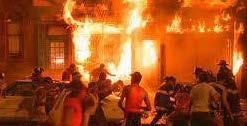
Screenshot from the 1989 film, “Do The Right Thing”
Note: Spike Lee (dir), 1989.
the various characters’ struggles, societal pressures, and the broader themes of race, power, and injustice.
Heat – or extreme cold – can successfully be used as a narrative device in film. It not only helps heighten drama and create tension, but also supports the development or devolution of characters. With reference to Do the Right Thing, it is clear that oppressive heat is not just an environmental backdrop, but that it serves as a palpable, powerful and productive narrative tool to add depth and complexity while shaping the interaction between, and the actions of characters. Additionally, it is used to emphasise issues of morality raised in the film by intensifying the racial tensions, injustices and moral dilemmas faced by the characters.
Finally, in terms of meaning-making – “the process by which people interpret situations, events, objects, or discourses, in the light of their previous knowledge and experience” (Zittoun & Brinkmann, 2012) – the film invites the viewership to reflect on the complexities of race relations, social inequality, and moral responsibility by challenging them to confront uncomfortable truths and engage critically with the issues in Do the Right Thing without preaching or proposing what ‘the right thing’ is.
Anderson, Craig. (1989). Temperature and Aggression: Ubiquitous effects of heat on occurrence of human violence. Psychological Bulletin, Vol 106(1), Jul 1989, 74-96
Ari, W. (2010). The implications of heat in Do The Right Thing. Introduction to Film & Media Studies. https://tdf165.wordpress.com/2010/09/22/the-implications-of-heat-in-do-the-rightthin g/
Bravo, L. (2022). From sweaty to sultry: Why fiction loves a heatwave. Penguin Books UK. https://www.penguin.co.uk/articles/2022/06/fiction-heatwaves-summer-books
Bordwell, D., & Thompson, K. (n.d.). Do the right thing. In Film art: An introduction (pp. 410–415). New York: McGraw-Hill.
Carboni, C. (2007). Film spectatorship and subjectivity: semiotics, complications, satisfactions. http://scholar.sun.ac.za/handle/10019.1/2203
Ehrat, J. (2005). Cinema and semiotic: Peirce and film aesthetics, narration, and representation University of Toronto Press.
Fabe, M. (2004). Political cinema: Spike Lee’s Do the Right Thing. In Closely watched films: An introduction to the art of narrative film technique (pp. 191–255). Los Angeles: University of California Press.
Gillett, P. (2013). Art and Morality. In Film and Morality. Introduction, Cambridge Scholars Publishing.
Hermoso, S. (2023). Impacts of Rising Temperatures on Human Behavior with a Focus on Gender Differences. https://repository.usfca.edu/thes/1482
Hirschman, E. (1994). The semiotics of ethnicity: Using consumption imagery to decode Spike Lee’s Do the Right Thing. Semiotica, 98(1-2),109-138. https://doi.org/10.1515/semi-1994981-206
Mock, B. (2014). The not-so-hidden climate messages in Spike Lee’s “Do the right thing.” Grist. https://grist.org/climate-energy/the-not-so-hidden-climate-messages-in-spike-lees-do-theright-thing/
O’Donnell, V. (2005). Cultural studies theory. In K. Smith, S. Moriarty, G. Barbatsis, & K. Kenney (Eds.), Handbook of visual communication: Theory, methods, and media (pp. 521–537).
Mahwah: Lawrence Erlbaum.
Ryan, M., & Lenos, M. (2012). An introduction to film analysis: technique and meaning in narrative film / Michael Ryan and Melissa Lenos. Continuum
Zittoun, T., Brinkmann, S. (2012). Learning as Meaning Making. In: Seel, N.M. (eds) Encyclopedia of the Sciences of Learning. Springer, Boston, MA. https://doi.org/10.1007/9781-4419-1428-6_1851
© 2024 The Open Window