The endless hope for a better year New Year’s traditions in Brazil
Luisa Clausen News/Life Editor
Editor’s note: Luisa Clausen, Brazil native and The O’Colly News and Lifestyle Editor, writes about Brazilian New Year’s traditions.
People in Brazil celebrate the holidays wearing shorts, T-shirts, dresses or swimsuits.
There is no white Christmas or freezing cold on New Year’s Eve. During the months that anticipate the parties, Brazilians from all over the country pick their outfits carefully, as if that is going to dictate how great the holidays will be.
Christmas is mostly celebrated on Christmas Eve them, with a late dinner and a late opening of presents.
Once Christmas is over, Brazil worries about one thing: New Year. There is no such thing as a small celebration, a lot of thought is put into how, when and with who you are going to ring the new year.
live in Brazil, and not everyone celebrates the holidays in the exact same way. The traditions and superstitions mentioned in this text are the most popular ones in the country, but there are thousands of different ones beside them. All the traditions I know are based on this blind hope of a better life. Brazil is a big and diverse country, filled with unique people.
The first one that comes to mind is, Brazilians believe wearing white for New Year’s will bring them peace for the new year starting. No, not every single person wears white.But when you see someone wearing a different color, the immediate thought is “Interesting, I wonder why they chose not to wear white.” Usually, the answer we find is “I am wearing green because I want to get pregnant” or a different explanation related to the colors’ meaning.
1999 OSU alumna named Texas middle school principal of the year
Positive role models are essential to young minds.
Middle school principal and OSU alumna Amber Epperson strives to set a good example for more than 1,200 students who attend Cockrill Middle School in McKinney, Texas.

Epperson grew up in Ponca City and graduated from Ponca
City High School in 1995. She graduated from OSU in 1999 and moved to the Dallas-Fort Worth area after learning of a teacher shortage in Texas at the time.
Epperson received her masters in school administration in 2002 and her doctorate in December 2004.
Bella Casey Staff Reporter See Principal on 3A
She has been awarded the title of 2022 Middle School Principal of the Year after the Texas Association of Secondary School Principals named her the 2022
Region 10 Outstanding Principal of the Year in September.
“I am honored to represent the outstanding middle school principals across the state of Texas,” Epperson said. “This recognition is a validation of the work I had led alongside very talented teams of people who are invested in positively impacting the lives of young people in our communities. I have
OSU-COM medical students find inequalities in ophthalmology research
 Michael Clark Staff Reporter
A group of students from OSU’s College of Osteopathic Medicine department published an article analyzing the inequalities of ophthalmology care for Black and Hispanic patients.
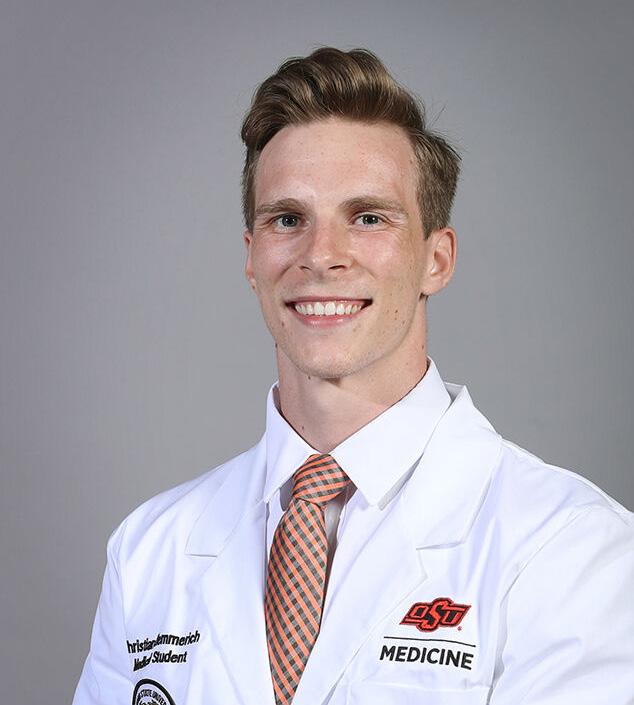
Christian Hemmerich, the lead author for the study and sophomore at OSU-COM, helped explain the team’s findings.
“Our research team recognized that deficient ophthalmologic care is costly to patients, making identifying groups not receiving adequate care of vital importance,” Hemmerich said. “Overall, lower-income patients were more likely to have vision impairment, use eye care services less, and have lower adherence to eye examinations.”
Other authors on the study team include second-year student Garrett Jones, third-year students Jordan Staggs and Rigel Bacani,
The study, which is published
a

“There are many surprising findings,” Hemmerich said. “However, some of the most noteworthy were that zero studies investigated inequities within the LGBTQ groups, and only 27% of studies that focused on race and ethnicity
The published article recommended future studies to examine the barriers to clinical studies and medical trainee recruitment as well as
patient values, preference studies and the implementation of telemedicine in under-resourced areas.
“I feel honored to have this research published in such an esteemed journal,” Hemmerich said. “I am incredibly grateful to have this opportunity and to use the JAMA platform to share our research and contribute to the scientific literature.”
Most of the country stops between Christmas and New Year. Those lucky enough to have some days off plan a way to spend their days enjoying the heat. Kids are off school, parents try to take some time to relax with them and friends look forward to making great memories in a break after all the family time spent the week before.
Growing up in Brazil, I spent most of my New Year celebrations with my family, and just when I was about old enough to participate in all the fun and traditions my country holds, I moved to the U.S.
This is the first time I spent this holiday here since I was 17 and outside the COVID era. With that, I started to realize all the peculiar traditions and celebrations we have that America does not.
It is important to say 214 million people
Stores all over the country display different white dresses, white skirts, white shirts, white shorts, white everything and it is almost hard to escape the sea of peace. Buying new clothes to start the new year means re-starting, and that is a big deal. Around the middle of December, everyone answers and asks the same question: “Have you picked what you are going to wear for New Years?”
Another specific tradition that gets in the way of white pants, is the belief the color of your underwear will tell you what will happen in the year starting.
If you wear red underwear, you will have love. If you wear yellow underwear, you will have money. If you wear green underwear, you will have a baby. If you wear blue underwear, you will have a serene year. And so on. It might sound silly, but at the end of the day, it is something fun we found to ask the universe for specific things.
Friday, December 30, 2022
Courtesy of McKineey Independent School Distric
The Texas Association of Secondary School Principals honored 1999 OSU alumna Amber Epperson as its Texas Middle School Principal of the Year.
Courtsey of OSU
Christian Hemmerich, the lead author for the study and sophomore at OSU-COM.
third-year Cherokee Nation student Reece Anderson and Office of Medical Student Research Director Matt Vassar. This group analyzed 75 articles based on ophthalmic research that discussed health and income inequalities.
in the peer-reviewed journal JAMA Ophthalmology, analyzed previous studies and reports on the same subject and also pointed out
lack of attention toward articles covering LGBTQ patients.
inequalities included American Indian and Alaska Native, Asian, Native Hawaiian and other Pacific Islander patients.”
Courtesy of Essa Receita Funciona
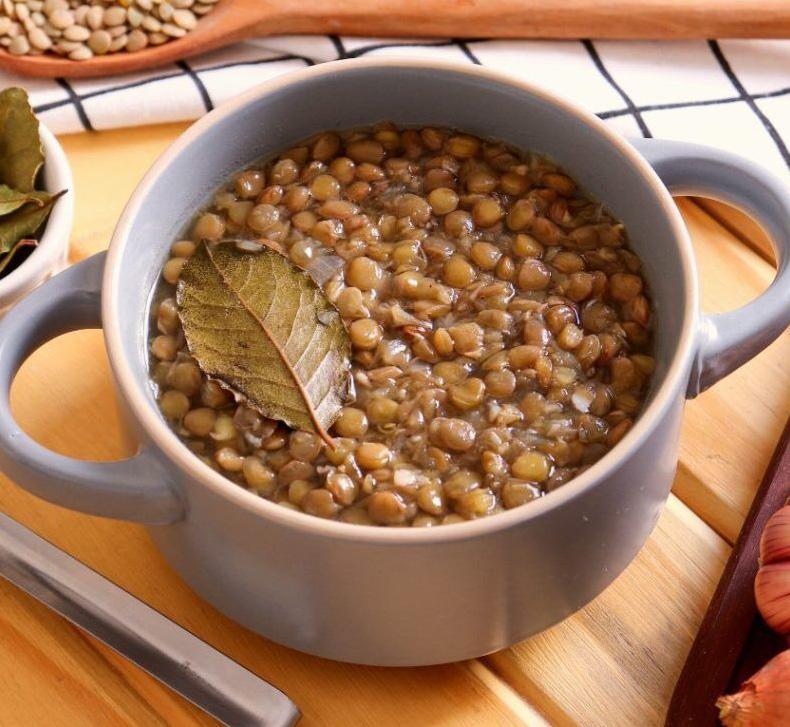
Brazillian lentils. Brazillians believe eating lentils on New Year’s Eve will bring money to the new year.
See Brazil on 5A
news.ed@ocolly.com














13. Page 2A Friday, December 30, 2022 O’Colly
Editorial board
editor
& Life editor
editor
Sam Hutchens Braden Bush Davis Cordova Ashton Slaughter Daniel Allen Rowdy Baribeau Payton Little PJ Tikalsky Parker Gerl Gina Foster Calif Poncy Bradley Cook Ivan White Rebekah Cleary Kendall McGhee Jaiden Daughty Molly Jolliff Cole Gueldenzoph Chase Davis Michael Clark Karlie Boothe Ethan Hilbert Paul Houston Carson Toulouse Jaycee Hampton Cassius Davis Ava Whistler The O’Colly Staff Newsroom Design editor
Adviser John Helsley
News & Lifestyle reporters: Jaden Besteda Payton Little Baylor Bryant Michael Clark Rebekah Cleary Micah McKamie Jaycee Hampton Isaac Terry Bella Casey
Assistant News & Life editor Kennedy Thomason news.ed@ocolly.com
Sports reporters: Photographers & Designers: Page 2
Courtesy
Tribune News Service Via Billboard NEW YEARS EVE Around the World Performers New Years Eve Night Times Square ✴ DURAN DURAN ✴ JAX ✴ J-HOPE ✴ NEW EDITION DisneyLand ✴ CIARA ✴ ALY & AJ ✴ BAILEY ZIMMERMAN ✴ BEN PLATT ✴ FITZ AND THE TANTRUMS ✴ HALLE BAILEY ✴ LAUREN SPENCER SMITH ✴ MADDIE & TAE ✴ SHAGGY ✴ TXT Los Angeles ✴ ARMANI WHITE ✴ BETTY WHO ✴ DOVE CAMERON ✴ FINNEAS ✴ NICKY YOURE ✴ WIZ KHALIFA Puerto Rico ✴ FARRUKO New Orleans ✴ BILLY PORTER 1)
the ball
2)
3)
4)
5)
6)
7)
8)
9)
10)
11)
12)
13)
14)
15)
15. 1. 12. 11. 10. 14. 4. 8. 6. 7. 9. 2. 5. 3.
108 Paul Miller Stillwater, OK 74078 (405)-744-6365
Sports
Gabriel Trevino sports.ed@ocolly.com News
Luisa Clausen news.ed@ocolly.com entertainment.ed@ocolly.com Photo
Mackenzie Janish photo.ed@ocolly.com
Sam Beebe design.ed@ocolly.com
john.helsley@okstate.edu
Editor-in-Chief Adam Engel editorinchief@ocolly.com Assistant sports editor Braden Bush sports.ed@ocolly.com
entertainment.ed@ocolly.com
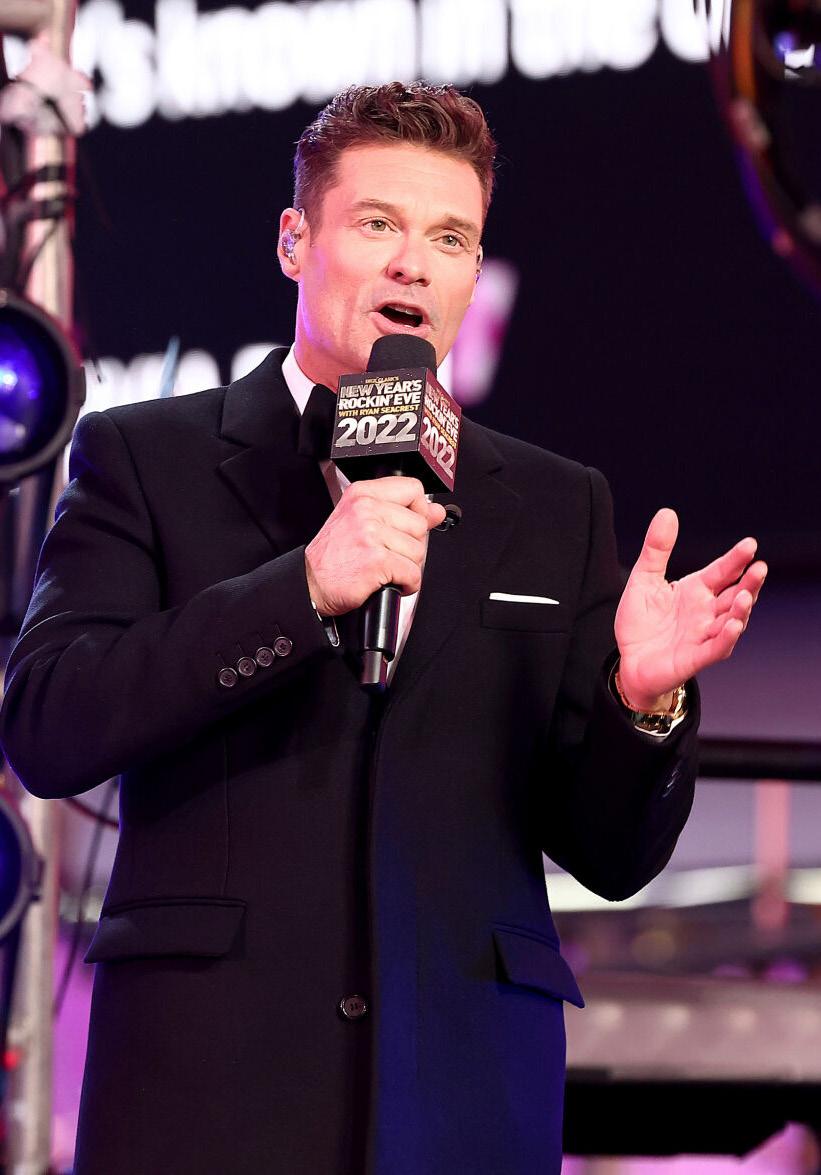
Ryan Seacrest will again host Dick Clark’s New Year’s Rocking Eve on ABC on Saturday night.
of
United States: Watching
drop
Brazil: Heading to the beach
Spain: Eating 12 grapes
India: Building a sculpture of an old man and burning it down
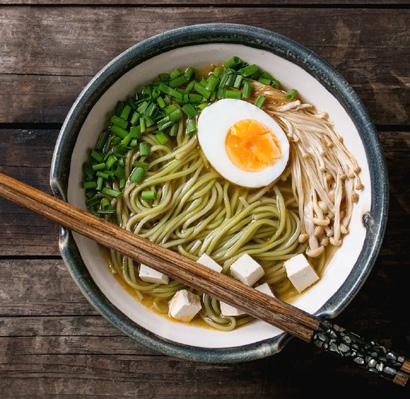
Japan: Eating soba noodles
France: Feasting with Champagne
Haiti: Sharing soup joumou
Denmark: Throwing old plates
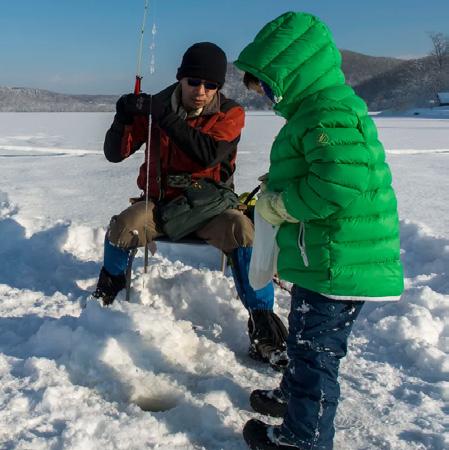
Canada: Going ice fishing
Philippines: Serving 12 round fruits
Mexico: Giving the gift of homemade tamales
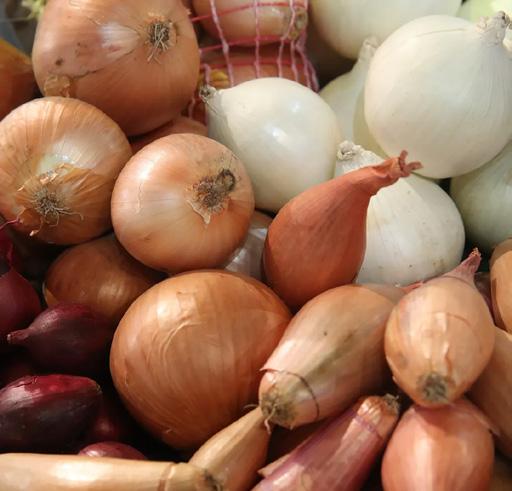
Greece: Hanging an onion outside the door
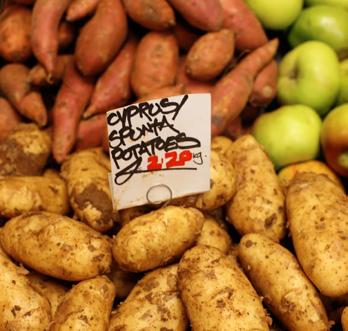
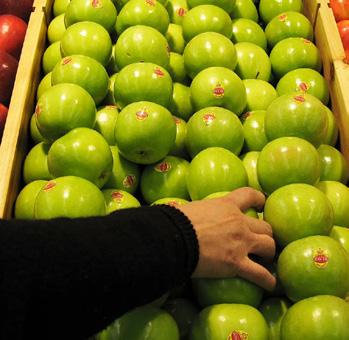
Colombia: Placing three potatoes under the bed
Ireland: Banging bread against the walls
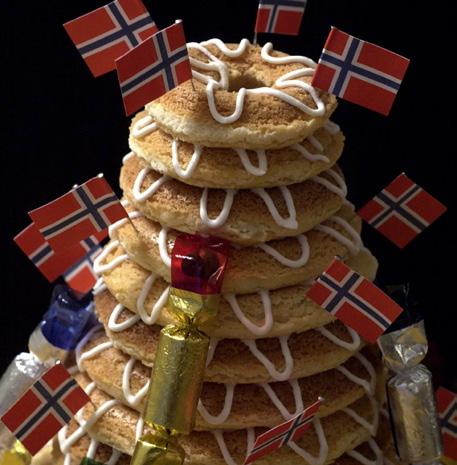
Norway and Denmark: Celebrating with a towering cake
been afforded many incredible opportunities in my career, and this recognition is a pinnacle experience in my career as a building principal.”
Epperson’s leadership ability and prioritization of students’ happiness are what define her career. The principal at her first teaching job played a large role in laying the foundation for the values and priorities she would have as a principal herself.
Epperson said her first princi-
OSU students share holliday traditions
Michael Clark Staff Reporter
Whether you’re celebrating the holidays out and about, living it up with your family and friends, or you’re simply enjoying the festivities from the comfort of your own home, the holiday season allows you to make memories that can last a lifetime.
These yearly celebrations bring about annual traditions which help us enjoy these cold winter days to the fullest. Some traditions are popular across the nation, you can find just about anyone enjoying Christmas music and drinking hot chocolate. Our favorite traditions tend to be the ones entirely unique to our own lives and experiences. Plenty of OSU students shared their holiday traditions, all of which are heartwarming and unique.
A personal tradition coming from my family is to play board games on the night of New Year’s Eve with the countdown playing on the TV in front of us. While we usually intend to hit up popular games like “Clue”, “Pictionary” and “Sorry!” most of the time we end up stuck on a really long game of Monopoly. My dad holds an eight year winning streak in our family. Traditions aren’t just playing games and partying, though. A tradition can be as simple as cooking a meal.
Ally Hernandez, a freshman at OSU, shared one of her most beloved holiday traditions. On Christmas Eve, her family gets together and makes fresh, homemade tamales
News/Lifestyle

pal, Bill Porter, constantly reassured her that she had a future in education. Using her experience with Porter as a guide, Epperson focuses on building confident students through continuous encouragement and support.
“Obviously, academics are a priority,” Epperson said. “But, I want kids to be involved in things here and to have a positive peer group and make memories. I want them to feel like people cared about them and that people had faith in them and that people here poured into them. I hope kids leave here feeling like they can be successful in high school and that there is a path even beyond high school for them.”
Epperson’s efforts have been on
the TASSP’s radar for years. Cockrill Middle School has been named a Texas School to Watch, a school that consistently has moved to meet fully the nationally endorsed criteria for highperforming middle schools, three times under her leadership. In 2021, Cockrill Middle School was one of only 50 middle schools to earn that title.
“My colleagues and I are passionate about creating wonderful places for all students to learn, where teachers are happy and thrive in their work and where parents and the community feel a sense of pride and investment in our schools,” Epperson said
In addition to being named a Texas School to Watch, Cockrill
Middle School’s counseling department received a CREST award for its outstanding counseling services from the Texas Counselor School Association in 2021.
“This recognition has given me a treasured opportunity to reflect on my experiences in this role and the truly talented, dedicated people I have had the fortune to work with in my career,” she said. “McKinney ISD has supported my efforts as a school leader through intentional steps to develop my leadership to this point. I am very grateful for this recognition and truly proud to be part of McKinney ISD.”
news.ed@ocolly.com
to enjoy together as they anticipate the holidays. The process may sound tough to some, but the results are always worth it, and the Hernandez family will surely continue their beloved tradition for years to come.
Morgan Tammen, a freshman majoring in sports media at OSU, shared their traditions as well. They explained that on New Year’s Day, their family will gather around and give each member 12 grapes. With each grape they eat, they make a wish for the corresponding month. The first grape is eaten as a wish for January, the second is a wish for February and so on. Tammen also explained that wearing black while carrying out this tradition tends to bring about bad luck, so they try to avoid it.
Another interesting tradition from an OSU student comes from Brynly Brown.
“One tradition that my family takes part in every year is a Christmas show in Branson, Missouri,” Brown said. “Another is that we’ll read ‘The Nightmare Before Christmas’ just before we go to bed on Christmas Eve.”
As we enjoy the last few days of the holiday season leading up to New Year’s Eve, now may be a good time to think about some of your favorite traditions and how they came about.
‘Glass Onion’ Review
Michael Clark Staff Reporter
“Glass Onion: A Knives Out Mistery” is complex, ersatz, sincere, disingenuous, honest and deceiving.
The sequel to “Knives Out” was released in September during the Toronto International Film Festival and is now streaming on Netflix. The new movie is a standalone story, separate from its predecessor, but still expands on the themes of the original in interesting ways. While “Glass Onion” may have a few small flaws, peeling back the layers of this film is a fantastic and rewarding experience.
The story of “Glass Onion” follows Daniel Craig’s returning character Detective Benoit Blanc as he investigates a murder
mystery on an eccentric millionaire’s private island. The setting is tropical, luxurious and a far cry from the warmer and more contained set pieces of the original. This time around the story feels looser, crazier and sillier. The movie is hilarious as the social satire is turned up to 100. As the film goes on, it turns itself on its head, drops the farce and takes a deeper and more nuanced look at the themes it sets up. The movie simply shines the most in its boldness.

I appreciate Rian Johnson’s (the director) ability to cast underdog characters you can easily root for. Janelle Monae puts on a complex and nuanced performance as her character Helen Brand. Craig’s detective persona is classic, being both a satire and a love letter to those quirky detective characters we all
know and love. The themes and message in the narrative are fantastic. With minimal spoilers, the film sharply critiques the ignorance that comes from the upper-class characters. “Glass Onion” perspective on these characters and the harsh truths they must fake are the most accurate depictions of the “insidious rich” type that I’ve seen. Taking such a politically relevant perspective was a risky gambit, but it paid off in spades.
There are a few flaws inside this onion. In some cases, the lack of subtlety in its political satire feels a little over the top when contrasted to the first movie’s subdued tone, but it’s funny enough to forgive. The foreshadowing was obvious. I managed to call out a few of the twists in the opening acts. My biggest bone to pick lies within the climax,
it feels just a little too over the top and showy for me to really buy, especially when compared to the rest of the franchise. However, I can understand why the events played out the way they did. It adds to the story and overall themes even if it’s a bit much.
In summary, “Glass Onion” is a layered film with a comedic heart of gold, a compelling, thematic narrative and a brilliant cast of characters anyone could fall in love with. I don’t know if I love it just as much as the original, but it stands on its own as a fantastic successor. Whatever Johnson does next, I’ll be the first person in the theater cheering him on, despite what “Star Wars” fans may say.
O’Colly Friday, December 30, 2022 Page 3A
Principal
Continued from 1A
entertainment.ed@ ocolly.com entertainment.ed@ocolly.com
Courtsey of Tribune
Edward Norton, left, Madelyn Cline and Daniel Craig in “Glass Onion: A Knives Out Mystery.” (John Wilson/Netflix/TNS)
Lifestyle
DC’S Formula to Success
 Jaden Besteda Staff Reporter

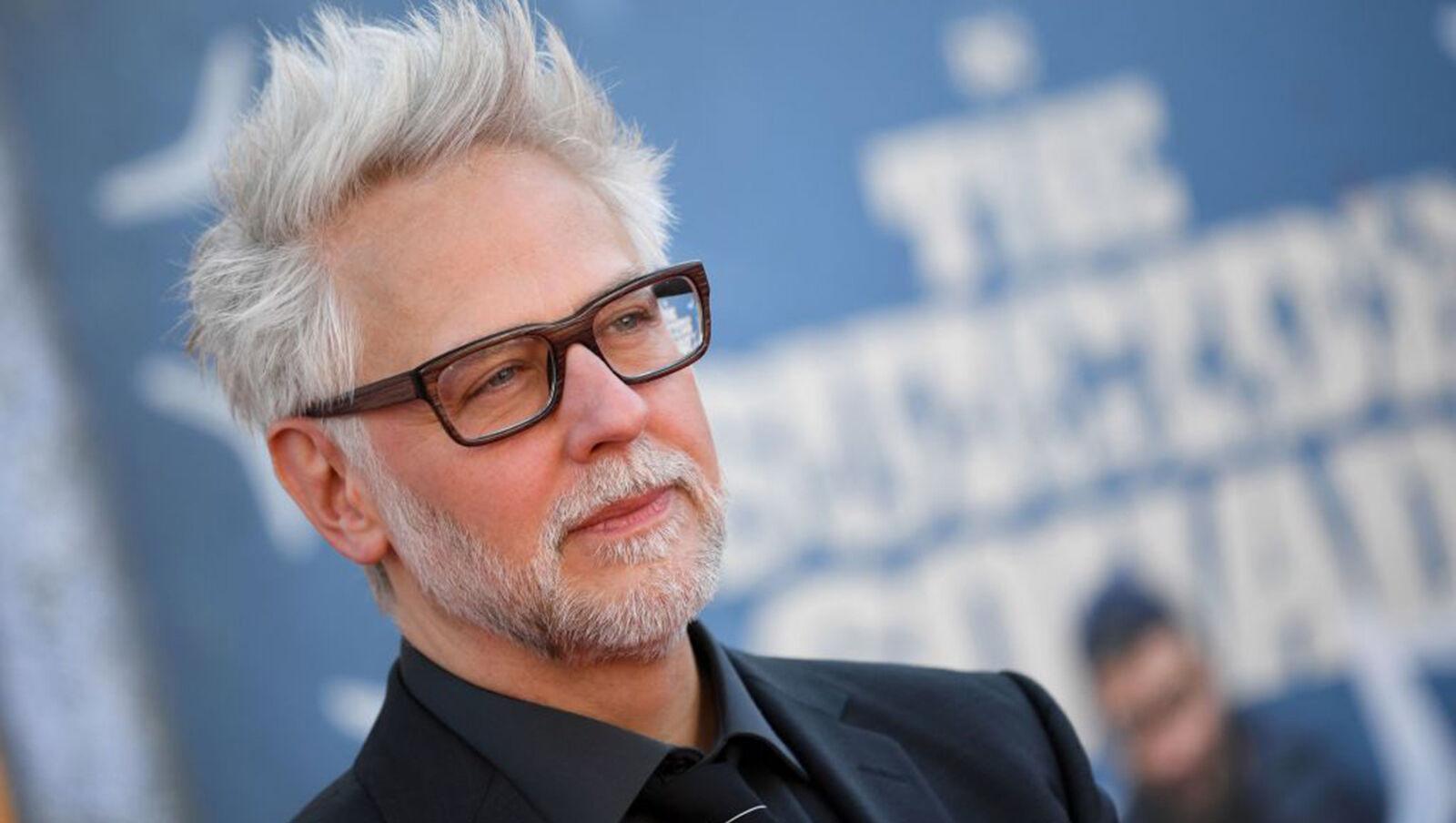
James Gunn has taken over the DC Extended Universe.
Gunn along with Peter Safran were named the new president of DC Studios and for the first time since Zack Snyder’s tenure, DC has a plan for a universe. A universe that may be able to rival Marvel one day. Or at least be able to remotely compete and not have an abundance of recastings and reboots in the middle of everything. However, before that, Gunn seems to be reacting to everyone with the news of Henry Cavill being booted once again after he was seemingly back for
just a month.

A return that even was cemented as he cameo’d in Black Adam for a post-credit scene is all but meaningless now. It’s safe to say that the universe that was once there is now completely dead. Now Gal Gadot, Jason Momoa, Ezra Miller and every other “Justice League” star will be replaced. With that, Gunn will have a hard task trying to reboot a universe that many fans loved. His plan? Go young. DC has something that Marvel doesn’t. The Teen Titans, Young Justice and several other younger teams. Marvel has teams like this but they aren’t the root of their universes much like the ones in the DC world. We are in the golden age of comic book movies and we have never seen a pepper Teen Ti-
tans or Nightwing on the big screen.
The route of having older heroes that are essentially parents now and only fighting crime when needed the absolute most is something that can separate DC from any comparisons and can lead to many deeper stories. It also gives a better reason for Batman to need a Robin on screen and Superman to need Cyborg and Superboy to help lead a Teen Titans team.
The next thing they can do is build the universe with Elseworld stories. An Elseworld story happens in another universe, where it shows a hero in a different perspective than what we would see him or her in their usual universe. Gunn may already have started that with Robert Pattinson’s “The Batman,” and soon, “No Way Home”
and “Spidermen” could be considered Elseworld stories to the MCU.
The DCEU doing this can provide for some very different stories that can eventually all lead to the same place while having a completely different feel.
Overall, the DCEU is now in good hands with the director of the “Guardians of the Galaxy” director and the maker of what may be DC’s best film to date “The Suicide Squad.” Having an opposite approach almost to what Marvel got their fame for doing may do them well, as long as the stories are good and the characters are strong. The direction will be great.
entertainment.ed@ocolly.com
Page 4A Friday, December 30, 2022 O’Colly
Courtesy of Tribune
James Gunn directed several Marvel movies such as “Guardians of the Galaxy” but became co-president of DC Studios in October.
Because it is summer during this time of the year, millions of people go to the beach to watch fireworks and jump seven waves when the clock rings midnight. This tradition comes from African religions and traditions, most specifically from the religion Umbanda, which believes that when you jump seven waves you are closer to the
life you cannot see. It is connected to a new vibration, a new beginning and a new plan. This is a deep and complicated religion, and its followers thank a different God each wave they jump. This tradition has been popularized, and nowadays a lot of non-followers make seven different wishes related to their personal lives while watching beautiful and bright fireworks.
The last two famous religions are related to food. One of the biggest things I have noticed moving from Brazil to the U.S. is how different we think of and treat food. Brazilians see food as a moment of connection.

There are fast foods spread around the country but they are seen as “weekend food.” We stop during lunchtime to sit at the table, eat a fresh meal and do the same with dinner. People show their love, affection and care through homemade food. It holds a sentimental place in our tradition. We don’t rush through a meal. And it would not be different during New Year. Just like Christmas, most Brazilians cook a thoughtful supper. A supper that must not have chicken. Never. Ever. For one simple reason: because chicken walk backward and we do not want anything taking us back in the new year.
What most Brazilians do have on their New Year’s Eve dinner table is lentils. I have eaten lentils once a year since I could eat them, and I hate it. It is by far, one of my least favorite foods, but eating lentils means having prosperity for the new year. It means money and we all want that.
From outfits to food, Brazilians find a way to make every special occasion fun and memorable, and whether the promises from the superstitions happen, what truly matters is the endless hope for better days.

entertainment.ed@ocolly.com


O’Colly Friday, December 30, 2022 Page 5A 121 E 9th Ave, Downtown www.formalfantasy.com 405-780-7720 Party/Semi-formal Pageant/Performace Wedding Lifestyle
Courtesy of Tribune
Fireworks are seen on Copacabana beach during New Years Eve Celebration on Jan. 1, 2020, in Rio de Janeiro, Brazil. (Wagner Meier/Getty Images/TNS)
Brazil... Continued from 1A
Dinosaur feet could lead to preventing sports injuries
Thomason News/Life Assistant Editor



A new study that a group of scientistic professionals, including two OSU professors, published suggests that tyrannosaur’s feet could have influenced their status as a top predator. This finding could lead to treatments for human sports injuries.

Tyrannosaurs were found to have longer feet in proportion to their body size than other dinosaurs. The middle bone of the foot appears triangular from the front, then tapers to a smaller size at the back of the foot.
Eric Snively, OSU-College of Osteopathic Medicine associate professor of anatomy, and Thomas Holtz, vertebrate paleontologist at the University of Maryland’s Department of Geology, published studies that discovered the arctometatarsus bone. This bone allowed the tyrannosaurs to have quick forward motion.
“People have long been attracted to the awesome power and ridiculously small arms of Tyrannosaurus rex and its kin, but the legs and especially the feet of the tyrant dinosaurs were also highly specialized,” Holtz said. “This new study helps to show that even on a microscopic level, tyrannosaurs were adapted for both long-distance running and rapid acceleration.”
New research is focused on the ligaments of tyrannosaurs. The large ligaments could have strengthened the foot sole and left rough surfaces on bone. This is a feature not seen in any modern animal.
University of Calgary Emeritus Professor of Biological Sciences, Ecology and Evolutionary Biology Anthony Russell found the pulling motion of ligaments and tendons makes bone rough.
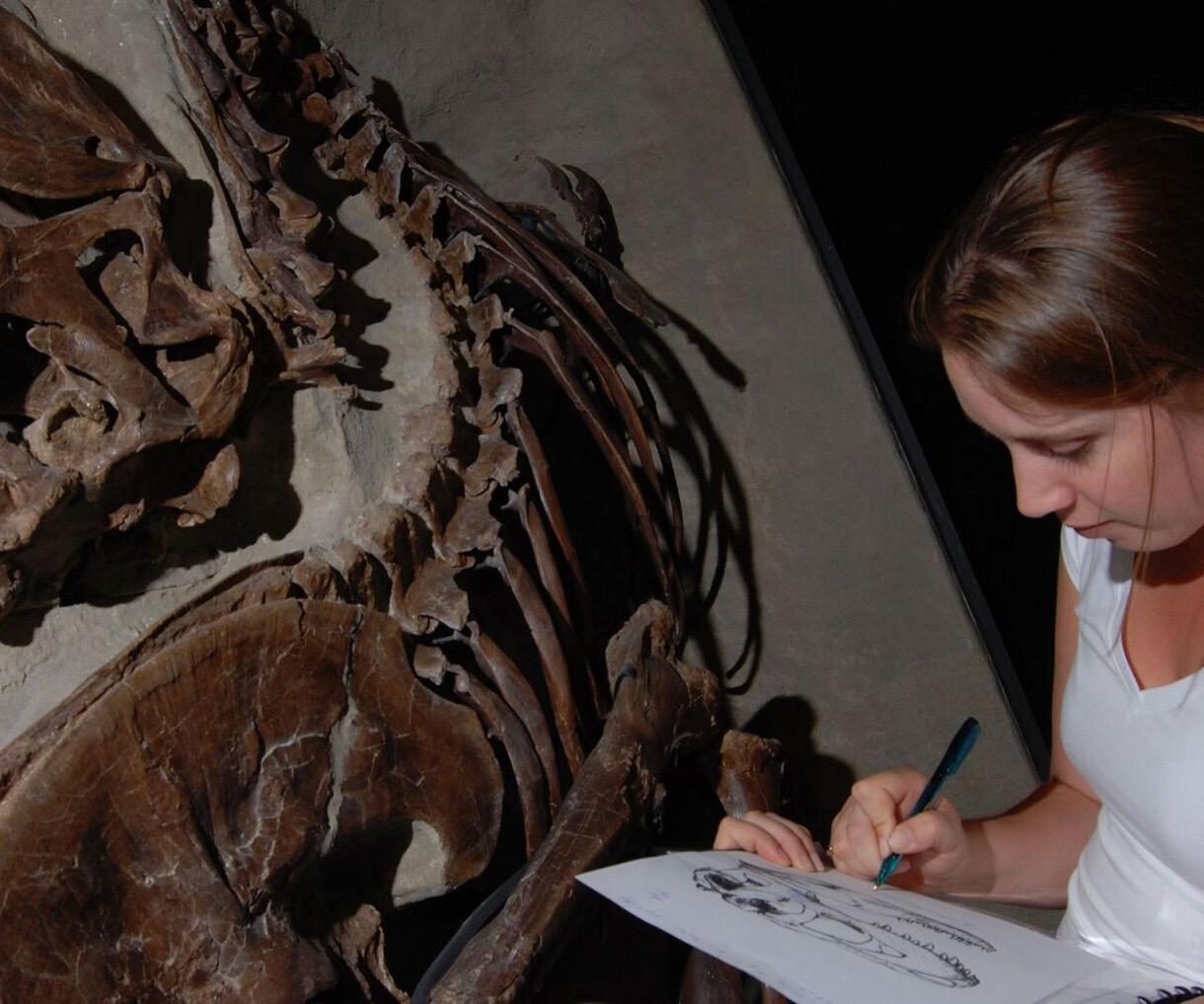
Because ligaments, a soft tissue, can’t be fossilized, the hypothesis was difficult to test. Lara Surring, lead author on the study and primary care paramedic with Alberta Health Services, solved this problem through using an electron microscope. The microscope focused on rough areas of the tyrannosaur fossils.
Surring said her team was interested in seeing how large dinosaurs could maintain strength in their lower limbs and how it could convert into
modern sports medicine.
“Exploring fossils reveals clues as to how the skeletal system has adapted in various ways through time,” Surring said. “We are hopeful that learning how tyrannosaurs made skeletal adjustments to stay functional at the limits of animal size will eventually help us to evaluate and improve human skeletons after injury or aging. This research is one more step in that direction.”
About 30-50% of sports injuries are because of the ligament or tendon. These injuries usually deal with how they attach to bone, and how they react to exertion.
Tyrannosaur feet are similar to the way human perform in long-distance running and walking.

The electron microscope showed pits in the rough bone surface, the same as in modern animals. The tyrannosaur’s bone structure shows that ligaments were anchored in the sinews of the bone, but the Coelophysis lacked them.
“With external and internal microscopy revealing its faded soft tissue, one small step for a tyrannosaur advances our understanding of a vivid past,” Snively said.
Surring discovered ligament attachments that held the foot together. The electron microscope allowed researchers to test for soft tissue in fossils.
“Although we’ve known about fossils for millennia, and dinosaurs for centuries, fossils can continuously provide new information as we can apply newer and more sophisticated analytical techniques,” Burns said.
“Hard-tissue histology and electron microscopy shed new light on old bones in this study. Future students and researchers will undoubtedly develop new techniques to answer the questions we can’t currently solve.”

Page 6A Friday, December 30, 2022 O’Colly STILLWATER’S MATTRESS STORE 424 SOUTH MAIN STREET, STILLWATER,OK 74074 MONDAY-SATURDAY | 9:30 - 6:00 SUNDAY | 1:00 - 5:00 405-624-3212 WWW.STILLWATERFURNITURESHOWCASE.COM News news.ed@ocolly.com
Daniel Barta, assistant professor of anatomy at OSU-COM at the Cherokee Nation, and Michael Burns, associate professor of biology at Jacksonville State University took small sections of metatarsal bones from a tyrannosaur and compared them to that of a Coelophysis, a small carnivorous dinosaur.
Kennedy
Courtesy of OSU
Study’s lead author Lara Surring, primary care paramedic with Alberta Health Services, examines the tyrannosaur Gorgosaurus for fossilized bone textures indicating tendons and ligaments, at the Royal Tyrrell Museum of Paleontology.
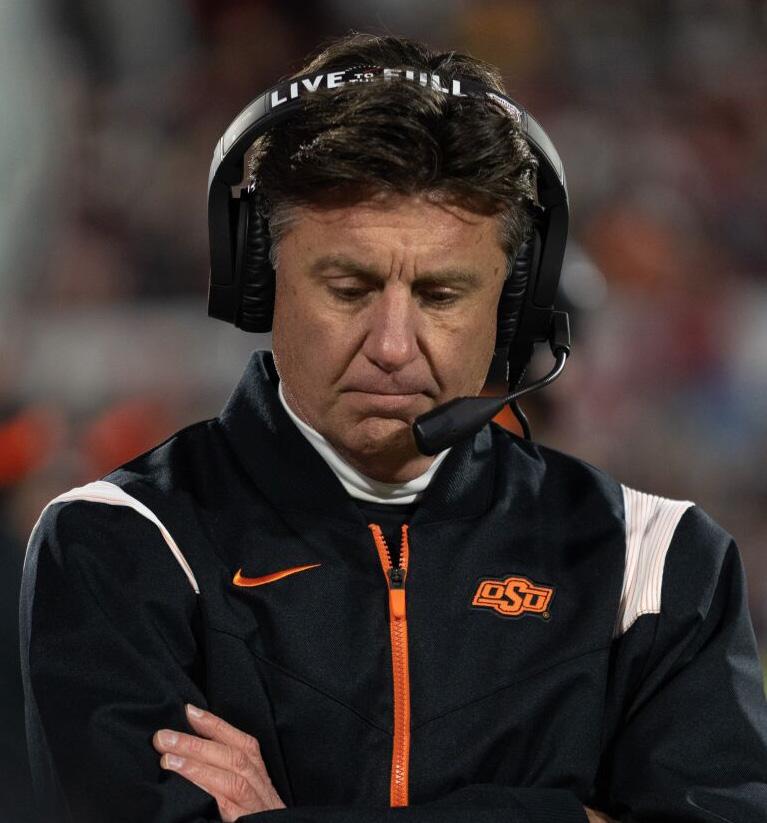
Gundy upset when asked about staff changes
O’Colly Sport Staff

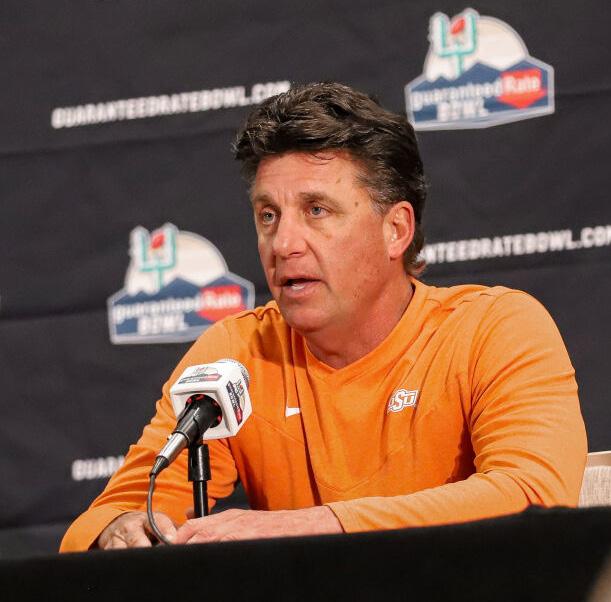
PHOENIX — Mike Gundy didn’t answer the question he was asked, but his response was still interesting.
Gundy, OSU’s football coach, took questions alongside two Cowboy players after OSU’s’ 24-17 loss to Wisconsin in the 2022 Guaranteed Rate Bowl. In the final question Gundy fielded, a reporter asked if Gundy was considering making any changes to his coaching staff.
Specifically, the reporter asked, “Staff changes are starting to happen earlier and earlier now with the portal being a thing. Do you anticipate mak-
ing any changes to your staff between now and next season?”
“Do you think I would tell you if I was making staff changes?” Gundy responded.
The reporter answered, “No” and Gundy responded, “So why would you ask?”
The reporter told Gundy he had to ask the question. It was their job.
“OK,” Gundy said. “Well, I might have to cut you out. I mean, don’t be an ass. Really? I mean, those are peoples lives, those are peoples families right? OK, don’t mess with peoples’ families. Let’s do this the right way.”
Gundy turned to an OSU athletics representative in the back of the room, asking, “You with me on this?”’ before
continuing addressing the reporter. “It’s not fair to people’s families, man,” Gundy said. “And I’m not mad about the game, I just don’t like ignorance.”
A Guaranteed Rate Bowl representative concluded the press conference at that point, as she had indicated would happen before the initial question was asked.
Shortly after, the entirety of the press conference was transcribed and uploaded into the media hub, but the exchange between the reporter and Gundy was left out.
Handing out superlatives from OSU’s nonconference play
Cisse
Braden Bush Assistant Sports Editor
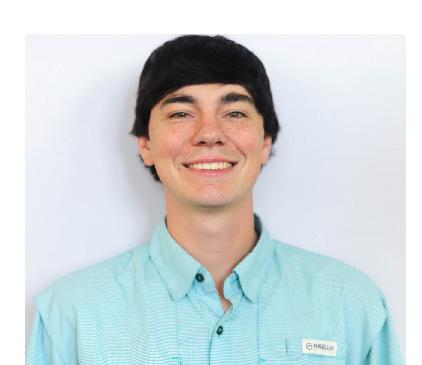
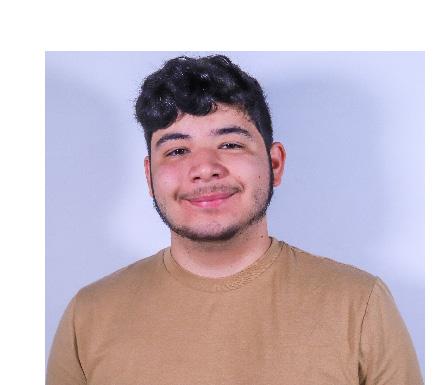
As the year comes to an end, so has nonconference play.
Ahead of the Cowboys’ (8-4) matchup with No. 4 Kansas on New Year’s Eve, here’s some end-of-year superlatives through OSU’s first 12 games.
Biggest weapon: Moussa
True in every sense. Cisse, a 7-foot-1 big man, isn’t just an imposing figure, but also a mismatch on offense and a brick wall on what coach Mike Boynton called a potential top-10 defense.
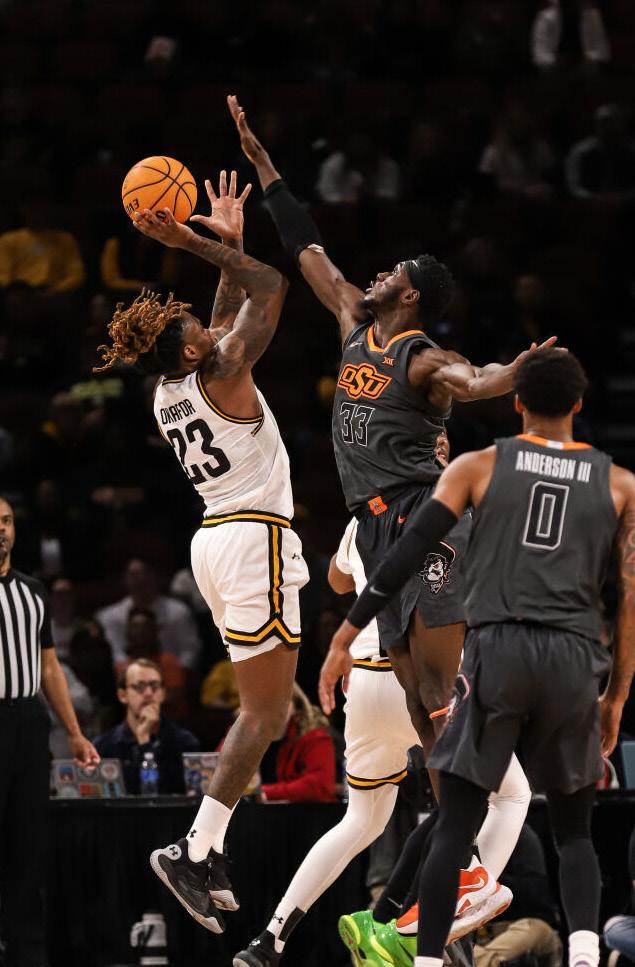
“Everything defensively starts with Moussa,” Boynton said. “I can’t talk enough about how important he is to what we do on that end of the floor. He gives everybody confidence that they can do their job all-out, because if they break down, that’s where it ends.”
“Where it ends” is usually a blocked shot, of which Cisse has
35 (2.9 per game), which leads the Big 12 by 19. If he isn’t blocking the shot, he’s forcing a kick-out or a retreat out of the paint, allowing OSU to force more lower-percentage shots outside the lane.
Cisse has developed into the type of player Boynton and staff hoped. He leads the league in total rebounds (130) and defensive rebounds (94), and he’s second in offensive boards (36). On offense, Cisse is averaging 8.6 points a game and has recorded five double-doubles.
There aren’t many centers that will overmatch Cisse, and he
PHOENIX —
Kasey Dunn has said it before, he said it again, and he’s exactly right.
Every week, it was something new with OSU this season. One week, the run game becomes nonexistent, and the next, it’s the passing game that falls behind. The only consistency the Cowboys found in its last six games was inconsistency. It happens for OSU, though. The more than 10 wins and New Year’s Six bowl seasons are the outliers. But for 7-6 and late season collapses — ending with a 24-17 loss to Wisconsin in the Guaranteed Rate Bowl on Tuesday — to not happen every year, is to change.
“For me and our staff, we have to take all those things into consideration and make decisions based on what’s best for the future as we move forward into a new era of college football,” said coach Mike Gundy. “And as we’re going through these changes, we need to try to do a good job of being out front to give our players the best chance to play better.”
Coaching moves
are the most obvious change people think about when adjustments are brought up after a season. But when Gundy was asked postgame on whether he believes he will be making any, he became agitated with the reporter.
“I may have to cut you out, don’t be an ass,” Gundy said. “(It’s about) those people’s lives, their families. Don’t mess with people’s families.”
When a person loses their job, any sympathetic human being can feel for them and their family. But if Gundy were to not make changes and have poor seasons every year, nothing can happen to him.
He signed a contract to keep him at OSU for the rest of his career. Most other head coaches don’t have the same luxury.
Hinting at threatening another person’s job while making a point of how people’s jobs are important isn’t a great way of showing you care.
Coaches get fired.
Gundy has fired some before. It happens, and most of the time, they are able to find other jobs. Sport is a business, and just like in any other job, if you’re not meeting standards, you are able to be removed. But it doesn’t suggest you’re done with your career.
Wisconsin’s defensive coordinator won’t be returning next season, but
Chase Davis
OSU coach Mike Gundy barked at a reporter when he asked about potential staff changes after the Cowboys 24-17 loss to Wisconsin in the Guaranteed Rate Bowl.
Column
See Change on 5B
Healthy change is needed in every college football program, including OSU
Mackenzie Janish
OSU football coach Mike Gundy went viral for a mini-rant at a reporter after the Cowboys 24-17 loss to Wisconsin in the Guaranteed Rate Bowl.
Mackenzie Janish
Coach Mike Boynton said shot-blocking center Mouse Cisse (33) “gives everybody confidence that they can do their job all-out...”
See Handing on 2B
Gabriel Trevino Sports Editor
sports.ed@ocolly.com
is a major key in conference play and for OSU’s postseason hopes.
Biggest improvement: 3-point shooting
Through the first five games, 3-pointers were scarce and inconsistent. Below 25% in the first two games, then a 12-for-23 performance in the third presented a sense of hope, but that was immediately extinguished with outings of 10% and 21.4% behind the arc.
But the Cowboys seem to have found real footing since then.
In its last seven games, OSU has shot better than 33% from deep six times and has made at least nine 3-pointers on four occasions. Guards
Bryce Thompson and John-Michael Wright are both shooting above 35% on more than 50 attempts, and reserves Caleb Asberry and Chris Harris Jr. have each had multiple games with three makes from long.
Despite the slow start, the Cowboys’ 3-point percentage has climbed to 32.5%, which is an improvement from last year’s 29% mark and a good sign for the offense heading into conference play.
Most glaring issues: Turnovers and closing out games
Southern Illinois dissipated an 8-point lead in the final four minutes and left Gallagher-Iba Arena as winners. Central Florida erased a 15-point deficit in the second half and upset the Cowboys. Virginia Tech dominated the final two minutes of a tied game and got a win.
The former two games were early
in the season, but the latter was just a couple weeks ago, meaning there’s still need for improvement in finishing games.
And what those games had in common were turnovers, especially in crucial moments, though it’s been an issue all season. OSU leads the conference – by a wide margin – in turnovers per game (15.1).
With self-proclaimed NCAA tournament aspirations, the Cowboys can’t afford many more turnover-induced close losses.
“I think (the players) realize that if we’re gonna reach the goals that we have, we’ve got to take ownership and play better,” Boynton said.
Biggest jump: Kalib Boone Boone started in four games a year ago. He averaged just 10 minutes a game. Now, his role has grown to that of a full-time starter averaging more
than 23 minutes per game.
The forward already has 34 offensive rebounds through 12 games (third in the Big 12), compared to 28 last season. The team’s free throw percentage is at its highest since 2019-20 (72.5%), and part of that is Boone’s improvement at the line, where he’s shooting 82.9%, up from last year’s 69.6%.
Boone is also averaging a careerhigh 9.5 points a game, putting his back to the basket and relying on skillful post moves.
“KB, he takes his time,” Cisse said. “That’s something that I’ve been watching at practice, like when I go watch film, he takes his time. He doesn’t rush... We’re making each other better.”
sports.ed@ocolly.com
‘It can’t be all young guys’ OSU’s plan to fix rushing defense
Sam Hutchens Staff Reporter

3 takeaways
Slow start and poor offense plague OSU
Parker Gerl Staff Reporter
Familiar problems hurt OSU on Tuesday. The Cowboys got off to another slow start.
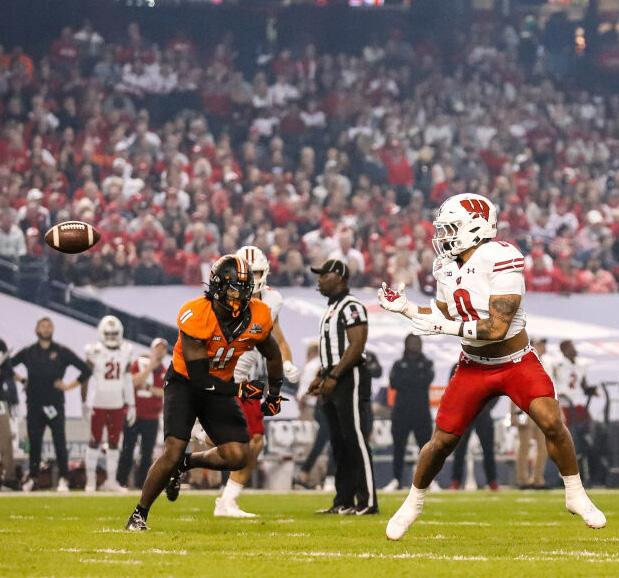
OSU (7-6) made a trip to Arizona to face off with Wisconsin (7-6) in the Guaranteed Rate Bowl. Wisconsin won 24-17.
Here are three takeaways from the game:
Sluggish offense, time of possession plague the Cowboys OSU’s offense was never able to find its rhythm on Tuesday. The Cowboys rushed for just 52 yards and freshman quarterback Garret Rangel completed just five passes in the first half and 14 of his 31 attempts on the night. Time of possession wasn’t particularly close as the Badgers controlled that battle 37:58 to 22:02, and dominated it in the first half, where they possessed the football for over 22 minutes, while OSU controlled it for just more than six minutes.
Badgers run wild Wisconsin’s rushing attack wore down the OSU defense in its win over the Cowboys. Braelon Allen led the way with 116 yards and a touchdown and Chez Mellusi pitched in 77 yards and a touchdown, and the Badgers ran the football 47 times for an average of 5.5 yards per carry.
OSU nearly comes back from 17 point deficit Once trailing 24-7 after three quarters, OSU would go on to cut the lead down to ten thanks to an underhand toss from Rangel to Ollie Gordon for a touchdown on fourth and goal followed by a field goal from Tanner Brown. The Cowboys then retained possession, attempting to score a touchdown to tie the game, but Rangel threw another interception — this time to Cedrick Dort Jr. to help secure a win for Wisconsin.
OSU defensive coordinator Derek Mason has a belief in football’s core tenet.
On Tuesday, two Wisconsin running backs provided a powerful reminder of how important it is.
“Football is a line of scrimmage league,” Mason said. “Anybody that you get up front that makes your life easier up front is what you go for. Identification of pass rushers and 3-techniques is really where college football is today.”
OSU lost 24-17 to Wisconsin in the 2022 Guaranteed Rate Bowl, where the Badgers badgered the Cowboys defense on the ground, racking up 258 rushing yards on 47 attempts. Sophomore Badger back Braelon Allen led the way with 116 yards on 22 carries. Senior Chez Mellusi worked in tandem, carrying the ball 16 times against OSU for 77 yards. Both had a touchdown.

The Cowboys’ run defense was a struggle throughout most of the year. OSU finished eighth in the Big 12 in total run defense, entering the bowl game allowing 171 yards per game. In their past three games, OSU’s opponents have averaged a whopping 227.6 yards per game.
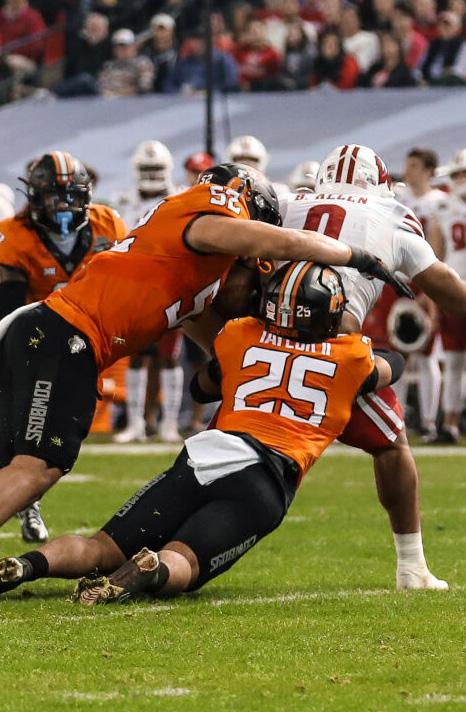
It’s something coach Mike Gundy said he will address during the offseason.
“We’ve got to work hard,” Gundy said. “We’ve got to make sure we run the gap, make sure we tackle and just continue to get better at what we do, just basic stuff.”
And yet, Mason is confident he will see defensive improvement. He expect it soon, too.
“That’s a learning lesson for this group,” Mason said. “As this group goes forward, in 2023 they’re going to be a really good defense. This defense is going to be a really good defense.”
He said the Badgers running free helped. When Kansas trounced OSU on the ground in early November to the tune of 351 rushing yards, it helped. But Mason said he is relying on more than lesson. He also plans to look for attributes.
“Speed,” Mason said. “Power. I think erasers. As you’re in the recruiting process, guys that love
football that are about discipline and toughness. Just got to get erasers… nowadays getting to the football, being around the football and making something happen is what you need. For us, as long as we still have spots on our roster it’s about getting erasers.”
Mason may not have to scour the transfer portal to execute his vision for a better defense.
“Oklahoma State is a developmental program, in that it does a really good job of finding guys that meet their criteria,” Mason said.
But he is said the transfer portal is like free agency. If you have a specific need, you can search up a player who will slot in perfectly. He said
Gundy has done a good job of finding those players.
The Cowboys have already successfully lured senior transfer Anthony Goodlow out of the portal. Goodlow, a three-year letter winner at Tulsa, is part of Mason’s plan to shore up the defensive front.
“It can’t be all young guys, right?” Mason said. “There’s got to be guys with experience. Guys that have pronounced resumes. Now all they’re doing is honing their craft and really tuning into the system. That’s really where we’re going to go with guys like Goodlow.”


Page 2B Friday, December 30, 2022 O’Colly 128 N Main St. Stillwater, OK 74075 Monday - Wednesday: 10:00am - 10:00pm Thursday - Saturday: 10:00am - 11:00pm Great selection, prices, & staff! 405.372.5080
sports
Mackenzie Janish
Handing... Continued from 1B
Wisconsin running back Braelon Allen toasted Oklahoma State for 116 yards and a touchdown in the Guaranteed Rate Bowl.
sports.ed@ocolly.com
Mackenzie Janish
Oklahoma State’s defense allows an average of 178 rushing yards a game which ranks last in the Big 12 among teams that have played 13 games.
sports.ed@ocolly.com
Houses for rent
Ginger or daikon
“The Princess and the Frog” setting
“The Country Girls” novelist O’Brien
*Separation after the vernal equinox?
Moral wrong
Round number
“And now, without further __ ... ”
Take to court
“So?”
*Nightmare for a wedding baker?
Thompson of “Passing”
Draped attire
Zoom alternative
Daily Horoscope
Nancy Black Tribune Content Agency Linda Black Horoscopes (TNS)
Today’s Birthday (12/30/22). Domestic bliss rewards this year. Profit by providing consistent excellence. Undergoing a change of heart this winter leads to a springtime family fun phase. Help friends around a summer change, before your career launches to new heights next autumn. Your home is your castle. To get the advantage, check the day’s rating: 10 is the easiest day, 0 the most challenging.
Aries (March 21-April 19) — Today is a 9 — You’re growing. Go for what you want. Don’t accept another’s prejudices. Challenge your own assumptions. Listen to a variety of views for a wider perspective.
Taurus (April 20-May 20) — Today is a 7 — Recharge your batteries. Let others debate in the public square. Restore energy with private rituals like a walk in nature or tea with a friend.
Gemini (May 21-June 20) — Today is a 7 — Luck follows initiative. Help a team project advance around a blockage. Clear clutter so you can see what’s going on. Contribute to a community effort.
Cancer (June 21-July 22) — Today is an 8 — Professional projects develop in interesting directions. Others are impressed with your work. Avoid a conflict of interests. Steadily build to realize a dream.
Leo (July 23-Aug. 22) — Today is a 9 — An adventure tempts. Wait for better travel conditions. Do the homework and make your deadlines. Build your investigation on solid foundations. Extra preparation pays off.
Virgo (Aug. 23-Sept. 22) — Today is a 7 — Collaboration gets you around a tight financial spot. Provide a view of each other’s blind spot. Reduce expenses and increase income. Share and pull together.
Libra (Sept. 23-Oct. 22) — Today is a 7 — Patience pays extra. A partner feels compelled to advise you. Ignore impulsive reactions. Listen for the gold and let the rest wash away.
Scorpio (Oct. 23-Nov. 21) — Today is an 8 — Demand for your attention is high. Avoid distractions. Don’t make false promises. Rely on structures for support. Slow to avoid mistakes. Physical action gets results.
Sagittarius (Nov. 22-Dec. 21) — Today is a 7 — Romance and fun are distinct possibilities, despite challenges. Luck is on your side. Disciplined actions get results. Prioritize family. Simplify and relax. Capricorn (Dec. 22-Jan. 19) — Today is an 8 — Family comes first. Work from home when you can. Increase productivity with comfortable surroundings and the right equipment. Household upgrades provide greater ease.
Aquarius (Jan. 20-Feb. 18) — Today is a 7 — Creative obstacles could stall the action. Back to the drawing board? Step by step, reinforce basic structures. Build on strong foundations. Persistence pays off.
Pisces (Feb. 19-March 20) — Today is a 9 — Tap another revenue source. Make sure there’s enough to pay expenses. Explain your ideas carefully. Advance profitable opportunities to the next level.
Solution to Thursday’s puzzle
Complete the grid so each row, column and 3-by-3 box (in bold borders) contains every digit, 1 to 9. For strategies on how to solve Sudoku, visit sudoku.org.uk

O’Colly Friday, December 30, 2022 Page 3B
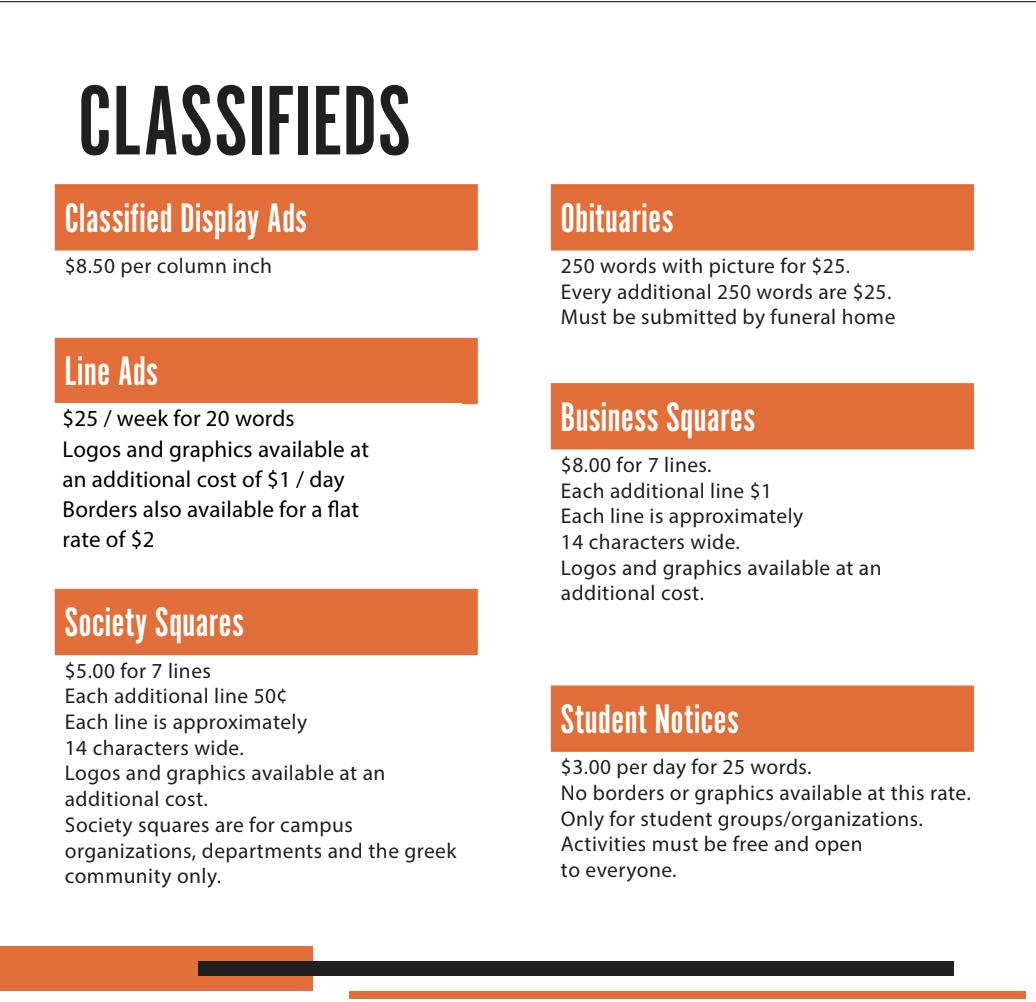
Business Squares Classifieds
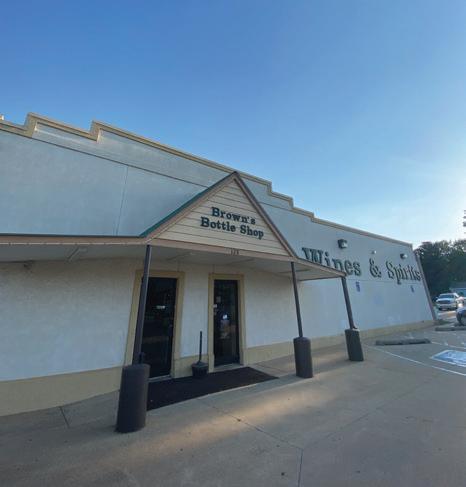
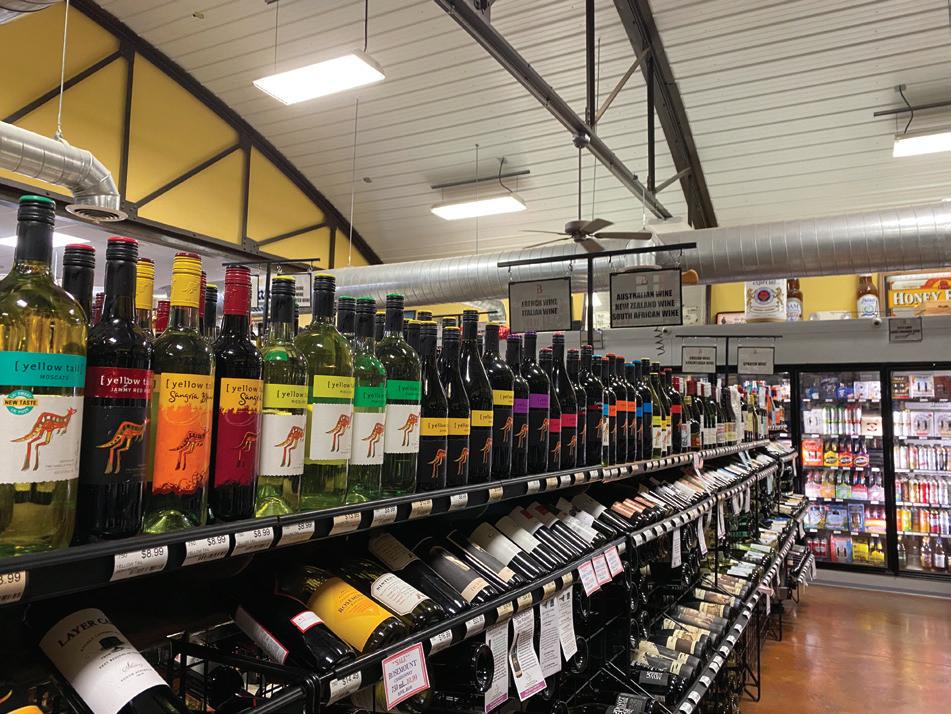
The best selection of beer, wine and liquor that Stillwater has to offer! Perfect for all your game day needs, come to Brown’s Bottle Shop located on 128 N. Main
Serving
“The Original Hideaway, located on the corner of Knoblock and University.
quality pizza and more since 1957.” Murphy’s Department Store
Business
Business
Company Coming? Check out “Cowboy Cabin” 550 steps east of Boone Pickens Stadium Airbnb.com/h/cowboy-cabin
the
of
at
815 S Main, Downtown Open 10-6 Monday thru Saturday
Squares
Squares
Come check out
wide variety
elegant clothing
Formal Fantasy! Located on 121 E. 9th Ave, Downtown Stillwater
Calls
Los Angeles Times Daily Crossword Puzzle
1.5 miles from campus. No lease, plain, fenced cabins. Pets OK. 3/1 $650, 2/1 $550.
only 405-743-0603.
FOR RELEASE DECEMBER 30, 2022 ACROSS 1
6
10
13
14
15
17
18
19
20
23
24
25
28
30
31
35
40
42
43
45
47
49
50
51
56
58
61
62
63
66
67
68
69
70
71
DOWN 1
2
3
4
5
6 __
7 Great
“Children
8
9
10
11
12
16
21
22
25
26
27
29
32
33
34
36
37 __
38
41 “¡Hasta mañana!” 44 Right direction? 46 “We Belong to Something Beautiful” cosmetics chain 48 Saffron-flavored rice dish 51 Self-satisfied 52 Bat mitzvah scroll 53 __-Saxon 54
55
Vivek
Akwaeke 57 Hitting
59 Between ports 60 Settled 64 Shiba __: dog breed 65 Megan
©2022 Tribune Content Agency, LLC By
12/30/22 Thursday’s Puzzle Solved 12/30/22
Edited
by Patti Varol and Joyce Lewis
In the lead
Word files, informally
Box set unit
The Gem State
“By yesterday!” letters
“Carol” star Rooney
Epic tales 39 Streetcar
*Arrangement of extras for a zombie movie?
Light touch
Draw
“This __ to stop”
“Be careful!”
Choose
*Halloween costume that’s a sheet on the bottom and a witch’s hat on top?
Strongly encourage
Falsehoods
Broadcasting
Big do
Kick back
Spanish royal
Sweltering
Showcase for a soprano
Make sense, and a hint to the answers to the starred clues
Tell 62-Across
Civil rights pioneer __ B. Wells
Sunbeams
Selling points?
Major component of Iceland’s economy
with faint praise
Plains people who call themselves
of the Middle Waters”
Pasta nutrients, for short
Peloponnesian city-state
Info provided to a matchmaker, perhaps
Spirit of the cosmos?
Pastry with a hole
Cassette
Alaskan people
Zehn minus neun
Makes a move
__ chocolate
“Sure”
Crossed (out)
Focus of some special elections
Function
Pre-coll. exam
Ancient Teuton
fresca: Mexican drink
Depletes
Man on a mission?
“The Death of
Oji” author
all the right notes
Thee Stallion genre
Mark Valdez & Brooke Husic
©
Level 1 2 3 4 12/30/22
2022 The Mepham Group. Distributed by Tribune Content Agency. All rights reserved.
OSU offense unable to get back to what worked, shaky in bowl loss
run from freshman Stephon Johnson Jr. that was more individual athleticism than offensive prowess, OSU would have entered halftime with only 37 yards.
Hutchens Staff Reporter

It felt like the OSU offense barely had the ball most of the game.
Which maybe was a good thing for some of the fans who made the trip from Stillwater to Chase Field. OSU’s offense was hard to watch for most of the game, a 24-17 loss.
OSU had the ball for 22:02 of game action. Wisconsin, for comparison, possessed the ball for 37:58. The Cowboys mustered 281 total offensive yards, their lowest total since the Manhattan disaster against K-State.
Without an 84-yard catch and
“We really couldn’t get enough going offensively to ever sustain time on the field defensively,” OSU coach Mike Gundy said. “So, we fought back and got some stops, fought back, got some stops, got some turnovers. But we really struggled, obviously, to rush the football early and then maintain time of possession on the field in the game.”

It took about three quarters for the offense to get going.
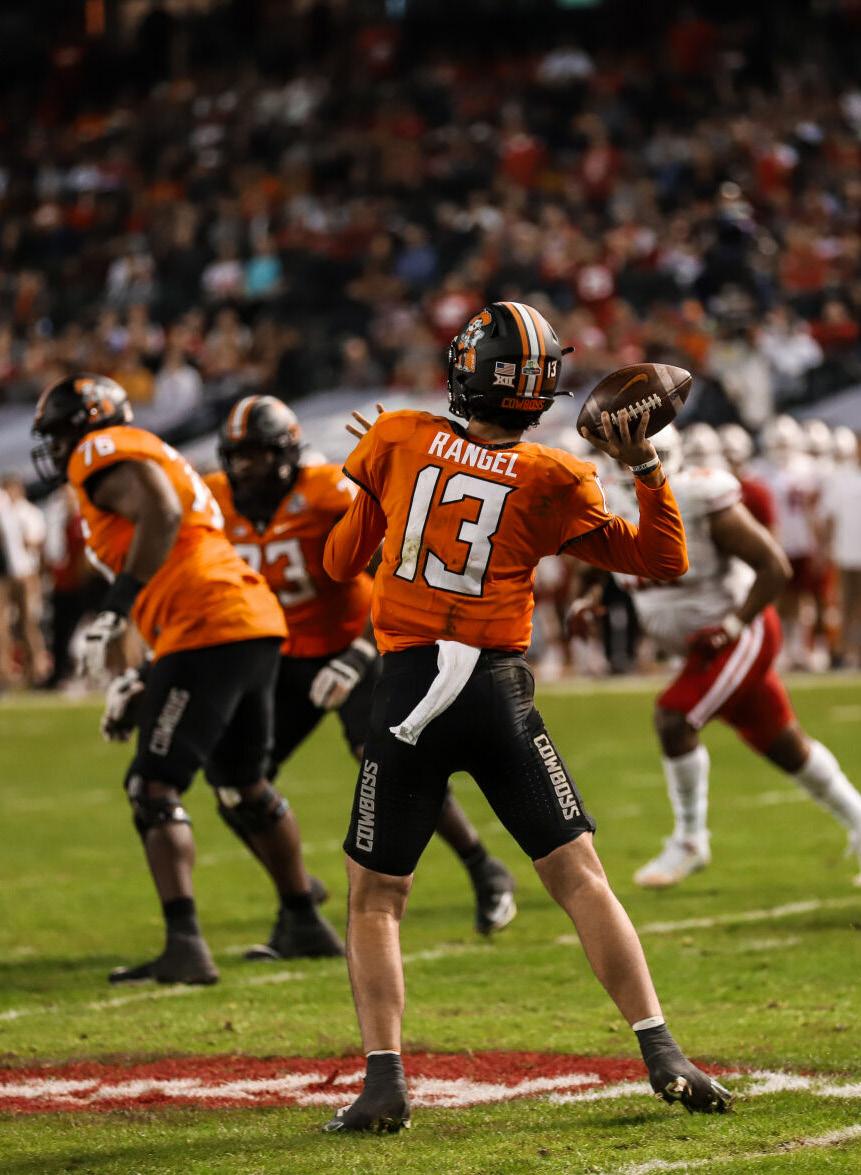
Freshman OSU quarterback Garret Rangel finished the game 14-of-31 for 229 yards, two touchdowns and two interceptions. Rangel was six-of-eight in the quarter with a highlight oneyard touchdown shovel pass to running back Ollie Gordon. The score gave the

HIMALAYAN

Cowboys some hope, and then a field goal the next offensive series put OSU right back into the game. However, a Rangel interception on a game-tying opportunity soon after sealed the game’s result.
Although the offense did its best to rally, the 17-point deficit OSU faced midway through the third quarter felt too wide to overcome. Because of the way the season ended, the 17-point deficit felt like 37.
Because of injuries and the transfer portal, the Cowboy team playing in the game Tuesday was completely different than the one that erased a 24-point deficit just two months ago against Texas.
OSU offensive coordinator Kasey Dunn said next season, OSU needs to get back to being the team they were early in the season.
“I loved the tempo (early in the season),” Dunn said. “We played fast at

the beginning of the year, probably one of the fastest teams out there through the first seven games. Like I said, we were scoring a lot and them the injury bug hit us again. We lost a bunch before the season started, and a lot of the fans don’t know but you lose a Jaden Bray and Blaine Green and those guys that’s impactful, big time.”
“I look at it and I go OK; I love the way that we started the season,” Dunn said. “I want us to just get back to some of that again. We’ve got to have the depth to make sure that we can get through that. So, for me, the message to the offense is what were we doing the first half of the season. And at that point we’re top-five in every category and all the sudden it just hit and a lot of moving parts and trying to make it work.”
Page 4B Friday, December 30, 2022 O’Colly 230 S. Knoblock St. Stillwater, OK 74074 Stop in for fresh Fried Mushrooms or Pizza made to your liking! SINCE 1957, CheckouttheOriginalHideaway! ORDER CARRY OUT TODAY OR MAKE A RESERVATION TEXT RANCHERS TO 33733 TO DOWNLOAD OUR APP LUNCH MON-FRI 11AM-1:30PM DINNER TUES-SAT 5PM-8:30PM MEAL PLAN/BURSAR ACCEPTED
GROCERY STORE sports
sports.ed@ocolly.com
Mackenzie Janish
OSU quarterback Garret Rangel (13)
completed just 45% of his passes, and the OSU offense finished with 281 yards in a loss to Wisconsin.
Ben
his defense only allowed 162 yards against the Cowboy offense in the first three quarters of the game. Coaches know what they’re doing. It’s mostly a matter of fit.
As for OSU, I’m not sure if there will be any coaching changes. And if there aren’t, I think that’s fine. One, albeit, very underperforming season isn’t enough in my eyes to fire somebody. 7-6 isn’t a good record, but it’s not 1-11. OSU isn’t a program where 11 or 12 wins is the standard anyway. After multiple bad ones, though, that’s when coaches get fired.
But a change of face isn’t always a bad thing. Sometimes, it’s healthy to get new eyes, new language and new brains into a group. You never know what can happen.
As for what changes will happen, Gundy alluded to how the staff will go about it. They’re going to talk about it, and with the season over, will have time to navigate and make decisions on what they are to do in the modern landscape of college football without a game to worry about in the week.
“It is a time to reflect and make the most of the opportunity to ask, ‘How do we make this work for Oklahoma State?’”

Dunn said. “Because whoever figures that out, is going to get us a step ahead. We need to
figure out how to make it worse for us.”
Personnel wise, young players will progress over the offseason, but he’s mentioned there’s a need for veterans. Gundy said earlier this season he’s not much of a portal coach. Well, he just brought in one of the top rated transfer portal classes in the country. It’s a big part of the sport now, and he just used it to fill holes at positions of need with said veterans.
“We need erasers,” said defensive coordinator Derek Mason. “Guys who have some college experience, because they can’t all be young guys. There’s got to be guys with experience. That’s what we’re looking into.”
Modern recruiting is a topic Gundy has explained his distaste for. Mostly about NIL, but like it or not, it’s part of the game now, too. How much of OSU’s 63rd ranked (247Sports) recruiting class could be attributed to NIL? I don’t have a clear answer for. But if it happens again, and again, then assumptions could be made. And after that, there would need to be change to compete.
Gundy and OSU have changed before. With both roster and coaching matters. But if they want to be better than 7-6 going forward, they’ll change again. And now more than ever is there a need for transformations.
 sports.ed@ocolly.com


sports
O’Colly Friday, December 30, 2022 Page 5B
Mackenzie Janish
Healthy... Continued from 1B
OSU freshman quarterback Garret Rangel finished as starter in a season that included many injuries and transfer portal entries, such as star quarterback Spencer Sanders.
Picking winners (and losers)
Michigan (33-31)
TCU (44-40)
Michigan (42-31)
Ohio State (41-37)
Ohio State (41-37)
Alabama (40-34)
Ohio State (34-28)
Michigan (38-30)
Ohio State (27-23)
Alabama (38-20)
Utah (41-40)
Utah (37-30)
Darren Shrum 5-0, Week 2


Clint Chelf 5-0, Week 8
Kenny Gajewski 4-1, Week 3


John Smith 4-1, Week 11
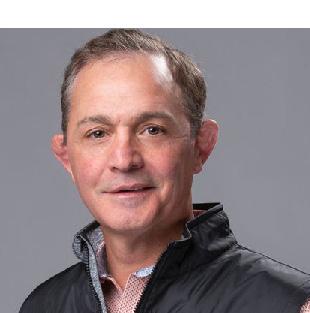

Michael Haag 3-2, Week 5
Michigan (37-34)
Georgia (37-29)
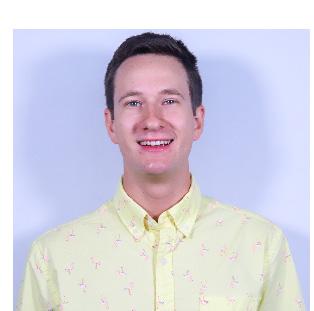
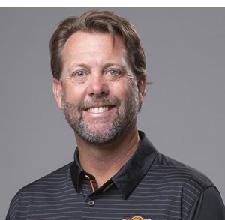
(30-14)


(30-29)

Michigan (38-31) Alabama (34-24)
Georgia (37-29) Michigan (30-29)
Alabama (42-27)
(37-27)
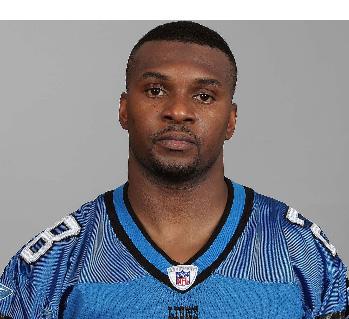
Penn State (36-34)
Oregon (44-31)
(27-26)
Jenni Carlson 3-2, Week 10


Jacie Hoyt 2-3, Week 9


Mayor Will Joyce 2-3, Week 6

Malcolm Rodriguez 2-3, Week 7

Eli Lederman 2-3, Week 12


Connor
Page 6B Friday, December 30, 2022 O’Colly
sports
Last Week’s Guest Guest Picker leader board
Dean Ruhl 0-5, Week 4
3-2, Week 14 Tatum Bell 2-3, Week 15 Record: 45-32 Last week: 1-4 Sam Hutchens Braden Bush Adam Engel Ben Hutchens Gabriel Trevino Record: 41-36 Last week: 3-2 Record: 49-28 Last week: 3-2 Record: 53-24 Last week: 1-4 Record: 47-30 Last week: 2-3 Overall Guest Record: 39-30 Last week: 2-3
Burgan 2-2, Week 13 O’Colly Women
TCU
Michigan vs.
Tumma
Tumma Sudeep Tumma 2-3, Week 16
Oregon
Alabama
Michigan
Michigan
Georgia vs. Ohio State National Champion Alabama vs. Kansas State Utah vs. Penn State Sudeep
Sudeep
