
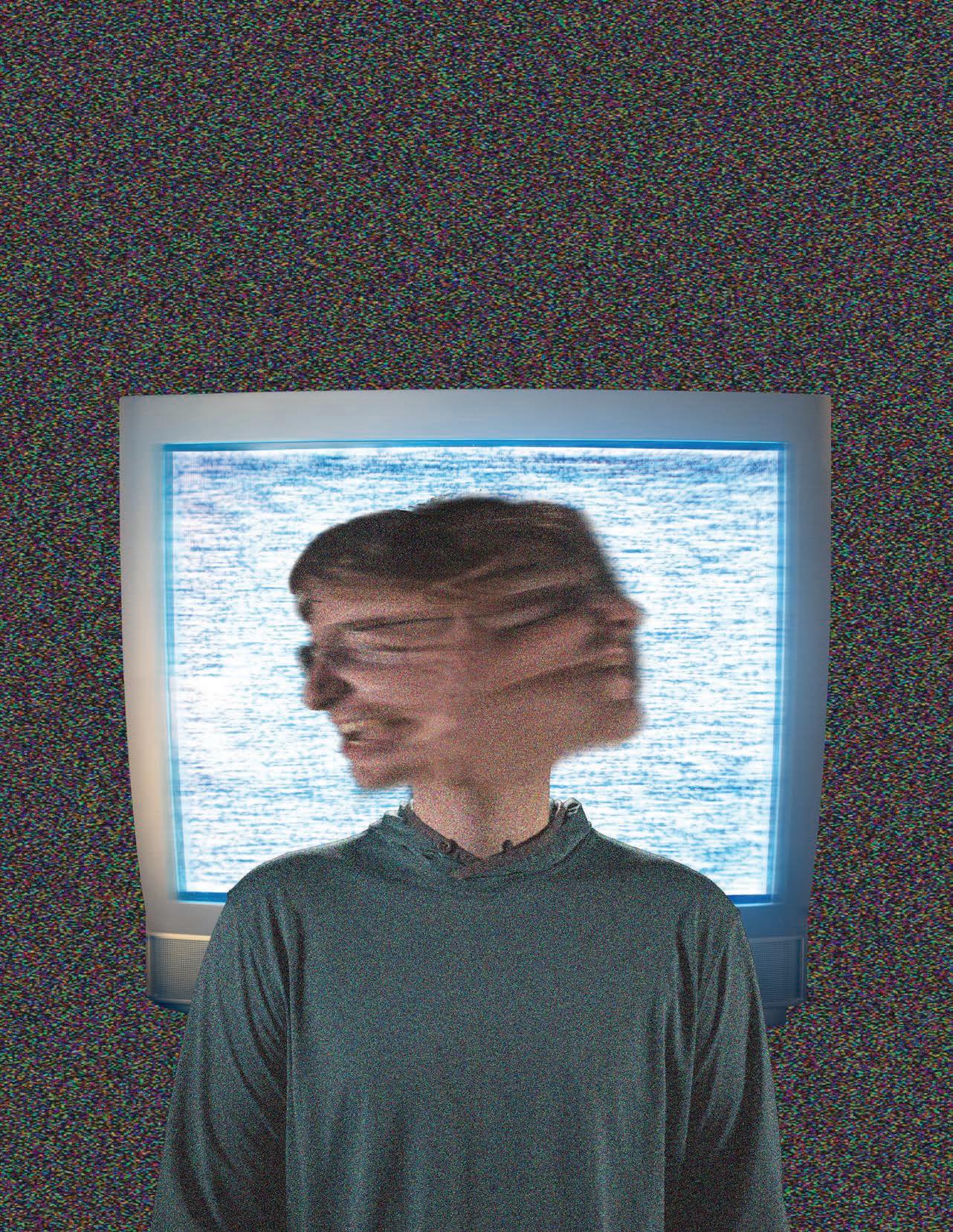














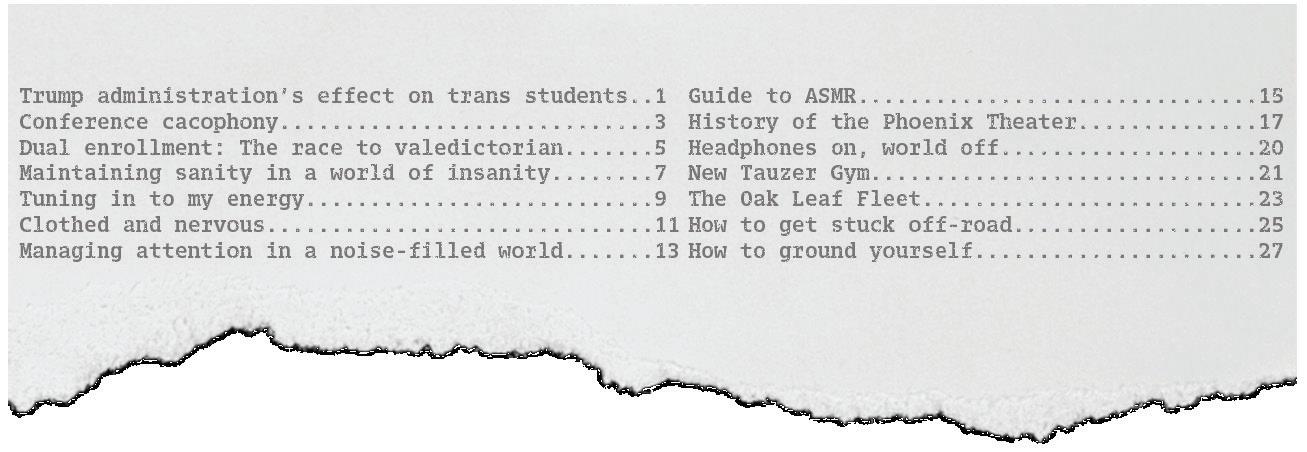






This issue, “Signal in the Noise,” was inspired by how difficult it is to find truth, meaning, focus and direction in today’s overwhelming barrage of discourse, fueled by addictive cycles of media creation and consumption, blurring the lines between fear and humor; dread and optimism; and isolation and community.
Between the backdrop of this zeitgeist, we prioritized curating a collaborative environment in our newsroom, emphasizing connection, community and burnout prevention. As first-time co-editors-in-chief, we strived to break down hierarchical barriers and create a newsroom for all voices to be heard.

This semester, The Oak Leaf has persevered to cover local commotion on and off campus, including the Trump administration targeting Santa Rosa Junior College and the athletics organization over the participation of a transgender athlete; a troubled dance program after alleged abuses from an instructor who is yet to be terminated; and SRJC’s $10 million budget deficit and the controversial defunding of positions and programs to correct course.
Contributors
Lauren Kelleher, Designer
Cristan Molinelli-Ruberto, Designer
Valondrah Mota, Designer
Rosemary Cromwell, Designer/Writer
Ziggy Leon, Designer/Writer/Photographer
Adair Alvarez Rodriguez, Designer
Natalie Emanuele, Illustrator/Writer
Forest Crystallah, Illustrator/Writer
Kevin Terlizzi-Bowes, Illustrator
Ben Lyle, Writer
Noah McSweeney, Writer
Jesse Saal, Writer
Kinda Hamami, Writer
Megan Brown, Writer
Vanessa Herrera Ortega, Writer
Destiny Quiroz-Lindauer, Writer
Dylan Cooper, Writer
Cayden Timbermoon, Writer
Pacific Jeremy, Photographer
Patrick Merritt, Photographer
Juan Padilla, Photographer
Zoë Steiner, Photographer

While we primarily deliver this coverage online, we have one opportunity to print each semester in the form of this magazine. With the rise of paper costs and the slow dying of local journalism, it’s a miracle that we have maintained some form of print in this digital age. After all, The Oak Leaf Magazine was born from a shrinking budget that could no longer support our biweekly newspaper we once printed from 1927 to 2018.
This pattern continues. With this semester’s budget consisting of the revenue from the few ads we were able to sell in today’s high-risk economy, a bit of leftover grant money and the tenacity of our adviser, we were able to produce the shortest issue since the publication’s inception at a mere 32 pages.
Truthfully, the future of The Oak Leaf Magazine is not guaranteed.
But you can help us keep it going, even if just for one more semester and for the new bright-eyed student journalists that come after us.
If you enjoy this magazine and want to see production continue, we ask for your contribution in any way that is reasonable for you. You can tell your friends and family to read this magazine. You can take out an ad online or in our next issue. Or you can make a donation. Or tell your wealthy aunt to make a donation.
Once you finish reading this issue, we hope you understand and believe in the life force and value journalism provides to communities, and feel inspired to support the journalists of tomorrow. Between now and then, enjoy some silly and serious stories about backpacking for the first time, what exactly ASMR is, and the threat of our current attention economy and how to break away.
Lauren Kelleher and Cristan Molinelli-Ruberto








Although the many actions taken by the Trump administration to limit gender expression have fluctuated in and out of national attention, the emotional and mental stress remains at the forefront for trans students at Santa Rosa Junior College.
In February, Kansas revoked driver’s licenses for 1,700 trans individuals because their gender listed didn’t align with their gender at birth. The Supreme Court overturned a law that would ban conversion therapy for minors in Colorado, Trump pressured multiple health insurance companies to ban trans-related surgeries for anyone under 19 and Trump’s Department of Education is suing SRJC over Title IX accusations against a trans athlete.
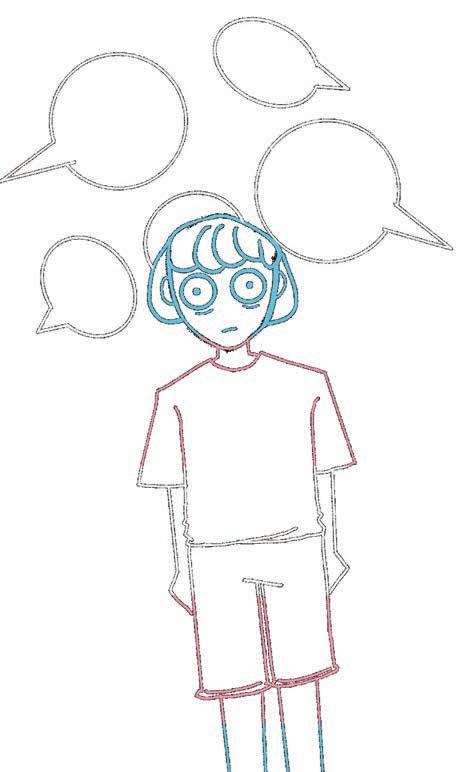
A study by the Trevor Project, a non-profit suicide prevention and support organization for LGBTQ youth, found that from September 2023 to March 2025, anxiety among LGBTQ youth increased from 57% to 68%, along with depressive symptoms rising from 48% to 54% and suicidal ideation growing from 41% to 47%. Trans and nonbinary youth ages 13-17 reported the lowest rates of mental health and represent the highest risk for suicide.


“A heavy thing that kind of weighs on my mind. There’s a lot of people who are in less progressive states.”
Jack, 18, a trans SRJC student who didn’t want their last name used for personal safety and fears of being out to the public, said they have friends living in rural states with more restrictions, such as the Kansas removal of driver’s licenses. Those friends know people who have died by suicide due to a lack of resources to support them and the Trump administration’s anti-trans agenda.
Jack said he has been personally affected and has felt his community struggle. He has not felt safe in seeking mental health resources for trans individuals from SRJC, primarily because of transphobia he’s seen on campus.
Zander, an SRJC biology major who wished for their last name to be omitted because he has a conservative family, hasn’t been able to medically transition, and has been concerned for people who are more visibly trans and those living outside of California.
Although physically safe, Zander still feels his mental health worsening as a result of political pressures, such as the current administration actively targeting of SRJC for accused Title IX violations.
He has also felt distressed about the lack of resources and people to support his identity.
“Coming from an unaccepting family, [I have] the stress of possibly not having people to fight [for me],” Zander said.
He has not accessed SRJC’s resources for trans mental health, such as the Queer Resource Center, because he said his sense of safety diminished after the Title IX case against a trans athlete began.
“I just
kind of fly under
the radar, but it’s definitely still nervewracking. Technically, they’re not going to stop me for having an incorrect gender marker or having name changes.”
Marina Lee, 20, an SRJC music major, worries what the future will look like for trans individuals if the political climate doesn’t change. She acknowledges her situation is different from others in more conservative states, though she said she has been negatively affected by community reactions surrounding the Title IX accusations.
She said she has also seen government officials from both left-wing and right-wing parties who are dismissive or hold anger. She has begun to hold less faith in the government and society at large, with how much aggression has been shown towards her identity, from people boycotting Bud Light after a sponsorship with a trans woman, to executive orders and legislation defining sex and gender in a binary way.
“Makes me feel kinda disillusioned with our fellow people. It’s hard to believe people hold this much anger in their heart.”
Lee has found a safe haven at the Intercultural Center, noting how supportive QRC coordinator Jennifer Espinoza has been throughout her transition.
SRJC psychology major and Oak Leaf editor Zoë Steiner, 23, thinks the current political situation is just another display of historical discrimination on which the country was founded, rather than a new issue.
“I’m still one of those people who’s like, it doesn’t really matter who’s president, because we still exist in a system that is basically just — not excused fascism — but it’s written into the Constitution,” Steiner said. “When a country is literally built on genocide, you can’t expect much better.”
Despite believing this is the norm, they have seen discrimination become more overt under the Trump administration.
“It’s more obvious now, whether that be because [discrimination] is happening more often, or just hating Trump is a very publicized thing,” Steiner said. “I think more people are paying attention to it now, which makes it seem big and can make people be like, ‘Oh, it wasn’t under the Biden administration.’”
Steiner believes the subtle transphobia of the Biden administration has been overshadowed by the outward display from the Trump administration.
Though they believe this is an old issue, it has still affected their mental health, but they do consider themselves lucky to have a community and family that supports them.
In general, they feel safe and accepted at SRJC, but Steiner noticed a social shift after the Title IX accusations and was terrified when anti-trans protesters descended on campus in October 2025 and protested outside a volleyball match at Haehl Pavilion.
Steiner has not had the time to seek mental health services from SRJC but has talked to the current QRC coordinator, Bree Clark, and feels she has been very kind and would be safe to talk to.
Although trans SRJC students may feel safer in California, they still feel the effects of the Trump administration’s policy changes and experience more mental distress as a result.
Clark chose to step into her current role as QRC coordinator after witnessing LGBTQ individuals being disproportionately affected by things like housing insecurity, lack of access to affirming healthcare and barriers to essential resources, especially with intersecting marginalized identities in her previous role as basic needs specialist.
“I generally don’t feel great existing in public when I am visibly queer.”
“These experiences reinforced for me that this work must be intersectional and rooted in equity,” Clark said.
Clark cited multiple studies showing that political rhetoric and policies that target trans individuals have deeply impacted the trans community. She’s also seen rates of suicide and attempts increase in transgender people during Trump’s last term and in the last year, proving the mental distress the community experiences when faced with political targeting and repression.
Despite only assuming her role in March, Clark has been working hard to create an affirming and safe space for trans individuals at the QRC. She has worked with students
and staff on hosting multiple trans-focused events, including the Trans Day of Visibility.
Clark is also working on expanding current support systems and building new systems to offer mental health referrals, basic needs resources, identity-based programming and community building through drop-in hours.
“My goal is not only to respond to harm, but to actively build conditions where students can thrive,” Clark said.
SRJC QRC - 707-527-4964
Drop in hours with Bree Clark: Mondays 4 to 6 p.m. Thursdays noon to 2 p.m.
Positive Images - (707) 568-5830
Drop in hours
Tuesday to Friday, noon to 6 p.m.
Trans Lifeline: (877) 565-8860
Hours of operation
Monday to Friday, 10 a.m. to 6 p.m.
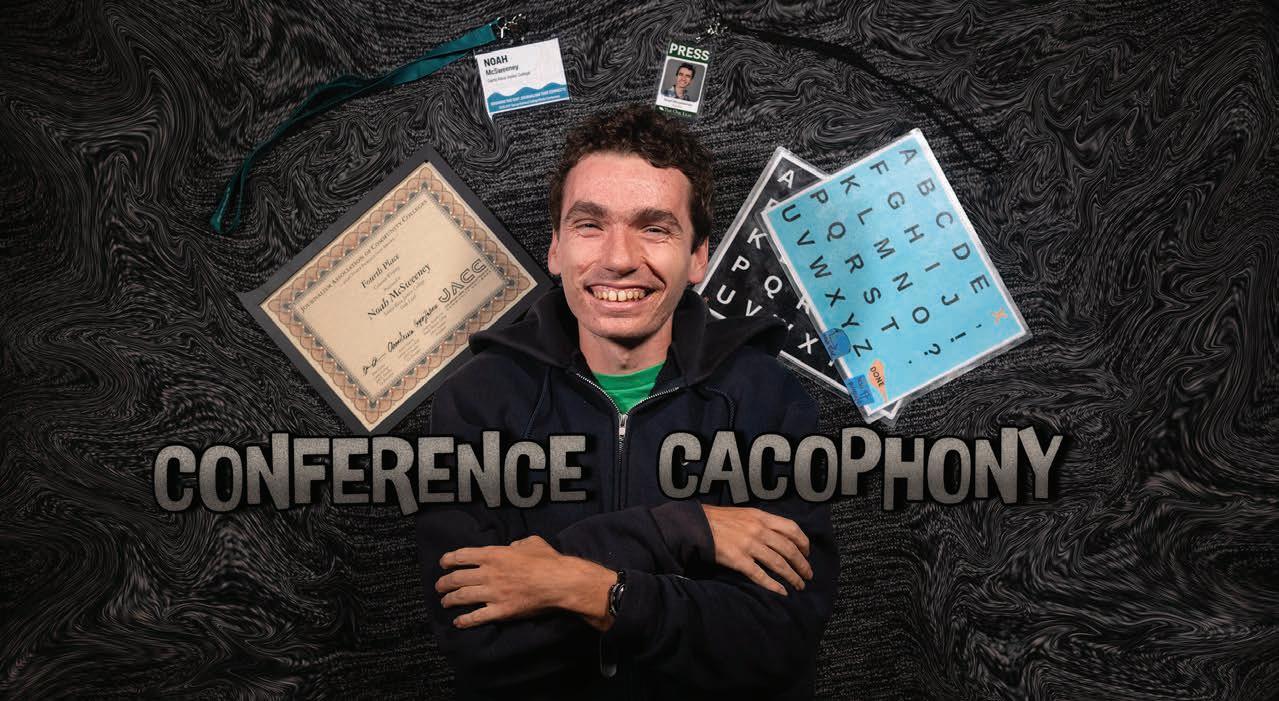
By Noah McSweeney
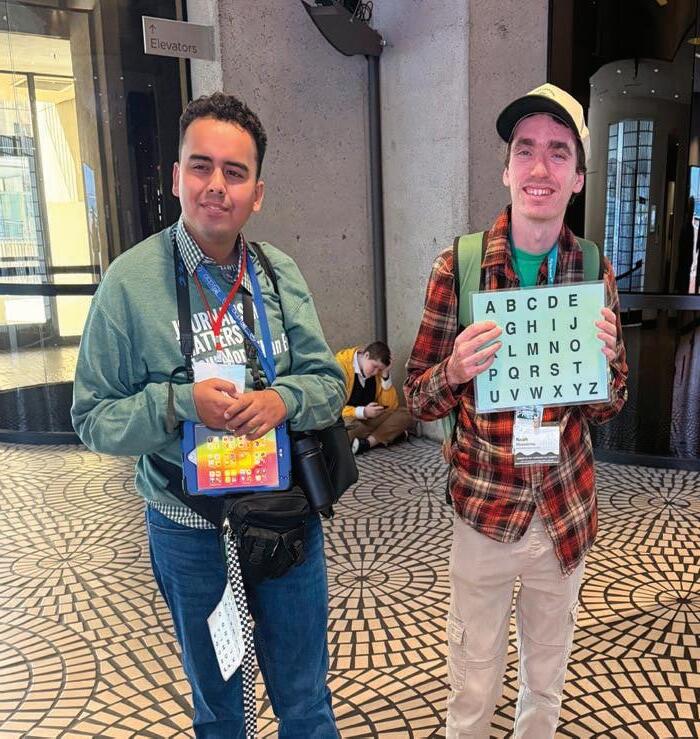
Iwalk into the Hyatt Regency Embarcadero, voices chattering from all directions bouncing through my brain like a rubber pinky ball. I feel the vibrations of hundreds of footsteps press up through the floor into each cell of my legs.
Walking into the Associated Collegiate Press National Media Conference in San Francisco is my initiation into the world of student journalism conferences. The cacophony takes my breath away. Shoulders hunched up past my ears, I take little steps in the crowd, trailing Buck, my communication partner. Colors swirl before me, blending with the voices; my synesthesia is in full bloom. It has a huge impact on my ability to discern between myself and others. My body loses its contours as I feel myself shape-shifting. Now I am formless.
I worry I will fail at my first college journalism conference.
I am scared and lost. I am not like them. My autism prevents my speech from matching my intention. Will I keep my cool, or will I run with my hands over my ears? Will I look weird, inducing stares from cute girls? Maybe my mouth will spew some accidental words; Please, God, don’t let me sound dumb!
Suddenly, I am aware of a woman talking to Buck, who is carrying the letterboard I use to spell out my thoughts. She is with a young man with a smaller letterboard strapped to his waist and carrying an iPad. It’s Alfonso, a speller friend from Southern California whom I barely remember, and the woman (his mom) knows my mom.
I am no longer alone in this chaotic place.
Standing in the hallways feels hellish, and smiling rarely manages to ease my angst. The small space and the hordes of people close in on me. I want to disappear.
Sometimes I need to actually hide so my nerves can reset. I chase my imaginary scared self into the corners of my mind by hiding behind pillars. It’s a trick I learned as a child to think I was invisible and mask my nervousness. Mastering any new social skill is an intense effort for my autistic brain and body.
I must come out, show my face and try to look normal. My mind needs more time to hide. No one notices me and I’m glad. I step out and make myself slowly blend into the scene before me.
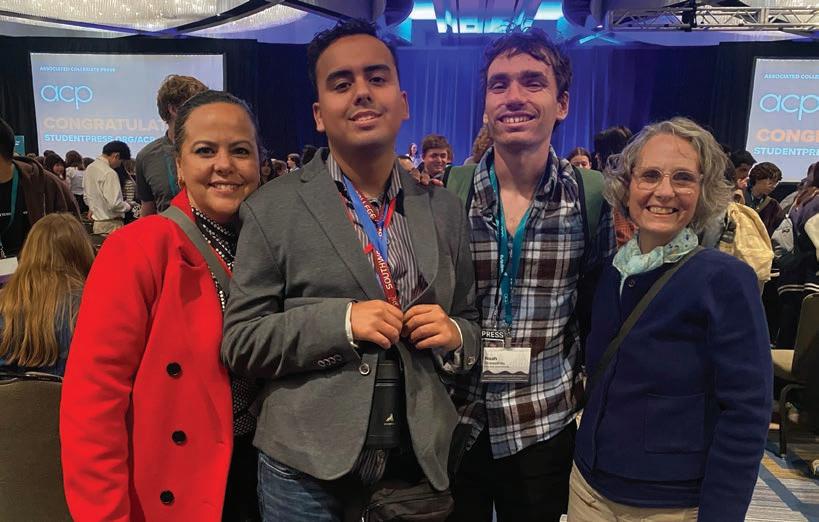
With Buck to help me and now another speller journalist in tow, I should be solid. Yet despite the supports in place, my sensory system is shaky. It isn’t until partway through the first presentation on “Restorative Practices in the Newsroom” that my body begins to settle. The speaker’s message is a warm blanket of cognitive comfort. From then on, things feel manageable. I have allowed myself to acclimate to the environment. It is more than that. Is it the best I can do? Will it be enough? I let it in. I deserve to be here.
In the “Disability Reporting” session, I feel I’m part of the group because of our shared interest. I unlock a scared part of myself that feels separate and invite my peers to embrace that part.
Hanging out in the lobby with my fellow Oak Leaf staff members — such good people — relaxes me. My senses are integrated and calm now.
Going to dinner with my class tests my patience. Restaurants mean long lines, wait times, noise and tons of talking faces. My hunger, however, trumps my anxiety. I’m glad to be there with them, listening to their banter in my silence. With Buck by my side, I stay grounded.
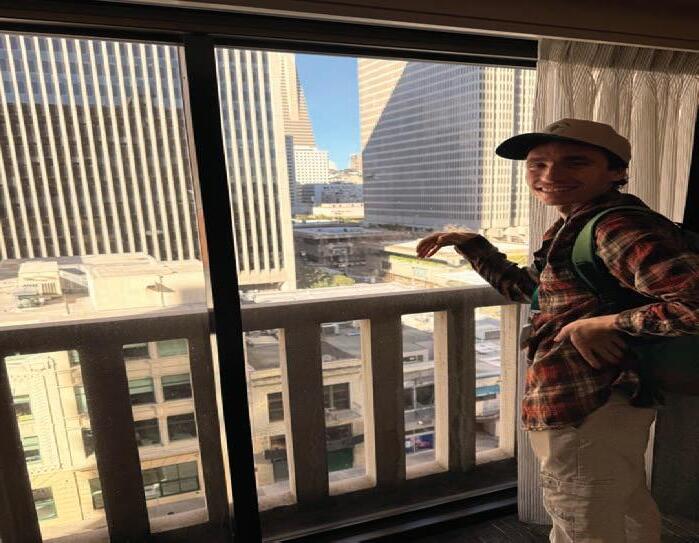
Waking in the hotel is disorienting. Moving through my usual morning routine, my nerves give way to my growling stomach. The hunt for breakfast leads us to a buffet, where
My parents’ attendance on the second day surprises me in a way that is uplifting and not encumbering in the way I suspect they thought it might be. I join the ranks of award-winning college journalists yet again, delighting at the fact that when the announcer calls

(From left) Santa Rosa High School seniors Alejandro Jarquin and Enjal Parajuli have challenged each other as academic rivals since freshman year, both dual-enrolled at Santa Rosa Junior College. (Lauren Kelleher)
by Vanessa Herrera Ortega

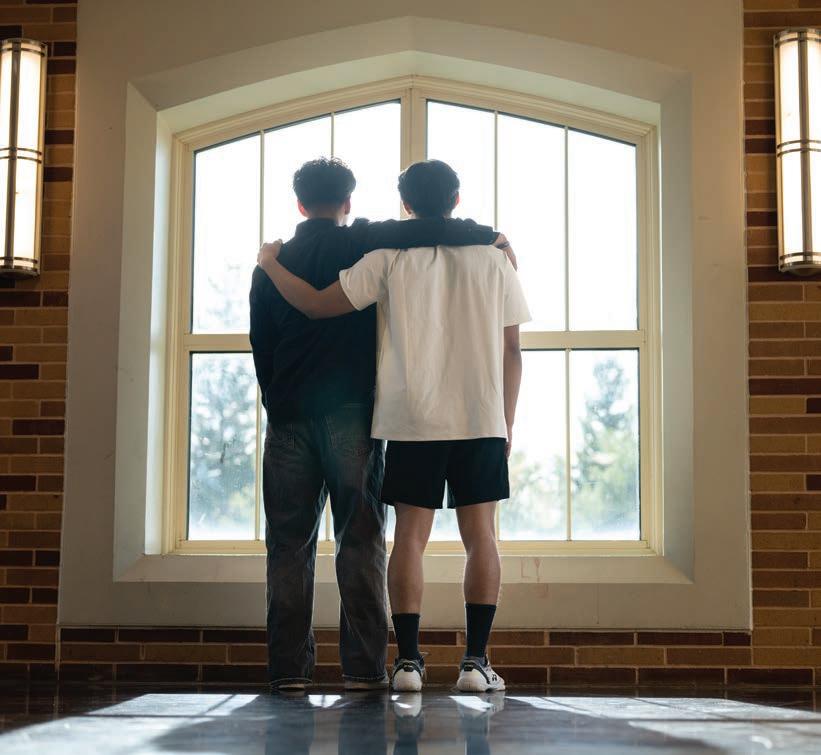
Alejandro Jarquin, 18, and Enjal Parajuli, 17, lead double lives. At Santa Rosa High School, they have battled neck and neck for nearly four years for valedictorian. At Santa Rosa Junior College, they take undergraduate STEM courses together and work in the tutorial center. They have been dual enrolled in both schools for the past four years on a fast-track journey to get their bachelor’s degrees.
Jarquin and Parajuli are among a growing number of dual-enrolled high school students at SRJC who juggle schedules and homework from two schools. High school students who are freshmen or above can get an early start on earning college credits through SRJC’s dual enrollment program. According to SRJC census data, 8.5% of the SRJC population are dual enrolled students.
The average number of dual-enrolled students at SRJC is close to 2,000 students per semester, according to Director of Admissions and Records Vayta Smith.
Students can begin as early as ninth grade, but most begin in junior year. “So the average students do walk away with 12 to 15 units completed at SRJC by the time they graduate high school,” Smith said.
California established the College and Career Access Pathway in 2015, which allows high school students to take community college courses for free. This partnership offers students the chance to experience higher education without barriers to entry such as cost. CCAP now accounts for 45% of student enrollment in dual enrollment courses.
According to CalMatters, about 80% of California’s dual-enrolled high school students go on to a community college or university.
Dual enrollment rates rose to about 165,000 students in 2025, with one-third of high school graduates completing at least one college course after California Community Colleges began offering dual enrollment statewide, according to the PPIC. The number of dual enrollees completing English composition has more than tripled since 2017.
According to the College in High School Alliance, high school students who dual enroll are more likely to graduate, attend college, and complete a certificate or degree.
“My parents immigrated here with the purpose of giving me an opportunity to pursue higher education.”
Santa Rosa High School seniors Jarquin and Parajuli, are prime examples of dual enrollment leading to success. Not only are they the top performing students in their class, they have also been recognized among students across the county in the Press Democrat’s Youth Service Awards, where they each received a $1,000 scholarship.
Jarquin was recognized in the STEM and Environmental Science category after co-founding both a robotics club and coding club at Santa Rosa High School and volunteering for environmental restoration projects with LandPaths.
Parajuli was recognized in the Education and Tutoring category for spending over 100 hours tutoring students and providing services to students around the world by creating two platforms to connect advanced students with quality study materials for free.
The two have supported and challenged each other throughout their time juggling their classes, learning tenacity alongside calculus.
“The biggest skill I’ve developed [is] discipline and creating a routine to follow,” Parajuli said. “I’ve learned to manage my time very efficiently, following a routine and just sticking through it, even if I don’t want to. Even if I’m not feeling like it, I know it’s necessary to achieve my goals,” Jarquin said. He estimated he spends anywhere from two to 40 hours a week on his college classes.
“I have had to show up to the JC before school at around 7 a.m. and then go to the high school after my class is over at around 9 a.m. Regardless, I enroll in courses that are outside my normal schedule,” Jarquin said.
Parajuli said he often spends 10 to 20 hours per week on his SRJC classes. He typically enrolls in two to three classes at SRJC per semester, often maxing out the 11-unit limit for high schoolers.
“It’s always going to feel like you’re behind, but as long as you muscle through, stay consistent, stay disciplined [and] get your stuff done, you’ll look [back] at the end of the year and be very happy you went through it,” Jarquin said. For both Jarquin and Parajuli, they are working for more than just a degree: it’s fulfilling their predecessors’ reverie.
“My parents immigrated here with the purpose of giving me an opportunity to pursue higher education,” said Jarquin, a first-generation Oaxacan who was born and raised in Santa Rosa.
Similarly, Parajuli is a Nepalese first generation immigrant whose family came to Santa Rosa when he was 2 years old. “My parents
heavily emphasized education; the main reason they came here was to give me and my sister a good education,” he said.
Another motivator for Parajuli is having the freedom to decide which classes he takes. “At the high school, there’s a set of classes that you need to take, but while at the JC there’s like a thousand classes that you could take, depending on your interests and future education goals,” he said.
Jarquin was first motivated to pursue dual enrollment because Parajuli was doing it. “I’m a very competitive person. It looked like he was getting ahead, getting things done and getting A’s in the class,” he said.
With only a month left for Jarquin or Parajuli to secure the title of valedictorian at their graduation come June, one thing is for certain: the two plan to continue challenging each other in UC Berkeley’s Electrical Engineering and Computer Sciences program.


After seeing a headline on Instagram of a new Israeli law that Palestinians under the death sentence would face hanging, Santa Rosa Junior College third-year environmental science student Lauren Fowler, who was already having a bad day, shut off her phone.
Fowler couldn’t banish the sadness or disappointment from her mind, so she resorted to a new form of media, one that, according to Fowler, isn’t designed for people to react emotionally to.


“When I’m consuming unfortunate news that angers me, it’s usually on Instagram, but when I consume other news from independent journalists like Taylor Loretz, it’s much less frustrating,” Fowler said.
Like Fowler, when SRJC students see headlines and images of war in Iran and oil prices skyrocketing, Immigration and Customs Enforcement killings in city streets and overcrowded detention centers, criminalization of trans communities, AI replacing future jobs and the Trump Administration’s climate action, they choose other options to get their mind off what they are seeing or reading.
“You can’t undo the information that you’ve learned, and the dissatisfaction and unhappiness that I’m feeling is the reality of what is going on geopolitically and within our own country,” Fowler said.
According to a December 2025 Pew Research Center study, nearly 15% of young adults say they follow the news, while 93% say they get their news from digital platforms, and 33% of young adults say the news makes them scared or confused.

Story by Kinda Hamami


SRJC second-semester psychology student Angelina Susner has a subscription to The New York Times to get reliable news, and when that news becomes too much, she delves into her favorite hobbies, such as reading and drawing to give her mind a break from the headlines.
“I try to distract myself by doing things I enjoy. If I see something on social media and it’s overwhelming, I sort of go past it, which I feel guilty about,” Susner said.
SRJC second-semester political science major Leigha Bradley talked to her friends to gauge their reactions to ICE protests she had seen online.
“To get away from the news, I’ll talk to my friends and see their reactions. I also take a break and put my phone down and go on a hike or something to disconnect from everything that’s happening right now,” Bradley said.
According to the Mental Health American Fredericksburg Region, 55% of youth report that uncertainty over the future and the current socio-political climate and international issues contribute to their stress.
“I feel like the news becomes the most overwhelming when I’m not discussing it with other people in the community and I’m not taking moments to process it,” SRJC fourthyear student Maeve Kraybill said.
While seeing the news, Kraybill can acknowledge the privilege she has to be watching it and not experiencing it.
I have the ability to step away and not watch the news, but there are a lot of people that don’t, and even in this community, I would argue that not feeling like you have to engage in current events is a privilege.
While students are seeing an increase in distressing news, faculty at SRJC are noticing heightened student stress and are exploring options to help students through this difficult time.
According to Sarah Laggos, district spokesperson, SRJC has taken a holistic “community of care” approach for supporting student struggles by providing basic needs services.
“SRJC provides counseling, crisis support and wellness resources, along with outreach and education to help students navigate stress and build resilience,” Laggos said. “SRJC is continuing to expand services, with a focus on trauma-informed care and embedding support across SRJC locations so students can access help where they already are.”
According to SRJC mental health supervisor Kirsty Viera, a percentage of students are arriving at SRJC’s student health services for help and resources from stress caused by the news.
“Back in the day, we would watch the five o’clock news, so you knew you were suppressed to some certain information,” Viera said. “What’s happening now is you’re standing in the grocery store and you open your phone and some newsbite comes in, or you’re laying down for bed wanting to see some funny video or see what your friends are up to, and then you’re having a jarring experience.”
According to Viera, students getting their news through social media is causing an increase in stress, and she recommends students go on a news diet, limiting how much news they consume, and curating their media feed to a variety of credible news sources.
“There are different ways to stay informed that don’t involve social media. There are other ways to get information and to find news sources that are reputable or have a sort of ethical or legal standard, like finding reliable news sources,” Viera said.
For students who want resources to help judge news sources, sites like Allsides, Media Bias/Fact Check and Poynter Institute fact-check the news.
With the severity in news, students are worried that the events and issues they see online will leave the screen and appear in their own lives. SRJC English for multilingual students faculty Camillia Trombino agrees. Trombino witnessed students at SRJC’s Roseland campus not wanting to go to class because of concerns about possible ICE officers being present, which was later confirmed to be false.
Kraybill argues that she has seen more action on the influx of news at a student level, rather than at a district level.
“I see a lot from the students, especially within the community of clubs. I’ve seen a lot from the students trying to support each other, make sure that we all have a safe place to be and process on the student end,” Kraybill said.
As world events seem to intensify, students have to decide whether to focus on their own sanity or the insanity of the world.
For SRJC third-year anthropology student Jasper Silveira, the answer is easy. “Well, the world might be falling apart, but I have a midterm tomorrow,” he said.

How I tuned my goals to fit my energy by Megan Brown
every goal felt
As far back as I can remember, my top New Year’s resolution was to lose weight. Each year, that goal fell through my fingers like sand. The harder I reached for the high bar I had set, the farther away I felt from accomplishing my goal.
By high school I was skipping meals and hardly eating enough to sustain a small bird. During my senior year, I joined the swim team out of certainty that this would solve my weight problem. I came close to my goal weight that season, but when it ended, I watched it return pound by pound. Desperate, I tried swimming on my own. I’d swim until my head felt light and stars filled the corners of my vision. With shaky arms, I repeatedly gouged my shins climbing out of the pool, leaving layers of scars. Yet, I still couldn’t reach my dream weight.
only one month. They also launched me on a journey to figure out how to identify and break through barriers associated with ADHD and dyslexia.
I have now successfully kept up with my goal for an entire year. Here’s what I learned.
So how did I regain control of my brain and body so I could meet my goal? I tuned in to my own energy.
Tuning in to my energy was not a linear process. I believed that when I succeeded in losing weight, I would arrive somewhere bright and sunny. That belief locked me into a never-ending attempt — and subsequent failure — at getting my life together. I was never content with myself or how I looked.

As my goal drifted farther from me, so did my mental health. I dropped out of college, started numbing, overworking and accidentally burning bridges. At that point I weighed 275 pounds, had just been diagnosed with pre-diabetes and was dating an alcoholic who refused much-needed medical attention; I could keep up with him in drinking. Then I was met with a wakeup call. One of my favorite coworkers died in a skateboarding collision with a car. While processing the loss, I faced my own mortality.
My idea of health shifted and I broke up with my partner, stopped drinking, quit my job and returned to SRJC in 2024. As I made my way through the communication studies program, I noticed that my thought processes differed from those of most people.
Last August I was finally diagnosed with ADHD and dyslexia. These diagnoses helped explain why I’m one of the 80% of people whose New Year’s resolutions fizzle out after
My resolution seems simple: lose weight. Little did I know, I was caught in a cycle. Self-hatred would push me to keep up with workouts for a month. During that time, I’d keep busy to the point of burnout. In my exhaustion, I would regain the weight plus more, causing self-hatred to resurface with a vengeance and begin the cycle again. The cycle began to crack when I realized that the bulk of my time and energy didn’t have a calculated direction.
My chaotic ADHD mind, the places I frequented — like bars and restaurants — and the people I surrounded myself with — party animals — all worked against me. I found it difficult to fit in time to cook for myself, let alone step into a pool. Gently, and at times forcibly, I unraveled and embraced what was holding me back and learned to forgive myself for past mistakes.
I had been fighting to fit into other people’s definitions of success. How could I not compare myself to these beautiful social media influencers with perfectly toned bodies? Not to mention the before and after ads that make losing 50 pounds in a weekend look like a trip to the other side of the pool. Advice I received, such as “just make it a habit” or “eat fewer calories,” was not helpful because ADHD made my energy level fluctuate from day to day and fueled a growing food addiction. These were challenges I hadn’t yet faced.
So although “tuning into my energy” rolls off the tongue, I like to think of this as a journey in which I continue to reshape my goals as I discover more about myself. My goals now fit into my life rather than attempting to stuff myself into others’ cookie-cutter perceptions. I’m not stressed to be anywhere other than where I am now. After all, the well-known saying is: life is in the journey.

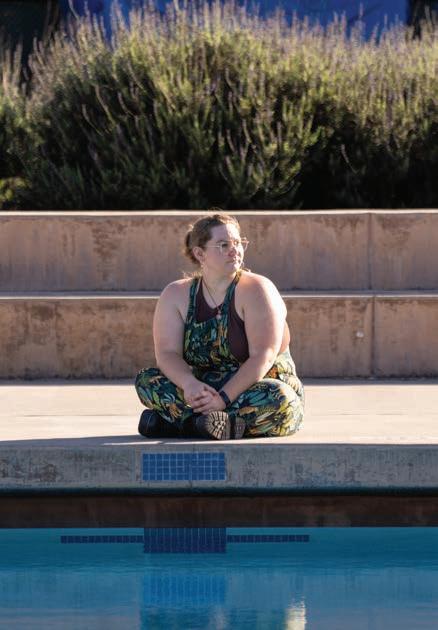
Megan Brown reflects on her time on the swim team during her senior year of high school when her unhealthy obsession to reach her “dream weight” began. She has since left counting calories behind and prioritized feeling healthy and confident. (Lauren Kelleher)


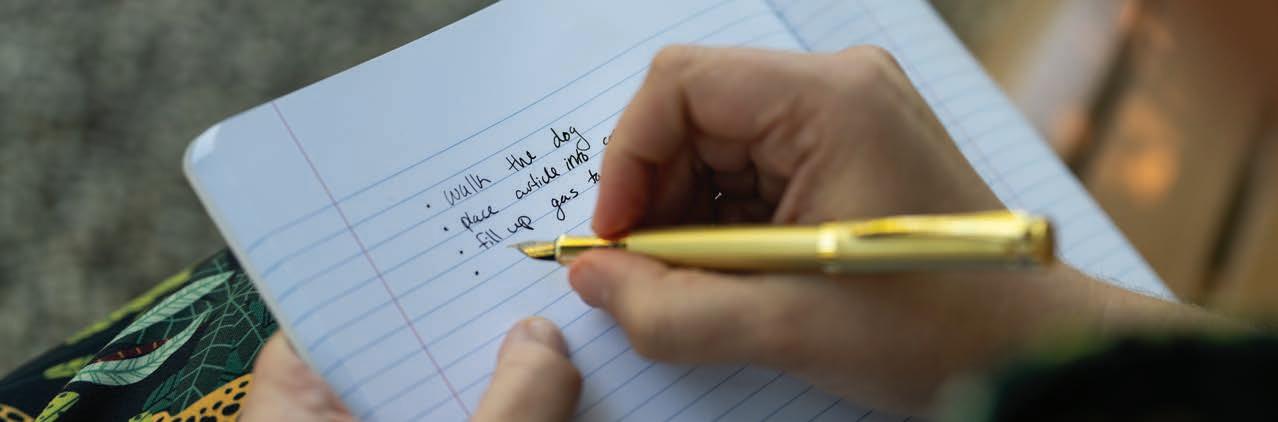

Now when reflecting on my progress each month, I start by decluttering my mind with a brain dump. I grab my notebook and write out everything bouncing around my busy head, what I need to get done today or even months from now, what I’m curious about, what I want to accomplish and any cool new music or hobbies that pique my interest, including ones I don’t believe I could learn. Why place hypothetical limits on myself?

Brain dumps don’t have to be completed in one sitting. The most freeing day I’ve had recently was when I carried a stack of flashcards with me to write every thought of that day. E-v-e-r-y-t-h-i-n-g, even stuff I had told myself wasn’t important. What I realized was that all the little unimportant crap takes up space in my brain. Later that day, my deeper thoughts materialized, giving me a moment to relax and reflect.
I started asking why I was drawn to think about certain things, especially if they popped into my brain in the middle of talking to a friend or sitting in class. They were soaking up my attention like a dry sponge when I wanted to be more present.
Next, I categorized everything from my brain dump onto one page. I started with a well-known tool called the Wheel of Life, a pie chart divided into categories of health, romance, career, finances, personal development, family and friends, fun and recreation, and contribution to society.
Each slice of the pie has notches to fill in to help visually gauge if your life is balanced. I didn’t end up coloring in the visual, but the categories helped me organize my thoughts and therefore my life. I keep one printed out in my goals binder.
I felt guilty about this at first, until it dawned on me to use tools like this with a grain of salt. I won’t hold myself to something that doesn’t work for me. So my new question was, what does work for me?
The SMART Goals tool — an acronym for Specific, Measurable, Achievable, Relevant and Time-Bound — got the ball rolling. I reframed my goal according to the following: Specific - What exactly do I want to do? Measurable - How will I track my progress? Achievable - Do I have the resources? Relevant - Does this matter right now? Time-bound - When is the deadline?
This tool helps refine goals in a measurable way. For instance, one of my New Year’s resolutions to help me lose weight was to hike the 16-mile trail between Sonoma Mountain and Jack London State Park by this summer. SMART goals helped me visualize the amount of time the goal would take. It solidified the stepping stones for gaining the strength and agility I will need. Since January, I’ve learned that this hike is overly ambitious for me to accomplish by summer because I’m taking 12.5 school units. But this process has taught me to remain curious about how to tune into myself. I no longer get discouraged to the point of a halt, and it is still set for next summer’s goals.
In an attempt to not drop every goal, I visited SRJC’s Student Success Center in Petaluma. Peer coaches sat with me when I first attempted to learn how to use SMART goals, and said they would monitor my progress. They told me to map my whole week down to the hour.
Before this, I couldn’t picture how long certain tasks would take, and I would fill my days to the point of exhaustion. Never having energy for the gym, I found a routine that
could mend my all-or-nothing attitude and fluctuate as much as I do. I have a categorized list of workouts I choose from on my workout days; low energy, medium energy and high energy. In mapping my hours, I learned that setting strict workout days for myself only discourages me when I don’t have the energy. So I tell myself I have to work out a certain number of times that week to satisfyingly check off a box in my planning binder.
I’ve also learned that a lot of my decisions are made from a fear of failure. I reframed that as a fear of learning. To grow, one must fail and have enough energy to remain curious about why. It’s a process of learning balance and how to catch yourself when you fall.
You can’t be a professional acrobat right away, so why expect it? I believe this fear stems from perfectionism. I’m unlearning my perfectionist habits after seeing how my standards were preventing me from finishing, and most of the time, even starting.
This has been true with my weight loss journey as well. I was talking down to myself for so long for not achieving my desired weight. But whenever I launched a new diet and exercise plan, I never observed myself to see what was or wasn’t working. I wasn’t listening to my body, only demanding it accomplish the impossible.
I also hadn’t considered other weight loss factors, for instance stress regarding work and family or eating just before sleep. So I may not be down to my goal weight I set in high school, but I am 60 pounds lighter than in 2024 and to me, that’s success enough.
Although I continue to shed pounds off my waist, my new top goal doesn’t involve my weight at all; I just want to be healthy and confident in my own skin.

Most folks don’t see the appeal of hiking a half-dozen miles with 50 pounds of gear strapped to their back only to set up camp, have the most uncomfortable sleep of their life, then pack up in the morning and do it again. I spent a few days of my spring break throwing myself in the deep end of the backpacking world to find out what that appeal really is.
I didn’t have a story pitch for the Oak Leaf Magazine the day they were due. That same morning I found out Santa Rosa Junior College’s Outdoor Club would be taking a backpacking trip at Henry Coe State Park south of San Jose the first weekend of spring break. When my turn came to pitch, I decided on the spot I was going on the trek.
My prior outdoor experience consisted of simple family camping trips and the occasional hike with friends on Taylor Mountain. The thought of backpacking had crossed my mind before, but I had no idea where to start.
I was lucky to have my partner, Gray Coleman, accompanying me. Coleman spent their summer as a camp counselor taking groups of children on backpacking trips, so they excitedly agreed to teach me the ropes like I was a fourth grader.
a meeting and distributed Tyvek tarps to the 15 participants. The morning of, Nacouzi brought donuts to the Park and Ride, and we divided into carpools heading south.
The group met at Hunting Hollow Trailhead. As everyone prepared to leave, Coleman began to feel nauseous but assured me it would pass. Everyone started hiking at 11:30 a.m.
The first mile up a steep hill with little shade on an 80-degree-plus day was torture. Coleman and I fell behind as the nausea returned and they began to vomit. Recovering from a throat infection, they hadn’t realized the antibiotics could react with exercise. Unable to continue, a club member offered to drive them home. I was offered a ride too — one I desperately wanted to take — but knew I had to keep going.
I was now carrying food for two. I sent the tent and stove with Coleman after Nacouzi offered to let me use his.
included the son of the Healdsburg mayor and an actress from SRJC’s recent “Boeing Boeing” play. Most were experienced; only one other member was also on their first trip. I learned this would be Nacouzi’s last semester at SRJC, meaning the club would soon need new leadership.
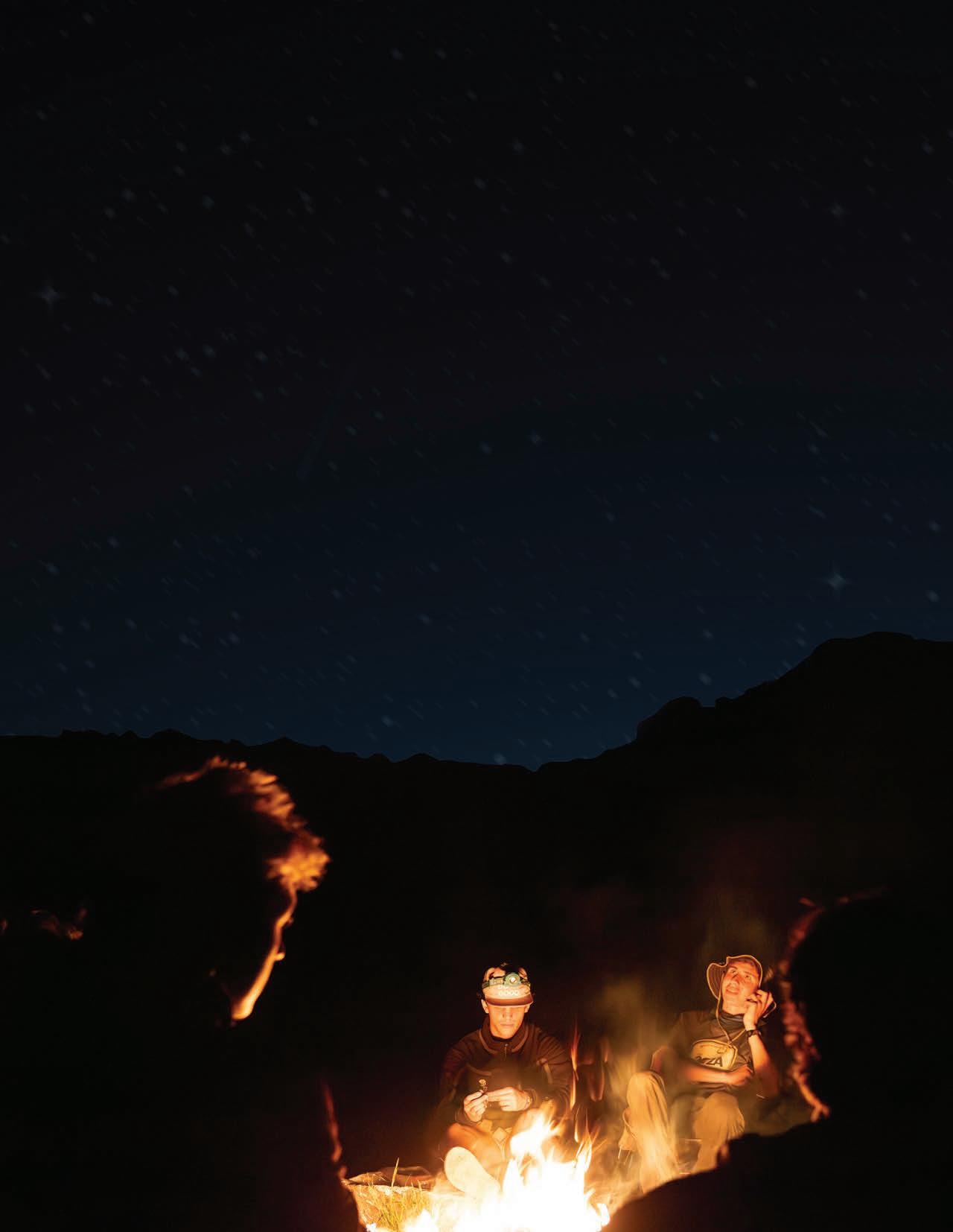
It was the worst sleep of my life. I settled in around 9 p.m. as the temperature hit 40 degrees. I woke at least a dozen times — hundreds of bullfrogs croaked, coyotes howled — and couldn’t get comfortable without a pillow, lying on my back, something I never do.
A distant turkey gobbling woke me at dawn. I drank hot cocoa for breakfast, relishing the cool morning knowing the sun would soon beat down. Nacouzi told us to take our time — this day’s hike would be relatively easy.
Day 2 was 3.3 miles along a shaded creek. The group worked like an accordion: experienced hikers went ahead and waited at rest spots for the rest to catch up. I stuck with the back of the pack. We didn’t talk much; most of our interactions consisted of encouragement to keep moving.
Coleman and I spent the next week getting prepared. My dad had a $100 REI gift card I used for hiking pants, a sleeping pad, water purification tablets and two dehydrated meals. The biggest expense was a $200 pair of hiking boots. Coleman helped me find a barely used backpack on Facebook Marketplace for $40, and we shopped at Grocery Outlet for three days of meals — PB&J wraps, ramen, oatmeal and plenty of snacks. We packed the night before, splitting food and shared gear evenly. Our packs weighed about 50 pounds each.
A few days before the trip, club president Rami Nacouzi went over the hike details at
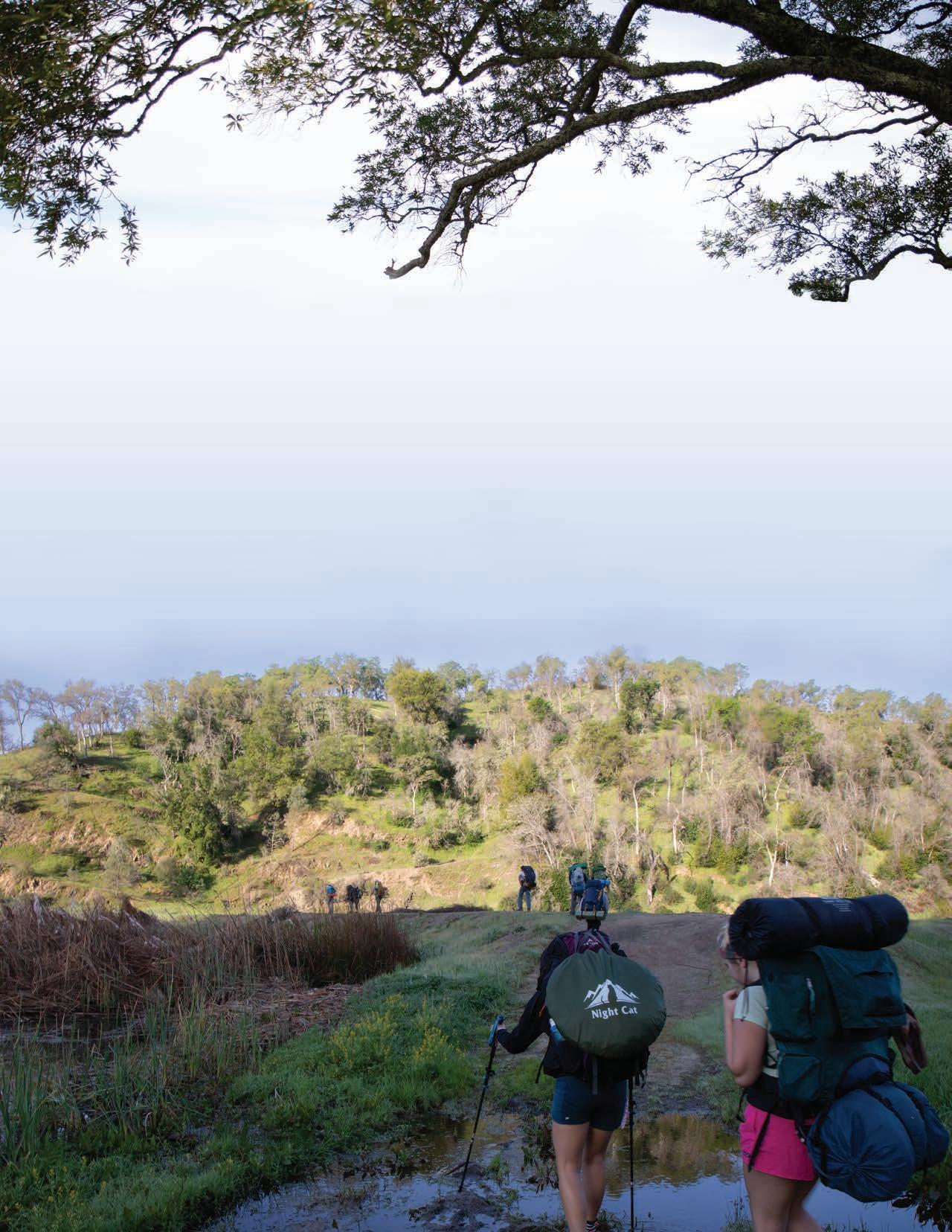
After climbing approximately 2,800 feet in that first mile, I was exhausted. Luckily the next five had a much more forgiving elevation gain. My legs cramping up reminded me I hadn’t been drinking enough water. The hike was still brutal, but I made it to camp at 3:30 p.m.
We set up camp next to Tule Pond. I took a much-needed rest as the soreness settled in, snacking on granola bars and meat sticks and handing some to the club — mostly to lighten my load, one Z-Bar at a time.
The group had to share Nacouzi’s stove for dinner, so the whole affair took a while. After about 30 minutes I fixed up my pepperoni pizza bowl, then waited another 20 agonizing minutes for it to rehydrate.
As the evening progressed I got to know my fellow hikers — a diverse group that
I found my pace that day. About two-thirds through I purposely slowed down, taking photos and splashing in the creek. I had music in my ears at times, but ultimately found the sound of the water and chirping birds far more appealing.
I reached the lake 30 minutes after everyone else at 12:15 p.m. I made a salami and mozzarella wrap, then changed into swim trunks and took a dip to escape the heat and several days of relying on deodorant and baby wipes.
Club vice president Bodhi Finnerty arrived at 5 p.m. with propane tanks so the club could have dinner. We chatted and took turns on speaker with artists such as Peter Tosh and The Smiths.
Night two wasn’t much better than the first. I was on a slight slope, so my sleeping pad kept sliding off the tarp and my bag sliding off the pad. I would periodically wake to shuffle everything back together like a sloppily-made sandwich.
Day three began before sunrise. Nacouzi blasted army bugle calls on his speaker and rushed us out for a 6-mile trek home. I scrambled to pack up, finally swapping cargo shorts for hiking pants. I skipped breakfast trying to save time.
All I knew about the day’s route: up a steep hill for a mile, down a road, then down another hill to the parking lot.
I fell behind as usual. At the top of the hill the group reunited, but a hiker called Arlo Herrod was missing. Finnerty backtracked to find him and the rest carried on. Soon it was just me and Victoria Medina. We grew worried — Byrd and Finnerty should have caught up by then. After waiting 15 minutes with no sign of them, our worst fear set in: we were lost.
We kept walking, staying on the trail. At a fork, we asked two hikers for the fastest way to Hunting Hollow Trailhead and followed their directions. After 20 minutes of distracted talking, Medina and I realized we’d taken a longer, unnecessary trail. It would loop back eventually, so we trudged on.
Then we descended into a valley and realized we’d gone wrong again. We’d need to climb an 800-foot hill to reach our destination. Medina used her satellite signal to update the group. Her husband called park rangers, but the nearest was an hour away. We decided not to wait.
If I hadn’t felt the cumulative weight of three days of hiking before, I did then. Stopping more and more frequently, my pack felt heavier with every step despite being lighter than when we started.
If I was going to get lost, I was glad I wasn’t alone. Medina was great company — she shared her experience immigrating from Brazil and her recent role in “Boeing Boeing,” and we traded words of encouragement to keep each other going.
At the peak we took a much-needed rest and finished our water. Medina joked that we needed a horse to carry our stuff — and then, impossibly, one appeared. A volunteer patrol on horseback pointed us in the right direction and told us we’d be close after one more descent.
The view on the way down was beautiful — rolling green hills as far as the eye could see. We made it to the bottom after about a mile and a half. Medina filtered water from the creek, giving me the most refreshing drink of my life.
15 more minutes brought us to the Hunting Hollow Trail sign. We let out a huge sigh of relief and collapsed into the parking lot at 2:50 p.m. Leonard greeted us — she’d arrived only 10 minutes earlier, also having gotten lost. The rest of the club had made it at 11 a.m. Medina and I had hiked 11 miles instead of six.
We rode back with the one remaining club member. I called Nacouzi, who sounded relieved and sent me money for a Double-Double from In-N-Out.
The following week I was the sorest I’d ever been; every single leg day I had skipped at the gym condensed into one weekend. Climbing stairs was a chore, but somehow I felt stronger.
At the next club meeting, Nacouzi announced new safety rules: the buddy system, stay put if lost and wait for a club leader.
Despite everything, I’d do it again. The quiet of the outdoors reminded me to get away from the noise of life more often. I pushed myself further than I thought possible. Outdoor Club’s motto is “seek discomfort,” and I’m glad I did, but I’m definitely spending a month on the couch first.


Iwake up in the morning and reach for my phone. I scroll through social media as I eat breakfast, blast loud music on my commute to and from school or work. I consume YouTube while I eat dinner. I do homework with videos playing in the background and only turn them off when it’s time for my video game nightcap. At some point, I happen to glance at the time, realize I’ve stayed up too late and rush to bed, head still spinning with the images I’ve devoured all day.
This sort of schedule may seem familiar. You may substitute YouTube for Hulu or Netflix, or maybe you are blessed to not be addicted to social media and instead use your morning to catch up on emails. Regardless, you are likely constantly stimulated by screens from dawn till dusk, just as I am.
This seems to be the new normal. Whether you’re rich or poor, you can’t avoid being affected by the media environment that surrounds you, even if you own the very platform you post to. The richest man in the world spends eight hours a day glued to his screen, arguing with people on the social media platform he bought for the equivalent of Iceland’s gross domestic product. The most powerful individual on the planet falls asleep to the cable TV channel his political party owns, echoing praise in his ear. You cannot buy your way out of this.
Platforms like Instagram, Facebook and YouTube have a history of conducting psychological research on their user base without their consent. The intent is to be maximally addictive and profitable with little care by those in charge as to the adverse health
effects we may suffer as a result; a quick search for “overstimulation” and “digital/social media” will reveal dozens of studies on the matter.
Regardless, this constant barrage of noise drains our mental energy. Whether it’s late-night scrolling through a comment thread arguing with a theoretically real person or watching a two-hour documentary on a topic of little interest, it’s clear that media content is sucking up our time and energy.
A study from BMC Public Health links longer screen time to decreased academic performance (the ability to retain and apply learned information) and more sedentary lifestyles in elementary school students.
A different study by the Archives of Medicine & Health Services focusing on college students shows a positive correlation between excessive screen time and diminished attention spans.
Furthermore, a study from the California Health Professional Student Alliance at UC Berkeley stated: “Contemporary technologies increasingly demand constant cognitive allocation,“ adding that given sufficient exposure, our “cognitive efficiency and resilience” slowly degrades over a lifetime.
The obvious individual solution to this assault on our senses is to simply “unplug,” meaning turn off your phone, computer and TV. However, much like telling an addict to “just say no,” appeals to willpower are effective for few. It also ignores the fact that we



Story by Ben Lyle
Photo illustration by Lauren Kelleher
actually get quite a lot of value from the media we interact with. The music we listen to, the games we play, the films we watch, even the social media posts we read do, on occasion, give us unique insight into the world, widening our palette
Thus, I propose not a solution, but perhaps a framework to view all your consumptions through; perhaps it will better your life in small ways, as it has mine.
Your attention is the most valuable resource you possess as a human being. And it is a limited resource.
It’s a resource everyone wants. It’s why companies such as Meta and Alphabet have designed complex and sophisticated algorithms to hoard your attention for themselves. This has been dubbed the “Attention Economy,” in which companies compete and bid for your attention with every click worth a monetary amount.
When you spend time on their platforms, the hourglass that is the remaining minutes of your life drains. Those are minutes you can never recover. Maybe you gained something from using those minutes, maybe you didn’t: they are gone just the same.
This may sound like I’m imploring you to go out and do something meaningful instead of binge-watching seven hours of Netflix or watching your favorite political commentator reaffirm your already existing world view. However, I understand the reason you are watching in the first place.
Maybe you are spent after a
long and stressful day of work or school and just want to sit back and relax. Maybe you want some solace after hearing disheartening news. The reasons are seemingly infinite.
This is where we come full circle to the aforementioned “unplug” advice — but I won’t ask you to throw away your cell phone and go live in the forest. Still, you can extrapolate a sliver of practical advice from this attitude.
Give yourself some quiet time, away from your electronic devices — no earbuds, no headphones, no screens. You don’t need much time, though more is better. A 30-minute walk will do, or even five minutes in a bathroom stall, if that’s all you can spare. You need some time and space to recalibrate, gather your thoughts and come to terms with how you’re feeling in the moment.
When you reach for a quick byte of entertainment during times of stress, anxiety or exhaustion, you are drowning out the natural mechanisms your brain uses to regulate said emotions. If you ignore these feelings long enough, they will eventually find a way to escape. Maybe you remember a time when you lost your cool and lashed out at someone who didn’t deserve it, or maybe you trauma-dumped on a random stranger. Most likely, it’s because you had pent-up, unresolved feelings that weren’t allowed to self-regulate.
Will this advice realistically solve your problems? Of course not. But I do believe that safeguarding your attention against hostile forces, and treating it as carefully as you would your own child, will be at least a small benefit to your life.

Natalie Emanuele
It’s the middle of the night, and I am awake against my will. It doesn’t matter that my bed is comfortable or that my cat is curled up nice and cozy by my feet. The radio in my brain is flipping stations just to spite me; a song stuck in my head, then an embarrassing memory, then just “go to sleep go to sleep go to sleep” over and over again. All noise, all the time.
I try turning my fan on. I try flipping my pillow over. I try sitting up in the dark and staring at the wall like I’m possessed. I want to sleep, but I can’t.
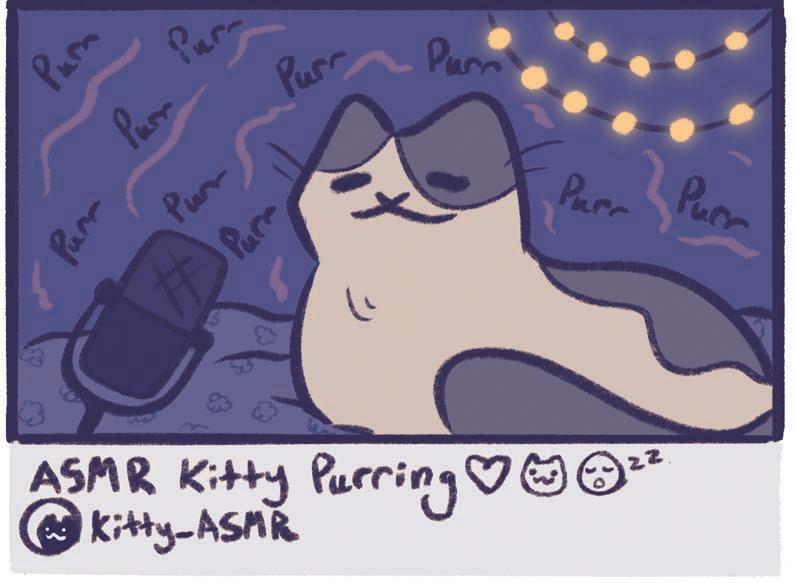
It all comes down to the very thing that has stifled my ability to sleep the most: my phone. I navigate to YouTube while my retinas recover from the blast of brightness and find my salvation: “Dragon Egg Shopping at Maybell’s Menagerie (ASMR).” I am out like a light before I even finish the video, lulled to sleep by whispered descriptions of fantastical creatures.
Good sleep is hard to find these days when it isn’t in gummy form, so why not take a break from the brainrot and tune in to some content made specifically to help you relax?
Autonomous Sensory Meridian Response is described in a 2018 fMRI study as “an internal sensation of deep relaxation and pleasant head tingling which is often stimulated by gentle sounds, light touch and personal attention.”
ASMRtists (it sounds better out loud, I promise) are creative and resourceful with their sound design, so every channel offers something different.
Several of Luna Bloom ASMR’s videos are not meant to be watched all the way through; the first half has the viewer follow a light or other directions to tire their eyes, then the second half is designed to be listened to while drifting off. If you want something short and silly, PaperPuppetASMR has the best (and only) five-minute video of a doodle pretending to give you DIY lip filler that I’ve ever seen.
featured roughly 80 different ASMR creators filling the other roles.
While ASMR is a great tool for sleep and relaxation, it’s understandable that the idea of having a stranger in your headphones whispering directly into your ear may put some people off. It’s similar to how some people love watching mukbangs while others would rather die than listen to the sound of chewing.
If traditional ASMR gives you the ick but you still want something to relax with, unintentional ASMR videos are perfect for audio to unwind to without the discomfort. These videos are often just people with calming voices talking about something innocuous, like tech demonstrations or the idea that we live inside a hollow planet.

For people with fond memories of falling asleep with the TV on, old shopping channel footage and episodes of Bob Ross’ “The Joy of Painting” are great for switching your brain off before bed.
Some channels, like Pure Honey ASMR, offer soft-spoken videos instead of whispered ones, which can be much easier to listen to when starting your sleep aid journey. ASMR Zeitgeist is one of many creators who don’t talk at all in their videos and let the triggers speak for themselves.

It’s a cousin of that feeling when something sends a chill down your spine or scratches your brain just right. If you’ve ever watched oddly satisfying compilations or mukbangs where influencers eat a lot of crunchy food, you are already familiar with the outskirts of ASMR content.
These videos range in length from a few minutes to multiple hours of sights and sounds that trigger the ASMR response. These aptly named triggers can be anything from tapping and scratching to simulating doing the viewer’s makeup.
Goodnight Moon ASMR’s “Babblebrook” series is not only a relaxing soundscape but an immersive fantasy world with a narrative that spans multiple videos. ATMOSPHERE’s film-like videos are similarly connected through a winding story that fans eagerly document, one of which was submitted to the 2025 Los Angeles International Short Film Festival.
ASMR YouTube is far from the sleepy corner of the internet. The community is thriving with its own fair share of chaos and comedy, like Gibi ASMR’s shot-for-shot remakes of “Shrek” and “The Bee Movie,” which each
It’s difficult to explain what ASMR is without getting weird looks. Yes, I like to listen to someone on the internet pretend to do my Halloween makeup while I fall asleep.
I don’t know if it’s the background noise or my affinity for strange things, but ASMR genuinely helps me relax.
Most of this article was written with an ASMR video playing in the other tab which, in hindsight, might explain why I kept getting too tired to finish writing.
ASMR has persisted despite its reputation for being strange and uncomfortable, not to mention the looming threat of AI-generated
ASMR. It’s slowly and sleepily making its way into livestreams and mainstreams alike.
There are so many different types of ASMR that it wouldn’t be a stretch to say everyone likes some form of it — yes, rain on a roof is ASMR!
The ASMR community is vast and interesting with something new around every corner. Seeing the amount of work that goes into these videos is as impressive as it is sleep-inducing, so leave your skepticism on the bedside table. An open mind is a clear mind, and a clear mind is a sleepy one.
Now if you’ll excuse me, it’s been a very long day, and I have a video from Mrfrogofficialpage of a frog puppet giving a cranial nerve exam to watch. Rest assured, I will be well-rested.



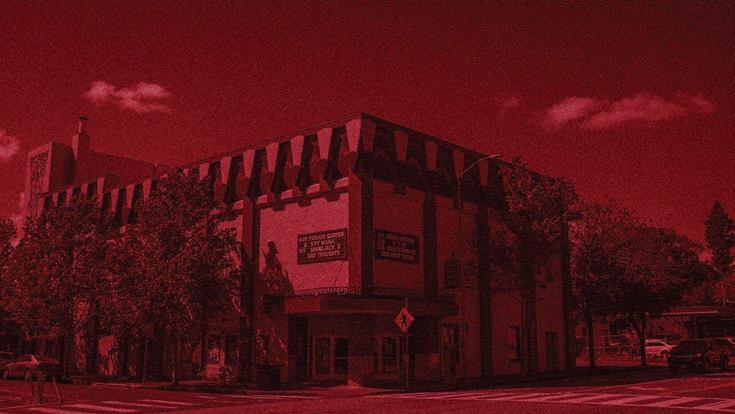
With more than a century of history, Petaluma’s Phoenix Theater is home to generations of memories, artists and ghosts. Its physical foundation is marked by catastrophe, and yet it has always risen from the ashes. Painted with lifetimes of chaos, the walls are a gallery of creativity and a memorial for the departed. Despite all this, the soul of the Phoenix remains unchanged.
In December 1905, the theater opened as the Hill Opera House with a performance of Shakespeare’s “Twelfth Night” by the Ben Greet Players. The wealthy Josie Hill, who built and owned the theater, envisioned it as a venue of high-class theater and refined extravagance. When Petaluma was still a town of under 5,000 people, it was the city’s first theater.
Today, the Phoenix stands as a safe haven for alternative music and counterculture, but it has a history of breaking social norms. Shortly after the Hill Opera House opened, it faced scandal for hosting vaudeville acts that challenged conventions. These acts often were unorthodox or sexually suggestive for the time, satirizing police, politicians and the wealthy owning-class.
When the venue became a gathering place for women, immigrants and the working-class, Josie Hill grew dismayed enough to change the program, emphasizing films that appealed to middle-class sensibilities. Little did Josie Hill know what would become of the Hill Opera House a lifetime later.
According to its Wikipedia article, and many other sources, the Hill Opera House suffered its first fire around 1922 before it was rebuilt as a movie theater. The actual story of how the Hill Opera House became a movie theater is less dramatic.
In the 1920s the venue fell under the ownership of T&D Jr. Enterprises, which chose to renovate the theater as a business decision. The interior was completely gutted and rebuilt as a dedicated movie theater, reopening in 1925 as the California Theater.
Doc Naify, who managed the theater for more than three decades, is still remembered for fostering the welcoming, open-to-all atmosphere the Phoenix continues to offer to this day.
Under Naify’s management, the California Theater — with its state-of-the-art projection system and generously decorated interior — became the central pillar of Petaluma’s cinema culture throughout the ‘40s, ’50s and ’60s. Tom Gaffey, who has managed the Phoenix Theater since 1984, cites Naify as his inspiration for taking charge of the venue.
The massive fire that later gave the Phoenix its namesake happened in 1957, destroying the building’s roof and damaging the interior. It was remodeled and reopened a few years later.
Gaffey first attended the theater at around the age of 5, during a 1960 showcase of “Old Yeller.” His journey to becoming proprietor of the theater began with a bunch of panicked adults trampling him in a bird-infested room during a 1963 showing of “The Birds.” This led to his first nickname at the theater, “the boy who was crying about the birds.”
Suffering economic hardship due to the rise of television, the building was sold again, this time to Santa Rosa theater operator Dan Tocchini in 1968, who renamed it the Showcase Theater. As a junior high school student, Gaffey worked at the Showcase Theater, where he later learned how to operate projectors and manage a theater.
Former Phoenix manager Larry “The Hat” Lautzker, credits the Tocchini family with the venue’s mythological title. According
To read the full, unabridged version, scan the QR Code or visit theoakleafnews.com
to Lautzker, they renamed it the Phoenix during a 1979 renovation.
Joel Coopersmith then purchased the Phoenix from the Tocchini family, leasing it to Lautzker and John Spillaine from 1980 to late 1983. Under their management, the Phoenix experienced its first explosion of rock and live music. The Ramones played the venue’s first-ever punk show in 1981.
“We brought music to Sonoma County. We were the first ones to bring in national acts, whether it was Van Morisson, Carlos Santana, Huey Lewis,” Lautzker said. “We brought in the most famous bands of the day.”
This golden period of the Phoenix’s history was glorious but short. Today almost no accurate records of those years exist, despite their immense influence on the venue’s future. Coopersmith, Lautzker and Spillaine gave the Phoenix the guts of a modern music venue. While the emergence of Sonoma County live music was revolutionary, it wasn’t profitable.
“We did live theater for the community, mud wrestling, and we ran movies during the week. At the end of the day, Sonoma County couldn’t support it,” Lautzker said. “We lost a lot of money doing it, but we had a good time.”
In late 1983, Coopersmith sold the Phoenix to Marin County developer Ken Frankel.
Meanwhile, in 1984, Gaffey found himself working with friends to flip failing theaters. During his last flip, a fateful one-year contract with Frankel put the Phoenix on the market and Gaffey into management. Unable to sell the place, he took out a lease and has run the Phoenix ever since.
“This was the longest one-year project I’ve ever been involved in,” Gaffey said.

Gaffey finished what Aquarius Productions started, helping the Phoenix grow into the legendary North Bay capital of punk, rock and metal.
Around 1986, he brought in folk-punk band The Violent Femmes to play at the Phoenix. The venue sold out. “We found ourselves at a pivotal moment in East Bay punk. Rancid, Operation Ivy. Primus and Mr. Bungle. So many bands from L.A. were coming through that a lot of clubs didn’t want. Not a lot of people wanted to have Gwar,” Gaffey said.
Gwar is a dramatic heavy metal band which carries a vast mythology and a reputation for showering their audiences in fake gore. Gaffey remembers their time at the Phoenix fondly: “They threw me in the meat grinder and spewed my guts out at the audience one night. It was incredible.”
Gaffey introduced weekend teen dances to the Phoenix in 1987. The massive success of these events brought complaints of Saturday-night traffic and teenage hedonism.
Despite the legal battles and public complaints, Gaffey never backed down from making the Phoenix a safe gathering place for all. With the addition of indoor skate ramps, an arcade, art programs, music instruction, a teen health center and work opportunities, it became an oasis for teenagers.
It was — and remains for that matter — one of the few places where adolescents could freely hang out without pressure. Unlike those of many schools and households, the adult mentors try to respect them as people and provide for their needs without judgment. The weird kids, artists and angsty teenagers of Sonoma County have always benefited from community.
The Loma Prieta earthquake damaged the theater in 1989, but it quickly recovered. Through the ’90s and into the 2000s, the Phoenix sold out multiple times a week.
“I look back on those times and wonder, ‘Why was I always broke in those days?’ It was because tickets were always $5,” Gaffey said. “The bands were getting paid well, which was good, and my staff was getting paid so there wasn’t much left over once the shows were done. We were flat-broke, but we were having a damn good time.”
The Phoenix Theater continues to stand the test of time, serving as the North Bay’s cornerstone for live punk, hardcore and rock music. Outside of scheduled concerts, the space offers itself as a community center for local youth. (Zoë Steiner)
In the late ’90s a tragedy struck that became forever ingrained in the venue’s heart. On May 24, 1996, Sublime played its final show at the Phoenix Theater. Lead singer Bradley Nowell was found dead from a heroin overdose in his hotel room the next morning.
Today, the mural memorializing Nowell still looks out from the wall of the Phoenix’s green room. Though he’s gone, three decades of musicians have practiced, laughed and wrung their hands with pre-show nerves under the watch of his memory.
All this time, the Phoenix Theater had remained on the market, and in the year 2000, it sold to a developer. Supporters of the Phoenix came together to rally for the venue. Just a few weeks before the building was set to close and become an office building, a guardian angel arrived.
Paul Elliot, along with three other telecom engineers who’d recently come into money, bought the venue back from the developer and established it as a nonprofit. All of them had been musicians, with two having an especially close relationship to the Phoenix.
“Basically, Paul loved what we did when his kids and their friends were hanging out here. We’re still doing pretty much the same thing. Hanging out,” Gaffey said. He has maintained much of that same philosophy for the last 26 years.
The theater’s services have expanded to continue serving the community. It has featured punk, metal, rock, rap, hardcore, jazz, ska, blues, reggae and just about every other genre. All are welcome. After all, it’s called everybody’s theater for a reason.
Anywhere that people gather, ghost stories do too. Anybody decently familiar with the Phoenix Theater is sure to be acquainted with its spectral inhabitants.
“I know about the ghosts,” said Milo Ward, guitarist and frontperson of the band MJ Ward. “I’ve come here for a really long time, so you just hear the stories around.”
Gaffey himself has had many firsthand encounters with the Phoenix’s anomalies. “I’m not even telling you I believe in ghosts, just to hedge my bets. But I won’t stay in an old hotel. Ever,” he said.
He remembers sleeping onstage in the theater as a kid and hearing the steps of his first Phoenix ghost. In the decades since, he’s continued to treat Chris the Giant as the childhood friend he is. “We’d hear these big footsteps coming over the stage and stomping right over us,” Gaffey said. “Didn’t feel bad at all, felt like he was just kinda checking us out. We named him Chris. He was huge; you could just feel the footsteps.”
Gaffey also recalls a story involving one of the Phoenix’s old security workers. They were setting up for a Gwar show late one night when the worker emerged from the lower exit of the tower and reported seeing a little kid backstage. Despite no little kids being in the theater that night, the worker was absolutely certain of what he’d seen. “He left then and there, quit and did not come back. It’s his real ghost story. He really saw this little kid,” Gaffey said.
The third major ghost Gaffey mentioned was a woman who once haunted the girl’s bathroom. Apparently, she was a large and terrifying spirit who harassed the staff at night. It started back in 1984, when Gaffey first started managing the venue. “When I got here, there were two janitors who would not clean the girls’ bathroom by themself.”
On Friday the 13th, in January of 1984, Gaffey’s friend brought in a ghost hunter from the Berkeley Psychic Institute. The ghost hunter, armed with paranormal gadgets, corroborated the existence of Chris, as well as the Lady in the Bathroom. After the ghost hunter directed her towards “the light,” her influence vanished, never to return.
These first three ghosts are just the beginning; the Phoenix is rife with hauntings.
TV ghost hunter Amy Bruni grew up investigating the ghosts of the Phoenix Theater. In 2010, she ran an event aptly called “Ghosts of the Phoenix,” in which participants joined her on a tour of the building and learned the haunting ropes of ghost hunting.
Down in the basement, they communicated with an object-flinging ghost Gaffey was well aware of. Gaffey was outraged when the ghost told him to “get out” during this communication. He says they’ve made up since then, but still have their differences.
“I’m like, ‘Get out? You know what? Screw you. I’m the guy who has to come down here when the basement floods.’ I’ve changed my tactic. We’re friends now,” Gaffey said.
Now, to finally answer the big question: “What’s up with the ghost on the balcony?”
If you grew up going to the Phoenix, it’s likely you’ve heard about this particular entity. The balcony was blocked off to the public for years, and many rumors have come about telling of a ghost up there, with some stories telling of a kid who fell off the balcony and now haunts it.
In truth, Gaffey keeps it locked mainly because the low-quality chairs are not up to Phoenix standards. In fact, ghost hunters from Penngrove disproved the balcony ghost as a trick of the light. “If you have a guitar flashing in the lights, it sends a shadow image up across the door there,” Gaffey said.
But there’s a much more compelling ghost story about the balcony’s projection booth. Today a secret practice studio, it was used
for many years when the venue was a movie theater. “The ghost hunters from Penngrove got a really good vocal hit up in the projection booth, and we do know in the ’50s a projectionist did have a heart attack and die up on those stairs,” Gaffey said.
He remembers once when the ghost in the projector room made noises one night while he was closing up the theater. “You can’t assume it’s ghosts, because that’s just ridiculous. You have to assume it’s a human being. So now I have to go up there all by myself. I let it happen twice, funny joke. By the third time, I’m ready to do battle with any ghost,” Gaffey said.
Though he maintains a healthy skepticism about the ghosts’ existence, Gaffey plays it safe. If the ghosts do exist, he hopes they are willing to work with him to keep the spirit of the Phoenix more alive than they are.
“We have to run a theater for the people, the living people who pay the bills,” Gaffey said. “If you guys want this to be a theater that you can haunt, then you better not mess with us too much, or else you’re gonna be haunting a big empty building that’ll be an office one day. Quit messing around here. We’re all in this together.”
The Phoenix today
The Phoenix is still going strong, after 120 years. On any particular weekend kids hang out and skate inside, bands perform and Tom Gaffey holds it all together.
The nonprofit Side Room Skateshop, also founded by Gaffey, operates directly out of the Theater. It helps teenagers gain on-thejob experience and encourages the next generation of skateboarders.
Every year Halloween and Christmas events are held in which audience members dress up and enjoy covers. The Phoenix also hosts an interactive screening of the cult-classic Rocky Horror Picture Show at least once a year.
In September 2025, wildly successful indie-pop musician Mac DeMarco played two sold-out shows.
“This was the place where I played my very first show when I was 14. It’s always been such a great, welcoming environment,” guitarist Ward said.

Yet while the theater hosts famous artists, it continues to support smaller, local bands. Bands like Green Day, now famous worldwide, wouldn’t have gotten their start without venues like the Phoenix.
Ward isn’t an outlier here; many musicians got their start at the Phoenix. Even the person writing this article played their first sloppy, amateur show at the Phoenix as a clueless teenager. Oftentimes, local teenage musicians suck, but it’s important that they have a space to suck so they can grow.
“The cool thing about the Phoenix is they bring in bands from the highest level to people who are just starting out,” longtime Phoenix-goer Michael Pickard said. “Kids, high schoolers, all coming out to the shows on weekend nights, enjoying local music.”
From the beginning of his time at the Phoenix, Gaffey has created a space for artists of all ages. This open-door policy goes all the way back to the inclusiveness of the era of Doc Naify’s Showcase Theater and even the working-class community and satirical shows of the Hill Opera House.
And while the Phoenix has undergone enormous changes over the decades, it holds a similar place in the community now as it did decades ago, still hosting local bands and hyperactive teenagers through it all.
“It feels pretty similar to me,” Pickard said. “When I walk in and see these local bands play, it’s the same vibe as 20, 25 years ago.”
Not even Gaffey knows how any of this is possible. It’s a miracle that the Phoenix even exists in the first place, let alone how it’s survived nearly unchanged for all these years.
“Don’t ever run a business like this. This is dumb,” Gaffey said. “I don’t know how we stay open. I have a deal with God. Timing was everything, I just happened to be here at the right time. So here we are.”
The Phoenix is a house for everyone. It has the bones of Petaluma’s early days and was once proclaimed as the greatest live music venue in the North Bay. It runs with the blood of a movie theater that welcomed all with open arms. Its guts hold those first bright, short years of rock ’n’ roll. It survives moshpits, fires, earthquakes and capitalism. It breathes the ghosts of those departed, or maybe who never were. Most importantly, its heart is that of a community which, against all odds, survives the test of time.
Story by Destiny Quiroz-Lindauer
Photo by Ziggy
Leon
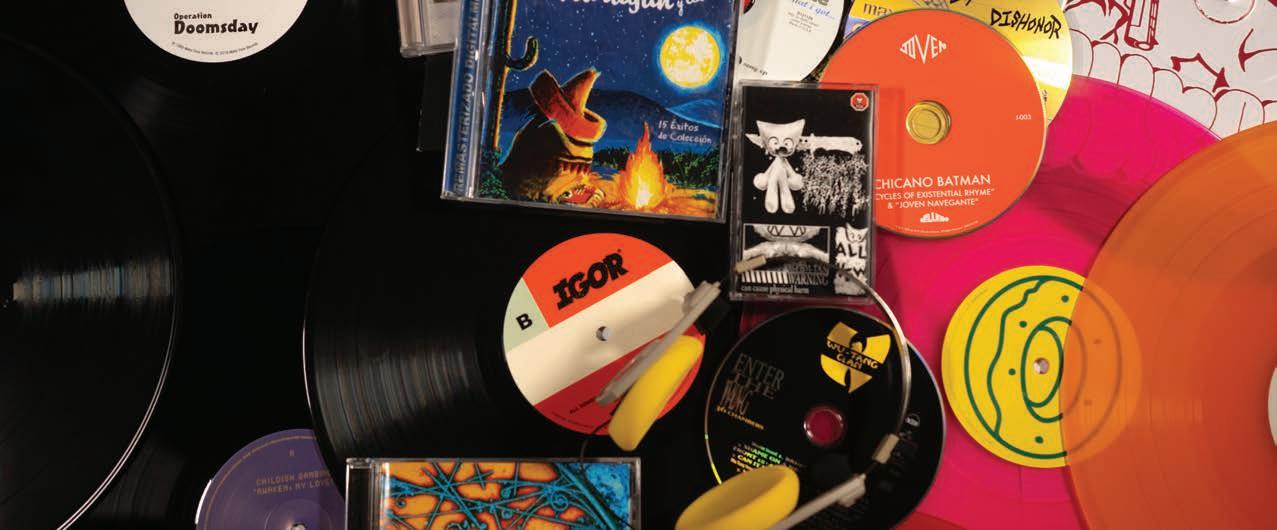
Every morning, Santa Rosa Junior College music student Michelle Nyandoro strolls her usual campus route with her headphones on, blasting smooth R&B music by her favorite artists to set the tone for her day and lift her mood.
On campus, she enjoys listening to artists like Drake and Chris Brown. At home or in the studio, she spends her time playing piano and creating her own sound as she aspires to become an R&B artist.
“Music is widely involved in my life,” Nyandoro said.
Beyond daily listening habits, students say music plays a deeper role in shaping how they feel and who they are. It serves as an outlet to process emotions, reflect on experiences and connect with themselves.
According to “The Gen Z Audio Report” from Edison Research and SiriusXM Media, Americans aged 13 to 24 spend an average of four hours and 10 minutes a day listening to music. Of that time, more than 42% is devoted to streaming music, 20% to music and videos on YouTube, 16% to AM/FM radio, 8% to podcasts and 14% to other audio sources.
Many students report listening to music for multiple hours a day, taking their favorite tracks and artists with them on the go.
Jared San Juan, a first-year chemistry major, connects with music through lyrics and storytelling, valuing songs that allow listeners to form their own interpretations.
“I like to dive deep into the lyrics, and I feel like it’s never specific on what it means, so a lot of the songs you can take it as you wish,” said San Juan, describing why he likes Julie, a Los Angeles-based rock band.
For some, their favorite artists and songs reflect how they feel or what they are going through. Nyandoro enjoys R&B for its emotional depth and smooth beats, while other students choose to explore a range of genres.
“I’ll use music to either keep me energized or if I’m working out,” said first-year SRJC engineering major Eric Rodriguez. “Music helps me a lot on focusing on one task for a long time because if not, I might hear other noises around me, and it ends up distracting me more than just one song.”

For many students, music is more than just something to listen to. It’s a constant companion that helps students get through their day and feel good about themselves.

“That song kind of saved my life. It makes me cry, and you know it’s so deep with its message.”
“I’ve got an average of seven hours of screen time [per day] dedicated to music,” Rodriguez said. “I listen to it while driving, doing homework and everything else.”
First-year fire and emergency medical services major Deja Jones said that certain songs and artists carry powerful meaning, often tied to personal memories or emotions.
“That song kind of saved my life,” Jones said, describing her favorite track, “Hands Held High” by Linkin Park. “It makes me cry, and you know it’s so deep with its message.”
She added that emotional connection with specific genres or artists tends to keep her from branching out to new music.
San Juan said his listening habits changed as he began to move away from music influenced by peers and toward songs he felt truly reflected his identity. He explained how he felt pressure to conform and listen to music recommended by his friends.
When asked what he gets from listening to the music of his choice, San Juan said, “I think mostly discovering myself, well, like creating myself, my own identity. I can be whatever I want, and I don’t care what people think.”
Other students described similar shifts in musical taste. Some mentioned branching out into new genres as their music taste matured or growing tired of listening to the same songs.
“It’s more about being able to appreciate the different types of music a lot more,” Rodriguez said. “I think my music taste has matured a lot.”

For Nyandoro, the evolution continues as she works to develop her own sound and draws inspiration from the music and artists she listens to every day.

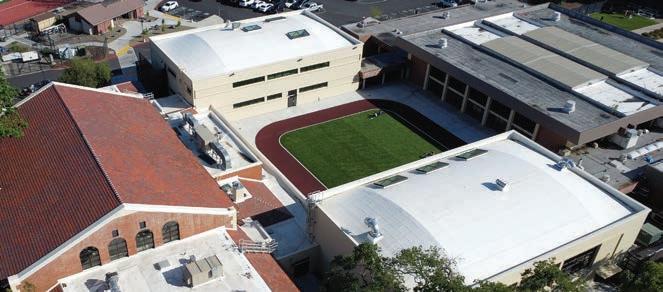

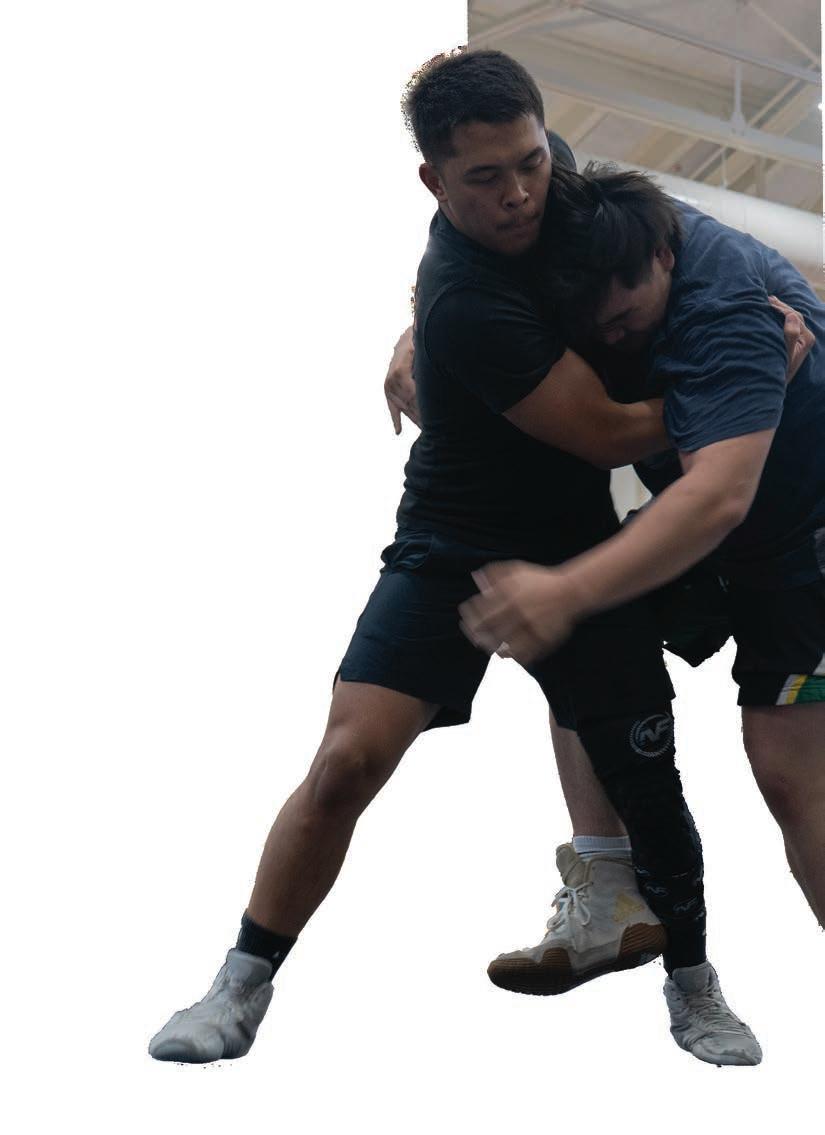
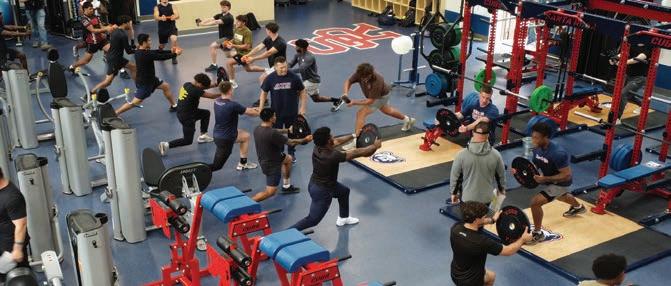
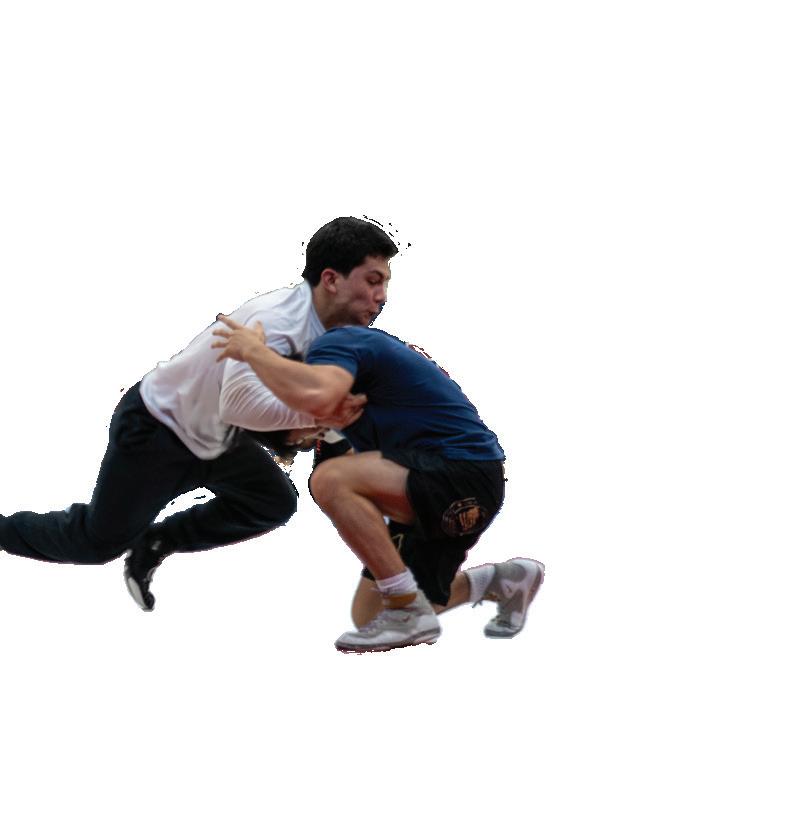
Aremodel, the Tauzer Gym doors are swinging open for 2026. This new and improved gymnasium is currently
- Gavin Early 1 2


The surround system is super nice. I love it a lot.







3.
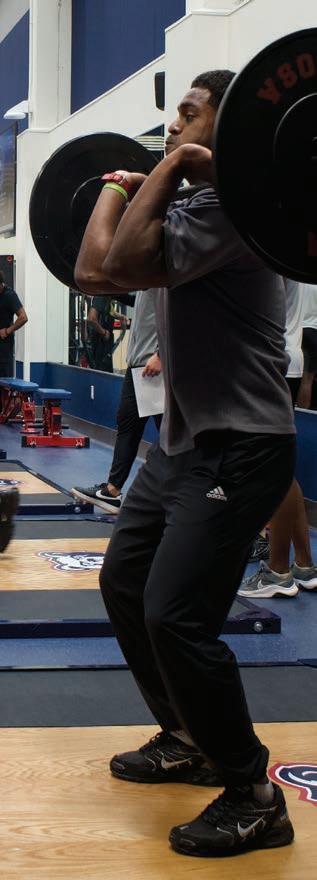
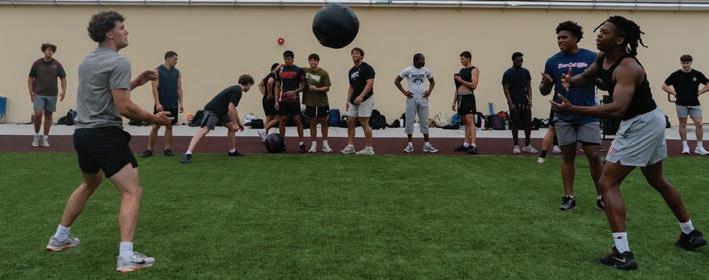
Gym has open recreation areas and studio spaces in addition to gym equipment that dance and kinesiology students can use. (Juan Padilla)
4.
from
What I like about it [Tauzer] is the variety of machines, a lot of options for weightlifting. A lot of nice benching equipment - Daniel
Bertral





by Dylan Cooper
The car engine’s roar blurs out the noise of street life in a metallic harmony. Every tire tells a thousand tales, and every driver brings those stories to life with each mile tacked on the odometer.
Video editor Archibald Henderson, and yours truly, open this motor show with a couple 2001 Toyota Camrys — which aren’t the most glamorous car but they make up for their basic nature with shocking efficiency.
“Usually my needle is hovering around 1/16 of a tank to empty, and that’s enough to go to work for the week,” Henderson said.
Gas prices are unrelenting. I remember when choosing a car, the one thing I refused to budge on was its gas mileage. I needed something that could run for a while and was cheap to fill. Lucky for me, the Toyota Camry is one of the best in that field.
Henderson has tested the car’s limits, taking it on trips long and short. He managed to cruise it through Bodega Bay in a storm before taking it on a quest to White Castle in Las Vegas, with an engine light or two.
“I’ve had several extremely close calls on account of a failing suspension and less-than-optimal brakes,” Henderson said.
There is no denying that any 25-year-old car is going to suffer through some detrimental maintenance problems, a reality I am grimly aware of.
“I’ve gotten it stuck in mud and taken it to terrain it should not have been on. I drove it from San Luis Obispo to San Diego, so it’s gotten across the state in that direction.”
From ripping out my dashboard to pulling half an engine apart just to replace an oil pump, my car, “Kurtis,” has survived many trips to Pick-n-Pull, a beautiful junkyard heaven built for every motorhead.

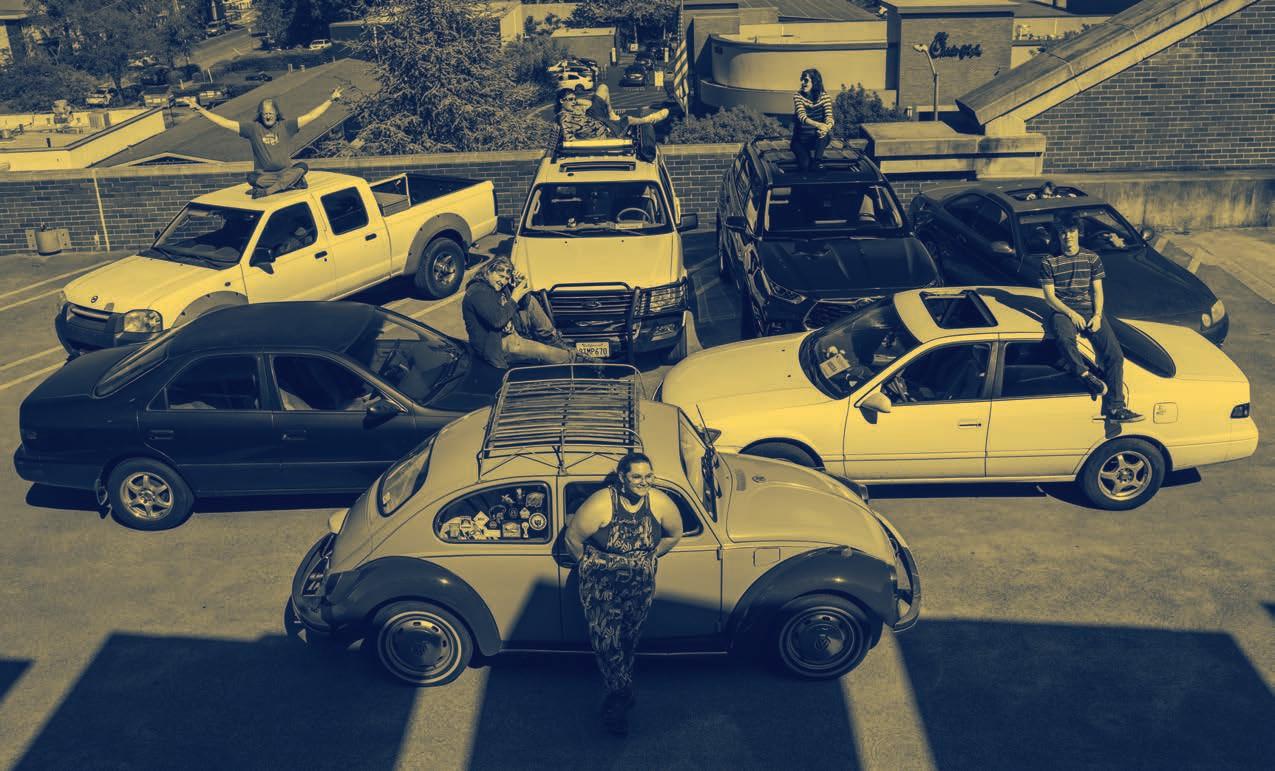
(Left to right, top to bottom) Mark Fernquest, Rosemary Cromwell, Anne Belden, Kevin Terlizzi-Bowes, Dylan Cooper, Archibald Henderson and Megan Brown match their cars, in style and personality. Can you tell whose is whose? (Zoë Steiner)
Despite how much old engines wear out, the Toyota Camry still holds its strengths, working as a valuable daily commuter.
Editor Rosemary Cromwell has also managed to make “The Exploder,” a 2010 Ford Explorer work — despite a few attempts of self-destruction.
“I had to replace everything: the compressors, all the hoses and the water pump,” Cromwell said. “I was driving to NY Pie once and the whole car started shaking. My thinking at the time was that I’d get the pizza and then roll back down to the shop.”
No matter the problems, Cromwell still gets the most out of the Explorer in the four years they’ve had it.
Another entry into the fleet is podcast editor Kevin Terlizzi’s 1993 Lexus SC400 “Lexy,” which has seen better days.
Having received the car from his father, it boasts a grand 276,949 miles and lost the inner lining of its passenger side door somewhere along the way.

“I have dragged it everywhere, from the freeway to the tops of mountains,” Terlizzi said. “Once I took it to the top of Glass Mountain years after the fire for a trip up there and slept in the car.”
Although he has owned the car for six years now, Terlizzi has been on the hunt for something a bit more reliable, hopefully with a fully intact door.
Stepping away from some everyday vehicles, ad manager Nick Vides’s 1973 Chevy Camaro LE named “Pearl” is a bonafide movie star.
“I want something I could really make my own. I could even car camp more efficiently.”
The wineberry pearl colored car was featured in “The Haunting of Hype House,” a movie directed by Matt Farren, a friend of Vides.
“We needed an era car for it. I have one from 1973, so why don’t we use that?” Vides said.
Vides and Farren stuck Pearl out in the middle of a green open field in Cotati to shoot a few scenes. Despite the 30-degree weather, and the car struggling to start after an hour of letting it sit, they still made it work.
“It was beautiful to see on the big screen,” Vides said.
Despite its long run, the Camaro is not quite the oldest car on this list, with reporter Megan Brown’s 1968 Volkswagen Bug beating it by five years.
The coffee colored Volkswagen Bug named “LaFawnda” has been with Brown for around 13 years, surviving with the help of her brother who used to work at Viking Auto Parts and Repair in Novato.
“He worked on old Volkswagens there for several years and now does it out of our garage,” Brown said. “We have maybe 12 cars in front of our house right now.”
There aren’t too many cars as iconic as the Volkswagen Bug; these decades-old cars are a staple of the classic car world.
Brown crossed paths with many other Volkswagen owners on the road, each happy to retell their Bug’s journey.
“One of the guys said that his windshield wipers stopped working in the snow and they had to tie strings around each of the wipers and pull it through the window of the car,” Brown said.
While some of the newer cars might be safer or far more efficient, there is a unique feeling that comes with driving an older car.
“I feel a tad more attached to my car because it’s older,” Brown said. “I feel so in tune with it; it’s an extension of myself.”
The Oak Leaf has also been a longtime home to our own apocalypse chaser, Mark Fernquest, who used to drive his dream truck, a two-door 2003 Nissan Frontier named “Zoom” for its supercharger.
Zoom eventually turned into the “Little Beast” after Fernquest heavily modified it, adding a high-end K&N air filter.
Sadly, a couple of years back, Fernquest was mid-drive when the engine seized up and stopped working.
“I used to go down to Joshua Tree National Park and there’s a fairly extensive network of dirt roads. Put it in fourwheel drive, wind up skating down roads. It was fun.”
“I had people laughing at me when I was asking $3,000 for the truck,” Fernquest said. “I still got $2,500.”
Now he is once again driving a 2003 Nissan Frontier, this time a four-door, which he has named “The Outlaw,” but it just doesn’t feel the same.
“I feel like a dad driving it,” Fernquest said.
Still, he hasn’t lost touch with his adventurous nature and plans to drive “The Outlaw” to the Badlands and the Crazy Horse Memorial in South Dakota.
At the head of the fleet roars adviser Anne Belden’s car, “Ruby,” a 2023 Toyota Highlander hybrid. However, Belden still mourns the loss of the previous Highlander, “Rosie,” a 2004 model.
“Rosie made many trips across the country and back. She got to see the world, stayed and slept in many states.”
Belden owned the car for 11 long years and took it absolutely everywhere.
A long-lasting car can often feel like an old friend, so it becomes quite difficult to say goodbye, even when the engine tells you it’s time to go.
“I put in my ad that I was looking to ‘rehome’ Rosie and it made her feel like a real person,” Belden said. “I got a lot of women wanting her. I would highly recommend that when you’re selling a car to personalize it.”
Ruby has also made quite a few trips at this point, crossing the country three times and surviving upwards of 16-hour drives.
Yet, no matter how far Belden takes Ruby, the memory of her first Highlander lives on.
“I love Ruby, but Rosie was my soul car,” Belden said.
These metal machines may not have lungs or eyes, but an engine is pretty close to a heart if you think about it. Our cars become companions to us, carrying us on our travels to distant places, creating memories with every new leak and worrying sound that emanates from under their hoods.
For the Oak Leafers with cars and everyone else with a box on wheels, firing up that engine can be just as soothing as stepping into your own gas-fueled home.
Off-roading, four-wheelin,’ overland camping, touring, rock crawling, desert running: you name any kind of “off-highway” driving and it is in vogue. In the pandemic, outdoor recreation was one of the only ways spend-happy Americans could safely vacation, and the hangover is evident in the 37-inch tire-and-LED-headlight addiction plaguing a suburb near you.
Yet overlanders seem to believe that any excuse to modify a car and take it off the paved road is a good one. And it’s hard to disagree when so much natural beauty is locked behind a little bit of ground clearance. Amazon, Temu and TikTok Shop all hound you with deals for parts that cost as much as snacks.
It was more than my psyche could bear. I had to cash in.
There are countless guides on the internet for recovering yourself if you get stuck off-roading. A core part of this hobby is making a major mistake and fixing it right then and there in the middle of nowhere (provided you spent the loot on the solution beforehand and bolted it to your vehicle.) Whether you have a hi-lift jack, a bottle jack, a winch, traction boards or a friend, there is a way to get home.
To that I say one word: Boring
If everyone is making the same content –the same guide – then nobody stands out. Where’s the intrigue in getting home safe?
With this in mind, last semester I set out in my RWD 2010 Ford Explorer XLT to make the ubiquitous guide on how to get stuck offroad. I had everything I needed. No 4WD. No lockable hubs or differential to speak of. No jack, save for the one from the factory. No winch. Radial tires.
My only recovery gear was Amazon traction boards tacked on to my roof rack and my friend, Finn, who I dragged into my shenanigans. No other vehicle joined us. The stage was set to get stuck – add in an atmospheric river and one whole hour of past off-roading experience, and we were set.
At first, it seemed like I would have no material to write about. The first open “trail” we found was the parking lot for a hiking trail. While rocky, it was no issue for my rig and it gave us an inflated sense of confidence for what came next.
We then turned down another offshoot from Highway 166 and met what should have been our first clue to turn around: cows! We, unknowingly, had turned onto private property – not an outdoor recreation area as we’d thought. We did light mudding: another boost to our confidence. The first time we bogged down, careful throttle application and the rear traction control clawed us out.
Little did we know, that was magic – more of a fluke than a baseline. Back on the paved road, we noticed another offshoot.
“One more?” “Yeahhhhhhhh.”
A fatal error of hubris. Amongst the list of famous last words, nestled between “Are you record ing?” and “Let’s get Buzzballs!” is “Just one more.”

Sometimes in life you make a decision because you feel like it’s what you have to do, not because it’s what you want to do. During this misadventure, I was attending Cal Poly in San Luis Obispo. This was the lone CSU that had accepted me, and rather than rot in Santa Rosa for another who-knows-how-long, I figured I’d better buckle down and chase that degree. What I failed to account for was that I, personally, had to be alive and present to finish that degree. I didn’t just get to blow through it in a fugue state, but rather had to viscerally experience each and every day.
I lived alone in a studio apartment. It was sunny every day. The ocean was a 30-minute drive away. The school had thriving business, engineering and agriculture programs. Frats practically ruled the city. At all times of the day, it seemed everyone was either on their way to or from the gym. Everyone was white.

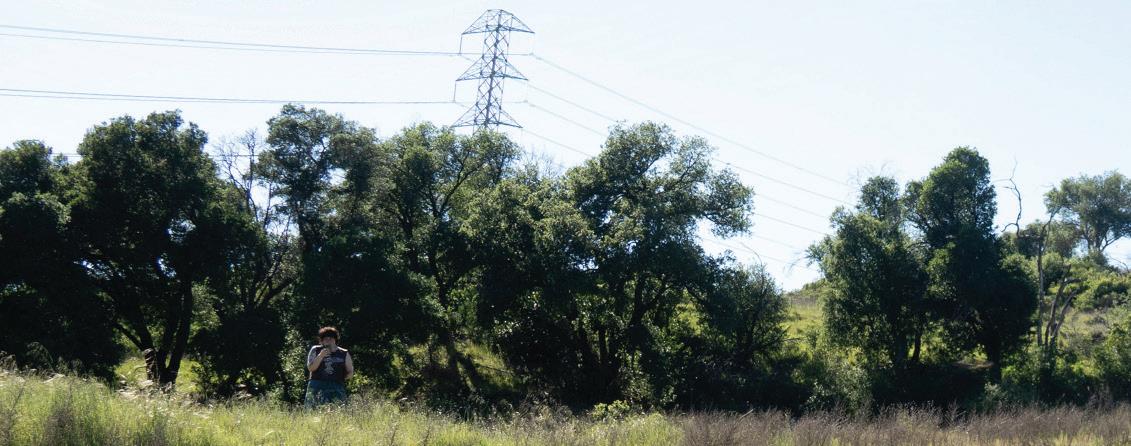



It simply was not my scene. That alone nagged me to no end. I attended to a school that I had been (inexplicably) wary of since middle school and I saw it through because, in my mind, I had no good reason to deny it. In fact, I owed this institution my attendance because they had
Yet I found no matter how many organizations I joined, how much intramural softball I played, how many hours I spent loafing in the radio studio: I felt awful. I could barely leave my bed by Thanksgiving break.
The truth is that you don’t owe any university anything. Intrapersonal relationships with instructors, classmates, family, friends, your community: these things are forever. These are lasting. The nameless and faceless institutions that seek to control us are owed nothing. A nation-state, a university, a church. Anything with massive sums of money attached to making its gears turn has a corrupt core. I debased and depressed myself at the altar of expectation like an ascetic monk in hopes that deliberate suffering would somehow free me. It didn’t. Much like my stupid car, I was stuck in the mud, and the rain
We goosed it as hard as we could up a dirt road towards, unbeknownst to us, a locked gate. We never saw that gate because we barely got halfway up the road. Our speed ensured that we buried the boat in mud, beaching ourselves on the air dam, splash guard and the frame of the vehicle itself. Wisely, I opted not to pack a shovel.
Finn and I spent most of our energy finding rocks to stack and gently attempting to dig out the car to no avail. After several hours, we had a cartoonishly stranded SUV with two bright orange traction boards wedged beneath the back tires and a smattering of stones placed with zero finesse. It was cold, it was raining and we hadn’t seen another car the entire time. Better yet, AAA was not coming to save us. Our options were calling members of the off-road club at Cal Poly or camping in the car until the rain stopped.
On the horizon, through the dumping rain and dark night, we saw a white glow. Whether the lord had finally arrived to rapture us or a nuclear warhead had detonated, something good was on the way. To our joy, it was a neighbor in a Ford Fusion. She was out searching for her dog and said she “did this all the time with my husband back in the day.” A seasoned four-wheeler, she was not looking to shoot us for trespassing and was in fact so sympathetic to our increasingly helpless situation that she had already called the property owner (whoops) and went on to bring us blankets, coffee, tea and quesadillas. Within the hour, the farmer returned from
the city, analyzed that our situation was worth $200 of his time and rescued us with relative ease via tractor.
It was embarrassing all around. To recap: we were stuck on his land with a 2WD soccer mom car attempting mudding seasoned vets would avoid, I was $200 in the hole for an avoidable situation, the rain reached a fever pitch just in time for our windy descent home and every single piece of our clothing had adopted an earth tone. The worst part? I had to be grateful to a Dodge RAM owner. I was lucky enough to pick the funniest person I know to suffer with, so the ride home was far from silent.
I did not yet know that I would drop out of Cal Poly. That took another month or so. The moment my family offered me the choice, I fled home. But in a much more real sense, I knew already that it wasn’t the place for me. Despite the charming faculty, I couldn’t bring myself to attend classes; I had friends in the newsroom who I struggled to connect with outside, I didn’t go out: I was alone. I knew when I graduated high school that waiting until I was sure of what I wanted to do was better than rushing into something. It’s why I attended Santa Rosa Junior College in the first place, and why I’m back. It was tough to relearn that lesson, but I’m immensely grateful for the educational safety net this college provides.
I’m not sure what lies beyond the horizon for me or where I’ll find myself next semester, but I’m out of the mud and have a clearer idea of what I want out of life. I’ve figured out what kind of community I value, where I want to live and what kind of terrain my car can handle: all extremely valuable lessons for the future. Paramount amongst these myriad lessons was the understanding that I don’t owe anyone my suffering. Making major life decisions based solely on the rationale that, “I have no reason not to” is a hazardous line of logic to follow. “Because we might as well,” is not a good enough reason to attempt an off-road obstacle. When you have a feeling in your gut before you take that turn into the sludge, the hungerlike pang asking “are you sure?” just might be worth listening to.

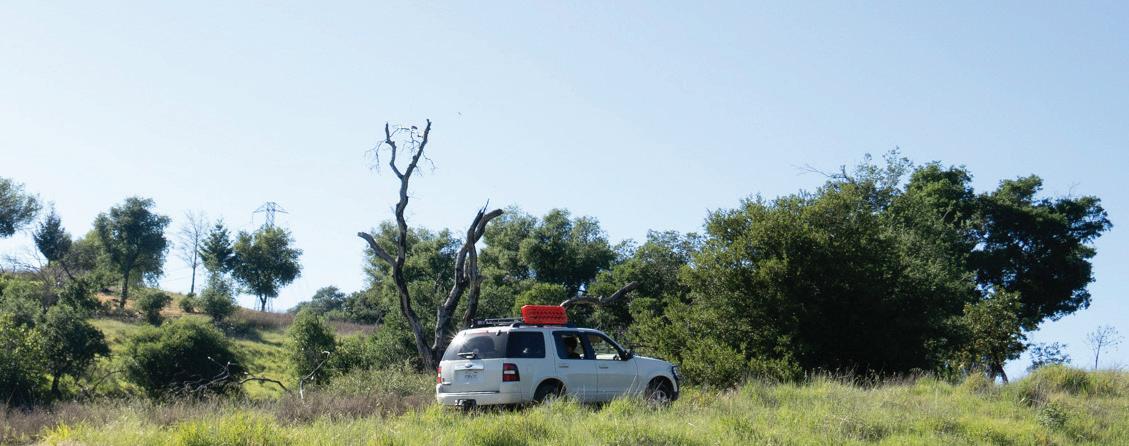
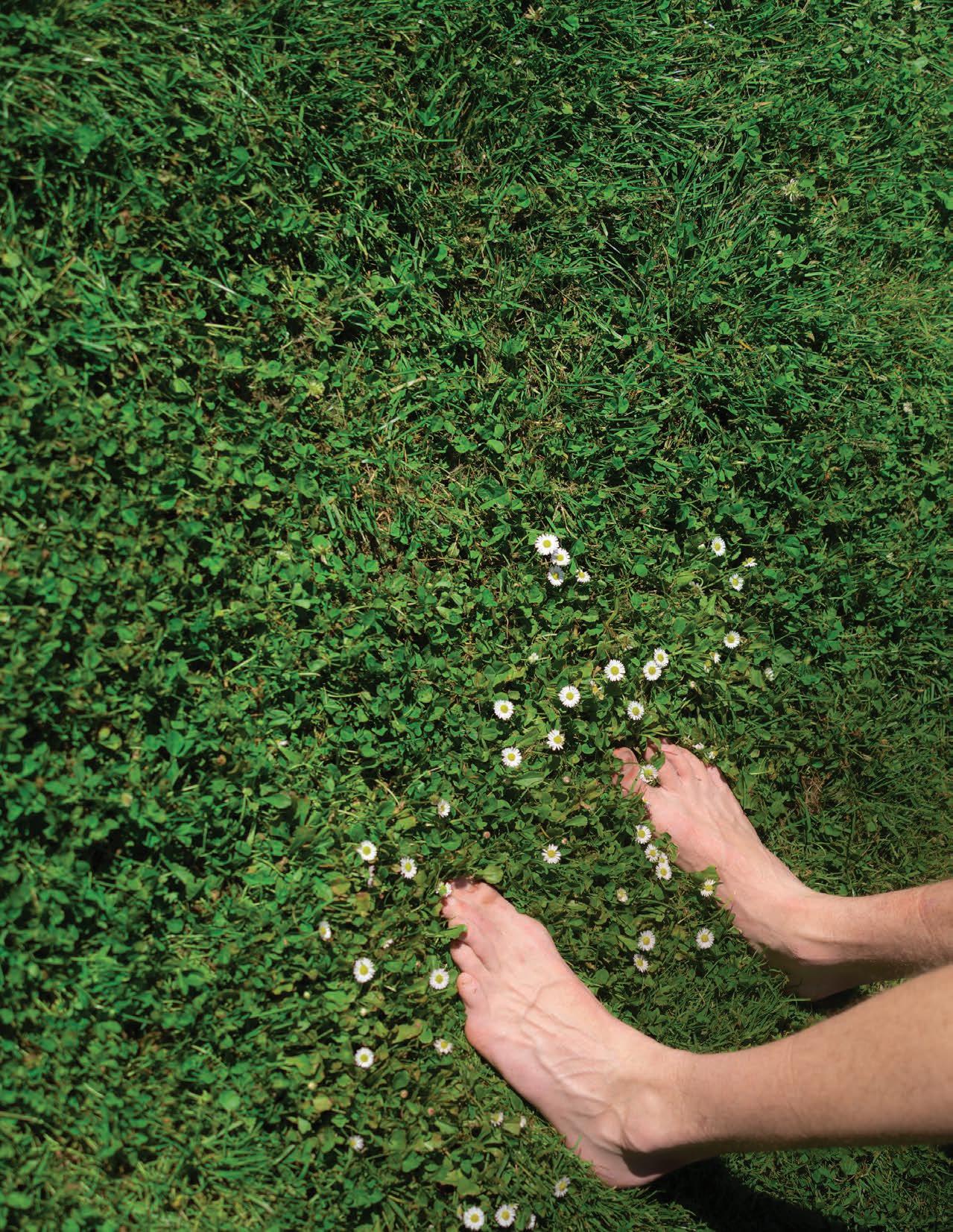
why it matters
Do you have a nagging headache that just won’t go away? Inflammation for seemingly no reason? Brain fog and stress overload? When you visit a doctor, do they tell you nothing is wrong, prescribe medicine and send you on your way?
Dr. Don Wright, a Santa Rosa-based certified chiropractic sports physician, would first ask you one simple question: Have you ever tried grounding?
Grounding is the practice of connecting an electrical circuit to the earth, allowing a pathway for electrons to flow if the circuit shorts. The earth is an electric sponge. Grounding is an essential safety measure electricians use to prevent damage.
“Our bodies are electric,” Wright said. “As an applied kinesiologist, as I treat people, I’m checking that electrical continuity. That’s how I derive my plan to fix them.”
He began to use grounding as medicine in 2001. He saw a patient who traveled from Chico in debilitating pain. After crawling into his office, Wright discovered the man was severely imbalanced, with an asymmetrical pelvis, a short leg and spots of pain all across his body.
If the patient breathed through his right nostril, he was strong. If he breathed through his left nostril, he was weak. If he counted numbers — a left brain activity — he was weak. If he hummed a song — right brain activity — he was strong. Dr. Wright believed he had an ionic imbalance.
His prescription? Grounding. The patient crawled outside to a PG&E grounding rod and held onto it for about three minutes. (Kids, don’t try that at home.)
The patient was able to stand up immediately after, Wright said. “Every symptom he’d initially presented was gone. And then he
by Cayden Timbermoon
was upset because he said, ‘You’re telling me that if I just held onto a metal post in Chico I would have gotten rid of all this and not had to drive all the way down here?’”
Grounding does not need to be done with a rod. Standing on a wet lawn or swimming in a natural body of water can allow for electron transfer, which relieves ionic pressure. But what is this actually doing?
“Inflammation is nothing more than positively charged ions,” Wright said. “When you ground yourself, you’re hanging onto a negative charge. That negative charge neutralizes the excessive positive charge in your body.”
“Our emotions carry electromagnetic charge. The feelings in our brain affect our electromagnetic field, and when we get supercharged, there are physiological effects.”
Last year, Wright went through a stressful experience. His wife suffered a stroke, which she recovered from, but he sat with her in the hospital for hours. As he waited, he listened to a family grieving over the impending death of their loved one. These emotions carried with him, and left him with a knee ache hours after.
He was completely debilitated the next day. He underwent various tests, and while the doctors could see the inflammation, they couldn’t find a cause, nor a solution. So there he was, stuck in bed, an ice pack on his knee, when YouTube recommended a documentary on grounding. “I watched it and realized, could it be that simple?” Wright said.
He limped over to Sonoma State University with a thermos of water, poured it on his feet
and took a nap under a redwood tree. He woke up 90 minutes later and walked back to his car. Only after a couple of steps did he realize that 90% of his pain had vanished. The next day, it was completely gone. But how did his stressful experience translate into physical pain?
“Our emotions carry electromagnetic charge,” Wright said. “The feelings in our brain affect our electromagnetic field, and when we get supercharged, there are physiological effects.”
The electric fields produced by our emotions are well-documented. Studies have found that different emotional states produce different waves. They can be induced by controlled electric stimuli. This shows that emotions and electricity are directly linked.
In this modern era, we are exposed to more stress and electromagnetic frequencies than ever before and rarely have the time to connect ourselves back to the earth.
“Part of the problem exists because of fashion,” Wright said. “We have these rubberized soles that insulate our bodies from the earth.”
It can be hard to find the time to ground ourselves. School, work and locational challenges can contribute to stressful energy and prevent us from dissipating it. However, if you allow it, grounding can change your life.
To ground yourself, all you need is time and a conductive medium connected to the earth. It’s important that the soil is wet. Dewy grass, a stream or even a puddle will be enough to connect you.
There’s no such thing as grounding for too long; just five minutes a day provides an outlet for your electrical system. In the meantime, it’s a great opportunity to practice mindfulness. Your body and your brain will thank you.