EFFECTIVE 11/16/2025
EFFECTIVE 11/16/2025
Section 1. This Association shall be known as the National Reined Cow Horse Association (“NRCHA” or “Association”).
Section 2. The purpose of the NRCHA is to improve the quality of the western reined stock horse: to perpetuate the early Spanish traditions of highly trained and well reined working cow horses; to promote exhibits, cow horse events, contests in expositions and shows; to promote the training of reined cow horses and to promote interest in reined working cow horses among the younger horsemen of this nation and the world; to use and encourage the use of standard rules for holding and judging contests of the reined working cow horse. Reined cow horse is synonymous with working cow horse or stock horse.
Section 3. The principal place of business of this Association shall be a place so established by the Board of Directors of the NRCHA.
Section 4. This Association is a Non-Profit mutual benefit corporation organized under the California Non-Profit Mutual Benefit Corporation Law. The purpose of this Association is to engage in any lawful act or activity for which a corporation may be organized under such law.
Section 1. There will be one class of Voting membership and each Voting member will have one vote. In order to exercise their right to vote members’ dues must be paid and current at the time of any vote. The vote of Voting members will not be transferable by proxies or otherwise. There will be one class of Youth membership for persons 18 years of age and under on November 16th of the current year. Youth members will have all the rights and privileges of Voting members, except the right to vote.
There will be one class of membership that shall be designated a “Life Membership”. An individual may qualify for the life membership category upon payment by that member. The Board shall approve fees. Upon payment of said sum and acceptance thereof by the Board of Directors, the Life member shall have the following privileges: (A) a Life membership card; (B) no further payment of annual dues; (C) such other privileges as the Board of Directors may from time to time bestow including all privileges of a Voting member. A non-voting honorary membership may be bestowed on any Voting member at the discretion of the Board of Directors. Such honorary membership may be a Life membership.
Section 2. The Board of Directors shall determine dues for each Voting and Youth member. Said dues shall become due and payable to the NRCHA on November 16th of each year and delinquent on December 16th of the same year. Members failing to pay the annual dues by December 16th of each year shall be considered delinquent and will forfeit all rights and privileges of participation in any activities of this Association until delinquent amounts are paid. Each member shall receive an annual membership card upon payment of his/her dues, and such membership card shall be non-transferable. The membership card shall be in the form prescribed by the Board of Directors, and all members, by accepting the membership card, shall be deemed to have agreed to comply with all the provisions of the By Laws and other rules and regulations of this Association. All members may be required to present
their membership cards or a copy of, to show management prior to exhibiting at an NRCHA approved event.
Section 3. There shall be one class of membership that shall be designated as “Affiliate”. Each Affiliate shall be a recognized reined cow horse association representing a state, region or “locale”. Each Affiliate shall be governed by its own Bylaws and Articles of Incorporation that shall be in conformance with those of the Association. Each Affiliate shall pay annual dues to the Association at a level that shall be set from time to time by the Board of Directors of the Association and shall be due on November 16th of each year and delinquent on December 16th of the same year. Membership dues not paid by December 16th of each year shall be considered delinquent and all rights and privileges of membership are forfeited. Each Affiliate member shall upon paying membership dues be deemed to have agreed to comply with all the provisions of the Bylaws, and other rules and regulations of the Association.
Affiliates may be represented on the Board of Directors by nominating from their membership any member in good standing in the NRCHA and in the Affiliate and then duly elected. Director representation on the Association Board of Directors may be appointed by the Affiliate and may sit on the Association Board as a non-voting member.
Every NRCHA Affiliate shall have within its membership at least twenty (20) members who are also active individual members of the NRCHA. No NRCHA Affiliate or NRCHA Show management entity may deny membership to any NRCHA member in good standing.
In order to qualify as an Affiliate, each Affiliate organization must:
a) Pay its annual fee and submit a list of its twenty members who are also members of NRCHA.
b) Provide NRCHA with a copy of its Constitution and Bylaws.
c) Provide the NRCHA with a complete list of its members no later than March 15th of each calendar year.
d) Provide the NRCHA with the results of all approved NRCHA classes which results shall be forwarded to this Association in a business-like manner as prescribed by the NRCHA in paragraph 12.1.10.
e) Conduct its affairs in compliance with the Bylaws and standing rules of this Association including, but not limited to:
i. The annual election of Officers and Directors
ii. Use due process in all matters of discipline or suspension of its members.
A person may serve as a President, Vice-President, Secretary or Treasurer of only one NRCHA Affiliate.
Any Affiliate found not in compliance with all sections of this article on April 15th of each year will be denied membership renewal until all of the above rules have been satisfied.
Section 1. The annual meeting of the membership of this Association shall be held as determined by the Board of Directors in the first quarter of the year. The meeting shall be held at a time and place designated by the Board of Directors. Special meetings of the membership may be called by a majority of the Board of Directors, or on the call of the President. The NRCHA Management shall call a special meeting of the membership upon written request of five percent (5%) of the voting members of the Associ-
ation and hold a meeting within 90 days at the principal place of business of the Association.
Section 2. Notice of the time and place of the holding of any regular or special meeting of the membership shall be sent by regular mail to all members at least twenty (20) days prior to such meeting.
Section 3. Three percent (3%) of voting members of this Association, based on membership numbers at end of previous show year, shall constitute a quorum at any meeting.
Section 1. The officers of the Association shall consist of a President, Vice President, Secretary and Treasurer and must be members of the Board of Directors and elected by the Board of Directors and shall be elected for a period of one (1) year or until their successors are duly elected and qualified. All officers of the Association shall be members in good standing of the Association.
Section 2. The President shall preside at all meetings of the Association and at the meetings of the Board of Directors. He/she must have served on the Board the year preceding his/her election. He/ she shall appoint all Committee chairmen. The President, during his/her term of office, may create certain positions, including but not limited to parliamentarian and historian, that he/she may deem necessary to advise the office of the President or the Board of Directors. Said appointments will run concurrently with his/her term as President. He/she shall perform such duties and exercise such other powers as are usually incident to such office.
Section 3. The Vice President shall perform the duties of the President in his/her absence. He/she must have served on the Board the year preceding his/her election. The Vice President will be responsible for the administration and day-to-day operation of the NRCHA, its staff, and its offices. The Vice President shall be chairman of the Executive Committee.
Section 4. The Secretary shall keep and safeguard a complete and accurate record of all proceedings of the Association, its Board of Directors and standing Committees. He/she shall attend to the proper publication of all reports, conduct official correspondence, attest documents and perform such other duties as are usual to such office or as may be required by this Association. The Secretary shall also issue notice or call to directors and members, keep the membership roll or cause the keeping of, issue membership cards and conduct, supervise, count and record the balloting of all elections. The Secretary shall be a member of the Executive Committee.
Section 5. The Treasurer shall oversee the custody of all moneys of the Association and shall keep, or cause the keeping of, regular books of accounts. He/she shall disburse or cause the disbursement of Association funds in payment of just demands against the Association, taking proper vouchers for such disbursements, and shall render at the annual meetings of the Association, the Board of Directors, and the Executive Committee, from time to time as may be required of him, an accounting of all his/her transactions as Treasurer and of the financial condition of the Association. He/she shall be a member of the Executive Committee and an ex-officio member of the Show Committee. A surety bond will be provided for the Treasurer and the NRCHA Management, the premium of which will be paid from Association funds. Written
financial statements for the first 3 quarters of the calendar year shall be presented to the membership at each annual meeting. The year-end financial statements, as prepared by a public accountant, will be mailed to the requesting member upon request, and a summary of the financial condition of the association will be published in the official NRCHA publication annually within 90 days of the end of the fiscal year.
Section 1. The management of the affairs, property, business and control of policy is vested in the Board of Directors. All members of the Board of Directors shall be a member in good standing of the Association.
Section 2. The Board of Directors of this Association shall consist of twelve (12) members in good standing elected by the general membership for a three-year term. A representative of the NRCHF (National Reined Cow Horse Foundation) may sit as a non-voting member of the Board of Directors. The President must be chosen from the twelve (12) elected board members. Following the election of the President, the President can recommend and ask the Board to approve the appointment of up to four (4) additional members to the Board of Directors, who will serve a one (1) year term and will sit as voting members of the Board of Directors. These appointees will begin their one (1) year term immediately and will be full voting members of the board upon their approval by the elected board. If the newly elected President does not choose to appoint four (4) directors at this meeting, the balance may be appointed during the course of the year, and will also be subject to Board approval. If a representative of the Non Pro or Affiliate Committees is not directly elected by the membership, persons to fulfill these positions must be included in the appointments. Following the election of the officers, the Board shall approve all appointments at this meeting and the appointees shall attend the following Board meeting and General meeting. In addition to the 4 appointees, the President is required to appoint additional board members to ensure that each region with over 250 Voting members (as of the end of the preceding show year) is represented by a member on the NRCHA Board of Directors. This will occur providing that there was a representative from said region on the ballot and will be the person with the highest number of votes from that region. In case of a tie, the President shall make the decision. Any appointments made at the annual meeting or during the year will end at the next year’s annual board meeting and these appointees will have no voting rights at that meeting. After the election of the new President and the President’s appointees are approved, the Board of Directors shall then elect the rest of the officers from any of the duly elected or appointed members of the board. The elected incoming and entire outgoing Board of Directors will meet annually prior to the annual general membership meeting and conduct other business deemed necessary for the continued function of the Association. Outgoing Board members will have no voting rights at this meeting.
Section 3. The President or six (6) members of the Board of Directors, on at least ten (10) days prior notice, may call meetings of the Board of Directors.
Section 4. Seven (7) directors will constitute a quorum at any meeting of the Board of Directors. A majority of said quorum may decide any questions which come before the Board.
Section 5. As a member of the Board of Directors, each director shall accept the responsibility of attending all Board meetings. If a director is going to be absent from a meeting any proxy for voting must be received via email to President, Executive Director or Secretary prior to the scheduled meeting. If a director has more than two (2) unexcused absences from meetings within any year that director will automatically forfeit his/her position on the Board.
Section 6. A Director’s term of service will be terminated immediately if the Director serves as an officer or director of a competing reined cow horse, working cow horse, or stock horse organization.
Section 7. The President shall fill any vacancy on the Board of Directors by appointing the nominee who had attained the next highest number of votes at the last Board of Directors election to complete the term vacated.
Section 8. The immediate past President of the Board shall sit as an ex-officio member of the Board of Directors.
Section 9. Action taken by any individual Board member shall not be binding upon the other Board members unless a majority of said quorum so votes. No Board members may undertake any financial obligation in excess of $500 without a vote of a majority of said quorum. No Board member may issue a check in excess of $500 without a vote of a majority of said quorum. An individual Board member cannot borrow nor pledge the assets of the association for borrowing without vote of a majority of said quorum.
Section 10. Members of the Board may participate in a meeting through use of conference telephone, electronic video screen communications, or other communications equipment provided all members participating in the meeting are able to hear one another.
Section 1. To aid and assist in the orderly growth of the Association, the Board of Directors may, as it deems necessary, establish by a two-thirds (2/3) vote certain executive positions to assist its officers in carrying out their appointed duties.
Section 2. The Board of Directors shall set remuneration of executive positions from time to time.
Section 3. The Board of Directors may request that a surety bond be provided for any executive position so created, the premium of which shall be paid from Association funds.
Section 1. From time to time the Board of Directors shall establish rules and regulations for the presentation and judging of NRCHA events. The rules and regulations so adopted shall be changed, nullified or repealed only by a two-thirds (2/3) vote of the Board of Directors. The Board of Directors must provide any changes made to the rules to the membership in writing upon approval.
Section 2. Any rules adopted by the Board of Directors in any given calendar year go into effect the following November 16th and will remain in effect through the next annual general meeting at which
point they will be ratified by a majority of the general membership in attendance.
Section 3. Any change in the rules or regulations proposed from the floor of any annual meeting must be considered and voted upon by the newly elected Board of Directors within fifteen (15) days after said annual meeting and, if adopted by the Board, will be effective the following November 16th.
Section 4. Any charge of infraction of the rules and regulations of this association registered in writing with the NRCHA Management shall be referred directly to the appropriate committee for investigation and recommendation to the Board in accordance with Disciplinary/Ethics Section 14.
Section 5. Every new member of this organization shall receive a current, complete set of Bylaws and rules and regulation book. The cost of printing and mailing the Bylaws and rules and regulations shall be passed on to the membership at the discretion of the Board of Directors.
Section 6. Show management and Affiliates will receive at no cost current, complete sets of Bylaws, rules and regulations, membership lists, and lists of approved judges as required to run NRCHA approved shows.
Section 7. The NRCHA Board of Directors reserves the right to interpret any rules within this rulebook that allow for ambiguity. In the event of ambiguity or uncertainty regarding the application or meaning of any rule, the Board of Directors shall have the authority to provide clarification or make determinations as they see fit. Such interpretations by the Board of Directors shall be final and binding.
Section 1. Standing Committees: All Standing Committees include the NRCHA Management in addition to the following and shall contain a minimum of 3 members unless otherwise specified: All members of standing committees shall be members in good standing of the Association.
a. Executive Committee: The Executive Committee shall consist of the President, Vice President (chairperson), Secretary, Treasurer, Show Committee chairperson and one (1) member of the Board of Directors who shall be appointed by the President. The Executive Committee shall be responsible for the following:
1. The Committee will be responsible for overseeing the dayto-day operations, administration, and finances of the NRCHA as approved by the Board of Directors.
2. The Committee will carry out the directives and fiscal policies established by the Board of Directors.
3. The Committee shall make recommendations to the Board of Directors concerning the Association’s policy in all administrative matters and make recommendations for implementation of operational policies and programs needed to efficiently run the NRCHA.
4. The Committee shall control, review and audit fiscal procedures, current accounts, including allocation of costs and revenues, and budgets for the past, present and future year. The NRCHA shall participate in a minimum of a bi-annual review audit, which shall be supervised by this Committee.
b. Show Committee: The Show Committee shall consist of a chairperson appointed by the President and such additional committee members as the chairperson desires to appoint. The Treasurer shall be an ex-officio member of the Show Committee.
c. Rules Committee: The Rules Committee shall consist of a chairperson appointed by the President and such additional committee members as the chairperson desires to appoint. The committee shall be responsible for advising the Board of Directors on the enactment and enforcement of all the rules and regulations pertaining to all NRCHA approved shows.
d. Ethics Committee: The Ethics Committee will be appointed by the President and shall consist of five (5) Voting members in good standing. At least three members of the Ethics Committee shall review all matters where disciplinary action may be possible and make recommendations to the Board.
e. Non Professional Committee: The Non Professional Committee shall consist of a chairperson appointed by the President and such additional committee members as the chairperson desires to appoint. The Non Professional Committee shall review and consider all applications received by it for Non Pro status. Such application shall be made in a form prescribed by the committee and approved by the board from time to time. Upon proper investigation and discussion, the committee shall make recommendations to the board regarding persons that meet the eligibility requirements to be a Non Professional. The committee shall bring to the attention of the board any problems, suggestions or criticisms regarding the Non Professional division that arise during the course of the year.
f. Long Range Planning Committee: The Long Range Planning Committee shall consist of a chairperson appointed by the President and such additional committee members as the chairperson desires to appoint. The Long Range Planning Committee makes recommendations with regard to the direction of the NRCHA for future growth and development.
g. Marketing Committee: The Marketing Committee Chairman shall be appointed by the President and such additional committee members as the chairperson desires to appoint and the committee shall be responsible for advising the Board of Directors on the best direction for marketing and promotion of the NRCHA.
h. Judges Committee: The Judges Committee shall consist of a chairman who shall be appointed by the President and at least 5 individuals appointed by the Chairman, of which at least two members shall have judged at least 1 NRCHA show per year in each of the preceding two years. The Director of Judging shall be on the Committee. It shall be the duties of the Judges Committee to administer judges tests, conduct clinics, review any and all judging after NRCHA sponsored events or approved events, review judging performances on recommendation of show representatives or by official protest, and to conduct investigations and hearings into any inappropriate behavior by an NRCHA Judge. The committee shall be empowered to take all action necessary to improve the quality, integrity and performance of the judging system.
i. Affiliate Committee: The Affiliate Committee shall consist of a chairperson, appointed by the President and such addi-
tional committee members as the chairperson desires to appoint. The Affiliate Committee shall bring to the attention of the Board all problems, suggestions and criticisms regarding the Affiliates that arise during the course of the year.
j. Youth Advisory Committee: The Youth Advisory Committee Chairman shall be appointed by the President and the committee shall consist of up to five (5) additional members, including the NRCHA Staff Liaison.
k. Owners Committee: The Owners Committee shall consist of a chairperson appointed by the President and such additional committee members as the chairman desires to appoint. The purpose of the Owners Committee shall be to facilitate and promote: 1. owner satisfaction and engagement, 2. industry growth and sustainability, 3. enhance owner experience through education and communication, 4. enrichment and expansion of owner involvement, 5. NRCHA’s time honored tradition of advancing horsemanship through the development of the highly trained and versatile bridle horse.
l. Professional Horseman Committee: The Professional Horseman Committee shall consist of a chairperson appointed by the president and a minimum of 4 other committee members to be appointed by the chairperson. The Professional Horseman Committee shall bring to the attention of the Board all problems, suggestions and concerns regarding the professional horseman of reined cow horses that arise throughout the course of the year.
a. Nominating Committee: The Nominating Committee shall be appointed by the President no later than September 1 of each year. This committee shall consist of five (5) members. All members of this committee will be members in good standing of the Association and at least three (3) of the said members will be other than current Board of Directors members.
i) The committee shall be responsible for the acceptance and review of nomination papers submitted by those who seek nomination and election to the Board of Directors.
ii) It shall be the duty of this committee to report its findings to the Board of Directors prior to the mailings of the ballots for voting by the membership. The Board of Directors shall from time to time set forth policy and guidelines for explicit duties of this committee.
b. Sponsorship Committee: The chairperson shall be appointed by the President and shall select a committee for the purpose of establishing, promoting and directing NRCHA sponsorships and awards. The committee shall obtain the approval of the board for the awards program proposed by the committee, including any expenditure to be made by it, prior to its enactment.
c. Hall of Fame Committee: The Hall of Fame Committee Chairman shall be appointed by the President and the committee shall be responsible for recommending to the Board of Directors the inductees for the Hall of Fame and the Hall of Merit each year.
Section 1. Prior to September 1st of each year, the President will appoint a five (5) person Nominating Committee to solicit, review
and report to the Board of Directors its findings on candidates seeking election to the Board of Directors.
Section 2. No less than ninety (90) days prior to the annual meeting each year, the general membership shall be given official notice that:
a. Any member in good standing in the Association may request and receive a Director Nomination Form.
The Director Nomination Form shall contain an explanation of the eligibility requirements and commitments for service on the Board of Directors which shall include, but not be limited to, the following:
(i) membership in the Association in good standing for a minimum of three (3) years;
(ii) attainment of at least twenty-one years of age;
(iii) agreement to attend Directors meetings as set forth herein;
(iv) full disclosure of any felony convictions on record;
(iv) signing of NRCHA Code of Conduct and Confidentiality Agreement.
Additionally, a person submitting false information on the nomination form, if discovered, will be immediately suspended from the ballot or later from the board.
b. Said form must be submitted to the Nominating Committee not less than forty-five (45) days prior to the annual meeting in order for said proposed nomination to be considered by the Nominating Committee.
Section 3. The Nominating Committee shall review all correct nomination forms received by it in accordance with Section 2 of this article in sufficient time for ballots to be prepared and mailed in accordance with this section, the Committee will, by investigation, personal interview and deliberation, formulate its own list of nominees and submit it to the Board of Directors. The recommendations of the Nominating Committee upon approval by a simple majority of the Board of Directors shall be final. The Board of Directors shall instruct the Corporate Secretary to prepare and issue ballots to be mailed to the general membership not later than thirty (30) days prior to such annual meeting.
Section 4. Election ballots will be mailed to current members by first class mail under separate cover and will include a return self-addressed envelope marked “Ballot” and mailed directly to the accounting firm. All ballots must be received no later than one (1) week prior to the annual meeting at which the results of said balloting are to be announced, and must remain unopened in the custody of the accounting firm until such time as they are to be tabulated. The ballots will be opened and tabulated by an accounting firm and by a group of three (3) tabulators appointed by the President and under the direct supervision of the Corporate Secretary. Ballots shall be retained in a secure location for two (2) years following any election.
Section 5. In addition to the mailed ballot voting option outlined in Section 4, eligible members may also cast their vote via an online voting platform provided by the organization. The online voting system will be secured and accessible only to verified members, and the voting instructions will be provided through an official communication, which may include email or other appropriate methods. The online voting period will begin at the same time as the mailed ballot distribution and will close no
later than one (1) week prior to the annual meeting at which the results are to be announced. Online votes will be directly transmitted to the accounting firm or a designated secure system for tabulation, and the ballots will be included in the overall count with the mailed ballots. All online votes must be cast in accordance with the deadlines and guidelines outlined, and no votes will be accepted after the closing of the online voting period. The security and integrity of the online voting system will be overseen by the Nominating Committee, Executive Director, and NRCHA Staff to ensure the process remains fair and transparent.
Section 1. The Bylaws may be repealed, modified or amended by a two thirds (2/3) vote of all voting members present and new Bylaws may be adopted by the same vote at any regular meeting of the members of this Association.
Section 2. The Bylaws may also be changed or amended by giving notice to the members of the Association by mail of the proposed changes which the Board of Directors has passed and which changes shall go into effect beginning with the following show year, unless within fifteen (15) days after they have been published, the NRCHA Management has received objections in writing signed by at least one hundred (100) members in good standing of this Association as to all or any portion of said changes. Said objections shall be in the form provided in the notice.
The Association shall indemnify each of its Directors, Officers, employees and committee members whether or not then in service as such, against all reasonable expenses actually and necessarily incurred by him or her in connection with the defense of any litigation to which the individual may have been a part because he/she was a director, officer or employee and committee member of the Association. The individual shall have no right to reimbursement, however, in relation to matters as to which he or she has been adjudged liable to the Association for negligence or misconduct in the performance in his/her duty as a director, officer or employee and committee member by reason of willful misconduct, bad faith, gross negligence, or reckless disregard of the duties of his/her office or employment. The right to indemnity for expense shall also apply to expense of suits which are comprised or settled if the court having jurisdiction of this matter shall approve such settlement. Pursuant to California Corporation’s Code section 7237. The foregoing right of indemnification shall be an addition to, and not exclusive of, all other rights which such director, officer or employee may be entitled.
Section 1: This organization shall be a division of the National Reined Cow Horse Association, shall operate within the scope of the bylaws, rules and regulations of NRCHA, and shall be named the National Reined Cow Horse Youth Association.
Section 2: The objectives and purposes of the National Reined Cow Horse Youth Association, hereafter referred to as NRCHYA, shall be as follows:
a) To develop and improve scholarship, leadership and community interest and participation of youth in the reined cow horse industry.
b) To support the youth of the NRCHA with opportunities for scholarship, advancement and reward.
c) To encourage high moral character and sportsmanship among all its members.
d) To establish a means whereby youth members may work in conjunction with NRCHA Youth Activities Committee.
e) To acquaint youth members with the parent organization, NRCHA, its structure and functions and to promote the reined cow horse industry for the present and the future.
Section 3: Individual Youth Members of the NRCHA will be allowed all privileges of a Voting member of NRCHA, the parent organization, except the right to vote and hold office in the parent organization.
Section 4: The business and property of the NRCHYA shall be managed and controlled by the NRCHYA Board and the NRCHYA Advisory Committee, along with the NRCHA Staff Liaison.
Section 5: Meetings: The regular annual meeting or meetings of the NRCHYA shall be held at such time and place as they may be fixed by the NRCHA Board of Directors for the purpose of electing officers of the organization and for the purpose of such other business as may be brought before the meeting.
Section 6: Powers of the Board: The NRCHYA Board and Advisory Committee shall have the power and authority to direct the affairs of the organization, including, but not limited to, the right to make, amend and repeal the constitution of the organization, as they may deem expedient concerning the conduct, management and activities of the organization, the admission, classification, qualification, suspension and expulsion of members, removal of officers, expenditure of money and other details relating to the general purposes of the organization, subject to the approval of the Advisory Board.
Section 7: NRCHYA Officers: The officers of the organization shall be the President, Vice President, Secretary, and Treasurer who shall be elected from and by the NRCHYA Youth Members. Such officers shall hold office for a period of one year and until their successors are elected and qualified. An officer must remain eligible for NRCHYA membership and a member in good standing for the duration of their term. (An officer cannot turn 19 before November 16 during the term in which they are serving.) Election shall take place prior to the annual NRCHYA Youth Meeting. That meeting will currently be held at the NRCHA Celebration of Champions but can be set at any time near the beginning of the year by direction of the NRCHYA Youth Advisory Board.
(a) President: The President shall be the chief executive officer of the association and shall have general supervision of the affairs of the association, and shall preside at all meetings of the Officers and members. The President shall appoint all committees of the association subject to the approval of the NRCHA Board of Directors and NRCHYA Advisory Committee. The president shall have such other and further duties and authority as may be prescribed elsewhere in this constitution or from time to time by the Board of Delegates or by the NRCHA Board of Directors.
(b) Vice President: The Vice President shall, in the absence, disability or inability of the President to act, perform the duties and exercise the powers of the President, and shall perform such other duties as the President shall prescribe from time to time.
(c) Secretary: The Secretary shall attend all meetings and shall record or cause to be recorded all votes taken and the minutes of all proceedings of NRCHYA.
(d) Treasurer: The Treasurer shall have the responsibility of examining the financial need of specific projects and needs of NRCHYA, and reporting those costs to the NRCHYA Board. He or she shall be made aware of the continuing status of membership growth and corresponding payment of dues.
Section 8: NRCHYA Director: Annually, two Directors shall be elected to the NRCHYA Board. The duties of an NRCHYA Director are to enhance communication and serve as liaison between NRCHYA membership and the NRCHYA Board.
Section 9: Vacancies of Elective Offices: All vacancies in the elective offices of the organization shall be filled by the NRCHYA Board for the unexpired term, and those so appointed shall serve until the election and acceptance of their duly qualified successors.
Section 10: The Advisory Board of the organization shall consist of the NRCHA President, the NRCHA Vice President, the Chairman of the Youth Activities Committee, the NRCHA Office Liaison and at least two adult representatives, appointed by the NRCHA Executive Committee. This Advisory Board shall assist the NRCHA Youth Advisory Committee in directing the activities of NRCHYA. All correspondence regarding NRCHYA shall be directed to the Youth Activities Department of NRCHA.
Section 11: Membership and election to office in NRCHYA is a privilege, not a right, which may be terminated or refused for cause detrimental to the interest of NRCHYA, of which it is a division, its programs, policies, objectives and harmonious relationship of its members. A member may be removed from the membership roll, an officer may be removed from office, a director may be removed from their position or an individual may be refused membership by the Advisory Board after prior written notice of the time and place of hearing, containing specification of charges, where the individual may attend, with counsel, to hear evidence against him, and present evidence on his behalf. The ruling or action of the Advisory Board may be appealed to the NRCHA Executive Committee by written request filed with the Executive Vice President within 15 days of the ruling date, which appeal shall, however, not suspend the effect of the ruling.
1.1 General
Any charge of infraction of the rules and regulations of this association registered in writing with the NRCHA Management shall be referred directly to the appropriate Committee for investigation and recommendation to the Board in accordance with Disciplinary/Ethics Section 14.
1.1.1 An Associate Membership will be offered. The Associate member will receive all the benefits of a Voting membership but he/she but will not be able to vote and will not be able to compete or own horses that are competing.
1.1.2 NRCHA Approved shows are restricted to NRCHA members in good standing only. If an owner or rider is found to not be a current member, they may be fined in the amount of $50. Failure to pay the assessed fine will be cause for denial of membership. In addition, a $50 fine, per occurrence, will be assessed any show management which allows a person to show without a current NRCHA membership card.
1.1.3 An owner may enter more than one horse and/or rider may ride more than one horse. A horse may be entered only once per division.
1.1.4 In any NRCHA class, competition must be open to any horse, regardless of breed, color, conformation, appearance, or previous performance.
1.1.4.1 Registered Horses: All registered horses must be shown under the name assigned to them by their Breed Association.
1.1.4.2 Grade Horses: All unregistered (Grade) horses must be shown under one name only and said name may not conflict with a registered horse’s name, at any and all contests approved by the NRCHA. Grade horses must apply for a competition license from the NRCHA office.
1.1.5 When exhibitor back numbers are provided at NRCHA approved shows it is mandatory for all entries to wear the correct number. Numbers must be visible to the judge. Failure to wear a back number or to wear the correct number will result in a fine to the rider of $100. If an event provides silks in the finals, no numbers are required in the finals while wearing the silks.
1.1.5.1 In the event an NRCHA approved show utilizes more than one show arena at the same time, it is possible that an exhibitor may have a conflict where they would be required to be in two places at once. In this situation, the exhibitor may request the non-priority run be moved to the bottom of the draw order without penalty. This request must be made of Show management (back gate / bit check / secretary) at least 30 minutes prior to the conflict. Show Management will designate a “priority pen”. If one of the pens is a Limited Aged Event, that pen shall be given the priority status. Priority pen work order may not be changed.
1.1.5.2 Failure to work in the proper order or proper adjusted order will result in a score of 0.
1.1.6 Automatic disciplinary action will be taken against any NRCHA member who fails to make any payment of any kind, to the NRCHA, Reined Cow Horse News or any NRCHA approved show, in a fourteen-month period:
1.1.6.1 First offense - $25 plus all bank charges, due and payable within 15 days. If not paid within 15 days, it automatically becomes a second offense.
1.1.6.2 Second offense - $500 fine and suspension. Fine must be paid, and worthless payment made good to be eligible to compete. NRCHA membership privileges will be suspended for the second offense of bad checks and for nonpayment of debt to NRCHA Show Management or NRCHA Approved Show Management per rule 1.1.6.7. Additionally, all amounts for advertising in the NRCHA publication, Reined Cow Horse News, are due and payable within 30 days of receipt. A finance charge of 1.5% per month (18% APR) will be added to all past due amounts. Membership privileges shall be suspended on accounts greater than 90 days past due and this information will be published in Reined Cow Horse News. There will be a membership reinstatement fee determined by the Board.
1.1.6.3 Third offense - $1,000 fine and 6 month suspension with reinstatement fee determined by the Board and bad debt to be made good during the 6 months. Failure to make full restitution, including all bank charges during the 6 month suspension, will be grounds for review with the Ethics Committee for further action.
1.1.6.4 No points for NRCHA annual awards or certificates may be received by either the owner or rider of any horse requiring implementation of the above on the date of the offense. Failure to make full restitution, including bank charges and the above penalties, within fifteen (15) days of official written notice from the NRCHA will cause all points for the NRCHA annual awards or certificates to be canceled from the date of the offense until the date full restitution is received by the NRCHA.
1.1.6.5 Payment of entry fees by a third party shall not release either the owner and/or rider of responsibility under this rule.
1.1.6.6 Any member or non-member will be subject to all provisions of this rule when any payment of any kind given in connection with the exhibition of reined cow horses is returned by the maker’s bank. This includes checks given to show managements, as well as any check paid to the Association for any reason whatsoever.
1.1.6.7 In addition, all provisions of this rule shall apply when any member or non-member has a debt outstanding with any show management for entry fees and/or related show charges when payment has not been received for same within fifteen (15) days after request for payment has been made. The term “show management” as used herein is the organization or individual acting as show manager of a reined cow horse contest for which said organization or individual sought and received the approval of the NRCHA to conduct the same, or any other person(s) designated by said organization or individual to act on its behalf.
1.1.6.8 A youth member whose tab has not been settled due to a returned check or non-payment will not be allowed to show in NRCHA events until the tab has been settled and any associated fees have been paid.
1.1.7 Any rider participating in a class or a division in which he/she is not eligible (or the horse he/she is riding is not eligible) will be placed on probation for a minimum of 30 days for the first offense. Second and subsequent offense will result in a 90-day suspension and a fine of $500. When a horse/rider is found to be ineligible, the earnings and awards will be forfeited to the NRCHA.
1.1.8 All eligibilities are figured as of Nov. 16 (beginning of the show year)
1.1.9 A contestant who achieves an earnings limit is eligible to compete in the division for the remainder of the show year.
2.1.1 A Non Pro is anyone who has not won more than $100,000 in Open competition, in any event that pertains to reined cow horse (cutting, reining, cow horse, or any fence work events), with the exception of Open NRCHA earnings won by a rider while having Non Pro status in the NRCHA prior to November 16, 2009.
2.1.2 A Non Pro shall also be defined as any person, regardless of age, who is not currently receiving remuneration directly or indirectly for showing, training, giving lessons, clinics, or assisting in the training of a horse for remuneration.
2.1.3 Remuneration is defined as:
2.1.3.1 To receive pay or financial gain for work completed.
2.1.3.2 Reimburse, compensate, make fair return for an action, barter.
2.1.3.3 Payment of entry fees and/or expenses by anyone other than the Non Pro, his/her immediate family or his/her corporation is considered remuneration.
2.1.3.4 Prize money is not considered remuneration.
2.1.4 Assisting in training shall be defined as follows:
2.1.4.1 Any activity that is performed while astride a horse not belonging to the Non Pro that prepares the horse to be trained, i.e. working a flag, backing in circles, side passing, two tracking etc.
2.1.4.2 Any activity that participates in the training of a horse not owned by the Non Pro while astride, i.e. working a cow out of the herd, running and stopping, boxing a cow on the end, taking a cow down the fence, circling a cow, etc.
2.2 Non Pro Activities
2.2.1
2.2.1.1 A Non Pro may without payment or remuneration engage in walking, trotting, or loping for the purpose of warming up or cooling down, turning back, sitting astride a horse not owned by the Non Pro for the purpose of observing other horses perform, etc.
2.2.1.2 A Non Pro may with payment or remuneration engage in ranching, cowboying, ranch manager, pack trip guides, horseback tour guides, feedlot or sale ring operators, or activities on foot such as round pen, lungeing, ground work, teaching a horse manners etc.
2.2.1.3 The above is not exhaustive in its description of the definition of “assisting in training” or “acceptable activities” but is meant to help interpret and guide the Committee and the Board in any decision with regards to Non Pro eligibility.
2.2.1.4 A Non Pro and/or corporate entity for which a Non Pro has a majority interest may endorse a product by lending their personal image and/or testimonial as long as there is no remuneration or product received, and a disclaimer as to such is in print within the body of the advertisement.
2.2.1.5 Collegiate entry fees paid by a college for a student shall not be considered remuneration. Students while enrolled in an equine program as part of an educational curriculum are eligible to be Non Pros provided the horses they train or accept remuneration for are part of the educational program. They can retain their Non Pro status provided they comply with all other Non Pro eligibility requirements.
2.2.1.6 Individuals may accept remuneration as part of participation in the NRCHA internship program provided they comply
with all the requirements of the program. At the end of the program, they may return to Non Pro status without a waiting period requirement. Program information is available from the NRCHA office.
2.2.1.7 Non Pro applications from college professors and instructors of equine-related programs will be reviewed on a caseby-case basis. Additional questions regarding the applicant’s duties and experience may be asked before granting Non Pro status by the NRCHA Board of Directors.
2.2.2.1 A Non Pro may not accept remuneration of any kind.
2.2.2.2 In addition, a Non Pro may not wear endorsement logos or signage on apparel or equipment in the show arena for the purpose of advertising said product. This applies to endorsement logos. Logos on award apparel or logos from/for personally owned entities are allowed.
2.3.1 Every rider, regardless of age, competing in an NRCHA Non Professional division / class, must have applied for a Non Pro card; this may be done at the show – but should keep in mind that approval may take up to thirty (30) days.
2.3.2 The Non Pro status shall be achieved by filling out a Non Pro application and completing the Non Pro Declaration form. The Non Pro Committee will screen all applicants and review eligibility annually for the membership year. A new Non Pro declaration is required annually. The Non Pro Committee shall determine eligibility for the Non Pro status. For the purposes of clarity, any reference to year or annually is for the membership year commencing November 16.
2.3.3 An applicant should apply to obtain a Non Pro card prior to entering a Non Pro Class; applicants should allow a minimum of thirty (30) days for processing applications. Earnings or points accumulated during this time period will be held until the Non Pro Committee approves the application. Failure to comply with the application requirements as specified in the NRCHA rulebook may result in disciplinary action.
2.3.4 A person who does not meet the criteria for Non Pro status, or a professional seeking Non Pro status, may apply for Non Pro status. The Non Pro Committee shall review the application and make a determination as to the eligibility and period of time the applicant has to comply with the NRCHA Non Pro definition before the applicant can achieve Non Pro status.
2.3.5 Anyone who has won more than $100,000 without Non Pro status in NRCHA Open competition shall not be eligible for Non Pro status in perpetuity. Any professional trainer winning more than $100,000 in Open competition, in any event that pertains to reined cow horse (cutting, reining, cow horse, or any fence work events) may not achieve Non Pro status in the NRCHA.
2.3.6 Any professional trainer from another horse venue may not become a Non Pro in the NRCHA until the NRCHA Non Pro Requirements have been met.
2.3.7 A person who does not meet the criteria for Non Pro status or a Professional seeking Non Pro status, may apply for Non Pro status after said person has met the NRCHA Non Pro definition for a period of one year for every year, they did not meet the NRCHA Non Pro definition with a maximum of 5 years from date to date listed on the Non Pro declaration as last date. The years of this compliance period must be served consecutively.
2.3.8 Once the Non Pro Committee makes its determination for compliance and the compliance period, the applicant shall be granted a membership as a “Provisional Non Pro”. A “Provisional Non Pro” must continue to meet the Non Pro requirements during their compliance period. They are ineligible to compete in the Non Pro Division, however, are eligible to compete in the Open Division as long as the Non Pro requirements are met.
2.3.8.1 Winnings earned in the Open Division during this provisional period count toward the $100,000 Open Earnings limitation. The Association shall post the names of all Provisional Non Pros on the Association’s website, inclusive of the end date of their compliance period.
2.3.8.2 A professional trainer seeking Non Pro status must have their application reviewed by the Board of Directors before receiving approval for Non Pro status.
2.4.1 Non Pros must not exhibit in Non Pro classes (except as noted in 2.4.5.3) any horses owned by any third party, but shall only exhibit horses solely owned by the exhibitor or the exhibitor’s family, which is the exhibitor’s spouse, legal domestic partner, child, stepchild, parent, grandparent, grandchild, aunt, uncle, cousin, step-parent, sibling, half-sibling, spouse’s parent, spouse’s step-parent, spouse’s sibling, spouse’s half sibling, spouse’s step sibling, sibling’s spouse, half-sibling’s spouse, step-sibling’s spouse, legal ward, or legal guardian. Separate legal entities such as family corporations, trusts or partnerships, are also authorized by this rule and must meet the family requirements as stated above. “Owned” means, in addition to other legitimate methods of acquiring ownership, the bona fide legal ownership obtained for adequate consideration in reasonable relationship with the actual market value of the horse. Violation of this rule will result in disqualification from the class shown.
2.4.2 Any transaction relating to the sale of a horse to a Non Pro other than by family members must be at fair market value. The Non Pro is responsible for documenting said transaction in a satisfactory manner in the event of a protest.
2.4.3 Horses owned in partnership or jointly with any person other than immediate family are not considered as fulfilling ownership requirements.
2.4.4.1 It is up to the discretion of the show management at any NRCHA approved event to ask competitors for proof of ownership. Proof of ownership is dependent on registration of horse.
2.4.4.2 Registered Horses - Horses cannot be shown on transfers in Non Pro classes. Ownership must be current on horse’s papers in order to show in Non Pro divisions. The Non Pro contestant must be able to prove ownership at the time of the show by presenting the official registration document / certificate as issued by a breed association, such as the AQHA, APHA or ApHC, legible photocopy with the correct owner or owners’ name printed on the certificate or documentation from a respective breed organization via their online website.
2.4.4.2.1 Horses that have been sold and the papers sent to a respective breed association are NOT considered owned by an individual until that transfer has been fully completed at the breed organization.
2.4.4.2.2 Leased Horses – horses with valid lease agreements on file at a respective breed association (i.e. AQHA or APHA) do NOT meet the Non Pro ownership requirements outlined above.
2.4.4.3 Unregistered Horses - A witnessed Bill of Sale or a written declaration of ownership will only be acceptable for establishing ownership when the horse is unable to be registered. Both buyer and seller must sign a bill of sale to be acceptable. Proof of ownership may be requested at any time. See Rule 1.1.4.2 for unregistered horse registration / ownership requirements.
2.4.5.1 Limited Age Event Non Pro Divisions - Non Pro, Intermediate Non Pro, Limited Non Pro, Level 1 Non Pro, Non Pro Boxing and Level 1 Non Pro Boxing competitors must meet the Non Pro ownership rule.
2.4.5.2 Limited Age Event & Horse Show Open Divisions - Any Non Pro entering an open class must abide by the Non Pro ownership rules.
2.4.5.3 Horse Show Limited Non Pro Boxing class - Any Non Pro in this class does not need to own the horse they are showing in the Limited Non Pro Boxing.
2.4.5.4 A Non Pro must adhere to the ownership requirements in any other judged cow horse event except when entering a class offered by a Nationally Recognized Breed and/or Performance Association which specifically makes provisions to allow a Non Pro / Amateur to exhibit a non-owned horse. (Example AQHA Leased horse in the AQHA Amateur Working Cow Horse.)
2.5 Non Pro Status Surrender / Inquiries / Revocation / Disciplinary Action
2.5.1 A Non Pro who surrenders their Non Pro status must notify the NRCHA office by written statement within 30 days of that change.
2.5.2 Should a member wish to protest the eligibility of a Non Pro, or an action of the Non Pro Committee, he/she may file a written protest to the NRCHA Management and said protest will be reviewed by the Non Pro Committee, which will make a recommendation to the NRCHA Board of Directors. The Board’s decision shall be final. An email identifying the protester with contact information will meet the requirements for a written protest.
2.5.3 Should the NRCHA Board of Directors determine a Non Pro has made false declarations, or is in violation of the Non Pro definition or has committed any infractions of Non Pro Rules, the said Non Pro:
2.5.3.1 Will forfeit all Non Pro NRCHA winnings earned within the year of violation(s). All forfeited moneys will be returned to the NRCHA, or the NRCHA affiliate in whose events the moneys were won, all points for year-end awards will also be forfeited, and all money earned will be stricken from the records. Upon receipt of the earnings, NRCHA will redirect the forfeited earnings to the Show Committee to be redistributed. NRCHA will correct the class placing and earnings in the database. It is the responsibility of the ineligible exhibitor to return all forfeited earnings to the NRCHA and all prizes and awards to the show secretary within 30 days of receipt of written request. If legal action is needed on such a matter, the action will be initiated from the county in which the NRCHA office is located.
2.5.3.2 May be subject to disciplinary procedures based on the severity of the infraction including but not limited to:
2.5.3.2.1 Minimum 1 year Non Pro probation
2.5.3.2.2
Maximum 1 year suspension from the Non Pro for a first offense
2.5.3.2.3
Maximum 5 year suspension from the Non Pro for a second offense
2.5.4 Should the Board of Directors determine that an Open Rider has actively participated with a Non Pro to make false declarations or to circumvent the Non Pro definitions while maintaining Non Pro status, the Board may suspend the Open Rider for a period of one year.
2.6.1 A Youth rider is anyone who is 18 years of age or younger as of November 16th of the current show year.
2.6.2 Youth Classes – In all Youth Classes and National High School Rodeo Classes, exhibitor does not have to meet the criteria for Non Pro status. They may wear logos, patches and receive product, receive renumeration unless and until they apply for and receive a Non Pro card.
2.6.3 Ownership requirements - Youth showing in the Youth Cow Horse, Youth Boxing or associated classes do not need to meet ownership requirements. They may show any horse owned by any current NRCHA member.
2.6.4 Stallions - Show management may bar youth from exhibiting a stallion in youth classes.
2.7.1 A Youth as defined herein is eligible to compete as a Non Pro in NRCHA classes provided they meet the criteria for Non Pro status, apply and be granted Non Pro status.
2.7.2 When showing in any Non Pro or Open division / class, a youth must abide by all Non Pro rules and have a NP designation on his/her membership.
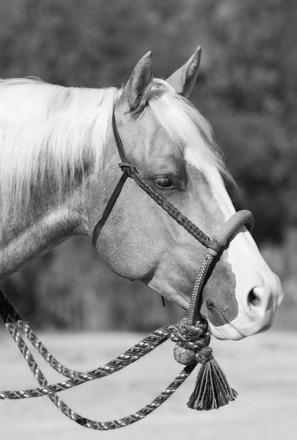
3.1 For purposes of eligibility, reined cow horse is synonymous with working cow horse or stock horse classes.
3.2 Lifetime earnings are considered as all monies won at NRCHA Approved Horse Shows, Limited Age Events, Category 1 Special Events, and Category 2 Special Events.
3.3 Any contest held along with a sale will not be considered a reined cow horse event if they do not follow NRCHA rein work, cow work, herd work and steer stopping patterns exactly. Horse eligibilities will not be affected by entering these events.
3.4 Open and Non Pro horse show classes are not to be run concurrently.
3.5 Bridle Classes - open to horses of any age, to be ridden in an approved bit. Reins with romal required. Only one hand may be used on the reins and hands must not be changed. When cross entering into AQHA classes at approved NRCHA events, NRCHA equipment rules will take precedence.
3.5.1 Open Bridle - Open to any rider who possesses a current NRCHA membership.
3.5.2 Intermediate Open Bridle- open to any rider who is not on the top thirty (30) Open rider listing; based on Open category 1 money won in the past three years at any NRCHA approved events. To be eligible to compete in this division, contestants must have a valid HS Intermediate Open designation on their membership.
3.5.2.1 Must enter the Open Bridle.
3.5.2.2 If a single entry fee option is utilized, eligible riders are automatically entered.
3.5.2.3 Must run concurrent with the Open Bridle draw. There will be no World Show eligibility, but these classes will be offered at the World Show for those that qualify in the Open Bridle.
3.5.3 Limited Open Bridle - open to any rider who is not on the top 120 Open rider listing; based on Open category 1 money won in the past three years at any NRCHA approved events, has not earned over $350,000 in Open and Non Pro category 1 and category 2 money at any NRCHA approved events. To be eligible to compete in this division, contestants must have a valid HS Limited Open designation on their membership.
3.5.3.1 Must enter the Open Bridle.
3.5.3.2 If a single entry fee option is utilized, eligible riders are automatically entered.
3.5.3.3 Must run concurrent with the Open Bridle draw. There will be no World Show eligibility, but these classes will be offered at the World Show for those that qualify in the Open Bridle.
3.5.4 Level 1 Open Bridle - open to any rider who has not earned $20,000 or more in Open and Non Pro category 1 and category 2 money at any NRCHA approved events. To be eligible to compete in this division, contestants must have a valid HS Level 1 Open designation on their membership.
3.5.4.1 Open Bridle entry is not required.
3.5.5 Non Pro Bridle - open to approved Non Pro riders.
3.5.6 Intermediate Non Pro Bridle - Open to any rider who possesses a current Non Pro card and is not in the top 25 Non Pro rider listing based on the previous three years of Open and Non Pro monies at NRCHA events. To be eligible to compete in this division, contestants must have a valid Horse Show Intermediate Non Pro designation on their membership card and a current application on file in the NRCHA Office. The Non Pro Bridle, Intermediate Non Pro Bridle and the Level 1 Non Pro Bridle may have a common draw at shows.
3.5.7 Level 1 Non Pro Bridle - Open to any rider who possesses a current Non Pro card and has not earned more than $15,000 in Open and Non Pro monies at NRCHA events. There is no fall back to the Level 1 Non Pro Bridle. To be eligible to compete in this division, contestants must have a valid Horse Show Level 1 Non Pro designation on their membership card and a current application on file in the NRCHA Office. The Non Pro Bridle,
Intermediate Non Pro Bridle and the Level 1 Non Pro Bridle may have a common draw at the shows.
3.6 Hackamore Classes - open to horses 5 years of age and under as of January 1st of current show year that have never been shown in a bridle (defined as any equipment using a shanked bit) or two rein down the fence at any judged classes or events with the exception of horse sales. Two hands must be used on the reined, except in the herd work.
3.6.1 Open Hackamore - Open to any rider who possesses a current NRCHA membership.
3.6.2 Intermediate Open Hackamore- open to any rider who is not on the top thirty (30) Open rider listing; based on Open category 1 money won in the past three years at any NRCHA approved events. To be eligible to compete in this division, contestants must have a valid HS Intermediate Open designation on their membership.
3.6.2.1 Must enter the Open Hackamore. There will be no World Show eligibility, but these classes will be offered at the World Show for those that qualify in the Open Hackamore.
3.6.2.2 If a single entry fee option is utilized, eligible riders are automatically entered.
3.6.2.3 Must run concurrent with the Open Hackamore draw.
3.6.3 Limited Open Hackamore - open to any rider who is not on the top 120 Open rider listing; based on Open category 1 money won in the past three years at any NRCHA approved events, has not earned over $350,000 in Open and Non Pro category 1 and category 2 money at any NRCHA approved events. To be eligible to compete in this division, contestants must have a valid HS Limited Open designation on their membership.
3.6.3.1 Must enter the Open Hackamore.
3.6.3.2 If a single entry fee option is utilized, eligible riders are automatically entered.
3.6.3.3 Must run concurrent with the Open Hackamore draw.
3.6.3.4 There will be no World Show eligibility, but these classes will be offered at the World Show for those that qualify in the Open Hackamore.
3.6.4 Level 1 Open Hackamore - open to any rider who has not earned $20,000 or more in Open and Non Pro category 1 and category 2 money at any NRCHA approved events. To be eligible to compete in this division, contestants must have a valid HS Level 1 Open designation on their membership.
3.6.4.1 Open Hackamore entry is not required.
3.6.5 Non Pro Hackamore - open to approved Non Pro riders only.
3.7 Two Rein Class - open to horses of any age that have not shown in the bridle down the fence or in boxing in any judged classes or events with the exception of horse sales, prior to November 16th of the current show year. These horses can be shown only one year in this class. A horse may be shown in the two rein equipment for one year only regardless of the class it is shown in. The rider must use an approved bit in accordance with Rule 5.2 with an approved bosal in accordance with Rule 5.4 and 5.5 underneath the bridle. When cross entering into AQHA classes at approved NRCHA events, NRCHA equipment rules will take precedence. Only one hand may be used on the reins and hands must not be changed. Any number of fingers between reins will be
permitted. Earnings in this class are counted as bridle earnings for purposes of Merit awards.
3.7.1 Open Two Rein - open to any rider who possesses a current NRCHA membership.
3.7.2 Intermediate Open Two Rein- open to any rider who is not on the top thirty (30) Open rider listing; based on Open category 1 money won in the past three years at any NRCHA approved events. To be eligible to compete in this division, contestants must have a valid HS Intermediate Open designation on their membership card.
3.7.2.1 Must enter the Open Two Rein.
3.7.2.2 If a single entry fee option is utilized, eligible riders are automatically entered.
3.7.2.3 Must run concurrent with the Open Two Rein draw. There will be no World Show eligibility, but these classes will be offered at the World Show for those that qualify in the Open Two Rein.
3.7.3 Non Pro Two Rein - This class is open to approved Non Pro riders.
3.8 Youth Cow Horse (fence class) - open to riders 18 years of age and under as of November 16th of the current show year. Horses 5 years of age and under as of January 1st of current show year may be shown in either a snaffle bit or hackamore. Horses of any age may be shown in the two rein equipment (in accordance with the two rein equipment rules defined in Rule 3.7) or bridle. Show management may bar youth from exhibiting a stallion in youth classes. Youth Cow Horse and Youth Boxing classes may not run concurrently with any other classes. If a youth attends a show and the horse shows only in the youth classes, stalls will be available at half price at the NRCHA Stallion Stakes, NRCHA Derby, NRCHA Hackamore Classic and NRCHA Snaffle Bit Futurity®.
3.8.1 Youth Cow Horse 13 & Under - open to riders 13 years of age and under as of November 16th of the current show year. This cannot be run as standalone class; riders must be entered in the Youth Cow Horse (down the fence). There will be no World Show eligibility, but these classes will be offered at the World Show for those that qualify.
3.9 Box Drive – To be eligible to compete in this division, contestants must be horse show Non Pro Boxing eligible. Work to consist of reining pattern and single cow work. Exhibitors are allotted one minute and forty five seconds to complete the cow work. Time shall begin when the gate closes behind the cow after being let into the arena. When there are 30 seconds left, the announcer will announce, 30 seconds remaining. At one minute and forty five seconds, the announcer will call for time. Exhibitors are not required to use all of the allotted time but must ride until the judge ends the run with a whistle or time expires, whichever occurs first. There are four parts to the work: boxing the cow; setting up the cow and driving / rating it down the fence to the opposite end of the arena; and boxing it at the opposite end of the arena, and then driving / rating the cow past the middle marker again. There is no expectation that the exhibitor will make a ‘fence turn,’ rather the drive down the fence demonstrates correct position and control around the corner. (New cow guidelines will follow rule 19.3.5.)
3.9.1 Open to approved Non Pro Boxing riders and who comply with all Non Pro eligibility rules. Non Pro riders in this class must meet the requirements of the ownership rule 2.4. (See Non Pro eligibility rules.) Earnings are calculated as lifetime boxing earnings. Riders cannot have earned more than $750 in fence work classes at any judged show or event with the exception of horse sales. A rider will be ineligible upon reaching the $750 threshold at the end of the current show year in any combination of officially published NRCHA earnings and/ or earnings from any other association. The responsibility for eligibility lies with the competitor. If an individual feels a competitor is not eligible for a class, the burden of proof lies with the person who protests.
3.9.2 Horses 5 years of age and under as of January 1st of current show year may be shown in either a snaffle bit or hackamore. Horses of any age may be shown in the two rein equipment (for one year only) or bridle.
3.9.3 Riders that have exercised their Non Pro Boxing fall back provision (see 3.10.1.1) may compete in the Box Drive class. Once a competitor reaches the age of 70, they will be eligible to show in the Box Drive class providing that they no longer show in fence classes at any judged show or event.
3.9.4 At the discretion of show management, the rein work for the Box Drive and Non Pro Boxing divisions, including Intermediate and Limited, may be run concurrently. When the rein work is conducted concurrently, the rein work score will be used for both the Box Drive and Non Pro Boxing divisions. The cow work for the Box Drive will be run and scored separately.
3.9.5 This class will count for regional standings, national standings and World Show qualification. Earnings will count towards horse and rider lifetime boxing earnings and eligibility.
3.10 Boxing Classes - work to consist of reining pattern and single cow work (boxing) on the end of the arena. Each contestant upon receiving a cow in the arena shall hold that cow on the prescribed end of the arena for 50 seconds, demonstrating the ability of the horse and rider to control the cow. Time shall begin when the gate closes behind the cow after being let into the arena. The announcer or judge will signal the completion of the 50 seconds with a whistle or horn. (New cow guidelines will follow rule 19.3.5.) Horses 5 years of age and under as of January 1st of current show year may be shown in either a snaffle bit or hackamore. Horses of any age may be shown in the two rein equipment (in accordance with the two rein equipment rules defined in Rule 3.7) or bridle. Riders cannot have earned more than $750 in fence work classes at any judged classes or events. A rider will be ineligible at the end of the current show year in any combination of officially published NRCHA earnings and/or earnings from any other association. The responsibility for eligibility lies with the competitor. If an individual feels a competitor is not eligible for a class, the burden of proof lies with the person who protests.
3.10.1 Non Pro Boxing - This class is open to approved Non Pro Boxing riders and who comply with all Non Pro eligibility rules. Non Pro riders in this class must meet the requirements of the section 2.4 ownership rules. (See Non Pro eligibility rules.) Earnings are calculated as lifetime earnings, excluding youth money. This class may run concurrently with the Intermediate Non Pro Boxing and/or the Limited Non Pro Boxing.
3.10.1.1 Non Pro competitors may fall back one time into the Non Pro Boxing division for any reason at any age, provided they submit notification to the NRCHA Non Pro committee. If a fall back is exercised, the competitor may not go down the fence again in any judged classes or events with the exception of horse sales and remain in the Non Pro Boxing Class. Competitors that have not won $750 in fence earnings may show in boxing and/ or fence classes. Once a competitor reaches the age of 70, they are eligible to fall back to the boxing even if they have exercised a fall back and then returned to competing down the fence.
3.10.2 Intermediate Non Pro Boxing - open to approved Non Pro riders who are not in the top 50 Non Pro Boxing rider listing based on lifetime money won in the past three years at any NRCHA approved events excluding youth money and who comply with all Non Pro eligibility rules. For purposes of determining eligibility for this class, all Non Pro Boxing earnings shall be computed at zero as of January 1, 2002. This class may run concurrent with Non Pro Boxing. There is no fall back Provision in this class. The responsibility for eligibility lies with the competitor. If an individual feels a competitor is not eligible for a class, the burden of proof lies with the person who protests.
3.10.3 Limited Non Pro Boxing - open to approved Non Pro riders who are not in the top 175 Non Pro Boxing rider listing based on lifetime money won in the past three years at any NRCHA approved events excluding youth money and who have not earned more than $5,000 in lifetime earnings, excluding youth money and who comply with all Non Pro eligibility rules, with the exception of the section 2.4 ownership rules. (See Non Pro eligibility rules.) This class may run concurrent with Non Pro Boxing or the Intermediate Non Pro Boxing. There is no fall back Provision in this class. The responsibility for eligibility lies with the competitor. If an individual feels a competitor is not eligible for a class, the burden of proof lies with the person who protests.
3.10.4
Youth Boxing - open to riders 18 years of age and under as of November 16th of the current show year. Riders cannot have earned more than $750 in fence work classes at any judged classes or events with the exception of horse sales. A rider will be ineligible upon reaching the earnings threshold at the end of the current show year in any combination of officially published NRCHA earnings and/or earnings from any other association. Show management may bar youth from exhibiting a stallion in youth classes. Youth Boxing classes may not run concurrently with any other classes. If a youth attends a show and the horse shows only in the youth classes, stalls will be available at half price at the NRCHA Stallion Stakes, NRCHA Derby, NRCHA Hackamore Classic and NRCHA Snaffle Bit Futurity®.
3.10.4.1 Youth Boxing 13 & Under - open to riders 13 years of age and under as of November 16th of the current show year. This cannot be run as a standalone class; riders must be entered in the Youth Boxing. There will be no World Show eligibility, but these classes will be offered at the World Show for those that qualify.
3.11
3.11.1 Select Classes – open to riders 60 years of age and over as of November 16th of the current show year. One select class will be run concurrent with the Non Pro Bridle, Intermediate Non Pro Bridle, or Level 1 Non Pro Bridle. A second select class will be run concurrent with the Non Pro Boxing, Intermediate Non
Pro Boxing, or Limited Non Pro Boxing. Select classes cannot be run as standalone classes; riders must enter at least one concurrent Non Pro Division. Select classes will be offered at the World Show for those that qualify in the above stated divisions. 3.12 Spectaculars – See Section 11.1.2
4.1 As of January 1, 2003, all NRCHA approved shows will be called NRCHA Shows.
4.2 Regions will be:
Southwest: Arizona, California, Hawaii, Nevada, and New Mexico
Northwest: Idaho, Montana, Oregon, Utah, Washington, Alaska
South Central: Arkansas, Missouri, Oklahoma, Texas
North Central: Colorado, Kansas, Nebraska, South Dakota, Wyoming, Iowa, Minnesota, North Dakota
Northeastern: Connecticut, Delaware, Illinois, Indiana, Kentucky, Maine, Maryland, Massachusetts, Michigan, New Hampshire, New Jersey, New York, Ohio, Pennsylvania, Rhode Island, Vermont, Virginia, West Virginia, Wisconsin, Canadian Provinces of Ontario and Quebec, Nova Scotia, New Brunswick, Prince Edward Island, Newfoundland and Labrador
Southeastern: Alabama, Florida, Georgia, Louisiana, Mississippi, North Carolina, South Carolina, and Tennessee
International: Foreign countries other than Canada
Canadian: Canadian Provinces of Manitoba, Saskatchewan, Alberta, and British Columbia
4.3 All eligible horses in each of the thirteen approved non Youth NRCHA classes from each region AND all eligible youth riders will qualify for the NRCHA World Championship Show. The show year begins on November 16 and ends on the following November 15.
4.4 A rider may qualify any number of horses for the NRCHA World Championship Show.
4.5 Horses in open classes may be shown by more than one rider or the rider may be changed, as long as all riders fit the earnings criteria for the class. In the case of a rider substitution at a show, the first rider showing will be credited with the earnings. Once a rider is changed, no additional changes will be permitted.
4.6 In Non Pro and Youth classes, horse and rider qualify together. If a Non Pro horse is sold the original horse and rider team is no longer eligible to compete.
4.7 Horses or riders may appear in the standings of more than one region.
4.8.1 Classes Except Youth: To be eligible for the NRCHA World Championship Show a horse or horse and rider combination must have competed at least three times in a given class in at least three NRCHA approved shows in the same region, and must have an accumulated point value of at least ½ point. The top 30 horses fulfilling these requirements, including ties, shall be invited to compete.
4.8.2 Youth Classes: Any Youth that has shown at least three times in their respective Youth class (or Boxing) shall be invited to compete in that Youth class.
4.8.2.1 In Youth classes, if a horse that qualified has died, the youth rider may substitute another horse after providing a vet certificate along with proof that the death was reported to the breed registry.
4.9.1 All AQHA World Show Champions from the AQHA Youth World, Select World and AQHA World Championship Show in the Working Cow Horse Classes will be invited to compete at the NRCHA World Show in the corresponding NRCHA classes for which they qualified. NRCHA equipment rules will be in effect. Junior / Amateur qualified horses may be shown in a bridle, two rein or hackamore class.
4.9.2 All APHA World Show Champions from the APHA Youth World and APHA World Show in Working Cow Horse Classes will be invited to compete at the NRCHA World Show in the corresponding NRCHA classes for which they qualified. NRCHA Equipment rules will be in effect. Junior / Amateur qualified horses may be shown in a bridle, two rein or hackamore class.
4.9.3 The SHTX world show Champions in Youth, Limited, Non Pro, Non Pro Boxing and Open SHTX divisions will be invited to compete at the NRCHA World Show in the corresponding NRCHA classes for which they qualified.
4.9.4 Each champion invitation will be allowed one (1) entry into the World Show. Invitations may not be used to enter multiple classes.
4.10 In order for an NRCHA approved show to count as one of the three times in a given class a horse and rider must show and receive a score of at least -0- in both parts of the event (rein work and cow work). A horse and rider who fail to attempt to complete either the rein work or the cow work pattern will not be recognized as being an entry in the class and therefore it will not count toward one of the three qualifying events. This will be considered a Non-Entry and will be designated by the judge as N-E in the score box of the judges’ cards.
4.11 Regional and national standings and winners will be named at the end of the regular season, before the NRCHA World Championship Show.
4.11.1 To be eligible for an NRCHA Regional Championship, a horse or horse and rider combination must have competed at least three times in a given class in at least four NRCHA approved shows in a specific region.
4.12 NRCHA World Championship Show Finals will result in World Champions being named, but will not earn points and will not count toward National (year-end) Championship points.
4.13 A horse does not have to compete at the World Show to qualify for Regional or National (year-end) awards.
4.14 Hackamore horses may show at the World Show as 6-year-olds as they qualified during their 5-year-old year. A hackamore horse may have been shown in the bridle or two rein after November 15 for this show only.
4.15 Two Rein horses may show at the World Show after their year of Two Rein eligibility as they qualified during their eligible year.
4.16 Non Pro Boxing, Youth Boxing, and Youth Cow Horse riders may show a 6 year old in a snaffle or hackamore as they qualified during their 5-year old year.
4.17 Eligibility of horse and/or rider to show in classes they have qualified for at the World Championship Show will not be
affected by classes they show in between the end of the qualifying year and the completion of the World Show. (Example: If the rider was still eligible for Boxing classes at the end of the show year, they can cross the $750 threshold after November 15 and still compete at the World Show). Money won at the NRCHA World Show will count toward horse and rider eligibilities for/in the year that the show took place. (Example: Money won at the World Show held in Jan-Feb 2010 counts as money earned in 2010 when calculating 2011 eligibility).
4.18 Champions of each region will be Regional Champions. (Example: 2009 NRCHA Northeast Region Open Bridle Champion) Champions of the NRCHA World Championship Show will be World Champions. (Example: 2009 NRCHA Open Bridle World Champion)
Year-end Champions will be National Champions. (Example: 2009 NRCHA Open Bridle National Champion)
5.1
5.1.1 Horses shall be shown astride with a western saddle.
5.1.2 Riders must wear a western hat or helmet approved for riding by an equine organization.
5.1.3 Appropriate western attire must be worn while showing. Western hat or approved safety helmet, long sleeved western shirt with collar (standup, button down, tuxedo etc.) and cuff. Vests, jackets and sweaters may be worn over proper attire.
5.1.4 Chaps or chinks must be worn except for Steer Stopping. Failure to wear appropriate attire will result in a score of zero.
5.1.5 Size and design of horse’s shoes will be at the exhibitor’s discretion.
5.1.6 Communication devices are prohibited. For hearing impaired persons communication devices may be allowed provided a letter requesting waiver of this rule is submitted annually to NRCHA.
5.2 Equipment – Bridle Classes (Bit): A spade bit or a bit having the following characteristics must be used in any of the bridle classes. Said characteristics shall be:
5.2.1 Unbroken bar mouthpiece
5.2.2 One inch or higher port measured from the bottom of the bar to the top of the port.
5.2.3 There must be an operable cricket or roller (with single or multiple rings) incorporated within the mouthpiece of the bit.
5.2.4 It is legal to have a barrel made of copper or metal, wrapped around the bar space of the bit and is to be considered a part of the mouthpiece.
5.2.5 The barrel must be round, smooth, and made up of one continuous, unbroken piece.
5.2.6 The minimum diameter, on any part of the bar of the mouthpiece, is 5/16 inch.
5.2.7 Bars must be round, oval or egg shaped smooth and unwrapped metal. Latex wrap or any foreign material is not acceptable.
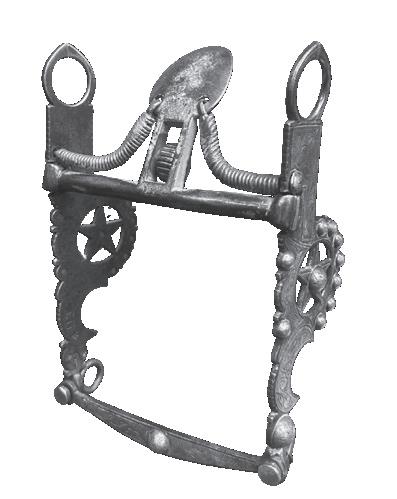
5.2.8 Nothing abnormal may protrude from either the bars or the port, such as extensions or prongs.
5.2.9 The cheeks must be connected at the bottom. It is acceptable to use metal, chain, wire, leather or braided rawhide. It is not acceptable to use duct tape, braided tail hair or bailing twine.
5.2.10 The overall length of the bit shall not be longer than 8½ inches measured from the inside bottom of the top of headstall
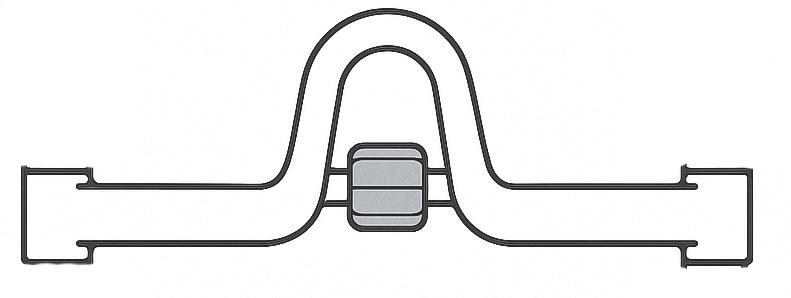
Maximum of 3 inches
Measurement starts when the bit begins to turn up from level. There is a maximum of 3 inches allowed.
Unacceptable based on 5.2.11
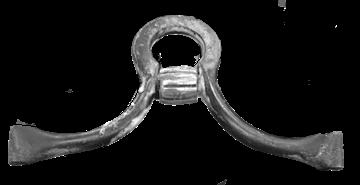
Exceeds 3 Inches
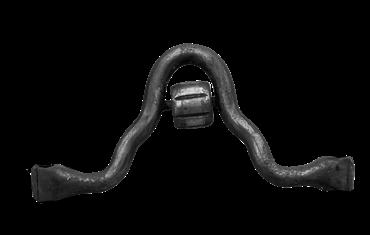
Exceeds 3 Inches
ring to point of pull in the bottom ring.
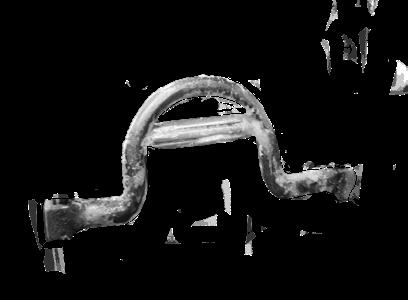
Exceeds 3 Inches
5.2.11 Optional tongue release shall not exceed 3 inches in width.
5.2.12 Braces, copper port cover and/or having copper smoothly inlaid in the mouthpiece are optional.
Acceptable Mouth Pieces
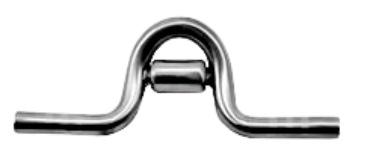
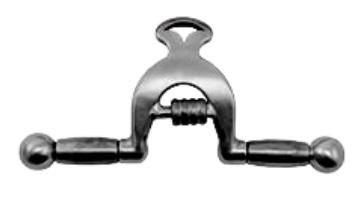
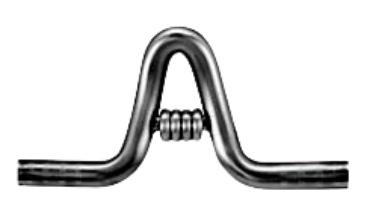
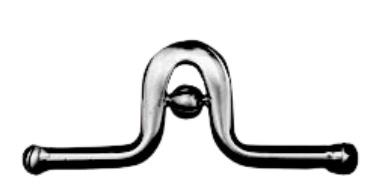
Acceptable Half Breed w/ Braces “Barqueno”
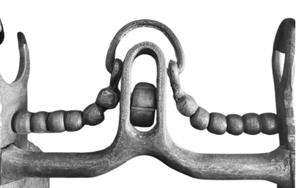
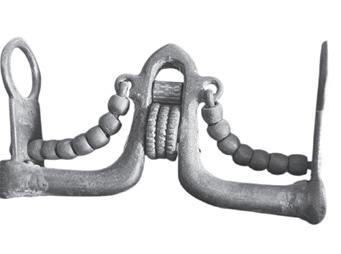
Acceptable Spade Bits
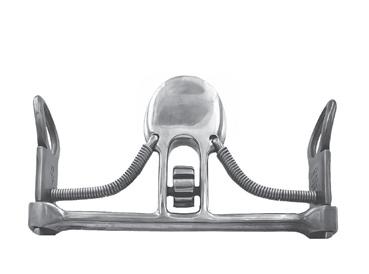
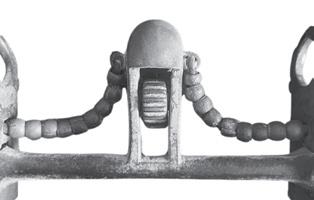
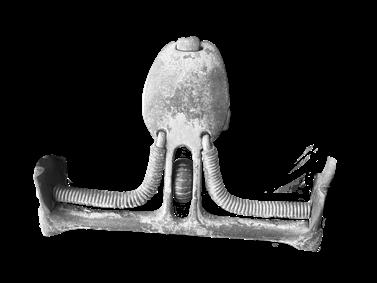
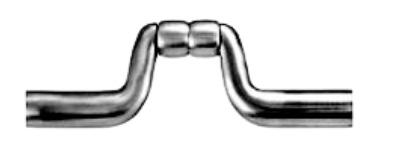
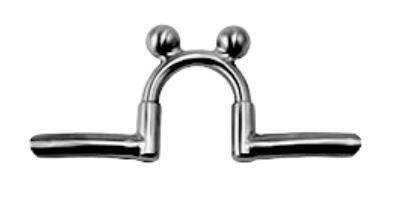
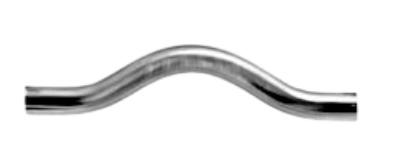
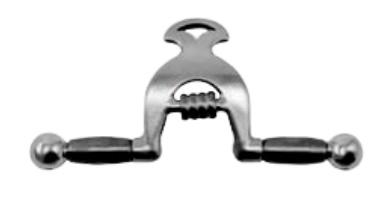
Violates 5.2.1. and 5.2.3 – Mouthpiece must be unbroken and cricket or roller must be within the mouthpiece, not on port.
Violates 5.2.1. and 5.2.8 – Mouthpiece must be unbroken and nothing abnormal may protrude from port and lacks an operable cricket or roller.
Violates 5.2.2 and 5.2.3 – port doesn’t meet 1 inch requirement and lacks an operable cricket or roller.
Violates 5.2.8 – the sharp edges are considered abnormal and protrude from port.
5.2.13 No wire, chain or other metal or rawhide device may be used in conjunction with the bit or part of leather chin strap.
5.3 Equipment – Bridle Classes (Additional Items)
5.3.1 Chin strap must be smooth leather. No wire, chain or other metal or rawhide device may be used in conjunction with a part of the leather chin strap. Leather chin strap must be flat, flexible and at least ½ inch wide. No metal rivets are is allowed on the inside of the chin strap and the rivets may not, at any time, come in contact with the chin, or chin groove of the horse. Metal keepers are not acceptable on the chin strap.
5.3.2 Reins with romal required. The reins can be held in either hand, with hand around reins in a fist position with thumbs up. The non-rein hand must be on the romal. (The keeper, or hobble, that attaches the romal to the reins is considered to be a part of the romal.) The non-rein hand is not allowed, at any time, to touch the reins or a score of -0- will be applied. The rider is allowed to shorten the reins while the horse is in motion as long as their hands are held in a legal manner. No fingers are permitted between the reins in Bridle classes, except in the Two Rein class. Reins may not be
Acceptable: Unacceptable:
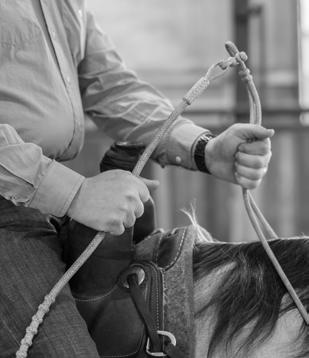
crossed under the horse’s neck. Crossed reins will result in a zero score. In the herd work and boxing classes only, romal reins can be held in one hand. Roping reins are optional in the Steer Stopping.
5.3.3 The use of bosal, martingale or tie-down is prohibited (bosal permitted in Two Rein class only).
5.4 Equipment – Two Rein Classes
5.4.1 In the Two Rein class bosals may be of any size, constructed of braided rawhide or leather and have a non-metal flexible core. No iron or foreign substance may be used.
5.4.2 The rider must use one hand on the reins. Fingers between the reins will be permitted.
5.4.3 Both mecate and bridle reins are to be held in the rein hand.
5.5.1 Hackamores shall be round in shape and constructed of uniform braided rawhide or leather and have a non-metal flexible core.
5.5.2 The noseband of the hackamore must measure at least 5½ inches of smooth rawhide or leather before any braided buttons.
5.5.3 No gimmick of any kind may be used in conjunction with the bosal.
5.5.4 No rigid material of any kind may be used, regardless of how padded or covered, in conjunction with the bosal.
5.5.5 Horse hair bosals are prohibited.
5.5.6 Tape is not allowed on the noseband of the hackamore.
5.5.7 Smooth, flat, wrapped tape is allowed on the hackamore between the headstall and the mecate reins. Maximum amount of tape allowed is 2 inches on each side of the hackamore.
5.6.1 Snaffle Bit shall be either “D” or “O” Ring type
5.6.2 Snaffle Bit should be no larger than 4 inches in diameter on the inside of the cheek piece ring.
5.6.3 It must have a broken, 2 piece, mouth piece, being a minimum of 5/16 inch in diameter, measured 1 inch in from the inside of the ring on the snaffle bit, with a gradual decrease to center of the snaffle.
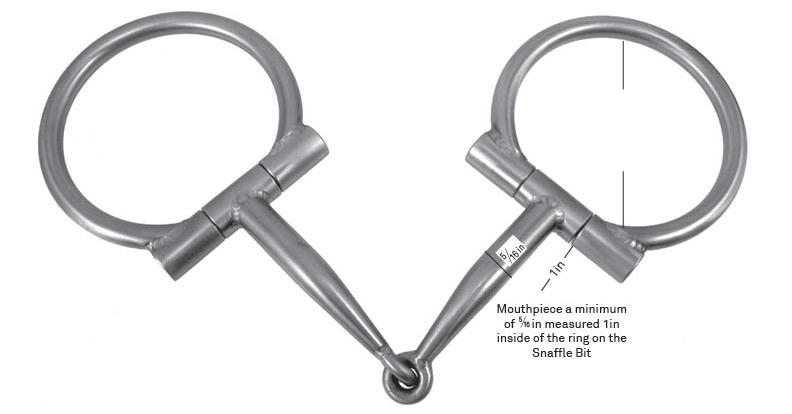
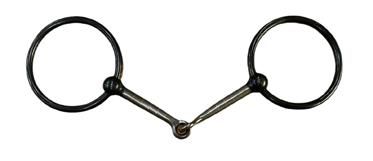
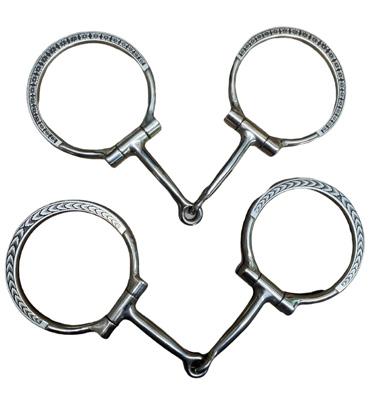
Ring can be no larger than 4 inches in diameter on the inside of the ring
Mouthpiece a minimum of 5/16 inch measured 1 inch inside of the ring on the Snaffle Bit
Cheek piece may not protrude past dimensions of the ring.
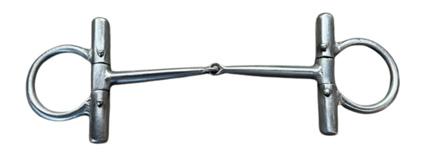
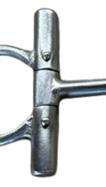
May not have bumps against horse and may not protrude past dimensions of the ring
5.6.4 The mouthpiece should be round, oval or egg-shaped, smooth and unwrapped metal.
5.6.5 It may be inlaid but must be smooth.
5.6.6 Latex wrap is not acceptable.
5.6.7 These bits must be such that when the reins are pulled no undue leverage is applied, i.e. the inside of the circumference of the ring must be free of rein, curb, or head stall attachments.
5.6.8 A leather or other woven material chin strap of any width is to be used. No iron, chain or other material may be used. Chin Strap is allowed to include metal buckles and/or keepers on snaffle bits only.
5.6.9 Reins are to be attached above the chin strap.
5.6.10 Split reins must be used; no closed reins.
5.6.11 Two hands must be used on the reins, except in the herd work or to provide safety to rider or adjust equipment.
5.7 Rider or representative will drop the bridle to the designated bridle checker. The bridle checker must have a magnet available to check the hackamores and chin straps for metal objects (inside) or cores. Designated bridle checker will not touch horse’s mouth. Failure to drop bit for bit checker will result in a score of zero.
5.8 Illegal Equipment – the following equipment is considered illegal and should not be used at any time, in any location, at an approved NRCHA show including, but not limited to, barns, stalls, practice area and show arena:
5.8.1 Tie-downs (bosal permitted in Two Rein Class Only)
5.8.2 Saw tooth bits, hock hobbles, tack collars or tack hackamores.
5.8.3 Any item or appliance that restricts movement or circulation of the tail.
6.1 If at any time during a performance a piece of equipment breaks, the rider may continue provided the broken equipment does not pose a hazard to the rider and/or is not cruel to the horse.
6.2 When the cow work immediately follows the rein work, broken equipment may be repaired between the two phases, within a 1-minute time period. If a new cow is awarded, the rider may repair equipment between cows as well.
6.3 Rider may dismount, if necessary, to make the repair or pick up lost equipment or attire. Horse and rider may not leave the arena and may not receive physical assistance or equipment from outside the arena. If the rider is unable to continue because of the broken equipment, the rider will be excused with a score of zero.
7.1 Payout – Based on the number of horses shown: This payout is for approved NRCHA shows. The following payout schedule applies to all NRCHA Category 1 approved horse show classes whose earnings count towards year-end NRCHA standings and NRCHA Category 1 approved LAE without finals. It does not apply to NRCHA Category 1 approved LAE with finals,
however all finalists must receive a payout. Entry fees for horses that are scratched after the draw will remain in the purse.
7.2 Payout Chart (on the facing page)
7.3 Ties
7.3.1 In NRCHA Managed LAE with or without finals, in the case of a tie for first place, the following process shall be used to determine the winner:
7.3.1.1 1st: First place shall be determined by the highest cow work score in finals or cow work go-round score in LAE without finals. If a tie remains then;
7.3.1.2 2nd: Work off between tied competitors, cow work only. If a tie remains then;
7.3.1.3 3rd: The high preliminary total score will determine the winner. If a tie still exists then;
7.3.1.4 4th: The contestants will be declared co-champions and a coin will be flipped for prizes.
7.3.2 In other NRCHA Approved LAE with or without finals, in the case of a tie for first place, the following process will be used;
7.3.2.1 First place shall be determined by the highest cow work score in finals or cow work go-round score in LAE without finals. If a tie remains then;
7.3.2.2 For events with preliminaries – the high preliminary total score will be used. If a tie still exists or if there were not preliminaries then;
7.3.2.3 Work off between tied competitors, cow work only, or if mutually agreed upon the contestants will be declared Co-Champions and a coin will be flipped for the prizes. (If they do not agree, the exhibitor who does not want to runoff will forfeit first place to the other.)
7.3.3 In NRCHA Approved horse shows, in the case of a tie for first place the following process will be used;
7.3.3.1 First place shall be determined by the highest cow work score. If a tie still exists then;
7.3.3.2 For events with preliminaries – the high preliminary total score will be used. If a tie still exists or if there were not preliminaries then;
7.3.3.3 A work off between tied competitors, cow work only, or if mutually agreed upon the contestants will be declared Co-Champions and a coin will be flipped for the prizes. If they do not agree the exhibitor who does not want to runoff will forfeit first place to the other.
7.3.3.4 If a tie is not discovered on the day it happens the contestants will be declared Co-Champions and a coin will be flipped for the prizes.
7.3.3.5 Ties below first place will split earnings and points, if applicable. Rounding of points may occur up or down to the nearest half point. If the class would pay 6 places, and there is a three way tie for 6th place, all three riders would split the points for 6th place and related earnings.
7.3.4 When there are finals in Horse Show classes, the number of horses taken to the finals is determined by the number of places that will be paid according to the payout schedule in section 7.2 and based on the number of horses shown in the preliminaries. ALL TIES FOR THE LAST POSITION WILL GO TO THE FINALS. HOWEVER, MONEY WILL BE PAID ONLY TO PLACES IN THE PRINTED PAYOUT. In the NRCHA World Championship Show
the number of horses taken to the finals will be determined by the schedule in section 7.2 and based on the number of horses shown in the preliminaries, with a minimum of 10 advancing to the finals. Money will be paid to a minimum to the number of places paid in the printed payout in 7.2. ALL TIES FOR THE LAST POSITION WILL GO TO THE FINALS. HOWEVER, MONEY WILL BE PAID TO A MINIMUM OF PLACES IN THE PRINTED PAYOUT 7.2 AND AWARDS WILL BE GIVEN TO THE TOP 10 ONLY. The finals will be clean slate; therefore the world championship and placings will be determined by the score in the finals.
7.3.5 When a horse that has qualified for the finals is unable to show in the finals, that horse will receive the placing and earnings for the lowest place to be paid in the finals, provided the finals fee has been paid, if applicable. No horse that initially did not make the finals will be allowed to move up into the finals. If there are 10 entries or less in the first go-round there will be a finals only.
7.3.6 All earnings and points are computed as of November 15th of the previous year to determine eligibility for year-end awards and for eligibility to show in classes where there are earnings limits
7.4 Point System — during the show season, points will be awarded to the horse for its placing in approved NRCHA classes as specified in Section 3. Points will be awarded to the same number of places as the payout schedule shown in Section 7.2, with the first place horse receiving the highest number based on the number of horses actually shown (ex: if payout is awarded to 5th place, points are awarded to 5th place). In a class with 5 or more shown the first place horse will receive 5 points for the win plus one point for every horse defeated. Each succeeding place will receive 2 points less than the place before it, i.e. 10 horses in class, 1st is 14 points, 2nd is 12 points, 3rd is 10 points, 4th is 8 points, 5th is 6 points. In classes having less than 5 entries, the first place horse will receive points equal to the number of horses shown in the class plus one point for every horse defeated (i.e.- four horses shown, 1st place receives 4 points plus 3 points for the three horses defeated, for a total of 7. Three horses shown in a class, 1st place receives five points, 2nd place receive 3 points.) Owners and riders must be members in good standing of the NRCHA. Any errors found in show results or standings will be corrected immediately on the NRCHA website. Members or show management must contact the NRCHA office within 30 days of the posting of these results for corrections to be made.
7.4.1 For approved events where Spectacular classes are offered but the regular horse show classes are not offered, points as defined above will be awarded for the Spectacular classes. If both regular horse show and spectacular classes are offered in the same show they may be run concurrently but only the regular horse show classes will be awarded points.
7.4.1.2 In addition, for every $100 won by the horse during the current contest year, the horse will receive an additional point, up to 75 additional points ($7,500).
7.5 Year-End Awards - Everyone that competes in an NRCHA approved horse show class as defined above will automatically be in the running for the year-end awards. There will be no sign-ups required to be in the standings. The awards will continue to be based on points earned, rather than cash won. A cumulative tabulation of points earned by all horses during the show season shall be kept by the office. Said tabulation of earned points shall be available on the NRCHA website. Points awarded are for
horse and rider combinations in all Non Pro and Youth divisions, and the horse only in Open divisions. In the event of ties in points, the total earnings will determine the standings.
8.1 Application forms for Merit Awards are available from the NRCHA office. Applications must be submitted by the current owner or rider of the horse being submitted for one of the merit awards. As of January 1, 2002, earnings which will count towards the Merit Award Program are all NRCHA Approved Category 1 horse shows, LAE Category 1 and Category 1 Special Events. To become an NRCHA approved show a request for show approval must be submitted in accordance with rule 12.1.
8.1.1 Certificate of Ability - a horse will be certified after winning a total of $1,000 in any NRCHA class or combination of classes. It is the intention of the NRCHA that the Certificate of Ability will be available to a great number of horses that do in fact show ability.
8.1.1.1 Foals of 2022 and prior will be grandfathered into this program with a minimum of $500 in total earnings.
8.1.2 Achievement Awards - the NRCHA wishes to recognize those horses that reach meaningful achievements in their career as they advance through the stages of the reined cow and vaquero bridle horse traditions of the snaffle, hackamore, two-rein and bridle.
8.1.2.1 LAE Achievement - Horse has earned a total of $5,000 in Category 1 Limited Age Event fence classes. Hackamore Classic earnings can count toward LAE Achievement Awards, so long as they are not double counted toward the Hackamore Achievement Award.
8.1.2.2 LAE Boxing Achievement - Horse has earned a total of $5,000 in Category 1 Limited Age Event boxing classes.
8.1.2.3 Hackamore Achievement - Horse has earned a total of $5,000 in Category 1 Hackamore fence classes. Hackamore Classic earnings can count toward this Achievement Award so long as the money has not been counted toward the LAE Achievement Award.
8.1.2.4 Two-Rein Achievement - Horse has earned a total of $1,000 in Category 1 Two-Rein fence classes.
8.1.2.5 Bridle Achievement - Horse has earned a total of $10,000 in Category 1 Bridle fence classes.
8.1.2.6 Non Pro Boxing Achievement - the NRCHA wishes to recognize those horses that excel in the Boxing classes. The horse must have earned a total of $7,500 in Horse Show Category 1 Non Pro Boxing classes including Select.
8.1.2.7 Non Pro Box Drive Achievement - Horse must have earned a total of $7,500 in Horse Show Category 1 Non Pro Box Drive classes including Select.
8.1.2.8 Youth Achievement - Horse must have earned a total of $1,000 in Horse Show Category 1 Youth Classes including Youth Cow Horse, Youth Boxing, and 13 and Under Classes
8.1.3 Superior Reined Cow Horse Award - this award will be given when a horse has earned $20,000 in any NRCHA fence class or combination of fence classes or events and has earned any combination of fence category Achievement Awards. The NRCHA believes that any horse that wins $20,000 in a single fence class or combination of fence classes and events is certainly considered a Superior Reined Cow Horse and should be recognized.
8.1.3.1 Foals of 2022 and prior will be grandfathered into this program with a minimum of $10,000 in earnings.
8.1.4 Superior Bridle Horse Award - this award will be given when a horse has earned $30,000 in any NRCHA Bridle class or combination of Bridle classes or events and has earned the Bridle Achievement. Two Rein earnings can also count toward the total.
8.1.5 Supreme Reined Cow Horse Award- the NRCHA has reserved the Supreme Reined Cow Horse Award for the unique individual that has shown and won in all divisions and the horse has substantial won a total of $50,000 in earnings.
8.1.5.1 The horse must have earned the LAE Achievement, Hackamore Achievement and Bridle Achievement. Two Rein earnings can also be applied to the total earnings required.
8.1.5.2 Foals of 2000 and prior will be grandfathered into this program and are not required to have won the $1,000 in Limited Age Events and hackamore, but still must win a total of $25,000. These horses must still have Limited Age Event and hackamore earnings.
8.1.5.3 Foals of 2022 and prior will be grandfathered into this program with a minimum requirement of $25,000 in total earnings, of which $1,000 must be earned in Limited Age Events and $1,000 in the Hackamore. Up to $20,000 of Limited Age Event and Hackamore monies can be applied to the $25,000 minimum, so long as no money is counted twice across the categories.
8.1.6 Superior Non Pro Boxing Award - the NRCHA wishes to recognize those horses that excel in the Boxing classes.
8.1.6.1 The horse must have earned a total of $25,000
8.1.6.2 The horse must have earned the LAE Achievement or LAE Boxing Achievement, and have earned the Boxing Achievement.
8.1.6.3 The horse must win a total of $15,000 in Horse Show Category 1 Boxing classes including Select, Youth Boxing and Youth Boxing 13 and Under.
8.1.6.4 Foals of 2022 and prior will be grandfathered into this program, but still must achieve $15,000 in earnings, with a minimum of $1,000 earned in Limited Age Events in either a Category 1 fence class or boxing class, given the aforementioned criteria of the 8.1.6 sections.
9.1 An owner may enter more than one horse and/or rider may ride more than one horse. A horse may be entered only once per division.
9.2 All payments for entry and other fees will be made payable to the Show Committee and must be good funds in order to be valid.
9.3 Payments must be postmarked by midnight of the due date or a late penalty will be assessed.
9.4 Late entries will be accepted. The late entry penalty plus the regular entry fees will be assessed.
9.4.1 For all NRCHA Premier Events produced by the NRCHA, late entries received after the draw will compete in the following order. For other approved events run by affiliates or other show managers, these rules serve as a guideline only.
9.4.1.1 First in the rein and cow work. The last late entry received will go first, the second to last late entry received will go second and so on until all late entries have gone before the first horse in the draw.
9.4.1.2 Herd work. The last late entry will draw last in the first set of cattle; the second to last late entry will go last in the second set etc. Cattle will be added for the late entry only if available and at the discretion of show management.
9.4.1.3 Draw numbers for late entries will reflect this order. Example: First late entry in the rein work will be #1, making the previous #1 in the draw #1.1. Draw sheets will be amended to reflect this change in order. For herd work, if 10 in a set, the first late entry will be 10.1.
9.5 In the event that a horse entered properly is left out of the draw, a re-draw will not be held. In order to establish a working order for this entry, show management will draw a numbered token based upon the number of entries in the class for the late entry. The token drawn shall designate the entry left out of the draw and shall work behind the token drawn. e.g. if 10 horses in the class, and token drawn is number 9, then entry shall work between draw 9 and 10. When this occurs in herd work, the appropriate number of cattle will be added to the set affected.
9.6 Once the draw has been finalized, the drawn position is the only position each entry may work in. Any horse that is scratched or otherwise removed from the draw may only be re-entered into the competition as a late entry. (See Rule 9.4.1)
9.6.1 If an entry enters the arena or working area out of order, but does not cross the time line, start the pattern (ie… lope depart, trot or run in), step into the roping box, or call for their cow, the entry may exit the working area with no penalty assessed. The correct entry may then enter the arena within a reasonable amount of time (normal gate-call) and compete as normal. If the correct entry is not present at the gate, the score for that entry will be zero.
9.7 If any entry changes ownership, the entry will retain eligibility by complying with the following: 1) notifying the Association of the change of ownership and the intention of the new owner to continue the entry, 2) payment of the remaining fees when due and 3) membership of the new owner in the NRCHA. The Show Committee reserves the right to approve all transfers.
9.8
9.8.1 In approved Horse show classes managed by the NRCHA, exhibitors that scratch after the entry deadline but prior to the draw will be refunded all entry fees with the exception of the office fee.
9.8.2 Entries that scratch after the draw will be refunded the video fees and NRCHA fees only.
9.8.3 After the draw, substitution of a horse only by the same owner and rider in the same class will be allowed upon presentation of a veterinary certificate stating that the horse entered will be unable to work. In the case of a Non Pro rider, they may substitute another horse that meets the Non Pro ownership requirements. A substitution fee equal to 10% of the total entry fee will be charged. Substitutions must be accompanied by a new entry form. Any substitution without a veterinary certificate will be considered a late entry, assessed the late entry penalty fees and entered into the competition as a late entry. (See Rule 9.4.1). All other NRCHA
approved shows shall abide by the affiliate’s or show management’s policies for substitutions, scratches, refunds and late fees.
9.8.4 In approved Horse show classes or LAEs managed by the NRCHA, if an entered horse is deceased, the entire amount will be refunded.
9.8.5 All other NRCHA approved shows shall abide by the affiliate’s or show management’s policies for substitutions, scratches, refunds, and late fees.
9.9 After each work, each bit and horse’s mouth will be viewed by the appointed representative to determine if the bit or hackamore is legal, and to check for blood inside the mouth. The judge(s) has the sole authority to disqualify the contestant.
9.10 Unofficial scores may be announced and/or exhibited on the scoreboard after each entry’s work. Scores will then be verified from the judge’s score sheets and any corrections will be made. Scores will not be official until all score sheets have been verified.
9.11 In the event of a post-event disqualification, the payoff will remain the same as far as number of places paid, as before the disqualification.
9.12 The Show Committee will select the patterns to be used in the reined work. Any pattern change must be posted at least 1 hour before the go round to which it applies.
9.13 For NRCHA Approved Events, herd settler must be entered in the event at which he/she is settling. (For example, to settle a herd in any division in a derby, the herd settler must be entered in that show in any division). No horse may be used as a herd settler or help horse for a class in which that horse is competing. Violation of this rule may result in a fine, suspension, and/ or probation as determined by the NRCHA Ethics Committee.
9.13.1 For NRCHA Premier Events, no rider can settle a set in which they are competing.
9.14 Rules printed herein are subject to amendments and annual updates.
For all intents and purposes in this rulebook, Limited Age Events (LAE) shall include events for which only horses of a specified age are eligible. Futurities are for 3-year-olds only, derbies are restricted to 4- and 5-year-olds, but may be held for 4-year-olds only. 6-year old horses may be shown in a snaffle only in a Non Pro Boxing derby.
10.1
These general rules shall apply to all approved and produced NRCHA LAE, unless specified otherwise.
10.1.1 For all the NRCHA Premier Events produced by the NRCHA, all fees and purses for LAEs are subject to annual review and update and are subject to change. They may be either published in the Reined Cow Horse News, mailed directly to the membership or posted on the NRCHA website. General rules for scoring and judging reined cow horse events as presented in this rulebook will apply to the NRCHA Snaffle Bit Futurity® and all NRCHA LAE where specific rules have not been implemented. Refer to the rules governing the individual Limited Age Events. In all Limited Age Events the same type of headgear (hackamore or snaffle) must be used throughout the event (herd, rein and cow
work) on a horse once the competition has started. This is also to include the finals portion of the event.
10.1.1.2 Limited Age Events with 50 entries or more must have a separate draw for the Open and the Non Pro.
10.1.1.3 Entry into the Open division is mandatory for entry into the Intermediate and Limited Open divisions. This applies to all NRCHA Approved LAE.
10.1.1.4 Entry into the Non Pro division is mandatory for entry into the Intermediate and Limited Non Pro divisions. This applies to all NRCHA Approved LAE.
10.1.2 The following should be used as a guideline for holding Approved Limited Aged Events, however affiliates or show management may change the guidelines in section 10.1.2 if it is in the best interest of their event.
10.1.2.1 The number of horses taken to the finals is determined by the table in Section 10.5. If an entry scratches after the draw, the entry fee will be left in the purse for that entry. Payouts and calculations for the number of horses taken to the finals will be based upon total paid entries in a class regardless of whether they show.
10.1.2.2 When the number of horses taken to the finals is determined by a percentage, rounding up may occur when the percentage is .5 or above. Example: If 30% of the total entries equals 25.5, then 26 horses shall go to the finals. If 30% of the total entries equals 25.4, then 25 horses shall go to the finals. If there is a tie for the last qualifying place to advance to the finals, tied horses shall go to the finals. The payout will be adjusted according to the number of horses in the finals, but the total payout will not change. Example: If there are 22 horses taken to the finals with ties, all 22 will be figured in the payout. If there are 27, all 27 will be figured in the payout which will be reworked but the amount will stay the same.
10.1.2.3
10.1.2.3.1 If written entry cancellation is received by the NRCHA office on or before the due date, payment may be refunded in full.
10.1.2.3.2 If written entry cancellation is received by the NRCHA office after the due date but prior to the draw, the payment may be refunded minus a retainage fee.
10.1.2.3.3 If written entry cancellation is received by the NRCHA office after the draw, payment will not be refunded.
10.1.2.3.4 In the event that an entered horse is deceased, the entire amount will be refunded.
10.1.2.4 NRCHA Snaffle Bit Futurity® payments made on or before the due date are final and non-refundable.
10.1.2.5 Substitution of a horse - see Rule 9.8.3.
10.1.2.6 Substitutions of riders due to accident or illness during LAE will be subject to approval by the Show Committee provided that the rider complies with all ownership and eligibility rules. In the case of a Non Pro rider they may substitute to another Non Pro family member. In the case of a rider substitution at a show, the first rider showing will be credited with the earnings. Once a rider is changed, no additional changes will be permitted. The horse will only be eligible for placings in divisions it was originally entered into, and also will only be eligible for divisions which the substitute rider is eligible.
10.1.2.7 Entrants do not have to participate in all three go-rounds to be eligible for prize money.
10.1.2.8 NRCHA reserves the right to cancel, transfer or re-schedule the LAE without notice and/or liability. In the event of a cancellation, all entry fees will be refunded.
10.1.2.9 Finals fees may be assigned based on event Terms and Conditions.
10.2 The finals, if held, will consist of each of the three phases: herd work, rein work and cow work. A final may be a fence work run only if the previous scores from the herd, rein and fence works are added to the final composite scores
10.3 The Show Committee reserves the right to accept or reject any entry. All decisions of the Committee are final.
10.3.1 Owners and riders must be current members in good standing with the NRCHA by noon the day preceding LAE competitions.
10.4 Divisions: The following Category 1 divisions may be used at LAE. NRCHA affiliates may use divisions in Limited Age Events which fit their needs. LAE divisions used by NRCHA affiliates differing from the divisions listed will be approved as a Category 2 Special Events.
10.4.1 Open - Open to any rider who possesses a current NRCHA membership.
10.4.2 Intermediate Open - open to any rider who is not on the top thirty (30) Open rider listing; based on Open category 1 money won in the past three years at any NRCHA approved events. To be eligible to compete in this division, contestants must have a valid LAE Intermediate Open designation on their membership.
10.4.2.1 Must enter the Open.
10.4.2.2 If a single entry fee option is utilized, eligible riders are automatically entered.
10.4.2.3 Must run concurrent with the Open draw.
10.4.3 Limited Open - open to any rider who is not on the top 120 Open rider listing; based on Open category 1 money won in the past three years at any NRCHA approved events, has not earned over $350,000 in Open and Non Pro category 1 and category 2 money at any NRCHA approved events. To be eligible to compete in this division, contestants must have a valid LAE Limited Open designation on their membership.
10.4.3.1 Must enter the Open.
10.4.3.2 If a single entry fee option is utilized, eligible riders are automatically entered.
10.4.3.3 Must run concurrent with the Open draw.
10.4.4 Level 1 Open - open to any rider who has not earned $20,000 or more in Open and Non Pro category 1 and category 2 money at any NRCHA approved events. To be eligible to compete in this division, contestants must have a valid LAE Level 1 Open designation on their membership.
10.4.4.1 Open entry is not required.
10.4.4.2 If a single entry fee option is utilized, eligible riders may be automatically entered based on event terms and conditions.
10.4.4.3 There may be a separate draw for the Level 1 Open or it may be run with the Open or the Novice Horse.
10.4.5 Novice Horse – 4- & 5-year-old events only.
10.4.5.1 A novice horse may not have won over $12,500 in Limited Age Events. A horse will be ineligible upon reaching the earnings threshold, when results are officially published by NRCHA on the website. Earnings are based on the money won in Limited Aged Events and do not include Boxing class earnings.
10.4.5.2 Earnings from this division at NRCHA Managed events are counted as part of the Merit Award program and are retroactive to the start of the 2010 show season.
10.4.5.3 Open entry is not required.
10.4.5.4 There may be a separate draw for the Novice Horse, or it may be run with the Level 1 Open or with the Open.
10.4.6 Non Pro - open to any rider who possesses a current NRCHA Non Pro card.
10.4.6.1 For NRCHA managed events Non Pro, Intermediate Non Pro and Limited Non Pro riders will pay a single entry fee and will be automatically entered in all divisions for which the Rider is eligible. If Affiliates choose to use the Single Entry fee, then the same entry rules apply as for NRCHA managed events (except for the percentage breakdown of payout). If affiliates do not choose the single entry fee options, then entry into the Non Pro is required when entering the Intermediate Non Pro and Limited Non Pro divisions.
10.4.7 Intermediate Non Pro - open to any rider who possesses a current NRCHA Non Pro card and is not on the top 25 Non Pro rider listings; based on Open and Non Pro category 1 money won in the past three years at any NRCHA approved events. To be eligible to compete in this division, contestants must have a valid LAE Intermediate Non Pro designation on their membership.
10.4.8 Limited Non Pro – open to any rider who possesses a current NRCHA Non Pro card and is not on the Top 60 Non Pro rider listing: based on Open and Non Pro category 1 money won in the past three years at any NRCHA approved events and the rider must not have earned more than $100,000 in Open and Non Pro category 1 and category 2 divisions at NRCHA events, and they must have a valid LAE Limited Non Pro designation on their membership.
10.4.9
Level 1 Non Pro - open to any rider who possesses a current NRCHA Non Pro card and has not won more than $15,000 Open and Non Pro category 1 and category 2 money at NRCHA approved events.
10.4.10 Ladies - Open to all female Open and Non Pro riders.
10.4.11 Non Pro Boxing - This class is open to approved Non Pro Boxing riders and who comply with all Non Pro eligibility rules in Rule 3.8. Non Pro riders in this class must meet the requirements of the section 2.4 ownership rules. (See Non Pro eligibility rules.)
10.4.12 Level 1 Non Pro Boxing - This class is open to approved Non Pro Boxing riders with less than $2,000 in Lifetime Earnings excluding youth money and who comply with all Non Pro eligibility rules in Rule 3.8. Non Pro riders in this class must meet the requirements of the section 2.4 ownership rules. (See Non Pro eligibility rules.) This class will use a single entry fee with Non Pro Boxing. Eligible riders will be automatically entered.
10.4.13 Select Classes – open to riders 60 years of age and over as of November 16th of the current show year. A select class may be run concurrent in each of the Non Pro, Level 1 Non Pro and Non Pro Boxing. They cannot be run as standalone classes, will not count toward National Standings.
At NRCHA managed events the payout for the four Open divisions may be allocated (72/22/6)% to each division. For the three Non Pro divisions the allocation is (65/25/10)%. For the Non Pro Boxing divisions the allocation is (85/15)%. For Affiliates using the Single Entry fee, payout percentages may be set at the Affiliate’s sole discretion.
10.5.1 Horses to Finals / Number Paid - The following rule shall be used for NRCHA managed shows and may be used as a guideline for Affiliates. For NRCHA managed events, payout for the Open LAE divisions shall be subject to Board approval. Unless otherwise specified, Level 1 Open, Level 1 Non Pro, Novice Horse and Non Pro Boxing divisions will not have finals.
NRCHA Stakes
Per Rule 7.2 with a Open min of 30 horses
Intermediate and Limited Open Per Rule 7.2
Non Pro 30% of entries
Intermediate Non Pro 30% of entries
Limited Non Pro 30% of entries
Level 1 (Open, Non Pro, Boxing) Divisions Per Rule 7.2 Non Pro Boxing Per Rule 7.2
Novice Horse Per Rule 7.2
NRCHA Hackamore Classic
All Divisions Per Rule 7.2
NRCHA Derbies
Per Rule 7.2 with a Open min of 30 horses
Intermediate and Limited Open Per Rule 7.2
Non Pro 30% of entries
Intermediate Non Pro 30% of entries
Limited Non Pro 30% of entries
Level 1 (Open, Non Pro, Boxing) Divisions Per Rule 7.2
Non Pro Boxing Per Rule 7.2
Novice Horse Per Rule 7.2
NRCHA Snaffle Bit Futurity®
All Other NRCHA Managed LAE Events
All Divisions Per Rule 7.2
10.5.2 Go Round Payouts: The following rule shall be used for NRCHA managed shows and may be used as a guideline for show management for go-rounds.
10.5.2.1 Go round money at Limited Aged Events other than the NRCHA Snaffle Bit Futurity®and the NRCHA Stallion Stakes shall be as follows: 10% of the total purse shall be divided between the three go rounds, and places to be paid as follows: 1 - 5 pays one place, 6 - 10 pays two places, 11 - 20 pays three places, 21 - 30 pays four places, 31 - up pays five places
10.5.2.2 Go-Round Monies for the NRCHA Snaffle Bit Futurity® and the NRCHA Stallion Stakes will be paid as specified in the Terms and Conditions available on the NRCHA website.
10.6 NRCHA Snaffle Bit Futurity®
10.6.1 Horse Eligibility
10.6.1.1 Open to 3-year-old horses, as of January 1st of current show year, of all breeds.
10.6.1.2 Horses will be shown in 3 go-rounds of competition: herd, rein and cow.
10.6.1.3 Horses may have been previously exhibited in a bridle, snaffle bit or hackamore. However, the horse may not have been shown down the fence in a bridle in any judged classes or events with the exception of horse sales.
10.6.2 Equipment Requirements
10.6.2.1 Entries must be shown with both hands on the reins, except in the herd work.
10.6.2.2 Entries must be shown in a standard headstall (browband, shaped ear or split ear) using a smooth snaffle bit as described in section 5.6.
10.6.3 Entries – Complete Terms and Conditions are available on the NRCHA website.
10.6.3.1 Definition: “Slot” is defined as an entry, which can be transferred / sold, and horse and rider named at a later date. Slot ownership changes are required to pay a transfer fee.
10.6.3.2 A Non Pro can enter both the Open and Non Pro divisions by paying the appropriate entry fees for each class.
10.6.4 Divisions / Payouts / Finals Qualification
10.6.4.1 Open
10.6.4.1.1 50 entries or less in the Open Futurity, the 20 highest scoring horses plus ties will advance to the Open Finals.
10.6.4.1.2 51 to 99 entries, the 20 highest scoring horses plus ties will advance to the Open finals.
10.6.4.1.3 100 to 111 entries, the 25 highest scoring horses plus ties will advance to the Open finals.
10.6.4.1.4 111 entries or more, the 30 highest scoring horses plus ties will advance to the Open finals.
10.6.4.1.5 Finals payouts will be available at the show.
10.6.4.2 Intermediate Open
10.6.4.2.1 50 entries or less, a minimum of ten (10) horses plus ties will advance to the finals.
10.6.4.2.2 51 or more entries, ten horses plus one for every ten horses above 50, plus ties will advance to the finals with a maximum of 30 finalists.
10.6.4.2.3 Finals payouts will be available at the show.
10.6.4.3 Limited Open
10.6.4.3.1 50 entries or less, a minimum of ten (10) horses plus ties will advance to the finals.
10.6.4.3.2 51 or more entries, ten horses plus one for every ten horses above 50, plus ties will advance to the finals with a maximum of 30 finalists.
10.6.4.3.3 Finals payouts will be according to rule 7.2.
10.6.4.4 Level 1 Open
10.6.4.4.1 Entry into the Open may not be required. In NRCHA managed events, this class may be included in the Singe Entry Fee.
10.6.4.4.2 There will be no finals for this class.
10.6.4.4.3 Payouts will be in accordance with rule 7.2.
10.6.4.5 Non Pro
10.6.4.5.1 30% of the entries, with a minimum of 15 horses with a cap of 20 horses plus ties, will advance to the finals. Rounding up will occur when percent is .5 or above.
10.6.4.5.2 Finals payouts will be according to rule 7.2
10.6.4.6 Intermediate Non Pro
10.6.4.6.1 30% of the entries, with a minimum of 10 horses with a cap of 20 horses plus ties, will advance to the finals. Rounding up will occur when percent is .5 or above.
10.6.4.6.2 Finals payouts will be according to rule 7.2
10.6.4.7 Limited Non Pro
10.6.4.7.1 30% of the entries, with a minimum of 10 horses with a cap of 20 horses plus ties, will advance to the finals. Rounding up will occur when percent is .5 or above.
10.6.4.7.2 Finals payouts will be according to rule 7.2
10.6.4.8 Level 1 Non Pro
10.6.4.8.1 There will be no finals for this class.
10.6.4.8.2 Payouts will be in accordance with rule 7.2.
10.6.4.9 Non Pro Boxing
10.6.4.9.1 The finals for this class will be determined by the NRCHA Board of Directors.
10.6.4.9.2 Payouts will be according to rule 7.2
10.6.4.10 Level 1 Non Pro Boxing
10.6.4.10.1 There will be no finals for this class.
10.6.4.10.2 Payouts will be according to rule 7.2
10.7 NRCHA
Open to eligible 4- and 5-year-old horses, as of January 1st of current show year, get of Subscribed Stallions, to be shown in a snaffle bit, as described in equipment rule 5.6, or hackamore, as described in equipment rule 5.5, that have never been shown in a bridle down the fence in any judged classes or events with the exception of horse sales.
The same type of headgear (hackamore or snaffle) must be used throughout the event (herd, rein and cow work) on a horse once the competition has started. This is also to include the finals portion of the event.
Entries must be shown with both hands on the reins, except in the herd work.
Horses must be shown in a standard headstall (browband, shaped ear or split ear) using a smooth snaffle bit or hackamore as described in equipment rule 5.6.
10.8 NRCHA Hackamore Classic
Open to horses 5 years of age and under, as of January 1st of current show year, that have never been shown in a bridle down the fence in any judged classes or events with the exception of horse sales. Horses 6 years old may compete in the Non Pro Boxing Hackamore Classic using a hackamore.
Horses must be shown in a hackamore as described in equipment rule 5.5. The rider shall use closed reins. Two hands must be used on the reins, except in the herd work.
10.9 NRCHA Derbies
Open to 4- and 5-year-old horses, as of January 1st of current show year, that have never been shown in a bridle down the fence in any judged classes or events with the exception of horse sales. Horses are to be shown in a snaffle bit, as described in equipment rule 5.6, or hackamore, as described in equipment rule 5.5.
The same type of headgear (hackamore or snaffle) must be used throughout the event (herd, rein and cow work) on a horse once the competition has started. This is also to include the finals portion of the event.
Entries must be shown with both hands on the reins, except in the herd work.
Horses must be shown in a standard headstall (browband, shaped ear or split ear) using a smooth snaffle bit or hackamore as described in General rules for equipment.
11.1 Category 1 Special Events – Category 1 Special Events are classes / divisions that are outside the standard Horse Show Divisions (see Section 3) and/or are outside the LAE Divisions (see 10.4). Earnings from Category 1 Special Events will count toward Lifetime earnings and merit awards. Eligibility for these events is based on Lifetime earnings. Approved Category 1 Special Events will consist of NRCHA World’s Greatest Horseman®, All-Around Competitions, and Spectaculars without entry restriction.
11.1.1 NRCHA World’s Greatest Horseman®, All-Around Competitions and Super Spectaculars
11.1.1.1 Open to all breeds of horses of all ages regardless of show history. Horses must be shown in the bridle. Contestants will compete in 4 go-rounds: herd, rein, steer stopping, and cow work.
11.1.1.2 NRCHA World’s Greatest Horseman® terms and conditions will be posted on the NRCHA website.
11.1.1.3 Entry fees, stall fees and other charges will be established annually and will be outlined on the entry form.
11.1.1.4 Scoring of the herd, reined, steer stopping and cow portions of this contest will be in accordance with the NRCHA rules. 11.1.1.5 NRCHA Rules and regulations will apply in all other instances.
11.1.1.6 NRCHA Payout may be used as a guide but is not mandatory.
11.1.2
11.1.2.1 Spectaculars are defined as classes that include herd work, rein work and cow work and fall outside an LAE.
11.1.2.2 Open to all breeds of horses of all ages regardless of show history.
11.1.2.3 Horses will be shown in the same age appropriate NRCHA legal equipment throughout all phases. No tie-downs will be permitted.
11.1.2.4 Category 1 spectacular descriptions are based on standard horse show divisions (see Section 3). For example, a Non Pro Boxing Spectacular would require an exhibitor to be eligible for the Non Pro Boxing Division and show their horse in age appropriate head gear and comply with Non Pro ownership requirements. A Youth Cow Horse Spectacular would require an exhibitor to be a youth and show their horse in legal headgear that is horse age appropriate. A Two Rein Spectacular would require use of legal two rein equipment with no stipulation on exhibitor, etc.
11.1.2.5 Scoring of the herd, reined and cow portions of this contest will be in accordance with the NRCHA rules. It will be at the Show Management’s discretion if the rein and cow work are run back-to-back or separately.
11.1.2.6 Equipment will be checked after each go-round. A score of zero will be given for bloody mouth on the horse.
11.1.2.7 Horse and rider are not required to compete in all three go-rounds to qualify for go-round money (if applicable).
11.1.2.8 NRCHA Rules and regulations will apply in all other instances.
11.1.2.9 NRCHA Payout may be used as a guide but is not mandatory.
11.1.3.1 The Cowboy Class includes reined work, cow work, and modified steer stopping.
11.1.3.2 Open to cowboys who have earned less than $15,000 in Open and Non Pro money at NRCHA events other than the Cowboy Class, and are currently employed by ranching or livestock operations.
11.1.3.3 Horses will be shown in the same age appropriate NRCHA legal equipment throughout all phases. No tie-downs will be permitted.
11.1.3.4 Scoring of the reined and cow portions of this contest will be in accordance with NRCHA rules. It will be at Show Management’s discretion if the reined and cow work are run back-toback or separately.
11.1.3.5 The modified steer stopping will be run separately from the reined and cow work and will utilize the Steer Stopping Judge Card. Modified steer stopping may be run as a walk-out roping and will not utilize a chute or barrier. Modified steer stopping may also be run where the exhibitor waits in arena, a steer is released into the arena, tracked, roped and stopped. If an alley is not used when releasing the steer, the steer may be boxed before being tracked and roped.
11.1.3.6 Equipment will be checked after each go-round. A score of zero will be given for bloody mouth on the horse.
11.1.3.7 NRCHA rules and regulations will apply in all other instances.
11.1.3.8 NRCHA Payout may be used as a guide but is not mandatory. Payouts must paid on the composite, and go-round monies may also be paid.
11.2.1 Event / Division Class must feature at least rein and cow work.
11.2.2 Divisions / classes held at approved shows that do not meet Category 1 criteria or standard horse show divisions that involve some restriction of entry can be approved as a Category 2 event.
Restriction Examples: Maximum rider earnings of $500; A Non Pro Boxing Bridle Spectacular; Maximum horse earnings of $2,000; Required cross entry into another class like Open Bridle (with the exception of LAE Intermediate Open, Limited Open into the Open and Intermediate Non Pro and Limited Non Pro into the Non Pro). Additional examples of Category 2 events: Stallion programs other than the NRCHA Stakes, invitational events other than the NRCHA World Show, horse sales or closed events that do not allow entry to everyone but still wish to be approved by the NRCHA for lifetime earnings.
11.2.3 Earnings from these events will count toward Lifetime Earnings or Limited Aged Event eligibility cap where applicable.
11.2.4 Earnings from these events will not count toward Merit Awards or Limited Aged Event eligibilities where applicable.
11.2.5 NRCHA Payout may be used as a guide but is not mandatory.
An event approved by the NRCHA is exclusive to the NRCHA and cannot also be approved or sanctioned by an unaffiliated horse entity or association unless specified prior approval is obtained from the National Reined Cow Horse Association.
12.1
12.1.1 No double judged, double pointed shows or two NRCHA shows on one day in the same location will be approved by the NRCHA. It is acceptable to split one NRCHA show over two or more days.
12.1.2 Any organization seeking approval for an event by the NRCHA must comply with the following requirements:
12.1.3 Classes for which approval is sought, will be called “Approved Shows” and must be presented and judged under the rules of the NRCHA. Approved horse shows are shows that must offer at minimum an Open Bridle and an Open Hackamore class. Approved horse shows must also have a minimum of $1,000 added to the NRCHA horse show classes and each entry has paid an NRCHA fee. For every $1,000 added show held, an NRCHA Affiliates may hold one show with no added money minimum requirement. The Open Hackamore must have a minimum of $250 added, the Open Bridle must have a minimum of $250 added and the remainder of the $1,000 would be distributed between the other NRCHA classes as the show management sees fit. Points and earnings will be kept track of by the NRCHA in all approved horse shows and the point totals will determine the Regional and National Year-End standings. Each NRCHA Affiliate may host one event (consisting of one or more Approved Shows) per year outside their designated region as long as there are no scheduling conflicts in either of the two regions.
12.1.3.1 In order to compete in an approved NRCHA contest, owners and riders must be NRCHA members in good standing, the show must remit the required fee to the NRCHA, the contest must be pre-approved by the NRCHA and all entry fees must be paid prior to showing.
12.1.3.2 Affiliates may require club membership from owners and/or riders to participate in NRCHA approved events.
12.1.4 All approved classes must include both rein work and cow work. Herd work is optional. In the case where it would be considered hazardous to riders and horses, herd work may be substituted for the cow work.
12.1.4.1 Show management with input from the judge, may deviate from traditional order of events and he/she may also deviate from the exact printed pattern due to arena conditions.
12.1.4.2 In the event of adverse arena conditions or time constraints, show management—with input from the judge— may request approval from the NRCHA Office and Rules Committee to assign a score of 70 in the rein work to all contestants in a specific class. This option may only be exercised with prior approval from the NRCHA Office and Rules Committee. The cow work must still be completed by all contestants in the class.
12.1.5 Fresh cattle must be supplied to all contestants for the cow work (fence). For every 8 head of cattle or fraction thereof,
one extra head must be supplied. It is strongly suggested that a minimum of 2.5 cattle for each entry in the herd work should be supplied. Fresh cattle are cattle that have not been previously used for recreational or practice purposes.
12.1.6 It is recommended that an EMT (Emergency Medical Technician), an Ambulance or other qualified medical personnel, along with suitable equipment, be on the show grounds during all scheduled performances.
12.1.7 The judge(s) for the event must hold a current NRCHA judges card.
12.1.7.1 The same Judge(s) must be used for all phases of an NRCHA class (Herd / Rein / Cow / Steer Stopping). Deviation from this rule must be pre-approved by the NRCHA office. It is acceptable to use a different judge(s) for different classes within an Approved NRCHA show.
12.1.8 All show managers and show secretaries must be current Voting NRCHA members in good standing.
12.1.9 Approval must appear on the NRCHA web site at least 14 days prior to the close of entries for that event. A request for show approval must be submitted to the NRCHA Management by the show management at least 60 days prior to the event. Any show approvals received between 30 and 60 days shall be subject to a $50 fine. No shows will be approved less than 30 days prior without extenuating circumstances. Failure to do so may result in loss of approval. The association accepts the responsibility of publishing show approvals that are received in accordance with the above. Show management is urged to include entry fees, office and cattle charges and the name of the judge when submitting request for show approval. Shows from previous years have priority. If a group applies for an approved show within a driving distance of 300 miles on previously held dates, the previous show organizer will be contacted and given right of refusal for a 21 day period to get a show approval in. If the original group chooses to keep the date, the date will be unavailable to the applying group. Approved Events may be canceled, and $100 approval fee refunded as long as the event is canceled no less than 30 days prior to the beginning of said event. Cancellation must be received in writing (fax or email is acceptable) by the NRCHA office for refund of show approval fee.
12.1.10 The show management shall pay a fee of $100 to the NRCHA for show approval. The fee shall be remitted to the NRCHA Management with the show approval application. If a show is holding an Approved show or LAE at the same time the total fee due is $100. The $100 approval fee is the minimum fee for an approved show. NRCHA shall charge a fee per entry in all Approved and Special Events, the fee amount shall be set annually by the Board of Directors to be assessed to each horse entered in each class, and shall be remitted to the NRCHA when submitting the show results. This fee is used to cover the cost of year-end awards, judges monitoring system, NRCHA office expenses in publicizing shows i.e. printing judge’s cards, postage, etc. Every NRCHA Approved show must meet the following reporting requirements:
12.1.10.1 NRCHA fees paid within 14 days of the last day of the show
12.1.10.2 Results received by the NRCHA office within 14 days of the last day of the show
12.1.10.3 Membership applications collected at the show received by the NRCHA office within 14 days of the last day of the show
12.1.10.4 Responses to NRCHA office questions regarding results within 2 business days
12.1.10.5 All show payouts must be made within 14 days of the last day of the show.
12.1.10.6 Results must include a COMPLETE LIST of all entries for each class along with the show scores, original judges’ sheets, membership applications, and all other NRCHA documents as required.
12.1.10.7 Failure to comply with any or all of these requirements will result in the possibility of fines and unapproval of future shows as imposed by the Executive Committee.
12.1.10.8 At a minimum a penalty of $100 will be assessed if postmarked after 14 days. An additional penalty of $500 will be assessed if postmarked after 30 days. Any results not received after 60 days will not be recognized by the NRCHA for year-end standings. Results from any shows taking place November 5 – 15 must be received in the NRCHA office no later than November 25 of that show year.
12.1.11 Mandatory classes for NRCHA Approved Horse shows, other than LAE, are the Open Bridle and Open Hackamore classes. Show management cannot force entry into another horse show class except Intermediate Open, Select and Youth 13 & Under Horse Show classes. (Example: to enter Level 1 Non Pro Bridle, forcing riders to enter the Non Pro Bridle). For a full roster of classes see Section 3. Other classes may be approved as Category 2 Horse Show Classes.
12.1.12 Show approval shall be based on show management conforming to the conditions set forth in the official show packet. Show packets will be sent to the Show Manager/Show Secretary once the show has been approved. The Association reserves the right to refuse approval for a show based on a date conflict with another show or another show within a 300 mile driving distance or for any other reason.
12.1.13 The Association shall publish show dates once the show has been approved. Early receipt of the show application will give the show more publicity. At completion of the show and the requirements being met, the association shall publish show results and award points.
12.1.14 The jackpot portion of the entry fee must be at least 1.5 times the office charge.
12.1.15 All entry forms shall have the following disclaimer: “By my signature below I hereby acknowledge that I meet the criteria for eligibility to compete in the classes entered according to the guidelines set forth in the NRCHA rulebook.” This is to ensure that competitors are aware of the criteria for the different classes in which they are indeed eligible to compete.
12.1.16 A show that is approved by the NRCHA must use the current Association rules. A show may be approved without naming a judge or judges; however, the judge or judges must be named at least thirty days prior to the closing date of entries. Any changes regarding the location of the event, show secretary, show manager, NRCHA approved classes, total entry fee, or decrease in added money must be communicated no later than thirty (30) days prior to the start of the show. Any changes regarding the cattle fees, retainage / office fee, addback / jackpot fee, judge fee, video fee, or increase in added money must be communicated no later than seven (7) days prior to the start of the show. No class/ division at or during any NRCHA Approved Event (Horse Show, LAE or Special Event) may be canceled or have the added money
reduced based on the number of entries. An Event may be cancelled, but the approval fee will be retained as an administrative fee.
12.1.16.1 Any approved NRCHA event with more than $40,000 in added money must use two or more judges.
12.1.16.2 No person listed on the NRCHA suspension list will be permitted to judge. Only those persons with valid NRCHA judge’s cards shall be permitted to judge.
12.1.16.3 All NRCHA approved events must use official judge’s cards and forward same to the Association along with the complete NRCHA result forms, which includes the purse distribution sheet, final show report and monetary payment, within fourteen (14) days of the conclusion of the show.
12.1.17 Any show(s) approved during any NRCHA Premier Event must be minimum 750 miles away from the Premier Event show site and have no more than $5,000 added. NO approved shows can be held during the NRCHA Snaffle Bit Futurity® Finals weekend.
12.1.18 Videotaping is required for any NRCHA Approved event with $5,000 or more in added money. Video shall be held by show management and available to the NRCHA office for a period of 90 days. In addition, it is strongly suggested that any NRCHA approved show have some form of official videographer throughout entire show because without that there is no documentation to augment discrepancies and/or protests concerning show or runs. 12.1.19 Noncompliance with any of the rules in section 12 shall result in a minimum $100 fine for the first offense. Any second offense shall result in a minimum $1,000 fine. Any subsequent offenses shall also be treated as second offenses. All fines will be determined by the NRCHA board based on the severity of the infraction.
12.2.1
12.2.1.1 Show management must see that a judge or a qualified person inspects each contestant’s bridle or hackamore after each individual work, the bit checker must have a magnet available to check the hackamores and chin straps for metal objects (inside) or cores. Bit checker guidelines: if the bit checker finds a violation (blood in mouth, illegal equipment) they will notify the exhibitor. If the exhibitor does not concur, the bit checker should have the exhibitor remain with them and ask for assistance from either the NRCHA Rep or an NRCHA Judge, if someone is available. If the situation is still not resolved, then the show judge must be called to rule on the infraction and their ruling will be final. The judge(s) has the sole authority to disqualify the contestant.
12.2.1.2 Show management must provide/hire a show secretary that has been certified by the NRCHA. The NRCHA shall set standards and requirements for each show secretary. Schools and certification requirements may be established by the NRCHA Board of Directors.
12.2.2 No NRCHA approved show is to be started without the appointment of a representative. The representative shall be a member in good standing of the Association and shall know the rules of the Association. Show manager and/or show secretary shall not be named as representative.
12.2.3 Before the show starts, the show management shall select, announce, and post the NRCHA representative.
12.2.4 Show management shall verify that each contestant and owner is a current NRCHA member in good standing with the NRCHA. Horse’s registration papers should accompany the entry to verify eligibility requirements and verify the horse’s registration numbers so earnings can be recorded correctly.
12.2.5 Show management must verify Non Pro status of those exhibitors who show in the Non Pro classes. Non Pro card numbers must be presented to show management and the number noted on the entry form. Entry may be refused to anyone who has not applied for a Non Pro card. Refer to rule 2.3.
12.2.6 Show management shall draw order of competition and post the draw and the pattern at least 2 classes ahead.
12.2.7 In NRCHA Managed Events, classes may be entered by the published draw date to get in the draw at an approved show, as long as any appropriate late fees have been paid. Entries received after the draw will be accepted until noon the day prior to the class. Entries received after the draw will follow rule 9.4 to determine draw position. In all other NRCHA approved events/ shows, show management shall determine entry deadlines, late fees and draw position (first or last).
12.2.8 Show management shall determine and post starting time and whether or not exhibitors may use arena for schooling prior to start of show and during lunch break. Time of lunch break should be announced as soon as it is determined.
12.2.9 Minimum added money and go round breakdowns for the Open and Non Pro divisions must be posted before the class starts.
12.2.10 Judge’s score sheets must be posted after the completion of each class.
12.2.11 The judge’s scores may be announced immediately following each work at the option of show management.
12.2.12 Two Judge System – both scores are combined.
12.2.13 Three Judge System – each judge scores a separate card. Show Management has the option of using all three scores and adding them together or comparing all three scores and the two closest scores are used, with the odd score being eliminated, i.e. the three scores are 72, 73 and 75, the total score is 145 (72 & 73 with the high score of 75 being eliminated). If the scores are evenly divided, the lowest score is eliminated, i.e. the three scores are 71, 72 and 73, the total score is 145 (72 & 73 with the lowest score of 71 being eliminated).
12.2.14 Five Judge System – drop the high and low scores, add the 3 remaining scores.
13.1 It shall be the duty of the show management to appoint, announce and post an NRCHA representative for the duration of the show. The position of the NRCHA representative carries a great deal of responsibility, as this person represents not only the NRCHA, but the contestants as well. Show management should choose a member in good standing, who is an upstanding, fair person, who has a good understanding of the rules. If the representative must leave the show, he/she shall appoint another representative for the duration of the show. Show management shall provide the representative with the appropriate NRCHA con-
test report form to be submitted to the Association office WITHIN TWO WEEKS after the show.
13.2 The Show Representative must report to Show Management on the NRCHA Show Representative Report form if he/ she observes any horse being abused or if there are actions by any contestant detrimental to the best interest of the Association such as the following: loud and profane language, drunkenness or being under the influence of intoxicants, use of devices not permitted by NRCHA rules or any infraction as described under Show and Contest Ethics.
13.3 The representative may delay the beginning of the show and/or stop the show while it is in progress if the conditions for performing are unsafe. Show Management shall make every effort to correct any unsafe condition.
14.1.1 The following provisions regarding conduct shall apply to any NRCHA approved show. The responsibility for reporting violations of conduct rests with, but is not limited to, show management, NRCHA Directors, officers, officials, and the judges.
14.1.2 Unsportsmanlike conduct will not be tolerated. Unsportsmanlike conduct shall be defined as any action of disrespect, deceit, fraud, or intimidation directed to judges, show management, NRCHA or other exhibitors, spectators, or sponsors.
14.1.2.1 At NRCHA managed events show managers shall be indemnified and empowered to immediately resolve any situation deemed to be unsafe or that may pose a risk to any person or animal participating in the event.
14.1.2.2 Violations will be brought before the NRCHA Management and a hearing may be scheduled before the Ethics Committee for possible disciplinary action or suspension. All violations of this rule will be dealt with according to the provisions as described in the disciplinary procedures portions of these rules.
14.1.3 NO ONE shall intimidate, or attempt to intimidate, a judge(s) or the monitor. The penalty for violating this subsection will be a minimum of 6 months suspension from the Association.
14.1.4 A contestant may withdraw from any contest due to any injury to himself or his/her horse or due to sickness or death in his/her family. A contestant shall not at any time withdraw from any contest he/she is participating in due to dissatisfaction or grievance with the judge(s), show management or other contestants without forfeiting all money he/she may have won in previous go-rounds. Entry fees, or part thereof, will not be refunded after a contestant begins competing.
14.1.5 While the show is in progress appropriate western attire must be worn while showing. Western hat or approved safety helmet. Long sleeve shirt in accordance with rule 5.1. A rider shall not enter the show arena of any NRCHA approved show with any equipment other than legal NRCHA and/or NCHA equipment while the show is in progress. The show management, representative or judge may disqualify a contestant if he/she enters the arena with any illegal equipment and all entry fees and/or premiums pertaining to said contestant shall be forfeited.
14.1.6 A contestant or their immediate family shall not talk to a judge or monitor nor shall a judge or monitor talk to a contes-
tant or their immediate family members beyond the exchange of normal greetings during a show, nor discuss with the judge(s) or monitor(s) any previous scores, events or related happenings within 30 days after a contest in which both parties participated. This includes verbally or by electronic or social media. However, in the course of education, a judge is allowed to initiate a discussion for instructional purposes at any time after the event.
14.1.7 No alcoholic beverages may be consumed or brought into the arena while an NRCHA approved or sponsored reined cow horse contest is taking place.
14.1.8 Failure to comply with rules 14.1.6 through 14.2.3 will call for a minimum $500 fine and/or a minimum of 90 days suspension.
Animal use is deeply ingrained in our society, benefiting the wealth of people, supporting commerce, and enhancing our enjoyment of life. The National Reined Cow Horse Association acknowledges the valuable role of animals in our lives, in history and in horse shows and is committed to providing a proper environment for the animals in competition, in transport and at rest and to providing humane guidelines for care and treatment of both horses and cattle.
National Reined Cow Horse Association produced and approved events, through example and education, strive to adhere to professional and humane standards of animal handling and to demonstrate sensitivity to the perceptions of the public. At a professional event, sanctioned or produced by the NRCHA, attendees and participants can be assured that humane treatment rules for horses and cattle will be enforced.
14.2.1.1 A veterinarian should be in attendance, or reasonably available at every reined cow horse show and will attend to any injured animal after its removal from the arena. Should humane destruction of an animal be recommended, such destruction will take place as soon as possible and shall be carried out by the most humane means possible.
14.2.1.2 A conveyance of a type on which injured animals may be easily placed without causing additional injury should be made available at all reined cow horse shows to remove animals from the arena in case of injury.
14.2.1.3 Cattle are recommended to be between 500 and 650 lbs. They should appear strong and healthy.
14.2.1.4 Chutes, corrals, mangers, etc., should be so constructed as to prevent injury to cattle and horses. All areas in which cattle are kept and the arena shall be free of rocks, holes, and obstacles.
14.2.1.5 Arena help may be fired and/or contestant may be disqualified for mistreatment of cattle.
14.2.1.6 No cattle should be confined to vehicles beyond a period of twenty-eight (28) hours or as otherwise established by the federal government without being unloaded, properly fed and watered, provided that when animals are carried in conveyances in which they do have proper food, water, space, and opportunity to rest, the provision for unloading shall not apply.
14.2.1.7 Cattle that become excessively excited, so that they appear in danger of injuring themselves, should be released from the arena.
14.2.1.8 No sick or injured animals will be permitted to be used in competition. Blinded animals or animals with bad eyes will not be permitted to be used in competition.
14.2.1.9 Animals will be inspected, and objectionable ones eliminated.
14.2.1.10 Any member tampering with competition livestock will be disqualified for the remainder of that particular reined cow horse show and will be subject to a fine.
14.2.1.11 If a rider kicks the animal being worked or hits it with the romal or reins in an abusive manner; he or she will receive a score of 0.
14.2.2.1 THE NATIONAL REINED COW HORSE ASSOCIATION TAKES VERY SERIOUSLY THE WELFARE OF THESE GREAT HORSES THAT WE ARE DEVOTED TO. Inhumane treatment of a horse in any manner in the show arena, practice pen or on the show grounds is strictly prohibited.
14.2.2.2 Inhumane treatment is the exhibition of a crippled or injured horse, or a horse with any other health abnormality, which could thereby result in the horse’s undue discomfort or distress. Abuse includes excessive jerking, spurring, whipping, slapping, or any other act intended to cause trauma or injury to a horse. Any act of abuse, or intent to abuse a horse, in the show arena or on the show grounds which could also potentially endanger the safety of other persons or animals will be dealt with in the strongest possible manner as provided by sub-section 14.1.8 of this standing rule.
14.2.2.3 If show management at any NRCHA approved event discovers inhumane treatment of a horse, it may immediately bar the responsible party and horse from further participation in the event. The decision of show management as to inhumane treatment shall be based upon consultation with a veterinarian. If show management determines in its sole discretion that the welfare of the horse requires immediate action and a veterinarian is not available, show management shall consult with the Ethics Committee or Show Representative before taking any action allowed by this rule.
14.2.2.4 In the event show management discovers any inhumane treatment of a horse, the NRCHA Management and the Ethics Committee shall be notified and a hearing to consider disciplinary action against the responsible party shall be scheduled.
14.2.2.5 Administration of drugs while in the show arena or practice arena is strictly prohibited unless administered in a lifesaving situation. Such an instance must be reported to show management. The decision of the show management as to life saving treatment should be based on consultation with a veterinarian. Show management shall disqualify and/or refuse entry to any contestant and/or owner for violation of this rule.
14.2.3
No person shall exhibit any horse which appears to be sullen, dull, lethargic, emaciated, drawn or overly tired. No person on show grounds, including, but not limited to, barns, stalls, practice area and show arena, may treat a horse in an inhumane manner, which includes, but is not limited to:
(1) Placing an object in a horse’s mouth so as to cause undue discomfort or distress.
(2) Tying a horse up or around in a stall or when lungeing or riding in a manner as to cause undue discomfort or distress. In addition, leaving a bit in a horse’s mouth for extended periods of time.
(3) Use of inhumane training techniques or methods; poling or striking horse’s legs or body with objects, excessive spurring and/or excessive jerking of reins.
(4) Use of illegal equipment as described in rule 5.8.
(5) Inhumane treatment which results in any bleeding.
14.2.4 Prohibited medication, drugs, mechanical device or artificial appliance: No person shall cause to be administered internally or externally to a horse, either before or during an approved event, any medication, drug, mechanical device or artificial appliance which is of such character as could affect its performance or appearance at that event, EXCEPT FOR THOSE CONDITIONALLY PERMITTED THERAPEUTIC MEDICATIONS, THE USE OF WHICH IS SPECIFICALLY PROVIDED FOR IN THIS RULEBOOK AND NOT OTHERWISE PROHIBITED BY GOVERNMENTAL REGULATIONS. Upon discovery of administration of such drug, medication, mechanical device or artificial appliance, show management shall immediately report the matter to NRCHA. Any action or substance administered internally or externally, whether drugs or otherwise, which may interfere with the testing procedure, or mask or screen the presence of such drug, is forbidden.
(1) Presence of such medication or drug in a horse participating in an NRCHA-approved event shall be grounds for the Executive Committee to take the following action if it is determined that the use of said drug or medication was not within the guidelines set forth in the Therapeutic Medication Addendum following subsection (j) of this rule:
(A) The horse shall be disqualified from all classes in which it participates at the show and all awards and monies must be returned and horse will not be allowed to be shown for a period of 90 days.
1) In a first offense, in addition to the above, the responsible individual(s) will be fined $500 each. Responsible individual(s) will be suspended until payment is made and reinstatement fee determined by the board is paid.
2) For the second offense, in addition to the above, responsible individual(s) will be fined $1,000 each. Each individual receiving a second offense will be suspended for a period of 3 months and will not be reinstated until payment is made and reinstatement fee determined by the board is paid.
3) For the third offense, in addition to above, responsible individual(s) will be fined $2,500 each and suspended until review by the Ethics Committee and NRCHA Board. At that time, the NRCHA Board will determine the length of suspension. The individual will not be reinstated until payment is made, the suspension time served, and reinstatement fee determined by the board is paid.
(B) Below specified individuals are absolutely responsible for a horse’s condition, are presumed to know
all rules and regulations of NRCHA and the penalty provisions of said rules, and their voluntary action in presenting or causing the horse to be presented at show grounds for exhibition, entering a horse or exhibiting one in an approved show, and their absolute responsibility for the condition of the horse makes them eligible for disciplinary sanctions, whether or not they had actual knowledge of the presence of a forbidden drug, directly participated in the administration thereof, innocently miscalculated its retention time in the horse’s system, or any other reason for its presence is established.
(C) It is presumed the sample of urine, saliva, blood or other substance tested by the approved laboratory is the one taken from the horse in question, its integrity is preserved, and that all procedures of such collection and preservation, transfer to the laboratory, and analysis of the sample are correct and accurate, and the report received from the laboratory pertains to the sample taken from the horse in question and correctly reflects the condition of the horse during the show in which he was entered, with the burden on the exhibitor or other responsible party to prove otherwise at any hearing in regard to the matter conducted by NRCHA.
1) Every exhibitor shall, upon request of show management or NRCHA representative, permit a specimen of urine, saliva, blood or other substance to be taken for testing, and refusal to comply with such request shall constitute grounds for immediate disqualification of the horse from further participation at the show, and shall constitute grounds for suspension of NRCHA membership. If the laboratory report on the chemical analysis of saliva, urine, blood or other sample taken from the horse indicates the presence of a forbidden drug or medication, this shall be taken as prima facie evidence such substance has been administered to the horse either internally or externally.
2) An individual is absolutely responsible for a horse’s condition if:
(a) he/she designates himself/herself on the entry form as exhibitor, or authorizes another to designate him as exhibitor on the entry form;
(b) he/she signs the entry form on behalf of himself or another, or causes an agent or representative to sign it;
(c) he/she physically participates in the event by riding or showing the horse; or
(d) he/she is the actual owner. The exhibitor and owner acknowledge an exhibitor represents the owner in regard to his/her horses entered in an approved show.
(Does not apply if prohibited by governmental regulations) Exhibitors, owners, trainers and veterinarians are cautioned against the use of medicinal preparations, tonics, pastes and products of
any kind, the ingredients and quantitative analysis of which are not specifically known, as many of them may contain a forbidden substance.
(1) Forbidden drugs or substances:
(A) Any drug or substance considered a Class I or Class II substance as defined in the most recent edition of ARCI’s Uniform Classification Guidelines for Foreign Substances.
(B) Any stimulant, depressant, tranquilizer or sedative which could affect the performance of a horse (stimulants and depressants are defined as substances that stimulate or depress the cardiovascular, respiratory or central nervous system).
(C) Any substance, regardless of how harmless or innocuous it might be, that might interfere with the detection or quantification of any substance defined in (A), (B) or (C).
(D) Any non-steroidal anti-inflammatory drug (NSAID) other than those listed in section below.
(E) Any metabolite and/or analog of any of the above described forbidden drugs or substances.
(2) Conditionally permitted therapeutic medication: Any drug, medication or substance that could affect the performance of a horse that is used for the legitimate treatment of illness or injury and is not specified as a forbidden substance as defined in sections above. Approved therapeutic antibiotics may be given by (or on the orders of) a licensed veterinarian. Approved antibiotics include only those without masking ingredients. Use of these drugs or substances is forbidden and use thereof subjects the person to disciplinary action, unless all conditions of their administration are met.
Each of the following requirements is a condition to authorize administration of conditionally permitted therapeutic medications, which shall be verified in a written medication report, available from NRCHA or show management, completed in its entirety, and filed with show management before exhibition of the horse.
(A) Administration by (or on the orders of) a licensed veterinarian which documents administration of medication is necessary for the legitimate treatment of illness or injury.
(B) The horse must be withdrawn and kept out of competition for not less than 24 hours after the medication is administered.
(C) Identification of the medication: the name, amount, strength/concentration and mode of administration.
(D) Date and time of administration.
(E) Identification of the horse: name, age, sex, color and entry number.
(F) Diagnosis of illness/injury, reason for administration, and name of administering and/or prescribing veterinarian.
(G) Signature of veterinarian or person administering the medication. If by prescription (written instructions), a copy must be attached to the medication report.
(H) The medication report must be filed with show management within one hour after administration of the medication or one hour after show management is available,
if administration occurs at a time other than during competition hours.
(I) The medication report must be signed by show management and time of receipt recorded on the report.
(J) While the medication report must be filed only if the administered medication will be present in amounts detectable in blood and/or urine samples at the time of competition/sampling, exhibitors are hereby cautioned it is their responsibility to determine whether or not such medication has had time to clear the horse’s system. IF THERE IS ANY DOUBT, A MEDICATION REPORT SHOULD BE FILED.
(K) Regardless of whether the medication report requirements described above are met, laboratory detection of concentration levels of an otherwise conditionally permitted therapeutic drug that are inconsistent with the administration of a therapeutic dosage of such drug (including, but not limited to, inconsistencies regarding reported dosage and time constraints) shall constitute presumption of a violation of this rule, and the responsible party has the burden of persuasion to establish that the drug was administered in a therapeutic dosage and not less than 24 hours prior to competition.
(L) Unless all of the conditionally permitted therapeutic medication requirements listed in section 2 are met, it shall be considered a rule violation if the same plasma or urine sample contains more than one (1) of the permitted NSAIDs listed in section (3)(C) (1-8) below.
(3) Restrictions concerning the use of conditionally permitted therapeutic medications that may be administered within 24 hours of showing:
(A) Subject to the specified restrictions, only those twelve (12) drugs or medications listed in section (3)(C)(1-12) below may be administered within 24 hours of showing. The provisions in (3)(C)(1-12) below contain rules concerning maximum allowable plasma concentration levels followed by “Guidelines”.
The Guidelines are applicable to most horses. Nevertheless, reliance upon the Guidelines does not guarantee compliance with the rules, since the response of individual horses may vary. Exhibitors, owners, and trainers should consult the drug manufacturer and knowledgeable veterinarians for up to date information and more specific advice concerning the therapeutic use of a drug or medication for a particular horse. The guidelines, if needed, will minimize the chances of positive drug tests. However, all responsible parties are cautioned that the guidelines are only general guidelines, and it is their responsibility to see to it that conditions prevail for full compliance with all NRCHA rules. Reliance upon the guidelines will not serve as a defense to a charge of violation of the rule in the event of a positive drug test. Should the testing laboratory report the presence of one of the drugs or medications listed in section (3)(C)(1-12) below in an amount greater than what would be consistent with the Guidelines or at a level higher than a specified maximum permitted plasma concentration, the matter will be reviewed and disciplinary action may be taken.
(B) Regardless of whether all of the conditionally permitted therapeutic medication requirements for a specific NSAID listed below are met, it shall be considered a rule violation if the same plasma or urine sample contains more than one (1) of the NSAIDs listed in section (3) (C)(1-8) below.
(C) Only those twelve (12) drugs or medications listed in section (3) (C) (1-12) below may be administered within 24 hours of showing:
(1) Phenylbutazone (an NSAID) - The maximum permitted plasma concentration of phenylbutazone is 15.0 micrograms per milliliter.
Guidelines: When phenylbutazone is administered, the dose should be accurately calculated according to the actual weight of the animal. Each 24 hours, not more than 2.0 milligrams per pound of body weight should be administered, preferably less. For a 1,000 pound animal, the maximum daily dose is 2.0 grams, which equals two 1.0 gram tablets, or two 1.0 gram units of paste, or 10.0 cc of the injectable (200 milligrams per milliliter). Neither a total daily dose nor part of an injectable dose should be administered during the 12 hours prior to competing. In the event the phenylbutazone is administered orally, half of the maximum daily dose (1.0 gram per 1,000 lbs.) can be administered each 12 hours during a five day treatment program. Phenylbutazone should not be used for more than five successive days.
(2) Diclofenac (Surpass) (an NSAID) - The maximum permitted plasma concentration of Diclofenac (Surpass) is 0.005 micrograms per milliliter.
Guidelines: Every 12 hours, not more than 73 mg of diclofenac liposomal cream should be administered (not more than 146 mg per 24 hour period) to one affected site. This 73 mg dose equals a 5-inch ribbon of cream not greater than ½ inch in width, which should be rubbed thoroughly into the hair over the joint or affected site using gloved hands. Administration of diclofenac cream should be discontinued 12 hours prior to competing. Do not apply diclofenac cream in combination with any other topical preparations including DMSO, nitrofurazone or liniments, and do not use on an open wound. Diclofenac cream should not be administered for more than 10 successive days.
(3) Flunixin (an NSAID) - The maximum permitted plasma concentration of Flunixin is 1.0 microgram per milliliter. Guidelines: When Flunixin Meglumine (Banamine®) is administered, the dose should be accurately calculated according to the actual weight of the animal. Each 24 hours, not more than 0.5 milligrams per pound of body weight should be administered. For a 1,000 pound animal, the maximum daily dose is 500 milligrams, which equals two 250 milligram packets of granules, or one 500 milligram packet of granules, or 500 milligrams of the oral paste (available in 1,500 milligram dose syringes), or 10.0 cc of the injectable (50 milligrams per milliliter). No part of a dose should be administered during the twelve (12) hours prior to competing. Any medicated feed must be consumed and/or removed at least twelve (12) hours prior to competing. The medication should not be used for more than five successive days.
(4) Ketoprofen (an NSAID) - The maximum permitted plasma concentration of Ketoprofen is 40.0 nanograms per milliliter.
Guidelines: When Ketoprofen (Ketofen®) is administered, the dose should be accurately calculated according to the actual weight of the animal. Each 24 hours, not more than 1.0 milligram per pound of body weight should be administered. For a 1,000 pound animal, the maximum daily dose is 1.0 gram, which equals 10.0 cc of the injectable (100 milligrams per milliliter). No part of a dose should be administered during the twelve (12) hours prior to competing. The medication should not be used for more than five successive days.
(5) Meclofenamic Acid (an NSAID) - The maximum permitted plasma concentration of Meclofenamic Acid (Arquel®) is 2.5 micrograms per milliliter.
Guidelines: When Meclofenamic Acid is administered, the dose should be accurately calculated according to the actual weight of the animal. Each 12 hours, not more than 0.5 milligram per pound of body weight should be administered, preferably less. For a 1,000 pound animal, the maximum 12 hour dose is 0.5 gram, which equals one 500 milligram packet of granules. The medication should not be used for more than five successive days.
(6) Naproxen (an NSAID) - The maximum permitted plasma concentration of Naproxen is 40.0 micrograms per milliliter.
Guidelines: When Naproxen is administered, the dose should be accurately calculated according to the actual weight of the animal. Each 24 hours, not more than 4.0 milligrams per pound of body weight should be administered. For a 1,000 pound animal, the maximum daily dose is 4.0 grams, which equals eight 500 milligram tablets. No part of a dose should be administered during the twelve (12) hours prior to competing. Any medicated feed should be consumed and/or removed at least twelve (12) hours prior to competing. The medication should not be used for more than five successive days.
(7) Firocoxib (Equioxx) (an NSAID) - The maximum permitted plasma concentration of Firocoxib (Equioxx) is 0.240 micrograms per milliliter.
Guidelines: When Firocoxib (Equioxx) is administered, the dose should be accurately calculated according to the actual weight of the animal. For a 1,000 pound animal, the maximum daily dose is 45.5 milligrams, which equals 0.1 milligram per kilogram of body weight once daily. No part of a dose should be administered during the 12 hours prior to competition. Firocoxib (Equioxx) should not be administered for more than 14 successive days.
(8) Eltenac (an NSAID) - (PENDING FDA APPROVAL –SEE BELOW) The maximum permitted plasma concentration of Eltenac is 0.1 microgram per milliliter.
Guidelines: When Eltenac is administered, the dose should be accurately calculated according to the actual weight of the animal. Each 24 hours, not more than 0.25 milligram per pound of body weight should be administered, preferably less. For a 1,000 pound animal, the maximum daily dose is 250 milligrams, which equals 5.0 cc of the injectable (50 milligrams per milliliter). No part of a dose should be administered during the 12 hours prior to competing. Eltenac should not be administered for more than five successive days. ELTENAC HAS BEEN APPROVED FOR USE PENDING FDA APPROVAL. THIS MEDICATION MAY NOT BE USED UNTIL NRCHA HAS NOTIFIED MEMBERS AND EXHIBITORS OF THE FDA APPROVAL.
(9) Acetazolamide - May only be administered to horses documented through DNA testing to be positive (N/H or H/H) for HYPP (Hyperkalemic Periodic Paralysis). While these rules do not contain a maximum allowable plasma concentration level for Acetazolamide, laboratory detection of levels of Acetazolamide that are not consistent with administration in accordance with the following Guidelines may result in prosecution of a rule violation. Guidelines: When acetazolamide is administered, the dose should be accurately calculated according to the actual weight of the animal. Each 24 hours, not more than 3 milligrams per pound of body weight should be administered. For a 1000 pound animal, the maximum daily dose is 3 grams.
(10) Furosemide or Lasix® - When used must be administered intravenously at least four hours prior to competition.
(11) Isoxsuprine - Guidelines: When administered, the dose should be accurately calculated according to the actual weight of the animal. Each 24 hours, not more than 1.6 milligrams per pound of body weight should be administered (usually divided in two equal doses given 12 hours apart). For a 1,000 pound animal, the maximum daily dose is 1,600 milligrams, which equals 80 20-milligram tablets. No part of a dose should be administered during the four hours prior to competing. Any medicated feed should be consumed and/or removed at least four hours prior to competing.
(12) Dexamethasone - The maximum permitted plasma concentration is 3.0 nanograms per milliliter at the time of competition.
Guidelines: In order to help trainers, owners and their veterinarians achieve compliance with this rule in connection with the therapeutic use of dexamethasone, it should be administered in accordance with the guidelines below. These guidelines include several alternative scenarios for dose time and route of administration. Whenever dexamethasone is administered, the dose should be accurately calculated according to the actual weight of the animal.
(A) Alternative Number 1. (2.0 mg or less per 100 pounds IV or IM at 12 or more hours before competition). Each 24 hours, not more than 2.0 milligrams of dexamethasone injectable solution per 100 pounds of body weight should be administered intravenously or intramuscularly, preferably less. For a 1,000 pound animal, the maximum daily intravenous or intramuscular dose of dexamethasone injectable solution is 20.0 milligrams, which equals 5.0 milliliters of the injectable solution (4.0 milligrams per milliliter). No part of this dose should be administered during the 12 hours prior to competing. Dexamethasone should not be administered for more than five successive days.
(B) Alternative Number 2. (0.5 mg or less per 100 pounds IV at 6 or more hours before competition). Each 24 hours, not more than 0.5 milligram of dexamethasone injectable solution per 100 pounds of body weight should be administered intravenously, preferably less. For a 1,000 pound animal, the maximum daily intravenous dose of dexamethasone injectable solution is 5.0 milligrams, which equals 1.25 milliliters
of the injectable solution (4.0 milligrams per milliliter). No part of this dose should be administered during the six hours prior to competing. Dexamethasone should not be administered for more than five successive days. Alternative Number 3 (1.0 mg or less per 100 pounds given orally 6 or more hours before competition.) Each 24 hours, not more than 1.0 milligram of dexamethasone powder per 100 pounds of body weight should be administered orally, preferably less. For a 1,000 pound animal, the maximum daily oral dose of dexamethasone powder is 10.0 milligrams, which equals one packet of dexamethasone powder (10.0 milligrams per packet). No part of this dose should be administered during the 6 hours prior to competing. Any medicated feed should be either consumed or removed at least six (6) hours prior to competing. Dexamethasone should not be administered for more than five successive days.
(D) In the case of sickness or injury to a horse at the event, therapeutic medication may be given to a horse by a licensed veterinarian under actual observation by event management or designated representative to treat a condition/illness/injury that would not prevent the horse from competing following treatment. An example is Lidocaine/Mepivicaine - used under actual observation of event management (or designated representative) and/or the official show veterinarian, either of which must sign the medication report form, to aid in the surgical repair of a minor skin laceration which, by its very nature, would not prevent the horse from competing following surgery. Another example would be treatment of a horse for a mild colic with Banamine that already had an NSAID in the allowed amount in its system. Medication must be done in the presence of show management or designated representative and report form must be filed with show management as required above.
14.3.1.A
Any person desiring to file a complaint against a member or non-member regarding any alleged violation of these rules may do so by submitting Intent to Protest within 7 days of discovery in writing to the NRCHA Management. Within 30 days of discovery, a written protest must be filed with the NRCHA Management together with a cashier’s check in the amount of $100, made payable to the National Reined Cow Horse Association. Complaints submitted by an NRCHA Director, NRCHA Staff, Show Representative, Show Management or Judges are not required to file the $100 fee. Upon receipt, all complaints will be referred to the Ethics Committee for investigation and consideration. If the Ethics Committee determines, after investigation, that no further action is warranted, the complainant will be notified, and no further action will be taken on the matter. If the Ethics Committee determines, after investigation, that there are grounds for possible disciplinary action, the NRCHA Management shall be notified and the matter will be scheduled for a hearing before the NRCHA Board of Directors. Complaints submitted through the NRCHA Contest Report, by show management, by NRCHA Rep-
resentative or by judges shall be handled in the same manner as outlined above.
14.3.1.B Corporate Governance. The NRCHA Board of Directors may take up, consider and determine any matter or rule violation that in its discretion relates to, involves or impacts the corporate governance of the Association. The presiding member of the Board of Directors may set such matters on the agenda of a meeting of the Board of Directors for consideration, review and determination. Any member who is the subject of such matter before the Board of Directors shall be given notice and an opportunity to attend the meeting of the Board of Directors in the same manner as the body is meeting (i.e. in person, telephonically, or by other electronic or video means). The determination of the Board of Directors in matters of corporate governance shall be final and binding on the Association and its members.
14.3.2 Membership in the NRCHA is a privilege and not a right. Any member may be disciplined, placed on probation or suspended from the Association and any member or non-member may be denied all privileges of the Association by the Board of Directors whenever it shall have been established by the preponderance of the evidence that such member or non-member has violated any rule of the Association. When the rule in question contains a specific punishment provision, any disciplinary action taken by the Board of Directors must be consistent with that provision.
14.3.3 With regard to Complaints/Protests, when anyone is accused of any rule violation, he/she shall be given not less than 15 days’ notice of a time and place for hearing such accusation by the Ethics Committee, at which time and place he/she shall have the opportunity, in person or by counsel, to be heard and to present evidence in his/her own behalf and to hear and refute evidence offered against him/her.
14.3.3.A No continuance shall be granted unless requested in writing at least 7 days prior the hearing and good cause is shown. A continuance shall be granted or denied at the sole discretion of the NRCHA President or the Chairman of the Ethics Committee.
14.3.3.B The decision of the Ethics Committee, or other involved committees, shall be recommended to the Board of Directors and the Board of Directors decision shall be final and binding on all parties.
14.3.4 Each NRCHA member releases the NRCHA from liability and renounces any recourse which such member may have against the Association, its affiliates, associated companies or business entities, officers, directors, employees and members, jointly, severally, individually and in their official capacity, of and from any and all claims, damages and causes of action whatsoever arising out of or in connection with enforcement or interpretation of the Bylaws or Rules and Regulations.
14.3.5 If any provision in this Section 14.3 shall be held or made invalid by a court decision, statute or rule, or shall be otherwise rendered invalid, that provision shall be stricken and the remaining provisions shall not be affected thereby.
14.3.6 When disciplinary action is taken against a member or non-member, the person’s name, the rule violated, and the disciplinary action taken will be published in the Reined Cow Horse News.
14.3.7 A member on probation may participate in NRCHA activities, although any rule violations occurring during the probationary period will result in additional penalties, fines or suspension.
14.3.8 A suspended member of the NRCHA will not be considered a member in good standing and will not be allowed to participate in an NRCHA or NRCHA Affiliate approved or sponsored reined cow horse contest as an owner of a horse, rider, agent or judge. A suspended list will be published in the NRCHA publication, Reined Cow Horse News. In the event such suspended member enters an approved event during the period of time he/ she is suspended as an owner, rider, agent or judge, an additional 6 months will be added to his/her suspension.
14.3.9 Every person who is suspended by the National Reining Horse Association, American Quarter Horse Association, National Cutting Horse Association or the American Paint Horse Association for unsportsmanlike conduct at a show or contest shall be suspended by the NRCHA upon official notice to this Association from the AQHA, NRHA, NCHA or APHA of any such disciplinary action.
14.3.10 The NRCHA may honor the disciplinary actions of its affiliate organizations when supplied with satisfactory evidence that the person so disciplined has been given a full and impartial hearing by the affiliate organization involved; however, any action taken by affiliates will not limit any authority or jurisdiction of the NRCHA. 14.3.11 Any member of the NRCHA who threatens, or actually inflicts bodily harm or injury to another person based upon that person’s actions, conduct or decisions, shall be suspended from membership in the NRCHA for a period of not less than one (1) year.
14.3.12 If any member institutes litigation in which the Association is included as a defendant in an effort to recover damages, to overturn enforcement or interpretation of the Bylaws or Rules and Regulations, or for any other reason whatsoever, and does not prevail in said litigation by the recovery of all relief requested, said member shall be liable to the Association for its attorney’s fees, costs of court and other expenses incurred in connection with such litigation. Venue for any litigation in which the Association is included as a defendant shall be the county of the Association headquarters. Further, the member agrees such litigation is limited to judicial review to ensure that the rules of Association are lawful, in keeping with public policy, and that any rule interpretation is within the bounds of reason and any rule enforcement is uniform and not arbitrary or capricious. Each member agrees that in no event shall the Association be liable to a member for consequential damage, exemplary or punitive damages, or attorney’s fees.
14.3.13 No person shall make a derogatory remark, nor take or threaten to take adverse action against an NRCHA sponsor, its agents, servants, or employees, relating in any manner to the sponsors involvement with the NRCHA or an NRCHA event. Any person who violates this rule is subject to disciplinary action and is also responsible to the NRCHA for any loss or damage caused by a violation of this rule.
14.3.14 Every notice required by these rules and regulations may be served by delivering a copy of the notice to the person to be served, or his/her attorney, in person or by mail, postage prepaid, to his/her last known address as it appears on the Association’s records and upon mailing, such notice shall be deemed received by such person when it is deposited in the United States mail.
14.3.15 If any member institutes litigation in which the Association is included as a defendant, that member will not be considered a member in good standing with the NRCHA.
15.1 Definition: A self-adjusted monitor system may be used at NRCHA Approved Shows. A single judge, in a Self-Adjusted Monitor System, may call for a review of any of the major penalties listed in NRCHA 15.1.1 thru 15.1.4. In a multiple judge system, when there is a major penalty marked by at least one judge, and at least one of the other judges did not mark it, a review of the penalty is mandatory. Major penalties shall be defined as follows:
15.1.1 In the rein work, a 2 point penalty or greater, with the exception of marker penalties and cumulative lead penalties may be reviewed.
15.1.2 In the cow work, boxing and box drive, 2 point penalties and above may be reviewed.
15.1.3 In the herd work, 3 point penalties and above may be reviewed.
15.1.4 In the Steer Stopping, 2 penalties and above may be reviewed.
15.1.5 A judge in a single or multiple judged situation should mark his/her card with an “R” to indicate a review is needed for penalties mentioned in 15.1.1 through 15.1.4. The review should be communicated to the announcer in lieu of a score.
15.1.6 During the review, in a multiple judge situation, each judge will have an opportunity to re-assess the penalty in question. Until the review is complete and a final decision is made, the penalty shall remain on the score card(s) as originally marked. Once the review is complete, the judge(s) will mark in the appropriate score. For judges who add a penalty or take one away at the time of review, they should either strike through the penalty legibly or add it and circle it to show it was added. The previous score should be struck through and the new score circled to the side of the score box with the judges initials.
15.2 Show management has the right to consult the NRCHA Director of Judges at any time regarding the Self-Adjusted Monitor System.
16.1 The Judges Committee shall review and recommend a list of individuals to act as judges in the events approved by the association. Individuals may be added or removed from the approved list of judges in the manner prescribed by the Judges Committee. Designation as an NRCHA approved judge is a privilege, not a right, bestowed by the NRCHA Board of Directors, according to procedures formulated by the Judges Committee. This privilege shall be open to individuals whose equine experience and expertise, as well as personal character, merits the honor. An individual’s conduct as a member, exhibitor, and judge, and his/ her ability must be exemplary. An individual’s conduct will be subjected to continuous Committee review. A list of approved judges shall be kept and maintained current by the Association and shall be made available to the public upon request to the Association. There shall be a Judge’s seminar given at least once each year.
16.2 Application Procedure
16.2.1 An application to become a judge may be obtained from the Association. A prospective judge must:
1. Attend an NRCHA Judges Seminar and attend an NRCHA 6th Chair Judge Education Training.
2. Pass the testing requirements as set forth by the Judges Committee.
16.2.2 The applicant must be at least twenty-one (21) years of age and be a member in good standing of the Association prior to applying for approval as a judge.
16.2.3 Approved judges must be current NRCHA members. Judges must have held an NRCHA membership for at least one year prior to being listed as an approved judge.
16.2.4 The applicant shall be required to pass a written test with a score of 80% or above and video test with a score of 70% or above on each phase of the video test.
16.2.4.1 After attending an NRCHA Judge’s Seminar and passing the Judges Exam – both written and video, the qualified applicant may apply for their NRCHA Judges Card to be approved by the NRCHA Judges Committee.
16.2.5 A judge with a questionable judging record may be asked to attend a judging seminar and/or test as deemed by the Judges Committee or the Director of Judges.
16.2.6 Judges will be classified based on experience and judging record. The classification system is as follows:
16.2.6.1 “AAAA” Judge: AAAA Judge is the highest rating and is eligible to judge any Major Event. A 4A judge must be an active, experienced, knowledgeable NRCHA Judge. They must judge by the rules and use their score sheets correctly. (This helps the exhibitors understand their scores).
Eligibility for a 4A rating can be achieved by the following criteria:
1) Must have been a 3A Judge that has judged at least 3 Major Events where the NRCHA Director of Judges served as the Judges monitor.
2) Must have judged in a 5 Judge system where the NRCHA Director of Judges served as a Judges monitor.
3) Must be well informed, have practical knowledge, be a co-operative and willing teammate.
The Director of Judges and the Chairman of the Judges committee will recommend to the Judges committee that a Judge be elevated to 4A when all criteria has been met. The Judges committee shall then recommend to the Board the judge’s designation.
16.2.6.2 “AAA” Judge: A AAA judge may judge any NRCHA show AAA judges may judge a major Limited Age Event along with a AAAA judge. Judging 3 major monitored Limited Age Events will qualify a AAA judge for application for a AAAA rating.
16.2.6.3 “AA” Judge: An AA judge may judge any NRCHA show. AA judges are allowed to judge any NRCHA show other than a major Limited Age Event. After judging 10 NRCHA shows without a valid written protest, the judge may apply for a AAA rating. The exception to this rule is a knowledgeable, experienced judge from another discipline could be allowed to judge a major Limited Age Event when the NRCHA Director of Judges serves as the judges monitor.
16.2.6.4 “A” Judge: An A judge is an entry level judge and is allowed to judge any NRCHA show other than a major Limited Age Event. After judging 3 NRCHA shows without any valid written protests, the judge may apply for an AA rating.
16.2.7 A judge cannot judge a contestant if within 30 days prior to an event any of the following situations exist between contestant and judge:
16.2.7.1 Buying or selling a horse
16.2.7.2 Giving or taking lessons
16.2.7.3 Training of a horse
The responsibility would lie with the exhibitor. If a horse is entered and a conflict of interest exists: If the horse has not been shown, the horse may be scratched with entry fee refunded. If the horse has been drawn in but has not yet shown, the entry fee will be not be refunded. Show management has the option to refund office and cattle. If the horse is shown, there will be no refunds.
16.3.1 National Reined Cow Horse Association Judges shall represent themselves in a professional manner at all times. Equine expertise, personal character, integrity and interest in the Reined Cow Horse are qualities of an NRCHA Judge.
16.3.2 NRCHA Judges are to base their judgment on the appropriate rules, as they are found in the current NRCHA rule book and to place the horses accordingly.
16.3.3 NRCHA Judges shall always be courteous to show personnel, exhibitors, spectators, and fellow judges. NRCHA Judges are expected to pursue continuing education to stay up with current judging and scoring techniques.
16.3.4 Judging Requirements:
16.3.4.1 Judges must hold current NRCHA membership. Membership is considered delinquent if not paid within the month following expiration. A judge delinquent in the payment of dues for a period of six months after the delinquent date will be removed from the list of approved judges and will be required to undergo full testing procedures to be reinstated. Judges are prohibited from officiating at an NRCHA approved show if their membership is expired. If an NRCHA judge does not have a current membership and accepts a job as an NRCHA Judge, he/she will be fined $100 and must also pay the membership fee.
16.3.4.2 After accepting a judging commitment, the judge shall endeavor, with all reasonable effort, to judge the show. If he or she is unable to do so, he or she should notify show management immediately, to allow show management maximum time to seek a suitable replacement. Additionally, the judge shall immediately contact the NRCHA Director of Judges with an explanation as to why they could not fulfill their obligation.
16.3.4.3 Contact an official of the show upon arrival in a city in which he or she is to officiate and advise show management of his/her presence and location.
16.3.4.4 Dress in an appropriate, professional manner. (Good hat, shined boots, pressed and starched clothes; sports coat and tie when warranted.)
16.3.4.5 Judges must attend an NRCHA Judges seminar once in a three year period. Judges have until March 1st of the following year to fulfill their seminar requirement (Example: If a person received their judge’s card in 2005, they would have until March 1st, 2009 to attend another seminar to keep their card.) A judge may be credited with attending a seminar by the director of judges in the event they successfully judge a qualifying NRCHA Premier Event.
16.3.4.6 Judges in good standing will be required to take an annual renewal test to keep them familiar with new rules or changes.
16.3.4.6 Judges who do not comply with 16.3.4.5 and 16.3.4.6 will be dropped from the approved judges list.
16.3.4.7 To be reinstated, the judge must attend a seminar and must be administered a one-time written exam. The results will be presented to the Judge Committee as application for reinstatement as a carded judge.
17.1 The Judges Committee, upon receipt of information that may adversely affect a person’s ability to be a judge, may temporarily suspend a judge’s privileges pending a hearing before the Judges Committee. In the event the Judges Committee votes to have a hearing on an issue concerning a judge, the hearing and scheduling shall be conducted in accordance with the disciplinary procedures set for the NRCHA Rulebook. The Judges Committee shall have the power to suspend an individual’s designation as an “NRCHA judge” and/or to impose whatever the Committee determines to be an appropriate penalty for conduct which may adversely affect an individual’s designation as an approved NRCHA Judge.
17.2 In the event the Judges Committee determines that a hearing is required, the accused may appear, with or without counsel and present any evidence on his/her behalf, as well as to confront the evidence presented against him/her. If the committee decides that disciplinary action and/or penalty is appropriate, or is required, the Committee shall have the power to enforce any penalty. The accused shall have the right to appeal the Judges Committee decision to the Board of Directors. The appeal must be filed in writing with the NRCHA office within fifteen (15) days of receiving the Committee’s written statement of findings, facts and conclusions. In the event no appeal is filed the decision of the Judges Committee shall become final. If, however, an appeal is taken, the NRCHA Board of Directors will schedule a hearing and conduct the same in compliance with the conditions set forth in the NRCHA rulebook for disciplinary actions.
17.3 If an appeal is not filed, the Board of Directors, at their next meeting, shall then adopt the findings of the Judges Committee and the penalty imposed by the Judges Committee. The Board of Directors may, in addition to any penalty, remove a person from the judges list.
18.1 General Description - Credit must always be given when applicable, even when there is a penalty involved. When the judge is in doubt, benefit always goes to the contestant. The scoring system is based on 60-80 points. Half-points may be used. The contestant is judged from the time that he/she enters the arena until he/she completes the pattern.
18.2 Horses are judged on performance only.
18.3 Scoring System - The scoring system for NRCHA approved classes/events is based on a 60-80 point system. The lowest score possible is 60 points and the highest score possible is 80. The average score for a typical work is 70 points.
18.4 Failure of exhibitor to attempt to take the cow down the fence in the fence work portion of the class; failure to attempt to complete the reined work portion of the class; failure to attempt the herd work; failure to attempt to work the cow work pattern in the Non Pro or Youth Boxing will result in the exhibitor not being eligible for points or placing. This will be considered a Non-Entry and will be designated by the judge as N-E in the score box of the judge’s cards. An entry which attempts to complete the cow work pattern and has not been disqualified will be scored accordingly at the judge’s discretion. An entry going off pattern in the rein work will receive a score of zero. An entry which attempts both the rein work and the cow work portion may be placed, even if a 0 score is received in one portion of the class. (Example: If a horse is disqualified and receives a 0 score for the rein work, but scores a 70 for the cow work, its total score would be a 70 and the horse would be eligible for placing.)
18.5 A judge may blow his/her whistle at any time to terminate the work. A score of zero will be given if the work is not complete at that time.
18.6 Horse must appear visibly sound at the beginning of the run. In the case of a multiple judged event the majority of the judges must agree on soundness prior to the horse beginning the pattern or work. Obvious lameness will be cause for immediate disqualification.
18.7 A No Score will include abuse or lameness of the horse. Abuse is defined as exhibiting a lame horse, abusive showing or schooling techniques. Zero tolerance is defined as: Abusive showing techniques will not be tolerated and will be whistled out by the judge immediately. Failure of exhibitor to stop immediately will result in a fine, suspension or both.
18.8 A No Score is not eligible for placing or points but will count as an entry in the class.
A Zero Score is eligible for placing or points and will count as an entry in the class. A Non-Entry (N-E) is not eligible for placing or points and will not count as an entry in the class
19.1 Herd Work – Maneuver Scores for Herd Work: The NRCHA has divided each herd work into sets of maneuvers. It is the judge’s responsibility to evaluate these maneuver groups individually and rate each maneuver group on the following scale:
Very Poor
Judging will begin at the time line. The contestant shall approach the herd with no hesitation, weaving or reluctance on the part of the horse to enter the herd sufficiently deep enough to show his ability to make a cut. The horse shall work quietly, but alertly, causing very little disturbance to the herd or the animal brought out. Credit will be given for driving cattle, clearing the herd by a sufficient distance and setting up a cow while holding it in a work-
ing position as near the center of the arena as possible. The degree of difficulty, eye appeal and the amount of courage in staying on a tough cow will be taken into consideration. The amount of time actually spent working cattle in the 2½ minute period will have a positive effect on the total score. The horse should show a great deal of expression but no ill will toward the animal. Judging will end at the whistle.
If an exhibitor is taking an excessive amount of time to get to the herd after their number is called the following will occur: the Director of Judges (if the Director of Judges is not there, then a designated judge) will contact the announcer and the announcer will give the exhibitor a “second call”. If the exhibitor still is not starting to the herd, a 15 second call will be given and then the time clock will be started. Special consideration will be given to exhibitors who helped the previous exhibitor in the herd.
1 point penalties:
A. (Miss) Loss of working advantage; Definition: When a horse goes by or misses to the degree that he loses his position to maintain control of the cow.
B. Noise directed by contestant toward cattle; Definition: Any noise directed by the contestant toward the cattle will be penalized 1 point for each time.
C. Working out of position; Definition: The position of the horse in relation to the cow being worked, being either too long or too short while working to control the cow.
D. Toe, foot, or stirrup on shoulder; Definition: A 1 point penalty will be charged each time the toe, foot or stirrup actually touches the horse’s shoulder.
3 point penalties:
A. Hot quit; Definition: A Contestant may quit an animal when it is obviously stopped, obviously turned away, is obviously behind the turnback horses and turn back horses are behind the time line. A penalty of 3 points must be charged if the animal is quit under any other circumstances.
B. Cattle picked up/running into or scattering herd; Definition: Each time a horse runs into the herd or scatters the herd while working or picking up cattle through fault of the horse, he will be penalized 3 points. The entire cow must enter the working area of the horse. (Working area of the horses is defined as an imaginary line paralleling a straight line connecting the outer limits of the back fence and being in front of the horse’s head.)
C. Failure to make a deep cut; Definition: Each horse is required to enter the herd sufficiently deep enough to show his ability to make a cut. One such deep cut will satisfy the rule. Note: It is more important for the judge to consider the depth and route taken by the cutter than it is to count the number of cattle that move around his horse. It is necessary, however, for the cutter to actually get behind some cattle before this rule is to be satisfied.
D. Back fence; Definition: The horse will be penalized each time the back fence actually stops or turns the animal being worked within one step (3 feet) of the fence. The back fence markers are considered part of the back fence.
5 point penalties:
A. Horse quitting a cow; Definition: When the horse refuses to stop or turn around with the cow.
B. Losing a cow; Definition: When the horse lets the animal that he is working get back to the herd. Note: At the buzzer, loss of cow occurs at the moment the horse can no longer regain his working position and the cow leaves the working area of the horse.
C. Changing cattle after a specific commitment; Definition: When the rider changes cattle after visibly committing to a specific cow.
D. Failure to separate a single animal after leaving the herd; Definition: When the horse clears the herd with two or more cattle and fails to separate a single animal before quitting. No penalty if time expires. This rule only applies when making a cut.
E. Blatant disobedience, defined as kicking, biting, bucking, rearing, striking, or obviously insubordinate.
F. Spurring or hitting in front of the cinch at any time or excessively whipping or spurring the horse; Definition: Spurs, reins or rider must actually make contact with the horse, in front of the cinch, for this rule to apply.
-0- score:
A. Horse turns tail; Definition: If the horse turns the wrong way with tail toward the animal being worked.
B. Using two hands on the reins in a bridle; Definition: If the hand holding the romal touches the closed part of the reins it is considered two hands on the reins.
C. Fingers between the reins in a bridle.
D. Illegal equipment.
E. Leaving working area before time expires; Definition: Any rider who allows his horse to quit working or leave the working area before time expires.
F. Fall of horse or rider; Definition: A horse is considered to have fallen to the ground when the hip and shoulder are touching the ground and all four feet are extended in the same direction. Rider has fallen when he or she is no longer astride the horse.
G. Bloody mouth (inside).
H. Improper Western Attire.
I. Failure to work in the proper working order.
NOTE: A judge may blow his/her whistle at any time to terminate the work. A score of zero will be given if the work is not complete at that time.
No Score
A. Abuse
B. Lameness of the horse
19.2 Reined Work - Maneuver Scores for Reined Work: The NRCHA has divided each rein pattern into sets of maneuvers. It is the judge’s responsibility to evaluate these maneuver groups individually and rate each maneuver group on the following scale:
+1½ Exceptional
+1 Very Good
+½ Good
0 Correct
-½ Poor
-1 Very Poor
-1½ Exceptionally Poor
Reined Work: Horses shall work individually. Judging begins the moment the horse enters the arena. There will be no schooling from the time the horse enters the arena. A reined work must consist of the following: circles, lead changes and runs terminating in well-balanced stops straight to the line of travel, turns and a backup of a reasonable distance with slight hesitations denoting each maneuver. NRCHA Rein Work Patterns found in this book are required for any approved NRCHA Event. The judging ends when the rider indicates he/she is finished by coming to a complete stop. Praising or rewarding of the horse is only allowed after the reining pattern is complete and before the exhibitor calls for a cow.
The best reined horse shall be easily guided or controlled with little or no apparent resistance. Bad manners exhibited by the horse will be penalized. All deviations from the exact given pattern must be considered a loss of control and marked down accordingly. Credit shall be given for the smoothness, finesse, attitude, quickness and authority of performing various maneuvers while using controlled speed which raises the difficulty level and makes the horse more exciting and pleasing to watch.
Circles: Circles are a controlled maneuver at the lope in the designated area of the arena. Emphasis on the scoring shall be given to the contestant exhibiting smooth, controlled figure eights with easy lead changes. Right and left circles shall have a common center line in the middle of the designated area. Circles shall be run and/or begun on the correct lead. The speed and size of the right circles shall be exactly the same as the speed and size of the left circles. The horse shall lope in an even, fluid manner with a minimum of rider contact and/or commands. Circles shall be run far enough from arena wall that it does not affect the circles.
Lead Changes: The act of changing the propelling side of the horse’s body when changing the direction traveling at a lope. The lead change must be executed at a lope with no change of speed or gait. The horse shall change leads at the exact location dictated in the pattern description and shall change in one stride. A horse shall be considered out of lead if both front and rear leads are not changed in the same stride.
Jogging: Jogging up to 2 strides incurs a ½ point penalty, jogging beyond 2 strides up until one-half circle or one-half the length of the arena will incur a 2 point penalty. Jogging in excess of onehalf circle or one-half the length of the arena will result in a score of 0. In determining whether a ½ or 2 point penalty has been incurred, it is useful for a judge to consider the distance traveled and to count the steps of the rear legs. Four steps and under would represent 2 or less strides and require a ½ point penalty; 5 steps and more, therefore, would require a 2 point penalty.
Run-Downs: Runs lengthwise through the arena. They shall be made as described in the given pattern, unless the judge indicated otherwise due to arena conditions. The horse shall demonstrate a relaxed fluid attitude when starting a run-down and throughout the maneuver. The horse shall use controlled speed consistent with the size of the arena and the condition of the ground. The horse shall travel in a straight line with a minimum of contact with the rider. Straight, controlled run-downs with square, smooth stops, maintaining suppleness and proper head position are desirable.
Stops: Shall be in line with the direction of travel. Horse shall have its hocks well under it during the entire stop, maintaining a proper head position and response to a light rein.
Spins: Consistent and positioned 360 degree turns. Spins shall be smooth and efficient. The location of the hind quarters shall be fixed at the start of the spin. The horse shall stop the spin exactly as dictated by the pattern description. The right and left spins shall have a similar speed and balance.
Back-up: The horse being caused to move in a reverse motion in a straight line for a required distance. The horse shall begin the back-up in a controlled manner and shall continue to back-up without hesitation until directed to stop by the rider. In the instance where a horse backs up where a back-up is not specified in the pattern, the penalty score of 0 will be incurred when the horse backs more than 2 full strides. It is important to note one stride is defined as the complete movement or steps of all 4 legs, one time. In this particular situation it is very helpful for a judge to watch and count the steps of the front feet. Up to and including 4 steps of the front feet in the not required back-up receives no penalty; five steps and beyond constitutes the inclusion of a maneuver not specified and thus a penalty score of 0.
Hesitate: Hesitation is only long enough to show the completion of one maneuver before the next one starts. There shall be slight hesitation to indicate each maneuver.
Definition of fall of horse: When the horses shoulder and hip are on the ground and all four feet are facing in one direction. Fall of horse in any event receives a score of -0-.
Definition of fall of rider: Rider is no longer astride the horse.
½ point penalties:
- Not changing leads within the same stride
- Over or under spin 1/8 turn
- Jogging first two strides
1 point penalties:
- Out of lead
- Out of lead each 1/4 circle
- Slipping a rein in the bridle
- Scotching or anticipating stop
- Over or under spinning up to 1/4 turn
2 point penalties:
- Lead missed around end of arena past 2nd corner
- Not ever changing leads in patterns where there is only ½ circle
- Failure to run by marker before stop is initiated
- Freezing up in turn
- Breaking gait (Break of gait is defined as “when the cadence of the lope is disrupted or not maintained.” Break of gait only occurs from the lope gait)
- Jogging beyond two strides up until one-half circle or one-half the length of the arena
- On trot in patterns, failure to “Stop” before executing a lope departure
- A stop in the first one-quarter of the circle, after a lope departure, is a break of gait
- At end of pattern, failure to hesitate to demonstrate completion of pattern.
5 point penalties:
- Spurring or hitting in front of cinch at any time or excessively whipping or spurring the horse
- Blatant disobedience, defined as kicking, biting, bucking, rearing, striking, or obviously insubordinate
-0- Score:
-Failure to complete the pattern as given (i.e. over or under spin more than 1/4)
-Using 2 hands on the reins in a bridle or two rein class
- Fingers between the reins in a bridle class except in the two rein class
- Horse balking
- Bloody Mouth (inside)
- Illegal Equipment
- Leaving the working area before pattern is complete
- Fall of horse or rider
- Backing more than two strides, when backing is not called for
- Jogging in excess of one-half circle or one-half the length of the arena
- Improper Western Attire
- Failure to work in the proper working order.
- A judge may blow his/her whistle at any time to terminate the work. A score of zero will be given if the work is not complete at that time
- Failure to follow pattern as written. The exhibitor must trot or lope at least half the way to center of arena when pattern specifies trot or lope in.
N-E
- Failure of an exhibitor to attempt to work the pattern
No Score
- Abuse
- Lameness of the horse
Leads & Lead Change Penalties: A judge is required to penalize a horse ½ of a point for a delayed change of lead by one stride. The penalty for being out of lead is cumulative, and the judge will add 1 penalty point for each 1/4 of the circumference of a circle or any part thereof that a horse is out of lead.
19.3 Cow Work - Maneuver Scores for Cow Work: The NRCHA has divided each cow work into sets of maneuvers. It is the judge’s responsibility to evaluate these maneuver groups individually and rate each maneuver group on the following scale:
++ Exceptional
+ Very Good
✓+ Good
✓ Correct
✓- Poor
- Very Poor
- - Exceptionally Poor
“The most important point when working a cow is for the horse to have the advantage or be in control of the cow. At the same time, the horse should exhibit a smooth willingness to do his job. He should respond to a light rein and show good manners in his face and body.” – Bobby Ingersoll.
19.3.1 Judging begins when the contestant enters the arena.
19.3.2 There shall be no schooling between the completion of the rein work and cow work, when the cow work immediately follows the rein work; the penalty for this will be a zero.
19.3.3 Pattern: The required pattern for the cow work is: boxing, fence turns and circles, in that order.
19.3.3.1 Boxing: At the start of the work, each contestant, upon receiving a cow in the arena, shall hold that cow on the prescribed end of the arena for a sufficient time to demonstrate the ability of the horse to contain the cow at that end. The horse should exhibit superior cow sense and natural cow working ability without excessive reining or spurring. In the head-to-head working position, the degree of difficulty shall be considered.
19.3.3.2 Turning: After a reasonable amount of time, the contestant shall take the cow down the fence, making at least one turn each way on the fence. The contestant must get a minimum of one turn in each direction when attempting the fence work. To qualify as a turn, the exhibitor must be in position to control the animal and be the cause of the animal to change course. During the turn, the horse should use himself in a controlled athletic manner, using its hocks to stop and drive out of the turn, while using its front end to balance and turn. More than two good turns in each direction should not result in extra credit but also should not be penalized unless the cow is thereby too exhausted to circle correctly. One turn each way may not necessarily result in extra credit if the horse and/or cow are out of control.
19.3.3.3 Types of Turns
Fence Turn: A turn in which the cow, while being run down the fence on one side of the arena is turned in a different direction and held near the same fence while being run in the new direction. The exhibitor must be close enough to the cow to be the cause of the turn. The situation where a horse and rider attempt to turn the cow and the cow exits the turn behind the horse is also considered to have satisfied the fence turn requirement. The route of the cow being worked has been altered because of the influence of the horse and rider.
Open Field Turn: A turn in which the cow, while being run down the arena more than 20 feet away from the perimeter fence is turned in a different direction and held on the same side of the arena, while being run in the new direction. The exhibitor must be close enough to the cow to be the cause of the turn.
Circling Turn: A turn in which the horse, while attempting an open field turn does not use its hocks to stop and drive out of the turn, but instead continues forward motion and guides or ‘circles’ the cow into the new direction. If an exhibitor performs a circling turn as the second turn of a two (2) turn run, then they must show separation between the second turn and the first circle. To avoid a 2C penalty, they must then change sides on the cow after completing the circling turn and before beginning the first circle.
19.3.3.4 Circling - Then the contestant shall take the cow to an open part of the arena and maneuver the cow smoothly at least 360 degrees in each direction without interference from the fence. The circle’s size, symmetry, speed and relative balance from right and left show control. Tightening the circles down with fast
head-to-head speed will be a credit situation. The circles should be completed before the cow is exhausted.
19.3.4.1 The judge should take into consideration the size of the arena, condition of the ground and disposition of the cattle in scoring each work. If ground, arena and/or weather conditions are deemed unfavorable by the show management, they may inform the judge and decide to alter the required cattle work for safety reasons.
19.3.4.2 The greater the difficulty of the run, the more credit should be given. The difficulty may be due to the extreme speed or stubbornness of the cow, or the cow’s reluctance to move down the fence when sufficiently driven by the contestant. The most controlled cow work, with the highest degree of difficulty, that exhibits good form throughout, should be marked the highest. Bad manners exhibited by the horse will be penalized under run content.
19.3.4.3 In the cow work phase of any class one hand on the horn may be used to prevent the fall of the rider.
19.3.5
19.3.5.1 When enough cows are available, the contestant should receive a new cow if the cow drawn is unreasonably difficult or unworkable. The judge will indicate new cow by blowing his/her whistle twice – indicating the awarding of a new cow. Allowing the horse to quit working before the judge signals for a new cow will result in a zero score. If the judge awards a new cow, the exhibitor has the option to refuse the new cow by continuing to work. If the exhibitor intends to accept the new cow, he or she must initiate the pull up immediately: instantly, at once, without delay. If the exhibitor is using a bridle or two-rein setup, he/she must not use two hands at any time; either when pulling up from the cow being worked, or while waiting for the new cow. From the time the exhibitor enters the arena until the final whistle, signifying the work is complete, the pair are being judged. If two hands are used on the bridle reins at any time, a score of zero will be applied. With a multiple judge system, any one of the judges may terminate the work or signal for a new cow.
19.3.5.2 In the case of an emergency (Such as a person falling into the arena or part of the arena falling apart) the judge may blow two whistles for a second time. At this point, the contestant has no option to continue and must receive a new cow. Contestant must pull up immediately or a score of zero will be given.
19.3.5.3 During the cow work, when a cow leaves the working area, it is automatic that the contestant will receive a new cow and scoring will begin again with the new cow, unless the contestant has been awarded a new cow and opted to continue working the current cow. If the contestant had incurred any major penalties before the cow leaving the arena, the penalties will carry over to the new cow.
19.3.5.4 Once a rider has committed to circling a cow, if the cow falls down no new cow will be awarded. The rider should complete the run by riding around the fallen cow to fulfill circling requirements.
19.3.5.5 In the case that a rider is awarded a third cow, the rider will have the option to work their new cow or to rest their horse and work their new cow at the end of the next set. If the rider is in the last set of the class they shall be afforded up to 20 minutes for their horse to recover before working the third cow. If the rider
elects to leave the show arena, the horse must stay in the warmup area adjacent to the show arena. If the horse leaves the warmup area or works a cow, the run will result in a 0 score.
19.3.6 Terminating the Work
19.3.6.1 The judge may blow his/her whistle once at any time during the work to terminate it.
19.3.6.2 If at any time a judge feels that the contestant is out of control endangering themselves and/or their horse, the judge may terminate the work, and a score of zero will be given.
19.3.6.3 Judging ends when the whistle blows. A score of zero will be given if the work is not complete at that point.
Cow Work - Penalty Points:
1 point penalties:
A. Loss of working advantage
C. When the cow’s head breaks the plane of the 1 point marker.
E. Changing sides of arena to turn cow. (1 point each time)
L. For each length horse runs past cow. A length by is 1 horse length of daylight between the cow’s head and the top of the horse’s tail.
P. Working Out of position
S. Slipping a rein
T. Failure to drive cow past middle marker on first run down the fence after the cow is lined out (3 horse strides).
W. Excessive hollering.
2 point penalties:
A Going around the corner of the arena before turning the cow. (When the cow’s head breaks the plane of the 2 point penalty marker)
B. When working an animal in the open field (at least 20’ from the side of arena) and the animal gets within 3 feet from the end fence before being turned. This applies when going from one end of the arena to the other.
C. Circling Turn – This penalty applies only in a two (2) turn run in which the second turn is an attempted open field turn where the horse never achieves a stopping position between the 2nd turn and the first circle; in the situation where it is not possible to tell where the second turn ends and the first circle begins.
3 point penalties:
D. Dangerous Position
E. Exhausting or overworking the cow before circling.
H. Hanging up on the fence (refusing to turn).
Hang-Up; Definition: When attempting to turn a cow on the fence a horse is considered to be hung up when the animal being worked exits the turn and the horse momentarily refuses the riders command and freezes up (stops lateral movement of the shoulders). Also considered a hang-up is when a horse is put in a position where it is physically impossible to complete the turn and the lateral movement of his shoulders is stopped.
K. Knocking down the cow without having a working advantage
5 point penalties:
A. Not getting one turn each way (5 points each way)
B. Spurring or hitting in front of cinch at any time or excessively whipping or spurring the horse.
C. Blatant disobedience, defined as kicking, biting, bucking, rearing, striking, or obviously insubordinate
-0- score:
A. Turn tail
B. Using 2 hands on the reins in a bridle or two rein class
C. Fingers between the reins in a bridle class, except the two rein class
D. Balking
E. Extremely out of control (Any horse that is out of control while working the cow, thus endangering the rider, i.e. crossing the path of the cow, shall be called off the cow.)
F. Bloody Mouth (inside)
G. Illegal Equipment
H. Leaving the work area before the pattern or work is complete
I. Fall of horse or rider
J. Schooling of the horse between the rein and cow work when the cow work immediately follows rein work
K. Schooling of the horse between cows, if a new cow is awarded. Schooling is defined as gaining an advantage by excessive pulling, turning, stopping or backing or failure to immediately pull up when a new cow is accepted.
L. If a rider hits or kicks the animal being worked, with the romal or reins, in an abusive manner
N. Improper Western Attire
O. Failure to work in the proper working order.
N-E
Failure of an exhibitor to attempt to complete the work.
No Score
A. Abuse
B. Lameness of the horse
19.4 Boxing Class Cow Work – Maneuver Scores for Boxing Class Cow Work: The NRCHA has divided each boxing class cow work into sets of maneuvers. It is the judge’s responsibility to evaluate these maneuver groups individually and rate each maneuver group on the following scale: ++ Exceptional
Very Good
+ Good ✓ Correct
- Poor
Very Poor
- Exceptionally Poor
The goal of this class is to introduce the rider to the “boxing” phase of the cow work. Judging begins when the contestant enters the arena. There shall be no schooling between the completion of the rein work and the cow work, or between cows if a new cow is awarded. The penalty for this is -0-. Each contestant, upon receiving a cow in the arena, shall hold that cow on the prescribed end of the arena for 50 seconds, demonstrating the ability of the horse and rider to control the cow. It is legal to hold the reins and romal in one hand (rein hand) while boxing the cow. Time shall begin when the gate closes behind the cow after being let into the arena. The announcer or judge will signal the completion of the 50 seconds with
a whistle or horn. The horse will be scored using the “Boxing cow work scoring guidelines”. New cow guidelines will follow rule 19.3.5.
1 point penalties:
A. Loss of working advantage
P. Working out of position
W. Excessive hollering
3 point penalties:
D. Dangerous Position
L. Loss of control and animal leaves the end of arena
5 point penalties:
B. Spurring or hitting in front of cinch at any time or excessively whipping or spurring the horse
C. Blatant disobedience, defined as kicking, biting, bucking, rearing, striking or obviously insubordinate.
-0- score:
A. Turn tail
B. Using 2 hands on the reins when using a bridle or two rein
C. Fingers between the reins, except when using a two rein
D. Balking
E. Extremely out of control
F. Bloody mouth (inside)
G. Illegal equipment
H. Leaving the work area before the pattern or work is complete
I. Fall of horse or rider
J. Schooling of the horse between the rein work and cow work
K. Schooling of the horse between cows if a new cow is awarded
M. Improper Western Attire
N. Failure to work in the proper working order.
N-E
Failure of an exhibitor to attempt to complete the work (call for cow)
No Score
A. Abuse
B. Lameness of the horse
Credits:
A. Maintaining control of cow at all times
B. Maintaining proper position
C. Degree of difficulty
D. Eye appeal
E. Time worked
19.5 Steer Stopping – In the steer stopping the horse will be judged on the box, run & rate, stop, position, degree of difficulty and eye appeal. Judging begins when the horse enters the arena.
19.5.1 The use of a rope barrier or an electronic eye will be at the discretion of show management. The penalty for breaking the barrier shall be 5 points.
19.5.2 The roper on the horse being judged may throw a total of 2 loops within a 60 second time limit.
19.5.3 If more than 1 loop is thrown, the rider must recoil and build additional loops as required. If the rider fails to catch and dally within the 60 second time limit, he/she will retire from the arena with -0- score.
19.5.4 Riders are to stay mounted. Loss of rope by the rider is automatic score of -0-.
19.5.5 Scoring will be on the basis of 60-80 points, with 70 points being average. Each maneuver will be scored from a plus 1½(excellent), to a minus 1½ (extremely poor), in ½ point increments. Eye Appeal and Degree of Difficulty will be scored from a plus 1 ½ (excellent), to a minus 1½ (poor), in ½ point increments. The maneuver scores will be added or subtracted from 70 to come up with the score.
19.5.6 Legal catches are both horns, half head or around the neck. If a steer is roped any other way, and the rope can be removed while the rider is still mounted, he/she may continue to rope within the 60 second time limit. A score of -0- will be given for no catch or failure to dally.
19.5.7 Arena is to be clear except for the flagger and help to line the cattle. The flagger’s only responsibility is to check for legal head catches, either in the arena or at the catch pen.
19.5.8 It is the contestant’s responsibility to signal when the run is complete so the head catch can be checked.
19.5.9 Only one hand on reins is legal.
19.5.10 Romal reins and roping reins are legal.
19.5.11 If steer leaves the arena during the 60 second time limit, timer will stop the clock. The contestant will carry time and all major penalties that have occurred up to this point over to the new steer. Contestant will receive the new steer lap and tap. (No Barrier)
19.5.12 If a judge awards a contestant a new steer, the run will start over clean with no penalties.
19.5.13 If a steer is deemed unusable by a judge or show management, that steer will be removed from the pen of cattle used for the competition.
19.5.14 Once the steer has been released from the chute, should the judges deem it unusable, they have the option of blowing the whistle 2 times to signal for a new steer. This may be done at any time during the run, even after the rider has thrown a loop. If the exhibitor intends to accept the new cow, he or she must pull up immediately.
2 point penalties:
- Freeze-up in box
- Jumping the barrier - Scotching
5 point penalties:
- Refusing to enter box
- Breaking barrier
- Rearing up in box
- Running into steer
- Blatant disobedience, defined as kicking, biting, bucking, rearing, striking, or obviously insubordinate.
- Missing first loop
- Taking off illegal catch
-0- Score:
- Loss of rope
- Failure to make legal catch
- Failure to dally
- Fall of horse or rider.
- Excessive schooling
- Whipping or hitting horse with rope.
- Failure of horse to stop steer’s forward motion.
- Failure to work in the proper working order.
N-E –
- Failure of an exhibitor to attempt to work the pattern
No Score
A. Abuse
B. Lameness of the horse
19.6 Box Drive Class Cow Work – Maneuver Scores for Box Drive Class Cow Work: The NRCHA has divided each box drive class cow work into sets of maneuvers. It is the judge’s responsibility to evaluate these maneuver groups individually and rate each maneuver group on the following scale:
++ Exceptional
+ Very Good
✓+ Good
✓ Correct
✓- Poor
- Very Poor
- - Exceptionally Poor
The goal of this class is to introduce the rider to the “fence work” phase of the cow work.
19.6.1 The class will have its own rein work, and will not run concurrently with Non Pro Boxing classes.
19.6.2 The horse will be scored using the “Box Drive scoring guidelines”.
19.6.3 Judging begins when the contestant enters the arena.
19.6.4 There shall be no schooling between entering the arena and the completion the cow work, or between cows if a new cow is awarded. The penalty for this is -0-. New cow guidelines will follow rule 19.3.5.
19.6.5 Pattern: The required pattern for the cow work is: box, drive, box, drive, in that order.
19.6.5.1 Part One - Box: At the start of the work, each contestant, upon receiving a cow in the arena, shall hold that cow on the prescribed end of the arena for a sufficient time to demonstrate the ability of the horse to contain the cow at that end. If the cow does not immediately challenge the horse, the rider shall aggressively move in on the cow to demonstrate his horse’s ability to drive and block the cow on the fence.
19.6.5.2 Part Two - Drive: After a reasonable amount of time, the contestant shall set up and drive/rate the cow down the fence, opposite fence of the judges, to the opposite end of the arena. When coming out of corner, the horse shall be close enough to cow to demonstrate control with cow against the fence. This distance and control should be maintained for approximately ½ to ¾ the length of arena. Upon reaching the opposite end of the arena, the rider will release the cow.
19.6.5.3 Part Three – Box: Move horse toward center of arena to set the cow up for boxing. Again, box the cow for a sufficient
time to demonstrate the ability of the horse to contain the cow at that end. If the cow does not immediately challenge the horse, the rider shall aggressively move in on the cow to demonstrate his horse’s ability to drive and block the cow on the entry fence.
19.6.5.4 Part Four – Drive: After a reasonable amount of time, the contestant shall set up and drive/rate the cow down the fence, opposite fence of the judges, to the opposite end of the arena. When coming out of corner, the horse shall be close enough to cow to demonstrate control with cow against the fence. This distance and control should be maintained past the center marker and continue until the judge signifies the completion of the run or time expires. The rider will then release the cow.
19.6.6 Time Limit / Terminating the Work - Each contestant is allotted one minute and forty five seconds to complete the fourpart cow work pattern.
19.6.6.1 The judge may blow his/her whistle once at any time during the work to terminate it.
19.6.6.2 If at any time a judge feels that the contestant is out of control endangering themselves and/or their horse, the judge may terminate the work, and a score of zero will be given.
19.6.6.3 Exhibitors are not required to use all the allotted time to complete the pattern.
19.6.6.4 Time shall begin when the gate closes behind the cow after being let into the arena. When there are 30 seconds left, the announcer will announce, 30 seconds remaining and at one minute and forty five seconds, the announcer will call for time.
19.6.6.5 Judging ends when exhibitor drives the cow past the middle marker the second time, judge ends the run with a whistle/ horn or the allotted time ends, whichever occurs first.
19.6.6.6 If contestant is not in a working position that causes the cow to initiate at least one turn/change of direction on the second boxing phase before crossing the timeline and terminating the work, a five point penalty will be assessed.
19.6.6.7 After contestant drives cow past middle marker on first drive, no new cow will be given.
Box Drive - Penalty Points:
1 point penalties:
A. Loss of working advantage
P. Working out of position
C. Changing sides on the second drive / rate
T. On the first drive, failure to drive past the middle marker
3 point penalties:
D. Dangerous Position
K Knocking down the cow without having a working advantage
W. Performing a fence turn (whether initiated by horse or rider)
Z. Failure to drive cow past middle marker on second drive before time expires
5 point penalties
B. Spurring or hitting in front of cinch at any time or excessively whipping or spurring the horse
C. Blatant disobedience, defined as kicking, biting, bucking, rearing, striking, or obviously insubordinate
F. Failure to initiate at least one turn/change on the second boxing phase before terminating the work
X. Running the cow into the back fence with force
-0- score:
A. Turn tail
B. Using 2 hands on the reins when using a bridle or two rein
C. Fingers between the reins, except when using a two rein
D. Balking
E. Extremely out of control
F. Bloody mouth (inside)
G. Illegal equipment
H. Leaving the work area before the pattern or work is complete
I. Fall of horse or rider
J. Schooling of the horse between rein work and cow work
K. Schooling of the horse between cows if a new cow is awarded
M. Improper Western Attire
N. Failure to work in the proper working order
Q. On first drive down the fence, failure to drive the cow past the middle marker after two attempts
N-E
Failure of an exhibitor to attempt to complete the work (call for cow)
No Score
A. Abuse
B. Lameness of the horse
Credits:
A. Maintaining control of cow at all times
B. Maintaining proper position
C. Degree of difficulty
D. Eye appeal
20.1 The use of the patterns in the following section at NRCHA approved events is required. The following patterns are to be worked as stated, not as drawn. The drawn pattern is just to give the general idea of what the pattern will look like in the arena.
20.2 Markers are mandatory for all patterns. Markers will be placed on the wall or fence of both sides of the arena to the approval of the judges with the following as a guideline:
20.2.1 At the center of the arena.
20.2.2 The 1 point penalty marker for cow work shall be placed at each corner of the arena.
20.2.3 The 2 point penalty marker for cow work shall be placed a minimum of 20 feet past the 1 point penalty marker.
20.2.4 For herd work, the start line marker shall be approximately 60 - 70 feet from the back fence marker to the time line. The judges shall be located approximately 120 feet from the back of the arena. The placement of the back fence marker shall be at the judge’s discretion.
20.2.5 End markers for rein work shall be placed a minimum of 50 feet from end of the arena.
20.3 Where designated in the pattern for stops to be beyond a marker, the horse should begin the stop after he/she passes the specified marker.
20.4 Run in patterns are drawn so that the bottom of the page represents the end of the arena entered by contestants and must be run as such. In the event that an arena has only one gate
and it is in the exact middle of the side, that side shall represent the right side of the page the pattern is drawn on. Walk in patterns are to be started either facing towards or away from the Judge.
20.5 All horses will be judged immediately upon entering the arena and judging will cease after the last maneuver. Any fault incurred prior to the commencement of a pattern will be scored accordingly.
20.6 Patterns that start with the circles may be used as lopeto-center patterns when posted as such by show management. Rider has the option to lope through the gate or walk through the gate and, without trotting, pick up the correct lead within the first quarter circle. Continue loping around the circle to the center of arena. At the center, without stopping or breaking gait, begin pattern. When using a lope to the center pattern, judging of the pattern will begin at the center of arena. Penalties occurring while loping to the center of arena to begin pattern will be assessed.
20.7 All judges’ decisions are final unless subject to the Self-Adjusted Monitor System.
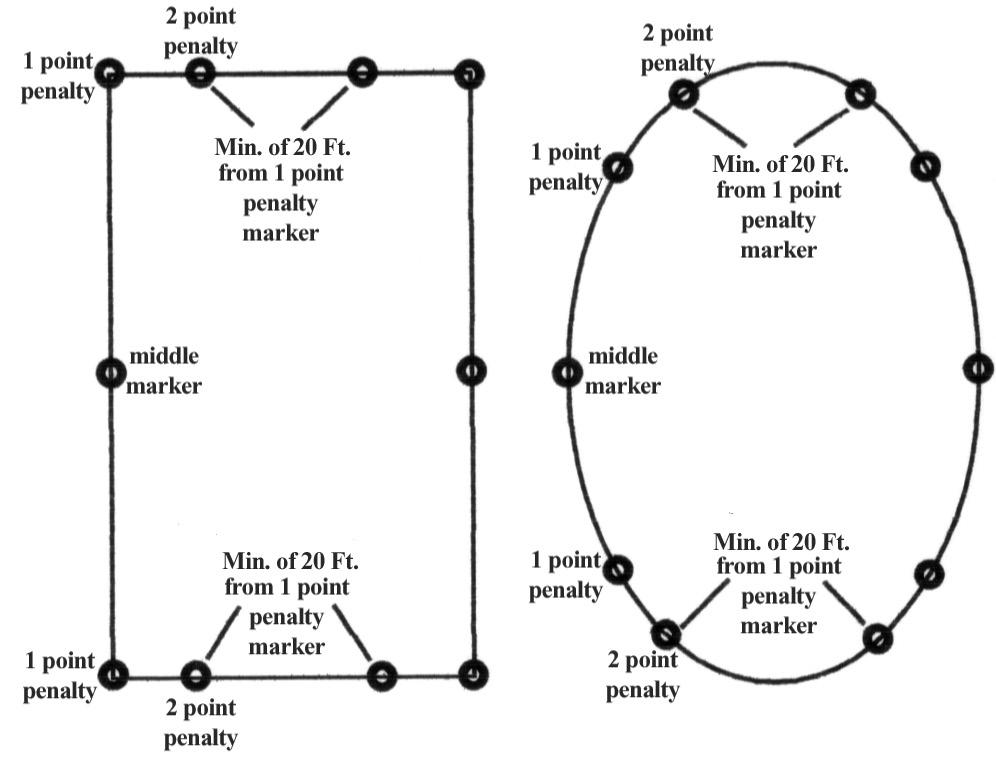
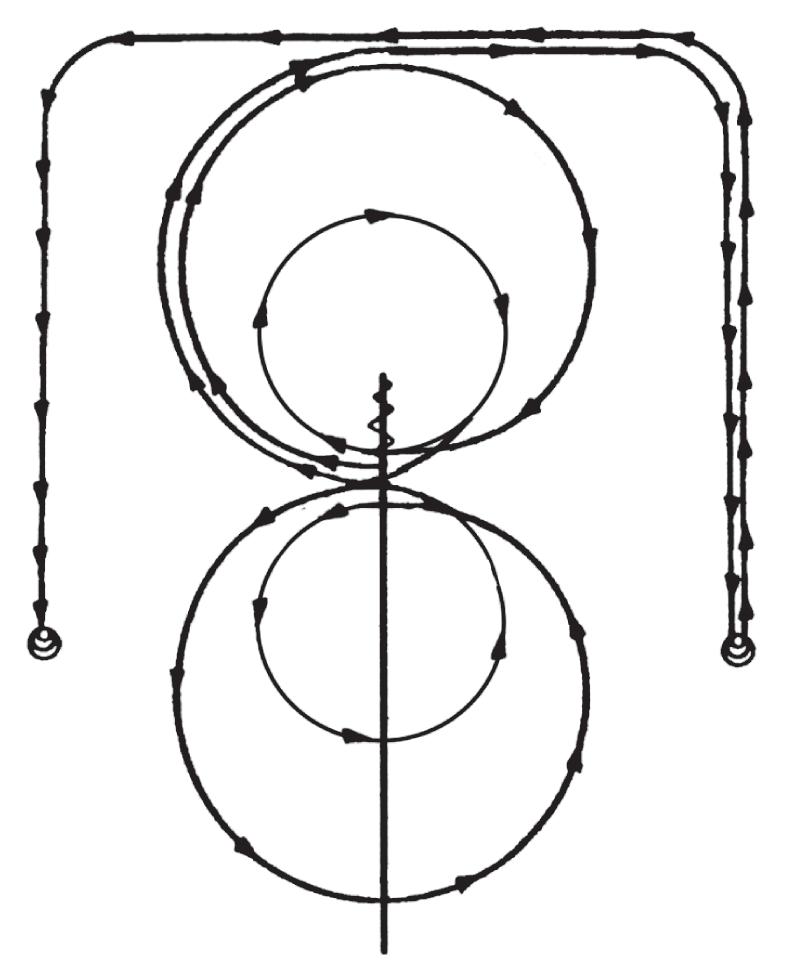
1. Start at end of arena. Run down middle past center marker to a sliding stop. Back at least 10 feet to center. 1/4 turn left.
2. Beginning on the right lead, complete 2 circles to the right. The first one large and fast fast, the second small and slow. Change leads at the center of arena.
3. Complete 2 circles to the left. The first circle large and fast, the second circle small and slow. Change leads at the center of arena.
4. Continue around end of arena without breaking gait or changing leads, run down the side (approximately 20 feet from fence) past center marker and come to a sliding stop.
5. Complete 3½ spins to the right.
6. Continue back down side and end of arena to other side (approximately 20 feet from fence) go past center marker and come to a sliding stop.
7. Complete 3½ spins to the left. Hesitate to complete pattern.
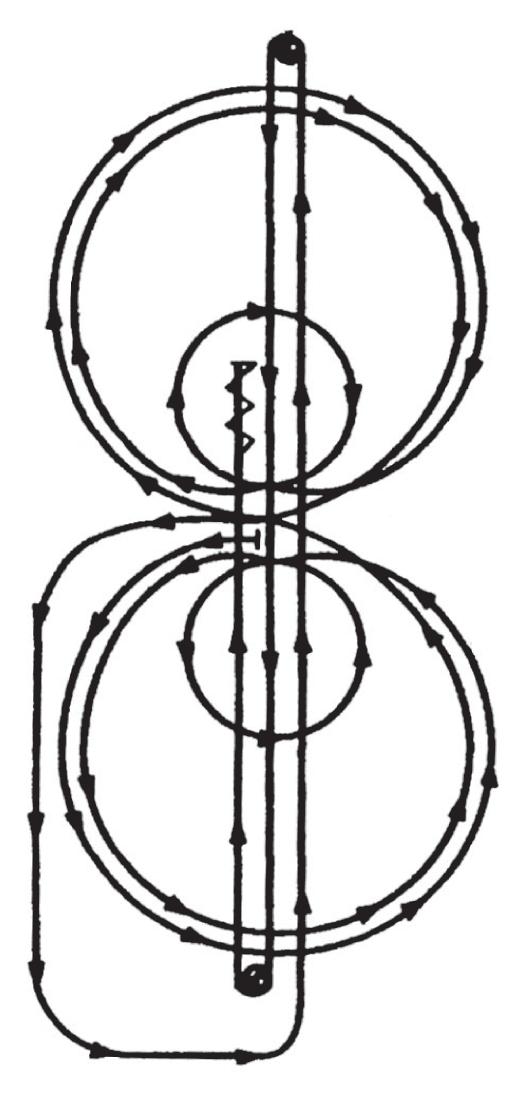
Trot to center of arena, stop. Start pattern facing towards judge.
1. Beginning on the left lead, complete 3 circles to the left. The first one large and fast, the second small and slow, the third large and fast. Change leads at the center of arena.
2. Complete 3 circles to the right. The first one large and fast, the second small and slow, and the third large and fast. Change leads at the center of arena.
3. Continue loping to run down. Run to far end past the marker to a sliding stop.
4. Complete 3½ spins to the left.
5. Run to far end past marker to a sliding stop.
6. Complete 3½ spins to the right.
7. Run past center marker to a sliding stop. Back at least 10 feet. Hesitate to complete pattern.
*This pattern may be used as a lope in pattern, please refer to rule 20.6.
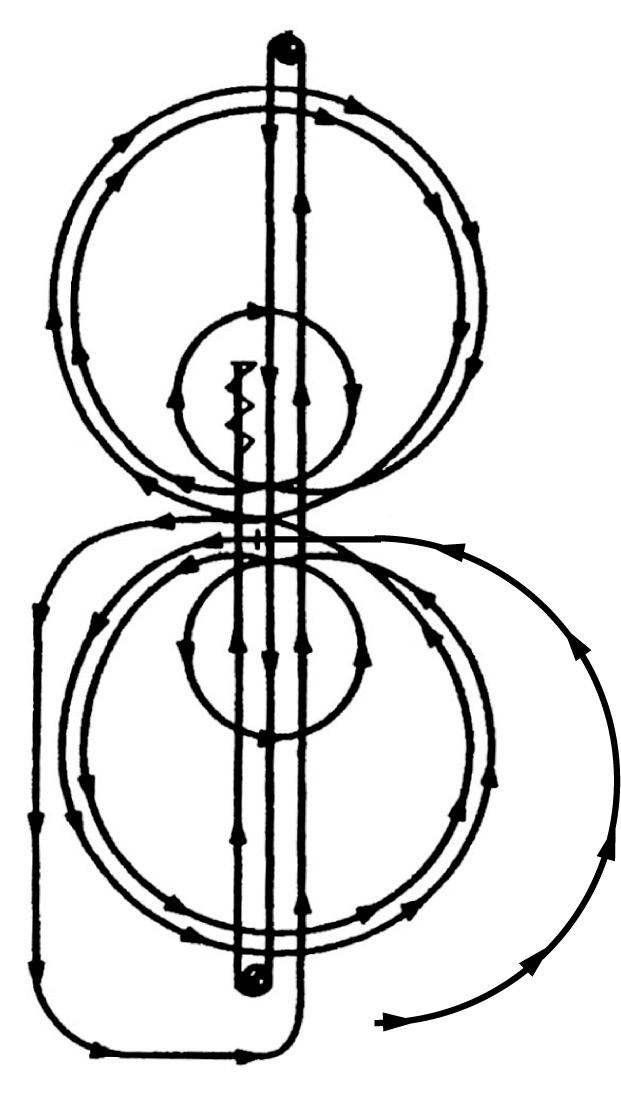
Begin on left lead. At the center, without stopping or breaking gait, begin pattern facing toward the judge. Refer to rule 20.6
1. Beginning on the left lead, complete 3 circles to the left. The first one large and fast, the second small and slow, the third large and fast. Change leads at the center of arena.
2. Complete 3 circles to the right. The first one large and fast, the second small and slow, and the third large and fast. Change leads at the center of arena.
3. Continue loping to run down. Run to far end past the marker to a sliding stop.
4. Complete 3½ spins to the left.
5. Run to far end past marker to a sliding stop.
6. Complete 3½ spins to the right.
7. Run past center marker to a sliding stop. Back at least 10 feet. Hesitate to complete pattern.
Begin on left lead. At the center, without stopping or breaking gait, begin pattern facing away from the judge. Refer to rule 20.6
1. Beginning on the left lead, complete 3 circles to the left. The first one large and fast, the second small and slow, the third large and fast. Change leads at the center of arena.
2. Complete 3 circles to the right. The first one large and fast, the second small and slow, and the third large and fast. Change leads at the center of arena.
3 Continue loping to run down. Run to far end past the marker to a sliding stop.
4. Complete 3½ spins to the left.
5. Run to far end past marker to a sliding stop.
6. Complete 3½ spins to the right.
7. Run past center marker to a sliding stop. Back at least 10 feet. Hesitate to complete pattern.
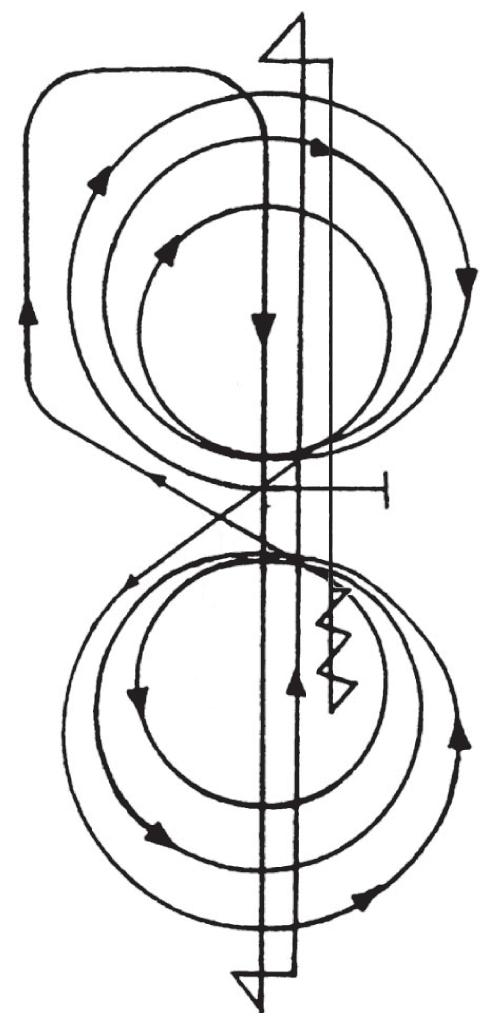
Trot to center of arena, stop. Start pattern facing towards judge.
1. Begin on right lead complete three circles to right, two large fast circles followed by one small and slow circle, change to left lead.
2. Complete three circles to left, two large fast circles followed by one small and slow circle. Change to right lead.
3. Continue loping around end of arena without breaking gait. Run up center of arena to far end past the end marker and come to a sliding stop.
4. Complete 3½ spins to the right.
5. Run up center of arena past the end marker, and come to a sliding stop.
6. Complete 3½ spins to the left.
7. Run back to middle of the arena past the center marker and come to a sliding stop. Back at least 10 feet in a straight line. Hesitate to complete pattern.
*This pattern may be used as a lope in pattern, please refer to rule 20.6.
3½ SPINS LEFT
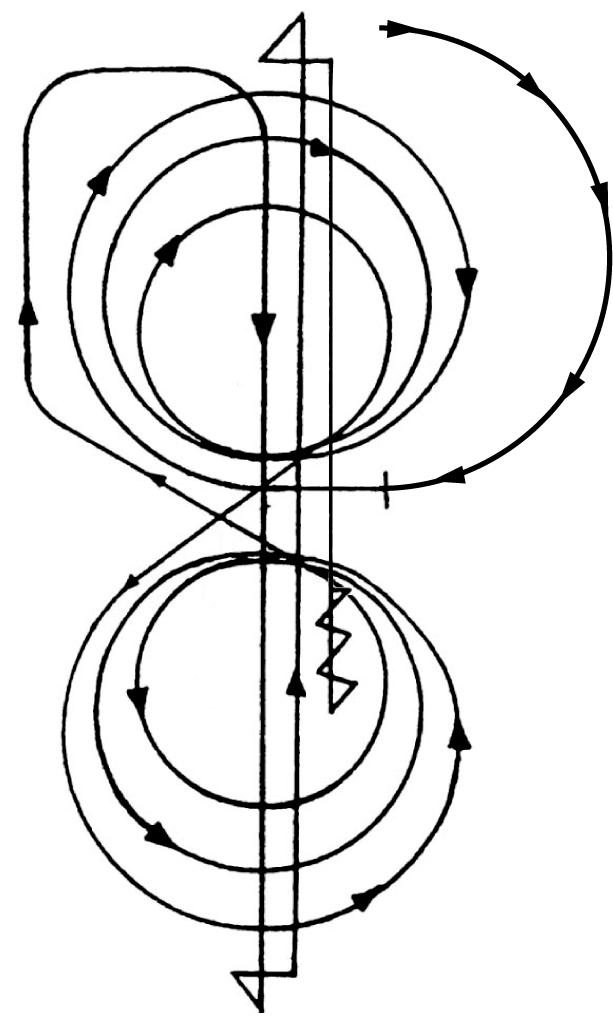
Begin on right lead. At the center, without stopping or breaking gait, begin pattern facing toward the judge. Refer to rule 20.6.
1. Begin on right lead complete three circles to right, two large fast circles followed by one small and slow circle, change to left lead.
2. Complete three circles to left, two large fast circles followed by one small and slow circle. Change to right lead.
3. Continue loping around end of arena without breaking gait. Run up center of arena to far end past the end marker and come to a sliding stop.
4. Complete 3½ spins to the right.
5. Run up center of arena past the end marker, and come to a sliding stop.
6. Complete 3½ spins to the left.
7. Run back to middle of the arena past the center marker and come to a sliding stop. Back at least 10 feet in a straight line. Hesitate to complete pattern.
Begin on right lead. At the center, without stopping or breaking gait, begin pattern facing away from the judge. Refer to rule 20.6.
1. Begin on right lead complete three circles to right, two large fast circles followed by one small and slow circle, change to left lead.
2. Complete three circles to left, two large fast circles followed by one small and slow circle. Change to right lead.
3. Continue loping around end of arena without breaking gait. Run up center of arena to far end past the end marker and come to a sliding stop.
4. Complete 3½ spins to the right.
5. Run up center of arena past the end marker, and come to a sliding stop.
6. Complete 3½ spins to the left.
7. Run back to middle of the arena past the center marker and come to a sliding stop. Back at least 10 feet in a straight line. Hesitate to complete pattern.
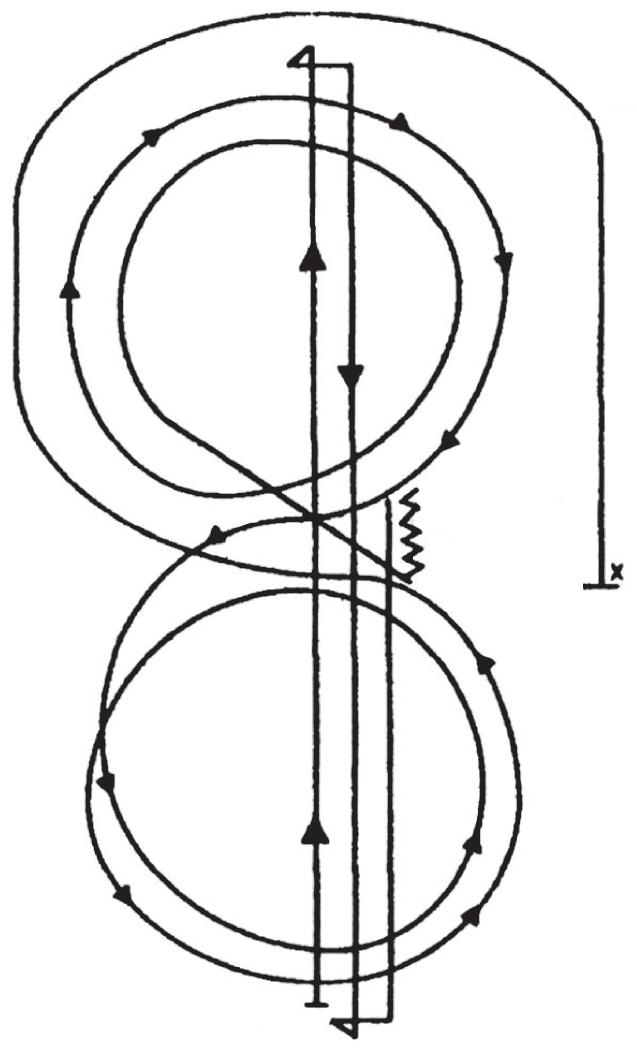
1. Start at end of arena. Run up center of arena past the end marker and come to a sliding stop.
2. Complete 3½ spins to the left.
3. Run to other end of arena past the end marker and stop.
4. Complete 3½ spins to the right.
5. Run past the center marker and stop. Back at least 10 feet in a straight line. Complete a 1/4 turn to the left.
6. Beginning on the right lead, complete two circles to the right, the first one small and slow, and the second large and fast. Change leads at the center of the arena.
7. Complete one small and slow circle and one large and fast circle, Change leads to the right.
8. Run around end of arena to the other side, past center marker, at least 20 feet from fence and come to sliding stop. Hesitate to complete pattern.
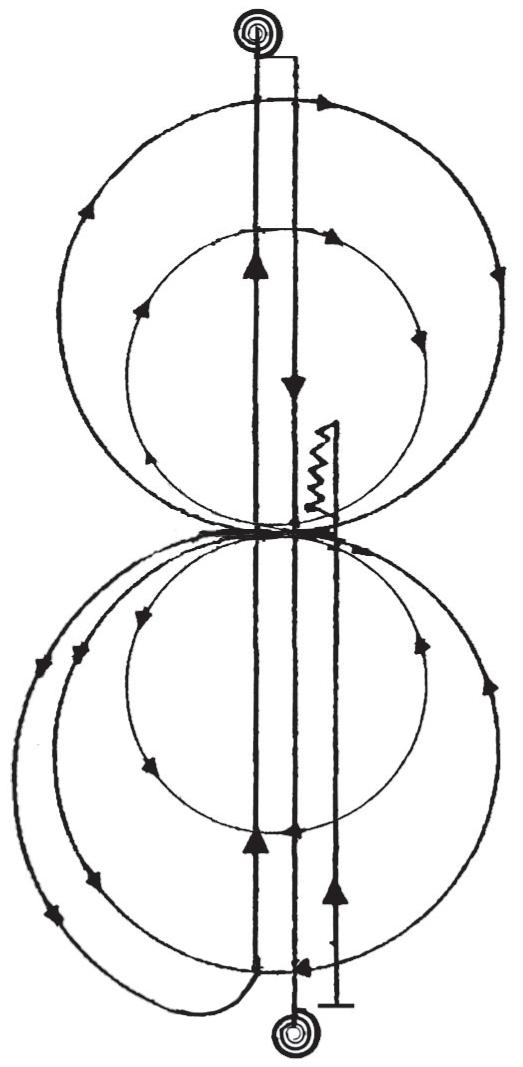
This pattern works best when the exhibitor and cattle enter from the same end of arena.
1. Start at end of arena. Run past center marker, stop, and back at least 10 feet. 1/4 turn to left.
2. Complete two circles to left. The first circle large and fast, the second circle small and slow. Change leads at the center of the arena.
3. Complete two circles to the right. The first circle small and slow, the second circle large and fast. Change leads at the center of the arena.
4. Continue around end of arena without breaking gait or changing leads, run down center of arena past end marker, execute a square sliding stop.
5. Complete 3½ spins to the right.
6. Rundown center of arena past end marker, execute a square sliding stop.
7. Complete 3½ spins to the left. Hesitate to complete pattern.
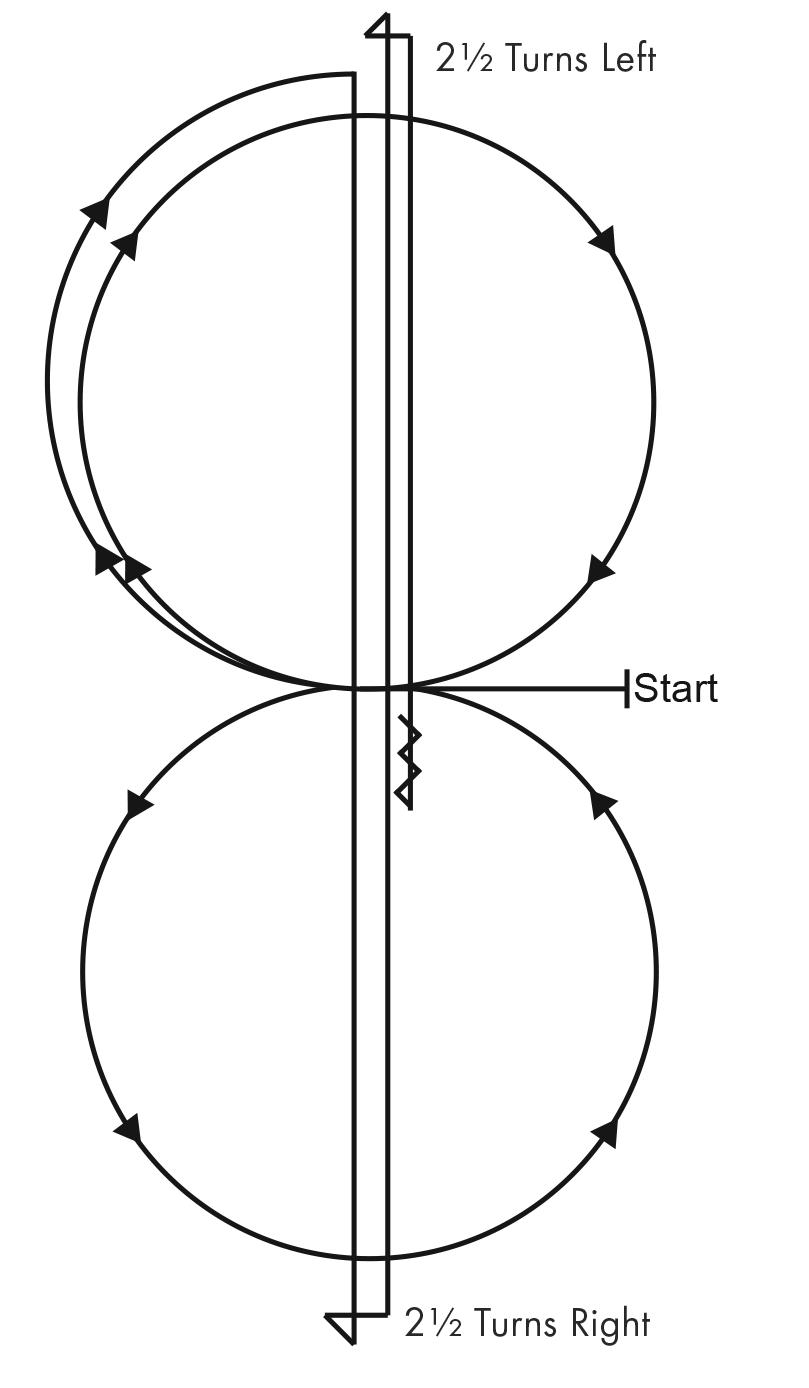
Trot to center of arena, stop. Start pattern facing towards judge
1. Beginning on the right lead lope one circle to the right. Change leads to the left.
2. Complete one circle to the left. Change leads to the right and go to the top of the arena.
3. Run down center of arena past the end marker and come to a sliding stop.
4. Complete 2½ spins to the right.
5. Run to the other end of the arena, past the end marker and come to a sliding stop.
6. Complete 2½ spins to the left.
7. Run past the center marker, stop and back at least 10 feet.
*This pattern may be used as a lope in pattern, please refer to rule 20.6.
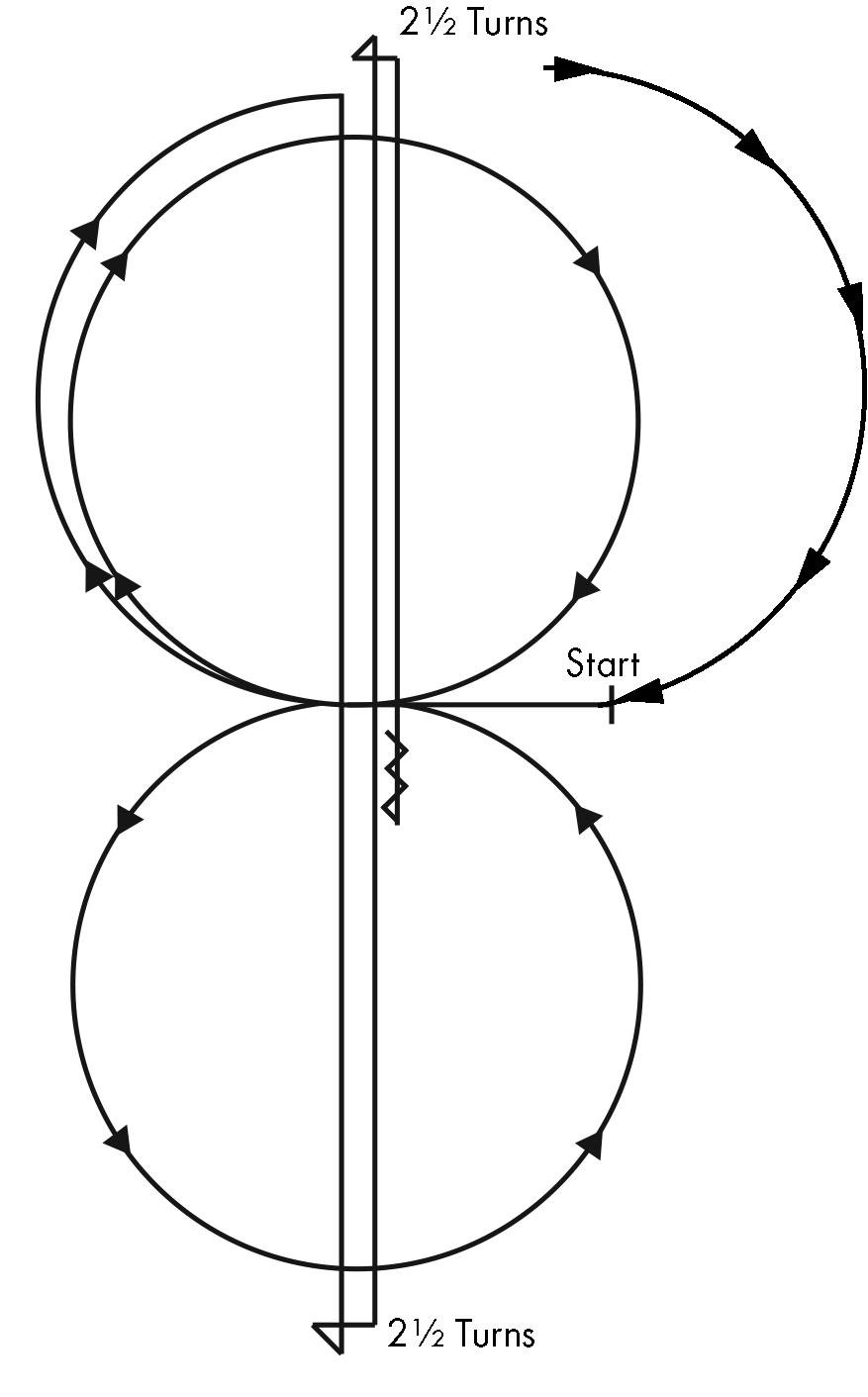
Begin on right lead. At the center, without stopping or breaking gait, begin pattern facing toward the judge. Refer to rule 20.6
1. Beginning on the right lead lope one circle to the right. Change leads to the left.
2. Complete one circle to the left. Change leads to the right and go to the top of the arena.
3. Run down center of arena past the end marker and come to a sliding stop.
4. Complete 2½ spins to the right.
5. Run to the other end of the arena, past the end marker and come to a sliding stop.
6. Complete 2½ spins to the left.
7. Run past the center marker, stop, back at least 10 feet.
Begin on right lead. At the center, without stopping or breaking gait, begin pattern facing away from the judge. Refer to rule 20.6
1. Beginning on the right lead lope one circle to the right. Change leads to the left.
2. Complete one circle to the left. Change leads to the right and go to the top of the arena.
3. Run down center of arena past the end marker and come to a sliding stop.
4. Complete 2½ spins to the right.
5. Run to the other end of the arena, past the end marker and come to a sliding stop.
6. Complete 2½ spins to the left.
7. Run past the center marker, stop, back at least 10 feet.
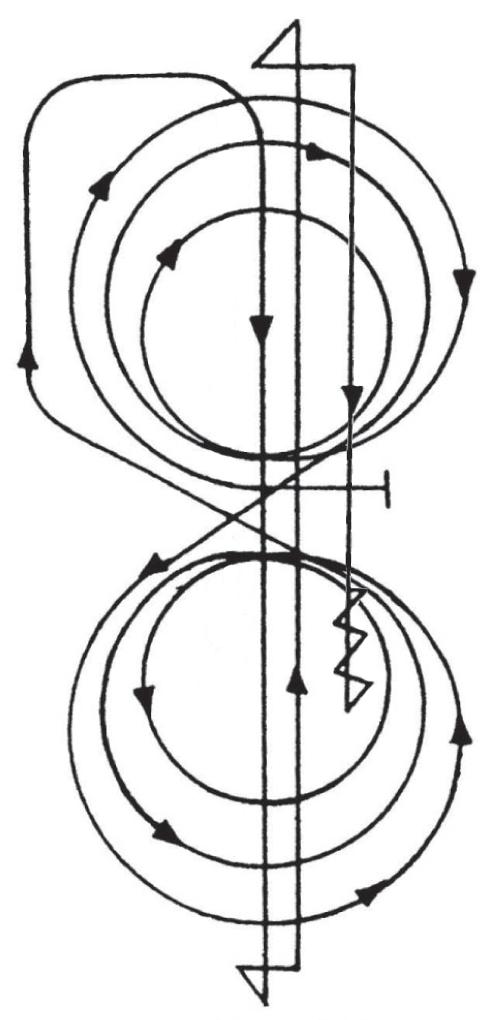
Trot to center of arena, stop. Start pattern facing towards judge.
1. Beginning on right lead and complete three circles, the first large and fast, the second small and slow, the third large and fast. Change leads to the left.
2. Complete three circles, the first large and fast, the second small and slow, the third, large and fast. Change leads to the right.
3. Continue loping around end of arena without breaking gait or changing leads. Run down center of arena, past end marker and come to a sliding stop.
4. Complete 3½ spins to the right.
5. Run down center of arena past end marker come to sliding stop.
6. Complete 3½ spins to the left.
7. Run past center marker come to sliding stop. Back up at least 10 feet. Hesitate to complete pattern.
*This pattern may be used as a lope in pattern, please refer to rule 20.6.
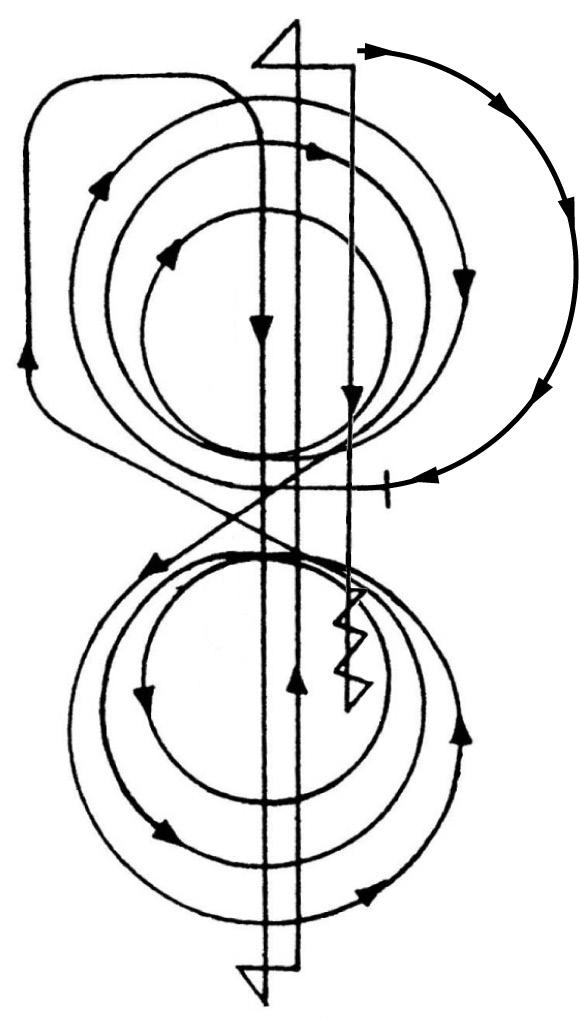
Begin on right lead. At the center, without stopping or breaking gait, begin pattern facing toward the judge. Refer to rule 20.6.
1. Beginning on right lead and complete three circles, the first large and fast, the second small and slow, the third large and fast. Change leads to the left.
2. Complete three circles, the first large and fast, the second small and slow, the third, large and fast. Change leads to the right.
3. Continue loping around end of arena without breaking gait or changing leads. Run down center of arena, past end marker and come to a sliding stop.
4. Complete 3½ spins to the right.
5. Run down center of arena past end marker come to sliding stop.
6. Complete 3½ spins to the left.
7. Run past center marker come to sliding stop. Back up at least 10 feet. Hesitate to complete pattern.
Begin on right lead. At the center, without stopping or breaking gait, begin pattern facing away from the judge. Refer to rule 20.6.
1. Beginning on right lead and complete three circles, the first large and fast, the second small and slow, the third large and fast. Change leads to the left.
2. Complete three circles, the first large and fast, the second small and slow, the third, large and fast. Change leads to the right.
3. Continue loping around end of arena without breaking gait or changing leads. Run down center of arena, past end marker and come to a sliding stop.
4. Complete 3½ spins to the right.
5. Run down center of arena past end marker come to sliding stop.
6. Complete 3½ spins to the left.
7. Run past center marker come to sliding stop. Back up at least 10 feet. Hesitate to complete pattern.
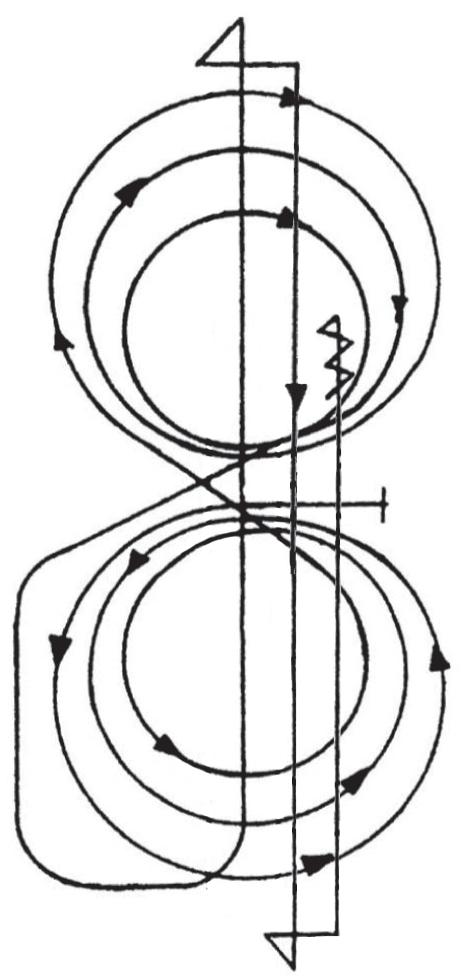
Trot to center of arena, stop. Start pattern facing towards judge.
1. Beginning on the left lead complete three circles; two large and fast circles, then one small and slow circle. Change leads to the right.
2. Complete three circles to the right, two large and fast circles, then one small and slow circle. Change leads to left.
3. Continue around end of arena without breaking gait or changing leads, run down center of arena past end marker come to square sliding stop.
4. Complete 3½ spins to the left.
5. Run down center of arena past end marker come to square sliding stop.
6. Complete 3½ spins to the right.
7. Run down center of arena past center marker come to square sliding stop. Back up at least 10 feet. Hesitate to complete pattern.
*This pattern may be used as a lope in pattern, please refer to rule 20.6.
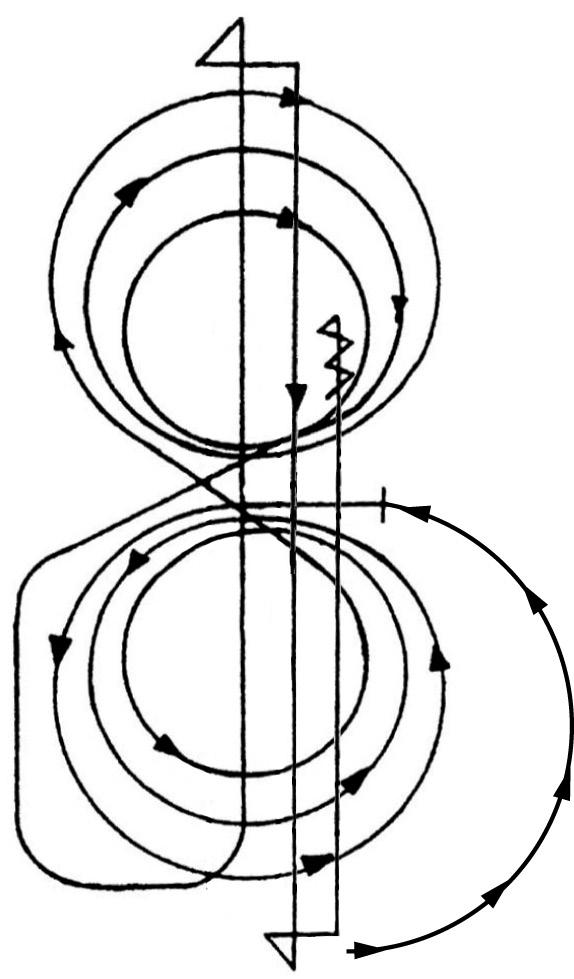
Begin on left lead. At the center, without stopping or breaking gait, begin pattern facing toward the judge. Refer to rule 20.6.
1. Beginning on the left lead complete three circles; two large and fast circles, then one small and slow circle. Change leads to the right.
2. Complete three circles to the right, two large and fast circles, then one small and slow circle. Change leads to left.
3. Continue around end of arena without breaking gait or changing leads, run down center of arena past end marker come to square sliding stop.
4. Complete 3½ spins to the left.
5. Run down center of arena past end marker come to square sliding stop.
6. Complete 3½ spins to the right.
7. Run down center of arena past center marker come to square sliding stop. Back up at least 10 feet. Hesitate to complete pattern.
Begin on left lead. At the center, without stopping or breaking gait, begin pattern facing away from the judge. Refer to rule 20.6.
1. Beginning on the left lead complete three circles; two large and fast circles, then one small and slow circle. Change leads to the right.
2. Complete three circles to the right, two large and fast circles, then one small and slow circle. Change leads to left.
3. Continue around end of arena without breaking gait or changing leads, run down center of arena past end marker come to square sliding stop.
4. Complete 3½ spins to the left.
5. Run down center of arena past end marker come to square sliding stop.
6. Complete 3½ spins to the right.
7. Run down center of arena past center marker come to square sliding stop. Back up at least 10 feet. Hesitate to complete pattern.
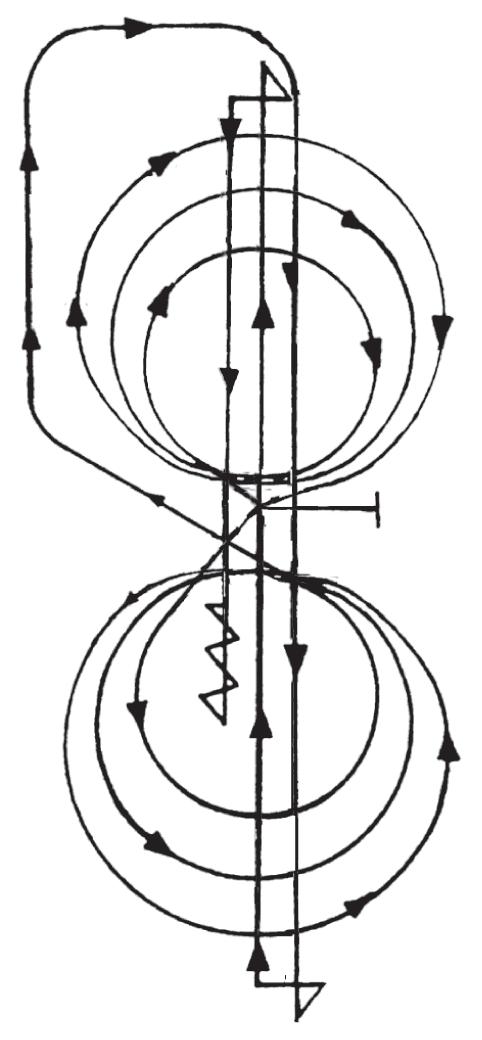
Trot to center of arena, stop. Start pattern facing towards judge.
1. Beginning on the right lead, complete three circles to the right; the first circle small and slow followed by two large fast circles. Change leads at the center of the arena.
2. Complete three circles to the left, the first circle small and slow followed by two large fast circles. Change leads at the center of the arena.
3. Continue loping around end of arena without breaking gait or changing leads. Run down center of arena, past end marker and come to a sliding stop.
4. Complete 3½ spins to the left.
5. Run down center of arena past end marker come to sliding stop.
6. Complete 3½ spins to the right.
7. Run past center marker come to sliding stop. Back up at least 10 feet. Hesitate to complete pattern.
*This pattern may be used as a lope in pattern, please refer to rule 20.6.
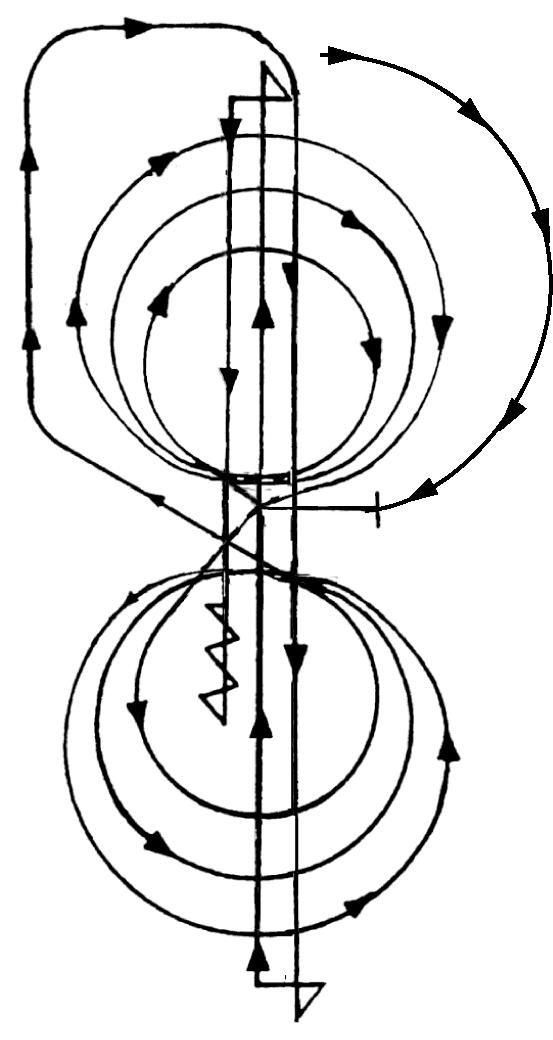
Begin on right lead. At the center, without stopping or breaking gait, begin pattern facing toward the judge. Refer to rule 20.6.
1. Beginning on the right lead, complete three circles to the right; the first circle small and slow followed by two large fast circles. Change leads at the center of the arena.
2. Complete three circles to the left, the first circle small and slow followed by two large fast circles. Change leads at the center of the arena.
3. Continue loping around end of arena without breaking gait or changing leads. Run down center of arena, past end marker and come to a sliding stop.
4. Complete 3½ spins to the left.
5. Run down center of arena past end marker come to sliding stop.
6. Complete 3½ spins to the right.
7. Run past center marker come to sliding stop. Back up at least 10 feet. Hesitate to complete pattern.
Begin on right lead. At the center, without stopping or breaking gait, begin pattern facing away from the judge. Refer to rule 20.6.
1. Beginning on the right lead, complete three circles to the right; the first circle small and slow followed by two large fast circles. Change leads at the center of the arena.
2. Complete three circles to the left, the first circle small and slow followed by two large fast circles. Change leads at the center of the arena.
3. Continue loping around end of arena without breaking gait or changing leads. Run down center of arena, past end marker and come to a sliding stop.
4. Complete 3½ spins to the left.
5. Run down center of arena past end marker come to sliding stop.
6. Complete 3½ spins to the right.
7. Run past center marker come to sliding stop. Back up at least 10 feet. Hesitate to complete pattern.
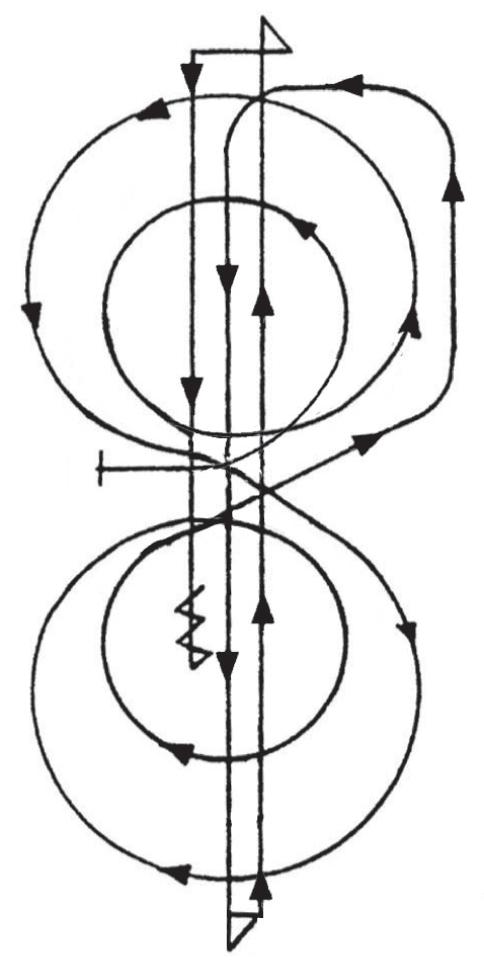
Trot to center of arena, stop. Start pattern facing toward the judge.
1. Beginning on the left lead, complete two circles to the left. The first circle small and slow, the second circle large and fast. Change leads at the center of arena.
2. Complete two circles to the right. The first circle large and fast, the second circle small and slow. Change leads at the center of arena.
3. Continue around end of arena without breaking gait or changing leads, run down center of arena past end marker, and execute a square sliding stop.
4. Complete 3½ spins to the left.
5. Run down center of arena past end marker, and execute a square sliding stop.
6. Complete 3½ spins to the right.
7. Run down center of arena past center marker, and execute a square sliding stop. Back up at least 10 feet. Hesitate to complete pattern.
*This pattern may be used as a lope in pattern. Please refer to rule 20.6.
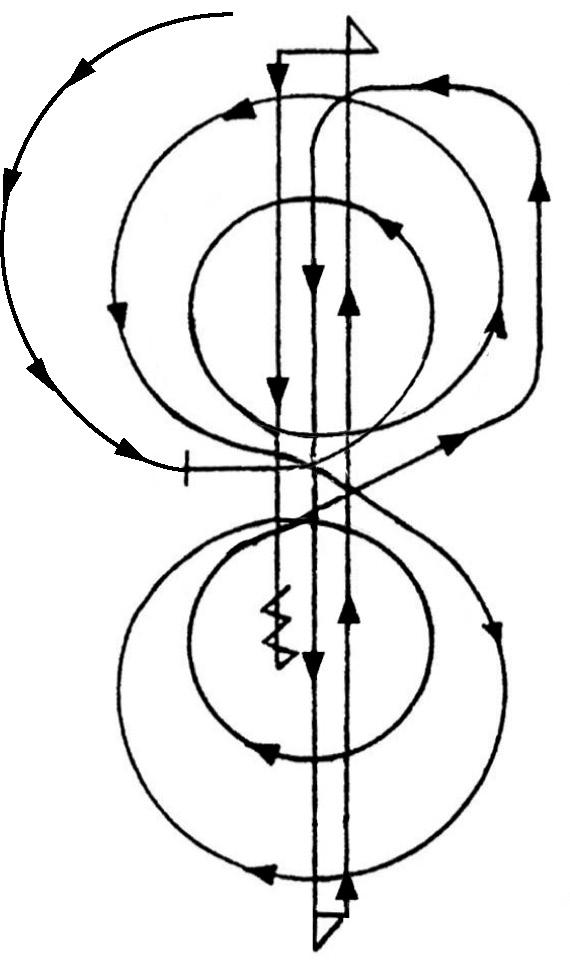
Start on left lead. At the center, without stopping or breaking gait, begin pattern facing toward the judge. Refer to rule 20.6.
1. Beginning on the left lead, complete two circles to the left. The first circle small and slow, the second circle large and fast. Change leads at the center of arena.
2. Complete two circles to the right. The first circle large and fast, the second circle small and slow. Change leads at the center of arena.
3. Continue around end of arena without breaking gait or changing leads, run down center of arena past end marker, and execute a square sliding stop.
4. Complete 3½ spins to the left.
5. Run down center of arena past end marker, and execute a square sliding stop.
6. Complete 3½ spins to the right.
7. Run down center of arena past center marker, and execute a square sliding stop. Back up at least 10 feet. Hesitate to complete pattern.
Start on left lead. At the center, without stopping or breaking gait, begin pattern facing away from the judge. Refer to rule 20.6.
1. Beginning on the left lead, complete two circles to the left. The first circle small and slow, the second circle large and fast. Change leads at the center of arena.
2. Complete two circles to the right. The first circle large and fast, the second circle small and slow. Change leads at the center of arena.
3. Continue around end of arena without breaking gait or changing leads, run down center of arena past end marker, and execute a square sliding stop.
4. Complete 3½ spins to the left.
5. Run down center of arena past end marker, and execute a square sliding stop.
6. Complete 3½ spins to the right.
7. Run down center of arena past center marker, and execute a square sliding stop. Back up at least 10 feet. Hesitate to complete pattern.
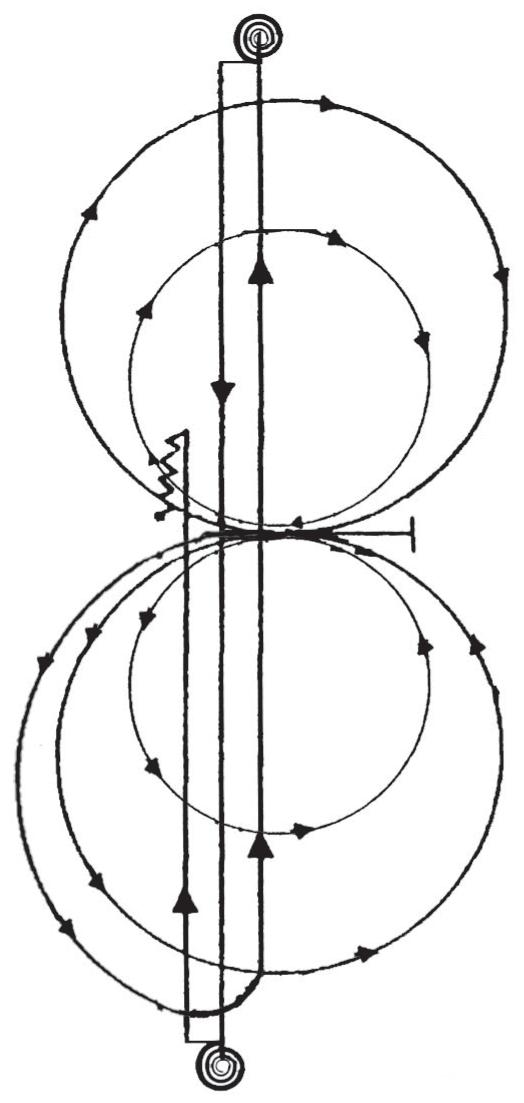
Trot to center of arena, stop. Start pattern facing towards judge.
1. Beginning on the left lead complete two circles to the left, the first circle large and fast, and the second circle small and slow. Change leads at the center of the arena.
2. Complete two circles to the right, the first large and fast, the second small and slow. Change leads at the center of the arena.
3. Continue around end of arena without breaking gait or changing leads, run down center of the arena past the end marker, execute a square sliding stop.
4. Complete 3½ spins to the left.
5. Run down center of arena past end marker, execute a square sliding stop.
6. Complete 3½ spins to the right.
7. Run down center of arena past center marker, execute a square sliding stop. Back at least 10 feet. Hesitate to complete pattern.
*This pattern may be used as a lope in pattern. Please refer to rule 20.6.
Begin on left lead. At the center, without stopping or breaking gait, begin pattern facing toward the judge. Refer to rule 20.6.
1. Beginning on the left lead complete two circles to the left, the first circle large and fast, and the second circle small and slow. Change leads at the center of the arena.
2. Complete two circles to the right, the first large and fast, the second small and slow. Change leads at the center of the arena.
3. Continue around end of arena without breaking gait or changing leads, run down center of the arena past the end marker, execute a square sliding stop.
4. Complete 3½ spins to the left.
5. Run down center of arena past end marker, execute a square sliding stop.
6. Complete 3½ spins to the right.
7. Run down center of arena past center marker, execute a square sliding stop. Back at least 10 feet. Hesitate to complete pattern.
Begin on left lead. At the center, without stopping or breaking gait, begin pattern facing away from the judge. Refer to rule 20.6.
1. Beginning on the left lead complete two circles to the left, the first circle large and fast, and the second circle small and slow. Change leads at the center of the arena.
2. Complete two circles to the right, the first large and fast, the second small and slow. Change leads at the center of the arena.
3. Continue around end of arena without breaking gait or changing leads, run down center of the arena past the end marker, execute a square sliding stop.
4. Complete 3½ spins to the left.
5. Run down center of arena past end marker, execute a square sliding stop.
6. Complete 3½ spins to the right.
7. Run down center of arena past center marker, execute a square sliding stop. Back at least 10 feet. Hesitate to complete pattern.
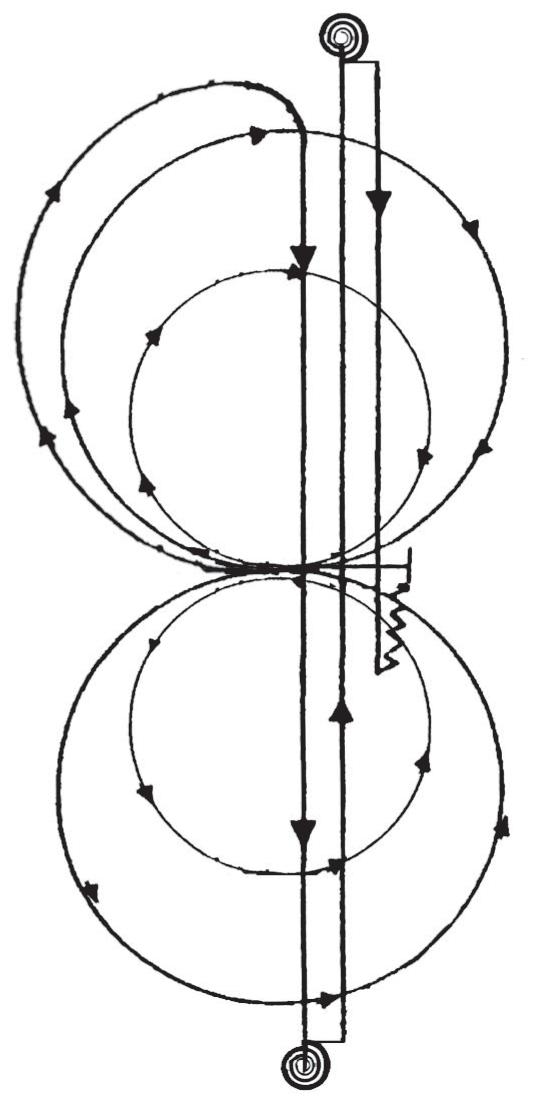
Trot to center of arena, stop. Start pattern facing towards judge.
1. Beginning on the right lead complete two circles to the right, the first circle large and fast, and the second circle small and slow. Change leads at the center of the arena.
2. Complete two circles to the left, the first circle large and fast, and the second circle small and slow. Change leads at the center of the arena.
3. Continue around end of arena without breaking gait or changing leads, run down center of the arena past the end marker, execute a square sliding stop.
4. Complete 3½ spins to the left.
5. Run down center of arena past end marker, execute a square sliding stop.
6. Complete 3½ spins to the right.
7. Run down center of arena past center marker, execute a square sliding stop. Back at least 10 feet. Hesitate to complete pattern.
*This pattern may be used as a lope in pattern, please refer to rule 20.6
Begin on right lead. At the center, without stopping or breaking gait, begin pattern facing toward the judge. Refer to rule 20.6.
1. Beginning on the right lead complete two circles to the right, the first circle large and fast, and the second circle small and slow. Change leads at the center of the arena.
2. Complete two circles to the left, the first circle large and fast, and the second circle small and slow. Change leads at the center of the arena.
3. Continue around end of arena without breaking gait or changing leads, run down center of the arena past the end marker, execute a square sliding stop.
4. Complete 3½ spins to the left.
5. Run down center of arena past end marker, execute a square sliding stop.
6. Complete 3½ spins to the right.
7. Run down center of arena past center marker, execute a square sliding stop. Back at least 10 feet. Hesitate to complete pattern.
Begin on right lead. At the center, without stopping or breaking gait, begin pattern facing away from the judge. Refer to rule 20.6.
1. Beginning on the right lead complete two circles to the right, the first circle large and fast, and the second circle small and slow. Change leads at the center of the arena.
2. Complete two circles to the left, the first circle large and fast, and the second circle small and slow. Change leads at the center of the arena.
3. Continue around end of arena without breaking gait or changing leads, run down center of the arena past the end marker, execute a square sliding stop.
4. Complete 3½ spins to the left.
5. Run down center of arena past end marker, execute a square sliding stop.
6. Complete 3½ spins to the right.
7. Run down center of arena past center marker, execute a square sliding stop. Back at least 10 feet. Hesitate to complete pattern.
1. Start at end of arena. Run down middle past center to a sliding stop. Back at least 10 feet to center 1/4 turn left.
2. Complete two circles to the left, the first circle large and fast, and the second circle small and slow. Change leads at the center of the arena
3. Complete two circles to the right, the first circle large and fast, and the second circle small and slow. Change leads at the center of the arena.
4. Continue around end of arena without breaking gait or changing leads, run down the side (approximately 20 feet from fence) past center marker and come to a sliding stop.
5. Complete 3½ spins to the left.
6. Continue back down the side and end of the arena to the other side (approximately 20 feet from fence) past center marker and come to a sliding stop.
7. Complete 3½ spins to the right. Hesitate to complete pattern.
1. Start at end of arena. Run down middle past end marker to a sliding stop.
2. Complete 3½ spins to the left.
3. Run down middle past end marker to a sliding stop.
4. Complete 3½ spins to the right.
5. Run down middle past center to a sliding stop. Back at least 10 feet to center 1/4 turn left.
6. Complete one circle to the right, large and fast. Change leads at the center of the arena. Complete one circle to the left, large and fast. Change leads at the center of the arena.
7. Continue around end of arena without breaking gait or changing leads, run down the past the center marker and come to a sliding stop. Hesitate to complete the pattern.
The NRCHA has divided its patterns into sets of seven or eight maneuver groups, which are scored as described below. These patterns break down as follows:
* indicates that pattern may be used as a lope in pattern. Refer to 20.6.
Pattern 1
1. Stop and back up and 1/4 turn
2. Right circles
3. Left circles
4. Stop
5. 3½ right spins
6. Stop
7. 3½ left spins
Pattern 2*
1. Left circles
2. Right circles
3. Stop
4. 3½ left spins
5. Stop
6. 3½ right spins
7. Stop and back up
Pattern 3*
1. Right circles
2. Left circles
3. Stop
4. 3½ right spins
5. Stop
6. 3½ left spins
7. Stop and back up
Pattern 4
1. Stop
2. 3½ left spins
3. Stop
4. 3½ right spins
5. Stop and back up and 1/4 turn
6. Right circles
7. Left circles
8. Stop
Pattern 5
1. Stop and back up at 1/4 turn
2. Left circles
3. Right circles
4. Stop
5. 3½ right spins
6. Stop
7. 3½ left spins
Pattern 6*
1. Right Circle
2. Left Circle
3. Stop
4. 2½ right spins
5. Stop
6. 2½ left spins
7. Stop and back up
Pattern 7*
1. Right circles
2. Left circles
3. Stop
4. 3½ right spins
5. Stop
6. 3½ left spins
7. Stop and back up
Pattern 8*
1. Left circles
2. Right circles
3. Stop
4. 3½ left spins
5. Stop
6. 3½ right spins
7. Stop and back up
Pattern 9*
1. Right circles
2. Left circles
3. Stop
4. 3½ left spins
5. Stop
6. 3½ right spins
7. Stop and back up
Pattern 10 *
1. Left circles
2. Right circles
3. Stop
4. 3½ left spins
5. Stop
6. 3½ right spins
7. Stop and back up
Pattern 11*
1. Left circles
2. Right circles
3. Stop
4. 3½ left spins
5. Stop
6. 3½ right spins
7. Stop and back up
Pattern 12*
1. Right circles
2. Left circles
3. Stop
4. 3½ left spins
5. Stop
6. 3½ right spins
7. Stop and back up
Pattern 13
1. Stop
2. Left circles
3. Right circles
4. Stop
5. 3½ left
6. Stop
7. 3½ right
Pattern 14
1. Stop
2. 3½ left
3. Stop
4. 3½ right
5. Stop
6. Circles
7. Stop

POINT PENALTIES: A(Miss) losing working advantage AHorse turns tail BNoise directed to cattle BUsing two hands on the reins in a bridle.
Effective November 16, 2025 CWorking out of position CFingers between the reins in a bridle.
Toe, foot, or stirrup on shoulder DIllegal equipment ELeaves working area before time expires
POINT PENALTIES: FFall of horse or rider
Hot quit GBloody Mouth (inside) BCattle picked up or scattered HImproper Western Attire CFailure to make deep cut IFailure to work in the proper working order DBack fence 5 POINT PENALTIES:
Abuse
Lameness
Horse quitting a cow
Losing a cow
Changing cattle after a specific commitment DFailure to separate a single animal after leaving
NOTE: Judge may blow his/her whistle at any time the herd to terminate the work. A score of zero will be given EBlatant disobedience if the work is not complete at that time. time or excessively whipping or spurring the horse. NEFailure of an exhibitor to attempt to complete the work.
F-Spurring or hitting in front of the cinch at any
F-Spurring or hitting in front of the cinch at any
time or excessively whipping or spurring the horse. NEFailure of an exhibitor to attempt to complete the work.
Effective November 16, 2025

POINT PENALTIES:
1/2
Not changing leads within the same strideOver or under spin 1/8 turn
Jogging first two strides
SCORE
0-
Failure to complete the pattern as given (I.e. over under spin more than 1/4 turn)
Two hands on the reins in a bridle or two-rein class
Fingers between the reins in a bridle class, except the two rein class
Horse balking
Bloody mouth (inside)
Illegal equipment
Leaving working area before pattern is complete1 1/2
Fall of horse or rider
Backing more than 2 strides when no back up is called for in the pattern.
Jogging In excess of one-half circle or one-half the length of the arena
Improper Western Attire
Failure to work in the proper working order
SCORE:
NO
AbuseLameness
Out of lead each 1/4 circle
Anticipating stop
1 POINT PENALTIES
Out of Lead
Slipping rein in the bridle
Over or under spin 1/4 turn
2 POINT PENALTIES
Lead missed around end of arena past second corner
Not ever changing leads in patterns where there is only 1/2 circle
Failure to run by marker before stop is initiated
Freezing up in turn
Breaking gait
Jogging beyond two strides up until one-half circle or one-half arena length
On trot in patterns, failure to stop before executing a lope departure
A stop in the first 1/4 of the circle, after a lope departure, is a break of gait.
At end of pattern, failure to hesitate to demonstrate completion of pattern.
5 POINT PENALTIES
Failure of an exhibitor to attempt to work the pattern. excessively whipping or spurring the horse.
Spurring or hitting in front of cinch at any time or NE
NOTE: Judge may blow his/her whistle at anytime to terminate the work. and striking or obviously insubordinate. A score of zero will be given if the work is not complete at that time.
SCORES: +1 1/2, +1, +1/2, 0, -1/2, -1, -1 1/2
Blatant disobedience including kicking, biting, bucking, rearing,
Blatant disobedience including kicking, biting, bucking, rearing, NOTE: Judge may blow his/her whistle at anytime to terminate the work. and striking or obviously insubordinate. A score of zero will be given if the work is not complete at that time.
Judge's Signature:

Effective November 16,
A-Turn tail
B-Using two hands on the reins in a bridle
1 POINT PENALTIES
A-Loss of working advantage
C-Cow's head breaks the plane of the 1 point marker
E-Changing sides of arena to turn cow or two rein class
C-Fingers between the reins in a bridle class
L-For each length horse runs past cow
P-Working out of position except the two rein class
D-Balking
S-Slipping rein
(At judge's discretion, rider will recive new cow as necessary to show horse)
Cow that won't run
Cow that doesn't respect horse
When cow leaves the arena
NOTE: Judge may blow the whistle at anytime to terminate the work.
A score of zero will be given if the work is not complete at that time.
F-Bloody mouth (inside)
G-Illegal equipment
H-Leaving working area before pattern is complete
I-Fall of horse or rider
J-Schooling between rein work and cow work
K-Schooling horse between cows, if new cow is awarded
L-If a rider hits or kicks the animal being worked
T-Failure to drive cow past middle marker on first run down the fence
E-Extremely out of control after the cow is lined out (3 horse strides)
W-Excessive hollering
2 POINT PENALTIES
A-Going around corner of arena before turning cow
B-In an open field turn animal gets within 3 feet of the end fence before being turned
C-Failure to change sides after a circling turn prior to the first circle
PENALTIES
3 POINT
DDangerous Position with the romal or reins, in an abusive manner
N-Improper Western Attire
O-Failure to work in the proper working order
A-Abuse
B-Lameness
NEFailure of an exhibitor to attempt to work the pattern (fence work) & 1 POINT
E-Exhausting or overworking before circling cow
H-Hanging up on fence (refusing to turn)
KKnocking down cow without having working advantage
5 POINT PENALTIES
A-Not getting a turn each way (5 points each way)
B-Spurring or hitting in front of cinch at anytime or excessively whipping or spurring horse
C-Blatant disobedience including kicking, biting, bucking, rearing and striking or obviously insubordinate
disobedience including kicking, biting, bucking, rearing and striking or obviously
NEFailure of an exhibitor to attempt to work the pattern (fence work) & 1 POINT PENALTIES

Turn tail
Each work will be limited to 1 minute 45 seconds
Loss of working advantage
Working out of Position
Changing sides on second Drive
On first drive, failure to drive past the middle marker BUsing two hands on the reins in a bridle or two-rein
CFingers between the reins in a bridle class, except in the two-rein
Dangerous Position DBalking
Knocking down the cow without having a working advantage EExtremely Out of Control
Performing a fence turn (whether initiated by horse or rider) FBloody mouth (inside)
"NEW
Failure to drive cow past middler marker on second drive before time expires GIllegal equipment
POINT PENALTIES HLeaving working area before pattern or work is complete BSpurring or hitting in front of cinch at anytime IFall of horse or rider
Blatant disobedience, defined as kicking, biting, JSchooling of the horse between rein work and cow work bucking, rearing, striking or obviously insubordinate KSchooling between cows, if new cow is awarded. FFailure to initiate at least one turn/change on the second boxing phase
MImproper Western Attire before terminating the work. NFailure to work in the proper working order
(At judges' discretion, rider will receive marker after two attempts new cow(s) as necessary to show horse)
QOn first drive down fence, failure to drive cow past middle
SCORE:Cow that won't run
AbuseCow that doesn't respect horse
Running cow into back fence with force
BLamenessWhen cow leaves arena
NOTE: Judge may blow the whistle at anyitime to terminate the work. A score of zero will be given if the work is not complete at that time. NEFailure of an exhibitor to attempt to complete the work

Each Work will be limited to 50 seconds 0SCORE ATurn tail 1 POINT PENALTIES BUsing two hands on the reins in ALoss of working advantage a bridle or two-rein
Effective November 16, 2025 PWorking out of Position CFingers between the reins in a bridle WExcessive hollering class, except in the two-rein DBalking 3 POINT PENALTIES EExtremely out of control D-Dangerous Position FBloody mouth (inside) LLoss of Control and cow leaves end of arena GIllegal equipment HLeaving working area before 5 POINT PENALTIES pattern is complete BSpurring or hitting in front of cinch. at anytime IFall of horse or rider or excessively whipping or spurring the horse. JSchooling between rein work and cow CBlatant disobedience, defined as kicking, biting, KSchooling between cows, if new cow bucking, rearing, striking or obviously insubordinate is awarded
(At judges' discretion, rider will receive new cow(s) as necessary to show horse) NFailure to work in proper working orderCow that won't runCow that doesn't respect horse
NEFailure of an exhibitor to attempt to complete the work.
MImproper Western Attire
NOTE: Judge may blow the whistle at anytime to NO SCORE:When cow leaves arena terminate the work. A score of zero will be given
if the work is not complete at that time.
16,

SCORING
Will be on the basis of 60-80, with a 70 denoting an average performance.Each maneuver will be scored from a + 1 1/2 (Exceptional), to a1 1/2 (Exceptionally poor), in 1/2 point increments. Effective
Time limit is 60 seconds with a two loop limit.
Freeze-up in BoxRefusing to enter boxLoss of RopeAbuse; LamenessJumping the BarrierBreaking BarrierFailure to make legal catchScotchingRearing up in boxFailure to dallyRunning into steerFall of horse or riderNervous in boxBlatant DisobedienceExcessive SchoolingTurns head severelyMissing First LoopWhipping or hitting horse with ropeSquats in CornerTaking off Illegal catchFailure of horse to stop steer's forward motionStopping CrookedImproper western attireWorking out of order NEFailure of an exhibitor to attempt to work the pattern
Judge's Signature: