Week of: October 1, 2026
The latest from tsdmemphis.com
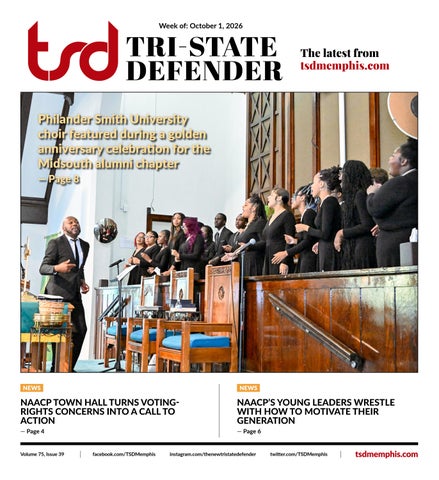
Philander Smith University choir featured during a golden anniversary celebration for the Midsouth alumni chapter — Page 8
NEWS
NEWS
NAACP TOWN HALL TURNS VOTINGRIGHTS CONCERNS INTO A CALL TO ACTION
NAACP’S YOUNG LEADERS WRESTLE WITH HOW TO MOTIVATE THEIR GENERATION
— Page 4
— Page 6
Volume 75, Issue 39
facebook.com/TSDMemphis
instagram.com/thenewtristatedefender
twitter.com/TSDMemphis
tsdmemphis.com
■■ NEWS
TRI-STATE DEFENDER
Mayor, transition team share big plans and policies for county’s future By James Coleman
tsdmemphis.com President Calvin Anderson
Editor Stephanie R. Jones
Published by The Tri-State Defender POSTMASTER: Send address changes to The Tri-State Defender, 1509 Madison Ave., Memphis, TN, 38104. GENERAL INFORMATION: Inquiries may be submitted in writing or by calling (901) 523-1818 or by email. TELEPHONE: (901) 523-1818. The Tri-State Defender (USPS 780-220) is published weekly. The Tri-State Defender 1509 Madison Ave. Memphis, TN, 38104. Second-class postage paid in Memphis, TN. The Tri-State Defender is a member of The National Newspaper Publishers Association and the Tennessee Press Association. All materials covered by copyright. No materials herein may be reproduced without the written permission of the Publisher. (901) 523-1818 | 1509 Madison Ave, Memphis, TN 38104 ••• $60 Annually/$5 Monthly Digital subscriptions are available online at tsdmemphis.com
Week of: October 1, 2026
TSD Contributing Writer
Handpicked experts on the transition team for newly elected Shelby County Mayor Mickell Lowery presented policy proposals at a meeting Thursday, Sept. 24, to begin shaping the county’s future under the new administration. Some 70 volunteers assigned to nine working groups have spent weeks studying separate policy areas. With only 25 days between the election and the Aug. 31 swearing-in ceremony, the team worked at a brisk pace to help the new mayor develop a comprehensive plan for county governance, fiscal stability and economic development. The county’s finances remain a top concern. On the same day as the policy presentation meeting, credit rating agency Moody’s downgraded the county’s finances because of a drop in its fund balance. In late fiscal 2026, cash reserves fell to 15.5% of the county’s overall budget. And the county was forced to borrow $125 million to cover a $100 million budget shortfall. Former county Mayor Lee Harris, for his part, prioritized low property taxes during his eight years in office. In fact, the fiscal 2027 budget represents the only property tax increase of his tenure. Homeowners benefitted while the county’s revenues suffered. Lowery, who voted as a county commissioner in favor of the fiscal 2027 tax increase, plans to take further action to secure the county’s finances. A fiscal stability working group will assess all county departments to develop a clear financial picture. Still, capital improvement projects rely on a solid credit rating to keep borrowing costs down. And Lowery is already considering a few major projects such as a new jail. Instead of making repairs and updates to the crumbling Shelby County jail, the
second-generation politician is pushing for the construction of a new campus to likely house several of the county’s law enforcement divisions. As a commissioner, he rejected a proposed jail in North Memphis. Other locations that were once considered for development or expansion include Shelby Farms and the current downtown facility. The federal Safe Memphis Task Force – with its high arrest volume, since its inception a year ago – has exacerbated the need for a larger correctional complex. Implementing violence intervention programs and accelerating court proceedings are additional solutions
Page 2
proposed in the transition team’s plan. And a new $22 million mental healthcare facility is expected to reduce overcrowding in the understaffed jail. Lowery also intends to focus on early education for 3-year-olds and 4-yearolds. But the current enrollment goal for universal pre-K across the county has fallen short, and further expansion would require more funding. The county, bound by fiscal 2026 spending levels, must adhere to a strict ratio to jointly fund the initiative with the city, which has refused to increase its share of total funding. If the county increased its contribution, the joint ordinance passed in 2019 to establish countywide universal pre-K would be nullified.
TRI-STATE DEFENDER | tsdmemphis.com
■■ NEWS
Stretch of Union Avenue renamed for former county mayor TSD Newsroom A portion of Union Avenue between South Dunlap and South Manassas streets in the Medical District has been renamed to honor former Shelby County Mayor Lee Harris. The new street sign for Lee A. Harris Avenue was unveiled Wednesday, Sept. 23, at a renaming ceremony. After Harris left office in August following the county general election, the Memphis City Council passed a resolution in early September to add his name to the stretch of roadway. Harris served two consecutive fouryear terms, the limit allowed for the position. Family and close friends attended the renaming ceremony, along with the Overton High School marching band. Harris is an Overton alum. Before he was elected county mayor, Harris, who plans to join the faculty of the University of Mississippi School of
Week of: October 1, 2026
A street sign is unveiled on Union Avenue in honor of former Shelby County Mayor Lee Harris.
Law, also served on city council and as a state senator. Harris views the honor as symbol-
ic of what can be achieved, he said, carrying a message of limitless possibilities.
Page 3
“I hope it is seen as a sign that anyone in this county can change anything,” he said.
TRI-STATE DEFENDER | tsdmemphis.com
■■ NEWS
‘Do something’:
NAACP town hall turns voting-rights concerns into a call to action From checking voter registration to bringing others to the polls, panelists urged Memphians to turn frustration into civic engagement By Lee Eric Smith
A new political map
Register. Vote. Bring somebody with you. Then stay involved. For all the legal analysis, political history and warnings about threats to voting rights packed into Saturday morning’s Tennessee State Conference NAACP Community Town Hall, among the most persistent messages was also the simplest. Do something. Panelists at Mt. Olive Cathedral CME Church urged people to check their voter registration, learn what’s on the ballot, knock on doors, contact friends and family and — above all — get to the polls. But they also stressed that civic engagement doesn’t end when the polls close. Show up at city council and county commission meetings. Pay attention to decisions being made in your neighborhood. Hold elected officials accountable. Keep organizing. Judging from the room, plenty of young people were listening. Less than 24 hours after young NAACP leaders spent Friday evening wrestling with how to get more of their generation involved, youths again turned out in force Saturday — this time joining veteran civil rights activists in a broader conversation about redistricting, voting rights, political power and what comes next.
Much of that conversation started with something that has already changed for Memphis voters: the map. In May, Tennessee lawmakers approved a new congressional map splitting Memphis and Shelby County among three districts and eliminating the state’s only majority-Black district. Civil rights groups, including the Tennessee State Conference NAACP, challenged the map in state and federal court, alleging that it intentionally diluted Black voting power. A state court challenge was dismissed in May, while federal challenges continued. Dr. Sekou Franklin, executive director of the John Lewis Center for Social Justice at Fisk University, told the audience that the redistricting fight should be viewed in the context of a changing legal landscape around voting rights. Franklin pointed specifically to the U.S. Supreme Court’s April decision in Louisiana v. Callais, which struck down Louisiana’s second majority-Black congressional district and altered the legal terrain surrounding Section 2 of the Voting Rights Act. But for Kathryn Winsley, a North Mississippi voter protection organizer for the Mississippi Democratic Party, the practical impact of redistricting could be explained without a law degree.
TSD Contributing Writer
Week of: October 1, 2026
Dominik Whitehead, the NAACP’s chief of field, membership growth and unit sustainability, says reaching younger voters requires listening to how they describe what is at stake. To his left is Venita Doggett, executive director of the Memphis Interfaith Coalition for Action and Hope (MICAH),. (Photos: Lee Eric Smith/Tri-State Defender)
She asked the young people in the room to raise their hands. Then she talked about young voters who had been excited about a congressional candidate who looked like them — only to learn that redistricting had moved them into another district. Someone in the room summed up the reaction in one word: “Insane.” Winsley seized on it. “You cannot sit on that upset feeling,” she said. “Y’all know our generation, we’re the go-getters.” Her message was to turn frustration into preparation — learning how the process works, organizing and showing
Page 4
up when decisions are being made.
From frustration to action Venita Doggett, executive director of the Memphis Interfaith Coalition for Action and Hope, or MICAH, said frustration itself has become one of the barriers organizers encounter when trying to persuade people to vote. People repeatedly hear that their vote is their power, Doggett said. But when they don’t see changes in their lives that feel like power, some simply disengage. “If what I get in return does not match what power looks like, then I tap out,” she said. That means organizers have to do TRI-STATE DEFENDER | tsdmemphis.com
■■ NEWS to the debate over data centers and their potential effects on electricity, water, noise, property values and surrounding communities. Doggett urged residents concerned about data center development to attend local government meetings and make their voices heard. For her, that is what staying involved looks like: Voting determines who gets a seat at the table, but public participation helps determine what happens after they get there.
Tennessee State Conference NAACP President Gloria Sweet-Love rises to address the audience as Saturday’s Community Town Hall draws toward a close.
more than tell people to vote, she added. Doggett described MICAH members knocking on doors, organizing voter hubs in congregations and sending 12,000 handwritten postcards to voters. She talked about “ballot and brunch” events, text banking and relational organizing — encouraging people to reach into their own networks rather than waiting for strangers to do the work. Winsley made a similar point. Organizers, she said, cannot become so attached to traditional voter outreach that they miss the people they are trying to reach. Go where people already are. That might mean a church. It might mean a neighborhood gathering. It might mean a Southern Heritage Classic tailgate. “You have to create that level of excitement again about voting,” Winsley said. Dominik Whitehead, the NAACP’s chief of field, membership growth and unit sustainability, said the national organization is pursuing much the same strategy. The NAACP announced in July that it plans to spend $20 million on its 2026 get-out-the-vote campaign, with a goal of mobilizing 6.5 million Black Week of: October 1, 2026
Kathryn Winsley, a voter protection organizer with the Mississippi Democratic Party, urged young people to use the communication tools their generation already understands.
voters across 14 states and 33 congressional districts. Whitehead said the organization is also listening to what younger voters are saying about civic engagement. Among younger people, he said, organizers are hearing a distinction. “I’m not fighting for democracy,” Whitehead recalled young people telling them. “I’m fighting for our rights.” That difference matters, he said, because organizations have to speak to people in language that connects civic participation to their everyday lives.
Voting — and what happens afterward Doggett said that connection also requires confronting another uncomfortable reality: Some voters are dissatisfied with the people they have already elected. Voting cannot be the end of the relationship, she said. Residents can attend municipal government meetings. They can organize around neighborhood concerns, write elected officials and show up when consequential decisions are being made. “I remind people that you have power beyond the ballot,” Doggett said. The conversation offered an immediate example. Several panelists pointed
Young people press the conversation If Friday evening’s Youth/College Community Town Hall focused largely on how young NAACP leaders could reach their peers, Saturday provided something of a companion scene. Young people were already in the room. And they had questions. One student talked about voter registration efforts on campus and the difficulty of persuading classmates who believe their voices are not being heard. Another wanted to know how young people could build meaningful relationships with veteran activists rather than simply being invited into the same room. Others asked about racial and economic inequality, advocacy on predominantly white campuses and how someone their age could begin preparing for a career in politics. Whitehead called the answer “intergenerational organizing.” “There is no way possible we’re going to win this fight without young people,” he said. Young organizers bring fluency in social media, digital communication, influencers and rapidly changing youth culture, Whitehead said. Older activists bring institutional knowledge and experience earned through previous political and civil rights battles. Both have something the other needs. Winsley put some of the responsibility directly on the younger generation: Listen to what veteran activists know, she said. Then take that knowledge and execute. “You know the algorithms,” Winsley told the young people. “You know
Page 5
social media. You know how to use your platform. You know your voice. Everyone in here that’s a young person is a leader.” Doggett offered an even simpler model for bridging generations: Ride together. She recalled carpooling with an older activist — a “seasoned freedom fighter” — and using those rides to listen to his stories and absorb lessons from experiences she had not lived herself.
Everybody has a role The town hall was moderated by Deidre Malone, president and CEO of The Carter Malone Group who also serves in leadership with the Memphis Branch NAACP and as communications chair for the Tennessee State Conference NAACP. Malone also serves as vice president of the Tri-State Defender Board of Directors. As the session neared its end, Malone asked each panelist to strip away the court cases, organizing strategies and political analysis and answer one final question: If people walked out of the church and did exactly one thing, what should it be? Winsley pointed people toward voter information — knowing their status, their district and where and how to vote. Franklin widened the answer. “Everyone has a role to play in this democratic experiment,” he said. “It’s just that we have to be creative enough to create those roles that people play.” Doggett urged people not to let the organizing stop when the town hall ended. Meet somebody you didn’t know before you walked into the room, she said. Exchange information. Schedule another conversation. Whitehead made his assignment measurable. Find five people. Then ask those five people to do something with you before Election Day. It brought the morning back to where it began. Register. Vote. Bring somebody with you. Then stay involved.
TRI-STATE DEFENDER | tsdmemphis.com
■■ NEWS
NAACP’s young leaders wrestle with how to motivate their generation Panel of youth and college leaders at town hall hosted by civil rights organization talked voting, advocacy, leadership — and how to reach the young people who aren’t in the room By Lee Eric Smith
TSD Contributing Writer
At an NAACP youth town hall Friday night, a LeMoyne-Owen College student pointed out an irony: As far as he could tell, he was the only LOC student in the room. Other students were probably strolling around on campus as he spoke. They might have considered getting involved if they had known about something to get involved with — they were just unaware of what was happening inside. “How could we get that outreach,” the student asked, “to other people that are not knowing but do want to make a change?” The young NAACP leaders inside the room had been wrestling all evening with that essential question. The Youth/College Community Town Hall, part of the Tennessee State Conference NAACP’s 80th annual Leadership & Civil Rights Convention, featured a panel called “More Than a Membership” that brought together young NAACP leaders to examine voting, advocacy, leadership and how to get more of their peers involved. The emphasis on voting comes as the national NAACP mounts a $20 million campaign that its leaders say is designed to mobilize 6.5 million Black voters in 14 states and 33 congressional districts. Town hall panelists included: Saniyah Collier, president of the Middle Tennessee State University chapter, Jonathan Baker of the Memphis Youth Council, and Jeremyah “Doc” McGill, president Week of: October 1, 2026
of the Jackson-Madison County Youth Council and vice president for the Tennessee State Conference Youth & College Division for West Tennessee. Ebony Lee of Lane College moderated. For Baker, involvement in the NAACP has meant finding a voice he didn’t always know he had. “As you might be able to see, I can do a lot of open speaking,” Baker said, referring to public speaking. “I was never able to do that a long time ago.” He described his younger self as timid, more likely to stay in his room playing video games than stand before a crowd. But now? “I can speak in front of a bunch of people,” he said. Before joining the NAACP at MTSU, Collier said she had never held an executive board position. When she heard the campus chapter was being reactivated, she went to a meeting. When nominations for president opened, she raised her hand. She won. “I don’t know why they voted for me,” Collier joked. “I learned more than just a position in the NAACP,” she said. “I grew as a woman.”
‘We are the next now generation’ The evening’s agenda carried a special statement: “We are the now generation.” The word ‘next’ was deliberately crossed out to convey that this generation is done waiting and they’re also challenging their peers to step up. The room was packed with nearly 150 people in the lecture hall, where every seat was occupied, leaving latecomers standing. Most of the young
Nearly 150 people packed a LeMoyne-Owen College lecture hall for the Tennessee State Conference NAACP’s Youth/College Community Town Hall. By the end of the Friday evening session, it was standing room only, with young people occupying many of the seats toward the front of the room. (Photos: Lee Eric Smith/Tri-State Defender)
people were seated toward the front, while many of the older adults attending the convention sat farther back. For that hour, the young people and their opinions were front and center. A younger participant asked the panel what it meant to be a youth council president. It means inspiring “the generation of now,” McGill said, and letting them know “that they have power, that their voice matters, that this world is good with them in it.”
Getting them in the room Finding your own voice is one thing. Getting other young people into the room is another. And panelists made no pretense about mastering that part. Baker recalled meetings where only a few people showed up. Collier talked about organizing MTSU events where sometimes the executive board seemed to be the only audience. “It definitely was heartbreaking,” she said.
Page 6
For these young leaders, part of fixing the participation problem means meeting their generation where it already stands. Collier described welcome mixers featuring “dirty soda” bars, movie nights and events aimed at fraternities and sororities with names like “Party at the Polls” and “Stroll to the Polls.” “Do the important stuff first,” she said. “Then have fun.” Baker talked about registering voters while tailgating at the Southern Heritage Classic. He also suggested adapting Jackson State University’s popular “hotspot” gatherings for civic engagement, which would mean hiring a DJ and creating an atmosphere that would attract young people, then stopping the music periodically to talk about voting and voter registration. Other suggestions included barbershop-style conversations and digital platforms. Collier said reaching young people sometimes requires thinking differently about where they get inforTRI-STATE DEFENDER | tsdmemphis.com
■■ NEWS Ebony Renee Lee
hurts most,” he said, “they realize maybe it’s time to get out, register to vote and make a change.” “Not making a change is not an option,” McGill continued. But panelists also said civic engagement doesn’t begin or end at the ballot box. McGill urged young people to attend community meetings, volunteer, network and get to know the people making decisions in their communities, regardless of the organizers’ years of experience or age. He urged young people to walk into those rooms, make themselves known and expect to be taken seriously. “I ain’t never scared,” McGill said. “Command the room.”
Jeremyah McGill
Jonathan Baker
Saniyah Collier
mation in the first place. “When I was younger, my grandma always had the news on,” she said. “Every single day.” Today, she said, young people have endless entertainment choices competing for their attention. “So maybe you have to reach them on their level,” she said. “Maybe through TikTok.” She also wondered why civic participation itself couldn’t become part of youth culture. “Why isn’t voting more of a trend?” Collier asked. Young people will line up for the newest Jordans or a Stanley tumbler, she said. She wondered why so many young people fail to bring some of that same urgency to voting? And simply paying dues doesn’t count as engagement. “I’m real big on being a member versus being a member on the roster,” Collier said. “Why join a community where we’re all here for one thing just for you to pay your $10 and leave? “Come here, advocate, be a voice,” she said. “Because even though I’m the president and I am the face of MTSU, when there’s more of us, it’s way louder than just me.”
‘Politics will do you’ Voting occupied a substantial part of the evening, but the panelists also tried to translate politics into the language of everyday life. Still, McGill often hears a familiar objection. “Some people my age say they don’t do politics,” he said. “I always tell them, ‘If you don’t do politics, politics will do you.’” McGill encouraged young voters to research candidates and determine for themselves who best reflects their goals, beliefs and values. Collier offered an analogy tailored for college students. Before choosing a class, she said, students routinely go online to Rate My Professors to see what other students have said about an instructor. So, why would college students research a professor but not a political candidate seeking the power to make decisions affecting their lives? “Do your research,” Collier said, “and see which one fits better for you.” McGill said the conversation should focus on money. Show young people how public decisions can affect their education, student loans, paychecks and household finances. “When you show people where it
Week of: October 1, 2026
When advocacy gets real Near the end of the town hall, the conversation took a heavier turn. Charles Wesley, a junior religion major at Lane College, stood to ask a question about Nolan Wells, the 18-year-old Black Mississippi teen whose body was found in July after a boating trip with other male teens to Horn Island. Days before the town hall, a Jackson County, Mississippi, grand jury declined to bring criminal charges in Wells’ death. Authorities have said evidence reviewed by the grand jury did not establish criminal wrongdoing. The state medical examiner and an independent pathologist both left the cause and manner of death undetermined. “There has been a pit in my stomach since finding out there will be no criminal charges for the death of Nolan Wells,” Wesley said. “As Black folks in America, Lord knows, we live with a rage that isn’t necessarily provoked. It simply is. And I feel that rage upon finding out that news.” Dominik Whitehead, the NAACP’s chief of field, membership growth and unit sustainability, picked up Wesley’s question after the panel. Whitehead said the NAACP Office of General Counsel is working with attorney Ben Crump’s team on the Wells case. But he also connected Wesley’s question to the importance of local elections, which the young panelists had been talking
Page 7
about all evening. “I oftentimes tell people local elections impact us more than anything else,” Whitehead said. “Folks (have) got to engage and get out to vote.”
‘It starts with you’ The lone LeMoyne-Owen student in the room wanted to know how the NAACP could reach more young people like him, including his schoolmates. Taylor Boyd, president of the Tennessee State Conference Youth & College Division, announced that efforts were already underway to re-establish an NAACP chapter at LeMoyne-Owen. “Surprise, surprise, LOC will have a chapter coming soon,” Boyd said. Still, she acknowledged that getting the word out to young people remained a challenge. But she also noted that Friday’s gathering represented progress. It was, she said, the largest youth turnout at a state convention in some time. But Collier turned the student’s question around. “The first thing I’m gonna say is, did you tell your friends about it?” “No,” he answered. “That’s not good enough right there,” Collier said. “Because it starts with you. It could have started with you. “You could have told your friends, and you don’t know who your friends are going to tell. That’s networking right there. So it has to start from you,” she said. Baker urged the group to expand outreach beyond friends. Walk up and greet other students. Tell them what’s happening. Give them sign-up information. Point them toward social media. He had done the same thing recruiting students for another organization on his campus. “Once you tell one person, they could tell five, 15, and those 15 could turn 30, 45,” Baker said. “So just not only within your friend group, but even people that you just meet on a daily basis.” Then Collier returned to the same question one final time. “Why don’t you be the trendsetter at your school?” she asked. “Make it a trend for people at your school. Just keep telling your friends. Advocate for the NAACP. Advocate for this.” TRI-STATE DEFENDER | tsdmemphis.com
■■ NEWS Philander Smith University choir featured during a golden anniversary celebration for the Midsouth alumni chapter By Judith Black Moore TSD Contributing Writer
The 25 voices of the Philander Smith University Choir opened their performance at Centenary United Methodist Church on Sunday afternoon with a rousing rendition of “Lift Every Voice and Sing.” The concert, celebrating the 50th anniversary of the Memphis/West Memphis-Crittenden County Chapter of the Philander Smith University National Alumni Association, brought together generations of alumni and a student choir poised to carry on one of its oldest traditions — travel performances. For Theresa Franklin, a 1954 graduate of Philander Smith, hearing the choir reminded her of the institution she attended more than seven decades ago. “I am proud of my institution where I spent 4 1/2 years,” Franklin said. “We have had a choir since I was there and they have always been this good.” Franklin was among the 25 charter members of the Memphis/West Memphis-Crittenden County alumni chapter recognized for their role in establishing the chapter 50 years ago. Members present received certificates and all charter members were acknowledged in the printed program. The choir’s performance reflected the rigorous preparation required for an engagement scheduled so early in the school year. The concert unfolded in two parts, moving between traditional Negro spirituals and works by contemporary composers. Two of the afternoon’s selections, “The Righteous Cry Out” and “The Word Was God,” were composed by Dr. Rosephanye Powell, an internationally acclaimed composer and conductor and former music
Week of: October 1, 2026
instructor at Philander Smith. “Barely a month into the semester, you are not going to find choirs ready this early — that know 10 songs,” said Vernon Harris, an alumnus and director of university choir. “But when Mrs. Franklin called us, we got busy. I know they are tired but they sound good. These young people have worked hard to get ready for today.” As they look forward to more outof-town engagements, Harris acknowledged that traveling for the choir has required endurance and coping with modest accommodations. He said things are changing for the better with continuing financial support for the choir. “When we travel today, we stay in hotels, but there was a time when we had to stay in people’s homes,” Harris told the audience. “And the generations before us had it even harder, so we are grateful for the alumni association and what they do for us.” Before Sunday’s event, choir members toured downtown Memphis aboard a Main Street trolley. It was the second trip to Memphis for Amaya Allison, choir president and a senior philosophy and religion major from Beaumont, Texas. “I love being in Memphis,” Allison said. “I love the culture here. I love the people here. The people are so nice and so welcoming. We’ve had a great time.” Harris, whose hometown is Earle, Arkansas, also has ties to Memphis. Before his appointment at Philander Smith, he served as minister of music at Pilgrim Rest Baptist Church and views Memphis as a city rich in vocal talent. “Memphis is like the mecca of choral music,” Harris said. “I do a lot of recruiting from the high schools here in Memphis.” Founded in 1877, Philander Smith
University is a private, historically Black institution in Little Rock, Arkansas, with roots in the Methodist Church. The institution began as an effort to provide education to formerly enslaved people following the Civil War and today is the only United Negro College Fund member institution in Arkansas. In August 2023, Philander Smith College officially became Philander Smith University, reflecting its expansion into graduate education. Its alumni include Dr. Joycelyn Elders, who became the first Black U.S. surgeon general, Deon Cole, an actor, comedian and producer, and the Rev. James H. Cone, the influential theologian widely regarded as the founder of Black liberation theology. Among university officials in attendance were former Philander Smith President Cynthia Bond Hopson, April Clark, vice president of institutional advancement and Keisha Richard-Patterson, director of alumni relations. As the concert wrapped up, Harris’ closing remarks offered a preview of what’s in store for the school’s anniver-
Page 8
sary celebration in 2027. “The choir is going to be your biggest bedazzle for the 150th year,” Harris told the audience, speaking especially to alumni. “I’ve got something up my sleeve that I can’t tell you today, but we are about to let the world know who we really are.” Franklin said the alumni chapter she helped charter remains dedicated to ensuring the university and its choir have the necessary resources. “It was important that we render our support to our alma mater back 50 years ago and it is just as important that we continue to ensure the school has what it needs,” she said. “We want students receiving the best education possible now and for generations to come.” ON THE COVER: Philander Smith University Choir, led by Vernon Harris, performs at the 50th anniversary celebration of the Memphis/West Memphis-Crittenden County Chapter of the Philander Smith University National Alumni Association on Sunday, Sept. 27, at Centenary United Methodist Church. (Gary Whitlow/Tri-State Defender)
TRI-STATE DEFENDER | tsdmemphis.com
■■ NEWS
Members on hand for the 50th anniversary celebration of the Memphis/West Memphis-Crittenden County Chapter of the Philander Smith University National Alumni Association include Theresa Franklin (page 8), and clockwise from top left, Gertrude Cooper, Mary Peterson, Erma P. Williams and Less Doll Twillie. Alumnus Jesse B. Lee presented each with a certificate. (Photos: Gary Whitlow/Tri-State Defender)
Week of: October 1, 2026
Page 9
TRI-STATE DEFENDER | tsdmemphis.com
■■ NEWS
Interim top doc proposes discussions between commission, council over data centers By James Coleman
TSD Contributing Writer
Members of the Shelby County Commission could be included in the current debate over data centers underway in the Memphis City Council. Interim Shelby County health director Dr. Bruce Randolph made a recommendation to commissioners at the Monday, Sept. 28 meeting during a discussion on rate hikes and penalties for large-scale industries that violate air quality rules. “I’ve been in communication with the director of Planning and Development, Mr. Brett Ragsdale,” said Randolph. “I suggested it to him and will suggest it to the commission today … It is very important that the county commissioners be at that table to discuss the zoning plan.” The council is currently drafting a zoning ordinance that regulates the controversial tech facilities, including the SpaceXAI Colossus data center. However, any discussion over air quality requires the input of the county-run health department. “Even though they may be focusing on the City of Memphis, the City of Memphis falls within the county of Shelby. I believe those zoning decisions should be something that the county should have some input in,” added Randolph. Much of the immediate concern about pollution levels centered around Colossus in South Memphis. During last week’s discussion on rates, it was revealed that SpaceXAI ranked 28th on the county’s list of industry polluters. Data centers currently operate in a Wild West fashion with little oversight. Memphis isn’t alone in its pursuit of a regulatory framework. Municipalities across the nation are considering zon-
Week of: October 1, 2026
“Even though they may be focusing on the City of Memphis, the City of Memphis falls within the county of Shelby. I believe those zoning decisions should be something that the county should have some input in.” — Dr. Bruce Randolph
SpaceXAI’s Colossus I data center in Southwest Memphis (Courtesy SpaceXAI)
ing ordinances of their own. Moreover, opposition to data centers is an issue that appears to cross political divides. Both Republican and Democratic politicians have expressed concerns. In Shelby County, the only recourse currently available for violations is through enforcement of Environmental Protection Agency standards. The rates under discussion are one enforcement tool. They apply to large-scale industries that release 100 tons or more of pollutants into the atmosphere annually. Companies in that category include NuCor Steel and the Tennessee Valley Authority. Both are required to report levels monthly, followed by annual
inspections by health department staff. A red flag on a report or increase in monitored pollution levels could lead to an immediate inspection. Pollutants the EPA monitors include CO2, lead, sulfur dioxide, nitrogen dioxide and ground level ozone. The health department also monitors 188 toxic pollutants. “Let’s do whatever we can to make sure the companies currently present are operating under those limits,” said Randolph. “Let’s make sure the companies are doing more than that and hold them accountable if they don’t. That’s one thing these permit fees will do, is hold folks accountable” said Randolph.
Page 10
Accountability also comes in the form of fines. They are tacked on to the bill if violations are discovered. All the money collected goes towards the self-funding program. In recent years, costs of sustaining the program have risen along with the inflation rate. Moreover, the EPA requires the county to fully fund its own pollution monitoring. “The permit fees are for us to sustain the program. To allow us to continue oversight locally and to provide regulations for industry that wants to come into Shelby County,” explained deputy health director Kasia Smith-Alexander. The program is currently $90,000 short of its overall $900,000 budget. During the discussion, Randolph briefly elaborated on an “environmental justice” position he proposed to create during last week’s committee meetings. The position would fall under the second of the “two-fold responsibility” of the agency, which is to “ensure the health” of the county’s residents. The first obligation is to enforce regulations. “The idea is that this individual would really be an advocate for the public and represent the interests of the public,” said Randolph. This ordinance amendment passed 9-0. Voting in favor were Michele Dial, Karen Streeter, Amber Huett-Garcia, Will Richardson, Charlie Caswell, Miska Clay Bibbs, Erika Sugarmon, LaShanta Rudd and chairwoman Shante Avant. Commissioners Derek Mills, Henri Brooks, Mark Billingsley and Rhonda O’Dell abstained. Members agreed to an ordinance amendment that brings the Shelby County Air Code references up to date with the state’s air pollution regulations. It also repeals obsolete provisions and revises the appeals procedure by providing for recovery of appeal costs.
TRI-STATE DEFENDER | tsdmemphis.com
■■ NEWS National Civil Rights Museum 35th Freedom Award celebration set for Oct. 1 TSD Newswire The National Civil Rights Museum will celebrate the contributions of extraordinary African American leaders to civil and human rights at its 35th annual Freedom Award ceremony. This year also marks the museum’s 35th anniversary. Hosted by acclaimed actor and producer Larentz Tate, the much-anticipated award ceremony is set for 7 p.m. CST Thursday, Oct. 1, 2026, at the Orpheum Theatre in downtown Memphis. The evening kicks off with a red carpet preshow gala at the adjacent Halloran Centre for Performing Arts & Education. The 2026 Freedom Award honorees are visionary trailblazers in their fields of service. Fred D. Gray, one of the most consequential civil rights attorneys in American history, has practiced law for more than 70 years. In 1955, Gray represented Claudette Colvin and, later, Rosa Parks in the case that sparked the Montgomery Bus Boycott, becoming Dr. Martin Luther King Jr.’s first civil rights attorney. He went on to argue landmark cases such as Browder v. Gayle, ending bus segregation in Montgomery, Gomillion v. Lightfoot, a foundational voting
Week of: October 1, 2026
rights case decided by the U.S. Supreme Court, and Williams v. Wallace, winning federal protections for the civil rights activists who marched from Selma to Montgomery. A former Alabama state legislator and past president of the National Bar Association and the Alabama State Bar, Gray helped establish the Tuskegee Human and Civil Rights Multicultural Center, a museum built to honor the hundreds of Black men victimized by the Tuskegee Syphilis Study. In 2022, he received the Presidential Medal of Freedom. He continues to practice law today in Montgomery and Tuskegee, Alabama. The Rev. Shavon Arline-Bradley, president and CEO of the National Council of Negro Women, has led the advocacy organization’s network of about 3 million members since March 2023. Under Arline-Bradley’s leadership, the organization has launched the Bethune-Height Changemaker Pathway, a program that connects collegiate Black women to mentors and career opportunities and has grown to more than 100 campus chapters nationwide. An ordained minister who holds degrees from Tulane University and Virginia Union University, she was named to the Women Who Mean Business list by the Washington Business Journal.
Bakari Sellers, an attorney, author and CNN political commentator, has spent two decades working in law, media and public service. In 2006, at age 22, he became the youngest African American man or woman in American history at that time to win elected office, serving in the House of Representatives of the South Carolina State Legislature for the 90th District. In 2014 he ran on the Democratic ticket for lieutenant governor of South Carolina. The New York Times bestselling author of “My Vanishing Country: A Memoir” and host of the “Bakari Sellers Podcast,” Sellers is an attorney at the Strom Law Firm in South Carolina. He has been named to TIME magazine’s 40 Under 40 and The Root 100. He is the son of civil rights leader Cleveland Sellers. WNBA champion Nneka Ogwumike, the longtime president of the WNBA Players Association, has used her platform to advance the rights of women and girls beyond the court. Ogwumike most recently negotiated a collective bargaining agreement that resulted in significant increases in compensation for players. During her college career at Stanford, she led the Cardinals to the Final Four
Page 11
four times as a starting forward. She was the #1 WNBA draft pick in 2012. She has been named one of the league’s all-time top 25 players. In 2024, she joined More Than a Vote, a nonprofit founded by four-time NBA champion LeBron James, recruiting fellow athletes to support voting rights and to expand the organization’s mission to protect women’s reproductive rights. She also serves as a mentor for the WNBA Changemakers Collective and VOICEINSPORT, working to retain female athletes and develop the next generation of diverse leaders on and off the court. In August, Nneka announced she will retire. Larenz Tate, who portrayed legendary Motown founder Berry Gordy in the 2026 blockbuster biopic “Michael,” will return to the podium for the second consecutive time to host this year’s ceremony. Grammy Award-winning gospel singer and actress Tamela Mann is set to perform. Since 1991, the Freedom Award has recognized civil and human rights leaders such as President Bill Clinton, Oprah Winfrey, Congressman John Lewis, Coretta Scott King and the Dalai Lama. For tickets, sponsorship opportunities and registration for the student forum, visit FreedomAward.org. TRI-STATE DEFENDER | tsdmemphis.com
■■ NEWS
4 things to know as the Memphis schools state takeover lawsuit progresses By Bri Hatch
seize control from the locally elected school board, whose members are mostly Black.
Chalkbeat
Who gets to control Memphis schools while a federal lawsuit over Tennessee’s new school takeover law plays out in court? That is the main question at the heart of a federal hearing next week in the ongoing Memphis takeover battle. A federal judge has scheduled oral arguments on Oct. 2 to determine whether to allow a state-appointed oversight board to begin its work or let the local school board retain control while the lawsuit plays out. Nine oversight board members, appointed by top Tennessee Republicans in June, were set to seize control of Memphis-Shelby County Schools on July 1. But on June 30, MSCS leaders secured a temporary pause after filing a lawsuit, which argues the takeover is unconstitutional because it nullifies voters’ choices by stripping local school board members of their elected powers. The October hearing will not delve into final arguments in the lawsuit, which could take months to conclude. If the court allows the state-appointed board to take control, it would have final say over MSCS’ annual budget and charter approvals. Its members could also replace the district’s superintendent, the first move the takeover board in Houston made in 2023. Tennessee takeover proponents have often pointed to Houston as a model for school takeovers. As the case moves forward, here are four things to know about the state takeover battle.
Why does the state want to take over MSCS? Tennessee Republicans have been pushing to take control of MSCS for almost two years, largely in response to what they say is a long history of acaWeek of: October 1, 2026
The new Memphis schools oversight board met only once, in June, before a federal judge temporarily blocked its takeover of the district. (Melissa Brown/Chalkbeat)
demic underperformance and district mismanagement. Rep. Mark White and Sen. Brent Taylor, both Republicans in the state legislature, successfully passed a takeover law this spring after failing to do so in 2025. The law lays out six criteria that would trigger the state to set up a state-appointed board of managers within a local school district. MSCS is the only district so far to meet the required takeover threshold of at least four criteria, including fewer than half of students passing English and math standardized tests and more than a quarter of students being chronically absent. Some local advocacy groups such as Memphis Lift and Together4Students have rallied behind the takeover and called for an end to the district’s lawsuit. Parents involved in those groups often say something needs to change in MSCS for better student outcomes — though they are often unable to name specific issues or solutions. Opponents of the MSCS takeover often argue that the last widespread state intervention, the Achievement School District, failed to improve student achievement.
Others say the district needs more federal and state investment and longterm leadership stability. That point was echoed in a state-ordered forensic audit of MSCS released this year, which showed that high leadership turnover — including four superintendents in five years — degraded internal policies and processes in the district. During a Chalkbeat virtual panel in August, local education experts said MSCS also needs to better allocate resources, which will require more school closures amid declining enrollment and rising facility costs. Current school board members and other local leaders decry the takeover for infringing on Memphis residents’ voter rights. The lawsuit also states that the takeover is unconstitutional and a violation of the 14th Amendment, which restricts state governments from denying anyone basic rights and fair treatment under its due process and equal protection clauses. In April, a Memphis school board member called the oversight law “racist” because it would allow Tennessee Republicans, all of whom are white, to tap political appointees who would
Page 12
Who’s on the state-appointed oversight board? Before the takeover was temporarily blocked, top Tennessee Republicans chose the nine members to sit on Memphis’ oversight board. Many of the appointees have ties to charter schools and organizations, or to MSCS itself. Former MSCS Superintendent Dorsey Hopson and former board member Billy Orgel are seated on the oversight board. Orgel was selected as the board chair at the body’s first and only meeting on June 18. Former Tennessee Teacher of the Year Karen Vogelsang was the final board member appointed in mid-June. David Mansouri, who leads one of Tennessee’s most influential education advocacy organizations called Tennessee SCORE, is the only member who is not a Shelby County resident. The other oversight board members include: Vice-Chair Shanea McKinney of Cigna, who is a member of the University of Tennessee’s board of trustees. Secretary Nisha Powers, who leads a Memphis civil engineering firm and has served on the Tennessee board of regents. Dedrick Brittenum Jr., a Memphis lawyer and former councilman. Beverly Robertson, a marketing executive and former president and CEO of the Greater Memphis Chamber of Commerce. Tyrone Burroughs, a Memphis CEO who sits on the Tennessee Lottery Commission and the Youth Villages board of directors. What could happen under a state takeover of MSCS? The state takeover law gives MSCS’ TRI-STATE DEFENDER | tsdmemphis.com
■■ NEWS oversight board broad power over key district decisions, from staff contracts to school closures. The intervention could last up to six years if MSCS continues to meet four of the six criteria outlined in the law. More schools would likely be shut down under a state takeover, according to intervention experts and recent examples in Houston and Fort Worth, the sites of two recent state takeovers in Texas that Tennessee proponents have often said they want to use as models for MSCS. Houston’s takeover board voted to close 12 schools over the summer. Fort Worth decided to close 14, only two weeks after the state takeover became official. MSCS leaders have already started shuttering schools, with five closed at the end of last year and Superintendent Roderick Richmond vowing to close up to 10 more in the next two years. Houston’s takeover also came with major curriculum and workforce
changes. The newly appointed superintendent, Mike Miles, forced all teachers to reapply for their jobs, causing a mass exodus of educators at schools targeted specifically for state intervention. Those schools were also required to adopt a new curriculum that some teachers said was too restrictive. In 2025, Miles began to pay teachers based on performance instead of experience. He also offered $10,000 bonuses for teachers who joined the staff at the district’s lowest-performing schools. It’s unclear which levers MSCS’ takeover board would pull if it takes control of the district. But Houston’s timeline offers insights into early decisions the oversight board could make. Bri Hatch covers Memphis-Shelby County Schools for Chalkbeat Tennessee. Reach Bri at bhatch@chalkbeat.org. This story was originally published by Chalkbeat.
Tomorrow starts today with tools to build a strong financial future No matter where you are on your financial journey, Trustmark can offer guidance to help you move forward. Our Advantage suite of products and services is designed for individuals who want a practical way to manage everyday expenses and build or rebuild credit. Take the next steps of your financial journey today. Set up a personal appointment at trustmark.com/advantage
Week of: October 1, 2026
Page 13
TRI-STATE DEFENDER | tsdmemphis.com