POSTMASTER: Send address changes to The Tri-State Defender, 1509 Madison Ave., Memphis, TN, 38104.
GENERAL INFORMATION: Inquiries may be submitted in writing or by calling (901) 523-1818 or by email. TELEPHONE: (901) 523-1818.
The Tri-State Defender (USPS 780-220) is published weekly. The Tri-State Defender 1509 Madison Ave. Memphis, TN, 38104. Second-class postage paid in Memphis, TN.
Tri-State Defender is a member of The National Newspaper Publishers Association and the Tennessee Press Association.
materials covered by copyright. No
herein may be reproduced without the written permission of the Publisher. (901) 523-1818 | 1509 Madison Ave, Memphis, TN 38104
■■ NEWS
Shelby County Election voting locations or
TSD Newswire
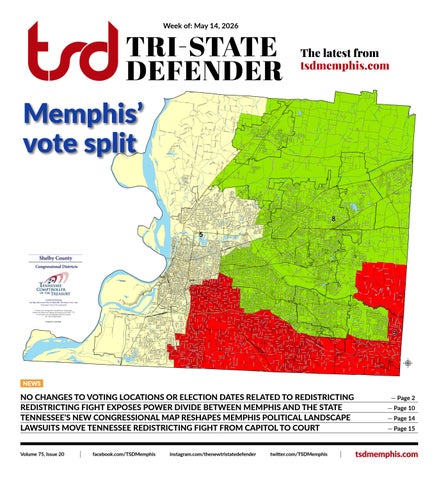
For the August election, precinct boundaries and election dates will remain the same, according to the Shelby County Election Commission. Shelby County voters can visit shelbyvote.com to access the revised maps and the district lookup tool available on the state’s website.
“Obviously, we’d like as much time as we can possibly get, but our office is required to execute elections according to the law; and last week’s redistricting plans present an aggressive timeline for our team, but we will do our job effectively and execute the August election according to the new parameters, unless instructed otherwise,” said Linda Phillips, the Administrator of Elections for Shelby County, Tuesday, May 12. during a media briefing.
Since U.S. Congressional district lines don’t have to follow precinct locations, there are no precinct location changes for the August election related to redistricting, Phillips said.
The commission outlined further guidelines for candidates and voters:
• The new qualifying deadline for the U.S. Congressional seats is Friday, May 15 at noon.
• Anyone who originally qualified to run for the congressional district seat can still run, but they must notify the state coordinator whether they plan to run in the same district or a different district.
• New congressional candidates can pick up a petition from the Shelby County Election Commission, but they must file the petition in Nashville by Friday, May 15 at noon.
• All election dates and times, including early voting and election day, will remain the same.
• The Shelby County Election Commission is ramping up its efforts and updating the website at shelbyvote.com to reflect the following:
• Revised maps are now available
from the home page through a direct link to the state website.
• The district lookup tool has been updated by the state and available through shelbyvote.com. Voters can go online, put in their address and see whether their congressional district has changed.
• The local district lookup tool is expected to be available on the website early next week.
“We have requested and expect to receive about $350,000 from the state that will allow us to pay overtime costs and vendor rush fees, and mail information to voters whose precincts have changed,” Phillips said.
In addition, the Shelby County Election Commission will certify the unofficial May primary election results next Thursday, May 21, during their regular commission meeting.
President Calvin Anderson Editor
Stephanie R. Jones
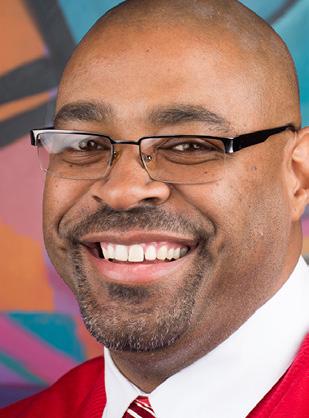
Want a stronger Memphis economy? Start in the classroom
By Chris Coleman Special to the Tri-State Defender
Memphis opened this school year with approximately 300 hundred teacher vacancies. That is not just an education problem. It is an economic development problem.
In his 2026 State of the City address, Mayor Paul Young said of young adults disconnected from work and school: “This is not a talent problem. This is a pathway problem.” He was talking about workforce pipelines. But where do those pipelines begin? They begin in a classroom. They begin with a teacher.
As we mark Teacher Appreciation Week, May 4-8, I want to make an argument that I don’t hear often enough in Memphis’s civic and economic development conversations: Great teaching is not just a social good. It is one of our most important economic development strategies. And right now, we are treating it like an afterthought.
The crisis in our classrooms
At the start of the 2025-26 school year, Memphis-Shelby County Schools opened its doors with more than 300 vacant teaching positions (Daily Memphian, Aug. 1, 2025). Forty days into the school year, 220 vacancies had been filled but not with certified teachers (Chalkbeat, Sept. 11, 2025). The teachers hired are not fully licensed, instead holding conditional permits that expire in three years.
Students in special education, elementary classrooms, and high school math sat without permanent, certified teachers, in some cases for weeks. This is a structural crisis playing out in real time across our city. And every
day a seat goes unfilled by a qualified educator is a day a child falls further behind.
Mayor Young’s Prosper 901 initiative aims to put 5,000 young adults on sustained career pathways by 2030.
These are serious, ambitious goals. But talent pipelines do not start at job fairs. They start with a teacher who affirms a student’s potential and expands what they believe is possible.
What 20 years teaches you
For 20 years, Teach For America Memphis has worked inside this city’s highest-need schools and seen firsthand what great teachers can unlock in students and communities. More than 1,200 educators have served through our corps, reaching more than 60,000 Memphis students.
But the impact that matters most is not measured in our teacher placements. It is measured in what students do next. We have seen former corps members go on to lead school districts, serve as Shelby County Commissioners, sit on the MSCS board, run nonprofit organizations, and build institutions now woven into the fabric of this city.
None of that happens without the teacher who first told them the truth: Their circumstances do not dictate their destiny. While students from low-income communities and students of color often face unequal access to opportunity, those outcomes are not inevitable, and given the clear connection between educational attainment,
workforce participation and economic mobility, we must do better by our kids.
More than a thank-you note
Teacher Appreciation Week is a chance to say thank you, and we should. Teachers in Memphis are doing extraordinary work under extraordinary pressure. They are serving students navigating instability at home, in their neighborhoods, and in the national news. They are doing this without enough colleagues beside them, because hundreds of positions remain unfilled every time the school year begins. Gratitude matters. But gratitude alone will not solve the issues plaguing our education system, and there are meaningful ways that we can contribute to educator support.
The first is on a more personal note. Parents are a child’s first teacher, and that role does not end once a student is school-age. Parents must show up. And when parents show up, they must represent the values and respect they desire their child to exhibit. Real appreciation looks like knowing your child’s teacher by name, showing up to conferences, and reinforcing at-home the habits they learn at school and the unwavering belief that effort matters. When parents send a child to school ready to learn — rested, encouraged, and supported — they give teachers one of the greatest gifts possible. The partnership between parent and teacher is the foundation that ensures a successful education for students.
What changes things at the civic level is treating teacher recruitment and retention like the economic priority it truly is. That means businesses and civic leaders showing up for schools the way they show up for infrastructure
projects and development incentives because an educated workforce is infrastructure. It means philanthropic investment in teacher development programs with proven outcomes. It means employers recognizing that the talent pipeline they depend on was built, student by student, by a teacher they may never meet.
Memphis’s workforce future is won or lost at the front of a classroom, long before a résumé is written or a job offer is extended.
Memphis, this is our moment
Somewhere in Memphis today, a student is in a classroom with the teacher who may change the trajectory of their life.
This week, I’d invite Memphis families, the business community, civic organizations, and elected leaders to ask a simple question: What are we doing (specifically, concretely, and measurably) to ensure that every classroom in this city is led by a great teacher?
Not just this week. Every week. Because every workforce strategy, every economic development plan, and every vision for what Memphis looks like in 2030 runs through that question. The pathways Mayor Young is building for young adults are real and necessary. But pathways are only as strong as the foundation beneath them.
That foundation is a teacher. It has always been a teacher. So to every educator showing up for Memphis students right now, thank you. Not just for what you teach, but for what you make possible: the leaders, builders, and changemakers this city is still waiting to meet.
Christopher Coleman is executive director of Teach For America Memphis.
Chris Coleman
TSD in the Community forum examines health, trust and access in Memphis
By Judith Black Moore TSD Contributing Writer
Human behavior, environment and emotional well-being emerged as defining threads in the Tri-State Defender’s latest community forum on healthcare, where panelists pointed to motivation, support systems and trust in physicians as critical factors in how care is experienced. In an era when internet searches and social media feeds often serve as stand-ins for advice from medical professions, the conversation underscored a more complex reality: that health in Memphis is shaped not only by access to care but by the ability to connect mind, body and resources in everyday life.
“You cannot disconnect the head from the body,” said Dr. Patrick Malone, an internal medicine physician at Regional One Health. “If we value our health, we will take better care of ourselves.”
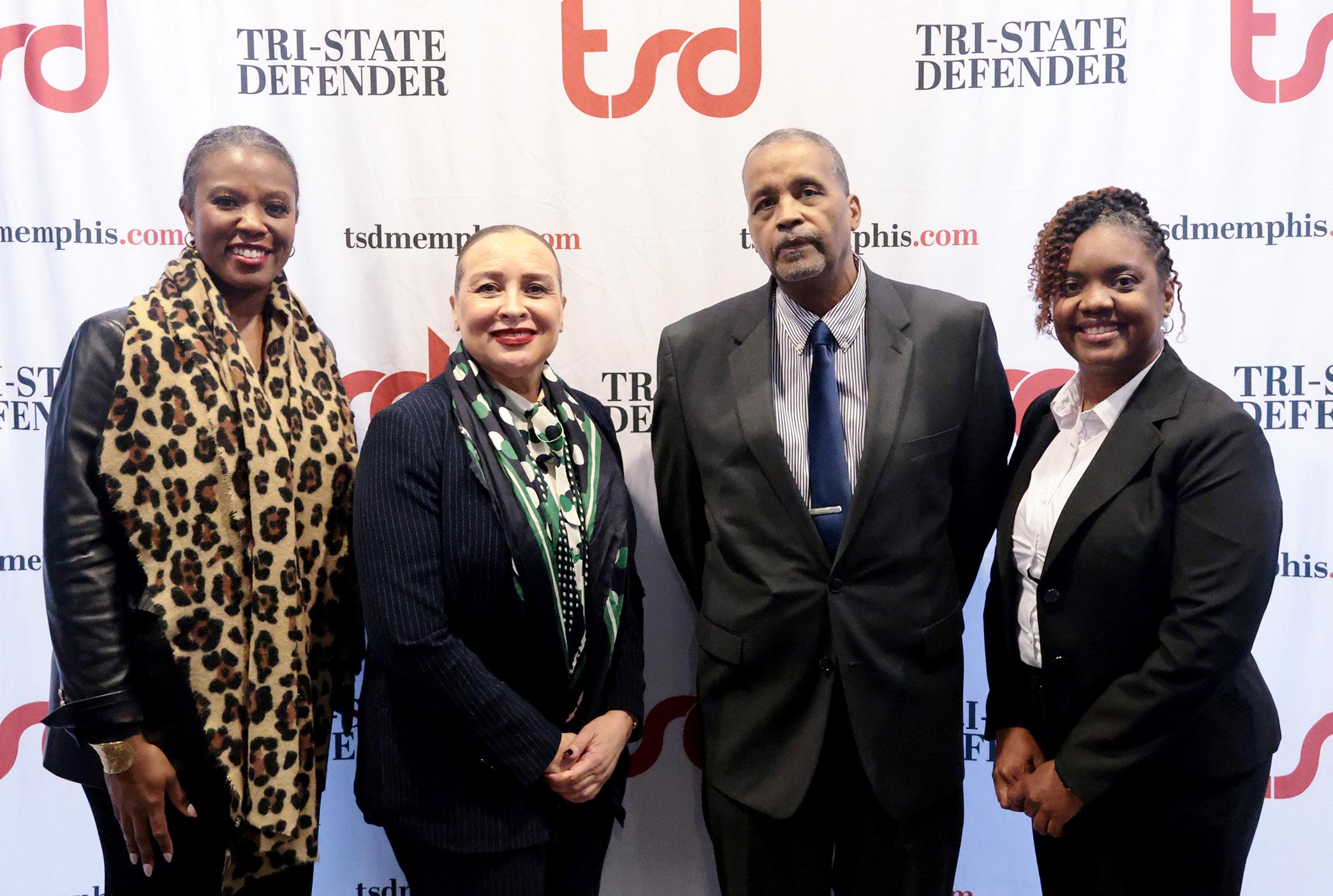
The forum, held at Memphis Health Center on Wednesday, May 6, was moderated by Lori Spicer Robertson and featured Malone, Judge Sheila Bruce Renfroe and Dr. Veronica Gant, clinical director of Memphis Health Center. The discussion was part of the Tri-State Defender’s TSD in the Community series exploring issues impacting Memphis and the Black community.
The idea that mental and physical health are inseparable set the tone for a discussion that moved beyond diagnosis to include environment, access and day-to-day life.
“Some people think if they’re breathing, they’re doing fine,” Gant said. “But what health actually looks like is access — access to healthy food, affordable options, quality sleep and the ability to manage stress.”
Renfroe said what is often labeled as mental health can sometimes be rooted in unmet basic needs.
“Some things that look like mental health issues may not be,” she said. “Sleep deprivation, malnourishment and environmental stress can cause people to act in ways they normally would not.”
Gant expanded on that point, describing how environmental conditions directly affect well-being.
“We know in some neighborhoods people aren’t able to sleep because all they hear is bullets and guns going off all night,” she said. “That affects being able to manage stress.”
Malone brought the conversation back to how those realities present in the exam room, where broader social conditions often surface in personal ways.
“Sometimes the only conversation a person has is when they come to the doctor,” he said. “So, I listen, even though sometimes I get accused of staying with patients too long. But I’ve found if you listen long enough the answers come to you.”
He said time spent with patients is essential to building trust and improving outcomes.
“Many times, all patients need is reassurance. If their blood pressure is always up and they manage to get it down, that is something they can feel good about,” Malone said. “Or when things don’t look good, I try to give hope. Primary care physicians are in a position to help patients take the next steps.”
Renfroe pointed to the long-term impact of unmet needs, particularly on young people.
“A lot of our children are in survival mode,” she said. “We see children fending for themselves, taking on the role of
parents and even becoming providers. That’s why trauma-based support is so important.”
She said mental health challenges exist across a wide spectrum.
Barriers to care such as cost, transportation and lack of information remain persistent.
“Some people just don’t have the knowledge about self-care,” Renfroe said. “But even with (funding) cuts, there are resources. Many are a Google search away.”
Gant emphasized the need for a more coordinated, patient-centered system.
“Patients shouldn’t have to answer the same questions five or six times,” she said. “We need collaboration so people feel comfortable and have a sense of peace.”
Malone said building trust is becoming more difficult as patients increasingly rely on information from social media.
“Social media makes developing trust harder now, especially with younger patients. People come in telling me what they want because they read something on social media or that something
worked for their friend,” he said. “But there’s no one-size-fits-all.”
Malone said primary care includes meeting patients where they are, often by asking open-ended questions and working to understand habits and behaviors.
He said that approach underscores the need for more physicians in primary care.
“There’s a real need for more young people to go into primary care,” Malone said. “There are fewer people going into primary care. It doesn’t pay a lot of money, but we are part of a unified team in position to hear patients and make patients feel comfortable about their care.”
As the discussion closed, the panel returned to a shared understanding: Health is shaped as much by daily conditions and relationships as it is by clinical care.
“Ultimately,” Renfroe said, “you can’t take care of others if you don’t take care of yourself first.”
The next TSD in the Community installment will take place in June and will focus on government.
Panelists gathered for the Tri-State Defender’s TSD in the Community healthcare forum at Memphis Health Center on May 6 to discuss the connections between mental health, access to care, trust in physicians and the everyday conditions shaping health outcomes in Memphis. Pictured from left are moderator Lori Spicer Robertson, Judge Sheila Bruce Renfroe, Dr. Patrick Malone and Dr. Veronica Gant. (Ramon Johnson/TriState Defender)
WLOK names Drew McCraven assistant program director
TSD Newswire
Andrew L. (Drew) McCraven III has been named assistant program director for WLOK radio. He is responsible for assisting in the planning and implementing WLOK’s programs and projects.
“Drew’s longtime experience in the entertainment and marketing industries makes him a great fit for WLOK,” said Art Giliam, president of WLOK.
“He supports our 50-year mission to present broadcast excellence and understands our commitment to the Memphis community.”
McCraven is the owner of Millennial Entertainment, a marketing entertainment and event planning company and 901 PR Firm, specializing in marketing, branding, and public relations.
“When I look at all the legendary DJs who have come through this station, I feel very fortunate and blessed to be
here at WLOK as an on-air personality,” said McCraven.
Since its founding a half century ago, WLOK has been a local broadcast leader offering listeners a wide format of gospel music and talk shows that focus on news and information. WLOK also presents several community events, including the annual WLOK Stone Soul Picnic, and the WLOK Black Film Festival.
Andrew (Drew) McCraven III
By Bri Hatch Chalkbeat
Memphis-Shelby County Schools will require all third grade students to retake state standardized reading tests on the last two days of the school year because of a timing conflict with Tennessee’s data release schedule.
District officials said Thursday, May 7, that they’re implementing a universal retesting because of the high stakes nature of a 2021 Tennessee law that holds back some third-graders who don’t score as proficient on the state test.
The Tennessee Department of Education will release preliminary state testing results on May 20, the day before MSCS closes for summer break. Those late results mean the district wouldn’t have time to determine which students are eligible for retests, which can help underperformers avoid extensive interventions required by Tennessee’s third-grade reading law.
Other school districts affected by extensive winter weather closures earlier this year are also grappling with the same issue. Metro Nashville Public Schools is currently considering its options, a spokesperson said.
Out of “an abundance of caution,” said MSCS Accountability and Data Director Bill White, all 5,450 third graders will spend their last two days retaking the literacy portion of the Tennessee Comprehensive Assessment Program.
“These poor third graders are taking a lot of tests. And we recognize that,” White said. “We want any student who
■■ NEWS
MSCS third graders must retake TCAP literacy tests on last two days of school
may have not been proficient the first time to have the opportunity to hopefully improve their score.”
Retake scores aren’t used in official proficiency data for the district, or in state and federal report cards. But students who pass the second time are exempted from required intervention measures.
Last year, just under 30% of MSCS third graders passed last year’s reading test, known as TCAP. A little over 40% of third graders passed statewide. According to the Tennessee law, all remaining students were required to receive additional tutoring or attend summer school.
Over 150 MSCS third graders were held back last year, and nearly 1,300 were required to attend the district’s Summer Learning Academy, according to an MSCS spokesperson. Around 3,000 students received additional mandated tutoring.
Usually, White said, MSCS uses preliminary data from the Tennessee Department of Education to sift out students who didn’t pass TCAP tests the first time to retake the exams.
Standardized testing was delayed in the district this year because of a February winter storm that shut down classes for two weeks. Educators statewide requested a pushed-back testing schedule, but the state department did not pass a universal schedule change. Districts most affected by the storm, including MSCS, implemented a delay anyway.
“We’re in kind of a scheduling bind,”
“These poor third graders are taking a lot of tests. And we recognize that. We want any student who may have not been proficient the first time to have the opportunity to hopefully improve their score.”
— Bill White
White said. “With a district our size, the amount of data we’re talking about, that’s really not enough time to identify ‘these are the students who need to take it.’”
Liz Marable, who leads one of Memphis’ teacher groups, said district leaders made the only logical choice in retesting everyone.
Marable said no one is happy about subjecting children to more testing. And she worries that attendance will drop off in the final days of school, meaning some students will miss the opportunity to redo.
“But ultimately, it will hurt them if they don’t do it,” Marable said. “So you have to pick the lesser of two evils.”
The last time MSCS mandated retesting for all third graders was in the first year of the Tennessee law, White said. That year, over 25,000 students statewide were retested.
Nashville public schools are in a
similar situation, with their last full day of classes on May 20. In an emailed statement, the district said it’s still considering options for how to move forward.
Amy Maples, MSCS’ director of curriculum and instruction, said the district will offer retesting sites on May 26 and 27 for students who are absent the last two days of school. Most third graders will complete the shortened online version of the literacy test, which doesn’t include a writing portion, on May 20.
“The goal is really to not put any additional hardships on our families,” Maples said.
Bri Hatch covers Memphis-Shelby County Schools for Chalkbeat Tennessee. Reach Bri at bhatch@chalkbeat.org
This story was originally published by Chalkbeat.
Retesting gives Tennessee third graders who didn’t pass reading exams the first time another opportunity to avoid mandatory interventions. (Andrea Morales/Chalkbeat)
■■ COMMUNITY Officials honor county government employees with Mother’s Day jazz brunch
By Judith Black Moore TSD Contributing Writer
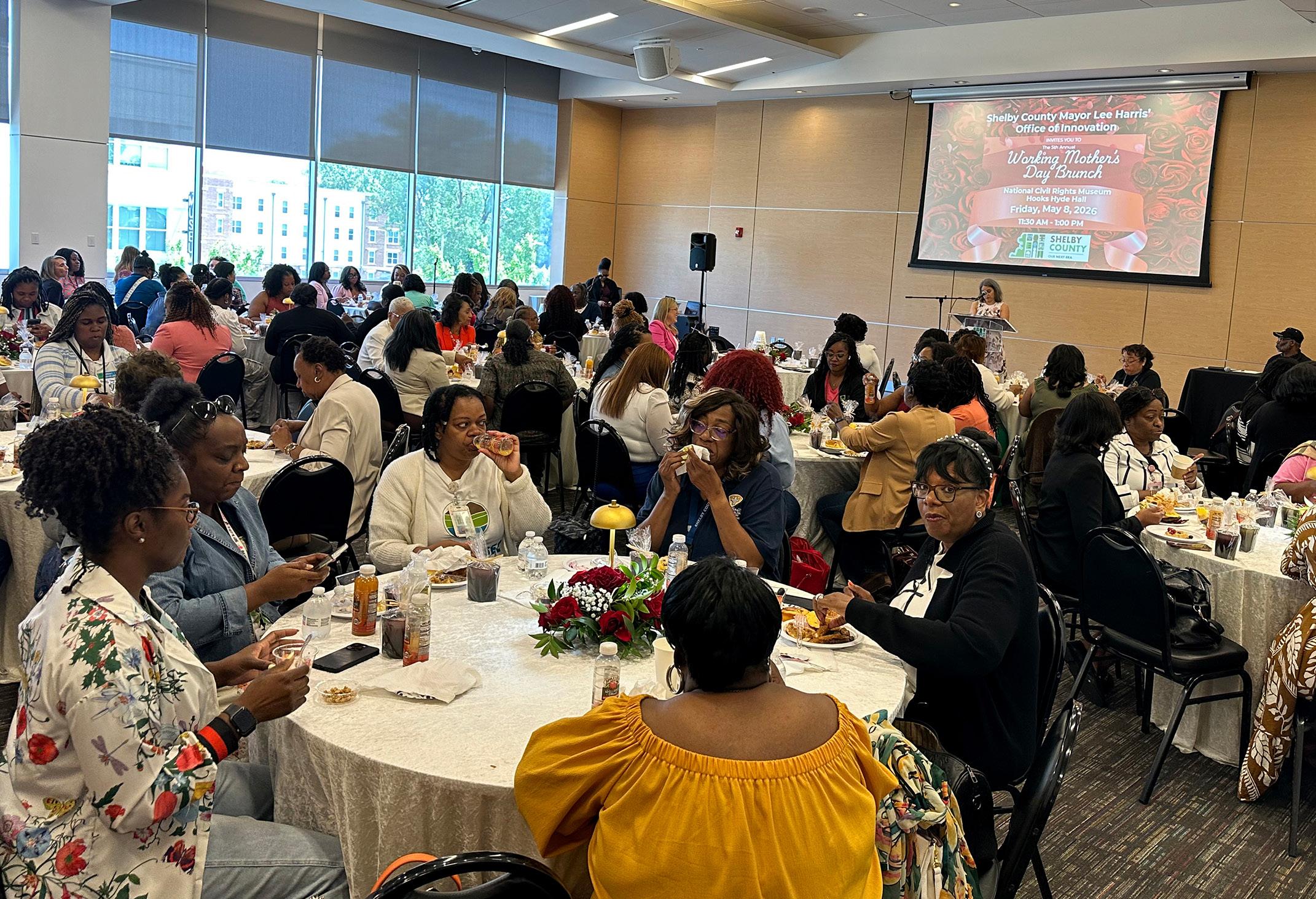
Shelby County Government honored its employees who are mothers, grandmothers and mother figures during the fifth annual Working Mother’s Day Brunch on Friday, May 8, at the National Civil Rights Museum.
Hosted by Shelby County Mayor Lee Harris’ Office of Innovation, the event recognized the contributions of women in public service ahead of Mother’s Day. The program featured remarks, live music and student performances.
Attendees were serenaded during lunch by saxophonist Hope Clayburn. Students from the Overton High School CAPA Department performed a scene from “A Raisin in the Sun” along with a song and dance number.
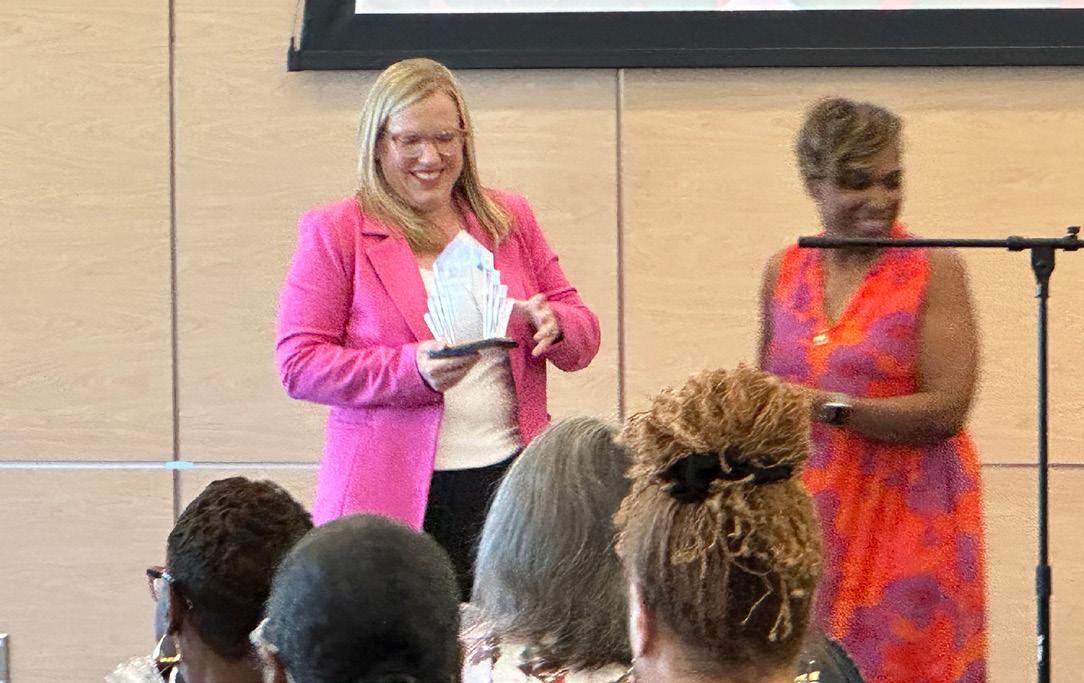
Keynote speaker Lauren Ready, an Emmy Award-winning storyteller and author, encouraged women to embrace both career and motherhood. She was also honored at the conclusion of the event with the Woman of the Year Award.
“I want to remind you that you get to have a wonderful, fulfilling career and still be a mother,” she said. “What do you value? What is important to you, and what do you want to show your child? I found it is okay to want to follow my dream, to have a career and be a mother.”
Deputy Chief Administrative Officer La Sonya Hall also addressed attendees with a message of affirmation, followed by a reading of the poem “Phenomenal Woman” by Maya Angelou.
“I want you to leave today knowing that you are a phenomenal woman,” Hall said.
County officials in attendance included Chief Administrative Officer Harold Collins, Deputy Chief Administrative Officer Dorcus Young-Griffin, and
“I want you to leave today knowing that you are a phenomenal woman.” — La Sonya Hall
Director of Innovation and Strategic Communications Blaire Benavides. Harris said in a statement the event highlights the impact of working mothers across county government and their role in strengthening families and communities.
The Shelby County Mayor Lee Harris’ Office of Innovation recognized the contributions of women in public service at the Working Mother’s Day Brunch on Friday, May 8, at the National Civil Rights Museum. (Photos: Judith Black Moore/Tri-State Defender)
La Sonya Hall, Shelby County deputy chief administrative officer, right, honors keynote speaker Lauren Ready, a storyteller and author, during the Working Mother’s Day Brunch on Friday, May 8.
■■ SPORTS Memphis Grizzlies forward Brandon Clarke, a veteran of 7 NBA seasons, dies at 29
By Tim Reynolds Associated Press
Memphis Grizzlies forward Brandon Clarke has died, the NBA team and his agents announced Tuesday, and a person familiar with the investigation into his death said an autopsy was planned to determine the exact cause.
The 29-year-old Clarke was found dead Monday at a home in the Los Angeles area, and emergency personnel who responded to the scene found drug paraphernalia in the home, said the person, who spoke to The Associated Press on condition of anonymity because those details were not released publicly.
Neither the Grizzlies nor Clarke’s agency, Priority Sports, provided any details about the nature of Clarke’s death.
“We are heartbroken by the tragic loss of Brandon Clarke. Brandon was an outstanding teammate and an even better person whose impact on the organization and the greater Memphis community will not be forgotten,” read a statement from the Grizzlies.
His agents wrote on social media that they were “beyond devastated.”
“He was so loved by all of us here and everyone whose life he touched,” read the statement from Priority Sports. “He was the gentlest soul who was the first to be there for all of his friends and family.”
NBA Commissioner Adam Silver expressed sympathies to Clarke’s family and friends and the Grizzlies organization.
“We are devastated to learn of the passing of Brandon Clarke,” Silver said. “As one of the longest-tenured members of the Grizzlies, Brandon was a beloved teammate and leader who played the game with enormous passion and grit.”
Clarke was the 21st overall pick out of Gonzaga in the 2019 NBA draft by Oklahoma City, which dealt his rights to the Grizzlies.
He was fourth in the 2019-20 Rookie of the Year balloting — his Grizzlies teammate Ja Morant was the overwhelming winner of that award — and was 11th in the NBA’s Sixth Man of the Year voting for the 2021-22 season.
Clarke averaged 10.2 points and 5.5 rebounds in 309 career NBA games.
He averaged 16.9 points in his one season at Gonzaga, transferring there after starting his college career at San Jose State. At Gonzaga, he was a huge part of a team that also had Rui Hachimura — now with the Los Angeles Lakers — and went 33-4.
“He had such a kind, gentle and warm soul, and I will remember the great smile he had on his face whenever
you were around him,” read a statement from Gonzaga and its coach, Mark Few. “BC was one of the most easygoing players we have ever had, and he was part of one of the greatest teams in our program’s history.”
Clarke was arrested April 1 in Arkansas for speeding and possession of a controlled substance that was reportedly kratom, an herbal supplement promoted as an alternative pain remedy that becomes illegal in Tennessee as of July 1. He was released on bond a day later.
Health officials have been warning about the risks of an opioid-related chemical known as 7-hydroxymitragynine and a component of kratom. The plant native to Southeast Asia has gained popularity in the U.S. as an unapproved treatment for pain, anxiety and drug dependence.
A federal report in 2019 found overdose deaths involving kratom were more common than previously reported. Most who died had also taken heroin, fentanyl or others, though officials counted a few instances in which kratom was the only substance listed.
“love you broski. gone way too soon,” Morant wrote in an Instagram post Tuesday.
Clarke joined Morant on the NBA’s All-Rookie team in 2020, and the Grizzlies gave him a multiyear contract extension in October 2022.
But injuries dogged him for more than three years. He tore his left Achilles tendon on March 3, 2023, in a loss to the Denver Nuggets in a showdown of what were then the top two teams in the Western Conference. Injuries limited him to 72 of a possible 246 games over the past three seasons, including only two this season.
“This is an incredible loss for the brotherhood,” the National Basketball Players Association said. “We will remember Brandon not only for the immense joy he brought to so many throughout his career, but for the genuine friendships he built far beyond basketball.”
Clarke was under contract for the 2026-27 season with Memphis, which went 25-57 this season. The San Antonio Spurs paid tribute to Clarke with a moment of silence — both for him and former NBA player Jason Collins, whose death was announced Tuesday — before a playoff game Tuesday night.
Clarke’s “leadership and passion earned him respect throughout the Memphis community and around the league,” the Spurs said.
AP Sports Writers Teresa M. Walker and Anne M. Peterson contributed to this report.
Brandon Clarke started his NBA career in 2019 with the Grizzlies. (Warren Roseborough/Tri-State Defender)
‘Hands Off Memphis!’ Redistricting fight exposes power divide between Memphis and the state
In the face of protests, Tennessee GOP approves Trump-backed map carving up Memphis
By Lee Eric Smith TSD Contributing Writer
The outcome felt inevitable before the first vote was cast. Tennessee’s Republican supermajority moved Thursday to approve a new congressional map that carves Shelby County into three congressional districts, dismantling the Memphis-centered 9th District and reshaping the state’s lone Democratic-held congressional seat to the GOP’s advantage.
Before passing the map, lawmakers gave final approval to legislation repealing Tennessee’s ban on mid-decade congressional redistricting and also passed a bill reopening candidate qualifying until May 15 — a necessary step because the 2026 election calendar was already underway.
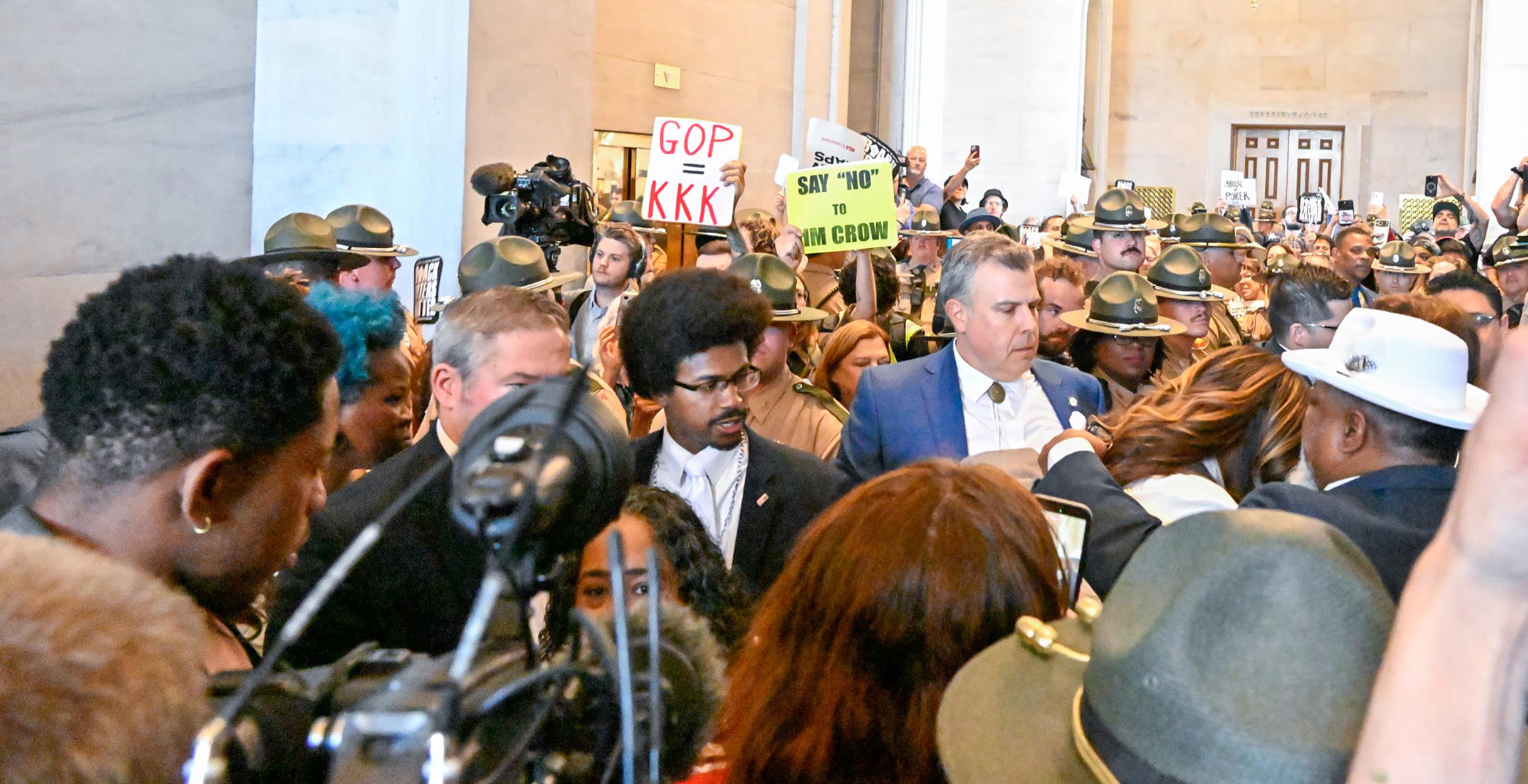
Outside the House and Senate chambers, protesters shouted “No Jim Crow.” As the House voted on the new map, Democratic lawmakers locked arms at the front of the chamber while protesters yelled and made noise.
But the vote did not make the fight meaningless.
As Tennessee lawmakers moved to redraw the state’s congressional map, opponents used every available opportunity — testimony, questions, chants, objections and organizing meetings — to make the record they believe will matter long after the legislative vote. What unfolded this week in Nashville was not simply a redistricting fight. It
was a demonstration of power: who has it, who can change the rules, and what happens when Memphis objects but the state proceeds anyway.
At the center was a Republican-backed map that critics say would dilute Black voting strength in Tennessee’s only majority-Black congressional district. Supporters insisted the map was drawn using “population and politics,” not race. Opponents countered that the racial impact was obvious — and that refusing to say the word did not make it disappear.
The committee hearing that set the stage for Thursday’s vote eventually erupted into chants of “Memphis is Black! No denying that!” and “Hands off Memphis!” before the room was cleared and lawmakers kept moving the bills forward.
Pleading with a machine
During committee meetings on the eve of the final vote, the contrast was stark.
On one side were emotional pleas from Memphis lawmakers, civil rights advocates and activists, warning that the proposal would fracture Black political power and roll back hard-won representation.
On the other was a committee moving through motions, amendments, previous-question motions and vote counts with the steady rhythm of a machine.
House Majority Leader William
Lamberth carried HB7002, the enabling bill that deleted the sentence in Tennessee law prohibiting congressional districts from being changed between apportionments. Before lawmakers could redraw Memphis’ congressional representation, they first had to erase the sentence that said they could not.
Lamberth repeatedly described the measure as modest — “this bill just deletes one sentence” — and said it simply allowed lawmakers to “enter into a conversation.” But the conversation already had a map attached to it.
State Rep. Karen Camper pressed him on whether the legislation removed the prohibition against mid-decade redistricting. Lamberth acknowledged that it did. State Rep. Torrey Harris asked why District 9 needed to be changed if race was not a factor. Lamberth answered that redistricting has always been “a mathematical and a political conversation.”
When House Speaker Cameron Sexton later presented the map bill, HB7003, he used nearly the same language. The map, he said, was based on “population and politics.” No racial data was used. No incumbents were paired.
But when Rep. Jesse Chism asked whether Memphis is predominantly African American, Sexton declined to affirm the demographic reality directly.
“I would refer to you on that,” Sexton said. “That was not used in the drawing of this map.” Asked whether Shelby County is predominantly African American, he again said racial data was not used. Asked whether District 9 is
the state’s only majority-Black congressional district, Sexton said, “I’ll defer to you on your opinion on that.”
For opponents, those answers strained belief. For the committee, they were enough to keep moving.
That became the emotional center of the hearing: Memphis witnesses tried to name what they believed was happening, while Republican leaders insisted the process was lawful, political and race-neutral.
Civil rights attorney Walter Bailey called the proposal “subliminal racism.” Dr. Sekou Franklin of the Tennessee NAACP called it “Black voter dilution on an industrial scale.” U.S. Rep. Steve Cohen said the map split Shelby County’s Black population with suspicious precision — “29% Black, 29% Black, and 30.7% Black” over the three new districts — effectively slicing the Black electorate so it could not control any district.
The words were heated. The process was not. The committee kept voting.
Fighting a fight they expected to lose
That was the second truth of the week: Most opponents knew they did not have the votes.
They fought anyway.
That made the hearings feel less like an attempt to persuade the Republican supermajority and more like a public act of resistance — a fight for the record, for the courts, for history and for Memphis residents watching from home.
The sense of inevitability hung over the proceedings. Republicans had
the votes. Gov. Bill Lee had called the special session. The map had been prepared. The committee calendar had been set. The bills moved with remarkable speed.
But inevitability did not produce silence.
Memphis Democrats kept asking questions. They asked who drew the map. What data was used. Whether race had been considered. Whether Memphis and Shelby County are majority Black. Whether District 9 is the only majority-Black congressional district in Tennessee. Whether election officials could implement new lines after qualifying deadlines had already passed. Many questions did not receive direct answers. But that appeared to be part of the point.
Van Turner, point person for legal matters for the Tennessee Conference NAACP, and others had already
■■ NEWS
suggested that opponents needed to get key facts and objections into the legislative record because the real battle may come later in court. Every question asked — and every answer avoided — could matter if the map is challenged.
Dr. Sekou Franklin, NAACP political action committee chair, explained the legal strategy. He said the state had previously defended the current map as transparent and fair to minority voters, only now to justify overturning that same map. He called the posture “legally schizophrenic.”
He also pointed to the timing of the election calendar, warning that major changes so close to an election could create confusion and administrative burdens — exactly the kind of argument Tennessee officials have used in other cases when resisting election changes sought by civil rights groups. Democrats also noted that the Ten-
nessee Supreme Court rejected a challenge to the current congressional map in 2022 after finding it was too close to the election to make changes. This year, they argued, lawmakers are trying to move even closer to the Aug. 6 primary.
State power, different forms
The redistricting fight also sharpened a larger question that has hovered over Memphis for months: What happens when state power turns toward the city and no branch of government meaningfully checks another?
When Lee sent the National Guard into Memphis as part of his public safety response, Republican lawmakers largely did not challenge the move as executive overreach. Now, in the redistricting fight, the dynamic appears different but familiar.
This time, the Legislature is not being bypassed. It is being activated.
Lee called lawmakers back to Nashville. Republican leaders moved to delete the state-law barrier to mid-decade redistricting. The map bill followed. A separate bill addressed 2026 congressional election rules, acknowledging that the normal election calendar was already underway.
In one instance, the governor moved first and lawmakers did not stop him. In this instance, the governor called on lawmakers and the supermajority moved to change the law itself.
Together, the two moments sharpen the same concern voiced by activists: Memphis is being acted upon by state government, not meaningfully consulted by it.
The state acts. Memphis objects. The state proceeds.
That is why the hearing resonated beyond congressional boundaries. Activists have connected redistricting to other state actions involving Memphis — policing, schools, local control and voting access. To them, the map is not an isolated maneuver. It is part of a governing pattern.
If the law blocks the desired action, change the law. If the calendar complicates the action, change the rules. If the public erupts, clear the room.
Republican leaders argue they are acting within their authority. But authority is not the same as legitimacy. That distinction was at the heart of the chants.
“Memphis is Black! No denying that!” was more than a demographic statement. It was a political claim: that Memphis’ identity, history and voting strength cannot simply be distributed across a map because a supermajority has the votes to do it.
The Tennessee fight is also part of a broader national redistricting battle. Republican-led Southern states are moving quickly after a U.S. Supreme Court decision involving Louisiana weakened a decades-old understanding of the Voting Rights Act, giving Republicans new grounds to challenge or eliminate majority-Black districts that have elected Democrats. Similar efforts
See Page 12
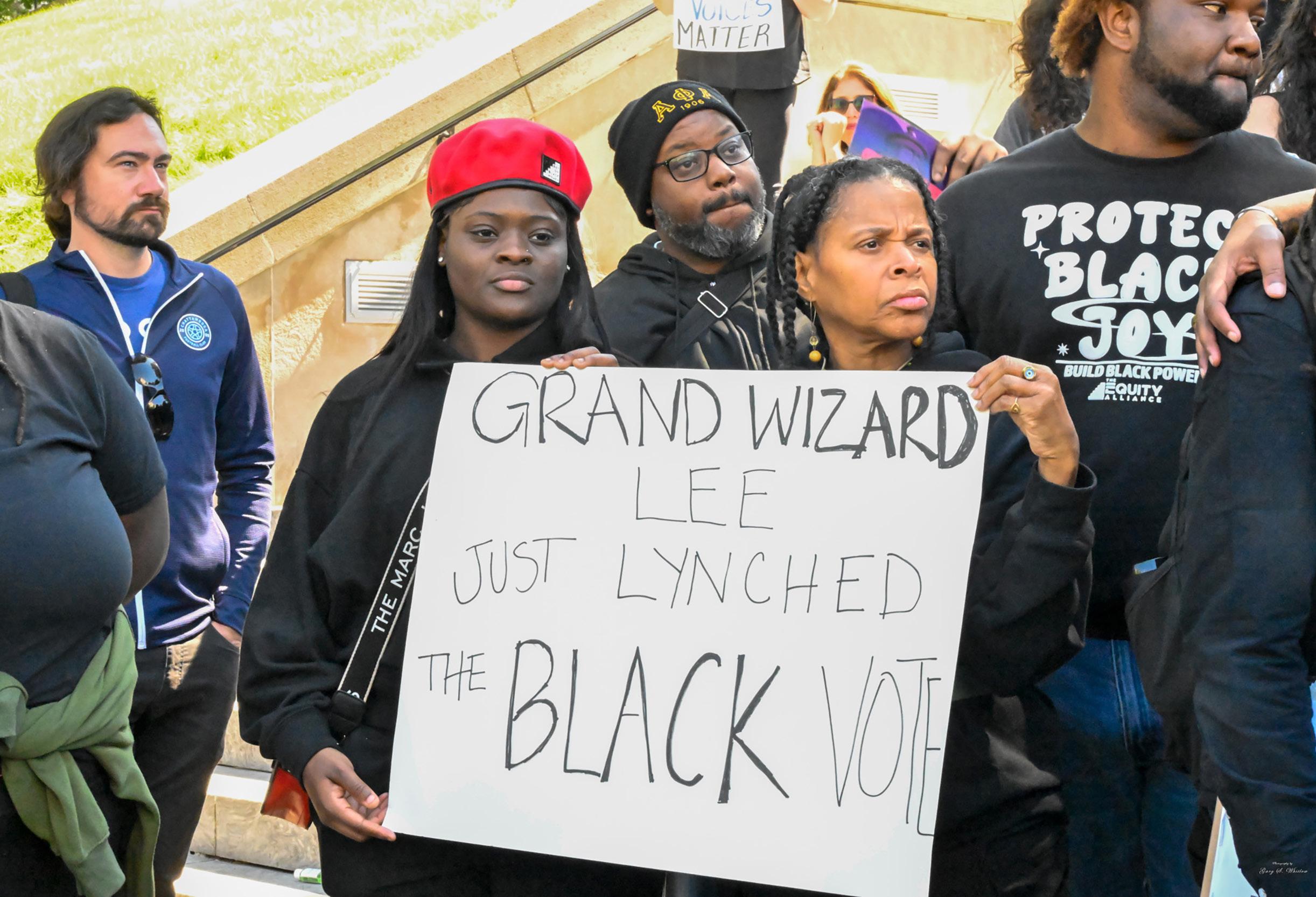
Memphians Jamiah Irby, left, and Kathy B. of The Equity Alliance protest outside the Tennessee Capitol on Thursday, May 7, after lawmakers approved new congressional maps dividing Shelby County into three districts. (Gary S. Whitlow/Tri-State Defender)
From Page 11
are advancing in Alabama and South Carolina.
Building the record
The opposition strategy had multiple audiences.
There was the public audience: Memphis residents, voters, activists, churches and civic organizations being urged to pay attention.
There was the legislative audience: Republican lawmakers who, even if unlikely to change their votes, were being forced to hear objections in public.
And there was the judicial audience: future judges who may one day read the record and ask how this map came to be.
That is why the repeated questions about race mattered. Lamberth and Sexton’s insistence that racial data was not used may become one side of the legal argument. Cohen’s claim that Black voters were divided almost evenly among three districts may become the other.
That is why the procedural objections mattered. After chants erupted and the committee continued voting, Rep. Bo Mitchell put on the record that he and several colleagues could not hear what was being voted on.
“We did not hear any of the call for the vote or any of those previous votes,” Mitchell said. “We had no idea what was being voted on.”
That is why Sherman’s testimony mattered. She gave the public-facing argument with unusual clarity.
“That means voters pick our leaders, not the other way around,” Sherman said. She accused lawmakers of being “consumed fixing the results of elections to hoard power.”
In the moment, her words may not have changed the vote. But they helped define the fight.
The record now includes the speed of the special session, the deletion of the state-law guardrail, the refusal to directly acknowledge Memphis’ racial demographics, the testimony of civil rights advocates, the warnings about election confusion, the clearing of the
■■ NEWS
room and the protests of lawmakers who said they could not hear the vote.
That may be the most important victory available to an outnumbered opposition: not stopping the bill in committee, but making sure the process cannot later be described as quiet, uncontested or ordinary.
After the hearing, organizing
The confrontation did not end when the hearing room was cleared.
Afterward, activists regrouped at First Baptist Church Capitol Hill, shifting from protest to next-step organizing ahead of the final vote.
There, Rachel Spriggs, director of power building for The Equity Alliance, framed the redistricting fight as part of a broader pattern of state intervention in Memphis.
“I’m emotionally tired right now,” Spriggs said. “Because the moment they see our power working, they see people’s power working, they change the rules.”
Spriggs argued that Memphis has become a testing ground for state power, connecting the redistricting push to earlier fights over schools, policing and local control.
“The moment is now,” she told the room. “We are under attack. The Black vote is under attack.”
Closing arguments before the vote
On the House floor, as lawmakers neared the final vote on HB7003, Democrats were no longer expecting Republicans to be persuaded. They were pressing contradictions into the record: census data or partisan data; population or politics; race-neutral process or racially precise result.
Moments later, the emotional appeals continued. Rep. Johnny Shaw recalled how his father registered to vote but “never got a chance to vote,” forcing the family to move to a government tent city.
Rep. Antonio Parkinson said Memphis is “the center of Black life in Shelby County and in Tennessee” and questioned whether the city should remain part of a state that benefits from its people while weakening their political power.
Rep. Torrey Harris said plainly what the debate had circled for days: “We all know it, whether we say it or not, that this map impacts Black people negatively.”
And as he is known to do, Rep. Justin J. Pearson delivered a fiery condemnation of the legislation,calling the maps “racist tools of white supremacy,” saying the legislation was designed to attack, target and “crack District 9 into pieces for more political and racial dominance.”
But he ended not with defeat, but defiance.
“This state has legislated and legalized the worst things in humanity, including our enslavement, and we are still here,” Pearson said with the cadence of a preacher. “You put us on cotton plantations and tobacco plantations, denied our human rights and our right to exist as children of God, and we are still here.”
Then, looking beyond the vote itself, Pearson spoke to future generations.
“Today you’ll take the only majority-Black district from us,” Pearson said, as protesters in the crowded hallways shouted in agreement. “But I want you to know — and I want my nephews, sons and the future to know — no matter what you do, no matter how much you try and break us and make us bend and make us quit . . .
“WE WILL STILL. BE. HERE!”
State Reps. Justin J. Pearson, left, and Jason Powell speak after the Tennessee Legislature approved new congressional maps for District 9 on Thursday, May 7, in Nashville. (Gary S. Whitlow/Tri-State Defender)
TENNESSEE
TENNESSEE
U.S. Congress
U.S. Congress
Districts Adopted May 7, 2026
“They want to diminish the Black voter base of Memphis for the benefit of the Republican Party.”
— Steve Cohen
Tennessee’s new congressional map reshapes Memphis political landscape as legal fight intensifies
By James Coleman TSD Contributing Writer
If the new District 9 maps recently drawn up by state Republicans withstand legal scrutiny, voters in Memphis and Shelby County could be in store for historic results come November.
Congressional maps were recently redrawn by Republican lawmakers during a special session called at the request of Republican Gov. Bill Lee last week.
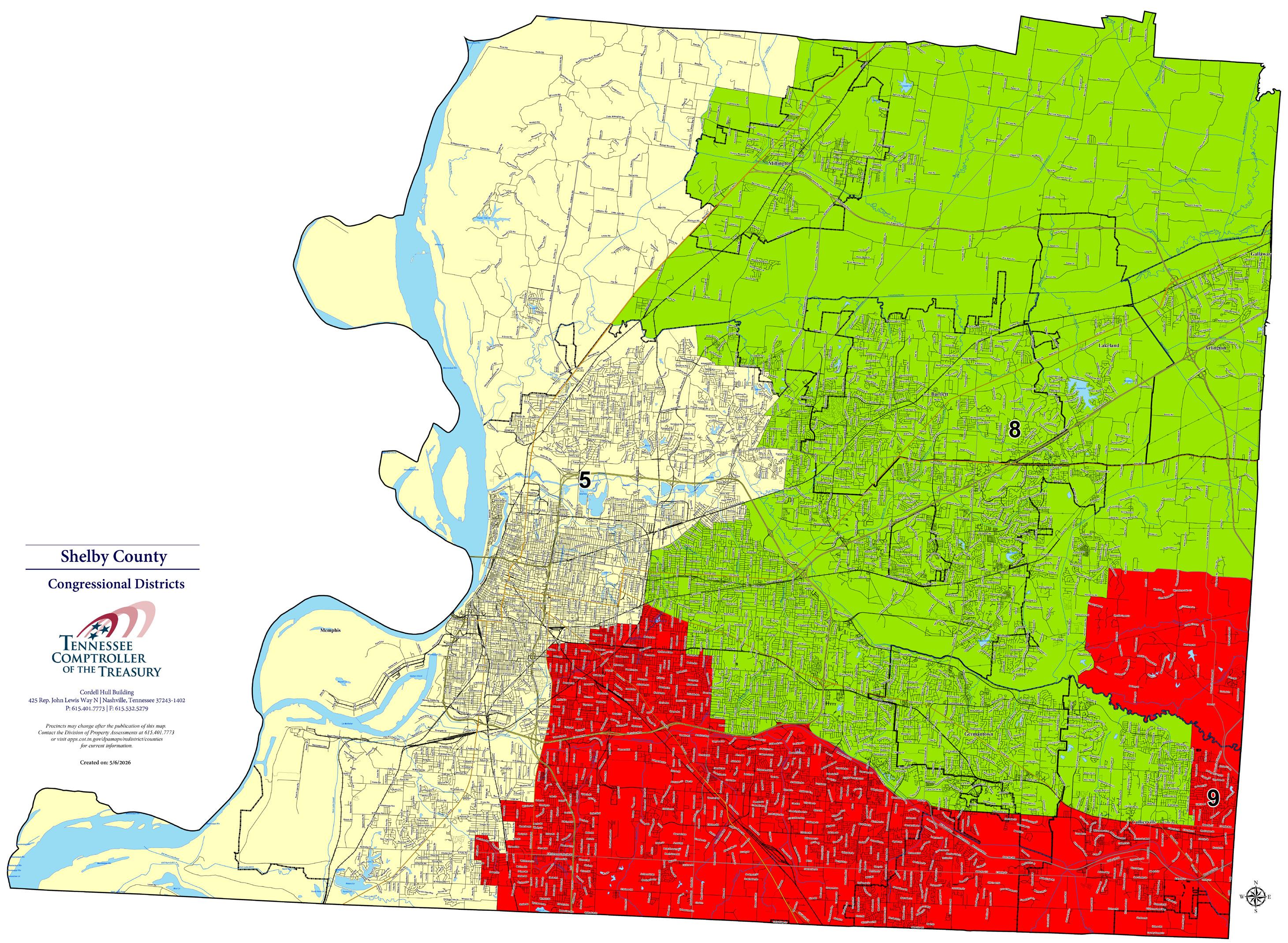
Critics argue the lines were crafted to end the Democratic Party’s dominance in the state’s only district with a majority Black population. The overhaul also splits Shelby County among three congressional districts — the 5th, 8th and 9th — ending decades of Memphis-centered representation under a compact urban district. Republicans currently hold a 8-1 delegation lead.
“They want to diminish the Black voter base of Memphis for the benefit
of the Republican Party,” condemned District 9 Rep. Steve Cohen.
Created following the 1980 census, District 9 has been represented by a Democrat in Congress for the entirety of its 45-plus years. Cohen was first elected in 2007.
The effort follows a recent U.S. Supreme Court ruling involving Louisiana congressional districts that critics say weakened protections under the Voting Rights Act and opened the door for states to pursue new redistricting efforts.
The Voting Rights Act of 1965 bans discriminatory voting practices adopted in many Southern states during the Jim Crow era. These include poll taxes, literacy tests and racial gerrymandering.
Cohen, the Tennessee NAACP, the state Democratic Party and the ACLU have sued to stop the new maps from being implemented. If that fails, District 9 will significantly increase in size.
Gone is the compact urban district.
The boundary currently makes up almost 770 square miles. It encompasses the urban core of Memphis and some of its suburbs. This includes splitting representation of citizens of Bartlett, Collierville and parts of Memphis with District 8. District 9 also includes all of Millington.
It also stretches into nearby Tipton County, including Burlison, Garland, Gilt Edge, Munford and Randolph. Cohen also represents parts of Atoka, Brighton and Covington with his District 8 counterpart, Dave Kustoff-R.
Under the new map, only the southern edge of the district near the Mississippi border remains largely intact. But the new District 9 no longer reaches the Mississippi River. That land belongs to District 5. The remainder of the old boundary was split between District 5 and District 8.
The new lines extend over 200 miles from Memphis. In fact, the new
boundary is so expansive it connects Bluff City with Nashville. In addition to Shelby County, lawmakers included 14 counties that run along the border with Mississippi.
The new lines will radically alter demographics too. Over 60% of the population within the current boundary is Black, followed by 25% White. Hispanics and Asians largely make up the rest of the racial mix, at 9% and 2% respectively.
Every new county included in the district is majority white. Furthermore, most are predominantly so. Eastern portions of the redrawn district include Williamson County. The Nashville suburb is the wealthiest county in the state. Shelby County ranks about 27th to 29th in wealth out of the state’s 95 counties.
The effort has not only endangered Cohen’s seat, but the ambitions of
Tennessee’s newly approved congressional map redraws District 9 into a sprawling region stretching from Memphis toward Middle Tennessee, splitting Shelby County among three congressional districts as part of a Republican-led redistricting overhaul.
From Page 13
another local politician. State Rep. Justin Pearson is currently running in the 2026 Democratic primary to unseat Cohen. Under the newly drawn map, both Cohen and Pearson now reside outside the reconfigured 9th District boundaries, though both have indicated they still intend to run in the district if the maps survive court challenges.
The outspoken lawmaker verbally confronted conservative colleagues — and state police — during a protest at the state Capitol after the vote.
Candidates now face a compressed timeline to decide whether to remain in their current races, switch districts or relocate while multiple lawsuits challenging the maps remain unresolved. They have until noon Friday, May 15, to withdraw from or qualify for races under the newly adopted district lines unless a court intervenes.
Despite the legal uncertainty, several candidates have already begun positioning themselves under the new district lines. State Sen. Brent Taylor has pulled a petition to run in the Republican primary for the reconfigured 9th District, while state Sen. London Lamar has explored a Democratic bid. Outgoing Shelby County Criminal Court Clerk Heidi Kuhn has pulled a petition in the newly redrawn 8th District, and Memphis City Council member Yolanda Cooper-Sutton has taken steps toward a Democratic run in the new 5th District.
For the most part, Republicans from the local level all the way to the White House appear supportive of the
■■ NEWS
“Tennessee’s new congressional map has created an opportunity to deliver a strong Republican voice to Congress and secure a brighter, safer and more conservative future for our state and our country, and I’m ready to be that leader.”
— Brent Taylor
pre-census overhaul. President Trump has been supportive of every Republican effort. So have many of his MAGA allies.
“I urge our state legislature to reconvene to redistrict another Republican seat in Memphis. It’s essential to cement (Trump’s) agenda and the Golden Age of America. I’ve vowed to keep Tennessee a red state, and as governor,
I’ll do everything I can to make this map a reality,” wrote Tennessee Sen. Marsha Blackburn.
The second-term senator is currently running in the GOP 2026 gubernatorial primary to succeed Lee.
Closer to home, some seem downright giddy. Taylor announced his decision to run immediately after the redistricting vote on Thursday, May 7.
The Eads Republican sponsored the Senate version of the law, SB7004.
“Tennessee’s new congressional map has created an opportunity to deliver a strong Republican voice to Congress and secure a brighter, safer and more conservative future for our state and our country, and I’m ready to be that leader,” Taylor said.
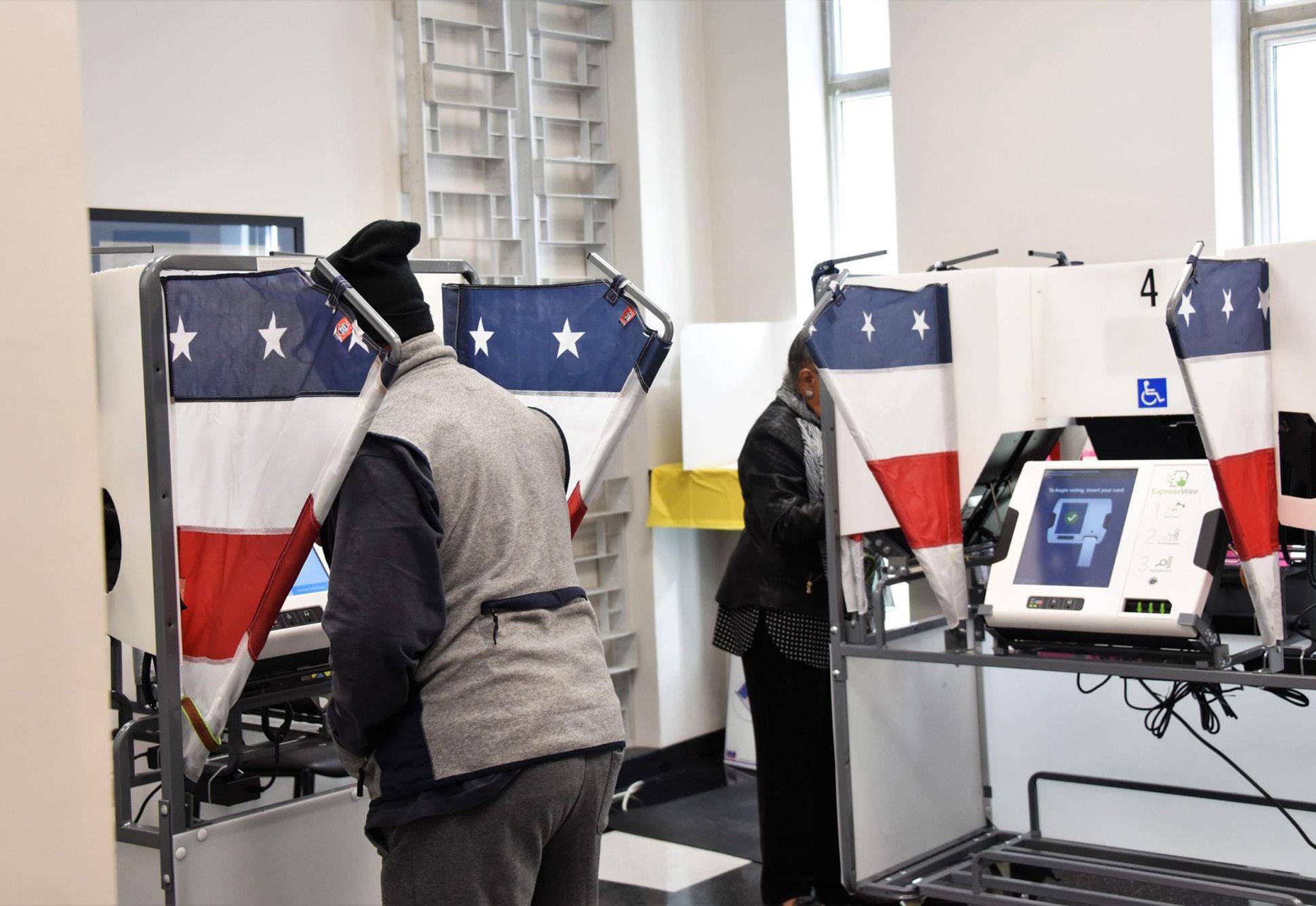
Shelby County voters cast ballots during a previous election cycle. Tennessee’s newly approved congressional map could significantly reshape representation for Memphis-area voters beginning with the 2026 elections. (Gary S. Whitlow/Tri-State Defender)
Lawsuits move Tennessee redistricting fight from Capitol to court
NAACP Tennessee and Democratic plaintiffs challenge new congressional map, arguing lawmakers moved unlawfully and too late in the election cycle
By Lee Eric Smith TSD Contributing Writer
The fight over Tennessee’s new congressional map has moved from the Capitol to the courthouse.
Within hours of Gov. Bill Lee signing a Republican-backed redistricting package into law, two lawsuits were filed challenging the state’s move to redraw most of Tennessee’s congressional districts in the middle of an election year — including the Memphis-centered 9th District, long the state’s only majority-Black congressional district.
The legal challenges follow a raucous special session in which Republican lawmakers repealed Tennessee’s long-standing ban on mid-decade congressional redistricting, reopened candidate qualifying until May 15 and adopted a new map that splits Shelby County among three congressional districts.
Together, the lawsuits reflect the same two-track argument opponents made throughout the special session: first, that the Legislature had no legal authority to do what it did; and second, that even if it did, the state is changing too much, too late.
NAACP: Redistricting was unlawful
The Tennessee State Conference of
the NAACP and its president, Gloria Sweet-Love, filed an emergency petition in Davidson County Chancery Court seeking declaratory judgment and injunctive relief. The petition names the governor and the General Assembly as respondents and argues that the state engaged in “unlawful late-decade congressional redistricting” in violation of Tennessee law and the Tennessee Constitution.
At the center of the NAACP petition is Tennessee Code Annotated Section 2-16-102, which, until lawmakers repealed it during the special session, stated that congressional districts “may not be changed between apportionments.”
The NAACP argues that because Tennessee’s congressional districts were already redrawn after the 2020 census, lawmakers were barred from changing them again in 2026.
The petition also argues that Lee’s proclamation calling the special session did not specifically authorize lawmakers to repeal that ban or suspend residency requirements for congressional candidates.
Under Article III, Section 9 of the Tennessee Constitution, when the governor calls lawmakers into extraordinary session, the proclamation must state the specific purposes for which they are convened, and lawmakers
“shall enter on no legislative business except that for which they were specifically called together.”
The NAACP contends the proclamation mentioned the composition of congressional districts and statutory changes needed to effectuate new maps, but did not specifically mention repealing Section 2-16-102 or suspending the one-year residency requirement for candidates.
“The districts may not be changed between apportionments,” the lawsuit quotes from the former statute.
The petition asks the court to declare that the repeal of the mid-decade redistricting ban is void, that the suspension
of residency requirements is void and that any redistricting arising from the special session is also void.
In plain terms, the NAACP is asking the court to stop the state from using the new map.
TN Dems: Too much confusion, chaos with elections underway
A separate federal lawsuit was filed in the U.S. District Court for the Middle District of Tennessee by voters, Democratic candidates and the Tennessee Democratic Party.
Plaintiffs include voters Vicki Hale, See Page 16
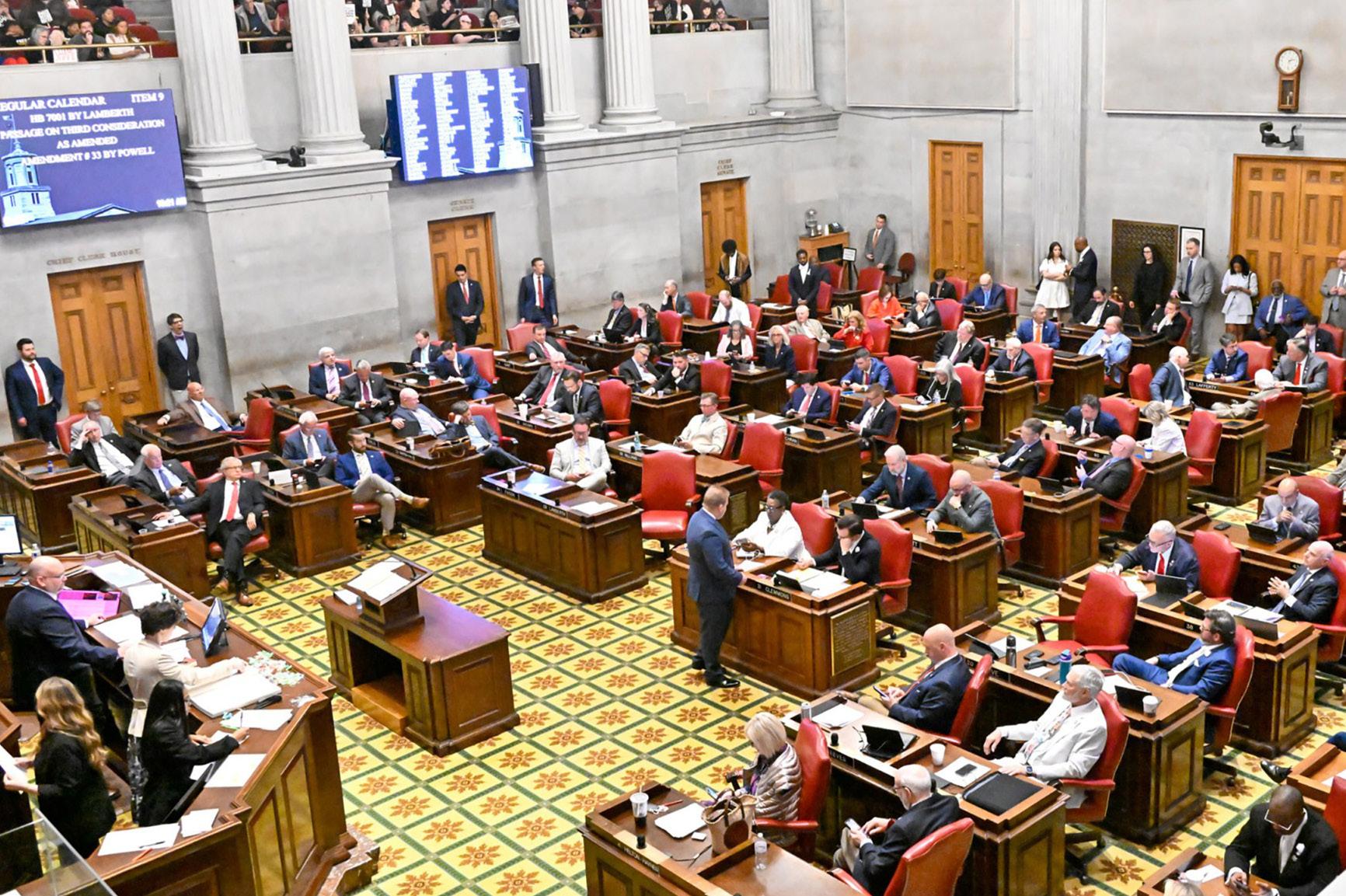
Tennessee lawmakers gather on the House floor during a special legislative session that led to the passage of a new congressional redistricting plan now facing multiple legal challenges in state and federal courts. (Gary S. Whitlow/Tri-State Defender)
■■ NEWS
From Page 15
Earle Fisher, Telise Turner and Hedy Weinberg; candidates U.S. Rep. Steve Cohen, Columbia Mayor Chaz Molder, Chaney Mosley and state Rep. Justin J. Pearson; and the Tennessee Democratic Party.
That lawsuit names Lee, Secretary of State Tre Hargett and Tennessee Coordinator of Elections Mark Goins as defendants in their official capacities.
Unlike the NAACP lawsuit, the federal complaint says it is not directly challenging the apportionment decisions themselves. Instead, it asks the court to block implementation and enforcement of the new laws for the 2026 election cycle, arguing that the rushed changes burden voters’ constitutional rights to vote and candidates’ and voters’ rights to political speech and association.
The federal lawsuit focuses heavily on timing.
Before the new law, the candidate qualifying deadline for the August congressional primary was March 10. The redistricting package moved that deadline to May 15. It also changed withdrawal deadlines, created a “special qualifying period,” suspended the residency requirement for 2026 congressional candidates and altered notice requirements for voters.
The lawsuit argues that the new timeline creates the very election chaos state officials previously warned against. In 2022, when litigation challenged Tennessee legislative districts, Lee, Hargett and Goins opposed moving election deadlines deeper into the calendar. In that case, known as Wygant v. Lee, state officials argued that “changing the rules on the eve of an election would wreak chaos upon the electoral process” and risk voter confusion and disenfranchisement, including for military and overseas voters.
The federal complaint notes that those arguments were made more than six weeks earlier in the election calendar than the May 7 enactment of the new congressional redistricting package.
The lawsuit also points to sworn affidavits from election officials in 2022, including Shelby County Administrator of Elections Linda Phillips, who warned that moving qualifying deadlines later could prevent election offices from meeting federal deadlines for mailing ballots to military and overseas voters.
According to the federal complaint, those same election concerns apply now — but with even less time.
The plaintiffs argue that election officials must now deal with new district lines, revised candidate deadlines, voter assignments, ballot styles, notices, ballot preparation, voting machine programming and overseas ballot requirements before the Aug. 6 primary.
The federal lawsuit asks for temporary and permanent injunctions preventing the state from implementing the new map and election changes during the 2026 cycle.
Strategic opposition
For opponents of the map, the lawsuits are the next phase of a fight they began building even before final votes were cast.
During committee hearings and floor debate, Memphis lawmakers repeatedly pressed Republican leaders on why the map was being redrawn now, whether race was considered, how election officials could implement changes in time, and whether lawmakers were creating the same kind of confusion the state had warned against in earlier litigation.
Republican leaders defended the map as legal and said it was drawn using population and politics, not racial data. They also argued that lawmakers were acting within their authority after Lee called the special session.
But with the filings now in state and federal court, the question shifts from whether Republicans had the votes to pass the plan to whether the courts will allow it to stand.
For Memphis, the stakes remain the same: whether the state can carve the city’s political voice into three congressional districts before voters head to the polls this summer.
PUBLIC NOTICES / CLASSIFIEDS
LEGAL NOTICE Request for Bids
MSCAA Project Number 18-1413-04
TW Bravo Hot Spot 1 – Construction
Sealed bids for TW Bravo Hot Spot 1 – Construction will be received by the Memphis-Shelby County Airport Authority (Authority), Procurement Department, 4150 Louis Carruthers Drive, Memphis, TN 38118, until 2:00 PM Local Time on 6/9/2026. Bids will not be received at any other location. Within 30 minutes thereafter, the bids will be opened and publicly read via phone/ video conference
Bid Opening Virtual Link https://teams.microsoft.com/ meet/269090313342209?p=AF10Cler2QydIouCs6
The Bid Documents, including a description of the scope of work, the required response format, and additional instructions may be obtained on or after 5/11, 2026 online at www.flymemphis. com
A Virtual Pre-Bid Meeting will be held on Tuesday, May 19, 2026, at 11:00 AM local time via the phone/video conference links below:
Pre-Bid Meeting Virtual Link https://teams.microsoft.com/ meet/269090313342209?p=AF10Cler2QydIouCs6
Instructions on Pre-Bid Meeting and Site Visit request can be found at https://www.flymemphis. com/rfps-rfgs. Attendance at the Pre-Bid Meeting is strongly recommended.
All Bidders are responsible for checking the Authority’s website up to the submission deadline for any updates, addenda or additional information. The successful Bidder must sign a contract with the Authority that includes Federal Aviation Administration provisions, if applicable, regarding the Buy American Preference, Foreign Trade Restriction, Davis-Bacon, Affirmative Action, Debarment and Suspension, and Drug-Free Workplace, all of which are incorporated herein by reference.
Each bid must be made by a contractor licensed in Tennessee and be accompanied by a 5% Bid Guarantee. The successful bidder must execute a Performance Bond and a Payment Bond in the amount of 100% each of the Contract Price and meet the Small Business Participation (SBP) Program participation goal for this project, which is 18%.
The Authority reserves the right to reject any or all responses to this Request for Bids in whole or in part; to waive any informalities, technicalities, or omissions related to this Request for Bids; and to reject responses on any other basis authorized by the Authority’s purchasing policies. The Authority is an equal opportunity employer and prohibits discrimination based on the grounds of age, race, sex, color, national origin, disability, marital status, military service, or sexual orientation in its hiring and employment practices and in the admission to, access to, or operation of its programs, services, and activities. By order of:
Terry Blue, A.A.E. President and CEO Memphis-Shelby County Airport Authority
Floetry reunion tour brings neo-soul nostalgia and sold-out energy to Memphis
By Ancelious Meeks TSD Contributing Writer
At a time when nostalgia tours are dominating the live music scene, the Floetry reunion felt less like a throwback and more like a reminder of the lasting power of R&B and neo-soul.
Fans packed the Orpheum Theatre on Thursday, May 7, for the Memphis stop of “Floetry Presents: Say Yes The Tour,” featuring opening performances from Teedra Moses and Raheem DeVaughn before headliner Floetry took the stage for their highly anticipated reunion performance.
Presented by BMN Entertainment, the nearly sold-out show placed soulful vocals, spoken word and emotional storytelling at the center of the evening. With DJ Aktive handling music between sets, the atmosphere inside the historic venue remained energized throughout the night as concertgoers sang along and danced to R&B classics.
Teedra Moses’ opening performance leaned heavily on live vocals rather than backing tracks, showcasing the voice that helped establish her as one of R&B’s most respected songwriters. She performed songs including “Be Your Girl,” “Take Me” and “You Better Tell Her,” drawing strong reactions from the audience. Her smooth delivery and confident stage presence reflected the same style that first earned her recognition in the early 2000s.
Raheem DeVaughn followed with a set that blended romance, humor and social awareness. Early in his performance, the Grammy-nominated artist joked that men should feel comfortable attending his concerts because he is “not Mr. Steal Your Girl” but “Mr. Make You Feel Your Girl.”
The audience responded enthusiastically as he performed fan favorites including “Guess Who Loves You
More” and “You.” During “Customer,” DeVaughn moved through the crowd handing out roses, and even grinding on a few women, drawing cheers from the whole theater. DeVaughn knew how to keep the crowd engaged for sure, from squeezing a towel drenched with water to make the crowd have a visual representation of some of the words he was singing in his song, to pouring water in fans mouths, he kept the women screaming and wanting more.
Beyond the music, DeVaughn also used part of his set to address rising HIV and AIDS rates among Black women. He encouraged attendees to get tested and support organizations providing resources and outreach. He said his foundation, in partnership with Gilead Sciences, has helped more than 10,000 Black women gain access to HIV and AIDS testing.
The night’s most anticipated moment came when Marsha Ambrosius and Natalie “The Floacist” Stewart reunited onstage as Floetry, drawing a standing ovation from the crowd before launching into songs from their platinum-selling debut album, “Floetic.”
As the duo performed songs including “Ms. Stress,” “Hey You,” “Butterflies” and “Say Yes,” the audience appeared fully immersed in the group’s signature blend of poetry and soul. Their chemistry and emotional delivery reminded longtime fans why Floetry became one of the defining acts of the neo-soul era.
Ambrosius and Stewart performed with the warmth and intimacy that originally defined the group’s live performances, creating an atmosphere that felt both reflective and deeply personal for many in attendance.
The “Say Yes Tour” has been promot-
ed as an experience designed to present Floetry’s music in its most intimate and emotionally connected form, and Thursday’s performance delivered on that promise.
The concert also continued a strong run for BMN Entertainment, which has brought a variety of national tours and legacy acts to Memphis in recent years, including major comedy and music events.
By the end of the night, the response inside the Orpheum made one thing evident: neo-soul and contemporary R&B continue to resonate deeply with audiences, and the artists who helped define the genre remain capable of commanding the stage decades later.
Marsha Ambrosius and Natalie Stewart reunite onstage as Floetry during a sold-out performance at the Orpheum Theatre, celebrating the group’s influential blend of neo-soul, poetry and R&B. (Photos: Ancelious Meeks/Tri-State Defender)
Raheem DeVaughn performs during the Memphis stop of the “Floetry Presents: Say Yes The Tour” at the Orpheum Theatre, delivering a crowd-pleasing set filled with romance, humor and fan favorites.
A Terrible Intimacy explores the courtroom dramas and human contradictions of slavery-era America
Book review
By Terri Schlichenmeyer
Time served.
If you’ve ever faced a judge in a courtroom, that can be good to hear. A few hours in a concrete room, maybe an uncomfortable overnight, done. It’s not fun, it might be embarrassing, but it’s over and you move on, chastised. Unless, as in the new book “A Terrible Intimacy” by Melvin Patrick Ely, time served was a lifetime.
When you think about slavery, the image of large fields and households full of enslaved people probably comes to mind.
That, says Ely, isn’t the whole story. In the years prior to the Civil War, he says, roughly “one-quarter of America’s enslaved people lived on large plantations with fifty or more forced laborers…” Another 25% percent dwelt on smaller plantations with slightly fewer enslaved people.
The rest — about half of this country’s enslaved people — lived on small farmsteads. In fact, households that held five or fewer enslaved people “were very numerous.”
This, Ely says, meant that slaveholders were very familiar with those they held in bondage, and they likely knew those held by their neighbors. They might have attended church with enslaved people, or sought medical help from an enslaved Black doctor.
“Trade across racial lines was frequent,” he says, “shared recreation not rare.”
Such “intimacy” sometimes led to looser rules for enslaved people. It also led to a surprise: “An enslaved person charged with a crime in Virginia, and
in the South generally, would have had legal representation.”
A Black man named Tom, for example, was accused of killing an overseer in a fight — but was the fight cloaked in a whole other matter? Nancy Morgan was viciously murdered by a “negro” named Solomon — or was she nothing more than “a wayward, shiftless pauper?” Mary Tatum accused George of rape. Was it a case of mistaken identity?
And when Hillery Richardson was mortally wounded by William, the jury had to decide: Who was really the victim?
So you say you’re a big fan of mysteries. Nothing like a good whodunit, right? Then check out “A Terrible Intimacy” and see if it doesn’t fit just perfectly.
Because it will. Reading author Melvin Patrick Ely’s work is like having Matlock on the sofa by you, and Easy Rawlins next to her. It’s part courtroom procedural, with a historical angle that Ely is studiously careful to explain, and the kind of excitement you’d expect from life-or-death testimonies — a few shockers and some heartbreak. Readers will clearly understand Ely’s obvious excitement in teasing apart these tales — they are, after all, things that happened to real people in real court cases, presented with a shared knowledge of 19th-century vocabulary, slang culture and filled-in-the-blanks for deeper understanding. If you feel like a real sleuth while you’re reading, you’re not far off. This is a book well-told by a great storyteller, and if you’re a fan of courtroom-thriller novels or historical events, you won’t be sorry to find it. Start “A Terrible Intimacy” and it will serve you well.
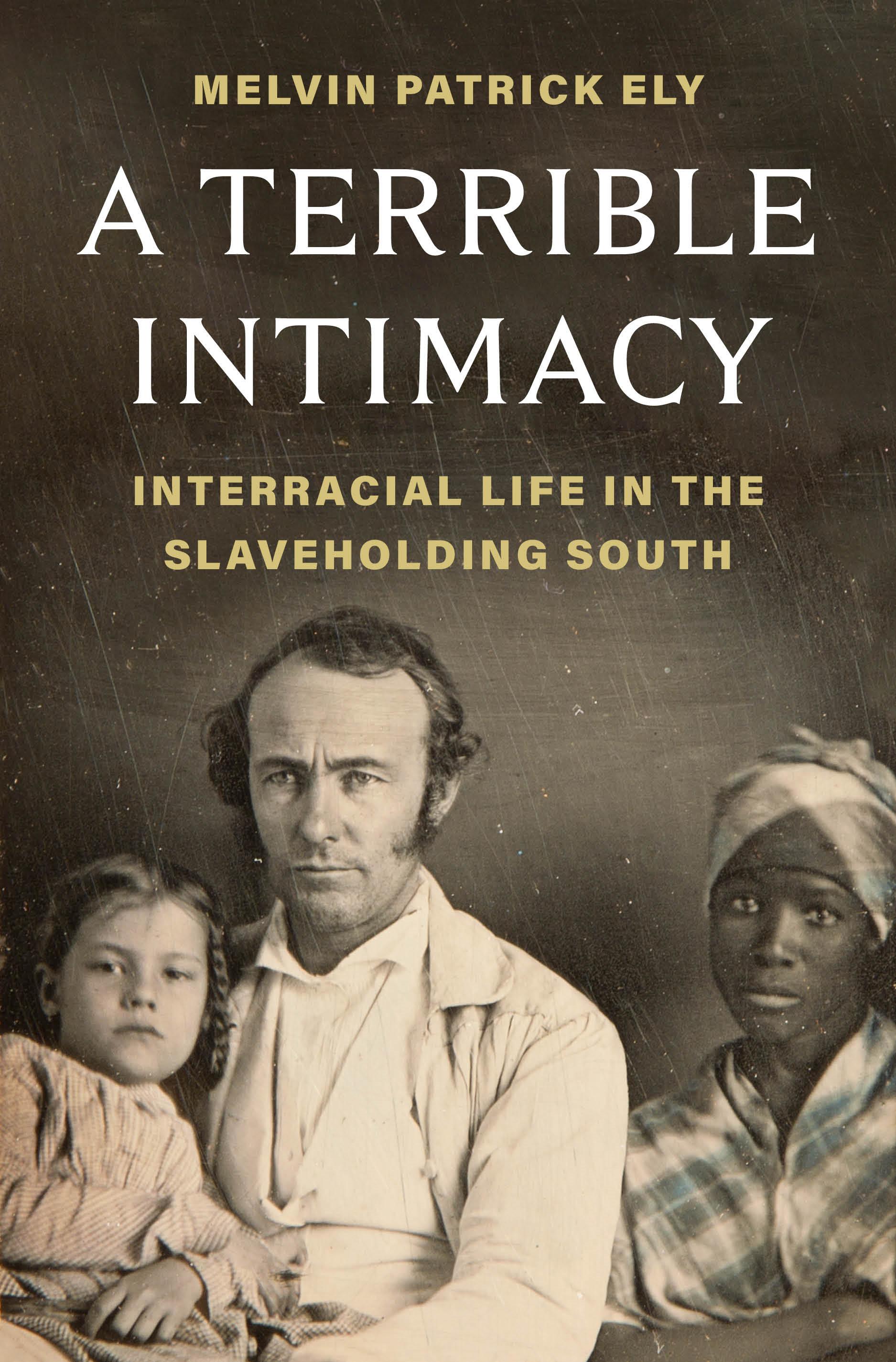
“A Terrible Intimacy: Interracial Life in the Slaveholding South” by Melvin Patrick Ely c.2026, Henry Holt