Week of: June 11, 2026
The latest from tsdmemphis.com
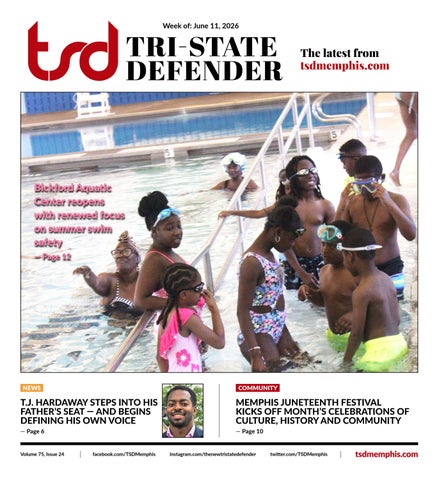
Bickford Aquatic Center reopens with renewed focus on summer swim safety — Page 12
NEWS
COMMUNITY
T.J. HARDAWAY STEPS INTO HIS FATHER’S SEAT — AND BEGINS DEFINING HIS OWN VOICE
MEMPHIS JUNETEENTH FESTIVAL KICKS OFF MONTH’S CELEBRATIONS OF CULTURE, HISTORY AND COMMUNITY
— Page 6
— Page 10
Volume 75, Issue 24
facebook.com/TSDMemphis
instagram.com/thenewtristatedefender
twitter.com/TSDMemphis
tsdmemphis.com
■■ NEWS TRI-STATE DEFENDER
tsdmemphis.com President Calvin Anderson
Editor Stephanie R. Jones
Published by The Tri-State Defender POSTMASTER: Send address changes to The Tri-State Defender, 1509 Madison Ave., Memphis, TN, 38104. GENERAL INFORMATION: Inquiries may be submitted in writing or by calling (901) 523-1818 or by email. TELEPHONE: (901) 523-1818. The Tri-State Defender (USPS 780-220) is published weekly. The Tri-State Defender 1509 Madison Ave. Memphis, TN, 38104. Second-class postage paid in Memphis, TN. The Tri-State Defender is a member of The National Newspaper Publishers Association and the Tennessee Press Association. All materials covered by copyright. No materials herein may be reproduced without the written permission of the Publisher. (901) 523-1818 | 1509 Madison Ave, Memphis, TN 38104 ••• $60 Annually/$5 Monthly Digital subscriptions are available online at tsdmemphis.com
Week of: June 11, 2026
Historic alliance emerges to combat antisemitism, racism, and division through renewed Black-Jewish solidarity BlackPressUSA TV personality Van Jones and media executive and philanthropist Shari Redstone joined more than 100 leaders from across the United States in Miami at the end of May for the National Convening on the Black-Jewish Alliance. It is the first national gathering of its kind in more than 25 years, aimed at renewing one of the most consequential partnerships in American history. Hosted by the Exodus Leadership Forum and Redstone Family Foundation at EAST Hotel Miami, the convening brought together clergy, organizers, artists, philanthropists, educators, civic leaders and cultural figures. The goals were to strengthen relationships; confront rising antisemitism and racism; and help shape a shared national strategy for Black-Jewish partnership in the years ahead. “It has been almost a quarter century since Black leaders, Jewish leaders and leaders who are both Black and Jewish pulled ourselves together like this,” said Jones. “With anti-Black and anti-Jewish backlash politics reaching a fever pitch, it’s time to renew this partnership. The gathering comes at a moment of deep polarization in the United States, with increasing concern over antisemitism, attacks on democratic institutions, racial injustice and growing social fragmentation. Redstone said, “This gathering reflects what we are seeing across the country — a real desire to rebuild trust, deepen relationships, and move from conversation to coordinated action. The Black-Jewish alliance is not a relic of history; it is a living partnership that is evolving in response to this moment.” Programming at the Miami event included a Soulful Shabbat gathering, artistic performances and facilitated conversations around difficult “wedge issues.” Discussions focused on movement-building, narrative change and civic participation. Rev. Dr. Benjamin F. Chavis Jr., pres-
ident and CEO of the National Newspaper Publishers Association, said, “We are living through a period of crisis. Rising antisemitism, rising racism and growing division in our nation. But history shows us that movements are born in moments like this. This convening is not simply about remembering past solidarity; it is about building a participatory national strategy that allows millions of people to join in the work of justice, repair and shared liberation.” An outcome of the convening was the advancement of a draft National Strategy for Black and Jewish Partnership, a living framework organized around five pillars: • Promoting Awareness and Historical Understanding • Deepening Relationships and
Page 2
Building Trust • Shaping a Public Narrative around Black-Jewish Allyship • Coordinating Efforts Across the Field • Expanding Partnerships for Collective Advocacy and Action Throughout the convening, attendees reflected on the historic partnership between Black and Jewish communities during the Civil Rights Movement. At the same time, they emphasized that the goal is not to recreate the past, but to build a broader, more durable future-facing alliance. Organizers plan for the convening to become an annual gathering focused on strengthening Black-Jewish partnership and advancing collaborative action nationwide.
TRI-STATE DEFENDER | tsdmemphis.com
■■ NEWS
Jackson State’s new president will get leadership training for a role previously marked by turmoil By Candace Wilder Mississippi Today
Jackson State University’s new president will receive a year of outside leadership training as she transitions into the job, which has been tumultuous for her predecessors. Denise Jones Gregory took the permanent role of president on May 1 after holding the interim role for a year. She is entering a position that has been held by four people in six years. And she will be in charge of leading an institution dealing with a number of challenges, including a student housing shortage and frayed relationships with alumni because of the constant leadership turnover and skepticism of the presidential hiring process. The coaching she will receive was part of the $97,500 contract Mississippi Institutions of Higher Learning Board signed with AGB Search in September, according to a copy obtained by Mississippi Today. The firm leads executive searches at universities. It marks the first time a Jackson State president has received such training when moving into the role. Kim Bobby, a principal with AGB Search, said the training helps presidents get familiar with their new institution and the region and build relationships with the board, faculty, and community members. The firm took Jackson State’s cultural significance as a historically Black university into consideration when shaping the training, she said. “It’s not a generic process,” Bobby said. “It’s really designed looking to initiate a close relationship and establish communication expectations and protocols around the transition.” Gregory, a Jackson State alumna, enWeek of: June 11, 2026
ters the permanent role at a time when colleges and universities across the country are facing significant pressure from state lawmakers scrutinizing how well they are preparing students and from President Donald Trump’s administration, which has pushed universities to end diversity, equity and inclusion programs and has threatened their research funding. University presidents are serving shorter tenures than ever — 5.9 years compared to 8.5 years two decades ago — according to the American Council on Education. Gregory said in an email statement to Mississippi Today that, like every university, JSU “faces challenges that require steady attention and measurable progress.” Those challenges include helping students stay enrolled and ensuring they have access to academic support and real-world opportunities. There are also infrastructure needs that must be addressed, she said. The university struggles to maintain enough housing and complete building renovations on schedule, she said. A key win happened recently: On Tuesday, the university broke ground on a new dining hall, which will have a capacity of 550. Several housing projects are ongoing and set to be completed next year, she said. Gregory also said she’s working to expand scholarships and sustain donor support for the university. “Students and families want to invest in institutions where they can clearly see momentum, opportunity, support and long-term vision, and that is exactly what we are working to build,” she said. The role of president at JSU is historically one marked by turmoil and leadership scandals.
In 2016, Carolyn Meyers resigned from JSU, leaving behind unresolved financial issues. William B. Bynum Jr., Meyers’ successor, resigned in 2020 after he was arrested in a prostitution sting. The next two presidents, Thomas Hudson and Marcus Thompson, both resigned suddenly without explanation. Gregory said she hopes to bring stability. Shifting from interim to permanent helps “to ensure continuity with strong governance support and an effective transition,” she said in an email statement. College presidents are stepping down earlier than ever due to the demands of the job and sometimes their lack of experience, said Judith Wilde, a George Mason University professor who studies college presidential searches. Training like what AGB Search offers can help a president navigate an increasingly complex role, she said. “I don’t think any president, even if they’ve been president before, is ready to become a president right now,” Wilde said. “Things are so different with the current administration. It has also become a job that is not Monday through Friday, nine to five.” Presidential search firms interact with alumni, faculty, students and board members during the search process. That gives them a unique perspective that helps them see what an institution needs, said Felecia Commodore, an education policy professor at University of Illinois Urbana-Champaign who studies HBCUs. Women presidents, particularly at HBCUs, are often scrutinized for their ability to lead a university in ways their male counterparts aren’t, Commodore said. Gregory is the second woman in a decade to hold the permanent title at JSU. “We see it happen more so with
Page 3
Denise Jones Gregory, who was then interim president of Jackson State University, speaks to the state Institutions of Higher Learning Board of Trustees on Thursday, Aug. 21, 2025, in Jackson. (Vickie D. King/Mississippi Today)
women, especially black women, that after there have been some challenges and sometimes crises at an institution, women are either put in as interim president or president and expected to fix everything,” Commodore said. Gregory’s experience as JSU’s interim president for nearly a year may help her transition into the top job, Wilde said. Gregory told Mississippi Today in an email statement that she spent the last year fostering relationships, including with staff, faculty and leaders within the university community. “If she showed that she is serious and does position herself with the knowledge, skills and expertise to lead a university, that shows her commitment to the institution and serving the community,” Wilde said. Earlexia Norwood, incoming JSU National Alumni Association president, said Gregory deserves this type of coaching. Alumni in recent years have clashed with JSU and IHL over presidents not receiving the support needed to lead Mississippi’s largest historically Black university. “All the support possible should be given to her just like support is given to all Mississippi university presidents,” Norwood said. “That support is well overdue.” This story was originally published by Mississippi Today and distributed through a partnership with The Associated Press. TRI-STATE DEFENDER | tsdmemphis.com
■■ NEWS
‘What’s Next for Memphis?’ TSD Forum sparks candid talks on crime, schools and voting power By Ancelious Meeks
TSD Contributing Writer
Community leaders, elected officials and policy experts gathered Wednesday, June 3, at Southbrook Town Center for Tri-State Defender’s TSD In The Community: Government and Public Policy Forum, an event centered on civic engagement, education policy, public safety and the future of Memphis and Shelby County. Moderated by Lori Spicer Robertson, the forum drew roughly 65 attendees, including newly elected Democratic nominee for Shelby County mayor Mickell Lowery, State Rep. London Lamar and several other elected officials and community leaders. Panelists included State Rep. Karen Camper; Dr. Darrick Dee Harris, president of Political Systems & Solutions; Mike Carpenter, principal of Carpenter Civic Strategies; and Shelby County Commission Chairwoman Shante Avant. The evening opened on a light note as Robertson asked panelists to introduce themselves, share something attendees may not know about them and reveal the “hype song” that keeps them motivated. Avant selected Beyoncé’s “Who Run the World (Girls)” and said one thing that gives her hope about Memphis is seeing young people pursue opportunities. “Seeing the number of youth that applied for summer jobs this year gives me hope because it paints a very different picture from what we sometimes think because of all the headlines we see about our young people,” Avant said. Camper made sure attendees knew they were gathered inside District 87, which she represents, before sharing her song choice, “Promises” by Lisa Knowles and the Brown Singers. Week of: June 11, 2026
“Everything the Lord promised, it’s going to come to pass,” Camper said. “Whether we see it or the next generation sees it. I’m the minority leader now only because somebody before me fought so it could happen.” Camper briefly broke into song, drawing smiles, applause and laughter from the audience. Before Harris could respond, Robertson jokingly told the remaining panelists she expected them to sing their selections as well, prompting more laughs throughout the room. “How do I follow that up?” Harris joked before naming Marvin Gaye’s “What’s Going On” as his motivational anthem. “If you look at what he was singing about then and look at where we are now, you can play that song today, and it’s still appropriate for what we are dealing with,” Harris said. Harris added that Memphis’ younger generation continues to inspire optimism. “Young people have gotten out and actually run for elected positions,” Harris said. “Some have not won, but you will never get into a position if you don’t run. I think the future here is bright and we just have to reach for it and encourage that next generation.” Carpenter humorously introduced himself as “a recovering elected official” before naming “Ain’t No Mountain High Enough” as his choice. “The thing that gives me hope is the new names and new faces that are on the ballot,” said Carpenter, a former Shelby County commissioner. “We have new people with some new ideas, and I’m very pleased to see that.” The conversation later turned toward one of the state’s most controversial issues in recent weeks: Tennessee’s newly approved oversight structure for Memphis-Shelby County Schools. Robertson noted that legislation
signed by Gov. Bill Lee grants the oversight board sweeping authority over budgets, contracts and personnel decisions. “Shanti Avant, with you being a former school board member and also now a commissioner, does this change the budget plan process?” Robertson asked. “It is a very difficult time for us as a community,” Avant responded. “Everything that has happened over the past 2 years with our school system has divided our community like nothing before. I don’t even think it was this divided during the merger and demerger. We’ve seen a lot of ups and downs in leadership at the district.” Yet, Avant said, the thing that has challenged her the most with the oversight board, “is that it’s about contracts and personnel, but nothing about academics. There has not been anything stated about how we are improving academics for these children.” “So, if the premise is that our kids are doing so badly and that our kids can’t read on a third grade level and there’s been no academic plan on how they are going to help our kids do better,” Avant added. Robertson asked Harris: “Our school takeover as well as congressional redistricting really happened in the same session, so what does that say about power in the state of Tennessee?” Harris responded: “Well I’ll be frank — power has shifted or is shifting from local to state. Luke 12:48 says to whom much is given, much is also required. I think the best way to handle this whole change is to hold the state, the school board, the appointed manager and the state accountable. If you want this power, then we need to hold you accountable.” Beyond holding officials accountable, Harris said, the response should be continued civic engagement. “We need
Page 4
to engage ourselves; stop being disengaged until there is a problem.” Harris suggested that those who think they know what’s best of Memphis should spend some time in the city. “Come down here for 6 months and actually run it. Spend some time to get to know the people. Go to Orange Mound, Whitehaven, South Memphis, and Binghamton,” Harris continued. “You can’t say you’re in charge of something and you don’t spend time with it.” Next up for discussion was public safety and the ongoing debate surrounding the Memphis Safe Task Force, which officials say has contributed to dramatic decreases in violent crime throughout the city. Robertson asked panelists how the city should balance public safety gains with concerns from residents who fear civil liberties may be compromised by increased law enforcement presence. Carpenter acknowledged the political challenges facing local leaders. “It’s a difficult question,” Carpenter said. “I want to acknowledge that the position (Memphis) Mayor (Paul) Young has been in is a difficult one. He’s been between a rock and a hard place.” Carpenter contrasted the responses from Young and Shelby County Mayor Lee Harris. He described Young’s approach as more pragmatic while noting that his “heart” aligned with concerns raised by the county mayor regarding federal and state involvement. “Our city mayor said, ‘OK, I need to step in here and make sure this can go as well as it can,’” Carpenter said. “And our county mayor said, ‘No, I’m going to fight it. I’m going to sue about it. We’re going to let the federal and state government know how we feel about it.’” While supporting the practical realities of the city’s response, Carpenter said communication with residents must improve. TRI-STATE DEFENDER | tsdmemphis.com
■■ NEWS
Panelists Mike Carpenter, Dr. Darrick Dee Harris, State Rep. Karen Camper and Shelby County Commission Chairwoman Shante Avant, joined by moderator Lori Spicer Robertson, discuss schools, crime policy, voting power and state-local tensions during the TSD In The Community forum in Memphis. (Gary S. Whitlow/Tri-State Defender)
“If I could offer constructive criticism to Mayor Young, it would be in the communication of that,” Carpenter said. “He’s done a lot behind the scenes, but a lot of that is not getting communicated to the public. I think it needs to be louder, and I think it needs to be clearer that we don’t mess around with civil liberties.” Carpenter also urged officials to
Week of: June 11, 2026
think beyond the task force’s current role in the city. “What’s next?” Carpenter asked. “The task force is going away. How are we going to better incorporate intervention and prevention into our crime strategy when the task force is gone?” Before opening the floor for audience questions, Robertson shifted the discussion toward another major political
issue dominating headlines across Tennessee: redistricting. “Karen, you were in the chamber,” Robertson said. “Walk us through what happened and what this means for our city and for Memphians who feel like their vote got diluted overnight. What recourse do they actually have?” Camper described the legislative session as one of the most difficult she has ever experienced. “First off, let me just say this was a very challenging session to begin with,” Camper said. “We had been through a lot of knock-down, drag-out fights over some of the bills coming through, fighting to keep funding for Memphis in the budget. We had just come out of those discussions and also the death of one of our colleagues, Representative (G.A.) Hardaway.” Camper said lawmakers then turned toward legislation involving mid-census redistricting efforts, which she argued violated long-standing principles tied to the census process. “The law says every 10 years, after the census, we do reapportionment based on the numbers and where people migrated to,” Camper said. “The law says you cannot disrupt that mid-census.” Lawmakers, she added, first passed legislation removing language that pre-
Page 5
vented redistricting during the middle of the census cycle. “And the next bill was the actual maps that were redrawn,” Camper said. “From a partisan perspective they say, but it was really about race.” Camper said the experience strained relationships within the legislature and made the issue deeply personal. “I told them they stabbed me,” she said. “But I’m over it now.” Despite her frustrations, Camper urged attendees to respond through civic engagement and voter participation. “There are a lot of people affected by this, not just Memphis — the entire state,” Camper said. “So what do we do? We turn that into political power. If this is important to you, you’ve got to get out and vote.” Overall, the evening’s discussion underscored what many in attendance said communities across Memphis continue to seek from leadership: communication, transparency and direct engagement on the issues impacting residents most. The next TSD In The Community Forum is scheduled for July 1 at the Alpha Memphis Education Foundation, 4122 Barton Dr., Memphis. The topic will be education.
TRI-STATE DEFENDER | tsdmemphis.com
■■ NEWS
T.J. Hardaway steps into his father’s seat — and begins defining his own voice After a whirlwind May that included a funeral, an appointment and a swearing-in, G.A. Hardaway’s son speaks for himself By Lee Eric Smith
TSD Contributing Writer
T.J. Hardaway is his father’s son. That much was clear in the way he accepted responsibility without much hesitation, stepping into the Tennessee House seat held by his father, the late Rep. G.A. Hardaway. It was clear in the way he talked about Memphis, public service, political leverage and the obligation to participate. It was clear, too, in the way he understood the weight of the moment — not just for his family, but for the community his father served. But T.J. Hardaway is not his father. And in a wide-ranging interview with the Tri-State Defender, the newly appointed state representative was just as clear about that. At 32, Hardaway speaks as someone shaped by his father’s politics, but also by a different set of experiences: a broader exposure to people and cultures; an interdisciplinary education rooted in anthropology, art and athletics; years in sports, including football, rugby and Olympic weightlifting; and a personal philosophy that seems to blend observation, strategy, creativity and contact. He describes himself, at his core, as an artist. He also thinks like an anthropologist. And when he reaches for a political metaphor, he is just as likely to reach for rugby — a sport most people think of as brutal, but one Hardaway remembers as a vehicle for exposure, discipline and understanding people. In other words, the son of G.A. Hardaway has inherited the seat. But he is beginning to define the voice. Week of: June 11, 2026
The following interview has been lightly edited for clarity and length. TSD: Just a few weeks ago (late April 2026), life was very different for you. Life was very different for Memphis. This time last month, your father was alive. And you’ve gone from mourning to being sworn in to speaking on the floor of the State Capitol — all within about two weeks. When have you been able to catch your breath? T.J. Hardaway: You know how you can watch a crowd and notice that things are starting to change? You feel a change in the air, or you just get a bad feeling in your gut? I remember kind of feeling that way (in April). I remember feeling like I should call home for a couple days before I got the phone call that I needed to come to Nashville as soon as possible to see my dad. After he passed, it was almost like we all crossed over some type of threshold where things just started moving so fast. There’s a flow state whenever you’re an artist or whenever you’re an athlete where things slow down, but you know that it’s all just a moment. That’s kind of how it felt. It felt like things had been going on for so long, like everything was happening for so long. Then you look up and it’s only been a couple days. TSD: You went immediately from mourning — or at least beginning that process — into public service, in the very seat your father held. How surreal was that? Hardaway: Absolutely surreal. The way we were brought up was very much “take on responsibility
without hesitation.” There was that same unsettling feeling that things were happening so fast that it felt wrong to let it happen without participating, if that makes sense. Because the appointment was so quick, it felt like if this went unchecked, it wouldn’t be in the best interest of the family somehow if someone else occupied that space. At the same time, it was an opportunity to do right by my father. An opportunity to keep a memory alive. We come from a big family, and we know what happens after someone is buried. People eventually stop talking about them. People eventually only reminisce, and that lasts for maybe a month before this person is completely forgotten. I personally didn’t want that to happen. I feel like my dad had invested too much into the community. It could not have happened any other way than for one of us to (step up) and do the same thing. TSD: Describe that moment when you stood up on the House floor for the first time to speak — indeed from the very same seat your father did. Hardaway: I’m not actually a hesitant public speaker. But, in that moment, I was really kind of drawing a blank, to be honest with you. “Should I say what I would say, or should I say what my dad would say?” Because I’m here on his behalf. That day specifically was in commemoration of him and his opposition to the redistricting bill. It was difficult to find words to portray that properly. But at the same time, it was obvious that you’re in a professional environment. You’re in an opportunity to learn, and you’re supposed to take it as an opportunity to learn, regardless of any preparation or opposition that you have. So: Make it short, get to the point
Page 6
T.J. Hardaway was appointed to take the Tennessee House seat of his late father, Rep. G.A. Hardaway. (Gary S. Whitlow/ Tri-State Defender)
and then professionally exit before you head downhill. Make your point, then exit early. (laughs) TSD: You are G.A. Hardaway’s son. But you also have your own mind, your own thoughts and your own opinions. How would you distinguish the service of T.J. Hardaway from G.A. Hardaway in that seat? Hardaway: That’s probably going to be a huge topic within the next few months. My dad had certain experiences that molded his subconscious. A lot of that came from his peak moments within his teen years and early development in the 1960s. I think I have a more global and more anthropological perspective on things. There’s more intricacy that I see in everything. And I think there’s context to every conversation that I have. I TRI-STATE DEFENDER | tsdmemphis.com
■■ NEWS look for the context in the information people are giving me. (My siblings and I) got a lot of handson experience, more exposure. The traveling that we did, the diversity of people we interacted with, the type of conversations we had — and the fact that we didn’t spend a lot of time with people our own age. Our dad had a very tight-knit community with people he grew up with, whereas specifically my brother and I, our friends were his friends. So we associated mostly with people in their 50s and up, besides our cousins, who were all significantly older than us until pretty much this point in life. TSD: I have to imagine you and your father had some pretty fascinating debates about policy — or just life. Hardaway: Man, if you could be in the room, particularly last year. My dad came from a very intense local experience, whereas I had a much more global exposure — or even nationwide to global exposure. So if my dad got a phone call, it was usually about an individual issue, and he was going to try to sort out that individual person’s issue. My perspective on things has been more systematic. I understand that there’s a system in place — or a system that’s not in place — that is causing a chain reaction of events to happen. I see why my dad made the choices he did about how to help his constituents. But it’s one method to individually address issues within a community in order to rally people to participate in the community. It’s another thing to notice that the community is not being serviced with certain systems that could have long-lasting effects and change the way people are actually treated or operate in government. That’s basically how we would talk. He would say, “You have to make sure you’re fixing these little problems from person to person.” And I’d come around and say, “Well, that’s not long term. That’s a short-term fix. You’re fixing symptoms without curing the disease. You’re fixing symptoms without looking forward to prevention. “What are the preventative measures Week of: June 11, 2026
so you don’t even have to come up with the medicine to treat the condition?” Those debates were pretty frequent. TSD: What did you study? Tell me a little about your educational background. Hardaway: I went to the University of Memphis, and I did interdisciplinary studies in the liberal arts. That was a culmination of anthropology, studio art and some athletics. But probably the most influential education that plays a big role in how I see the world, or the conversations I have, or the terminology that I use, comes from being in sports so heavy — because I played three sports at Memphis, and just that level of exposure. TSD: What did you play? Hardaway: Football, rugby and Olympic weightlifting. TSD: That’s quite a combination. Hardaway: Oh yeah. It’s like being in the fire 24/7. It was an experience for sure. I’m not afraid of blood. Blood does not make me squeamish. TSD: You’re an anthropologist, a rugby player and a weightlifter. How do those sides of you show up in your legislative philosophy? Hardaway: One of my coaches made a point to say that if you’re going to take responsibility for something, if you’re going to do something, then you have to take ownership of it. I think that plays a big role in policy. If you want something to pass, then you have to approach it as if this is a community issue that starts here, but inevitably trickles down to everyone. Some people are going to respond a certain way, so you have to be able to roll with the punches and you can’t be afraid of conflict. TSD: I think rugby and I think, “tough.” Like REAL tough. Football without pads tough. Hardaway: In rugby, there’s this concept that you don’t meet force with force. I had a coach in rugby who would say — and everybody knows rugby is violent, no pads, you can get cut real easy, fractured knuckles, your fingers never look the same after you play rugby long enough — but he would say, “If you are playing this sport looking for
contact, you will not make it far.” He said your mindset should be that rugby is not a contact sport. You don’t have to seek out contact; getting hit is inevitable. It didn’t resonate with me until I got hit so much that I had to switch positions because I didn’t understand that the contact is inevitable. I think that translates to a lot of things we do in life. You’re going to get hit regardless. Somebody is going to hit you. You cannot step into life and think you are completely elusive to contact. But if you play the game without seeking contact, then you’ll get more yards. You’re always prepared for the contact, but don’t seek it. Build up your armor. Go to the gym. Do your pushups. Make sure you’re ready so that if somebody hits you, they regret it. But getting hit is inevitable. You don’t have to seek it out. It’s already looking for you. TSD: If you had to name your legislative priorities going forward, what would they be? Hardaway: I’m thoroughly aware that we’re currently in an age where technology is an equity tool. So finding ways to implement technology into the school system, into transportation, infrastructure and government — there’s too much advancement happening in connection with people’s ignorance to the opportunities it could provide. I think agency and giving people a sense of autonomy is vital right now. Of course, the buzzword for AI is all over that statement. But even autonomous driving and putting people in a position to do research into cybersecurity — the job market has changed. It’s turned into every person being able to be their own entrepreneur. My community specifically lacks the ability to pay attention to those topics, or lacks the avenue for the information that’s available. So these things have to be planted. TSD: In terms of where we are now in this redistricting fight, what do you see as the fight forward? What do Memphis voters need to be doing? Hardaway: The one thing for sure is registering to vote.
Page 7
I think a lot of people have lost faith in the system because they don’t understand how this happened. We have to create more transparency on voter turnout, which is atrocious. The amount of people registered is atrocious. The amount of people who actually vote is atrocious. The truth is, if Memphis pulled up full throttle, Memphis and Shelby County could shift the entire state of Tennessee. That’s a big part of why Memphis was a bullseye. They know the amount of influence and volume that Memphis hasn’t participated in. Then we have to act on the local level. The local level should be (the) priority now because our participation federally is so dwindled that we can’t just keep looking up. I approach everything as an athlete. If you can get the upper hand on the other team, that’s priority No. 1. TSD: Anything we haven’t covered that you want to make sure people understand? Hardaway: Fundamentally, I’m an artist. I think that was something my dad cultivated at a young age. I attended Memphis College of Art when I was just in junior high. I took some classes, and he was so adamant that I take advantage of those experiences. If people were to call me anything, they would call me an artist at my core. Drawing, painting, sculpting, writing — I think reading is an artistic skill. Reading is something you participate in. So on behalf of my dad, between the anthropology and the sports and the mathematics or data science, anything that I’m interested in, that rearing was important to him. So I want that to be important to how people understand where I’m coming from. TSD: Before I let you go, people are going to keep asking about the future. Do you hope to keep the seat in the General Assembly? Those are big shoes to fill. Hardaway: It’s funny that this keeps coming up, as far as the shoes are concerned. Me and my dad actually wear the same size. So if that’s an innuendo to the future, take that how you will. TRI-STATE DEFENDER | tsdmemphis.com
■■ NEWS
Memphis charter students are bucking district math trends. Here’s what’s guiding their growth. By Bri Hatch Chalkbeat
In examining post-pandemic learning loss, officials at Leadership Preparatory Charter School came to a realization: Teachers were following scripted math curriculum a bit too closely. “We were expecting teachers to make changes” to cater to students’ needs, said Valissia Allen, founder of the Southeast Memphis K-8 school. “But they were scared.” So in 2022, the school partnered with national organization Teach Like A Champion to adapt scripted state-approved curriculum. Now, the school provides more flexibility in teaching and plugs material into a structured schedule, starting with a “do now” activity and rote review exercises. Allen calls it “teacher autonomy with guardrails.” Leadership Prep is seeing booming results. Last year, nearly 44% of students scored as proficient on state standardized math tests – up over 20 percentage points from 2021, school leaders said. That’s more than double last year’s district-wide average for math proficiency. The uptick mirrors growth in math performance in charter schools across Memphis. A Chalkbeat analysis found that charter students are bouncing back from pandemic-era math losses faster than their traditional school peers and are now outperforming them on state tests. Nearly one-quarter of Memphis charter students scored proficient in math on last year’s Tennessee Comprehensive Assessment Program – up from 2% in 2021, a year after the pandemic struck. That big leap lifted charter math proficiency above pre-pandemic levels. Traditional school students recovered, as well, but not as quickly: Just under 22% of traditional public school students passed the math TCAP last Week of: June 11, 2026
year, up from 6.9% in 2021. That lagged behind traditional schools students’ pre-pandemic math proficiency. Memphis-Shelby County Schools did not respond to a request for comment about Chalkbeat’s findings. That data is backed up by a new report from Tennessee education nonprofit SCORE, where staff spent the past year visiting local charters that showed significant growth on the Tennessee Comprehensive Assessment Program, or TCAP. “Their growth was the equivalent of if they had had 47 more days of learning in a year,” said Emma McWeeney, SCORE’s senior director of charter initiatives. These trends carry weight on the eve of a state takeover of MSCS. Nashville Republicans cite years of academic underperformance in the district as justification for taking away local control of education decisions, including charter authorization. House Speaker Cameron Sexton appointed SCORE CEO David Mansouri to the impending state oversight board last week. Mansouri will now have a direct hand in shaping critical levers like MSCS curriculum and staffing. Experts also say that state takeovers of school districts often lead to the expansion of charter options in the area. SCORE’s report, which included analysis of state-run charters alongside MSCS charters, revealed consistent practices that boosted charter math performance, including daily data analysis and teacher training. But McWeeney said the key driver of success was development of a “school-wide vision” for how math lessons should be run across all grade levels. “We walked into a kindergarten classroom, a fourth grade classroom, an eighth grade classroom. They were doing very different math skills, but there was a consistent flow and model,” she said.
Teaching with guardrails: The Leadership Prep math model Corliss James, a former Leadership Prep teacher who is now a principal at the school, said the flexibility to alter state-approved curriculum helps teachers prepare students more directly for TCAP. “With the scripted curriculum, some of the questions weren’t as rigorous,” she said. “And then when we would see the state test, they weren’t aligned even though they were saying they were.” Most curricula also focused too heavily on “conceptual” math that explains why certain equations are used instead of the procedural skills necessary for a timed standardized test, Allen added. A typical math class at Leadership Prep looks like this: Students start with a short quiz, then move into timed basic equations like multiplication. Teachers then review relevant vocabulary for the day’s lesson, and walk through errors from the previous day’s assignments. Then, they employ classic “gradual release” techniques for new problems: teachers solve an equation, then the class solves one together, and then students complete one on their own. And each class period ends with a short quiz
Page 8
reviewing the new material to gauge student comprehension. James said a good number of teachers “wanted to revolt” when Leadership Prep first introduced the new lesson model because of the increased workload in crafting daily lesson plans. Some wound up quitting. That first year, the school held three weeks of professional development in the summer, plus a usual hour-per-month session and eight hours each month for Teach Like A Champion training. But Allen says the teachers who stayed have become partners in enhancing the school’s curriculum every day. “They’re constantly coming to us like, ‘Hey, I saw this. Can I try this in the classroom?’” she said. “They’re champions. This work does not exist without their tireless efforts in the push to change.” Editor’s Note: An earlier version of this story showed a graph that was off by one year, identifying 2024-25 math scores as 2025-26 data. Bri Hatch covers Memphis-Shelby County Schools for Chalkbeat Tennessee. Reach Bri at bhatch@chalkbeat.org. This story was originally published by Chalkbeat. TRI-STATE DEFENDER | tsdmemphis.com
■■ NEWS
Proposed changes to Shelby County pre-K program spark debate over funding and oversight By James Coleman
TSD Contributing Writer
After two passes on a first vote, Shelby County Commissioners will once again consider a sweeping overhaul of its attempt to provide universal pre-k. Mayor Lee Harris is seeking to revise an ordinance approved in 2025, that ups the county’s commitment to 100% of all eligible students. The edits include opening up pre-k funding to numerous “entities.” Currently, the money is distributed by a single “fiscal agent.” The amendment will be brought up again during the Wednesday, June 10 committee meetings. Still, there are hopes that major changes won’t be necessary. During the Monday, June 1 meeting, commissioners were informed that discussions between the administration and nonprofit First 8 Memphis have begun. “First 8 Memphis recently met with county attorney Megan Smith and special assistant Hannah McCarthy this evening. They are bringing a couple of revisions to Mayor Harris, per our conversation,” said First 8 Director Kandace Thomas. The county hired the nonprofit to implement a 5-year plan. A fiscal agent works as an independent third party — like a bank, or trust — to manage financial affairs, administrative duties and grant funding. Any changes will also require a two-thirds majority vote from commissioners. “It was decided at that time you needed an independent fiscal agent to do this work without compromising the community,” said Kandace Thomas. “You could be paying a fiscal agent who right now runs pre-k, who right now has pre-k seats, or paying a fiscal agent who is not considered neutral to your interests.” Harris has expressed concerns with Week of: June 11, 2026
Shelby County commissioners are expected to again consider proposed changes to the county’s universal pre-K initiative, including revisions to how program funds are distributed and managed. Supporters say the expansion has increased enrollment and access to early childhood education, while critics warn the changes could weaken oversight and accountability. (Envato Elements)
“The organization that you work with to invest the pre-k funds should actually be seen as more than a vendor. It really should be seen as a community institution for early learning.” — Kandace Thomas “The proposed amendment that you all have before you as a joint ordinance would dismantle more than 10 years of effective alignment of early childhood services system building.” — Yvonne Matlock using a single entity. He has also said too much funding has gone towards First 8’s administrative overhead, instead of classrooms. The amendment
would loosen the language to allow for other vendors. The move would permit direct funding to learning facilities. “The organization that you work
Page 9
with to invest the pre-k funds should actually be seen as more than a vendor. It really should be seen as a community institution for early learning,” argued Thomas. Critics argue the amendment would hinder oversight, funding alignment, accountability, along with data reporting, collection and analysis. “The proposed amendment that you all have before you as a joint ordinance would dismantle more than 10 years of effective alignment of early childhood services system building,” said Yvonne Matlock, former Shelby County health director who currently serves on First 8’s board. Last year, the county’s enrollment rate was 90%. Shelby County achieved a 97% pre-k enrollment rate in 2026. The pre-k expansion includes bringing 3-year-olds into the fold. Prior to the change, the focus was on 4-year-olds. To handle the influx, the new law encouraged increased funding, by setting an annual target of $21 million. The bulk is paid by Shelby County. Last year, the figure was over $14 million. The City of Memphis made up the rest. Prior to the ordinance, the county’s typical baseline allotment towards early childhood education was around $8.5 million. Harris has criticized the 2 to 1 funding gap created by the ordinance. According to one charter school administrator, the extra money has already paid dividends. “I want to let you know, our kids are finishing up their pre-k year in the 55% national percentile for reading,” said Libertas Memphis executive director Bob Nardo. “This is in a community where almost every single school was considered a failure by the state ten years ago, now we have some of the highest performing schools in the state right here in Frayser.” TRI-STATE DEFENDER | tsdmemphis.com
■■ COMMUNITY
Memphis Juneteenth Festival kicks off month’s celebrations of culture, history and community By Dylan Graham and Brianna Smith
TSD Contributing Writers
African American pride, cultural celebration and community engagement were on full display Friday and Saturday, June 5-6, during the 33rd Annual Memphis Juneteenth Festival at Medical District Park. The festival, founded and organized by Dr. Telisa Franklin, was the first of a host of events scheduled this month to celebrate the June 19 holiday. Throughout the day Friday, visitors explored vendor booths and took part in activities designed to celebrate freedom and cultural heritage. While the late spring heat posed a challenge, attendees remained engaged. Some vendors passed out handheld fans to visitors as they moved between exhibits, performances, and booths of local businesses displaying their products and services. Dozens of vendors lined the park, offering everything from African-inspired clothing to personal brands to wellness products. For entrepreneurs, the festival offered an opportunity to connect with customers while supporting a celebration centered on Black culture and economic empowerment. Entertainment played a significant role in keeping the crowd energized. Line dances on the main stage from LINE-TASTIC Memphiz, encouraged audience participation from their seats, and created moments of collective celebration. Various musical acts took to the stage throughout the day Saturday. One of the festival’s most educational attractions was an outdoor museum exhibit that highlighted the history of slavery in America and traced the progression of African Americans through Emancipation, the Civil Rights Movement and modern-day achievements.The exhibit offered attendees an Week of: June 11, 2026
Gospel rapper Preachr Man
Members of the Line-Tastic Memphiz got festivalgoers on their feet. (Photos: Gary S. Whitlow/Tri-State Defender)
Dr. Telisa Franklin, founder and organizer of Memphis Juneteenth Festival
opportunity to reflect on the historical significance of Juneteenth while connecting the holiday to ongoing conversations about freedom and equality. Among those in attendance was Magistrate Judge Mitzi Pollard, who said she came to support both the event and its organizer. “What brought me here is my dear friend Telisa Franklin,” Pollard said. “When I hear that she’s hosting something, I’ve got to come check it out.” Pollard added that she was interested in experiencing the cultural displays while also connecting with members of the community.
Pollard reflected on the growth in national recognition of Juneteenth, which commemorates June 19, 1865, the day when slaves in Texas learned they were free — more than two years after the Emancipation Proclamation was signed. She noted that many Black communities celebrated the holiday long before it became a federal holiday. “We’ve celebrated Juneteenth for a long time before it even became popular,” she said. “I’m glad to see a lot more involvement and a lot more items that share the cultural aspects of Juneteenth.” Judge Chris Frulla also attended the festival and emphasized the importance of community outreach and historical awareness. “My job is to represent the citizens all over Shelby County,” said Frulla, a Shelby County Circuit Court judge. “So, I try to touch as many hands as I can to let them know that the justice system cares about everybody.” For Frulla, Juneteenth serves as a reminder of both freedom and the importance of understanding history. “It’s about freedom,” he said. “It’s about all the rights that folks fought for over the years, and it’s about celebrat-
Page 10
ing those freedoms and making sure they’re preserved.” Frulla encouraged attendees to continue learning from earlier generations and to study the past. “A lot of people forget about what happened in the past,” he said. “Talk to older people, read books, and understand how we got from where we were a long time ago to where we are today.” Juneteenth observances continue throughout Memphis beginning June 18 with everything from educational exhibits and freedom rides to festivals, concerts and community gatherings. One of the newest additions to Memphis’ Juneteenth calendar is the Juneteenth Summer Classic concert featuring Chicago rapper G Herbo, scheduled for Friday, June 19, at Minglewood Hall, 1555 Madison Ave. G Herbo will headline the event, presented by Tapped In and Peppa Mouth of the South. Doors open at 5 p.m., and the show is 6-11 p.m.
Other Juneteenth events in the city include: Douglass Freedom & Heritage Festival June 18-20 Douglass Park Juneteenth Freedom Ride bicycle ride June 18-20 Beginning at 7 a.m. TRI-STATE DEFENDER | tsdmemphis.com
COMMUNITY
PUBLIC NOTICES / CLASSIFIEDS NOTICE TO BIDDER(S) Sealed bids will be received by the Shelby County Government in the Department of Housing online until 9:30 a.m. on Friday, June 26, 2026, as shown below: MULTIPLE AND ENTIRELY DIFFERENT LEAD HAZARD REDUCTION AND REHABILITATION JOBS ARE CONTAINED IN THIS BID NOTICE. BIDDER(S) MAY ELECT TO BID ON ANY OR ALL OF THE JOBS IN THE NOTICE. SEALED BID #202653 DUE ONLINE AT 9:30 a.m. Friday, June 26, 2026 1. Lead-Based Paint Hazard Reduction Jobs. Detailed specifications for the items above may be obtained through the Neighborly Portal beginning Friday, June 12, 2026. All bids will be opened and publicly read by the Shelby County Government at the time mentioned above at the Department of Housing, 6465 Mullins Station Road Memphis, TN 38134, (901) 222-7600; TTY Number (901) 222-2301; or for information in Spanish 901-222-7601. Award recommendations will be posted at the following website https://www.develop901.com/ housing upon review of the bid opening results.
An outdoor museum at the Memphis Juneteenth Festival, June 5-6, chronicles the road from slavery to freedom and beyond for Black Americans.
As a condition precedent to bidding, each bidder must apply and qualify for a Vendor Number and Business Registration Number (BRN) prior to submitting your response. We have now transitioned to conducting bids online through Neighborly. If you have not already signed up, you can do so at https:// portal.neighborlysoftware.com/SHELBYCOUNTYTN/contractor. All documents submitted must be current and uploaded into your
TSD CLASSIFIEDS 1509 Madison Ave. Memphis, TN 38104 PH (901) 523-1818 HOURS: Mon.-Fri. 9 a.m. - 5 p.m. DEADLINES: Display ads Friday 5 p.m. Classifieds ads Monday 5 p.m. Neighborly account. Bids submitted without all required documentation will be unacceptable. Paisley Pogue (Paisley.Pogue@shelbycountytn. gov or 901-222-7611) will be assisting with any questions you may have regarding uploading the documents. All new contractors will need to register with the Neighborly portal in order for their bids to be accepted on projects. Interested contractors not currently on the contractor list should contact the Department of Housing in order to schedule a meeting with the Housing Site Inspector. Paper copies of bids are no longer available. The Department of Housing encourages participation from WBE, MBE, LOSB, and Section 3 Contractors under these rehabilitation programs. The Shelby County Government reserves the right to reject any or all bids and to waive any informalities therein. By order of LEE HARRIS, MAYOR SHELBY COUNTY GOVERNMENT Scott Walkup, Administrator
Workers for Score Health, a festival sponsor, passed out fans, a hot commodity to beat the heat at the Memphis Juneteenth Festival.
Starting at Wiseacre Brewery, 2783 Broad Ave. National Civil Rights Museum Community Day June 19 9 a.m.-6 p.m. National Civil Rights Museum Juneteenth Summer Classic featuring G Herbo June 19 6 p.m.-11 p.m. Minglewood Hall Juneteenth Fest at Black Seeds Week of: June 11, 2026
Urban Farms June 19 6 p.m. Black Seeds Urban Farms, 580 N 4th St Memphis Juneteenth Urban Music Festival June 19 Health Sciences Park, downtown Shop Black Festival June 20 11 a.m.-4 p.m. Martyrs Park, downtown Page 11
TRI-STATE DEFENDER | tsdmemphis.com
■■ COMMUNITY
Bickford Aquatic Center reopens with renewed focus on summer swim safety By Lee Eric Smith
TSD Contributing Writer
Elaine Stevenson came dressed to swim. For Stevenson, a senior citizen from Frayser, the grand reopening of Bickford Aquatic Center on Thursday, June 4, was not just another city ribbon-cutting. It was a chance to get back into the water, reconnect with friends and resume a routine that, for many residents, is as much about health and community as it is about recreation. “I love aerobics — water activity, communicating with other people,” Stevenson said. “We have good fun in the pool.” After being closed for renovations since September 2024, Bickford Aquatic Center returns one of the city’s most important public swimming facilities to service just as summer begins and Memphis Parks officials are emphasizing swim lessons, water safety education and safe recreational options for families. Located at 235 Henry Ave. in North Memphis, the indoor aquatic center is part of the larger Bickford Park and Community Center campus, which includes a community center operated by Oasis of Hope, a pavilion, playground, outdoor basketball court and softball field. Memphis Parks Director Justice Bolden said Bickford’s reopening had been a priority from the time he stepped into the role. “Bickford Aquatic Center closed for renovations in September of 2024,” Bolden said. “My first day on the job, June of 2025, I was made aware that reopening of the pool was a priority. And so what we did, Memphis Parks, we worked together with the community and with the contractors to make sure Week of: June 11, 2026
Elaine Stevenson of Frayser came dressed to swim at the newly reopened Bickford Aquatic Center, where she said seniors and families had missed the water during the two-year closure. “Now that the pool is open, I can start out with my pool, and then do everything else afterward,” Stevenson said. City officials, including Memphis Mayor Paul Young and City Councilwomen Yolanda Cooper-Sutton and Michalyn Easter-Thomas joined swim enthusiasts of all ages for a ribbon-cutting at the newly reopened Bickford Aquatic Center. (Photos: Lee Eric Smith / Tri-State Defender) ON THE COVER: Young and mature alike eagerly take advantage of Bickford’s pool.
that we could push to get this pool back online for the start of summer 2026.”
Not your average community pool The reopening also restores a facility that Bolden described as unique in the city’s public pool system. “Essentially, this is the largest public pool in the city,” Bolden said. “This is the only public pool of its kind in the city of Memphis.” Bickford includes a 25-yard competition pool, a diving well and a deep-water area, along with a shallow, zero-entry area and accessibility features for swimmers with mobility needs. Bolden said those features make the facility useful for competitive swimming, swim team practice, water aerobics, lap swimming and water safety instruction. Bolden said the facility has long served multiple generations and mul-
tiple needs — from water aerobics and lap swimming to swim teams, swim meets and lifeguard training. That workforce development piece matters, Bolden said, because aquatic centers do more than give residents somewhere to swim. Through lifeguard training and other programs, they also give young people a pathway to job skills and summer employment. “There are so many opportunities that are provided by this pool, especially when it comes to work opportunities,” Bolden said.
A visible return on city investment Mayor Paul Young said the reopening offered a tangible example of what city budget debates are meant to produce. “It’s difficult to really see the fruit of what you’re talking about until you
Page 12
come to an opening like this,” Young said, “and you see that all of the debate, all the dialogue, is about opening up a space where our community is going to be able to have a good time, enhance their quality of life, create memories for themselves, for their kids or as seniors, and just come out and have a good time.” Young said the city invested about $2 million in the project. He also credited residents who continued pressing the city to reopen the facility, including Cynthia Dickerson, a longtime swim coach in the area. “I had a conversation with Ms. Cynthia Dickerson, who has been a swim coach in this area for many years,” Young said. “She was just telling me that this facility is one of the best facilities in the city for training young people.” For Young, the center’s return is about both recreation and life-changing opportunities. “It’s really important to have facilities TRI-STATE DEFENDER | tsdmemphis.com
■■ COMMUNITY like this, because this can be life-changing,” Young said. “Whether it’s someone learning how to swim, and then later in life they are safe around water, or someone who learns how to compete as a competitive swimmer, and they’re able to go to college based on their skills and talents that they learn right here in the facility that the city has opened up.” Councilwoman Michalyn Easter-Thomas, who represents District 7, said Bickford’s return reflected residents’ persistence and the value of collaboration between the community, the council and the administration. “I remember when I used to frequent Bickford pool with my little brother, as he was on the swim team for years over here in Bickford,” Easter-Thomas said. “Just learning about what an asset this is in our community and our city — we don’t have many pools of this size in our city.”
Easter-Thomas said Bickford’s location and size make it a major amenity not only for Uptown and North Memphis, but for residents across the city. “This is what your tax money is important for,” Easter-Thomas said. “To pour back into the people who need it the most — us, our neighbors, our community.”
Open swim Memphis Parks’ online listing for Bickford Aquatics Center shows open swim Monday through Friday from 10 a.m. to 6 p.m., with lessons from 4 p.m. to 6 p.m. The city notes that there may be limited or no availability during lessons and that all pools are cleared 30 minutes before closing. Swim lessons are listed at $25 for a 10-lesson program for children ages 5 to 17 and $48 for a 10-lesson adult program.
Those lessons are part of the broader summer safety message city officials and residents emphasized at the reopening: Pools are fun, but knowing how to swim can save lives. Stevenson said she learned to swim as a girl at Douglass Community Center, taught by her brothers. Decades later, she still sees swimming as a skill every child should have. “This is very important to learn how to swim,” Stevenson said. “We’ve got so many kids that’s drowning. And if they knew how to swim, they probably have a better chance of not drowning.” She also said the reopened center gives young people another option during the summer months. “A lot of kids that don’t know how to swim, they can learn how to swim,” Stevenson said. “It’s just so much that they can do here, instead of just playing in the streets. They can come here and
do a lot of things.” Bolden said Memphis Parks is looking toward a busy summer, with swimming lessons at Bickford, community center children visiting the facility and additional water safety opportunities through the city’s partnership with the YMCA. “We’re looking forward to a really fun summer,” Bolden said, and “quite a bit of water safety education.” For Stevenson, the reopening means getting back to something she missed. “It’s been two years since the pool’s been closed, and everybody’s been struggling, trying to do things to keep up,” she said. “But they’re so excited that it’s back open.” Now that Bickford is back, Stevenson already has her plan. “I can start out with my pool, and then do everything else afterward,” she said.
Tomorrow starts today with tools to build a strong financial future No matter where you are on your financial journey, Trustmark can offer guidance to help you move forward. Our Advantage suite of products and services is designed for individuals who want a practical way to manage everyday expenses and build or rebuild credit. Take the next steps of your financial journey today. Set up a personal appointment at trustmark.com/advantage
Week of: June 11, 2026
Page 13
TRI-STATE DEFENDER | tsdmemphis.com
■■ ENTERTAINMENT
Richard Pryor’s daughter examines language, identity, family in ‘Something We Said’ Book review By Terri Schlichenmeyer Sticks and stones may break my bones. You know the rest of that childhood rhyme, and you know it’s not true: Words have meaning, and they can cut like a knife. And yet, though sticks and stones and words are weapons, as in the new memoir, “Something We Said” by Elizabeth Stordeur Pryor, they can also hold people together. The college lecture was supposed to have been about the 1850 Fugitive Slave Act. It was supposed to have been a lively discourse and discussion, but without intention, it quickly veered sideways. When a white student quoted a movie line featuring the “n-word,” the room went quiet and Professor Elizabeth Stordeur Pryor panicked. She’d grown up hearing that word, and seeing it, and she’d experienced the painful feelings attached to it. She knew who wrote that movie line. It was her father, Richard Pryor. In her first few years, Pryor spent most of her time in a white world, hearing her mother’s tales of her larger-than-life father, and trying to grasp meaning in her father’s albums, peppered as they were with a word that was off-limits to her. When she was six, she met her father for the first time. She began to visit him regularly. It was fun at her Dad’s house. Though he was sometimes moody, he taught her to fish and play dominoes. She became close with her siblings, fearful of her great-grandmother, and confused about a word that her father’s uncles threw around like a beach ball. It was a forbidden word at her mother’s
Week of: June 11, 2026
Author Elizabeth Stordeur Pryor explores the complicated legacy of a notorious racial slur, her relationship with her father, comedian Richard Pryor, and the power of language in her memoir Something We Said: Richard Pryor, A Notorious Word, and Me. (Photo by Isabella Dellolio Photography)
house, but her father used it. Differently. Often. The word hurt. She knew first-hand that it did. “The word became a degrading slur that shackled all Black people together into a single, inescapable tribe,” she says. So why was it okay if certain people said it? Knowing that, in the years since Richard Pryor’s burn accident and his death from multiple sclerosis, he’s become somewhat of a legend is a very satisfying thing, isn’t it? So is reading about him, especially from the viewpoint of one of his seven children. But his is not the only story you get inside “Something We Said.” Wrapped around the life of Richard Pryor is the life of a word that straddles a line between danger and provocation, a word that author Elizabeth Stordeur Pryor refuses to say or even print. As she tells readers about her father and
“Something We Said: Richard Pryor, A Notorious Word, and Me” by Elizabeth Stordeur Pryor c.2026, Simon & Schuster; $29.00; 304 pages
her loving-but-difficult relationship with him, she warily circles that word, as if it might bite. You may cringe, but she weighs it carefully, helping readers see it as a chameleon before always bringing us back to her father, his work, and his life before and after her and that word.
Page 14
It’s a push-pull balance that holds readers fast, and keeps them there. It’s perfect for fans of this genre, or Richard Pryor, or of language — and it’s going to make you think. If you want a good memoir this week, one that may send you to your old album collection, “Something We Said” is rock-solid. TRI-STATE DEFENDER | tsdmemphis.com