




By Melissa Brown Chalkbeat
A federal judge has temporarily blocked the Memphis school takeover board’s authority after school officials said it could delay the start of the school year or force building closures as the district prepares to welcome students back to class in less than five weeks.
Memphis-Shelby County school board members and local officials asked a federal judge Tuesday, June 30, to temporarily halt the oversight board or, at minimum, block its power to disrupt contract payments and fire top district officials ahead of the 2026-27 school year, which begins Aug. 3.
On Wednesday, July 1, U.S. District Judge Waverly Crenshaw Jr. granted the temporary restraining order, requiring the state and MSCS to “maintain the STATUS QUO before” the new takeover law took effect.
The temporary order is an early win for the district and Shelby County officials, who sued over the new oversight board last month.
Under the takeover law, the oversight board, which took control July 1, must approve every purchase over $50,000. Previous district policy allowed the superintendent or a designated deputy to approve contracts under $100,000, while school board approval was needed for larger contracts.
Control by the new oversight board could significantly hinder MSCS’ ability to respond quickly to start-of-school emergencies, including HVAC failures, creating “immediate operational deadlock” during one of the district’s busiest times of year, the district alleged in Tuesday’s court filing.
“School cannot be conducted in
buildings that do not have functioning air conditioning,” the court filing says. “A lapse of up to three weeks while these expenses are submitted to and approved by the Oversight Board will be detrimental to student instruction.”
Oversight Board Chair Billy Orgel told Chalkbeat that the board’s full meeting set for this afternoon is cancelled, delaying votes on an executive director contract and initial steps for the board’s expected assessment of MSCS operations. The takeover’s board work will now be paused indefinitely pending a full federal court hearing, which has not yet been set.
The nine-member oversight board
of political appointees has sweeping authority over the state’s largest school district, but the board was formed with no existing infrastructure to support its new work just weeks before a new school year.
The board has yet to meet in Memphis. It held its first meeting in June in a Nashville conference room at the state Capitol and was in the process of hiring staff and legal counsel when the temporary restraining order was issued.
In their Tuesday court filing, MSCS leaders argued the lack of infrastructure leaves the district without a clear process for obtaining timely contract

and purchase approvals needed to keep the school year on schedule. With classes beginning in about a month, they wrote, “there has not even been the suggestion of a plan for such a process.”
That leaves the district without a designated point of contact for emergency purchases, according to the court filing. District leaders argued the oversight board could backlog contracts the school board approved Monday night that are essential to district operations, including school bus transportation services and online information systems.
“Based on my experiences in prior years, the School District’s inability to respond efficiently to HVAC outages or other emergencies will likely require school closures or interrupt instruction at the start of the school year,” Tito Langston, the district’s chief academic
officer, said in an affidavit filed Tuesday.
The oversight board also has the ability to veto MSCS’ proposed budget, which totals more than $1.7 billion and includes bonuses for veteran teachers and facilities costs. The budget has not yet been approved by the Shelby County Commission, so it’s unclear whether the board could stop it from being adopted.
Bri Hatch covers Memphis-Shelby County Schools for Chalkbeat Tennessee. Reach Bri at bhatch@chalkbeat.org.
This story was originally published by Chalkbeat.
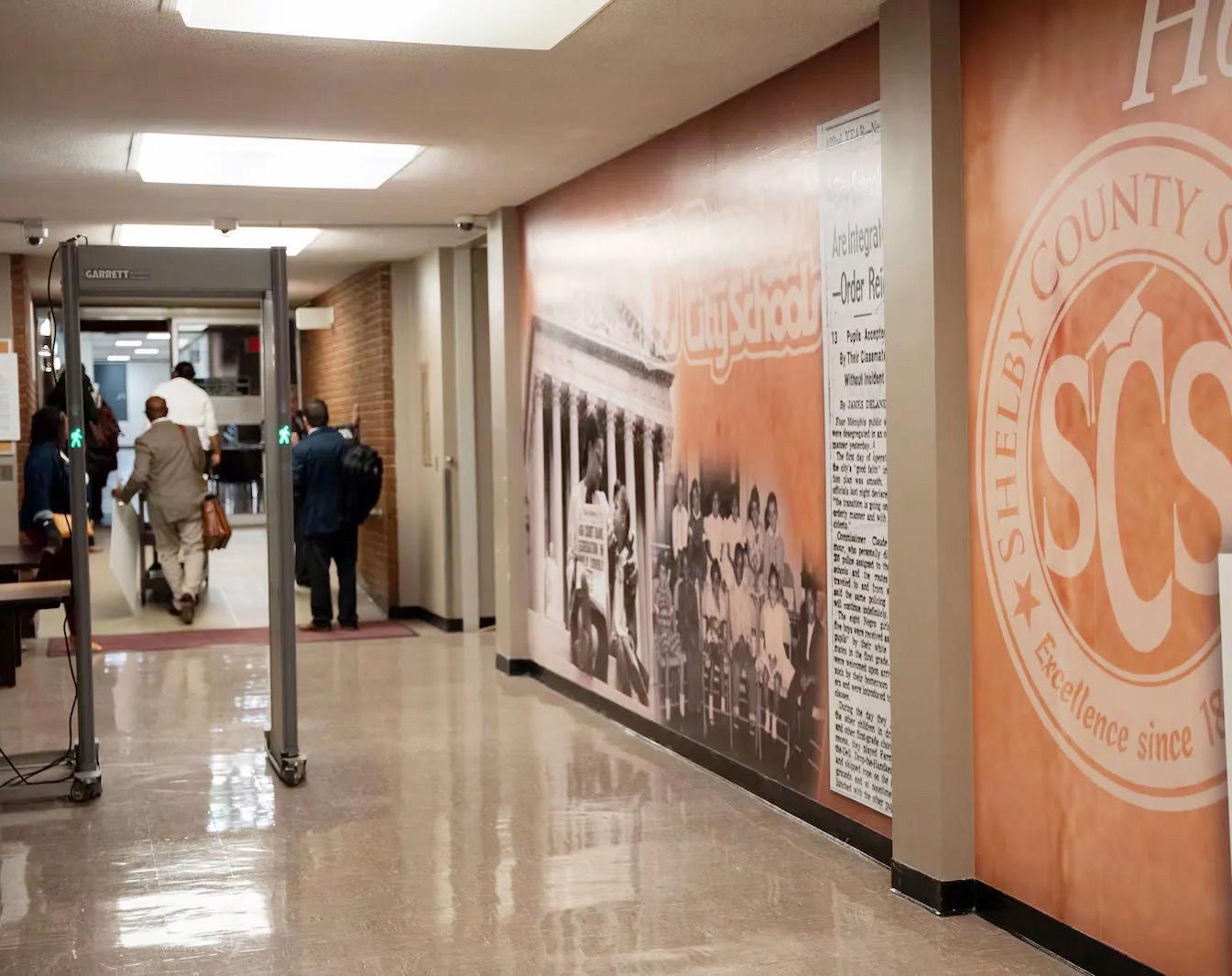
A federal judge temporarily blocked a state takeover board’s authority after Memphis school officials said it could delay the start of the school year or even force building closures as the district prepares to welcome students back to class in less than five weeks. (Andrea Morales/Chalkbeat)

By Corey Williams, Linley Sanders and Simran Parwani Associated Press
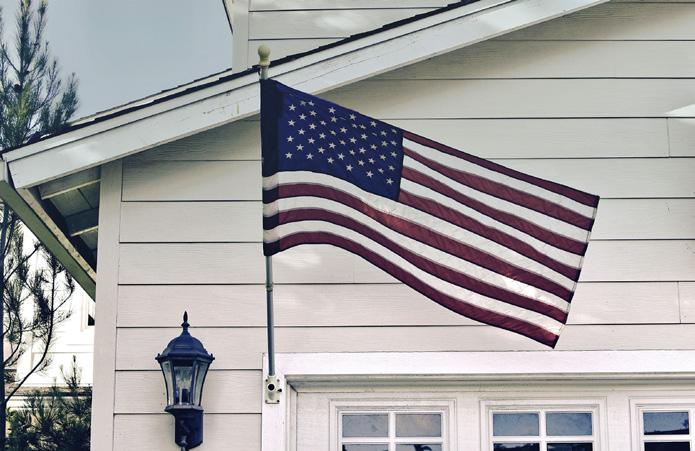
DETROIT — Jerry Esters proudly displays the American flag each day on his Detroit home. A few miles away, Yvonne Pistochini says there is no scenario under which she would allow the Stars and Stripes to cast its shadow where she lives.
Both are Black.
For Esters, the flag represents the opportunities that allowed the greatgreat-grandson of slaves to find success and flourish. Pistochini, 79, simply says the America identified by the flag is not the same country she saw growing up.
Americans’ views of “Old Glory” are divided by politics, age and race, according to a new survey conducted by The Associated Press-NORC Center for Public Affairs Research ahead of the nation’s 250th birthday celebration.
Republicans and older, white adults are especially likely to say they fly the American flag, while younger Democrats and Black adults are more likely to say they don’t fly it. Views of the flag — and whether it’s a unifying or divisive symbol — track with other deep divisions among Americans, who see their country’s history and accomplishments very differently.
“A lot of Black Americans see the flag as a symbol of both inclusion and exclusion,” said Matthew Delmont, professor of American history at Dartmouth College. “Black Americans, more so than white Americans, also understand the flag can be used to justify a version of patriotism that is rooted in exclusion, with the flag being used to say ‘you don’t belong here.’”
The survey of 2,596 adults was conducted April 16-20. It suggests
that older white Americans, especially Republicans, are more likely to see the flag as unifying.
About half of U.S. adults said they display the flag at home throughout most of the year, or during holidays. About 7 in 10 Republicans and about 6 in 10 Americans ages 60 and older fly the flag at least during holidays.
About 6 in 10 Democrats and independents, on the other hand, say they “never” fly the U.S. flag. That includes the vast majority, 75%, of Democrats under 45.
Opportunities worth fighting for
Esters, a 64-year-old retired clay sculptor for a Detroit automaker, flies three American flags at his Sherwood Forest home on the city’s west side.
“When these homes were built, Black men like me, my mother and my family ... we couldn’t even buy these homes,” he said. “To me, that’s one reason I fly the flag. We went through a lot to be able to own nice homes.”
The other reason is Moriah Martin, Esters’ great-great-grandmother, who was born into slavery.
“I’m kind of living out her dreams — what I did for a living, having a business, having a nice home,” he said.
“I think that’s the American way, but we got to fight for it and we, as Blacks, fought for it.”
He’s in the minority among Black adults, according to the survey, which found that only about 3 in 10 Black adults say they ever display the American flag, compared with about half of white and Hispanic adults.
Pistochini says current divisions over political leanings and perspectives, and inequality of opportunities for the poor and people of color are not what she believes the flag should stand for. People confuse flying it with being
patriotic, she added.
“Just because you fly a flag doesn’t make you a patriot,” Pistochini said. “If there was patriotism, we would not have all this. We can’t look at (what’s going on) and say this is America.”
For country and freedom
Ben Gaskins, chair of political science at Lewis & Clark College in Portland, Oregon, says the flag is an important symbol of patriotism for many Americans.
“It is those who are older people, who are white and people who are more conservative,” Gaskins said. “They take it as more central to their identity.”
Nancy Hansen, a 73-year-old retired Customs and Border Protection clerk in Culvertson, Montana, believes “you have to be for the country, no matter what” and that the flag means “freedom.”
“Freedom to live where we want to live, travel where we want to travel, raise our kids where we want to raise our kids,” said Hansen, who is white and identifies as Republican.
Linda and Greg Cunningham also equate the flag with freedom.
The white, conservative Pontiac, Michigan, couple are going all out this summer. The exterior of their home northwest of Detroit is awash in red, white and blue. The flag sits atop a flagpole just feet from their door.
“It’s no political thing, at all,” said Linda Cunningham, 63. “It’s our freedom. I love the American flag. I love the whole concept of it. I love America. I know there’s so much going on in the world right now, and I know everyone has their own views, and I’m just sad that politics have to be brought into the flag.”
Flag as a ‘painful reminder’
Of those who took the survey, 47% see the flag as a “more unifying” sym-
bol. About 16% call it a “more divisive” icon, while 36% say it’s neither divisive nor unifying.
Only 22% of Black adults see the flag as a unifying symbol, compared with 55% of white adults and 42% of Hispanic adults.
“It’s a painful symbol. It’s a reminder of what we could be and how it’s failed to live up to that for Black people, for Indigenous people and people of color,” said Allison Wiltz, a Black author and founder of Writers and Editors of Color.
Paul Walthour, 71, occasionally flies the flag outside his Minneapolis-area home on special occasions and some holidays. Walthour says that when he’s away from home and at his cabin, the flag goes up each morning and is taken down at the end of the day.
“This is antiquated, perhaps,” said Walthour, who is white and a retired advertising agency creative director. “I feel it’s a symbol that you’re proud to be an American.”
“Unfortunately, I kind of think it’s kind of a symbol of dividing more than uniting,” added Walthour, who identifies as a Democrat. “The people who fly it on the far right have one kind of feeling about it, and the people who fly it on the left have a different kind of feeling about it.”
— The AP-NORC poll of 2,596 adults was conducted April 16-20 using a sample drawn from NORC’s probability-based AmeriSpeak Panel, which is designed to be representative of the U.S. population. The margin of sampling error for adults overall is plus or minus 2.6 percentage points.
By Shawnee Calhoun TSD Contributing Writer
In the United States, Independence Day reflects the ongoing duality of our country. The promise of life, but without the individual right to bodily autonomy nor the security to express joy and community without opposition. The promise of freedom from the British Crown, but not from internal oppression and systemic racism. The promise of the right to pursue happiness, but without the fair economic, housing or agricultural practices to guarantee equal opportunity to access it to its fullest potential.
The day itself is supposed to commemorate those ideals as well as the lives of the men and women who sacrificed, in effort and in mortality, to ensure U.S. citizens would have unhindered access to the benefits of those unalienable rights. The latter gets lost under the heat of barbecues, the flash of fireworks, and the joy of line dances at the reunions and festivals. Beyond those distractions, the stories of unsung heroes in the fight for human rights in the United States get buried underneath the narratives of the founding fathers of the Constitution and Declaration of Independence.
This year, their stories are being provided with a space to live on perpetually and be woven into the national fabric similar to the way Kwanzaa and Juneteenth are today. Martyrs Day, the brainchild of author and legal historian Gloria J. Browne-Marshall, celebrates the lives of the people whose efforts and lives advanced the movement for human rights equality in the United States. The movement will observe its inaugural national commemoration this Sunday, July 5 — one day after the nation marks 250 years of independence.
The idea was born on the road.
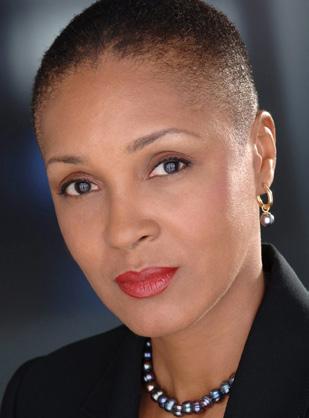
Browne-Marshall, a professor of constitutional law and Africana studies at John Jay College of Criminal Justice, spent the past year touring the country behind her latest book, “A Protest History of the United States” (Beacon Press), which chronicles half a millennium of American dissent, opening with the Indigenous nations who stood against colonization and running through the marches of our own moment. In city after city — Memphis, Nashville, Little Rock, Sarasota, Los Angeles — she met readers asking the same questions: about protest, about protesters, and about what they could do in their own hometowns.
After meeting hundreds of them, she turned the question inward. “I would ask them, will you ask yourself what you can do?” Browne-Marshall said in an interview with the Tri-State Defender. “And when I asked that question, I prayed on that question.” What moved her was the idea of “a tribute to slain activists and protesters” — Americans whose lives, she said, “were taken just like they were in battle.”
“We have days to commemorate and pay tribute and honor those people who fought for this country in foreign land,” she said. “What about those people on their own homeland who fought for civil rights and social justice and voting rights and equality?”
A trusted elder told her when that day should fall: “It should be on July 5th,” the elder said, “because of Frederick Douglass’s speech.” On July 5, 1852, Douglass stood before the Rochester Ladies’ Anti-Slavery Society at Corinthian Hall and delivered “What to the Slave Is the Fourth of July?” — speaking the day after the nation’s celebra-
tion rather than on it, while millions remained enslaved. “This Fourth of July is yours, not mine,” Douglass told his audience. “You may rejoice, I must mourn.”
One hundred seventy-four years later, Martyrs Day restores his rhythm to the calendar. “We celebrate on the 4th of July and have the fireworks,”
Browne-Marshall said, “but we should also have a day right after that in which we ask ourselves, ‘What was the price of this freedom for regular people?’”
Browne-Marshall is intent that the new observance is an addition to, not a rival holiday. “July 5th is not in competition with the Fourth of July,” she said. “It is a reflection on the freedoms that one celebrates on the Fourth of July.” Independence Day, she noted, was once also known as Freedom Day. The fifth of July exists because, in her words, “the work of freedom is ongoing work.”
“The words in the U.S. Constitution are words on paper,” she said. “To make them a reality, it took human beings — activists, protesters, regular folks who put their hands in and decided they were going to push forward a better
community and a better country.” Or, as she put it more plainly: “Freedom didn’t fall out of the sky. Santa Claus didn’t give it to us.”
Those who paid include names the country knows — Emmett Till, George Floyd — and names it should. Vernon Dahmer, a Mississippi voting rights leader whose motto was “if you don’t vote, you don’t count,” died in 1966 from burns suffered when his home was firebombed. Five Black men were gunned down in Philadelphia in 1871 for attempting to exercise the right to vote they had held for barely a year — not in the Deep South, but in the city where the Declaration was signed. Such martyrs, Browne-Marshall said, were “right here inside the United States of America, trying to get what is in our Constitution applied in reality and dayto-day life for themselves, their families, their community, and other people in the country.” Their biographies, along with educational toolkits and draft proclamations for local officials, are available at martyrsday.us
See Page 6
From Page 5
Since Browne-Marshall first shared the vision in the fall of 2025, the movement has gathered proclamations from the governor of Maryland and the cities of Philadelphia, Pittsburgh, Cincinnati and Canton, Ohio, and Longmont, Colorado, with more than a dozen inaugural events scheduled from San Francisco to New York City, where the national commemoration will be held. Memphis has yet to issue a proclamation but by the founder’s own account, no place has mattered more. “Memphis, and especially Tennessee, has been essential in elevating Martyrs Day,” Browne-Marshall said. “The engine for it began in Memphis.”
“The people I interacted with, when I was hearing the idea of Martyrs Day, were very enthusiastic. Those people are Memphis residents,” Browne-Marshall said. “They were the ones who said, yes, we can do an event in Memphis, and it went from an event in Memphis to a statewide event because they’re NAACP members,” she said,
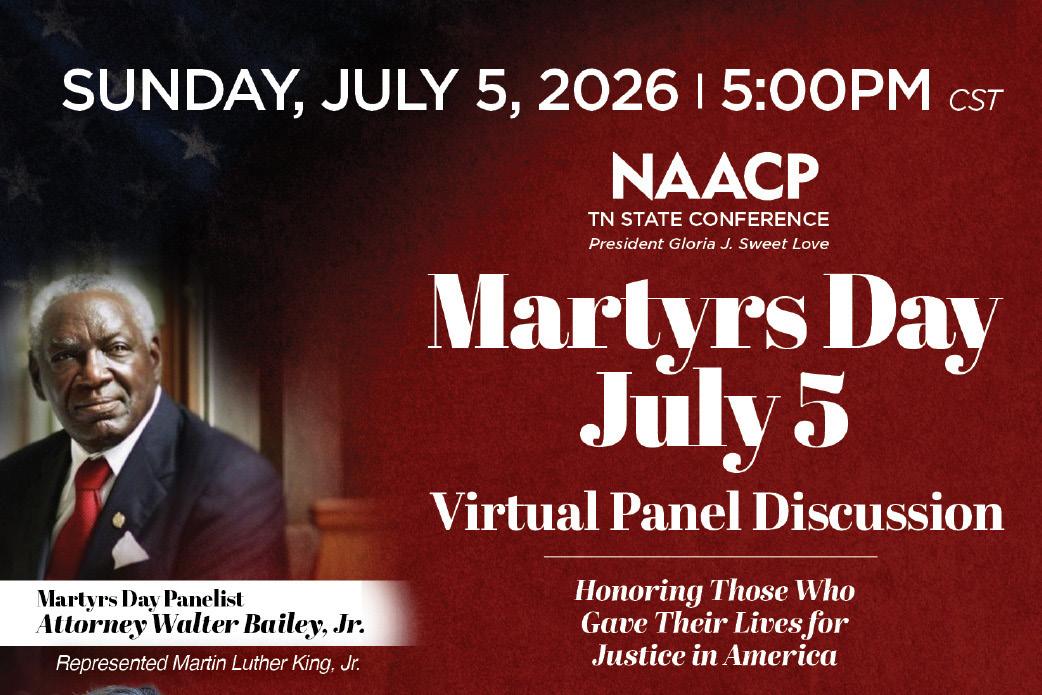
crediting the Memphis Martyrs Day Committee for carrying the vision forward. The NAACP Tennessee State Conference will host an observance that culminates the inaugural Martyrs Day: a virtual panel discussion Sunday, July 5, at 5 p.m. CST, with registration required via Eventbrite
The panel is anchored in Memphis’ own place on the civil rights timeline. It features attorney Walter Bailey Jr., who represented Dr. Martin Luther King Jr. in Memphis during the 1968 sanitation workers’ strike; Emily Yellin, co-author of “Nonviolent: A Memoir of Resistance, Agitation and Love” about the life of the Rev. James Lawson; and Beverly Denise Glaze-Johnson, a licensed social worker and program director known for her community advocacy and social action leadership.
“On Saturday, we celebrate this country’s 250th anniversary of being the United States of America,” said Gloria J. Sweet Love, president of the NAACP TN State Conference, in a statement announcing the event. “On Sunday, we will celebrate those individuals who helped build this country and made
sacrifices by paying with their lives for the advancement of justice for all people.”
In that sense, Martyrs Day challenges us to account for a debt we could never repay — owed to those whose signatures on this country’s contract were signed in life and blood. It challenges us to say their names and show their faces the way the presidents lined our classroom walls, and to pay forward a balance that the obstacle of systemic racism hinders from being paid in full.
Asked whether the country is too divided, too far gone, for a day like this to take root, Browne-Marshall answered with what she calls practical hope grounded in the historical record. The research behind her book showed her, over and over, people with far less facing far worse and pushing forward anyway. Women dismissed as having the minds of children won the ballot. People who were not even counted as people forced this nation closer to its own words. “Courage is fighting a foe — feeling the fear, and fighting anyway,” she said. “And that’s what’s gotten us forward.” That courage carries
a challenge for the living — whether we have become “freedom freeloaders.” “Are you actually putting anything into pushing the country forward,” she asks, “or are you just benefiting and reaping from the work that was done from prior generations?”
Her hope for the day is intentionally manageable. Families already gathered for the holiday weekend can carry it to the cookout table: have the young people research a martyr and present at the family reunion, the way spotlights once shone on children at gatherings past. “No movement moves forward without young people,” she said, noting her inaugural committee includes young members who advise on how best to carry Martyrs Day across social media.
Twenty years from now, she envisions Martyrs Day as an expected part of the July calendar in every community — what she describes as “a moment of silence, a time of reflection, education, and a re-commitment to social justice.” The fireworks will fade Saturday night. On Sunday, the country is invited to sit in the quiet that follows and remember who lit the way.

By Brianna Smith-Herman TSD Contributing Writer
For Julia Griggs, receiving a proclamation from the City of Memphis was a moment she never saw coming.
The Memphis native, a veteran journalist, award-winning filmmaker and founder of independent film studio Kingdom Stride Productions, has spent much of her career shining a light on the stories of others. Now, the city that helped shape her story is recognizing her impact.
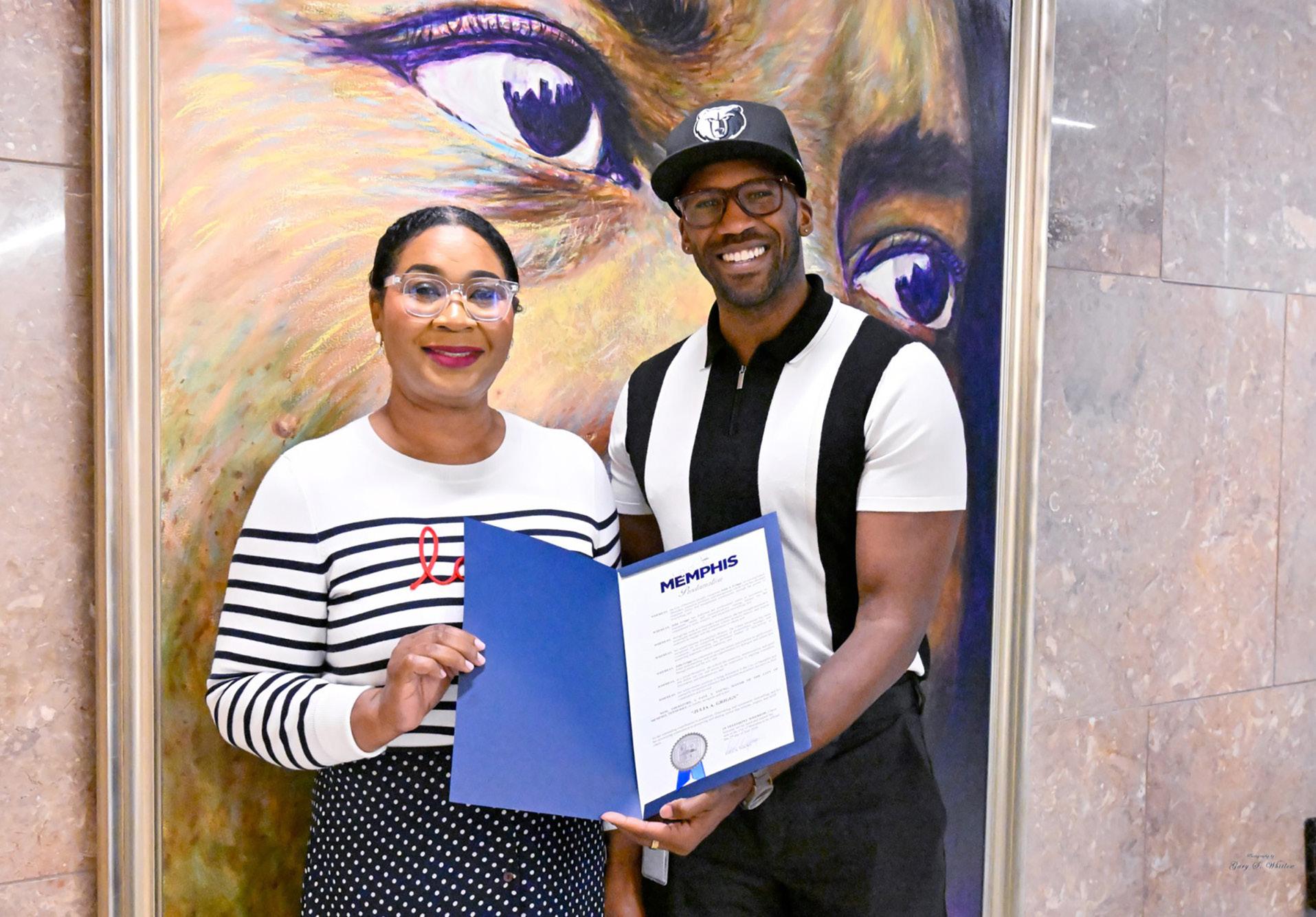
Memphis Mayor Paul Young issued an official proclamation last month honoring Griggs for her commitment to truthful and impactful storytelling, highlighting her documentary “Brannu: The Urban Horseman,” and recognizing her work to preserve culture, uplift underrepresented voices and inspire the next generation of journalists and filmmakers. The proclamation also recognizes Griggs for bringing distinction to Memphis and exemplifying the positive influence dedicated storytellers can have on their communities.
“I was truly shocked,” Griggs said. “Receiving a proclamation from the City of Memphis is deeply meaningful to me, especially as a daughter of Memphis who grew up in North Memphis. This recognition feels truly special, and I’m grateful to the mayor for acknowledging my work in this way.”
Griggs’ path to national newsrooms and award-winning filmmaking began in Memphis. Before building a career in journalism and media production, she worked as a flight attendant. But determined to create a new future for herself, Griggs returned to school and earned a degree from the University of Memphis. While still working in the airline industry, she spent her days off gaining experience in media, which eventually led to
“I hope my work can inspire people to believe beyond their zip code. Do the work. The work is what opens doors.”
— Julia Griggs
opportunities with major national news outlets, including CNN, where she established herself as a respected producer and storyteller.
The proclamation serves as recognition for years of perseverance and purpose, said Griggs, who now lives in Atlanta.
“It reflects the work, dedication and passion I have poured into my career,” said Griggs, who thanked Mayor Paul Young on her LinkedIn page. “It inspires me to continue making a positive impact through my work.”
Grigg’s latest project, “Brannu: The Urban Horseman,” an award-winning documentary, explores Black horsemanship, land ownership, displacement and community resilience through the story of Brandon “Brannu” Fulton, an Atlanta-based horse stunt rider. The project was recently screened in Memphis.
“This honor represents years of hard work. Much of it done quietly, without recognition, but always with purpose,” Griggs said. “’Brannu: The Urban Horseman’ shifted the trajectory of my career. It deepened my perspective as a producer and reaffirmed my passion for telling impactful stories.”
Throughout her career, Griggs has remained committed to amplifying voices and perspectives that are often overlooked. As a Black journalist and filmmaker, she acknowledges the journey has sometimes been hard.
“I’ve faced my share of challenges in this industry — moments that tested
not only my work, but also my purpose,” she said. “Through faith and prayer, I’ve been able to overcome those obstacles and continue pushing forward in a field where representation matters deeply.”
That commitment to authentic storytelling continues to guide her work today. Whether producing national news coverage or creating independent films, Griggs says her personal mission to tell stories that matter remains unchanged.
“What I’m most proud of is the opportunity to bring impactful voices to national news coverage,” she said.
“I’m also proud of the creative growth I’ve experienced as a filmmaker and the relationships I’ve built with other storytellers.”
As she looks toward the future, Griggs hopes her journey will inspire others, especially young people in Memphis, to dream beyond the limitations of circumstance or condition.
“I hope my work can inspire people to believe beyond their zip code,” she said. “Do the work. The work is what opens doors.”
Her message is one grounded in faith and preparation. And while this latest honor celebrates what she has already accomplished, Griggs says she remains focused on what comes next.
She recently helped co-produce the short film “Back To You” in collaboration with Sheila B Productions, an independent film and media company. The Black cowboy love story will premiere July 25 at NCG Cinema in Stone Mountain, Georgia, with another screening slated for Aug. 8 at Georgia Gwinnett College, about 30 miles northeast of downtown Atlanta.
“As I continue moving forward,” said Griggs, “I’m focused on giving my best in whatever God has for me next and staying open to the opportunities ahead.”
By Lee Eric Smith TSD Contributing Writer
Louis Martin III, owner of Uncle Lou’s Fried Chicken restaurant in South Memphis, still remembers where his famous recipe was conceived — not in a restaurant, not on television and not under the bright lights of an awards stage.
It all started in his mother’s kitchen.
Martin, a celebrated restaurateur who has appeared on The Food Network, was honored Thursday, June 25, at the fourth annual Small Business Expo, hosted by the Economic Development Growth Engine for Memphis and Shelby County. The free event was held at the Renasant Convention Center, where dozens milled about the room, networking with entrepreneurs, lenders, business support organizations and community partners, while connecting over samples of fried chicken, waffles and specialty lemonade.
“People ask me where I went to culinary school,” said Martin, after receiving EDGE’s first Small Business Legacy Award at the expo. “I tell them I went to the Mary Martin School of Fine Culinary Arts — my mom’s kitchen.”
The event also marked the debut of Culture Corner, a new space at the expo created to give exposure to artists, crafters and creative entrepreneurs. With music drifting from the creative side of the room, the expo blended the feel of a business resource fair with the energy of a community marketplace.
“The purpose of this is not just to showcase the businesses, but to bring you all together here so that we can continue to uplift Memphis,” said Dr. Joann Massey, president and CEO of EDGE, speaking from the stage. “Because guess what? Nobody’s coming to save us. It’s up to us to do what we need to do for our community.”
The expo is part of the economic development agency’s broader push for “Entrepreneurship City,” an
“The purpose of this is not just to showcase the businesses, but to bring you all together here so that we can continue to uplift Memphis. Because guess what? Nobody’s coming to save us. It’s up to us to do what we need to do for our community.”
— Dr. Joann Massey
effort to connect small business owners with resources and relationships that can help them grow.
For Massey and EDGE, the expo’s message was straightforward: Small businesses are not minor players in Memphis’ economy. They are job creators, community anchors and, in many cases, the places where future entrepreneurs first learn about business ownership.
“We’re so excited to amplify the importance of small business in Entrepreneurship City, which is Memphis, and also again highlight the way that we power progress through partnership,” Massey said in a social media video captured at the event.
For Martin, whose Uncle Lou’s Fried Chicken has become a Memphis institution, the award means more than a plaque to display on a mantel. It is a reminder of what a small business can achieve with faith, family, skill and persistence, even during lean years.
“It started with my mom, my grandmother, my great-grandmother,” said Martin. “One day she was doing chicken and she said, ‘The secret to good chicken is – ’”
Martin paused just long enough to tease the audience, making some believe that he might give up a tip — buttermilk marinade, imported flour, something. No luck. Psych.
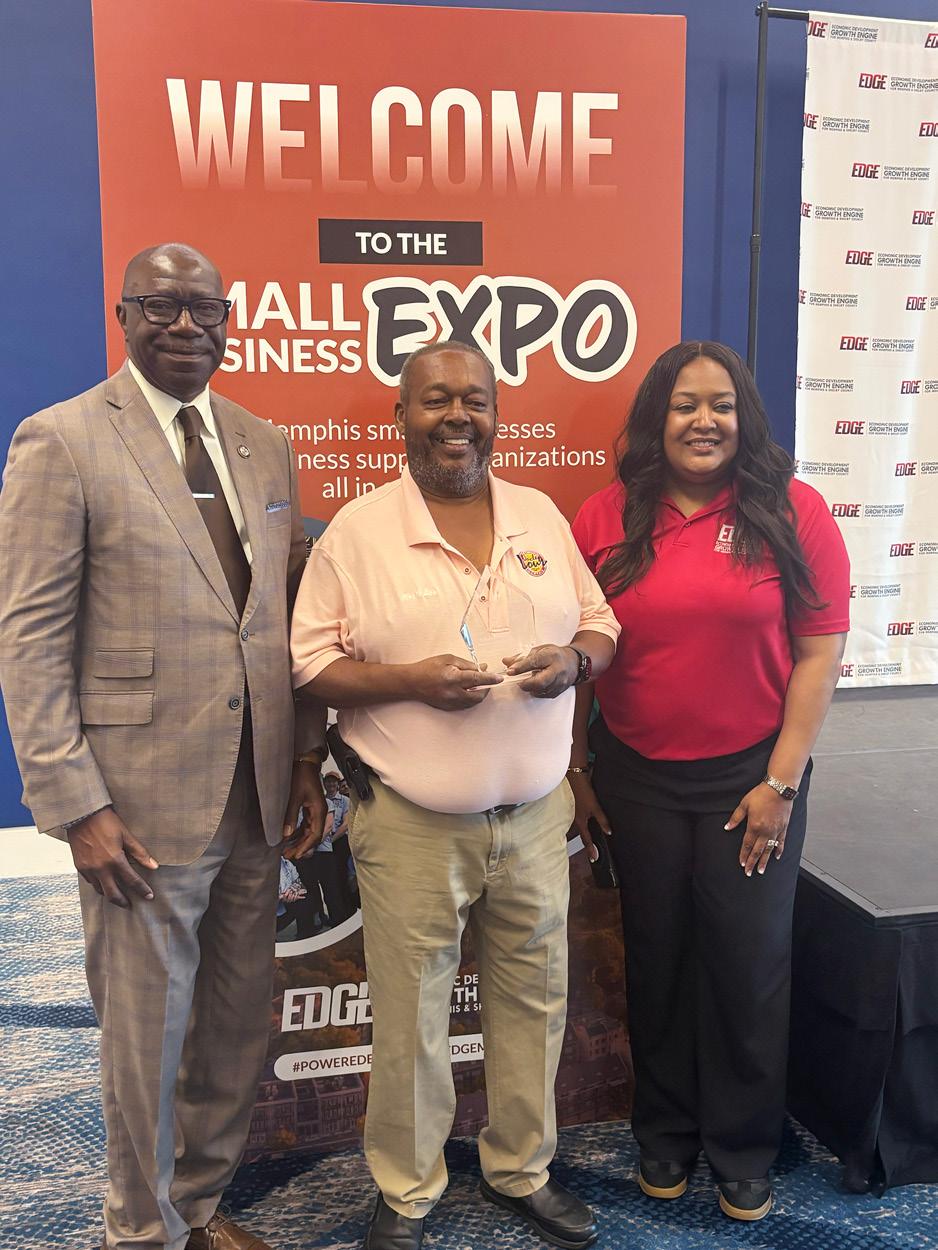
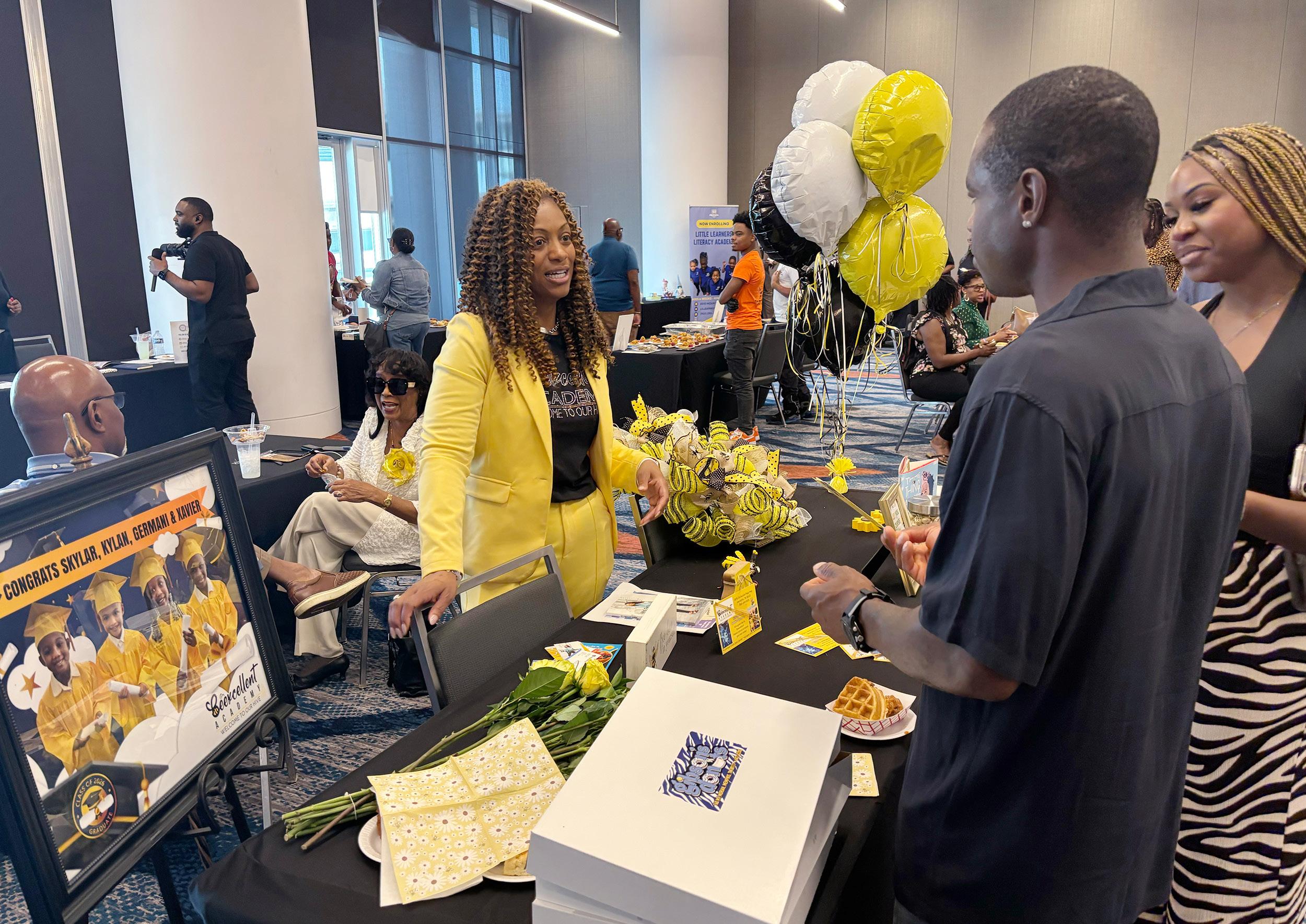
Harold Collins, Shelby County’s chief administrative officer, Louis “Uncle Lou” Martin III and Dr. Joann Massey, EDGE president and CEO, share the stage as Martin receives EDGE’s first Small Business Legacy Award during the Fourth Annual Small Business Expo. (Photos: Lee Eric Smith/Tri-State Defender) ON THE COVER: Stacie Payne from Bee Excellent Academy meets and greets during EDGE’s Fourth Annual Small Business Expo at the Renasant Convention Center. The event brought together entrepreneurs, artists, crafters, lenders and community partners for networking, visibility and business support.
“And she went on to give me the recipe,” he said. “I guess she thought I wasn’t listening, but I guess I was. Here it is, years later, it stuck. It’s not a cliché. It is a family recipe that we’ve taken and shared with the world.”
Martin also thanked Harold Collins, Shelby County’s chief administrative officer, for helping connect him with Massey and EDGE.
“He’s not just a guy in the office,” Martin said of Collins from the stage. “He does what he says he’s going to do.”
The next generation gets a taste
At the awards presentation, another Memphis eatery offered a glimpse into the ways small business owners share knowledge with aspiring entrepreneurs.
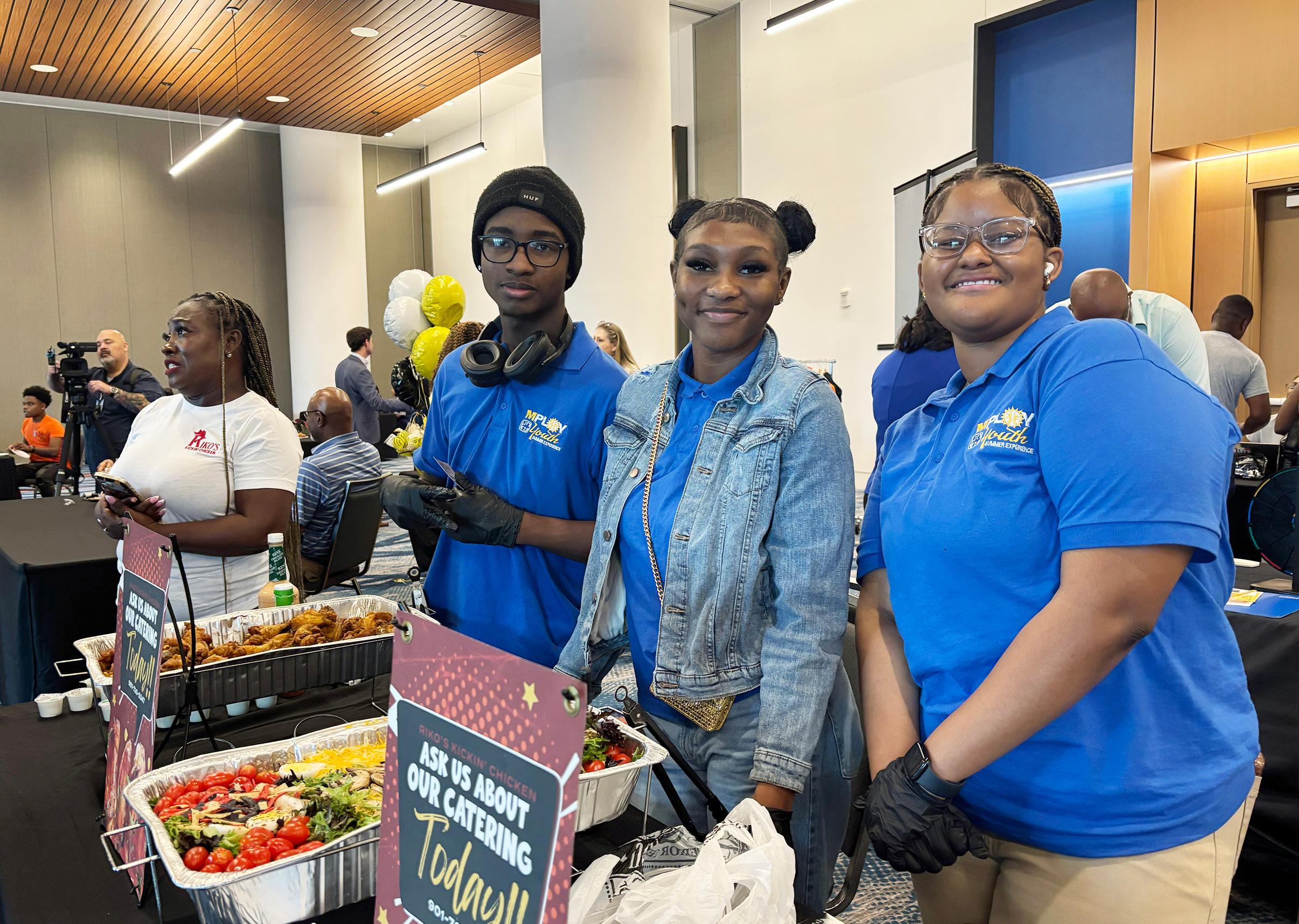
Tiffany Wiley, co-owner of Riko’s Kickin’ Chicken in Midtown, enlisted summer interns hired as part of the city’s MPLOY youth employment and professional development program to help out at the expo and learn about the demands of entrepreneurship beyond the finished plate.
Riko’s, located at 1329 Madison Ave., has been in business for 12 years, said Wiley. Through MPLOY, Wiley said students get exposure to the behind-thescenes realities of running a small business.
“We show them different sides of the business — not just the good side,” said Wiley. “We show them what we have to deal with — customer service on one end, hiring on the other end. We show them all the aspects of it, the brick-and-mortar and the food truck side.”
Jemias Powell, a 16-year-old Bolton High School student, was not looking for summer work before accepting an MPLOY internship. His path to a job at Riko’s started with his concern for a family member.
“If we really want to be honest, it was because of my little cousin,” said Powell. “I didn’t want her to be by herself, so I was thinking of her when I wanted to join.”
Powell, who turns 17 in August, said he was open to either food service or working around cars. After landing at Riko’s, watching Wiley operate her businesses, he has started to widen his view about his future.
“I’m thinking about it,” Powell said of becoming an entrepreneur. “She’s been encouraging me to do it. She’s got multiple businesses, and as I’m working for her, it’s just making me want my own business.”
His first choice would be trucking, he said.
“I really want to have my own trucking business, get my CDL and eventually have my own trucking business,” said Powell. “But if not, I’d have my own restaurant. I don’t know what I’d name it yet, though.”
Changing with the times
Martin said the road was sometimes rocky for Uncle Lou’s, which operated for two decades at another location before moving to its current address at 1725 Winchester Road.
“I had been where I was for right at 20 years, and that piece of property got sold from under me twice,” said Martin. “I was a little upset, not knowing God had something else for me.”
That “something else” turned out to be the former Wendy’s building around the corner, where Uncle
“If nothing else, believe in you. You’re going to have hurdles. You’re going to have highs, but you’re going to have a whole lot of lows in the beginning. You’ve got to build a foundation to get to where you want to go.”
— Louis Martin III
Lou’s relocated in 2025.
“It was a blessing,” Martin said. “It was a good thing that it went that way for me and my crew.”
At 67, Martin is still thinking about what comes next for Uncle Lou’s. He is exploring licensing or franchising opportunities built around a smaller food service format, including walk-up, drive-thru, delivery and online ordering.
“With DoorDash and Uber and online ordering, people are in a hurry,” said Martin.
Still, his restaurant will remain the flagship for the foreseeable future, he said.
“The mothership — the mainstay, the one that put us on the map — we’ve got a nice dining room,” Martin said. “We’re never going to get rid of that one.”
Surviving uncertainty, managing through unexpected turns and doing the work long before the recognition comes are the lessons Martin said he tries to pass along to other entrepreneurs who seek his advice.
“I talk to anybody,” Martin said. “Whatever little knowledge I have, I don’t mind sharing.”
But Martin also tries to make it clear that entrepreneurship is not only about passion or a good idea. It requires sacrifice. For Martin, that meant years of long days with few breaks and an unyielding will and drive to succeed.
“There’s NDO — no days off — when you start. It might have been six to eight years into my business before I could take a vacation.” Martin said. “If nothing else, believe in you. You’re going to have hurdles. You’re going to have highs, but you’re going to have a whole lot of lows in the beginning. You’ve got to build a foundation to get to where you want to go.”
By Jack Brook and Travis Loller Associated Press/Report for America
NASHVILLE — The grandfather of a man who was shot and killed by the Tennessee National Guard in Memphis over the weekend says he wants answers from law enforcement.
Evaniel Johnson said he is waiting to see if video footage supports the police narrative that his 20-year-old grandson, Tyrin Johnson, turned toward U.S. guard members with a gun while running from them early Sunday. Memphis police say the guard members were responding to a report of gunfire.
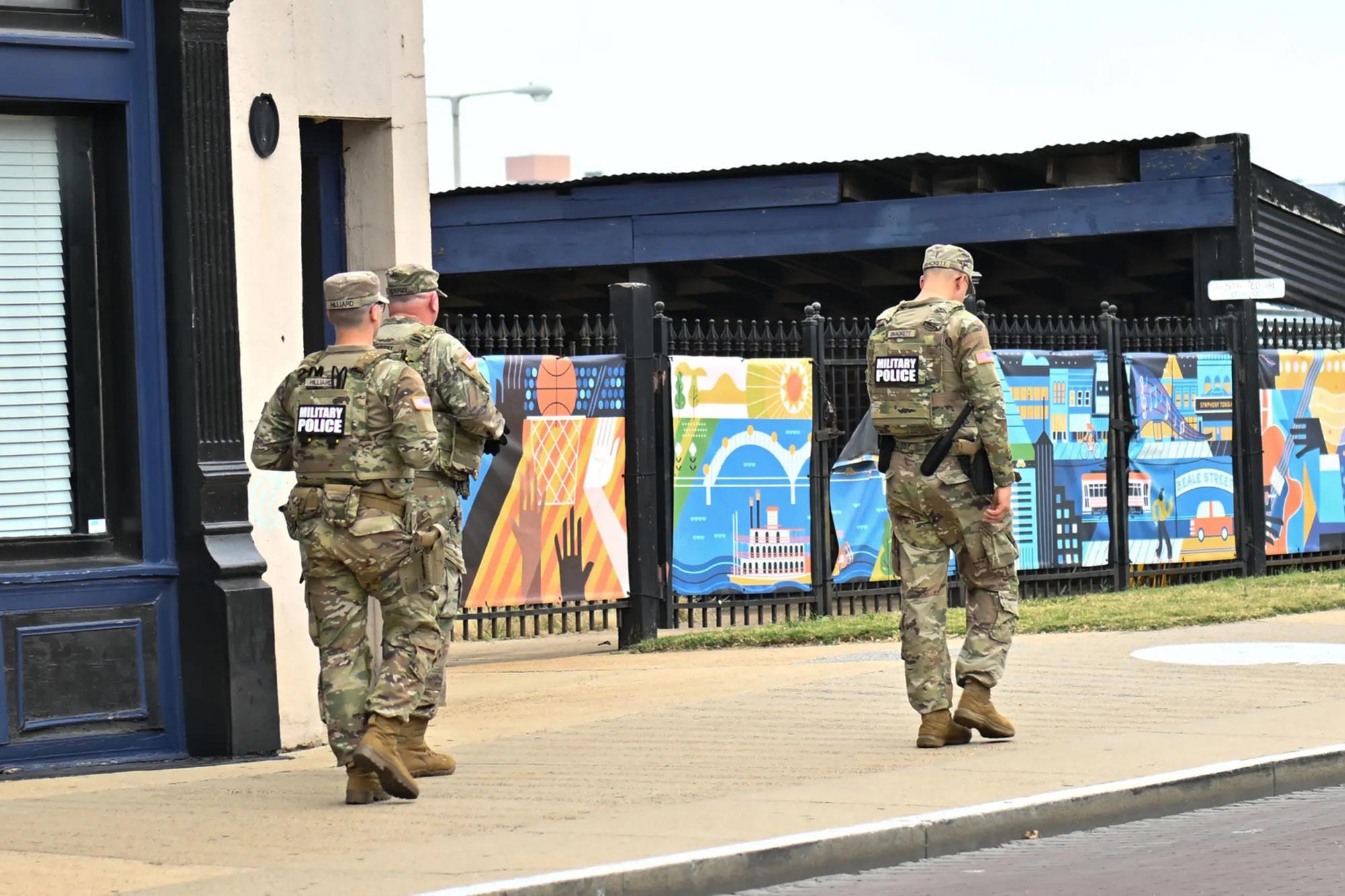
The National Guard members had been assigned to a crime-fighting patrol in Memphis created last year by President Donald Trump, who has sent troops and federal agents to Democratic-run cities he described as crime-ridden.
“Show me the video,” Evaniel Johnson told The Associated Press. “Please show me that — and then I’m OK. Until you show me that, I’m gonna fight and advocate for my grandson until there’s no breath in me.”
Johnson, a former correctional officer with the Davidson County Sheriff’s Office in Nashville, disputes that his grandson would have tried to fire a gun at U.S. guard members and that deadly force would be needed if he was running away. His grandson, he said, was “no hoodlum.”
According to his grandfather, Tyrin Johnson carried a gun for protection after being “jumped” recently in Nashville and was likely wary about being attacked again over a murky social media feud.
The Tennessee Bureau of Investigation
says it is reviewing the shooting and that two guard members fired their weapons. Johnson’s family says they were told by the TBI that he was shot twice in the chest. The Memphis Police Department declined to comment on what footage existed and when it would be released.
The National Guard did not immediately respond to a request for comment on whether the two members involved in the shooting had been placed on leave.
Democrats, others call for a transparent investigation
Tennessee Senate Democratic Leader Raumesh Akbari and Chairwoman London Lamar, both of Memphis, issued a joint statement expressing their sympathy and emphasizing the need for transparency during the investigation. They asked the TBI to release any available video as soon as it is possible to do so without jeopardizing the investigation.
“Transparency serves everyone — the Johnson family, the members of the National Guard involved, and a community that deserves confidence in the outcome, whatever the facts ultimately show,” they wrote.
State Rep. Justin Pearson, a Democrat running for the U.S. House, echoed the call for a transparent investigation and demanded the disbanding of the federal task force.
“Memphis does not need armed soldiers in our streets terrifying our people,” he said in a statement.
The NAACP Memphis Branch issued a statement Tuesday calling for a speedy investigation.
“Our hearts go out to the Johnson
family, but we are committed to more than just thoughts and prayers,” said the statement signed by Kermit Moore, Memphis Branch president. “We call for the immediate release of all bodycam and surveillance footage. We also call for the Tennessee Bureau of Investigation (TBI) to immediately announce an expedited timeline in which they will handle this investigation.”
The American Civil Liberties Union of Tennessee also called for the task force to be shut down. “We demand a transparent investigation, not a closed-door ruse that leaves our community in the dark,” the ACLU said in a statement.
Trump’s decision to send Tennessee National Guard troops to Memphis to combat crime was met with a mixed response from residents and was the subject of a lawsuit. However, it was never the subject of widespread protests.
TBI data shows that at least three people have died in four shootings by officers tied to the federal task force.
Evaniel Johnson wishes his grandson stayed home that weekend
Tyrin Johnson did not appear to have a criminal history besides a handful of traffic violations, according to a review
of online federal and state court records and Memphis and Nashville courts. In May, he was arrested for failing to appear at a 2025 hearing for driving without a license in Wilson County, just outside Nashville. He bonded out, records show.
He was enrolled in Tennessee State University from August 2023 to May 2024, according to university spokesperson Angel Higgins.
Evaniel Johnson said he had hoped his grandson would return to university and he was training him to take on a bigger role in the family’s real estate development business, including lining up a project for him in Nashville to oversee in the coming weeks.
On the Fourth of July, Evaniel Johnson said his family had gathered on his back porch in Nashville to play cards. He wished his grandson had stayed with them. Instead, Tyrin Johnson ended up in Memphis.
“He was down there like all the rest of the people trying to enjoy the Fourth of July,” Johnson said. “His future was buying homes, living life, taking care of his little baby. He had a future. It’s gone now.”
Brook reported from New Orleans.
Civil rights attorney Ben Crump says preliminary forensic findings challenge the official account and escalate demands for bodycam, dashcam and Walmart video
Lee Eric Smith TSD Contributing Writer
The bullet that killed 1-year-old Kohen Kartier Wiley did not travel from front to back, an independent forensic review shows. It entered his body from right to left.
The finding raises new questions about whether a police officer was in danger June 14 when he fired into a vehicle carrying Kohen in a Walmart parking lot in Senatobia, Mississippi. According to the preliminary forensic examination, performed by board-certified forensic pathologist Dr. Roger Mitchell, the bullet entered the right side of Kohen’s chest and exited on the left side, said civil rights attorney Ben Crump, during a news conference Wednesday at Senatobia Church of Christ.
Crump, who stood with local attorneys, family members and community activists, said the findings support the family’s contention that the shot came from the side of the vehicle — not the front.
“The direction is from right to left, not front to back. They told us that, but they have not showed us that,” said Crump, referring to the official account that the vehicle moved toward officers.
Crump again demanded the release of police body camera video, dashcam video and Walmart surveillance footage, saying the family should not have to rely on diagrams, photographs and an independent autopsy to learn what happened.
The Mississippi Bureau of Investigation has said officers responded to a reported shoplifting call at the Walmart on U.S. 51 and attempted to stop a vehicle carrying two women and a
child. The vehicle drove toward officers, nearly striking one, before an officer fired, according to MBI.
Kohen’s mother, Vel’lesiya “Punkin” Wiley, has disputed that account.
Crump and Memphis attorney Van Turner, who is part of the family’s legal team, have repeatedly said the family believes video from police and Walmart will show the officer was not in a life-ordeath situation when he fired his gun.
Crump: ‘How do you justify that?’
Mitchell reviewed photographs of Kohen’s body and the vehicle, and examined the toddler’s body before burial. Mitchell did not reopen the body, said Crump, because the state had already performed an autopsy.
The forensic pathologist’s preliminary review found the cause of death to be a gunshot wound to the torso and classified the manner of death as homicide.
In forensic terms, homicide is defined as death caused by another person with or without intent to cause harm.
Still, the key finding, said Crump, is the bullet’s path. The entrance wound appears on the right side of Kohen’s chest. The left side of his body shows the exit wound. The review also noted abrasions on the right side of his chest and abdomen consistent with “pseudo-stippling,” injuries that can occur when a bullet passes through glass before entering the body. The injuries support the conclusion the bullet passed through the side window’s tempered glass, said Crump, before striking Kohen.
“That’s the bullet that went through that window that killed Baby Kohen,” said Crump, pointing to enlarged photos and diagrams as he walked reporters and community members through

the findings. “How do you justify that?”
The official autopsy report has not been completed, according to The Associated Press, and MBI has not commented publicly about Crump’s description of the preliminary independent findings. No video of the shooting has been released.
For Crump and Turner, the forensic review sharpens the central question about the shooting: If the vehicle was not driving toward police as the path of the bullet indicates, why did the officer fire?
“The kill shot came from the side, not the front,” said Turner. “Now we know how this young precious child died. The next thing for all the authorities to do is to release the video.”
Turner also renewed calls for local policy changes, pointing to the “8 Can’t Wait” national framework for police reform, including de-escalation, warnings before shooting, bans on shooting at moving vehicles and proportional use of force.
“Shoplifting diapers does not require
deadly force,” said Turner.
Kohen was killed after officers responded to a reported shoplifting call involving diapers. That context remains important because, even if the allegation was true, the suspected offense did not justify firing into a vehicle where officers knew a baby was inside, said Crump.
“They didn’t get called saying that somebody had been shot in Walmart,” said Crump. “They didn’t get called saying that it was a strong-arm robbery in Walmart. They didn’t get called saying that this was a hostile situation in Walmart. No, we’re talking about a box of diapers.”
Wednesday’s news conference came four days after Kohen’s funeral in Pope, Mississippi, where hundreds gathered to remember him as a child full of laughter, who favored animated TV character Bluey and a toy lawnmower. It also followed two weeks of protests, marches, a town hall meeting and demands for transparency in Senatobia.
Community activist Patrick Lumumba said the release of the preliminary findings should intensify the movement around Kohen’s death, and spur the beginning of more in-depth organizing. A new group called the Senatobia Committee for Accountability and Transparency was formed, he said, to press the city’s board of aldermen for answers and reforms.
Kohen’s parents did not appear at Wednesday’s news conference. For them, the details of the forensic review were too painful in the wake of their son’s burial, said Crump. And Vel’lesiya Wiley still carries the trauma of holding her son immediately after he was shot.
“She did not deserve to have her baby get shot while he was in her arms,” said Crump.
By Judith Black Moore TSD Contributing Writer
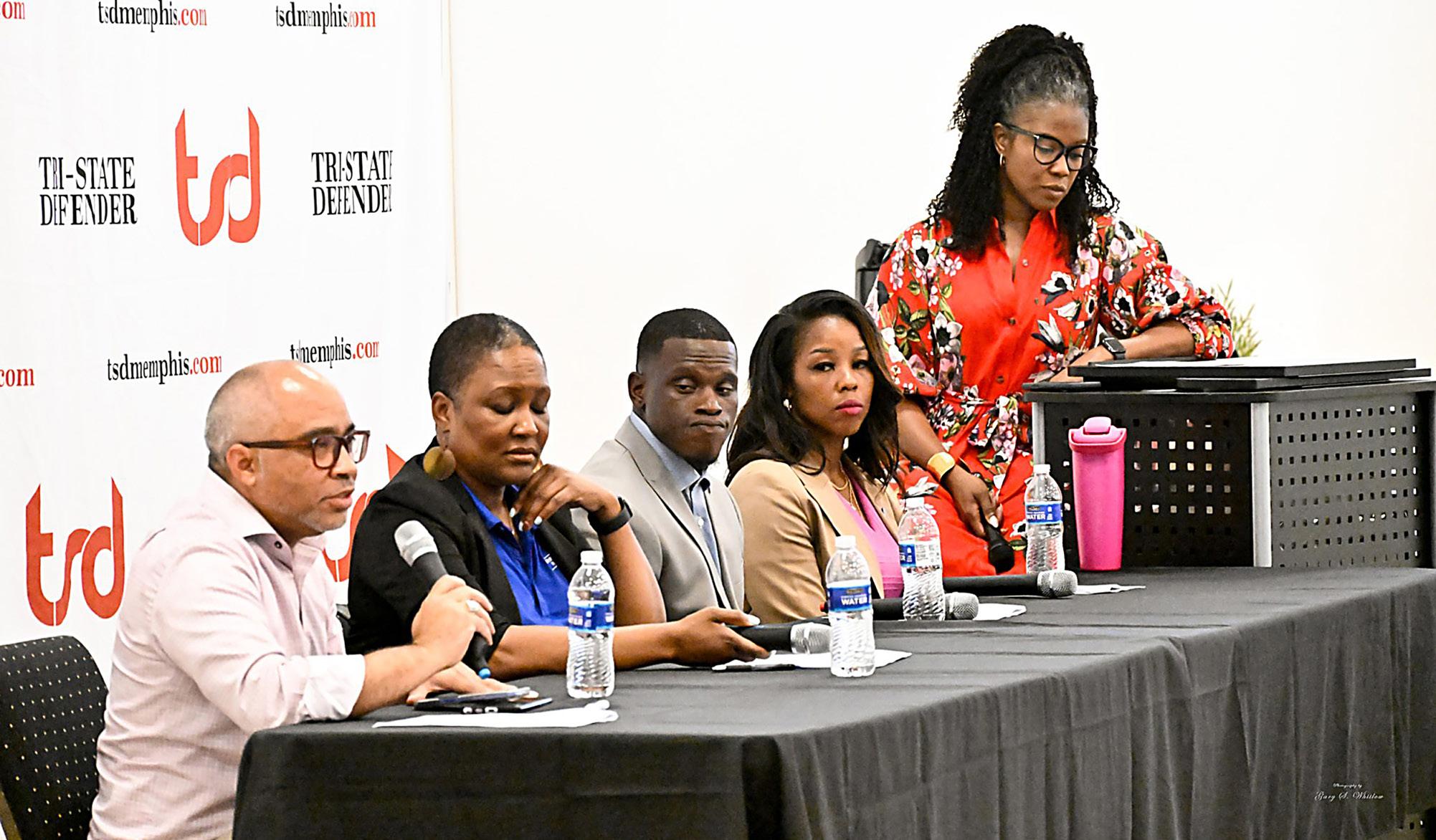
The Tri-State Defender hosted its fourth and final TSD in the Community forum of 2026 focusing on public education on Wednesday, July 1, just hours after U.S. District Judge Waverly Crenshaw Jr. issued a temporary restraining order halting Tennessee’s takeover of Memphis-Shelby County Schools.
That legal uncertainty — and the cancellation of the newly appointed oversight board’s first meeting in Nashville — provided the backdrop for the free community event held at the Alpha Memphis Education Foundation in South Memphis.
The 90-minute forum drew elected officials, political candidates, current MSCS commissioners and community members.
Moderator Lori Spicer Robertson, Memphis civic leader and communications executive, led a panel discussion about the state of Memphis-Shelby County Schools, featuring Cardell Orrin, executive director of Stand for Children Tennessee; Tomeka Hart Wigginton, president and CEO of United Way of the Mid-South and a former Memphis City Schools board member; Sable Otey, commissioner for Memphis-Shelby County Board of Education; and Dr. Derek King, principal of Craigmont High School.
Much of the evening focused on a central tension: The heavy weight the education system is asked to shoulder and how little support it receives to carry it.
“Education is the only system in which everybody expects it to do everything — address homelessness, the hunger of kids, transportation,” said Hart Wigginton. “It is isolated, but also expected to address every problem without the support of other systems.”
Orrin pointed to nonschool factors
affecting student performance, including Memphis’ high rate of child poverty, lack of affordable housing and elevated rates of chronic disease, challenges compounded by the lingering impact of the COVID-19 pandemic and a school district that has cycled through four superintendents in five years.
“Public education is moving both forward and backward — two steps forward, one step back,” said Orrin. “The data says growth is happening by the state’s measurement, but all of our children are not performing where we want them to be.”
For Otey, the school board commissioner, more effective channels are needed to share the board’s actions and rationale for decision-making in overseeing the district’s nearly $2 billion budget, beyond the limitations of media coverage.
“We need to do a better job of communicating — an overview of meetings, media relations to break things down, reiterate, help people understand,” she said. “There is a lot more than what you see on television.”
When asked to identify the main problem facing the district, panelists pointed to economic disparities.
Hart Wigginton, who oversees housing, food and utility assistance programs through United Way, said families’ inability to meet basic needs directly affects children in classrooms.
Census data illustrates the disparity. The median household income for white households was roughly $73,826 in the city of Memphis, compared with about $42,373 for Black households, according to the American Community Survey’s 2018-2023 five-year estimates — a gap of more than $31,000.
And nearly 60% of the district’s 106,000 students are classified as economically disadvantaged, according to the 2024-2025 Tennessee State Report Card. The figure is more than double the state level of 29%.
Otey connected the issue to state education funding, noting Tennessee’s low national ranking in per-pupil investment.
“If we are not receiving the funding from the state, we cannot have sustainable growth when it comes to teacher pay so we can retain and recruit good teachers and pay them appropriately, as well as the staff,” said Otey.
King, the high school principal, brought the conversation to the school level, describing the daily challenge of running a large comprehensive high school amid fluctuating enrollment and funding uncertainty.
“The hardest part of what I do when it comes to the budget is having to consider the right now and then tomorrow,” said King. “With the transientness of the city, our enrollment fluctuates. The kids and the parents are moving around. Against this, I have to understand how to advocate and figure out what positions the district is going to fund.”
He described the challenges of
navigating deferred maintenance with limited resources, sometimes finding creative, informal solutions to keep a building running.
“I reach out to stakeholders — we might even hire somebody’s uncle to fix it — but we work to get it done,” he said.
Despite the challenges, King said scarcity should not shape how educators view their roles and cautioned against allowing a lack of resources to cast a shadow on the profession. It also helps to offer teachers outlets to share activities they enjoy with their students, he said, including leading extracurricular programs and clubs that align with their interests.
Still, the legal fight over the state takeover brings with it an opportunity for state and local leaders to reconsider how they work together.
“The system cannot continue to be the enemy of the city. With the halt (of the takeover), there is time to come together as a community and decide what we are trying to accomplish,” said
Hart Wiggington.
But the uncertainty leaves school employees sometimes struggling to determine who is authorized to make decisions at the district level, said King. The resulting delays affect schools’ ability to operate.
“We had a bottleneck trying to get contracts signed, which held us up from getting testing materials,” said King.
Orrin framed the funding conversation as a community choice as much as a state issue, pointing to Memphis and Shelby County’s flat local tax revenue as part of the equation.
“There is a need for more investment in our community. We are running local government paycheck to paycheck,” said Orrin. “That is the challenge in getting money to our schools.”
Panelists returned repeatedly to community engagement and the role parents and residents can play in rebuilding individual schools.
But Orrin cautioned against community movement for its own sake, arguing for deliberate planning to guide community action.
Hart Wigginton recommended an approach that would encourage residents, neighborhoods and organizations to focus their time and resources on individual schools.
“People might not trust the system, but they trust the school,” she said. “Attach to one school and do everything you can do with that school. And the school system has to empower schools.”
King echoed Hart Wigginton’s advice to the audience of some 50 people. And
he challenged parents to pay attention to communications sent from their children’s schools and remain apprised of the school’s activities, events, needs and updates.
“We need parents, students and stakeholders to not have an adversarial relationship,” he said. “We are sending out information, but so many of you (parents) are not opening emails.”
King also encouraged the public to seek and share positive stories about student and school performance.
“Fix your algorithm by ‘liking’ what schools are doing,” he said.
Orrin called out the business community and the role it could play in creating work-based learning opportunities, internships and career pathways for public school students.
Elected officials should be more explicit about the expectations of companies receiving public incentives to contribute to public education, Orrin said.
“Our elected officials need to say to businesses, ‘This is what we need from you in terms of support for education. If you want a PILOT, this is what we need,’” he said, referring to the city’s payment-in-lieu-of-taxes incentive program for businesses.
“It’s hard for us to set up work-based learning and partnerships,” said King about his efforts to secure career-oriented jobs on behalf of juniors and seniors at Craigmont who are “competing against private schools that have a direct pipeline to, say, a Morgan Stanley.”
Gestalt Community Schools (GCS) is accepting bids for Instructional Materials/Tools, Digital Curriculum, Tutoring Platforms, Before-Aftercare Services, Security Services, and all technology-related equipment, including laptops, iPads, laptop carts, and protective coverings that support in-person learning for students in grades K-12. GCS is a public charter school organization that serves students in Shelby County, TN. Proposals must be received by COB Thursday, July 16, 2026. To request an RFP, please email us at bids@gestaltcs.org.
1509 Madison Ave. Memphis, TN 38104
PH (901) 523-1818
HOURS: Mon.-Fri. 9 a.m. - 5 p.m.
DEADLINES: Display ads Friday 5 p.m.


By Bri Hatch Chalkbeat
Long-awaited results from the state-ordered forensic audit of Memphis-Shelby County Schools were released Wednesday, July 8 as the legal battle continues over who will lead the district for the next four years.
The 667-page report on district finances and operations, completed June 30, identifies over $54 million in MSCS spending that serves as evidence of “potential” fraud, waste or abuse, primarily found in district contracts. That represents around 1% of the district’s multibillion-dollar budget from 2021 to 2024.
State Comptroller Jason Mumpower said the audit shows “systemic failures” in district management.
Initial findings from the audit released in April spurred the passage of MSCS’ state takeover law. But the nine-member oversight board that Tennessee Republicans say will correct district mismanagement is temporarily unable to assume control over key MSCS decisions. A federal judge issued an order blocking the board’s authority on June 30, the night before its fouryear tenure was set to begin.
The ruling was an early win for MSCS and the local government leaders who filed a lawsuit challenging the takeover as unconstitutional last month. The temporary block will remain in place at least until the court holds a full hearing, which has not been scheduled.
Initial results from the forensic audit, released when the review was only 25% complete, identified more than $1 million in MSCS spending that auditors considered waste or abuse over a threeyear period.

The preliminary findings also pointed to issues with leadership instability and staff retention that auditors said contributed to a lack of institutional knowledge and weaknesses in accountability and recordkeeping systems.
MSCS has had four superintendents in the past five years, a trend Superintendent Roderick Richmond has said has undermined public trust and district management.
Days before the initial results were released, MSCS leaders adopted plans to strengthen internal controls and modernize document systems. Rich-
mond pledged that more than 80% of the district’s employee files and 95% of payroll documentation would be complete by the summer.
The district issued a written response Wednesday after the audit’s release. “Independent assessments provide an important opportunity to strengthen accountability, evaluate operations, and identify opportunities for continuous improvement,” the statement read.
While pointing out that the report examines matters spanning multiple years, with the majority predating the current administration, the state-
ment went on to say that “the District remains committed to transparency, accountability, and implementing any additional improvements identified through its review.”
Under the takeover law, Richmond has 45 days to identify the key issues outlined in the final report and present a corrective action plan to the board.
Bri Hatch covers Memphis-Shelby County Schools for Chalkbeat Tennessee. Reach Bri at bhatch@chalkbeat.org.
This story was originally published by Chalkbeat.
By Terri Schlichenmeyer
You’ve probably never tasted an unpalatable scoop of ice cream.
Whether it’s rocky road, chocolate chip cookie dough or plain vanilla topped with caramel sauce or draped in a rainbow of sprinkles, it is unlikely you’ve discarded any flavor of the frozen confection in a cup or cone on a hot summer’s day.
And for nearly three centuries, “African American hands have been touching sugar,” often the most essential ingredient in ice cream, says pastry chef and author Lokelani Alabanza in her new cookbook, “Ice Cream Queen: Flavors From Black America’s Past, Present & Future.” Black people risked life and limb, says Alabanza, planting, harvesting and processing sugar.
For Alabanza, who has trained in kitchens in the U.S., Europe and Asia, the sometimes difficult history of ice cream’s main ingredient makes her discovery of Sarah Estell, a free Black woman and pioneering entrepreneur who owned a Nashville ice cream saloon in the mid-1800s, a historic – and welcome – revelation that had been frozen in time.
Known locally as the “Ice Cream Queen,” Estell sold ice cream she made from her own recipes from about 1840 until the Civil War. But after 1865, Estell seems to have disappeared, says Alabanza, who now lives in Nashville.
Humans have been eating ice cream, or frozen desserts similar to it, for thousands of years, tracing its origins
to different parts of the ancient world, including Persia, known today as Iran, and China. But the tasty treat arrived in America in the 1740s, about 30 years before the New York City opening of the country’s first ice cream parlor, considered a socially acceptable establishment for unchaperoned ladies to patronize. And the “parlor” label may have helped make it a hit, since a typically male-dominated “shop,” akin to taverns, was deemed unsuitable.
For her part, Alabanza has found inspiration in Estell’s example, offering readers a delightful collection of more than 100 recipes for basic flavors, unexpected savory varieties such as Parmesan or cream cheese and pepper jelly, and sweet concoctions including burnt almond, marshmallow, blueberry, cranberry-cherry vodka and summer corn.
To help would-be frozen dessert chefs get started, the cookbook includes a glossary of terms, equipment lists and recipes for simple bases, the liquid mixture of basic ingredients that will be frozen and eventually churned to make ice cream.
From a primer on the origins of ice cream and tales of notable ice cream makers throughout history to recipes, glossy photos and step-by-step instructions, Alabanza’s “Ice Cream Queen: Flavors From Black America’s Past, Present & Future” will satisfy food historians, chefs, home cooks, foodies and, of course, ice cream lovers of all ages on a hot summer day.
“I have yet to come across one person who doesn’t like ice cream,” says Alabanza. “Not one.”

c.2026, W.W. Norton
$29.99
264 pages
By Jackie Hampton and Wiley Henry Special to the Tri-State Defender
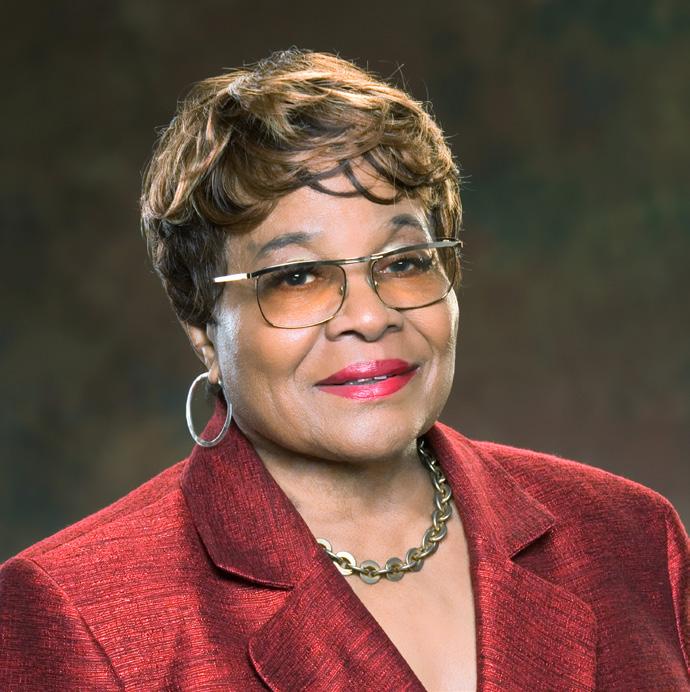
NASHVILLE, Tenn. — Although she received more than 500 local, state, and national honors for her extraordinary contributions to publishing, journalism, civil rights, education, and for her support of economic empowerment within Nashville’s African American business community, Rosetta (Irvin) Miller-Perry sought only to help others succeed in life.
Miller-Perry was smart, relentless and unwavering in her pursuit of excellence while reaching the pinnacle of success. She was a preeminent newspaper publisher, entrepreneur, business owner, advocate, and a warrior for justice. On Friday, June 26, she rested from her labor. She was 91.
Born in Coraopolis, Pennsylvania, on July 7, 1934, to her parents Anderson Irvin and Mary Hall Irvin, Miller-Perry understood that her life would be dedicated to something greater than herself. The Spirit moved her to reach for the brass ring in life and to help aspirants along the way.
Her journey began in the classrooms of McKinley Elementary School, Coraopolis Junior High School, and Coraopolis Senior High School, where she graduated in 1952. She would later matriculate at Howard University in Washington, D.C., and Herzl Community College in Chicago.
In 1955, Miller-Perry enlisted in the U.S. Navy. But she did not stop there. She went on to work at the Pentagon and for the Adjutant General’s Office in Germany.
In 1956, she graduated from the University of Memphis with a B.S. degree in chemistry and from the John A. Gumpton School of Mortuary Science
in 1957 with her D.M.S. In 1958, she attended Tennessee State University and Meharry Medical College for nurse training while working at Southern Funeral Home in Nashville.
While Miller-Perry was pursuing an education, the Civil Rights Movement was teetering on the edge of uncertainty. The Klan was on a war path across the South and hellbent on maintaining the status quo. She joined the fight for justice in the fury that divided the nation, working in the trenches in Nashville alongside giants like Z. Alexander Looby, Reverend Kelly Miller Smith, Curley McGruder, and countless others who risked everything in their pursuit of justice.
Miller-Perry moved to Memphis and worked closely with the Southern Christian Leadership Conference and Dr. Martin Luther King Jr., serving first as a clerk typist for the U.S. Civil Rights Commission in 1960. She was a field representative and a trusted observer monitoring Civil Rights activities during the Memphis Sanitation Workers Strike in 1968.
While the struggle for freedom was ongoing, Miller-Perry remained vigilant. The fight in her never waned. In 1975, she took a job as director of the Equal Employment Opportunity Commission (EEOC) for the Nashville area and challenged an unjust system that discriminated against African Americans and other marginalized communities.
After retiring from government service, the entrepreneurial spirit in Miller-Perry tugged at her and she answered the call. In 1990, using her own money, she, and her husband Dr. L.O.P. Perry, who was recognized as the first black gastroenterologist in Nashville, founded and launched Contempora, a Tennessee-focused African American
magazine.
In 1991, Miller-Perry recognized a void in positive media coverage of the African American community, and The Tennessee Tribune, was born. Miller-Perry poured all her resources into this new weekly newspaper to ensure that African Americans voices would no longer be silenced by neglect from mainstream media.
She refused to allow others to define the narrative. For more than 35 years, Miller-Perry was able to build a media empire without shrinking from her vision and provided the vehicle for others to tell their stories. She also gave young journalists opportunities to work under her tutelage when the doors at white newspapers were seldom open for upstarts.
As a member of The National Newspaper Publishers Association (NNPA), the largest and most influential Blackown media resource in America, Miller-Perry served several terms as a member of the Board of Directors for the association and the NNPA Fund.
NNPA President/CEO Dr. Ben Chavis stated, “The living legacy of Rosetta Miller-Perry is vital to the future sustainability and progress of the Black Press of America. As Queen Mother of the Black Press, Rosetta Perry exemplified the genius and conscious commitment of the Black Press to freedom, justice and equality by NNPA. We pledge to keep Rosetta’s memory alive as we approach the 200th Anniversary of the Black Press in 2027.”
For her work in media and community service, Miller-Perry received the NNPA Lifetime Achievement Award on January 25, 2019, during the NNPA Mid-Winter training conference in Ft. Lauderdale, Florida. It was at that gathering that she earned the title of “Queen Mother of the Black Press.”
Bobby Henry, a former chair of NNPA, recalls roasting her during this event. “I teased her about being a mortician and how she could do away with people who did not treat her right and nobody would ever know.” Henry said. “She smiled and gave me a look that said it was possible.”
“She had a good sense of humor but along with all her business savvy, she was a loving, private woman. She had the genuine sweetness of your favorite aunt and the wisdom and sage of your gangster uncle. She was just a well-rounded person full of love and wisdom,” Henry stated.
Never one to rest on her laurels, Miller-Perry established the Greater Nashville Black Chamber of Commerce in 1998 and that same year created the Anthony J. Cebrun Journalism Center in partnership with Dell Computers to prepare young people for careers in journalism.
Miller-Perry also founded Nashville chapter of the Coalition of 100 Black Women Les Gemmes, Inc., Nashville Chapter, the National Council of Negro Women. She also was instrumental in the building of the Alpha Kappa Alpha Sorority, Inc., meeting facility in Nashville, and countless initiatives dedicated to service and empowerment.
Even in her later years, Miller-Perry continued to climb the proverbial ladder of success. She was still making headway in journalism and business until an illness slowed her stride. Despite her health challenges and eventual transition, Miller-Perry lives
on through her family, friends, business associates, and those she helped to succeed in their respective careers.
Calvin Anderson,president of the Tri-State ts board of directors, said Miller-Perry was a highly respected publisher who cared deeply for her publication and the Black press overall.
“Rosetta collaborated with the Tri-State Defender and other NNPA publications to advance the Black press and inform its readers and subscribers,” said Anderson, who also counted her as a friend. “Her contributions will be lasting and her friendship will be missed.
Dr. John Warren, NNPA chairman and publisher of the San Diego Voice, called Miller-Perry’s passing, “one of the great losses of our time and our century.”
“In every respect, she was the virtuous woman that Proverbs spoke about in the Bible. She was a woman who lived a life of service to the community, to government, the military, to business and to the people around her,” Warren added.
“She reminds me of the poet Samuel Longfellow, who said: ‘Lives of great ‘women’ remind us we can make our lives sublime, and, departing leave behind us, footprints on the sands of time.’”
Celebration of life services for Miller-Perry will be Friday and Saturday, July 10-11, in Nashville. Visitation will be at 4-6 p.m. Friday at First Baptist Church, Capitol Hill, 625 Rosa L. Parks Blvd. Nashville, TN. Viewing begins Saturday at 10 a.m. followed by the funeral at 11 a.m. at Mt. Zion Missionary Baptist Church, located at 2261 Murfreesboro Pike, Nashville, TN 37217. Lewis & Wright Funeral Directors has charge.
Jackie Hampton is publisher of The Mississippi Link newspaper in Jackson, Mississippi, and vice president of The National Newspaper Publishers Association.
Wiley Henry is a journalist, visual artist and photographer having worked as deputy editor and senior writer of the Tri-State Defender.
Dylan Graham TSD Contributing Writer
Wildlife experts are warning residents across Tennessee, Mississippi and Arkansas to prepare for increased snake activity as summer temperatures climb, creating conditions that drive rodents and snakes inside.
“We are seeing a dramatic increase in calls involving snakes entering homes, garages, attics, and crawlspaces,” said Dan Morgan, operations partner at Memphis-based Ranger Wildlife Removal & Prevention.
The animal control company has recorded a 50% increase in snake-related service calls this year compared to the same period in 2025. The rise comes as wildlife specialists anticipate the next three to four months to be among the busiest periods for snake encounters around residential properties across the Mid-South.
But snakes are often not the primary problem for homeowners.
As summer heat intensifies, rodents such as mice often move indoors in search of cooler shelter and places to breed. Attics, crawlspaces, garages and wall cavities provide ideal environments for nesting. And growing rodent populations inside houses and other residential structures often become hunting grounds for snakes seeking food.
Many homeowners are unaware how easily snakes and rodents can access their homes, Morgan warns. Small openings around foundations, roofs, plumbing lines and ventilation systems provide entry points for unwanted wildlife. Common problem areas include unsealed attic gaps, damaged soffits and vents, garage door openings, crawlspace penetrations, HVAC access points and foundation cracks. Rodents can squeeze through open-

ings as small as a quarter inch, while some snake species can follow the same pathways.
And rodent infestations can lead to serious health concerns. Rodent urine, droppings and nesting materials may carry disease such as hantavirus, which can become airborne when contaminated materials are disturbed.
In the Mid-South, hot temperatures, wooded areas and abundant food sources create favorable conditions for a variety of snake species. Tennessee alone is home to more than 30 snake varieties and four are considered “medically significant to humans and pets,” according to biologist Lisa Powell, in the May/June 2025 issue of the state park system’s official magazine, The Tennessee Conservationist.
Although most snakes found in the region are nonvenomous and beneficial to the ecosystem, local experts recommend keeping a safe distance and contacting removal professionals if a snake is found inside a home.
Preventive measures to ward off unwelcome animals include sealing exterior openings, eliminating food sources that attract rodents, keeping yards and landscaping free of debris, and scheduling routine property inspections to identify vulnerable areas.
“The biggest misconception is that snakes randomly appear inside homes,” said Morgan. “In most cases, the house is already supporting an active food source. Prevention is far less expensive and far less dangerous than reacting after wildlife enters the structure.”