POSTMASTER: Send address changes to The Tri-State Defender, 1509 Madison Ave., Memphis, TN, 38104.
GENERAL INFORMATION: Inquiries may be submitted in writing or by calling (901) 523-1818 or by email. TELEPHONE: (901) 523-1818.
The Tri-State Defender (USPS 780-220) is published weekly.
The Tri-State Defender 1509 Madison Ave. Memphis, TN, 38104. Second-class postage paid in Memphis, TN.
The Tri-State Defender is a member of The National Newspaper Publishers Association and the Tennessee Press Association. All materials covered by copyright. No materials herein may be reproduced without the written permission of the Publisher. (901) 523-1818 | 1509 Madison Ave, Memphis, TN 38104
$60 Annually/$5 Monthly Digital subscriptions are available online at tsdmemphis.com
Search underway for new Memphis Chamber of Commerce CEO
By James Coleman TSD Contributing Writer
The Greater Memphis Chamber of Commerce is accepting applications for a “visionary leader,” the pro-business nonprofit announced on July 9.
Memphis-based financial executive and part owner of the Memphis Grizzlies, Duncan Williams, is currently filling in as interim leader. No timeline was given for his successor. The hire will be based on the best available candidate.
The hunt for a new leader follows the sudden departure of previous chamber CEO Ted Townsend, who resigned in April.
The chamber has retained recruiting firm Jorgenson Pace to lead the search. The Greensboro, N.C.-based nonprofit began accepting applications on June 9. An executive search committee will make the eventual hire.
Along with foresight, the chamber is seeking candidates that can promote trust between government agencies, the business community and the community at-large. Backgrounds in regional economic development and strategic growth are also must-haves.
At the time of his resignation, Townsend stated he wanted to spend more time with his family.
However, the former University of Memphis chief economic development officer’s resignation followed a controversial social media exchange with sports commentator Stephen A. Smith. A March 16, First Take segment by the ESPN personality speculated on a Grizzlies relocation to Nashville.
“F you @stephenasmith You were invited by our mayor to visit and you never did. Tells us enough about your sorry a* takes. You have zero authority
to judge and assess Memphis. Go Grizz,” responded Townsend on X.
The pointed missive elicited a local firestorm. Townsend quickly deleted the post and apologized.
Townsend’s departure also invited scrutiny into the chamber’s executive compensation. From 2022-2024, the ex-CEO’s base salary more than doubled from $302,000 to more than $720,000. The boost included a 92%
adjustment in 2024.
He wasn’t alone. Overall executive compensation increased by 25%. The raises coincided with increased revenue at the chamber. The pro-business non-profit brought in $10.8 million in 2023.
The recruitment of the controversial xAI (now SpaceAXI) Colossus Supercomputer to Southwest Memphis is largely credited with the spike. Townsend also established a number of public-private partnerships that led to the opening of the University of Memphis Research Foundation Park.
President Calvin Anderson Editor Stephanie R. Jones
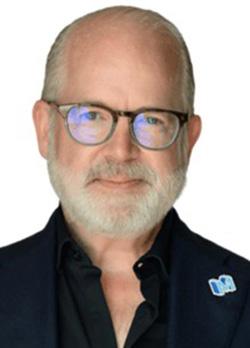
Ted Townsend
Public reading of Declaration of Independence in Memphis commemorates country’s 250th anniversary
By Judith Black Moore TSD Contributing Writer
The revered words that formed a new nation were spoken aloud Wednesday, July 8, at the Hall of Mayors inside City Hall, where hundreds gathered for the first public reading of the Declaration of Independence in Memphis to commemorate America’s 250th anniversary.
The commemoration was part of a nationwide initiative marking the first public reading of America’s founding documents in Philadelphia in 1776. Organized locally by Paula Casey, co-founder of the Memphis Women’s Political Caucus, who delivered the opening remarks, the program featured prominent community members who took turns reading portions of the Declaration of Independence in front of an audience of elected officials, civic leaders and residents.
We are reading into our history, said Mayor Paul Young, who then began reading the declaration’s historic introduction. “In Congress, July 4, 1776 … ” Young also read the opening lines of the document’s most recognizable paragraph.
“We hold these truths to be self-evident, that all men are created equal,” he read, “that they are endowed by their Creator with certain unalienable Rights, that among these are Life, Liberty and the pursuit of Happiness.”
The audience quietly listened, while surrounded by portraits of former mayors spanning nearly two centuries of the city’s history, beginning with Marcus B. Winchester, who took office in 1827.
Memphis City Council member Jerri Green, Shelby County District Attorney General Steve Mulroy, State Rep. Karen Camper, State Rep. Gabby Salinas,
Wayne Dowdy, senior manager for the Memphis Public Library’s history department, and city and business leaders Robin Jones, Dottie Jones and Jee Vahn Knight also read passages from the landmark charter of individual rights.
The ceremony also acknowledged the gap between the guiding ideals of the Declaration of Independence and the ongoing struggle to extend the promise of liberty to all Americans, incorporating readings from the Declaration of Sentiments, written by 19th-century suffragist Elizabeth Cady Stanton for the nation’s first Women’s Rights Convention in Seneca Falls, New York, in 1848. Stanton intentionally modeled her document after the Declaration of Independence, broadening its principles to include women, who did not have the right to vote, own property or hold public office.
Peg Watkins, a member of the League of Women Voters, reflected on the continued relevance of the founders’ declaration.
“Maybe everyone should read the Declaration of Independence again to remember what it says,” said Watkins. “I think it should be written in bold every day on the front of newspapers to keep us reminded of who we are as a country.”
For Salinas, reading the declaration carried historical significance and the need for introspection.
“It was very powerful, very timely,” she said. “It seems like in some way we are kind of losing our voting power. I struggle like most people with suffrage and celebrating. I have mixed emotions, especially being an immigrant, as well. But it’s part of our history, even though we know that not everyone got the right to vote.”
Salinas pointed to Memphians in his-
tory who fought to expand fundamental freedoms in America, such as journalist and civil rights activist Ida B. Wells, who challenged the women’s suffrage movement to confront racial inequality.
“Ida B. Wells was a big voice, saying, ‘You are asking me to put my race aside for my gender, and I can’t do that,’” said Salinas. “But I do think it (the suffragist movement) needs to be acknowledged,
because it was a stepping stone to the next step.”
Salinas also reflected on Tennessee’s role in the nation’s continuing pursuit of justice for all.
“I am also here to celebrate, because I don’t care what anybody says. Tennessee has shaped our entire country,” she said. “We continue to be at the edge of the fight for justice for our country.”
Memphis Mayor Paul Young speaks with a young attendee following a public reading of the Declaration of Independence at Memphis City Hall on Wednesday, July 8. The event commemorated the nation’s 250th anniversary and reflected on the enduring ideals of liberty and equality. (Photos: Gary S. Whitlow/Tri-State Defender)
Participants in a public reading of the Declaration of Independence at Memphis City Hall on Wednesday, July 8, include, from left, Jee Vahn Knight, Wayne Dowdy, Jocelyn Dan Wurzburg, Memphis City Councilwoman Jerri Green, Memphis Mayor Paul Young, Paula Casey, state Rep. Karen Camper, Dottie Jones and state Rep. Gabby Salinas. The event commemorated the nation’s 250th anniversary and featured community leaders reciting passages from the founding document.
By Jim Coleman TSD Contributing Writer
Memphis City Council members began preliminary discussions during committee meetings Tuesday, July 7, on local zoning plans for data centers.
A planning strategy for the controversial large-scale supercomputing facilities are expected to be included in an update of the Memphis 3.0 comprehensive zoning plan, which aims to build up older or established neighborhoods in the city.
Data centers have proliferated across the nation as AI technology continues to expand. Nashville’s planning commission is debating the rules for new developments as local opposition to data centers grows.
For Memphis, the impact of data centers on residents is the central issue. Several facilities in the city, including Colossus 1 and Colossus 2 owned by SpaceXAI, formerly xAI up until Monday, popped up in recent years with little debate.
■■ NEWS
City Council looks to protect residents against data centers in zoning plan update
Concerns about the facilities continue to grow. Residents living nearby face increased electricity bills, and noise and light pollution. Other worries stem from the facilities’ environmental impacts, such as daily water usage, energy consumption and air emissions. But the Memphis 3.0 zoning plan will focus on residents’ issues.
“We do look at commercial properties, but we’re really more interested in the residential part of it,” said Brett Ragsdale, director of the Memphis and Shelby County Division of Planning & Development.
Considered a novelty use, data centers in the city currently face no zoning rules, which typically address approved locations, permit requirements, site layouts and building dimensions. Landscaping, buffering, setbacks and permissible equipment also are considered.
“We want to make sure there are some guardrails,” said Memphis City Council member Yolanda Cooper-Sutton.“We really need to be aggressive.”
Still, data centers come in a variety of sizes, from behemoth physical enterprises like SpaceXAI to FedEx’s use of cloud platforms, and support critical uses and institutions.
“We have a wide variety of data centers. We have data centers throughout the city that support St. Jude and other types of facilities, but they may be smaller, so how are those integrated into the city,” said Ragsdale.
Council members and city leaders would like to minimize the impact of any zoning rules on smaller operations. They also would like to prevent demonization of their efforts.
“I don’t want us to signal that data centers are bad,” said Antonio Adams, the city’s chief operating officer. “We’ve got powerful data centers, but they are at our hospitals and they save lives.”
Tech giants are a different story for some council members who are eager to install safeguards to prevent data centers’ overuse of natural resources.
Launched in 2023, Colossus 1 and 2
have grown in physical size and computing capacity, and so has their usage of water and energy. Much of the water used to cool the supercomputers is drawn from the Memphis Aquifer.
But the number of employees hired by SpaceXAI has remained relatively low at 3,000 employees reporting to its Southwest Memphis facilities, compared with 30,000 workers at FedEx’s Memphis logistics hub near the airport.
“One of the reasons they are here is because they know we’ve got the aquifer,” said Memphis City Council member Jeff Warren.
The AI company’s Memphis data centers are powered by nearly 60 mobile natural-gas burning turbines. Although they are subject to regulations, they are currently operating without permits.
In May, the state legislature passed HB 1847/SB 2128. The law requires data center owners to source and pay for their own infrastructure. Lawmakers hope the legislation blunts the impact of data centers on residential power bills.
Mt. Olive Cathedral CME Church celebrates 145 years by honoring its past while looking toward its future
By Judith Black Moore TSD Contributing Writer
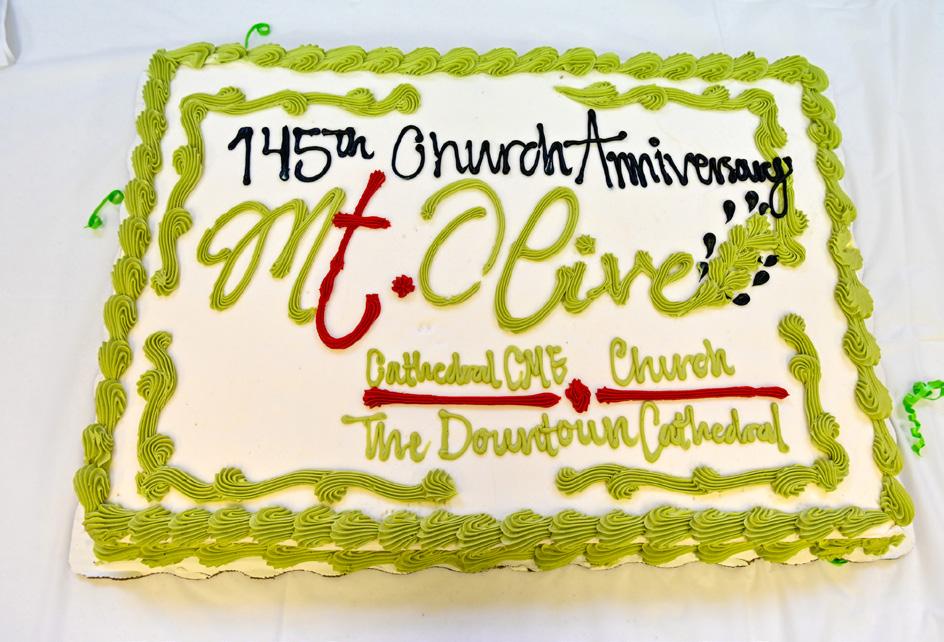
Four generations of voices, a renewed call for community engagement and a vision for the future defined Mt. Olive Cathedral CME Church’s 145th anniversary celebration on Sunday, July 12.
From its humble beginnings in a location known as the “jug factory,” Mt. Olive grew over the years to become one of the city’s most important centers of faith, civil rights and community leadership. Sunday’s anniversary celebration reflected every chapter of that journey, honoring the church’s storied history while challenging the congregation to shape its next era.
The celebration blended traditional gospel music, young liturgical dancers and reflections from four generations who shared their hopes for Mt.Olive’s future.
Speakers celebrated the church’s history, from its founding by Rev. G.W. Armour in 1881 after years of holding Bible lessons in the jug factory on Georgia Avenue to its move in 1952 into the iconic neo-classical cathedral at the corner of what was then Linden Avenue (now Martin Luther King Jr. Avenue) and Lauderdale Street.
Mt. Olive served as a meeting place for the NAACP Memphis Branch, and welcomed Dr. Martin Luther King Jr. during a Southern Christian Leadership Conference gathering in 1957. It continues to serve as a gathering place for civil rights leaders, most recently national Atty. Ben Crump.
But while lauding Mt. Olive’s history, guest speaker Rev. Dr. L. LaSimba M. Gray Jr., pastor emeritus of New Sardis Baptist Church, reminded the congregation that history alone is not enough.
“Mount Olive was the epicenter of The Movement,” Gray said. “All of the NAACP meetings were held here. Downstairs is where they strategized.”
Recalling the church’s legacy of ministry beyond
its sanctuary, Gray reflected on a time when Mt. Olive regularly addressed basic human needs of the community and posed a question that became the sermon’s central challenge.
“What if Mt. Olive took some steps around a onemile radius to see what is going on?” Gray asked. “Find out what the community needs are.”
The celebration also emphasized the voices of younger generations.
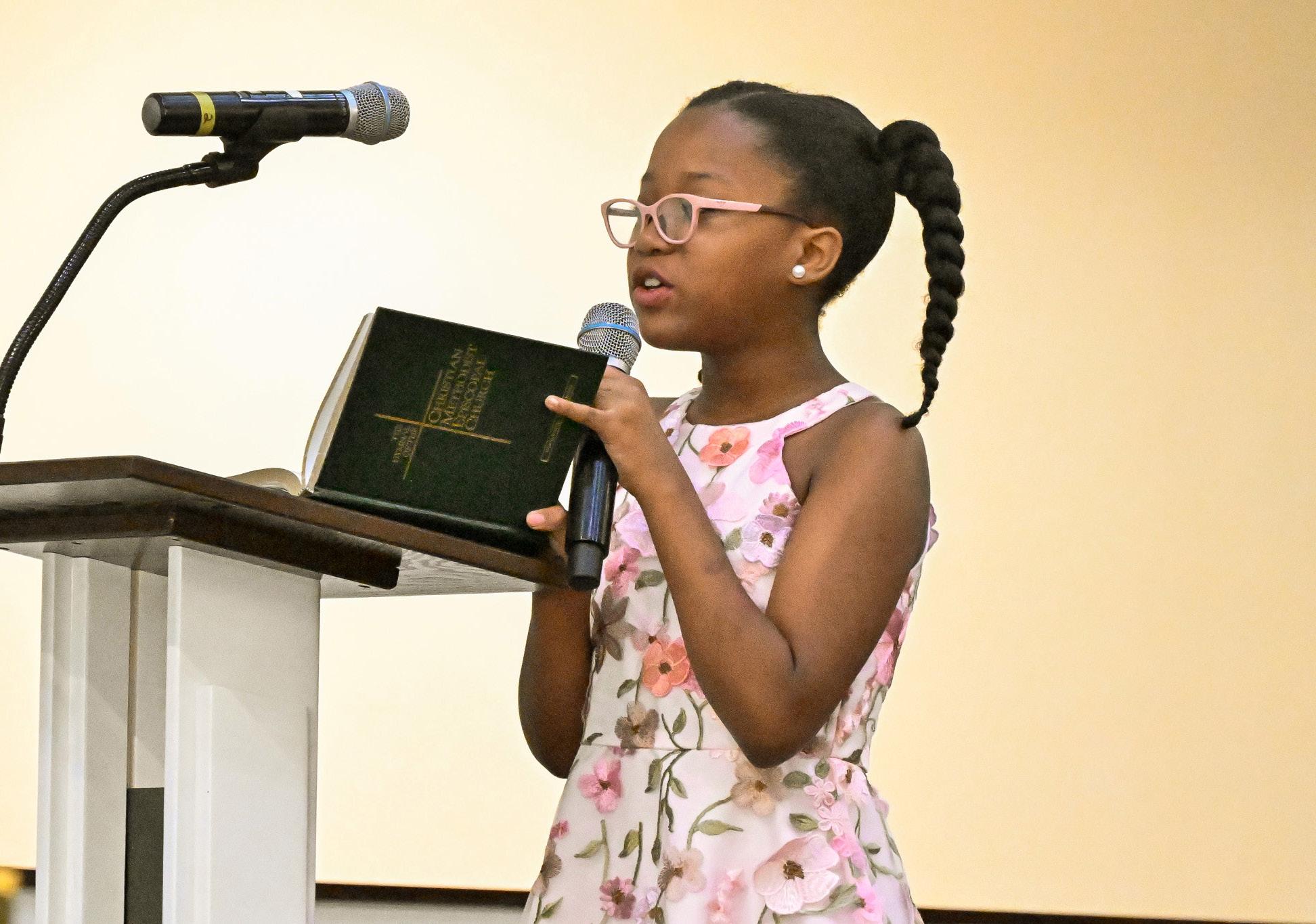
The youngest speaker was 10-year-old Avery Rose Davis, whose simple but heartfelt vision for the future summed up the church’s most foundational need.
“My hope is for the church to be full and for the young people of the church to have a good connection with God,” she said.
Rev. Cameron Kuykindall, a senior at the University of Tennessee, Knoxville, embodies the future of ministry. As co-chair of the anniversary celebration, he reflected on the significance of Mt. Olive in his ministerial training.
“Our history is important, and being here allows me to be mentored by a wonderful network of individuals who have my best interest at heart,” he said. “Being surrounded by this kind of history is import-
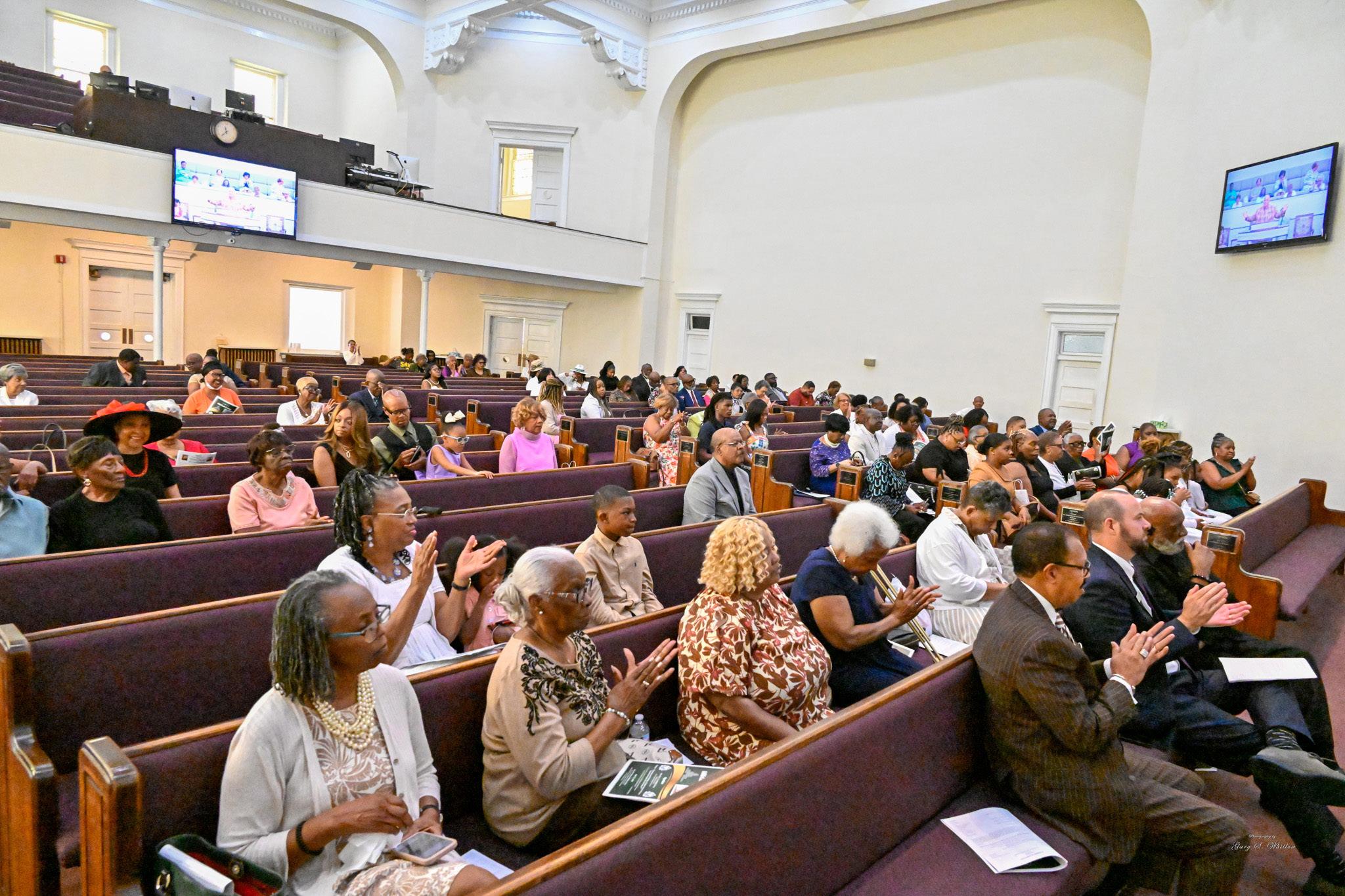
Members, clergy and guests gathered at Mt. Olive Cathedral CME Church on Sunday, July 12, to celebrate the historic congregation’s 145th anniversary. The daylong observance honored the church’s legacy of faith, civil rights leadership and community service. (Photos: Gary S. Whitlow/Tri-State Defender)
■■ RELIGION
ant. However, we must do things in a new light and in innovative ways.”
Referencing Mt. Olive’s downtown neighborhood, he echoed Gray’s call for renewed community engagement.
Rev. Dr. Wayne A. Williams, completing his first year at the helm of the church, acknowledged its longstanding influence reaching far beyond its own membership.
“You are inevitably a giant in your own right, and you are historic in your own right,” Williams told the congregation. “Anyone who is a student of history cannot talk or reflect on the historicity of Memphis without including the church named Mt. Olive Cathedral CME Church.”
Sunday’s theme, “Honoring Our Heritage, Empowering the Present, Advancing Justice for the Future,” embodied Mt. Olive Cathedral CME Church’s enduring significance while challenging the congregation to embrace its legacy as a catalyst for hope, justice and service in the heart of Memphis.
Rose Kuykindall serves as co-chair of Mt. Olive Cathedral CME Church’s anniversary program.
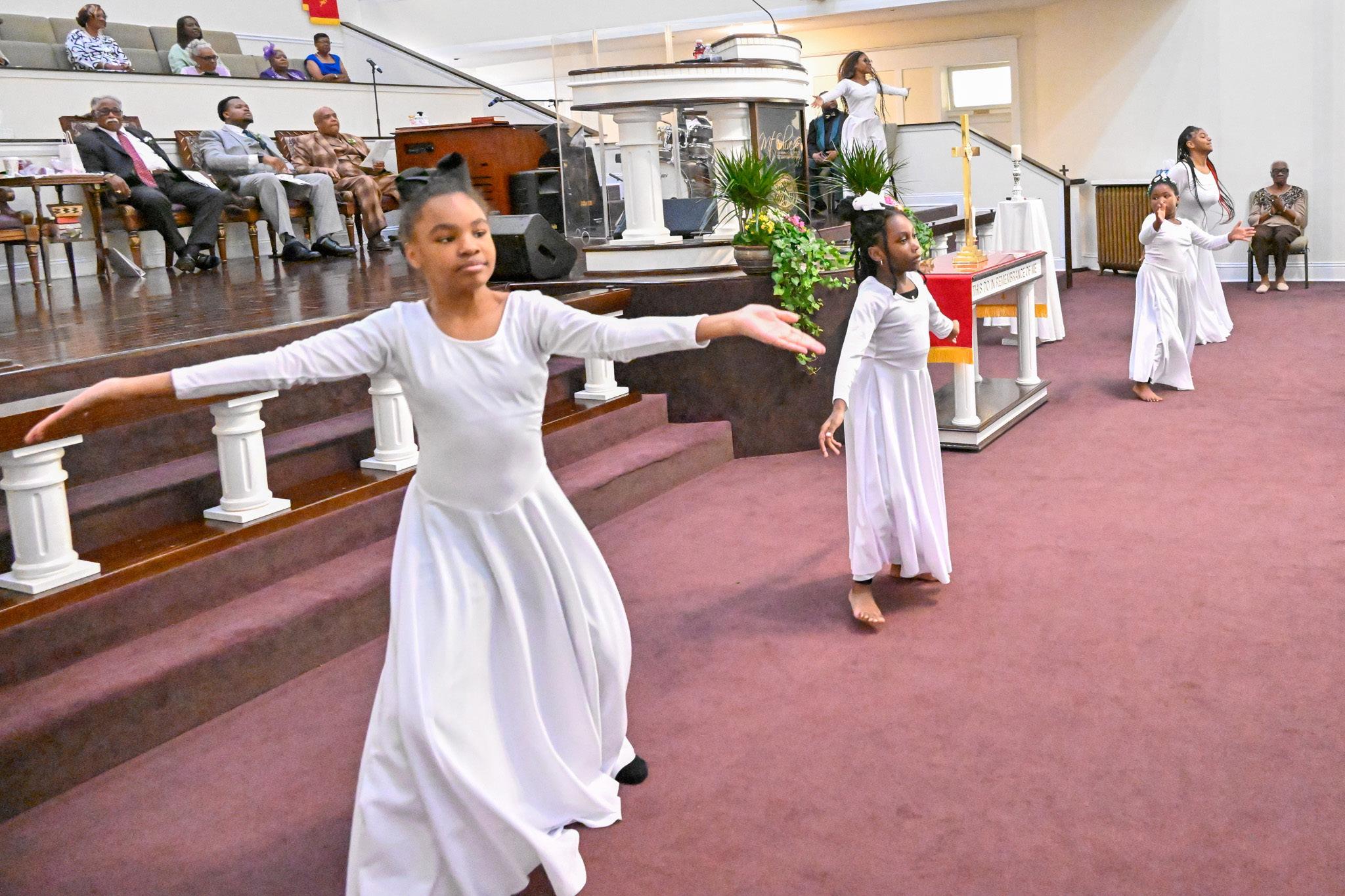
Liturgical dancers perform at Mt. Olive Cathedral CME Church’s 145th anniversary celebration on Sunday, July 12.
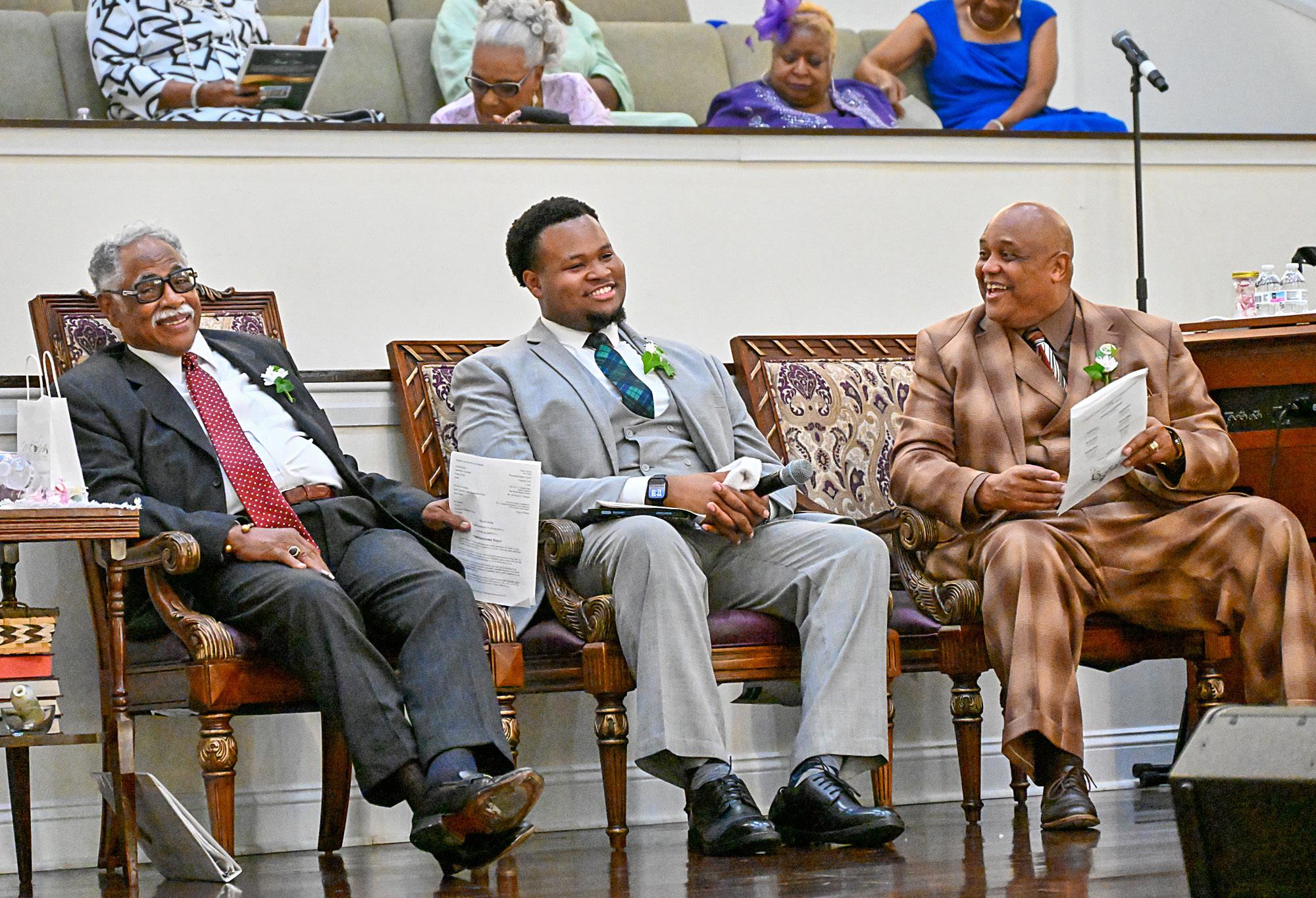
Rev. Dr. Wayne A. Williams, right, pastor of Mt. Olive Cathedral CME Church, shares the pulpit with guest speaker Rev. Dr. L. LaSimba M. Gray Jr., left, and Rev. Cameron Kuykindall, during the church’s 145th anniversary program on Sunday, July 12.
Political forum highlights voter uncertainty due to congressional redistricting and unfamiliar candidates
By Judith Black Moore TSD Contributing Writer
Emerging contenders for U.S. Congress introduced themselves Wednesday, July 8, to voters – some learning about their district candidates for the first time – at a political forum in Memphis, hosted by a nonprofit group of faith leaders.
Republican lawmakers’ redrawing of the state’s congressional map, dividing Memphis into three districts, has left many voters wondering where to vote in upcoming elections and unclear about which candidates would vie for their vote.
The Black Clergy Collaborative of Memphis, a social justice advocacy organization established in 2020, hosted the candidates forum at the historic Mount Olive Cathedral CME Church downtown, ahead of early voting, which begins July 17.
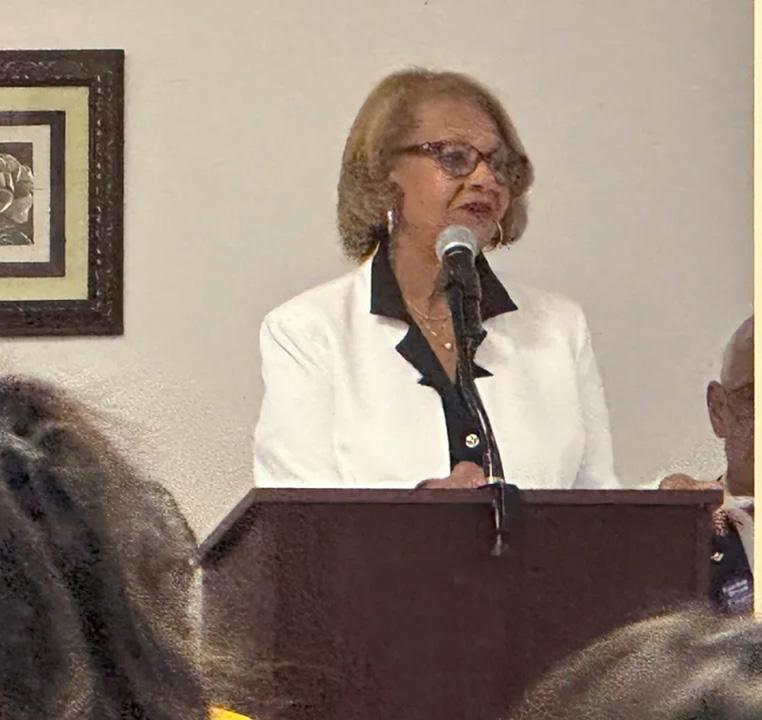
Rev. Dr. Wayne Williams, senior pastor of the host church, opened the evening by reminding the audience about the stakes.
“Democracy is on the ballot,” said Williams, “As a matter of fact, everything is on the ballot. That’s why we’re here.”
The forum, moderated by Action News 5 anchor and investigative reporter Kelli Cook, gave voters an opportunity to hear directly from congressional candidates. For some attendees, however, it was the first time they learned about being reassigned to a new congressional district.
“Since the redistricting, there are voters who are just realizing tonight that their district has changed,” said Debra
Brown, one of the event’s organizers. “The forum gave the community direct access to candidates running in their respective districts and gave information so that voters can make informed decisions.”
Local resident Paula Thomas is among those affected by redistricting. Thomas questioned whether candidates seeking to represent newly configured districts understand the communities they hope to serve.
“Have you physically driven through and know what the lay of the land is in Memphis, because I don’t know you,” said Thomas. “I don’t see any signs in my community for those that say they are here to represent us. They need to knock on doors like back in the day, because we do not know them.”
Thomas also was disappointed, she said, that the candidates at the forum failed to address the impact of the SpaceXAI development in Southwest Memphis, the growing number of data centers and their rising utility and power demands. She believes these issues are increasingly important to established neighborhoods, especially those newly assigned to the 5th Congressional District, where the supercomputing facilities are located.
A range of issues sparked debate during the forum, from Tennessee’s state-appointed school oversight board, economic development and healthcare to housing affordability, rising consumer costs, corporate taxes, congressional unity and the war in Iran.
New and recognizable candidates from the two major political parties and a Libertarian participated in the hourslong forum on Wednesday eve-
ning:
District 5: Devante Hill, Rachel Hurley and Carrie Iacomini
District 8: Gordon Bryan, Jordan Hinders, Heidi Kuhn, clerk for Shelby County Criminal Court, Pamela Moses, Leonard Perkins and Horace Taylor
District 9: M. LaTroy Alexandria-Williams, Charlotte Bergmann, state Sen. London Lamar, a Democrat who represents state senate District 33, state Rep. Justin Pearson, a Democrat who represents state house District 86, and Jim Tomasik
Before casting ballots, voters can confirm their congressional district, polling location and registration status by visiting the Tennessee Secretary of State website, sos.tn.gov, click on “Elections” at the top of the homepage, and then click on “GoVoteTN.” The Shelby County Election Commission also provides information and resources for voters at electionsshelbytn.gov.
Primary elections will be held for
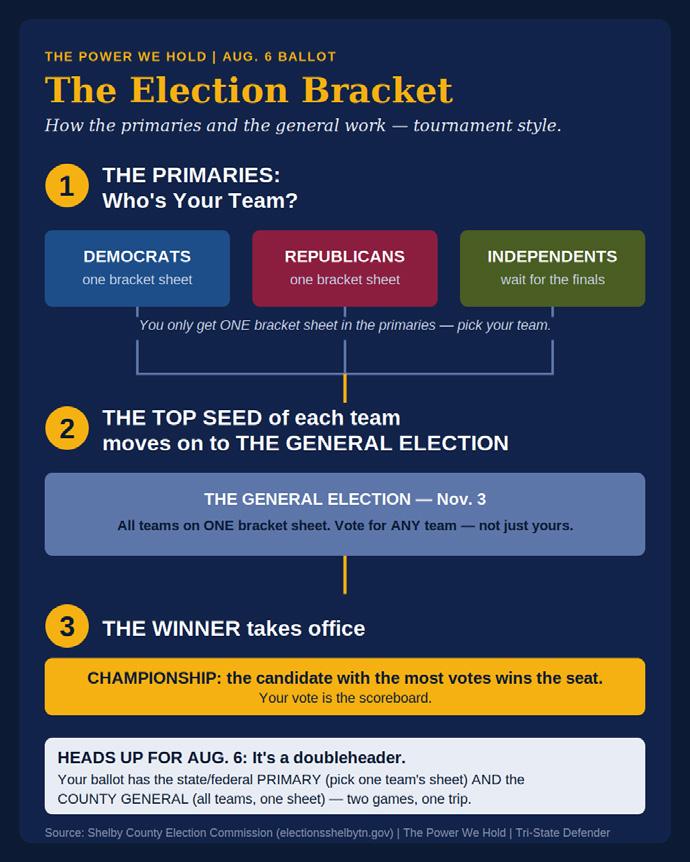
governor, U.S. Senate, U.S. House, odd-numbered districts for Tennessee Senate, Tennessee House, and Republican and Democratic state executive committees. And general elections will be held during early voting and on Election Day for vacant state judicial offices and some county offices, including the county’s mayoral race.
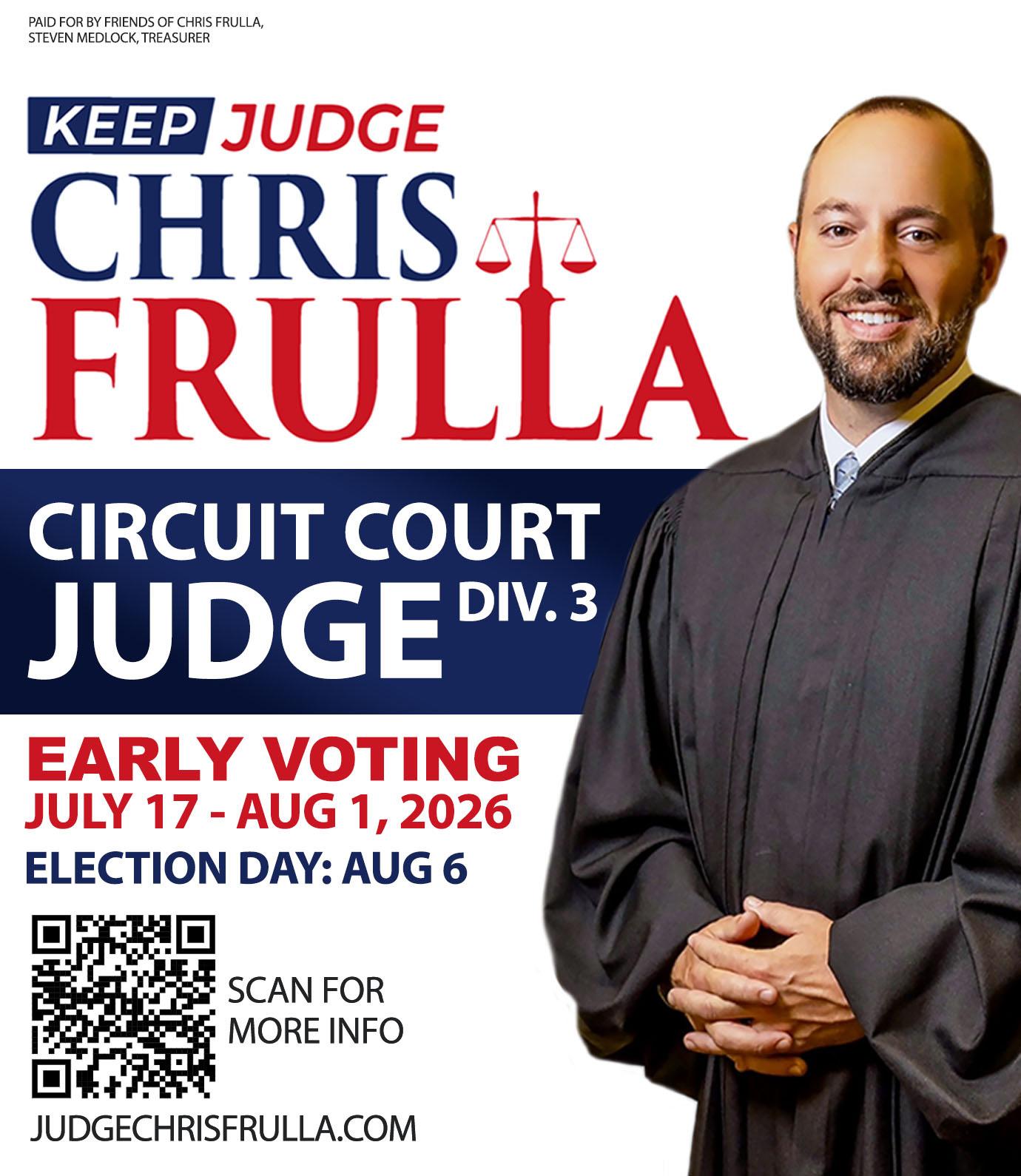
Early voting begins Friday, July 17, and runs through Saturday, Aug. 1. Election Day is Thursday, Aug. 6.
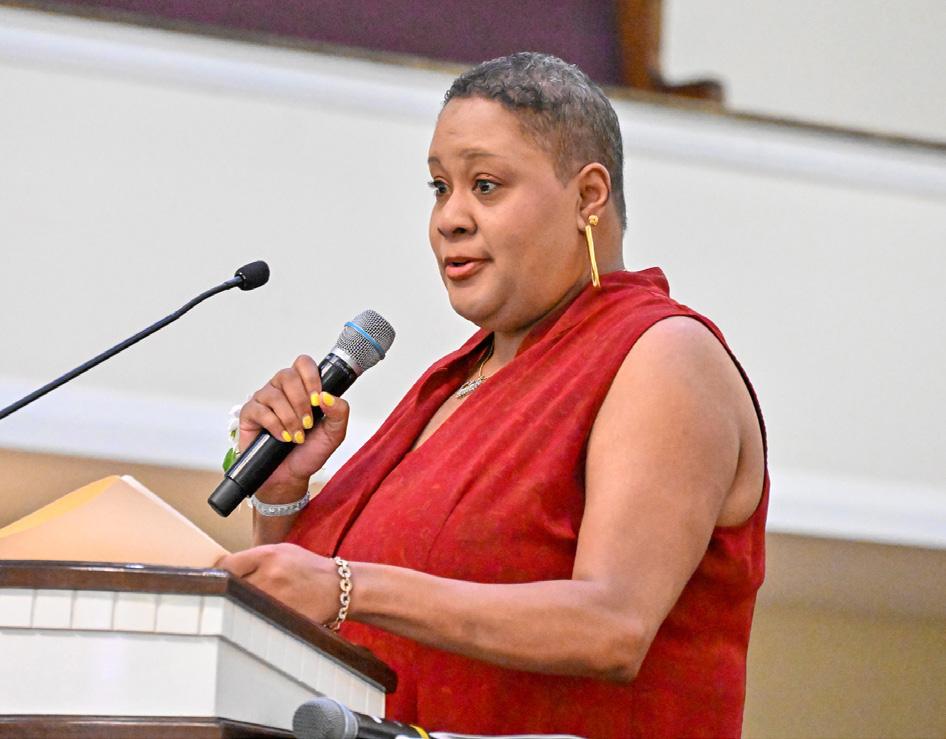
Debra Brown organized the candidates forum at Mt. Olive Cathedral CME Church on Wednesday, July 8. (Photos: Judith Black Moore/Tri-State Defender)
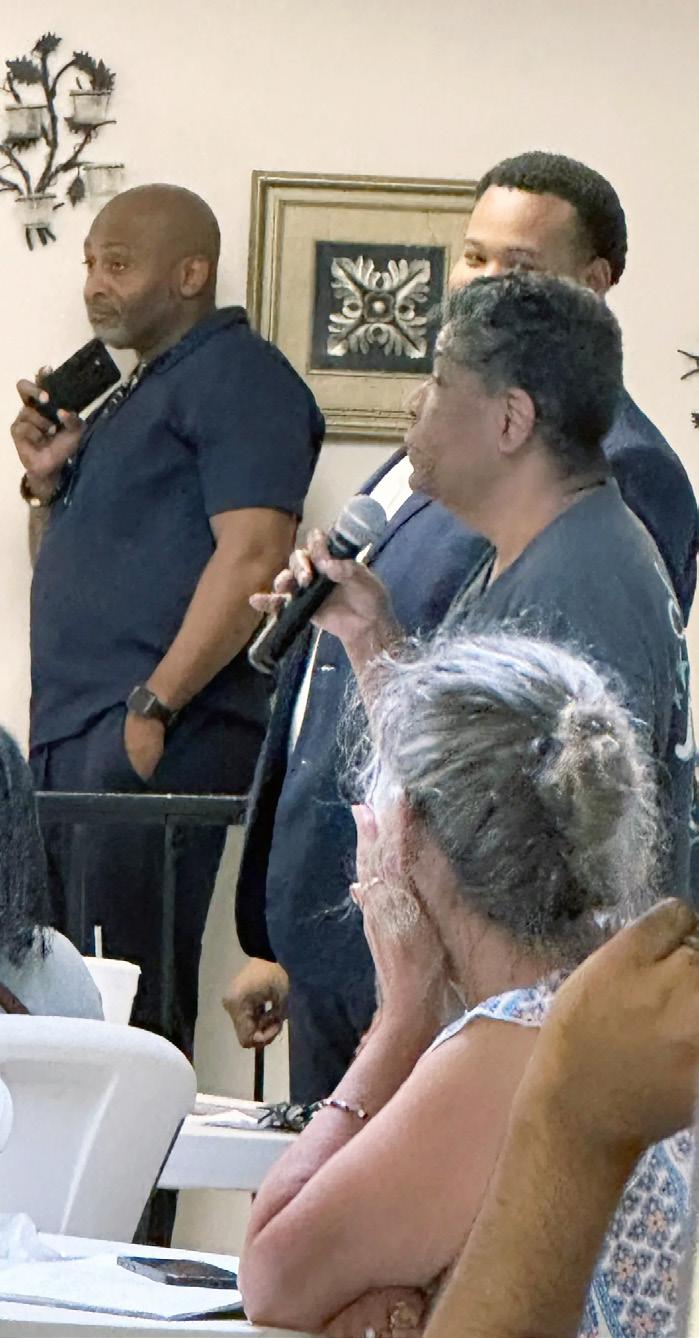
Brenda Thomas asks a question at the candidates forum at Mt. Olive Cathedral CME Church on Wednesday, July 8.
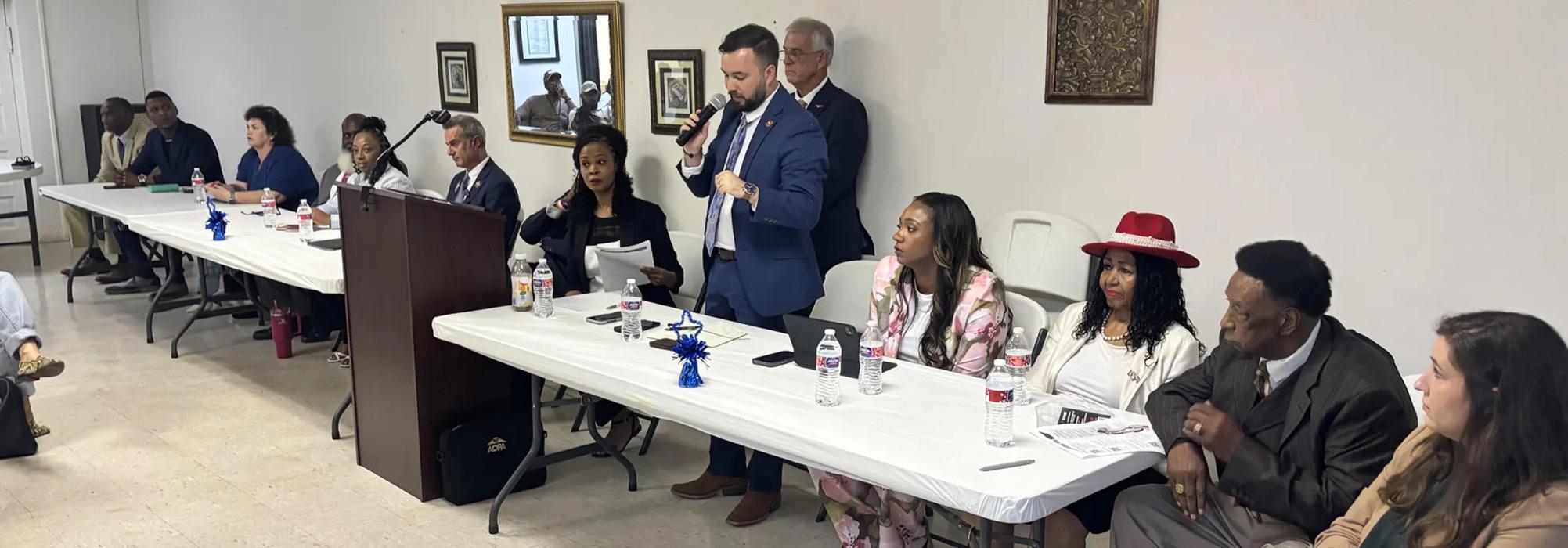
Mt. Olive Cathedral CME Church holds a forum Wednesday, July 8, for candidates for congressional seats in Districts 5, 8 and 9. Pictured, from left, are Leonard Perkins, Devante Hill, Rachel Hurley, Horace Taylor, Pamela Moses, Jim Torino , Kelli Cook, Gordan Bryan (against wall), Jordan Hinders (at the mic), state Sen. London Lamar, Charlotte Bergmann, M. LaTroy Williams and Carrie Iacomini. (Judith Black Moore/Tri-State Defender)
What you are really doing when you vote
The power we hold:
By Shawnee Calhoun TSD Contributing Writer
Campaign signs are posted across the city, and unsolicited texts are arriving faster than you can reply “STOP.” It’s time to vote. Again.
Some of you are probably asking, “But wasn’t there a big election last year?” The answer is yes, but not for Memphis or Shelby County, specifically. In December, 14 Tennessee counties held an election asking voters to fill the seat left open by U.S. Rep. Mark Green’s resignation in the 7th Congressional District, which includes communities in Middle and West Tennessee.
But now you have an opportunity to make a difference in your community by casting your vote in local, state and federal elections in August and November.
Voters in New York City are seeing the power of their vote in the form of new programs launched by Mayor Zohran Mamdani, a democratic socialist who took office only six months ago, to address the city’s high cost of rental housing and unpredictable public transportation – two issues Memphians know well. Mamdani’s administration has already frozen rents for 1 million homes and is planning to speed up 50 bus routes. So, how do we use the power of our vote here in Memphis to replicate the successes New York City voters seem to be enjoying after elect-
ing a new chief executive who promised swift change?
Start with the ballot that is actually in your hands on Aug. 6, because it is a doubleheader and each half carries a different power. The county general election will yield final decisions. Winners will be determined for county mayor and sheriff to judges, court clerks and school board. The federal and state primary on the same ballot is a nominating exercise. You choose who advances to the November general election for governor, a U.S. Senate seat, Congress and the state legislature.
If Congress and the state legislature are the league owners, then the city and county officers are the team managers. Your local officials handle day-to-day operations here at home such as budgets, services and staffing, while state and federal lawmakers set the policies every city must follow, and their rules override ours every time.
Using the city’s charter as a guide, your vote works on three levels. The charter is the city’s rulebook or paperwork, similar to the U.S. Constitution for the country, and it dictates who holds power in Memphis, how they got it and how they’re allowed to wield it. Every level of power comes straight from the charter, and every one of those levels belong to you.
Level 1: Your vote selects leaders
You choose the people at the top. Memphis voters elect the mayor and all 13 members of City Council to four-
year terms, according to the charter. Afterward, the people we elected hire or appoint their own staff and team. The charter also gives the mayor the power to pick department heads, including the chief of police. That means you will never see “Police Chief” on a ballot.
You vote for the mayor, and the mayor does the hiring. You are pre-approving the mayor’s hires when you choose a candidate for mayor. Ask about each mayoral candidate’s choices before you vote, because the mayor becomes your spokesperson. If an elected official leaves office early, the City Council picks a temporary replacement until you vote again.
Level 2: Your vote makes and changes laws
Since 1963, Memphis has been governed by “home rule,” which means its citizens can change the city’s charter themselves by voting for new laws, as long as no state or federal law is
violated. You pick the players, and you have the power to rewrite the rules of the game.
The mayor-and-council form of government we have today exists because voters approved it in 1966, and it was formally established in 1968. Our October election date? Voters chose that election timing, also in 1966. Term limits? Voters passed those in 2010. The rule is two consecutive four-year terms – eight years in a row, then the seatholder must go. But it is not a lifetime ban. A former official can sit out and run again later. And home rule allowed Memphis voters in 2008 to change the city’s charter six times.
Level 3: Your vote fires
Your power does not end when the polls close. The charter lets voters fire, or recall, the mayor or a council member before their term is up. If enough registered voters sign a petition – equal to 10% of the votes cast in the last city election - the recall question appears on the next ballot: Should this official be
removed? A simple majority says yes, and the office is vacated. But a petition can only be filed after an official’s first two years in office.
■■ NEWS
Before you go: ID rules
To activate your power, you must arrive at your polling place with a valid driver’s license or photo ID issued by the Tennessee Department of Safety and Homeland Security, Tennessee state government or the federal government, even if they are expired. Student IDs, library cards and driver’s licenses from other states are unacceptable. Your voter registration card is your reminder to vote, not your permission slip. It tells you where to vote. Your valid photo ID gets you a ballot. If your status shows “inactive,” you can still vote by verifying your address in writing with the Election Commission. Moved? Update your address by Aug. 1, which is five days before the election, with the change of address form at electionsshelbytn.gov. Then preview the full sample ballot so nothing surprises
you in the voting booth.
The reason for this voter information series
Here is the part that should stay with you. In 2008, Memphis voters approved a new way of electing some of its officials called instant runoff voting, or ranked choice voting, a method in single-office elections such as mayor that requires voters to rank candidates in order of preference. The candidate who receives 50% of the vote is the winner. If no candidate receives the majority vote, the candidate with the fewest votes is eliminated and an instant runoff gets underway. Voters whose top-ranked pick is eliminated have their votes transferred to their second choice. This process continues until one candidate receives over 50% of the vote, and is named the winner. This candidate ranking method is written into the
city’s charter, but has never been used, not once in 18 years. The people voted, but the follow-through never came.
Voter fatigue is real. A confusing voting schedule, the nagging feeling that voting doesn’t matter, and ballot measures affirmed by citizens’ votes but overturned by the state can reinforce voter burnout. And lead to apathy.
But your vote does matter. Your vote selects leaders, makes laws, and even fires elected officials deemed unworthy of their office. Still, it only works if we vote and keep watch after ballots are counted.
This series will break down the aspects of our power and how to wield it responsibly. This city is your business. Have you read your paperwork?
The Memphis City Charter is free to read online at library.municode.com/ tn/memphis/codes/charter.
Memphis teens learn pathways to leadership at Jack and Jill regional conference
By Dylan Graham TSD Contributing Writer
Leadership, community service, scholarship and fellowship were on full display recently in Fort Lauderdale, Florida, where members of the Memphis chapter of Jack and Jill of America joined hundreds of teens from the organization’s southeastern region for its 70th annual teen leadership conference.
The four-day regional confab themed “Black to the Future: Powered by Legacy, Driven by Vision” featured workshops and social activities for teen members to learn about purposeful leadership, while strengthening the bonds that connect Jack and Jill chapters across the five-state region.
Jack and Jill, an 88-year-old membership nonprofit, was founded in Philadelphia by 20 Black mothers whose goal was to create educational, cultural and social opportunities to help their children thrive.
The Memphis Chapter, founded in 1948, is one of the oldest chapters of the 52 chapters in the Southeast Region, said Deidre Bush, lead team advisor who accompanied the youths to the conference. “The Memphis chapter sends delegates to the regional teen leadership conference because it fosters awareness and encourages leaders within the five major focuses — cultural, civic, educational, health and philanthropic,” Bush said.
Members of Tennessee’s six chapters were joined by 46 delegations from Alabama, Florida, Georgia and Mississippi to attend plenary sessions designed to inspire civic engagement and personal growth, and strategies for community impact. The young leaders
also took part in community service projects, reinforcing Jack and Jill’s long-standing commitment to giving back.
Jack and Jill member Matthew Nichols, who will be a freshman at Howard University in the fall, spoke about the impact of the conference as he prepares for his first semester at Howard University in the fall. “It provided me with a unique realization of its role in fostering black excellence across the United States,” Nichols said. “The essence of Teen Conference lies in its ability to connect, inspire and empower individuals who share similar aspirations and strive to excel in various endeavors.”
He and other graduating seniors celebrated their accomplishments and yearslong friendships aboard a yacht
for a cruise that included a lively “Soul Train”-inspired retro party.
The Memphis chapter also expressed appreciation for the Jack and Jill chapters in neighboring Mississippi, whose teens joined with Memphis members to share in the conference’s spirit of leadership and service. Together, the MidSouth chapters proved the strength of regional collaboration, while building lasting relationships that will outlive the conference.
The annual conference, which serves as more than a gathering of students, is part of the organization’s broader strategy to invest in the next generation of Black leaders, who are preparing to make meaningful contributions to their schools, communities and future professions.
New teen officers for the region were elected during the conference after teen delegates cheered for candidates who participated in the Ann Owen Gordon Teen Oratorical Competition. And high school seniors preparing for the next chapter of their lives received words of encouragement from Florida State Sen. Shevrin Jones and representatives from companies such as Truist Bank who applauded their achievements and community service efforts.
Conference participants from across the region also enjoyed a variety of activities that balanced competition with camaraderie, including sports and games at a local park, along with a Tesla vehicle experience, Kona Ice trucks and a barbecue cookout. The evening concluded with a western-themed celebration featuring line dancing, laughter and memorable moments.
Macy Mack, who will attend Tuskegee University, said the conferences enabled her to have fun and bond with fellow Jack and Jillers.
“Jack and Jill of America Inc. means a family that is dedicated to raising and providing opportunity for black children across the country,” Mack stated.
As the Memphis delegation returned home, they carried with them new perspectives, stronger leadership skills and a renewed commitment to serving their communities.
If this year’s Jack and Jill regional conference is any indication, the future of civic, corporate and community leadership in the Mid-South is already in capable hands.
Dylan Graham is a member of Jack and Jill of America. He will be a freshman at Morehouse College in the fall.
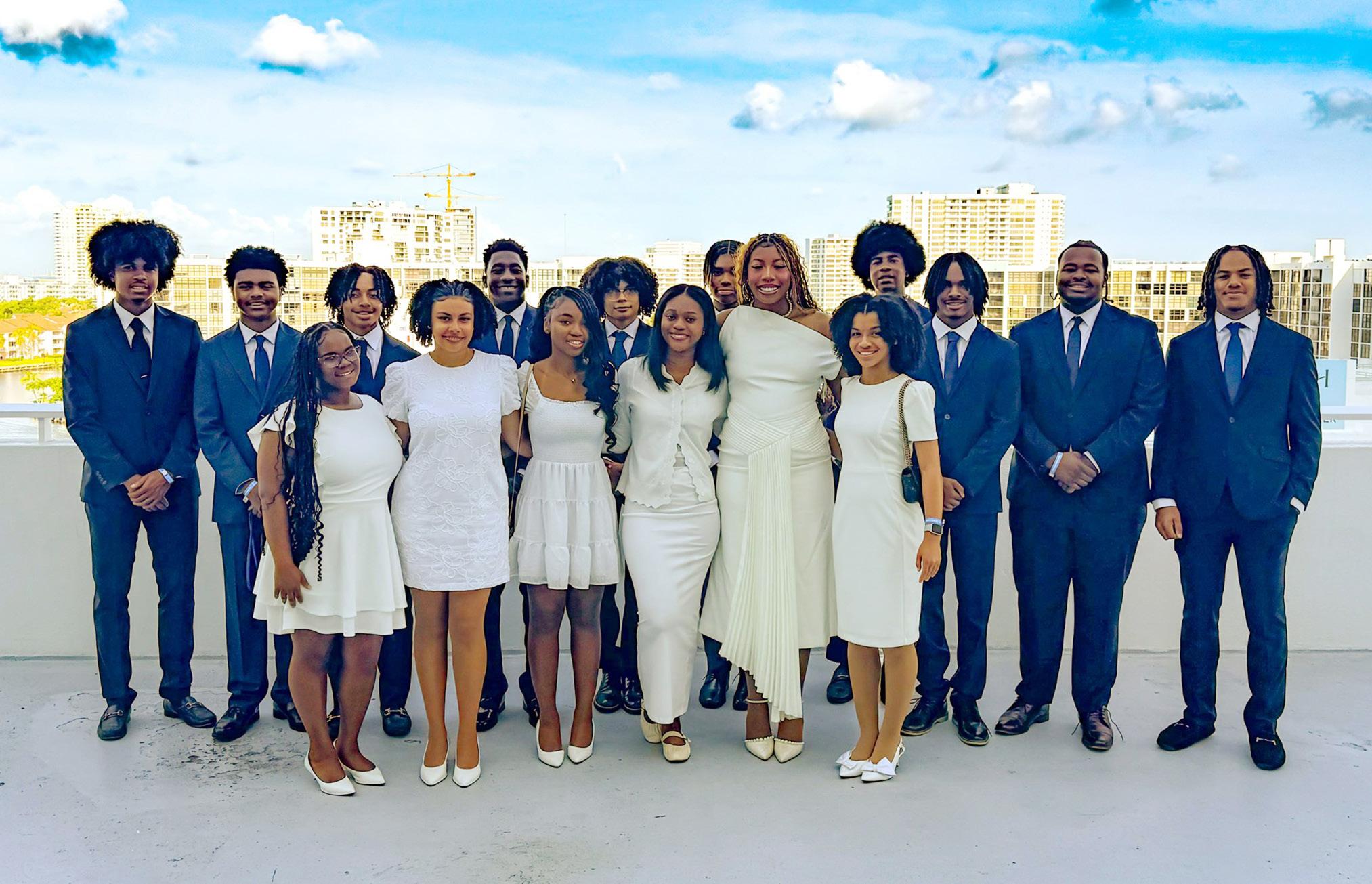
Jack and Jill of America’s Memphis chapter members: Front row, from left, Mackenzie Bails, Sophia Henderson, Macy Mack, Kennedy Williams, Amirah Abduls-Salaam, Baili Price; Back row: Matthew Nichols, John Patrick, Owen Smith, Scotty Hendricks III, Joshua Henderson, Bryant Newberry, Stone Hendricks, Ramon Dahmer, Dylan Graham, Russell Maples. (Courtesy photo)
■■ NEWS
Second person is fatally shot in Memphis in 4 days by federal task force member
By Travis Loller Associated Press
NASHVILLE, Tenn. — A member of a federal crime-fighting task force in Memphis shot and killed a person there on Wednesday, the second fatal shooting by a task force member in four days, and the fourth death involving the unit since its deployment in September.
The shooting occurred while U.S. Drug Enforcement Administration agents were serving a drug warrant at a hotel room, said Brady McCarron, a U.S. Marshals Service spokesperson. When the suspect refused to open the door for agents, they knocked the door down, said McCarron.
A news release from the Marshals Service sent out earlier in the day said the man was killed after pointing a handgun at task force members. A later news release from the Tennessee Bureau of Investigation, which is probing the circumstances of the shooting, is less specific. It says only that, “For reasons still under investigation, the situation escalated, resulting in a DEA agent firing into a room, striking a man and killing him.”
Wednesday’s shooting follows another one early Sunday by two members of the Tennessee National Guard assigned to the task force. Authorities said 20-year-old Tyrin Johnson was killed after he turned toward them with a gun
during a downtown pursuit. Johnson’s family is calling for the release of video evidence that would show what happened.
Data from the Tennessee Bureau of Investigation shows that at least four people have died in encounters with officers tied to the federal task force, including at least one other fatal shooting by a DEA agent.
In mid-May, when task force members were serving an arrest warrant, the agent shot and killed 41-year-old Darrin Pigram, who had allegedly reached for a gun in his waistband, the TBI said in a preliminary statement.
Later that same month, a Homeland Security special agent fired her weapon when task force members “responded to a report of a man armed with a gun, threatening to harm himself.”
Jonah Neal, 25, was pronounced dead at the scene, but TBI said at the time it was not “immediately clear whether Neal died as a result of the agent firing upon him or if it was self-inflicted stab wounds.”
In a fifth shooting in December, a Tennessee Highway Patrol trooper assigned to the task force opened fire at a vehicle and struck one person, after the car didn’t pull over in a traffic stop. The person was taken to the hospital in stable condition, according to information released by TBI at the time.
All five shootings are being investigated by the TBI.
PUBLIC NOTICES / CLASSIFIEDS
PUBLIC NOTICE THE MEMPHIS URBAN AREA METROPOLITAN PLANNING ORGANIZATION
In compliance with federal regulations under Title 23 CFR 450, the Memphis Urban Area Metropolitan Planning Organization (MPO) will present the Traffic Congestion and Congestion Mitigation and Air Quality (CMAQ) targets under System Performance Measures (PM3) and the Memphis MPO Safety Plan (SAP) 2026 for adoption. Additionally, the MPO staff will present updates on the Moving Together: 2055 Regional Transportation Plan (RTP) and share any relevant information from the MPO committee or board members and MPO staff. The Memphis MPO SAP 2026 was made available for a 30-day public review period, which ended on June 29, 2026. These documents were made available for review and comment at the MPO’s office and online (memphismpo.org), and written public comments are being accepted through Monday, July 27, 2026. The TPB of the Memphis MPO will hold a public hearing to accept oral comments and take action on the proposed items. The public hearing will take place on:
Date: Thursday, July 30, 2026
Time: 1:30 PM
Location: DoubleTree by Hilton Hotel Memphis, 5069 Sanderlin Ave, Memphis, TN 38117
The full meeting agenda will be made available 10 days prior to the meeting on the Memphis MPO’s website: (memphismpo.org). If you need assistance in participating in the meeting, please contact the MPO Office at 901-6367190 and provide at least seven (7) days’ notice.
It is the policy of the Memphis MPO not to exclude, deny, or discriminate on the basis of race, color, national origin, or any other
Rates are non-commissionable and are quoted at the net rate. No refund for early cancellation. For additional information contact Sales Dept. at (901) 746-5201 or email: advertising@tsdmemphis.com.
characteristic protected under applicable federal or state law in its practices, or in its admission to, access to, or operations of its programs, services, or activities. For any and all inquiries regarding the application of this accessibility statement and related policies, or for persons that require aids or services to participate either in the review of these documents or during the hearing, please contact Kate Horton at 901636-7218 or Kate.Horton@memphistn.gov
This notice is funded (in part) under an agreement with the State of TN and MS, Departments of Transportation.
MSCS superintendent disputes public framing of state-ordered forensic audit, touts district progress
Third-party auditors identify potential fraud, waste or abuse over three school years totaling $54 million and call out district’s weak internal audit operation
By Lee Eric Smith TSD Contributing Writer
Memphis-Shelby County Schools Superintendent Dr. Roderick Richmond is disputing the public framing of a state-ordered forensic audit, arguing the report offers only observations and recommendations for problems already identified and addressed by the district.
In a message to MSCS families and employees, Richmond placed the transactions in question within the broader context of the district’s nearly $6 billion budget for the three school years examined by an accounting firm hired by the state comptroller’s office.
He noted the total amount identified by auditors — $54.1 million in potential fraud, waste or abuse, along with $65.1 million for internal policy noncompliance and $291,000 for federal grant noncompliance — represents about 2% of the public funds managed by the district from July 2021 through June 2024.
“We will acknowledge where improvements are needed, build upon the progress already made, and remain transparent with our community as we continue moving this District forward,” Richmond wrote. “Our commitment to continuous improvement did not begin with this audit, nor will it end with it.”
During the period covered by the audit, the district saw several changes at the top.
Dr. Joris Ray, the district’s superintendent when the review period began, served until August 2022 when he resigned amid an investigation into allegations that he abused his authority and violated district policies in
connection with alleged relationships involving district employees. Interim Superintendent Toni Williams replaced Ray, leading the district until Dr. Marie Feagins took office in April 2024, three months before the end of the audit’s review period.
Feagins’ tenure lasted less than 10 months. In January 2025, a sharply divided school board voted 6-3 to fire her, citing allegations of professional misconduct and poor leadership — allegations Feagins disputed as false and politically motivated.
The rapid succession of leaders meant that even well-intentioned administrators, who faced repeated changes, were subjected to different personnel, priorities and operating systems. The forensic auditors said that turnover contributed to staff losses, eroded institutional knowledge and created conditions for the possible loss of records, responsibilities and established procedures.
Against that broader backdrop, Richmond said the district is not attempting to minimize the auditors’ assessments.
“Providing that context does not diminish the importance of any concern raised,” Richmond wrote. “Rather, it reflects the overall scope of the audit while reinforcing our commitment to responsible stewardship of taxpayer resources and continuous improvement.”
But the 667-page final report, prepared by CliftonLarsonAllen LLP for the Tennessee Comptroller of the Treasury, uses language that goes well beyond routine suggestions for improvement.
State Comptroller Jason Mumpower offered a much harsher assessment of
the report’s conclusions.
“The failures identified in these reports are unacceptable,” Mumpower said in announcing the audit’s release. “This review documents years of poor management, weak internal controls, inadequate oversight, and a culture where policies were too often ignored instead of followed. Public education depends on public trust, and that trust has been damaged.”
Mumpower said the issues were not isolated mistakes, but “systemic failures” across the district’s governance, procurement, contracting, financial management and recordkeeping that require sustained corrective action.
Auditors said evidence indicated that transactions totaling about $54.1 million were consistent with professional fraud-examiner guidance describing potential fraud, waste or abuse, including $250,000 classified as potential fraud, $763,124 as waste and nearly $53.15 million as abuse.
Auditors also identified $65.1 million in transactions that did not rise to the
level of potential fraud, waste or abuse, but failed to comply with district policies and procedures. Another $291,000 involved potential noncompliance with federal grant requirements, auditors said.
Together, the report called out transactions totaling about $119.5 million.
For parents and community advocates, that total raised questions about what the money could have provided inside district classrooms.
“All these children can’t read, but we can have reading programs. We can have ready-to-work jobs,” Memphis parent Marcus Randolph said during a July 10 news conference organized by the education advocacy group Memphis Lift. “It’s so much we could’ve done with $119 million.”
The group gathered outside the former Shannon Elementary School to demand greater accountability for district spending.
Observations versus findings
Richmond’s response hinges partly on how the report characterizes its conclusions.
“Formal audit findings identify instances where auditors determine an organization did not comply with applicable laws, policies, or required processes,” he wrote. “This report did not contain formal audit findings and instead presented observations and recommendations for strengthening operations, governance, and internal controls.”
That distinction is reflected in the report’s structure. The accounting firm, CLA, labels its findings as “observations” and accompanies them with recommendations.
Still, the forensic audit’s stated purpose was to assess whether evidence of potential fraud, waste or abuse by district employees or the school board
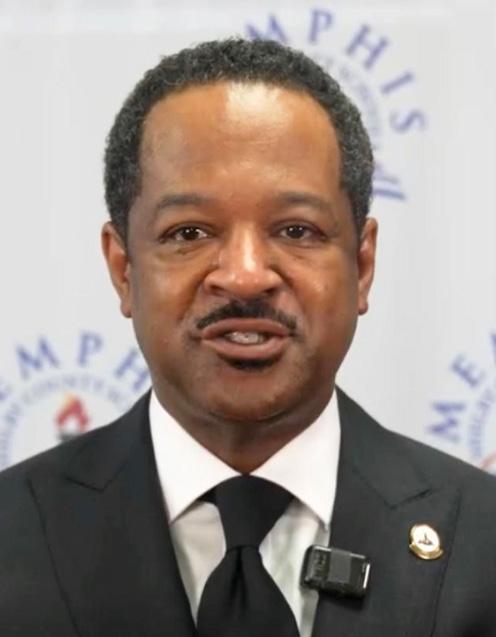
Dr. Roderick Richmond
existed. CLA concluded that such evidence did exist in specific transactions.
The auditors said those determinations were based on factors including payments for work not performed, deficient or negligent work, unsupported or duplicative billing, inadequate oversight and contracting or payment activity that occurred outside established procurement controls.
The largest single amount, $48.43 million, identified by auditors was connected to a custodial services contract classified as potential abuse. According to the report, the contract was directed to one vendor outside the evaluation committee’s recommendation and without documented justification.
Other questionable transactions involved $3.1 million for a vendor with a reported conflict of interest with a district employee who could influence vendor selection, $400,000 paid for work that MSCS determined was deficient or negligent, and $250,000 paid for work the district determined had not been completed.
Auditors used risk analysis and transaction sampling for forensic testing. Although only 2% of district transactions over three contract periods were formally called into question, no conclusion can be drawn about whether the remaining 98% of expenditures were individually examined and cleared.
CLA said it analyzed district financial data, reviewed contracts and supporting documentation, searched public records and emails, and conducted more than 142 interviews. The firm also said its work was hampered by delayed or incomplete records, fragmented record-keeping and procurement information spread across multiple systems.
Dianechia Fields, director of operations for Memphis Lift, said the audit’s historical scope does not answer whether similar practices have continued since the review period ended.
“If it happened then, from ’21 to ’24, what is happening in 2026?” Fields said at the group’s news conference. “That’s why we’re here today, to demand that our tax dollars do what they’re supposed to be doing.”
■■ NEWS
District says action began before final report
Richmond emphasized that the audit period predated his current administration, but the district had already begun rectifying the issues raised in the final report before its release.
“The report also reflects that many of the matters discussed were not uncovered by the forensic audit itself,” Richmond wrote. “Rather, they had already been identified by the District through its own
individuals and entities accountable,” Richmond wrote.
The audit’s findings, however, raise significant questions about the structure and independence of the district’s internal audit function.
CLA said the department lacked a comprehensive inventory of auditable operations, a formal risk assessment and risk-based annual and multiyear plans. Auditors also said the chief audit executive reported functionally to the
internal auditing processes and were addressed during the review period.”
District actions included referrals to federal law enforcement, lawsuits seeking to recover public money, personnel actions, contract terminations and other corrective measures, he said.
“This demonstrates that our internal auditing processes were functioning effectively by identifying concerns, initiating corrective action, and holding
district’s legal department and administratively to the superintendent, instead of maintaining a direct functional reporting relationship with the school board’s audit committee.
The report described an internal audit operation that performed important work but lacked the structure, documentation, independence and strategic alignment necessary to function as a fully effective, risk-focused assurance operation.
Other districtwide weaknesses cited in the report included outdated or missing policies, poor record retention, inconsistent contract and vendor oversight, inadequate segregation of financial duties, insufficient monitoring of computer-system access and failures to document required approvals.
Auditors also reported that MSCS could not produce 86 of 250 employee eligibility forms selected for review and that leadership turnover had eroded institutional knowledge. CLA said repeated interviews were sometimes necessary, because employees lacked consistent knowledge about past processes, systems and decisions.
Richmond highlights ongoing reforms
Richmond said his administration began reviewing the district’s internal controls, operations and organizational systems during the leadership transition in 2025, rather than waiting for the forensic audit to be completed.
He pointed to an “Operational Modernization and Excellence Plan” aimed at strengthening procurement, payroll oversight, digital systems and compliance. He also cited changes to the competitive procurement process, public accountability updates and the district’s first long-range facilities roadmap. His letter does not directly challenge the auditors’ classification of individual transactions or specify which of the report’s dollar amounts the district believes are incorrect. Instead, Richmond focuses on the report’s terminology, the scale of district operations, corrective work already underway and the need to keep the controversy from overshadowing student achievement.
He noted that MSCS has earned the state’s highest academic-growth rating for four consecutive years, increased its Ready Graduate rate and posted preliminary 2026 gains in English language arts, math and social studies.
“An audit can evaluate our systems,” Richmond concluded. “It cannot measure the heart of this District. That is found in our educators, our employees, our families, and, most importantly, our students.”
New financial app pushes new savings concept for close family and friends
By Candace A. Gray TSD Contributing Writer
Asking for money using social media or crowdsourcing websites and apps when a crisis strikes has become a modern-day norm. But a new digital platform is emerging that aims to provide a long-term solution for financial planning and saving money among family and friends.
Crowdsavings, a trademarked name by Memphis native JT Shaheen, is a new financial technology concept that reimagines crowdfunding by collecting money for life’s big events — before they happen, not afterward.
After 18 months of design, development and focus group testing, Shaheen and his team are preparing to launch a new app, Mo Crowdsavings, based on proactive crowdfunding.
Mo, which stands for “moments, money and momentum,” allows users to ask their close friends and family members to help them save for life’s milestones, such as a new car, wedding or graduation, through a secure platform.
“Mo is here to help anyone with a bank account and a dream,” said Shaheen, a former musician, serial entrepreneur and Mo Crowdsavings developer.
Shaheen built Mo with the help of Austin, Texas, design firm Thinktiv and FortyAU, his development partner in Nashville. He shared the broader vision, then hired experts to build the app.
Mo is now available for downloads
from both the Apple and Google app stores. Shaheen plans to invite Memphis residents to be among the first users for beta testing.
How it works
• Download the free app
• Create an account
• Declare first moment, the purpose for asking for savings help
• Set a savings goal
An AI tool helps guide users through the setup process with questions and prompts. Once complete, prospective contributors are invited by users through the app, text message or email to donate money for deposit into their Mo savings account. To strengthen their appeal, users can upload videos to share more details about their savings goals.
Although the money is held with Mo until users make requests for withdrawals, the app uses Stripe, a global payment portal, for the financial onboarding process. Banking information is still required by the app for users to receive money from invited family members and friends, who now comprise a Mo accountholder’s personal savings ecosystem.
Shaheen’s hometown, Memphis, is slated to test this new technology and approach to community saving before any other city. But he expects to attract users across the country.
“It’s something that people need and not just in the U.S.,” said Shaheen. “There is a void in the marketplace and Mo is the solution.”
Mo Crowdsavings is designed to help users save for major life goals — such as a wedding, a new vehicle, education or other milestones — by building a personal savings network of trusted family members and friends. (Courtesy Mo Crowdsavings)
The Mo Crowdsavings app guides users through creating a savings goal, inviting supporters and tracking contributions through a step-by-step mobile experience. (Courtesy Mo Crowdsavings)
‘Good Grief, Pass the Bread, Mom is Dead’ explores loss, family and finding humor in grief
Book review
By Terri Schlichenmeyer
For weeks, you’ve been picking at a scar.
Your brain says to stop, but your heart likes the sweet pain you get when you pick, pick, pick. It’s a scar from loss, a scar of trauma – yours, and your parents’ – a scar that might heal in time, or maybe not. You’ve been around a while and you’ve had bruises, but this one, as in the new memoir, “Good Grief, Pass the Bread, Mom is Dead” by Angela Nissel, hurts the most.
Gwendolyn Nissel had experience a lot of triumphs.
She had fought her way to an Ivy League education, marched for civil rights, and worked with the Black Panthers. She raised two kids on her own, and held decent jobs to keep food on the table. She could do anything.
Except beat cancer.
Her daughter, Angela Nissel, 35, was living in California and looking for a job to match the TV writer and producer roles she had held when Gwendolyn was diagnosed with aggressive breast cancer. Nissel’s marriage had crumbled. She was flat broke but she knew where she belonged – back in Philly with her newly married mom, who said she was “fine.” She wasn’t. Gwendolyn was sick, and Nissel soon became her caretaker. Getting Gwendolyn away from the new husband, who was in the process of taking all her money, was Nissel’s first order of business. Taking her to Los Angeles was the next step, and getting an opinion from a highly regarded doctor, but the cancer had metastasized.
Grief is different for everyone. Nissel was surprised to realize that she hated anybody who still had a mother. She had prayed that God might spare her mom. She tried to love the cancer away. She fought with the brother she adored, until they argued and he cut ties with her. How is it possible to survive without a mother? How do you stop fighting a fierce enemy like cancer, and start saying goodbye?
First thing: You bring tissues when you read “Good Grief, Pass the Bread, Mom is Dead.” You will need them throughout many parts of the book. Author Angela Nissel tells a story of loss and grief that’s raw and honest. And funny.
The humor is far from disrespectful, though. Nissel has a keen ability to highlight the bitter pill of caring for a beloved sick parent, the horror of breast cancer for Black American women, and the expectations demanded by our culture in the grieving process. She shows readers the personal absurdity of these things. She lets us in on her family’s complicated dynamics, and subtly explains how she stood in her own way sometimes.
Then she’s devastatingly funny, which could be beneficial to someone who is grieving or may soon face sorrow. For some readers, this mix of candor and humor may hit wrong, depending on where you are in the process, so be mindful. And beware of the profanity sprinkled quite liberally throughout this memoir, though it fits the story’s tone and tenor.
Laugh and cry. “Good Grief, Pass the Bread, Mom is Dead” is the right book for both expressions of emotion.
c.2026,
$21.99
224 pages
“Good Grief, Pass the Bread, Mom is Dead: A Memoir” by Angela Nissel
Amistad
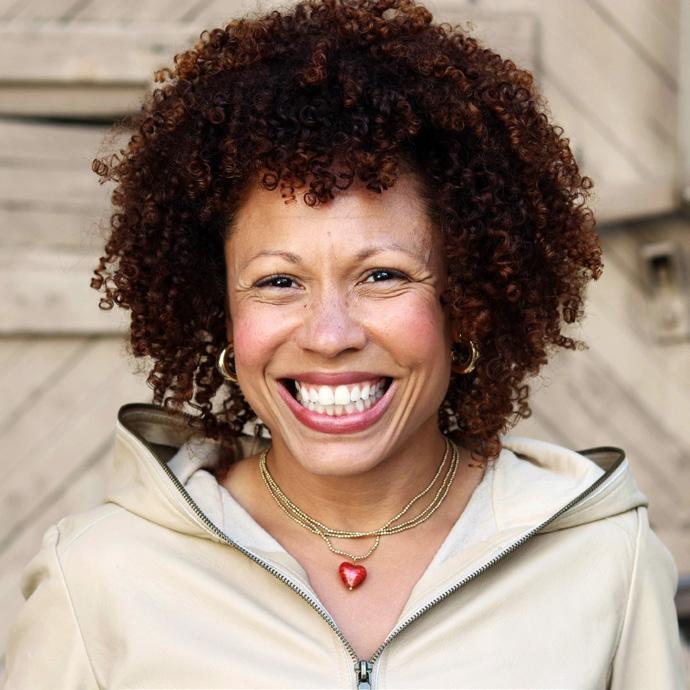
Author Angela Nissel explores grief, family and resilience in her memoir, Good Grief, Pass the Bread, Mom is Dead. (Photo: Hashim LaFond)