POSTMASTER: Send address changes to The Tri-State Defender, 1509 Madison Ave., Memphis, TN, 38104.
GENERAL INFORMATION: Inquiries may be submitted in writing or by calling (901) 523-1818 or by email. TELEPHONE: (901) 523-1818.
The Tri-State Defender (USPS 780-220) is published weekly. The Tri-State Defender 1509 Madison Ave. Memphis, TN, 38104. Second-class postage paid in Memphis, TN.
The Tri-State Defender is a member of The National Newspaper Publishers Association and the Tennessee Press Association. All materials covered by copyright. No materials herein may be reproduced without the written permission of the Publisher. (901) 523-1818 | 1509 Madison Ave, Memphis, TN 38104
$60 Annually/$5 Monthly
Digital subscriptions are available online at tsdmemphis.com
■■ NEWS
Five MSCS developments you may have missed amid a summer of controversy
Academic gains, neighborhood outreach and expanded student services moved forward while audits and state intervention dominated headlines
By Lee Eric Smith TSD Contributing Writer
For much of the summer, the biggest stories surrounding Memphis-Shelby County Schools have focused on adults: who should control the district, who should be held accountable for its financial failures and whether state intervention will improve Tennessee’s largest public school system. Meanwhile, students kept moving toward another first day of school.
Classes begin Monday, Aug. 3, and students will return to a district still wrestling with low proficiency, chronic absenteeism and aging facilities — but also one that recorded academic gains, took enrollment help into neighborhoods and expanded funding for students who need specialized services.
Here are five MSCS developments families may have missed while the forensic audit, oversight board and court fight commanded most of the attention.
1. Test scores moved in the right direction
Preliminary 2026 Tennessee Comprehensive Assessment Program results show increased proficiency in English language arts, math and social studies.
Districtwide ELA proficiency rose from 24.6% to 25.7%, while math increased from 21.2% to 22.3%. Social studies showed the largest gain, rising from 26.1% to 28.7%.
The numbers offer both encouragement and a reminder of how much work remains. Most MSCS students are still not meeting grade-level expectations on state assessments.
The district also says it has earned TVAAS Level 5 — Tennessee’s highest student-growth designation — for four
consecutive years. Superintendent Dr. Roderick Richmond said 68 schools now have an A or B state rating, while 67% received a C or better. The district’s Ready Graduate rate has more than doubled during the past four years.
Growth and proficiency measure different things. Proficiency asks whether students have met grade-level standards. Growth measures how much progress they made from where they began. That means a student or district can show strong growth while still falling
short of proficiency. For families, both measures matter.
2. MSCS went looking for families who did not know their school had changed
The district did not rely entirely on websites, robocalls and social media to prepare families for the new year. MSCS employees and school board members conducted a neighborhood door-knocking campaign and found families who did not know their atten-
Published by
The Tri-State Defender
President Calvin Anderson Editor
Stephanie R. Jones
dance zones had changed.
Staff later provided registration help at Woodstock K-8 and other schools. School Board Member Towanna Murphy said registration appeared to be moving smoothly at campuses she visited and thanked principals and staff for their preparation.
MSCS also operated multilingual summer support hubs where families could receive assistance with enrollment, transfers, English-language services, attendance, transportation and immunizations.
The door-to-door effort illustrates the challenge beneath those instructions: Not every parent receives digital notices, understands a zone change or knows returning students must register again.
3. The district increased funding for specialized student services
Days before schools opened, the school board increased the amount available for occupational therapy, physical therapy, speech therapy, audiology and interpreters for deaf and hard-of-hearing students.
The board raised the budget for those services from $11 million to $14 million and authorized agreements with multiple providers for the 2026-27
■■ NEWS
school year.
Board Member Amber Huett-Garcia asked whether removing predetermined limits for each vendor would give administrators greater flexibility to shift money according to student needs.
Her board colleague Stephanie Love asked a more immediate question: Would the administrative correction interrupt services?
The board unanimously approved the revised arrangement after administrators responded.
The increase came as Board Member Tamarques Porter raised broader questions about staffing in the district’s Mental Health and Exceptional Children departments.
Porter said he had received reports that 20 school psychologists had resigned. Langston said that was the first he had heard of the figure and promised to investigate.
Superintendent Dr. Roderick Richmond said MSCS employs psychologists through two departments and supplements its own staff with contracted providers. Some positions previously supported by expiring grants were moved into vacant general-fund positions, administrators said.
The district had not provided a con-
firmed psychologist-vacancy count by the end of Tuesday’s meeting.
4. Mental-health professionals are already working inside the district
Several public commenters identified themselves as members of the district’s Mental Health Center.
Stephanie Nelson, a school social worker, said she provides individual, group and family therapy, along with social-emotional and attendance support.
Anita Ryan House identified herself as a school psychologist within the center.
Natasha Anderson, a mental-health clinician, used her speaking time to address educators preparing for another year.
“As we begin a new school year, I want to remind educators: Please, take care of your mental health,” Anderson said. “Take care of your mental health so you’re able to pour into our children.”
The message matters in a district where chronic absenteeism remains one of the most persistent barriers to learning.
MSCS has reported improvement in chronic absenteeism, but more than one in four students was still projected to miss at least 10% of the school year. The district is increasingly connecting attendance intervention with social-emotional and family support.
Mental-health staff can help families address anxiety, trauma, grief, behavior and other concerns that may appear first as attendance or academic problems.
5. Teachers and principals received new back-to-school preparation
Southwind High School Principal
John Bush appeared before the board in clothing more suited for a long registration day than a formal meeting.
“Sorry I’m dressed like this, but it’s registration day,” Bush said. “I had an auditorium full of kids, and this is what you got.”
Bush praised the district’s leadership and operations institutes, saying the sessions connected Richmond and central-office leaders directly with
principals’ instructional and operational concerns.
“He thinks a lot about principals and what we need and the conversations that we have,” Bush said. “Sometimes he stretches us on the things that he wants, but he has passion for the kids, for the schools, and he’s also building leaders.”
United Education Association representative Liz Marable briefly set aside her prepared comments about state intervention to praise the district’s new-teacher orientation.
“It was amazing PD,” Marable said, using the abbreviation for professional development.
Richmond later thanked the orientation team and said seeing new teachers excited to join the district “did my heart proud.”
The preparation does not answer the unresolved question of how many vacancies remain. Porter requested an updated teacher-vacancy count before students return.
But the comments offered a glimpse of work that received considerably less attention than the controversies surrounding the district: preparing new teachers, developing school leaders and helping principals get buildings ready for students.
Beyond the headlines
None of those developments cancels the serious questions raised by the state-ordered forensic audit. Nor do modest academic gains mean MSCS is where students and families need it to be.
The board and administration still must account for vacancies, uneven academic outcomes, persistent absenteeism and the condition of school buildings.
But the fuller picture includes more than audits, lawsuits and leadership turmoil. It also includes students making progress, employees finding families one door at a time, additional support for children with disabilities and teachers preparing to begin again.
The adults will continue debating who should run Memphis-Shelby County Schools.
Students will return expecting everyone involved to make it work.
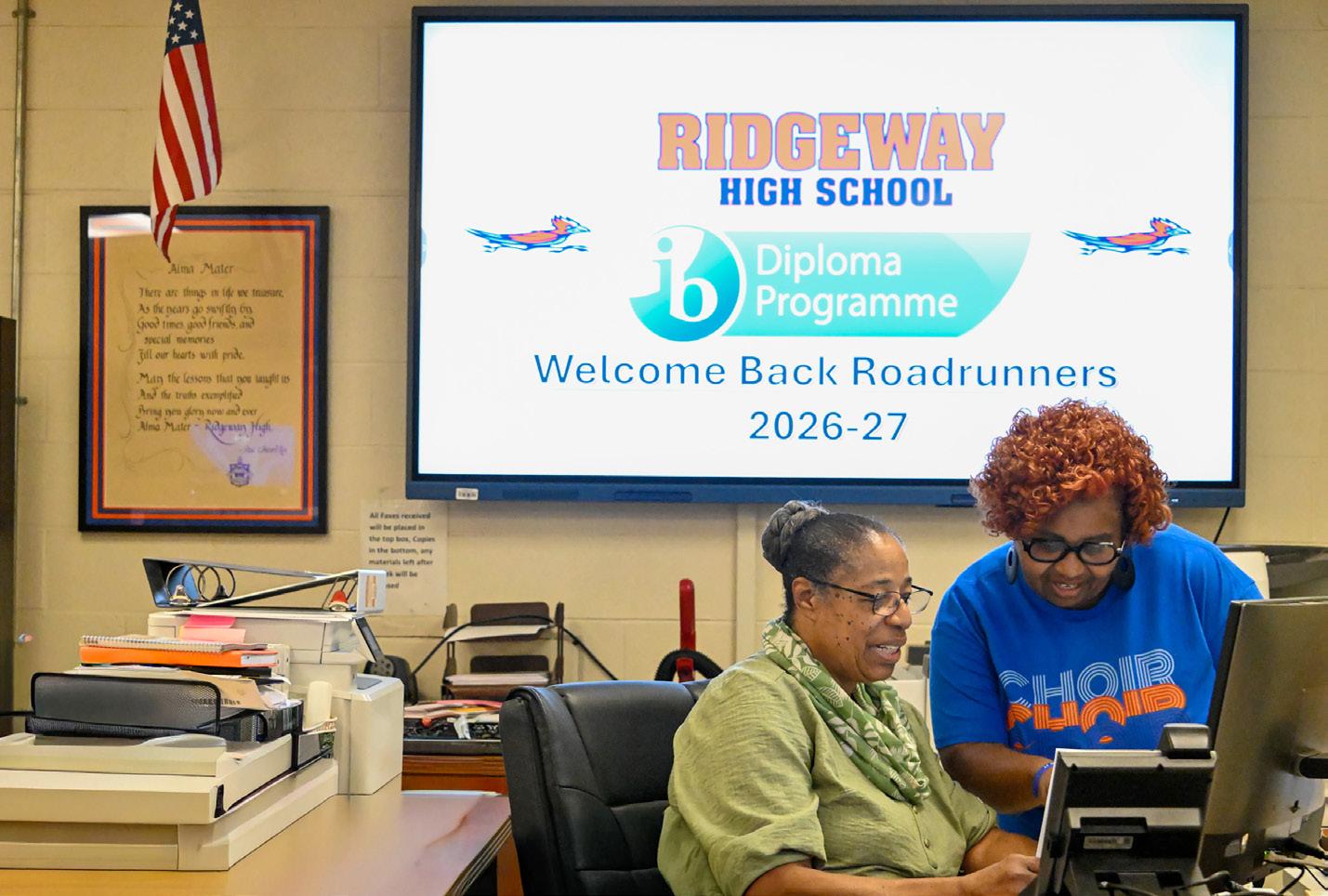
At Ridgeway High School, Avery R. Lewis, general office secretary (left), and Jawanna Franklin, IB coordinator, work on last minute tasks Friday, July 31, to prepare the school for students’ return on Monday, Aug. 3. (Gary S. Whitlow/Tri-State Defender)
MSCS Chair McKinney: ‘Accountability is not something this board fears’
Board chair questions who can hold state-appointed oversight body accountable as district prepares for new school year
By Lee Eric Smith TSD Contributing Writer
Memphis-Shelby County Schools
Board Chair Natalie McKinney said Tuesday that the elected board’s lawsuit to fend off oversight by a state-appointed oversight board is not an attempt to avoid accountability.
It is an effort, she argued, to preserve it.
“Accountability is not something this board fears,” McKinney said during the board’s July 28 business meeting. “We believe in accountability. But in a democracy, there is a fundamental question that must always be asked: ‘Accountable to whom?’”
In its final business meeting before students return to class, the MSCS School Board fielded questions about
the lawsuit and also pressed administrators for answers about teacher vacancies, school psychologists, student services and whether school air-conditioning systems would be ready for August heat.
But not before McKinney made her case that state oversight cannot be called accountability if local voters have no way to hold the overseers accountable.
“The voters hired us, the voters evaluate us, and the voters have the power to fire us,” McKinney said in her opening remarks. “That is accountability. That is democracy.”
In contrast, McKinney argued, Memphis and Shelby County voters have no say in who sits on the oversight board, nor can they directly hold the state
officials who appointed its members accountable.
“Where is the accountability in that?” she said.
Her remarks came during a sharply divided public-comment period, with some parents and educators urging the board to continue its legal challenge and others calling on members to drop the lawsuit and cooperate with the state-appointed body.
‘Accountable to whom?’
McKinney said Public Chapter 1057, the state law creating the appointed oversight board, gives that body significant authority over district budgets, contracts, personnel, charter decisions and school property.
She invoked Tennessee’s history of
weakening Black political participation after Reconstruction, while cautioning against equating the current law with 19th-century voter-suppression measures.
But history, McKinney said, offers a warning about laws that preserve the appearance of representation while reducing the practical power of the ballot.
“Our students deserve more than governance restructuring masquerading as academic strategy,” McKinney said. She argued that the state intervention concentrates heavily on administrative authority but offers comparatively little that directly strengthens classroom instruction, places effective teachers in classrooms or provides support to struggling children.
The board unanimously authorized the lawsuit, McKinney said, because members believe the law represents an unconstitutional intrusion into local democratic authority.
Public divided over lawsuit
Public commenters offered competing definitions of what accountability should look like.
Ashley Collins identified herself as a single mother raising five children in public schools and urged the board to drop the lawsuit and work alongside the state-appointed body.
“When you have five kids in school, your days are full of problems to solve,” said Collins, a member of Together4Students, a pro-oversight advocacy group. “And if there is one thing I try to teach my children every day, it is that we get so much more done when we work together instead of fighting.
“We don’t have to agree on everything to sit down at the same table,” Collins added.
Other speakers voiced support for the lawsuit.
Benita Doggett, an MSCS graduate, parent and former employee, called state intervention another attempt to undermine local control. She pointed to the state-run Achievement School District, which took control of dozens of schools beginning in 2012 but failed to produce the promised academic turnaround.
“I ask that the board stay the course,” Doggett said, “and be courageous when so many of our other elected leaders will not.”
Teachers union leader Liz Marable was more blunt.
“Public school funds should stay in public schools,” said Marable, president of the United Education Association of Shelby County. “Local control of public schools should not be an issue.”
“We support the lawsuit. We support public schools. We support public-school educators, public-school children and public-school communities,” she said.
District says schools are ready Richmond said he had met with regional superintendents, instructional leadership coaches and employees responsible for human resources, safety, security, facilities and maintenance as the district conducted final readiness checks.
■■ NEWS
He thanked families who registered early and encouraged those still completing the process to do so. Registration is required for all new and returning MSCS students.
District employees and board members also described going door to door after learning that some families did not know their attendance zones had changed.
Staff members provided registration assistance at Woodstock K-8 and schools throughout the district Tuesday. Board Member Towanna Murphy said the registration process appeared to be moving smoothly at campuses she visited, with backpacks being distributed to students who registered.
The district also offered multilingual support hubs this summer to help families with enrollment, transfers, transportation, attendance, immunizations and other needs.
Questions about psychologists and vacancies
Board Member Tamarques Porter said he had received reports that 20 school psychologists had resigned heading into the new school year.
Chief Financial Officer Tito Langston said the figure was new to him and promised to consult the district’s Mental Health and Exceptional Children departments immediately.
Langston said some psychologists and social workers had been supported through temporary grant funding that expired. The district moved some of those employees into vacant positions supported through the general fund, he said. MSCS also uses outside contractors to supplement its in-house psychologists and other specialists.
Richmond said the district has psychologists working through both the Mental Health and Exceptional Children departments and that their roles differ. “We will work on the information regarding the staffing numbers,” Richmond said.
Porter also requested an updated count of teacher vacancies before students return.
The board also unanimously increased funding for occupational therapy, physical therapy, speech therapy,
audiology and interpreters for deaf and hard-of-hearing students from $11 million to $14 million for the 2026-27 school year.
The revised agreements give MSCS flexibility to distribute the money among multiple providers based on student needs. Board Member Stephanie Love also asked whether the administrative changes would interrupt services.
Repairs and August heat
Facilities were another concern as students prepare to return to classes during one of Memphis’ hottest months.
Board Member Sable Otey thanked administrators and facilities employees for completing maintenance, responding to work orders and placing updated equipment in schools.
Murphy urged the administration to make sure HVAC systems were operating and ready for Monday.
The board also added $11.9 million in county funding to the district’s capital budget.
Langston said MSCS selected projects it believes can be completed during the current fiscal year rather than allowing the money to remain unspent. The district also assigned approximately $33 million from its fund balance for additional facilities and life-safety work.
The board separately increased an air-conditioning and refrigeration contract and approved GPS and radio installation for 46 new school safety and security vehicles.
The lawsuit will continue, as will the argument over who should control Memphis-Shelby County Schools.
On Monday, however, students will return expecting the elected board, the administration and the new oversight body to answer a more immediate question: Who is accountable for making sure their schools work?
Parents’ checklist to prepare for school year
Registration, immunizations, transportation and attendance can determine whether students are ready
By Lee Eric Smith TSD Contributing Writer
The first day of classes for Memphis-Shelby County Schools is Monday, Aug. 3.
For families, being ready involves more than buying notebooks, uniforms and new shoes. Parents should confirm registration, transportation arrangements, immunization records and
school-specific requirements before students arrive.
That preparation is particularly important this year, as some attendance zones had changed.
Here is a last-minute checklist for the 2026-27 school year.
Make sure registration is complete
Registration is required every year
for all students, including those returning to the same school.
Returning families can register through the PowerSchool Parent Portal (Memphis Shelby County Schools). Rising kindergarten students must register as new students even if they attended an MSCS Pre-K program.
Parents should verify:
• the student’s assigned school;
• home address and
ber;
• emergency contacts;
• custody information;
• grade placement;
• any approved transfer or schoolchoice assignment.
Completing registration affects more than classroom placement. The information helps MSCS plan staffing, transportation and student-support services.
Families needing enrollment help may contact the district’s Department of Enrollment, Registration and Attendance Department (Memphis Shelby County Schools ).
telephone num-
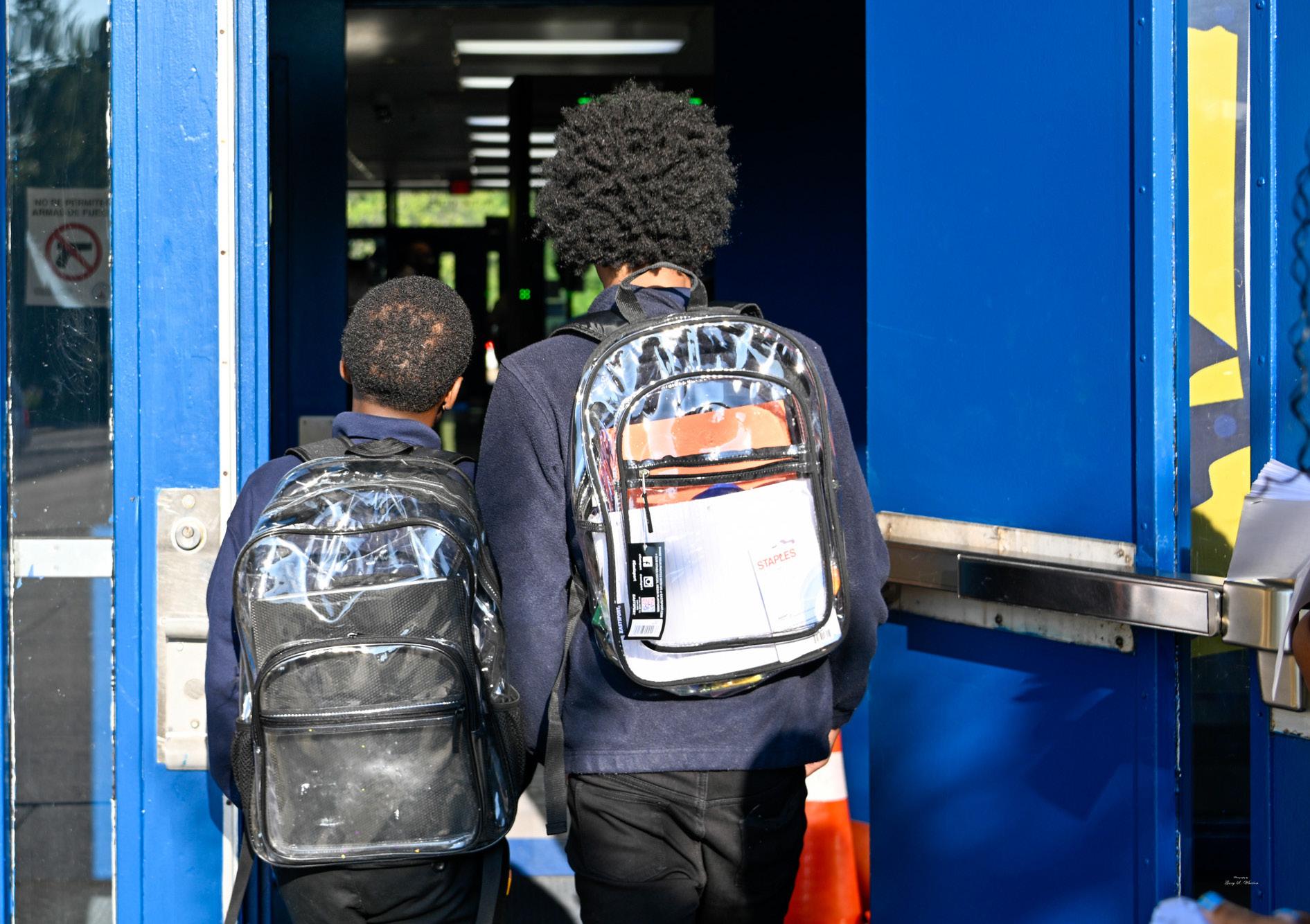
A child gets a fresh haircut before the start of the new school year. Memphis-Shelby County Schools students return to class Monday, Aug. 3, and district officials encourage families to complete registration, confirm transportation, update immunization records and prepare for a successful first day. (Gary S. Whitlow/Tri-State Defender)
Check immunizations
Parents of incoming kindergarten and seventh-grade students should pay particular attention to immunization requirements.
Incoming kindergarten students must provide proof of required immunizations and a physical examination. Rising seventh-graders generally need documentation of a Tdap booster.
Parents should provide a valid Tennessee immunization certificate and any physical-examination documents required for the student’s grade or program.
Students experiencing homelessness have a right to immediate enrollment even when they do not have documents normally required for registration, including proof of address, birth certificates, immunization records or previous school records.
Confirm transportation
Families whose children qualify for district transportation should verify the route, bus stop and pickup time before Monday.
Parents should not assume last year’s bus number or stop remains unchanged. Routes can shift as students register, attendance zones change and enrollment totals become clearer.
Develop a backup plan for the first few days, when late buses and route adjustments are more likely.
Young children should know their full name, school and bus number. Contact information can be placed inside a backpack without displaying a child’s personal information publicly.
Log into PowerSchool now
The PowerSchool Parent Portal is useful for more than report cards. Parents can use the portal to check for registration, grades, attendance and other student information.
Families who cannot access their accounts should resolve the problem before school begins rather than waiting until a schedule, absence or grade becomes an issue.
■■ NEWS
Make sure the district has a current email address and telephone number so emergency notices and school messages reach the correct person.
Take attendance seriously from Day One
A student who misses 10% or more of the school year is considered chronically absent. That includes excused and unexcused absences.
Missing approximately two days per month can be enough to reach that threshold.
MSCS has reported improvement in chronic absenteeism, but the problem continues to affect more than one in four students. The district says reducing absenteeism requires partnership among schools, students and families.
Parents should submit documentation whenever a child misses school and communicate early when illness, transportation, housing or family circumstances create an attendance problem.
Know what services your child receives
Parents of students with individualized education programs should confirm the services listed in those plans and who is responsible for coordinating them.
The school board approved up to $14 million Tuesday for occupational therapy, physical therapy, speech therapy, audiology and interpreters for deaf and hard-of-hearing students during the new school year.
Families should ask:
• When will services begin?
• How often will the student receive them?
• Will services be provided by a district employee or contractor?
• Who should be contacted if a session is missed?
• When is the next IEP meeting or review?
Parents do not have to wait until a report card or formal meeting to raise a concern.
Ask for mental-health help early
MSCS employs school psychologists, clinicians and social workers who provide support to students and families.
Parents who notice persistent anxiety, withdrawal, anger, grief, sleep changes, school refusal or other concerning behavior are encouraged to speak with a school counselor, social worker or administrator.
Ask who provides mental-health services at the school and how to request an assessment or referral.
Confirm the supply list and dress code
Supply lists, uniform requirements and dress codes can vary by school and grade.
Parents should check with the school directly rather than relying entirely on a generic list. They should also ask about:
• arrival and dismissal procedures;
• identification required for student pickup;
• student devices and charging requirements;
• before- and after-school care;
• orientation schedules; and
• school-specific restrictions.
Do not assume the school knows
Parents should tell the school about medical conditions, allergies, custody restrictions, transportation changes, homelessness, language needs or other circumstances that may affect a child’s school day.
A smooth first morning cannot guarantee a smooth school year. But confirmed registration, complete health records, working PowerSchool access and a clear transportation plan can prevent several of the problems most likely to derail Day One.
Students get straight to business on the first day of school, Monday, Aug. 3, at Kirby Middle School. (Photos: Gary S. Whitlow/Tri-State Defender)
The new school year is underway in Memphis
Tri-State Defender
Backpacks were filled, buses were rolling and classrooms were prepped on Monday morning, Aug. 3, as Memphis and Shelby County students began a new school year.
At Kirby Middle School, students lined up outside in crisp new uniforms, their backpacks loaded with fresh supplies. While some chatted with their peers, others waited anxiously for the doors to open.
A huge “Welcome Back” sign stood on the school lawn as smiling teachers, administrators and staff greeted arriving students. Even the Memphis Shelby County Schools head honcho, Superintendent Dr. Roderick Richmond, was on hand to welcome students back.
Richmond, along with school board members and district senior leaders, boarded a bus for a tour, dubbed “First Day of School,” across parts of the city. The group visited five schools, including Kirby Middle, where the superintendent went from classroom to classroom, greeting and encouraging students. The tour, the district said, was intended to set the tone for a “strong, student-centered year ahead.”
Once the bell rang and the young scholars were seated at their desks in classrooms, it was books open and pencils out. Time for the learning to begin.
Kirby Middle School students wait in line for the start of a brand new school year.
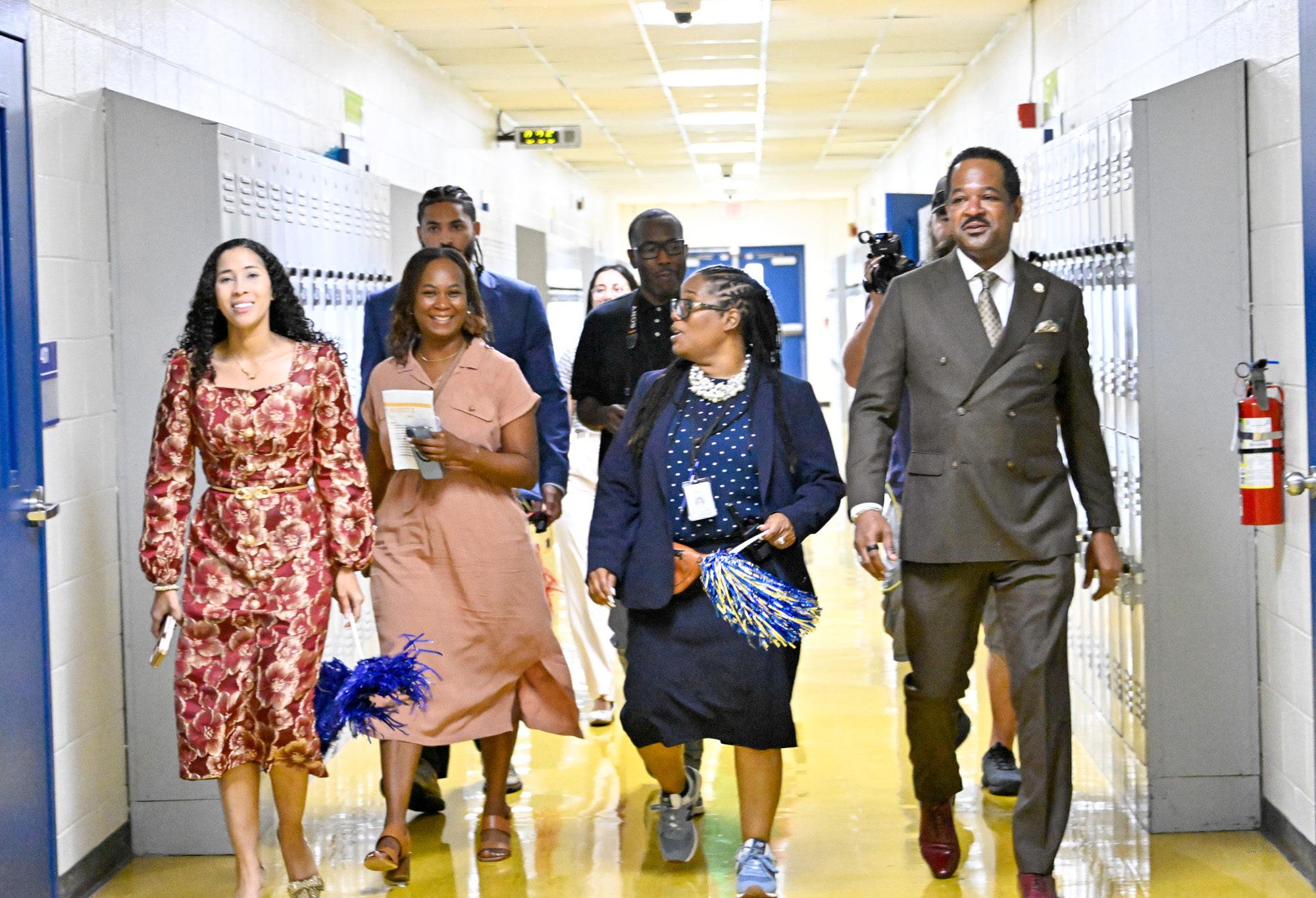
Superintendent Dr. Roderick Richmond, along with school board members and district leaders, visit Kirby Middle School during their First Day of School Tour, Monday, Aug. 3. ON THE COVER: It’s that time! Another school year begins at Kirby Middle School.
Book explores how Minneapolis reflects America’s racial divide
Book review
By Terri Schlichenmeyer
Two blocks up, two down. Once upon a time, that was your entire world. You lived here. Grandma’s house was around the corner and uncles and aunties lived along the way. School was nearby, church across the street. That real estate held everything you needed. But what if things changed? What if, as in the new memoir, “The Cruelty of Nice Folks” by Justin Ellis, your hometown, the place that held your memories, betrayed you?
Chances are when you think of Minnesota, you think of lakes, lush fields, or fun in the snow. Justin Ellis thought of home because he grew up in Minneapolis, close to family and friends and everything he held dear.
He was, therefore, understandably alarmed when George Floyd was killed by a Minneapolis policeman who knelt on Floyd’s neck until he died. Ellis wondered how something like this could happen in the city he loved, and so he headed home.
Being a Black family in Minneapolis was never without its struggles. There, Ellis says, “only 26 percent of Black families own homes…” When unemployment for Black residents was at an all-time low, it was double what white Minneapolitans experienced.
And scattered throughout Ellis’s lifetime, Black residents died at the hands of police.
He wanted to know why, with such a progressive reputation and a history of welcome for people of color, was there still racial violence in his hometown?
Would the police officer, Derek Chauvin, pay for Floyd’s murder?
Ellis says, “… our eyes had seen this death so many times before and watched a killer walk away. What were we supposed to believe?”
Arriving in Minneapolis, Ellis set out to see the whole picture that he and other Black Minneapolitans had lived, but his arrival there had dual purpose. Ellis’s mother had been diagnosed with cancer, and she needed him close.
As her life slipped away, he studied the death of a man he’d never know…
While you’ll probably pick up “The Cruelty of Nice Folks” for its thoughtful content and the fact-finding inside, it’s important to at least give a nod to the books’ exquisite writing. Author Justin Ellis sharpens a thought, turns a phrase, and screws it tightly into your heart in a way that most writers will only wish they could do, so pay attention and don’t miss it.
That’s the first appeal of this book.
The second appeal is in the story itself, and the reporting that Ellis offers. Readers who know all about “Minnesota Nice” but also about Floyd, Renee Good and Alex Pretti will see the yin and yang of the Twin Cities, and why Minneapolis’s long history of race relations explains a lot of what’s going on in the rest of America. That story is woven in with a memoir of a mother’s love that’ll make you want a big box of tissues. You’ve been warned.
This is a thoughtful, thorough book that will satisfy readers of history and biographies, making it a don’t-miss. Start “The Cruelty of Nice Folks” and you’ll find that you can’t put it down.
c.2026,
$30.00
419 pages
“The Cruelty of Nice Folks: Why Minneapolis Is the Story of America” by Justin Ellis
Harper
The Power We Hold: Staying the course between elections
By Shawnee Calhoun TSD Contributing Writer
This series opened with a question: Have you read your paperwork? It closes with a promise. The power we hold does not clock out when the polls close. This final installment is about the bottom of your ballot, the dates that remain in the election cycle and what your power looks like after the count ing is done — your staying power.
On Thursday, Aug. 6, polls open from 7 a.m. to 7 p.m. in Memphis and Shelby County, and you must vote at your assigned precinct. Check your precinct and preview your party’s full sample ballot at electionsshelbytn.gov so nothing surprises you in the booth.
The next order of business is to finish the whole ballot. The top of the ballot gets the earworms — state governor, U.S. Senate, U.S. Congress, plus county mayor, commissioners and sheriff. The bottom of the ballot, however, holds the jobs closest to home. The farther down the ballot you vote, the heavier your vote weighs. Do not leave yours blank.
A look down ballot
Six judicial seats are up. Judges in these races run without party labels, so there is no shortcut at the bottom of the ballot — the job description is all you have. The unexpired terms: Circuit Court Judge Division III, Chancellor Part II and Criminal Court Judge Divisions I and VIII. A chancellor is a judge in Chancery Court, which decides civil disputes — contracts, property, business fights and divorces — where the stakes are rights and money rather than guilt or innocence. That last race is seven candidates deep, the longest
Court and appellate judges. A “retain” vote keeps the judge in office. A “replace” vote removes the judge, and the governor appoints a nominee to fill the vacancy. That person must then be approved by the state legislature. The last item on the general election ballot is a two-part county referendum. First is a proposed Shelby County Charter amendment that would let the county commission appoint its own attorney, independent of the county attorney. Part 2 is about how commissioners preapprove the county mayor’s hires. A “yes” writes it into the county’s rulebook. A “no” keeps legal advice
7 p.m. on election night — early voting and absentee totals first, with precinct returns behind them. Every number that night is unofficial. Provisional ballots are counted within four business days. Then the five-member Shelby County Election Commission certifies the results, no later than the third Monday after the election — Aug. 24 — under Tennessee law.
Certification is the starter’s pistol. Winners of the county general election begin their terms Sept. 1, a date set by Article VII, Section 5 of the Tennessee Constitution. Watch the swearing-ins.
Primary winners have a shorter runway. They advance to the Nov. 3 state and federal general election, where every voter chooses from every party’s nominees. The new U.S. Congress — our national lawmakers, seated in Washington, D.C. — convenes in early January. The Tennessee General Assembly — our state lawmakers, seated in Nashville — convenes the same month, with its live streams running, ready to be timestamped, the whole way through. And the new governor’s term begins in mid-January.
Next up, Nov. 3
Missed the July 27 deadline to request an absentee ballot or to vote early for this election? Vote in person Aug. 6 at your precinct, then build your November plan. Confirm or update your registration at GoVoteTN.gov before the Oct. 5 deadline. If you qualify to vote by mail — voters 60 and older, voters who are hospitalized or ill, jurors, students enrolled outside the county and voters away for the entire voting period, among others — the application window for Nov. 3 opens Aug. 5. File early. The Election Commission warns that waiting until the deadline risks a ballot that arrives too late to mail back. Once you request an absentee ballot, you cannot vote in person in that election except by provisional ballot.
Now comes staying power
Part 1 showed what you are really doing when you vote: selecting leaders and making or changing laws. Part 2 decoded the job descriptions on the ballot — which offices enforce the laws, which ones write the rules and budgets and which ones decide court cases. This
finale adds the last piece: sustaining your power.
Name a pressing issue, and this ballot names the office that answers for it.
The immigration task force in Memphis belongs to the sheriff, the U.S. Congress and the state governor. The sheriff runs the jail that receives detainer requests from the immigration task force, Congress funds and oversees it, and the governor decides the National Guard’s role.
The South Memphis data centers
■■ NEWS
belong to the county mayor, the county commission and the District 86 state House seat. The mayor appoints the health director who issues the air permits, the commissioners confirm and fund that office, and District 86 covers the neighborhoods closest to the turbines.
The state takeover push at Memphis-Shelby County Schools belongs to your state senators and state representatives — and to the school board members it would override. The Ten-
nessee General Assembly voted on the takeover; an appointed board will lead the district unless lawsuits against the takeover are successful.
The redistricting of Memphis and Shelby County belongs to the Tennessee General Assembly and the governor, who drew and signed the map splitting the city among U.S. House Districts 5, 8 and 9. Change the mapmakers, and you change the map.
Between now and November, staying power looks like homework we already
know how to do. Stream a county commission meeting when the confirmation votes begin. Timestamp the General Assembly’s live streams and write your legislators about what you watched. Keep your registration current before Oct. 5.
After Aug. 6, the counting is the commission’s job. The watching is ours. This is still your business, and the paperwork is still free to read.
Voting is the power we hold — and staying is how we keep it.
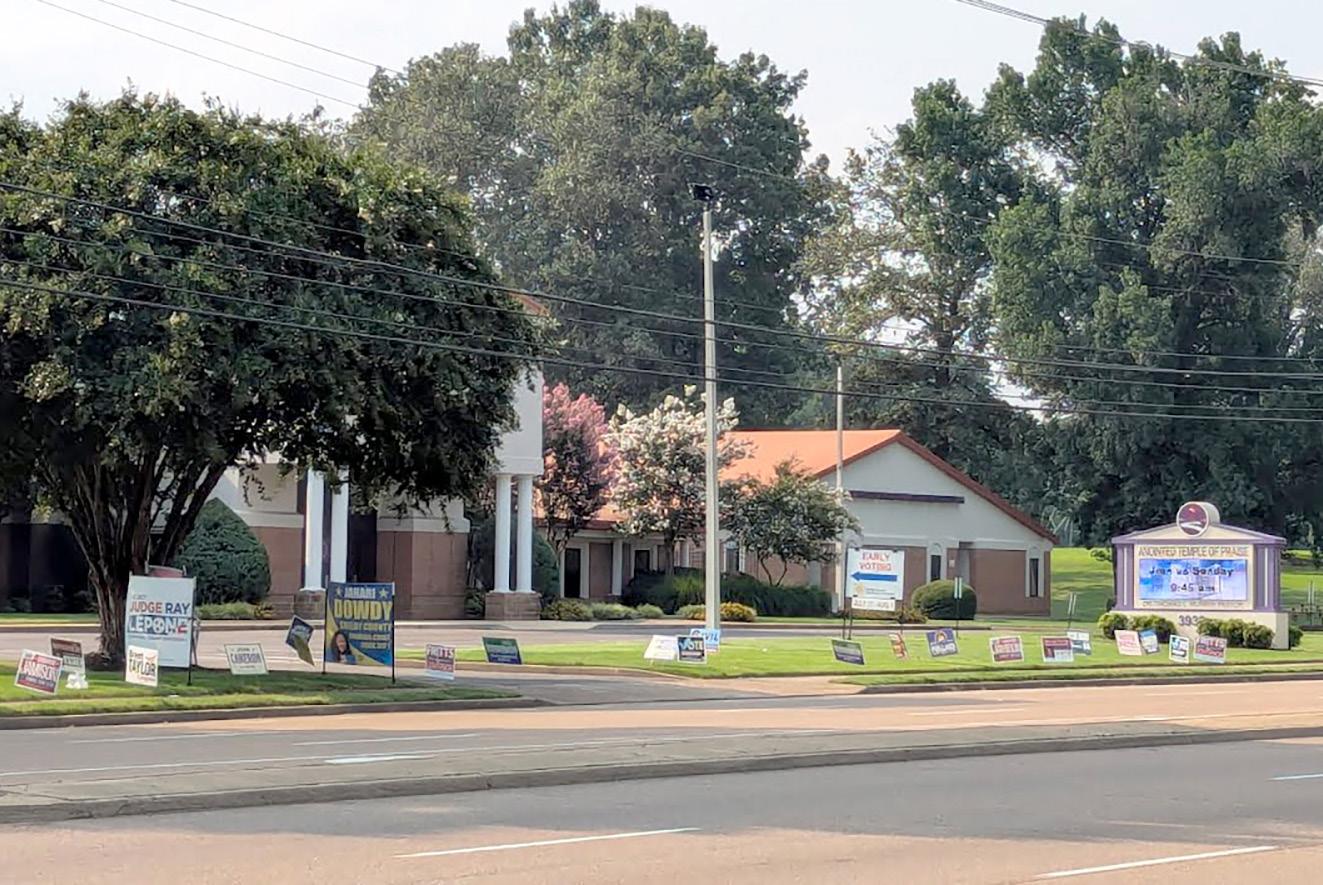
As election day approaches, campaign signs dot the perimeter at the Anointed Temple of Praise polling site at 3939 Riverdale Road. (Shawnee Calhoun/Tri-State Defender)
■■ PERSPECTIVE
The other capital Memphis needs for a foothold on the future
Financial philanthropy alone won’t prepare Memphis for tomorrow. But Intellectual philanthropy may determine whether the city and the region are ready for an AI-driven future.
Groundwork:
Mission Critical
By Judith Black Moore TSD Contributing Writer
Another kind of capital is at play for US cities on the rise — and these cities appear to be more intentional about investing it.
As elected officials and business leaders in Memphis discuss the public and private funding needed for growth, perhaps it is time to engage a different kind of philanthropy to help prepare our region for the future.
We often ponder what it will take to move Memphis forward. Many would say the answer is money. Traditional philanthropy. But that’s only half the answer. And the question is incomplete. It’s not just what it will take, but also who it will take.
Yes, financial philanthropy is essential. But there is another form of giving that may be even more transformative.
Let’s call it intellectual philanthropy, the gift of knowledge sharing and access that leads to exposure, opportunity and inventiveness.
Data shows that Memphis is already generous. According to “The Chronicle of Philanthropy,” Memphis has consistently ranked first or second nationally since 2017 in charitable giving on a per-capita income basis. Residents here contribute nearly 6% of their income to charitable causes, according to the philanthropy report.
Still, with all that generosity, Memphis is not ranked among the top cities
for attracting top talent, referred to as brain gain. In fact, Memphis is losing talent, sliding toward brain drain. Meanwhile, 200 miles east, Nashville is becoming one of the nation’s brain-gain magnets.
Some may argue we give in Memphis despite high structural poverty. Others may say we give because of it. And without the support of thoughtful guidance that intellectual philanthropy could bring, financial giving alone may fail to help our community fully realize its potential.
But if Memphis’ corporate and
individual donors would combine their financial gifts – regardless of the reason – with intellectual philanthropy, the region could see a bigger return.
In the 2019 study, “Who Becomes an Inventor in America? The Importance of Exposure to Innovation,” published in “The Quarterly Journal of Economics” by economists Alex Bell, Raj Chetty, Xavier Jaravel, Neviana Petkova and John Van Reenen, unrealized potential is given a compelling name, “Lost Einsteins,” or people who might have become highly impactful inventors had they been exposed to new ideas and
innovation. Which raises a broader question: How much human potential never fully develops simply because of a lack of exposure?
Memphis faces too much unrealized human potential, choked off by poverty, high incarceration rates and crime. But talent rarely vanishes. It simply goes elsewhere looking for a way to survive.
Marian Wright Edelman, founder of the advocacy nonprofit Children’s Defense Fund, summed up the importance of exposure in six words: “You can’t be what you can’t see.”
Every day, thousands of professionals
Judith Black Moore
Participants in The Journey Experiential field trip offered by The Gentlemen’s League organization visited with WREG News station’s meteorologist Max Claypool to get a behind the scenes glimpse of a newscast and weather reporting. Photo: KMG- Knowledge Media for Generations & The Gentlemen’s League (KMG- Knowledge Media for Generations & The Gentlemen’s League)
■■ PERSPECTIVE
across Memphis solve complex problems, identifying technological and environmental solutions, designing supply chains, conducting research and constructing buildings. But do these industries share knowledge to uplift a struggling community and prepare it for a better future?
That question has become more urgent as artificial intelligence reshapes the workplace.
Larry Robinson, founder and CEO of Kudzukian, a video production firm, and director of Knowledge Media for Generations, a nonprofit group that produces educational videos, believes communities must prepare people not only for today’s jobs but also for opportunities yet to emerge.
KMG’s “The Journey” video series introduces young people to accomplished leaders and innovators to help demonstrate that exposure is not simply inspiration, said Robinson. It is preparation.
“We are at a point in our society with all that is taking place with AI that we don’t know all that is coming to us in
terms of opportunities,” said Robinson. “Memphis should become the national model for how a community is upcycled – transformed and equipped – to understand AI and thrive in an AI-driven workplace.”
In early July, during the education forum hosted by TSD in the Community, Sable Otey, member of the Memphis-Shelby County Schools board, called out the lack of exposure and opportunity for the district’s students:
“Say there’s a career fair. Students go by and grab the brochure but how many of those businesses really get involved? Or (consider) the adopt-a-school model. It is easier for corporations to give (to) that. But when it comes to training, I have heard businesses say they don’t bring students in because it is not a safe space.”
Otey then offered what amounts to a call for intellectual philanthropy: “So then make a safe space.”
Robinson, the video production CEO, says companies benefiting from public incentives should think beyond traditional corporate giving.
“Companies are getting tax abate-
ments,” he said. “But what about their investment in the community from an intellectual standpoint?”
It is a fair question. If taxpayers help underwrite business growth, then businesses also should help underwrite intellectual growth, enabling communities to participate in the future those companies are helping create.
Imagine if every corporation and local business viewed intellectual giving as a form of risk management and a core part of succession planning. What could Memphis become if intentional mentorship were woven into its business culture with the same commitment as financial giving? What if nonprofits and startups were given transformative access to executive-level insights and exposure to business strategies that sustain organizations?
Thoughtfully planned intellectual philanthropy could help would-be innovators see endless possibilities and envision their role in shaping the future.
Access leads to exposure. Exposure opens the mind to what is possible. Knowledge of what is possible creates hope and drives ingenuity. And funding underwrites the pursuit of what is possible.
If we believe Memphis’ future depends on the preparedness of its people, then the answer to “what” is twofold. And the “who” becomes every citizen, business and corporation with intellectual resources to give.
A culture of giving built equally on intellectual and financial philanthropy could ensure fewer lost Einsteins and prepare more futuristic thinkers, innovators and inventors to contribute their talents to Memphis’ future.
The ultimate return is a generation no longer compelled to take their talent elsewhere but instead choosing to invest it here – repaying Memphis in the same currency invested in them: intellectual and financial capital that strengthens us here at home.
Damar Bell, now a criminal justice major at University of Memphis spent a day shadowing Juvenile Court Judge Tarik Sugarmon prior to declaring his major. Bell credits what he saw firsthand while with Judge Sugarmon reinforced his desire to study criminal law. (Juvenile Court Staff)
■■ ENTERTAINMENT
Broadway’s ‘SUFFS’ celebrates Ida B. Wells, women’s voting rights at the Orpheum
By Candace A. Gray TSD Contributing Writer
Memphis’ cultural imprint on America didn’t start with STAX Records nor end with Dr. Martin Luther King, Jr. Before the turn of the century, a mighty little lady named Ida B. Wells made Memphis her home. And while she lived here, she just so happened to be fighting for civil and Black women’s rights in America.
Wells and her commitment to civil rights, voting rights and progressive politics are memorialized in Downtown Memphis at the recently revamped and re-opened Ida B. Wells Plaza at the East end of Beale Street.
Memphians and Mid-Southerners have yet another way to learn about and pay tribute to the activist, journalist and suffrage commander. Tony Award®-winning “SUFFS,” a contemporary play about the Women’s Suffrage Movement and the life of Wells, arrives at the Orpheum Theatre July 31 and runs through August 2.
Danyel Fulton, a Brooklyn, N.Y.-native, plays the role of Wells in this national touring production, which celebrates a full year of being on the road in early August.
“After having been an understudy for a few big roles, I couldn’t be more thrilled to portray Ida B. Wells in such a historically significant production,” said Fulton in a recent interview.
When she spoke to TSD, she had just concluded spending the day with Michelle Duster, historian, great-granddaughter of Wells and the author of
“Ida B the Queen” (c. 2021), who gave her a signed copy.
This is not the first historical figure Fulton has portrayed, as she acted as Billie Holliday and other notables previously. But the process of preparing for each role was the same — research, research, research.
“I like to read what the person has written about themselves, as well as what their family has shared about them,” said Fulton. “I go deep into autobiographies, documentaries, even pieces on Youtube.”
Additionally, Fulton researches the time period and what occurred but stays away from certain accounts in an act of self-preservation.
“We have to protect ourselves when we play these luminaries,” Fulton shared. “Some people are cruel and self-serving. And what she (Wells) did changed the world, so many had terrible things to say bout her.”
After preparation came the practice. Fulton has been playing the role of Ida B. Wells for nearly a year and this role, more than any, has had a significant impact on her life.
“I can’t even put into words how much I have been affirmed, encouraged, empowered,” said Fulton. “Nothing and no one compared to her and what she had to speak out against. There wasn’t a day she wasn’t in danger.”
Fulton spoke about the courage and tenacity it took for Wells to incite change, but recalled Wells was also human. What she hopes audiences will take away is that the same kind of courage and tenacity can inspire and
motivate action in today’s society.
“I want people to see themselves when they come to the show,” said Fulton. “This country — the foundation was built on domestic terrorism and we’re still experiencing it today.”
Wells had the courage to write the president a letter. She traveled the country, evangelizing, spreading the message of equality, fairness and solidarity.
Fulton believes that this production will ignite something inside of attendees, who can expect a spectacular, entertaining show, complete with talented women who take joy in sharing a special message of hope, love and friendship.
“In Greenville, South Carolina, the audience stood up and started marching with us — some in the balcony, some in the orchestra,” Fulton recalled. “The symbolism of coming together was beautiful.”
There have been challenges for the production and crew on the road, never knowing in some “red” cities how they would be received. But they pull from
Wells’ spirit, which motivated them all to keep pushing.
Fulton said having the show come to Memphis makes it even more special, as this is where so much of the Civil Rights story and progress picked up steam.
“Wells had to flee to Memphis, but the work didn’t stop. She kept going,” said Fulton.
She is in awe of the opportunity to introduce some audiences to Wells through her art.
“I find solace in that these productions are sometimes introductions to historical figures people don’t really know,” said Fulton. “The ‘SUFFS’ cast is phenomenal and sees the need to tell this important story.”
“SUFFS” also features another native Memphian, educator and activist Mary Church Terrell, who played an impactful role in the Suffrage and Civil Rights movements.
“SUFFS” runs at the Orpheum Theatre Memphis through Aug. 2. Tickets are available at https://www. orpheum-memphis.com/events/suffs
Danyel Fulton portrays journalist, activist and suffrage leader Ida B. Wells in the national touring production of “SUFFS.” (Joan Marcus)