Week of: August 20, 2026
The latest from tsdmemphis.com
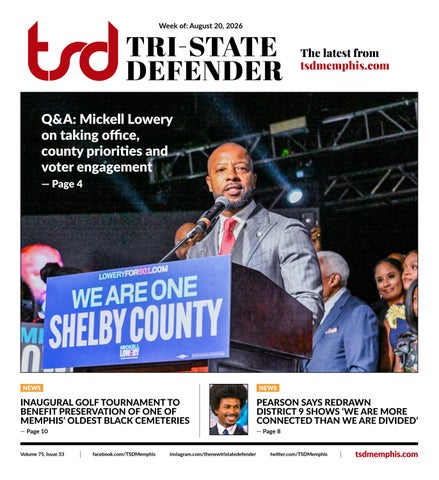
Q&A: Mickell Lowery on taking office, county priorities and voter engagement — Page 4
NEWS
NEWS
INAUGURAL GOLF TOURNAMENT TO BENEFIT PRESERVATION OF ONE OF MEMPHIS’ OLDEST BLACK CEMETERIES
PEARSON SAYS REDRAWN DISTRICT 9 SHOWS ‘WE ARE MORE CONNECTED THAN WE ARE DIVIDED’
— Page 10
— Page 8
Volume 75, Issue 33
facebook.com/TSDMemphis
instagram.com/thenewtristatedefender
twitter.com/TSDMemphis
tsdmemphis.com
■■ NEWS
TRI-STATE DEFENDER
tsdmemphis.com
Federal judge denies attempt to strike down Mississippi county’s majority-Black judicial districts By Taylor Vance
President Calvin Anderson
Editor Stephanie R. Jones
Published by The Tri-State Defender POSTMASTER: Send address changes to The Tri-State Defender, 1509 Madison Ave., Memphis, TN, 38104. GENERAL INFORMATION: Inquiries may be submitted in writing or by calling (901) 523-1818 or by email. TELEPHONE: (901) 523-1818. The Tri-State Defender (USPS 780-220) is published weekly. The Tri-State Defender 1509 Madison Ave. Memphis, TN, 38104. Second-class postage paid in Memphis, TN. The Tri-State Defender is a member of The National Newspaper Publishers Association and the Tennessee Press Association. All materials covered by copyright. No materials herein may be reproduced without the written permission of the Publisher. (901) 523-1818 | 1509 Madison Ave, Memphis, TN 38104 ••• $60 Annually/$5 Monthly Digital subscriptions are available online at tsdmemphis.com
Week of: August 20, 2026
Mississippi Today
A federal judge, at least for now, has denied a request to prevent a majority-Black section of voters from electing new county judges months before the election begins. The ruling comes in a lawsuit filed by Robert Foster, a former Republican gubernatorial candidate and current DeSoto County supervisor, and others who claim the Legislature’s creation of majority-Black subdistricts for the state judiciary violates the Voting Rights Act. The lawsuit came after the U.S. Supreme Court’s May Louisiana v. Callais decision rolled back protections for minority voters during redistricting. U.S. District Judge Sharion Aycock ruled on Aug. 13 that a court order changing the district lines for an upcoming state judicial race would fall too close to the November election date, something the U.S. Supreme Court has ruled lower courts should not do. “The Plaintiffs have not provided sufficient evidence to justify this Court’s involvement,” Aycock wrote. Foster and other DeSoto County residents filed a lawsuit last month, arguing that when the Legislature redrew the state’s court districts, it gave DeSoto County an additional circuit judge and an additional chancery judge. But those judges had to be elected from a majority-Black subdistrict. A subdistrict is used to elect a judge from a smaller area within the main district, but the judge can
still hear cases from anywhere in the district. The lawsuit was filed against the three-member State Board of Election Commissioners, which is composed of Gov. Tate Reeves, Secretary of State Michael Watson and Attorney General Lynn Fitch, all Republican statewide officials. Attorneys for the DeSoto County residents did not respond to a request for comment. MaryAsa Lee, a spokesperson for Fitch’s office, declined to
Page 2
comment. Even though Aycock denied the plaintiff ’s request to prevent the subdistricts from going into effect, the litigation can still proceed. Aycock can order the parties to submit new briefs and evidence, after which she can issue a ruling on the full case. This story was originally published by Mississippi Today and distributed through a partnership with The Associated Press.
TRI-STATE DEFENDER | tsdmemphis.com
■■ NEWS
Frey, Harris elected to MemphisShelby County school board By Bri Hatch Chalkbeat
Memphis voters elected longtime lawyer Tanya Frey and anti-violence program leader T.L. Harris to serve on the Memphis-Shelby County school board, according to unofficial results from the Aug. 6 election. In the district’s first partisan school board election, Harris and Frey ran as Democrats in the Districts 6 and 8 races against independent challengers. Two Democratic incumbents — Michelle McKissack in District 1 and Joyce Dorse Coleman in District 9 — ran unopposed. No Republicans were on the ballot. New board members take office on Sept. 1 and will inherit a significant legal battle over control of the district. The local officers could be constrained by a nine-member oversight board that Tennessee Republicans appointed under a state takeover law passed this spring. The state-appointed board is temporarily blocked by a federal court order pending a decision on a Memphis-Shelby County Schools lawsuit challenging the takeover law as unconstitutional. If reinstated by the court, oversight board members would have final approval over MSCS budgets and vendor contracts. They could also choose a new superintendent and close local schools. Harris won the District 6 Democratic primary in the spring by fewer than 200 votes. He’s lived in the Whitehaven neighborhood for more than 30 years and spent three years leading community centers for the Memphis Gun Down summer program.
Week of: August 20, 2026
Only two races, in Districts 6 and 8, were contested in the Aug. 6 election. (Andrea Morales / For Chalkbeat)
Harris pleaded guilty to a federal drug charge in 2006 while working as a Memphis police officer. He served time in federal prison and later had his voting rights, and right to hold public office, restored. Harris said that background makes him more able to connect with local youth facing poverty and other hardships. Chalkbeat was unable to confirm his current place of employment. Harris said literacy is the most important issue for the MSCS board to address, with less than a third of
Memphis students passing state reading tests. He will replace District 6 incumbent Keith Williams on the board. Frey runs Terra Firma Consulting, an organization that advises nonprofits on leadership decisions. She worked as a lawyer for 21 years for companies including Autozone and ALSAC, the fundraising and awareness organization for St. Jude’s Children’s Research Hospital. She said she’ll be focused on improving board governance during a
Page 3
year when the district has to respond to state audit findings that revealed ineffective operations and potential spending abuse. Frey will replace current board member Amber Huett-Garcia, who was elected Aug. 6 to serve on the Shelby County Commission. Bri Hatch covers Memphis-Shelby County Schools for Chalkbeat Tennessee. Reach Bri at bhatch@chalkbeat.org. This story was originally published by Chalkbeat.
TRI-STATE DEFENDER | tsdmemphis.com
■■ NEWS
Q&A: Mickell Lowery on taking office, county priorities and voter engagement Shelby County’s mayor-elect talks about the transition, view from the executive side and why he wants voters to think of elected officials as their employees By Lee Eric Smith
TSD Contributing Writer
Shelby County Mayor-elect Mickell Lowery has little time to ease into the job. Elected Aug. 6 and set to be sworn into office Sept. 1, Lowery is moving quickly to assemble his administration, assess county government and prepare for the challenges awaiting him on day one. After the first meeting of his transition team Thursday, Aug.13, Lowery spoke one-on-one with the Tri-State Defender about the work ahead, what he is learning from seeing county government through a different lens and why he believes residents should think differently about the people they elect. TSD: You’ve got less than three weeks between the election and taking office. What’s the biggest challenge waiting for you? Lowery: Well, a lot of people don’t know that you get elected on Aug. 6, you take the job on Aug. 31. So, most importantly, it’s making sure we have the right people in the right position. We’ve got to make sure we’re getting our financial footing on the right trajectory. We didn’t get here overnight. It’s not going to change overnight. But we’ve got to set the foundation and culture to change it for the better. That’s a looming issue. TSD: But it sounds like there isn’t just one overriding issue. Week of: August 20, 2026
Shelby County Mayor-elect Mickell Lowery addresses supporters at his election day watch party at Minglewood Hall on Aug. 6, 2026. (Gary S. Whitlow/Tri-State Defender)
Lowery: We have a lot of issues that are going on in Shelby County when it comes to our schools, when it comes to our jail, when it comes to making sure that we’re doing the best thing to tackle mental health in our community, as well as doing whatever we can to make sure people feel safe. So there are a myriad of issues, and there’s none more important than the other, including health care when it comes to Regional One and everything else.
TSD: So how do you keep one of those issues from getting pushed aside while you focus on another? Lowery: We have to attack those simultaneously. We can’t put something in a corner while we look at something else, because that’s how things happen and cans get kicked down the road because we didn’t give that attention while we were focused on something else. My job is to make sure that we’re all focused on the top priorities and helping the best people to be focused
Page 4
on their areas of expertise to move us forward. And I’m excited about that. I’m excited about the great things that are happening in Shelby County as well, that we’re moving in the right direction with. Again, moving forward with making sure that we’re prioritizing health care in every community, building new schools, building a mental health facility — those are steps in the right direction. Now we’ve got to build on that with our generational development
TRI-STATE DEFENDER | tsdmemphis.com
■■ NEWS We’ve got to make sure we’re getting our financial footing on the right trajectory. We didn’t get here overnight. It’s not going to change overnight. But we’ve got to set the foundation and culture to change it for the better. That’s a looming issue. — Mickell Lowery to help change Shelby County for the better. TSD: You’ve been on the County Commission for years, so you know county government. What looks different from the executive chair? Lowery: Being a county commissioner gives me a unique perspective, but I’ll tell you, as I’m learning, the lens is definitely different. There are things that the County Commission is responsible for that are much different than what the executive administration is responsible for. The day-to-day operation of the county is not what a county commissioner does. You see these things every so often at meetings, while there’s day-to-day work happening every day. So my eyes are open to some of these opportunities that we have going forward. There are some things that I thought
Week of: August 20, 2026
I knew. Now that I see it on the other side, it’s becoming kind of a revelation. TSD: Does seeing it from that side change how you want to communicate with the County Commission? Lowery: I want to make sure I am communicating the best way I can with the County Commission, so none of us have revelations. My goal is to be as transparent as possible, not only with the County Commission, but with the public as well, because we all want the same things — to move our county forward and for us all to be successful. TSD: Shelby County elections are known for low turnout, but now you need citizens — including people who didn’t vote — to stay involved. What do you say to the people who stayed home? Lowery: I’ll just say these times are
too critical to sit on the couch. But first, let me thank everybody that went and voted. Voter turnout has increased over the last four years. In fact, over the last eight years. We had the highest percentage this time around, so we’ve got to build on that. So while I’m talking to people who sat on the couch, I’m also talking to people who went out and voted and saying, “Thank you.” Now, to those folks who haven’t voted yet: These are issues that are too critical for you to stay at home. We need your voice. We need your support. I understand why some people are skeptical, but you still have to make your voices heard. And know that we are hiring people to do jobs here. We’re not electing folks. TSD: You said “hiring,” not “electing.” That sounds intentional. Why
Page 5
make that distinction? Lowery: I’m trying to change the culture when it comes to that. Think about it: You’re hiring someone to go to work for you day in and day out, and it’s your decision on who that person may be. So please make your voices heard. You’ve got another opportunity in November. We’re going to be electing state and federal officials. I’m not running, but I want to make sure people are getting out to vote to make sure whoever is elected in those roles — my bad, hired in those roles — has Shelby County’s best interests at heart. Note: Questions and responses have been lightly edited for clarity and length. In a few places, follow-up questions have been added to divide longer responses by subject; Lowery’s answers remain drawn from his original responses.
TRI-STATE DEFENDER | tsdmemphis.com
■■ NEWS
Lowery transition team races to forge new administration County mayor-elect asks community leaders to help shape priorities, recruit talent for 200 jobs By Lee Eric Smith
TSD Contributing Writer
One week after winning the election and roughly two weeks until taking office, Shelby County Mayor-elect Mickell Lowery convened dozens of business, education, government, healthcare and nonprofit leaders to prepare his incoming administration. “People sometimes don’t know that you get elected on the 6th, take the job on the 31st,” Lowery told the group Thursday. “Not a long time.” Lowery’s inauguration is slated to take place Aug. 31, 2026. His four-year term officially begins Sept. 1. Between now and Aug. 31, his team will be convening working groups, reviewing county departments and beginning to draft the policy recommendations that will shape the opening months of his administration. But the assignment for Lowery and his transition team extends beyond developing a policy agenda. He must not only determine what his administration needs to do, but also who he needs around him to do it. Consequently, his team is asking the group of leaders to help find talent to fill roughly 200 appointed county government positions. “Help us identify the best talent,” said Lowery during the meeting. “Help us identify the best ideas.” Lowery’s need for urgency is driving a transition process built around nine working groups developing policy recommendations, a series of stakeholder roundtables, internal reviews of operations inside several county departments, and a public resume bank. Week of: August 20, 2026
“Help us identify the best talent, help us identify the best ideas,” Shelby County Mayor-elect Mickell Lowery told members of his transition team as they began work Thursday, Aug. 13, on staffing and priorities for his incoming administration. (Photos: Gary S. Whitlow/Tri-State Defender)
Darrell Cobbins, who chairs Mayor-elect Mickell Lowery’s transition executive committee, speaks during their kickoff meeting Thursday, Aug. 13, alongside transition team Executive Director Felecia Walker.
Seeking the best and brightest Paul Morris, co-chair of the transition executive committee for mayoral appointments, urged transition members to use their own networks to help identify qualified candidates for the incoming administration. “There’s already a lot of great people within county government, and he certainly expects to retain all the good people he can,” Morris said. “But there are open positions, and he wants to be able to vet the best candidates.” Meg Crosby, another co-chair on the executive committee, reiterated the point. “Think about your networks and the talent that you can help us find for this
administration,” Crosby said. “Because, at the end of the day, it’s all about the people and the work that they can get done.” A resume bank on Lowery’s transition website, https://transition.loweryfor901.com, allows applicants to search positions by county division and submit their information for consideration. Transition team members were encouraged to circulate the site widely and steer potential candidates to it.
Diverse work groups brainstorming Lowery has also formed nine working groups focused on workforce development, K-12 public education, economic growth, fiscal stability, housing
Page 6
and neighborhoods, sustainability and environment, public health, the justice system and early childhood education. The groups bring together leaders from business, government, education, healthcare, organized labor and community organizations. They include BlueCross BlueShield of Tennessee, Memphis-Shelby County Schools and suburban school districts, Regional One Health, Protect Our Aquifer, Just City, Memphis Allies, Greater Memphis Chamber, Memphis Central Labor Council, and several nonprofit and neighborhood groups. Darrell Cobbins, chairman of the transition executive committee, said the goal is to recruit people capable of bringing different experiences and perspectives to the same table, rather than simply creating a list of recognizable names. Each group will receive a one-page primer providing background and context on its policy area. Members will then meet between full transition team sessions and work toward consensus on two or three recommendations they believe should rise to the top for Lowery’s consideration. Cobbins acknowledged that gathTRI-STATE DEFENDER | tsdmemphis.com
■■ NEWS
Dozens of Shelby County leaders from business, education, government, health care and the nonprofit sector gathered Thursday, Aug. 13, for the first meeting of Shelby County Mayor-elect Mickell Lowery’s transition team.
ering strong leaders with strong ideas could create tension. But collaboration would be essential, he said. “Our best idea has to be considered alongside another set of best ideas,” he said, “and ultimately you all arrive at some degree of consensus on what you can agree on … ” The transition team is scheduled to reconvene approximately every two weeks through September, with working groups reporting on their progress along the way. About six weeks after Lowery takes office, the team expects to release a final public report laying out what Cobbins described as the new administration’s “game plan.”
Transition moving on several fronts Another part of the transition process also underway focuses on the Week of: August 20, 2026
“There’s already a lot of great people within county government, and he certainly expects to retain all the good people he can. But there are open positions, and he wants to be able to vet the best candidates.” — Paul Morris county’s internal functions. A separate group will conduct assessments of six or seven county departments, Cobbins said, providing Lowery with a clearer picture of what he is inheriting as he takes office and helping inform both his priorities and the agenda presented to the public. Still, Lowery cautioned the group against expecting the transition process itself to resolve longstanding problems. “Even when we put our final report out, there’s still work to be done,” he said.
He also stressed the transition should build on current progress. “This isn’t just a problem-solving group,” he said. “This is also making sure, how do we make sure we’re properly communicating all the great things that are going on in Shelby County as well.” And the transition includes smaller stakeholder roundtables intended to capture perspectives that do not necessarily fall neatly into the existing nine working groups. Cobbins said the discussion groups
Page 7
will be relatively small, generally 10 to 12 people, and will bring Lowery together with municipal mayors and representatives from higher education, faith communities, arts and culture, small business, healthcare, philanthropy, corporate leadership, community services and youth development. The roundtables are intended to give Lowery a chance to hear directly from those sectors while building relationships that continue beyond the formal transition. “That’s an opportunity for him to hear from them and them to hear from him,” Cobbins said. “And ultimately, that’d be an ongoing thing that the mayor does as he goes forward in his administration.” The countywide emphasis for Lowery’s administration is reflected in the transition’s “One Shelby” branding. Working groups include officials and representatives from both Memphis and suburban Shelby County, including Germantown and Lakeland. Cobbins told transition members that the slogan comes with an expectation. “You’re now officially ambassadors of #OneShelby,” he said.
‘Control the narrative’ Lowery said part of the transition’s work also should be identifying and communicating what Shelby County is doing well. “We gotta control the narrative as much as we can,” he said. “That’s on both sides of it.” For now, though, the main challenge for Lowery’s transition operation is time. “It’s a sprint for the next six weeks,” Cobbins told the room, “but we’re all in it together.” Lowery acknowledged that neither the transition nor the administration that follows will solve Shelby County’s challenges in six weeks. “The issues that we have, we didn’t get here overnight,” Lowery said. “And obviously we won’t change them overnight, but we’ve got to set ourselves on the right trajectory.” TRI-STATE DEFENDER | tsdmemphis.com
■■ NEWS
Pearson says redrawn District 9 shows ‘we are more connected than we are divided’ Democratic congressional nominee talks rural voters, coalitionbuilding, Brent Taylor and lessons from the Tennessee Statehouse By Lee Eric Smith
TSD Contributing Writer
After winning the Democratic nomination for Tennessee’s redrawn 9th Congressional District, state Rep. Justin J. Pearson is campaigning across a sprawling 15-county district stretching from Memphis into rural Middle Tennessee. Pearson spoke with the Tri-State Defender about what he is hearing from voters, building coalitions across political and geographic lines, lessons from the Tennessee General Assembly and his November race against Republican state Sen. Brent Taylor. The interview has been lightly edited for length and clarity. TSD: You are coming out of the primary and now campaigning in parts of Tennessee you probably were not contemplating when you first considered running for Congress. What are you finding as you travel the new district? PEARSON: I’ve got to be honest with you, I’ve had a great time traveling across the district and meeting all the new people. We’ve got shared problems and shared issues, whether it be data centers, lack of access to healthcare, people struggling financially and in need of increased wages and better jobs — a lot that they thought would divide us, along race in particular. Issue-wise, we are very shared and similar. And I’ve been able to spend meaningful time with people who I’m fight-
Week of: August 20, 2026
ing for the opportunity to represent. And that is what I’m going to have to do if we have the privilege to serve in the United States Congress: build relationships across all 15 counties, remain accessible and present for the people in the district. Traveling over these last few months here, we are more connected than we are divided. And I think the divisiveness, the hatefulness of my opponent and his campaign, is not what’s going to bring real solutions for people. And that’s what we’re going to be bringing, real solutions. TSD: There was a lot of attention on what redistricting did to Memphis. But it also disrupted districts farther out. Are you finding that the issues important to predominantly Black Memphis aren’t as different from rural Tennessee as people might assume? PEARSON: Absolutely. The people who are in rural areas or urban or suburban areas are all struggling with the same systems that deeply impact people in Memphis and Shelby County. What I’ve realized is the person who’s making $10 in Giles County, moving out of an apartment that’s just $800 a month, is struggling with the same private corporations and private equity firms as in Shelby County who are buying up the neighborhoods. These aren’t disparate problems, because it’s the same systems rigged against everyday working-class people. With the district being stretched
out, what I’m realizing is the farmer in Savannah is also running up against billion-dollar corporations who have a monopoly, such as John Deere or Monsanto. Just like in Memphis and Shelby County, we’re up against billion-dollar corporations like SpaceXAI and Valero and TVA that are hurting and harming our communities. What we have now is a significant opportunity to say: You thought you would be able to divide us by breaking up our districts, but instead you’ve united us around our common causes and our common purposes. The disruption isn’t leading to the destruction of the values and the needs that people still have, regardless of how they voted in the past. TSD: You have already had experience building that kind of coalition. Before you were elected state representative, you helped lead the fight against the proposed Byhalia Connection Pipeline, which would have carried crude oil from southwest Memphis through predominantly Black communities and into North Mississippi. More recently, you have worked with communities on both sides of the state line over SpaceXAI. Has that experience prepared you for campaigning among voters who may look different politically from Memphis? PEARSON: I’ve been fortunate to serve a diverse district in the Statehouse already. I represent some poor folks in parts of my district, and I have Harbor Town in my district, right? My
Page 8
State Rep. Justin J. Pearson speaks to supporters at his campaign watch party after winning the Democratic primary for Tennessee’s 9th Congressional District on Thursday, Aug. 6, 2026. (Photos: Gary S. Whitlow/Tri-State Defender)
Statehouse district stretches all the way up to Millington. And so I have an ability to connect with people across race, across class, across differences already. And the fight against the pipeline six years ago really helped me to build what author Heather McGhee called the aptitude for the “solidarity dividend,” which is when you get white folks and Black folks and richer folks and poorer folks together, you really create and can create transformational change. And that bedrock that was laid six years ago, that I’ve kept throughout my political career, is also being used now in this moment where we’re running to serve in Congress. But without a doubt, helping to organize the resistance in North Mississippi with very different communities than Boxtown and Westwood is helping me in the community conversations that we have with people from Lawrenceburg, for instance, who are fighting their own multibillion-dollar data center, or people who are fighting their rock quarry. We have the ability to find common TRI-STATE DEFENDER | tsdmemphis.com
■■ NEWS
State Rep. Justin J. Pearson, a Democrat, will face Republican state Sen. Brent Taylor for the Congressional District 9 seat in the Nov. 3 general election.
ground without compromising our values. That’s the job of a good elected official. That’s the job I hope to do as a congressman — find common ground with people without compromising our values. TSD: Shelby County is now split among three congressional districts. Do you see a possibility that the new map could actually help create a broader political coalition stretching across West and Middle Tennessee? Can Democrats run the table in Districts 5, 8 and 9? PEARSON: Yeah. My goal is for every Democrat who’s in one of these broken districts to win — really every Democrat in all nine, but especially in these three, because Memphis and Shelby County is now the bedrock of each of these electoral positions. And if we show up to the polls, we win. The job is to get people in Shelby County to show up and vote. And if the people in Shelby County show up and vote, Democrats are going to run the table. They built the maps based on old data. We’ve got to give them new data. And that has to be an active and
Week of: August 20, 2026
engaged electorate fighting for the future of our democracy, of our communities and for our rights. That’s what’s at stake right here and right now. And I think we can do it. We are in a particular moment where gas is high, groceries are high, medical bills are high, wages are stagnant, corporations are getting richer and wealthier, data centers are destroying us. And we have a core message that appeals to the majority of people. And if we get that message out there, there’s no way we’re going to lose. TSD: One group you do not hear much about is the small-town, rural Black voter, particularly in this part of the state. Are you finding voters who are essentially saying, “We’ve been here the whole time — nobody has been talking to us”? PEARSON: Absolutely. This is smalltown, rural Black voters and small-town white voters as well, who no one knocks their door, no one holds town halls, no one comes to see them, meet them or greet them because they don’t believe that’s where their time is best spent. Whereas for me, that’s all I’ve been doing. I’ve been to all 15 counties more than once already in just three months, because I don’t want anyone to feel
disconnected from power. And I got that lesson from Dr. Barbara Cooper, my predecessor in House District 86, who always viewed her job as a conduit for power, never as the seat of power. And that meant you always had to be proximate to people in the district. There are a lot of rural Black voters in West Tennessee who we had not tapped into before. Look at Fayette County, where I think there was a 9% increase in turnout, specifically from Black rural voters, because we’re going there. We’re going to the churches. We’re knocking on the doors. And I think a lot of people who felt disaffected for a long time are finding a place and a home within our campaign and movement. Same with Republicans and conservatives who are disaffected with this MAGA extremism of Brent Taylor and his ilk. Those people, they’re like, “Pearson’s the person for it.” That’s what they tell me. They say, “I vote for the man, not the party.” And I think that’s what’s going to show up this November. TSD: If you are elected, you will make the jump from the Tennessee House to Congress. What have your experiences in Nashville, the wins and the losses, taught you that you would take to Washington? PEARSON: I think the Tennessee General Assembly is kind of like Hollywood. If you can make it in the Tennessee Statehouse, you can make it anywhere. I think the biggest lesson or philosophy that I have is to find common ground with people without compromising values. I talked a little bit about that before, but that was really nurtured at the Statehouse. It’s a much more toxic work environment than I could have ever imagined. And the reality remains that you do what you can to work with people on the things that you can work with them on, and you stand up for the things that you cannot. And I think I’ve seen people capitulate, become cowards in the face of evil in ways that are detrimental not just to
Page 9
democracy, but to our community. And I know I don’t want to be that. There’s a guy, Monty Fritts, who ran for governor. He did a good job in that race, who I disagree with about 95%, 97% of the things that he says. But he believes veterans deserve better care. And he believes people deserve clean air, clean water and clean soil. And on those two things, we can collaborate and work together. That’s the job. It is to find the areas of collaboration. Tim Burchett, a man who said that I need to go to prison, has legislation to ban members of Congress from trading stocks. I’d be one of the first people to co-sponsor that legislation and support it, because I believe you find common ground without compromising your values. That’s what it’s going to take, and that’s what I’m going to take to D.C. and bring those results home to us right here. TSD: You know the attacks are coming. Opponents will try to characterize you as too radical — the “scary Black man,” the Afro, all of it. You have dealt with that before, but how do you prepare for it in a congressional race that people outside Tennessee will be watching? PEARSON: A couple things. It’s not what people call you, it’s what you answer to. And I’m not going to let the hate and the divisiveness and the evil dampen my spirit or my motive and motivation to serve this community. And the other thing: What other people think about me isn’t any of my business. My business is, how do I reach voters who really matter to get their vote and to get their trust that I can do this job well? Anybody who knows me knows I am a happy, joy-filled, faith-filled Christian husband, son and uncle. And I’m proud of those things. And I’m not going to let him take me away from who I am. And if you’re afraid of the Afro, that’s your problem, not mine. (laughs) Those people are afraid because they’re jealous. My opponent is bald and can’t grow one himself. (laughs)
TRI-STATE DEFENDER | tsdmemphis.com
■■ NEWS
Saving sacred ground: Inaugural golf tournament to benefit preservation of one of Memphis’ oldest Black cemeteries By Brianna Smith-Herman TSD Contributing Writer
For nearly 180 years, historic Mount Carmel Cemetery has stood as a sacred testament to generations of Black Memphians whose lives helped shape the city. Today, many of those stories are obscured by overgrown vegetation, fallen trees, deteriorating headstones and roads that have become difficult to navigate. For those working to restore the cemetery, the contrast is striking because the cemetery had continued to operate normally in their lifetime, though its condition showed evidence of neglect. Sam Oldham, founder and director of Mt Carmel Ally, a historic restoration and preservation nonprofit formed in 2023, recalls the days in the 1970s when the cemetery was thriving. Seeing its condition deteriorate in the decades since – amid continuing celebrations of Memphis heroes such as Tom Lee, who is buried there – inspired the undertaking to reclaim the historic grounds. Now, the nonprofit is preparing for its largest fundraising effort since its inception. Mt Carmel Ally will host its inaugural Golf Fore Charity Tournament on Sept. 21 at TPC Southwind in southeast Memphis, bringing golfers, volunteers and community partners together to raise money for its work. The fundraiser’s goal extends beyond cleaning up an old cemetery. Oldham wants to ensure that the people buried there, and their contributions to Memphis, remain part of the city’s story. “If you don’t know where you came from, you don’t know where you’re going,” said Oldham. The first known burial at Mount Carmel dates to 1847, making it one of the oldest cemeteries in Memphis, according to the Black Cemetery Network at the University of South Florida’s Living Week of: August 20, 2026
Heritage Institute. Its grounds provide a window into several eras of the city’s history. Although Mount Carmel eventually became a primarily Black cemetery, it also served as the final resting place for people of different races and religious traditions. And Union and Confederate soldiers were buried there. Among those laid to rest at Mount Carmel are some of the most significant figures in Black Memphis history. They include Tom Lee, the Black river worker who rescued 32 people from the Mississippi River in 1925 when a steamboat capsized – despite being unable to swim, Lucie E. Campbell, an influential educator, composer and musician, Leila Mason, wife of Church of God in Christ founder Bishop Charles Harrison Mason, and educator Rosa Fuller, wife of educator, minister and civic leader T.O. Fuller. A 31-acre park along the Mississippi River in Memphis is named in honor of Tom Lee. The graves of notable figures make Mount Carmel more than a burial ground. Collectively, they form a physical record of Black life, faith, education, leadership and community building in Memphis. But decades of neglect have placed the preservation and dissemination of that history at risk. Overgrown weeds, downed trees, broken and overturned headstones and deteriorating roads have transformed portions of the cemetery into a forsaken and eerie maze. Lost or incomplete burial records have created another challenge, making it more difficult to identify some of those resting there. Since 2023, the nonprofit’s volunteers have organized community cleanups, secured a Tennessee State Historical Marker and developed relationships with organizations including Memphis City Beautiful, Memphis Parks Services, the National Trust for Historic
Mt Carmel Ally has organized a golf tournament, to be held on Sept 21, to support its efforts to preserve the historic Mount Carmel Cemetery to ensure that the people buried there, and their contributions to Memphis, remain part of the city’s story. (Black Cemetery Network)
Preservation, along with the Black Cemetery Network. Still, the restoration envisioned by Oldham and Mt Carmel Ally is extensive. Plans include landscaping and brush removal, tree care, architectural improvements and the use of ground penetrating technology, which relies on high-frequency radio waves to help locate burial sites. The organization also hopes to digitally map graves and preserve cemetery records, creating a more complete picture of who is buried at Mount Carmel. The project remains ongoing, as the organization acknowledges that restoring a cemetery with nearly two centuries of history will take time. But progress is also measured by something less tangible: recognition. Bringing awareness to Mount Carmel could attract people interested in historic preservation while helping Memphians understand what could be lost if these sites are allowed to decay and disappear. Mt Carmel Ally ultimately sees Mount Carmel Cemetery as a living classroom where preservation and education intersect. Rather than treating
Page 10
the cemetery as a tourist attraction, Oldham wants visitors, particularly young people, to experience it as a sacred place of communal memory. For Oldham, a monument should be something that makes a visitor reflect and want to learn more about the person it memorializes. That means future plans include field trips and virtual interactive stations that could allow students to explore Memphis history, genealogy, archaeology, and the artistry and symbolism found in historic monuments. Oldham said he hopes those experiences foster “pride and truth in and of their ancestry.” The nonprofit’s educational mission reflects a growing recognition that historic Black cemeteries can preserve stories that may be missing from traditional classrooms, archives and history books. Every identified grave can become an entry point into a family, neighborhood, institution or movement that helped build Memphis. And the Golf Fore Charity Tournament in late September represents a new phase of the nonprofit’s work. After discussions among board members, committee members and TRI-STATE DEFENDER | tsdmemphis.com
NEWS volunteers, Oldham said the group determined a golf tournament offered the best opportunity to combine fundraising, community participation and greater public awareness. Approximately 100 golfers and 30 volunteers are expected to participate in the golf tournament to meet a fundraising goal of $30,000. Businesses and community organizations can participate through sponsorship opportunities ranging from individual hole sponsorships to title sponsorships. The deadline for sponsorship commitments is Aug. 21. For Oldham, however, success will not be measured solely by how much money is raised. He hopes the tournament achieves the organization’s goals for participation and fundraising while generating positive attention that can help move the restoration effort forward, long after the final putt drops. Mt Carmel Ally also wants more Memphians to participate in volunteer events and fundraisers, share Mount Carmel’s history with their neighbors and encourage professional, civic and governmental organizations to become involved, which is especially important for descendants of those buried at Mount Carmel. Oldham described his role in the preservation effort as that of “a concerned descendant of a legacy that needs to be remembered in a dignified manner.” And when asked what he hopes people understand after learning about the effort to save Mount Carmel, Oldham’s answer was simple: “Some people do care enough to do something,” he said. Every cleared pathway, restored headstone, identified grave or preserved record represents another piece of Memphis history rescued from obscurity. And for a cemetery that has witnessed nearly 180 years of the city’s history, saving the grounds also means saving the stories buried within. The inaugural Golf Fore Charity Tournament will be held Sept. 21 at TPC Southwind in Memphis. For sponsorship information, contact Mt Carmel Ally at MtCarmelAlly@gmail.com, mtcarmelally.org or (901) 219-6718. Week of: August 20, 2026
PUBLIC NOTICES / CLASSIFIEDS
LEGAL NOTICE Request for Bids MSCAA Project Number 25-1486-01 Runway 18R Precision Approach Path Indicator (PAPI) - Construction
TSD CLASSIFIEDS 1509 Madison Ave. Memphis, TN 38104 PH (901) 523-1818 HOURS: Mon.-Fri. 9 a.m. - 5 p.m.
Sealed bids for Runway 18R Precision Approach Path Indicator (PAPI) – Construction will be received by the Memphis-Shelby County Airport Authority (Authority), Procurement Department, 4150 Louis Carruthers Drive, Memphis, TN 38118, until 2:00 PM Local Time on 09/15/2026. Bids will not be received at any other location. Within 30 minutes thereafter, the bids will be opened and publicly read at the Procurement Department Conference Room (at the above address) as well as via phone/video conference (information for the phone/video conference can be found at www.flymemphis.com). The Bid Documents, including a description of the scope of work, the required response format, and additional instructions may be obtained on or after August 18, 2026, on the Authority’s website www.flymemphis.com. A virtual pre-bid conference will be held Wednesday, August 26, 2026, at 11:00 am Local Time via video conference. The link to the video conference can be found at www.flymemphis.com . The project site will be available for inspection following the meeting at 1:30p. It is STRONGLY RECOMMENDED those wishing to submit a bid to attend the pre-bid conference and make a site visit. All attendees must register for the site visit by sending an email to bidquestions@flymemphis.com . All Bidders are responsible for checking the Authority’s website up to the submission deadline for any updates, addenda or additional information. The successful Bidder must sign a contract with the Authority that includes Federal Aviation Administration provisions, if applicable, regarding the Buy American Preference, Foreign Trade Restriction, Davis-Bacon, Affirmative Action, Debarment and Suspension, and Drug-Free Workplace, all of which are incorporated herein by reference.
DEADLINES: Display ads Friday 5 p.m. Classifieds ads Monday 5 p.m. STANDARD RATES: $8.00 per line for 1 column ad. Rates are non-commissionable and are quoted at the net rate. No refund for early cancellation. For additional information contact Sales Dept. at (901) 746-5201 or email: advertising@ tsdmemphis.com.
Bartlett City Schools Bartlett City Schools is seeking qualified vendors to quote pricing on all Bids and Request for Proposals. For information concerning Vendor Registration to become an approved vendor to conduct business with Bartlett City Schools,
GENERAL INFORMATION: The Tri-State Defender reserves the right to edit all copy or to reject or cancel any ad at any time. Copy change during ordered schedule constitutes new ad & new changes. Deadlines for cancellation are identical to placement deadlines. Rates subject to change. We can only offer in-house credit and NO REFUNDS are issued. THE TRI-STATE DEFENDER assumes no financial responsibility for errors nor for copy omission. Direct any classified billing inquires to (901) 523-1818.
please visit http://bartlettschools.org and click on the About US Tab. Vendor Registration is also available by contacting Purchasing, 901.202.0855, ext. #2255. Bids and Request for Proposals are available to download at the following website: http://www.bartlettschools. org.
Each bid must be made by a contractor licensed in Tennessee and be accompanied by a 5% Bid Guarantee. The successful bidder must execute a Performance Bond and a Payment Bond in the amount of 100% each of the Contract Price and meet the Small Business Participation Program (SBPP) participation goal for this project, which is 0%. The Authority reserves the right to reject any or all responses to this Request for Bids in whole or in part; to waive any informalities, technicalities, or omissions related to this Request for Bids; and to reject responses on any other basis authorized by the Authority’s purchasing policies. The Authority is an equal opportunity employer and prohibits discrimination based on the grounds of age, race, sex, color, national origin, disability, marital status, military service, or sexual orientation in its hiring and employment practices and in the admission to, access to, or operation of its programs, services, and activities. By order of: Terry Blue, A.A.E. President and CEO Memphis-Shelby County Airport Authority
Page 11
TRI-STATE DEFENDER | tsdmemphis.com
■■ NEWS
Melvin ‘Too Tall’ Moore, favorite fine dining host in Memphis, dies at 67 By Candace Gray
TSD Contributing Writer
Melvin “Too Tall” Moore, a popular and beloved figure in Memphis hospitality and fine dining, died suddenly Aug. 4. He was 67. The family man and avid golfer, who worked in the restaurant industry for five decades, built a reputation as a warm host and social anchor. “He was the life of the party,” said Flora Childres, Moore’s sister. “Any, every party! He took it upon himself to make sure everyone was having a good time.” Moore was born on May 22, 1959 and moved from rural Collierville to North Memphis with his mother, Annie Moore, and four siblings when he was in grade school. Childres said the family was close-knit. At age 15, Moore became a busboy at The Four Flames, an upscale restaurant in downtown Memphis, where he learned the service standards required at fine dining establishments. He was promoted to waiter before his 18th birthday. He would spend the rest of his life working in the hospitality industry, honing his craft and eventually becoming a highly sought-after server, host and caterer. Moore and Childres worked together at The Four Flames, Memphis Country Club and at private parties. “We started bartending together in our 20s,” Childres remembers. “But the funny thing is, I’d be slammed (with lots of customers) and look up and he’s walking around, talking to people, having a good time.” That was the gracious host, standing 6 feet, 6 inches tall, many Memphians knew and loved. He captured the hearts of restaurant-goers, country club members and anyone throwing a good party. Childres, now a retired elementary Week of: August 20, 2026
Standing six and a half feet tall, Melvin “Too Tall” Moore, a highly regarded restaurant server, bartender and caterer in Memphis, died suddenly Aug. 4. “He was the life of the party,” said Flora Childres, Moore’s sister.
A huge University of Memphis Tigers fan, Melvin “Too Tall” Moore often attended games with his son, also named Melvin Moore, and daughter Meaghan Moore.
school principal, found his “life of the party” persona hard to believe at first, because Moore was “too” shy growing up, she said. “It’s as if his time at The Four Flames ignited something inside of him,” said Childres. “He was really good at what he did.” Though charming, witty and good looking, Moore relied on his academic training to help advance his career. He earned an associate’s degree in food and beverage operations from Shelby State Community College, now Southwest Tennessee Community College. He accepted a position in 1996 at Erling Jensen, an award-winning, chef-led fine dining restaurant in East Memphis. “Too Tall worked here for nearly 30 years,” said Jaquila Jensen, of Erling Jensen restaurant. “Most of our guests had a special request for him to be their server. They loved him, and he loved and spoiled his people. His personality was as big as he was tall.” Erling Jensen, executive chef of the eponymous restaurant, said he would miss the good-natured debates he
shared with Moore. “Too Tall has been here since the beginning,” said Erling Jensen. “Though we’ve had many arguments about him giving the guests whatever they wanted, I wouldn’t trade our time together. It’s a great loss. And this football season, I’ll miss our back-and-forth football banter about the Cowboys and Dolphins, and who’ll finally have a good season.” Moore, who had catered parties for the late FedEx founder Fred Smith, fashion designer Pat Kerr Tigrett and other prominent Memphians, loved his work in fine dining and enjoyed entertaining those he described as the “upper echelon.” And though he loved “his people” at work, Moore’s first love was his family. “My dad was the one constant in my life,” said Moore’s daughter, Meaghan Moore. “He would do anything for us. He just wanted to see us happy.” The recent college graduate said she and her father shared a love of the Tigers, long before she attended the University of Memphis, adding that he “bled Tiger Blue.” Moore’s son, also named Melvin Moore, said one of the most important lessons he learned from his father was to “be you” and to be true to himself. Whenever the younger Moore would return home to visit, after moving to Texas in 2012, he and his father would eat at the senior’s favorite Memphis restaurant, Huey’s, where he had worked as a youngster.
Page 12
“He loved the Grizzlies, the Tigers and Memphis,” said the younger Moore. “I call him the unofficial mayor of Memphis because he really loved his city.” Golf became another passion of Moore’s life. He was introduced to the game at Memphis Country Club’s Tap Room in the early 1990s. “I was with him on the golf course down in Pensacola a few weeks ago,” New Orleans resident John “Bomber” Brown said of his longtime golf buddy. “Too Tall was known in New Orleans and all around the golfing circuit. He wasn’t just the life of the party, he was the life of the golf course, too.” Moore won his first golf tournament earlier this year in Monroe, Louisiana, said Brown. “I would pick him up from the train station, and the first thing we would do is go get oysters. He loved his oysters,” he said. “He always tipped the service men and women well. He was such a gentleman.” Moore was a member of the Southern Association of Amateur Golfers and several golf clubs and organizations, including the Irene Golf Course, The Links at Pine Hill, Kinfolk Golf Tour and the Tri-State Golf Tour. In addition to his son, daughter and sister, Moore is survived by his brother John Moore. A memorial celebration is set for 1-4 p.m. Sunday, Aug. 16, at The Kent, 61 Keel Ave., Memphis. Attendees are encouraged to wear Tiger Blue. TRI-STATE DEFENDER | tsdmemphis.com
■■ ENTERTAINMENT
‘Searching for Jane Crow’ examines Black women, slavery and mass incarceration in America Book review By Terri Schlichenmeyer What goes through a Black woman’s mind as she is led away to serve a prison sentence? What happens to her children, her home? Does she already know the shackles could make her wrists ache, that they could always be too tight? In the new book “Searching for Jane Crow: Black Women and Mass Incarceration in America from the Auction Block to the Cell Block,” author Talitha LeFlouria examines whether today’s answers to those unsettling questions would be any different for an imprisoned or enslaved woman in 1845. Two summers ago, LeFlouria, a history professor at the University of Texas at Austin, visited the Orleans Justice Center in New Orleans to interview female inmates. The experience sparked an epiphany for the educator, who also wrote “Chained in Silence: Black Women and Convict Labor in the New South” in 2015. She realized that she was meant to share “courageous” stories about incarcerated women. One tale troubled her. A California woman told LaFlouria that when she went to prison, she was stripped and humiliated, physically searched before being dressed in a uniform that identified her as “Property of … ” She was given a number and chained around her ankles and wrists – similar to the treatment that millions of enslaved people endured more than a century ago and, according to “Searching for Jane Crow,” one-third were women. Week of: August 20, 2026
“I immediately noticed the deep historical influence of slavery’s legacies on mass incarceration,” LaFlouria says. Through her research, she discovered “slave jails” that originated in the early 19th century to warehouse enslaved people. Food was scarce, she says, the floors were filthy and space was tight. The jails “played a key role in introducing profit-based incarceration … ” Women were confined there indefinitely by slaveowners who rented them out for housework, fieldwork or sex work. Several large, and infamous, slave jails were established, she says. And the Ku Klux Klan was involved in operating at least one. For the imprisoned women, the slave jails were confusing and frightening. If a woman somehow escaped, she often feared that she might end up there again. Then, as now, the threat of reincarceration was always present. “Searching for Jane Crow” is a hard book to pin down. It can feel like an old-fashioned Victorian drama written in a florid style, which conflicts with the 19th century slave stories it tells. Although the author’s use of period-appropriate language adds authenticity, it yields an ornate tone that sometimes clashes with the harrowing severity of the situations LeFlouria describes. But every single point lands as the author intends in this book, every bit of research is solid, every story is unforgettable. LeFlouria makes her comparisons clear, and it’s hard to look away and even harder not to notice other indignities and inequalities. Once you’re good and shocked, she shifts
to an activism stance, offering advice to help change the status quo in the prison system, support incarcerated Black women to reduce recidivism, and ensure their children receive care while their mothers are away. Despite its bumps, stick with this book until the last page. You’ll be astounded by the new and thoughtful way it dissects the prison system. Just prepare yourself.
Page 13
“Searching for Jane Crow: Black Women and Mass Incarceration in America From the Auction Block to the Cell Block” by Talitha L. LeFlouria c.2026, Beacon Press $32.00 224 pages
TRI-STATE DEFENDER | tsdmemphis.com
■■ NEWS
Leadership Memphis announces Executive Program Class of 2027 TSD Newswire Leadership Memphis Announces Executive Program Class of 2027 Roster consists of executives, business owners, healthcare professionals, nonprofit leaders and government officials Leadership Memphis has announced the participants for its Executive Program Class of 2027. The incoming class will consist of professionals from various industries, including banking and finance, education, government, media and healthcare. “For over 40 years, Leadership Memphis has offered this premier civic leadership experience, and we are proud to continue to bring together leaders from every sector to expand their impact and strengthen Memphis and the surrounding areas, including Arkansas and Mississippi,” said Dr. Reginald Porter Jr., president and CEO of Leadership Memphis. “Congratulations to the incoming ‘best class ever,’ and we hope that these executives have a wonderful and fulfilling experience.” The 2027 class participants pictured from top, left to right, include: • Shara Ayers – Memphis Rise Academy, network director of operations • Colby Barrom – Amazon.com, senior operations manager • David Blankenship – Renasant Bank, managing director - private client • Reginald Boyce – City of Memphis, director of community affairs • Toria Brown - Memphis-Shelby County Schools, manager, The Pursuit Center • Dr. Vonzella Bryant – University of Tennessee Health Science Center College of Medicine, associate professor Week of: August 20, 2026
of Emergency Medicine and assistant dean of student affairs • Tiffany Burton – US Bank, account executive • Antwone Cameron – University of Memphis, associate vice president of student affairs/dean of students • Ron Childers – WMC TV, chief meteorologist • Charity Cole – City of Memphis, operations manager • Antwanette Crutcher – Jasper Float Spa & Wellness Center, LLC, founder & CEO • Alfred Degrafinreid – Leadership Tennessee, president & CEO • Brian Diggs – Power & Tel, director of credit • Jaime Dunn – First Horizon Bank, SVP, director of total rewards • Marquita Evans – Juvenile Court of Memphis & Shelby County, deputy CAO • Gwendolyn Gavin – Eagles Nest Family Services, director • Anthony Glenn – FedEx, pilot • CeCe Glenn – Chick-fil-A Uptown Memphis, owner/operator • Samantha Hammonds – Alliance Healthcare Services, senior vice president of compliance, grants, and outpatient • Rhonda Hooks – New Salem Baptist Church of Memphis, chief of staff/ general counsel • Dr. Justin Hunter – Methodist LeBonheur Healthcare, medical director of Vascular And Endovascular Surgery • Cassie Jones – International Paper Company, manager of technical services • Katie Lea – Methodist University Hospital, vice president/chief nursing officer • Nichole Love – Memphis Shelby
County Airport Authority, director of human resources • Nicole Lowe – Regional One Health, vice president of post-acute services • Dorothy Mays – Pinnacle Financial Partners, financial advisor • Brian McLaughlin – The YMCA of Memphis & the Mid-South, president & CEO • Taylor McPherson – Lehman-Roberts, A Granite Company, director of communications and engagement • Keesa Mitchell – Memphis Medical District Collaboration, vice president • Kindle Nance – Shelby County District Attorney’s Office, chief prosecutor • Jenikka Oglesby – The Big We, chief of Staff
Page 14
• Mark O’Mell – Economic Development Growth Engine, manager, economic development • Monica Patel – Provisions Group, senior delivery manager • Lara Payne – Preserver Partners, director of operational risk management • Miajenell Peake – CHOICES, midwifery nurse coordinator • Elayne Perry – Regional One Health, director, patient financial services • Cortney Richardson - Peer Power Foundation, CEO • Jaron Roux – FedEx/Spitfire Elite Consulting, 767 first officer / chief of staff • Robin Samuel – ALSAC area executive director TRI-STATE DEFENDER | tsdmemphis.com
■■ NEWS • Racheal Shantel – Mane Up Memphis Inc, executive director • Alan Sawyer – WATN (ABC24) / WLMT (CW30), director of sales • Todd Shaffer – Memphis-Shelby County Schools, principal • Franklin Stewart – FedEx, managing director, audit • C’sara Strong – APAC Mississippi/ Tennessee, occupational health manager • Eugenya “Mickki” Tisdale – FedEx Express, senior ops manager • Marcus J. Taylor – Sports Sanitizers, LLC, CEO • Shelby Thomas – Alliance Healthcare Service, CFO • Matthew Szalaj – Shelby County Board of Commissioners / special assistant for policy to Memphis Mayor Paul Young • Tiffany Wiley – Riko’s Kickin
Chicken LLC, owner and operator • Glover Wright – Shelby County Public Defender, supervising attorney The Leadership Memphis Executive Program is a nine-month experience that develops, connects and mobilizes leaders from every sector to drive meaningful change across Memphis and Shelby County. The program begins with a three-day opening retreat that starts on Wednesday, Aug. 19, followed by eight full class days held once a month from September through April. “Our programs are designed to develop, connect and mobilize leaders to create positive change across our city and the Mid-South, and our goal for the Leadership Memphis Executive Program is to teach executive leaders how to use their knowledge, network and experiences to amplify impactful
and meaningful change,” said Lori J. Evans, director of programs for Leadership Memphis. “We look forward to working with the Class of 2027 to strengthen Memphis and the surrounding areas through service, mentorship and collaboration.” Participants engage in lectures from distinguished city leaders across key civic and community modules, including: • Leadership Memphis & Memphis History • Collective Impact • City-Wide Initiatives • Design Thinking • Social & Community Context • Government • Health & Wellness • Education • Community Safety • Housing and City Planning
• Economics, Arts & Culture • Hunger & Homelessness Each session features courageous conversations, case studies and solutions-focused dialogue around Memphis’ most pressing issues and initiatives, along with panels of community and nonprofit leaders driving critical change across the city. Within an assigned Community Group, each cohort member collaborates on a Community Action Project in partnership with a neighborhood nonprofit initiative. Upon completion, graduates join the prestigious Leadership Memphis Alumni Network, a 4,300-member community of changemakers, CEOs, public officials, nonprofit leaders and grassroots organizers who are shaping Memphis’ future.
Tomorrow starts today with tools to build a strong financial future No matter where you are on your financial journey, Trustmark can offer guidance to help you move forward. Our Advantage suite of products and services is designed for individuals who want a practical way to manage everyday expenses and build or rebuild credit. Take the next steps of your financial journey today. Set up a personal appointment at trustmark.com/advantage
Week of: August 20, 2026
Page 15
TRI-STATE DEFENDER | tsdmemphis.com
■■ BUSINESS Community Foundation of Greater Memphis holds event to share tools for building wealth Powered by Us symposium focuses on passing assets to future generations By Judith Black Moore TSD Contributing Writer
Through workshops and group discussions, nearly 300 attendees at the second annual Powered by Us symposium explored ideas and practical approaches to building generational wealth in Black families and creating a better future for African American people. “Philanthropy isn’t new to us,” said Sam O’Bryant, CEO of Bridges USA, a youth civic engagement nonprofit that hosted the symposium near downtown Memphis. “We have been pooling our resources. We’ve been building Black wealth and we have been lifting up our communities long before anyone gave it a fancy title.” The Community Foundation of Greater Memphis sponsored the event — a prelude to “Give 8/28,” the nationally recognized day in August of giving to support Black charities — as part of its efforts to advance wealth-building and philanthropy in the Black community. “We wanted to provide expertise and resources that offer advice and information about different stages of the wealth continuum,” said Aerial Ozuzu, the foundation’s vice president of com-
munity impact. “In planning this event, we did not assume everybody knew an estate attorney, CPA, wealth manager, real estate professional or financial adviser. We were intentional in including ways attendees could meet experts and receive generational wealth-building information.” Keynote speaker Andre Perry, senior fellow at the Brookings Institution and author of “Black Power Scorecard” and “Know Your Price,” was introduced by Veronica Jamison, the foundation’s vice president of philanthropic services. Jamison opened her remarks by asking, “What will we build today that someone else will be able to stand on tomorrow?” Perry, who serves as the director of the Center for Community Uplift at Brookings, framed Jamison’s question within the context of the social and economic realities that affect the overall quality of life for African Americans. “I define Black power as the ability to live out your natural life. Say there is no racism. How long would you live? How long would your community live?” Perry asked the audience. “What would it take to build your community to enable people to thrive?” Perry said his research does not com-
pare Black people with white people but Black people with Black people. “We know that there is a policy difference that should result in different outcomes,” he said. “But in research, we should not replicate the harms that were done to us.” Perry shared findings from studies comparing specific measures across Black communities in the United States. “We see that when we have a higher share of business ownership in place, we have a higher life expectancy,” Perry said. Those in attendance represented various stages of wealth building but shared similar perspectives on the symposium’s significance for Black families and the community. “I attended last year. I’m here today because it’s a great time to grow in Memphis,” said community impact consultant Donna Olds. “The possibilities are endless. I want all things great in Memphis because I want all things great for my son and my daughter-inlaw and my grandchildren.” Symposium speakers noted these businesses can help build wealth, along with healthier and more stable Black communities.
Archie Willis III, founder and president of real estate development firm ComCap Partners, Alicia Willis, ComCap founding partner, and Alexandra Willis Boddie, vice president of development for ComCap, shared how their family’s history of community service became foundational to building their businesses. Archie and Alexandra’s father, the late A.W. Willis Jr, was a prominent Memphis businessman and civil rights leader. “I fortunately come from a legacy of folks who have been a part of the community and done things for the community for generations,” said Archie Willis, whose career was influenced by his father. “I worked with my dad who always said we need to do things that improve our community.” Alicia Willis, Archie’s wife, described the dynamics of working in a family business. “One of the things that makes us work well as business partners is that we each have our strengths and work together well as a team,” she said. Willis Boddie, agreed. “I couldn’t imagine not having come to work for my parents,” she said. “It’s been an amazing experience.”
“I define Black power as the ability to live out your natural life. Say there is no racism. How long would you live? How long would your community live? What would it take to build your community to enable people to thrive?” — Andre Perry
Week of: August 20, 2026
Page 16
TRI-STATE DEFENDER | tsdmemphis.com