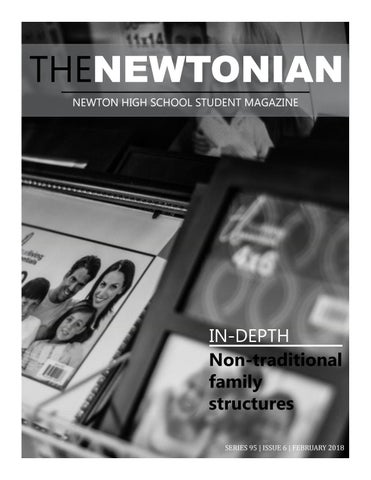
THENEWTONIAN NEWTON HIGH SCHOOL STUDENT MAGAZINE
IN-DEPTH Non-traditional family structures SERIES 95 | ISSUE 6 | FEBRUARY 2018
TABLE OF CONTENTS NEWS
FEATURES
District substitute shortage 3 Student athlete drug testing 4 Ochoa’s classroom layout 4 AP enrollment drops at semester 5 Increase in security cameras 5
Semester graduates 10 Social media friendships 11 RaileRobotics regional victory 11
OPINIONS H&M advertisement debate 6 “I, Tonya” message controversial 6 Guest column: AP courses 7 Guest column: student section 7
Student critiques movies 12
IN-DEPTH
Wrestling: cutting weight
Family structure
8-9
Cover photo by Gracie Hammond
SPORTS 13
ARTS & CULTURE Conspiracy theories 15 Hummingbird’s clothing sales 15
STAFF INFORMATION Editor-in-Chief Lauren Mitchell Asst. Editor-in Chief Online Editor Payton Fenwick Content Editor Photo Editor Gracie Hammond
News Editor Sports Feature Editor Faye Smith Features Editor Erica Beebe Opinions Editor Macy Rice Online Sports Manager Ben Crump
Graphics Manager Asst. Arts & Culture Editor Caroline Barger Asst. Features Editor Addie Lindenmeyer Asst. Opinions Editor Ellen Garrett Arts & Culture Editor Kaete Schmidt
Letters to the Editor The Newtonian may accept letters to the editor and guest columns from students, faculty, administrators, community residents and the general public. Submissions should be 300 words or less and contain the author’s name, address and signature. All submissions will be verified. The Newtonian editorial board reserves the right to withhold a letter, column or other submission and/or return it for revision if it contains unprotected speech or grammatical errors that could hamper its meaning. Letters to the editor and guest columns can be given to the editor-inchief or adviser, delivered to room 1-113 or be e-mailed to nhsrailernews@ gmail.com. The deadline for publication in the next issue is 2/10/18 to allow sufficient time for verification of authorship prior to publication.
2 | STAFF | FEBRUARY 2018
@RailerNews
Reporter Meya Green Reporter Emma Pulaski Reporter Taylor Tasaka Adviser Robin Montano
District experiences substitute shortage Teachers sacrifice plan periods to fill positions
Emma Pulaski Reporter
F
or students, reporting an absence means calling in and making up work when you get back. The task for teachers, however, can be more of a process. It includes logging onto a program where they record the date, time and reason for their absence, making a lesson plan and for most teachers now, hoping there is a substitute available to fill in for them. With the shortage of substitutes working in the district, taking an absence as a teacher can be a luck of the draw. Although the shortage of substitute teachers became a rising concern last year, it has been more of an apparent issue starting this year. Director of human resources Jane Nichols believes the low unemployment rate is to blame. Since people already have a job, they no longer take interest in looking to fill the positions as substitutes. “We do have instances where [individual] jobs go unfilled and then what happens is the principal has to determine the best way to fill that teaching position for that day.” Nichols said. The solution that administration has put forward is to look inside the building for help. At times, teachers give up their plan period to fill in for a class that needs a substitute. With the help from teachers, it means that administration does not have to rely on the district substitutes. However, teachers have to make the decision on if their
planning time is worth being sacrificed. “I’m learning to say no and to find somebody else if they can first, because it then leaves me without a plan and depending on where I am in the building, not being able to access my room,” Spanish teacher Cheryl Loeffler said. “We do get compensated but then of course we don’t have a plan time and we’re here after school working for longer hours.” As of right now, there are approximately 110 people employed in the district. Yet the amount of employees who are available to help a certain day does vary, since substitutes sometimes work for other districts as well. The district and administration has put in efforts to advertise the open job positions. Posts have been made on Facebook, advertisements have been put in the Newton Kansan and they have even sent notices to local colleges, looking for graduates that are looking to try to substitute for the semester. Substitutes are reported to be needed on a daily basis and Loeffler stated that it had got to the point in the past where she would have to fill in for teachers at least once a week. With the efforts being put in, there is hope from teachers and staff that the shortage will be restored soon. “I believe it causes a problem because we have teachers’ positions not covered when teachers are out, so then our students are not being taught in the manner that they should be.” Nichols said
Process of finding a substitute teacher
1. Record Absence online 2. Write lesson plans 3. Substitute teacher position is filled for the day What if the position can not be filled?
Most teachers will give up their own lesson plan time to sub for a class How can the district fix the problem?
USD 373 has made advertisements for substitute teaching positions on Facebook and in the Newton Kansan NEWS
| FEBRUARY 2018 | 3
District explores Spanish teacher removes desks, redesigns classroom drug testing may seem like it would make class for 2018-19 work harder to do without flat desk space, but Ochoa believes that the extracurricular flexible learning environment still ue to some students feeling D trapped or uncomfortable while allows her students to do classwork as successfully as they had before. sitting in desks for seven hours at activities “They can sit on the floor and do school, Spanish teacher Chandler Ellen Garrett Asst. Opinions Editor
Faye Smith News Editor
A
fter the Jan. 17 arrests of 11 Newton high school students and graduates, the possibility of implementing student-athlete drug testing arose. The school is in the initial stages of exploring how to conduct random drug testing and collecting information from several different school districts, including El Dorado and Topeka-Seaman. Athletic director Brian Becker believes that this will have a positive impact on battling drug usage in future years. “Well the pros would definitely be that this is a deterrent to engage in illegal activity. It hopefully is also a pro to give students a legitimate out, if others want them to engage in things that would show up on a drug test,” Becker said. “They don’t want to but the peer pressure is there. Our desire to implement a program like this is not necessarily to catch kids red handed, but to be a deterrent.” The school has formed a committee to explore other districts’ policies and protocol for drug testing all students involved with all extracurricular activities. Once the committee begins to meet, financial and policy planning will be polished before sent to the board of education in early summer. Head football coach Chris Jaax believes the random drug testing will help influence others to abstain from any illegal activity and will benefit Newton athletics. “I think it will create positive peer pressure. I think what it will do is the guys are going to recognize that anybody that is going to pressure their teammates into doing something like that or teammates to pressure each other into doing that, it’s going to have a negative consequence for the team. They know if anybody gets caught making that decision, they’re going to hurt the team. You can’t avoid it.” Jaax said.
4 | NEWS | FEBRUARY 2018
Ochoa removed the desks from her classroom. Ochoa said opting for chairs and creating a more flexible learning environment was a necessary change not only for her teaching style, but for her students’ comfort. Ochoa had the concept to switch from desks to chairs from other Spanish teachers that she follows online. The main reasoning behind the switch was the way that desks impacted her room and teaching. “I was always having to arrange desks, and push desks out of the way or do things around desks, a lot of times I would just take kids out into the hall because with my bigger classes, we just wouldn’t have room in here with the desks,” Ochoa said. Ochoa took the chairs from a hallway near the language department, where they were waiting to be used by whoever needed them. After playing with the idea of making a more flexible learning environment, finding the chairs in the hallway made Ochoa realize that it was the perfect time to change her classroom. “They were the exact amount of chairs that I needed, literally I took them all. It was kind of a sign that this is the time to do it,” Ochoa said. Ochoa did have to have the desk removal approved by administration. She had a meeting with principal Lisa Moore to make sure that the change could be made successfully. “She had some questions just to make sure I had thought everything out before I totally got rid of all of them,” Ochoa said. Substituting chairs for desks
stuff, they can do work on chairs, I just really wanted a more flexible space to allow them more options and have it be more comfortable,” Ochoa said. However, some students view the change from an opposite perspective. “I think it’s really awful because we don’t have desks. It’s really hard to do schoolwork because we don’t have desks to write on,” sophomore Annika Senn said. Ochoa believes that sudden change is to blame for some students’ views on not having desks. “Some students are like ‘Are we really not going to have desks anymore?’ Because I just think that change in general is hard, especially because they’re in desks in all their other classes. For some I think it’s a nice change to come to,” Ochoa said. As soon as she made the change, Ochoa said she could already see a difference in the way her classroom felt. “We can play a game and use the whole classroom, we don’t have to be up front. The room feels twice as big, because you don’t have these clunky things in your way,” Ochoa said. The new arrangement also makes discipline and addressing students easier because of the open space. “I’m also closer to them. I can easily walk through the aisles and see how everybody’s doing, and I feel like I can be more one-on-one if I need to be with students. It’s easier for me to get to students, not having to maize through desks,” Ochoa said.
AP enrollment plummets at semester Students relieve workload, satisfy credit requirements Taylor Tasaka Reporter
A
t beginning of the first semester, 302 students were enrolled in an AP class. After winter break, the number dropped to 259 for second semester. Some students chose to alter their schedule with classes that better fit their career choice, others dropped classes to relieve their workload, or some simply dropped classes because better oppor-
tunities surfaced. Senior Ryan Hirsh has spent his high school career challenging himself with honors/AP courses. His sophomore year, Hirsh enrolled in Honors World History before continuing onto AP US History and American Government. This path allowed Hirsh to be able to complete the credits required to graduate. Once the credit was complete, Hirsh discovered an alternative by taking a Hutchinson Community
College Psychology class. “I didn’t originally plan on dropping AP US History. I took the class to continue the honors route I had originally started but I saw another opportunity. I talked to some of my college counselors and they recommend getting it out of the way and getting ahead of the game,” Hirsh said. Often times, AP teachers will see a dip in their student rosters with the beginning of second semester. Within the 2017-18 school year, on aver-
age each AP teacher noticed an average of 8.6 students dropping a class they teach. AP US History and Economics teacher, Mark George was a teacher who witnessed the drop first handedly. “Some dropped to enroll in college psychology, some dropped because they fulfilled their credit responsibilities for social sciences, some didn’t enjoy the class, some were not taking the AP exam, and some wanted to take an elective that they thought was interesting,” George said.
Administration increases security measures Emma Pulaski Reporter
S
tudent and staff safety is reported to be a large concern at this school and steps are taken each day to ensure well-being. Security cameras are one of the tools that the school uses to maintain a safe and fair environment. To increase student safety, administration recently installed twelve new cameras. With a total of approximately forty cameras throughout the buildings and in the parking lot, administration is able to monitor almost everything that happens on school grounds. Cameras provide a way to look deeper into disciplinary actions and safety violations to help maintain the fairest outcomes for all situations. “Our goal is to basically have it to where the areas of the building, not only here, but out in the exterior buildings are all covered,” district technology assistant Brenda Barger said. “Out in VoAg and Brooks, there are a lot of situations where people can get hurt and if there’s no cameras we can’t determine what exactly happened.” The desire for more cameras has been around for a few years now, but since it can be an expensive and time-
consuming activity, installing said cameras is still an ongoing process. According to Barger, an indoor camera can be anywhere from $300 to $500 and an outdoor camera costs between $500 to $1000. Aside from the price, there also needs to be enough storage on computers to hold the video’s recordings and an adequate location on where to set up the camera. Ultimately, employees have found that the best way to install new cameras was to do it in shifts, which is a strategy they have been carrying out since 2016. “Since the cameras record, you have to have so much storage on our servers that allow us to view things that happened,” Barger said. “The decision as far as how many to install and where to install comes from administration. How we [district technology assistants] are involved is when they ask for more cameras, we look at how much storage we have to cover the amount of cameras they want and location wise as to if we can physically do it.” With the substantial amount of students attending school and the large buildings they are in, administration needs to be able to prevent or control any dangerous situations before they
get too out of hand. With the help of cameras, they can do just that. “We will be able to see more of what’s going on,” director of technology Brenda Thompson said. “Of course you can’t get every nook and cranny but it gives a better view of what’s happening.”
12 new cameras added around the NHS campus NEWS
| FEBRUARY 2018 | 5
H&M advertisement aftermath harmful Critical South African job opportunities removed Macy Rice Opinions Editor
R
ecently, the Swedish company H&M created controversy which flooded the news feeds of every major news outlet and social media site when it advertised a sweatshirt with the phrase “Coolest monkey in the jungle” printed across it on a five-year-old African American model. The brand’s distasteful choice of marketing incited an uproar of radical opposition parties who vandalized many of the South African stores. The H&M chain made the decision to close the South African stores to ensure the safety of staff and customers. The individuals at the worst end of this controversy are the workers who took on the job in order to make ends meet, and that is in no way fair.
Not only is the aftermath of the invasions being left to workers to clean up, but the workers are currently unemployed in an underdeveloped country with very few decent-paying job opportunities. The average salary in South Africa is R14,154, which is equivalent to $1,174. According to www.thebalance.com, the median wage for workers in America in the fourth quarter of 2016 was $44,148 per year. The wage gap between the U.S. and South Africa is astronomical, and removing jobs from the country certainly is not going to be beneficial. H&M is the second largest global clothing retailer in the world. In 2016, the brand employed approximately 114,586 workers among their 4,553 stores worldwide. According to www. hm.com, 16 of these stores are located in South Africa. That number sounds very small compared to 4,553, but this is due to the fact that H&M just recently expanded to South Africa in 2015. Prior
to the controversy, the brand planned to continue expanding and adding new stores, but now they are contemplating leaving the country entirely. This would mean the loss of benefits such as medical, dental and vision coverage, in addition to the loss of a paycheck for many. Terry Mango, the mother of the model, released a statement following the controversial outbreak, telling critics of H&M to “get over it.” Mango stated that she received online abuse for her comments. It is understandable that the advertisement was offensive to many, however, this does not give freedom to destroy the South African stores, because in the end, this is affecting the workers the most. While the actions of H&M should not be condoned, the shutdown of the South African stores is going to do more harm than good for the workers relying on a steady paycheck to support their families.
Administration limits student section Skylar Botterweck Guest Columnist
A
s
basketball season has progressed, it has become more apparent that the student section has lost its intensity when it comes to hyping up the teams. Of course the point of a student section during games is to create not only a distraction for the opposing team but to hype everyone up by being loud, dressing up for themes and chanting. Due to restrictions from administration, this has become more difficult. It seems like in recent
years the administration has become more strict than they have been in past years. We are now being told we cannot say numbers or names, whether they are on the court or not, and we cannot chant common things like “scoreboard” because it supposedly calls out the other team. Saying things to distract the other team is part of being a student section. At the same point, we as students need to build a trustworthy relationship with administration by avoiding things that are clearly not okay to say, including foul language, racial slurs and words with the intentions of hurting someone. By doing this, we
6 | OPINIONS | FEBRUARY 2018
will make it less likely that administration will restrict us more. When more limitations are put on the student section, it makes it increasingly more difficult for the student section to get involved. In order to be ranked higher in the student section rankings, we must be creative and unique, but that can be hard with so many restrictions. This also weakens us as a
photo by Gracie Hammond
whole and the student section numbers have began to drop because of it. One of our main goals as Do-Crew officers is to be in the top ten, if not top five, of the student section rankings. At the end of the day, we as officers just want to create the type of student section that every team hates and that every student wishes they could be apart of.
“I, Tonya” presents pro-violence message Movie glamorizes attack on Nancy Kerrigan Payton Fenwick Asst. Editor in Chief
V
iolence has been an issue around the world for years. According to The Centers for Disease Control and Prevention and The National Institute of Justice, nearly 25% of women experience at least one physical assault during adulthood. While there have been movements against violence, there will be no change unless all people are committed to the eradication of violence. In light of the reports of violence around the country, the movie industry is producing a new movie that not only acknowledges this violence, but glamorizes it.
“I, Tonya” follows the past of former USA Ice Skating team member Tonya Harding who paid a man to break her opponent’s, Nancy Kerrigan, leg. The film follows Harding through her childhood growing up in the competitive ice skating world and details Harding’s mother as conditioning young Harding into hating her competitors. “I, Tonya” not only contradicts the idea of fighting against physical violence but glamorizes it by placing Harding on a pedestal because of the abuse done to Nancy Kerrigan. The film may be attributing Harding’s violent tendencies to the alleged abuse done to her but this still doesn’t make it okay to pay someone to hurt your opponent’s leg. Tonya Harding should not be accepting applause at the Golden Globes for
being “brave” by telling her story. Instead, we should be applauding Nancy Kerrigan for her bravery and persistence in her time of pain and suffering. Because of Harding, Kerrigan was forced to withdraw from the 1994 U.S. figure skating championship because of a bruised leg. At the Golden Globes, Allison Janney, who plays Tonya Harding’s mother LaVona Golden in “I, Tonya”, won an award for best supporting actress in the film. In her speech she says “I would just like to thank Tonya for sharing her story. What this movie did is tell a story about class in America, tell a story about the disenfranchised, tell the story about a woman who was not embraced for her individuality…” At this point in the award show, other
celebrities and bystanders began to stand and applaud Harding for “sharing her story”. “I, Tonya” is a movie making a woman who used violence to try and get ahead a hero. LuckyChap Entertainment is tarnishing the connotation of physical violence. By producing a movie with this kind of message, they are setting the movement against physical violence back. Outrage would ensue if a studio created a movie that formed Chris Brown as the hero of the abuse done to Rihanna. So how is “I, Tonya” any different? “I, Tonya” is presenting the wrong idea of about violence. Instead of encouraging a movie that presents Harding as a hero, we should be boycotting this film.
Advanced Placement offerings should expand Breadth of rigorous courses essential post high school Erik Brown Guest Columnist
I
t is an unfortunate reality that Newton High School does not always have a positive reputation circulating around the mentioning of its name. A glimmer of light, however, shined down when NHS became the only school in Kansas to be placed on the Advanced Placement
(AP) National Honor Roll for consecutive years. In an Newton Now article interview, Principal Lisa Moore stated that this award “is phenomenal and speaks volumes for us academically,” and while one cannot dispute this claim at face value, it is also seemingly apparent that we are still lacking as a coherent whole in terms of preparation and course availability. In a world in which college admissions and career opportunities are becoming ever-more competitive, a distinct variety
of classes, and a qualified educator pool, is vital at the secondary-education level. Currently, NHS offers six AP classes, only a fraction of the thirty-eight acknowledged by the College Board, including European History, Studio Art Drawing, Japanese Language and Culture, and many more. If the school is truly making a concerted effort to better prepare us for life beyond high school, then the focus should be shifted from attempting to make students take these six classes, to offering more. Adding breadth over depth
OPINIONS
in courses before a college or career setting is vital to truly helping us decide what we would like to pursue, a necessary improvement to ensure post-graduate success. While the accomplishments by our school are nothing short of celebration-worthy, it’s important to understand that giant strides of progress can still be made. Every student at NHS deserves the opportunity to excel once we receive our diploma, and this progress needs to continue in order for that to occur.
| FEBRUARY 2018 | 7
describe ‘nonAll in the family: students traditional’ family structures According to a schoolwide survey, only 49.7 percent of students reported having a ‘traditional’ family structure: two married parents and biological children who live together. The remaining students described a transition away from the dictionary definition of family, including having divorced parents, single parent households, adoptive or combined families, or living independently. “The social norms have broadened to meet the times as they are changing to become more accepting of love of all kinds. Traditional doesn’t have to be quote on quote ‘traditional’ anymore.
You love who you love and that makes a family,” senior Maggie Tyner said. Social science teacher Brian Kennell said that while the unit is influential in determining beliefs and values, support received is more important than overall structure. “The family unit is significant because it is the socializing agent in society... The different structures, as I understand, it doesn’t have to be one particular structure. It is about the support and the consistency that is received in the family unit that can create the nurturing environment for kids to be successful,” Kennell said.
Divorced parents
A
Courtesy photo
30.9 %
of students have divorced or remarried parents *Out of 155 responses
8 | IN-DEPTH | FEBRUARY 2018
ccording to the American Psychological Association, nearly 40 to 50 percent of married couples in America divorce. Senior Khalil Kumar was ten years old when his parents divorced and said it has impacted his life in many ways. “I think it was probably better for my parents individually to get divorced. It has definitely been a life-shaping event, but it’s one you don’t think of and I think it’s that way for a lot of people. I think there’s a lot embedded in divorce and in family structure as a whole that people don’t dig into until they really start evaluating the way they think about things,” Kumar said. “The biggest thing about divorce is probably just learning to live between two
different houses and all of the complexities that come with that, including not leaving your stuff everywhere.” The ‘traditional’ American family is typically described as a married mother and father who co-parent children. Kumar sees this stereotype fading away over time. “I think that the ‘traditional’ American family is on its way out, but not for any deep social reason...” Kumar said. “I think the ‘traditional’ American family isn’t necessarily a good structure, however I would say that having non-traditional family structures can be harmful in some situations. I wouldn’t necessarily say that I would reverse my parent’s divorce, but there are definitely things I would change.”
Single parent family
S
ophomore Kobi Mathies has grown up living with his mom, the only parent in his life, and has seen firsthand the “traditional” family structure transition. Mathies has had the chance to grow closer and form a bond with someone not everyone has the chance to. “I’d say in the past I’ve had a lot of trouble just not having a male figure in the house. I have a really strong relationship with my grandpa which not a lot of people can say that they have. I’ve just had him as kind of a father figure,” Mathies said.
Not only has growing up with a single parent brought Mathies closer to his grandpa, but it also gave him a different kind of respect for his mom and everything she does. “It used to bother me somewhat just because it was just my mom and I didn’t really have a father figure...Lately it doesn’t really bother me as much. It’s just kind of the usual and I respect her a lot because she’s doing as best as she can being a single mom. She’s doing a great job,” Mathies said.
12.9 %
Courtesy photo
of students live in a single parent family *Out of 155 responses
Adoptive family
A
t the age of eight, sophomore Aubrey Lakey joined her forever family when she was adopted from China. “It was really exciting for me, but it was also scary for me too,” Aubrey said. Since then, Aubrey’s family has grown from just her to being part of a family of six. “Now I’m just really
excited I have a family and hope that other kids will get theirs too,” Aubrey said. Along with her parents she has two adult siblings and four school-aged siblings. “We chose, after having two biological children, to grow our family further through adoption. That is probably what makes us conspicuous. But we
also have a large family, and that isn’t so typical these days,” mother Tami Lakey said. The family can be found working together at Norm’s coffee bar. Everyone has a role in keeping Norm’s going, from managing to helping close. “This simply would not work if we did not approach it as a team,” Tami said.
Courtesy photo
1 out of 25 U.S.
families with children have an adopted child
Lives independently
M Courtesy photo
6.5 %
of students live with someone other than their parents *Out of 155 responses
any students may find themselves wishing that they lived without parents and had more freedom. For senior Allison Reiner, this lifestyle is a reality. Reiner lives with her boyfriend part of the time and with her grandparents for the rest. Reiner began living alone when her mom and two siblings moved 13 hours away for a job.
“Now it’s a lot different because it’s kind of me on my own and [my mom is] really separate. I grew up and she was like my best friend and so that’s definitely changed a lot and it’s been different with like changes in power,” Reiner said. Despite having more responsibility and working more hours at her job, Reiner’s grades have improved.
IN-DEPTH
*www.adoptionnetwork.com
“It’s pretty nice. I’ve got study time, work time, and all that other stuff that I can do but it’s also a con because you know I’m working all these hours and it goes straight to bills,” Reiner said. “If somebody were thinking of living on their own, I definitely would recommend a roommate or somebody you trust that is dependable and can help take care of bills.”
| FEBRUARY 2018 | 9
Seniors graduate early, pursue dreams Gracie Hammond Content Editor
Students that decide to graduate early are still required to have the same amount of credits as a typical or most students, high graduating senior. This often school is a four-year requires taking multiple journey starting on their classes of the same subject first day of freshman year and/or taking classes outside in August and ending on the last day of senior year in May. of normal class hours. “Graduating early has However, some opt to cut been a part of my plan since their high school experience freshman year but didn’t short and begin the next really feel real until I finished chapter of their lives early. my English course over the Students’ reasons for summer, through the Essdack graduating early vary, but Learning Center,” semester they all have a new beginning graduate Acacia Petrie said. ahead of them. Petrie is currently “I decided to graduate pursuing CNA certification early so I could age out of the and plans to later become an foster care program,” Linzee RN. McGruder said. ”I stay She motivated had because been it’s in the something system I’ve since early always 2016. wanted so If she I had time wanted -senior Acacia Petrie to think to leave about foster care what I on her really wanted to be and have own she either had to wait time to save. I knew it would until she turned 18 or until all be worth it in the end,” she received a diploma or Petrie said. GED. According to a statistic by Another recent graduate USA Today, only three percent was eager to break a pattern of high school students and become one of the few graduate early. Though going graduates in her family. through all four years is the “I was determined to do current norm at Newton High it,” Tanisha Kunkel said. and nationally, some believe To her, graduating a more students could benefit semester early made the from graduating early. most sense, and she was “I don’t necessarily think ready to move on. that the traditional four“You’ve been there for year path is for everyone. three years, like it’s time to I personally know a lot of go, you have to realize that people who struggle to come eventually it will all be gone.” to school everyday, and I feel Kunkel said. like a shorter high school Both McGruder and experience might cut down Kunkel are pursuing degrees on the level of truancy,” at Hutchinson Community McGruder said. College.
F
“
It’s something I’ve always wanted...I knew it would all be worth it in the end.
10 | FEATURES | FEBRUARY 2018
“
Students make friendships over Internet Addie Lindenmeyer Asst. Features Editor
A
ccording to pewinternet. com, 57 percent of all teens have made friends online. Sophomore Aryanna Rossiter and junior Tahlia Frary have both made close friends through social networking apps such as Snapchat and Twitter. Through these friendships, Frary and Rossiter have learned more about themselves as well as the world around them. “I’ve learned not to automatically assume something is weird just because it isn’t normal to me,” Rossiter said. “I have also learned that just because you are miles apart, doesn’t mean you can’t connect. I’ve met so many people that
share interests with me, it’s amazing to feel connected even though you haven’t met face-to-face.” Meeting through singer songwriter Lauren Sanderson on Twitter, Frary and her online acquaintance had been communicating for a whole year before meeting. Frary’s first face-to-face interaction with her internet friend occurred on a family vacation to Florida. It was a short lived experience as the two had not initially planned on meeting, but they filled their time with the beach and going out to eat. “Before I met her I was very nervous because we’d never met in person and it’s not something normal to do,” Frary said. “After meeting her it was very hard to leave because you want to be with
that person everyday, but you don’t get that chance because you live so far away.” Despite the prospect of gaining a new companion, Rossiter said it can be scary trusting someone that you have never met. “I was skeptical to trust people online, but not everyone is bad. It’s kind of like a leap of faith. I’m glad I started trusting people because if I didn’t then I wouldn’t have the friends I have today,” Rossiter said. While meeting online friends does not come without its downfalls, Frary has still enjoyed making a close friend and will continue to plan visits with her. Rossiter also finds joy in starting fresh with people from around the country. “Getting to know people
without them growing up with me is a relief. I’m not a bad person, but the fact that I can have a clean slate every time I meet someone is refreshing,” Rossiter said. “It’s amazing to learn new things about people and just create friendships around the world.” Unlike Frary, Rossiter still has yet to meet any of her online acquaintances but communicates with them often. “I’ve talked to many of my online friends and we always say that ‘someday we will meet up and it will be amazing’,” Rossiter said. “It’s hard having such a close connection with these people and not getting to see them, but we’re still young and maybe one day we will meet up.”
RaileRobotics team builds winning robot Potluri organizes team in collaborative structure
Meya Green Reporter
A
certain group of students spend their free time designing and building a robot that they will bring to competitions throughout a six week period. For the first time in six years, the RaileRobotics team claimed a regional victory. “We are a part of FRC which is First Robotics Competition. Every year they release game for us to compete in and we have strictly six weeks to build a robot to compete in that game and that is when we go to competitions and compete against other robots,” sophomore head of the design team Gretchen Otter said. The RaileRobotics
team works on weekdays, weekends and teacher work days in order to create this robot. “Those six weeks are a crazy time commitment, but that is what we have to do to get it done,” Otter said. The team is organized in a way so that everyone on the team has a role in creating the finished robot. “We have a captain, a project administrator and then we have four different subgroups. Those subgroups consist of the design team, who are the engineers. We have the controls team, who does programming and electronics. We have the machining team who machines parts for the team. We also have a team called M.A.C, they do media and communications,” senior
The RaileRobotics team moves their robot into place before its demonstration. Photo by Gretchen Otter
RaileRobotics captain Colin Potluri said. Potluri and Otter make practice a way for everyone to participate no matter their position. “Gretchen and I try our hardest to encourage people to share their ideas, be
FEATURES
present on the team, and still have a good time. Robotics is all about STEM education and them knowing the benefits of engineering and the process and how that could make them successful in the future,” Potluri said.
| FEBRUARY 2018 | 11
Arambaru critiques for Rotten Tomatoes Ben Crump Online Sports Manager
W
hen it comes to the bright lights of cinematography, there is much more than the actors who bring ideas to life on the big screen. Behind the scenes, the director gives a guiding voice to the actors while movie critics, like junior Marco Aramburu, pour over every line of a scene and scrutinize all aspects of a film. Aramburu voices his opinion in many different places. “I review online. I have an account on Rotten Tomatoes. Whenever I get on there I just give my opinion of the film and I also talk to my friends about it,” Aramburu said. Along with writing and reviewing movies online, he prefers many older critics. His all-time favorites are two classic critics. “[My favorites are] the most iconic ones: Roger Ebert and Gene Siskel. Those are the most influential ones to me. Nowadays most people are set in their ways on what the movies are going to be like before they even watch it, so I don’t like a lot of that,” Aramburu said. Aramburu’s reviews might currently be a hobby, but he hopes that one day it will lead to bigger things. “I do want to be a film director. Since I was a kid, I thought since I watched movies, this is something that I want to do. That’s why I started watching movies and reviewing them, just so I could get out my opinion,” Aramburu
said. Being invested in movies has been a big part of Aramburu’s life since he started grade school. “My uncle got me into Star Wars films and I went on to watch classics like Citizens Kane and Lawrence of Arabia,” Aramburu said. While many students absorb cinema either online or at the theaters, Aramburu believes theaters provide the best viewing. “If you want an authentic movie experience you go to the theater. Watching it on your own small TV is not the same as the huge IMAX screen,” Aramburu said. While many movie watchers hope to see a good movie at the theaters, Aramburu sometimes hope for the opposite. “A good review is really bland. You just say that the director was great, the acting was great, cinematography was great. Bad reviews are way more fun to do because you get into the complete scenes and how everything about a character was horrible,” Aramburu said. No matter how exceptional the film, Aramburu says a critic has to have a passion for their work. “You just have to like film and it’s your opinion on what it is. Sometimes people are going to disagree and sometimes they’re going to agree but it’s nothing. You just get on and talk to other people about what you like,” Aramburu said.
12 | FEATURES | FEBRUARY 2018
Film critiques
2001: A Space Odyssey
W
hat happens when the greatest director of all time makes his masterpiece. It’s called 2001: A Space Odyssey. This film was released almost 50 years ago and it still stands as one of the greatest films ever made. As Roger Ebert said about 2001, “Alone among science-fiction movies, ‘2001’ is not concerned with
The Room
I
can’t really say this is a bad viewing experience. This movie showed me that, “Yeah, it’s not a masterpiece in the general term of what you would classify as masterpiece, but it is entertaining.” This film takes everything you learn as a filmstudent and tosses it straight out the window into a pool of lava. The screen writing is awful, the
thrilling us, but with inspiring our awe.” This is the most influential science-fiction film of all time. It gives you an experience that is so unique that no other film might ever be about to top it. The visual effects still stand up so well that it is astonishing... see the rest at https:// www.rottentomatoes.com/ user/id/977066166/ cinematography is awful, and the acting is awful too. While watching, it gives you the feeling that you know Tommy Wiseau wanted to make it a serious scene but it come off as hysterical. It’s just so hard to watch without laughing the whole time... see the rest at https://www. rottentomatoes.com/user/ id/977066166/
Drs. McKinney & Simmonds Doctors of Optometry msseyecare.com
Complete Family Eye Care
Ocular Disease Diagnosis and Managment • Pediatric Eye Care Fashion Optical Dispensary • Contact Lens Care Dr. Rick H. McKinney • Dr. Ryan D. Simmonds 216 Meridian • Newton • 283-1310 Mon, Tues, Thurs, Fri, 8:30am – 5:00pm • Wednesday, 8:00am – Noon
Wrestlers use strict diets to cut weight Erica Beebe Features Editor
W
restlers have to do more than just training in order to perform at their very best. This sport is unique in the fact that players have to make a certain weight. Wrestling coach and physical education teacher Tommy Edgmon explains the difficulties in “cutting” or losing weight. “[The difficulty of cutting weight] depends on the wrestlers’ body fat and how
much weight he has to lose. It also depends on the time period you have to lose it in. If you have a week to lose five pounds, that’s pretty reasonable. If you have a day to lose five pounds, that might be a little hard,” Edgmon said. In order to lose the weight, wrestlers have to get in at least two workouts a day to lose more calories than they consume. This might sound like a difficult task, but the consequences of not making weight are
What is your motivation to cut weight?
sometimes worse. “If you do not make weight you just scratch and you don’t wrestle, and that weight class is open. If we have another wrestler that can fill that weight, then we’ll move kids around to fill that weight. Even if you wrestle 120 pounds, 120.1 is overweight, and you don’t wrestle,” Edgmon said. While Edgmon works to motivate his wrestlers, it is the wrestlers’ decision on whether they will work to make weight.
On average, how much do you usually cut weight? 10.5%
%
5.3
%
“Placing third last year pushed me to want to place first this year.”
%
5.3
5.3
Senior Cyle Gautschi
10.5%
21.1% Junior Wyatt Hendrickson “It’s just good to know that you’ve completed your goal of getting up there in placing. It’s very delightful and you know you’re going to look forward to that as wrestlers to being one of the best.”
“If you say you’re going to make a certain weight, then I expect them to do that. I let them pick what weight they need to make, but at the same time I may tell them where I’d like them to be based on how much they weigh and where the team is falling. If they need guidance as far as workout plans and food regiments, I do recommend that as well,” Edgmon said.
42.1%
1-3 lbs. 4-6 lbs. 7-9 lbs. 10-12 lbs. Depends 13-20 lbs. None
*20 surveyed from wrestling team
Sophomore Josh Edson
10,597 schools in the
“I do it for the team, if I don’t make weight then that weight is just open and it doesn’t help the team.”
are
Freshman Gaige Llamas “Just doing good at tournaments and wanting to do better. If I can get down to the weight I want to be at then I know I can do better.
U.S. participate in wrestling. Out of those schools, there
258,208 participants. Wrestling is the 6th most popular sport at high school level. *Source: auburntakedown.com SPORTS
| FEBRUARY 2018 | 13
• Complete Overhaul • Service & Repair • Foreign & Domestic • Quality Work at Affordable Prices
SHOP:
620-654-3445
Galva, KS - 2 Miles South & 1/4 Mile West of Galva www.nightingaletransmissions.com
Mark Boston Mark Boston Insurance Agency
614 N. Main St. • Newton, Ks 67114 Bus: 316-283-0021 mboston@farmersagent.com
Hair Cutting Co.
283-0532
6th & Main • Newton Open Mon-Sat
25 off %
ANY CUSTOM FRAMING PROJECT
great for senior photos
C
CHISHOLM TRAIL SHOPPING CENTER Newton, KS I 316.804.4860 rivermillwoods.com I Tues-Sat 10-5
14 | ADS | FEBRUARY 2018
South Park Apartments
n CLOSE TO SHOPPING n WATER/TRASH PAID n PET FRIENDLY APARTMENTS & TOWNHOMES
1501 OLD MAIN n 316-283-0999
Hummingbird resells streetwear, earns profit Ellen Garrett Asst. Opinion Editor
W
hile most high schoolers have jobs at fast food restaurants or bending sheet metal, sophomore Fletcher Hummingbird works from his computer. He sells streetwear, a style of clothing derived from Californian surf and skate culture, and shoes on Facebook. The job started about two years ago when he began to sell shoes that no longer fit him online. He sells shoes from a selection of popular brands. “[I sell] Jordans, limited edition Nike shoes, or Supreme collaborations on shoes,” Hummingbird said. The idea of selling clothes and shoes online began when Hummingbird started to grow out of his older clothes and turned to Facebook groups to get his items out to large amounts of people.
After he stopped growing out of things, he still continued to buy and sell clothing and shoes. “I wanted new things so I had to let go of things I had bought in the past,” Hummingbird said. Over the past two years, the business has really taken off, Hummingbird’s profits have more than outweighed the costs. “I’ve made probably about $1500 over the past two years,” Hummingbird said. Hummingbird typically sells items for around $200, but has sold items for up to $600. Clothes sold by streetwear brands such as Supreme, Anti Social Social Club, Nike and Yeezy, are priced much higher than average brands. “The main reason for [branded items being expensive] is that it’s just so limited and it is expensive, and it is a status symbol. It designates class,” Hummingbird said.
$1,000
invested in items to sell
20
items sold
Students justify belief in conspiracy theories
Junior Chase Cassil
Junior Jake Rostetter
“I believe that we have found other forms of life and that the government is hiding it. I feel like the government is really shady and they have a big place where nobody knows what is going on. So, it just breeds there to be a discussion about what if and what could be there.”
“I believe that Bush did 9/11 and that JFK was not truly assassinated by who was convicted [Lee Harvey Oswald]. I first started believing this when I first learned of them probably about freshman year. Jet fuel can’t melt steel beams.”
Senior Ivy Smith
Senior Kenton Fox
“I believe there are different multiverses, the moon landing was fake, and the government assassinated JFK. I just think the government is really manipulative and I don’t think they tell everyone the full truth. I feel like they will try to hide stuff from us if they can.”
“I believe there is suppression of different drugs and innovations in the pharmaceutical industry that are potentially life saving. There is more of an opportunity for profit when people are not healthy. Also, aliens. The wow signal is something that happened a while ago where we saw and interpreted a seemingly intelligent signal and never been able to find it again. I think the government is pretty sleazy and they just don’t tell us a lot of stuff.”
ARTS & CULTURE
| FEBRUARY 2018 | 15
NHS LETTER JACKETS AND SPORTS PATCHES ANDERSON OFFICE SUPPLY MAIN & BROADWAY • NEWTON • 283-3570
SHOW YOUR SCHOOL ID AT GURTY’S BURGERS & SHAKES
at lunch and get a SINGLE COMBO BURGER MEAL for
5 BUCKS!
214 East 12th Street I Across from North Dillons
16 | ADS | FEBRUARY 2017
Back to School Special Cosmic Bowling ONLY $6!
d Owne Family ated r e p &O ! Years for 28
1610 E. 2nd. Newton • 283-0430